FM 3-21.10 (FM 7-10) The Infantry Rifle Company (July 2006) - page 3
Chapter 2
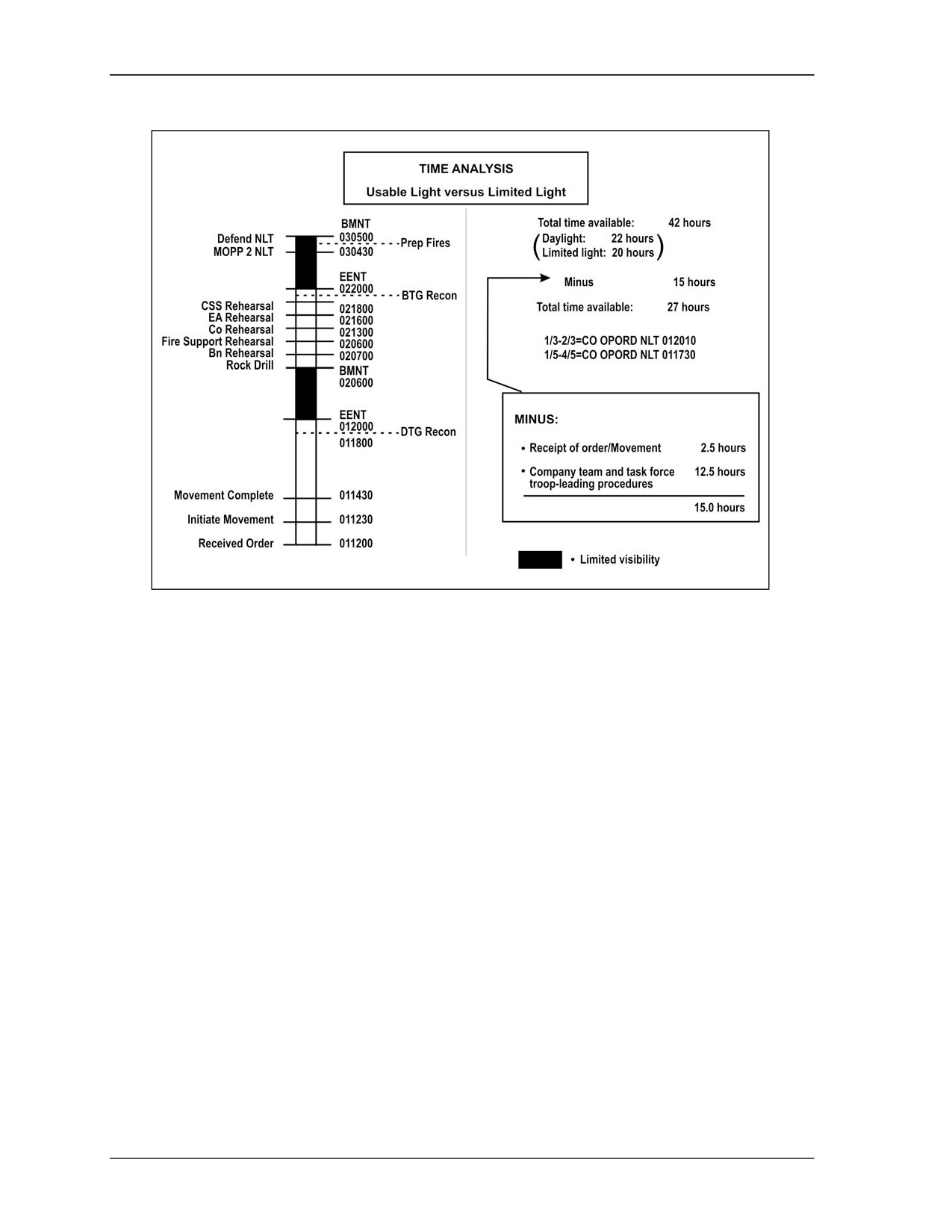
Figure 2-17. Example company timeline.
Analysis of Civil Considerations
2-102. Civil considerations include the influences of man-made infrastructure; civilian institutions; and
the attitudes and activities of civilian leaders, populations, and organizations within an AO, with regard to
the conduct of military operations. Civil considerations generally focus on the immediate impact of
civilians on operations in progress. Civil considerations of the environment can either help or hinder
friendly or enemy forces; the difference lies in which leader has taken time to learn the situation and its
possible effects on the operation. Analysis of civil considerations answers three critical questions:
y How do civilian considerations affect the operation?
y How does the operation affect the civilians?
y How do our forces build national will in our AO?
2-103. The higher headquarters provides the leader with civil considerations that may affect the next
echelon’s mission. The memory aid the higher headquarters may use to analyze and describe these civil
considerations is ASCOPE (Appendix B, FM 6-0).
Population Perceptions
2-104. The population within a prescribed AO comprises several different groups, both ethnically and
politically. Leaders must understand each group’s perceptions about the United States, the Army, and the
specific unit operating within that area. Population status overlays can best describe groups and define
what feelings that group has toward American forces. This is extremely important in understanding when
and where to commit combat power, what relationships can be reinforced with certain groups versus what
relationships need to start or cease, and ultimately what second and third order effects our actions will have
2-38
FM 3-21.10
27 July 2006
Troop-Leading Procedures
in the AO. Information operations can also be properly focused with a healthy understanding of the
perceptions of the civilian population.
2-105. This characteristic addresses terrain analysis from a civilian perspective. Analyze how key civilian
areas affect the missions of respective forces and how military operations affect these areas. Factors to
consider include political boundaries, locations of government centers, by-type enclaves, special regions
such as mining or agricultural, trade routes, and possible settlement sites.
Structures
2-106. Structures include traditional high-payoff targets, protected cultural sites, and facilities with
practical applications. The analysis is a comparison how a structure’s location, functions, and capabilities
can support operations as compared to costs and consequences of such use.
Capabilities
2-107. Assess capabilities in terms of those required to save, sustain, or enhance life, in that order.
Capabilities can refer to the ability of local authorities to provide key functions and services. These can
include areas needed after combat operations and contracted resources and services.
Organizations
2-108. Consider all nonmilitary groups or institutions in the AO. These may be indigenous, come from a
third country or US agencies. They influence and interact with the populace, force, and each other. Current
activities, capabilities, and limitations are some of the information necessary to build situational
understanding. This becomes often a union of resources and specialized capabilities.
People
2-109. People is a general term describing all nonmilitary personnel that military forces encounter in the
AO. This includes those personnel outside the AO whose actions, opinions, or political influence can affect
the mission. Identify the key communicators and the formal and informal processes used to influence
people. In addition, consider how historical, cultural, and social factors that shape public perceptions
beliefs, goals, and expectations.
Events
2-110. Events are routine, cyclical, planned, or spontaneous activities that significantly affect
organizations, people, and military operations, such as seasons, festivals, holidays, funerals, political
rallies, and agricultural crop/livestock and market cycles and paydays. Other events, such as disasters and
those precipitated by military forces, stress and affect the attitudes and activities of the populace and
include a moral responsibility to protect displaced civilians. Template events and analyze them for their
political, economic, psychological, environmental, and legal implications.
2-111. The leader must also identify any civil consideration that may affect only his mission. Civil
considerations are important when conducting operations against terrorist or insurgent forces in urban
areas. Most terrorists and insurgents depend on the support or neutrality of the civilian population to
camouflage them. Leaders must understand the impact of their actions--as well as their subordinate’s
actions--on the civilian population, and the effect they will have on current and future operations.
Considerations may include--
Ethnic Dynamics
2-112. Ethnic dynamics include religion, cultural mores, gender roles, customs, superstitions, and values
that certain ethnic groups hold dear that differ from other groups. Leaders who analyze the ethnic dynamics
of their AO can best apply combat power, shape maneuver with information operations, and ultimately find
27 July 2006
FM 3-21.10
2-39
Chapter 2
the common denominator that all ethnic varieties have in common and focus unit efforts at it. Gaining local
support can best be accomplished by the commander who demonstrates dignity and respect to the civilian
population he is charged to protect and train.
Organizations of Influence
2-113. Organizations of influence force the leader to look beyond preexisting civilian hierarchical
arrangements. By defining organizations within the community, leaders can understand what groups have
power and influence over their own smaller communities and what groups can assist our forces. After these
groups have been defined, analyzing them and determining their contributions or resistance to friendly
operations is easier. Many Eastern cultures rely upon religious organizations as their centers of power and
influence, whereas Western cultures’ power comes from political institutions by elected officials. Defining
other influential organizations or groups of influence allows for effective information collection and
intelligence gathering. For example, the educated persons in an Islamic culture include clerics and teachers.
However, where clerics have power, teachers do not. However, teachers can be very useful in providing
intelligence to US forces because they seek stability and value security for their people over the religious
power arrangements within the area.
Patterns
2-114. Every culture, every group of people, has patterns of behavior. Whether it is set times for prayer,
shopping or commuting, people follow patterns. Understanding these patterns helps leaders plan and
execute combat and reconnaissance patrols and logistical resupply. Also, unit leaders who study the history
of a people's culture can better understand and explain to others how--and why--the people have fought
previous wars and conflicts. Starting with a baseline pattern and then keeping a running estimate on how
the population is responding or have responded in the past under similar circumstances will assist leaders
in using patterns to the unit's advantage.
Leaders and Influencers
2-115. Know who is in charge and who can influence and enable unit leaders to effectively exercise
governance and monitor security within a prescribed area. Many times, the spiritual leader is not
necessarily the decision maker for a community, but the spiritual leader must approve the decision-maker's
actions. Commanders and staff officers who make link-diagrams of leadership that include religious,
political, and criminal personnel allow focused planning and decentralized execution that bolsters
legitimacy within the population. Using the targeting methodology of D3A (decide, detect, deliver, and
assess) may prove useful in determining whether a leader or influencer would best facilitate an operation,
when to engage them, and what to expect.
Economic Environment
2-116. Money and resources drive prosperity and stability. Leaders who identify the economic
production base for their AOs can effectively execute civil-military campaigns within their AOs that
bolster the economic welfare of the people. These campaigns include infrastructure rebuild projects,
creation of labor opportunities, and education. By focusing on the motivations for civilian labor and
creating essential services and prosperity where there was none, unit leaders/commanders can effectively
win the support of the civilian who can now feed and clothe his family and now has clean running water.
This aspect of civil considerations reinforces the security of the community against poverty and other
enablers to instability.
RISK ASSESSMENT
2-117. Risk assessment is the identification and assessment of hazards that allows a leader to implement
measures to control hazards (Appendix A, Risk Management, Fratricide Avoidance, and the Effects of
Continuous Operations). Leaders assess risk to protect the force and aid in mission accomplishment. The
2-40
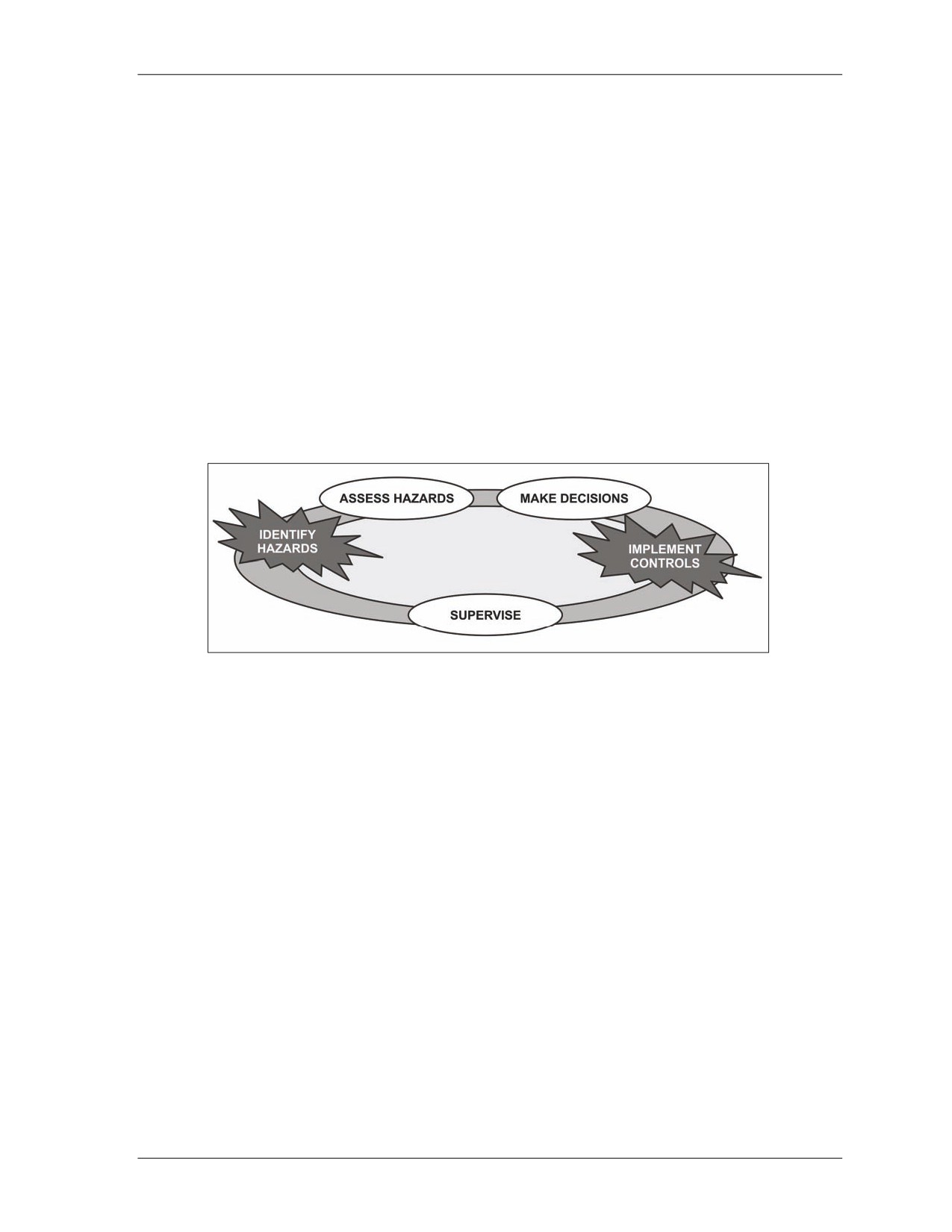
FM 3-21.10
27 July 2006
Troop-Leading Procedures
leader must consider two kinds of risk: tactical and accident. Tactical risk is associated with hazards that
exist due to the enemy's presence on the battlefield. The consequences of tactical risk take two major
forms.
y Enemy action where the leader has accepted risk such as an enemy attack where the friendly
leader has chosen to conduct an economy of force.
y Lost opportunity, such as movement across terrain that severely restricts the speed of traverse.
This would then restrict the unit's ability to mass the effects of combat power.
2-118. Accident risk includes all operational risk other than tactical risk and can include hazards
concerning friendly personnel, equipment readiness, and the environment. Fratricide is an example of an
accident risk.
2-119. The leader must identify risks based on the results of his mission analysis. Once identified, risk
must be reduced through controls. For example, fratricide is a hazard categorized as an accident risk;
surface danger zones (SDZs; see also Appendix A) and risk estimate distances (REDs) are used to identify
the controls, such as target reference points and phase lines, to reduce this accidental risk. When the leader
decides what risks he is willing to accept, he must also decide in his COA how to reduce that risk to an
acceptable level (Figure 2-18).
Figure 2-18. Risk assessment.
IDENTIFY TENTATIVE DECISIVE POINTS
2-120. Identifying a tentative decisive point and verifying it during COA development is the most
important aspect of the TLP. Visualizing a valid decisive point is how the leader determines how to
achieve success and accomplish his purpose. The leader develops his entire COA from the decisive point.
Without determining a valid decisive point, the leader cannot begin to develop a valid or tactically sound
COA. The leader, based on his initial analysis of METT-TC factors, his situational awareness, his vision of
the battlefield, and insight into how such factors can affect the unit's mission, should visualize where,
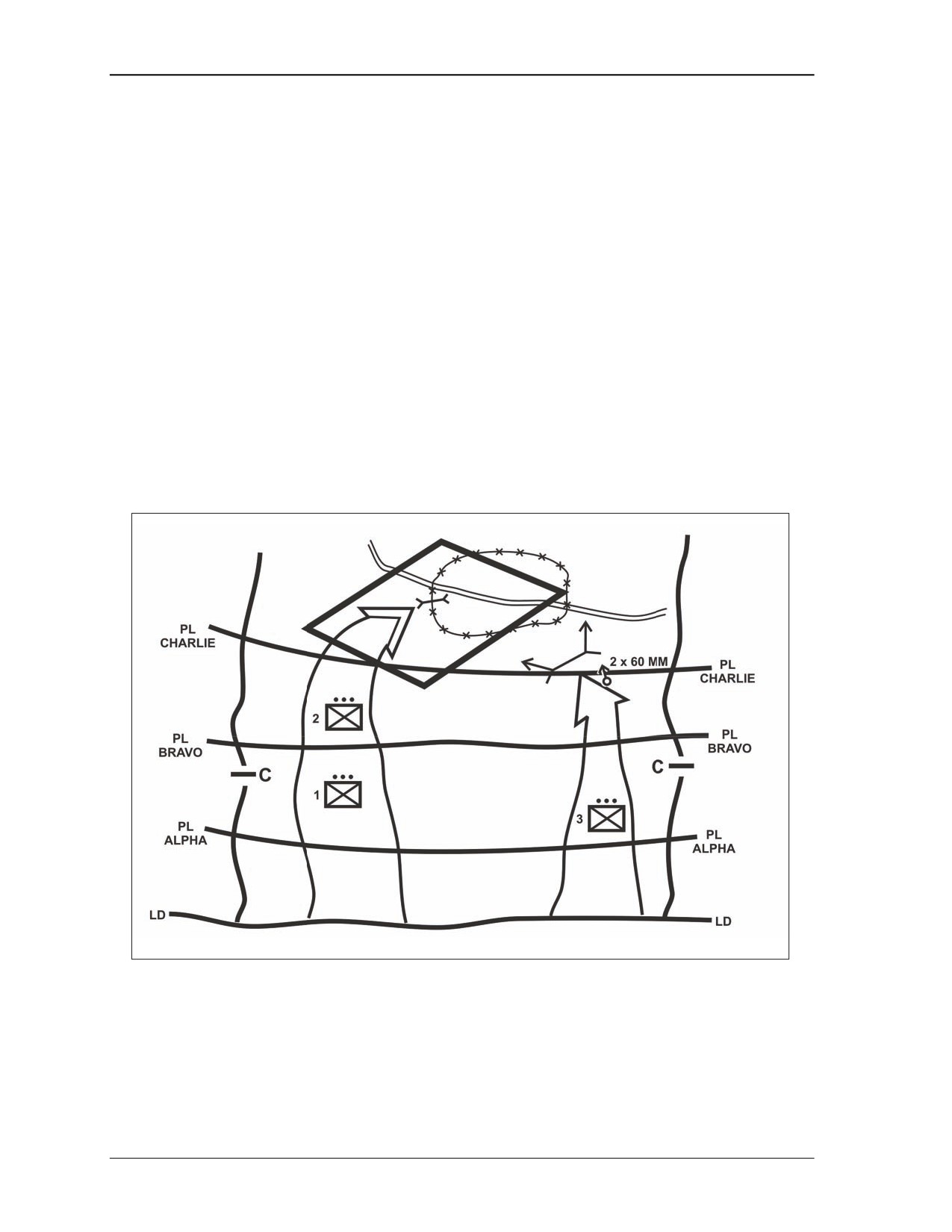
when, and how his unit's ability to generate combat power (firepower, protection, maneuver, leadership,
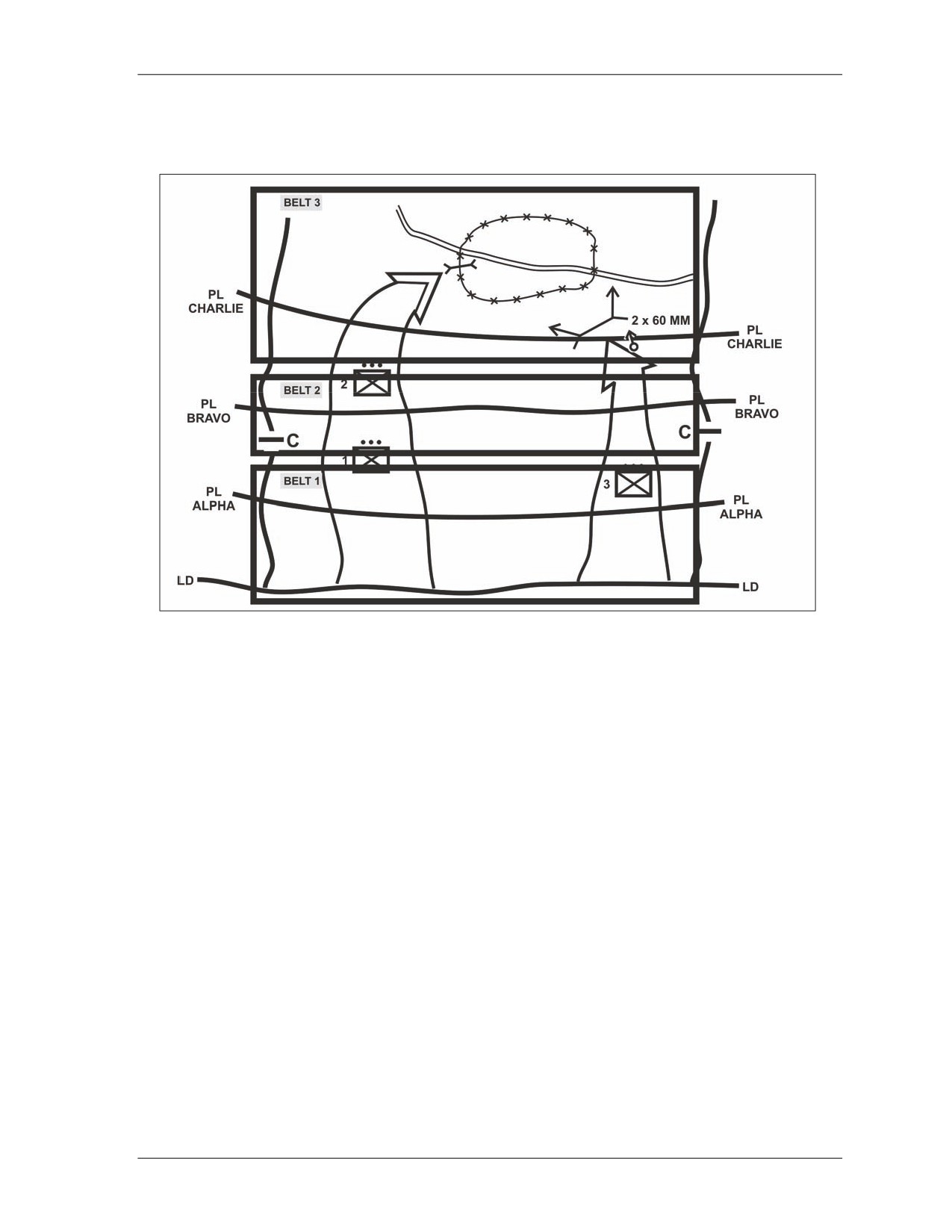
and information) can overwhelm the enemy's abilities to generate combat power. The decisive point might
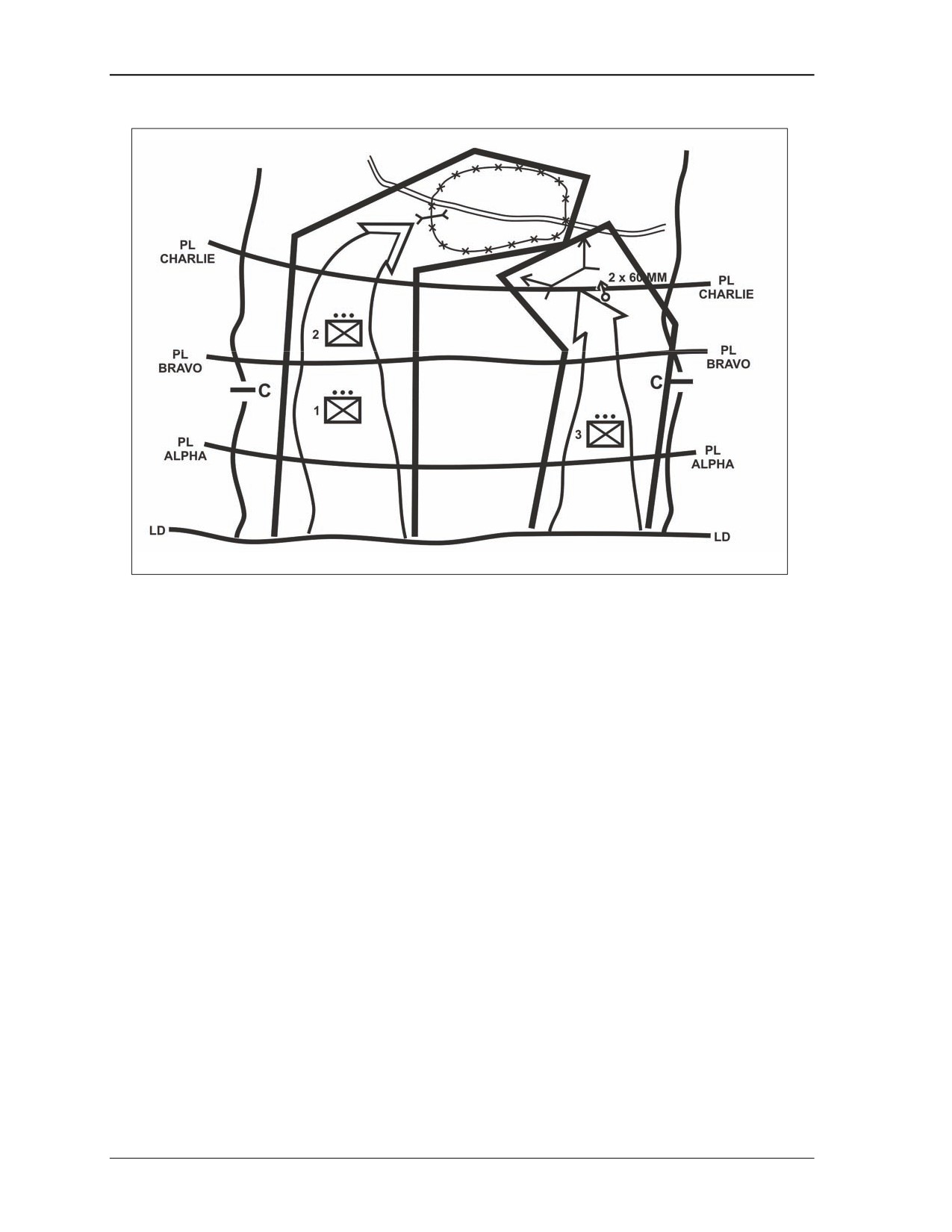
orient on terrain, enemy, time, or a combination of these. The decisive point might be where or how, or
from where, the unit will mass the effects of combat power against the enemy. The decisive point might be
the event or action (with respect to terrain, enemy, or time, and the generation of combat power) that will
ultimately and irreversibly lead to the unit achieving its purpose.
2-121. The decisive point does not simply restate the unit's essential task or purpose; it defines how,
where, or when the unit will accomplish its purpose. The unit's decisive operation always focuses at the
decisive point, and always accomplishes the unit's purpose. Designating a decisive point is critical to the
leader's vision of how he will use combat power to achieve the purpose, how he will task organize his unit
and how his shaping operations will support the decisive operation, and how the decisive operation will
accomplish the unit's purpose. This tentative decisive point forms the basis of his planning and COA
27 July 2006
FM 3-21.10
2-41
Chapter 2
development; it also forms the basis of communicating the COA to his subordinates. The leader should
clearly explain what the decisive point is to his subordinate leaders and why it is decisive; this objective, in
conjunction with his commander's intent, facilitates subordinate initiative. A valid decisive point enables
the leader to clearly and logically link how the application of combat power elements with respect to
terrain, enemy, and time allows the unit to accomplish its purpose. If the leader determines that his
tentative decisive point is not valid during COA development or analysis, then he must determine another
decisive point and restart COA development.
COMMANDER'S INTENT
2-122. The commander's intent is a clear, concise statement of what the force must do to succeed with
respect to the enemy, terrain and desired end state (a set of required conditions that, when achieved, attain
the aims set for the operation). The commander's intent provides the link between the mission and the
CONOP by stating key tasks or conditions that must exist to achieve the stated purpose of the operation.
The commander's intent and mission statements form the bases for subordinates to exercise disciplined
initiative and judgment in the face of new opportunities, or whenever the concept of operation ceases to
apply. The commander's intent continuously evolves throughout the planning and preparation for the
operation as the leader becomes more attuned to what he must do to accomplish his mission.
2-123. The key tasks and conditions specified in the commander's intent are not tied to a specific COA.
They are not limited to tactical tasks. The operation’s tempo, duration, and effect on the enemy, and the
terrain that must be controlled are examples of key tasks or conditions.
2-124. The commander's intent does not include the method by which the force will get from its current
state to the end state. The method is the CONOP. Nor does the intent contain acceptable risk. Risk is
addressed in COAs. The example below shows key tasks and conditions related to enemy, terrain, and
desired end state. The final commander's intent included in the OPORD is based on the sum of all of the
analysis conducted during the TLP. This final intent can only be provided after the leader understands the
end state of the mission. An example of commander's intent follows:
EXAMPLE
Commander's intent expressed as key tasks includes--
• All enemy forces on OBJ Atlanta destroyed.
• Bravo Company defeats enemy counterattacks.
• The company controls the west side of Bush Hill (OBJ BM312), in
position and able to defeat counterattack in EA Red, TF 1-22 IN
(M) passed through CP2.
• Commander's intent expressed as conditions includes--
• Enemy AT weapon systems on or around OBJ Hook should be
unable to affect US vehicles on Route Bud between CPs 5 and 7.
• Alpha Company occupies terrain on or around OBJ Hook,
successfully destroys enemy counterattacks, and prevents the
disruption of US forces on Route Bud between CP 5 and 7.
COURSE OF ACTION DEVELOPMENT
2-125. From developing a strategy to analyzing, refining, and rehearsing the plan, a leader should be
knowledgeable in the following areas detailed under this subheading to construct a solid COA
(Figure 2-18). The purpose of COA development is to determine one or more ways to accomplish the
mission that is consistent with the immediate higher commander's intent. A COA describes how the unit
might generate the effects of overwhelming combat power against the enemy at the decisive point with the
least friendly casualties. Each COA the leader develops must be detailed enough to clearly describe how he
envisions using all of his assets and combat multipliers to achieve the unit's mission-essential task and
2-42
FM 3-21.10
27 July 2006
Troop-Leading Procedures
purpose. To develop a COA, he focuses on the actions the unit must take at the decisive point and works
backward to his start point
(SP). The leader should focus his efforts to develop at least one
well-synchronized COA; if time permits, he should develop several. The result of the COA development
process is paragraph 3 of the OPORD. A COA should position the unit for future operations and provide
flexibility to meet unforeseen events during execution. It should also give subordinates the maximum
latitude for initiative.
SCREENING CRITERIA
2-126. According to Chapter 3, FM 5-0, a COA should be suitable, feasible, acceptable, distinguishable,
and complete.
Suitable
2-127. If successfully executed, the COA accomplishes the mission consistent with the higher
commander's concept and intent.
Feasible
2-128. The unit has the technical and tactical skills and resources to accomplish the COA successfully,
with available time, space, and resources.
Acceptable
2-129. The military advantage gained by executing the COA must justify the cost in resources, especially
casualties. This assessment is largely subjective.
Distinguishable
2-130. If more than one COA is developed, it must be sufficiently different from the others to justify full
development and consideration.
Complete
2-131. The COA covers the operational factors of who, what, when, where, and how, and must show
from start to finish how the unit will accomplish the mission. The COA must also address the doctrinal
aspects of the mission. For example, in an attack against a defending enemy, the COA must address the
movement to, deployment against, assault of, and consolidation upon the objective.
Note: Leaders assess risk continuously throughout COA development.
ACTIONS
2-132. Next, the commander analyzes relative combat power, generates options, arrays his forces,
develops a CONOP, assigns responsibility, and prepares a COA statement and sketch.
Analyze Relative Combat Power
2-133. During the first step of COA development, analyzing relative combat power, leaders compare and
contrast friendly combat power with the enemy. There four goals include--
y Identify an enemy weakness to exploit.
y Identify friendly strengths to exploit the enemy weakness.
27 July 2006
FM 3-21.10
2-43
Chapter 2
y Identify enemy strengths to mitigate.
y Identify friendly weaknesses to protect.
2-134. The purpose of this step is to compare the combat power of friendly and enemy forces. It is not
merely a calculation and comparison of friendly and enemy weapons numbers or units with the aim of
gaining a numerical advantage. Using the results of all previous analyses done during mission analysis, the
leader compares his unit's combat power strengths and weaknesses with those of the enemy. He seeks to
calculate the time and manner in which his force (and the enemy) can maximize the effects of maneuver,
firepower, protection, leadership, and information in relation to the specific terrain, disposition, and
composition of each force. The leader also determines how to avoid enemy strengths or advantages in
combat power. In short, he strives to determine where, when, and how his unit's combat power (the effects
of maneuver, firepower, protection, leadership, and information) can overwhelm the enemy's ability to
generate combat power. An analysis of the ability to generate combat power will help the leader confirm or
deny his tentative decisive point.
Generate Options
2-135. Most missions and tasks can be accomplished in more than one way. The goal of this step,
generating options, is to determine one or more of those ways quickly. First, leaders consider TTP from
doctrine, unit SOPs, history, or other resources to determine if a solution to a similar tactical problem
already exists. If it does, the leader's job is to take the existing solution and modify it to his unique
situation. If a solution does not exist, the leader must develop one. Second, leaders confirm the mission’s
decisive point. Then, using doctrinal requirements as a guide, the leader assigns purposes and tasks to
decisive, and shaping, and sustaining operations.
2-136. This doctrinal requirement provides a framework for the leader to develop a COA. For example, a
breach requires an assault element, support element, breach element, security element, and possibly a
reserve. Beginning with the decisive point identified during mission analysis, the leader identifies the
decisive operation's purpose and the purposes of his shaping and sustaining operations. The decisive
operation's purpose is nested to his unit's overall purpose and is achieved at his decisive point. The shaping
operations’ purposes are nested to the decisive operation's purpose by setting the conditions for success of
the decisive operation. The sustaining operations’ purposes are nested to the decisive and shaping
operation's purposes by providing sustainment, rear area and base security, movement control, terrain
management, and infrastructure. The leader then determines the tactical mission tasks for the decisive,
shaping, and sustaining operations. These tasks must be accomplished to achieve the subordinate units’
given purposes.
Array Forces
2-137. Using the product from generating options, the leader then determines what combinations of
Soldiers, weapons, and other systems are needed to accomplish each task. This is known as "arraying
forces" or "assigning troops to task." This judgment call is unique to the specific METT-TC conditions the
leader faces. He must then task organize his forces specific to the respective essential tactical tasks and
purposes assigned to his subordinate elements. He determines the specific quantity of squads, weapons (by
type), and fire support necessary to accomplish each task against the enemy array of forces. He allocates
resources required for the decisive operation's success first and then determines the resources needed for
shaping operations in descending order of importance.
Develop a Concept of Operations
2-138. The concept of operations (CONOP) describes how the leader envisions the operation unfolding,
from its start to its conclusion or end state. Operations/actions are made up of numerous activities, events,
and tasks. The CONOP describes the relationships between activities, events, and tasks, and explains how
the tasks will lead to accomplishing the mission. The CONOP is a framework to assist leaders, not a script.
The normal cycle for an offensive operation is tactical movement, actions on the objective, and
2-44
FM 3-21.10
27 July 2006
Troop-Leading Procedures
consolidation and reorganization. The normal cycle for defensive operations is engagement area
development and preparation of the battle positions, actions in the engagement area, counterattack, and
consolidation and reorganization. In developing the CONOP, the leader clarifies in his mind the best ways
to use the available terrain and to employ the unit's strengths against the enemy's weaknesses. He includes
the requirements of indirect fire to support the maneuver. He then develops the maneuver control measures
necessary to convey his intent, enhance the understanding of the schemes of maneuver, prevent fratricide,
and clarify the tasks and purposes of the decisive shaping, and sustaining operations. He also determines
the CS and sustainment aspects of the COA.
Assign Responsibilities
2-139. Infantry leaders assign responsibility for each task to a subordinate. Whenever possible and
depending on the existing chain of command, they avoid fracturing unit integrity. They try to keep their
span of control between two to five subordinate elements. The leader ensures that every unit in his
command is employed, every asset is attached, and adequate command and control is provided for each
element. The leader must avoid unnecessary complicated command and control structures and maintain
unit integrity where feasible.
Prepare a COA Statement and Sketch
2-140. Leaders in small Infantry units primarily use the COA statement and COA sketch (Figure 2-19) to
describe the CONOP. These two products are the basis for paragraph 3 of the operation order. The COA
statement specifies how the unit will accomplish the mission. The first three steps of COA development
provide the bulk of the COA statement. The COA statement details how the unit's operation supports the
next higher leader's operation, the decisive point and why it is decisive, the form of maneuver or type of
defensive operation, and the battlefield framework. The COA sketch is a drawing or series of drawings to
assist the leader in describing how the operation will unfold. The sketch provides a picture of the maneuver
aspects of the concept. Leaders use tactical mission task graphics and control measures (FM 1-02) to
convey the operation in a doctrinal context. Both the COA statement and sketch focus at the decisive point.
The COA statement should identify---
y Decisive point, and what makes it decisive.
y Form of maneuver or type of defensive operation.
y Tasks and purposes of the decisive, shaping, and sustaining operations.
y Reserve planning priorities.
y Purposes of critical WFF elements.
y The end state.
27 July 2006
FM 3-21.10
2-45
Chapter 2
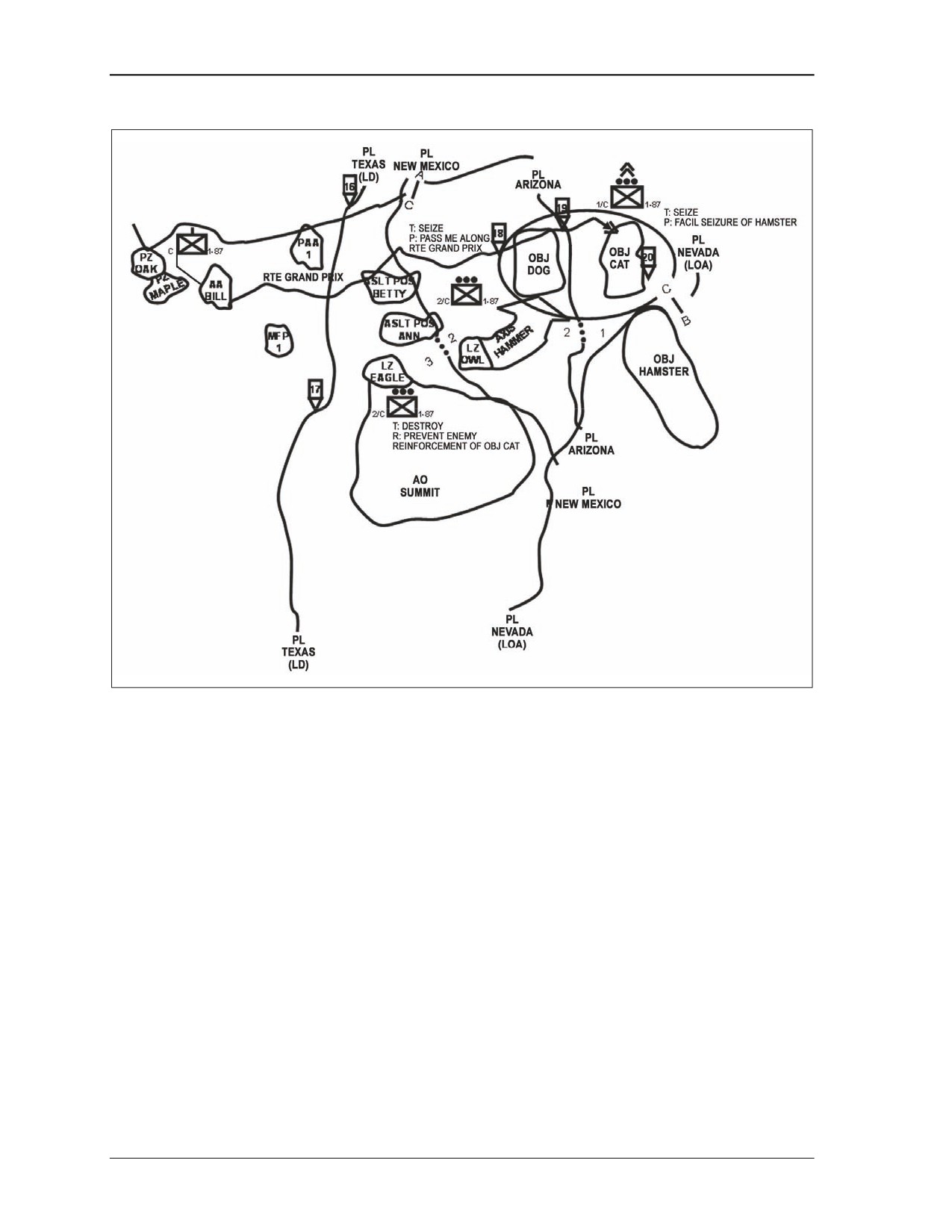
Figure 2-19. Example COA sketch.
2-141. The COA sketch should identify how the unit intends to focus the effects of overwhelming
combat power at the decisive point. When integrated with terrain, the refined product becomes the unit's
operations overlay.
COURSE OF ACTION ANALYSIS
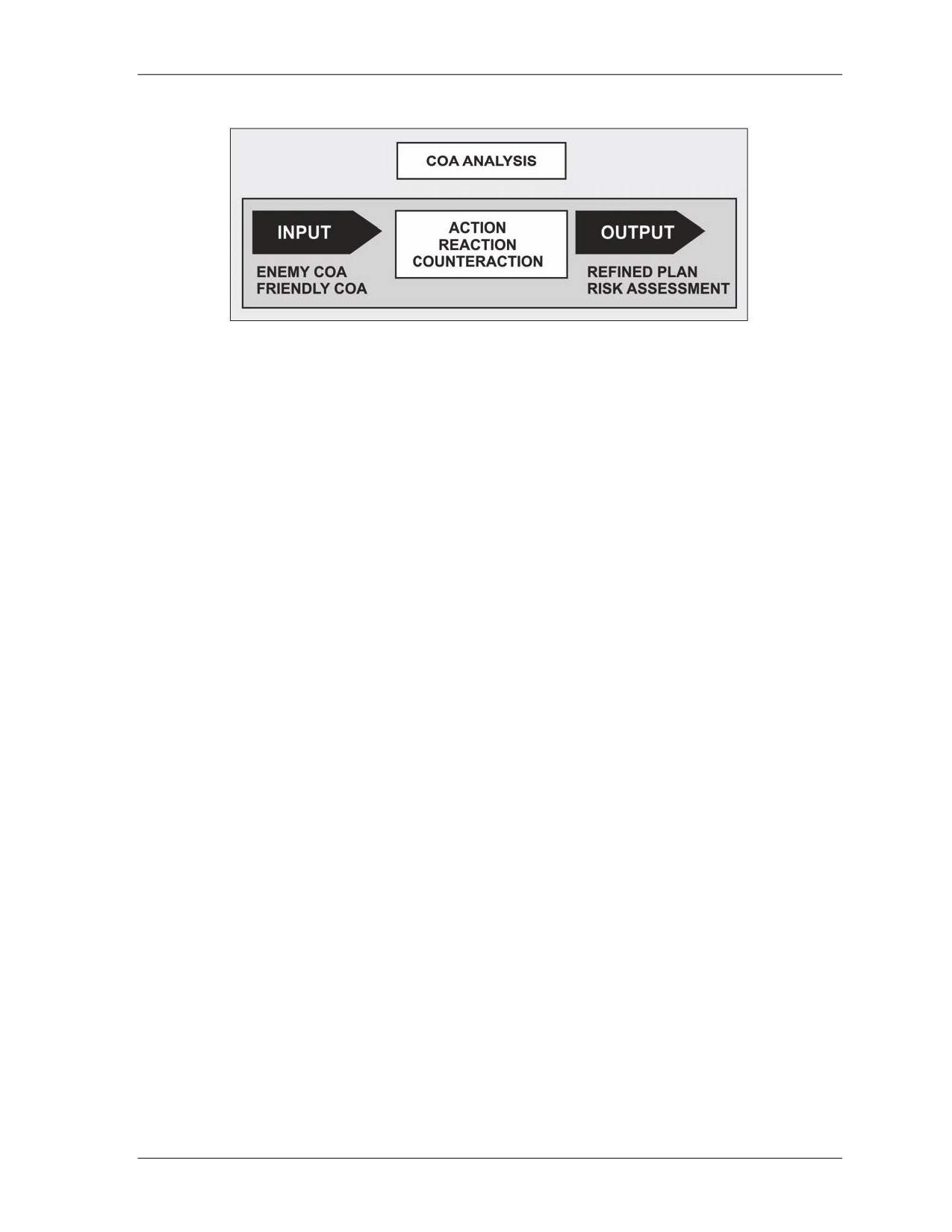
2-142. COA analysis begins with both friendly and enemy COAs and, using a method of
action-reaction-counteraction war game, results in a synchronized friendly plan, identified strengths and
weaknesses, and updated risk assessment (Figure 2-20, page 2-47).
2-46
FM 3-21.10
27 July 2006
Troop-Leading Procedures
Figure 2-20. Analysis of course(s) of action.
2-143. After developing the COA, the leader analyzes it to determine its strengths and weaknesses,
visualizes the flow of the battle, identifies the conditions or requirements necessary to enhance
synchronization, and gains insights into actions at the decisive point of the mission. If he has developed
more than one COA, he applies this same analysis to each COA developed. He does this analysis through
war-gaming or "fighting" the COA against at least one enemy COA. For each COA, leaders think through
the operation from start to finish. They compare their COA with the enemy's most probable COA. At small
unit level, the enemy's most probable COA is what the enemy is most likely to do. During the war game,
the leader visualizes a set of enemy and friendly actions and reactions. War-gaming is the process of
determining "what if?" factors for the overall operations. The object is to determine what can go wrong and
what decision the leader will likely have to make as a result. COA analysis allows the leader to synchronize
his assets, identify potential hazards, and develop a better understanding of the upcoming operation. It
enables him--
y To determine how to maximize the effects of combat power while protecting friendly forces
and minimizing collateral damage.
y To anticipate battlefield events.
y To determine conditions and resources required for success.
y To identify additional control requirements.
y To identify friendly coordination requirements.
2-144. COA analysis (war-gaming) brings together friendly and enemy forces on the actual terrain to
visualize how the operation will unfold. It is a continuous cycle of action, reaction, and counteraction. This
process highlights critical tasks, stimulates ideas, and provides insights rarely gained through mission
analysis and COA development alone. War-gaming is a critical step in the planning process and should be
allocated more time than the other steps. War-gaming helps the leader fully synchronize friendly actions,
while considering the likely reactions of the enemy. The product of this process is the synchronization
matrix. War-gaming, depending on how much time is devoted to planning, provides---
y An appreciation for the time, space, and triggers needed to integrate fire support, smoke,
engineers, air defense artillery
(ADA), and CBRN with maneuver platoons
(Infantry,
antiarmor, or tank) to support unit tasks and purposes identified in the scheme of maneuver.
y Flexibility built into the plan by gaining insights into possible branches to the basic plan.
y The need for control measures, such as checkpoints, contact points, and target reference points
(TRPs), that aid in control, flexibility, and synchronization.
y Coordinating instructions to enhance execution and unity of effort, and to ease confusion
between subordinate elements.
y Information needed to complete paragraphs 3, 4, and 5 of the OPORD.
27 July 2006
FM 3-21.10
2-47
Chapter 2
y Assessments regarding on-order and be-prepared missions.
y Projected sustainment expenditures, friendly casualties, and resulting medical requirements.
2-145. The best way for small unit leaders to war-game is to start at their current location and go through
the mission from start to finish, or start at a critical point such as the objective or engagement area. Using
the action-reaction method, leaders can think through the engagement beforehand. As they proceed, they
can either record their observations into a matrix or keep note in a notebook. The most important aspect of
this process is not the method but the output, meaning a more in-depth understanding of the operation.
Depending on the time available and his personal preference, the leader may use any of the following
war-gaming techniques.
BOX TECHNIQUE
2-146. The box technique focuses the war game on a specific area of the battlefield (Figure 2-21). This
might be the objective area, the EA, or some other critical location where decisive or critical actions will
take place. It should include all of the units, friendly and enemy, that have a direct impact on those actions.
This technique is used when time is limited and the enemy situation is relatively clear. However, a
disadvantage is that when considering only the actions at the critical or decisive points, the leader may
overlook other actions or events that could have a significant impact on the unit's mission.
Figure 2-21. Box war-gaming technique.
BELT TECHNIQUE
2-147. The belt technique allows the leader to divide the COA into events or belts (Figure 2-22, page
2-49). He may do this in several ways, such as from phase line to phase line or by significant event. Each
step then is war-gamed in sequence. This approach is most effective for offensive COAs. The leader can
2-48
FM 3-21.10
27 July 2006
Troop-Leading Procedures
modify this technique by dividing the battlefield into belts that are not necessarily adjacent or overlapping
but focus on the critical actions throughout the AOs.
Figure 2-22. Belt war-gaming technique.
AVENUE-IN-DEPTH TECHNIQUE
2-148. This method is most effective for a defensive COA, especially when there are several avenues of
approach to consider. Using the enemy's most probable COA, the leader analyzes friendly and enemy
actions along one avenue of approach at a time (Figure 2-23).
2-149. To gain the benefits that result from war-gaming a COA, the leader must remain objective and
record the results of the war game. He must remember the assumptions he made about the enemy, his unit,
and the ground during the development of his tentative plan. He must avoid letting the enemy or his unit
"win" to justify the COA. Also, he must avoid drawing premature conclusions about the war game or
changing his COA until the war game is complete.
27 July 2006
FM 3-21.10
2-49
Chapter 2
Figure 2-23. Avenue-in-depth war-gaming technique.
COURSE OF ACTION COMPARISON AND SELECTION
2-150. If the leader has developed more than one COA, he must compare them by weighing the specific
advantages, disadvantages, strengths, and weaknesses of each COA as noted during the war game. These
attributes may pertain to the accomplishment of the unit purpose, the use of terrain, the destruction of the
enemy, or any other aspect of the operation that he believes is important. He uses these factors, gained
from his relational combat power analysis (RCPA) matrix, as his frame of reference in tentatively selecting
the best COA. He makes the final selection of a COA based on his own judgment, the start time of the
operation, the AOs, the scheme of maneuver, and subordinate unit tasks and purposes.
2-151. The CCIR identify and filter information needed by leaders to support their vision and to make
critical decisions, especially to determine or validate COAs. CCIR help commanders determine what is
relevant to mission accomplishment. In one technique, they write the desired question, the quantified
answer, and the reaction (critical decision to make). CCIR also help focus the efforts of subordinates and
aid in the allocation of resources. Commanders should limit their CCIR to essential information.
2-152. PIR are information that a leader needs to know about terrain or enemy to make a critical decision.
PIR are best expressed in a question that can be answered yes or no.
2-50
FM 3-21.10
27 July 2006
Troop-Leading Procedures
PIR EXAMPLE
Can enemy wheeled vehicles cross the creek at NU12345678?
• If yes, the company will reinforce the obstacle and establish an antiarmor ambush at
this location.
• If no, the company will emplace an OP, and then establish the antiarmor ambush
along another route.
2-153. Friendly force information requirements (FFIR) include information that leaders need to know
about their units or about adjacent units to make critical decisions.
ESSENTIAL ELEMENTS OF FRIENDLY INFORMATION
2-154. Although EEFI are not part of the CCIR, they still become priorities when the leader states them
IAW FM 3-0. EEFI are the critical aspects of a friendly operation that, if known by the enemy, would
subsequently compromise or lead to failure of the operation. Consequently, this information must be
protected from identification by the enemy.
Section IV. STEPS 4 THRU 8--INITIATE MOVEMENT, RECONNOITER,
COMPLETE PLAN, ISSUE OPORD, SUPERVISE
This section discusses TLP Steps 4 thru 8.
STEP 4--INITIATE MOVEMENT
2-155. Leaders initiate any movement necessary to continue mission preparation or to posture the unit for
the start of the mission. This step can be executed at any time throughout the sequence of the TLP. It can
include movement to an assembly area, battle position (BP), or new AO, or the movement of guides or
quartering parties.
STEP 5--RECONNOITER
2-156. To exploit the principles of speed and surprise, leaders should weigh the advantages of
reconnoitering personally against the combat multiplier in the form of supplied information from the
battalion's C2 information system. They realistically consider the dangers of reconnoitering personally, and
the time required to conduct them. Leaders might be able to plan their operations using the unprecedented
amount of combat information provided by the higher echelon reconnaissance and surveillance assets.
However, if time permits, leaders should verify higher headquarters’ intelligence by reconnoitering
visually. They should seek to confirm the PIR that support their tentative plans. These PIR usually consist
of assumptions or critical facts about the enemy. This can include strength and location, especially at
templated positions. It can also include information about the terrain, for example, verification that a
tentative support-by-fire position can suppress the enemy, or that an avenue of approach is useable.
2-157. If possible, leaders should include their subordinate leaders in their reconnaissance efforts. This
allows the subordinates to see as much of the terrain and enemy as possible. The reconnaissance also helps
subordinate leaders gain insight into the leaders' visions of the operation.
2-158. The leaders' recons might include moving to or beyond the line of departure (LD), reconnaissance
of an AO, or walking from the forward edge of battle area (FEBA) back to and through the company AO
or battle position (BP) along likely enemy avenues of approach. If possible, leaders should select vantage
points with the best possible view of the decisive point.
27 July 2006
FM 3-21.10
2-51
Chapter 2
2-159. In addition to the leaders' reconnaissance efforts, the units can conduct additional reconnaissance
operations. Examples include surveillance of an area by subordinate elements, patrols to determine enemy
locations, and establishment of observation posts (OPs) to gain additional information. Commanders can
also incorporate Javelin command launch units (CLUs) as surveillance tools (day or night), based on an
analysis of METT-TC factors.
2-160. The nature of the reconnaissance, including what it covers and how long it lasts, depends on the
tactical situation and the time available. The leader should use the results of the COA development process
to identify information and security requirements for the unit's reconnaissance operations.
2-161. The leader must include disseminating results and conclusions arrived from any reconnaissance
into his time analysis. He must also consider how to communicate any changes in the COA to his
subordinates and how these changes affect his plans, actions of the subordinates, and other
supporting elements.
STEP 6--COMPLETE PLAN
2-162. During this step, leaders expand their selected (or refined) COAs into complete OPORDs. They
prepare overlays, refine the indirect fire list, complete sustainment and C2 requirements and, of course,
update the tentative plan based on the latest reconnaissance or information. They prepare briefing sites and
other briefing materials they might need to present the OPORDs directly to their subordinates. They
conduct final coordination with other units or staff members before issuing the order to their subordinates.
Using the five-paragraph OPORD format helps them to explain all aspects of the operation: terrain, enemy,
higher and adjacent friendly units, unit mission, execution, support, and command and control. The format
also serves as a checklist to ensure that they cover all relevant details of the operation. It also gives
subordinates a smooth flow of information from beginning to end.
STEP 7--ISSUE OPORD
2-163. The OPORD precisely and concisely explains both the leader's intent and concept of how he
envisions the unit accomplishing the mission. The order does not contain unnecessary information. The
OPORD is delivered quickly and in a manner that allows subordinates to concentrate on understanding the
leader's vision and not just copying what he says verbatim. The leader must prepare adequately and deliver
the OPORD confidently and quickly to build and sustain confidence in his subordinates.
2-164. When issuing the OPORD, the leader must ensure his subordinates understand and share his
vision of what must be done and when and how it must be done. They must understand how all the
company's elements work together to accomplish the mission. They must also understand how the
company's mission supports the intentions of the immediate higher commander. When the leader has
finished issuing the order, subordinate leaders should leave with a clear understanding of what the leader
expects their elements to do. The leader is responsible for ensuring that his subordinates understand.
2-165. Also, and in many respects more importantly, the leader must issue the order in a manner that
instills his subordinates with confidence in the plan and a commitment to do their best to achieve the plan.
Whenever possible, he must issue the order in person. He looks into the eyes of his subordinate leaders to
ensure each one understands the mission and what the element must achieve.
2-166. Complete the order with a confirmation brief. At a minimum, each subordinate leader should be
able to backbrief the unit mission and intent, the immediate higher commander's intent, his own task(s) and
purpose, and the time he will issue his unit's OPORD. Each subordinate should confirm that he understands
the vision of the battlefield and how the mission is accomplished with respect to the decisive point. This
confirmation brief also provides an opportunity to highlight any issues or concerns.
2-167. The five-paragraph OPORD format helps the leader paint a picture of all aspects of the operation,
from the terrain to the enemy, and finally to the unit's own actions from higher to lower. The format helps
him decide what relevant details he must include and in providing subordinates with a smooth flow of
information from beginning to end. At the same time, the leader must ensure that the order is not only clear
2-52
FM 3-21.10
27 July 2006
Troop-Leading Procedures
and complete but also as brief as possible. If he has already addressed an item adequately in a previous
WARNO, he can simply state "No change," or provide any necessary updates. The leader is free to brief
the OPORD in the most effective manner to convey information to his subordinates.
STEP 8--SUPERVISE
2-168. This final step of the TLP is crucial. After issuing the OPORD, the commander and his
subordinate leaders must ensure that the required activities and tasks are completed in a timely manner
prior to mission execution. Supervision is the primary responsibility of all leadership. Both officers and
NCOs must check everything that is important for successful mission accomplishment. This includes, but is
not limited to--
y Conducting numerous back briefs on all aspects of the company and subordinate unit
operations.
y Ensuring the second in command in each element is prepared to execute in his leaders’ absence.
y Listening to subordinate's operation orders.
y Observing rehearsals of subordinate units.
y Checking load plans to ensure they are carrying only what is necessary for the mission or what
the OPORD specified.
y Checking the status and serviceability of weapons.
y Checking on maintenance activities of subordinate units.
y Ensuring local security is maintained.
REHEARSALS
2-169. Rehearsals are practice sessions conducted to prepare units for an upcoming operation or event.
They are essential in ensuring thorough preparation, coordination, and understanding of the commander's
plan and intent. Commanders should never underestimate the value of rehearsals.
2-170. Effective rehearsals require leaders and, when time permits, other company Soldiers to perform
required tasks, ideally under conditions that are as close as possible to those expected for the actual
operation. At their best, rehearsals are interactive; participants maneuver their actual vehicles or use
vehicle models or simulations while verbalizing their elements’ actions. During every rehearsal, the focus
is on the how element, allowing subordinates to practice the actions called for in their individual scheme of
maneuver.
Note: A rehearsal is different from a discussion of what is supposed to happen during the
actual event. For example, in a rehearsal, platoon leaders send real spot reports (SPOTREPs)
when reporting enemy contact, rather than just saying, "I would send a SPOTREP now."
The commander can test subordinate understanding of the plan by ensuring that they push the
rehearsal forward rather than waiting on him to dictate each step of the operation.
2-171. The commander uses well-planned, efficiently run rehearsals to accomplish the following:
y Reinforce training and increase proficiency in critical tasks.
y Reveal weaknesses or problems in the plan, leading to further refinement of the plan or
development of additional branch plans.
y Integrate the actions of subordinate elements.
y Confirm coordination requirements between the company and adjacent units.
y Improve each Soldier's understanding of the concept of the operation, the direct fire plan,
anticipated contingencies, and possible actions and reactions for various situations that may
arise during the operation.
y Ensure that seconds in command are prepared to execute in their leaders’ absence.
27 July 2006
FM 3-21.10
2-53
Chapter 2
REHEARSAL CONSIDERATIONS
2-172. Rehearsals should follow the crawl-walk-run training methodology. This prepares the Infantry
companies and subordinate elements for increasingly difficult conditions. The unit can conduct
reduced-force or full-dress rehearsals.
Reduced-Force Rehearsals
2-173. Infantry company commanders conduct reduced-force rehearsals when time is limited or when the
tactical situation affects attendance. Unit members who can participate should practice on mock-ups, sand
tables, or actual terrain (usually over a smaller area than in the actual operation).
Full-Dress Rehearsals
2-174. Full dress rehearsals are the most effective, but use the most time and resources. They involve
nearly every Soldier who will participate in the operations. If possible, they should be conducted under the
same conditions, such as the weather, time of day, and terrain that the unit can expect in the actual
operations.
REHEARSAL TYPES
2-175. Leaders may use several types of rehearsals in the same operation.
Confirmation Brief
2-176. The commander may require the platoon leaders to conduct a confirmation brief right after he
issues a company OPORD or FRAGO. This is to ensure that the subordinates understand their assigned
tasks, purposes, and intents.
Backbrief
2-177. The leader might require squad leaders to backbrief him once they have developed their plan. He
checks to ensure it is nested with the concept of the operation, or to identify problems with
synchronization.
Combined Arms Rehearsal
2-178. This is the preferred rehearsal type for Infantry units and is conducted when all subordinate
OPORDs are complete. This rehearsal type involves all the elements of the unit and ensures that all
subordinate plans are fully synchronized within the overall plan. Infantry company commanders can use
any of several techniques to execute this type of rehearsal.
Support Rehearsal
2-179. Support rehearsals are normally conducted by a single or limited number of WFF elements such
as sustainment or fire support. Infantry companies seldom conduct their own support rehearsals. However,
commanders should be aware that higher headquarters might, which will affect the companies. They
should consider this factor when planning their overall timelines.
PRECOMBAT CHECKS AND INSPECTIONS
2-180. Precombat checks (PCCs) and precombat inspections (PCIs) are critical to the success of any
combat patrol. These checks and inspections are leader tasks and cannot be delegated below team leader
level. They ensure that the Soldier is prepared to execute the required individual and collective tasks that
2-54
FM 3-21.10
27 July 2006
Troop-Leading Procedures
support the mission. Checks and inspections are part of the TLP that protect against shortfalls that could
endanger Soldiers’ lives and jeopardize the successful execution of a mission. PCCs and PCIs must be
tailored to the specific unit and the mission requirements. Each mission and each patrol may require a
separate set of checklists. Each element will have their own established set of PCCs and PCIs, but each
platoon within that element should have identical checklists. A weapons squad will have a different
checklist than a line squad, but each weapons squad within an organization should be the same. One of the
best ways to ensure PCCs and PCIs are complete and thorough is with full-dress rehearsals. These
rehearsals, run at combat speed with communication and full battle-equipment, allow the leader to envision
minute details, as they will occur on the battlefield. If the operation is to be conducted at night, Soldiers
should conduct full-dress rehearsals at night as well. PCCs and PCIs should include back briefs on the
mission, the task and purpose of the mission, and how the Soldiers’ role fits into the scheme of maneuver.
The Soldiers should know the latest intelligence updates and the ROE, and be versed in MEDEVAC
procedures and sustainment requirements. Table 2-9 lists sensitive items, high dollar value items, issued
pieces of equipment, and supplies. This table should spur thought--it is not a final list.
ID card
T&E mechanisms
Grappling hook
ID tags
Spare barrels
Sling sets
Ammunition
Spare barrel bags
PZ marking kit
Weapons
Extraction tools
ANCD
Protective mask
Asbestos gloves
Plugger or GPS
Knives
Barrel changing handles
Handheld microphones
Flashlights
Headspace and timing gauges
NVDs
Radios and backup communication
SAW tools
Batteries and spare batteries
Communication cards
BII
Picket pounder
Nine-line MEDEVAC procedures
Oil and transmission fluids
Engineer stakes
OPORD
Antifreeze coolant
Pickets
FRAGOs
5-gallon water jugs
Concertina wire
Maps
MREs
TCP signs
Graphics, routes, objectives, LZs,
Load plans
IR lights
and PZs
Fuel cans
Glint tape
Protractors
Fuel spout
Chemical lights
Alcohol pens
Tow bars
Spare handsets
Alcohol erasers
Slave cables
Pencil with eraser
Pen and paper
Concertina wire gloves
Weapon tie downs
Tripods
Pintles
Table 2-9. Example PCC and PCI checklists.
27 July 2006
FM 3-21.10
2-55
This page intentionally left blank.
Chapter 3
Movement
The purpose of tactical movement is to position units on the battlefield and prepare
them for contact. This chapter focuses on the movement techniques and formations
that give the company commander options for moving his unit. Included are
discussions of motor or foot marches and occupation of assembly areas. Each
technique and formation has advantages and disadvantages. Some are secure and
slow, while others are faster, but less secure. Some work well in some terrain or
tactical situations, but not so well in others. Because of the Infantry rifle company's
capabilities, the commander must consider the overall movement plan, including
these various advantages and disadvantages.
Commanders and leaders may adapt the movement techniques and formations in this
chapter to their particular situations.
TACTICAL MOVEMENT AND ENEMY CONTACT
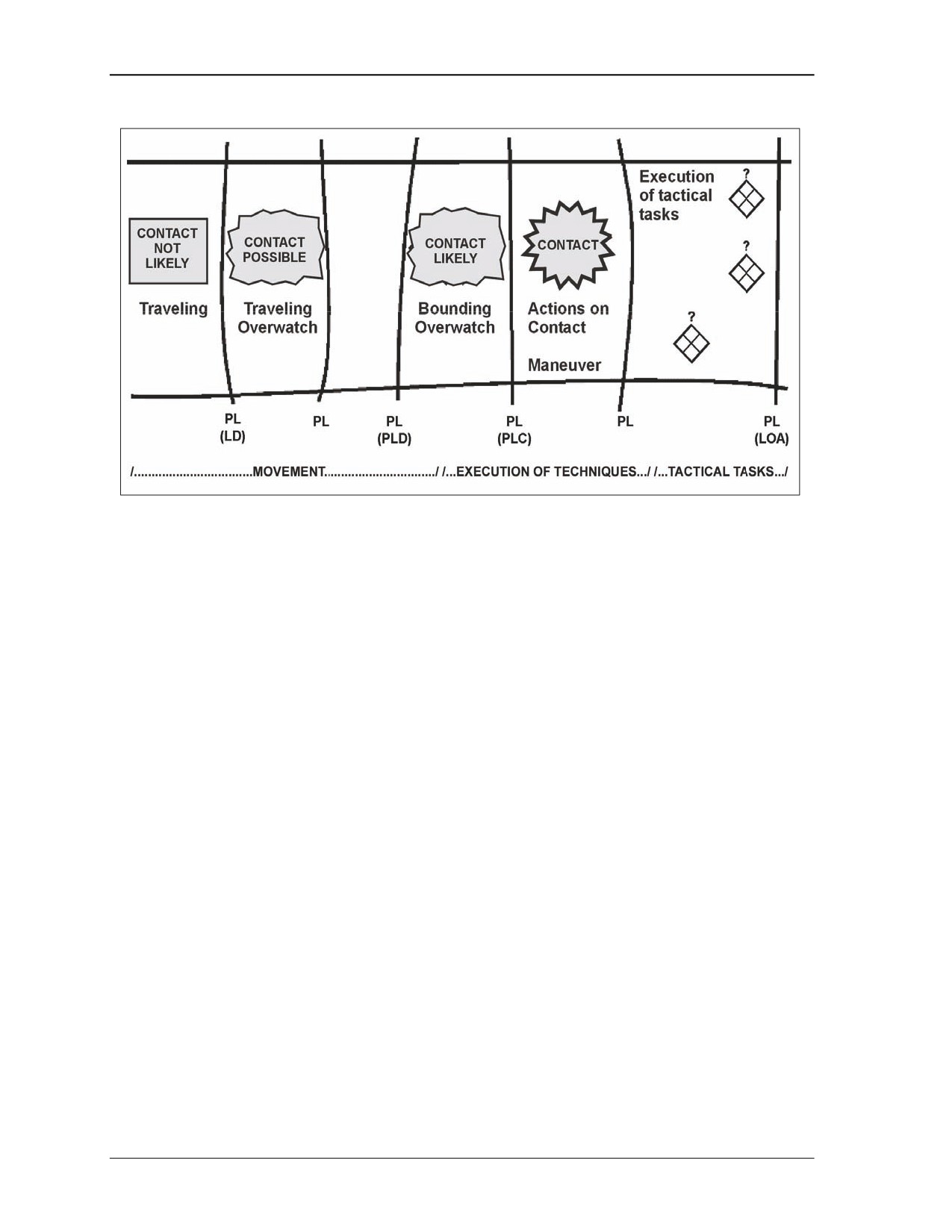
3-1.
Avoid confusing movement with maneuver. Maneuver is defined as "Movement supported by fire
to gain a position of advantage over the enemy." At company level, the two overlap considerably. Tactical
movement differs from maneuver, however, because maneuver is movement while in contact, but tactical
movement is movement in preparation for contact. The process by which units transition from tactical
movement to maneuver is called "actions on contact." Actions on contact are covered in Chapter 4,
Section IV, Actions on Contact. Figure 3-1, page 3-2, relates movement techniques (traveling, traveling
overwatch, and bounding overwatch), the possibility of enemy contact, and the transition to maneuver.
27 July 2006
FM 3-21.10
3-1
Chapter 3
Figure 3-1. Transition from movement techniques to maneuver.
MOVEMENT TECHNIQUES
3-2.
The company commander selects from the three movement techniques
(traveling, traveling
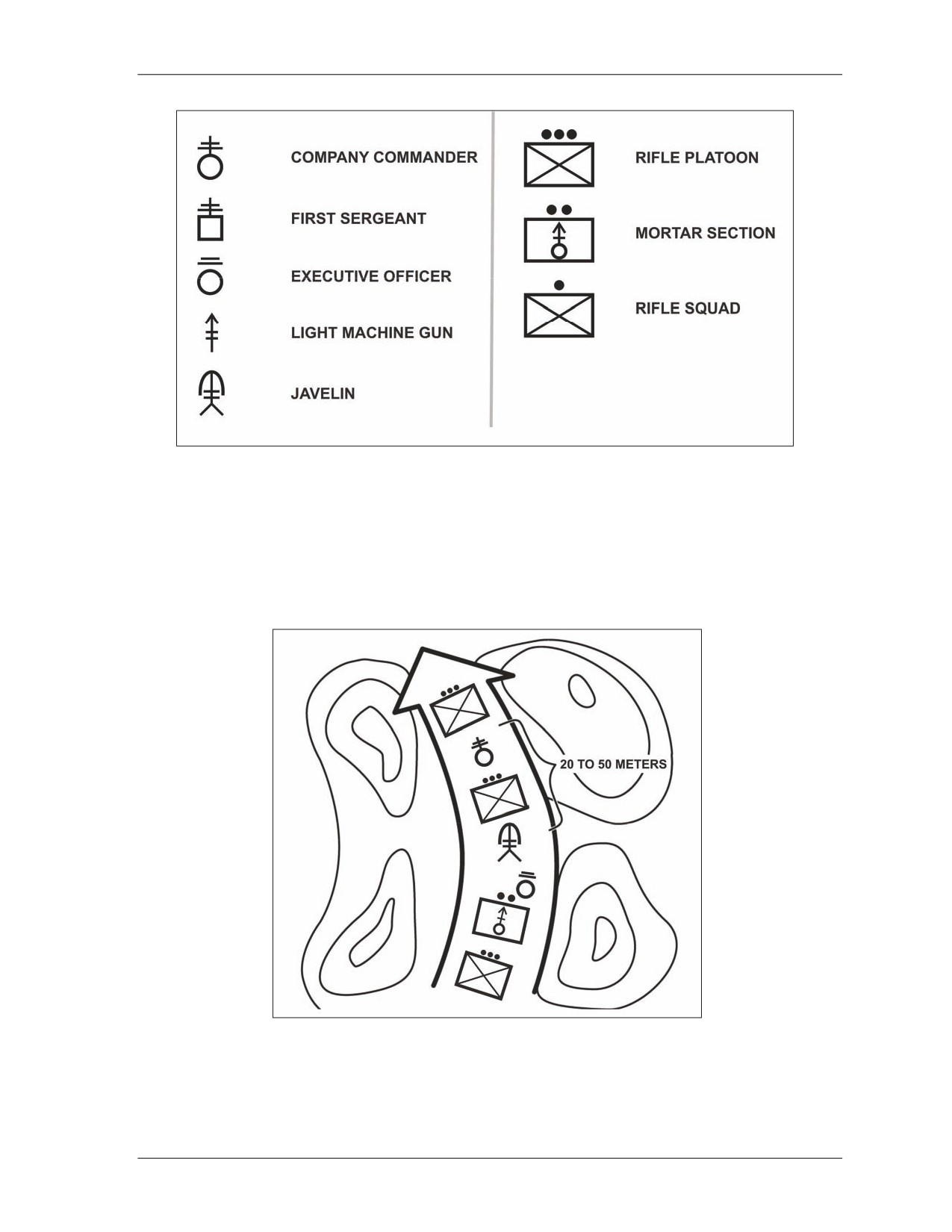
overwatch, and bounding overwatch) based on several battlefield factors. Figure 3-2 shows the symbols for
company personnel and elements.
y The likelihood of enemy contact.
y The type of contact expected.
y The availability of an overwatch element.
y The terrain over which the moving element will pass.
y The balance of speed and security required during movement.
3-2
FM 3-21.10
27 July 2006
Movement
Figure 3-2. Legend of company symbols.
TRAVELING
3-3.
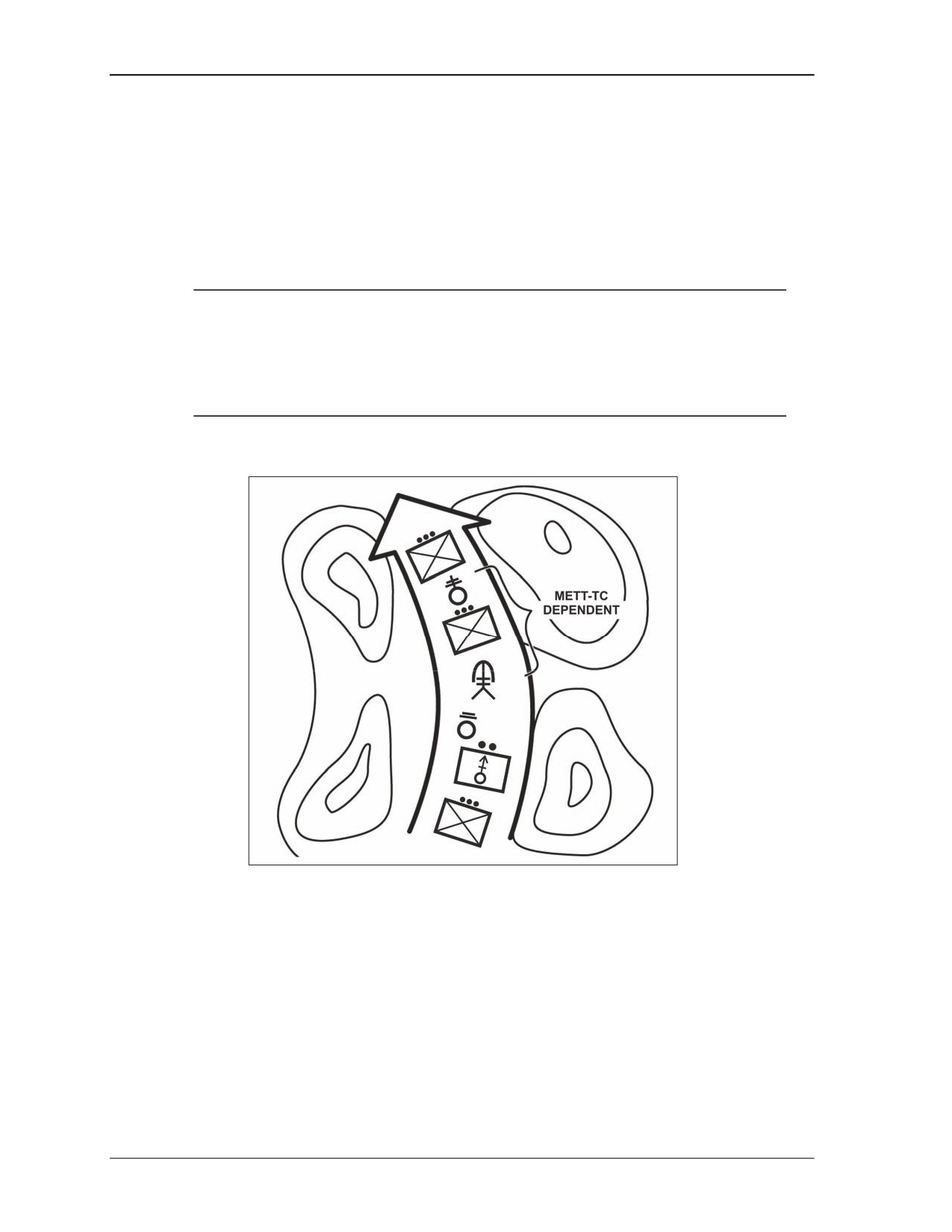
Continuous movement characterizes the traveling technique by all company elements. It is best
suited for situations in which enemy contact is unlikely and speed is important. Figure 3-3 shows the
traveling technique for an Infantry rifle company.
Figure 3-3. Traveling technique.
27 July 2006
FM 3-21.10
3-3
Chapter 3
TRAVELING OVERWATCH
3-4.
Traveling overwatch is an extended form of traveling that provides additional security when speed
is desirable but contact is possible (Figure 3-4). The lead element moves continuously. The trail element
moves at various speeds and may halt periodically to overwatch movement of the lead element. Dispersion
between the two elements must be based on the trail element’s ability to see the lead element and to
provide immediate suppressive fires in case the lead element is engaged. The intent is to maintain depth,
provide flexibility, and maintain the ability to maneuver even if contact occurs, although a unit should
ideally make contact while moving in bounding overwatch rather than traveling overwatch.
Note: Organization of the company (in both traveling overwatch and bounding overwatch
(consists of a lead element (also called the bounding element in bounding overwatch) and a
trail
(or overwatch) element. The commander constitutes these elements using varying
combinations of company elements; his decisions are based on the results of his METT-TC
analysis. For example, the lead element might consist of one platoon, the commander, and the
FSO, overwatched by the two remaining platoons and the XO.
Figure 3-4. Traveling overwatch technique.
BOUNDING OVERWATCH
3-5.
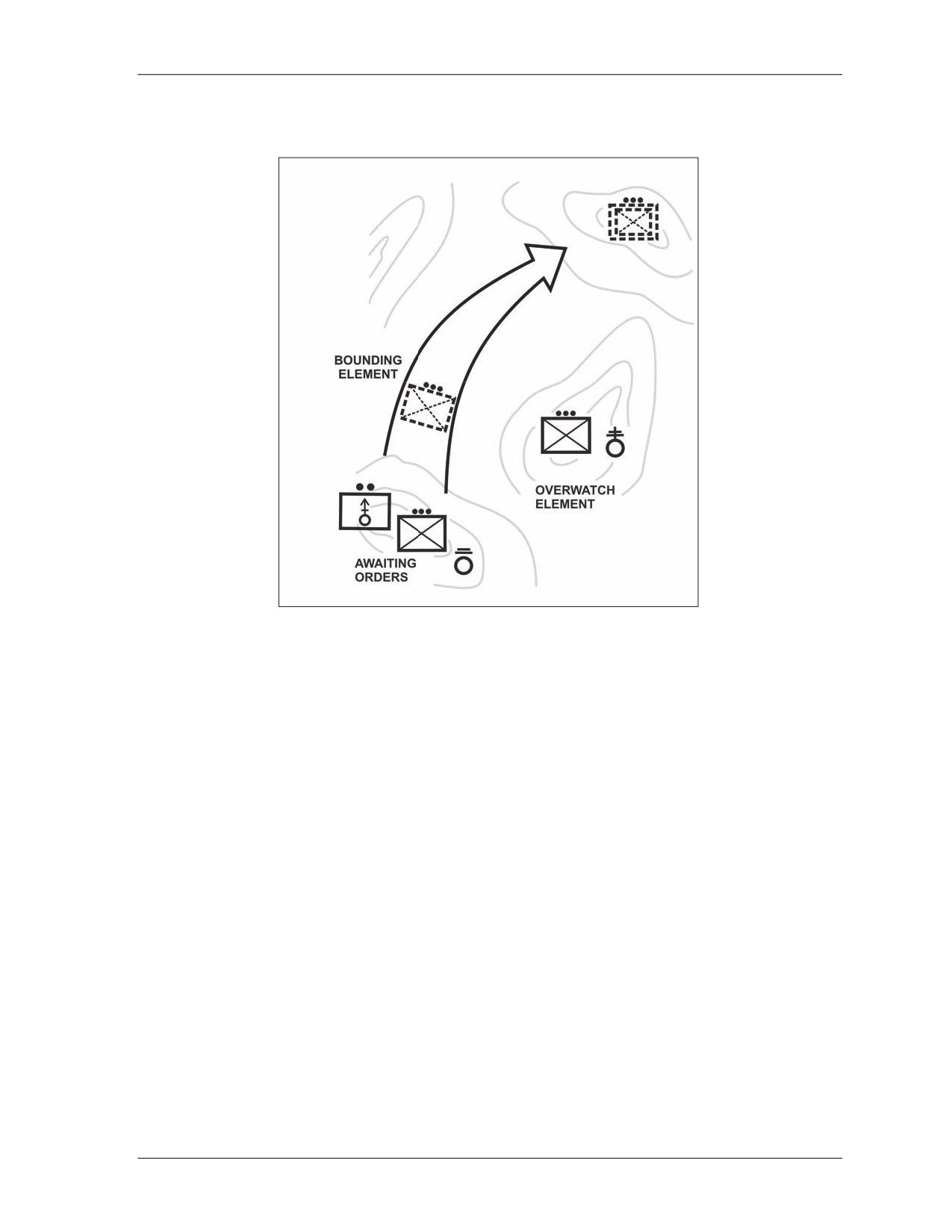
Bounding overwatch is used when contact is expected (Figure 3-5). It is the most secure, but
slowest, movement technique. The purpose of bounding overwatch is to deploy prior to contact, giving the
unit the ability to protect a bounding element by immediately suppressing an enemy force. In all types of
bounding, the overwatch element is assigned sectors to scan while the bounding element uses terrain to
achieve cover and concealment. The bounding element avoids masking the fires of the overwatch element;
it never bounds beyond the range at which the overwatch element can effectively suppress likely or
suspected enemy positions. The company can employ either of two bounding methods: alternate
or successive.
3-4
FM 3-21.10
27 July 2006
Movement
Figure 3-5. Bounding overwatch technique.
Alternate Bounds
3-6.
Covered by the rear element, the lead element moves forward, halts, and assumes overwatch
positions. The rear element advances past the lead element and takes up overwatch positions. This
sequence continues as necessary with only one element moving at a time. This method is usually more
rapid than successive bounds.
Successive Bounds
3-7.
In the successive bounding method the lead element, covered by the rear element, advances and
takes up overwatch positions. The rear element then advances to an overwatch position roughly abreast of
the lead element and halts. The lead element then moves to the next position, and so on. Only one element
moves at a time, and the rear element avoids advancing beyond the lead element. This method is easier to
control and more secure than the alternate bounding method, but it is slower.
MOVEMENT FORMATIONS
3-8.
The Infantry rifle company uses six basic movement formations: column, line, vee, wedge, file,
and echelon right or left. These formations describe the locations of the company's platoons and sections in
relation to each other. They are guides on how to form the company for movement. Each formation aids
control, security, and firepower to varying degrees. The following factors should be considered in
determining the best formation to use.
y Mission.
27 July 2006
FM 3-21.10
3-5
Chapter 3
y Enemy situation.
y Terrain.
y Weather and visibility conditions.
y Speed of movement desired.
y Degree of flexibility desired.
CROSS COUNTRY MOVEMENT
3-9.
When moving cross-country, the distance between Soldiers and platoons varies according to the
terrain and the situation. Soldiers should constantly observe their sectors for likely enemy positions and
look for cover that can be reached quickly in case of enemy contact.
Platoon Formation
3-10. The company commander may specify the platoon formations to be used within the company
formation. If he does not, each platoon leader selects his platoon's formation. For example, the lead platoon
leader may select a formation that permits good observation and massing of fire to the front (vee
formation). The second platoon leader may select a formation that permits fast movement to overwatch
positions and good flank security (wedge formation). (Squad and platoon movement formations and
techniques are discussed in FM 3-21.8 (FM 7-8).)
Base Platoon
3-11. When moving in a formation, the company normally guides on the base platoon to ease control.
This should be the lead platoon. In the line or the vee formation, the company commander must specify
which platoon is the base platoon. The other platoons key their speed and direction on the base platoon.
This permits quick changes and lets the commander control the movement of the entire company by
controlling only the base platoon. Terrain features might be designated for the base platoon to guide on by
using the control techniques previously described. The company commander normally locates himself
within the formation where he can best see and direct the movement of the base platoon.
ALERT STATUS
3-12. One technique used to alert units for possible movement or for units to report their readiness to
move is an alert status. With this technique, use a readiness condition (REDCON) system to reflect the
amount of time a unit will have before it must move.
REDCON 1: Be prepared to move immediately.
REDCON 2: Be prepared to move in 15 minutes.
REDCON 3: Be prepared to move in 1 hour.
REDCON 4: Be prepared to move in 2 hours.
FORMATIONS
3-13. Formations include the column, the company line, the company wedge, the company vee, the
company file, and echelon right or left.
Column
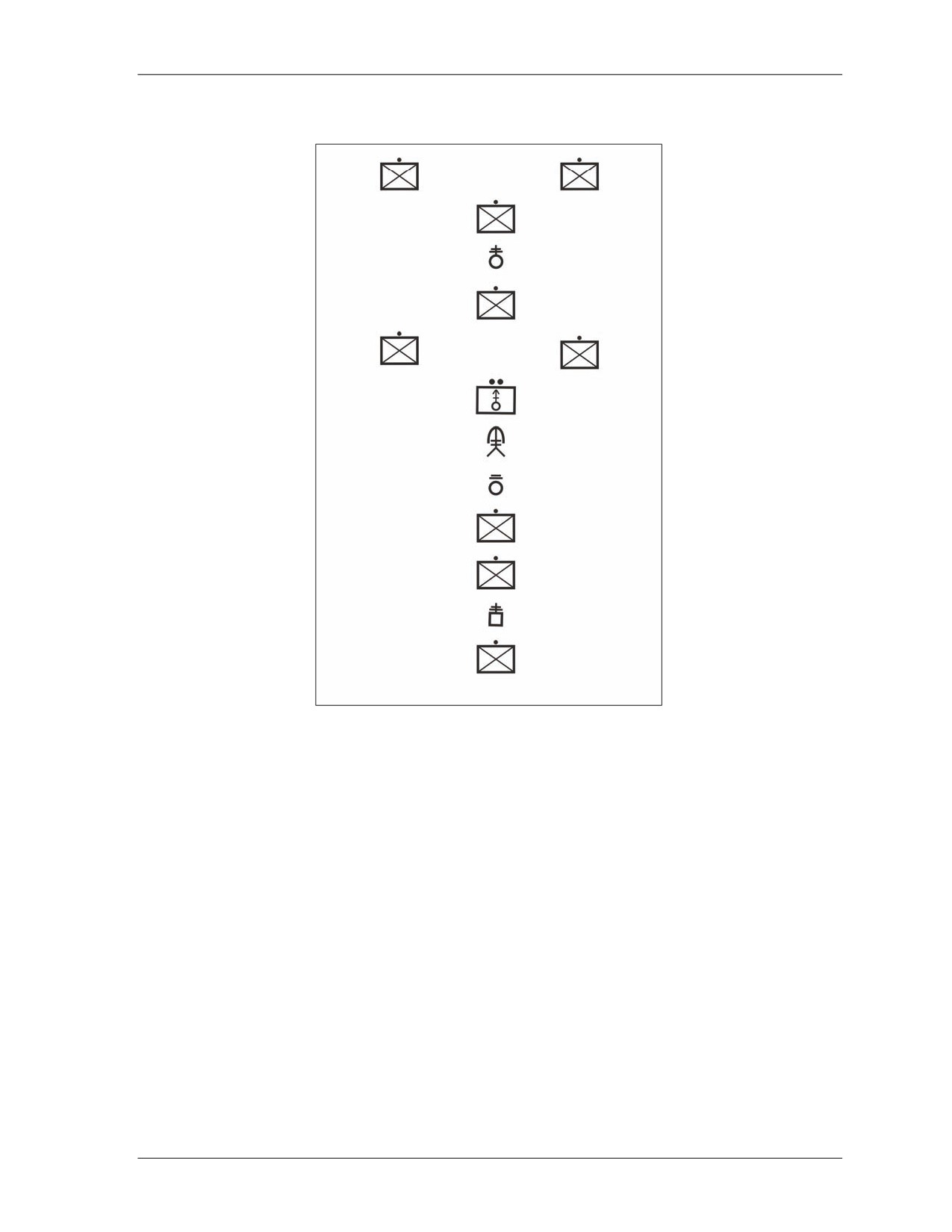
3-14. The column formation allows the company to make contact with one platoon and maneuver with
the two trail platoons. It is a flexible formation, allowing easy transition to other formations. It provides
good all-round security and allows fast movement. It also provides good dispersion and aids maneuver and
control, especially in limited visibility. The company can deliver a limited volume of fire to the front and to
the rear, but a high volume to the flanks. Figure 3-6 shows an example of the company column.
3-6
FM 3-21.10
27 July 2006
Movement
Figure 3-6. Example company column formation.
Company Line
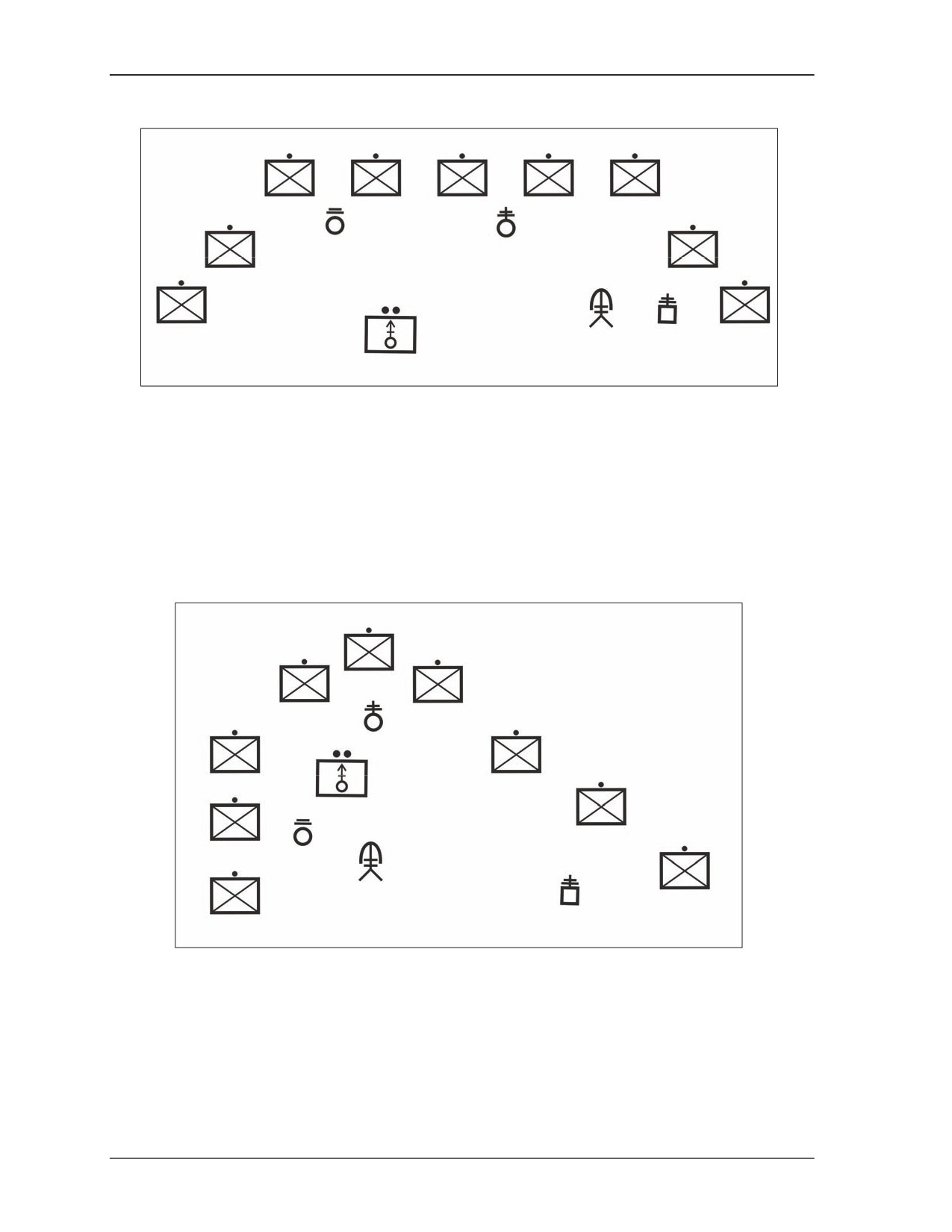
3-15. The company line formation puts all platoons forward along the same direction of movement, and
it provides for the delivery of maximum fire to the front, but less to the flanks. It is the most difficult
formation to control. The company commander designates a base platoon, normally the center one, for the
others to guide on. Flank and rear security is generally poor but is improved when the flank platoons use
echelon formations. Figure 3-7 shows an example of the company line.
27 July 2006
FM 3-21.10
3-7
Chapter 3
Figure 3-7. Example company line formation.
Company Wedge
3-16. The company wedge formation allows the commander to make contact with a small element and
still maneuver the remaining platoons. If the company is engaged from the flank, one platoon is free to
maneuver. This formation is hard to control, but it allows faster movement than the company vee
formation. Figure 3-8 shows an example of the company wedge.
Figure 3-8. Example company wedge formation.
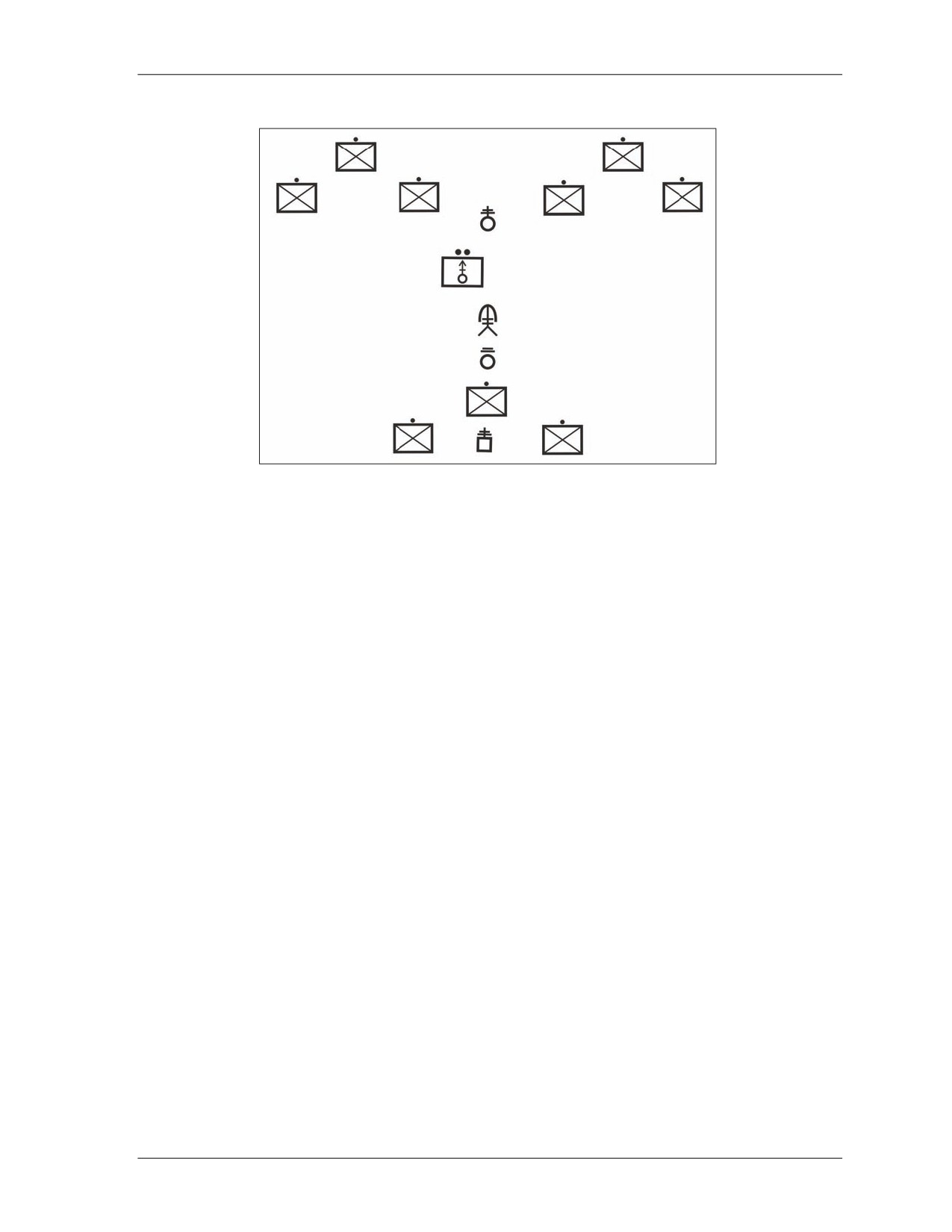
Company Vee
3-17. The company vee formation has two platoons forward to provide immediate fire on contact or to
flank the enemy. It also has one platoon centered trailing the two forward platoons. If the company is
engaged from either flank, two platoons can provide fire, and at least one platoon is free to maneuver. This
formation is hard to control and slows movement. The company commander designates one of the forward
platoons as the base platoon. Figure 3-9 shows an example of the company vee with all platoons in wedge.
3-8
FM 3-21.10
27 July 2006
Movement
Figure 3-9. Example company vee formation.
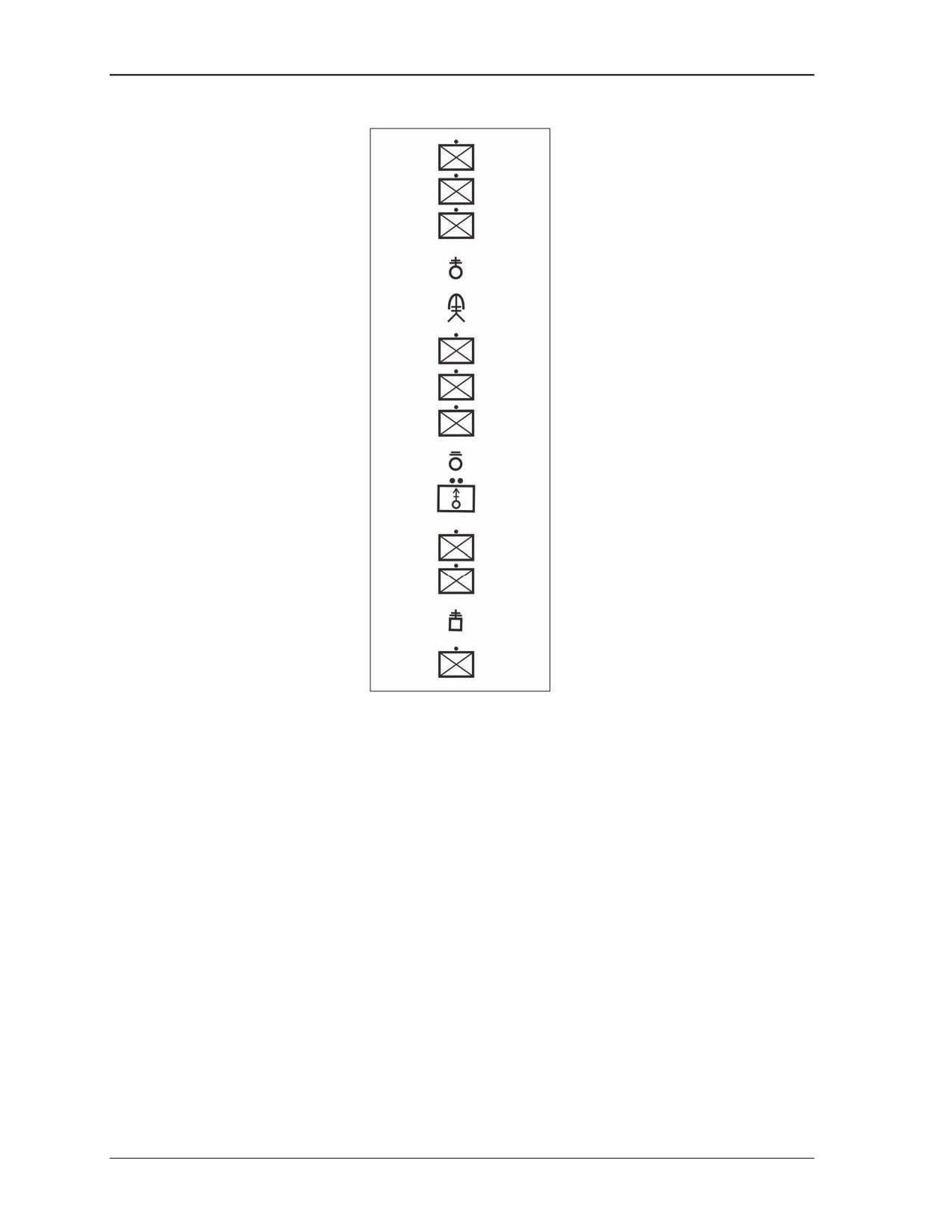
Company File
3-18. The company file formation is the easiest formation to control. It allows rapid movement in
restricted terrain and in limited visibility, and it enhances control and concealment. Light forces use a file
predominantly as its movement formation during times of limited visibility. It is, however, the least secure
formation and the hardest from which to maneuver. Figure 3-10 shows an example of the company file
with all units in file.
27 July 2006
FM 3-21.10
3-9
Chapter 3
Figure 3-10. Example company file formation.
3-19. The company commander locates well forward with the lead platoon headquarters or immediately
behind the lead security element. This location increases his control by putting him in position to make
critical decisions. The company CP can locate farther back (behind the lead platoon) to avoid interfering
with the platoon's movement and to aid communications with other elements. The 1SG (or XO) is last, or
nearly last, in the company file to provide leadership and to prevent breaks in contact within the file. The
company file is vulnerable to breaks in contact and should be used only when necessary and for short
periods. A company may stretch out over 600 meters in a company file, with a pass time of more than 20
minutes.
Echelon Right or Left
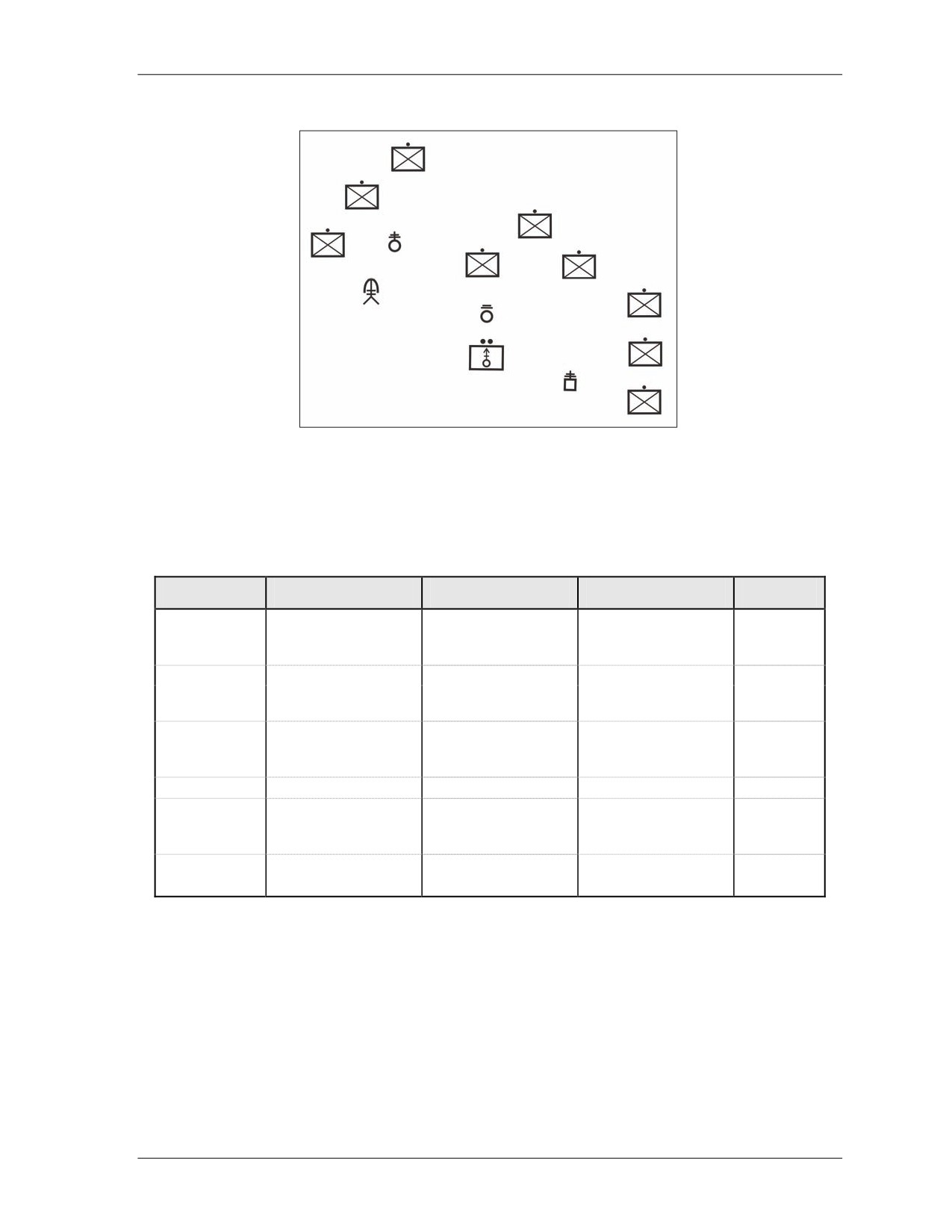
3-20. The echelon right or echelon left formation is used if the situation is vague and the company
commander anticipates enemy contact to the front or on one of the flanks. Normally, an obstacle or another
friendly unit exists on the flank of the company opposite the echeloned flank, preventing enemy contact on
that side. This formation provides a good volume of fire and protection to the echeloned flank, but less to
the opposite flank. Figure 3-11 shows an example of the echelon right formation.
3-10
FM 3-21.10
27 July 2006
Movement
Figure 3-11. Example echelon right formation.
FORMATION SELECTION
3-21. The company commander selects the formation that provides the proper control, security, and
speed. Table 3-1 compares the six movement formations.
Formation
Security
Fires
Control
Speed
Column
Good dispersion.
Good to front and rear.
Easy to control.
Fast.
Good all-round
Excellent to the flanks.
Flexible formation.
security.
Line
Excellent to the front.
Excellent to the front.
Difficult to control.
Slow.
Poor to the flank and
Poor to the flank and
Inflexible formation.
rear.
rear.
Wedge
Good all-round
Good to the front and
Less difficult to control
Faster than
security.
flanks.
than the line.
the line.
Flexible formation.
Vee
Better to the front.
Very good to the front.
Very difficult to control.
Slow.
File
Least secure.
Poor.
Easy to control.
Fast.
Effective use of
concealment.
Echelon
Good to the echeloned
Good to the echeloned
Difficult to control.
Slow.
flank and front.
flank and front.
Table 3-1. Comparison of movement formations.
USE OF MOVEMENT FORMATIONS
3-22. Movement should be as rapid as the terrain, mobility of the force, and enemy situation permit. The
ability to gain and maintain the initiative often depends on movement being undetected by the enemy. If
detected during movement, the enemy might be able to apply substantial combat power against the
company. The Infantry rifle company depends heavily upon the terrain for protection from enemy fire. The
company commander also protects his company during movement by ensuring the company is using proper
movement formations and techniques.
27 July 2006
FM 3-21.10
3-11
Chapter 3
Fundamentals
3-23. The Infantry rifle company commander's mission analysis helps him decide how to move most
effectively. When planning company movements, the commander ensures the unit is moving in a way that
supports a rapid transition to maneuver. Once contact with the enemy is made, squads and platoons execute
the appropriate actions on contact, and leaders begin to maneuver their units. The following fundamentals
provide guidance for planning effective company movements.
Reconnoiter
3-24. All echelons reconnoiter. The enemy situation and the available planning time may limit the unit's
reconnaissance, but leaders at every level seek information about the terrain and enemy. If sufficient
information is still lacking, an effective technique is to send a reconnaissance element forward of the lead
platoon. Even if this unit is only 15 minutes ahead of the company, it can still provide valuable information
and reaction time for the company commander.
Use Terrain and Weather Effectively
3-25. One of the strengths of the Infantry rifle company is its ability to move across almost any terrain
and in almost any weather conditions. The company moves on covered and concealed routes. Moving in
limited visibility may provide better concealment, and the enemy might be less alert during these periods.
Plan to avoid identified danger areas.
Move as Squads and Platoon
3-26. The advantages to moving the company by squads and platoons include--
y Faster movement.
y Better security. A small unit is less likely to be detected because it requires less cover and
concealment.
y More dispersion. The dispersion gained by moving the company by squads and platoons makes
it more difficult for the enemy to concentrate his fires against the company, especially indirect
fires, CAS, and chemical agents. Subordinate units also gain room to maneuver.
y Better operations security (OPSEC). It is harder for the enemy to determine what the friendly
force is doing with only isolated squad-size spot reports.
3-27. Although the advantages normally outweigh the disadvantages, when planning decentralized
movements the commander should also consider the following disadvantages.
y Numerous linkups are required to regroup the company.
y May take longer to mass combat power to support a hasty attack or disengage in the event of
enemy contact.
Maintain Security During Movement
3-28. Security is critical during movement since the company is extremely vulnerable to enemy direct
and indirect fires. In addition to the fundamentals listed earlier, the company commander achieves security
for the company by applying the following.
y Use the appropriate movement formation and technique for the conditions.
y Move as fast as the situation allows. This may degrade the enemy's ability to detect the unit and
the effectiveness of his fires once he detects it.
y Ensure subordinate units correctly position security elements to the flanks, front, and rear at a
distance that prevents enemy direct fire on the main body. (Normally, the company formation
and movement technique provides greater security to the front; the flanks and rear must be
3-12
FM 3-21.10
27 July 2006
Movement
secured by these security elements. The company TSOP should state who is responsible for
providing these security elements.)
y Enforce noise and light discipline.
y Enforce camouflage discipline (Soldiers and their equipment).
y When the situation is not clear, make contact with the smallest element possible. By making
contact with a small element, the company commander maintains the ability to maneuver with
the majority of his force. The Soldiers who first receive enemy fires are most likely to become
casualties. They are also most likely to be suppressed and fixed by the enemy.
y When the situation is clear, the company commander must quickly mass the effects of his
combat power to overwhelm the enemy.
Locations of Key Leaders and Weapons
3-29. The locations of key leaders and weapons depend on the situation, movement formation and
technique, organization of the Infantry rifle company. The following paragraphs provide guidance for the
company commander in deciding where these assets should locate.
Company Command Post
3-30. The company CP normally consists of the company commander, his radio operators, the fire
support team (FIST), consisting of the fire support officer (FSO), fire support sergeant, and forward
observer; and the CBRN sergeant along with possibly other personnel and attachments (XO, 1SG, or a
security element). The company CP locates where it best supports the company commander and maintains
communications with higher and subordinate units. To maintain communications, the CP may need to
locate away from the CO. In this case, the XO controls the CP (or part of it) and maintains communications
with higher or adjacent units while the commander locates where he can best control the company.
Although the CP can move independently, it normally locates where it is secured by the other platoons and
sections within the company formation.
Company Commander
3-31. The company commander locates where he can see and control the company. Normally, he
positions the CP at his location, but at times, he may move separate from the CP. He might only take his
company net radio operator and travel with one of his platoons. This allows him to move with a platoon
without disrupting their formation. Generally, the company commander
(with the CP) operates
immediately behind the lead platoon.
Company Fire-Support Team
3-32. The FSO typically moves with the company commander and locates remaining team members
according to METT-TC. At times, he may locate elsewhere to control indirect fires or relay calls for fire
from the platoons.
Company Mortars
3-33. The company mortars locate where they can provide responsive fires in case of enemy contact.
They must locate where they are provided security from the other units in the company. They are normally
not last in the company formation, because they have limited capability to provide security, and because
their loads often make them the slowest element in the company.
27 July 2006
FM 3-21.10
3-13
Chapter 3
Other Attachments
3-34. The locations of other attachments depend on METT-TC. CS assets, such as engineers, are
positioned where they can best support the company. For example, the engineers may follow the lead
platoon where they can be more responsive.
Mechanized and Wheeled Vehicles
3-35. The Infantry rifle company may have mechanized or wheeled vehicles attached or in support of the
company. These might be Bradley Fighting Vehicles, tanks, Strykers, ambulances, trucks attached for
movement or resupply vehicles, and they will present certain challenges to the Infantry rifle company
commander. Vehicular support greatly enhances the Infantry company's operational mobility. Woodland
terrain may not support vehicular movement as well as urban. If the company secures more restrictive
terrain on the flanks, it might be able to secure the roads or trails that these vehicles will move on. Several
options are available to the commander for the disposition of the vehicles.
y Employ the vehicles in conjunction with the rifle platoons so that each compliments the other.
y Employ them to support the Infantry rifle platoons.
y Employ them to provide heavy direct fires or antiarmor fires.
y Leave in hide positions.
y Displace them to a secure location.
CONTROL TECHNIQUES
3-36. Using the proper formation and movement techniques helps the Infantry rifle company commander
control the company, but additional control techniques are often required. The following techniques may
help in controlling company movements.
GRAPHICS
3-37. Normally the battalion assigns graphic control measures to synchronize the Infantry rifle
company's movement into the battalion's movement or scheme of maneuver. The company commander
may need to establish additional control measures to control his units. These may include boundaries,
routes, CPs, release points (RP), and TRPs on known (likely) enemy positions to control direct fires. The
company commander ensures each graphic control measure is updated as needed and is easy to locate on
the terrain.
RECONNAISSANCE
3-38. Prior reconnaissance aids control during movement. It provides the commander with a better idea
of where movement is more difficult and where graphic control measures are needed. Elements from the
company may perform this reconnaissance, however the battalion reconnaissance platoon is more likely to
conduct the reconnaissance and provide the information to other organizations.
GUIDES
3-39. Guides who have already seen the terrain are the best way to provide control. When guides are not
available for the entire movement, they should reconnoiter the difficult areas and guide the Infantry
company through those.
NAVIGATIONAL AIDS
3-40. Even with the availability of a global positioning system (GPS), every leader should use his
compass and a pace count for all moves. If possible, select routes that allow leaders to use prominent
terrain to stay oriented.
3-14
FM 3-21.10
27 July 2006
Movement
LIMITED VISIBILITY MOVEMENTS
3-41. The measures already listed are the best ways to provide control for moving in limited visibility.
The following measures provide extra control when moving in limited visibility.
Use Night Vision Devices
3-42. Effective limited visibility movement is possible even if there is not a sufficient quantity of night
vision devices (NVDs) for every Soldier. If the Soldiers providing front, flank, and rear security use them,
the entire unit can move faster. Soldiers should rotate to maintain effectiveness. Key leaders throughout the
formation must also use NVDs.
Reduce Interval between Soldiers and Units
3-43. Closing up the formation allows the use of arm-and-hand signals and reduces the chance of breaks
in contact. However, leaders maintain the most dispersion possible at all times. Well-trained units can
operate at night as they do during the day.
Use Other Measures
3-44. Other measures include using luminous or IR tape on the back of helmets, slowing the speed of
movement, using landlines to communicate or to guide units, and moving leaders closer to the front.
SECURITY DURING MOVEMENT
3-45. During company movement, each platoon is responsible for a sector, depending on its position in
the formation. Each fire team and squad within the platoons has a sector, so the company has all-round
security during movement (Figure 3-12).
Figure 3-12. All-round security.
3-46. During short halts, Soldiers spread out and assume prone positions behind cover. They observe the
same sectors they did while moving. Leaders orient machine guns and antiarmor weapons on likely enemy
27 July 2006
FM 3-21.10
3-15
Chapter 3
AA into the position. Soldiers remain alert and keep movement to a minimum. They speak quietly and only
when necessary. Soldiers with NVDs scan areas where the enemy might be concealed in limited visibility.
3-47. During long halts, the Infantry rifle company sets up a perimeter defense (see Chapter 5). The
company commander chooses the most defensible terrain, which must have good cover and concealment.
The company TSOP addresses the actions required during long halts.
3-48. For additional security, small ambush teams might be concealed and remain in position after a
short halt. Ideally, the center platoon provides these teams, which remain in position to ambush any enemy
following the company. The linkup of these teams must be coordinated and understood by all.
3-49. Before occupying a static position (objective rally point, patrol base, or perimeter defense), the
Infantry commander ensures the enemy is unaware of his company's location. In addition to using the
ambush teams, he may also conceal security teams in or near the tentative static position as the company
passes it. The company continues movement, preferably until darkness, and then circles back to link up
with the security teams, who have reconnoitered the position and guide the company into it.
MOVEMENT AS PART OF A BATTALION
3-50. The Infantry rifle company often moves as part of the battalion. The battalion commander assigns
the company a position within the battalion formation, and the company commander uses the movement
technique and movement formation that best suits the likelihood of enemy contact and his unit's mission.
Regardless of the company's position within the battalion formation, it must be ready to make contact or to
support the other elements by maneuver or by fire alone.
ROAD MARCHES AND ASSEMBLY AREAS
3-51. When the company conducts a road march as part of the battalion, the battalion staff plans the
march. When the company conducts a road march alone, the company commander plans the march.
DEFINITIONS
3-52. The following definitions apply (FM 21-18 explains formulas to compute movement time).
March Unit
3-53. A unit that moves and halts at the command of a single commander is normally a platoon, but
might be a company.
Serial
3-54. A group of march units under a single commander is given a number or letter designation to aid in
planning and control.
Arrival Time
3-55. This is the time when the head of a column reaches a designated point or line.
Clearance Time
3-56. This is when the tail of a column passes a designated point or line.
3-16
FM 3-21.10
27 July 2006
Movement
Column Gap
3-57. This is the space, time, or distance between two consecutive elements following each other on the
same route. It is stated in units of length (meters) or units of time (minutes) and is measured from the rear
of one element to the front of the following element.
Vehicle Distance
3-58. This is the space between two consecutive vehicles.
Start Point
3-59. This is a well-defined point on a route where the units come under the control of the movement
commander and start the move. At this point, the column is formed by the successive passing of the units.
Release Point
3-60. This is a well-defined point on a route where the elements of a column leave the control of the
movement commander and return to the control of their respective commanders/leaders.
Completion Time
3-61. This is when the tail of a column passes the release point.
Critical Point
3-62. This is a point on the route of march, such as a busy intersection, which is used for reference in
giving instructions. It may also designate a point on the route where interference with troop movement
might occur.
Length of a Column
3-63. This is the length of roadway occupied by a column, including the gaps, measured from front to
rear of the column.
Pace Setter
3-64. This is a person or vehicle in the lead element that is responsible for regulating movement speed.
Pass Time
3-65. This is the time between the passage of the first and last elements by a given point.
Rate of March
3-66. This is the average distance traveled in a given period of time (speed in kmph), including short
halts or delays.
Time Distance
3-67. This is the time required for the head of a column to move between two points at a given rate of
march.
27 July 2006
FM 3-21.10
3-17
Chapter 3
Traffic Density
3-68. This is the average number of vehicles that occupy 1 kilometer or 1 mile of road space; it is
expressed in vehicles per kilometer or mile (VPK or VPM).
Foot Marches
3-69. The company moves prepared to fight at all times. It is normally organized into platoon-size march
units for control and unit integrity. The normal march formation is the column; however, the commander
may decide to use another formation based on the factors of METT-TC. (FM 21-18, Foot Marches, goes
into more detail.)
3-70. When moving along a road, the company moves with one file on each side of the road. Do not split
squads by placing a fire team in each file, because if there is contact, these teams will have a danger area
between them. When moving cross-country, the company moves with two files 5 meters apart. There
should be 2 to 5 meters between Soldiers and 50 meters between platoons. The normal rate of march for an
8-hour march is 4 mph. The interval and rate of a march depends on the length of the march, time allowed,
likelihood of enemy contact (ground, air, or artillery), terrain and weather, condition of the Soldiers, and
the weight of the Soldiers' loads.
3-71.
If the company is marching to a secure area, the company vehicles (if applicable) and mortars may
precede the company as a separate march unit. This permits those elements to be operational when the
company arrives. If vehicles move with the company, the last vehicle should have a radio so the
commander can be contacted in emergencies.
3-72. If vehicles are available, the commander may use the company's vehicles to shuttle the company.
The vehicles take as many men as they can carry to the detrucking point, while the remainder of the
company starts the march on foot. The vehicles unload, drive back to where they meet the marching
company, and pick up another load of Soldiers. They repeat this process until the entire company is at its
destination.
Motor Marches
3-73. A company must be given additional vehicles to conduct a motor march. These will normally come
from the battalion or forward support company; however, the company commander is responsible for and
must plan the air and ground security. He must also insure that drivers know the contingencies if attacked
during assembly, loading, or movement.
3-74. The commanding officer (CO) normally organizes the platoons into march units. When moving as
part of the battalion, the company is normally a serial. To provide all-round security, the CO assigns
security tasks to each march unit. Some tasks might be assigned by SOP; for example, every vehicle will
have an airguard with a sector of observation. When supported with vehicles armed with MK 19s or M2
machine guns, the CO positions these vehicles to provide fire support.
3-75. The formations used in a motor march are close column, open column, and infiltration. Before the
move, the CO designates a maximum catch-up speed (greater than the prescribed march rate) for vehicles
regaining lost distance. To control the column, the CO uses guides, escorts, and route markers. He uses
radios, arm-and-hand signals, flags, and flashlights for communications.
y A close column is one in which the vehicles are spaced about 20 meters apart in daylight to
increase its density and to reduce pass time. During limited visibility, they are spaced so that
each driver can see the blackout markers of the vehicle to his front. This column might be used
for movement through congested areas or over poorly marked routes.
y The vehicles in an open column are widely spaced as a passive defense measure, normally 75 to
100 meters apart. This permits other vehicles (not a part of the march unit) to overtake and
enter the column, if necessary. It is normally used in daylight and on roads having civilian
traffic. It may also be used on dusty roads to overcome the effects of the dust. Drivers do not
get as tired and the chances of accidents are less than in close-column marches.
3-18
FM 3-21.10
27 July 2006
Movement
y During infiltrations, vehicles are usually dispatched singly or in small groups at irregular
intervals and at a speed, that reduces traffic density. Infiltration increases control problems, but
is the best passive defense against enemy observation and attack. It is used when time and road
space are available and maximum security, deception, and dispersion are required.
Conduct of a Road March
3-76. The company normally moves in a column. The lead platoon (march unit) maintains the rate of
march. The commander is positioned in the formation where he can best command and control the unit's
movement.
3-77. Before the road march, the route should be reconnoitered and march orders issued. The march
order should include a strip map (Figure 3-13). The strip map shows the assembly areas, SP, route, CPs,
and RP. The CO may identify critical points on the route and post guides at those points to help control
movement and to provide security. (See FM 21-18 for details on march orders.)
27 July 2006
FM 3-21.10
3-19
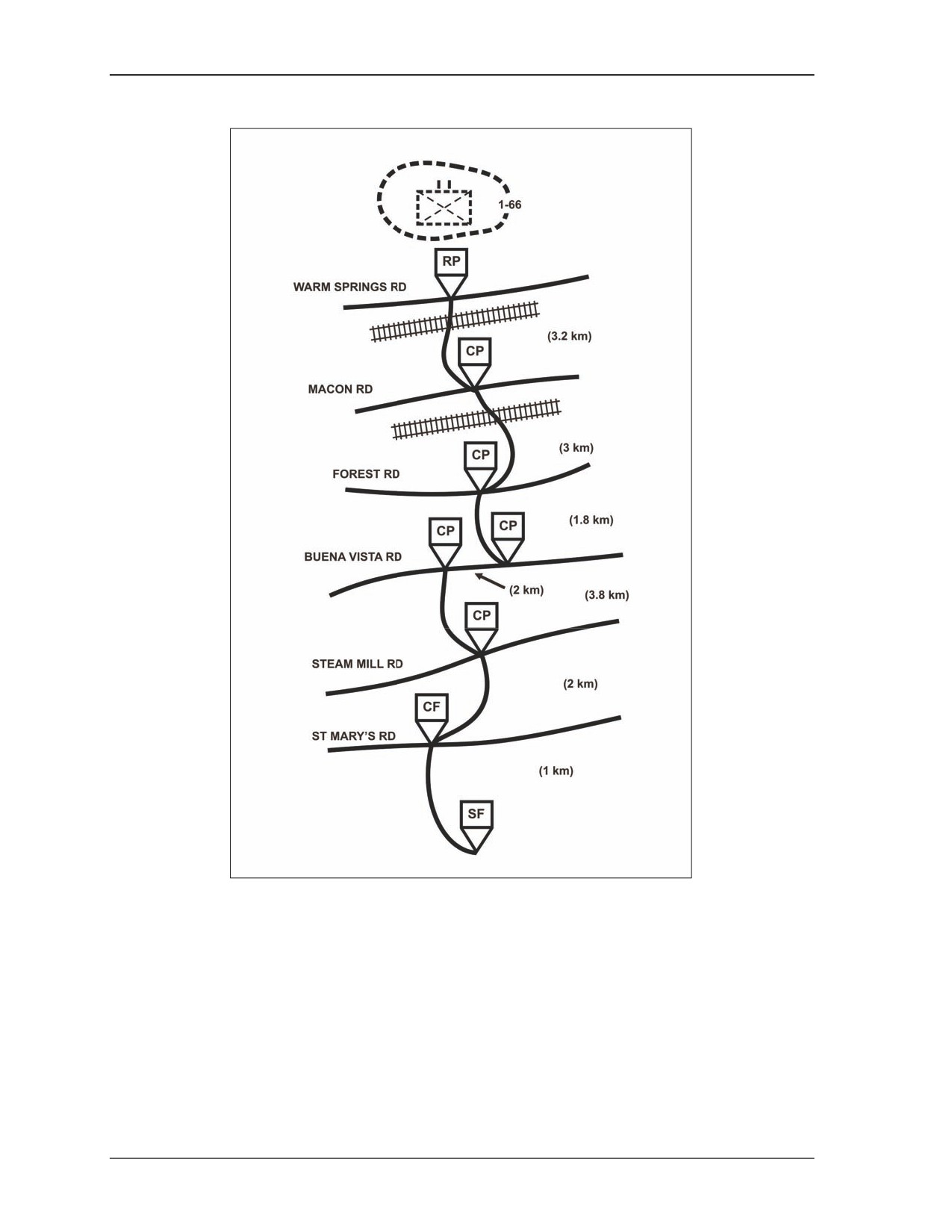
Chapter 3
Figure 3-13. Strip map.
3-78. The battalion scout platoon may reconnoiter the route. For motor marches, the scout platoon may
prepare a hasty route classification. This may include hasty bridge classifications, ford site locations and
conditions, road restrictions, sharpness of curves, and the slope percentage of steep hills. (For classification
symbols and their meanings, see FM 5-170.)
3-79. Arrival time at the start point is critical. The company must cross and clear the start point on time
so that other units are not delayed. The CO should reconnoiter and time the route from his assembly area to
the start point, so he can determine when the company must move to meet its start point time.
3-20
FM 3-21.10
27 July 2006
Movement
3-80. After crossing the start point, platoons report crossing each critical point. When moving as part of
the battalion, the company commander, in turn, reports to the battalion commander when his company
crosses and clears these points.
3-81. Before the company departs an assembly area, the CO should send a quartering party to the new
assembly area. The XO or 1SG leads the quartering party, which may consist of the platoon sergeants,
squad representatives, and the required headquarters personnel. This party provides its own security, and it
follows the same route of march to the new assembly area as the company does. At the assembly area, the
quartering party--
y Reconnoiters the area.
y Locates and marks or removes obstacles and mines.
y Marks platoon and squad sectors.
y Selects a position for the mortar section.
y Selects a command post location.
y Selects a company trains location.
y Provides guides for the incoming unit(s).
March Security
3-82. The CO plans for the security of the company when moving. This includes security against both air
and ground threats.
y He assigns each platoon the responsibility for a security sector. For example, he may assign the
lead platoon the front, the middle platoon the flanks, and the trail platoon the rear. The platoon
sectors must overlap to provide all-round security.
y He plans indirect fire to support the move. He plans targets along the route as he does for all
other moves. He designates warning signals and battle drills (usually SOP).
y A Stinger section may support the company from positions along the route or by moving within
the company column. Each Stinger team that is on the early warning net can warn the company
of an air attack. For that reason, each team should be within voice distance of someone having
a radio on the company command net.
y The mortar section must be ready to go into action and fire quickly. The FO teams should be in
continuous contact with the mortar and artillery fire-direction centers. The lead FO should keep
the fire direction center (FDC) informed of the lead elements location.
Assembly Areas
3-83. An assembly area is a location where the company prepares for future operations. The company
receives and issues orders, services and repairs vehicles and equipment, receives and issues supplies, and
feeds and rests Soldiers in the assembly area. When used to prepare for an attack, the assembly area is
usually well forward.
Characteristics
3-84. Cover and concealment are important if the company is to remain in the area for any length of
time. Vehicles, equipment, entrances, and exits should be camouflaged to keep the enemy from detecting
the location of the company. Consideration should be given to the following.
y Concealment.
y Cover from direct and indirect fire.
y Defendable terrain.
y Drainage, and a surface that will support vehicles.
y Exits and entrances, and adequate internal roads or trails.
27 July 2006
FM 3-21.10
3-21