FM 3-21.10 (FM 7-10) The Infantry Rifle Company (July 2006) - page 5
Chapter 4
positions until the finishing force arrives. The fixing force attacks if that action meets the commander's
intent and it can generate sufficient combat power against the detected enemy. Depending on the enemy's
mobility and the likelihood of the reconnaissance force being compromised, the commander may need to
position his fixing force before his reconnaissance force enters the AO.
4-184. If conditions are not right to use the finishing force to attack the detected enemy, the
reconnaissance or the fixing force can continue to conduct reconnaissance and surveillance activities to
further develop the situation. Whenever this occurs, the force maintaining surveillance must be careful to
avoid detection and possible enemy ambushes.
4-185. The finishing force may move behind the reconnaissance and fixing forces, or it may locate at a
pickup zone and air assault into a landing zone (LZ) near the enemy once he is located. The finishing force
must be responsive enough to engage the enemy before he can break contact with the reconnaissance force
or the fixing force. The battalion or brigade intelligence officer provides the commander with an estimate
of the time it will take the enemy to displace from his detected location. The commander provides
additional mobility assets so the finishing force can respond within that timeframe.
4-186. The commander uses his finishing force to destroy the detected and fixed enemy during a search
and attack by conducting hasty or deliberate attacks, maneuvering to block enemy escape routes while
another unit conducts the attack, or employing indirect fire or close air support to destroy the enemy. The
commander may have his finishing force establish an area ambush and use his reconnaissance and fixing
forces to drive the enemy into the ambushes.
DEVELOPMENT OF CONCEPT
4-187. Initially, the potential decisive points are identified as the most likely enemy locations. Once the
enemy has been located, the specific decisive point must be determined as in any attack, and a concept
must be developed for generating overwhelming combat power there. The initial concept must include the
actions to finish the enemy force once they are located. At times, this part of the plan might be very general
or consist only of control measures and be-prepared missions to provide flexibility and to support the rapid
issuance of FRAGOs.
4-188. The commander must understand the battalion commander's concept and what freedom of action
the company has to engage the enemy. At times, the company must engage and destroy all enemy forces
within their capabilities. In other cases, the company must locate, follow, and report small enemy units to
allow the battalion to concentrate and destroy these forces.
4-189. The commander focuses the platoons and squads on the likely enemy locations. He assigns
missions IAW the battalion commander's concept. Possible operations include a zone or area
reconnaissance, an ambush, or surveillance. The small-unit leaders must know what actions to take when
they locate the enemy either with or without being detected. The platoon most likely to make contact is
normally designated the decisive operation.
4-190. The company commander decides how the company will enter its zone or area of operations
(AO), how to move once in the area, where to locate certain units or facilities, and what the requirements
for contingency plans are. This includes establishing the proper graphic control measures to control the
movement of the units, to provide for linkups between units, and to support the rapid concentration of the
company's combat power. It also includes synchronizing the actions of the company and providing specific
tasks or restraints to ensure subordinates understand what actions to take once they make contact with the
enemy. The company normally enters the area or zone by moving as a company; platoons may then move
toward separate objectives or areas.
4-191. The commander determines the number and size of the units that will conduct reconnaissance and
combat actions against the enemy. The size of the area, the duration of the mission, the Soldier's load, and
the probable size of the enemy force are key factors to this decision.
4-192. The size of the area of operations is considered in relation to how much time is available to search
the area. When allocating terrain, the commander must consider how the platoons will conduct the
reconnaissance and how to provide security and control. The commander may use one of the following
techniques.
4-40
FM 3-21.10
27 July 2006
Offensive Operations
y Assign small AOs that keep the platoons more concentrated and help maintain control. The
platoons move into the next AO on order.
y Divide the company area into zones. The commander concentrates most of the company in one
zone and uses fire team or squad patrols to reconnoiter the next zone or the rest of the area.
Once the company (-) has completed the reconnaissance in the initial zone, it moves into the
area the small units have reconnoitered. This technique is effective when a detailed
reconnaissance is required, but it also supports the seizure of the initiative through speed,
stealth, and surprise. The small, dispersed units have a better chance of locating the enemy
undetected. They also provide initial reconnaissance information and surveillance on which the
commander focuses the remainder of the company's reconnaissance efforts.
4-193. The commander must consider how the duration of the mission affects the company's ability to
conduct contingency operations. If the mission will continue for days or longer, the commander must
develop a concept that allows his subordinates to maintain combat effectiveness. The concept must address
the use of patrol bases and limited visibility operations. The commander must ensure that the concept
provides sufficient rest to maintain his Soldiers' stealth, alertness, and security.
4-194. The duration of the mission also affects the Soldier's load, which has a tremendous impact on a
search-and-attack mission. The longer the mission is expected to last, the heavier the Soldiers' loads might
be to reduce the need for resupply. The ability to move with stealth and security (while close to the enemy)
is hindered by heavy loads; however, resupply operations may also hinder the company's operation and
allow the enemy to locate the unit by following or observing the resupply vehicles.
4-195. The company commander must determine the requirements for Soldier's load. If this causes
excessive loads, he plans for resupply operations that avoid enemy detection and maintain the security of
the company.
4-196. The company commander may combine techniques to reduce the risk of moving with these heavy
loads. He identifies company patrol bases throughout the AO, and the company moves between these
patrol bases using the approach-march technique to provide greater control and security. After securing and
occupying the patrol base, the platoons leave their rucksacks and move out to conduct decentralized
search-and-attack operations. A security force secures the patrol base until the units return to get their
rucksacks and move to the next patrol base. Platoons can use this same technique when the risk is
acceptable.
4-197. Knowing the size of the enemy units helps the company commander determine the risk to the
company. He must also consider the enemy's capabilities, likely COAs, and specific weapons’ capabilities.
He must do so to understand the threat, and to ensure the security of his company, even during
decentralized operations. He can direct specific force protection restraints such as--
y No patrols smaller than a squad.
y Platoons must be able to consolidate within 20 minutes.
y Platoons will depart their patrol bases NLT 60 minutes prior to BMNT.
LOCATE ENEMY
4-198. Information collection and analysis is normally the key to success in search and attack. During
this step, the focus is on reconnaissance to locate the enemy. Generally, small units able to move quickly
and with stealth are more likely to locate the enemy without detection. The company commander's concept
may restrict the platoon's authority to destroy the enemy once located. It might be more important to locate
and follow enemy units to identify their base camps. However, when not restricted, the unit making contact
takes immediate action to destroy the enemy. If this is beyond the unit's capabilities, the platoon links up to
mass its combat potential and to coordinate the attack. Considerations for reconnaissance should also
include the use of SUASs. Most SUASs have both a daylight and limited visibility (infrared) capability and
significantly aid in providing the commander with needed information on the terrain and enemy.
4-199. Platoons seldom receive a mission with the vague requirement to search and attack. The company
commander must be more specific in stating his concept. His concept must also address the likely actions
27 July 2006
FM 3-21.10
4-41
Chapter 4
to destroy the enemy once they are located. Specific tasks may include route, area, and zone
reconnaissance or surveillance tasks. Platoons may also be tasked to conduct ambushes, be prepared to
conduct an attack to destroy enemy forces, provide security for another force, such as the CP or the mortar
section, or act as the company reserve.
4-200. During limited visibility, reconnaissance is more difficult and potentially more dangerous. If a
unit makes contact with the enemy in the dark, a hasty attack is very risky. Reconnaissance is also less
effective in the dark because the unit covers less area and is unable to detect many signs of enemy activity.
Although observation is reduced in limited visibility, the unit might be more likely to detect the enemy by
sound or smell. Route and small-area reconnaissance tasks are more effective for limited visibility.
4-201. Ambushes are effective in limited visibility. The enemy may avoid daylight movements if aware
of the company's presence in the AO. Ambushes should be set up on the enemy's likely routes or near their
water and food sources. Patrol bases should integrate ambushes and OPs (with thermal sights, NVDs, and
platoon early warning systems [PEWS]) into their security plans. These tasks support the seizure and
maintenance of the initiative.
FIX AND FINISH THE ENEMY
4-202. These steps of a search and attack are closely related. An initial try to finish the enemy may
quickly become the fixing effort for the company's attack if the enemy is too strong or the platoon is unable
to achieve surprise. When the platoon's authority to destroy the enemy has been decentralized to the lowest
level, the fundamentals of an attack apply at every echelon.
ACHIEVE SURPRISE
4-203. Locate the enemy without being detected. This allows more time to plan and coordinate the attack.
Once detected, speed and violence in the assault may also achieve surprise, but this is rarely true against a
prepared enemy defense.
LIMIT THE ENEMY'S FREEDOM OF ACTION
4-204. Fix the enemy in position. Block his routes of escape with indirect fires, maneuver forces, or both.
Suppress his weapons systems, obscure his vision, and disrupt his command and control. Reconnaissance
is continuous; leaders at every echelon seek out the enemy's dispositions, strengths, and weaknesses.
Initially, these actions are directed toward supporting an attack by the lowest echelon. At some point, the
leader of this unit must determine if he is able to achieve fire superiority and conduct the assault. If he
determines he does not have sufficient combat power to complete the destruction of the enemy, the leader
focuses on fixing the enemy and reconnoitering to support the attack by the next higher echelon.
MAINTAIN SECURITY
4-205. While trying to take these actions against the enemy, the enemy is trying to do the same. Do not
assume the enemy is alone; there might be mutually supporting positions or units. The planned
envelopment or flank attack of one enemy position may move through the kill zone of another unit, or may
expose the assault force's flank to fires from undetected positions.
CONCENTRATE COMBAT POWER
4-206. Once contact is made, the plan must support the rapid concentration of combat power to fix and
destroy (finish) the enemy. Leaders at each echelon plan to destroy the enemy within their capabilities. The
combat potential of small units might be increased by ensuring each has the ability to request fire support.
4-207. The company commander may retain a portion of the company in reserve in order to act quickly
to enemy contact by one of the small units. However, when the company is operating in a more dispersed
manner, this company reserve may not be responsive enough. It might be more effective for each platoon
to retain its own reserve.
4-208. If the unit or platoon cannot finish the enemy, the company commander determines how to fix or
contain the enemy while concentrating his dispersed combat potential. He then develops an attack plan to
4-42
FM 3-21.10
27 July 2006
Offensive Operations
destroy the enemy force. He may use the fixing force to support by fire and assault with another platoon(s),
or he may use artillery and CAS to destroy him in position.
4-209. Each leader must report the results of his reconnaissance to support the company commander's
planning. Leaders recommend effective support positions, good assault positions or directions of attack,
and likely enemy weak points. The leader of the unit in contact should also identify good linkup points in
case the preplanned points are not effective. In most cases, this leader should coordinate face-to-face with
the company commander or the leader of the assault element before initiating the assault.
FOLLOW THE ENEMY
4-210. When the purpose of the operation is to locate the enemy's base camps or other fixed sites, the
company concept must avoid inconclusive fights between small units. When friendly units locate small
enemy units, they report and try to follow or track these units back to their base camps. Well-trained
trackers familiar with the area might be able to identify and follow enemy tracks that are hours or even
days old (FM 3-21.8 (FM 7-8)). The company commander must ensure that his concept does not risk the
security of his force in the try to make undetected contact and track enemy units. Units tracking the enemy
must be ready to react to enemy contact and avoid likely ambush situations. It also might be possible to
track the enemy's movement through the AO by using stationary OPs as trail watchers to report enemy
activity. Movement within the area or through the zone of attack might be conducted by the entire
company or by individual platoons.
4-211. The Infantry company commander must decide where the company CP will locate. He may
collocate it with the decisive operation platoon or position it in a central location where it can communicate
with and move quickly to each platoon's location. A technique to support contingency operations is to
rotate a reserve platoon each day to provide security for the CP and the company mortars. To prevent a
serious degradation in effectiveness due to sleep loss, each platoon spends only 48 hours actively searching
for the enemy and then rotates into the reserve role.
4-212. Company mortars must locate where they have security and can support the platoons. The
company commander can collocate the mortars with the company CP. To overcome the difficulties of
moving mortar ammunition, the company commander may direct the reserve platoon to carry the
ammunition to the next firing position. Another option is to establish company patrol bases and place the
mortars at these locations. The entire company can then carry the mortar ammunition; the Soldiers drop off
the rounds before moving out to the platoon areas. However, the entire company must return to this
location before continuing the operation through the zone.
4-213. The Soldier's load and the threat of enemy armor are two primary considerations for employing
the antiarmor (shoulder-fired munitions and close-combat missile systems [Appendix B, Employment of the
TOW and Javelin Close-Combat Missile Systems]) assets. When an armored threat exists, the company
commander must provide guidance to platoon leaders on where to position the antiarmor assets. If the
threat does not require antiarmor weapons, the platoons may still use some thermal sights for observation.
4-214. Contingency plans may include actions in case one platoon becomes decisively engaged or the
company receives a new mission. All units should routinely report possible landing zone/pick-up zone
(LZ/PZ) locations, mortar firing positions, any sign of recent enemy activity, and any sightings of civilians
in the area.
APPROACH-MARCH-TECHNIQUE
4-215. The Infantry company normally uses this technique when it conducts a MTC as part of the
battalion. Depending on its location in the formation and its assigned mission, the company can act as the
advance guard, move as part of the battalion main body, or provide flank or rear guards for the battalion.
PLANNING CONSIDERATIONS
4-216. When planning for an approach-march MTC, the company commander needs certain information
from the battalion commander. With this information, the company commander develops his scheme of
27 July 2006
FM 3-21.10
4-43
Chapter 4
maneuver and fire support plan. He provides this same information to the platoon leaders. As a minimum,
he needs to know--
y The company's mission.
y The friendly and enemy situations.
y The route (axis of advance) and the desired rate of movement.
y The control measures to be used.
y The company's actions on contact.
y The fire support plan.
y The company's actions upon reaching the march objective, if one is used.
LEAD COMPANY RESPONSIBILITIES
4-217. The battalion may conduct a MTC on a single axis or on multiple axes. The lead company on an
axis is responsible for--
y Protecting the battalion from a surprise attack by providing early warning of enemy positions
and obstacles.
y Assisting the forward movement of the battalion by removing obstacles or finding routes
around them.
y Destroying enemy forces (within its capability).
y Rapidly developing the situation once contact is made.
LEAD COMPANY MOVEMENT
4-218. The lead company or advance guard on an axis moves using traveling overwatch or bounding
overwatch, depending on the enemy situation. It normally is assigned an axis of advance or a zone and a
march objective on which to orient its movement. Phase lines and CPs help control movement.
y The company commander selects the movement technique and formation based on the
likelihood of enemy contact and the speed of movement desired by the battalion commander.
Bounding overwatch provides the best security, but traveling overwatch is faster. If the
company uses traveling overwatch, the lead platoon may use bounding overwatch for added
security.
y The company commander must retain the freedom to maneuver his platoons and weapons. He
analyzes the terrain, anticipates where he might make contact, and plans fires on those
locations. He should avoid terrain that restricts maneuver, such as draws, ravines, narrow trails,
and steep slopes.
OTHER COMPANIES
4-219. A company not in the lead uses traveling or traveling overwatch. It must be ready to fire or
maneuver in support of the lead company, or in another direction, or to assume the lead company's mission.
FLANK GUARD AND REAR GUARD
4-220. One company might be assigned the mission to provide forces for security of the flanks or rear of
the battalion column. Normally this is the trail company of the battalion, which provides for centralized
control and tactical integrity. Typically, the battalion commander specifies one platoon for each flank and
one for the rear. METT-TC may call for reinforcement of certain of these elements as well. The company
headquarters and remaining platoons will likely march with the main column.
4-44
FM 3-21.10
27 July 2006
Offensive Operations
REAR GUARD FORCE CONSIDERATIONS
4-221. Prevents enemy interference with the main body by stopping or delaying an attack to the rear; and
prevents enemy direct fire or ground observed indirect fire from harassing the main body.
y During halts, occupies positions that enable it to protect the rear of the main body.
y Normally moves in column formation except where expected enemy action causes the need to
deploy in width.
FLANK GUARD FORCE CONSIDERATIONS
4-222. Protects the main body from ground observation and surprise ground attack from the flank;
Should the enemy initiate an attack, the flank guard may counterattack, defend, or delay to allow the main
body to pass from the area, deploy, or maneuver.
y Responsibility might be assigned to the flank guard using a series of terrain features that block
enemy likely avenues of approach; these positions must be coordinated with the protected main
body unit.
y Movement of the guard force is tied to movement of the protected unit and may employ
successive or alternate bounds to blocking positions.
y The flank guard must maintain close liaison with protected elements by all available means
such as radio, patrols, or helicopters.
y Distances to the flank must assure mission accomplishment while trying to stay within range of
the battalion mortars; normally about one terrain feature is tactically sound.
CONTACT
4-223. Once the company makes contact with the enemy, the company commander maintains that contact
until ordered to do otherwise by the battalion commander. The following actions must take place at once.
4-224. When there is an unexpected contact, the platoon in contact returns fire at once and takes cover. If
the enemy is unaware, the platoon making contact reports and deploys to prevent detection. Maneuver to a
position of advantage to maintain the element of surprise until the company completes preparation for the
hasty attack. If detected, or once the company commander decides to initiate the hasty attack, the platoon
leader tries to fight through, destroying the enemy with the resources that are immediately available. His
FIST should begin calling for fire. The platoon leader then reports to the company commander and
continues to develop the situation. The overwatch element immediately fires at the enemy position. Trail
platoons that are not able to fire take cover and wait for orders.
4-225. The squad or platoon that initially received direct fire immediately executes the attack drill. The
intent is to use aggressive small-unit actions to seize the initiative rapidly and at the lowest echelon
possible. The unit in contact tries to achieve fire superiority to fix or suppress the enemy with the resources
that are immediately available. The unit then executes a flank attack directed against an identified enemy
weakness. If this is not possible, the unit develops the situation to identify the enemy's flanks, any covered
and concealed routes around the enemy position, possible supporting positions (both friendly and enemy),
and any protective obstacles that the enemy has constructed. It then reports this information to the company
commander.
4-226. Upon receipt of this information, the company commander determines the proper action to take.
The XO reports the situation to battalion. The company commander may conduct, or direct his units to
conduct, additional reconnaissance. The company FSO requests and coordinates indirect fires to support
the company's maneuver. Possible reactions to contact include--
CONDUCT A HASTY ATTACK
4-227. If the company commander feels he can defeat the enemy force and an attack supports the
battalion commander's concept, he conducts a hasty attack immediately, before the enemy can react.
27 July 2006
FM 3-21.10
4-45
Chapter 4
BYPASS THE ENEMY
4-228. The company commander, with battalion permission, may bypass an enemy force. He may bypass
the enemy with one platoon at a time or with the entire company at once (Figure 4-14, page 4-50). Precise
criteria exist for making for a bypass. The criteria are usually conveyed as a size of enemy unit, for
example, bypassing a squad-size unit without automatic weapons is authorized.
FIX OR SUPPRESS THE ENEMY
4-229. When the enemy cannot be bypassed and a hasty attack by the company is not feasible, the
battalion normally directs the company to fix or suppress the enemy. This action ensures that the enemy
does not have the freedom to fire or maneuver against the main body of the battalion while the battalion
moves to attack the enemy. The company commander supports the battalion commander's planning by
reconnoitering to identify the enemy's disposition, strengths, and weaknesses. The company identifies
covered and concealed routes, good support positions, and enemy obstacles, and reports these to battalion.
ESTABLISH A HASTY DEFENSE
4-230. Although this action tends to give the initiative to the enemy force, it might provide a needed
advantage. This might be required in a meeting engagement with a superior force. The company may
establish a hasty defense to protect itself while the remainder of the battalion maneuvers against the enemy.
DISENGAGE
4-231. This action is not preferred unless disengaging is the only way to ensure preservation of the force.
Use of indirect fires and bounding and overwatch elements is essential in disengaging from a superior
force. The company may disengage while another unit maintains contact, or the company may disengage
by moving back through the battalion to draw the enemy into an ambush.
TECHNIQUE CONSIDERATIONS
4-232. The battalion may direct the company's technique (search-and-attack or approach-march). If not,
the Infantry company commander considers his mission and the battalion concept as he conducts his
estimate to select the best technique. Normally, when operating as part of a battalion MTC, the company
employs the same technique as the battalion. The following considerations may also assist the commander
in developing his concept.
TIME AVAILABLE
4-233. The time available for planning, coordinating, and rehearsing may affect the decision. The
approach-march technique generally requires much less time for preparation. The company may require
only a brief FRAGO assigning the movement formation and technique and some simple graphic control
measures to begin movement. The search-and-attack technique requires more preparation time because the
platoons and squads have more planning responsibilities such as patrol base, linkups, and casualty
evacuations.
SPEED OF MOVEMENT
4-234. The speed in which the company must move is a major factor. With either technique, the faster the
company moves, the less effective its R&S efforts are. Thus, it becomes more likely that the enemy will
initiate fires at the time and place he selects. The approach-march technique is normally more effective for
quickly acting to enemy contacts.
ENEMY
4-235. The company commander considers the clarity of the enemy situation. If the enemy situation is
vague then a MTC is required. Knowing where the enemy will probably locate and in what strength is key
to developing a concept. The company commander considers the enemy's probable locations and strength
4-46
FM 3-21.10
27 July 2006
Offensive Operations
when planning the company's movement and security needs, and he analyzes the risks for each technique.
The company commander also considers the expected enemy reaction upon contact. If he expects the
enemy to fight, then the approach march might be the more effective technique. If the enemy will try to
avoid detection or quickly disengage, the search-and-attack technique might be the better method.
SECURITY
4-236. Preparation time, required movement speed, and the enemy situation have a direct impact on the
company's security requirements. The company commander also considers the terrain, the adjacent units,
the available combat support, and the present status of his unit to determine how to provide security for his
company. Successful movements to contact depend on locating the enemy without being detected. This
provides the company commander the initiative to develop the situation by fully coordinating and
supporting the attack with all available resources.
COMBINED TECHNIQUE
4-237. An effective option might be to combine the techniques by having the lead platoon use the
search-and-attack technique while the rest of the unit uses the approach-march technique. The lead platoon
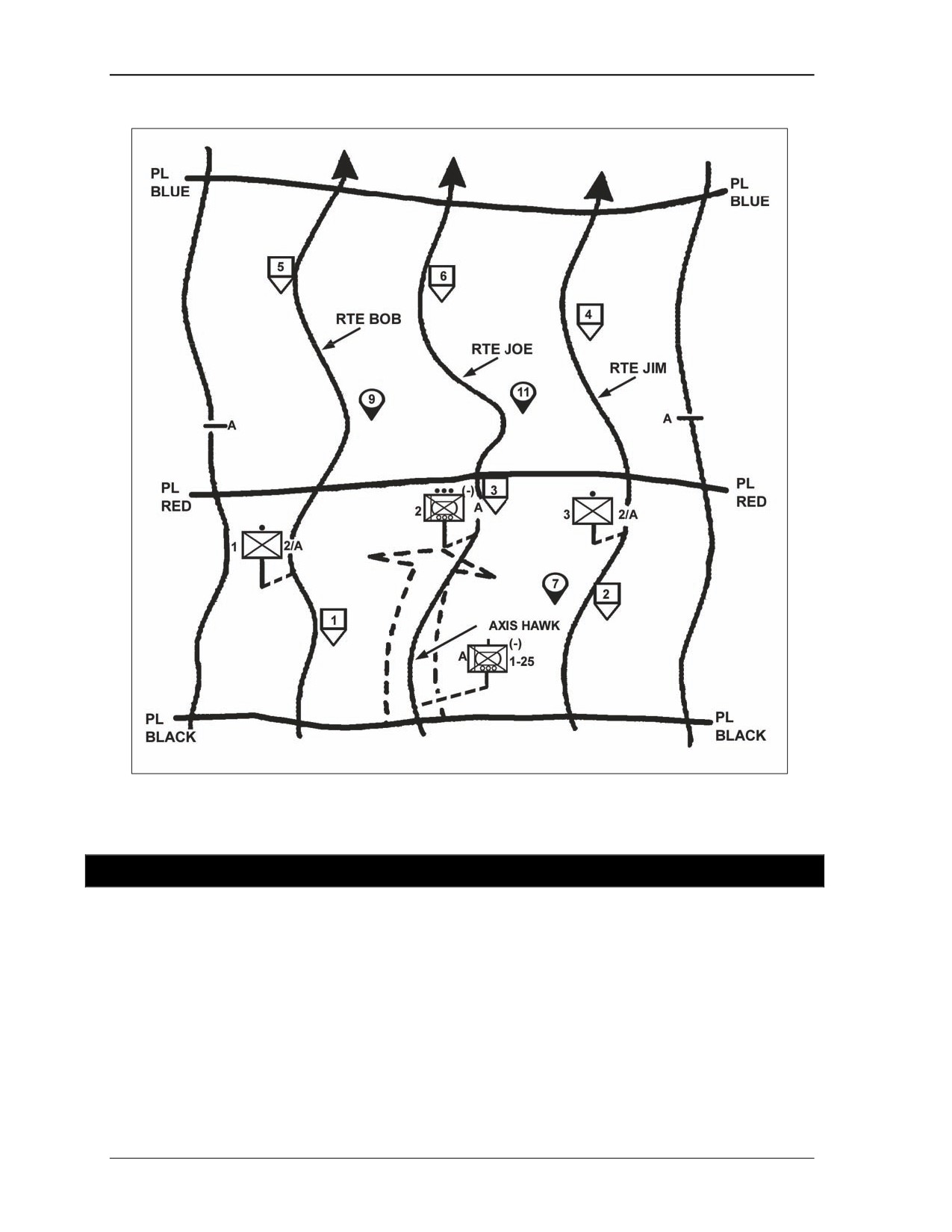
is assigned reconnaissance missions to find the enemy. In the example shown in Figure 4-14, the company
commander assigns route reconnaissance tasks to the 2d Platoon. He assigns CPs and named areas of
interest (NAIs) to focus the subordinate elements on specific locations. He can also use phase lines (PLs) to
control the lead platoon by directing that PLs be crossed on order. The company's main body follows the
reconnaissance at a distance that allows it to maneuver based on reports from the lead platoon. The
formation and movement techniques for the main body vary but generally apply the fundamentals for the
approach-march technique.
27 July 2006
FM 3-21.10
4-47
Chapter 4
Figure 4-14. Combination technique.
Section VII. COMMON ACTIVITIES
These activities are warfighting actions the Infantry company might be called upon to perform in battle.
INFILTRATION
4-238. Infiltration is a form of maneuver used by Infantry units in many situations. During an attack,
strong enemy defensive positions might be encountered. To avoid the enemy's strength, the Infantry
commander may (by stealth through gaps or around enemy positions) conduct operations in the enemy's
rear area. The company may infiltrate to conduct raids, ambushes, or other attacks. The company may also
use infiltrations for many other types of operations, such as stay-behind and reconnaissance.
4-48
FM 3-21.10
27 July 2006
Offensive Operations
FUNDAMENTALS
4-239. By infiltrating, the Infantry company can maneuver to critical targets undetected, can achieve
surprise, and can avoid the effects of enemy fires. Limited visibility, bad weather, and restrictive terrain
reduce the chances of detection during an infiltration. A unit may infiltrate--
y To gather information.
y To attack the enemy at a weak point.
y To seize key terrain or destroy vital installations behind enemy positions.
y To harass and disrupt the enemy with ambushes in his rear area.
y To attack enemy reserves, fire support units, and command posts.
STEPS
4-240. The steps of an infiltration follow.
Patrol
4-241. Find gaps or weak areas in the enemy defense and locate enemy positions.
Prepare
4-242. Conduct TLP.
Infiltrate
4-243. Avoid enemy contact; move by smallest units possible.
Consolidate
4-244. Link up and prepare for actions at the objective.
Execute (Complete Mission)
4-245. Infiltration does not always require that all units move through the enemy's positions without
detection or contact. Depending on the mission, the company can still complete the mission even though
some of the squads make contact en route to the linkup point. Although the enemy might have some idea of
what is happening, he will have difficulty estimating exactly what these small contacts mean. OPSEC
might require that only key leaders have the entire plan during the infiltration step to prevent disclosure
due to casualties or friendly prisoners.
CONSIDERATIONS
4-246. The Infantry company commander must prepare an infiltration plan and give units enough time
for preparation and movement. The company may infiltrate by itself or as part of the battalion. In either
case, movement techniques and formations are based on the likelihood of enemy contact, the terrain, the
level of visibility, and the need for speed and control.
SIZE
4-247. The size of the infiltrating unit depends on the amount of time available, the amount of cover and
concealment, and the enemy. Other considerations may include the need to communicate, the difficulty of
navigation, and the number of infiltration routes. Generally, smaller units can move more quickly and make
better use of available concealment, but they may increase the number of linkups, requiring more time.
27 July 2006
FM 3-21.10
4-49
Chapter 4
Infiltrating by company or platoons ensures control and provides more combat power in the event of
contact.
INFILTRATION LANE
4-248. The company might be assigned an infiltration lane or zone. The company commander must
decide whether to move the entire company together through the company's lane or to assign each platoon
a separate infiltration lane within the company lane. He also has the option to stagger the start time for each
platoon on the one company lane. The infiltration lane should be wide enough to allow the infiltrating units
to change their planned routes to avoid enemy contact. If the company uses a single company lane, the
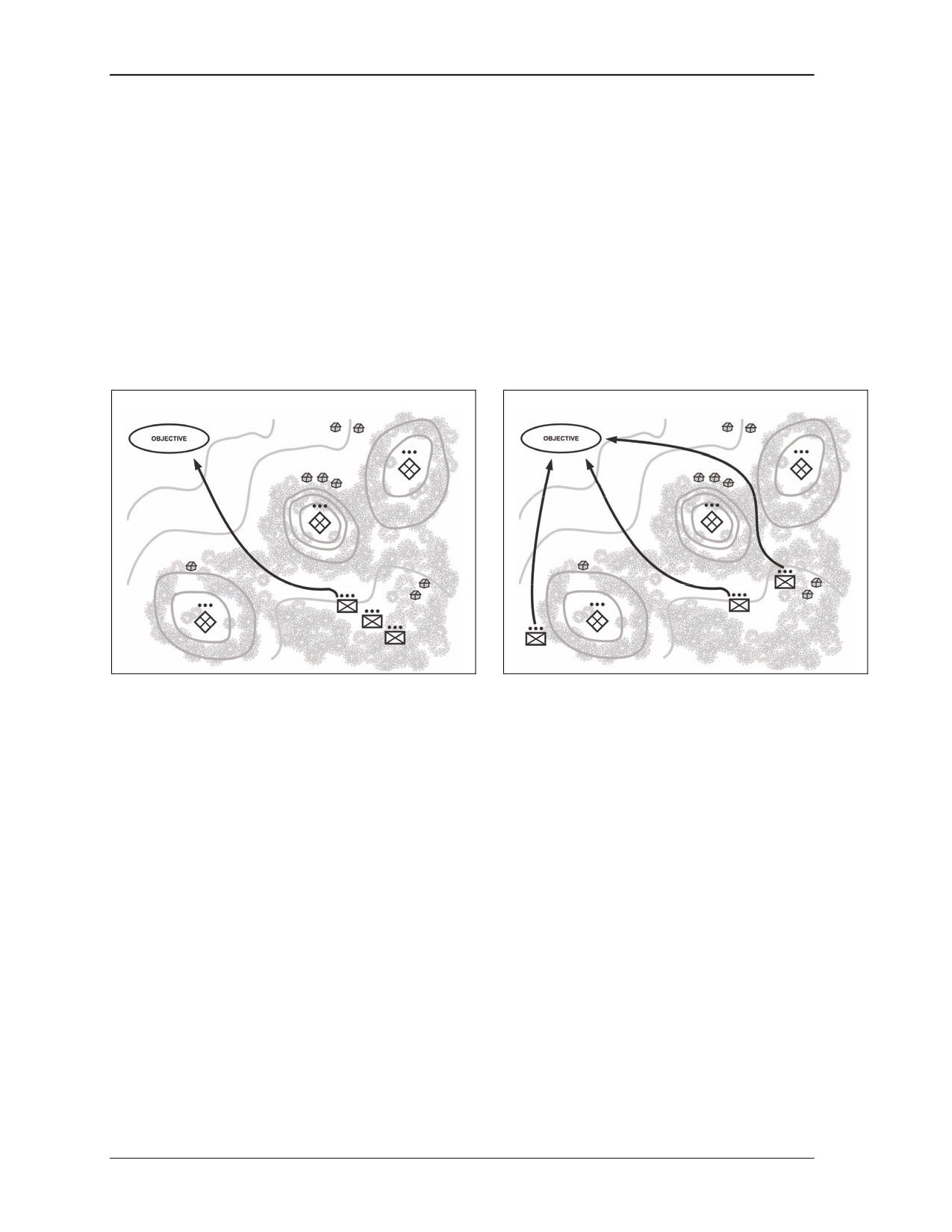
company commander picks a route through it and a company linkup point (Figure 4-15). If the company
commander uses multiple lanes the company commander assigns each platoon a lane and a start time, picks
linkup points for the platoons, and picks a company linkup point (Figure 4-16). The platoon leaders pick
the routes through their lanes. In making his decision whether to use single or multiple lanes, the company
commander considers several factors:
Figure 4-15. Company moving on
Figure 4-16. Company moving on
single infiltration lane.
multiple infiltration lanes.
Moving as a Company on a Single Lane
4-249. The advantages follow.
y Might get the company to the linkup point faster.
y Makes control easier.
y Makes navigation easier.
y Increases the chance of the entire company being detected but provides greater combat
potential if detected.
Moving on Multiple Lanes or by Platoons on One Lane
4-250. The advantages follow.
y Requires linkups.
y Makes control harder.
y May make navigation more difficult.
y Decreases the chance of the entire company being detected but provides less combat potential if
detected.
4-50
FM 3-21.10
27 July 2006
Offensive Operations
Routes
4-251. The routes selected must avoid enemy positions, use the best available cover and concealment,
ease control and navigation, and avoid obstacles and danger areas.
y Routes should be reconnoitered without alerting the enemy. Leaders should consider using a
map reconnaissance or guides, or marking the routes.
y Rally points might be selected based on the reconnaissance assets available to the commander;
others are selected as the company moves along the route. If the infiltrating company is
dispersed by enemy action, it rallies at the last rally point passed that is not within enemy
small-arms range. The assembled unit then waits until a set number of units or Soldiers arrive at
the rally point, or until a specified time, before continuing the mission. The senior man at the
rally point should, in the absence of the commander, assume command and decide how best to
continue the mission within the commander's intent.
y Locate the ORP as close to the objective as possible without being detected or losing security.
The ORP should be large enough so that the company can deploy in it. It should be cleared
before occupation.
Linkup Point
4-252. When using multiple lanes, the platoons meet at a linkup point and then move as a company to the
ORP. Do not plan linkups at the ORP. If a unit misses its linkup, it moves to a contingency linkup point
located away from the ORP and links up with a small element from the ORP.
Signals
4-253. Use of visual signals, such as with arms and hands, infrared devices, or flashlights with colored
lenses, reduce the chance of detection. Avoid sound signals and flares. Recognition signals are critical for
actions at a linkup or rally point.
4-254. Radio listening silence should be enforced, except when a unit must report its progress or when a
unit detected by the enemy needs supporting fire.
4-255. Radio messages to report crossing of phase lines or CPs (if required) should be brief ? one code
word. They might be transmitted without using call signs to identify units, providing each unit has separate
code words.
4-256. When required, units operating out of radio contact (because of terrain or distances) can monitor
or send codes only at a certain time. At these times, they set up expedient antennas or move to terrain better
suited for communication.
Fire Support
4-257. Indirect fires are always planned but are used only when contact is made or when needed to
support the mission. If contact is made with an enemy element, the infiltrating unit should use indirect fire
to divert the enemy's attention, suppress enemy positions, and screen friendly movement as they disengage.
Indirect fires may also be used to assist in navigation and to cause enemy Soldiers on security to seek
cover.
Actions on Contact
4-258. When infiltrating on multiple lanes, detection of one infiltrating unit may alert the enemy and
compromise the other infiltrating units. The company OPORD must state whether to continue the mission
or return to friendly lines if detected by the enemy. Units following on the same lane should switch to an
alternate lane. If a Soldier in the unit speaks the enemy's language, he should be positioned at or near the
27 July 2006
FM 3-21.10
4-51
Chapter 4
front of the column in case an enemy OP or patrol challenges the unit. The order also must specify what to
do in the event of casualties.
Methods of Handling Casualties and Prisoners
4-259. During the infiltration, it might be extremely difficult to evacuate casualties or move prisoners
without jeopardizing security. Casualties can be carried to the ORP or linkup point and evacuated when the
operation has ended, or they can be consolidated and concealed with appropriate medical care and security
and left for recovery and evacuation later. Moving casualties or prisoners to the ORP is dangerous when
trying to avoid detection. Soldiers with medical supplies stay with any casualties left behind. The killed in
action (KIA) can be concealed and recovered later when the tactical situation permits. Leave prisoners
under guard at a rally point and evacuate them when the operation is over.
Rehearsals
4-260. Every Soldier must know the plan and his role in the plan. Units should rehearse their formations,
their movement techniques, and their actions.
y On enemy contact.
y At rally points.
y At the linkup point.
y At the ORP.
y At danger areas.
y At the objective.
OVERWATCH
4-261. Overwatch is the component of tactical movement in which an element observes and, if necessary,
provides direct fire support for a friendly moving element. Situational understanding of the tactical
environment is crucial for the overwatch unit, whose objective is to prevent the enemy from surprising and
effectively engaging the moving unit. The overwatch force must maintain communications with the
moving element and provide early warning of enemy elements that could affect it. The overwatch must be
able to support the moving element with immediate direct (to include antiarmor fires) and indirect fires; it
can do this in either bounding overwatch or traveling overwatch. The key to successful overwatch is
thorough scanning of gaps and dead space within the moving element’s formation and on surrounding
terrain. If the overwatch is unable to scan gaps and dead space and effectively engage the enemy, it must
alert the moving element of the lapse in coverage. The moving element normally adjusts its movement
speed, formation, or both, and initiates its own overwatch until the overwatch force completes movement
to a position where it can continue the overwatch mission.
FOLLOW AND SUPPORT
4-262. Follow and support forces are employed in the offense to maintain the momentum of an operation.
They do this by providing support or assistance that relieves the lead element of hindrances that could slow
its advance. Follow and support missions are usually assigned when the enemy situation is vague and
speed of the operation is important. The Infantry company might be task-organized to conduct follow and
support missions in one of several ways.
y It can be part of a battalion with the mission of maintaining the momentum of a brigade attack.
y It can function as a separate maneuver element in support of the movement of another
battalion element.
y Platoons within the company may conduct follow and support missions in support of other
Infantry elements.
4-52
FM 3-21.10
27 July 2006
Offensive Operations
y Follow and support operations may require the company to conduct a variety of tactical tasks,
including--
- Conduct linkup operations with the lead element’s fixing or overwatch force.
- Destroy bypassed pockets of resistance.
- Secure the flanks of a penetration to prevent the enemy from closing the penetration.
- Secure lines of communications.
- Secure bypassed key terrain.
- Protect key installations.
- Guard EPW.
- Evacuate casualties.
4-263. The follow and support force receives information on the enemy or the supporting tasks from the
lead element’s fixing or overwatch force. The follow and support force conducts linkup with the fixing
force on the ground, completes the exchange of critical tactical information, and accepts responsibility for
the assigned tasks. The fixing force then rejoins the lead element, and the follow and support force
executes its tasks. If enemy contact occurs, the follow and support force conducts actions on contact as
outlined earlier in this chapter.
BYPASS
4-264. The company may bypass an enemy force or obstacle to maintain the momentum of the attack or
for another tactical purpose. The battalion commander establishes bypass criteria.
y The Infantry company commander designates a fixing force to maintain contact with the enemy
and assist the remainder of the company during the bypass. This fixing force may not come into
direct fire contact with the enemy force.
y The bypassing force uses covered and concealed routes and, if possible, moves along bypass
routes that are outside the enemy's direct fire range. If the situation dictates, the company can
also employ smoke to obscure the enemy or to screen the bypassing force's movement. The
company must conduct adequate reconnaissance of the route to confirm the feasibility of the
bypass; the enemy may intentionally leave a bypass route unguarded to draw attacking forces
into his kill sacks.
y Once the rest of the Infantry company clears the enemy position, the fixing platoon normally
hands the enemy over to a supporting force, breaks contact, and rejoins the company. The
fixing platoon might be attached to the follow-on force, but this is unlikely.
CLEARING OF AN OBJECTIVE
4-265. The company might be tasked with clearing an objective area during an attack to facilitate the
movement of the remainder of the battalion or with clearing a specific part of a larger objective area.
Situations in which the Infantry company may conduct the tactical task CLEAR include the following.
y Clear a defile, including high ground surrounding the defile and choke points within the defile.
y Clear a heavily wooded area.
y Clear a built-up area.
y Clear a road, trail, or other narrow corridor. This may include obstacles or other obstructions on
the actual roadway, as well as surrounding wooded and built-up areas.
CLEARING PROCEDURES IN RESTRICTED TERRAIN
4-266. Clearing in restricted terrain is time-consuming and resource-intensive. During the planning
process, the Infantry company commander evaluates the tactical requirements, resources, and other
considerations for each of the three steps of the operation.
27 July 2006
FM 3-21.10
4-53
Chapter 4
y Approach the restricted terrain.
y Clear the area in and around the restricted area.
y Pass friendly forces, as required.
APPROACH
4-267. The approach focuses on moving combat power into restricted terrain and posturing it to begin
clearing. The company commander takes the following actions.
y Establishes support-by-fire positions; destroys or suppresses any known enemy positions to
allow forces to approach the restricted terrain.
y Provides additional security by incorporating suppressive indirect fires and obscuring or
screening smoke.
y Provides support by fire for the dismounted Infantry. Be prepared to cover Infantry elements to
the points at which they enter the restricted terrain such as high ground on either side of a
defile, wooded areas on either side of a trail or road, or buildings on either side of a road in a
built-up area.
y Moves dismounted Infantry elements along axes that provide the best available cover and
concealment. The approach ends when the Infantry elements are prepared to conduct an attack.
4-268. The clearing begins as the Infantry squads begin their attack in and around the restricted terrain.
Locations where this maneuver may take place include--
y On both sides of a defile, either along the ridgelines or high along the walls of the defile.
y Along the wood lines parallel to a road or trail.
y Around and between buildings on either side of the roadway in a built-up area.
y The following actions and considerations apply during this step.
- Direct fire plans should cover responsibility for both horizontal and vertical observation and
direct fire.
- Infantry squads should clear a defile from the top down and should orient on objectives on
the far side of the defile.
- Engineers with manual breaching capability should move with the Infantry squads.
PASSAGE OF FRIENDLY FORCES
4-269. The Infantry company might be directed to assist the passage of another element forward to
continue the clearing. When clearing is complete, the company must be prepared to take any action
necessary to pass friendly forces, such as the following.
y Within the capabilities of the company, assault to destroy enemy forces and secure the far side
of the restricted terrain.
y Conduct support by fire to protect the deployment of the follow-on force that is assuming the
fight or to destroy or suppress any enemy elements that threaten the battalion as it exits the
restricted terrain.
y Defeat any counterattacks.
y Protect the obstacle reduction effort.
y Maintain observation beyond the restricted terrain.
y Integrate indirect fires as necessary.
COMPANY AS RESERVE
4-270. The company might be held as the battalion reserve during an attack. The Infantry battalion
commander commits the reserve to decisively influence the action and to maintain the momentum of the
attack. To exploit the success of the other attacking Infantry/weapons companies and to achieve surprise,
4-54
FM 3-21.10
27 July 2006
Offensive Operations
the reserve should attack the enemy from a new direction. Because of the various missions that the reserve
might be assigned, the reserve commander must keep abreast of the tactical situation, know the missions
and the tactical plans of the other companies, and be familiar with the terrain and the enemy situation in the
objective area. The reserve must act quickly and effectively when committed. The reserve might be
assigned one or more of the following tasks as part of its planning priorities.
y Protect the flanks or the rear of a battalion.
y Assume the mission of another company.
y Support by fire.
y Clear a position that has been overrun or bypassed.
y Attack from a new direction.
y Assist during the consolidation on an objective.
y Guard and evacuate prisoners.
27 July 2006
FM 3-21.10
4-55
This page intentionally left blank.
Chapter 5
Defensive Operations
This chapter discusses the planning, preparing, and executing of defensive
operations. These operations are temporary measures conducted to identify or create
enemy weaknesses and to create the opportunity to go on the offense. However,
properly conducted, defensive operations can defeat numerically superior forces.
Infantry forces in the defense must use the terrain to support their maneuver and to
achieve surprise. They maintain an offensive focus and seek to avoid static defenses
that surrender the initiative to the enemy.
This edition adds a discussion on retrograde operations.
Section I. OVERVIEW
The immediate purpose of defensive actions is to resist, defeat, or destroy an enemy attack and gain the
initiative for the offense. Defensive operations defeat an enemy attack, buy time, economize forces, or develop
conditions favorable for offensive operations. Defensive actions alone are not normally decisive; frequently,
they are combined with or followed by offensive action. Though the outcome of decisive combat derives from
offensive actions, commanders often find that it is necessary, even advisable, to defend. Once commanders
make this choice, they must set the conditions for the defense in a way that allows friendly forces to withstand
and hold the enemy while they prepare to seize the initiative and return to the offense. A thorough
understanding of the commander's intent is especially critical in defensive operations, which demand precise
integration of combat, combat service, and sustainment elements.
TYPES
5-1.
As part of defensive operations, the company may defend, delay, withdraw, or counterattack. The
company may also perform security tasks. The company normally defends, as part of the battalion's
defense, in the main battle area (MBA). The three types of defensive operations are--
AREA DEFENSE
5-2.
Concentrates on denying the enemy access to designated terrain for a specified time, rather than
the outright destruction of the enemy.
MOBILE DEFENSE
5-3.
Orients on the destruction of the enemy through a decisive attack(s) by a striking force.
RETROGRADE OPERATIONS
5-4.
Forced or voluntary organized movements to the rear or away from the enemy.
27 July 2006
FM 3-21.10
5-1
Chapter 5
PURPOSE
5-5.
The immediate purpose of a defensive operation is to defeat an enemy attack and gain the
initiative for offensive operations. The Infantry company may also conduct the defense to achieve one or
more of the following purposes.
y Gain time.
y Retain key terrain.
y Support other operations.
y Preoccupy the enemy in one area while friendly forces attack him in another.
y Erode enemy forces at a rapid rate while reinforcing friendly operations.
CHARACTERISTICS
5-6.
The characteristics of the defense are also planning fundamentals for the Infantry company. These
characteristics include preparation, security, disruption, massing effects, and flexibility. (FM 3-90 explains
the two defensive patterns, area and mobile.)
PREPARATION
5-7.
The defender arrives in the battle area before the attacker. He must take advantage of this by
making the most thorough preparations for combat possible in the time available. By analyzing the factors
of METT-TC, the Infantry rifle company commander gains an understanding of the tactical situation and
identifies potential friendly and enemy weaknesses. He then war-games friendly and enemy options and
synchronizes his concept of the operation with all available combat multipliers.
SECURITY
5-8.
The goals of the company security effort are to deceive the enemy as to the location of friendly
locations, strengths, and weaknesses. They also inhibit or defeat enemy reconnaissance operations.
Security also provides early warning and disrupts enemy attacks early and continuously.
DISRUPTION
5-9.
Defensive plans vary with the circumstances, but all defensive concepts of operation aim at
disrupting the attacker's synchronization. Counterattacks, indirect fires, obstacles, and retention of key, or
decisive terrain prevent the enemy from concentrating his strength against portions of the defense.
Destroying enemy command and control vehicles disrupts enemy synchronization and flexibility.
MASSED EFFECTS
5-10.
The successful defender concentrates combat power at the decisive time and place. Through
massing effects, he can obtain a local advantage at points of decision. Offensive action and the use of
surprise and deception are often the means of gaining this advantage. Concentration refers to combat power
and its effects ― not just numbers of Soldiers and weapons systems. To concentrate combat power, the
defender may economize in some areas, retain a reserve, and maneuver to gain local superiority. Local
counterattacks might be needed to maintain the integrity of the defense. Indirect fire can shift to critical
points to concentrate destructive effects rapidly.
FLEXIBILITY
5-11.
Flexibility is derived from sound preparation and effective C2. The defender must be agile enough
to counter or avoid the attacker's blow and then strike back effectively. Flexibility results from a detailed
mission analysis, an understanding of the unit's purpose, aggressive reconnaissance and security, and when
applicable, organization in depth and retention or reconstitution of a reserve. Flexibility requires that the
5-2
FM 3-21.10
27 July 2006
Defensive Operations
company commander "see the battlefield"―physically and through timely and accurate reports.
Supplementary positions on secondary avenue of approach may provide additional flexibility to the
company commander. After proper analysis of the terrain and enemy situation, the commander can
anticipate enemy actions and be prepared to act through the positioning of maneuver units or a reserve.
Section II. SEQUENCE
Usually, as part of a larger element, the Infantry rifle company conducts defensive operations performing
several integrated and overlapping activities. The following paragraphs focus on the tactical considerations and
procedures involved in each activity. This discussion shows an attacking enemy that uses depth in its
operations, but there will be situations where a company must defend against an enemy that does not have a
doctrinal operational foundation. The Infantry company must be prepared to defend against such threats. This
unconventional (insurgent or terrorist force) enemy situation requires a more flexible plan that allows for more
responsive and decentralized control of combat power rather than spreading it evenly throughout the company's
AO. The Infantry company may also conduct ‘base-camp’ or perimeter defense operations along with offensive
and patrolling operations against terrorist, insurgent, or guerilla forces.
(Chapter 6, Stability Operations
discusses base defense; Chapter 8, Tactical Enabling Operations, includes a section on patrols and patrolling.
Corresponding chapters in FM 3-21.8 (FM 7-8) and FM 3-21.20 (FM 7-20) also discuss these operations).
RECONNAISSANCE AND SECURITY OPERATIONS AND ENEMY
PREPARATORY FIRES
5-12.
Security forces must protect friendly MBA forces in order to allow them to prepare their defense.
These security forces work in conjunction with and compliment battalion and brigade security operations.
The enemy will try to discover the defensive scheme of maneuver using reconnaissance elements and
attacks by forward detachments and disruption elements. He will also try to breach the battalion's tactical
obstacles.
SECURITY FORCE
5-13.
The goals of the battalion security force normally include providing early warning, destroying
enemy reconnaissance units, and impeding and harassing enemy assault elements. The security force
continues its mission until directed to displace. The battalion commander may also use security forces in
his deception effort to give the illusion of strength in one area while establishing the main defense in
another. While conducting this type of security operation, the Infantry rifle company may simultaneously
have to prepare battle positions, creating a challenging time management problem for the commander and
his subordinate leaders.
GUIDES
5-14.
During this activity, the Infantry company might be required to provide guides to pass the security
force and might be tasked to close the passage lanes. The company may also play a role in shaping the
battlefield. The battalion commander may position the company to deny likely enemy attack corridors to
enhance flexibility and force enemy elements into friendly engagement areas. When it is not conducting
security or preparation tasks, the company normally occupies hide positions to avoid possible chemical
strikes or enemy artillery preparation.
OCCUPATION AND PREPARATION
5-15.
A leader's reconnaissance is critical during this time in order for the company to conduct
occupation without hesitation and begin the priorities of work. The participants in the reconnaissance are
the company commander, platoon leaders, mortar section leader, FSO, leaders of any attached elements,
and a security element. The goals are, but not limited to, identification of enemy avenues of approach, EAs,
27 July 2006
FM 3-21.10
5-3
Chapter 5
sectors of fire, the tentative obstacle plan, indirect fire plan, OP locations, and command post locations.
The brigade and battalion establish security forces during this step, and remaining forces begin to develop
EAs and prepare BPs. Operational and tactical security is critical during the occupation to ensure the
company avoids detection and maintains combat power for the actual defense. Soldiers, at all levels of the
company, must thoroughly understand their duties and responsibilities related to the occupation; they must
be able to execute the occupation quickly and efficiently to maximize the time available for planning and
preparation of the defense.
APPROACH OF ENEMY MAIN ATTACK
5-16.
The company engages the enemy at a time and place where he can maximize the lethality of his
direct and indirect fire systems to achieve success within his designated AO. If available, as the enemy's
assault force approaches the EA, the brigade or Battalion may initiate CAS to weaken the enemy. Friendly
forces occupy their actual defensive positions before the enemy reaches direct fire range; they may shift
positions in response to enemy actions or other tactical factors.
Note: Long-range fires might be withheld in accordance with a higher commander's intent.
ENEMY ASSAULT
5-17.
During his assault, the enemy deploys to achieve mass at a designated point, normally employing
both assault and support forces. This may leave him vulnerable to the combined effects of indirect and
direct fires and integrated obstacles. The enemy may employ additional forces to fix friendly elements and
prevent their repositioning. Friendly counterattack forces might be committed against the enemy flank or
rear, while other friendly forces may displace to alternate, supplementary, or subsequent positions in
support of the commander's scheme of maneuver. All friendly forces should be prepared for the enemy to
maximize employment of combat multipliers, such as dismounted Infantry operations, to create
vulnerability. The enemy is also likely to use artillery, CAS, and chemical weapons to set the conditions for
the assault.
COUNTERATTACK
5-18.
As the enemy's momentum slows or stops, friendly forces may conduct a counterattack. The
counterattack might be for offensive purposes to seize the initiative from the enemy. In some cases,
however, the purpose of the counterattack is mainly defensive such as reestablishing a position or restoring
control of the sector. The Infantry company may participate in the counterattack as a base-of-fire
element--providing support by fire for the counterattack force--or as the actual counterattack force.
CONSOLIDATION AND REORGANIZATION
5-19.
The company secures its defensive area by repositioning forces, destroying remaining enemy
elements, processing EPW, and reestablishing obstacles. The company conducts all necessary sustainment
functions as it prepares to continue the defense. Even when enemy forces are not actively engaging it, the
Infantry company maintains awareness of the tactical situation and local security at all times. The company
prepares itself for possible follow-on missions.
5-4
FM 3-21.10
27 July 2006
Defensive Operations
Section III. PLANNING CONSIDERATIONS
The WFFs are critical tactical considerations that provide a means of reviewing plans, preparation, and
execution. The synchronization and coordination of activities within each WFF and among the various WFFs
are critical to the success of the Infantry rifle company. This section discusses selected WFF and other planning
considerations. For a detailed discussion of command, control, and intelligence, see Chapter 2.
MOVEMENT AND MANEUVER
5-20.
Maneuver considerations employ direct fire weapons on the battlefield. In the defense, effective
weapons positioning is critical to the company's success. Effective weapons positioning enables the
company to mass fires at critical points on the battlefield and shift fires as necessary. The company
commander must exploit the strengths of his weapons systems while minimizing the company's exposure to
enemy observation and fires. The following paragraphs focus on tactical considerations for weapons
positioning.
DEPTH AND DISPERSION
5-21.
Dispersing positions laterally and in depth helps to protect the force from enemy observation and
fires. The positions are established in depth, allowing sufficient maneuver space within each position to
establish in-depth placement of weapons systems, and Infantry elements. Engagement areas are established
to provide for the massing of fires at critical points on the battlefield. Sectors of fire are established to
distribute and shift fires throughout the extent of the EA. Once the direct fire plan is determined, fighting
positions are constructed in a manner to support the fire plan.
FLANK POSITIONS
5-22.
Flank positions enable a defending force to fire on an attacking force moving parallel to the
defender's forces. An effective flank position provides the defender with a larger and more vulnerable
target while leaving the attacker unsure of the defense location. Major considerations for successful
employment of a flank position are the defender's ability to secure the flank and his ability to achieve
surprise by remaining undetected. Effective fire control and fratricide avoidance measures are critical
considerations in the employment of flank positions. (See Chapter 9 for a more detailed discussion of
direct-fire planning and control.)
DISPLACEMENT PLANNING
5-23.
Disengagement and displacement allow the company to retain its flexibility and tactical agility in
the defense. The ultimate goals of disengagement and displacement are to enable the company to avoid
being fixed or decisively engaged by the enemy. The overarching factor in a displacement is to maintain a
mobility advantage over the enemy. The commander must consider several important factors in
displacement planning. These factors include, among others--
y The enemy situation, for example, an enemy attack with two battalion-size enemy units might
prevent the company from disengaging.
y Disengagement criteria.
y Availability of direct fire suppression that can support disengagement by suppressing or
disrupting the enemy.
y Availability of cover and concealment, indirect fires, and smoke to assist disengagement.
y Obstacle integration, including situational obstacles.
y Positioning of forces on terrain that provides an advantage to the disengaging elements such as
reverse slopes or natural obstacles.
y Identification of displacement routes and times when disengagement or displacement will take
place. Routes and times are rehearsed.
27 July 2006
FM 3-21.10
5-5
Chapter 5
y The size of the friendly force that must be available to engage the enemy in support of the
displacing unit.
5-24.
While disengagement and displacement are valuable tactical tools, they can be extremely difficult
to execute in the face of a rapidly moving enemy force. In fact, displacement in contact poses such great
problems that the company commander must plan for it thoroughly and rehearse displacement before the
conduct of the defense. He must then carefully evaluate the situation at the time displacement in contact
becomes necessary to ensure it is feasible and will not result in unacceptable personnel or equipment
losses.
DISENGAGEMENT CRITERIA
5-25.
Disengagement criteria dictate to subordinate elements the circumstances, in which they will
displace to alternate, supplementary, or subsequent positions. The criteria are tied to an enemy action, such
as an enemy unit advancing past phase line DOG. They are also linked to the friendly situation, for
example, the criteria might depend on whether artillery or an overwatch element can engage the enemy.
Unique disengagement criteria are developed during the planning process for each specific situation. They
are never part of the unit's TSOP.
DIRECT FIRE SUPPRESSION
5-26.
The attacking enemy force must not be allowed to bring effective direct and indirect fires to bear
on a disengaging friendly force. Direct fires from the base-of-fire element, employed to suppress or disrupt
the enemy, are the most effective way to facilitate disengagement. The company may receive base of fire
support from another element in the battalion. However, in most cases, the company establishes its own
base-of-fire element. Having an internal base of fire requires the company commander to carefully
sequence the displacement of his forces.
COVER AND CONCEALMENT
5-27.
The company and subordinate platoons use covered and concealed routes when moving to
alternate, supplementary, or subsequent positions. Regardless of the degree of protection the route itself
affords, the company and platoons rehearse the movement prior to contact. Rehearsals increase the speed at
which they can conduct the move and provide an added measure of security. The commander makes a
concerted effort to allocate available time to rehearse movement in limited visibility and degraded
conditions.
INDIRECT FIRES AND SMOKE
5-28.
Artillery or mortar fires assist the company during disengagement. Suppressive fires slow the
enemy and cause him to seek cover. Smoke obscures the enemy's vision, slow his progress, or screens the
defender's movement out of the BP or along his displacement route.
OBSTACLE INTEGRATION
5-29.
Obstacles are integrated with direct and indirect fires. By slowing and disrupting enemy
movement, obstacles provide the defender with the time necessary for displacement and allow friendly
forces to employ direct and indirect fires effectively against the enemy. The Modular Pack Mine System
(MOPMS) can also be employed in support of the disengagement, to either block a key displacement route
once the displacing unit has passed through it or close a lane through a tactical obstacle. The location of
obstacles in support of disengagement depends on METT-TC factors. Ideally, an obstacle should be
positioned far enough away from the defender that he can effectively engage enemy elements on the far
side of the obstacle while remaining out of range of the enemy's massed direct fires.
5-6
FM 3-21.10
27 July 2006
Defensive Operations
MOBILITY
5-30.
Mobility operations in the defense ensure the ability to reposition forces, delay, and counterattack.
Initially during defensive preparations, mobility operations focus on the ability to resupply, reposition, and
conduct rearward and forward passage of forces, material, and equipment. Once defensive preparations are
complete, the focus normally shifts to supporting the company reserve, local counterattacks, and the higher
HQ counterattack or reserve. Priorities set by the battalion may specify routes for improvement in support
of such operations. Normally, most Engineer assets go to survivability and countermobility. At a set time
or trigger, Engineers disengage from obstacle and survivability position construction and start preparing
for focused mobility operations. The commander analyzes the scheme of maneuver, obstacle plan, and
terrain to determine mobility requirements. Critical considerations may include--
y Lanes and gaps in the obstacle plan.
y Lane closure plan and subunit responsibility.
y Route reconnaissance, improvement, and maintenance.
COUNTERMOBILITY
5-31.
To succeed in the defense, the company commander integrates individual obstacles into both
direct and indirect fire plans. In each case, he considers his intent for each obstacle group. Obstacle intent
includes the target and desired effect (clear task and purpose) and the relative location of the obstacle
group. The purpose influences many aspects of the operation, from selecting and designing obstacle sites to
conducting the defense. Normally, the battalion commander designates the purpose of an obstacle group.
(FM 90-7 gives more information about obstacle planning, siting, and turnover.)
Tactical Obstacles
5-32.
The battalion commander assigns obstacle groups. He tells the company commanders and the
Engineer what he wants to do to the enemy, and then he resources the groups accordingly. Obstacle
intent includes these elements.
y The target, which is the enemy force that the commander wants to affect with fires and tactical
obstacles. The commander identifies the target's size, type, echelon, avenues of approach, or
any combination of these.
y The obstacle effect describes how the commander wants to attack enemy maneuver with
obstacles and fires. Tactical obstacles block, turn, fix, or disrupt. Obstacle effect integrates the
obstacles with direct and indirect fires.
y The relative location is where the commander wants the obstacle effect to occur against the
targeted enemy force. The commander initiates the obstacle integration process after he
identifies where on the terrain the obstacle will most decisively affect the enemy.
y For example, the battalion commander might say,
"Deny the enemy access to our flank by turning the northern, mechanized Infantry battalion
(MIB) into our EA. Allow Companies B and C to mass their fires to destroy the enemy."
Scatterable minefield systems and submunitions are the main means of constructing tactical
obstacles. These systems, with their self- and command-destruct capabilities, are flexible, and
they aid in rapid transitions between offensive and defensive operations. They do this better
than conventional mines and other constructed obstacles. The force constructs conventional
minefields and obstacles only for a deliberate, long-term defense. In those cases, the battalion
and companies are usually augmented with assets from a divisional engineer battalion.
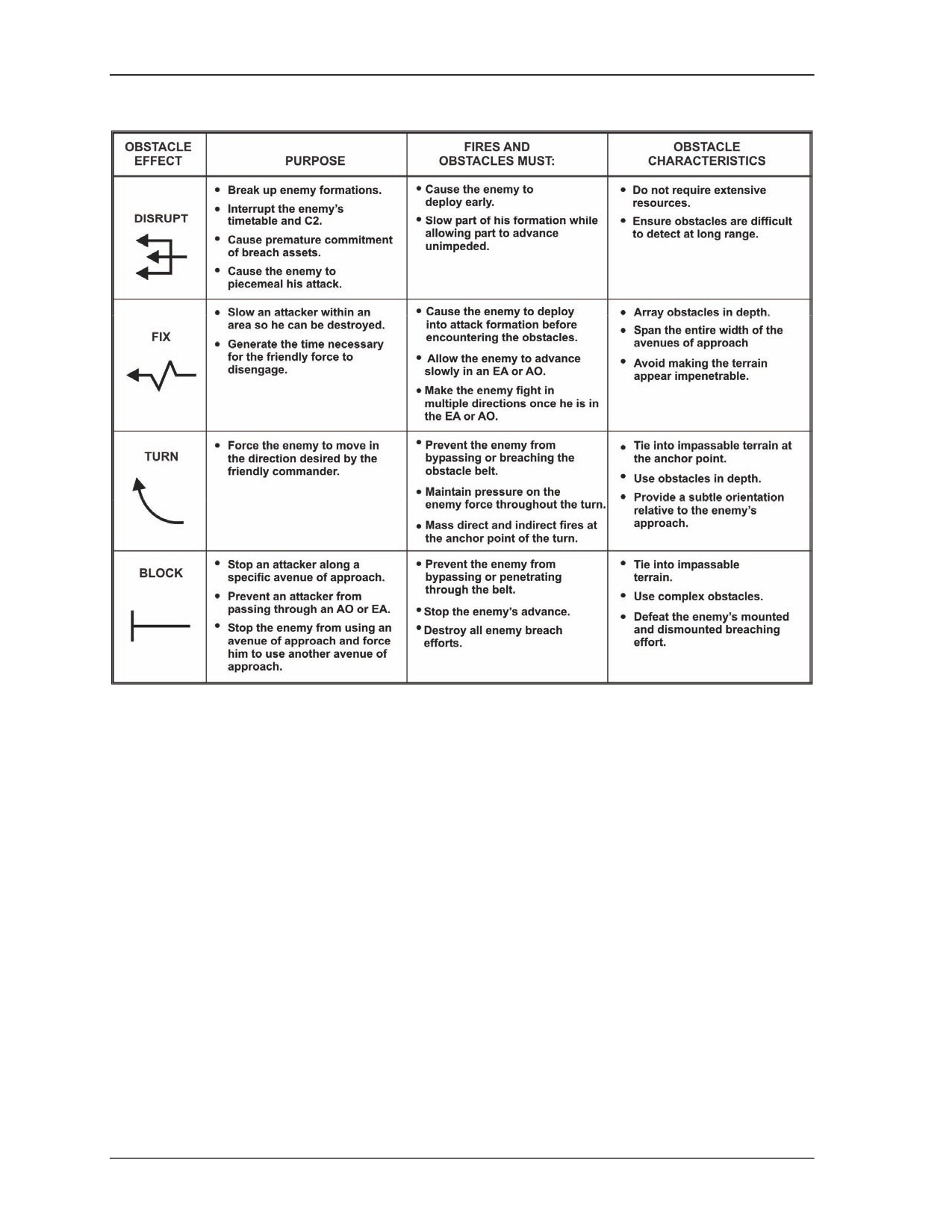
Table 5-1 shows the symbols for each obstacle effect, and it describes the purpose and
characteristics of each.
27 July 2006
FM 3-21.10
5-7
Chapter 5
Table 5-1. Obstacle effects.
Protective Obstacles
5-33.
Infantry rifle companies plan and construct their own protective obstacles. For best effect,
protective obstacles are tied into existing or tactical reinforcing obstacles. The company can use mines and
wire, or it might receive additional materiel, including MOPMS, from the battalion Class IV or V supply
point. The company might also conduct any other required coordination, such as that needed in a relief in
place, to recover or destroy the obstacle, for example, MOPMS. (FM 90-7 provides detailed planning
guidance for protective obstacle emplacement.)
y In planning protective obstacles, the commander evaluates the potential threat to the company's
position. Then, he employs the best system for that threat. For example, MOPMS is mainly an
antitank system. It is best on mounted avenues of approach, but has some antipersonnel uses.
However, on dismounted avenues, wire obstacles might be more effective.
y Protective obstacles are usually located beyond hand grenade distance (40 to 100 meters) from
the Soldier's fighting position, and may extend out 300 to 500 meters to tie into tactical
obstacles and existing restricted terrain. As with tactical obstacles, the commander should plan
protective obstacles in depth and try to maximize the effective range of his weapons.
y When planning protective obstacles, the company commander considers preparation time, the
burden on the logistical system, the Soldiers' loads, and the risk of loss of surprise.
5-8
FM 3-21.10
27 July 2006
Defensive Operations
Wire Obstacles
5-34.
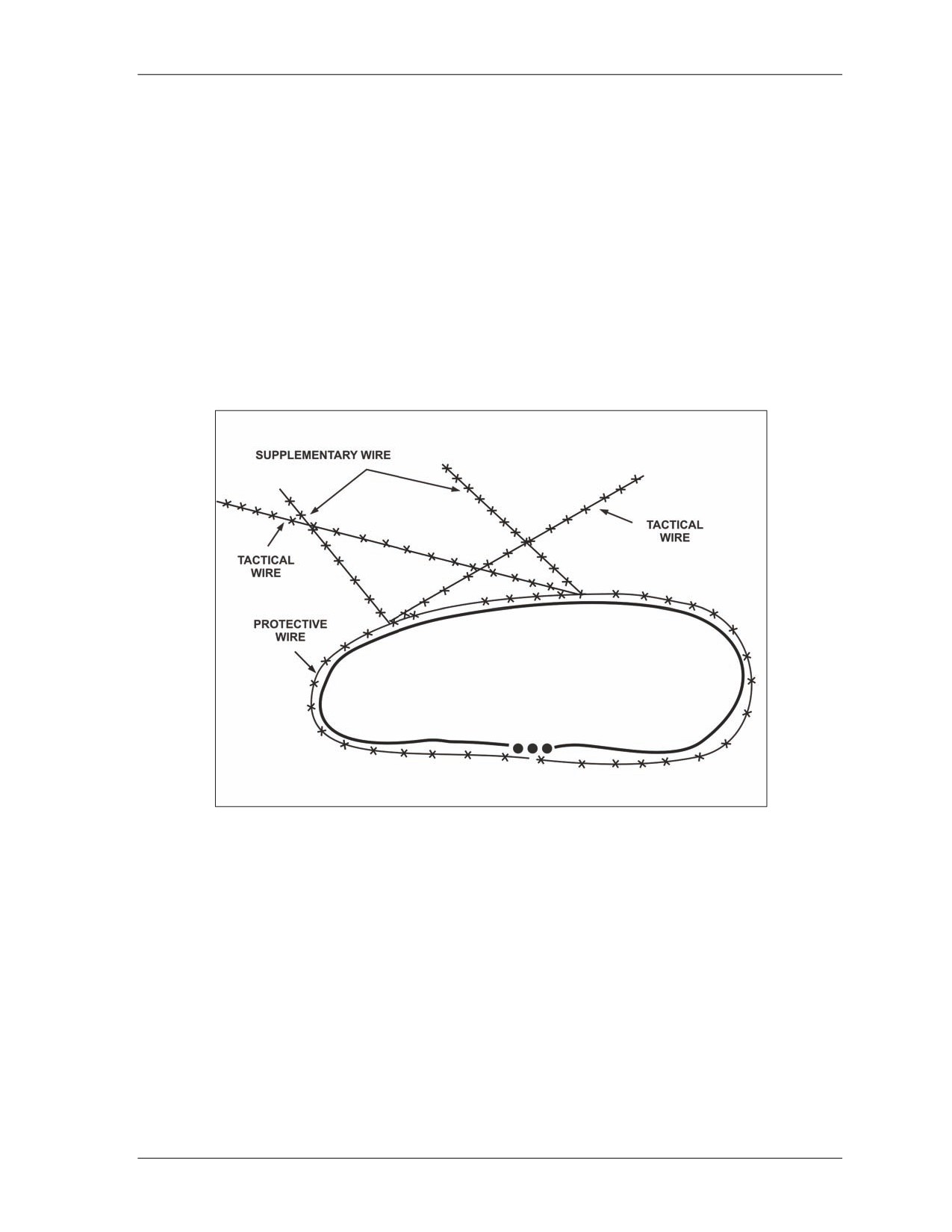
The three types of wire obstacles are protective, tactical, and supplementary (Figure 5-1).
y Protective wire can be a complex obstacle providing all-round protection of a platoon
perimeter. It might also be a simple wire obstacle on the likely dismounted avenue of approach
into a squad ambush position. Command-detonated M18 Claymore mines can be integrated into
the protective wire or used separately.
y Tactical wire is positioned to increase the effectiveness of the company's fires. Usually, it is
positioned along the friendly side of the machine gun final protective lines (FPLs). Tactical
minefields may also be integrated into these wire obstacles or used separately.
y Supplementary wire obstacles can break up the line of tactical wire. This helps prevent the
enemy from locating friendly weapons (particularly the machine guns) by following the
tactical wire.
Figure 5-1. Protective wire obstacles.
Obstacle Lanes
5-35.
The company might be responsible for actions related to lanes through obstacles. These duties can
include marking lanes in an obstacle, reporting locations of the start and end points of each lane, operating
contact points, providing guides for elements passing through the obstacle, and closing the lane.
Situational Obstacle
5-36.
A situational obstacle is planned and possibly prepared before an operation, but it executes only if
specific criteria are met. It gives the commander the flexibility to emplace tactical obstacles based on
battlefield development.
y The commander anticipates situations that require him to modify the maneuver and fire plans to
defeat the threat. He considers the use of situational obstacles to support these modifications.
27 July 2006
FM 3-21.10
5-9
Chapter 5
y By their very nature, situational obstacles must be quickly installable, but still achieve the
desired effect. Therefore, SCATMINEs such as MOPMS, Hornets, and Volcanoes are the most
common versions used at the company level. However, situational obstacles can consist of any
type of individual obstacle.
y Commanders consider where they can employ situational obstacles. They ensure that the
combination of fires and obstacles are enough to achieve the obstacle effect.
y Commanders identify execution triggers; situational obstacles are triggered based on friendly
actions, enemy actions, or a combination of both.
y Finally, the commander withholds execution of a situational obstacle until the obstacle effect is
required. Once committed, those assets are no longer available to support any other mission.
Commanders also consider that SCATMINEs have a self-destruct (SD) time. Emplacing an
obstacle too soon can cause the mines to self-destruct before the enemy arrives.
FIRE SUPPORT
5-37.
For the indirect fire plan to be effective in the defense, the unit plans and executes fires in a
manner that achieves the intended task and purpose of each target. Indirect fires serve a variety of purposes
in the defense, including--
y Slow and disrupt enemy movement.
y Prevent the enemy from executing breaching operations.
y Destroy or delay enemy forces at obstacles using massed fires or pinpoint munitions.
y Disrupt enemy support-by-fire elements.
y Defeat attacks along Infantry avenues of approach with the use of final protective fire (FPF).
y Disrupt the enemy to allow friendly elements to disengage or conduct counterattacks.
y Obscure enemy observation or screen friendly movement during disengagement and
counterattacks.
y Use smoke to separate enemy echelons or to silhouette enemy formations to facilitate direct fire
engagement.
y Provide illumination as necessary.
y Execute suppression of enemy air defenses (SEAD) missions to support CAS, attack aviation,
and high-payoff targets.
FIRE-SUPPORT ASSETS
5-38.
In developing the fire plan, the company commander evaluates the indirect fire systems available
to provide support. Considerations include tactical capabilities, weapons ranges, and available munitions.
These factors help the company commander and FSO determine the best method for achieving the task and
purpose of each target in the fire plan.
FIST POSITIONING
5-39.
The company's fire support personnel contribute significantly to the fight. Effective positioning is
critical. The company commander and FSO must select positions that provide fire support personnel with
unobstructed observation of the AO and ensure survivability.
5-10
FM 3-21.10
27 July 2006
Defensive Operations
PROTECTION
5-40.
Protection includes air defense, survivability, mobility, and countermobility.
AIR DEFENSE
5-41.
The focus of air defense is on likely air avenues of approach for enemy fixed-wing aircraft,
helicopters, and UASs. Air avenues of approach may or may not correspond with the enemy's ground
avenues of approach. These systems also are frequently used to protect friendly counterattack forces
against aerial observation or attack.
SURVIVABILITY
5-42.
Survivability positions are prepared to protect personnel and weapon systems. Positions can be
constructed and reinforced with overhead cover to provide Infantry and crew-served weapons with
protection against shrapnel from air bursts. In addition, the company may use digging assets for
ammunition caches at alternate, supplementary, or subsequent positions. All leaders must understand the
survivability plan and priorities, and that one leader within the company is specifically designated to
enforce the plan and priorities, and that completion status is accurately reported and tracked.
SUSTAINMENT
5-43.
In addition to the sustainment functions required for all operations (Chapter 11, Sustainment
operations), the IBCT rifle company commander's planning process includes the considerations
highlighted in the following paragraphs.
PRE-POSITIONING AND CACHES
5-44.
The commander's mission analysis may reveal that the company's ammunition needs during an
upcoming operation exceed its basic load. This requires the company to pre-position ammunition caches.
The caches, which might be positioned either at alternate or subsequent positions, are dug in and guarded.
POSITIONING OF COMPANY TRAINS
5-45.
The company's trains normally operate one terrain feature to the rear of the company to provide
immediate recovery and medical support. The company trains are established to conduct evacuation (of
those wounded in action [WIA], weapons, and equipment) and resupply as required. The company trains
are located in a covered and concealed position, close enough to the company to provide responsive
support, but out of enemy direct fire. The 1SG or XO will position the trains and supervise sustainment
operations. The commander ensures all elements know the locations of the battalion's forward support
company as well as the company CCP, battalion aid station (BAS) and that casualty evacuation procedures
are planned and rehearsed.
Section IV. PREPARATION AND INTEGRATION
The company commander's analysis determines the most effective measures for every mission. This section
describes the techniques and planning considerations available to the company commander as he prepares
his defense.
DEFENSIVE TECHNIQUES
5-46.
The company normally defends using one of these basic defensive techniques.
y Defend in sector.
y Defend from a BP.
27 July 2006
FM 3-21.10
5-11
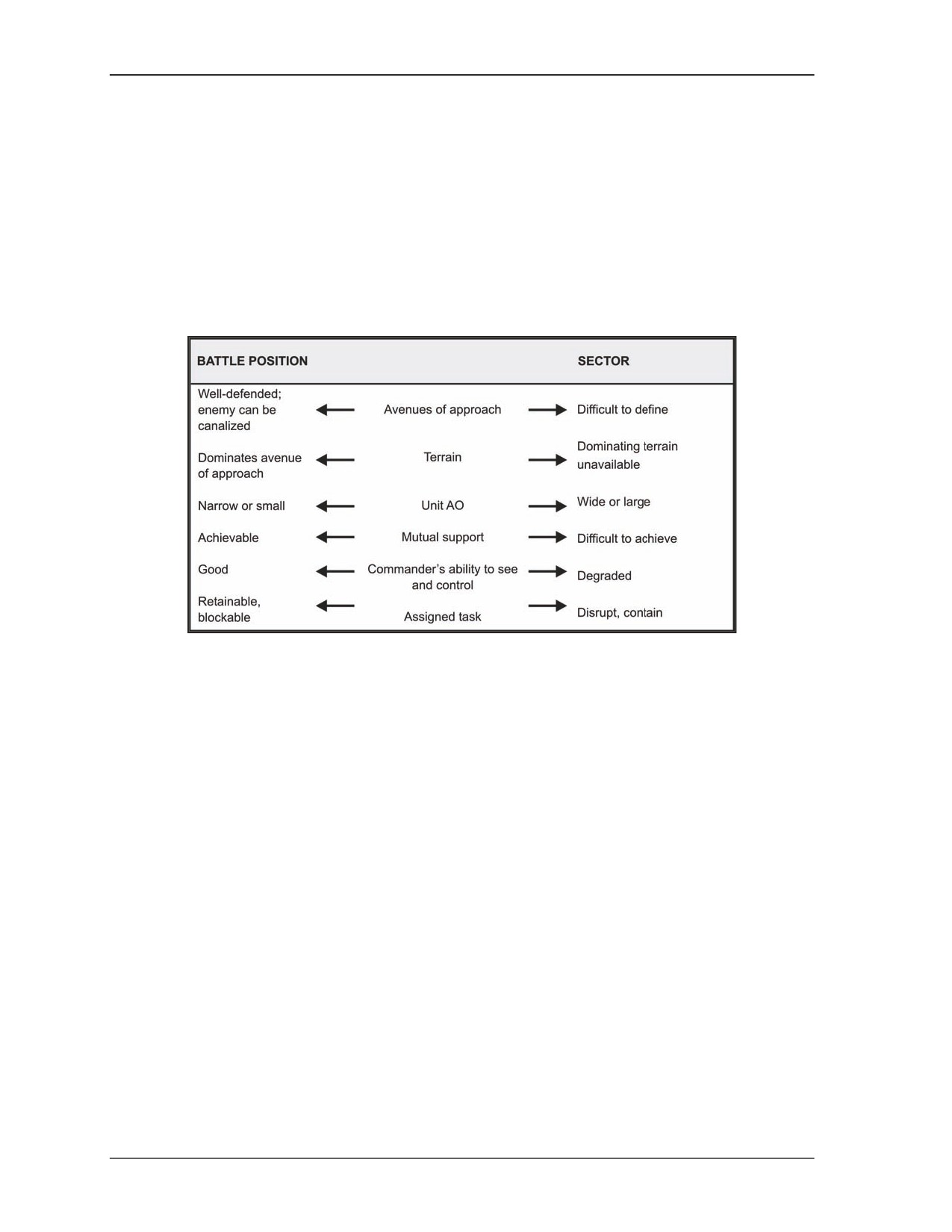
Chapter 5
y Defend a strongpoint.
y Defend a perimeter.
y Defend in a linear defense.
y Defend in a nonlinear defense.
y Defend on a reverse slope.
5-47.
The control measures for the defense are sectors, battle positions, or a combination of these
measures. No set criteria exist for selecting the control measures, but Table 5-2 provides some basic
considerations.
Table 5-2. Selection of control measures.
SECTOR DEFENSE
5-48.
A sector is the company control measure that provides the most freedom of action to a platoon.
It gives the platoon the flexibility to operate decentralized, while ensuring sufficient control to avoid
confusion and synchronize the company's operation. In restricted terrain, where dismounted Infantry forces
prefer to work, mutual support between the company's platoon battle positions is difficult to achieve.
Seeing and controlling the fight throughout the company sector are also very difficult for the commander.
Company Disposition
5-49.
The company disposition might consist of platoon sectors, a series of mutually supporting BPs, or
a combination of the two (Figure 5-2). Positions are arrayed in depth. The strength of the sector comes
from its flexibility. This defense normally orients on the enemy force and not on retaining terrain. It is
effective because it allows the enemy to expose his flanks and critical C2 and CS assets through his own
maneuver into the depth of the defense.
5-12
FM 3-21.10
27 July 2006
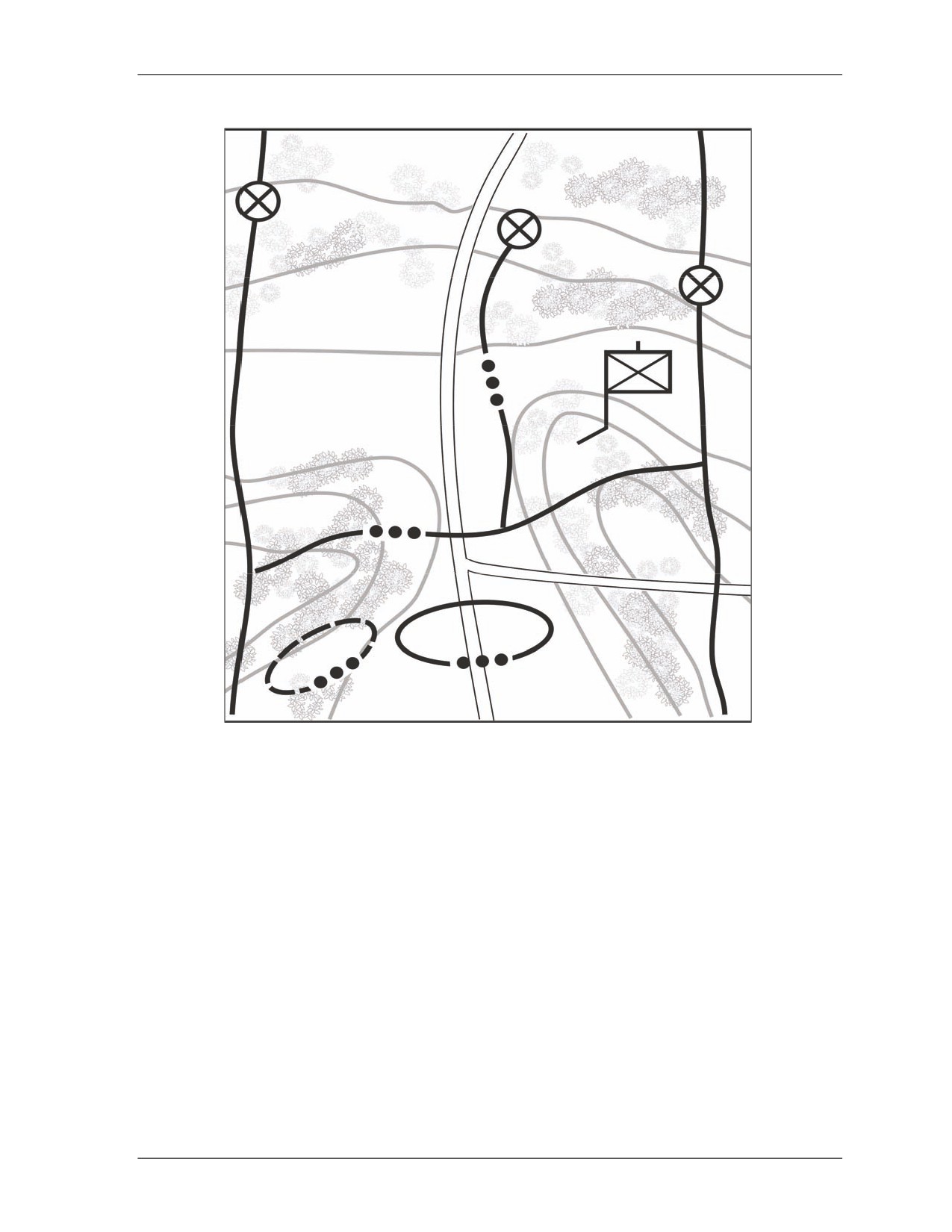
Defensive Operations
Figure 5-2. Company defense in sector, with platoon in a battle position.
Decentralization
5-50.
By assigning platoon sectors, the company may fight a defense in sector very similar to a
nonlinear defense. This decentralized technique for conducting a defense in sector requires greater
initiative and delegates more of the control to subordinate leaders. The small-unit actions are very similar
to the nonlinear defense. When required, squads or platoons may disengage independently and move to
another location within the sector to continue the fight. Considerations for the company R&S plan and
employment of a reserve also are very similar to the nonlinear defense.
Platoon Battle Positions
5-51.
When fighting a company defense in sector from platoon battle positions, the concept is to defeat
the attacker through the depth of his formation by confronting him with effective fires from mutually
supporting BPs as he tries to maneuver around them. Infantry positions, patrols, mines, and other obstacles
cover gaps that, due to terrain masking or thick vegetation, cannot be covered effectively by direct fire.
Units remain in place except for local or internal movement to alternate or supplementary positions. If
27 July 2006
FM 3-21.10
5-13
Chapter 5
certain platoon positions become untenable during the battle, the company commander may withdraw the
platoons according to prepared plans.
5-52.
One technique is to allow the enemy to move into the EA and destroy him with massed fires.
Another technique is to engage the attacker at maximum range with fires from field artillery, (and mortars)
and then engage with organic antiarmor weapons positioned to deliver fires at maximum effective ranges
from the flanks and rear. As the enemy closes, antiarmor weapons may move to alternate or supplementary
firing positions within the BP to continue firing and avoid being bypassed.
5-53.
The company defense in sector from platoon battle positions generally requires the company
commander to be able to see and control the battle. It also requires good fields of fire to allow mutual
support. If the terrain or the expected ECOA prevents this, the defense might be more effective if control is
more decentralized and the platoons fight in sector.
5-54.
A significant concern, particularly when fighting from BPs, is the enemy's ability to isolate a part
of the company and then fix and destroy or bypass them. Without effective mutual support between the
BPs, this is likely to occur. Even with mutual support, responsive and effective indirect fire support might
be critical to defending the BPs. Without immediately available fire support, a capable enemy will quickly
concentrate combat power against any BP that is identified.
BATTLE POSITION DEFENSE
5-55.
A battle position is a general location orientation of forces on the ground where units defend. The
platoon is located within the general area of the BP. Security elements might be located forward and to the
flanks of the BP. Platoons defending from a BP may not be tied in with adjacent units; thus, the
requirement for all-round security is increased. When determining the location of BPs, the commander
decides first on EAs and sectors of fire; locations are then determined to support the direct fire plan. Each
position must contribute to the company's accomplishment of its assigned task and purpose within the
battalion commander's concept of the operation.
TYPES OF BATTLE POSITIONS AND PREPAREDNESS LEVELS
5-56.
A platoon moves from its primary, alternate, supplementary, or subsequent position only with the
commander's approval, or when the commander has prescribed a particular condition as a reason to move.
The four types of battle positions and three levels of preparedness are--
Battle Positions
y Primary.
y Alternate.
y Supplementary.
y Subsequent.
Levels of Preparedness
y Occupied.
y Prepared but not occupied.
y Planned.
PRIMARY BATTLE POSITION
5-57.
The primary position is the position that covers the enemy's most likely avenue of approach into
the AO. It is the best position to accomplish the assigned mission such as cover an EA (Figure 5-3).
5-14
FM 3-21.10
27 July 2006
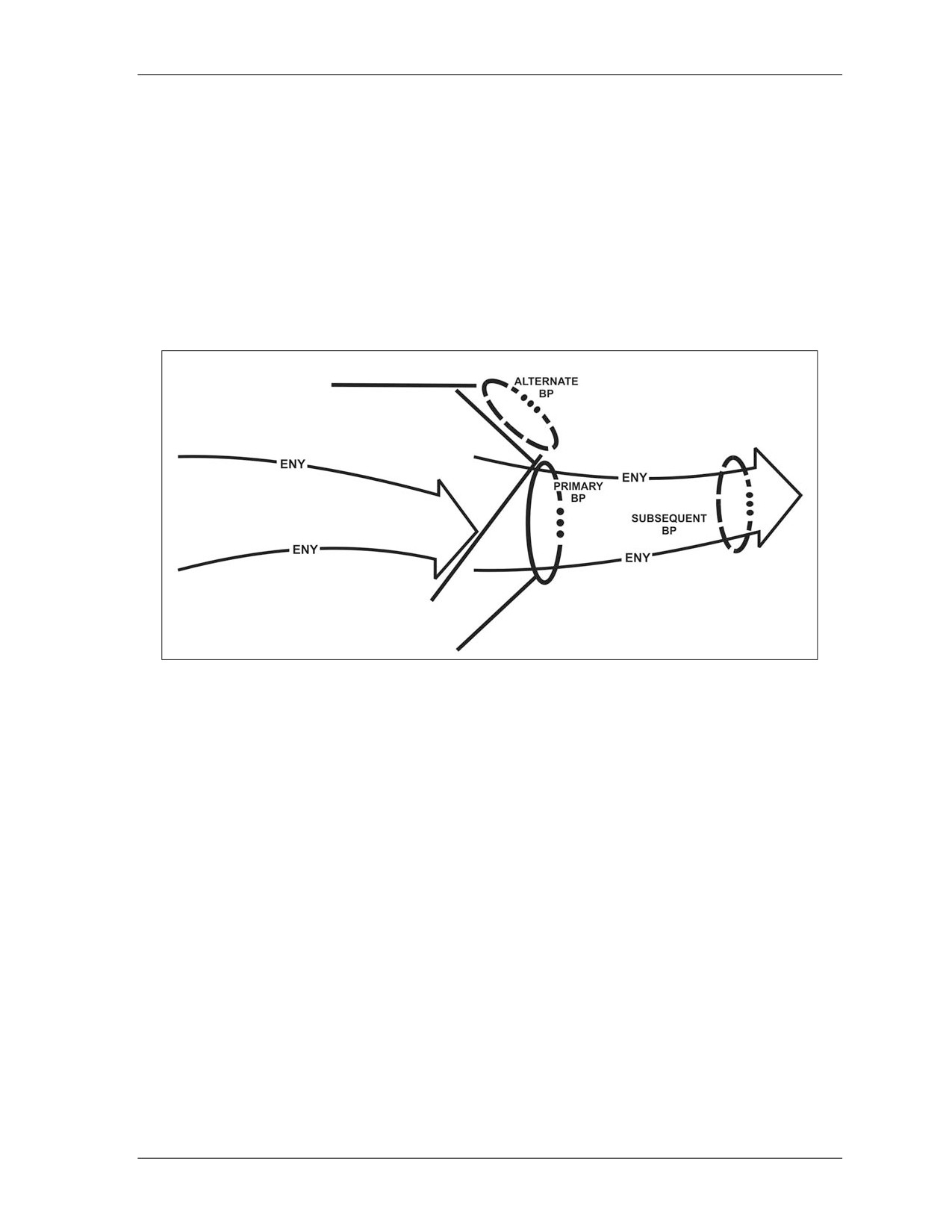
Defensive Operations
ALTERNATE BATTLE POSITION
5-52. An alternate position is a defensive position that the commander assigns to a unit for occupation
when the primary position becomes untenable or unsuitable for carrying out the assigned task. (Figure 5-3).
It is located so the platoon can continue to fulfill the original task such as covering the same avenue of
approach or engagement area as the primary position. Alternate positions increase the defender's
survivability by allowing engagement of the enemy from multiple positions. For example, a unit moves to
its alternate position when the enemy brings suppressive fires on the primary position. If the alternate
position is to be occupied in limited visibility, it might be forward of the primary position. The alternate
position might be occupied if the platoon is driven out of the primary position by enemy fire or by assault,
or it might be occupied to begin the fight to deceive the enemy of the platoon's primary position.
Figure 5-3. Primary and alternate positions.
SUPPLEMENTARY BATTLE POSITION
5-53. A supplementary position is a defensive position located within a unit's assigned AO that provides
the best sectors of fire and defensive terrain along an avenue of approach that is not the primary avenue
where the enemy is expected to attack. For example, an avenue of approach into a unit's AO from one of its
flanks normally requires establishing supplementary positions to allow a unit or weapon system to engage
enemy forces traveling along that avenue. It can also be assigned when the platoon must cover more than
one avenue of approach (Figure 5-4, page 5-16).
27 July 2006
FM 3-21.10
5-15
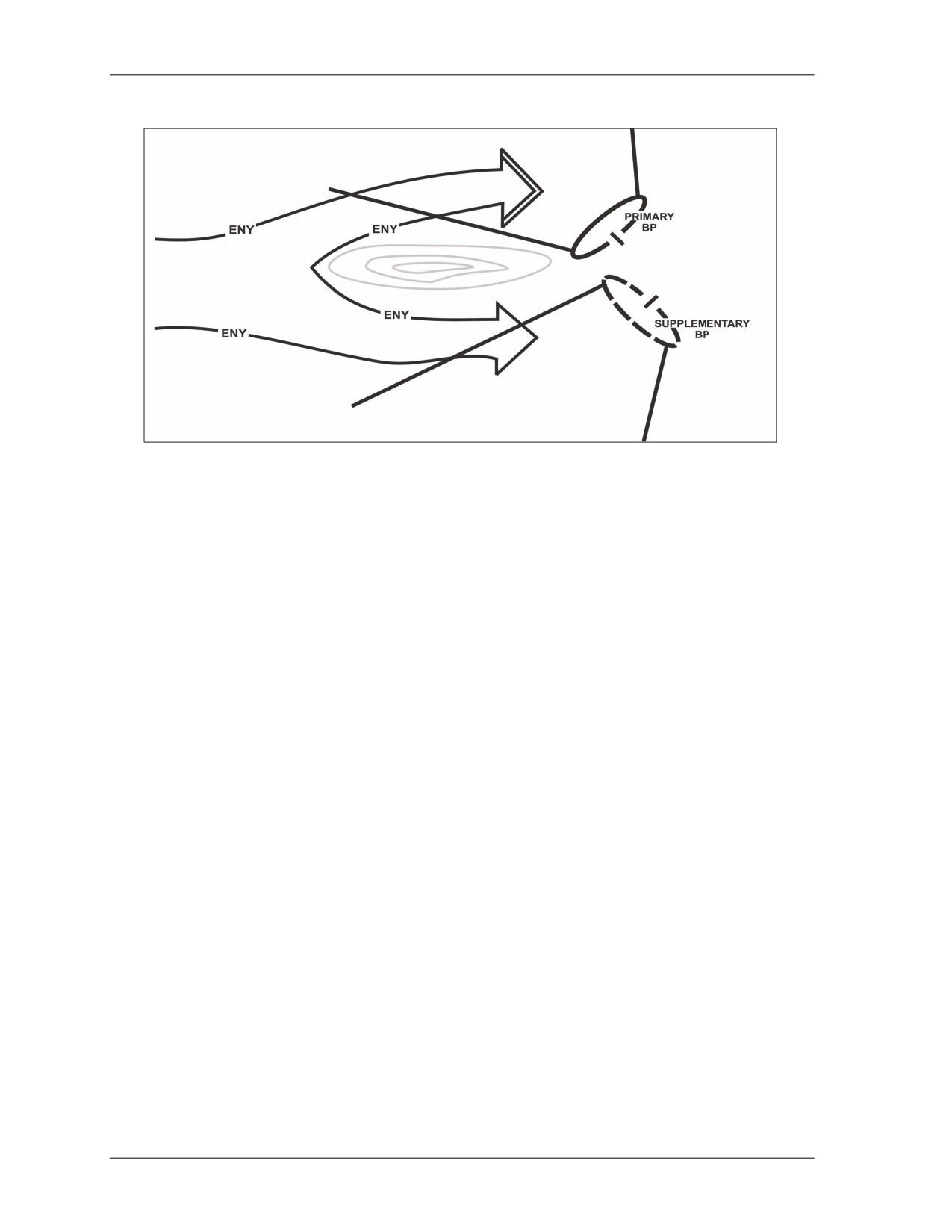
Chapter 5
Figure 5-4. Supplementary position.
SUBSEQUENT BATTLE POSITION
5-58.
A subsequent position is a position that a unit expects to move to during the course of battle. A
defending unit may have a series of subsequent positions. Subsequent positions can also have primary,
alternate, and supplementary positions associated with them.
OCCUPIED
5-59.
An occupied position is one that has the unit physically is in place in the assigned position. The
position is fully planned, prepared, and occupied before the "defend no later than (NLT)" time specified by
the commander.
PREPARED BUT NOT OCCUPIED
5-60.
The unit fully reconnoiters the position and the corresponding EA, marking positions in the BP
and fire control measures in the EA. From the BP, the unit must accomplish all actions to enable it to
execute the mission immediately on occupation. Planning, coordination, and rehearsals are required for the
unit to displace to the BP and accomplish the mission. Despite time constraints, the unit digs in
survivability positions, constructs fighting positions, designates target reference points (TRPs), develops
direct and indirect fire plans, emplaces obstacles, clears fields of fire, and prestocks ammunition. Prepare
missions are normally critical to the defense. A unit assigned such a mission must maintain security on the
position and on the routes to it.
PLANNED TENTATIVE POSITIONS
5-61.
The unit fully reconnoiters the EA and BP, planning tentative unit positions in the BP and
establishing fire control measures in the EA. The unit coordinates and plans for defense from this position.
Leaders reconnoiter, select, and mark positions, routes, and locations for security elements. They
coordinate movement and other actions, such as preparing obstacles and occupation plans, with other
elements of the battalion.
5-16
FM 3-21.10
27 July 2006
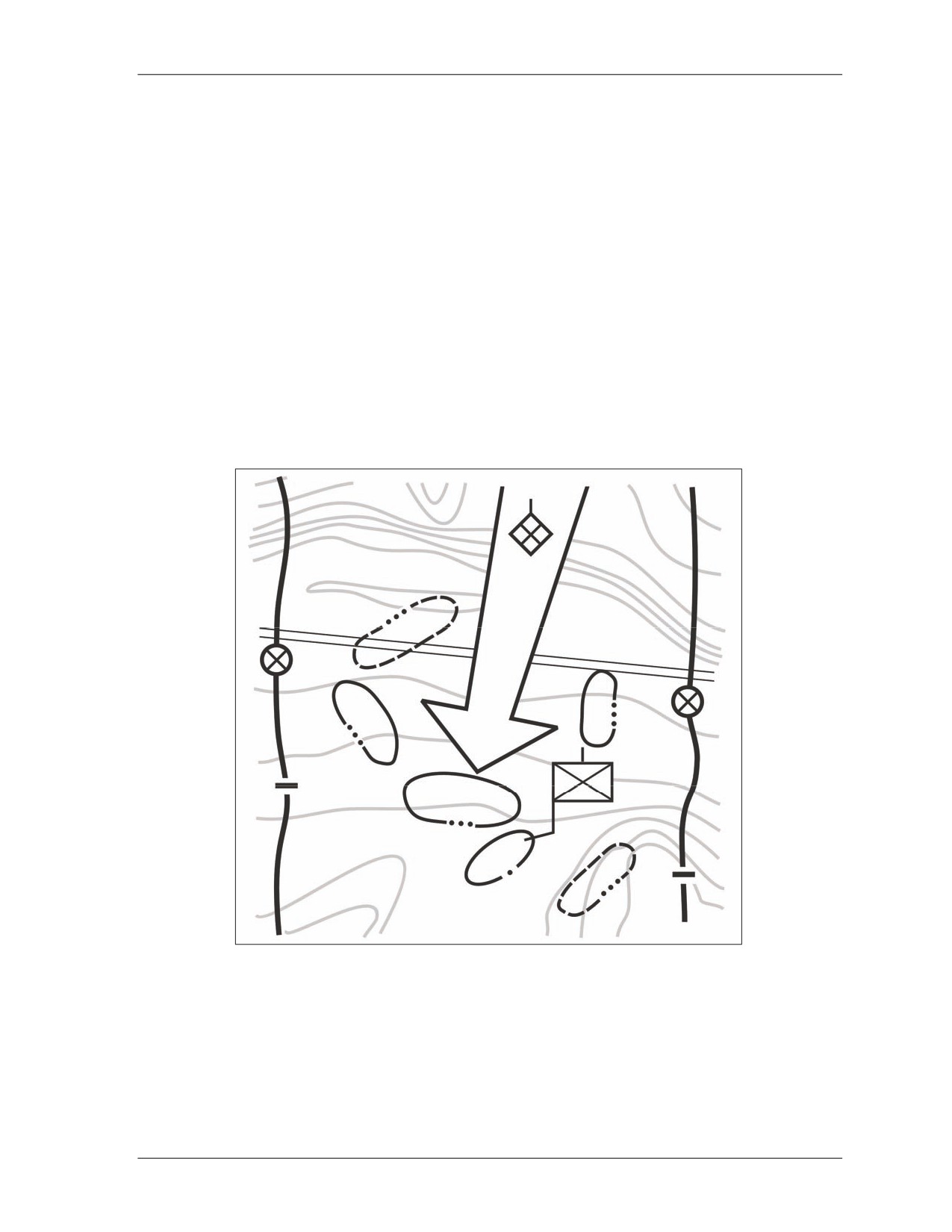
Defensive Operations
CENTRALIZED TECHNIQUE
5-62.
Fighting from battle positions is a more centralized technique. It might also be more linear at the
company level (Figure 5-5). Even so, it is not a static defense. Battle positions are positioned to achieve
surprise and to allow maneuver within and between BPs. Defense from BPs is effective in concentrating
combat power into an EA. It prevents the enemy from isolating one part of the company and concentrating
his combat power in this area. Platoons are assigned mutual supporting battle positions that cover the
enemy's likely avenues of approach. These BPs are located on terrain that provides cover and concealment
and restricts vehicular movement.
SURPRISE
5-63.
The commander's concept for fighting this defensive technique should concentrate on achieving
surprise for each of the BPs. He does so by conducting an effective counterreconnaissance. Its purpose is to
keep the enemy from finding the BPs. He initiates fires from one BP and waits for the enemy to react to
this engagement before engaging from the other BPs (Figure 5-5). This confuses the enemy and disrupts
his C2.
Figure 5-5. Defense from mutually supporting platoon battle positions.
y When the terrain provides a large EA and the commander's concept allows most of the enemy
into the EA, the company may engage with massed fires from all platoon BPs. A disadvantage
to this technique is that if there are still uncommitted enemy forces outside the EA, they will
know the locations of the BPs and will try to isolate and concentrate against them. Contingency
plans to disengage from these BPs and reorganize to continue the fight must be developed. This
may involve displacing to alternate BPs or disengaging to conduct counterattacks against
identified enemy C2, CS, or sustainment assets.
27 July 2006
FM 3-21.10
5-17
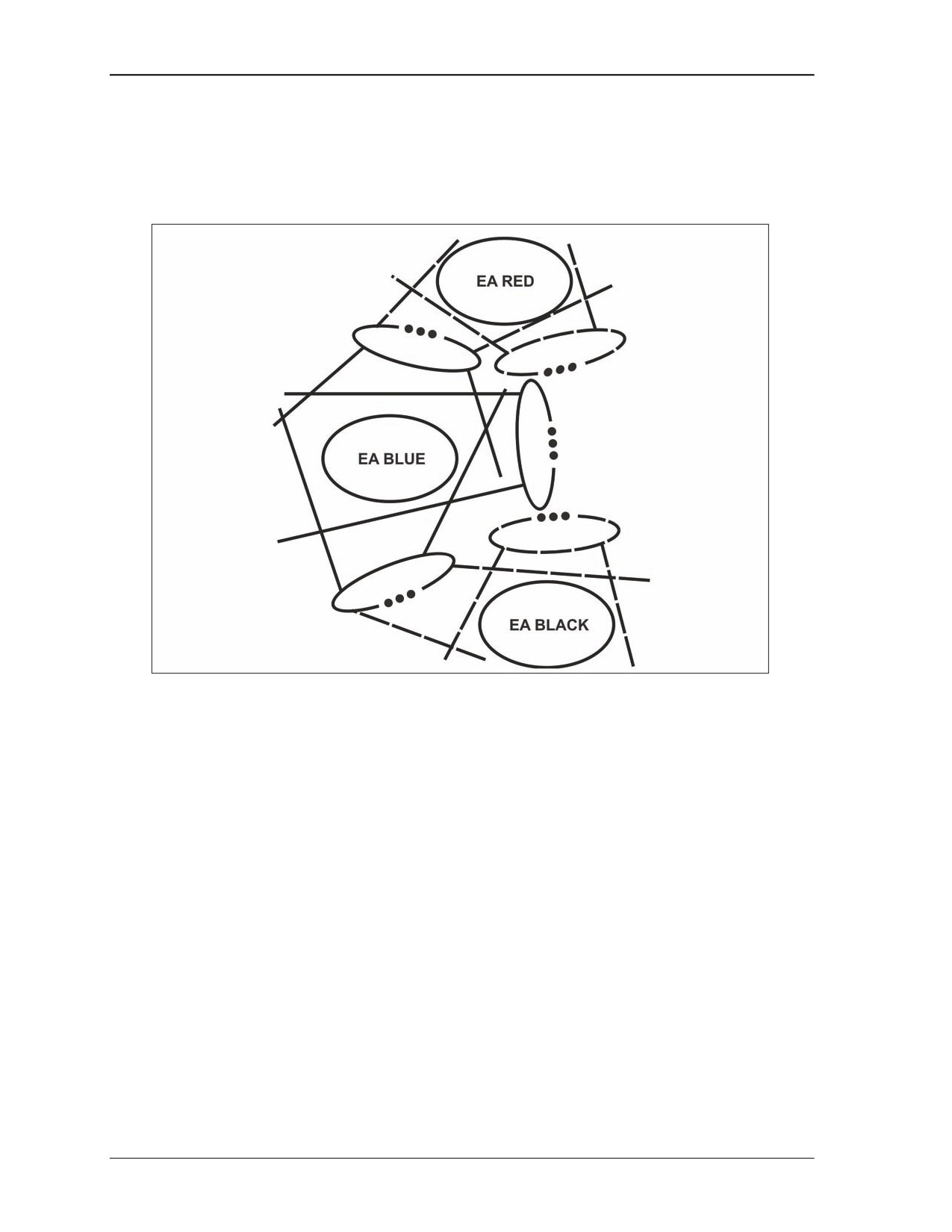
Chapter 5
y Instead of one company EA, multiple EAs might be identified to provide flexibility to the plan
(Figure 5-6, page 5-18). The plan must clearly state which platoons must reorient fires into the
alternate EA and when they must do so.
Figure 5-6. Multiple engagement areas.
STRONGPOINT DEFENSE
5-64.
A company might be directed to construct a strongpoint as part of an Infantry battalion defense
(Figure 5-7). In order to do so, it is augmented with engineer support, more weapons, and sustainment
resources. A strongpoint is defended until the commander directing the defense formally orders the unit out
of it. The specific positioning of units in the strongpoint depends on the company commander's mission
analysis. The same considerations for a perimeter defense apply, in addition to the following:
y Reinforce each individual fighting position (to include alternate and supplementary positions)
to withstand small-arms fire, mortar fire, and artillery fragmentation. Stockpile food, water,
ammunition, pioneer tools, and medical supplies in each fighting position.
y Support each individual fighting position with several others. Plan or construct covered and
concealed routes between positions and along routes of supply and communication. Use these
to support counterattack and maneuver within the strongpoint.
5-18
FM 3-21.10
27 July 2006
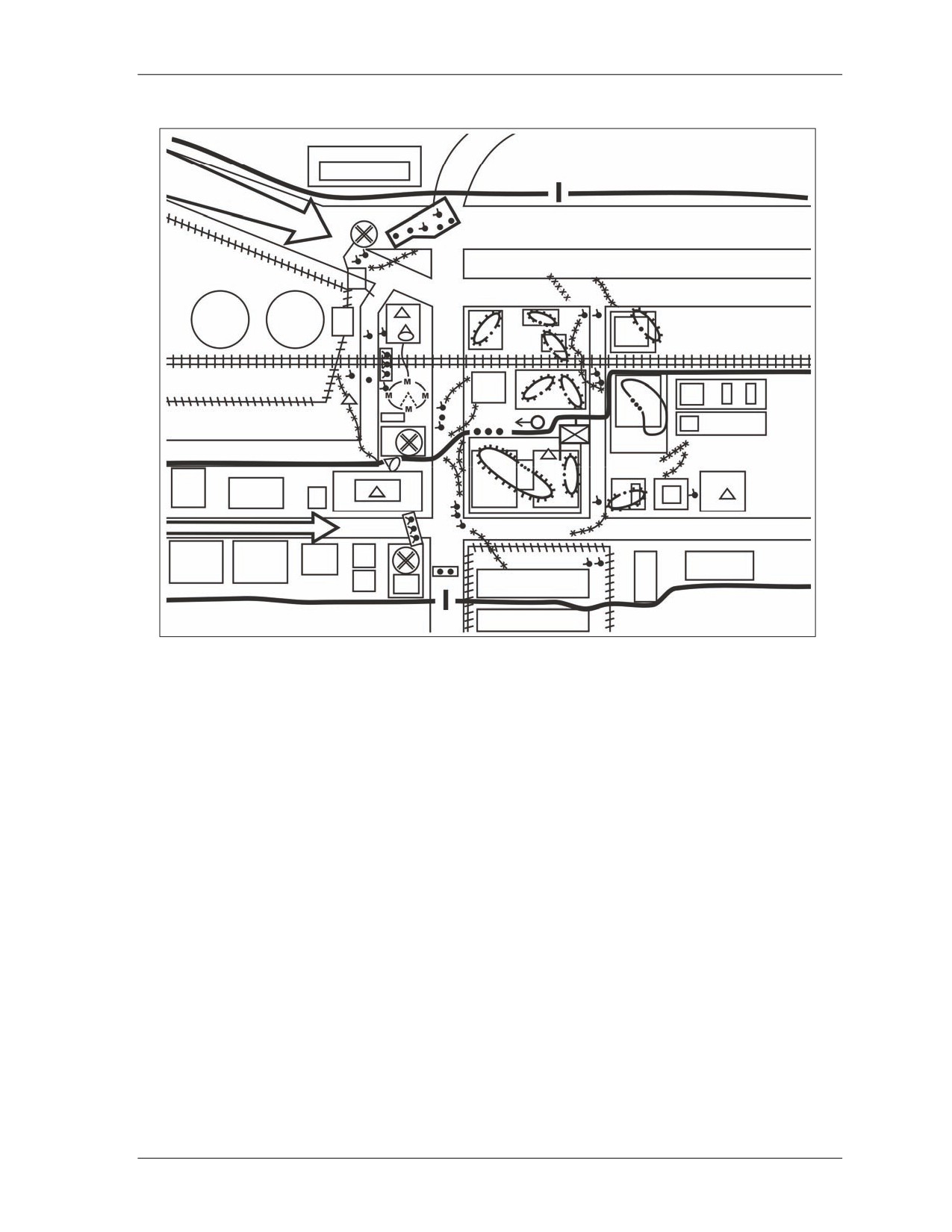
Defensive Operations
Figure 5-7. Company strongpoint.
y Divide the strongpoint into several independent, but mutually supporting, positions or sectors.
If one of the positions or sectors must be evacuated or is overrun, limit the enemy penetration
with obstacles and fires, and support a counterattack.
y Construct obstacles and minefields to disrupt and canalize enemy formations, to reinforce fires,
and to protect the strongpoint from the assault. Place the obstacles and mines out as far as
friendly units can observe them, within the strongpoint, and at points in between where they
will be useful.
y Prepare range cards for each position and confirm them by fires. Plan indirect fires in detail and
register them. Also, plan indirect fires for firing directly on the strongpoint using
proximity fuses.
y Plan and test several means of communication within the strongpoint and to higher
headquarters; possibilities include radio, wire, messenger, pyrotechnics, and other signals.
y Improve or repair the strongpoint until the unit is relieved or withdrawn. More positions can be
built, tunnels and trenches dug, existing positions improved or repaired, and barriers built
or fixed.
5-65.
A strongpoint might be part of any defensive plan. It might be built to protect vital units or
installations, as an anchor around which more mobile units maneuver, or as part of a trap designed to
destroy attacking enemy forces that attack.
5-66.
Mold the strongpoint to the terrain and use natural camouflage and obstacles. Existing obstacles
can support formidable strongpoints, which provide cover, concealment, and obstacles. Complex and urban
areas are also easily converted to strongpoints. Stone, brick, or steel buildings provide cover and
27 July 2006
FM 3-21.10
5-19
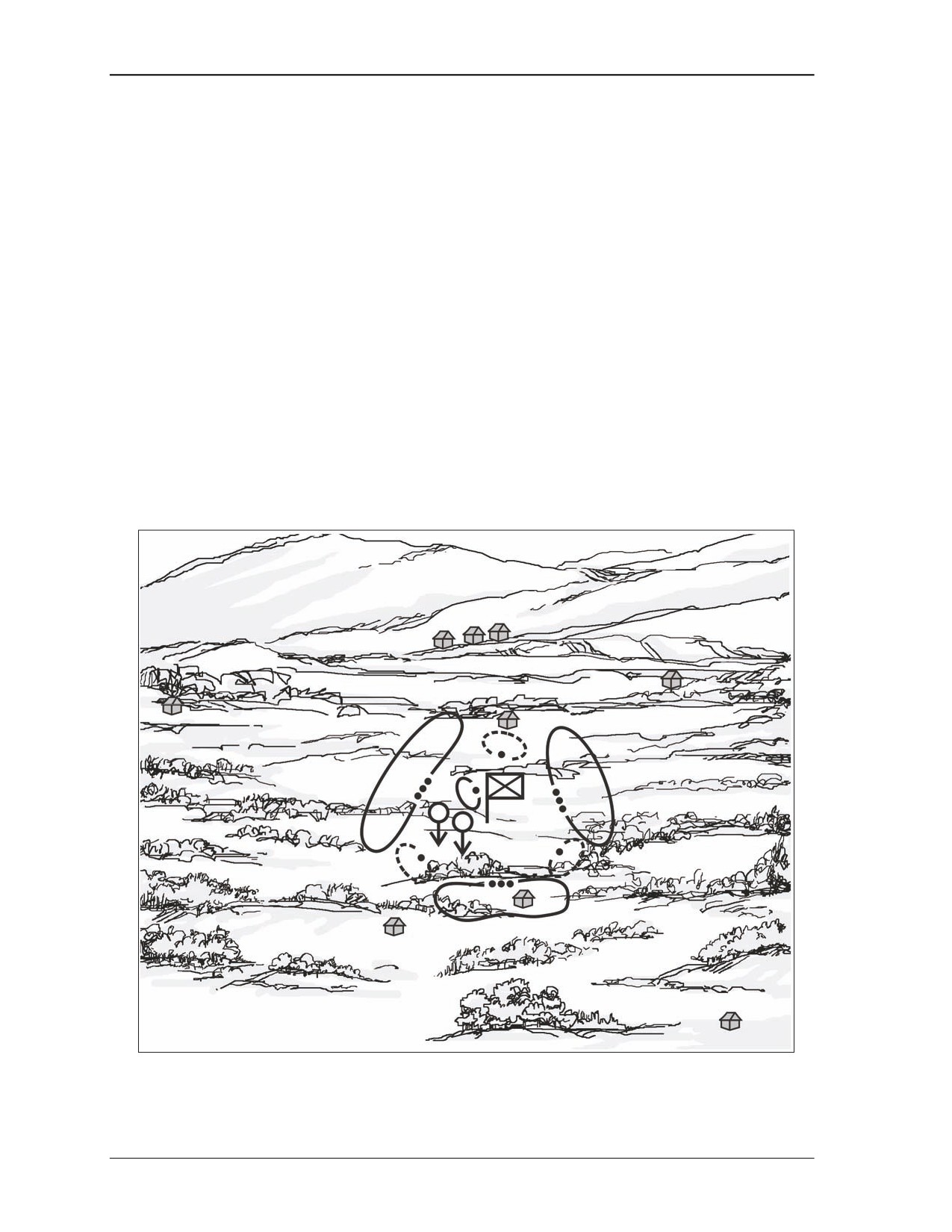
Chapter 5
concealment. Buildings, sewers, and some streets, which provide covered and concealed routes, can be
rubbled to provide obstacles. Telephone systems can provide communications.
PERIMETER DEFENSE
5-67.
A perimeter defense allows the defending force to orient in all directions (Figure 5-8). The
perimeter defense can be employed in urban or woodland terrain. In terms of weapons emplacement, direct
and indirect fire integration, and reserve employment, a commander conducting a perimeter defense
considers the same factors as for a strongpoint operation. The Infantry rifle company might be called upon
to execute the perimeter defense under a variety of conditions, including--
y When it must secure itself against terrorist or guerilla attacks in an urban area. This technique
may also apply if the company must conserve or build combat power in order to execute
offensive or patrolling operations.
y When it must hold critical terrain in areas where the defense is not tied in with adjacent units.
y When it has been bypassed and isolated by the enemy and must defend in place.
y When it conducts occupation of an independent assembly area or reserve position.
y When it begins preparation of a strongpoint.
y When it is directed to concentrate fires into two or more adjacent avenues of approach.
Figure 5-8. Company perimeter defense.
5-20
FM 3-21.10
27 July 2006
Defensive Operations
Preparations
5-68.
The Infantry company prepares a perimeter defense when there are no friendly units adjacent to it
(Figure 5-8). A perimeter defense might be used in a reserve position, in an assembly area or patrol base,
on a follow-on decentralized company operation during resupply or when the company is isolated. The
following actions constitute setting up a perimeter defense.
y
Preparing a perimeter defense is like preparing any other position defense, but the company
must disperse in a circular configuration for all-round security (the actual shape depends on the
terrain). The company must be prepared to defend in all directions.
y
The commander assigns the Infantry platoon to cover the most likely approach--a smaller sector
than the other platoons cover. He prepares alternate and supplementary positions within the
perimeter.
y
If available, Javelins cover likely armor approaches. They may use hide positions and move
forward to fire as the enemy appears. The commander assigns several firing positions. If there
are few positions for them, they are assigned a primary position and are dug in.
y
Snipers or designated shooters should cover likely or suspected enemy positions or OPs.
Snipers and designated shooters should also be used to observe or overwatch areas where
civilians congregate.
y
Keep the mortars near the center of the perimeter so their minimum range does not restrict their
ability to fire in any direction. They should dig in and have covered ammunition storage
bunkers. They communicate by phone
(the wire is buried). The FDC is dug in with
overhead cover.
y
If possible, hold one or more rifle squad in reserve. The company commander assigns a primary
position to the rear of the platoon, covering the most dangerous avenues of approach. He may
also assign the rifle squad supplementary positions since it must be prepared to fight in all
directions.
y
Prepare obstacles in depth around the perimeter.
y
Plan direct and indirect fire as for any type of defense. Plan and use fire support from outside
the perimeter when available.
y
Counter enemy probing attacks by area fire weapons (artillery, mortars, Claymores, and
grenade launchers) to avoid revealing the locations of fighting positions (ROE dependent).
y
If the enemy penetrates the perimeter, the reserve destroys, and then blocks the penetration.
They also cover friendly Soldiers during movement to alternate, supplementary, or subsequent
positions. Even though the company's counterattack ability is limited, it must strive to restore
its perimeter.
y
Sustainment elements may support from within the perimeter or from another position. Supply
and evacuation might be by air. Consider the availability of landing zones and drop zones
(protected from enemy observation and fire) when selecting and preparing the position.
Y Variation
5-69.
The Y-shaped perimeter defense is a variation of the perimeter defense that uses the terrain
effectively. This defense is used when the terrain, cover and concealment, or fields of fire do not support
the physical positioning of the platoons in a circular manner. The Y-shaped perimeter defense is so named
because the platoon battle positions are positioned on three different axes radiating from one central point
(Figure 5-9, page 5-22). It is still a perimeter defense because it is effective against an attack from any
direction. The Y-shaped defense provides all-round perimeter fires without having to position Soldiers on
the perimeter. It is likely to be most effective in mountainous terrain, but it may also be effective in a dense
jungle environment due to limited fields of fire. All of the fundamentals of a perimeter defense previously
discussed apply, with the following adjustments and special considerations.
y Although each platoon battle position has a primary orientation for its fires, each platoon must
be prepared to reorient to mass fires into the EAs to its rear.
27 July 2006
FM 3-21.10
5-21
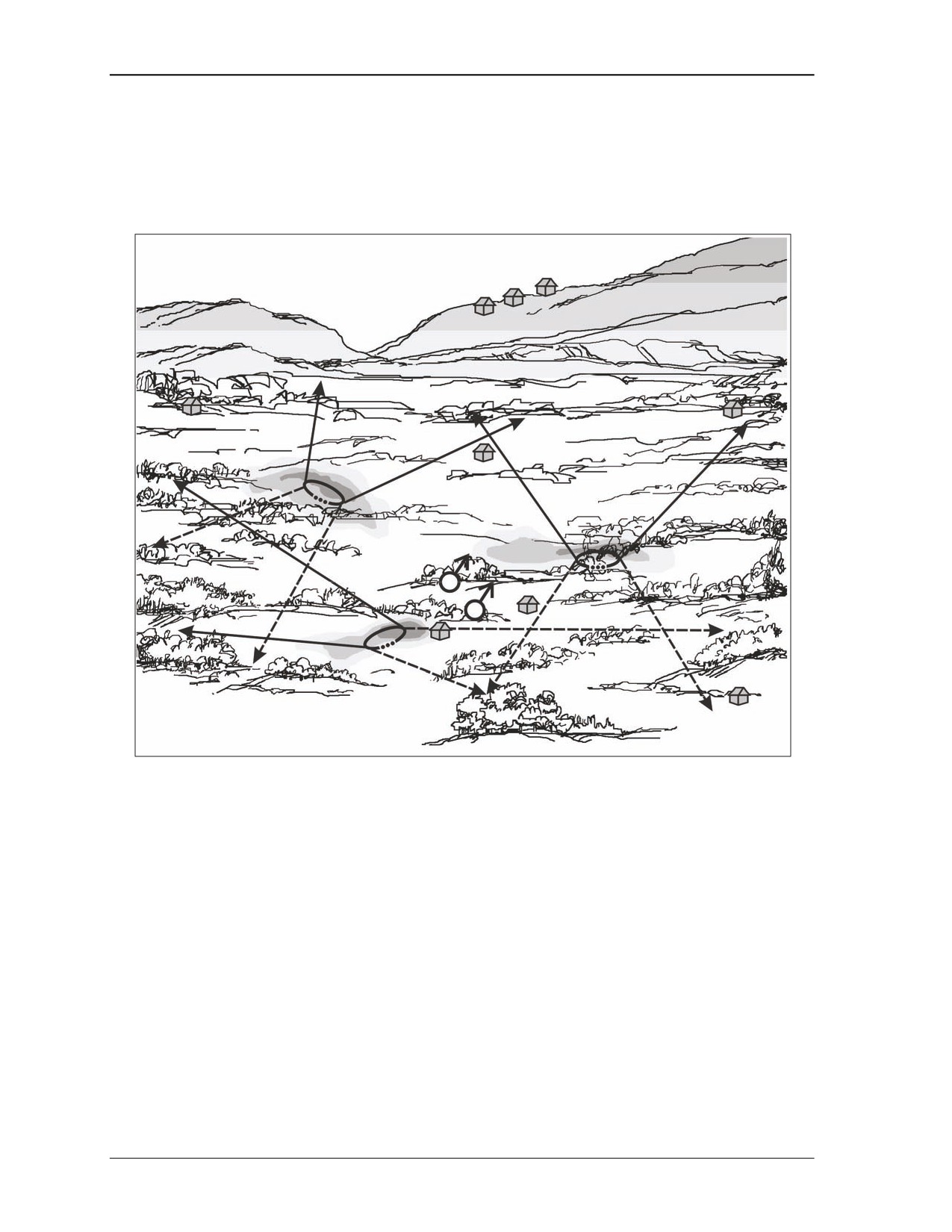
Chapter 5
y When no most likely enemy approach is identified, or in limited visibility, each platoon may
have half its Soldiers oriented into the EAs to the front and half into the EAs to the rear.
Ideally, supplementary individual fighting positions are prepared to allow the Soldiers to
reposition when required to mass fires into one EA.
Figure 5-9. Y-shape perimeter defense.
y When a most likely enemy avenue of approach is identified, the company commander may
adjust the normal platoon orientations to concentrate fires (Figure 5-10). This entails accepting
risk in another area of the perimeter. The company security plan should compensate for this
with additional OPs, patrols, or other measures.
y The positioning of the company CP, mortars, a reserve, or any sustainment assets is much more
difficult due to a lack of depth within the perimeter.
5-22
FM 3-21.10
27 July 2006
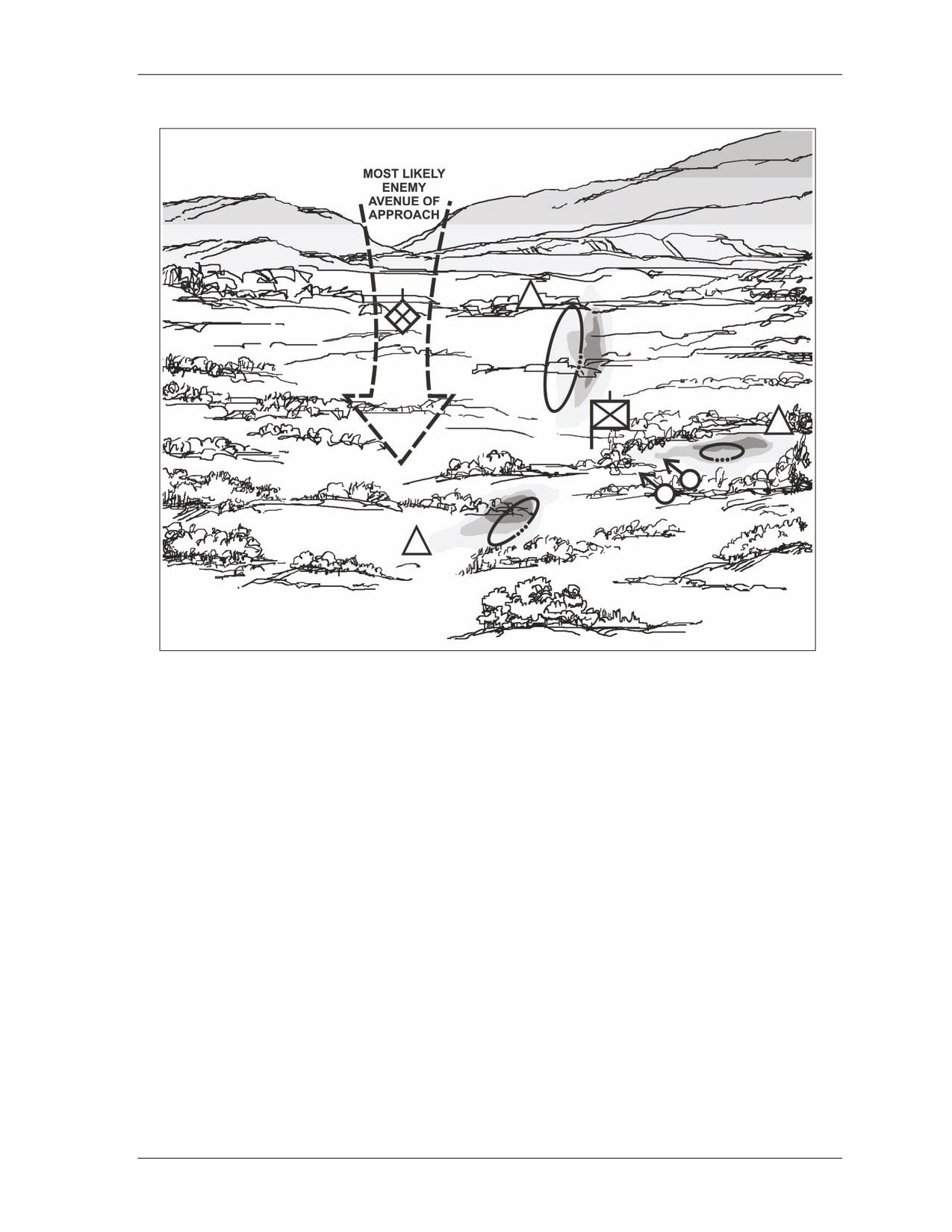
Defensive Operations
Figure 5-10. Modified Y-shape perimeter defense.
5-70.
The most difficult aspect of the Y-shape perimeter defense is the fire control measures required.
To safely fight this defense without casualties from friendly fire, the leaders must ensure the limits of fire
for each weapon do not allow fires into the adjacent platoon position. In a mountainous environment, firing
downward into the EAs may make this more simple. Some measures to consider include--
y Position machine guns near the apex of the "Y" to allow a FPL that covers the platoon front
while firing away from the adjacent platoon.
y Cover the areas of the EAs closest to the apex with Claymores, other mines, or obstacles to
reduce the need for direct fires in these areas.
y Identify those positions at most risk to friendly fires and prepare the fighting position to protect
the Soldier from fires in this direction.
y The loss of one platoon position may threaten the loss of the entire company. To prevent this,
plan and rehearse immediate counterattacks with a reserve or the least committed platoon.
y Consider allowing the enemy to penetrate well into the EAs and destroy him as in an ambush.
y Be aware that if a Y-shape defense is established on the prominent terrain feature and the
enemy has the ability to mass fires, he may fix the company with direct fires and destroy it with
massed indirect fires.
27 July 2006
FM 3-21.10
5-23