FM 3-21.10 (FM 7-10) The Infantry Rifle Company (July 2006) - page 7
Chapter 6
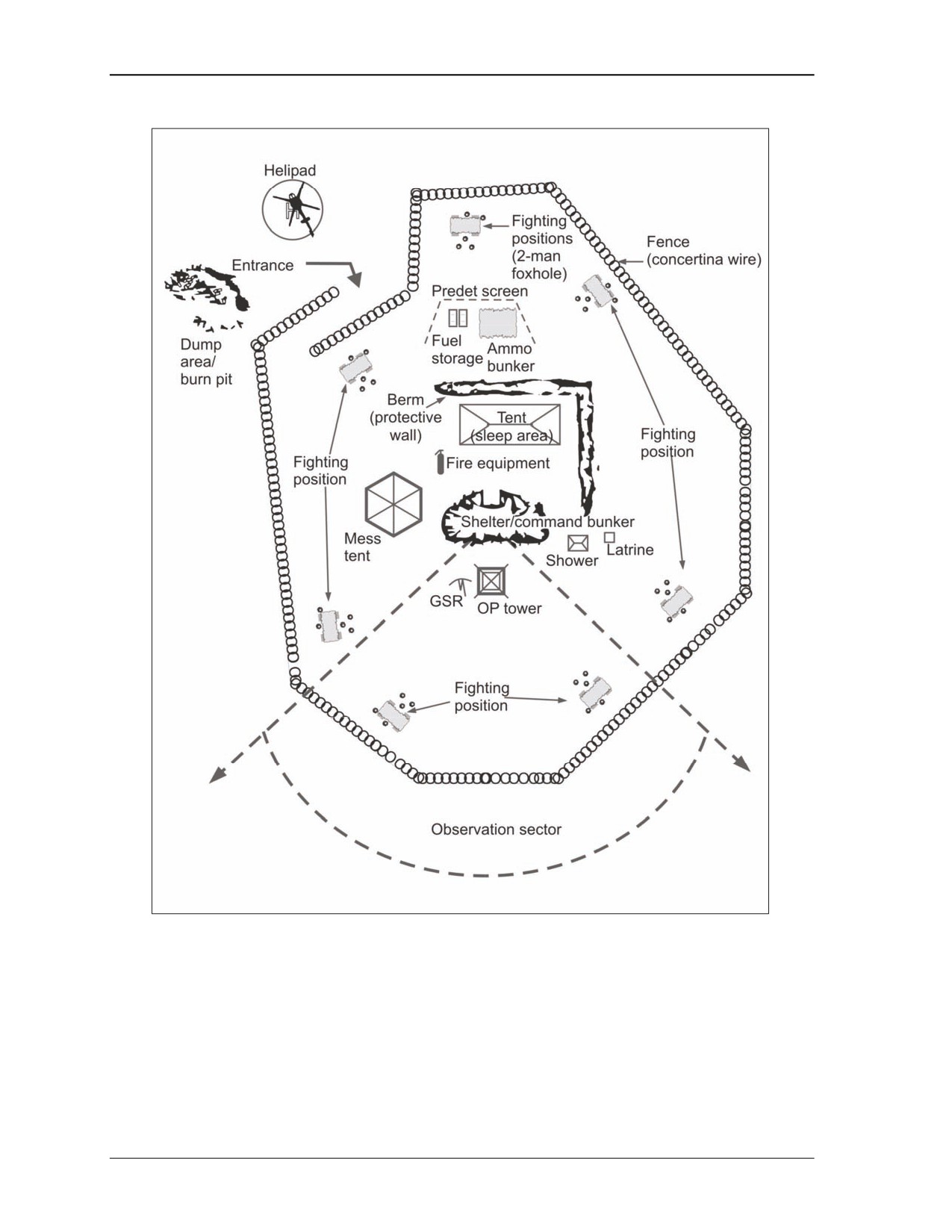
Figure 6-3. Example deliberate observation post.
ESTABLISH CHECKPOINTS
6-50. One of the main missions conducted during OIF was the vehicle or traffic checkpoint. Units
considered these standard steady-state operations and through repetitive execution could perform them
virtually like battle drills; clearly beneficial given the often constrained planning and preparation time at
company and platoon level.
6-14
FM 3-21.10
27 July 2006
Stability Operations
Purposes
6-51. The Infantry company or a subordinate element might be directed to establish a checkpoint to
achieve one or more of the following purposes.
y Obtain intelligence.
y Identify enemy combatants or seize illegal weapons.
y Disrupt enemy movement or actions.
y Deter illegal movement.
y Create an instant or temporary roadblock.
y Control movement into the area of operations or onto a specific route.
y Demonstrate the presence of US or peace forces.
y Prevent smuggling of contraband.
y Enforce the terms of peace agreements.
y Serve as an OP, patrol base, or both.
Advantages
6-52. Checkpoints offer units the following advantages regardless of the spectrum of conflict.
y They are an intimidating show of force.
1. They provide Soldiers and commanders with better situational awareness.
2. Provide reassurance to the friendly elements of the population.
3. Serve to gain the initiative for limited periods.
4. Help maintain friendly force vigilance and refine TTP.
5. Keeps the enemy off balance.
Disadvantages
6-53. Checkpoints have the following disadvantages, regardless of the spectrum of conflict.
y May create a pattern, thus giving a potential enemy the ability to gather information on TTP.
May invite targeting for attack if Soldiers are undisciplined or lax.
y The level of effort required to conduct checkpoints securely and for extended periods exhausts
a force rapidly.
y May incite the local populace to assist or join hostile elements.
y Their static locations can increase the potential for direct attack.
Procedures
6-54. Checkpoint layout, construction, and operating should reflect METT-TC factors, including the
amount of time available for emplacing it. The following procedures and considerations normally apply.
y Position the checkpoint where it is clearly visible and where traffic cannot turn back, get off the
road, or bypass the checkpoint without being observed.
y Position a combat vehicle
(if available) or crew-served weapons, selected based upon
METT-TC and ROE, off the road but within sight of the checkpoint. This helps deter resistance
to the Soldiers operating the checkpoint. The vehicle should be in a hull-down position and
protected by local security. It must be able to engage vehicles trying to break through or bypass
the checkpoint.
27 July 2006
FM 3-21.10
6-15
Chapter 6
y
Place obstacles in the road to slow or canalize traffic into the search area. Traffic should enter
the checkpoint single file.
y
Place signs written in the host nation's language explaining what they are entering and
instructions to facilitate their passing through.
y
Establish a reserve if applicable.
y
Establish a bypass lane for approved convoy traffic.
y
If applicable, establish wire communications within the checkpoint area to connect the
checkpoint bunker, combat vehicle, search area, security forces, rest area, and any other
elements involved in the operation.
y
Designate the search area. If possible, it should be below ground level or barrier that is
protected against such threats as a booby-trapped vehicle or suicide bomber. Establish a
parking area adjacent to the search area. Women are normally only checked with a metal
detector or searched by female personnel. However, this depends on the ROE, the ROI, and
METT-TC.
y
If applicable, checkpoint personnel should include linguists.
y
Properly construct and equip the checkpoint. Consider including--
- Barrels filled with sand, concrete, or water (emplaced to slow and canalize vehicles).
- Concertina wire (emplaced to control movement around the checkpoint).
- Spiked vehicle chains or collapsible tire defeating devices.
- Secure facilities for radio and wire communications with the controlling headquarters.
- First-aid kit.
- Sandbags for defensive positions.
- Wood or other materials for the checkpoint bunker.
- Binoculars, NVDs, and flashlights.
- Long-handled mirrors (for use in inspections of vehicle undercarriages).
y
Elements operating a deliberate CP may require access to specialized equipment such as--
- Floodlights.
- Control flags or signs in local language.
- Barrier poles that can be raised and lowered.
- Generators with electric wire.
Types
6-55.
Some common types of checkpoints are discussed below.
Deliberate Checkpoints
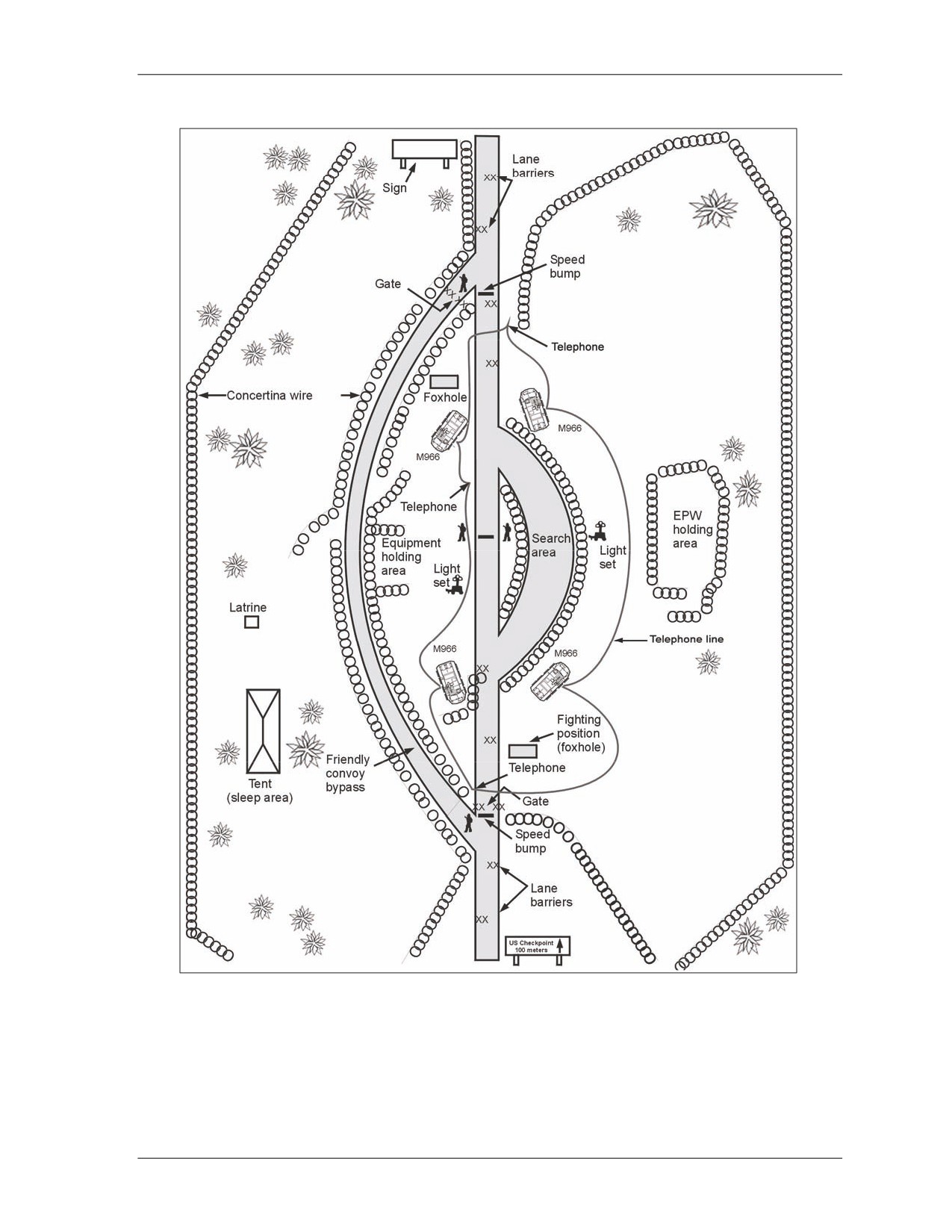
6-56. These might be permanent or semi-permanent (Figure 6-4). They are typically constructed and
employed to protect an operating base or well-established MSRs. Deliberate checkpoints are often used to
secure the entrances to lodgment areas or base camps. They may also be used at critical intersections or
along heavily traveled routes to monitor traffic and pedestrian flow. Deliberate checkpoints can be
constructed so that all vehicles and personnel are checked or where only random searches occur (ROE and
METT-TC dependent).
y They are useful deterrents and send a strong law and order or US presence message.
y Deliberate checkpoints and their locations are known to terrorists and insurgents. Commanders
must weigh the costs to the benefits of operating deliberate checkpoints.
y Commanders must consider that deliberate checkpoints may quickly become enemy targets and
US Soldiers operating deliberate checkpoints are highly visible and viable targets for
enemy attack.
6-16
FM 3-21.10
27 July 2006
Stability Operations
Figure 6-4. Deliberate checkpoint layout.
27 July 2006
FM 3-21.10
6-17
Chapter 6
Hasty Checkpoints
6-57. Such checkpoints are planned and used only for a short, set period. Hasty checkpoints are normally
employed during the conduct of a vehicle or foot patrol. The hasty checkpoint is similar in nature to the
deliberate checkpoint but only uses transportable materials.
y The hasty checkpoint is mobile and can be quickly positioned where needed.
y While more adaptable, the hasty checkpoint does not send the constant visual reminder of US
presence to the local population that the deliberate checkpoint does.
y Because they can be quickly established and removed, hasty checkpoints are likely to be more
effective in disrupting enemy actions. They are also less likely to be deliberately targeted by
enemy forces.
Snap Checkpoints
6-58. Such checkpoints are conducted when specific intelligence indicates that a checkpoint hinders the
enemy's freedom of movement at a specific time and place. Snap checkpoints are very similar to hasty
checkpoints. The major difference is that hasty checkpoints are often random actions conducted as part of a
patrol, whereas snap checkpoints are deliberate and based on either enemy analysis or quickly developed
actionable intelligence. Snap checkpoints are normally conducted immediately and often with little to no
deliberate planning; for this reason specific techniques should be develop and this specific action should be
well rehearsed.
Vehicular Traffic Stop Checkpoints
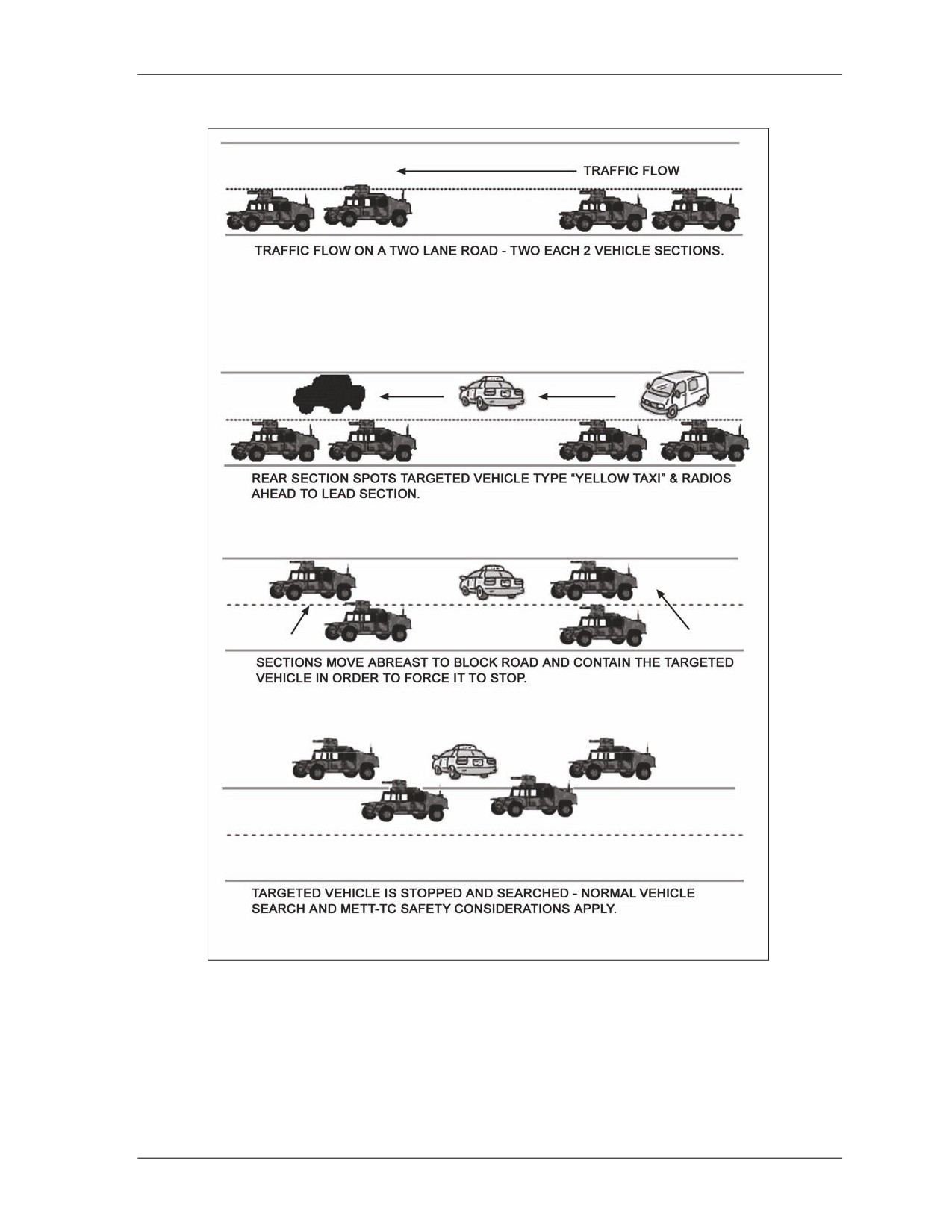
6-59. Such checkpoints
(Figure 6-5) are conducted by multiple sections of vehicle-equipped
Infantrymen. This type of operation involves two or three sections of vehicles that patrol an area looking
for a specific type of vehicle or specific personnel such as a particular model and color of car. Once this
vehicle or person is identified, the vehicle or person is forced to stop and then searched. Normally the
vehicle sections move single file with enough distance between the first two sections to allow civilian
traffic to move between the sections
(50 to
500 meters based on visibility, road conditions, and
METT-TC.) If either section spots a targeted vehicle or person in a static or parked position, then the patrol
cordons and searches the area, again based on METT-TC, or requests additional assistance. The patrol
should move slightly slower than normal civilian traffic so that civilian traffic will pass the rear section. As
civilian traffic passes the rear section, the patrol radio to the lead section if it spots a targeted vehicle. Once
a targeted vehicle has moved between the two sections, both sections move abreast to effectively block the
road and close the distance between themselves. They block in the targeted vehicle. The sections slowly
force the targeted vehicle to pull to the side of the road and stop, and then they use normal vehicle search
techniques. A third section can be employed as a reserve, as additional security, or simply as additional
Soldiers.
6-18
FM 3-21.10
27 July 2006
Stability Operations
Figure 6-5. Vehicular traffic stop.
SEARCH
6-60. Searches are an important aspect of populace and resource control. The need to conduct search
operations or to employ search procedures is a continuous requirement. A search can orient on people,
27 July 2006
FM 3-21.10
6-19
Chapter 6
materiel, buildings, or terrain. A search usually involves both civil police and Soldiers but may involve
only Soldiers. Misuse of search authority can adversely affect the outcome of operations. Soldiers must
conduct and lawfully record the seizure of contraband, evidence, intelligence material, supplies, or other
minor items for their seizure to be of future legal value. Proper use of authority during searches gains the
respect and support of the people. For procedures, leaders should consult available references such as unit
TSOPs, theater training requirements, handbooks, or the Soldiers Manual of Common Tasks. The
following discussion provides additional techniques to consider:
SEARCH A VEHICLE
6-61. Two principle types of vehicle searches include one during checkpoint operations and one for
entering a forward operating base
(FOB) or other secure area. Searches should be methodical yet
unpredictable, efficient yet speedy, thorough yet considerate. They are used for various purposes and are
conducted with varying degrees of force. Search techniques should be developed according to existing
conditions and current events in theaters of operation. Therefore, the best TTP reference is the unit TSOP.
SEARCH A MALE
6-62. In all search operations, leaders must emphasize the fact that anyone in an area to be searched
could be an insurgent or a sympathizer. To avoid making an enemy out of a suspect who may support the
host country government, searchers must be tactful. The greatest caution is required during the initial
handling of a person about to be searched. One member of the search team covers the other member, who
makes the actual search. (FM 3-19.40 and STP 19-95B1-SM discuss how to correctly search people.)
SEARCH A FEMALE
6-63. The enemy can use females for all types of tasks when they think searches might be a threat. To
counter this, use female searchers. If no female searchers are available, use doctors, aidmen, or members of
the local populace. If male Soldiers must search females, take all possible measures to prevent any
inference of sexual molestation or assault.
SEARCH A HOUSE
6-64. The object of a house search is to look for controlled items and to screen residents to determine if
any are suspected insurgents or sympathizers. As far as possible, care should be taken to respect national
customs. For instance, in a Muslim country, men should be allowed to take women out of the house prior
to the search. The commander should have enough money to pay immediately for damages to locks and
doors, and so on. A search party assigned to search an occupied building should have at least one local
police officer, a protective escort for local security, and a female searcher. If inhabitants remain in the
dwellings, the protective escort must isolate and secure the inhabitants during the search. Escort parties and
transportation must be arranged before the search of a house. Forced entry might be necessary if a house is
vacant or if an occupant refuses to allow searchers to enter. If the force searches a house containing
property while its occupants are away, it should secure the house to prevent looting. Before US forces
depart, the commander should arrange for the community to protect such houses until the occupants return.
Several methods for controlling the inhabitants follow.
y Assemble inhabitants in a central location if they appear to be hostile. This method provides the
most control, simplifies a thorough search, denies insurgents an opportunity to conceal
evidence, and allows for detailed interrogation. Depending on the objective of the search, a
personnel search team might be necessary in this central location. This method has the
disadvantage of taking the inhabitants away from their dwellings, thus encouraging looting,
which, in turn, engenders ill feelings. The security element is then responsible for controlling
the inhabitants. The search element may escort individuals back to their dwellings to be present
during the search or may leave them in the central location.
y Restrict inhabitants to their homes. This prohibits movement of civilians, allows them to stay in
their dwellings, and discourages looting. The security element must enforce this restriction. The
6-20
FM 3-21.10
27 July 2006
Stability Operations
disadvantages of this method are that it makes control and interrogation difficult and gives
inhabitants time to conceal evidence in their homes.
y Control the heads of the households. Tell the head of each household to remain in front of the
house and at the same time have everyone else in the house taken to a central location. The
security element controls the group at the central location, controls the head of the household,
and provides external security for the search team. During the search, the head of the household
accompanies the search team through the house. This reduces looting. Plus, the head of the
household sees for himself that the search team steals nothing. This is the best method for
controlling the populace during a search.
PATROL
6-65. Patrolling is also a high-frequency task during stability operations. The primary advantage of the
dismounted patrol is that they provide a strong presence and enable regular interface with the local
population. This procedure greatly helps in gathering vital information as well as in developing the base of
knowledge of the unit's AO. Planning and execution of an area security patrol and presence patrol are
similar to procedures for other tactical patrols except that the patrol usually occurs in urban areas and
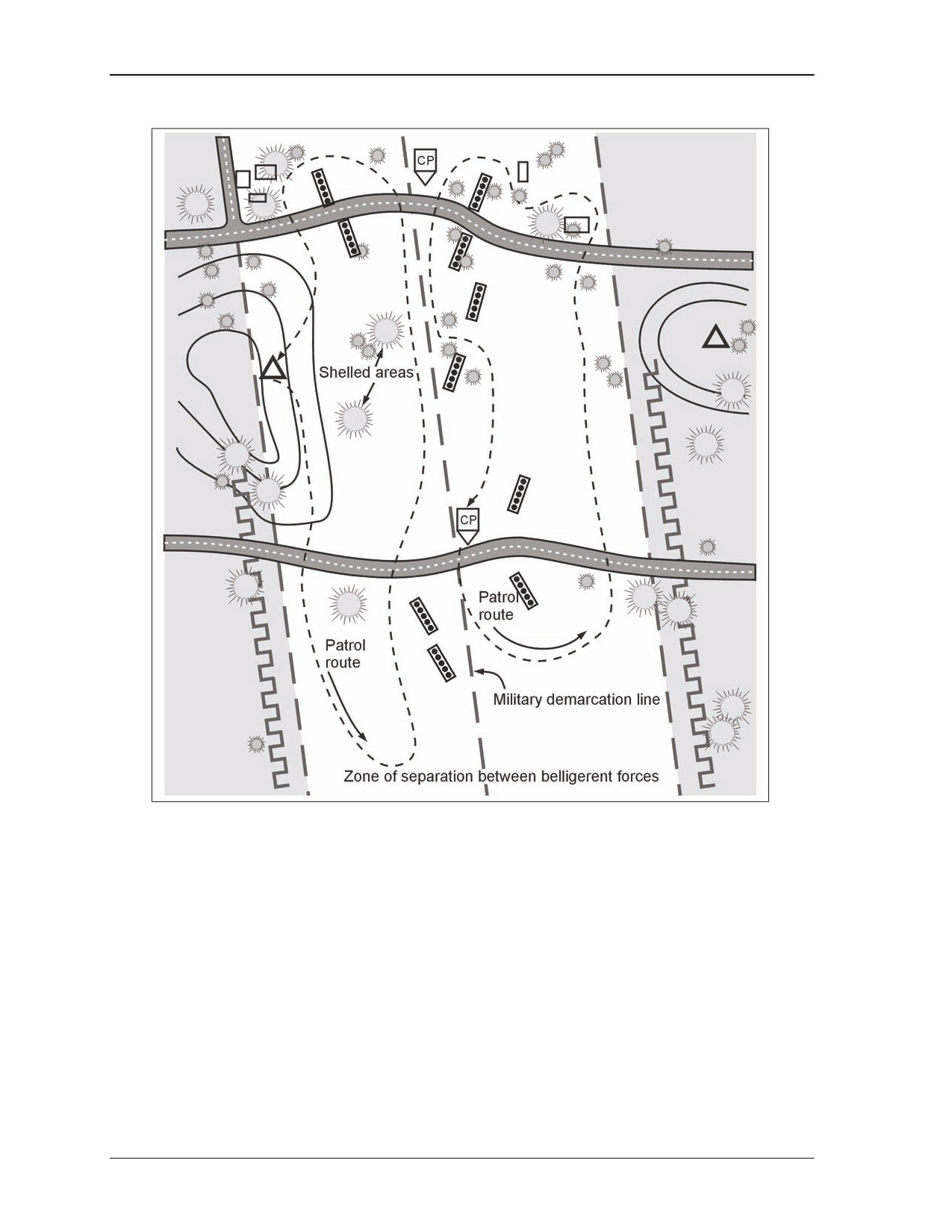
patrol leaders must consider political implications and ROE. Figure 6-6, page 6-22 shows the use of an
area security patrol, in conjunction with checkpoints and OPs, in enforcing a zone of separation between
belligerent forces.
27 July 2006
FM 3-21.10
6-21
Chapter 6
Figure 6-6. Employment of checkpoints, OPs, and
patrols to enforce a zone of separation.
PRESENCE PATROLS
6-66. US forces are deployed increasingly in combat operations in urban areas and in support of stability
operations missions all around the world. The Infantry company and platoons conduct a presence patrol
much the same as a combat patrol, and the planning considerations are similar. The main difference is that
the patrol wants to both show force and lend confidence and stability to the local population of the host
nation (HN). Rarely should a commander use a presence patrol where enemy contact is likely. Presence
patrols work best for some types of stability operations, for example, peace operations, humanitarian and
civic assistance, NEO, foreign humanitarian assistance (FHA), or shows of force. The presence patrol is
also the primary means by which the commander collects information about his AO. The presence patrol is
armed, and it conducts the planning and preparation necessary for combat operations at all times. Leaders
should plan the patrol based on a movement to contact model or methodology. The patrol in urban areas is
6-22
FM 3-21.10
27 July 2006
Stability Operations
planned in the same manner. Each patrol will often involve vehicle support. The platoon could be tasked to
conduct mounted (if augmented with vehicles) or dismounted patrols planned by the higher headquarters to
accomplish one or more of the following.
y Confirm or supervise an agreed cease-fire.
y Gain information.
y Cover gaps between OPs or checkpoints.
y Show a stability force presence.
y Reassure isolated communities.
y Inspect existing or vacated positions of former belligerents.
y Escort former belligerents or local populations through trouble spots.
PLANNING CONSIDERATIONS
6-67. Commanders must address additional considerations when planning or conducting patrols in and
around urban areas. Some of these are--
y Leaders and Soldiers must plan for and rehearse actions in and around large crowds of civilians
or noncombatants. Expect most civilians not to speak English which means you must have
interpreters.
y All Soldiers and leaders should be briefed on information/intelligence collection priorities.
y Soldiers must be assigned responsibility to maintain all-round and high-low security that
assigns responsibility for each floor and the roof of buildings.
y Leaders should consider periodically occupying rooftops during the course of the patrol to
increase observation and security.
y Use of urban city maps. Navigation by grid in an urban area can be difficult. Maps that show
street names, neighborhoods, and so on are much more useful.
y Ensure there is a contingency plan for dealing with large crowds of noncombatants or large
hostile crowds.
y Know the numbers and locations of translators or interpreters in the patrol. Also, know the
ethnicity of the translators, and how that might affect the population of the patrol area or route.
y Check recent activity or trends in the local population or urban areas.
y The speed of the patrol should normally be slow and even promoting a relaxed and confident
attitude towards the local population except where the current IED threat calls for high speed
movement. It also enables patrol members to concentrate on the urban environment and the
population, which increases their ability to gather information. A steady pace helps stave off
fatigue.
OPPORTUNITIES
6-68. Urban terrain provides multiple opportunities for attack against patrols in the stability environment.
The locations of enemy firing points can be concealed by building characteristics, vehicles, civilian
population, and noise. The patrol must therefore regain the initiative during an engagement by immediate
and aggressive action. An attack is normally initiated on a patrol only when the attacker has an open escape
route. This emphasizes the need to maneuver teams quickly in order to provide depth, and to cordon the
area immediately after the initial reaction to the contact. The teams out of contact must rapidly envelop the
firing point indicated by the contact team and try to close off the suspected escape route. The contact team
must provide general directions or guidance to the other teams not in contact. Reacting quickly and
aggressively based on limited information always beats giving the attacker a chance to escape.
27 July 2006
FM 3-21.10
6-23
Chapter 6
VEHICLE-SUPPORTED PATROLS
6-69. Infantry units
might find themselves conducting frequent vehicle-assisted or
vehicle-mounted patrols. The same considerations that apply to any dismounted patrol apply to
vehicle-mounted patrols. The commander must consider the following.
y
Organize and orient vehicle gunners and commanders to maintain all-round security and, for
urban areas, high-low security. Carefully consider leader locations in each vehicle and within
the convoy.
y
Rehearse mounted battle drills, reaction to contact, and mounting and dismounting in contact
and include drivers in all rehearsals.
y
Plan alternate routes, civilian traffic, and roadblocks.
y
Remember that four vehicles is generally the minimum number of vehicles to conduct any
operation. If one vehicle is disabled or destroyed, it can still be recovered while the third
provides security. Unit SOPs determine the number of vehicles required.
y
Remove outboard vehicle cargo seats that force Soldiers to face the interior of the vehicle.
Replace with centerline seats that allow Soldiers to face outward. This increases observation,
situational understanding, and potential firepower available.
y
Position heavy crew-served weapons, such as the M2.50 caliber machine gun and the MK 19
machine gun, towards the rear of vehicle patrol convoys, where they can support the entire
convoy in the event of contact.
y
Harden unarmored vehicles by sandbagging or attaching improvised armor. Sandbagging
vehicles seldom increases vehicle survivability, and the added weight increases maintenance
problems, but it can increase crew and Soldier survivability. Add-on armor kits are preferred
however, unit mechanics or welders can quickly fabricate improvised armor to protect both the
vehicle engine and crew compartments if necessary.
y
Plan for actions required if a vehicle breaks down and has to be repaired or recovered. Review
self-recovery assets. Plan actions in case a vehicle gets stuck and cannot be recovered. Also,
plan actions for catch-ups and breaks in contact.
y
Establish a communications plan if not all vehicles have FM communication or in case a
vehicle loses FM.
y
Secure external gear to prevent theft. Inspect it to ensure it is not flammable. In the event of fire
bomb or RPG attack, burning material attached to the vehicle creates a greater hazard than the
initial attack.
y
Plan for heavy civilian vehicle and pedestrian traffic.
y
Conduct a map reconnaissance and identify likely chokepoints, ambush sites (intersections),
and overpasses.
y
Plan primary and alternate routes to avoid potential hazards.
y
Drive offensively, unpredictably, but safely.
y
Avoid stopping; it can create a potential kill zone.
y
Learn the capabilities of the vehicle, including how high a vehicle can jump (curbs and other
obstacles), its turning radius, its high-speed maneuverability, and its estimated width, in order
to navigate narrow passageways.
6-70.
Most engagements last less than one minute. Many engagements will be initiated with some type
of IED or other command-detonated explosive device. Rapid maneuver against threat ensures either
destruction or capture. The enemy will typically break contact and run after initially engaging with one
magazine indiscriminately. Fire and maneuver is not always an option. Establish an over-watch or
support-by-fire element and a maneuver element to close on the enemy (preferably from an assailable
flank). An immediate cordon of the area may prevent the enemy from escaping. U.S. forces can then
engage in a deliberate search of the area to capture or kill the attackers. Indigenous personnel firing
weapons may not always pose a threat such as celebratory fire. Stay aware of the different situations in
which weapons firing may not be threatening. Some personnel under control (PUC) are not Soldiers. They
6-24
FM 3-21.10
27 July 2006
Stability Operations
sometimes follow instructions poorly. Follow procedures for handling EPWs (secure, search, segregate,
silence, safe to the rear) when handling PUCs.
ESCORT A CONVOY
6-71. This mission requires the Infantry company to provide a convoy with security and close-in
protection from direct fire while on the move. Infantry forces must be augmented with additional
transportation assets to carry out this mission.
COMMAND AND CONTROL
6-72. The task organization inherent in convoy escort missions makes battle command especially critical.
The Infantry company commander may serve either as the convoy security commander or as overall
convoy commander. In the latter role, he is responsible for the employment of his own organic combat
elements and of CS and sustainment attachments and drivers of the escorted vehicles. He must incorporate
all these elements into the various contingency plans developed for the operation. He must also maintain
his link with the controlling TOC.
6-73. Effective SOPs and drills supplement OPORD information for the convoy. Since this is not a core
mission the company commander must ensure adequate time to conduct thorough rehearsals. Also, the
company conducts PCCs and PCIs, to include inspection of the escorted vehicles. The commander also
coordinates with units and elements in areas through which the convoy will pass. Theater or combatant
commands will provide baseline information and procedures for unit convoy TSOPs. However, Table 6-1
is an example convoy briefing checklist, which is used to provide minimum essential information to all
members of a convoy.
27 July 2006
FM 3-21.10
6-25

Chapter 6
SITUATION
EXECUTION (continued)
Enemy.
- Order of movement and bumper numbers and.
- Activity in the last 48 hours.
individual manifesto.
- Threats.
- Movement formation.
- Capabilities.
- Speed and catch-up speed.
Friendly.
- Interval (open areas and in built-up areas).
- Units in the area or along the route.
- Weapons orientation, locations of key weapons.
Light and Weather Data.
systems.
- Effects of light and weather on the enemy and.
- Route.
on friendly forces.
- Checkpoints.
- BMNT, sunrise, high temp, winds, sunset.
- Actions on contact.
- EENT, moonrise, percent illumination.
- Actions on breakdowns.
low temp
- Actions at the halt (short halt and long halt)
MISSION
SUSTAINMENT
Task and Purpose of the Movement.
MEDEVAC Procedures.
Mission Statement
- Nine-line MEDEVAC request.
- Location of medical support and combat.
lifesavers.
EXECUTION
- Potential PZ/LZ locations.
Commander's Intent.
Maintenance Procedures.
Endstate.
- Location of maintenance personnel.
Concept of the Operation (Concept Sketch or.
- Location and number of tow bars.
Terrain Model).
- Recovery criteria.
Task to Maneuver Units.
- Stranded vehicle procedures
Fires.
Close Air Support.
Coordinating Instructions.
COMMAND AND SIGNAL
- Timeline.
- Convoy commander.
- Marshal.
- Sequence of command.
- Rehearsals.
- Location of convoy commander.
- Convoy briefing.
- Call signs of every vehicle/unit in the convoy.
- Inspections.
- Convoy frequency.
- Initiation of movement.
- MEDEVAC frequency.
- Rest halts.
- Alternate frequencies
- Arrival time
Table 6-1. Example convoy briefing checklist.
6-74. Before the mission begins, the convoy commander issues a complete OPORD to all vehicle
commanders in the convoy. This is vital, because the convoy may itself be task-organized from a variety of
units, and because some vehicles might not have tactical radios. The order follows the standard
five-paragraph OPORD format. It can emphasize these subjects.
y Inspection of convoy vehicles.
y Route of march (including a strip map for each vehicle commander).
y Order of march.
y Actions at halts (scheduled and unscheduled).
y Actions in case of vehicle breakdown.
y Actions for a break in column.
y Actions in built-up areas.
y Actions on contact, covering such situations as snipers, enemy contact (including near or far
ambush), indirect fire, mine strike, and minefields.
y Riot drill.
y Refugee control drill.
y Evacuation drill.
y Actions at the delivery site.
y Chain of command.
y Guidelines and procedures for negotiating with local authorities.
6-26
FM 3-21.10
27 July 2006
Stability Operations
y Communications and signal information.
y Tactical disposition.
y Fire support plan.
6-75. In any escort operation, the basic mission of the convoy commander (and, as applicable, the
convoy security commander) is to establish and maintain security in all directions and throughout the
length of the convoy. He must be prepared to move the security force to fit the situation. Several factors
apply, including convoy size, organization, and composition. Sometimes, he positions the security
elements, such as platoons, to the front, rear, or flanks of the convoy. He may also disperse the combat
vehicles throughout the convoy body.
TASK ORGANIZATION
6-76. When sufficient escort assets are available, the convoy commander usually organizes convoy
security into three distinct elements: advance guard, close-in protective group, and rear guard. He may also
designate an additional reserve in the rear guard to handle contingency situations. The following
paragraphs examine the role of the advance guard, of security assets accompanying the convoy main body,
and of the reserve in the rear guard.
Advance Guard
6-77. The advance guard reconnoiters and proofs the convoy route. It searches for signs of enemy
activity such as ambushes and obstacles. Within its capabilities, it tries to clear the route. The distance and
time separation between the advance guard and the main body should be enough to give the convoy
commander adequate early warning before the arrival of the vehicle column. However, the separation
should be short enough that the enemy cannot interdict the route between the time the advance guard
passes and the main body arrives. The advance guard should be task-organized with reconnaissance and
mobility assets. As necessary, it should also include linguists.
Main Body
6-78. The commander might choose to intersperse security elements with the vehicles of the convoy
main body. These can include combat elements (including the rear guard), the convoy commander,
additional linguists, mobility assets, and medical and maintenance support assets. Depending on
METT-TC, the convoy commander might also employ flank security.
Rear Guard
6-79. The rear guard may serve as a reserve, often called a quick reaction force (QRF). Either it moves
with the convoy, or it locates at a staging area close enough to provide immediate interdiction against
enemy forces. The supporting headquarters normally designates an additional reserve, consisting of an
additional company or combat aviation assets, to support the convoy operation.
ACTIONS ON CONTACT
6-80. As the convoy moves to its new location, the enemy might try to harass or destroy it. This contact
usually occurs in the form of an ambush, often executed at a hasty obstacle. The safety of the convoy rests
on the speed and effectiveness with which escort elements can execute appropriate actions on contact.
Based on the factors of METT-TC, portions of the convoy security force might be designated as a reaction
force. This element performs its normal escort duties, such as conducting tactical movement or occupying
an assembly area, unless enemy contact occurs. Then, it performs a reaction mission given by the convoy
commander. Leaders should follow actions on contact procedures according to the unit TSOP. However,
this manual also provides discussions for reacting to IEDs in Appendix G and urban patrolling react to
contact in Appendix K.
27 July 2006
FM 3-21.10
6-27
Chapter 6
Actions at an Ambush
6-81. An ambush is one of the best ways to stop a convoy. Actions in response to an ambush must be
immediate, overwhelming, and decisive. This means they must be planned for and rehearsed so they can be
executed by all escort and convoy elements. Procedures to consider in case of an ambush--
y The security force immediately acquires the enemy force, provides suppressive fires on known
or suspected enemy positions, and tries to clear the kill zone quickly. They seek covered
positions between the convoy and the enemy and suppress the enemy with the highest possible
volume of fire
(METT-TC and ROE dependent). They send contact reports to higher
headquarters.
y The convoy vehicles, if armed, return fire only if the security force is not between the convoy
and the enemy force.
y The convoy commander keeps the convoy vehicles moving on the route.
y Subordinate leaders or the convoy commander can request recovery assistance for damaged or
disabled vehicles which may have to be pushed off the path or roadway.
y The convoy escort leader uses situational reports to keep the convoy security commander
informed. If necessary, the convoy escort leader can then direct a reserve force from the rear
guard or staging area to take action. He can also call for and adjust indirect fires.
y Once the convoy is clear of the kill zone, the convoy escort element executes one of the
following COAs based on the composition of the escort and reaction forces, the commander's
intent, and the strength of the enemy force.
- Continue to suppress the enemy as the reserve moves to provide support.
- Break contact and move out of the kill zone.
- Assault the enemy.
Actions at an Obstacle
6-82. Obstacles are obstructions that prevent movement. They include, among others, among others,
deliberate roadblocks, disabled vehicles, and large groups of demonstrators. Obstacles threaten convoy
security and can canalize or stop the convoy to set up an enemy ambush. A route reconnaissance goes
ahead of a convoy to identify obstacles and either breach or bypass them. Sometimes, the reconnaissance
element misses an obstacle and the convoy runs into it after all. If this happens, the convoy must take
actions to reduce or bypass the obstacle.
y When an obstacle is identified, the convoy escort faces two challenges: reducing or bypassing
the obstacle, or maintaining protection for the convoy. Security becomes critical, and actions at
the obstacle must be accomplished very quickly. The convoy commander must assume that the
obstacle is overwatched and covered by enemy fires.
y To reduce the time the convoy is halted, thus reducing its vulnerability, the company should act
when the convoy escort encounters point-type obstacles.
6-83. The advance guard element identifies the obstacle, and the convoy commander directs the convoy
to make a short halt and establish security.
6-84. The convoy escort element overwatches the obstacle, asks the convoy commander to allow the
breach force to move forward. Pay particular attention to terrain that dominates the area.
6-85. The escort maintains all-round security and provides overwatch as the breach force reconnoiters
the obstacle in search of a bypass.
6-86. Once all reconnaissance is complete, the convoy commander determines if he will bypass the
obstacle, breach the obstacle with the assets on hand, or breach the obstacle with reinforcing assets.
6-28
FM 3-21.10
27 July 2006
Stability Operations
Actions During a Halt
6-87. During a short halt, the convoy escort remains at REDCON-1 status, regardless of what other
convoy vehicles are doing. If the halt is for any reason other than an obstacle, the convoy escort takes the
following actions.
y The convoy commander signals the short halt and transmits the order via tactical radio. Based
on METT-TC factors, he directs all vehicles in the convoy to execute the designated formation
or drill for the halt.
y Ideally, the convoy assumes a herringbone or coil formation. If the sides of the road are
untrafficable or are mined, however, noncombat vehicles may simply pull over and establish
all-round security as best they can. This allows movement of the escort vehicles through the
convoy main body as necessary.
y If possible, escort vehicles are positioned up to 100 meters beyond other convoy vehicles,
which are just clear of the route. Escort vehicles remain at REDCON-1 but establish local
security based on the factors of METT-TC.
y When given the order to continue, convoy vehicles reestablish the movement formation,
leaving space for escort vehicles. Once the convoy is in column, local security elements (if
used) return to their vehicles, and the escort vehicles rejoin the column.
y When all elements are in column, the convoy resumes movement.
OPEN AND SECURE ROUTES
6-88. This task is a mobility operation normally conducted by the engineers. The Infantry company
might be tasked to assist in route clearance and to provide overwatch support. Route clearance may achieve
one of several tactical purposes.
y To clear a route for the initial entry of the battalion into an area of operations.
y To clear a route ahead of a planned convoy to ensure that belligerent elements have not
emplaced new obstacles since the last time the route was cleared.
y To secure the route for use as a main supply route.
6-89. The planning considerations for opening and securing a route resemble those for a convoy escort
operation. The company commander analyzes the route and develops contingency plans for such
possibilities as likely ambush locations and sites that are likely to be mined. The size and composition of a
team charged with opening and securing a route is based on METT-TC.
CONDUCT RESERVE OPERATIONS
6-90. Reserve operations in the stability environment are similar to those in other tactical operations.
They too allow the Infantry company commander to plan for a variety of contingencies based on the higher
unit's mission. The reserve might play a critical role in almost any stability activity or mission, including
lodgment area establishment, convoy escort, and area security.
y The reserve force must be prepared at all times to execute its operations within the time limits
specified by the controlling headquarters.
y The controlling headquarters can tailor the size and composition of the reserve to the mission.
For a convoy mission, for example, the reserve might consist of a company.
CONTROL CROWDS
6-91. Large crowds or unlawful civil gatherings or disturbances pose a serious threat to US troops.
Commanders must consider the effects of mob mentality, the willingness of enemies to manipulate media,
and the ease with which a small, isolated group of Soldiers can be overwhelmed by masses of people. The
27 July 2006
FM 3-21.10
6-29
Chapter 6
police forces of each state and territory are normally responsible for controlling crowds involved in mass
demonstrations, industrial, political and social disturbances, riots, and other civil disturbances. The prime
role of US troops in the control of unlawful assemblies or demonstrations is to support and protect the
police, innocent bystanders, and property. Therefore, this paragraph describes protective and defensive
measures rather than offensive measures. For example, troops provide a firm base where police can
operate, either as riot or arrest squads. The troops will only use force as a last resort to disperse the crowd
or prevent its advancing past a given point or line.
6-92. Control at the scene of an incident normally falls under civil authority. The Army will act only on
receiving a formal request or when danger is immediate and pressing. The command of the US military
elements remains with the commander. The key to success is cooperation between military and civilian
authorities. The controlling forces will not work side by side but rather, from front to rear, with one
element backing up the other.
Note: In the very early stages of stability operations, US forces might be the only civil or
military authority present.
6-93. A military element might have to deploy without a police unit. If so, an authorized representative
of the civil authority, such as a magistrate or police representative, should accompany the military.
6-94. Before going into the disturbed area, the Infantry company must try to isolate it and cut off
reinforcement of dissidents. Roadblocks, checkpoints, or even a cordon can help, although complete
isolation is probably unlikely.
6-95. Where possible, the company should dominate the disturbed area by unobtrusively setting up
rooftop OPs or patrols before starting the street operation. If prominent rooftops are inaccessible from the
ground, the unit can deploy on helicopters.
6-96. An initial deployment into an operational area has two phases: the approach, and the ‘show
of force.’.
6-97. The company conducts an approach march to a secure area out of view of the mob or gathering.
The column formation is most suited for an approach in vehicles or on foot. The force moves one platoon
behind the other on a single axis of advance, with company headquarters immediately behind the leading
platoon. Barring immediate and pressing danger, a commander should avoid allowing other incidents to
divert him en route to his assigned area of operations.
6-98. The original briefing, report, or order is unlikely to give the commander enough information to
plan the deployment in detail before he arrives at the scene. Although rooftop OPs and patrols might have
been established earlier, the commander must conduct a quick reconnaissance on arrival in the deployment
area. He must make contact with the police commander or other local civil authority and plan the final
deployment. The use of helicopters for crowd and route surveillance will help the commander adjust his
deployment as the situation changes, and to identify the threat to the security of his forces when deployed.
6-99. Troops should be deployed outside the range of hand-thrown missiles (50 to 60 meters), but within
full view of the crowd. They should deploy into the appropriate formation quickly (double time), adopting
the port arms or on guard position to convey a sense of purpose to the crowd.
6-100. Such operations are likely to call for the employment of non-lethal munitions. Some examples
include various size projectiles made of substances such as rubber, foam, wood, and bean-bags. (For
detailed discussions of nonlethal see FM 3-22.40 and FM 3-19.15.)
6-30
FM 3-21.10
27 July 2006
Chapter 7
Civil Support Operations
During the disastrous events caused by hurricanes Katrina and Rita, US military
forces executed "the largest, fastest, most comprehensive and most responsive civil
support mission ever," said Paul McHale, assistant secretary of defense for
homeland defense, to the Senate Committee on Homeland Security and
Governmental Affairs.
McHale credited the 72,000 Active Duty, National Guard, and Reserve Soldiers who
responded, particularly at a time of large-scale deployments supporting the war on
terror, as a testament to the readiness, agility and professionalism of the force.
This edition adds civil support operations, which call for Army units to assist
domestic civil authorities. They do this by providing essential supplies and services
to control disease, to alleviate suffering, restore civil order, or to help people and
communities recover from disasters. The ultimate goal is to meet the immediate
crisis, and then to transfer responsibility quickly and efficiently back to the
appropriate civilian authorities.
The discussions in this chapter rely on the experiences gained during recent natural
disasters.
ROLES
7-1.
The US active duty military is limited by the Posse Comitatus Act and other legislation in the
actions it can take in within the US and its territories. Under PCA, Army forces do not conduct stability
operations within the United States. Instead, the federal and state governments are responsible for those
tasks, but we do conduct civil support operations. Normally, for US armed forces to conduct offensive and
defensive operations inside the US and its territories, the President must do two things. First, he must
identify a significant armed force that threatens the territorial integrity of the US. Second, he must declare a
national emergency. Only then can jointly commanded Army forces conduct, IAW Chapter 4 (Offensive
Operations) and Chapter 5 (Defensive Operations), offensive and defensive Homeland Security missions.
7-2.
The Army plays different roles for offense or defense as part of Homeland Security from that of
civil support. However, civil support may be conducted in circumstances that require offensive and
defensive operations in order to return the affected population to a state of normalcy.
7-3.
Significant legal and constitutional issues arise when military forces are committed to combat
operations within the US Differences exist between the actions active duty forces, federalized reserve
component forces, and National Guard forces can are authorized to perform. Commanders and leaders at
all levels must ensure they clearly understand the guidelines and rules of engagement established by the
President and his legal representatives.
7-4.
Leaders must keep their Soldiers informed on the situation and guidance from the higher
headquarters. The Infantry company will encounter various units and organizations classified by certain
Titles under US Code which may effect command and control relationships. Civil authorities may need to
be informed of the differences in terms of what each can and cannot do.
y National Guard (NG) in its role as the state militia can be called to respond as state active duty
(SAD) under the command of the governor.
27 July 2006
FM 3-21.10
7-1
Chapter 7
y Title 32 - National Guard on full time status can be moved from SAD to Title 32.
y Title 10 - Active duty military units including active Guard and Reserve (AGR).
y Title 14 - Pertains to the US Coast Guard.
DEFINITION
7-5.
In disaster relief, the Infantry company becomes a force provider and supplements the efforts and
resources of state and local governments (and possibly NGOs) within the United States.
7-6.
During civil support operations, the US military responds in support of civilian agencies and may
receive guidance and instructions from civil authorities through their assigned chain of command. These
include responding to civil emergencies or major disasters. A presidential declaration of an emergency or
disaster usually precedes the Army’s commitment to civil support operations, but in cases of extreme
emergency, it may follow the initial actions. Regardless of the relationship between the civil authorities and
the military, the fundamental elements and responsibilities of military command do not change. A
representative of the civil authority does not, except in some specific and rare circumstances, exercise
command over military forces.
7-7.
The US military provides civil support based on a DoD directive for military assistance to civil
authorities. Such a directive normally addresses both natural and manmade disasters. It can direct military
aid in civil disturbances, counterdrug and counterterror activities, law enforcement, and management of
consequences associated with weapons of mass destruction (WMD).
7-8.
The US Constitution mandates that the civilian government is responsible for preserving public
order. However, the Constitution also allows military forces to protect federal and civilian property and
functions. The Posse Comitatus Act restricts the use of the military in civilian law enforcement except in
the role of supporting or technical assistance.
7-9.
Federal military forces remain under the military chain of command while supporting civil law
enforcement. The supported law enforcement agency coordinates Army force activities under appropriate
civil laws and interagency agreements. Army and Air National Guard units that have not been federalized
can assist civil authorities when active duty federal units cannot under the provisions of the Posse
Comitatus Act.
TYPES OF OPERATIONS
7-10.
Civil support involves using the Army to respond with a wide array of capabilities and services to
aid civil authorities in the following types of actions.
y Protecting public health.
y Restoring public order.
y Assisting in disaster recovery.
y Alleviating large-scale suffering.
y Protecting critical infrastructure.
POSSIBLE TASKS
7-11.
The company commander cannot predict the exact tasks his unit might have to perform during
civil support operations. Infantry units must often perform nonstandard tasks during national and local
emergencies. Civil support operations respond to requests for help with protection and restoration.
Typically, these include riots or widespread disorder; forest and grassland fires; hazardous material
releases; and floods, storms, hurricanes, tornados, and earthquakes.
7-2
FM 3-21.10
27 July 2006
Civil Support Operations
7-12.
State, local, and federal authorities are responsible for restoring essential services in the case of a
disaster. Army forces may support their efforts. Disaster relief focuses on recovery of critical infrastructure
after a natural or manmade disaster. Both humanitarian and disaster relief normally occur simultaneously.
7-13.
The most common civil support tasks for Infantry companies include--
y
Search and rescue of survivors.
y
Recovery of human remains.
y
Disposal of animal carcasses.
y
Disinfection and sanitation.
y
Debris and trash removal.
y
Riot and civil disturbance control.
y
Police augmentation.
y
Food and ice distribution.
y
Fuel distribution.
y
Contamination containment.
y
Personnel movement and control.
y
Key facilities protection.
y
Vital services assessment.
y
Medical triage and treatment.
y
Emergency fire fighting.
y
Emergency flood control.
y
Hazard identification.
y
Water purification and distribution.
y
Temporary shelter construction and administration.
y
Transportation support.
y
Power generation.
y
Communications support.
y
Clothing and blanket distribution.
y
Information distribution.
y
Medical evacuation.
y
Operations coordination.
INTELLIGENCE
7-14.
This paragraph discusses support to SA; ISR; and maps and imagery.
SUPPORT TO SITUATIONAL AWARENESS
7-15.
Due to the complete destruction of communications systems prior to arrival into a devastated area,
the company commander and his unit may lack any level of situational awareness. The commander must
identify and conduct a face-to-face with first responders such as police, fire, or NG personnel.
7-16.
The Infantry company commander must develop and disseminate PIR such as--
y What is the number and location of displaced civilians in each units sector?
y What is the number and location of civilians remaining in AO?
y Where are flooded areas?
y What is the water level at engineer test points?
y What areas currently have the most criminal activity?
y Where are criminal elements caching weapons and ammunition?
27 July 2006
FM 3-21.10
7-3
Chapter 7
y What locations will criminals target for looting?
y Will criminal elements go beyond handguns to explosives use?
y Will civilians evaluating damage to their homes and businesses stay beyond time limits?
7-17.
The Infantry company commander must also develop internal information gathering TTP relevant
to disaster response situations.
INTELLIGENCE, SURVEILLANCE, AND RECONNAISSANCE
7-18.
Intelligence collection and management becomes information collection and management for two
reasons: the inherent statutory language preventing military intelligence collection on US citizens (DOD
Directive 5240.1-R, Procedures Governing the Activities of DOD Intelligence Components that Affect US
Persons) and the reliance on civil authorities for information regarding civil infrastructure. Tactical
reconnaissance assessments become civil assessments. Centers of influence may be mobility (access to
lines of communication), water and electricity distribution, telephone, access to relief agencies, and
criminal activity; and tracked as indicators where there is potential to cause civil unrest or unexpected
displacement of civilians.
7-19.
Likely aerial collection platforms may include UASs, given adequate airspace management. It
may also include observation helicopters to gain information on area trafficability, movements of displaced
persons, status of flooding and drainage progress.
MAPS AND IMAGERY SUPPORT
7-20.
Limited initial availability of maps and imagery may be expected. Commanders might need to
obtain commercial maps or mapping software en route.
MOVEMENT AND MANEUVER
7-21.
This paragraph discusses movement control, lines of communication, control points, mobility over
water, and Engineer assets and munitions.
MOVEMENT CONTROL PROCEDURES
7-22.
This may be delegated to task force (TF) level. If not moving with his own TF, the company
commander will need to obtain procedures from the unit to which attached.
PRIMARY AND ALTERNATE LINES OF COMMUNICATIONS
7-23.
The commander must determine designated primary and alternate lines of communication (LOC)
as convoy routes for overall movement planning and deconfliction, C2 of forces, and ease of maintenance
and recovery.
TRAFFIC AND INFORMATION CONTROL POINTS
7-24.
When a disaster is severe enough to cause shortages of law enforcement officers, the military may
be used for traffic control posts (TCP) or information control points.
OVER-WATER MOBILITY
7-25.
If units must contend with flooded areas that cannot be forded with tactical vehicles, the
commander may need to request and plan for the acquisition and employment of boating assets such as
Zodiacs or coordinate for Engineer or Coast Guard support.
7-4
FM 3-21.10
27 July 2006
Civil Support Operations
ENGINEER ASSETS AND MISSIONS
7-26.
Response to a natural catastrophe is uniquely an engineering and logistics mission. Consequently,
the Infantry company is likely to be working closely with Engineer units or require their expertise or
assistance. An Engineer LNO will be located at each Emergency Operations Center (EOC).
7-27.
Engineer mobility assets may provide transportation to bring food and water, open roads, build
life-support centers (tent cities), provide power units for hospitals and emergency centers, initial repair to
schools and local government offices, and bridging or boat assets to aid flood rescue or for emergency
mobility across high-water.
FIRE SUPPORT
7-28.
Fire support forces, if available, may operate to assist other critical relief functions that exploit
their equipment and expertise.
PROTECTION
7-29.
This paragraph discusses risk management, search and rescue, and force health protection.
RISK MANAGEMENT
7-30.
During civil support operations, the commander and all company leaders and Soldiers must
routinely and thoroughly integrate risk management, according to appendix A of this manual, into all
missions and tasks.
SEARCH AND RESCUE (SAR)
7-31.
Search and rescue may become an essential task for Infantrymen during disaster relief. Though
common doctrine, procedures, and centralized control are needed for joint and inter-agency SAR
operations, Army units will contribute to efforts to perform rescue by various means or may provide
security during SAR operations.
FORCE HEALTH PROTECTION
7-32.
Force health protection includes preventive medicine, mental health services, MEDEVAC, and
decontamination.
Preventive Medicine
7-33.
Preventive medicine (PM) capabilities are a must in humanitarian relief operations. In order to
avoid exposing his Soldiers to unnecessary environmental and disease hazards, the commander must
identify the PM assets and determine how to obtain their support.
7-34.
Units ensure their Soldiers deploy with sufficient personal medications (at least a 30-day supply)
to address chronic conditions. The unit medical personnel should plan to secure resupply if needed.
Mental Health
7-35.
When Soldiers must become involved in the identification and recovery of human remains, the
commander must identify and obtain support from mental health (MH) professionals or a Chaplain.
MEDEVAC
7-36.
A lack of airspace management may significantly reduce the availability of aeromedical
evacuation making ground evacuation the primary means. In any case, Infantrymen are among the most
27 July 2006
FM 3-21.10
7-5
Chapter 7
practiced at medical evacuation (MEDEVAC) procedures and will likely be needed to plan and execute
those tasks.
Decontamination
7-37.
Since many contaminants of both known and unknown composition may be encountered in a
disaster relief scenario, another issue that may present itself in the area of medical planning is unit
decontamination. Commanders must ensure the predeployment process deals with identifying
decontamination element support, equipment, SOP and training.
SUSTAINMENT
7-38.
For self sustainment, plan for the requirement to bring unit level logistics equipment (ULLS) for
supply and maintenance management. Traditional supply requisition methods may have to be adjusted
based on the environment and availability of ULLS.
7-39.
The Infantry company is also likely to be heavily engaged in helping sustain a suffering civilian
population by delivering food, water, fuel, and a myriad of other critical supplies. Units may anticipate the
need to assist with receipt, control, and security of distribution centers. Tasks may include establishing
entry, exit, staging, and distribution points. Security tasks may include performing guard duty and presence
patrols.
COMMAND AND CONTROL
7-40.
Although each civil support operation is different, the Army’s troop-leading procedures still
apply.
7-41.
Civil support operations are typically joint and interagency. The potential for duplication of effort
and working at cross-purposes is high. Unity of effort requires, as a minimum, common understanding of
purposes and direction of all participants. Ensuring unity of effort and efficient use of resources requires
constant coordination. Army forces enhance unity of effort by establishing a civil military operations center
and by providing liaison elements, planning support, advisors, and technical experts to assist civil
authority. In some situations, civil authority may have become so diminished that the company commander
has the most effective command and control system in the area. Commanders must determine where their
objectives and plans complement or conflict with those of other key agencies.
7-42.
Commanders must follow the principle of providing essential support to the largest number of
people as a guide prioritization and allocation. Allocate finite resources to achieve the greatest good to the
largest number of people. Initial efforts usually focus on restoring civil order and vital services, which
include food and water distribution, medical aid, power generation, search and rescue, and firefighting. It
might be necessary to complete a lower-priority task before accomplishing a higher one. For example,
Army forces might have to restore limited electrical services before restoring hospital emergency rooms
and shelter operations.
7-43.
Commanders must assess requirements to employ Army forces effectively. They determine how
and where to apply limited assets to benefit the most people. In some cases, war fighting reconnaissance
capabilities and techniques are adaptable to support operation requirements. For example, UASs can
survey relief routes and locate civilian refugee groups. Standard information collection methods are
reinforced and supplemented by civil affairs or dedicated disaster assessment teams as well as interagency
and NGO sources. Company commanders should expect to work with many different federal, state, and
local agencies to accomplish his mission. The combination of traditional and nontraditional information
support allows commanders to obtain a clear understanding of the situation and adjust plans accordingly.
7-6
FM 3-21.10
27 July 2006
Civil Support Operations
7-44.
While the immediate goal of support operations is to relieve hardship and suffering, the ultimate
goal is to create conditions necessary for civil follow-on operations. The successful handover of all
activities to civil authorities and withdrawal of Army forces is a positive signal to the supported population
and the Army. It indicates that the community has recovered enough for civil agencies to resume control
and life is beginning to return to normal.
27 July 2006
FM 3-21.10
7-7
This page intentionally left blank.
Chapter 8
Tactical Enabling Operations
This chapter covers tasks that the Infantry rifle company conducts, either alone or as
part of a larger force, to complement or support its primary missions.
It expands the discussion of reconnaissance and breaching as tactical enabling
operations and of the Company Commander’s use of patrols to accomplish tactical
tasks. It introduces and defines presence patrols for stability and civil support
operations; point reconnaissance; tracking; and contact patrols.
Tactical enabling operations include reconnaissance, special purpose operations
(linkups, reliefs in place, and passages of lines), breaches, security, and patrols. The
company conducts these operations to set conditions for future operations or to
support the current operations of its higher headquarters. The planning, preparation,
and execution for these operations are just as important and require the same level of
detail as conducting defensive or offensive operations. This edition eliminates all
reference to friendly force use of non-command-detonated antipersonnel mines or
booby traps.
Section I. RECONNAISSANCE
This section defines a reconnaissance and gives the categories and types offers considerations for planning; and
discusses execution and techniques.
DEFINITION
8-1.
Reconnaissance is any mission undertaken to get information about the activities and resources of
enemy forces or the physical characteristics of a particular area, using visual observation or other methods.
Successful reconnaissance is a focused collection effort, aimed at gathering timely and accurate
information about the enemy and the terrain in the area of operations. Every Infantry company commander
to reconnoiter to gain the information he needs to ensure the success of his mission. In addition, the
company may conduct other reconnaissance operations to gather information for higher headquarters. (For
a more detailed discussion of reconnaissance operations, see FM 17-95.)
CATEGORIES
8-2.
The company commander develops the enemy situation through active and passive
reconnaissance. Passive reconnaissance includes techniques such as map, photographic and SUAS
reconnaissance and surveillance. Active methods include ground reconnaissance and reconnaissance by
fire. Active reconnaissance operations are also classified as stealthy or aggressive, as discussed in the
following paragraphs.
27 July 2006
FM 3-21.10
8-1
Chapter 8
STEALTHY RECONNAISSANCE
8-3.
Stealthy reconnaissance emphasizes procedures and techniques that allow the unit to avoid
detection and engagement by the enemy. It is more time-consuming than aggressive reconnaissance. To be
effective, stealthy reconnaissance must rely primarily on elements that make maximum use of covered and
concealed terrain. The company's primary assets for stealthy reconnaissance are its Infantry squads or
SUASs.
AGGRESSIVE RECONNAISSANCE
8-4.
Aggressive reconnaissance is characterized by the speed and manner in which the reconnaissance
element develops the situation once contact is made with an enemy force. A unit conducting aggressive
reconnaissance uses both direct and indirect fires and movement to develop the situation. In conducting a
patrol, the unit employs the principles of tactical movement to maintain security. The patrolling element
maximizes the use of cover and concealment and conducts bounding overwatch as necessary to avoid
detection. (For a more detailed discussion, see Chapter 3.)
TYPES
8-5.
In addition to reconnaissance performed as part of another type of operation, three types of
reconnaissances are conducted as distinct operations.
ROUTE RECONNAISSANCE
8-6.
A route reconnaissance is a directed effort to get detailed information on a specific route as well
as on all terrain where the enemy could influence movement along that route. Route reconnaissance might
be oriented on a specific area of movement, such as a road or trail, or on a more general area, like an axis
of advance.
ZONE RECONNAISSANCE
8-7.
A zone reconnaissance is a directed effort to get detailed information about all routes, terrain,
enemy forces, and obstacles, including areas of chemical and radiological contamination, within specified
boundaries. The company normally conducts a zone reconnaissance when the enemy situation is vague, or
when the company needs information about cross-country trafficability. As in route reconnaissance, the
Infantry battalion commander's intent as well as METT-TC dictates the company's actions. Critical
components of the operation normally include--
y Find and report all enemy forces within the zone.
y Reconnoiter specific terrain within the zone.
y Report all reconnaissance information.
8-8.
If time permits, the commander may also direct the company to--
y Reconnoiter all terrain within the zone.
y Inspect and classify all bridges.
y Locate fords or crossing sites.
y Inspect and classify all overpasses, underpasses, and culverts.
y Locate and clear all mines, obstacles, and barriers (within capability).
y Locate bypasses around built-up areas, obstacles, and contaminated areas.
AREA RECONNAISSANCE
8-9.
An area reconnaissance is a directed effort to get detailed information about the terrain or enemy
activity within a prescribed area. The area can be any location that is critical to the unit's operations.
Examples include easily identifiable areas covering fairly large spaces such as towns or military
8-2
FM 3-21.10
27 July 2006
Tactical Enabling Operations
installations; terrain features such as ridge lines, wood lines, or choke points; or single points such as
bridges or buildings. The critical tasks of an area reconnaissance are the same as those for a zone
reconnaissance.
PLANNING CONSIDERATIONS
8-10.
Reconnaissance planning starts with the company commander's identification of critical
information requirements. The company commander then compares his CCIR list to that of the battalion
commander. If the company commander identifies CCIR not covered on the battalion list, he shares them
with the battalion commander and staff. The company commander requests that battalion or higher
headquarter commit assets to confirm his CCIR. Based on the results of that request, the company
commander can commit his forces to gather the information needed. This process begins while the unit is
planning or preparing for an operation. It often continues during the conduct of the operation. Once the
operation is under way, the commander continues to identify information requirements. For example, he
needs to find an assailable flank or another position of advantage over an identified enemy force while the
company develops the situation. In such a case, he might dispatch a platoon or section to find a flank or
position where the company can effectively engage the enemy.
POSITIONING OF SUBORDINATE ELEMENTS
8-11.
In conducting route, zone, or area reconnaissance, the company may employ direct and indirect
fires. Based on his evaluation of METT-TC factors, the company commander establishes the roles of
organic elements and support assets within his scheme of maneuver.
FOCUS OF RECONNAISSANCE
8-12.
In planning for route, zone, or area reconnaissance, the company commander determines the
objective of the mission, and identifies whether the reconnaissance will orient on the terrain or on the
enemy force. He provides the company with clear guidance on the objective of the reconnaissance. In a
force-oriented reconnaissance operation, the critical task is to find the enemy and gather information on
him; terrain considerations of the route, zone, or area are a secondary concern. The company is generally
able to move more quickly in a force-oriented reconnaissance than in a terrain-oriented reconnaissance.
EXECUTION
8-13.
To be most effective, reconnaissance must be continuous and conducted before, during, and after
operations. Before an operation, the company focuses its reconnaissance effort to confirm or deny a
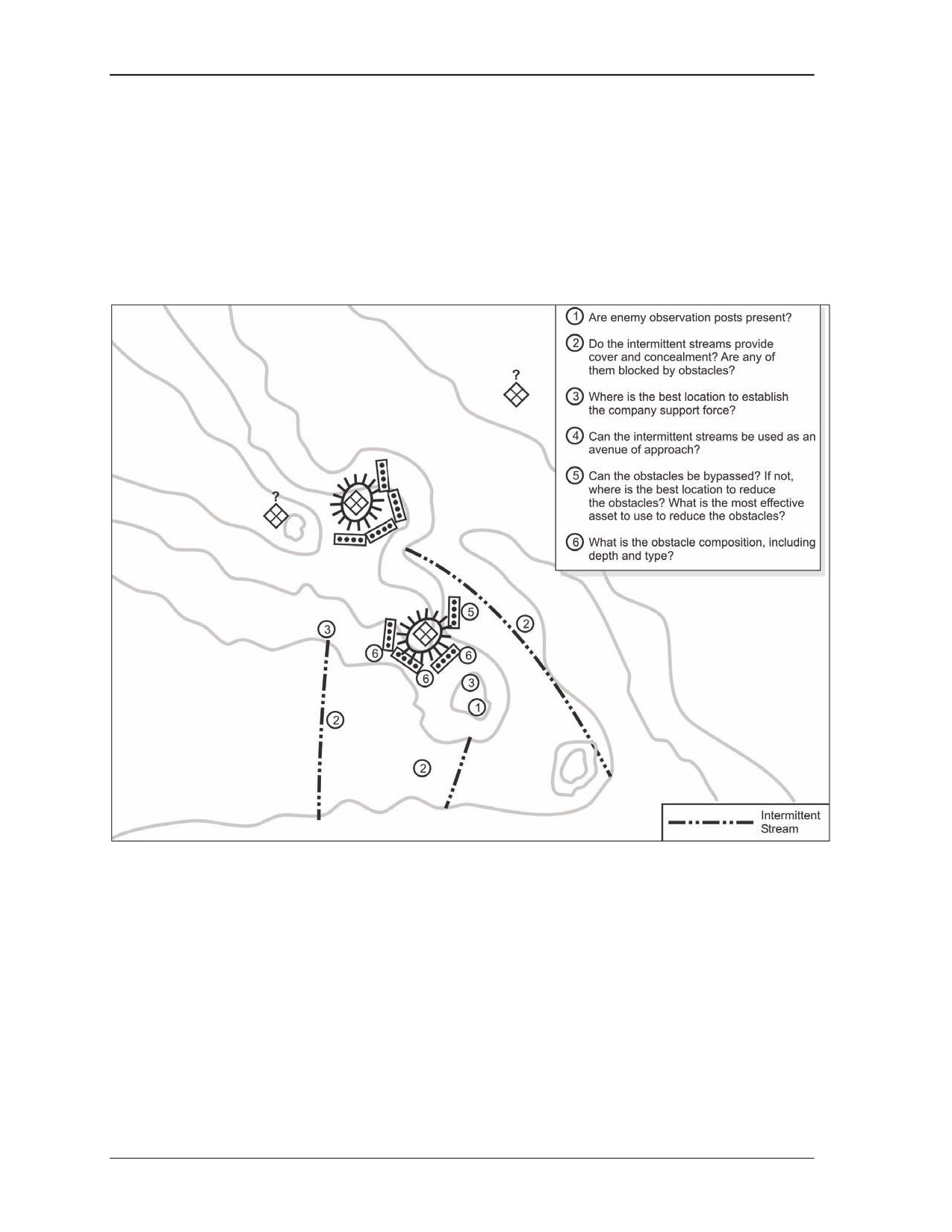
possible course of action (Figure 8-1, page 8-4). After an operation, the company normally reconnoiters so
it can maintain contact with the enemy, collect information for upcoming operations, and provide force
protection and security.
BEFORE OR AFTER AN OPERATION
8-14.
Situations in which the company may conduct reconnaissance before or after an
operation include--
y Reconnaissance by a quartering party of an assembly area and the associated route to it.
y Reconnaissance before an offensive operation from the assembly area to and near the LD.
y Reconnaissance by Infantry patrols to probe enemy positions for gaps prior to an attack or
infiltration.
y Reconnaissance by Infantry patrols to observe enemy forward positions.
y Reconnaissance by patrols
(normally Infantry and engineers) to locate bypasses around
obstacle belts or to determine the best locations and methods for breaching operations.
27 July 2006
FM 3-21.10
8-3
Chapter 8
y Reconnaissance by Infantry patrols of choke points or other danger areas in advance of the
remainder of the company.
y Reconnaissance of defensive positions or EAs prior to the conduct of the defense.
y Reconnaissance by patrols as part of security operations to secure friendly obstacles, clear
possible enemy OPs, or cover areas not observable by stationary OPs.
y Reconnaissance to maintain contact with adjacent units.
y Reconnaissance by patrols to maintain contact with enemy elements.
Figure 8-1. Identification of intelligence requirements and use of patrols to reconnoiter.
DURING AN OPERATION
8-15.
During offensive operations, company reconnaissance normally focuses on fighting for
information about the enemy and the terrain, with the primary goal of gaining an advantage over the
enemy. The company conducts this type of reconnaissance during actions on contact. As the company
develops the situation, the commander may dispatch patrols to identify positions of advantage or to acquire
an enemy force. The information gained by the company while in contact is critical not only to the success
of its own mission but also to the success of its higher headquarters. (Chapter 4, Offensive Operations,
discusses actions on contact.)
8-4
FM 3-21.10
27 July 2006
Tactical Enabling Operations
Section II. SPECIAL PURPOSE OPERATIONS
This section defines linkup, relief in place, and passage of lines operations. It also describes when these might
occur, discusses planning considerations for planning, and lists the steps to apply.
LINKUP
8-16.
A linkup is an operation that entails the meeting of friendly ground forces (or their leaders or
designated representatives). The company conducts linkup activities independently or as part of a larger
force. Within a larger unit, the company may lead the linkup force.
SITUATIONS
8-17.
Linkup may occur in, but is not limited to, the following situations.
y Advancing forces reaching an objective area previously secured by air assault, airborne, or
infiltrating forces.
y Units coordinating a relief in place.
y Cross-attached units moving to join their new organization.
y A unit moving forward with a fixing force during a follow-and-support mission.
y A unit moving to assist an encircled force.
y Units converging on the same objective during the attack.
y Units conducting a passage of lines.
PLANNING CONSIDERATIONS
8-18.
The plans for a linkup are detailed and cover the following.
Site Selection
8-19.
Select a primary and an alternate site. These sites should be easy to find at night, have cover and
concealment, and avoid the natural lines of drift. They must also be easy to defend for a short time, and
must offer access and escape routes.
Recognition Signals
8-20.
Far and near recognition signals help keep friendly units from firing on each other. Although units
linking up exchange radio frequencies and call signs, they should avoid radio communications for
short-range recognition due to possible compromise. Instead, they plan visual and voice recognition
signals. They might use a sign and countersign such as a challenge and password or a number combination.
Signaling means can include flashlights, chemical lights, infrared lights, or VS-17 panels. The TSOP can
define near and far recognition signals.
Indirect Fires
8-21.
Indirect fires are always planned, but not necessarily executed, for linkup operations. They
support the movement by masking noise, deceiving the enemy of friendly intent, and distracting the enemy.
Indirect fires are planned along the infiltration lanes and at the linkup sites to support in case of enemy
contact.
27 July 2006
FM 3-21.10
8-5
Chapter 8
Direct Fires
8-22.
Direct fire planning must include fratricide prevention. Restrictive fire lines (RFLs) control fires
around the linkup site. Phase lines may serve as RFLs, which are adjusted as two forces approach
each other.
Contingency Plans
8-23.
The unit TSOP or the linkup annex to the OPORD must cover--
y Enemy contact before, during, and after linkup.
y Length of time to wait at the linkup site.
y Actions in case some elements fail to link up.
y Alternate linkup points and rally points.
STEPS
8-24.
The linkup procedure begins as the unit moves to the linkup point. If using the radio, the unit
reports its location using phase lines, checkpoints, or other control measures. Each unit sends a small
contact team or element to the linkup point; the remainder of the unit stays in the linkup rally point. In a
linkup, one unit occupies the linkup point as the stationary unit, while the other moves to the linkup point.
The leader assigns specific duties of the contact elements and coordinates procedures for integrating the
linkup units into a single linkup rally point. Full rehearsals are conducted if time permits. Figure 8-2 shows
a company linkup between the 3rd platoon. The 3d platoon infiltrated early, conducted the reconnaissance
of the objective, and established the ORP. The rest of the company, also shown, infiltrated later. The
company (-) stops and sets up a linkup rally point about 300 meters from the linkup point. A contact team
is sent to the linkup point; it locates the point and observes the area. If the unit is the first at the site, it
clears the immediate area and marks the linkup point, using the agreed-upon recognition signal. It then
takes up a covered and concealed position to watch the linkup point. The next unit (in this example, 3rd
platoon) approaching the site repeats these actions. When its contact team arrives at the site and spots the
recognition signal, they initiate the far recognition signal. The first element answers and the two elements
exchange near recognition signals. The contact teams coordinate the actions required to link up the units
such as to move one unit to the other unit's rally point or to continue the mission.
8-6
FM 3-21.10
27 July 2006
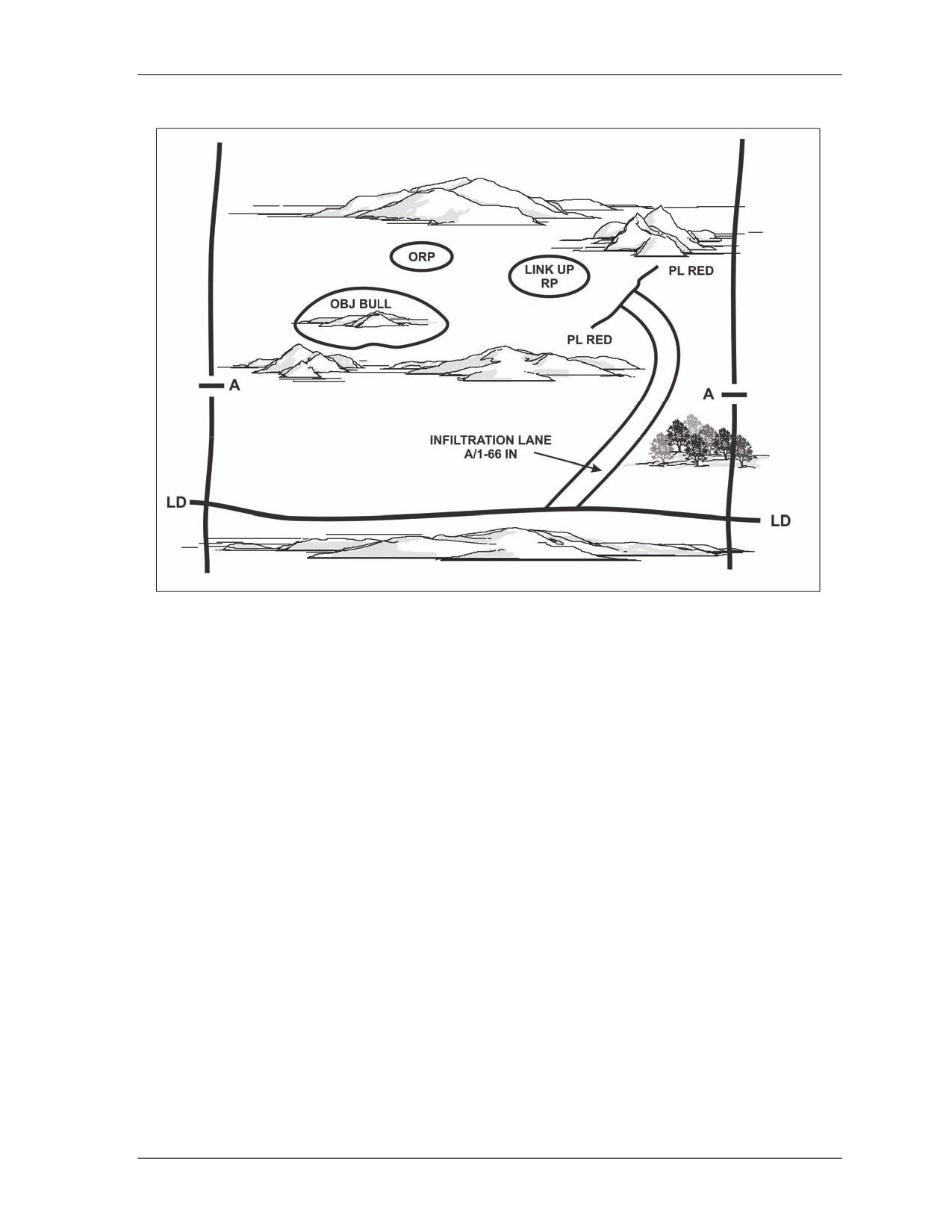
Tactical Enabling Operations
Figure 8-2. Infantry company linkup.
COORDINATION
8-25.
Before initiating movement to the linkup point, the forces exchange necessary tactical
information, including--
y The known enemy situation.
y Number and types of friendly units or personnel.
y Disposition of stationary forces, if either unit is stationary.
y Routes to the linkup and rally points, if used.
y Fire-control measures.
y Near recognition signal(s).
y Communications information.
y Combat support coverage.
y Sustainment responsibilities and procedures.
y Final location of the linkup point and rally point, if used.
y Any special coordination such as maneuver instructions or requests for medical support.
MOVEMENT TO LINKUP POINT AND LINKUP ITSELF
8-26.
All units or elements involved in the linkup must enforce strict fire-control measures to prevent
fratricide. Linkup points and RFLs must be easily recognizable by moving and converging forces.
Linkup elements--
y Conduct far recognition by radio or Army Battle Command System (ABCS).
27 July 2006
FM 3-21.10
8-7
Chapter 8
y Conduct short-range (near) recognition using visual or voice signal.
y Complete movement to the linkup point.
y Establish local security at the linkup point.
y Conduct additional coordination and linkup activities as necessary.
RELIEF IN PLACE
8-27.
A relief in place is an operation in which one unit replaces another unit and assumes the relieved
unit's responsibilities.
PURPOSE
8-28.
The primary purpose for a relief in place operation is to maintain the combat effectiveness of
committed units. A relief in place may also be conducted--
y To reorganize, reconstitute, or re-equip a unit that has sustained heavy losses.
y To rest units that have conducted sustained operations.
y To establish the security force or the DLIC during a withdrawal operation.
y To allow the relieved unit to conduct another operation.
PLANNING CONSIDERATIONS
8-29.
If higher omits the time and location of the coordination meeting, the relieving unit commander
contacts the relieved unit commander to coordinate them. The COs, XOs, platoon leaders, and FSOs
should also attend the coordination meeting.
8-30.
Each commander faces unique considerations in every tactical situation. Their respective
missions, the enemy situation, and the time available are some of the factors that will affect the plan.
Command and Control
8-31.
The C2 requirements during a relief are unique due to the mixing of units. To ensure effective C2,
leaders must conduct detailed coordination early in the planning process (Chapter 2). The positions of key
leaders and use of effective control measures will also ensure effective C2. Coordination between the
relieving and the relieved units may include--
y Exchange of intelligence.
y Arrangements for reconnaissance.
y Exchange of tactical plans and sector sketches.
y Sequence and timing for each subunit's relief.
y Time or circumstance when the responsibility for the relieved unit's area of operations is
transferred.
y The use of guides and liaison personnel.
y Security measures.
y Fire support.
y Transfer and exchange of equipment, supplies, ammunition, and minefields.
y Control measures.
y Exchange of frequencies, call signs, challenge and passwords, and recognition signals.
8-32.
The locations of key leaders in both units are critical. The commanders and their FSOs normally
collocate to best observe and control the relief. Other key leaders should be positioned to best assist the
commander. They might be positioned along routes, assembly areas, points of possible congestion, or
locations of greatest enemy threat.
8-8
FM 3-21.10
27 July 2006
Tactical Enabling Operations
8-33.
Control measures provide control and flexibility during execution. The specific method of relief
determines the number and type of control measures required. The following control measures are routine.
Assembly Areas
8-34.
The relieved unit may designate platoon and company AAs to the rear of their positions. The
relieving unit may also designate AAs, but should move directly into position. To avoid confusion, leaders
must designate separate AAs for each unit.
Contact Points
8-35.
Normally, the relieved company commander designates these. Having contact points facilitates the
initial linkup between the companies. Multiple contact points might be needed to support some relief
operations.
Release Points
8-36.
The relieved commander normally designates the platoon release point for the relieving company.
When necessary, the relieved company commander or platoon leader can designate squad release points.
Routes
8-37.
All units should move along designated routes to avoid confusion and fratricide. When possible,
the commander designates separate routes for the relieving and relieved units. The relieved commander
ensures all movements are controlled.
RECONNAISSANCE
8-38.
The relieving commander conducts a physical reconnaissance as soon as possible. The
commanders and leaders of both companies should reconnoiter together, so they can coordinate their
movement plans. Leaders down to squad level must reconnoiter. Only in this way can they ensure full
understanding of movements, control measures, and responsibilities. Specific reconnaissance requirements
may include--
y The relieved unit's disposition, to include locations of all OPs, minefields, land lines, early
warning or antiintrusion devices, and crew-served weapons.
y Enemy dispositions, when the relieved unit is in contact.
y Locations for AAs, release points, contact points, and routes.
y Locations of the CP, trains, mortars, CCM, attached heavy or Stryker elements.
METHOD OF RELIEF
8-39.
The method of relief is determined by the specific situation; however, regardless of the method of
relief, certain actions normally occur. The relieving company occupies an AA to the rear of the relieved
company or is guided along a route directly to the platoon RP. For each relieving subordinate unit, guides
are provided by the relieved unit. The company CPs collocate prior to commencing the relief. The relief
begins with the depth positions of the relieved company. The relieving company's trains and mortars are
normally positioned before any relief begins. The relieved company's trains and mortars normally remain
in position until responsibility for the area passes to the relieving company. A relief is conducted as
follows.
27 July 2006
FM 3-21.10
8-9
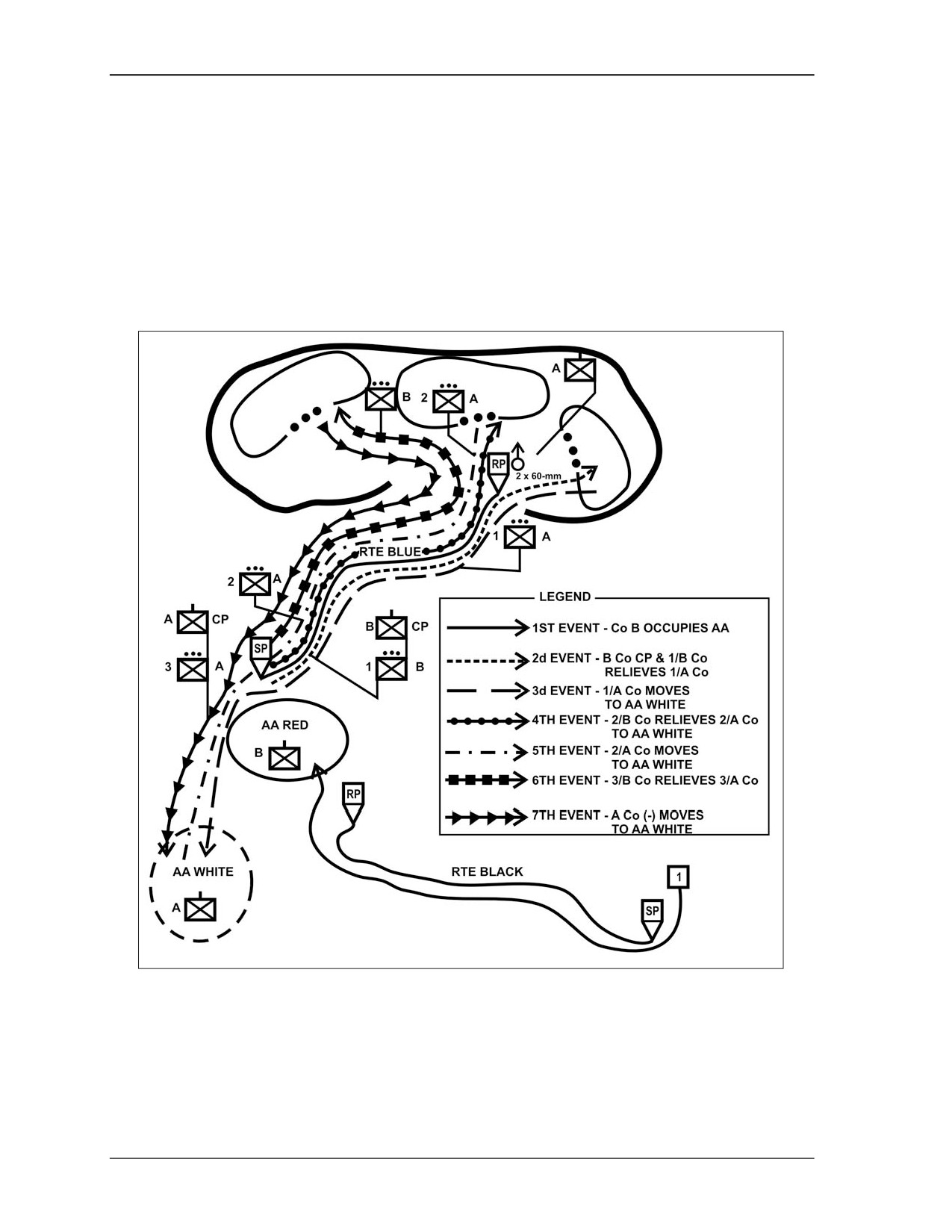
Chapter 8
Relief of one unit at a time
8-40.
This method takes longer than the others. However, it might be required when covered and
concealed routes are limited, and when all platoons must use the same route. The relieving company
occupies an AA to the rear of the relieved company and relieves by platoon according to the coordinated
sequence (Figure 8-3). Each platoon moves forward (with guides provided by the relieved unit) to the
squad release point. The squads are led to a covered and concealed location to the rear of the relieved
squad's position. The necessary equipment is exchanged, and members of the relieving squads relieve the
soldiers from the relieved squad. The relieved squad moves directly to the platoon AA, links up with the
remainder of their platoon, and continues to the company AA. Once the entire relieving platoon assumes
responsibility from the relieved platoon, the next platoon begins their relief.
Figure 8-3. Relief in place in sequence.
Simultaneous Relief of Units
8-41.
Although this method is the fastest, enemy detection is more likely, because all units move at
once. This method may be appropriate when the mission requires a rapid relief, enemy detection is
8-10
FM 3-21.10
27 July 2006
Tactical Enabling Operations
unlikely, and the terrain provides multiple covered and concealed routes. All relieving platoons move
forward along their designated routes at the same time to the squad release points. The squad's actions are
the same as previously described.
Relief by Occupation in Depth or Occupation of Adjacent Positions
8-42.
This method requires the relieving unit to occupy positions to the flank or rear of the relieved unit.
The relieving unit should be able to cover the relieved unit's direct-fire control measures (TRPs and EAs).
This method is useful when the relieved unit has sustained chemical or nuclear contamination. It might also
apply when the units involved have dissimilar TOEs such as a light unit relieving a heavy unit. The
relieving unit may occupy its positions one at a time or all at once, depending on the situation. Once the
relieving unit is in position, the relieved unit withdraws along designated routes.
SEQUENCE OF RELIEF
8-43.
To determine the most effective sequence of relief, the commander considers the following.
Combat Effectiveness of Units
8-44.
If one subordinate unit has suffered heavy losses in men or equipment, it may need to be the first
relieved.
Terrain
8-45.
The subordinate unit most likely to be detected during the relief should be relieved last. This
allows the most relieving units to be in position before the enemy is aware of the relief operation.
Enemy
8-46.
Consider relieving first the subordinate unit positioned on the most likely or most dangerous
avenue of approach.
Control
8-47.
When two adjacent units must share a route to conduct the relief, select a method and sequence of
relief that reduces congestion and confusion. Avoid massing units in a small area.
Subsequent Mission
8-48.
The subordinate unit with the most critical task may need to be relieved first. For example, a
relieving subordinate unit may need to establish an OP forward of their position to provide security for the
rest of the relief operation. Or when the company being relieved is moving to a LZ for an air assault
operation, the platoon tasked to secure the LZ should be relieved first.
TRANSFER OF RESPONSIBILITY
8-49.
The time for the transfer of responsibility must be agreed to by both commanders. Normally, this
occurs once two-thirds of the relieving company are in position and have established communications and
control.
TRANSFER OR EXCHANGE OF EQUIPMENT AND SUPPLIES
8-50.
To simplify the relief and maintain the OPSEC, the two units might need to transfer certain
equipment and supplies. These include machine gun tripods, mortar base plates and aiming stakes,
camouflage nets, chemical alarms, and early warning and antiintrision devices. Supplies they should
27 July 2006
FM 3-21.10
8-11
Chapter 8
transfer can include barrier materials; excess or stockpiled supplies and ammunition; and bulky or heavy
supplies that would slow the relief if the relieved unit tried to carry them out. Any prepared range cards,
sector sketches, and minefield records must also be transferred to the relieving unit.
OPERATIONS SECURITY AND DECEPTION
8-51.
Both units should make every effort to keep the enemy from knowing about the relief. Try to
conduct the relief during limited visibility to reduce the risk of discovery by a capable threat.
8-52.
The dispositions, activities, and radio traffic of the relieved unit must be maintained throughout
the relief. Both companies should be on the relieved company's net. The relieved company continues
routine traffic, which the relieving company monitors. Once the relief is complete and on a prearranged
signal, the relieving company changes to their assigned frequency. Security activities, such as OPs and
patrols, must maintain the established schedule. This might require some personnel from the relieving unit
being placed under operational control (OPCON) of the relieved unit before the relief.
8-53.
Additional planning and coordinating is required when a relief is conducted between a heavy or
Stryker unit and an Infantry company, and when neither a relief by occupation in depth nor an occupation
of adjacent positions is possible. If the relieving company is heavy or Stryker, the company should
dismount, conduct the relief with the dismounts, and position the vehicles once the relieved company has
withdrawn. If the relieved company is a heavy or Styker unit, the relieving company should relieve the
dismounts, and then the vehicles move to the rear. The dismounts from the relieved unit may mount their
vehicles or move to the rear on foot and occupy AAs until they linkup with their vehicles. If possible, the
relieved company uses routine vehicle movements to reposition some vehicles to the rear before the relief.
This might be possible when the unit has been using the out-of-position resupply technique. All vehicles
would move to the resupply point, but only half return to their positions.
CONTINGENCY PLAN
8-54.
The commanders should collocate where they can best observe and control the relief. The relieved
company commander controls the relief until the conditions for the transfer of responsibility are met. If the
enemy attacks before the transfer of responsibility, the subordinate units of the relieving company, which
are in the area, become OPCON to the relieved company commander. If the enemy attacks after the
transfer, the relieving commander assumes OPCON of all units of the relieved company still in the area.
The commander should develop plans to cover these cases. Commanders must agree and understand when
and which units will become OPCON. These contingency plans should address how the commanders will
employ the uncommitted OPCON units. A technique for a more flexible relief plan is to designate the last
relieving unit as the reserve.
CONDUCT OF RELIEF
8-55.
At the time set for the start of the relief, the relieving company moves to the contact point. Once
there, it makes contact with the company guide from the relieved company (Figure 8-4). The guide leads
the company to the RP, where the company links up with the platoon and section guides. The platoon
guides lead the platoons to their respective RPs, where the squad guides link up with their squads.
8-12
FM 3-21.10
27 July 2006
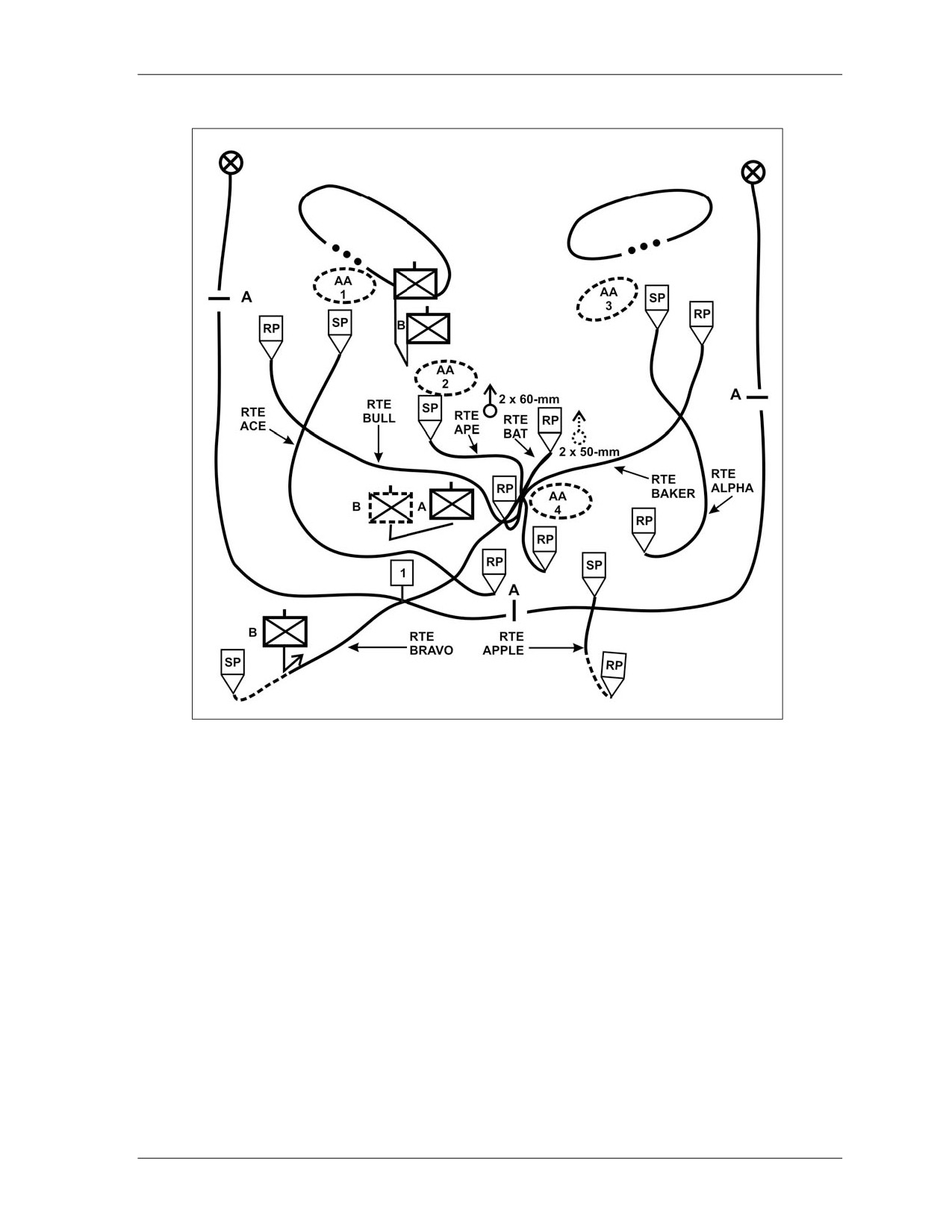
Tactical Enabling Operations
Figure 8-4. Relief in place (company graphics).
8-56.
In the sequence specified in the order, each platoon conducts its relief. The platoon leader releases
control of his squads, and the squad guides lead the squads to a location just to the rear of their defensive
positions. The squad leaders then begin relieving a few men at a time until the relief is complete. Before
each relieved soldier or leader leaves his position, he orients the relieving Soldier or leader on the position
and the area around it.
8-57.
As each Soldier or leader is relieved, he moves to his squad's AA. When each squad is assembled,
it moves to its platoon's AA. When each platoon is assembled and its leader is relieved of his responsibility
for the defense, it moves to the company AA. After the company is assembled and the transfer of
responsibility is complete, the relieved commander moves his company as directed by the battalion
commander.
PASSAGE OF LINES
8-58.
A passage of lines is the movement of one or more units through another. This operation becomes
necessary when the moving unit(s) cannot bypass the stationary unit and must pass through it. The primary
purpose of the passage is to maintain the momentum of the moving elements. A passage of lines might be
designated as either forward or rearward. The headquarters ordering the passage of lines is responsible for
27 July 2006
FM 3-21.10
8-13
Chapter 8
planning and coordination; however; specific coordination tasks are normally delegated to subordinate
commanders.
PLANNING CONSIDERATIONS
8-59.
In planning the passage of lines, the commander considers the tactical factors and procedures
covered in the following paragraphs.
Passage Lanes
8-60.
The passage facilitates transition to follow-on missions by using multiple lanes, or lanes wide
enough to support doctrinal formations for the passing units.
Use of Deception
8-61.
The company can use deception techniques, such as smoke, to enhance security during the
passage.
Battle Handover
8-62.
The controlling commander clearly defines the battle handover criteria and procedures for the
passage. His order covers the roles of both the passing unit and the stationary unit, and of direct and
indirect fires. If needed, he also gives the location of the battle handover line (BHL) as part of the unit's
graphic control measures. For a forward passage, the BHL is normally the LD for the passing force. In a
rearward passage, it is normally a location within the direct-fire range of the stationary force. In general, a
defensive handover is complete when the passing unit is clear, and when the stationary unit is ready to
engage the enemy. An offensive handover is complete when the passing unit has deployed and crossed
the BHL.
Obstacles
8-63.
The passing and stationary units coordinate obstacle information, to include the locations of
enemy and friendly obstacles, existing lanes and bypasses, and guides for the passage.
Air Defense
8-64.
Air defense coverage is imperative during the high-risk passage operation. Normally, the
stationary unit provides air defense, allowing the passing unit's air defense assets to move with the
passing unit.
Sustainment Responsibilities
8-65.
Responsibility for sustainment actions, such as vehicle recovery or casualty evacuation in the
passage lane, is clearly defined for both passing and stationary units.
Command and Control
8-66.
To enhance command and control during the passage, the company collocates a command and
control element, normally the company commander or XO, with a similar element from the stationary or
moving unit (as applicable).
8-14
FM 3-21.10
27 July 2006
Tactical Enabling Operations
RECONNAISSANCE COORDINATION
8-67.
Detailed reconnaissance and coordination are critical in a passage of lines, both in its complex
planning factors and to ensure that the passage goes quickly and smoothly. The company commander
normally reconnoiters and coordinates the passage. At times, he may designate the XO, 1SG, or a platoon
leader to conduct coordinate the following.
y Unit designation and composition.
y Type and number of personnel.
y Passing unit's arrival time(s).
y Location(s) of attack positions or assembly areas.
y Current enemy situation.
y Stationary unit's mission and plan, to include OP, patrol, and obstacle locations.
y Locations of routes, contact points, passage points, and passage lanes.
y Guide requirements.
y Order of march.
y Anticipated actions on enemy contact.
y Requirements for supporting direct and indirect fires, with location of RFL.
y Chemical, biological, radiological, or nuclear conditions.
y Available combat support assets and their locations.
y Communications information, to include frequencies and near and far recognition signals.
y Criteria for battle handover and location of the battle handover line.
y Additional procedures for the passage.
FORWARD PASSAGE OF LINES
8-68.
In a forward passage (Figure 8-5, page 8-16), the passing unit first moves to an assembly area or
attack position to the rear of the stationary unit. Designated personnel move forward to link up with guides
and confirm coordination information with the stationary unit. Guides then lead the passing elements
through the passage lane. The company conducts a forward passage by employing tactical movement. It
moves quickly, using appropriate dispersal and formations whenever possible, and keeping radio traffic to
a minimum.
27 July 2006
FM 3-21.10
8-15