FM 3-21.10 (FM 7-10) The Infantry Rifle Company (July 2006) - page 9
Chapter 9
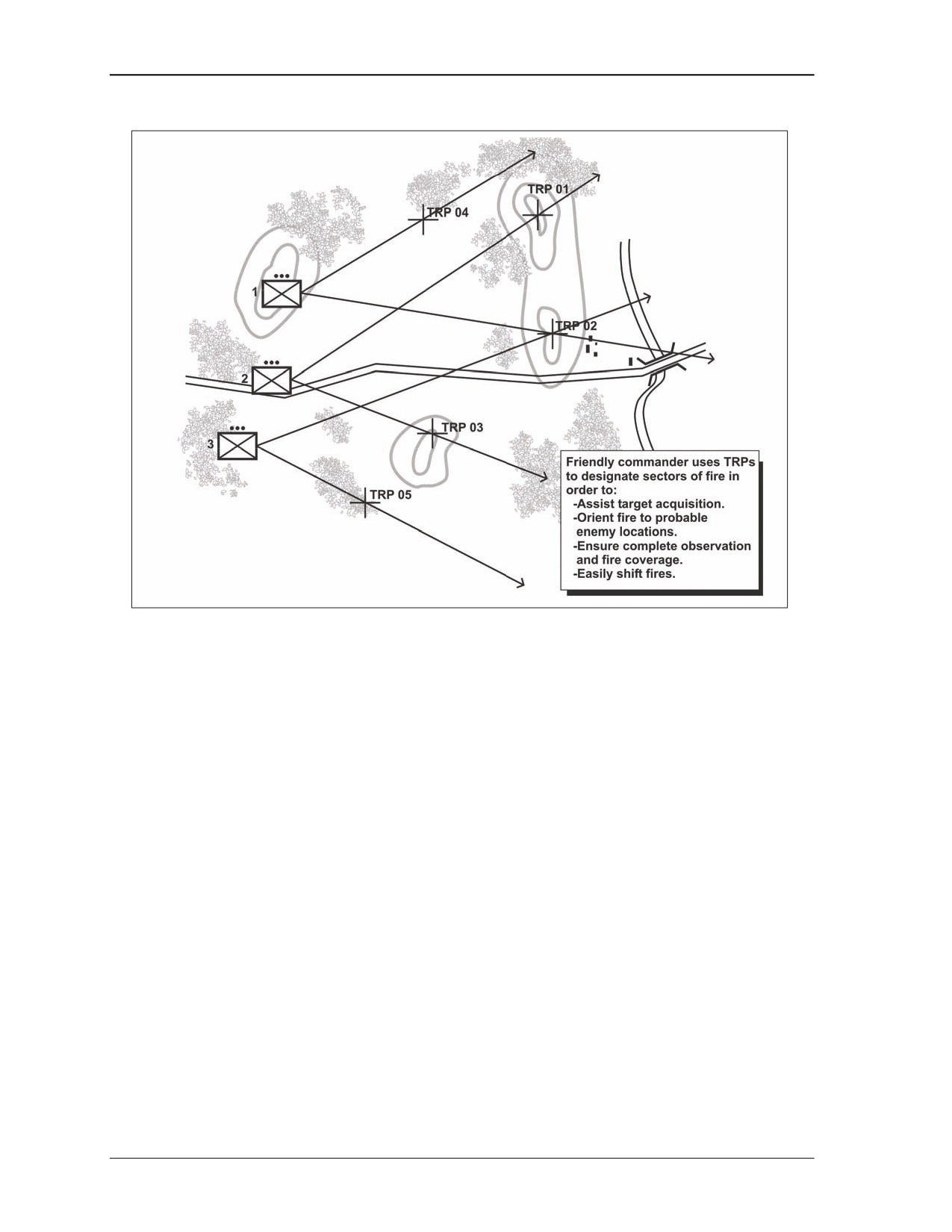
Figure 9-3. Orientation of forces to speed target acquisition.
SHIFT FIRES TO REFOCUS AND REDISTRIBUTE
9-12. As the engagement proceeds, leaders shift direct fires to refocus and redistribute the effects based
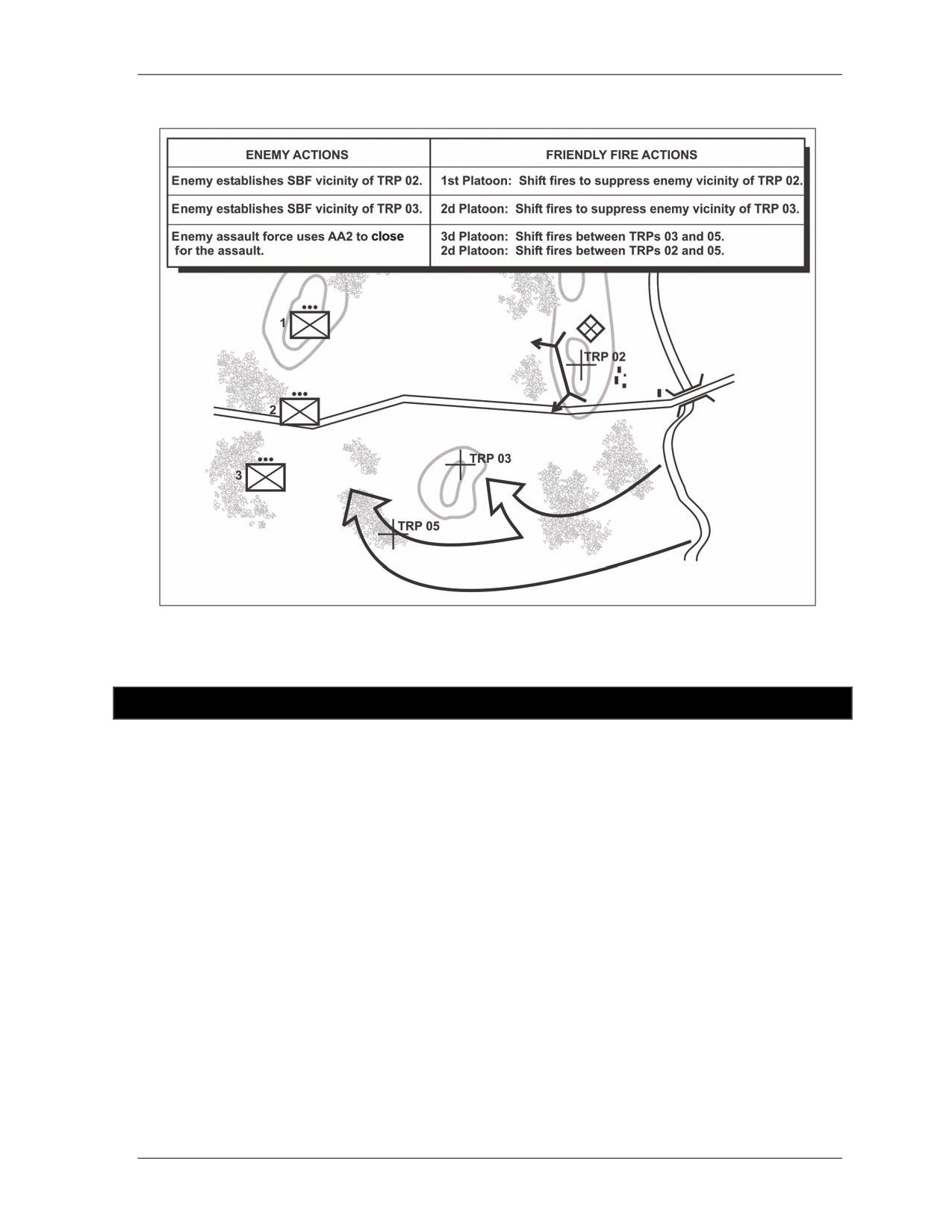
on evolving friendly and enemy information. Figure 9-4 provides an example of shifting to refocus and
redistribute fires. The Infantry company commander and his subordinate leaders apply the same techniques
and considerations that they used earlier to focus and distribute fires, including fire control measures. A
variety of situations dictate shifting of fires, including--
y Appearance of an enemy force posing a greater threat than the one currently being engaged.
y Extensive destruction of the enemy force being engaged, creating the possibility of target
overkill.
y Destruction of friendly elements that are engaging the enemy force.
y Change in the ammunition status of friendly elements that are engaging the enemy force.
y Maneuver of enemy or friendly forces resulting in terrain masking.
y Increased fratricide risk as a maneuvering friendly element closes with the enemy force
being engaged.
9-6
FM 3-21.10
27 July 2006
Direct Fire Control
Figure 9-4. Shifting of fires to refocus and redistribute them.
Section III. PLANNING CONSIDERATIONS
The Infantry company commander plans direct fires as part of the troop-leading procedures. Determining where
and how the company can and will mass fires are essential steps as the commander develops his concept of the
operation.
OVERVIEW
9-13. After identifying probable (or known) enemy locations, the Infantry commander determines points
or areas where he will focus his combat power. His situational understanding (SU), or vision, of where and
how the enemy will attack or defend helps him determine the volume of fires he must focus at particular
points to have a decisive effect. In addition, if he intends to mass the direct fires of more than one platoon,
he must establish a means for distributing those fires effectively.
y Based on where and how he wants to focus and distribute direct fires, the commander can
establish the weapons ready postures for company elements as well as triggers for initiating
fires. He must evaluate the risk of fratricide and establish controls to prevent it. Fratricide
prevention measures include designation of recognition markings, weapons control status
(WCS), and weapons safety posture.
y Having determined where and how he will mass and distribute direct fires, the company
commander orients platoons so they can rapidly and accurately acquire the enemy. The
commander anticipates how the enemy will fight. He gains this anticipation through a detailed
war-game of the selected course of action. With this war game, he determines probable
27 July 2006
FM 3-21.10
9-7
Chapter 9
requirements for refocusing and redistributing fires and for establishing other necessary
controls. Also during the troop-leading procedures, the company commander plans and
rehearses direct fires (and the fire-control process) based on his analysis.
y The company commander continues to apply planning procedures and considerations
throughout execution. When necessary, he must also apply effective direct fire SOPs.
STANDING OPERATING PROCEDURES
9-14. A well-rehearsed direct fire SOP enhances direct fire planning and ensures quick, predictable
actions by all members of the company. The Infantry company commander bases the various elements of
the SOP on the capabilities of his force and on anticipated conditions and situations. SOP elements should
include standard means for focusing fires, distributing their effects, orienting forces, and preventing
fratricide. The commander should adjust the direct fire SOP whenever changes to anticipated and actual
factors of METT-TC become apparent.
FOCUS FIRES
9-15. One technique is to establish a standard respective position for TRPs in relation to friendly
elements and then to consistently number the TRPs such as from left to right. This allows leaders to
quickly determine and communicate the location of the TRPs.
DISTRIBUTE FIRES
9-16. Two useful means of distributing the effects of the company's direct fires are engagement priorities
and target array. Engagement priorities, by type of enemy vehicle or weapon, are assigned for each type of
friendly weapon system. The target array technique helps in distribution by assigning specific friendly
elements to engage enemy elements of approximately similar capabilities.
ORIENT FORCES
9-17. A standard means of orienting friendly forces is to assign a primary direction of fire, using a TRP,
to orient each element on a probable (or known) enemy position or likely avenue of approach. To provide
all-round security, the SOP can supplement the primary direction of fire with sectors using a friendly based
quadrant. The following sample SOP elements show the use of these techniques.
y The front (center) platoon's primary direction of fire is TRP 2 (center) until otherwise specified;
the platoon is responsible for the front two quadrants.
y The left flank platoon's primary direction of fire is TRP 1 (left) until otherwise specified; the
platoon is responsible for the left two friendly quadrants (overlapping with the center platoon).
y The right flank platoon's primary direction of fire is TRP 3 (right) until otherwise specified; the
platoon is responsible for the right two friendly quadrants
(overlapping with the center
platoon).
PREVENT FRATRICIDE
9-18. The SOP must address the most critical requirement of fratricide prevention. It must direct
subordinate leaders to inform the commander, adjacent elements, and subordinates whenever a friendly
force is moving or preparing to move. One technique is to establish a standing WCS of WEAPONS
TIGHT, which requires positive enemy identification prior to engagement. The SOP must also cover
means for identifying dismounted Infantry squads and other friendly dismounted elements. Techniques
include using arm bands, medical heat pads, or an IR light source, as well as detonating a smoke grenade of
a designated color at the appropriate time.
9-8
FM 3-21.10
27 July 2006

Direct Fire Control
Section IV. CONTROL
Acquiring the enemy is a precursor to direct fire engagement. He must expect the enemy to use covered and
concealed routes effectively when attacking and to make best use of flanking and concealed positions in the
defense. As a result, the company may not have the luxury of a fully exposed enemy that it can easily see. The
acquisition of the enemy often depends on visual recognition of very subtle indicators such as exposed
antennas, reflections from the vision blocks of enemy vehicles, small dust clouds, or smoke from vehicle
engines or ATGM or tank fires. Because of the difficulty of target acquisition, the company commander must
develop surveillance plans to assist the company in acquiring the enemy.
MEASURES
9-19. Fire control measures are the means by which the Infantry company commander or his subordinate
leaders control direct fires. Application of these concepts, procedures, and techniques helps the unit acquire
the enemy, focus fires on him, distribute the effects of the fires, and prevent fratricide. At the same time, no
single measure is enough to control fires effectively. At company level, fire control measures are effective
only if the entire unit has a common understanding of what they mean and how to employ them. Table 9-1
lists terrain-based and threat-based fire control measures.
Terrain-Based Fire-Control Measures
Threat-Based Fire-Control Measures
Target reference point
Fire patterns
Engagement area
Target array
Sector of fire
Engagement priorities
Direction of fire
Weapons ready posture
Terrain-based quadrant
Engagement criteria
Friendly based quadrant
Weapons control status
Maximum engagement line
Rules of engagement
Restrictive fire line
Weapons safety posture
Final protective line
Engagement techniques
Table 9-1. Common fire-control measures.
TERRAIN-BASED FIRE-CONTROL MEASURES
9-20. The Infantry company commander uses terrain-based fire-control measures to focus and control
fires on a particular point, line, or area rather than on a specific enemy element. The following paragraphs
describe the techniques associated with this type of control measure.
Target Reference Point
9-21. A target reference point is an easily recognizable point on the ground that leaders use to orient
friendly forces and to focus and control direct fires. In addition, when TRPs are designated as indirect fire
targets, they can be used in calling for and adjusting indirect fires. Leaders designate TRPs at probable (or
known) enemy locations and along likely avenues of approach. TRPs, natural or manmade, can be
established sites such as hills or buildings. They can also be expedient, temporary features designated as
TRPs on the spot such as a burning enemy vehicle or smoke generated by an artillery round. While not
ideal, TRPs can also be made by the unit with items such as engineer pickets with visible or IR chem-lights
or IR strobe in the recessed grove of the picket. Ideally, TRPs should be permanent features and visible in
three observation modes (unaided, passive-IR, and thermal) so all forces can identify them, for example---
y Prominent hill mass.
y Distinctive building.
y Observable enemy position.
27 July 2006
FM 3-21.10
9-9
Chapter 9
y Destroyed vehicle.
y Ground-burst illumination.
y Smoke round.
y Laser point.
Engagement Area
9-22. This fire control measure is an area along an enemy avenue of approach where the company
commander intends to mass the direct fires of available weapons to destroy an enemy force. The size and
shape of the EA is determined by the degree of relatively unobstructed intervisibility available to the unit's
weapons systems in their firing positions and by the maximum range of those weapons. Typically,
company commanders delineate responsibility within the EA by assigning each platoon a sector of fire.
Sector of Fire
9-23. A sector of fire is a defined area that must be covered by direct fire. It is used to distribute fires
within an EA. Leaders assign sectors of fire to subordinate elements, crew-served weapons, and individual
Soldiers to ensure coverage of an area of responsibility. They may also limit the sector of fire of an element
or weapon to prevent accidental engagement of an adjacent unit. In assigning sectors of fire, commanders
and subordinate leaders consider the number and types of weapons available. They also consider
acquisition system type and field of view in determining the width of a sector of fire. For example, while
unaided vision has a wide field of view, its ability to detect and identify targets at distant ranges and in
limited visibility conditions is restricted. Conversely, most fire control acquisition systems have greater
detection and identification ranges than the unaided eye, but their field of view is narrow. Means of
designating sectors of fire include--
y Target reference points.
y Clock direction.
y Terrain-based quadrants.
y Friendly based quadrants.
Direction of Fire
9-24. A direction of fire is an orientation or point used to assign responsibility for a particular area on the
battlefield that must be covered by direct fire. Leaders designate directions of fire for the purpose of
acquisition or engagement by crew-served weapons, or individual Soldiers. Direction of fire is most
commonly employed when assigning sectors of fire would be difficult or impossible because of limited
time or insufficient reference points. Means of designating a direction of fire include--
y Closest target reference point.
y Clock direction.
y Cardinal direction.
y Tracer on target.
y Infrared laser pointer.
Quadrants
9-25. Quadrants are subdivisions of an area created by superimposing imaginary perpendicular axes over
the terrain to create four separate areas, or quadrants. Quadrants can be based on the terrain, on friendly
forces, or on the enemy formation. The technique in which quadrants are based on the enemy formation is
usually referred to as the target array and is covered in threat-based fire control measures. The method of
identifying quadrants is established in the unit SOP, but the unit must take care to avoid confusion when
using quadrants based on terrain, friendly forces, and enemy formations simultaneously.
9-10
FM 3-21.10
27 July 2006
Direct Fire Control
Terrain-Based Quadrant
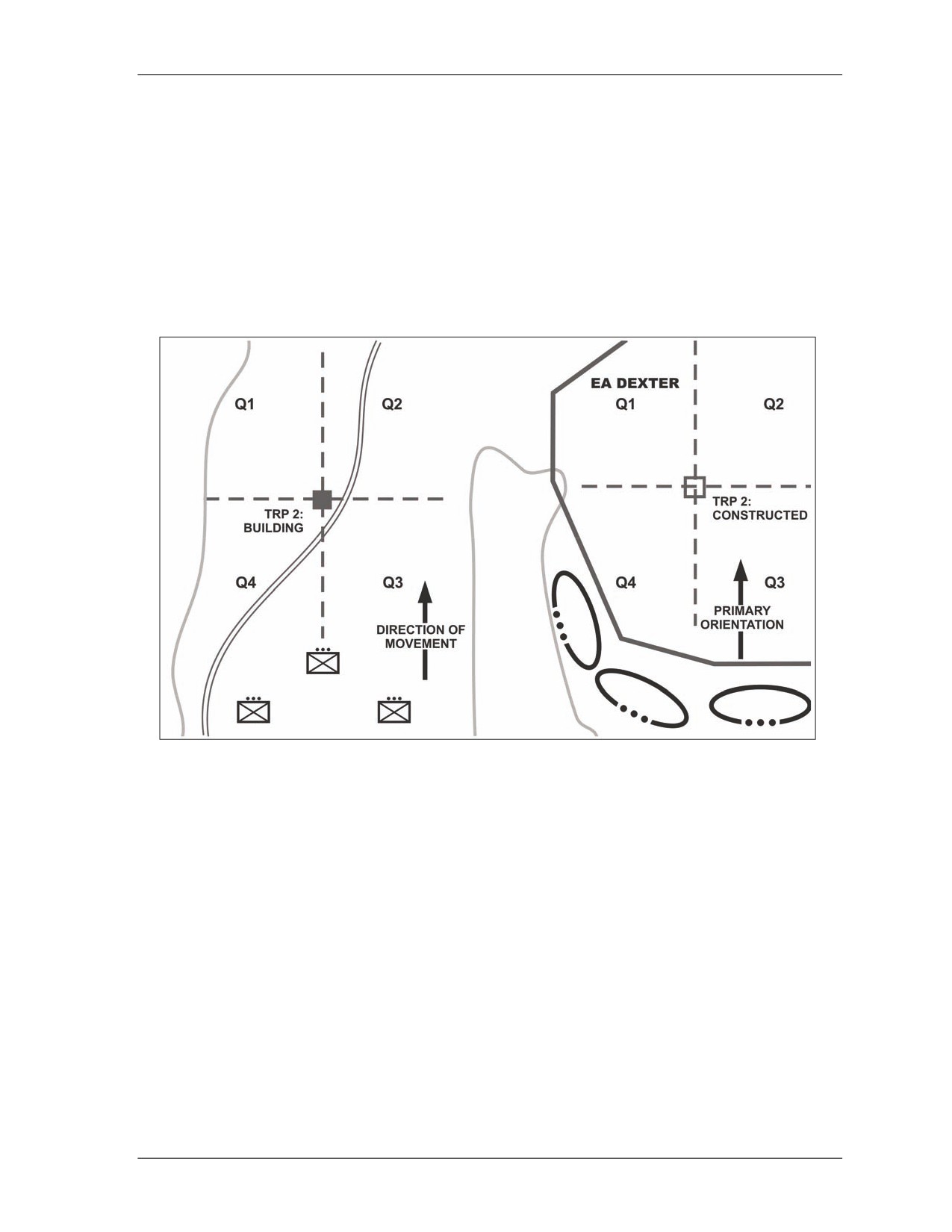
9-26. A terrain-based quadrant entails use of a TRP, either existing or constructed, to designate the
center point of the axes that divide the area into four quadrants. This technique can be employed in both
offensive and defensive operations. In the offense, the company commander designates the center of the
quadrant using an existing feature or by creating a reference point such as using a ground burst
illumination round, a smoke marking round, or a fire ignited by incendiary or tracer rounds. The axes
delineating the quadrants run parallel and perpendicular to the direction of movement. In the defense, the
company commander designates the center of the quadrant using an existing or constructed TRP. In
Figure 9-5, the quadrants are marked using the letter "Q" and a number (Q1 to Q4); quadrant numbers are
in the same relative positions as on military map sheets (from Q1 as the upper left quadrant clockwise to
Q4 as the lower left quadrant).
Figure 9-5. Terrain-based quadrants.
Friendly Based Quadrant
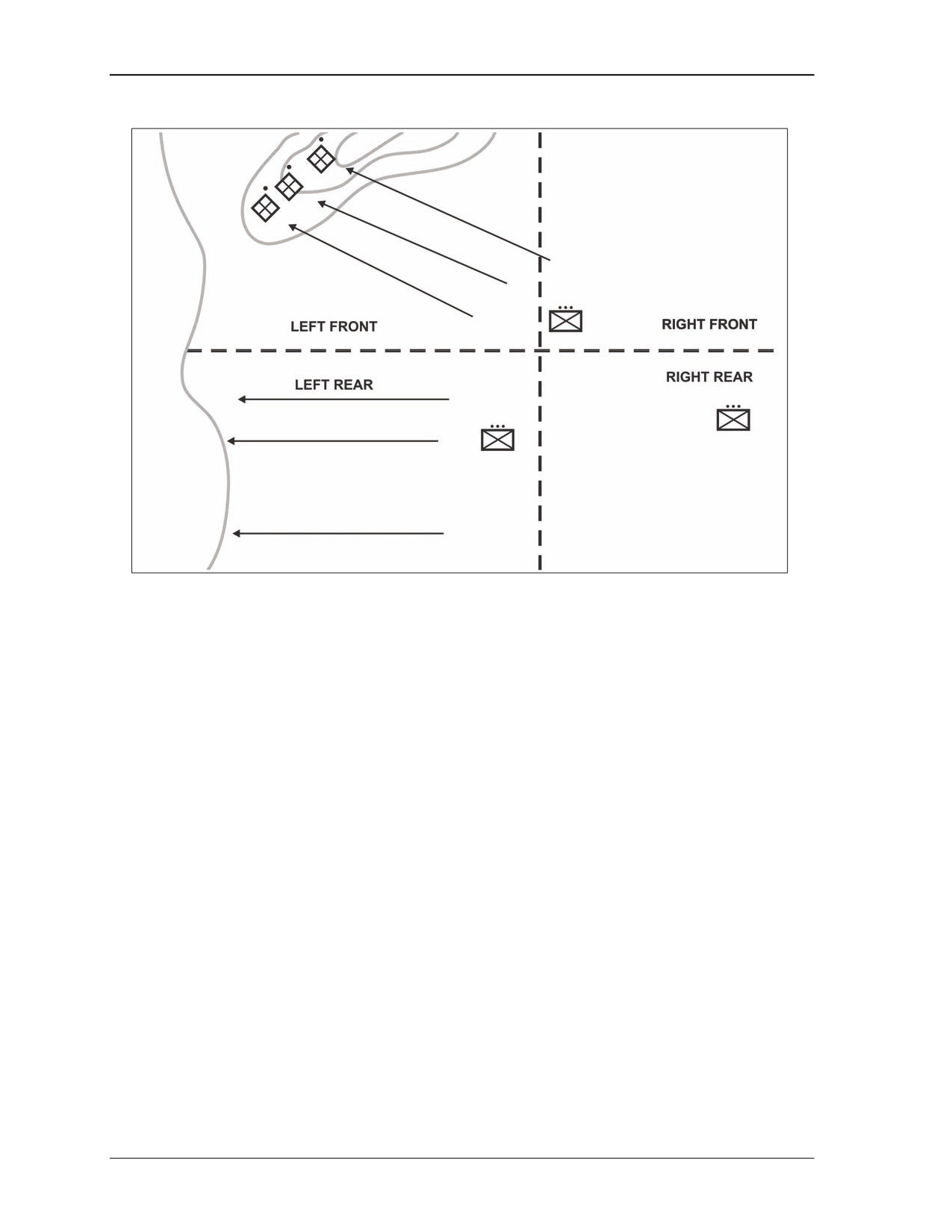
9-27. The friendly based quadrant technique entails superimposing quadrants over the unit's formation.
The center point is based on the center of the formation, and the axes run parallel and perpendicular to the
general direction of travel. For rapid orientation, the friendly quadrant technique might be better than the
clock direction method because different elements of a large formation are rarely oriented in the same exact
direction and because the relative dispersion of friendly forces causes parallax to the target. Figure 9-6,
page 9-12, shows use of friendly based quadrants.
27 July 2006
FM 3-21.10
9-11
Chapter 9
Figure 9-6. Friendly based quadrants.
Maximum Engagement Line
9-28. A MEL is the linear image of the farthest limit of effective fire for a weapon or unit. This line is
determined both by the weapon’s or unit's maximum effective range, and by the effects of terrain. For
example, slope, vegetation, structures, and other features provide cover and concealment that may prevent
the weapon from engaging out to the maximum effective range. A MEL serves several purposes. The
company commander may use it to prevent engaging beyond the maximum effective range of their
weapons, to define criteria for the establishment of triggers, and to delineate the maximum extent of battle
space on the sector sketch.
Restrictive Fire Line
9-29. An RFL is a line established between converging friendly forces (one or both might be moving)
that prohibit fires and effects across the line without coordination with the affected force. In the offense,
the company commander may designate an RFL to prevent a base of fire platoon from firing into the area
where an assaulting platoon is maneuvering. In the defense, the company commander may establish an
RFL to prevent the unit from engaging an Infantry squad positioned in restricted terrain on the flank of an
enemy avenue of approach.
Final Protective Line
9-30. The FPL is a line of fire established where an enemy assault is to be halted by the interlocking fires
of all available weapons. The unit reinforces this line with protective, tactical, and supplemental obstacles
and with FPFs whenever possible. Initiation of the FPF is the signal for elements and individual Soldiers to
shift fires to their assigned portion of the FPL.
9-12
FM 3-21.10
27 July 2006
Direct Fire Control
THREAT-BASED FIRE-CONTROL MEASURES
9-31. The Infantry company commander uses threat-based fire control measures to focus and control
direct fires by directing the unit to engage a specific enemy element rather than to fire on a point or area.
The following paragraphs describe the techniques associated with this type of fire control measure.
Fire Patterns
9-32. Fire patterns are a threat-based fire control measure designed to distribute the fires of a unit
simultaneously among multiple, similar targets. They are most often used by platoons to distribute fires
across an enemy formation. Leaders designate and adjust fire patterns based on terrain and the enemy
formation. The basic fire patterns are frontal fire, cross fire, and depth fire.
Frontal Fire
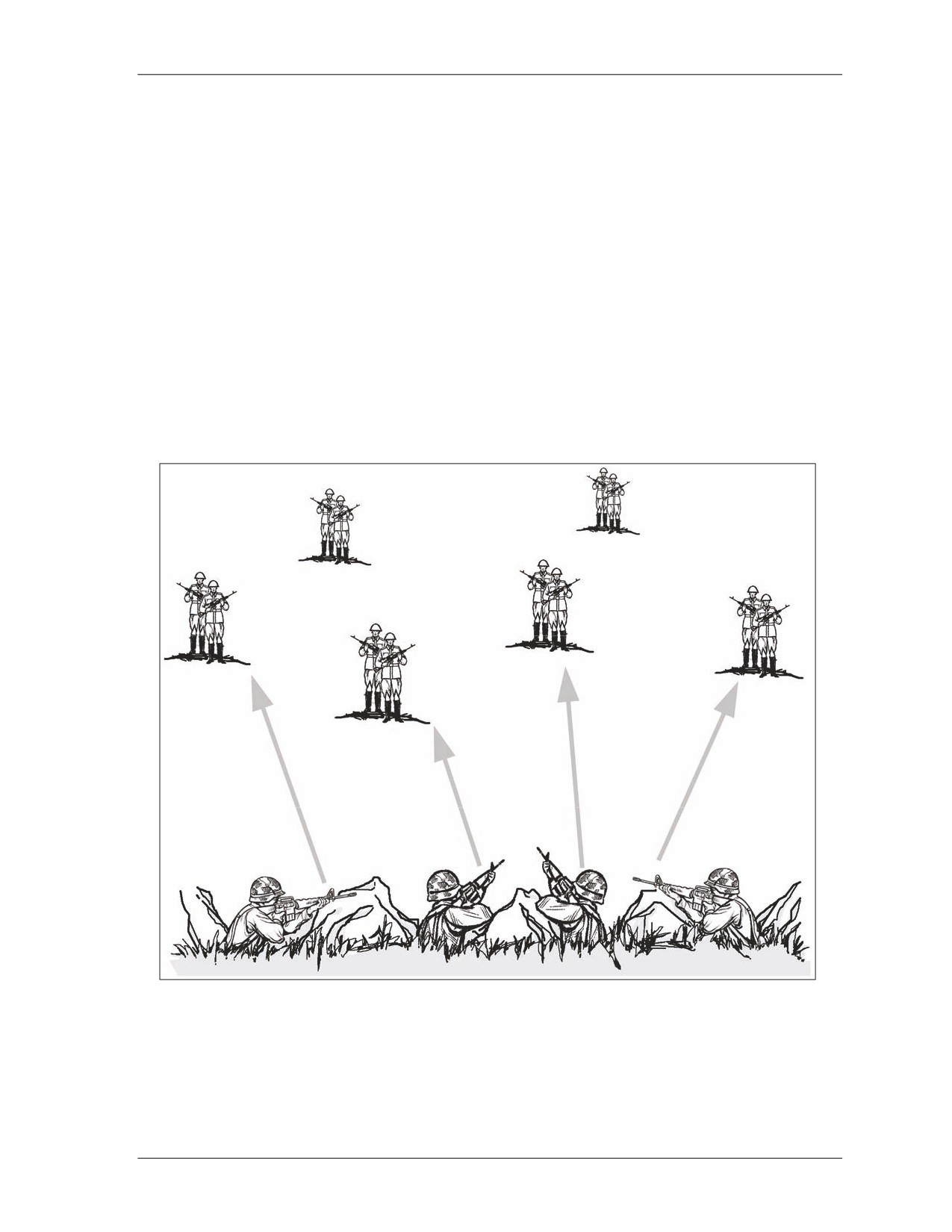
9-33. Leaders may initiate frontal fire (Figure 9-7) when targets are arrayed in front of the unit in a
lateral configuration. Weapons systems engage targets to their respective fronts. For example, the left flank
weapon engages the left-most target, and the right flank weapon engages the right-most target. As the unit
destroys targets, weapons shift fires toward the center of the enemy formation and from near too far.
Figure 9-7. Frontal fire.
27 July 2006
FM 3-21.10
9-13
Chapter 9
Cross Fire
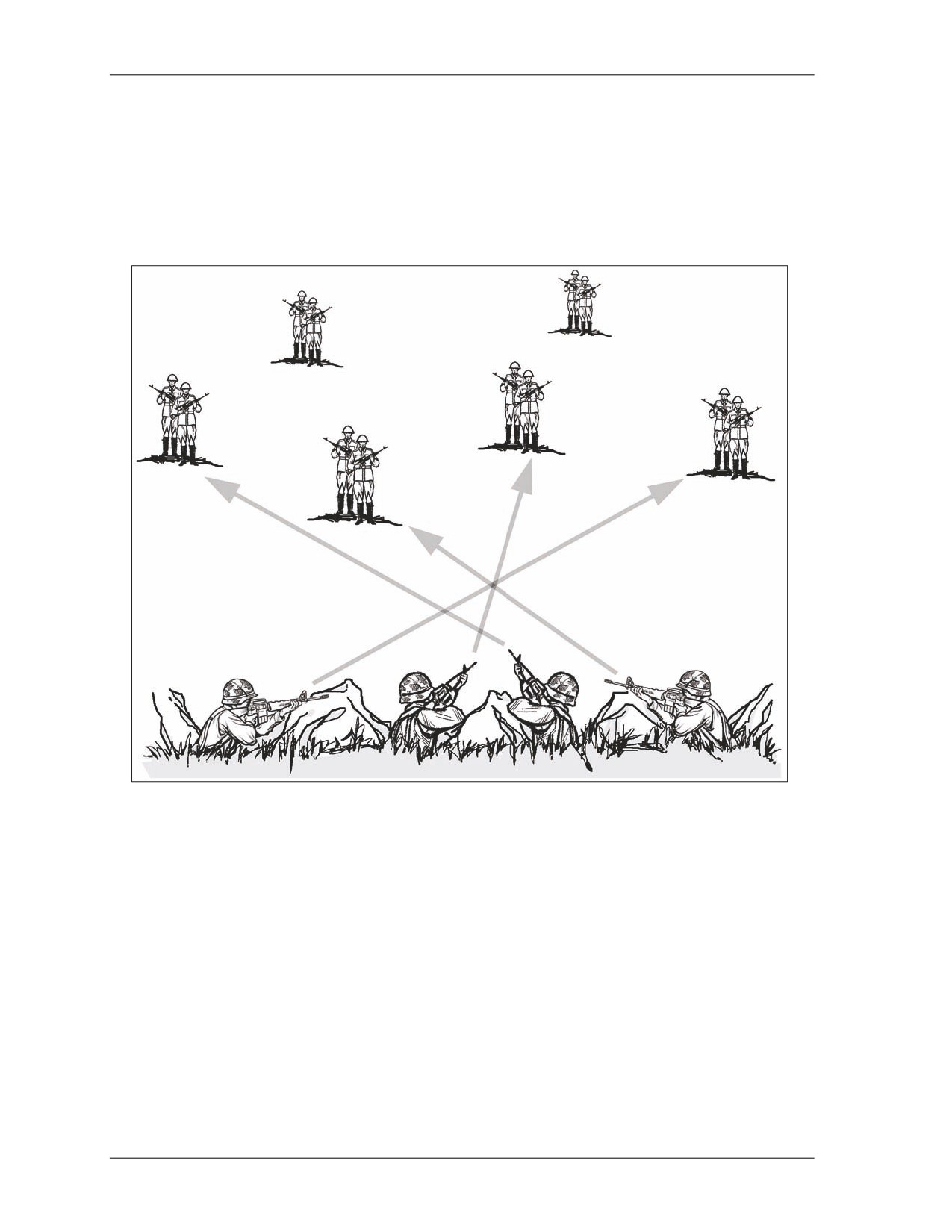
9-34. Leaders initiate cross fire (Figure 9-8) when targets are arrayed laterally across the unit's front in a
manner that permits diagonal fires at the enemy's flank or when obstructions prevent unit weapons from
firing frontally. Right flank weapons engage the left-most targets, and left flank weapons engage the
right-most targets. Firing diagonally across an EA provides more flank shots, thus increasing the chance of
kills. It also reduces the possibility of the enemy detecting friendly elements. As the unit destroys targets,
weapons shift fires toward the center of the enemy formation.
Figure 9-8. Cross fire.
Depth Fire
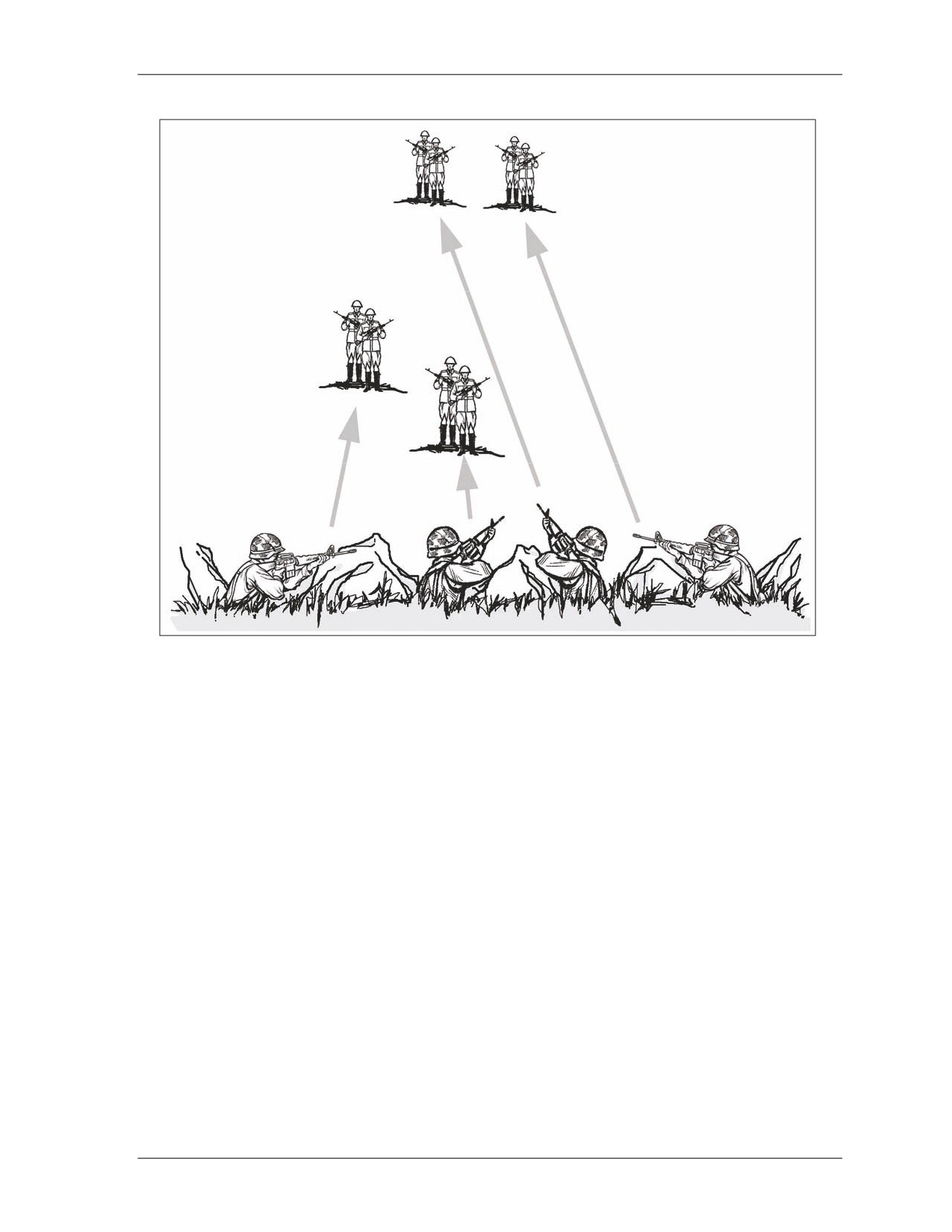
9-35. Leaders initiate depth fire (Figure 9-9) when targets are dispersed in depth, perpendicular to the
unit. Center weapons engage the closest targets, and flank weapons engage deeper targets. As the unit
destroys targets, weapons shift fires toward the center of the enemy formation.
9-14
FM 3-21.10
27 July 2006
Direct Fire Control
Figure 9-9. Depth fire.
Target Array
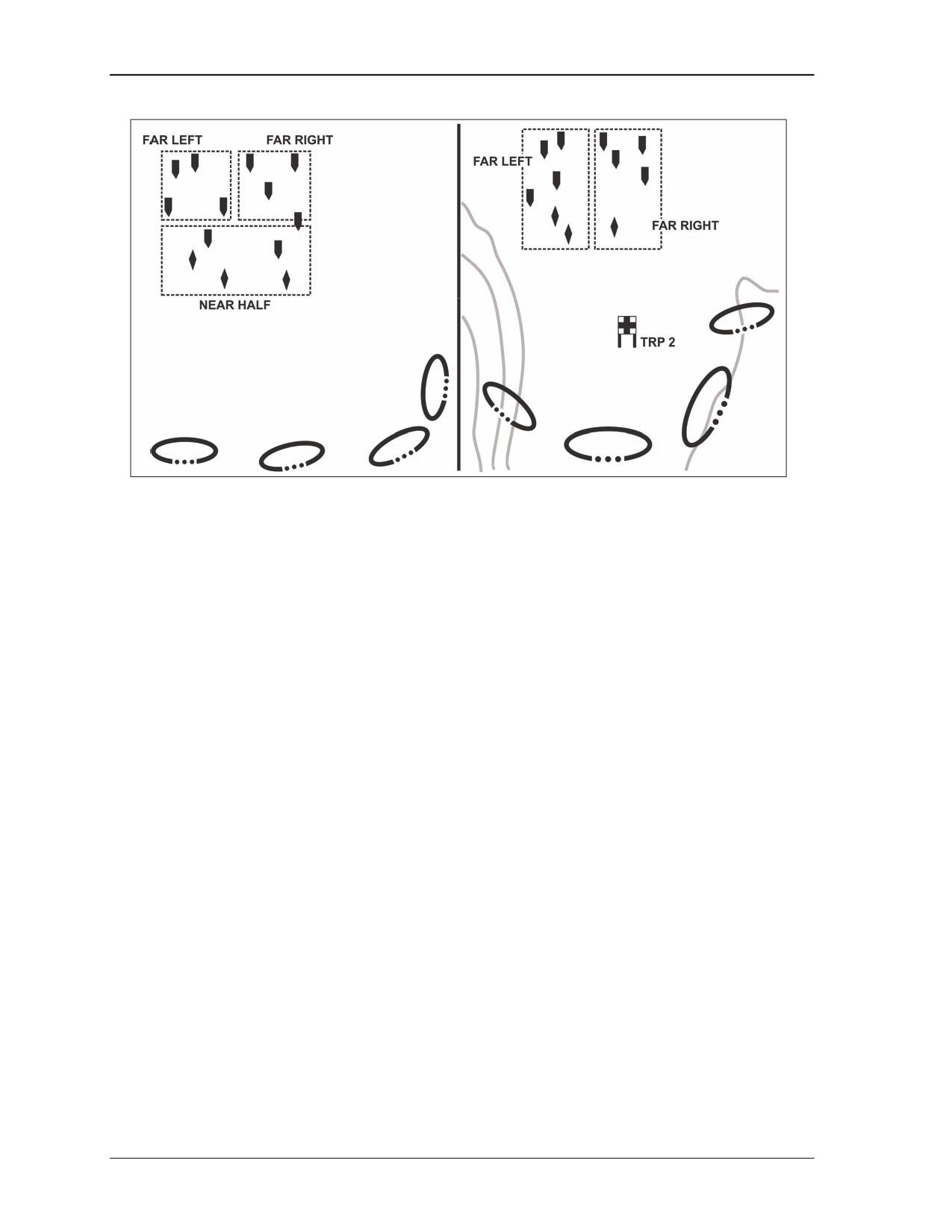
9-36. Target array permits the company commander to distribute fires when the enemy force is
concentrated and terrain-based controls are inadequate. This threat-based distribution measure is similar to
the quadrant method mentioned in terrain-based fire control measures. The company commander creates
the target array by superimposing a quadrant pattern over an enemy formation. The pattern centers on the
enemy formation, with the axes running parallel and perpendicular to the enemy's direction of travel.
Quadrants are described using their relative locations. Figure 9-10, page 9-16 shows examples of the target
array technique.
27 July 2006
FM 3-21.10
9-15
Chapter 9
Figure 9-10. Example target arrays.
Engagement Priorities
9-37. Engagement priorities entail the sequential ordering of targets to be engaged. They serve one or
more of the following critical fire control functions.
Prioritize Targets
9-38. In concert with his concept of the operation, the company commander determines which target
types provide the greatest threat to the company and sets these as engagement priorities. For example, he
may decide that destroying enemy engineer assets is the best way to prevent the enemy from breaching
an obstacle.
Employ Best Weapons for Target
9-39. Establishing engagement priorities for specific friendly systems increases the effectiveness with
which the unit employs its weapons. As an example, the engagement priority for the Javelin could be
enemy fortifications first, then enemy armored vehicles.
Distribute Unit’s Fires
9-40. Establishing different priorities for similar friendly systems helps to prevent overkill and achieve
effective distribution of fires. For example, the company commander may designate the enemy
fortifications as the initial priority for one Infantry platoon while making the enemy vehicles the priority
for another Infantry platoon. This decreases the chance of multiple Javelins being fired against two enemy
vehicles while ignoring the dangers posed by the fortifications.
9-16
FM 3-21.10
27 July 2006
Direct Fire Control
Weapons Ready Posture
9-41. The weapons ready posture is a means by which leaders use the tactical information available to
specify the ammunition and range for the most probable engagement. Ammunition selection depends on
the target type, but the leader may adjust it based on engagement priorities, desired effects, and effective
range. Range selection depends on the anticipated engagement range, and it is affected by terrain
intervisibility, weather, and light conditions. Within the company, the weapons ready posture affects the
types and quantities of ammunition and where they are located or cached.
9-42. For Infantry squads, weapons ready posture is the selected ammunition and indexed range for
individual and crew-served weapons. For example, an M203 grenadier whose most likely engagement is to
cover dead space at 200 meters from his position might load high-explosive, dual-purpose (HEDP) rounds
and set 200 meters on his quadrant sight. To prepare for an engagement in a wooded area where
engagement ranges are extremely short, an AT4 might be more appropriate than a Javelin.
Engagement Criteria
9-43. Engagement criteria are a specific set of conditions that specify the circumstances in which
subordinate elements are to engage. This is often referred to as a trigger. The circumstances can be based
on a friendly or an enemy event. For example, the engagement criteria for a friendly platoon to initiate
engagement could be three or more enemy combat vehicles passing or crossing a given point or line. This
line can be any natural or manmade linear feature, such as a road, ridgeline, or stream, or a line
perpendicular to the unit's orientation, delineated by one or more reference points.
Weapons Control Status
9-44. The three levels of weapons control status
(WCS) outline the conditions, based on target
identification criteria, under which friendly elements may engage. The commander sets and adjusts the
weapons control status based on friendly and enemy disposition. In general, a more restrictive WCS relates
to a higher probability of fratricide. The three levels, in descending order of restriction, are--
WEAPONS HOLD (Engage only if engaged or ordered to engage)
WEAPONS TIGHT (Engage only targets positively identified as enemy)
WEAPONS FREE (Engage any targets not positively identified as friendly)
Note: As an example, the company commander may establish the WCS as WEAPONS
HOLD when friendly forces are conducting a passage of lines. As the passage progresses and
the likelihood of enemy presence rises, the WCS might be lowered. In such a case, the
company commander might be able to set a WEAPONS FREE status when he knows there
are no friendly elements near the passage. This permits his elements to engage targets at
extended ranges, even when distinguishing targets accurately is difficult under battlefield
conditions. The WCS is extremely important for forces using combat identification systems:
establishing the WCS as WEAPONS FREE permits leaders to engage an unknown target
when they fail to get a friendly response.
Rules of Engagement
9-45. The ROE specify the circumstances and limitations under which forces may engage. ROE include
definitions of combatant and noncombatant elements and prescribe the treatment of noncombatants.
Factors influencing ROE are national command policy, the mission and commander's intent, the
operational environment, and the law of war. ROE always recognize a Soldier's right of self-defense; at the
same time, they clearly define circumstances in which he may fire.
27 July 2006
FM 3-21.10
9-17

Chapter 9
Weapons Safety Posture
9-46.
Weapons safety posture is an ammunition handling instruction that allows the company
commander to control the safety of his unit's weapons precisely. Leaders supervise the weapons safety
posture and Soldier adherence to it, minimizing the risk of accidental discharge and fratricide. Table 9-2
shows the company's procedures and considerations in using the four weapons safety postures, which are
listed in ascending order of restriction: AMMUNITION LOADED, AMMUNITION LOCKED,
AMMUNITION PREPARED, and WEAPONS CLEARED.
Note: In setting and adjusting the weapons safety posture, the company commander must
weigh the need to prevent accidental discharges against the requirement for immediate action
based on the enemy threat. If the possibility of direct contact with the enemy is high, the
company commander may establish the weapons safety posture as AMMUNITION
LOADED. If the requirement for action is less immediate, he may lower the posture to
AMMUNITION LOCKED or AMMUNITION PREPARED. Also, the company commander
may designate different weapons safety postures for different elements of the unit.
Weapons
Safety Postures
Infantry Squad Weapons and Ammunition
Ammunition loaded
y M4 rounds chambered.
y M240B and M249 ammunition on feed tray; bolt locked to rear.
y M203 launcher loaded.
y Weapons on safe.
Ammunition locked
y Magazines locked into M4s.
y M240B and M249 ammunition on feed tray; bolt locked forward.
y M203 launcher unloaded.
Ammunition prepared
y Magazines, ammunition boxes, launcher grenades, and hand
grenades prepared but stowed in pouches or vests.
Weapons cleared
y Magazines, ammunition boxes, and launcher grenades removed;
all weapons cleared.
Table 9-2. Weapons safety posture levels.
Engagement Techniques
9-47. Engagement techniques are effects-oriented direct fire distribution measures. The following
engagement techniques are the most common in Infantry company operations.
Point Fire
9-48. Point fire concentrates the effects of a unit's fire against a specific, identified target such as a
vehicle, machine gun bunker, or ATGM position. When leaders direct point fire, all of the unit's weapons
engage the target, firing until it is destroyed or the required time of suppression has expired. Employing
converging fires from dispersed positions makes point fire more effective because the unit engages the
target from multiple directions. The unit may initiate an engagement using point fire against the most
dangerous threat, then revert to area fire against other, less threatening point targets. (Use of point fire has
been rare because a unit seldom encounters a single, clearly identified enemy weapon.)
9-18
FM 3-21.10
27 July 2006
Direct Fire Control
Area Fire
9-49. Area fire involves distributing the effects of a unit's direct fires over an area in which enemy
positions are numerous or are not obvious. If the area is large, leaders assign sectors of fire to subordinate
elements using a terrain-based distribution method such as the quadrant technique. Typically, the primary
purpose of the area fire is suppression; however, sustaining effective suppression requires judicious control
of the rate of fire.
Alternating Fire
9-50. In alternating fire, pairs of elements continuously engage the same point or area target one at a
time. For example, a company team may alternate fires of two platoons; a tank platoon may alternate the
fires of its sections, or an Infantry platoon may alternate the fires of a pair of machine guns. Alternating
fire permits the unit to maintain suppression for a longer duration than simultaneous fire. It also forces the
enemy to acquire and engage alternating points of fire.
Sequential Fire
9-51. In sequential fire, the subordinate elements of a unit engage the same point or area target one after
another in an arranged sequence. Sequential fire can also help preserve ammunition, as when an Infantry
platoon waits to see the effects of the first Javelin before firing another. Also, sequential fire permits
elements that have already fired to pass on information they have learned from the engagement. An
example would be an Infantryman who missed an armored vehicle with AT4 fires passing range and lead
information to the next Soldier preparing to engage the same armored vehicle with an AT4.
Simultaneous Fire
9-52. Units employ simultaneous fire, also referred to as volley fire, to mass the effects of their fires
rapidly or to gain immediate fire superiority. For example, a unit may initiate a support-by-fire operation
with simultaneous fire, then change to alternating or sequential fire to maintain suppression. Simultaneous
fire is also employed to negate the low probability of hit and kill of certain antiarmor weapons. As an
example, an Infantry squad may employ volley fire with its AT4s to ensure rapid destruction of a BMP that
is engaging a friendly position.
Observed Fire
9-53. Observed fire is normally used when the company is in concealed defensive positions with
extended engagement ranges. It can be employed between elements of the company, such as an Infantry
platoon observing while the machine gun section fires; or it can be employed between machine guns in the
section. The company commander or platoon leader directs one element to engage. The remaining elements
or vehicles observe fires and prepare to engage on order in case the engaging element consistently misses
its targets, experiences a malfunction, or runs low on ammunition. Observed fire allows for mutual
observation and assistance while protecting the location of the observing elements.
Time of Suppression
9-54. Time of suppression is the period, specified by the company commander, during which an enemy
position or force is to be suppressed. Suppression time typically depends on the time it will take a
supported element to maneuver. Normally, a unit suppresses an enemy position using the sustained rate of
fire of its weapons. In planning for sustained suppression, leaders must consider several factors: the
estimated time of suppression, the size of the area being suppressed, the type of enemy force to be
suppressed, range to the target, rates of fire, and available ammunition quantities.
27 July 2006
FM 3-21.10
9-19
Chapter 9
Reconnaissance by Fire
9-55. Reconnaissance by fire is the process of engaging possible enemy locations to elicit a tactical
response such as return fire or movement. This response permits the company commander and his
subordinate leaders to make accurate target acquisition and then to mass fires against the enemy element.
Typically, the company commander directs a platoon to conduct the reconnaissance by fire. For example,
he may direct an overwatching platoon to conduct the reconnaissance by fire against a probable enemy
position before initiating movement by a bounding element.
COMMANDS
9-56. Fire commands are oral orders issued by the Infantry company commander and his subordinate
leaders to focus and distribute fires as required to achieve the desired effects against an enemy force. Fire
commands allow leaders, in the already confusing environment of close combat, to articulate their firing
instructions rapidly and concisely using a standard format. Unit fire commands include these elements:
ALERT
9-57. The alert specifies the units that are directed to fire. It does not require the leader who initiates the
command to identify himself. Examples of the alert element (call signs and code words based on unit SOP)
include--
GUIDONS (all subordinate elements)
RED (1st platoon only)
WEAPON OR AMMUNITION (OPTIONAL)
9-58. This element identifies the weapon and ammunition to be employed by the alerted units. Leaders
may designate the type and number of rounds to limit expenditure of ammunition. Examples of this
element include--
JAVELIN
MACHINE GUN
TARGET DESCRIPTION
9-59. Target description designates which enemy forces are to be engaged. Leaders may use the
description to focus fires or achieve distribution. Example target descriptions include--
TROOPS IN TRENCH
BUNKER
PCs
ORIENTATION
9-60. This element identifies the location of the target. The location of the target might be designated in
any of several ways, for example--
Closest TRP TRP 13
Clock direction ONE O’CLOCK
Terrain quadrantQUADRANT ONE
Friendly quadrant LEFT FRONT
Target array
FRONT HALF
Tracer on target ON MY TRACER
Laser pointer ON MY POINTER
9-20
FM 3-21.10
27 July 2006
Direct Fire Control
RANGE (OPTIONAL)
9-61. The range element identifies the distance to the target. Announcing range is not necessary for
systems that have range finders or that employ command-guided or self-guided munitions. For systems that
require manual range settings, leaders have a variety of means for determining range, including--
y Predetermined ranges to TRPs or phase lines.
y Handheld rangefinders.
y Range stadia.
y Mil reticles.
CONTROL (OPTIONAL)
9-62. The company commander may use this optional element to direct desired target effects, distribution
methods, or engagement techniques. Subordinate leaders may include the control element to supplement
the company commander's instructions and achieve effective distribution. Examples of information
specified in the control element include--
Target array FRONT HALF
Fire pattern FRONTAL
Terrain quadrant QUADRANT ONE
Engagement priorities M203 ENGAGE BUNKERS; MACHINE GUNS ENGAGE TROOPS
Engagement technique ALTERNATING
Target effect AREA
EXECUTION
9-63. The execution element specifies when direct fires should be initiated. The company commander
may engage immediately, delay initiation, or delegate authority to engage. Examples of this element
include--
FIRE
AT MY COMMAND
AT YOUR COMMAND
AT PHASE LINE ORANGE
27 July 2006
FM 3-21.10
9-21
This page intentionally left blank.
Chapter 10
Maneuver Support
For a unit to achieve its full combat potential, the commander must effectively
integrate all available combat arms and combat support assets. This chapter focuses
on the elements that the Infantry company is most likely to work with such as fire
support, engineers, air defense, and CBRN. It also briefly describes available support
from Army aviation units.
This edition expands the discussion of aerial fire support to the rifle company,
including close air support (CAS), and joint tactical air control (JTAC) procedures. It
provides checklists such as the CAS 9-line briefing.
Section I. COMMAND AND SUPPORT RELATIONSHIPS
The Infantry company commander must understand the command and support relationships established
between his company and supporting units.
COMMAND RELATIONSHIPS
10-1.
Command responsibility and authority are established routinely through the following standard
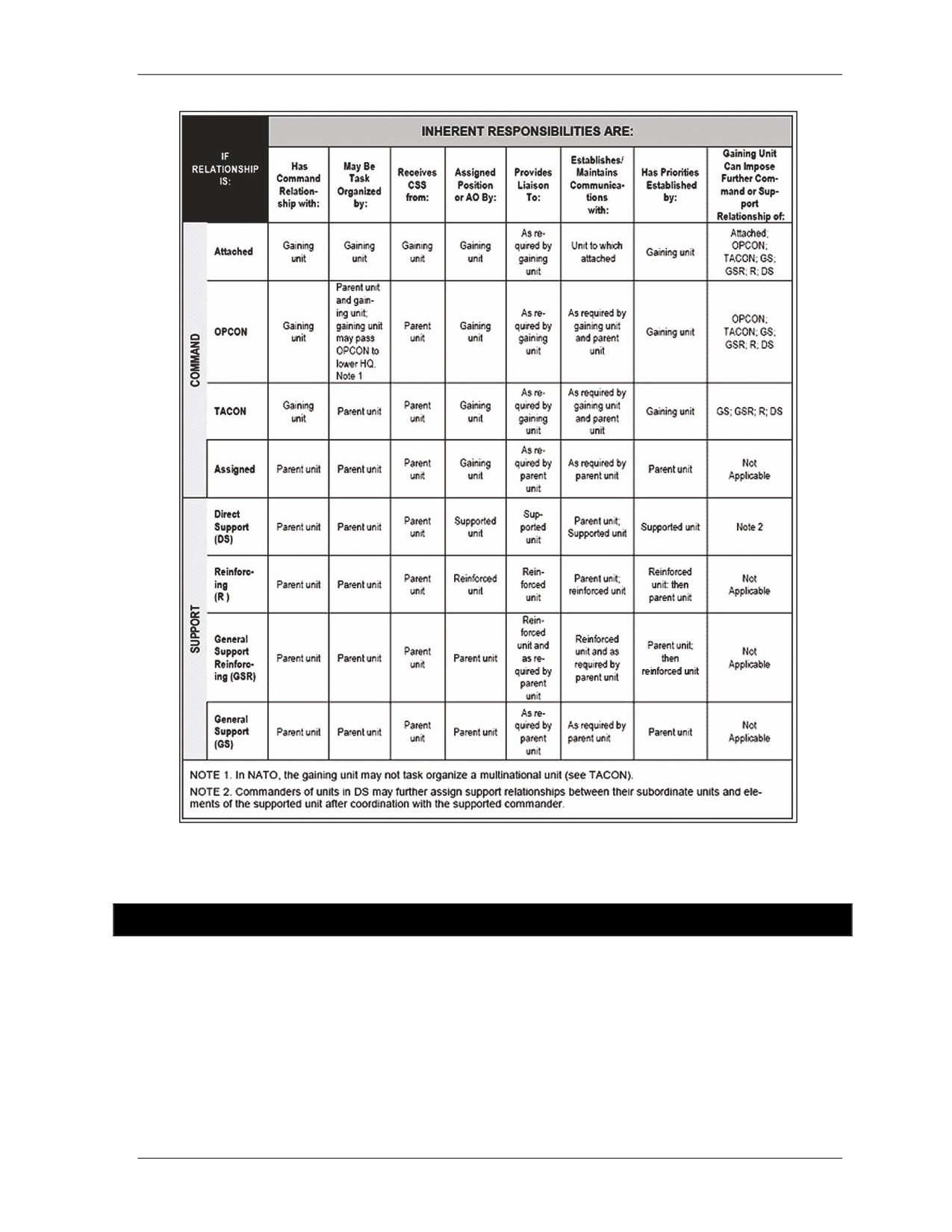
relationships, also shown in Figure 10-1, page 10-3. To simplify these definitions, the gaining organization
is referred to as "the organization" and the organic, assigned, attached, OPCON, or TACON unit simply as
"the unit." The term "parent unit" is self-explanatory.
ORGANIC
10-2.
This unit is assigned to and forms an essential part of an Army organization. It (the unit) is listed
in the organization's table of organization and equipment
(TOE) or table of distribution and
allowances (TDA).
ASSIGNED
10-3.
This is a unit permanently placed in an organization and completely controlled and administered
by the organization.
ATTACHED
10-4.
This is a unit temporarily assigned to an organization other than its parent unit. The organization's
commander has the same command and control over the attached unit as he does with his organic units.
This control is limited only as caveated in the attachment order. The organization is responsible for the
unit's logistics, training, and operations. The parent unit normally retains responsibility for transfers and
promotions; nonjudicial punishment; administrative actions such as SIDPERS and unit strength reporting;
and uniform code of military justice actions. Having an attached unit increases an organization's
administrative and logistical burden.
27 July 2006
FM 3-21.10
10-1
Chapter 10
OPERATIONAL CONTROL
10-5.
An OPCON unit is one placed under the control of an organization for one or more specific
operations. The organization controls all aspects of the unit's military operations. The relationship is
limited by function, time, or location. The organization is not necessarily responsible for administration,
logistics, discipline, internal organization, or training. Otherwise, the commander's relationship with
OPCON units is the same as with organic or attached subordinate units.
TACTICAL CONTROL
10-6.
A TACON unit is normally only subject to the authority of the organization with regard to
specified local direction of movement and maneuver of forces to accomplish a task. In this command
relationship, a combatant commander delegates limited authority to the organization to direct the tactical
use of a combat unit. TACON is often the command relationship established between forces of different
nations in a multinational force.
SUPPORT RELATIONSHIPS
10-7.
Support is the action of an element or unit that aids, protects, complements, or sustains another
unit IAW an order requiring such support. A supporting unit helps another unit but is not under the
command of that unit. The commander's relationship with supporting units follows (Figure 10-1).
y He ensures that the supporting unit establishes liaison and communications with his unit.
y He keeps the supporting unit informed of the situation and the support needed.
y He communicates with the leader of the supporting unit on employment considerations.
y His request for support is honored by the supporting unit as an order. The supporting unit
leader refers any conflicts or problems to his parent unit commander. However, the request in
question is honored until the conflict is resolved.
DIRECT SUPPORT
10-8.
A unit in direct support (DS) of another organization remains under the command of its parent
unit. However, although the supporting unit answers the supported unit's requests directly, the
organization's commander may not reallocate, reassign, or task-organize the DS force.
GENERAL SUPPORT
10-9.
A unit in general support (GS) to another organization remains under the control of the parent
unit. A GS unit supports the organization as a whole, not any specific subunit. Therefore, subunit
commanders must request support from the GS unit through their own parent unit.
REINFORCING SUPPORT
10-10. Reinforcing support is tactical (fire) augmentation of one artillery unit by another in overall
support of the maneuver force. Coordination for support is normally provided through the DS artillery unit.
GENERAL SUPPORT REINFORCING
10-11. General support-reinforcing (GS-R) artillery is a tactical artillery mission where an artillery unit
has the mission of supporting the force as a whole. It also provides reinforcing fires for another artillery
unit. Coordination for support is the responsibility of the DS artillery unit.
10-2
FM 3-21.10
27 July 2006
Maneuver Support
Figure 10-1. Command and support relationships.
Section II. FIRE SUPPORT
Fire support is the collective and coordinated use of indirect fire weapons and armed aircraft in support of the
battle plan. Fire support assets include mortars, field artillery cannons and rockets, and CAS. Desired effects
from fire support assets can be achieved through a combination of both lethal and nonlethal means. The
integration of fire support assets is critical to the success of the company. The Infantry battalion FSO plans fires
(in coordination with the plans developed by the Infantry battalion S-3) to support the Infantry battalion
commander's concept of the operation. The company FSO plans company fire support, and the Infantry
company commander approves his plan. Fire support planning is the process of analyzing, allocating, and
scheduling fire support assets.
27 July 2006
FM 3-21.10
10-3

Chapter 10
INDIRECT FIRE CAPABILITIES
10-12. Indirect fires affect an enemy force much more than do the fires of the Infantry company's organic
weapons. Indirect fire assets offer the most destructive, accurate, and flexible combat multiplier available
to the Infantry company commander in immediate support of his operations. Table 10-1 lists the
capabilities of the indirect fire systems that might support the Infantry company.
Capabilities of the Indirect Fire System
CALIBER
60-mm
81-mm
120-mm
105-mm
155 -mm
155-mm
MODEL
M224
M252
M285
M119
M198
M109A6
MAX RANGE (HE)(m)
3,490
5,608
7,200
14,000
24,000
24,000
PLANNING RANGE (m)
(2/3 max)
(2/3 max)
(2/3 max)
11,500
14,600
14,600
PROJECTILE
HE, WP,
HE, WP,
HE, SMK,
HE M760
HE, WP, illum,
HE, WP, illum,
illum, IR
illum, RP, IR
illum, IR illum
illum, HEP-T,
smk, chem,
smk, chem,
illum
illum
APICM,
nuc, RAP,
nuc, RAP,
chem, RAP
FASCAM,
FASCAM,
CPHD, AP/
CPHD, AP/
DPICM
DPICM
MAX RATE OF FIRE
30 RPM for
30 RPM for
16 RPM for
6 RPM for
4 RPM for
4 RPM for
4 min
2 min
1 min
3 min
3 min
3 min
SUSTAINED RATE OF
20
15
4
3
2
1
FIRE (rd/min)
MINIMUM RANGE (m)
70
83
200
Direct fire
Direct fire
Direct fire
FUZES
PD, VT,
PD, VT,
PD, VT,
PD, VT,
PD, VT, CP,
PD, VT, CP,
time, dly,
time, dly,
time, dly, MO
MTSQ, CP,
MT, MTSQ, dly
MT, MTSQ, dly
MO
MO
MT, dly
LEGEND
AP
armor piercing
MO multioption (VT, PD, dly)
APICM
antipersonnel improved conventional munitions
MT mechanical time
chem
chemical
MTSQ mechanical time super quick
CP
concrete piercing
nuc
nuclear
CPHD
Copperhead
PD
point detonating
dly
delay
RAP
rocket assisted projectile
DPICM
dual purpose improved conventional munitions
RD
round
FASCAM
family of scatterable mines
RP
red phosphorus
HE
high explosive
RPM
rounds per minute
HEP-T
high explosive plastic--tracer
smk
smoke
illum
illumination
time
adjustable time delay
IR
infrared
VT
variable time
min
minute
WP
white phosphorus
Table 10-1. Indirect fire capabilities.
FIRE-SUPPORT TEAM
10-13. For artillery and mortar support, the FIST personnel are the observers or "eyes" for the maneuver
company. Each FIST has a four-Soldier headquarters consisting of an FSO, a fire support sergeant, a fire
support specialist, and a radio operator. Normally the commander sends FO teams to the platoons. An FO
team has an FO and a radio operator. The mission of the fire support team is to provide fire support for the
supported maneuver company. To do this the team must provide fire support planning, fire support
coordination, target location, calls for indirect fire, battlefield information reporting, and emergency
control of CAS.
10-4
FM 3-21.10
27 July 2006
Maneuver Support
FIRE-SUPPORT PLANS AND COORDINATION
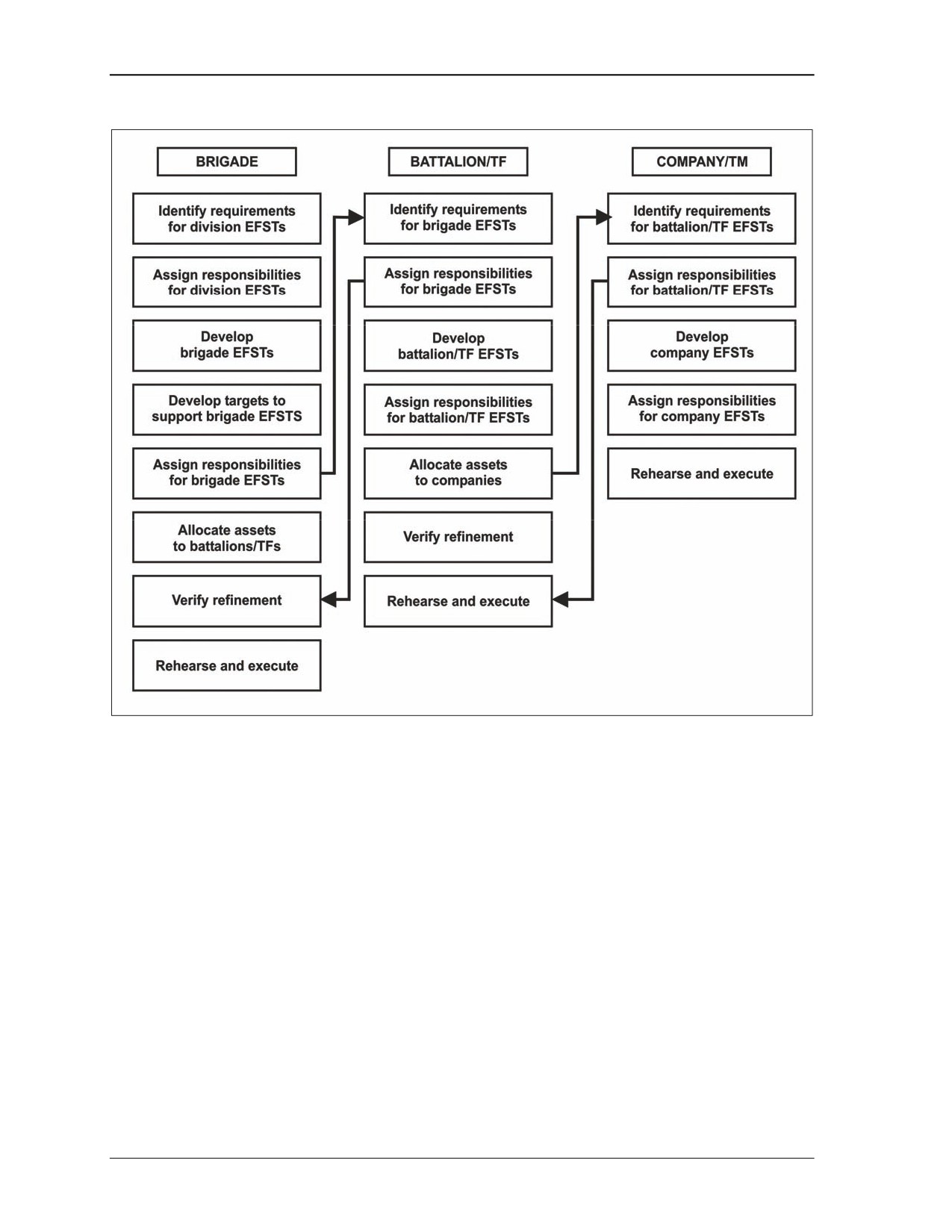
10-14. At all levels, leaders plan fire support and maneuver concurrently. Infantry battalions typically
plan fire support from the top down, and refine plans from the bottom up. The commander develops
guidance for fire support tasks, purposes, and effects. The fire support planner determines the method for
accomplishing each task. Individual units then incorporate assigned tasks into their fire support plans. In
addition, units tasked to initiate fires refine and rehearse their assigned tasks. The company commander
refines his unit's assigned portion of the battalion fire support plan, ensuring that the designated targets will
achieve the intended purpose. He also conducts rehearsals to prepare for the mission and, as specified in
the plan, directs the company to execute its assigned targets.
TERMS AND DEFINITIONS
10-15. Leaders must understand basic fire support terms to effectively plan and employ fire
support assets.
Fire support plans
10-16. Fire support planning is the continual process of analyzing, allocating, and scheduling fire
support. The goal of fire support planning is to effectively integrate fire support into battle plans to
optimize combat power. It is performed as part of the TLP.
Fire support Coordination
10-17. Fire support coordination is the continual process of implementing fire support plans and
managing the fire support assets that are available to a maneuver force.
Fire Plans
10-18. Fire planning is the continual process of selecting and prearranging fires on particular targets to
support a phase of the commander's plan.
Essential Fire-Support Task
10-19. An EFST is a task that a fire support element must accomplish in order to support a
combined-arms operation. Failure to achieve an EFST may require the commander to alter his tactical or
operational plan. A fully developed EFST has a task, purpose, method, and effects (TPME). The task
describes the targeting objective, for example, delay, disrupt, limit, or destroy. Fires must achieve these on
an enemy formation's function or capability. The purpose describes why the task contributes to maneuver.
The method describes how the task is accomplished by assigning responsibility to observers or units and
delivery assets and providing amplifying information or restrictions. Typically, the method is described by
covering three categories: priority, allocation, and restrictions. The effects statement describes how
successful accomplishment of the task will be measured, quantitatively.
Scheme of Fires
10-20. The scheme of fires is the detailed, logical sequence of targets and fire support events the fire
support element uses to find and attack high-payoff targets (HPTs). It details how to execute the fire
support plan in accordance with the time and space of the battlefield to accomplish the commander's
EFSTs. The products of the fire support annex: fire support execution matrix (FSEM), target list or
overlay, or a target synchronization matrix (TSM): articulate the scheme of fires.
27 July 2006
FM 3-21.10
10-5
Chapter 10
Linking Tasks and Maneuver Purpose
10-21. A clearly defined purpose and commander's intent enables the maneuver commander to articulate
precisely how he wants fire support to affect the enemy during different phases of the battle. This, in turn,
allows fire support planners to develop a fire support plan that effectively supports the intended purpose.
The planners can determine each required task (in terms of effects on target), the best method for
accomplishing each task (in terms of a fire support asset and its fire capabilities), and a means of
quantifying accomplishment. A carefully developed method of fire is equally valuable during execution of
the fire support mission; it helps not only the firing elements but also the observers who are responsible for
monitoring the effects of the indirect fires. With a clear understanding of the intended target effects, fire
support assets and observers can work together effectively, planning and adjusting the fires as necessary to
achieve the desired effects on the enemy. The following paragraphs describe several types of targeting
objectives associated with fire support tasks and provide examples of how the Infantry company
commander might link a target task to a specific maneuver purpose in his order.
Delay
10-22. The friendly force uses indirect fires to cause a particular function or action to occur later than the
enemy desires. For example, the commander might direct delaying fires this way, "Delay the repositioning
of the enemy's reserve, allowing B Company to consolidate on Objective Bob."
Disrupt
10-23. Disrupting fires are employed to break apart the enemy's formation; to interrupt or delay his
tempo and operational timetable; to cause premature commitment of his forces; or, otherwise, to force him
to stage his attack piecemeal. The commander might direct, for example, "Disrupt the easternmost lead
motorized battalion to prevent the enemy from massing two battalions against Alpha and Charlie."
Limit
10-24. Indirect fires help prevent the enemy from executing an action or function where he wants it to
occur. The commander might direct, for example, "Limit the ability of the enemy's advance guard to
establish a firing line on the ridge line to the flank of the battalion axis of advance to prevent the enemy
from fixing the battalion main body."
Destroy
10-25. The friendly force uses indirect fires to render an enemy formation ineffective. For example, the
commander might direct destroying fires this way, "Destroy enemy platoon on Objective Harry in order to
allow the decisive operation to assault Objective Tom."
Divert
10-26. Diverting fires are used to cause the enemy to modify his course or route of attack. The
commander might direct, for example, "Divert the enemy's combined arms reserve. Counterattack to EA
Dog to facilitate its destruction by Delta."
Screen
10-27. Screening fires entail the use of smoke to mask friendly installations, positions, or maneuver.
Normally, they are conducted for a specified event or a specified period. The commander might direct, for
example, "Screen the movement of the counterattack force (B Company) along Route Red to attack by fire
(ABF) position 21 to prevent the remnants of the enemy battalion from engaging the company."
10-6
FM 3-21.10
27 July 2006
Maneuver Support
Obscure
10-28. Smoke is placed between enemy forces and friendly forces or directly on enemy positions to
confuse and disorient the enemy's direct fire gunners and artillery FOs. Obscuration fires are normally
conducted for a specified event or a specified period. The commander might direct, for example, "Obscure
the northernmost company to protect our breach force until the breach site is secured."
FINAL PROTECTIVE FIRE PLANS
10-29. FPF planning is designed to create a final barrier, or "steel curtain", to prevent the enemy from
moving across defensive lines. These are fires of last resort and take priority over all other fires. The
employment of FPFs presents several potential problems. They are linear fires, with coverage dependent on
the firing sheaf of the fire support asset(s). In addition, while an FPF may create a barrier against
penetration by enemy Infantry, armored vehicles may simply button up and move through the fires into the
friendly defensive position. FPFs are planned targets and thus must have a clearly defined purpose. FPF
planning is normally delegated to the Infantry company that is allocated the support.
TARGET REFINEMENT
10-30. The Infantry company commander is responsible for the employment of indirect fires in his zone
or sector. The most critical aspect of this responsibility is target refinement, in which he makes necessary
changes to the fire support plan to ensure that targets accomplish the commander's intended battlefield
purpose. Rather than merely executing targets without regard to the actual enemy situation, the company
commander and FSO must be ready to adjust existing targets or to nominate new targets that allow
engagement of specific enemy forces.
10-31. Necessary refinements usually emerge when the Infantry company commander war-games as part
of step 6 (complete the plan) of the TLP. The war-gaming process allows him to identify required
additions, deletions, and adjustments to the Infantry battalion fire support plan. The company FSO then
submits the refinements to the battalion FSE for inclusion in the scheme of fires for the operation. (This is
normally only the first step of target refinement, with the commander and FSO making further adjustments
as the enemy situation becomes clearer.)
10-32. As a specific requirement in defensive planning, the company commander must focus on target
refinement for the ground he will "own" during the operation. This usually takes place as part of
engagement area development. The commander makes appropriate adjustments to the targets based on
refinements to the SITEMP such as the actual positions of obstacles and enemy direct fire systems.
10-33. Because fire support is planned from the top down, cutoff times for target nomination and target
refinement are normally specified in the battalion OPORD. Commanders must ensure that nominations and
refinements meet these deadlines to provide fire support planners with sufficient time to develop
execution plans.
FIRE SUPPORT PREPARATION
10-34. As noted, although the Infantry battalion and brigade commanders establish target tasks and
purposes and allocate appropriate fire support assets, the Infantry company commander is the one who
must ensure execution of assigned targets. In turn, successful execution demands thorough preparation,
focusing on areas covered in the following paragraphs.
27 July 2006
FM 3-21.10
10-7
Chapter 10
Observation Plan
10-35. In developing the observation plan, the commander ensures that both primary and alternate
observers cover all targets and determine whether the desired target effects have been achieved. The plan
provides clear, precise guidance for the observers. Perhaps the most important aspect of the plan is
positioning. An observer's positions must allow him to see the trigger for initiating fires as well as the
target area and the enemy force on which the target is oriented; this is done to help the observer determine
if the target effects have been achieved. The commander must also consider other aspects of observer
capabilities, including the Bradley Fire Support Team (BFIST) when operating with HBCT elements or
Long Range Advanced Scout Surveillance System (LRAS) when available. As another example, the
ground/vehicle laser locator designator (G/VLLD), or similar device, provides first round fire-for-effect
capability; without it, observers might have to use adjust-fire techniques that take longer and are more
difficult to implement. The observation plan must also include contingency plans that cover limited
visibility conditions and backup communications.
Note: In addition to providing the specific guidance outlined in the observation plan, the
commander ensures that each observer understands the target task and purpose for which he
is responsible. For example, observers must understand that once the first round impacts, the
original target location is of no consequence; rather, they must orient on the targeted enemy
force to ensure that fires achieve the intended battlefield purpose.
Rehearsals
10-36. The Infantry company commander is responsible for involving his FSO in company-and
battalion-level rehearsals, making the company available for any separate fire support rehearsals, and for
rehearsing the company's FOs in the execution of targets. He uses rehearsals to ensure that the company's
primary and backup communications systems adequately support the plan.
Target Adjustment
10-37. In the defense, the commander confirms target location by adjusting fires as part of engagement
area development.
Tactical and Technical Triggers
10-38. The two types of triggers associated with a target are tactical and technical. The company
commander develops a tactical trigger for each target and then he or his FSO develop the technical trigger.
A tactical trigger is the maneuver related event or action that causes the commander to initiate fires. This
event can be friendly or enemy based. The tactical trigger is usually determined during COA development.
The technical trigger is the mathematically derived solution for firing the indirect fires based on the tactical
trigger to ensure that the indirect fires arrive at the correct time and location to achieve the desired effects.
Note: Triggers can be marked using techniques similar to those for marking TRPs.
10-39. When selecting the tactical trigger the commander must ensure that either he, or the designated
observer, is able to observe the enemy forces or event that is the tactical trigger if it is enemy driven; for
example, "When enemy forces occupy their defensive positions vic Objective Brown." The tactical trigger
may also be friendly event or time driven; for example, "When Charlie company crosses PL Bowen" or
"at 0900."
10-8
FM 3-21.10
27 July 2006

Maneuver Support
10-40. Several factors govern the selection and positioning of the technical trigger. Critical factors are the
enemy's likely locations or rate of travel, and the time required for the enemy force to move from the
technical trigger to the target area. Using this information, the commander can then select the technical
trigger location based on the following considerations:
y The amount of time required to initiate the call for fire.
y The time needed by the fire support element to prepare for and fire the mission.
y The time required to clear the fires.
y Any built-in or planned delays in the firing sequence.
y The time of flight of the indirect fire rounds.
y Possible adjustment times.
10-41. The company commander can use an estimated rate of enemy movement, along with the
information in Table 10-2, to complete the process of determining the location of the technical trigger in
relation to the target area. Table 10-2 lists the response time required by field artillery assets to prepare for
and fire various types of support missions. Trigger lines or points (used in this method) are usually
employed as technical triggers to synchronize the effects of direct fires, countermobility efforts, and
indirect fires in time and space, rather than try to engage moving targets based on mathematical
calculations.
Grid or polar mission (unplanned)
5 to 7 minutes
Preplanned mission
3 minutes
Preplanned priority mission
1 to 2 minutes
NOTE: These are approximate times (based on ARTEP standards) needed to process and
execute calls for fire on normal artillery targets. Special missions may take longer.
Table 10-2. Artillery response times.
Ceasing or Shifting of Fires
10-42. As in trigger planning for the initiation of fires, the commander must establish triggers for ceasing
or shifting fires based on battlefield events such as the movement of enemy or friendly forces. One
technique is the use of a minimum safe line (MSL) when a friendly element, such as a breach force, is
moving toward an area of indirect fires. As the element approaches the MSL, observers call for fires shift
or cease, allowing the friendly force to move safely in the danger area.
Clearance of Fire
10-43. The maneuver commander has the final authority to approve (clear) fires and their effects within
his zone or sector. Although he may delegate authority to coordinate and clear fires to his FSO, the
ultimate responsibility belongs to the Infantry company commander. Normally, the FSO helps the
commander by making recommendations on the clearance of fires.
Fires Support Execution Matrix
10-44. As a tool in fires support planning and execution, the company commander may develop a graphic
summary outlining the critical elements of the fire support plan and the company's role. The commander
incorporates this information into his own execution matrix or into a separate fire support execution matrix,
similar to the battalion's fire support execution matrix as shown in Table 10-3, page 10-10. The company
fire support execution matrix is similar and should include, as a minimum, the following information for
each target.
27 July 2006
FM 3-21.10
10-9

Chapter 10
y Target number and type, to include FPF designation.
y Allocated fire support asset and munitions type.
y Observer and backup observer.
y Trigger.
y Target purpose.
y Target grid.
y Priority of fire.
y Priority targets.
y Fire support coordination measures (FSCMs).
Event I
Event II
Event III
Event IV
Event
Set conditions for
Support Data
LD to SBF O1
breach from SBF 01
B Co Breach
C Co Assault
TARGET/ GRID
AE0001 (PK
AE0002 (PK
O/O shift AE0001
O/O lift AE0003.
10184938).
09005031).
to AE0003 (PK
10204810) and
lift AE0002.
ASSET
155-mm HE.
Mortar smoke.
155-mm.
155-mm.
OBSERVER/
Scout platoon will
FSO (primary)/
AE0003: FSO
FSO (primary)/
BACKUP
initially call for and
1st platoon leader
(primary)/
3d platoon leader
adjust fires; FSO
(backup).
2d platoon leader
(backup).
adjusts upon
(backup).
arrival at SBF; 1st
platoon leader is
backup.
TRIGGER
Weapons company
On-call at SBF.
B Company
C Company
crosses PL Lynx.
crosses PL Lion.
completes
consolidation on
OBJ Bob.
PURPOSE
Disrupt enemy on
Obscure enemy to
Disrupt MRB
Protect the assault
OBJ Bob to
prevent interference
reserve to protect
force (C Company).
facilitate maneuver
with B Company's
the assault force
of A Company to
breach.
(C Company).
SBF position.
Table 10-3. Example battalion fire support execution matrix.
MANEUVER COMMANDER'S INTENT
10-45. The Infantry company commander ensures the FSO clearly understands the intent and desired
effects for maneuver and fire support. He identifies the role of fire support in the scheme of maneuver
(when, where, what, and why) by explaining in detail the concept of the operation, scheme of maneuver,
and tasks and desired effects for fire support to the FSO.
y Providing this level of guidance is not easy. Artillery fires are not instantaneous, and planning
must allow for this lag time. It takes several minutes to process targets of opportunity and
deliver fires in the target area. While war-gaming the maneuver, the company commander
refines the critical targets or EAs, priority of targets, priority of engagement, sequence of fires,
and results desired. He then can see when and how to synchronize direct and indirect fires to
destroy the enemy and protect the force.
y The company commander normally designates the company's decisive operation to have
priority of fires. This prioritizes requests when two or more units want fires at the same time.
He also designates where to place obscuration or illumination, suppressive fires, and
preparation fires.
10-10
FM 3-21.10
27 July 2006
Maneuver Support
Note: An element can still request fires even if it has not been allocated priority of fires.
PLANNING PROCESS
10-46. While the Infantry company commander develops and refines the tactical plan, he also develops
the fire support plan. The FSO concurrently helps develop and refine fire support. Targets are placed in the
fire support planning channels as soon as possible, so they can be processed at the battalion FSE or battery
FDC (Figure 10-2). Regardless of the planning method used, the company fire support plan includes--
y Target number and location.
y A description of the expected target.
y Primary and alternate persons responsible for shooting each target.
y The amount of effect required and purpose.
y Radio frequency and call sign to use in requesting fires.
y When to engage the target.
y Priority of fires and shifting of priority.
y Size, location, code word, and emergency signal to begin FPF.
27 July 2006
FM 3-21.10
10-11
Chapter 10
Figure 10-2. Fire planning process.
10-47. The company FSO does most of the technical aspects of the company fire support planning;
however, he may receive targets and target information from platoon leaders and the battalion FSO. The
company commander and FSO should not plan too many targets.
y The number of targets planned by the company and included in the formal fire support plan
depends upon the company's priority for fire support and the number of targets allocated to
them. The total number of targets in the fire support plan or the battalion mortar plan might be
constrained. An excessive number of targets tends to dilute the focus of fire planning and can
lead to increases in response time.
y Informal planning continues with target locations being recorded on terrain sketches or the
FSO's map or being stored in the buffer group of the Advanced Field Artillery Tactical Data
System (AFATDS) for quick reference and transmission. Fire planning for the company
mortars complements these plans; the primary constraint is normally ammunition availability
and the rapid resupply ability. Care must be taken to ensure that planning focuses on the critical
fire support requirements identified by the company commander.
10-12
FM 3-21.10
27 July 2006
Maneuver Support
10-48. The company FSO completes the indirect fire plan and briefs the company commander. The
company commander may alter the plan or approve it as is, but he makes the final decision. After the
company commander approves the plan, the FSO makes sure the targets are passed to the battalion FSE
where the fire plans are integrated into the battalion scheme of maneuver.
10-49. The commander and the FSO ensure platoon leaders are thoroughly familiar with the indirect fire
plan. The FSO also provides target overlays to the platoon leaders, FOs, and the commander. He may also
disseminate the company fire support plan as a target list and a fire support execution matrix. The FSO
does this in sufficient time to allow subordinates to brief their platoons and sections. (A good plan given
with the company order is better than a perfect plan handed out at the line of departure.)
FIRES PARAGRAPH
10-50. The fires subparagraph in the CONOP describes the concept of fires that, along with the scheme
of maneuver, communicates how the force as a whole will achieve the commander's intent. It clearly
describes the logical sequence of EFSTs and how they contribute to the CONOP. The overall paragraph
organization should mirror that of the scheme of maneuver paragraph. If the maneuver paragraph is phased
or otherwise organized, the fires paragraph takes on the same organization.
TASK, PURPOSE, METHOD, AND EFFECTS
10-51. The internal format for the fires paragraph uses the four subcategories of TPME. Within each
phase of an operation, each EFST will be described in the sequence of planned execution using TPME. The
fires paragraph must clearly and concisely state what fires will accomplish in the operation. Describe each
category and subcategory as follows.
Task
10-52. Task describes the targeting objective fires must achieve against a specific enemy formation's
function or capability. These formations are HPTs or contain one or more HPT. Task is normally expressed
in terms of objective, formation, and function.
Objective
10-53. Clearly describes the targeting objectives that must be achieved. Use terms such as destroy,
disrupt, delay, or limit to describe the effects required.
Formation
10-54. This is a specific element or subelement of the enemy. This can specify a specific vehicle type or
target category as long as the element or sub element is clear.
Function
10-55. This is a capability of the formation that is needed for it (the enemy formation) to achieve its
primary task and purpose.
Purpose
10-56. Purpose describes the maneuver or operational reason for the task. This identifies (as specifically
as possible) the friendly maneuver formation that will benefit from the targeting objective and also describe
in space and time what the objective will accomplish.
27 July 2006
FM 3-21.10
10-13
Chapter 10
EXAMPLE
Task: Disrupt the ability of the motorized Infantry platoon at point of penetration
to place effective direct fire against the breach force.
Objective
Formation
Function
Disrupt
The motorized Infantry
To prevent the enemy from placing
platoon at point of
effective direct fire against the
penetration
breach force.
Purpose: To allow an Infantry rifle company to breach the obstacle without becoming
decisively engaged by the motorized Infantry platoon at the point of
penetration.
Method
10-57. Method describes how the task and purpose will be achieved. It ties the "detect" function to the
"deliver" function in time and space and describes how to accomplish the task. Method is normally
described in terms of priority, allocation, and restriction.
Priority
10-58. For detection assets, it assigns priorities for finding NAIs, targeted areas of interest (TAIs), EAs,
or HPTs. For delivery assets, it assigns the priority of the HPT against which that system will mostly
be used.
Allocation
10-59. For both detection and deliver assets, it describes the allocation of assets to accomplish the EFST.
Restriction
10-60. Describes constraints, either requiring or prohibiting a particular action. Considerations include
ammunition restrictions and FSCMs. The method subparagraph includes the following information.
y Priority of fires.
y Observers (primary and alternate).
y Triggers (tactical and technical).
y Target allocation.
y Priority targets.
y Close air support allocations.
y Final protective fires.
y Restrictions.
y Special munitions.
y Intelligence and electronic warfare assets.
y Any other instructions.
10-14
FM 3-21.10
27 July 2006

Maneuver Support
EXAMPLE METHOD
FA POF to 1st platoon, mortar POF to 2d platoon. Primary observer for AB 1000 (motorized
Infantry platoon at point of penetration) is 1st platoon from OP 1, NFA 1. Alternate observer
is company FIST, NFA
3 … no DPICM within 300 meters NP177368 … airspace
coordination area (ACA) Lion in effect with CAS at initial point.
Effects
10-61. Effects try to quantify the successful accomplishment of the task. They provide a guide to
determine when the task is completed. One measure is to determine if the purpose has been met. If multiple
delivery assets are involved, it helps clarify what each must accomplish. Effects determination also
provides the basis for the assess function of targeting and contributes to the decision of whether to reattack
the target.
EXAMPLE EFFECTS
No hostile fire on the breach force from enemy motorized Infantry platoon until at least the
assault force has passed through. Twenty-five percent of vehicles and fifty percent of
enemy motorized Infantry platoon destroyed.
Note: At battalion and below, a formal written OPORD may not be produced. A fire
support plan at this level might be an operations overlay with written instructions, an FSEM,
and a target list or overlay.
FIRE-SUPPORT EXECUTION MATRIX
10-62. Battalion fire support plans might be distributed in matrix format. The fire support execution
matrix is a concise, effective tool showing the many factors of a detailed plan. It aids the company FSO
and the commander in understanding how the indirect fire plan supports the scheme of maneuver. It
explains what aspects of the fire support plan each element is responsible for, and at what time during the
battle these aspects apply. (For more on the battalion fire support matrix, see FM 3-21.20).
10-63. The advantage of the matrix is that it reduces the plan to one page and simplifies execution. The
company fire support execution matrix also directs execution responsibilities and reduces the possibility
that planned fires will not be executed. The company commander is responsible for disseminating the fire
plan. The commander and his key subordinate leaders must understand the categories of targets, and how
to engage those targets to create the desired result.
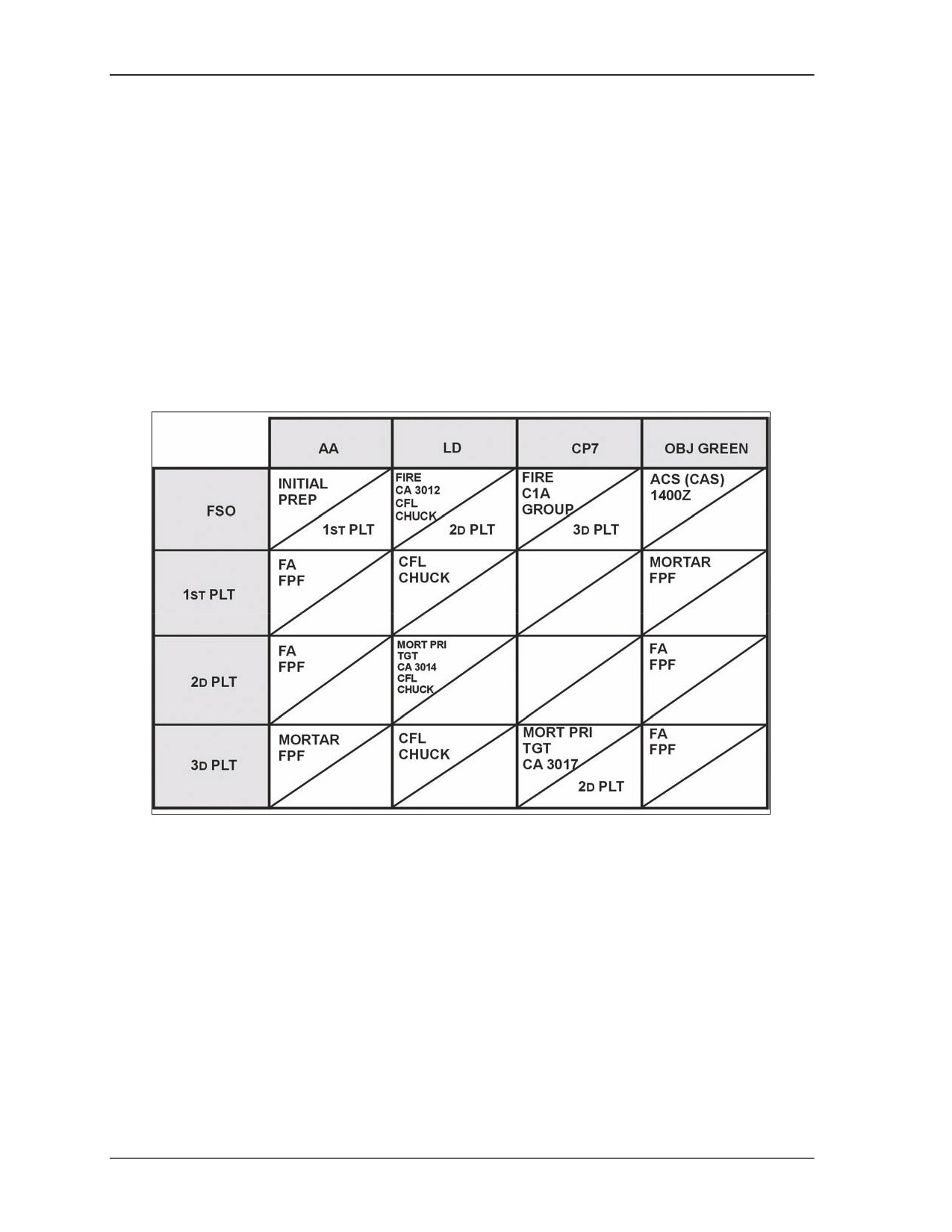
10-64. Figure 10-3 shows an example completed fire support execution matrix for a company deliberate
attack. In the AA, a field artillery FPF is allocated for 1st and 2d platoons; 3d platoon has been allocated a
mortar FPF; 2d platoon has priority of mortar fires from the LD to Checkpoint 7. From Checkpoint 7 to
Objective Green, 3d platoon has been allocated a mortar priority target and has designated it as CA3017;
2d platoon is backup for execution. 1st platoon has been allocated a mortar FPF; 2d and 3d platoons have
been allocated field artillery FPFs. At company level, information in each box of the matrix includes
the following.
y Priorities of indirect fire support to a platoon appear in the upper left corner of the appropriate
box (FA).
y If a unit is allocated an FPF, the type of indirect fire means responsible for firing appears next
to the indicator (FA FPF or MORT FPF).
27 July 2006
FM 3-21.10
10-15
Chapter 10
y The target number of priority targets allocated to a platoon appear in the box preceded by the
target, followed by the target number (MORT PRI TGT CA3014).
y If the company FSO is responsible for initiating specific fires, the target number, group, or
series designation is listed in the box for the FSO (CA3012). Specific guidelines concerning
fires not included on the target list are included in that box.
y Alternate element responsible for the execution of specific fires is listed in the lower right hand
corner of the box (2d platoon). If fires have not been initiated when they were supposed to have
been, that unit initiates them (unless ordered not to).
y Each fire support measure to be placed in effect, followed by a word designated for the
measure, is shown in the box (CFL CHUCK). For airspace coordination areas, the time for the
arrival of the planned CAS or attack helicopters is listed (ACA 1400Z).
y Other factors that apply to a certain platoon during a specific time might be included in the
appropriate box. General guidance is issued in the written portion of the operation order.
Figure 10-3. Example fire support execution matrix.
FINAL PROTECTIVE FIRES
10-65. These are immediately available planned fires that block enemy movement, especially dismounted
Infantry approaching defensive lines or areas. These areas are integrated with defensive plans. The pattern
of FPF plans may be varied to suit the tactical situation. They are drawn to scale on the target overlay. The
size of the FPF is determined by the number and type of weapons used to fire on it (Figure 10-4). The
company commander is responsible for the precise location of FPFs. The company FSO--
y Reports the desired location of the FPF to the supporting FDC.
y Adjusts indirect fire on the desired location, by weapon.
y Transmits the call to fire FPF to the supporting FDC.
10-16
FM 3-21.10
27 July 2006

Maneuver Support
10-66. The leader (normally the company commander or a platoon leader) in whose area the FPF is
located has the authority to call for the FPF. The FPF has the highest priority of any target assigned to a
fire support means. The FPF is only fired when required to repel the enemy's assault. Premature firing
wastes ammunition and allows the enemy to avoid the impact area.
Figure 10-4. Dimensions of final protective fires.
SPECIAL MUNITIONS
10-67. Obscuration fires use smoke and WP ammunition to degrade the enemy by obscuring his view of
the battlefield. (High explosive ammunition may also obscure his view with dust and fires, but the unit
should not rely on it as the primary means.) Because smoke is subject to changes in wind direction and
terrain contours, its use must be coordinated with other friendly units affected by the operation. Used
properly, obscuration fires can--
y Slow enemy vehicles to blackout speeds.
y Obscure the vision of enemy direct fire weapon crews.
y Reduce accuracy of enemy-observed fires by obscuring OPs and CPs.
y Cause confusion and apprehension among enemy Soldiers.
y Limit the effectiveness of the enemy's visual command and control signals.
10-68. Screening fires are closely related to obscuration fires; they also involve the use of smoke and
WP. However, screening fires mask friendly maneuver elements to disguise the nature of their operations.
Screening fires may assist in consolidation by placing smoke in areas beyond the objective. They may also
be used to deceive the enemy to believe that a unit is maneuvering when it is not. Screening fires require
the same precautions as obscuration fires.
10-69. Special munitions might be used for illumination, which might be scheduled or on-call. Use
friendly direct fire weapons and adjustment of indirect fires to illuminate areas of suspected enemy
movement or to orient moving units.
SMOKE SUPPORT
10-70. Internal smoke capabilities consist of company mortars and smoke pots. Smoke pots are the
commander's primary means of producing small-area screening smoke. An external smoke platoon is
required for long-term, large-area obscuration. If attached, the smoke platoon can provide both hasty
smoke and large-area smoke support for tactical operations in the main battle area.
27 July 2006
FM 3-21.10
10-17
Chapter 10
OBSERVER POSITIONS
10-71. To ensure that indirect fire can be called on a specific target, observers are designated and in the
proper position. As the company plans indirect fire targets to support the operation and passes these down
to the platoon, specific observers are positioned to observe the target and the associated trigger line or
TRP. Any Soldier can perform this function as long as he understands the mission and has the
communications capability and training. Once the target has been passed to the platoon or included by the
platoon in the fire support plan, the platoon leader must position the observer and make sure he
understands the following in precise terms.
y The nature and description of the target he is expected to engage.
y The terminal effects required (destroy, delay, disrupt, limit, and so on) and purpose.
y The communications means, radio net, call signs, and FDC to be called.
y When or under what circumstances targets are to be engaged.
y The relative priority of targets.
y The method of engagement and method of control to be used in the call for fire.
y Purpose and location of target; observers (primary and alternate); trigger; communications; and
the resource providing the fires.
REHEARSALS AND EXECUTION
10-72. Once the company has developed and coordinated the fire support plan, it rehearses the plan. As
the company rehearses the maneuver, it rehearses the fire plan. The target list is executed as the maneuver
is conducted; fires are requested (though not actually executed by the firing units) just as they would be
during the operation. Under ideal circumstances, an FPF can be adjusted during the rehearsal. Rehearsals
on the terrain reveal any problems in visibility, communications, and coordination of the fire support plan.
Conduct rehearsals under degraded conditions (at night and in MOPP4) to make sure the company can
execute the plan in all circumstances.
y If time or conditions do not permit full-scale rehearsals, key leaders can meet, preferably at a
good vantage point, and brief back the plan. They can use a sand table to show it on the terrain.
Each participant explains what he does, where he does it, and how he plans to overcome
key-leader casualties. The fire support plan execution is integral to this process and is rehearsed
in exactly the same way.
y The company executes the fire plan as it conducts the operation. It fires targets as required and
makes adjustments based on enemy reactions. Priority targets are cancelled as friendly units
pass them or they are no longer relevant to the maneuver.
COMMUNICATIONS
10-73. The FSO can monitor three of four possible radio voice nets and three digital nets (Figure 10-5).
The company's mission and priority determine the specific nets.
10-18
FM 3-21.10
27 July 2006
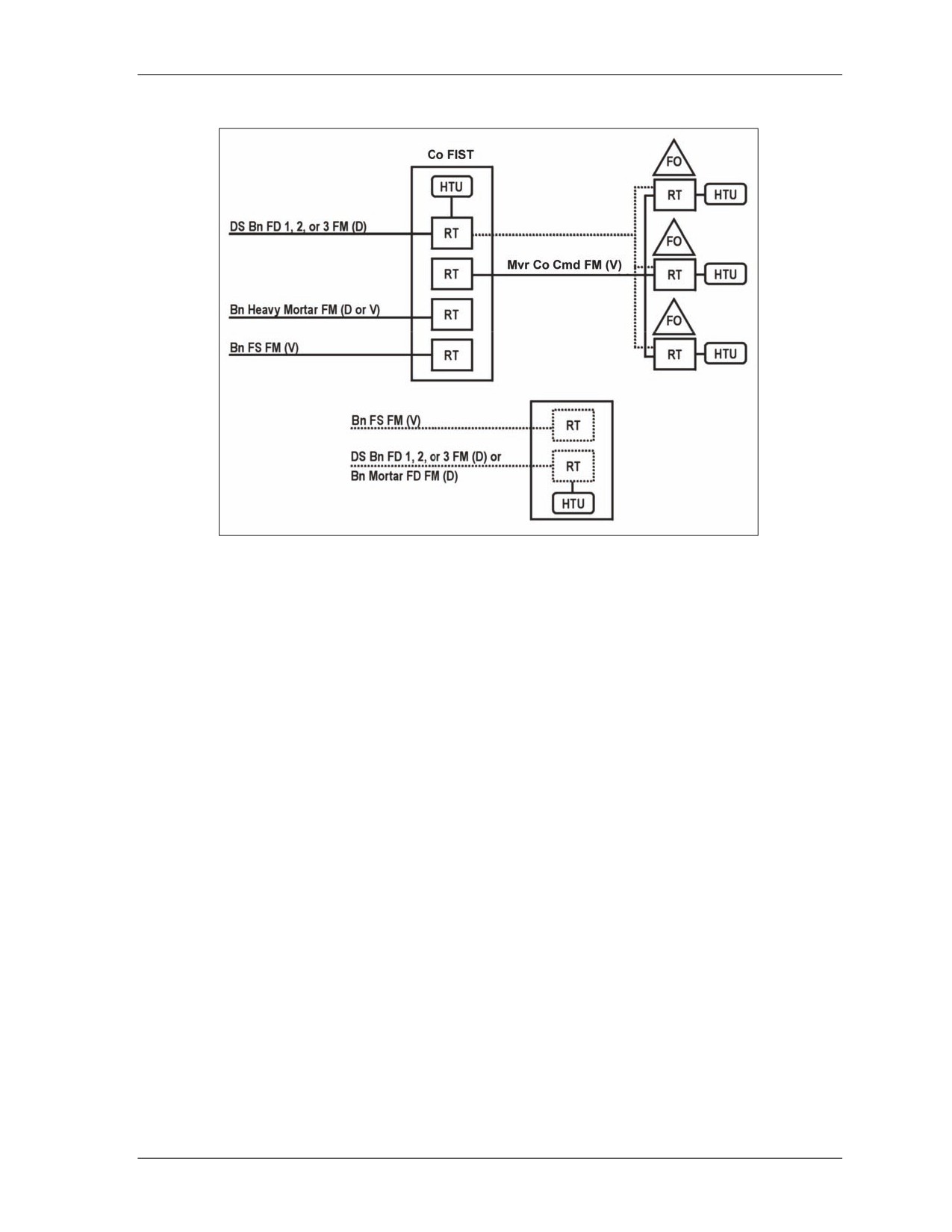
Maneuver Support
Figure 10-5. Company FIST communications.
COMPANY COMMAND NET FM (VOICE) AND FBCB2 (DIGITAL)
10-74. Platoon leaders, the XO, and attachments use this net to send reports, receive instructions, and
request fires. Any Strikers, Bradleys, or tanks attached to the company monitor this net. This net also
allows the FIST to monitor company operations and links it to the company commander, platoon leaders,
and observers for planning and coordination. The company headquarters is the net control station (NCS).
BATTALION MORTAR FIRE DIRECTION NET FM (VOICE)
10-75. Observers may use this net to request fires of the battalion mortar platoon. Other stations on the
net include the FIST headquarters and the battalion FSE. The battalion mortar platoon is the NCS.
BATTALION MORTAR FIRE DIRECTION NET (DIGITAL)
10-76. As necessary, the FIST sends fire missions to the supporting mortar platoon or section using
this net.
COMPANY MORTAR NET (VOICE)
10-77. Observers or the company FSO use this net to request fire from the company mortars.
DIRECT SUPPORT BATTALION FIRE DIRECTION NET FM (VOICE) AND DIGITAL
10-78. This net is used for FA fire direction. The FIST uses this net to relay calls for fire through the
battalion FSE to supporting artillery assets. The direct support battalion FDC is the NCS. When a Striker is
present, it uses this net to request FA fires. The battery FDC and battalion FSE are also on this net.
27 July 2006
FM 3-21.10
10-19
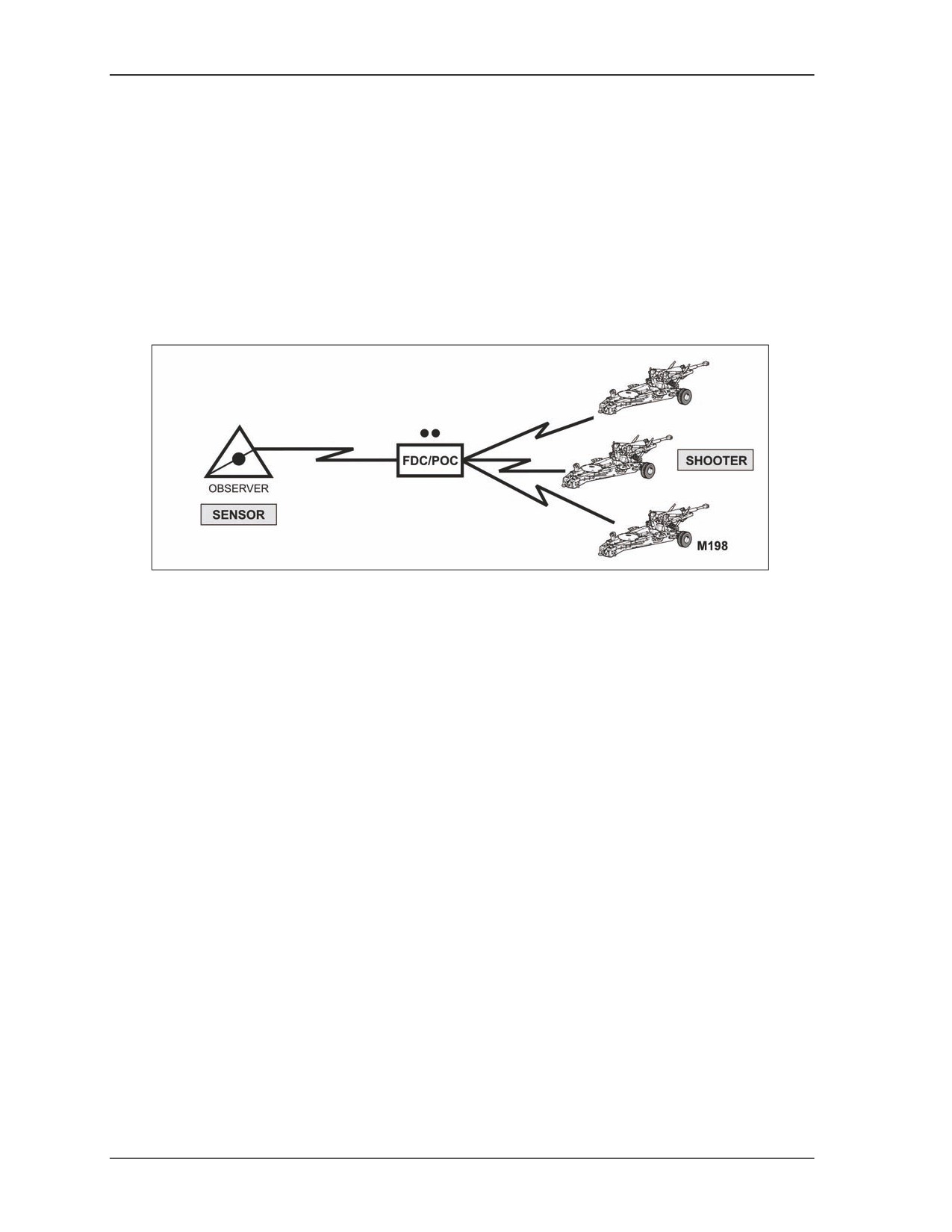
Chapter 10
QUICKFIRE CHANNEL
10-79. A QuickFire channel is established to link an observer (or other target executor) directly with a
weapon system (Figure 10-6). QuickFire channels might be either voice or digital nets. QuickFire channels
within a brigade combat team are normally established on FA or mortar nets. These channels are designed
to expedite calls for fire against HPTs or to trigger preplanned fires. QuickFire channels may also be used
to execute fires for critical operations or phases of the operation and to link an observer with a battery or
platoon FDC for counterreconnaissance fires. Copperhead missions can best be executed by using
QuickFire channels. The fire support coordinator or FSOs establish QuickFire channels and procedures
based on the commander's intent and the CONOP.
Figure 10-6. QuickFire channel illustration of sensor-to-shooter link.
INDIRECT FIRES IN CLOSE SUPPORT
10-80. Effective indirect fire support often requires artillery and mortar fires near friendly Infantry
Soldiers. A safe integration of fires and maneuver this close demands careful planning, coordination, and
knowledge of the supporting weapons. These close supporting fires are most commonly FPFs in a
defensive operation or suppression or obscuration fires to support an assault on an enemy position. When
planning these fires, the company commander considers.
EFFECTS
10-81. In the defense, this might be to destroy enemy Soldiers and to degrade the effectiveness of enemy
vehicles by causing them to fight buttoned-up. In the attack, the suppression/obscuration of enemy
positions to allow the breach and seizure of a foothold on the objective is probably the desired effect.
ACCURACY
10-82. Many variables affect the accuracy of the weapon. The FSO has the technical knowledge to assist
the company commander. Artillery and mortars are area weapons systems, which means that every round
fired from the same tube impacts in an area around the target or aiming point. This dispersion is greater in
length than in width. The weather conditions (wind, temperature, and humidity), the condition of the
weapon, and the proficiency of the crew also affect the accuracy.
10-20
FM 3-21.10
27 July 2006
Maneuver Support
PROTECTION
10-83. If the unit is in well-prepared defensive positions with overhead cover, an FPF can be adjusted
very close, just beyond bursting range. If required, the company commander can even call for artillery fires
right on his company position using proximity or time fuzes for airbursts. Calling for close indirect fires is
more dangerous during an attack. The commander considers the terrain, the breach site, and the enemy
positions to determine how close to adjust his supporting indirect fires.
INTEGRATION OF SUPPRESSIVE FIRES
10-84. When integrating indirect suppressive fires to support the breach and assault, the following points
are key.
y The danger increases with the size of the weapons. Use artillery to isolate the objective; use
mortars on enemy positions away from the breach site; and use the 60-mm mortars, M203s, and
direct fire weapons for close suppression.
y Assaulting perpendicular to the gun target (GT) line increases the probability of safety. If the
rounds are coming over the head of the assault element, the margin of safety is reduced.
y Company mortars firing direct lay or direct alignment are the most responsive system. They are
able to observe the rounds' impact and adjust accordingly. The safest method is to fire the
60-mm mortar with a bipod.
y Ideally, the firing units register prior to firing close-support missions. If not, the first rounds
fired might be off target by a considerable distance. Once the firing units are adjusted on a
target, then any shifts from that target are much more reliable.
TIMES AND CONTROLS
10-85. The final requirement for integrating these fires is to establish timings and control to ensure these
targets are initiated, adjusted, and shifted properly. If possible, the company FSO should locate where he
can observe these targets (possibly with the support element). A detailed execution matrix that assigns
responsibility for each target to the leader or observer who is in the best position to control them should be
developed. These Soldiers must know when each target, series, or group is fired, what effect is desired on
which enemy positions, and when to lift or shift the fires. Consider the use of pyrotechnic or other signals
to ensure communication.
ECHELONMENT OF FIRES
10-86. Company commanders will often find themselves as the observer (and executor) of battalion fires.
Understanding the concept of echelonment of fires is critical for the indirect fire plan to be effectively
synchronized with the maneuver plan. The purpose of echeloning fires is to maintain constant fires on a
target while using the optimum delivery system up to the point of its risk-estimate distance (RED) in
combat operations or minimum safe distance (MSD) in training (Table 10-4). Echeloning fires provides
protection for friendly forces as they move to and assault an objective, allowing them to close with minimal
casualties. It prevents the enemy from observing and engaging the assault by forcing the enemy to take
cover, allowing the friendly force to continue the advance unimpeded.
(Appendix A in this book;
FM 3-90.2; and Appendix E in FM 3-09.32 all provide more information on RED.)
10-87. The concept behind echeloning fires is to begin attacking targets on or around the objective using
the weapons system with the largest RED-combat (or MSD-training). As the maneuver unit closes the
distance, that is, crosses the RED line for that specific munition en route to the objective, the fires cease,
shift, or switch to a different system such as to the 81- or 60-mm mortar. This triggers the engagement of
the targets by the delivery system with the next largest RED-combat (or MSD-training). The length of time
to engage the targets is based on the rate of the friendly force's movement between the RED-combat (or
MSD-training) trigger lines. The process continues until the system with the least RED-combat (or
MSD-training) ceases fires and the maneuver unit is close enough to eliminate the enemy with direct fires
or make its final assault and clear the objective.
27 July 2006
FM 3-21.10
10-21

Chapter 10
10-88. The RED for combat (or MSD training) take into account the bursting radius of particular
munitions and the characteristics of the delivery system. It associates this combination with a probability of
incapacitation for Soldiers at a given range. The RED-combat (or MSD-training) is defined as the
minimum distance friendly troops can approach the effects of friendly fires without 0.1 percent or more
probability of incapacitation. A commander may maneuver their units into the RED-combat area based on
the mission. However, he is making a command decision to accept the additional risk to friendly forces.
WARNING
Risk estimate distances are for combat use and do not represent
the maximum fragmentation envelopes of the weapons listed.
Risk estimate distances are not minimum safe distances for
peacetime training use.
10-89. The casualty criterion is the 5-minute assault criterion for a prone Soldier. Physical incapacitation
means that a Soldier is physically unable to function in an assault within a 5-minute period after an attack.
A probability of incapacitation (PI) value of 0.1 percent can be interpreted as being less than or equal to
one chance in one thousand and a PI value of 10% is one chance in ten (Table 10-4 and Table 10-5).
Risk Estimate Distances (Meters)
10% PI
0.1% PI
1/3
2/3
Max
1/3
2/3
Max
System
Description
range
range
range
range
range
range
M224
60-mm mortar
60
65
65
100
150
175
M252
81-mm mortar
75
80
80
165
185
230
M120/121
120-mm mortar
100
100
100
150
300
400
M102/M119
105-mm howitzer
85
85
90
175
200
275
155-mm howitzer
100
100
125
200
280
450
M109/M198
155-mm DPICM
150
180
200
280
300
475
Table 10-4. Risk estimate distances for mortars and cannon artillery.
10-22
FM 3-21.10
27 July 2006

Maneuver Support
Risk Estimate Distance (meters)
Item
Description
10% PI
0.1% PI
MK-82 LD
500 lb. bomb
250
425
MK-82 HD
500 lb. bomb (retarded)
100
375
MK-82 LGB
500 lb. bomb (GBU-12)
2501
4251
MK-83 HD/LD
1,000 lb. bomb
275
475
MK-83 LGB
1,000 lb. bomb (GBU-16)
2751
4751
MK-84 HD/LD
2,000 lb. bomb
325
500
MK-84 LGB
2,000 lb. bomb (GBU-10/24)
2251
5001
MK-202
Rockeye
150
225
MK-77
500 lb. Napalm
100
150
1
1
CBU-55/772
Fuel-air explosive (FAE)
CBU-522
CBU (all types)
275
450
CBU-58/712, 3
CBU (all types)
350
525
CBU-872
CBU (all types)
175
275
CBU-89/783
CBU (all types)
175
275
2.75" folding fin aircraft
Rocket with various warheads
160
200
rocket (FFAR)
5" Zuni
Rocket with various warheads
150
200
1
1
SUU-11
7.62-mm minigun
M-4, M-12, SUU-23, M-61
20-mm Gatling gun
100
150
GAU-12
25-mm gun
100
150
GPU-5a, GAU-8
30-mm Gatling gun
100
150
AGM-655
Maverick (TV, IIR, laser-guided)
25
100
MK-1/MK-21
Walleye II (1,000 lb. TV-guided bomb)
275
500
1
1
MK-5/MK-23
Walleye II (2,400 lb. TV-guided bomb)
AC-130
105-mm cannon.
80 4
200 2
40-/25-/20-mm gun
35
125
1 Risk-estimate distances are to be determined. For LGBs, the values shown are for weapons that do not guide and that follow a
ballistic trajectory similar to general purpose bombs. This does not apply to GBU-24 bombs, because GBU-24s do not follow a
ballistic trajectory.
2 Not recommended for use near troops in contact.
3 CBU-71/CBU84 bombs contain time-delay fuzes, which detonate at random times after impact. CBU-89 bombs are antitank and
antipersonnel mines and are not recommended for use near troops in contact.
4 AC-130 estimates are based on worse case scenarios. The 105-mm round described is the M-1 HE round with M-731 proximity
fuze. Other fuzing would result in smaller distances. These figures are accurate throughout the firing orbit. The use of no-fire
headings has no benefits for reducing risk-estimate distances and should not be used in contingency situations.
5 The data listed applies only to AGM-65 A, B, C, and D models. AGM-65 E and G models contain a larger warhead. Risk-estimate
distances are unknown.
Table 10-5. Risk estimate distances for aircraft-delivered ordnance.
10-90. Using echelonment of fires within the specified RED-combat (or MSD-training) for a delivery
system requires the unit to assume some risks. The maneuver commander determines, by delivery system,
how close he will allow fires to fall in proximity to his forces. The maneuver commander makes the
decision for this risk level, but he relies heavily on the FSO's expertise. The commander considers the
effects of terrain and weather, the experience of the observers, and communication systems involved.
While this planning is normally accomplished at the battalion level, the company FSO has input and should
be familiar with the process.
27 July 2006
FM 3-21.10
10-23