FM 3-21.10 (FM 7-10) The Infantry Rifle Company (July 2006) - page 16
Appendix H
Combat Lifesaver
H-22. The CLS must check to verify if the individual has received three sets of the Mark I. If not, the
CLS performs first aid as described for buddy aid. If the person has received the first three sets of Mark I,
then the CLS may administer additional atropine injections at approximately 15 minute intervals until
atropinization is achieved (that is, a heart rate above 90 beats per minute; reduced bronchial secretions; and
reduced salivation). Administer additional atropine at intervals of 30 minutes to 4 hours to maintain
atropinization or until the casualty is placed under the care of medical personnel. Check the heart rate by
lifting the casualty's mask hood and feeling for a pulse at the carotid artery. Request medical assistance as
soon as the tactical situation permits.
Combat Medic or Corpsman
H-23. A casualty has received three sets of Mark I; however, atropinization has not been achieved.
Administer additional atropine at approximately 15 minute intervals until atropinization is achieved (that is
a heart rate above 90 beats per minute; reduced bronchial secretions and reduced salivations). Administer
additional atropine at intervals of 30 minutes to 4 hours to maintain atropinization or until the casualty is
evacuated to an MTF. Check the heart rate by lifting the casualty's mask hood and feeling for a pulse at the
carotid artery. Provide assisted ventilation for severely poisoned casualties, if equipment is available.
Monitor the patient for development of heat stress.
CONVULSANT ANTIDOTE FOR NERVE AGENTS
H-24. The following principles apply to the administration of a convulsant antidote for nerve agent
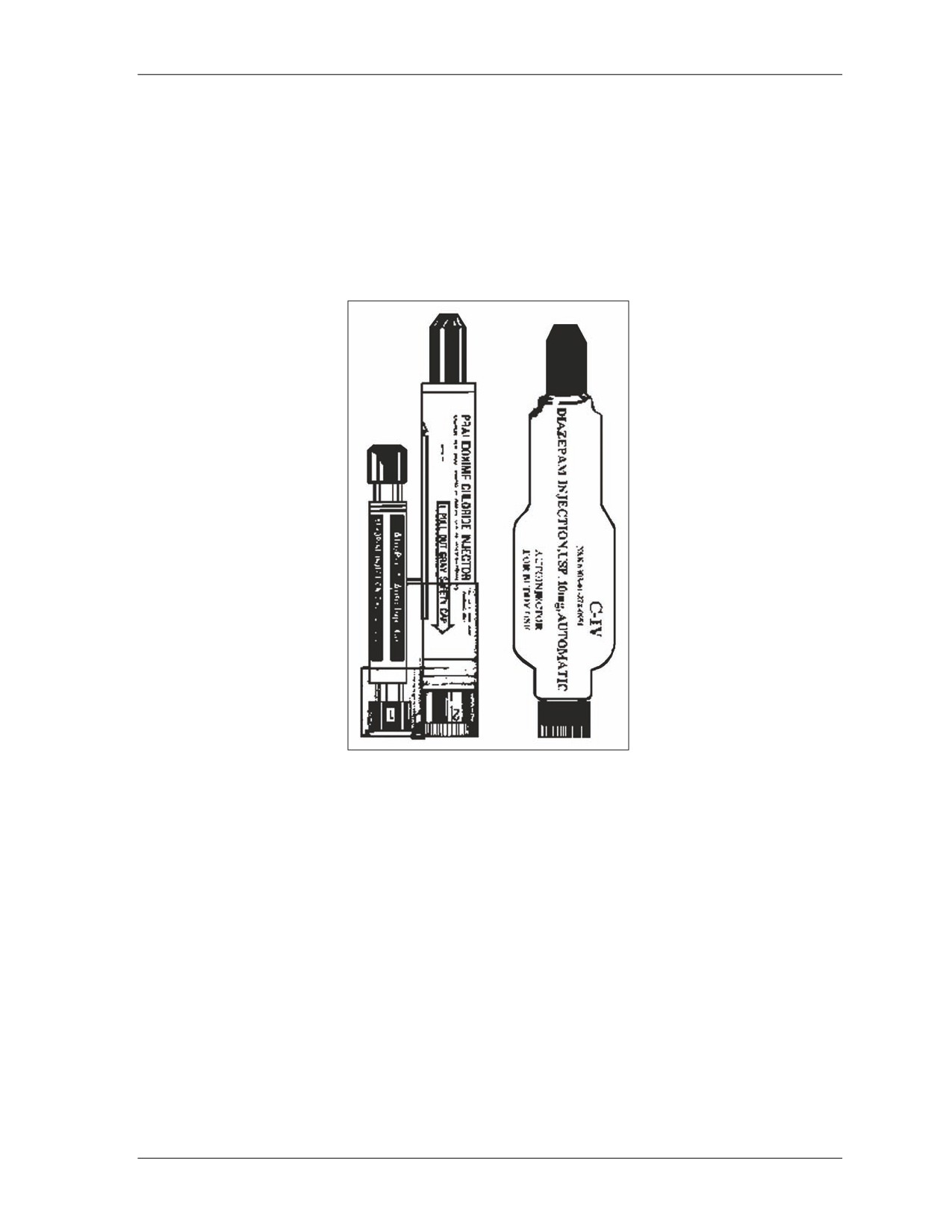
(CANA) (Figure H-1).
Self-Aid
H-25. The CANA is not for self-aid. If you know who and where you are and what you are doing, you
do not need CANA. If symptoms fail to subside after self-administering one Mark I, seek assistance from
a buddy.
Buddy Aid
H-26. In addition to administering the Mark I antidotes for nerve agents as buddy aid, also administer
the CANA. Mask the casualty, if necessary. Do not fasten the hood. Administer the CANA with the third
Mark I to prevent convulsions. Do not administer more than one CANA.
CAUTION
Use the casualty's CANA when providing aid. Do not use your own
CANA. If you do, you might not have any antidote available when
needed for self-aid.
H-6
FM 3-21.10
27 July 2006
Operations in a Chemical, Biological, Radiological, or Nuclear Environment
Combat Lifesaver and Medic or Corpsman
H-27. The CLS, medic, or corpsman should administer additional CANA to casualties suffering
convulsions.
y Administer a second and, if needed, a third CANA at 5 to 10 minute intervals up to three
injections, which is a total of 30 mg of diazepam.
y Follow the steps and procedures described in buddy aid for administering the CANA. Do not
give more than two additional injections for a total of three (one buddy aid plus two by CLS,
medic, or corpsman).
Figure H-1. Nerve agent antidote Mark I and CANA.
27 July 2006
FM 3-21.10
H-7
Appendix H
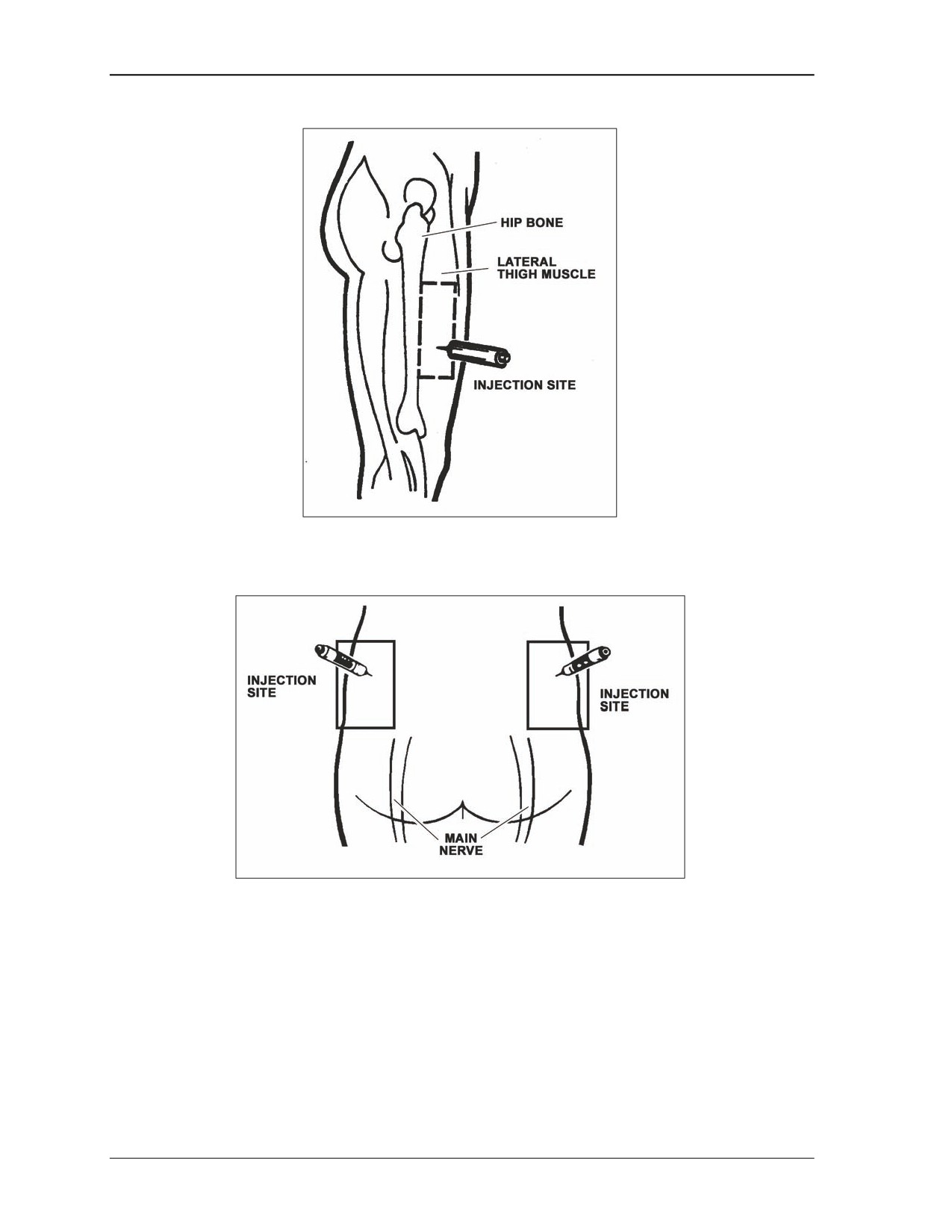
Figure H-2. Thigh injection site.
Figure H-3. Buttocks injection site.
BIOLOGICAL AGENTS
H-28. A biological agent is a microorganism that causes disease in personnel, plants, or animals or that
causes the deterioration of material.
TYPES
H-29. Biological agents can be classified as toxins, pathogens, bioregulators, or prions.
H-8
FM 3-21.10
27 July 2006
Operations in a Chemical, Biological, Radiological, or Nuclear Environment
Toxins
H-30. Toxins are poisonous substances produced from living organisms and--
y Can be synthesized (artificially produced).
y Mirrors the symptoms of nerve agents.
y Presents 8 to 12 hours of tactical concern before the sun destroys them.
y Can be fast acting (neurotoxins) or slower acting (cytotoxins).
Pathogens
H-31. These are infectious agents, such as bacteria, viruses, and rickets, which cause disease in man and
animals. Pathogens have the following characteristics.
y Delayed reaction (incubation 1 to 21 days).
y Capability of multiplying and overcoming natural defenses.
y Vectors (disease-infected insects) that can get around, into, or through protective clothing and
prolong hazards.
Bioregulators
H-32. Bioregulators include biochemical compounds that regulate cell processes and physiologically
active compounds such as catalysts and enzymes. Although they can be found in the human body in small
quantities, introduction of large quantities can cause severe adverse effects or death.
Prions
H-33. Prions are proteins that cause neurodegenerative diseases in humans and animals. Proteins have a
unique, genetically defined amino acid sequence that determines their specific shapes and functions. When
prions enter brain cells, they apparently convert normal proteins into prions. Ultimately, the infected brain
cells die and release prions into the tissue, causing continuing cell destruction. Prions entered the public’s
consciousness during the mad cow epidemic that hit England in 1996.
PROTECTIVE MEASURES
H-34. Protective measures against biological attack include--
y Up-to-date immunizations.
y Good hygiene.
y Area sanitation.
y Physical conditioning.
y Water purification.
RADIOLOGICAL WEAPONS
H-35. A radiological dispersal device (RDD) is a conventional bomb, not a yield-producing nuclear
device. An RDD disperses radioactive material to destroy, contaminate, and injure. An RDD can be almost
any size.
TYPES
H-36. The types of RDDs follow.
27 July 2006
FM 3-21.10
H-9
Appendix H
Passive
H-37. A passive RDD is unshielded radioactive material that is dispersed or placed manually at
the target.
Explosive ("Dirty Bomb")
H-38. An explosive RDD--often called "dirty bomb" is any system that uses the explosive force of
detonation to disperse radioactive material. A simple explosive RDD consisting of a lead-shielded
container--commonly called a "pig"--with a kilogram of explosive attached could easily fit into a backpack.
Atmospheric
H-39. An atmospheric RDD is any device that converts radioactive materials into a form that is easily
transported by air currents.
EMPLOYMENT
H-40. Use of an RDD by terrorists could result in health, environmental, political, social, and economic
effects. It would cause fear, injury and, possibly, levels of contamination requiring costly and
time-consuming cleanup efforts. Hospitals, universities, factories, construction companies, and laboratories
are possible sources for the materials needed to produce an RDD.
H-41. Friendly force avoidance and defensive measures are much the same as for other terrorist attacks,
but prevention relies heavily on successful intelligence efforts.
H-42. Decontamination and casualty treatment are much the same as for exposure to the radiation in
nuclear radiation.
NUCLEAR WEAPONS
H-43. Soldiers should know the effects of nuclear explosions and how to protect themselves from them.
EFFECTS
H-44. The following are effects of nuclear detonations.
Blast
H-45. High-pressure shock wave crushes structures and causes missiling damage.
Thermal Radiation
H-46. Intense heat and extremely bright light cause burns, temporary blindness, and dazzle.
Nuclear Radiation
H-47. Energy released from nuclear detonation produces fallout in the form of initial and residual
radiation, both of which can cause casualties.
Electromagnetic Pulse
H-48. A surge of electrical power occurs within seconds of a nuclear detonation, damaging electrical
components in equipment (radios, radar, computers, and vehicles) and weapons systems (TOW, Javelin).
H-10
FM 3-21.10
27 July 2006
Operations in a Chemical, Biological, Radiological, or Nuclear Environment
PROTECTION FROM NUCLEAR ATTACK
H-49. Cover and shielding offers the best protection from the immediate effects of a nuclear attack. This
includes cover in fighting positions, culverts, and ditches. Soldiers should cover exposed skin and stay
down until the blast wave passes and debris stops falling. Immediately after a nuclear attack, the platoon
leader should begin continuous monitoring for radiation using the AN/VDR-2 radiacmeter.
27 July 2006
FM 3-21.10
H-11
This page intentionally left blank.
Appendix I
Media Considerations
This appendix introduces the concepts of media considerations. Today, the media is
present in most military operations and can immediately transmit what they see and
hear. The powerful images and words they project can affect national policy. With
our form of government, the media have the right to cover operations, and the public
has a right to know what the media have to say. Unfortunately, many in the media
lack a full understanding of the military, yet they are the key conduits of information
about the Army to the public. Many good things about the Army are unknown to the
public. Commanders and public affairs personnel have a responsibility to tell the
Army story.
Freedom of the press does not negate the requirement for OPSEC and the
accomplishment of the military mission. This appendix discusses how to deal
appropriately with the media.
OBJECTIVE
I-1.
In dealing with the media, the objective of all Infantry leaders is to ensure that operations are
presented to the American public and audiences around the world in the proper context. Commanders and
leaders can best achieve this goal by educating Soldiers and subordinate leaders about the positive aspects
of a well-informed public.
REALITY
I-2.
Today, keeping secret the fact of a large-scale military movement or operation is almost
impossible. Our society as a whole understands and accepts freedom of the press and understands that
different or competing viewpoints on issues are normal, indicating a healthy, open society.
I-3.
News coverage for deployments is immediate and worldwide. The Army cannot and should not
control--or try to manipulate--media messages or stories.
I-4.
The media will go everywhere it can to uncover unique angles and stories. They try to gather their
information firsthand. Some members of the media have not served in the military. Many do not
understand military nuances. However, during Operation Iraqi Freedom, members of the media were
embedded with combat units. This strategy succeeded: the reporters understood and reported combat better
at the small unit level. They were able to see and experience first-hand what the Soldiers did. Embedding
reporters will most likely be used again in future combat.
OBJECTIVES AND INTERESTS
I-5.
The media wants access to Soldiers and units, which embedded reporters provide. The media
accepts media pools if required. They seek fresh stories every day and expect daily authoritative briefings
from operators and leaders. The press also wants the Soldiers' perspective. They want to discuss the ROE
and issues related to them. Also, large on the press list are any US casualty figures, both actual and
projected. These events should neither be emphasized or deemphasized. They are part of continuing
military operations. Simply tell the media the truth, but focus only on events at your level and on
known facts.
27 July 2006
FM 3-21.10
I-1
Appendix I
CAPABILITIES
I-6.
With available technology, the media have the capability to collect and transmit images and
sounds worldwide and live from any location. They can cover events quickly, and can influence the public
either positively or negatively. With interest high in worldwide deployments, the media can send large
numbers of reporters to cover operations in detail.
COMMAND CONSIDERATIONS
I-7.
Commanders must anticipate, prepare, and respond within 12 to 24 hours to breaking events.
Otherwise, it is difficult or impossible to explain or counter what has already appeared on the television or
in print. When the released report is inaccurate, the commander should aggressively counter the false
report with timely and accurate information backed up by subject matter experts. It is also important to
coordinate statements among agencies. Bad news does not get better with time and ignoring the media does
not make them go away but usually creates or fosters an adversarial relationship. If the commander refuses
to talk to the media, he only guarantees the military’s perspective will not be seen or heard. The
commander must balance his time with the news media to avoid being overexposed or ignored.
GUIDELINES
I-8.
The following are general guidelines for dealing with the media. These guidelines must be
tempered with the public’s right to know and the requirements of OPSEC.
SECURITY CONSIDERATIONS
I-9.
It is important that all Soldiers understand what is classified and not discuss it with the press.
Embedded media agreed prior to Operation Enduring Freedom not to report classified or current
operations, and except for a very few exceptions, the media did not report OPSEC material. Soldiers
should also understand that they are not required to talk to the media if it is against their wishes.
Precautions should be taken to protect classified information from the news media that are not embedded.
If someone accidentally reveals classified information, the reporter should be informed, the situation
should be explained, and he or she should be asked not to report the information. All such incidents must
be reported to the chain of command. All Soldiers represent the military; they should not guess or speculate
on things they do not know. Anything said could be in the hands of the enemy in minutes. Grumbling or
thoughtless complaining provide the enemy with propaganda to use against the military. The media must
be prevented from televising nearby recognizable landmarks, sensitive equipment, or operational or
classified information contained in the CP. The reasons for interfering with the telecast should be explained
to the press.
MEDIA CONTROLS
I-10.
Media in the AO should be checked to ensure that they are certified, and a military escort should
escort them at all times for their safety. An interview should not be scheduled when it could interfere with
the mission. Media material or equipment should not be confiscated, even in an effort to prevent the
disclosure of classified information.
TOPICS AND STATEMENTS TO AVOID
I-11.
Neither the commander nor any member of his command should discuss political or foreign policy
matters. These are outside the direct purview of the military and would be purely speculative. No Soldier
should discuss matters about which he does not have direct knowledge. Operational capabilities, including
exact numbers or troop strengths, numbers or types of casualties, types of weapons systems, and plans,
should not be discussed with the press.
I-2
FM 3-21.10
27 July 2006
Media Considerations
INTERVIEWS
I-12.
Any Soldier might be requested to grant an interview. This should be considered an opportunity to
ensure that the needs of the media are met by providing accurate, timely, and useful information.
MAINTAIN A PROFESSIONAL ATTITUDE
I-13.
Know exactly what your message is before you begin the interview. You should have a series of
"talking points" that you are comfortable discussing. Keep your comments in line with these points.
Remain in control even when the media are aggressive or ask silly questions. Be polite but firm. Be brief
and concise; use simple language. Control the tempo of the questions if more than one reporter is present
and asking questions. Do not use jargon or acronyms; the public does not know what they mean. Do not
speculate and do not talk about issues or subjects that are not applicable to your position or level, for
example, a rifleman should not talk about battalion or brigade issues. Instead, he should focus on his team
and squad.
MAKE A GOOD IMPRESSION
I-14.
Relax and be yourself. Ignore the cameras and talk directly to the reporter. Remove your
sunglasses so the audience can see your eyes. Do not smoke or dip during the interview. Do not use
profanity. Use appropriate posture and gestures.
THINK FIRST
I-15.
Always stop and think before answering; questions need not be answered instantly. Answer only
one question at a time. Do not be badgered or harassed. Correct answers are more important than deadlines.
Do not get angry.
KNOW QUESTION
I-16.
If you do not understand the question, ask the reporter to rephrase it. Know the question you are
answering. Do not answer "what if" questions or render opinions. Reporters may ask the same question in
different ways so stay consistent.
REMEMBER THAT EVERYTHING COUNTS
I-17.
Everything is on the record. You may be friendly, but stick to business. The interviewer chooses
the questions; but you choose the answers.
ASK YOURSELF--CAN MY ANSWER STAND ALONE?
I-18.
Videotape and print media will not include the question, just your answer. Your answer should
stand alone. If the interviewer uses a catch phrase, such as "assassination squad," carefully resist using it in
your answer. For example, someone asks you, "What are you doing about the assassination squads?" A
good answer might be, "We are committed to investigating this matter. We will take the necessary and
appropriate action." You might also include the original question in your answer to help keep your
answers in context.
SPEAK ABOUT WHAT YOU KNOW
I-19.
If you do not know the answer, simply say so, "I do not know." That answer rarely appears in
print. Avoid speculation or answering a question more appropriate for the Secretary of Defense. Talk about
your area of expertise.
27 July 2006
FM 3-21.10
I-3
Appendix I
TELL TRUTH
I-20.
Tell the truth. Never cover embarrassing events with a security classification. Never lie to
the media.
TRAINING FOR MEDIA AWARENESS
I-21.
Units should train for media awareness in two parts, first in a classroom, then in the field.
CLASSROOM PHASE
I-22.
OPSEC should be covered thoroughly. Many of the things outlined in this appendix should be
discussed with Soldiers and leaders. If a media card is available in the command, it should be explained in
detail. Soldiers should be instructed on how to give an interview and their right to refuse to do so. Leaders
should understand their responsibility to tell the Army’s story truthfully, and in a way that the public will
understand it.
FIELD PHASE
I-23.
Soldiers should be given an opportunity to participate in an interview using Soldiers who
role-play as reporters. If possible, the role-playing Soldiers should be qualified in public affairs training.
This training should be included in regular field training exercises. If a video camera is used during the
interview, the tape can be replayed during an AAR. Due to the possible far reaching effects of interviews,
this training should receive considerable command emphasis.
MEDIA CARDS
I-24.
If higher headquarters has not developed a media card, the commander should ask the PAO to
do so. If they do not or cannot, the commander should consider making one for the company. A media card
should state--
y Who Soldiers should contact and how to contact them if reporters show up in the area
unannounced.
y Responsibilities of a media escort.
y What information you may or may not discuss.
y When to allow a media interview.
y How to treat reporters.
y How to conduct an interview.
y The best techniques to use in telling the Army’s story.
I-4
FM 3-21.10
27 July 2006
Appendix J
Pattern Analysis and Situational Understanding
This chapter introduces concepts of pattern analysis and situational understanding to
assist the commander in gaining rapid tactical insight and enable planning in a
diminished time frame.
Developing valid and relevant situational understanding (SU) of the operational
environment
(OE) requires the personal attention and effort of each
individual commander.
Pattern analysis and information-gathering operations enhance and contribute to the
commander's force-protection program, SU, and battlefield vision. They portray
relevant environmental and threat information that could affect the commander's
operational and tactical environment.
For the commander to develop a relevant and timely understanding of the OE, he
must logically and diligently collect, organize, and study all the information he can,
from all sources, about all facets of the OE. This includes, among other things,
information about friendly, enemy, and noncombatant forces; about cultural and
ethnic considerations; about short and long term goals; and about IO campaigns.
GATHERING OF INFORMATION
J-1.
The first steps to developing SU of the operational environment are information gathering and
pattern analysis. For the commander to assume an offensive orientation rather than a reactionary one, he
must have developed enough SU to perform accurate pattern and predictive analysis. This is likely to be a
relatively long term and potentially time consuming process, but it will yield actionable information that
will allow the commander to take the fight to the enemy and substantially increase the commander's ability
to protect his force. Information gathering occurs continuously during the conduct of day-to-day
operations. This information, which might be police, criminal, or combat, is provided as input to the
intelligence collection effort and turned into action or reports. The information collected during the
conduct of operations is analyzed at the commander's level and reported up through the proper channels so
that it can be analyzed by higher headquarters. Every Soldier in the unit should know what information is
required and how to report it. Every member of every patrol or mission should be specifically tasked to
collect information and each member should be debriefed after every mission accordingly. Information is
gathered while conducting combat operations and other operations such as--
y Patrolling. Every Soldier in every patrol should be tasked to collect information.
y Checkpoints and roadblocks.
y Traffic control points.
y Field interviews.
y Reconnaissance (zone, area, and route).
y Cordon and search.
y Soldier and leader observations of the daily operational environment.
y Local and international media sources such as newspapers, flyers, radio, TV, gossip,
and graffiti.
27 July 2006
FM 3-21.10
J-1
Appendix J
SOURCES
J-2.
Collection can result primarily in combat information, but may lend to police or criminal
information. Units collect information throughout the entire AO. Soldiers and leaders gather information
from contacts that are often very valuable in substantiating or verifying other sources of information. These
sources include--
y Daily contact with the local populace.
y Combined patrols with HN police, military police, and civilian police agencies.
y Close liaison with local, HN, and multinational police agencies.
y Field interviews.
y Nongovernmental organizations (NGOs).
y Private volunteer organizations (PVOs).
ASSESSMENT
J-3.
Pattern analysis and the information assessment process (IAP) are tools used to contribute to SU.
Information gained through the IAP may contribute independently or simultaneously to the all source
analysis product (ASAP) and the IPB process. Pattern analysis, the IAP, the ASAP, and the IPB enhance
and support the commander's force protection program, SU, and battlefield vision. The IAP independently
or collectively--
y Provides the commander with information necessary to improve measures to protect the forces.
y Provides information that clarifies the threat and operational situation.
y Reduces opportunities for threat forces to disrupt military operations and inflict friendly
casualties.
OPERATIONAL VARIABLES
J-4.
Commanders continually monitor their operational environment at the tactical level consistent
with METT-TC. They apply the military aspects of terrain (OAKOC) as a means of protecting the force.
Commanders will also find it useful to use the operational environment variables as a method to analyze
information. Information is used to clarify the evolving operational, tactical, and criminal threat picture for
commanders through pattern analysis and the IAP. This helps planners predict threat COAs against our
forces or protected populations. Operational environment variables include--
y The physical environment (status of or changes in).
y Nature and stability of the enemy state, sponsor, and population.
y Military capabilities of the enemy state or sponsor.
y Technology available to US, enemy forces, and noncombatant population.
y Information warfare/PSYOPs considerations.
y External organizations (government and nongovernment).
y Sociological demographics and population considerations.
y Regional and global political and strategic relationships.
y US and enemy national will.
y Time.
y Economics.
COLLECTION
J-5.
Units gather information actively or passively. Active collecting efforts result from a direct
tasking, while passive collecting efforts result from normal, daily operations.
J-2
FM 3-21.10
27 July 2006
Pattern Analysis and Situational Understanding
ACTIVE MODE
J-6.
Units gather information in the active mode when the commander directs or when directed by the
higher headquarters. In this mode, the unit conducts specific missions with the intent to actively collect
information. Specific activities, such as setting up a checkpoint or roadblock, are performed to fulfill a
specific requirement. Examples of such requirements include looking for people who have weapons or
military property, or who know others who do. Valuable information is gathered during these operations.
The leader determines the scope of the IAP by--
y Reviewing pattern analysis and trends developed to that point.
y Conducting a detailed mission analysis.
y Reviewing the mission of the higher headquarters and the commander's intent.
y Reviewing the CCIR (PIR and FFIR).
y Reviewing the EEFI.
y Reviewing mission priorities.
y Determining the AO and AI.
y Reviewing the IPB estimates of the higher headquarters.
y Determining the required information products.
J-7.
Assemble the working aids and--
y Post the applicable maps with all applicable operational overlays.
y Post population and other pertinent demographic maps or overlays.
y Acquire crime statistics and other related data.
y Obtain language aids such as cultural references, and arrange for interpreters.
y Acquire the necessary automation equipment.
J-8.
Recommend and supervise police, criminal, and combat collection efforts by--
y Coordinating with the S-2, the G-2, the SJA, the CID, adjacent or supporting Joint or SOF unit,
and other applicable agencies before initiating a collection effort.
y Determining the criteria to satisfy information requirements.
y Providing collectors with reporting instructions such as the reporting frequency and the report
format.
y Monitoring information collection efforts to prevent duplication of efforts.
y Determining the best methods
(memory, photography, digital) to physically record the
information.
J-9.
Process police, criminal, and combat raw data by--
y Assembling and assessing the reliability of the data.
y Integrating information from the collectors
(other organizations collecting information in
the field).
y Conducting pattern analysis (developing trends and indicators).
y Always conducting immediate AARs of the collection effort.
J-10.
Report and disseminate information assessment by--
y Recommending actions to improve and focus future collection efforts.
y Reporting information assessments to the S-2 or the G-2.
y Disseminating information to the unit.
y Modifying or improving the unit's force protection status and actions based on the information.
y Reviewing and ensuring that the release of information assessments do not violate established
guidelines and constraints.
27 July 2006
FM 3-21.10
J-3
Appendix J
J-11.
Standardized checklists enhance the collection effort and aid in the analysis of the information
collected. They also give Soldiers a means by which to organize their thoughts and personal collection
efforts and aid in debriefings. The checklist indicates a pattern in the behavior of the local population or
enemy forces. It shows, among other things, what the local nationals are transporting, and where they are
transporting the items. The checklist may include--
y The number and types of vehicles stopped. Identifying marks, license plate numbers, and any
signs displayed on the vehicles are recorded and reported.
y The number of passengers in the vehicle. The nationality, age, and gender mix of the
passengers are recorded and reported.
y The type and quantity of cargo.
y The vehicle's point of origin and destination.
y The stated reason for travel by the passengers.
y The description of arms, ammunition, explosives, communications equipment, and sensitive
items found, observed, or confiscated from the vehicle.
y The possible or actual sightings of weapons, explosives, or threat forces by the passengers.
y The condition of the passengers.
y Apparent or perceived nationality or ethnicity/clan of passengers.
y Reports of anything unusual by the passengers.
y Location and time of incident, attack, or ambush.
y A change or trend noticed in apparent enemy tactics, weapons, or composure.
J-12.
Digitally photographing or recording the collection effort and information acquired will allow the
commander and higher headquarters to more efficiently and effectively study and disseminate the
information. Digitally capturing information also allows the rapid sharing of information via electronic
means. Commanders should also consider using recording or filming methods to monitor relatively
stationary activities remotely. For example, they could set up cameras in a parking garage. Information
recorded this way can prove useful in studying or recreating events.
PASSIVE MODE
J-13.
Every Soldier gathers information in the passive mode during his normal day-to-day operations.
In the passive mode, information gathering is not a stand-alone function and as such, it cannot be separated
from other operations. If while conducting operations, a Soldier receives, observes, or encounters police,
criminal, or combat information, he immediately submits a SALUTE, SPOTREP, or other appropriate
report to relay information up the chain of command. Soldiers should report any suspicious activity without
trying to distinguish whether the information is police, criminal, or combat in nature. The information is
then integrated into the ongoing IAP and pattern analysis and forwarded to the higher echelon S-2 and G-2
for IPB applications.
RECORDS
J-14.
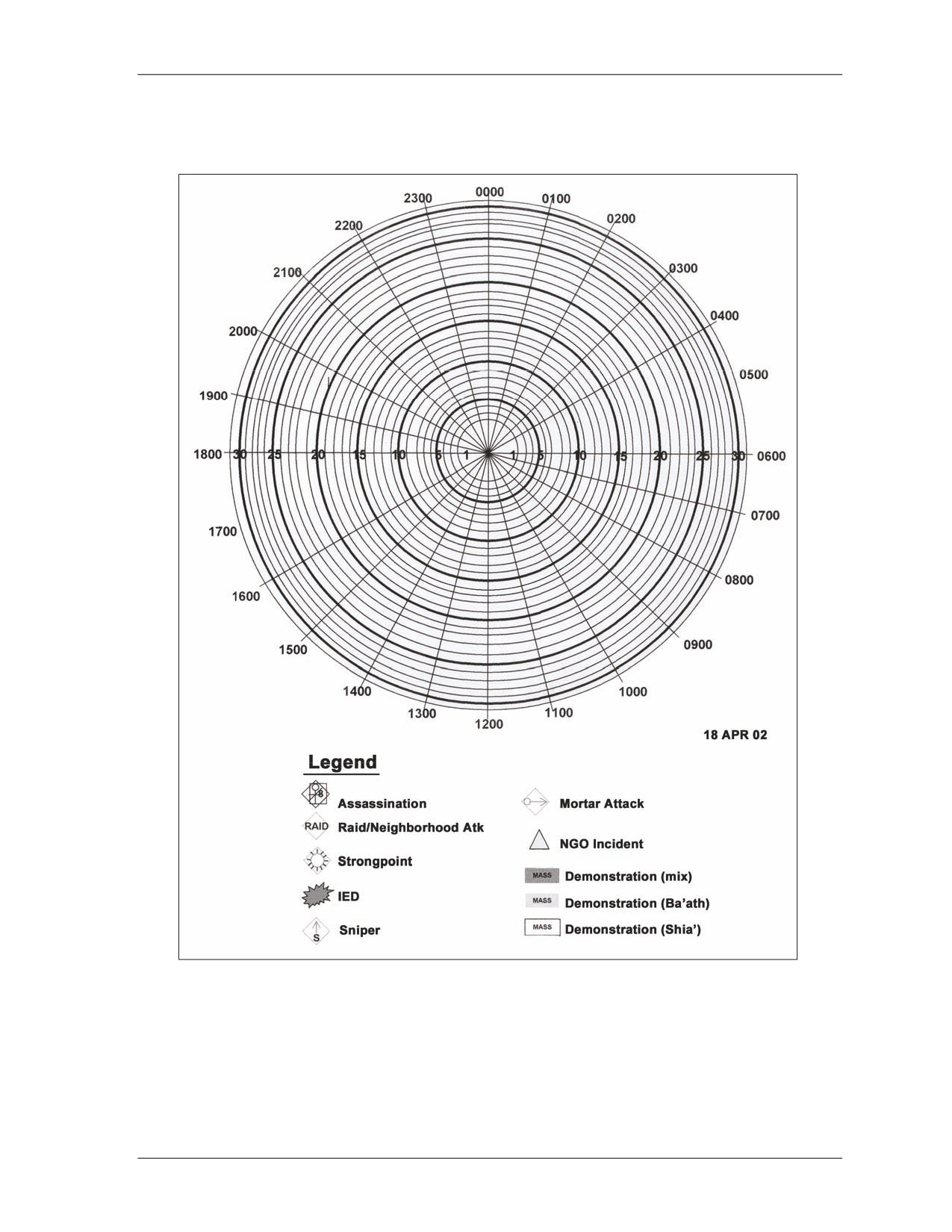
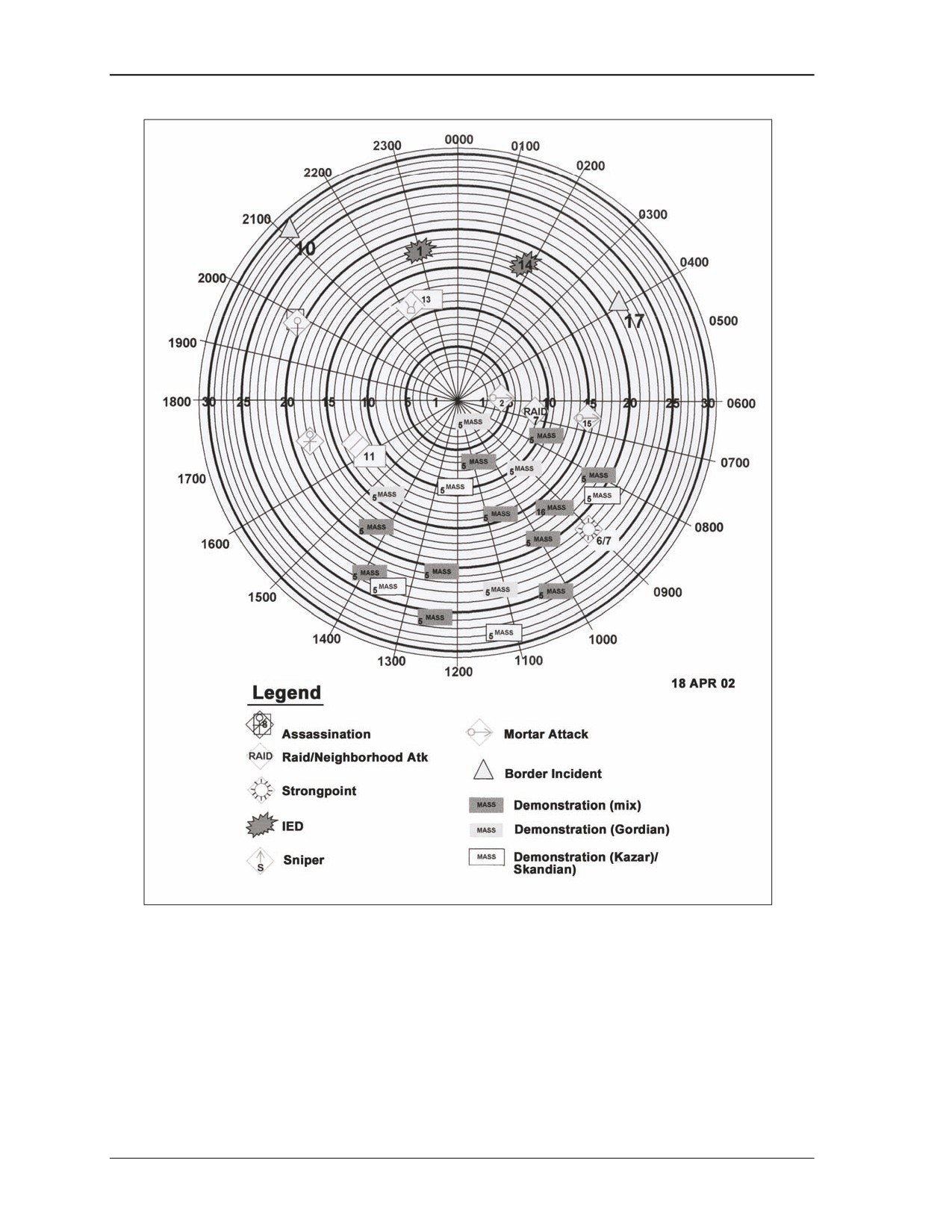
The commander should construct a time pattern analysis worksheet to record the date and time of
each relevant event, collection, or serious incident in his AO or AI. In these examples (Figure J-1 and
Figure J-2), the rings show the days of the month, the segments show the hours of the day. (See also
Chapter 3, FM 34-130.) Similar tools help distinguish patterns in activity that are tied to particular days,
dates, or times. The commander can adopt this format or modify as he sees fit. It will likely be useful to
make the pattern analysis wheel as large as possible and post it in an area where subordinate leaders and
Soldiers can study it while maintaining OPSEC. The commander also maintains maps of the AO showing
the location of events linked to pattern analysis.
J-15.
As the unit begins to collect information and the commander receives additional information from
higher and adjacent units, he begins to post or display this information on the pattern analysis wheel and on
maps of the AO/AI. Using this displayed information; intuition and experience of his subordinates, local
J-4
FM 3-21.10
27 July 2006
Pattern Analysis and Situational Understanding
authorities, or HN personnel; and historical examples, the commander can begin to identify trends,
patterns, and specific AIs or danger within the assigned AO/AI.
Figure J-1. Example 1, pattern analysis.
27 July 2006
FM 3-21.10
J-5
Appendix J
Figure J-2. Example 2, pattern analysis.
POPULATION CONSIDERATIONS
J-16.
The commander will probably determine that the local population is one of the most important
characteristics of the operational environment/battlefield, and will likely have a major influence on both
friendly and enemy COAs. Accordingly, he should prepare one or more population status overlays
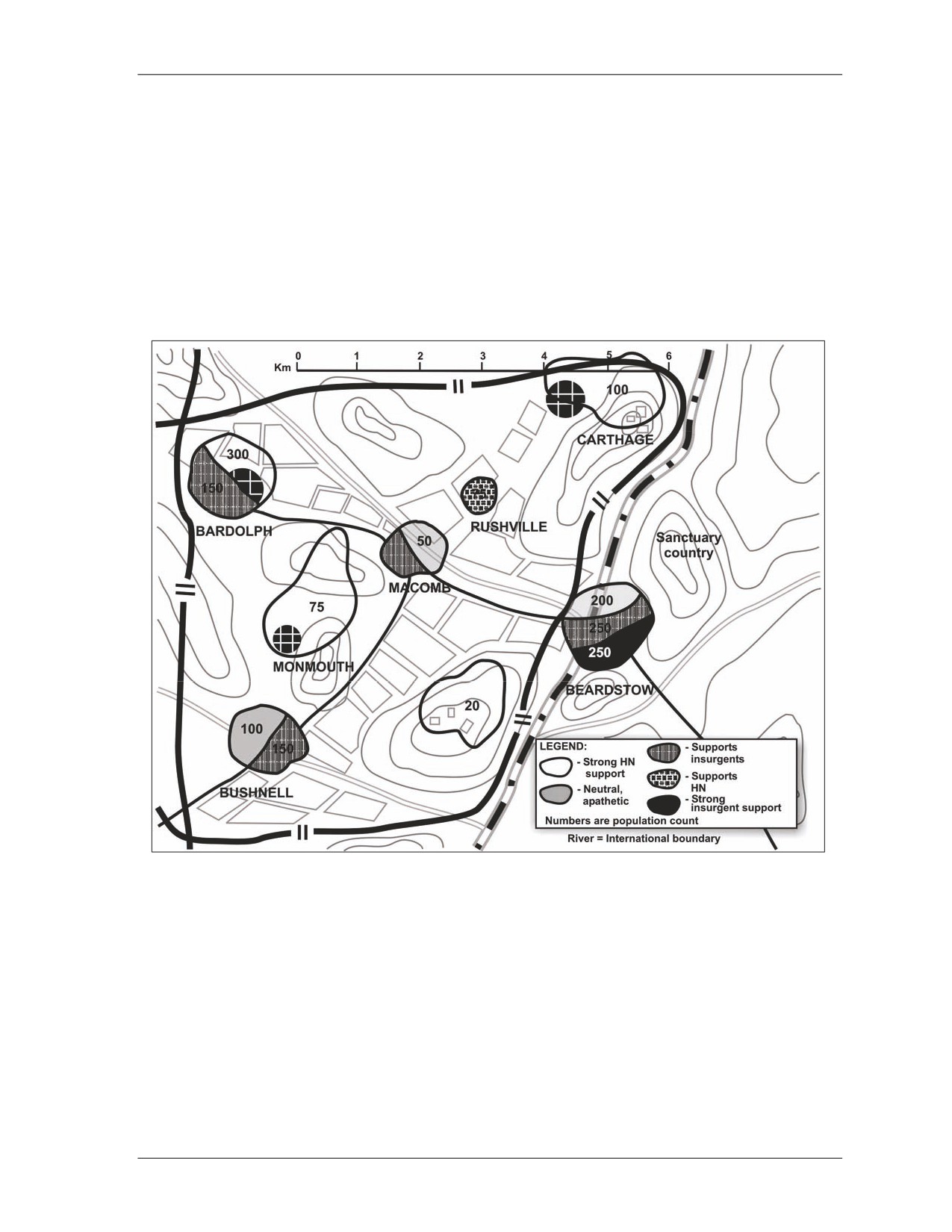
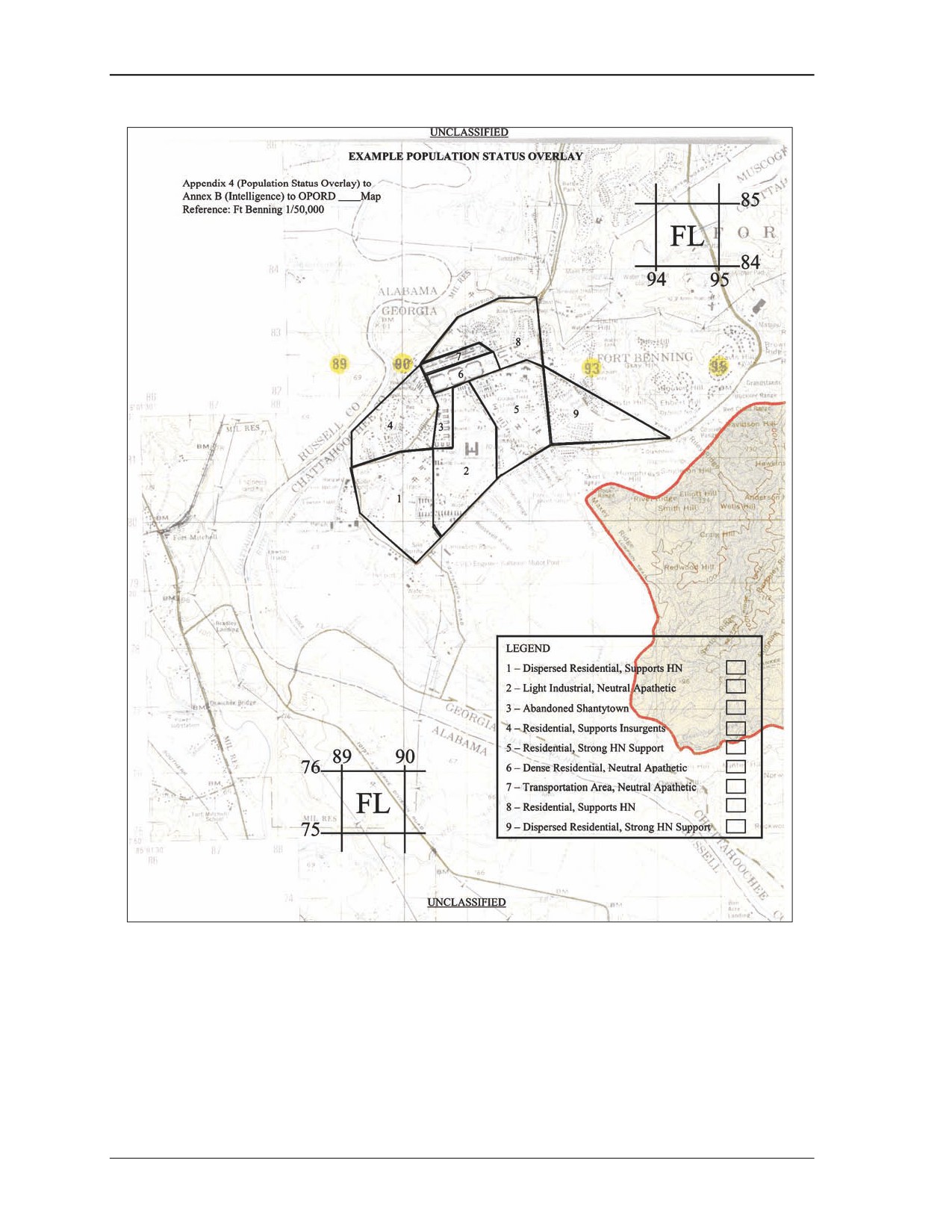
showing their political, ethnic, tribal, or racial sympathies and affiliations. Figure J-3
(page J-7) and
Figure J-4 (page J-8) show examples; the commander should adopt whatever format best suits his needs.
J-6
FM 3-21.10
27 July 2006
Pattern Analysis and Situational Understanding
Traditionally, the larger the scale of the overlay, the greater its usefulness, and the greater the detail. He
will use the overlay later to analyze patterns, to determine enemy trends and likely COAs, and to determine
areas inside his AO or AI that warrant increased attention. The nature of the operational environment and
urban operations requires the commander to include factors other than OAKOC into the definition of the
battlefield environment. The politics and ethnic considerations of the urban area and its populace will have
a considerable impact on the ease with which US forces can conduct operations. The interactions between
rival forces, tribes, clans, or religious groups and their interaction with US forces, coalition forces, HN
forces, and other GOs and NGOs are also critical aspects of the definition of the operational environment.
Also, the commander must consider the impact of higher headquarters or competing parties’ IO and
PSYOPs campaigns or the missions and activities of any friendly SOF that operates within the AO/AI.
Figure J-3. Example 1, population status overlay.
27 July 2006
FM 3-21.10
J-7
Appendix J
Figure J-4. Example 2, population status overlay.
RESPONSIBILITIES
J-17.
The commander has the overall responsibility of supervising the collecting, analysis, and
reporting of information to the higher headquarters. The commander should report both the raw
information and his own analysis conclusions to higher headquarters. Training scenarios can be developed
to enhance the information collecting process of both the active and passive mode. Also, the scenarios
J-8
FM 3-21.10
27 July 2006
Pattern Analysis and Situational Understanding
stress collective training such as processing police information. They also stress individual training such as
improving interpersonal communication and interview skills.
PLATOON LEADER
J-18.
When the platoon leader is tasked to conduct collecting and reporting, he initiates TLP for the
mission. The platoon leader also--
y Participates in the actual pattern analysis conducted by the commander and draws on his own
observations/experiences to help identify patterns or trends.
y Coordinates with the higher headquarters for the CCIR, police and criminal information
requirements, and threat estimates.
y Establishes liaison with civil and MP forces and law enforcement agencies in the AO.
y Coordinates with the local and HN police to determine the existence of organized crime in the
AO and the identification of current and emerging criminal leaders and associates.
y Coordinates with the local and HN police and the populace to identify the types of criminal
activity, such as smuggling, counterfeiting, trafficking in narcotics, or engaging in extortion in
the AO.
y Reports information of potential intelligence value by participating in the debriefing process of
his Soldiers, gathering collected information from squads and teams, and consolidating original
reports and sketches of potential intelligence value and forwarding them through the company
headquarters for analysis.
PLATOON MEMBERS
J-19.
Soldiers may observe more relevant information than the combined technical intelligence can
collect. This realization lead to the Army formalizing the Every Soldier as a Sensor (ES2) concept.
Soldiers are exposed to information that would be of significant value if collected, processed, and
integrated into a common operating picture. Therefore, all platoon members from rifleman to platoon
leader collect and report information that supports the commander's collection plan. They accomplish this
by--
y Continually reviewing the commander's information needs and any checklists or information
distributed by the company or higher headquarters.
y Noting terrain information pertaining to streets, roads, canals, subterranean systems, built-up
areas, cities and villages, and the impacts of weather on the terrain.
y Collecting information on pro-government and anti-government individuals and groups who
might cause disruptions during protests, strikes, riots, and other spontaneous or organized
efforts.
y Identifying private establishments that might be a target or whose presence or operations
contribute to the disruption. Examples of these establishments include gun shops, pawnshops,
religious sites, culturally sensitive areas, liquor stores, and pornography stores.
y Identifying critical infrastructures such as power stations, water works, radio and television
stations, telephone and communication facilities, public transportation, and other
establishments that might be critical to the sustainment of the community.
J-20.
Platoon members identify EPWs, stragglers, and others who may have information of potential
intelligence value and reporting it to the chain of command.
J-21.
Platoon members use a SPOTREP, SITREP, or SALUTE report or a format directed by the chain
of command to report information. SOPs and checklists may also be developed and used.
27 July 2006
FM 3-21.10
J-9
Appendix K
Motorized Operations
Throughout history, success in battle has gone to combat leaders who can build and
effectively fight combat organizations with the right blend of mobility, firepower, and
protection. The Infantry company commander might have to conduct motorized
operations in various environments to increase his company's tactical or operational
mobility, or to increase his firepower or protection.
This edition introduces discussions on motorized operations to address planning
considerations, and urban motorized patrolling.
This appendix introduces and provides basic information for the Infantry company
commander about motorized operations. This includes considerations in employing
various wheeled vehicles.
This appendix also provides a selection of TTPs from current operations and
emerging threat trends. Depending on his METT-TC analysis, the commander may
adapt these TTP to suit the tactical requirements of the company.
Section I. WHEELED VEHICLE PLANNING CONSIDERATIONS
Two major considerations for employing light wheeled vehicles during tactical operations are, first, the risks
associated with the reduced protection and firepower of more heavily armored and "up-gunned" systems; and,
second, the benefits of vehicle speed and maneuverability, crew observation and agility, and weapon
engagement reaction times. In balancing these risks and benefits, the commander thoroughly evaluates the
factors of METT-TC. Company leadership must know the latest developments in threat tactics against wheeled
patrols and convoys. Other sources to consider for TTP include the unit TSOP and combined arms lessons
learned
(CALL) publications. This section addresses several considerations for balancing offensive and
defensive vehicle characteristics. These considerations are based on historical and current observations from
both US and foreign military engagements, and on both OEF and OIF.
y All-round security and observation--coupled with an aggressive crew and passenger security
and weapons posture-is normally the biggest enemy deterrent.
y With regard to weight and thickness, protection against 5.56-mm and 7.62-mm rounds is easier
to achieve than protection against RPGs. Even the M2 BFV and Stryker are not always fully
RPG proof.
y Vehicle suspension must be enhanced to avoid deterioration and failure under the weight of
additional armor. Vehicle passenger or material loads are greatly reduced. For each vehicle,
commanders should identify the types and capabilities of the suspensions for each vehicle.
y Trends indicate that vehicles without all-round security are individually targeted for attack. The
enemy can even target individual vehicles with poor security from within larger convoys.
y Most vehicle passenger seating configurations place passengers in a seated position with their
backs to the enemy--modifying vehicle seats, both cargo area and rear passenger, so that they
mount in the center of the vehicle and allow Soldiers to face outward.
27 July 2006
FM 3-21.10
K-1
Appendix K
MAINTENANCE
K-1.
Vehicle maintenance is critical to mission accomplishment. Poorly maintained vehicles will fail.
As they do so, the OPTEMPO for functional vehicles increases dramatically. Potential adverse effects
can result:
y Reduced cargo- or personnel-carrying capacity, which reduces the combat power ratio in
the field.
y Crews who perform proper maintenance suffer greater exposure to enemy fire than do crews
who do not.
y Reciprocal maintenance problems for overused vehicles.
VEHICLE WEIGHT, SURVIVABILITY, AND ARMOR
K-2.
Force protection is irrevocably linked to mission success. Consequently, it must always be an
important consideration in the planning and execution of missions that employ a soft motorized force.
K-3.
Again, the balance between the protection of vehicles and crews, observation, and the
employment of weapons is critical. Normally, heavily armored vehicles, especially wheeled vehicles with
extra armor such as the up-armored HMMWV, severely limit crew and passenger observation in restrictive
and urban terrain. They can also limit weapons employment at close ranges. Both RPGs and IEDs can
defeat many armored vehicles, and will likely defeat any wheeled vehicle at the point of detonation, with or
without an armor package. At times, insurgent and terroristic enemy forces target vehicles with poor
security, because they seem easier to destroy and less likely to respond effectively. Commanders must
analyze enemy trends and events in their AOs before deciding on the appropriate levels of armor versus
offensive capabilities, mission demands, and crew survivability. Other considerations might include--
y Can the vehicle suspension support additional armor and still carry the payload?
y Can the vehicle crew and passengers provide all-round security for themselves?
y Can the vehicle crew secure itself if the passengers dismount?
y Will additional armor affect vehicle mobility over rough terrain or in restrictive urban areas?
y Can the vehicle crew and passengers quickly and safely mount or dismount? Can they do so
under fire?
y If the vehicle has a turret-mounted weapon system, does the gunner have enough protection?
Consider his legs and lower body, which will be exposed through the middle of the vehicle as
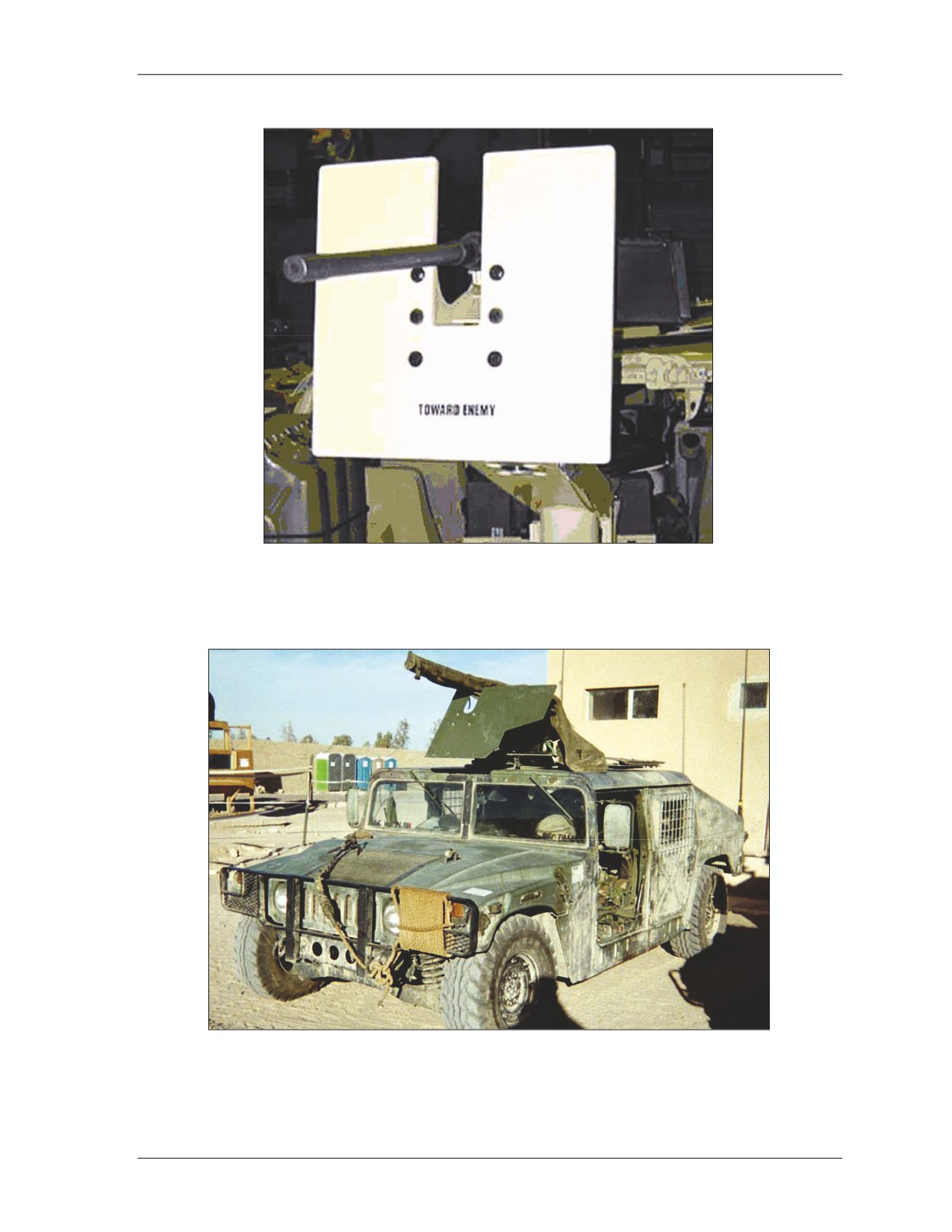
well, and which are not covered by body armor. (Figure K-1A and Figure K-1B show examples
of vehicle gunner armor.)
y What is the primary enemy threat? Is it 7.62-mm guns, RPGs, IEDs, or mines, for example,
how well can the vehicle's armor protect the crew from each threat? What threats must be
protected by offensive capabilities?
y Determine whether the enemy is employing mines. Consider whether the armor and weight
associated with mine strike protection is practical versus armor, which protects against other
threats.
y Consider armoring critical pieces of the vehicle itself such as the fuel system, communication
system, and cooling system.
y Use Kevlar blankets from disabled HMMWVs or the M2 Bradley spall liner to ‘armor’
HMMWV seats and to add light weight armor to other areas of the vehicle.
K-2
FM 3-21.10
27 July 2006
Motorized Operations
Figure K-1A. Commercially produced and available gunner armor protection.
Figure K-1B. Army-issue, roof-mounted, gun-ring armor.
27 July 2006
FM 3-21.10
K-3
Appendix K
Note: While the gunner's upper body is protected, his lower torso is exposed through the
middle of the vehicle. Also, note the ‘screen’ window on the rear doors. These prevent items
from being thrown into the rear of the vehicle.
K-4.
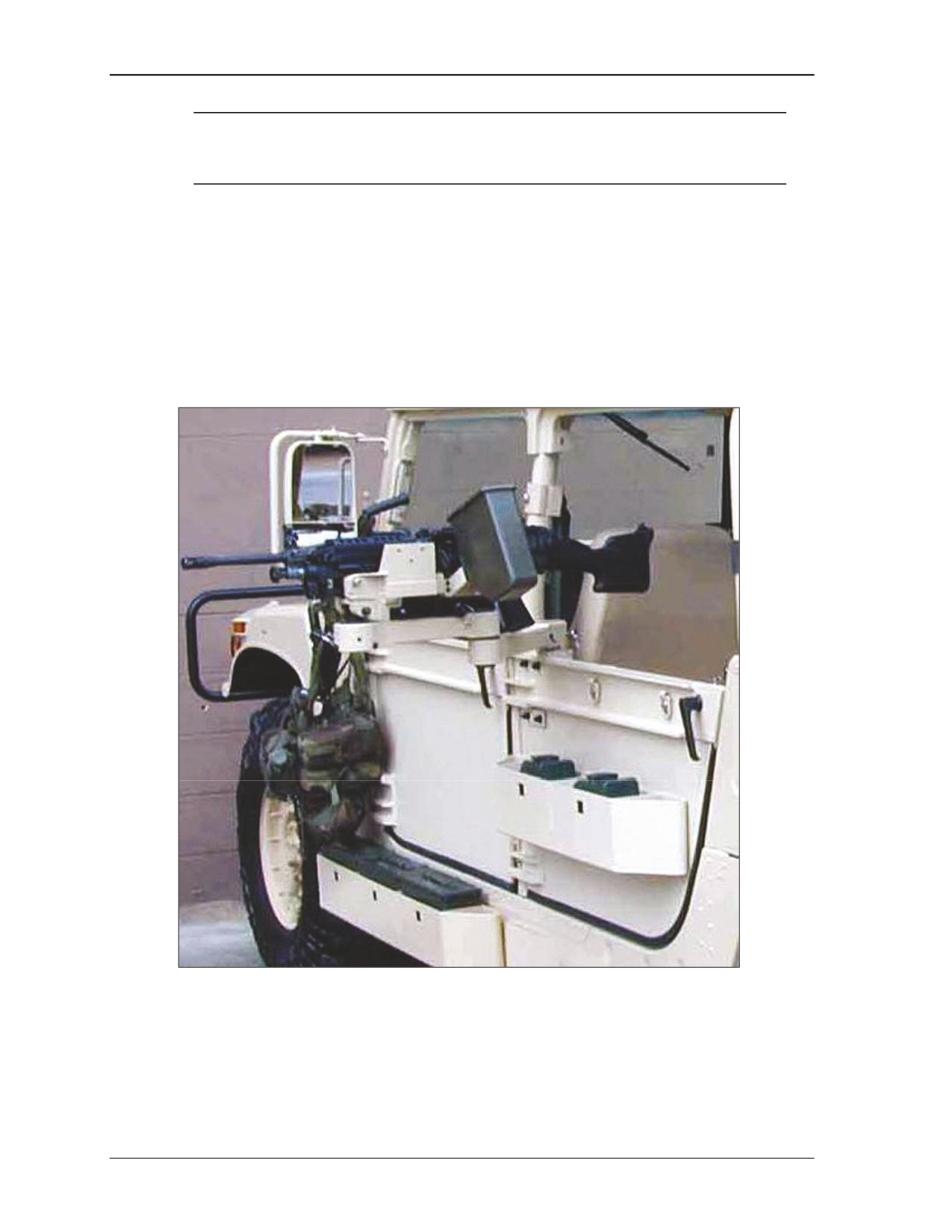
One technique units may use in balancing armor and observation is to install armored half doors
(Figure K-2) rather than a full door or no door. Benefits include protection against either 5.56-mm or
7.62-mm rounds, depending on armor thickness; protection for crewmembers' legs, groins, and sides (areas
not covered by conventional body armor); increased observation, mounting and dismounting capabilities
and speed; the ability to effectively employ personal or crew-served weapons; and reduced vehicle weight.
Limitations include less upper body protection for the vehicle crew than if fully armored doors and
windows were installed. Similar products are available commercially, or they might be fabricated using
on-hand or captured materials.
Figure K-2. Commercially produced HMMWV armored half-door and double-articulating,
swing-arm mount for crew-served weapons.
K-5.
Note the door-mounted and running board-mounted ammunition storage areas. Units can also
sandbag all or portions of vehicles, or they can construct effective vehicle armor using on-hand or captured
materials. This can include armor from destroyed enemy vehicles.
K-4
FM 3-21.10
27 July 2006
Motorized Operations
FIREPOWER AND OBSERVATION CONSIDERATIONS
K-6.
In combination with previous improvements, the following modifications can enhance
engagement capability and protection of the crew and on-board personnel.
y Consider removing vehicle windshields and glass windows. Windshields greatly restrict
visibility when dirty or cracked; restrict mobility and weapons employment; and create
secondary missile hazards.
y Install armor plates for crew-served weapons on roof-mounted gun rings. Consider adding
armor beneath the gun ring to protect the gunner's abdomen and femoral artery.
y If operating vehicles without roof-mounted gun rings, consider constructing field-expedient
roof mounts.
y Consider removing vehicle roofs or cutting away sections of the vehicle roof not required to
support roof-mounted gun rings. Roofs greatly restrict observation, and often limit crew
mobility, while providing little or no armored protection.
y If transporting troops in the cargo area of vehicles, remove all tarpaulins and bows to allow full
visibility and security for the passengers.
y Replace all conventional passenger and cargo area seating with outboard facing,
center-mounted seats.
y Install seats from destroyed or disabled vehicles in the cargo areas of HMMWVs (M2 Bradley
seats or HMMWV seats).
COMMUNICATION CONSIDERATIONS
K-7.
Vehicle crew communication is paramount to smooth vehicle operation. Commanders must
consider how dismounts will communicate with the mounted or dismounted crew. Drivers and TCs can
normally communicate by voice in most wheeled vehicles, but might not be able to do so if in contact.
Passengers and gunners have a hard time communicating with the driver or TC under normal operating
conditions, and most likely cannot do so during contact. Once passengers dismount, voice communications
is nearly impossible. Commanders should consider the following.
y Equip the driver, TC, and gunner
(if applicable) with headset radios for internal
communication.
y All passengers and dismounted elements must have some form of effective internal
communication with the crew while mounted and dismounted.
CREW AND PASSENGER DESIGNATED VEHICLE POSITIONS
K-8.
The TSOP typically dictates positions for the crew and passengers. The commander adjusts them
as needed based on METT-TC. When moving to a tactical objective area, he employs principles similar to
those used in load planning for air assaults. That is, based on the ground tactical plan, he assigns positions
in addition to the crewmembers based on unit integrity, the bump plan, and the cross-leveling of personnel
and equipment.
K-9.
Commanders must balance vehicle and crew survivability; vehicle weight and payload,; the
offensive capabilities of the crew and passengers; and their ability to quickly and efficiently mount and
dismount the vehicle. The positions will likely change once the passengers dismount. Vehicle crews
normally remain with the vehicles while passengers dismount. This allows them to operate the vehicles and
any mounted weapon systems. Figure K-3A and Figure K-3B, page K-6, show two possible
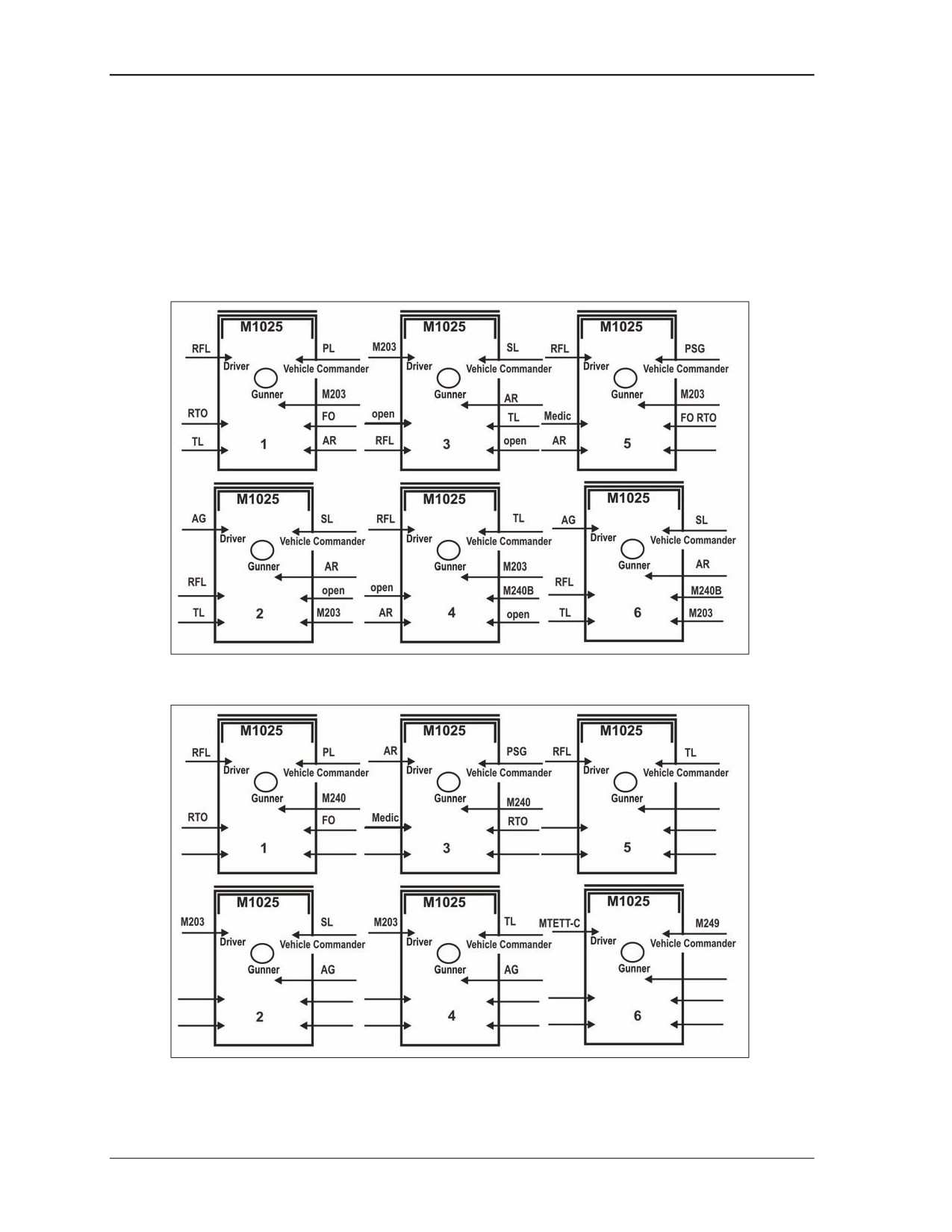
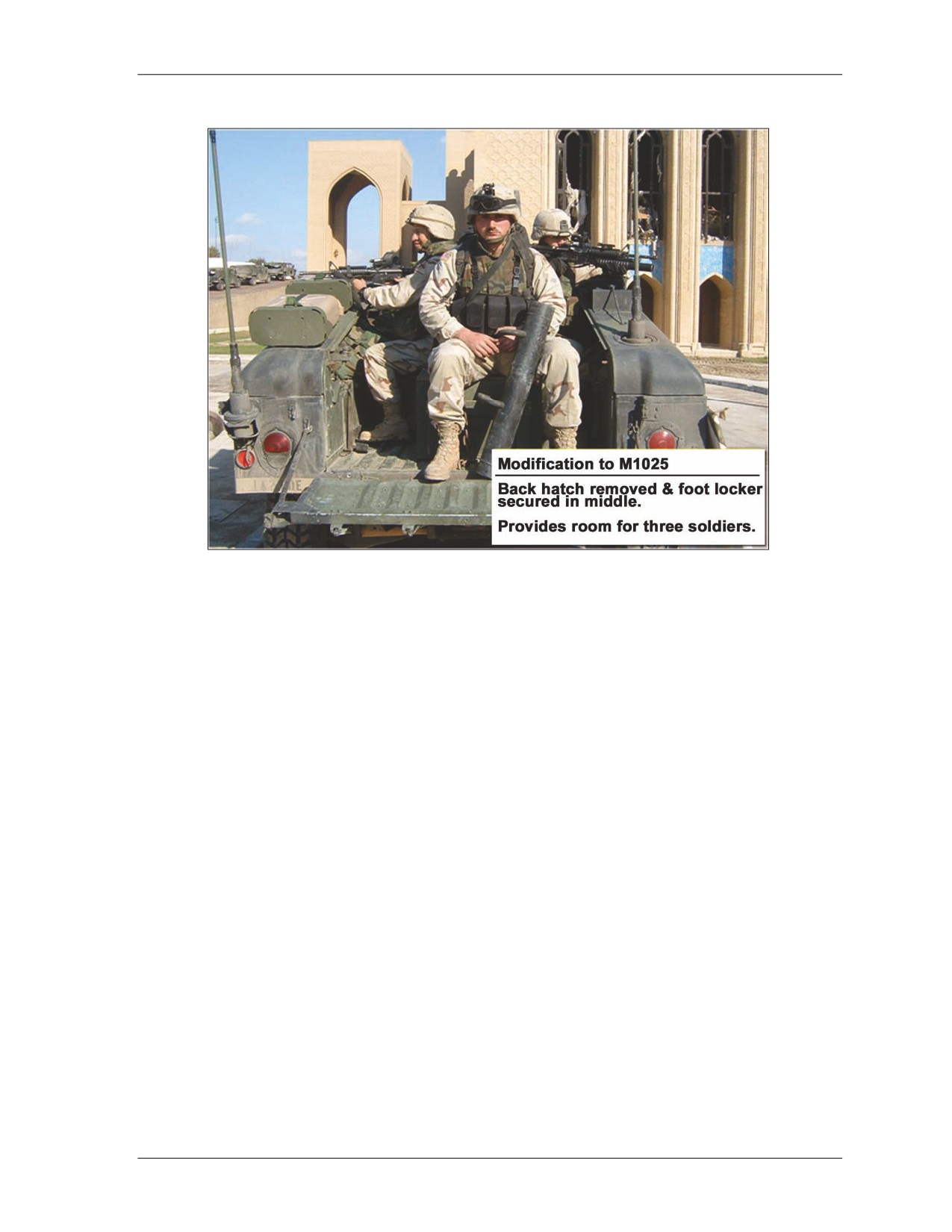
vehicle-manning configurations for an Infantry platoon employing the M1025 variant with the hard shell
rear cover removed (Figure K-4). The K-3A example maintains squad integrity among vehicle sections, but
not if Soldiers dismount. The seating plan in Figure K-3B dedicates one organic squad to man the vehicle,
so that two organic squads can dismount. The actual vehicle and crew manning configuration employed by
the Infantry platoon or company should be driven by careful METT-TC analysis. Additional manning and
seating considerations include--
27 July 2006
FM 3-21.10
K-5
Appendix K
y What types of vehicles are available? Will the unit use HMMWVs, LMTVs, FMTVs, or some
mix of these? What version(s) of HMMWV is available?
y Will the vehicles have dedicated operators and crews, or will the Infantry platoon or company
provide drivers and crews?
y Will the vehicles mount M2 or MK19s, or will the Infantry platoon or company use its organic,
vehicle-mounted, automatic or crew-served weapons? Does the commander anticipate
dismounting the crew-served or automatic weapons from the vehicles at the objective or if
contact is made?
y Do the vehicles have roof-mounted gun rings designed to support crew-served weapons?
Figure K-3A. Possible platoon-seating technique.
Figure K-3B. Variation of platoon-seating technique.
K-6
FM 3-21.10
27 July 2006
Motorized Operations
Figure K-4. Modified M1025 (turtle-shell HMMWV).
K-10. Will the unit maintain team and squad integrity within vehicles and vehicle sections? Or, will the
unit dedicate an element to vehicle crews and maintain squad and team integrity only when dismounted?
Will assistant gunners travel with their gunners in the same vehicle or in the same section?
y Is the mission primarily focused on the mobility aspect of the vehicles? Or, are the vehicles
merely a means of transportation to the objective, with the focus on dismounted operations at or
around the objective?
y Does the commander anticipate using the vehicles' crew-served weapons as a base of fire or as
a support-by-fire element?
y Passengers in forward facing rear seats in most HMMWVs will have a difficult time effectively
employing their weapons or quickly dismounting. Commanders should consider modifying rear
passenger seats. They can either cut away under-seat storage and move the seat and seat back to
the center console so passengers can face outward, or they can simply move the seat pad and
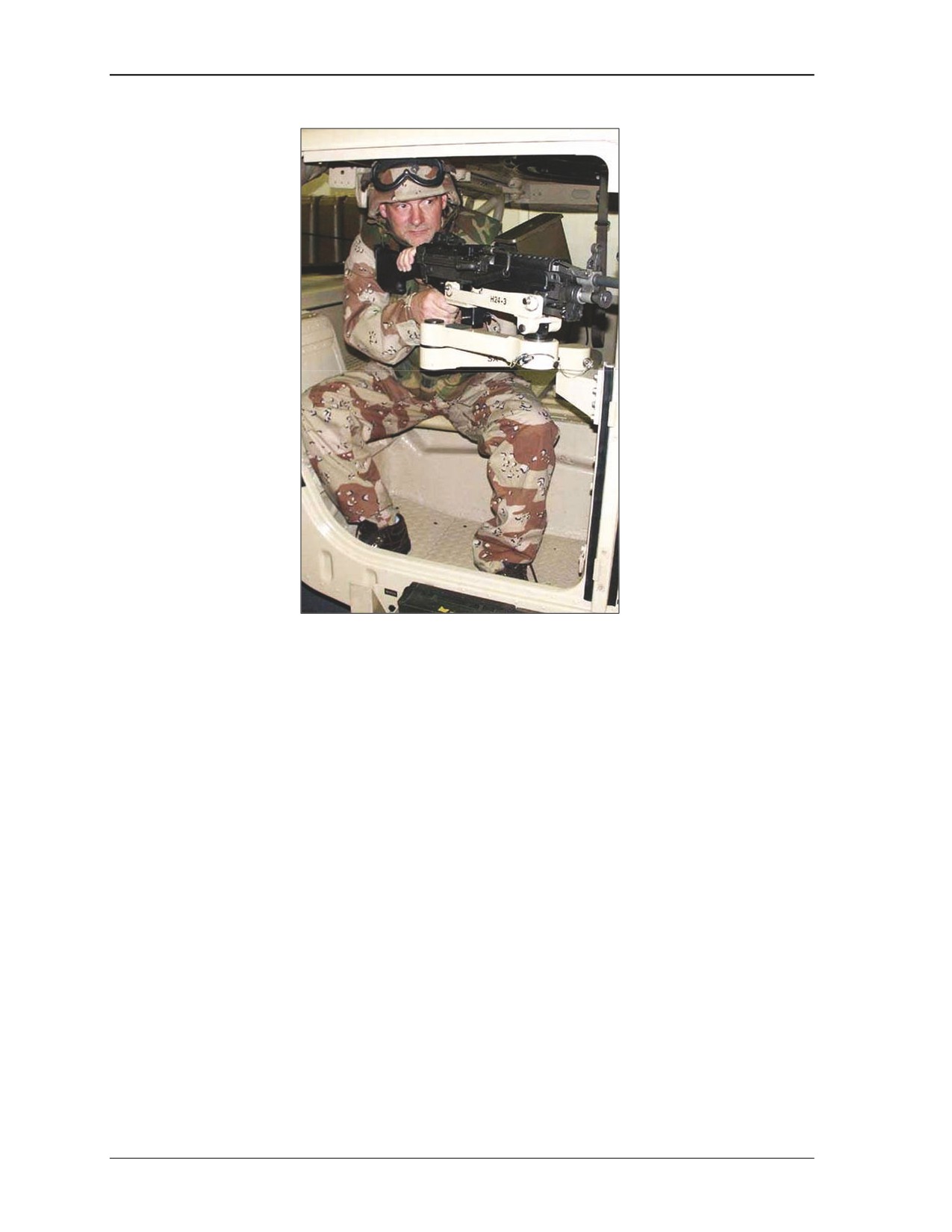
seat back to the center. (Figure K-5, page K-8, shows an example of rear seat modifications that
allow the passenger to face outwards.)
27 July 2006
FM 3-21.10
K-7
Appendix K
Figure K-5. Commercially produced version of an outboard-facing rear passenger seat and
double-articulated swing arm for crew-served weapons.
K-11. This technique maintains squad integrity across each vehicle section, but does not do so if forces
dismount. It dedicates one squad and the M240B section to vehicle crews, and it allows two organic squads
to dismount. An up-armored HMMWV (M1109 or M1114 model) is not designed for quick-dismount as
are the Stryker or BFV. Commanders should consider this when planning their use in the urban
environment. All passengers in the cargo bed or rear of any vehicle must face outwards. Seats must be
modified to allow for this. If the HMMWV has a hard shell, that is, if it is a model M1025 or M1043 and
has a turtle shell or turtle back, then consider removing the hard shell and installing seats for additional
crewmembers and passengers, and to ensure all-round observation. Each passenger sits facing outboard,
which improves his observation and his ability to employ a personal or crew-served weapon. Units can
achieve this same benefit in one of several ways.
y Remove the rear passenger seat and cut away the under-seat storage; move the seat to the center
console.
y Remove the vehicle roof, and stand on the passenger seat or center console.
y Identify the modifications required, and contract the work prior to deployment.
VEHICLE EQUIPMENT LOAD PLANS
K-12. Vehicle commanders must ensure that any externally stowed items are secured from theft and do
not constitute a fire hazard if the vehicle is attacked by IED, RPG, or other flammable device. External
stowage should be minimized or modified to lessen the threat of vehicle fire and not restrict the view or
movement of gunners or passengers providing security. All loose items stored inside the vehicle must be
secured to prevent theft or becoming secondary missiles in the event of a mine or IED strike or a roll over.
K-8
FM 3-21.10
27 July 2006
Motorized Operations
Commanders should consider stowing flammable items that are mission essential inside the vehicle and
behind armored portions of the vehicle, and securing non-mission-essential and nonflammable items
outside the vehicles. Other considerations follow.
y Remove windshields, which when dirty often restrict mobility and visibility. Windshields also
shatter when struck, creating secondary missiles or fragments (shrapnel).
y Consider lashing pioneer tools and crew-served weapon tripods to the front hoods of vehicles.
Extend them fully before lashing them down; this eases employment.
y Use on-board ammunition storage containers such as 60-mm mortar ammunition cans. These
hold several types of ammunition. This saves the crew a lot of time when they have to switch
between ammunition for the 7.62-mm.50 caliber, and MK19 40-mm crew-served weapons.
Carry complete spare wheel and tire assemblies rather than just spare tires. This reduces the time
needed to change a flat, and will often allow a crew to repair a vehicle after a mine strike.
y Consider equipping every vehicle or every other vehicle with wheeled vehicle tow bars, so that
vehicles can recover or tow each other. Tow bars are better than cables, since no driver is
needed in the towed vehicle.
y Consider emplacing civilian or military fire extinguishers in fixed positions inside the vehicle.
Normally, locate them to protect the crew rather than the vehicle. This helps ensure crew
survivability. Carry additional loose fire extinguishers to fight vehicle fires. Never use a halon
fire extinguisher inside an armored vehicle.
K-13. Commanders should establish load plan SOPs for sensitive items. They should account for
ammunition and additional special equipment such as breach kits, demolitions, and first aid equipment.
They should also account for any additional weapons, such as rifles, in case no automatic or crew-served
weapons are required after dismounting.
Section II. PATROLLING CONSIDERATIONS IN URBAN OPERATIONS
Infantry companies and platoons may conduct urban operations or patrols using wheeled vehicles as the sole
means of mobility, or along with dismounted patrols.
URBAN PATROLLING CONSIDERATIONS
K-14. The basic planning considerations for both mounted and dismounted patrolling are almost
identical. Although wheeled vehicles typically have the advantage of mobility and firepower over
dismounted elements, as previously noted, communications and protection pose difficulties. The more
heavily armored vehicles might be at greater risk in the urban environment unless closely supported by
dismounted forces. Therefore, this environment calls for integrating dismounted with mounted patrol.
elements. The combination of the two capabilities enhances conditions for successful urban operations.
Note: Sometimes, a psychological dimension exists in the employment of armored fighting
vehicles (the M2 Bradley and the M1 tank) in urban operations. To avoid antagonizing
noncombatants, even when they think using armored vehicles would help, leaders should
carefully consider whether to do so.
TACTICAL VEHICLE EMPLOYMENT AND URBAN PATROLS
K-15. Vehicles operating as part of a patrol in stability operations should always operate in sections of at
least two vehicles. For all stability operations, the commander should consider employing vehicles to
augment dismounted patrolling. The enhanced mobility allows greater and faster AO saturation and
expansion of control. Integrating vehicles with foot patrols also allows for increased sustainment loads.
Lighter, faster Infantry forces have a greater chance of capturing or killing lightly armed insurgents;
27 July 2006
FM 3-21.10
K-9
Appendix K
mounted firepower provides support or moves to block escaping or flanking enemy. Mounted elements
increase patrol flexibility and versatility. Other considerations for urban operations include--
y To avoid contact with overhead power lines, tie down vehicle antennas.
y Avoid streets and alleys that are too narrow for particular vehicles. Enemy forces can quickly
identify this fact and plan their own routes accordingly.
y Consider civilian vehicle and pedestrian traffic flow when planning patrol routes. For each
operation, consider the effects of military vehicles on civilian traffic flow and patterns.
y Tracked vehicles can damage or even destroy civilian roads in the AO. Carefully plan the use
of tracked vehicles with this in mind.
y Avoid using night vision devices or blackout driving around civilian traffic using white lights.
Doing so endangers you and the civilians, and they can see you anyway!.
BRADLEY AND STRYKER CONSIDERATIONS
K-16. When halting Strykers and BFVs, the commander should leave at least three vehicle lengths to the
front and sides of each vehicle. This allows for emergency movement. In addition to patrolling, vehicles
can enhance or assist in the following common stability operations.
y Hasty checkpoints.
y Cordon or security during searches.
y Deployment or redeployment of foot patrols.
y Baseline for riot or crowd control incidents.
y Support or overwatch obstacle reduction.
y Mounted reserve or quick-reaction force.
MOUNTED HASTY CHECKPOINT OPERATIONS
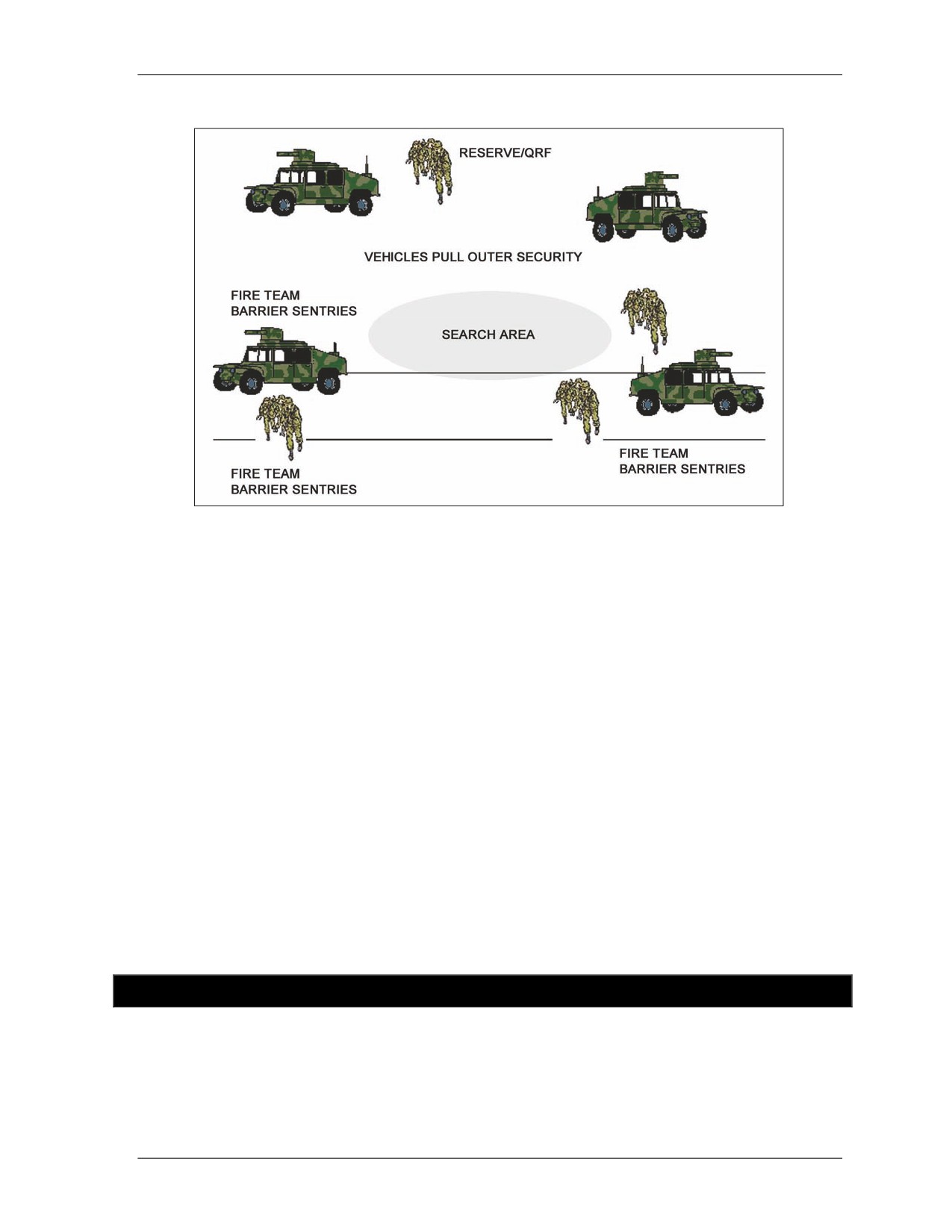
K-17. This is a generic technique for example only. Leaders must always consider the factors of
METT-TC (Figure K-6).
K-10
FM 3-21.10
27 July 2006
Motorized Operations
Figure K-6. Hasty checkpoints.
ACTIONS ON CONTACT
K-18. The actions on contact for mounted and dismounted forces are normally the same--seek cover and
return fire, then develop the situation. Detrucking or dismounting troops should occur in a covered or
concealed position when possible, but the speed of dismounting and the need to get Infantry on the ground
quickly once in contact must also be considered. Once in contact, based on the enemy situation, the
vehicles may or may not maneuver in order to dismount troops or form a base of fire. The commander must
consider the following.
y Rehearse unwieldy dismounting and remounting procedures before mission execution.
y Avoid dismounting troops directly into the line of fire.
y Take measures to prevent troops from becoming casualties while mounted.
K-19. Vehicles can maneuver quickly with troops mounted or dismounted) either to occupy covered and
concealed positions or to form a base of fire. The vehicles might be required to form an immediate cordon
while the Infantry clears or searches the area.
K-20. Vehicles might be required to maneuver immediately, with or without support, to take advantage
of speed and shock action, or to move to a position to gain a tactical advantage.
K-21. When troops dismount, or when the vehicle maneuvers away from immediate troops, the vehicle
crew must remain vigilant and protect the vehicle from further enemy actions or isolation.
Section III. LONG-RANGE OPERATIONS CONSIDERATIONS
The Infantry company might have to conduct long-range movements or patrols using with wheeled vehicles.
Special operations forces are likely to conduct these operations. However, this section contains considerations
for the Infantry company commander in case he is tasked to do so. (FM 31-23 discusses long-range vehicular
operations in detail.)
27 July 2006
FM 3-21.10
K-11
Appendix K
LONG-RANGE OPERATIONS
K-22. If the commander must conduct long-range operations, then he must be reasonably sure of the
range and expected time of the operation. This allows him to estimate logistics support accurately. The
logistical resources required to support long-range vehicular operations will drive many aspects of the
mission planning (Classes III and IX, specifically). Additional considerations for long-range operations
include the following.
y
Mission range (mileage), duration, and expected vehicle fuel consumption.
y
Availability of resupply or support during operations.
y
Planned vehicle loads (personnel and equipment).
y
Expected enemy situation.
y
Terrain considerations such as---
- Road conditions.
- Off-road travel conditions.
- River crossings.
- Expected rainfall or snowfall.
y
Presence of civilian vehicles in area--are vehicles normally encountered in the AO?
y
Communications ranges.
y
Navigational considerations.
y
Movement times.
- Day or night?
- White light or NVDs?
- Road or cross-country?
y
Recovery.
- Can the unit self-recover?
- How will the unit deal with nonrecoverable or disabled vehicles?
y
Load plan for casualties or additional personnel in case vehicles are destroyed or disabled.
y
Fuel cans, 5 or 10 gallon, with long fuel lines to attach directly to engine intakes, to allow the
vehicle to operate even if the fuel tank is punctured.
ROUGH TERRAIN DRIVING
K-23. Using good off-road driving techniques is the best way to limit broken vehicle parts and getting
stuck. All drivers must be well trained in judging terrain and negotiating various ground conditions. Many
operations and movements are at night, so driver's training should focus on using night vision devices. In
addition, drivers should develop the following skills.
y Selecting proper gear ratio and shifting.
y Using momentum and understanding the effects of vehicle speed.
y Knowing the vehicle's capabilities and the impact of the on board payload.
y Estimating and using proper speeds for the appropriate terrain conditions.
y Avoiding sudden forward and braking thrusts.
y Applying traction theory.
K-24. Drivers must become familiar with the various terrain conditions in the AO and considerations for
crossing the conditions encountered.
K-12
FM 3-21.10
27 July 2006
Motorized Operations
VEHICLE RECOVERY
K-25. Many recovery operations consist of self-recovery methods, either when the vehicle becomes
stuck, or when it has a mechanical or enemy caused [what?]. Vehicle recovery is easiest when the tires still
have traction and when crewmembers can help the vehicle move through the original tire tracks. When the
vehicle is stuck in snow, sand, or mud, the crew can lower tire pressure to increase traction. Using a second
vehicle to help winch or pull a stuck vehicle is normally the quickest recovery method. However, winches
are used only to assist in recovery., They are never used as the sole source of power for vehicle recovery.
The company should always carry tow straps or chains. Braided rope (three 12feet long by 5/16-inch
diameter pieces) or a heavy 20-foot chain work well. They should have hooks or clevises attached to both
ends for anchoring to the vehicles. If possible, the company carries at least one tow bar for each vehicle
section to assist in long-range recovery or to tow a vehicle at high speed. When a vehicle is stuck in mud or
sand, the unit uses pioneer tools to emplace dry or solid matter under the tires for traction. Sandbags or
other materials can be dug into and under the wheels to assist traction. Vehicles normally carry empty
sandbags for this purpose. When conducting recovery, one section provides security while the other vehicle
makes the recovery. The recovery section decides before making the recovery where the vehicle can go
after it breaks loose. When they use a military winch, they should remember these do’s and don’ts.
DO--
y Use the stuck vehicle's wheel power to help the winch.
y Carefully prepare the winching operation.
y Position personnel where they will not be injured should the cable snap or unhook.
y Ensure the anchor points are solid.
y Use artificial surfaces for traction when the vehicle is stuck in water or soft sand.
DO NOT--
y Overtake the cable.
y Exceed the maximum angle of pull.
K-26. The commander should make contingency plans for vehicles that cannot be repaired or recovered.
The company will make every attempt to recover the vehicle and return it where it can be repaired, if
needed. However, if the company cannot recover the vehicle, then they may destroy it in place to prevent
the enemy from capturing it.
Section IV. OEF AND OIF VEHICLE MODIFICATIONS
This section contains examples of vehicles used by various units in different stages of both OEF and OIF.
These pictures show some of the ways that units, leaders, and Soldiers have modified wheeled vehicles using a
variety of line item, commercial, and on-hand materials to meet mission requirements.
Note: This section neither endorses nor approves the use of any of the equipment or
techniques discussed.
UNIT-INSTALLED WIRE CUTTERS AND WIRE GUARDS
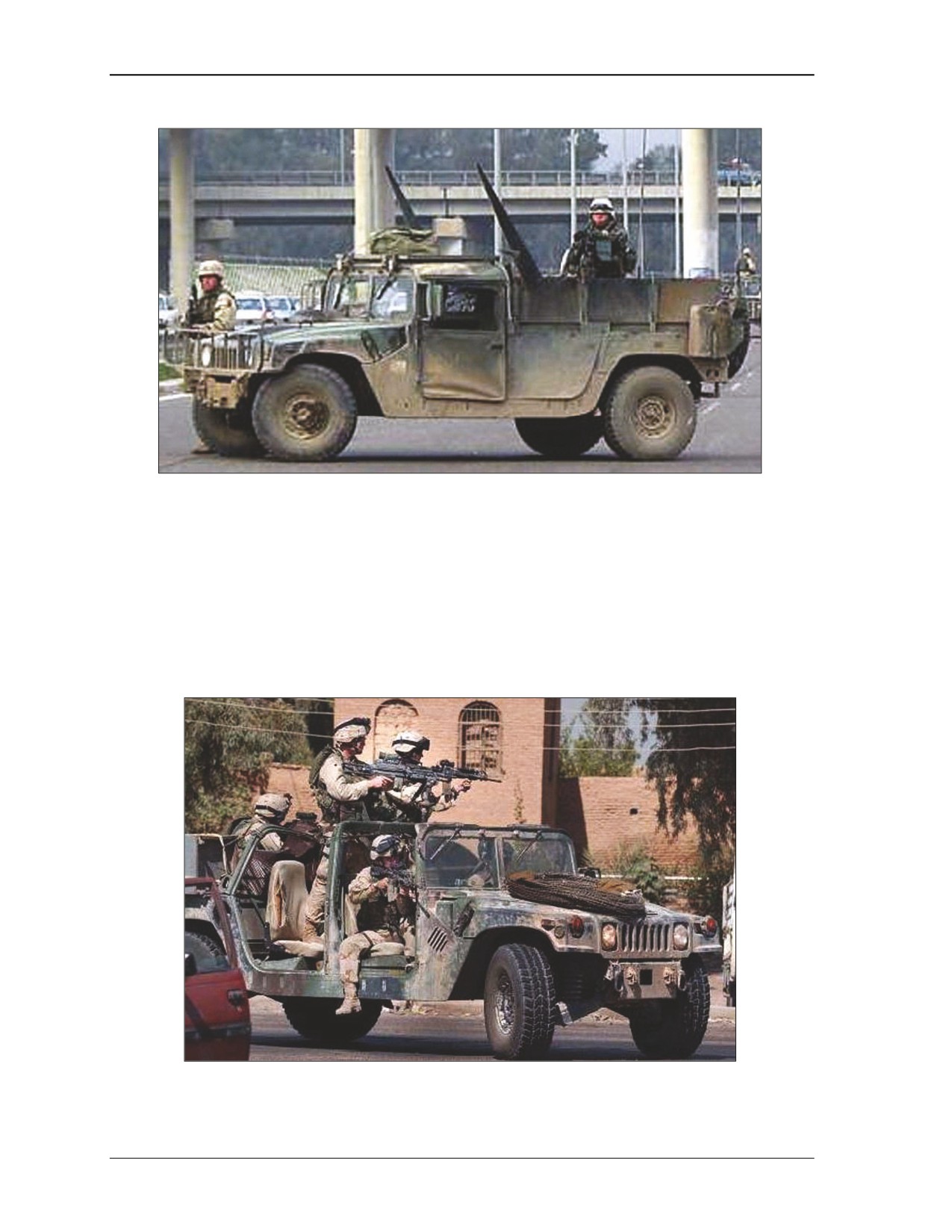
K-27. Wire cutters and wire guards (Figure K-7, page K-14) are used in areas with low-lying power
wires or wires laid across the roads to allow insurgents to ambush troops. Armor plating on the sides of the
cargo bed help protect the Soldiers' lower bodies. The armor height protects the areas not covered by body
armor, yet provides excellent observation, and does not affect the use of the crew-served weapon.
27 July 2006
FM 3-21.10
K-13
Appendix K
Figure K-7. Unit-installed wire cutters and wire guards.
URBAN PATROL
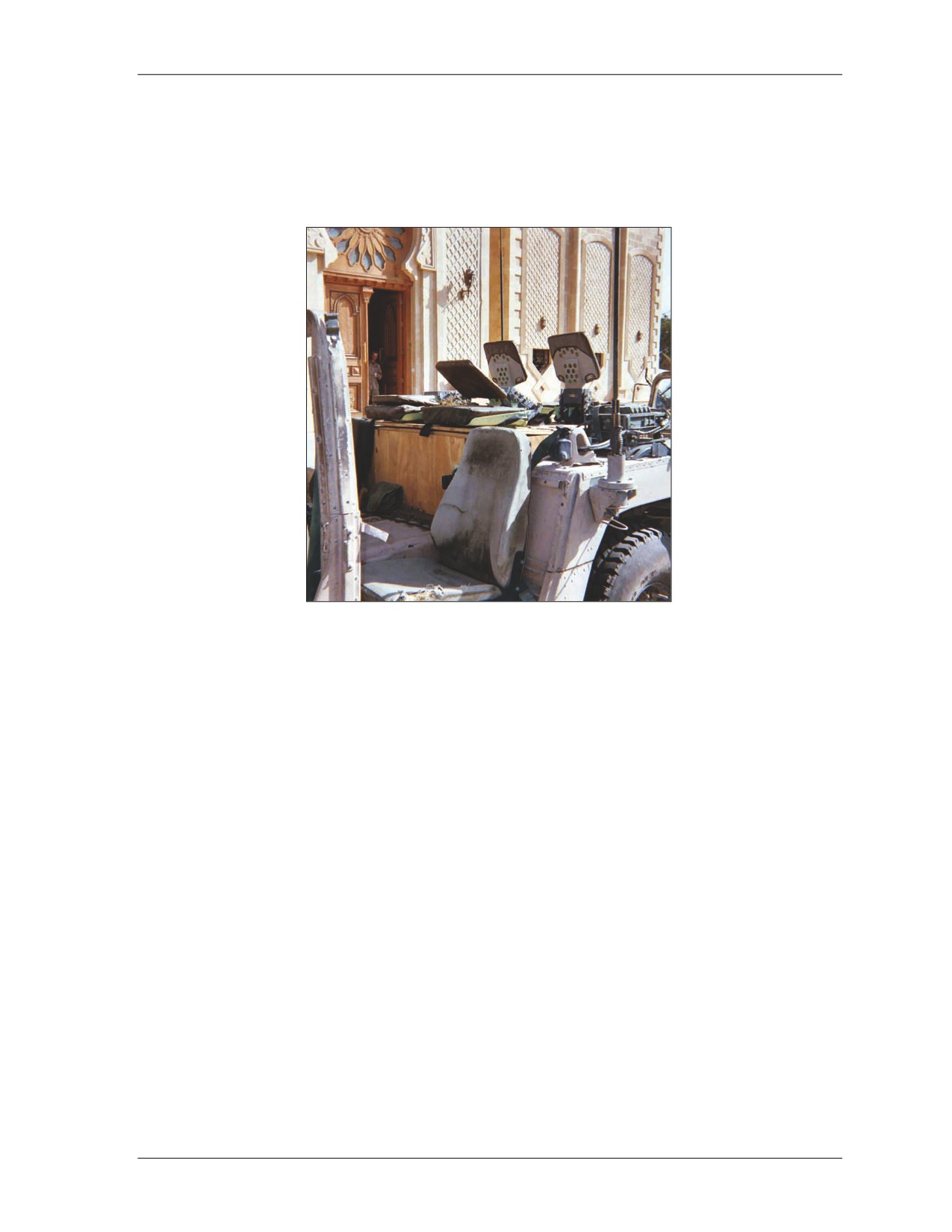
K-28. The Soldiers in Figure K-8 are conducting a vehicular patrol in an urban area. To increase
observation, the Soldiers in the rear seat are standing, rather than sitting. Possible modifications include
adding running boards to the vehicle as foot rests for seated passengers facing outboard; removing the rear
seat assemblies and storage so Soldiers can stand on the vehicle floor; adding an armored half-door; or
attaching sections of armored or steel plating to the doors to protect Soldier's legs.
Figure K-8. Urban patrol.
K-14
FM 3-21.10
27 July 2006
Motorized Operations
UNIT COMMAND VEHICLE
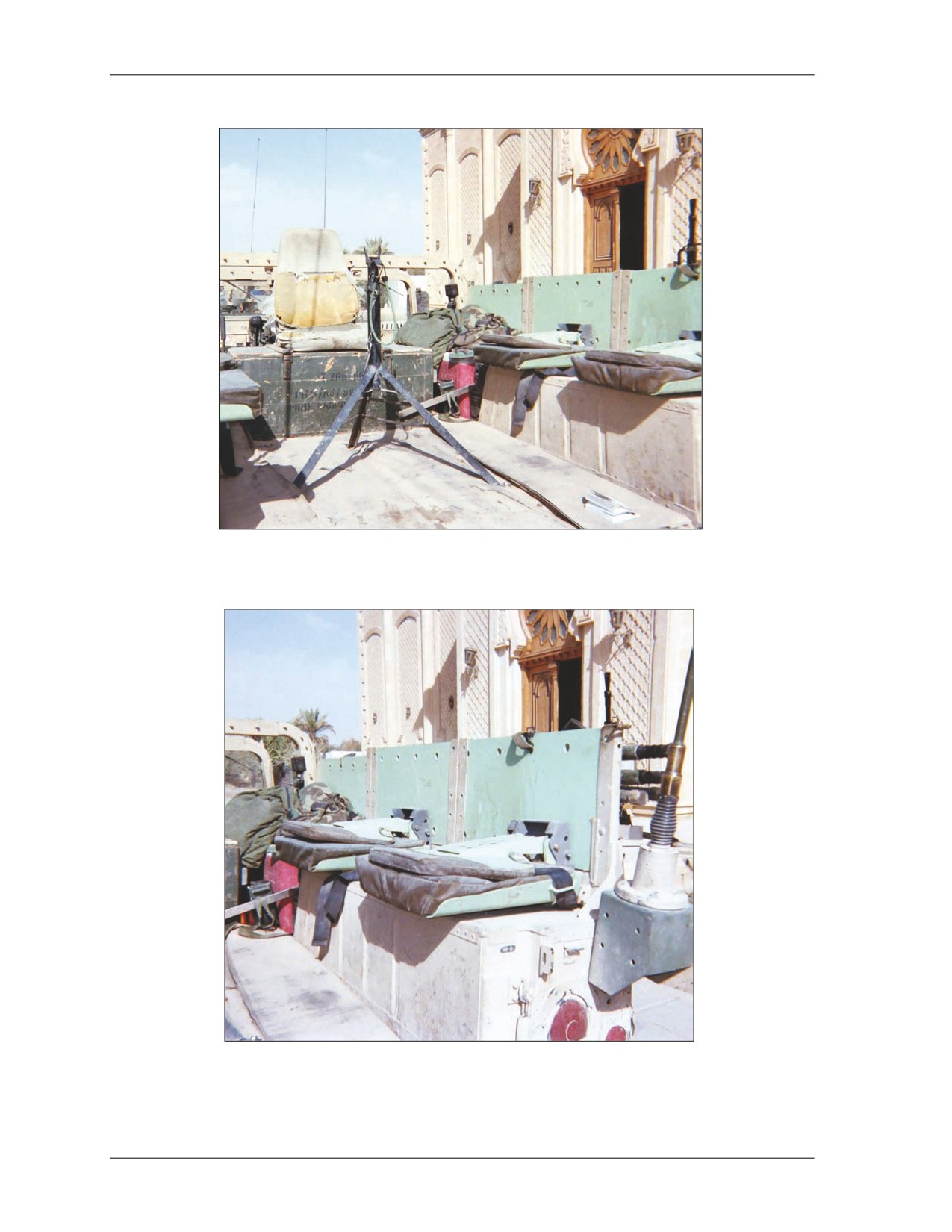
K-29. Figure K-9 shows the addition of four BFV seats (two facing forward, two rearward) and a large
wooden footlocker for secure storage. Also, communications gear has been moved to the rear of the
vehicle.
Figure K-9. Unit command vehicle.
UNIT-PRODUCED TRIPOD AND MODIFIED ARMOR
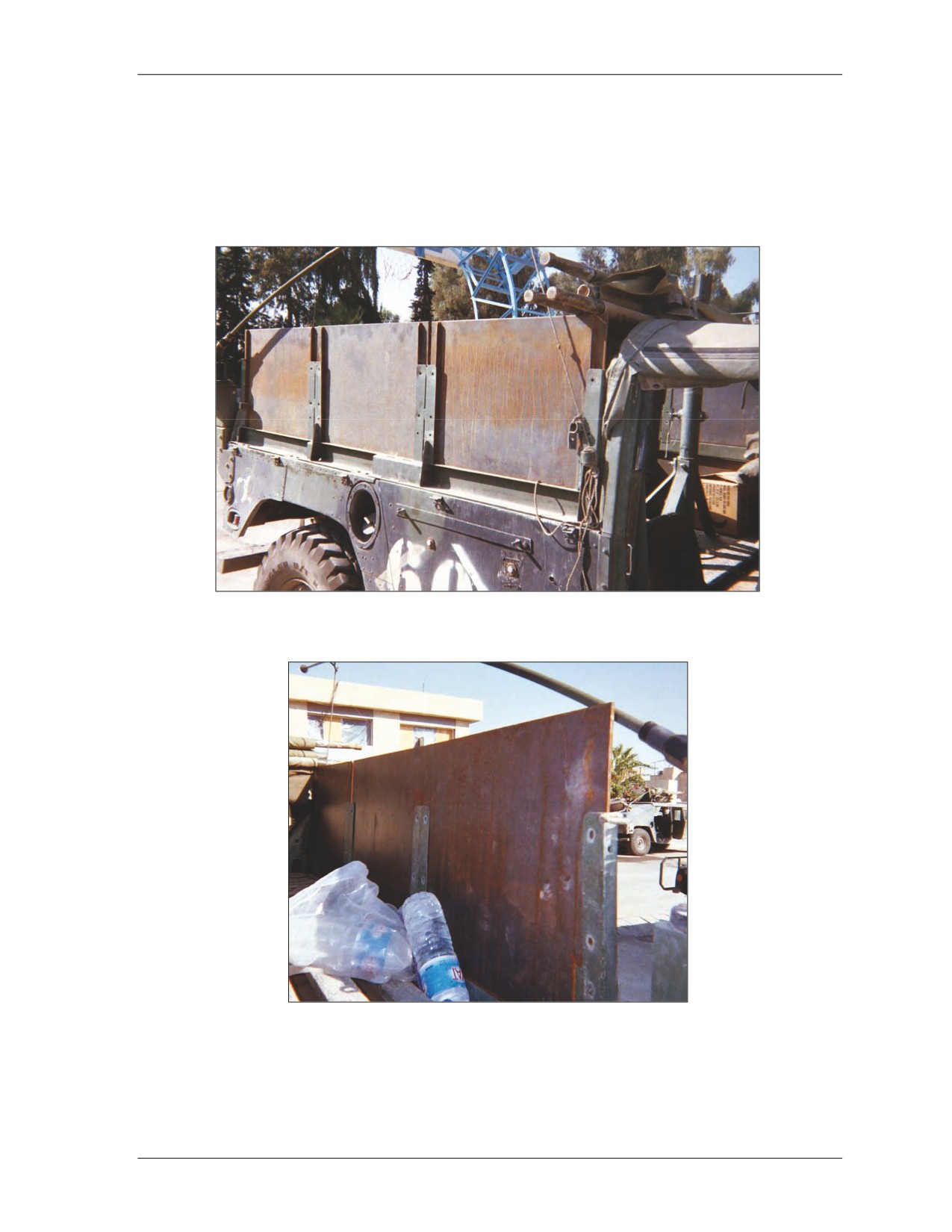
K-30. Figure K-10 shows a unit-designed and -produced elevated tripod. The unit has bolted the tripod
into the rear bed of a cargo HMMWV. This allows the weapon to be employed over the rear and flanks of
the vehicle, but does not look high enough to employ the weapon over the front. A standard-issue foot
locker has been added for storage and seating. BFV seats have been added for passengers, but do not face
outward. The unit has removed sections of the interior spall lining (Figure K-11) from a disabled M2 BFV
and installed it as exterior armor to protect passengers.
27 July 2006
FM 3-21.10
K-15
Appendix K
Figure K-10. Unit-produced tripod and modified armor.
Figure K-11. Closeup of sections of Bradley fighting vehicle spall liner armor applied
to exterior of cargo bed.
K-16
FM 3-21.10
27 July 2006
Motorized Operations
UNIT-INSTALLED STEEL ARMOR
K-31. Figure K-12 shows unit-fabricated and -installed plate steel armor and a tripod mount, which is
visible through the front door. The tripod looks high enough to allow a mounted weapon system to fire in
an all-round fan. Also note that the unit has not added any additional armor beneath the seating area--this
leaves Soldiers' legs relatively unprotected (Figure K-13).
Figure K-12. Unit-installed steel armor.
Figure K-13. Closeup, reverse-angle view of unit-fabricated and -installed steel plate armor.
27 July 2006
FM 3-21.10
K-17
This page intentionally left blank.
Glossary
Acronyms and Abbreviations
1SG
first sergeant
C
A
C2
command and control
AA
avenue(s) of approach
CACOM
CA communications
CANA
convulsant antidote for nerve agent
AAR
after-action review
CAPT-A
CA planning team A
ACPS
Army Civilian Personnel System
ACU
Army combat uniform
CAS
close air support
CASEVAC
casualty evacuation
ADA
air defense artillery
CAT
civil affairs team
ADAM
area-denial artillery munition
CBRN
chemical, biological, radiological,
ADW
air defense warning
or nuclear (replaces NBC except
AFATDS
Advanced Field Artillery Tactical
when referring to existing reports
Data System
and reporting systems)
AHD
antihandling devices
CBRNE-CM
chemical, biological, radiological,
nuclear, and high-yield explosive
AMC
air mission commander
consequence management
AO
area of operations
CCA
close combat attack
AP
antipersonnel
CCIR
commander's critical information
APC
armored personnel carrier
requirements
APDS
armor-piercing discarding sabot
CCP
casualty collection point
chem
chemical
APOD
aerial port of debarkation
CIC
combat in cities
ARFOR
Army forces
CLS
combat lifesaver
ARNG
Army National Guard
CLU
command launch unit
ARTEP
Army Training and Evaluation
CMO
civil-military operations
Program
CMOC
civil-military operations center
aslt psn
assault position
CO
commanding officer
ASOC
air support operations center
COA
course of action
AT
antitank
COE
contemporary operational
ATGM
antitank guided missile
environment
atk psn
attack position
COMSEC
communications security
B
CONOP
concept of operations
BDAR
battle damage assessment and
CONUS
continental United States
repair
COP
common operational picture
BDO
battle dress overgarments
CP
command post
BFV
Bradley fighting vehicle
CS
combat support
BHL
battle handover line
D
BMNT
begin morning nautical twilight
DA
Department of the Army
BP
battle position
DED
detailed equipment
BSA
brigade support area
decontamination
BUA
built-up area
27 July 2006
FM 3-21.10
Glossary-1
Glossary
DEUCE
deployable universal combat
FSB
forward support battalion
earthmover
FSCM
fire support coordination measure
DLIC
detachment left in contact
FSE
fire support element
DOD
Department of Defense
FSEM
fire support execution matrix
DPICM
dual-purpose improved convention
FSO
Fire Support Officer
munition
DRAW-D
defend, reinforce, attack,
G
withdraw, delay
G/VLLD
ground/vehicle laser locator
DTD
detailed troop decontamination
designator
DVE
driver's vision enhancer
GPS
Global Positioning System
DZ
drop zone
GS
general support
GSR
ground surveillance radar
E
GS-R
general support-reinforcing
EA
engagement area
GT
gun target
ECOA
enemy course of action
GTAO
graphic terrain analysis overlay
EEFI
essential elements of friendly
information
H
EENT
end evening nautical twilight
HAZMAT
hazardous materials
EFST
essential fire support task
HCA
humanitarian and civic assistance
EMT
emergency medical treatment
HCP
health and comfort pack
EOD
explosive ordnance disposal
HDC
headquarters distribution company
EPW
enemy prisoner of war
HE
high explosive
HEDP
high explosive, dual purpose
F
HHC
headquarters and headquarters
FA
field artillery
company
FASCAM
family of scatterable mines
HN
host nation
FBCB2
Force XXI battle command
HPT
high-payoff target
brigade and below
HSS
health service support
FCL
final coordination line
HUMINT
human intelligence
FDC
fire direction center
FEBA
forward edge of battle area
I
FFIR
friendly force information
I2R
imaging infrared
requirements
IAW
in accordance with
FHA
foreign humanitarian assistance
IBCT
Infantry brigade combat team
FIBUA
fighting in built-up areas
ICV
Infantry carrier vehicle
FIST
fire support team
IED
improvised explosive device
FLOT
forward line of own troops
illum
illumination
FM
frequency modulated
IM
information management
FO
forward observer
INFOSYS
information systems
FPF
final protective fire
IO
information operations
FPL
final protective line
IPB
intelligence preparation of the
FRAGO
fragmentary order
battlefield
FS
fire support
IR
infrared
Glossary-2
FM 3-21.10
27 July 2006