FM 3-22.91 MORTAR FIRE DIRECTION PROCEDURES (July 2008) - page 14
Appendix E
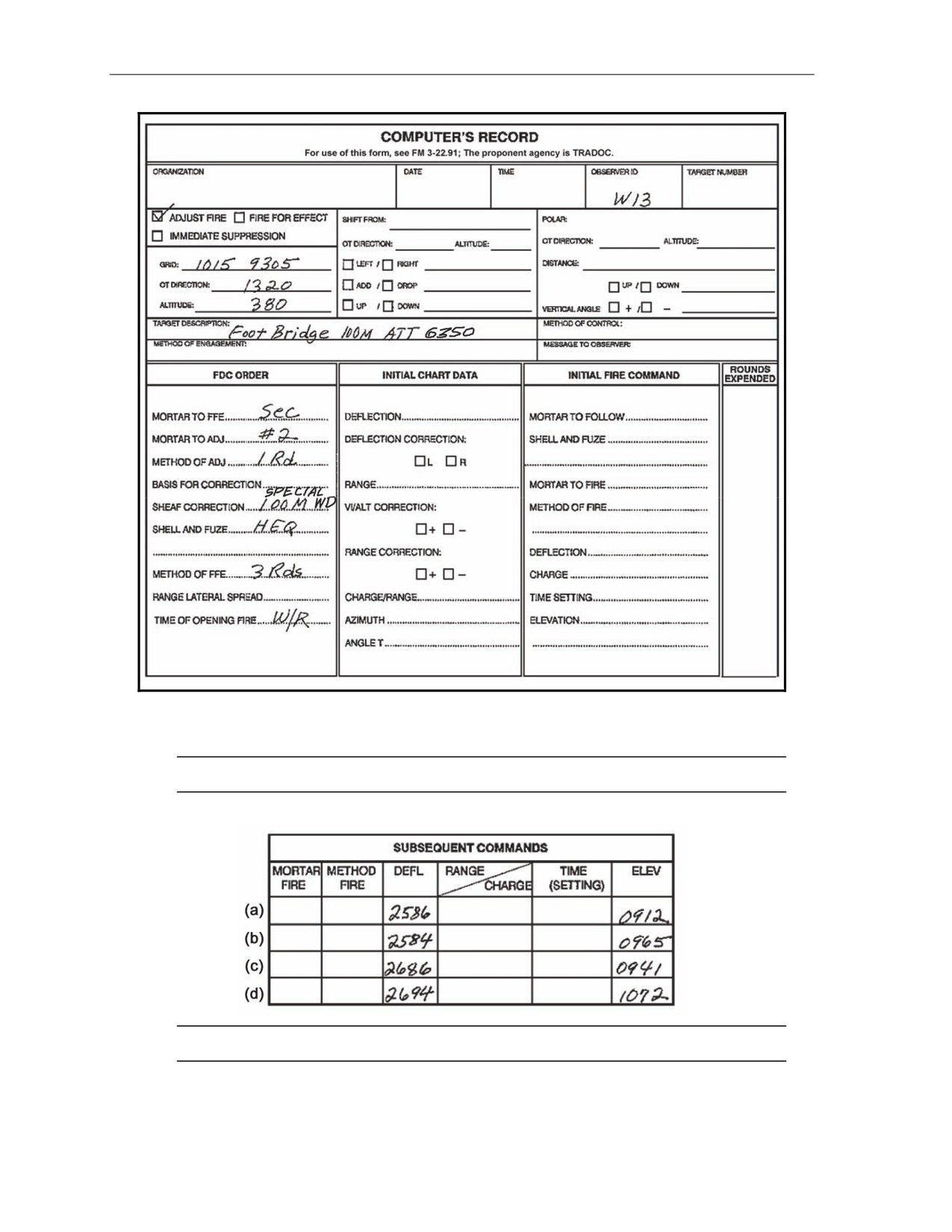
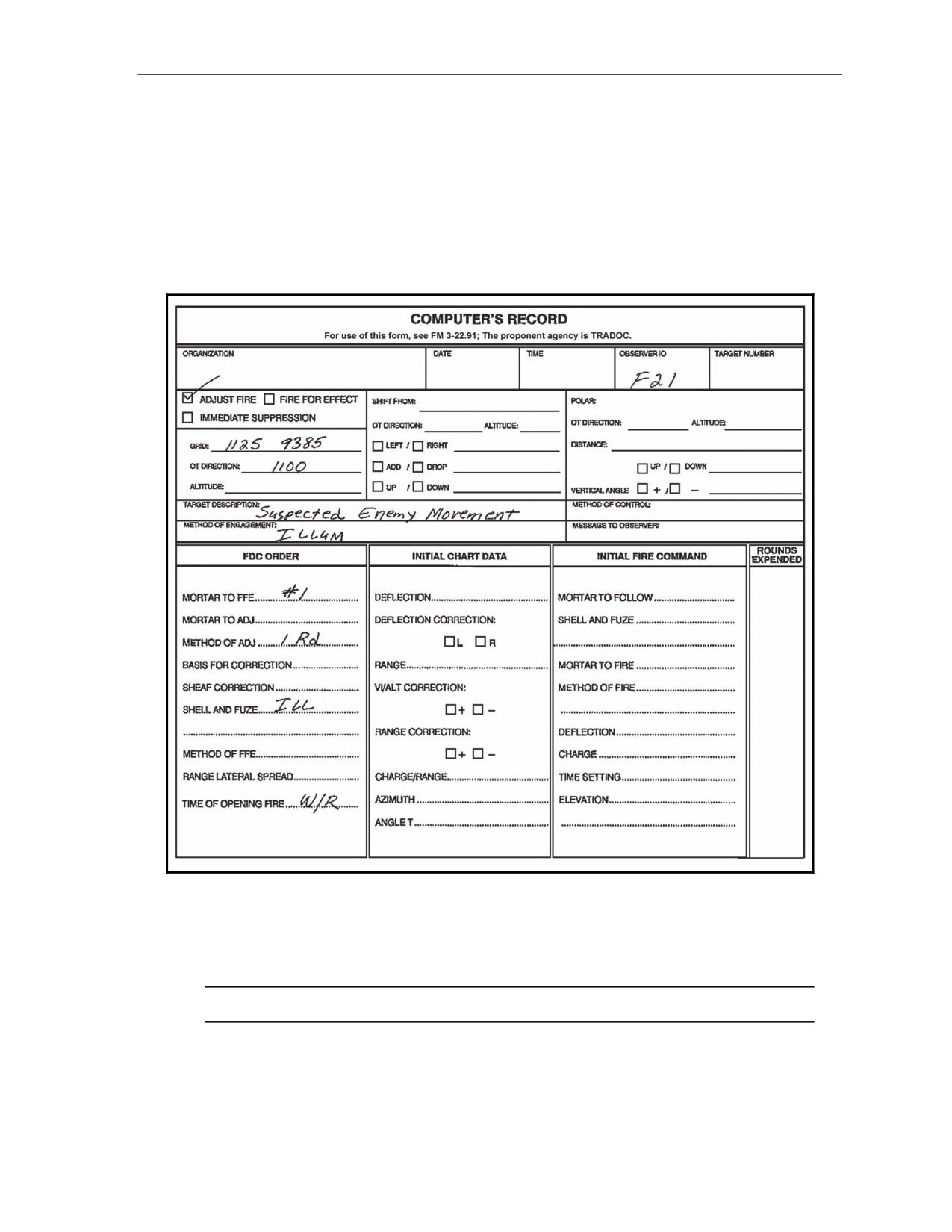
Figure E-7. Situation F (excerpt from an example of
completed DA Form 2399-R [Computer's Record]).
NOTE: The initial round is fired, and the FO sends: RIGHT 100, ADD 100.
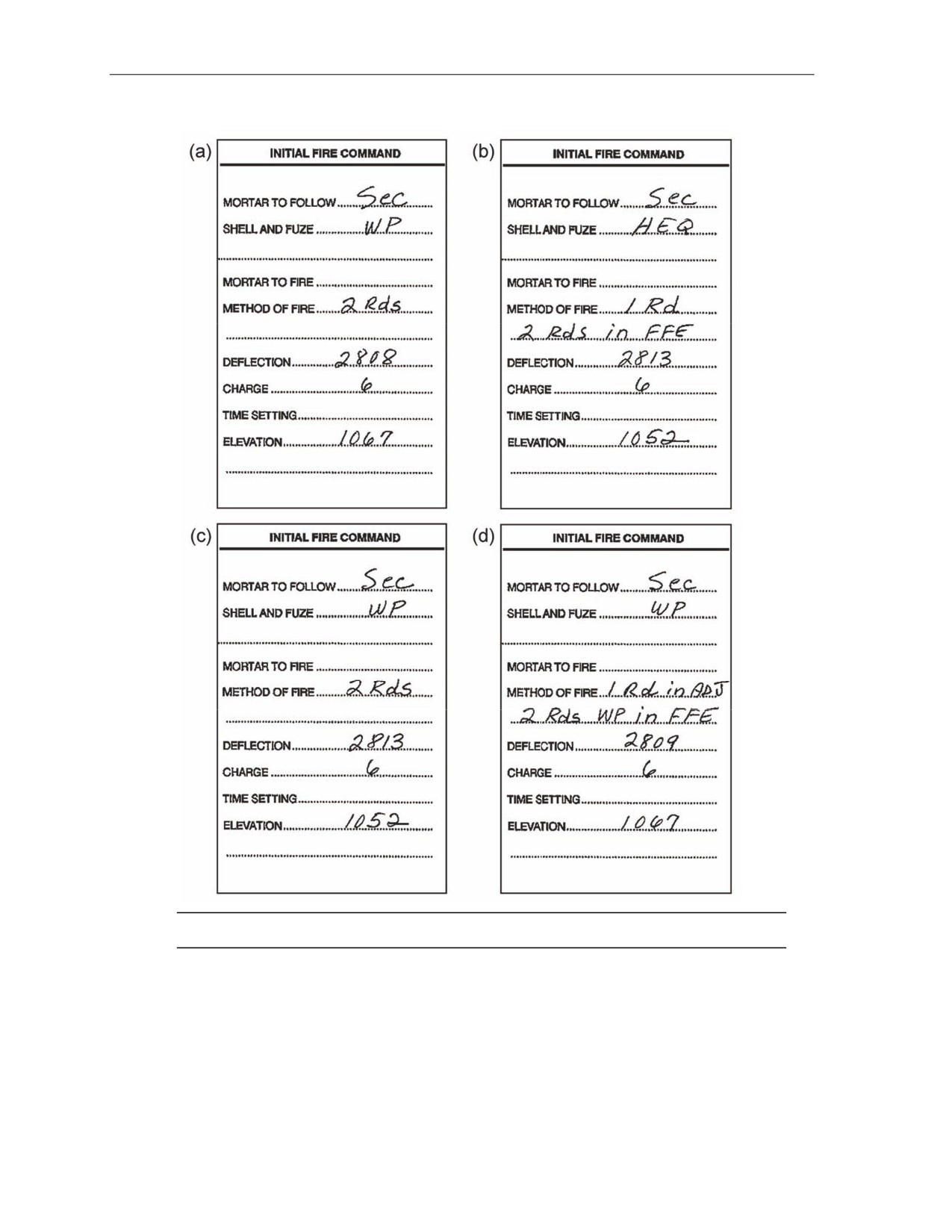
16. What is the correct subsequent command?
NOTE: The FO spots the round and sends: ADD 50, FFE.
E-22
FM 3-22.91
17 July 2008
Fire Direction Center Certification
TASK:
Compute data for a special sheaf using the CFF and FDC order in Figure E-7.
CONDITIONS:
Given an MBC with a mission already in progress.
STANDARDS:
Compute data for the corrections to within
1 mil for deflection and elevation, and
determine turns to the nearest one-half turn.
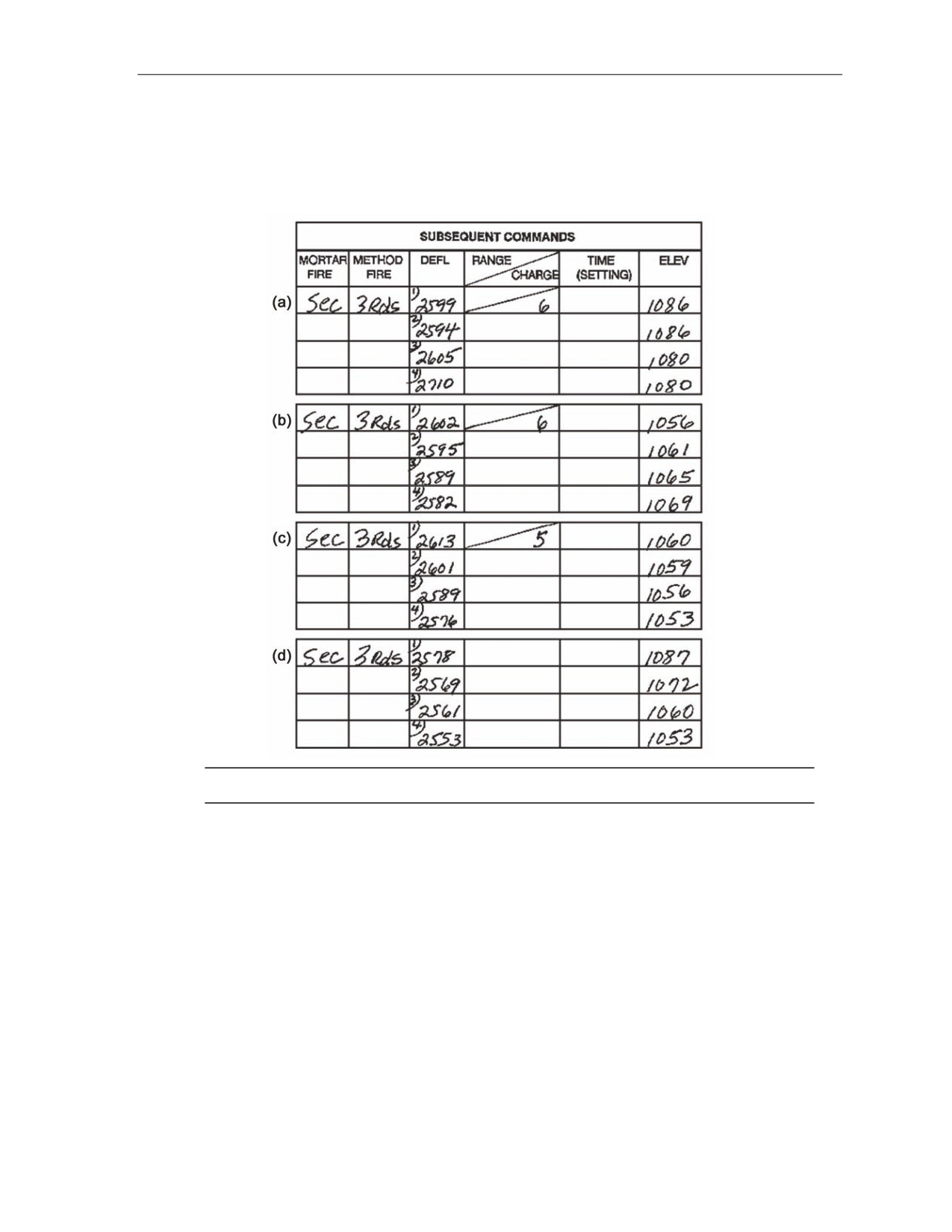
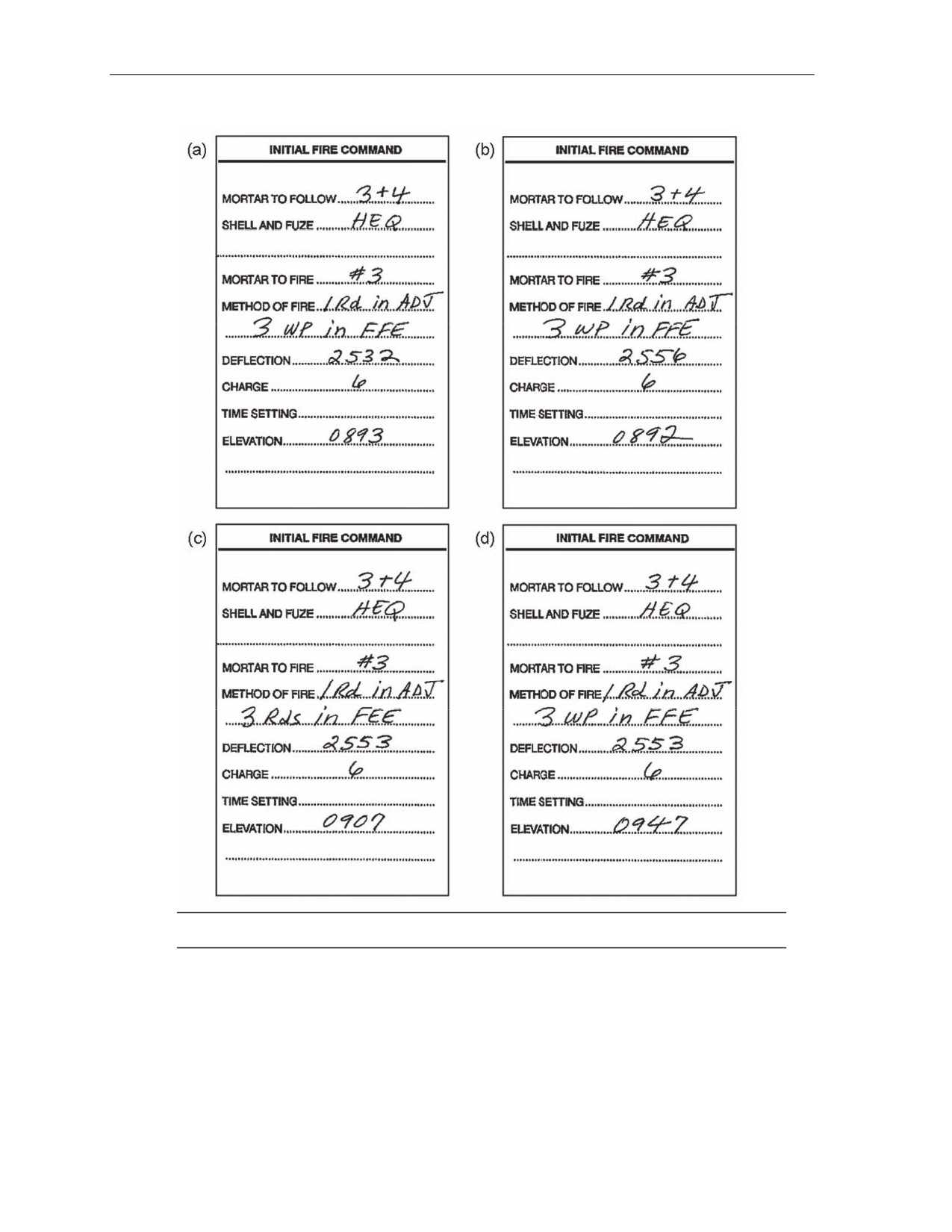
17. What is the correct subsequent command for the FFE?
NOTE: The FO sends: EOM, BRIDGE DESTROYED, EOMRAT AA0202, KNPT 02.
SITUATION G
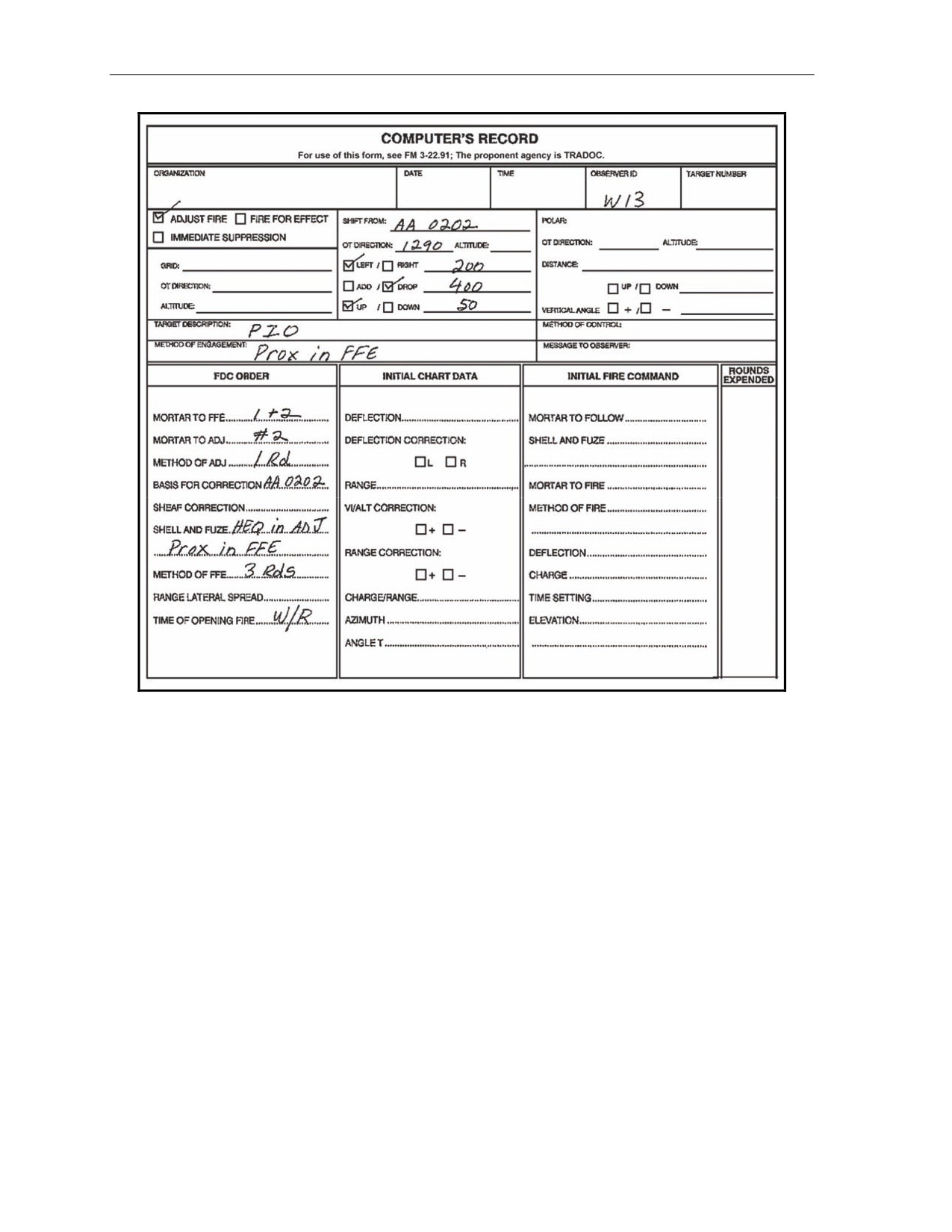
W13 sends in the fire request in Figure E-8.
TASK:
Record information on firing records.
CONDITIONS:
Given a DA Form 2399-R and DA Form 2188-R, CFF, FO’s corrections, information to
complete the FDC order, ammunition count, mortar platoon/ section SOP, and MBC.
STANDARDS: Record and compute the mission. Correctly complete all required blocks and spaces on
the DA Form 2399-R. Record the information and data needed for the type of mortar and
ammunition being fired at the end. Complete the DA Form 2188-R.
17 July 2008
FM 3-22.91
E-23
Appendix E
Figure E-8. Situation G: first mission (excerpt from an example of
completed DA Form 2399-R [Computer's Record]).
W13 immediately sends in another fire request. The section leader assigns No. 1 and No. 2 guns to the first
mission (SHIFT), and No. 3 and No. 4 guns to the second mission (POLAR).
TASK:
Compute data for a shift from a known point mission using the CFF and FDC orders in
Figure E-8.
CONDITIONS: Given an initialized MBC, CFF using shift from a known point, DA Form 2399-R, and DA
Form 2188-R.
STANDARDS: Compute data for the mission to within 1 mil for deflection and elevation.
TASK:
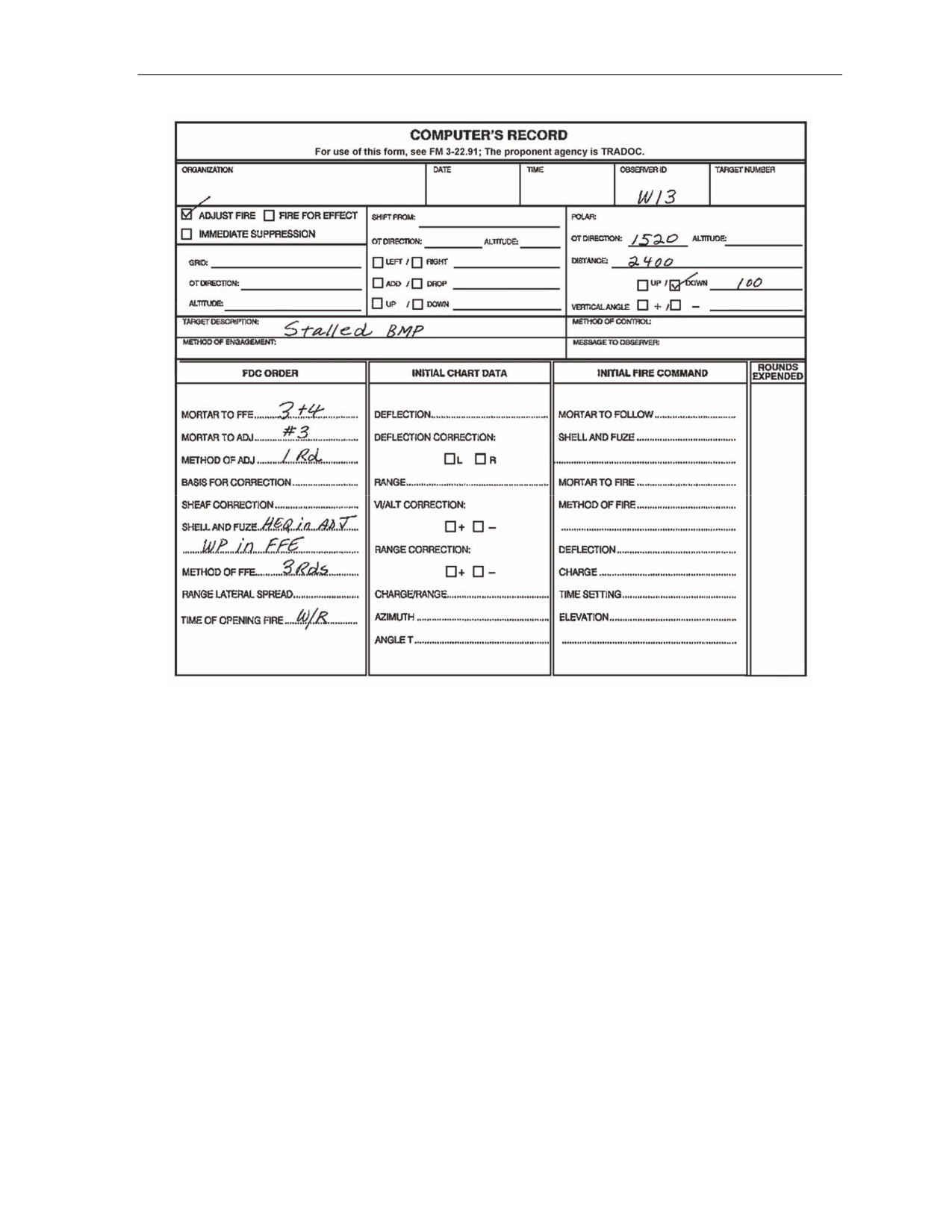
Compute firing data for a polar plot mission using the CFF and FDC orders in Figure E-9.
CONDITIONS:
Given an initialized MBC, CFF, DA Form 2399-R, and DA Form 2188-R.
STANDARDS:
Compute the firing data for the mission to within 1 mil for deflection and elevation.
TASK:
Compute firing data for a polar plot mission using the CFF and FDC orders in Figure E-9.
CONDITIONS:
Given an initialized MBC, CFF, DA Form 2399-R, and DA Form 2188-R.
STANDARDS:
Compute the firing data for the mission to within 1 mil for deflection and elevation.
E-24
FM 3-22.91
17 July 2008
Fire Direction Center Certification
Figure E-9. Situation G: second mission (excerpt from an example of
completed DA Form 2399-R [Computer's Record]).
18. What is the correct range for the first round in mission one?
(a)
2,408 meters
(b)
3,628 meters
(c)
3,354 meters
(d)
2,508 meters
17 July 2008
FM 3-22.91
E-25
Appendix E
19. What is the correct initial fire command for mission two?
NOTE: The first mission’s initial round is fired, and the FO sends: RIGHT 50, DROP 100.
TASK:
Compute data for subsequent FO corrections using the MBC.
CONDITIONS:
Given an MBC with a mission already in progress and corrections from the FO to apply.
STANDARDS:
Compute data for the corrections to within 1 mil for deflection and elevation.
E-26
FM 3-22.91
17 July 2008
Fire Direction Center Certification
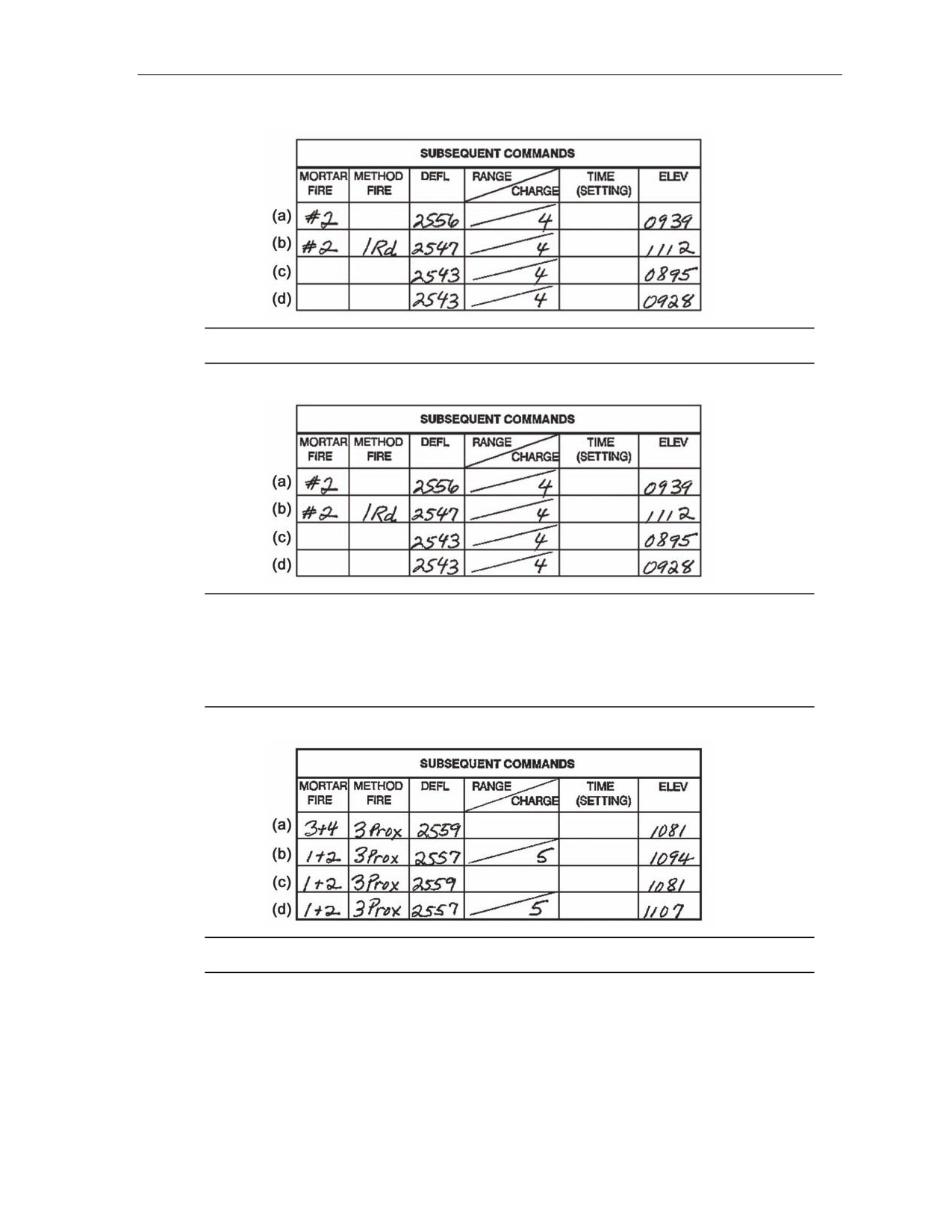
20. What is the correct subsequent command for mission one?
NOTE: The FO spots the round for mission two and sends: DROP 50, FFE.
21. What is the correct subsequent command for the second mission?
NOTES:
1. The FO spots the second round for the first mission and sends:
ADD 50, FFE.
2. The FO calls back on the second mission: EOM, BMP DESTROYED,
EOMRAT AA204, KNPT 04.
22. What is the correct subsequent command for the first FFE mission?
NOTE: The FO sends: EOM, EST 80 PERCENT CAS, EOMRAT AA0203, KNPT03.
SITUATION H
The company commander orders the mortar platoon to displace. The platoon occupies the new position. The
initialization data is entered into the MBC.
17 July 2008
FM 3-22.91
E-27
Appendix E
TASK:
Prepare an MBC with initialization data.
CONDITIONS:
Given an MBC with weapon and FO location data.
STANDARDS:
Enter the weapon and FO location data into the MBC without error.
WEAPON DATA
FO LOCATION
81-MM (M252)
F21 AP: 09850 93100
CARRIER-MOUNTED: NO
ALT: 0300
BP: A2 GRID: AP: 13225 92885
ALT: 0420
AZ: 5340 DEF: 2800
A1: Dir 0540 Dis 035
A3: Dir 3740 Dis 035
A4: Dir 3740 Dis 070
TASK:
Store a no-fire line/zone in the MBC.
CONDITIONS:
Given an initialized MBC and coordinates for a no-fire line/zone.
STANDARDS:
Store a no-fire line/zone without error.
NO-FIRE LOCATION
ZN1 04 PTS
PT1 09450 93300
PT2 10650 93300
PT3 10650 93500
PT4 09450 93500
TASK:
Store safety data in the MBC.
CONDITIONS:
Given an initialized MBC and a completed safety diagram.
STANDARDS:
Store the safety diagram data without error.
SAFETY DATA
LLAZ 4940
RLAZ 5740
MAX RN 3800
MIN RN 0450
MIN CHG 1
MAX CHG 7
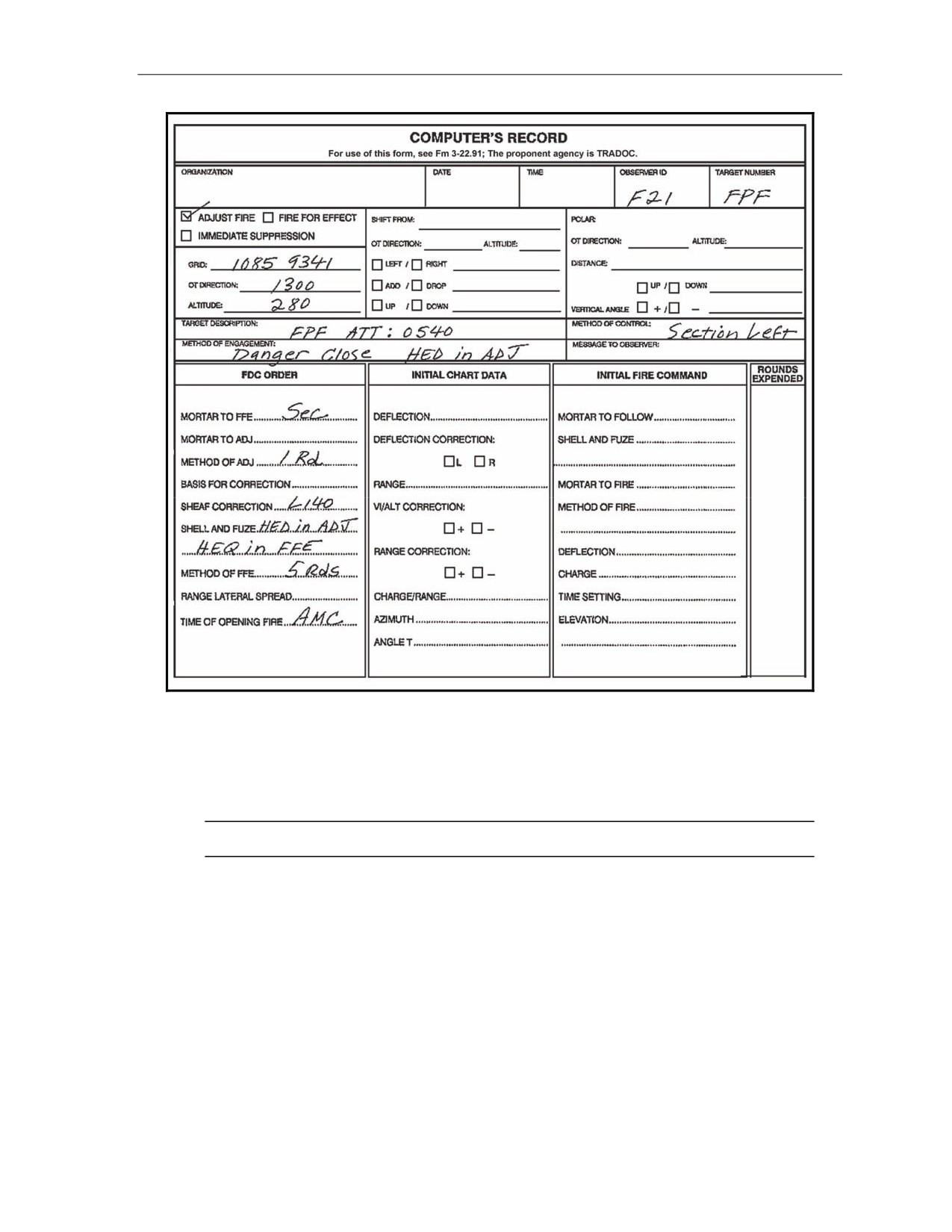
The company commander has directed that an FPF be placed at grid 10850 93410. The platoon leader informs
the FO, and the FO sends the CFF in Figure E-10.
E-28
FM 3-22.91
17 July 2008
Fire Direction Center Certification
Figure E-10. Situation H (excerpt from an example of
completed DA Form 2399-R [Computer's Record]).
TASK:
Compute firing data for an FPF.
CONDITIONS:
Given an initialized MBC, a CFF (requesting adjustment of an FPF), DA Form 2399-R,
and DA Form 2188-R.
STANDARDS: Compute data for an FPF to the nearest 1 mil for deflection and elevation.
NOTE: No. 4 gun is the danger close gun.
23. What is the burst point grid for the first round?
(a)
10850 93410
(b)
10788 93304
(c)
10920 93411
(d)
10790 93000
17 July 2008
FM 3-22.91
E-29
Appendix E
24. What are the correct initial deflections and elevations?
DEF (mils) ELEV (mils)
DEF (mils) ELEV (mils)
(a)
No. 1
3128
1045
(b) No. 1
3180
0995
No. 2
3127
1045
No. 2
3179
0995
No. 3
3126
1046
No. 3
3178
0994
No. 4
3200
0900
No. 4
3124
0900
(c)
No. 1
3040
0945
(d) No. 1
3141
0969
No. 2
3039
0994
No. 2
3141
0969
No. 3
3038
0946
No. 3
3141
0969
No. 4
3200
0900
No. 4
3141
0969
NOTE: The FO spots the round and sends: NO. 4 GUN, LEFT 25, ADD 25.
TASK:
Compute data for subsequent FO corrections using the MBC.
CONDITIONS:
Given an MBC with a mission already in progress and corrections from the FO to
apply.
STANDARDS: Compute data for the corrections to within 1 mil for deflection and elevation.
NOTE: The round is fired and the FO sends: NO. 4 GUN ADJUSTED, REPEAT NO. 3 GUN.
25. What is the correct deflection and elevation for No. 3 gun?
DEF (mils) ELEV (mils)
DEF (mils) ELEV (mils)
(a)
3134
1059
(b)
3124
1050
(c)
3126
3127
(d)
3134
0975
NOTES:
1. The FO spots the round and sends: RIGHT 25.
2. That round is fired, and the FO sends: NO. 3 ADJUSTED,
REPEAT NO. 2 GUN.
3. The round is fired, and the FO sends: RIGHT 25, ADD 25.
26. What is the correct deflection and elevation for the No. 2 gun?
DEF (mils) ELEV (mils)
DEF (mils) ELEV (mils)
(a)
3126
0974
(b)
3141
0977
(c)
3127
0975
(d)
3141
0950
NOTES:
1. The round is fired, and the FO sends: NO. 2 ADJUSTED,
REPEAT NO. 1 GUN.
2. The round is fired, and the FO sends: EOM, FPF ADJUSTED.
E-30
FM 3-22.91
17 July 2008
Fire Direction Center Certification
SITUATION I
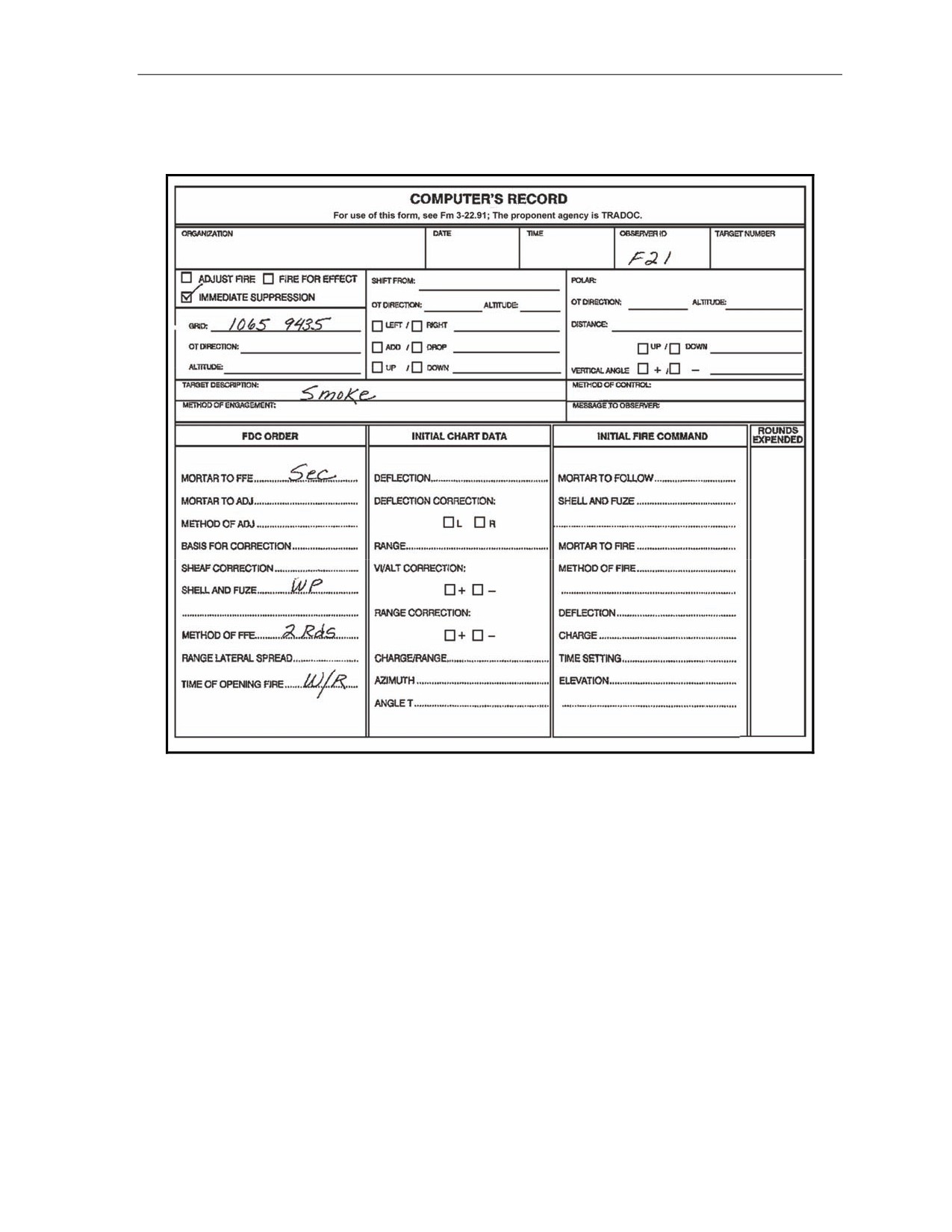
A short time after adjusting the FPF, you receive the CFF and FDC order in Figure E-11.
Figure E-11. Situation I (excerpt from an example of
completed DA Form 2399-R [Computer's Record]).
TASK:
Compute data for a grid mission using the CFF and FDC order in Figure E-11.
CONDITIONS:
Given an initialized MBC, CFF using grid coordinates as the method of target location,
DA Form 2399-R, and DA Form 2188-R.
STANDARDS: Compute data for the mission's initial fire command to within 1 mil for deflection and
elevation.
17 July 2008
FM 3-22.91
E-31
Appendix E
27. What is the correct initial fire command?
NOTE: The FO sends: EOM, AREA SCREENED, EOMRAT AA0205, KNPT 05.
SITUATION J
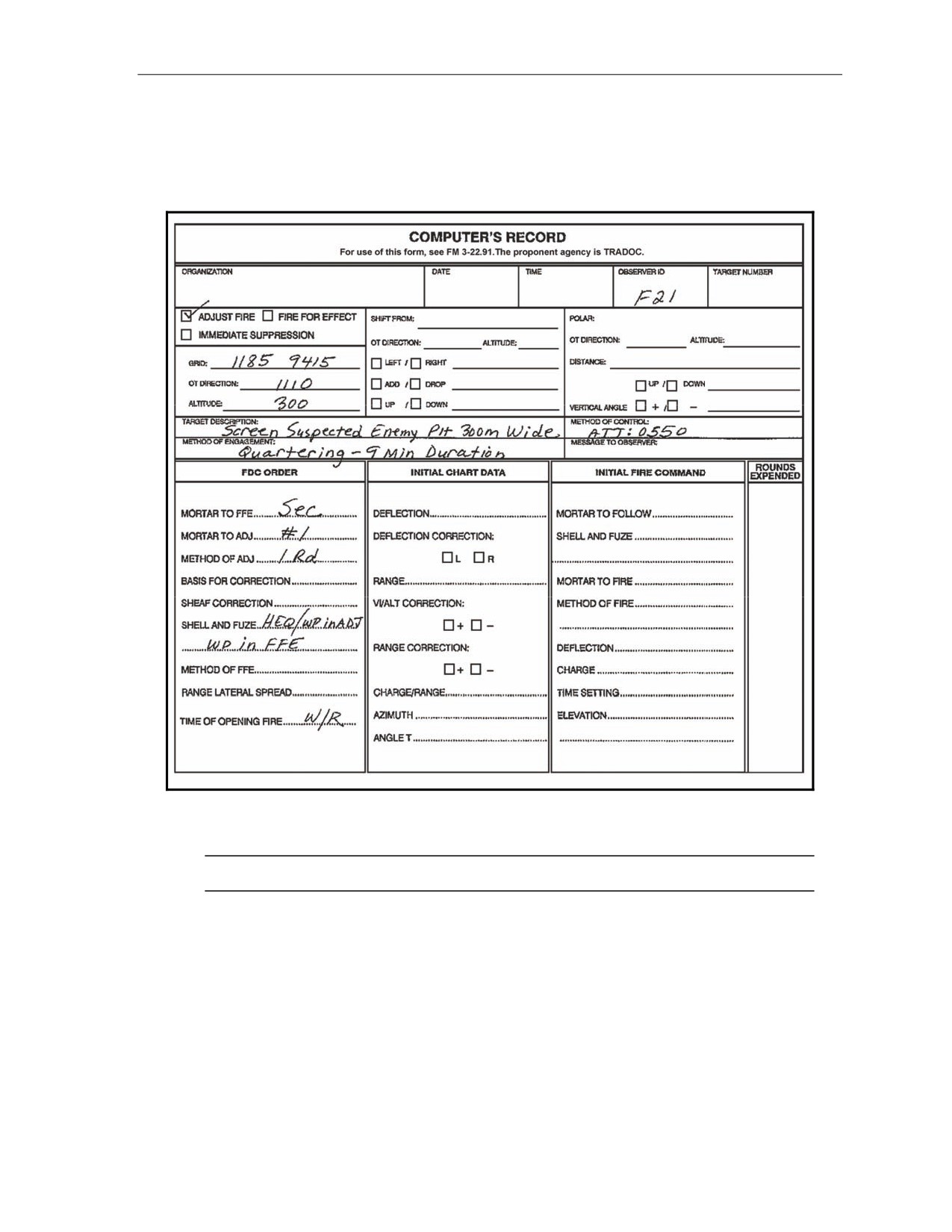
The commander wants a screen at grid 11850 94150. The platoon leader informed the FSO and the FO. A short
time later you receive the CFF in Figure E-12.
E-32
FM 3-22.91
17 July 2008
Fire Direction Center Certification
TASK:
Compute firing data for a quick-smoke mission.
CONDITIONS:
Given an initialized MBC, call fire
(requesting a quick smoke mission), weather
conditions, smoke card, DA Form 2399-R, and DA Form 2188-R.
STANDARDS: Compute the initial and subsequent fire commands to the nearest 1 mil for deflection and
elevation, and the correct number of rounds in the FFE.
Figure E-12. Situation J (excerpt from an example of
completed DA Form 2399-R [Computer's Record]).
NOTE: Temperature gradient: neutral; wind speed: 9 knots; humidity: 60 percent.
17 July 2008
FM 3-22.91
E-33
Appendix E
28. What is the deflection for the last round fired?
(a)
2468
(b)
2498
(c)
2388
(d)
2598
NOTES:
1. The FO spots the round and sends: LEFT 50, ADD 100.
2. The round is fired and the FO sends: ADD 100.
3. The FO spots the round and sends: REPEAT WP.
4. The FO sees the WP and sends: FFE, CONTINUOUS FIRE FROM THE LEFT.
29. What is the time interval between rounds?
(a)
20 seconds
(b)
10 seconds
(c)
12 seconds
(d)
6 seconds
30. What is the total number of WP rounds computed for the mission?
(a)
37 rounds
(b)
40 rounds
(c)
41 rounds
(d)
28 rounds
NOTE: The FO calls back: EOM, AREA SCREENED, EOMRAT AA0206, KNPT 06.
SITUATION K
The platoon leader has been ordered to displace No. 3 and No. 4 guns to a new firing point. Enter the following
weapon data:
TASK:
Prepare an MBC with initialization data.
CONDITIONS:
Given an MBC with weapon data.
STANDARDS:
Enter the weapon data into the MBC without error.
WPN DATA
BP: B3
CARRIER-MOUNTED: NO
GRID: 10750 91300
ALT: 0350
AZ: 6400 DEF: 2800
B4: Dir 4900 Dis 040
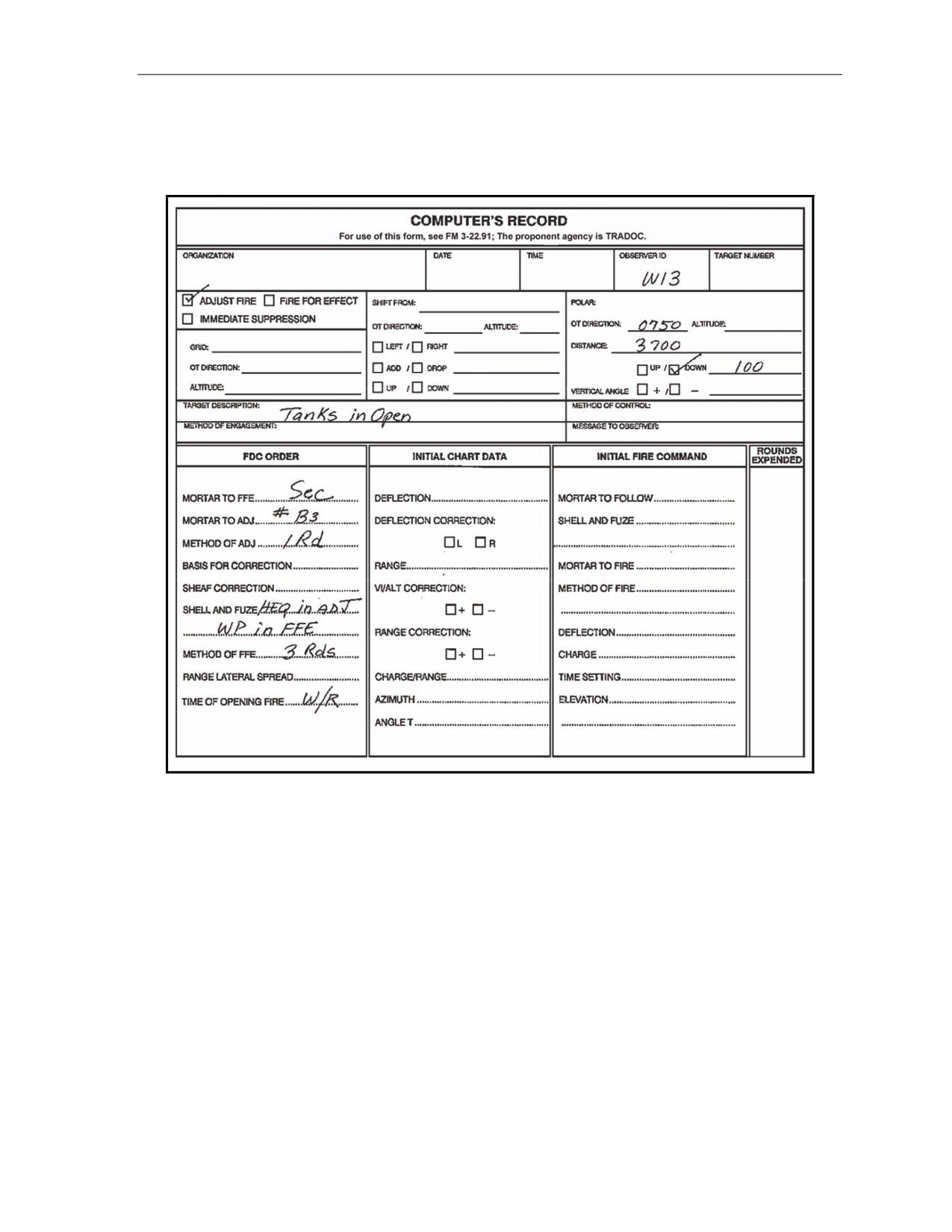
Shortly after the section occupies its new position, another fire request is received. Use the CFF and FDC order
in Figure E-13 to compute the mission.
E-34
FM 3-22.91
17 July 2008
Fire Direction Center Certification
TASK:
Compute firing data for a polar plot mission using the CFF and FDC orders in Figure E-
13.
CONDITIONS: Given an initialized MBC, CFF, DA Form 2399-R, and DA Form 2188-R.
STANDARDS: Compute the firing data for the mission to within 1 mil for deflection and elevation.
Figure E-13. Situation K (excerpt from an example of
completed DA Form 2399-R [Computer's Record]).
17 July 2008
FM 3-22.91
E-35
Appendix E
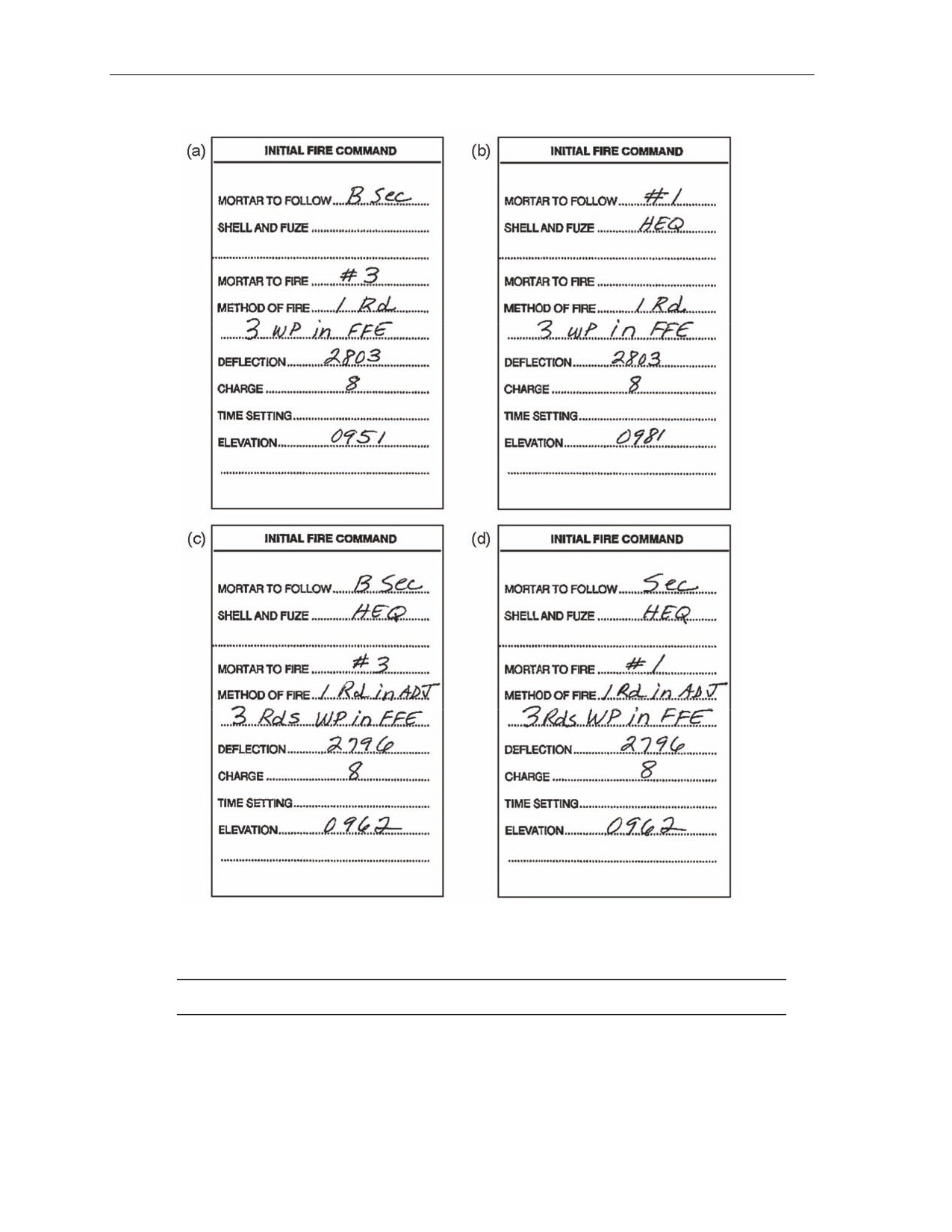
31. What is the correct initial fire command?
TASK:
Compute data for subsequent FO corrections using the MBC.
CONDITIONS:
Given an MBC with a mission already in progress and corrections from the FO to apply.
STANDARDS:
Compute data for the corrections to within 1 mil for deflection and elevation.
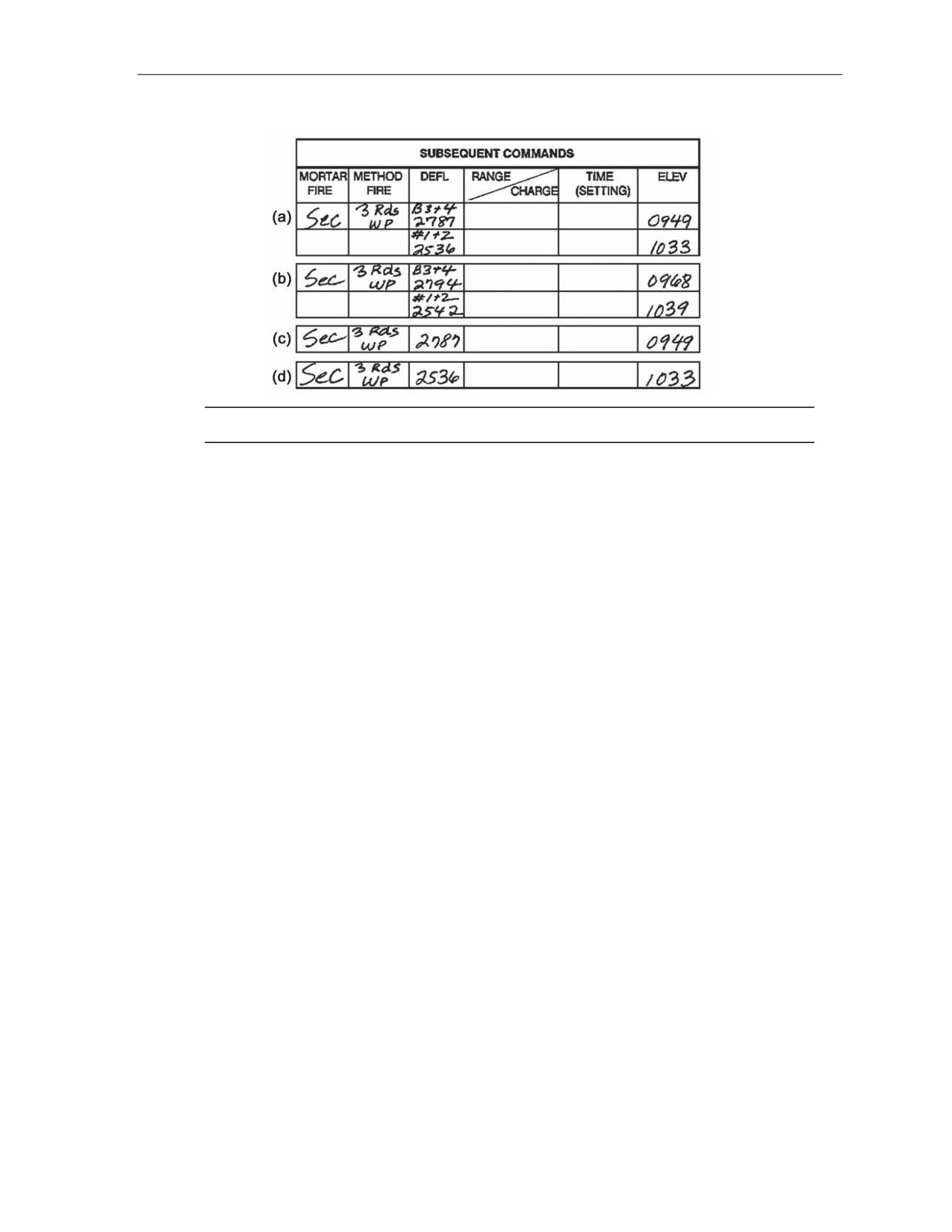
NOTE: The FO sends the correction: ADD 50, FFE.
E-36
FM 3-22.91
17 July 2008
Fire Direction Center Certification
32. What is the correct subsequent command?
NOTE: The FO sends: EOM, TANKS BURNING, EOMRAT AA0207, KNPT 07.
SITUATION L
The No. 3 and No. 4 guns have now displaced back to their position with the rest of the platoon. Another
mission is received in the FDC. Use the CFF and FDC order in Figure E-14 to compute the mission.
TASK:
Compute data for a searching mission using the CFF and FDC order in Figure E-14.
CONDITIONS:
Given an MBC with a mission already in progress.
STANDARDS:
Compute data for the corrections to within
1 mil for deflection and elevation, and
determine turns to the nearest one-half turn.
17 July 2008
FM 3-22.91
E-37
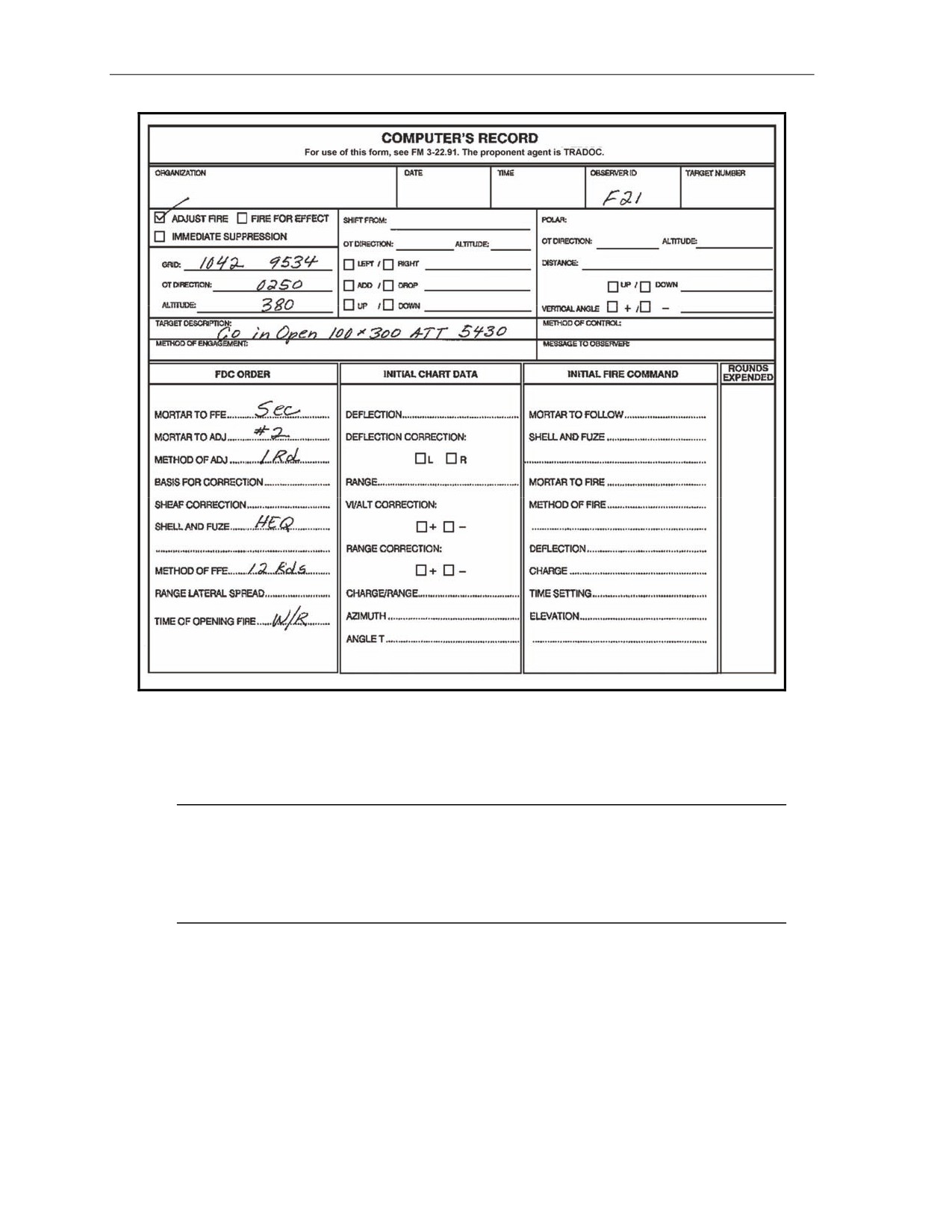
Appendix E
Figure E-14. Situation L (excerpt from an example of
completed DA Form 2399-R [Computer's Record]).
TASK:
Compute data for subsequent FO corrections using the MBC.
CONDITIONS:
Given an MBC with a mission already in progress and corrections from the FO to apply.
STANDARDS:
Compute data for the corrections to within 1 mil for deflection and elevation.
NOTES:
1. The FO spots the initial round and sends a correction: RIGHT 200, DROP 200.
2. That round is fired, and the FO sends his next correction: LEFT 50, DROP 100.
3. That round is fired, and the observer calls back: ADD 50, FFE.
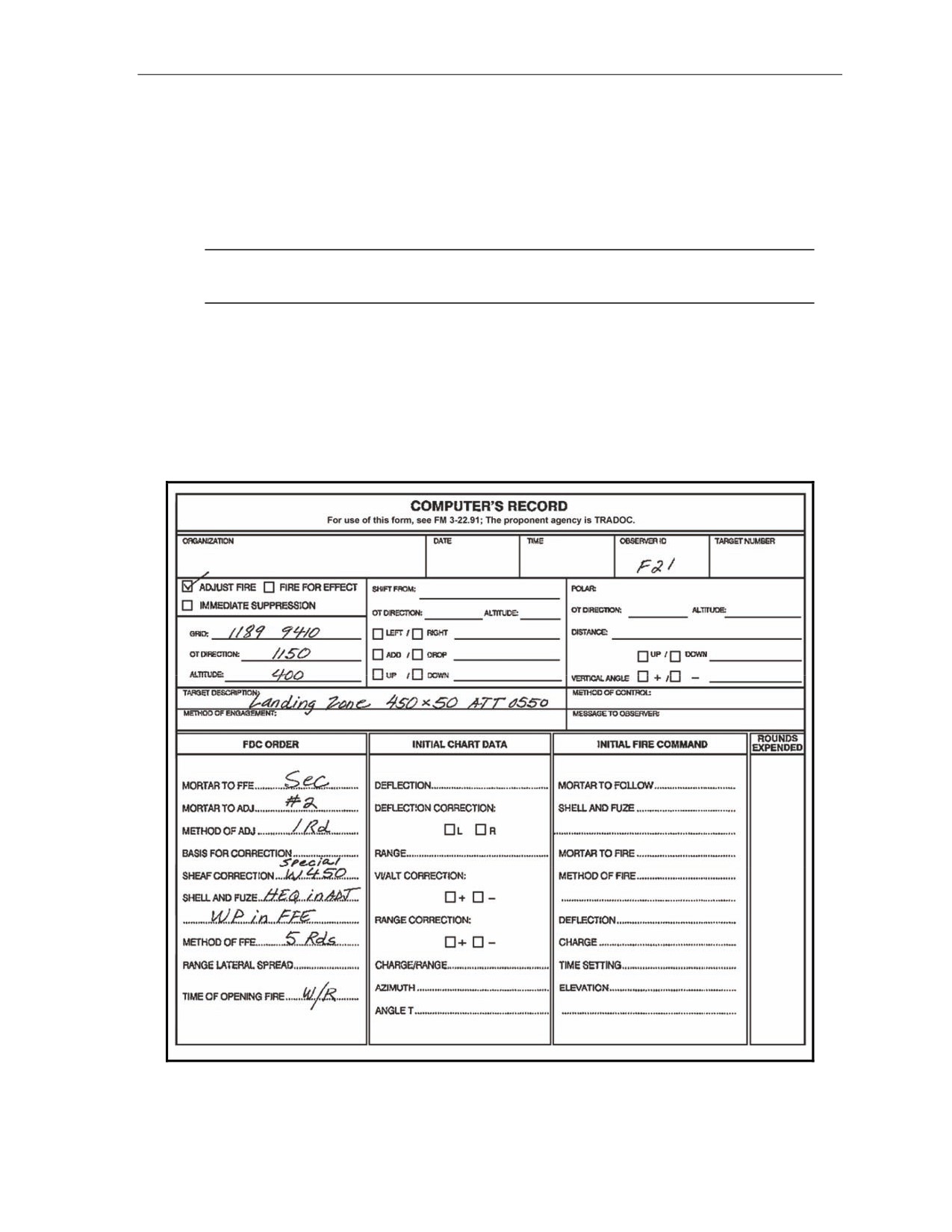
33.
What is the correct deflection, charge, and elevation for the near edge of the target?
DEF
CHG ELEV
DEF
CHG
ELEV
(mils)
(mils)
(mils)
(mils)
(a)
2652
6
1062
(b)
2642
7
1083
(c)
2645
7
1072
(d)
2642
7
1072
E-38
FM 3-22.91
17 July 2008
Fire Direction Center Certification
34. What is the correct deflection, charge, and elevation to the far edge of the target?
DEF
CHG ELEV
DEF
CHG
ELEV
(mils)
(mils)
(mils)
(mils)
(a)
2649
6
0982
(b)
2649
7
0997
(c)
2645
7
1051
(d)
2649
7
0982
NOTE: The FO observes the FFE and sends: EOM, TROOPS DISPENSING, EOMRAT
AA0208, KNPT 08.
SITUATION M
Just at dusk of the same day, the FDC receives another fire request. Use the CFF and FDC order in Figure E-15
to compute the mission.
TASK:
Compute data for a traversing mission using the CFF and FDC order in Figure E-15.
CONDITIONS:
Given an MBC with a mission already in progress.
STANDARDS:
Compute data for the corrections to within
1 mil for deflection and elevation, and
determine turns to the nearest one-half turn.
Figure E-15. Situation M (excerpt from an example of
completed DA Form 2399-R [Computer's Record]).
17 July 2008
FM 3-22.91
E-39
Appendix E
TASK:
Compute data for subsequent FO corrections using the MBC.
CONDITIONS:
Given an MBC with a mission already in progress and corrections from the FO to apply.
STANDARDS:
Compute data for the corrections to within 1 mil for deflection and elevation.
NOTES:
1. The FO spots the round and sends the correction: LEFT 200, DROP 200.
2. The round is fired, and the FO sends another correction: RIGHT 100, ADD 25.
3. The round is spotted by the FO, and he sends the correction:
LEFT 50, FFE, TRAVERSE RIGHT.
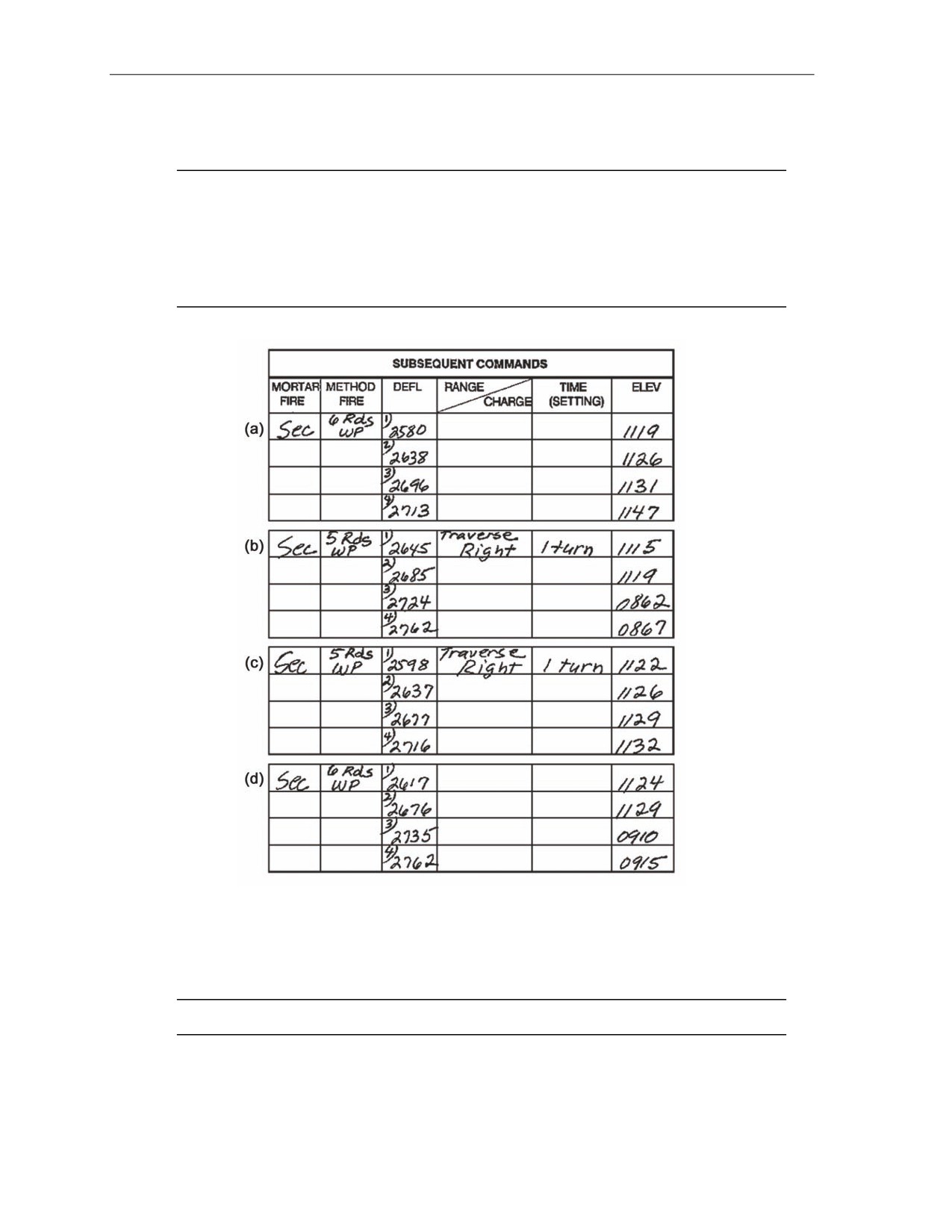
35.
What is the subsequent command for the FFE?
36. How many turns are there between rounds?
(a)
1/2 turn
(b)
1 turn
(c)
1 1/2 turns
(d)
2 turns
NOTE: The FO observes the FFE and sends: EOM LZ DESTY.
E-40
FM 3-22.91
17 July 2008
Fire Direction Center Certification
SITUATION N
It is now dark and the platoon is prepared for night firing. The FDC receives a fire request. Use the CFF and
FDC order in Figure E-16 to compute the mission.
TASK:
Compute firing data for an illumination mission.
CONDITIONS:
Given an initialized MBC, CFF, DA Form 2399-R, and DA Form 2188-R.
STANDARDS:
Compute data for an illumination mission to the nearest 1 mil for deflection and elevation,
and time setting to within one-tenth of a second.
Figure E-16. Situation N (excerpt from an example of
completed DA Form 2399-R [Computer's Record]).
TASK:
Compute data for subsequent FO corrections using the MBC.
CONDITIONS:
Given an MBC with a mission already in progress and corrections from the FO to apply.
STANDARDS:
Compute data for the corrections to within 1 mil for deflection and elevation.
NOTE: The round is fired and the FO sends the correction: RIGHT 200, DROP 400, DOWN 100.
17 July 2008
FM 3-22.91
E-41
Appendix E
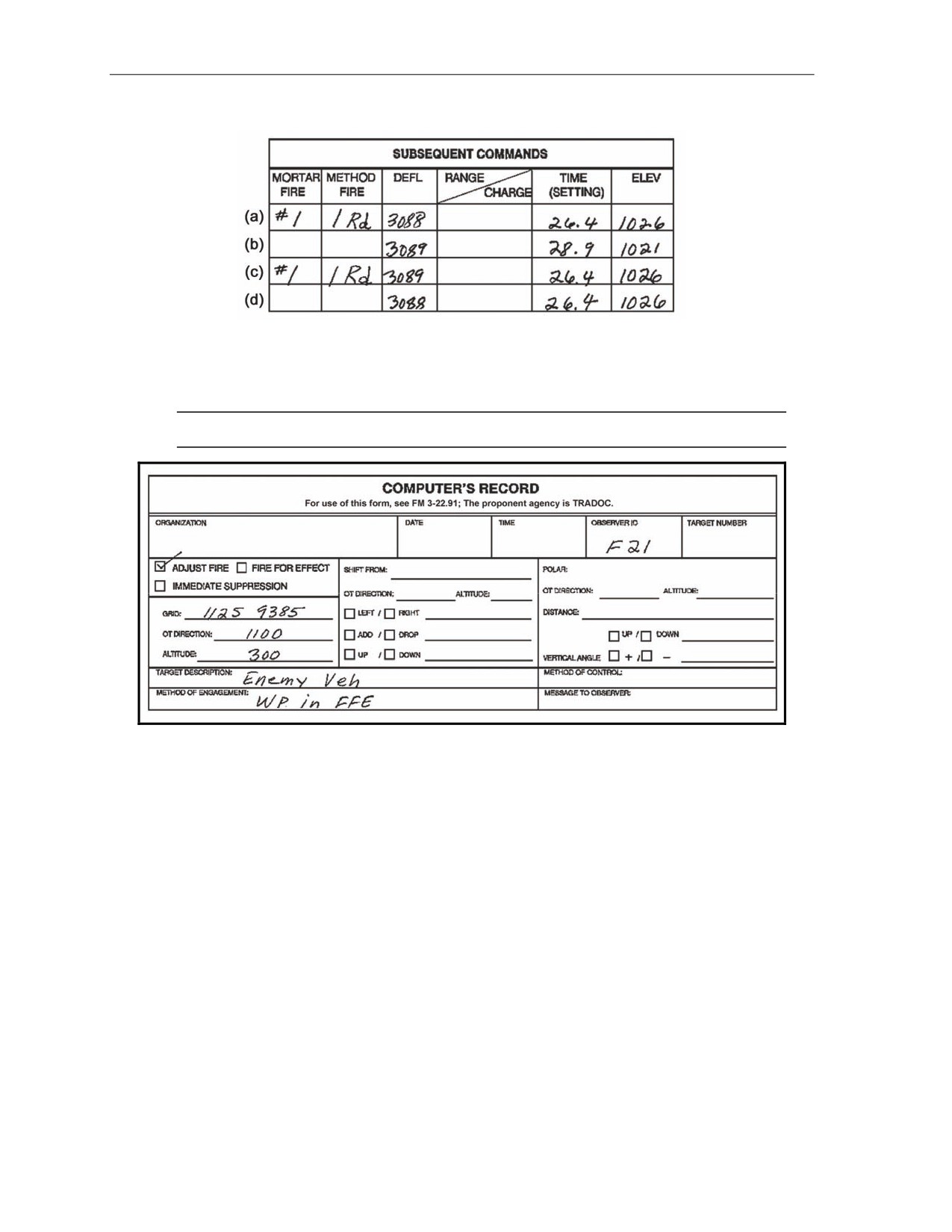
37. What is the correct subsequent command?
TASK:
Compute data for a coordinated illumination mission using the CFF in Figure E-17.
CONDITIONS:
Given an initialized MBC, CFF, DA Form 2399-R, and DA Form 2188-R.
STANDARDS:
Compute firing data for the deflection and elevation to within 1 mil for all high-explosive
and illumination rounds for the initial and subsequent fire commands.
NOTE: The round is fired, and the FO sends a coordinated illumination and HE CFF.
Figure E-17. Situation N: second mission (excerpt from an example of
completed DA Form 2399-R [Computer's Record]).
E-42
FM 3-22.91
17 July 2008
Fire Direction Center Certification
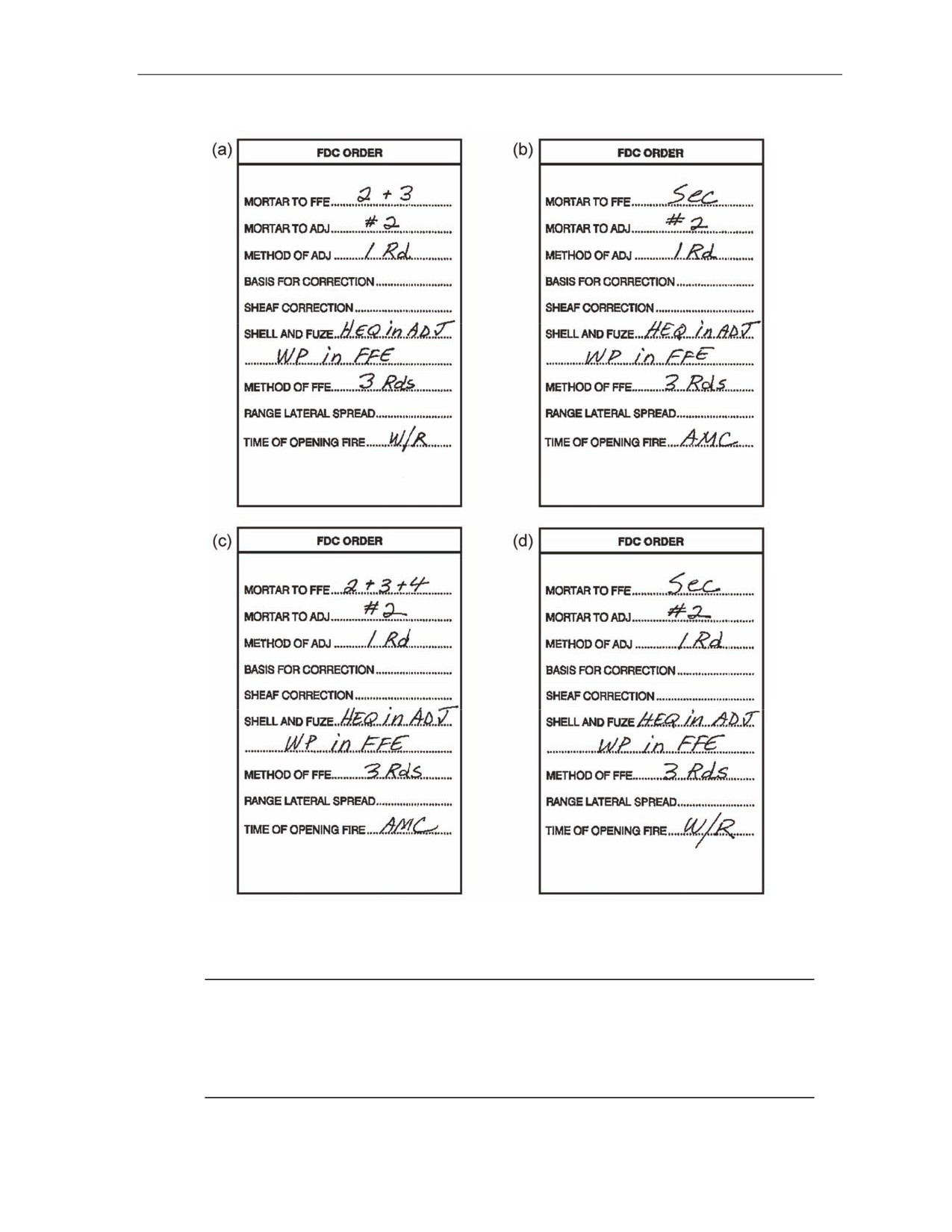
38. What is the correct FDC order?
TASK:
Compute data for subsequent FO corrections using the MBC.
CONDITIONS:
Given an MBC with a mission already in progress and corrections from the FO to apply.
STANDARDS:
Compute data for the corrections to within 1 mil for deflection and elevation.
NOTES:
1. No. 1 gun fires an illumination round and the FO sends: ILLUM MARK.
2. The MARK TIME is 50 seconds.
3. ILL and HE rounds are fired and the FO calls back: HE, DROP 100.
17 July 2008
FM 3-22.91
E-43
Appendix E
39. What is the range to the target for this correction?
(a)
2,358 meters
(b)
2,318 meters
(c)
2,198 meters
(d)
2,258 meters
NOTE: ILL and HE rounds are fired, and the FO calls back: HE, RIGHT 50, DROP 50, FFE.
40. What is the correct deflection and elevation for the No. 2, No. 3, and No. 4 guns in the FFE?
DEF ELEV
DEF ELEV
(mils)
(mils)
(mils)
(mils)
(a)
2946
1047
(b)
2946
1055
(c)
2946
1063
(d)
2946
1070
NOTE: The FO observes the FFE and sends: EOM, VEHICLES BURNING, EOMRAT
AA0409, KNPT 09.
SITUATION O
The following are questions relating to various MBC situations:
41. When the MBC is connected to a radio, it is proper procedure to conduct a MODEM test.
TRUE
FALSE
42. While operating the MBC, the computer becomes unusually hot and a hissing sound is detected. The first
thing to do is turn the MBC off.
TRUE
FALSE
43. When storing the MBC, the battery can be left in the computer for an unlimited length of time.
TRUE
FALSE
44. While operating the MBC using an external power source in the vehicle, the vehicle should not be started.
TRUE
FALSE
45. Never use a sharp object, such as a pencil, to press the switches when operating the MBC.
TRUE
FALSE
46. The MBC is waterproof when one switch on the keyboard is punctured.
TRUE
FALSE
E-44
FM 3-22.91
17 July 2008
Fire Direction Center Certification
47. The first step before operating the MBC is to place a battery into the battery compartment.
TRUE
FALSE
48. The last check before operating the MBC is to conduct a self-test.
TRUE
FALSE
49. How many messages can the MBC receive from a digital device?
(a) a. 4
(b)
9
(c)
14
(d)
2
50. When receiving a completed fire request (FR) message from a digital device, why must you review it
before processing the mission?
(a) To prevent errors.
(b) To be able to send an MTO.
(c) To receive an ACK.
(d) To manually enter the GRID switch.
51. When entering SET-UP data, what two entries must be the same as the digital device to communicate
digitally?
(a) Listen Only and Bit Rate.
(b) Bit Rate and Block Mode.
(c) Key Tone and Black Mode.
(d) Bit Rate and Key Tone.
52. After pushing the COMPUTE switch during a mission and the display window displays *RANGE ERR*,
what is the correct action to take?
(a) End the mission.
(b) Clear the MET.
(c) Verify initialization and input entries.
(d) Enter a higher charge and recompute.
53. When receiving an FR from a digital device, the display window shows SAFETY VIOLATION. What
corrective action should be taken?
(a) Recompute.
(b) Send an MTO.
(c) Send a CMD message.
(d) Clear out safety diagram.
54. Which FM or technical manual (TM) is used when performing preventive maintenance checks and services
(PMCS) on the M23 mortar ballistic computer?
(a) FM 3-22.90.
(b) TM 9-1350-261-10.
(c) TM 9-1300-257-10.
(d) TM 9-1220-246-12&P.
17 July 2008
FM 3-22.91
E-45
Appendix E
55. After entering safety data into the MBC, the need for safety T’s is no longer warranted.
TRUE
FALSE
SECTION IV. PLOTTING BOARD TEST
The candidate analyzes the following situations and then selects the appropriate answers.
SITUATION A
You are going to the firing range. The platoon leader goes to range control and obtains the safety information.
Using the information that follows, construct a safety diagram.
TASK:
Construct a safety diagram on the M16 plotting board.
CONDITIONS:
Given an M16 plotting board, right and left limit azimuths, minimum and maximum
ranges, type of weapon, firing point with either 8- or 10-digit grid coordinates, charge
zones, and 300-series firing table.
STANDARDS: Convert left and right limits to deflections, and minimum and maximum ranges to
elevations. Construct a diagram on an M16 plotting board without error.
Mortar grid: 06406580
Left limit azimuth: 4800
Right limit azimuth: 5600
Maximum range: 4,000
Minimum range: 500
Charge zone: 2-8
Referred deflection: 2800
1. What are the left and right deflections?
LEFT DEF RIGHT DEF
(mils)
(mils)
(a)
2400
1200
(b)
4800
5600
(c)
2800
2400
(d)
3200
2400
2. What is the minimum elevation (mils that can be fired at the maximum range)?
(a)
0941 mils
(b)
1471 mils
(c)
0907 mils
(d)
1428 mils
E-46
FM 3-22.91
17 July 2008
Fire Direction Center Certification
SITUATION B
You move out to the field. The platoon leader determines an eight-digit grid and an altitude to the mortar
position. He instructs you to construct a modified-observed firing chart.
TASK:
Prepare a plotting board for operation using the modified-observed firing chart.
CONDITIONS:
Given an M16 plotting board, a Fort Benning Installation Map 1:50,000, Edition 1-DMA,
Series:V745Z; a mil protractor; an area of responsibility; a direction of fire (DOF); an
eight-digit coordinate to the mortar position; a target or RP; and a grid intersection to
represent the pivot point.
STANDARDS: Superimpose a grid system on the M16 plotting board using the grid intersection given
without error.
TASK:
Forward plot a target to the modified-observed chart from an observed chart.
CONDITIONS:
Given an M16 plotting board, DA Form 2188-R with previously fired targets, setup data,
DA Form 2399-R, CFF, and firing table.
STANDARDS: Plot the target, compute the firing data to within 1 mil with a 10-mil tolerance for
deflection and 25 meters for range with a 25-meter tolerance, and record and update
firing records without error.
Mortar grid: 07506539
Altitude: 440
OP No. 1: 096660
Altitude: 450
Direction of fire: 2020 mils
Grid intersection: 09/64
Mounting azimuth: 2000 mils
Referred deflection: 4800 mils
Forward plot AC070:
Chart deflection: 4536 mils
Chart range: 2,950 meters
Altitude: 440 meters
The section leader receives a CFF and checks the map. He then hands you the CFF in Figure E-18 and instructs
you to compute the mission.
TASK:
Compute data for a grid mission using the CFF and FDC order in Figure E-18.
CONDITIONS:
Given an M16 plotting board, sector of fire, 1:50,000 map, protractor, DA Form 2399-R,
tabular firing tables, CFF for a grid mission, FO corrections, paper, and pencil.
STANDARDS: Determine the deflection to within 1 mil with a 10-mil tolerance and the range to within 25
meters with a 25-meter tolerance.
TASK:
Determine the VI between the mortar altitude and the target altitude.
CONDITIONS:
Given the mortar altitude and the target altitude.
STANDARDS:
Determine the VI to the nearest whole meter and the range correction to apply without
error.
TASK:
Determine VI to the nearest whole meter and the range correction to apply without error.
CONDITIONS:
Given an M16 plotting board, altitude of the mortar position, CFF with the target altitude,
and a firing table.
STANDARDS: Apply the VI correction without error when computing a mission. Record and update firing
records. Determine deflections to the nearest 1 mil with a 10-mil tolerance. Determine the
range to within 25 meters with a 25-meter tolerance. Convert the range to the correct
charge and elevation.
TASK:
Compute angle T.
CONDITIONS:
Given the observer to target (OT) direction, direction of fire (GT), No. 2 pencil, and paper.
STANDARDS:
Determine the angle T to the nearest 1 mil. Record the angle T to the nearest 10 mils.
Send the angle T to the nearest 100 mils to the FO. Notify the FO in the message to
observer when the angle T exceeds 500 mils.
17 July 2008
FM 3-22.91
E-47
Appendix E
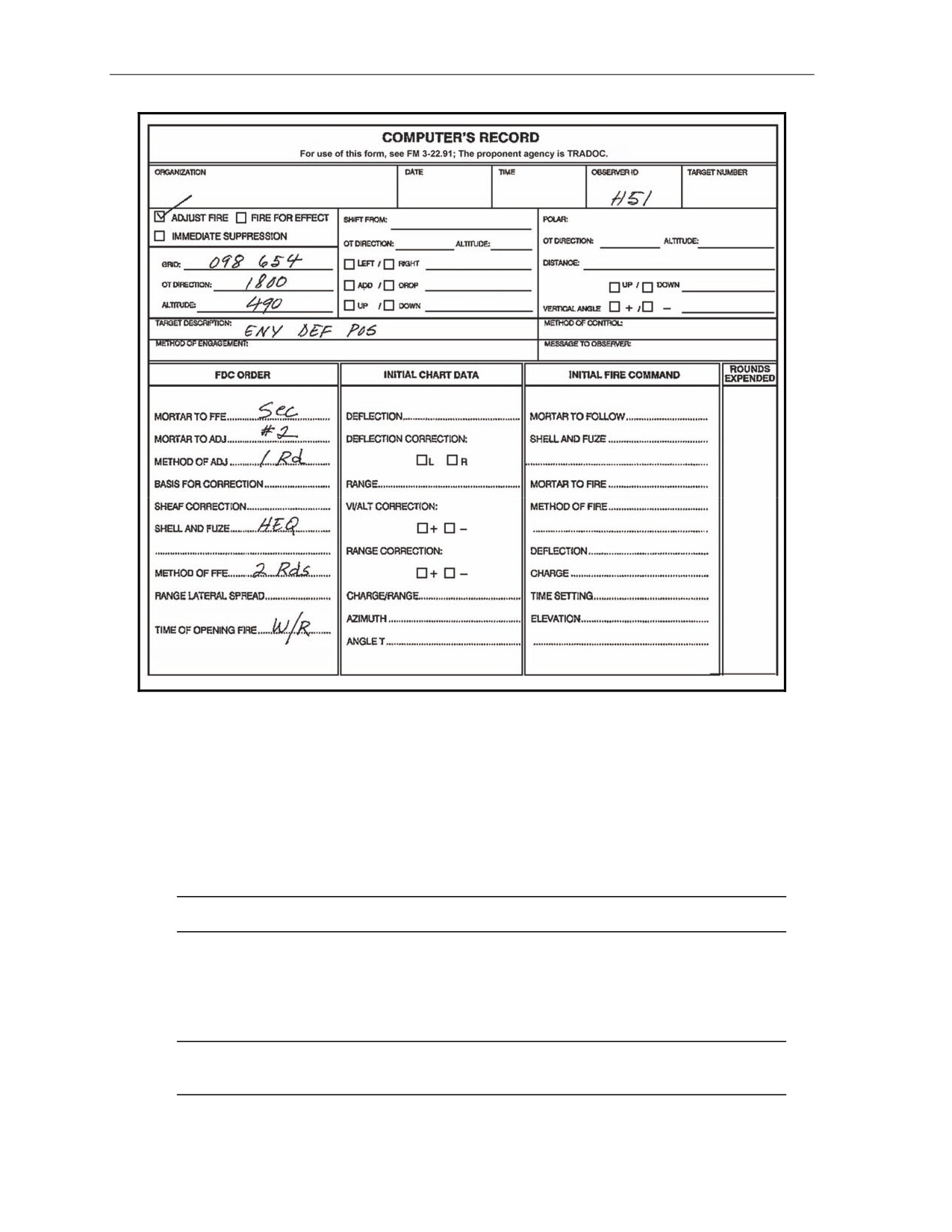
Figure E-18. Situation B: first mission (excerpt from an example of
completed DA Form 2399-R [Computer's Record]).
3. What is the initial chart deflection?
(a)
3205 mils
(b)
5205 mils
(c)
2800 mils
(d)
0700 mils
4. What is the command range to fire the first round?
NOTE: The chart range is 2,300.
(a)
2,300 meters
(b)
2,325 meters
(c)
2,375 meters
(d)
2,275 meters
NOTE: The FO spots the first round and sends these corrections: RIGHT 150, DROP 50, FFE;
OT direction 1800.
E-48
FM 3-22.91
17 July 2008
Fire Direction Center Certification
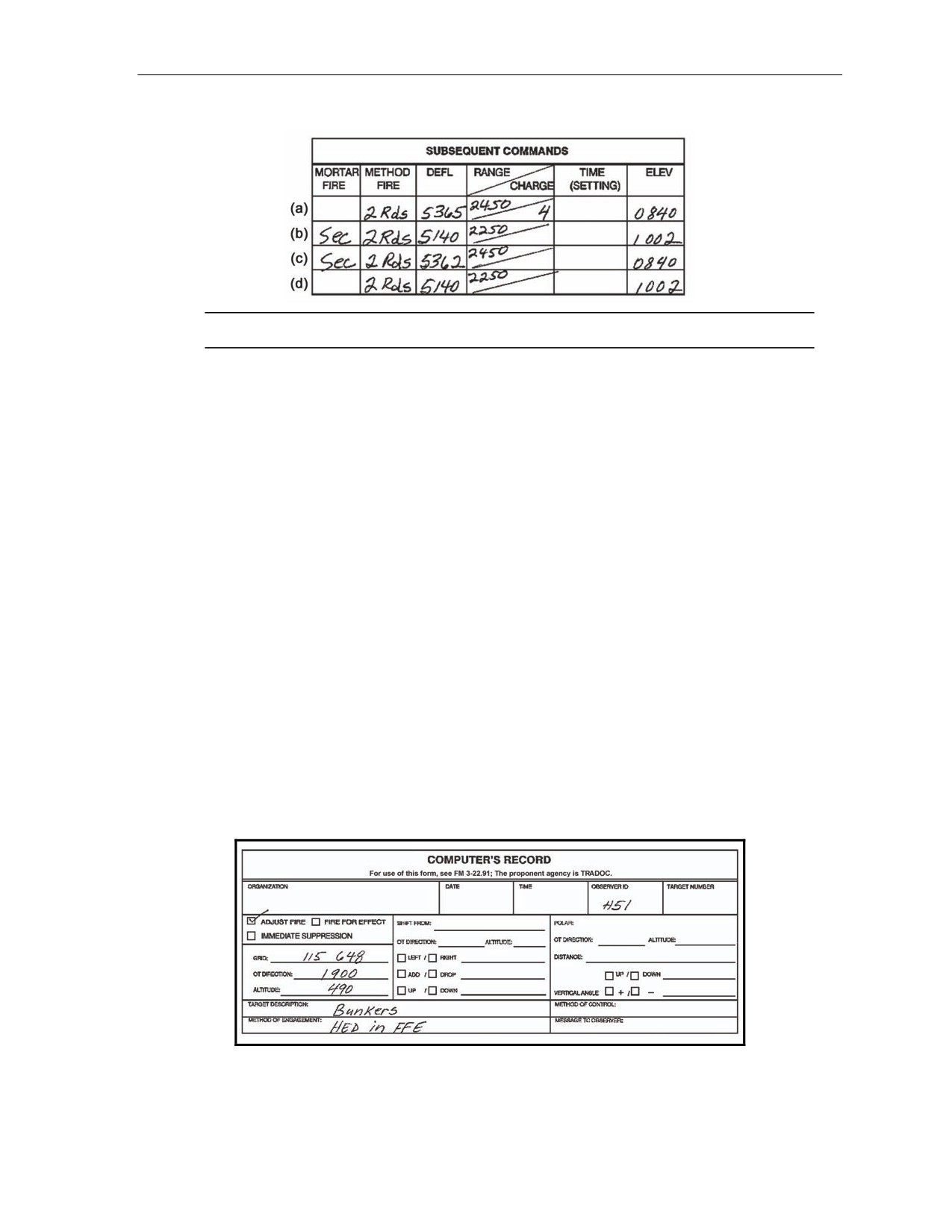
5. What is the correct subsequent fire command?
NOTE: The rounds are fired and the FO sends EOM. Update and mark as target AC071.
You receive the CFF in Figure E-19 and see that it is in your area of operations. You are instructed to compute
the mission.
TASK:
Compute data for a grid mission using the CFF and FDC order in Figure E-19.
CONDITIONS:
Given an M16 plotting board, sector of fire, 1:50,000 map, protractor, DA Form 2399-R,
tabular firing tables, CFF for a grid mission, FO corrections, paper, and No. 2 pencil.
STANDARDS: Determine deflection to within 1 mil with a 10-mil tolerance and range to within 25 meters
with a 25-meter tolerance.
TASK:
Determine the VI between the mortar altitude and the target altitude.
CONDITIONS:
Given the mortar altitude and target altitude.
STANDARDS:
Determine the VI to the nearest whole meter and the range correction to apply without
error.
TASK:
Determine VI and the correction to apply when computing a mission using the M16
plotting board.
CONDITIONS: Given an M16 plotting board, altitude of the mortar position, CFF with the target altitude,
and firing table.
STANDARDS: Apply the VI correction without error when computing a mission. Record and update firing
records. Determine deflections to the nearest 1 mil with a 10-mil tolerance. Determine the
range to within 25 meters with a 25-meter tolerance. Convert range to the correct charge
and elevation.
TASK:
Compute angle T.
CONDITIONS:
Given the observer-target (OT) direction, direction of fire (GT), No. 2 pencil, and paper.
STANDARDS:
Determine the angle T to the nearest 1 mil. Record the angle T to the nearest 10 mils.
Send the angle T to the nearest 100 mils to the FO. Notify the FO in the message to
observer when the angle T is 500 mils or more.
Figure E-19. Situation B: second mission (excerpt from an example of
completed DA Form 2399-R [Computer's Record]).
17 July 2008
FM 3-22.91
E-49
Appendix E
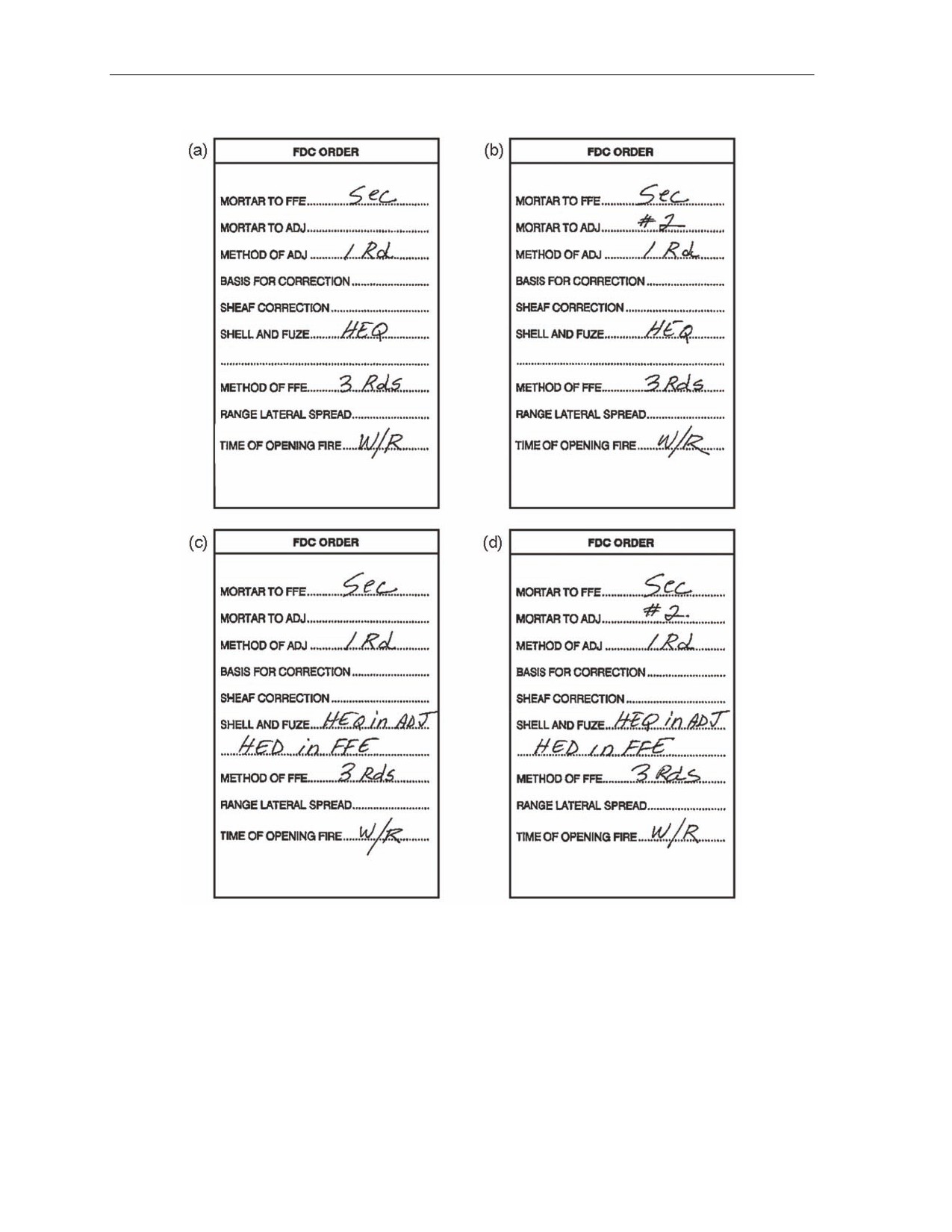
6.
What is the FDC order?
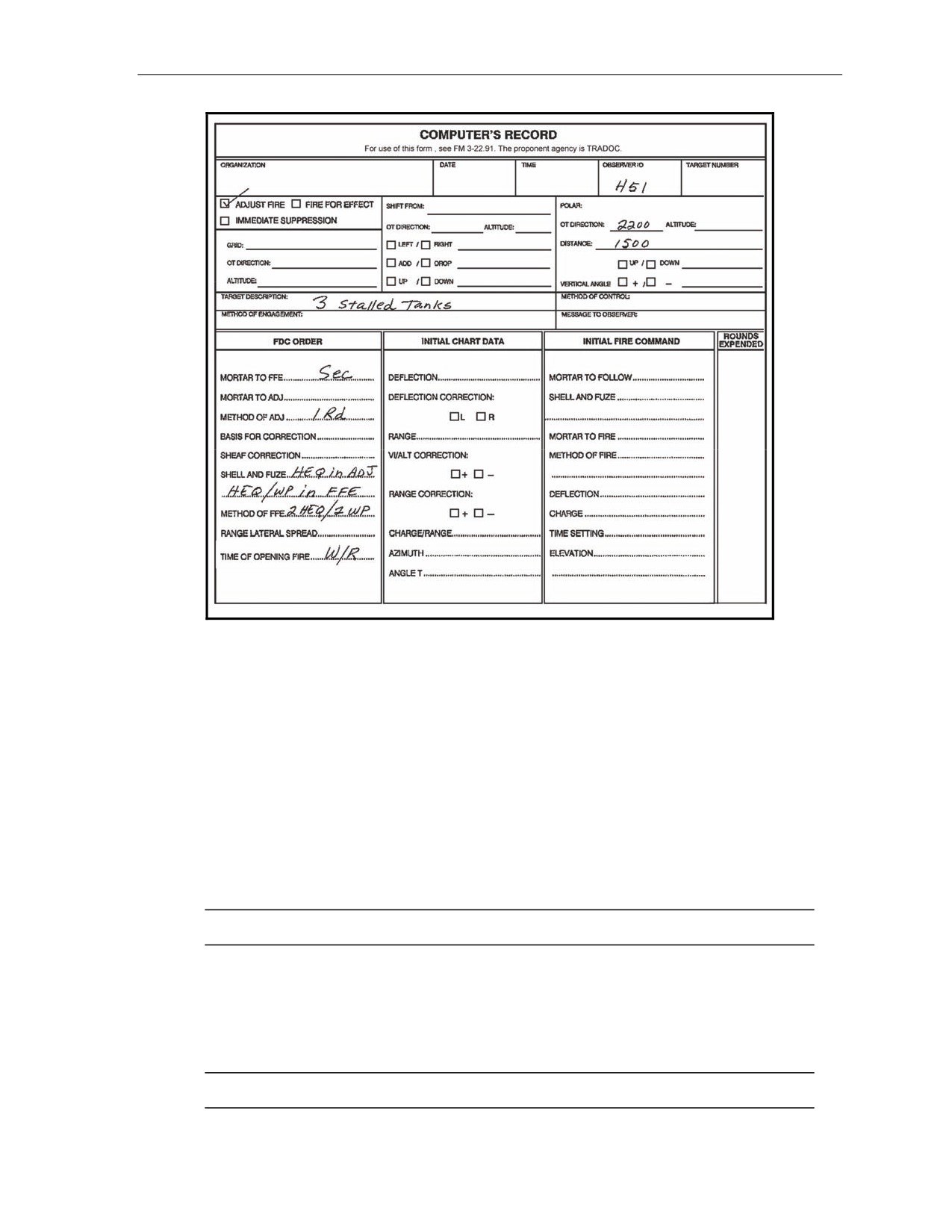
You are handed the CFF and FDC order in Figure E-20 and are instructed to compute the mission.
TASK:
Compute data for a shift from a known point mission using a plotting board.
CONDITIONS:
Given a plotting board, DA Form 2399-R, firing table, CFF for a shift from a known point
mission, and FO corrections.
STANDARDS: Determine deflection to within 1 mil with a 10-mil tolerance and range to within 25 meters
with a 25-meter tolerance.
E-50
FM 3-22.91
17 July 2008
Fire Direction Center Certification
Figure E-20. Situation B: third mission (excerpt from an example of
completed DA Form 2399-R [Computer's Record]).
7.
What is the initial deflection?
(a)
4606 mils
(b)
4994 mils
(c)
4800 mils
(d)
4660 mils
8.
The initial chart range is 2,375. What is the command range?
(a)
2,325 meters
(b)
2,350 meters
(c)
2,375 meters
(d)
2,400 meters
NOTE: The FO spots the first round and sends this correction: ADD 50, FFE.
9.
What is the final deflection for the adjusting mortar?
(a)
4999 mils
(b)
4805 mils
(c)
4665 mils
(d)
4611 mils
NOTE: The adjusted chart range is 2,450.
17 July 2008
FM 3-22.91
E-51
Appendix E
10. What is the deflection for No. 3?
(a)
4627
(b)
4611
(c)
4595
(d)
4665
NOTE: The FO sends EOM. Mark as target AC073.
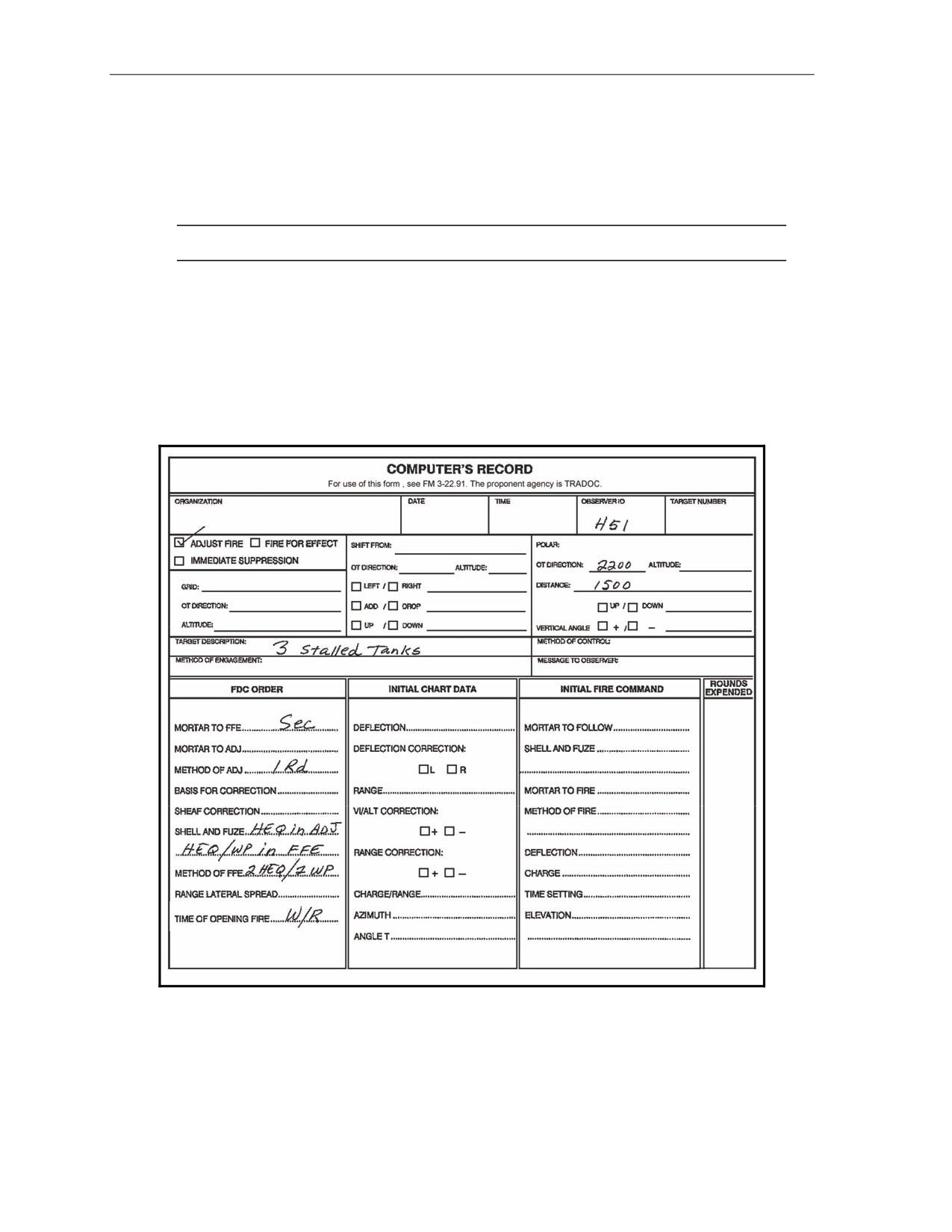
You receive the CFF, check the map, and issue the FDC order to the computers. Using the CFF and FDC order
in Figure E-21, compute the mission.
TASK:
Compute data for a polar plot mission using a plotting board.
CONDITIONS:
Given an M16 plotting board prepared for operation to include the mortar position,
reference points, and FO positions plotted; firing tables; DA Form 2399-R; CFF using the
polar method of target location; and subsequent corrections.
STANDARDS: Determine deflection to the nearest 1 mil with a 10-mil tolerance, determine range to 25
meters with a 25-meter tolerance, and convert range to the correct charge and elevation.
Figure E-21. Situation B: fourth mission (excerpt from an example of
completed DA Form 2399-R [Computer's Record]).
E-52
FM 3-22.91
17 July 2008
Fire Direction Center Certification
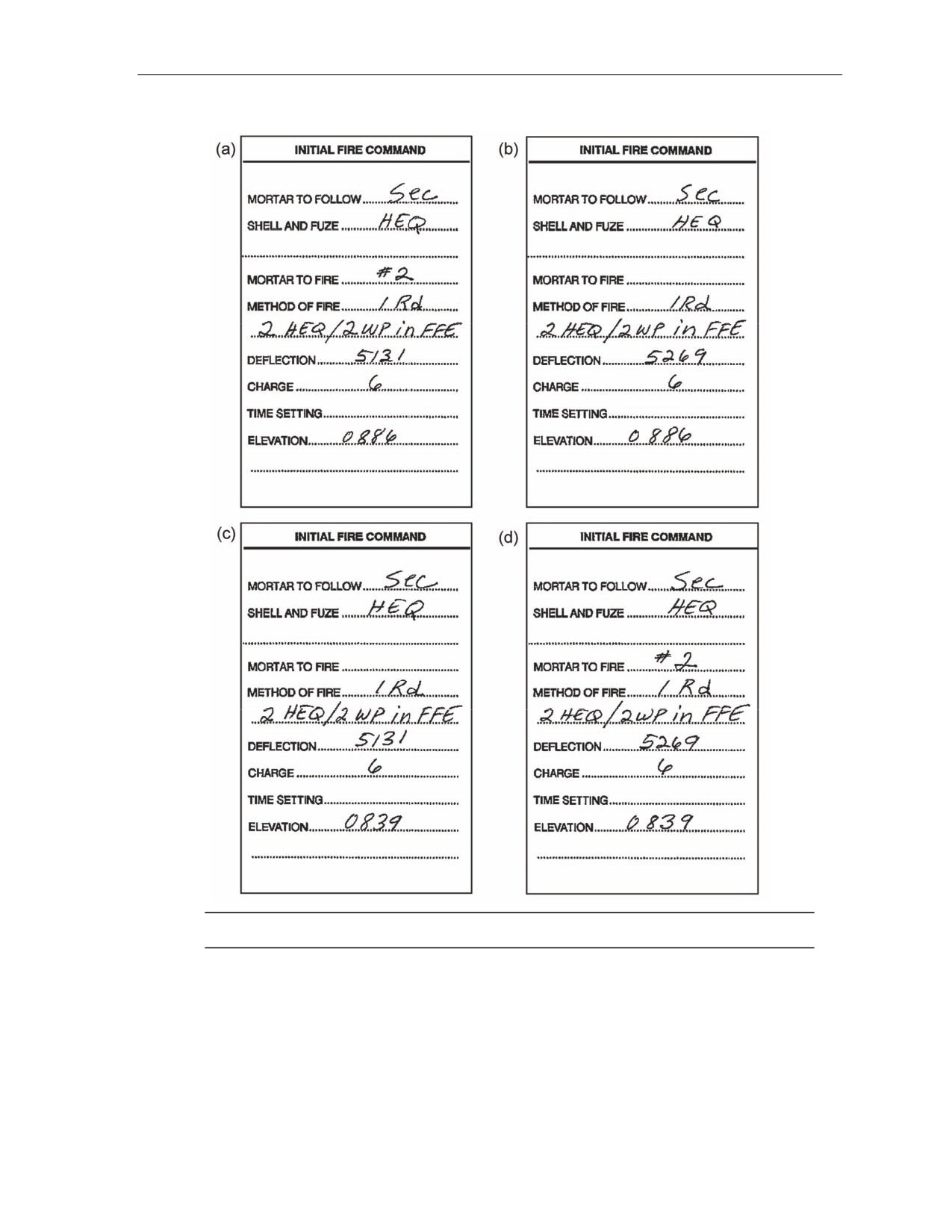
11. What is the correct initial fire command?
NOTE: The FO spots the first round and sends: DROP 50, FFE.
17 July 2008
FM 3-22.91
E-53
Appendix E
12.
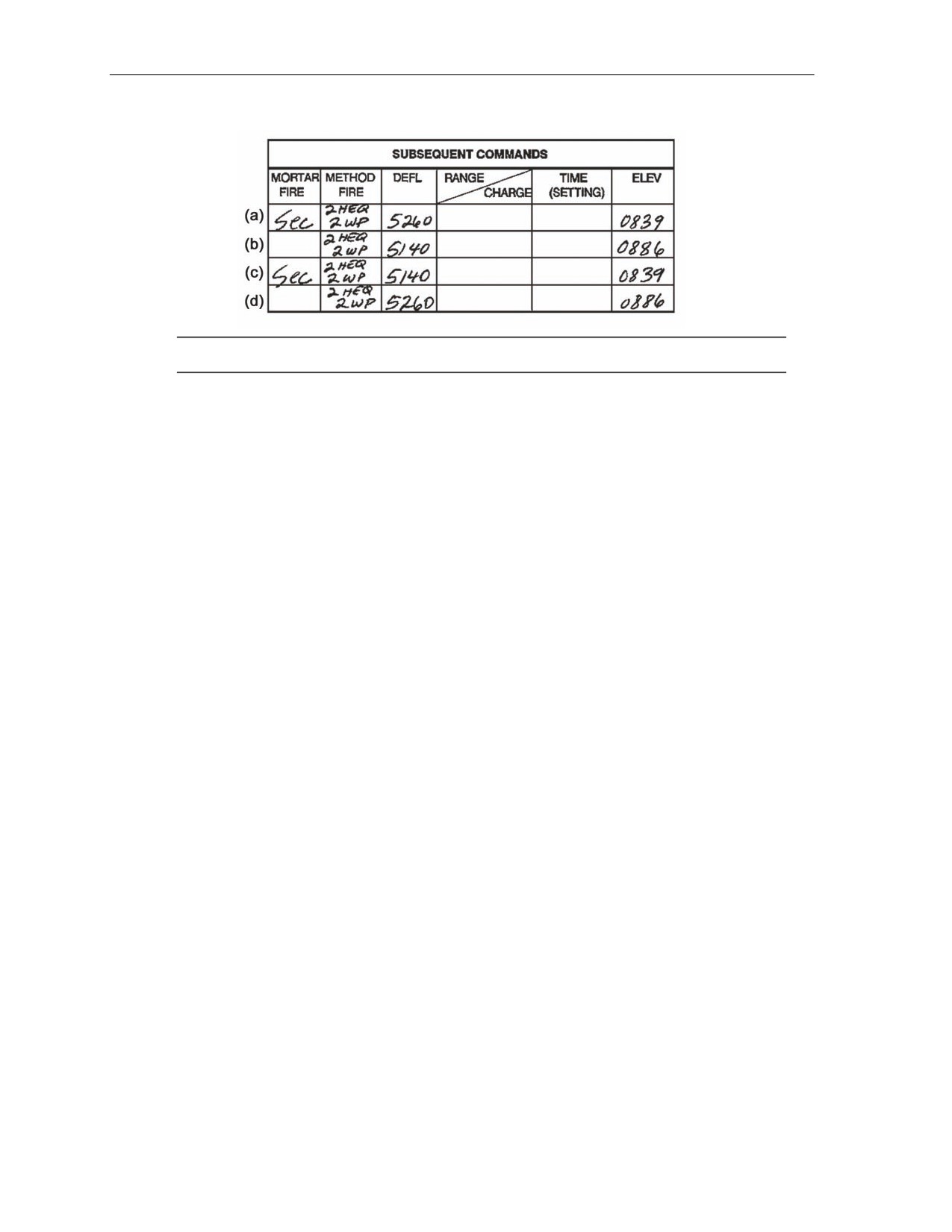
What is the correct subsequent fire command?
NOTE: The FO sends EOM.
SITUATION C
Your platoon is moving to a defensive position for a few days. Your platoon leader has the site surveyed. He
then instructs you to set up a surveyed firing chart and to conduct a coordinated registration. Using the
information below, construct a surveyed chart. Using the information in Figure E-22, conduct the registration
mission.
TASK:
Construct a surveyed firing chart.
CONDITIONS:
Given an M16 plotting board, a grid intersection to represent the pivot point, a surveyed
mortar position, a surveyed RP, and a referred deflection.
STANDARDS: Determine the direction of fire to the nearest mil, determine the mounting azimuth to the
nearest 50 mils, and superimpose the deflection scale without error.
TASK:
Compute data for a registration mission using a plotting board.
CONDITIONS:
Given an M16 plotting board, surveyed mortar position, and surveyed RP.
STANDARDS:
Determine the deflection to within 1 mil with a 10-mil tolerance. Determine the range to
within 25 meters with a 25-meter tolerance. Convert the range to the correct charge and
elevation without error.
Mortar grid: 06726544
Altitude: 450 meters
RP No. 1 grid: 09946362
Altitude: 400 meters
Referred deflection: 3800 mils
Grid intersection: 08/64
13.
What is the direction of fire?
(a)
2270 mils
(b)
2130 mils
(c)
3800 mils
(d)
2170 mils
E-54
FM 3-22.91
17 July 2008
Fire Direction Center Certification
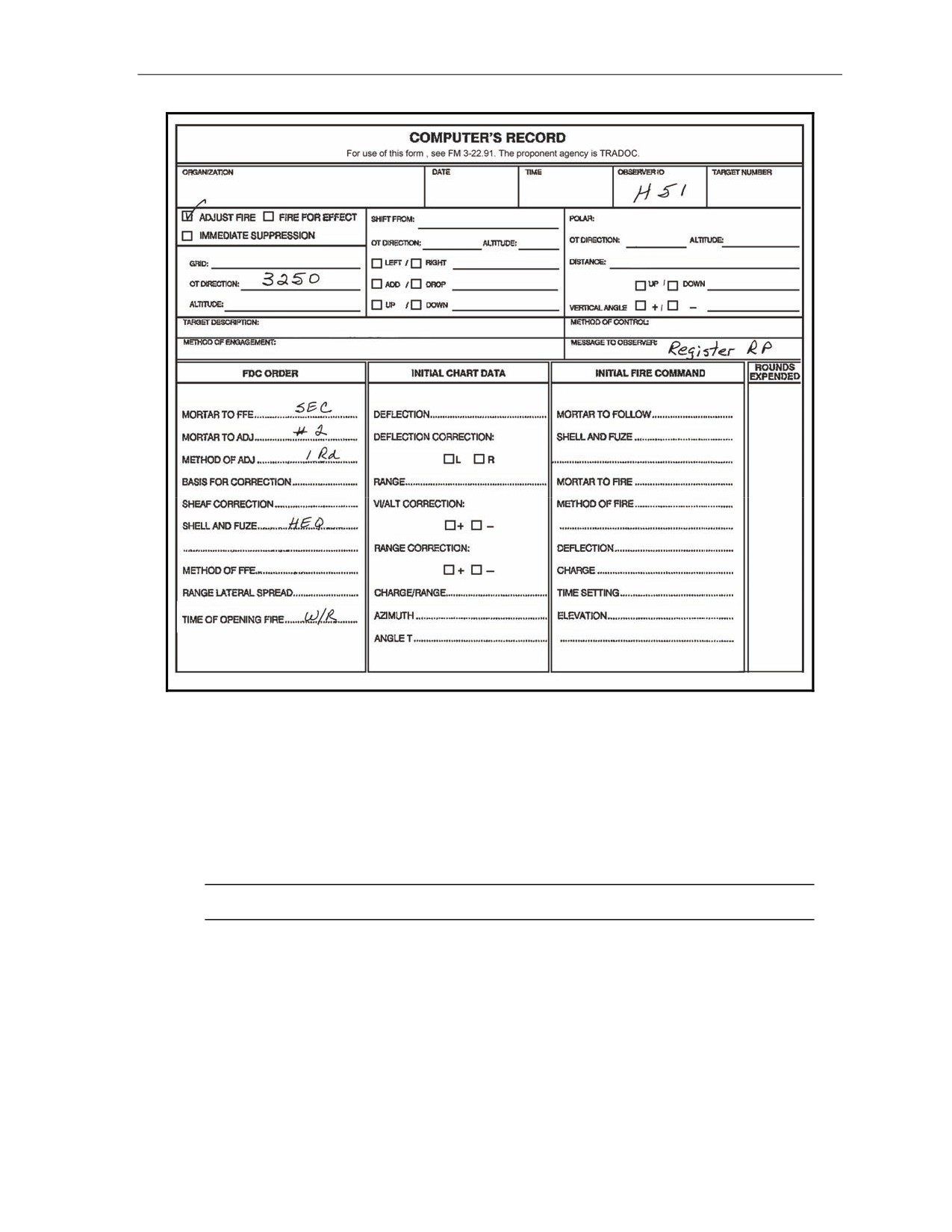
Figure E-22. Situation C: first mission (excerpt from an example of
completed DA Form 2399-R [Computer's Record]).
14. What is the command deflection and command range for the first round?
DEF
RANGE
(mils)
(mils)
(a)
3373
3775
(b)
3820
3750
(c)
3820
3675
(d)
3773
3625
NOTE: The FO spots the first round and sends these corrections: LEFT 50, ADD 50.
17 July 2008
FM 3-22.91
E-55
Appendix E
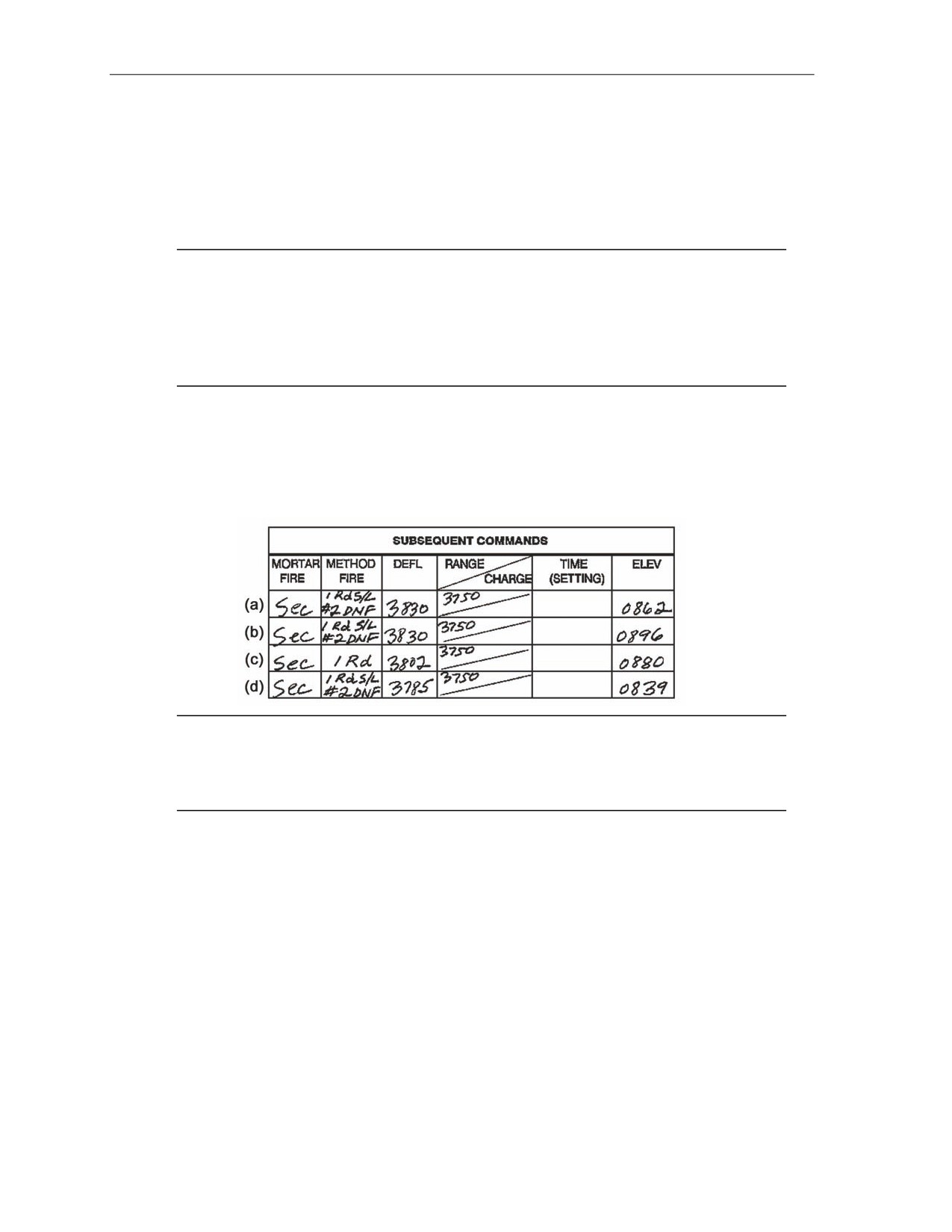
15. What is the deflection and elevation for the second round?
DEF
RANGE
(mils)
(mils)
(a)
3831
0880
(b)
3801
0839
(c)
3959
0896
(d)
3781
0862
NOTES:
1. The FO spots the second round and sends: ADD 25, EOM, REGISTRATION
COMPLETE.
2. The FDC sends a message to the FO: PREPARE TO ADJUST SHEAF.
3. The FO sends: SECTION LEFT.
TASK:
Compute firing data for a sheaf adjustment using the plotting board.
CONDITIONS:
Given an M16 plotting board, an active registration mission, FO corrections for sheaf
adjustments, DA Form 2399-R, and firing tables.
STANDARDS: Determine total range correction to apply within 25 meters range with a 25-meter
tolerance.
16. What is the correct subsequent fire command?
NOTES:
1. The FO makes a spotting and sends: NO. 3, RIGHT 10; NO. 1, RIGHT 20;
NO. 4 ADJUSTED, EOM S/A.
2. The command range to the target is 3,750 meters.
17. What are the deflections for the No. 3 and No. 1 guns?
No. 3 DEF
No. 1 DEF
(mils)
(mils)
(a)
3777
3780
(b)
3843
3840
(c)
3793
3797
(d)
3827
3824
E-56
FM 3-22.91
17 July 2008
Fire Direction Center Certification
TASK:
Determine firing corrections.
CONDITIONS:
Given the altitude of a mortar position and RP in meters, chart deflection, chart range,
adjusted deflection, adjusted range for the RP, or a completed DA Form 2399-R for a
registration mission.
STANDARDS: Determine corrections to include:
a. Altitude correction to within 1 meter.
b. Range difference to the nearest 25 meters.
c. Range correction factor to within 1 meter.
d. Deflection correction to within 1 mil.
18. If the initial chart deflection was 3820 and the final chart deflection was 3830, what is the deflection
correction for RP No. 1?
(a) R10
(b)
0
(c) L10
(d) L30
19. The initial chart range was 3,700 and the RP was hit at a command range of 3,750. What is the range
correction factor?
(a)
+50
(b)
+20
(c)
-50
(d)
+75
After updating and computing all the corrections, you receive a CFF. The section leader hands you the CFF and
the FDC order in Figure E-23 and instructs you to compute the mission.
TASK:
Compute data for a shift from a known point mission using a plotting board.
CONDITIONS:
Given a plotting board, DA Form 2399-R, firing table, CFF for a shift from a known point
mission, and FO corrections.
STANDARDS: Determine deflection to within 1 mil with a 10-mil tolerance and range to within 25 meters
with a 25-meter tolerance.
TASK:
Compute firing data from a surveyed firing chart for a total range correction mission using
a plotting board.
CONDITIONS: Given an M16 plotting board, an RP with deflection correction and range correction
factors, CFF, DA Form 2399-R, and firing tables.
STANDARDS: Determine total range correction to apply within 25 meters for range with a 25-meter
tolerance.
20. What is the total range correction for this mission?
(a)
-25
(b)
+70
(c)
3500
(d)
+45
17 July 2008
FM 3-22.91
E-57
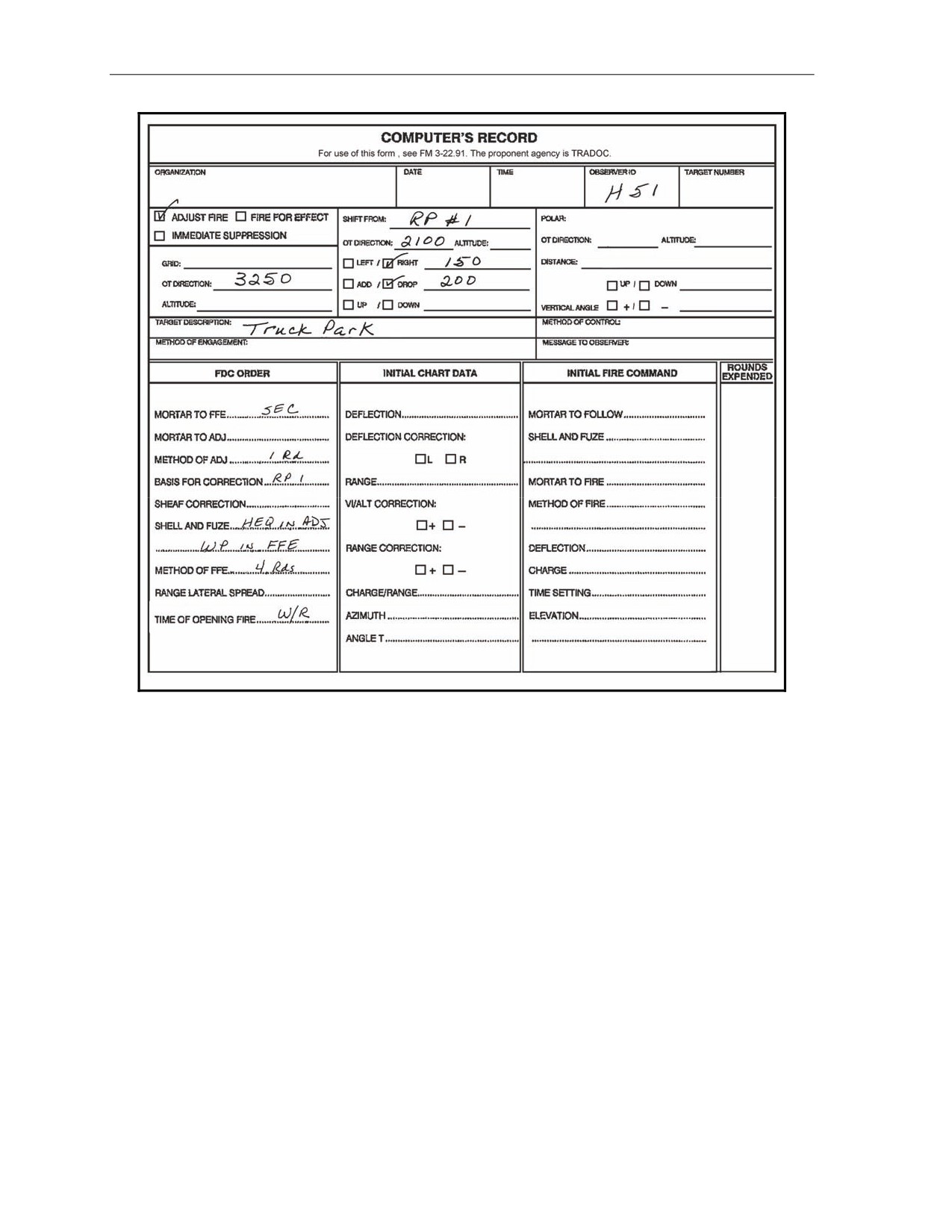
Appendix E
Figure E-23. Situation C: second mission (excerpt from an example of
completed DA Form 2399-R [Computer's Record]).
E-58
FM 3-22.91
17 July 2008

Appendix F
Error Messages
This appendix addresses all the possible error messages that may appear while using
the MBC. Explanations and actions are also discussed.
CHARACTERS
F-1. Along with text, the three common characters found within an error message are alpha, numeric, and
alphanumeric:
z
@ = Alpha character.
z
#
= Numeric character.
z
$
= Alphanumeric character.
MESSAGES, EXPLANATIONS, AND ACTIONS
F-2. Error messages confirm that a problem has occurred and specific actions must be taken to compute
or log data on the MBC. The various types of messages that may appear and the appropriate action that
should be taken to correct the error are as follows:
ERROR MESSAGE
EXPLANATION and ACTION
@@ * RANGE ERR *
Target location cannot be precisely achieved by ballistic calculations. The following
menu indicates error magnitude.
ACTION: Verify all initialization and input data. Check error magnitude in following
menu. If error is excessive, use alternate weapon or ammunition type.
@# ACTIVE, MSN #
Weapon selected (@#) is now activated for mission #.
ACTION: Choose an alternate weapon not now in use, or terminate mission #.
@# IS BP
When entering WPN BATA, basepiece number entered as alternate piece.
ACTION: Enter correct weapon number.
@# MISSED: ####
Follows *RANGE ERR* message. Indicates error magnitude as distance in meters from
target.
ACTION: Verify all initialization and input entries. If error is excessive, select an
alternate charge, weapon, or ammunition type.
@# NOT FOUND
No WPN DATA entered for this weapon.
ACTION: Enter WPN DATA for this weapon or choose an alternate weapon.
@#:@# DANGER
WARNING: Friendly weapon is positioned at or near computed target location. First
@# is firing weapon ID. Second @# is endangered weapon position ID.
ACTION: Verify target and FO location entries. If locations are correct and endangered
FO is still in place, verify mission.
17 July 2008
FM 3-22.91
F-1

Appendix F
ERROR MESSAGE
EXPLANATION and ACTION
@#:@/## DANGER
WARNING: Friendly FO is positioned at or near computed target location. The @# is
firing weapon ID. The @/## is endangered FO ID.
ACTION: Verify target and FO location entries. If locations are correct and endangered
FO is still in place, verify mission.
^ AZ TOO BIG
Difference between safety fan LLAZ and RLAZ entries is 3200 mils or more.
ACTION: Change safety fan LLAZ and RLAZ entries to get delta azimuth of less than
3200 mils.
^ AZ TOO SMALL
Difference between safety fan LLAZ and RLAZ entry is less than 400 mils.
ACTION: Change safety fan LLAZ and RLAZ entry to get delta azimuth of at least
400 mils.
^ RANGE TOO
Difference between safety fan MIN RN and MAX RN entries is less than 200 meters.
SMALL
ACTION: Change SFTY DATA MIN RN and MAX RN entry to get delta range of 200
meters or greater.
ADJ COMPLETE
All weapons in sheaf are already adjusted.
ACTION: No further adjustments are possible within current mission.
BAD AIR DENSITY
Temperature and pressure entries will not yield ballistics solution.
ACTION: Verify temperature and pressure values. If correct for given MET, data are
not usable in MBC.
BAD
CHARGE
SFTY DATA, MIN CHG entry is greater than MAX CHG entry.
ZONE
ACTION: Change MIN CHG and MAX CHG entries so that MIN CHG is less than or
equal to MAX CHG.
BAD FO:@/## FR
FR message received from FO for which no initialization was entered. Corrections
cannot be computed.
ACTION: If action is required, enter FO LOC initialization data.
BAD HEIGHT
Absolute altitude or delta height is outside the range (400 meters to 10,000 meters).
ACTION: Verify all altitude, height, or vertical angle entries. If all values are correct,
given mission cannot be computed.
BAD KNPT:## SHFT
Upon receipt of FR SHIFT message, known point message is not stored in KNPT
buffer.
ACTION: If known point is valid, enter KNPT data. If known point number is in error,
orally request retransmission of corrected message.
BAD POWER UP
Hardware malfunction; memory probably corrupted.
ACTION: Power down and back up several times. If this or another power-up error
occurs, check battery or power supply. If error still occurs, return MBC to next higher
maintenance level.
BAD ^ HEIGHT
Similar to BAD HEIGHT error. Computed delta height exceeds acceptable limits.
ACTION: Verify all altitude, height, and vertical angle entries. If all values are correct,
given mission cannot be computed.
F-2
FM 3-22.91
17 July 2008

Error Messages
ERROR MESSAGE
EXPLANATION and ACTION
BAD ^ WIND ##-##
Direction and velocity entries in consecutive MET datum planes yield easting and
northing wind components that differ by more than 29 knots. The ##-## indicates MET
datum planes in error.
ACTION: Verify direction and velocity entries for stated MET datum planes. If correct
for given MET, data are not usable in MBC.
BANK:FAIL
Memory bank switching hardware failure.
ACTION: Return MBC to next higher maintenance level.
BAT @ NOT FOUND
Initialization data not yet entered for this battery.
ACTION: Enter initialization data for this battery or select weapon from another
battery.
CHARGE
Illegal cartridge-fuze-charge combination entry, such as: 81-mm, with VT fuze, at
VIOLATION
charge 0.
ACTION: Make alternate WPN/AMMO entries to avoid the above illegal
combinations.
CHG TOO BIG
Minimum range for user-selected charge is greater than range to target.
ACTION: Leave charge field blank (MBC selects optimum charge) or enter valid
smaller alternate charge. If valid charge cannot be found for these WPN/AMMO
entries, make alternate WPN/AMMO entries.
CHG TOO LOW
User-selected charge maximum range is less than the range to target.
ACTION: Leave the charge field blank (MBC selects optimum charge) or enter valid
larger alternate charge. If valid charge cannot be found for these WPN/AMMO entries,
make alternate WPN/AMMO entries.
DEFL TOO BIG
Required deflection exceeds maximum left or right traverse limitations for
carrier-mounted 107-mm mortars.
ACTION: Select alternate weapon for which limitations are not exceeded.
DISP $$$ MEM $$$
Follows REV NO. FAILURE error message. Indicates revision numbers for
display/processor and memory respectively.
ACTION: Return MBC to next higher maintenance level.
DUPLICATE WPNS
Same weapon number entered two or more times into TFC, GUNS selection for
multiple weapon missions.
ACTION: Delete duplicate entries.
E TOO BIG
Computed delta easting exceeds 32767.
ACTION: Verify all entries affecting delta easting. Also verify that MIN E and MIN N
entries in the SET UP data are appropriate for mission coordinates.
ENTRY NOT FND
Required FO, KNPT, or TGT initialization data not yet entered into the appropriate
memory file.
ACTION: Enter initialization data for required FO, KNPT, or TGT, or choose alternate
course of action not requiring this data.
EXCESSIVE WIND
Wind deviations exceed stability limitations of MBC.
ACTION: Verify MET entries. If correct, this MET is unusable.
17 July 2008
FM 3-22.91
F-3