FM 3-22.91 MORTAR FIRE DIRECTION PROCEDURES (July 2008) - page 13
This page intentionally left blank.
Appendix A
Mortar Training Strategy
This appendix provides a comprehensive unit training strategy for training
mortarmen. Leaders have the means to develop a program for training their mortar
units to full mission proficiency. This training strategy applies to ALL mortars in
ALL organizations of the US Army. Although not prescriptive in nature, mortar
training strategy must adapt to a unit’s mission, local training resources,
commander’s guidance, and unit training status.
GENERAL
A-1. The mortar training strategy helps the mortar crew become proficient and effective on the battlefield.
The gunner is required to be proficient in mechanical drill and FDC when computing the fire mission from
the FO.
TRAINING EVALUATION
A-2. Evaluation cannot be separated from effective training. Training evaluation occurs during the top-
down analysis when planners develop the training plan. Planners use various sources of information to
assess their unit’s individual and collective training status. Evaluation is continuous during training.
Soldiers receive feedback through coaching and after-action reviews (AARs). Leaders also assess their
own training plan and the instructional skills of their subordinate leaders. After training, leaders evaluate
by sampling training or reviewing AARs. Much of this evaluation is conducted informally. Formal
evaluations occur under the Individual Training and Evaluation Program (ITEP) and the Army Training
and Evaluation Program (ARTEP) to assess individual and collective training respectively.
INDIVIDUAL TRAINING
A-3. Individual training is a clearly defined and measurable activity accomplished by an individual.
Commander’s Evaluation
A-4. The commander’s evaluation is routinely conducted in units. Commanders select and evaluate
individual tasks that support their unit mission and contribute to unit proficiency. The evaluation may be
performed through local tests or assessments of Soldier proficiency on crucial MOS tasks or common
tasks. The commander’s evaluation is based on year-round, constant evaluation by the chain of command
and supported by the MOS 11C Soldier’s manuals, trainer’s guides, and job books.
Gunner’s Examination
A-5. The gunner’s examination is a continuation of the mortar-based drills in which a mortarman’s
proficiency as a gunner is established. The examination includes situations similar to combat. The
examination contained in Chapter
9 of FM
3-22.90 includes tasks, conditions, standards, and
administrative procedures, while focusing on the individual qualification of the Soldier in the role of a
gunner. However, the gunner’s success also depends on the collective performance of his assistants. Within
these limitations, evaluators should try to standardize the examination. The squad leader, gunner, and
assistant gunner should pass the gunner’s exam semiannually. All gunners should have a current
qualification before a live-fire exercise (LFX), whether using service or subcaliber ammunition.
17 July 2008
FM 3-22.91
A-1
Appendix A
Fire Direction Center Certification
A-6. FDC certification allows commanders to verify that their FDC mortarmen have the knowledge and
skills for their positions: squad leader, FDC computer, section sergeant, platoon sergeant, and platoon
leader. Certification helps ensure that ammunition is wisely expended and that training is conducted safely
and effectively. Mortarmen are certified when they receive a passing score of 90 percent and 70 percent on
the two-part examination.
COLLECTIVE TRAINING
A-7. Collective training is a clearly defined and measurable activity accomplished by individuals and
organizations.
External Evaluation
A-8. The commander formally determines the status of his collective training through external evaluation.
The external evaluation gives the commander an objective appraisal of this status by using mortar expertise
found outside the normal chain of command. The external evaluation is not a test that a unit passes or fails;
it is a diagnostic tool that identifies training strengths and weaknesses. It must be emphasized that an
external evaluation is not a specific training event but a means to evaluate a training event. Mortar units
undergo external evaluations during an LFX or field training exercise (FTX), or a combination of both.
The unit may be evaluated alone, as part of its parent unit, or with other mortar units. The mission training
plan (MTP) provides guidance on planning, preparing, and conducting an external evaluation.
Evaluation of the Indirect Fire Team
A-9. The members of the indirect fire team must train and correctly execute their respective tasks to
successfully complete any fire mission. The team training event sequence should include a step to confirm
that the fires have been cleared. For example, while the battalion FSO coordinates airspace clearance and
friendly troop locations, the FDC confirms that the charge-shell combination does not violate any
maximum ordinate restrictions or other control measures. Failure to do so should be identified as a training
deficiency. However, only as a last resort should the fire mission be deleted from the evaluation.
Evaluators should determine the reason why any fire mission fails to meet standards in order to determine
where additional training is required. The indirect fire team should be given the opportunity to successfully
complete the fire mission. This can be accomplished in the following ways:
z
Allow the mission to continue if the detected error will still result in the rounds impacting within
the safety limits. The team must train to accomplish the mission by finding and correcting any
errors based on the round’s impact. The appropriate evaluator should intervene only if the team
prepares to fire incorrect data that is out of the safety area or when ammunition is constrained.
z
Start the fire mission over. Although ammunition constraints during live-fire may not permit
this, tasks can be repeated using devices or, less preferably, dry-fire.
z
The evaluator corrects the error when the mission data would result in rounds fired out of the
safety area. The FO evaluator at the observation post can change the call for fire or correction to
reflect proper procedures. The FDC evaluator may correct the improperly computed firing data
while the mortar squad evaluator may correct improperly set data or a faulty sight picture.
A-2
FM 3-22.91
17 July 2008

Appendix B
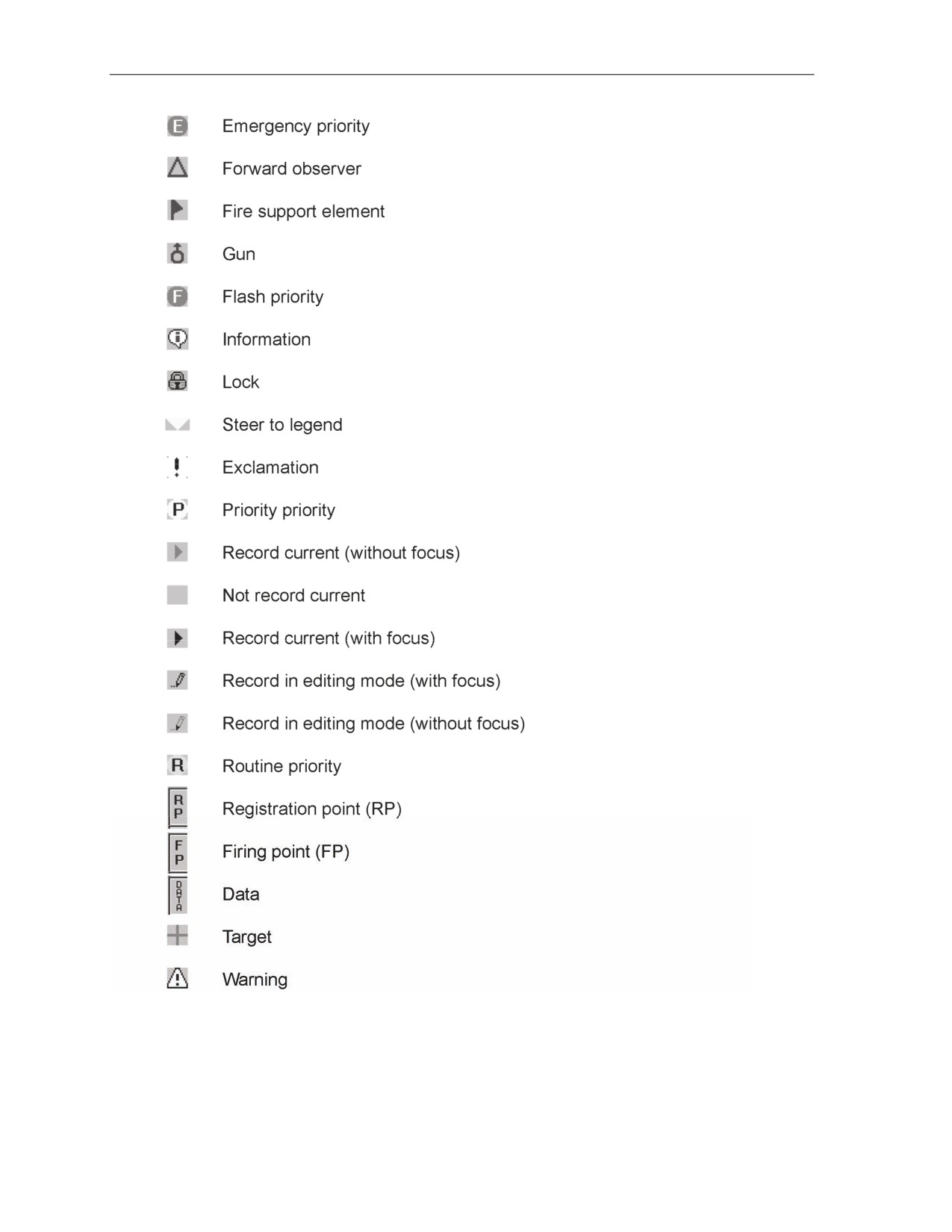
Icons for the Mortar Fire Control System
This appendix provides a comprehensive listing of the various icons (and their
meanings) that may appear on various screens while using the CI.
17 July 2008
FM 3-22.91
B-1
Appendix B
B-2
FM 3-22.91
17 July 2008
Appendix C
Safety Procedures
Minimum and maximum elevations, deflection limits, and minimum fuze settings
must be computed to ensure all rounds impact or function within the designated
impact area. These data are then presented in graphic form on a range safety diagram.
They are also arranged in a simplified format (the safety T) for each mortar squad
leader. This appendix discusses the computation of safety data using tabular and
graphical data.
SURFACE DANGER ZONES
C-1. Range control personnel or the officer in charge (OIC) provides the safety officer with the precise
location and size of the impact area. The impact area can either be defined by a series of grid coordinates
representing the corner points or lateral azimuths and minimum and maximum distances from a fixed RP.
Either method defines an area on the ground, perhaps irregularly shaped, within which all rounds fired
must either impact or function. The safety officer must then compute the safety limits of this impact area
and construct the safety diagram and the safety T. To compute the safety limits the safety officer must
consider the following:
SECONDARY DANGER AREAS A AND B
C-2. The safety officer must first determine whether the impact area limits provided to him include
secondary danger areas A and B. These areas are established by AR 385-63.
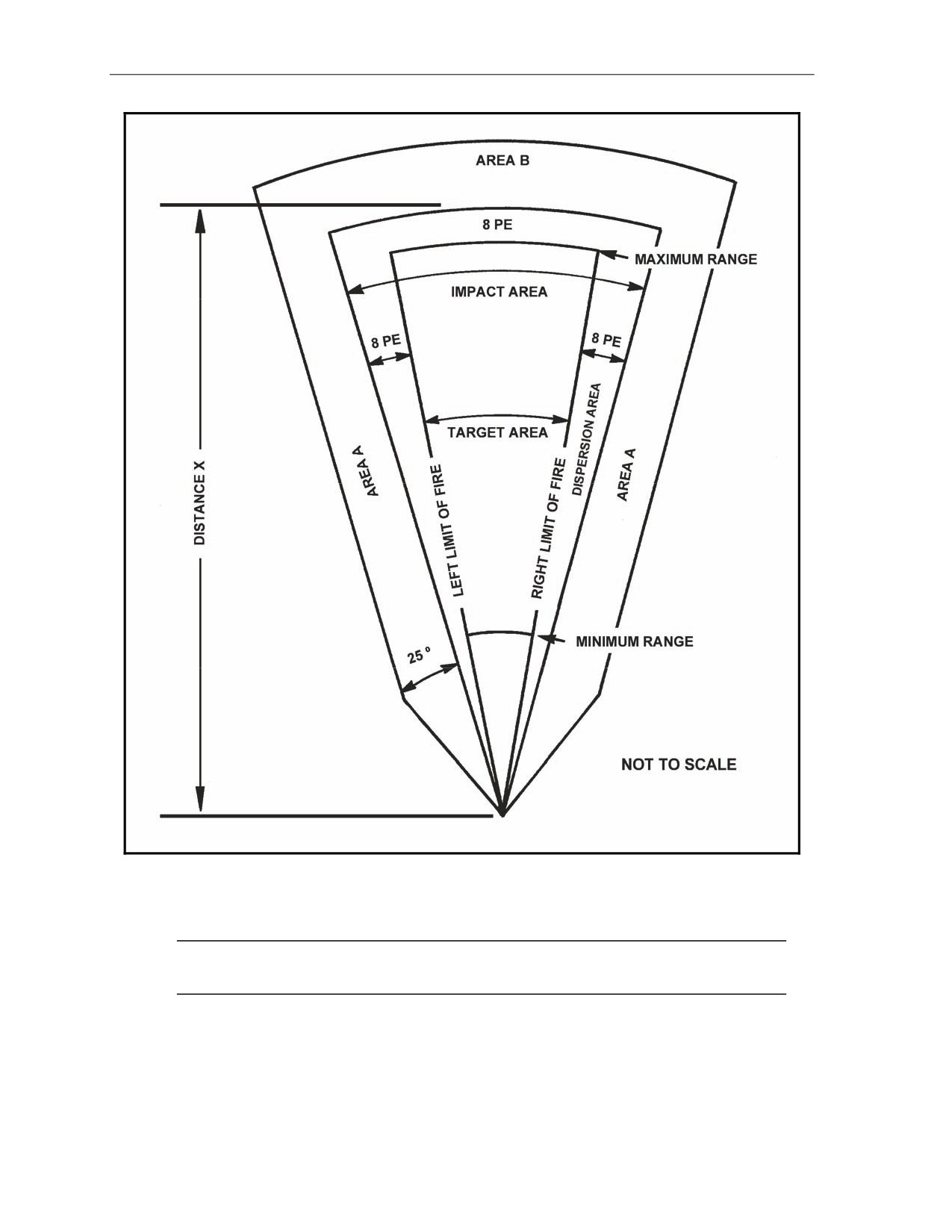
C-3. Secondary danger area A parallels the impact area laterally and is provided to contain fragments
from rounds exploding on the right or left edges of the impact area (Figure C-1). Depending on the mortar
being fired, secondary danger area A varies from 250 to 400 meters.
C-4. Secondary danger area B is on the downrange side of the impact area and area A. It contains
fragments from rounds exploding on the far edge of the impact area. Depending on the mortar being fired,
secondary danger area B varies from 300 to 500 meters (Figure C-1).
NOTE: If the designated impact area does not already consider areas A and B, it must be
reduced by the appropriate amount to ensure no rounds impact within or outside of either area.
PROBABLE ERRORS IN RANGE AND DEFLECTION
C-5. The initial impact area must be reduced again to account for the normal dispersion of rounds fired.
The safety officer must determine the maximum PEs for both range and deflection.
(1) The safety officer checks columns 3 and 4 of Table E in the tabular firing tables for the mortar
and ammunition to be used. He checks all possible charge and elevation combinations to ensure
he has found the maximum PEs at the distance to the far edge of the impact area.
(2) The safety officer then reduces the maximum range by a factor of eight times the PEr. He also
adjusts the minimum range toward the center of impact by a factor of 12 times the PEr.
17 July 2008
FM 3-22.91
C-1
Appendix C
Figure C-1. Mortar surface danger zone.
(3) Once the ranges have been adjusted, the safety officer adjusts the left and right limits inward by
a factor of eight times the maximum PEd.
NOTE: The safety officer must determine whether range control personnel have already
performed this computation before designating the impact area.
C-2
FM 3-22.91
17 July 2008
Safety Procedures
VERTICAL INTERVAL AND CREST CLEARANCE
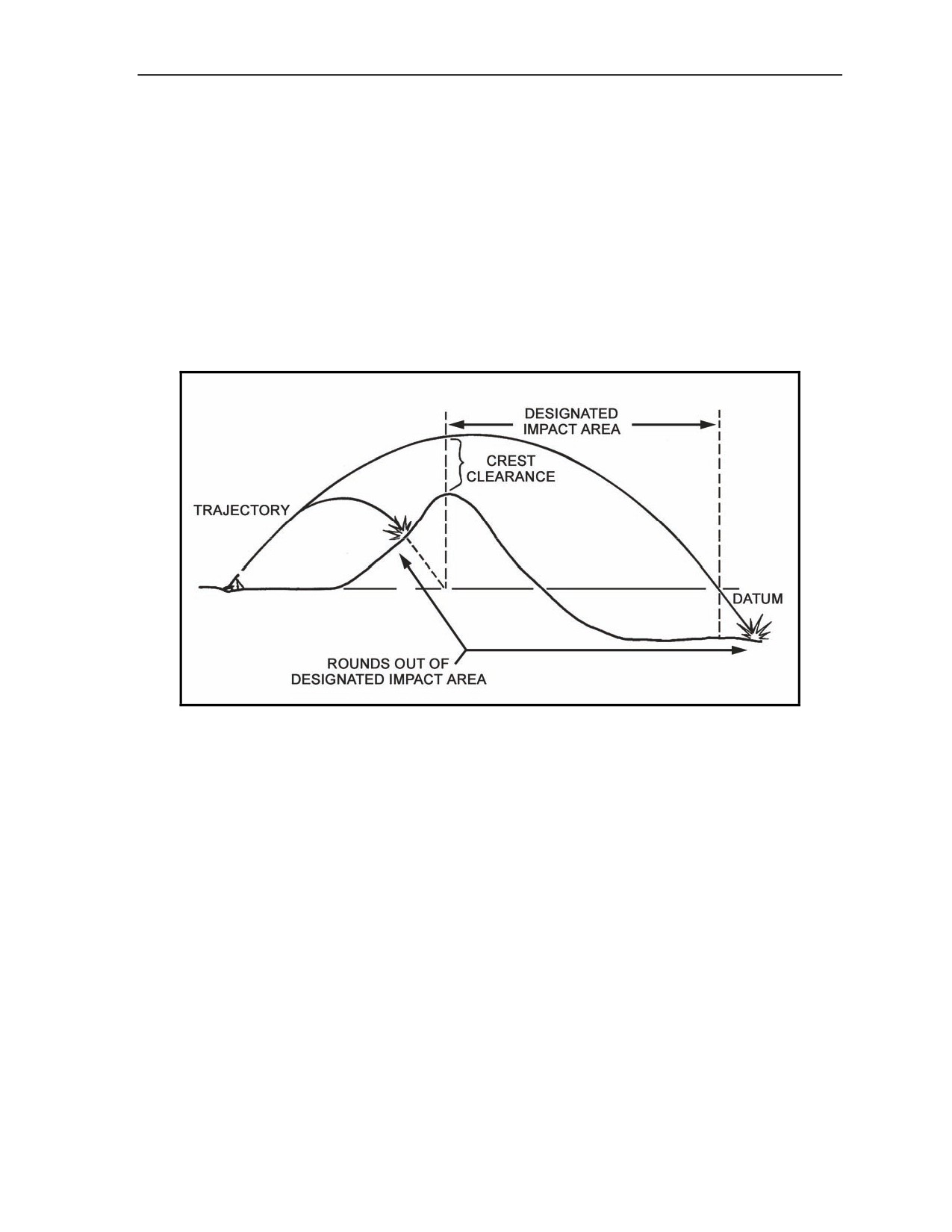
C-6. The safety officer must compare the altitude of the mortar position and that of the impact area. If
there are significant differences in the VI between these two areas, he must adjust the safety limits to
preclude any rounds impacting short or long of the impact area (Figure C-2).
(1) The mini-max rule determines the correct VI for safety purposes. At the minimum range, the
maximum altitude is selected. At the maximum range, the minimum altitude is selected. If the
contour interval is in feet, it is converted to meters.
(2) The safety officer determines VI by subtracting the mortar firing position altitude from the
altitude of the applicable range line. The resulting number is either positive or negative.
(3) The safety officer adds half the value of the VI determined for each applicable range line, to that
line. This either increases or decreases the apparent size of the impact area, depending on
whether the VI is positive or negative.
Figure C-2. Effects of vertical interval and crest clearances.
(4) The safety officer must then make a map inspection to determine the highest point between the
mortar position and the edge of the impact area. He then compares this highest point with the
lowest maximum ordinate value found in Table E in the tabular firing tables. As long as the
maximum ordinate exceeds the VI of the highest point, no correction need be made. If not, all
charge and elevation combinations that do not allow crest clearance must be noted and applied
to the safety diagram.
SECTION WIDTH AND DEPTH (MANUAL PLOTTING ONLY)
C-7. If a mortar near the center of the section is used as the adjusting mortar, any mortar significantly left
or right of this “base” can put rounds out of impact, unless corrections are made. If the mortars are
arranged in the firing position with any significant depth, the rearward or forward mortar can put rounds
short or long of the impact area unless a correction is made.
(1) The safety officer must determine the width and depth of the mortar section as it is arranged on
the ground (at the firing position). He then reduces the left and right limits by half the section
width.
(2) The safety officer adds half the section depth to the minimum range and subtracts half the
section depth from the maximum range.
17 July 2008
FM 3-22.91
C-3
Appendix C
REGISTRATION AND METEOROLOGICAL CORRECTIONS
C-8. After a registration (survey chart), a reregistration, or a MET update has been conducted and
corrections have been determined, the safety officer must modify the original basic safety diagram by
applying the registration corrections. New elevations are determined that correspond to the minimum and
maximum ranges. Deflections are modified by applying the total deflection correction to each lateral limit.
SAFETY DIAGRAM
C-9. The safety diagram graphically displays the computed safety limits. Data are logically presented and
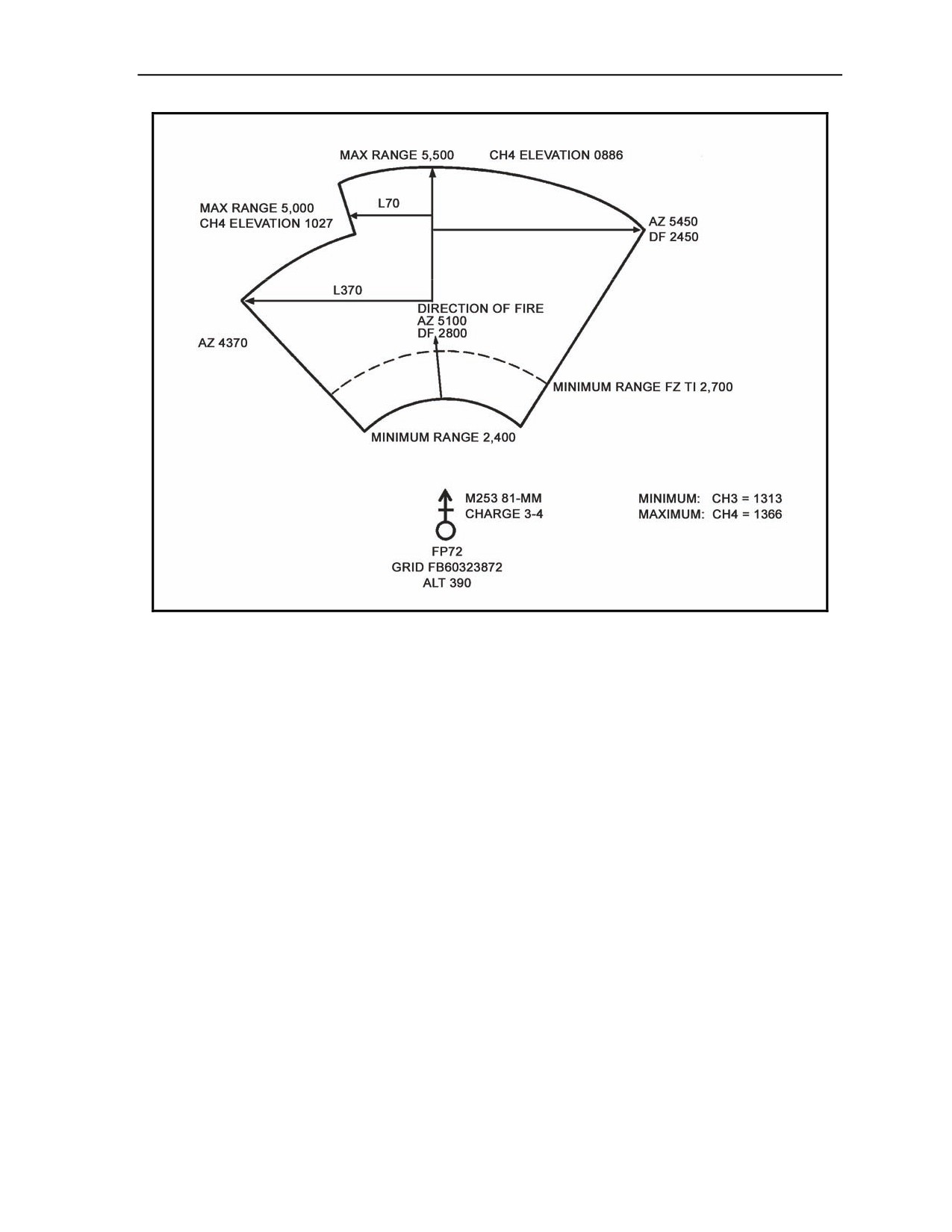
arranged for the FDC to use. Once the diagram is constructed, data from it are used to draw the safety T.
C-10. The range safety officer determines the lateral safety limits and the minimum and maximum ranges
of the target area. These data must then be converted to deflections and elevations. In the case of
mechanical time (illumination) and variable time (VT or PROX) fuzes, a minimum time setting must be
determined. For example, assume the following limits were provided by the range safety officer:
z
Left azimuth limit is 4730 mils.
z
Right azimuth limit is 5450 mils.
z
Minimum range (min rg) is 2,400 meters.
z
Maximum range (max rg) is 5,500 meters.
z
From azimuth 4730 mils to azimuth 5030 mils, the maximum range is 5,000 meters.
z
Minimum range for fuze time is 2,700 meters.
z
Authorized weapons and charge zones are the M252 81-mm mortar, and charges 3 and 4 (M821
HE round).
z
Firing point 72 is located at grid FB60323872; altitude is 390 meters.
C-11. The basic safety diagram is constructed (Figure C-3) as follows:
(1) On a sheet of paper, draw a line representing the direction of fire for the firing unit. Label this
line with its azimuth (AZ) and the referred deflection (DF) for the weapon system.
(2) Draw lines representing the lateral limits in proper relation to the line on which the section is
laid. Label the lateral limits with the appropriate azimuths.
(3) Draw lines between the lateral safety limits to represent the minimum and maximum ranges.
Label each line with the appropriate range. If the minimum range for fuze (FZ) time (TI) is
different from the minimum range, draw a dashed line between the safety limits to represent the
minimum range for FZ TI. Label the line with the appropriate range.
(4) Compute the angular measurements from the azimuth of lay to the left and right safety limits by
comparing the azimuth of lay to the azimuth of each limit. On the diagram, draw arrows
indicating the angular measurements and label them.
(5) Apply the angular measurements to the deflection corresponding to the azimuth of fire to
determine the deflection limits (LARS).
C-4
FM 3-22.91
17 July 2008
Safety Procedures
Figure C-3. Basic safety diagram.
C-12. Once the basic safety diagram is drawn, the FDC uses the tabular firing tables to determine the
proper charges, elevations, and time settings. He then applies them to complete the diagram.
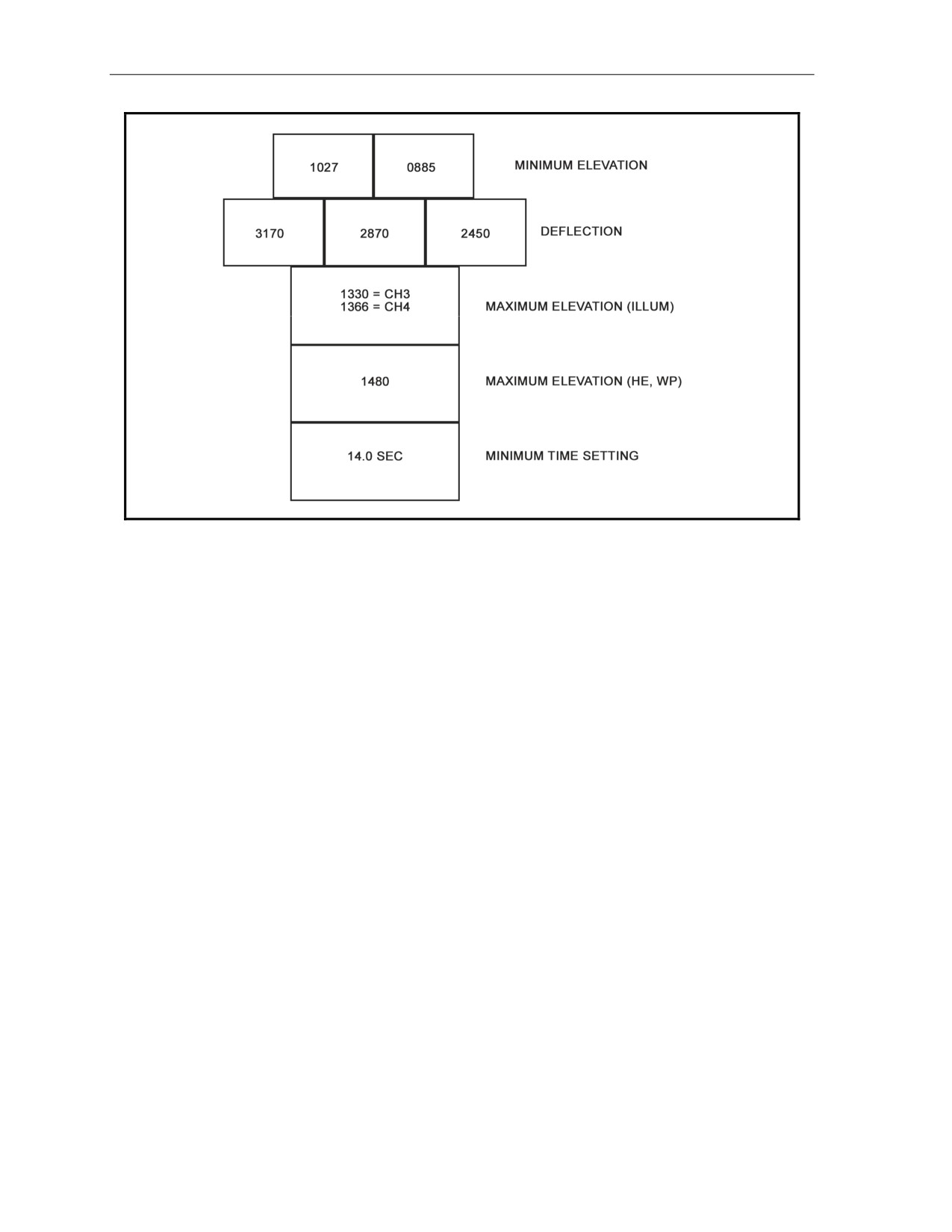
C-13. The safety T is a method of passing safety data on to the mortar squad leaders in a simplified form.
The information needed by the squad leader is extracted from the completed safety diagram and placed on
a 3- by 5-inch card or a similar form. Figure C-4 shows the safety T taken from the completed range safety
diagram.
17 July 2008
FM 3-22.91
C-5
Appendix C
Figure C-4. Safety T.
C-6
FM 3-22.91
17 July 2008
Appendix D
Field-Expedient Survey Techniques
Surveyed locations may be provided by the artillery survey personnel. Normally, a
map spot location to six-digit or eight-digit grid coordinates is estimated by the
platoon supervisor that is the most qualified. With the “roving mortars” concept, new
methods of position location are needed. Two such methods are described in this
appendix. The mortar position should be constantly improved to include more
accurate platoon center location.
GRAPHIC RESECTION
D-1. A graphic resection can be used to establish the coordinates of a point or to check the accuracy of a
map spot. If the resection cannot be performed from platoon center, the platoon center coordinates can be
estimated on the basis of the coordinates of the nearby resected point. The platoon may be required to
locate its own roving gun (split section) and primary, alternate, or supplementary positions as accurately as
possible. Often, the location of those positions can be determined by a simple map spot location. Whenever
possible, a more accurate method of location should be used. Graphic resection is a simple method using
the aiming circle, tracing paper, and a map. Follow these procedures:
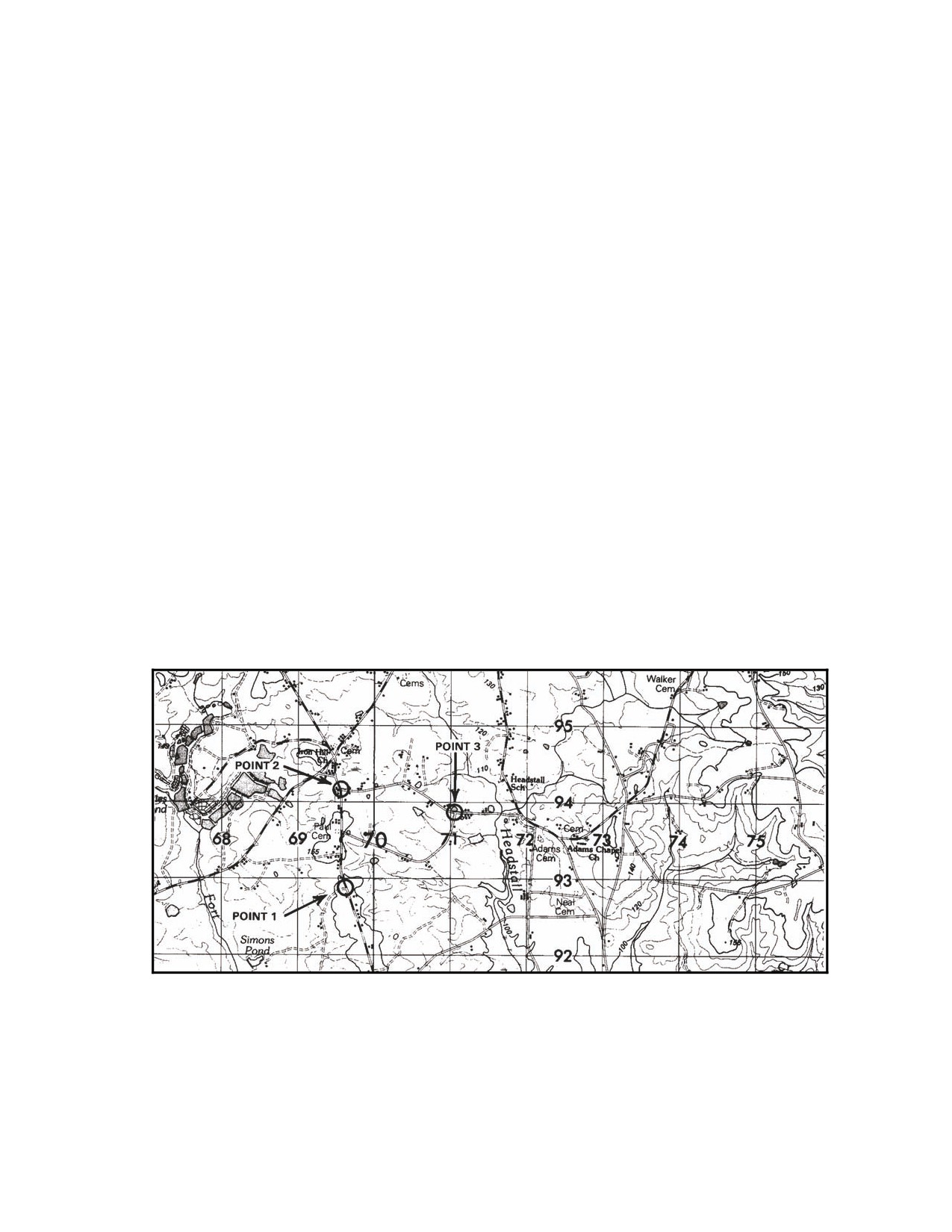
(1) Identify three distant points that also appear on a map (Figure D-1).
(2) With an aiming circle, measure the azimuth to those points. Preferably, the angles between the
points should be greater than 400 mils.
(3) On tracing paper, place a dot representing the aiming circle location.
Figure D-1. Three distant points.
17 July 2008
FM 3-22.91
D-1
Appendix D
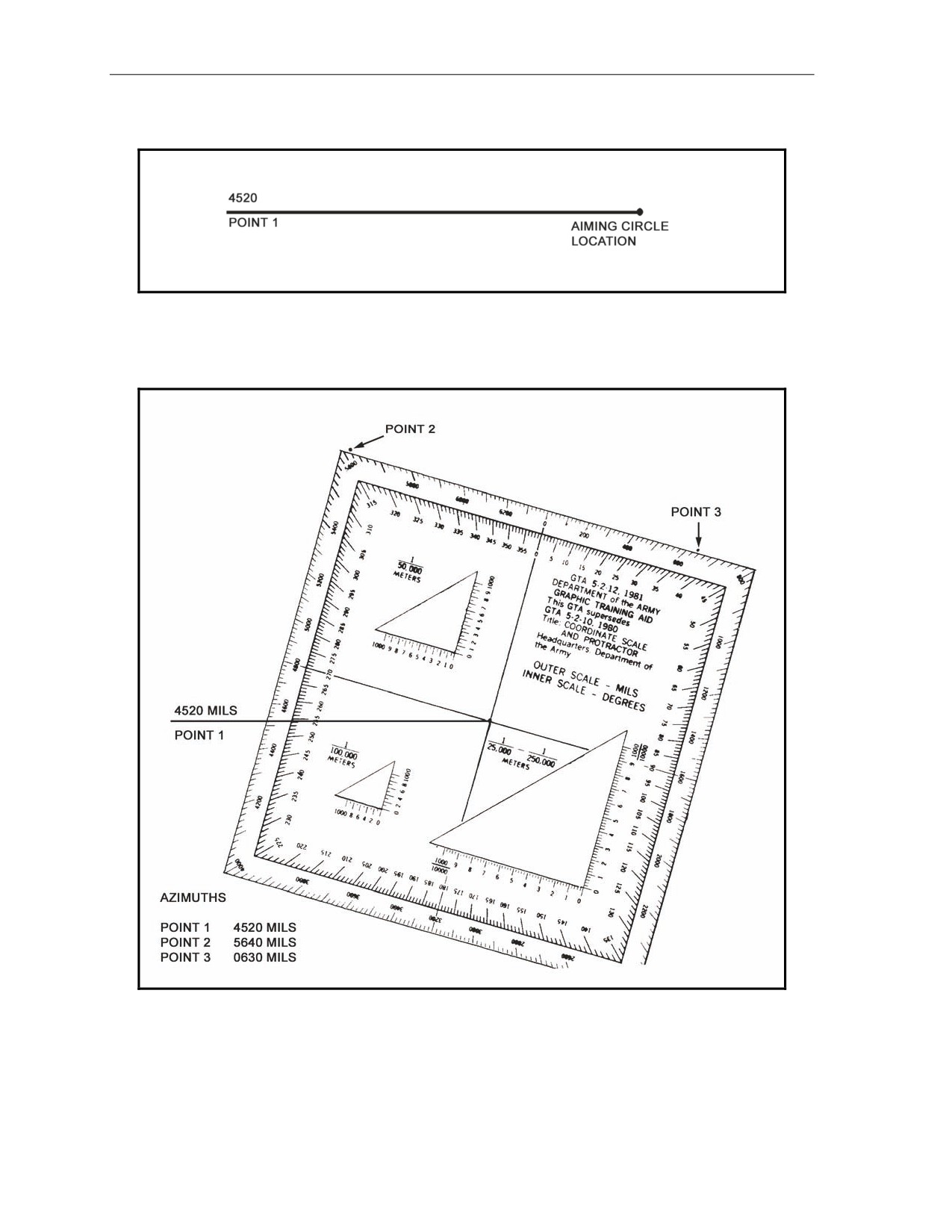
(4) Draw a line from this dot in any direction (Figure D-2).
Figure D-2. Line drawn in any direction.
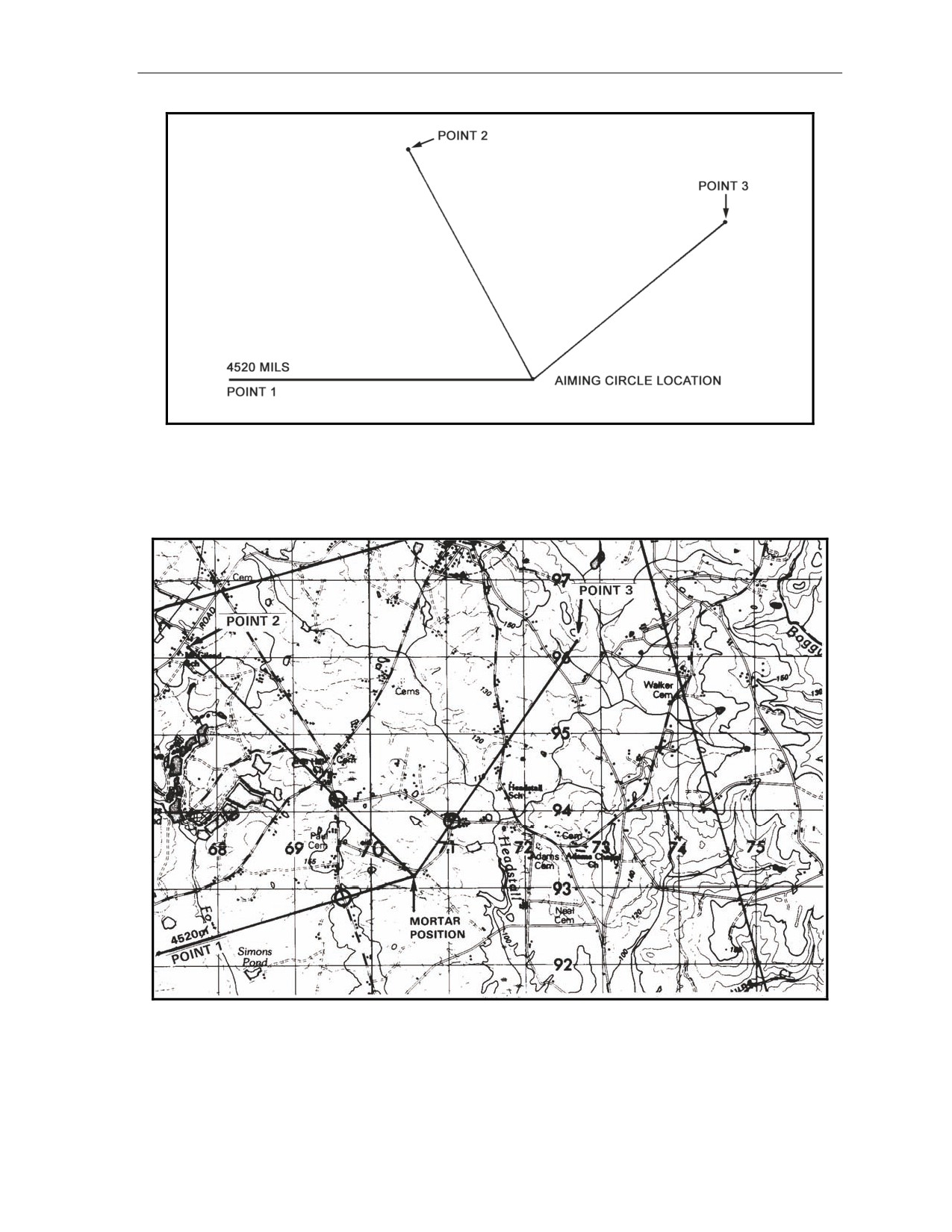
(5) With a protractor aligned with the correct azimuth on the line (Figure D-3), draw two lines from
the dot on the measured azimuths (Figure D-4).
Figure D-3. Protractor aligned with correct azimuth.
D-2
FM 3-22.91
17 July 2008
Field-Expedient Survey Techniques
Figure D-4. Two more lines drawn from dot.
(6) Place the tracing paper over the map of the area and slide it around until it is positioned so that
the three lines pass through their respective distant points (Figure D-5). The dot on the tracing
paper represents the location of the aiming circle (mortar position) on the map.
Figure D-5. Positioning of tracing paper.
(7) If the angles are plotted with a standard protractor (accurate to about 10 mils) and oriented over
a 1:50,000 scale map, the resection should be accurate within 100 meters.
17 July 2008
FM 3-22.91
D-3
Appendix D
HASTY SURVEY
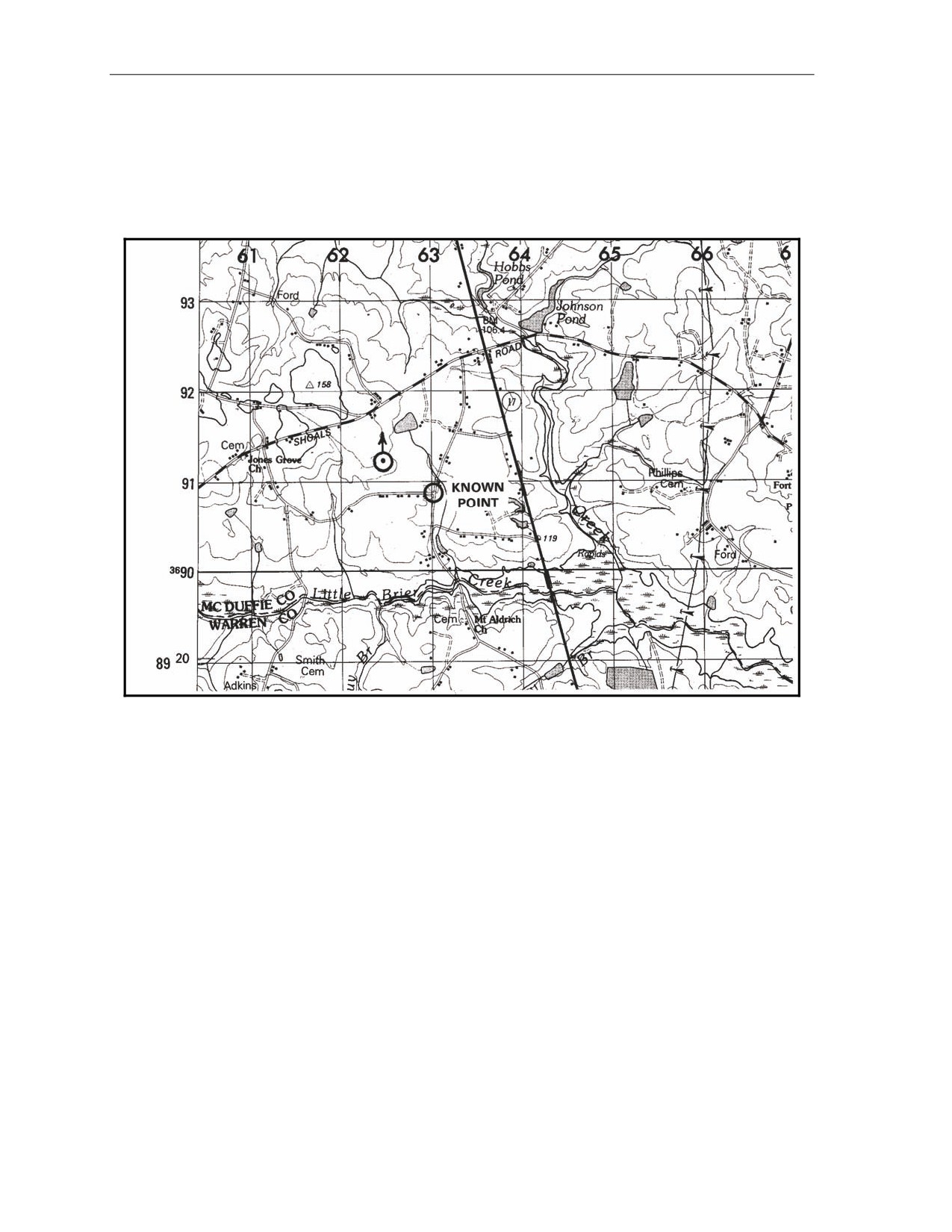
D-2. A terrain feature or man-made object is needed close to the desired mortar position for a hasty
survey. This identifies the mortar position on a map by eight-digit grid coordinates. The hasty survey
begins at this point, using the pivot point of the M16 plotting board to represent the selected known
position (Figure D-6).
Figure D-6. Hasty survey.
D-4
FM 3-22.91
17 July 2008
Field-Expedient Survey Techniques
(1) To begin the hasty survey, set the M2 aiming circle over the known point, level it, index the
declination constant using the azimuth micrometer knob, and, with the nonrecording (lower)
motion, orient the magnetic needle toward north. Now the grid azimuth can be measured.
(2) While the “circle” man is measuring the grid’s azimuth, an assistant (the “post” man) moves
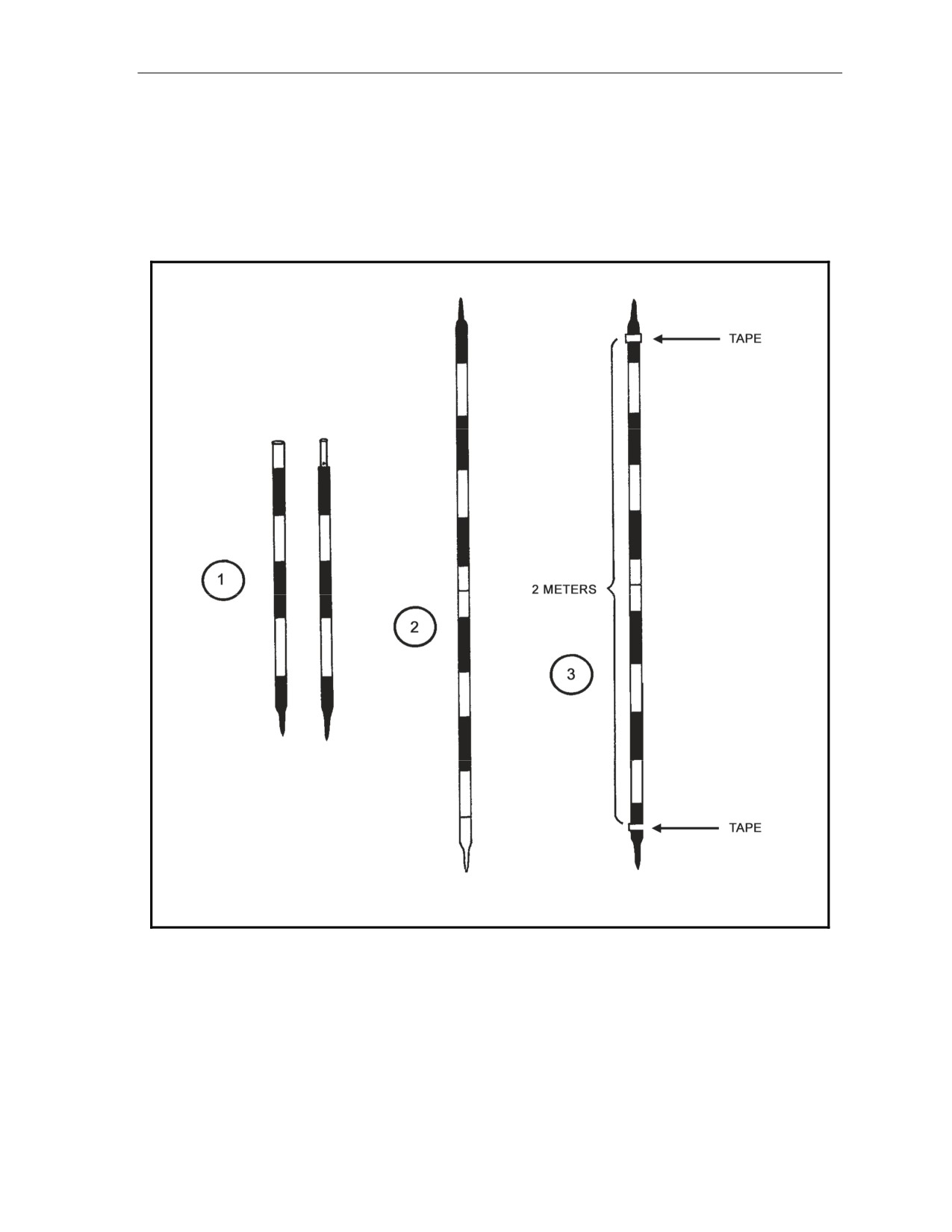
toward the desired mortar position with the two aiming posts. Before moving, the “post” man
will have joined the posts together and placed reflective or black tape strips exactly 2 meters
apart on each post. Thus, the post becomes a subtense bar (Figure D-7).
Figure D-7. Subtense bar.
17 July 2008
FM 3-22.91
D-5
Appendix D
(3) At this point, the first leg of the hasty survey can be done. The “circle” man directs the “post”
man to move toward the desired mortar position until he is within 290 meters and to place the
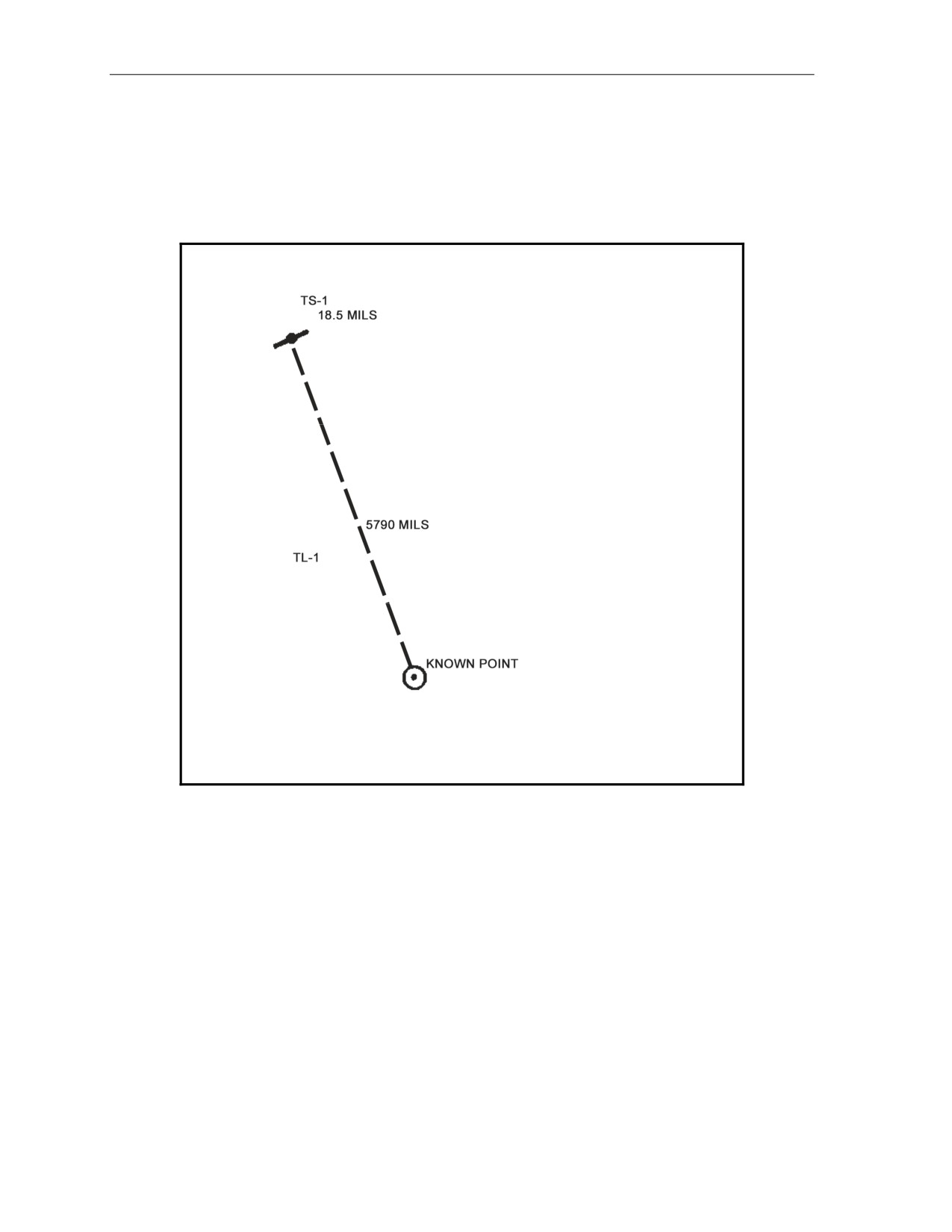
post into the ground. This point on the ground becomes traverse station 1 (TS-1).
(4) The “circle” man then rotates the azimuth motion (upper motion) until the vertical crossline in
the telescope is on the center of the post. He records the azimuth to the post and labels it traverse
leg 1 (TL-1) (Figure D-8).
Figure D-8. Traverse leg 1.
(5) Next, the “post” man removes the post and holds it parallel to the ground, facing the aiming
circle.
(6) The “circle” man measures the mil angle between the two strips of tape on the post (subtense
bar) and records the mil reading along with the azimuth to TS-1 (Figure D-8).
(7) The post is then replaced into the ground and the “circle” man moves forward to this point and
sets up the aiming circle directly over this point. This completes the first traverse leg.
D-6
FM 3-22.91
17 July 2008
Field-Expedient Survey Techniques
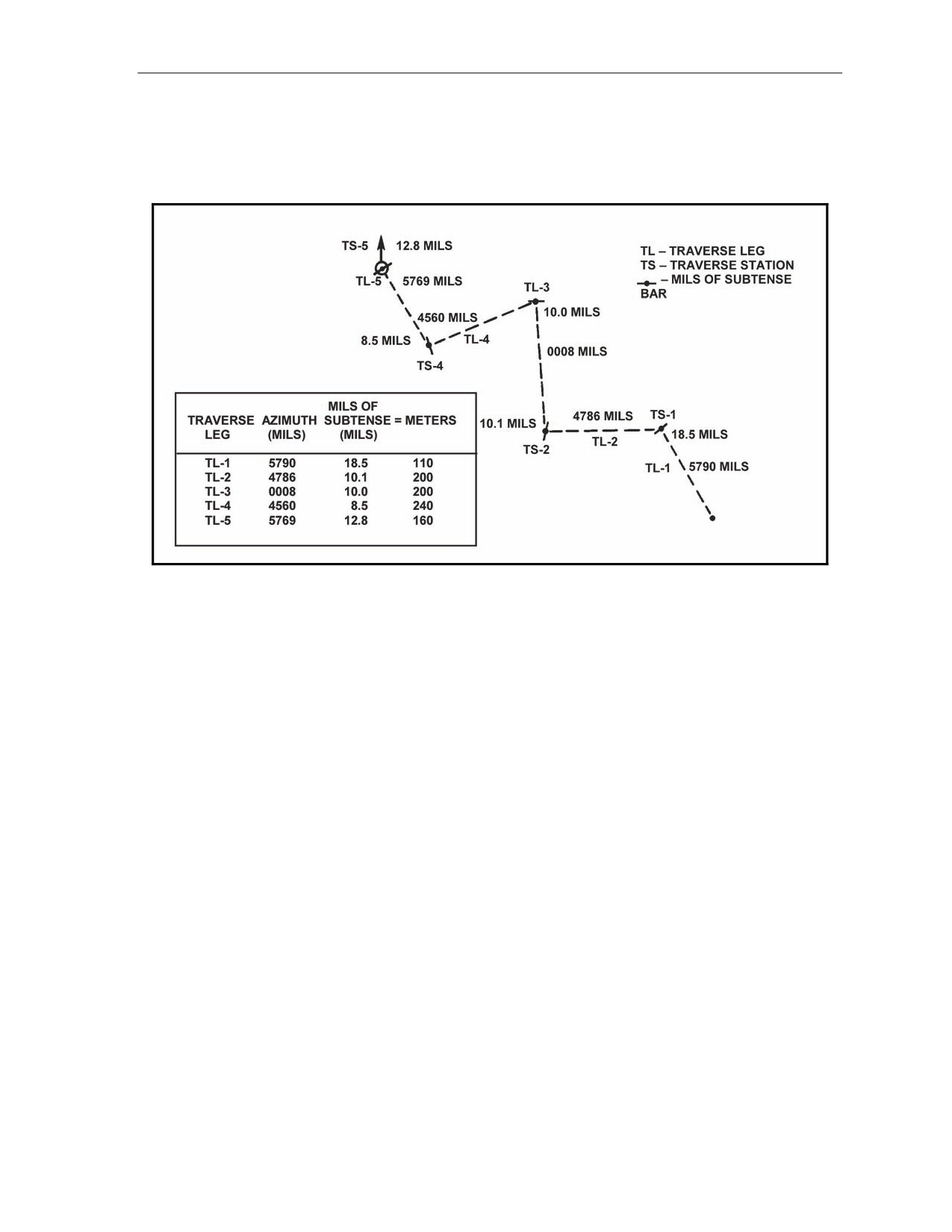
(8) This procedure is repeated until the desired mortar position is reached. The information obtained
may either be written down as an azimuth, a mil angle, and a traverse station, or a diagram may
be constructed (Figure D-9). To avoid confusing others working with a hasty survey, any
diagram should reflect the route of the various traverse legs and should be close to scale.
Figure D-9. Construction of a diagram.
(9) The information recorded by the “circle” man goes to the FDC either as the traverse legs are
made or after all the legs have been completed. The beginning known point is represented by the
pivot point of the M16 plotting board.
(10) Starting at the pivot point, the data are applied on the board for each leg of the hasty survey. For
example:
The azimuth on the first traverse leg was 5790 mils. Index that information on the M16
plotting board.
The distance between the two strips of tape on the aiming posts was 18.5 mils.
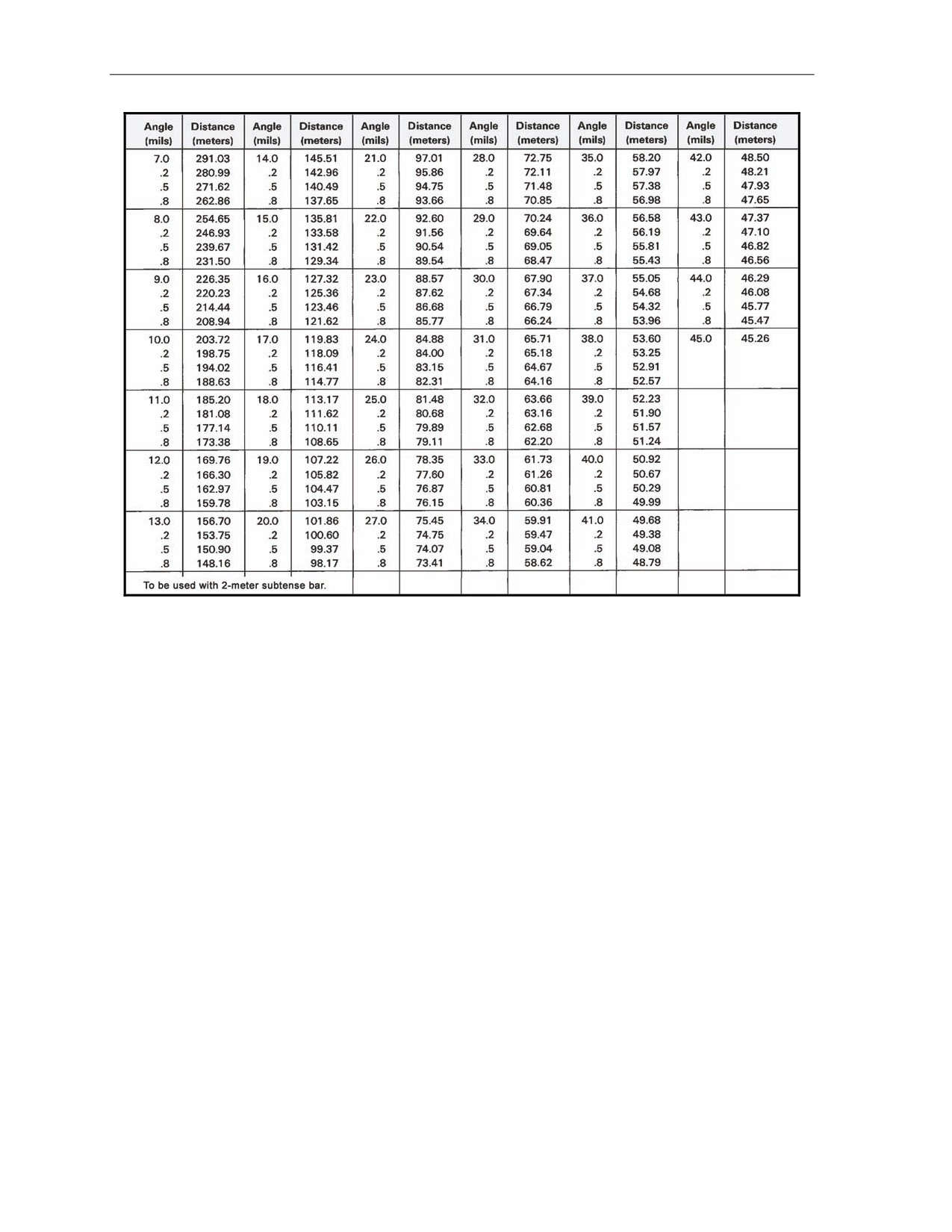
Refer to the distance table (Figure D-10) for the 2-meter subtense bar width; a mil angle of
18.5 mils is equal to a distance of 110 meters. For the hasty survey, make one square on the
plotting board equal to 25 meters.
From the pivot point on the direction of 5790 mils, move 110 meters (4 2/5 squares) along
the index line, place a dot, and circle it. This point, marked as TS-1, completes traverse leg
1.
The azimuth for the second traverse leg was 4786 mils. Again, index this information on
the plotting board.
At TS-2, the mil angle measured for the 2-meter subtense bar width was 10.1 mils.
Refer to the distance table for the 2-meter subtense bar width; 10.1 mils equals a distance of
200 meters.
17 July 2008
FM 3-22.91
D-7
Appendix D
Figure D-10. Distance table for a 2-meter subtense bar.
With 4786 mils indexed on the plotting board, move up 200 meters from TS-1 along or
parallel to a vertical line (eight squares), place a dot, and circle it.
This point, marked TS-2, completes traverse leg 2. Repeat the same procedure for traverse
legs 3, 4, and 5.
Rotate the M16 plotting board until TS-5 (mortar position) is directly over the vertical
centerline.
Read the azimuth from the top of the plotting board; this is the direction from the known
starting point to the base mortar squad’s position.
Count the number of squares along the index line between the pivot point and TS-5
(remember: each square equals 25 meters). This is the straight-line distance from the
known starting point to the base mortar squad’s position.
If given data were properly applied in the example, a known starting point-base mortar
squad azimuth should have been obtained of 5961 mils, and a known starting point-based
mortar squad distance of 690 meters (+/-5 mils and 10 meters).
Apply these data to the map. From the known starting point along the direction of 5961
mils, move 690 meters. The new point is the eight-digit grid coordinate for the base mortar
squad’s position.
The FDC now establishes a modified-observed firing chart or, if the FO can find an eight-
digit location in the target area, a surveyed firing chart.
D-8
FM 3-22.91
17 July 2008
Appendix E
Fire Direction Center Certification
FDC certification is required for all units with mortars and tests the proficiency of
Soldiers to perform their duties as FDC computers and section sergeants. This
appendix provides the commander with a means to verify that mortarmen are trained
in FDC procedures. FDC certification tests all FDC personnel subject to certification
on the M16/M19 plotting board and, depending on their equipment, either on the
MBC, MFCS, or LHMBC. This appendix contains an example test for the units; units
should develop their own test based on their METL. At a minimum, certification will
cover the tasks listed for the primary FDC equipment, the MBC or the MFCS, and
the M16/M19 plotting boards. Ninety percent of all section leaders, squad leaders,
and FDC personnel will have passed the FDC exam within the past six months.
SECTION I. CONDUCT OF THE PROGRAM
The FDC certification program (FDCCP) consists of a hands-on and written test, in which commanders are
responsible for the conduct and certification of the program. For the M16/M19 plotting board, MBC (both the
M23 and the M31), MFCS, or LHMBC, participants prepare the equipment and, using the data provided,
answer multiple-choice questions. Either component may be changed to conform to a particular mortar
organization. Units with the MFCS or LHMBC take the same test on the plotting boards and must meet unit-
based certification requirements that cover, as a minimum, the tasks listed in paragraphs E-7 through E-10 for
the MFCS and those in paragraphs E-11 through E-14 for the LHMBC. An example of the written test,
contained in this appendix, includes multiple choice questions (some of which use the Fort Benning Installation
Map as a reference) for units to use as a guide in the development of their own test. The answer key is not
included; units should develop their own key when they construct their test.
ELIGIBLE PERSONNEL
E-1. Soldiers should meet the following criteria to be evaluated for certification:
z
FDC radiotelephone operation.
z
FDC computer.
z
Section sergeant.
z
Squad leaders that perform FDC operations (CAV, BCT, and so on).
NOTE: All sergeants and the above personnel should be administered an FDC certification, but
only personnel that perform FDC operations must certify for live-fire operations. A squad
leader’s failure to pass the FDC certification does not preclude his squad from firing if that
squad operates under a controlling FDC.
QUALIFICATION
E-2. The FDCCP is designed to be a battalion-sponsored program that the battalion commander can use
to certify FDC personnel. The goal is to certify all leaders under a standardized evaluation program.
E-3. Soldiers must receive a minimum score of 90 percent on the hands-on/written test for the M16/M19
plotting board and the MBC. Soldiers must be certified on all tasks listed for the MFCS in paragraphs E-7
through E-10 and those for the LHMBC in paragraphs E-11 through E-14. For example, the hands-
17 July 2008
FM 3-22.91
E-1
Appendix E
on/written test in Sections V and VI contains 20 questions on the M16/M19 plotting boards and 55
questions on the MBC; the student must correctly answer 18 and 50 questions respectively.
E-4. Soldiers may retest only once on any part of the test they have failed. Soldiers who fail the retest will
not be certified and will be required to repeat the FDCCP during the next evaluation. Those who fail a
second time should be considered for administrative action.
GENERAL RULES
E-5. The FDCCP should be conducted at regiment/brigade level. Battalions should provide scorers (staff
sergeants and above) who are Infantry Mortar Leader’s Course (IMLC)/11C or Maneuver Advanced
Noncommissioned Officer Course (MANCOC) graduates. Considerable training value can be obtained by
using a centralized evaluation and by obtaining the experience of several units’ noncommissioned officers
(NCOs). Conditions should be the same for all candidates during the certification. The examining board
ensures that information obtained by a candidate during testing is not passed to another candidate.
SECTION II. CERTIFICATION
This section outlines the criteria used to test the candidate’s ability to perform FDC tasks using the M16/M19
plotting boards, the MFCS, the LHMBC, and the MBC.
M16/M19 PLOTTING BOARD CERTIFICATION
E-6. The candidate analyzes the situation, and then selects the appropriate answer. A Fort Benning
Installation Map 1:50,000, Edition 1-DMA, Series: V745Z is required for the example certification test.
The certification consists of, but is not limited to, the following tasks:
•
Prepare a plotting board for operation as an observed chart (pivot point).
•
Prepare a plotting board for operation as an observed chart (below pivot point).
•
Prepare a plotting board for operation as a modified-observed chart.
•
Prepare a plotting board for operation as a surveyed chart.
•
Process subsequent FO corrections on all charts.
•
Determine data for sheaf adjustments.
•
Determine data for registration, re-registration, and application of the corrections.
•
Record information on DA Form 2399-R.
•
Record MET data using DA Form 3675-R.
•
Determine MET corrections using DA Form 2601-1-R and apply MET corrections.
•
Locate and compute data for a grid mission.
•
Locate and compute data for a polar plot mission.
•
Locate and compute data for a shift from a known point mission.
•
Compute data for open, converged, and special sheaves.
•
Compute data for traversing fire.
•
Compute data for searching fire (60-mm, 81-mm, and 120-mm mortars).
•
Compute data for battlefield illumination.
•
Compute data for a coordinated illumination/HE mission.
•
Determine angle T.
•
Prepare an FDC order (section sergeant).
•
Locate an unknown point on a map or plotting board using intersection.
•
Locate an unknown point on a map or plotting board using resection.
E-2
FM 3-22.91
17 July 2008
Fire Direction Center Certification
MORTAR FIRE CONTROL SYSTEM CERTIFICATION
E-7. This paragraph outlines the criteria used to test the candidate’s ability to perform FDC tasks using
the MFCS. The certification consists of, but is not limited to, the following tasks:
START AND INITIALIZE THE MORTAR FIRE CONTROL SYSTEM
E-8. Perform the following:
(1) Start up the MFCS on M577 and the M1064A4 carriers in the proper sequence.
(2) Initialize the data and configure the MFCS, which includes inputting and checking data on the
following screens:
Unit List.
Configuration.
Data.
Geographical Reference.
Position.
Channel A.
Channel B.
OPERATE THE MORTAR FIRE CONTROL SYSTEM
E-9.
Conduct the following:
(1)
Check the status of all guns assigned to the FDC, to include:
Operational status.
Location.
(2)
Determine the overall status of the fire unit.
(3)
Obtain information and update ammunition status, to include:
Ammunition for each gun.
Ammunition for all guns controlled by the FDC.
Ammunition status manually updated.
(4)
Obtain information and update MET data, to include:
Accept and apply new MET data.
Understand why MET data are highlighted due to exceeding MET trend limits.
Manually enter or edit the new MET message.
(5)
Identify targets or known points, to include:
Designate a target after a fire mission.
Manually enter a target or a known point.
(6)
Enter and modify a safety fan.
(7)
Initiate a check fire message.
(8)
Send and receive a PTM.
(9)
Respond to and correct alerts, to include—
Information alerts.
Reason for error alerts.
Warning alerts.
17 July 2008
FM 3-22.91
E-3
Appendix E
CONDUCT FIRE MISSIONS
E-10. Conduct the following:
(1) Receive and transmit a digital fire mission.
(2) Receive, process, and transmit a manual fire mission.
(3) Enter, update, and store an RP.
(4) Process an illumination mission.
(5) Process a coordinated illumination mission.
(6) Initiate and process an FPF mission.
(7) Process a smoke mission.
LIGHTWEIGHT HANDHELD MORTAR BALLISTIC COMPUTER
CERTIFICATION
E-11. This paragraph outlines the criteria used to test the candidate’s ability to perform FDC tasks using
the LHMBC. The certification consists of, but is not limited to, the following tasks:
START AND INITIALIZE THE LIGHTWEIGHT HANDHELD MORTAR BALLISTIC COMPUTER
E-12. Initialize the data and configure the LHMBC, which includes inputting and checking data on the
following screens:
z
Geographical Reference.
z
Setup Data.
z
Unit List.
z
Setup Commo Parameters
OPERATE THE LIGHTWEIGHT HANDHELD MORTAR BALLISTIC COMPUTER
E-13. Conduct the following:
(1) Obtain information and update ammunition status for each gun.
(2) Obtain information and update MET data, to include:
Accepting and applying new MET data.
Understanding why MET data are highlighted (due to exceeding MET trend limits).
Manually entering or editing the new MET message.
(3) Identify targets or known points, to include:
Designating a target after a fire mission.
Manually entering a target or a known point.
(4) Enter and modify a safety fan.
(5) Initiate a check fire message.
(6) Send and receive a PTM.
(7) Respond to and correct alerts, to include:
Information alerts.
Reason for error alerts.
Warning alerts.
E-4
FM 3-22.91
17 July 2008
Fire Direction Center Certification
CONDUCT FIRE MISSIONS
E-14. Conduct the following:
(1) Receive and transmit a digital fire mission.
(2) Receive, process, and transmit a manual fire mission.
(3) Enter, update, and store an RP.
(4) Process an illumination mission.
(5) Process a coordinated illumination mission.
(6) Initiate and process an FPF mission.
MORTAR BALLISTIC COMPUTER CERTIFICATION
E-15. This paragraph outlines the criteria used to test the candidate’s ability to perform FDC tasks using
the M23 MBC. Units with the M31 MBC should modify this certification to conform to the capabilities of
the M31. The certification consists of, but is not limited to, the following tasks:
z
Prepare an MBC for operation (minimum initialization).
z
Process subsequent FO corrections.
z
Determine data for sheaf adjustments.
z
Determine data for registration and re-registration.
z
Record information on DA Form 2399-R.
z
Record MET data using DA Form 2601-1-R or DA Form 2601-2-R.
z
Determine MET corrections.
z
Compute data for a grid mission.
z
Compute data for a shift from a known point mission.
z
Compute data for a polar plot mission.
z
Compute data for open, converged, and special sheaves.
z
Compute data for traversing fire.
z
Compute data for searching fire (60-mm, 81-mm, and 120-mm mortars).
z
Compute data for battlefield illumination.
z
Compute data for a coordinated illumination/HE mission.
z
Determine angle T.
z
Prepare an FDC order (section sergeant).
z
Locate an unknown point using intersection.
z
Locate an unknown point using resection.
SECTION III. MORTAR BALLISTIC COMPUTER EXAMPLE TEST
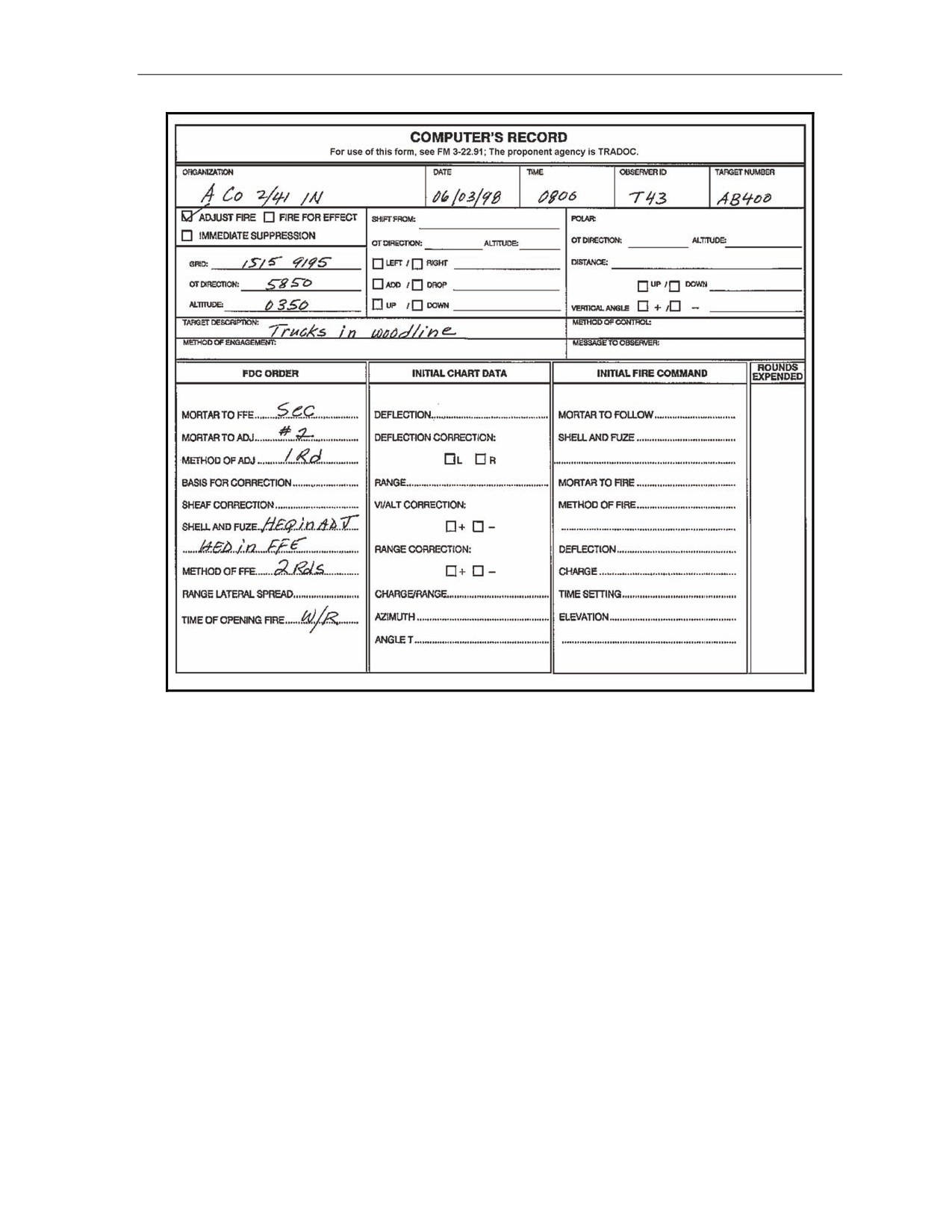
The candidate analyzes the following situations, and then selects the appropriate answer. Figure E-1 shows a
completed DA Form 2399-R for Situation A. This example was created using an M23 MBC; however, it may
be used as a template to create FDCCP tests for the M31 MBC, M32 LHMBC, and the M95/M96 MFCS.
17 July 2008
FM 3-22.91
E-5
Appendix E
SITUATION A
The following takes place while operating the MBC.
TASK:
Place the MBC into operation using internal or external power sources.
CONDITIONS:
Given a BA 5588/U battery, power supply cable, MBC, and a variable power supply.
STANDARDS:
Place the MBC into operation.
TASK:
Operate the panel switches on the MBC.
CONDITIONS:
Given an MBC.
STANDARDS:
Operate the panel switches without error.
TASK:
Perform the MBC system self-test.
CONDITIONS:
Given an operating MBC.
STANDARDS:
Perform the self-test without error and report any deficiencies, shortcomings, or failures to
your supervisor.
TASK:
Prepare an MBC with initialization data.
CONDITIONS:
Given an MBC with setup, weapon, and ammunition data.
STANDARDS:
Enter the setup, weapon, and ammunition data into the MBC without error.
SETUP
WEAPON DATA
TIME OUT: 30
UNIT: A Co 2/41 IN
TGT PREFIX: AB
81-mm (M252)
TN: 0400-0800
CARRIER-MOUNTED:
NO
ALARM: OFF
BP: A2 GRID PA 15880
88950
MIN E: 010
ALT 0410
GD: E01
AZ: 6400 DEF: 2800
LAT: +31
A1: Dir 1600 Dis 035
LISTEN ONLY: OFF
A3: Dir 4800 Dis 035
BIT RATE: 1200
A4: Dir 4800 Dis 070
KEYTONE: 1.4
BLK: SNG
AMMO DATA
OWN ID: A
TEMP: 70 deg
HE: M374A2
WP: M375A2
ILL: M301A3
TASK:
Compute data for a grid mission.
CONDITIONS:
Given an initialized MBC, CFF using grid coordinates as the method of target location, DA
Form 2399-R, FDC order, and DA Form 2188-R.
STANDARDS:
Compute data for the mission’s initial fire command to within 1 mil for deflection and
elevation.
TASK:
Record information on firing records.
CONDITIONS:
Given a DA Form 2399-R and DA Form 2188-R, CFF, FO’s corrections, information to
complete the FDC order, ammunition count, mortar platoon/ section SOP, and MBC.
STANDARDS:
Record and compute the mission. Correctly complete all required blocks and spaces on
the DA Form 2399-R. Record the information and data needed for the type of mortar and
ammunition being fired at the end.
E-6
FM 3-22.91
17 July 2008
Fire Direction Center Certification
Figure E-1. Situation A (excerpt from an example of
completed DA Form 2399-R [Computer's Record]).
1. What is the initial range?
(a)
3018
(b)
2970
(c)
3087
(d)
3047
17 July 2008
FM 3-22.91
E-7
Appendix E
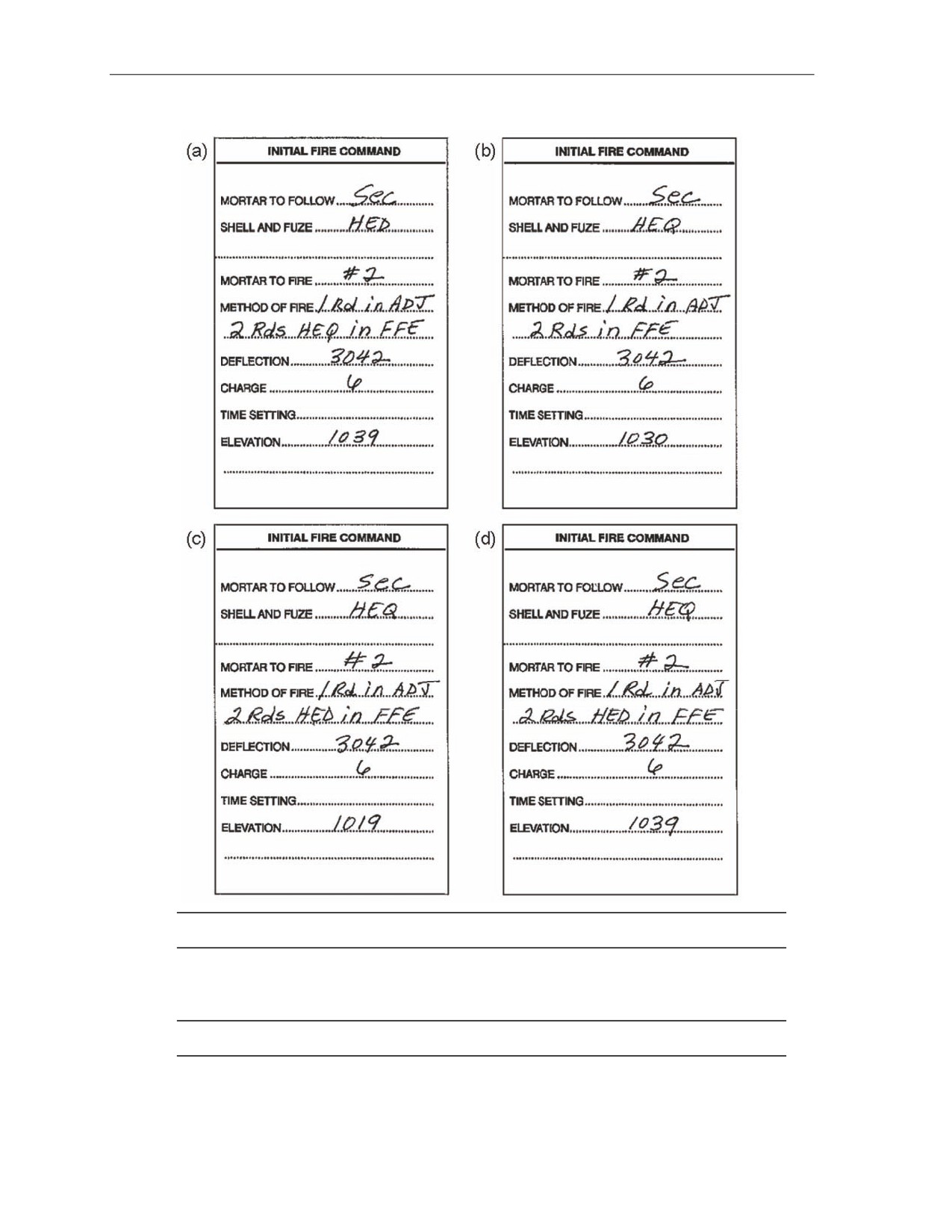
2. What is the correct initial fire command?
NOTE: The first round is fired, and the FO sends: RIGHT 100, DROP 100.
TASK:
Compute data for subsequent FO corrections using the MBC.
CONDITIONS:
Given an MBC with a mission already in progress and corrections from the FO.
STANDARDS:
Compute data for the corrections to within 1 mil for deflection and elevation.
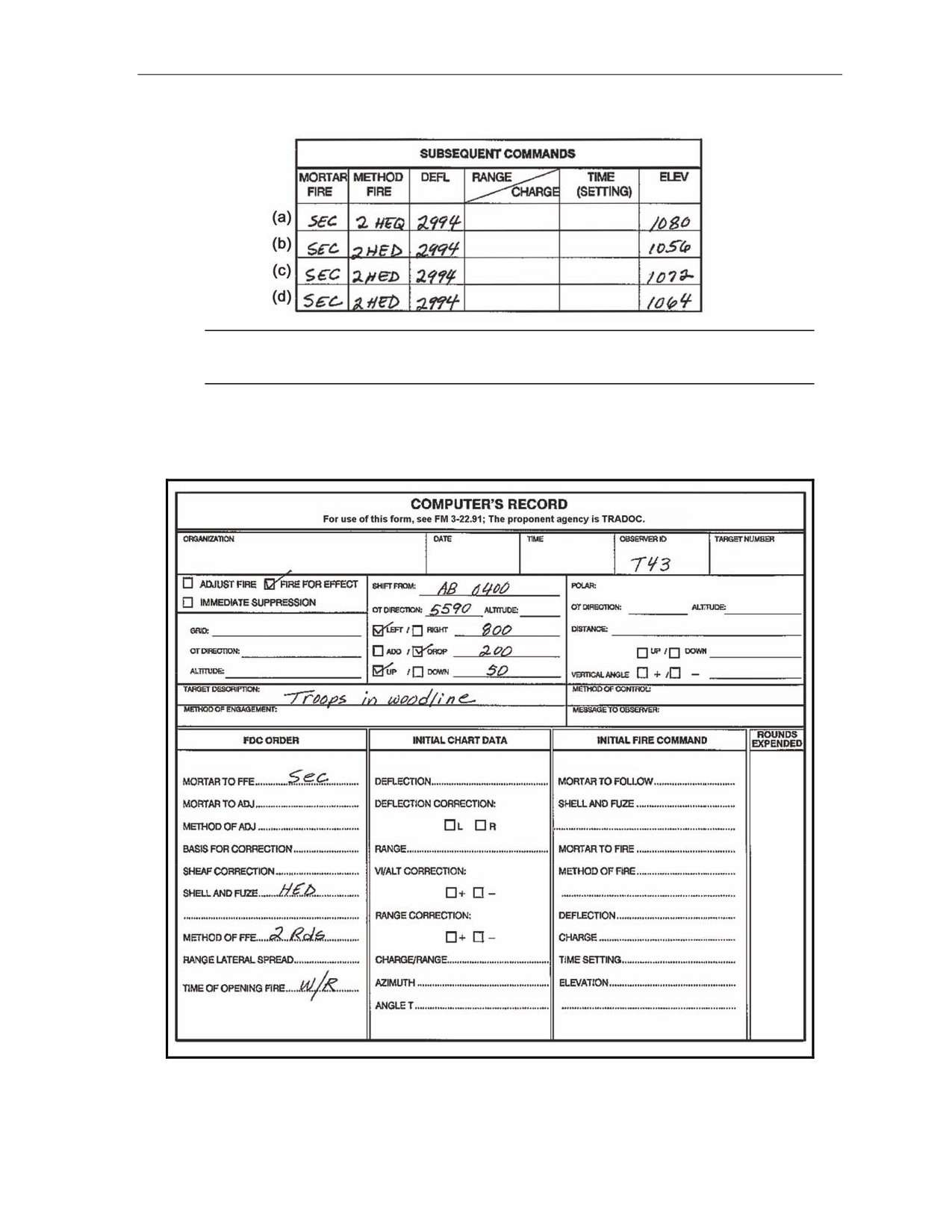
NOTE: That round is fired, and the FO sends: DROP 50, FFE.
E-8
FM 3-22.91
17 July 2008
Fire Direction Center Certification
3. What is the correct subsequent fire command for the FFE?
NOTE: The FO sends: END OF MISSION (EOM), 4 TRUCKS DESTROYED, EST 6 CAS.
The computer records: EOMRAT AB0400, KNPT 00.
SITUATION B
A fire mission is conducted using the CFF and FDC order in Figure E-2.
Figure E-2. Call for fire and FDC order (excerpt from an example of
completed DA Form 2399-R [Computer's Record]).
17 July 2008
FM 3-22.91
E-9
Appendix E
TASK:
Compute data for a shift from a known point mission.
CONDITIONS:
Continued from Situation A.
STANDARDS:
Compute data for the mission to within 1 mil for deflection and elevation.
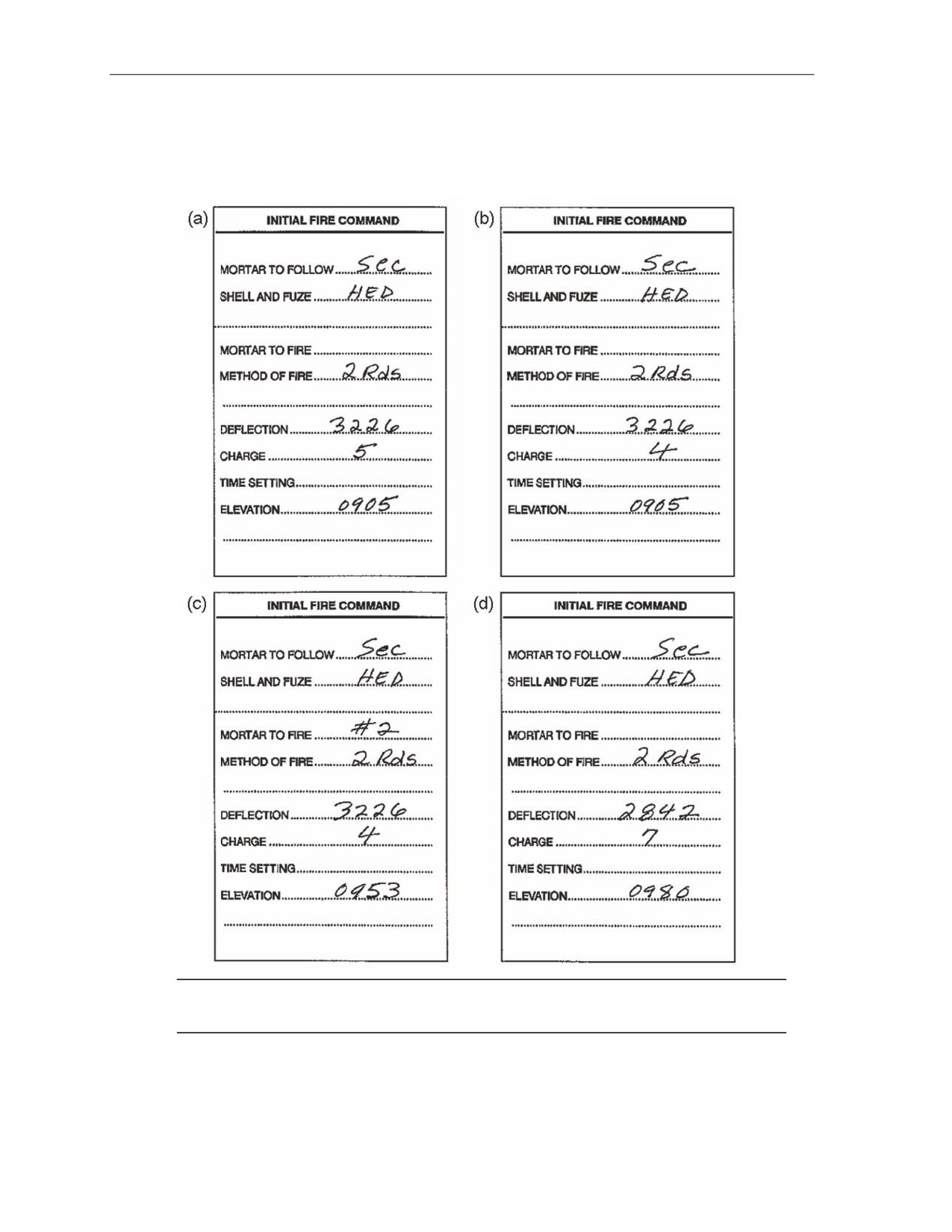
4. What is the correct initial fire command?
NOTE: The FO sends: EOM, EST
30 PERCENT CAS. The computer records:
EOMRAT AB 0401, KNPT 01.
E-10
FM 3-22.91
17 July 2008
Fire Direction Center Certification
SITUATION C
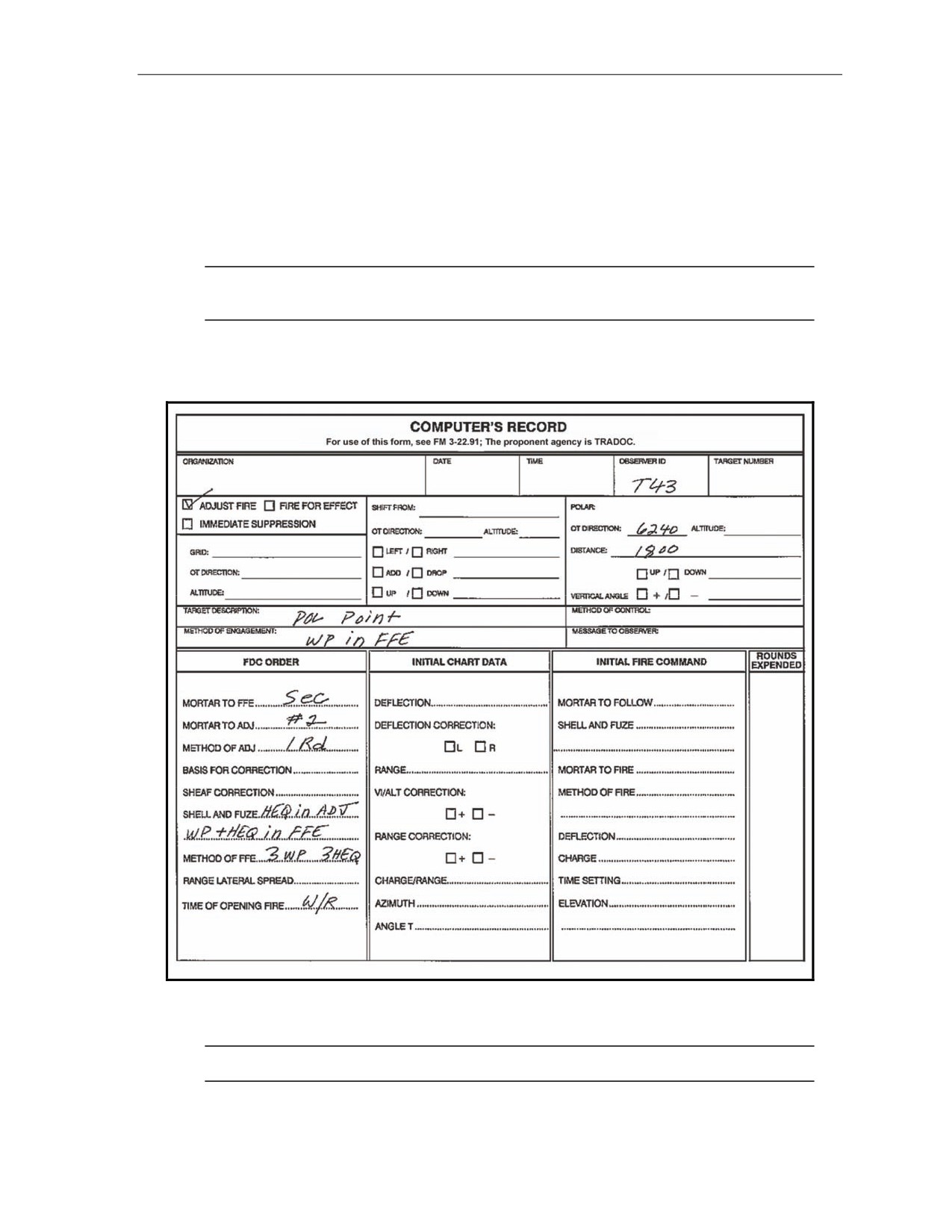
The FO calls in a polar plot mission. His location must be determined before the polar plot mission can be
computed. (Figure E-3 shows a completed DA Form 2399-R for Situation C.)
TASK:
Determine an unknown location by using resection (SURV key).
CONDITIONS:
Continued from Situation B.
STANDARDS:
Determine the unknown location as a grid coordinate to within 1 meter and record it as
an FO location.
NOTE: The FO’s call sign is T43. T43 sees KNPT 00 at a direction of 5850 and KNPT 01 at a
direction of 5590.
TASK:
Compute firing data for a polar plot mission.
CONDITIONS:
Continued from above and using the CFF and FDC order in Figure E-3.
STANDARDS:
Compute the firing data for the mission to within 1 mil for deflection and elevation.
Figure E-3. Situation C (excerpt from an example of
completed DA Form 2399-R [Computer's Record]).
NOTE: The initial round is fired, and the FO sends LEFT 100.
17 July 2008
FM 3-22.91
E-11
Appendix E
TASK:
Compute data for subsequent FO corrections using the MBC.
CONDITIONS:
Given an MBC with a mission already in progress and corrections from the FO to apply.
STANDARDS:
Compute data for the corrections to within 1 mil for deflection and elevation.
NOTE: The round is fired and the FO sends: LEFT 50, ADD 50, FFE.
TASK:
Compute data for subsequent FO corrections using the MBC.
CONDITIONS:
Given an MBC with a mission already in progress and corrections from the FO to apply.
STANDARDS:
Compute data for the corrections to within 1 mil for deflection and elevation.
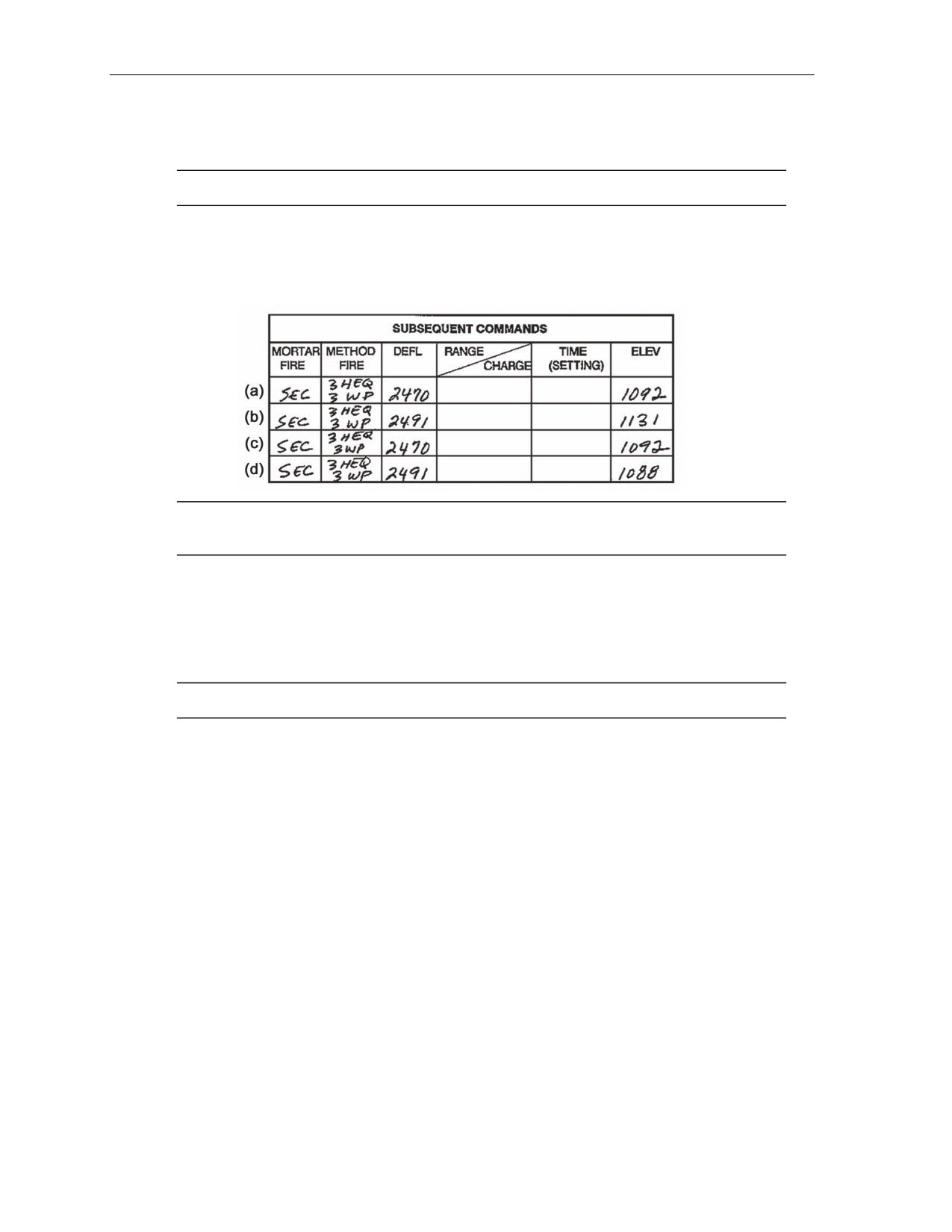
5. What is the correct subsequent fire command for the FFE?
NOTE: The FO calls back: EOM, POL POINT BURNING. The computer records:
EOMRAT ABO402, KNPT 02.
6. What is the FO’s grid location?
(a)
16743 89354
(b)
16843 89254
(c)
16943 89154
(d)
16154 89943
NOTE: Clear the computer before starting Situation D.
E-12
FM 3-22.91
17 July 2008
Fire Direction Center Certification
SITUATION D
Your platoon has moved to a firing range.
SETUP
WEAPON DATA
TIME OUT: 30
UNIT: A Co 2/41 IN
TGT PREFIX: AA
81-mm (M252)
TN: 0200-0600
CARRIER-MOUNTED:
NO
ALARM: OFF
BP: A2 GRID AP 07550
93650
MIN E: 003
ALT: 0460
MIN N: 089
AZ: 1600 DEF: 2800
GD: E01
A1: Dir 3200 Dis 035
LAT: +31
A3: Dir 6400 Dis 035
LISTEN
ONLY:
A4: Dir 6400 Dis 070
OFF
BIT
RATE:
1200
KEYTONE: 1.4
AMMO DATA
BLK: SNG
TEMP: 70 deg
OWN ID: A
HE: M374A2
WP: M375A2
ILL: M301A3
FO LOCATION
W13 AP: 08250 92550
ALT: 0500
TASK:
Prepare an MBC with initialization data.
CONDITIONS:
Given an MBC with setup, weapon, ammunition, and FO location data.
STANDARDS:
Enter the setup, weapon, and ammunition data into the MBC without error.
TASK:
Store safety data in the MBC.
CONDITIONS:
Continuation of situation D and safety diagram data.
STANDARDS:
Store the safety diagram data without error.
LLAZ: 1200
RLAZ: 2000
MAX RN: 4000
MIN RN: 0350
MIN CHG: 1
MAX CHG: 8
17 July 2008
FM 3-22.91
E-13
Appendix E
TASK:
Store MET data and update to the current file in the MBC.
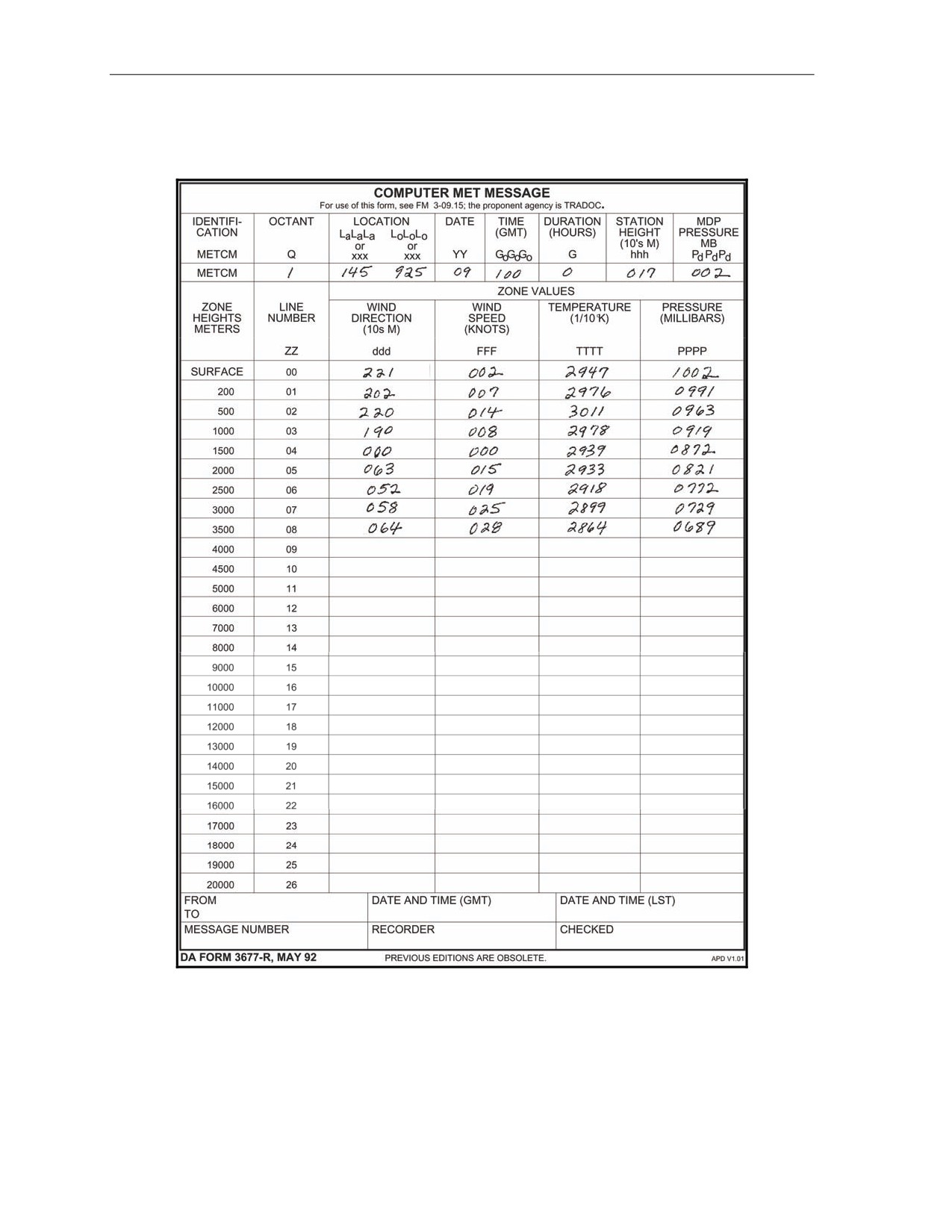
CONDITIONS:
Given an initialized MBC and a completed DA Form 3677-R (Figure E-4).
STANDARDS:
Enter MET data in the MBC without error.
Figure E-4. Situation D: first mission (an example of
completed DA Form 3677-R [Computer MET Message]).
E-14
FM 3-22.91
17 July 2008
Fire Direction Center Certification
TASK:
Store MET data and update to the current file in the MBC.
CONDITIONS:
Given an initialized MBC and a completed DA Form 3677-R (Figure E-4).
STANDARDS:
Enter MET data in the MBC without error.
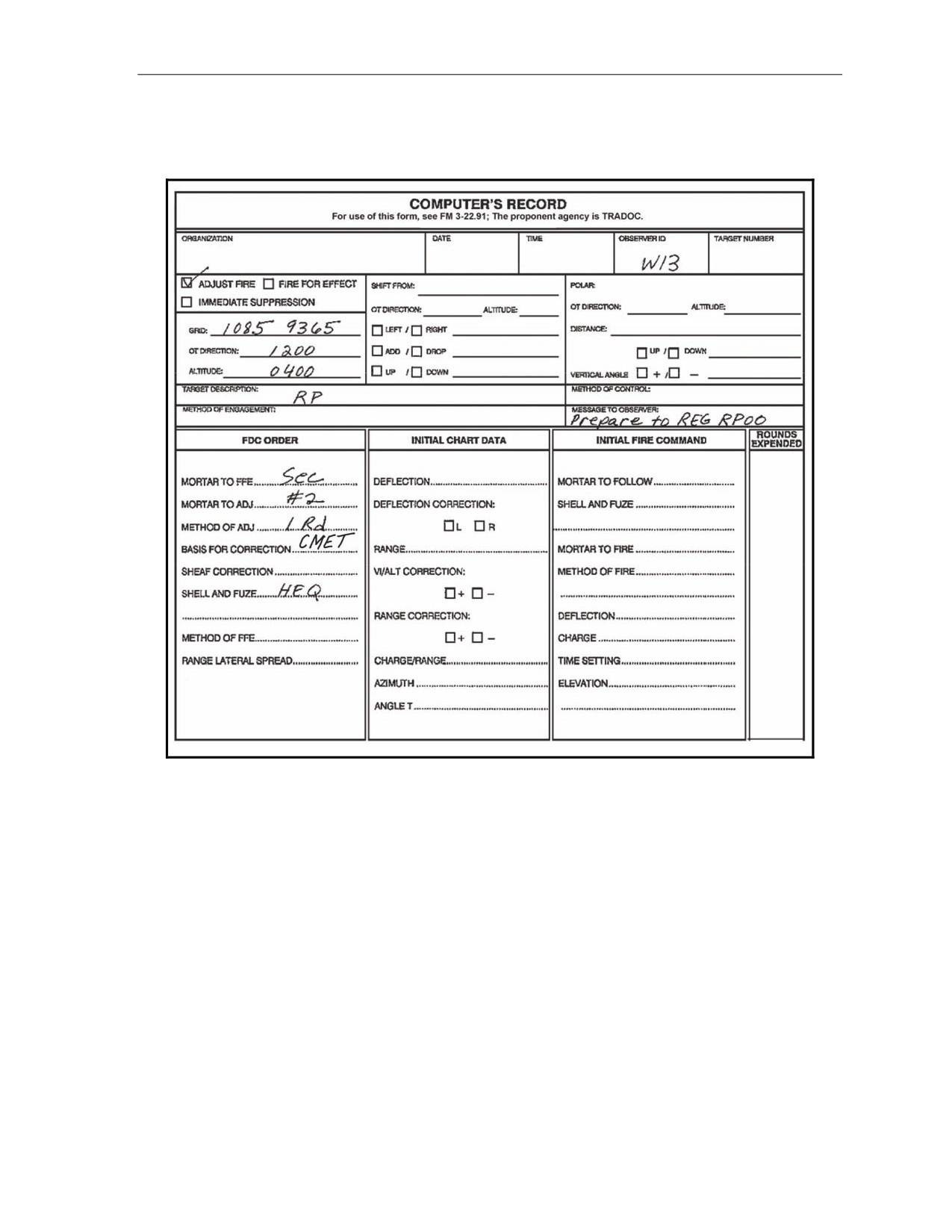
Figure E-5. Situation D: second mission (excerpt from an example of
completed DA Form 2399-R [Computer's Record]).
17 July 2008
FM 3-22.91
E-15
Appendix E
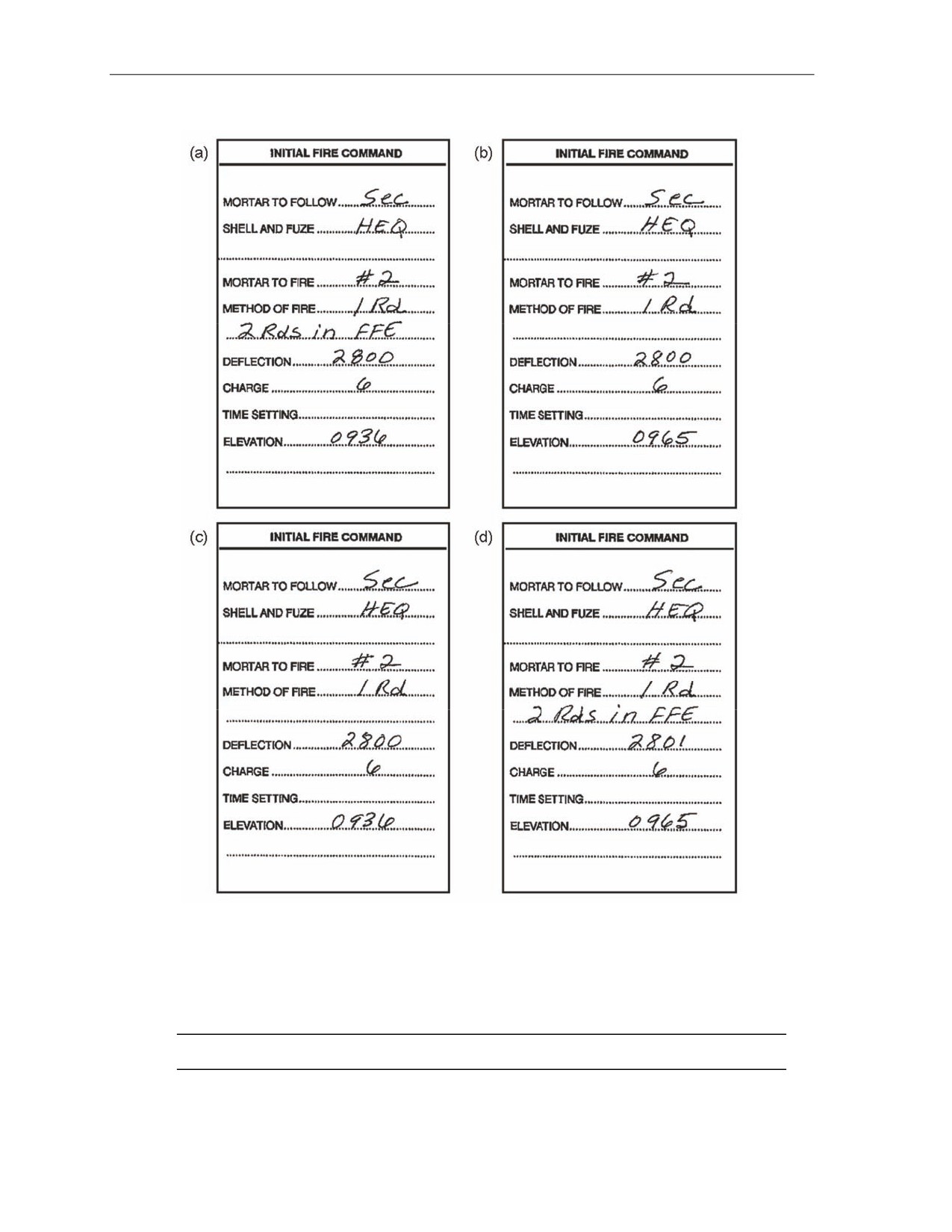
7. What is the correct initial fire command?
8. What is the angle T?
(a)
0450 mils
(b)
0500 mils
(c)
0400 mils
(d)
0300 mils
NOTE: The FO sends: LEFT 100, ADD 150.
E-16
FM 3-22.91
17 July 2008
Fire Direction Center Certification
9. What is the correct elevation?
(a)
1069 mils
(b)
1042 mils
(c)
0961 mils
(d)
1061 mils
NOTES:
1. The FO sends: RIGHT 50, ADD 50.
2. That round is fired, and the FO sends: DROP 25, EOM, REGISTRATION
COMPLETE.
10. What is the RCF?
(a)
+44
(b)
-51
(c)
+51
(d)
-44
11. What is the DEFK?
(a) R33
(b) R36
(c) L36
(d) L33
TASK:
Compute data for sheaf adjustment.
CONDITIONS:
Given an initialized MBC, completed registration mission, DA Form
2399-R, and
corrections from the FO for the adjustment of the remainder of the section.
STANDARDS: Adjust the sheaf and determine the sheaf data to within 1 mil for deflection and elevation.
NOTE: The FDC sends an MTO, “Prepare to adjust sheaf,” and the FO replies, “Section right.”
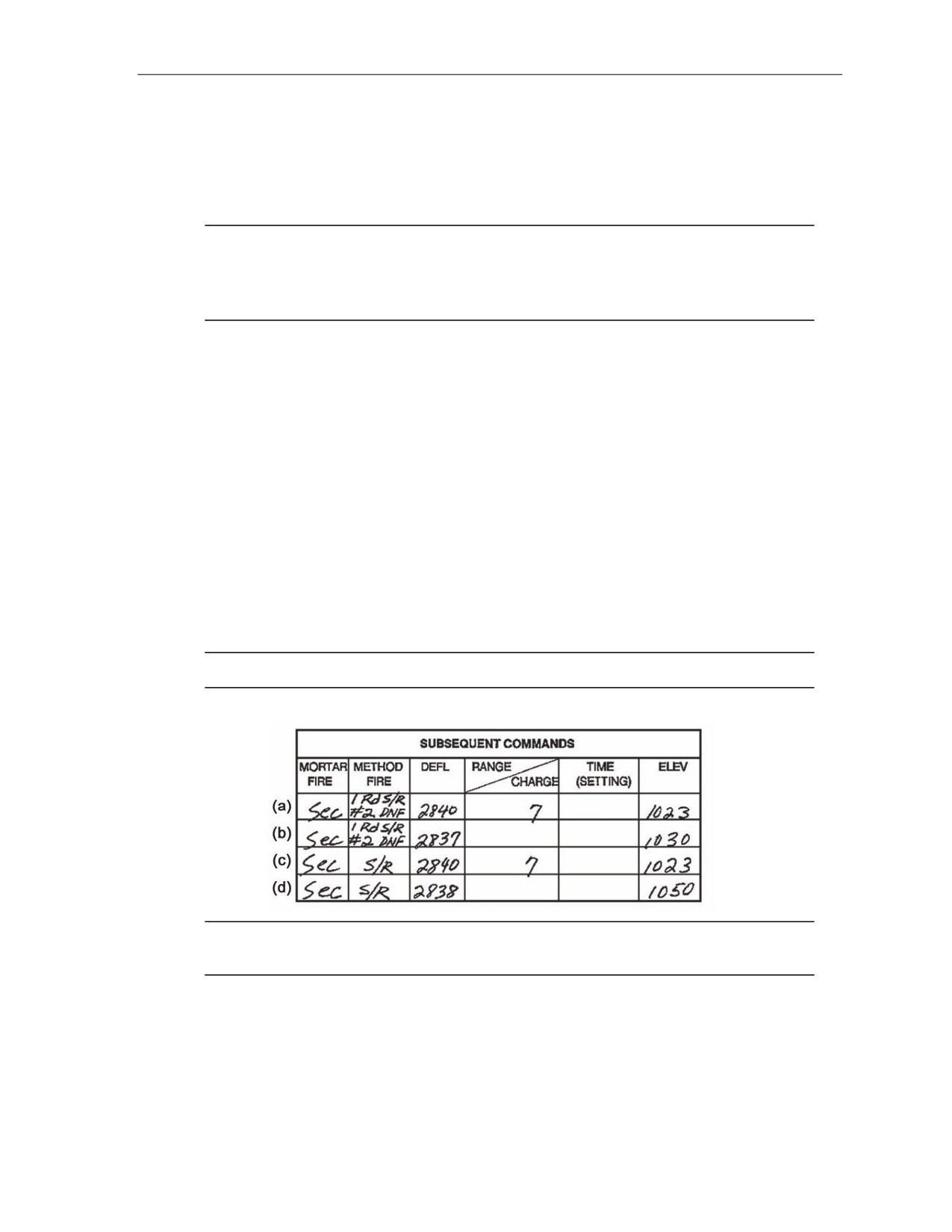
12. What is the correct subsequent command?
NOTE: The FO calls back: NUMBER 1 GUN RIGHT 60; NUMBER 3 GUN LEFT 20;
NUMBER 4 ADJUSTED.
17 July 2008
FM 3-22.91
E-17
Appendix E
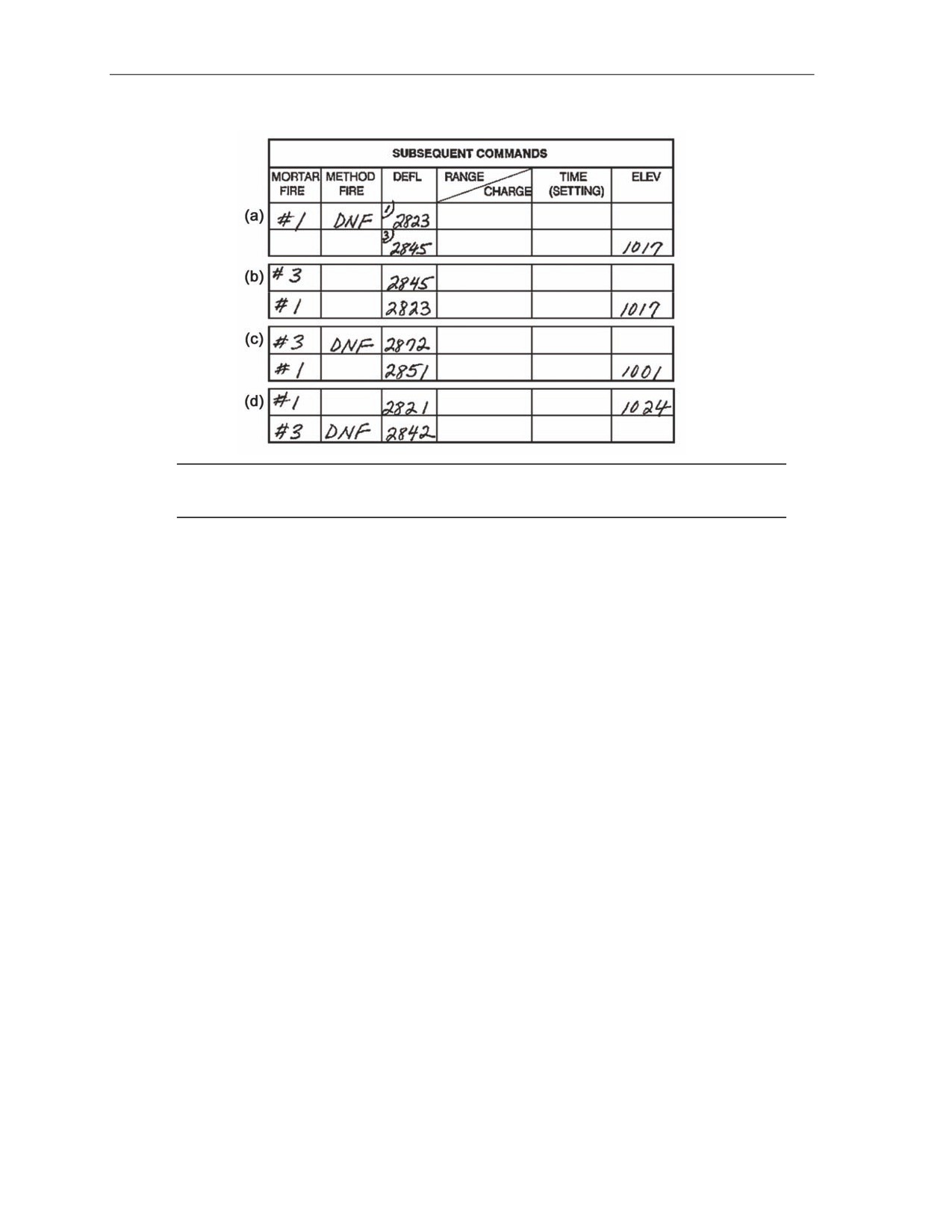
13. What are the correct subsequent commands?
NOTE: The FO spots the last round and sends: EOM, SHEAF ADJUSTED. The computer
records as: EOMRAT AA0200, KNPT 00.
E-18
FM 3-22.91
17 July 2008
Fire Direction Center Certification
SITUATION E
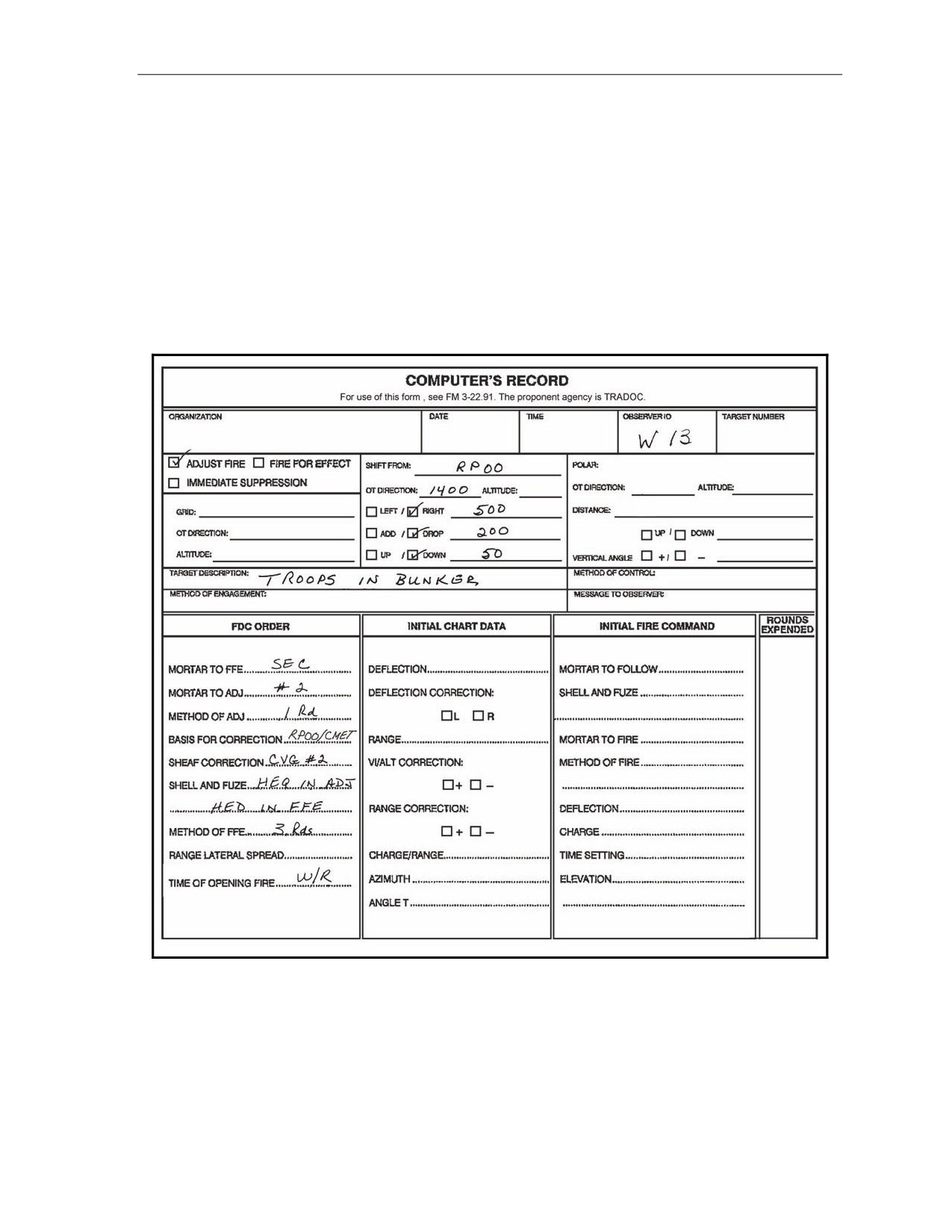
While the section is referring and realigning their aiming posts, the section leader hands you a CFF.
TASK:
Compute data for a shift from a known point mission.
CONDITIONS:
Continue from Situation D using the CFF in Figure E-6.
STANDARDS:
Compute data for the mission to within 1 mil for deflection and elevation.
TASK:
Record all information on firing records.
CONDITIONS:
Given a DA Form 2399-R and DA Form 2188-R, CFF, FO’s corrections, information to
complete the FDC order, ammunition count, mortar platoon/section SOP, and MBC.
STANDARDS: Record and compute the mission. Correctly complete all required blocks and spaces on
the DA Form 2399-R. Record the information and data needed for the type of mortar and
ammunition being fired at the end. Complete the DA Form 2188-R.
Figure E-6. Situation E (excerpt from an example of
completed DA Form 2399-R [Computer's Record]).
17 July 2008
FM 3-22.91
E-19
Appendix E
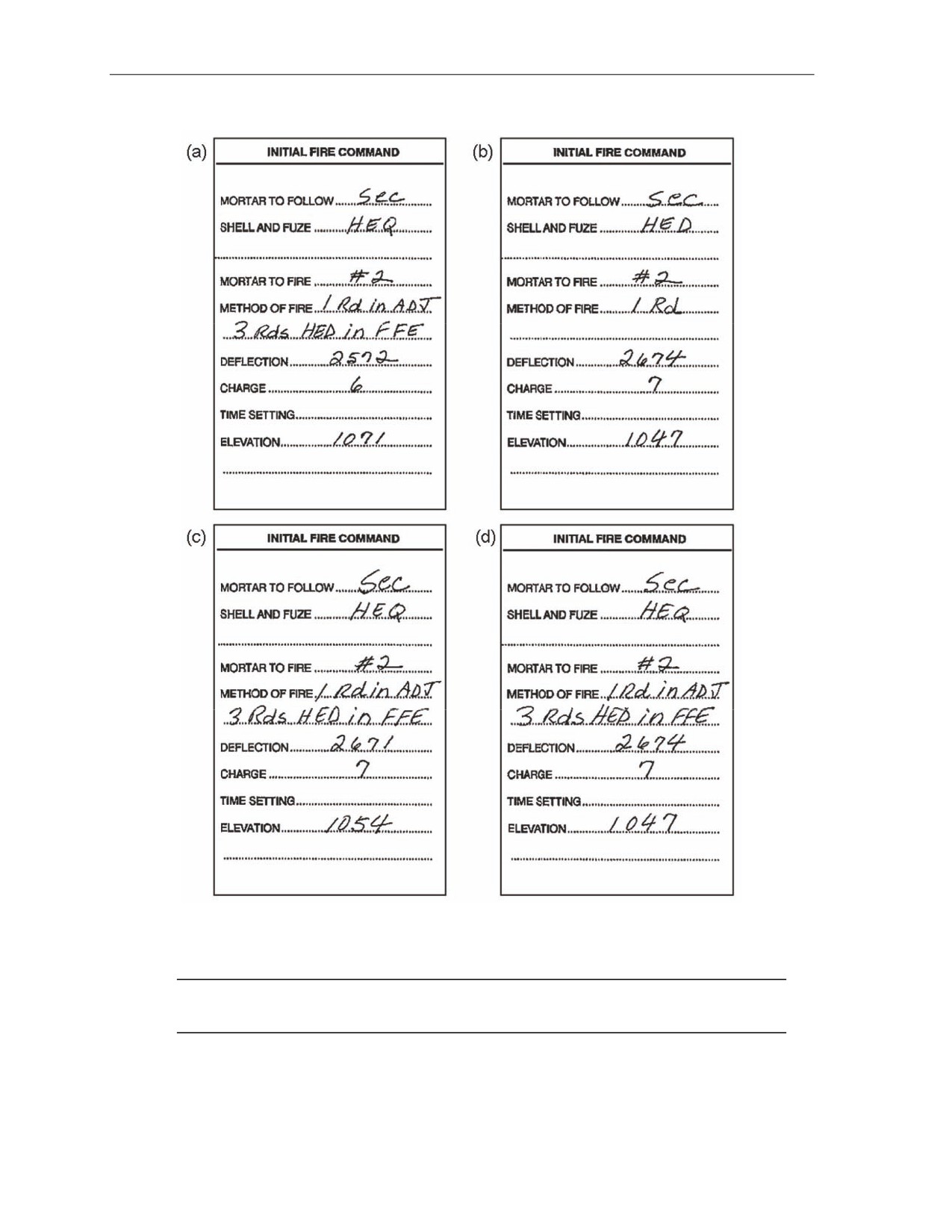
14. What is the correct initial fire command?
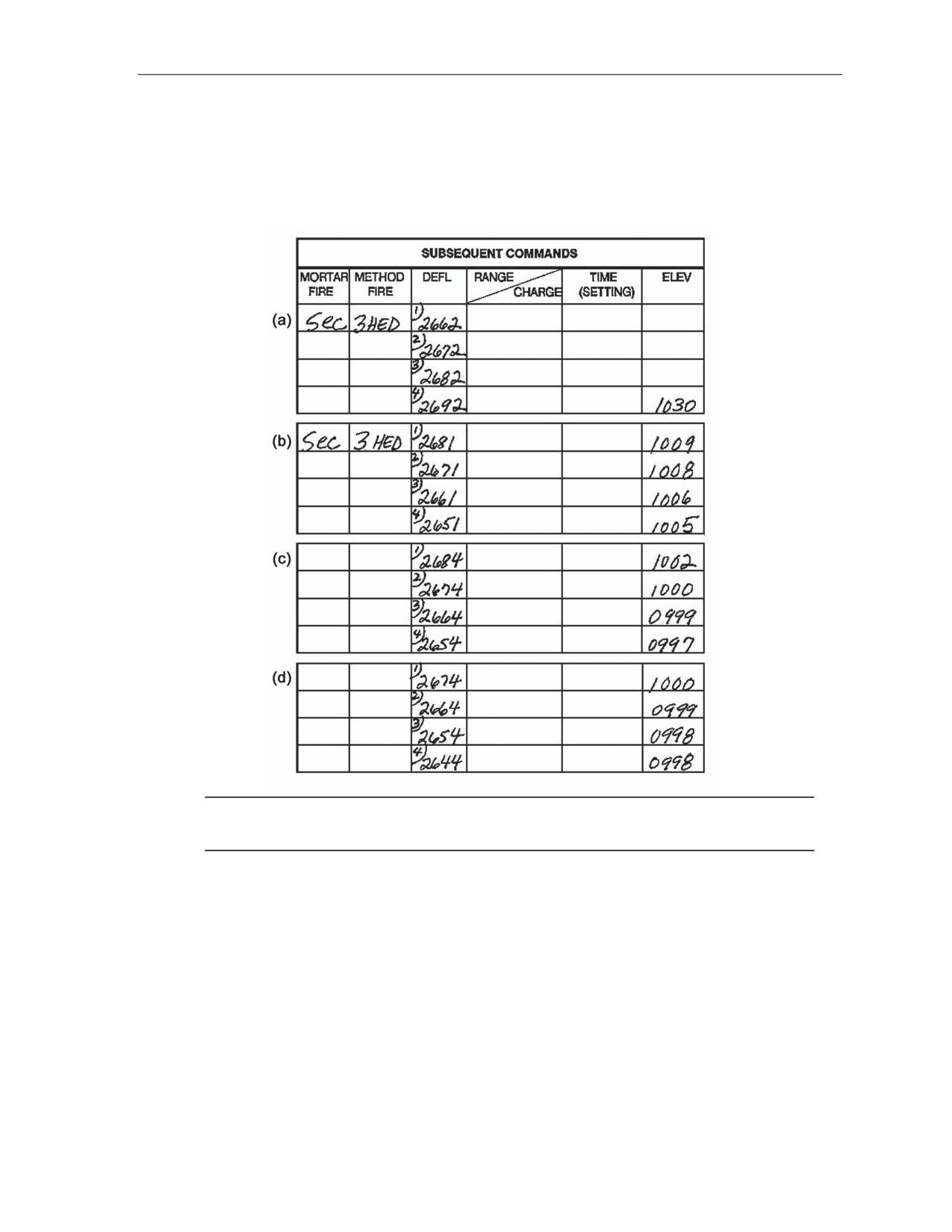
TASK:
Compute data for subsequent FO corrections using the MBC.
CONDITIONS:
Given an MBC with a mission already in progress and corrections from the FO to apply.
STANDARDS:
Compute data for the corrections to within 1 mil for deflection and elevation.
NOTE: The FO spots the first round and sends: ADD 100. That round is fired, and the FO
sends: RIGHT 50, ADD 50, FFE.
E-20
FM 3-22.91
17 July 2008
Fire Direction Center Certification
TASK:
Compute data for a converged sheaf.
CONDITIONS:
Given an initialized MBC using a grid coordinate as the method of target location, DA
Form 2399-R, and DA Form 2188-R.
STANDARDS: Compute the firing data for the initial and subsequent fire commands to within 1 mil for
deflection and elevation.
15. What is the correct subsequent fire command for the FFE?
NOTE: The FO sends: EOM. BUNKER DESTROYED, EST 50 PERCENT CAS EOMRAT
AA0201, KNPT 01.
SITUATION F
The FO calls in a new mission.
TASK:
Compute data for a grid mission using the CFF and FDC order in Figure E-7.
CONDITIONS:
Given an initialized MBC, CFF using grid coordinates as the method of target location,
DA Form 2399-R, and DA Form 2188-R.
STANDARDS: Compute data for the mission’s initial fire command to within 1 mil for deflection and
elevation.
17 July 2008
FM 3-22.91
E-21