FM 3-22.91 MORTAR FIRE DIRECTION PROCEDURES (July 2008) - page 6
This page intentionally left blank.
Chapter 12
Preparation of Fire Control Equipment
Three types of firing charts can be constructed on the M16/M19 plotting board: the
observed firing chart, the modified-observed firing chart, and the surveyed firing
chart. This chapter discusses methods of constructing these charts.
OBSERVED FIRING CHARTS
12-1. The mobile nature of modern combat often requires mortars to provide accurate and responsive
indirect fire support before survey information is available. The observed firing chart provides this ability.
PIVOT-POINT METHOD WITHOUT USE OF RANGE ARMS
12-2. The observed firing chart is the simplest and fastest way to plot. The mortars are plotted at the pivot
point. This allows the computer to use the vertical center line for aligning the mortar position and plot. Range
can be determined by simply reading the range of the plot on the range scale of the vertical center line.
Preparation of the Plotting Board
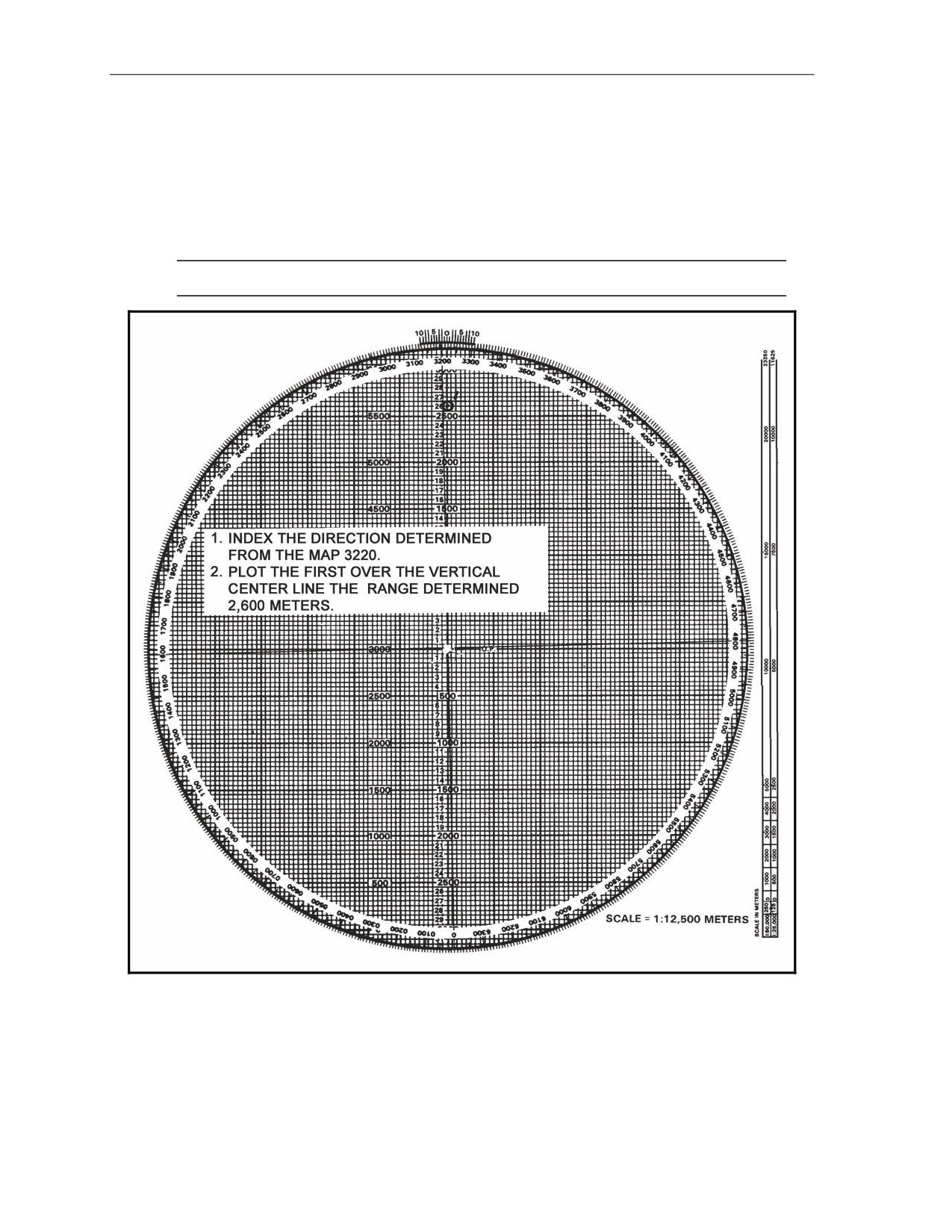
12-3. Two items are needed to set up the plotting board for operation: a direction (azimuth) and a range
from the mortar position to the target. The azimuth and range from the mortar position to the target are
usually obtained from a map by plotting each position and then determining the grid azimuth and range.
That information is then transferred to the plotting board
(Figure 12-1). For example, the computer
determines the initial direction (azimuth) between the mortar position and target is 3220, and the range is
2,600 meters.
Determination of Mounting Azimuth
12-4. To determine the mounting azimuth (MAZ) from the DOF, the computer rounds off the DOF to the
nearest 50 mils. (Round-off rule for obtaining the mounting azimuth: 0 to 24, round to 00; 25 to 74, round
to 50; 75 to 99, round to 100.) The aiming circle operator uses the mounting azimuth to lay the section, and
the computer uses it to prepare the M16/M19 plotting board. This gives the computer a starting point for
superimposing the referred deflection scale at a longer graduation.
EXAMPLE
DOF 3200 = MAZ 3200
DOF 1625 = MAZ 1650
DOF 3150 = MAZ 3150
NOTE: DOF 3150 is already at the nearest 50 mils; there is no need to round off.
17 July 2008
FM 3-22.91
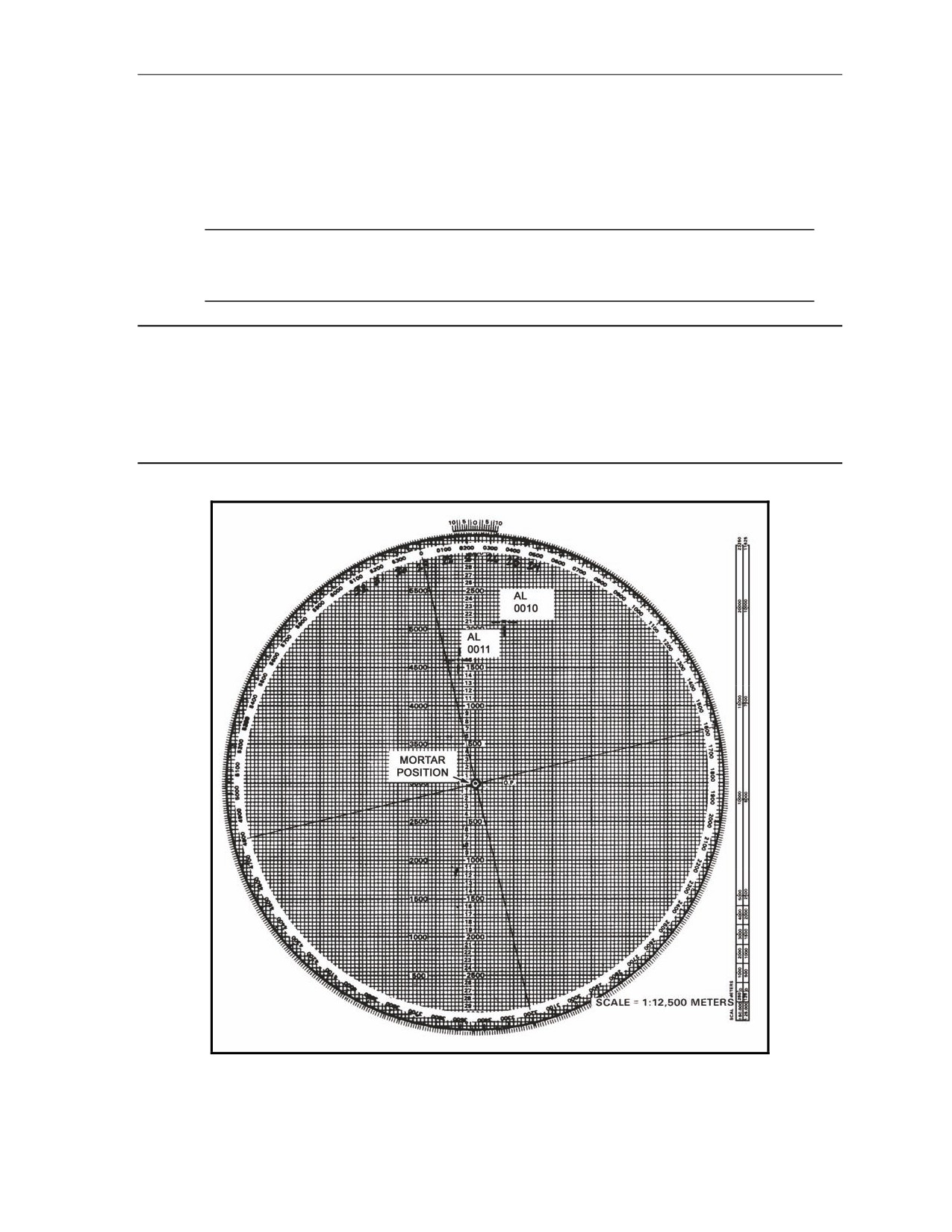
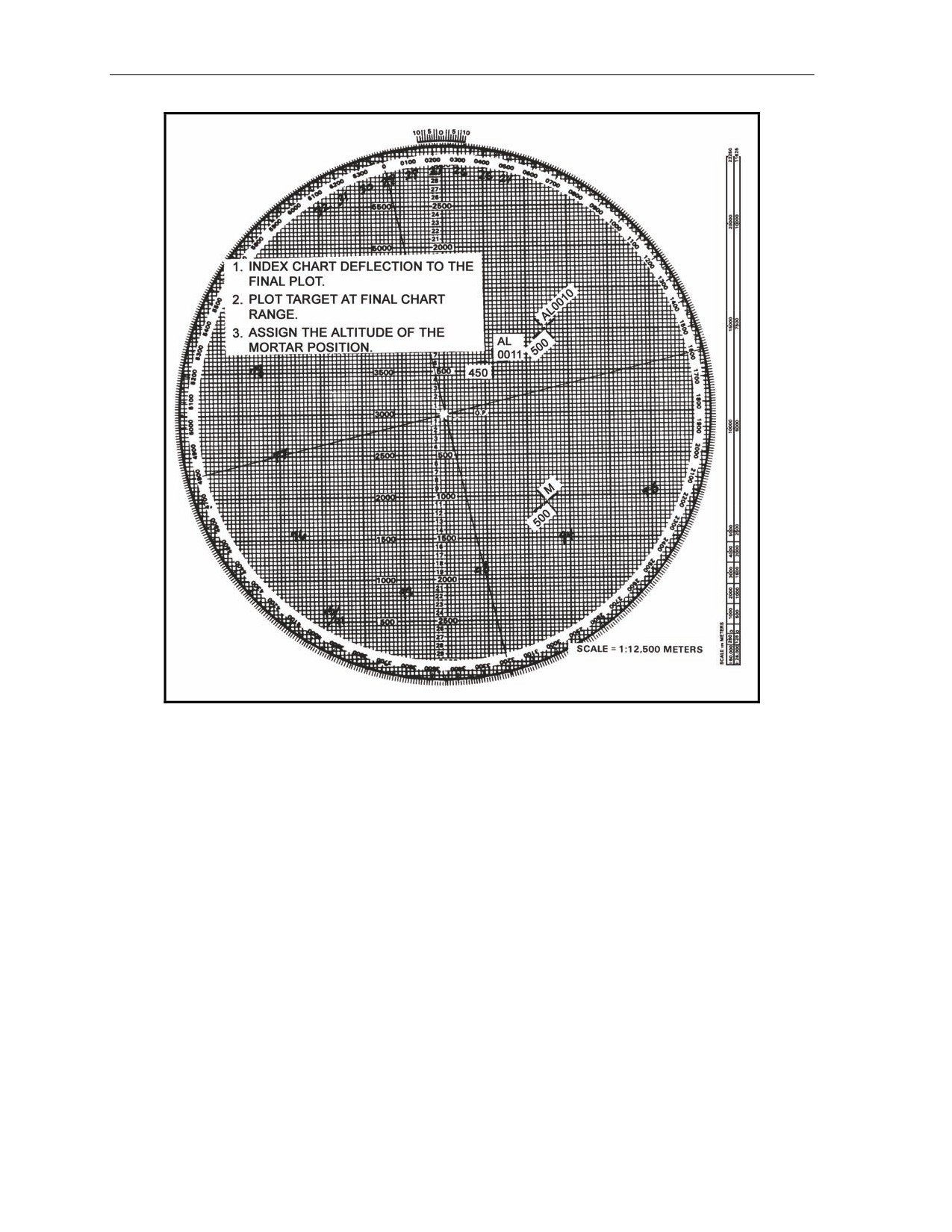
12-1
Chapter 12
Referred Deflection
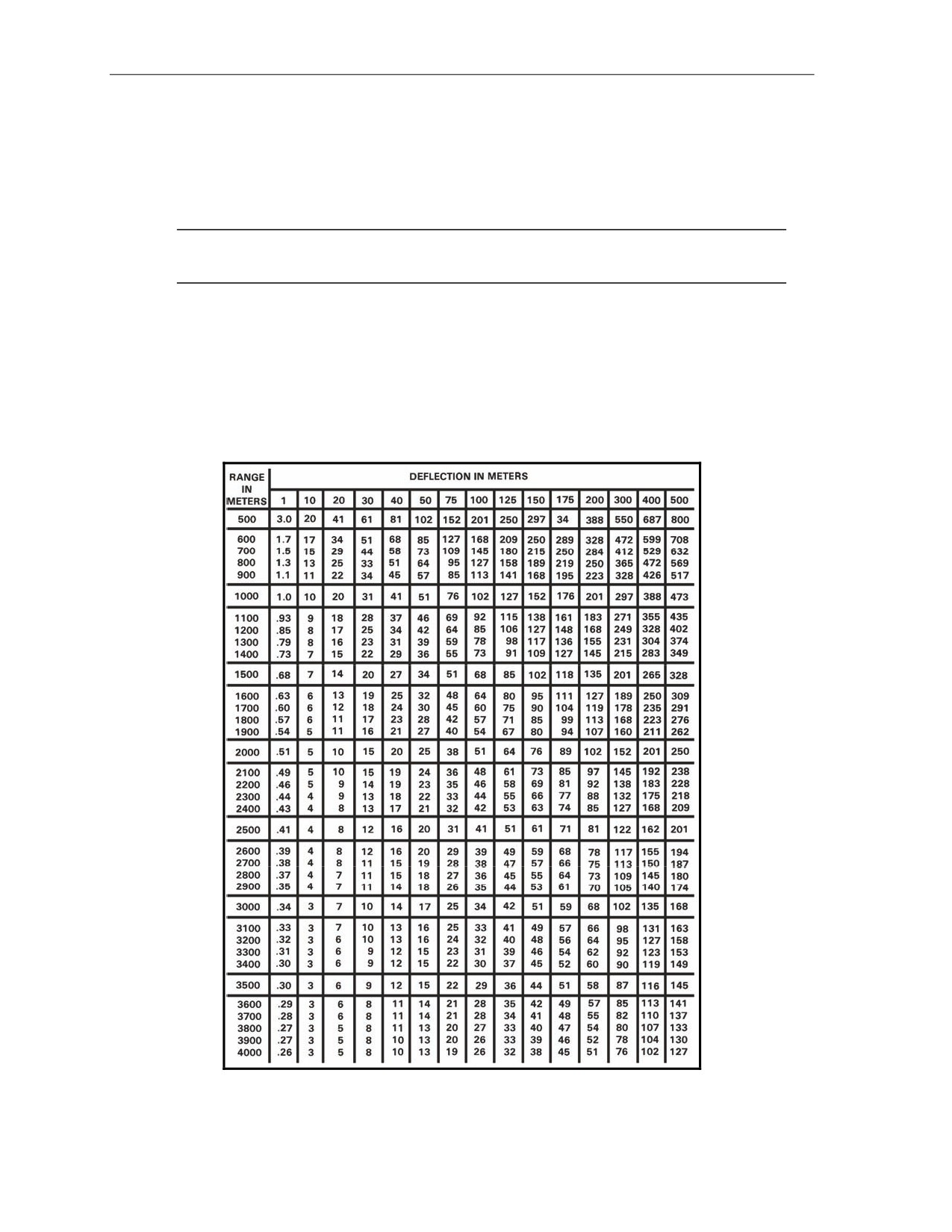
12-5. The aiming circle operator gives the referred deflection to the FDC after the section is laid. The
referred deflection can be any 100-mil deflection from 0 to 6300, as long as all of the mortars can place out
their aiming posts on the same deflection. Normally, the referred deflection used is 2800 to the front or
0700 to the rear. If one or more mortars has a sight block at the given deflection, the gunner may slip the
scale to a point where his poles can be set out at the proper interval. For more information about slipping
the scales, see FM 3-22.90.
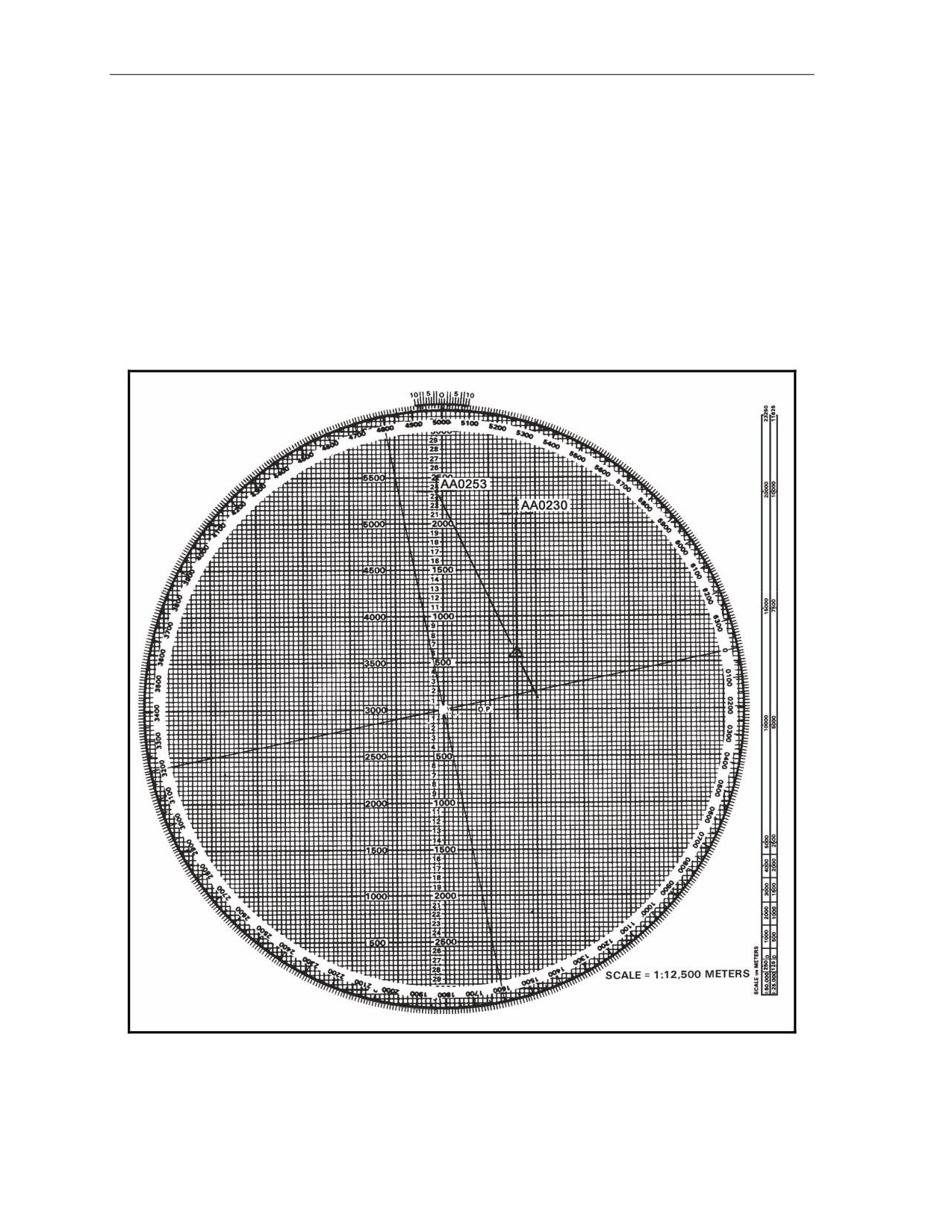
NOTE: Use 2800 and 0700 to avoid any sight blocks caused by the cannon.
Figure 12-1. Preparation of the plotting board.
12-2
FM 3-22.91
17 July 2008
Preparation of Fire Control Equipment
Superimposition of Referred Deflection
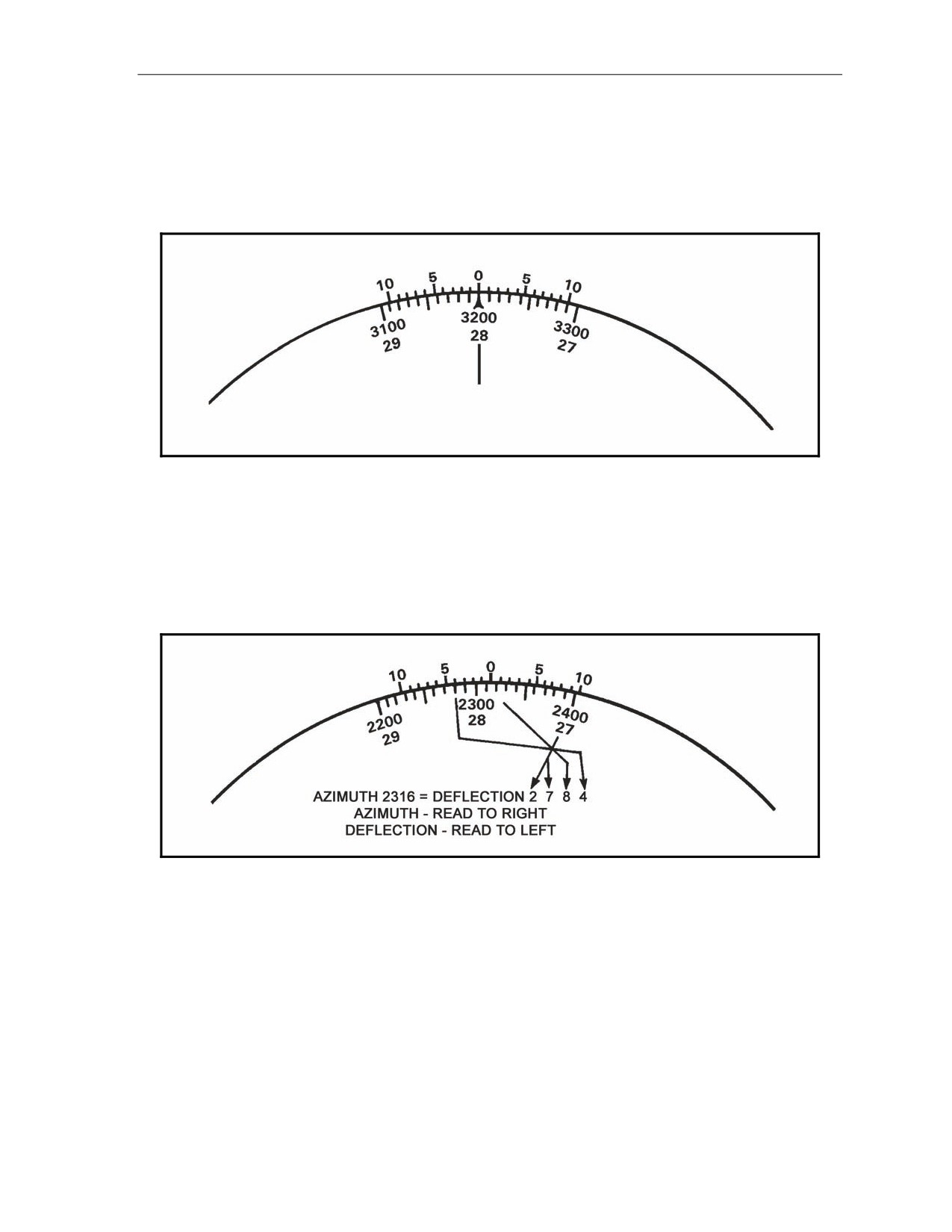
12-6. The referred deflection is superimposed (written) on the azimuth disk under the mounting azimuth
using the LARS rule. The disk is normally numbered 400 mils left and right of the referred deflection,
which is usually enough to cover the area of operation (Figure 12-2). However, if needed, the deflection
scale can be superimposed all the way around the azimuth disk.
Figure 12-2. Superimposition of referred deflection scale under the mounting azimuth.
Determination of Firing Data
12-7. After plotting the first round on the DOF at the determined range and superimposing the deflection
scale, the computer rotates the azimuth disk until the first round is over the vertical centerline. He
determines the deflection to fire the first round by using the deflection scale and the left portion of the
vernier scale (Figure 12-3).
Figure 12-3. Determination of the deflection.
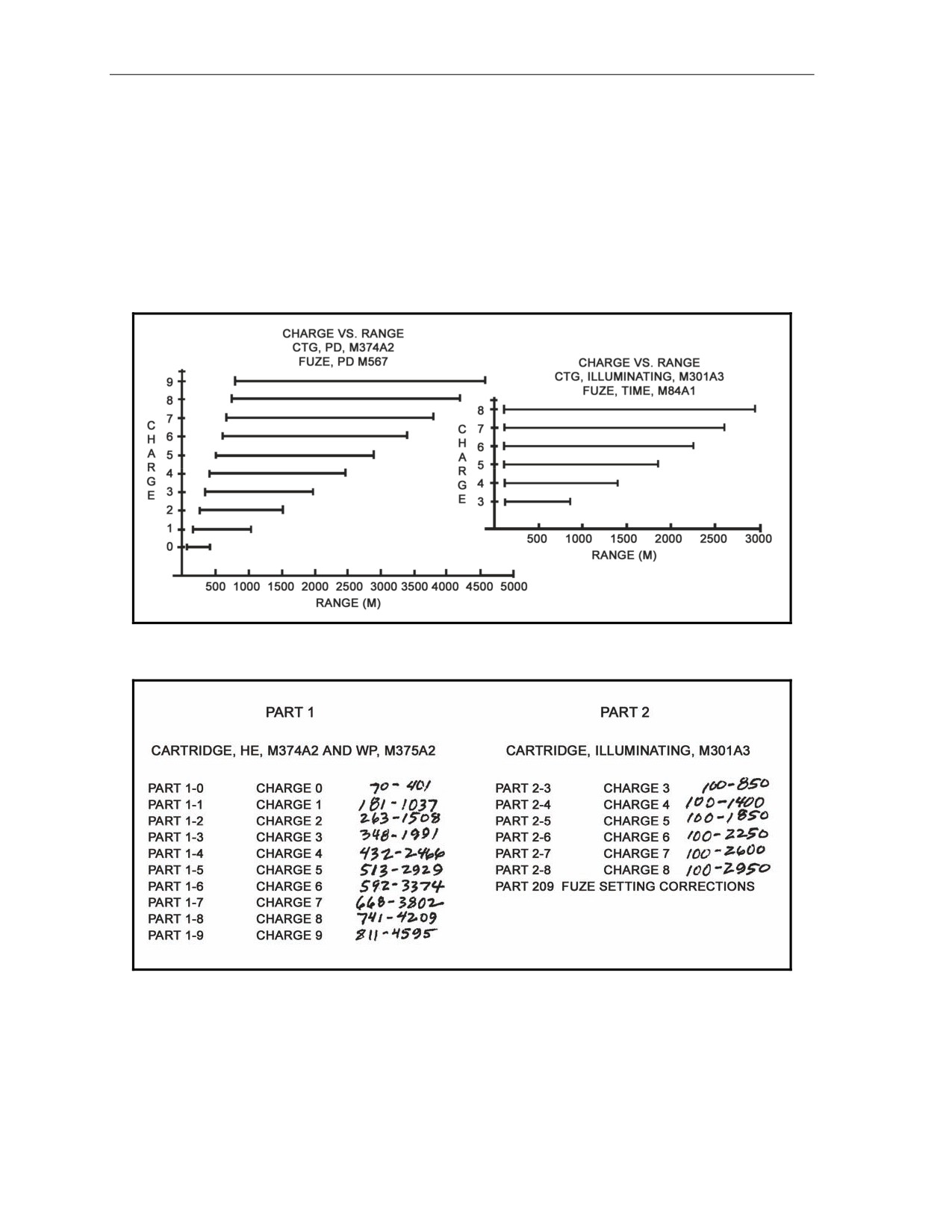
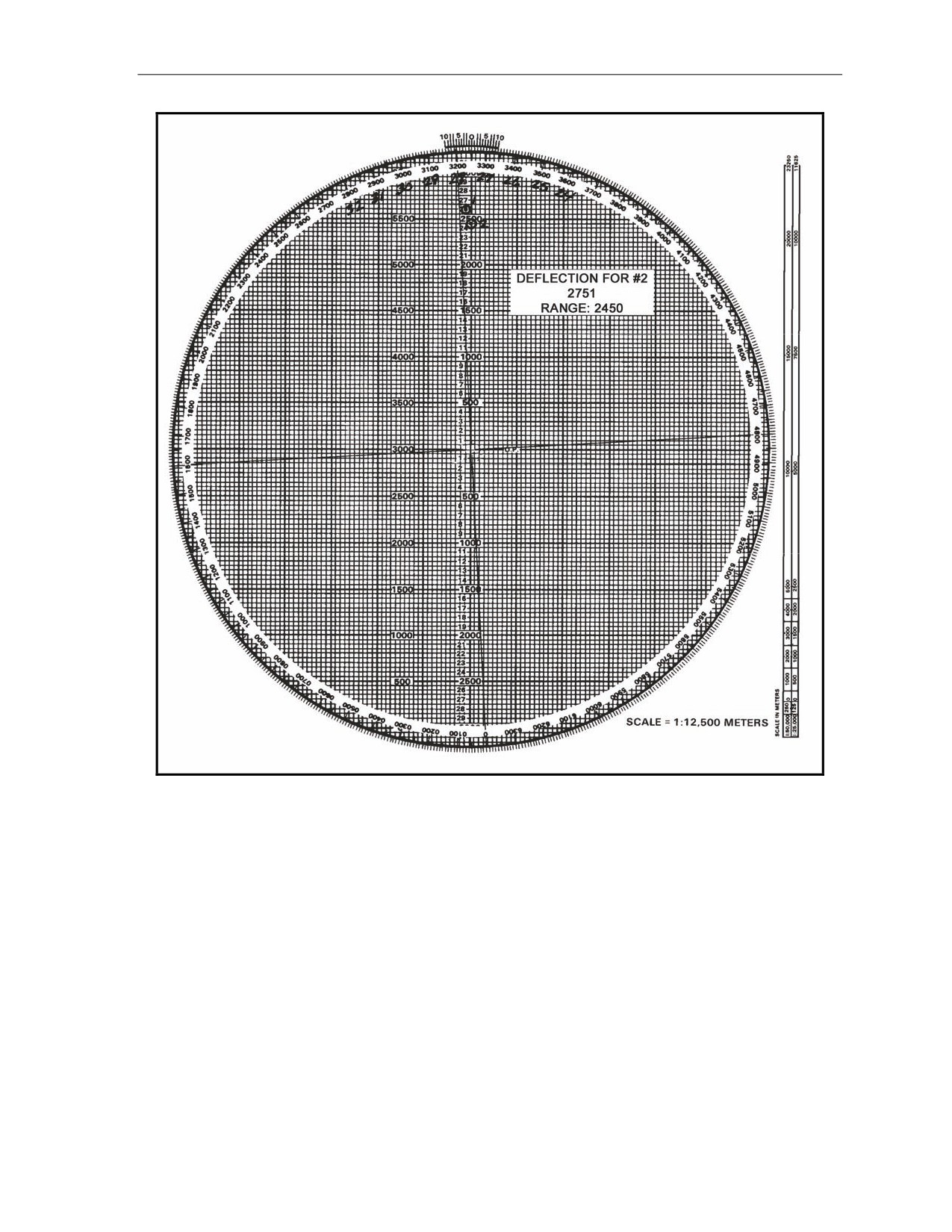
12-8. Read the first two digits from the deflection scale. Since deflections increase to the left, read the first
number (100-mil indicator) to the right of the index mark. In this example, it is 27.
12-9. Read the third digit from the 10-mil graduations between deflection scale numbers 27 and 28 (100-
mil indicators). Count the 10-mil graduations on the azimuth disk (from 27 to the index mark) to find that
the index mark is between the eighth and ninth 10-mil graduations, making the third digit 8.
12-10. Read the fourth digit at the vernier scale. For deflections, use the left half of the vernier scale.
Count the 1-mil graduations, starting at the 0, to the left until one of the 1-mil graduations of the vernier
scale and one of the 10-mil graduations on the azimuth disk are aligned. In this example, the fourth 1-mil
graduation is aligned, making the fourth digit 4.
17 July 2008
FM 3-22.91
12-3
Chapter 12
12-11. Determine the range by rotating the plot over the vertical centerline and reading the range to the
nearest 25 meters. Enter the firing table (such as FT 81-AI-3) and determine the charge as follows: Locate
the Charge vs. Range table (Figure 12-4) in the appropriate firing table (normally the last page of the
introduction or the last page preceding Part I). This page is the charge vs. range chart. It can be used to
determine the lowest charge to engage the target. To use the chart, find the range to the target using the
range bar at the bottom of the chart. The range bar is numbered every 500 meters from 0 to 5,000 meters.
Since the range to the target was determined to be 2,600 meters, estimate the 2,600 meters on the range bar.
After determining the 2,600-meter point on the range bar, place a straightedge at the point so that it crosses
the charge lines (Figure 12-5). The first charge line the straightedge crosses is the lowest charge possible to
engage the target.
Figure 12-4. Charge versus range chart.
Figure 12-5. Determination of charge.
12-4
FM 3-22.91
17 July 2008
Preparation of Fire Control Equipment
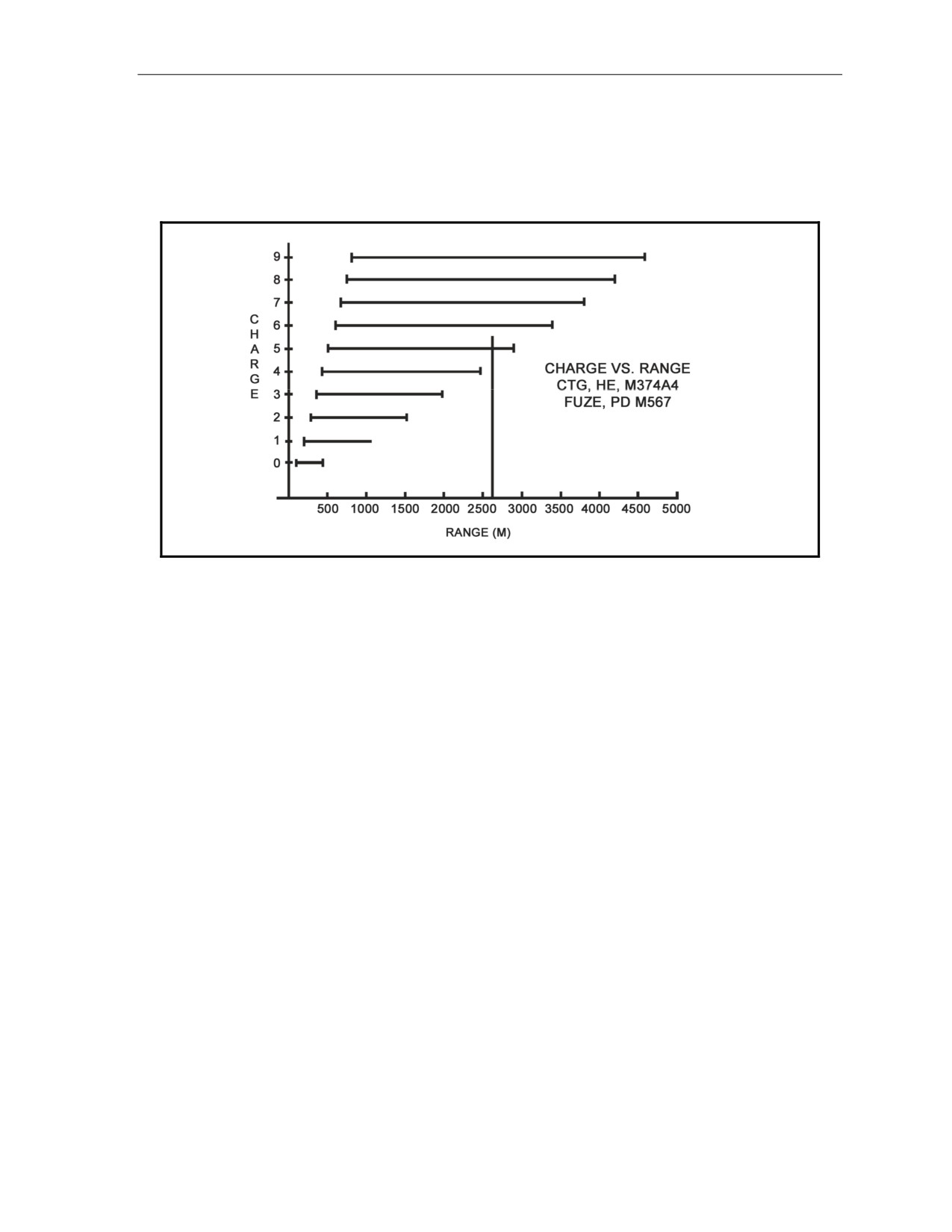
12-12. Another method that can be used is to turn to page II in the firing table. There is a listing of
charges for M374A2 (HE) and M375A2 (WP) from charge 0 through charge 9. Below that listing is the
charge listing for M301A3 illumination (ILLUM) from charge 0 through charge 8. Write in after each
charge the minimum and the maximum ranges that each charge zone covers (Figure 12-6). By looking at
the maximum range, the correct charge to use can easily be determined.
Figure 12-6. Charge zone and range.
17 July 2008
FM 3-22.91
12-5
Chapter 12
Plotting of Observer Corrections
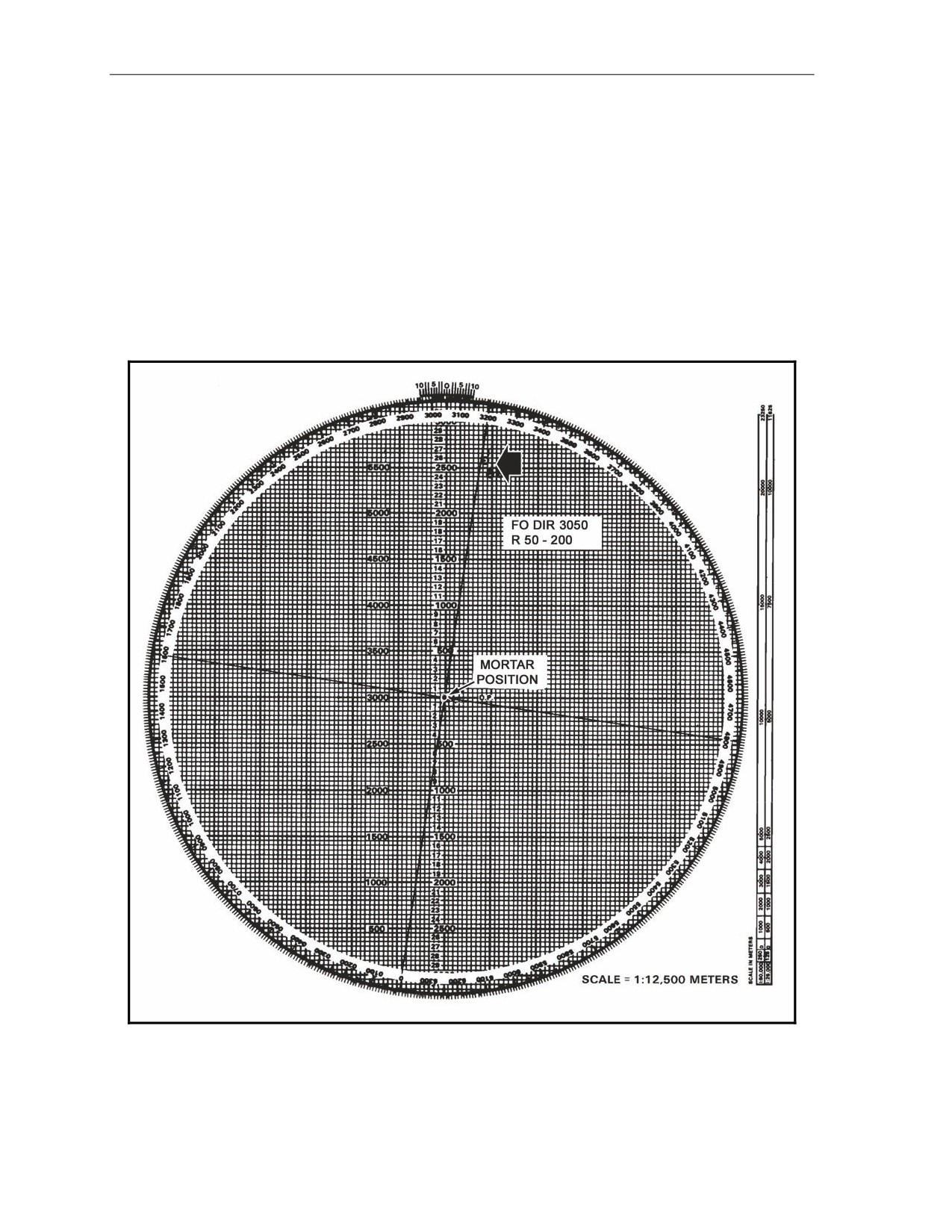
12-13. To plot the FO’s corrections, the computer first indexes the FO’s direction to the target. That OT
direction is given in the CFF or with the first correction. Going from the last round, he applies the FO’s
corrections.
12-14. For example, assume that the OT direction is 3050, and the FO sends these corrections: "Right 50,
drop 200." Ensuring that OT direction is indexed, make these corrections from the first plot (Figure 12-7).
12-15. To do this, move to the right one small square (50 meters), then straight down the board four small
squares (200 meters). Then, make a small plot, circle it, and label it “No. 2.” To determine the firing data,
rotate the disk until the No. 2 plot is over the vertical centerline. Then, read the deflection and range
(Figure 12-8). Using the firing table, determine the charge and elevation to fire the round, and compute the
subsequent fire command.
Figure 12-7. Plotting of observer’s correction.
12-6
FM 3-22.91
17 July 2008
Preparation of Fire Control Equipment
Figure 12-8. Determination of deflection and range.
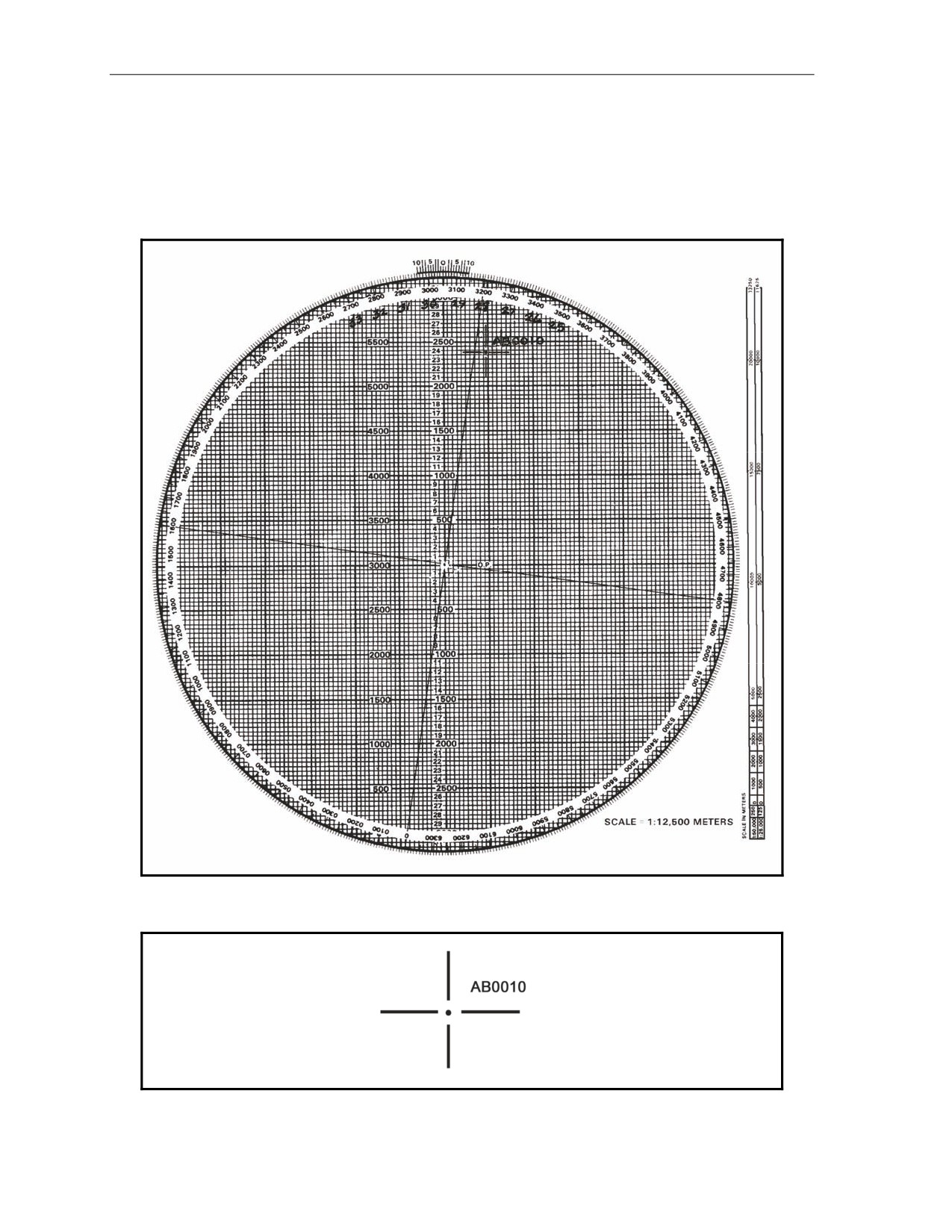
12-16. Once the EOM has been given, update the M16/M19 plotting board (Figure 12-9). To do this,
erase all the plots except the final plot. Then enclose that plot with a hollow cross and number it with the
target number (Figure 12-10).
17 July 2008
FM 3-22.91
12-7
Chapter 12
Engagement of Other Targets
12-17. To fire other targets on this chart, the computer must perform the following actions:
z
Grid. Go back to the map, plot the target location, and determine the range and direction.
z
Shift. Index the FO’s direction to the target and apply the correction from the known point,
which must be plotted on the chart.
Figure 12-9. Board updated.
Figure 12-10. Hollow cross with target number.
12-8
FM 3-22.91
17 July 2008
Preparation of Fire Control Equipment
BELOW PIVOT-POINT METHOD
12-18. The observed firing chart (with mortars plotted below pivot point) is used when the ranges to the
targets being engaged are over 2,900 meters. When the initial range to the target is 2,900 meters or more,
mortars are always plotted below the pivot point.
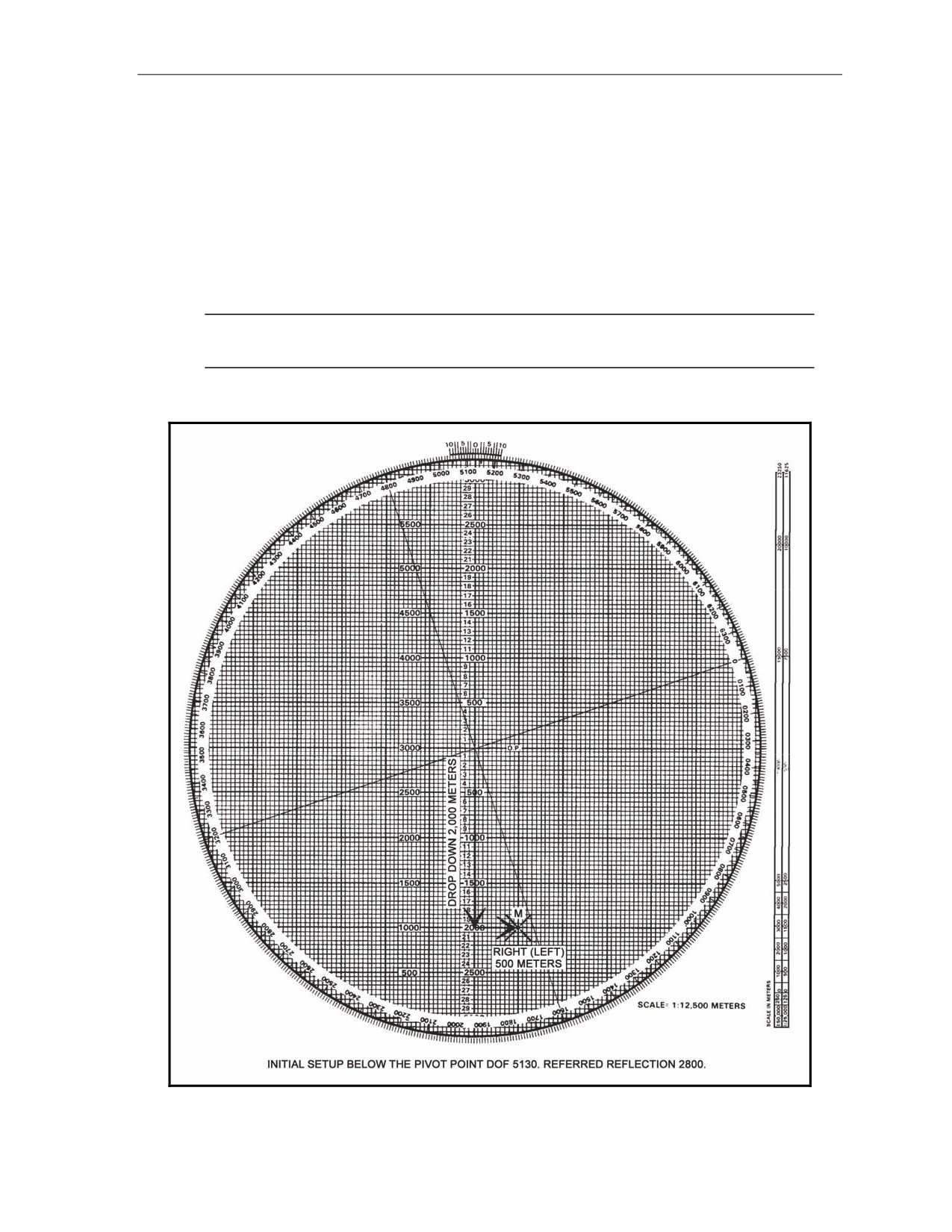
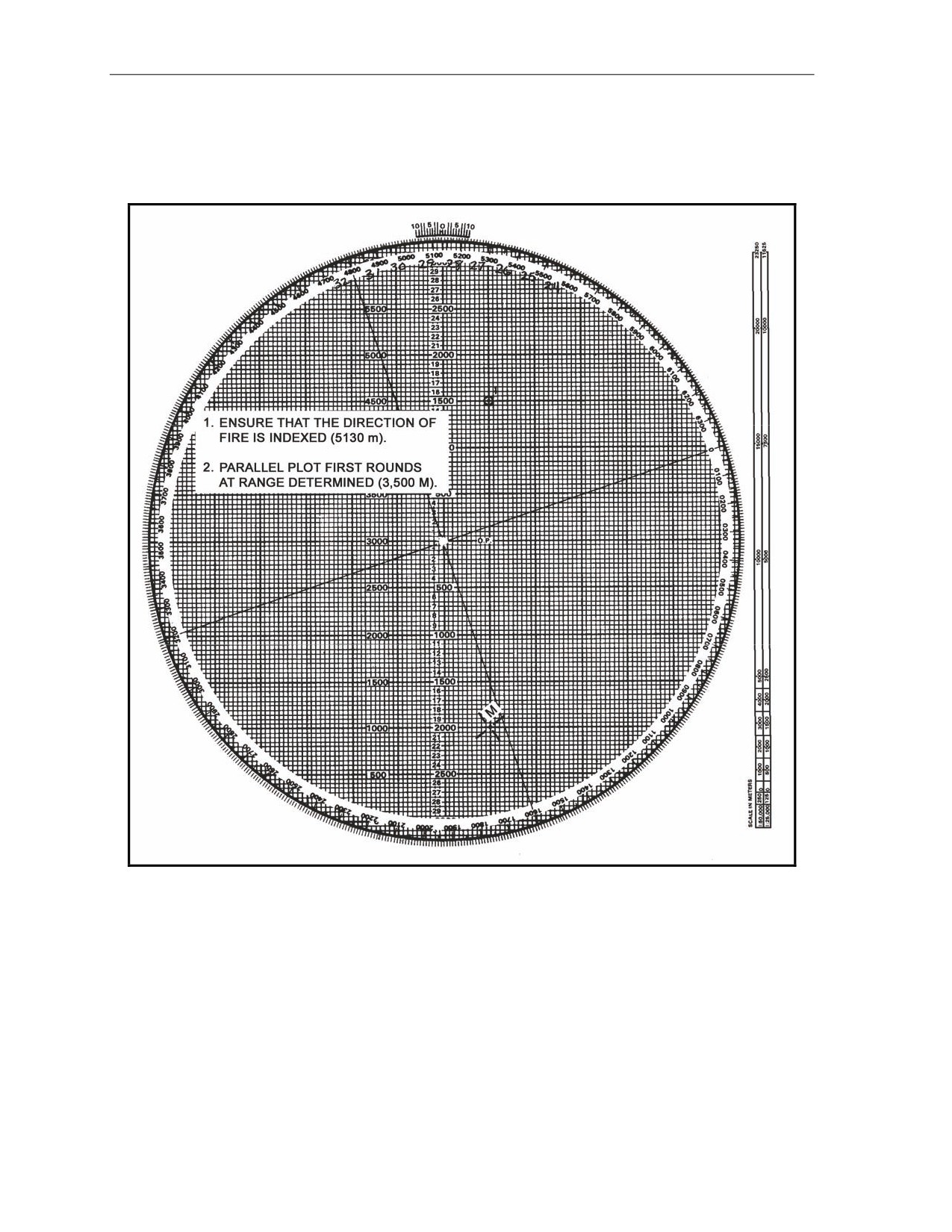
12-19. Two items are needed to set up the board for operation: a gun-target azimuth and a range from the
mortar position to the target. To construct the chart—
(1) Index the gun-target azimuth.
(2) Drop below the pivot point 1,000 meters for 60-mm mortars, 2,000 meters for 81-mm mortars,
and 3,000 meters for 120-mm mortars.
NOTE: When firing 800-series ammunition with the 81-mm mortar, drop 3,000 meters below
the pivot point to accommodate the extended range.
(3)
Plot the mortar position 500 meters left or right of the vertical centerline (Figure 12-11).
Figure 12-11. Plotting of mortar position.
17 July 2008
FM 3-22.91
12-9
Chapter 12
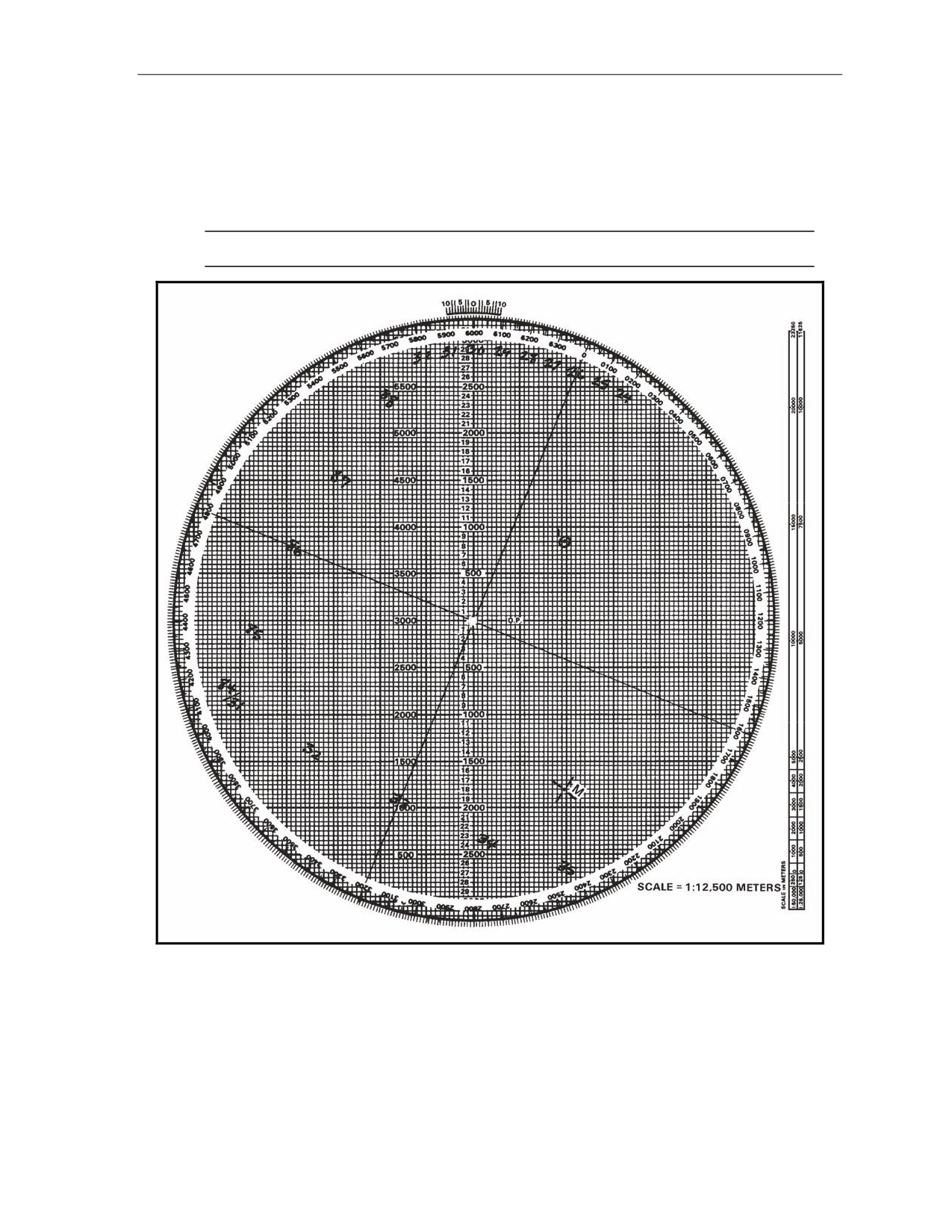
12-20. Once these actions have been taken, ensure that the azimuth disk is still indexed on the gun target
azimuth. Then, from the mortar position, plot the first round at the range determined using the parallel-line
method of plotting (Figure 12-12). Determine the mounting azimuth and referred deflection the same way
as with the pivot-point method.
Figure 12-12. Plotting of first round.
12-10
FM 3-22.91
17 July 2008
Preparation of Fire Control Equipment
12-21. To determine the firing data to send to the mortar, align the mortar position below the target being
engaged using the parallel-line method of plotting. Then read the deflection using the azimuth disk and
vernier scale and measure the range between the mortars and target. To align the mortar position and target,
since the mortar position is being plotted away from the pivot point, use the parallel-line method of
plotting. With the mortar position and target plotted, rotate the disk until the mortar position and the target
are an equal distance from, or on, the same vertical line (Figure 12-13).
NOTE: All directions are read from bottom to top.
Figure 12-13. Parallel-line plotting.
17 July 2008
FM 3-22.91
12-11
Chapter 12
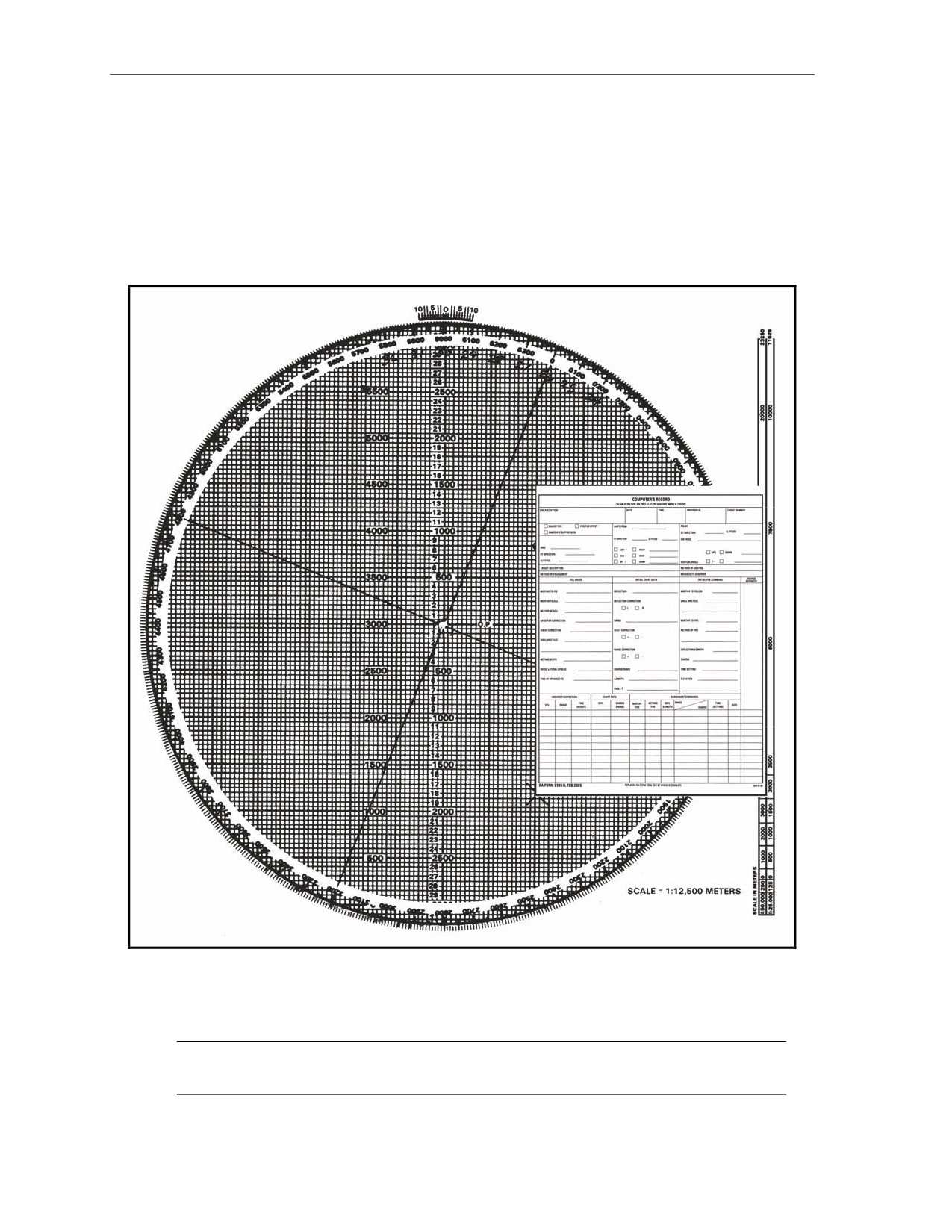
12-22. Range must now be determined using one of the following 3 techniques:
z
Count each of the 50-meter squares from the mortar position to the target.
z
Use the scale on the left edge of the range arm to measure the distance from the mortar position
to the target.
z
Place the edge of the DA Form 2399-R alongside the two plots on the plotting board (mortar
and target). Then make a tick mark on the edge of the DA Form 2399-R at each plot. Using the
alternate range scale to the left of the pivot point, lay the DA Form 2399-R along this scale with
the mortar tick mark at 0 and read the range (Figure 12-14).
Figure 12-14. Determination of range with edge of DA Form 2399-R (Computer’s Record).
12-23. To update the board after the EOM is given or to engage other targets, use the same method as
with the pivot-point method.
NOTE: When operating the M16 plotting board as an observed firing chart (pivot-point or
below-pivot-point methods), no correction factors are applied to the data.
12-12
FM 3-22.91
17 July 2008
Preparation of Fire Control Equipment
MORTARS PLOTTED AT PIVOT POINT
12-24. With the pivot pin inserted in the pivot point of the plotting board, the computer can use the range
scale arm or the range arm to determine deflections and range to both the initial and subsequent rounds.
(1) Determine the range and direction to the center of the sector from a map or by visual
observation. Round off the azimuth to the initial round or DOF to the nearest 50 mils to
determine a mounting azimuth, and superimpose a deflection scale on the azimuth disk.
(2) Make the initial plot by indexing the DOF (or initial azimuth) to the initial round at the index
mark. This may be different from the mounting azimuth because of the round-off rule. Use the
scale on the vertical centerline to make the initial plot at the correct range.
(3) When the FO calls in a target direction (the OT azimuth), index the azimuth disk on the
M16/M19 plotting board at the OT azimuth. It remains indexed on that azimuth until the mission
is completed. Plot corrections from the FO IAW procedures. Once a correction has been plotted,
rotate the range arm until the right edge of the range arm is over the new plot. Determine the
range to the nearest 25 meters, and read the deflection to the nearest mil using the vernier scale.
(4) Plot additional corrections, and use the range scale arm to determine range and deflection. Once
the azimuth disk is indexed on the OT azimuth, the disk does not have to be rotated to determine
ranges or deflections.
MORTARS PLOTTED BELOW PIVOT POINT
12-25. With the pivot pin inserted in the pivot point, the computer can use the left edge of the range scale
arm to plot the initial round. The mounting azimuth and azimuth to the initial round are determined as for
mortars plotted at pivot point. The computer indexes the azimuth disk on the DOF and aligns the right edge
of the range scale arm on the vertical centerline. Next, he makes a small plot at the zero range on the left
edge of the range scale arm. Then, still using the left edge, he makes a small plot at the range for the initial
round. The mortar position plot must be marked with a hollow cross to further identify its position. Once
the initial round is fired, the range scale arm is removed, and the left edge is used as a range scale.
CARE AND CLEANING OF PLOTTING BOARDS
12-26.Plotting boards must be handled with care to prevent bending, scratching, or chipping. They must be kept
away from excessive heat or prolonged exposure to the sun, which may cause them to warp. When storing a
board, place it in its carrying case, base down, on a horizontal surface. Do not place the board on an edge or
have other equipment stored on it. Normally the plotting board is cleaned with a nongritty (art gum) eraser. If
the board is excessively dirty, a damp cloth should be used. The contact surfaces of the disk and base are
cleaned often. The disk is removed by pushing a blunt instrument through the pivot point hole from the back of
the base.
MODIFIED-OBSERVED FIRING CHART
12-27. The modified-observed firing chart can be constructed on the M16 plotting board. It is constructed
when the mortar position or target is known to survey accuracy. The three basic items needed to construct a
modified observed chart are a DOF (usually to the center of the platoon area of responsibility), one point
(mortar position, target, or reference point) that must be known to surveyed accuracy (eight-digit grid
coordinates), and a grid intersection to represent the pivot point.
NOTE: See survey firing chart in Chapter 14.
17 July 2008
FM 3-22.91
12-13
Chapter 12
DETERMINATION OF DIRECTION OF FIRE
12-28. The section sergeant usually determines DOF. In most cases, it is to the center of sector. The
mortar location can be surveyed by map inspection, terrain inspection, or pacing from a known point on an
azimuth, as long as the position of the base gun is known to a valid eight digits.
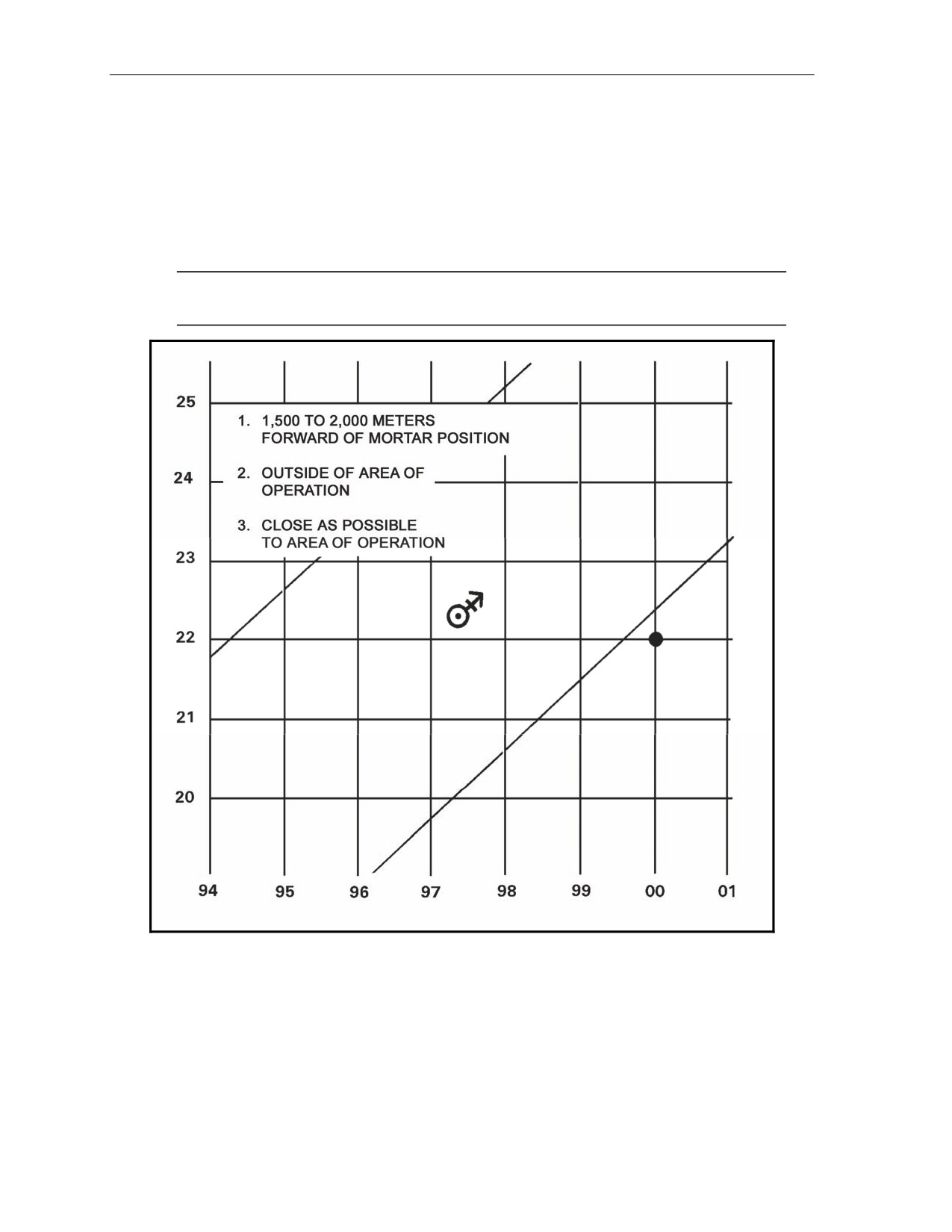
12-29. For the 60-mm and 81-mm mortars, the grid intersection representing the pivot point is between
1,500 and 2,000 meters forward of the mortar location. This allows the full range of the mortar to be used
(Figure 12-15).
NOTE: With the 120-mm mortar, the grid intersection should be 3,000 to 4,000 meters forward
of the mortar position.
Figure 12-15. Grid intersection to represent pivot point.
12-30. The grid intersection should be outside the area of responsibility. This ensures that the pivot point
does not interfere with plotting targets or corrections. The grid intersection is also as close as possible to
the area of responsibility. This ensures that as much of the area of responsibility as possible will be on the
plotting board.
12-14
FM 3-22.91
17 July 2008
Preparation of Fire Control Equipment
SUPERIMPOSITION OF GRID SYSTEM ON PLOTTING BOARD
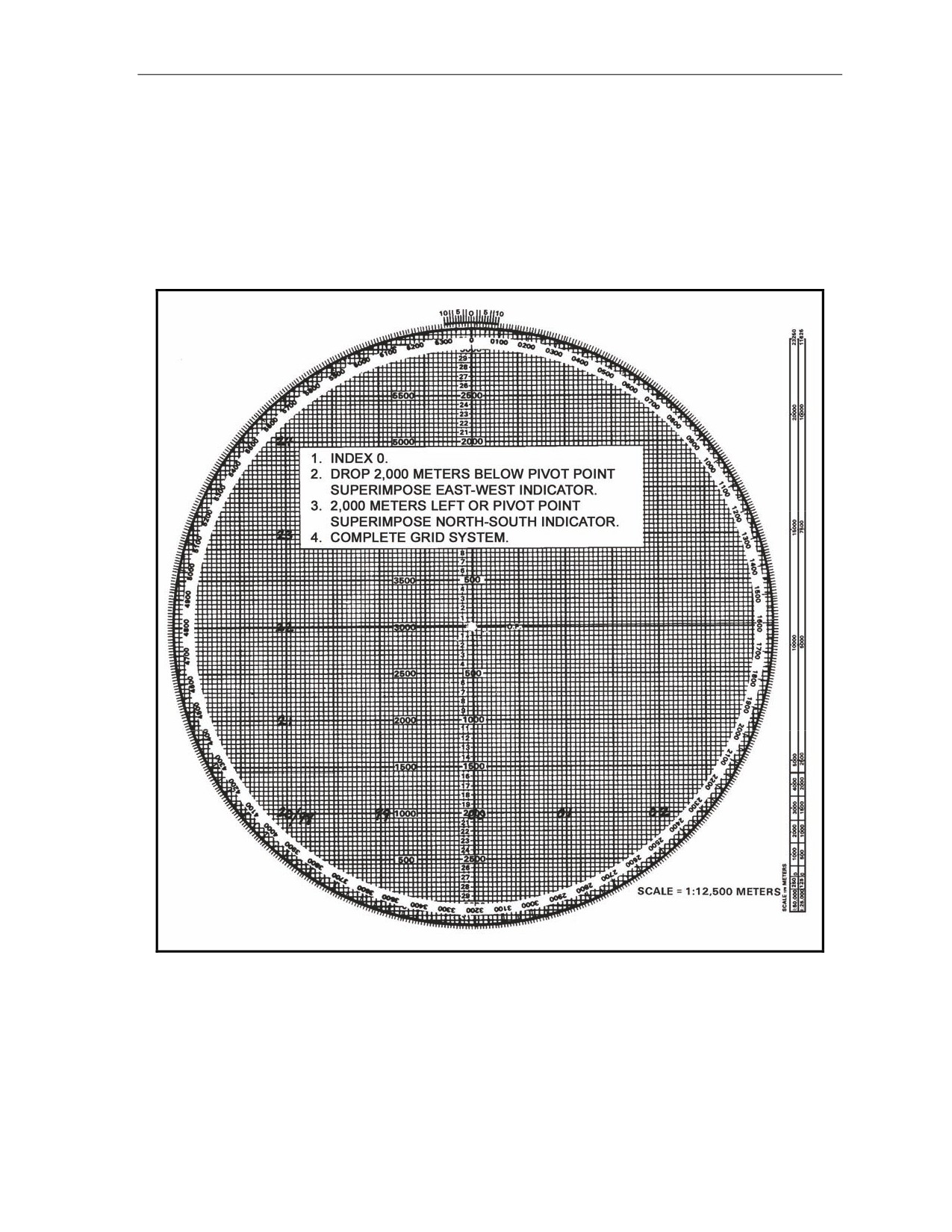
12-31. Once the grid intersection has been determined, the computer indexes “0” on the azimuth disk. He
then drops down 2,000 meters below the pivot point and writes in the east/west indicator on the vertical
centerline at the 2,000-meter mark. Next, he goes 2,000 meters to the left of the pivot point on the heavy
center horizontal line and writes the north/south indicator. To complete the grid system, the computer
writes in the other north/south, east/west grid numbers as though looking at a map. By numbering every
other heavy dark line (two large squares) on the plotting board, he retains a scale of 1:12,500 on the board
(Figure 12-16).
Figure 12-16. Superimposition of the grid.
17 July 2008
FM 3-22.91
12-15
Chapter 12
PLOTTING OF MORTAR POSITION
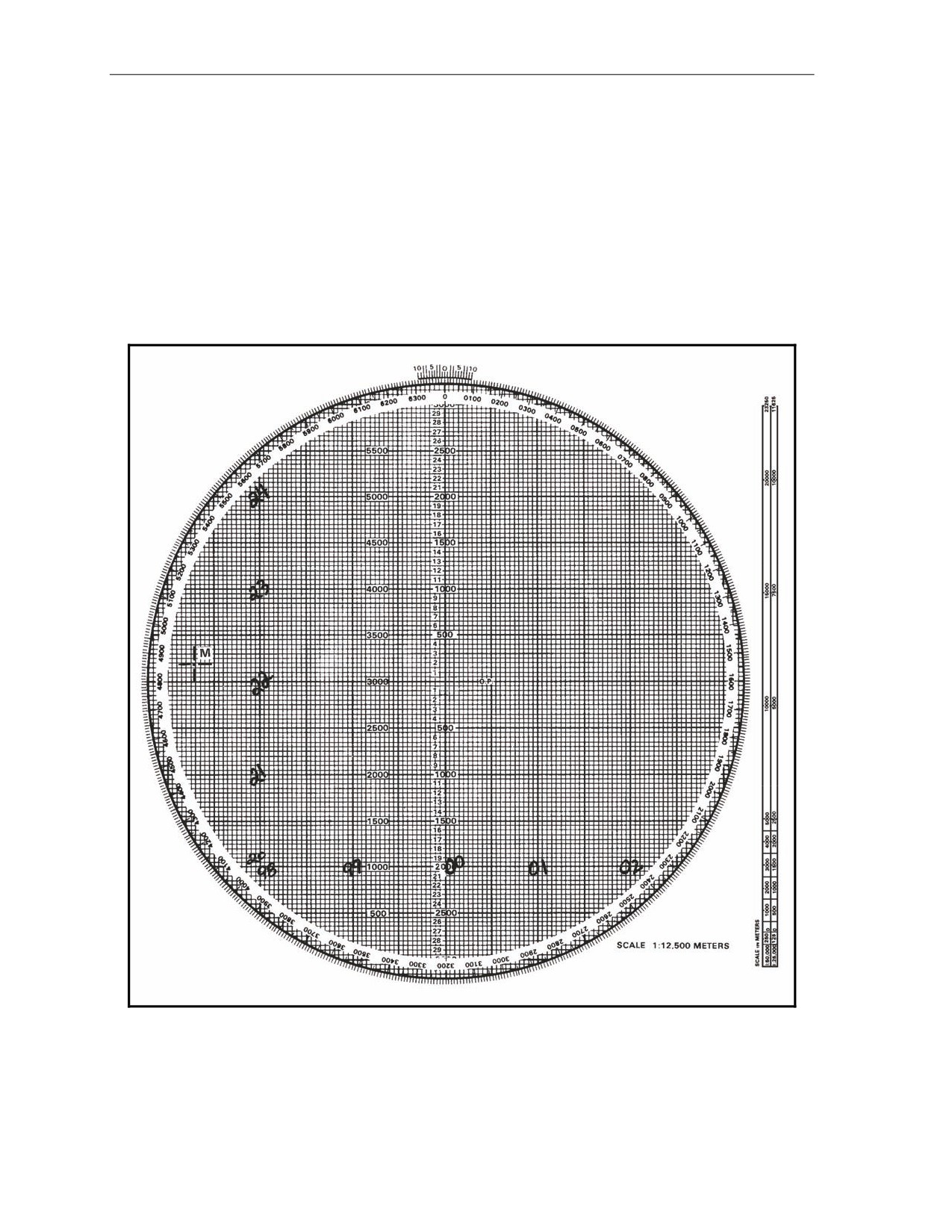
12-32. Now that a grid system is on the board, the computer can plot any grid coordinates. To do this, he
must—
(1) Ensure that the azimuth disk is indexed at 0.
(2) Read like a map: RIGHT and UP.
(3) Remember that the scale is
1:12,500
(each small square is
50 meters by
50 meters)
(Figure 12-17).
12-33. To superimpose the deflection scale, the computer writes the referred deflection on the board the
same way as with the observed chart. Firing data are determined by using the parallel-line method of
plotting.
Figure 12-17. Plotting of a mortar position.
12-16
FM 3-22.91
17 July 2008
Preparation of Fire Control Equipment
FIELD-EXPEDIENT METHOD FOR CONSTRUCTION
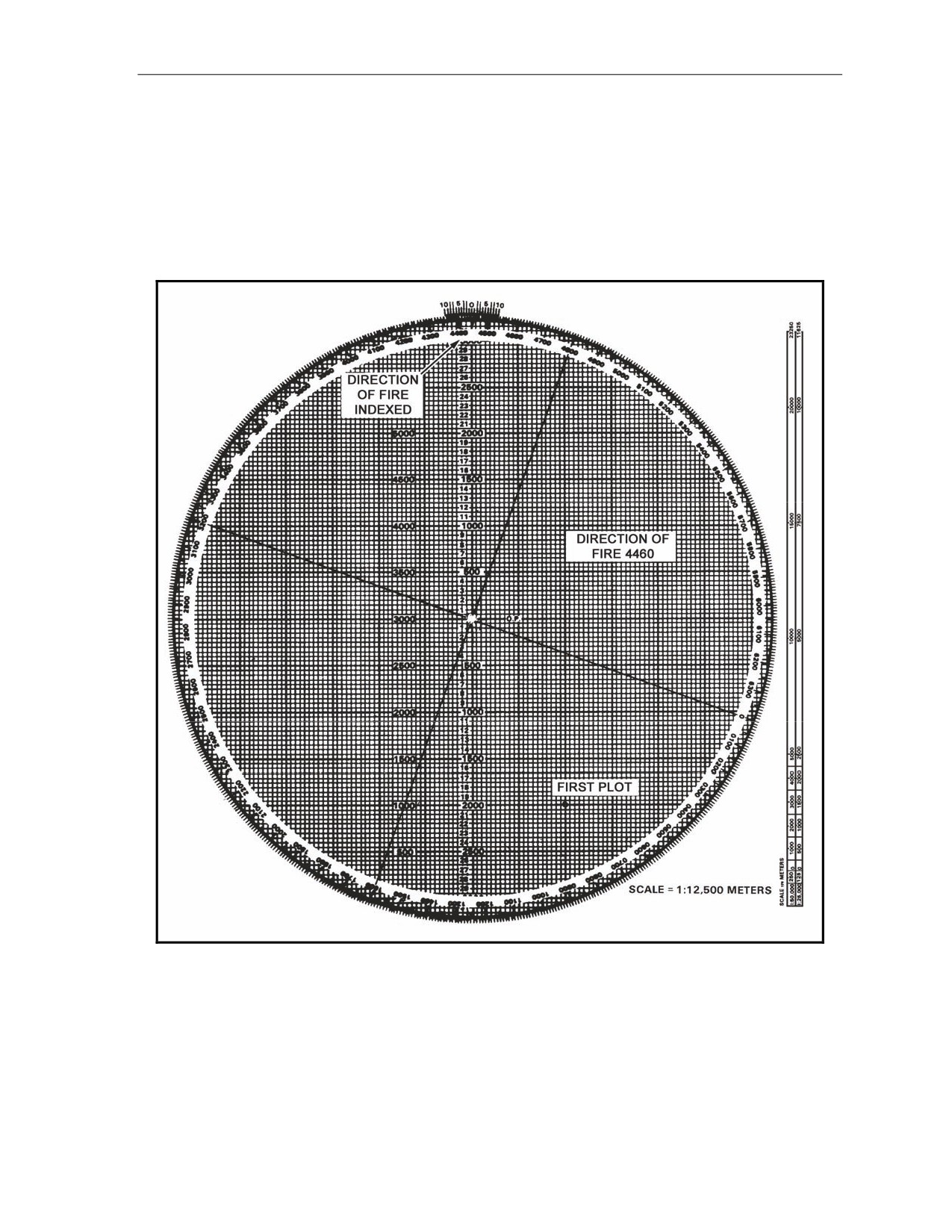
12-34. If the grid coordinates of the mortar position are known but a map is not available for determining
the grid intersection to represent the pivot point, the computer can construct the modified-observed firing
chart using the following procedures:
(1) Index the DOF.
(2) Drop below the pivot point on the vertical centerline 2,000 to 2,500 meters.
(3) Go 500 to 1,000 meters left or right of the vertical centerline and make a plot (Figure 12-18).
Figure 12-18. First plot.
17 July 2008
FM 3-22.91
12-17
Chapter 12
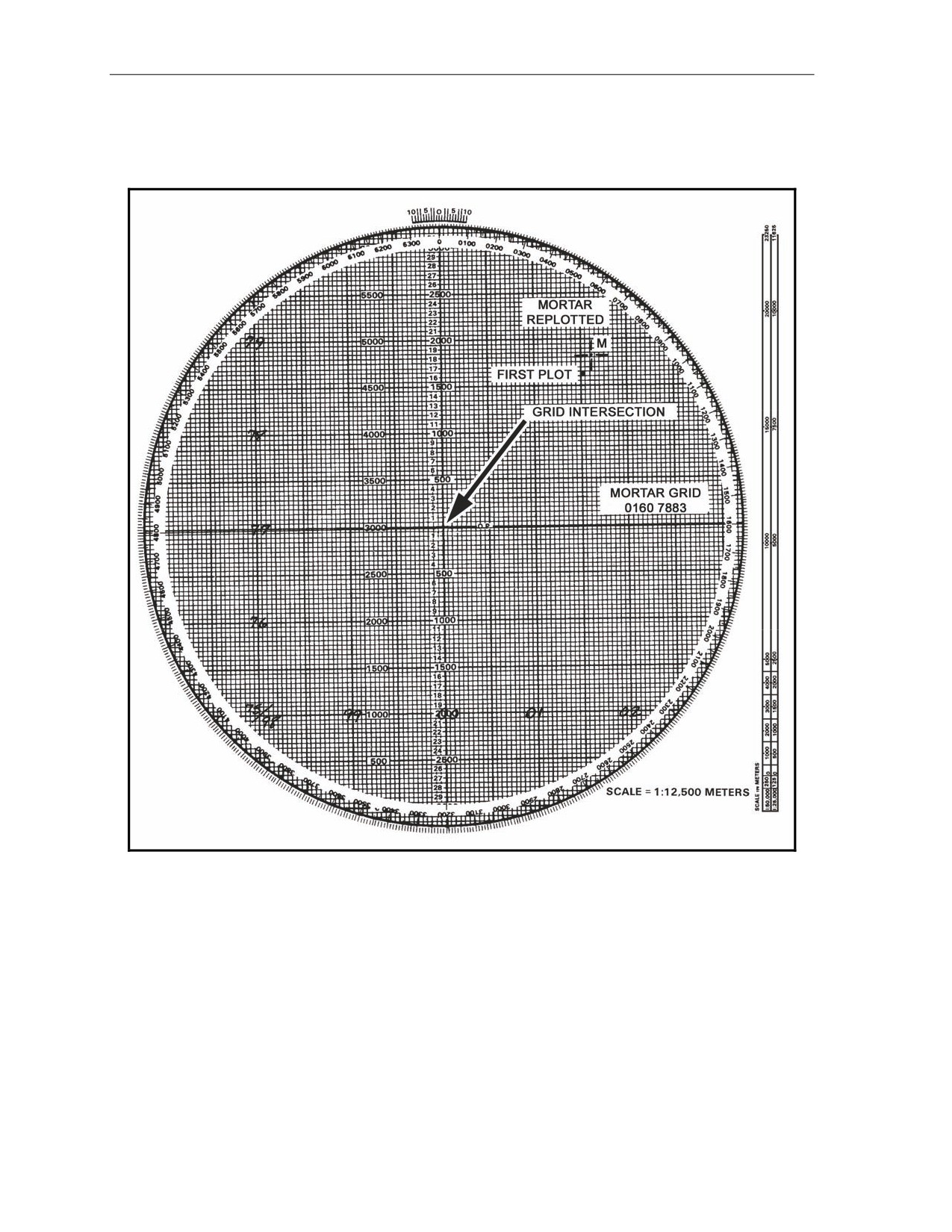
(4) Rotate the azimuth disk and index “0.”
(5) Determine the 1,000-meter grid that contains the mortars (Figure 12-19). The first, second, fifth,
and sixth numbers of the mortar grid give the 1,000-meter grid square.
Figure 12-19. Replotting of mortar location.
(6) Superimpose the grid system.
(7) Replot the mortar location to the surveyed grid.
12-18
FM 3-22.91
17 July 2008
Preparation of Fire Control Equipment
TRANSFER OF TARGETS
12-35. Transfer is the process of transferring a target from the observed chart to the modified-observed
chart, or from the modified-observed chart to the surveyed chart, as more information becomes available.
This occurs since the targets transferred are known points to the FO and FDC, and these points may be
used in future missions. Transfer is always done using chart data (deflection and range to the final plot).
NOTE: No firing corrections are used with the observed chart. Once transferred to the
modified-observed chart, the altitude of the target is assumed to be the same as that of the mortar
position.
EXAMPLE
Assume that the mortar section is at grid 939756 (six digits: observed chart) and two targets have
been fired on (Figure 12-20). The platoon leader determines that the eight-digit grid to the mortar
position is 93937563 (modified-observed chart) and designates the grid intersection to represent the
pivot point. The computer constructs the chart and transfers the targets from the observed chart
(Figure 12-21).
Figure 12-20. Observed chart.
17 July 2008
FM 3-22.91
12-19
Chapter 12
Figure 12-21. Forward plotting target to modified-observed chart from the observed chart.
TARGET PLOTTING
12-36. After transfer, through coordination with the FO, an RP or target may be identified to valid eight-
digit coordinates. The plotting board is then reconstructed as a surveyed chart. When the situation permits,
a registration mission should be conducted on the point for which the valid eight-digit coordinates were
determined. Then, firing corrections are computed.
z
When transferring targets from one type of chart to another, remember that the target plots on
the observed chart are plotted at the data it takes to hit the target. This is not always the locations
of the targets.
z
The same holds true for the modified-observed chart, except that with some targets, altitude
correction (VI) may have been used. When replotting the target at the end of the mission, strip
this altitude correction from the command range and plot the target using this range. Using this
procedure gives a more accurate picture of the exact location of the target than the observed
chart; however, it is not always the actual location of the target.
12-20
FM 3-22.91
17 July 2008

Preparation of Fire Control Equipment
PLOTTING OF PREVIOUSLY FIRED TARGETS
12-37. At the completion of the surveyed registration mission and the computation of the firing
corrections, previously fired targets plotted on the plotting board must be forward plotted. Since the
surveyed chart is the most accurate chart to use, all information on it should be the most accurate possible.
EXAMPLE
When targets AL0010 and AL0011 were fired before the surveyed registration, the data and the plots
included all firing corrections, even though they may have been unknown at the time of firing (Table
12-1). To forward plot these targets, the computer strips the firing correction from the range and
deflection to plot them at their actual location.
NOTE: To strip out the corrections, the signs must be reversed.
Table 12-1. Replotting of previously fired targets.
COMMAND
FIRING
CHART DATA
COMPUTATIONS
DATA
CORRECTIONS
FOR REPLOT
TARGET AL0010
Deflection 2786
Deflection R12
2786 + L12 = 2798
Deflection 2798
RCF - 18
+18 X 1.8 = +32
Range 1825
Altitude Correction +25
1825 + 32 - 25 = 1832
Range 1825
TARGET AL0011
Deflection 3115
Deflection R12
3115 + L12 = 3127
Deflection 3127
RCF - 18
+18 X 2.9 = +52
Range 2850
Altitude Correction +25
2850 + 52 - 25 = 2877
RANGE 2875
17 July 2008
FM 3-22.91
12-21
Chapter 12
DEFLECTION CONVERSION TABLE
12-38. When an adjustment is made to a sheaf, such as after the completion of the registration, the sheaf
is paralleled or converged if engaging a point-type target, or opened when engaging a wider target. In these
situations, the computer must determine the new data and convert the deviation corrections required into
mils. He can use the deflection conversion table (Figure 12-22) or the mil-relation formula.
NOTE: If the target has been mechanically surveyed, enter the DCT at the initial range plot. If
the target is non-surveyed (even if it is an eight-digit grid), enter the DCT at the final range plot.
12-39. To use the DCT, first round off the range at which the section is firing to the nearest 100 meters.
This is required because the ranges on the table are divided into 100-meter increments. Next, go down the
range column to find the range. The deflection is in meters across the top of the card.
12-40. Using the number of meters the FO requested to move the strike of the round, find that number of
meters and go straight down that column until it intersects with the range. This number is the number of
mils that would have to be applied to the mortar sight to move the strike of the round the required meters.
If the range is greater than 4,000 meters, divide the range and mil correction by two.
Figure 12-22. Deflection conversion table.
12-22
FM 3-22.91
17 July 2008
Preparation of Fire Control Equipment
EXAMPLE
The mortar section has completed a registration mission and is prepared to adjust the sheaf. The
initial range for the RP is 2,750 meters. The No. 1 and No. 3 mortars fire one round each. The FO
sends the following corrections: NUMBER 3, R30; NUMBER 1, L20; END OF MISSION, SHEAF
ADJUSTED. Any corrections of 50 meters or more must be refired.
For this example, the last deflection fired from No. 1 and No. 3 was 2931 mils. Using the DCT, round
off the range to the nearest 100 meters (2,800). Find 2,800 meters in the range column and using the
FO’s corrections, find 30 and 20 in the deflection-in-meters column. Go across and down those
columns to where they intersect. The table shows that the requirements are 11 mils for 30 meters and
7 mils for 20 meters.
Using this information, use the previous deflection fired, which was 2931 mils. Since the FO’s
correction for the No. 3 mortar was R30, which equals R11 mils (using the LARS rule), subtract 11
mils from 2931 mils. This gives a new deflection of 2920 mils. The correction for No. 1 mortar was
L20, which equals L7 mils. Using the LARS rule for deflection, add 7 mils to 2931, which gives a new
deflection of 2938 mils.
If there is no deflection conversion table available, use the mil-relation formula (W/R x M) to convert
the corrections from meters to mils. To use the formula for the same FO’s corrections of R30 and L20
used in the example cited, cover the item needed (in this case M [mils]). The remainder of the formula
states: divide W (width in meters) by R (range in thousandths).
W/R = 20/2.8 = M
20 ÷ 2.8 = 7.1
=
7 mils
W/R = 30/2.8 = M
30 ÷ 2.8 = 10.7 =
11 mils
These are exactly the same figures determined using the DCT.
GRID MISSION
12-41. For an observed chart, the grid coordinates of the target must be plotted on the map, and a
direction and distance determined from the mortar location to the target. For modified and surveyed charts,
index “0” and plot the target using the grid coordinates.
NOTE: Corrections for VI can be used on the modified and surveyed charts.
SHIFT FROM A KNOWN POINT MISSION
12-42. For an observed chart, the known point must be plotted on the firing chart. This may be a fired-in
target or a mark-center-of-sector round. The OT azimuth is indexed, and the correction applied is sent in
the CFF. For modified and surveyed charts, the same procedure is used as for the observed chart.
17 July 2008
FM 3-22.91
12-23
Chapter 12
POLAR PLOT MISSION
12-43. The FO’s location must be plotted on the plotting board before a polar plot mission can be fired.
For an observed chart, the location can be plotted in three ways:
z
By resection.
z
By direction and distance.
z
By range and azimuth from a known point.
RESECTION
12-44. Plot two known points on the plotting board. Then index the azimuths the FO sends from these
two points, and draw lines from the known points toward the bottom of the board. The intersection of these
lines is the FO’s location. (Figure 12-23).
Figure 12-23. Resection.
12-24
FM 3-22.91
17 July 2008
Preparation of Fire Control Equipment
INTERSECTION
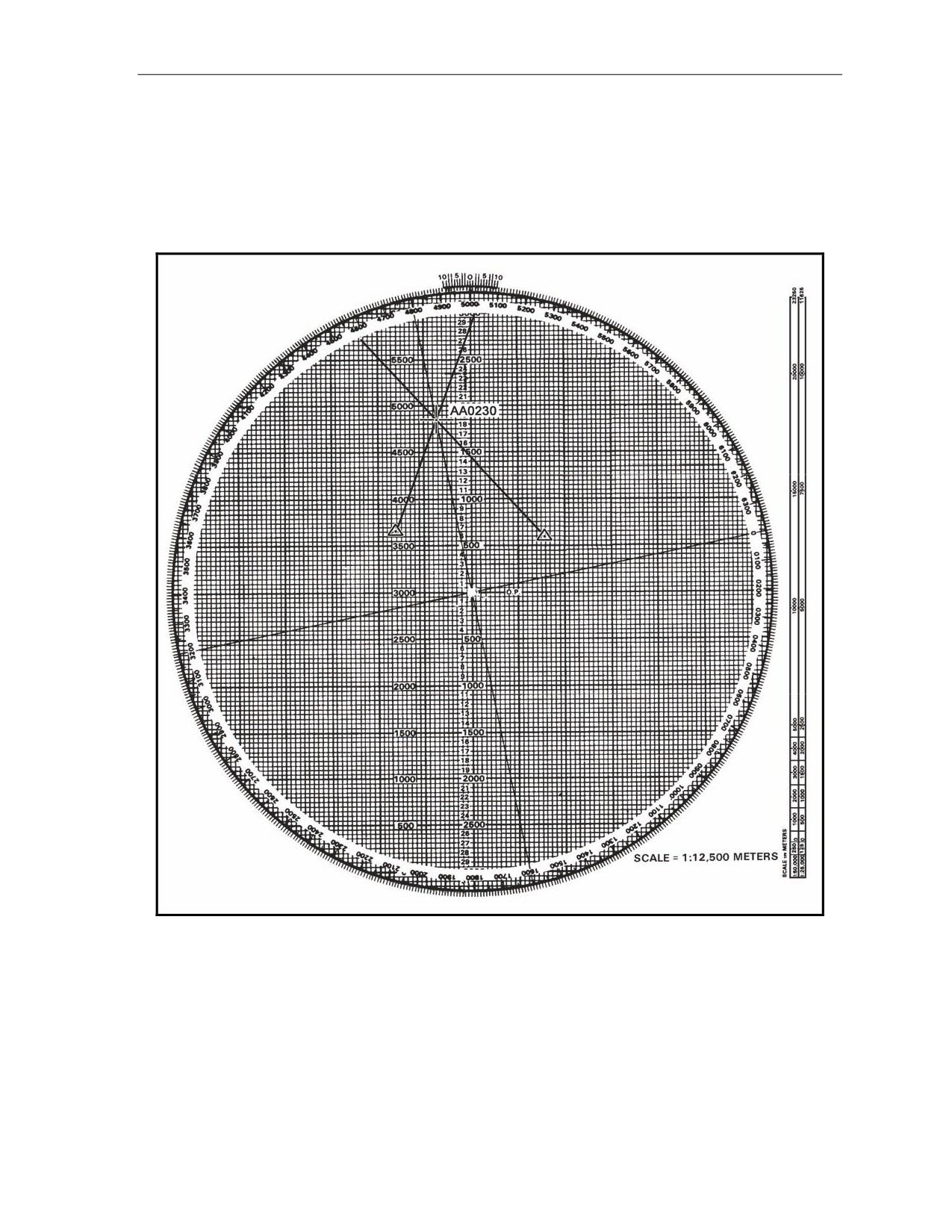
12-45. Similar to resection, intersection (Figure 12-24) is a method of location that requires two separate
observers that can see the same target/point of interest. Plot the two FOs on the plotting board. Index the
azimuth from the first FO to the target/point of interest. Draw a line from the first FO to the top of the
board. Next, index the azimuth from the second FO to the target/point of interest. Draw a line from the
second FO to the top of the board. These two lines intersect at the location of the target/point of interest.
Figure 12-24. Intersection.
17 July 2008
FM 3-22.91
12-25
Chapter 12
DIRECTION AND DISTANCE
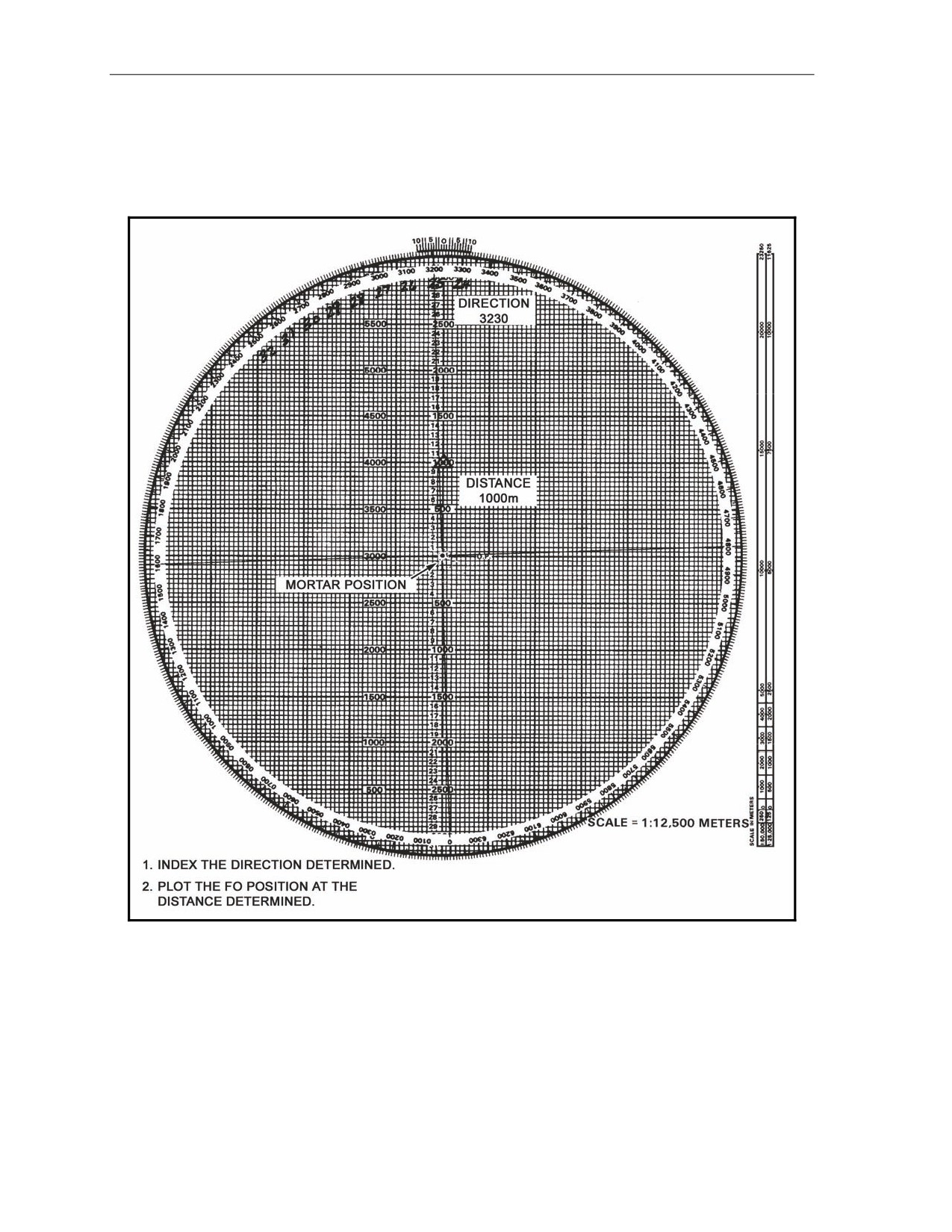
12-46. The FO sends the computer the grid to the FO position. The computer then plots the grid on the
map, determines the direction and distance from the mortar position to that grid, transfers the direction and
distance to the plotting board, and plots the FO’s location. (Figure 12-25).
Figure 12-25. Direction and distance.
12-26
FM 3-22.91
17 July 2008
Preparation of Fire Control Equipment
RANGE AND AZIMUTH FROM A KNOWN POINT
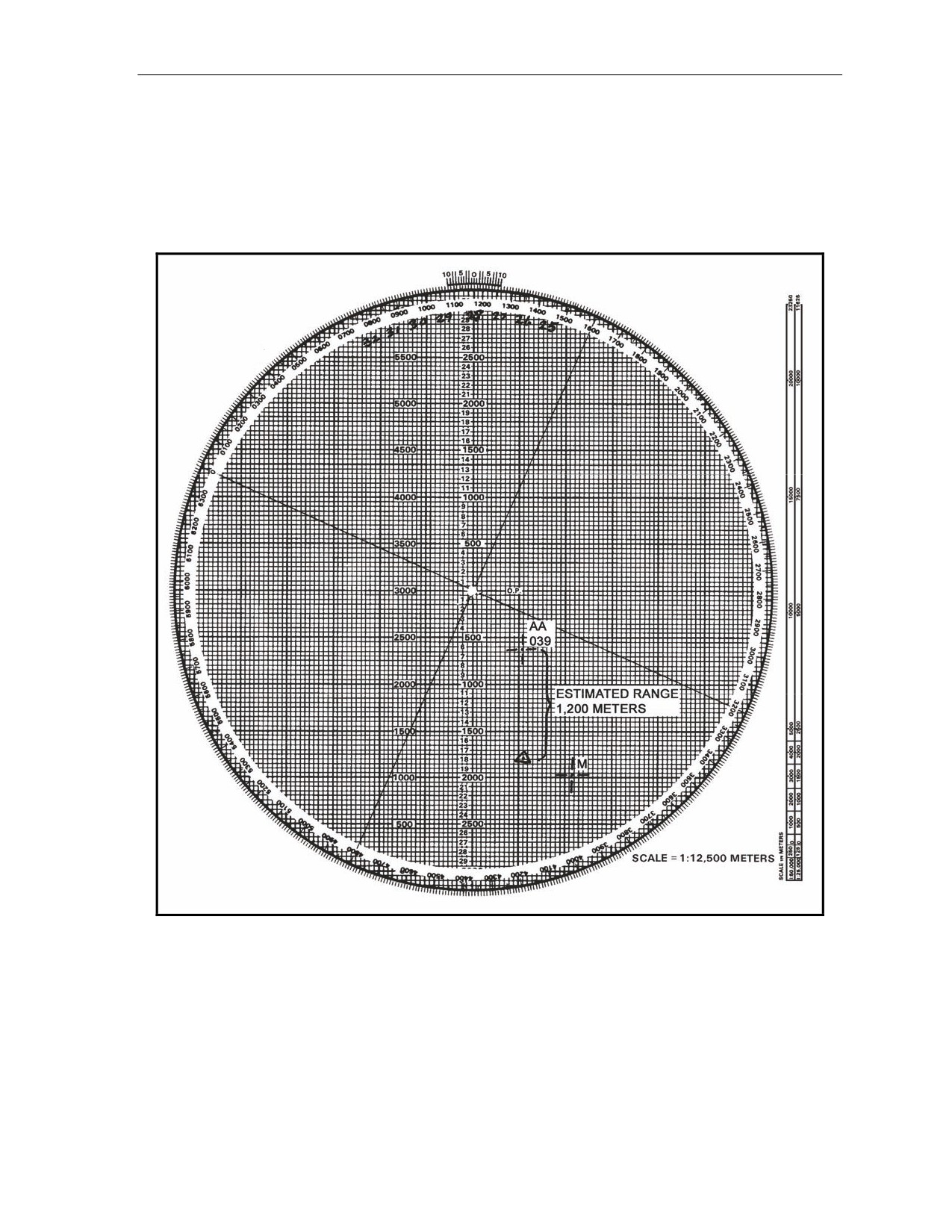
12-47. The FO must send the range from the known point and the azimuth on which that point is seen.
Once that is known, the computer can index the azimuth, drop below the known point the range given, and
plot the FO’s location (Figure 12-26). For modified and surveyed charts, the FO’s location can be plotted if
the grid of the FO is known, by indexing “0” and plotting the FO grid. If the grid is not known, then the
computer can use resection, direction and distance, or range and azimuth from a known point.
Figure 12-26. Estimate of range from the reference point of the forward observer's location.
17 July 2008
FM 3-22.91
12-27
This page intentionally left blank.

Chapter 13
Types of Missions
Certain missions require special procedures for the effective engagement of targets;
therefore, these missions should not be fired on the observed chart. Area targets have
width or depth (or both), requiring the mortar section to use either searching or
traversing fire, or a combination of both.
TRAVERSING FIRE
13-1. Traversing fire is used when the target has more width than a section firing a parallel sheaf can
engage. Each mortar of the section covers part of the total target area and traverses the area.
13-2. The M16/M19 plotting board can be constructed as any of the three firing charts. The following data
are used to set up the plotting board for traversing fire:
z
Grid intersection.
z
Direction of fire.
z
Mounting azimuth.
z
Mortar position.
z
Mortar position attitude.
z
Mortar altitude.
z
Referred deflection.
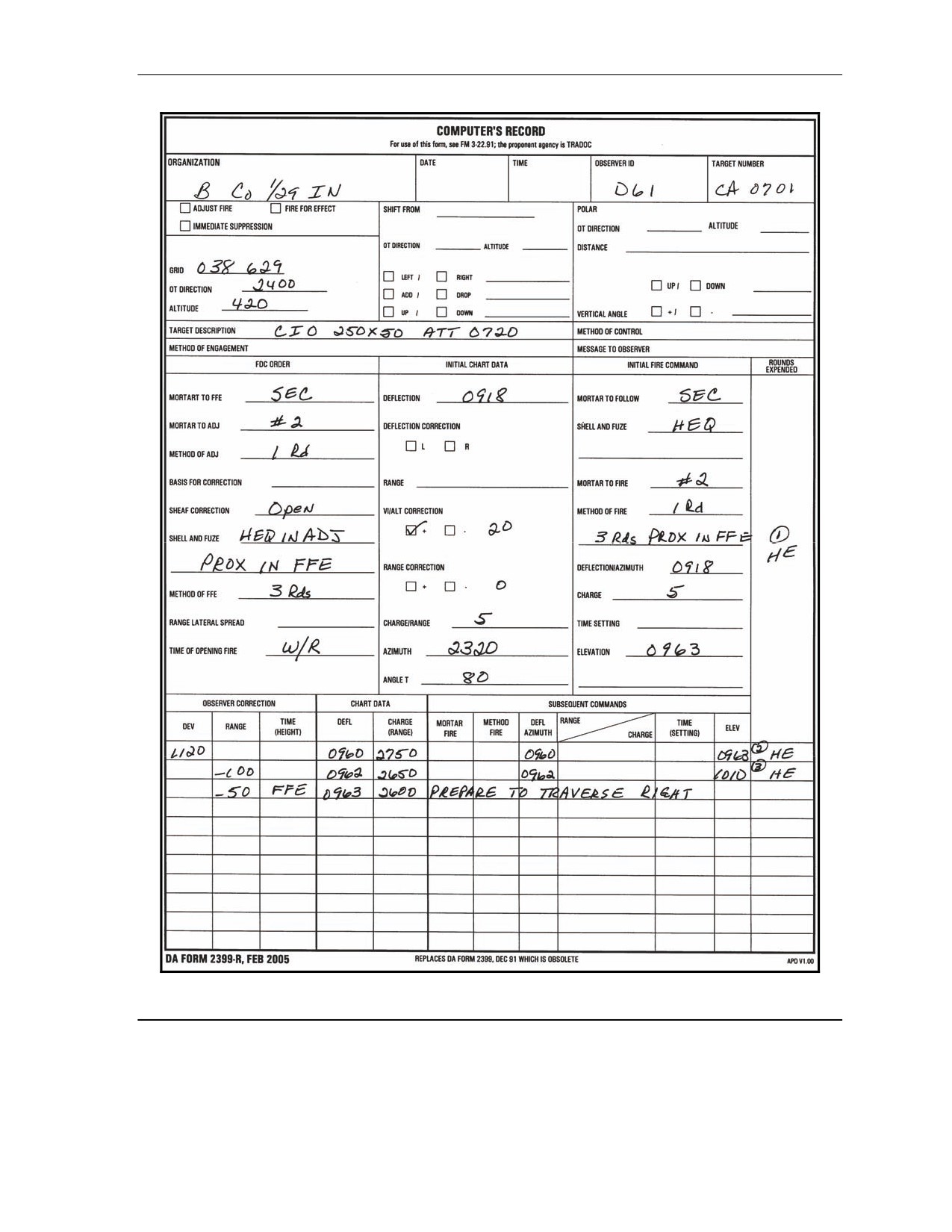
13-3. Upon receiving the CFF, the section sergeant determines from the target's size and description that
traversing fire must be used to cover the target. To effectively engage a target using traversing fire, the
section sergeant ensures that the target's attitude is within 100 mils of the firing section's attitude. The
section sergeant then completes the FDC order (Figure 13-1).
13-4. The three or four mortars are plotted separately on the M16/M19 plotting board, using the section's
attitude. During the mission, the computer ensures that the correct plots are used to determine the data
required.
EXAMPLE
Table 13-1 lists the data used to set up the M16 plotting board for traversing fire.
Table 13-1. M16 plotting board data for traversing fire.
Grid Intersection
04/64
Direction of Fire
2700 mils
Mounting Azimuth
2700 mils
Mortar Position
FB02006500
Mortar Position Attitude
1080 mils
Mortar Altitude
400 meters
Referred Deflection
0700 mils
17 July 2008
FM 3-22.91
13-1
Chapter 13
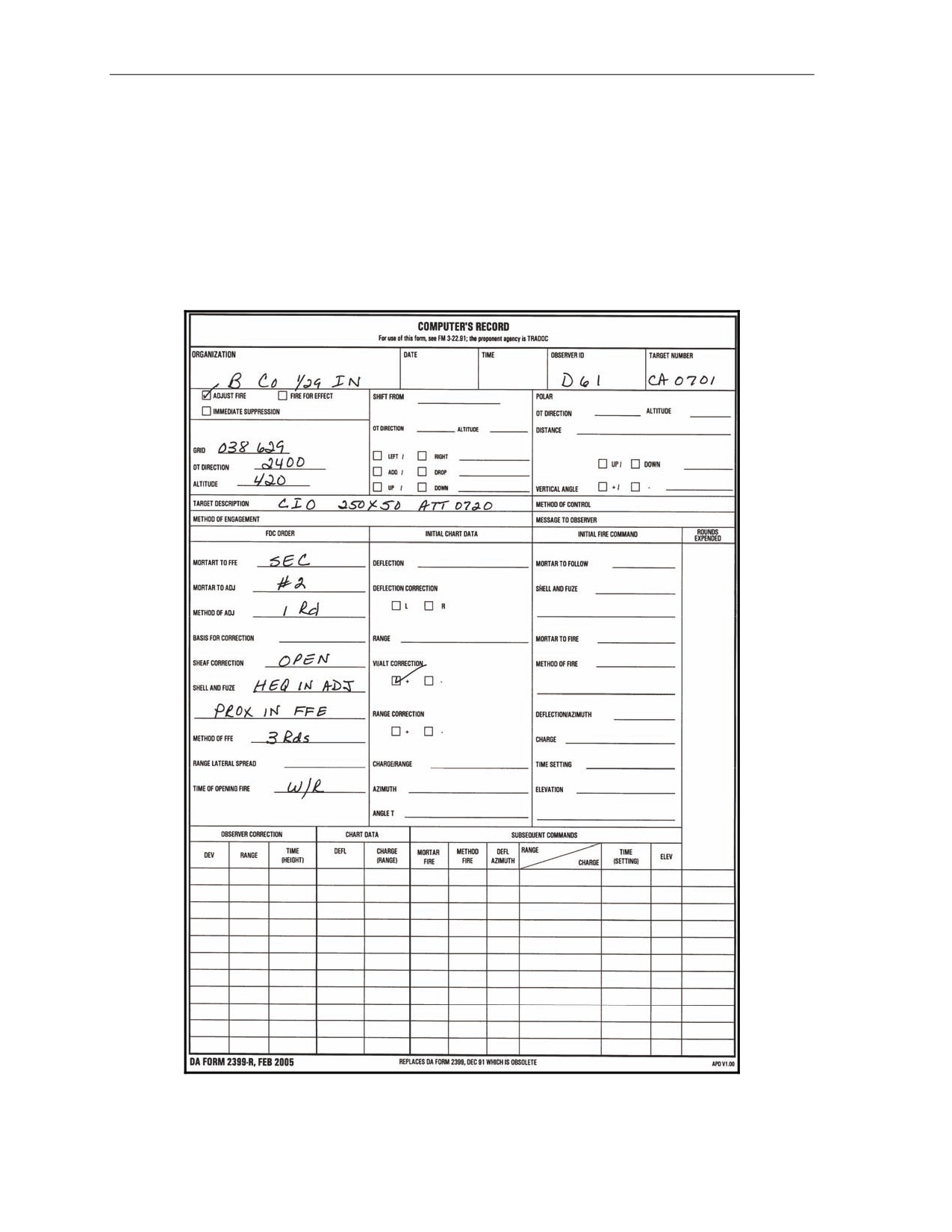
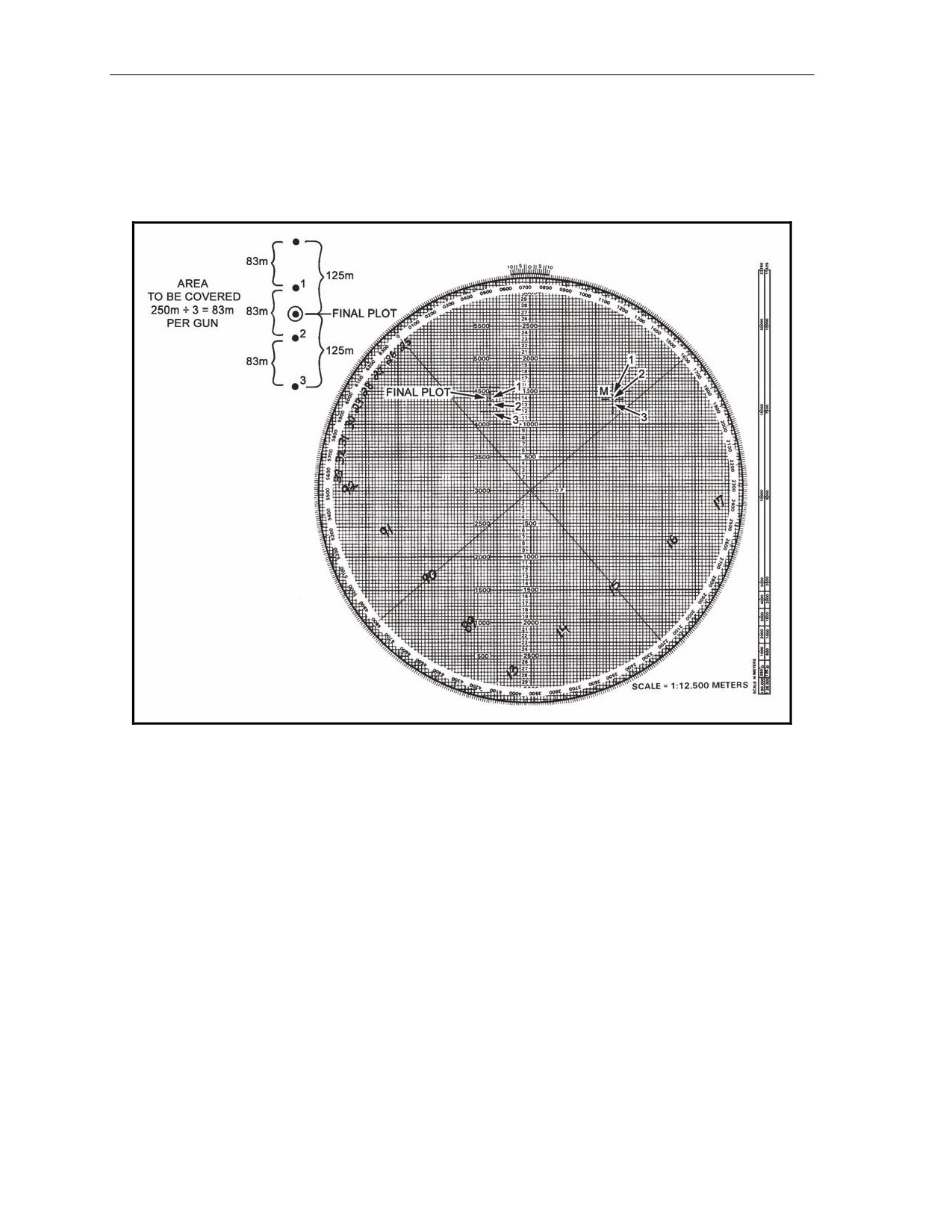
During the adjustment phase of the mission, the impact point is aligned with the No. 2 mortar plot. Using
the information in the CFF, the FDC order, and the observer corrections, compute the data to adjust the
No. 2 mortar onto the target's center of mass. After the adjustment is complete (Figure 13-2)—
(1) Plot the target's length (250 meters) on the plotting board using the target's attitude.
(2) Divide the target into segments.
(3) Determine the number of rounds for each segment.
(4) Determine the mil width of one segment.
(5) Determine the number of turns required to cover one segment.
(6) Determine the number of turns that must be taken between rounds.
Figure 13-1. Example of DA Form 2399-R (Computer's Record) with a completed call for fire
and fire direction center order.
13-2
FM 3-22.91
17 July 2008
Types of Missions
Figure 13-2. Example of DA Form 2399-R (Computer's Record) with completed adjustment.
17 July 2008
FM 3-22.91
13-3
Chapter 13
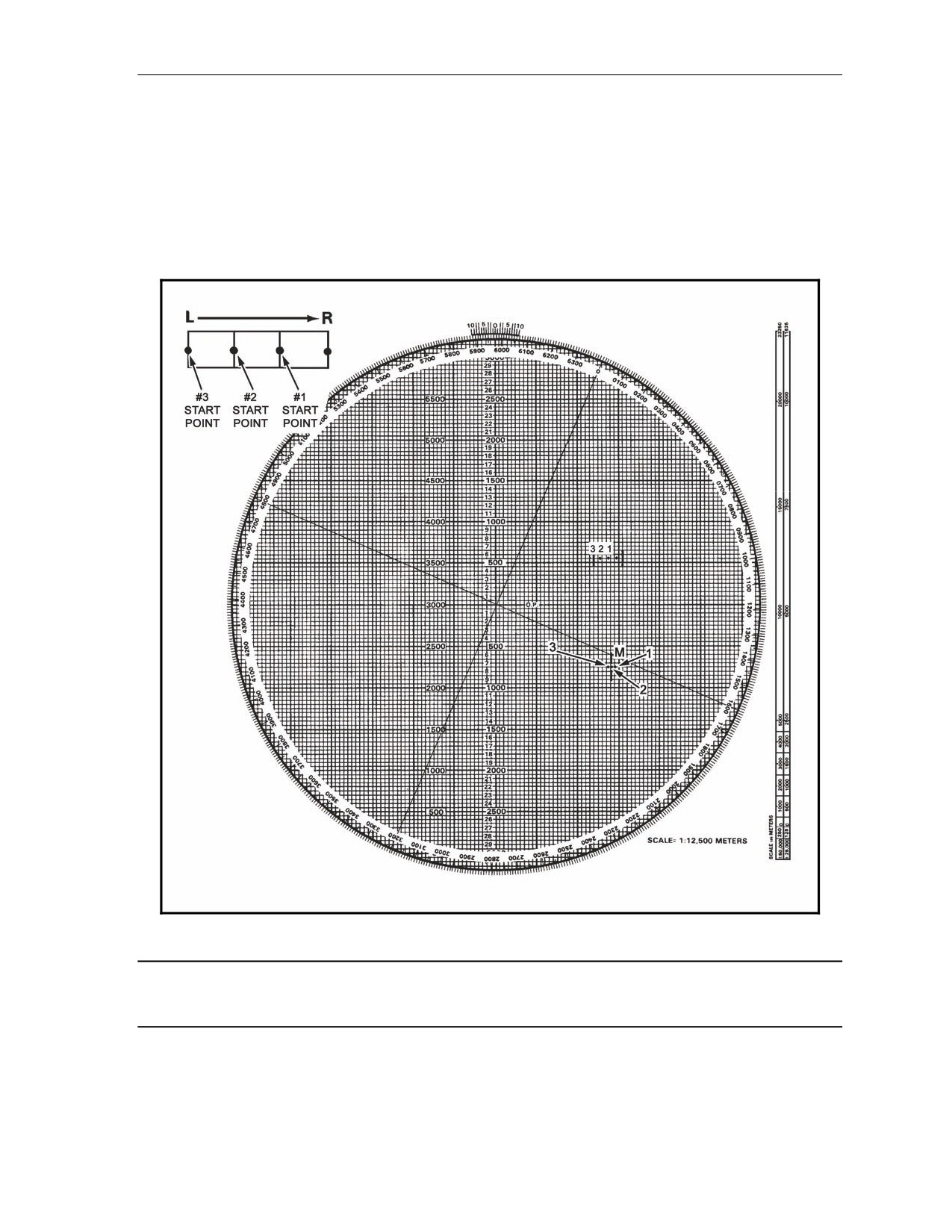
(1) To plot the target on the plotting board, the computer rotates the azimuth disc until the target
attitude (taken from the CFF) is indexed. The computer erases all of the plots except the last
one. After ensuring that the attitude is indexed, the computer divides the total target area into
segments. These plots represent the starting points for each mortar. The area between the plots is
the area each mortar must cover with fire (Figure 13-3).
Figure 13-3. Plotting of starting points.
13-4
FM 3-22.91
17 July 2008
Types of Missions
(2) The target is now divided into three segments (each being 83 meters, in the example). Once the
remaining data for one segment have been determined, the data will apply to all three mortars. If
the computer determines the mil width of one segment, the other two will be the same. The
computer can use one of two methods to determine the mil width of one segment.
In the first method, the computer knows the deflection that was used to hit the No. 3 point.
First, he aligns the No. 2 plot and No. 3 mortar to determine the proper deflection for the
mortars to hit the start point for the No. 2 mortar (Figure 13-4). Then, he subtracts these
two numbers to determine the segment's mil width.
Figure 13-4. Alignment of No. 2 and No. 3 plots.
EXAMPLE
2993 mils (No. 3 plot deflection) - 2942 mils (No. 2 plot deflection) = 51 mils (mil width of segment)
17 July 2008
FM 3-22.91
13-5
Chapter 13
The second method uses the DCT to determine the mil width of one segment. The
computer enters the DCT at the final chart range (rounded off to the nearest 100 meters).
He follows the Deflection in Meters line to the closest number of meters (75) needed to
cover the segment. The point at which the Range line and the Deflection line meet is the
number of mils that will cover the segment. Each turn of the traversing handwheel is about
10 mils. By dividing the mil width of each segment (29) by 10, the computer obtains the
total number of turns needed to cover the segment (round off to the nearest whole turn).
EXAMPLE
29.0 (mil width of each segment) ÷ 10 = 2.9
Round to the nearest whole turn = 3 (turns needed to cover the segment)
(3) To compute the number of turns that must be taken between rounds, the computer must know
how many rounds will be fired for each segment. This information is given in the FDC order
(three rounds, in the example). To determine the number of turns that must be taken between
rounds, the computer divides the total number of turns by the interval between rounds.
RULES:
1. There will always be one less interval than the number of rounds. Three rounds
= two intervals, for example.
2. The turns taken between rounds are rounded to the nearest half turn.
3. The number of rounds to fire is based on the rule: four rounds per 100 meters of
target width, or one round per 30 meters for 81-mm mortars; or two rounds per
100 meters of target width, or 1 round for 60 meters for 120-mm mortars.
EXAMPLE
3.0 (total number of turns) ÷ 2 (interval between rounds) = 1.5 = 1 1/2 (turns taken between rounds)
In this instance, there is no need to round to the nearest half turn.
(4) The computer determines the deflection and range for each mortar by aligning each mortar with
its start point. Then, he completes the subsequent command and issues it to the mortar section.
NOTE: If there is a range change of 25 meters or more, the mortar will receive its own
elevation.
(5) Upon completion of the adjustment phase of the mission, the section is given the command,
"Prepare to traverse right (left)." The gunners then traverse the mortars in the direction opposite
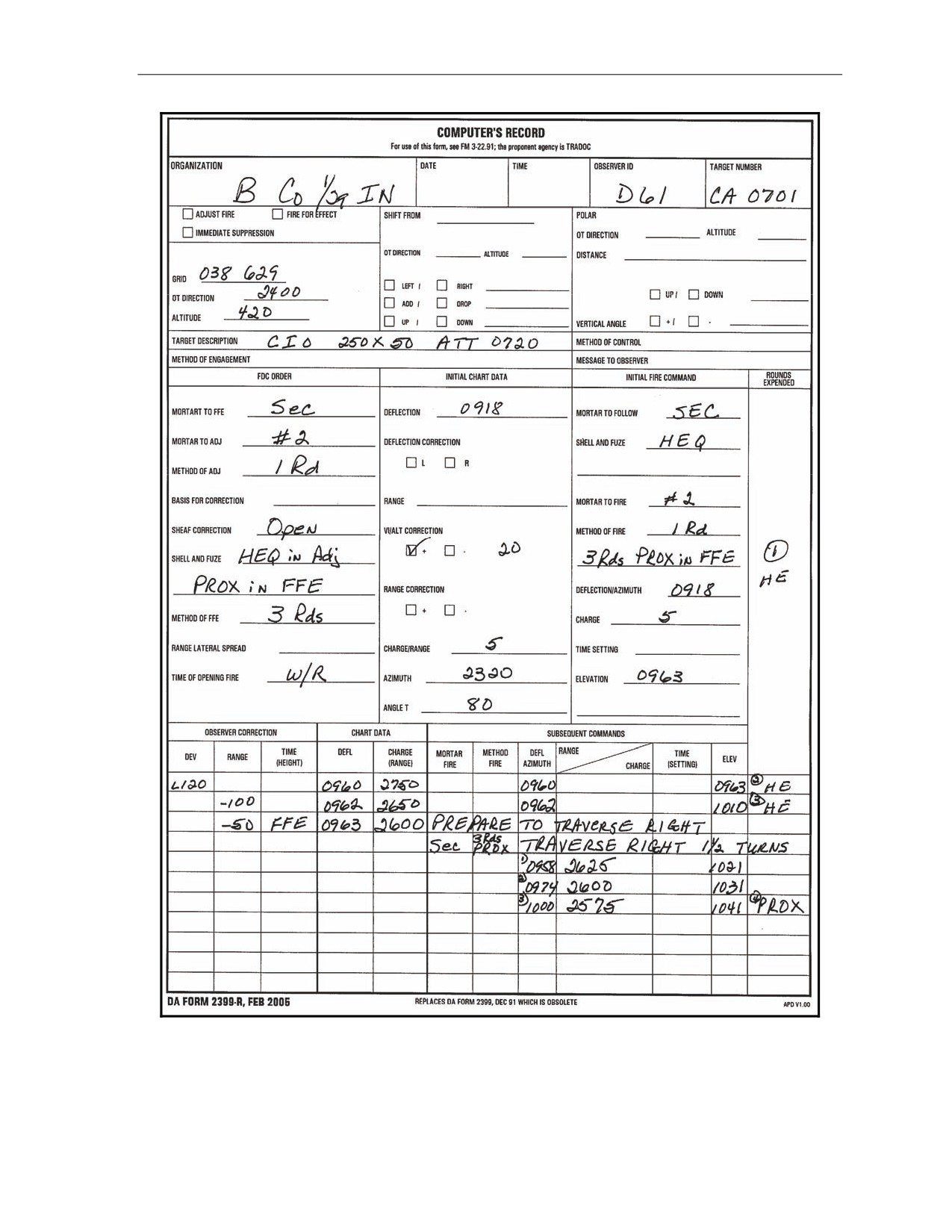
to that given, back off two turns, and await further instructions (Figure 13-5).
13-6
FM 3-22.91
17 July 2008
Types of Missions
Figure 13-5. Example of a completed DA Form 2399-R (Computer's Record)
for a completed mission.
17 July 2008
FM 3-22.91
13-7
Chapter 13
SEARCHING FIRE
13-5. Mortars can cover area targets more than 50 meters deep by either elevating or depressing the barrel
during the FFE. Sections can cover areas up to 50 meters (three mortars firing four rounds on the same
elevation and deflection) due to range and deflection dispersion.
13-6. In the CFF, the FO sends the target's size and attitude since it has more depth than a section firing a
linear sheaf can engage. The FO gives the width and depth of the target's attitude. Attitude is the direction
(azimuth) through the target's long axis.
13-7. For the mortar section to effectively engage a target using only searching fire with the M16/M19
plotting board, the target's attitude cannot be more than 100 mils difference from the gun section's attitude.
If the difference is more than 100 mils, the target should be engaged using a combination of searching and
traversing fire, or traversing fire only. When a section fires a searching mission, the adjustment phase is the
same as that of a regular mission using the base mortar (No. 2) as the adjusting mortar. The base mortar is
adjusted to the target's center of mass.
13-8. Upon completion of the adjustment phase of the mission, the computer must compute the data
needed to cover the target with fire using the target area given in the CFF. He must determine the number
of rounds necessary to cover the target, the number of turns required to cover the target, and the number of
turns taken between rounds.
NOTES:
1. When firing on a target using traversing or searching fire, the computer uses
four rounds for every 100 meters of target width or depth, or one round for
every 30 meters for 81-mm mortars; or two rounds per 100 meters of target
width, or 1 round for 60 meters for 120-mm mortars.
2. The computer must always consider the number of rounds on hand and the
resupply rate when determining the number of rounds to fire.
EXAMPLE
Assume that the target's depth is 350 meters, and the engagement is with 81-mm mortars.
(1) Four rounds are required to cover 100 meters.
350 ÷ 100 = 3.5 (or 3 even 100s)
4 x 3 (for 300, the number of 100s of meters) = 12
(2) For the remainder of the target depth (50 meters), add one round for every 30 meters.
12 + 1 = 13 (rounds)
(3) At this point, 20 meters of target is left. To cover the 20 meters, add one more round.
13 + 1 = 14 (rounds to cover 350 meters)
13-8
FM 3-22.91
17 July 2008
Types of Missions
(1) When determining the number of turns needed to cover the target, the computer can use one of
two methods.
If the computer is using the unabridged firing table, the number of turns in elevation
required for a 100-meter change in range is given in column 4 of Table D (Basic Data).
EXAMPLE
Assume the target is 350 meters in depth, the range to the target's center of mass is 2,125 meters
(always use chart range), and the firing charge is 4.
To determine the number of turns needed to cover the target —
(1) Determine the range to the target's center of mass (2,125).
(2) Enter the firing table at charge 4, range 2,125, and go across to column 4.
(3) Four turns are needed to cover 100 meters.
(4) Multiply 4 by 3.5 (range in hundreds) to get the number of turns needed to cover the
target.
4 x 3.5 (range in hundreds) = 14 (turns needed to cover the target area)
The mortars are adjusted to the center of mass. To obtain the range to the far edge (search up), add
half of the target area to the range to the center of mass.
175 (half of the target area) + 2,125 (range to the center of mass) = 2,300 (range to the
far edge)
EXAMPLE
The range to the center of mass is 2,125 meters; the target area is 100 meters by 350 meters; and
the range to the far end is 2,300 meters.
(1) Divide the target's depth by two.
350 (target's depth) ÷ 2 = 175 meters (half of the target depth)
(2) To search down, start at the near edge and subtract half of the target depth from target
center.
2125 (target center) - 175 meters (half of the target depth) = 1950meters
17 July 2008
FM 3-22.91
13-9
Chapter 13
To apply the second method, the computer must determine the mil length of the target using
FTs. He uses the elevation for the far end of the target (adjusting point) and the elevation to
hit the near end of the target.
EXAMPLE
Range to adjusting
2,300 meters
Elevation
974 mils
point
Range to near end
1,950 meters
Elevation
1128 mils
(1) Subtract the two elevations to determine the mil length of the target.
1128 mils (elevation for the range to the near end)
- 974 mils (elevation for the range to the adjusting point)
154 mils (length of the target)
NOTE: Each turn of the elevating crank is 10 mils (5 mils for the 120-mm mortars).
(2) Divide the mil length of the target (154 mils) by 10 to get the total number of turns
needed to cover the target. Round to the nearest whole turn.
154.0 (mil length of the target) ÷ 10 = 15.4 = 15 (total turns needed to cover the target)
NOTE: Table D (Basic Data) gives the number of turns per 100 meters difference in range.
This data may be used to determine the total number of turns needed to cover the target.
(2) To compute the number of turns that must be taken between rounds, the computer must know
how many rounds each mortar will fire. The computer computes this information or finds it in
the FDC order (14 rounds, in the example). To determine the number of turns that must be taken
between rounds, he divides the total number of turns by the intervals between rounds. The
computer rounds the product to the nearest half turn.
NOTE:
1. There will always be one less interval than the number of rounds. For example,
14 rounds = 13 intervals.
2. Turns between rounds will be rounded to the nearest half turn.
EXAMPLE
15.0 (total number of turns) ÷ 13 (intervals between rounds) = 1.15 = 1 (turn between rounds).
RULE: The number of rounds to fire is based on the rule: four rounds per 100 meters of target
depth, or one round per 30 meters for 81-mm mortars; or two rounds per 100 meters of
target width, or 1 round for 60 meters for 120-mm mortars.
13-10
FM 3-22.91
17 July 2008
Types of Missions
(3) At this point, the computer has all of the information needed to complete the subsequent
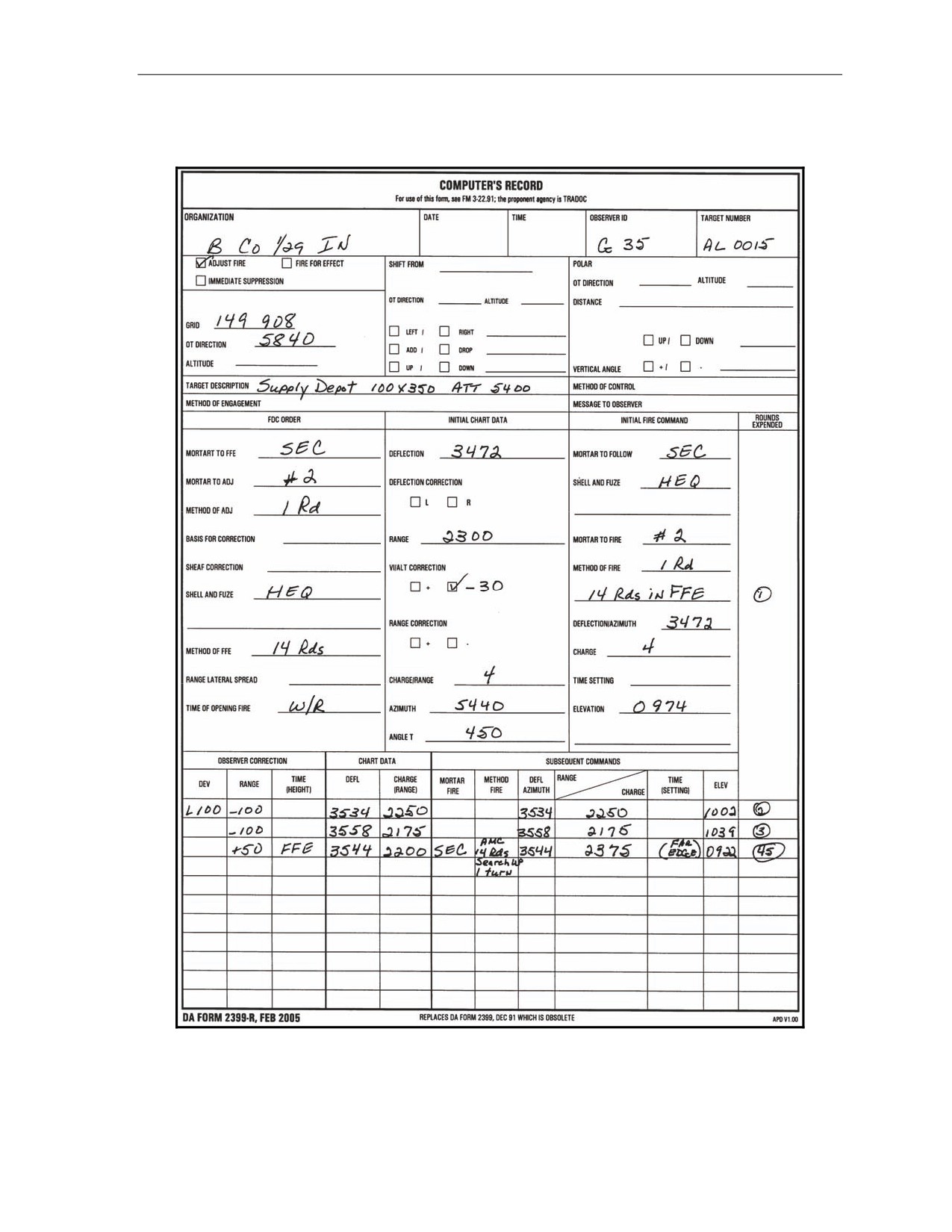
command. The command can then be issued to the mortars (Figure 13-6).
Figure 13-6. Example of completed DA Form 2399-R (Computer's Record)
for a search mission.
17 July 2008
FM 3-22.91
13-11