FM 3-22.91 MORTAR FIRE DIRECTION PROCEDURES (July 2008) - page 3
Chapter 4
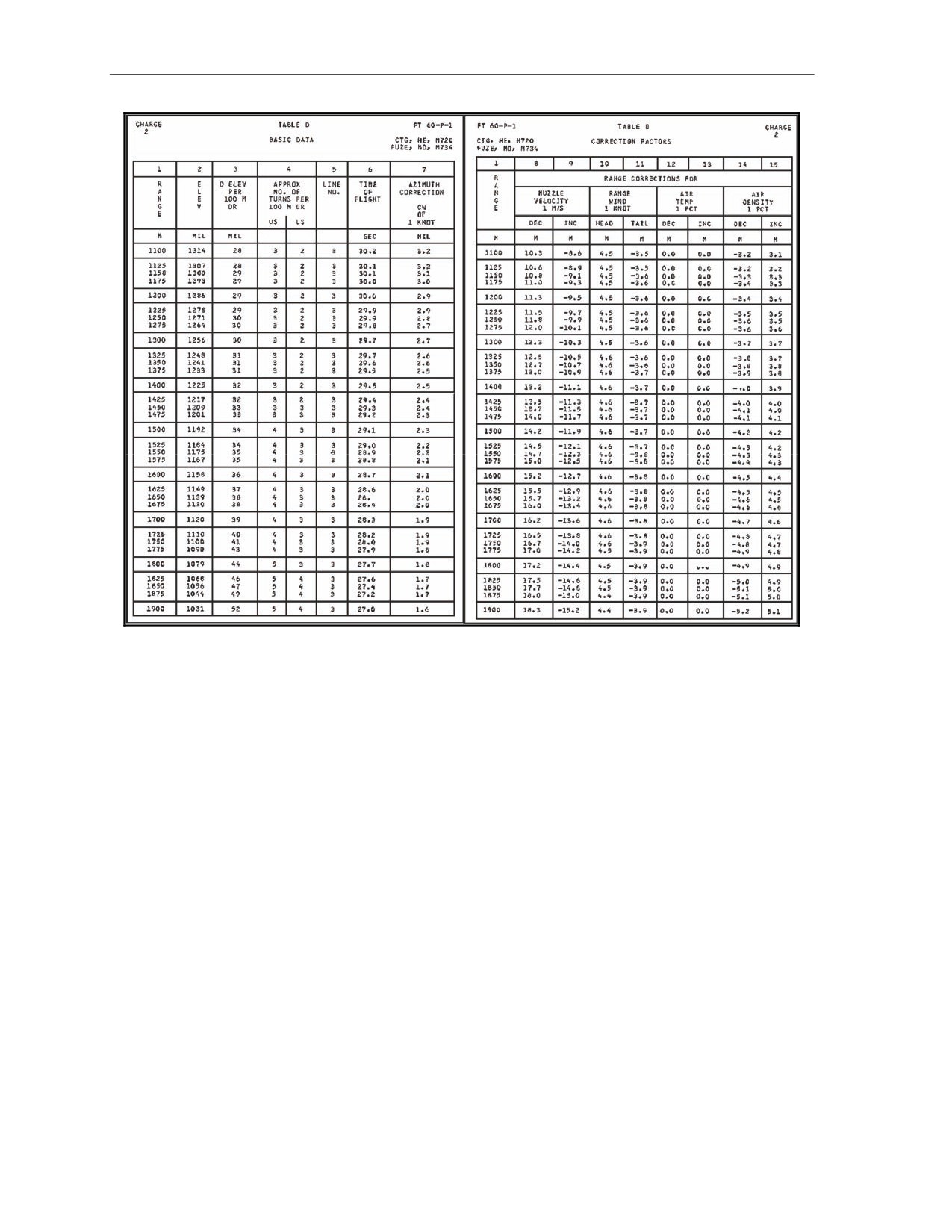
Figure 4-6. Sample pages from firing tables for 60-mm mortar.
4-20
FM 3-22.91
17 July 2008
Major Concerns of the Fire Direction Center
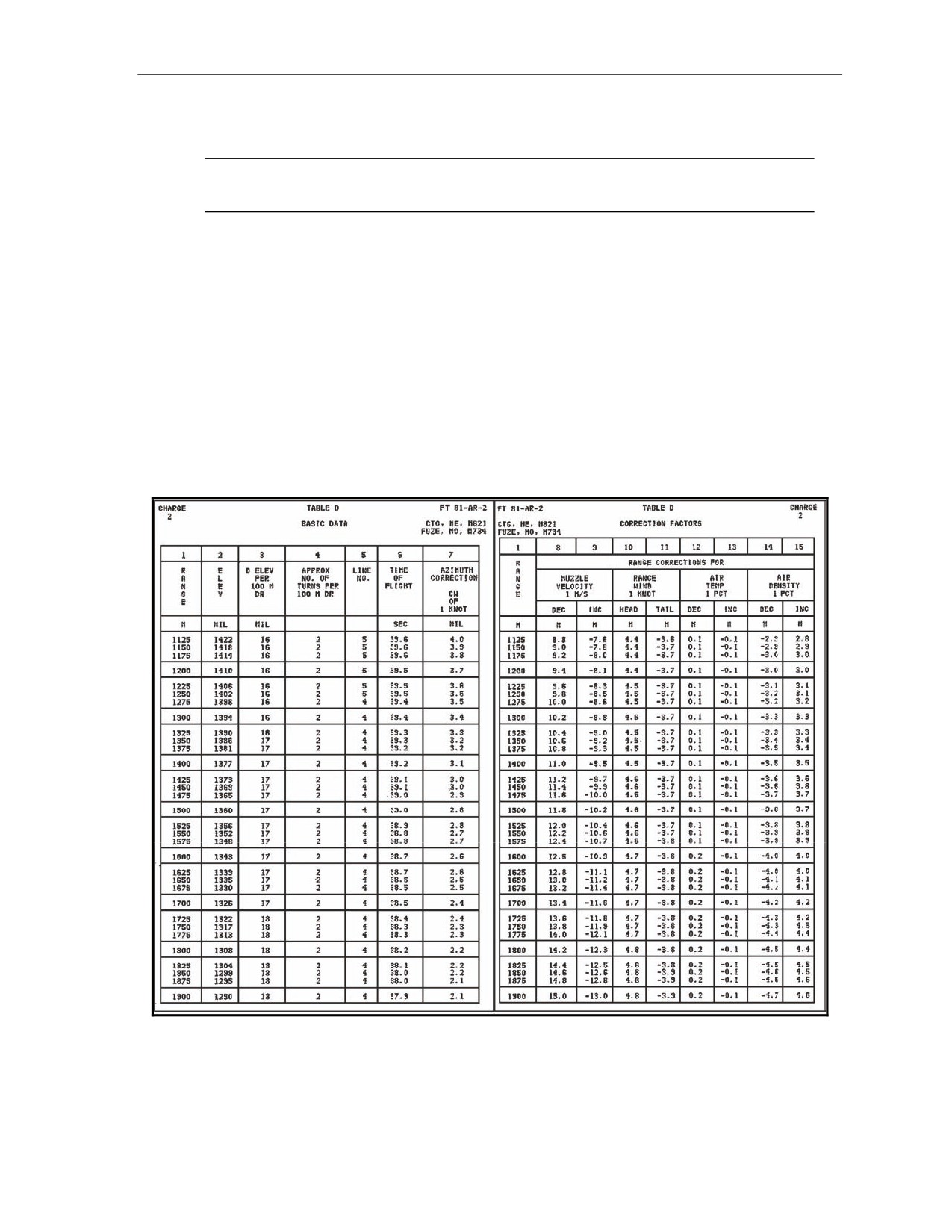
4-49. The following information describes the firing table for the 81-mm mortar. An example is shown in
Figure 4-7.
NOTE: To round off range, look for the range at the lowest charge, then round it off to the
closest range.
z
Part I contains six parts, the first of which contains data for corrections for the HE M889
cartridge. The other five parts contain firing data for a given propelling charge using the HE
M821 cartridge. Tables A, B, C, D, and E provide the same data for all mortar firing tables.
z
Part II contains four parts and provides data for the M819 cartridge, red phosphorus. All four
parts contain data for given propelling charges.
z
The appendices contain trajectory charts. The computer uses these charts to determine the height
of a round for a given charge and the nearest 100-mil elevation the round will travel to a given
range. These charts assist computer in determining what round to use during urban combat.
z
FT 81-AI-3 contains data similar to that of the FT 81-AR-2, but addresses M374A2 HE, M374
HE, M375A2 WP, M375 WP, M375A2 WP, and M301A3 illumination rounds. It also contains
a section that gives the range, elevation, and maximum ordinate for the M68 training round.
z
FT 81-AQ-1 contains data for M374A3 HE and M375A3 WP rounds similar to that contained in
FT 81-AR-2.
Figure 4-7. Sample pages from firing tables for 81-mm mortar.
17 July 2008
FM 3-22.91
4-21
Chapter 4
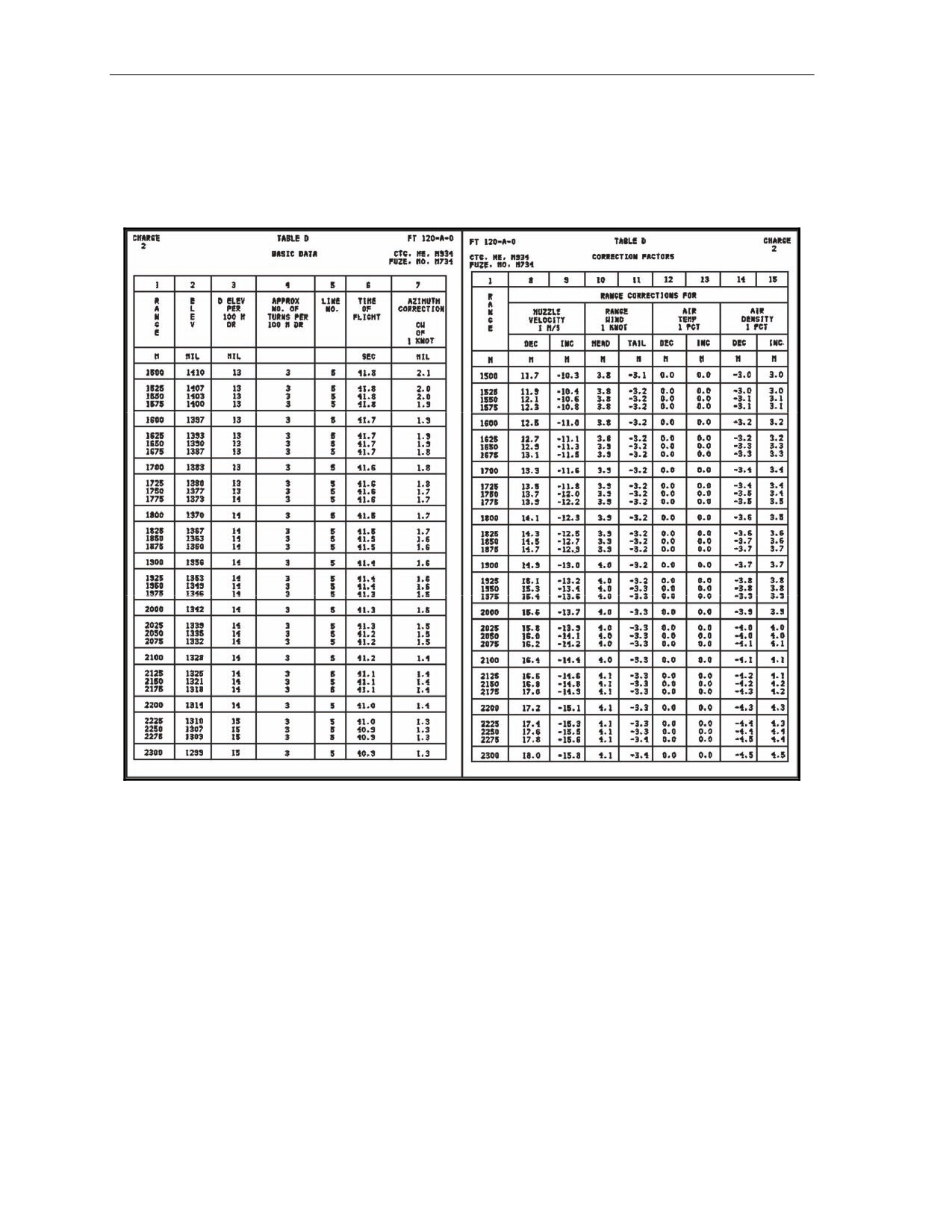
4-50. The following information describes the firing table for the 120-mm mortar. An example is shown in
Figure 4-8.
z
Parts I and II provide elevation information for use with 120-mm NDI ammunition.
z
Parts I and II provide general data, ground data, and correction factors for each round. Part I
includes M57 HE and M68 WP rounds. Part II includes the M91 illumination round.
Figure 4-8. Sample pages from firing tables for the 120-mm mortar.
DA FORM 3675-R (BALLISTIC MESSAGE)
4-51. DA Form 3675-R (Ballistic Message) and DA Form 3677-R (Computer MET Message) allow the
user to determine necessary firing data corrections so that the section has better accuracy and target effect
without re-registering every two to four hours.
USE OF METEOROLOGICAL MESSAGE
4-52. MET messages provide information about air temperature and density, and the speed and direction
of the wind between the mortar platoon and the targets. The validity of a MET message increases over
time. There are no specific rules for determining how long a MET message is usable, since that
determination depends on the atmospheric conditions.
4-53. To be valid, the MET message must be received with the initial registration mission. To ensure that
the first MET message will be current, the FDC requests a MET message shortly after setting up the
surveyed firing chart. This message alone is not adequate to determine firing corrections, but it can tell the
4-22
FM 3-22.91
17 July 2008
Major Concerns of the Fire Direction Center
FDC how many registration corrections are due to weather. After the FDC receives and computes the first
MET message, they receive a second within four hours, compare the two, and determine the data used to
update the firing equipment.
SOURCE OF METEOROLOGICAL MESSAGE
4-54. In the modular force, each BCT, whether heavy or light, will have one MET system in the fires
battalion. Each fires brigade will have three MET systems; however, owing to a lack of assets, each fires
brigade will initially be fielded with one MET system. The FA unit operations officer coordinates with the
MET station leader and unit signal staff officers to prioritize the means of communicating and
disseminating messages, and to assign radiosonde frequencies. If a ballistic MET message is necessary
(such as when only the M16 plotting board is used), the MET message can be transmitted by any means,
including a digital plain text message.
RECEIPT OF METEOROLOGICAL MESSAGE
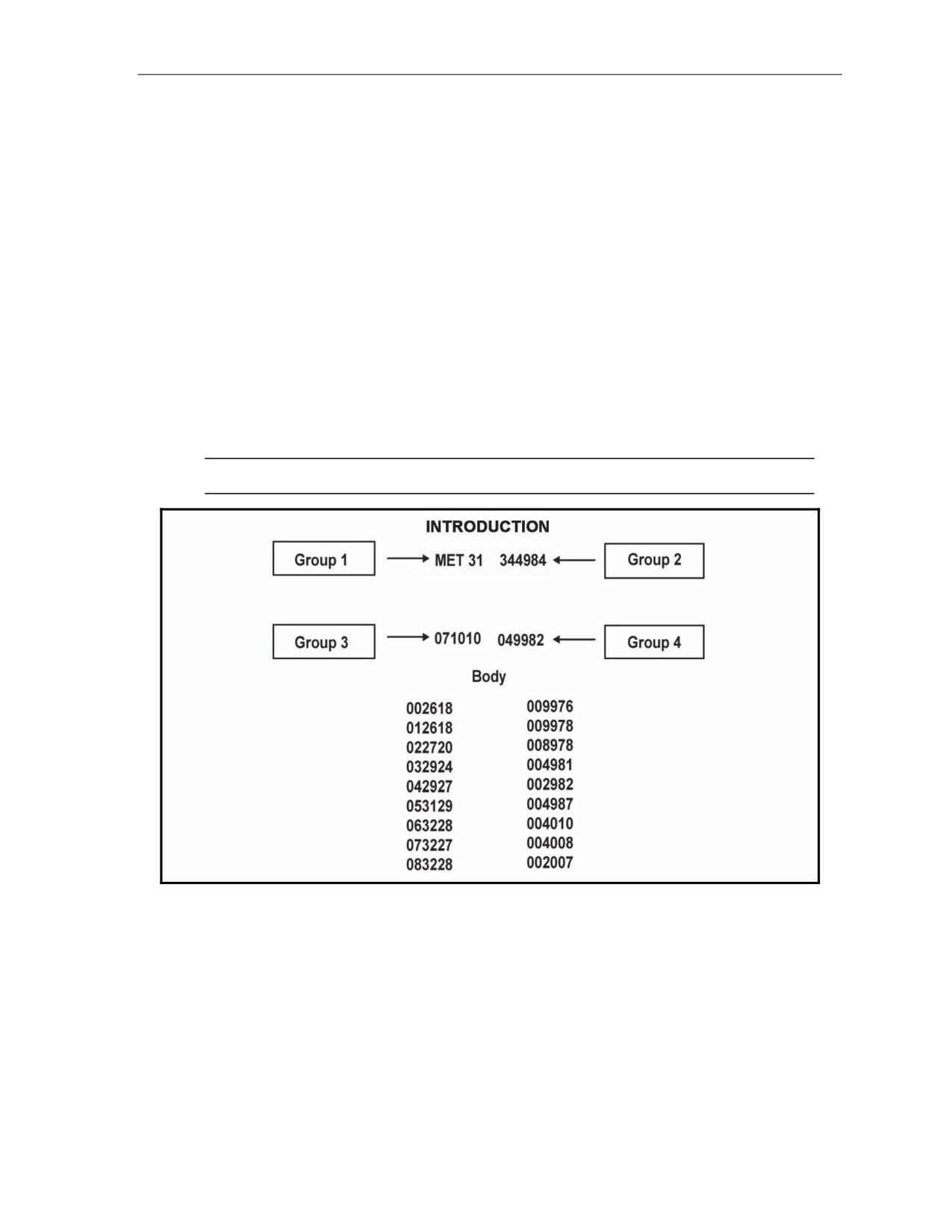
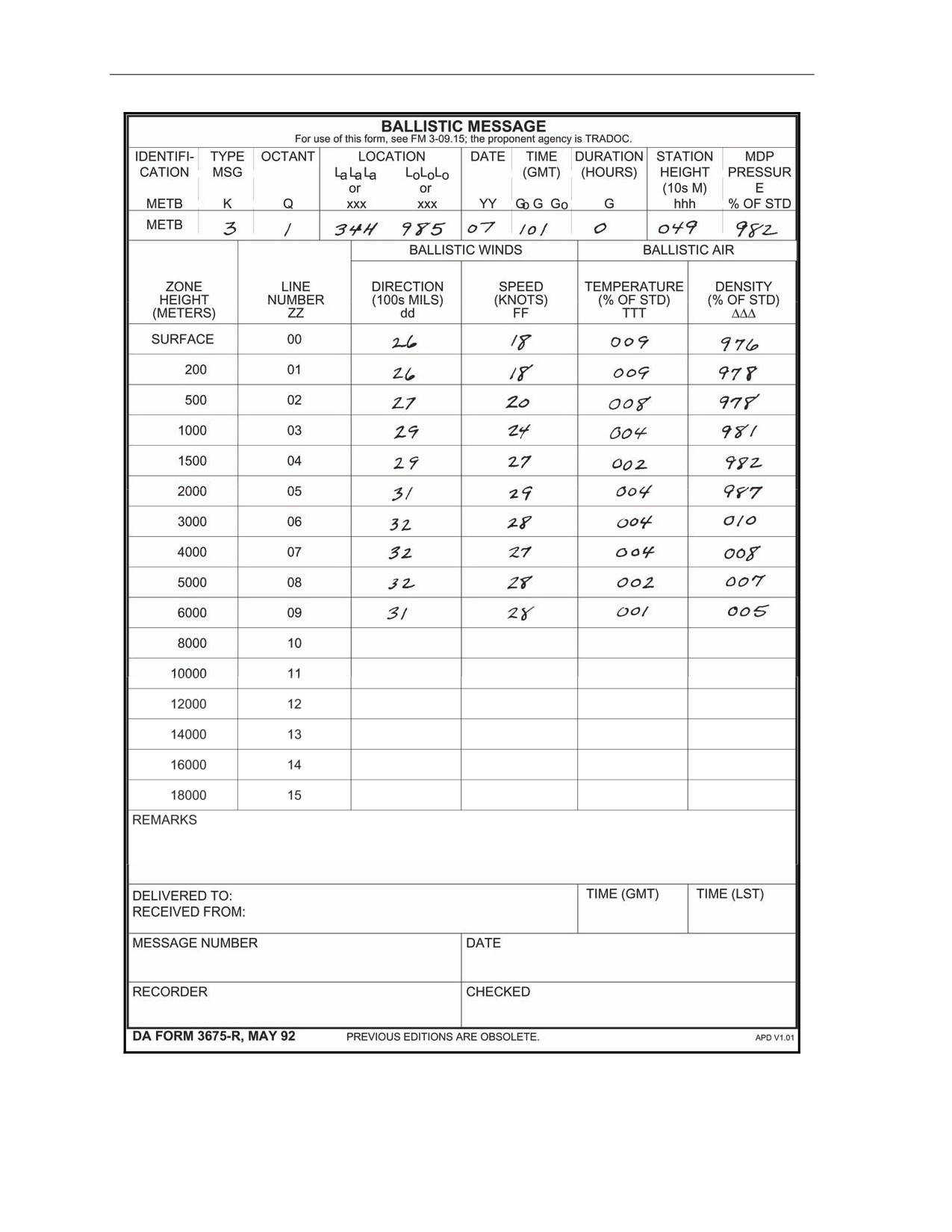
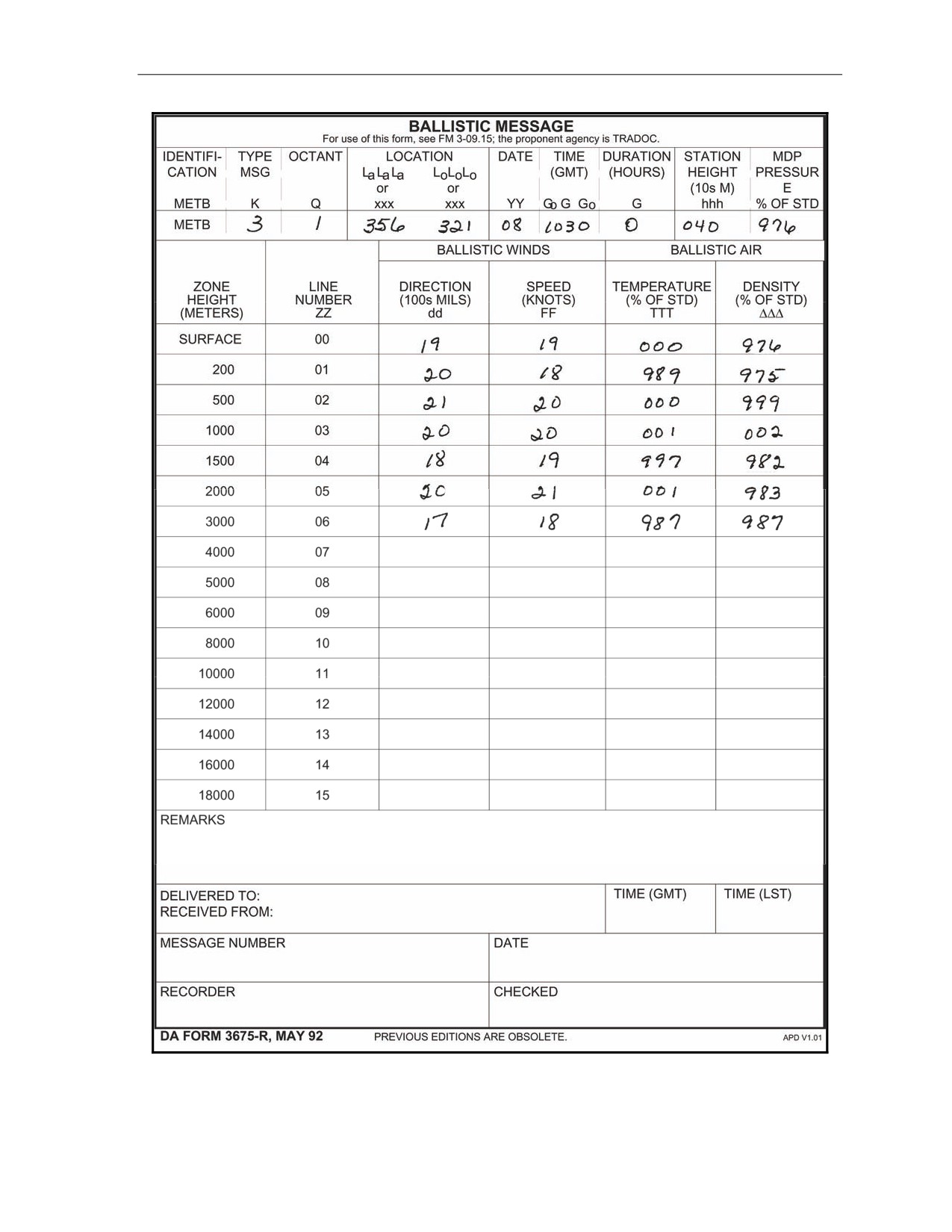
4-55. The MET message has two parts: the introduction and the body. It is broadcasted in six-character
groups, as shown in Figure 4-9. The examples of completed DA Forms 3675-R (Figure 4-10) and 3677-R
(Figure 4-11) use the same six-character groups to show how they are entered on the form.
NOTE: See FM 3-09.15 for guidance concerning the use of the aforementioned forms.
Figure 4-9. Six-character groups.
17 July 2008
FM 3-22.91
4-23
Chapter 4
Figure 4-10. Example of completed DA Form 3675-R (Ballistic Message).
4-24
FM 3-22.91
17 July 2008
Major Concerns of the Fire Direction Center
Figure 4-11. Example of completed DA Form 3675-R (Ballistic Message).
17 July 2008
FM 3-22.91
4-25

Chapter 4
Introduction
4-56. The first four character groups in the MET message, the introduction, identify the type of message
and the MET station transmitting the message. Table 4-22 identifies these character groups and explains
their meanings.
Table 4-22. Character groups in the introduction and their corresponding meanings.
CHARACTER
MEANING
Group 1: MET B 31 (METCM) for computer MET
MET
Indicates that the transmission is a MET message
B
Type of fire; indicates that the message is a ballistic MET message
3
Indicates that the message is for surface-to-surface fire
NOTE: For use with mortars, the number 3 must appear.
1
Indicates the octant of the globe in which the MET message applies
When code 9 is sent for the octant, the area is transmitted in code, not in numbers.
Example: MIF MIF
NOTE: Octants are further defined in the firing tables.
Group 2: 344985
344
Indicates the latitude of the center of the area, expressed to the nearest tenth of a degree
985
Indicates the longitude of the center of the area, expressed to the nearest tenth of a degree
Group 3: 071010
07
Indicates the day of the month
101
Indicates the hour the period of validity begins, expressed to the nearest tenth of an hour,
Greenwich mean time (GMT)
NOTE: To convert GMT to standard time, see FM 3-09.15.
0
Indicates the duration of the MET message
NOTE: For US armed forces, the MET data is presumed valid until a later message is received.
Group 4: 049982
049
Indicates the altitude of the MET station above sea level, expressed in tens of meters
982
Indicates the atmospheric pressure at the MET datum plane (MDP), expressed to the nearest one-
tenth of a percent of standard atmospheric pressure at sea level
NOTE: When this value is 100 or greater, the initial digit 1 is omitted.
4-26
FM 3-22.91
17 July 2008
Major Concerns of the Fire Direction Center
Body
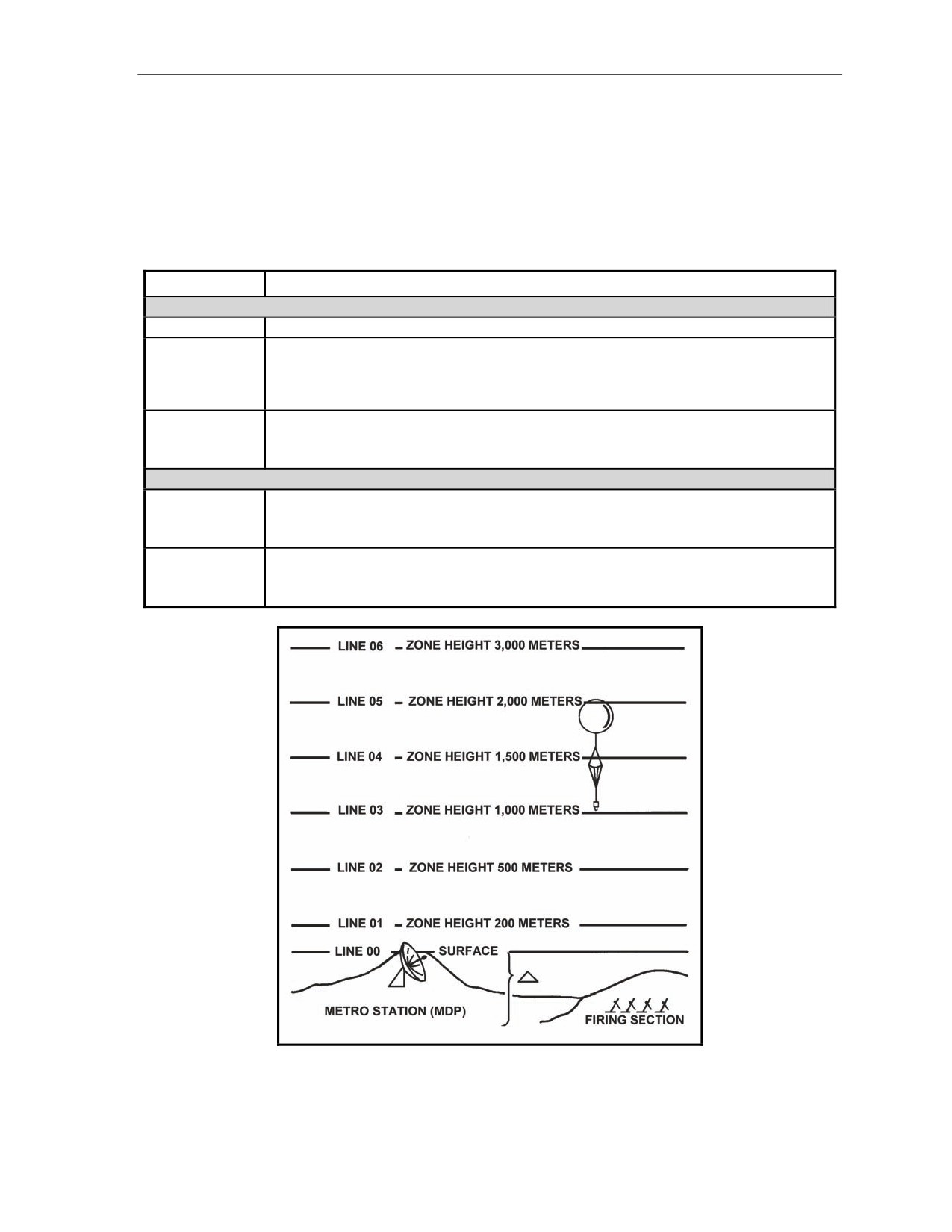
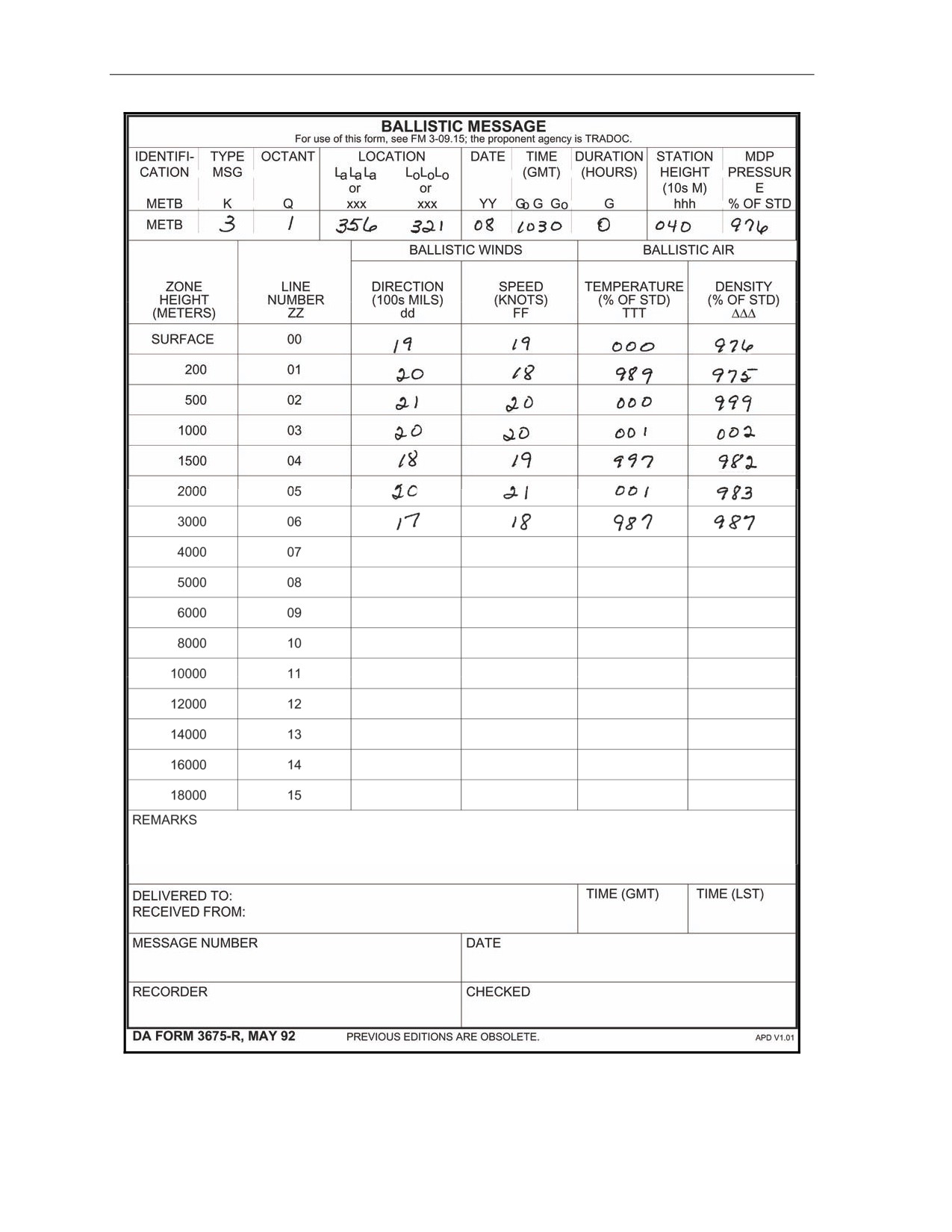
4-57. The next group of six-character blocks, the body, contains MET data listed by line number. Figure 4-
12 depicts the relationship of the line numbers and zone heights to the meteorological datum plane. Table
4-23 identifies two of the character groups and explains their meanings. The remaining 16 lines contain the
same information. Because of the height at which mortars can fire, not all 16 lines are applicable for
mortars; only the first seven lines (00-006) need to be recorded (Figure 4-13).
Table 4-23. Character groups in the body and their corresponding meanings.
CHARACTER
MEANING
002618
00
The line number indicating the standard height relative to the MDP
26
The direction from which the ballistic wind is blowing (measured clockwise from north, expressed in
hundreds of mils)
Example: This number represents 2600 mils.
18
The ballistic wind speed to the nearest knot
Example: This number represents 18 knots.
009976
009
The ballistic air temperature to the nearest 0.1 percent of standard
NOTE: The initial digit 1 is omitted when the value is 100 or greater.
976
The ballistic air density to the nearest 0.1 percent of standard
NOTE: As with temperature, the initial 1 is omitted when the value is 100 or greater.
Figure 4-12. Line number and zone height relative to meteorological data plane.
17 July 2008
FM 3-22.91
4-27
Chapter 4
Figure 4-13. Example of completed first seven lines for DA Form 3675-R
(Ballistic Message).
4-28
FM 3-22.91
17 July 2008

Major Concerns of the Fire Direction Center
RECORDING OF THE METEOROLOGICAL MESSAGE
4-58. As the battalion headquarters sends the MET message, the computer records it on DA Forms 3675-R
and 3677-R. (See FM 3-09.15 for guidance on the use of these forms.) If the computer misses something or
records the wrong information during the transmission, the format of the form allows him to ask for that
portion of the message to be repeated.
METEOROLOGICAL MESSAGE COMPUTATION
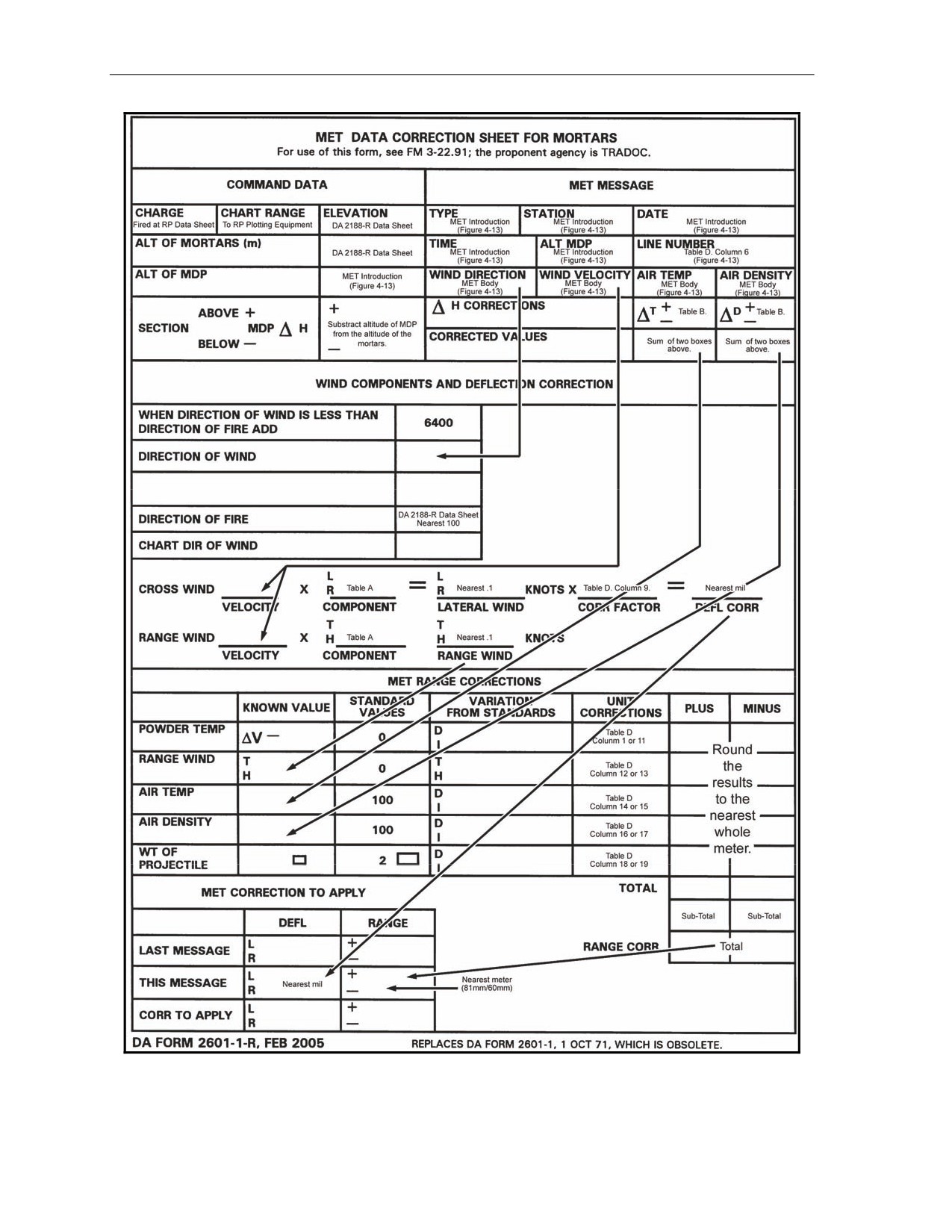
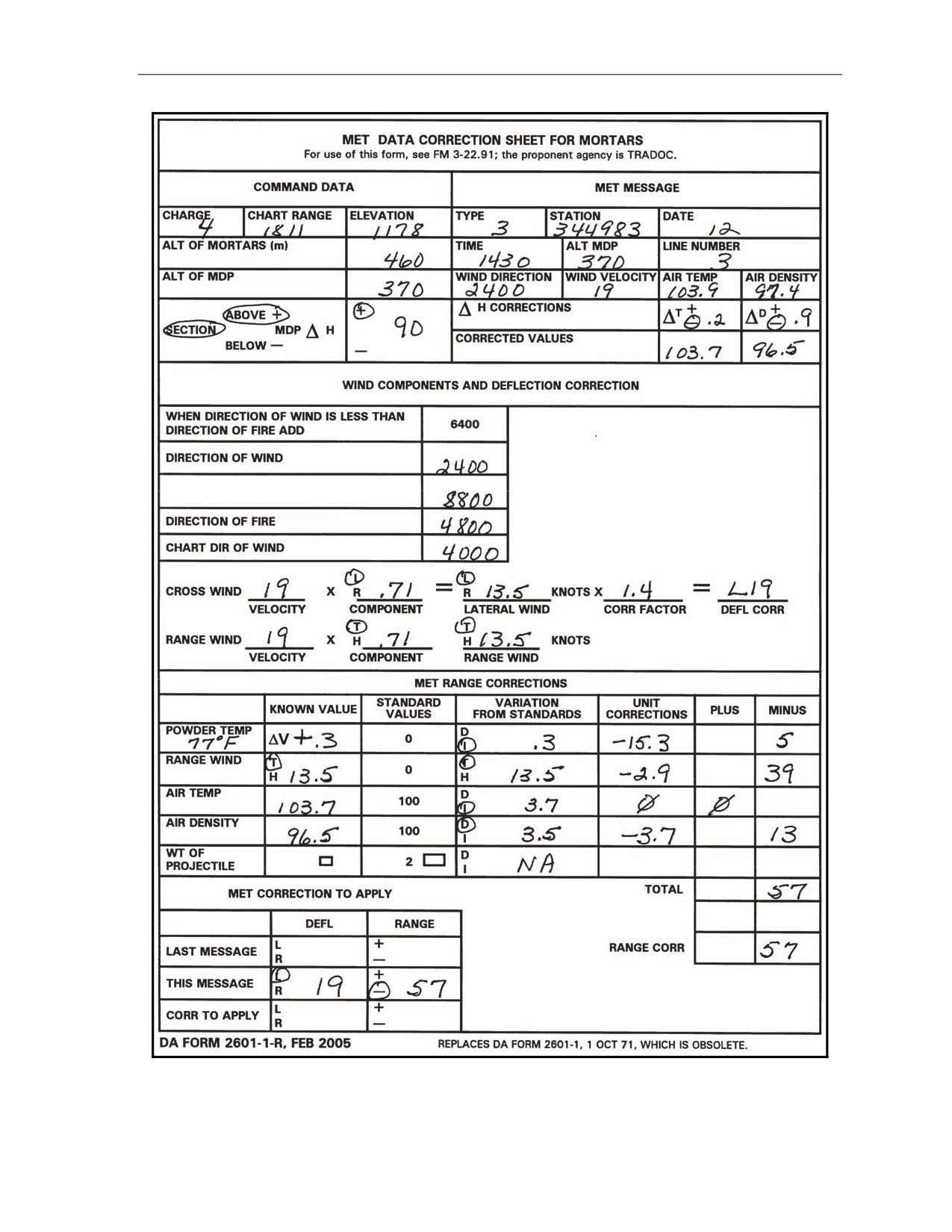
4-59. After recording the MET message, the FDC uses DA Form 2601-1-R (MET Data Correction Sheet
for Mortars) to compute the MET and determines the corrections that will be applied when updating the
firing equipment (Figures 4-14 and 4-15). Personnel record known data in the proper spaces on the form.
These data are available at the mortar platoon or section (obtained from DA Form 2188-R, DA Form 2188-
1-R, or section sergeant).
NOTE: For a blank, reproducible copy of DA Form 2601-1-R, see the back of this publication.
4-60. Table 4-24 highlights the fields found in this form and provides more information about each area.
Table 4-24. DA Form 2601-1-R (MET Data Correction Sheet for Mortars) field titles and
information documented in each field.
FIELD
INFORMATION DOCUMENTED IN FIELD
Charge
The command charge used to hit the RP
NOTE: This charge is used to determine the line number to be used for computing the
message.
Chart Range
The command range from the mortar platoon or section to the RP
NOTE: Using the command charge and range puts the round at its highest ordinate for that
range, where the round is affected most.
Elevation
The elevation used to hit the RP
Altitude of Mortars
The altitude of the mortar platoon or section to the nearest 10 meters
Line Number
The number in this field is used for the MET and can be recorded before the MET message is
received. To do so, the computer enters the firing tables as follows:
•
For 60-, 81-, or 120-mm mortars, find the command charge. Go to column 1 (range)
and find the command range. Go to column 5. The number at that range in column 5
is the line number.
•
Once the FDC has received and recorded the MET message, record the introduction
and information from the line number being used.
•
Since the altitude of the MDP is expressed in tens of meters and the wind direction is
expressed in hundreds of mils, change them to read their actual values. Then,
determine the MET values (the corrections for this MET).
Direction of Fire
The azimuth to the RP to the nearest 100 mils
Powder Temp
The temperature of the propellants
NOTE: If the temperature of the powder cannot be determined, air temperature at the platoon
or section can be used.
17 July 2008
FM 3-22.91
4-29
Chapter 4
Figure 4-14. Data guide for DA Form 2601-1-R (MET Data Correction Sheet for Mortars).
4-30
FM 3-22.91
17 July 2008
Major Concerns of the Fire Direction Center
Figure 4-15. Example of completed DA Form 2601-1-R (MET Data Correction
Sheet for Mortars).
17 July 2008
FM 3-22.91
4-31
Chapter 4
AIR TEMPERATURE AND AIR DENSITY CORRECTIONS
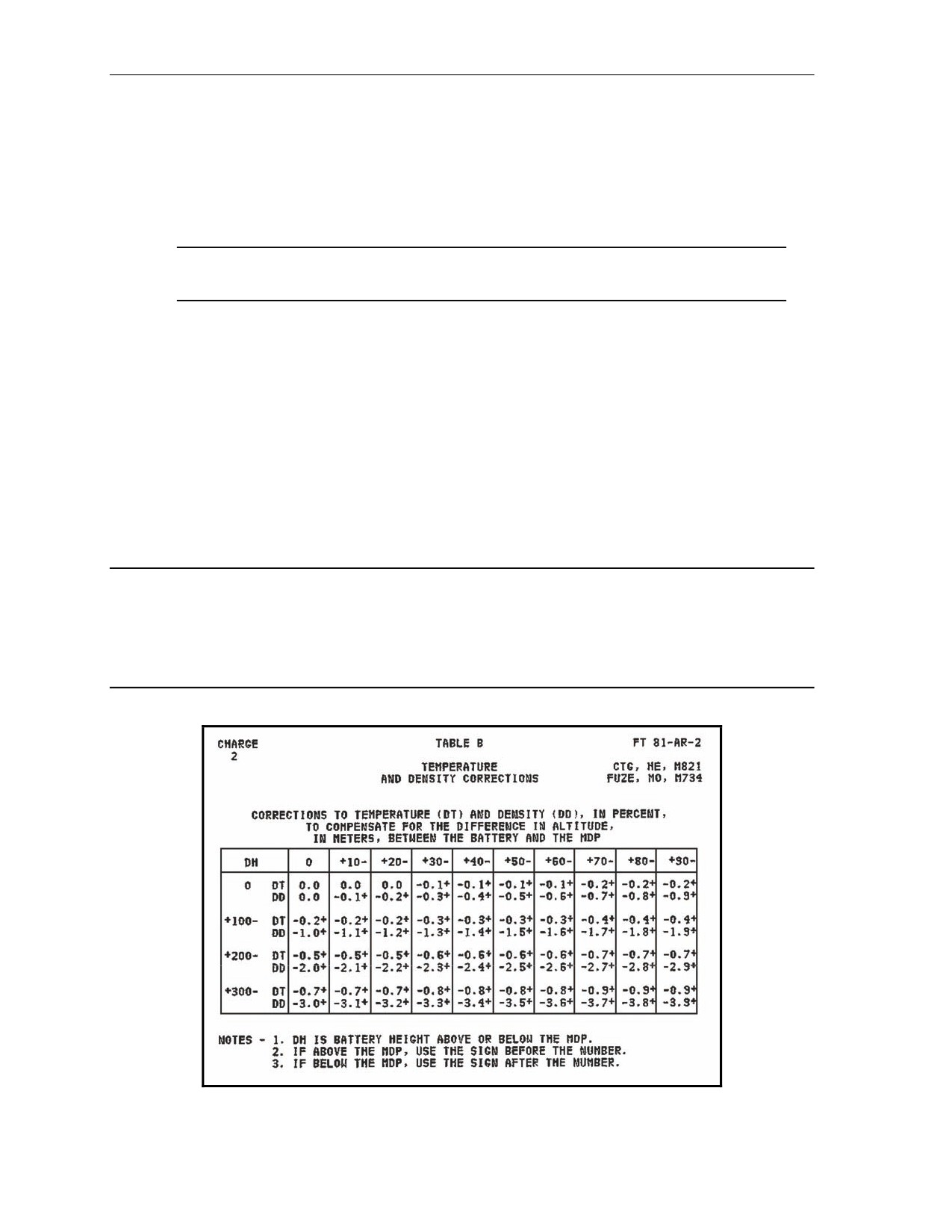
4-61. To determine the corrected values for air temperature and density—
(1) The computer must determine the location of the platoon or section in relationship to the MDP
(difference in H correction). To do so, he compares the altitude of the section and the MDP, and
subtracts the smaller from the larger. The remainder is the height of the platoon or section above
or below the MDP.
NOTE: If the altitude of the section is above the MDP, the sign is plus (+); if below, the sign is
minus (-).
(2) Once he has calculated the distance above or below the MDP, the computer can enter Table B
(Figure 4-16), which shows the correction that must be applied to the ballistic AIR TEMP AIR
DENSITY on the DA Form 2601-1-R (Figure 4-14). This correction compensates for the
difference in altitude between the platoon or section and the MDP, and determines the
corrections for AIR TEMP (difference in T) and AIR DENSITY (difference in D). Those
corrections modify the AIR TEMP and AIR DENSITY determined at the MDP to determine
values at the mortar platoon or section. Corrections for a difference in T and a difference in D
are arranged in four double rows in the table.
(3) The numbers 0, +100-, +200-, and +300- in the left column of the table represent a difference in
H expressed in hundreds of meters. The numbers 0 and +10- through +90- across the top
represent a difference in H in tens of meters. The corrections can be found where the proper
hundreds row crosses the proper tens column. The numerical sign of the corrections is opposite
of the difference in H sign.
EXAMPLE
Assume that the difference in H is -30, the corrected value for the difference in H is +0.1, and the
difference in D is +0.3 (enter a 0 in hundreds column, go across to +30-column). Those corrections
are entered on DA Form 2601-1-R, and the corrected values can then be determined and recorded in
the proper spaces.
Figure 4-16. Sample page from firing table for air temperature and density corrections.
4-32
FM 3-22.91
17 July 2008
Major Concerns of the Fire Direction Center
WIND COMPONENT CORRECTIONS
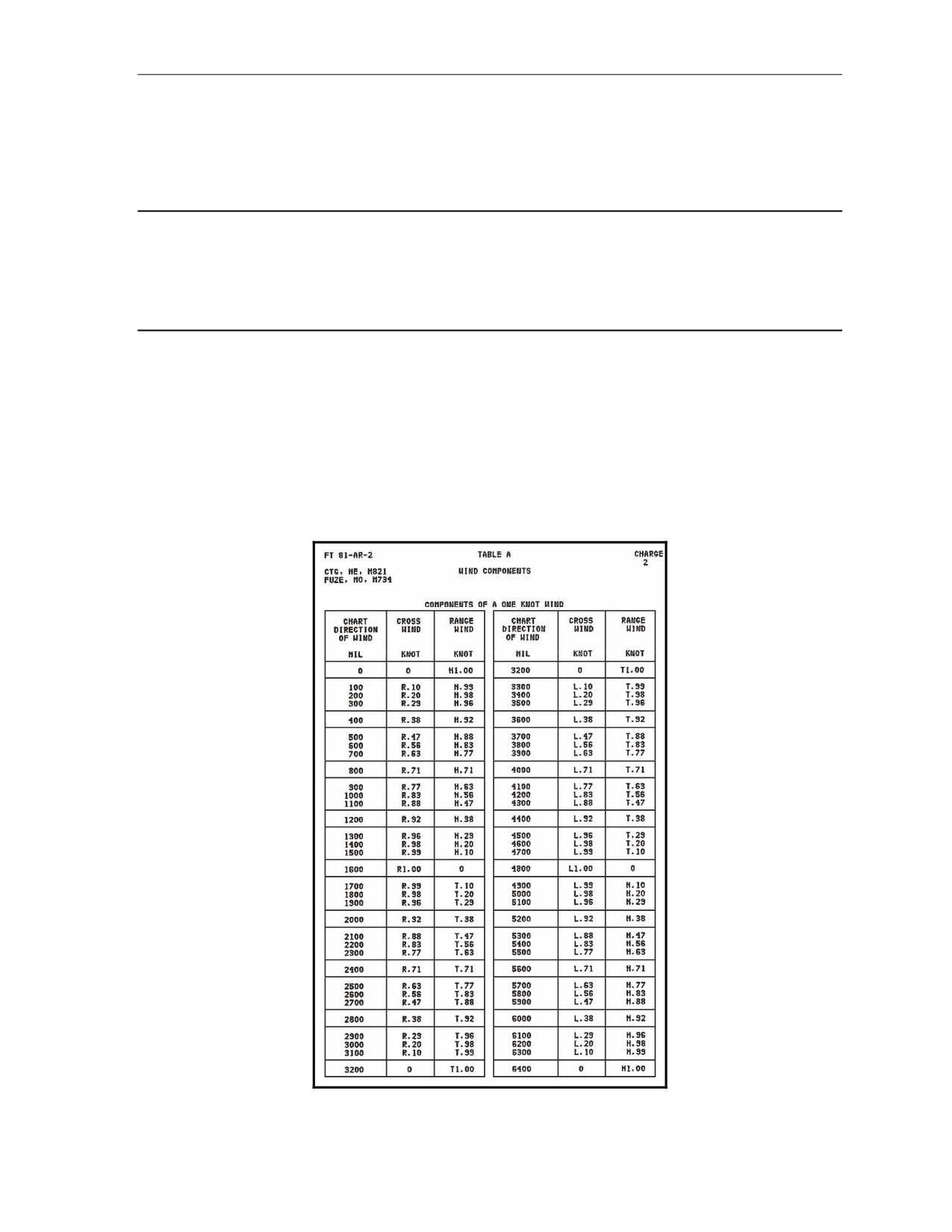
4-62. To determine corrections for wind components—
(1) The computer compares the direction of wind and the direction of fire (DOF). If the direction of
wind is less than the DOF, it adds 6400 mils, and then subtracts the DOF.
EXAMPLE
DOF 4300
DIRECTION OF WIND (MET) 2900
2900 + 6400 = 9300 - 4300 = 5000 mils (chart direction of wind)
(2) He then uses the remainder (CHART DIRECTION OF WIND) to enter Table A at the CHART
DIRECTION OF WIND (Figure 4-17). Table A divides a 1-knot wind into crosswind and range
wind components to show the effect on a round in flight. The chart direction of wind is the angle
formed by the DOF and direction of wind.
(3) The computer reads across that row to find the crosswind and range wind components, and
records them in the proper spaces in DA Form 2601-1-R.
(4) Once the wind components have been determined, the computer determines crosswind and
range wind corrections.
Figure 4-17. Sample page from firing table for wind components.
17 July 2008
FM 3-22.91
4-33
Chapter 4
Crosswind (Deflection Correction)
4-63. To determine the deflection correction—
(1) The computer multiplies the wind speed (Table A) by the wind velocity (MET). This yields the
lateral wind.
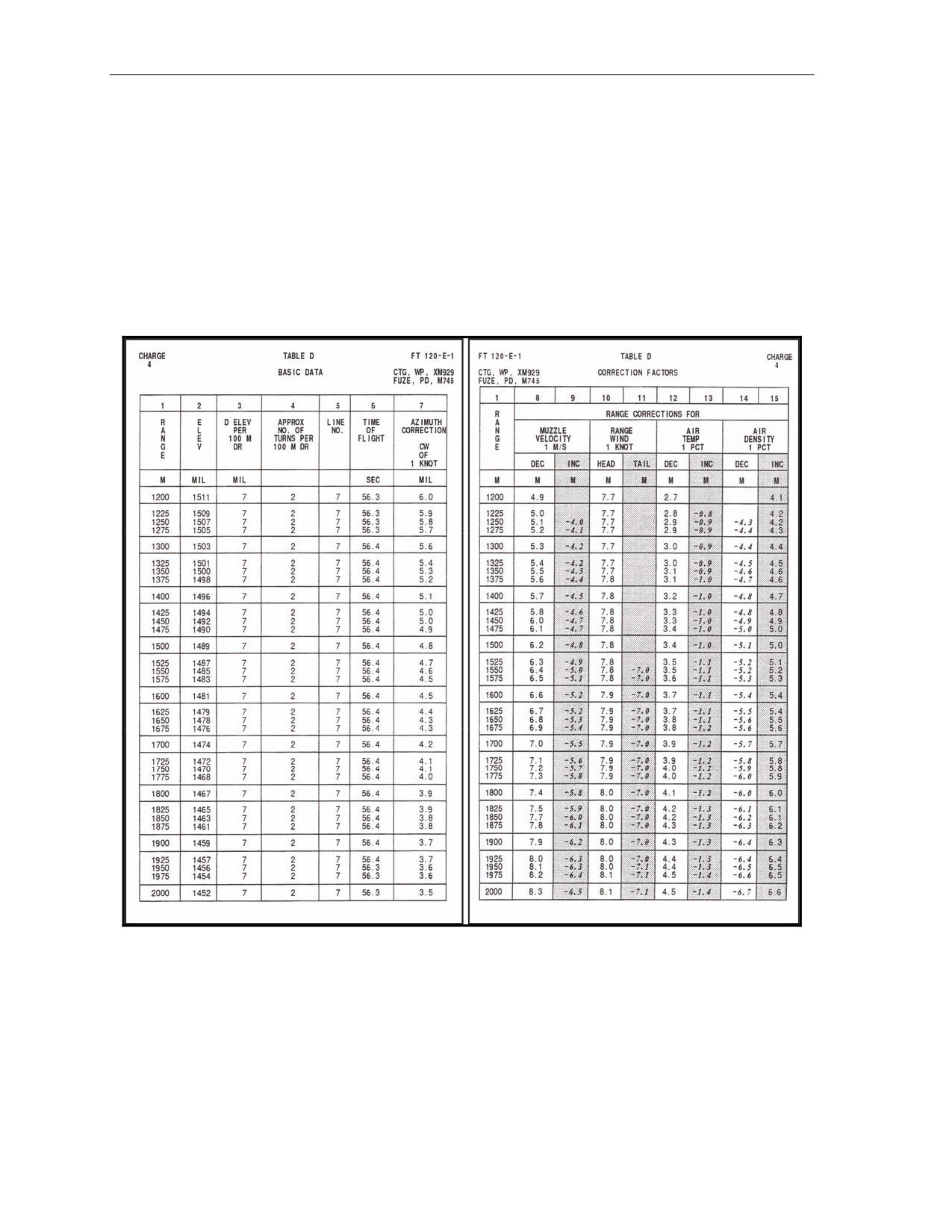
(2) Once the lateral wind is determined, he enters Table D (Figure 4-18), goes to column 7 (60-
mm/81-mm/120-mm mortars), and finds the correction factor.
(3) He records the correction factor in the proper space, multiplies it by the lateral wind, carries the
sign of the component (left/right), and determines the product to the nearest mil.
(4) The product is the deflection correction for this MET. The computer records it in the proper
space on DA Form 2601-1-R.
Figure 4-18. Sample pages from firing table for basic data and correction factors.
Range Wind
4-64. To determine the range wind, the computer—
(1) Multiplies the component by the wind speed.
(2) Carries the sign of the component (H or T from Table D).
(3) Determines to the nearest 0.1 mil.
(4) Records it in the proper space on DA Form 2601-1-R.
4-34
FM 3-22.91
17 July 2008
Major Concerns of the Fire Direction Center
Range Corrections
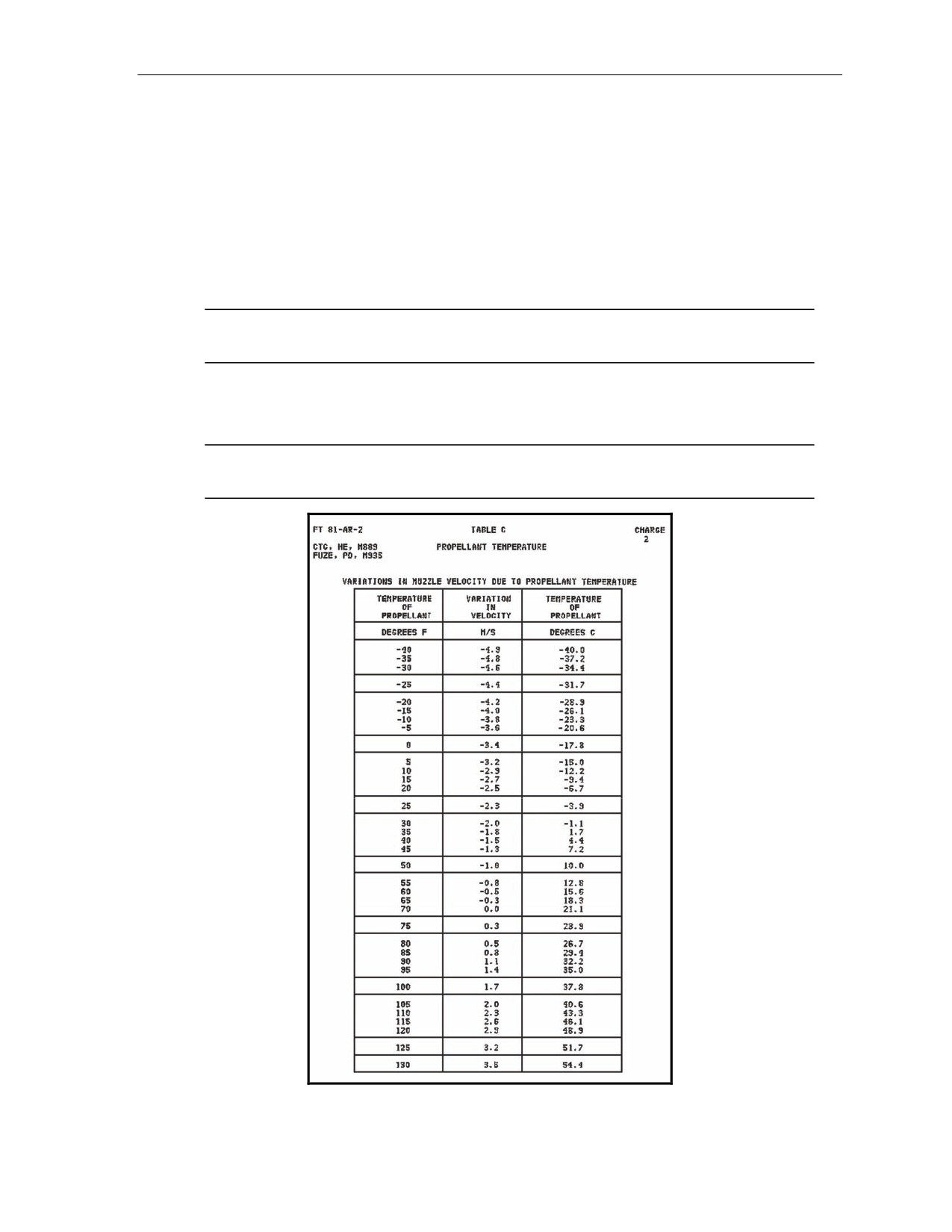
4-65. All values should be recorded in the proper spaces except DV, which is found as follows:
(1) The computer enters Table C, which shows the corrections to the muzzle velocity for various
temperatures of the propellant charges (Figure 4-19).
(2) He finds the temperature closest to that recorded for the propellant; DV appears in the center
column on the same line as the temperature.
(3) The computer records that value in the proper space.
(4) Then, he determines the amount by which all known values vary from the standard values upon
which the firing tables are based.
NOTE: Within the firing tables, D means decrease from standard, and I means increase from
standard.
(5) Once those variations are determined, the computer enters Table D (Command Charge and
Range, 60-mm/81-mm/120-mm mortar, Figure 4-18) goes to columns 8 to 15 (60-mm, 81-mm,
and 120-mm), and records the unit corrections for each variation.
NOTE: The sign of the unit correction must be recorded; numbers without a sign are a plus (+).
If the column ends, the last listed numbers are considered to continue.
Figure 4-19. Sample page from firing table for propellant temperature.
17 July 2008
FM 3-22.91
4-35
Chapter 4
(6) Once the variations have been recorded, the computer multiplies the variations from standard by
the unit corrections and places the result (rounded to the nearest whole meter) in the column
with the same sign as the unit correction.
(7) Once all corrections have been multiplied, the computer compares the minus (-) and plus (+),
subtracts the smaller form the larger, and uses the sign of the larger. He determines the result to
the nearest meter for 60-mm/ 81-mm/120-mm mortars and records it in the proper space.
COMPUTER METEOROLOGICAL MESSAGE
4-66. Instead of the ballistic MET that FDC personnel use when manually plotting with the M16 plotting
board, the M23 MBC, M95/96 MFCS, and the LHMBC, along with artillery, use computerized MET
(CMET). The following example highlights CMET with the M23 MBC.
NOTE: See Chapter 15 for the MFCS CMET and Chapter 17 for the LHMBC CMET.
4-67. When no MET is available, the computer uses the standard MET that is stored within itself. The
MET menu has two main options: new and current. When a new MET message is received, it is entered
into the computer using the new option in the MET menu. Once the update * option is selected, the new
MET becomes the current MET and is applied to the firing data.
EXAMPLE
METEOROLOGICAL: NEW
QUADRANT: 0
LATITUDE: 322
LONGITUDE: 845
DATE: DAY: 02
TIME: 100
DURATION: 0
STATION HEIGHT: 014
ATMOSPHERIC PRESSURE: 003
00
231
002
2957
1003
01
200
008
2937
0902
02
230
013
3013
0064
03
185
009
2980
0921
04
000
000
2940
0868
05
074
013
2935
0820
06
057
023
2931
0074
07
067
027
2897
0730
08
070
029
2861
0688
4-68. To input new MET data—
(1) Press the MET switch. “MET: NEW CURRENT” displays. Using multiple choice entry, select
NEW.
(2) Press the SEQ switch. Using numeric entry, enter the quadrant— 0.
(3) Press the SEQ switch. Using numeric entry, enter the latitude and longitude— 322 and 845.
(4) Press the SEQ switch. Using numeric entry, enter the day of the month and time of the MET
message (CMT)—02 and 100.
(5) Press the SEQ switch. Using numeric entry, enter the duration, station altitude, and atmospheric
pressure—0, 014, and 003.
4-36
FM 3-22.91
17 July 2008
Major Concerns of the Fire Direction Center
(6) Press the SEQ switch. Using numeric entry, enter wind direction and speed for line 00— 231
and 002.
(7) Press the SEQ switch. Using numeric entry, enter the temperature and air pressure for line 00—
2957 and 1003.
(8) Using the procedures above, repeat steps (6) and (7) to line 9.
(9) Press the SEQ switch. After line 8, UPDATE MET * is displayed. Using the multiple choice
entry, select the flashing asterisk (*) to update the NEW MET stored in the MBC, placing the
NEW MET in the CURRENT MET file, while retaining a copy in the NEW file. Sequence to
ready.
NOTE: The MBC, M23, calculates the effect of the MET on the round when determining firing
data. Only new MET files may be changed, and then they must be updated to the current file.
(10) To check MET, enter the MET switch, select CURR, and review the MET message.
(11) If a change is needed, enter NEW, make the necessary corrections, and select UPDATE MET *.
6400-MIL METEOROLOGICAL MESSAGE
4-69. The target area is usually larger than the transfer limits of the RP, and yet time, ammunition, and the
tactical situation will permit firing only one registration.
4-70. By assuming negligible error in surveys or maps, lay of the weapons, and preparation of the plotting
boards or MBC computer, the FDC can divide registration corrections for the RP into two corrections. The
first is a function of the range fired; it is constant for a given range, regardless of direction. The second is a
function of the direction fired.
4-71. If the amount of concurrent MET computed for the RP is subtracted from the total registration
correction, the result is an absolute registration correction that does not change with the direction fired or
the weather. The FDC can then plot an imaginary RP at the same range as the original RP, but in other
directions (800 mils apart), compute a MET correction for each of those directions, and, by adding the
different MET corrections to the absolute registration correction, determine different firing corrections for
each of the imaginary RPs. The firing corrections determined for the imaginary RPs can be applied when
engaging targets within their transfer limits.
COMPUTATION OF METEOROLOGICAL CORRECTIONS FOR
LARGE SECTOR CAPABILITY
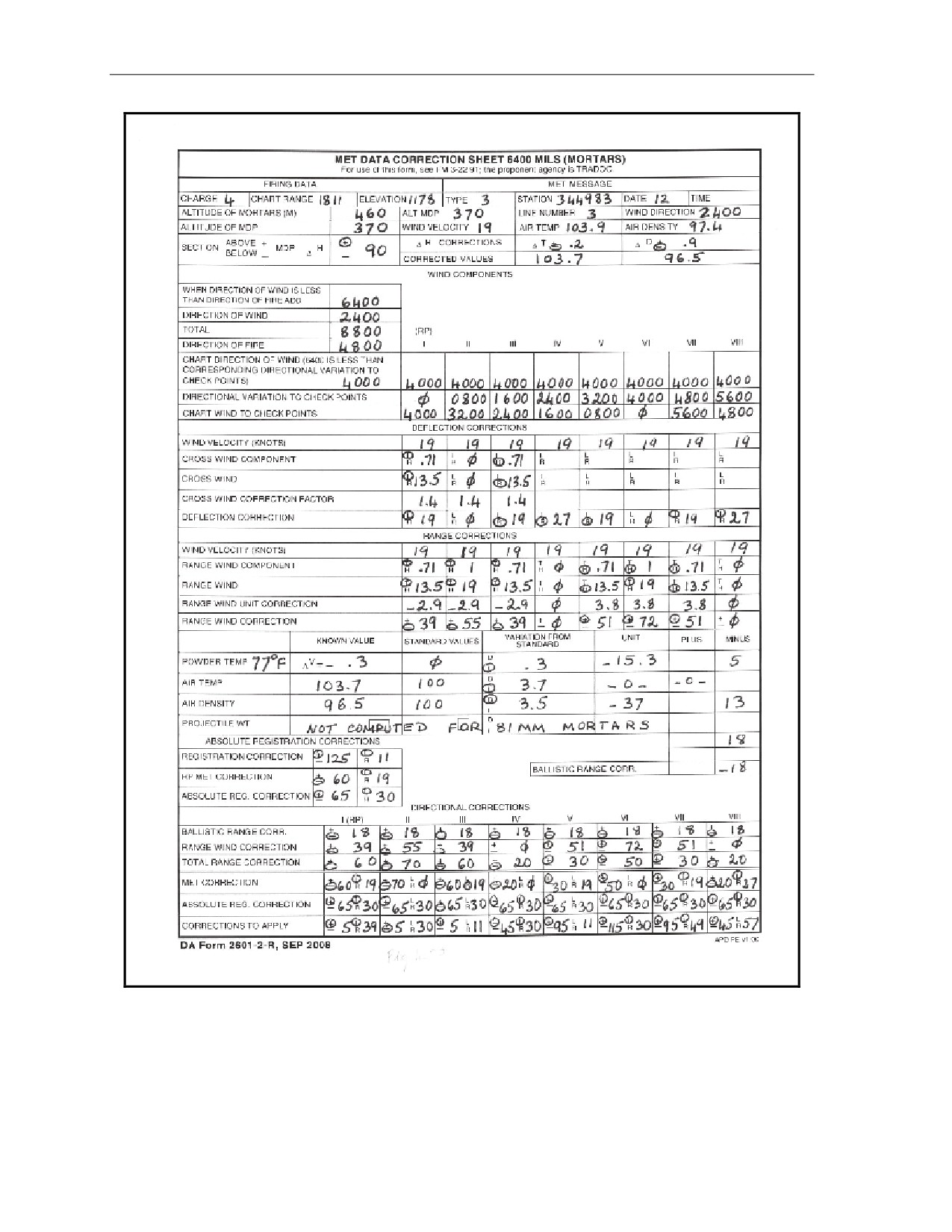
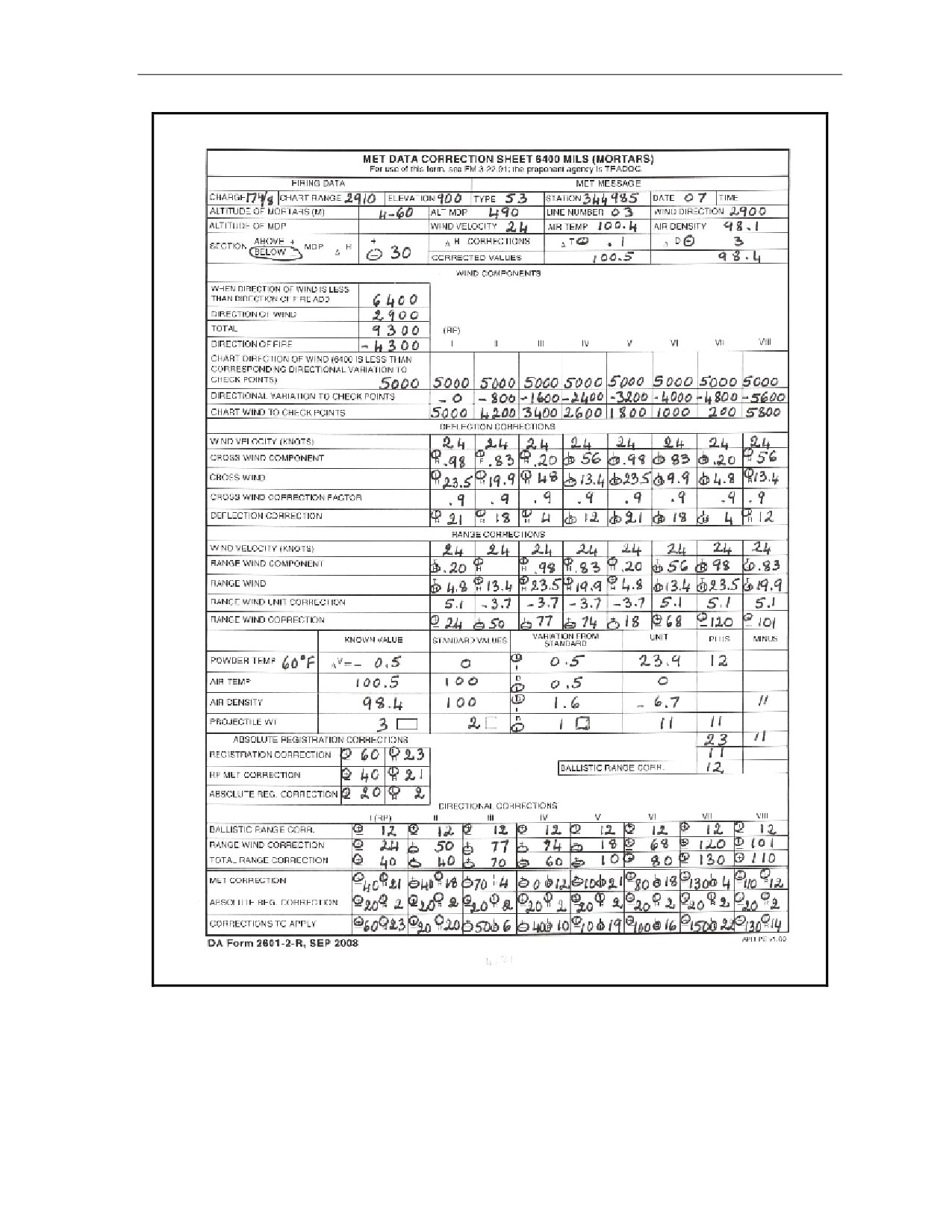
4-72. A special worksheet, such as DA Form 2601-2-R (MET Data Correction Sheet 6400 Mils [Mortars])
(Figures 4-20 and 4-21), is needed to compute multiple MET corrections from a single registration. The
supplemental (imaginary) RPs are spaced 800 mils apart, extending to the right and left of the RP as far as
needed to cover the sector of responsibility. DA Form 2601-2-R shows a full 6400-mil capacity. On the
firing chart, imaginary RPs are plotted at the same range from the mortar position as the real RP. Following
is the process that the FDC uses to compute MET corrections.
NOTE: For a blank, reproducible copy of DA Form 2601-2-R, see the back of this manual.
17 July 2008
FM 3-22.91
4-37
Chapter 4
Figure 4-20. Example of completed DA Form 2601-2-R
(MET Data Correction Sheet 6400 mils [Mortars]).
4-38
FM 3-22.91
17 July 2008
Major Concerns of the Fire Direction Center
Figure 4-21. Example of completed DA Form 2601-2-R
(MET Data Correction Sheet 6400 mils [Mortars]) for a full 6400-mil capacity.
17 July 2008
FM 3-22.91
4-39
Chapter 4
(1) Complete the top section of the sheet, and compute the difference in H corrections and the
corrected values for AIR TEMP and AIR DENSITY.
(2) Determine the CHART DIRECTION OF WIND. Record the result in the box marked I (RP),
and copy the result in as many boxes as there are imaginary RPs (II is 800 mils clockwise from
the RP, and the numbers increase in a clockwise direction to VIII, which is
800 mils
counterclockwise from the RP).
(3) Add the directional variations to the CHART DIRECTION OF WIND, subtracting 6400 if the
result is more than 6400.
(4) Copy the wind velocity into the first row of boxes under DEFLECTION CORRECTIONS and
RANGE CORRECTIONS. Do not use any column that does not have the CHART DIRECTION
OF WIND written on top.
(5) From Table A (Figure 4-17), extract the appropriate crosswind (record it in the DEFLECTION
CORRECTIONS section) and range wind (record it in the RANGE CORRECTIONS section)
components for each value of CHART WIND TO CHECKPOINTS.
(6) Multiply the velocity by the components to get values for crosswind and range wind.
(7) Find the crosswind correction factor corresponding to the adjusted RP charge in Table D,
(column 7, 60-mm/81-mm/ 120-mm mortars). Multiply it by the crosswind to get the MET
DEFLECTION CORRECTION.
(8) Find the proper range wind unit correction in Table D, (columns 10 and 11, 60-mm/81-mm
mortars). Multiply it by the range wind to get the RANGE WIND CORRECTION.
(9) Compute the MET RANGE CORRECTIONS for POWDER TEMP, AIR TEMP, AIR
DENSITY, and PROJECTILE WT in the usual manner. The net of the four is the ballistic range
correction.
(10) Combine the ballistic range correction with the various range wind corrections to obtain the total
range corrections.
(11) Obtain the total MET corrections by bringing together the MET RANGE CORRECTION and
the MET DEFLECTION CORRECTION for each of the points.
(12) Determine the absolute registration correction. First, calculate the registration correction. The
registration range correction is the difference between the chart range to the RP and the range
corresponding to the initial range at the RP; it is plus if the chart range is smaller. The
DEFLECTION CORRECTION is the LARS (left, add; right, subtract) correction, which must
be applied to the initial deflection read at the RP to get the firing deflection that hit it. The RP
MET correction, which has been recorded under I (RP), is then subtracted from the registration
correction; the result is the absolute registration correction.
(13) Add the absolute registration correction to each point MET correction to obtain the corrections
to apply at the points.
METEOROLOGICAL CORRECTIONS
4-73. To place fire on a target without adjustment, the FDC must know the target’s exact location and must
be able to compensate for all nonstandard conditions. Registration and re-registration are the most accurate
methods of determining and maintaining firing corrections, but re-registration is not always practical.
Between registrations, the MET message helps to determine corrections due to changes in conditions that
affect the flight of rounds. Those conditions include changes in powder temperature, air temperature, air
density, and the speed and direction of the wind. The FDC assumes that all other factors remain relatively
constant until the section displaces.
4-74. Corrections computed from MET messages are not adequate firing corrections alone, but the use of
MET corrections can eliminate the need for re-registration. To be of value to the FDC, a valid MET
message must be received with or within four hours of the registration. Computing this MET message with
the registration tells the FDC how much of the total registration correction is due to weather. By comparing
the corrections from a later MET message, the FDC can modify the registration corrections to account for
changes in weather.
4-40
FM 3-22.91
17 July 2008
Major Concerns of the Fire Direction Center
4-75. For MET corrections to be of use, the FDC must receive two MET messages. The corrections from
the two are compared to determine the current corrections to update the firing corrections determined from
the registration. Once the two messages are computed, the correcting areas (deflection correction and range
correction) are compared, and the product is used to update the registration corrections.
EXAMPLE
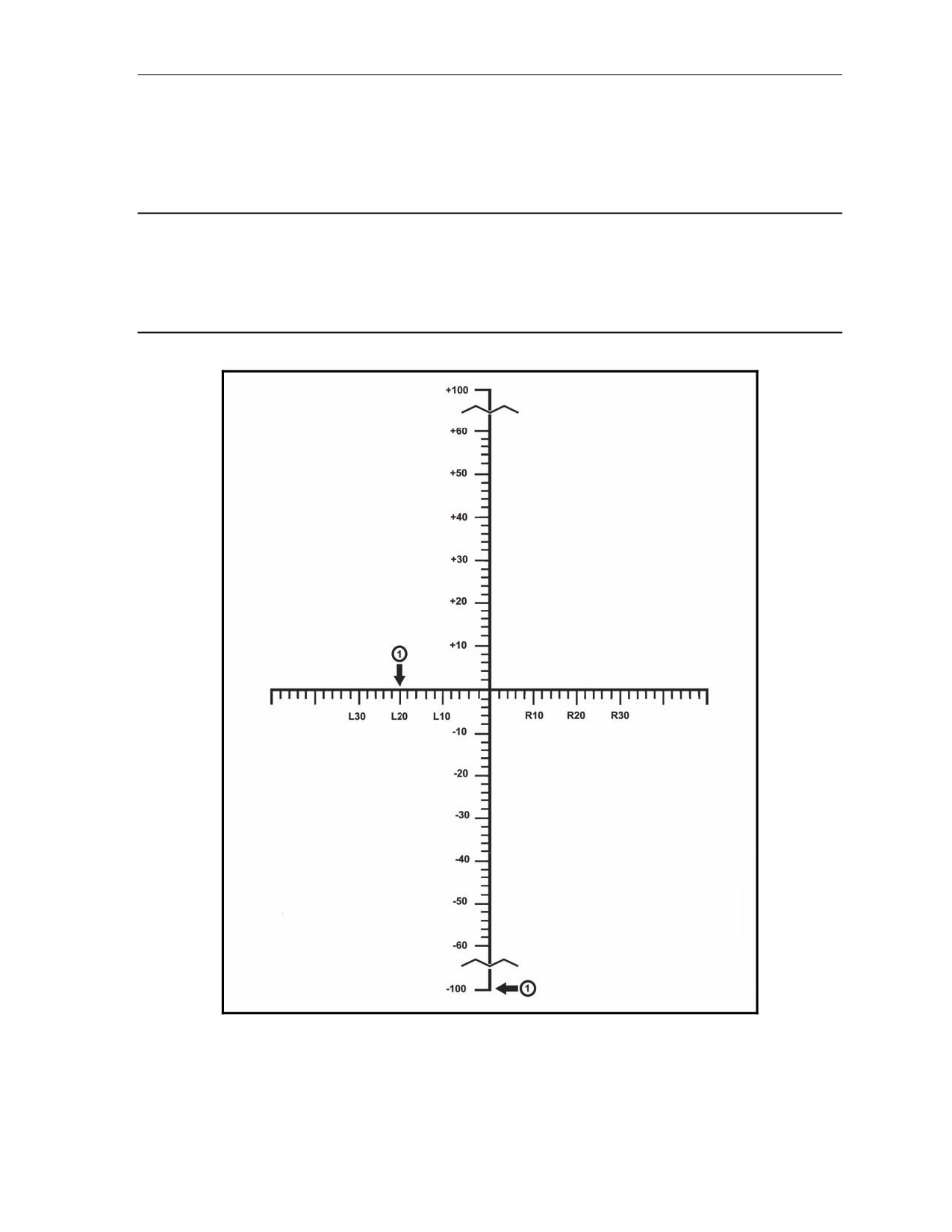
Assume that:
MET 1:
Deflection correction L20 (Figure 4-22)
Range correction -100
Place the correction from the MET message on a MET cross.
Figure 4-22. Initial meteorological message.
17 July 2008
FM 3-22.91
4-41
Chapter 4
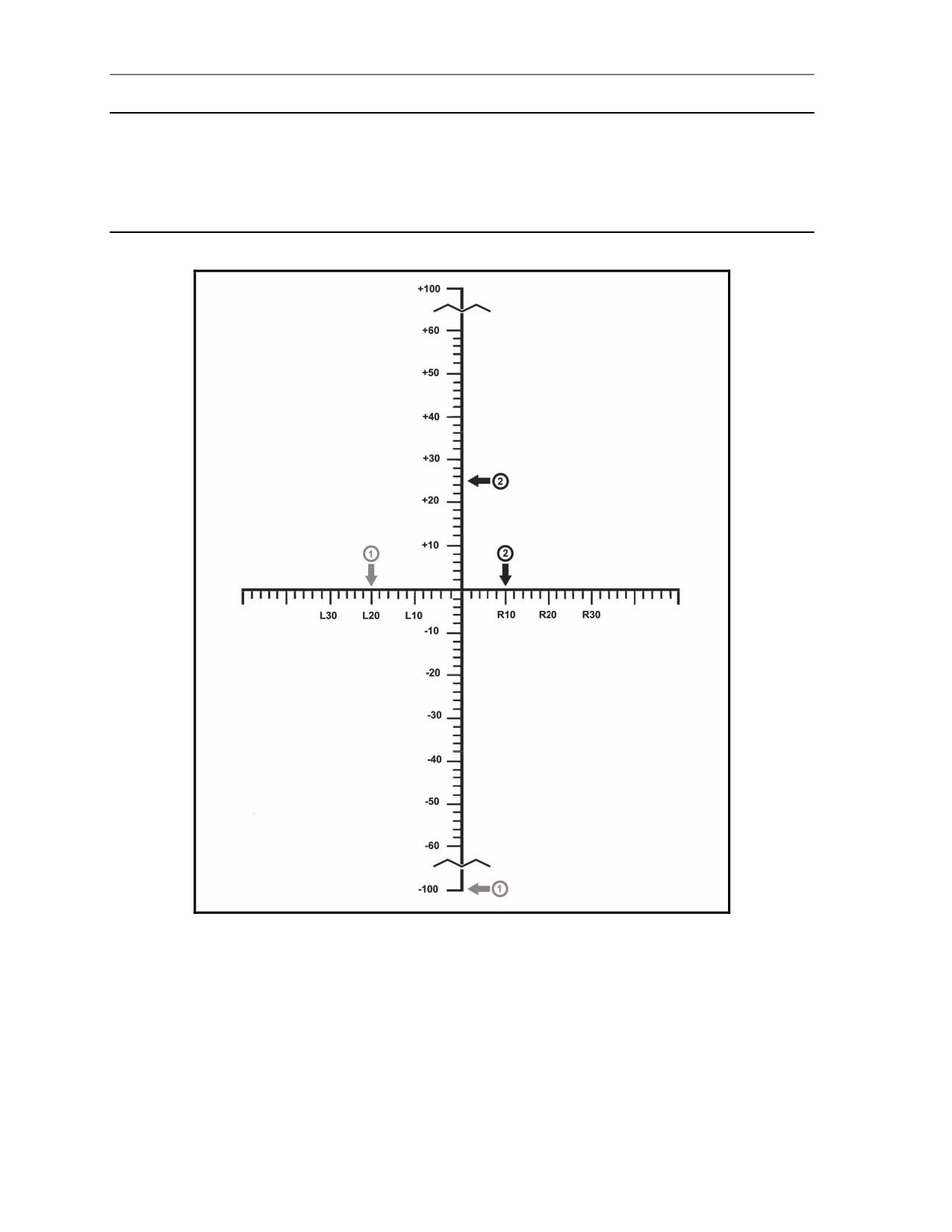
EXAMPLE
Assume that:
MET 2:
Deflection correction R10 (Figure 4-23)
Range correction +25
Place the correction from the MET message on a MET cross.
Figure 4-23. Second meteorological message.
4-76. The MET cross helps answer three key questions:
z
Where are you? L20 - 100 (MET 1)
z
Where are you going? R10 + 25 (MET 2)
z
What is required to get there?
4-42
FM 3-22.91
17 July 2008
Major Concerns of the Fire Direction Center
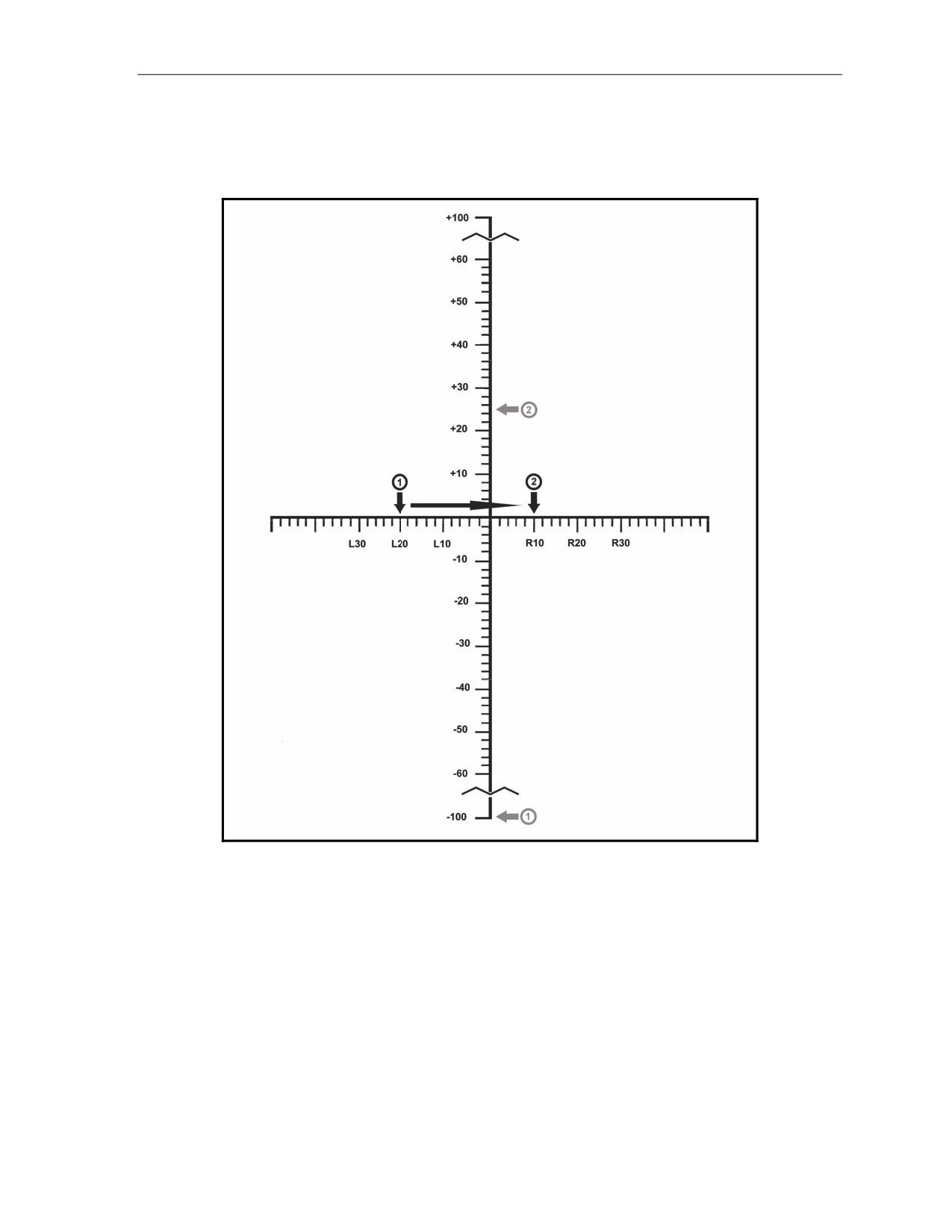
DEFLECTION CORRECTION
4-77. To get from L20 to R10, first go from L20 to 0, then right to R10. In doing so, you went R20, then
R10, for a total of R30 (Figure 4-24).
Figure 4-24. Updated registration corrections, deflection.
17 July 2008
FM 3-22.91
4-43
Chapter 4
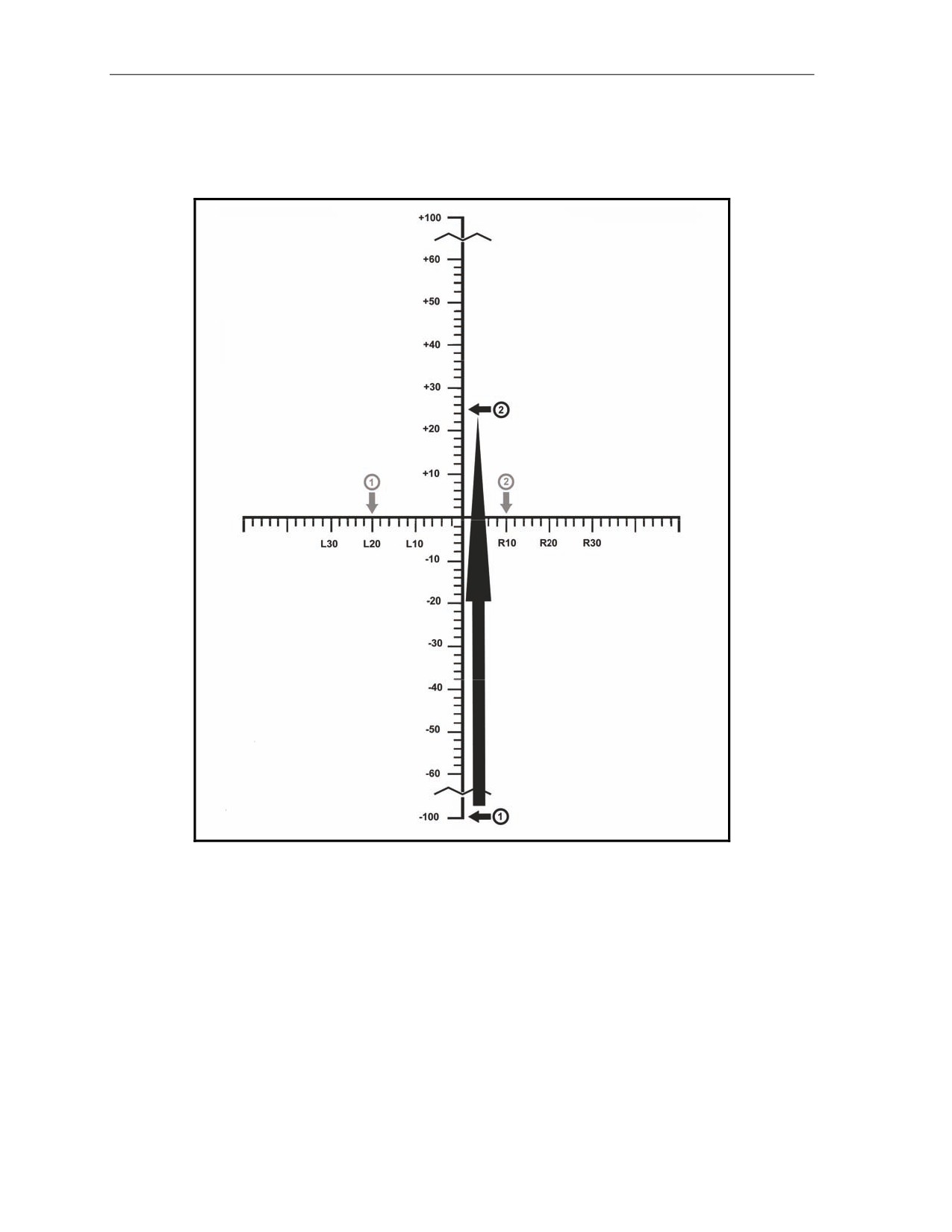
RANGE CORRECTION
4-78. To get from -100 to +25, first go from -100 to 0, then up the scale to +25. In doing so, you went
+100, then +25, for a total correction of +125 (Figure 4-25).
Figure 4-25. Updated registration corrections, range.
4-44
FM 3-22.91
17 July 2008
Major Concerns of the Fire Direction Center
EXAMPLE
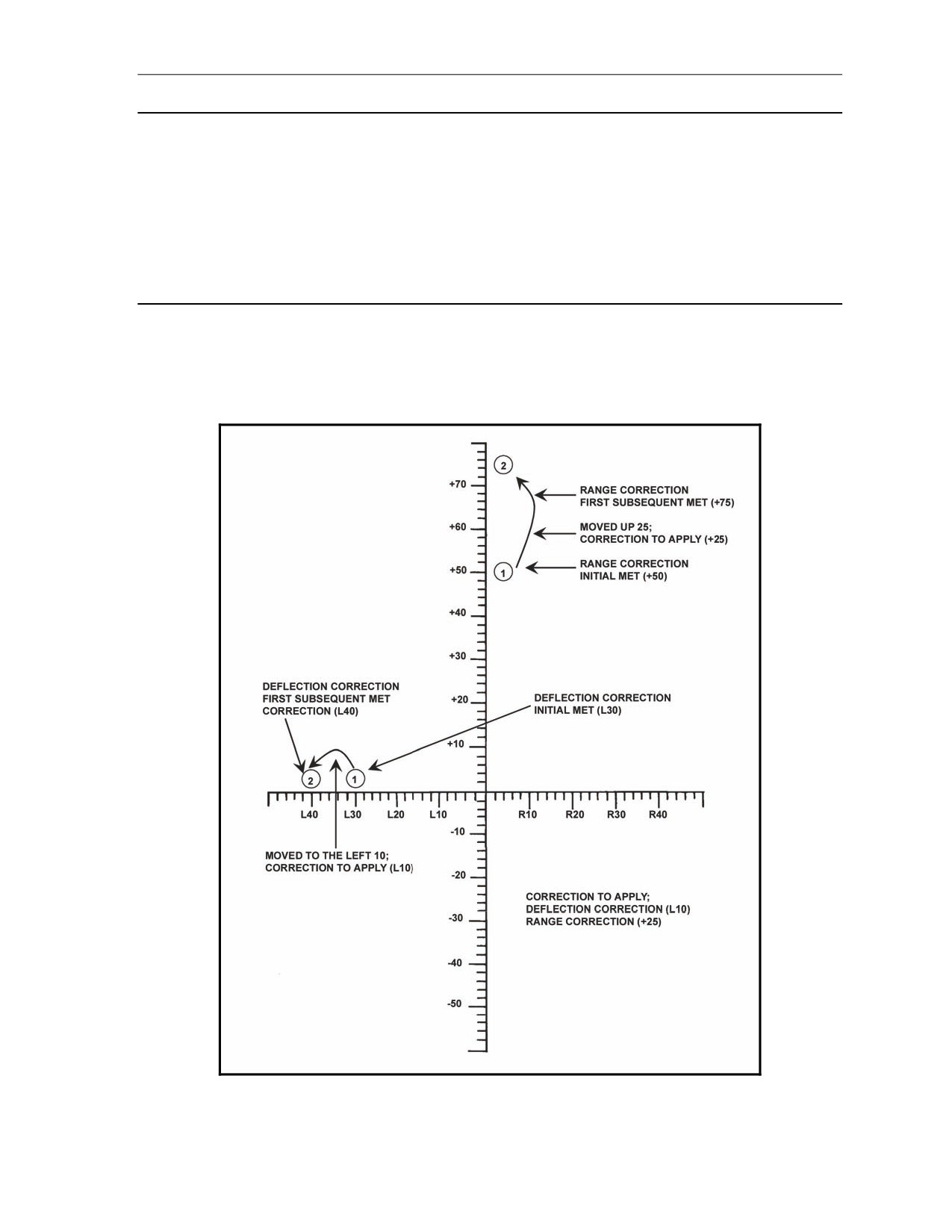
MET messages on the same side of the MET cross (Figure 4-26).
Assume that:
MET 1:
Deflection correction L30
Range correction +50
MET 2:
Deflection correction L40
Range correction +75
Deflection correction L30 + L40 = L10
Range correction +50 + 25
4-79. Always use this procedure to determine corrections. Remember, MET 1 is compared to MET 2, and
MET 2 to MET 3. This procedure continues as long as MET messages are received and the unit remains in
the same position.
Figure 4-26. Deflection and range corrections.
17 July 2008
FM 3-22.91
4-45
Chapter 4
4-80. Once MET corrections have been determined, the FDC can determine the corrections for updating
the MET. MET is based on the RP; therefore, MET corrections are applied to corrections determined from
the registration.
RANGE CORRECTION
4-81. Compare the range correction from the RP and the MET range correction. For different signs,
subtract the smaller from the larger, and use the sign of the larger for the new range correction for the RP.
If the signs are the same, add the values.
EXAMPLE
Range correction from the registration +150
Range correction from the METS +25
+150 + 25 = +175 range correction
RANGE CORRECTION FACTOR
4-82. Once the range correction has been determined, the FDC determines the range correction factor
(RCF) by dividing the initial chart range (rounded to the nearest hundred and expressed in thousandths)
into the range correction.
EXAMPLE
New range correction:
+175
Initial chart range:
3,050
(100's = 3100; 1000's = 3.1)
+56.4
= +56 RCF
+3.1/ +175.0
Deflection correction from registration L12
Deflection correction from METs
R10
L2= DEF CORR
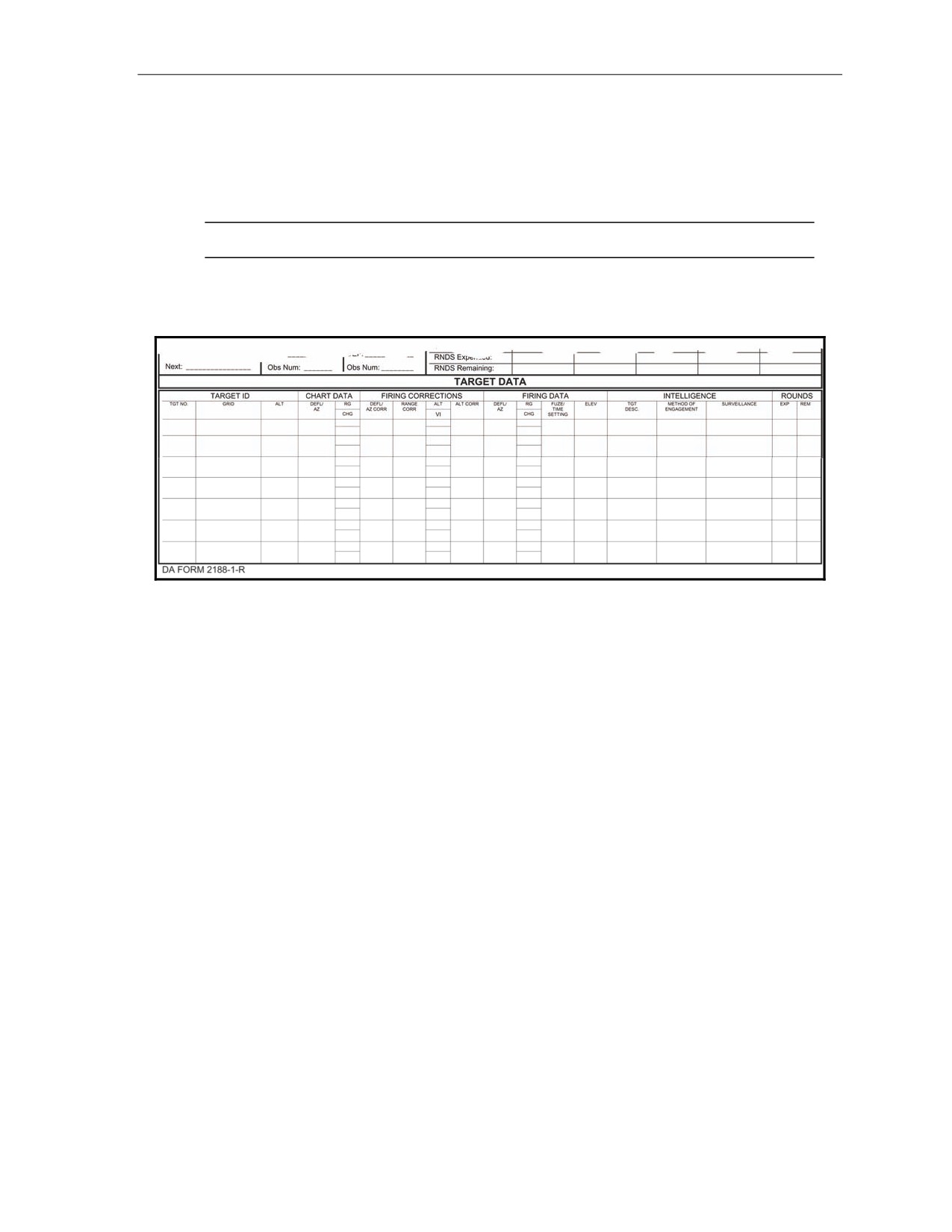
4-83. Once the new corrections have been determined, the FDC updates the DA Form 2188-1-R (RP and
previously fired targets). Because the chart is based on the RP, the FDC updates it first.
4-46
FM 3-22.91
17 July 2008
Major Concerns of the Fire Direction Center
4-84. Chart data remain the same because the known points have not moved. Apply the new corrections to
the chart to obtain new command data (Figure 4-27). For previously fired targets, chart data remain the
same.
4-85. To obtain the range correction, multiply the new RCF by the range (rounded to the nearest hundred
and expressed in thousandths) (Figure 4-27).
NOTE: For a blank, reproducible copy of DA Form 2188-1-R, see the back of this manual.
4-86. For new targets within the transfer limits of the RP, apply the new corrections the same as for
previous registration corrections.
Figure 4-27. Example for updating target data.
17 July 2008
FM 3-22.91
4-47
This page intentionally left blank.
Chapter 5
Call for Fire
A CFF is a concise message prepared by the observer. It contains all of the
information that the FDC needs to determine the method of target attack.
INTRODUCTION
5-1. The CFF is a request for fire from the observer. The observer must send it quickly, yet clearly
enough for the FDC to understand, record, and read it back without error.
5-2. The CFF is sent in three transmissions consisting of six elements with a break and a read-back after
each transmission. The transmissions and elements are as follows:
z
The first transmission consists of—
Observer ID.
Warning order.
z
The second transmission consists of—
Target location.
z
The third transmission consists of—
Target description.
Method of engagement (optional).
Method of fire and control (optional).
NOTE: When the observer sees a target, he should notify the RTO so the RTO can begin the
CFF while the target location is determined. The RTO sends the information as it is determined,
instead of waiting until a complete CFF has been prepared.
5-3. Further, CFFs typically require authentication.
OBSERVER IDENTIFICATION
5-4. Observer identification tells the FDC who is calling for fire. It consists of appropriate call signs or
codes needed to establish contact between the observer and the FDC.
WARNING ORDER
5-5. The warning order clears the net for the fire mission. The warning order consists of the—
z
Type of mission.
z
Size of the element to FFE (optional).
z
Method of target location.
17 July 2008
FM 3-22.91
5-1
Chapter 5
TYPES OF MISSIONS
5-6. There are four types of missions for a warning order:
z
Adjust fire.
z
Fire for effect.
z
Suppress.
z
Immediate suppression or immediate smoke.
Adjust Fire
5-7. When the observer decides that an adjustment is needed because of a questionable target location or
lack of registration corrections, he announces, “Adjust fire (A/F).”
Fire for Effect
5-8. The observer should always strive for first-round FFE. The accuracy required to FFE depends on the
target and the ammunition being used. When the observer is certain that the target location is accurate and
that the first volley will have the desired effect on the target with little or no adjustment, he announces,
“Fire for effect.”
Suppress
5-9. To quickly bring fire on an inactive target, the observer announces, “Suppress (target identification
number).” Suppression missions are normally fired on preplanned targets, and the duration is associated
with the CFF.
Immediate Suppression or Immediate Smoke
5-10. When engaging a planned target or target of opportunity that has taken friendly maneuver or aerial
elements under fire, the observer announces, “Immediate suppression (IS).” If the desired effect is a hasty
screen for obscuration, the FO announces, “Immediate smoke.”
SIZE OF THE ELEMENT TO FIRE FOR EFFECT
5-11. The observer may request the size of the unit to FFE.
METHODS OF TARGET LOCATION
5-12. This element enables the FDC to plot (M16/M19 plotting board) or enter (MBC/MFCS/LHMBC) the
location of the target so that personnel can determine firing data.
GRID
5-13. If the target is located using the grid method, the FO announces, “Grid (six-digit grid coordinates for
typical mission; eight-digit grid coordinates for RPs or other points for which greater accuracy is
required).” Since the FDC does not need the OT direction to locate the target, the observer sends the
direction (to the nearest 10 mils) at the end of the CFF or just before the initial correction.
SHIFT FROM A KNOWN POINT
5-14. If the target is located using the shift from a known point method, the FO announces, “Shift from
known point (known point designation or target number).” In a shift from a known point mission, both the
observer and the FDC must know the point from which the shift will be made; the observer announces it in
the warning order. The observer then sends the OT direction. Normally, direction to the target will be sent
to the nearest 10 mils; however, the FDC can use mils, degrees, or cardinal directions, whichever is
specified by the observer. Next, the observer sends the lateral shift (the target’s distance left or right of the
5-2
FM 3-22.91
17 July 2008
Call for Fire
known point, expressed to the nearest 10 meters), the range shift (the target’s distance farther [add] or
closer to [drop] the known point, expressed to the nearest 100 meters), and the vertical shift (the target’s
distance above [up] or below [down] the known point, expressed to the nearest 5 meters).
NOTE: The vertical shift is ignored unless it exceeds 30 meters.
POLAR PLOT
5-15. If the target is located using the polar plot method, the observer announces, “Polar,” in the warning
order to alert the FDC that the target will be located with respect to the observer’s position, which must be
known to the FDC. The observer sends the direction (to the nearest 10 mils) and distance (to the nearest
100 meters) to the target from his position. A vertical shift (to the nearest 5 meters) tells the FDC how far
the target is located above (up) or below (down) the observer’s location. Vertical shift may also be
described by a vertical angle (VA) in mils relative to the observer’s location; this method is used when
conducting a laser polar plot mission.
TARGET DESCRIPTION
5-16. The section sergeant selects different ammunition for different types of targets. The observer must
describe the target in detail to allow the section sergeant to determine the amount and type of ammunition
to use. The observer’s description should be brief, but accurate, and contain the following:
z
What the target is (troops, equipment, supply dump, trucks).
z
What the target is doing (digging in, establishing an assembly area).
z
The number of elements in the target (squad, platoon, three trucks, six tanks).
z
The degree of protection (in the open, in fighting positions, in bunkers with overhead cover).
z
The target size and shape, if significant.
When the target is rectangular, the observer should give the length and width in meters, and
the attitude (azimuth of the long axis) to the nearest 100 mils. For example, 400 meters by
100 meters; attitude 2600.
When the target is circular, the observer should give the radius.
The observer may describe linear targets using length, width, and attitude.
METHOD OF ENGAGEMENT
5-17. The observer may indicate how he wants to attack the target. This element consists of the—
z
Type of adjustment.
z
Ammunition.
z
Distribution of fire.
TYPE OF ADJUSTMENT
5-18. In an adjustment, area or precision fire may be used.
Area Fire
5-19. If no specific type of adjustment is designated, area fire will be used. Split a 100-meter bracket to
achieve area fire.
17 July 2008
FM 3-22.91
5-3
Chapter 5
Precision Fire
5-20. Precision fire is conducted with one weapon engaging a point target. Currently the only precision
mortar mission is registration. Registration is initiated by the FDC and is used to determine corrections for
subsequent missions.
Danger Close
5-21. The observer includes the term “danger close” in the method of engagement when the target is
located within 600 meters of friendly troops for mortars and cannon artillery, 750 meters for 5-inch naval
guns.
AMMUNITION
5-22. If the observer does not request a specific projectile or fuze, he is given shell HE, fuze IMP.
5-23. The observer may initially request one type of projectile or fuze, and then request another type to
complete the fire mission.
Smoke
5-24. When the observer requests smoke, the chief computer normally directs the use of HE for the
adjustment phase and WP for the completion of the adjustment and FFE.
Combination of Projectiles or Fuzes
5-25. When the observer wants a combination of projectiles or fuzes in effect, he must state so in this
element of the CFF. For example, the observer may request, “HE and WP in effect” or “IMP and PROX in
effect.”
Volume of Fire
5-26. The observer may also request the volume of fire he needs for FFE. If the observer does not specify
the number of rounds to be fired in effect, the FDC should notify the observer of the number of rounds that
will be fired in effect.
DISTRIBUTION OF FIRE
5-27. A linear sheaf is fired on an area target in FFE. When another type of sheaf is desired, the observer
must announce the type of sheaf desired; for example, “Converged” or “Open sheaf.”
METHODS OF FIRE AND CONTROL
5-28. The methods of fire and control indicate the desired manner of attacking the target, whether the
observer wants to control the time of delivery of fire, or if the observer can observe the target. The
observer announces the methods of fire and control using the terms discussed below.
METHOD OF FIRE
5-29. Adjustment is normally conducted with the number two mortar. The observer may request any
weapon or combination of weapons to adjust. For example, if the observer wants to see where each of the
mortars in a section hits, he may request, “Section right (left).”
5-30. The normal interval of time between the rounds fired by a section right or left is 10 seconds. If the
observer wants another interval, he may so specify.
5-4
FM 3-22.91
17 July 2008
Call for Fire
METHOD OF CONTROL
5-31. The control element indicates the type of control that the observer exercises over the time of fire
delivery and if any or no adjustments are to be made. In the absence of observer control, the firing section
fires when ready (W/R) or under the FDC’s control. The observer announces the method of control using
the following terms:
z
At my command.
z
Cannot observe.
z
Time on target.
z
Continuous illumination.
z
Coordinated illumination.
z
Cease fire.
z
Check fire.
z
Continuous fire.
z
Repeat.
z
Followed by.
At My Command
5-32. “At my command (AMC)” indicates that the observer wants to control the delivery of fire.
5-33. The observer announces, “At my command,” immediately before the adjust fire or FFE. When the
weapons are ready to fire, FDC personnel announce, “Section is ready.” Then, when the observer wants the
mortar section to fire, he announces, “Fire.” This method of control remains in effect until the observer
announces, “Cancel at my command” or “End of mission.”
Cannot Observe
5-34. This announcement indicates that the observer cannot adjust fire, but he believes that a target exists
at the given location, and the target is important enough to justify firing upon it without adjustment.
Time on Target
5-35. The observer may tell the FDC when he wants the rounds to impact by requesting, “Time on target
(number desired) minutes from now” or “Time on target (time desired) hours.” The observer must conduct
a time check to ensure that his timepiece is synchronized with the FDC’s timepiece.
Continuous Illumination
5-36. If the observer has not given an interval, the section sergeant determines the interval by the burn time
of the illuminating ammunition in use. If another interval is required, it is indicated in seconds.
Coordinated Illumination
5-37. While the preferred method is to have the FDC compute the interval between HE and illuminating
rounds, the observer may order this interval in seconds. This command causes the HE round to impact at
the point of optimum illumination, or the observer may use AMC procedures.
Cease Fire
5-38. This command is used to stop the loading of rounds into mortars when firing two or more rounds.
Gun sections may fire any rounds that have already been loaded (hung rounds).
17 July 2008
FM 3-22.91
5-5
Chapter 5
Check Fire
5-39. This command is used to cause an immediate halt in firing.
Continuous Fire
5-40. In mortars, this command means loading and firing as rapidly as possible, consistent with accuracy
and within the prescribed rate of fire for the mortar being used. Firing continues until suspended by the
commands “Cease loading” or “Check fire.”
Repeat
5-41. This command can mean one of two things:
z
During adjustment, “Repeat” means to fire another round(s) using the last data and adjust for
any change in ammunition.
z
During FFE, “Repeat” means to fire the same number of rounds using the same method of FFE.
Changes to the number of guns, gun data, interval, or ammunition may be requested.
Followed By
5-42. This term is used to indicate a change in the rate of fire, the type of ammunition, or another order for
FFE.
MESSAGE TO OBSERVER
5-43. After receiving the CFF, the FDC determines if and how the target will be attacked. That decision
may be announced to the observer in the form of a message to observer (MTO).
5-44. The MTO consists of the following four items:
z
Unit(s) to fire.
z
Changes to the CFF.
z
Number of rounds.
z
Target number.
5-45. The following information can also be transmitted in the MTO:
z
Angle T.
z
Time of flight.
UNIT(S) TO FIRE
5-46. This element consists of the number of mortars that will fire the mission.
EXAMPLE
In a four-gun 120-mm mortar platoon, two guns are already involved in a fire mission. The other two
are available, but the FDC only wants to use one mortar on the new target. The FDC would announce
to the observer, "One gun."
5-6
FM 3-22.91
17 July 2008
Call for Fire
CHANGES TO THE CALL FOR FIRE
5-47. This element contains any changes to the CFF.
EXAMPLE
The observer requested IMP in effect, and the FDC decides to fire PROX in effect.
NUMBER OF ROUNDS
5-48. This element contains the number of rounds for each tube in FFE.
TARGET NUMBER
5-49. A target number is assigned to each mission to help the processing of subsequent corrections.
ANGLE T
5-50. The FDC sends angle T to the observer when it is equal to or greater than 500 mils or when
requested.
NOTE: See Chapter 4 for more information about angle T.
TIME OF FLIGHT
5-51. The FDC sends time of flight to an observer during moving target or aerial observer missions, or
when requested.
NOTE: See FM 6-30 for more information about MTOs.
CALL FOR FIRE FORMAT
5-52. The following is the format for a CFF.
z
Observer identification
z
Warning order
Adjust fire
Fire for effect
Suppression
Immediate suppression/smoke
z
Target location
Grid coordinates: direction
Shift from a known point
- Direction
- Lateral shift
- Range shift
- Vertical shift
Polar plot coordinates
- Direction
- Distance
- Vertical shift from the observation point (OP)
17 July 2008
FM 3-22.91
5-7
Chapter 5
z
Target description
z
Method of engagement
Type of adjustment
- Area
- Precision (registration)
- Danger close
Ammunition and fuze
Distribution
- Linear sheaf
- Parallel sheaf
- Open sheaf
- Converged sheaf
- Special sheaf
- Traversing fire
- Searching fire
- Range spread, lateral spread, or range lateral spread (illumination only)
z
Method of fire and control
Method of fire
Method of control
- Fire when ready
- At my command
- Cannot observe
- Time on target
- Continuous illumination
- Coordinated illumination
- Cease firing
- Check firing
- Continuous fire
- Repeat
- Request splash
- Do not fire
AUTHENTICATION
5-53. Authentication is considered a normal element of the initial request for indirect fire. Two methods of
authentication are authorized for use:
z
Challenge and reply.
z
Transmission.
5-54. Challenge and reply authentication requires two-way communications, whereas transmission
authentication does not. Challenge and reply authentication is used when possible.
CHALLENGE AND REPLY AUTHENTICATION
5-55. The FDC inserts the challenge in the last read-back of the CFF. The FO transmits the correct
authentication reply immediately following the challenge. Authentication replies exceeding 20 seconds are
automatically suspect, and the FDC may rechallenge. Subsequent adjustments of fire or immediate
engagement of additional targets by the FO who originated the fire request normally do not require
continued challenge.
5-8
FM 3-22.91
17 July 2008
Call for Fire
TRANSMISSION AUTHENTICATION
5-56. Transmission authentication is used only if authentication is required and it is not possible or
desirable for the receiving station to reply; for example, message instruction, imposed radio silence, and
FPF and IS.
5-57. The observer is given a transmission authentication table in accordance with the unit SOP. The table
consists of 40 columns with authenticators in each column. After each authenticator is used, a line may be
drawn through it to avoid using the same one again.
17 July 2008
FM 3-22.91
5-9
This page intentionally left blank.
Part Three
Mortar Ballistic Computer
Chapter 6
Introduction
This chapter outlines the description, audio alarm characteristics, capabilities, and
memory storage of the MBC.
DESCRIPTION
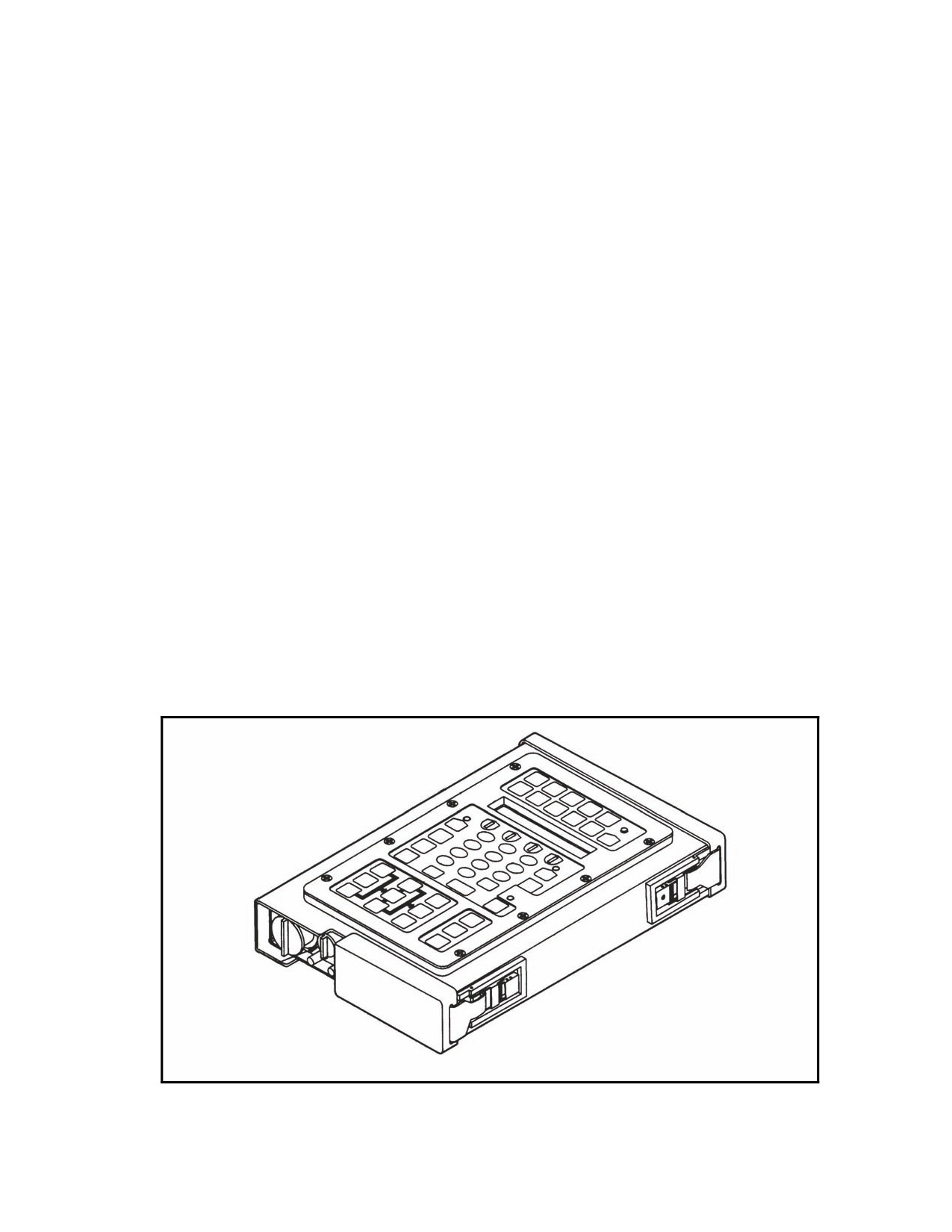
6-1. The M23 MBC (Figure 6-1) is handheld, lightweight, and battery-powered. It is used for automated
computations, digital communications, and displaying mortar-related information. The MBC weighs seven
pounds (including the battery) or eight pounds (including the battery and case assembly). It is portable, can
be used in all-weather operations, and has built-in self-test circuits. The MBC requires fire mission data
input to compute fire commands needed to effectively execute a mortar fire mission. When the MBC is
connected to an external communication device, such as a digital message device (DMD) or the forward
observer system (FOS), the FO fire mission inputs are automatically entered and may be reviewed and
edited by the MBC operator. When the MBC is not connected to an external communication device, the
MBC operator manually enters all fire mission data. The fire commands are then relayed to the gun line in
accordance with the unit standing operating procedures (SOP).
Figure 6-1. Mortar ballistic computer.
17 July 2008
FM 3-22.91
6-1