FM 3-22.91 MORTAR FIRE DIRECTION PROCEDURES (July 2008) - page 1
*FM 3-22.91
Field Manual
Headquarters
No. 3-22.91
Department of the Army
Washington, DC, 17 July 2008
Mortar Fire Direction Procedures
Contents
Page
Preface
xix
Part One
INTRODUCTION AND FUNDAMENTALS OF MORTAR FIRE CONTROL
1-1
Chapter 1
INTRODUCTION
1-1
Organization
1-1
General Doctrine
1-1
Indirect Fire Team
1-2
Mortar Positions
1-3
Missions and Fire Direction Control Procedures
1-4
Fire Control Systems
1-6
Chapter 2
FUNDAMENTALS OF MORTAR FIRE DIRECTION
2-1
Section I. Elements of Firing Data and Ballistics
2-1
Direction
2-1
Range
2-2
Vertical Interval
2-2
Distribution of Bursts
2-2
Interior Ballistics
2-2
Nature of Propellants and Projectile Movements
2-2
Standard Muzzle Velocity
2-3
Nonstandard Muzzle Velocity
2-3
Exterior Ballistics
2-4
Trajectory
2-4
Section II. Firing Tables
2-6
Purpose
2-6
Unit Corrections
2-6
Standard Range
2-7
Dispersion and Probability
2-9
Mean Point of Impact
2-10
DISTRIBUTION RESTRICTION: Approved for public release; distribution is unlimited.
*This publication supersedes FM 3-22.91, 18 January 2005.
17 July 2008
FM 3-22.91
i
Contents
Probable Error
2-12
Section III. Fire Planning
2-14
Terminology
2-14
Target Considerations
2-16
Support of Offensive Operations
2-17
Support of Defensive Operations
2-18
Fire Support Coordination Measures
2-19
Company Fire Support Plan
2-20
Battalion Fire Support Plan
2-22
Section IV. Target Analysis and Attack
2-22
Target Description
2-22
Registration and Survey Control
2-23
Size of Attack Area
2-23
Maximum Rate of Fire
2-23
Amount and Type of Ammunition
2-25
Unit Selection
2-26
Typical Targets and Methods of Attack
2-27
Part Two
FIRE DIRECTION CENTER
3-1
Chapter 3
INTRODUCTION
3-1
Principles of Fire Direction
3-1
Organization
3-1
Personnel Duties
3-2
Chapter 4
MAJOR CONCERNS OF THE FIRE DIRECTION CENTER
4-1
Types of Sheaves
4-1
Computer’s Record
4-3
DA Form 2188-R (Data Sheet)
4-9
DA Form 2188-1-R (LHMBC/MFCS Data Sheet)
4-14
Angle T
4-17
Firing Tables
4-19
DA Form 3675-R (Ballistic Message)
4-22
Computer Meteorological Message
4-36
6400-Mil Meteorological Message
4-37
Computation of Meteorological Corrections for Large Sector Capability
4-37
Meteorological Corrections
4-40
Chapter 5
CALL FOR FIRE
5-1
Introduction
5-1
Observer Identification
5-1
Warning Order
5-1
Methods of Target Location
5-2
ii
FM 3-22.91
17 July 2008
Contents
Target Description
5-3
Method of Engagement
5-3
Methods of Fire and Control
5-4
Message To Observer
5-6
Call For Fire Format
5-7
Authentication
5-8
Part Three
MORTAR BALLISTIC COMPUTER
6-1
Chapter 6
INTRODUCTION
6-1
Description
6-1
Audio Alarm
6-11
Capabilities
6-12
Memory Storage Capacity
6-13
Chapter 7
PREPARATION OF FIRE CONTROL EQUIPMENT
7-1
Types of Data Entry
7-2
Initialization
7-5
Chapter 8
TYPES OF MISSIONS
8-1
Grid Mission Switch
8-1
Shift Mission Switch
8-5
Polar Mission Switch
8-8
Technical Fire Control
8-11
Sheaves
8-12
Traversing Fire
8-13
Searching Fire
8-20
Illumination
8-21
Coordinated Illumination
8-23
Chapter 9
SPECIAL PROCEDURES
9-1
Registration and Sheaf Adjustment
9-1
Mean Point of Impact Registration
9-4
Radar Registration
9-6
Final Protective Fires
9-8
Immediate Smoke or Immediate Suppression
9-12
Quick Smoke
9-13
Special Keys and Functions
9-19
Chapter 10
DIGITAL DEVICE SUPPORT
10-1
Application
10-1
Communications
10-1
17 July 2008
FM 3-22.91
iii
Contents
Part Four
M16 AND M19 PLOTTING BOARDS
11-1
Chapter 11
INTRODUCTION
11-1
Capabilities
11-1
M16 Plotting Board
11-2
M19 Plotting Board
11-4
Chapter 12
PREPARATION OF FIRE CONTROL EQUIPMENT
12-1
Observed Firing Charts
12-1
Modified-Observed Firing Chart
12-13
Transfer of Targets
12-19
Deflection Conversion Table
12-22
Grid Mission
12-23
Shift from a Known Point Mission
12-23
Polar Plot Mission
12-24
Chapter 13
TYPES OF MISSIONS
13-1
Traversing Fire
13-1
Searching Fire
13-8
Illumination
13-12
Chapter 14
SPECIAL CONSIDERATIONS
14-1
Registration and Sheaf Adjustment
14-1
Mean Point of Impact Registration
14-13
Vertical Interval Correction Factors
14-17
Radar Registration
14-19
Final Protective Fires
14-21
Part Five
MORTAR FIRE CONTROL SYSTEM
15-1
Chapter 15
INTRODUCTION
15-1
Section I. Initialization and Configuration
15-1
Description
15-1
Capabilities
15-8
Soldier Graphic User Interface
15-9
Data Initialization and System Configuration
15-13
Section II. Additional Functions
15-26
Ammunition/Status Function
15-27
Meteorological Data Screen
15-32
Target/Known Point Screen
15-36
Safety Fan Screen
15-39
Check Fire
15-40
Plain Text Messages
15-41
Alerts Function
15-44
iv
FM 3-22.91
17 July 2008
Contents
Chapter 16
FIRE MISSIONS
16-1
Section I. Parts of a Standard Fire Mission
16-1
Standard Fire Mission Procedures
16-1
Sequence of Actions from the Initial Call For Fire to the End of Mission
16-1
Digital and Manual Fire Mission Tabs and Screens
16-2
Common Actions
16-4
Section II. Basic Fire Missions
16-5
Basic Digital Missions
16-5
Manual Missions
16-16
Section III. Special Missions
16-19
Registration Point
16-20
Target/Known Point
16-22
Illumination Mission
16-24
Coordinated Illumination Mission
16-30
Final Protective Fires
16-32
Smoke Missions
16-43
Part Six
LIGHTWEIGHT HANDHELD MORTAR BALLISTIC COMPUTER
17-1
Chapter 17
INTRODUCTION
17-1
Section I. Initialization and Configuration
17-1
Description
17-1
Capabilities
17-3
Battery Life
17-4
Graphic User Interface
17-4
Startup
17-8
Data Initialization and Configuration
17-9
Meteorological Data
17-17
Safety Fan
17-20
Check Fire
17-22
Section II. Communication
17-23
Cable Connection
17-23
Parameter Setup
17-24
Set Up a Unit Address
17-26
Edit a Unit Address
17-26
Enable or Disable a Channel
17-27
Send Status Screen
17-28
Plain Text Messaging
17-28
Section III. Global Positioning System
17-29
Setup and Initialization
17-29
Standby Mode
17-31
Global Positioning System COMSEC Key
17-31
Zeroizing the Global Positioning System Crypto Key
17-31
17 July 2008
FM 3-22.91
v
Contents
Chapter 18
FIRE MISSIONS
18-1
Section I. Manual Fire Missions
18-1
Grid Missions
18-2
Shift From a Known Point Missions
18-12
Polar Plot Missions
18-13
Laser Polar Plot Missions
18-14
Quick Fire Missions
18-15
Direct Lay Missions
18-16
Hipshoot Missions
18-17
Targets/Known Points
18-21
Section II. Digital Fire Missions
18-21
Receipt of the Message
18-22
Section III. Special Missions
18-33
Registration Missions
18-34
Illumination Missions
18-39
Coordinated Illumination Missions
18-46
Final Protective Fires
18-49
Smoke Missions
18-61
Search and Traverse Missions
18-74
Appendix A
MORTAR TRAINING STRATEGY
A-1
General
A-1
Training Evaluation
A-1
Appendix B
ICONS FOR THE MORTAR FIRE CONTROL SYSTEM
B-1
Appendix C
SAFETY PROCEDURES
C-1
Surface Danger Zones
C-1
Safety Diagram
C-4
Appendix D
FIELD-EXPEDIENT SURVEY TECHNIQUES
D-1
Graphic Resection
D-1
Hasty Survey
D-4
Appendix E
FIRE DIRECTION CENTER CERTIFICATION
E-1
Section I. Conduct of the Program
E-1
Eligible Personnel
E-1
Qualification
E-1
General Rules
E-2
Section II. Certification
E-2
M16/M19 Plotting Board Certification
E-2
Mortar Fire Control System Certification
E-3
Lightweight Handheld Mortar Ballistic Computer Certification
E-4
Mortar Ballistic Computer Certification
E-5
vi
FM 3-22.91
17 July 2008
Contents
Section III. Mortar Ballistic Computer Example Test
E-5
Situation A
E-6
Situation B
E-9
Situation C
E-11
Situation D
E-13
Situation E
E-19
Situation F
E-21
Situation G
E-23
Situation H
E-27
Situation I
E-31
Situation J
E-32
Situation K
E-34
Situation L
E-37
Situation M
E-39
Situation N
E-41
Situation O
E-44
Section IV. Plotting Board Test
E-46
Situation A
E-46
Situation B
E-47
Situation C
E-54
Appendix F
ERROR MESSAGES
F-1
Characters
F-1
Messages, Explanations, and Actions
F-1
Glossary
Glossary-1
References
References-1
Index
Index-1
Figures
Figure 1-1. Indirect fire team
1-2
Figure 2-1. Direction to the target
2-1
Figure 2-2. Elements of the trajectory
2-5
Figure 2-3. Example of Firing Table 120-E-1
2-6
Figure 2-4. Mean point of impact
2-10
Figure 2-5. Burst in elliptical pattern
2-10
Figure 2-6. A 100-percent rectangle
2-11
Figure 2-7. Dispersion rectangle
2-11
Figure 2-8. One probable error
2-12
Figure 2-9. Range probability curve
2-12
Figure 2-10. Probable error in deflection
2-13
Figure 2-11. Group of targets
2-15
Figure 2-12. Series of targets
2-15
17 July 2008
FM 3-22.91
vii
Contents
Figure 2-13. Final protective fires symbol
2-16
Figure 4-1. Example of completed DA Form 2399-R (Computer’s Record)
4-3
Figure 4-2. Example of completed DA Form 2188-R (Data Sheet)
4-9
Figure 4-3. Example of completed DA Form 2188-1-R (LHMBC/MFCS Data Sheet)
4-14
Figure 4-4. Angle T between 400 and 1600 mils
4-17
Figure 4-5. Angle T exceeding 499 mils
4-18
Figure 4-6. Sample pages from firing tables for 60-mm mortar
4-20
Figure 4-7. Sample pages from firing tables for 81-mm mortar
4-21
Figure 4-8. Sample pages from firing tables for the 120-mm mortar
4-22
Figure 4-9. Six-character groups
4-23
Figure 4-10. Example of completed DA Form 3675-R (Ballistic Message)
4-24
Figure 4-11. Example of completed DA Form 3675-R (Ballistic Message)
4-25
Figure 4-12. Line number and zone height relative to meteorological data plane
4-27
Figure 4-13. Example of completed first seven lines for DA Form 3675-R (Ballistic
Message)
4-28
Figure 4-14. Data guide for DA Form 2601-1-R (MET Data Correction Sheet for
Mortars)
4-30
Figure 4-15. Example of completed DA Form 2601-1-R (MET Data Correction Sheet
for Mortars)
4-31
Figure 4-16. Sample page from firing table for air temperature and density corrections
4-32
Figure 4-17. Sample page from firing table for wind components
4-33
Figure 4-18. Sample pages from firing table for basic data and correction factors
4-34
Figure 4-19. Sample page from firing table for propellant temperature
4-35
Figure 4-20. Example of completed DA Form 2601-2-R (MET Data Correction Sheet
6400 mils [Mortars])
4-38
Figure 4-21. Example of completed DA Form 2601-2-R (MET Data Correction Sheet
6400 mils [Mortars]) for a full 6400-mil capacity
4-39
Figure 4-22. Initial meteorological message
4-41
Figure 4-23. Second meteorological message
4-42
Figure 4-24. Updated registration corrections, deflection
4-43
Figure 4-25. Updated registration corrections, range
4-44
Figure 4-26. Deflection and range corrections
4-45
Figure 4-27. Example for updating target data
4-47
Figure 6-1. Mortar ballistic computer
6-1
Figure 6-2. Initialization switches
6-2
Figure 6-3. Action switches
6-5
Figure 6-4. Alphanumeric and minus sign keys
6-6
Figure 6-5. Fire mission keys
6-7
Figure 6-6. Output switches
6-9
Figure 6-7. Display switches
6-10
Figure 6-8. Light-emitting diode indicators
6-10
Figure 7-1. Mortar ballistic computer switch panel
7-1
Figure 7-2. Declination diagram
7-4
viii
FM 3-22.91
17 July 2008
Contents
Figure 8-1. Excerpt from example DA Form 2399-R (Computer's Record) with call for
fire and FDC order completed
8-14
Figure 8-2. Example of completed DA Form 2399-R (Computer's Record) for
adjustment
8-15
Figure 8-3. Example situation chart number 1
8-17
Figure 8-4. Example situation charts numbers 2 and 3
8-17
Figure 8-5. Example situation charts numbers 4 and 5
8-17
Figure 8-6. Example of deflection conversion table
8-19
Figure 8-7. Range-lateral spread
8-23
Figure 9-1. Determination of a spotting
9-7
Figure 9-2. Fire direction center order
9-18
Figure 11-1. Vernier scale
11-2
Figure 11-2. M16 plotting board
11-3
Figure 11-3. M19 plotting board
11-4
Figure 12-1. Preparation of the plotting board
12-2
Figure 12-2. Superimposition of referred deflection scale under the mounting azimuth
12-3
Figure 12-3. Determination of the deflection
12-3
Figure 12-4. Charge versus range chart
12-4
Figure 12-5. Determination of charge
12-4
Figure 12-6. Charge zone and range
12-5
Figure 12-7. Plotting of observer’s correction
12-6
Figure 12-8. Determination of deflection and range
12-7
Figure 12-9. Board updated
12-8
Figure 12-10. Hollow cross with target number
12-8
Figure 12-11. Plotting of mortar position
12-9
Figure 12-12. Plotting of first round
12-10
Figure 12-13. Parallel-line plotting
12-11
Figure 12-14. Determination of range with edge of DA Form 2399-R (Computer’s
Record)
12-12
Figure 12-15. Grid intersection to represent pivot point
12-14
Figure 12-16. Superimposition of the grid
12-15
Figure 12-17. Plotting of a mortar position
12-16
Figure 12-18. First plot
12-17
Figure 12-19. Replotting of mortar location
12-18
Figure 12-20. Observed chart
12-19
Figure 12-21. Forward plotting target to modified-observed chart from the observed
chart
12-20
Figure 12-22. Deflection conversion table
12-22
Figure 12-23. Resection
12-24
Figure 12-24. Intersection
12-25
Figure 12-25. Direction and distance
12-26
Figure 12-26. Estimate of range from the reference point of the forward observer's
location
12-27
17 July 2008
FM 3-22.91
ix
Contents
Figure 13-1. Example of DA Form 2399-R (Computer's Record) with a completed call
for fire and fire direction center order
13-2
Figure 13-2. Example of DA Form 2399-R (Computer's Record) with completed
adjustment
13-3
Figure 13-3. Plotting of starting points
13-4
Figure 13-4. Alignment of No. 2 and No. 3 plots
13-5
Figure 13-5. Example of a completed DA Form 2399-R (Computer's Record) for a
completed mission
13-7
Figure 13-6. Example of completed DA Form 2399-R (Computer's Record) for a
search mission
13-11
Figure 13-7. Fall of rounds during a search mission
13-12
Figure 13-8. Height of burst line for an M301A3
13-13
Figure 13-9. FT 81-A1-3, charge 8, used in determination of location of round in
relation to the height of burst
13-14
Figure 13-10. Firing adjustment
13-16
Figure 13-11. Firing adjustment
13-17
Figure 13-12. FT 81-A1-3, charge 5, used in determination of location of round in
relation to the height of burst
13-18
Figure 13-13. Firing adjustment
13-20
Figure 14-1. Splitting of a 50-meter bracket
14-2
Figure 14-2. Deflection conversion table
14-3
Figure 14-3. No. 1, No. 3, and No. 4 mortars out of sheaf
14-4
Figure 14-4. Transfer limits for one registration point
14-5
Figure 14-5. Multiple transfer limits
14-6
Figure 14-6. Plotting of rounds
14-6
Figure 14-7. Example of completed DA Form 2399-R (Computer's Record) for firing a
total range correction mission on the surveyed chart
14-9
Figure 14-8. Example of completed DA Form 2399-R (Computer's Record) for a
reregistration
14-11
Figure 14-9. Example of completed DA Form 2188-R (Data Sheet)
14-12
Figure 14-10. Example of completed DA Form 5472-R (Computer’s Record [MPI])
14-16
Figure 14-11. Altitude correction
14-18
Figure 14-12. Determination of a spotting
14-20
Figure 14-13. Application of correction to fire the second round
14-20
Figure 14-14. Determination of danger mortar
14-22
Figure 14-15. Example of completed DA Form 2399-R (Computer's Record) for
computing final protective fire missions
14-23
Figure 14-16. Drawing final protective fire symbol with attitude indexed
14-24
Figure 14-17. Determination of danger mortar
14-25
Figure 14-18. Plotting of No. 1, No. 2, and No. 3 mortars
14-26
Figure 14-19. Alignment of each mortar with its impact point
14-26
Figure 15-1. Mortar Fire Control System
15-2
Figure 15-2. Commander’s interface
15-4
Figure 15-3. Power distribution assembly
15-5
x
FM 3-22.91
17 July 2008
Contents
Figure
15-4. Pointing device
15-6
Figure
15-5. Gunner’s display
15-6
Figure
15-6. Driver’s display
15-7
Figure
15-7. Vehicle motion sensor
15-8
Figure
15-8. Graphic user interface
15-10
Figure
15-9. Log-in screen
15-12
Figure
15-10. Unit List screen
15-14
Figure
15-11. Unit Configuration screen
15-15
Figure
15-12. Data screen
15-16
Figure
15-13. Geographic Reference screen
15-17
Figure
15-14. Position screen
15-18
Figure
15-15. Universal Transverse Mercator Alternate Methods screen
15-20
Figure
15-16. Polar Alternate Methods screen
15-21
Figure
15-17. Military Grid Reference System Alternate Methods screen
15-21
Figure
15-18. Latitude/ Longitude Alternate Methods screen
15-22
Figure
15-19. Mounting Azimuth and References screen
15-23
Figure
15-20. Channel A screen
15-24
Figure
15-21. Ammo By Unit screen
15-27
Figure
15-22. Ammo Fire Unit screen
15-28
Figure
15-23. Ammo Roll Up screen
15-29
Figure
15-24. Status Fire Unit screen
15-30
Figure
15-25. New Meteorological Data screen using VMF R5
15-34
Figure
15-26. New Meteorological Data screen using VMF PKG 11
15-34
Figure
15-27. Current screen
15-35
Figure
15-28. Targets screen
15-37
Figure
15-29. Known Points screen
15-38
Figure
15-30. Safety Fans screen
15-40
Figure
15-31. Check Fire screen
15-41
Figure
15-32. Plain Text Message Read screen
15-42
Figure
15-33. Send screen
15-43
Figure
15-34. Alerts screen
15-44
Figure
16-1. Mission Data screen
16-2
Figure
16-2. New Call for Fire screen
16-5
Figure
16-3. Mission Data screen
16-6
Figure
16-4. Solution screen
16-7
Figure
16-5. Safety Data screen
16-8
Figure
16-6. Plot screen
16-9
Figure
16-7. Solution screen
16-10
Figure
16-8. Mission Status screen
16-11
Figure
16-9. Messages screen
16-12
Figure
16-10. Mission Data screen
16-13
17 July 2008
FM 3-22.91
xi
Contents
Figure
16-11. End of Mission message
16-14
Figure
16-12. Save Data screen
16-15
Figure
16-13. Manual Call for Fire screen
16-16
Figure
16-14. Manual Adjust Fire screen
16-18
Figure
16-15. Manual End of Mission screen
16-19
Figure
16-16. Save Registration screen
16-20
Figure
16-17. Registration screen
16-21
Figure
16-18. Targets screen
16-22
Figure
16-19. Known Points screen
16-23
Figure
16-20. New Call for Fire screen
16-24
Figure
16-21. Mission Data screen
16-25
Figure
16-22. Solution screen
16-26
Figure
16-23. Safety Data screen
16-27
Figure
16-24. Solution screen
16-28
Figure
16-25. Mission Status screen
16-29
Figure
16-26. Messages screen
16-30
Figure
16-27. New Call for Fire screen
16-33
Figure
16-28. Final Protective Fire Mission Data screen
16-34
Figure
16-29. Final Protective Fire Solution screen
16-35
Figure
16-30. Safety Data screen
16-36
Figure
16-31. Solution screen
16-37
Figure
16-32. Plot screen
16-38
Figure
16-33. Mission Status screen
16-39
Figure
16-34. Subsequent Adjust screen
16-40
Figure
16-35. Solution End of Mission screen
16-41
Figure
16-36. Mission Status screen
16-42
Figure
16-37. Messages screen
16-43
Figure
17-1. Lightweight handheld mortar ballistic computer
17-2
Figure
17-2. Lightweight handheld mortar ballistic computer interface
17-3
Figure
17-3. Lightweight handheld mortar ballistic computer graphic user interface
17-4
Figure
17-4. Desktop
17-5
Figure
17-5. Password screen
17-9
Figure
17-6. Setup Geographical Reference screen
17-10
Figure
17-7. Minimum easting and northing
17-11
Figure
17-8 Locating minimum zone
17-11
Figure
17-9 Unit List screen
17-12
Figure
17-10 Unit List Add/Edit screen
17-13
Figure
17-11. Ammunition screen
17-15
Figure
17-12. Ammunition Add/Edit screen
17-15
Figure
17-13. Ammunition Roll-Up screen
17-16
Figure
17-14. Setup Data screen
17-17
xii
FM 3-22.91
17 July 2008
Contents
Figure 17-15. Met New screen
17-18
Figure 17-16. Met Edit Station screen
17-19
Figure 17-17. Met New Edit Lines Screen
17-19
Figure 17-18. Met Current screen
17-20
Figure 17-19. Safety Fan Segment screen
17-21
Figure 17-20. Add New Safety Fan Segment screen
17-21
Figure 17-21. Lightweight handheld mortar ballistics computer communications
connector
17-23
Figure
17-22. Setup Commo Parameters screen
17-24
Figure
17-23. Setup Commo Addresses screen
17-26
Figure
17-24. Edit Commo Address screen
17-27
Figure
17-25. Send Status screen
17-28
Figure
17-26. Global Positioning System Status screen
17-30
Figure
18-1. Manual Missions menu
18-2
Figure
18-2. Manual grid mission entry
18-2
Figure
18-3. Mission Data screen
18-3
Figure
18-4. Solution/Gun Orders screen
18-5
Figure
18-5. <Target> screen
18-6
Figure
18-6. Safety Data screen
18-8
Figure
18-7. Subsequent Adjust screen
18-9
Figure
18-8. End of Mission screen
18-10
Figure
18-9. Ammunition Expended screen
18-11
Figure
18-10. Shift Mission screen
18-12
Figure
18-11. Polar Mission screen
18-13
Figure
18-12. Laser Polar Mission screen
18-14
Figure
18-13. Quick Fire Mission screen
18-15
Figure
18-14. Direct Lay Mission screen
18-16
Figure
18-15. Direct Lay: first adjustment
18-17
Figure
18-16. Hipshoot Mission screen
18-17
Figure
18-17. Hipshoot Solution screen
18-18
Figure
18-18. Hipshoot: Subsequent Adjustment screen
18-19
Figure
18-19. Hipshoot End of Mission screen
18-20
Figure
18-20. Targets screen
18-21
Figure
18-21. Mission priority icon displayed on the Menu button
18-22
Figure
18-22. Call for fire menu selection
18-22
Figure
18-23. Digital Fire Mission: New Call For Fire screen
18-23
Figure
18-24. Digital Fire Mission: Mission Data screen
18-24
Figure
18-25. Digital Fire Mission: Solution/Gun Orders screen
18-25
Figure
18-26. Digital Fire Mission: Message Send Status screens
18-25
Figure
18-27. Digital Fire Mission: <Target> screen
18-27
Figure
18-28. Digital Fire Mission: Mission Status screen
18-27
Figure
18-29. Digital Fire Mission: Mission Messages screens
18-29
17 July 2008
FM 3-22.91
xiii
Contents
Figure
18-30. Digital Fire Mission: first adjustment
18-29
Figure
18-31. Digital Fire Mission: final adjustment
18-30
Figure
18-32. Digital Fire Mission: Fire for Effect Solution screen
18-30
Figure
18-33. Digital Fire Mission: selecting Rnds Complete
18-31
Figure
18-34. Digital Fire Mission: end of mission message
18-32
Figure
18-35. Digital Fire Mission: Select Known Point Number screen
18-32
Figure
18-36. Registration: Mission Initialization screen
18-34
Figure
18-37. Registration: Solution/Gun Orders screen
18-35
Figure
18-38. Registration: first subsequent adjustment
18-36
Figure
18-39. Registration: second subsequent adjustment
18-36
Figure
18-40. Registration: Fire For Effect Solution screen
18-36
Figure
18-41. Registration: Adjust Sheaf screen
18-37
Figure
18-42. Registration: Error and Warnings screen
18-38
Figure
18-43. Registration: Save Registration Point screen
18-39
Figure
18-44. Illumination: Mission Initialization screen
18-40
Figure
18-45. Illumination: Targets screen
18-41
Figure
18-46. Illumination: solution and display of fuze setting
18-43
Figure
18-47. Illumination: Safety Data screen
18-44
Figure
18-48. Illumination: first subsequent adjustment
18-45
Figure
18-49. Illumination: second subsequent adjustment
18-45
Figure
18-50. One-gun Illumination Fire For Effect Solution screen
18-46
Figure
18-51. Coordinated Illumination: Mission Initialization screen
18-47
Figure
18-52. Coordinated Illumination: Mission Data screen
18-48
Figure
18-53. Coordinated Illumination: High-Explosive Solution screen
18-48
Figure
18-54. Manual Grid Final Protective Fire: Mission Initialization screen
18-50
Figure
18-55. Final Protective Fire: Mission Data screen
18-50
Figure
18-56. Final Protective Fire: Initial Solution screen
18-51
Figure
18-57. Final Protective Fire: changing the adjusting gun
18-52
Figure
18-58. Final Protective Fire: first adjustment
18-53
Figure
18-59. Final Protective Fire: A1’s initial adjustment
18-53
Figure
18-60. Final Protective Fire: A1’s second adjustment and solution
18-54
Figure
18-61. Final Protective Fire: preparing to adjust the sheaf
18-55
Figure
18-62. Final Protective Fire: adjusting A2
18-56
Figure
18-63. Final Protective Fire: A3’s solution
18-57
Figure
18-64. Final Protective Fire: A4’s adjustment solution
18-58
Figure
18-65. Final Protective Fire: section solution
18-59
Figure
18-66. Final Protective Fire: changing the fire for effect volleys
18-59
Figure
18-67. Final Protective Fire: storing the final protective fires
18-60
Figure
18-68. Quick Smoke: target location information
18-62
Figure
18-69. Quick Smoke: Mission Initialization screen
18-62
Figure
18-70. High-Explosive Adjustment Phase - first solution
18-63
xiv
FM 3-22.91
17 July 2008
Contents
Figure 18-71. High-Explosive Adjustment Phase: first adjustment
18-64
Figure 18-72. High-Explosive Adjustment Phase: first adjustment solution
18-64
Figure 18-73. High-Explosive Adjustment Phase: second adjustment
18-64
Figure 18-74. High-Explosive Adjustment Phase: second adjustment solution
18-64
Figure 18-75. High-Explosive Adjustment Phase: change the method of fire from
adjust to fire for effect
18-65
Figure 18-76. High-Explosive Adjustment Phase: first confirmation round
18-65
Figure 18-77. Smoke Card screen
18-66
Figure 18-78. Smoke Card example with solution
18-67
Figure 18-79. Quick Smoke: guns A1, A2, A3, and A4 solutions for the maintaining
phase
18-68
Figure 18-80. Quick Smoke: End of Mission screen
18-69
Figure 18-81. Quick Smoke: Ammunition Expended screen
18-69
Figure 18-82. Immediate Smoke: Mission Initialization screen
18-70
Figure 18-83. Immediate Smoke: Mission Data screen
18-71
Figure 18-84. Immediate Smoke: Solution/Gun Orders screen
18-71
Figure 18-85. Immediate Suppression: Mission Initialization screen
18-72
Figure 18-86. Immediate Suppression: Mission Data screen
18-73
Figure 18-87. Immediate Suppression: Solution/Gun Orders screen
18-73
Figure 18-88. Search and Traverse: Mission Initialization screen
18-74
Figure 18-89. Search and Traverse: Mission Data screen
18-75
Figure 18-90. Search and Traverse Sheaf Information screen
18-75
Figure 18-91. Search and Traverse Operation screen
18-76
Figure 18-92. Search and Traverse: initial solution
18-79
Figure 18-93. Search and Traverse: first adjustment
18-79
Figure 18-94. Search and Traverse: second solution
18-80
Figure 18-95. Search and Traverse: final adjustment
18-80
Figure 18-96. Search and Traverse: fire for effect solution
18-81
Figure 18-97. Search and Traverse Round and Hand Wheel Fire Data screen
18-82
Figure 18-98. Search and Traverse: End of Mission and Ammunition Expended
screens
18-83
Figure C-1. Mortar surface danger zone
C-2
Figure C-2. Effects of vertical interval and crest clearances
C-3
Figure C-3. Basic safety diagram
C-5
Figure C-4. Safety T
C-6
Figure D-1. Three distant points
D-1
Figure D-2. Line drawn in any direction
D-2
Figure D-3. Protractor aligned with correct azimuth
D-2
Figure D-4. Two more lines drawn from dot
D-3
Figure D-5. Positioning of tracing paper
D-3
Figure D-6. Hasty survey
D-4
Figure D-7. Subtense bar
D-5
17 July 2008
FM 3-22.91
xv
Contents
Figure D-8. Traverse leg 1
D-6
Figure D-9. Construction of a diagram
D-7
Figure D-10. Distance table for a 2-meter subtense bar
D-8
Figure E-1. Situation A (excerpt from an example of completed DA Form 2399-R
[Computer's Record])
E-7
Figure E-2. Call for fire and FDC order (excerpt from an example of completed DA
Form 2399-R [Computer's Record])
E-9
Figure E-3. Situation C (excerpt from an example of completed DA Form 2399-R
[Computer's Record])
E-11
Figure E-4. Situation D: first mission (an example of completed DA Form 3677-R
[Computer MET Message])
E-14
Figure E-5. Situation D: second mission (excerpt from an example of completed DA
Form 2399-R [Computer's Record])
E-15
Figure E-6. Situation E (excerpt from an example of completed DA Form 2399-R
[Computer's Record])
E-19
Figure E-7. Situation F (excerpt from an example of completed DA Form 2399-R
[Computer's Record])
E-22
Figure E-8. Situation G: first mission (excerpt from an example of completed
DA Form 2399-R [Computer's Record])
E-24
Figure E-9. Situation G: second mission (excerpt from an example of completed DA
Form 2399-R [Computer's Record])
E-25
Figure E-10. Situation H (excerpt from an example of completed DA Form
2399-R [Computer's Record])
E-29
Figure E-11. Situation I (excerpt from an example of completed DA Form 2399-R
[Computer's Record])
E-31
Figure E-12. Situation J (excerpt from an example of completed DA Form
2399-R [Computer's Record])
E-33
Figure E-13. Situation K (excerpt from an example of completed DA Form
2399-R [Computer's Record])
E-35
Figure E-14. Situation L (excerpt from an example of completed DA Form
2399-R [Computer's Record])
E-38
Figure E-15. Situation M (excerpt from an example of completed DA Form
2399-R [Computer's Record])
E-39
Figure E-16. Situation N (excerpt from an example of completed DA Form
2399-R [Computer's Record])
E-41
Figure E-17. Situation N: second mission (excerpt from an example of completed DA
Form 2399-R [Computer's Record])
E-42
Figure E-18. Situation B: first mission (excerpt from an example of completed DA
Form 2399-R [Computer's Record])
E-48
Figure E-19. Situation B: second mission (excerpt from an example of completed DA
Form 2399-R [Computer's Record])
E-49
Figure E-20. Situation B: third mission (excerpt from an example of completed DA
Form 2399-R [Computer's Record])
E-51
Figure E-21. Situation B: fourth mission (excerpt from an example of completed DA
Form 2399-R [Computer's Record])
E-52
Figure E-22. Situation C: first mission (excerpt from an example of completed DA
Form 2399-R [Computer's Record])
E-55
xvi
FM 3-22.91
17 July 2008
Contents
Figure E-23. Situation C: second mission (excerpt from an example of completed DA
Form 2399-R [Computer's Record])
E-58
Tables
Table 1-1. Battalion fire support personnel
1-3
Table 1-2. Company fire support personnel
1-3
Table 2-1. Consolidated target list
2-21
Table 2-2. Rates of fire for the 60-mm mortar
2-24
Table 2-3. Rates of fire for the 81-mm mortar
2-24
Table 2-4. Rates of fire for the 120-mm mortar
2-25
Table 2-5. Targets and methods of attack
2-28
Table 2-5. Targets and methods of attack (continued)
2-29
Table 4-1. Types of sheaves
4-2
Table 4-2. FDC order field titles and information documented in each field
4-5
Table 4-3. Initial chart data field titles and information documented in each field
4-6
Table 4-4. Initial fire command field titles and information documented in each field
4-6
Table 4-5. Observer correction field titles and information documented in each field
4-7
Table 4-6. Chart data field titles and information documented in each field
4-7
Table 4-7. Subsequent command field titles and information documented in each
field
4-8
Table 4-8. Setup field titles and information documented in each field
4-10
Table 4-9. Weapon data field titles and information documented in each field
4-10
Table 4-10. Forward observer data field titles and information documented in each field
4-11
Table 4-11. Ammunition data field titles and information documented in each field
4-11
Table 4-12. Target identification field titles and information documented in each field
4-11
Table 4-13. Chart data field titles and information documented in each field
4-12
Table 4-14. Firing correction field titles and information documented in each field
4-12
Table 4-15. Firing data field titles and information documented in each field
4-12
Table 4-16. Intelligence field titles and information documented in each field
4-13
Table 4-17. Geographical Reference field titles and information documented in each field
4-15
Table 4-18. Data field titles and information documented in each field
4-15
Table 4-19. Weapon Data field titles and information documented in each field
4-15
Table 4-20. Subscribers field titles and information documented in each field
4-16
Table 4-21. Commo field titles and information documented in each field
4-16
Table 4-22. Character groups in the introduction and their corresponding meanings
4-26
Table 4-23. Character groups in the body and their corresponding meanings
4-27
Table 4-24. DA Form 2601-1-R (MET Data Correction Sheet for Mortars) field titles
and information documented in each field
4-29
Table 6-1. Mortars and corresponding ammunition
6-12
Table 8-1. TFC menu abbreviations and their uses
8-12
Table 8-2. Gun-target azimuth chart
8-16
17 July 2008
FM 3-22.91
xvii
Contents
Table 9-1. Normal final protective fire dimensions, for each number of mortars
9-8
Table 9-2. Smoke chart for the 120-mm M929 WP
9-15
Table 9-3. Smoke chart for the 81-mm M819 red phosphorus
9-16
Table 9-4. Message switch entries and related information
9-20
Table 9-5. Transmit switch entries and related information
9-21
Table 9-6. Safety Data switch entries and related information
9-21
Table 12-1. Replotting of previously fired targets
12-21
Table 13-1. M16 plotting board data for traversing fire
13-1
Table 13-2. Example of illumination adjustment
13-13
Table 14-1. Plotting of a surveyed registration
14-2
Table 15-1. Function keys
15-3
Table 16-1. Tabs and screens
16-3
Table 17-1. Battery life expectancy
17-4
Table 17-2. Message icons
17-7
Table 17-3. Message priorities
17-7
Table 17-4. Parameter Setup fields and settings
17-25
Table 17-5. Global Positioning System crypto key status and meaning
17-31
Table 18-1. Grid Mission screen fields and related information
18-3
Table 18-2. Mission Data screen fields and related information
18-4
Table 18-3. Solution/Gun Orders screen fields and buttons, and related information
18-5
Table 18-4. <Target> screen buttons and related information
18-7
Table 18-5. Safety Data screen fields and related information
18-8
Table 18-6. Subsequent Adjust screen fields and related information
18-10
Table 18-7. End of Mission screen selections and related information
18-11
Table 18-8. Digital Fire Mission: New Call For Fire screen control buttons and related
information
18-23
Table 18-9. Digital Fire Mission: Message box fields and purposes
18-23
Table 18-10. Digital Fire Mission: Send Status screen Message window fields and
purposes
18-26
Table 18-11. Digital Fire Mission: Mission Status screen fields and buttons, and
purposes
18-28
Table 18-12. Illumination: additional sheaves and related information
18-42
Table 18-13. Illumination: two-gun range and lateral spread distances
18-42
Table 18-14. Quick Smoke: Mission Data screen fields and related information
18-63
Table 18-15. Search and Traverse Sheaf Information screen fields and related
information
18-76
Table 18-16. Search and Traverse Sheaf Operation screen fields and related information
18-77
Table 18-17. Search and Traverse types and methods
18-78
Table 18-18. Search and Traverse Round and Hand Wheel Fire Data screen fields
and related information
18-82
xviii
FM 3-22.91
17 July 2008
Preface
This manual provides guidance for military occupational specialty (MOS) 11C Soldiers and their trainers on the
employment of the 60-mm mortars (M224), 81-mm mortar (M252), and 120-mm mortar (M120). It discusses
the practical applications of ballistics and a system combining the principles, techniques, and procedures
essential to the delivery of timely and accurate mortar fire. (See FM 3-22.90 for information about mechanical
training, crew drills, and the characteristics, components, and technical data of each mortar.)
This manual is divided into six parts. Part 1 discusses the fundamentals of mortar fire direction; Part 2
summarizes the operational procedures of a fire direction center (FDC); Part 3 describes the capabilities and use
of the mortar ballistic computer (MBC); Part 4 describes the capabilities and use of the M16/M19 plotting
boards; Part 5 discusses the Mortar Fire Control System (MFCS); and Part 6 discusses the lightweight handheld
mortar ballistic computer (LHMBC).
This manual was revised to delete references to obsolete material and systems and add references to new
material and systems. In addition to various editorial corrections, this revision—
z
Removes all references to M2 and M19 mortar systems, as they are now obsolete.
z
Removes all references to M29 and M29A1 mortar systems, as they are now obsolete, except for
M29A1 use with the M303 subcaliber insert.
z
Adds references to the LHMBC.
z
Replaces references to common terms with their accepted modifications.
This publication prescribes DA Form 2188-R (Data Sheet), DA Form 2188-1-R (LHMBC/MFCS Data Sheet),
DA Form 2399-R (Computer’s Record), DA Form 5472-R (Computer's Record [MPI]), DA Form 2601-2-R
(MET Data Correction Sheet 6400 Mils [Mortars]), and DA Form 2601-1-R (MET Data Correction Sheet for
Mortars).
This publication applies to the Active Army, the Army National Guard (ARNG)/Army National Guard of the
United States (ARNGUS), and the US Army Reserve (USAR) unless otherwise stated.
Terms that have joint or Army definitions are identified in both the glossary and the text. Terms for which FM
3-22.91 is the proponent FM are indicated with an asterisk in the glossary.
Uniforms depicted in this manual were drawn without camouflage for clarity of the illustration. Unless this
publication states otherwise, masculine nouns and pronouns refer to both men and women.
The proponent for this publication is the US Army Training and Doctrine Command. The preparing agency is
the US Army Infantry School. You may send comments and recommendations by any means (US mail, e-mail,
fax, or telephone) as long as you use DA Form 2028 (Recommended Changes to Publications and Blank
Forms) or follow its format. Point of contact information is as follows:
E-mail:
benn.29IN.229-S3-DOC-LIT@conus.army.mil
Phone:
Commercial: 706-545-8623
DSN: 835-8623
Fax:
Commercial: 706-545-8600
DSN: 835-8600
US Mail: Commandant, USAIS
ATTN; ATSH-INB
6650 Wilkin Drive, Bldg 74, Rm 102
17 July 2008
FM 3-22.91
xix
This page intentionally left blank.
PART ONE
Introduction and Fundamentals of
Mortar Fire Direction
Chapter 1
Introduction
The mission of the mortar platoon is to provide close and immediate indirect fire
support for maneuver battalions and companies.
ORGANIZATION
1-1. Mortars are organized as part of a company, battalion, and cavalry squadron. They are organized
either as sections or platoons in infantry brigade combat team (IBCT) companies and as platoons in tank
and heavy brigade combat team (HBCT) battalions. Regardless of the organization to which they belong,
mortars have the battlefield role of providing the maneuver commander with immediate indirect fires.
Mortars fulfill this mission when all of the elements responsible for placing effective mortar fire on the
enemy are properly trained.
GENERAL DOCTRINE
1-2. Doctrine demands the timely and accurate delivery of indirect fire to meet the needs of supported
units. All members of the indirect fire team must strive to reduce, by all possible measures, the time
required to execute an effective fire mission; they must be thoroughly indoctrinated with a sense of
urgency. A key principle of effective training is the use of appropriate doctrine. (See Appendix A for more
information.)
1-3. Good observation is required for effective mortar fire. Limited observation results in a great
expenditure of ammunition and less effective fire. Every target needs some type of observation to ensure
that fire is placed on the target. Observation of close battle areas is usually visual. Radar or sound
observation is best used when terrain features hide targets or when great distance or limited visibility is
involved. When observation is possible, corrections can be made to place mortar fire on the target using
adjustment procedures. Lack of observation, however, must not preclude firing on targets that can be
located by other means.
1-4. Mortar fire must be delivered using the most accurate means that time and the tactical situation
permit. When possible, survey data will be used to accurately locate the mortar position and target. Under
some conditions, only a rapid estimate of the relative location of weapons and targets may be possible.
1-5. To achieve effective massed fires, units should survey the area using accurate maps of mortar
positions, registration points (RPs), and targets. The immediate objective is to deliver a large volume of
accurate, timely fire to cause as many enemy casualties as possible. Surprise fire often increases the
number of casualties inflicted in a target area. If surprise massed fires cannot be achieved, the time required
to bring effective fires on the target should be as brief as possible.
17 July 2008
FM 3-22.91
1-1
Chapter 1
1-6. Mortars can inflict the greatest demoralizing effect on the enemy by delivering as many rounds as
possible (from all mortars in a section or platoon) in the shortest period of time possible.
1-7. Mortar units must be prepared to handle multiple fire missions. Mortars are area fire weapons, but
units can employ them to neutralize or destroy area or point targets, to screen large areas with smoke for
sustained periods, to provide illumination, or to provide an immediate, heavy volume of accurate fire for
sustained periods.
1-8. In HBCT battalions, units can normally fire mortars from mortar carriers (mortars maintain their
ground-mounted capability). This permits rapid displacement and quick reaction to the tactical situation.
INDIRECT FIRE TEAM
1-9. The team mission is to provide accurate, timely response to the unit it supports. Effective
communication is vital to the successful coordination of the indirect fire team’s efforts. Indirect fire
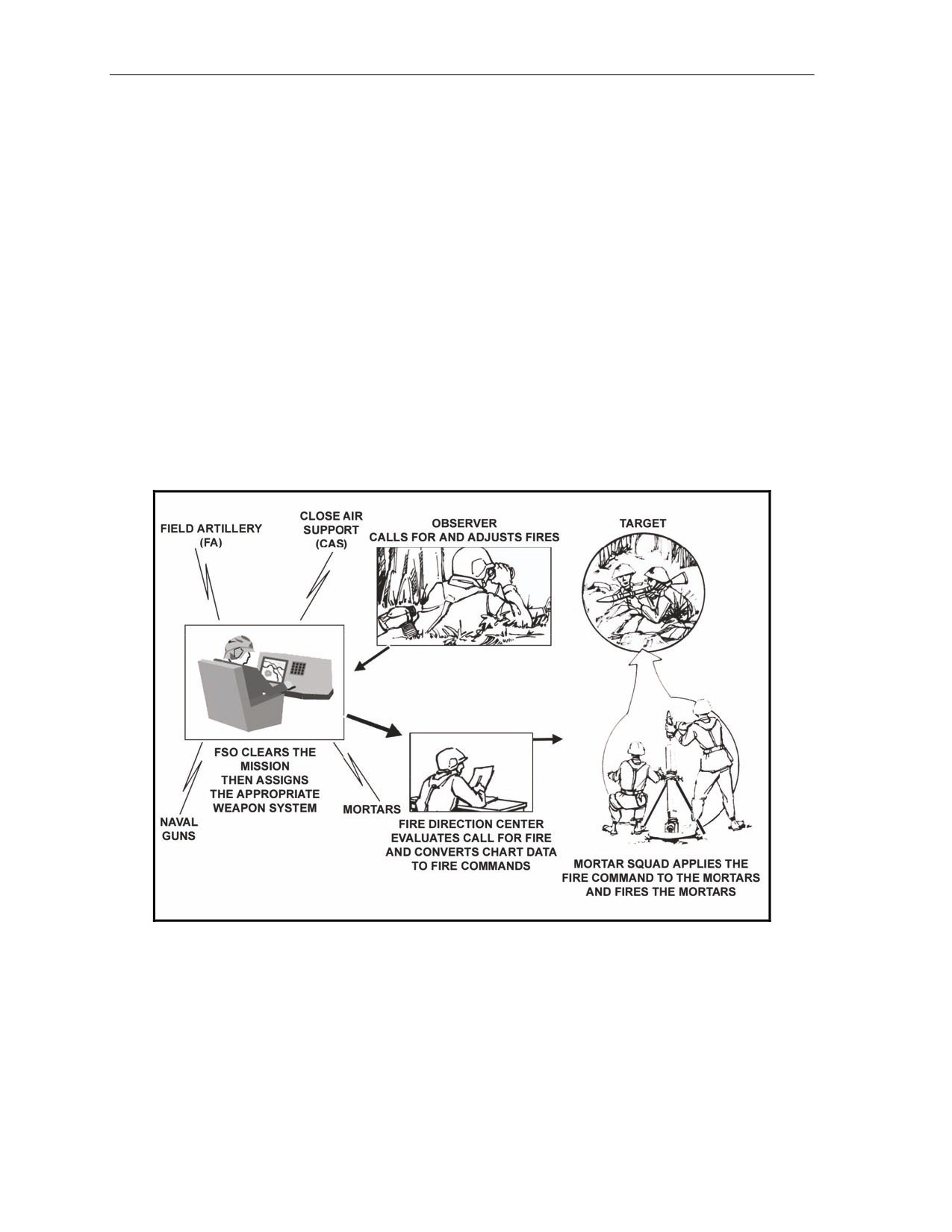
procedures are a team effort (Figure 1-1). They include locating the target, designating the correct asset to
fire the mission, determining firing data, clearing indirect surface-to-surface fires, applying data to the
mortar, and preparing the ammunition. Since the mortar is normally fired from the defilade position (where
the crew cannot see the target), the indirect fire team gathers and applies the required data, and coordinates
and synchronizes the fires with the concept of the operation. This team consists of a fire support officer
(FSO) in the fires cell (FC), forward observer (FO), a fire direction center (FDC), and mortar squads.
Figure 1-1. Indirect fire team.
1-10. The battalion FSO coordinates and synchronizes fire support for the maneuver battalion. He is in
charge of the FC and is the principal fire support advisor to the maneuver battalion commander. The FC is
located with the operations element of the maneuver force. The commander is responsible for integrating
fire support, but typically delegates planning and supervisory authority for clearing indirect fires for the
unit to the FSO. Table 1-1 shows the organization of an FC in support of IBCT and HBCT battalions.
1-2
FM 3-22.91
17 July 2008

Introduction
Table 1-1. Battalion fire support personnel.
BATTALION FIRE SUPPORT PERSONNEL
IBCT
HBCT
FSO
1
1
Fire Support Plans/
0
1
Targeting Officer
Fire Support Sergeant
1
1
Fire Support Specialist
2
2
Radio/Telephone Operators
0
2
1-11. The battalion HHC fire support platoon provides FISTs to the battalion's maneuver companies upon
deployment. FISTs typically move to and remain with their supported companies and platoons. Table 1-2
shows the organization of a fire support team (FIST) in support of IBCT and HBCT companies.
Table 1-2. Company fire support personnel.
COMPANY FIRE SUPPORT PERSONNEL
IBCT
HBCT
Company FSO
1
1
Fire Support Sergeant
1
1
Fire Support Specialist
1
1
Radio Operator
1
1
Platoon FO
3
0
Platoon FO Radio Operator
3
0
1-12. The FDC has two computer personnel in each section (except the 60-mm squad, which does not have
assigned FDC personnel) who control the firing of mortars. They convert data received from the FO in a
call for fire (CFF) into firing data that can be applied to the mortar and ammunition.
1-13. Mortar squads organic to HBCT, and IBCT battalions consist of one squad leader, one gunner, one
assistant gunner, and one ammunition bearer/driver. At company level, IBCT units have one six-man
section consisting of one section sergeant, one squad leader, two gunners, and two assistant gunners. The
squad lays the mortar and prepares the ammunition using data from the FDC fire command. When the data
are applied, the squad fires the mortar. The squad must also be able to fire without an FDC.
MORTAR POSITIONS
1-14. To protect mortars from enemy direct fire and observation, units should employ mortars in defilade
positions when possible. These positions can also take the greatest advantage of the indirect fire role of
mortars.
1-15. The use of defilade precludes sighting weapons directly at the target (direct lay); this is necessary for
survival.
1-16. Mortars are indirect fire weapons. Special procedures ensure that the weapon and ammunition
settings used cause the projectile to burst on the target or at the proper height above it. A coordinated effort
by the indirect fire team also ensures the timely and accurate engagement of targets.
1-17. To apply the essential information and engage the target from a defilade position—
(1) Locate targets and mortar positions.
(2) Determine chart data (direction, range, and vertical interval [VI] from mortars to targets).
(3) Convert chart data into firing data.
(4) Apply firing data to the mortar and to the ammunition.
(5) Apply FO corrections and fire for subsequent rounds until a fire for effect (FFE) is achieved.
17 July 2008
FM 3-22.91
1-3
Chapter 1
MISSIONS AND FIRE DIRECTION CONTROL PROCEDURES
1-18. Basic FDC procedures are the foundation of all mortar missions. Basic mortar missions consist only of
basic FDC procedures, but special mortar missions include special FDC procedures, such as control measures.
BASIC FIRE DIRECTION CENTER PROCEDURES
1-19. Basic FDC procedures include—
z
Grid.
z
Shift from a known point.
z
Polar plot.
z
Special sheaf adjustments.
z
Registration.
z
Meteorological (MET) correction.
Grid
1-20. For a grid mission, the observer expresses the target location using the target’s grid coordinates.
Shift from a Known Point
1-21. For a shift from a known point mission, the observer expresses the target location using the target’s
direction and distance from a known point.
Polar Plot
1-22. For a polar plot mission, the observer expresses the target location using the target’s direction and
distance from the observer. The observer’s location must be known prior to calling a polar plot mission.
Special Sheaf Adjustments
1-23. Special sheaf adjustments involve altering the placement of rounds on the ground between guns. The
sheaf may be open, converged, linear (formerly known as standard), parallel, or special.
Registration
1-24. Registration involves applying fire corrections to resolve interior and exterior ballistics and errors in
gun/target location. This process is similar to zeroing a rifle.
Meteorological Correction
1-25. MET correction involves correcting for variations in weather conditions.
SPECIAL FIRE DIRECTION CENTER PROCEDURES
1-26. Special FDC procedures include—
z
Search.
z
Traverse.
z
Search and traverse.
z
Illumination.
z
Coordinated illumination.
z
Split.
z
Simo.
z
Final protective fire (FPF).
z
Smoke.
1-4
FM 3-22.91
17 July 2008
Introduction
Search
1-27. Mortarmen use search procedures to fire upon targets that are deeper than the burst diameter of the
round being fired.
NOTE: Search procedures exclude use of the Mortar Fire Control System (MFCS).
Traverse
1-28. Mortarmen use traverse procedures to fire upon targets that are wider than the sections/platoons that
engage them.
NOTE: Traverse procedures exclude use of the MFCS.
Search and Traverse
1-29. Mortarmen use search and traverse procedures to fire upon targets with attitudes neither parallel nor
perpendicular to the gun-target line.
NOTE: Search and traverse procedures apply to the lightweight handheld mortar ballistic
computer (LHMBC) only.
Illumination
1-30. Mortarmen use illumination procedures to illuminate a portion of the battlefield.
Coordinated Illumination
1-31. Coordinated illumination procedures combine illumination with high-explosive
(HE), red
phosphorus, or white phosphorus (WP) to illuminate and engage a target.
Split
1-32. Split procedures involve firing upon a single target from more than one location.
Simo
1-33. Simo procedures involve simultaneous fire upon two targets from a single location.
Final Protective Fire
1-34. Final protective fire (FPF) is a final defensive measure to prevent friendly units from being overrun.
Smoke
1-35. Mortarmen may use immediate or quick smoke. Advanced planning of quick smoke is essential,
since it requires large amounts of ammunition and prior coordination with all troops in the vicinity of the
intended screen or curtain.
17 July 2008
FM 3-22.91
1-5
Chapter 1
FIRE CONTROL SYSTEMS
1-36. The six fire control systems include—
z
M16 plotting board.
z
M19 plotting board.
z
M23 mortar ballistic computer (MBC).
z
M95 MFCS.
z
M96 MFCS.
z
M32 LHMBC.
M16 PLOTTING BOARD
1-37. HBCT and IBCT BN Mortar, forces use the M16 plotting board as a backup manual fire control
system.
M19 PLOTTING BOARD
1-38. IBCT Company sections use the M19 plotting board as a backup manual fire control system.
M23 MORTAR BALLISTICS COMPUTER
1-39. Since 1985, the M23 MBC has been the primary electronic fire control system for IBCT and HBCT
forces, but it is currently being replaced by the M95 MFCS, M96 MFCS, or M32 LHMBC.
M95 MORTAR FIRE CONTROL SYSTEM
1-40. The M95 MFCS is installed in M1064 and M1129 Stryker mortar carriers.
M96 MORTAR FIRE CONTROL SYSTEM
1-41. The M96 MFCS is installed in the M577 in the HBCT.
M32 LIGHTWEIGHT HANDHELD MORTAR BALLISTIC COMPUTER
1-42. The M32 LHMBC is the new primary electronic fire control system for all dismounted forces.
1-6
FM 3-22.91
17 July 2008
Chapter 2
Fundamentals of Mortar Fire Direction
This chapter discusses the elements of firing data, ballistics, firing tables, fire
planning, target analysis, and methods of attack (MOA). This information enables the
FDC to engage the enemy, even during adverse conditions.
SECTION I. ELEMENTS OF FIRING DATA AND BALLISTICS
Mortarmen apply firing data to ammunition and mortars so that the fired projectile bursts at the desired
location. These data are based on the direction, horizontal range, and vertical interval (VI) from the mortar to
the target; the pattern of bursts desired at the target; and MET conditions.
(See Appendix C for more
information.)
DIRECTION
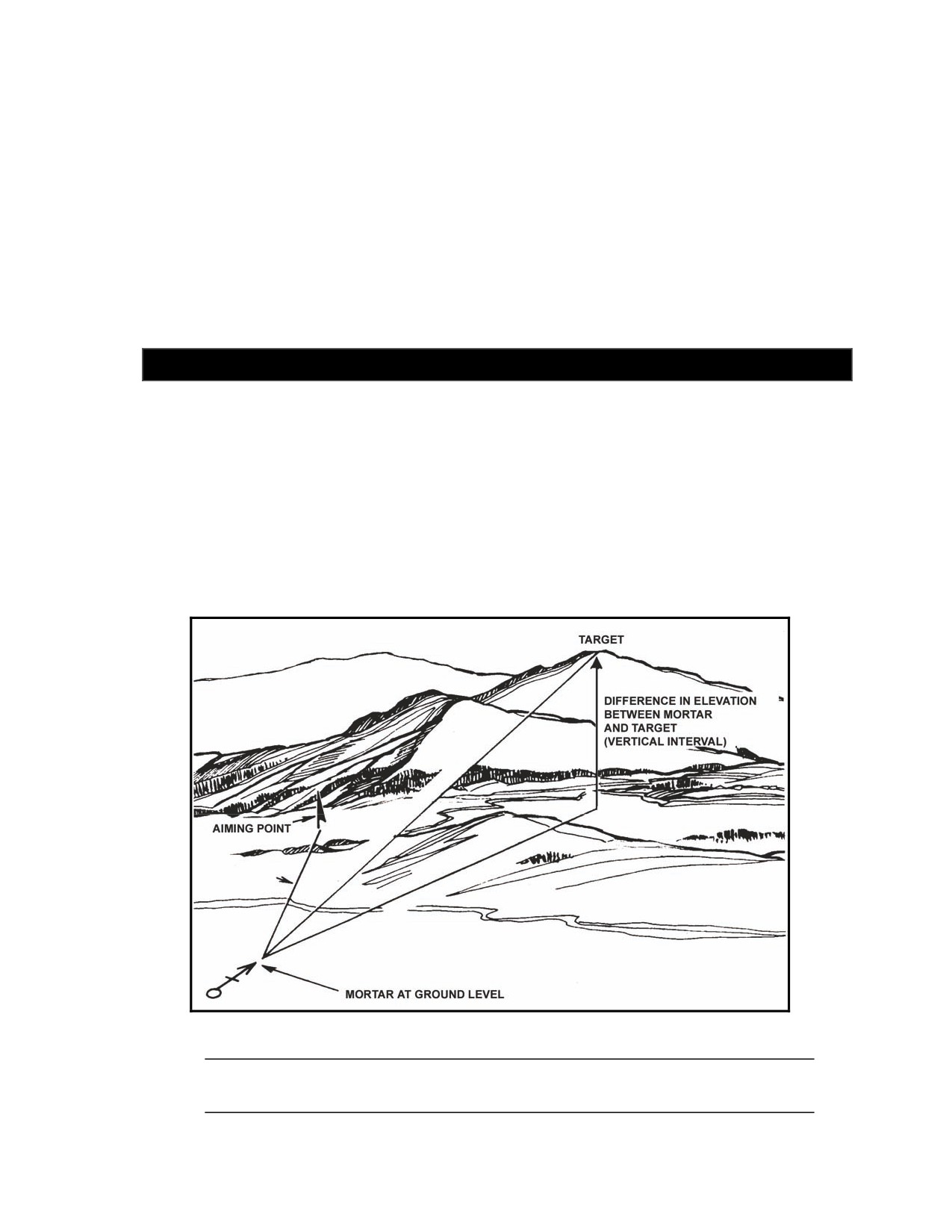
2-1. In mortar gunnery, direction is a horizontal angle measured from a fixed reference. The indirect fire
team measures direction in mils clockwise from grid north (the direction of the north-south grid lines on a
tactical map). The team emplaces its mortars on a mounting azimuth, and then uses the direction to make
angular shifts onto the target. Direction to the target may be computed, determined graphically, or estimated
(Figure 2-1).
Figure 2-1. Direction to the target.
NOTE: In mortar gunnery, the unit of angular measurement is the mil. A mil equals about
0.056 of a degree. There are 17.8 mils in a degree and 6400 mils in a 360-degree circle.
17 July 2008
FM 3-22.91
2-1
Chapter 2
RANGE
2-2. Range is the computed, measured, or estimated horizontal distance (expressed in meters) from the
mortar to the target. The range of a projectile depends on its muzzle velocity and the elevation of the
mortar.
VERTICAL INTERVAL
2-3. VI is the altitude difference between the mortar section and the target or point of burst. It is
determined using maps, survey, or a shift from a known point.
DISTRIBUTION OF BURSTS
2-4. Distribution of bursts is the pattern of bursts in the target area. When in a standard formation, all
mortars of a section or platoon generally fire with the same deflection, fuze setting, charge, and elevation.
Since targets may be various shapes and sizes and mortars may use terrain positioning, mortarmen either
adjust the pattern of bursts to the shape and size of the target or compute and apply individual mortar
corrections for deflection, fuze setting, charge, and elevation to achieve a specific pattern of bursts.
INTERIOR BALLISTICS
2-5. Interior ballistics deals with the factors affecting the motion of a mortar round before it leaves the
muzzle of the barrel. The total effect of all interior ballistic factors determines the velocity with which the
projectile leaves the muzzle. This type of velocity, called muzzle velocity, is expressed in meters per
second (MPS).
NATURE OF PROPELLANTS AND PROJECTILE MOVEMENTS
2-6. Propellant, a low-order explosive that burns rather than detonates, is the mortar fire’s semi-fixed
ammunition. When gases from the burning propellant develop enough pressure to overcome projectile
weight and initial bore resistance, the projectile begins to move.
2-7. Gas pressure peaks quickly and subsides gradually after the projectile begins to move. The peak
pressure, together with the travel of the projectile in the bore, determines the speed at which the projectile
leaves the barrel.
2-8. Factors that affect the velocity of a mortar-ammunition combination include—
z
An increase or decrease in the rate of burning propellant increases or decreases gas pressure.
z
An increase in the size of the weapon’s chamber, without a corresponding increase in the
amount of propellant, decreases the gas pressure.
z
Gas escaping around the projectile in the barrel decreases the pressure.
z
An increase in bore resistance to projectile movement before peak pressure further increases the
pressure.
z
An increase in bore resistance has a dragging effect on the projectile and decreases velocity.
Temporary variations in bore resistance are caused by carbon buildup in the barrel or
imperfections in bore shape.
2-2
FM 3-22.91
17 July 2008
Fundamentals of Mortar Fire Direction
STANDARD MUZZLE VELOCITY
2-9. Firing tables give the standard muzzle velocity for each charge. Values are based on a standard
barrel and are guides, since they cannot be reproduced in a given instance. A specific mortar-ammunition
combination cannot be selected with the assurance that it will result in a standard muzzle velocity when
fired. Charge velocities are established indirectly by the military characteristics of a weapon. Since mortars
are high-angle-of-fire weapons, they require greater variation in charges than howitzers, which are capable
of low angles-of-fire. This variation helps achieve a range overlap between charge zones and the desired
range-trajectory. Other factors considered in establishing charge velocities are the maximum range
specified for the weapon and the maximum elevation and charge (with the resulting maximum pressure)
that the weapon can accommodate.
NONSTANDARD MUZZLE VELOCITY
2-10. In mortar gunnery, nonstandard velocity is expressed as a variation (plus or minus MPS) from an
accepted standard. Round-to-round corrections for dispersion cannot be made. Each factor causing
nonstandard muzzle velocity is treated as independent of related factors.
VELOCITY TRENDS
2-11. Not all rounds of a series fired from the same weapon using the same ammunition lot will develop
the same muzzle velocity. Some muzzle velocities are higher than average, and some are lower. This is
called velocity dispersion. Under most conditions, the first few rounds follow a somewhat regular pattern,
rather than the random pattern associated with normal dispersion. This is called velocity trend. The
magnitude and extent (number of rounds) of velocity trends vary with the mortar, charge, barrel condition,
and firings that precede the series. Velocity trends cannot be predicted, so computer personnel should not
attempt to correct for their effects.
AMMUNITION LOTS
2-12. Each lot of ammunition has its own performance level when related to the same mortar barrel.
Although the round-to-round probable error (PE) within each lot is about the same, the mean velocity
developed by one lot may be higher or lower than that of another lot. Variations in the projectile, such as
the diameter and hardness of the rotating disk, affect muzzle velocity. Projectile variations have a much
more apparent effect on exterior ballistics than on interior ballistics.
TOLERANCES IN NEW WEAPONS
2-13. New mortars of a given size and model do not always develop the same muzzle velocity. In a new
barrel, the main factors are variations in the powder chamber and in the interior dimensions of the bore. If a
battalion armed with new mortars fires with a common lot of ammunition, mortars with the highest and
lowest muzzle velocity will have a velocity difference of 3 or 4 MPS.
WEAR OF BARREL
2-14. Heated gases, chemical action, and friction from projectiles during continued firing wear away the
bore. This wear is more pronounced when higher charges are being fired. Barrel wear allows more gases to
escape past the obturator band, decreasing resistance to initial projectile movement and lessening pressure
buildup, thereby decreasing muzzle velocity. Wear can be reduced by careful selection of the charge and
proper cleaning of the weapon and ammunition.
TEMPERATURE OF THE PROPELLANT
2-15. Combustible material burns rapidly when it is heated before ignition. When a propellant burns more
rapidly, the resulting pressure on the projectile is greater, increasing muzzle velocity. Firing tables show
the magnitude of that change. Appropriate corrections to firing data can be computed, but such corrections
17 July 2008
FM 3-22.91
2-3
Chapter 2
are valid only if they reflect the true propellant temperature. The temperature of propellants in sealed
packing cases remains fairly uniform, though not always standard (70 degrees Fahrenheit).
2-16. Once the propellant is unpacked, its temperature tends to approach the prevailing air temperature.
The time and type of exposure to weather results in propellant temperature variations. It is not practical to
measure propellant temperature and to apply corrections for each round fired by each mortar. Propellant
temperatures must be kept uniform; if they are not, firing is erratic. A sudden change in propellant
temperature can invalidate even the most recent corrections.
2-17. To let propellants reach air temperature uniformly—
z
Ready ammunition should be kept off of the ground.
z
Ammunition should be protected from dirt, moisture, and direct sunrays.
z
An airspace should be created between the ammunition and protective covering.
z
Unpack a sufficient number of rounds so that they are not mixed with newly unpacked
ammunition. Fire rounds in the order in which they are unpacked.
MOISTURE CONTENT OF PROPELLANT
2-18. Handling and storage can cause changes in the moisture content of the propellant, which affects the
velocity. Protect ammunition from moisture because moisture content cannot be measured or corrected.
BARREL TEMPERATURE
2-19. The temperature of the barrel affects the muzzle velocity. A cold barrel offers more resistance to
projectile movement than a warm barrel.
PROPELLANT RESIDUES
2-20. Burned propellant and certain chemical agents mixed with expanding gases cause residue deposits
on the bore surface. Properly clean and care for the barrel to prevent such deposits from causing pits in the
barrel (pitting will increase abrasion by the projectiles).
OIL OR MOISTURE
2-21. Oil or moisture in the barrel or on the rotating disk increases a round’s velocity by causing a better
initial gas seal and reducing projectile friction on the bore surface. Too much oil or moisture in the barrel,
however, decreases velocity, causing a short round.
EXTERIOR BALLISTICS
2-22. Exterior ballistics, mainly gravity and air, affect the motion of a projectile after it leaves the muzzle
of the barrel. Gravity causes the projectile to fall, but air resistance impedes it. When projectiles are fired
into the air, their paths differ, since projectiles of different sizes or weights respond differently to the same
atmospheric conditions. A given elevation and muzzle velocity can also result in a wide variety of
trajectories, depending on the combined properties of the projectile and the atmosphere.
TRAJECTORY
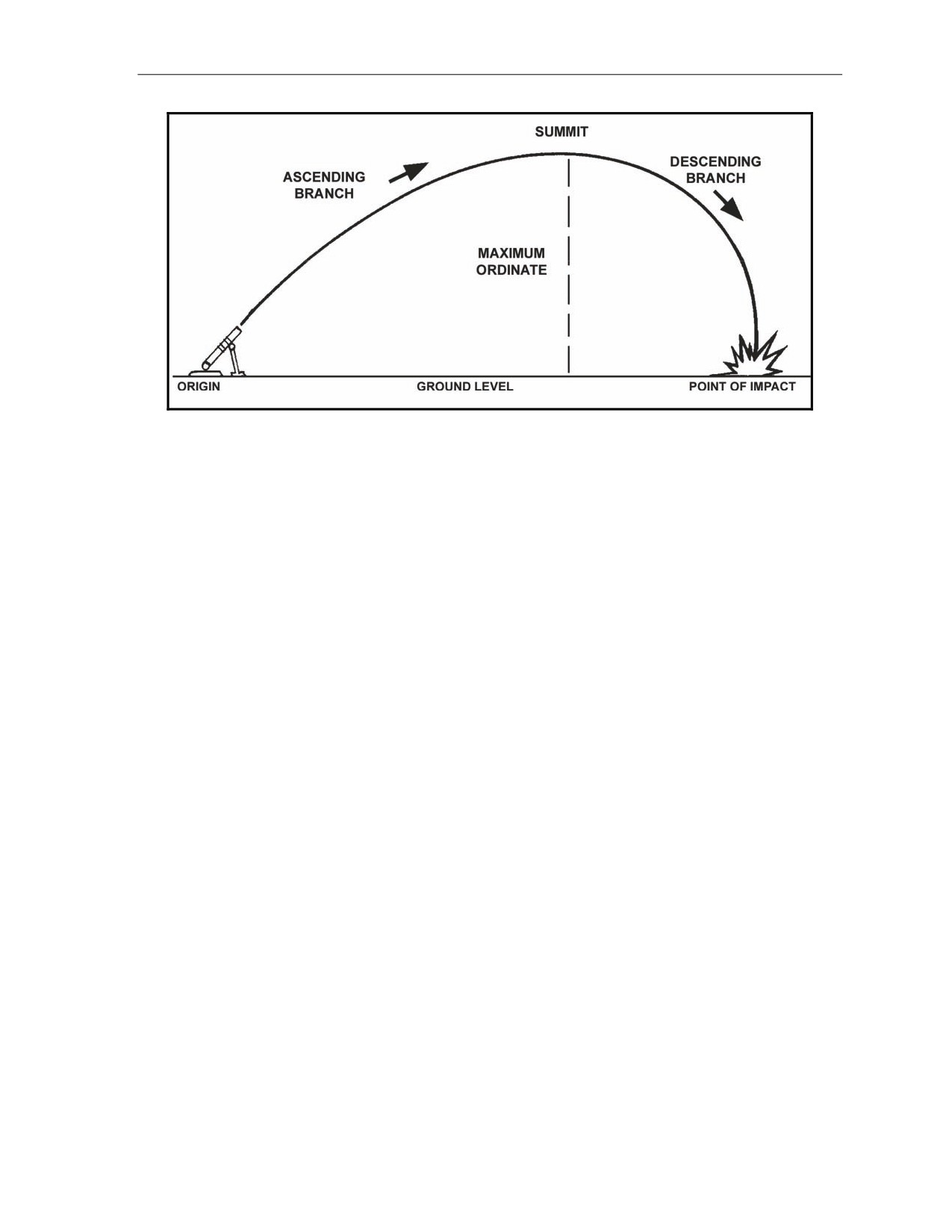
2-23. Trajectory is the flight path that a projectile follows from the muzzle of the mortar to its point of
impact (Figure 2-2). The ascending branch is the portion of the trajectory traced while the projectile rises
from its origin. The descending branch is the portion of the trajectory traced while the projectile falls. The
summit, the highest point of the trajectory, is located at the end of the ascending branch and at the
beginning of the descending branch. The maximum ordinate is the altitude (in meters) at the summit above
the point of origin.
2-4
FM 3-22.91
17 July 2008
Fundamentals of Mortar Fire Direction
Figure 2-2. Elements of the trajectory.
TRAJECTORY IN ATMOSPHERE
2-24. Air’s resistance to a projectile depends on the air’s movement, density, and temperature. Standard
atmosphere (an assumed density and temperature and a condition of no wind) is used to compute firing
tables.
CHARACTERISTICS OF TRAJECTORY IN STANDARD ATMOSPHERE
2-25. The projectile’s velocity at the level point is less than its velocity at its origin (Figure 2-2). The
projectile travels more slowly beyond the summit than before it, so it does not travel as far. Its descending
branch is shorter than its ascending branch, and its angle of fall is greater than its angle of elevation. In
standard atmosphere, trajectory is affected by the following factors:
z
Horizontal velocity decreases with continued time of flight.
z
Vertical velocity is affected not only by gravity, but also by air resistance.
STANDARD CONDITIONS AND CORRECTIONS
2-26. As outlined in the introduction to the firing tables (Section II), certain atmospheric and material
conditions are accepted as standard. When conditions vary from standard, the trajectory varies. Variations
in the following conditions can be measured and corrected:
z
Difference in altitude between the mortar and the target.
z
Propellant temperature.
z
Ballistic wind.
z
Air temperature.
z
Air density.
z
Weight of the projectile.
17 July 2008
FM 3-22.91
2-5
Chapter 2
SECTION II. FIRING TABLES
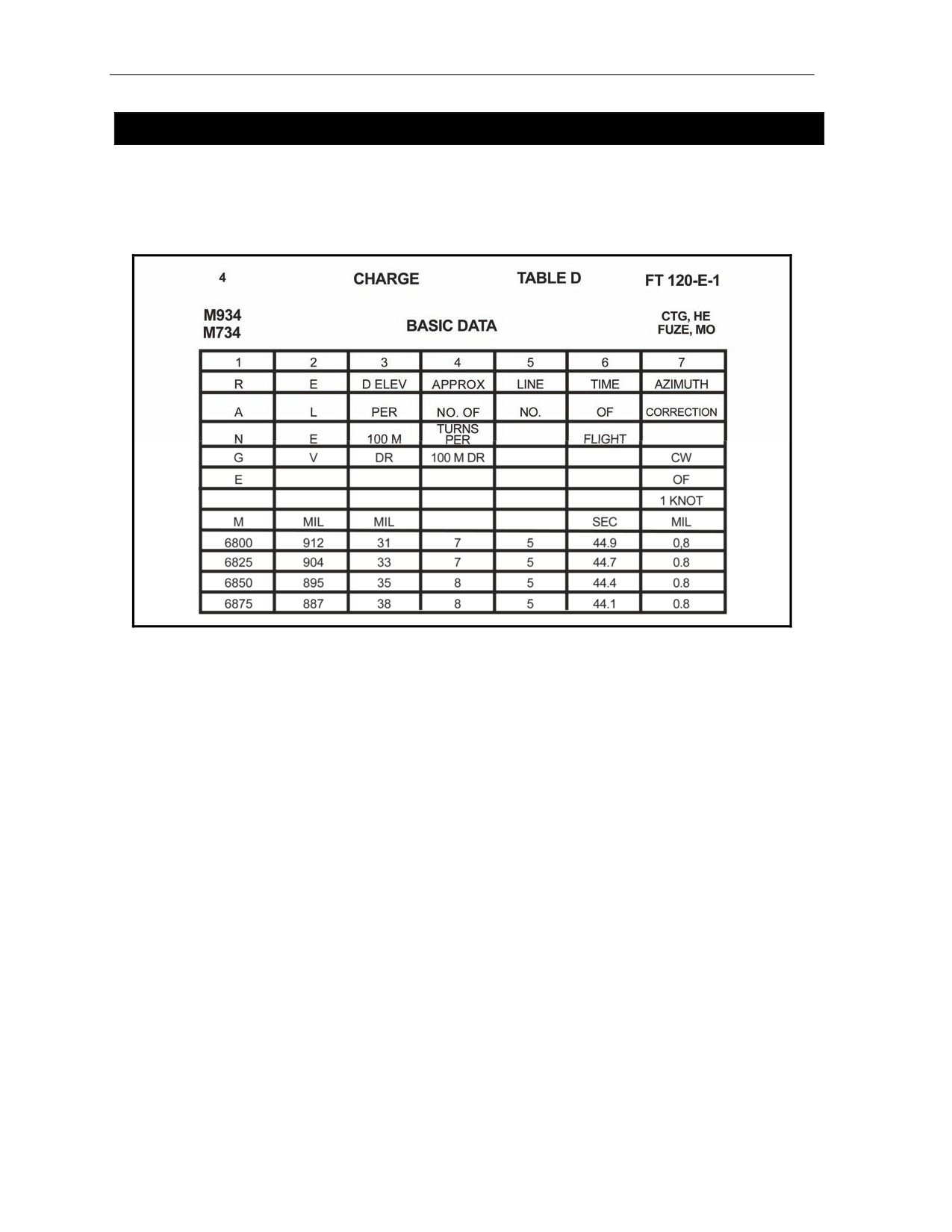
Firing tables are based on firing the weapon and its ammunition under, or correlated to, standard conditions
(Figure 2-3). Those standards are used to compensate for variations in the weapon, weather, and ammunition at
a given time and place. The atmospheric standards in United States’ firing tables reflect the mean annual
conditions in the North Temperate Zone. The main elements measured in experimental firing are angle of
elevation, angle of departure, muzzle velocity, attained range, and concurrent atmospheric conditions.
Figure 2-3. Example of Firing Table 120-E-1.
PURPOSE
2-27. The main purpose of a firing table is to provide the data required to bring effective fire on a target
under any condition. Data for firing tables are obtained by firing the weapon at various elevations and
charges.
UNIT CORRECTIONS
2-28. Firing tables describe unit corrections as range corrections for an increase or decrease in range, wind,
air temperature, density, and projectile weight, followed by the unit value in meters.
2-29. Each correction is computed on the assumption that all other conditions are standard, but corrections
differ slightly if one or more of the other conditions are nonstandard. The amount of difference depends on
the effect of the other nonstandard conditions. The effect one nonstandard condition has on another is
known as an interaction effect. The effect of a nonstandard condition depends on the length of time the
projectile is exposed to that condition.
2-30. The weather’s effect on a given projectile can be determined from a met message, if the maximum
ordinate achieved is known. Personnel can compensate for those effects using the corrections listed in the
appropriate firing tables.
2-6
FM 3-22.91
17 July 2008
Fundamentals of Mortar Fire Direction
STANDARD RANGE
2-31. The standard range is the range opposite the charge in the firing table, which is the horizontal
distance from the origin to the level point. The attained range is reached by firing with a given elevation
and charge. If actual firing conditions duplicate the ballistic properties and MET conditions upon which the
firing table is based, the attained range and the standard range will be equal. The command range
corresponds to the given elevation and charge that must be fired to reach the target.
EFFECT OF NONSTANDARD CONDITIONS
2-32. Deviations from standard conditions, if not corrected when computing firing data, causes the
projectile to impact or burst somewhere other than the desired point. Nonstandard conditions that affect
range also affect the time of flight.
2-33. Corrections are made for nonstandard conditions to improve accuracy. The accuracy of mortar fires
depends on the accuracy and completeness of data available, computation procedures used, and care in
laying the weapons. Accuracy should not be confused with precision. Precision is related to the tightness of
the dispersion pattern without regard to its nearness to a desired point; accuracy is related to the location of
the mean point of impact (MPI) with respect to a desired point.
RANGE EFFECTS
2-34. Factors that affect the range include—
z
Vertical jump.
z
Projectile's weight.
z
Air resistance.
z
Finish of the shell.
z
Ballistic coefficient.
z
Range wind.
Vertical Jump
2-35. Vertical jump is a small change in barrel elevation caused by the shock of firing, which produces a
minor range dispersion. In modern weapons, vertical jump cannot be predicted and is usually small, so it is
not considered separately in gunnery.
Projectile’s Weight
2-36. The projectile’s weight affects the muzzle velocity. Two opposing factors affect the flight of a
projectile of nonstandard weight. A heavier projectile is more efficient in overcoming air resistance, but its
muzzle velocity is lower because it is more difficult to push through the barrel. An increase in projectile
efficiency increases range, but a decrease in muzzle velocity decreases range. In firing tables, corrections
for those two opposing factors are combined into a single correction. The change in muzzle velocity
predominates at shorter times of flight; the change in projectile efficiency predominates at longer times of
flight. Hence, for a heavier-than-standard projectile, the correction is plus at shorter times of flight and
minus at longer times of flight. The reverse is true for a lighter-than-standard projectile.
Air Resistance
2-37. Air resistance affects both range and deflection during the flight of the projectile. Air’s resistance to
the direction of flight is called drag. Because of drag, both the horizontal and vertical components of
velocity are less at any given time of flight than they would be if drag were zero, as in a vacuum. The
greater the drag, the shorter the range; and the heavier the projectile, the longer the range, all other factors
being equal. Air density, air temperature, velocity, and diameter are factors considered in the computation
of drag.
17 July 2008
FM 3-22.91
2-7
Chapter 2
2-38. The drag of a given projectile is proportional to the density of the air through which it passes. For
example, an increase in air density of a given percentage increases the drag by the same percentage. Since
the air density at a particular place, time, and altitude varies widely, the standard trajectories reflected in
firing tables are computed with a fixed relation between density and altitude. As the air temperature
increases, the drag decreases, thereby increasing range.
2-39. The faster a projectile moves, the more the air resists its motion. Examination of a set of firing tables
shows that, for a given elevation, the effect of 1 percent of air density (1 percent of drag) increases with an
increase of charge (muzzle velocity).
2-40. Two projectiles of identical shape but different size do not experience the same drag. For example, a
larger projectile offers a larger area for the air to act upon, increasing its drag.
Finish of the Shell
2-41. The finish of the shell surface affects the muzzle velocity. A rough surface on the projectile or fuze
increases air resistance, thereby decreasing range.
Ballistic Coefficient
2-42. The ballistic coefficient of a projectile is its efficiency in overcoming air resistance compared to an
assumed standard projectile. Each projectile and projectile lot, however, has its own efficiency level.
Therefore, to establish firing tables, one specific projectile lot must be selected and fired. Based on the
performance of that lot, standard ranges are determined. The ballistic coefficient of that lot becomes the
firing table standard. However, other projectile lots of the same type may not have the same ballistic
coefficient as the one reflected in the firing tables. If another lot is more efficient (that is, has a higher
ballistic coefficient than the firing table standard), it will achieve a greater range when fired. The reverse is
true for a less efficient projectile lot.
NOTE: For ease in computations, all projectile types are classified into certain standard groups.
Range Wind
2-43. Range wind is that component of the wind blowing parallel to the direction of fire (DOF) and in the
plane of fire. Range wind changes the relationship between the velocity of the projectile and the velocity of
the air nearby. If the air is moving with the projectile (tail wind), it offers less resistance to the projectile
and a longer range results; a head wind has the opposite effect.
DEFLECTION EFFECTS
2-44. Factors that affect the deflection include—
z
Crosswind.
z
Lateral jump.
z
Drift.
z
Initial yaw.
z
Summital yaw.
CROSSWIND
2-45. The crosswind is that component of the ballistic wind blowing across the DOF. Crosswind tends to
carry the projectile with it and causes a deviation from the DOF. The lateral deviation of the projectile,
however, is not as large as the velocity of the crosswind acting on that projectile. Wind component tables
simplify the reduction of the ballistic wind into its two components—crosswind and range wind—with
respect to the DOF. (See Chapter 4 for a discussion of the wind component table.)
2-8
FM 3-22.91
17 July 2008
Fundamentals of Mortar Fire Direction
LATERAL JUMP
2-46. Lateral jump is a small change in barrel deflection caused by the shock of firing. The effect is
ignored, since it is small and varies from round to round.
DRIFT
2-47. Drift is the departure of the projectile from standard direction due to air resistance and gravity. To
understand the forces that cause drift, mortarmen must understand the angle of yaw, which is the angle
between the projectile’s direction of motion and axis. The yaw of a spinning projectile changes constantly:
right, down, left, up.
INITIAL YAW
2-48. Initial yaw is greatest near the muzzle and gradually subsides. The atmosphere offers greater
resistance to a yawing projectile, so projectiles are designed to minimize yaw and to retard it in flight.
SUMMITAL YAW
2-49. Summital yaw occurs at the summit of the trajectory and directs the nose of the projectile slightly
toward the direction of spin.
DISPERSION AND PROBABILITY
2-50. The points of impact of the projectiles are scattered both laterally (deflection) and in depth (range)
due to minor variations of many elements from round to round. These variations must not be confused with
those caused by mistakes or constant errors. Mistakes can be removed and constant errors compensated for,
but errors that cause dispersion may be due to conditions in the bore, in the bipod, or during flight. There
are many conditions that affect accurate dispersion prediction, including—
z
Dispersion pattern.
z
Muzzle velocity.
z
Direction and elevation.
z
Air resistance.
DISPERSION PATTERN
2-51. If a number of rounds of the same caliber and same lot are fired from the same mortar with the same
charge, elevation, and deflection, the rounds will not all fall at a single point. Instead, they will scatter in a
pattern of bursts called the dispersion pattern.
CONDITIONS THAT AFFECT MUZZLE VELOCITY
2-52. Muzzle velocity is affected by conditions in the bore, such as minor variations in the weight,
moisture content, temperature, and arrangement of the propelling charge. It is also affected by differences
in the ignition of the charge, the weight of the projectile, and the form of the rotating disk.
CONDITIONS THAT AFFECT DIRECTION AND ELEVATION
2-53. Direction and elevation are affected by conditions of the bipod, such as play (looseness) in the
traversing mechanism, physical limitations on precision in setting scales, and inconsistent reactions to
firing stresses.
CONDITIONS THAT AFFECT AIR RESISTANCE
2-54. Air resistance is affected by conditions during flight, such as differences in the weight, velocity, and
form of the projectile and by changes in air density, wind velocity, and temperature.
17 July 2008
FM 3-22.91
2-9
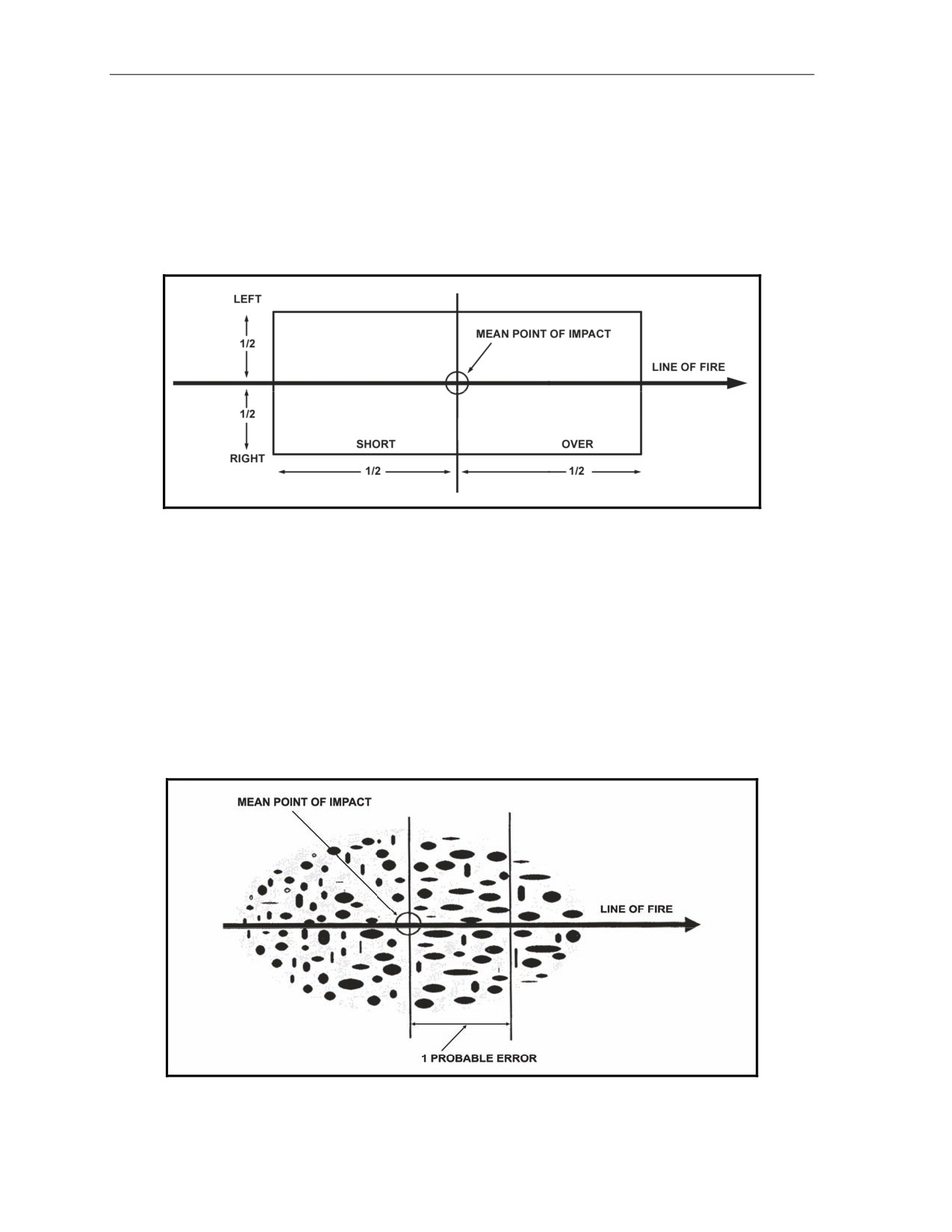
Chapter 2
MEAN POINT OF IMPACT
2-55. For any large number of rounds fired, a line drawn perpendicular to the line of fire divides the points
of impact equally. Half of the points will be beyond the line, or over; half will be inside the line, or short.
For the same group of rounds, another line drawn parallel to the line of fire divides the points equally. Half
of the points will be to the right of the line; half will be to the left. The first line (at right angles to the line
of fire) represents the mean range; the second (parallel to the line of fire) represents the mean deflection.
The lines intersect at the MPI (Figure 2-4).
Figure 2-4. Mean point of impact.
DISPERSION SCALE
2-56. In a normal burst pattern, the number of rounds short of the MPI will be the same as the number of
rounds over the MPI. The PE will be the same in both cases.
2-57. For any normal distribution (such as mortar fire), a distance of four PEs on either side of the MPI
will include almost all of the rounds in the pattern. A small fraction of rounds (about 7 out of 1,000) will
fall outside of four PEs on either side of the MPI.
2-58. A large number of bursts creates a roughly elliptical pattern (Figure 2-5). Since four PEs on either
side of the MPI (in range and deflection) will encompass almost all rounds, a rectangle is drawn to include
the full distribution of the rounds (Figure 2-6).
Figure 2-5. Burst in elliptical pattern.
2-10
FM 3-22.91
17 July 2008
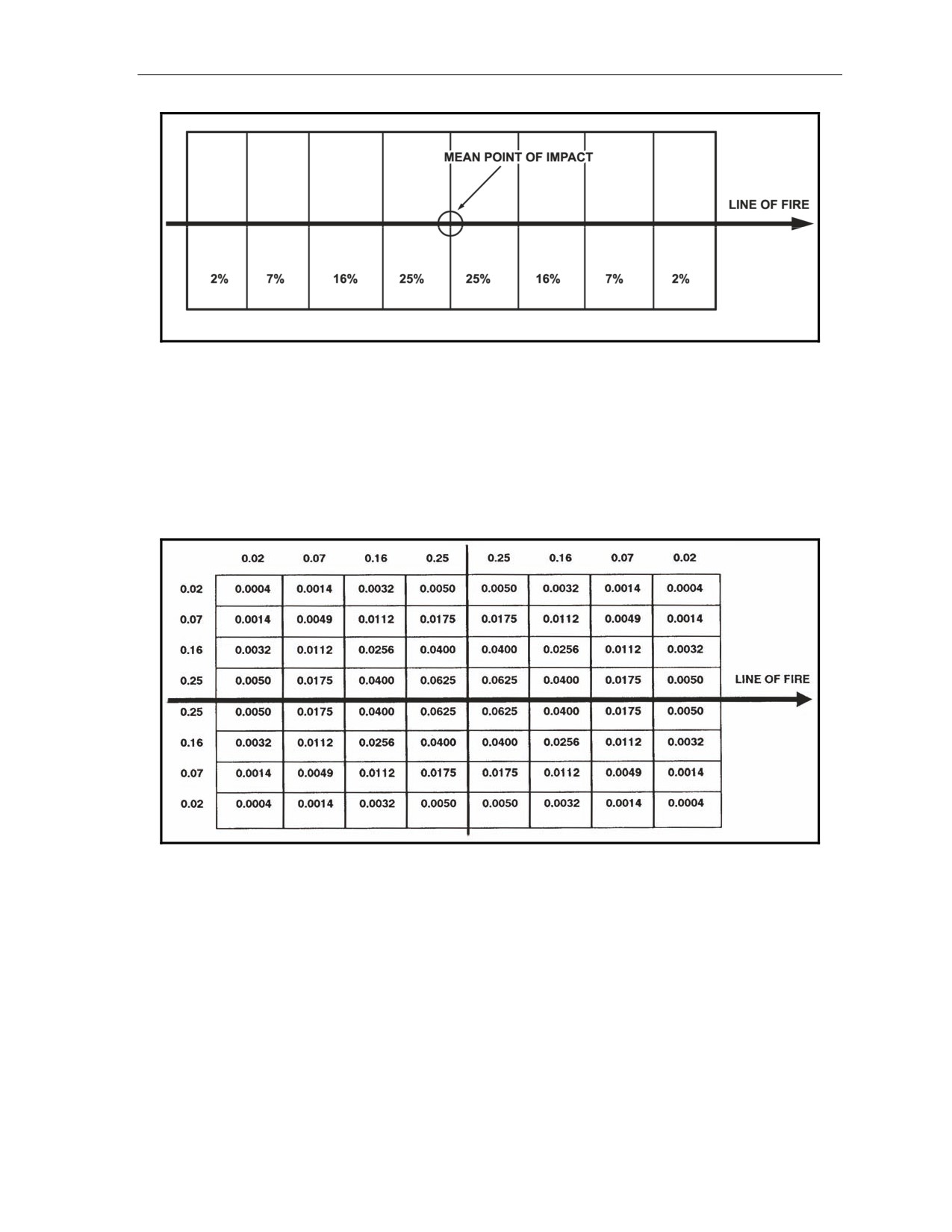
Fundamentals of Mortar Fire Direction
Figure 2-6. A 100-percent rectangle.
DISPERSION PATTERN
2-59. If one PE is used as the limit of measurement to divide the dispersion rectangle evenly into eight
range zones, the percentage of rounds falling into each zone will be as shown in Figure 2-7. The
percentages have been found to be true by experiment. Again, what is true in range is also true in
deflection. If range dispersion zones and deflection dispersion zones are both considered, a set of small
rectangles is created.
Figure 2-7. Dispersion rectangle.
17 July 2008
FM 3-22.91
2-11
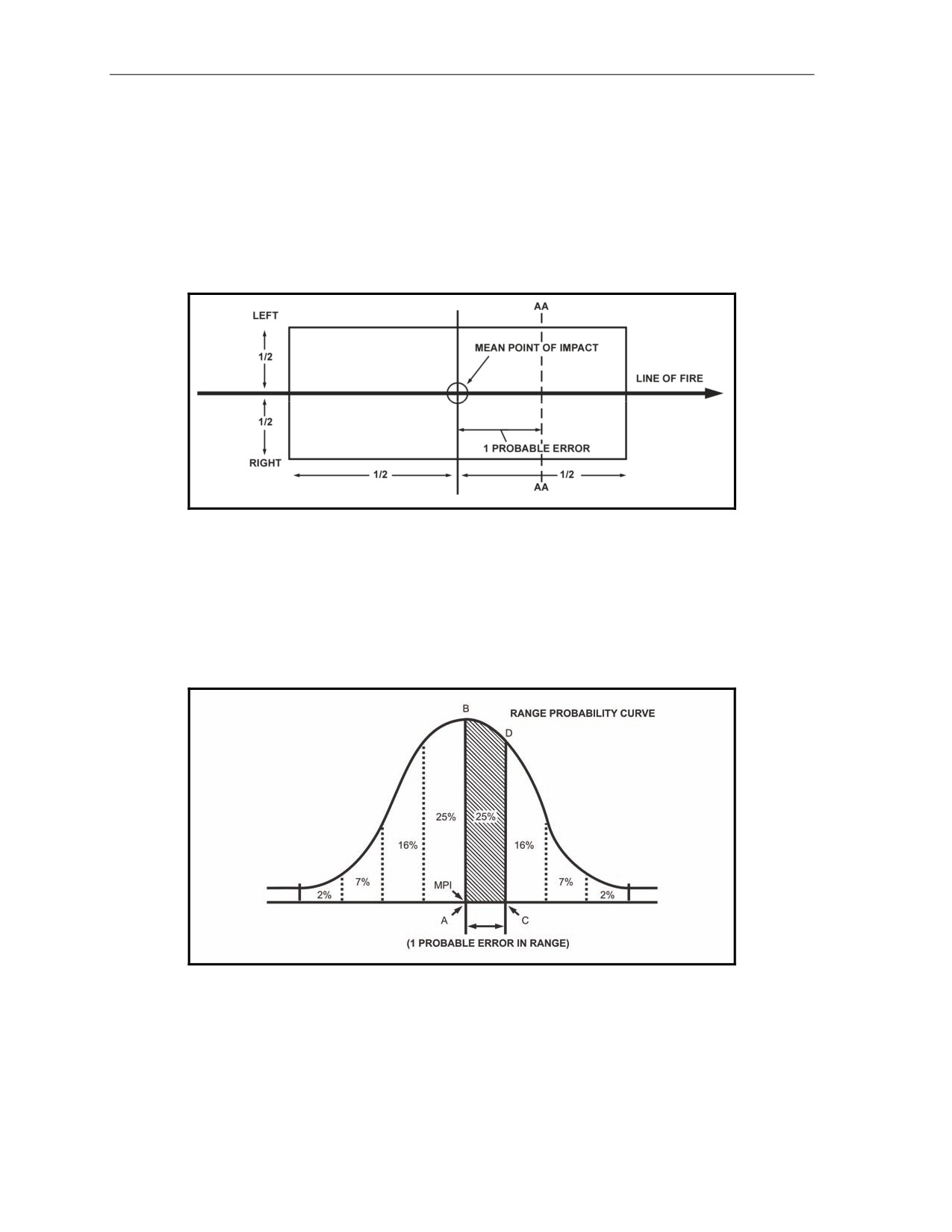
Chapter 2
PROBABLE ERROR
2-60. At some point along the line of fire, beyond the MPI, a second horizontal line can be drawn at right
angles to the line of fire. This line divides rounds over into two equal parts (line AA, Figure 2-8). All
rounds beyond the MPI manifest an error in range—they are all over. Some of the rounds falling over are
more in error than others. If the distance from the MPI to line AA is a measure of error, half of the rounds
over have a greater error, and half have a lesser error. The distance from the MPI to line AA becomes a
convenient unit of measure. That distance is called one probable error in range (PEr). A PE is the error
exceeded as often as not. PE applies to short rounds, as well as to rounds to the left and right of the MPI.
Figure 2-8. One probable error.
PROBABLE ERROR IN RANGE
2-61. The approximate value of the PEr is shown in Table E, Supplementary Data, of the firing tables and
can be taken as an index of the mortar’s precision. Firing table values for PErs are based on the firing of
specific ammunition under controlled conditions. The actual round-to-round PEr experienced in the field is
larger (Figure 2-9).
Figure 2-9. Range probability curve.
2-12
FM 3-22.91
17 July 2008
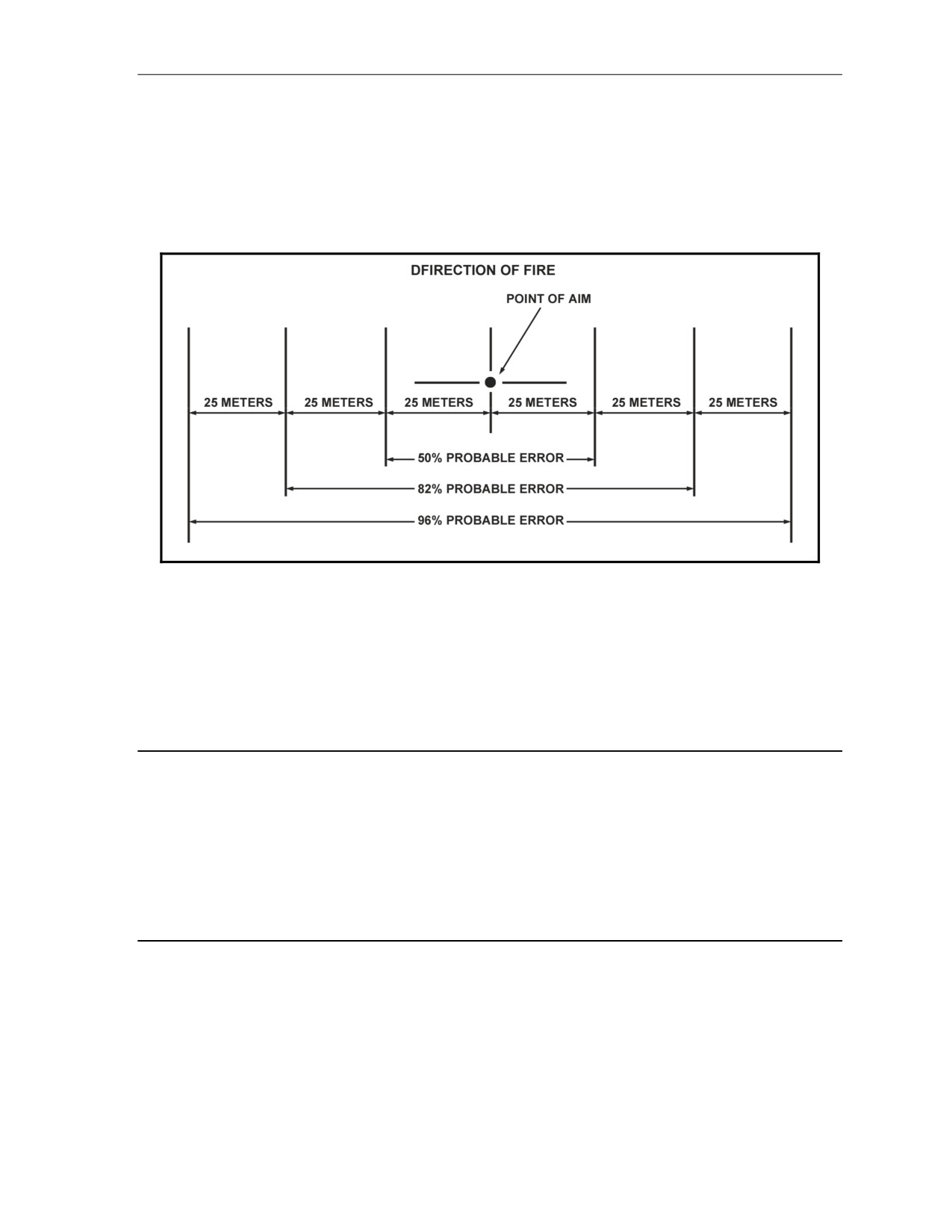
Fundamentals of Mortar Fire Direction
PROBABLE ERROR IN DEFLECTION
2-62. The value of the probable error in deflection (PEd) is given in Table E, Supplementary Data, of the
firing tables. For mortars, the PEd is much smaller than the PEr. For example, for a 120-mm mortar firing
charge 4 at a range of 3,600 meters and elevation 1324, the PEd is 25 meters (Figure 2-10). In other words,
50 percent of the projectiles fired will hit within 25 meters, 82 percent will hit within 50 meters (two PEs),
and 96 percent will hit within 75 meters (three PEs) of the mean deflection.
Figure 2-10. Probable error in deflection.
APPLICATION OF PROBABLE ERROR
2-63. Firing tables list PEs for range and deflection at each listed range. It is possible to express a given
distance in terms of PEs and to solve problems using the dispersion scale or probability tables. To compute
the probability of a round landing within an error of a certain magnitude, the specified error is reduced to
equivalent PEs in one direction along the dispersion scale, and the sum is multiplied by two.
EXAMPLE
A 120-mm mortar has fired a number of rounds with charge 4, elevation 1245, and an MPI of at least
4,500 meters has been determined. What is the probability that the next round fired will fall within 50
meters of the MPI?
ANSWER
PEr at 4,500 meters (charge 4) = 25 meters
Equivalent of 50 meters in PEs (50/25) = approximately 2
Percentage of rounds falling within 2 PEs = 25 percent plus 16 percent x 2 = 82 percent
17 July 2008
FM 3-22.91
2-13
///////////////////////////////////////