FM 3-22.91 MORTAR FIRE DIRECTION PROCEDURES (July 2008) - page 2
Chapter 2
SECTION III. FIRE PLANNING
Mortar platoons’ ability to engage targets with accurate and sustained fires depends on the precision and detail
of fire plans. Fire planning is concurrent and continuous at all levels of command. The principles of fire
planning used by field artillery (FA) also apply to mortars. These principles are close and continuous support of
the battalion, coordination with adjacent and higher units, and continuous planning.
TERMINOLOGY
2-64. Common terms used in fire planning include—
z
Target.
z
Targets of opportunity.
z
Scheduled targets.
z
On-call targets.
z
Group of targets.
z
Series of targets.
z
Final protective fire (FPF).
z
Preparation.
z
Counterpreparation.
z
Program of targets.
z
Harassing and interdiction fires.
TARGET
2-65. A target is troops, weapons, equipment, vehicles, buildings, or terrain that warrants engagement by
fire. Targets may be numbered for future reference and are designated on overlays as a solid cross with its
center representing the center of the target. The target number consists of two letters and four numbers
allocated by higher headquarters; this numbering system identifies the headquarters that planned the target,
distinguishes one target from another, and prevents duplication.
TARGETS OF OPPORTUNITY
2-66. Targets of opportunity are targets for which fires have not been planned. Planned targets are
scheduled or on-call.
Scheduled Targets
2-67. Scheduled targets are fired at a specific time before or after H-hour, or upon completion of a
predetermined movement or task.
On-Call Targets
2-68. On-call targets are fired only upon request. They include targets for which firing data is kept current
and those for which firing data is not prepared in advance; for example, a road junction (a prominent
terrain feature) that the FO may use as a reference point.
GROUP OF TARGETS
2-69. Mortars are often assigned groups of targets. A group of targets consists of two or more targets to be
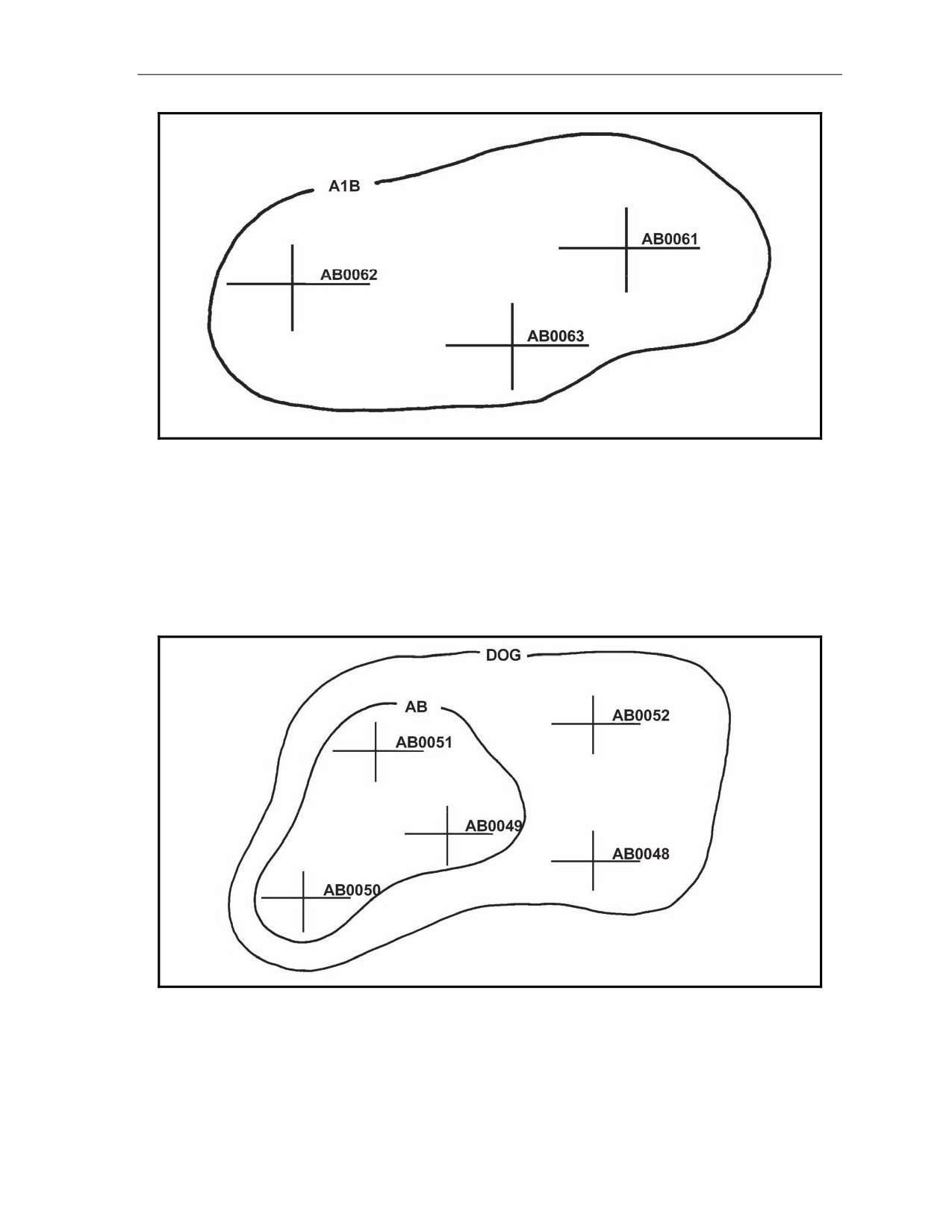
fired upon at the same time. Groups of targets are graphically designated by a circle and a group
designation (Figure 2-11). The group designation consists of the letters assigned to the maneuver brigade
by the division tactical operations center (TOC), with a number inserted between them; for example, A1B
for the first group of targets that the fires battalion FDC plans for a brigade assigned the letters A and B.
The designation of a group of targets does not preclude firing upon individual targets within the group.
2-14
FM 3-22.91
17 July 2008
Fundamentals of Mortar Fire Direction
Figure 2-11. Group of targets.
SERIES OF TARGETS
2-70. A series of targets is a number of targets or groups of targets planned to support the operation
(Figure 2-12). For example, a series of targets may be planned on a large objective so that fires are lifted or
shifted as the support unit advances. Graphically, a series is shown as individual targets or groups of
targets within a prescribed area. The series is given a code name. The designation of a series of targets does
not preclude the attack of individual targets or groups of targets within the series.
Figure 2-12. Series of targets.
17 July 2008
FM 3-22.91
2-15
Chapter 2
FINAL PROTECTIVE FIRE
2-71. FPF is an immediately available prearranged barrier of fire designed to impede enemy movement
across defensive lines or areas (Figure 2-13). It is integrated with the maneuver commander’s defensive
plans and may vary in shape and pattern to suit the tactical situation. On maps or firing charts, FPF is
represented by a linear plot, with the unit designated to fire the FPF indicated above it. The length of the
plot depends on the type of unit assigned to fire the FPF.
2-72. The maneuver commander determines the precise location of FPF, and the company FSO reports the
desired location to the supporting FDC. Authority to call the FPF is vested in the maneuver commander
(often the company commander or platoon leader) in whose area the FPF is located.
Figure 2-13. Final protective fires symbol.
PREPARATION
2-73. Preparation is the scheduled delivery of intense fires to support an attack. The commander decides to
fire a preparation and orders the attack.
COUNTERPREPARATION
2-74. Counterpreparation is the delivery of intense planned fires when an enemy attack is imminent. It is
designed to break up enemy formations, to disorganize command and communications systems, to reduce
the effectiveness of enemy preparations, and to impair the enemy’s offensive spirit.
2-75. Counterpreparation is fired on the order of the force commander. The fires are planned and assigned
to firing units, and firing data are kept current.
PROGRAM OF TARGETS
2-76. A program of targets, such as a countermortar program, is a number of targets planned on similar
areas. Although the artillery battalion in DS of the brigade plans counterpreparation and programs and
designates groups and series of targets, the battalion mortar platoon and company mortar section that are
assigned the targets are considered in the planning.
HARASSING AND INTERDICTION FIRES
2-77. Fires planned on known enemy positions to inflict losses, curtail movement, and disrupt the enemy
to keep him off balance are called harassing fires. Interdiction fires are planned on critical areas (bridges,
possible observation posts, road junctions) to deny the enemy use of those areas. Harassing and interdiction
fires should include the number of rounds to be fired and the times of firing. Varying the number of rounds
and firing at irregular intervals greatly increases the effectiveness of those fires.
TARGET CONSIDERATIONS
2-78. Planned targets include known, suspected, and likely enemy locations and prominent terrain features.
These areas are determined through intelligence sources, knowledge of the situation, and map and terrain
study. They are planned without regard to boundaries or weapon abilities. Duplication of effort will be
resolved by the next higher headquarters.
2-16
FM 3-22.91
17 July 2008
Fundamentals of Mortar Fire Direction
KNOWN ENEMY LOCATIONS
2-79. Fires are planned on all known enemy locations that could hinder the support unit’s mission.
SUSPECTED ENEMY LOCATIONS
2-80. Suspected enemy locations include probable operations, troop positions, assembly areas, avenues of
approach, and routes of withdrawal. Fires are planned on suspected locations so that fires are available if
the target is confirmed.
LIKELY ENEMY LOCATIONS
2-81. Targets in this category are determined from a careful study of the terrain and maps, and from
knowledge of the enemy’s methods of placing troops and weapons.
PROMINENT TERRAIN FEATURES
2-82. Hilltops, road junctions, manufactured objects, and other easily identifiable locations on a map and
on the ground are planned as targets to provide reference points from which to shift to targets of
opportunity.
SUPPORT OF OFFENSIVE OPERATIONS
2-83. Fires planned to support an attack consist of a preparation (if ordered) and subsequent fires. The
preparation may be delivered before the assault elements advance from their line of departure (LD) and
may continue for a short time thereafter. Fires planned for the preparation are limited to known targets and
suspected areas. The delivery of fires on scheduled targets should be consistent with the threat imposed,
time available for coordination, and availability of ammunition.
SUPPORT ARTILLERY
2-84. An artillery preparation is usually phased to permit successive attacks on certain targets. The phasing
should be planned to provide for early domination of enemy fire support means, the attack of local reserves
and command and control installations, and the attack of enemy forward elements, in that order. The detail
and extent of preparation plans depend on the availability of intelligence.
BATTALION MORTAR PLATOON
2-85. The battalion fire plan table for a preparation may include fires by the battalion mortar platoon. Once
the preparation is fired, the mortar platoon is available for fire support of the battalion maneuver elements.
In some situations, the battalion commander may exclude the mortars from the preparation and retain them
for targets of opportunity throughout the attack.
COMPANY MORTAR SECTION
2-86. The company mortar section may be required to fire preparation fires that are limited to the
engagement of enemy forward elements. Before committing mortars to preparation fires, the commander
should consider ammunition resupply and availability of mortars to quickly attack targets of opportunity.
FIRES SUPPORTING THE ATTACK
2-87. Fires planned to support the attack are shifted to conform to the movements of the supported unit.
They are planned in the form of targets, groups of targets, and series of targets. They may be fired on a
time schedule or on-call and may include targets from the LD to the objective, on the objective, and
beyond the objective.
17 July 2008
FM 3-22.91
2-17
Chapter 2
OBJECTIVES
2-88. Supporting fires have several objectives. They—
z
Assist the advance of the supported unit by neutralizing enemy forces, weapons, and
observation short of the objective.
z
Assist the supported unit in gaining fire superiority on the objective so that the assaulting force
can close to assault distance.
z
Protect the supported unit during reorganization.
z
Fire upon on-call targets, such as likely assembly areas and routes for enemy counterattacks.
z
Provide supporting fires to prevent the enemy from reinforcing, supplying, or disengaging his
forces.
z
Quickly provide mutual fire support to lower, adjacent, and higher headquarters.
SUPPORT OF DEFENSIVE OPERATIONS
2-89. Fires in support of defensive operations include—
z
Long-range fires.
z
Close defensive fires.
z
FPF.
z
Fires within the battle area.
LONG-RANGE FIRES
2-90. Long-range fires are designed to engage the enemy as early as possible to inflict casualties, delay his
advance, harass him, interdict him, and disrupt his organization. They consist of the fires of those
supporting weapons within the battle area capable of long-range fires. Long-range weapons engage the
enemy as soon as he comes within range. As a result, the volume of fire increases as the enemy continues
to advance and comes within range of additional weapons.
CLOSE DEFENSIVE FIRES
2-91. Close defensive fires are supporting fires employed to destroy enemy attack formations before the
assault.
FINAL PROTECTIVE FIRES
2-92. FPF are planned to prohibit or break up the enemy assault on the forward defense area. They consist
of prearranged fires of supporting weapons to include machine gun final protective lines (FPL) and mortar
and artillery FPF. Only those weapons whose FPF are in front of the threatened units fire their assigned
fires; all other available weapons use observed fire to supplement or reinforce the FPF in the threatened
area. To reinforce the FPF, direct-fire weapons engage those targets in front of the threatened area or
others.
2-93. Artillery and mortar FPF are integrated with machine gun FPL. Each artillery battery fires one FPF.
The mortar platoon may fire one or two FPF, but the platoon’s fires are more effective in one FPF than in
two.
2-94. DS artillery FPF are available to the supported brigade and its battalions. Typically, the FPF of any
artillery reinforcing the DS battalion are available. The brigade commander designates general areas for
available FPF or allocates them to maneuver battalions. The maneuver battalion commander, in turn,
designates general locations or allocates them to maneuver companies.
2-18
FM 3-22.91
17 July 2008
Fundamentals of Mortar Fire Direction
FIRES WITHIN THE BATTLE AREA
2-95. The precise location of an FPF is the responsibility of the company commander in whose sector it
falls. The exact locations of FPF within each forward company are included in the fire plan and reported to
the battalion. Fires within the battle area are planned to limit penetrations and to support counterattacks.
FIRE SUPPORT COORDINATION MEASURES
2-96. The FIST and fire support planners use fire support coordination measures (FSCMs) to ensure that
fires impacting in their zone will not jeopardize troop safety, interfere with other fire support means, or
disrupt adjacent unit operations.
BOUNDARIES
2-97. Boundaries determined by maneuver commanders establish the operational zone for a maneuver unit
and the area in which the commander fires and maneuvers freely. A unit may fire and maneuver against
clearly identified enemy targets near or over its boundary, as long as such action does not interfere with
adjacent units.
COORDINATION MEASURES
2-98. Coordination measures designate portions of the battlefield where actions may or may not be taken.
The battalion or company FSO recommends FSCMs; the commander establishes them. FSCMs facilitate
operations by establishing rules and guidelines for selected areas for a given time. There are two
categories: permissive and restrictive.
Permissive Measures
2-99. Permissive measures allow fires into an area, such as a free-fire area or beyond a line; an example of
such is a coordinated fire line (CFL) that need not be further coordinated as long as fires remain within the
zone of the establishing headquarters and beyond the line. On overlays and maps, permissive measures are
drawn in black, are titled, and indicate the establishing headquarters and the effective date-time group.
Coordinated Fire Line
2-100. A coordinated fire line is a line beyond which conventional surface fire support meansʊ mortars,
FA, and naval gunfire (NGF)ʊmay fire any time (within the zone of the establishing headquarters)
without further coordination.
Fire Support Coordination Line
2-101. A fire support coordination line (FSCL) is a line beyond which all targets may be attacked by any
weapon system without endangering troops or requiring further coordination with the establishing
headquarters. The effects of any weapon system may not fall short of this line.
Free-Fire Area
2-102. A free-fire area is a designated area into which any weapon system may fire without further
coordination with the establishing headquarters.
Restrictive Measures
2-103. Restrictive measures mean that fires into an area or across a line must be coordinated with the
establishing headquarters on a case-by-case basis. Graphically, they are drawn in red, are titled, and
indicate the establishing headquarters and the effective date-time group.
17 July 2008
FM 3-22.91
2-19
Chapter 2
2-104. Restrictive measures include—
z
Restrictive fire areas.
z
No-fire areas.
z
Restrictive fire lines.
z
Airspace coordination areas (ACA).
Restrictive Fire Area
2-105. A restrictive fire area is an area in which specific restrictions are imposed and into which fires that
exceed those restrictions will not be delivered without coordination with the establishing headquarters.
No-Fire Area
2-106. A no-fire area is an area in which no fires or effects of fires are allowed. There are two exceptions:
z
When establishing headquarters approves fires temporarily within a no-fire area on a mission-
by-mission basis.
z
When an enemy force within the no-fire area engages a friendly force, and the commander
engages the enemy to defend his force.
Restrictive Fire Line
2-107. A restrictive fire line is a line established between converging friendly forces that prohibits fires or
effects from fires across the line without coordination with the affected force.
Airspace Coordination Area
2-108. An ACA is a block of airspace in the target area in which friendly aircraft are reasonably safe from
friendly surface fires. It may be a formal measure, but is usually informal.
COMPANY FIRE SUPPORT PLAN
2-109. The company commander’s fire planning begins with the receipt or assumption of a mission and
continues throughout mission execution. The company fire planning team consists of the company
commander, the company FSO, the mortar section/platoon leader, and the platoon’s FIST FOs. During the
process of evaluating, refining, revising, and deciding how to accomplish the mission, the commander
constantly seeks the most efficient and effective application of resources to produce maximum combat
power. For best results, the commander should include the team in every step of his decision-making
process.
2-110. As the commander’s special staff officer for fire support, the company FSO performs a critical
role in this planning process. He ensures that the commander has all required information about available
fire support and recommends the best way to apply it in concert with other resources.
2-111. The company commander gives guidance to the fire planning team in the form of a concept. This
concept outlines the scheme of maneuver and the desire for fire support. Later, when the company FSO
submits the proposed consolidated target list and company fire plan, the company commander approves or
changes it.
2-112. The company commander supervises the preparation of the company fire plan and coordinates fire
planning activities. The company FSO develops the company fire plan and consolidates it with the target
lists prepared by the platoon FOs. He then submits this consolidated list to the company commander for
approval.
2-20
FM 3-22.91
17 July 2008

Fundamentals of Mortar Fire Direction
2-113. Company fire planners inform the company commander of the fire support available. They also
obtain the following information for or from the company commander:
z
Location of forward elements.
z
Scheme of maneuver.
z
Known enemy locations, avenues of approach, and assembly areas.
z
Fires desired.
z
Exact location of the company.
z
Location of battalion mortar and artillery FPF.
z
Location of the command post.
2-114. Upon receipt of this information, fire planners begin planning fires to support the company.
Through map inspection and terrain analysis, they prepare the target lists (Table 2-1). If time and facilities
permit, they also prepare an overlay giving a graphic representation. The target list includes the target
number, map coordinates, description, and amplifying remarks for each target. It does not include target
altitudes, which are determined by the respective FDCs.
Table 2-1. Consolidated target list.
TARGET NUMBER
DESCRIPTION
LOCATION
REMARKS
C-
FPF
14898346
1-66
FPF
15508330
1-45
FPF
15908330
AA0050
DEFENSIVE TARGET
15278336
AA0051
DEFENSIVE TARGET
15368319
AA0052
HILLTOP
14848250
AA0053
HILLTOP
15038196
AA0054
CROSSROADS
15248171
AA0055
RIDGE
15118081
AA0056
MORTAR POSITION
152802
AA0150
DEFENSIVE TARGET
14948381
AA0152
DEFENSIVE TARGET
15008325
AA0153
DEFENSIVE TARGET
15528303
AA0154
OP
1428287
AA0155
OP
15108245
AA0156
HILL
15128286
AA0157
EMERGENCY POSITION
161188288
AA0158
ROAD JUNCTION
14608190
AA0159
ROAD JUNCTION
15638160
AA0160
ROAD JUNCTION
16308183
AO7000
DEFENSIVE TARGET
15808424
AC7001
DEFENSIVE TARGET
15818353
AC7002
DEFENSIVE TARGET
15968320
AC7003
ROAD JUNCTION
15728272
AC7004
BRIDGE
152791
DESTROY ON CALL
17 July 2008
FM 3-22.91
2-21
Chapter 2
2-115. Target information can be submitted to the FDC using any means available, such as telephone or
radio. The company FSO assigns numbers to targets not included in the list from the platoon FO or mortar
platoon leader. Then, the company FSO transfers numbers from the separate target lists to the
corresponding targets on the approved consolidated target list/company fire plan and arranges the targets
by target number, alphabetically, and numerically.
2-116. Once the company commander approves the fire plan, the company FSO distributes it to FOs, rifle
platoon leaders, FDCs, company fire planners, and battalion operations and training officers (S3s). Also, he
sends a copy of the approved target list to the FSO at battalion headquarters.
BATTALION FIRE SUPPORT PLAN
2-117. Fire planning at the battalion level is initiated the same way as in the company. The battalion fire
planning team consists of the battalion commander, S3, battalion mortar platoon leader, and FSO. The
battalion mortar platoon must always be directly responsive to the battalion commander’s desires. The
platoon leader assists the S3 in planning and obtaining fire support. The FSO is the battalion FSO, but the
battalion mortar platoon leader serves in the absence of an FSO.
2-118. The battalion commander and S3 present the commander’s concept of the operation, which (as in
the case of the company) includes the scheme of maneuver and the plan for fire support. After the FSO has
consolidated the target lists prepared by the company fire planners, the battalion commander approves the
consolidated target list as part of the battalion fire support plan. The written plan becomes an annex to the
operation plan.
2-119. The FSO receives target lists from the company FSO and from the battalion mortar platoon leader.
Then, he deletes duplications and updates all fire plans by assigning target numbers or by consolidating
targets. Then, the FSO submits all fire plans and target lists to the battalion S3 as the proposed battalion
fire support plan.
2-120. The S3 ensures that the proposed fire support plan supports the scheme of maneuver. After the
battalion commander approves the fire plan, the plan becomes an annex to the battalion operation plan. It is
disseminated to all subordinate elements, such as rifle companies and the battalion mortar platoon.
SECTION IV. TARGET ANALYSIS AND ATTACK
When planning fires or deciding to engage a target, the company FSO ensures that the fire conforms to the
support unit’s scheme of maneuver. He must also be informed of the present enemy situation. When conducting
a target analysis and determining the MOA, the FDC chief considers target description, registration data, size of
attack area, and the maximum rate of fire.
TARGET DESCRIPTION
2-121. The method of attacking a target depends largely on its description, which includes the type, size,
density, cover, mobility, and importance. Those factors are weighed against the guidelines established by
the commander. The FDC then decides the type and number of projectiles, fuze, and fuze setting to be
used.
2-122. Fortified targets must be destroyed by point-type fire using projectiles and fuzes appropriate for
penetration. Mortar fire does not usually destroy armor, but it can harass and disrupt armor operations.
2-123. A target consisting of both men and materiel is normally attacked by area fire using air or impact
bursts to neutralize the area. Flammable targets are engaged with HE projectiles to inflict fragmentation
damage, and then with WP projectiles to ignite the material.
2-124. The method of attacking a target is governed by the results desired: suppression, neutralization, or
destruction.
2-22
FM 3-22.91
17 July 2008
Fundamentals of Mortar Fire Direction
SUPPRESSION
2-125. Suppressive fires limit the ability of enemy troops in the target area to be an effective force.
HE/PROX (proximity) creates apprehension or surprise and causes tanks to button up. Smoke is used to
blind or confuse, but its effect lasts only as long as fires are continued.
NEUTRALIZATION
2-126. Neutralization knocks the target out of the battle temporarily. Ten percent or more casualties
usually neutralize most units. The unit becomes effective again when casualties are replaced and equipment
repaired.
DESTRUCTION
2-127. Destructive fires put the target out of action permanently. A unit with
30 percent or more
casualties is usually rendered permanently ineffective, depending on the type and discipline of the force.
Direct hits are required on hard materiel targets.
REGISTRATION AND SURVEY CONTROL
2-128. Firing corrections within the transfer limits should be maintained through registration, survey data,
and current MET message. When those data are unavailable or inadequate, targets should be attacked with
observed fire, since unobserved fires may be ineffective. Surveillance should be obtained on all missions to
determine the results of the FFE. If accurate, firing for effect without adjustment is highly effective against
troops and mobile equipment because damage is inflicted before the target can take evasive action. All
destruction missions and missions fired at moving targets must be observed, and FFE should be adjusted
on the target. (See Appendix D for more information.)
SIZE OF ATTACK AREA
2-129. The size of the attack area is determined by the estimated (based on intelligence and experience in
similar situations) size of the target or the area in which the target is known or suspected to be located. The
size of the attack area is limited when considering units to fire. Due to their versatility in making range
changes and maintaining high rates of fire, mortars are the best weapons for engaging targets in depth. All
mortars can fire traversing fires with minor manipulations.
MAXIMUM RATE OF FIRE
2-130. Surprise fire delivered with maximum intensity achieves the greatest effect, and massing the fires
of several organic battalion units using time on target (TOT) procedures best attains intensity. The intensity
of fires available is limited by each unit’s maximum rate of fire and ammunition supply (Tables 2-2, 2-3,
and 2-4). Maximum rates cannot be exceeded without danger of damaging the tube. To maintain rates to
either neutralize a target or to attack a series of targets, mortars must be rested, or cooled, from previous
firing. If not, heat can cause ignition of the increment or charges on a round before it reaches the bottom of
the barrel. The lowest charge possible should be used during prolonged firing, since heating is more
pronounced with higher charges.
17 July 2008
FM 3-22.91
2-23

Chapter 2
Table 2-2. Rates of fire for the 60-mm mortar.
60-mm MORTAR, M224
MAXIMUM
SUSTAINED
AMMUNITION TYPE
FUZE
RATE OF FIRE
RATE OF FIRE
M83A3 ILLUM
M65A1 PD
30 RPM for 1 minute
8 RPM
M302xx WP SMOKE
M935/M936 PD
30 RPM for 1 minute
8 RPM
M769 FRPC
M781 TRNG
30 RPM for 1 minute
8 RPM
M888 HE
M935 PD
30 RPM for 4 minutes
20 RPM
M720 HE
M734 MO
30 RPM for 4 minutes
20 RPM
M720A1HE
M734A1
30 RPM for 4 minutes
20 RPM
M722xx WP SMOKE
M745/M783 PD
30 RPM for 4 minutes
20 RPM
M721 ILLUM
M776 MTSQ
30 RPM for 4 minutes
20 RPM
M768 HE
M783 PD/DLY
30 RPM for 4 minutes
20 RPM
M767 IR ILLUM
M776 MTSQ
30 RPM for 2 minutes
15 RPM
M766 SRTP
M779 TRNG
N/A
N/A
PD = Point-Detonating
TRNG = Training
MTSQ = Mechanical Time Superquick
FRTR = Full-Range Training Round
DLY = Delay
SRTR = Short-Range Training Round
Table 2-3. Rates of fire for the 81-mm mortar.
81-mm MORTAR M252
MAXIMUM
SUSTAINED
AMMUNITION TYPE
FUZE
RATE OF FIRE
RATE OF FIRE
M821 HE
M734 MOF
30 RPM for 2 minutes
15 RPM
M821A1 HE
M734 MOF
30 RPM for 2 minutes
15 RPM
M821A2 HE (IM)
M734A1 MOF
30 RPM for 2 minutes
15 RPM
M889 HE
M935 PD
30 RPM for 2 minutes
15 RPM
M889A1 HE
M935 PD
30 RPM for 2 minutes
15 RPM
M853A1 ILLUM
M772 MTSQ
30 RPM for 2 minutes
15 RPM
M819 RP
M772 MTSQ
30 RPM for 2 minutes
15 RPM
M374xx HE
M524/5/6/7 PD
25 RPM for 2 minutes
8 RPM
M375A1 WP
M524/5/6/7 PD
25 RPM for 2 minutes
8 RPM
M301A3 ILLUM
M84 MTSQ
25 RPM for 2 minutes
8 RPM
M816 ILLUM
M772 MTSQ
30 RPM for 2 minutes
15 RPM
M879 FRTP
M751 TRNG
30 RPM for 2 minutes
15 RPM
M880 SRTP
M775 TRNG
N/A
N/A
3 RPM (charge 8)
12 RPM (charge 8) for 2
M524/5/6/7 PD
M43/M362/M374 HE
5 RPM (charge 6) for 1
minutes, 12 RPM (charge
M716/7 PD
6) for 5 minutes
minute
PD = Point-Detonating
SRTR = Short-Range Training Round
MTSQ = Mechanical Time Superquick
MOF = Multi-Option Fuze
TRNG = Training
IM = Insensitive Munitions
FRTR = Full-Range Training Round
2-24
FM 3-22.91
17 July 2008

Fundamentals of Mortar Fire Direction
Table 2-4. Rates of fire for the 120-mm mortar.
120-mm MORTAR M120/M121
MAXIMUM
SUSTAINED
AMMUNITION TYPE
FUZE
RATE OF FIRE
RATE OF FIRE
M91 ILLUM
M776 MTSQ
15 RPM for 1 minute
4 RPM
M933 HE
M745 PD
16 RPM for 1 minute
4 RPM
M934 HE
M734 MOF
16 RPM for 1 minute
4 RPM
M934A1 HE
M734A1 MOF
16 RPM for 1 minute
4 RPM
XM929 WP SMOKE
M745 PD
16 RPM for 1 minute
4 RPM
M929 WP SMOKE
M734A1 MOF
16 RPM for 1 minute
4 RPM
M930 ILLUM
M776 MTSQ
16 RPM for 1 minute
4 RPM
M983 IR ILLUM
M776 MTSQ
16 RPM for 1 minute
4 RPM
M931 FRPC
M751 TRNG
16 RPM for 1 minute
4 RPM
PD = Point-Detonating
FRTR = Full-Range Training Round
MTSQ = Mechanical Time Superquick
MOF = Multi-Option Fuze
TRNG = Training
AMOUNT AND TYPE OF AMMUNITION
2-131. The amount of ammunition available is an important consideration when attacking targets. The
controlled supply rate (CSR) should not be exceeded except by the authority of higher headquarters. When
the CSR is low, units should fire only those missions that contribute the most to the supported units’
mission. When the CSR is high, units may fire missions that include targets that affect planning or future
operations and targets that require massing fires without adjustment.
2-132. The selection of a charge with which to engage a target depends on the elevation required. The
range and terrain dictate the elevation. Hence, targets at great distances require the lowest elevations and
greatest charges, while targets in deep defilade require the highest elevations. Targets in deep defilade and
at great range are hard to engage. 60-, 81-, and 120-mm mortars vary both the elevation and charge, but
attempt to stay at the lowest charge while varying the elevation.
2-133. The type of ammunition selected to engage a target depends on the nature of the target and the
characteristics of the ammunition available.
z
HE is used for destruction, harassing, interdiction, and neutralization fire. The effects of this
ammunition vary depending on the type of fuze used.
z
Red and white phosphorous ammunition is used for producing casualties, incendiary effects,
screening, marking, and harassing.
z
Visible and infrared illumination use a time fuze that gives an airburst depending on the time
setting on the charge and elevation. The height of burst (HOB) can be adjusted to give the best
illumination on the desired location.
QUICK AND SUPERQUICK FUZES
2-134. Quick and superquick (SQ) fuzes are used for impact detonation. When an HE projectile with a
quick or SQ fuze passes through trees, detonation may occur in the foliage. Therefore, its effectiveness
may be either improved or lost, depending on the density of the foliage and the nature of the target.
PROXIMITY FUZES
2-135. Proximity fuzes are used with HE ammunition to obtain airbursts. PROX or variable time (VT)
fuzes detonate automatically when approaching the object and allow the user to obtain airbursts without
adjusting the HOB. The HOB varies according to the caliber of projectile, the angle of fall, and the type of
terrain in the target area. If the terrain is wet or marshy, the HOB is increased. Light foliage has little effect
17 July 2008
FM 3-22.91
2-25
Chapter 2
on a proximity fuze, but heavy foliage increases the HOB by about the height of the foliage. The greater
the angle of fall, the closer the burst is to the ground.
NOTE: If the proximity element fails to function, the fuze will operate as a superquick.
FUZE DELAY
2-136. Fuze delay produces a mine action caused by the round’s penetration before detonation. The depth
of the round’s penetration depends on the type of soil and the round’s terminal velocity. Fuze delay is
effective against earth and log emplacements, some masonry, and concrete structures, but is not used
against armor.
MULTIOPTION
2-137. With settings for delay, impact, near-surface burst, and proximity, the multioption fuze allows its
user to select all types of fuzes. In the future, this fuze will replace all others.
M734A1
2-138. The air-powered M734A1 multioption fuze has four selectable functions:
z
PRX 120 (4 meters/14 feet).
z
PRX 60/81 (2 meters/7 feet).
z
Impact (IMP).
z
Delay (DLY).
2-139. In HE proximity mode, the HOB remains constant over all types of targets. The impact mode
causes the round to function on contact with the target and is the first backup function for either proximity
setting. In the delay mode, the fuze functions about 30 to 200 milliseconds after target contact. The delay
mode is the backup for the impact and PRX modes. The impact and delay modes have not changed from
the current M734 multioption fuze.
2-140. Radio frequency jamming can affect the functioning of proximity fuzes. Radio frequency jamming
initiates a gradual desensitizing of the fuze electronics to prevent premature fuze function. Once the fuze is
out of jamming range, the fuze electronics recover and function in the proximity mode if the designed
HOB has not been passed. To limit the time of fuze radio frequency radiation, the proximity turn-on is
controlled by an apex sensor that does not allow initiation of the fuze proximity electronics until after the
apex of the ballistic trajectory has been passed.
2-141. In compliance with the safety requirements of military standard 1316C, the M734A1 uses ram air
and setback to provide two independent environment sensors.
UNIT SELECTION
2-142. The unit selected for a mission must have weapons of the proper caliber and range to cover the
target area quickly, effectively, and economically. If the unit selected to fire cannot mass its fires in an area
as small as the target area, ammunition is wasted. Conversely, if a unit can cover only a small part of the
target area at a time, surprise is lost during the shifting of fire. Also, the rate of fire for the area or number
of mortars may not be adequate to achieve the desired effect. The factors that affect the selection of units
and the number of rounds fired upon a target are discussed below.
AVAILABILITY OF MORTAR FIRE
2-143. When few mortar units are available, more targets must be assigned to each mortar unit.
2-26
FM 3-22.91
17 July 2008
Fundamentals of Mortar Fire Direction
SIZE OF THE AREA TO BE COVERED
2-144. The size of the area to be covered must be compared to the effective depth and width of the sheaf
to be used by the platoon(s) available.
INCREASED AREA COVERAGE
2-145. Targets greater in depth or width than the standard sizes can be covered by—
z
Increasing the number of units firing.
z
Dividing the target into several targets and assigning portions to different firing elements.
z
Shifting fire laterally with a single unit or with a number of units acting as a single fire unit.
z
Traversing fire with each mortar covering a portion of the target.
CALIBER AND TYPE OF UNIT
2-146. The projectiles of larger calibers are more effective for destruction missions.
SURPRISE
2-147. To achieve surprise, a few rounds from many pieces are better than many rounds from a few
pieces.
ACCURACY OF TARGET LOCATION
2-148. In certain circumstances, personnel may be unable to accurately locate important targets.
Commanders ensure adequate coverage of these targets by having more than one unit fire upon a given
target.
DISPERSION
2-149. At extreme ranges, the increasing PE causes mortar fire to be less dense, so more ammunition is
required to effectively cover the target. When possible, the commander compensates for that dispersion by
selecting a unit whose gun-target (GT) line coincides with the long axis of the target.
MAINTENANCE OF NEUTRALIZATION AND INTERDICTION FIRES
2-150. Neutralization and interdiction fires may be maintained using a few small units. A unit may fire
other missions while it maintains these fires.
VULNERABILITY OF TARGETS
2-151. Some targets, such as truck parks and troops in the open, should be attacked rapidly with massed
fires while they are vulnerable.
TYPICAL TARGETS AND METHODS OF ATTACK
2-152. Mortar targets should include enough enemy materiel, fortifications, and troops to justify
ammunition expenditure (Table 2-5). Mortar fire is not effective against minefields and barbed wire; mines
are detonated only by direct hits (the mortar is an indirect fire weapon), and breaching barbed wire requires
extravagant amounts of ammunition.
17 July 2008
FM 3-22.91
2-27

Chapter 2
Table 2-5. Targets and methods of attack.
TYPE OF
TYPE OF
REMARKS(SEE
PROJECTILE
FUZE
TYPE OF FIRE
TARGET
ADJUSTMENT
FOOTNOTES)
GROUP I
Vehicles
Observed,
HE, WP
IMP
Neutralization,
(1), (2), (3)
Unobserved
Destruction
(Rendezvous)
Vehicles
Observed
HE, WP
IMP
Neutralization,
(2), (3), (5)
(Moving)
Destruction
TOT missions are most
effective.
Weapons
Observed
HE
Delay
Neutralization,
Airbursts are desirable if
(Fortified)
Destruction
the weapon is firing.
After the weapon has
been silenced, it is
attacked for destruction.
Choice of fuze is
determined by the type of
fortification.
(4)
Weapons
Observed
HE, WP
PROX
Neutralization,
(1), (2), (3)
Destruction
(In Open)
GROUP II
Personnel
Observed,
Observed,
PROX
Neutralization,
PROX fuze settings
Unobserved
Unobserved
Harassing,
should be fired at the
(In Open)
Destruction
lowest practical charge,
as the steep angle of fall
gives better
fragmentation.
Intermittent fire is better
than continuous fire.
(1)
Personnel
Observed
HE, WP
PROX
Neutralization,
Airbursts are necessary,
Harassing,
but surprise is not.
(In Dugouts or
Destruction
Caves)
WP/RP are useful in
driving soldiers out of
holes and into the open.
(1) Personnel should neutralize the area with HE projectiles (airbursts if practical); surprise is essential to producing
casualties.
(2) Personnel should attack materiel remaining in the area for destruction using the appropriate projectile and fuze.
(3) Personnel should combine WP projectiles with HE when the target contains flammable material and when the
smoke will not obscure adjustment.
(4) Personnel should fire HE projectiles with a delay fuze setting at intervals to clear away camouflage, earth cover,
and rubble.
(5) Personnel should stop the vehicle’s movement by establishing a deep bracket so that the target will not move out
of the initial bracket during adjustment. Speed of adjustment is essential. If possible, personnel stop the column at a
point where vehicles cannot change their route and where one stalled vehicle will cause others to stop. Vehicles
moving on a road can be attacked by adjusting on a point in front of the vehicle (in the direction in which the vehicle is
moving) and timing rounds so they arrive at that point when the vehicle is passing it. A firing unit or several units, if
available, may fire at different points on the road at the same time.
2-28
FM 3-22.91
17 July 2008

Fundamentals of Mortar Fire Direction
Table 2-5. Targets and methods of attack (continued).
TYPE OF
TYPE OF
REMARKS(SEE
PROJECTILE
FUZE
TYPE OF FIRE
TARGET
ADJUSTMENT
FOOTNOTES)
GROUP II (continued)
Personnel
Observed,
HE
PROX,
Neutralization,
(4)
(Under Light
Unobserved
Delay
Harassing,
Cover)
Destruction
Roads and
Observed,
HE
PROX,
Neutralization
(3)
Railroads
Unobserved
Delay
HE
IMP
Destruction,
Critical points, defiles, fills,
Harassing,
crossings,
culverts,
Interdiction
bridges,
and
narrow
portions must be attacked.
The DOF should coincide
with the direction of the
road.
Supply
Observed,
HE, WP
PROX
Neutralization,
(1), (3)
Installations
Unobserved
Destruction
(1) Personnel should neutralize the area with HE projectiles (airbursts if practical); surprise is essential to producing
casualties.
(2) Personnel should attack materiel remaining in the area for destruction using the appropriate projectile and fuze.
(3) Personnel should combine WP projectiles with HE when the target contains flammable material and when the
smoke will not obscure adjustment.
(4) Personnel should fire HE projectiles with a delay fuze setting at intervals to clear away camouflage, earth cover,
and rubble.
(5) Personnel should stop the vehicle’s movement by establishing a deep bracket so that the target will not move out
of the initial bracket during adjustment. Speed of adjustment is essential. If possible, personnel stop the column at a
point where vehicles cannot change their route and where one stalled vehicle will cause others to stop. Vehicles
moving on a road can be attacked by adjusting on a point in front of the vehicle (in the direction in which the vehicle is
moving) and timing rounds so they arrive at that point when the vehicle is passing it. A firing unit or several units, if
available, may fire at different points on the road at the same time.
17 July 2008
FM 3-22.91
2-29
This page intentionally left blank.
Part Two
Fire Direction Center
Chapter 3
Introduction
This chapter contains information about the principles of fire direction, organization
of FDCs, and duties and responsibilities of FDC personnel.
PRINCIPLES OF FIRE DIRECTION
3-1. Fire direction is the tactical and technical employment of firepower, the exercise of tactical
command of one or more units in the selection of targets, the massing or distribution of fire, and the
allocation of ammunition for each mission.
3-2. Fire direction also includes the methods and techniques FDCs use to convert CFFs into proper fire
commands. The FDC is the element of the mortar platoon headquarters that controls the fire of a mortar
section and relays information and intelligence from observers to higher headquarters. Tactical fire
direction involves the FDC’s control of mortars in the selection of targets, the designation of units to fire,
and the allocation of ammunition for each mission.
3-3. Fire direction methods must ensure—
z
Close, continuous, accurate, and timely indirect fire support in all types of weather, visibility, and terrain.
z
Flexibility to engage all targets within the company’s or battalion’s area of responsibility.
z
The ability to engage two or more targets at the same time.
z
The ability to implement independent gun operation.
ORGANIZATION
3-4. The FDC is the element of the indirect fire team that receives the CFF from the FO, company FSO, or
higher headquarters; determines firing data; and announces fire commands to the firing section(s). The FDC
also determines and applies corrections to chart data and to standard firing table values to achieve accuracy in
firing. The FDC normally produces firing data, but this data may be produced by a firing unit operating as a
GUN/FDC, if the FDC is unavailable or not assigned. Accuracy, flexibility, and speed of fire missions depend
on—
z
Accurate and rapid computation of firing data from the MBC and plotting board.
z
Clear transmission of commands to the mortar section.
z
Accurate and rapid verification of firing data.
z
Efficient division of duties.
z
Adherence to standard techniques and procedures.
z
Efficient use of FDC plotting equipment and other data-determining devices.
z
Teamwork and operating in a specified sequence.
z
Efficient use of communications, including the FDC switchboard.
17 July 2008
FM 3-22.91
3-1
Chapter 3
PERSONNEL DUTIES
COMMANDER
3-5. Commanders are responsible for the unit’s training; they must ensure that FDC personnel are
certified to perform their duties. (See Appendix E for more information.)
FDC DUTIES
3-6. The FDC of an 120-mm mortar section consists of—
z
One section sergeant.
z
One chief computer.
z
One check computer.
z
One driver/radio-telephone operator (RTO).
3-7. The FDC of an 81-mm mortar platoon consists of—
z
One section sergeant.
z
Two computers.
z
One driver/RTO.
Fire Direction Chief/Section Sergeant
3-8. As the senior enlisted member of the FDC, the fire direction chief (chief computer/section sergeant)
plans, coordinates, and supervises all FDC activities and is responsible for the training of all FDC members.
The fire direction chief must be able to operate all FDC equipment, as well as supervise equipment operation.
3-9. The fire direction chief/section sergeant also—
z
Makes the decision to fire. When a target is reported, the fire direction chief/section sergeant
examines its location relative to friendly troops, boundary lines, no-fire lines, and fire
coordination lines. Using that information, along with the nature of the target, the ammunition
available, and the policy of the commander, he decides whether to fire. If he decides to engage
the target, he uses that information to decide how to do so.
z
Issues the FDC order. Once the fire direction chief/section sergeant decides to engage a target,
he issues the FDC order to tell other FDC members how the mission will be conducted.
z
Verifies corrections and commands. The fire direction chief/section sergeant verifies firing
corrections obtained from a registration or a MET message before they are applied. He also cross-
checks all firing data and fire commands sent to the mortar section to eliminate errors and resolves
any discrepancies.
z
Determines the altitude of a target from the map and announces it immediately after the FDC
order so that the computers may compute and apply any altitude correction.
z
Maintains records for all fire missions and all corrections to be applied.
z
Evaluates and relays target surveillance data and intelligence reports from observers.
z
Coordinates with the company FSO regarding sectors of responsibility and up-to-date tactical
information. If the FDC receives a CFF for a target it cannot engage immediately or effectively,
the fire direction chief/section sergeant informs the company FSO so that the mission can be
assigned to another firing element.
3-10. In addition to the duties that the chief computer of a 120-mm mortar platoon performs, the section
sergeant of an 81-mm mortar FDC—
z
Supervises tactical deployment of mortar squads.
z
Selects sites for tactical employment of mortar squads.
z
Supervises the laying of the mortar section.
z
Supervises the section during fire missions.
3-2
FM 3-22.91
17 July 2008
Introduction
Fire Direction Computer Personnel
3-11. To reduce errors, increase speed and efficiency, and allow for the platoon or section to be split to fire
multiple missions, all mortar sections, except that of the 60-mm mortar, have two fire direction computer
personnel. In 81- and 120-mm mortar sections, one acts as a RTO for communication with the observers,
while the other relays fire commands to the section. FDC personnel cross-train in computer skills to allow
rotation for round-the-clock operations.
3-12. The FDC uses the MBC, MFCS, or LHMBC to convert observer data into fire commands. These
commands are then reported to the firing section. Under other circumstances, FDC personnel might use the
M16 (an alternate means of fire control for all mortars) or M19 (an alternate means of fire control for 60-
mm mortar sections) plotting board. To prevent errors in the FDC, personnel cross-check their information
using two MBCs or two M16/M19 plotting boards at all times. Neither the MFCS nor the LHMBC require
a check computer for firing.
3-13. Computer personnel—
z
Prepare and maintain an MBC or plotting board for plotting targets and producing firing data.
z
Plot target locations called in by an observer and update them with observer corrections.
z
Determine and announce the gun(s) to fire, number of rounds, deflection, charge, and elevation.
z
Determine the size of angle T and announce it to the observer when angle T exceeds 500 mils or
when requested.
z
Number and replot targets for future reference.
z
Compute and apply registration and MET corrections.
z
Plot the location of friendly elements, supported unit boundaries, observers, no-fire lines, and
safety limits in the MBC or on the M16/M19 plotting board.
z
Maintain DA Forms 2188-R (Data Sheets) with current firing information about all targets.
Driver/Radio-Telephone Operator
3-14. In the FDC, the RTO drives the FDC vehicle. He must be trained in communication procedures, as
well as in the duties of the computer personnel.
3-15. The driver/RTO also—
z
Operates the telephones and radios within the FDC.
z
Repeats CFFs received from an observer.
z
Issues the message to the observer.
17 July 2008
FM 3-22.91
3-3
This page intentionally left blank.
Chapter 4
Major Concerns of the Fire Direction Center
This chapter discusses the methods and techniques that FDCs use to convert CFFs
into proper fire commands.
TYPES OF SHEAVES
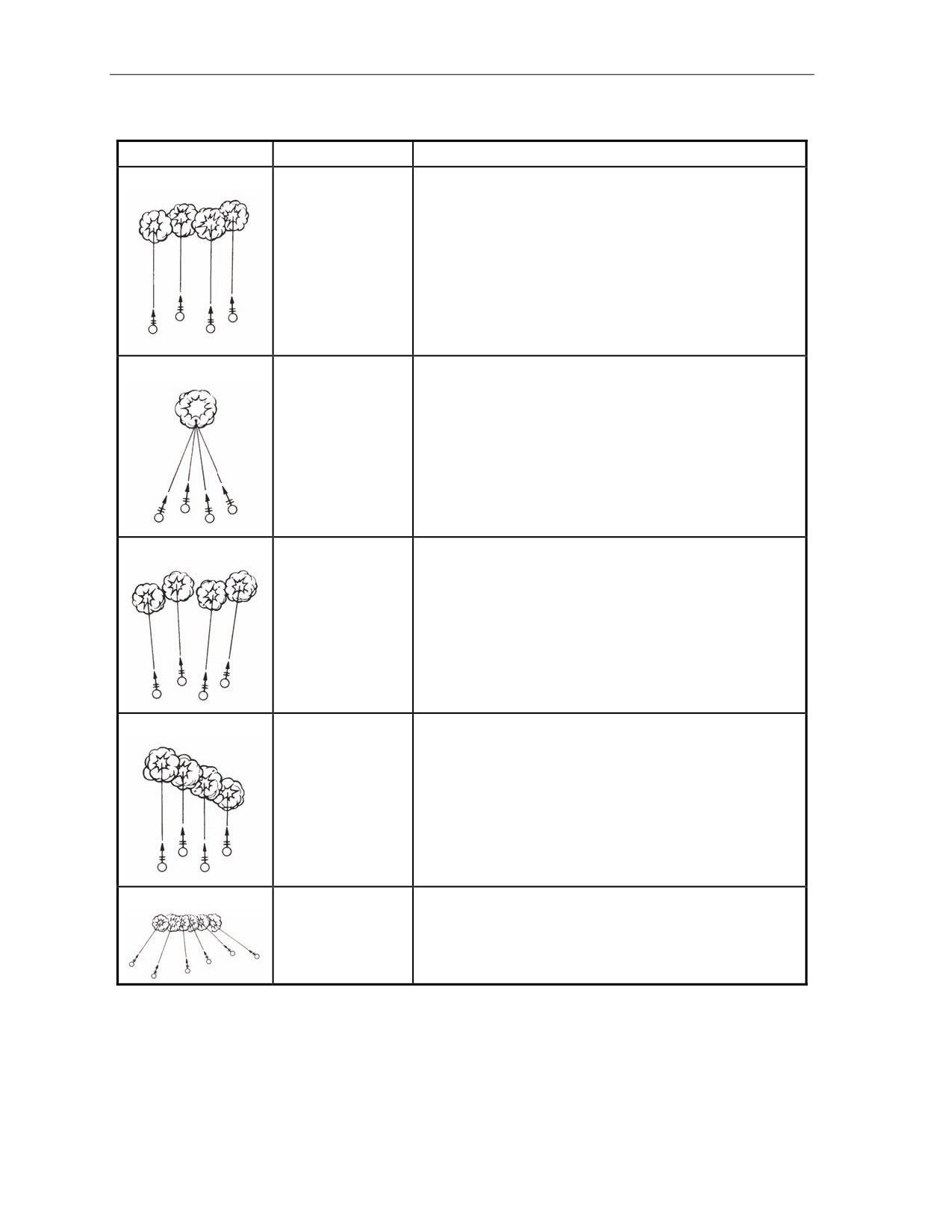
4-1. When the mortar section or platoon engages a target, it can use different sheaves depending on the
type of target being engaged.
4-2. These types of sheaves include—
z
Parallel sheaf.
z
Converged sheaf.
z
Open sheaf.
z
Special sheaf.
z
Linear (standard) sheaf.
4-3. Table 4-1 outlines the types of sheaves used for a given target and provides additional information.
17 July 2008
FM 3-22.91
4-1
Chapter 4
Table 4-1. Types of sheaves.
TYPE OF SHEAF
TYPE OF TARGET
RELATED INFORMATION
Parallel sheaf
To fire a parallel sheaf, two or more mortars fire the same deflection,
Area targets
elevation, and charge, with the distance between the impacts of
rounds being the same as the distance between the mortars.
Converged sheaf
Point targets, such as
When firing converged sheaves, mortar sections or platoons fire two
bunkers or machine
or more mortars (each firing a different deflection) to impact the
gun positions
same target.
Open sheaf
The distance between impacts of rounds from two or more mortars
is one and a half times the distance between the bursts of rounds in
a linear sheaf. Normally, 60-mm mortar rounds impact 30 meters
Targets that are wider
apart, 81-mm rounds impact 40 meters apart, and 120-mm rounds
than a linear sheaf
impact 70 meters apart. For example, in an open sheaf with 60-mm
mortars, rounds would impact 45 meters apart, one and a half times
the distance that separates 60-mm mortar rounds in a linear sheaf.
All mortars fire different deflections for an open sheaf.
Special sheaf
A special sheaf is normally used in attitude missions and when
Targets that are linear
needed for the FPF.
in nature such as
roadways, bridges,
and forward lines of
Each mortar has a certain point to engage. The mortars may have
troops (FPF)
different deflections and elevations.
Linear (standard) sheaf
Standard engagement
With the linear sheaf, rounds impact within the total effective width
against enemy
of the bursts, regardless of the mortar formation.
formations
4-2
FM 3-22.91
17 July 2008
Major Concerns of the Fire Direction Center
COMPUTER’S RECORD
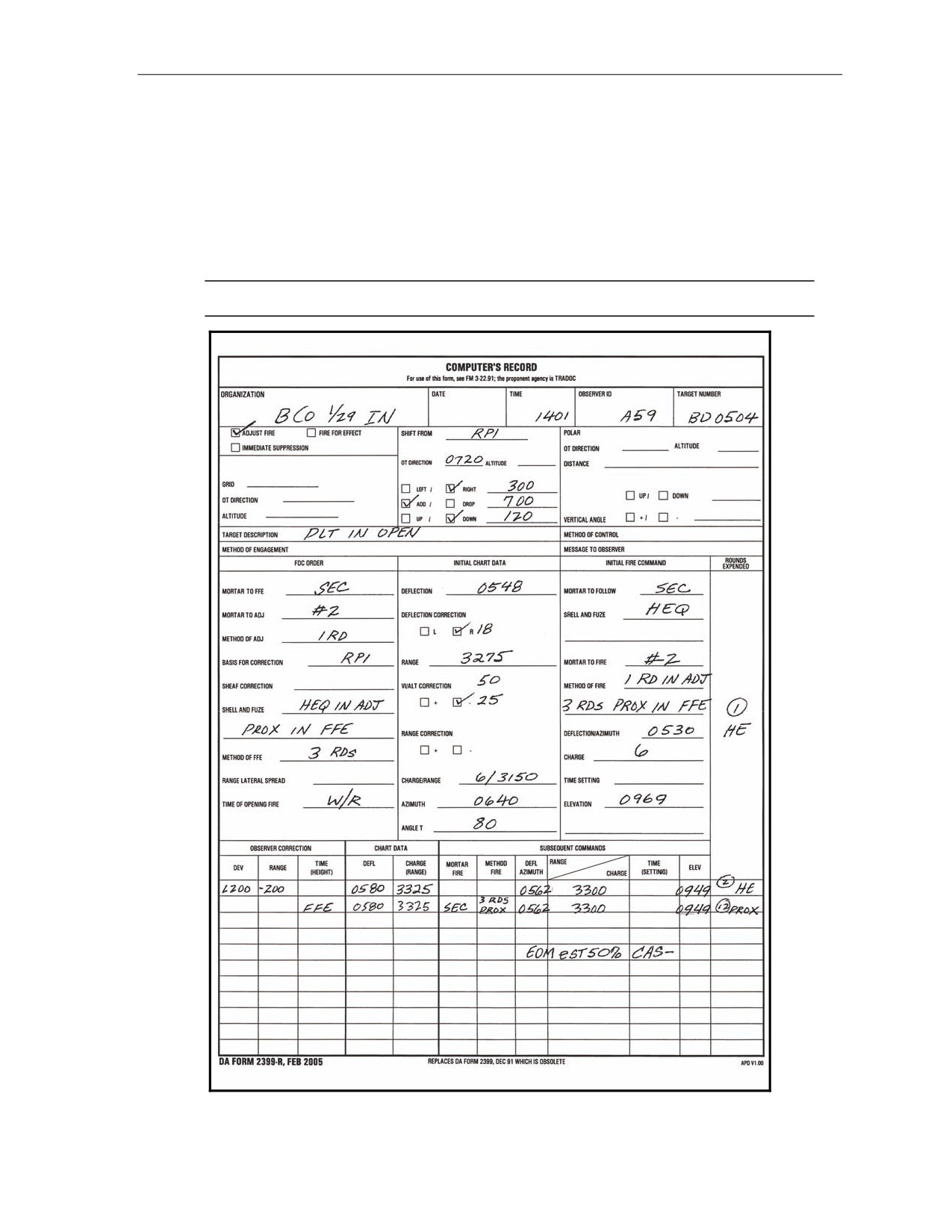
4-4. DA Form 2399-R (Computer’s Record) (Figure 4-1) is a form used to record—
z
The FO’s CFF and corrections.
z
Firing data.
z
Commands to the mortars during a fire mission.
4-5. The FDC uses this form to record each mission that the FDC receives and fires. This section
provides instructions on how to complete a DA Form 2399-R.
NOTE: For a blank, reproducible copy of DA Form 2399-R, see the back of this publication.
Figure 4-1. Example of completed DA Form 2399-R (Computer’s Record).
17 July 2008
FM 3-22.91
4-3
Chapter 4
ORGANIZATION
4-6. In this field, the FDC documents the unit that fires the mission.
DATE
4-7. In this field, the FDC records the date that the mission is fired.
TIME
4-8. The FDC uses this field to document the time that the mission was received (the CFF recorded).
OBSERVER IDENTIFICATION
4-9. In the observer identification (ID) field, the FDC records the observer’s call sign.
NUMBER TARGET
4-10. In this field, the FDC records the number assigned to the mission.
WARNING ORDER
4-11. The FDC uses this field to document the type of warning order used for the mission, such as adjust
fire, FFE, or immediate suppression.
TARGET LOCATION
4-12. In this field, the FDC records the method used to locate the target, such as grid, shift from a known
point, or polar plot.
TARGET DESCRIPTION
4-13. In this field, the FDC provides a detailed description of the target
(type, size, number, and
protection).
METHOD OF ENGAGEMENT
4-14. The FDC records the types of adjustment and ammunition in this field. (For more information, see
FM 6-30.)
METHOD OF CONTROL
4-15. In this field, the FDC documents the adjustment gun (when named by the FO) and time of delivery.
(For more information, see FM 6-30.)
MESSAGE TO OBSERVER
4-16. The FDC records any messages sent to the FO in this field.
4-4
FM 3-22.91
17 July 2008

Major Concerns of the Fire Direction Center
FDC ORDER
4-17. The chief computer/section sergeant usually completes the FDC order. This area describes how the
mortars will engage the target. Table 4-2 highlights the fields found in this section and provides more
information about each area.
Table 4-2. FDC order field titles and information documented in each field.
FIELD
INFORMATION DOCUMENTED IN FIELD
Mortar to FFE
The mortar(s) that will be used during the FFE phase of the mission
Mortar to ADJ
The mortar(s) that will be used during the adjustment phase of the mission
NOTE: Leave this field blank if the “Mortar to ADJ” is the same as the “Mortar to FFE.”
Method of ADJ
Number of rounds used by the adjusting mortar(s) for each correction during the adjustment
phase of the mission
Basis for Correction
Point (usually the registration point [RP]) from which the correction factors to be applied are
determined (surveyed chart only) and/or the latest meteorological corrections
Sheaf Correction
Type of sheaf, other than the default sheaf, that will be used during the FFE
This is parallel for all fire control systems except the MFCS, which uses a default sheaf of
linear.
Shell and Fuze
Shell and fuze combination that will be used for the mission
The first line documents the ammunition that will be fired during the adjustment phase. The
second line records the ammunition that will be fired in the FFE, if it changes from the
adjustment round type.
If different types of ammunition will be used during the mission, the different rounds are
listed.
Example: SHELL AND FUZE: HEQ in Adj, HEQ/WP in FFE
Method of FFE
Number and type of rounds for each mortar in the FFE phase of the mission
Example: METHOD OF FFE: 2 Rds HEQ, 2 Rds WP
RG/Lateral Spread
Used with illumination, with one of the following:
•
RG spread (60-mm mortar, 250 meters between rounds; 81-mm mortar,
500 meters between rounds; and 120-mm mortar, 1,500 meters between rounds)
•
Lateral spread (60-mm mortar, 250 meters between rounds; 81-mm mortar,
500 meters between rounds; and 120-mm mortar, 1,500 meters between rounds)
•
RG/Lateral spread, which is a combination of range spread and lateral spread
Time of Opening Fire
The fire control for the mission given by the FO or FDC as “When ready” (W/R), “At my
command” (AMC), or “Do not fire.”
17 July 2008
FM 3-22.91
4-5

Chapter 4
INITIAL CHART DATA
4-18. The FDC uses initial chart data to determine initial or subsequent fire commands. Table 4-3
highlights the fields found in this section and provides more information about each area.
Table 4-3. Initial chart data field titles and information documented in each field.
FIELD
INFORMATION DOCUMENTED IN FIELD
Deflection
Initial deflection from the mortar position to the target being engaged
Deflection Correction
Deflection correction used for the mission
Range
Initial chart range from the mortar position to the target being engaged
VI/ALT Correction
VI/altitude difference and VI correction used for the mission
Range Correction
The total range correction (TRC) used for the mission
NOTE: Deflection, deflection correction, range, VI/ALT correction, and range correction are calculated only when using the
plotting board.
Charge/Range
Charge and corrected range used for the mission
Azimuth
The azimuth from the gun position to the target
Angle T
Difference (in mils) between the gun-target (GT) line and the observer-target (OT) line
NOTE: Determine this difference to the nearest 1 mil, record to the nearest 10 mils, and
transmit to the nearest 100 mils.
INITIAL FIRE COMMAND
4-19. The initial fire command is the first fire command that the FDC sends to the mortar section for a
mission. To complete the initial fire command, the computer must use the information contained in the
initial chart data, any corrections, and the FDC order. Table 4-4 highlights the fields found in this section
and provides more information about each area.
Table 4-4. Initial fire command field titles and information documented in each field.
FIELD
INFORMATION DOCUMENTED IN FIELD
Mortar to Follow
The mortar(s) to follow all commands or the mortar(s) that will be used in the FFE
Shell and Fuze
The shell and fuze combination used during the mission
NOTE: If the mission is an adjustment mission, that is the round used during the adjustment.
Mortar to Fire
The mortar(s) to be used during the adjustment phase
Method of Fire
The number of rounds to be used for adjustment and in the FFE, and the type, if mixed
Any control by the FDC would be placed here. For example, one round HEQ in adjustment; two
rounds HEQ/two rounds WP in FFE, AMC; three rounds HEQ. Announcing the number of
rounds in the FFE gives the ammunition bearer time to prepare those rounds in the event of,
for example, an immediate suppression mission.
Deflection
The command deflection needed to fire the first round
Charge
The command charge needed to fire the first round
Time Setting
The time setting needed on mechanical time fuzes (normally illumination) to obtain the desired
effects over the target area
Elevation
The elevation used to engage the target at a specific range with the given charge
NOTE: The elevation is also the command to fire in the absence of fire control.
4-6
FM 3-22.91
17 July 2008

Major Concerns of the Fire Direction Center
ROUNDS EXPENDED
4-20. The FDC uses this space to record the number of rounds fired for the initial fire command.
OBSERVER CORRECTION
4-21. The observer sends the observer correction to the FDC to move the impact of the round to the target.
Table 4-5 highlights the fields found in this section and provides more information about each area.
Table 4-5. Observer correction field titles and information documented in each field.
FIELD
INFORMATION DOCUMENTED IN FIELD
Deviation (DEV)
The left/right correction (in meters) sent by the observer
Example: “DEV: L 200” means the observer wants a “left 200 meters” correction.
Range (RG)
The add/drop correction (in meters) sent by the observer
Example: “RG: Add 200” is recorded as +200, while “Drop 200” is recorded as
“-200.”
Height (Time)
The up/down (height) correction the observer wants
Example: The observer will send “UP/DOWN: UP 200” or “DOWN 200” and record the same.
NOTE: This element is usually used with illumination.
CHART DATA
4-22. The FDC obtains chart data from the M16/M19 plotting boards for the observer’s requested
corrections. Personnel use this section when firing corrections must be applied to chart data to obtain firing
data. Table 4-6 highlights the fields found in this section and provides more information about each area.
NOTE: Disregard this portion of DA Form 2399-R when using the MBC.
Table 4-6. Chart data field titles and information documented in each field.
FIELD
INFORMATION DOCUMENTED IN FIELD
Deflection (DEFL)
The deflection read from the plotting board before any corrections are applied
Charge Range
Chart charge (or range) read from the plotting board before any corrections are applied
17 July 2008
FM 3-22.91
4-7

Chapter 4
SUBSEQUENT COMMANDS
4-23. The FDC sends command data to the mortar(s) so they can fire the next round(s). Those commands,
DEFL/CHG/ELEV, contain chart data and all firing corrections. In subsequent fire commands, only
commands that change the initial fire command or the previous subsequent fire command are announced.
Regardless of changes, the FDC always announces the elevation. Table 4-7 highlights the fields found in
this section and provides more information about each area.
Table 4-7. Subsequent command field titles and information documented in each field.
FIELD
INFORMATION DOCUMENTED IN FIELD
Mortar to Fire
The mortars to fire a mission
Method of Fire
The number of rounds and type of fire
Deflection (DEFL)
The command deflection(s) to fire the round(s)
Range/Charge
60-, 81-, and 120-mm mortars: The command range used for this round(s) and the charge, if
different from the preceding round
NOTE: The range is recorded and used to determine the charge that is given to
60-, 81-, and 120-mm mortars (range is not given to guns).
Time Setting
The time setting needed for the mechanical time fuze
Elevation (ELEV)
The elevation used for this round(s) and the command to fire (in the absence of fire control)
4-8
FM 3-22.91
17 July 2008
Major Concerns of the Fire Direction Center
DA FORM 2188-R (DATA SHEET)
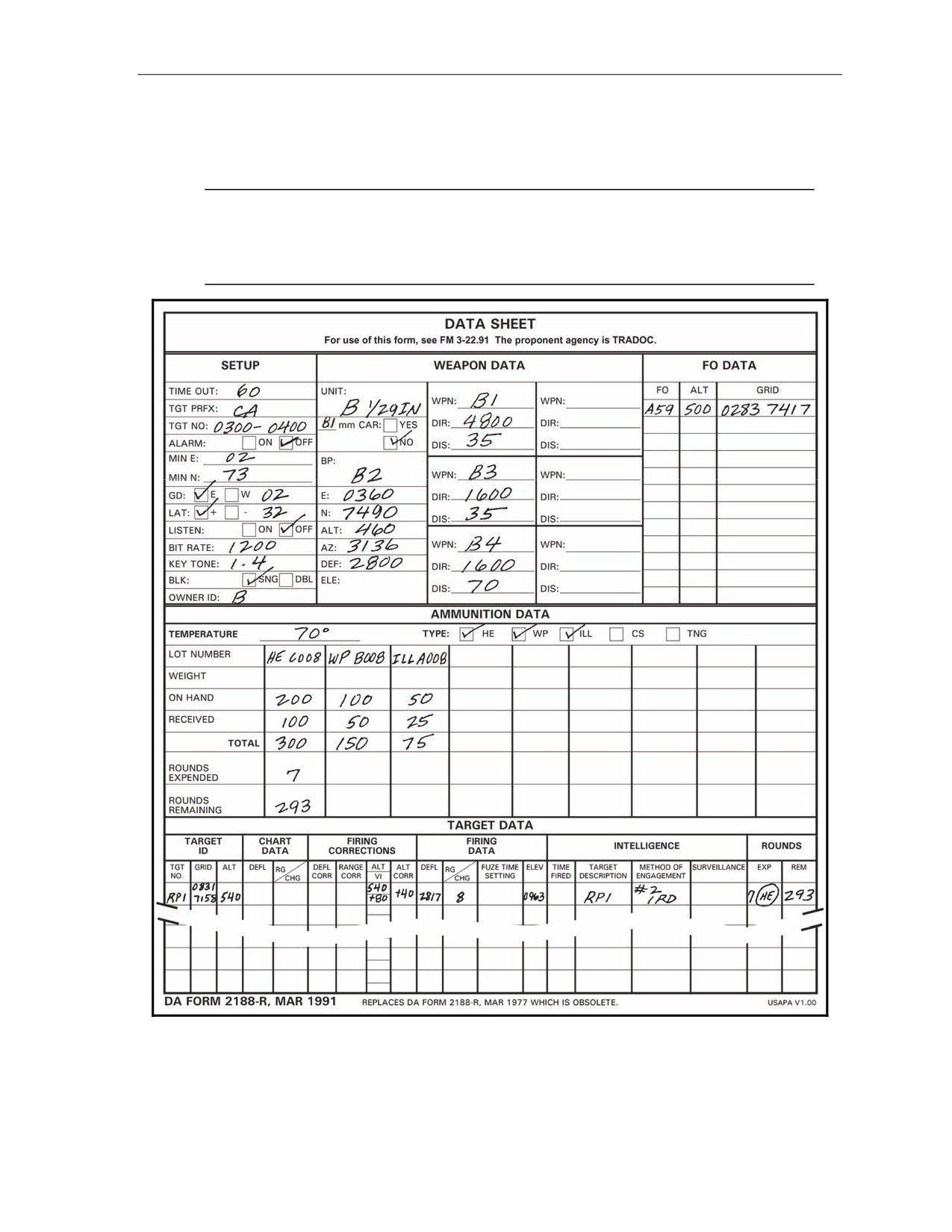
4-24. The computer uses DA Form 2188-R (Data Sheet) (Figure 4-2) to record data that pertains to the
mortar section or platoon and the firing data for each target engaged.
NOTES:
1. The controlling FDC will keep the DA Form 2188-R.
2. For a blank, reproducible copy of DA Form 2188-R, see the back of this
publication.
Figure 4-2. Example of completed DA Form 2188-R (Data Sheet).
17 July 2008
FM 3-22.91
4-9

Chapter 4
SETUP
4-25. The FDC uses this field to record the firing element’s initialization data. Table 4-8 highlights the
fields found in this section and provides more information about each area.
Table 4-8. Setup field titles and information documented in each field.
FIELD
INFORMATION DOCUMENTED IN FIELD
Time Out
The time that must elapse before the MBC enters standby mode
TGT PRFX
Target prefix used by the firing element
TGT NO.
Target numbering block
Alarm
Alarm on and off function for messages
MIN E/MIN N
Minimum easting and northing coordinates from the map sheet
GD
East or west grid declination
LAT
Latitude from the map sheet
Listen
Message transmission and reception
BIT Rate
Message transmission rates for digital message device (DMD)-supported missions
Key Tone
Length of time required for a communications device
BLK
Transmit block mode for DMD-supported missions
Owner ID
Owner identification for DMD-supported missions
WEAPON DATA
4-26. The FDC uses this field to record the firing element’s weapon initialization data. Table
4-9
highlights the fields found in this section and provides more information about each area.
Table 4-9. Weapon data field titles and information documented in each field.
FIELD
INFORMATION DOCUMENTED IN FIELD
Unit
Unit mortar element assigned
__mm CAR
Weapon type, mounted or dismounted
BP
Basepiece number
E
Basepiece’s easting map coordinate
N
Basepiece’s northing map coordinate
ALT
Basepiece’s altitude in meters
AZ
Basepiece’s direction of fire in mils
DEF
Referred deflection used by the firing element
ELE
Elevation used for these rounds
WPN/DIR/DIS
Weapon number, direction, and distance from the basepiece
NOTE: Continue to fill out until all weapons have been recorded for firing section.
4-10
FM 3-22.91
17 July 2008

Major Concerns of the Fire Direction Center
FORWARD OBSERVER DATA
4-27. The FDC records the FO’s location in this field. Table 4-10 highlights the fields found in this section
and provides more information about each area.
Table 4-10. Forward observer data field titles and information documented in each field.
FIELD
INFORMATION DOCUMENTED IN FIELD
FO
FO’s call sign
ALT
Altitude at the FO’s location
GRID
Grid coordinates of the FO’s location
AMMUNITION DATA
4-28. The FDC monitors the rounds using this section. After each mission, personnel update all fields.
Table 4-11 highlights the fields found in this section and provides more information about each area.
Table 4-11. Ammunition data field titles and information documented in each field.
FIELD
INFORMATION DOCUMENTED IN FIELD
Temperature
Current temperature
Type
Appropriate types of ammunition issued
Lot Number
Lot numbers of the rounds and fuzes on hand
On Hand
Number (by lot number) of rounds the firing element has on the firing position
Received
Number and type of rounds received
Total
Combination of rounds on hand and those received
Rounds Expended
Number of rounds expended for missions
Rounds Remaining
Number of rounds remaining
TARGET DATA
4-29. The FDC records previously fired targets using this section.
Target Identification
4-30. Target identification (ID) includes the type of target; for example, troops in the open. Table 4-12
highlights the fields found in this section and provides more information about each area.
Table 4-12. Target identification field titles and information documented in each field.
FIELD
INFORMATION DOCUMENTED IN FIELD
TGT NO.
Alphanumeric identifier assigned to a target
GRID
Six- or eight-digit coordinates of a target
ALT
Altitude of the target
17 July 2008
FM 3-22.91
4-11

Chapter 4
Chart Data
4-31. Chart data includes the fire solution without adjustment or modification. Table 4-13 highlights the
fields found in this section and provides more information about each area.
Table 4-13. Chart data field titles and information documented in each field.
FIELD
INFORMATION DOCUMENTED IN FIELD
DEFL
Chart (M16/M19) or initial (MBC) deflection to the target
RG/CHG
Chart (M16) or initial (MBC) range and charge needed for the mortars to engage the target
Firing Corrections
4-32. This information is applied to the chart data. Table 4-14 highlights the fields found in this section
and provides more information about each area.
Table 4-14. Firing correction field titles and information documented in each field.
FIELD
INFORMATION DOCUMENTED IN FIELD
DEFL CORR
Direction (left/right) value and number of mils to apply to the chart deflection for firing data
RG CORR
The value and amount (+/-) of meters to apply to the chart range for firing data
ALT VI
Altitude of the target and VI difference, UP (+) or DOWN (-) in meters, between the target and
the mortar altitudes
ALT CORR
The number of meters and direction (UP/DOWN) used for altitude corrections
NOTE: For 60-, 81-, and 120-mm mortars, corrections for deflection and range are used on the
modified and surveyed charts.
NOTE: If the chart data and the command data are the same, do not repeat the data in the
range/charge block.
Firing Data
4-33. Firing data includes the base gun command data for targets. This information combines corrections
and chart data to calculate firing data (command data) so that mortars can fire to the target's center of mass.
Table 4-15 highlights the fields found in this section and provides more information about each area.
Table 4-15. Firing data field titles and information documented in each field.
FIELD
INFORMATION DOCUMENTED IN FIELD
DEFL
Command deflection to hit the target's center of mass
RG/CHG
Command range and charge to hit the target
Fuze Time SETT
Fuze/time setting on mechanical/electronic fuzes, recorded to the nearest 0.1 second
ELEV
Elevation used to fire the round for 60-, 81-, and 120-mm mortars; the elevation from the firing
tables for the command range
4-12
FM 3-22.91
17 July 2008

Major Concerns of the Fire Direction Center
Intelligence
4-34. Intelligence combines information provided by the FO and the FDC. Table 4-16 highlights the fields
found in this section and provides more information about each area.
Table 4-16. Intelligence field titles and information documented in each field.
FIELD
INFORMATION DOCUMENTED IN FIELD
Time Fired
The time the CFF was received
NOTE: The FDC completes this field.
Target DESCR
What the target was (from the CFF on DA Form 2399-R)
NOTE: The FO completes this field.
Method of Engagement
How the target was engaged (number of mortars, number and type of rounds fired in the FFE)
NOTE: The FDC completes this field.
Surveillance
The battle damage assessment (BDA) of the engagement
NOTE: The FO provides this information to the FDC.
Rounds
4-35. This section contains information regarding the rounds expended for the mission and the amount
remaining for future missions.
17 July 2008
FM 3-22.91
4-13
Chapter 4
DA FORM 2188-1-R (LHMBC/MFCS DATA SHEET)
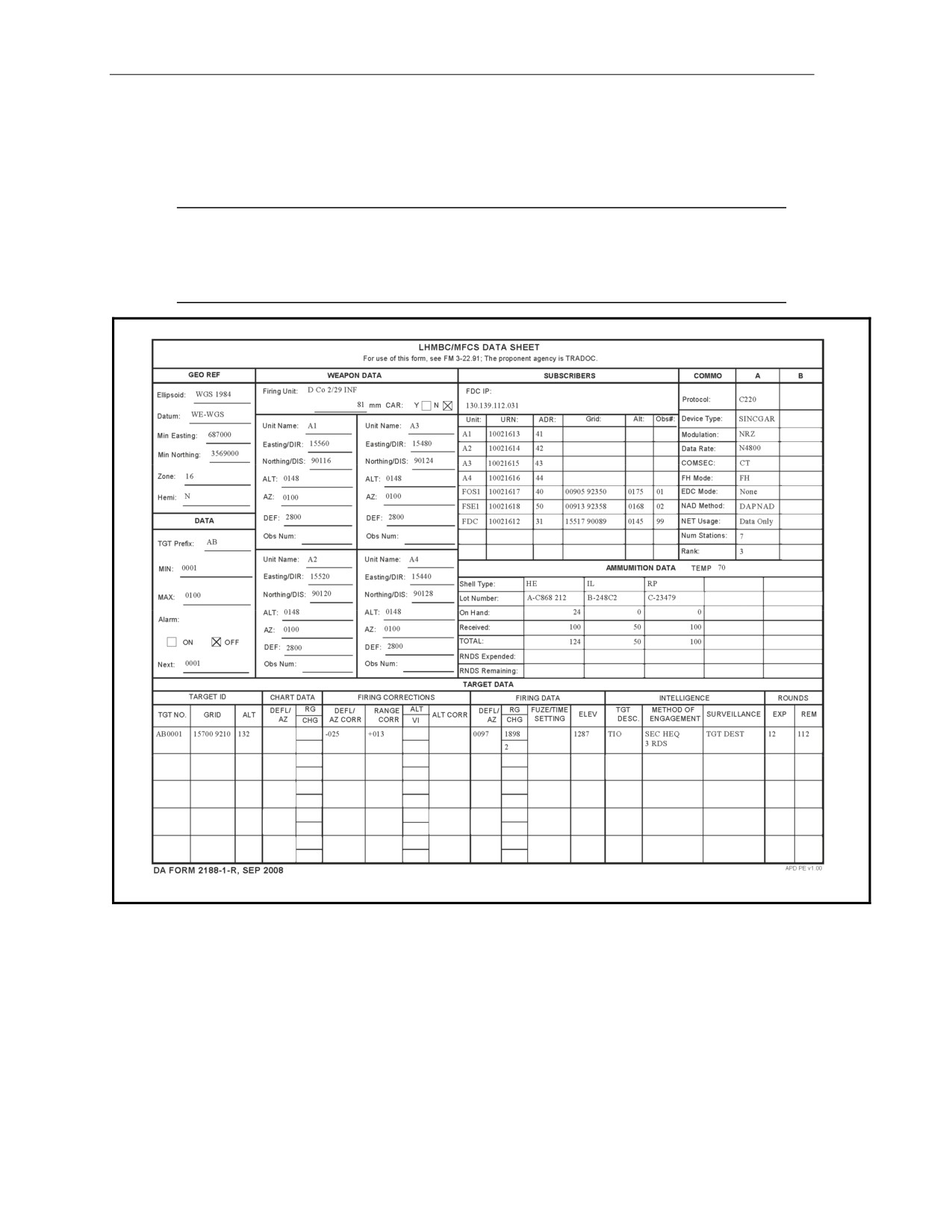
4-36. The computer uses DA Form 2188-1-R (LHMBC/MFCS Data Sheet) (Figure 4-3) to record data that
pertains to the mortar section or platoon and the firing data for each target engaged when using the
LHMBC or MFCS.
NOTES:
1. The controlling FDC will keep the DA Form 2188-1-R.
2. For a blank, reproducible copy of DA Form 2188-1-R, see the back of this
publication.
Figure 4-3. Example of completed DA Form 2188-1-R (LHMBC/MFCS Data Sheet).
4-14
FM 3-22.91
17 July 2008

Major Concerns of the Fire Direction Center
GEOGRAPHICAL REFERENCE FIELD
4-37. The FDC uses the GEO REF field to record the geographical reference data. Table 4-17 highlights
the fields found in this section and provides more information about each area.
Table 4-17. Geographical Reference field titles and information documented in each field.
FIELD
INFORMATION DOCUMENTED IN FIELD
Ellipsoid
Default is WGS1984, Set to <ALL> to view all data
Datum
When the Ellipsoid is set, the corresponding default datum is set.
Min Easting
Minimum easting coordinates from the map sheet
Min Northing
Minimum northing coordinates from the map sheet
Zone
Zone coordinates from the map sheet
Hemi
Set to North if north of the equator; set to South if south of the equator.
DATA FIELD
4-38. The FDC uses this field to record the firing element’s setup data. Table 4-18 highlights the fields
found in this section and provides more information about each area.
Table 4-18. Data field titles and information documented in each field.
FIELD
INFORMATION DOCUMENTED IN FIELD
TGT PRFX
Target prefix used by the firing element
MIN
The first number in the unit's designated target block
MAX
The last number in the unit's designated target block
Alarm
Alarm on and off function for messages
Next
The target number to be assigned to the next mission
WEAPON DATA FIELD
4-39. The FDC uses this field to record the firing element’s weapon initialization data. Table 4-19
highlights the fields found in this section and provides more information about each area.
Table 4-19. Weapon Data field titles and information documented in each field.
FIELD
INFORMATION DOCUMENTED IN FIELD
Firing Unit
Unit mortar element assigned
mm CAR: Y/N
Weapon type, mounted or dismounted
Unit Name
Designation given to the specific weapon (for example, A1)
Easting/DIR
The easting portion of the grid coordinate or the direction to the mortar from the basepiece
Northing/DIS
The northing portion of the grid coordinate or the distance to the mortar from the basepiece
ALT
The mortar’s altitude in meters
AZ
The mounting azimuth used by the firing element for degraded ops
DEF
Referred deflection used by the firing element for degraded ops
Obs Num
Observer number of the firing unit (if used)
NOTE: Continue to fill out until all weapons have been recorded for firing section.
17 July 2008
FM 3-22.91
4-15

Chapter 4
SUBSCRIBERS FIELD
4-40. The FDC records the observer(s) and additional friendly units’ information in this field. Any unit
with which the FDC wishes to digitally communicate must be on this list. Table 4-20 highlights the fields
found in this section and provides more information about each area.
Table 4-20. Subscribers field titles and information documented in each field.
FIELD
INFORMATION DOCUMENTED IN FIELD
FDC IP
Supplied by Unit signal officer. This 12 digit address will set the first 9 digits of the IP Address’
for all subscriber units.
Unit
Designation assigned to a given subscriber. First character must be a letter
URN
Unit Reference Number. Supplied by the units signal officer. The
URN of the Force XXI battle command—brigade and below (FBCB2) computer and the URN of
the MFCS are different, even though they refer to the same unit.
ADR
The last 3 digits of the 12 digit IP address for the subscriber
Grid
Grid coordinates of the subscribers location
Alt
Altitude at the subscribers location
Obs#
Observer number if the subscriber is acting as an observer
COMMO FIELD
4-41. The FDC records the communication information in this field. Table 4-21 highlights the fields found
in this section and provides more information about each area.
Table 4-21. Commo field titles and information documented in each field.
FIELD
INFORMATION DOCUMENTED IN FIELD
Protocol
A220 for VMF PKG 11 or C220 for VMF R5
Device Type
Set to SINCGARS if using FM communications or 2-Wire for a hardwired connection.
Modulation
Either Non-Return to Zero(NRZ) or Frequency Shift Keying-FSK188C
Data Rate
Speed that data is transferred on the network, ranging from 75 to 1200 bps
COMSEC
Set to cipher text (CT) for secure communications or plain text (PT) for unsecured
communications
FH Mode
Select FH for frequency hop or SC for single channel communications
EDC Mode
Error detection and correction mode
Selectable modes include forward error correction, time-dispersal coding, and scrambling.
NAD Method
Deterministic adaptable priority network access delay (DAPNAD) (default), hybrid, priority
random, or round-robin (LHMBC only)
NET Usage
Data or data and voice
Voice will take priority on networks that are data and voice enabled, significantly increasing
data transmission times.
# Stations
Number of stations using the network
Rank
Rank of the FDC in the network
4-16
FM 3-22.91
17 July 2008
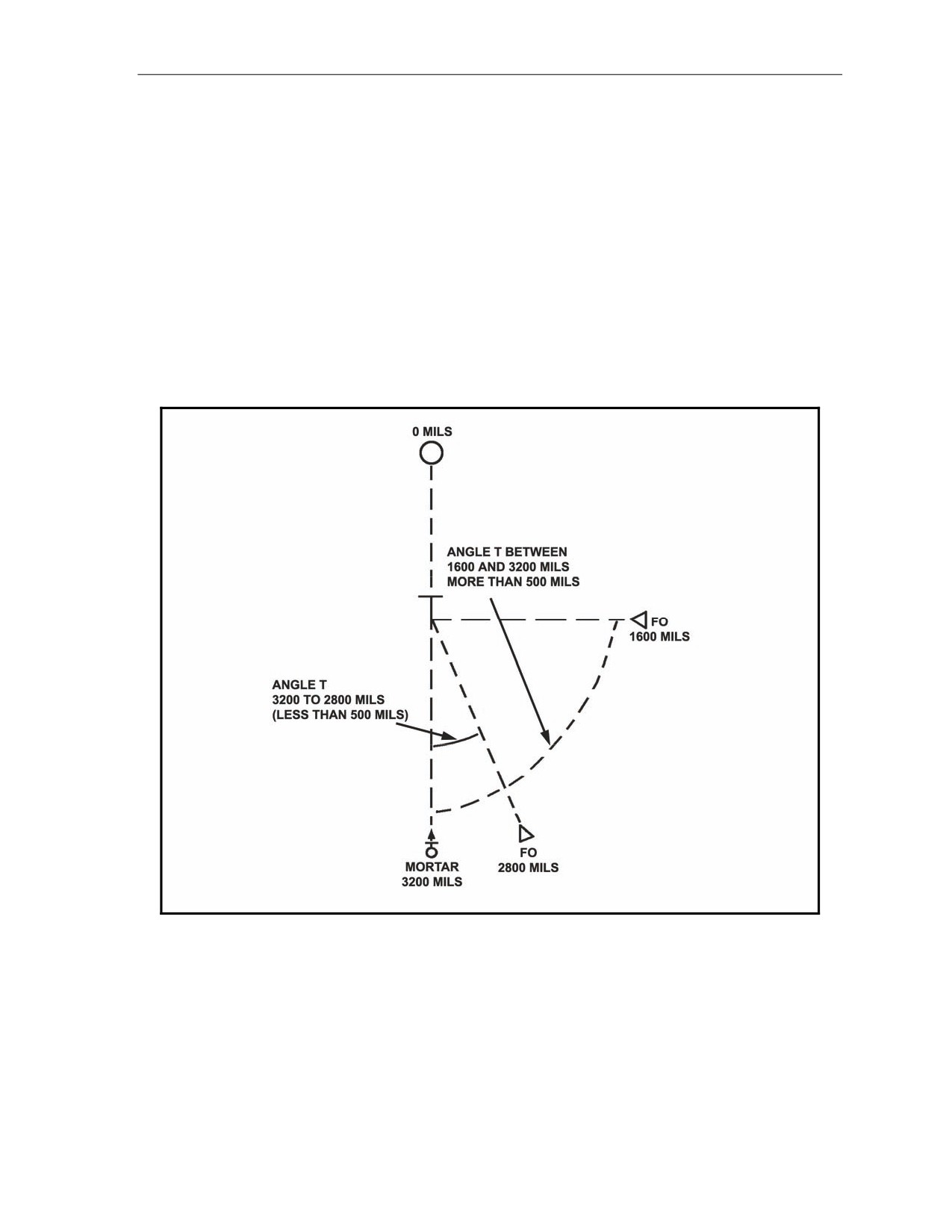
Major Concerns of the Fire Direction Center
AMMUNITION DATA FIELD
4-42. The FDC monitors the rounds using this section. This section is filled out in the same manner as
DA Form 2188-R. See paragraph 4-28 for instructions.
TARGET DATA FIELD
4-43. The FDC records previously fired targets using this section. This section is filled out in the same
manner as DA Form 2188-R. See paragraphs 4-29 through 4-35 for instructions.
ANGLE T
4-44. Angle T is the angle, or difference in mils, between the OT line and GT line (Figure 4-4). Angle T is
not important to the FDC when computing, but the FDC notifies the FO if angle T is between 500 and
2700 mils so that the FO can cut his corrections in half to compensate for dispersion.
Figure 4-4. Angle T between 400 and 1600 mils.
4-45. The computer determines angle T to the nearest mil, records it to the nearest 10 mils, and announces
it to the observer to the nearest 100 mils when requested or when it is 500 mils or greater. To determine
angle T, the computer must compare the OT azimuth and GT azimuth, subtracting the smaller from the
larger.
z
GT azimuth is the azimuth that corresponds to the initial chart deflection of the target being
engaged.
z
OT azimuth is the azimuth that the observer gives in his CFF or with his first correction.
17 July 2008
FM 3-22.91
4-17
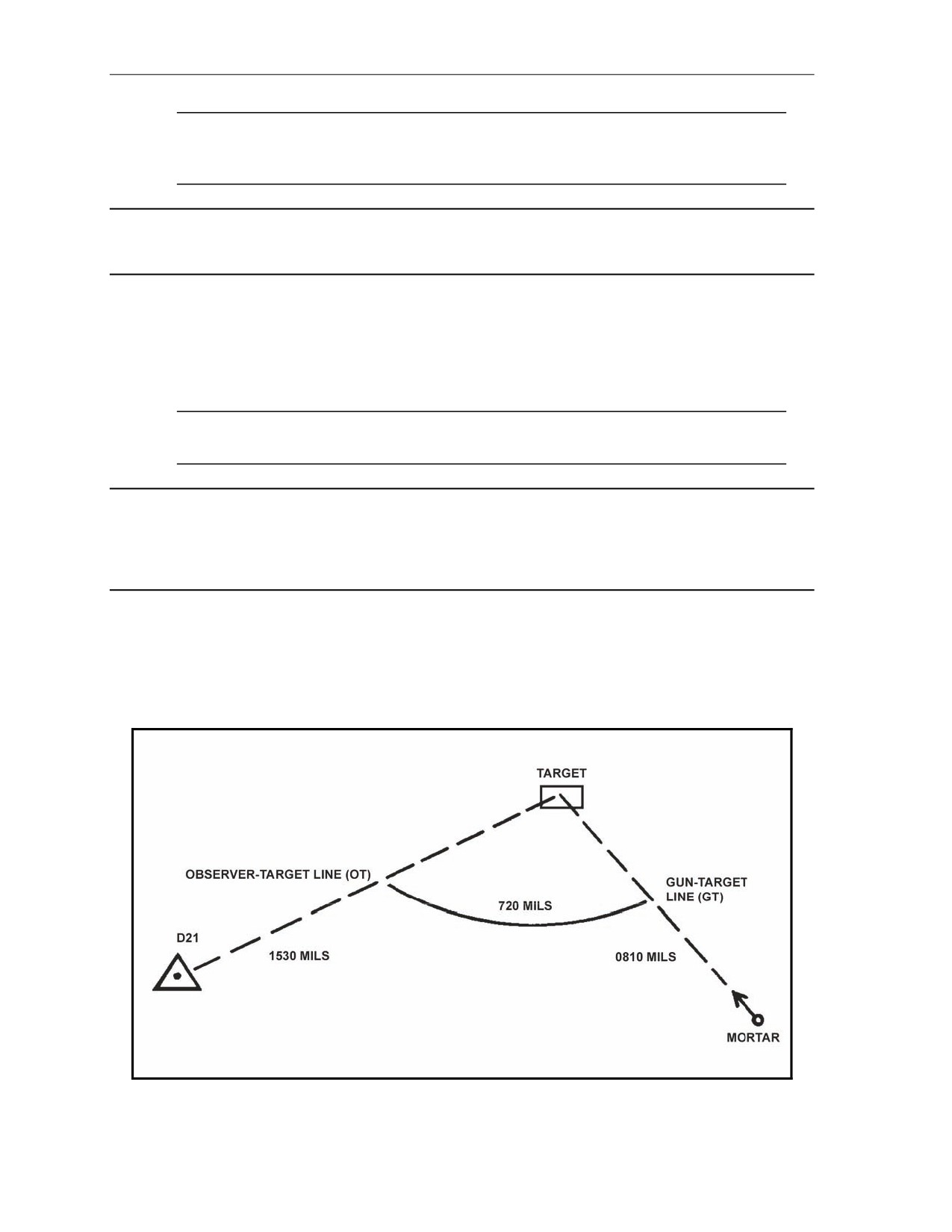
Chapter 4
NOTE: For shift from a known point and polar plot missions, the FO must send the OT
azimuth in the CFF. For grid missions, however, the FO may not send the OT azimuth in the
CFF, but he must send it before or with the first subsequent adjustment.
EXAMPLE 1
If OT = 2950 mils and GT = 3190 mils, then 3190 - 2950 = 240 mils (angle T).
EXAMPLE 2
Consider OT = 6210 mils and GT = 0132 mils. Because the azimuths are on either side of 6400 (0),
subtracting the smaller from the larger would not yield the angle T. The computer must add 6400 to
the smaller value, and then subtract from the larger value:
0132 + 6400 = 6532
6532 - 6210 = 322, recorded as 320
NOTE: Use this procedure only when one azimuth is between 0 (6400) and 1600, and
one is between 4800 and 6400.
EXAMPLE 3
For an angle T exceeding 499 mils, subtract the smaller from the larger.
If OT = 1530 mils and GT = 810 mils, then 1530 - 810 = 720 mils (angle T).
4-46. Because angle T exceeds 499 mils in the third example above, the FDC notifies the observer so that
he can use this information to make any corrections. When angle T exceeds 499 mils, the FO continues to
use the OT factor to make deviation corrections (Figure 4-5), but if the correction is more than asked for,
he reduces the deviation corrections proportionately.
Figure 4-5. Angle T exceeding 499 mils.
4-18
FM 3-22.91
17 July 2008
Major Concerns of the Fire Direction Center
FIRING TABLES
4-47. Firing tables contain data based on standard and nonstandard trajectories for a given weapon and
combination of cartridge, fuze, and propelling charge.
z
A standard trajectory, fired at a given elevation, theoretically exists under arbitrarily chosen
conditions of weather and material.
z
A nonstandard trajectory exists under conditions of weather and material differing from standard conditions.
NOTE: Refer to the appropriate firing tables for rounds not listed in this manual.
4-48.
The following information describes the firing table for a 60-mm mortar. An example is shown in Figure 4-
6.
z
Parts I, II, III, and IV of FT 60-P-1 contain firing data for various rounds that use propelling
charges. Each part contains five tables:
Table A provides the components of a 1-knot wind.
Table B provides air temperature and density corrections.
Table C provides variations in muzzle velocity due to propellant temperature.
Table D provides basic data and nonstandard correction factors.
Table E provides supplementary data.
z
Each part addresses a given round:
Part I includes the M720 HE round.
Part II includes the M49A4 HE round.
Part III includes the M302A1 WP round.
Part IV includes the M83A3 illumination round.
The appendices contain trajectory charts for the M720 HE round.
z
FT-6-Q-1 contains information for M49A4 HE, M50A3 training practice, M302A1 WP, and
M83A3 illumination rounds for the M31 subcaliber assembly.
17 July 2008
FM 3-22.91
4-19