FM 4-20.198 Multiservice Helicopter Sling Load: Single-Point Load Rigging Procedures (February 2009) - page 13
Chapter 17
Derigging. Derigging is the reverse of the preparation and rigging procedures.
RIGGING STEPS
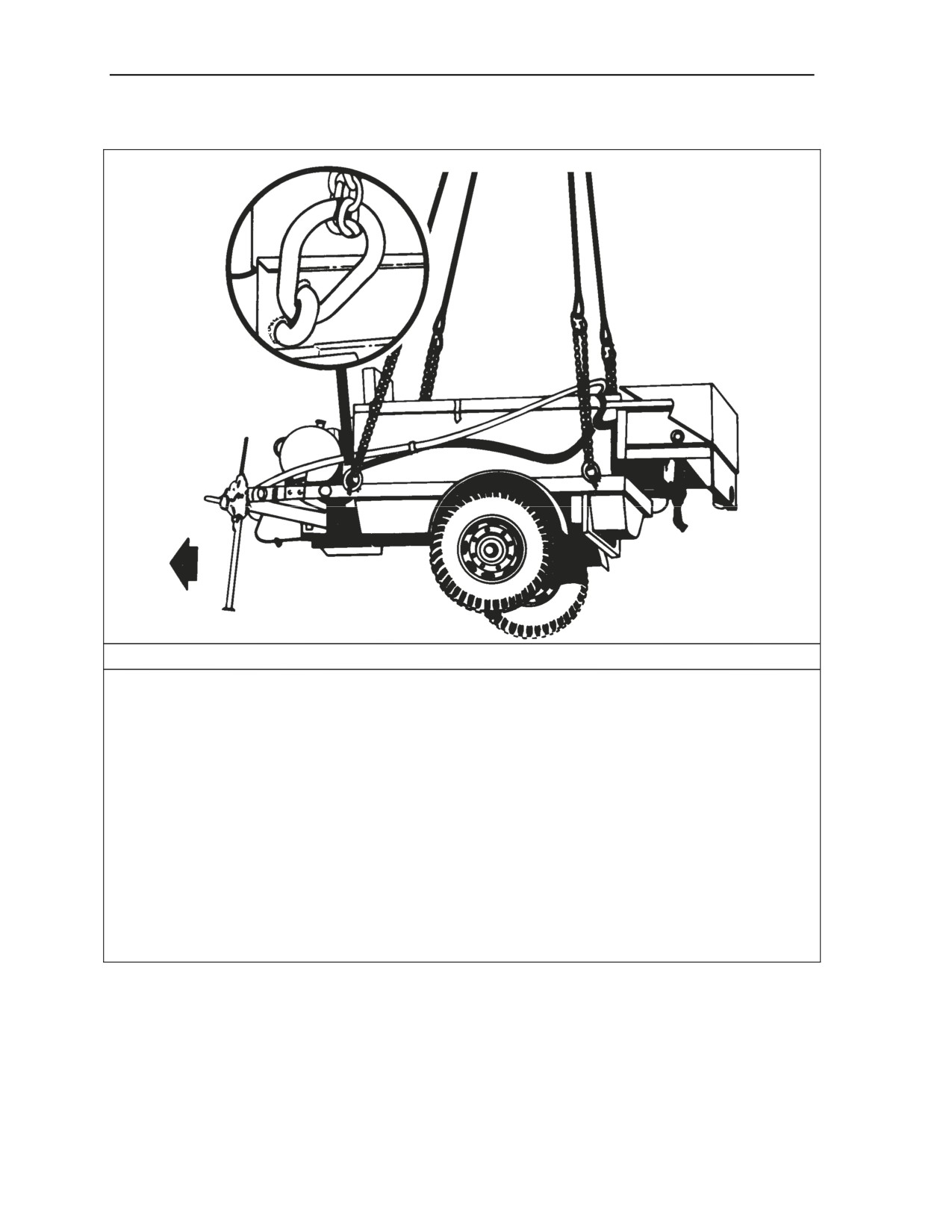
1. Position apex fitting on top of the tar kettle. Route outer sling legs 1 and 2 to the front of the
trailer and inner sling legs 3 and 4 to the rear. Sling legs 1 and 3 must be on the left side of
the load.
2. Loop the chain end of sling leg 1 through the left front lifting ring located on the front left
corner of the trailer. Place the correct link from Table 17-5 in the grab hook. Repeat with
sling leg 2 and the right front lift provision.
3. Loop the chain end of sling leg 3 through the left rear lifting ring located on the left rear corner
of the trailer. Place the correct link from Table 17-5 in the grab hook. Repeat with sling leg 4
and the right rear lift provision.
4. Cluster and tie (breakaway technique) all sling legs together on top of the trailer to prevent
entanglement during hookup and lift-off.
Figure 17-5. Tar Kettles
FM 4-20.198/MCRP 4-11.3E, VOL II/NTTP 3-04.12/
17-8
AFMAN 11-223 (I), VOL II/COMDTINST M13482.3B
20 February 2009
Suitable Single-Point Rigging Procedures for Engineer Equipment
16SM CONCRETE MIXER
17-7. The 16SM concrete mixer is rigged for single-point sling load using the following procedures:
z
Applicability. The following item in Table 17-6 is suitable for all ARMY helicopters with
suitable lift capacity by the US Army Natick Soldier Center:
Table 17-6. 16SM Concrete Mixer
Nomenclature
Max
Sling
Link Count
Weight
Set
Front/Rear
(Pounds)
Mixer, Concrete, Trailer-Mounted, 16SM
6,040
10K
3/3
z
Materials. The following materials are required to rig this load:
Sling set (10,000-pound capacity).
Tape, adhesive, pressure-sensitive, 2-inch wide roll.
Cord, nylon, Type III, 550-pound breaking strength.
Webbing, cotton, 1/4-inch, 80-pound breaking strength.
Chock blocks, 6 x 6 x 24-inch (4 each).
Tie-down, cargo, CGU-1/B (as required).
z
Personnel. Two persons can prepare and rig this load in 20 minutes.
z
Procedures. The following procedures apply to this load:
Preparation. Prepare the load using the following steps:
─ Place the chock blocks to the inside of each wheel.
─ Secure the tongue in the raised position using the CGU-1/B cargo tie-down strap.
─ Secure the scoop elevating wheel with the scoop in the raised position with rope or Type
III nylon cord.
Rigging. Rig the load according to the steps in Figure 17-6.
Hookup. The hookup team stands on top of the mixer. The static wand person discharges
the static electricity with the static wand. The hookup person places the apex fitting onto the
aircraft cargo hook. The hookup team then moves clear of the load but remains close to the load
as the helicopter removes slack from the sling legs. When successful hookup is assured, the
hookup team quickly exits the area underneath the helicopter to the designated rendezvous
point.
Derigging. Derigging is the reverse of the preparation and rigging procedures.
20 February 2009
FM 4-20.198/MCRP 4-11.3E, VOL II/NTTP 3-04.12/
AFMAN 11-223 (I), VOL II/COMDTINST M13482.3B
17-9
Chapter 17
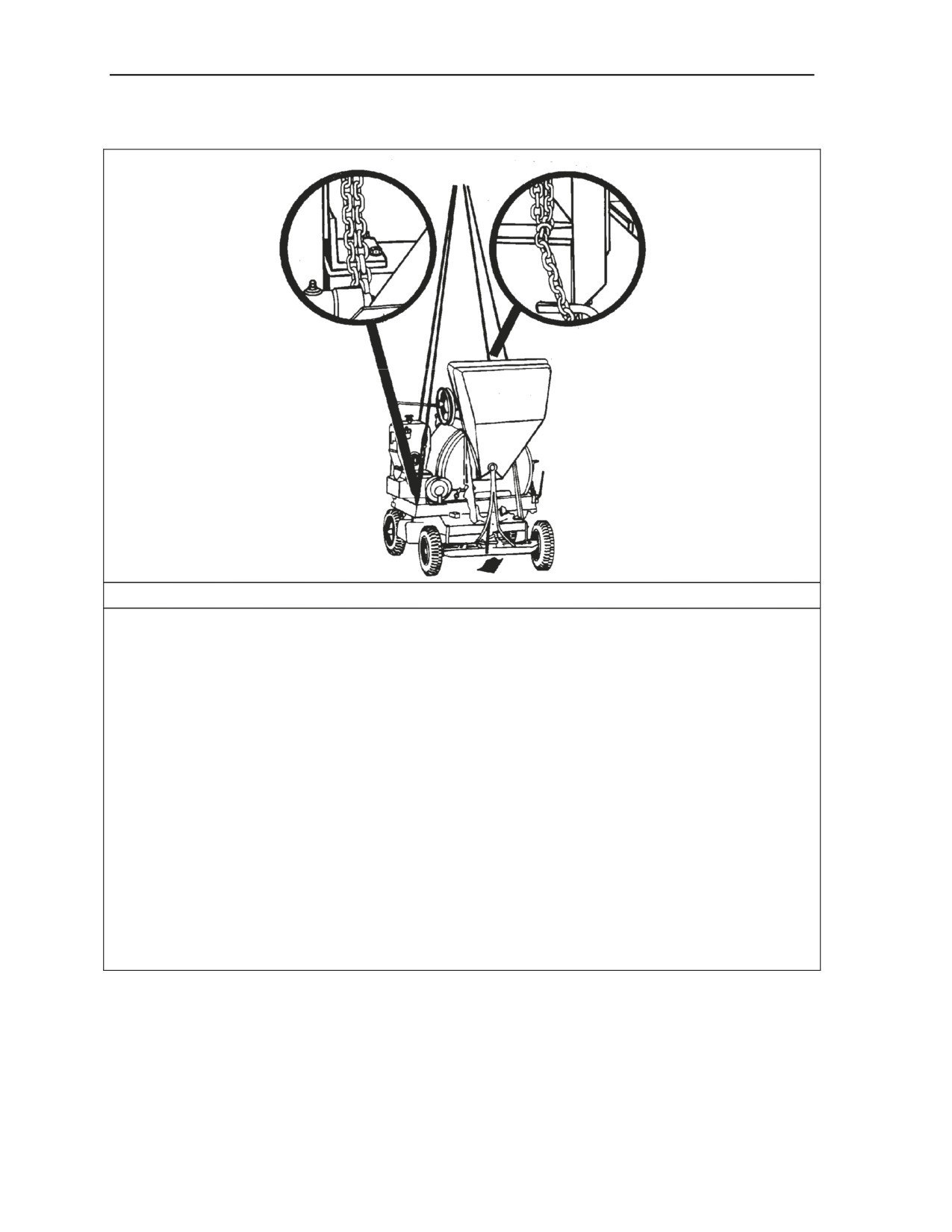
RIGGING STEPS
1. Position apex fitting on top of the mixer. Route outer sling legs 1 and 2 to the front (tongue
end) of the mixer and inner sling legs 3 and 4 to the rear. Sling legs 1 and 3 must be on the
left side of the load.
2. Loop the chain end of sling leg 1 through the left front lifting ring located on the front left
corner of the trailer frame near the left front wheel. Place the correct link from Table 17-6 in
the grab hook. Repeat with sling leg 2 and the right front lift provision.
3. Route sling leg 3 inside the scoop elevating wheel and loop the chain end through the left
rear lifting ring located on the left rear corner of the trailer frame near the left rear wheel.
Place the correct link from Table 17-6 in the grab hook.
4. Route sling leg 4 inside the fan belt housing and loop the chain end through the right rear
lifting ring on the trailer frame near the right rear wheel. Place the correct link from Table 17-
6 in the grab hook.
5. Cluster and tie (breakaway technique) all sling legs together on top of the trailer to prevent
entanglement during hookup and lift-off.
Figure 17-6. 16SM Concrete Mixer
FM 4-20.198/MCRP 4-11.3E, VOL II/NTTP 3-04.12/
17-10
AFMAN 11-223 (I), VOL II/COMDTINST M13482.3B
20 February 2009
Suitable Single-Point Rigging Procedures for Engineer Equipment
ROAD SWEEPER, TOWED
17-8. The road sweeper, towed is rigged for single-point sling load using the following procedures:
z
Applicability. The following item in Table 17-7 is suitable for all ARMY helicopters with
suitable lift capacity by the US Army Natick Soldier Center:
Table 17-7. Road Sweeper, Towed
Nomenclature
Max
Sling
Link Count
Weight
Set
Front/Rear
(Pounds)
Sweeper, Rotary, Towed with 150-Gallon Water Tank Sprinkling
2,120
10K
90/3
System
z
Materials. The following materials are required to rig this load:
Sling set (10,000-pound capacity).
Tape, adhesive, pressure-sensitive, 2-inch wide roll.
Cord, nylon, Type III, 550-pound breaking strength.
Webbing, cotton, 1/4-inch, 80-pound breaking strength.
z
Personnel. Two persons can prepare and rig this load in 10 minutes.
z
Procedures. The following procedures apply to this load:
Preparation. Prepare the load using the following steps:
─ Rotate the towing bar around and secure it in place to the top horizontal bar. Secure
safety chains in place with Type III nylon cord.
─ Rotate the brush to the last locking hole and secure it with the locking pin.
─ Secure the hydraulic handle in the UP position with Type III nylon cord.
Rigging. Rig the load according to the steps in Figure 17-7.
Hookup. The hookup team stands on the frame next to the engine. The static wand person
discharges the static electricity with the static wand. The hookup person places the apex fitting
onto the aircraft cargo hook. The hookup team then moves clear of the load but remains close to
the load as the helicopter removes slack from the sling legs. When successful hookup is
assured, the hookup team quickly exits the area underneath the helicopter to the designated
rendezvous point.
Derigging. Derigging is the reverse of the preparation and rigging procedures.
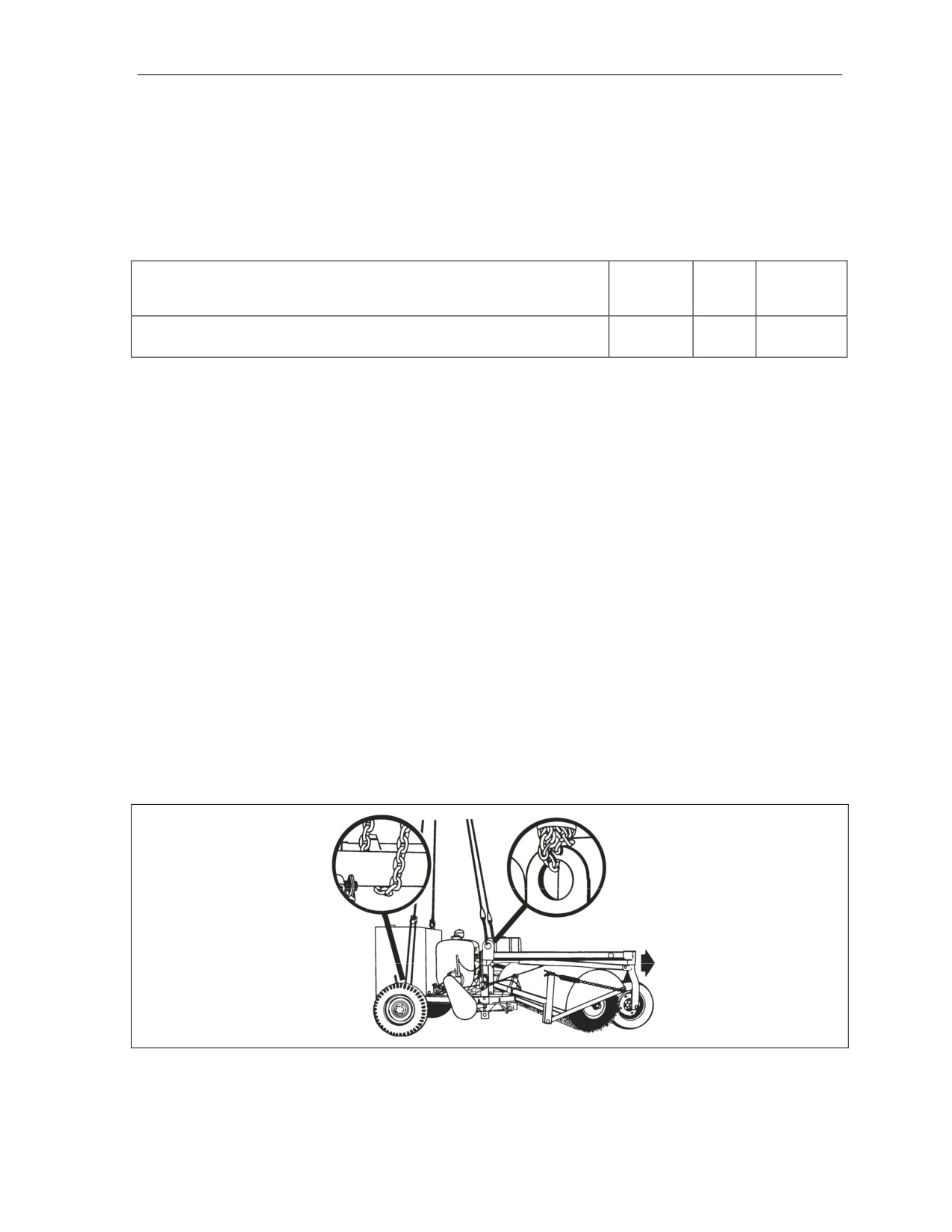
Figure 17-7. Road Sweeper, Towed
20 February 2009
FM 4-20.198/MCRP 4-11.3E, VOL II/NTTP 3-04.12/
AFMAN 11-223 (I), VOL II/COMDTINST M13482.3B
17-11
Chapter 17
RIGGING STEPS
1. Position apex fitting on top of the road sweeper. Route outer sling legs 1 and 2 to the front of
the engine and inner sling legs 3 and 4 to the rear axle. Sling legs 1 and 3 must be on the
left side of the load.
2. Loop the chain end of sling leg 1 through the left front lifting point. Place the correct link from
Table 17-7 in the grab hook. Repeat with sling leg 2 and the right front lift provision. Secure
the excess chain with Type III nylon cord.
3. Loop the chain end of sling leg 3 around the left rear axle near the left rear wheel. Place the
correct link from Table 17-7 in the grab hook. Repeat with sling leg 4 and the right rear axle.
4. Cluster and tie (breakaway technique) all sling legs together on top of the sweeper to prevent
entanglement during hookup and lift-off.
Figure 17-7. Road Sweeper, Towed (Continued)
SHEEPSFOOT ROLLER, TWO-DRUM, MD-96
17-9. The sheepsfoot roller, two-drum, MD-96 is rigged for single-point sling load using the following
procedures:
z
Applicability. The following item in Table 17-8 is suitable for all ARMY helicopters with
suitable lift capacity by the US Army Natick Soldier Center:
Table 17-8. Sheepsfoot Roller, Two-Drum, MD-96
Nomenclature
Max
Sling
Link Count
Weight
Set
Front/Rear
(Pounds)
Sheepfoot Roller, Two-Drum, MD-96
7,500
10K
3/3
z
Materials. The following materials are required to rig this load:
Sling set (10,000-pound capacity).
Tape, adhesive, pressure-sensitive, 2-inch wide roll.
Cord, nylon, Type III, 550-pound breaking strength.
Webbing, cotton, 1/4-inch, 80-pound breaking strength.
Chain assembly (2 each).
z
Personnel. Two persons can prepare and rig this load in 15 minutes.
z
Procedures. The following procedures apply to this load:
Preparation. Prepare the load using the following steps:
─ Wrap a chain four or five times around the two lower tie-down points aft of the inner
sections of the drums and engage hook in the chain end to prevent the two drum
sections from pivoting upwards. Secure the hook with tape or Type III nylon cord so
the hook will not disengage.
─ Repeat using the other chain on the two forward lower tie-down points.
Rigging. Rig the load according to the steps in Figure 17-8.
Hookup. The hookup team stands beside the roller. The static wand person discharges the
static electricity with the static wand. The hookup person places the apex fitting onto the
aircraft cargo hook. The hookup team then moves clear of the load but remains close to the load
as the helicopter removes slack from the sling legs. When successful hookup is assured, the
FM 4-20.198/MCRP 4-11.3E, VOL II/NTTP 3-04.12/
17-12
AFMAN 11-223 (I), VOL II/COMDTINST M13482.3B
20 February 2009
Suitable Single-Point Rigging Procedures for Engineer Equipment
hookup team quickly exits the area underneath the helicopter to the designated rendezvous
point.
Derigging. Derigging is the reverse of the preparation and rigging procedures.
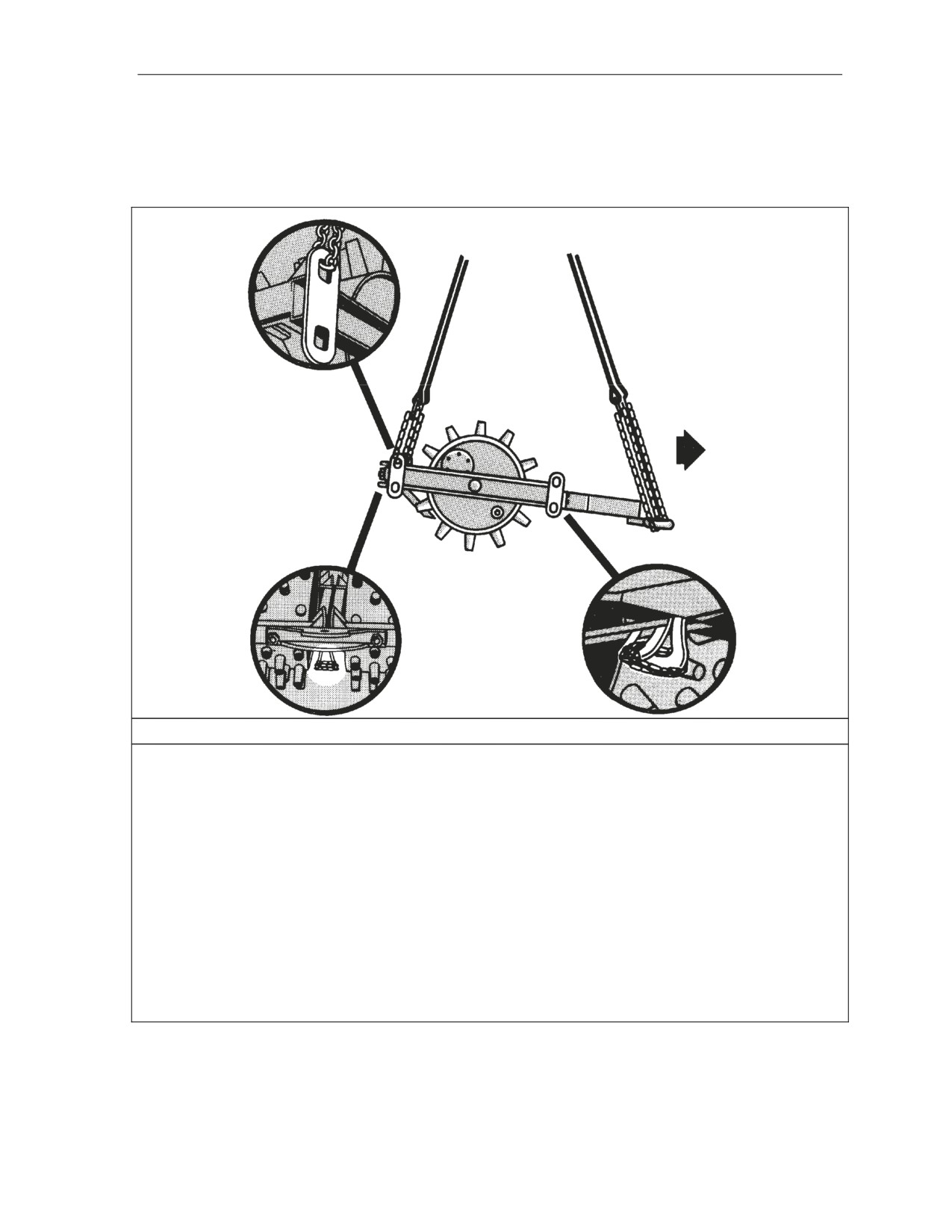
RIGGING STEPS
1. Position apex fitting on top of the rollers. Route outer sling legs 1 and 2 to the front (tongue
end) of the roller and inner sling legs 3 and 4 to the rear. Sling legs 1 and 3 must be on the
left side of the load.
2. Loop the chain end of sling leg 1 through the lunette. Place the correct link from Table 17-8
in the grab hook. Repeat with sling leg 2.
3. Loop the chain end of sling leg 3 through the left rear lift provision on the aft left corner of left
roller. Place the correct link from Table 17-8 in the grab hook. Repeat with sling leg 4 and
the right roller.
4. Cluster and tie (breakaway technique) all sling legs together on top of the roller to prevent
entanglement during hookup and lift-off.
Figure 17-8. Sheepsfoot Roller, Two-Drum, MD-96
20 February 2009
FM 4-20.198/MCRP 4-11.3E, VOL II/NTTP 3-04.12/
AFMAN 11-223 (I), VOL II/COMDTINST M13482.3B
17-13
Chapter 17
MODEL 1150 FULL TRACKED TRACTOR
17-10. The model 1150 full tracked tractor is rigged for single-point sling load using the following
procedures:
z
Applicability. The following items in Table 17-9 are suitable for all ARMY helicopters with
suitable lift capacity by the US Army Natick Soldier Center:
Table 17-9. Model 1150 Full Tracked Tractor
Nomenclature
Max
Sling
Link Count
Weight
Set
Front/Rear
(Pounds)
Tractor, Full-Tracked, Case Model 1150 without Roll Over
21,930
25K
3/3
Protection System
Tractor, Full-Tracked, Case Model 1150 without Blade
18,740
25K
3/3
Blade
N/A
10K
3/3
z
Materials. The following materials are required to rig this load:
Sling set (25,000-pound capacity).
Sling set (10,000-pound capacity) (2 legs only).
Tape, adhesive, pressure-sensitive, 2-inch wide roll.
Cord, nylon, Type III, 550-pound breaking strength.
Webbing, cotton, 1/4-inch, 80-pound breaking strength.
Two protective plugs for hydraulic lines, if sectionalizing the tractor.
z
Personnel. One person can rig each load in 5 minutes. Two persons can remove ROPS and
sectionalize the tractor and blade in 2 hours.
z
Procedures. The following procedures apply to this load:
Preparation. Prepare the load using the following steps:
─ Sectionalize the load, if required, according to the operator's manual. Install protective
caps over the hoses and install trunnion caps securely.
─ Place the transmission in neutral.
Rigging. Rig the load according to the steps in Figure 17-9.
Hookup. The hookup team stands on the driver's seat or beside the blade assembly. The
static wand person discharges the static electricity with the static wand. The hookup person
places the apex fitting onto the aircraft cargo hook. The hookup team then moves clear of the
load but remains close to the load as the helicopter removes slack from the sling legs. When
successful hookup is assured, the hookup team quickly exits the area underneath the helicopter
to the designated rendezvous point.
Derigging. Derigging is the reverse of the preparation and rigging procedures.
FM 4-20.198/MCRP 4-11.3E, VOL II/NTTP 3-04.12/
17-14
AFMAN 11-223 (I), VOL II/COMDTINST M13482.3B
20 February 2009
Suitable Single-Point Rigging Procedures for Engineer Equipment
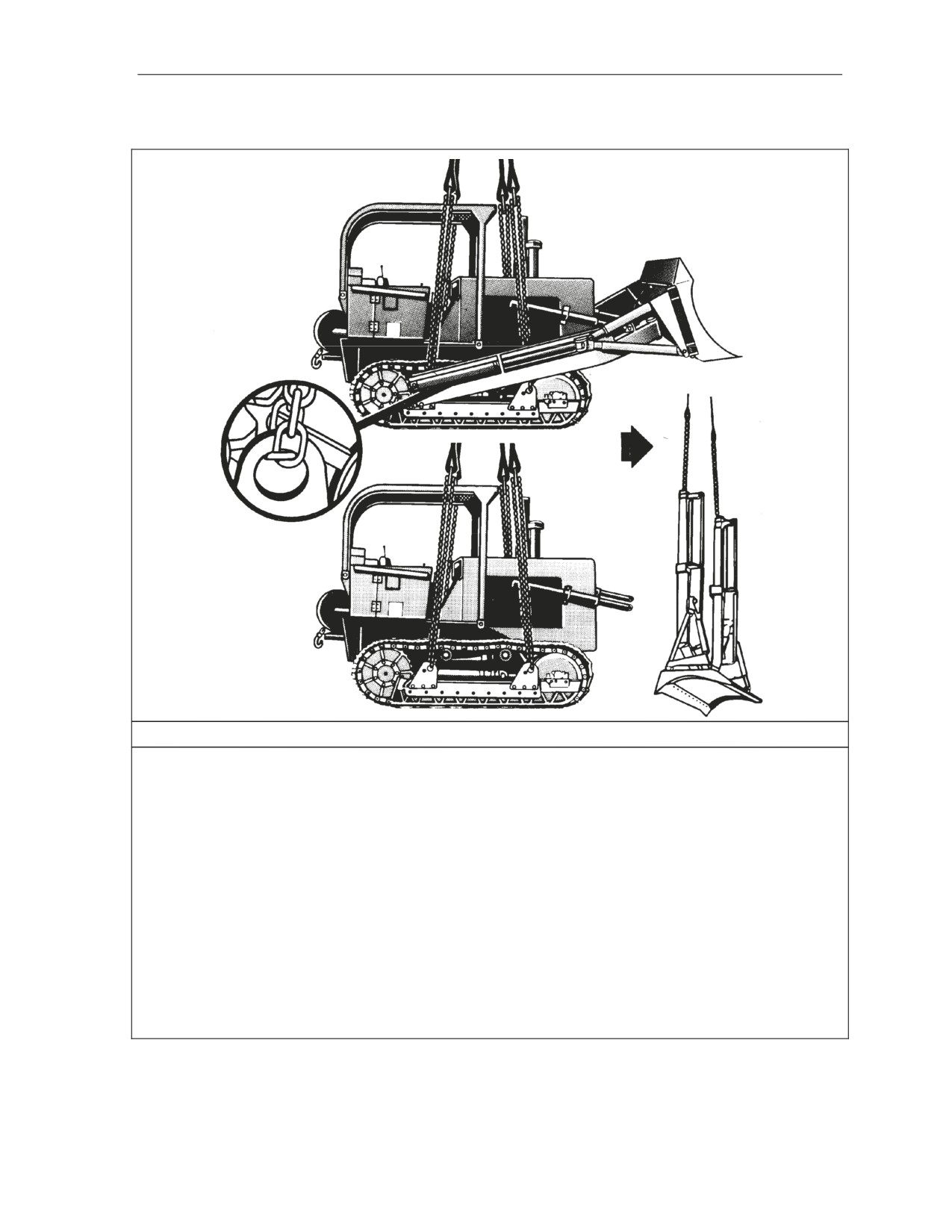
RIGGING STEPS FOR TRACTOR
1. Position apex fitting on top of the center of the tractor. Route outer sling legs 1 and 2 to the
front of the tractor and inner sling legs 3 and 4 to the rear. Sling legs 1 and 3 must be on the
left side of the load.
2. Loop the chain end of sling leg 1 through the left front lift provision located by the front idler.
Place the correct link from Table 17-9 in the grab hook. Repeat with sling leg 2 and the right
front lift provision.
3. Loop the chain end of sling leg 3 through the left rear lift provision located outboard of the
drive sprocket. Place the correct link from Table 17-9 in the grab hook. Repeat with sling leg
4 and the right lift provision.
4. Cluster and tie (breakaway technique) all sling legs together on top of the tractor to prevent
entanglement during hookup and lift-off.
Figure 17-9. Model 1150 Full Tracked Tractor
20 February 2009
FM 4-20.198/MCRP 4-11.3E, VOL II/NTTP 3-04.12/
AFMAN 11-223 (I), VOL II/COMDTINST M13482.3B
17-15
Chapter 17
RIGGING STEPS FOR BLADE
1. Position apex fitting between the trunnion arms.
2. Loop the chain end of the left sling leg through the hole in the left trunnion cap. Place the
correct link from Table 17-9 in the grab hook.
3. Loop the chain end of the right sling leg through the hole in the right trunnion cap. Place the
correct link from Table 17-9 in the grab hook.
4. Cluster and tie (breakaway technique) all sling legs together on top of the tractor to prevent
entanglement during hookup and lift-off.
Figure 17-9. Model 1150 Full Tracked Tractor (Continued)
M4K 4000-POUND FORKLIFT
17-11. The M4K 4000-pound forklift is rigged for single-point sling load using the following
procedures:
z
Applicability. The following item in Table 17-10 is suitable for all ARMY helicopters with
suitable lift capacity by the US Army Natick Soldier Center:
Table 17-10. M4K 4000-Pound Forklift
Nomenclature
Max
Sling
Link Count
Weight
Set
Front/Rear
(Pounds)
Forklift Rough Terrain, 4000-Pound, M4K
9,725
10
25/3
z
Materials. The following materials are required to rig this load:
Sling set (10,000-pound capacity).
Tape, adhesive, pressure-sensitive, 2-inch wide roll.
Cord, nylon, Type III, 550-pound breaking strength.
Webbing, cotton, 1/4-inch, 80-pound breaking strength.
Felt sheet, cattle hair, Type IV, 1/2-inch or suitable substitute.
Tie-down strap, cargo, CGU-1/B (as required).
z
Personnel. Two persons can prepare and rig this load in 20 minutes.
z
Procedures. The following procedures apply to this load:
Preparation. Prepare the load using the following steps:
─ Insert the locking pin or bolt and nut to prevent the front and rear ends from pivoting.
─ Secure the steering wheel with Type III nylon cord. Engage the hand brake.
─ Ensure the fuel tank is less than 3/4 full.
─ Pad the forward edge of the roll over protection system (ROPS). Secure the padding
with tape or Type III nylon cord.
─ Raise the fork tines approximately 1 foot above the ground. Lift the ends of the fork
tines by hand to point upward and secure the fork tines to the lift cylinder frame using
the tie-down strap.
Rigging. Rig the load according to the steps in Figure 17-10.
Hookup. The hookup team stands on top of the engine deck. The static wand person
discharges the static electricity with the static wand. The hookup person places the apex fitting
FM 4-20.198/MCRP 4-11.3E, VOL II/NTTP 3-04.12/
17-16
AFMAN 11-223 (I), VOL II/COMDTINST M13482.3B
20 February 2009
Suitable Single-Point Rigging Procedures for Engineer Equipment
onto the aircraft cargo hook. The hookup team then moves clear of the load but remains close to
the load as the helicopter removes slack from the sling legs. When successful hookup is
assured, the hookup team quickly exits the area underneath the helicopter to the designated
rendezvous point.
Derigging. Derigging is the reverse of the preparation and rigging procedures.
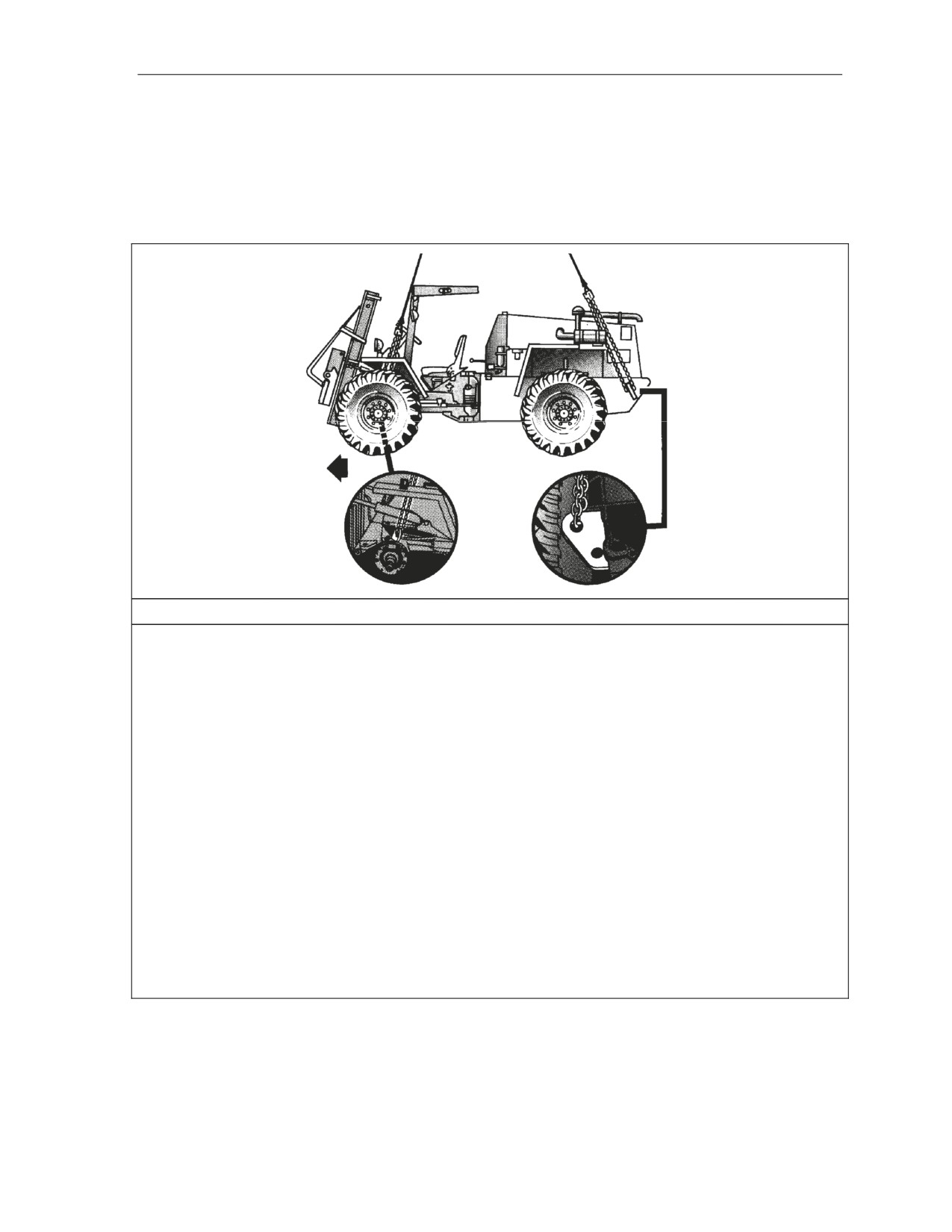
RIGGING STEPS
1. Position apex fitting on top of the engine hood. Route outer sling legs 1 and 2 to the front of
the forklift. Ensure the sling legs are routed behind the lower driving light box beam mounted
on the front fenders. Route inner sling legs 3 and 4 to the rear. Sling legs 1 and 3 must be
on the left side of the load.
2. Loop the chain end of sling leg 1 through the left front lift provision located directly above the
forward axle housing between the left front tire and the hydraulic cylinder. Place the correct
link from Table 17-10 in the grab hook. Repeat with sling leg 2 and the right front lift
provision. Secure the excess chain with Type III nylon cord.
3. Loop the chain end of sling leg 3 through the top hole in the left rear lift provision. Place the
correct link from Table 17-10 in the grab hook. Repeat with sling leg 4 and the right rear lift
provision.
4. Pull the aft sling legs together on top of the engine compartment and tie (breakaway
technique) the grab hooks together.
5. Cluster and tie (breakaway technique) all sling legs together on top of the forklift to prevent
entanglement during hookup and lift-off.
Figure 17-10. M4K 4000-Pound Forklift
20 February 2009
FM 4-20.198/MCRP 4-11.3E, VOL II/NTTP 3-04.12/
AFMAN 11-223 (I), VOL II/COMDTINST M13482.3B
17-17
Chapter 17
FLOODLIGHT SET, TRAILER-MOUNTED
17-12. The floodlight set, trailer-mounted is rigged for single-point sling load using the following
procedures:
z
Applicability. The following item in Table 17-11 is suitable for all ARMY helicopters with
suitable lift capacity by the US Army Natick Soldier Center:
Table 17-11. Floodlight Set, Trailer-Mounted
Nomenclature
Max
Sling
Link Count
Weight
Set
Front/Rear
(Pounds)
Floodlight Set, Trailer-Mounted, Model No. HLT-3KW-M.1
2,300
10
40/100
z
Materials. The following materials are required to rig this load:
Sling set (10,000-pound capacity).
Tape, adhesive, pressure-sensitive, 2-inch wide roll.
Cord, nylon, Type III, 550-pound breaking strength.
Webbing, cotton, 1/4-inch, 80-pound breaking strength.
Tie-down strap, cargo, CGU-1/B (as required).
z
Personnel. Two persons can prepare and rig this load in 15 minutes.
z
Procedures. The following procedures apply to this load:
Preparation. Prepare the load using the following steps:
─ Ensure the generator set is secured in place with the security bolts. Use the CGU-1/B tie-
down straps if necessary.
─ Secure the mast section and lights in place with Type III nylon cord.
─ Secure all cables, hoses, and chains to the trailer tongue with tape or Type III nylon cord.
─ Engage the parking brake. Raise all the leveling legs to the full up position. Secure the
trailer tongue leg in the down position.
Rigging. Rig the load according to the steps in Figure 17-11.
Hookup. The hookup team stands alongside the load. The static wand person discharges
the static electricity with the static wand. The hookup person places the apex fitting onto the
aircraft cargo hook. The hookup team then moves clear of the load but remains close to the load
as the helicopter removes slack from the sling legs. When successful hookup is assured, the
hookup team quickly exits the area underneath the helicopter to the designated rendezvous
point.
Derigging. Derigging is the reverse of the preparation and rigging procedures.
FM 4-20.198/MCRP 4-11.3E, VOL II/NTTP 3-04.12/
17-18
AFMAN 11-223 (I), VOL II/COMDTINST M13482.3B
20 February 2009
Suitable Single-Point Rigging Procedures for Engineer Equipment
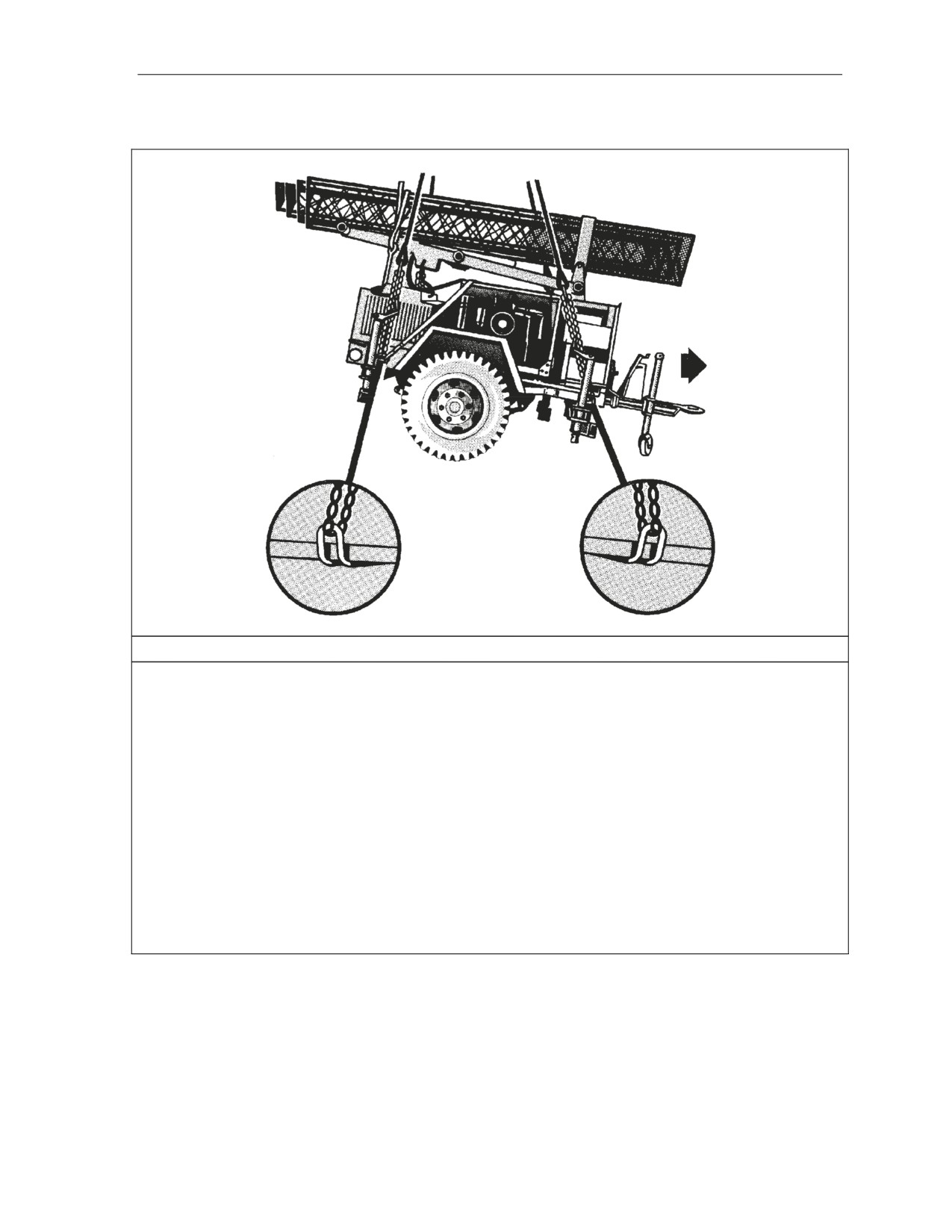
RIGGING STEPS
1. Position apex fitting on top of the floodlight set. Route outer sling legs 1 and 2 to the front of
the trailer and inner sling legs 3 and 4 to the rear. Sling legs 1 and 3 must be on the left
side of the load.
2. Loop the chain end of sling leg 1 through the left front lift provision located on the left side of
the trailer. Place the correct link from Table 17-11 in the grab hook. Repeat with sling leg 2
and the right front lift provision. Secure the excess chain with Type III nylon cord.
3. Loop the chain end of sling leg 3 through the left rear lift provision. Place the correct link
from Table 17-11 in the grab hook. Repeat with sling leg 4 and the right rear lift provision.
Secure the excess chain with Type III nylon cord.
4. Cluster and tie (breakaway technique) all sling legs together on top of the floodlight set to
prevent entanglement during hookup and lift-off.
Figure 17-11. Floodlight Set, Trailer-Mounted
20 February 2009
FM 4-20.198/MCRP 4-11.3E, VOL II/NTTP 3-04.12/
AFMAN 11-223 (I), VOL II/COMDTINST M13482.3B
17-19
Chapter 18
Suitable Single-Point Rigging Procedures for Liquid
Containers
INTRODUCTION
18-1. This chapter contains rigging procedures for single-point lift of liquid containers that are suitable
for sling load. Each rigging procedure is found in a paragraph that includes a description of the load,
materials required for rigging, and steps to complete the procedure. An applicability paragraph is also a
part of each paragraph and identifies the suitable loads. The suitable single-point rigging procedures for
liquid containers are in this section. Paragraphs 18-2 through 18-4 give detailed instructions for rigging
loads.
Note. Reach Pendants may be used on all single point loads. A static discharge person is not
required when using a Reach Pendant.
TANK, FABRIC, COLLAPSIBLE, 10,000-GALLON
18-2. The tank, fabric, collapsible, 10,000-gallon is rigged for single-point sling load using the following
procedures:
z
Applicability. The following item in Table 18-1 is suitable for all ARMY helicopters with
suitable lift capacity by the US Army Natick Soldier Center:
Table 18-1. Tank, Fabric, Collapsible, 10,000-Gallon
Nomenclature
Max
Sling
Link Count
Weight
Set
Front/Rear
(Pounds)
Tank, Fabric, Collapsible, 10,000-Gallon
1,040
10K
100/100
CAUTION
This load may become unstable at airspeeds above 35 knots.
z
Materials. The following materials are required to rig this load:
Sling set (10,000-pound capacity).
Tape, adhesive, pressure-sensitive, 2-inch wide roll.
Cord, nylon, Type III, 550-pound breaking strength.
Webbing, cotton, 1/4-inch, 80-pound breaking strength.
z
Personnel. Two persons can prepare and rig this load in 10 minutes.
z
Procedures. The following procedures apply to this load:
Preparation. Ensure all safety latches on the cover are securely closed.
Rigging. Rig the load according to the steps in Figure 18-1.
Note. Do not carry more than one tank at a time.
20 February 2009
FM 4-20.198/MCRP 4-11.3E, VOL II/NTTP 3-04.12/
AFMAN 11-223 (I), VOL II/COMDTINST M13482.3B
18-1
Chapter 18
Hookup. The hookup team stands alongside the load. The static wand person discharges
the static electricity with the static wand. The hookup person places the apex fitting onto the
aircraft cargo hook. The hookup team then moves clear of the load but remains close to the load
as the helicopter removes slack from the sling legs. When successful hookup is assured, the
hookup team quickly exits the area underneath the helicopter to the designated rendezvous
point.
Derigging. Derigging is the reverse of the preparation and rigging procedures.
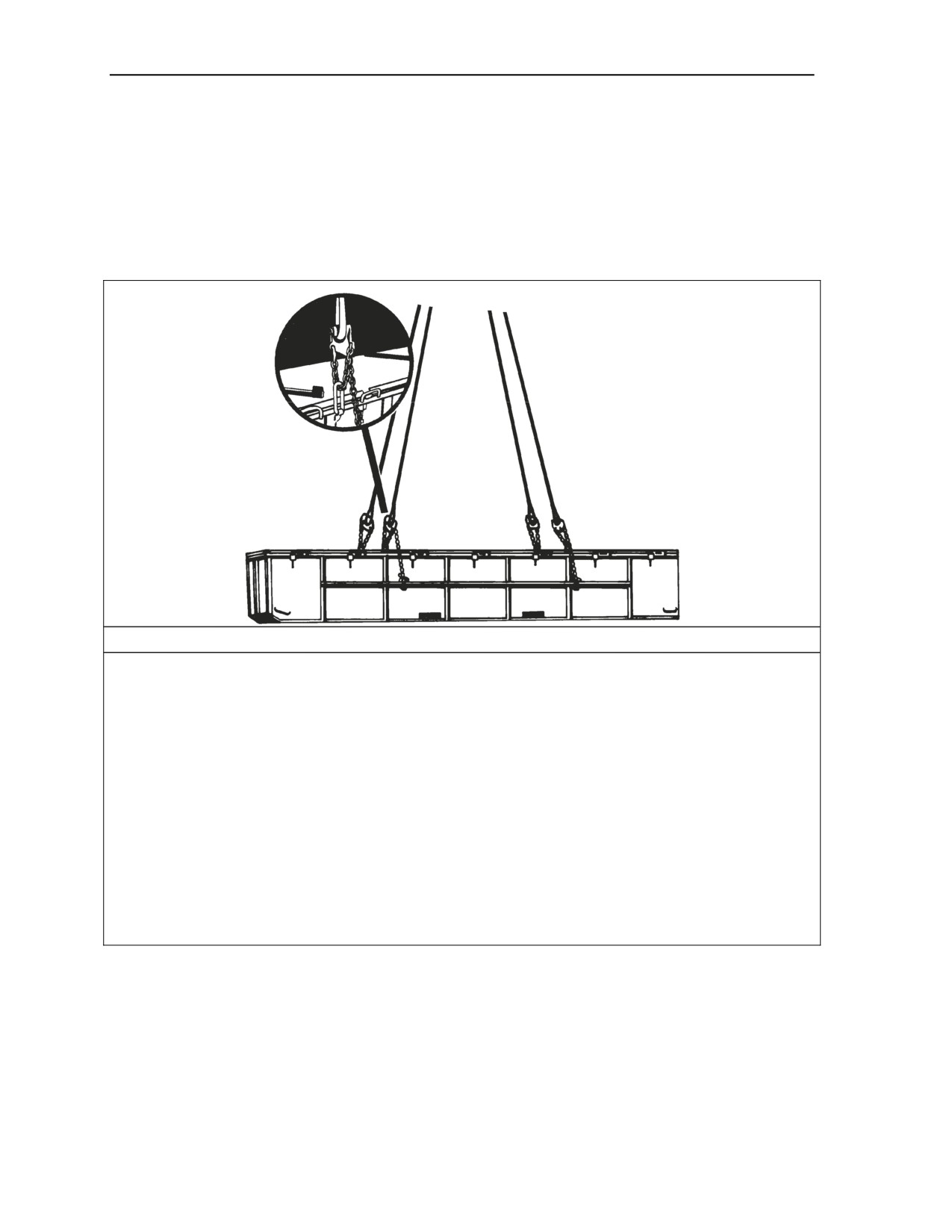
RIGGING STEPS
1. Position apex fitting on top of the center of the tank. Route outer sling legs 1 and 2 to the
front of the tank and inner sling legs 3 and 4 to the rear. Sling legs 1 and 3 must be on the
left side of the load.
2. Loop the chain end of sling leg 1 through the left front lift provision located on the left forward
side of the tank. Place the correct link from Table 18-1 in the grab hook. Repeat with sling
leg 2 and the right front lift provision. Secure the excess chain with Type III nylon cord.
3. Loop the chain end of sling leg 3 through the left rear lift provision. Place the correct link
from Table 18-1 in the grab hook. Repeat with sling leg 4 and the right rear lift provision.
Secure the excess chain with Type III nylon cord.
4. Cluster and tie (breakaway technique) all sling legs together on top of the tank to prevent
entanglement during hookup and lift-off.
Figure 18-1. Tank, Fabric, Collapsible, 10,000-Gallon
FM 4-20.198/MCRP 4-11.3E, VOL II/NTTP 3-04.12/
18-2
AFMAN 11-223 (I), VOL II/COMDTINST M13482.3B
20 February 2009
Suitable Single-Point Rigging Procedures for Liquid Containers
60,000-GALLON FUEL SYSTEM SUPPLY POINT
18-3. The 60,000-gallon fuel system supply point is rigged for single-point sling load using the following
procedures:
z
Applicability. The following items in Table 18-2 are suitable for all ARMY helicopters with
suitable lift capacity by the US Army Natick Soldier Center:
Table 18-2. 60,000-Gallon Fuel System Supply Point
Nomenclature
Max
Sling Set
Link Count
Weight
Front/Rear
(Pounds)
60,000-Gallon Fuel System Supply Point
N/A
N/A
N/A
Net # 1 - Pump
1,300
5K Net
N/A
Net # 2 - Tanks
6,000
10K Net
N/A
Net # 3 - Hoses
2,000
5K Net
N/A
Net # 4 - Hoses
2,200
5K Net
N/A
Net # 5 - Hoses
4,000
5k Net
N/A
z
Materials. The following materials are required to rig this load:
Net, cargo (5,000-pound capacity) (4 each).
Net, cargo (10,000-pound capacity).
Sling set (10,000-pound capacity) (2 each).
Tape, adhesive, pressure-sensitive, 2-inch wide roll.
Cord, nylon, Type III, 550-pound breaking strength.
Webbing, cotton, 1/4-inch, 80-pound breaking strength.
Apex fitting (25,000-pound capacity).
z
Personnel. Eight persons can prepare and rig this load in 60 minutes.
z
Procedures. The following procedures apply to this load:
Preparation. Prepare the load using the following steps:
Rigging. Rig the load according to the steps in Figure 18-2.
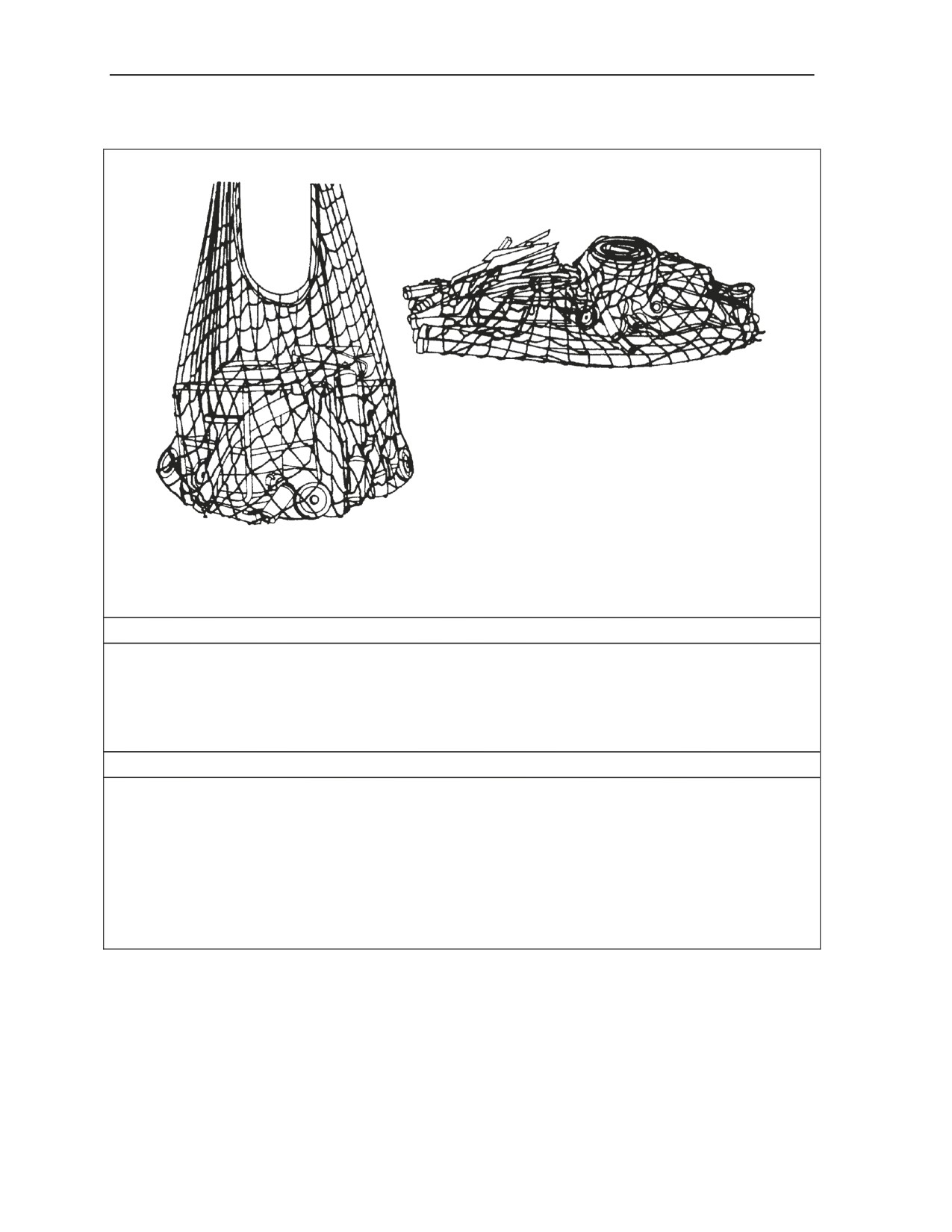
─ Spread out all five nets side by side.
─ Center the pump on net #1 (5,000-pound capacity).
─ Center two metal containers with tanks and fittings on net #2 (10,000-pound capacity).
Position the third container on top of the bottom two containers.
─ Center both filters on net #3. Tie three fire extinguishers to each side of the filters with
Type III nylon cord. Place six rolled hoses on top of the filters. Pull the net up around
the load and tie the corners to the pumps.
─ Place 15 long hoses centered on net #4 (5,000-pound capacity). Build a pyramid of 120
hoses.
─ Secure all signs on a pallet and secure with Type III nylon cord. Center the net on net
#5. Secure four fire extinguishers on a second pallet and center on the net. Pile all
remaining hoses on the pallets.
Hookup. The hookup team stands alongside the load. The static wand person discharges
the static electricity with the static wand. The hookup person places the apex fitting onto the
aircraft cargo hook. The hookup team then moves clear of the load but remains close to the load
as the helicopter removes slack from the sling legs. When successful hookup is assured, the
hookup team quickly exits the area underneath the helicopter to the designated rendezvous
point.
Derigging. Derigging is the reverse of the preparation and rigging procedures.
20 February 2009
FM 4-20.198/MCRP 4-11.3E, VOL II/NTTP 3-04.12/
AFMAN 11-223 (I), VOL II/COMDTINST M13482.3B
18-3
Chapter 18
Note. If both loads are being moved as one load, place both sling set apex fittings on a 25,000-
pound capacity apex fitting.
RIGGING STEPS LOAD 1
1. Loop the chain end of one sling leg through the apex fitting of net 1 and insert link 3 in the
grab hook.
2. Loop the chain end of three sling legs through the apex fitting of net 2 and insert link 3 in the
grab hook.
RIGGING STEPS LOAD 2
1. Loop the chain end of one sling leg through the apex fitting of net 3 and insert link 3 in the
grab hook.
2. Loop the chain end of one sling leg through the apex fitting of net 4 and insert link 3 in the
grab hook.
3. Loop the chain end of two sling legs through the apex fitting of net 5 and insert link 3 in the
grab hook.
Figure 18-2. 60,000-Gallon Fuel System Supply Point
FM 4-20.198/MCRP 4-11.3E, VOL II/NTTP 3-04.12/
18-4
AFMAN 11-223 (I), VOL II/COMDTINST M13482.3B
20 February 2009

Suitable Single-Point Rigging Procedures for Liquid Containers
ONE TO SIX 250-GALLON WATER DRUMS
18-4. One to six 250-gallon water drums are rigged for single-point sling load using the following
procedures:
z
Applicability. The following items in Table 18-3 are suitable for all ARMY helicopters with
suitable lift capacity by the US Army Natick Soldier Center:
Table 18-3. One to Six 250-Gallon Water Drums
Nomenclature
Max
Sling Set
Link Count
Weight
Front/Rear
(Pounds)
One Drum, Fabric, Water, 250-Gallon
2,210
10K
3
Two Drums, Fabric, Water, 250-Gallon
4,420
10K
3/3
Three Drums, Fabric, Water, 250-Gallon
6,630
10K
3/20
Four Drums, Fabric, Water, 250-Gallon
8,840
10K
3/3
Five Drums, Fabric, Water, 250-Gallon
11,050
10K
3/3/33
Six Drums, Fabric, Water, 250-Gallon
13,260
10K
3/3/22
z
Materials. The following materials are required to rig this load:
Sling set (10,000-pound capacity) with 2 additional sling legs.
Tape, adhesive, pressure-sensitive, 2-inch wide roll.
Cord, nylon, Type III, 550-pound breaking strength.
Webbing, cotton, 1/4-inch, 80-pound breaking strength.
Apex fitting (25,000-pound capacity).
z
Personnel. One person can prepare and rig one drum in 5 minutes; add 5 minutes for each
additional drum.
z
Procedures. The following procedures apply to this load:
Preparation. Align all drums side by side (if appropriate) and rotate the hubs of each drum
so a clevis is positioned at the top.
Rigging. Rig the load according to the steps in Figure 18-3.
Note. Route the sling legs so the odd numbered sling legs are to one side of the drum(s) and the
even numbered sling legs are to the other side.
Hookup. The hookup team stands alongside the load. The static wand person discharges
the static electricity with the static wand. The hookup person places the apex fitting onto the
aircraft cargo hook. The hookup team then moves clear of the load but remains close to the load
as the helicopter removes slack from the sling legs. When successful hookup is assured, the
hookup team quickly exits the area underneath the helicopter to the designated rendezvous
point.
Derigging. Derigging is the reverse of the preparation and rigging procedures.
20 February 2009
FM 4-20.198/MCRP 4-11.3E, VOL II/NTTP 3-04.12/
AFMAN 11-223 (I), VOL II/COMDTINST M13482.3B
18-5
Chapter 18
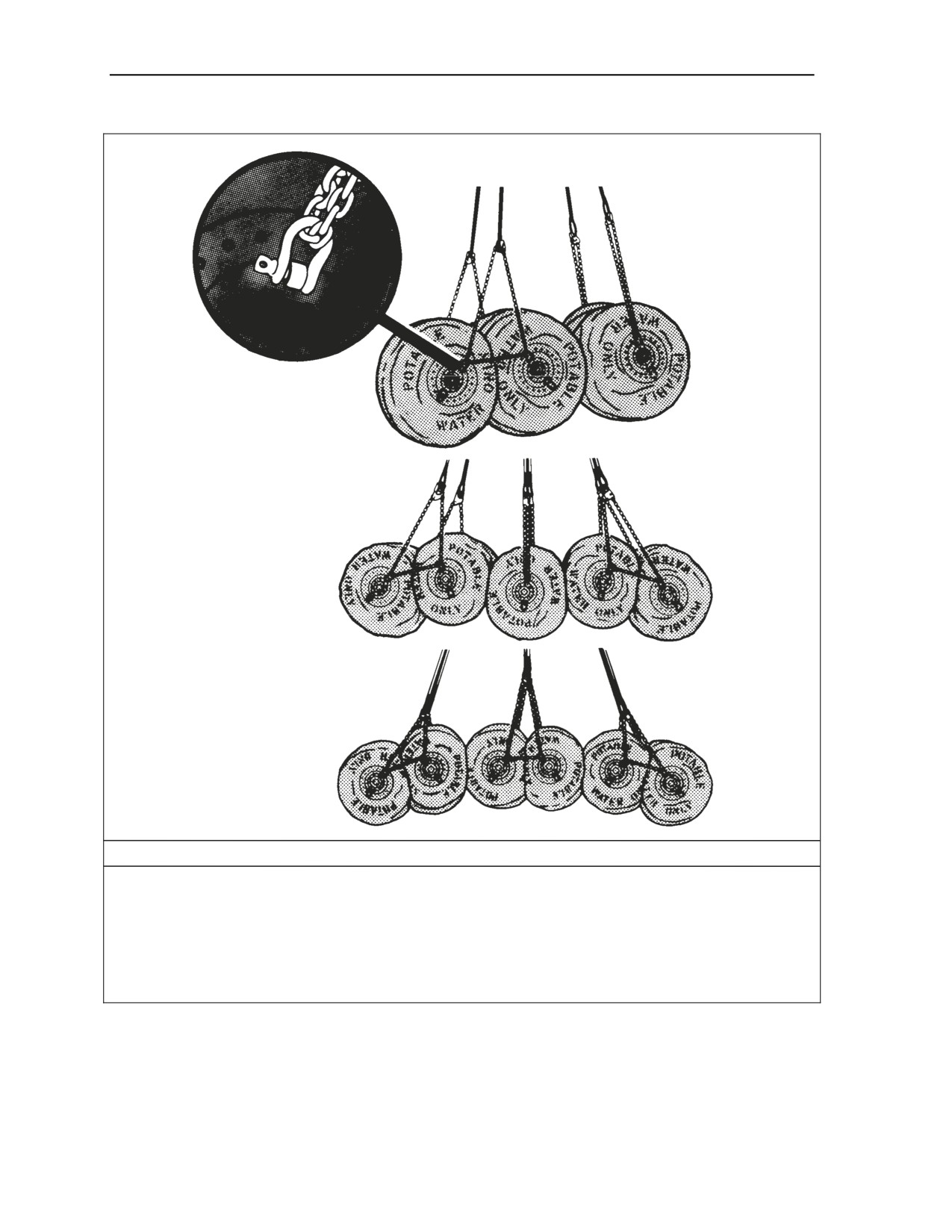
RIGGING STEPS (ONE DRUM)
1. Position apex fitting beside the drum. Route sling legs 1 and 3 to one side of the drum and
sling legs 2 and 4 to the other side.
2. Loop the chain end of the sling legs through the clevis at the top of the hub. Place the
correct link from Table 18-3 in the grab hook.
Note. A single drum may be moved using a two-leg sling set.
Figure 18-3. One to Six 250-Gallon Water Drums
FM 4-20.198/MCRP 4-11.3E, VOL II/NTTP 3-04.12/
18-6
AFMAN 11-223 (I), VOL II/COMDTINST M13482.3B
20 February 2009

Suitable Single-Point Rigging Procedures for Liquid Containers
RIGGING STEPS (TWO DRUMS)
1.
Position apex fitting beside or on top of the two drums. Route outer sling legs 1 and 2 to the
front drum and inner sling legs 3 and 4 to the rear drum.
2.
Loop the chain end of the sling leg through the appropriate clevis at the top of the hub for
each drum. Place the correct link from Table 18-3 in the grab hook.
RIGGING STEPS (THREE DRUMS)
1.
Position apex fitting beside or on top of the drums. Route outer sling legs 1 and 2 to the front
drum and inner sling legs 3 and 4 to the rear drum.
2.
Loop the chain end of sling leg 1 through the clevis at the top of the outer drum and through
the clevis at the top of the center drum. Place the correct link from Table 18-3 in the grab
hook.
3.
Loop the chain end of sling leg 3 through the clevis at the top of the hub of the outer drum.
Place the correct link from Table 18-3 in the grab hook. Repeat with sling leg 4 on the other
side of the drum. Secure the excess chain with Type III nylon cord.
RIGGING STEPS (FOUR DRUMS)
1.
Position apex fitting beside or on top of the drums. Route outer sling legs 1 and 2 to the front
drum and inner sling legs 3 and 4 to the rear drum.
2.
Loop the chain end of sling leg 1 through the clevis at the top of the outer drum and through
the clevis at the top of the next inner drum. Place the correct link from Table 18-3 in the grab
hook. Repeat with sling leg 2 on the other side of the drums.
3.
Loop the chain end of sling leg 3 through the clevis at the top of the hub of the rear outer
drum and through the clevis at the top of the next inner drum. Place the correct link from
Table 18-3 in the grab hook. Repeat with sling leg 4 on the other side of the drums.
RIGGING STEPS (FIVE DRUMS)
1.
Configure a six-leg sling set using a 25,000-pound capacity apex fitting and six sling leg
assemblies.
2.
Position apex fitting on top of the drums. Route outer sling legs 1 and 2 to the front drum,
middle sling legs 3 and 4 to the rear drum and inner sling legs 5 and 6 to the center drum.
3.
Loop the chain end of sling leg 1 through the left clevis on outer drum and through the left
clevis of an adjacent drum. Place the correct link from Table 18-3 in the grab hook. Repeat
with sling leg 2 on the right side of the drums.
4.
Loop the chain end of sling leg 3 through the left clevis on outer drum and through the left
clevis of an adjacent drum. Place the correct link from Table 18-3 in the grab hook. Repeat
with sling leg 4 on the right side of the drums.
5.
Loop the chain end of sling leg 5 through the top clevis of the center drum. Place the correct
link from Table 18-3 in the grab hook. Repeat with sling leg 6 on the right side of the drum.
Secure the excess chain with Type III nylon cord.
Figure 18-3. One to Six 250-Gallon Water Drums (Continued)
20 February 2009
FM 4-20.198/MCRP 4-11.3E, VOL II/NTTP 3-04.12/
AFMAN 11-223 (I), VOL II/COMDTINST M13482.3B
18-7
Chapter 18
RIGGING STEPS (SIX DRUMS)
1. Configure a six-leg sling set using a 25,000-pound capacity apex fitting and six sling leg
assemblies.
2. Position apex fitting on top of the drums. Route outer sling legs 1 and 2 to the front drum,
middle sling legs 3 and 4 to the rear drum and inner sling legs 5 and 6 to the center drum.
3. Loop the chain end of sling leg 1 through the left clevis on outer drum and through the left
clevis of an adjacent drum. Place the correct link from Table 18-3 in the grab hook. Repeat
with sling leg 2 on the right side of the drums.
4. Loop the chain end of sling leg 3 through the left clevis on outer drum and through the left
clevis of an adjacent drum. Place the correct link from Table 18-3 in the grab hook. Repeat
with sling leg 4 on the right side of the drums.
5. Loop the chain end of sling leg 5 through the top clevis of both center drums. Place the
correct link from Table 18-3 in the grab hook. Repeat with sling leg 6 on the right side of the
drums. Secure the excess chain with Type III nylon cord.
Figure 18-3. One to Six 250-Gallon Water Drums (Continued)
FM 4-20.198/MCRP 4-11.3E, VOL II/NTTP 3-04.12/
18-8
AFMAN 11-223 (I), VOL II/COMDTINST M13482.3B
20 February 2009
Chapter 19
Suitable Single-Point Rigging Procedures for Shelters
INTRODUCTION
19-1. This chapter contains rigging procedures for single-point lift of shelters that are suitable for sling
load. Each rigging procedure is found in a paragraph that includes a description of the load, materials
required for rigging, and steps to complete the procedure. An applicability paragraph is also a part of
each paragraph and identifies the suitable loads. The suitable single-point rigging procedures for shelters
are in this section. Paragraphs 19-2 and 19-3 give detailed instructions for rigging loads.
Note. Reach Pendants may be used on all single point loads. A static discharge person is not
required when using a Reach Pendant.
TOOL SET, AVIATION MAINTENANCE, SE 1, AIRMOBILE
19-2. The tool set, aviation maintenance, SE 1, airmobile is rigged for single-point sling load using the
following procedures:
z
Applicability. The following item in Table 19-1 is suitable for all ARMY helicopters with
suitable lift capacity by the US Army Natick Soldier Center:
Table 19-1. Tool Set, Aviation Maintenance, SE 1, Airmobile
Nomenclature
Max
Sling
Link Count
Weight
Set
Front/Rear
(Pounds)
Tool Set, Aviation Maintenance, SE 1, Airmobile
3,030,
10K
30/30
z
Materials. The following materials are required to rig this load:
Sling set (10,000-pound capacity).
Tape, adhesive, pressure-sensitive, 2-inch wide roll.
Cord, nylon, Type III, 550-pound breaking strength.
Webbing, cotton, 1/4-inch, 80-pound breaking strength.
Felt sheet, cattle hair, Type IV, 1/2-inch or suitable substitute.
z
Personnel. Two persons can prepare and rig this load in 15 minutes.
z
Procedures. The following procedures apply to this load:
Preparation. Prepare the load using the following steps:
─ Secure the tongue in the UP position with Type III nylon cord. Secure the safety chains
and hoses to the tongue with tape or Type III nylon cord. Secure the jack handles in
position with tape or Type III nylon cord.
─ Pad the rear axle on each side of the towing pintle and secure the padding with tape or
Type III nylon cord.
Rigging. Rig the load according to the steps in Figure 19-1.
Hookup. The hookup team stands on top of the tool set. The static wand person discharges
the static electricity with the static wand. The hookup person places the apex fitting onto the
aircraft cargo hook. The hookup team then moves clear of the load but remains close to the load
as the helicopter removes slack from the sling legs. When successful hookup is assured, the
20 February 2009
FM 4-20.198/MCRP 4-11.3E, VOL II/NTTP 3-04.12/
AFMAN 11-223 (I), VOL II/COMDTINST M13482.3B
19-1
Chapter 19
hookup team quickly exits the area underneath the helicopter to the designated rendezvous
point.
Derigging. Derigging is the reverse of the preparation and rigging procedures.
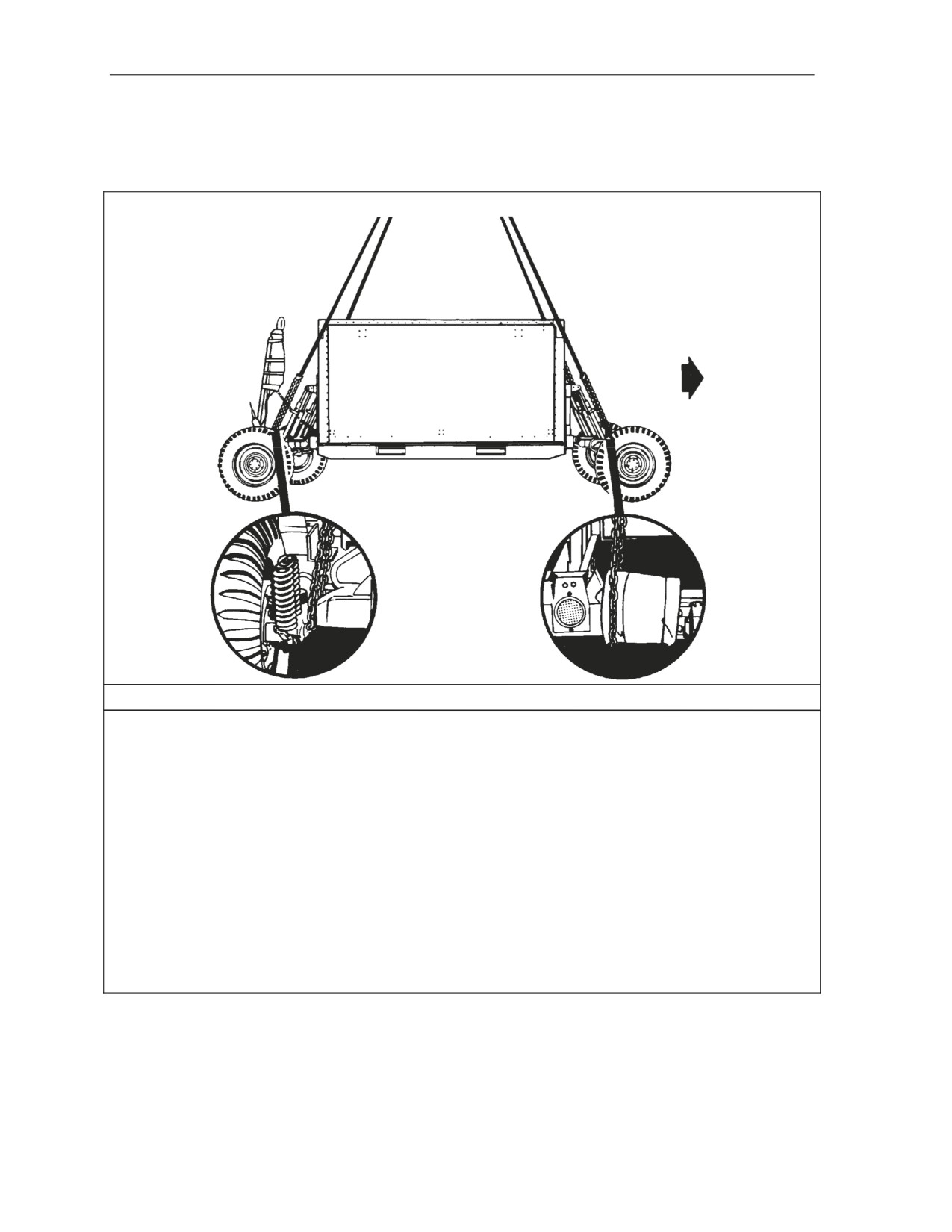
RIGGING STEPS
1. Position apex fitting on top of the tool set. Route outer sling legs 1 and 2 to the front (tongue
end) of the tool set and inner sling legs 3 and 4 to the rear. Sling legs 1 and 3 must be on the
left side of the load.
2. Loop the chain end of sling leg 1 around the left front axle just inside the suspension spring.
Place the correct link from Table 19-1 in the grab hook. Repeat with sling leg 2 and the right
front axle. Secure the excess chain with Type III nylon cord.
3.
Loop the chain end of sling leg 3 around the padded area on the left rear axle. Place the
correct link from Table 19-1 in the grab hook. Repeat with sling leg 4 and the right rear axle.
Secure the excess chain with Type III nylon cord.
4. Cluster and tie (breakaway technique) all sling legs together on top of the tool set to prevent
entanglement during hookup and lift-off.
Figure 19-1. Tool Set, Aviation Maintenance, SE 1, Airmobile
FM 4-20.198/MCRP 4-11.3E, VOL II/NTTP 3-04.12/
19-2
AFMAN 11-223 (I), VOL II/COMDTINST M13482.3B
20 February 2009
Suitable Single-Point Rigging Procedures for Shelters
SHOP, PORTABLE, AIRCRAFT MAINTENANCE (SPAM)
19-3. The shop, portable, aircraft maintenance is rigged for single-point sling load using the following
procedures:
z
Applicability. The following item in Table 19-2 is suitable for all ARMY helicopters with
suitable lift capacity by the US Army Natick Soldier Center:
Table 19-2. Shop, Portable, Aircraft Maintenance
Nomenclature
Max
Sling
Link Count
Weight
Set
Front/Rear
(Pounds)
Shop Portable, Aircraft Maintenance
5,425
10K
3/3
z
Materials. The following materials are required to rig this load:
Sling set (10,000-pound capacity).
Tape, adhesive, pressure-sensitive, 2-inch wide roll.
Cord, nylon, Type III, 550-pound breaking strength.
Webbing, cotton, 1/4-inch, 80-pound breaking strength.
z
Personnel. Two persons can prepare and rig this load in 5 minutes.
z
Procedures. The following procedures apply to this load:
Preparation. Prepare the load using the following steps:
─ Secure all vents and doors with tape or Type III nylon cord.
─ Secure the fold-out safety cable with tape or Type III nylon cord.
Rigging. Rig the load according to the steps in Figure 19-2.
Hookup. The hookup team stands on top of the SPAM. The static wand person discharges
the static electricity with the static wand. The hookup person places the apex fitting onto the
aircraft cargo hook. The hookup team then moves clear of the load but remains close to the load
as the helicopter removes slack from the sling legs. When successful hookup is assured, the
hookup team quickly exits the area underneath the helicopter to the designated rendezvous
point.
Derigging. Derigging is the reverse of the preparation and rigging procedures.
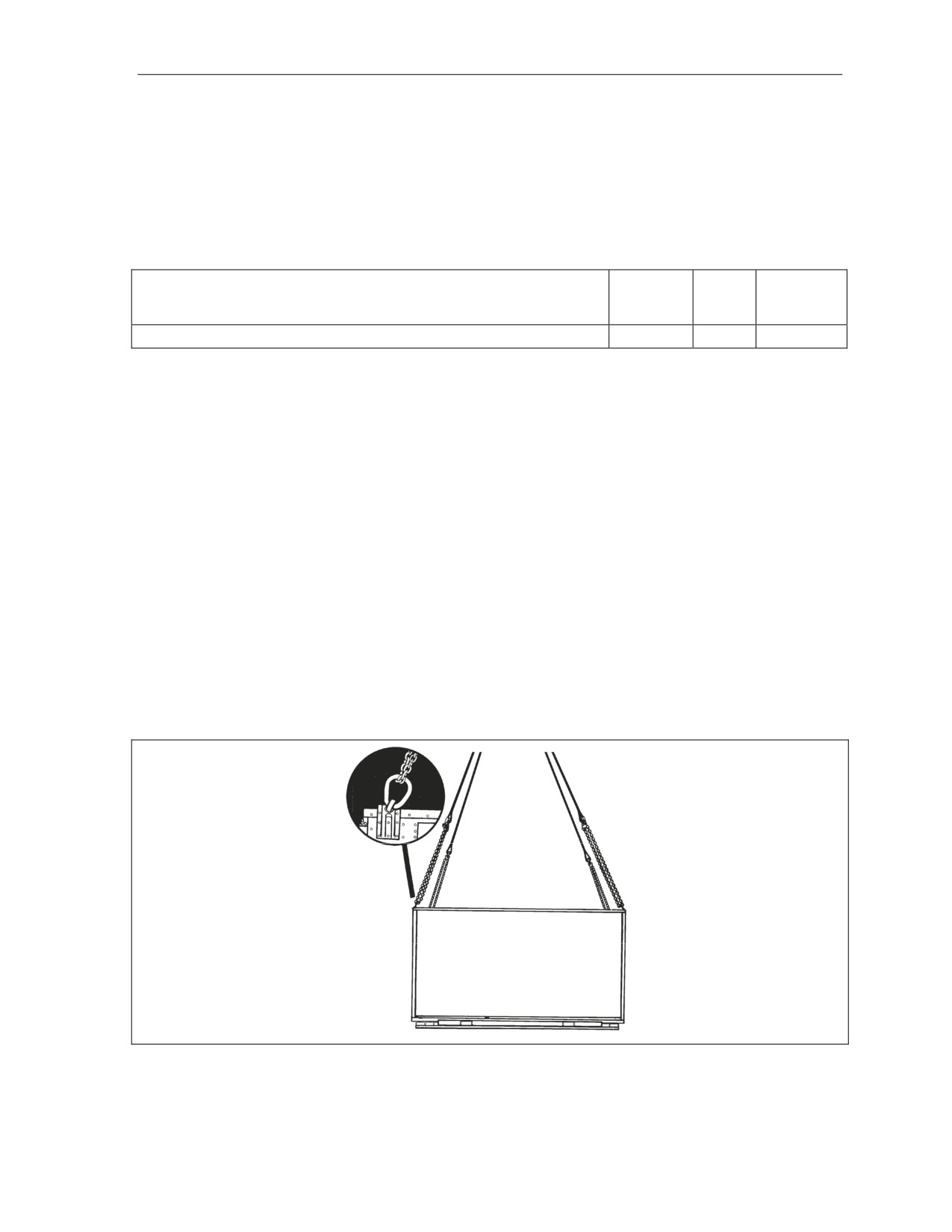
Figure 19-2. Shop, Portable, Aircraft Maintenance
20 February 2009
FM 4-20.198/MCRP 4-11.3E, VOL II/NTTP 3-04.12/
AFMAN 11-223 (I), VOL II/COMDTINST M13482.3B
19-3
Chapter 19
RIGGING STEPS
1. Position apex fitting on top of the shop. Route outer sling legs 1 and 2 to the front (door end)
of the tool set and inner sling legs 3 and 4 to the rear. Sling legs 1 and 3 must be on the left
side of the load.
2. Loop the chain end of sling leg 1 through the left front lift ring. Place the correct link from
Table 19-2 in the grab hook. Repeat with sling leg 2 and the right front lift ring.
3. Loop the chain end of sling leg 3 through the left rear lift ring. Place the correct link from
Table 19-2 in the grab hook. Repeat with sling leg 4 and the right rear lift ring.
4. Cluster and tie (breakaway technique) all sling legs together on top of the shop to prevent
entanglement during hookup and lift-off.
Figure 19-2. Shop, Portable, Aircraft Maintenance (Continued)
FM 4-20.198/MCRP 4-11.3E, VOL II/NTTP 3-04.12/
19-4
AFMAN 11-223 (I), VOL II/COMDTINST M13482.3B
20 February 2009
Chapter 20
Suitable Single-Point Rigging Procedures for Containers
INTRODUCTION
20-1. This chapter contains rigging procedures for single-point lift of containers that are suitable for
sling load. Each rigging procedure is found in a paragraph that includes a description of the load,
materials required for rigging, and steps to complete the procedure. An applicability paragraph is also a
part of each paragraph and identifies the suitable loads. The suitable single-point rigging procedures for
containers are in this section. Paragraphs 20-2 and 20-3 give detailed instructions for rigging loads.
Note. Reach pendants may be used on all single point loads. A static discharge person is not
required when using a reach pendant.
ONE CONEX CONTAINER
20-2. One CONEX container is rigged for single-point sling load using the following procedures:
z
Applicability. The following items in Table 20-1 are suitable for all ARMY helicopters with
suitable lift capacity by the US Army Natick Soldier Center:
Table 20-1. One CONEX Container
Nomenclature
Max
Sling
Link Count
Weight
Set
Front/Rear
(Pounds)
Box, Metal, Shipping, Conex, 270 Cubic Feet
1,560
10K
3/3
Box, Metal, Shipping, Conex, 295 Cubic Feet
2,140
10K
3/3
z
Materials. The following materials are required to rig this load:
Sling set (10,000-pound capacity).
Tape, adhesive, pressure-sensitive, 2-inch wide roll.
Cord, nylon, Type III, 550-pound breaking strength.
Webbing, cotton, 1/4-inch, 80-pound breaking strength.
Tie-down strap CGU-1/B.
z
Personnel. One person can prepare and rig this load in 10 minutes.
z
Procedures. The following procedures apply to this load:
Preparation. Prepare the load using the following steps:
─ Close the doors.
─ Secure the doors by routing CGU-1/Bs around the entire container.
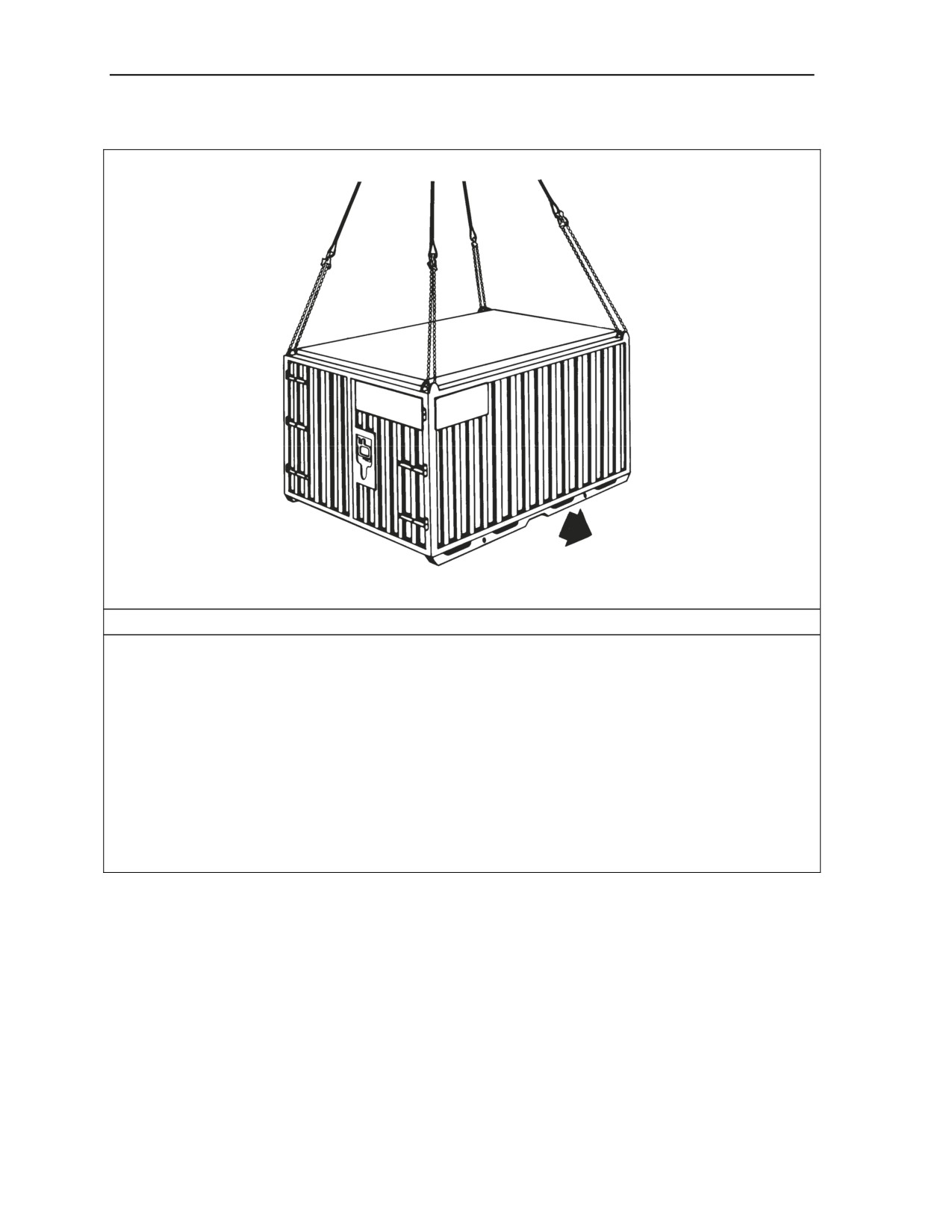
Rigging. Rig the load according to the steps in Figure 20-1.
Hookup. The hookup team stands on top of the container. The static wand person
discharges the static electricity with the static wand. The hookup person places the apex fitting
onto the aircraft cargo hook. The hookup team then moves clear of the load but remains close to
the load as the helicopter removes slack from the sling legs. When successful hookup is
assured, the hookup team quickly exits the area underneath the helicopter to the designated
rendezvous point.
20 February 2009
FM 4-20.198/MCRP 4-11.3E, VOL II/NTTP 3-04.12/
AFMAN 11-223 (I), VOL II/COMDTINST M13482.3B
20-1
Chapter 20
Derigging. Derigging is the reverse of the preparation and rigging procedures.
RIGGING STEPS
1. Position apex fitting on top of the container. Route outer sling legs 1 and 2 to the front of the
load and inner sling legs 3 and 4 to the rear. Sling legs 1 and 3 must be on the left side of
the load.
2. Loop the chain end of sling leg 1 through the left front lift provision. Place the correct link
from Table 20-1 in the grab hook. Repeat with sling leg 2 and the right front lift provision.
3. Loop the chain end of sling leg 3 through the left rear lift provision. Place the correct link
from Table 20-1 in the grab hook. Repeat with sling leg 4 and the right rear lift provision.
4. Cluster and tie (breakaway technique) all sling legs together on top of the container to
prevent entanglement during hookup and lift-off.
Figure 20-1. One CONEX Container
TWO CONEX CONTAINERS
20-3. Two CONEX containers are rigged for single-point sling load using the following procedures:
z
Applicability. The following items in Table 20-2 are suitable for all ARMY helicopters with
suitable lift capacity by the US Army Natick Soldier Center:
FM 4-20.198/MCRP 4-11.3E, VOL II/NTTP 3-04.12/
20-2
AFMAN 11-223 (I), VOL II/COMDTINST M13482.3B
20 February 2009
Suitable Single-Point Rigging Procedures for Containers
Table 20-2. Two CONEX Containers
Nomenclature
Max
Sling
Link Count
Weight
Set
Front/Rear
(Pounds)
Two Boxes, Metal, Shipping, Conex, 270 Cubic Feet
10,000
10K
3/60/3
Two Boxes, Metal, Shipping, Conex, 295 Cubic Feet
10,000
10K
3/60/3
z
Materials. The following materials are required to rig this load:
Sling set (10,000-pound capacity) with two additional sling leg assemblies.
Tape, adhesive, pressure-sensitive, 2-inch wide roll.
Cord, nylon, Type III, 550-pound breaking strength.
Webbing, cotton, 1/4-inch, 80-pound breaking strength.
Tie-down strap CGU-1/B.
z
Personnel. Two persons can prepare and rig this load in 20 minutes.
z
Procedures. The following procedures apply to this load:
Preparation. Prepare the load using the following steps:
─ Position the containers side by side with the doors facing the same direction.
─ Close and secure the doors by routing CGU-1/Bs around the entire container.
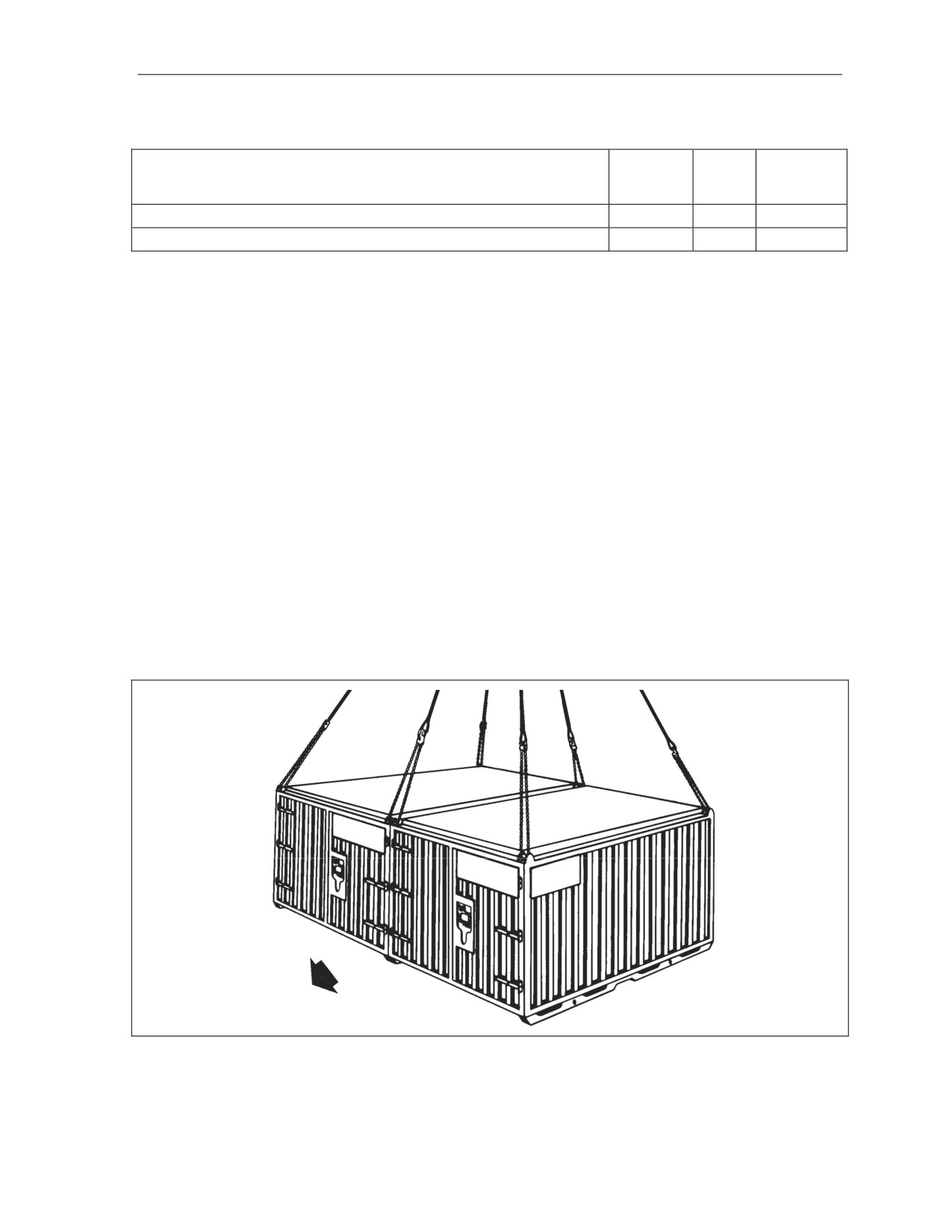
Rigging. Rig the load according to the steps in Figure 20-2.
Hookup. The hookup team stands on top of the containers. The static wand person
discharges the static electricity with the static wand. The hookup person places the apex fitting
onto the aircraft cargo hook. The hookup team then moves clear of the load but remains close to
the load as the helicopter removes slack from the sling legs. When successful hookup is
assured, the hookup team quickly exits the area underneath the helicopter to the designated
rendezvous point.
Derigging. Derigging is the reverse of the preparation and rigging procedures.
Figure 20-2. Two CONEX Containers
20 February 2009
FM 4-20.198/MCRP 4-11.3E, VOL II/NTTP 3-04.12/
AFMAN 11-223 (I), VOL II/COMDTINST M13482.3B
20-3
Chapter 20
RIGGING STEPS
1. Configure a six-leg sling set by adding the two additional sling legs to the sling set.
2. Position apex fitting on top of the containers. Route outer sling legs 1 and 2 to the front (door
end) of the containers, middle sling legs 3 and 4 to the rear, and inner sling legs 5 and 6 to
the center of the containers. Sling legs 1, 3, and 5 must be on the left side of the load.
3. Loop the chain end of sling leg 1 through the left front lift provision of the left container. Place
the correct link from Table 20-2 in the grab hook. Repeat with sling leg 2 and the right front
lift provision.
4. Loop the chain end of sling leg 3 through the left rear lift provision on the left container.
Place the correct link from Table 20-2 in the grab hook. Repeat with sling leg 4 and the right
rear lift provision.
5. Loop the chain end of sling leg 5 through the front inboard lift provision of both containers.
Place the correct link from Table 20-2 in the grab hook. Repeat with sling leg 6 and the rear
inboard lift provisions. Secure the excess chain with Type III nylon cord.
6. Cluster and tie (breakaway technique) all sling legs together on top of the containers to
prevent entanglement during hookup and lift-off.
Figure 20-2. Two CONEX Containers (Continued)
FM 4-20.198/MCRP 4-11.3E, VOL II/NTTP 3-04.12/
20-4
AFMAN 11-223 (I), VOL II/COMDTINST M13482.3B
20 February 2009
Chapter 21
Suitable Single-Point Rigging Procedures for Radar
Equipment
INTRODUCTION
21-1. This chapter contains rigging procedures for single-point lift of radar equipment that is suitable for
sling load. Each rigging procedure is found in a paragraph that includes a description of the load,
materials required for rigging, and steps to complete the procedure. An applicability paragraph is also a
part of each paragraph and identifies the suitable loads. The suitable single-point rigging procedure for
radar equipment is in this section. Paragraph 21-2 gives detailed instructions for rigging the load.
Note. Reach pendants may be used on all single point loads. A static discharge person is not
required when using a reach pendant.
AN/MPQ-4A RADAR SET
21-2. One AN/MPQ-4A radar set is rigged for single-point sling load using the following procedures:
z
Applicability. The following items in Table 21-1 are suitable for all ARMY helicopters with
suitable lift capacity by the US Army Natick Soldier
Table 21-1. AN/MPQ-4A Radar Set
Nomenclature
Max
Sling
Link Count
Weight
Set
Front/Rear
(Pounds)
Radar Set, Trailer-Mounted, AN/MPQ-4A Radar Set without 55-
6,290
10K
3/55
Gallon Drum of Fuel
Radar Set, Trailer-Mounted, AN/MPQ-4A Radar Set with 55-
6,690
10K
3/55
Gallon Drum of Fuel
z
Materials. The following materials are required to rig this load:
Sling set (10,000-pound capacity).
Tape, adhesive, pressure-sensitive, 2-inch wide roll.
Cord, nylon, Type III, 550-pound breaking strength.
Webbing, cotton, 1/4-inch, 80-pound breaking strength.
Webbing, nylon, tubular, 1/2-inch.
Padding, felt, 1/2- x 24- x 60-inch (2 sheets), 1/2- x 30- x 36-inch (1 sheet).
z
Personnel. Two persons can prepare and rig this load in 30 minutes.
z
Procedures. The following procedures apply to this load:
Preparation. Prepare the load using the following steps:
─ Place the radar set in the travel mode. Secure the safety chains and the air hoses to the
trailer tongue with tape or Type III nylon cord.
─ Secure the handles of the rear outriggers and all pins with tape.
─ Place a 24- x 48-inch sheet of felt padding over the receiver-transmission group and
secure with tape.
20 February 2009
FM 4-20.198/MCRP 4-11.3E, VOL II/NTTP 3-04.12/
AFMAN 11-223 (I), VOL II/COMDTINST M13482.3B
21-1
Chapter 21
─ Place two sheets of felt side by side on top of the reflector, tape the centerline, and secure
in place with Type III nylon cord routed from one step over the receiver-transmission
group and reflector to the other step.
─ Secure the fuel drum with 1/2-inch tubular nylon to the step.
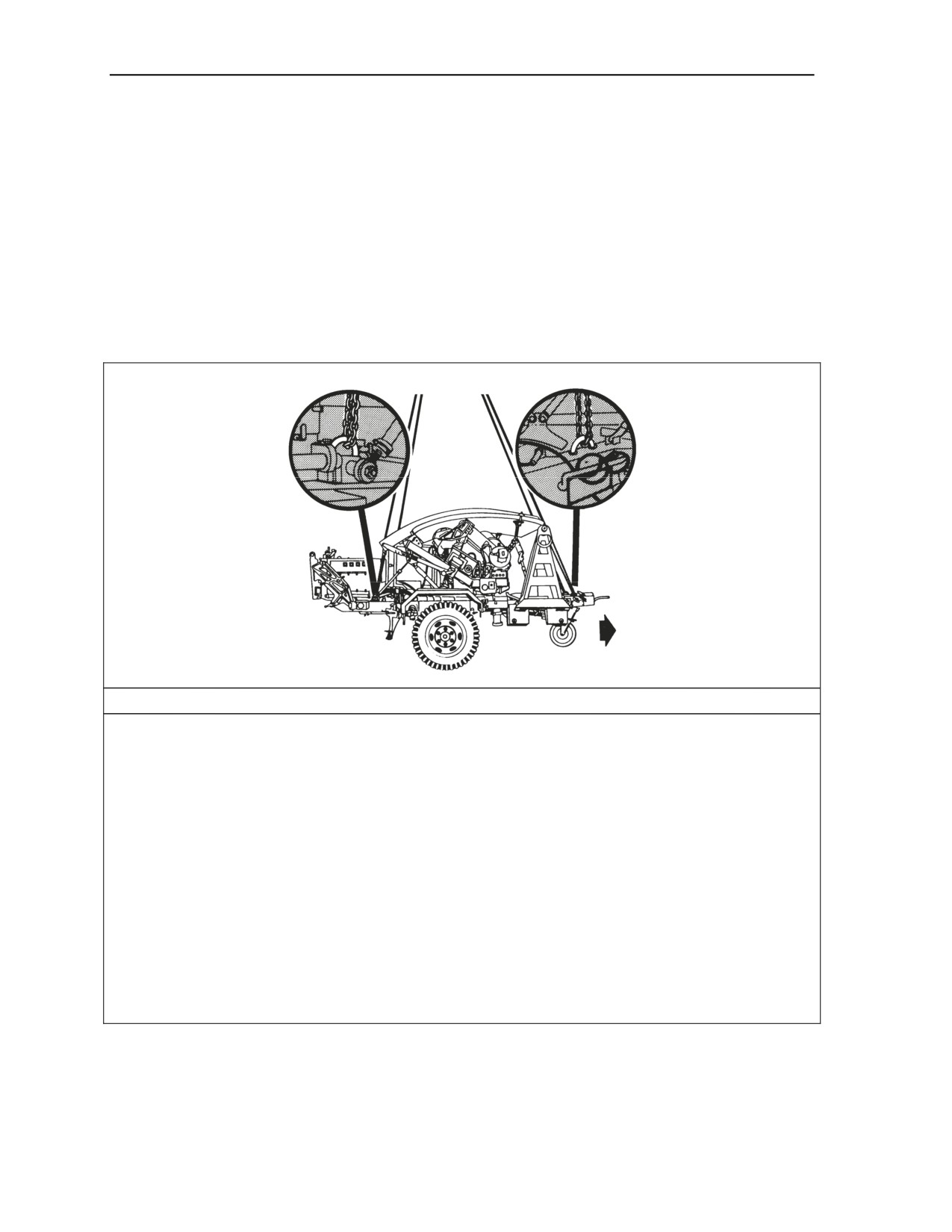
Rigging. Rig the load according to the steps in Figure 21-1.
Hookup. The hookup team stands on the trailer fenders. The static wand person
discharges the static electricity with the static wand. The hookup person places the apex fitting
onto the aircraft cargo hook. The hookup team then moves clear of the load but remains close to
the load as the helicopter removes slack from the sling legs. When successful hookup is
assured, the hookup team quickly exits the area underneath the helicopter to the designated
rendezvous point.
Derigging. Derigging is the reverse of the preparation and rigging procedures.
RIGGING STEPS
1. Position apex fitting on top of the reflector. Route outer sling legs 1 and 2 to the front (tongue
end) of the load and inner sling legs 3 and 4 to the rear. Sling legs 1 and 3 must be on the
left side of the load.
2. Loop the chain end of sling leg 1 through the left front lift provision located on the tongue.
Place the correct link from Table 21-1 in the grab hook. Repeat with sling leg 2 and the right
front lift provision. If a fuel drum is being moved, route sling legs 1 and 2 through the lunette
instead of the lift provisions.
3. Loop the chain end of sling leg 3 through the left rear lift provision located aft of the receiver-
transmission group. Place the correct link from Table 21-1 in the grab hook. Repeat with
sling leg 4 and the right rear lift provision.
4. Cluster and tie (breakaway technique) all sling legs together to prevent entanglement during
hookup and lift-off.
Figure 21-1. AN/MPQ-4A Radar Set
FM 4-20.198/MCRP 4-11.3E, VOL II/NTTP 3-04.12/
21-2
AFMAN 11-223 (I), VOL II/COMDTINST M13482.3B
20 February 2009
Chapter 22
Suitable Single-Point Rigging Procedures for Generator
Sets
INTRODUCTION
22-1. This chapter contains rigging procedures for single-point lift of generator sets that are suitable for
sling load. Each rigging procedure is found in a paragraph that includes a description of the load,
materials required for rigging, and steps to complete the procedure. An applicability paragraph is also a
part of each paragraph and identifies the suitable loads. The suitable single-point rigging procedures for
generator sets are in this section. Paragraph 22-2 and 22-3 give detailed instructions for rigging the load.
Note. Reach Pendants may be used on all single point loads. A static discharge person is not
required when using a Reach Pendant.
TRAILER-MOUNTED GENERATORS
22-2. Trailer mounted generators are rigged for single-point sling load using the following procedures:
z
Applicability. The following items in Table 22-1 are suitable for all ARMY helicopters with
suitable lift capacity by the US Army Natick Soldier Center:
Table 22-1. Trailer Mounted Generators
Nomenclature
Max
Sling
Link Count
Weight
Set
Front/Rear
(Pounds)
Generator Set, 5KW, PU-620/M Mounted on M116 Trailer
2,840
10K
3/50
Generator Set, 10KW, PU-619 Mounted on M105 Trailer
3,530
10K
30/30
Generator Set, 10KW, PU-304 Mounted on M105 Trailer
4,110
10K
40/50
Note. The PU-619/M generator set mounted on the M105 trailer is not currently approved for
lift with the original lift provisions.
z
Materials. The following materials are required to rig this load:
Sling set (10,000-pound capacity).
Tape, adhesive, pressure-sensitive, 2-inch wide roll.
Cord, nylon, Type III, 550-pound breaking strength.
Webbing, cotton, 1/4-inch, 80-pound breaking strength.
z
Personnel. Two persons can prepare and rig this load in 15 minutes.
z
Procedures. The following procedures apply to this load:
Preparation. Prepare the load using the following steps:
─ Remove the canvas cover and secure on top of the generator with Type III nylon cord.
─ Secure the 5-gallon gas cans with Type III nylon cord.
─ Engage the parking brakes.
20 February 2009
FM 4-20.198/MCRP 4-11.3E, VOL II/NTTP 3-04.12/
AFMAN 11-223 (I), VOL II/COMDTINST M13482.3B
22-1
Chapter 22
─ Secure the safety chains, air hoses, and intervehicular cable to the tongue with tape or
Type III nylon cord.
─ Inspect the lift provisions for cracks in the welds.
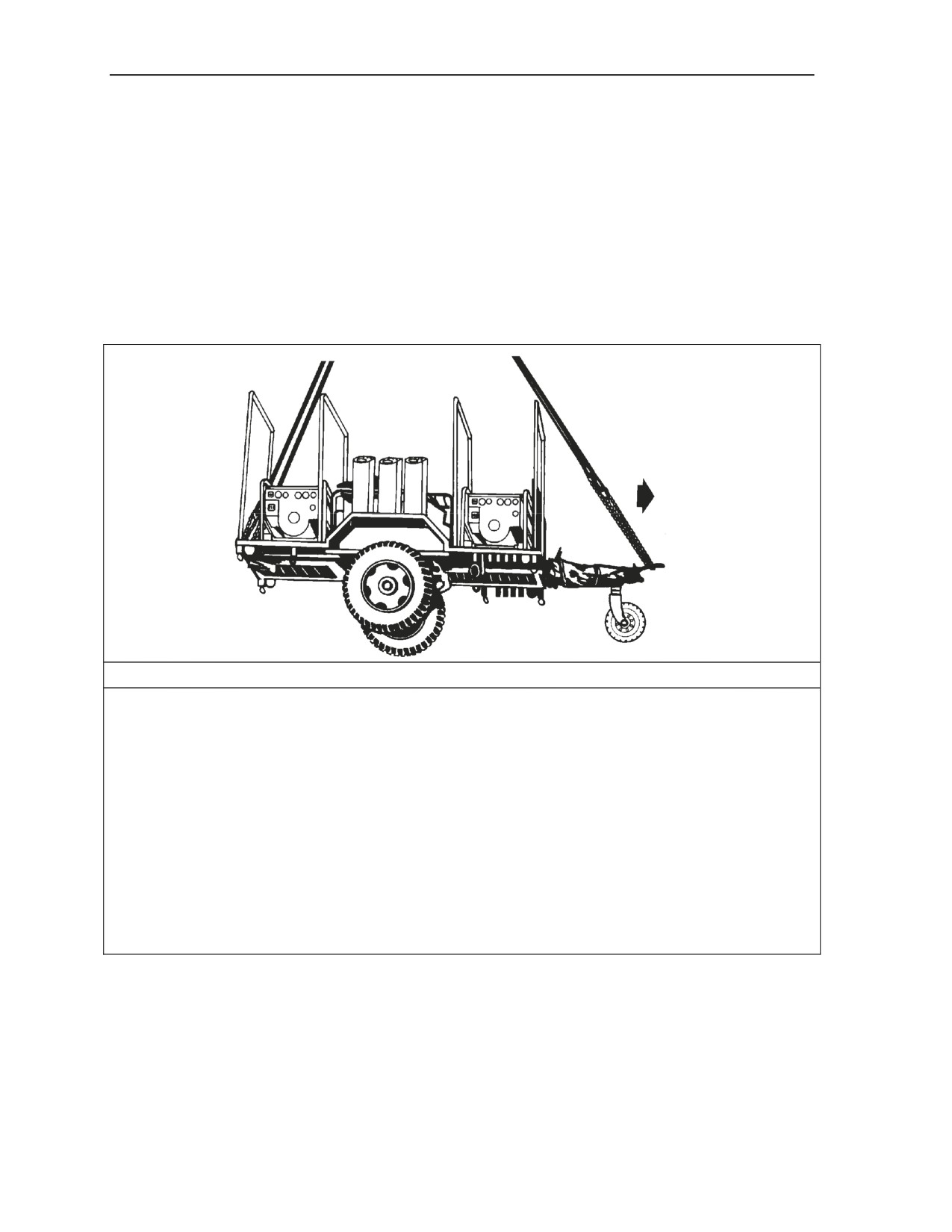
Rigging. Rig the load according to the steps in Figure 22-1.
Hookup. The hookup team stands on the trailer. The static wand person discharges the
static electricity with the static wand. The hookup person places the apex fitting onto the
aircraft cargo hook. The hookup team then moves clear of the load but remains close to the load
as the helicopter removes slack from the sling legs. When successful hookup is assured, the
hookup team quickly exits the area underneath the helicopter to the designated rendezvous
point.
Derigging. Derigging is the reverse of the preparation and rigging procedures.
RIGGING STEPS
1. Position apex fitting on top of the trailer. Route outer sling legs 1 and 2 to the front of the
load in front of bow 1 and inner sling legs 3 and 4 to the rear between bows 3 and 4. Sling
legs 1 and 3 must be on the left side of the load.
2. Loop the chain end of sling leg 1 through the lunette. Place the correct link from Table 22-1
in the grab hook. Repeat with sling leg 2. Secure the excess chain with Type III nylon cord.
3. Loop the chain end of sling leg 3 through the left rear lift provision. Place the correct link
from Table 22-1 in the grab hook. Repeat with sling leg 4 and the right rear lift provision.
Secure the excess chain with Type III nylon cord.
4. Cluster and tie (breakaway technique) all sling legs together to prevent entanglement during
hookup and lift-off.
Figure 22-1. Trailer Mounted Generators
FM 4-20.198/MCRP 4-11.3E, VOL II/NTTP 3-04.12/
22-2
AFMAN 11-223 (I), VOL II/COMDTINST M13482.3B
20 February 2009
Suitable Single-Point Rigging Procedures for Generator Sets
7.5KW GENERATOR SET
22-3. The 7.5KW generator set is rigged for single-point sling load using the following procedures:
z
Applicability. The following item in Table 22-2 is suitable for all ARMY helicopters with
suitable lift capacity by the US Army Natick Soldier Center:
Table 22-2. Trailer Mounted Generators
Nomenclature
Max
Sling Set
Link Count
Weight
Front/Rear
(Pounds)
Generator Set, Wheel Mounted 7.5 KW
810
10K or 5K Net
3
z
Materials. The following materials are required to rig this load:
One sling leg from a 10,000-pound capacity sling set with apex fitting.
Net, cargo (5,000-pound capacity).
Tape, adhesive, pressure-sensitive, 2-inch wide roll.
Cord, nylon, Type III, 550-pound breaking strength.
Webbing, cotton, 1/4-inch, 80-pound breaking strength.
z
Personnel. One person can prepare and rig this load in 5 minutes.
z
Procedures. The following procedures apply to this load:
Preparation. Prepare the load using the following steps:
─ Tie the tow bar in the raised position with Type III nylon cord.
─ Secure the safety chains, air hoses, and intervehicular cable to the tongue with tape or
Type III nylon cord.
Rigging. Rig the load according to the steps in Figure 22-2.
Hookup. The hookup team stands beside the generator. The static wand person discharges
the static electricity with the static wand. The hookup person places the apex fitting onto the
aircraft cargo hook. The hookup team then moves clear of the load but remains close to the load
as the helicopter removes slack from the sling legs. When successful hookup is assured, the
hookup team quickly exits the area underneath the helicopter to the designated rendezvous
point.
Derigging. Derigging is the reverse of the preparation and rigging procedures.
20 February 2009
FM 4-20.198/MCRP 4-11.3E, VOL II/NTTP 3-04.12/
AFMAN 11-223 (I), VOL II/COMDTINST M13482.3B
22-3
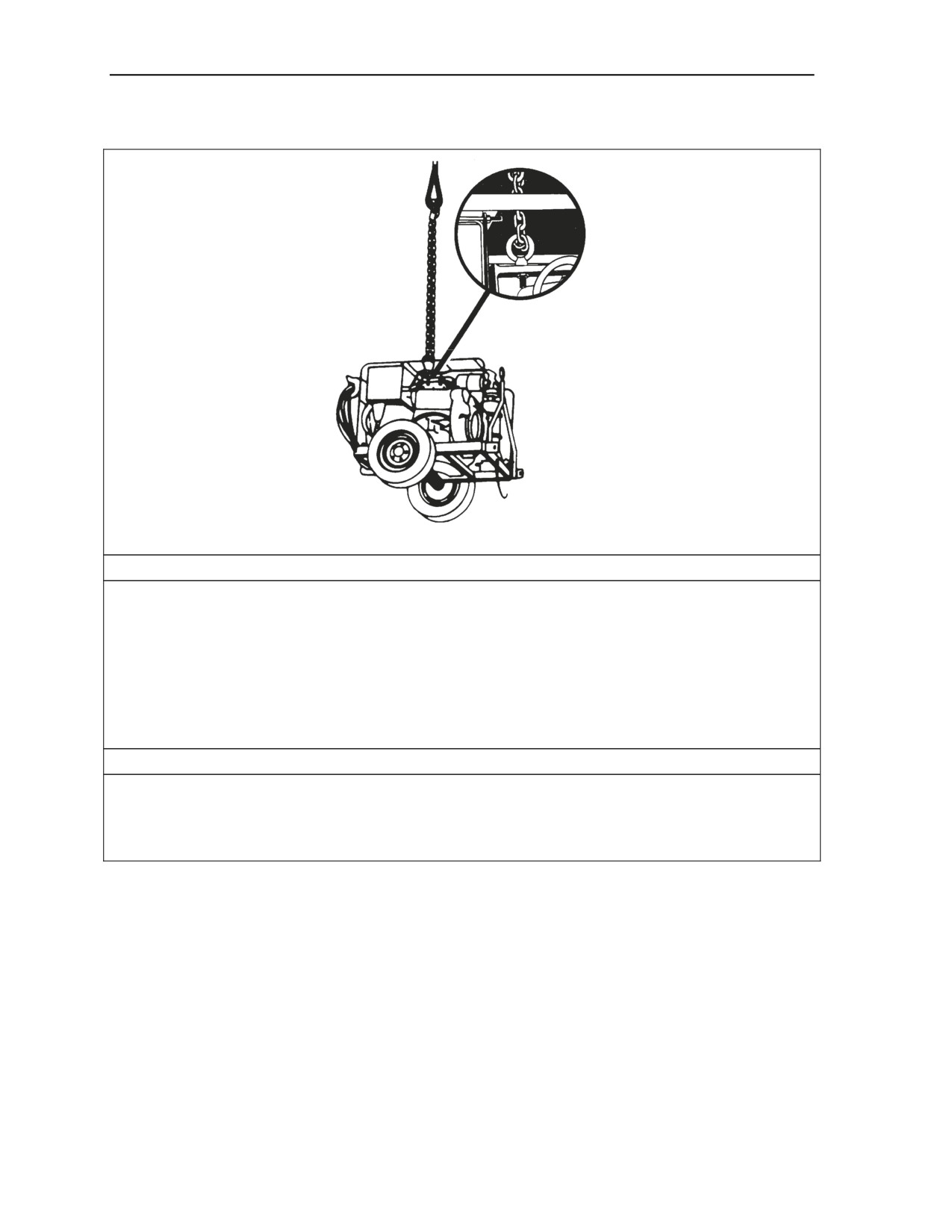
Chapter 22
RIGGING STEPS FOR SLING LEG
1. Position apex fitting beside the generator set.
2. Loop the chain end of the sling leg through the lift provision located on top of the generator.
Place the correct link from Table 22-2 in the grab hook. Repeat with sling leg 2. Secure the
excess chain with Type III nylon cord.
3. Tape the sling leg to the upper frame to prevent entanglement during hookup and lift-off.
RIGGING STEPS FOR CARGO NET
1. Spread the net out flat on the ground. Center the generator on the net.
2. Close and rig the net in accordance with FM 4-20.197.
Figure 22-2. 7.5KW Generator Set
FM 4-20.198/MCRP 4-11.3E, VOL II/NTTP 3-04.12/
22-4
AFMAN 11-223 (I), VOL II/COMDTINST M13482.3B
20 February 2009
Chapter 23
Suitable Single-Point Rigging Procedures for
Miscellaneous Equipment
INTRODUCTION
23-1. This chapter contains rigging procedures for single-point lift of miscellaneous equipment that is
suitable for sling load. Each rigging procedure is found in a paragraph that includes a description of the
load, materials required for rigging, and steps to complete the procedure. An applicability paragraph is
also a part of each paragraph and identifies the suitable loads. The suitable single-point rigging
procedures for miscellaneous equipment are in this section. Paragraphs 23-2 through 23-5 give detailed
instructions for rigging the load.
Note. Reach pendants may be used on all single point loads. A static discharge person is not
required when using a reach pendant.
350-GPM PUMP ASSEMBLY
23-2. The 350-GPM pump assembly is rigged for single-point sling load using the following procedures:
z
Applicability. The following item in Table 23-1 is suitable for all ARMY helicopters with
suitable lift capacity by the US Army Natick Soldier Center:
Table 23-1. 350-GPM Pump Assembly
Nomenclature
Max
Sling
Link Count
Weight
Set
Front/Rear
(Pounds)
350-GPM Pump Assembly
1,165
10K
50/50
z
Materials. The following materials are required to rig this load:
Sling set (10,000-pound capacity).
Tape, adhesive, pressure-sensitive, 2-inch wide roll.
Cord, nylon, Type III, 550-pound breaking strength.
Webbing, cotton, 1/4-inch, 80-pound breaking strength.
z
Personnel. Two persons can prepare and rig this load in 10 minutes.
z
Procedures. The following procedures apply to this load:
Preparation. Prepare the load using the following steps:
─ Secure the engine cover and any other loose equipment with Type III nylon cord.
─ Slide the tow bar all the way in and secure with safety pins.
Rigging. Rig the load according to the steps in Figure 23-1.
Hookup. The hookup team stands beside the pump. The static wand person discharges the
static electricity with the static wand. The hookup person places the apex fitting onto the
aircraft cargo hook. The hookup team then moves clear of the load but remains close to the load
as the helicopter removes slack from the sling legs. When successful hookup is assured, the
hookup team quickly exits the area underneath the helicopter to the designated rendezvous
point.
Derigging. Derigging is the reverse of the preparation and rigging procedures.
FM 4-20.197/MCRP 4-11.3E, VOL I/NTTP 3-04.11/
20 February 2009
AFMAN 11-223 (I), VOL I/COMDTINST M13482.2B
23-1
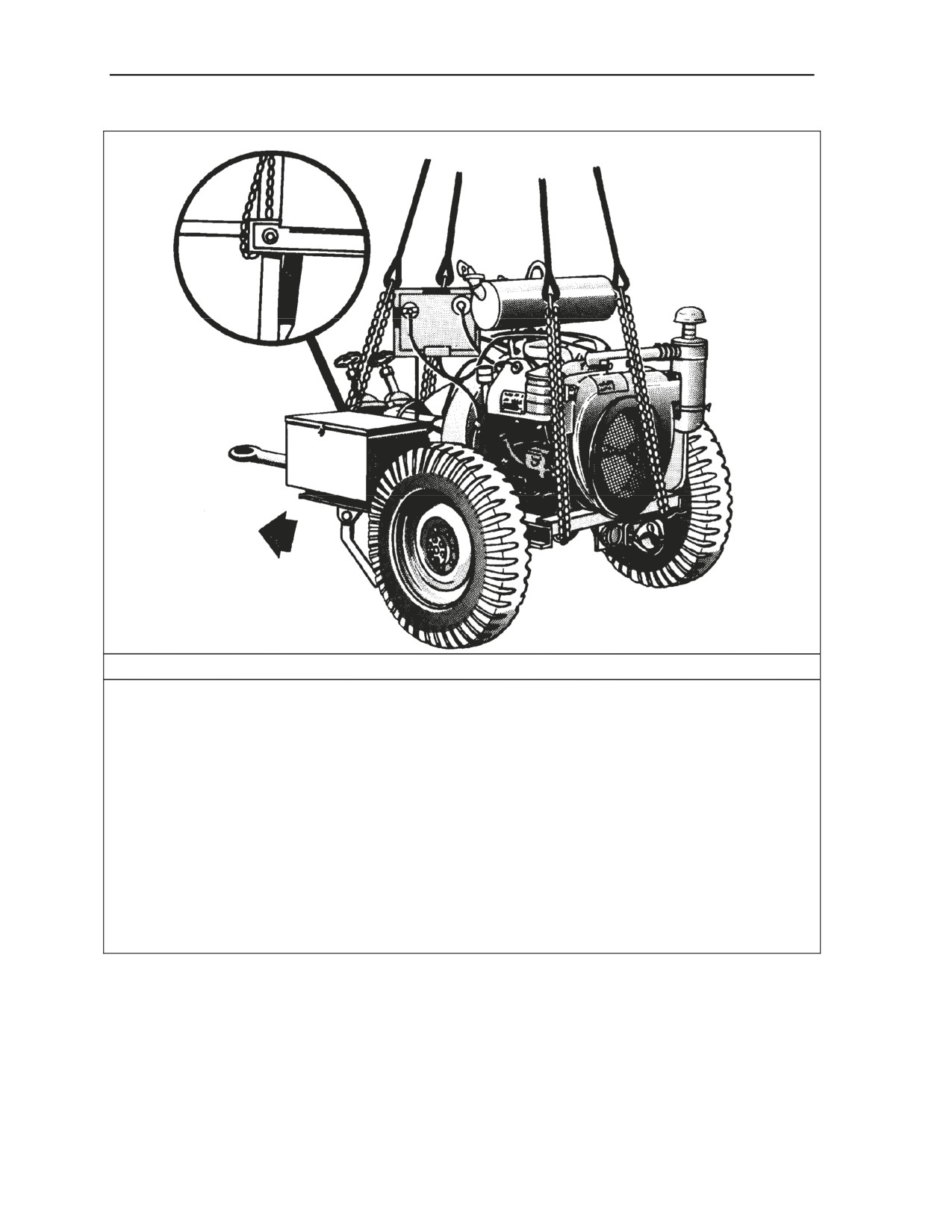
Chapter 23
RIGGING STEPS
1. Position apex fitting on top of the pump. Route outer sling legs 1 and 2 to the front of the
load and inner sling legs 3 and 4 to the rear. Sling legs 1 and 3 must be on the left side of
the load.
2. Loop the chain end of sling leg 1 around the left front corner of the frame and through the
rings on the bottom of the frame. Place the correct link from Table 23-1 in the grab hook.
Repeat with sling leg 2 and the right front corner of the frame. Secure the excess chain with
Type III nylon cord.
3. Loop the chain end of sling leg 3 around the left rear corner of the frame and through the
rings on the bottom of the frame. Place the correct link from Table 23-1 in the grab hook.
Repeat with sling leg 4 and the right rear corner of the frame. Secure the excess chain with
Type III nylon cord.
4. Pull each grab hook up and tie to the top corner of the load. Cluster and tie (breakaway
technique) all sling legs together to prevent entanglement during hookup and lift-off.
Figure 23-1. 350-GPM Pump Assembly
FM 4-20.198/MCRP 4-11.3E, VOL II/NTTP 3-04.12/
23-2
AFMAN 11-223 (I), VOL II/COMDTINST M13482.3B
20 February 2009
Suitable Single-Point Rigging Procedures for Miscellaneous Equipment
LIGHT TACTICAL FLOATING RAFT BRIDGE
23-3. The light tactical floating raft bridge is rigged for single-point sling load using the following
procedures:
z
Applicability. The following items in Table 23-2 are suitable for all ARMY helicopters with
suitable lift capacity by the US Army Natick Soldier Center:
Table 23-2. Light Tactical Floating Raft Bridge
Nomenclature
Max
Sling
Link Count
Weight
Set
Front/Rear
(Pounds)
M796 Bolster Trailer with Eight Half-Pontoons and Cradle
10,620
25K
3/13
Eight Half-Pontoons and Cradle
6,000
10K
3/3
LTR Superstructure, Light Bundle
5,250
10K
3/3
LTR Superstructure, Medium Bundle
7,000
10K
3/3
LTR Superstructure, Heavy Bundle
10,000
25K
3/3
Two Motors and Mounting Brackets
1,290
5K Net
N/A
z
Materials. The following materials are required to rig this load:
Bolster trailer with pontoons and cradle:
─ Sling set (25,000-pound capacity).
─ Tie-down assemblies (10,000-pound capacity) (6 each).
─ Tie-down strap, cargo, CGU-1/B (as required)
─ Webbing, cotton, 1/4-inch.
─ Tape, adhesive, pressure-sensitive, 2-inch wide roll.
─ Cord, nylon, Type III.
Pontoons and cradle:
─ Sling set (10,000-pound capacity).
─ Tape, adhesive, pressure-sensitive, 2-inch wide roll.
─ Cord, nylon, Type III.
─ Webbing, cotton, 1/4-inch.
LTR (light bundle).
─ Sling set (10,000-pound capacity).
─ Tape, adhesive, pressure-sensitive, 2-inch wide roll.
─ Cord, nylon, Type III.
─ Webbing, cotton, 1/4-inch.
─ Webbing, nylon, tubular, 1/2-inch.
─ Panel, deck (4 each).
─ Panel, filler, deck (8 each).
─ Panel, filler, short deck (6 each).
─ Panel, end, ramp (2 each).
─ Assembly, articulating (2 each).
─ Curb, normal (4 each).
─ Curb, short (6 each).
─ Cable, 5/8-inch, 26-feet long (2 each).
20 February 2009
FM 4-20.198/MCRP 4-11.3E, VOL II/NTTP 3-04.12/
AFMAN 11-223 (I), VOL II/COMDTINST M13482.3B
23-3
Chapter 23
─ Clamp, cable, 5/8-inch (8 each).
─ Turnbuckle, 5/8- x 24-inch (2 each).
LTR (medium bundle).
─ Sling set (10,000-pound capacity).
─ Tape, adhesive, pressure-sensitive, 2-inch wide roll.
─ Cord, nylon, Type III.
─ Webbing, cotton, 1/4-inch.
─ Webbing, nylon, tubular, 1/2-inch.
─ Panel, deck (6 each).
─ Panel, filler, deck (6 each).
─ Panel, filler, short deck (2 each).
─ Panel, end, ramp (4 each).
─ Curb, normal (6 each).
─ Curb, short (4 each).
─ Cable, 5/8-inch, 26-feet long (2 each).
─ Clamp, cable, 5/8-inch (8 each).
─ Turnbuckle, 5/8- x 24-inch (2 each).
LTR (heavy bundle).
─ Sling set (25,000-pound capacity).
─ Tape, adhesive, pressure-sensitive, 2-inch wide roll.
─ Cord, nylon, Type III.
─ Webbing, cotton, 1/4-inch.
─ Webbing, nylon, tubular, 1/2-inch.
─ Panel, deck (8 each).
─ Panel, filler, deck (16 each).
─ Panel, filler, short deck (12 each).
─ Panel, end, ramp (4 each).
─ Curb, normal (8 each).
─ Curb, short (12 each).
─ Cable, 5/8-inch, 40-feet long (2 each).
─ Clamp, cable, 5/8-inch (8 each).
─ Turnbuckle, 5/8- x 24-inch (2 each).
─ Assembly, articulating (4 each).
Two motors and mounting brackets:
─ Net, cargo (5,000-pound capacity).
─ Tape, adhesive, pressure-sensitive, 2-inch wide roll.
─ Cord, nylon, Type III.
─ Webbing, cotton, 1/4-inch.
─ Webbing, nylon, tubular, 1/2-inch.
z
Personnel. Eleven persons can prepare and rig these loads in the following time:
Bolster trailer with pontoons and cradle, 30 minutes.
Pontoons and cradle, 20 minutes.
LTR (light bundle), 20 minutes.
LTR (medium bundle), 25 minutes.
LTR (heavy bundle), 30 minutes.
Two motors and mounting brackets, 10 minutes.
FM 4-20.198/MCRP 4-11.3E, VOL II/NTTP 3-04.12/
23-4
AFMAN 11-223 (I), VOL II/COMDTINST M13482.3B
20 February 2009
Suitable Single-Point Rigging Procedures for Miscellaneous Equipment
z
Procedures. The following procedures apply to these loads:
Preparation. Prepare the loads using the following steps:
─ Bolster trailer with pontoons and cradle:
─ Secure the pontoons on the cradle and trailer according to the operator's manual.
─ Secure both sides of the cradle to the trailer with tie-downs.
─ Under the bottom pontoon and on top of the cradle, secure the cradle to the trailer by
wrapping one tie-down strap around the cradle and trailer frame at each side of the
load in the vicinity of the rear wheels. Repeat this procedure at the
forward wheels.
Pontoons and cradle: Secure the pontoons to the cradle according to the operator's
manual.
LTR superstructure (light bundle):
─ Place two timbers on the ground as shoring approximately 6 feet apart.
─ Lay both cables on the ground parallel to and on the outside of the timbers.
─ Stack the four deck panels on the timbers. Face the deck plates of the bottom and third
panels down and the second and top panels up. All male ends must be in the same
direction.
─ Connect the two articulating assemblies and place them on top of the stack of deck
panels.
─ Place two end ramp panels, butt end to butt end, on top of the articulating assemblies.
─ Place six deck filler panels in the space between the bottom and second deck panels.
─ Place remaining two deck filler panels, six short deck filler panels, and six short curbs in
the space between the third and top deck panels.
─ Place the four normal curbs in the space between the top deck panel and the articulating
assemblies.
─ Close off the ends of the deck panels and articulating assemblies by lacing 1/2-inch
tubular nylon webbing across the ends of the stack.
─ Bring cables up over load, route each end through the turnbuckle, secure each end with
two cable clamps, and tighten turnbuckle.
CAUTION
Do not over tighten the cables as damage to the load will occur.
─ Tie the two cables together with 1/2-inch tubular nylon webbing.
LTR superstructure (medium bundle):
─ Place two timbers on the ground as shoring approximately 6 feet apart.
─ Lay both cables on the ground parallel to and on the outside of the timbers.
─ Stack two parallel sets of deck panels, three panels high, with male ends facing in same
direction.
─ Place two end ramp panels, butt end to butt end, on top of each stack of deck panels.
─ Place deck filler panels between deck panels.
─ Close off ends of deck panels by lacing 1/2-inch tubular nylon webbing across ends of
stacks.
─ Place three normal curbs on each side of load, alternating short curbs in between the
normal curbs.
─ Bring cables up over load, route each end through turnbuckle, secure each end with two
cable clamps, and tighten turnbuckle.
20 February 2009
FM 4-20.198/MCRP 4-11.3E, VOL II/NTTP 3-04.12/
AFMAN 11-223 (I), VOL II/COMDTINST M13482.3B
23-5
Chapter 23
CAUTION
Do not over tighten the cables as damage to the load will occur.
─ Tie each short curb to the turnbuckle with nylon webbing.
─ Tie the two cables together with 1/2-inch tubular nylon webbing.
LTR superstructure (heavy bundle):
─ Place two timbers on the ground as shoring approximately 6 feet apart.
─ Lay both cables on the ground parallel to and on the outside of the timbers.
─ Configure two light bundle stacks side-by-side and secure each end of the load with
cables.
Rigging. Rig the load according to the steps in Figure 23-2.
Hookup. The hookup team stands on top of the pontoons, on top of the superstructure
bundles, or alongside the cargo net, depending on the load. The static wand person discharges
the static electricity with the static wand. The hookup person places the apex fitting onto the
aircraft cargo hook. The hookup team then moves clear of the load but remains close to the load
as the helicopter removes slack from the sling legs. When successful hookup is assured, the
hookup team quickly exits the area underneath the helicopter to the designated rendezvous
point.
Derigging. Derigging is the reverse of the preparation and rigging procedures.
FM 4-20.198/MCRP 4-11.3E, VOL II/NTTP 3-04.12/
23-6
AFMAN 11-223 (I), VOL II/COMDTINST M13482.3B
20 February 2009