FM 4-20.198 Multiservice Helicopter Sling Load: Single-Point Load Rigging Procedures (February 2009) - page 11
Chapter 12
Derigging. Derigging is the reverse of the preparation and rigging procedures.
Note. Brief the helicopter crew to relax sling leg tension, lower the spreader bars onto the
shelter roof and antenna array support arms, and hover to the side of the load when releasing the
sling set.
RIGGING STEPS
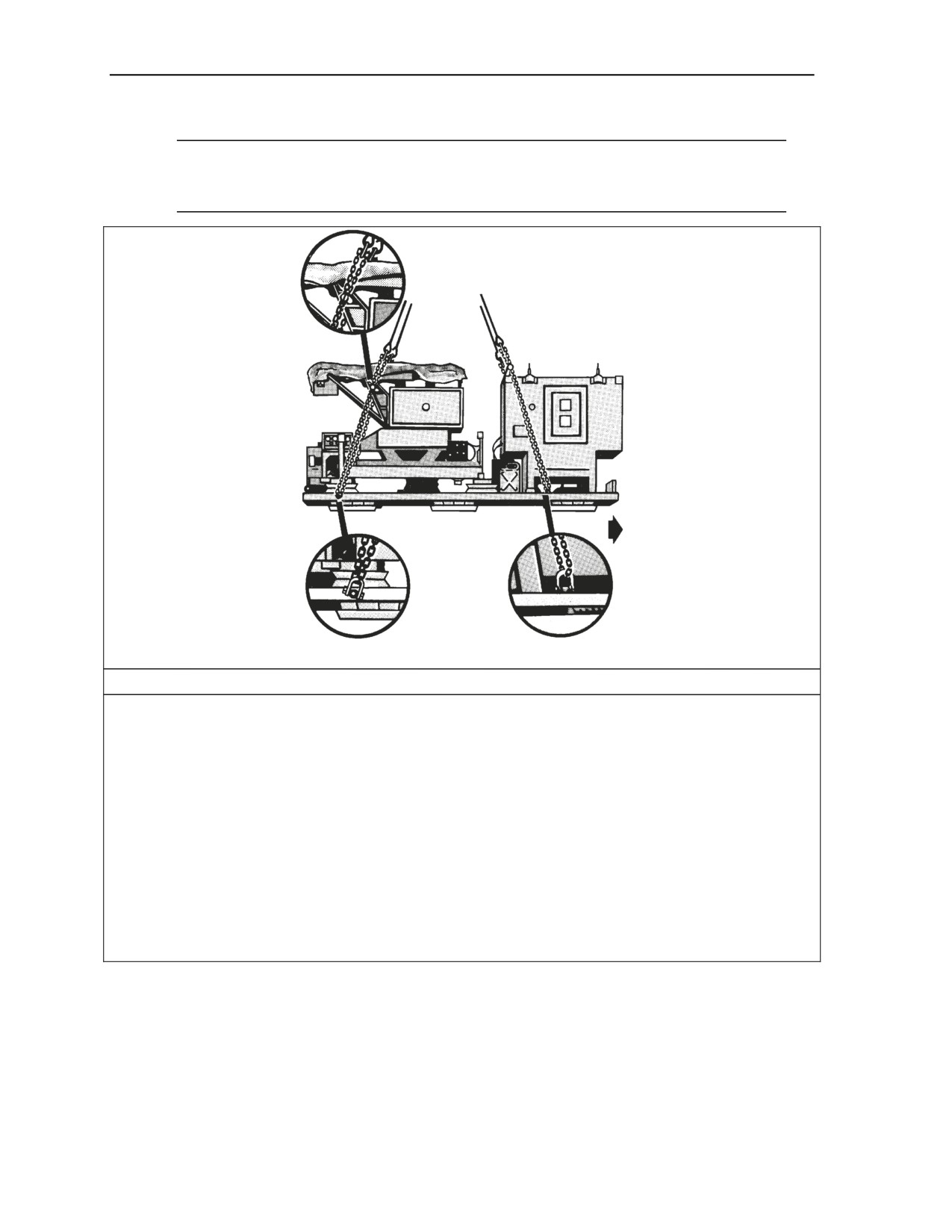
1. Position apex fitting on top of the shelter. Route outer sling legs 1 and 2 to the front (shelter
end) of the load and inner sling legs 3 and 4 to the rear (generator end). Sling legs 1 and 3
must be on the left side of the load.
2. Using the proper coupling links, add the chain extensions to each sling leg chain assembly.
3. Route the chain end of sling leg 1 through the fitting on the left end of the long spreader bar
and down the side of the shelter. Insert link 10 (counting down from the grab hook coupling
link) in the spreader bar end fitting. Route the chain end through the lift provision located on
the left side of the pallet frame, back up to the spreader bar, and insert link 23 in the end
fitting. Secure the chain in the end fitting by installing the retaining pin in the end of the
spreader bar. Place the correct link from Table 12-4 in the grab hook. Repeat with sling leg
2 through the right end fitting on the spreader bar, and lift provision on the right side of the
pallet frame.
Figure 12-4. AN/TPQ-36 Firefinder II
FM 4-20.198/MCRP 4-11.3E, VOL II/NTTP 3-04.12/
12-8
AFMAN 11-223 (I), VOL II/COMDTINST M13482.3B
20 February 2009
Certified Single-Point Rigging Procedures for Radar and Satellite Equipment
RIGGING STEPS (CONTINUED)
4.
Route the chain end of sling leg 3 through the fitting on the left end of the short spreader bar
and down the side of the antenna array assembly. Route the chain end through the lift
provision located on the left side of the pallet frame below the generator engine and back up
through the spreader bar end fitting. Pull the chains tight to remove slack. Place the correct
link from Table 12-4 in the grab hook. Install the retaining pin in the end of the spreader bar.
Repeat with sling leg 4 through the right end fitting on the spreader bar and lift provision on
the right side of the pallet frame.
Note. The chain links do not lock in the end fittings on the short spreader bar like they do on the
long spreader bar.
5.
Tape the two loops of the chain legs together every 1 to 2 feet. Secure all excess chain with
tape or nylon cord. Place padding around the grabhooks and secure with tape or nylon cord
to prevent damage caused by the grabhooks when the sling is released.
6.
Pull the rear sling legs 3 and 4 tight over top of the antenna array to remove slack from the
sling legs. Cluster and tie or tape (breakaway technique) the sling legs together to prevent
the chains and grabhooks from fouling on the antenna array during hookup and lift-off.
7.
Cluster and tie (breakaway technique) the front sling legs 1 and 2 together on top of the
shelter to prevent entanglement during hookup and lift-off.
Figure 12-4. AN/TPQ-36 Firefinder II (Continued)
OE-361/G QUICK REACTION SATELLITE ANTENNA
12-6. The OE-361/G quick reaction satellite antenna is rigged for single-point sling load using the
following procedures:
z
Applicability. The following item in Table 12-5 is certified for all helicopters with suitable lift
capacity by the US Army Natick Soldier Center:
Table 12-5. OE-361/G Quick Reaction Satellite Antenna
Nomenclature
Max
Sling
Link Count
Weight
Set
Front/Rear
(Pounds)
OE-361/G Quick Reaction Satellite Antenna (QRSA)
4,830
10K
3/30
z
Materials. The following materials are required to rig this load:
Sling set (10,000-pound capacity).
Tape, adhesive, pressure-sensitive, 2-inch wide roll.
Cord, nylon, Type III, 550-pound breaking strength.
Webbing, cotton, 1/4-inch, 80-pound breaking strength.
Felt sheet, cattle hair, Type IV, 1/2-inch or suitable substitute.
z
Personnel. Four persons can prepare and rig this load in 30 minutes.
z
Procedures. The following procedures apply to this load:
Preparation. Prepare the load using the following steps:
─ Install the spreader bar assembly which is stored on the load. After hooking the spreader
bar assembly to the lift rings, tape the keepers securely with tape.
20 February 2009
FM 4-20.198/MCRP 4-11.3E, VOL II/NTTP 3-04.12/
AFMAN 11-223 (I), VOL II/COMDTINST M13482.3B
12-9
Chapter 12
─ Pad both spreader bars with felt or other cushioning material to prevent damage to the
antenna panels during load release. Tape or tie the padding securely to prevent it from
being dislodged during flight.
─ Pad the uppermost stacked antenna panel with available material to prevent possible
damage from the apex clevis at load release. Tape or tie the padding securely to
prevent it from being dislodged during flight.
─ Ensure the ladder, box covers, and any other loose items are properly secured. If the tie-
down straps are missing or worn, replace with nylon cord.
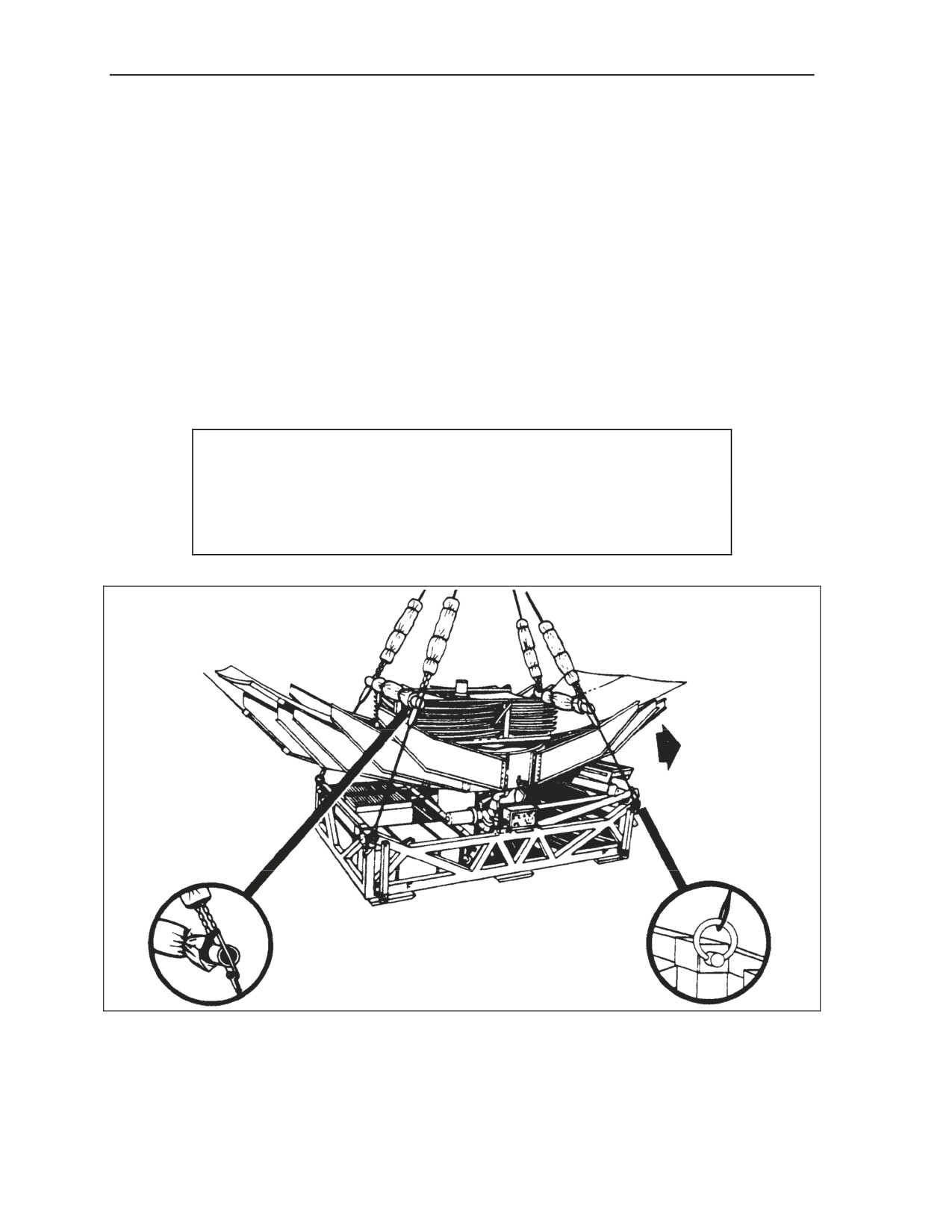
Rigging. Rig the load according to the steps in Figure 12-5.
Hookup. The hookup team stands on top of the load between the stacked antenna panels
and either side of the center post. The static wand person discharges the static electricity with
the static wand. The hookup person places the apex fitting onto the aircraft cargo hook. The
hookup team then moves clear of the load but remains close to the load as the helicopter
removes slack from the sling legs. When successful hookup is assured, the hookup team quickly
exits the area underneath the helicopter to the designated rendezvous point.
Derigging. Derigging is the reverse of the preparation and rigging procedures.
CAUTION
Brief the helicopter crew to relax sling leg tension, lower the spreader
bars onto the shelter roof and antenna array support arms, and hover
to the side of the load when releasing the sling set.
Figure 12-5. OE-361/G Quick Reaction Satellite Antenna
FM 4-20.198/MCRP 4-11.3E, VOL II/NTTP 3-04.12/
12-10
AFMAN 11-223 (I), VOL II/COMDTINST M13482.3B
20 February 2009

Certified Single-Point Rigging Procedures for Radar and Satellite Equipment
RIGGING STEPS
1. Position the apex fitting on top of the load. Route outer sling legs 1 and 2 to the front (ladder
end) of the load and inner sling legs 3 and 4 to the rear. Sling legs 1 and 3 must be on the
left side of the load.
2. Loop the chain end of sling leg 1 through the left lift eye of the front spreader bar. Place the
correct link from Table 12-5 in the grab hook. Repeat with sling leg 2 and the right lift eye on
the front spreader bar.
3. Loop the chain end of sling leg 3 through the left lift eye of the rear spreader bar. Place the
correct link from Table 12-5 in the grab hook. Repeat with sling leg 4 and the right lift eye on
the rear spreader bar. Secure excess chain with tape or nylon cord.
4. Wrap felt padding or other suitable cushioning material around each grab hook assembly to
protect the antenna when the sling set is released. Tape or tie the padding securely to
prevent it from being dislodged during flight.
5. Cluster and tie (breakaway technique) all sling legs together on top of the antenna to prevent
entanglement during hookup and lift-off.
Figure 12-5. OE-361/G Quick Reaction Satellite Antenna (Continued)
AS-3471/TPN-22 ANTENNA PALLET (USMC)
12-7. The AS-3471/TPN-22 antenna pallet is rigged for single-point sling load using the following
procedures:
z
Applicability. The following item in Table 12-6 is certified for all helicopters with suitable lift
capacity by the US Army Natick Soldier Center:
Table 12-6. AS-3471/TPN-22 Antenna Pallet
Nomenclature
Max
Sling
Link Count
Weight
Set
Front/Rear
(Pounds)
AS-3471/TPN-22 Antenna Pallet, TAMCN Q2115
5,700
40K
3-5
z
Materials. The following materials are required to rig this load:
Sling set (40,000-pound capacity) with four additional chain lengths and coupling links.
Tape, adhesive, pressure-sensitive, 2-inch wide roll.
Cord, nylon, Type III, 550-pound breaking strength.
Webbing, cotton, 1/4-inch, 80-pound breaking strength.
Felt sheet, cattle hair, Type IV, 1/2-inch or suitable substitute.
z
Personnel. Four persons can prepare and rig this load in 15 minutes.
z
Procedures. The following procedures apply to this load:
Preparation. Prepare the load using the following steps:
─ Secure all handles.
─ Secure the crank handle at the base of the pallet.
─ Add the additional chain length to each leg of the sling set using the coupling links.
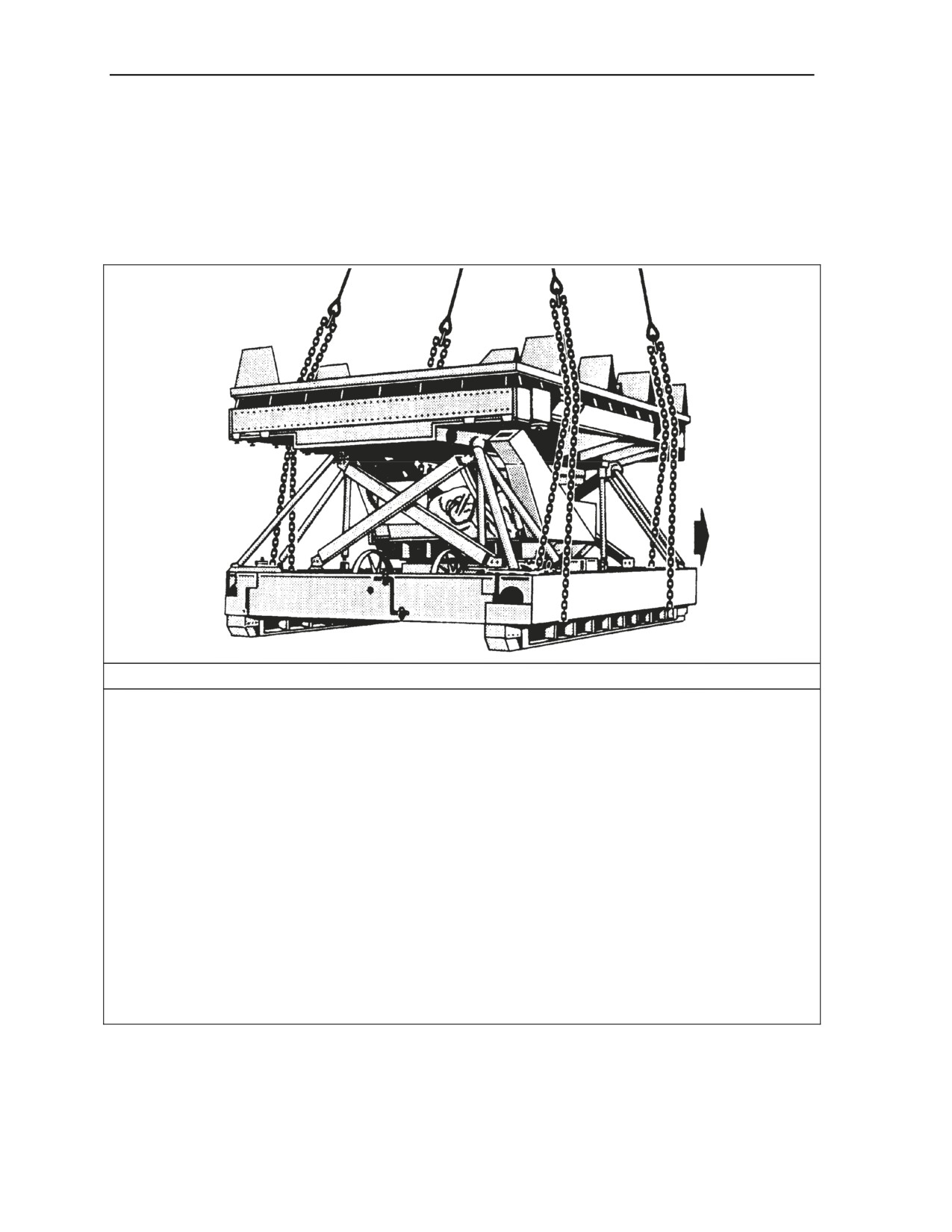
Rigging. Rig the load according to the steps in Figure 12-6.
20 February 2009
FM 4-20.198/MCRP 4-11.3E, VOL II/NTTP 3-04.12/
AFMAN 11-223 (I), VOL II/COMDTINST M13482.3B
12-11
Chapter 12
Hookup. The hookup team stands on the pallet. The static wand person discharges the
static electricity with the static wand. The hookup person places the apex fitting onto the
aircraft cargo hook. The hookup team then moves clear of the load but remains close to the load
as the helicopter removes slack from the sling legs. When successful hookup is assured, the
hookup team quickly exits the area underneath the helicopter to the designated rendezvous
point.
Derigging. Derigging is the reverse of the preparation and rigging procedures.
RIGGING STEPS
1. Position the apex fitting on top of the load. Route outer sling legs 1 and 2 to the front (supply
box end) of the load and inner sling legs 3 and 4 to the rear (leveling disk end). Sling legs 1
and 3 must be on the left side of the load.
2. Loop the chain end of sling leg 1 through the small space between the channel beams at the
left front base of the antenna. Place the correct link from Table 12-6 in the grab hook.
Repeat with sling leg 2 on the right front base of the antenna.
3. Loop the chain end of sling leg 3 through the small space between the channel beams at the
left rear base of the antenna. Place the correct link from Table 12-6 in the grab hook. Repeat
with sling leg 4 on the right rear base of the antenna.
4. Tie or tape (breakaway technique) all chains loosely to the straps at the bumpers to prevent
the chains from moving off the protective bumpers.
5. Cluster and tie (breakaway technique) all sling legs together on top of the antenna to prevent
entanglement during hookup and lift-off.
Figure 12-6. AS-3471/TPN-22 Antenna Pallet
FM 4-20.198/MCRP 4-11.3E, VOL II/NTTP 3-04.12/
12-12
AFMAN 11-223 (I), VOL II/COMDTINST M13482.3B
20 February 2009
Certified Single-Point Rigging Procedures for Radar and Satellite Equipment
ANTENNA PALLET TRANSIT FRAME
12-8. The antenna pallet transit frame is rigged for single-point sling load using the following procedures:
z
Applicability. The following items in Table 12-7 are certified for all helicopters with suitable
lift capacity by the US Army Natick Soldier Center:
Table 12-7. Antenna Pallet Transit Frame
Nomenclature
Max
Sling
Link Count
Weight
Set
Front/Rear
(Pounds)
SM-F 973604-1 used with AN/TSC-93-B
1,970
10K
30/3
SM-F 973604-21 used with AN/TSC-85-B
2,107
10K
30/3
z
Materials. The following materials are required to rig this load:
Sling set (10,000-pound capacity).
Tape, adhesive, pressure-sensitive, 2-inch wide roll.
Cord, nylon, Type III, 550-pound breaking strength.
Webbing, cotton, 1/4-inch, 80-pound breaking strength.
z
Personnel. Four persons can prepare and rig this load in 10 minutes.
z
Procedures. The following procedures apply to this load:
Preparation. Prepare the load using the following steps:
─ Secure all equipment with the eight ratchet straps supplied. Use tape or Type III nylon
cord if additional security is required.
─ Remove and stow the protective cover. Secure with Type III nylon cord.
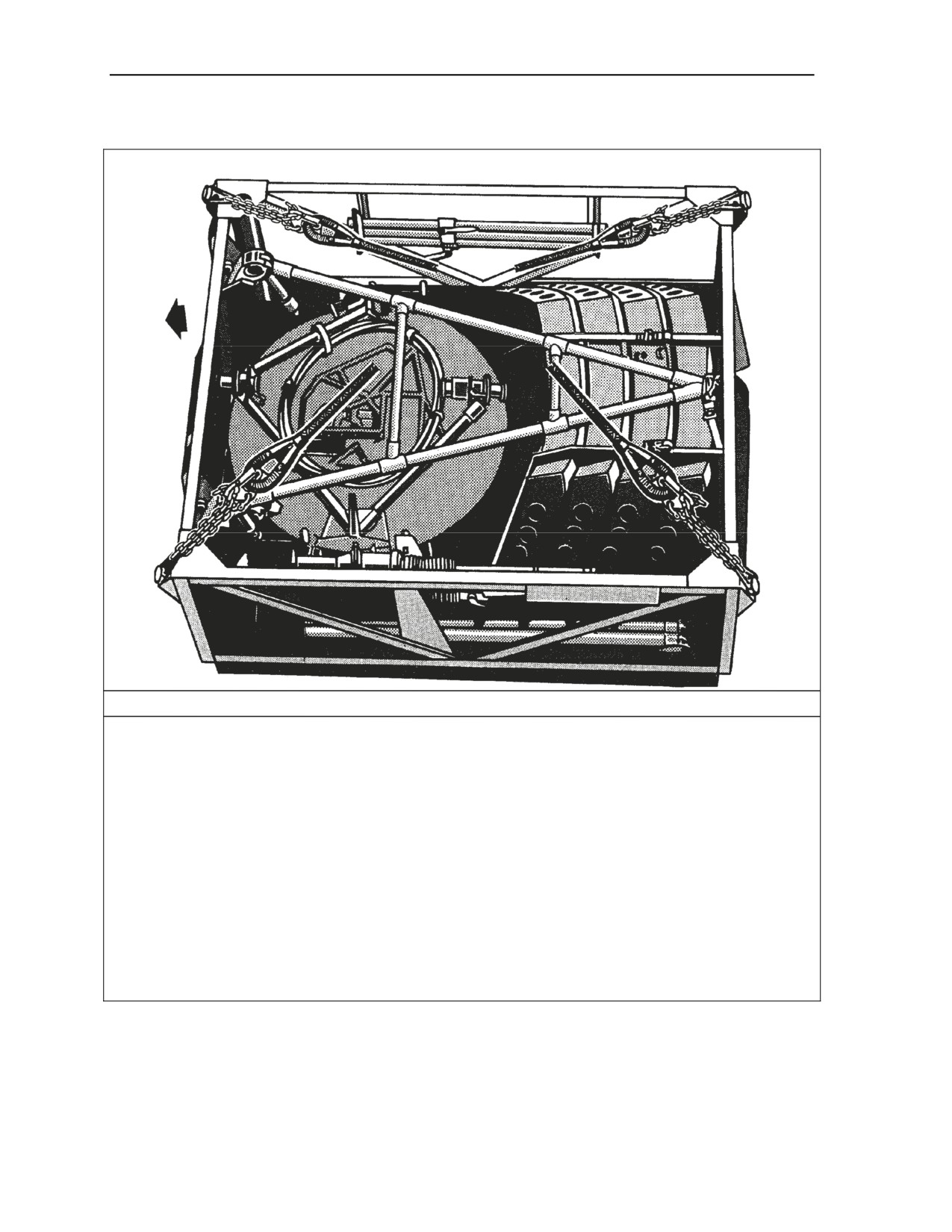
Rigging. Rig the load according to the steps in Figure 12-7.
Hookup. The hookup team stands on the frame. The static wand person discharges the
static electricity with the static wand. The hookup person places the apex fitting onto the
aircraft cargo hook. The hookup team then moves clear of the load but remains close to the load
as the helicopter removes slack from the sling legs. When successful hookup is assured, the
hookup team quickly exits the area underneath the helicopter to the designated rendezvous
point.
Derigging. Derigging is the reverse of the preparation and rigging procedures.
20 February 2009
FM 4-20.198/MCRP 4-11.3E, VOL II/NTTP 3-04.12/
AFMAN 11-223 (I), VOL II/COMDTINST M13482.3B
12-13
Chapter 12
RIGGING STEPS
1. Position the apex fitting on top of the load. Route outer sling legs 1 and 2 to the front
(opposite the antenna segments) of the load and inner sling legs 3 and 4 to the rear. Sling
legs 1 and 3 must be on the left side of the load.
2. Loop the chain end of sling leg 1 through the left front lift provision located on the top left
corner of the frame. Place the correct link from Table 12-7 in the grab hook. Repeat with
sling leg 2 on the top right corner of the frame. Secure the excess chain with tape or Type III
nylon cord.
3. Loop the chain end of sling leg 3 through the left rear lift provision. Place the correct link from
Table 12-7 in the grab hook. Repeat with sling leg 4 on the right rear lift provision.
4. Cluster and tie (breakaway technique) all sling legs together on top of the frame to prevent
entanglement during hookup and lift-off.
Figure 12-7. Antenna Pallet Transit Frame
FM 4-20.198/MCRP 4-11.3E, VOL II/NTTP 3-04.12/
12-14
AFMAN 11-223 (I), VOL II/COMDTINST M13482.3B
20 February 2009
Certified Single-Point Rigging Procedures for Radar and Satellite Equipment
DIGITAL GROUP MULTIPLEXER (DGM), DIGITAL ANTENNA
MAST PROGRAM (DAMP), 2 AND 3 ANTENNA PALLET
CONFIGURATIONS
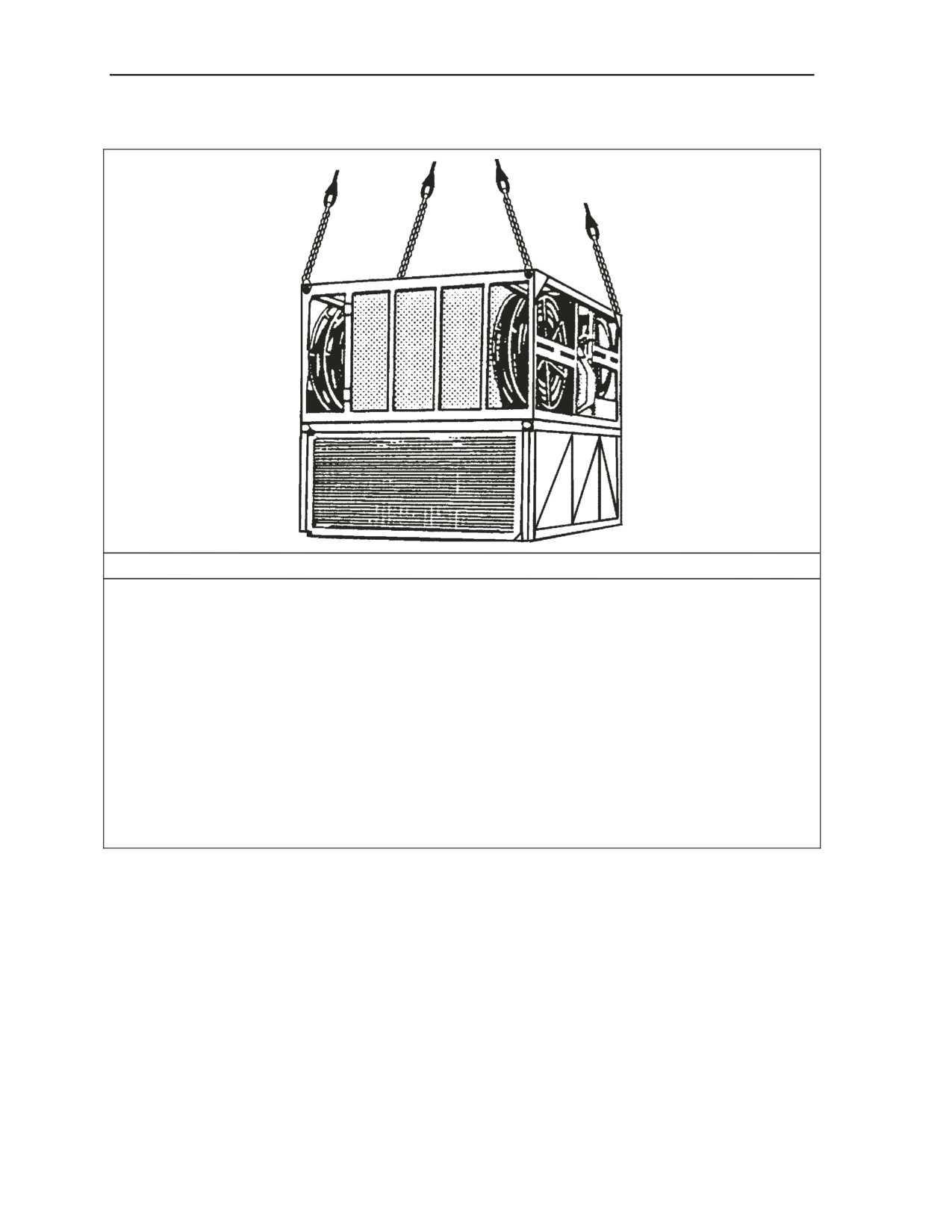
12-9. The digital group multiplexer digital antenna mast program, 2 and 3 antenna pallet configurations are
rigged for single-point sling load using the following procedures:
z
Applicability. The following items in Table 12-8 are certified for all helicopters with suitable
lift capacity by the US Army Natick Soldier Center:
Table 12-8. Digital Group Multiplexer, Digital Antenna Mast Program
Nomenclature
Max
Sling
Link Count
Weight
Set
Front/Rear
(Pounds)
DGM, Damp Pallet, 2 Antenna Configuration
4,300
10K
3/3
DGM, Damp Pallet, 3 Antenna Configuration
5,500
10K
3/3
z
Materials. The following materials are required to rig this load:
Sling set (10,000-pound capacity).
Tape, adhesive, pressure-sensitive, 2-inch wide roll.
Cord, nylon, Type III, 550-pound breaking strength.
Webbing, cotton, 1/4-inch, 80-pound breaking strength.
Webbing, tubular, nylon, 1/2-inch, 1000-pound breaking strength.
Felt sheet, cattle hair, Type IV, 1/2-inch or suitable substitute.
z
Personnel. Four persons can prepare and rig this load in 20 minutes.
z
Procedures. The following procedures apply to this load:
Preparation. Prepare the load using the following steps:
─ Secure the grating on the cable reels side with Type III nylon cord.
─ Secure the cable reels with Type III nylon cord.
─ Wrap the tie-down straps and turnbuckles with padding and secure the padding with tape.
Secure them to the pallet with the rubber straps provided.
Rigging. Rig the load according to the steps in Figure 12-8.
Hookup. The hookup team stands on the pallet. The static wand person discharges the
static electricity with the static wand. The hookup person places the apex fitting onto the
aircraft cargo hook. The hookup team then moves clear of the load but remains close to the load
as the helicopter removes slack from the sling legs. When successful hookup is assured, the
hookup team quickly exits the area underneath the helicopter to the designated rendezvous
point.
Derigging. Derigging is the reverse of the preparation and rigging procedures.
20 February 2009
FM 4-20.198/MCRP 4-11.3E, VOL II/NTTP 3-04.12/
AFMAN 11-223 (I), VOL II/COMDTINST M13482.3B
12-15
Chapter 12
RIGGING STEPS
1. Position the apex fitting on top of the load. Route outer sling legs 1 and 2 to the front (cable
reel end) of the load and inner sling legs 3 and 4 to the rear. Sling legs 1 and 3 must be on
the left side of the load.
2. Loop the chain end of sling leg 1 through the left front lift provision located on the top left
corner of the frame. Place the correct link from Table 12-8 in the grab hook. Repeat with
sling leg 2 on the top right corner of the frame.
3. Loop the chain end of sling leg 3 through the left rear lift provision. Place the correct link from
Table 12-8 in the grab hook. Repeat with sling leg 4 on the right rear lift provision.
4. Cluster and tie (breakaway technique) all sling legs together on top of the frame to prevent
entanglement during hookup and lift-off.
Figure 12-8. Digital Group Multiplexer, Digital Antenna Mast Program
DIGITAL GROUP MULTIPLEXER (DGM), AUXILIARY EQUIPMENT
TRANSPORTATION CONTAINER (AETC), 2 AND 3 MAST
CONFIGURATIONS
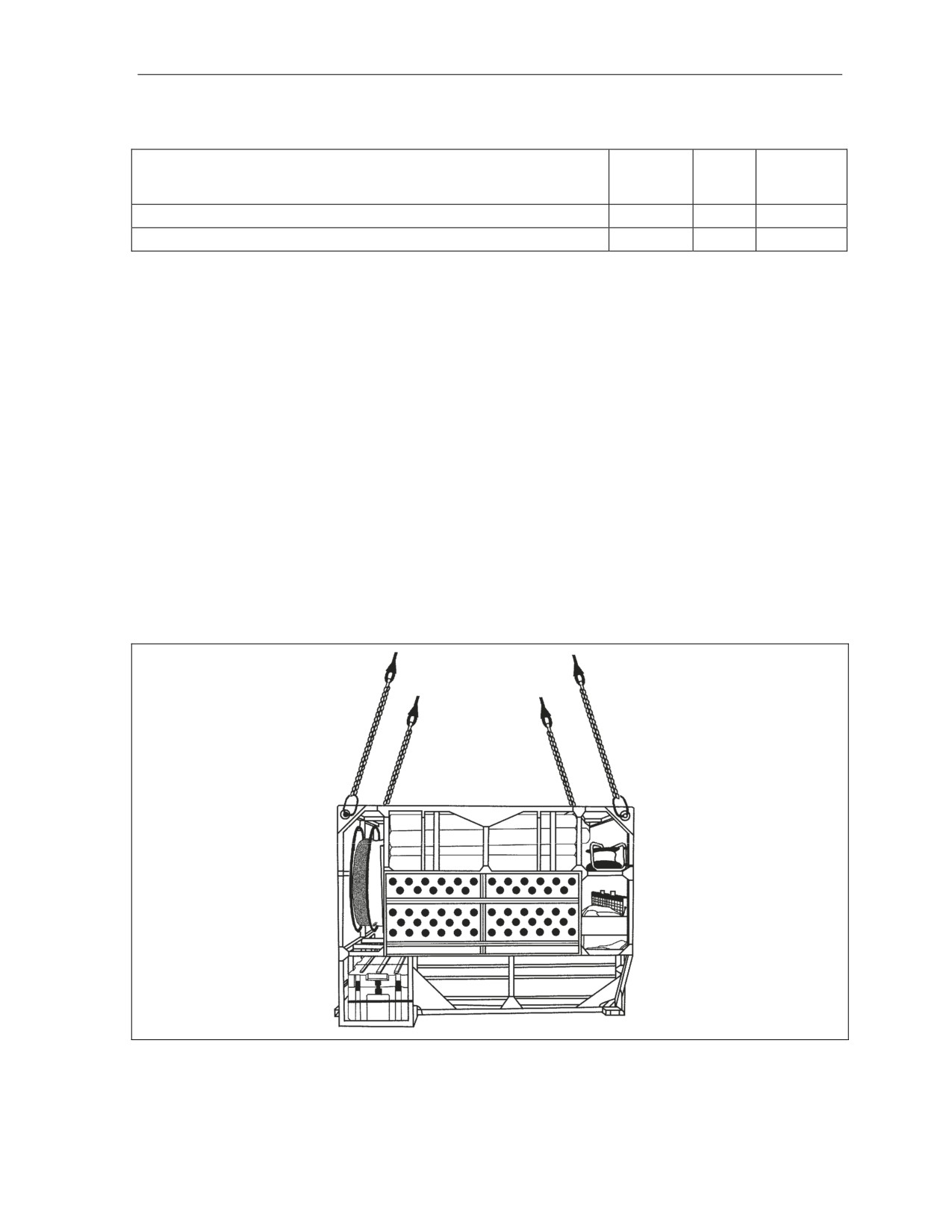
12-10. The digital group multiplexer, auxiliary equipment transportation container,
2 and 3 mast
configurations are rigged for single-point sling load using the following procedures:
z
Applicability. The following items in Table 12-9 are certified for all helicopters with suitable
lift capacity by the US Army Natick Soldier Center:
FM 4-20.198/MCRP 4-11.3E, VOL II/NTTP 3-04.12/
12-16
AFMAN 11-223 (I), VOL II/COMDTINST M13482.3B
20 February 2009
Certified Single-Point Rigging Procedures for Radar and Satellite Equipment
Table 12-9. Digital Group Multiplexer, Auxiliary Equipment Transportation Container
Nomenclature
Max
Sling
Link Count
Weight
Set
Front/Rear
(Pounds)
DGM, AETC, 2 Antenna Configuration
3,028
10K
3/3
DGM, AETC, 3 Antenna Configuration
4,014
10K
3/3
z
Materials. The following materials are required to rig this load:
Sling set (10,000-pound capacity).
Tape, adhesive, pressure-sensitive, 2-inch wide roll.
Cord, nylon, Type III, 550-pound breaking strength.
Webbing, cotton, 1/4-inch, 80-pound breaking strength.
z
Personnel. Four persons can prepare and rig this load in 15 minutes.
z
Procedures. The following procedures apply to this load:
Preparation. Prepare the load using the following steps:
─ Secure all loose equipment inside the AETC with tape or Type III nylon cord.
─ Remove and stow the AETC cover. Secure the cover with Type III nylon cord.
Rigging. Rig the load according to the steps in Figure 12-9.
Hookup. The hookup team stands on the AETC. The static wand person discharges the
static electricity with the static wand. The hookup person places the apex fitting onto the
aircraft cargo hook. The hookup team then moves clear of the load but remains close to the load
as the helicopter removes slack from the sling legs. When successful hookup is assured, the
hookup team quickly exits the area underneath the helicopter to the designated rendezvous
point.
Derigging. Derigging is the reverse of the preparation and rigging procedures.
Figure 12-9. Digital Group Multiplexer, Auxillary Equipment Transportation Container
20 February 2009
FM 4-20.198/MCRP 4-11.3E, VOL II/NTTP 3-04.12/
AFMAN 11-223 (I), VOL II/COMDTINST M13482.3B
12-17
Chapter 12
RIGGING STEPS
1. Position the apex fitting on top of the load. Route outer sling legs 1 and 2 to the front of the
load and inner sling legs 3 and 4 to the rear. Sling legs 1 and 3 must be on the left side of
the load.
2. Loop the chain end of sling leg 1 through the left front lift provision. Place the correct link from
Table 12-9 in the grab hook. Repeat with sling leg 2 on the top right corner of the frame.
3. Loop the chain end of sling leg 3 through the left rear lift provision. Place the correct link from
Table 12-9 in the grab hook. Repeat with sling leg 4 on the right rear lift provision.
4. Cluster and tie (breakaway technique) all sling legs together on top of the AETC to prevent
entanglement during hookup and lift-off.
Figure 12-9. Digital Group Multiplexer, Auxillary Equipment Transportation Container
(Continued)
LIGHTWEIGHT GENERATOR FRAME ASSEMBLY (AN/TSC-93B
RECONFIGURATION) SATELLITE COMMUNICATIONS TERMINAL
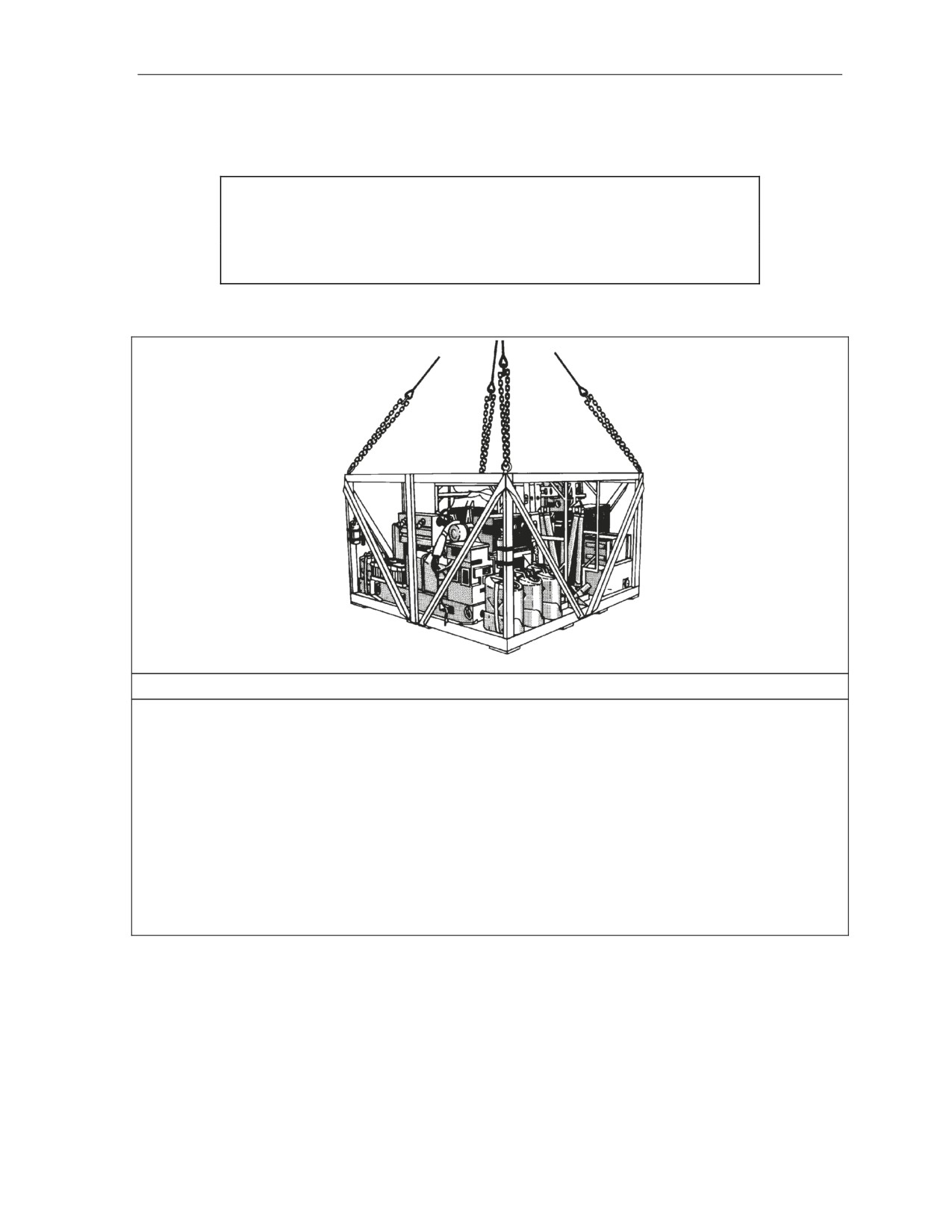
12-11. The lightweight generator frame assembly
(AN/TSC-93B reconfiguration) satellite
communications terminal is rigged for single-point sling load using the following procedures:
z
Applicability. The following items in Table 12-10 are certified for all helicopters with suitable
lift capacity by the US Army Natick Soldier Center:
Table 12-10. Lightweight Generator Frame Assembly (AN/TSC-93B Reconfiguration) Satellite
Communications Terminal
Nomenclature
Max
Sling
Link Count
Weight
Set
Front/Rear
(Pounds)
AN/TSC-93B Satellite Communications Terminal without ALTA
3,644
10K
3/3
AN/TSC-93B Satellite Communications Terminal with ALTA
3,957
10K
3/3
z
Materials. The following materials are required to rig this load:
Sling set (10,000-pound capacity).
Tape, adhesive, pressure-sensitive, 2-inch wide roll.
Cord, nylon, Type III, 550-pound breaking strength.
Webbing, cotton, 1/4-inch, 80-pound breaking strength.
Tie-down strap, cargo, CGU-1/B (3 each).
z
Personnel. Four persons can prepare and rig this load in 10 minutes.
z
Procedures. The following procedures apply to this load:
Preparation. Prepare the load using the following steps:
─ Secure all loose equipment with CGU-1/B tie-down straps, tape, or Type III nylon cord.
─ Remove and stow the cover. Secure the cover with Type III nylon cord.
Rigging. Rig the load according to the steps in Figure 12-10.
Hookup. The hookup team stands on the frame corners, diagonally across from each other.
The static wand person discharges the static electricity with the static wand. The hookup person
places the apex fitting onto the aircraft cargo hook. The hookup team then moves clear of the
FM 4-20.198/MCRP 4-11.3E, VOL II/NTTP 3-04.12/
12-18
AFMAN 11-223 (I), VOL II/COMDTINST M13482.3B
20 February 2009
Certified Single-Point Rigging Procedures for Radar and Satellite Equipment
load but remains close to the load as the helicopter removes slack from the sling legs. When
successful hookup is assured, the hookup team quickly exits the area underneath the helicopter
to the designated rendezvous point.
CAUTION
Brief the helicopter crew to relax the sling leg tension and hover to the
side of the load when releasing the apex fitting.
Derigging. Derigging is the reverse of the preparation and rigging procedures.
RIGGING STEPS
1. Position the apex fitting on top of the load. Route outer sling legs 1 and 2 to the front of the
load and inner sling legs 3 and 4 to the rear. Sling legs 1 and 3 must be on the left side of
the load.
2. Loop the chain end of sling leg 1 through the left front lift provision. Place the correct link from
Table 12-10 in the grab hook. Repeat with sling leg 2 on the top right corner of the frame.
3. Loop the chain end of sling leg 3 through the left rear lift provision. Place the correct link from
Table 12-10 in the grab hook. Repeat with sling leg 4 on the right rear lift provision.
4. Cluster and tie (breakaway technique) all sling legs together on top of the load to prevent
entanglement during hookup and lift-off.
Figure 12-10. Lightweight Generator Frame Assembly (AN/TSC-93B Reconfiguration)
20 February 2009
FM 4-20.198/MCRP 4-11.3E, VOL II/NTTP 3-04.12/
AFMAN 11-223 (I), VOL II/COMDTINST M13482.3B
12-19
Chapter 12
SECURE MOBILE ANTI-JAM RELIABLE TACTICAL TERMINAL
(SMART-T) PALLET
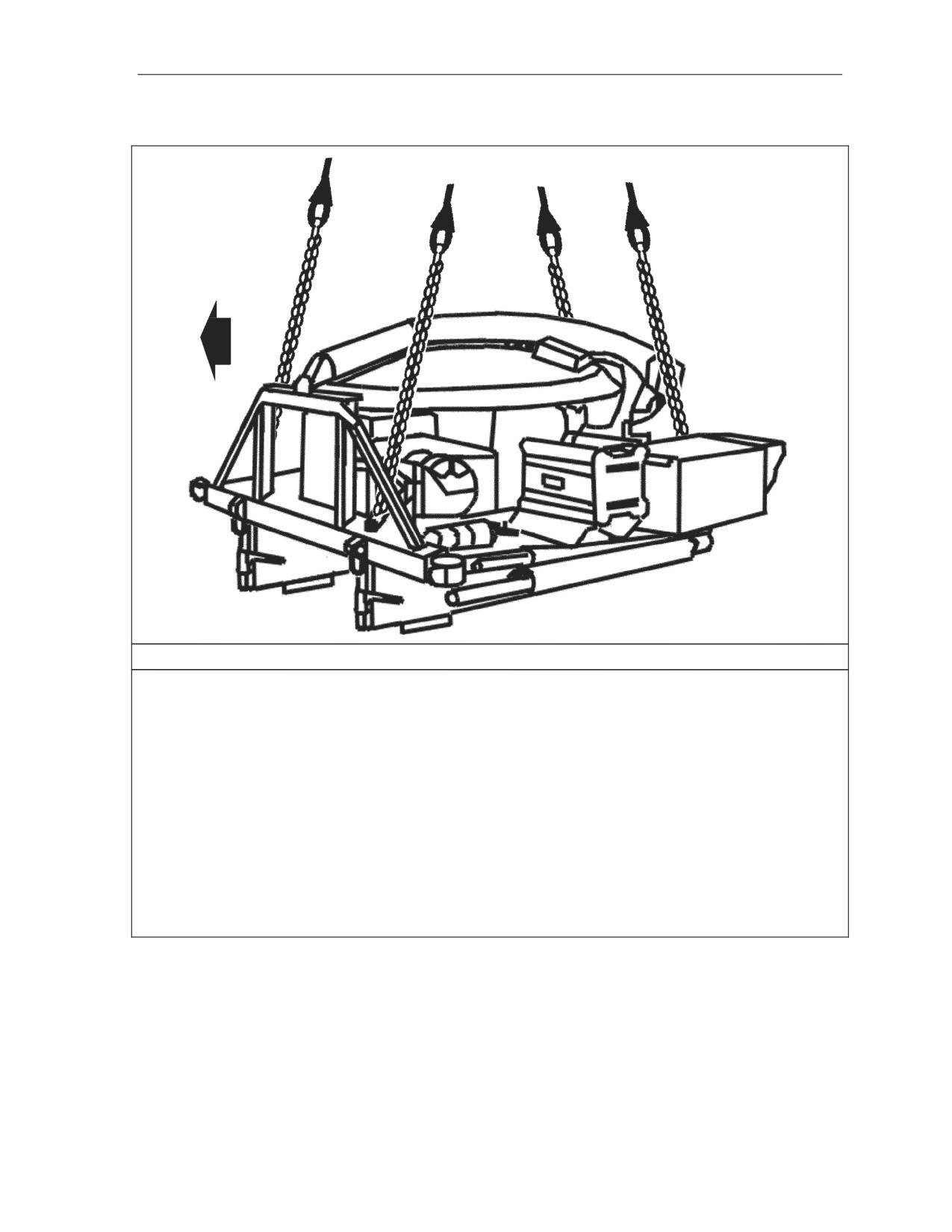
12-12. The secure mobile anti-jam reliable tactical terminal pallet is rigged for single-point sling load
using the following procedures:
z
Applicability. The following item in Table 12-11 is certified for all helicopters with suitable lift
capacity by the US Army Natick Soldier Center:
Table 12-11. Secure Mobile Anti-Jam Reliable Tactical Terminal Pallet
Nomenclature
Max
Sling
Link Count
Weight
Set
Front/Rear
(Pounds)
Secure Mobile Anti-Jam Reliable Tactical Terminal Pallet
2,440
10K
3/30
z
Materials. The following materials are required to rig this load:
Sling set (10,000-pound capacity).
Tape, adhesive, pressure-sensitive, 2-inch wide roll.
Cord, nylon, Type III, 550-pound breaking strength.
Webbing, cotton, 1/4-inch, 80-pound breaking strength.
z
Personnel. Four persons can prepare and rig this load in 10 minutes.
z
Procedures. The following procedures apply to this load:
Preparation. Prepare the load using the following steps:
─ Secure all loose equipment with tape or Type III nylon cord. Ensure the fuel cans at the
end of the pallet are locked in position.
─ Secure the antenna dish.
Rigging. Rig the load according to the steps in Figure 12-11.
Note. The fuel can brackets are on the rear of the load.
Hookup. The hookup team stands beside the pallet. The static wand person discharges the
static electricity with the static wand. The hookup person places the apex fitting onto the
aircraft cargo hook. The hookup team then moves clear of the load but remains close to the load
as the helicopter removes slack from the sling legs. When successful hookup is assured, the
hookup team quickly exits the area underneath the helicopter to the designated rendezvous
point.
Derigging. Derigging is the reverse of the preparation and rigging procedures.
FM 4-20.198/MCRP 4-11.3E, VOL II/NTTP 3-04.12/
12-20
AFMAN 11-223 (I), VOL II/COMDTINST M13482.3B
20 February 2009
Certified Single-Point Rigging Procedures for Radar and Satellite Equipment
RIGGING STEPS
1. Position the apex fitting beside the pallet. Route outer sling legs 1 and 2 to the front of the
load and inner sling legs 3 and 4 to the rear. Sling legs 1 and 3 must be on the left side of
the load.
2. Loop the chain end of sling leg 1 through the left front lift provision. Place the correct link from
Table 12-11 in the grab hook. Repeat with sling leg 2 on the top right corner of the frame.
3. Loop the chain end of sling leg 3 through the left rear lift provision. Place the correct link from
Table 12-11 in the grab hook. Repeat with sling leg 4 on the right rear lift provision. Secure
excess chain with tape or Type III nylon cord.
4. Cluster and tie (breakaway technique) all sling legs together on top of the load to prevent
entanglement during hookup and lift-off.
Figure 12-11. Secure Mobile Anti-Jam Reliable Tactical Terminal Pallet
UNMANNED THREAT EMITTER (UMTE) SYSTEM
12-13. The unmanned threat emitter (UMTE) system is rigged for single-point sling load using the
following procedures:
z
Applicability. The following item in Table 12-12 is certified for all helicopters with suitable lift
capacity by the US Army Natick Soldier Center:
20 February 2009
FM 4-20.198/MCRP 4-11.3E, VOL II/NTTP 3-04.12/
AFMAN 11-223 (I), VOL II/COMDTINST M13482.3B
12-21

Chapter 12
Table 12-12. Unmanned Threat Emitter System
Nomenclature
Max
Slin
Link Count
Weight
g Set
Front/Rear
(Pounds)
Remote Power Unit, PU-818/TPT-T1 (V) (P/N9805-8500-1) without
3,941
10K
3/15
Antenna
Remote Power Unit, PU-818/TPT-T1 (V) (P/N9805-8500-1) withTK1,
4,006
10K
3/15
51-inch Antenna (8811-1900)
Remote Power Unit, PU-818/TPT-T1 (V) (P/N9805-8500-1) withTK2,
4,006
10K
3/15
28-inch Antenna (8811-2900)
Remote Power Unit, PU-818/TPT-T1 (V) (P/N9805-8500-1) withTK3,
4,006
10K
3/15
46-inch Antenna (8811-3900)
Remote Power Unit, PU-818/TPT-T1 (V) (P/N9805-8500-1) withTK4,
4,061
10K
3/15
76-inch Antenna (8811-4900)
Remote Power Unit, PU-818/TPT-T1 (V) (P/N9805-8500-1) withTK9,
3,979
10K
3/15
40.4-inch Antenna (9805-8900)
Remote Power Unit, PU-809A/TPT-T1 (V) (P/N100905-8500-1)
4,085
10K
3/15
without Antenna
Remote Power Unit, PU-809A/TPT-T1 (V) (P/N1009-8500-1)
4,150
10K
3/15
withTK1, 51-inch Antenna (8811-1900)
Remote Power Unit, PU-809A/TPT-T1 (V) (P/N1009-8500-1)
4,150
10K
3/15
withTK2, 28-inch Antenna (8811-2900)
Remote Power Unit, PU-809A/TPT-T1 (V) (P/N1009-8500-1)
4,150
10K
3/15
withTK3, 46-inch Antenna (8811-3900)
Remote Power Unit, PU-809A/TPT-T1 (V) (P/N1009-8500-1) with
4,205
10K
3/15
TK4, 76-inch Antenna (8811-4900)
Remote Power Unit, PU-809A/TPT-T1 (V) (P/N1009-8500-1)
4,123
10K
3/15
withTK9, 40.4-inch Antenna (9805-8900)
Remote Emitter Unit (REU) Threat Kit (TK) 1, (P/N 1006-1001-1)
3,712
10K
3/15
Remote Emitter Unit (REU) Threat Kit (TK) 4, (P/N 1006-4001-1)
3,986
10K
3/15
Remote Emitter Unit (REU) Threat Kit (TK) 9, (P/N 9805-8001-1)
3,497
10K
3/15
z
Materials. The following materials are required to rig this load:
Sling set (10,000-pound capacity).
─ Additional chain lengths, part number 38850-00053-101, from a 10,000-pound capacity
sling set (4 each).
─ Coupling link, NSN 4010-01-231-3388, from a 10,000-pound capacity sling set (4 each).
Tape, adhesive, pressure-sensitive, 2-inch wide roll.
Cord, nylon, Type III, 550-pound breaking strength.
Webbing, cotton, 1/4-inch, 80-pound breaking strength.
z
Personnel. Four persons can prepare and rig this load in 15 minutes.
z
Procedures. The following procedures apply to this load:
Preparation. Prepare the load using the following steps:
─ Connect one additional chain length to each chain of the sling set with the coupling link.
─ Place the UMTE in the shipping configuration.
─ Secure all loose equipment.
─ Coil and secure the power cable to the platform with tiedown straps.
─ Ensure the fuel tank is not over 3/4 full. Inspect the fuel tank cap for proper installation.
FM 4-20.198/MCRP 4-11.3E, VOL II/NTTP 3-04.12/
12-22
AFMAN 11-223 (I), VOL II/COMDTINST M13482.3B
20 February 2009
Certified Single-Point Rigging Procedures for Radar and Satellite Equipment
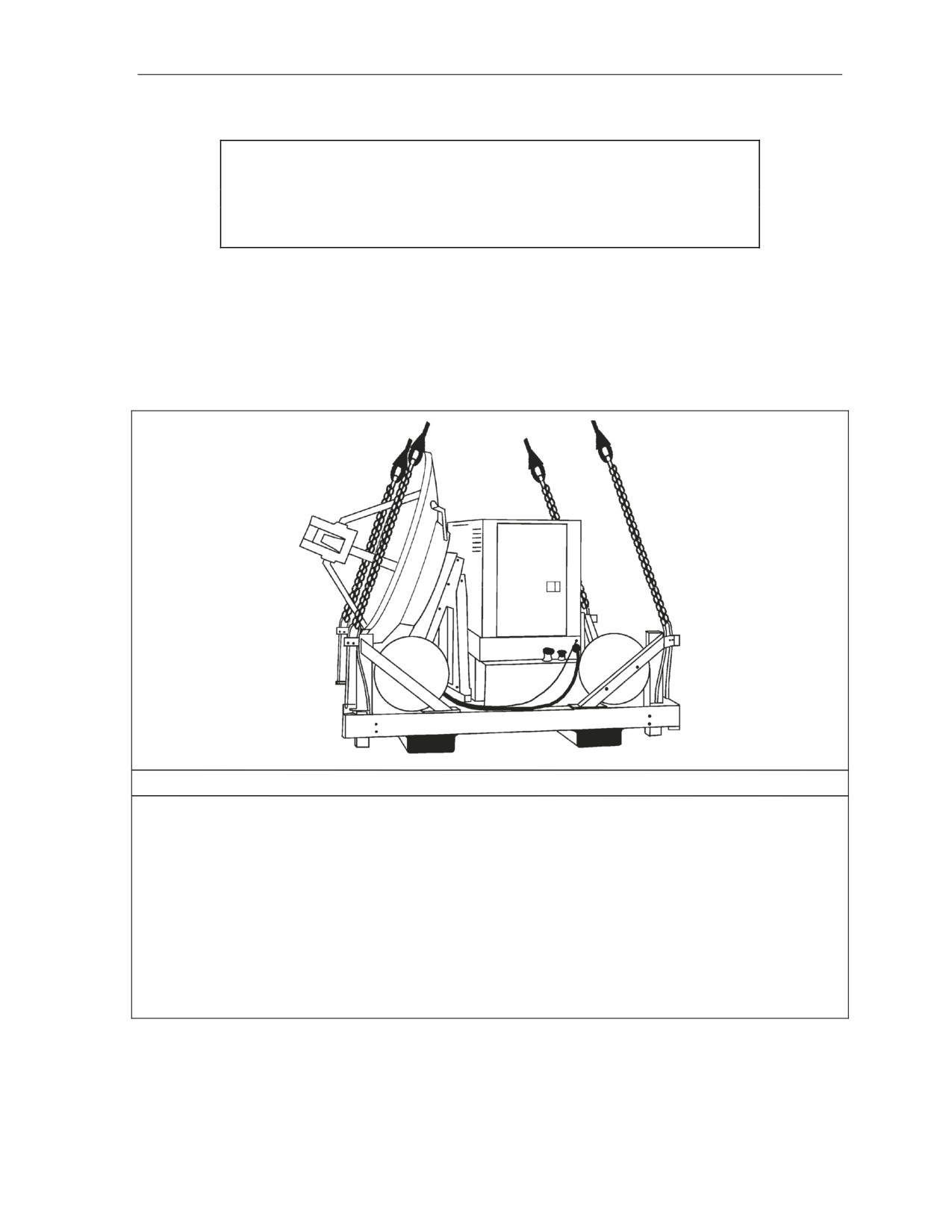
Rigging. Rig the load according to the steps in Figure 12-12.
CAUTION
The antenna faces the rear of the load. Rigging the load in reverse
could cause the load to become unstable.
Hookup. The hookup team stands beside the pallet. The static wand person discharges the
static electricity with the static wand. The hookup person places the apex fitting onto the
aircraft cargo hook. The hookup team then moves clear of the load but remains close to the load
as the helicopter removes slack from the sling legs. When successful hookup is assured, the
hookup team quickly exits the area underneath the helicopter to the designated rendezvous
point.
Derigging. Derigging is the reverse of the preparation and rigging procedures.
RIGGING STEPS
1. Position the apex fitting on top of the pallet. Route outer sling legs 1 and 2 to the front of the
RPU or REU and inner sling legs 3 and 4 to the rear (antenna end). Sling legs are routed
inside the antenna. Sling legs 1 and 3 must be on the left side of the load.
2. Loop the chain end of sling leg 1 through the left front lift provision. Place the correct link from
Table 12-12 in the grab hook. Repeat with sling leg 2 on the top right corner of the frame.
Secure excess chain with tape or Type III nylon cord.
3. Loop the chain end of sling leg 3 through the left rear lift provision. Place the correct link from
Table 12-12 in the grab hook. Repeat with sling leg 4 on the right rear lift provision. Secure
excess chain with tape or Type III nylon cord.
Figure 12-12. Unmanned Threat Emitter System
20 February 2009
FM 4-20.198/MCRP 4-11.3E, VOL II/NTTP 3-04.12/
AFMAN 11-223 (I), VOL II/COMDTINST M13482.3B
12-23
Chapter 12
RIGGING STEPS (Continued)
4. Extend the chain from each leg above the pallet and secure the chain to the load with Type I,
1/4-inch cotton webbing (breakaway technique).
5. Cluster and tie (breakaway technique) all sling legs together on top of the load to prevent
entanglement during hookup and lift-off.
Figure 12-12. Unmanned Threat Emitter System (Continued)
FM 4-20.198/MCRP 4-11.3E, VOL II/NTTP 3-04.12/
12-24
AFMAN 11-223 (I), VOL II/COMDTINST M13482.3B
20 February 2009
Chapter 13
Certified Single-Point Rigging Procedures for Generator
Sets
INTRODUCTION
13-1. This chapter contains rigging procedures for single-point lift of generator sets that have been
certified for sling load. Each rigging procedure is found in a paragraph that includes a description of the
load, materials required for rigging, and steps to complete the procedure. An applicability paragraph is
also a part of each paragraph and identifies the certified loads. The certified single-point rigging
procedures for generator sets are in this section. Paragraphs 13-2 through 13-7 give detailed instructions
for rigging loads.
Note. Reach Pendants may be used on all single point loads. A static discharge person is not
required when using a Reach Pendant.
AVIATION GROUND POWER UNIT (AGPU)
13-2. The aviation ground power unit is rigged for single-point sling load using the following procedures:
z
Applicability. The following item in Table 13-1 is certified for all helicopters with suitable lift
capacity by the US Army Natick Soldier Center:
Table 13-1. Aviation Ground Power Unit
Nomenclature
Max
Sling
Link Count
Weight
Set
Front/Rear
(Pounds)
Aviation Ground Power Unit
4,190
10K
3/3
z
Materials. The following materials are required to rig this load:
Sling set (10,000-pound capacity).
Tape, adhesive, pressure-sensitive, 2-inch wide roll.
Cord, nylon, Type III, 550-pound breaking strength.
Webbing, cotton, 1/4-inch, 80-pound breaking strength.
Tie-down strap, cargo, CGU-1/B (4-each).
Webbing, nylon, tubular, 1/2-inch, 1000-pound breaking strength.
z
Personnel. Two persons can prepare and rig this load in 10 minutes.
z
Procedures. The following procedures apply to this load:
Preparation. Prepare the load using the following steps:
─ Stow and secure the tow bar with 1/2-inch tubular nylon.
─ Close all doors, secure handles with tape, and attach four CGU-1/B tie-down straps.
─ Route one tie-down strap horizontally around the power unit. Position it approximately
16 inches down from the top of the power unit. Repeat using another tie-down strap
positioned approximately 8 inches higher than the first tie-down strap.
20 February 2009
FM 4-20.198/MCRP 4-11.3E, VOL II/NTTP 3-04.12/
AFMAN 11-223 (I), VOL II/COMDTINST M13482.3B
13-1
Chapter 13
─ Route another tie-down strap through the forklift lift provisions and then vertically
around the power unit. Repeat this procedure using another tie-down strap through the
other lift provision.
─ Secure all equipment inside the unit with nylon cord or tape.
─ Secure exhaust cover closed with tape.
CAUTION
Pay careful attention to securing the exhaust cover closed to preclude
possible damage during flight. If cover cannot be adequately secured,
it should be removed.
─ Ensure that fuel tank is not more than 3/4 full. Inspect fuel tank cap, oil filler caps, and
battery caps to ensure they are secure.
─ Engage the parking brake.
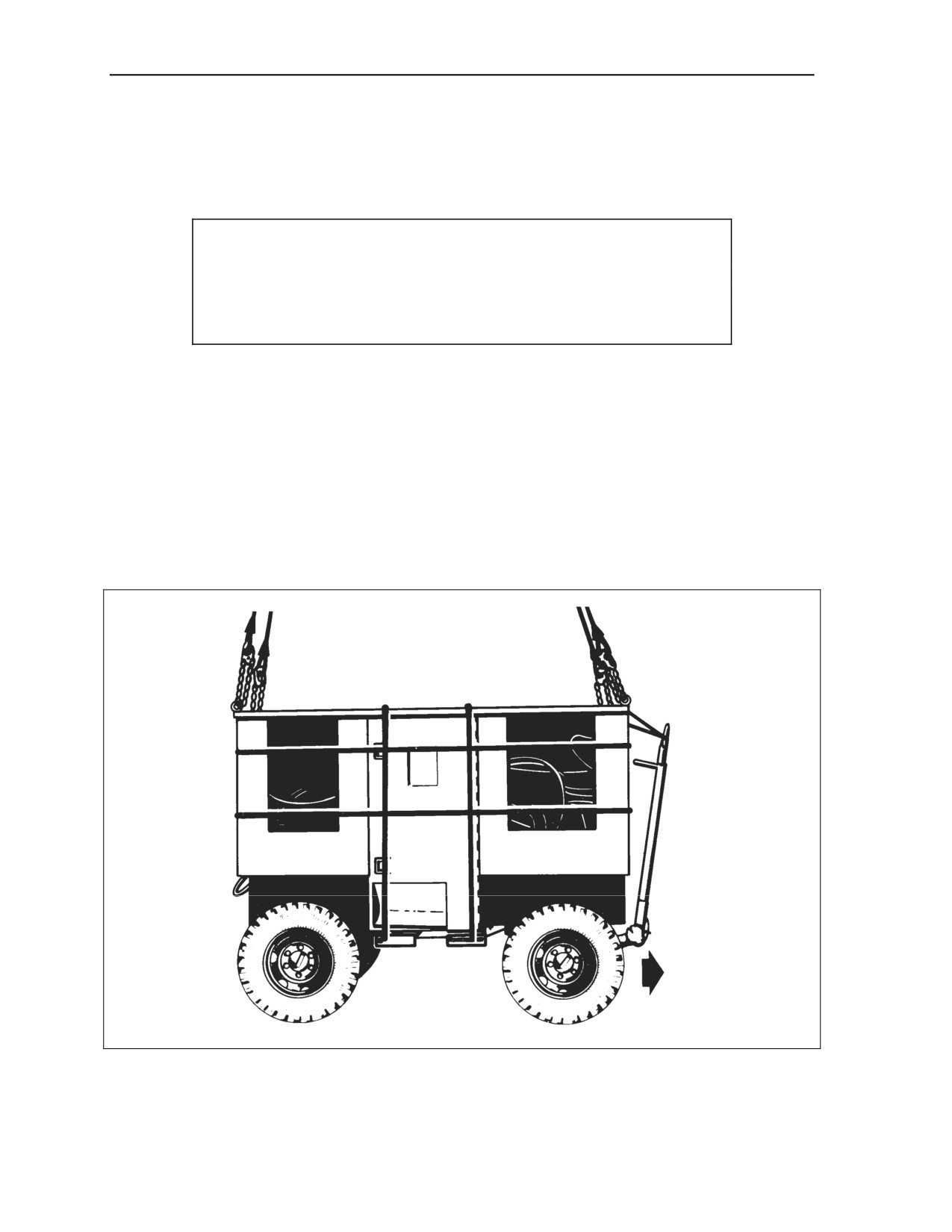
Rigging. Rig the load according to the steps in Figure 13-1.
Hookup. The hookup team stands on top of the power unit. The static wand person
discharges the static electricity with the static wand. The hookup person places the apex fitting
onto the aircraft cargo hook. The hookup team then moves clear of the load but remains close to
the load as the helicopter removes slack from the sling legs. When successful hookup is
assured, the hookup team quickly exits the area underneath the helicopter to the designated
rendezvous point.
Derigging. Derigging is the reverse of the preparation and rigging procedures.
Figure 13-1. Aviation Ground Power Unit
FM 4-20.198/MCRP 4-11.3E, VOL II/NTTP 3-04.12/
13-2
AFMAN 11-223 (I), VOL II/COMDTINST M13482.3B
20 February 2009

Certified Single-Point Rigging Procedures for Generator Sets
RIGGING STEPS
1. Position apex fitting on top of the unit. Route outer sling legs 1 and 2 to the front (tongue) of
the trailer and inner sling legs 3 and 4 to the rear. Sling legs 1 and 3 should be on the left
side of the load.
2. Loop the chain end of sling leg 1 through the left front lift ring. Place the correct link from
Table 13-1 in the grab hook. Repeat with sling leg 2 on the right front lift ring.
3. Loop the chain end of sling leg 3 through the left rear lift ring. Place the correct link from
Table 13-1 in the grab hook. Repeat with sling leg 4 on the right rear lift ring.
4. Cluster and tie (breakaway technique) all sling legs together on top of the unit to prevent
entanglement during hookup and lift-off.
Figure 13-1. Aviation Ground Power Unit (Continued)
AVIATION DIRECT CURRENT GENERATOR SET (ADCGS)
13-3. The aviation direct current generator set is rigged for single-point sling load using the following
procedures:
z
Applicability. The following item in Table 13-2 is certified for all helicopters with suitable lift
capacity by the US Army Natick Soldier Center:
Table 13-2. Aviation Direct Current Generator Set
Nomenclature
Max
Sling
Link Count
Weight
Set
Front/Rear
(Pounds)
Aviation Direct Current Generator Set
1,100
10K
3/3
z
Materials. The following materials are required to rig this load:
Sling set (10,000-pound capacity).
Tape, adhesive, pressure-sensitive, 2-inch wide roll.
Cord, nylon, Type III, 550-pound breaking strength.
Webbing, cotton, 1/4-inch, 80-pound breaking strength.
Felt sheet, cattle hair, Type IV, 1/2-inch or suitable substitute, 30- x 36-inch (4 sheets).
z
Personnel. Two persons can prepare and rig this load in 20 minutes.
z
Procedures. The following procedures apply to this load:
Preparation. Prepare the load using the following steps:
─ Fold and tape ground cable to the inside of the tongue frame. Roll rear cable in the rack
provided. Tape hold-down latch on rear cable rack.
─ Cover cable receptacles. Secure door latches and tape exhaust stack cover down.
─ Route a single length of Type III nylon cord under and through the frame, over the
exhaust stack cover and instrument cover, and tie to secure both covers. Tape the fuel
tank gage.
─ Set the wheel brakes in the ON position.
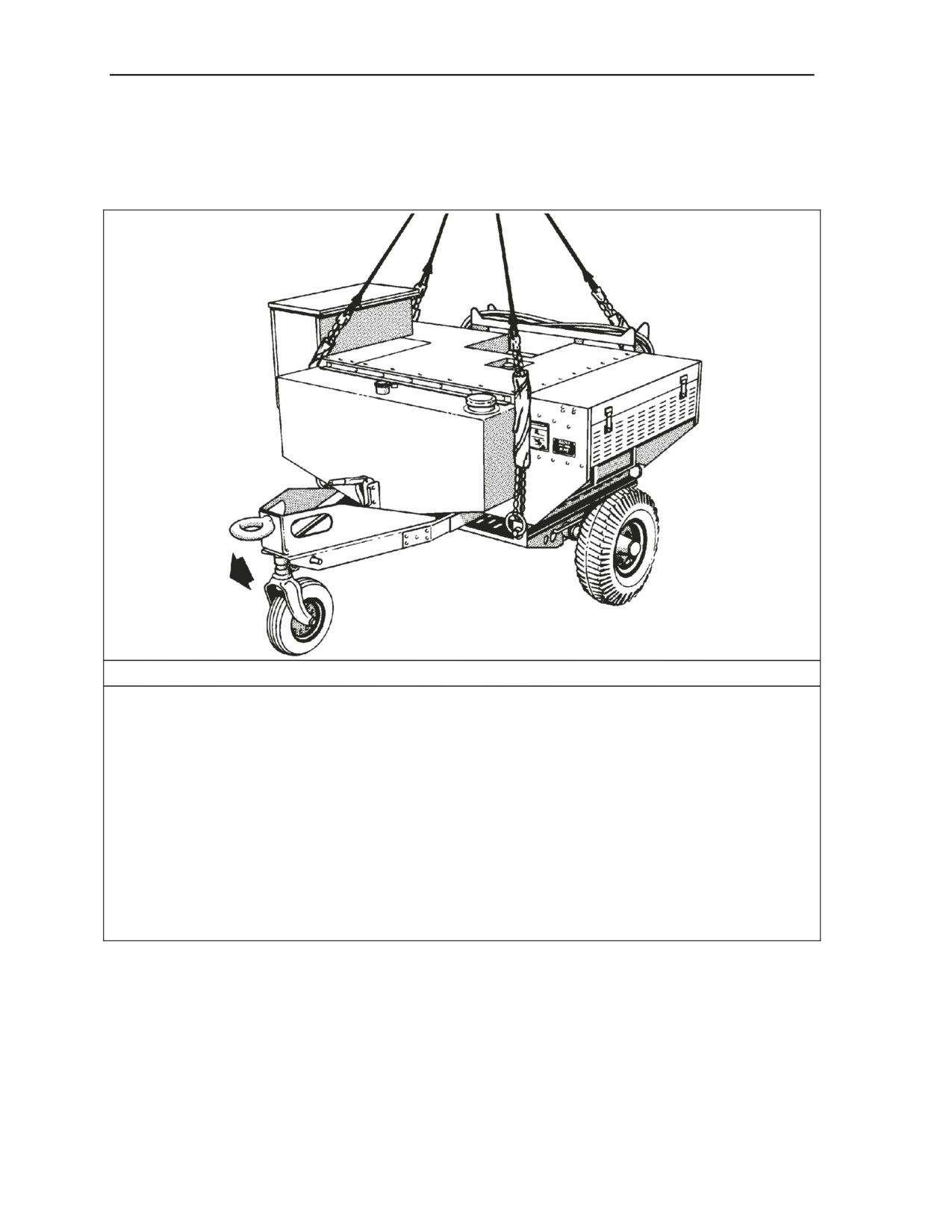
Rigging. Rig the load according to the steps in Figure 13-2.
Hookup. The hookup team stands on the side of the load. The static wand person
discharges the static electricity with the static wand. The hookup person places the apex fitting
onto the aircraft cargo hook. The hookup team then moves clear of the load but remains close to
20 February 2009
FM 4-20.198/MCRP 4-11.3E, VOL II/NTTP 3-04.12/
AFMAN 11-223 (I), VOL II/COMDTINST M13482.3B
13-3
Chapter 13
the load as the helicopter removes slack from the sling legs. When successful hookup is
assured, the hookup team quickly exits the area underneath the helicopter to the designated
rendezvous point.
Derigging. Derigging is the reverse of the preparation and rigging procedures.
RIGGING STEPS
1. Position apex fitting on top of the generator set. Route outer sling legs 1 and 2 to the front
(tongue) of the trailer and inner sling legs 3 and 4 to the rear. Sling legs 1 and 3 should be
on the left side of the load.
2. Loop the chain end of sling leg 1 through the left front lift provision. Place the correct link from
Table 13-2 in the grab hook. Repeat with sling leg 2 on the right front lift ring.
3. Loop the chain end of sling leg 3 through the left rear lift provision. Place the correct link from
Table 13-2 in the grab hook. Repeat with sling leg 4 on the right rear lift ring.
4. Cluster and tie (breakaway technique) all sling legs together on top of the unit to prevent
entanglement during hookup and lift-off.
Figure 13-2. Aviation Direct Current Generator Set
SKID MOUNTED GENERATORS
13-4. The skid mounted generators are rigged for single-point sling load using the following procedures:
z
Applicability. The following items in Table 13-3 are certified for all helicopters with suitable
lift capacity by the US Army Natick Soldier Center:
FM 4-20.198/MCRP 4-11.3E, VOL II/NTTP 3-04.12/
13-4
AFMAN 11-223 (I), VOL II/COMDTINST M13482.3B
20 February 2009
Certified Single-Point Rigging Procedures for Generator Sets
Table 13-3. Skid Mounted Generators
Nomenclature
Max
Sling
Link Count
Weight
Set
Front/Rear
(Pounds)
MEP-004AAS with Acoustic Suppression Kit, 15 KW
4,031
10K
3/3
MEP-005AAS with Acoustic Suppression Kit, 30 KW
4,556
10K
3/3
MEP-103A with Acoustic Suppression Kit, 15 KW
4,230
10K
3/3
MEP-104A with Acoustic Suppression Kit, 30 KW
4,830
10K
3/3
MEP-113A with Acoustic Suppression Kit, 15 KW
4,230
10K
3/3
MEP-114A with Acoustic Suppression Kit, 30 KW
4,830
10K
3/3
z
Materials. The following materials are required to rig this load:
Sling set (10,000-pound capacity).
Tape, adhesive, pressure-sensitive, 2-inch wide roll.
Cord, nylon, Type III, 550-pound breaking strength.
Webbing, cotton, 1/4-inch, 80-pound breaking strength.
Felt sheet, cattle hair, Type IV, 1/2-inch or suitable substitute, 30- x 36-inch (4 sheets).
z
Personnel. Two persons can prepare and rig this load in 15 minutes.
z
Procedures. The following procedures apply to this load:
Preparation. Prepare the load using the following steps:
─ Remove two sling legs from the sling set.
─ Secure all lids, doors, and caps with tape or Type III nylon cord.
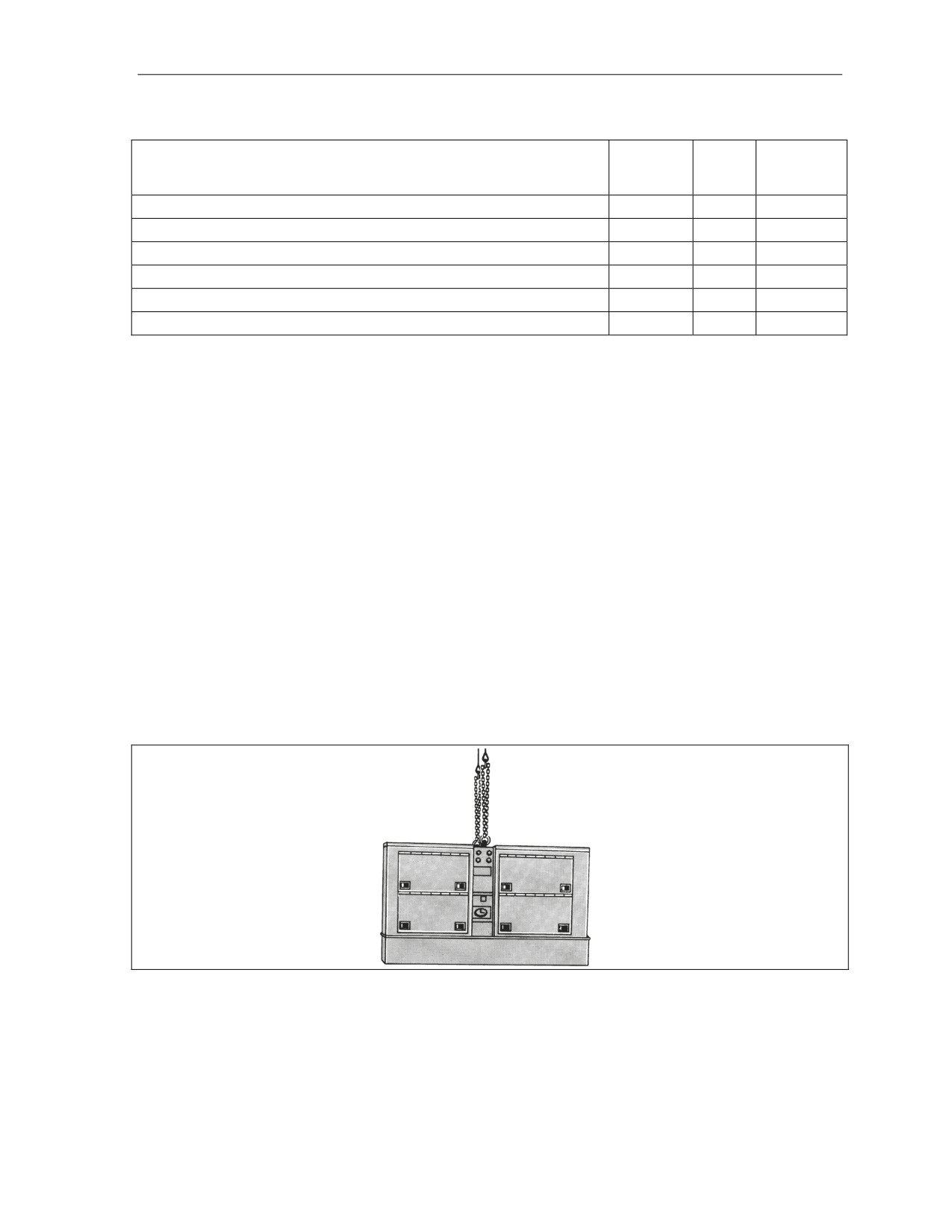
Rigging. Rig the load according to the steps in Figure 13-3.
Hookup. The hookup team stands on top of the load. The static wand person discharges
the static electricity with the static wand. The hookup person places the apex fitting onto the
aircraft cargo hook. The hookup team then moves clear of the load but remains close to the load
as the helicopter removes slack from the sling legs. When successful hookup is assured, the
hookup team quickly exits the area underneath the helicopter to the designated rendezvous
point.
Derigging. Derigging is the reverse of the preparation and rigging procedures.
Figure 13-3. Skid Mounted Generators
20 February 2009
FM 4-20.198/MCRP 4-11.3E, VOL II/NTTP 3-04.12/
AFMAN 11-223 (I), VOL II/COMDTINST M13482.3B
13-5
Chapter 13
RIGGING STEPS
1. Position apex fitting on top of the generator set. Route the left sling leg to the left lift provision
and the right sling leg to the right lift provision.
2. Loop the chain end of left sling leg through the left lift provision. Place the correct link from
Table 13-3 in the grab hook. Repeat with the right sling leg on the right lift provision.
3. Cluster and tie (breakaway technique) all sling legs together on top of the unit to prevent
entanglement during hookup and lift-off.
Figure 13-3. Skid Mounted Generators (Continued)
MEP112A GENERATOR PALLET
13-5. The MEP112A generator pallet is rigged for single-point sling load using the following procedures:
z
Applicability. The following items in Table 13-4 are certified for all helicopters with suitable
lift capacity by the US Army Natick Soldier Center:
Table 13-4. MEP112A Generator Pallet
Nomenclature
Max
Sling
Link Count
Weight
Set
Front/Rear
(Pounds)
MEP-813 TQG, Generator Pallet, Sentinel Radar System
1,600
10K
7/3
MEP-812A Generator Pallet
2,150
10K
7/3
z
Materials. The following materials are required to rig this load:
Sling set (10,000-pound capacity).
Tape, adhesive, pressure-sensitive, 2-inch wide roll.
Cord, nylon, Type III, 550-pound breaking strength.
Webbing, cotton, 1/4-inch, 80-pound breaking strength.
z
Personnel. Two persons can prepare and rig this load in 15 minutes.
z
Procedures. The following procedures apply to this load:
Preparation. Prepare the load using the following steps:
─ Secure all chains and hoses with tape or Type III nylon cord.
─ Secure all lids, doors, vents, and caps with tape or Type III nylon cord.
Rigging. Rig the load according to the steps in Figure 13-4.
Hookup. The hookup team stands on top of the load. The static wand person discharges
the static electricity with the static wand. The hookup person places the apex fitting onto the
aircraft cargo hook. The hookup team then moves clear of the load but remains close to the load
as the helicopter removes slack from the sling legs. When successful hookup is assured, the
hookup team quickly exits the area underneath the helicopter to the designated rendezvous
point.
Derigging. Derigging is the reverse of the preparation and rigging procedures.
FM 4-20.198/MCRP 4-11.3E, VOL II/NTTP 3-04.12/
13-6
AFMAN 11-223 (I), VOL II/COMDTINST M13482.3B
20 February 2009
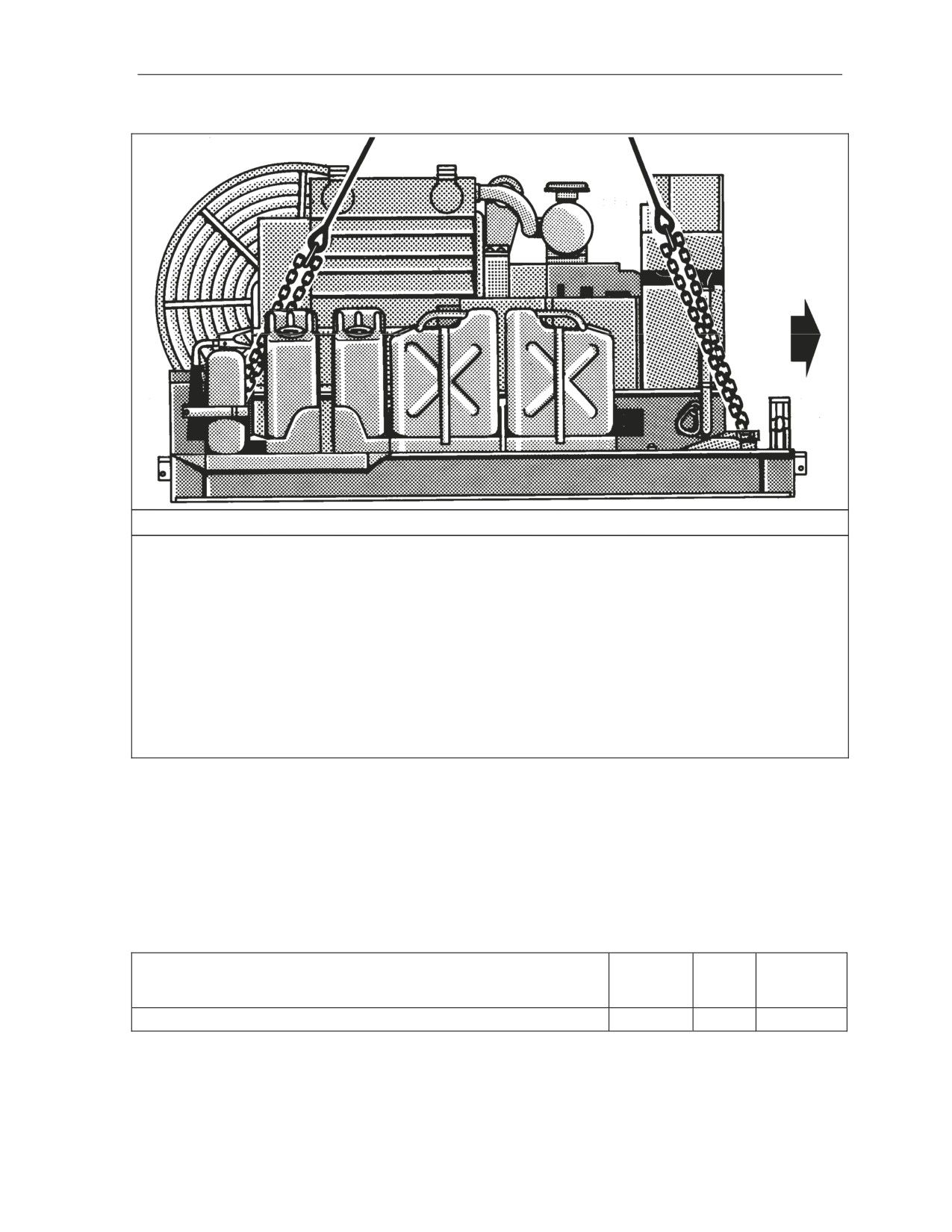
Certified Single-Point Rigging Procedures for Generator Sets
RIGGING STEPS
1. Position apex fitting on top of the generator set. Route outer sling legs 1 and 2 to the front of the pallet
and inner sling legs 3 and 4 to the rear. Sling legs 1 and 3 should be on the left side of the load.
2. Loop the chain end of sling leg 1 through the left front lift provision. Place the correct link from Table 13-
4 in the grab hook. Repeat with sling leg 2 on the right front lift ring.
3. Loop the chain end of sling leg 3 through the left rear lift provision. Place the correct link from Table
13-4 in the grab hook. Repeat with sling leg 4 on the right rear lift ring.
4. Cluster and tie (breakaway technique) all sling legs together on top of the unit to prevent entanglement
during hookup and lift-off.
Figure 13-4. MEP112A Generator Pallet
NATO AIR BASE SATCOM (NABS) POWER PALLET AN/TSC-85(V)2
13-6. The NATO air base satcom power pallet AN/TSC-85(V)2 is rigged for single-point sling load using
the following procedures:
z
Applicability. The following item in Table 13-5 is certified for all helicopters with suitable lift
capacity by the US Army Natick Soldier Center:
Table 13-5. NATO Air Base Satcom Power Pallet AN/TSC-85(V)2
Nomenclature
Max
Sling
Link Count
Weight
Set
Front/Rear
(Pounds)
NATO Air Base Satcom (NABS) Power Pallet AN/TSC-85 (V)2
8,630
10K
3/3
z
Materials. The following materials are required to rig this load:
Sling set (10,000-pound capacity).
Tape, adhesive, pressure-sensitive, 2-inch wide roll.
Cord, nylon, Type III, 550-pound breaking strength.
20 February 2009
FM 4-20.198/MCRP 4-11.3E, VOL II/NTTP 3-04.12/
AFMAN 11-223 (I), VOL II/COMDTINST M13482.3B
13-7
Chapter 13
Webbing, cotton, 1/4-inch, 80-pound breaking strength.
z
Personnel. Two persons can prepare and rig this load in 20 minutes.
z
Procedures. The following procedures apply to this load:
Preparation. Prepare the load using the following steps:
─ Secure all loose equipment and cables on the pallet with tape or Type III nylon cord.
─ Close and secure all access covers, vents, and doors. All exhaust covers must be taped.
─ Remove the cargo cover and store it on the prime mover.
Rigging. Rig the load according to the steps in Figure 13-5.
Note. The Required Individual Equipment (RIE) case is designated as the forward end for
rigging purposes.
Hookup. The hookup team stands on top of the load. The static wand person discharges
the static electricity with the static wand. The hookup person places the apex fitting onto the
aircraft cargo hook. The hookup team then moves clear of the load but remains close to the load
as the helicopter removes slack from the sling legs. When successful hookup is assured, the
hookup team quickly exits the area underneath the helicopter to the designated rendezvous
point.
CAUTION
Brief the pilot to relax sling tension and hover to the side of the load
when releasing the apex fitting to prevent damage to the pallet.
Derigging. Derigging is the reverse of the preparation and rigging procedures.
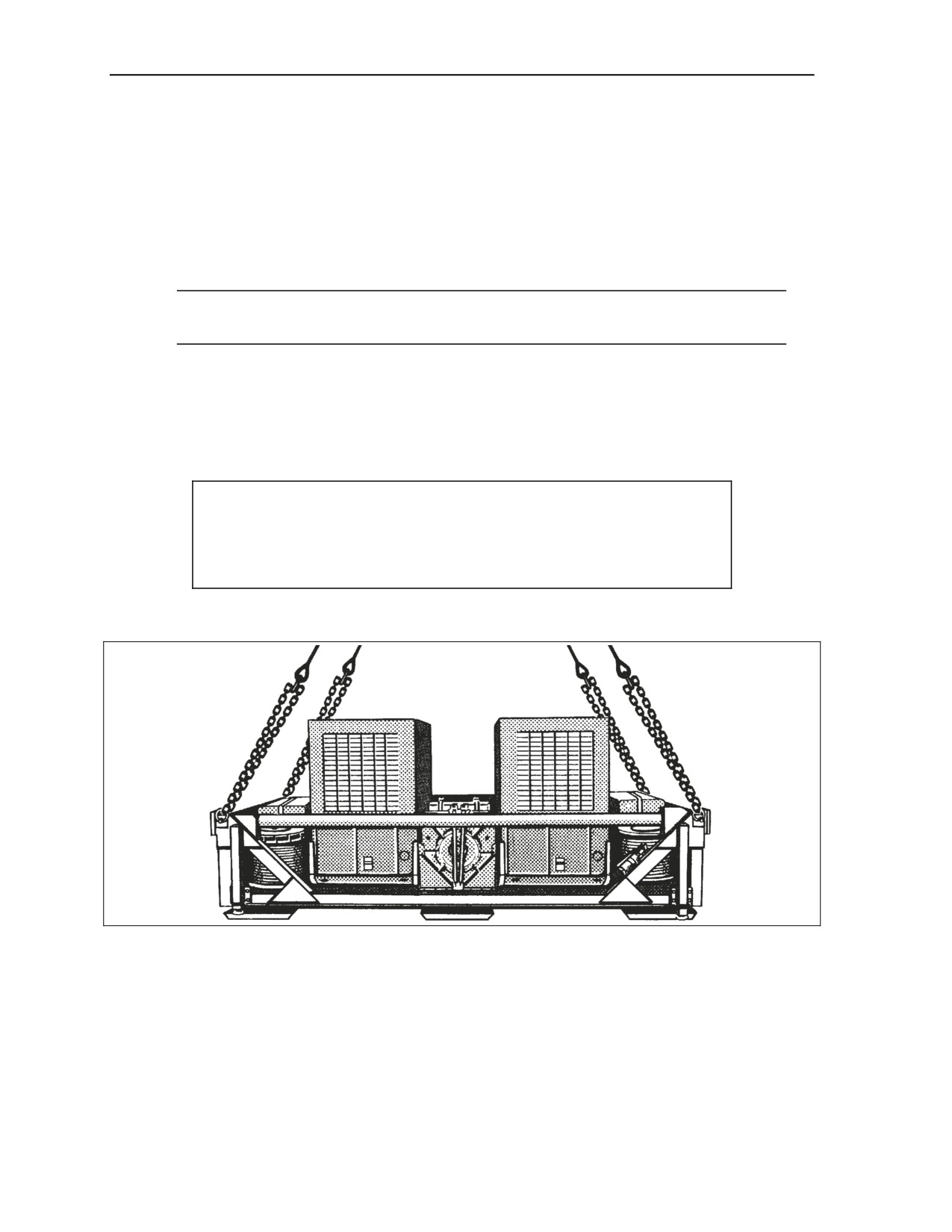
Figure 13-5. NATO Air Base Satcom Power Pallet AN/TSC-85(V)2
FM 4-20.198/MCRP 4-11.3E, VOL II/NTTP 3-04.12/
13-8
AFMAN 11-223 (I), VOL II/COMDTINST M13482.3B
20 February 2009

Certified Single-Point Rigging Procedures for Generator Sets
RIGGING STEPS
1. Position apex fitting on top of the generators. Route outer sling legs 1 and 2 to the front of
the pallet and inner sling legs 3 and 4 to the rear. Sling legs 1 and 3 should be on the left
side of the load.
Note. Do not use the lift provisions on the generators.
2. Loop the chain end of sling leg 1 through the left front lift provision located on the pallet.
Place the correct link from Table 13-5 in the grab hook. Repeat with sling leg 2 on the right
front lift ring.
3. Loop the chain end of sling leg 3 through the left rear lift provision. Place the correct link from
Table 13-5 in the grab hook. Repeat with sling leg 4 on the right rear lift ring.
4. Cluster and tie (breakaway technique) all sling legs together on top of the unit to prevent
entanglement during hookup and lift-off.
Figure 13-5. NATO Air Base Satcom Power Pallet AN/TSC-85(V)2 (Continued)
SKID MOUNTED TACTICAL QUIET GENERATOR SETS
13-7. The skid mounted tactical quiet generator sets are rigged for single-point sling load using the
following procedures:
z
Applicability. The following items in Table 13-6 are certified for all helicopters with suitable
lift capacity by the US Army Natick Soldier Center:
Table 13-6. Skid Mounted Tactical Quiet Generator Sets
Nomenclature
Max
Sling
Link Count
Weight
Set
Front/Rear
(Pounds)
MEP831, 3KW, 60HZ Generator Set
325
10K
3/3
MEP802A, 5KW, 60HZ Generator Set
890
10K
3/3
MEP812A, 5KW, 400HZ Generator Set
900
10K
3/3
MEP803A, 10KW, 60HZ Generator Set
1,180
10K
3/3
MEP813A, 10KW, 400HZ Generator Set
1,280
10K
3/3
MEP804A, 15KW, 50/60HZ Generator Set
2,125
10K
3/3
MEP814A, 15KW, 50/60HZ Generator Set
2,240
10K
3/3
MEP805A, 30KW, 50/60HZ Generator Set
3,005
10K
3/3
MEP805B, 30KW, 50/60HZ Generator Set
3,040
10K
3/3
MEP815A, 30KW, 400HZ Generator Set
3,015
10K
3/3
MEP815B, 30KW, 400HZ Generator Set
3,060
10K
3/3
MEP806A, 60KW, 50/60HZ Generator Set
3,760
10K
3/3
MEP806B, 60KW, 50/60HZ Generator Set
4,042
10K
3/3
MEP816A, 60KW, 400HZ Generator Set
3,850
10K
3/3
MEP816B, 60KW, 400HZ Generator Set
4,240
10K
3/3
z
Materials. The following materials are required to rig this load:
Sling set (10,000-pound capacity).
20 February 2009
FM 4-20.198/MCRP 4-11.3E, VOL II/NTTP 3-04.12/
AFMAN 11-223 (I), VOL II/COMDTINST M13482.3B
13-9
Chapter 13
Tape, adhesive, pressure-sensitive, 2-inch wide roll.
Cord, nylon, Type III, 550-pound breaking strength.
Webbing, cotton, 1/4-inch, 80-pound breaking strength.
Felt sheet, cattle hair, Type IV, 1/2-inch or suitable substitute.
z
Personnel. Two persons can prepare and rig this load in 20 minutes.
z
Procedures. The following procedures apply to this load:
Preparation. Prepare the load using the following steps:
─ Close, lock, and secure all doors and panels with tape.
─ Close and secure the exhaust cover with tape.
─ Close vents on the fuel cap.
Rigging. Rig the load according to the steps in Figure 13-6.
Hookup. The hookup team stands on top of the load. The static wand person discharges
the static electricity with the static wand. The hookup person places the apex fitting onto the
aircraft cargo hook. The hookup team then moves clear of the load but remains close to the load
as the helicopter removes slack from the sling legs. When successful hookup is assured, the
hookup team quickly exits the area underneath the helicopter to the designated rendezvous
point.
Derigging. Derigging is the reverse of the preparation and rigging procedures.
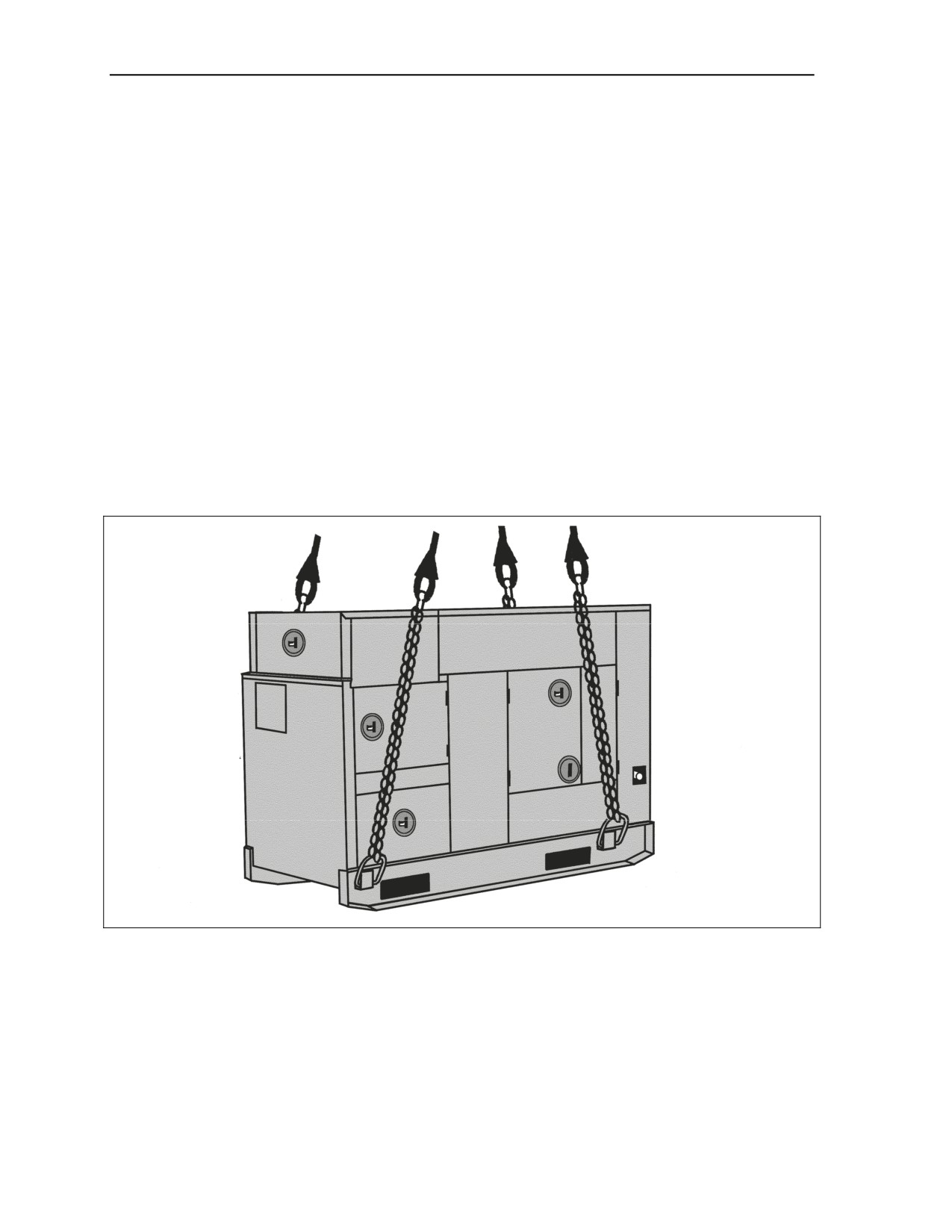
Figure 13-6. Skid Mounted Tactical Quiet Generator Sets
FM 4-20.198/MCRP 4-11.3E, VOL II/NTTP 3-04.12/
13-10
AFMAN 11-223 (I), VOL II/COMDTINST M13482.3B
20 February 2009
Certified Single-Point Rigging Procedures for Generator Sets
RIGGING STEPS
1. Position apex fitting on top of the generator. Route outer sling legs 1 and 2 to the front of the
generator and inner sling legs 3 and 4 to the rear. Sling legs 1 and 3 should be on the left
side of the load.
2. Loop the chain end of sling leg 1 through the left front lift provision located at the front of the
generator inside of the left skid. Place the correct link from Table 13-6 in the grab hook.
Repeat with sling leg 2 on the right front lift provision.
3. Loop the chain end of sling leg 3 through the left rear lift provision located at the rear of the
generator and inside the skid. Place the correct link from Table 13-6 in the grab hook.
Repeat with sling leg 4 on the right rear lift provision.
4. Secure the lift provision in the up position with tape and pad the slings where they contact the
generator.
5.
Cluster and tie (breakaway technique) all sling legs together on top of the unit to prevent
entanglement during hookup and lift-off.
Figure 13-6. Skid Mounted Tactical Quiet Generator Sets (Continued)
20 February 2009
FM 4-20.198/MCRP 4-11.3E, VOL II/NTTP 3-04.12/
AFMAN 11-223 (I), VOL II/COMDTINST M13482.3B
13-11
This page intentionally left blank.
Chapter 14
Certified Single-Point Rigging Procedures for
Miscellaneous Equipment
INTRODUCTION
14-1. This chapter contains rigging procedures for single-point lift of miscellaneous equipment that have
been certified for sling load. Each rigging procedure is found in a paragraph that includes a description of
the load, materials required for rigging, and steps to complete the procedure. An applicability paragraph is
also a part of each paragraph and identifies the certified loads. The certified single-point rigging
procedures for miscellaneous equipment are in this section. Paragraphs 14-2 through 14-9 give detailed
instructions for rigging loads.
Note. Reach Pendants may be used on all single point loads. A static discharge person is not
required when using a Reach Pendant.
FORWARD AREA REFUELING EQUIPMENT (FARE)
14-2. The forward area refueling equipment is rigged for single-point sling load using the following
procedures:
z
Applicability. The following item in Table 14-1 is certified for all helicopters with suitable lift
capacity by the US Army Natick Soldier Center:
Table 14-1. Forward Area Refueling Equipment
Nomenclature
Max
Sling Set
Link Count
Weight
Front/Rear
(Pounds)
Generator, 1.5KW, Fuel Hoses with Reels and Carrying Bags
820
5K Cargo
N/A
(2 each), Assembly Pump, Fire extinguishers (3 each)
Net
z
Materials. The following materials are required to rig this load:
Net, cargo (5,000-pound capacity).
Tape, adhesive, pressure-sensitive, 2-inch wide roll.
Cord, nylon, Type III, 550-pound breaking strength.
Webbing, cotton, 1/4-inch, 80-pound breaking strength.
Tie-down strap, cargo, CGU-1/B (4 each).
Webbing, nylon, tubular, 1/2-inch, 1,000-pound breaking strength.
z
Personnel. Two persons can prepare and rig this load in 15 minutes.
z
Procedures. The following procedures apply to this load:
Preparation. Prepare the load using the following steps:
─ Secure the two fire extinguishers to the inside frame of the fuel hose reels with 1/2-inch
tubular nylon webbing. Secure the two fuel hose reels together with Type III nylon
cord.
─ Spread a 5,000-pound capacity cargo net on the ground. Center the two fuel hose reels
on the net. Place the pump assembly on either side of the reels. Place the 1.5KW
20 February 2009
FM 4-20.198/MCRP 4-11.3E, VOL II/NTTP 3-04.12/
AFMAN 11-223 (I), VOL II/COMDTINST M13482.3B
14-1
Chapter 14
generator, with 5-gallon gas can attached, on the opposite side of the reels. Place fuel
hose carrying bags in front of the reels. Secure the two carrying bags with the
remaining fire extinguisher together with nylon cord. Secure the carrying bag to the
reels.
Rigging. Rig the load according to the steps in Figure 14-1.
Hookup. The hookup team stands alongside the load. The static wand person discharges
the static electricity with the static wand. The hookup person places the apex fitting onto the
aircraft cargo hook. The hookup team then moves clear of the load but remains close to the load
as the helicopter removes slack from the sling legs. When successful hookup is assured, the
hookup team quickly exits the area underneath the helicopter to the designated rendezvous
point.
Derigging. Derigging is the reverse of the preparation and rigging procedures.
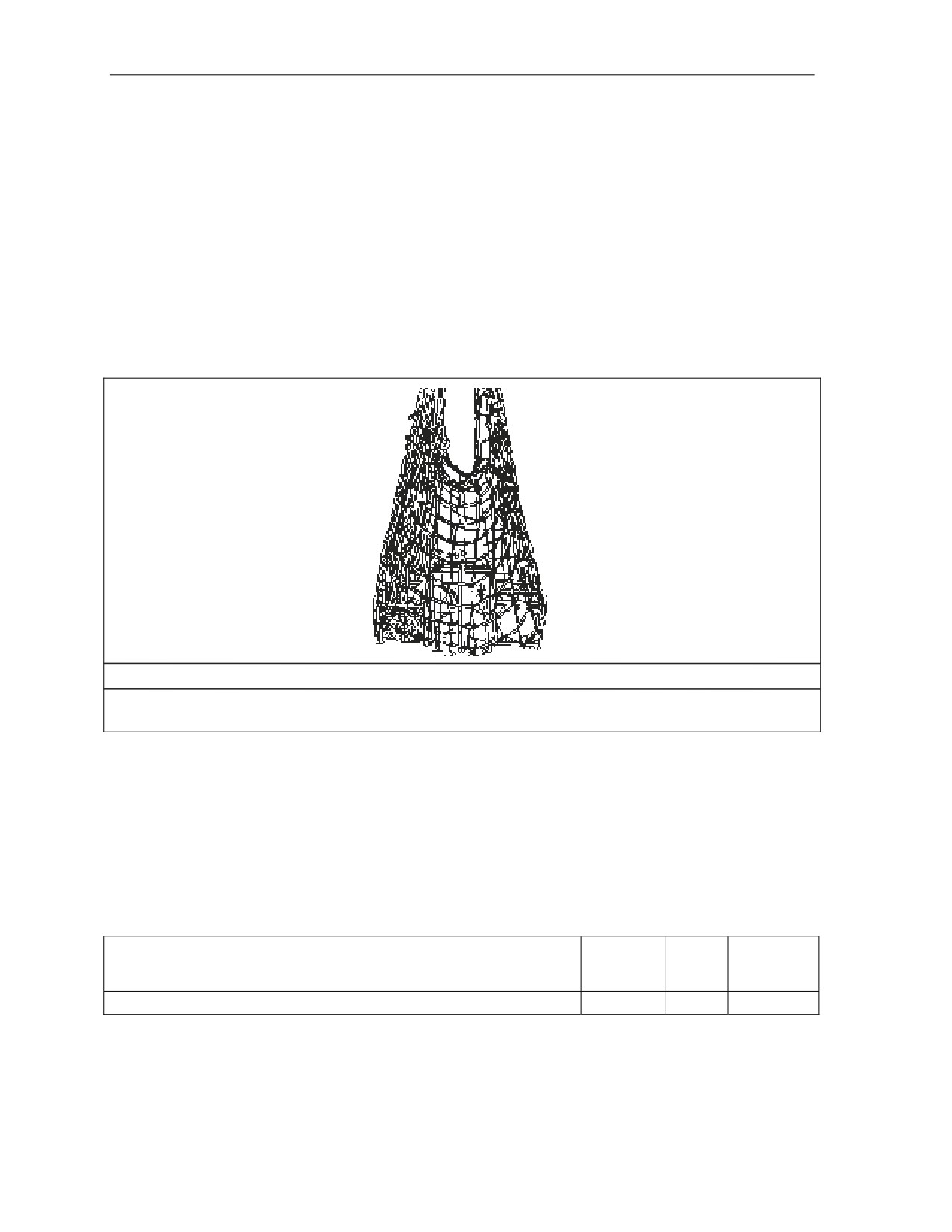
RIGGING STEPS
Inspect, prepare and rig the net in accordance with FM 4-20.197.
Figure 14-1. Forward Area Refueling Equipment
FIRE EXTINGUISHER, DRY CHEMICAL
14-3. The fire extinguisher, dry chemical is rigged for single-point sling load using the following
procedures:
z
Applicability. The following item in Table 14-2 is certified for all helicopters with suitable lift
capacity by the US Army Natick Soldier Center:
Table 14-2. Fire Extinguisher, Dry Chemical
Nomenclature
Max
Sling
Link Count
Weight
Set
Front/Rear
(Pounds)
Fire Extinguisher, Dry Chemical, Self Contained, TAMCN C4765
3000
15K
5/5
FM 4-20.198/MCRP 4-11.3E, VOL II/NTTP 3-04.12/
14-2
AFMAN 11-223 (I), VOL II/COMDTINST M13482.3B
20 February 2009
Certified Single-Point Rigging Procedures for Miscellaneous Equipment
z
Materials. The following materials are required to rig this load:
Sling set (15,000-pound capacity).
Tape, adhesive, pressure-sensitive, 2-inch wide roll.
Cord, nylon, Type III, 550-pound breaking strength.
Webbing, cotton, 1/4-inch, 80-pound breaking strength.
z
Personnel. Two persons can prepare and rig this load in 10 minutes.
z
Procedures. The following procedures apply to this load:
Preparation. Prepare the load using the following steps:
─ Tie hose reel and nozzle to the frame with Type III nylon cord.
─ Secure or remove all loose attachments. Tape all glass including the gages.
Rigging. Rig the load according to the steps in Figure 14-2.
Hookup. The hookup team stands alongside the load. The static wand person discharges
the static electricity with the static wand. The hookup person places the apex fitting onto the
aircraft cargo hook. The hookup team then moves clear of the load but remains close to the load
as the helicopter removes slack from the sling legs. When successful hookup is assured, the
hookup team quickly exits the area underneath the helicopter to the designated rendezvous
point.
Derigging. Derigging is the reverse of the preparation and rigging procedures.
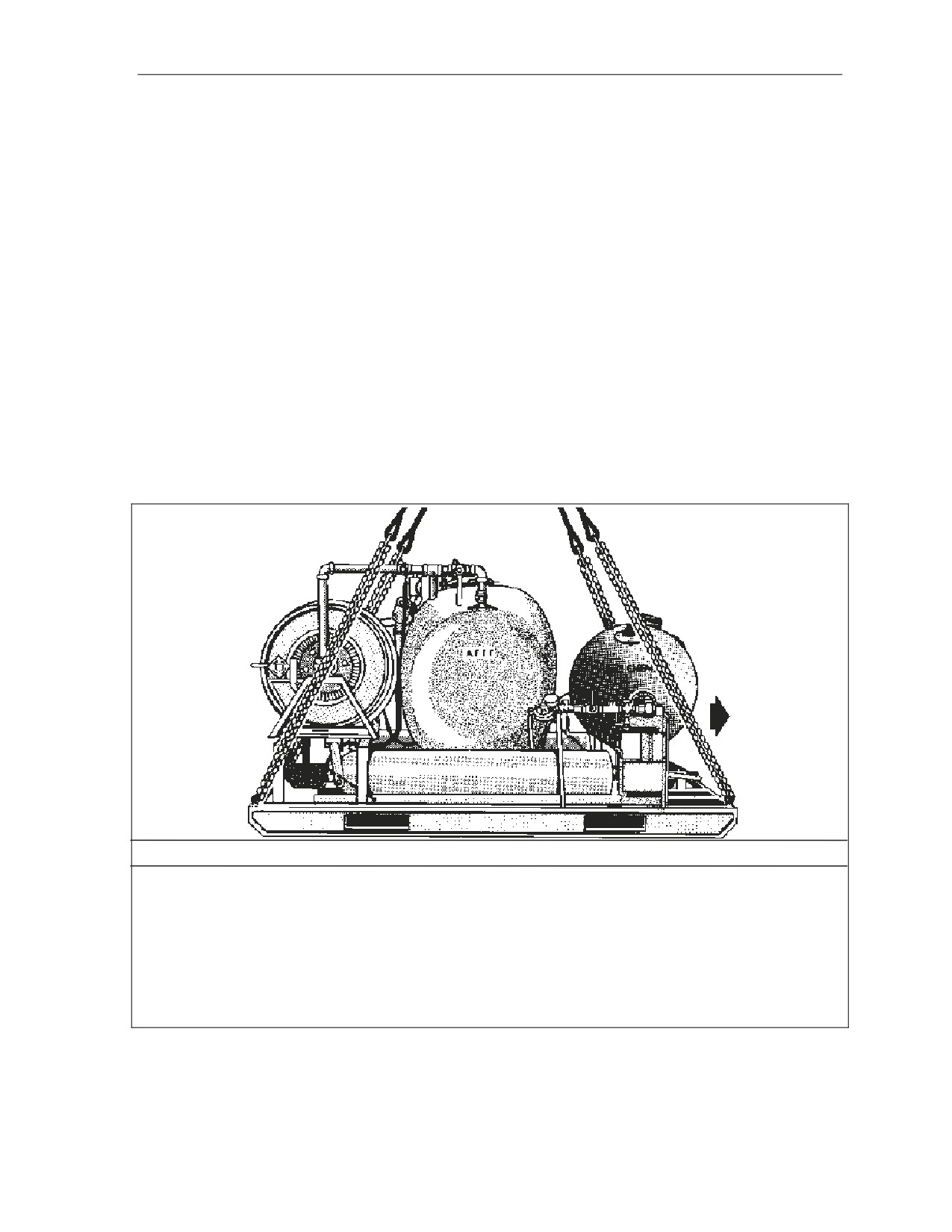
RIGGING STEPS
1. Position apex fitting/web ring on top of the fire extinguisher. Route outer sling legs 1 and 2 to
the front of the fire extinguisher and inner sling legs 3 and 4 to the rear end (hose reel). Sling
legs 1 and 3 must be on the left side of the load.
2. Loop the chain end of sling leg 1 through the left front lift provision located at the top corner
of the frame near the pressure vessel. Place the correct link from Table 14-2 in the grab
hook. Repeat with sling leg 2 and the right front lift provision.
Figure 14-2. Fire Extinguisher, Dry Chemical
20 February 2009
FM 4-20.198/MCRP 4-11.3E, VOL II/NTTP 3-04.12/
AFMAN 11-223 (I), VOL II/COMDTINST M13482.3B
14-3
Chapter 14
RIGGING STEPS (Continued)
3. Loop the chain end of sling leg 3 through the left rear lift provision located at the top corner of
the frame near the hose reel. Place the correct link from Table 14-2 in the grab hook.
Repeat with sling leg 4 and the right rear lift provision.
4. Cluster and tie (breakaway technique) all sling legs together on top of the fire extinguisher to
prevent entanglement during hookup and lift-off. Pay close attention to the pipes and valves.
Figure 14-2. Fire Extinguisher, Dry Chemical (Continued)
RIGID RAIDING CRAFT
14-4. The rigid raiding craft is rigged for single-point sling load using the following procedures:
z
Applicability. The following item in Table 14-3 is certified for all helicopters with suitable lift
capacity by the US Army Natick Soldier Center:
Table 14-3. Rigid Raiding Craft
Nomenclature
Max
Sling
Link Count
Weight
Set
Front/Rear
(Pounds)
Rigid Raiding Craft
3,200
40K
5/10
z
Materials. The following materials are required to rig this load:
Sling set (40,000-pound capacity).
Tape, adhesive, pressure-sensitive, 2-inch wide roll.
Cord, nylon, Type III, 550-pound breaking strength.
Webbing, cotton, 1/4-inch, 80-pound breaking strength.
z
Personnel. Two persons can prepare and rig this load in 15 minutes.
z
Procedures. The following procedures apply to this load:
Preparation. Prepare the load using the following steps:
─ Tighten all straps on the anchor, paddles, cushions, and loose equipment.
─ Stow the boat utility bags in the console. Remove the anchor chain and line and stow in
the console. Protect the battery from the chain.
─ Secure the console hatch with tape. Secure the anchor to the deck and secure the loose
end of the anchor.
─ Secure the running lights to an inner handrail with tape or Type III nylon cord.
─ Secure the base of the outboard motors tightly to the bar directly above with Type III
nylon cord.
─ Tape the compass glass on top of the console.
Rigging. Rig the load according to the steps in Figure 14-3.
Hookup. The hookup team stands alongside the load. The static wand person discharges
the static electricity with the static wand. The hookup person places the apex fitting onto the
aircraft cargo hook. The hookup team then moves clear of the load but remains close to the load
as the helicopter removes slack from the sling legs. When successful hookup is assured, the
hookup team quickly exits the area underneath the helicopter to the designated rendezvous
point.
Derigging. Derigging is the reverse of the preparation and rigging procedures.
FM 4-20.198/MCRP 4-11.3E, VOL II/NTTP 3-04.12/
14-4
AFMAN 11-223 (I), VOL II/COMDTINST M13482.3B
20 February 2009
Certified Single-Point Rigging Procedures for Miscellaneous Equipment
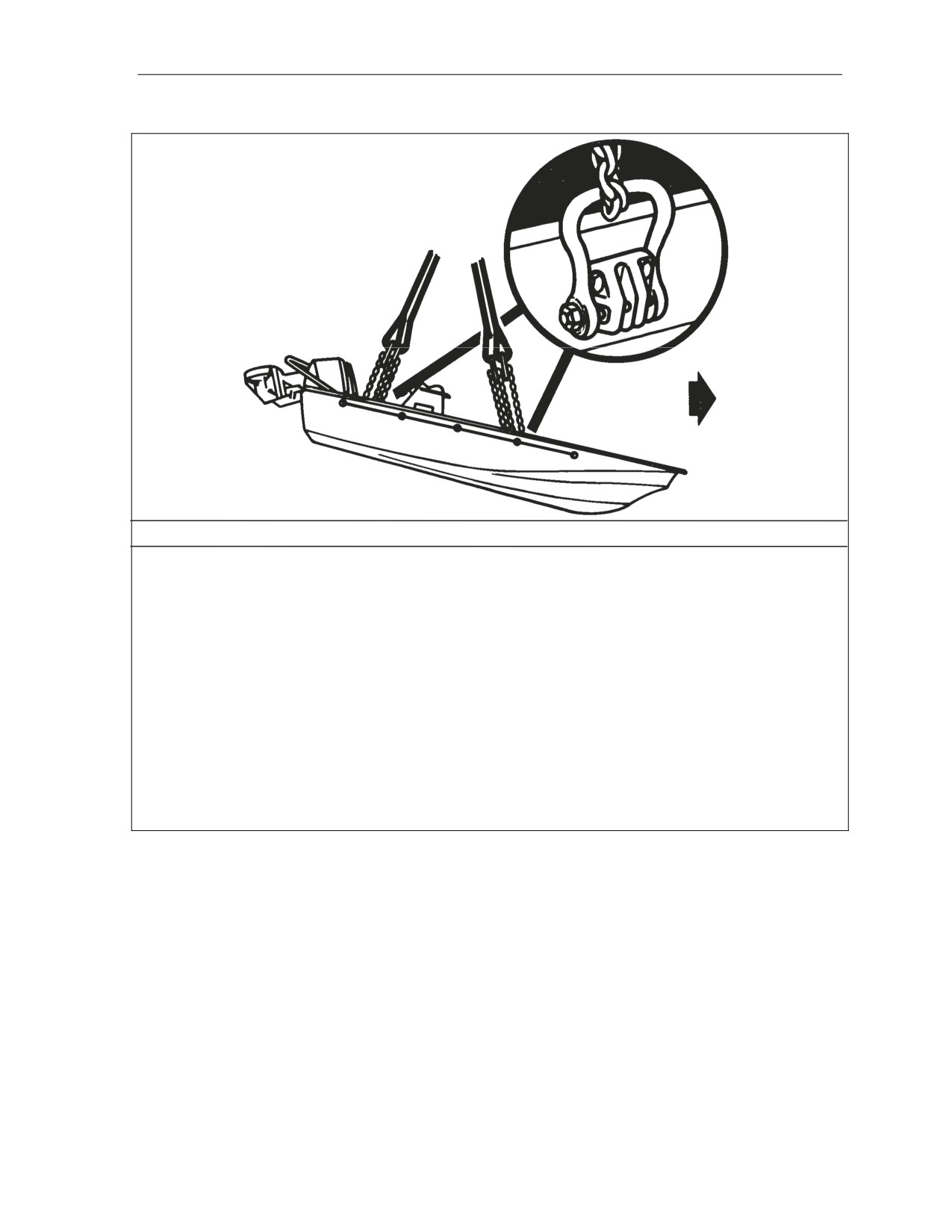
RIGGING STEPS
1. Position apex fitting on top of the boat. Route outer sling legs 1 and 2 to the front (bow end)
of the boat and inner sling legs 3 and 4 to the rear end. Sling legs 1 and 3 must be on the left
side of the load.
2. Loop the chain end of sling leg 1 through the left front lift ring located on the inside of the hull.
Place the correct link from Table 14-3 in the grab hook. Repeat with sling leg 2 and the right
front lift provision.
3. Loop the chain end of sling leg 3 through the left rear lift ring located on the inside of the hull.
Place the correct link from Table 14-3 in the grab hook. Repeat with sling leg 4 and the right
rear lift provision.
4. Cluster and tie (breakaway technique) all sling legs together on top of the boat to prevent
entanglement during hookup and lift-off.
Figure 14-3. Rigid Raiding Craft
2.75-INCH ROCKET FASTPACK PALLET
14-5. The 2.75-inch rocket fastpack pallet is rigged for single-point sling load using the following
procedures:
z
Applicability. The Following items in Table 14-4 are certified for all helicopters with suitable
lift capacity by the US Army Natick Soldier Center:
20 February 2009
FM 4-20.198/MCRP 4-11.3E, VOL II/NTTP 3-04.12/
AFMAN 11-223 (I), VOL II/COMDTINST M13482.3B
14-5
Chapter 14
Table 14-4. 2.75-inch Rocket Fastpack Pallet
Nomenclature
Max
Sling
Link Count
Weight
Set
Front/Rear
(Pounds)
PA 150 Pallet with Twelve (12) 2.75-inch Rockets
2,200
10K
3/3
PA 151 Pallet with Twelve (12) 2.75-inch Rockets
2,000
10K
3/3
z
Materials. The following materials are required to rig this load:
Sling set (10,000-pound capacity).
Tape, adhesive, pressure-sensitive, 2-inch wide roll.
Cord, nylon, Type III, 550-pound breaking strength.
Webbing, cotton, 1/4-inch, 80-pound breaking strength.
z
Personnel. Two persons can prepare and rig this load in 10 minutes.
z
Procedures. The following procedures apply to this load:
Preparation. Prepare the load using the following steps:
─ Close the safety latches on the lids of the rocket containers. Secure the lids with Type III
nylon cord.
─ Secure the loose ends of any cables, bands, or chains with tape or Type III nylon cord.
─ Ensure the 1-1/4-inch steel banding around the pallet is in serviceable condition and the
containers are locked together.
─ Tape the upper corners of the pallet from the top to the second row of rockets.
Rigging. Rig the load according to the steps in Figure 14-4.
Hookup. The hookup team stands alongside the load. The static wand person discharges
the static electricity with the static wand. The hookup person places the apex fitting onto the
aircraft cargo hook. The hookup team then moves clear of the load but remains close to the load
as the helicopter removes slack from the sling legs. When successful hookup is assured, the
hookup team quickly exits the area underneath the helicopter to the designated rendezvous
point.
Derigging. Derigging is the reverse of the preparation and rigging procedures.
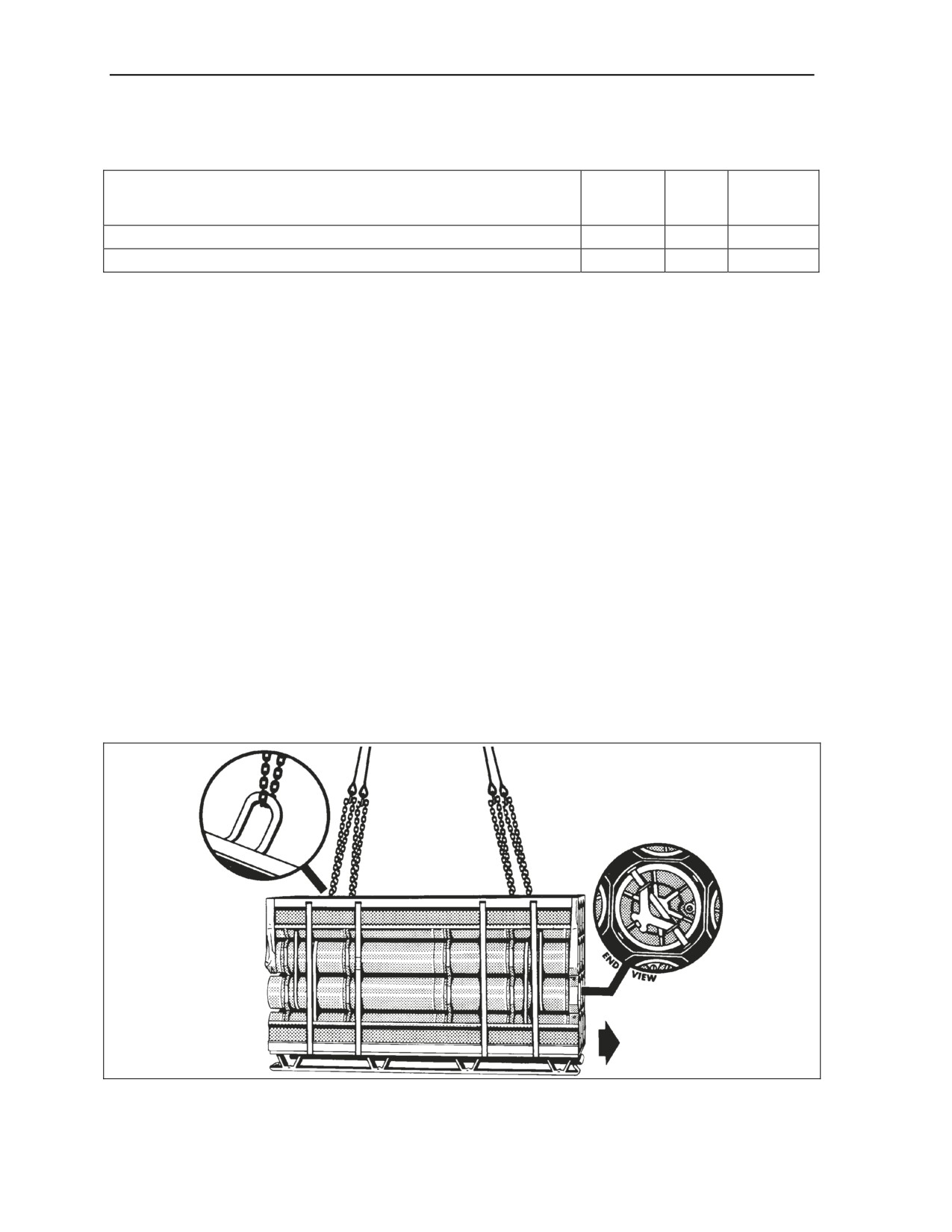
Figure 14-4. 2.75-inch Rocket Fastpack Pallet
FM 4-20.198/MCRP 4-11.3E, VOL II/NTTP 3-04.12/
14-6
AFMAN 11-223 (I), VOL II/COMDTINST M13482.3B
20 February 2009

Certified Single-Point Rigging Procedures for Miscellaneous Equipment
RIGGING STEPS
1. Position apex fitting on top of the pallet. Route outer sling legs 1 and 2 to the front of the
pallet and inner sling legs 3 and 4 to the rear end. Sling legs 1 and 3 must be on the left side
of the load.
2. Loop the chain end of sling leg 1 through the left front lift provision. Place the correct link
from Table 14-4 in the grab hook. Repeat with sling leg 2 and the right front lift provision.
3. Loop the chain end of sling leg 3 through the left rear lift provision. Place the correct link
from Table 14-4 in the grab hook. Repeat with sling leg 4 and the right rear lift provision.
4. Cluster and tie (breakaway technique) all sling legs together on top of the pallet to prevent
entanglement during hookup and lift-off.
Figure 14-4. 2.75-inch Rocket Fastpack Pallet (Continued)
SPECIAL DIVERS AIR SUPPORT SYSTEM (SDASS)
14-6. The special divers air support system is rigged for single-point sling load using the following
procedures:
z
Applicability. The following items in Table 14-5 are certified for all helicopters with suitable
lift capacity by the US Army Natick Soldier Center:
Table 14-5. Special Divers Air Support System
Nomenclature
Max
Sling Set
Link Count
Weight
Front/Rear
(Pounds)
Four SDASS Racks with Two Empty Air Cylinders each in a
1,800
10K Cargo
N/A
2 X 2 Configuration
Net
z
Materials. The following materials are required to rig this load:
Net, cargo (10,000-pound capacity).
Tape, adhesive, pressure-sensitive, 2-inch wide roll.
Cord, nylon, Type III, 550-pound breaking strength.
Webbing, cotton, 1/4-inch, 80-pound breaking strength.
Tie-down strap, cargo, CGU-1/B (4 each).
Dunnage material.
Plywood 44 X 75 X 1/2-inch (2 each).
z
Personnel. Two persons can prepare and rig this load in 20 minutes.
z
Procedures. The following procedures apply to this load:
Preparation. Prepare the load using the following steps:
─ Inspect the cargo net in accordance with FM 4-20.197.
─ Prepare the plywood sheets and the dunnage.
Rigging. Rig the load according to the steps in Figure 14-5.
Hookup. The hookup team stands alongside the load. The static wand person discharges
the static electricity with the static wand. The hookup person places the apex fitting onto the
aircraft cargo hook. The hookup team then moves clear of the load but remains close to the load
as the helicopter removes slack from the sling legs. When successful hookup is assured, the
20 February 2009
FM 4-20.198/MCRP 4-11.3E, VOL II/NTTP 3-04.12/
AFMAN 11-223 (I), VOL II/COMDTINST M13482.3B
14-7
Chapter 14
hookup team quickly exits the area underneath the helicopter to the designated rendezvous
point.
Derigging. Derigging is the reverse of the preparation and rigging procedures.
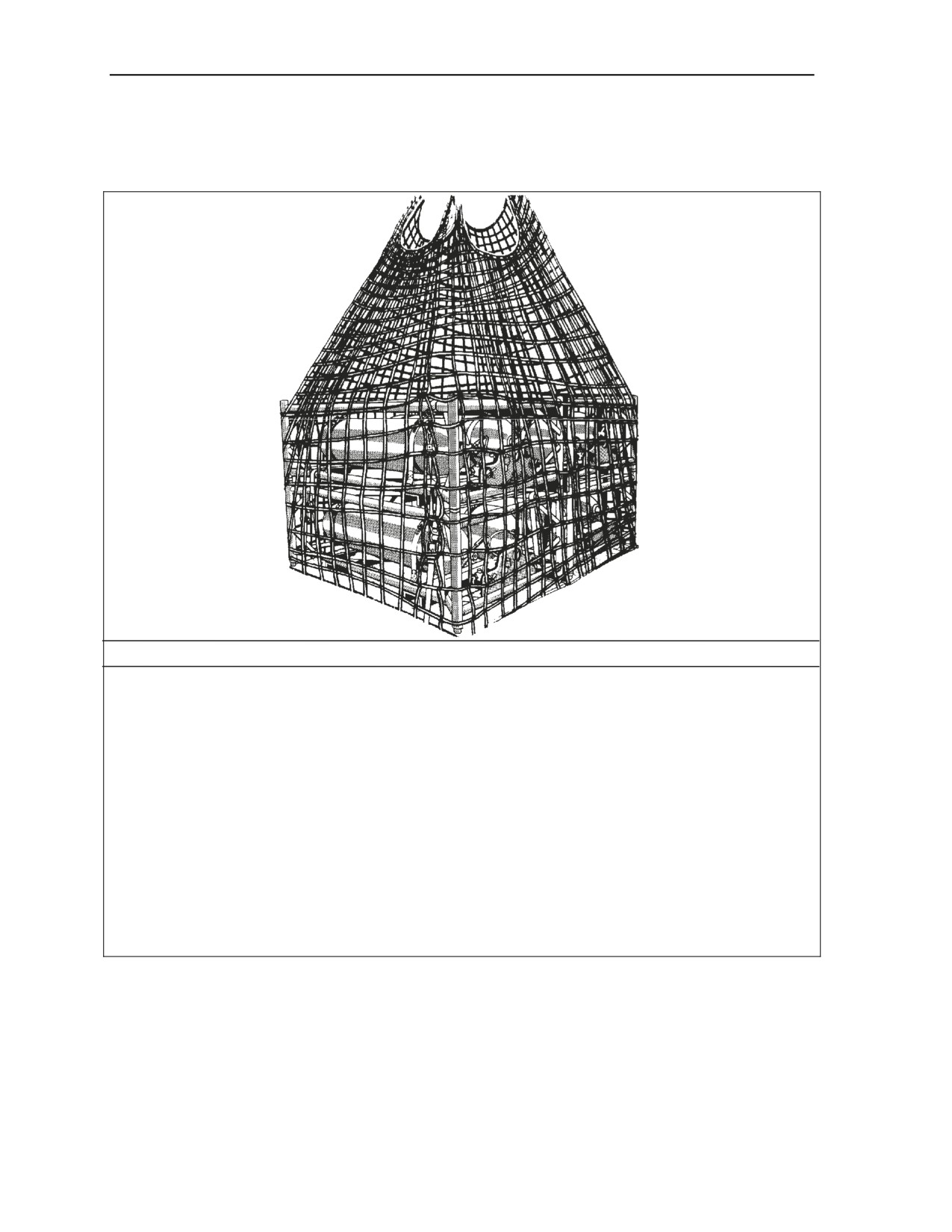
RIGGING STEPS
1. Spread the cargo net on the ground.
2. Position the bottom two racks on the plywood sheets. Secure each rack to the plywood using
CGU-1/B tie-down straps.
3. Place the remaining two racks on top of the bottom racks, fitting together the feet at each of
the five junction points.
4. Insert dunnage between the two stacks of racks and secure the dunnage to the stacks with
Type III nylon cord.
5. Route two CGU-1/B tie-down straps around the lower bottom racks and two CGU-1B tie-
down straps around the upper racks.
6. Rig the net in accordance with FM 4-20.197.
Figure 14-5. Special Divers Air Support System
TWO MOBILE OVERSNOW TRANSPORT (MOST) SNOWMOBILES
WITH OR WITHOUT TWO SLEDS
14-7. The two mobile oversnow transport snowmobiles with or without two sleds are rigged for single-
point sling load using the following procedures:
FM 4-20.198/MCRP 4-11.3E, VOL II/NTTP 3-04.12/
14-8
AFMAN 11-223 (I), VOL II/COMDTINST M13482.3B
20 February 2009
Certified Single-Point Rigging Procedures for Miscellaneous Equipment
z
Applicability. The following items in Table 14-6 are certified for all helicopters with suitable
lift capacity by the US Army Natick Soldier Center:
Table 14-6. Two Mobile Oversnow Transport Snowmobiles with or without Two Sleds
Nomenclature
Max
Sling Set
Link Count
Weight
Front/Rear
(Pounds)
Polaris Indy Wide-Track Snowmobile
638 each
10K Cargo
N/A
Net
Norwegian Pulk Sled, Model BN 2010C
381 each
10K Cargo
N/A
Net
z
Materials. The following materials are required to rig this load:
Net, cargo (10,000-pound capacity) (2 each).
One sling leg from a sling set (10,000-pound capacity).
Cord, nylon, Type III, 550-pound breaking strength.
Webbing, cotton, 1/4-inch, 80-pound breaking strength.
Tape, adhesive, pressure-sensitive, 2-inch wide roll.
Felt sheet, cattle hair, Type IV, 1/2-inch or suitable substitute.
Pad, energy dissipating, honeycomb (2 sheets).
z
Personnel. Eight persons can prepare and rig this load in 10 minutes. The large number of
personnel is required to lift and position the MOST.
z
Procedures. The following procedures apply to this load:
Preparation. Prepare the load using the following steps:
─ Inspect the cargo net in accordance with FM 4-20.197.
─ Position the two MOSTs on level ground.
─ Secure the canvas cargo cover over the sled.
─ Secure the fuel cap on the MOST with tape.
─ Remove the snap-off wind screen from the MOST, pad it with felt, and secure it over the
seat with Type III nylon cord.
Rigging. Rig the load according to the steps in Figure 14-6.
Hookup. The hookup team consists of four people. The hookup team stands alongside the
load. The static wand person discharges the static electricity with the static wand. One hookup
person places the apex fitting onto the aircraft cargo hook. The other two people kneel, one on
each side of the load, to ensure the net does not catch on the handle bars, tie-down points, or
trailer hitch as the load is lifted. As the first net is lifted off the ground, after successful hookup
is assured, the hookup team quickly exits the area underneath the helicopter to the designated
rendezvous point. This will ensure the hookup team is not struck by the second cargo net as it is
being lifted off the ground.
Note. Brief the pilot to hover to the side after the sleds are on the ground to lower the MOSTs
to the ground. Once the MOSTs are on the ground, the pilot must hover to the side before
releasing the apex fitting.
Derigging. Derigging is the reverse of the preparation and rigging procedures.
20 February 2009
FM 4-20.198/MCRP 4-11.3E, VOL II/NTTP 3-04.12/
AFMAN 11-223 (I), VOL II/COMDTINST M13482.3B
14-9
Chapter 14
RIGGING STEPS
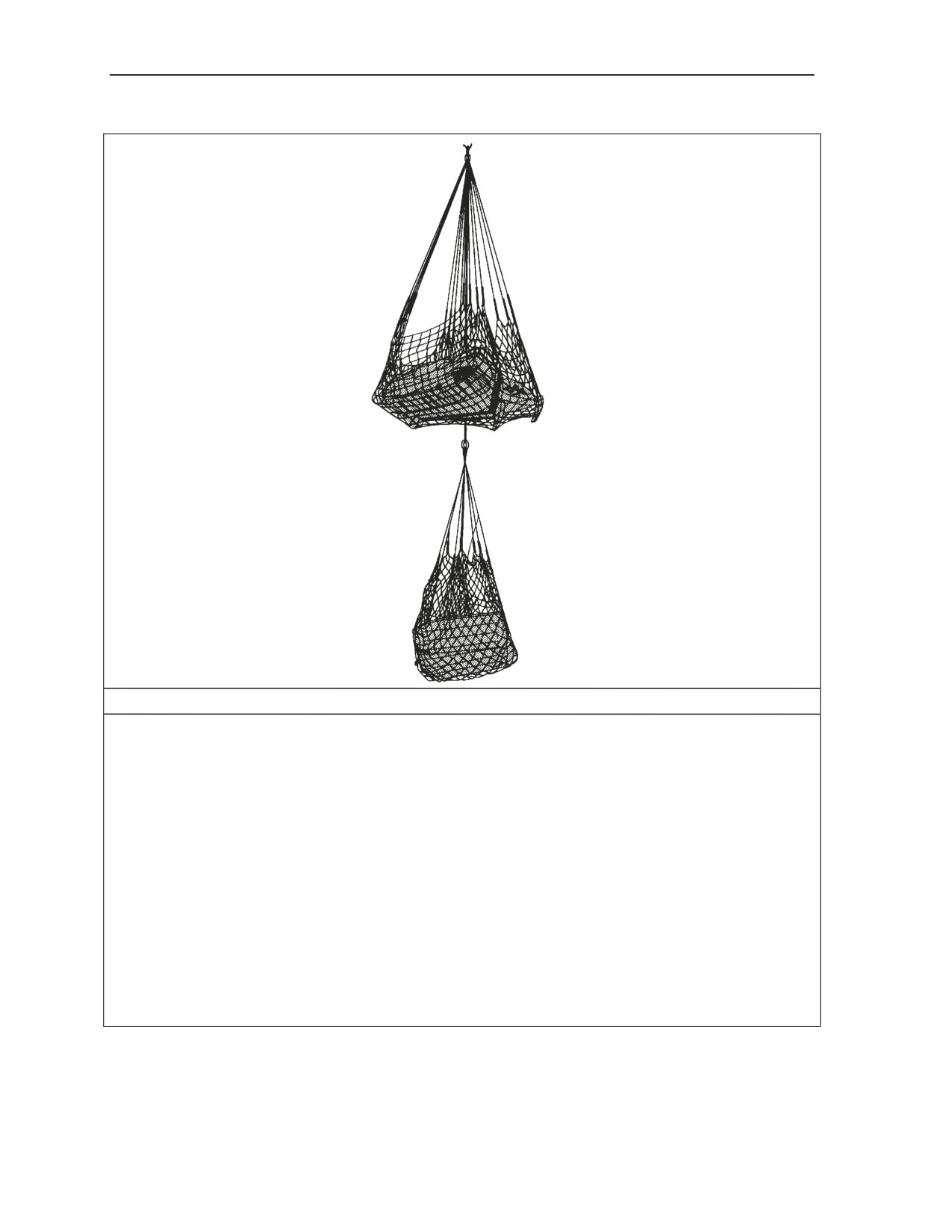
1. Lay out the first 10,000-pound cargo net. Place two MOSTs side-by-side facing in opposite
directions with two sheets of honeycomb between them. Close the net to the apex fitting of
the cargo net. Gather the excess net above the load and tape the net together every 3 feet
from the apex down (breakaway technique).
2. Lay out the second 10,000-pound cargo net next to the first one and center the two sleds on
the net side-by-side facing opposite directions. Close the net to the apex fitting of the cargo
net. Gather the excess net above the load and tape the net together every 3 feet from the
apex down (breakaway technique).
3. Attach the chain from the 10,000-pound sling leg to the apex of the cargo net holding the
sleds. Insert link 4 in the grabhook. The end of the sling leg with the apex attached is fed
under the net holding the two MOSTs along the axis of the honeycomb. It is passed through
the net at the center and pulled upward between the two sheets of honeycomb and attached
to the apex of the net using the apex. This will allow the sleds to hang directly below the
MOST.
Figure 14-6. Two Mobile Oversnow Transport Snowmobiles with or without Two Sleds
FM 4-20.198/MCRP 4-11.3E, VOL II/NTTP 3-04.12/
14-10
AFMAN 11-223 (I), VOL II/COMDTINST M13482.3B
20 February 2009
Certified Single-Point Rigging Procedures for Miscellaneous Equipment
CONTAINER ROLL-IN/OUT PLATFORM (CROP), M3/M3A1, TWO
EMPTY PLATFORMS, STACKED
14-8. The container roll-in/out platform, M3/M3A1, two empty platforms, stacked are rigged for single-
point sling load using the following procedures:
z
Applicability. The following items in Table 14-6 are certified for all helicopters with suitable
lift capacity by the US Army Natick Soldier Center:
Table 14-7. Container Roll-in/out Platform, M3/M3A1, Two Empty Platforms, Stacked
Nomenclature
Max
Sling
Link Count
Weight
Set
Front/Rear
(Pounds)
Two CROPs, M3, Empty, Stacked
7,300
10K
30/3
Two CROPs, M3A1, Empty, Stacked
7,300
10K
30/3
z
Materials. The following materials are required to rig this load:
Sling set (10,000-pound capacity).
Tape, adhesive, pressure-sensitive, 2-inch wide roll.
Cord, nylon, Type III, 550-pound breaking strength.
Webbing, cotton, 1/4-inch, 80-pound breaking strength.
Felt sheet, cattle hair, Type IV, 1/2-inch or suitable padding.
z
Personnel. Two persons can prepare and rig this load in 10 minutes.
z
Procedures. The following procedures apply to this load:
Preparation. Prepare the load using the following steps:
─ Ensure the load restraints are in the stowed position.
─ Secure the A-frames in the down position.
─ Stack the platforms with the A-frames at the same end and secure the platforms together
with the straps provided with the platform (a minimum of two straps per platform are
required). Ensure the straps have operational keepers on the hook ends. Secure the
loose strap ends with tape or 1/4-inch cotton webbing.
Rigging. Rig the load according to the steps in Figure 14-7.
Hookup. The hookup team stands on the stacked platforms. The static wand person
discharges the static electricity with the static wand. The hookup person places the apex fitting
onto the cargo hook. The hookup team then carefully dismounts the platform and remains close
to the load as the helicopter removes slack from the sling legs. When successful hookup is
assured, the hookup team quickly exits the area underneath the helicopter to the designated
rendezvous point.
Derigging. Derigging is the reverse of the preparation and rigging procedures.
20 February 2009
FM 4-20.198/MCRP 4-11.3E, VOL II/NTTP 3-04.12/
AFMAN 11-223 (I), VOL II/COMDTINST M13482.3B
14-11