FM 4-20.198 Multiservice Helicopter Sling Load: Single-Point Load Rigging Procedures (February 2009) - page 5
Chapter 3
M1112 400-GALLON WATER TRAILER
3-28. The M1112 400-gallon water trailer is rigged for single-point sling load using the following
procedures:
z
Applicability. The following item in Table 3-27 is certified for all helicopters with suitable lift
capacity by the US Army Natick Soldier Center:
Table 3-27. M1112 400-Gallon Water Trailer
Nomenclature
Max
Sling
Link Count
Weight
Set
Front/Rear
(Pounds)
M1112 400 Gallon Water Trailer, (Empty)
3,860
10K
3/3
CAUTION
This load is certified only when empty. Do not lift the trailer loaded.
z
Materials. The following materials are required to rig this load:
Sling set (10,000-pound capacity).
Tape, adhesive, pressure-sensitive, 2-inch wide roll.
Cord, nylon, Type III, 550-pound breaking strength.
Webbing, cotton, 1/4-inch, 80-pound breaking strength.
Felt sheet, cattle hair, Type IV, 1/2-inch or suitable padding.
z
Personnel. Two persons can prepare and rig this load in 10 minutes.
z
Procedures. The following procedures apply to this load:
Preparation. Prepare the load using the following steps:
─ Secure all loose chains, hoses, and cables to the trailer drawbar with tape or Type III
nylon cord.
─ Ensure the tongue wheel is in the down and locked position.
─ Close and secure the tank lid.
─ Engage the parking brake.
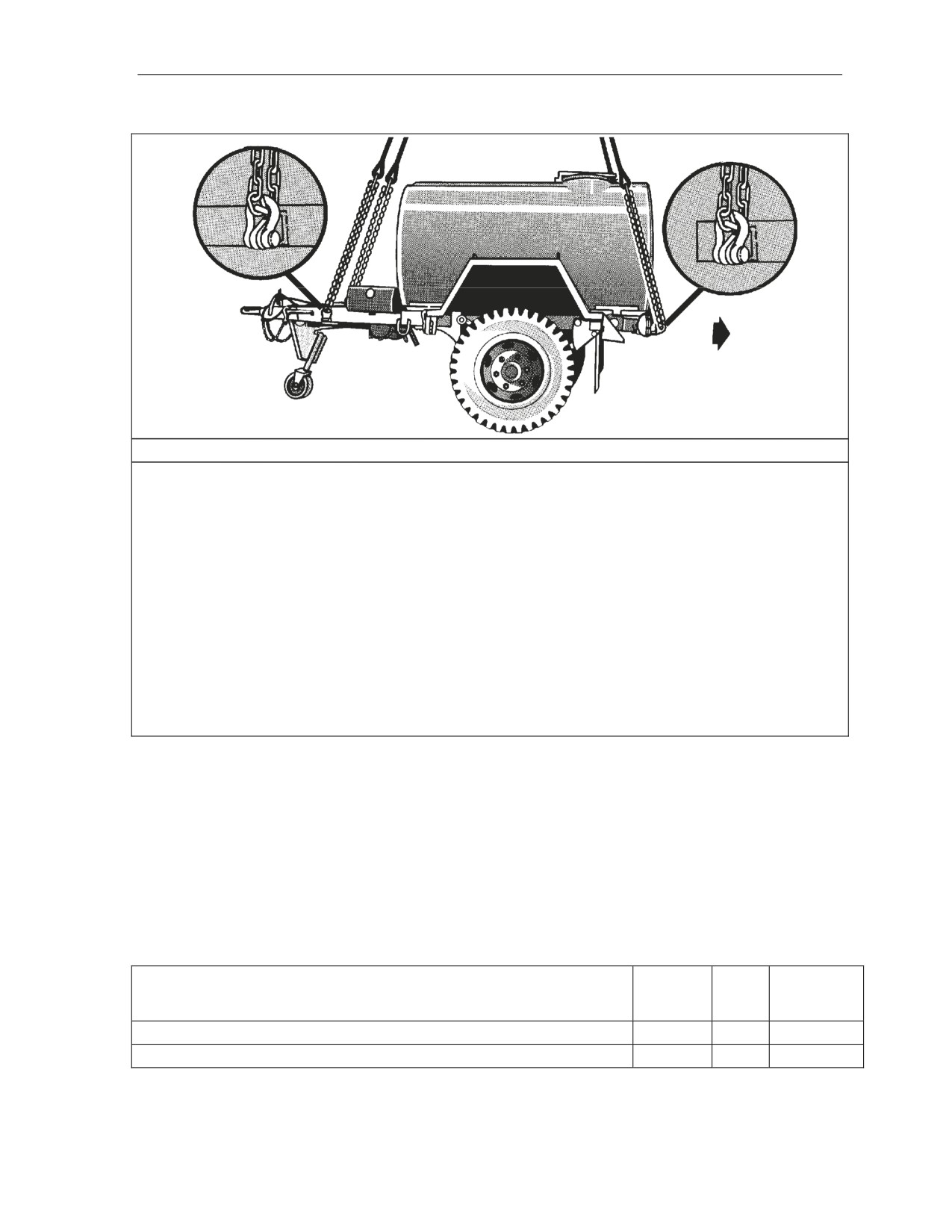
Rigging. Rig the load according to the steps in Figure 3-27.
Hookup. The hookup team stands on the trailer fenders or the front of the trailer. The
static wand person discharges the static electricity with the static wand. The hookup person
places the apex fitting onto the aircraft cargo hook. The hookup team then carefully dismounts
the trailer and remains close to the load as the helicopter removes slack from the sling legs.
When successful hookup is assured, the hookup team quickly exits the area underneath the
helicopter to the designated rendezvous point.
Derigging. Derigging is the reverse of the preparation and rigging procedures.
3-48
FM 4-20.198/MCRP 4-11.3E, VOL II/NTTP 3-04.12/
AFMAN 11-223 (I), VOL II/COMDTINST M13482.3B
20 February 2009
Certified Single-Point Rigging Procedures for Trailers
RIGGING STEPS
1. Position the apex fitting on top of the water tank. Route outer sling legs 1 and 2 to the front of the trailer
and inner sling legs 3 and 4 to the rear. Sling legs 1 and 3 must be on the left side of the load.
2. Loop the chain end of sling leg 1 through the left front lift provision located on the left front corner of the
trailer. Place the correct link from Table 3-27 in the grab hook. Repeat with sling leg 2 through the right
front lift provision.
3. Route the chain end of sling leg 3 through the left rear lift provision. Place the correct link from Table
3-27 in the grab hook. Repeat with sling leg 4 through the right rear lift provision.
4. Pad the chains where they make contact with the trailer.
5. Cluster and tie (breakaway technique) all sling legs together on top of the trailer to prevent
entanglement during hookup and lift-off.
Figure 3-27. M1112 400 Gallon Water Trailer
M1082 LIGHT MEDIUM TACTICAL VEHICLE (LMTV) AND M1095
MEDIUM TACTICAL VEHICLE (MTV) TRAILERS
3-29. The M1082 light medium tactical vehicle and M1095 medium tactical vehicle trailers are rigged for
single-point sling load using the following procedures:
z
Applicability. The following items in Table 3-28 are certified for all helicopters with suitable
lift capacity by the US Army Natick Soldier Center:
Table 3-28. M1082 Light Medium Tactical Vehicle and M1095 Medium Tactical Vehicle Trailers
Nomenclature
Max
Sling
Link Count
Weight
Set
Front/Rear
(Pounds)
M1082 LMTV Trailer
11,510
25K
10/3
M1095 MTV Trailer
15,780
25K
10/3
z
Materials. The following materials are required to rig this load:
Sling set (25,000-pound capacity).
20 February 2009
FM 4-20.198/MCRP 4-11.3E, VOL II/NTTP 3-04.12/
AFMAN 11-223 (I), VOL II/COMDTINST M13482.3B
3-49
Chapter 3
Tape, adhesive, pressure-sensitive, 2-inch wide roll.
Cord, nylon, Type III, 550-pound breaking strength.
Webbing, cotton, 1/4-inch, 80-pound breaking strength.
z
Personnel. Two persons can prepare and rig this load in 10 minutes.
z
Procedures. The following procedures apply to this load:
Preparation. Prepare the load using the following steps:
─ Position the trailer's jack stand in the down position so the trailer sets level.
─ Secure all loose chains, hoses, and cables to the trailer drawbar with tape or Type III
nylon cord.
─ Engage the parking brake.
─ Extend the lift provision bars to the widest position and lock into place with the locking
pins. Secure the locking pins in place with tape.
Note. Ensure the lift eyes on the lift provision bars are perpendicular to the ground.
─ Remove the side and end panels and stow in the storage boxes under the bed of the
trailer. Secure the storage latches with tape.
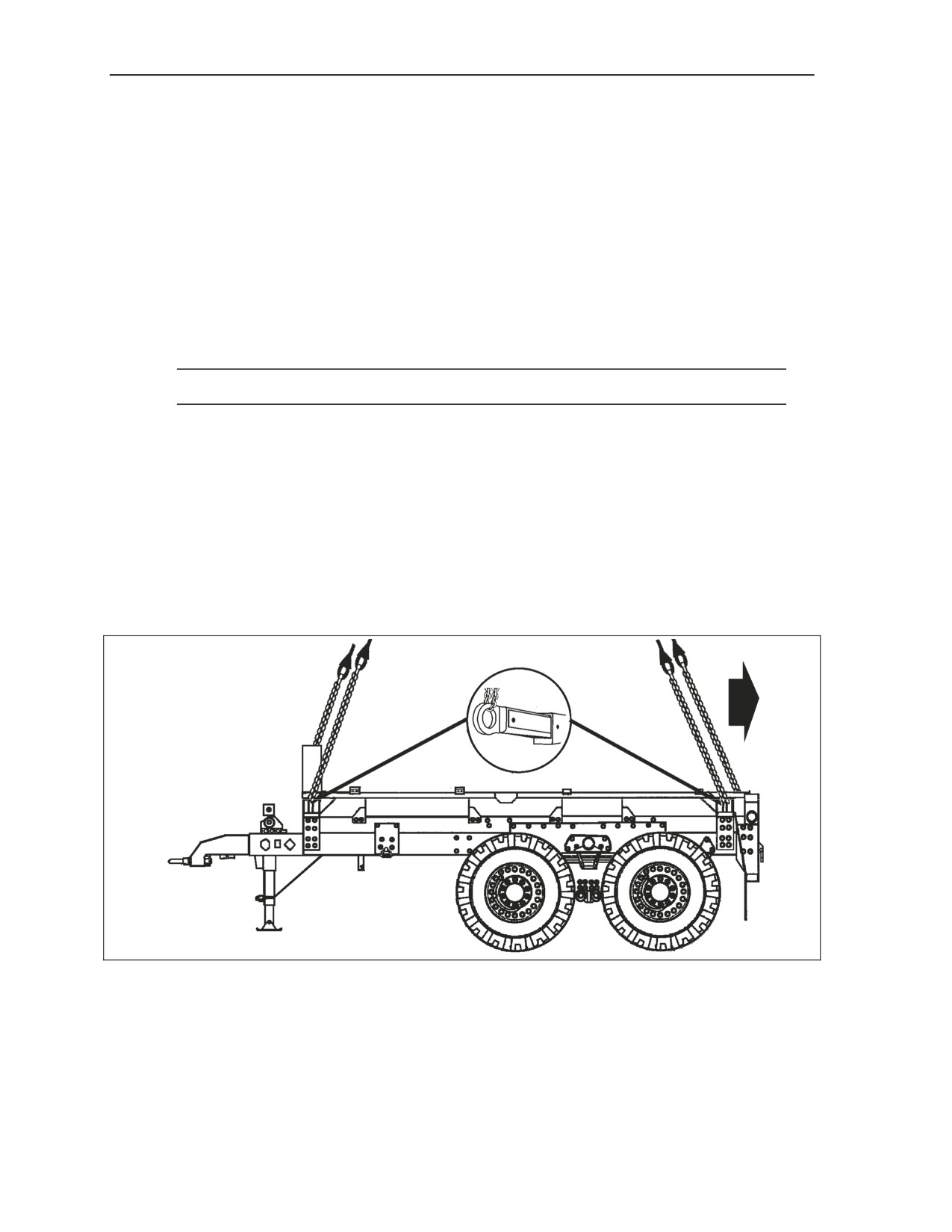
Rigging. Rig the load according to the steps in Figure 3-27.
Hookup. The hookup teams stand in the bed of the trailer. The static wand person
discharges the static electricity with the static wand. The hookup person places the apex fitting
on the cargo hook. The hookup team then carefully dismounts the trailer and remains close to
the load as the helicopter removes slack from the sling legs. When successful hookup is
assured, the hookup team quickly exits the area underneath the helicopter to the designated
rendezvous point.
Derigging. Derigging is the reverse of the preparation and rigging procedures.
Figure 3-28. M1082 Light Medium Tactical Vehicle and M1095 Medium Tactical Vehicle
Trailers
3-50
FM 4-20.198/MCRP 4-11.3E, VOL II/NTTP 3-04.12/
AFMAN 11-223 (I), VOL II/COMDTINST M13482.3B
20 February 2009
Certified Single-Point Rigging Procedures for Trailers
RIGGING STEPS
1. Position the apex fitting on top of the trailer. Route outer sling legs 1 and 2 to the front of the
trailer and inner sling legs 3 and 4 to the rear. Sling legs 1 and 3 must be on the left side of
the load.
2. Loop the chain end of sling leg 1 through the left front lift provision bar located on the left
front corner of the trailer (lunette end). Place the correct link from Table 3-28 in the grab
hook. Repeat with sling leg 2 through the right front lift provision.
3. Loop the chain end of sling leg 3 through the left rear lift provision bar located on the left rear
corner of the trailer. Place the correct link from Table 3-28 in the grab hook. Repeat with
sling leg 4 through the right rear lift provision.
4. Secure all excess chain with tape or Type III nylon cord.
Figure 3-28. M1082 Light Medium Tactical Vehicle and M1095 Medium Tactical Vehicle
Trailers (Continued)
SMALL PORTABLE EXPEDITIONARY AEROMEDICAL RAPID
RESPONSE (SPEARR) TRAILER
3-30. The small portable expeditionary aeromedical rapid response trailer is rigged for single-point sling
load using the following procedures:
z
Applicability. The following item in Table 3-29 is certified for all helicopters with suitable lift
capacity by the US Army Natick Soldier Center:
Table 3-29. Small Portable Expeditionary Aeromedical Rapid Response Trailer
Nomenclature
Max
Sling
Link Count
Weight
Set
Front/Rear
(Pounds)
Small Portable Expeditionary Aeromedical Rapid Response
6,100
10K
Listed in
Trailer
Rigging Steps
z
Materials. The following materials are required to rig this load:
Sling set (10,000-pound capacity).
Tape, adhesive, pressure-sensitive, 2-inch wide roll.
Cord, nylon, Type III, 550-pound breaking strength.
Webbing, cotton, 1/4-inch, 80-pound breaking strength.
z
Personnel. Two persons can prepare and rig this load in 10 minutes.
z
Procedures. The following procedures apply to this load:
Preparation. Prepare the load using the following steps:
─ Position the trailer's jack stand in the down position so the lunette is near the ground.
─ Secure all loose chains, hoses, and cables to the trailer drawbar with tape or Type III
nylon cord.
─ Secure all lids, doors, and caps with tape or Type III nylon cord.
─ Ensure the stabilizer legs are retracted and stowed.
20 February 2009
FM 4-20.198/MCRP 4-11.3E, VOL II/NTTP 3-04.12/
AFMAN 11-223 (I), VOL II/COMDTINST M13482.3B
3-51
Chapter 3
─ Release the curb side lift provisions from the stowage straps. Secure the stowage straps
to the trailer with tape.
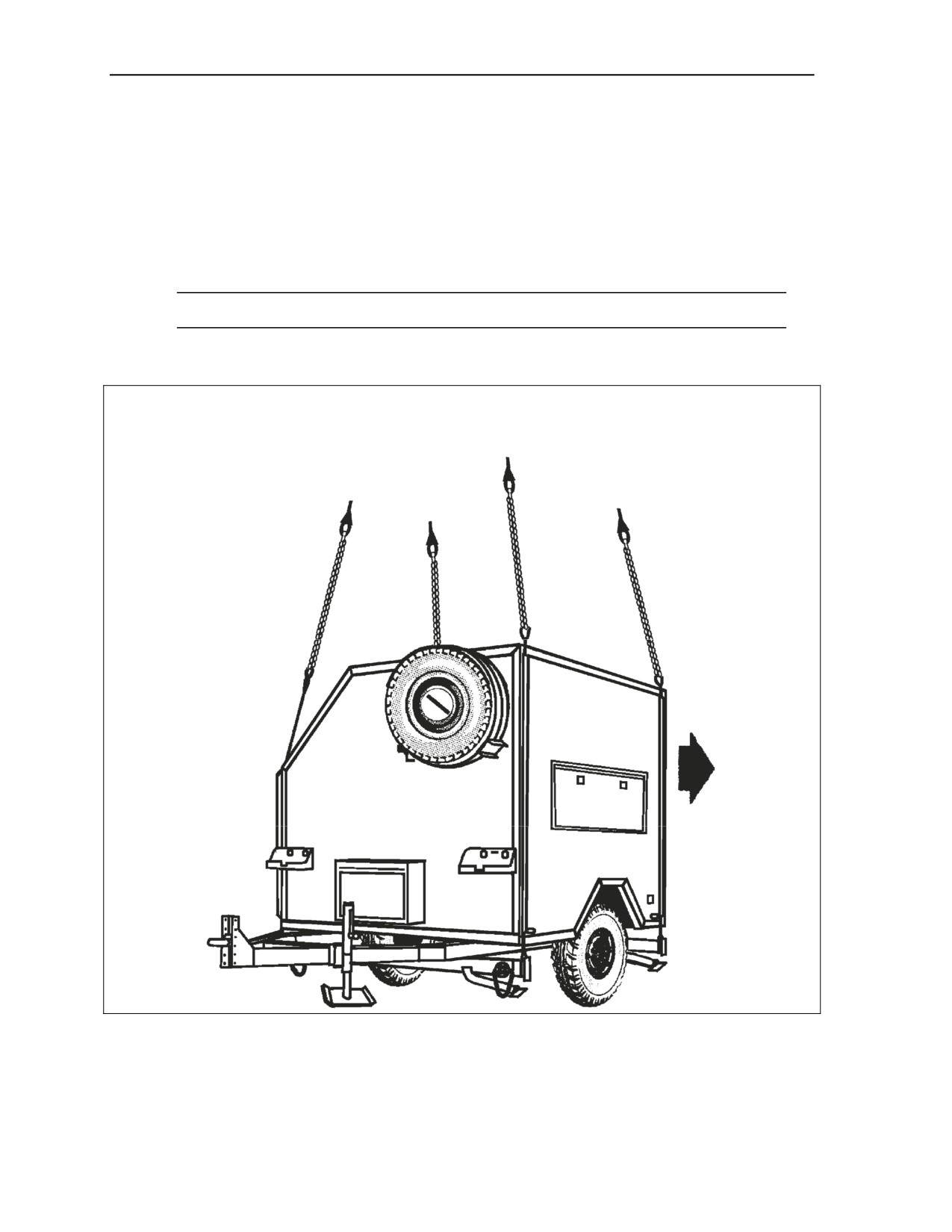
Rigging. Rig the load according to the steps in Figure 3-29.
Hookup. The hookup teams stand on the roof of the trailer. The static wand person
discharges the static electricity with the static wand. The hookup person places the apex fitting
on the cargo hook. The hookup team then carefully dismounts the trailer and remains close to
the load as the helicopter removes slack from the sling legs. When successful hookup is
assured, the hookup team quickly exits the area underneath the helicopter to the designated
rendezvous point.
Note. This load is flown with the rear of the trailer facing forward.
Derigging. Derigging is the reverse of the preparation and rigging procedures.
SLING LEG 1
SLING LEG 2
SLING LEG 3
SLING LEG 4
Figure 3-29. Small Portable Expeditionary Aeromedical Rapid Response Trailer
3-52
FM 4-20.198/MCRP 4-11.3E, VOL II/NTTP 3-04.12/
AFMAN 11-223 (I), VOL II/COMDTINST M13482.3B
20 February 2009
Certified Single-Point Rigging Procedures for Trailers
RIGGING STEPS
1. Position the apex fitting on top of the trailer roof. Route outer sling legs 1 and 2 to the front of
the trailer (lunette end) and inner sling legs 3 and 4 to the rear. Sling legs 1 and 3 must be
on the left side of the load.
2. Loop the chain end of sling leg 1 through the left front lift provision located on the left front
corner of the trailer roof (lunette end). Place link 20 in the grab hook.
3. Loop the chain end of sling leg 2 through the right front lift provision located on the right front
corner of the trailer roof (lunette end). Place link 30 in the grab hook.
4. Loop the chain end of sling leg 3 through the left rear lift provision located on the left rear
corner of the trailer roof. Place link 3 in the grab hook.
5. Loop the chain end of sling leg 4 through the right rear lift provision located on the right rear
corner of the trailer roof. Place link 10 in the grab hook.
6. Secure all excess chain with tape or Type III nylon cord.
7. Cluster and tie or tape (breakaway technique) the sling legs in each sling set together to
prevent entanglement during hookup and lift-off.
Figure 3-29. Small Portable Expeditionary Aeromedical Rapid Response Trailer (Continued)
MINIMUM OPERATING STRIP LIGHTING SYSTEM (MOSLS)
3-31. The minimum operating strip lighting system is rigged for single-point sling load using the following
procedures:
z
Applicability. The following item in Table 3-30 is certified for all helicopters with suitable lift
capacity by the US Army Natick Soldier Center:
Table 3-30. Minimum Operating Strip Lighting System
Nomenclature
Max
Sling
Link Count
Weight
Set
Front/Rear
(Pounds)
Minimum Operating Strip Lighting System with Spreader Bars
3,350
15K
10/3
z
Materials. The following materials are required to rig this load:
Sling set (15,000-pound capacity).
Tape, adhesive, pressure-sensitive, 2-inch wide roll.
Cord, nylon, Type III, 550-pound breaking strength.
Webbing, cotton, 1/4-inch, 80-pound breaking strength.
Padding, cellulose.
Spreader bar, HMMWV (2 each).
z
Personnel. Two persons can prepare and rig this load in 10 minutes.
z
Procedures. The following procedures apply to this load:
Preparation. Prepare the load using the following steps:
─ Position the trailer's jack stand in the down position so the lunette is near the ground.
20 February 2009
FM 4-20.198/MCRP 4-11.3E, VOL II/NTTP 3-04.12/
AFMAN 11-223 (I), VOL II/COMDTINST M13482.3B
3-53
Chapter 3
─ Secure all loose chains, hoses, and cables to the trailer drawbar with tape or Type III
nylon cord.
─ Secure all lids, doors, and caps with tape or Type III nylon cord.
─ Ensure the stabilizer legs are retracted and stowed.
─ Engage the parking brake.
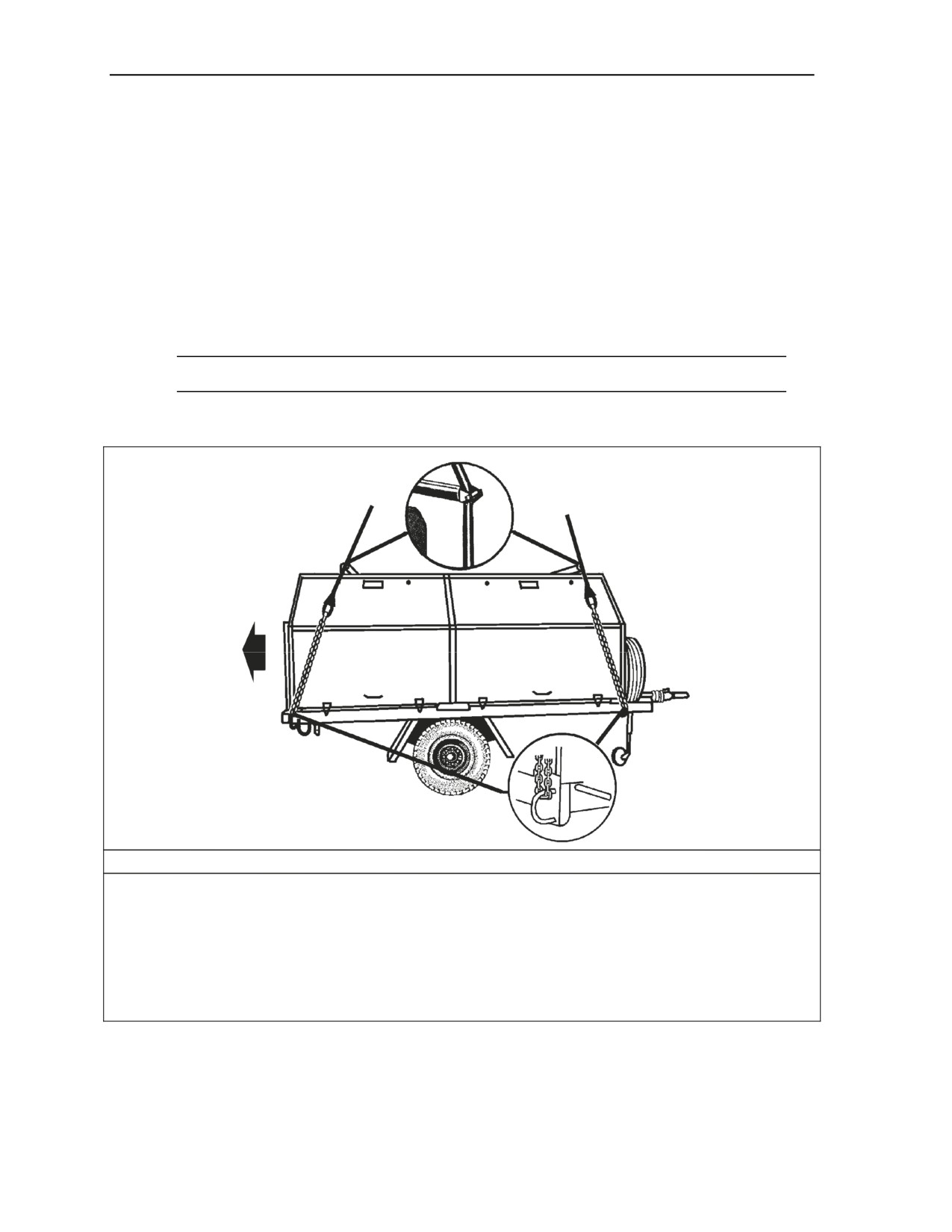
Rigging. Rig the load according to the steps in Figure 3-30.
Hookup. The hookup teams stand on the roof of the trailer. The static wand person
discharges the static electricity with the static wand. The hookup person places the apex fitting
on the cargo hook. The hookup team then carefully dismounts the trailer and remains close to
the load as the helicopter removes slack from the sling legs. When successful hookup is
assured, the hookup team quickly exits the area underneath the helicopter to the designated
rendezvous point.
Note. This load is flown with the rear of the trailer facing forward.
Derigging. Derigging is the reverse of the preparation and rigging procedures.
RIGGING STEPS
1. Position the apex fitting on top of the trailer. Route outer sling legs 1 and 2 to the front of the
trailer (lunette end) and inner sling legs 3 and 4 to the rear. Sling legs 1 and 3 must be on
the left side of the load.
2. Loop the chain end of sling leg 1 through the vertical left front lift provision located on the left
front corner of the trailer (lunette end). Place the correct link from Table 3-30 in the grab
hook. Repeat with sling leg 2 through the vertical right front lift provision.
Figure 3-30. Minimum Operating Strip Lighting System
3-54
FM 4-20.198/MCRP 4-11.3E, VOL II/NTTP 3-04.12/
AFMAN 11-223 (I), VOL II/COMDTINST M13482.3B
20 February 2009

Certified Single-Point Rigging Procedures for Trailers
RIGGING STEPS
3. Loop the chain end of sling leg 3 through the vertical left rear lift provision located on the left
rear corner of the trailer. Place the correct link from Table 3-30 in the grab hook. Repeat
with sling leg 4 through the vertical right rear lift provision.
4. Secure all excess chain with Type III nylon cord.
5. Extend the sling set above the trailer. Position the spreader bar between the front slings 6-
inches above the trailer roof. Secure the spreader bar to the slings with Type III nylon cord
and tape. Repeat the procedure with the second spreader bar and the rear slings.
6. Cluster and tie (breakaway technique) the sling legs in each sling set together to prevent
entanglement during hookup and lift-off.
Figure 3-30. Minimum Operating Strip Lighting System (Continued)
ASSAULT COMMAND POST WITH HIGH MOBILITY WHEEL SET
3-32. The assault command post with high mobility wheel set is rigged for single-point sling load using
the following procedures:
z
Applicability. The following items in Table 3-31 are certified for all helicopters with suitable
lift capacity by the US Army Natick Soldier Center:
Table 3-31. Assault Command Post with High Mobility Wheel Set
Nomenclature
Max
Sling
Link Count
Weight
Set
Front/Rear
(Pounds)
Assault Command Post, Housed in Expandable Light
13,240
25K
ECU is Front
Airmobile Shelter with High Speed Mobile Wheel Set
3/3
Upgraded, Assault Command Post, Housed in Expandable
14,600
25K
ECU is Front
Light Airmobile Shelter with High Speed Mobile Wheel Set
3/3
z
Materials. The following materials are required to rig this load:
Sling set (25,000-pound capacity).
Tape, adhesive, pressure-sensitive, 2-inch wide roll.
Cord, nylon, Type III, 550-pound breaking strength.
Webbing, cotton, 1/4-inch, 80-pound breaking strength.
z
Personnel. Two persons can prepare and rig this load in 15 minutes.
z
Procedures. The following procedures apply to this load:
Preparation. Prepare the load using the following steps:
─ Ensure manufacturer approved tiedown assemblies (2 each) are in place between the
shelter and each wheel set.
─ Remove all antennas and secure inside the shelter.
─ Secure all lids, doors, and caps with tape or Type III nylon cord.
─ Secure all loose equipment inside the shelter with tape, lashings, or Type III nylon cord.
─ Secure the tow bar in the up position.
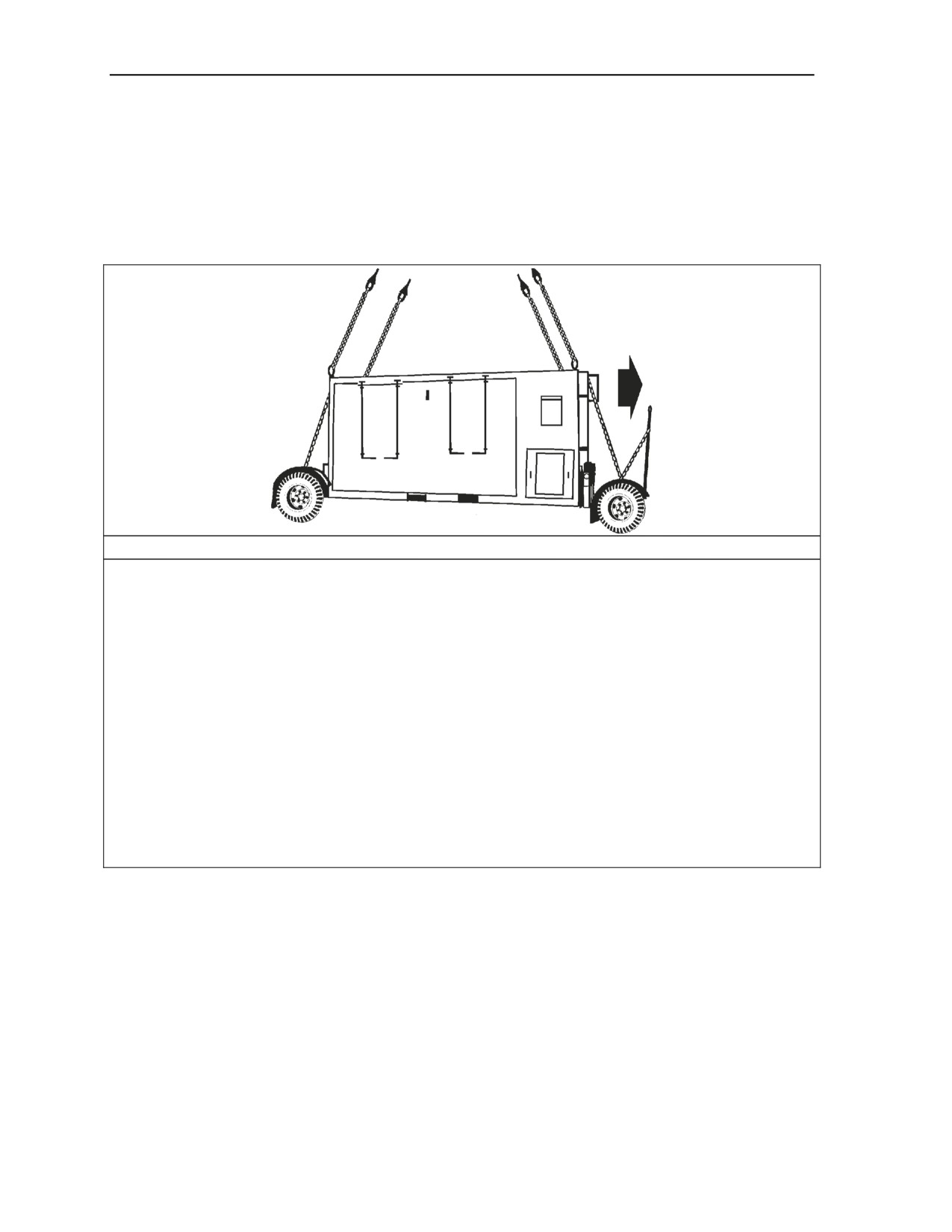
Rigging. Rig the load according to the steps in Figure 3-31.
20 February 2009
FM 4-20.198/MCRP 4-11.3E, VOL II/NTTP 3-04.12/
AFMAN 11-223 (I), VOL II/COMDTINST M13482.3B
3-55
Chapter 3
Hookup. The hookup team stands on the roof of the shelter. The static wand person
discharges the static electricity with the static wand. The hookup person places the apex fitting
on the cargo hook. The hookup team then carefully dismounts the trailer and remains close to
the load as the helicopter removes slack from the sling legs. When successful hookup is
assured, the hookup team quickly exits the area underneath the helicopter to the designated
rendezvous point.
Derigging. Derigging is the reverse of the preparation and rigging procedures.
RIGGING STEPS
1. Position the apex fitting on top of the shelter. Route outer sling legs 1 and 2 to the front of
the shelter (lunette end) and inner sling legs 3 and 4 to the rear. Sling legs 1 and 3 must be
on the left side of the load.
2. Loop the chain end of sling leg 1 through the left front lift provision located on the top left front
corner of the shelter (lunette end). Place the correct link from Table 3-31 in the grab hook.
Repeat with sling leg 2 through the top right front lift provision.
3. Loop the chain end of sling leg 3 through the left rear lift provision located on the top left rear
corner of the shelter. Place the correct link from Table 3-31 in the grab hook. Repeat with
sling leg 4 through the top right rear lift provision.
4. Secure all excess chain with Type III nylon cord.
5. Cluster and tie (breakaway technique) the sling legs in each sling set together to prevent
entanglement during hookup and lift-off.
Figure 3-31. Assault Command Post with High Mobility Wheel Set
TRAILER SUPPORT SYSTEM WITH EXPEDITIONARY SHELTER
3-33. The trailer support system with expeditionary shelter is rigged for single-point sling load using the
following procedures:
z
Applicability. The following item in Table 3-32 is certified for all helicopters with suitable lift
capacity by the US Army Natick Soldier Center:
3-56
FM 4-20.198/MCRP 4-11.3E, VOL II/NTTP 3-04.12/
AFMAN 11-223 (I), VOL II/COMDTINST M13482.3B
20 February 2009
Certified Single-Point Rigging Procedures for Trailers
Table 3-32. Trailer Support System with Expeditionary Shelter
Nomenclature
Max
Sling
Link Count
Weight
Set
Front/Rear
(Pounds)
Trailer Support System (TSS 2000655) on Crash-Out-Package
4,320
10K
20/5
System (COPS) Trailer with Base-X Expeditionary Shelter
CAUTION
The fuel tank must have the modified cap to prevent fuel from leaking
through the fuel cap vent. If the cap is not modified the tank must be
drained.
z
Materials. The following materials are required to rig this load:
Sling set (10,000-pound capacity).
─ Chain length, part number 38850-00053-101, from a 10,000-pound capacity sling set
(4 each).
─ Coupling link, NSN 4010-01-231-3388, from a 10,000-pound sling set (4 each).
Tape, adhesive, pressure-sensitive, 2-inch wide roll.
Cord, nylon, Type III, 550-pound breaking strength.
Webbing, cotton, 1/4-inch, 80-pound breaking strength.
Spreader bar assembly (component of M996/M997 HMMWV ambulance) (NSN 4910-01-
313-8839) (2 each).
Strap, cargo tiedown, CGU-1/B (as required).
z
Personnel. Two persons can prepare and rig this load in 20 minutes.
z
Procedures. The following procedures apply to this load:
Preparation. Prepare the load using the following steps:
─ Extend the sling leg chains by connecting one additional chain length to each chain on a
10,000-pound capacity sling set with coupling links.
─ Engage both trailer parking brakes.
─ Secure all chains, hoses, and cables with Type III nylon cord to the trailer drawbar.
─ Secure tents and all loose equipment with CGU-1/B cargo tiedown straps.
─ Close and secure all doors, latches, and caps with tape or Type III nylon cord.
─ Secure or remove and stow the intake duct cover.
─ Fully retract the stabilizer legs.
─ Lower the front jack so the lunette is close to the ground.
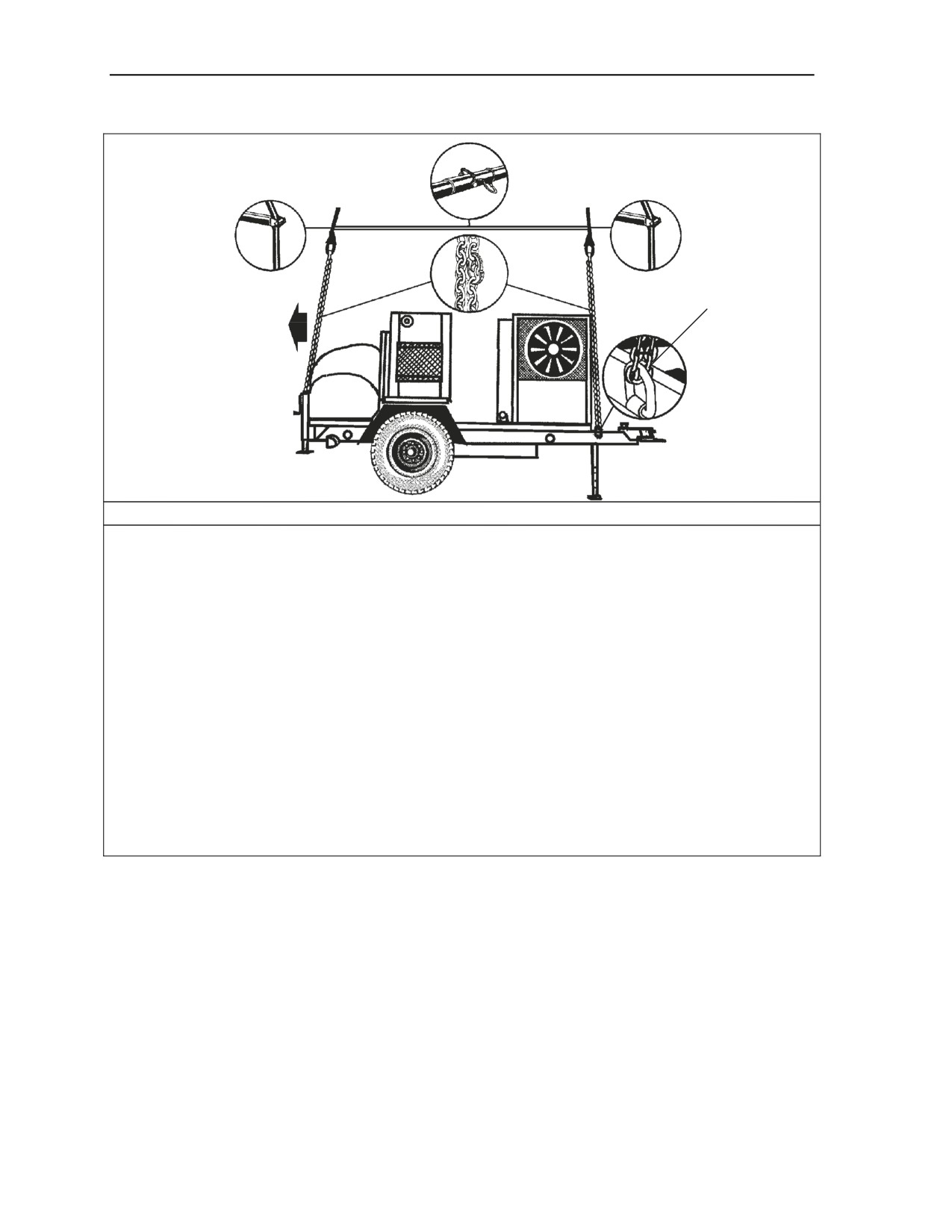
Rigging. Rig the load according to the steps in Figure 3-32.
Hookup. The hookup team stands on top of the trailer. The static wand person discharges
the static electricity with the static wand. The hookup person places the apex fitting onto the
cargo hook. The hookup team then carefully dismounts the trailer and remains close to the load
as the helicopter removes slack from the sling legs. When successful hookup is assured, the
hookup team quickly exits the area underneath the helicopter to the designated rendezvous
point.
Derigging. Derigging is the reverse of the preparation and rigging procedures.
20 February 2009
FM 4-20.198/MCRP 4-11.3E, VOL II/NTTP 3-04.12/
AFMAN 11-223 (I), VOL II/COMDTINST M13482.3B
3-57
Chapter 3
TYPE III NYLON CORD
RIGGING STEPS
1. Position the apex fitting on top of the trailer. Route outer sling legs 1 and 2 to the front of the
trailer (lunette end) and inner sling legs 3 and 4 to the rear. Sling legs 1 and 3 must be on
the left side of the load.
2. Loop the chain end of sling leg 1 through the left front lift provision located in the trailer frame.
Place the correct link from Table 3-32 in the grab hook. Repeat with sling leg 2 through the
right front lift provision. Secure the excess chain with Type III nylon cord.
3. Loop the chain end of sling leg 3 through the left rear lift provision located on the rear of the
trailer frame. Place the correct link from Table 3-32 in the grab hook. Repeat with sling leg 4
through the right rear lift provision.
4. Raise the chain portion of each leg above the lift point and tie the links together with Type III
nylon cord.
5. Cluster and tie (breakaway technique) all sling legs together on top of the trailer to prevent
entanglement during hookup and lift-off.
Figure 3-32. Trailer Support System with Expeditionary Shelter
SHADOW TACTICAL UNMANNED AERIAL VEHICLE (TUAV),
LAUNCHER/RECOVERY TRAILER (L/R-T)
3-34. The shadow tactical unmanned aerial vehicle, launcher/recovery trailer is rigged for single-point
sling load using the following procedures:
z
Applicability. The following item in Table 3-33 is certified for all helicopters with suitable lift
capacity by the US Army Natick Soldier Center:
3-58
FM 4-20.198/MCRP 4-11.3E, VOL II/NTTP 3-04.12/
AFMAN 11-223 (I), VOL II/COMDTINST M13482.3B
20 February 2009
Certified Single-Point Rigging Procedures for Trailers
Table 3-33. Shadow Tactical Unmanned Aerial Vehicle Launcher/Recovery Trailer
Nomenclature
Max
Sling
Link Count
Weight
Set
Front/Rear
(Pounds)
Shadow Tactical Unmanned Aerial Vehicle Launcher/Recovery Trailer
4,100
10K
3/15
z
Materials. The following materials are required to rig this load:
Sling set (10,000-pound capacity).
Tape, adhesive, pressure-sensitive, 2-inch wide roll.
Cord, nylon, Type III, 550-pound breaking strength.
Webbing, cotton, 1/4-inch, 80-pound breaking strength.
Strap, cargo tiedown, CGU-1/B (as required).
z
Personnel. Two persons can prepare and rig this load in 20 minutes.
z
Procedures. The following procedures apply to this load:
Preparation. Prepare the load using the following steps:
─ Lower and fully retract the trailer's rear landing legs. Secure the stowage straps with tape
or Type III nylon cord.
─ Ensure the rear lift provisions are positioned above the rear trailer landing legs.
─ Lower the front jack so the lunette is close to the ground and secure with Type III nylon
cord.
─ Close and secure all doors, latches, and caps with tape or Type III nylon cord.
─ Secure the beam support segments to the rails with Type III nylon cord.
─ Secure the shuttle in the stowed position.
─ Engage both trailer parking brakes.
─ Secure all chains, hoses, and cables with Type III nylon cord to the trailer drawbar.
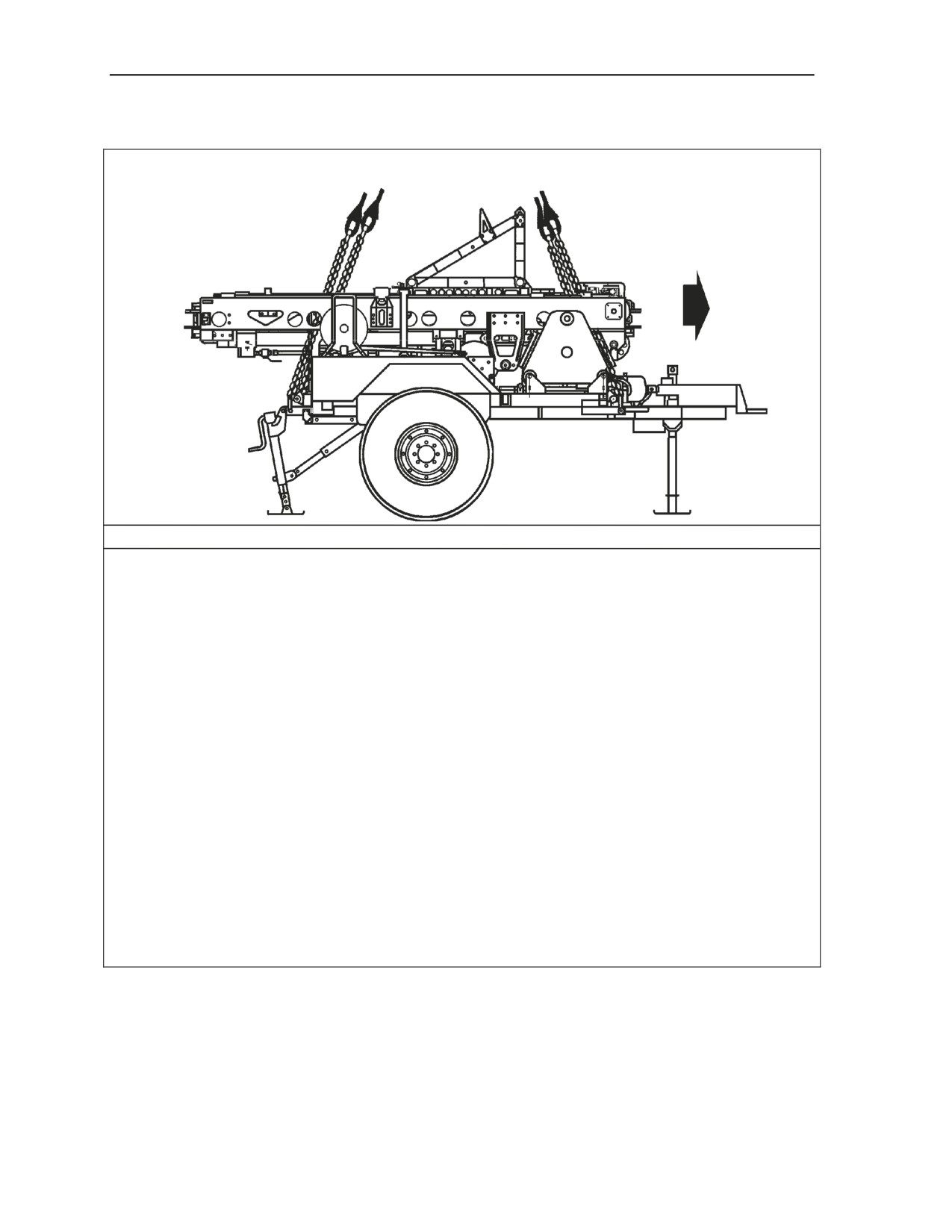
Rigging. Rig the load according to the steps in Figure 3-33.
Hookup. The hookup team stands on top of the trailer. The static wand person discharges
the static electricity with the static wand. The hookup person places the apex fitting onto the
cargo hook. The hookup team then carefully dismounts the trailer and remains close to the load
as the helicopter removes slack from the sling legs. When successful hookup is assured, the
hookup team quickly exits the area underneath the helicopter to the designated rendezvous
point.
Derigging. Derigging is the reverse of the preparation and rigging procedures.
20 February 2009
FM 4-20.198/MCRP 4-11.3E, VOL II/NTTP 3-04.12/
AFMAN 11-223 (I), VOL II/COMDTINST M13482.3B
3-59
Chapter 3
RIGGING STEPS
1. Position the apex fitting on top of the trailer. Route outer sling legs 1 and 2 to the front of the
trailer (lunette end) and inner sling legs 3 and 4 to the rear. Sling legs 1 and 3 must be on
the left side of the load. Ensure the sling legs are routed between the launcher rails.
2. Loop the chain end of sling leg 1 through the left front lift provision located in the trailer frame.
Place the correct link from Table 3-33 in the grab hook. Repeat with sling leg 2 through the
right front lift provision. Secure the excess chain with Type III nylon cord.
3. Loop the chain end of sling leg 3 through the left rear lift provision located on the rear of the
trailer frame. Place the correct link from Table 3-33 in the grab hook. Repeat with sling leg 4
through the right rear lift provision.
4. Place the nylon rope of sling legs 1 and 3 in the guides on the end of spreader bar 1 and
install the spreader bar guide retainer pins and keepers. Lay the spreader bar on left top of
the load. Repeat with sling legs 2 and 4 with spreader bar 2 on the right side of the load.
5. Raise the chain portion of each leg until the chain is tight and secure each chain to the
launch rail with Type I 1/4-inch cotton webbing.
6. Cluster and tie (breakaway technique) all sling legs together on top of the launcher rails to
prevent entanglement during hookup and lift-off.
Figure 3-33. Shadow Tactical Unmanned Aerial Vehicle Launcher/Recovery Trailer
3-60
FM 4-20.198/MCRP 4-11.3E, VOL II/NTTP 3-04.12/
AFMAN 11-223 (I), VOL II/COMDTINST M13482.3B
20 February 2009
Certified Single-Point Rigging Procedures for Trailers
SMALL EMPLACEMENT EXCAVATOR (SEE) TRANSPORTER
(TRAILER)
3-35. The small emplacement excavator transporter is rigged for single-point sling load using the
following procedures:
z
Applicability. The following item in Table 3-34 is certified for all helicopters with suitable lift
capacity by the US Army Natick Soldier Center:
Table 3-34. Small Emplacement Excavator Transporter
Nomenclature
Max
Sling
Link Count
Weight
Set
Front/Rear
(Pounds)
Transporter (Trailer), SEE, 2-Axle, 20,000-Pound Capacity
10,800
15K
30/3
z
Materials. The following materials are required to rig this load:
Sling set (15,000-pound capacity).
Tape, adhesive, pressure-sensitive, 2-inch wide roll.
Cord, nylon, Type III, 550-pound breaking strength.
Webbing, cotton, 1/4-inch, 80-pound breaking strength.
Strap, cargo tiedown, CGU-1/B (as required).
z
Personnel. Two persons can prepare and rig this load in 15 minutes.
z
Procedures. The following procedures apply to this load:
Preparation. Prepare the load using the following steps:
─ Position the trailer with the rear of the trailer facing forward in the direction of flight.
─ Secure the ramps and equipment on the trailer bed with chains, tiedowns, or Type III
nylon cord.
CAUTION
Ensure the equipment or cargo on the trailer bed does not interfere
with the routing of the sling legs.
─ Ensure the spare tire is properly inflated.
─ Rotate the rubber mud flaps to the up stowed position.
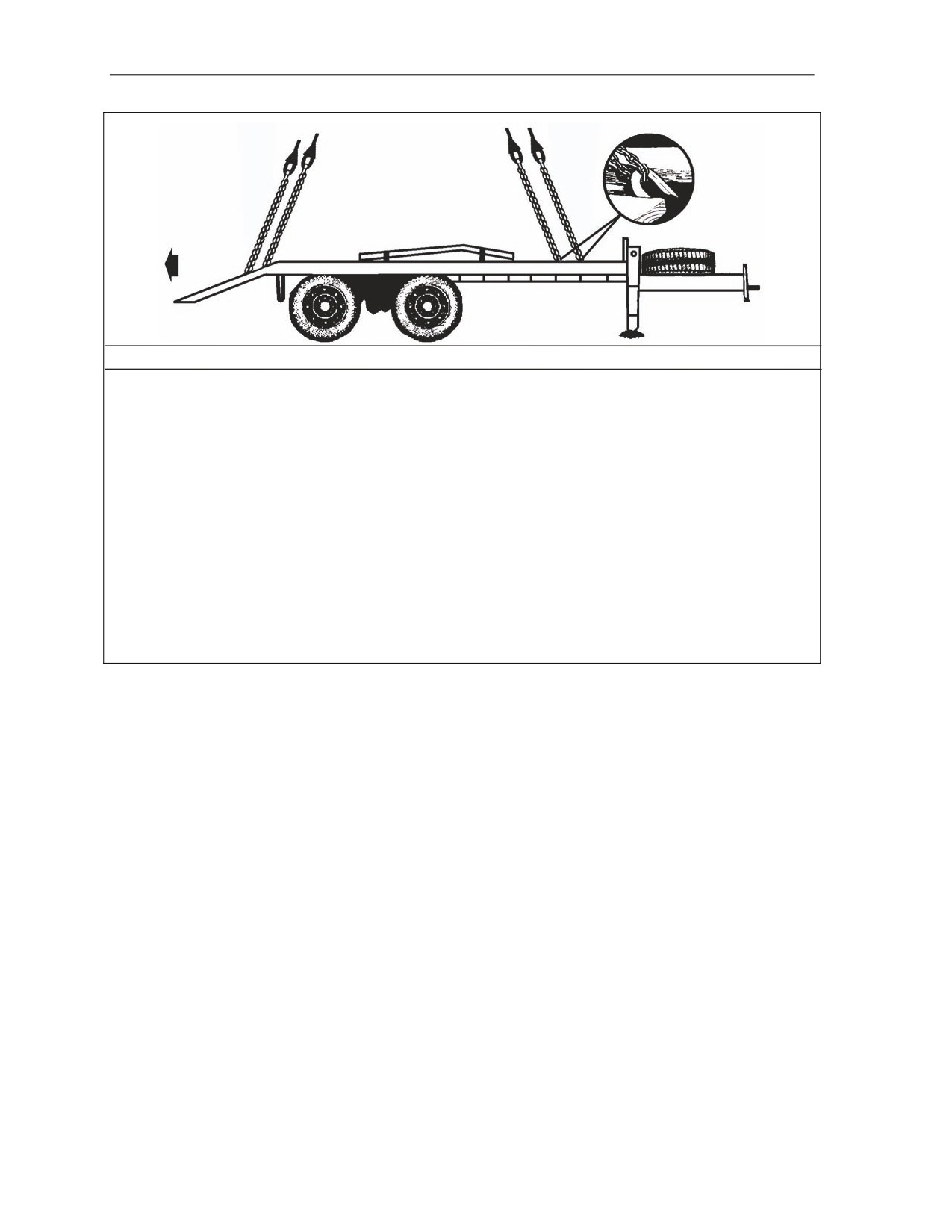
Rigging. Rig the load according to the steps in Figure 3-34.
Hookup. The hookup team stands on top of the trailer. The static wand person discharges
the static electricity with the static wand. The hookup person places the apex fitting onto the
cargo hook. The hookup team then carefully dismounts the trailer and remains close to the load
as the helicopter removes slack from the sling legs. When successful hookup is assured, the
hookup team quickly exits the area underneath the helicopter to the designated rendezvous
point.
Derigging. Derigging is the reverse of the preparation and rigging procedures.
20 February 2009
FM 4-20.198/MCRP 4-11.3E, VOL II/NTTP 3-04.12/
AFMAN 11-223 (I), VOL II/COMDTINST M13482.3B
3-61
Chapter 3
RIGGING STEPS
1. Position the apex fitting on top of the trailer. Route outer sling legs 1 and 2 to the front of the
trailer (lunette end) and inner sling legs 3 and 4 to the rear. Sling legs 1 and 3 must be on
the left side of the load
2. Loop the chain end of sling leg 1 through the left front lift provision from inboard to outboard.
Place the correct link from Table 3-34 in the grab hook. Repeat with sling leg 2 through the
right front lift provision. Secure the excess chain with Type III nylon cord.
3. Loop the chain end of sling leg 3 through the left rear lift provision located on the ramp
section. Place the correct link from Table 3-34 in the grab hook. Repeat with sling leg 4
through the right rear lift provision.
4. Cluster and tie (breakaway technique) all sling legs together on top of the trailer to prevent
entanglement during hookup and lift-off.
Figure 3-34. Small Emplacement Excavator Transporter
3-62
FM 4-20.198/MCRP 4-11.3E, VOL II/NTTP 3-04.12/
AFMAN 11-223 (I), VOL II/COMDTINST M13482.3B
20 February 2009
Certified Single-Point Rigging Procedures for Trailers
TRAILER MOUNTED ENVIRONMENTAL CONTROL SYSTEM
(TMECS)
3-36. The trailer mounted environmental control system is rigged for single-point sling load using the
following procedures:
z
Applicability. The following item in Table 3-35 is certified for all helicopters with suitable lift
capacity by the US Army Natick Soldier Center:
Table 3-35. Trailer Mounted Environmental Control System
Nomenclature
Max
Sling
Link Count
Weight
Set
Front/Rear
(Pounds)
Trailer Mounted Environmental Control System
4,200
10K
15/3
z
Materials. The following materials are required to rig this load:
Sling set (10,000-pound capacity).
─ Chain length, part number 38850-00053-101, from a 10,000-pound capacity sling set
(4 each).
─ Coupling link, part number 577-0615, from a 10,000-pound sling set (4 each).
Tape, adhesive, pressure-sensitive, 2-inch wide roll.
Cord, nylon, Type III, 550-pound breaking strength.
Webbing, cotton, 1/4-inch, 80-pound breaking strength.
Webbing, nylon tubular, ½-inch, 1000-pound breaking strength.
z
Personnel. Two persons can prepare and rig this load in 15 minutes.
z
Procedures. The following procedures apply to this load:
Preparation. Prepare the load using the following steps:
─ Engage the parking brake.
─ Secure the brake hoses and safety chains to the top of the drawbar with Type III nylon
cord.
─ Secure all lids, doors, caps, hoses, cords, and the table with tape or Type III nylon cord.
─ Secure the four lift rings on the trailer in the up position to a convenient point on the load
with Type I ¼-inch cotton webbing.
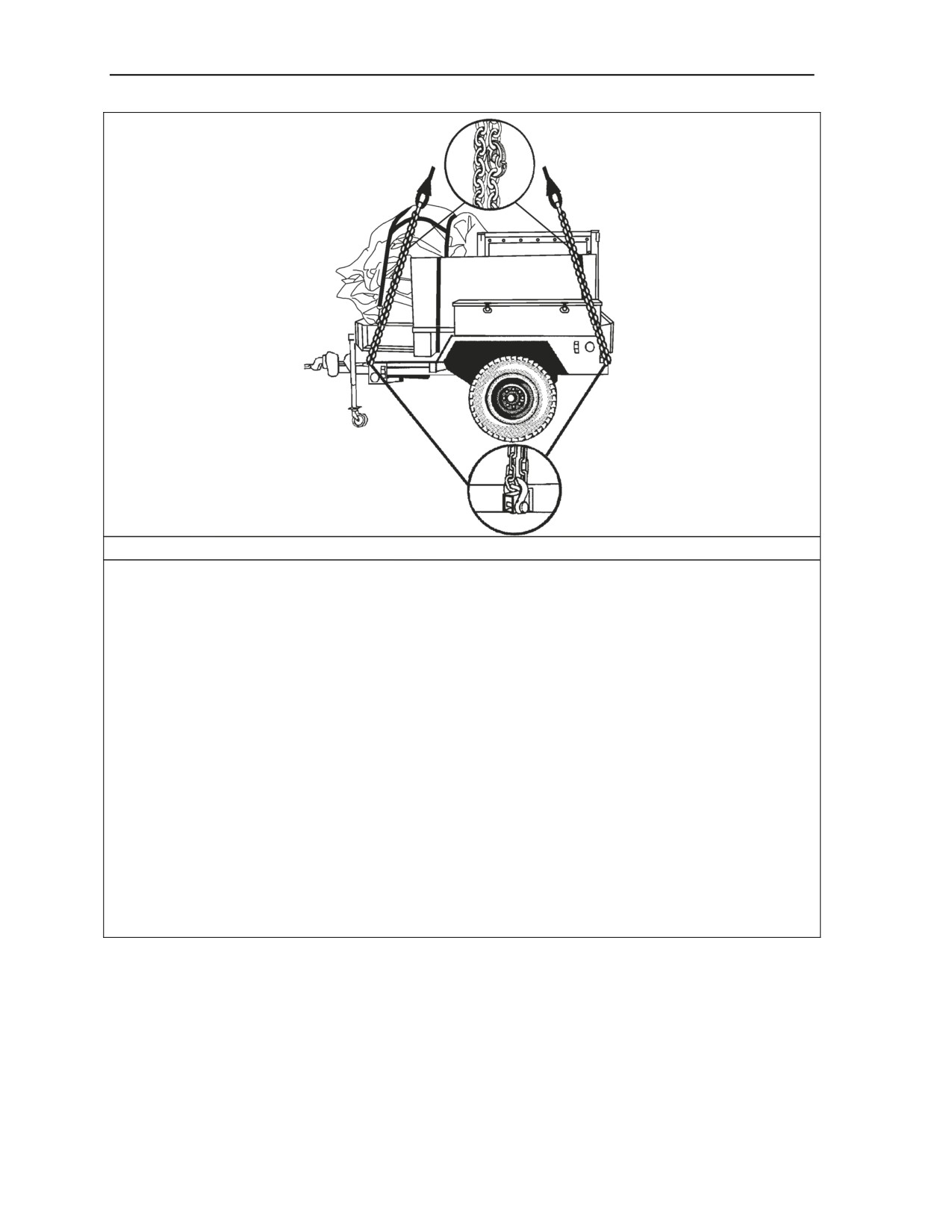
Rigging. Rig the load according to the steps in Figure 3-35.
Note. This load flies with the aft facing the direction of flight.
Hookup. The hookup team stands on top of the TMECS. The static wand person
discharges the static electricity with the static wand. The hookup person places the apex fitting
onto the cargo hook. The hookup team then carefully dismounts the trailer and remains close to
the load as the helicopter removes slack from the sling legs. When successful hookup is
assured, the hookup team quickly exits the area underneath the helicopter to the designated
rendezvous point.
Derigging. Derigging is the reverse of the preparation and rigging procedures.
CAUTION
The hookup team should dismount the trailer towards the lunette to
keep the trailer from tipping to the rear.
20 February 2009
FM 4-20.198/MCRP 4-11.3E, VOL II/NTTP 3-04.12/
AFMAN 11-223 (I), VOL II/COMDTINST M13482.3B
3-63
Chapter 3
RIGGING STEPS
1. Position the apex fitting on top of the TMECS. Route outer sling legs 1 and 2 to the rear of
the trailer and inner sling legs 3 and 4 to the front. Sling legs 1 and 3 must be on the right
side of the load.
2. Loop the chain end of sling leg 1 through the right rear lift provision. Place the correct link
from Table 3-35 in the grab hook. Repeat with sling leg 2 through the left rear lift provision.
Route chain leg 2 between the heating/cooling unit and the stowed tables. Secure the
excess chain with Type III nylon cord. Cluster and tie (breakaway technique) chain legs 1
and 2 together at a point 8 inches above the heating cooling unit. Remove all the slack from
sling legs 1 and 2. Keep the chains tight by tying a length of ½-inch tubular nylon webbing to
the chains routing the webbing over the heating/cooling unit.
3. Loop the chain end of sling leg 3 through the right front lift provision. Place the correct link
from Table 3-35 in the grab hook. Repeat with sling leg 4 through the left front lift provision.
Remove all the slack from sling legs 3 and 4. Keep the chains tight by tying a length of ½-
inch tubular nylon webbing to the chains routing the webbing over the tenting. Cluster and tie
(breakaway technique) chain legs 3 and 4
4. Cluster and tie (breakaway technique) all sling legs together on top of the TMECS to prevent
entanglement during hookup and lift-off.
Figure 3-35. Trailer Mounted Environmental Control System
PETROLEUM QUALITY ANALYSIS SYSTEM (PQAS) TRAILER
3-37. The petroleum quality analysis system trailer is rigged for single-point sling load using the following
procedures:
z
Applicability. The following item in Table 3-36 is certified for all helicopters with suitable lift
capacity by the US Army Natick Soldier Center:
3-64
FM 4-20.198/MCRP 4-11.3E, VOL II/NTTP 3-04.12/
AFMAN 11-223 (I), VOL II/COMDTINST M13482.3B
20 February 2009
Certified Single-Point Rigging Procedures for Trailers
Table 3-36. Petroleum Quality Analysis System Trailer
Nomenclature
Max
Sling
Link Count
Weight
Set
Front/Rear
(Pounds)
Petroleum Quality Analysis System Trailer
3,380
10K
35/3
z
Materials. The following materials are required to rig this load:
Sling set (10,000-pound capacity).
─ Chain length, part number 38850-00053-101, from a 10,000-pound capacity sling set
(4 each).
─ Coupling link, part number 577-0615, from a 10,000-pound sling set (4 each).
Tape, adhesive, pressure-sensitive, 2-inch wide roll.
Cord, nylon, Type III, 550-pound breaking strength.
Webbing, cotton, 1/4-inch, 80-pound breaking strength.
Webbing, nylon tubular, ½-inch, 1000-pound breaking strength.
z
Personnel. Two persons can prepare and rig this load in 15 minutes.
z
Procedures. The following procedures apply to this load:
Preparation. Prepare the load using the following steps:
─ Secure all loose equipment inside the trailer with tape, Type III nylon cord, or tiedown
straps. Close and lock all doors.
─ Fully extend the lunette wheel and secure in place with tape or Type III nylon cord.
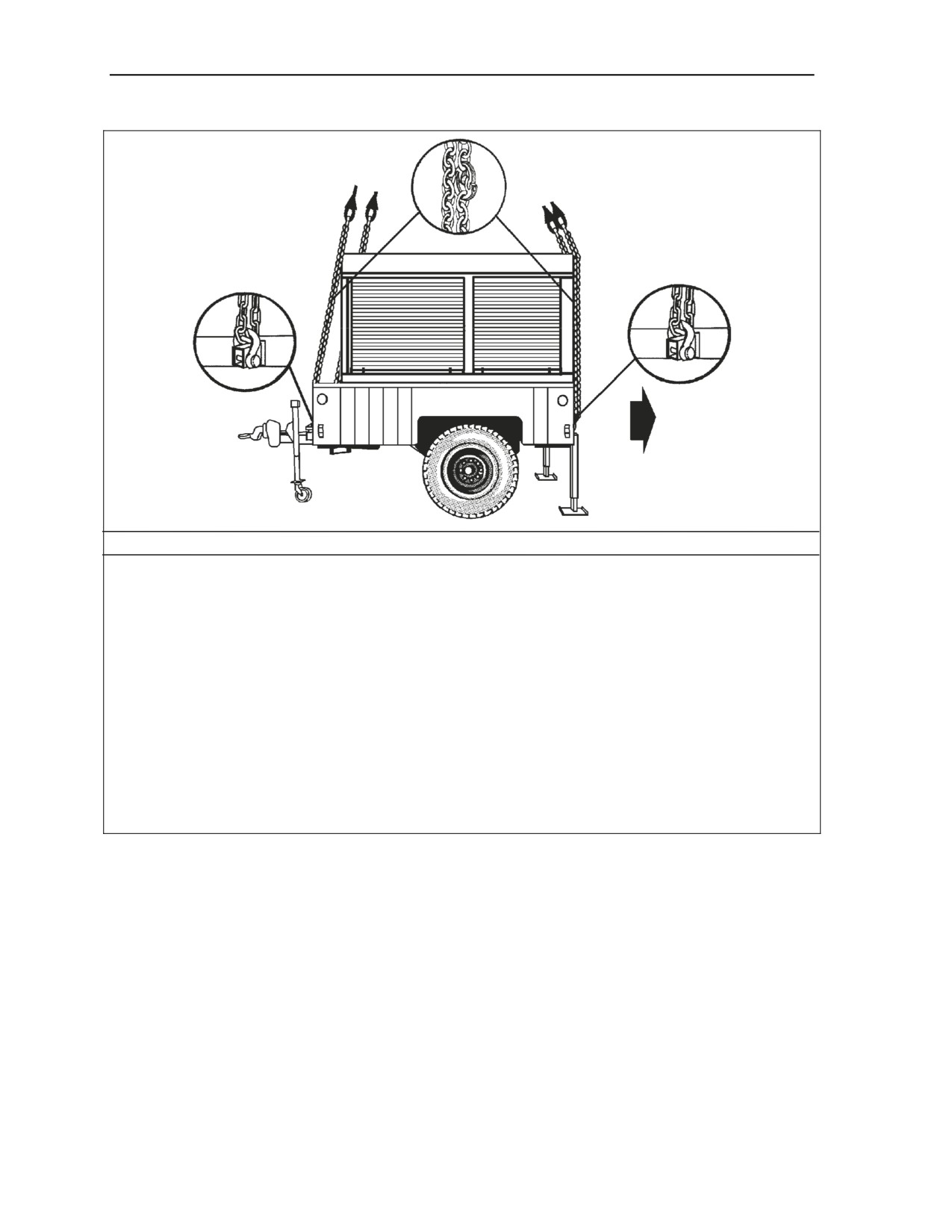
Rigging. Rig the load according to the steps in Figure 3-36.
Hookup. The hookup team stands on top of the PQAS trailer. The static wand person
discharges the static electricity with the static wand. The hookup person places the apex fitting
onto the cargo hook. The hookup team then carefully dismounts the trailer and remains close to
the load as the helicopter removes slack from the sling legs. When successful hookup is
assured, the hookup team quickly exits the area underneath the helicopter to the designated
rendezvous point.
Derigging. Derigging is the reverse of the preparation and rigging procedures.
20 February 2009
FM 4-20.198/MCRP 4-11.3E, VOL II/NTTP 3-04.12/
AFMAN 11-223 (I), VOL II/COMDTINST M13482.3B
3-65
Chapter 3
RIGGING STEPS
1. Position the apex fitting on top of the trailer. Route outer sling legs 1 and 2 to the front of the
trailer (lunette end) and inner sling legs 3 and 4 to the rear. Sling legs 1 and 3 must be on
the left side of the load
2. Loop the chain end of sling leg 1 through the left front lift provision from inboard to outboard.
Place the correct link from Table 3-36 in the grab hook. Repeat with sling leg 2 through the
right front lift provision. Secure the excess chain with Type III nylon cord.
3. Loop the chain end of sling leg 3 through the left rear lift provision located on the ramp
section. Place the correct link from Table 3-36 in the grab hook. Repeat with sling leg 4
through the right rear lift provision.
4. Cluster and tie (breakaway technique) all sling legs together on top of the launcher rails to
prevent entanglement during hookup and lift-off.
Figure 3-36. Petroleum Quality Analysis System Trailer
3-66
FM 4-20.198/MCRP 4-11.3E, VOL II/NTTP 3-04.12/
AFMAN 11-223 (I), VOL II/COMDTINST M13482.3B
20 February 2009

Chapter 4
Certified Single-Point Rigging Procedures for Trailers with
Mounted Generators
INTRODUCTION
4-1. This chapter contains rigging procedures for single-point trailer loads with mounted generators that
have been certified for sling load. Each rigging procedure is found in a paragraph that includes a
description of the load, materials required for rigging, and steps to complete the procedure. An
applicability paragraph is also a part of each paragraph and identifies the certified loads. The certified
single-point rigging procedures for trailer loads with mounted generators are in this section. Paragraphs 4-
2 through 4-10 give detailed instructions for rigging loads.
Note. Reach pendants may be used on all single point loads. A static discharge person is not
required when using a reach pendant.
M353 TRAILER CHASSIS WITH MOUNTED GENERATORS
4-2. The M353 trailer chassis with mounted generators is rigged for single-point sling load using the
following procedures:
z
Applicability. The following items in Table 4-1 are certified for all helicopters with suitable lift
capacity by the US Army Natick Soldier Center:
Table 4-1. M353 Trailer Chassis with Mounted Generators
Nomenclature
Max
Sling
Link Count
Weight
Set
Front/Rear
(Pounds)
M353 Trailer Chassis
2,720
10K
20/3
MEP-005A
6,220
10K
20/3
MEP-006A
7,720
10K
20/3
MEP-0114A
6,220
10K
20/3
MEP-0115A
6,320
10K
20/3
z
Materials. The following materials are required to rig this load:
Sling set (10,000-pound capacity).
Tape, adhesive, pressure-sensitive, 2-inch wide roll.
Cord, nylon, Type III, 550-pound breaking strength.
Webbing, cotton, 1/4-inch, 80-pound breaking strength.
z
Personnel. Two persons can prepare and rig this load in 10 minutes.
z
Procedures. The following procedures apply to this load:
Preparation. Prepare the load using the following steps:
─ Engage both hand brakes.
─ Secure safety chains and brake hoses to the top of the drawbar with Type III nylon cord.
─ Secure all lids, doors, and caps with tape or Type III nylon cord.
20 February 2009
FM 4-20.198/MCRP 4-11.3E, VOL II/NTTP 3-04.12/
AFMAN 11-223 (I), VOL II/COMDTINST M13482.3B
4-1
Chapter 4
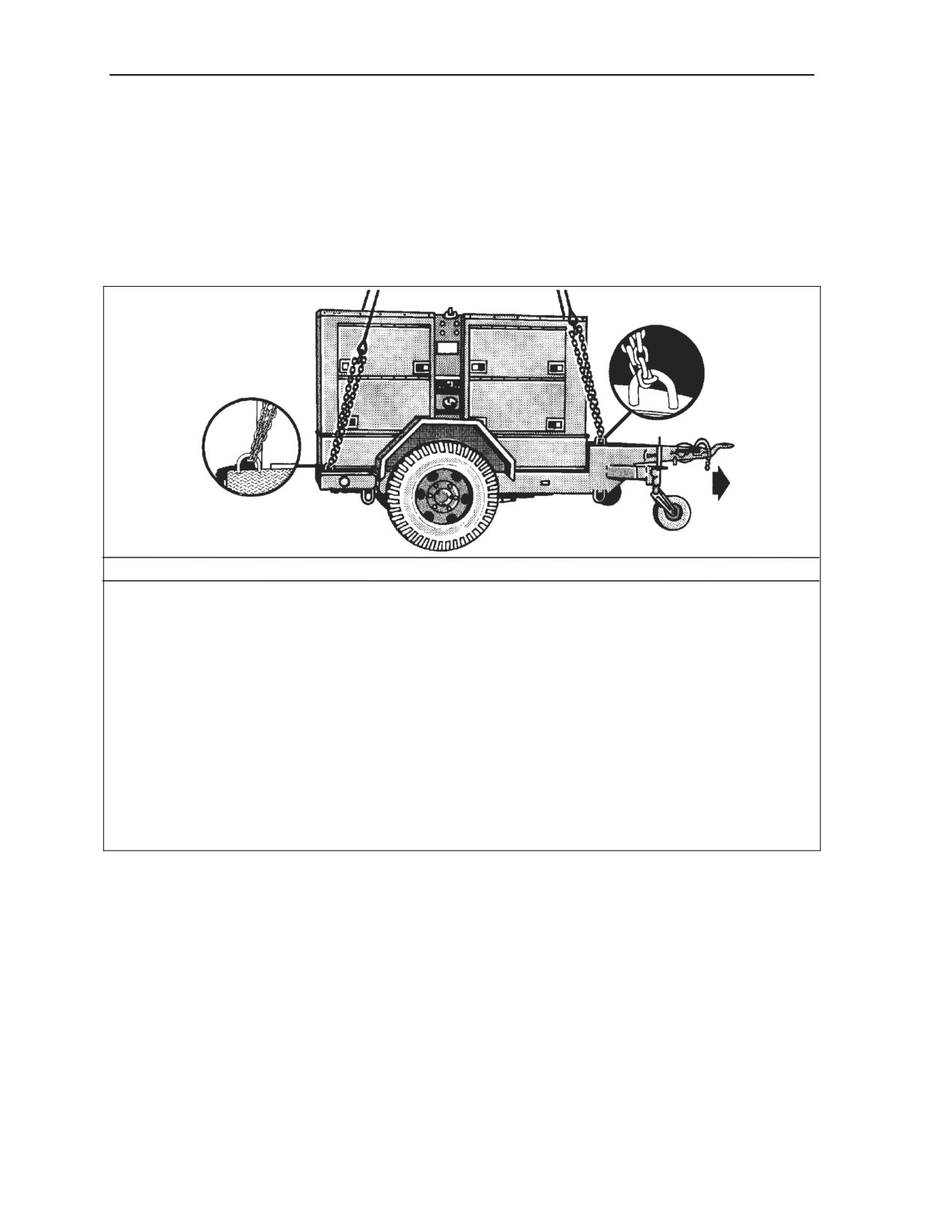
Rigging. Rig the load according to the steps in Figure 4-1.
Hookup. The hookup team stands on top of the generator. The static wand person
discharges the static electricity with the static wand. The hookup person places the apex fitting
onto the aircraft cargo hook. The hookup team then carefully dismounts the trailer and remains
close to the load as the helicopter removes slack from the sling legs. When successful hookup is
assured, the hookup team quickly exits the area underneath the helicopter to the designated
rendezvous point.
Derigging. Derigging is the reverse of the preparation and rigging procedures.
RIGGING STEPS
1. Position apex fitting on top of the generator. Route outer sling legs 1 and 2 to the front of the
trailer (lunette end) and inner sling legs 3 and 4 to the rear. Sling legs 1 and 3 must be on
the left side of the load.
2. Loop the chain end of sling leg 1 through the left front lift provision located on the front of the
trailer frame. Place the correct link from Table 4-1 in the grab hook. Repeat with sling leg 2
through the right side, front lift provision. Secure the excess chain with Type III nylon cord.
3. Route the chain end of sling leg 3 through the left rear lift provision located on the rear of the
trailer frame. Place the correct link from Table 4-1 in the grab hook. Repeat with sling leg 4
through the right rear lift provision.
4. Cluster and tie (breakaway technique) all sling legs together on top of the roof to prevent
entanglement during hookup and lift-off.
Figure 4-1. M353 Trailer Chassis with Mounted Generators
M200A1 TRAILER-MOUNTED POWER UNITS, GENERATORS, AND
POWER PLANTS
4-3. The M200A1 trailer-mounted power units, generators, and power plants are rigged for single-point
sling load using the following procedures:
z
Applicability. The following items in Table 4-2 are certified for all helicopters with suitable lift
capacity by the US Army Natick Soldier Center:
4-2
FM 4-20.198/MCRP 4-11.3E, VOL II/NTTP 3-04.12/
AFMAN 11-223 (I), VOL II/COMDTINST M13482.3B
20 February 2009

Certified Single-Point Rigging Procedures for Trailers with Mounted Generators
Table 4-2. M200A1 Trailer-Mounted Power Units, Generators, and Power Plants
Nomenclature
Max
Sling Set
Link Count
Weight
Front/Rear
(Pounds)
Generator set, 15 kW, 6113
5,119
10K
3/23
Generator set, 30 kW, CE301ACWK1
5,625
10K
3/28
Generator set, 45 kW, 52300
6,885
10K
3/30
Generator set, 60 kW, MEP-006A
7,347
10K
3/33
AN/MJQ-12A, Unit A, 60 kW, 50/60 Hz Power Unit with MEP 006A,
8,060
10K
10/3
60 kW, 50/60 Hz, generator set with switch box
AN/MJQ-12A, Unit B, 60 kW, 50/60 Hz Power Unit with MEP 806A,
7,980
10K
10/3
60 kW, 50/60 Hz, generator set (no switch box)
AN/MJQ-39, Unit A, 15 kW, 400 Hz Power Unit with MEP 814A, 15
5,255
10K
3/3
kW, 400 Hz, generator set with switch box
AN/MJQ-39, Unit B, 15 kW, 400 Hz Power Unit with MEP 814A, 15
5,255
10K
3/3
kW, 400 Hz, generator set (no switch box)
AN/MJQ-40, Unit A, 30 kW, 50/60 Hz Power Unit with MEP 805A,
6,100
10K
3/3
30 kW, 50/60 Hz, generator set with switch box
AN/MJQ-40, Unit B, 30 kW, 50/60 Hz Power Unit with MEP 805A,
6,100
10K
3/3
30 kW, 50/60 Hz, generator set (no switch box)
AN/MJQ-40B, Unit A, PU-803B/G, PU-804B/G
7,410
10K
3/3
AN/MJQ-40B, Unit B, PU-803B/G, PU-804B/G
7,410
10K
3/3
AN/MJQ-41, Unit A, 60 kW, 50/60 Hz Power Unit with MEP 806A,
6,720
10K
3/3
60 kW, 50/60 Hz, generator set with switch box
AN/MJQ-41, Unit B, 60 kW, 50/60 Hz Power Unit with MEP 806A,
6,720
10K
3/3
60 kW, 50/60 Hz, generator set (no switch box)
AN/MJQ-41B, Unit A, PU-805B/G, PU-806B/G
7,410
10K
3/3
AN/MJQ-41B, Unit B, PU-805B/G, PU-806B/G
7,410
10K
3/3
PU-405 A/M Power Unit, 15 kW, without acoustic suppression kit
6,119
10K
3/33
(ASK)
PU-405 A/M Power Unit, 15 kW, with acoustic suppression kit
6,740
10K
3/28
(ASK)
PU-406 B/M Power Unit, 30 kW, with acoustic suppression kit
7,520
10K
3/28
(ASK)
PU-650 B/G, 60 kW , 50/60 Hz Power Unit with MEP 006A, 60 kW,
7,800
10K
10/3
50/60 Hz generator set
PU-707 A/M, 60 kW , 400 Hz Power Unit with MEP 115A, 60 kW,
7,800
10K
10/3
400 Hz generator set
PU-732 Power Unit, 15 kW, with acoustic suppression kit (ASK)
6,690
10K
3/28
PU-760 Power Unit, 30 kW, with acoustic suppression kit (ASK)
7,240
10K
3/28
PU-800, 15 kW, 400 Hz Power Unit with MEP 814A, 15 kW, 400
5,255
10K
3/3
Hz, generator set
PU-802, 15 kW, 50/60 Hz Power Unit with MEP 804A, 15 kW,
5,320
10K
3/3
50/60 Hz, generator set
PU-803, 30 kW, 50/60 Hz Power Unit with MEP 805A, 30 kW,
6,100
10K
3/3
50/60 Hz, generator set
20 February 2009
FM 4-20.198/MCRP 4-11.3E, VOL II/NTTP 3-04.12/
AFMAN 11-223 (I), VOL II/COMDTINST M13482.3B
4-3

Chapter 4
Table 4-2. M200A1 Trailer-Mounted Power Units, Generators, and Power Plants (Continued)
Nomenclature
Max
Sling Set
Link Count
Weight
Front/Rear
(Pounds)
PU-804, 30 kW, 400 Hz Power Unit with MEP 815A, 30 kW, 400
6,130
10K
3/3
Hz, generator set
PU-805, 60 kW, 50/60 Hz Power Unit with MEP 806A, 60 kW,
7,120
10K
3/3
50/60 Hz, generator set
PU-806, 60 kW, 400 Hz Power Unit with MEP 816A, 60 kW, 400
7,215
10K
3/3
Hz, generator set
PU-794/G Regency Net Power Unit
6,600
10K
3/18
z
Materials. The following materials are required to rig this load:
Sling set (10,000-pound capacity).
Tape, adhesive, pressure-sensitive, 2-inch wide roll.
Cord, nylon, Type III, 550-pound breaking strength.
Webbing, cotton, 1/4-inch, 80-pound breaking strength.
Felt sheet, cattle hair, Type IV, 1/2-inch or suitable substitute.
Tie-down strap, CGU/1B (as required).
z
Personnel. Two persons can prepare and rig this load in 15 minutes.
Procedures. The following procedures apply to this load:
Preparation. Prepare the load using the following steps:
─ Lower the lunette as far as possible.
─ Engage both hand brakes.
─ Secure safety chains and brake hoses to the top of the drawbar with Type III nylon cord.
─ Secure all lids, doors, and caps with tape or type III nylon cord.
─ Secure the fire extinguisher (if installed) with Type III nylon cord.
─ Secure the landing legs in the up position with the safety pins. Secure the safety pins
with tape.
─ Place additional cargo as close to the center of the trailer as possible. The cargo must not
contact the sling legs during lift-off or flight.
Note. The load must not weigh more than the maximum allowable weight during sling load
operations.
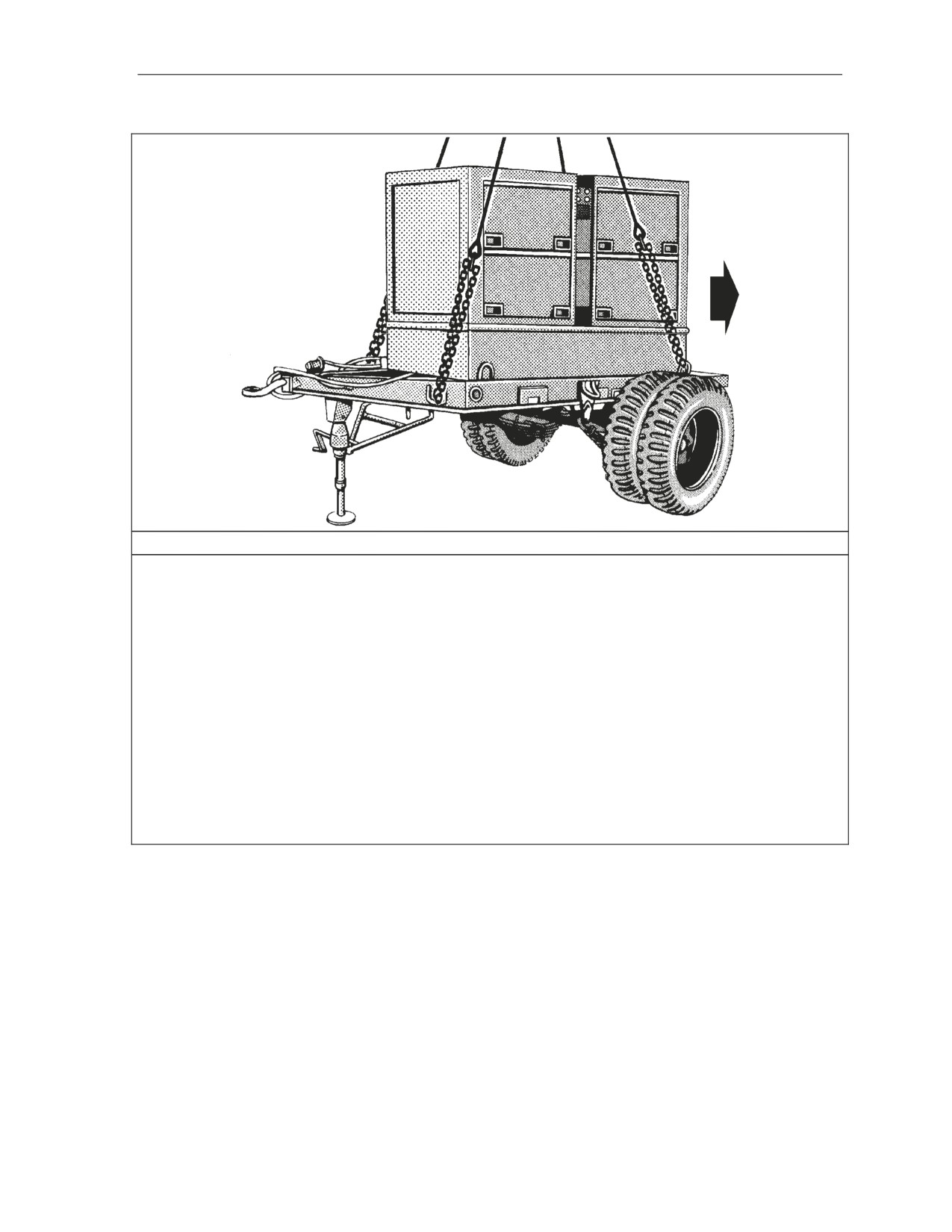
Rigging. Rig the load according to the steps in Figure 4-2.
Hookup. The hookup team stands on top of the generator. The static wand person
discharges the static electricity with the static wand. The hookup person places the apex fitting
onto the aircraft cargo hook. The hookup team then carefully dismounts the trailer and remains
close to the load as the helicopter removes slack from the sling legs. When successful hookup is
assured, the hookup team quickly exits the area underneath the helicopter to the designated
rendezvous point.
Derigging. Derigging is the reverse of the preparation and rigging procedures.
4-4
FM 4-20.198/MCRP 4-11.3E, VOL II/NTTP 3-04.12/
AFMAN 11-223 (I), VOL II/COMDTINST M13482.3B
20 February 2009
Certified Single-Point Rigging Procedures for Trailers with Mounted Generators
RIGGING STEPS
1. Position apex fitting on top of the generator. Route outer sling legs 1 and 2 to the front of the
trailer (lunette end) and inner sling legs 3 and 4 to the rear. Sling legs 1 and 3 must be on
the left side of the load.
2. Loop the chain end of sling leg 1 through the left front lift provision located on the front of the
trailer frame. Place the correct link from Table 4-2 in the grab hook. Repeat with sling leg 2
through the right side, front lift provision. Secure the excess chain with Type III nylon cord.
3. Route the chain end of sling leg 3 through the left rear lift provision located on the rear of the
trailer frame. Place the correct link from Table 4-2 in the grab hook. Repeat with sling leg 4
through the right rear lift provision.
4. Cluster and tie (breakaway technique) all sling legs together on top of the roof to prevent
entanglement during hookup and lift-off.
Figure 4-2. M200A1 Trailer-Mounted Power Units, Generators, and Power Plants
M103A3 TRAILER-MOUNTED POWER UNITS, GENERATORS, AND
POWER PLANTS
4-4. The M103A3 trailer-mounted power units, generators, and power plants are rigged for single-point
sling load using the following procedures:
z
Applicability. The following items in Table 4-3 are certified for all helicopters with suitable lift
capacity by the US Army Natick Soldier Center :
20 February 2009
FM 4-20.198/MCRP 4-11.3E, VOL II/NTTP 3-04.12/
AFMAN 11-223 (I), VOL II/COMDTINST M13482.3B
4-5
Chapter 4
Table 4-3. M103A3 Trailer-Mounted Power Units, Generators, and Power Plants
Nomenclature
Max
Sling Set
Link Count
Weight
Front/Rear
(Pounds)
AN/MJQ-16 Power Unit, 5 kW, 60 Hz
5,100
10K
5/10
AN/MJQ-18 Power Unit, 10 kW, 60 Hz
5,765
10K
5/10
AN/MJQ-25 Power Unit, 10 kW, 400 Hz
5,750
10K
5/10
z
Materials. The following materials are required to rig this load:
Sling set (10,000-pound capacity).
Tape, adhesive, pressure-sensitive, 2-inch wide roll.
Cord, nylon, Type III, 550-pound breaking strength.
Webbing, cotton, 1/4-inch, 80-pound breaking strength.
Felt sheet, cattle hair, Type IV, 1/2-inch or suitable substitute.
Tie-down strap, CGU/1B (as required).
z
Personnel. Two persons can prepare and rig this load in 15 minutes.
z
Procedures. The following procedures apply to this load:
Preparation. Prepare the load using the following steps:
─ Remove the canvas top and bows. Secure the top and bows on the generator trailer or
coordinate the transportation for the canvas top and bows.
─ Ensure the fuel tank is less than 3/4 full.
─ Engage both hand brakes.
─ Secure safety chains and brake hoses to the top of the drawbar with Type III nylon cord.
─ Secure all lids, doors, and caps with tape or Type III nylon cord.
Rigging. Rig the load according to the steps in Figure 4-3.
Hookup. The hookup person stands on top of the generator. The static wand person stands
on the wheel well. The static wand person discharges the static electricity with the static wand.
The hookup person places the apex fitting onto the aircraft cargo hook. The hookup team then
carefully dismounts the trailer and remains close to the load as the helicopter removes slack
from the sling legs. When successful hookup is assured, the hookup team quickly exits the area
underneath the helicopter to the designated rendezvous point.
Derigging. Derigging is the reverse of the preparation and rigging procedures.
4-6
FM 4-20.198/MCRP 4-11.3E, VOL II/NTTP 3-04.12/
AFMAN 11-223 (I), VOL II/COMDTINST M13482.3B
20 February 2009
Certified Single-Point Rigging Procedures for Trailers with Mounted Generators
RIGGING STEPS
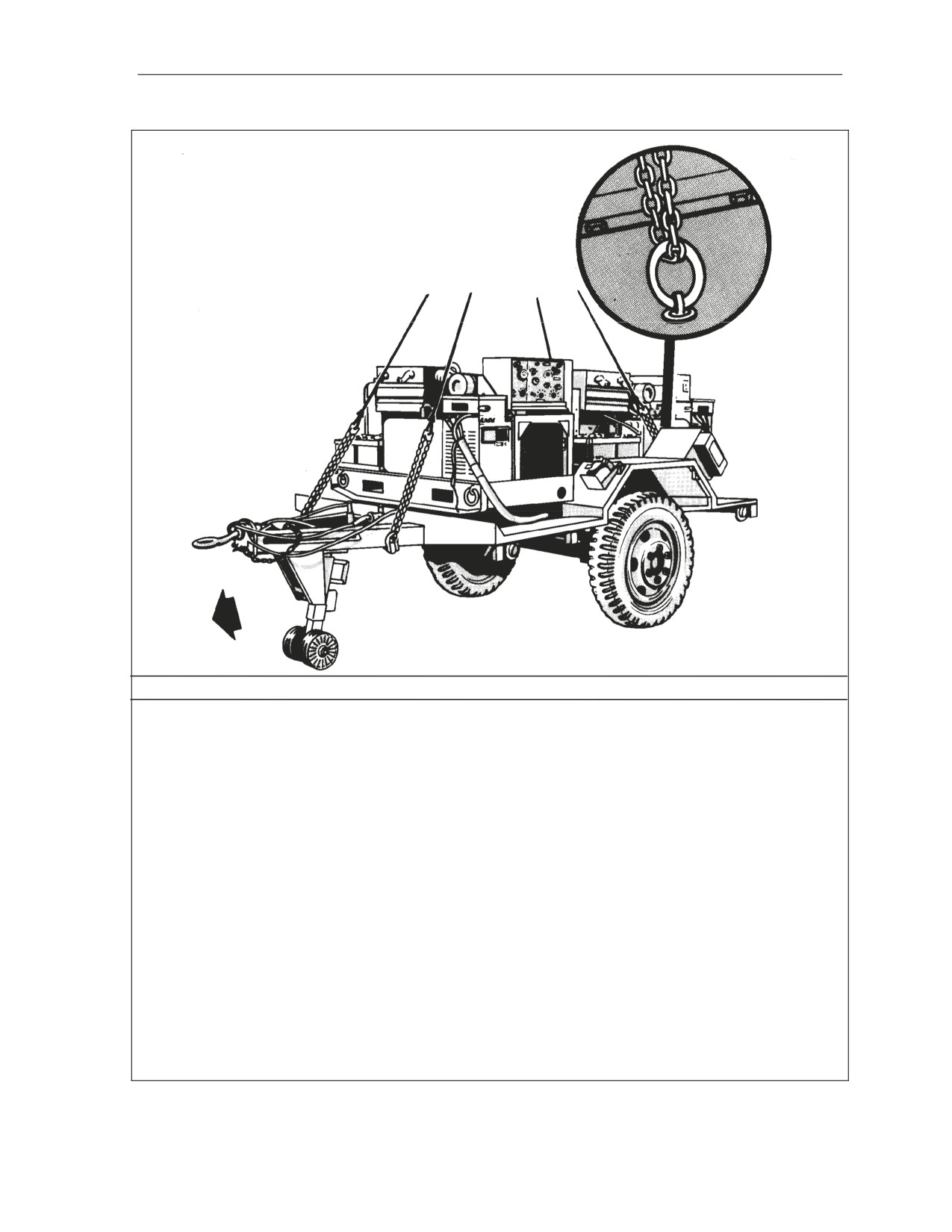
1. Position apex fitting on top of the generator. Route outer sling legs 1 and 2 to the front of the
trailer (lunette end) and inner sling legs 3 and 4 to the rear. Sling legs 1 and 3 must be on
the left side of the load.
2. Loop the chain end of sling leg 1 through the left front lift provision located on the outboard
side of the trailer A-frame. Place the correct link from Table 4-3 in the grab hook. Repeat
with sling leg 2 through the right side, front lift provision. Secure the excess chain with Type
III nylon cord.
3. Route the chain end of sling leg 3 through the left rear lift ring located on the trailer deck aft of
the wheel well. Place the correct link from Table 4-3 in the grab hook. Repeat with sling leg
4 through the right rear lift provision.
4. Secure the rear lift provisions in the up position to the generator tiedown provisions with Type
III nylon cord.
5. Pad the slings in the areas where they contact the generators.
6. Cluster and tie (breakaway technique) the front sling legs together to prevent entanglement
during hookup and lift-off. Repeat the procedure for the rear sling legs.
Figure 4-3. M103A3 Trailer-Mounted Power Units, Generators, and Power Plants
20 February 2009
FM 4-20.198/MCRP 4-11.3E, VOL II/NTTP 3-04.12/
AFMAN 11-223 (I), VOL II/COMDTINST M13482.3B
4-7
Chapter 4
M103A3/A4 TRAILER-MOUNTED POWER UNITS, GENERATORS,
AND POWER PLANTS
4-5. The M103A3/A4 trailer-mounted power units, generators, and power plants are rigged for single-
point sling load using the following procedures:
z
APPLICABILITY. The following items in Table 4-4 are certified for all helicopters with
suitable lift capacity by the US Army Natick Soldier Center :
Table 4-4. M103A3/A4 Trailer-Mounted Power Units, Generators, and Power Plants
Nomenclature
Max
Sling Set
Link Count
Weight
Front/Rear
(Pounds)
AN/MJQ-37 Power Unit, with Two (2) MEP-803A 10 kW, 60 Hz
4,735
10K
15/3
Generator Sets
AN/MJQ-38 Power Unit, with Two (2) MEP-813A 10 kW, 400 Hz
4,735
10K
15/3
Generator Sets
z
Materials. The following materials are required to rig this load:
Sling set (10,000-pound capacity).
Tape, adhesive, pressure-sensitive, 2-inch wide roll.
Cord, nylon, Type III, 550-pound breaking strength.
Webbing, cotton, 1/4-inch, 80-pound breaking strength.
Felt sheet, cattle hair, Type IV, 1/2-inch or suitable substitute.
Tie-down strap, CGU/1B (as required).
z
Personnel. Two persons can prepare and rig this load in 15 minutes.
z
Procedures. The following procedures apply to this load:
Preparation. Prepare the load using the following steps:
─ Engage both hand brakes.
─ Secure safety chains and brake hoses to the top of the drawbar with Type III nylon cord.
─ Secure all lids, doors, and caps with tape or type III nylon cord.
─ Ensure the rear lift provisions, located on the rear of the trailer frame, are free to rotate.
Secure the pins with tape.
─ Place additional cargo as close to the center of the trailer as possible. The cargo must not
contact the sling legs during lift-off or flight.
Rigging. Rig the load according to the steps in Figure 4-4.
Hookup. The hookup person stands on top of the generator. The static wand person stands
on the wheel well. The static wand person discharges the static electricity with the static wand.
The hookup person places the apex fitting onto the aircraft cargo hook. The hookup team then
carefully dismounts the trailer and remains close to the load as the helicopter removes slack
from the sling legs. When successful hookup is assured, the hookup team quickly exits the area
underneath the helicopter to the designated rendezvous point.
Derigging. Derigging is the reverse of the preparation and rigging procedures.
4-8
FM 4-20.198/MCRP 4-11.3E, VOL II/NTTP 3-04.12/
AFMAN 11-223 (I), VOL II/COMDTINST M13482.3B
20 February 2009
Certified Single-Point Rigging Procedures for Trailers with Mounted Generators
RIGGING STEPS
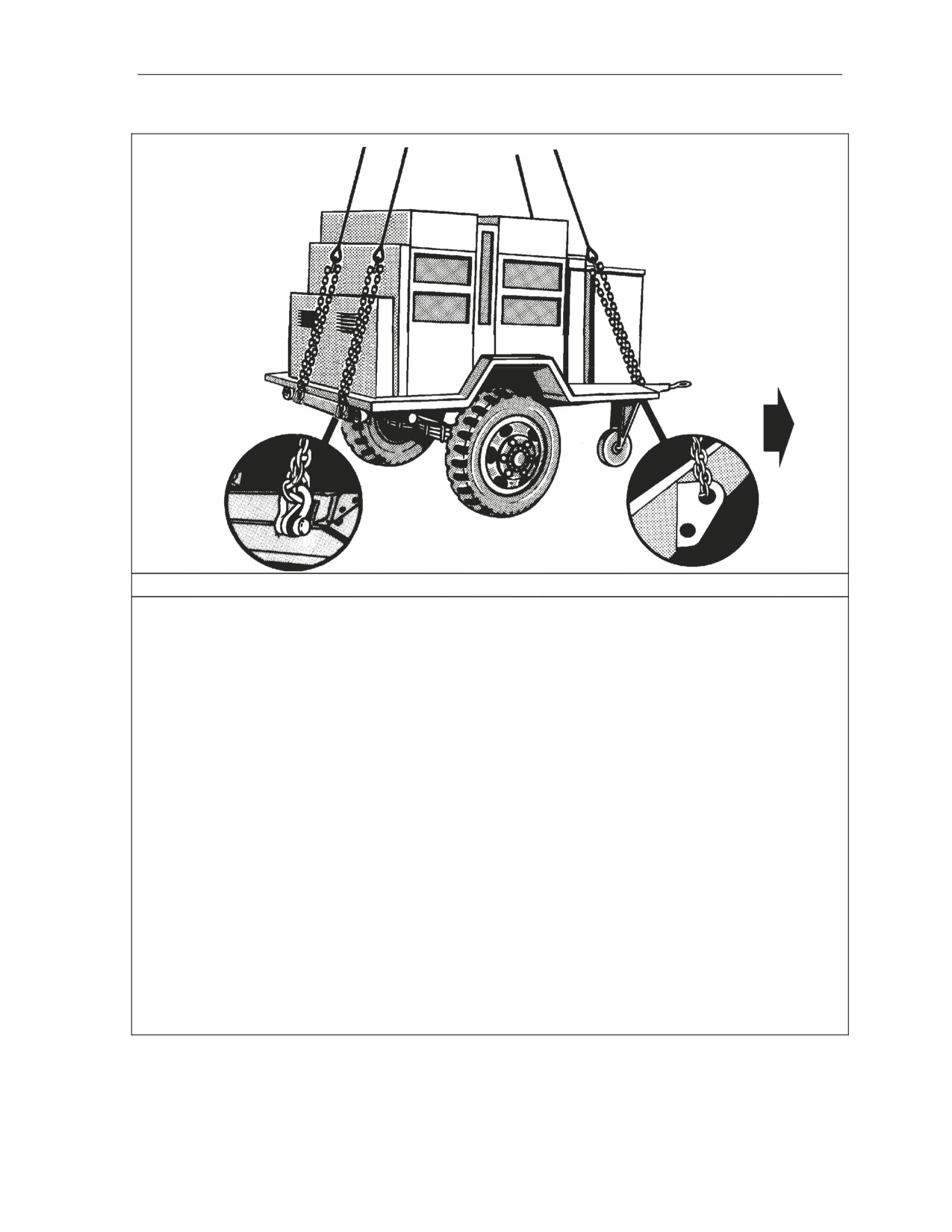
1. Position apex fitting on top of the generator. Route outer sling legs 1 and 2 to the front of the
trailer (lunette end) and inner sling legs 3 and 4 to the rear. Sling legs 1 and 3 must be on
the left side of the load.
2. Loop the chain end of sling leg 1 through the left front lift provision located on the left side of
the trailer A-frame. Place the correct link from Table 4-4 in the grab hook. Repeat with sling
leg 2 through the right side, front lift provision. Secure the excess chain with Type III nylon
cord.
3. Route the chain end of sling leg 3 through the left rear lift provision located on the rear of the
trailer frame. Place the correct link from Table 4-4 in the grab hook. Repeat with sling leg 4
through the right rear lift provision.
4. Secure the rear lift provisions in the up position to the generator tiedown provisions with Type
III nylon cord.
5. Raise the apex fitting above the generators and route the rear slings to the side of the rear
generator.
6. Pad the slings in the areas where they contact the generators.
7. Cluster and tie (breakaway technique) the front sling legs together to prevent entanglement
during hookup and lift-off. Repeat the procedure for the rear sling legs.
Figure 4-4. M103A3/A4 Trailer-Mounted Power Units, Generators, and Power Plants
20 February 2009
FM 4-20.198/MCRP 4-11.3E, VOL II/NTTP 3-04.12/
AFMAN 11-223 (I), VOL II/COMDTINST M13482.3B
4-9

Chapter 4
M116A2 TRAILER-MOUNTED POWER UNITS, GENERATORS, AND
POWER PLANTS
4-6. The M116A2 trailer-mounted power units, generators, and power plants are rigged for single-point
sling load using the following procedures:
z
Applicability. The following items in Table 4-5 are certified for all helicopters with suitable lift
capacity by the US Army Natick Soldier Center :
Table 4-5. M116A2 Trailer-Mounted Power Units, Generators, and Power Plants
Nomenclature
Max
Sling Set
Link Count
Weight
Front/Rear
(Pounds)
PU-751/M, 5 kW Generator Variants
LOS V1,V2/V3/V4
3,000
10K
3/40
Planning Trailer
Radio Access Trailer
PU-753/M, 10 kW Generator Variants
NC OPS Trailer, SCC TECH Trailer
NC MGMT Trailer
LEN MGMT Trailer
LEN OPS Trailer
3,000
10K
3/40
SEN V1 Trailer
SEN V2 Trailer
Maintenance #1 Trailer
AN/TSQ-182
AN/MJQ-32 Power Unit with Acoustic Suppression Kit, 3 kW
3,120
10K
7/3
AN/MJQ-33 Power Unit with Acoustic Suppression Kit, 3 kW
2,858
10K
7/3
z
Materials. The following materials are required to rig this load:
Sling set (10,000-pound capacity).
Tape, adhesive, pressure-sensitive, 2-inch wide roll.
Cord, nylon, Type III, 550-pound breaking strength.
Webbing, cotton, 1/4-inch, 80-pound breaking strength.
Felt sheet, cattle hair, Type IV, 1/2-inch or suitable substitute.
Tie-down strap, CGU/1B (as required).
z
Personnel. Two persons can prepare and rig this load in 20 minutes.
z
Procedures. The following procedures apply to this load:
Preparation. Prepare the load using the following steps:
─ Engage both hand brakes.
─ Secure safety chains and brake hoses to the top of the drawbar with Type III nylon cord.
─ Secure all lids, doors, and caps with tape or Type III nylon cord.
─ Remove the tarp and bows from the trailer and secure in appropriate place on trailer.
Secure the tarp and bows with tiedown straps (if required).
Rigging. Rig the load according to the steps in Figure 4-5.
Hookup. The hookup person stands on top of the generator. The static wand person stands
on the wheel well. The static wand person discharges the static electricity with the static wand.
The hookup person places the apex fitting onto the aircraft cargo hook. The hookup team then
carefully dismounts the trailer and remains close to the load as the helicopter removes slack
from the sling legs. When successful hookup is assured, the hookup team quickly exits the area
underneath the helicopter to the designated rendezvous point.
4-10
FM 4-20.198/MCRP 4-11.3E, VOL II/NTTP 3-04.12/
AFMAN 11-223 (I), VOL II/COMDTINST M13482.3B
20 February 2009
Certified Single-Point Rigging Procedures for Trailers with Mounted Generators
Derigging. Derigging is the reverse of the preparation and rigging procedures.
RIGGING STEPS
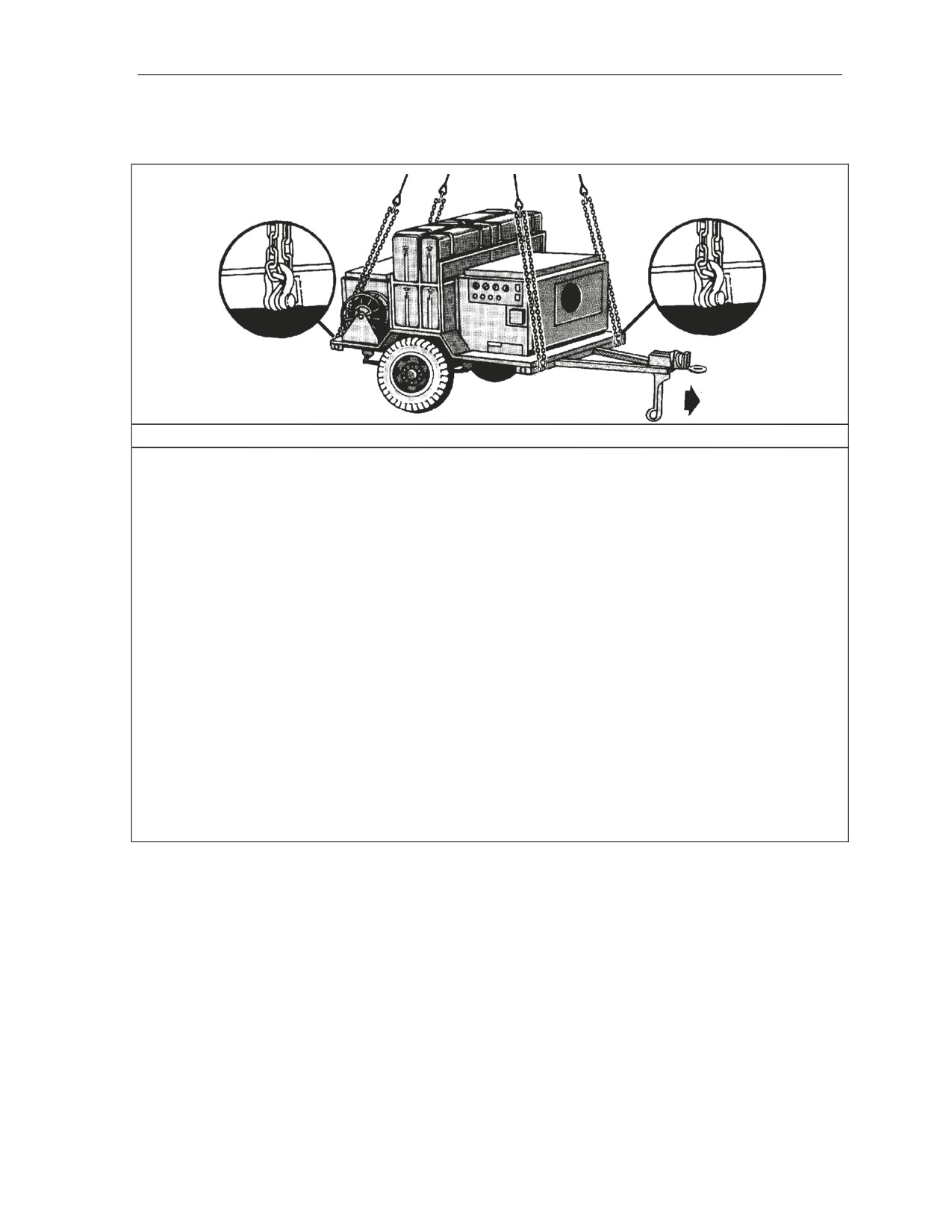
1. Position apex fitting on top of the generator. Route outer sling legs 1 and 2 to the front of the trailer
(lunette end) and inner sling legs 3 and 4 to the rear. Sling legs 1 and 3 must be on the left side of the
load.
2. Loop the chain end of sling leg 1 through the left front lift provision located on the left front side of the
trailer bed. Place the correct link from Table 4-5 in the grab hook. Repeat with sling leg 2 through the
right side, front lift provision. Secure the excess chain with Type III nylon cord.
3. Route the chain end of sling leg 3 through the left rear lift provision located on the rear of the trailer bed.
Place the correct link from Table 4-5 in the grab hook. Repeat with sling leg 4 through the right rear lift
provision.
4. Secure the lift provisions in the up position to the generator tiedown provisions with 1/4-inch cotton
webbing.
5. Raise the apex fitting above the generators and route the rear slings to the side of the rear generator.
6. Pad the slings in the areas where they contact the tool boxes or the generators.
7. Cluster and tie (breakaway technique) the sling legs together to prevent entanglement during hookup
and lift-off.
Figure 4-5. M116A2 Trailer-Mounted Power Units, Generators, and Power Plants
M116A3 TRAILER-MOUNTED POWER UNITS, GENERATORS, AND
POWER PLANTS
4-7. The M116A3 trailer-mounted power units, generators, and power plants are rigged for single-point
sling load using the following procedures:
z
Applicability. The following items in Table 4-6 are certified for all helicopters with suitable lift
capacity by the US Army Natick Soldier Center :
20 February 2009
FM 4-20.198/MCRP 4-11.3E, VOL II/NTTP 3-04.12/
AFMAN 11-223 (I), VOL II/COMDTINST M13482.3B
4-11

Chapter 4
Table 4-6. M116A3 Trailer-Mounted Power Units, Generators, and Power Plants
Nomenclature
Max
Sling Set
Link Count
Weight
Front/Rear
(Pounds)
AN/MJQ-43 Power Unit with Two (2) MEP-831A, 3 kW, 60 Hz,
2,060
10K
3/3
Generator Sets
AN/MJQ-35 Power Unit with Two (2) MEP-802A, 5 kW, 60 Hz,
3,160
10K
3/3
Generator Sets
PU-797 5 kW, 60Hz Power Unit with MEP-802A, 5 kW, 60 Hz, 60
2,720
10K
3/3
Hz, Generator Set
PU-798 10 kW, 60Hz Power Unit with MEP-803A,10 kW, 60 Hz,
2,860
10K
3/3
Generator Set
PU-799 10 kW, 400 Hz Power Unit with MEP-813A,10 kW, 400
3,160
10K
3/3
Hz, Generator Set
PU-801 15 kW, 50/60Hz Power Unit with MEP-804A,15 kW, 50/60
3,160
10K
15/3
Hz, Generator Set
AN/MJQ-33 Tactical Quiet Generator (TQG)
2,100
10K
3/3
z
Materials. The following materials are required to rig this load:
Sling set (10,000-pound capacity).
Tape, adhesive, pressure-sensitive, 2-inch wide roll.
Cord, nylon, Type III, 550-pound breaking strength.
Webbing, cotton, 1/4-inch, 80-pound breaking strength.
Felt sheet, cattle hair, Type IV, 1/2-inch or suitable substitute.
Tie-down strap, CGU/1B (as required).
z
Personnel. Two persons can prepare and rig this load in 15 minutes.
z
Procedures. The following procedures apply to this load:
Preparation. Prepare the load using the following steps:
─ Engage both hand brakes.
─ Secure safety chains and brake hoses to the top of the drawbar with Type III nylon cord.
─ Secure all lids, doors, and caps with tape or Type III nylon cord.
─ Place additional cargo as close to the center of the trailer as possible. Secure the cargo
with CGU-1/B tiedown straps. The cargo must not contact the sling legs during lift-off
or flight.
Rigging. Rig the load according to the steps in Figure 4-6.
Hookup. The hookup person stands on top of the generator. The static wand person stands
on the wheel well. The static wand person discharges the static electricity with the static wand.
The hookup person places the apex fitting onto the aircraft cargo hook. The hookup team then
carefully dismounts the trailer and remains close to the load as the helicopter removes slack
from the sling legs. When successful hookup is assured, the hookup team quickly exits the area
underneath the helicopter to the designated rendezvous point.
Derigging. Derigging is the reverse of the preparation and rigging procedures.
4-12
FM 4-20.198/MCRP 4-11.3E, VOL II/NTTP 3-04.12/
AFMAN 11-223 (I), VOL II/COMDTINST M13482.3B
20 February 2009
Certified Single-Point Rigging Procedures for Trailers with Mounted Generators
RIGGING STEPS
CAUTION
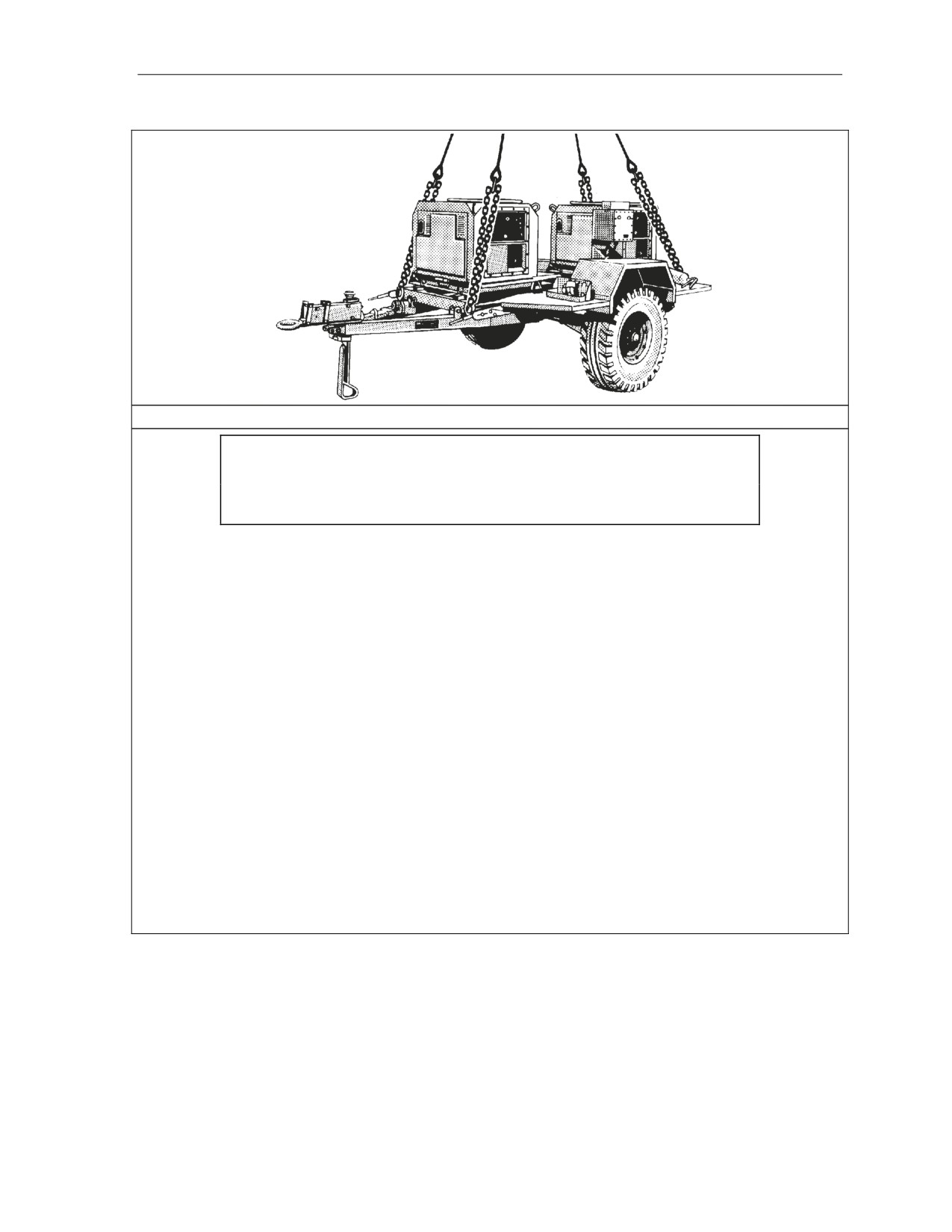
Do not add cargo to the PU-801 generator set.
1. Position apex fitting on top of the generator. Route outer sling legs 1 and 2 to the front of the
trailer (lunette end) and inner sling legs 3 and 4 to the rear. Sling legs 1 and 3 must be on
the left side of the load.
2. Loop the chain end of sling leg 1 through the left front lift provision located on the left front
side of the trailer bed. Place the correct link from Table 4-6 in the grab hook. Repeat with
sling leg 2 through the right side, front lift provision. Secure the excess chain with Type III
nylon cord.
3. Route the chain end of sling leg 3 through the left rear lift provision located on the rear of the
trailer bed. Place the correct link from Table 4-6 in the grab hook. Repeat with sling leg 4
through the right rear lift provision.
4. Secure the lift provisions in the up position to the generator tiedown provisions with 1/4-inch
cotton webbing.
5. Raise the apex fitting above the generators and route the rear slings to the side of the rear
generator. Pad the slings in the areas where they contact the tool boxes or the generators.
6. Cluster and tie (breakaway technique) the front sling legs together to prevent entanglement
during hookup and lift-off. Repeat the procedure for the rear sling legs.
Figure 4-6. M116A3 Trailer-Mounted Power Units, Generators, and Power Plants
HIGH MOBILITY TRAILER (HMT) WITH AN/MJQ-35A POWER
PLANT
4-8. The high mobility trailer with AN/MJQ-35A power plant is rigged for single-point sling load using
the following procedures:
20 February 2009
FM 4-20.198/MCRP 4-11.3E, VOL II/NTTP 3-04.12/
AFMAN 11-223 (I), VOL II/COMDTINST M13482.3B
4-13
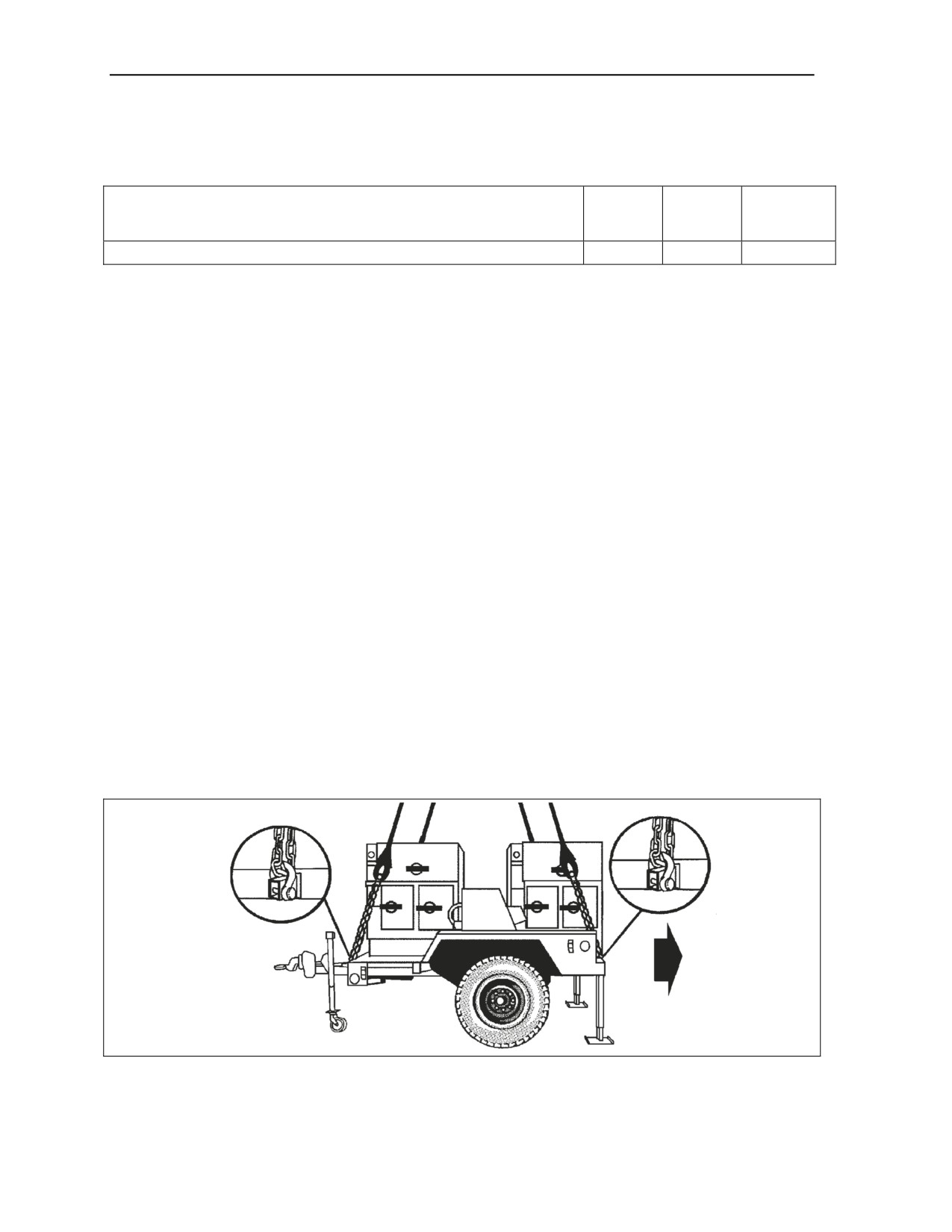
Chapter 4
z
Applicability. The following item in Table 4-7 is certified for all helicopters with suitable lift
capacity by the US Army Natick Soldier Center :
Table 4-7. High Mobility Trailer with AN/MJQ-35A Power Plant
Nomenclature
Max
Sling Set
Link Count
Weight
Front/Rear
(Pounds)
AN/TMQ-35A 5 kW, 60 Hz Power Plant
3,540
10K
20/3
z
Materials. The following materials are required to rig this load:
Sling set (10,000-pound capacity).
Tape, adhesive, pressure-sensitive, 2-inch wide roll.
Cord, nylon, Type III, 550-pound breaking strength.
Webbing, cotton, 1/4-inch, 80-pound breaking strength.
Felt sheet, cattle hair, Type IV, 1/2-inch or suitable substitute.
Tie-down strap, CGU/1B (as required).
z
Personnel. Two persons can prepare and rig this load in 10 minutes.
z
Procedures. The following procedures apply to this load:
Preparation. Prepare the load using the following steps:
─ Engage the parking brake.
─ Secure safety chains and brake hoses to the top of the drawbar with Type III nylon cord.
─ Secure all lids, doors, and caps with tape or type III nylon cord.
─ Place additional cargo on the trailer bed and secure the cargo with CGU-1/B tiedown
straps.
─ Install the rear stabilizer legs with the lower support section fully retracted.
─ Lower the front jack so the lunette is close to the ground.
Rigging. Rig the load according to the steps in Figure 4-7.
Hookup. The hookup team stands on the drawbar or the bed of the trailer. The static
wand person discharges the static electricity with the static wand. The hookup person places the
apex fitting onto the aircraft cargo hook. The hookup team then carefully dismounts the trailer
on the lunette end of the trailer and remains close to the load as the helicopter removes slack
from the sling legs. When successful hookup is assured, the hookup team quickly exits the area
underneath the helicopter to the designated rendezvous point.
Derigging. Derigging is the reverse of the preparation and rigging procedures.
Figure 4-7. High Mobility Trailer with AN/MJQ-35A Power Plant
4-14
FM 4-20.198/MCRP 4-11.3E, VOL II/NTTP 3-04.12/
AFMAN 11-223 (I), VOL II/COMDTINST M13482.3B
20 February 2009

Certified Single-Point Rigging Procedures for Trailers with Mounted Generators
RIGGING STEPS
1. Position apex fitting on top of the generator. Route outer sling legs 1 and 2 to the front of the
trailer (lunette end) and inner sling legs 3 and 4 to the rear. Sling legs 1 and 3 must be on
the left side of the load.
2. Loop the chain end of sling leg 1 through the left front lift provision located on the left front
side of the trailer bed. Place the correct link from Table 4-7 in the grab hook. Repeat with
sling leg 2 through the right side, front lift provision. Secure the excess chain with Type III
nylon cord.
3. Route the chain end of sling leg 3 through the left rear lift provision located on the rear of the
trailer bed. Place the correct link from Table 4-7 in the grab hook. Repeat with sling leg 4
through the right rear lift provision.
4. Pad the slings in the areas where they contact the tool boxes or the generators.
5. Cluster and tie (breakaway technique) the front sling legs together to prevent entanglement
during hookup and lift-off. Repeat the procedure for the rear sling legs.
Figure 4-7. High Mobility Trailer with AN/MJQ-35A Power Plant (Continued)
HIGH MOBILITY TRAILER (HMT) WITH TACTICAL QUIET
GENERATOR POWER UNITS
4-9. The high mobility trailer with tactical quiet generator power units is rigged for single-point sling
load using the following procedures:
z
Applicability. The following items in Table 4-8 are certified for all helicopters with suitable lift
capacity by the US Army Natick Soldier Center :
Table 4-8. High Mobility Trailer with Tactical Quiet Generator Power Units
Nomenclature
Max
Sling Set
Link Count
Weight
Front/Rear
(Pounds)
PU-797A 5 kW, 60 Hz, Power Unit with 802A Generator Set
2,657
10K
3/15
PU-798A 10 kW, 60 Hz, Power Unit with 803A Generator Set
2,880
10K
3/15
PU-799A 10 kW, 400 Hz, Power Unit with 813A Generator Set
2,910
10K
3/15
PU-801A 15 kW, 60Hz Power Unit with MEP-804A Generator Set
3,800
10K
3/3
z
Materials. The following materials are required to rig this load:
Sling set (10,000-pound capacity).
Tape, adhesive, pressure-sensitive, 2-inch wide roll.
Cord, nylon, Type III, 550-pound breaking strength.
Webbing, cotton, 1/4-inch, 80-pound breaking strength.
Felt sheet, cattle hair, Type IV, 1/2-inch or suitable substitute.
Tie-down strap, CGU/1B (as required).
z
Personnel. Two persons can prepare and rig this load in 10 minutes.
z
Procedures. The following procedures apply to this load:
Preparation. Prepare the load using the following steps:
─ Engage the parking brake.
─ Secure safety chains and brake hoses to the top of the drawbar with Type III nylon cord.
20 February 2009
FM 4-20.198/MCRP 4-11.3E, VOL II/NTTP 3-04.12/
AFMAN 11-223 (I), VOL II/COMDTINST M13482.3B
4-15
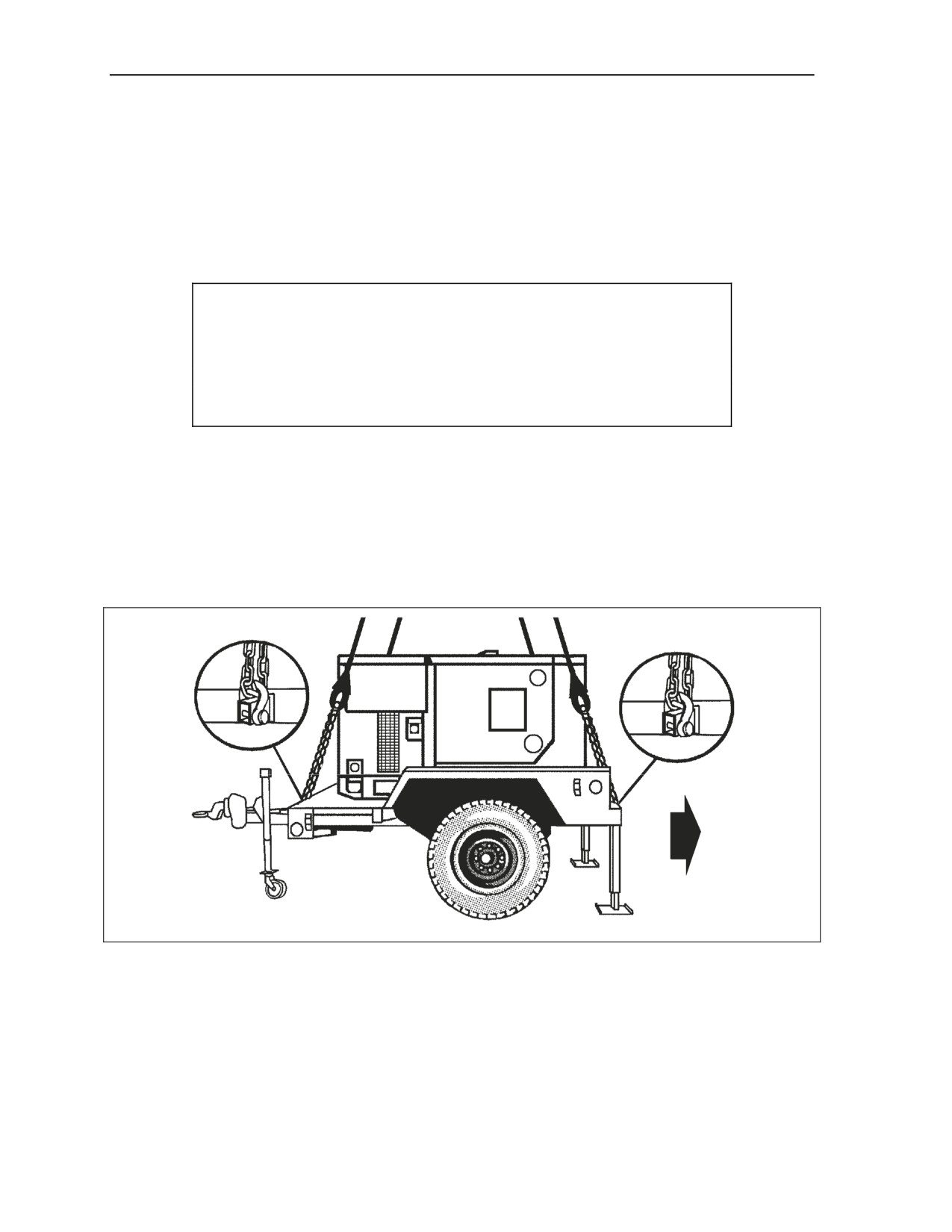
Chapter 4
─ Secure all lids, doors, and caps with tape or Type III nylon cord.
─ Place additional cargo on the trailer bed and secure the cargo with CGU-1/B tiedown
straps.
─ Install the rear stabilizer legs with the lower support section fully retracted.
─ Lower the front jack so the lunette is close to the ground.
─ Secure the four lift rings on the trailer in the up position to a convenient point on the load
with 1/4-inch cotton webbing.
Rigging. Rig the load according to the steps in Figure 4-8.
CAUTION
The routing of the sling legs is reversed from the standard routing
found in this manual. Sling legs 1 and 2 are routed to the rear of the
trailer to increase the clearance between the sling legs and the
generator.
Hookup. The hookup team stands on the drawbar or the bed of the trailer. The static wand
person discharges the static electricity with the static wand. The hookup person places the apex
fitting onto the aircraft cargo hook. The hookup team then carefully dismounts the trailer on the
lunette end of the trailer and remains close to the load as the helicopter removes slack from the
sling legs. When successful hookup is assured, the hookup team quickly exits the area
underneath the helicopter to the designated rendezvous point.
Derigging. Derigging is the reverse of the preparation and rigging procedures.
Figure 4-8. High Mobility Trailer with Tactical Quiet Generator Power Units
4-16
FM 4-20.198/MCRP 4-11.3E, VOL II/NTTP 3-04.12/
AFMAN 11-223 (I), VOL II/COMDTINST M13482.3B
20 February 2009
Certified Single-Point Rigging Procedures for Trailers with Mounted Generators
RIGGING STEPS
1. Position apex fitting on top of the generator. Route outer sling legs 1 and 2 to the rear of the
trailer and inner sling legs 3 and 4 to the front (lunette end). Sling legs 1 and 3 must be on
the left side of the load.
2. Loop the chain end of sling leg 1 through the left rear lift provision located on the left rear side
of the trailer bed. Place the correct link from Table 4-8 in the grab hook. Repeat with sling
leg 2 through the right rear lift provision. Secure the excess chain with Type III nylon cord.
3. Route the chain end of sling leg 3 through the left front lift provision located on the front of the
trailer bed. Place the correct link from Table 4-8 in the grab hook. Repeat with sling leg 4
through the right front lift provision.
4. Pad the slings in the areas where they contact the tool boxes or the generators.
5. Cluster and tie (breakaway technique) the sling legs together on top of the generator to
prevent entanglement during hookup and lift-off.
Figure 4-8. High Mobility Trailer with Tactical Quiet Generator Power Units (Continued)
HIGH MOBILITY TRAILER (HMT) WITH GENERATOR FOR JOINT
SURVEILLANCE TARGET ATTACK RADAR (JSTAR) SYSTEM
4-10. The high mobility trailer with generator for joint surveillance target attack radar system is rigged for
single-point sling load using the following procedures:
z
Applicability. The following items in Table 4-9 are certified for all helicopters with suitable lift
capacity by the US Army Natick Soldier Center :
Table 4-9. High Mobility Trailer with Generator for Joint Surveillance Target Attack Radar
System
Nomenclature
Max
Sling Set
Link Count
Weight
Front/Rear
(Pounds)
Mission Trailer without Transfer Cases
3,960
10K
10/3
Support Trailer without Transfer Cases
3,878
10K
10/3
z
Materials. The following materials are required to rig this load:
Sling set (10,000-pound capacity).
─ Chain length, part number 38850-00053-10, from a 10,000-pound capacity sling set (4
each).
─ Coupling link, part number 577-0415, from a 10,000-pound capacity sling set (4 each).
Tape, adhesive, pressure-sensitive, 2-inch wide roll.
Cord, nylon, Type III, 550-pound breaking strength.
Webbing, cotton, 1/4-inch, 80-pound breaking strength.
Felt sheet, cattle hair, Type IV, 1/2-inch or suitable substitute.
z
Personnel. Two persons can prepare and rig this load in 15 minutes.
z
Procedures. The following procedures apply to this load:
Preparation. Prepare the load using the following steps:
20 February 2009
FM 4-20.198/MCRP 4-11.3E, VOL II/NTTP 3-04.12/
AFMAN 11-223 (I), VOL II/COMDTINST M13482.3B
4-17
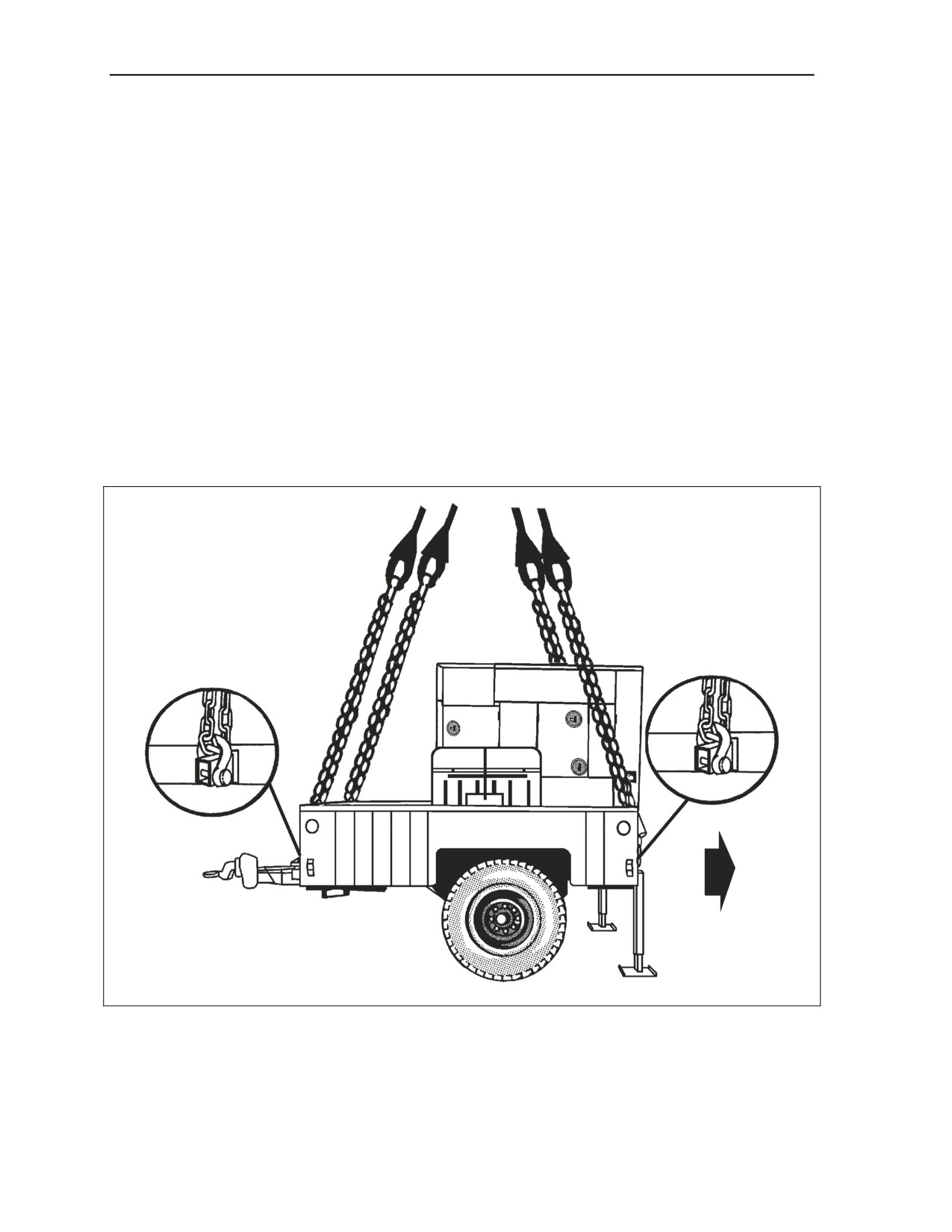
Chapter 4
─ Engage the parking brake.
─ Secure safety chains and brake hoses to the top of the drawbar with Type III nylon cord.
─ Secure all lids, doors, and caps with tape or Type III nylon cord.
─ Remove transit cases which will interfere with the sling legs and store them in the
shelter.
─ Install the rear stabilizer legs with the lower support section fully retracted.
─ Remove the lunette jack and secure in the trailer bed.
─ Secure the four lift rings on the trailer in the up position to a convenient point on the load
with 1/4-inch cotton webbing.
─ Connect one additional chain length to each chain of the sling set with the coupling link.
Rigging. Rig the load according to the steps in Figure 4-9.
Hookup. The hookup team stands in the bed of the trailer. The static wand person
discharges the static electricity with the static wand. The hookup person places the apex fitting
onto the aircraft cargo hook. The hookup team then carefully dismounts the trailer and remains
close to the load as the helicopter removes slack from the sling legs. When successful hookup is
assured, the hookup team quickly exits the area underneath the helicopter to the designated
rendezvous point.
Derigging. Derigging is the reverse of the preparation and rigging procedures.
Figure 4-9. High Mobility Trailer with Generator for Joint Surveillance Target Attack Radar
System
4-18
FM 4-20.198/MCRP 4-11.3E, VOL II/NTTP 3-04.12/
AFMAN 11-223 (I), VOL II/COMDTINST M13482.3B
20 February 2009
Certified Single-Point Rigging Procedures for Trailers with Mounted Generators
RIGGING STEPS
1. Position apex fitting on top of the generator. Route outer sling legs 1 and 2 to the front of the
trailer (lunette end) and inner sling legs 3 and 4 to the rear. Sling legs 1 and 3 must be on
the left side of the load.
2. Loop the chain end of sling leg 1 through the left front lift provision located on the left front
side of the trailer bed. Place the correct link from Table 4-9 in the grab hook. Repeat with
sling leg 2 through the right front lift provision. Secure the excess chain with Type III nylon
cord.
3. Route the chain end of sling leg 3 through the left rear lift provision located on the rear of the
trailer bed. Place the correct link from Table 4-9 in the grab hook. Repeat with sling leg 4
through the right rear lift provision.
4. Pad the slings/chains in the areas where they contact the generators.
5. Cluster and tie (breakaway technique) the sling legs together on top of the generator to
prevent entanglement during hookup and lift-off.
Figure 4-9. High Mobility Trailer with Generator for Joint Surveillance Target Attack Radar
System (Continued)
20 February 2009
FM 4-20.198/MCRP 4-11.3E, VOL II/NTTP 3-04.12/
AFMAN 11-223 (I), VOL II/COMDTINST M13482.3B
4-19
This page intentionally left blank.
Chapter 5
Certified Single-Point Rigging Procedures for Truck and
Towed Combinations
INTRODUCTION
5-1. This chapter contains rigging procedures for single-point truck and towed combinations that have
been certified for sling load. Each rigging procedure is found in a paragraph that includes a description of
the load, materials required for rigging, and steps to complete the procedure. An applicability paragraph is
also a part of each paragraph and identifies the certified loads. The certified single-point rigging
procedures for trailer loads with mounted generators are in this section. Paragraphs 5-2 and 5-3 give
detailed instructions for rigging loads.
M973/M973E1/M1065/M1066 SMALL UNIT SUPPORT VEHICLE
(SUSV)
5-2. The M973/M973E1/M1065/M1066 small unit support vehicle is rigged for single-point sling load
using the following procedures:
z
Applicability. The following items in Table 5-1 are certified for all helicopters with suitable lift
capacity by the US Army Natick Soldier Center:
Table 5-1. M973/M973E1/M1065/M1066 Small Unit Support Vehicle
Nomenclature
Max
Sling Set
Link Count
Weight
Front/Rear
(Pounds)
Front-6,380
Listed in
M973, Cargo, Tracked
Rear-6,600
25K
Rigging
Total-12,980
Steps
Front-6,380
Listed in
M973E1, Cargo, Tracked
Rear-6,600
25K
Rigging
Total-12,980
Steps
Front-6,380
Listed in
M1065, Command Post, Tracked
Rear-6,600
25K
Rigging
Total-12,980
Steps
Front-6,380
Listed in
M1066, Ambulance, Tracked
Rear-6,600
25K
Rigging
Total-12,980
Steps
z
Materials. The following materials are required to rig this load:
Sling set (25,000-pound capacity) (2 sets).
─ Additional chain length, part number 38850-00053-102, from 25,000-pound capacity
sling sets (8 each).
─ Additional coupling links, part number 664241, from 25,000-pound capacity sling sets
(8 each).
Aerial delivery slings, Type XXVI nylon, 4 loop, 20 foot length (2 each) (Used to form
40 foot vertical pendant) (For CH-47 use only).
Apex fitting (25,000-pound capacity) (2 each) (For CH-47 use only).
20 February 2009
FM 4-20.198/MCRP 4-11.3E, VOL II/NTTP 3-04.12/
AFMAN 11-223 (I), VOL II/COMDTINST M13482.3B
5-1