FM 10-450-4 MULTISERVICE HELICOPTER SLING LOAD: SINGLE-POINT LOAD RIGGING PROCEDURES (September 2003) - page 4
FM 10-450-4/MCRP 4-23E, VOL II/NWP 3-04.12/AFJMAN 11-223, VOL II/
COMDTINST M13482.2
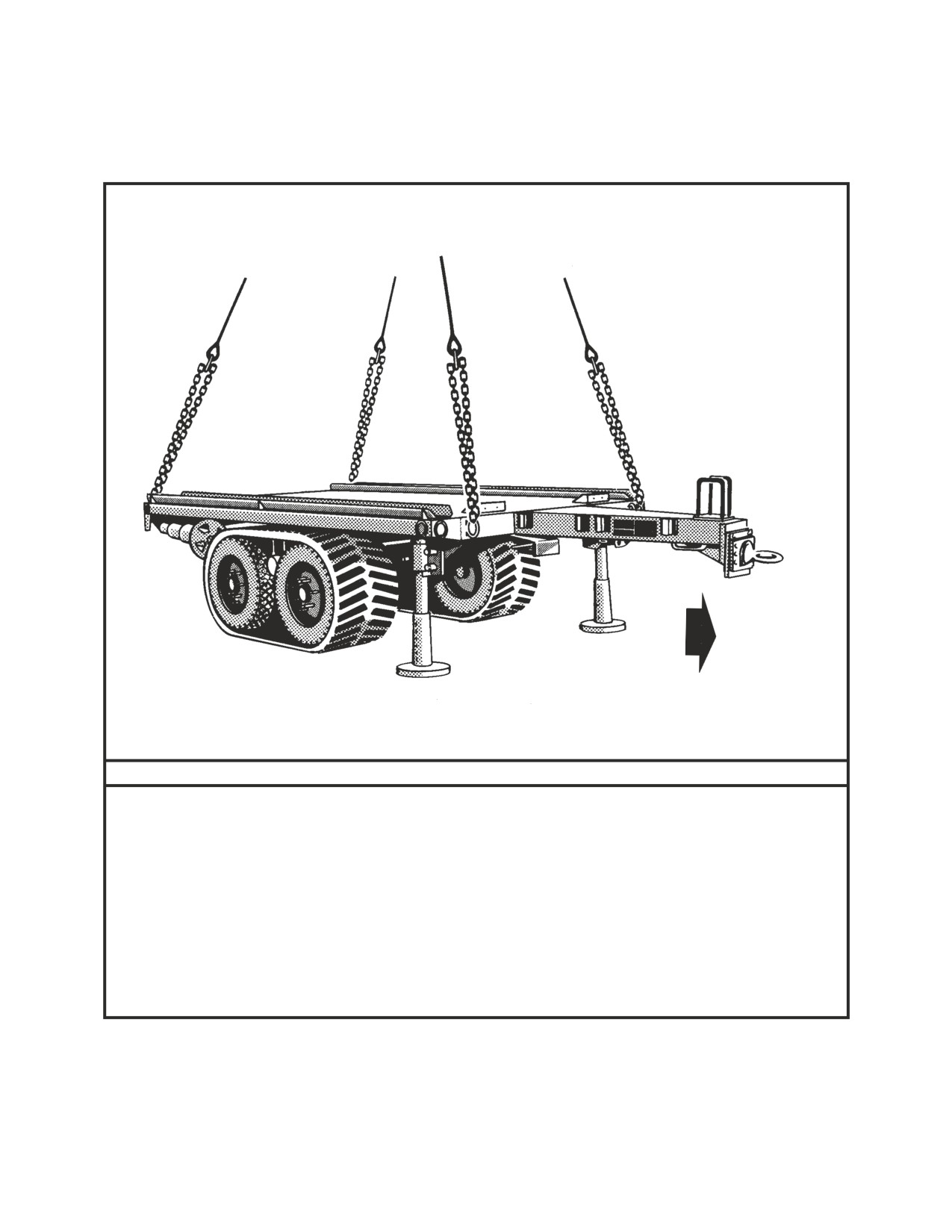
RIGGING STEPS
1. Position apex fitting in the trailer bed. Route outer
3. Route the chain end of sling leg 3 through the left rear
sling legs 1and 2 to the front of the trailer and inner sling
lift provision. Place the correct link from Table 3-4 in the
legs 3 and 4 to the rear. Sling legs 1 and 3 must be on the
grab hook. Repeat with sling leg 4 through the right rear
left side of the load.
lift provision.
2. Loop the chain end of sling leg 1 through the left
4. Cluster and tie or tape (breakaway technique) all sling
front lift provision located on the left front corner of the
legs together on top of the trailer to prevent entanglement
trailer. Place the correct link from Table 3-4 in the grab
during hookup and lift-off. Secure excess chain with tape
hook. Repeat with sling leg 2 through the right front lift
or Type III nylon cord.
provision. Secure excess chain with tape or Type III ny-
lon cord.
Figure 3-4. M1048 Trailer (TSS)
3-8

FM 10-450-4/MCRP 4-23E, VOL II/NWP 3-04.12/AFJMAN 11-223, VOL II/
COMDTINST M13482.2
3-6. M149A2 Water Trailer (USMC)
a. Applicability. The following item in Table 3-5 is certified for all helicopters with suitable lift capacity by the US Army
Natick Research, Development, and Engineering Center:
Table 3-5. M149A2 Water Trailer
MAX
RECOMMENDED
LINK COUNT
NOMENCLATURE
WEIGHT
SLING SET
AIRSPEED
FRONT/REAR
(POUNDS)
(KNOTS)
M149A2 Water Trailer Modified with
6,100
15K
3/11
90
Clevis Type Lifting Provisions
NOTES:
(1) Preparation. Prepare the load using the following
1. This load is only certified for sling loading
steps:
at its full weight of 6,100 pounds.
(a) Secure all loose chains, hoses, and cables to the
2. The rigging procedures for the M149
trailer drawbar with Tape or Type III nylon cord.
Water Trailer (US Army) are located in chapter 16.
(b) Ensure the tongue wheel is locked in the down
b. Materials. The following materials are required to
position.
rig this load:
(c) Close the tank lid and secure.
(1) Multileg sling set (15,000-pound capacity).
(d) Ensure that one trailer brake is set.
(2) Tape, adhesive, pressure-sensitive, 2-inch wide
roll.
(2) Rigging. Rig the load according to the steps in
Figure 3-5.
(3) Cord, nylon, Type III, 550-pound breaking strength.
(3) Hookup. The hookup team stands on the trailer
fenders or the front of the trailer. The static wand person
(4) Webbing, cotton, 1/4-inch, 80-pound breaking
discharges the static electricity with the static wand. The
strength.
hookup person places the apex fitting onto the aircraft
cargo hook. The hookup team then carefully dismounts
(5) Felt sheet, cattle hair, Type IV, 1/2-inch or suitable
the vehicle and remains close to the load as the helicopter
substitute.
removes slack from the sling legs. When successful
hookup is assured, the hookup team quickly exits the area
c. Personnel. Two persons can prepare and rig this
underneath the helicopter to the designated rendezvous
load in 10 minutes.
point.
d. Procedures. The following procedures apply to this
(4) Derigging. Derigging is the reverse of the prepa-
load:
ration and rigging procedures in steps d (1) and d (2).
3-9
FM 10-450-4/MCRP 4-23E, VOL II/NWP 3-04.12/AFJMAN 11-223, VOL II/
COMDTINST M13482.2
DIRECTION OF
FRONT OF TRAILER
FLIGHT
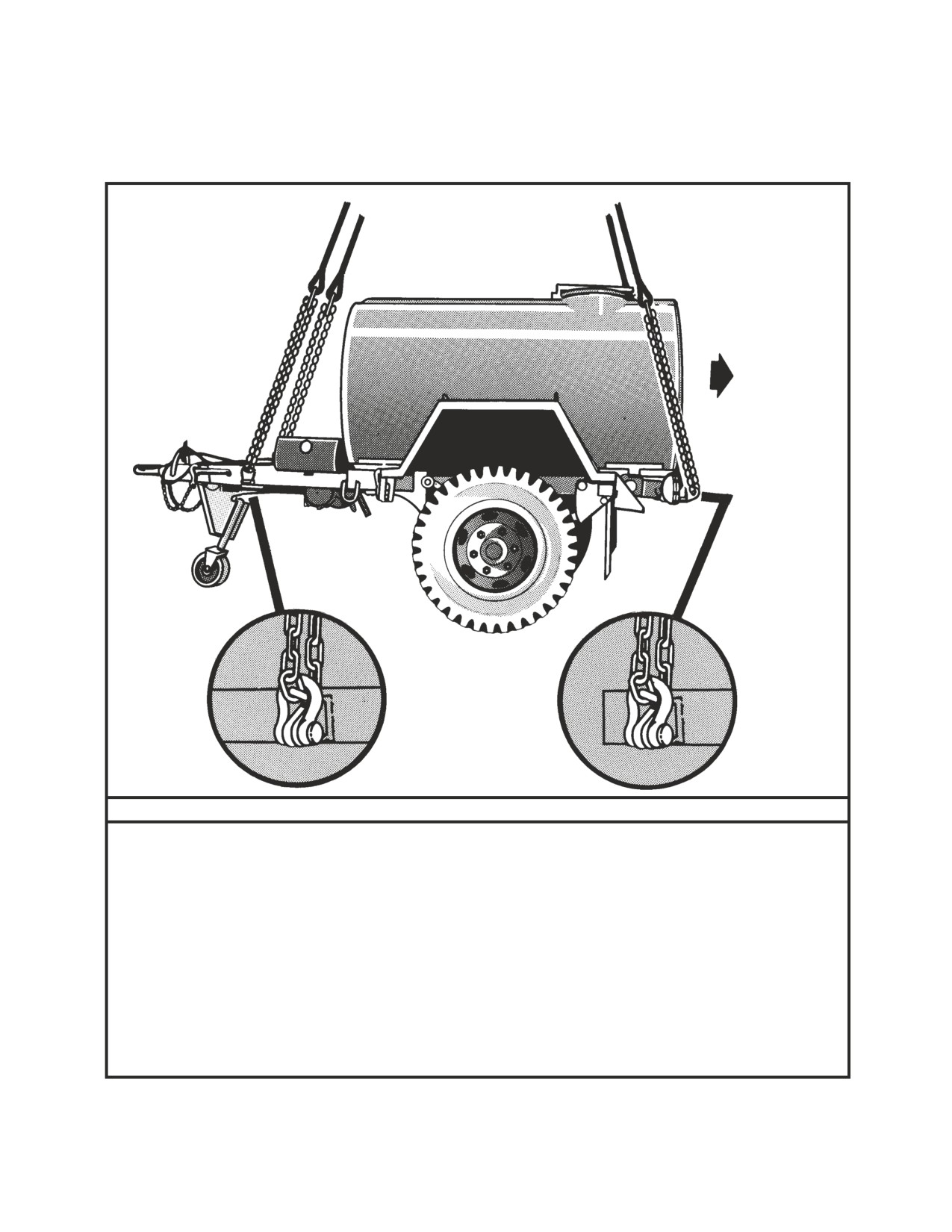
RIGGING STEPS
1. Position apex fitting on top of the water tank. Route
lift provision. Place the correct link from Table 3-5 in the
outer sling legs 1and 2 to the front of the trailer and inner
grab hook. Repeat with sling leg 4 through the right rear
sling legs 3 and 4 to the rear. Sling legs 1 and 3 must be on
lift provision. Pad the rear slings where they contact the
the left side of the load.
water tank. Secure excess chain with tape or Type III
nylon cord.
2. Loop the chain end of sling leg 1 through the left
front lift provision located on the left front corner of the
4. Position the two rear slings around the side of the
trailer. Place the correct link from Table 3-5 in the grab
tank so that the sling legs cradle the tank.
hook. Repeat with sling leg 2 through the right front lift
provision.
5. Cluster and tie or tape (breakaway technique) all sling
legs together on top of the tank to prevent entanglement
3. Route the chain end of sling leg 3 through the left rear
during hookup and lift-off.
Figure 3-5. M149A2 Water Trailer
3-10

FM 10-450-4/MCRP 4-23E, VOL II/NWP 3-04.12/AFJMAN 11-223, VOL II/
COMDTINST M13482.2
3-7. M989 Heavy-Expanded Mobility Ammunition Trailer (HEMAT)
a. Applicability. The following item in Table 3-6 is certified for all helicopters with suitable lift capacity by the US Army
Natick Research, Development, and Engineering Center:
Table 3-6. M989 HEMAT
MAX
RECOMMENDED
LINK COUNT
NOMENCLATURE
WEIGHT
SLING SET
AIRSPEED
FRONT/REAR
(POUNDS)
(KNOTS)
M989 HEMAT (Empty)
7,640
10K
40/4
120
NOTE: This load is only certified for sling loading at its
Place the remaining panels on top of the respective panels
empty weight.
on the trailer.
b. Materials. The following materials are required to
(c) Secure the panels on the trailer with the tie-down
rig this load:
straps. Attach the hook end of one tie-down strap to a tie-
down ring on the trailer bed beside the panels approxi-
(1) Sling set (10,000-pound capacity).
mately 1 foot from the end of the panels. Connect and
tighten the ratchet end to a tie-down ring on the other side
(2) Tape, adhesive, pressure-sensitive, 2-inch wide
of the panels. Secure loose end of strap. Repeat with a
roll.
second tie-down strap at the other end of the panels.
(3) Cord, nylon, Type III, 550-pound breaking strength.
(d) To secure the panels lengthwise, route the hook
end of one tie-down strap around the vertical metal stiff-
(4) Webbing, cotton, 1/4-inch, 80-pound breaking
eners on the top panel of the stack of panels on the left
strength.
side of the trailer. Attach the hook end to a tie-down ring
on the front end of the trailer bed. Connect and tighten
(5) Tie-down CGU-1/B (4 each).
the ratchet end to a tie-down ring on the other end of the
stack of panels. Secure loose end of strap. Repeat with a
c. Personnel. Two persons can prepare and rig this
second tie-down strap on the other stack of panels.
load in 15 minutes.
(e) Tape or tie the intervehicular cable, hoses, and
d. Procedures. The following procedures apply to this
safety chains firmly to the top of the drawbar with tape or
load:
Type III nylon cord.
(1) Preparation. Prepare the load using the following
(f) Engage the parking brake.
steps:
(2) Rigging. Rig the load according to the steps in
(a) At each corner of the trailer, slide the lifting pro-
Figure 3-6.
visions out until they are completely extended. Do not lift
the trailer unless the provisions are fully extended and
(3) Hookup. The hookup team stands on the bed of
secured in position.
the trailer. The static wand person discharges the static
electricity with the static wand. The hookup person places
(b) Remove the side and end panels. Place two pan-
the apex fitting onto the aircraft cargo hook. The hookup
els side by side on the trailer so that the panel ends are
team then carefully dismounts the vehicle and remains
approximately 10 inches from the front of the trailer. Make
close to the load as the helicopter removes slack from the
sure the panels are positioned lengthwise on the trailer.
sling legs. When successful hookup is assured, the
3-11
FM 10-450-4/MCRP 4-23E, VOL II/NWP 3-04.12/AFJMAN 11-223, VOL II/
COMDTINST M13482.2
hookup team quickly exits the area underneath the heli-
(4) Derigging. Derigging is the reverse of the prepa-
copter to the designated rendezvous point.
ration and rigging procedures in steps d (1) and d (2).
FRONT OF TRAILER
DIRECTION OF
FLIGHT
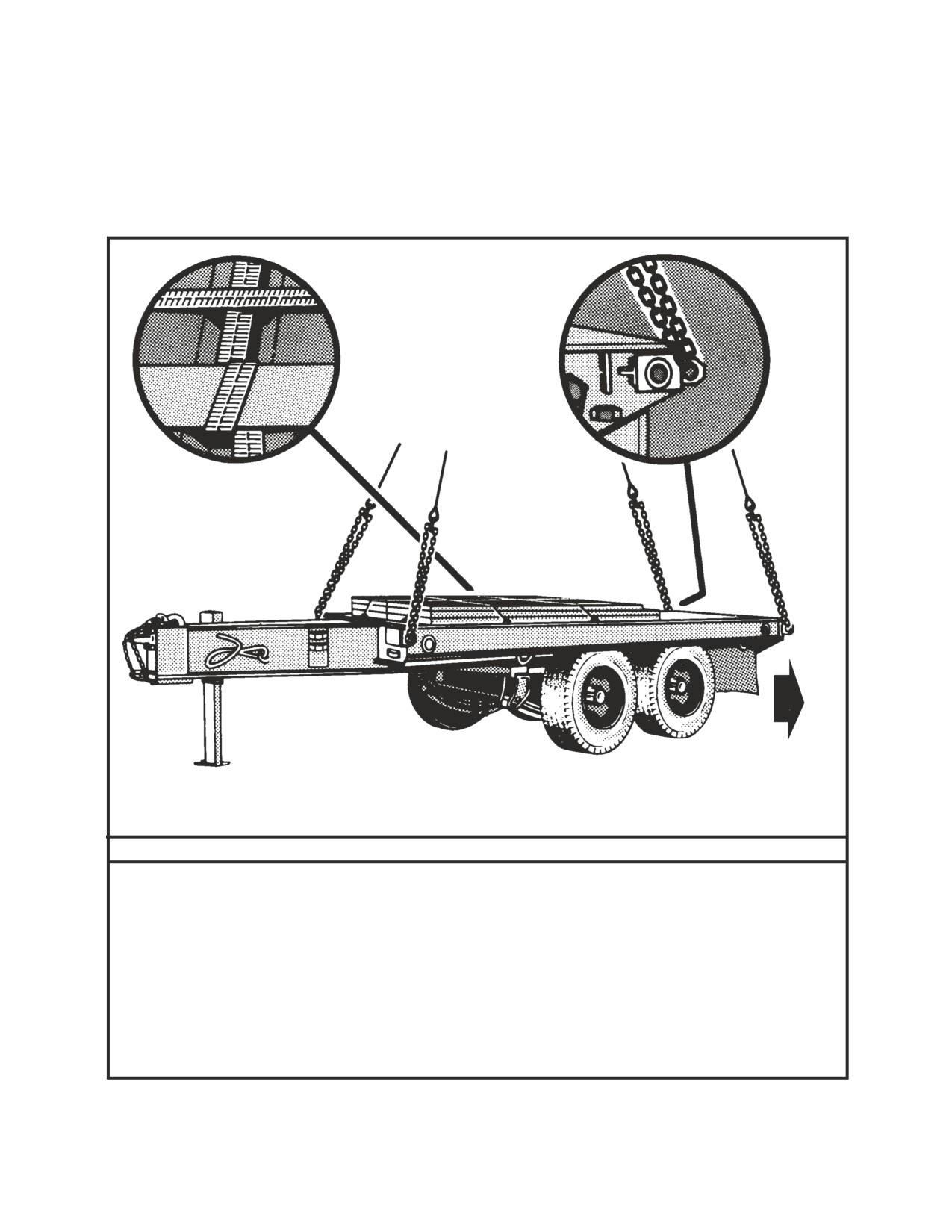
RIGGING STEPS
1. Position apex fitting on top of the trailer. Route outer
3. Route the chain end of sling leg 3 through the left rear
sling legs 1and 2 to the front of the trailer and inner sling
lift provision. Place the correct link from Table 3-6 in the
legs 3 and 4 to the rear. Sling legs 1 and 3 must be on the
grab hook. Repeat with sling leg 4 through the right rear
left side of the load.
lift provision. Secure excess chain with tape or Type III
nylon cord.
2. Loop the chain end of sling leg 1 through the left
front lift provision located on the left front corner of the
4. Cluster and tie or tape (breakaway technique) all sling
trailer. Place the correct link from Table 3-6 in the grab
legs together on top of the trailer to prevent entanglement
hook. Repeat with sling leg 2 through the right front lift
during hookup and lift-off.
provision. Secure excess chain with Type III nylon cord.
Figure 3-6. M989 HEMAT
3-12
FM 10-450-4/MCRP 4-23E, VOL II/NWP 3-04.12/AFJMAN 11-223, VOL II/
COMDTINST M13482.2
3-8. M989A1 Heavy-Expanded Mobility Ammunition Trailer (HEMAT II)
a. Applicability. The following item in Table 3-7 is certified for all helicopters with suitable lift capacity by the US Army
Natick Research, Development, and Engineering Center:
Table 3-7. M989A1 HEMAT II
MAX
RECOMMENDED
LINK COUNT
NOMENCLATURE
WEIGHT
SLING SET
AIRSPEED
FRONT/REAR
(POUNDS)
(KNOTS)
M989A1 HEMAT II
10,650
25K
15/3
125
(b) Raise the trailer tongue and secure it in the up
CAUTION
position with a CGU-1/B.
The following rigging procedures are for the M989A1
HEMAT II only. Do not use these procedures when rig-
(c) Secure the brake hose, safety hose, intervehicular
ging the M989 HEMAT.
cables, and safety chains to the trailer and tongue with
tape or Type III nylon cord.
b. Materials. The following materials are required to
rig this load:
(d) Engage the steering lockout pin.
(1) Sling set (25,000-pound capacity).
(e) Secure the side panels to the cargo deck with
CGU-1/Bs.
(2) Tape, adhesive, pressure-sensitive, 2-inch wide
roll.
(2) Rigging. Rig the load according to the steps in
Figure 3-7.
(3) Cord, nylon, Type III, 550-pound breaking strength.
(3) Hookup. The hookup team stands on the bed of
(4) Webbing, cotton, 1/4-inch, 80-pound breaking
the trailer. The static wand person discharges the static
strength.
electricity with the static wand. The hookup person places
the apex fitting onto the aircraft cargo hook. The hookup
(5) Tie-down CGU-1/B (8 each).
team then carefully dismounts the vehicle and remains
close to the load as the helicopter removes slack from the
(6) Felt sheet, cattle hair, Type IV, 1/2-inch or suitable
sling legs. When successful hookup is assured, the
substitute.
hookup team quickly exits the area underneath the heli-
copter to the designated rendezvous point.
c. Personnel. Two persons can prepare and rig this
load in 10 minutes.
CAUTION
Brief the aircrew to relax sling leg tension and hover to
d. Procedures. The following procedures apply to this
the side of the load when releasing the apex fitting to
load:
prevent damage to the panels on top of the trailer.
(1) Preparation. Prepare the load using the following
(4) Derigging. Derigging is the reverse of the prepa-
steps:
ration and rigging procedures in steps d (1) and d (2).
(a) Inspect the lift provisions at the four upper cor-
ners of the cargo bed.
3-13
FM 10-450-4/MCRP 4-23E, VOL II/NWP 3-04.12/AFJMAN 11-223, VOL II/
COMDTINST M13482.2
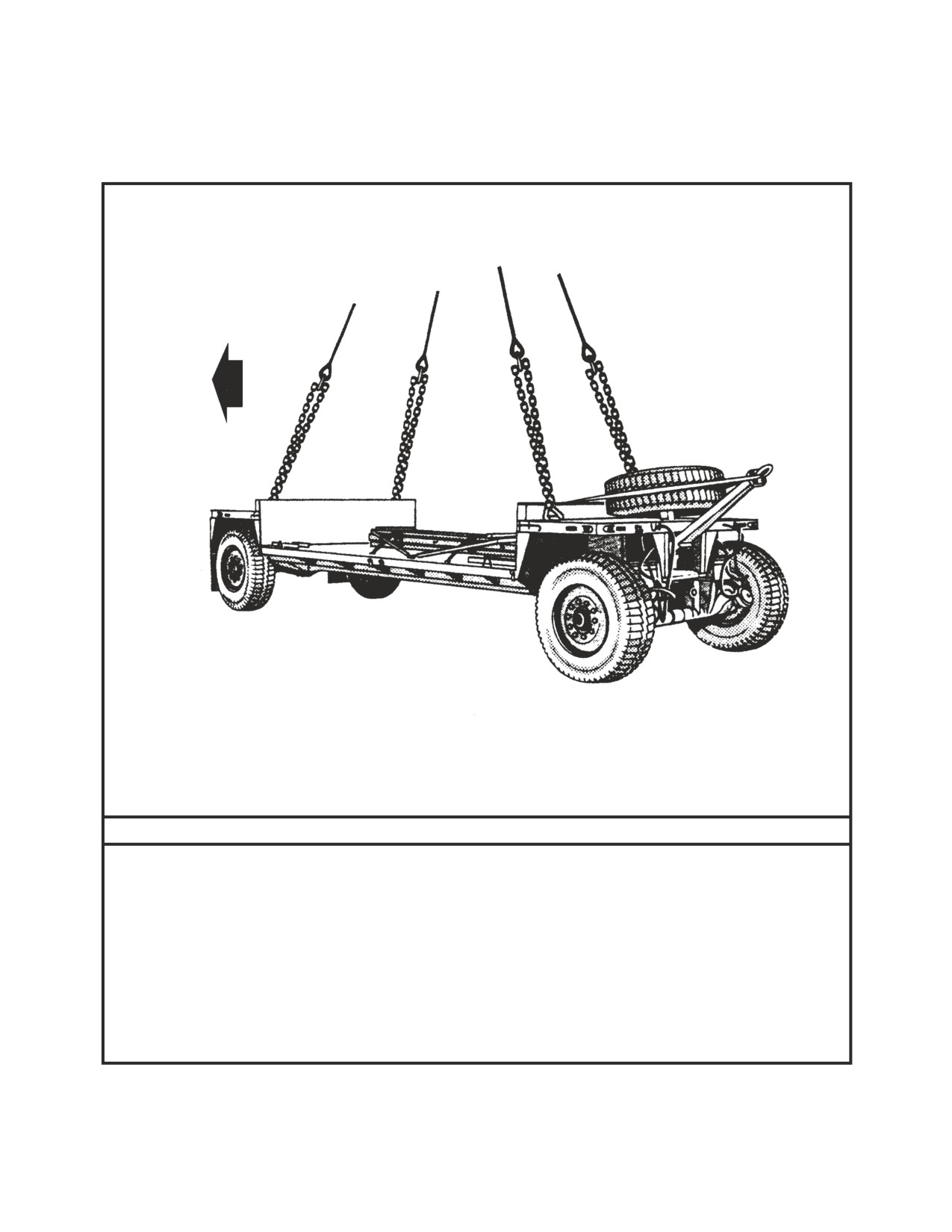
RIGGING STEPS
1. Position apex fitting on top of the trailer. Route outer
3. Route the chain end of sling leg 3 through the left rear
sling legs 1and 2 to the front of the trailer and inner sling
lift provision. Place the correct link from Table 3-7 in the
legs 3 and 4 to the rear. Sling legs 1 and 3 must be on the
grab hook. Repeat with sling leg 4 through the right rear
left side of the load.
lift provision. Secure excess chain with tape or Type III
nylon cord.
2. Loop the chain end of sling leg 1 through the left
front lift provision located on the left front corner of the
4. Cluster and tie or tape (breakaway technique) all sling
trailer. Place the correct link from Table 3-7 in the grab
legs together on top of the trailer to prevent entanglement
hook. Repeat with sling leg 2 through the right front lift
during hookup and lift-off.
provision. Secure excess chain with Type III nylon cord.
Figure 3-7. M989A1 HEMAT II
3-14
FM 10-450-4/MCRP 4-23E, VOL II/NWP 3-04.12/AFJMAN 11-223, VOL II/
COMDTINST M13482.2
3-9. Mk14, Trailer, Container Hauler
a. Applicability. The following item in Table 3-8 is certified for all helicopters with suitable lift capacity by the US Army
Natick Research, Development, and Engineering Center:
Table 3-8. Mk14, Trailer, Container Hauler
MAX
RECOMMENDED
LINK COUNT
NOMENCLATURE
WEIGHT
SLING SET
AIRSPEED
FRONT/REAR
(POUNDS)
(KNOTS)
Mk14, Trailer, Container Hauler
16,000
40K
3/3
100
b. Materials. The following materials are required to
(d) Remove the safety retainer pins from the lifting
rig this load:
eyelets located under the doors in the bed of the trailer.
Unscrew the lifting eyelets from their stored position and
(1) Sling set (40,000-pound capacity).
reinsert the lifting eyelets so that the eyelet portion is
accessible from the bed of the trailer through the access
(2) Tape, adhesive, pressure-sensitive, 2-inch wide
doors. Screw the lifting eyelets all the way in and back out
roll.
one full turn. Reinsert the safety retainer pins to prevent
the lifting eyelets from backing out in flight.
(3) Cord, nylon, Type III, 550-pound breaking strength.
(e) Make sure all tool compartment doors are se-
(4) Webbing, cotton, 1/4-inch, 80-pound breaking
cured shut.
strength.
(2) Rigging. Rig the load according to the steps in
c. Personnel. Two persons can prepare and rig this
Figure 3-8.
load in 15 minutes.
(3) Hookup. The hookup team stands on the bed of
the trailer. The static wand person discharges the static
d. Procedures. The following procedures apply to this
electricity with the static wand. The hookup person places
load:
the apex fitting onto the aircraft cargo hook. The hookup
team then carefully dismounts the vehicle and remains
(1) Preparation. Prepare the load using the following
close to the load as the helicopter removes slack from the
steps:
sling legs. When successful hookup is assured, the
hookup team quickly exits the area underneath the heli-
(a) Disengage the Mkl4 from the Mk48 prime mover
copter to the designated rendezvous point.
according to the operator’s manual.
(4) Derigging. Derigging is the reverse of the prepa-
(b) Secure all hoses with tape or nylon cord.
ration and rigging procedures in steps d (1) and d (2).
(c) Tape all lights, reflectors, and glass fixtures.
3-15
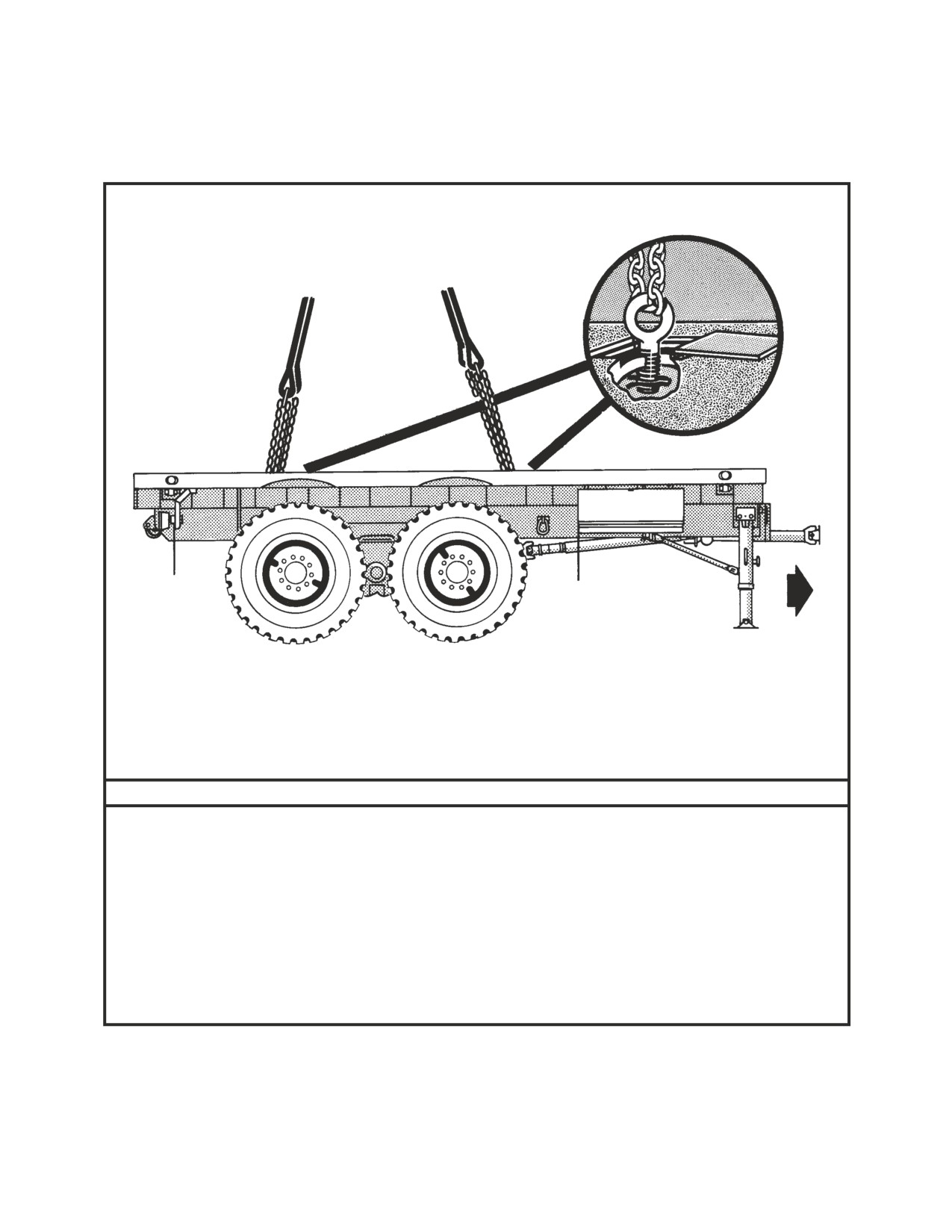
FM 10-450-4/MCRP 4-23E, VOL II/NWP 3-04.12/AFJMAN 11-223, VOL II/
COMDTINST M13482.2
RIGGING STEPS
1. Position apex fitting on top of the trailer. Route outer
3. Route the chain end of sling leg 3 through the left rear
sling legs 1and 2 to the front of the trailer and inner sling
lift provision. Place the correct link from Table 3-8 in the
legs 3 and 4 to the rear. Sling legs 1 and 3 must be on the
grab hook. Repeat with sling leg 4 through the right rear
left side of the load.
lift provision. Secure excess chain with tape or Type III
nylon cord.
2. Loop the chain end of sling leg 1 through the left
front lift provision located on the left front corner of the
4. Cluster and tie or tape (breakaway technique) all sling
trailer. Place the correct link from Table 3-8 in the grab
legs together on top of the trailer to prevent entanglement
hook. Repeat with sling leg 2 through the right front lift
during hookup and lift-off.
provision. Secure excess chain with Type III nylon cord.
Figure 3-7. Mk14, Trailer, Container Hauler
3-16
FM 10-450-4/MCRP 4-23E, VOL II/NWP 3-04.12/AFJMAN 11-223, VOL II/
COMDTINST M13482.2
3-10. Mk15, Trailer, Wrecker /Recovery
a. Applicability. The following item in Table 3-9 is certified for all helicopters with suitable lift capacity by the US Army
Natick Research, Development, and Engineering Center:
Table 3-9. Mk15, Trailer, Wrecker /Recovery
MAX
RECOMMENDED
LINK COUNT
NOMENCLATURE
WEIGHT
SLING SET
AIRSPEED
FRONT/REAR
(POUNDS)
(KNOTS)
Mk15, Trailer, Wrecker /Recovery
26,000
40K
3/10
90
b. Materials. The following materials are required to
(d) Tape all lights, reflectors, and glass fixtures.
rig this load:
(e) Remove the safety retainer pins from the lifting
(1) Sling set (40,000-pound capacity).
eyelets located under the doors in the bed of the trailer.
Unscrew the lifting eyelets from their stored position and
(2) Tape, adhesive, pressure-sensitive, 2-inch wide
reinsert the lifting eyelets so that the eyelet portion is
roll.
accessible from the bed of the trailer through the access
doors. Screw the lifting eyelets all the way in and back out
(3) Cord, nylon, Type III, 550-pound breaking strength.
one full turn. Reinsert the safety retainer pins to prevent
the lifting eyelets from backing out in flight.
(4) Webbing, cotton, 1/4-inch, 80-pound breaking
strength.
(f) Make sure all tool compartment doors are se-
cured shut.
(5) Tie-down strap, cargo, CGU-1/B, as required.
(2) Rigging. Rig the load according to the steps in
c. Personnel. Two persons can prepare and rig this
Figure 3-9.
load in 30 minutes.
(3) Hookup. The hookup team stands on the bed of
d. Procedures. The following procedures apply to this
the trailer. The static wand person discharges the static
load:
electricity with the static wand. The hookup person places
the apex fitting onto the aircraft cargo hook. The hookup
(1) Preparation. Prepare the load using the following
team then carefully dismounts the vehicle and remains
steps:
close to the load as the helicopter removes slack from the
sling legs. When successful hookup is assured, the
(a) Disengage the Mkl5 from the Mk48 prime mover
hookup team quickly exits the area underneath the heli-
according to the operator’s manual.
copter to the designated rendezvous point.
(b) Remove the A-frame from the rear of the trailer.
(4) Derigging. Derigging is the reverse of the prepa-
ration and rigging procedures in steps d (1) and d (2).
(c) Secure all hoses with tape or nylon cord.
3-17
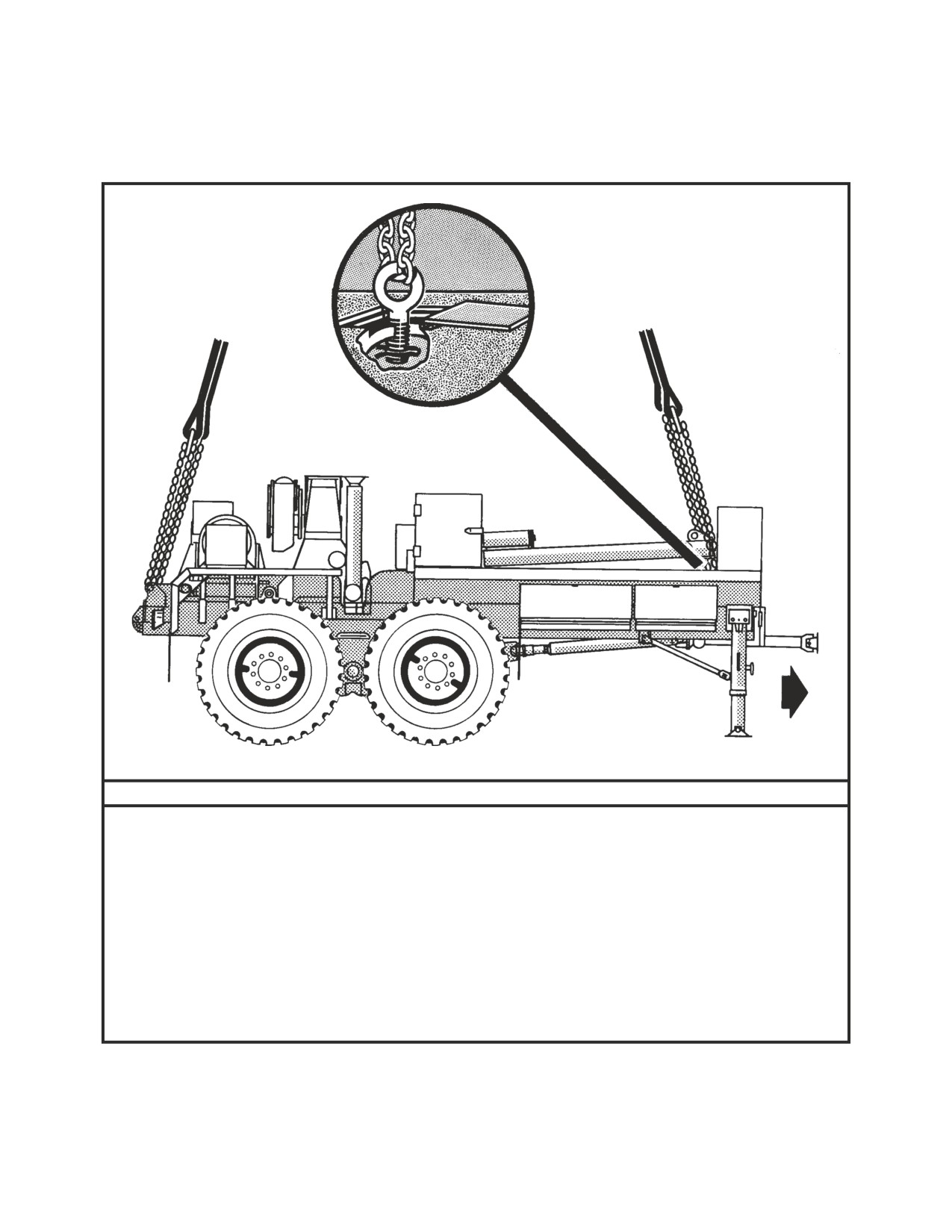
FM 10-450-4/MCRP 4-23E, VOL II/NWP 3-04.12/AFJMAN 11-223, VOL II/
COMDTINST M13482.2
RIGGING STEPS
1. Position apex fitting on top of the trailer. Route outer
3. Route the chain end of sling leg 3 through the left rear
sling legs 1and 2 to the front of the trailer and inner sling
lift provision. Place the correct link from Table 3-9 in the
legs 3 and 4 to the rear. Sling legs 1 and 3 must be on the
grab hook. Repeat with sling leg 4 through the right rear
left side of the load.
lift provision. Secure excess chain with tape or Type III
nylon cord.
2. Loop the chain end of sling leg 1 through the left
front lift provision located on the left front corner of the
4. Cluster and tie or tape (breakaway technique) all sling
trailer. Place the correct link from Table 3-9 in the grab
legs together on top of the trailer to prevent entanglement
hook. Repeat with sling leg 2 through the right front lift
during hookup and lift-off.
provision. Secure excess chain with Type III nylon cord.
Figure 3-9. Mk15, Trailer, Wrecker/Recovery
3-18
FM 10-450-4/MCRP 4-23E, VOL II/NWP 3-04.12/AFJMAN 11-223, VOL II/
COMDTINST M13482.2
3-11. Mk16, Trailer, Fifth-Wheel Adapter
a. Applicability. The following item in Table 3-10 is certified for all helicopters with suitable lift capacity by the US
Army Natick Research, Development, and Engineering Center:
Table 3-10. Mk16, Trailer, Fifth-Wheel Adapter
MAX
RECOMMENDED
LINK COUNT
NOMENCLATURE
WEIGHT
SLING SET
AIRSPEED
FRONT/REAR
(POUNDS)
(KNOTS)
Mk16, Trailer, Fifth-Wheel Adapter
16,000
40K
3/3
90
b. Materials. The following materials are required to
(b) Secure all hoses with tape or nylon cord.
rig this load:
(c) Tape all lights, reflectors, and glass fixtures.
(1) Sling set (40,000-pound capacity).
(d) Make sure all tool compartment doors are se-
(2) Tape, adhesive, pressure-sensitive, 2-inch wide
cured shut.
roll.
(2) Rigging. Rig the load according to the steps in
(3) Cord, nylon, Type III, 550-pound breaking strength.
Figure 3-10.
(4) Webbing, cotton, 1/4-inch, 80-pound breaking
(3) Hookup. The hookup team stands on top of the
strength.
fifth-wheel adapter. The static wand person discharges
the static electricity with the static wand. The hookup
c. Personnel. Two persons can prepare and rig this
person places the apex fitting onto the aircraft cargo hook.
load in 30 minutes.
The hookup team then carefully dismounts the vehicle
and remains close to the load as the helicopter removes
d. Procedures. The following procedures apply to this
slack from the sling legs. When successful hookup is
load:
assured, the hookup team quickly exits the area under-
neath the helicopter to the designated rendezvous point.
(1) Preparation. Prepare the load using the following
steps:
(4) Derigging. Derigging is the reverse of the prepa-
ration and rigging procedures in steps d (1) and d (2).
(a) Disengage the Mkl6 from the Mk48 prime mover
according to the operator’s manual.
3-19
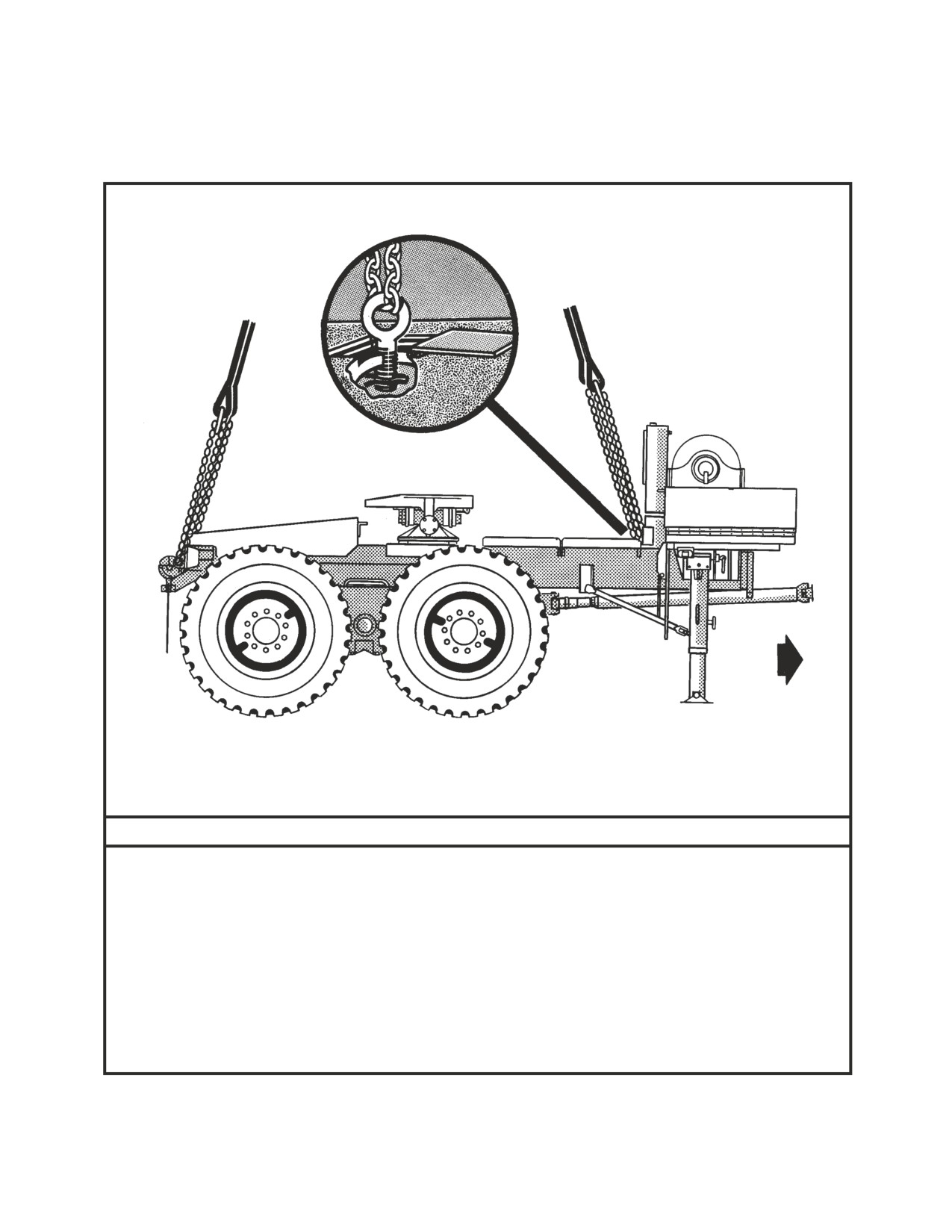
FM 10-450-4/MCRP 4-23E, VOL II/NWP 3-04.12/AFJMAN 11-223, VOL II/
COMDTINST M13482.2
RIGGING STEPS
1. Position apex fitting on top of the fifth-wheel. Route
3. Route the chain end of sling leg 3 through the left rear
outer sling legs 1and 2 to the front of the trailer and inner
lift provision located on the left side of the towing pintle.
sling legs 3 and 4 to the rear. Sling legs 1 and 3 must be on
Place the correct link from Table 3-10 in the grab hook.
the left side of the load.
Repeat with sling leg 4 through the right rear lift provi-
sion.
2. Loop the chain end of sling leg 1 through the left
front lift provision located on the main frame below the
4. Cluster and tie or tape (breakaway technique) all sling
winch and behind the left front stowage compartment.
legs together on top of the trailer to prevent entanglement
Place the correct link from Table 3-10 in the grab hook.
during hookup and lift-off.
Repeat with sling leg 2 through the right front lift provi-
sion.
Figure 3-10. Mk16, Trailer, Fifth-Wheel Adapter
3-20
FM 10-450-4/MCRP 4-23E, VOL II/NWP 3-04.12/AFJMAN 11-223, VOL II/
COMDTINST M13482.2
3-12. Mk17, Trailer, Drop-side, Cargo
a. Applicability. The following item in Table 3-11 is certified for all helicopters with suitable lift capacity by the US
Army Natick Research, Development, and Engineering Center:
Table 3-11. Mk17, Trailer, Drop-side, Cargo
MAX
RECOMMENDED
LINK COUNT
NOMENCLATURE
WEIGHT
SLING SET
AIRSPEED
FRONT/REAR
(POUNDS)
(KNOTS)
Mk17, Trailer, Drop-side, Cargo
23,000
40K
3/13
75
b. Materials. The following materials are required to
(d) Remove the safety retainer pins from the lifting
rig this load:
eyelets located under the doors in the bed of the trailer.
Unscrew the lifting eyelets from their stored position and
(1) Sling set (40,000-pound capacity).
reinsert the lifting eyelets so that the eyelet portion is
accessible from the bed of the trailer through the access
(2) Tape, adhesive, pressure-sensitive, 2-inch wide
doors. Screw the lifting eyelets all the way in and back out
roll.
one full turn. Reinsert the safety retainer pins to prevent
the lifting eyelets from backing out in flight.
(3) Cord, nylon, Type III, 550-pound breaking strength.
(e) Make sure all tool compartment doors are se-
(4) Webbing, cotton, 1/4-inch, 80-pound breaking
cured shut.
strength.
(2) Rigging. Rig the load according to the steps in
c. Personnel. Two persons can prepare and rig this
Figure 3-11.
load in 20 minutes.
(3) Hookup. The hookup team stands on top of the
d. Procedures. The following procedures apply to this
trailer. The static wand person discharges the static elec-
load:
tricity with the static wand. The hookup person places
the apex fitting onto the aircraft cargo hook. The hookup
(1) Preparation. Prepare the load using the following
team then carefully dismounts the vehicle and remains
steps:
close to the load as the helicopter removes slack from the
sling legs. When successful hookup is assured, the
(a) Disengage the Mkl7 from the Mk48 prime mover
hookup team quickly exits the area underneath the heli-
according to the operator’s manual.
copter to the designated rendezvous point.
(b) Secure all hoses with tape or nylon cord.
(4) Derigging. Derigging is the reverse of the prepa-
ration and rigging procedures in steps d (1) and d (2).
(c) Tape all lights, reflectors, and glass fixtures.
3-21
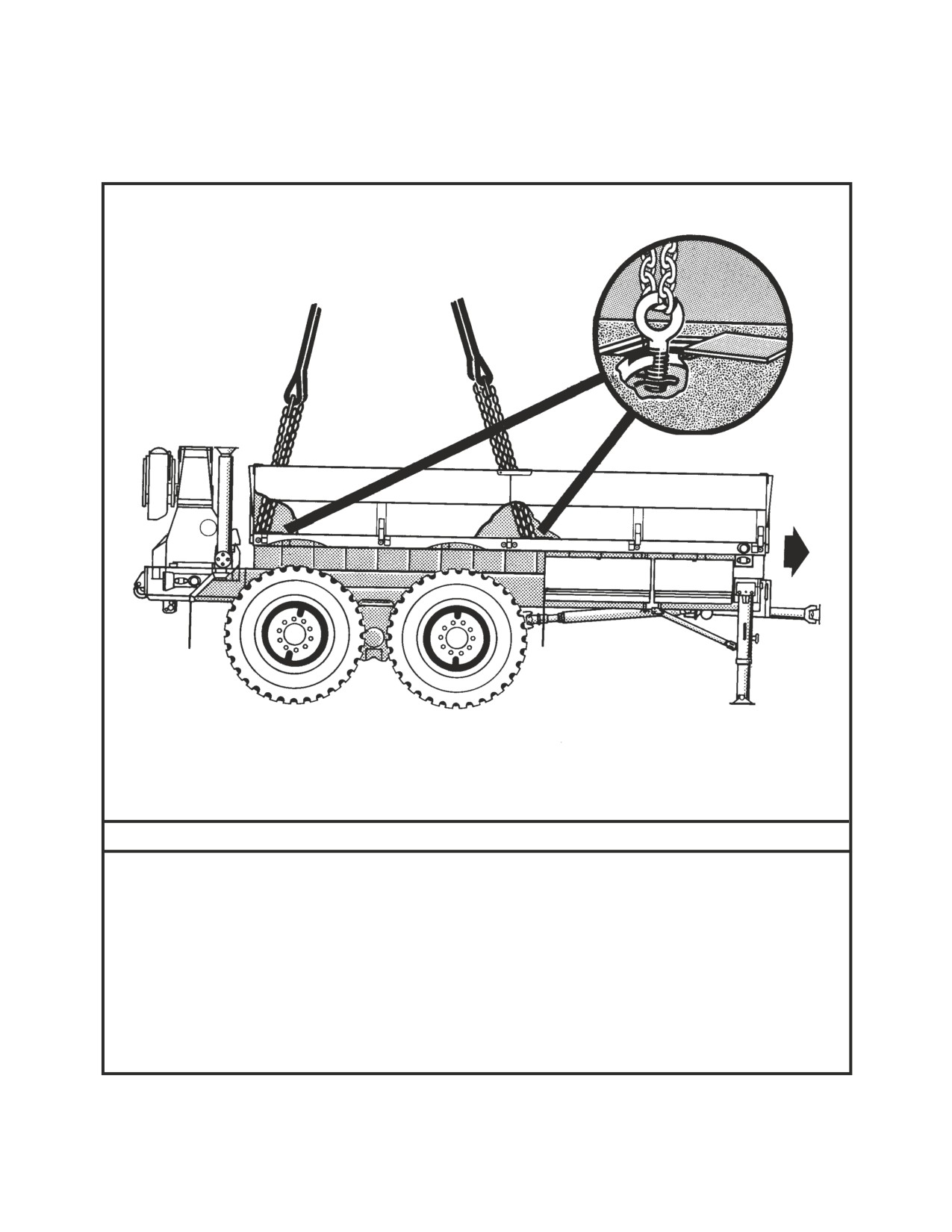
FM 10-450-4/MCRP 4-23E, VOL II/NWP 3-04.12/AFJMAN 11-223, VOL II/
COMDTINST M13482.2
RIGGING STEPS
1. Position apex fitting on top of the trailer. Route outer
3. Route the chain end of sling leg 3 through the left rear
sling legs 1and 2 to the front of the trailer and inner sling
lift provision located in the left rear corner of the trailer
legs 3 and 4 to the rear. Sling legs 1 and 3 must be on the
bed by the towing pintle hook. Place the correct link from
left side of the load.
Table 3-11 in the grab hook. Repeat with sling leg 4 through
the right rear lift provision.
2. Loop the chain end of sling leg 1 through the left
front lift provision located in the middle of the left side of
4. Cluster and tie or tape (breakaway technique) all sling
the trailer bed. Place the correct link from Table 3-11 in the
legs together on top of the trailer to prevent entanglement
grab hook. Repeat with sling leg 2 through the right front
during hookup and lift-off.
lift provision.
Figure 3-11. Mk17, Trailer, Drop-side, Cargo
3-22
FM 10-450-4/MCRP 4-23E, VOL II/NWP 3-04.12/AFJMAN 11-223, VOL II/
COMDTINST M13482.2
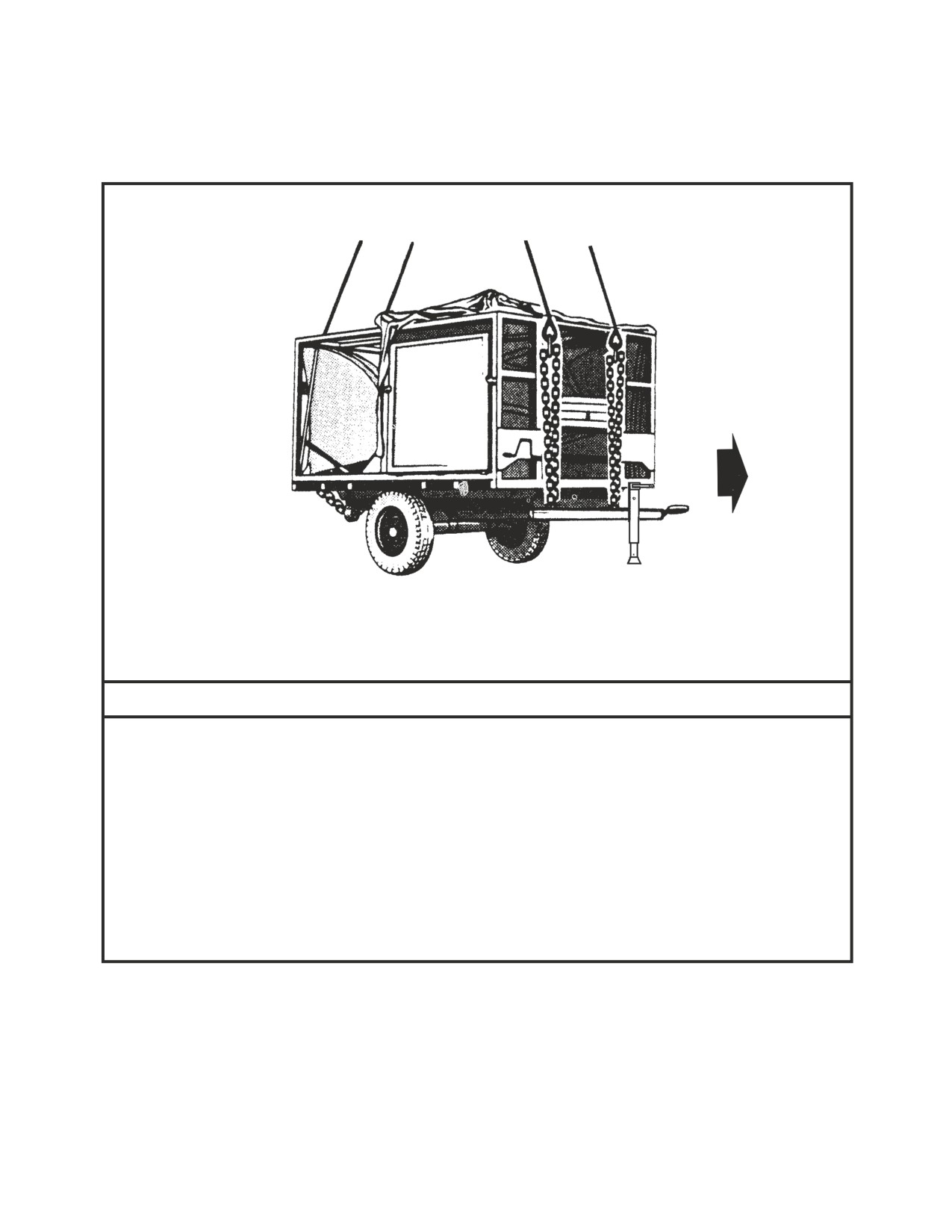
3-13. M116A2 Trailer with Antenna Groups, AS-3954/TRC (2 each) (USMC)
a. Applicability. The following item in Table 3-12 is certified for all helicopters with suitable lift capacity by the US
Army Natick Research, Development, and Engineering Center:
Table 3-12. M116A2 Trailer with Antenna Groups, AS-3954/TRC (2 each)
MAX
RECOMMENDED
LINK COUNT
NOMENCLATURE
WEIGHT
SLING SET
AIRSPEED
FRONT/REAR
(POUNDS)
(KNOTS)
M116A2 Trailer with Antenna Groups,
3,230
15K
3/3
65
AS-3954/TRC (2 each)
b. Materials. The following materials are required to
(b) Secure all covers in their proper place. Do not
rig this load:
remove the tarps. The tarps protect the antennae.
(1) Multileg sling set (15,000-pound capacity).
(c) Secure all chains, hoses, and cables with Type
III nylon cord.
(2) Tape, adhesive, pressure-sensitive, 2-inch wide
roll.
(d) Engage both trailer parking brakes and ensure
the front support leg is down.
(3) Cord, nylon, Type III, 550-pound breaking strength.
(2) Rigging. Rig the load according to the steps in
(4) Webbing, cotton, 1/4-inch, 80-pound breaking
Figure 3-12.
strength.
(3) Hookup. The hookup team stands on top of the
(5) Tie-down strap, cargo, CGU-1/B.
trailer. The static wand person discharges the static elec-
tricity with the static wand. The hookup person places
c. Personnel. Two persons can prepare and rig this
the apex fitting onto the aircraft cargo hook. The hookup
load in 10 minutes.
team then carefully dismounts the vehicle and remains
close to the load as the helicopter removes slack from the
d. Procedures. The following procedures apply to this
sling legs. When successful hookup is assured, the
load:
hookup team quickly exits the area underneath the heli-
copter to the designated rendezvous point.
(1) Preparation. Prepare the load using the following
steps:
(4) Derigging. Derigging is the reverse of the prepa-
ration and rigging procedures in steps d (1) and d (2).
(a) Secure all loose items inside the trailer with tape
or Type III nylon cord.
3-23
FM 10-450-4/MCRP 4-23E, VOL II/NWP 3-04.12/AFJMAN 11-223, VOL II/
COMDTINST M13482.2
RIGGING STEPS
1. Position apex fitting on top of the trailer. Route outer
3. Route the chain end of sling leg 3 through the left rear
sling legs 1and 2 to the front of the trailer (lunette end)
lift provision located on the aluminum frame attached to
and inner sling legs 3 and 4 to the rear. Sling legs 1 and 3
the trailer. Do not use the trailer lifting provisions at-
must be on the left side of the load.
tached to the chassis. Place the correct link from Table 3-
12 in the grab hook. Repeat with sling leg 4 through the
2. Loop the chain end of sling leg 1 through the left
right rear lift provision.
front lift provision located on the aluminum frame attached
to the trailer. Do not use the trailer lifting provisions at-
4. Cluster and tie or tape (breakaway technique) all sling
tached to the chassis. Place the correct link from Table 3-
legs together on top of the trailer to prevent entanglement
12 in the grab hook. Repeat with sling leg 2 through the
during hookup and lift-off.
right front lift provision.
Figure 3-12. M116A2 Trailer with Antenna Groups, AS-3954/TRC (2 each)
3-24
FM 10-450-4/MCRP 4-23E, VOL II/NWP 3-04.12/AFJMAN 11-223, VOL II/
COMDTINST M13482.2
3-14. M116A2 Trailer with AN/TPQ-36 Firefinder Antenna Transceiver Group (ATG)
a. Applicability. The following item in Table 3-13 is certified for all helicopters with suitable lift capacity by the US
Army Natick Research, Development, and Engineering Center:
Table 3-13. M116A2 Trailer with AN/TPQ-36 Firefinder Antenna Transceiver Group (ATG)
MAX
RECOMMENDED
LINK COUNT
NOMENCLATURE
WEIGHT
SLING SET
AIRSPEED
FRONT/REAR
(POUNDS)
(KNOTS)
AN/TPQ-36 Firefinder Antenna
3,320
10K
3/25
105
Transceiver Group
b. Materials. The following materials are required to
(c) Secure the doors closed with Type III nylon cord.
rig this load:
(d) Place the radar set in the travel mode and secure
(1) Sling set (10,000-pound capacity).
the antenna cover to the antenna with tape.
(2) Chain length, part number 38850-00053-101, from
(2) Rigging. Rig the load according to the steps in
a 10,000-pound capacity sling set (4 each).
Figure 3-13.
(3) Coupling link, part number 577-0615, from a
(3) Hookup. The hookup team stands on top of the
10,000-pound sling set (4 each).
ATG trailer frame. The static wand person discharges the
static electricity with the static wand. The hookup person
(4) Tape, adhesive, pressure-sensitive, 2-inch wide
places the apex fitting onto the aircraft cargo hook. The
roll.
hookup team then carefully dismounts the ATG and re-
mains close to the load as the helicopter removes slack
(5) Cord, nylon, Type III, 550-pound breaking strength.
from the sling legs. When successful hookup is assured,
the hookup team quickly exits the area underneath the
(6) Webbing, cotton, 1/4-inch, 80-pound breaking
helicopter to the designated rendezvous point.
strength.
NOTES:
(7) Felt sheet, cattle hair, Type IV, 1/2-inch or suitable
1. Do not stand on the radar panel during hookup.
padding.
2. Due to limited clearance between the helicopter
and the top of the ATG, the hookup team may want to use
(8) Padding, Cellulose.
an extended sling system on this load and hook this load
from the ground or the bed of a truck. Polyester round
c. Personnel. Two persons can prepare and rig this
slings are recommended for use as vertical pendants.
load in 20 minutes.
The extended sling legs may not be ideal for flying this
load "nap of the earth" in a tactical environment.
d. Procedures. The following procedures apply to
3. Hookup of this load presents substantial risk of
this load:
damage to the load or injury to the hookup personnel.
Use of a reach pendant is recommended for this load.
(1) Preparation. Prepare the load using the
following steps:
(4) Derigging. Derigging is the reverse of the prepara-
tion and rigging procedures in steps d (1) and d (2).
(a) Connect one additional chain length to each chain
of the sling set with the coupling link.
NOTE: When releasing the apex fitting after setting the
load down, the helicopter pilot should hover to the side to
(b) Engage the trailer parking brake.
prevent damaging the radar panel.
3-25
FM 10-450-4/MCRP 4-23E, VOL II/NWP 3-04.12/AFJMAN 11-223, VOL II/
COMDTINST M13482.2
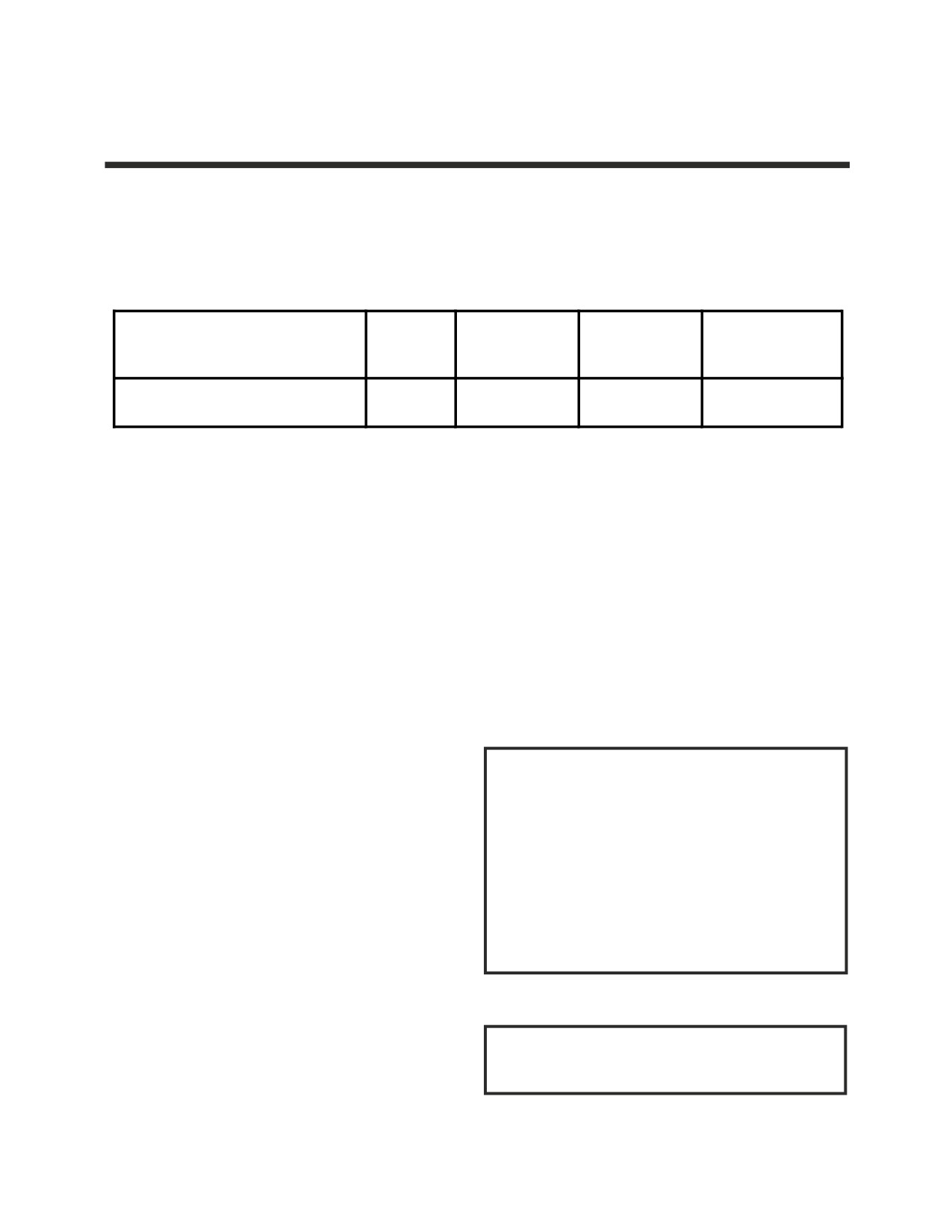
RIGGING STEPS
1. Position apex fitting on top of the trailer (but not on
3. Route the chain end of sling leg 3 through the left rear
top of the radar panel). Route outer sling legs 1and 2 to
lift provision located on the rear of the trailer. Place the
the front of the trailer (lunette end) and inner sling legs 3
correct link from Table 3-13 in the grab hook. Repeat with
and 4 to the rear. Sling legs 1 and 3 must be on the left side
sling leg 4 through the right rear lift provision. Secure the
of the load.
excess chain with Type III nylon cord.
2. Loop the chain end of sling leg 1 under the trailer A-
4. Cluster and tie or tape (breakaway technique) all sling
frame just aft of the lunette and through the keeper from
legs together on top of the trailer to prevent entanglement
left to right on the left side of the drawbar. Place the
during hookup and lift-off.
correct link from Table 3-13 in the grab hook. Repeat with
sling leg 2 on the right side of the drawbar.
Figure 3-13. M116A2 Trailer with AN/TPQ-36 Firefinder Antenna Transceiver Group (ATG)
3-26
FM 10-450-4/MCRP 4-23E, VOL II/NWP 3-04.12/AFJMAN 11-223, VOL II/
COMDTINST M13482.2
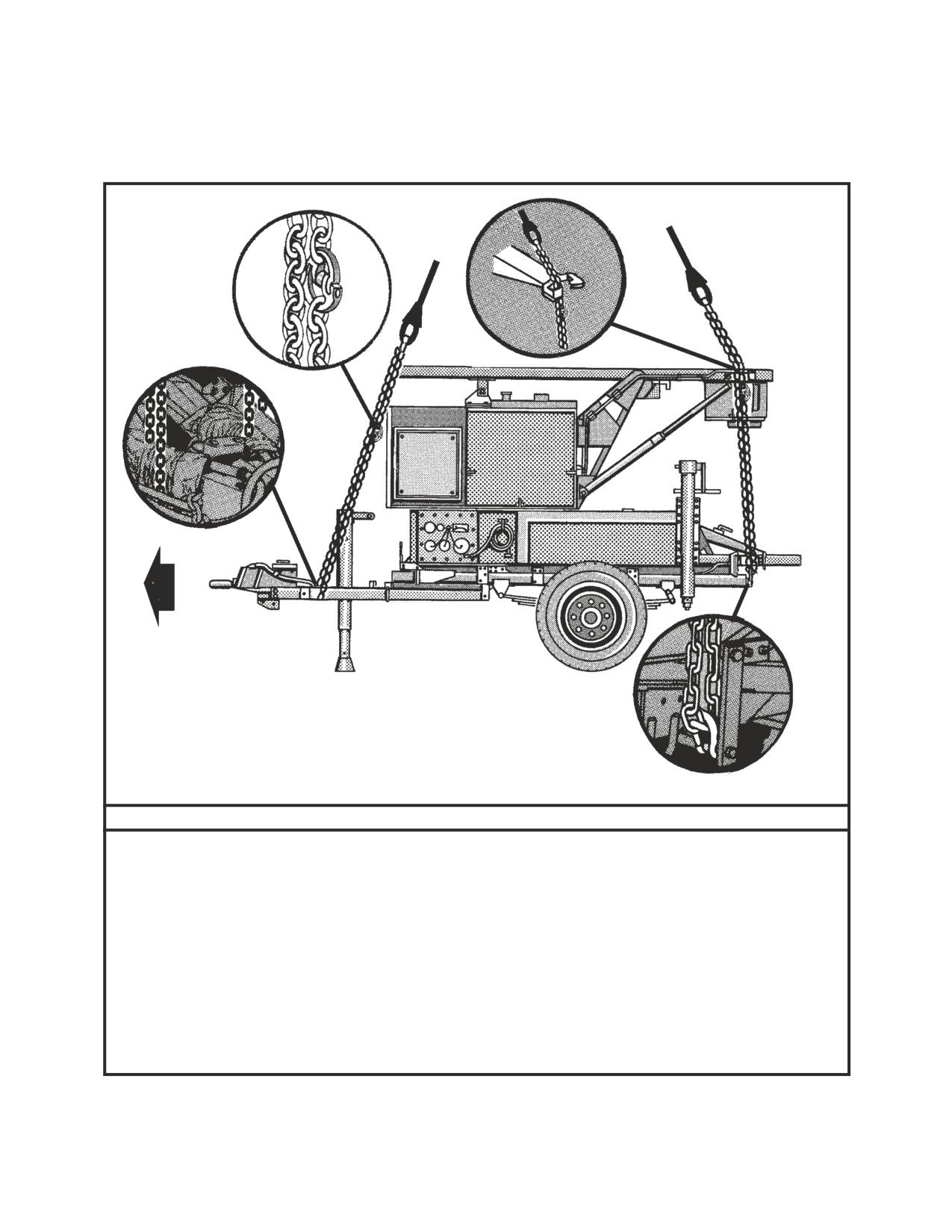
3-15. M116A2 Trailer with M894 18,000-BTU Air Conditioner and MEP-003A Generator
a. Applicability. The following item in Table 3-14 is certified for all helicopters with suitable lift capacity by the US
Army Natick Research, Development, and Engineering Center:
Table 3-14. M116A2 Trailer with M894 18,000-BTU Air Conditioner and MEP-003A Generator
MAX
RECOMMENDED
LINK COUNT
NOMENCLATURE
WEIGHT
SLING SET
AIRSPEED
FRONT/REAR
(POUNDS)
(KNOTS)
M116A2 Trailer with M894
18,000-BTU Air Conditioner and
2,620
10K
3/3
80
MEP-003A Generator
b. Materials. The following materials are required to
(a) Secure all lids, doors, and caps with tape or Type
rig this load:
III nylon cord.
(1) Sling set (10,000-pound capacity).
(b) Secure all chains, hoses, and cables with Type
III nylon cord.
(2) Tape, adhesive, pressure-sensitive, 2-inch wide
roll.
(c) Engage both trailer parking brakes and ensure
the front support leg is down.
(3) Cord, nylon, Type III, 550-pound breaking strength.
(2) Rigging. Rig the load according to the steps in
(4) Webbing, cotton, 1/4-inch, 80-pound breaking
Figure 3-14.
strength.
(3) Hookup. The hookup team stands on top of the
(5) Felt sheet, cattle hair, Type IV, 1/2-inch or suitable
trailer. The static wand person discharges the static elec-
substitute.
tricity with the static wand. The hookup person places
the apex fitting onto the aircraft cargo hook. The hookup
c. Personnel. Two persons can prepare and rig this
team then carefully dismounts the vehicle and remains
load in 15 minutes.
close to the load as the helicopter removes slack from the
sling legs. When successful hookup is assured, the
d. Procedures. The following procedures apply to this
hookup team quickly exits the area underneath the heli-
load:
copter to the designated rendezvous point.
(1) Preparation. Prepare the load using the following
(4) Derigging. Derigging is the reverse of the prepa-
steps:
ration and rigging procedures in steps d (1) and d (2).
3-27
FM 10-450-4/MCRP 4-23E, VOL II/NWP 3-04.12/AFJMAN 11-223, VOL II/
COMDTINST M13482.2
RIGGING STEPS
1. Position apex fitting on top of the generator. Route
3. Route the chain end of sling leg 3 through the left rear
outer sling legs 1and 2 to the front of the trailer (lunette
lift provision located on the rear of the trailer frame. Place
end) and inner sling legs 3 and 4 to the rear. Sling legs 1
the correct link from Table 3-14 in the grab hook. Repeat
and 3 must be on the left side of the load.
with sling leg 4 through the right rear lift provision.
2. Loop the chain end of sling leg 1 through the left
4. Cluster and tie or tape (breakaway technique) all sling
front lift provision located on the front of the trailer just
legs together on top of the trailer to prevent entanglement
outside the A-frame. Place the correct link from Table 3-14
during hookup and lift-off.
in the grab hook. Repeat with sling leg 2 through the right
front lift provision.
Figure 3-14. M116A2 Trailer with M894 18,000-BTU Air Conditioner and MEP-003A Generator
3-28
C3, FM 10-450-4/MCRP 4-23E, VOL II/NWP 3-04.12/AFJMAN 11-223, VOL II/
COMDTINST M13482.3A
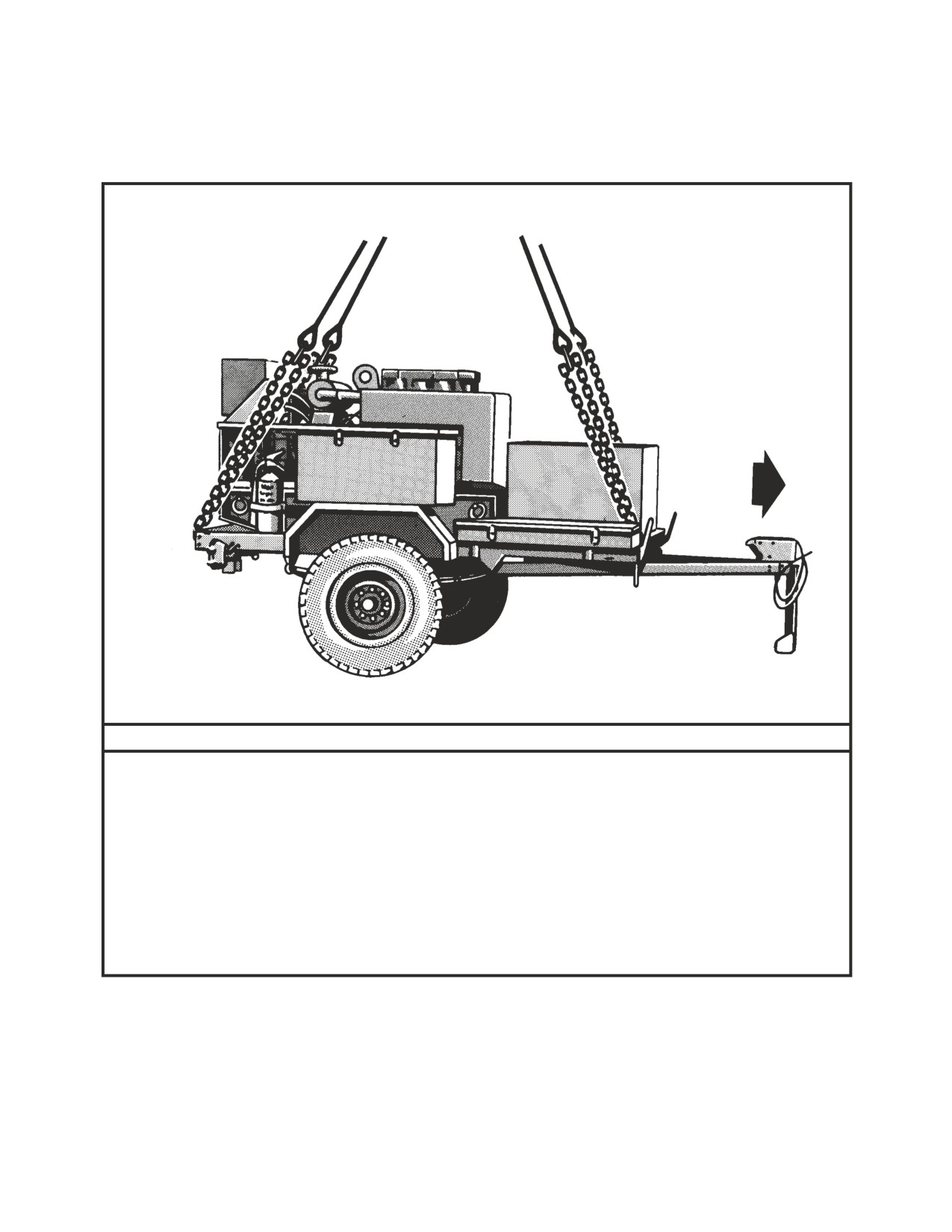
3-16. MKT-90/MKT-95/MKT-99 Field Kitchen Trailer
a. Applicability. The following items in Table 3-15 are certified for all helicopters with suitable lift capacity by the US
Army Soldier Systems Center:
Table 3-15. MKT-90/MKT-95/MKT-99 Field Kitchen Trailer
M AX
RECOMMENDED
SLING
LINK COUNT
NOMENCLATURE
WEIGH T
AIRSPEE D
SET
FRONT / REA R
(POUNDS )
(KNOTS )
MKT-90
5,730
10K
3/11
70
MKT-95
6,731
10K
3/11
70
MKT-99
6,731
10K
3/11
70
NOTE: Only MKT-90 versions equipped with internal
(1) Preparation. Prepare the load using the following
spreader bars (PIP No. 1-85-08-2802) may be sling
steps:
loaded. The data plate next to the item data plate must
contain an etched helicopter.
(a) Extend the sling leg chains by connecting
one
additional chain length to each chain on a 10,000-
b. Materials. The following materials are required to
pound
rig this load:
capacity sling set with coupling links.
(1) Sling set (10,000-pound capacity).
(b) Secure all items in their proper storage lo-
cation before closing the unit.
(a) Chain length, part number 38850-00053-101,
from a 10,000-pound capacity sling set (4 each).
(c) Configure the MKT for ground transportation
according to the operator's instructions.
(b) Coupling link, part number 577-0615, from a
10,000-pound sling set (4 each).
(d) Retract and stow all landing legs. Secure each
landing leg with Type III nylon cord.
(2) Tape, adhesive, pressure-sensitive, 2-inch wide
roll.
(e) Lower the lunette as far as possible by adjusting
the llanding wheel hand screw. Do not retract the landing
(3) Cord, nylon, Type III, 550-pound breaking strength.
wheel.
(4) Webbing, cotton, 1/4-inch, 80-pound breaking
(f) Secure all chains, hoses, and cables with Type III
strength.
nylon cord to the trailer drawbar.
(5) Felt sheet, cattle hair, Type IV, 1/2-inch or suitable
(g) Engage both trailer parking brakes and ensure
padding.
the front support leg is down.
c. Personnel. Two persons can prepare and rig this
(h) Secure loose canvas with tape.
load in 20 minutes.
(2) Rigging. Rig the load according to the steps in
d. Procedures. The following procedures apply to
Figure 3-15.
this load:
3-29
C3, FM 10-450-4/MCRP 4-23E, VOL II/NWP 3-04.12/AFJMAN 11-223, VOL II/
COMDTINST M13482.3A
(3) Hookup. The hookup team stands on top of the
legs. When successful hookup is assured, the hookup
trailer. The static wand person discharges the static elec-
team quickly exits the area underneath the helicopter to
tricity with the static wand. The hookup person places
the designated rendezvous point.
the apex fitting onto the cargo hook. The hookup team
then carefully dismounts the trailer and remains close to
(4) Derigging. Derigging is the reverse of the prepara-
the load as the helicopter removes slack from the sling
tion and rigging procedures in steps d (1) and d (2).
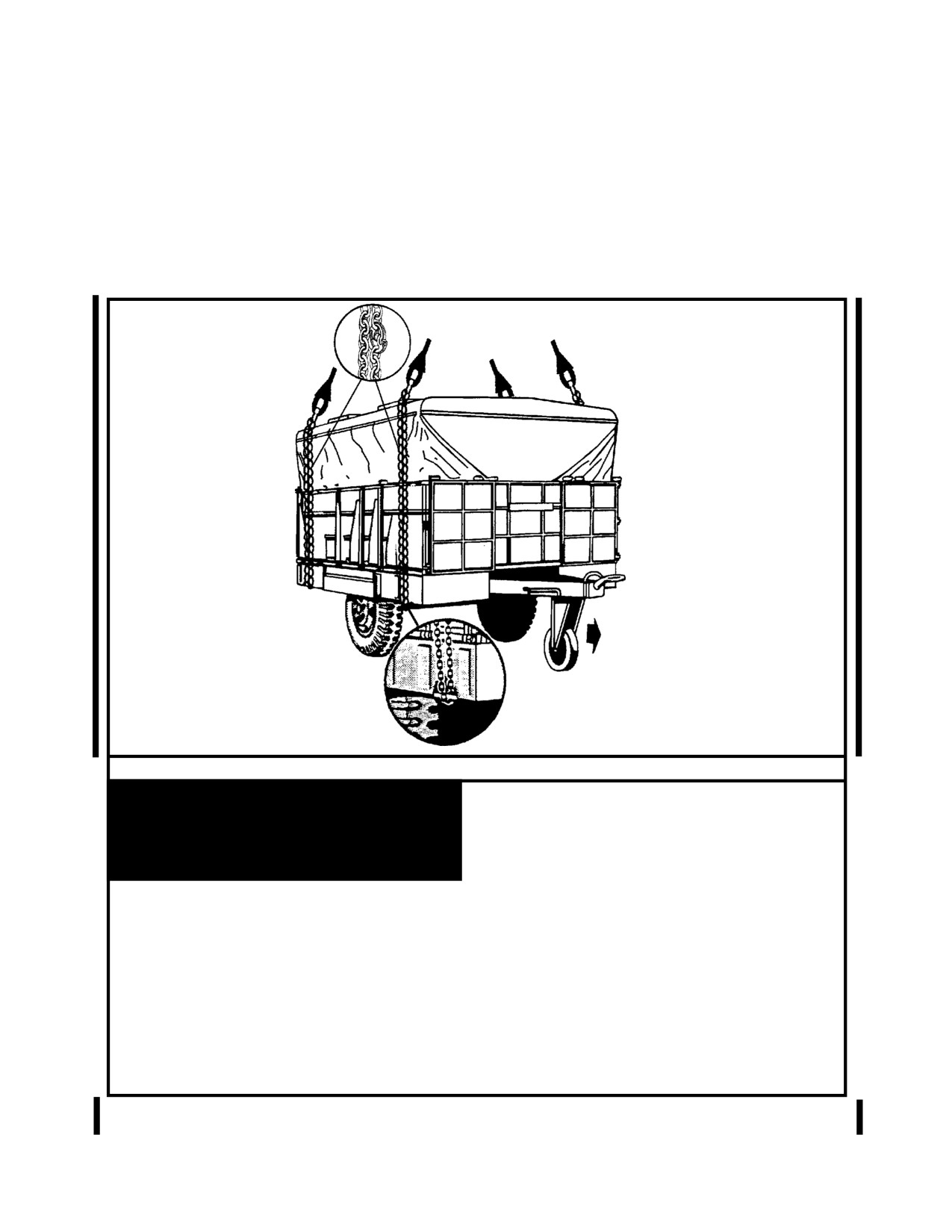
RIGGING STEPS
CAUTION
While on the roof of the trailer, stay in front of the trailer
3. Loop the chain end of sling leg 3 through the left rear
axle. Moving behind the axle may cause the trailer to tip
lift provision located on the rear of the trailer frame. Place
rearwards, causing possible injury to personnel and dam-
the correct link from Table 3-15 in the grab hook. Repeat
age to the load.
with sling leg 4 through the right rear lift provision.
1. Position the apex fitting on the roof of the trailer.
4. Secure all excess chain with tape or Type III nylon
Route outer sling legs 1 and 2 to the front of the trailer
cord.
(lunette end) and inner sling legs 3 and 4 to the rear. Sling
legs 1 and 3 must be on the left side of the load.
5. Pad each sling where it contacts the edge of the roof.
Secure the padding with tape or Type III nylon cord.
2. Loop the chain end of sling leg 1 through the left
front lift provision located in the trailer frame. Place the
6. Cluster and tie or tape (breakaway technique) all sling
correct link from Table 3-15 in the grab hook. Repeat with
legs together on top of the container to prevent entangle-
sling leg 2 through the right front lift provision. The lift
ment during hookup and lift-off.
provisions are in the form of cutouts in the frame.
Figure 3-15. MKT-90/MKT-95/MKT-99 Field Kitchen Trailer
3-30
FM 10-450-4/MCRP 4-23E, VOL II/NWP 3-04.12/AFJMAN 11-223, VOL II/
COMDTINST M13482.2
3-17. Hydraulic System Test and Repair Unit (HSTRU)
a. Applicability. The following item in Table 3-16 is certified for all helicopters with suitable lift capacity by the US
Army Natick Research, Development, and Engineering Center:
Table 3-16. Hydraulic System Test and Repair Unit (HSTRU)
MAX
RECOMMENDED
LINK COUNT
NOMENCLATURE
WEIGHT
SLING SET
AIRSPEED
FRONT/REAR
(POUNDS)
(KNOTS)
Hydraulic System Test and Repair
2,878
10K
16/3
70
Unit (HSTRU)
b. Materials. The following materials are required to
Type III nylon cord.
rig this load:
(b) Secure all chains, hoses, and cables with Type
(1) Sling set (10,000-pound capacity).
III nylon cord to the trailer drawbar.
(2) Tape, adhesive, pressure-sensitive, 2-inch wide
(c) Engage both trailer parking brakes and ensure
roll.
the front support leg is down.
(3) Cord, nylon, Type III, 550-pound breaking strength.
(2) Rigging. Rig the load according to the steps in
Figure 3-16.
(4) Webbing, cotton, 1/4-inch, 80-pound breaking
strength.
(3) Hookup. The hookup team stands on top of the
HSTRU. The static wand person discharges the static
c. Personnel. Two persons can prepare and rig this
electricity with the static wand. The hookup person places
load in 15 minutes.
the apex fitting onto the aircraft cargo hook. The hookup
team then carefully dismounts the vehicle and remains
d. Procedures. The following procedures apply to this
close to the load as the helicopter removes slack from the
load:
sling legs. When successful hookup is assured, the
hookup team quickly exits the area underneath the heli-
(1) Preparation. Prepare the load using the following
copter to the designated rendezvous point.
steps:
(4) Derigging. Derigging is the reverse of the prepa-
(a) Safety tie the covers in the down position with
ration and rigging procedures in steps d (1) and d (2).
3-31
FM 10-450-4/MCRP 4-23E, VOL II/NWP 3-04.12/AFJMAN 11-223, VOL II/
COMDTINST M13482.2
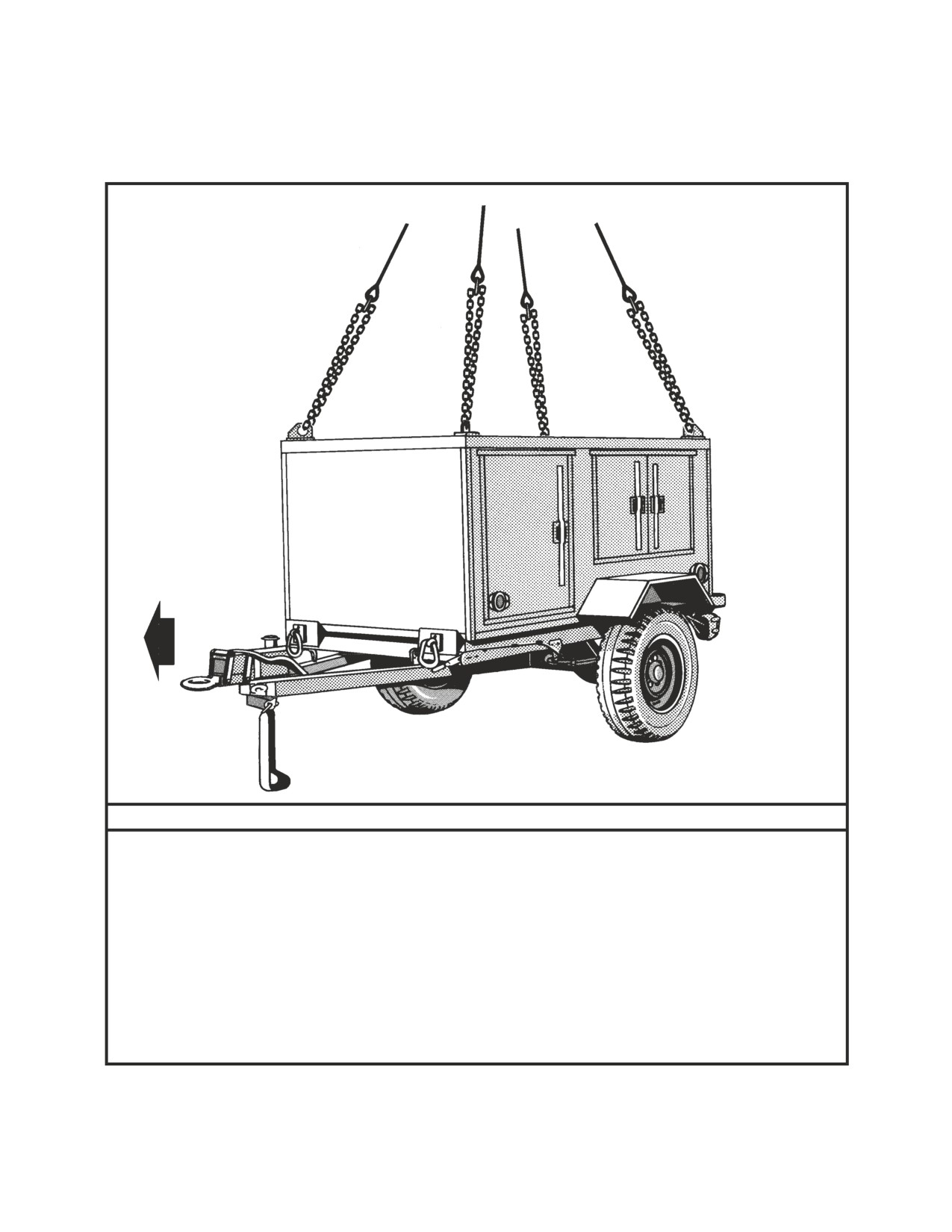
RIGGING STEPS
1. Position apex fitting on top of the trailer roof. Route
provision. Secure the excess chain with Type III nylon
outer sling legs 1and 2 to the front of the trailer (lunette
cord.
end) and inner sling legs 3 and 4 to the rear. Sling legs 1
and 3 must be on the left side of the load.
3. Route the chain end of sling leg 3 through the left rear
lift provision located on the rear of the HSTRU roof. Place
2. Loop the chain end of sling leg 1 through the left
the correct link from Table 3-16 in the grab hook. Repeat
front lift provision located on the front of the HSTRU
with sling leg 4 through the right rear lift provision.
roof. Place the correct link from Table 3-16 in the grab
hook. Repeat with sling leg 2 through the right front lift
4. Cluster and tie or tape (breakaway technique) all sling
legs together on top of the roof to prevent entanglement
during hookup and lift-off.
Figure 3-16. Hydraulic System Test and Repair Unit (HSTRU)
3-32
FM 10-450-4/MCRP 4-23E, VOL II/NWP 3-04.12/AFJMAN 11-223, VOL II/
COMDTINST M13482.2
3-18. M116A2 Trailer, Single Channel Objective Tactical Terminal (SCOTT)
a. Applicability. The following item in Table 3-17 is certified for all helicopters with suitable lift capacity by the US
Army Natick Research, Development, and Engineering Center:
Table 3-17. M116A2 Trailer, Single Channel Objective Tactical Terminal (SCOTT)
MAX
RECOMMENDED
LINK COUNT
NOMENCLATURE
WEIGHT
SLING SET
AIRSPEED
FRONT/REAR
(POUNDS)
(KNOTS)
M116A2 Trailer, Single Channel
2,830
10K
18/3
85
Objective Tactical Terminal (SCOTT)
(b) Remove and secure nylon tarps to upper trailer
b. Materials. The following materials are required to
structure with tape or Type III nylon cord.
rig this load:
(c) Secure all chains, hoses, and cables to the draw-
(1) Sling set (10,000-pound capacity).
bar with Type III nylon cord.
(2) Tape, adhesive, pressure-sensitive, 2-inch wide
(d) Engage both hand brakes.
roll.
(2) Rigging. Rig the load according to the steps in
(3) Cord, nylon, Type III, 550-pound breaking strength.
Figure 3-17.
(4) Webbing, cotton, 1/4-inch, 80-pound breaking
CAUTION
strength.
Brief the pilots to hover to the side of the trailer prior to
(5) Felt sheet, cattle hair, Type IV, 1/2-inch or suitable
jettisoning the apex fitting during landing operations.
substitute.
(3) Hookup. The hookup team stands on the trailer
(6) Tie-down, cargo, CGU-1/B.
chassis. The static wand person discharges the static
electricity with the static wand. The hookup person places
c. Personnel. Two persons can prepare and rig this
the apex fitting onto the aircraft cargo hook. The hookup
load in 15 minutes.
team then carefully dismounts the vehicle and remains
close to the load as the helicopter removes slack from the
d. Procedures. The following procedures apply to this
sling legs. When successful hookup is assured, the
load:
hookup team quickly exits the area underneath the heli-
copter to the designated rendezvous point.
(1) Preparation. Prepare the load using the following
steps:
(4) Derigging. Derigging is the reverse of the prepa-
ration and rigging procedures in steps d (1) and d (2).
(a) Secure all cargo in the bed of the trailer with tie-
down straps.
3-33
FM 10-450-4/MCRP 4-23E, VOL II/NWP 3-04.12/AFJMAN 11-223, VOL II/
COMDTINST M13482.2
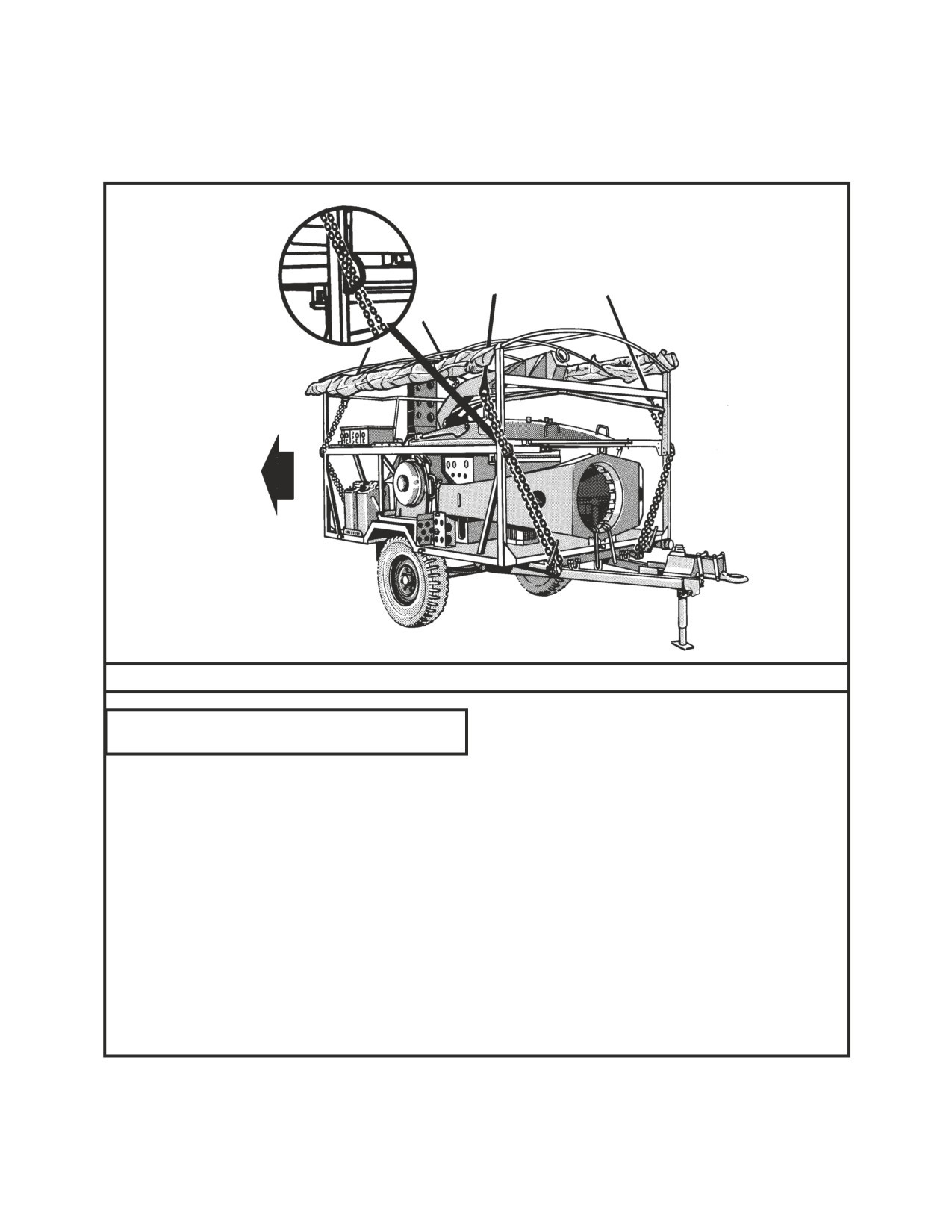
RIGGING STEPS
4. Route sling leg 3 through the trailer canopy structure
NOTE: This trailer will fly with the front end (trailer
to the side of the trailer and through the rear left sling
lunette) aft.
guide on the horizontal reflector support tube. Repeat
with sling leg 4 and the right rear sling guide provision.
1. Position apex fitting on top of the trailer . Route outer
sling legs 1and 2 to the front of the trailer (lunette end)
5. Route the chain end of sling leg 3 through the left rear
and inner sling legs 3 and 4 to the rear. Sling legs 1 and 3
lift provision located on the rear of the trailer. Place the
must be on the left side of the load.
correct link from Table 3-17 in the grab hook. Repeat with
sling leg 4 through the right rear lift provision.
2. Route sling leg 1 through the trailer canopy structure
to the side of the trailer and through the front left sling
6. Pad the chain and/or trailer support where there is
guide on the horizontal reflector support tube. Repeat
chain contact.
with sling leg 2 and the right front sling guide provision.
7. Cluster and tie or tape (breakaway technique) all sling
3. Loop the chain end of sling leg 1 through the left
legs together on top of the roof to prevent entanglement
front lift provision located on the front of the trailer. Place
during hookup and lift-off.
the correct link from Table 3-17 in the grab hook. Repeat
with sling leg 2 through the right front lift provision.
Secure the excess chain with Type III nylon cord.
Figure 3-17. M116A2 Trailer, Single Channel Objective Tactical Terminal (SCOTT)
3-34

C2, FM 10-450-4/MCRP 4-23E, VOL II/NWP 3-04.12/AFJMAN 11-223, VOL II/
COMDTINST M13482.2
3-19. High Mobility Trailers (HMT), M1101/M1102
a. Applicability. The following items in Table 3-18 are certified for all helicopters with suitable lift capacity by the US
Army Soldier Systems Center:
Table 3-18. High Mobility Trailers
MAX
RECOMMENDED
LINK COUNT
NOMENCLATURE
WEIGH T
SLING SET
AIRSPEE D
FRONT/REA R
(POUNDS )
(KNOTS )
High Mobility Trailer (Light), M1101
3,400
10K
2
/
120
High Mobility Trailer (Light), M1102
4,200
10K
2
/
120
Tactical Messaging System (TMS)
4,200
10K
2
/
120
Cargo Carrier, M1102
b. Materials. The following materials are required to
close to the ground as possible.
rig this load:
(c) Remove the canvas cover and racks from the
(1) Sling set (10,000-pound capacity).
trailer. Place these items in the bed of the trailer. Place the
accompanying load on top of the canvas cover and se-
(2) Tape, adhesive, pressure-sensitive, 2-inch wide
cure with the tie-down lashings.
roll.
(d) Secure the light cable to the top of the drawbar
(3) Cord, nylon, Type III, 550-pound breaking strength.
with Type III nylon cord.
(4) Webbing, cotton, 1/4-inch, 80-pound breaking
(e) Engage the parking brake.
strength.
(2) Rigging. Rig the load according to the steps in
(5) Felt sheet, cattle hair, Type IV, 1/2-inch or suitable
Figure 3-18.
substitute.
(3) Hookup. The hookup team stands on the drawbar
(6) Tie-down, cargo, CGU-1/B or suitable tie-down
or in the bed of the trailer (if possible). The static wand
lashings.
person discharges the static electricity with the static
wand. The hookup person places the apex fitting onto the
c. Personnel. Two persons can prepare and rig this
aircraft cargo hook. The hookup team then carefully dis-
load in 10 minutes.
mounts the trailer and remains close to the load as the
helicopter removes slack from the sling legs. When suc-
d. Procedures. The following procedures apply to this
cessful hookup is assured, the hookup team quickly exits
load:
the area underneath the helicopter to the designated ren-
dezvous point.
(1) Preparation. Prepare the load using the following
steps:
CAUTION
The hookup team should dismount the trailer towards
(a) Remove the two rear stabilizer legs from their
the lunette to keep the trailer from tipping towards the
storage location on the front of the trailer. Place the lower
rear.
support section in the fully retracted position. Install the
stabilizer legs on the rear of the trailer.
(4) Derigging. Derigging is the reverse of the prepa-
ration and rigging procedures in steps d (1) and d (2).
(b) Install the front jack and lower the lunette as
3-35
C2, FM 10-450-4/MCRP 4-23E, VOL II/NWP 3-04.12/AFJMAN 11-223, VOL II/
COMDTINST M13482.2
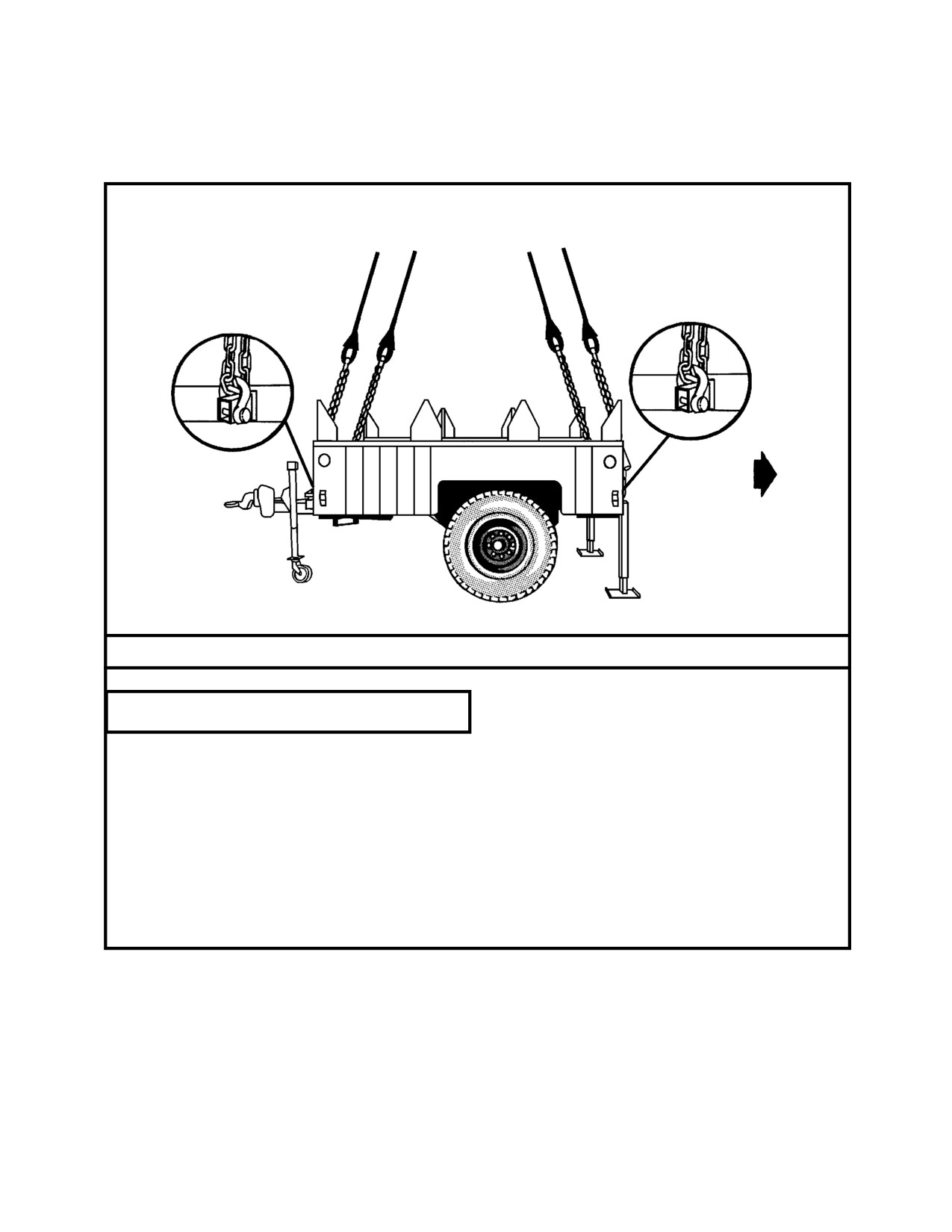
RIGGING STEPS
3. Route the chain end of sling leg 3 through the left
NOTE: This trailer will fly with the front end (trailer
rear lift provision located on the rear of the trailer. Place
lunette) aft.
the correct link from Table 3-18 in the grab hook. Repeat
with sling leg 4 through the right rear lift provision.
1. Position apex fitting on top of the trailer . Route outer
sling legs 1and 2 to the front of the trailer (lunette end)
4. Pad the chain at and below where the chain contacts
and inner sling legs 3 and 4 to the rear. Sling legs 1 and 3
the trailer walls.
must be on the left side of the load.
5. Cluster and tie or tape (breakaway technique) all sling
2. Loop the chain end of sling leg 1 through the left
legs together on top of the roof to prevent entanglement
front lift provision located on the front of the trailer. Place
during hookup and lift-off.
the correct link from Table 3-18 in the grab hook. Repeat
with sling leg 2 through the right side front lift provision.
Secure the excess chain with Type III nylon cord.
Figure 3-18. High Mobility Trailers
3-36
FM 10-450-4/MCRP 4-23E, VOL II/NWP 3-04.12/AFJMAN 11-223, VOL II/
COMDTINST M13482.2
3-20. M116A3 Trailer with OE334 Antenna Coupler Group
a. Applicability. The following items in Table 3-19 are certified for all helicopters with suitable lift capacity by the US
Army Natick Research, Development, and Engineering Center:
Table 3-19. M116A3 Trailer with OE334 Antenna Coupler Group
MAX
RECOMMENDED
LINK COUNT
NOMENCLATURE
WEIGHT
SLING SET
AIRSPEED
FRONT/REAR
(POUNDS)
(KNOTS)
High Mobility Downsized (HMD),
Direct Air Support Central (DASC),
3,280
15K
3/15
80
OE334 Antenna Coupler Group
b. Materials. The following materials are required to
(a) Lower and lock the rear landing leg in place.
rig this load:
(b) Lower the front jack on the lunette as close to the
(1) Multileg sling set (15,000-pound capacity).
ground as possible.
(2) Tape, adhesive, pressure-sensitive, 2-inch wide
(c) Secure the light cable to the top of the drawbar
roll.
with Type III nylon cord.
(3) Cord, nylon, Type III, 550-pound breaking strength.
(d) Engage both parking brakes.
(4) Webbing, cotton, 1/4-inch, 80-pound breaking
(2) Rigging. Rig the load according to the steps in
strength.
Figure 3-19.
(5) Felt sheet, cattle hair, Type IV, 1/2-inch or suitable
(3) Hookup. The hookup team stands next to the
substitute.
trailer. The static wand person discharges the static elec-
tricity with the static wand. The hookup person places
c. Personnel. Two persons can prepare and rig this
the apex fitting onto the aircraft cargo hook. The hookup
load in 15 minutes.
team remains close to the load as the helicopter removes
slack from the sling legs. When successful hookup is
d. Procedures. The following procedures apply to this
assured, the hookup team quickly exits the area under-
load:
neath the helicopter to the designated rendezvous point.
(1) Preparation. Prepare the load using the following
(4) Derigging. Derigging is the reverse of the prepa-
steps:
ration and rigging procedures in steps d (1) and d (2).
3-37
FM 10-450-4/MCRP 4-23E, VOL II/NWP 3-04.12/AFJMAN 11-223, VOL II/
COMDTINST M13482.2
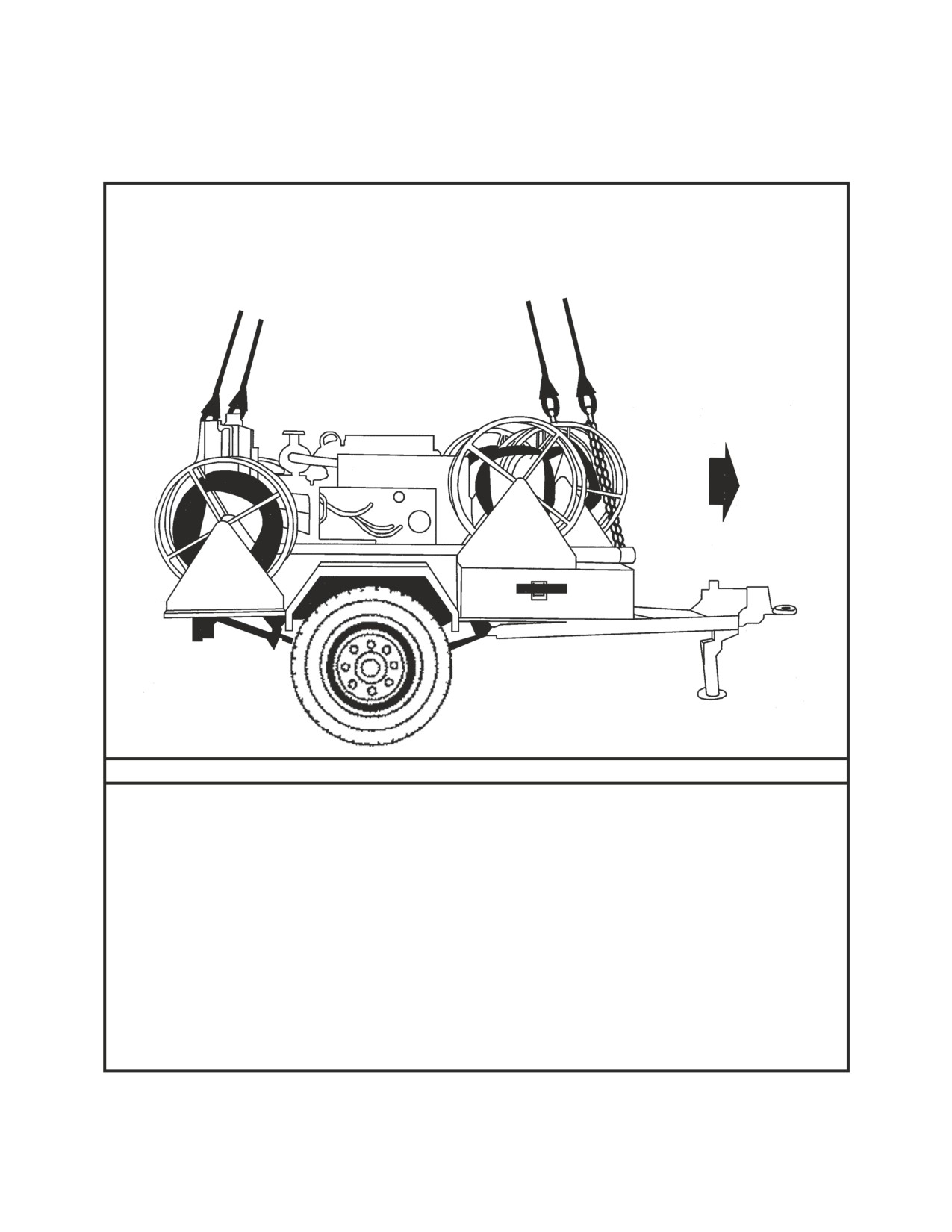
RIGGING STEPS
1. Position apex fitting on top of the trailer . Route outer
3. Route the chain end of sling leg 3 through the left
sling legs 1and 2 to the front of the trailer (lunette end)
rear multipurpose provision located on the rear of the
and inner sling legs 3 and 4 to the rear. Sling legs 1 and 3
trailer. Place the correct link from Table 3-19 in the grab
must be on the left side of the load.
hook. Repeat with sling leg 4 through the right rear multi-
purpose provision. Secure the excess chain with Type III
2. Pass the chain end of sling leg 1 through the right
nylon cord.
inner cable reel assembly at the front of the trailer. Loop
the chain end of sling leg 1 through the left front multipur-
4. Pad the front chains where the chains contact the
pose provision located on the front of the trailer. Place
generator and reels.
the correct link from Table 3-19 in the grab hook. Repeat
with sling leg 2 through the right multipurpose provision.
5. Cluster and tie or tape (breakaway technique) all sling
legs together to prevent entanglement during hookup and
lift-off.
Figure 3-19. M116A3 Trailer with OE334 Antenna Coupler Group
3-38
FM 10-450-4/MCRP 4-23E, VOL II/NWP 3-04.12/AFJMAN 11-223, VOL II/
COMDTINST M13482.2
3-21. Desert Operation Trailer (DOT) with Desert Operation Motorcycle (DOM)
a. Applicability. The following items in Table 3-20 are certified for all helicopters with suitable lift capacity by the US
Army Natick Research, Development, and Engineering Center:
Table 3-20. Desert Operation Trailer (DOT) with Desert Operation Motorcycle (DOM)
MAX
RECOMMENDED
LINK COUNT
NOMENCLATURE
WEIGHT
SLING SET
AIRSPEED
FRONT/REAR
(POUNDS)
(KNOTS)
Desert Operation Trailer (DOT) with
3,300
10K
20/3
80
Desert Operation Motorcycle (DOM)
b. Materials. The following materials are required to
(b) Secure the tailgate in the up position.
rig this load:
(c) Secure all chains and hoses with tape or Type III
(1) Sling set (10,000-pound capacity).
nylon cord.
(2) Tape, adhesive, pressure-sensitive, 2-inch wide
(d) Engage the parking brake and place the front
roll.
support leg in the down position.
(3) Cord, nylon, Type III, 550-pound breaking strength.
(d) Safety the spare tire with Type III nylon cord.
(4) Webbing, cotton, 1/4-inch, 80-pound breaking
(e) Pad the motorcycle handlebars and luggage rack
strength.
with felt padding.
(5) Felt sheet, cattle hair, Type IV, 1/2-inch or suitable
(f) Cover the motorcycle with canvas and secure the
substitute.
canvas with Type III nylon cord.
(6) Tie-down strap, cargo, CGU-1/B (4 each).
(2) Rigging. Rig the load according to the steps in
Figure 3-20.
(7) Canvas to cover the motorcycle.
(3) Hookup. The hookup team stands on the trailer
c. Personnel. Two persons can prepare and rig this
fender or in the trailer bed. The static wand person dis-
load in 15 minutes.
charges the static electricity with the static wand. The
hookup person places the apex fitting onto the aircraft
d. Procedures. The following procedures apply to this
cargo hook. The hookup team remains close to the load
load:
as the helicopter removes slack from the sling legs. When
successful hookup is assured, the hookup team quickly
(1) Preparation. Prepare the load using the following
exits the area underneath the helicopter to the designated
steps:
rendezvous point.
(a) Secure the motorcycle to the trailer using stan-
(4) Derigging. Derigging is the reverse of the prepa-
dard mounting methods or using at lease four (4) CGU-1/
ration and rigging procedures in steps d (1) and d (2).
B tie-down straps.
3-39
FM 10-450-4/MCRP 4-23E, VOL II/NWP 3-04.12/AFJMAN 11-223, VOL II/
COMDTINST M13482.2
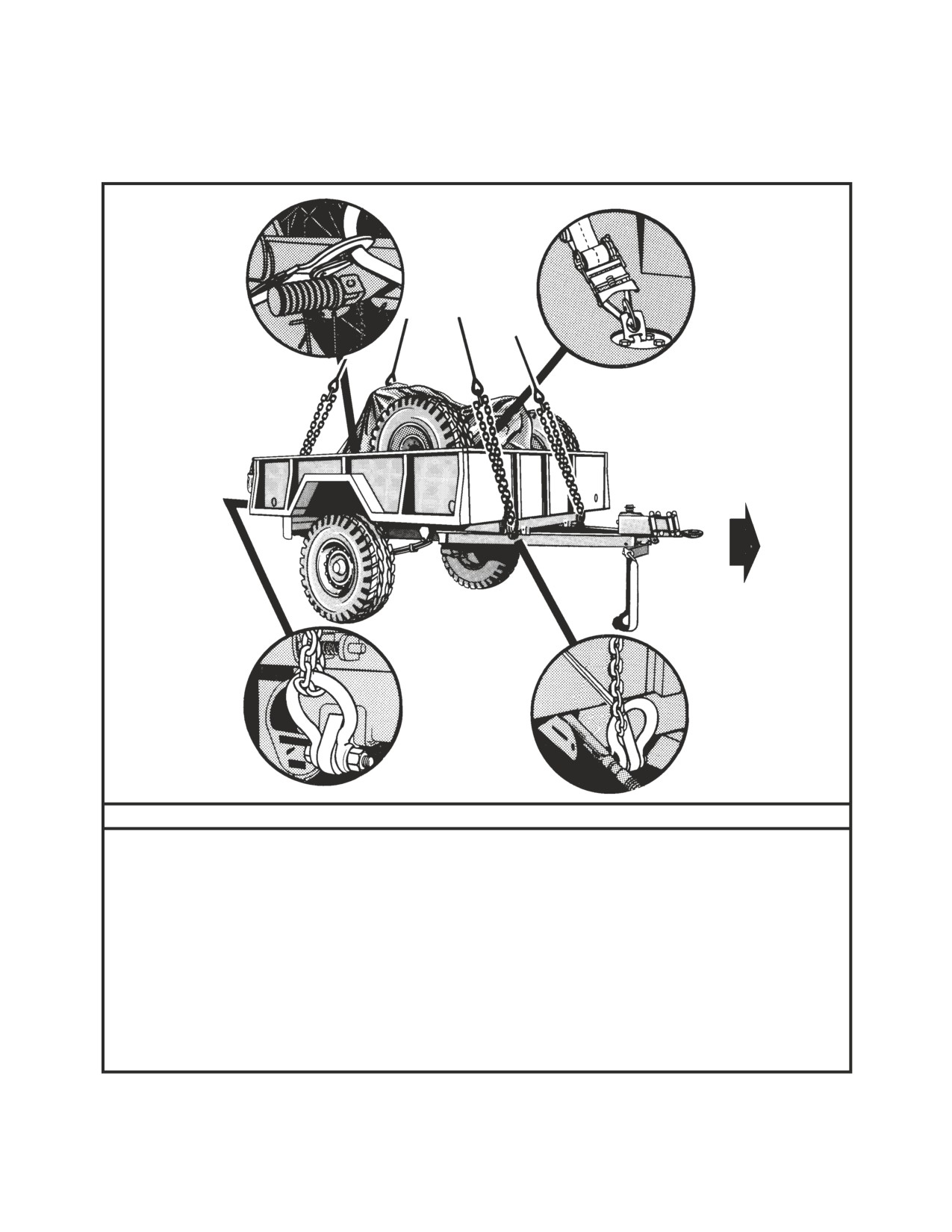
RIGGING STEPS
3. Route the chain end of sling leg 3 over the tailgate
1. Position apex fitting on top of the motorcycle . Route
and through the left rear lift provision located on the rear
outer sling legs 1and 2 to the front of the trailer (lunette
of the trailer. Place the correct link from Table 3-20 in the
end) and inner sling legs 3 and 4 to the rear. Sling legs 1
grab hook. Repeat with sling leg 4 through the right rear
and 3 must be on the left side of the load.
lift provision.
2. Loop the chain end of sling leg 1 through the left
4. Secure the excess chain taut to the sidewall with tape
front lift provision located on the front of the trailer. Place
or Type III nylon cord.
the correct link from Table 3-20 in the grab hook. Repeat
with sling leg 2 through the right front lift provision.
5. Cluster and tie or tape (breakaway technique) all sling
Secure the excess chain with Type III nylon cord.
legs together on top of the motorcycle to prevent en-
tanglement during hookup and lift-off.
Figure 3-20. Desert Operation Trailer (DOT) with Desert Operation Motorcycle (DOM)
3-40
C1, FM 10-450-4/MCRP 4-23E, VOL II/NWP 3-04.12/AFJMAN 11-223, VOL II/
COMDTINST M13482.2
3-22. HMT Trailer With Sentinel AN/MPQ-64 Antenna Transmitter Group (ATG)
a. Applicability. The following item in Table 3-21 is certified for all helicopters with suitable lift capacity by the US
Army Soldier Systems Center:
Table 3-21. HMT Trailer With Sentinel AN/MPQ-64 Antenna Transmitter Group (ATG)
M AX
RECOMMENDED
LINK COUNT
NOMENCLATURE
WEIGH T
SLING SET
AIRSPEE D
FRONT/REA R
(POUNDS )
(KNOTS )
SentinelAN/MPQ-64 Antenna
3,900
10K
3/20
80
T
ransmitter Group (ATG
)
b. Materials. The following materials are required to
top of the drawbar.
rig this load:
(d) Secure all loose equipment, lids, and caps with
(1) Sling set (10,000-pound capacity).
tape or Type III nylon cord.
(2) Tape, adhesive, pressure-sensitive, 2-inch wide
(e) Cut pieces of plywood to cover the antenna boxes
roll.
on top of the ATG. Drill holes in the plywood where
necessary to secure the plywood with Type III nylon cord.
(3) Cord, nylon, Type III, 550-pound breaking strength.
Ensure the plywood is adequately secured.
(4) Webbing, cotton, 1/4-inch, 80-pound breaking
(f) Pad the slings where they make contact with the
strength.
load.
(5) Plywood, 3/4-inch x 48-inches x 72-inches.
(2) Rigging. Rig the load according to the steps in
Figure 3-21.
(6) Reach pendant, 11K or 25K.
(3) Hookup. The hookup team stands on the wheel
c. Personnel. Two persons can prepare and rig this
well of the trailer. The static wand person discharges the
load in 15 minutes.
static electricity with the static wand. The hookup person
places the apex fitting onto the aircraft cargo hook. The
d. Procedures. The following procedures apply to
hookup team then carefully dismounts the vehicle and
this load:
remains close to the load as the helicopter removes slack
from the sling legs. When successful hookup is assured,
(1) Preparation. Prepare the load using the following
the hookup team quickly exits the area underneath the
steps:
helicopter to the designated rendezvous point.
(a) Partially retract all landing legs. Secure in posi-
CAUTION
tion and tie with Type III nylon cord.
Advise the air crew to hover to the side of the load before
releasing the apex to prevent damaging the load.
(b) Engage the hand brakes.
(4) Derigging. Derigging is the reverse of the prepa-
(c) Tape or tie the light cable and brake hose to the
ration and rigging procedures in steps d (1) and d (2).
3-41
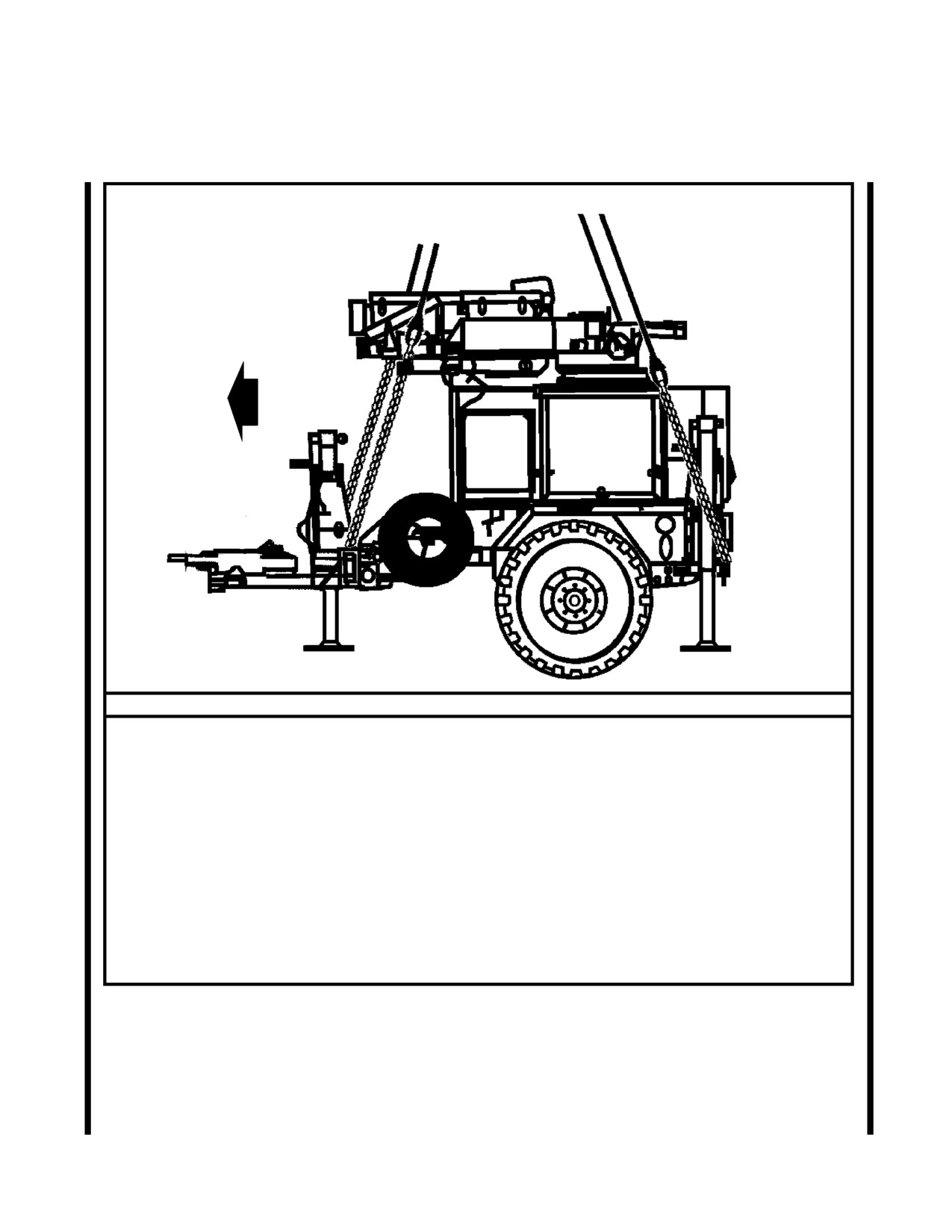
C1, FM 10-450-4/MCRP 4-23E, VOL II/NWP 3-04.12/AFJMAN 11-223, VOL II/
COMDTINST M13482.2
RIGGING STEPS
1. Attach a reach pendant to the apex fitting. Position
legs 1 and 2 together at 3-foot intervals to prevent en-
the reach pendant and apex fitting on top of the ATG.
tanglement during hookup and lift-off.
Route outer sling legs 1and 2 to the front of the trailer and
inner sling legs 3 and 4 to the rear. Sling legs 1 and 3 must
4. Route the chain end of sling leg 3 through the left rear
be on the left side of the load.
lift provision. Place the correct link from Table 3-21in the
grab hook. Repeat with sling leg 4 through the right rear
2. Loop the chain end of sling leg 1 through the left
lift provision. Secure excess chain with tape or Type III
front lift provision located on the front of the trailer. Place
nylon cord.
the correct link from Table 3-21 in the grab hook. Repeat
with sling leg 2 through the right front lift provision.
5. Cluster and tie or tape (breakaway technique) all sling
legs together on top of the trailer to prevent entanglement
3. Cluster and tie or tape (breakaway technique) sling
during hookup and lift-off.
Figure 3-21. HMT Trailer With Sentinel AN/MPQ-64 Antenna Transmitter Group (ATG)
3-42
C1, FM 10-450-4/MCRP 4-23E, VOL II/NWP 3-04.12/AFJMAN 11-223, VOL II/
COMDTINST M13482.2
3-23. HMT Trailer With Remote Landing Site Tower (RLST)
a. Applicability. The following item in Table 3-22 is certified for all helicopters with suitable lift capacity by the US
Army Soldier Systems Center:
Table 3-22. HMT Trailer With Remote Landing Site Tower (RLST)
M AX
RECOMMENDED
LINK COUNT
NOMENCLATURE
WEIGH T
SLING SET
AIRSPEE D
FRONT/REA R
(POUNDS )
(KNOTS )
Rem ote Landing Site Tower (RLST )
3,600
15K
3/15
120
b. Materials. The following materials are required to
or Type III nylon cord. Tape the trailer lights and the cable
rig this load:
on the spool.
(1) Sling set (15,000-pound capacity).
(c) Retract the jack wheel to the lowest position.
Position the rear stabilizers in the highest position.
(a) Chain length, part number 34080-4, from 15,000-
pound capacity sling sets (8 each).
(d) Place the cover over the aft rack and secure the
loose ends of the straps with tape.
(b) Coupling link, part number 31611, from 15,000-
pound capacity sling sets (8 each).
(e) Extend the sling leg chains by connecting two
additional chain lengths to each chain using the cou-
(2) Tape, adhesive, pressure-sensitive, 2-inch wide
pling links.
roll.
(2) Rigging. Rig the load according to the steps in
(3) Cord, nylon, Type III, 550-pound breaking strength.
Figure 3-22.
(4) Webbing, cotton, 1/4-inch, 80-pound breaking
(3) Hookup. The hookup team stands beside the trailer.
strength.
The static wand person discharges the static electricity
with the static wand. The hookup person places the apex
(5) Felt sheet, cattle hair, Type IV, 1/2-inch or suitable
fitting onto the aircraft cargo hook. The hookup team
padding
then carefully dismounts the vehicle and remains close to
the load as the helicopter removes slack from the sling
c. Personnel. Two persons can prepare and rig this
legs. When successful hookup is assured, the hookup
load in 15 minutes.
team quickly exits the area underneath the helicopter to
the designated rendezvous point.
d. Procedures. The following procedures apply to
this load:
CAUTION
Ensure the sling legs do not snag on the an-
(1) Preparation. Prepare the load using the following
tenna or the pole at the corner of the trailer.
steps:
(4) Derigging. Derigging is the reverse of the prepa-
(a) Engage the hand brakes.
ration and rigging procedures in steps d (1) and d (2).
(b) Secure loose fittings, wires, and cables with tape
3-43
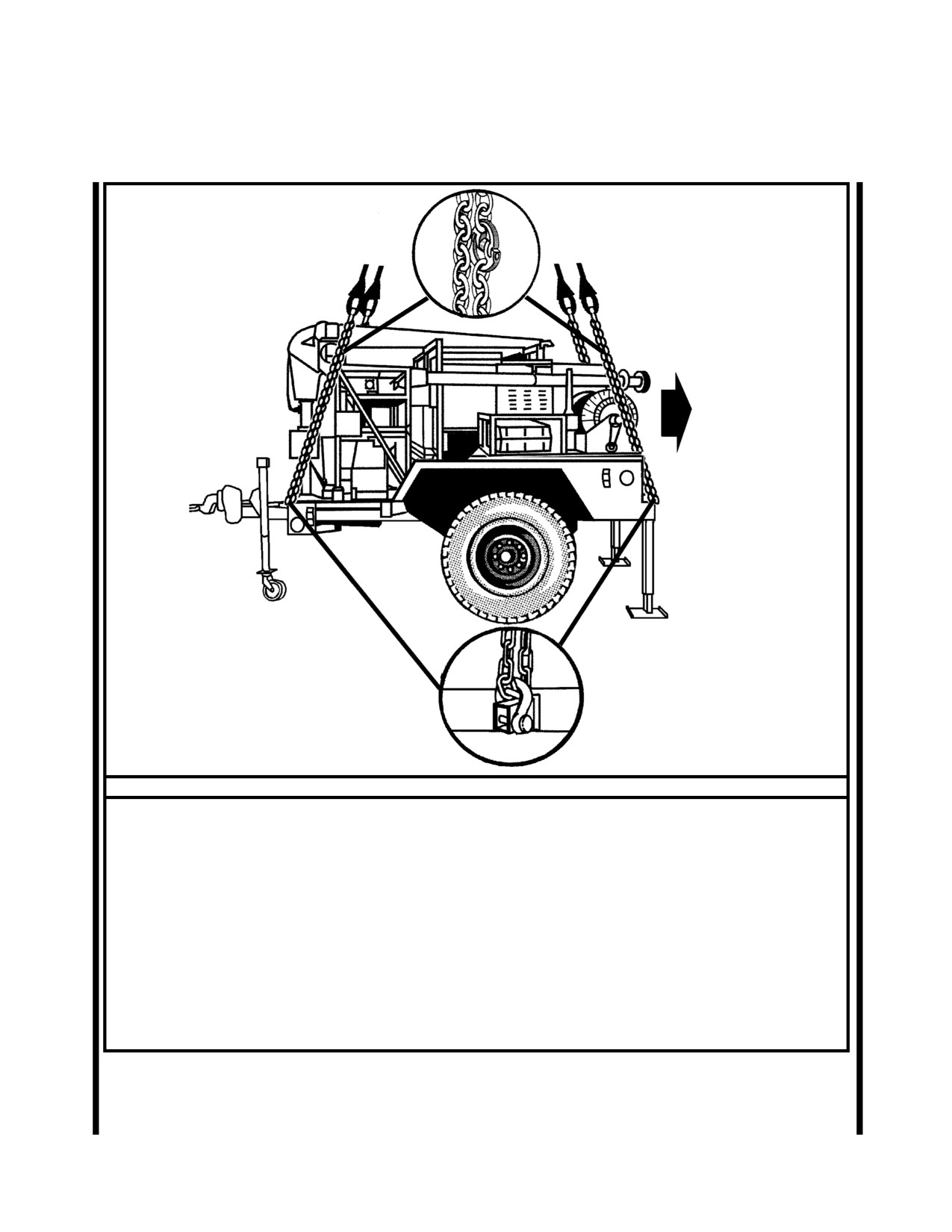
C1, FM 10-450-4/MCRP 4-23E, VOL II/NWP 3-04.12/AFJMAN 11-223, VOL II/
COMDTINST M13482.2
RIGGING STEPS
1. Position the web ring beside the trailer. Route outer
lift provision (lunette end). Place the correct link from Table
sling legs 1and 2 to the aft of the trailer and inner sling
3-22 in the grab hook. Repeat with sling leg 4 through the
legs 3 and 4 to the front (lunette end). Sling legs 1 and 3
right rear lift provision (lunette end). Secure excess chain
must be on the left side of the load.
with tape or Type III nylon cord.
2. Loop the chain end of sling leg 1 through the left
4. Pad the sling legs or chains where they make contact
front lift provision of the trailer. Place the correct link from
with the load.
Table 3-22 in the grab hook. Repeat with sling leg 2 through
the right front lift provision.
5. Cluster and tie or tape (breakaway technique) all sling
legs together on top of the trailer to prevent entanglement
3. Route the chain end of sling leg 3 through the left rear
during hookup and lift-off.
Figure 3-22. HMT Trailer With Remote Landing Site Tower (RLST)
3-44
C1, FM 10-450-4/MCRP 4-23E, VOL II/NWP 3-04.12/AFJMAN 11-223, VOL II/
COMDTINST M13482.2
3-24. M105A3 Trailer
a. Applicability. The following item in Table 3-23 is certified for all helicopters with suitable lift capacity by the US
Army Soldier Systems Center:
Table 3-23. M105A3 Trailer
M AX
RECOMMENDED
LINK COUNT
NOMENCLATURE
WEIGH T
SLING SET
AIRSPEE D
FRONT/REA R
(POUNDS )
(KNOTS )
M105A3
T
railer, Em pty
2,600
10K
3/40
80
M105A3
T
railer, Loaded
5,580
10K
3/40
110
b. Materials. The following materials are required to
ground.
rig this load:
(b) Engage the hand brakes.
(1) Sling set (10,000-pound capacity).
(c) Tape or tie the light cable, safety chains, and
(2) Tape, adhesive, pressure-sensitive, 2-inch wide
brake hose to the top of the drawbar.
roll.
(2) Rigging. Rig the load according to the steps in
(3) Cord, nylon, Type III, 550-pound breaking strength.
Figure 3-23.
(4) Webbing, cotton, 1/4-inch, 80-pound breaking
(3) Hookup. The hookup team stands on the trailer
strength.
bed. The static wand person discharges the static elec-
tricity with the static wand. The hookup person places
c. Personnel. Two persons can prepare and rig this
the apex fitting onto the aircraft cargo hook. The hookup
load in 10 minutes.
team then carefully dismounts the vehicle and remains
close to the load as the helicopter removes slack from the
d. Procedures. The following procedures apply to
sling legs. When successful hookup is assured, the
this load:
hookup team quickly exits the area underneath the heli-
copter to the designated rendezvous point.
(1) Preparation. Prepare the load using the following
steps:
(4) Derigging. Derigging is the reverse of the prepa-
ration and rigging procedures in steps d (1) and d (2).
(a) Raise the trailer's jack stand so the pintle is on the
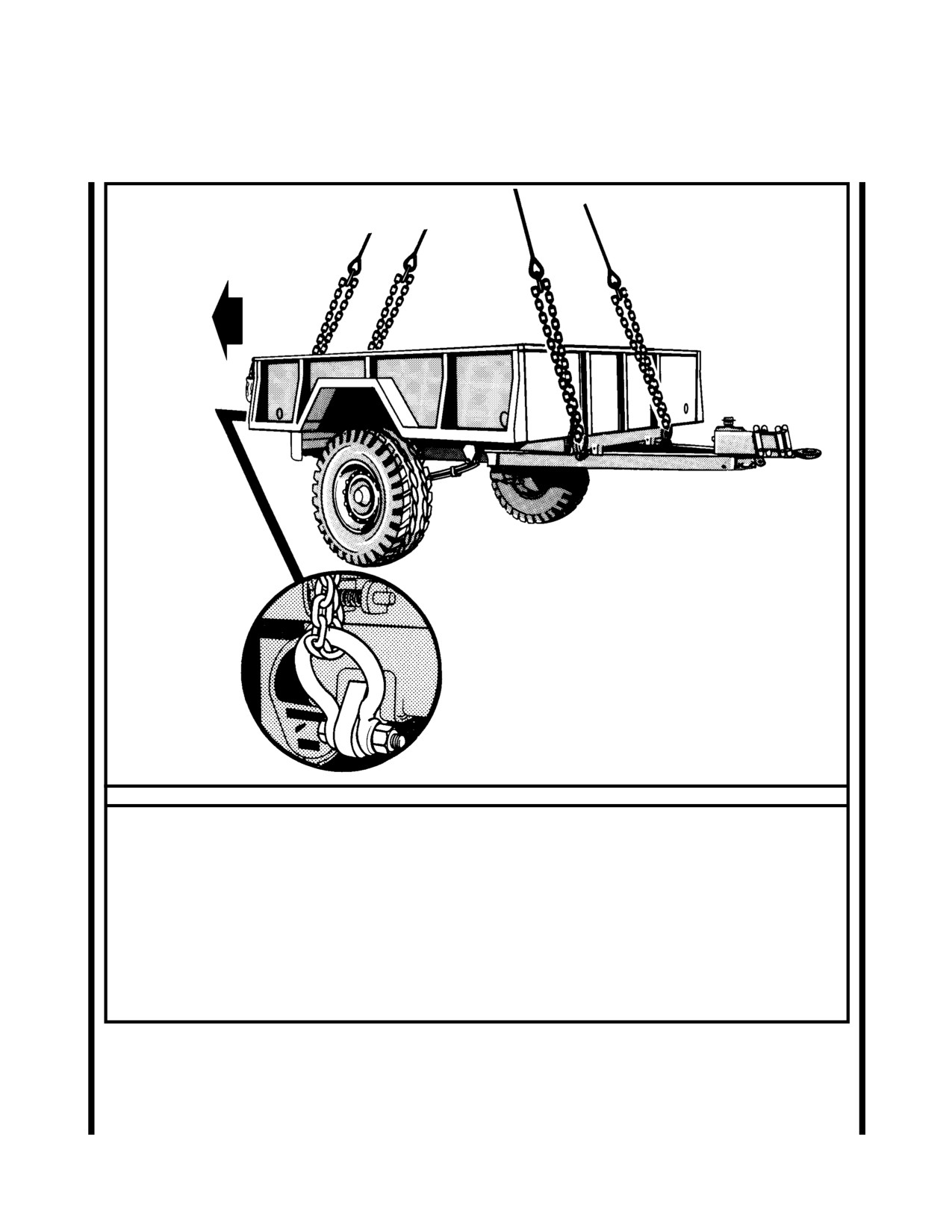
3-45
C1, FM 10-450-4/MCRP 4-23E, VOL II/NWP 3-04.12/AFJMAN 11-223, VOL II/
COMDTINST M13482.2
RIGGING STEPS
1. Position the apex fitting beside the trailer. Route
3. Route the chain end of sling leg 3 through the left rear
outer sling legs 1and 2 to the front of the trailer (tailgate
lift provision (lunette end). Place the correct link from
end) and inner sling legs 3 and 4 to the rear (lunette end).
Table 3-23 in the grab hook. Repeat with sling leg 4 through
Sling legs 1 and 3 must be on the left side of the load.
the right rear lift provision (lunette end). Secure excess
chain with tape or Type III nylon cord.
2. Loop the chain end of sling leg 1 through the left
front lift provision of the trailer. Place the correct link from
4. Cluster and tie or tape (breakaway technique) all sling
Table 3-23 in the grab hook. Repeat with sling leg 2 through
legs together on top of the trailer to prevent entanglement
the right front lift provision.
during hookup and lift-off.
Figure 3-23. M105A3 Trailer
3-46
C1, FM 10-450-4/MCRP 4-23E, VOL II/NWP 3-04.12/AFJMAN 11-223, VOL II/
COMDTINST M13482.2
3-25. M332 Ammunition Trailer, 1 1/2-Ton
a. Applicability. The following item in Table 3-24 is certified for all helicopters with suitable lift capacity by the US
Army Soldier Systems Center:
Table 3-24. M332 Ammunition Trailer, 1 1/2-Ton
M AX
RECOMMENDED
LINK COUNT
NOMENCLATURE
WEIGH T
SLING SET
AIRSPEE D
FRONT/REA R
(POUNDS )
(KNOTS )
M332 Am munition Trailer, 1 1/2-Ton
5,780
10K
1
/
120
b. Materials. The following materials are required to
(b) Engage the hand brakes.
rig this load:
(c) Tape or tie the light cable, safety chains, and
(1) Sling set (10,000-pound capacity).
brake hose to the top of the drawbar.
(2) Tape, adhesive, pressure-sensitive, 2-inch wide
(d) Place the telescoping leg in the down position.
roll.
(2) Rigging. Rig the load according to the steps in
(3) Cord, nylon, Type III, 550-pound breaking strength.
Figure 3-24.
(4) Webbing, cotton, 1/4-inch, 80-pound breaking
(3) Hookup. The hookup team stands on the trailer
strength.
bed. The static wand person discharges the static elec-
tricity with the static wand. The hookup person places
c. Personnel. Two persons can prepare and rig this
the apex fitting onto the aircraft cargo hook. The hookup
load in 15 minutes.
team then carefully dismounts the vehicle and remains
close to the load as the helicopter removes slack from the
d. Procedures. The following procedures apply to
sling legs. When successful hookup is assured, the
this load:
hookup team quickly exits the area underneath the heli-
copter to the designated rendezvous point.
(1) Preparation. Prepare the load using the following
steps:
(4) Derigging. Derigging is the reverse of the prepa-
ration and rigging procedures in steps d (1) and d (2).
(a) Secure all loose items, lids, and caps with tape or
Type III nylon cord.
3-47