FM 10-450-4 MULTISERVICE HELICOPTER SLING LOAD: SINGLE-POINT LOAD RIGGING PROCEDURES (September 2003) - page 3
C1, FM 10-450-4/MCRP 4-23E, VOL II/NWP 3-04.12/AFJMAN 11-223, VOL II/
COMDTINST M13482.3A
2-26. M1097A1 (HMMWV) With Remote Landing Site Tower (RLST)
a. Applicability. The following item in Table 2-25 is certified for all helicopters with suitable lift capacity by the US
Army Soldier Systems Center:
Table 2-25. M1097A1 (HMMWV) With Remote Landing Site Tower (RLST)
M AX
RECOMMENDED
LINK COUNT
NOMENCLATURE
WEIGH T
SLING SET
AIRSPEE D
FRONT/REA R
(POUNDS )
(KNOTS )
M1097A1 (HMMWV) With Remote
8,460
15K
6
/
120
Landing Site Tower (RLST )
b. Materials. The following materials are required to rig
vehicle with tape, nylon cord, or lashings. Remove and
this load:
secure the doors in the cab of the vehicle.
(1) Sling set (15,000-pound capacity).
(c) Ensure the fuel tank is not over 3/4 full. Inspect
fuel tank cap, oil filler cap, and battery caps for proper
(a) Chain length, part number 34080-4, from 15,000-
installation.
pound capacity sling sets (8 each).
(d) Engage the vehicle parking brake and put the
(b) Coupling link, part number 31611, from 15,000-
transmission in neutral.
pound capacity sling sets (8 each).
(e) Ensure the front wheels are pointed straight ahead.
(2) Tape, adhesive, pressure-sensitive, 2-inch wide
Tie down the steering wheel, using the securing device
roll.
attached under the dashboard.
(3) Cord, nylon, Type III, 550-pound breaking strength.
(f) Install the lift provisions on the outer ends of the
rear bumper by removing the tiedown provisions located
(4) Webbing, cotton, 1/4-inch, 80-pound breaking
inboard of the bumper end and installing them on the
strength.
outer ends of the rear bumper.
(5) Felt sheet, cattle hair, Type IV, 1/2-inch or suitable
(g) Configure the RLST in the TRANSPORT mode in
padding.
accordance with the operator's manual.
c. Personnel. Two persons can prepare and rig this
(h) Ensure the RLST is properly secured to the ve-
load in 15 minutes.
hicle. Secure all equipment inside the RLST with the hold-
down straps, tape, or Type III nylon cord.
d. Procedures. The following procedures apply to
this load:
(i) Secure the RLST cover with the straps provided.
Secure the loose ends with tape.
(1) Preparation. Prepare the load using the following
steps:
(j) Tape the windshield in an X formation from cor-
ner to corner.
(a) Fold mirrors forward in front of the windshield for
added protection and tie together with Type III nylon cord.
(k) Extend the sling leg chains by connecting two
additional chain lengths to each chain with coupling links.
(b) Secure all equipment and cargo inside the
2-59
C1, FM 10-450-4/MCRP 4-23E, VOL II/NWP 3-04.12/AFJMAN 11-223, VOL II/
COMDTINST M13482.3A
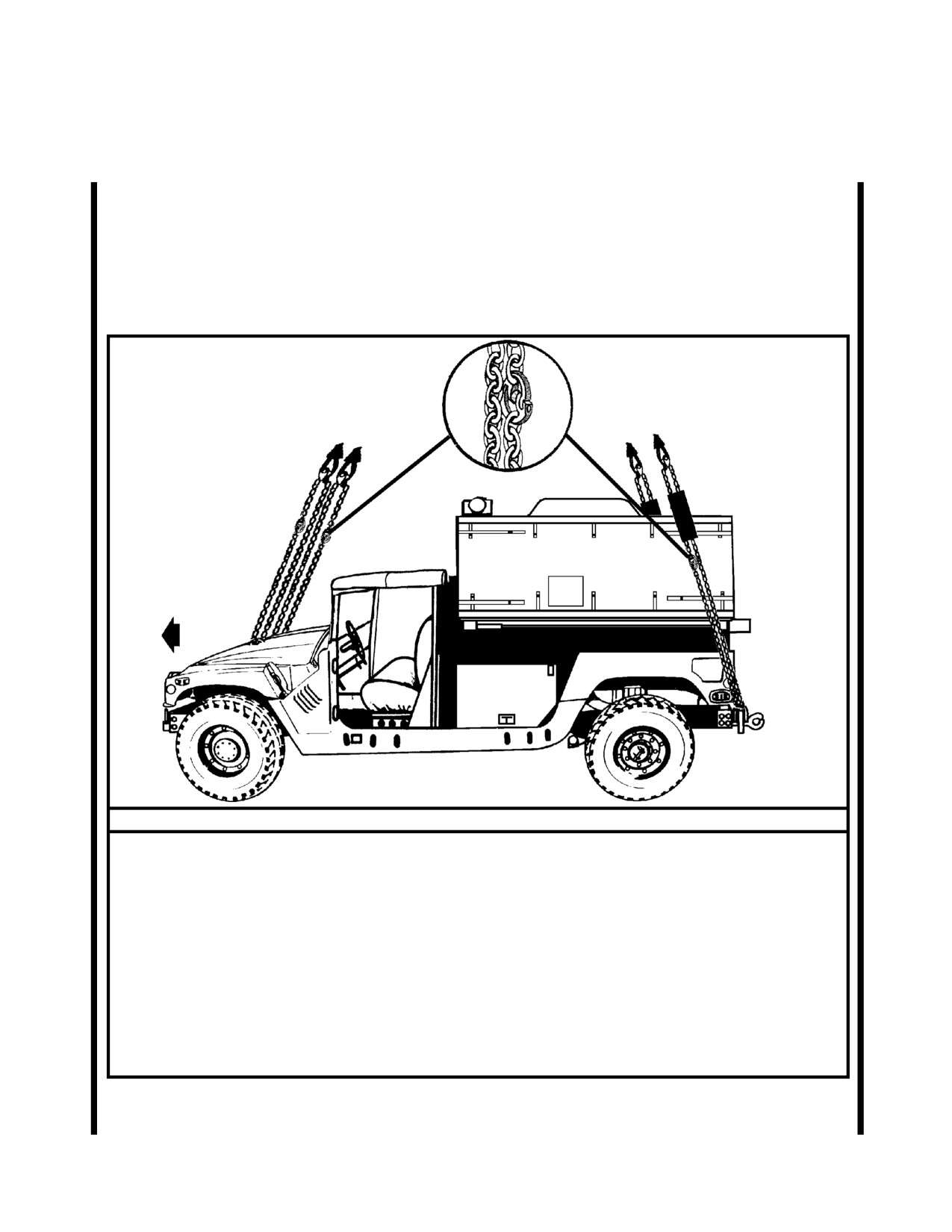
(2) Rigging. Rig the load according to the steps in
the load as the helicopter removes slack from the sling
Figure 2-24.
legs. When successful hookup is assured, the hookup
team quickly exits the area underneath the helicopter to
(3) Hookup. The hookup team stands on the vehicle.
the designated rendezvous point.
The static wand person discharges the static electricity
with the static wand. The hookup person places the apex
(4) Derigging. Derigging is the reverse of the prepara-
fitting onto the aircraft cargo hook. The hookup team
tion and rigging procedures in steps d (1) and d (2).
then carefully dismounts the vehicle and remains close to
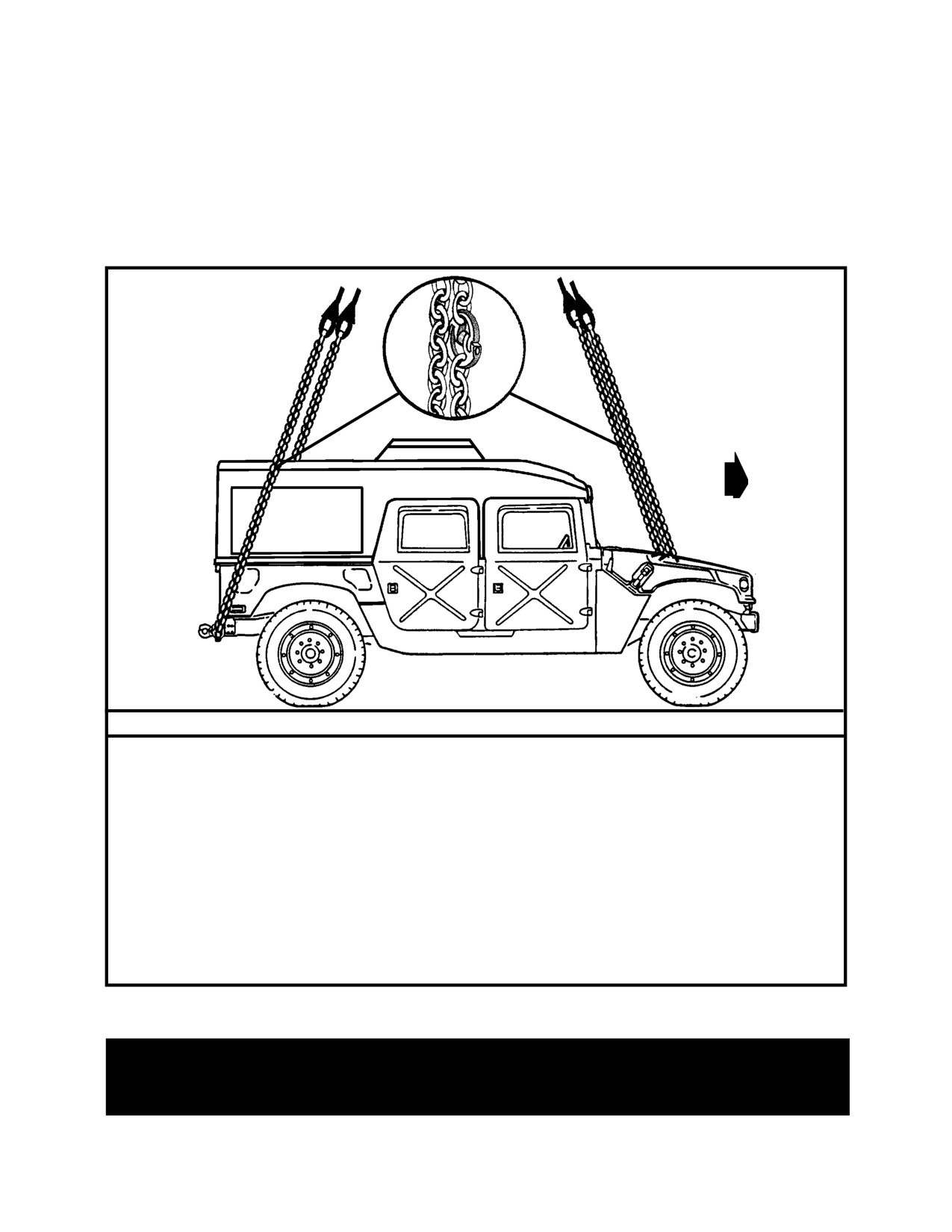
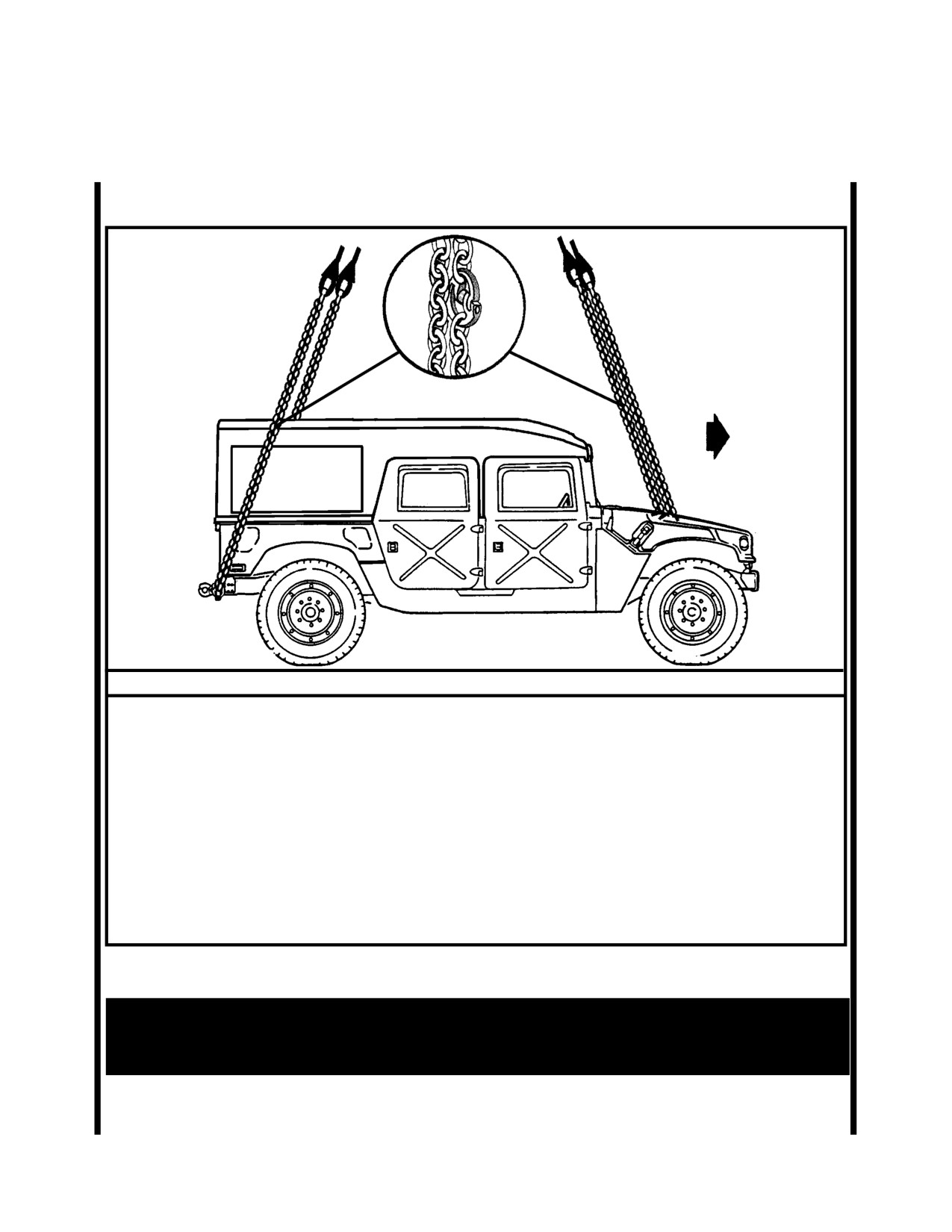
RIGGING STEPS
3. Route the chain end of sling leg 3 through the lift
1. Position the web ring beside the RLST. Route outer
provision located on the left end of the rear bumper from
sling legs 1and 2 to the front of the vehicle and inner sling
inboard to outboard. Place the correct link from Table 2-25
legs 3 and 4 to the rear. Sling legs 1 and 3 must be on the
in the grab hook. Repeat with sling leg 4 and the right rear
left side of the load.
lift provision.
2. Loop the chain end of sling leg 1 through the left
4. Pad the sling legs in the area where they make contact
front lift provision that protrudes through the hood from
with the RLST.
inboard to outboard. Place the correct link from Table 2-25
in the grab hook. Repeat with sling leg 2 and the right
5. Cluster and tie or tape (breakaway technique) all sling
front lift provision. Secure excess chain with tape or Type
legs together on top of the shelter to prevent entangle-
III nylon cord.
ment during hookup and lift-off.
Figure 2-24. M1097A1 (HMMWV) With Remote Landing Site Tower (RLST)
2-60
C2, FM 10-450-4/MCRP 4-23E, VOL II/NWP 3-04.12/AFJMAN 11-223, VOL II/
COMDTINST M13482.2
2-27. M1113 (HMMWV) With M56 Smoke Generating System
a. Applicability. The following item in Table 2-26 is certified for all helicopters with suitable lift capacity by the US
Army Soldier Systems Center:
Table 2-26. M1113 (HMMWV) With M56 Smoke Generating System
M AX
RECOMMENDED
LINK COUNT
NOMENCLATURE
WEIGH T
SLING SET
AIRSPEE D
FRONT/REA R
(POUNDS )
(KNOTS )
M1113 (HMMWV) With M56 Smoke
9,400
10K
5
/
120
Generating System with Graphite
i
M1113 (HMMWV) With M56 Smoke
50-Front
Generating System without Graphite
i
9,400
10K
14-Right Rear
120
Tank
3-Left Rear
b. Materials. The following materials are required to rig
secure the doors in the cab of the vehicle.
this load:
(c) Ensure the fuel tank is not over 3/4 full. Inspect
(1) Sling set (10,000-pound capacity).
fuel tank cap, oil filler cap, and battery caps for proper
installation.
(2) Tape, adhesive, pressure-sensitive, 2-inch wide
roll.
(d) Engage the vehicle parking brake and put the
transmission in neutral.
(3) Cord, nylon, Type III, 550-pound breaking strength.
(e) Ensure the front wheels are pointed straight ahead.
(4) Webbing, cotton, 1/4-inch, 80-pound breaking
Tie down the steering wheel, using the securing device
strength.
attached under the dashboard.
(5) Felt sheet, cattle hair, Type IV, 1/2-inch or suitable
(f) Ensure the turbine fuel and both fog oil tanks are
padding.
not over 3/4 full.
(6) Spreader bar assembly(component of the M996/
(g) Set the three-way valve to the OFF position.
M997 HMMWV Ambulance).
(h) Ensure the IR hopper latches are securely closed
c. Personnel. Two persons can prepare and rig this
and the auxiliary hoses are attached to the mounting
load in 10 minutes.
bracket at the forward end of the inboard fog oil tank.
d. Procedures. The following procedures apply to
(i) Secure all latches and doors with tape or Type III
this load:
nylon cord.
(1) Preparation. Prepare the load using the following
(j) Extend the spreader bar until the holes line up.
steps:
Install the pin and engage the keeper.
(a) Fold mirrors forward in front of the windshield for
(k) Position the spreader bar across the rear of the
added protection and tie together with Type III nylon cord.
vehicle, resting on the power module and the weapons
case. Attach the two spreader bar check cables to the
(b) Secure all equipment and cargo inside the
larger hole openings, footman's loop, on the vehicle fend-
vehicle with tape, nylon cord, or lashings. Remove and
ers.
2-61
C2, FM 10-450-4/MCRP 4-23E, VOL II/NWP 3-04.12/AFJMAN 11-223, VOL II/
COMDTINST M13482.2
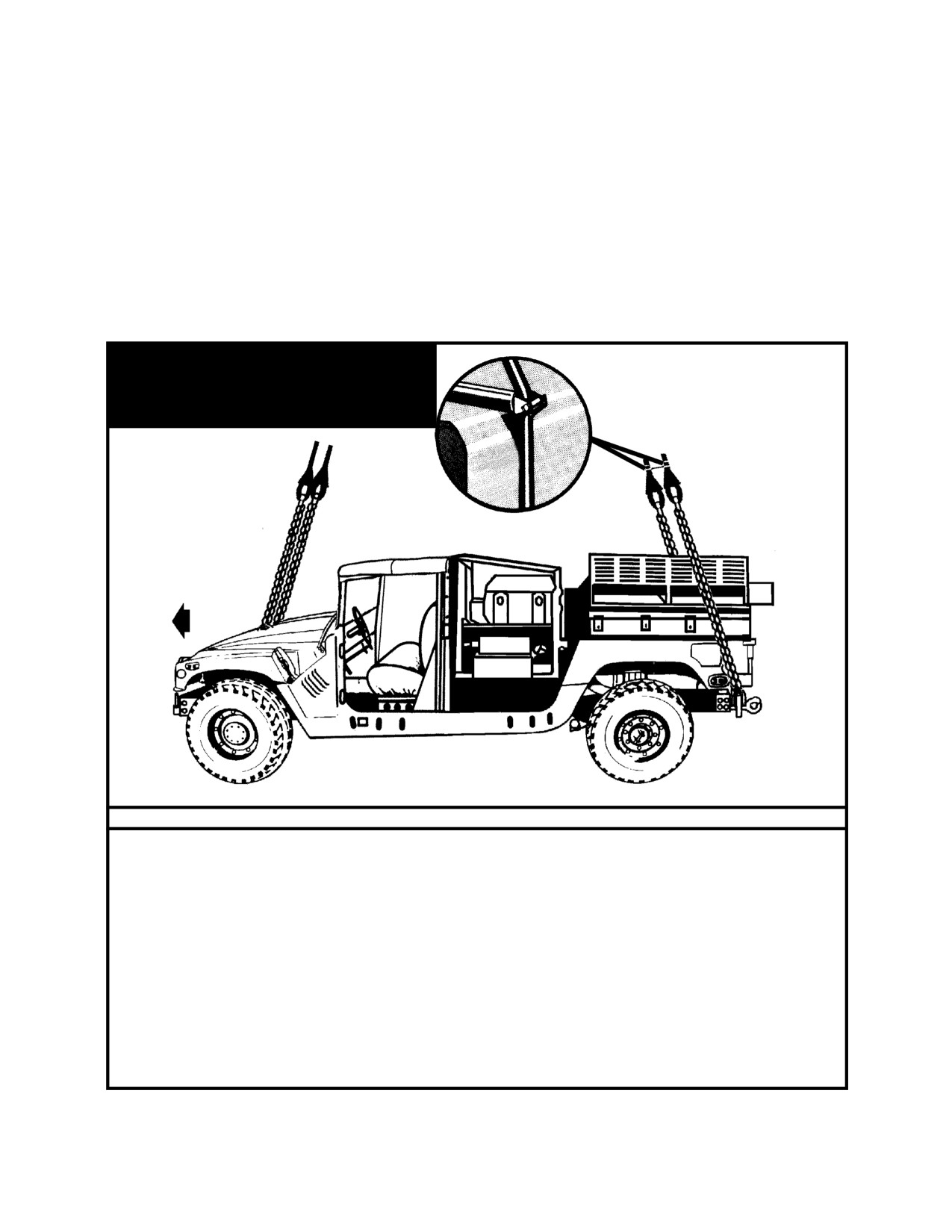
(2) Rigging. Rig the load according to the steps in
carefully dismounts the vehicle and remains close to the
Figure 2-25.
load as the helicopter removes slack from the sling legs.
When successful hookup is assured, the hookup
(3) Hookup. The hookup team stands on the IR hop-
teamquickly exits the area underneath the helicopter to
per loading platform on the left side of the vehicle. The
the designated rendezvous point.
static wand person discharges the static electricity with
the static wand. The hookup person places the apex fit-
(4) Derigging. Derigging is the reverse of the prepara-
ting onto the aircraft cargo hook. The hookup team then
tion and rigging procedures in steps d (1) and d (2).
CAUTION
TOTAL WEIGHT OF LOAD IS RESTRICTED TO
9,400 POUNDS DUE TO THE STRUCTURAL
STRENGTH OF THE SPREADER BAR.
RIGGING STEPS
1. Position the apex fitting on top of the IR hopper or on
3. Place the nylon rope of sling legs 3 and 4 in the
the forward end of the fog oil tanks. Route outer sling
guides on the ends of the spreader bar. Route the chain
legs 1and 2 to the front of the vehicle and inner sling legs
end of sling leg 3 through the lift provision located on the
3 and 4 to the rear. Sling legs 1 and 3 must be on the left
left end of the rear bumper from inboard to outboard. Place
side of the load.
the correct link from Table 2-26 in the grab hook. Repeat
with sling leg 4 and the right rear lift provision.
2. Loop the chain end of sling leg 1 through the left
front lift provision that protrudes through the hood from
4. Pad the sling legs in the area where they make contact
inboard to outboard. Place the correct link from Table 2-26
with the structure.
in the grab hook. Repeat with sling leg 2 and the right
front lift provision. Secure excess chain with tape or Type
5. Cluster and tie or tape (breakaway technique) all sling
III nylon cord.
legs together on top of the shelter to prevent entangle-
ment during hookup and lift-off.
Figure 2-25. M1113 (HMMWV) With M56 Smoke Generating System
2-62

C1, FM 10-450-4/MCRP 4-23E, VOL II/NWP 3-04.12/AFJMAN 11-223, VOL II/
COMDTINST M13482.3A
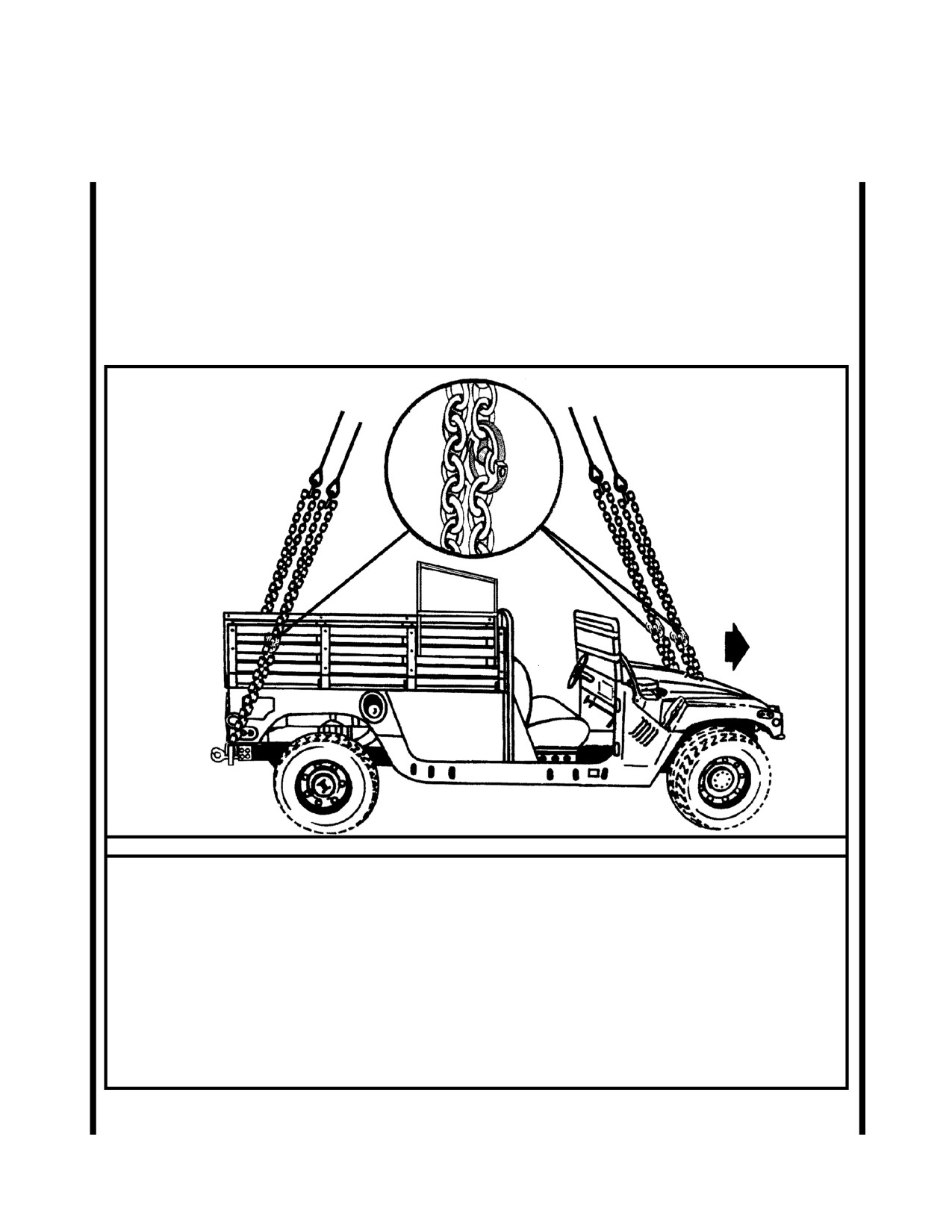
2-28. M1097A2 (HMMWV) Soft Top Truck With Advanced Field Artillery Tactical Data
Systems (AFATADS)
a. Applicability. The following items in Table 2-27 are certified for all helicopters with suitable lift capacity by the US
Army Soldier Systems Center:
Table 2-27. M1097A2 (HMMWV) Soft Top Truck With Advanced Field Artillery Tactical Data Systems
(AFATADS)
M AX
RECOMMENDED
LINK COUNT
NOMENCLATURE
WEIGH T
SLING SET
AIRSPEE D
FRONT/REA R
(POUNDS )
(KNOTS )
System 2: CHS-2 AN/GYG-3(V)1,
with SINCGARS AN/VRC-90,
8,103
10K
5
/
100
AN/VRC-92, and EPLRS installed
i
thebed. AN/VRC-92instaled
i
System 3: CHS-2 AN/GYG-3(V)3,
with SINCGARS AN/VRC-90,
8,366
10K
5
/
100
AN/VRC-92, and EPLRS installed
i
thebed. AN/VRC-92instaled
i
System 4: 2 each AN/GYK-37(V)2,
with SINCGARS AN/VRC-89,
7,790
10K
5
/
100
AN/VRC-92, and EPLR S
b. Materials. The following materials are required to rig
this load:
this load:
(1) Preparation. Prepare the load using the following
(1) Sling set (10,000-pound capacity).
steps:
(a) Chain length, part number 38850-00053-101, from
(a) Fold mirrors forward in front of the windshield for
a 10,000-pound capacity sling set (4 each).
added protection and tie together with Type III nylon cord.
(b) Coupling link, part number 577-0615, from a 10,000-
(b) Secure all equipment and cargo inside the
pound capacity sling set (4 each).
vehicle with tape, nylon cord, or lashings. Remove and
secure the doors in the cab of the vehicle.
(2) Tape, adhesive, pressure-sensitive, 2-inch wide
roll.
(c) Ensure the fuel tank is not over 3/4 full. Inspect
fuel tank cap, oil filler cap, and battery caps for proper
(3) Cord, nylon, Type III, 550-pound breaking strength.
installation.
(4) Webbing, cotton, 1/4-inch, 80-pound breaking
(d) Engage the vehicle parking brake and put the
strength.
transmission in neutral.
(5) Padding, cellulose.
(e) Ensure the front wheels are pointed straight ahead.
Tie down the steering wheel, using the securing device
c. Personnel. Two persons can prepare and rig this
attached under the dashboard.
load in 10 minutes.
(f) Extend the sling leg chains by connecting one
d. Procedures. The following procedures apply to
2-63
C1, FM 10-450-4/MCRP 4-23E, VOL II/NWP 3-04.12/AFJMAN 11-223, VOL II/
COMDTINST M13482.3A
additional chain length to each chain using the coupling
fitting onto the aircraft cargo hook. The hookup team
links.
then carefully dismounts the vehicle and remains close to
the load as the helicopter removes slack from the sling
(2) Rigging. Rig the load according to the steps in
legs. When successful hookup is assured, the hookup
Figure 2-26.
team quickly exits the area underneath the helicopter to
the designated rendezvous point.
(3) Hookup. The hookup team stands on the shelter.
The static wand person discharges the static electricity
(4) Derigging. Derigging is the reverse of the prepara-
with the static wand. The hookup person places the apex
tion and rigging procedures in steps d (1) and d (2).
RIGGING STEPS
1. Position the apex fitting on top of the shelter. Route
3. Route the chain end of sling leg 3 through the lift
outer sling legs 1and 2 to the front of the vehicle and inner
provision located on the left end of the rear bumper from
sling legs 3 and 4 to the rear. Sling legs 1 and 3 must be on
inboard to outboard. Place the correct link from Table 2-27
the left side of the load.
in the grab hook. Repeat with sling leg 4 and the right rear
lift provision.
2. Loop the chain end of sling leg 1 through the left
front lift provision that protrudes through the hood from
5. Cluster and tie or tape (breakaway technique) all sling
inboard to outboard. Place the correct link from Table 2-27
legs together on top of the shelter to prevent entangle-
in the grab hook. Repeat with sling leg 2 and the right
ment during hookup and lift-off.
front lift provision. Secure excess chain with tape or Type
III nylon cord.
Figure 2-26. M1097A2 Soft Top Truck With Advanced Field Artillery Tactical Data Systems (AFATADS)
2-64

C3, FM 10-450-4/MCRP 4-23E, VOL II/NWP 3-04.12/AFJMAN 11-223, VOL II/
COMDTINST M13482.3A
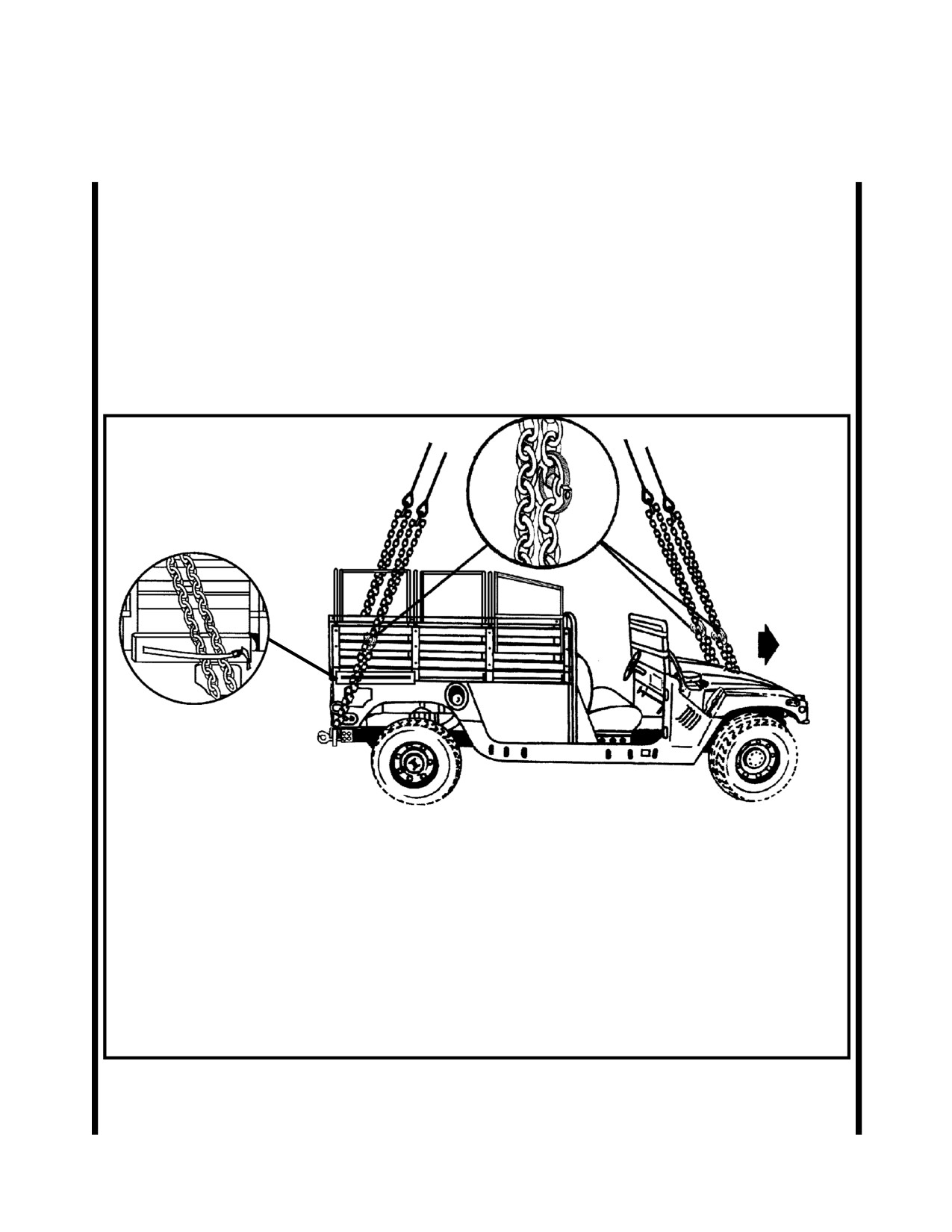
2-28.1. M1097A2 (HMMWV) with Advanced Field Artillery Tactical Data System (AFATDS)
Full Size Soft Top Installation Kit (STIK)
a. Applicability. The following items in Table 2-27.1 are certified for all helicopters with suitable lift capacity by the US
Army Soldier Systems Center:
Table 2-27.1. M1097A2 (HMMWV) with Advanced Field Artillery Tactical Data System (AFATDS) Full Size Soft
Top Installation Kit (STIK)
M AX
RECOMMENDED
LINK COUNT
NOMENCLATURE
WEIGH T
SLING SET
AIRSPEE D
FRONT/REA R
(POUNDS )
(KNOTS )
System 2: CHS-2 AN/GYG-3(V)1,
with SINCGARS AN/VRC-90,
8,103
10K
5
/
100
AN/VRC-92, and EPLRS installed
i
thebed. AN/VRC-92instaled
i
System 3: CHS-2 AN/GYG-3(V)3,
with SINCGARS AN/VRC-90,
8,366
10K
5
/
100
AN/VRC-92, and EPLRS installed
i
thebed. AN/VRC-92installed
i
System 4: 2 each AN/GYK-37(V)2,
with SINCGARS AN/VRC-89,
7,790
10K
5
/
100
AN/VRC-92, and EPLR S
b. Materials. The following materials are required to
c. Personnel. Two persons can prepare and rig the
rig this load:
M1097A2 HMMWV in 15 minutes.
(1) Sling set (10,000-pound capacity).
d. Procedures. The following procedures apply to this
load:
(a) Chain length, part number 38850-00053-101, from
a 10,000-pound capacity sling set (4 each).
(1) Preparation. Prepare the load using the following
steps:
(b) Coupling link, NSN 4010-01-231-3388, from a
10,000-pound sling set (4 each).
(a) Fold mirrors inward and tie together with Type III
nylon cord. Remove the doors and secure to the seats
(2) Tape, adhesive, pressure-sensitive, 2-inch wide
with Type III nylon cord.
roll.
(b) Secure all equipment and cargo inside the truck
(3) Cord, nylon, Type III, 550-pound breaking strength.
and trailer with tiedown straps, tape, or Type III nylon
cord.
(4) Webbing, cotton, 1/4-inch, 80-pound breaking
strength.
(c) Ensure the fuel tank is not over 3/4 full. Inspect
the fuel tank cap, oil filler cap, and battery caps for proper
installation.
(5) Strap, cargo, tiedown, CGU-1/B (2 each).
(d) Engage the vehicle parking brake and put the
(6) Sling guides (included as part of the HMMWV
transmission in neutral.
STIK) (2 each).
(e) Ensure the front wheels are pointed straight
2- 64.1
C3, FM 10-450-4/MCRP 4-23E, VOL II/NWP 3-04.12/AFJMAN 11-223, VOL II/
COMDTINST M13482.3A
ahead. Tie down the steering wheel, using the securing
(3) Hookup. The hookup team stands on top of the
device attached under the dashboard.
vehicle. The static wand person discharges the static
electricity with the static wand. The hookup person places
(f) Connect one additional chain length to each
the apex fitting onto the aircraft cargo hook. The hookup
chain on each sling set with a coupling link.
team then carefully dismounts the vehicle and remains
close to the load as the helicopter removes slack from the
(g) Ensure the STIK sling guides are properly
sling legs. When successful hookup is assured, the
installed.
hookup team quickly exits the area underneath the heli-
copter to the designated rendezvous point.
(2) Rigging. Rig the load according to the steps in
Figure 2-26.1.
(4) Derigging. Derigging is the reverse of the prepa-
ration and rigging procedures in steps d (1) and d (2).
1. Position apex fitting on top of the truck. Route outer
3. Loop the chain end of sling leg 3 through the left
sling legs 1and 2 to the front of the vehicle and inner sling
sling guide, through the left rear lift provision located on
legs 3 and 4 to the rear. Sling legs 1 and 3 must be on the
the outer ends of the rear bumper, and back through the
left side of the load.
left sling guide. Place the correct link from Table 2-27.1 in
the grab hook. Repeat with sling leg 4 and the right sling
2. Loop the chain end of sling leg 1 through the left
guide and right rear lift provision. Secure excess chain
front lift provision that protrudes through the hood from
with tape or Type III nylon cord.
inboard to outboard. Place the correct link from Table 2-
27.1 in the grab hook. Repeat with sling leg 2 and the right
4. Cluster and tie or tape (breakaway technique) all sling
front lift provision. Secure excess chain with tape or Type
legs together on top of the vehicle to prevent entangle-
III nylon cord.
ment during hookup and lift-off.
Figure 2-26.1. M1097A2 (HMMWV) with Advanced Field Artillery Tactical Data System (AFATDS) Full Size
Soft Top Installation Kit (STIK)
2-64.2
C3, FM 10-450-4/MCRP 4-23E, VOL II/NWP 3-04.12/AFJMAN 11-223, VOL II/
COMDTINST M13482.3A
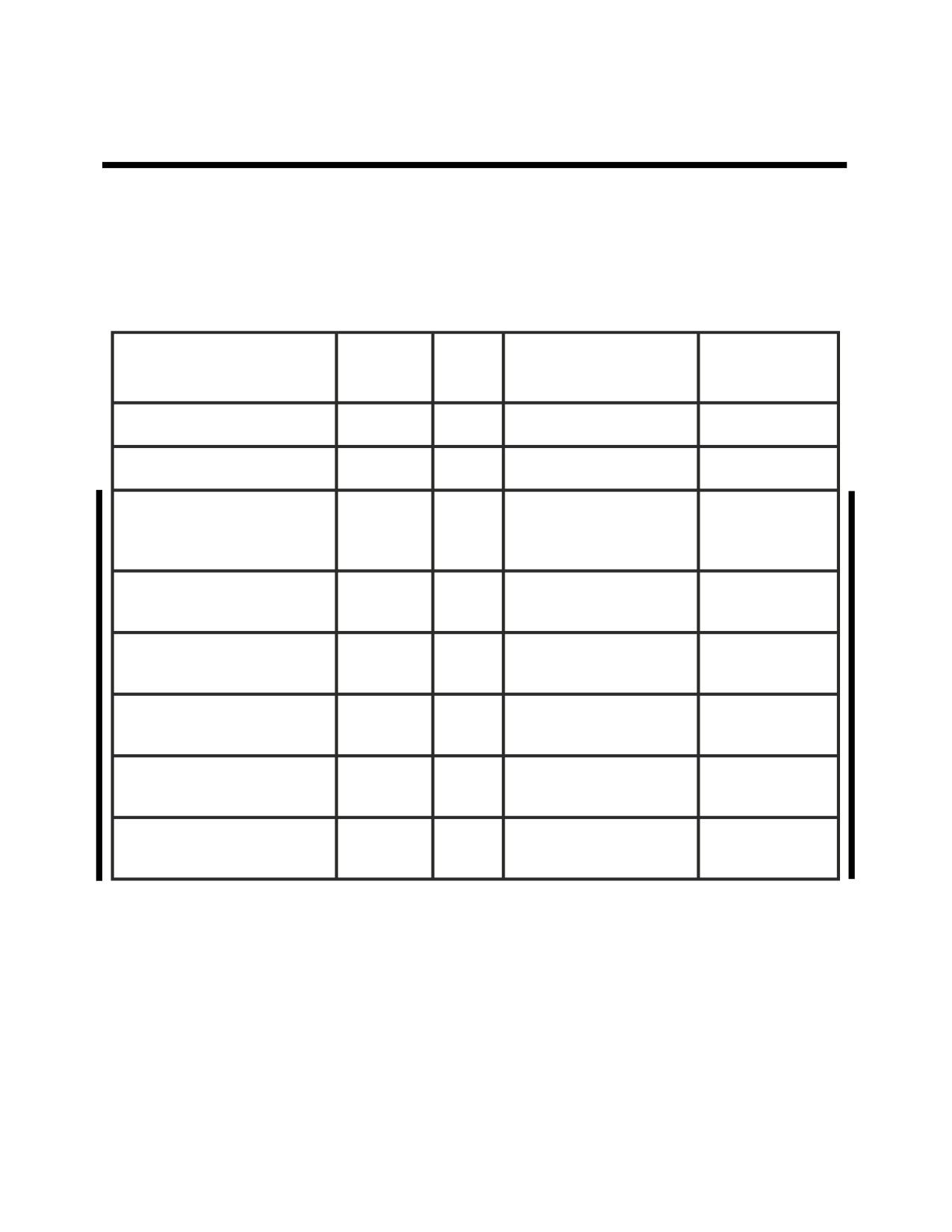
2-29. M1113 Truck, Utility, Expanded Capacity (HMMWV) With Lightweight Multipurpose
Shelter (LMS)
a. Applicability. The following items in Table 2-28 are certified for all helicopters with suitable lift capacity by the US
Army Soldier Systems Center:
Table 2-28. M1113 HMMWV with Lightweight Multipurpose Shelter (LMS)
M AX
RECOMMENDED
SLING
LINK COUNT
NOMENCLATURE
WEIGH T
AIRSPEE D
SET
FRONT / REA R
(POUNDS )
(KNOTS )
AN/TTC-56 Single Shelter
11,500
25K
3
/
120
Switch (SSS )
Digital Topographic Support
11,500
25K
3
/
100
System-Light (DTSS-L )
Integrated System Control
(ISYSCON), AN/TYQ-76B ,
11,500
25K
3
/
100
(V)1, (V)2, and Degraded
configurations
Shadow Tactical Unmanned
V
ehicle (TUAV), Air Vehicle
11,500
25K
3
/
100
Transport
Shadow Tactical Unmanned
V
ehicle (TUAV), Ground Control
11,500
25K
3
/
100
Station
Shadow Tactical Unmanned
V
ehicle (TUAV), Maintenance
11,500
25K
3
/
100
Section Multifunctional
Common Ground Station (CGS),
Joint Surveillance Target Attack
11,500
25K
3
/
100
Radar (JSTAR) System (V)2
Trojan Spirit Lite (V)3 Support
11,500
25K
3
/
100
V
ehicle, AN/TSQ-226 (V)3
b. Materials. The following materials are required to
(2) Tape, adhesive, pressure-sensitive, 2-inch wide
rig this load:
roll.
(1) Sling set (25,000-pound capacity).
(3) Cord, nylon, Type III, 550-pound breaking strength.
(a) Chain length, part number 38850-00053-102,
(4) Webbing, cotton, 1/4-inch, 80-pound breaking
from a 25,000-pound capacity sling set (4 each).
strength.
(b) Coupling link, part number 664241, from a
(5) Felt sheet, cattle hair, Type IV, 1/2-inch or suitable
25,000-pound sling set (4 each).
padding.
2-65
C3, FM 10-450-4/MCRP 4-23E, VOL II/NWP 3-04.12/AFJMAN 11-223, VOL II/
COMDTINST M13482.3A
c. Personnel. Two persons can prepare and rig this
load in 15 minutes.
(g) Ensure the fuel tank is not over 3/4 full. Inspect
fuel tank cap, oil filler cap, and battery caps for proper
d. Procedures. The following procedures apply to
installation.
this load:
(h) Engage the vehicle parking brake and put the
(1) Preparation. Prepare the load using the following
transmission in neutral.
steps:
(i) Ensure the front wheels are pointed straight ahead.
(a) Extend the sling leg chains by connecting
Tie down the steering wheel, using the securing device
one
attached under the dashboard.
additional chain length to each chain on a 25,000-
pound
(j) Tape the windshield in an X formation from cor-
capacity sling set with coupling links.
ner to corner.
(b) Fold mirrors forward in front of the windshield for
(k) Install the lift provisions on the outer ends of the
added protection and tie together with Type III nylon cord.
rear bumper.
(c) Secure all equipment inside the shelter with tape,
(l) Remove the upper antenna mounting bracket if
nylon cord, or lashings; close and secure shelter vents
installed.
and door with nylon cord or tape.
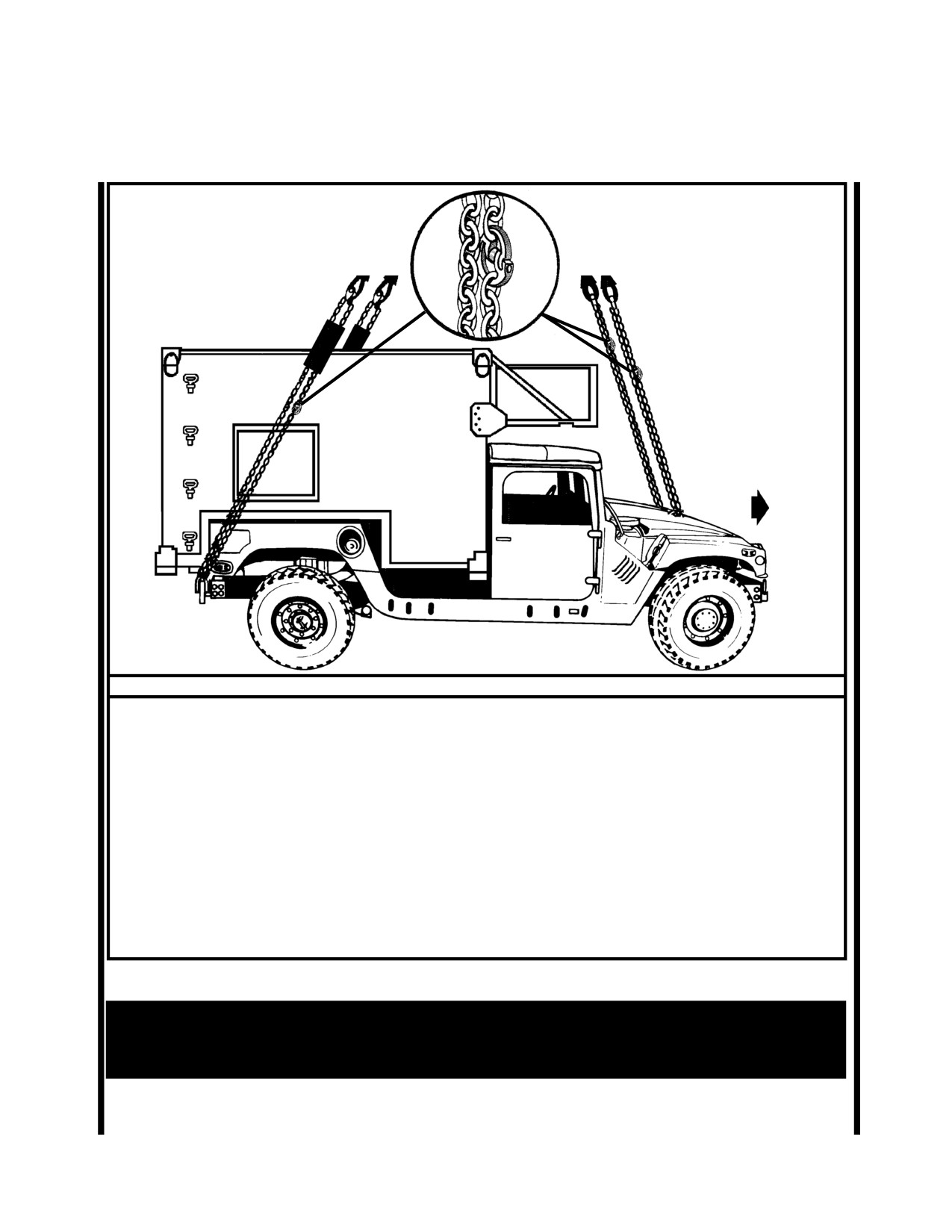
(2) Rigging. Rig the load according to the steps in
(d) Secure environmental control unit cover with
Figure 2-27.
duct tape.
(3) Hookup. The hookup team stands on top of the
(e) Disconnect the power cord from the rear panel
shelter. The static wand person discharges the static elec-
and secure it to the rear platform with Type III nylon cord.
tricity with the static wand. The hookup person places
Lower the power panel door and secure the door.
the apex fitting onto the cargo hook. The hookup team
then carefully dismounts the vehicle and remains close to
(f) Secure all equipment and cargo inside the
the load as the helicopter removes slack from the sling
vehicle with tape, nylon cord, or lashings. Secure the
legs. When successful hookup is assured, the hookup
doors shut if installed.
team quickly exits the area underneath the helicopter to
the designated rendezvous point.
(4) Derigging. Derigging is the reverse of the prepara-
tion and rigging procedures in steps d (1) and d (2).
2-66
C2, FM 10-450-4/MCRP 4-23E, VOL II/NWP 3-04.12/AFJMAN 11-223, VOL II/
COMDTINST M13482.3A
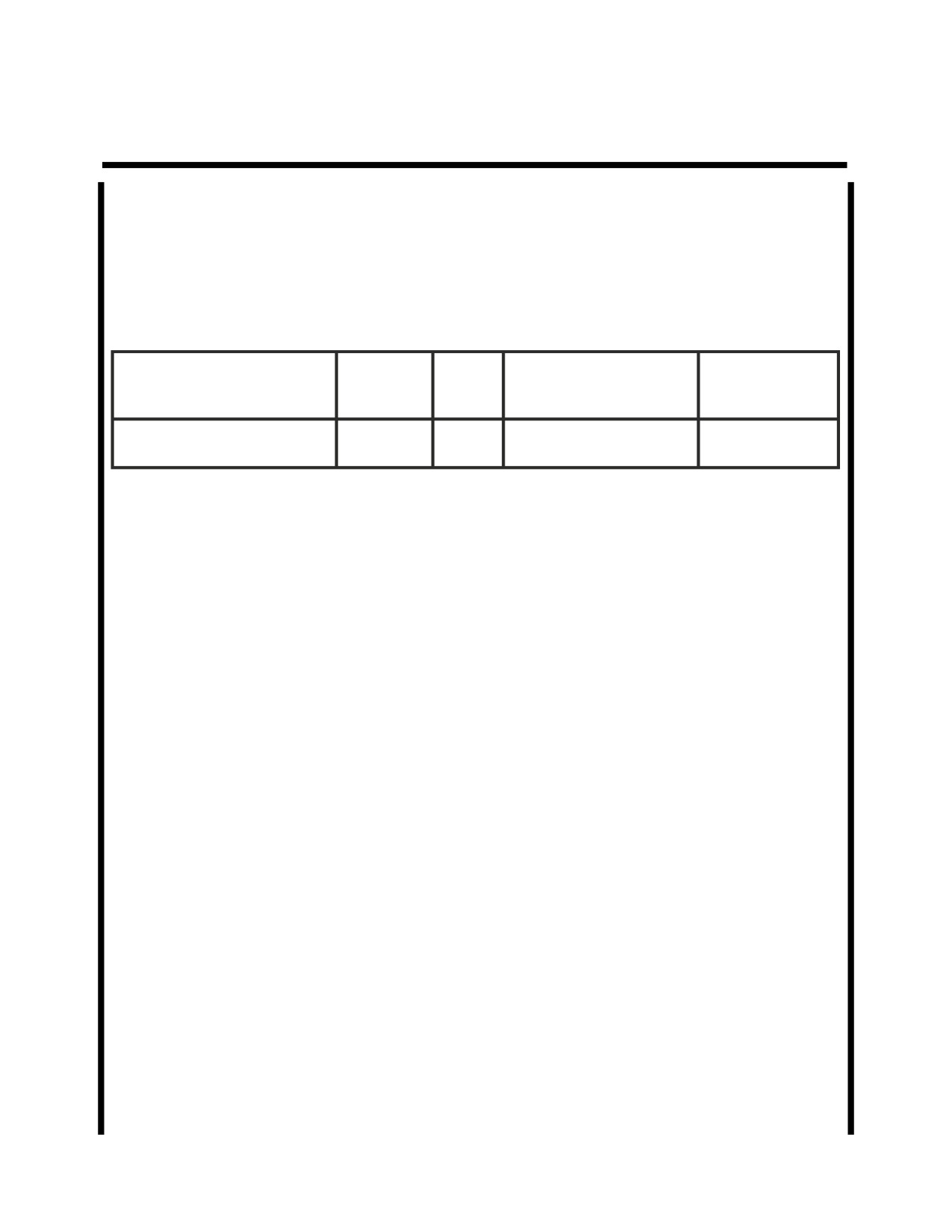
RIGGING STEPS
3. Loop the chain end of sling leg 3 through the left rear
1. Position the apex fitting on top of the shelter. Route
lift provision located on the left end of the rear bumper.
outer sling legs 1 and 2 to the front of the vehicle and
Place the correct link from Table 2-28 in the grab hook.
inner sling legs 3 and 4 to the rear. Sling legs 1 and 3 must
Repeat with sling leg 4 through the right rear lift provision
be on the left side of the load.
Secure all excess chain with tape or Type III nylon cord.
2. Loop the chain end of sling leg 1 through the left
4. Wrap the rear slings with padding where they contact
front lift provision that protrudes through the hood from
the shelter sides.
inboard to outboard. Place the correct link from Table 2-28
in the grab hook. Repeat with sling leg 2 through the right
5. Cluster and tie or tape (breakaway technique) the
front lift provision. Secure all excess chain with tape or
sling legs in each sling set together to prevent entangle-
Type III nylon cord.
ment during hookup and lift-off.
Figure 2-27. LMS Shelter Mounted on the M1113
CAUTION
Do not use the lift shackles located near the center of the rear bumper for sling load lift
provisions.
2-67
C2, FM 10-450-4/MCRP 4-23E, VOL II/NWP 3-04.12/AFJMAN 11-223, VOL II/
COMDTINST M13482.3A
2-30. M1097A2 Shelter Carrier (HMMWV) With Special Operations Media System
(SOMS-B) in S-788G Shelter (LMS)
a. Applicability. The following item in Table 2-29 is certified for all helicopters with suitable lift capacity by the US
Army Soldier Systems Center:
Table 2-29. M1097A2 Shelter Carrier (HMMWV) With Special Operations Media System (SOMS-B) in S-788G
Shelter (LMS)
MAX
RECOMMENDED
SLING
LINK COUNT
NOMENCLATURE
WEIGH T
AIRSPEE D
SET
FRONT / REA R
(POUNDS )
(KNOTS )
Special Operations Media
9,080
10K
4
/
120
System
b. Materials. The following materials are required
(a) Extend the sling leg chains by connecting one
to rig this load:
additional chain length to each chain on a 10,000-pound
capacity sling set with coupling links.
(1) Sling set (10,000-pound capacity).
(b) Fold mirrors forward in front of the windshield for
(a) Chain length, part number 38850-00053-101,
added protection and tie together with Type III nylon cord.
from a 10,000-pound capacity sling set (4 each).
(c) Secure all equipment inside the shelter with tape,
(b) Coupling link, part number 577-0615, from a
nylon cord, or lashings; close and secure shelter vents
10,000-pound sling set (4 each).
and door with nylon cord or tape.
(2) Tape, adhesive, pressure-sensitive, 2-inch wide
(d) Disconnect the power cord from the rear panel
roll.
and secure it to the rear platform with Type III nylon cord.
Lower the power panel door and secure the door.
(3) Cord, nylon, Type III, 550-pound breaking strength.
(e) Secure all equipment and cargo inside the
(4) Webbing, cotton, 1/4-inch, 80-pound breaking
vehicle with tape, nylon cord, or lashings. Secure the
strength.
doors shut if installed.
(5) Felt sheet, cattle hair, Type IV, 1/2-inch or suitable
(f) Ensure the fuel tank is not over 3/4 full. Inspect
padding.
fuel tank cap, oil filler cap, and battery caps for proper
installation.
(6) Padding, Cellulose.
(g) Engage the vehicle parking brake and put the
c. Personnel. Two persons can prepare and rig this
transmission in neutral.
load in 15 minutes.
(h) Ensure the front wheels are pointed straight
d. Procedures. The following procedures apply to
ahead. Tie down the steering wheel, using the securing
this load:
device attached under the dashboard.
(1) Preparation. Prepare the load using the following
(i) Tape the windshield in an X formation from cor-
steps:
ner to corner.
2-68
C2, FM 10-450-4/MCRP 4-23E, VOL II/NWP 3-04.12/AFJMAN 11-223, VOL II/
COMDTINST M13482.3A
(j) Install the lift provisions on the outer ends of the
the apex fitting onto the cargo hook. The hookup team
rear bumper.
then carefully dismounts the vehicle and remains close to
the load as the helicopter removes slack from the sling
(k) Remove the upper antenna bracket if installed.
legs. When successful hookup is assured, the hookup
team quickly exits the area underneath the helicopter to
(2) Rigging. Rig the load according to the steps in
the designated rendezvous point.
Figure 2-28.
NOTE: Hookup of this load presents substantial risk of
NOTE: Ensure the chains on sling leg 1 are routed be-
damage to the load or injury to the hookup personnel.
tween the shelter and the 30 meter mast.
Use of a reach pendant is recommended for this load.
(3) Hookup. The hookup team stands on top of the
(4) Derigging. Derigging is the reverse of the prepara-
shelter. The static wand person discharges the static elec-
tion and rigging procedures in steps d (1) and d (2).
tricity with the static wand. The hookup person places
2-69
C2, FM 10-450-4/MCRP 4-23E, VOL II/NWP 3-04.12/AFJMAN 11-223, VOL II/
COMDTINST M13482.3A
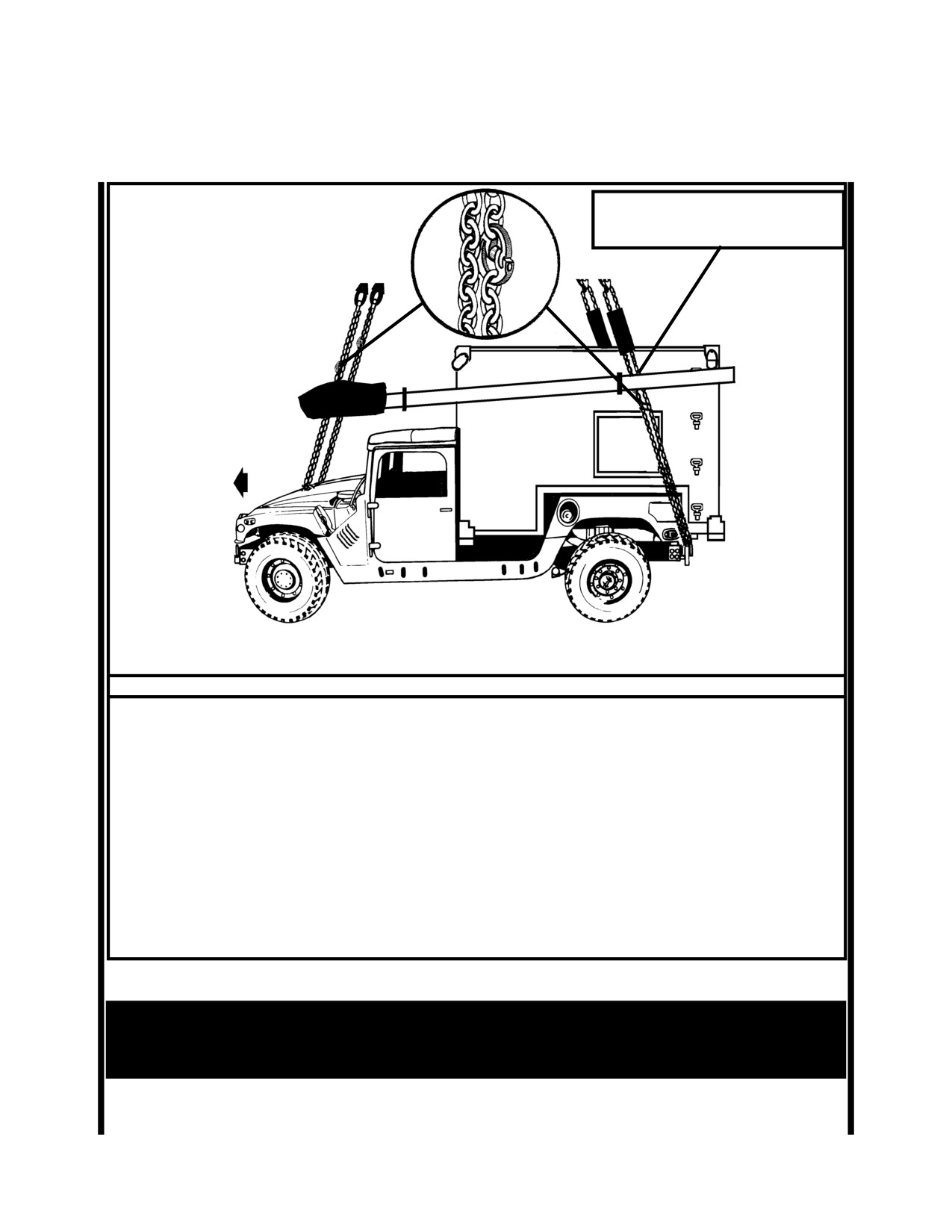
NOTE: Ensure the chains on sling
leg 1 are routed between the shelter
and the 30 meter mast.
RIGGING STEPS
3. Loop the chain end of sling leg 3 through the left rear
1. Position the apex fitting on top of the shelter. Route
lift provision located on the left end of the rear bumper.
outer sling legs 1 and 2 to the front of the vehicle and
Place the correct link from Table 2-29 in the grab hook.
inner sling legs 3 and 4 to the rear. Sling legs 1 and 3 must
Repeat with sling leg 4 through the right rear lift provision
be on the left side of the load.
Secure all excess chain with tape or Type III nylon cord.
2. Loop the chain end of sling leg 1 through the left
4. Wrap the rear slings with padding where they contact
front lift provision that protrudes through the hood from
the shelter sides.
inboard to outboard. Place the correct link from Table 2-29
in the grab hook. Repeat with sling leg 2 through the right
5. Cluster and tie or tape (breakaway technique) the
front lift provision. Secure all excess chain with tape or
sling legs in each sling set together to prevent entangle-
Type III nylon cord.
ment during hookup and lift-off.
Figure 2-28. SOMS-B in LMS Shelter Mounted on the M1097A2
CAUTION
Do not use the lift shackles located near the center of the rear bumper for sling load lift
provisions.
2-70
C2, FM 10-450-4/MCRP 4-23E, VOL II/NWP 3-04.12/AFJMAN 11-223, VOL II/
COMDTINST M13482.3A
2-31. M1037 (HMMWV) With Compressed Air-Foam System, Mobile (CAFSM)
a. Applicability. The following item in Table 2-30 is certified for all helicopters with suitable lift capacity by the US
Army Soldier Systems Center:
Table 2-30. M1037 (HMMWV) With Compressed Air-Foam System, Mobile (CAFSM)
M AX
RECOMMENDED
SLING
LINK COUNT
NOMENCLATURE
WEIGH T
AIRSPEE D
SET
FRONT / REA R
(POUNDS )
(KNOTS )
Compressed Air-Foam System
,
6,400
15K
4
/
120
Mobie
(EMPTY )
Note: The water tank in the CAFSM MUST BE
(c) Secure all equipment and cargo inside the ve-
EMPTY for sling loading.
hicle with tape, nylon cord, or lashings.
b. Materials. The following materials are required
(d) Ensure the fuel tank is not over 3/4 full. Inspect
to rig this load:
fuel tank cap, oil filler cap, and battery caps for proper
installation.
(1) Sling set (15,000-pound capacity) .
(e) Engage the vehicle parking brake and put the
(2) Tape, adhesive, pressure-sensitive, 2-inch wide
transmission in neutral.
roll.
(f) Ensure the front wheels are pointed straight ahead.
(3) Cord, nylon, Type III, 550-pound breaking strength.
Tie down the steering wheel, using the securing device
attached under the dashboard.
(4) Webbing, cotton, 1/4-inch, 80-pound breaking
strength.
(g) Tape the windshield in an X formation from cor-
ner to corner.
c. Personnel. Two persons can prepare and rig this
load in 15 minutes.
(2) Rigging. Rig the load according to the steps in
Figure 2-29.
d. Procedures. The following procedures apply to
this load:
(3) Hookup. The hookup team stands in the bed of the
vehicle. The static wand person discharges the static
(1) Preparation. Prepare the load using the follow-
electricity with the static wand. The hookup person places
ing steps:
the apex fitting on the cargo hook. The hookup team then
carefully dismounts the vehicle and remains close to the
(a) Fold mirrors forward in front of the windshield for
load as the helicopter removes slack from the sling legs.
added protection and tie together with Type III nylon
When successful hookup is assured, the hookup team
cord. Remove the canvas cab top and the doors. Secure
quickly exits the area underneath the helicopter to the
to the seats with Type III nylon cord.
designated rendezvous point.
(b) Ensure the CAFSM is secured to the truck. Se-
(4) Derigging. Derigging is the reverse of the prepara-
cure all lids, doors, and vents on the CAFSM with tape or
tion and rigging procedures in steps d (1) and d (2).
Type III nylon cord. Safety tie all chains and hoses with
tape or Type III nylon cord.
2-71
C2, FM 10-450-4/MCRP 4-23E, VOL II/NWP 3-04.12/AFJMAN 11-223, VOL II/
COMDTINST M13482.3A
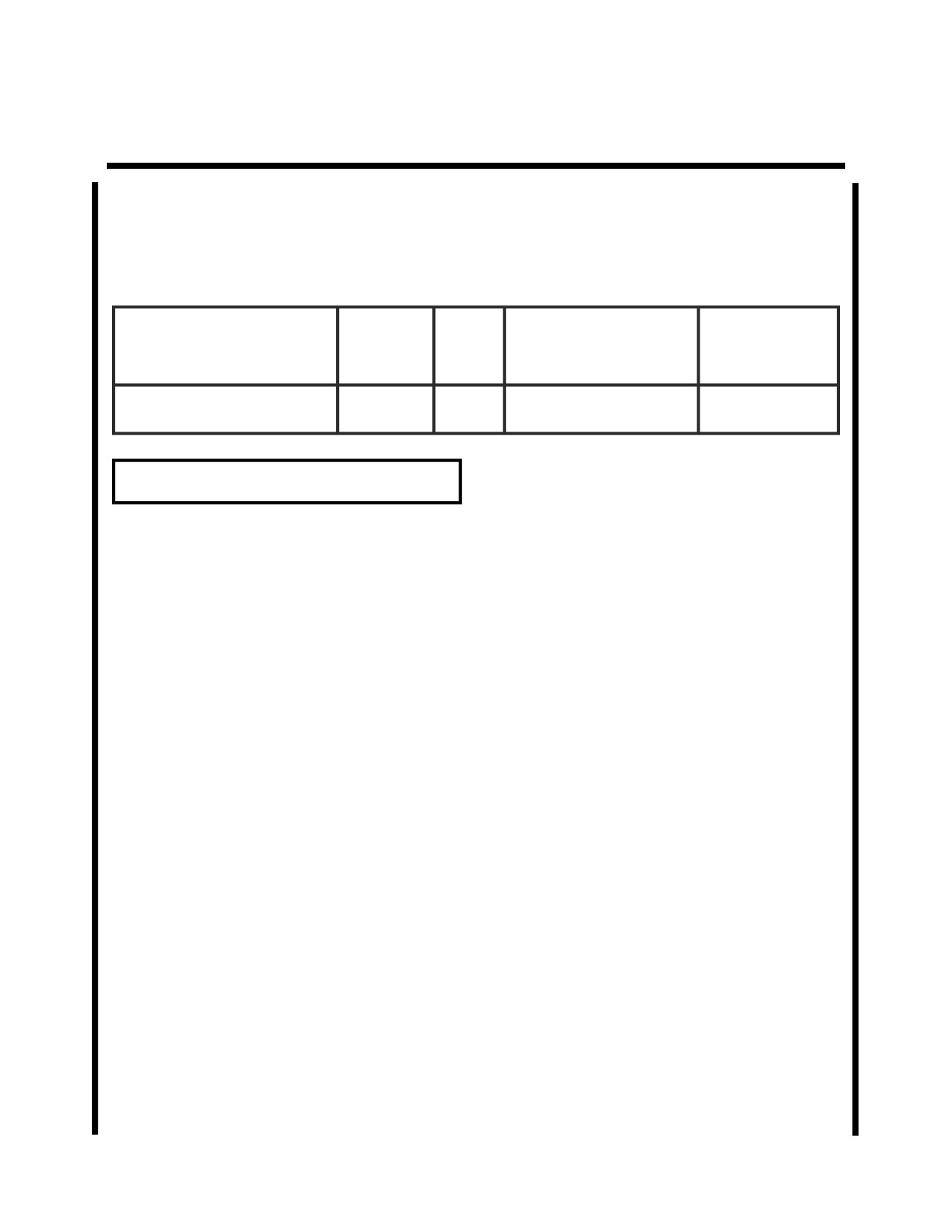
RIGGING STEPS
1. Position the apex fitting on top of the vehicle. Route
3. Loop the chain end of sling leg 3 through the left rear
outer sling legs 1 and 2 to the front of the vehicle and
lift provision located on the outside end of the rear bumper.
inner sling legs 3 and 4 to the rear. Sling legs 1 and 3 must
Place the correct link from Table 2-30 in the grab hook.
be on the left side of the load.
Repeat with sling leg 4 through the right rear lift provi-
sion.
2. Loop the chain end of sling leg 1 through the left
front lift provision that protrudes through the hood from
4. Secure all excess chain with tape or Type III nylon
inboard to outboard. Place the correct link from Table 2-30
cord.
in the grab hook. Repeat with sling leg 2 through the right
front lift provision.
5. Cluster and tie or tape (breakaway technique) the
sling legs in each sling set together to prevent entangle-
ment during hookup and lift-off.
Figure 2-29. M1037 (HMMWV) With Compressed Air-Foam System, Mobile (CAFSM)
CAUTION
Do not use the lift shackles located near the center of the rear bumper for sling load lift provi-
sions.
2-72
C3, FM 10-450-4/MCRP 4-23E, VOL II/NWP 3-04.12/AFJMAN 11-223, VOL II/
COMDTINST M13482.3A
2-32. Prophet AN/MLQ-40 (V) on M1097 HMMWV
a. Applicability. The following items in Table 2-31 are certified for all helicopters with suitable lift capacity by the US
Army Soldier Systems Center:
Table 2-31. Prophet AN/MLQ-40 (V) on M1097 HMMWV
MAX
RECOMMENDED
SLING
LINK COUNT
NOMENCLATURE
WEIGH T
AIRSPEE D
SET
FRONT / REA R
(POUNDS )
(KNOTS )
Prophet AN/MLQ-40 (V) 1
10,000
10K
5
/
90
Prophet AN/MLQ-40 (V) 3
10,000
10K
5
/
90
b. Materials. The following materials are required to
to the truck. Secure all equipment and cargo inside the
rig this load:
unit with tape, nylon cord, or lashings. Close and secure
the door.
(1) Sling set (10,000-pound capacity).
(c) Secure all equipment and cargo inside the vehicle
(a) Chain length, part number 38850-00053-101,
with tape, nylon cord, or lashings. Roll up all the win-
from a 10,000-pound capacity sling set (4 each).
dows and secure the doors closed (if installed)
(b) Coupling link, part number 577-0615, from a
(d) Ensure the fuel tank is not over 3/4 full. Inspect
10,000-pound sling set (4 each).
fuel tank cap, oil filler cap, and battery caps for proper
installation.
(2) Tape, adhesive, pressure-sensitive, 2-inch wide
roll.
(e) Engage the vehicle parking brake and put the
transmission in neutral.
(3) Cord, nylon, Type III, 550-pound breaking strength.
(f) Ensure the front wheels are pointed straight ahead.
(4) Webbing, cotton, 1/4-inch, 80-pound breaking
Tie down the steering wheel, using the securing device
strength.
attached under the dashboard.
c. Personnel. Two persons can prepare and rig this
(g) Tape the windshield in an X formation from cor-
load in 15 minutes.
ner to corner.
d. Procedures. The following procedures apply to
(h) Extend the sling leg chains by connecting
this load:
one
additional chain length to each chain on a 10,000-
(1) Preparation. Prepare the load using the following
pound
steps:
capacity sling set with coupling links.
(a) Fold mirrors forward inward and tie together with
(2) Rigging. Rig the load according to the steps in
Type III nylon cord.
Figure 2-30.
(b) Ensure the Prophet cargo bed cover is secured
(3) Hookup. The hookup team stands on top of the
vehicle. The static wand person discharges the static
electricity with the static wand. The hookup person places
the apex fitting on the cargo hook. The hookup team then
2-73
C3, FM 10-450-4/MCRP 4-23E, VOL II/NWP 3-04.12/AFJMAN 11-223, VOL II/
COMDTINST M13482.3A
carefully dismounts the vehicle and remains close to the
designated rendezvous point.
load as the helicopter removes slack from the sling legs.
When successful hookup is assured, the hookup team
(4) Derigging. Derigging is the reverse of the prepara-
quickly exits the area underneath the helicopter to the
tion and rigging procedures in steps d (1) and d (2).
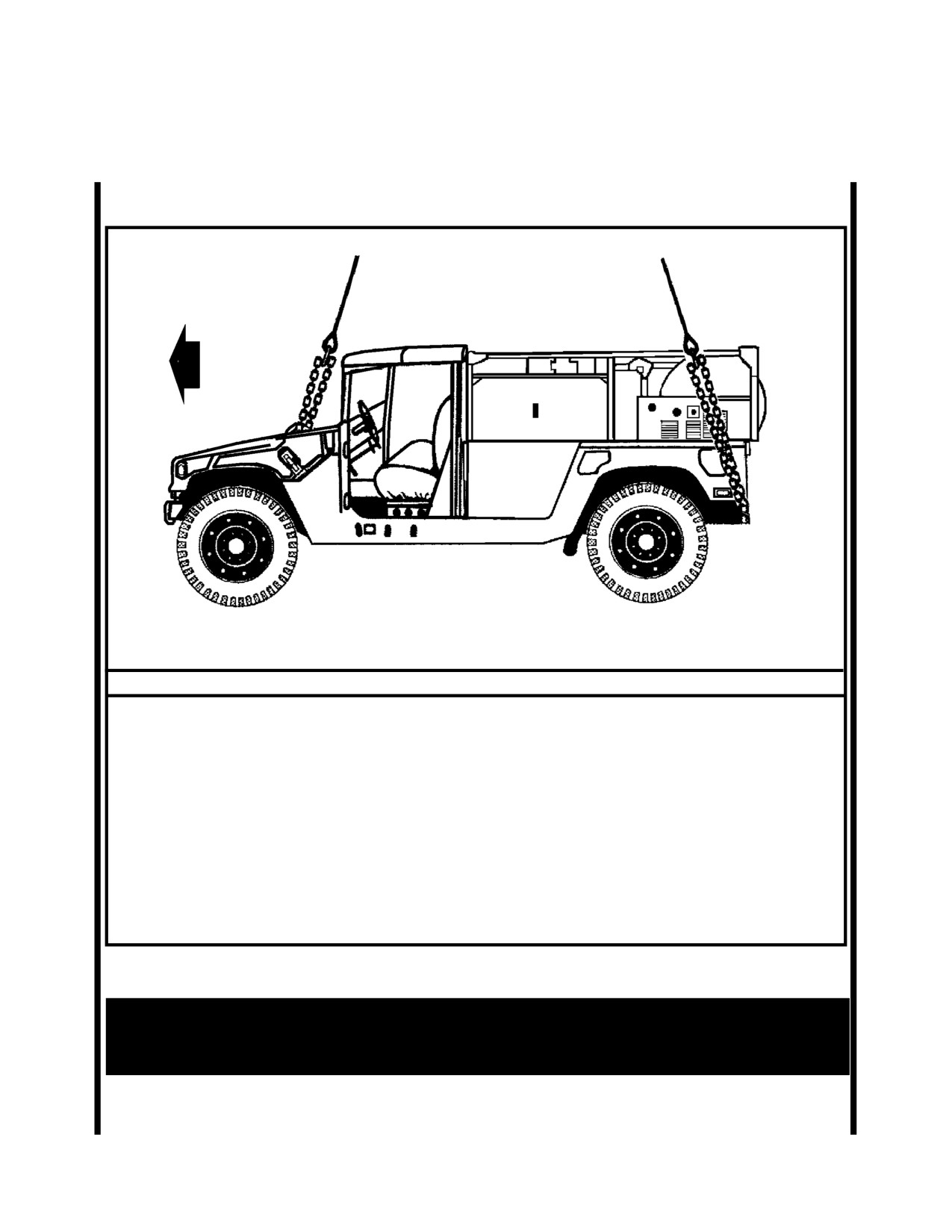
RIGGING STEPS
1. Position the apex fitting on top of the vehicle roof.
3. Loop the chain end of sling leg 3 through the left rear
Route outer sling legs 1 and 2 to the front of the vehicle
lift provision located on the outside end of the rear bumper.
and inner sling legs 3 and 4 to the rear. Sling legs 1 and 3
Place the correct link from Table 2-31 in the grab hook.
must be on the left side of the load.
Repeat with sling leg 4 through the right rear lift provi-
sion.
2. Loop the chain end of sling leg 1 through the left
front lift provision that protrudes through the hood from
4. Secure all excess chain with tape or Type III nylon
inboard to outboard. Place the correct link from Table 2-31
cord.
in the grab hook. Repeat with sling leg 2 through the right
front lift provision.
5. Cluster and tie or tape (breakaway technique) the
sling legs in each sling set together to prevent entangle-
ment during hookup and lift-off.
Figure 2-30. Prophet AN/MLQ-40 (V) on M1097 HMMWV
CAUTION
Do not use the lift shackles located near the center of the rear bumper for sling load lift provi-
sions.
2-74
C2, FM 10-450-4/MCRP 4-23E, VOL II/NWP 3-04.12/AFJMAN 11-223, VOL II/
COMDTINST M13482.3A
2-33. Helmet Hardtop (Amtech Corp) Cargo Bed Cover on M1097A2 HMMWV
a. Applicability. The following item in Table 2-32 is certified for all helicopters with suitable lift capacity by the US
Army Soldier Systems Center:
Table 2-32. Helmit Hardtop (Amtech Corp) Cargo Bed Cover on M1097A2 HMMWV
M AX
RECOMMENDED
SLING
LINK COUNT
NOMENCLATURE
WEIGH T
AIRSPEE D
SET
FRONT / REA R
(POUNDS )
(KNOTS )
Measurements and Signature
10,300
25K
4
/
90
Intelligence (MASINT
)
b. Materials. The following materials are required
(c) Secure all equipment and cargo inside the vehicle
to rig this load:
with tape, nylon cord, or lashings. Roll up all the win-
dows and secure the doors closed (if installed)
(1) Sling set (25,000-pound capacity).
(d) Ensure the fuel tank is not over 3/4 full. Inspect
(a) Chain length, part number 38850-00053-102,
fuel tank cap, oil filler cap, and battery caps for proper
from a 25,000-pound capacity sling set (4 each).
installation.
(b) Coupling link, part number 664241, from a
(e) Engage the vehicle parking brake and put the
25,000-pound sling set (4 each).
transmission in neutral.
(2) Tape, adhesive, pressure-sensitive, 2-inch wide
(f) Ensure the front wheels are pointed straight ahead.
roll.
Tie down the steering wheel, using the securing device
attached under the dashboard.
(3) Cord, nylon, Type III, 550-pound breaking strength.
(g) Tape the windshield in an X formation from cor-
(4) Webbing, cotton, 1/4-inch, 80-pound breaking
ner to corner.
strength.
(h) Extend the sling leg chains by connecting one
c. Personnel. Two persons can prepare and rig this
additional chain length to each chain on a 10,000-pound
load in 15 minutes.
capacity sling set with coupling links.
d. Procedures. The following procedures apply to
(2) Rigging. Rig the load according to the steps in
this load:
Figure 2-31.
(1) Preparation. Prepare the load using the follow-
(3) Hookup. The hookup team stands on top of the
ing steps:
vehicle. The static wand person discharges the static
electricity with the static wand. The hookup person places
(a) Fold mirrors forward inward and tie together with
the apex fitting on the cargo hook. The hookup team then
Type III nylon cord.
carefully dismounts the vehicle and remains close to the
load as the helicopter removes slack from the sling legs.
(b) Ensure the cargo bed cover is secured to the
When successful hookup is assured, the hookup team
truck. Secure all equipment and cargo inside the unit with
quickly exits the area underneath the helicopter to the
tape, nylon cord, or lashings. Close and secure the door.
designated rendezvous point.
2-75
C2, FM 10-450-4/MCRP 4-23E, VOL II/NWP 3-04.12/AFJMAN 11-223, VOL II/
COMDTINST M13482.3A
(4) Derigging. Derigging is the reverse of the prepara-
tion and rigging procedures in steps d (1) and d (2).
RIGGING STEPS
1. Position the apex fitting on top of the vehicle roof.
3. Loop the chain end of sling leg 3 through the left rear
Route outer sling legs 1 and 2 to the front of the vehicle
lift provision located on the outside end of the rear bumper.
and inner sling legs 3 and 4 to the rear. Sling legs 1 and 3
Place the correct link from Table 2-32 in the grab hook.
must be on the left side of the load.
Repeat with sling leg 4 through the right rear lift provi-
sion.
2. Loop the chain end of sling leg 1 through the left
front lift provision that protrudes through the hood from
4. Secure all excess chain with tape or Type III nylon
inboard to outboard. Place the correct link from Table 2-32
cord.
in the grab hook. Repeat with sling leg 2 through the right
front lift provision.
5. Cluster and tie or tape (breakaway technique) the
sling legs in each sling set together to prevent entangle-
ment during hookup and lift-off.
Figure 2-31. Helmit Hardtop (Amtech Corp) Cargo Bed Cover on M1097A2 HMMWV
CAUTION
Do not use the lift shackles located near the center of the rear bumper for sling load lift provi-
sions.
2-76
C2, FM 10-450-4/MCRP 4-23E, VOL II/NWP 3-04.12/AFJMAN 11-223, VOL II/
COMDTINST M13482.3A
2-34. Interim Fast Attack Vehicle (IFAV) Truck, Long Wheel Base
a. Applicability. The following item in Table 2-33 is certified for all helicopters with suitable lift capacity by the US
Army Soldier Systems Center:
Table 2-33. Interim Fast Attack Vehicle (IFAV) Truck, Long Wheel Base
M AX
RECOMMENDED
SLING
LINK COUNT
NOMENCLATURE
WEIGH T
AIRSPEE D
SET
FRONT / REA R
(POUNDS )
(KNOTS )
Interim Fast Attack Vehicle
5,720
15K
3/15
120
Truck, Long Wheel Base
b. Materials. The following materials are required
(b) Secure all equipment and cargo inside the vehicle
to rig this load:
with tape, nylon cord, or tiedown straps.
(1) Sling set (15,000-pound capacity).
(c) Ensure the fuel tank is not over 3/4 full. Inspect
fuel tank cap, oil filler cap, and battery caps for proper
(2) Tape, adhesive, pressure-sensitive, 2-inch wide
installation.
roll.
(d) Engage the vehicle parking brake and put the
(3) Cord, nylon, Type III, 550-pound breaking strength.
transmission in neutral.
(4) Webbing, cotton, 1/4-inch, 80-pound breaking
(e) Ensure the front wheels are pointed straight ahead.
strength.
Tie down the steering wheel using Type III nylon cord.
(5) Padding, cellulose.
(f) Tape the windshield in an X formation from cor-
ner to corner.
(6) Strap, cargo, tiedown (as required).
(2) Rigging. Rig the load according to the steps in
c. Personnel. Two persons can prepare and rig this
Figure 2-32.
load in 10 minutes.
(3) Hookup. The hookup teams stand in the bed of the
d. Procedures. The following procedures apply to
vehicle. The static wand person discharges the static
this load:
electricity with the static wand. The hookup person places
the web ring on the cargo hook. The hookup team then
(1) Preparation. Prepare the load using the follow-
carefully dismounts the vehicle and remains close to the
ing steps:
load as the helicopter removes slack from the sling legs.
When successful hookup is assured, the hookup team
(a) Fold mirrors forward in front of the windshield for
quickly exits the area underneath the helicopter to the
added protection and tie together with Type III nylon
designated rendezvous point.
cord. Remove all canvas covers.
(4) Derigging. Derigging is the reverse of the prepara-
tion and rigging procedures in steps d (1) and d (2).
2-77
C2, FM 10-450-4/MCRP 4-23E, VOL II/NWP 3-04.12/AFJMAN 11-223, VOL II/
COMDTINST M13482.3A
RIGGING STEPS
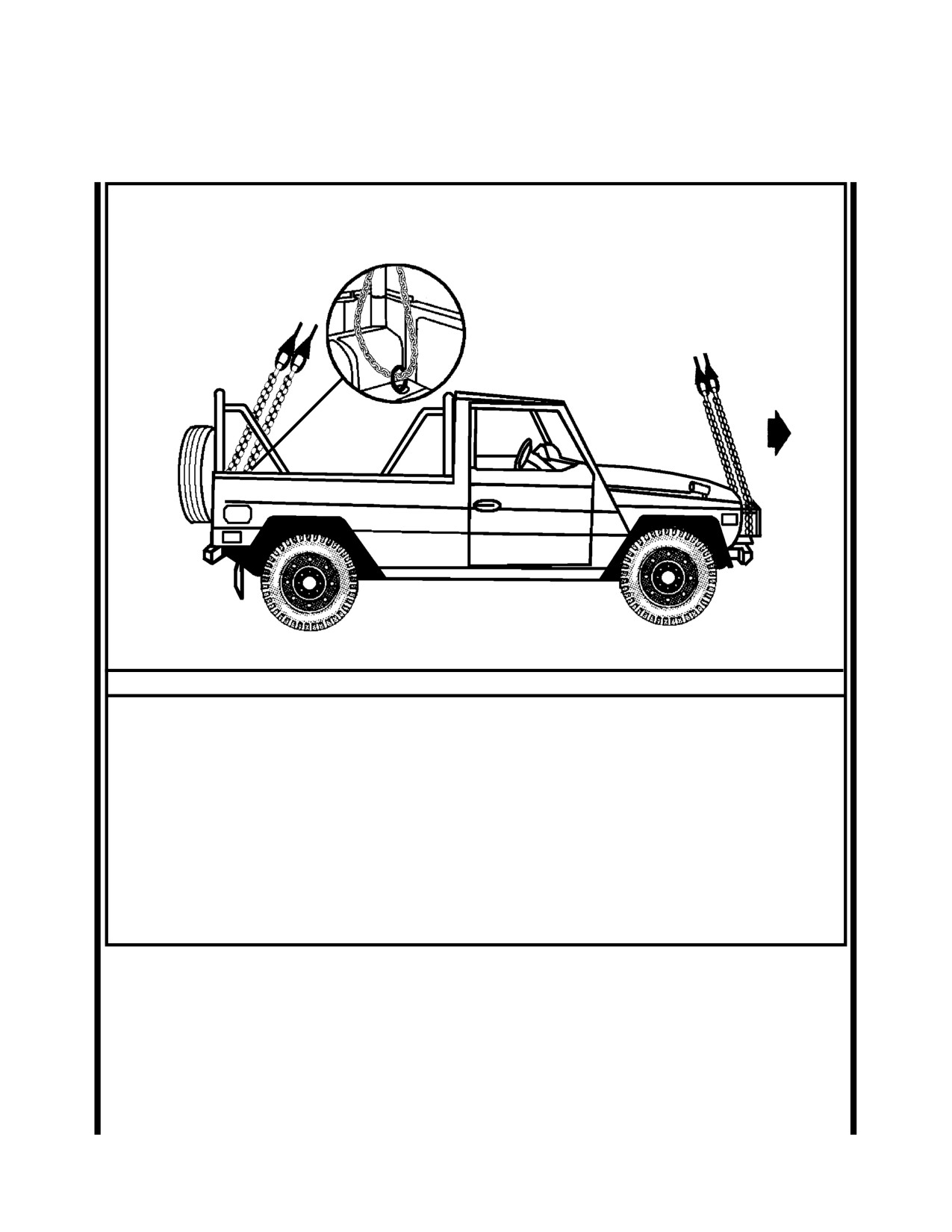
1. Position the apex fitting on top of the vehicle. Route
3. Loop the chain end of sling leg 3 through the left rear
outer sling legs 1 and 2 to the front of the vehicle and
lift provision located in the left rear corner of the cargo
inner sling legs 3 and 4 to the rear. Sling legs 1 and 3 must
bed. Place the correct link from Table 2-33 in the grab
be on the left side of the load.
hook. Repeat with sling leg 4 through the right rear lift
provision.
2. Loop the chain end of sling leg 1 through the left
front lift provision located on the left front corner of the
4. Secure all excess chain with tape or Type III nylon
bumper . Place the correct link from Table 2-33 in the grab
cord.
hook. Repeat with sling leg 2 through the right front lift
provision.
5. Cluster and tie or tape (breakaway technique) the
sling legs in each sling set together to prevent entangle-
ment during hookup and lift-off.
Figure 2-32. Interim Fast Attack Vehicle (IFAV) Truck, Long Wheel Base
2-78
C2, FM 10-450-4/MCRP 4-23E, VOL II/NWP 3-04.12/AFJMAN 11-223, VOL II/
COMDTINST M13482.3A
2-35. John Deere M-Gator (Model #VGM6X01001)
a. Applicability. The following items in Table 2-34 are certified for all helicopters with suitable lift capacity by the US
Army Soldier Systems Center:
Table 2-34. John Deere M-Gator (Model #VGM6X01001)
MAX
RECOMMENDED
SLING
LINK COUNT
NOMENCLATURE
WEIGH T
AIRSPEE D
SET
FRONT / REA R
(POUNDS )
(KNOTS )
John Deere M-Gator (Empt
y)
1,400
10K
3/30
90
(Model # VGM6X01001)
John Deere M-Gator (with
l
2,450
10K
3/40
90
(Model # VGM6X01001)
b. Materials. The following materials are required
(c) Ensure the fuel tank is not over 3/4 full. Inspect
to rig this load:
fuel tank cap, oil filler cap, and battery caps for proper
installation.
(1) Sling set (10,000-pound capacity).
(d) Engage the vehicle parking brake and put the
(2) Tape, adhesive, pressure-sensitive, 2-inch wide
transmission in neutral.
roll.
(e) Ensure the front wheels are pointed straight ahead.
(3) Cord, nylon, Type III, 550-pound breaking strength.
Tie down the steering wheel, using the securing device
attached under the dashboard or type III nylon cord.
(4) Webbing, cotton, 1/4-inch, 80-pound breaking
strength.
(2) Rigging. Rig the load according to the steps in
Figure 2-33.
c. Personnel. Two persons can prepare and rig this
load in 10 minutes.
(3) Hookup. The hookup team stands on the vehicle.
The static wand person discharges the static electricity
d. Procedures. The following procedures apply to
with the static wand. The hookup person places the apex
this load:
fitting on the cargo hook. The hookup team then carefully
dismounts the vehicle and remains close to the load as the
(1) Preparation. Prepare the load using the follow-
helicopter removes slack from the sling legs. When suc-
ing steps:
cessful hookup is assured, the hookup team quickly exits
the area underneath the helicopter to the designated ren-
(a) Secure the gas cap, tailgate, fire extinguisher, and
dezvous point.
all equipment and cargo inside the vehicle with tape, ny-
lon cord, or lashings.
(4) Derigging. Derigging is the reverse of the prepara-
tion and rigging procedures in steps d (1) and d (2).
(b) Place tape on all the lights.
2-79
C2, FM 10-450-4/MCRP 4-23E, VOL II/NWP 3-04.12/AFJMAN 11-223, VOL II/
COMDTINST M13482.3A
RIGGING STEPS
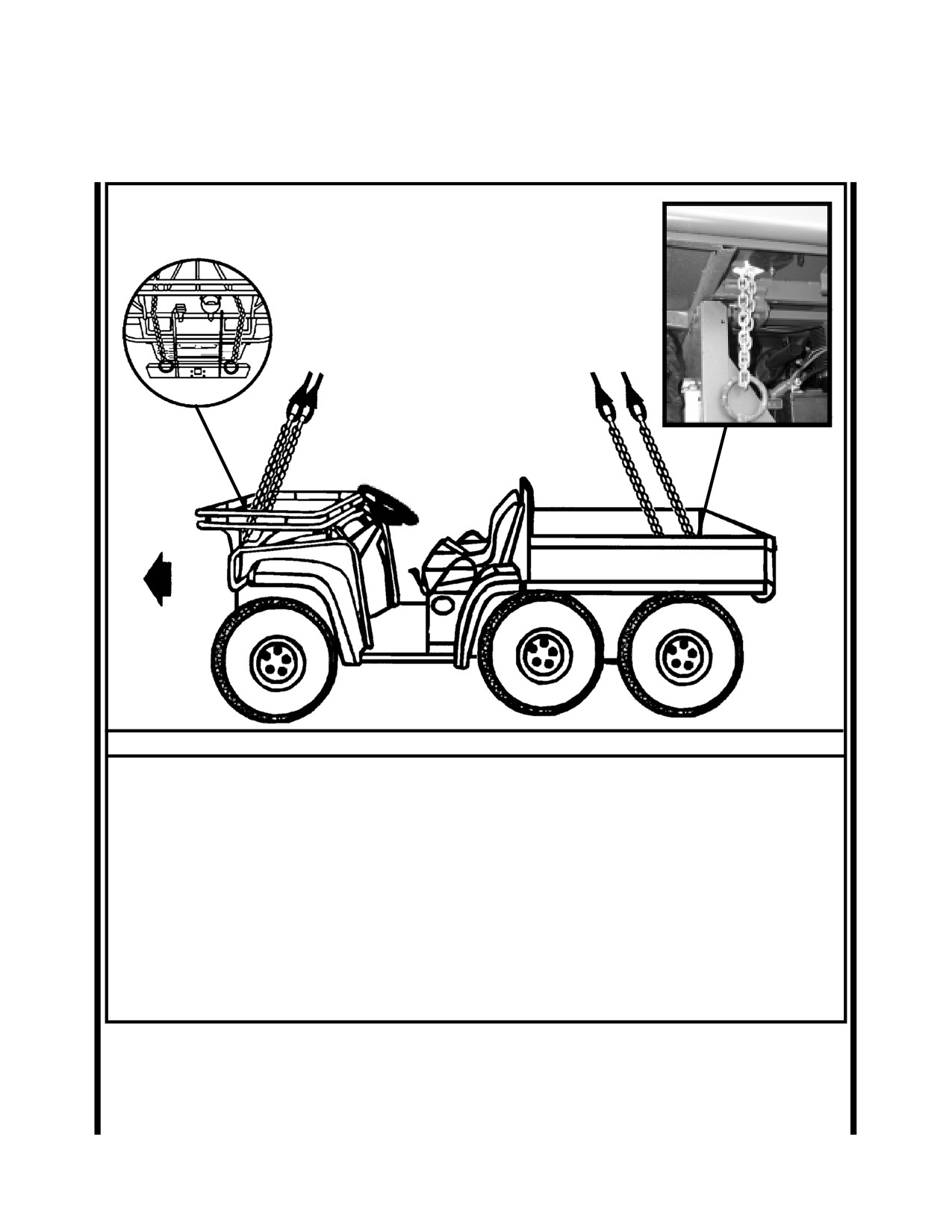
1. Position the apex fitting on top of the vehicle. Route
3. Slide the black circular hole covers, located in the
outer sling legs 1 and 2 to the front of the vehicle and
vehicle bed, to the side. Route the chain end of sling leg
inner sling legs 3 and 4 to the rear. Sling legs 1 and 3 must
3 through the left exposed hole and the left rear lift provi-
be on the left side of the load.
sion. Place the correct link from Table 2-34 in the grab
hook. Repeat with sling leg 4 through the right exposed
2. Route the chain end of sling leg 1 through the litter
hole and right rear lift provision.
carrier and over the brush bar to the left front lift provi-
sion. Loop the chain through the lift provision and follow
4. Secure all excess chain with tape or Type III nylon
the chain routing back to the grab link. Place the correct
cord.
link from Table 2-34 in the grab hook. Repeat with sling
leg 2 through the right front lift provision.
5. Cluster and tie or tape (breakaway technique) the
sling legs in each sling set together to prevent entangle-
ment during hookup and lift-off.
Figure 2-33. John Deere M-Gator (Model #VGM6X01001)
2-80
C2, FM 10-450-4/MCRP 4-23E, VOL II/NWP 3-04.12/AFJMAN 11-223, VOL II/
COMDTINST M13482.3A
2-36. Two John Deere M-Gators, Model # VGM6X4D01001, Side by Side (Shotgun
Method)
a. Applicability. The following item in Table 2-35 is certified for all helicopters with suitable lift capacity by the US
Army Soldier Systems Center:
Table 2-35. Two John Deere M-Gators, Model # VGM6X4D01001, Side by Side (Shotgun Method)
MAX
RECOMMENDED
LINK COUNT
NOMENCLATURE
WEIGH T
SLING SET
AIRSPEE D
FRONT/REA R
(POUNDS )
(KNOTS )
John Deere M-Gator, Model#
Listed
i
1,450 each
10K
75
VGM6X4D01001
t
b. Materials. The following materials are required to
(c) Ensure the fuel tank is not over 3/4 full. Inspect
rig this load:
fuel tank cap, oil filler cap, and battery caps for proper
installation.
(1) Sling set (10,000-pound capacity (2 each)).
(d) Engage the vehicle parking brake and put the
(2) Additional apex fitting from a 10,000-pound
transmission in neutral.
capacity sling set (NSN: 4030-01-027-2902).
(e) Ensure the front wheels are pointed straight ahead.
(3) Tape, adhesive, pressure-sensitive, 2-inch wide
Tie down the steering wheel using the securing device
roll.
under the dash or Type III nylon cord.
(4) Cord, nylon, Type III, 550-pound breaking strength.
(f) Tape all lights and gauges.
(5) Webbing, cotton, 1/4-inch, 80-pound breaking
(g) Reposition the blackout lights and the infrared
strength.
LED lights so they do not interfere with the routing of the
sling legs.
(6) Strap, tiedown, cargo, CGU-1/B (2 each).
(h) Open the black sling guide covers in the bed of
c. Personnel. Two persons can prepare and rig this
both vehicles.
load in 15 minutes.
(2) Rigging. Rig the load according to the steps in
d. Procedures. The following procedures apply to
Figure 2-34.
this load:
(3) Hookup. The hookup team stands in the bed of the
(1) Preparation. Prepare the load using the following
vehicle. The static wand person discharges the static
steps:
electricity with the static wand. The hookup person places
the apex fitting on the cargo hook. The hookup team then
(a) Position the vehicles as close together as pos-
carefully dismounts the vehicle and remains close to the
sible. Ensure the vehicles are facing in the same direction
load as the helicopter removes slack from the sling legs.
and the wheels of the M-Gators are lined up.
When successful hookup is assured, the hookup team
quickly exits the area underneath the helicopter to the
(b) Secure all equipment and cargo inside the vehicle
designated rendezvous point.
with tape, nylon cord, or lashings.
(4) Derigging. Derigging is the reverse of the prepara-
tion and rigging procedures in steps d (1) and d (2).
2-81
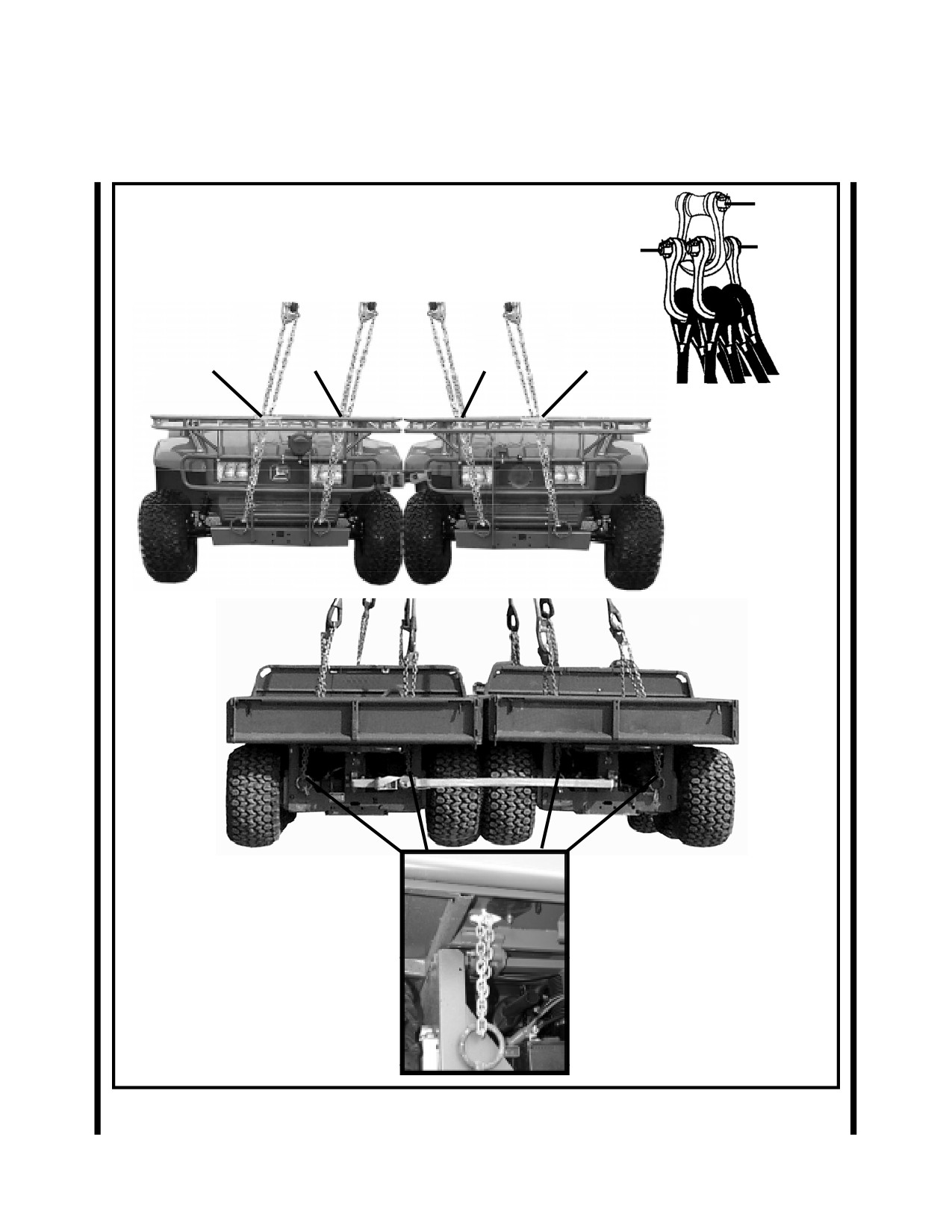
C2, FM 10-450-4/MCRP 4-23E, VOL II/NWP 3-04.12/AFJMAN 11-223, VOL II/
COMDTINST M13482.3A
APEX 3
APEX 1
APEX 2
4th
6th
6th
4th
OPENING OPENING
OPENING
OPENING
FRONT
REAR
Figure 2-34. Two John Deere M-Gators, Model # VGM6X4D01001, Side by Side (Shotgun Method)
2-82

C3, FM 10-450-4/MCRP 4-23E, VOL II/NWP 3-04.12/AFJMAN 11-223, VOL II/
COMDTINST M13482.3A
RIGGING STEPS
1. Position sling set 1 on top of the right vehicle with the
grabhook along the same path. Place link 3 in the
bolt parallel to the length of the vehicle. Route sling legs 1
grabhook.
and 2 to the front of the vehicle and sling legs 3 and 4 to
the rear. Sling legs 1 and 4 must be on the outside.
8. Route the chain end of sling leg 2 through the 6th
opening in the front litter carrier, over the brush guard to
2. Route the chain end of sling leg 1 through the 4th
the inside front lift provision. Loop the chain end through
opening in the front litter carrier, over the brush guard to
the inside front lift provision and back to the grabhook
the outside front lift provision. Loop the chain end
along the same path. Place link 20 in the grabhook.
through the outside front lift provision and back to the
grabhook along the same path. Place link 3 in the
9. Route the chain end of sling leg 4 through the outside
grabhook.
sling guide to the outside rear lift provision. Loop the
chain end through the outside rear lift provision and back
3. Route the chain end of sling leg 2 through the 6th
to the grabhook along the same path. Place link 30 in the
opening in the front litter carrier, over the brush guard to
grabhook.
the inside front lift provision. Loop the chain end through
the inside front lift provision and back to the grabhook
10. Route the chain end of sling leg 3 through the inside
along the same path. Place link 20 in the grabhook.
sling guide to the inside rear lift provision. Loop the chain
end through the inside rear lift provision and back to the
4. Route the chain end of sling leg 4 through the outside
grabhook along the same path. Place link 45 in the
sling guide to the outside rear lift provision. Loop the
grabhook.
chain end through the outside rear lift provision and back
to the grabhook along the same path. Place link 30 in the
11. Route the additional apex fitting through apex fit-
grabhook.
tings 1 and 2.
5. Route the chain end of sling leg 3 through the inside
12. Secure all excess chain with tape or Type III nylon
sling guide to the inside rear lift provision. Loop the chain
cord.
end through the inside rear lift provision and back to the
grabhook along the same path. Place link 45 in the
13. Cluster and tie or tape (breakaway technique) the
grabhook.
sling legs in each sling set on top of the vehicle to prevent
entanglement during hookup and lift-off.
6. Position sling set 2 on top of the left vehicle with the
bolt parallel to the length of the vehicle. Route sling legs 1
14. Route a CGU-1/B cargo tiedown strap through the
and 2 to the front of the vehicle and sling legs 3 and 4 to
trailer hitch of both vehicles and connect the hooks to-
the rear. Sling legs 1 and 4 must be on the outside.
gether. Tighten the straps and secure the excess strap.
7. Route the chain end of sling leg 1 through the 4th
15. Route a CGU-1/B cargo tiedown strap through the
opening in the front litter carrier, over the brush guard to
inside front bar of the brush guard on both vehicles and
the outside front lift provision. Loop the chain end
connect the hooks together. Tighten the straps and se-
through the outside front lift provision and back to the
cure the excess strap.
Figure 2-34. Two John Deere M-Gators, Model # VGM6X4D01001, Side by Side (Shotgun Method) (continued)
2-83
C3, FM 10-450-4/MCRP 4-23E, VOL II/NWP 3-04.12/AFJMAN 11-223, VOL II/
COMDTINST M13482.3A
2-37. Air Traffic Navigation, Integration, and Control System (ATNAVICS) Radar Sensor
Pallet on M1113 HMMWV
a. Applicability. The following item in Table 2-36 is certified for all helicopters with suitable lift capacity by the US Army
Soldier Systems Center:
Table 2-36. Air Traffic Navigation, Integration, and Control System (ATNAVICS) Radar Sensor Pallet on M1113
HMMWV
M AX
RECOMMENDED
SLING
LINK COUNT
NOMENCLATURE
WEIGH T
AIRSPEE D
SET
FRONT / REA R
(POUNDS )
(KNOTS )
M1113 HMMWV wih
11,500
25K
3
/
120
A
TNAVICS Radar Sensor Pa
l
b. Materials. The following materials are required to
(a) Fold the mirrors inward for added protection and
rig this load:
tie together with Type III nylon cord. Remove the doors
and secure the doors on the load with Type III nylon cord.
(1) Sling set (25,000-pound capacity).
(b) Secure all equipment inside the unit with tape,
(a) Additional chain lengths, part number 38850-
Type III nylon cord or tiedown straps. Secure all vents,
00053-102, from a 25,000-pound capacity sling set
doors and latches with tape or Type III nylon cord.
(4 each).
(c) Secure all equipment and cargo inside the ve-
(b) Coupling link, part number 664241, from a
hicle cab with tape, Type III nylon cord, or tiedown straps.
25,000-pound capacity sling set (4 each).
(d) Ensure the fuel tank is not over 3/4 full. Inspect
(2) Tape, adhesive, pressure-sensitive, 2-inch wide
fuel tank cap, oil filler cap, and battery caps for proper
roll.
installation.
(3) Cord, nylon, Type III, 550-pound breaking strength.
(e) Engage the vehicle parking brake and put the
transmission in neutral.
(4) Webbing, cotton, 1/4-inch, 80-pound breaking
strength.
(f) Ensure the front wheels are pointed straight ahead.
Tie down the steering wheel, using the securing device
(5) Strap, cargo, tiedown, CGI-1/B (as required).
attached under the dashboard or Type III nylon cord.
c. Personnel. Two persons can prepare and rig this
(g) Extend the sling leg chains by connecting one
load in 15 minutes.
additional chain length to each chain on the 25,000-pound
capacity sling set with coupling links.
d. Procedures. The following procedures apply to
this load:
(h) Install the sling leg guides on the rear corners of
the radar sensor pallet as required in TM 11-584-381-23,
(1) Preparation. Prepare the load using the following
chapter 2.
steps:
(2) Rigging. Rig the load according to the steps in
Figure 2-35
2-84
C3, FM 10-450-4/MCRP 4-23E, VOL II/NWP 3-04.12/AFJMAN 11-223, VOL II/
COMDTINST M13482.3A
(3) Hookup. The hookup team stands on the vehicle.
the area underneath the helicopter to the designated ren-
The static wand person discharges the static electricity
dezvous point.
with the static wand. The hookup person places the apex
fitting on the cargo hook. The hookup team then carefully
(4) Derigging. Derigging is the reverse of the prepara-
dismounts the vehicle and remains close to the load as the
tion and rigging procedures in steps d (1) and d (2).
helicopter removes slack from the sling legs. When suc-
cessful hookup is assured, the hookup team quickly exits
RIGGING STEPS
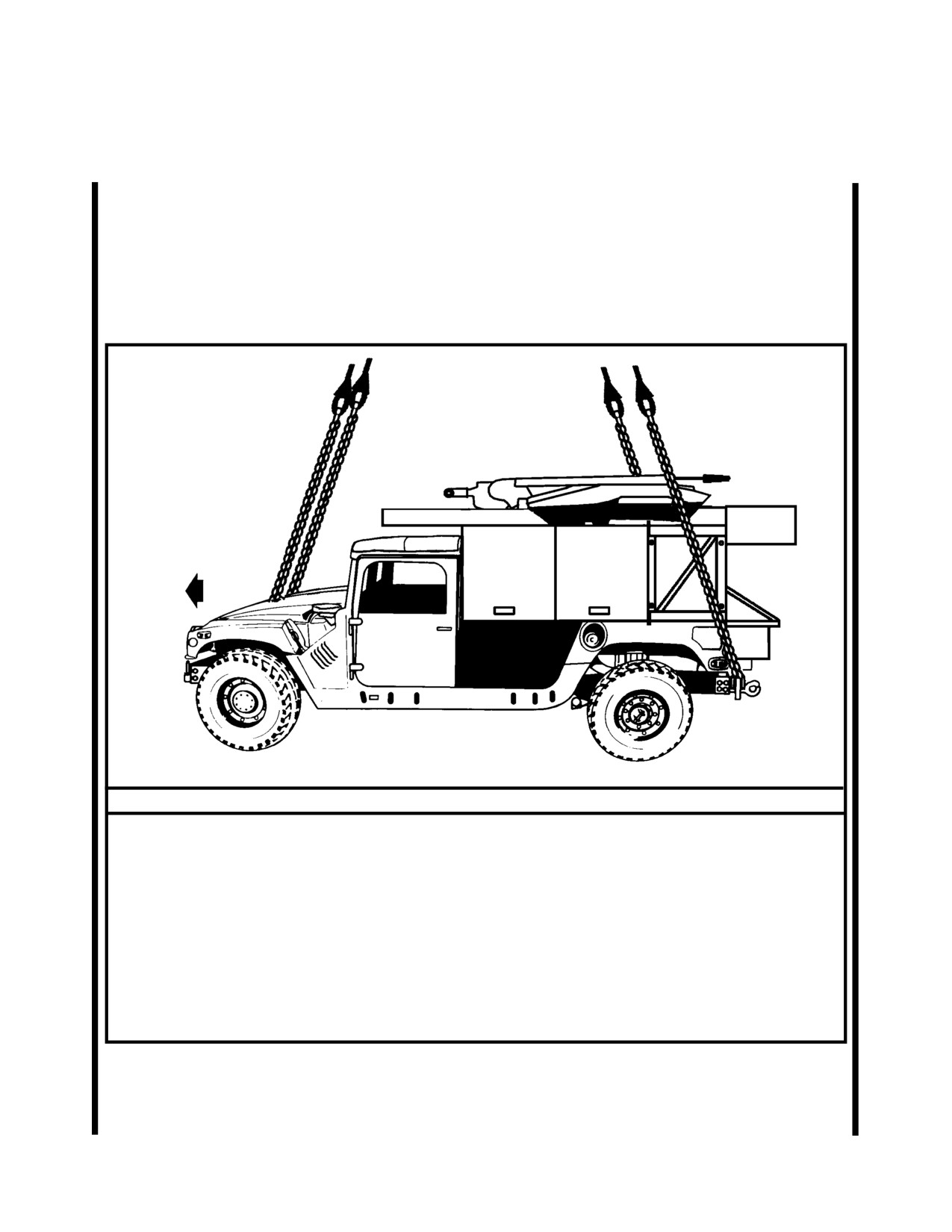
1. Position apex fitting on top of the truck. Route outer
3. Loop the chain end of sling leg 3 through the left rear
sling legs 1and 2 to the front of the vehicle and inner sling
lift provision located on the outer ends of the rear bumper.
legs 3 and 4 to the rear. Sling legs 1 and 3 must be on the
Place the correct link from Table 2-36 in the grab hook.
left side of the load.
Repeat with sling leg 4 and the right rear lift provision.
Secure excess chain with tape or Type III nylon cord.
2. Loop the chain end of sling leg 1 through the left
front lift provision that protrudes through the hood from
4. Cluster and tie or tape (breakaway technique) all sling
inboard to outboard. Place the correct link from Table 2-
legs together on top of the vehicle to prevent entangle-
36 in the grab hook. Repeat with sling leg 2 and the right
ment during hookup and lift-off.
front lift provision. Secure excess chain with tape or Type
III nylon cord.
Figure 2-35. Air Traffic Navigation, Integration, and Control System (ATNAVICS) Radar Sensor Pallet on
M1113 HMMWV
2-85
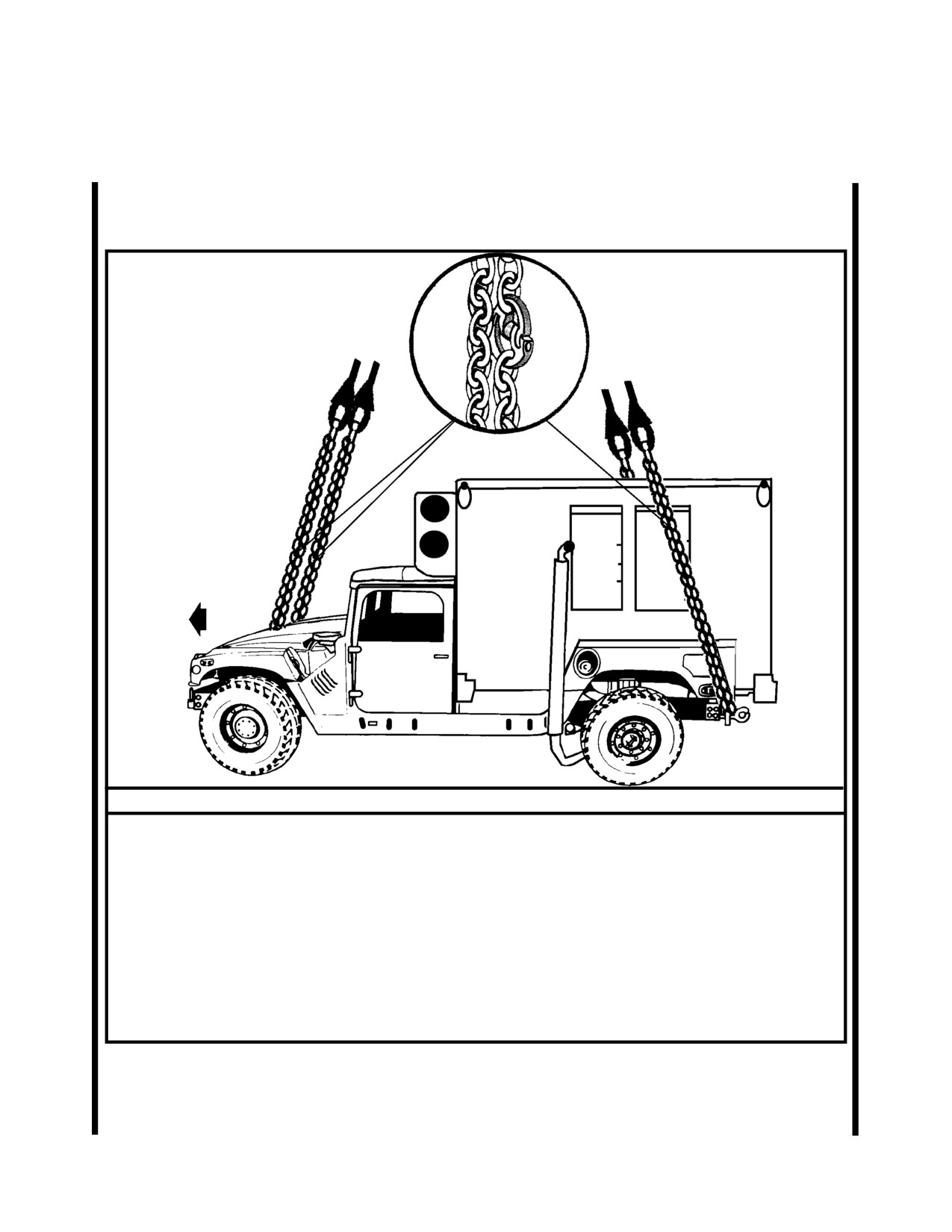
C3, FM 10-450-4/MCRP 4-23E, VOL II/NWP 3-04.12/AFJMAN 11-223, VOL II/
COMDTINST M13482.3A
2-38. Tactical Data Network (TDN) Gateway on M1097A1 HMMWV
a. Applicability. The following item in Table 2-37 is certified for all helicopters with suitable lift capacity by the US Army
Soldier Systems Center:
Table 2-37. Tactical Data Network (TDN) Gateway on M1097A1 HMMWV
M AX
RECOMMENDED
SLING
LINK COUNT
NOMENCLATURE
WEIGH T
AIRSPEE D
SET
FRONT / REA R
(POUNDS )
(KNOTS )
Tactical Data Network (TD
N)
Gateway on M1097A 1
9,580
15K
3
/
100
HMMW V
b. Materials. The following materials are required to
doors and latches with tape or Type III nylon cord.
rig this load:
(c) Secure all equipment and cargo inside the vehicle
(1) Multileg sling set (15,000-pound capacity).
cab with tape, Type III nylon cord, or tiedown straps.
Secure the doors shut, if installed.
(a) Additional chain lengths, part number 3408-4,
from a 15,000-pound capacity sling set (8 each).
(d) Ensure the fuel tank is not over 3/4 full. Inspect
fuel tank cap, oil filler cap, and battery caps for proper
(b) Coupling link, part number 31611, from a 15,000-
installation.
pound capacity sling set (8 each).
(e) Engage the vehicle parking brake and put the
(2) Tape, adhesive, pressure-sensitive, 2-inch wide
transmission in neutral.
roll.
(f) Ensure the front wheels are pointed straight ahead.
(3) Cord, nylon, Type III, 550-pound breaking strength.
Tie down the steering wheel, using the securing device
attached under the dashboard or Type III nylon cord.
(4) Webbing, cotton, 1/4-inch, 80-pound breaking
strength.
(g) Extend the sling leg chains by connecting one
additional chain length to each chain on the15,000-pound
c. Personnel. Two persons can prepare and rig this
capacity sling set with coupling links.
load in 15 minutes.
(h) Tape the windshield in an X formation from cor-
d. Procedures. The following procedures apply to
ner to corner.
this load:
(2) Rigging. Rig the load according to the steps in
(1) Preparation. Prepare the load using the following
Figure 2-36.
steps:
(3) Hookup. The hookup team stands on the roof of
(a) Fold the mirrors inward for added protection and
the shelter. The static wand person discharges the static
tie together with Type III nylon cord.
electricity with the static wand. The hookup person places
the apex fitting on the cargo hook. The hookup team then
(b) Secure all equipment inside the unit with tape,
carefully dismounts the vehicle and remains close to the
Type III nylon cord or tiedown straps. Secure all vents,
load as the helicopter removes slack from the sling legs.
2-86
C3, FM 10-450-4/MCRP 4-23E, VOL II/NWP 3-04.12/AFJMAN 11-223, VOL II/
COMDTINST M13482.3A
When successful hookup is assured, the hookup team
(4) Derigging. Derigging is the reverse of the prepara-
quickly exits the area underneath the helicopter to the
tion and rigging procedures in steps d (1) and d (2).
designated rendezvous point.
RIGGING STEPS
1. Position apex fitting on top of the truck. Route outer
3. Loop the chain end of sling leg 3 through the left rear
sling legs 1and 2 to the front of the vehicle and inner sling
lift provision located on the outer ends of the rear bumper.
legs 3 and 4 to the rear. Sling legs 1 and 3 must be on the
Place the correct link from Table 2-37 in the grab hook.
left side of the load.
Repeat with sling leg 4 and the right rear lift provision.
Secure excess chain with tape or Type III nylon cord.
2. Loop the chain end of sling leg 1 through the left
front lift provision that protrudes through the hood from
4. Cluster and tie or tape (breakaway technique) all sling
inboard to outboard. Place the correct link from Table 2-37
legs together on top of the vehicle to prevent entangle-
in the grab hook. Repeat with sling leg 2 and the right
ment during hookup and lift-off.
front lift provision. Secure excess chain with tape or Type
III nylon cord.
Figure 2-36. Tactical Data Network (TDN) Gateway on M1097A1 HMMWV
2-87
C3, FM 10-450-4/MCRP 4-23E, VOL II/NWP 3-04.12/AFJMAN 11-223, VOL II/
COMDTINST M13482.3A
2-39. Trojan Spirit Lite (V)2, Central Communications AN/TSQ-226 (V)2 on M1113
HMMWV
a. Applicability. The following item in Table 2-38 is certified for all helicopters with suitable lift capacity by the US Army
Soldier Systems Center:
Table 2-38. Trojan Spirit Lite (V)2, Central Communications AN/TSQ-226 (V)2 on M1113 HMMWV
M AX
RECOMMENDED
SLING
LINK COUNT
NOMENCLATURE
WEIGH T
AIRSPEE D
SET
FRONT / REA R
(POUNDS )
(KNOTS )
Trojan Spirit Lite (V)2, Central
Communications AN/TSQ-226
11,500
25K
3
/
100
(V)2 on M1113 HMMW V
b. Materials. The following materials are required to
tape, Type III nylon cord or tiedown straps. Secure all
rig this load:
vents, doors and latches with tape or Type III nylon cord.
(1) Sling set (25,000-pound capacity).
(c) Secure all equipment and cargo inside the vehicle
cab with tape, Type III nylon cord, or tiedown straps.
(a) Additional chain lengths, part number 38850-
Secure the doors shut, if installed.
00053-102, from a 25,000-pound capacity sling set (4
each).
(d) Ensure the fuel tank is not over 3/4 full. Inspect
fuel tank cap, oil filler cap, and battery caps for proper
(b) Coupling link, part number 664241, from a
installation.
25,000-pound capacity sling set (4 each).
(e) Engage the vehicle parking brake and put the
(2) Tape, adhesive, pressure-sensitive, 2-inch wide
transmission in neutral.
roll.
(f) Ensure the front wheels are pointed straight ahead.
(3) Cord, nylon, Type III, 550-pound breaking strength.
Tie down the steering wheel, using the securing device
attached under the dashboard or type III nylon cord.
(4) Webbing, cotton, 1/4-inch, 80-pound breaking
strength.
(g) Extend the sling leg chains by connecting one
additional chain length to each chain on the 25,000-pound
c. Personnel. Two persons can prepare and rig this
capacity sling set with coupling links.
load in 15 minutes.
(h) Tape the windshield in an X formation from cor-
d. Procedures. The following procedures apply to
ner to corner.
this load:
(i) Secure the rear lift provision in the up position
(1) Preparation. Prepare the load using the following
with Type III nylon cord.
steps:
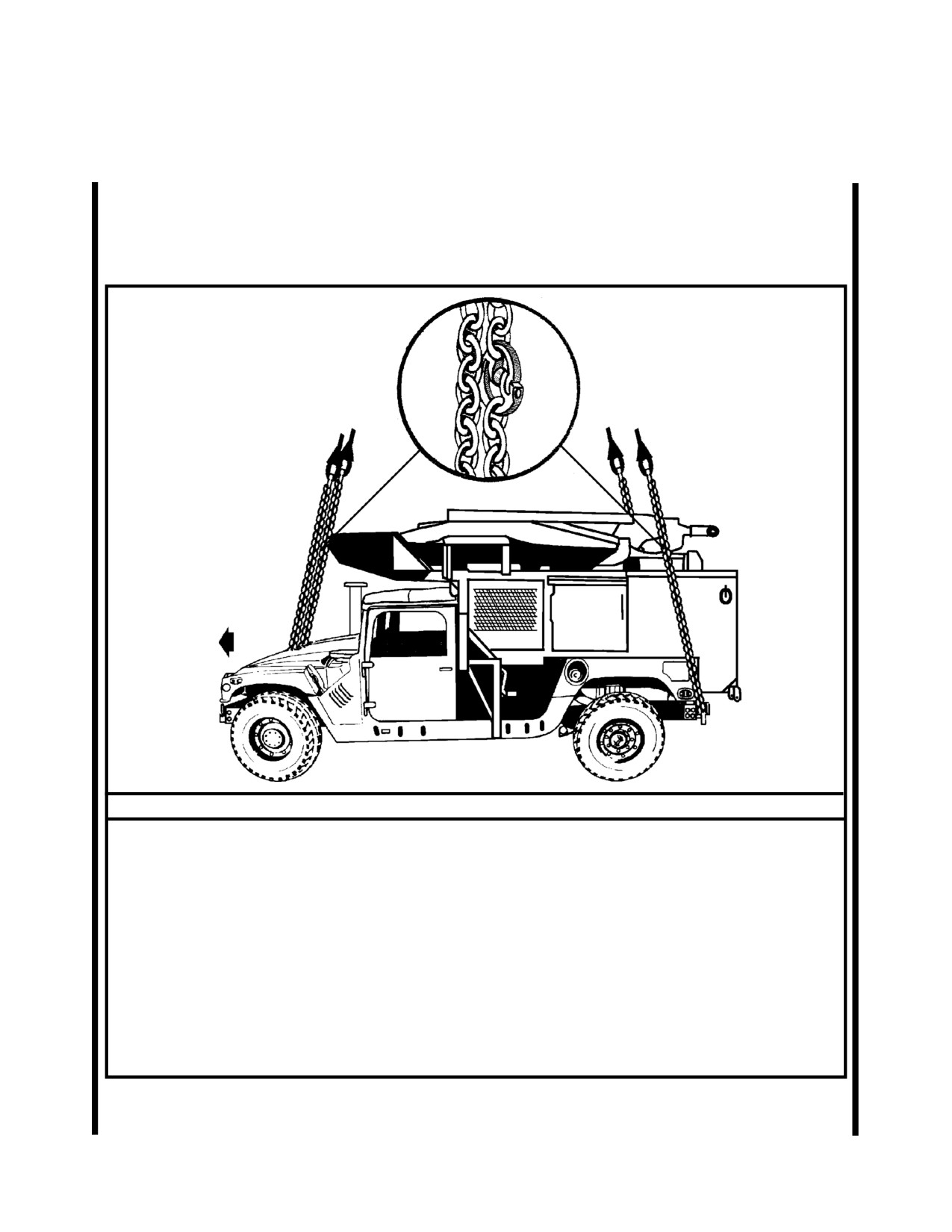
(2) Rigging. Rig the load according to the steps in
(a) Fold the mirrors inward for added protection and
Figure 2-37.
tie together with Type III nylon cord.
(3) Hookup. The hookup team stands on top of the
(b) Secure all equipment inside on the pallet with
vehicle. The static wand person discharges the static
2-88
C3, FM 10-450-4/MCRP 4-23E, VOL II/NWP 3-04.12/AFJMAN 11-223, VOL II/
COMDTINST M13482.3A
electricity with the static wand. The hookup person places
quickly exits the area underneath the helicopter to the
the apex fitting on the cargo hook. The hookup team then
designated rendezvous point.
carefully dismounts the vehicle and remains close to the
load as the helicopter removes slack from the sling legs.
(4) Derigging. Derigging is the reverse of the prepara-
When successful hookup is assured, the hookup team
tion and rigging procedures in steps d (1) and d (2).
RIGGING STEPS
1. Position apex fitting on top of the truck. Route outer
3. Loop the chain end of sling leg 3 through the left rear
sling legs 1and 2 to the front of the vehicle and inner sling
lift provision located on the outer ends of the rear bumper.
legs 3 and 4 to the rear. Sling legs 1 and 3 must be on the
Place the correct link from Table 2-37 in the grab hook.
left side of the load.
Repeat with sling leg 4 and the right rear lift provision.
Ensure sling leg 4 is routed between the handholds on the
2. Loop the chain end of sling leg 1 through the left
right side of the system. Remove the slack from sling leg
front lift provision that protrudes through the hood from
4 and secure the sling leg to the front handhold with Type
inboard to outboard. Place the correct link from Table 2-37
I, 1/4-inch cotton webbing. Secure excess chain with tape
in the grab hook. Repeat with sling leg 2 and the right
or Type III nylon cord.
front lift provision. Secure excess chain with tape or Type
III nylon cord.
4. Cluster and tie or tape (breakaway technique) all sling
legs together on top of the vehicle to prevent entangle-
ment during hookup and lift-off.
Figure 2-37. Trojan Spirit Lite (V)2, Central Communications AN/TSQ-226 (V)2 on M1113 HMMWV
2-89
C3, FM 10-450-4/MCRP 4-23E, VOL II/NWP 3-04.12/AFJMAN 11-223, VOL II/
COMDTINST M13482.3A
CHAPTER 3
CERTIFIED SINGLE-POINT RIGGING PROCEDURES FOR TRAILERS
3-1. INTRODUCTION
This chapter contains rigging procedures for single-point
dures for trailers are in this section. Paragraphs 3-2 through
trailer loads that have been certified for sling load. Each
3-33 give detailed instructions for rigging loads.
rigging procedure is found in a paragraph that includes a
description of the load, materials required for rigging, and
NOTE: Reach Pendants may be used on all single point
steps to complete the procedure. An applicability para-
loads. A static discharge person is not required when
graph is also a part of each paragraph and identifies the
using a Reach Pendant.
certified loads. The certified single-point rigging proce-
3-2. M416 1/4 Ton Trailer
a. Applicability. The following item in Table 3-1 is certified for all helicopters with suitable lift capacity by the US Army
Soldier Systems Center:
Table 3-1. M416 1/4-Ton Trailer
MAX
RECOMMENDED
LINK COUNT
NOMENCLATURE
WEIGH T
SLING SET
AIRSPEE D
FRONT/REA R
(POUNDS )
(KNOTS )
M416 1/4-Ton Tra
l
1,080
10K
/
90
WARNING
c. Personnel. Two persons can prepare and rig this
load in 15 minutes.
THE M416 1/4-TON TRAILER MUST HAVE A GROSS
d. Procedures. The following procedures apply to
WEIGHT OF 800 POUNDS OR MORE. ADD ADDI-
this load:
TIONAL WEIGHT OR CARGO TO ANY TRAILER
WHICH WEIGHS LESS THAN 800 POUNDS.
(1) Preparation. Prepare the load using the following
steps:
b. Materials. The following materials are required to
rig this load:
(a) Lower and lock the trailer support leg in the down
position.
(1) Sling set (10,000-pound capacity).
(b) Tape or tie the light cable firmly to the top of the
(2) Tape, adhesive, pressure-sensitive, 2-inch wide
drawbar.
roll.
(c) Load and lash the cargo in the bed of the trailer.
(3) Cord, nylon, Type III, 550-pound breaking strength.
(d) Ensure the parking brake is set.
(4) Webbing, cotton, 1/4-inch, 80-pound breaking
strength.
(2) Rigging. Rig the load according to the steps in
Figure 3-1.
(5) Tie down, CGU-1B or Dacron lashing and load
binder.
(3) Hookup. The hookup team stands in the bed of
3-1
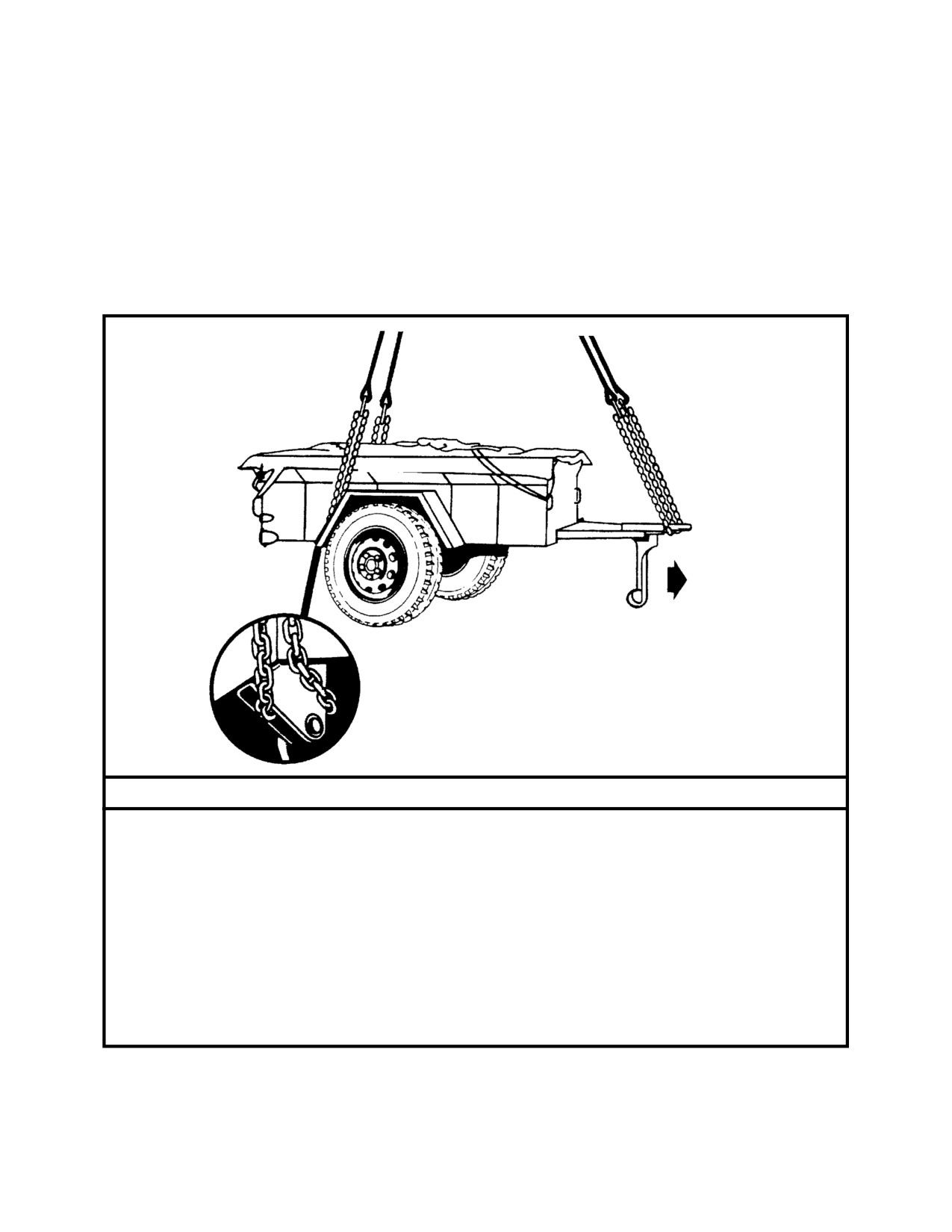
C3, FM 10-450-4/MCRP 4-23E, VOL II/NWP 3-04.12/AFJMAN 11-223, VOL II/
COMDTINST M13482.3A
the trailer. The static wand person discharges the static
hookup team quickly exits the area underneath the heli-
electricity with the static wand. The hookup person places
copter to the designated rendezvous point.
the apex fitting onto the aircraft cargo hook. The hookup
team then carefully dismounts the vehicle and remains
(4) Derigging. Derigging is the reverse of the prepa-
close to the load as the helicopter removes slack from the
ration and rigging procedures in steps d (1) and d (2).
sling legs. When successful hookup is assured, the
RIGGING STEPS
1. Position apex fitting in the trailer bed. Route outer
from Table 3-1 in the grab hook. Repeat with sling leg 4
sling legs 1and 2 to the front of the trailer and inner sling
around the right rear spring shackle mounting bracket.
legs 3 and 4 to the rear. Sling legs 1 and 3 must be on the
left side of the load.
4. Tape or tie (breakaway technique) the chains of legs
3 and 4 to the next-to-last tarpaulin hold-down hook on
2. Loop the chain end of sling leg 1 through the lunette.
each side.
Place the correct link from Table 3-1 in the grab hook.
Repeat with sling leg 2 through the lunette.
5. Cluster and tie or tape (breakaway technique) all sling
legs together on top of the trailer to prevent entanglement
3. Route the chain end of sling leg 3 around the left rear
during hookup and lift-off.
spring shackle mounting bracket. Place the correct link
Figure 3-1. M416 1/4 Ton Trailer
3-2
C1, FM 10-450-4/MCRP 4-23E, VOL II/NWP 3-04.12/AFJMAN 11-223, VOL II/
COMDTINST M13482.2
3-3. M101A2/A3 3/4-Ton Trailer
a. Applicability. The following items in Table 3-2 are certified for all helicopters with suitable lift capacity by the US
Army Soldier Systems Center:
Table 3-2. M101A2/A3 3/4-Ton Trailer
M AX
RECOMMENDED
LINK COUNT
NOMENCLATURE
WEIGH T
SLING SET
AIRSPEE D
FRONT/REA R
(POUNDS )
(KNOTS )
M101A2 with Accom panying Load
3,000
10K
3/40
65
Command Version 1
T
ra
l
1,958
10K
3/40
65
Command Version 2
T
ra
l
1,981
10K
3/40
65
Len Cable Tra
l
2,796
10K
3/40
65
NC Support Tra
l
2,643
10K
3/40
65
Maintenance Trailer
#2
1,430
10K
3/40
65
Battalion Spares Trailer
#1
1,594
10K
3/40
65
Battalion Spares Trailer
#2
2,206
10K
3/40
65
Marine Expeditionary Force Intelligence
3,000
10K
15/3
65
Analysis System M101A3
T
ra
l
T
echnical Control and Analysis Center
Production Im provem ent Program
3,000
10K
15/3
65
M101A3
T
ra
l
(4) Webbing, cotton, 1/4-inch, 80-pound breaking
WARNINGS
strength.
THE M101A2 3/4-TON TRAILER MUST HAVE A
GROSS WEIGHT OF 1,575 POUNDS OR MORE. ADD
(5) Tie down, CGU-1B or dacron lashing and load
ADDITIONAL WEIGHT OR CARGO TO ANY TRAILER
binder.
WHICH WEIGHS LESS THAN 1,575 POUNDS. PLACE
THE WEIGHT NEAR THE CENTER OF THE TRAILER.
c. Personnel. Two persons can prepare and rig this
load in 15 minutes.
MAXIMUM WEIGHT DURING SLING LOAD OPERA-
TIONS FOR ANY VARIANT OF THE M101A2 3/4-TON
d. Procedures. The following procedures apply to
TRAILER IS 3,000 POUNDS.
this load:
b. Materials. The following materials are required to
rig this load:
(1) Preparation. Prepare the load using the following
steps:
(1) Sling set (10,000-pound capacity).
(a) Fasten the tailgate in the open position with the
(2) Tape, adhesive, pressure-sensitive, 2-inch wide
chains on each side hooked through the keeper.
roll.
(b) Remove the front rack and place it in the bed of
(3) Cord, nylon, Type III, 550-pound breaking strength.
3-3
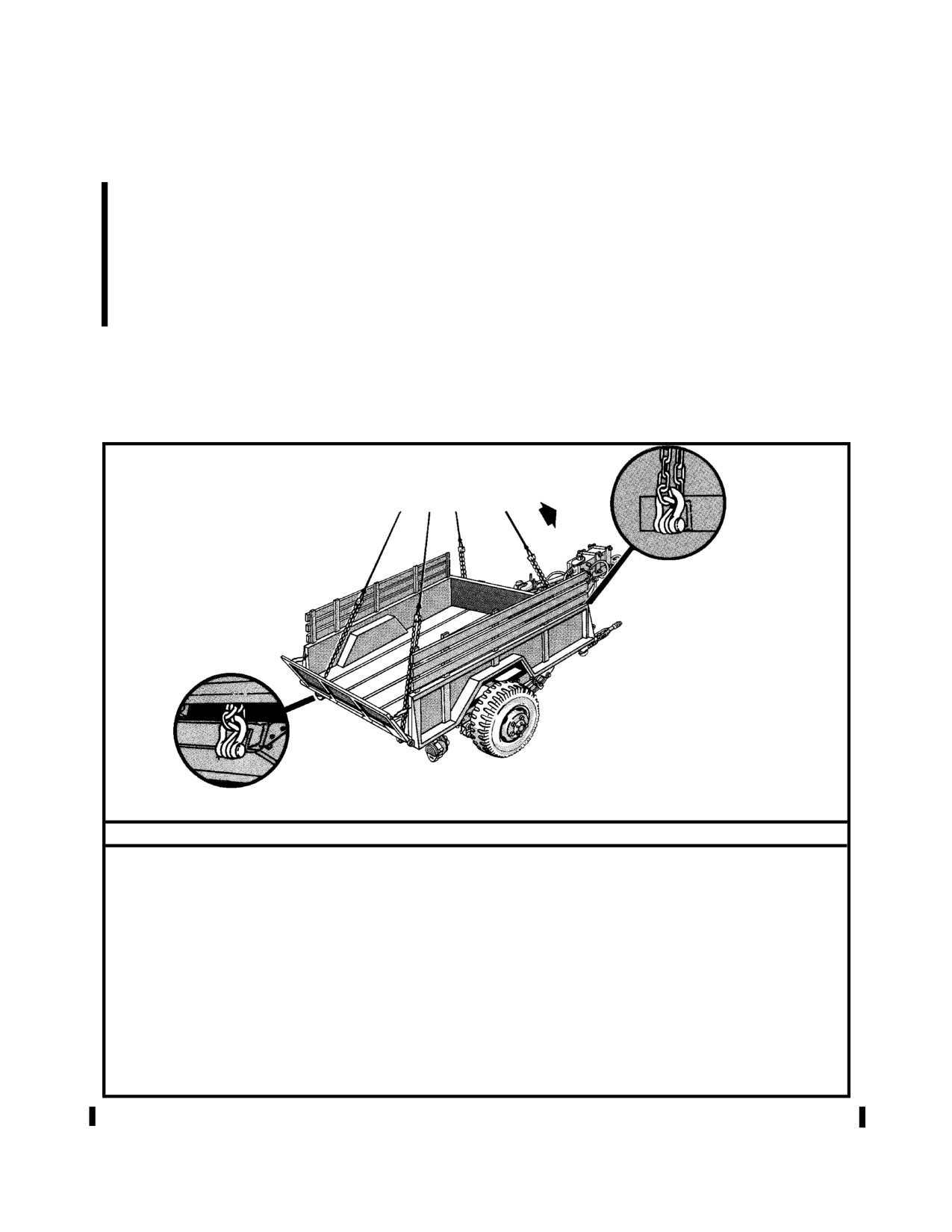
C1, FM 10-450-4/MCRP 4-23E, VOL II/NWP 3-04.12/AFJMAN 11-223, VOL II/
COMDTINST M13482.2
the trailer. Place the accompanying load on top of the
Figure 3-2.
front rack. Secure the accompanying load to the trailer
using tie-down straps. Route the straps diagonally across
(3) Hookup. The hookup team stands in the bed of
the load from the tailgate hinge to the front lifting shack-
the trailer. The static wand person discharges the static
les.
electricity with the static wand. The hookup person places
the apex fitting onto the aircraft cargo hook. The hookup
(c) Tape or tie the light cable firmly to the top of the
team then carefully dismounts the vehicle and remains
drawbar.
close to the load as the helicopter removes slack from the
sling legs. When successful hookup is assured, the
(d) Ensure the tongue wheel is in the down and
hookup team quickly exits the area underneath the heli-
locked position and the parking brake is set..
copter to the designated rendezvous point.
(2) Rigging. Rig the load according to the steps in
(4) Derigging. Derigging is the reverse of the prepa-
ration and rigging procedures in steps d (1) and d (2).
RIGGING STEPS
1. Position apex fitting in the trailer bed. Route outer
lift provision. Place the correct link from Table 3-2 in the
sling legs 1and 2 to the front of the trailer and inner sling
grab hook. Repeat with sling leg 4 through the right rear
legs 3 and 4 to the rear. Route the rear chains through the
lift provision. Secure excess chain with tape or Type III
opening between the tailgate and the trailer bed. Sling
nylon cord.
legs 1 and 3 must be on the left side of the load.
4. Tape or tie (breakaway technique) the chains of legs
2. Loop the chain end of sling leg 1 through the left
3 and 4 to the side racks to keep the chains from binding
front lift provision located on the front of the trailer. Place
between the tailgate and trailer bed.
the correct link from Table 3-2 in the grab hook. Repeat
with sling leg 2 through the right front lift provision. Se-
5. Cluster and tie or tape (breakaway technique) all sling
cure excess chain with tape or Type III nylon cord.
legs together on top of the trailer to prevent entanglement
during hookup and lift-off.
3. Route the chain end of sling leg 3 through the left rear
Figure 3-2. M101A2/A3 3/4-Ton Trailer
3-4

FM 10-450-4/MCRP 4-23E, VOL II/NWP 3-04.12/AFJMAN 11-223, VOL II/
COMDTINST M13482.2
3-4. M1048/M1073 Trailer
a. Applicability. The following item in Table 3-3 is certified for all helicopters with suitable lift capacity by the US Army
Natick Research, Development, and Engineering Center:
Table 3-3. M1048/M1073 Trailer
MAX
RECOMMENDED
LINK COUNT
NOMENCLATURE
WEIGHT
SLING SET
AIRSPEED
FRONT/REAR
(POUNDS)
(KNOTS)
M1048 Trailer
5,880
10K
44/6
120
M1073 Trailer
6,260
15K
58/3
110
b. Materials. The following materials are required to
(b) Secure any lids, caps, or loose items with tape or
rig this load:
Type III nylon cord.
(1) Sling set (10,000-pound capacity).
(c) Tape or tie the light cable firmly to the top of the
drawbar.
OR
(d) Place the leveling jacks in the down position.
(2) Multileg sling set (15,000-pound capacity).
Ensure the base of the leveling jacks are not extended.
Stow the jack handles and secure with Type III nylon
(3) Tape, adhesive, pressure-sensitive, 2-inch wide
cord. The trailer should lean downward at the lunette end.
roll.
(e) Ensure the parking brake is set.
(4) Cord, nylon, Type III, 550-pound breaking strength.
(2) Rigging. Rig the load according to the steps in
(5) Webbing, cotton, 1/4-inch, 80-pound breaking
Figure 3-3.
strength.
(3) Hookup. The hookup team stands in the bed of
the trailer. The static wand person discharges the static
c. Personnel. Two persons can prepare and rig this
electricity with the static wand. The hookup person places
load in 15 minutes.
the apex fitting onto the aircraft cargo hook. The hookup
team then carefully dismounts the vehicle and remains
d. Procedures. The following procedures apply to this
close to the load as the helicopter removes slack from the
load:
sling legs. When successful hookup is assured, the
hookup team quickly exits the area underneath the heli-
(1) Preparation. Prepare the load using the following
copter to the designated rendezvous point.
steps:
(4) Derigging. Derigging is the reverse of the prepa-
(a) Secure all loose chains, hoses, and cables to the
ration and rigging procedures in steps d (1) and d (2).
trailer drawbar with Type III nylon cord.
3-5
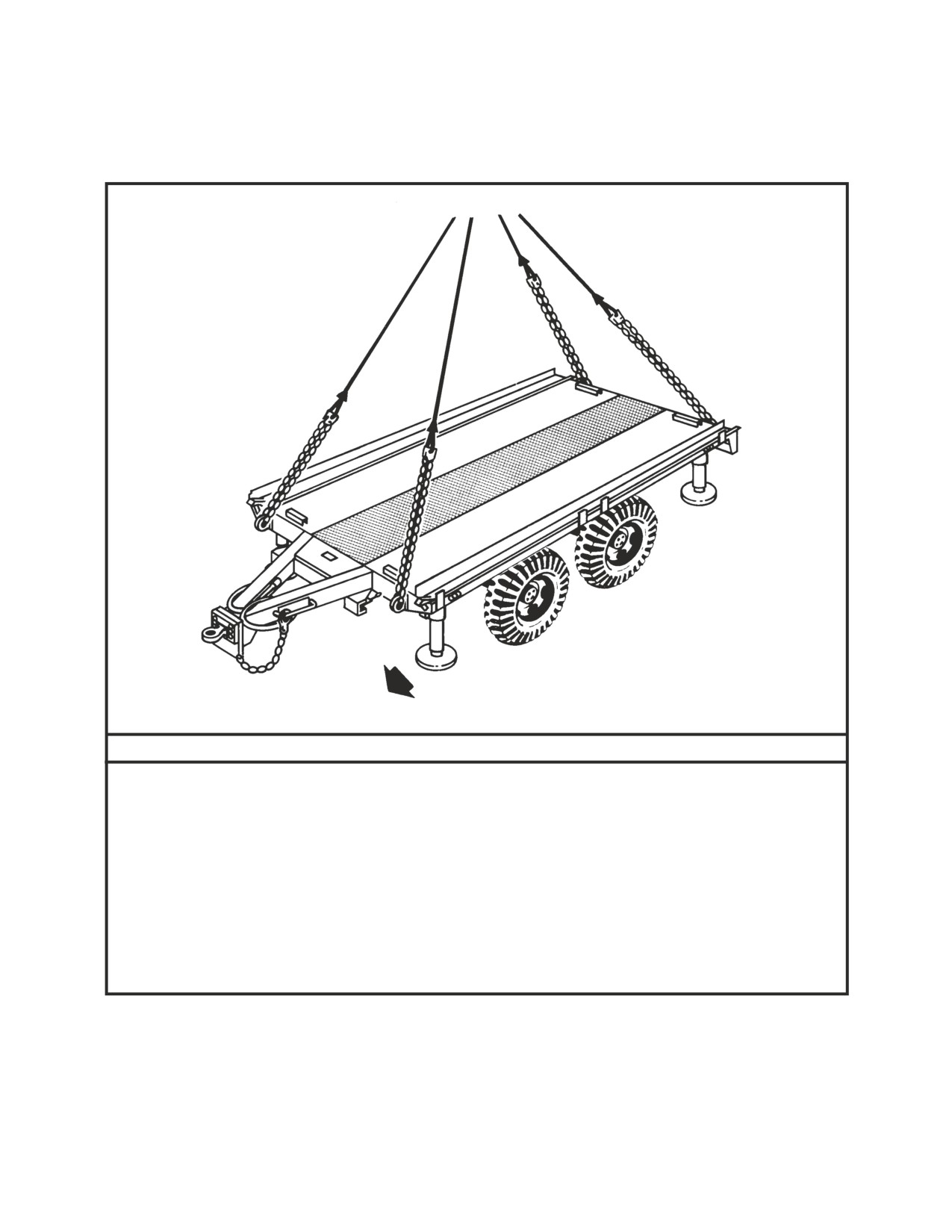
FM 10-450-4/MCRP 4-23E, VOL II/NWP 3-04.12/AFJMAN 11-223, VOL II/
COMDTINST M13482.2
RIGGING STEPS
1. Position apex fitting in the trailer bed. Route outer
3. Route the chain end of sling leg 3 through the left rear
sling legs 1and 2 to the front of the trailer and inner sling
lift provision. Place the correct link from Table 3-3 in the
legs 3 and 4 to the rear. Sling legs 1 and 3 must be on the
grab hook. Repeat with sling leg 4 through the right rear
left side of the load.
lift provision. Secure excess chain with tape or Type III
nylon cord.
2. Loop the chain end of sling leg 1 through the left
front lift provision located on the left front corner of the
4. Cluster and tie or tape (breakaway technique) all sling
trailer. Place the correct link from Table 3-3 in the grab
legs together on top of the trailer to prevent entanglement
hook. Repeat with sling leg 2 through the right front lift
during hookup and lift-off. Secure excess chain with tape
provision.
or Type III nylon cord.
Figure 3-3. M1048/M1073 Trailer
3-6
FM 10-450-4/MCRP 4-23E, VOL II/NWP 3-04.12/AFJMAN 11-223, VOL II/
COMDTINST M13482.2
3-5. M1048 Trailer with Tracked Suspension System (TSS)
a. Applicability. The following item in Table 3-4 is certified for all helicopters with suitable lift capacity by the US Army
Natick Research, Development, and Engineering Center:
Table 3-4. M1048 Trailer (TSS)
MAX
RECOMMENDED
LINK COUNT
NOMENCLATURE
WEIGHT
SLING SET
AIRSPEED
FRONT/REAR
(POUNDS)
(KNOTS)
M1048 Trailer (TSS)
7,880
10K
26/3
120
b. Materials. The following materials are required to
(c) Tape or tie the light cable firmly to the top of the
rig this load:
drawbar.
(1) Sling set (10,000-pound capacity).
(d) Place the front leveling jacks in the down posi-
tion. Ensure the base of the leveling jacks are not ex-
(2) Tape, adhesive, pressure-sensitive, 2-inch wide
tended. Stow the jack handles and secure with Type III
roll.
nylon cord. Secure the rear leveling jacks in the up posi-
tion. The trailer should lean downward at the lunette end.
(3) Cord, nylon, Type III, 550-pound breaking strength.
(e) Ensure the parking brake is set.
(4) Webbing, cotton, 1/4-inch, 80-pound breaking
strength.
(2) Rigging. Rig the load according to the steps in
Figure 3-4.
c. Personnel. Two persons can prepare and rig this
(3) Hookup. The hookup team stands in the bed of
load in 10 minutes.
the trailer. The static wand person discharges the static
electricity with the static wand. The hookup person places
d. Procedures. The following procedures apply to this
the apex fitting onto the aircraft cargo hook. The hookup
load:
team then carefully dismounts the vehicle and remains
close to the load as the helicopter removes slack from the
(1) Preparation. Prepare the load using the following
sling legs. When successful hookup is assured, the
steps:
hookup team quickly exits the area underneath the heli-
copter to the designated rendezvous point.
(a) Secure all loose chains, hoses, and cables to the
trailer drawbar with Type III nylon cord.
(4) Derigging. Derigging is the reverse of the prepa-
ration and rigging procedures in steps d (1) and d (2).
(b) Secure any lids, caps, or loose items with tape or
Type III nylon cord.
3-7