FM 4-20.199 Multiservice Helicopter Sling Load: Dual-Point Load Rigging Procedures (February 2009) - page 12
Certified Dual-Point Rigging Procedures for Containers
TANDEM LIFT OF TWO ISU-90 SHIPPING/STORAGE CONTAINERS
11-3. The tandem lift of two ISU-90 shipping/storage containers are rigged for dual-point sling load using
the following procedures:
z
Applicability. The following items in Table 11-2 are certified for the helicopter(s) listed in the
following table by the US Army Natick Soldier Center:
Table 11-2. Tandem Lift of Two ISU-90 Shipping/Storage Containers
Nomenclature
Max
Sling Set
Link Count
Type of
Weight
Front/Rear
Aircraft
(Pounds)
Two (2) ISU-90 Shipping/Storage
7,500-Each
25K
20/10
CH-47
Containers, Tandem
15,000-Total
WARNING
As the weight of the containers drop, the airspeed must also
drop.
z
Materials. The following materials are required to rig this load:
Sling set (25,000-pound capacity) (2 each).
Tape, adhesive, pressure-sensitive, 2-inch wide roll.
Cord, nylon, Type III, 550-pound breaking strength.
Webbing, cotton, 1/4-inch, 80-pound breaking strength.
Lumber, 4-inch x 6-inch x 72-inch (2 each).
Lumber, 1-inch x 3-inch x 24-inch (2 each).
Bolts, 1/2-inch x 6-inch (2 each).
Nuts, 1/2-inch (2 each).
Rope, 5/8-inch x 84-inch (2 each).
Strap, cargo, tie-down, CGU-1/B (as required).
z
Personnel. Two persons can prepare and rig this load in 20 minutes.
z
Procedures. The following procedures apply to this load:
Preparation. Prepare the load using the following steps:
─ Secure all cargo inside the container.
─ Secure all doors in the closed/locked position.
─ Construct the top wooden separator by bolting the two 1-inch x 3-inch x
24-inch
pieces of lumber to a
4-inch x 6-inch x 72-inch piece of lumber. Space the 1-inch x
3-inch x 24-inch pieces of lumber so they will fit in the 45 degree slots on the top of
the ISU-90. Drill two additional 3/4-inch holes through the 4-inch x 6-inch x 72-inch
piece of lumber 18-inches in from each end. Route one end of a piece of 5/8-inch rope
up through the 3/4-inch hole from bottom to top. Tie an overhand knot in the top
running end. Route the running end of the second 5/8-inch rope up through the second
3/4-inch hole from bottom to top and tie an overhand knot in the top running end.
─ Construct the bottom wooden separator by drilling two 3/4-inch holes in the second 4-
inch x 6-inch x 72-inch piece of lumber 18-inches in from each end. Route the other
running end of the ropes through the holes in the bottom separator from top to bottom
and tie an overhand knot in each bottom running end.
FM 4-20.199/MCRP 4-11.3E, VOL III/NTTP 3-04.13/
20 February 2009
AFMAN 11-223 (I), VOL III/COMDINST M13482.4B
11-3
Chapter 11
─ Raise the top wooden separator up to the top of the ISU-90 and slide the unbolted end
of the two 1-inch x 3-inch x 24-inch pieces of lumber into the 45 degree slots on the
top of the ISU-90.
─ Move the second container as close as possible to the first container, end to end.
Designate the heaviest container as the forward container.
─ Pass a CGU-1/B through each inboard forklift point of each ISU-90. Connect the two
CGU-1/Bs together and tighten.
─ Encircle the top of the two ISU-90s by connecting the CGU-1Bs together. Tighten the
CGU-1Bs.
CAUTION
The containers should be as close as possible in weight. If the weight
varies by 500 pounds or more, place the heavier container in the
forward position. Ensure the weight inside the containers is evenly
distributed.
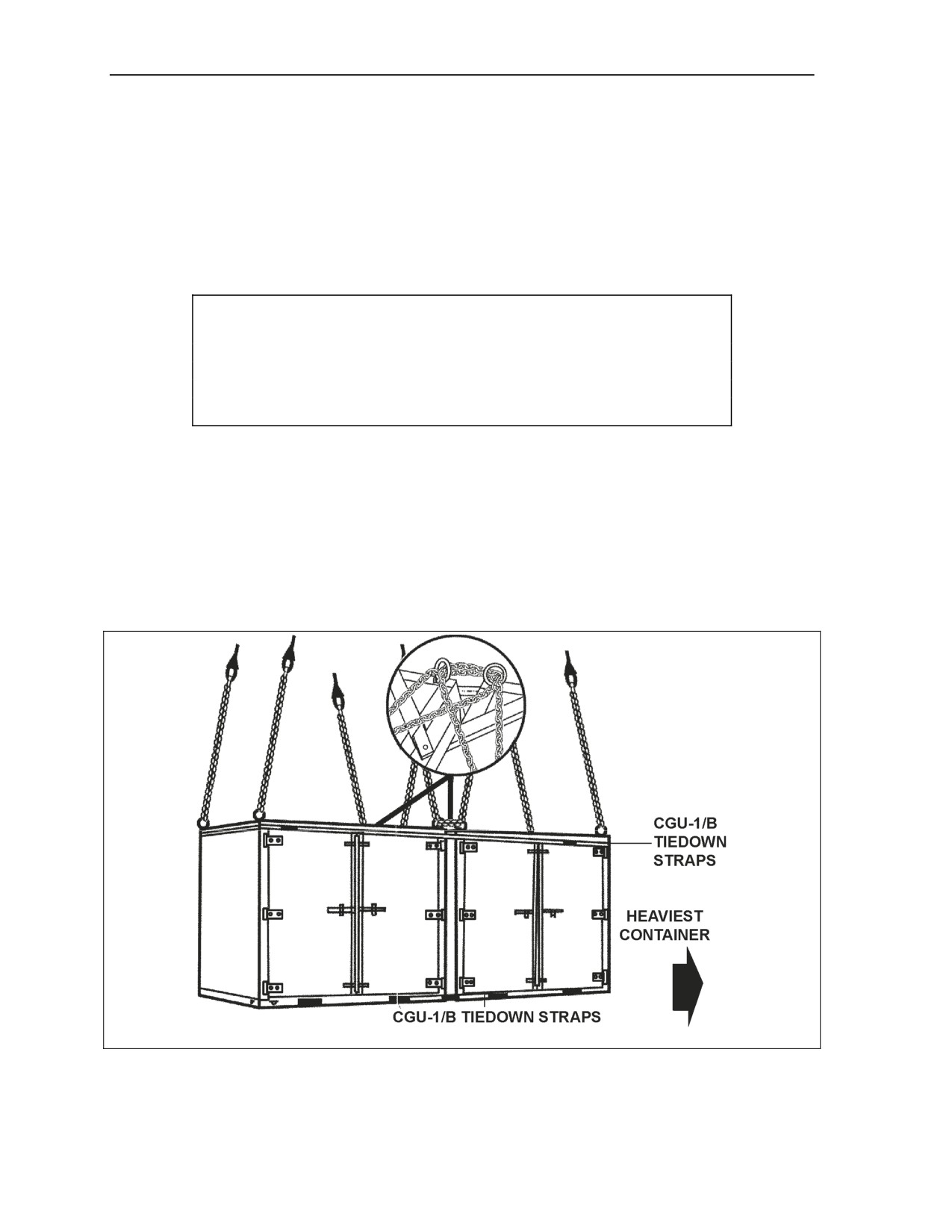
Rigging. Rig the load according to the steps in Figure 11-2.
Hookup. Two hookup teams are used for this load. The static wand person discharges the
static electricity with the static wand. The forward hookup person stands on top of the forward
load and places apex fitting 1 onto the forward cargo hook. The aft hookup person stands on
top of the rear load and places apex fitting 2 onto the aft cargo hook. The hookup team then
carefully dismounts the load and remains close to the load as the helicopter removes slack
from the sling legs. When successful hookup is assured, the hookup team quickly exits the
area underneath the helicopter to the designated rendezvous point.
Derigging. Derigging is the reverse of the preparation and rigging procedures.
Figure 11-2. Two ISU-90 Shipping/Storage Containers
FM 4-20.199/MCRP 4-11.3E, VOL III/NTTP 3-04.13/
11-4
AFMAN 11-223 (I), VOL III/COMDINST M13482.4B
20 February 2009

Certified Dual-Point Rigging Procedures for Containers
RIGGING STEPS
1.
Position sling set one on top of the forward container.
2.
Route outer sling legs 1 and 2 to the forward end of the forward container and inner legs 3
and 4 to the rear. Loop the chain end of sling legs 1 and 2 through their respective lift
provisions located on the forward end of the container. Place the correct link from Table 11-2
in the grab hook. Loop the chain end of sling legs 3 and 4 through the lift provisions on the
rear of the forward container and the front of the rear container. Place the correct link from
Table 11-2 in the grab hook.
3.
Position sling set two on top of the rear container.
4.
Route outer sling legs 1 and 2 to the forward end of the rear container and inner legs 3 and 4
to the rear. Loop the chain end of sling legs 1 and 2 through the lift provisions on the front of
the rear container and the rear of the front container. Place the correct link from Table 11-2
in the grab hook. Loop the chain end of sling legs 3 and 4 through their respective lift
provisions located on the rear end of the rear container. Place the correct link from Table 11-
2 in the grab hook.
5.
Secure all excess chain with tape or Type III nylon cord.
6.
Cluster and tie (breakaway technique) the sling legs in each sling set on top of the
containers to prevent entanglement during hookup and lift-off.
Figure 11-2. Two ISU-90 Shipping/Storage Containers (Continued)
AUTHORIZED STOCKAGE LIST MOBILITY SYSTEM (ASLMS),
12-FOOT SECTION
11-4. The authorized stockage list mobility system, 12-foot section is rigged for dual-point sling load using
the following procedures:
z
Applicability. The following item in Table 11-3 is certified for the helicopter(s) listed in the
following table by the US Army Natick Soldier Center:
Table 11-3. Authorized Stockage List Mobility System, 12-Foot Section
Nomenclature
Max
Sling Set
Link Count
Type of
Weight
Front/Rear
Aircraft
(Pounds)
Authorized Stockage List Mobility System FPU-
20,000
25K
3/3
CH-47
12 (12-Foot Section Only)
40K
CH-53
z
Materials. The following materials are required to rig this load:
Sling set (25,000-pound capacity) with one additional apex fitting.
OR
Sling set (40,000-pound capacity) with one additional apex fitting.
Tape, adhesive, pressure-sensitive, 2-inch wide roll.
Cord, nylon, Type III, 550-pound breaking strength.
Webbing, cotton, 1/4-inch, 80-pound breaking strength.
z
Personnel. Two persons can prepare and rig this load in 15 minutes.
z
Procedures. The following procedures apply to this load:
Preparation. Prepare the load using the following steps:
FM 4-20.199/MCRP 4-11.3E, VOL III/NTTP 3-04.13/
20 February 2009
AFMAN 11-223 (I), VOL III/COMDINST M13482.4B
11-5
Chapter 11
─ Secure all cargo inside the container.
─ Secure all doors in the closed/locked position.
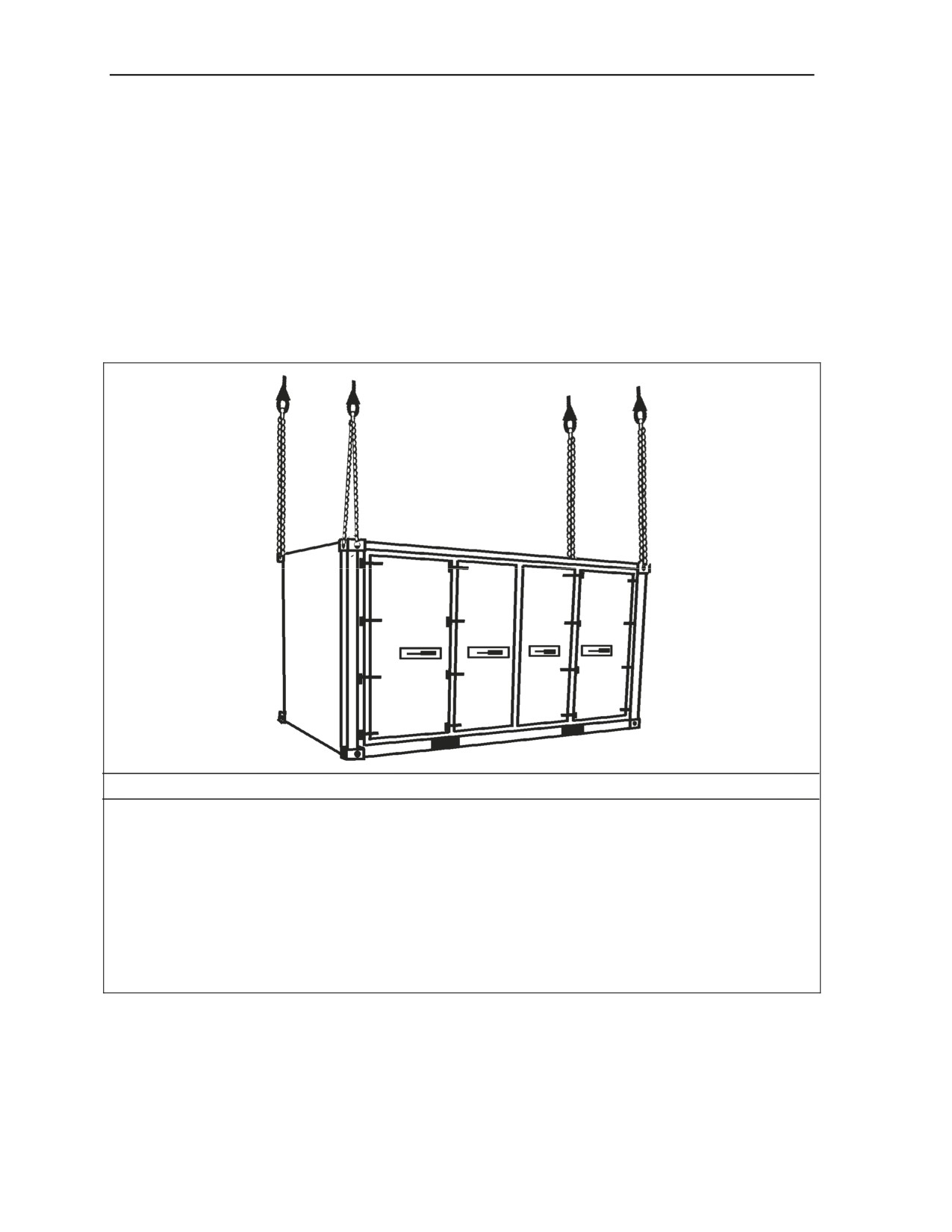
Rigging. Rig the load according to the steps in Figure 11-3.
Hookup. Two hookup teams are used for this load. The static wand person discharges the
static electricity with the static wand. The forward hookup person stands on top of the forward
load and places apex fitting 1 onto the forward cargo hook. The aft hookup person stands on
top of the rear load and places apex fitting 2 onto the aft cargo hook. The hookup team then
carefully dismounts the load and remains close to the load as the helicopter removes slack
from the sling legs. When successful hookup is assured, the hookup team quickly exits the
area underneath the helicopter to the designated rendezvous point.
Derigging. Derigging is the reverse of the preparation and rigging procedures.
RIGGING STEPS
1. Place two sling legs on apex fitting number 1. Position apex fitting number 1 on top of the
front of the load.
2. Loop the chain end of the left and right sling legs through their respective lift provisions
located on the corners so the chain is routed through the opening in the side of the ISO and
out through the front opening. Place the correct link from Table 11-3 in the grab hook.
3. Place two sling legs on apex fitting number 2. Position apex fitting number 2 on top of the
container.
Figure 11-3. Authorized Stockage List Mobility Systems, 12-Foot Section
FM 4-20.199/MCRP 4-11.3E, VOL III/NTTP 3-04.13/
11-6
AFMAN 11-223 (I), VOL III/COMDINST M13482.4B
20 February 2009

Certified Dual-Point Rigging Procedures for Containers
RIGGING STEPS (Continued)
4. Loop the chain end of the left and right sling legs through their respective lift provisions
located on the corners so the chain is routed through the opening in the side of the ISO and
out through the rear opening. Place the correct link from Table 11-3 in the grab hook.
5. Cluster and tie (breakaway technique) the sling legs in each sling set on top of the containers
to prevent entanglement during hookup and lift-off.
Figure 11-3. Authorized Stockage List Mobility Systems, 12-Foot Section (Continued)
AUTHORIZED STOCKAGE LIST MOBILITY SYSTEM (ASLMS),
8- AND 12-FOOT SECTIONS CONNECTED
11-5. The authorized stockage list mobility system, 8- and 12-foot sections connected are rigged for dual-
point sling load using the following procedures:
z
Applicability. The following items in Table 11-4 are certified for the helicopter(s) listed in the
following table by the US Army Natick Soldier Center:
Table 11-4. Authorized Stockage List Mobility System, 8- and 12-Foot Sections Connected
Nomenclature
Max
Sling Set
Link Count
Type of
Weight
Front/Rear
Aircraft
(Pounds)
Authorized Stockage List Mobility System FPU-
25,000
25K
3/3
CH-47
8/12 (8- and 12-Foot Sections Connected)
26,000
40K
CH-53
z
Materials. The following materials are required to rig this load:
Sling set (25,000-pound capacity) with one additional apex fitting.
OR
Sling set (40,000-pound capacity) with one additional apex fitting.
Tape, adhesive, pressure-sensitive, 2-inch wide roll.
Cord, nylon, Type III, 550-pound breaking strength.
Webbing, cotton, 1/4-inch, 80-pound breaking strength.
z
Personnel. Two persons can prepare and rig this load in 15 minutes.
z
Procedures. The following procedures apply to this load:
Preparation. Prepare the load using the following steps:
─ Connect the ASLMS together using the manufacturer’s approved rigid connecting link
(Tandem Horizontal Connectors, part number 12900BA-1PZ).
─ Secure all cargo inside the container.
─ Secure all doors in the closed/locked position.
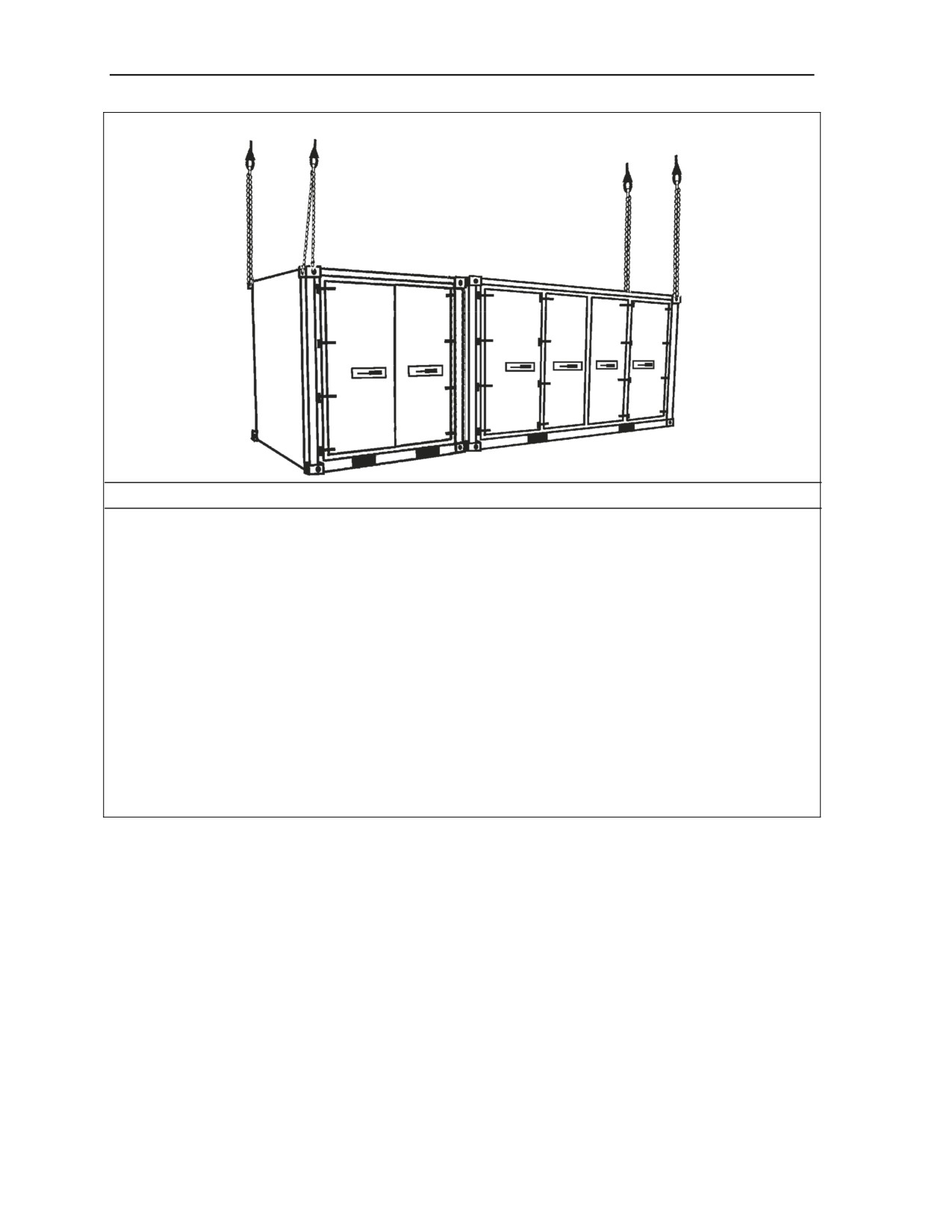
Rigging. Rig the load according to the steps in Figure 11-4.
Hookup. Two hookup teams are used for this load. The static wand person discharges the
static electricity with the static wand. The forward hookup person stands on top of the forward
load and places apex fitting 1 onto the forward cargo hook. The aft hookup person stands on
top of the rear load and places apex fitting 2 onto the aft cargo hook. The hookup team then
carefully dismounts the load and remains close to the load as the helicopter removes slack
from the sling legs. When successful hookup is assured, the hookup team quickly exits the
area underneath the helicopter to the designated rendezvous point.
Derigging. Derigging is the reverse of the preparation and rigging procedures.
FM 4-20.199/MCRP 4-11.3E, VOL III/NTTP 3-04.13/
20 February 2009
AFMAN 11-223 (I), VOL III/COMDINST M13482.4B
11-7
Chapter 11
RIGGING STEPS
1. Place two sling legs on apex fitting number 1. Position apex fitting number 1 on top of the
front of the load.
2. Loop the chain end of the left and right sling legs through their respective lift provisions
located on the corners so the chain is routed through the opening in the side of the ISO and
out through the front opening. Place the correct link from Table 11-4 in the grab hook.
3. Place two sling legs on apex fitting number 2. Position apex fitting number 2 on top of the
container.
4. Loop the chain end of the left and right sling legs through their respective lift provisions
located on the corners so the chain is routed through the opening in the side of the ISO and
out through the rear opening. Place the correct link from Table 11-4 in the grab hook.
5. Cluster and tie (breakaway technique) the sling legs in each sling set on top of the containers
to prevent entanglement during hookup and lift-off.
Figure 11-4. Authorized Stockage List Mobility Systems, 8- and 12-Foot Sections Connected
FM 4-20.199/MCRP 4-11.3E, VOL III/NTTP 3-04.13/
11-8
AFMAN 11-223 (I), VOL III/COMDINST M13482.4B
20 February 2009
Certified Dual-Point Rigging Procedures for Containers
QUADCONS
11-6. The quadcons are rigged for dual-point sling load using the following procedures:
z
Applicability. The following items in Table 11-5 are certified for the helicopter(s) listed in the
following table by the US Army Natick Soldier Center:
Table 11-5. Quadcons
Nomenclature
Max
Sling Set
Link Count
Type of
Weight
Front/Rear
Aircraft
(Pounds)
Three Quadcons (3), Empty
5,292
10K
3/3
CH-47
Three Quadcons (3), Loaded
16,000
25K
5/5
CH-47
Four Quadcons (4), Empty
7,056
10K
3/3
CH-47
Four Quadcons (4), Loaded
16,000
25K
5/5
CH-47
WARNING
Weight is restricted to 7,000 pounds in each quadcon for sling
load operations. Quadcons must be centrally loaded. Ensure
quadcons are loaded to similar weights for multiple quadcon
configurations. Off center loading or overloading may result in
adverse flight conditions or damage to the load.
Note. Recommended airspeed will vary based on load configuration and the weight of the load
inside the Quadcons.
z
Materials. The following materials are required to rig this load:
Sling set (10,000- or 25,000-pound capacity) with one additional apex fitting.
Tape, adhesive, pressure-sensitive, 2-inch wide roll.
Cord, nylon, Type III, 550-pound breaking strength.
Webbing, cotton, 1/4-inch, 80-pound breaking strength.
z
Personnel. Two persons can prepare and rig this load in 15 minutes.
z
Procedures. The following procedures apply to this load:
Preparation. Prepare the load using the following steps:
─ Connect the Quadcons together using the manufacture's approved rigid connecting link
(Part No. Sealock 1046). Lock all connecting links and wrap with tape.
─ Secure all cargo inside the container. Close and secure all doors in the locked position.
Rigging. Rig the load according to the steps in Figure 11-5.
Hookup. Two hookup teams stand on top of the container. The static discharge person
discharges the static electricity. The forward hookup person places apex fitting 1 onto the
forward cargo hook. The aft hookup person places apex fitting 2 onto the aft cargo hook. The
hookup teams then carefully dismount the container and remain close to the load as the
helicopter removes slack from the sling legs. When successful hookup is assured, the hookup
teams quickly exit the area underneath the helicopter to the designated rendezvous point.
Derigging. Derigging is the reverse of the preparation and rigging procedures.
FM 4-20.199/MCRP 4-11.3E, VOL III/NTTP 3-04.13/
20 February 2009
AFMAN 11-223 (I), VOL III/COMDINST M13482.4B
11-9
Chapter 11
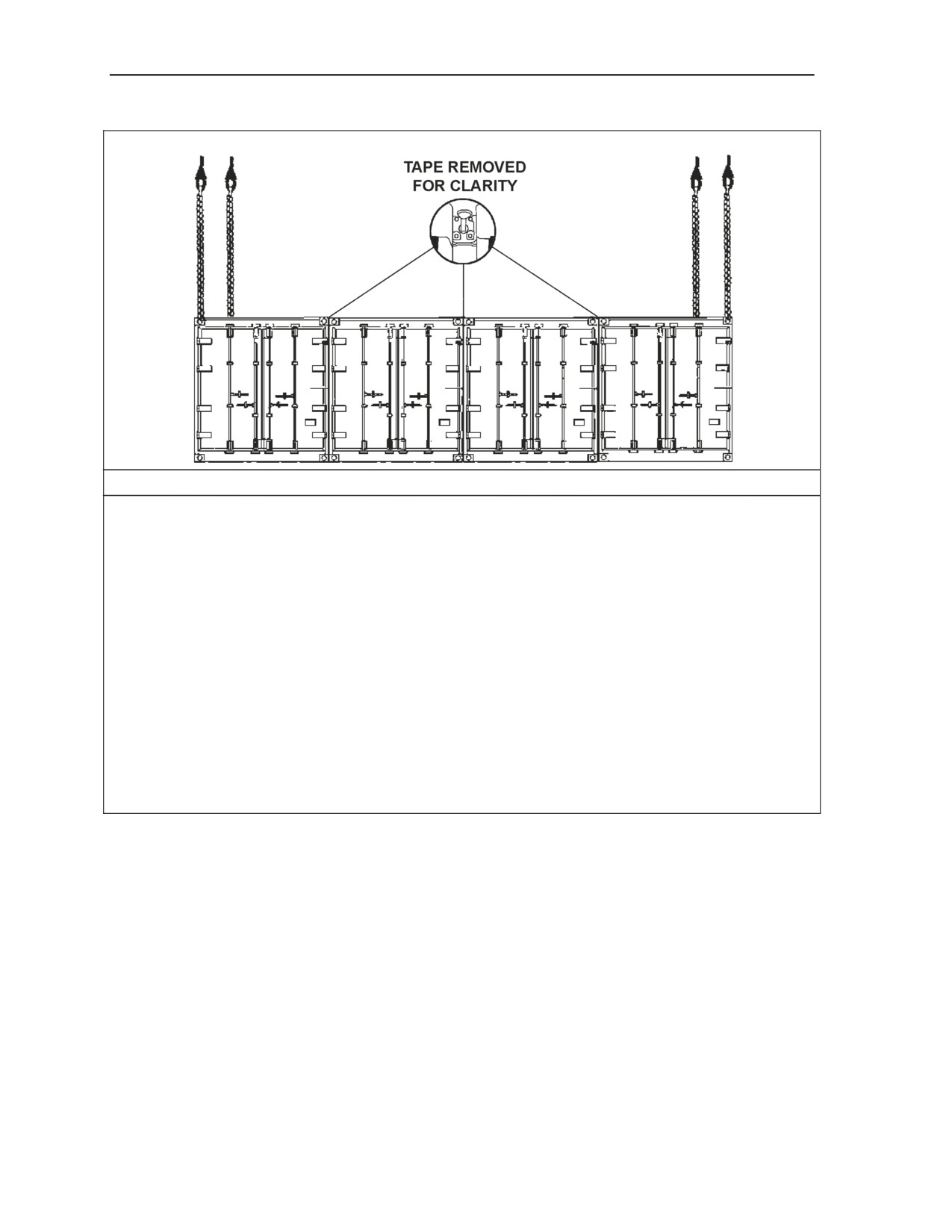
RIGGING STEPS
1. Connect 2 sling legs to apex fitting number 1. Position the apex fitting on top of the first
connected container.
2. Loop the chain end of the sling legs through their respective lift provisions on the top front
corner of the container. Place the correct link from Table 11-5 in the grab hook.
3. Connect 2 sling legs to apex fitting number 2. Position the apex fitting on top of the last
connected container.
4. Loop the chain end of the sling legs through their respective lift provisions on the top rear
corner of the container. Place the correct link from Table 11-5 in the grab hook.
5. Secure all excess chain with tape or Type III nylon cord.
6. Cluster and tie (breakaway technique) the sling legs in each sling set on top of the container
to prevent entanglement during hookup and lift-off.
Figure 11-5. Quadcons
LAUNCH POD CONTAINER (LPC) WITH MULTIPLE LAUNCH
ROCKET SYSTEM (MLRS) ROCKETS OR GUIDED MULTIPLE
LAUNCH ROCKET SYSTEM (G-MLRS) ROCKETS / GUIDED
MISSILE LAUNCH ASSEMBLY (GMLA)PODS WITH ARMY
TACTICAL MISSILE SYSTEM (ATACMS) MISSILES, TWO
CONTAINERS
11-7. The launch pod container with multiple launch rocket system rockets or guided multiple launch
rocket system rockets / guided missile launch assembly with army tactical missile system missiles, two
containers are rigged for dual-point sling load using the following procedures:
FM 4-20.199/MCRP 4-11.3E, VOL III/NTTP 3-04.13/
11-10
AFMAN 11-223 (I), VOL III/COMDINST M13482.4B
20 February 2009

Certified Dual-Point Rigging Procedures for Containers
z
Applicability. The following items in Table 11-6 are certified for the helicopter(s) listed in the
following table by the US Army Natick Soldier Center:
Table 11-6. Launch Pod Container with Multiple Launch Rocket System Rockets or Guided
Multiple Launch Rocket System Rockets / Guided Missile Launch Assembly Pods with Army
Tactical Missile System Missiles, Two Containers
Nomenclature
Max
Sling
Link Count
Type of
Weight
Set
Front/Rear
Aircraft
(Pounds)
Launch Pod Container with Multiple Launch Rocket
10,190
25K
3/3
CH-47
System Rockets or Guided Multiple Launch Rocket
System Rockets, (with Six Rockets)
Guided Missile Launch Assembly with Army Tactical
10,222
25K
3/3
CH-47
Missile System Missiles
z
Materials. The following materials are required to rig this load:
Sling set (25,000-pound capacity) with one additional apex fitting.
Tape, adhesive, pressure-sensitive, 2-inch wide roll.
Cord, nylon, Type III, 550-pound breaking strength.
Webbing, cotton, 1/4-inch, 80-pound breaking strength.
Strap, cargo, tiedown, CGU-1/B (as required).
Felt sheet, cattle hair, Type IV, 1/2-inch or suitable padding.
z
Personnel. Two persons can prepare and rig this load in 30 minutes.
z
Procedures. The following procedures apply to this load:
Preparation. Prepare the load using the following steps:
─ Prepare pods for travel in accordance with standard procedures.
CAUTION
Do not mix the MLRS and the GMLA in the same load.
─ Stack the pods one on top of the other ensuring both pods are facing the same
direction.
─ Lash the stacks of pods together using the CGU-1/B tiedown straps. Two of the straps
should run through both sets of lifting provisions on each end of the RP/Cs, to keep
them aligned during flight. Evenly space the remaining two straps between the lifting
provisions, running them around the pods. DO NOT ROUTE THE STRAPS OVER
THE ROCKET TUBES. Pad all straps in the area where they contact the edges of
the pods.
Rigging. Rig the load according to the steps in Figure 11-6.
Note. The firing end is considered to be the front of the load.
Hookup. Two hookup teams stand on top of the container. The static discharge person
discharges the static electricity. The forward hookup person places apex fitting 1 onto the
forward cargo hook. The aft hookup person places apex fitting 2 onto the aft cargo hook. The
hookup teams then carefully dismount the container and remain close to the load as the
helicopter removes slack from the sling legs. When successful hookup is assured, the hookup
teams quickly exit the area underneath the helicopter to the designated rendezvous point.
Derigging. Derigging is the reverse of the preparation and rigging procedures.
FM 4-20.199/MCRP 4-11.3E, VOL III/NTTP 3-04.13/
20 February 2009
AFMAN 11-223 (I), VOL III/COMDINST M13482.4B
11-11
Chapter 11
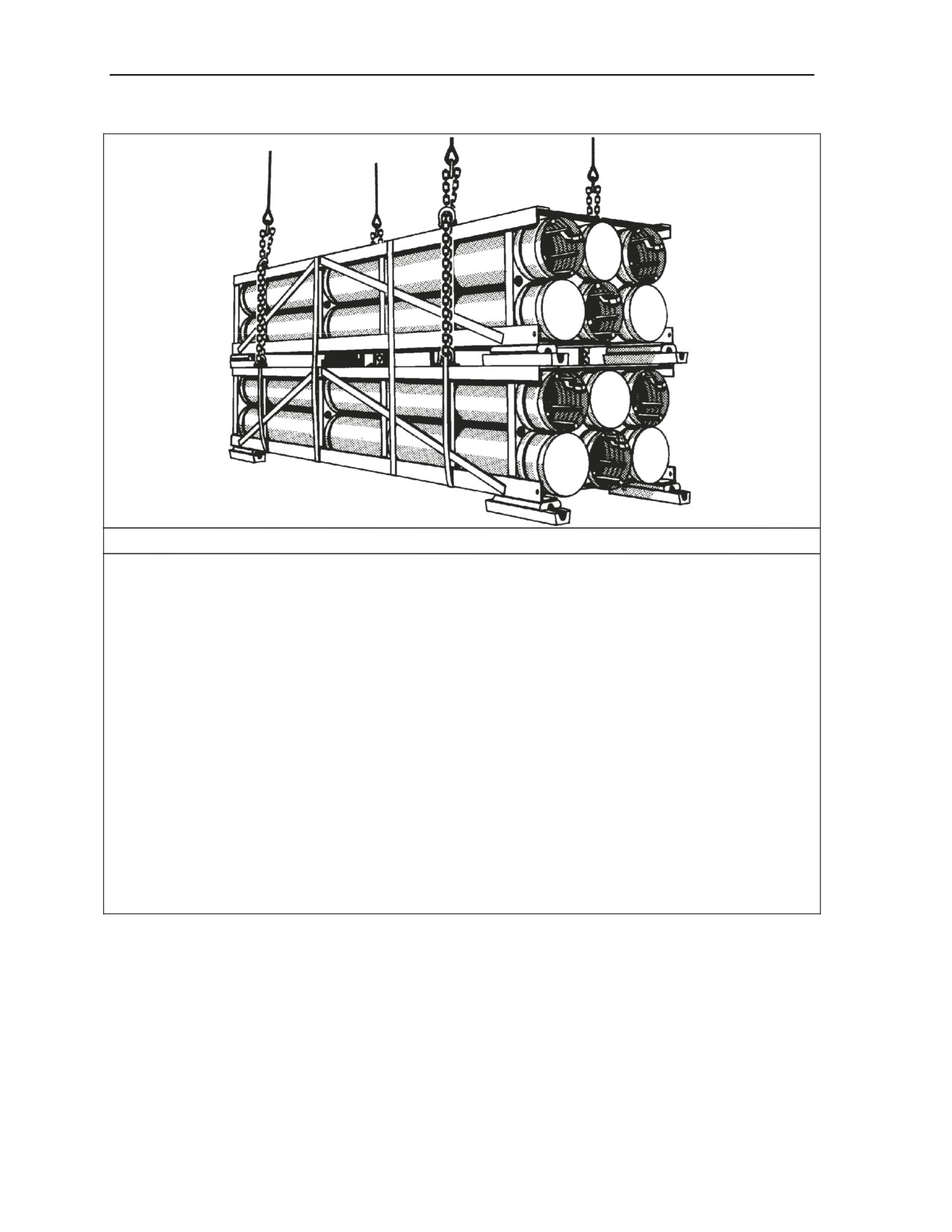
RIGGING STEPS
1. Place two sling legs on apex fitting number 1. Position apex fitting number 1 on top of the
forward end of the pods.
2. Loop the chain end of the left and right sling legs through their respective top front lift
provisions of the pod, through the front lifting provision on the bottom pod, and back through
the front top lift provision on the top pod. Place the correct link from Table 11-5 in the grab
hook.
3. Place two sling legs on apex fitting number 2. Position apex fitting number 1 on top of the aft
end of the pods.
4. Loop the chain end of the left and right sling legs through their respective top rear lift
provisions of the pod, through the rear lifting provision on the bottom pod, and back through
the rear top lift provision on the top pod2. Place the correct link from Table 11-5 in the grab
hook.
5. Raise the apex fittings above the shelter. Cluster and tie (breakaway technique) the sling
legs in each sling set together to prevent entanglement during hookup and lift-off.
Figure 11-6. Launch Pod Container with Multiple Launch Rocket System Rockets or Guided
Multiple Launch Rocket System Rockets / Guided Missile Launch Assembly Pods with Army
Tactical Missile System Missiles, Two Containers
FM 4-20.199/MCRP 4-11.3E, VOL III/NTTP 3-04.13/
11-12
AFMAN 11-223 (I), VOL III/COMDINST M13482.4B
20 February 2009

Certified Dual-Point Rigging Procedures for Containers
LAUNCH POD CONTAINER (LPC) WITH MULTIPLE LAUNCH
ROCKET SYSTEM (MLRS) ROCKETS OR GUIDED MULTIPLE
LAUNCH ROCKET SYSTEM (G-MLRS) ROCKETS / GUIDED
MISSILE LAUNCH ASSEMBLY (GMLA)PODS WITH ARMY
TACTICAL MISSILE SYSTEM (ATACMS) MISSILES, FOUR
CONTAINERS
11-8. The launch pod container with multiple launch rocket system rockets or guided multiple launch
rocket system rockets / guided missile launch assembly pods with army tactical missile system missiles,
four containers are rigged for dual-point sling load using the following procedures:
z
Applicability. The following items in Table 11-7 are certified for the helicopter(s) listed in the
following table by the US Army Natick Soldier Center:
Table 11-7. Launch Pod Container with Multiple Launch Rocket System Rockets or Guided
Multiple Launch Rocket System Rockets / Guided Missile Launch Assembly Pods with Army
Tactical Missile System Missiles, Four Containers
Nomenclature
Max
Sling
Link Count
Type of
Weight
Set
Front/Rear
Aircraft
(Pounds)
Launch Pod Container with Multiple Launch Rocket
20,380
25K
3/14
CH-47
System Rockets or Guided Multiple Launch Rocket
System Rockets
Guided Missile Launch Assembly Pods with Army
20,444
25K
3/14
CH47
Tactical Missile System Missiles
z
Materials. The following materials are required to rig this load:
Sling set (25,000-pound capacity) (2 each).
Tape, adhesive, pressure-sensitive, 2-inch wide roll.
Cord, nylon, Type III, 550-pound breaking strength.
Webbing, cotton, 1/4-inch, 80-pound breaking strength.
Strap, cargo, tiedown, CGU-1/B (16 each).
Lumber, 2 X 4 X 65-inches (4 each).
Nails, eightpenny (as required).
Felt sheet, cattle hair, Type IV, 1/2-inch or suitable padding.
Crane or forklift (15,000-pound capacity or larger).
z
Personnel. Four persons can prepare and rig this load in 30 minutes.
z
Procedures. The following procedures apply to this load:
Preparation. Prepare the load using the following steps:
─ Prepare the pods for sling loading in accordance with standard procedures.
─ Prepare two pieces of dunnage to protect the pods by nailing two pieces of 2 X 4 X 65-
inch lumber together, wide side to wide side.
─ Make two stacks of pods. Use the crane or forklift to stack one stack of pods on top of
the other with the projectiles facing the same direction. Label the stacks #1 and #2.
CAUTION
Do not mix the MLRS and the GMLA in the same load.
FM 4-20.199/MCRP 4-11.3E, VOL III/NTTP 3-04.13/
20 February 2009
AFMAN 11-223 (I), VOL III/COMDINST M13482.4B
11-13
Chapter 11
─ Lash stack #1 together using four tiedown straps. Route a tiedown strap through both
sets of lifting provisions on each end of the pods. Evenly space the remaining two
tiedown straps between the lifting provisions, routing the straps around the pods. DO
NOT ROUTE THE STRAPS OVER THE ROCKET TUBES. Pad the straps
where they contact the edges of the EALP.
─ Lash stack #2 using the above procedures for stack #1.
─ Position the two pieces of dunnage near the lifting provisions on each end of the pods.
Secure the dunnage to the pods with Type III nylon cord.
─ Position stack #1 against stack #2 using the crane or forklift. Ensure the dunnage is
between the loads.
─ Lash the top two pods together on each end. Connect two tiedown straps together to
form each lashing.
─ Lash the bottom two pods together on each end. Connect two tiedown straps together
to form each lashing.
─ Pad the straps where they contact the edges of the pods.
Rigging. Rig the load according to the steps in Figure 11-7.
Note. The firing end is considered the front of the load.
Hookup. Two hookup teams stand on top of the container. The static discharge person
discharges the static electricity. The forward hookup person places apex fitting 1 onto the
forward cargo hook. The aft hookup person places apex fitting 2 onto the aft cargo hook. The
hookup teams then carefully dismount the container and remain close to the load as the
helicopter removes slack from the sling legs. When successful hookup is assured, the hookup
teams quickly exit the area underneath the helicopter to the designated rendezvous point.
Derigging. Derigging is the reverse of the preparation and rigging procedures.
FM 4-20.199/MCRP 4-11.3E, VOL III/NTTP 3-04.13/
11-14
AFMAN 11-223 (I), VOL III/COMDINST M13482.4B
20 February 2009
Certified Dual-Point Rigging Procedures for Containers
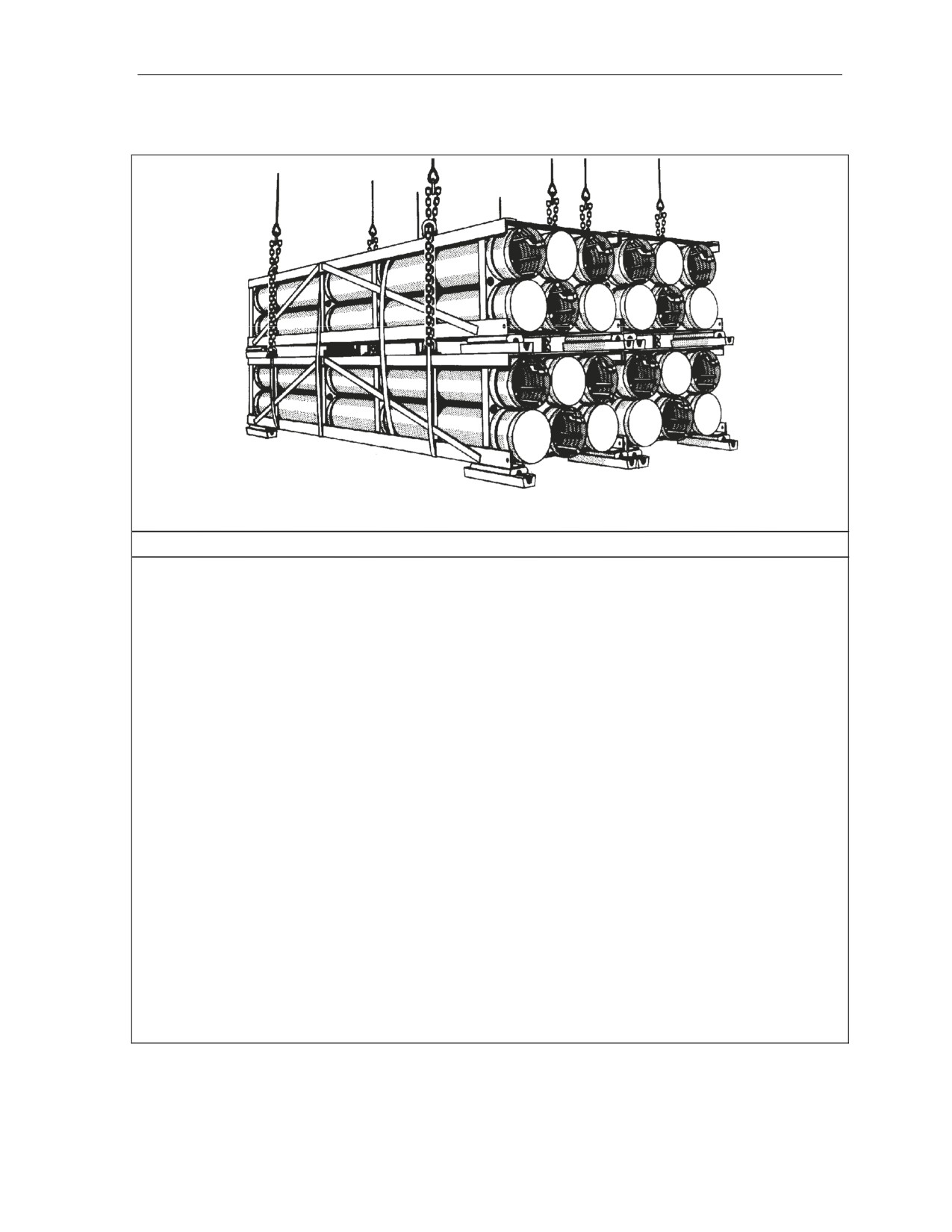
RIGGING STEPS
1.
Position sling set number 1 on top of the forward end of the pods.
2.
Loop the chain end of outer sling legs 1 and 2 through their respective top front lift provisions
of the top pods, through the front lifting provision on the bottom pods, and back through the
front top lift provision on the top pods. Place the correct link from Table 11-7 in the grab
hook.
3.
Loop the chain end of inner sling legs 3 and 4 through their respective top front lift
provisions of the top, through the front lifting provision on the bottom pods, and back through
the front top lift provision on the top pods. Place the correct link from Table 11-7 in the grab
hook. Secure the excess chain with tape or Type III nylon cord.
4.
Position sling set number 2 on top of the aft end of the pods.
5.
Loop the chain end of outer sling legs 1 and 2 through their respective top rear lift provisions
of the top pods, through the rear lifting provision on the bottom pods, and back through the
rear top lift provision on the top pods. Place the correct link from Table 11-7 in the grab
hook.
6.
Loop the chain end of inner sling legs 3 and 4 through their respective top rear lift provisions
of the top pods, through the rear lifting provision on the bottom pods, and back through the
rear top lift provision on the top pods. Place the correct link from Table 11-7 in the grab
hook. Secure the excess chain with tape or Type III nylon cord.
7.
Raise the apex fittings above the container. Cluster and tie (breakaway technique) the sling
legs in each sling set together to prevent entanglement during hookup and lift-off.
Figure 11-7. Launch Pod Container with Multiple Launch Rocket System Rockets or Guided
Multiple Launch Rocket System Rockets / Guided Missile Launch Assembly Pods with Army
Tactical Missile System Missiles, Four Containers
FM 4-20.199/MCRP 4-11.3E, VOL III/NTTP 3-04.13/
20 February 2009
AFMAN 11-223 (I), VOL III/COMDINST M13482.4B
11-15
This page intentionally left blank.
Chapter 12
Certified Dual-Point Rigging Procedures for Radar and
Satellite Equipment
INTRODUCTION
12-1. This chapter contains rigging procedures for dual-point lift of radar and satellite equipment that has
been certified for sling load. Each rigging procedure is found in a paragraph that includes a description of
the load, materials required for rigging, and steps to complete the procedure. An applicability paragraph is
also a part of each paragraph and identifies the certified loads. The certified dual-point rigging procedures
for radar and satellite equipment are in this section. Paragraphs
12-2 through
12-5 give detailed
instructions for rigging loads.
Note. Reach Pendants may be used on dual point loads. Place a Reach Pendant on each apex
fitting. A static discharge person is not required when using a Reach Pendant.
OE-361/G QUICK REACTION SATELLITE ANTENNA
12-2. The OE-361/G Quick Reaction Satellite Antenna is rigged for dual-point sling load using the
following procedures:
z
Applicability. The following item in Table 12-1 is certified for the helicopter(s) listed in the
following table by the US Army Natick Soldier Center:
Table 12-1. OE-361/G Quick Reaction Satellite Antenna
Nomenclature
Max
Sling
Link Count
Type of
Weight
Set
Front/Rear
Aircraft
(Pounds)
Antenna, Satellite, Quick Reaction, (QRSA), OE-
4,830
10K
3/30
CH-47
361/G
z
Materials. The following materials are required to rig this load:
Sling set (10,000-pound capacity) with one additional apex fitting.
Tape, adhesive, pressure-sensitive, 2-inch wide roll.
Cord, nylon, Type III, 550-pound breaking strength.
Webbing, cotton, 1/4-inch, 80-pound breaking strength.
Felt sheet, cattle hair, Type IV, 1/2-inch or suitable padding.
z
Personnel. Four persons can prepare and rig this load in 30 minutes.
z
Procedures. The following procedures apply to this load:
Preparation. Prepare the load using the following steps:
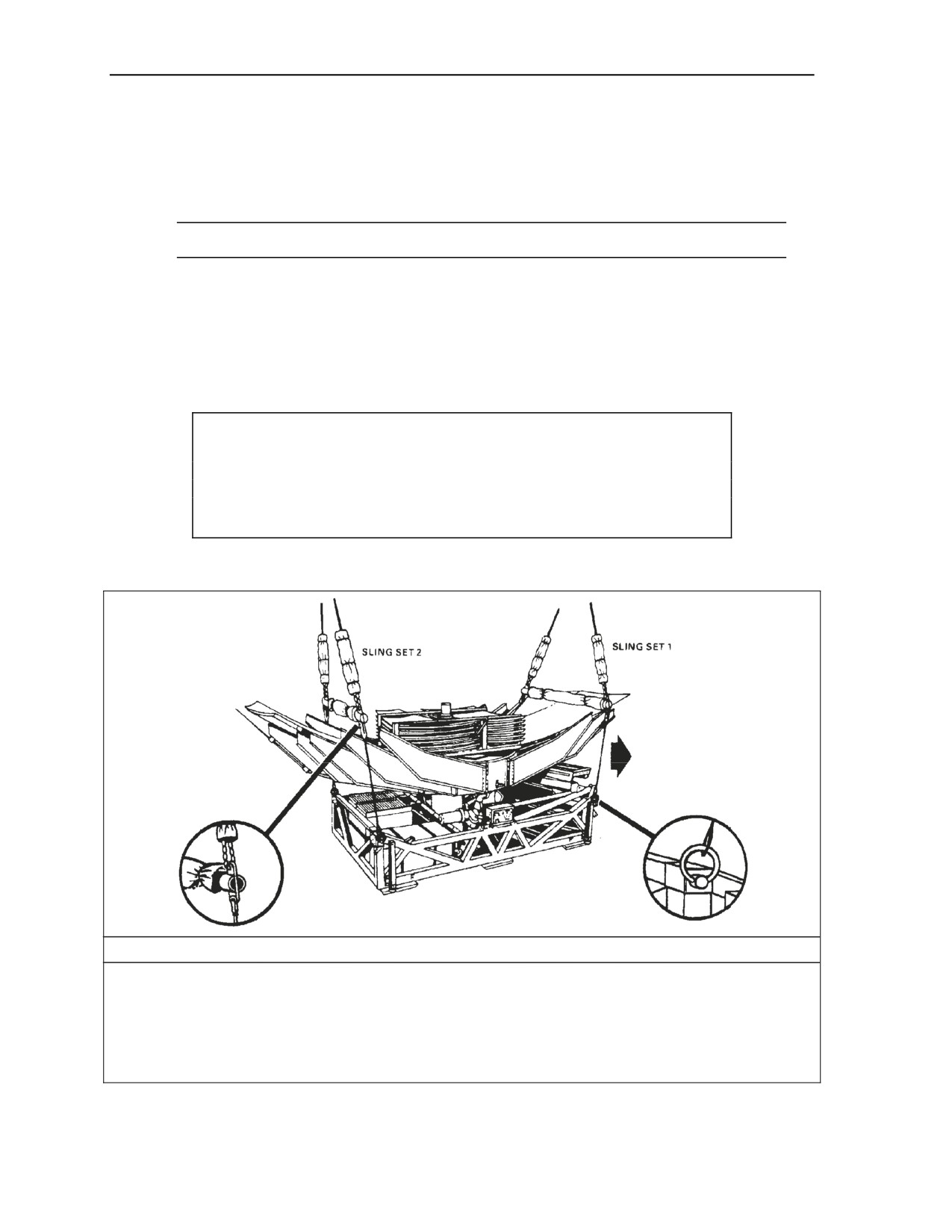
─ Install the spreader bar assembly that is stored on the load. Hook the spreader bar
assembly cables to the lift rings and secure the keepers with tape.
─ Pad the spreader bar. Secure the padding with tape or cotton webbing.
FM 4-20.199/MCRP 4-11.3E, VOL III/NTTP 3-04.13/
20 February 2009
AFMAN 11-223 (I), VOL III/COMDINST M13482.4B
12-1
Chapter 12
─ Pad the uppermost stacked antenna panel. Secure the padding with tape or cotton
webbing.
─ Secure the ladder, box covers, and any loose equipment with tape or Type III nylon
cord.
Rigging. Rig the load according to the steps in Figure 12-1.
Note: The ladder end is the front of the load.
Hookup. Two hookup teams stand on top of the load between the stacked antenna panels
and on either side of the center post. The static discharge person discharges the static
electricity. The forward hookup person (ladder end) places apex fitting 1 onto the forward
cargo hook. The aft hookup person places apex fitting 2 onto the aft cargo hook. The hookup
teams then carefully dismount the container and remain close to the load as the helicopter
removes slack from the sling legs. When successful hookup is assured, the hookup teams
quickly exit the area underneath the helicopter to the designated rendezvous point.
CAUTION
Brief the helicopter crew to relax sling leg tension and to hover to the
side of the load when releasing the apex fitting to prevent damaging
the antenna.
Derigging. Derigging is the reverse of the preparation and rigging procedures.
RIGGING STEPS
1. Place two sling legs on apex fitting number 1. Position apex fitting number 1 on top of the
load (ladder end).
2. Loop the chain end of the left and right sling legs through their respective lift eyes located on
the ends of the spreader bar. Place the correct link from Table 12-1 in the grab hook.
Figure 12-1. OE-361/G Quick Reaction Satellite Antenna
FM 4-20.199/MCRP 4-11.3E, VOL III/NTTP 3-04.13/
12-2
AFMAN 11-223 (I), VOL III/COMDINST M13482.4B
20 February 2009

Certified Dual-Point Rigging Procedures for Radar Satellite Equipment
RIGGING STEPS (Continued)
3. Place two sling legs on apex fitting number 2. Position apex fitting number 2 on top of the aft
end of the load.
4. Loop the chain end of the left and right sling legs through their respective lift eyes located on
the ends of the spreader bar. Place the correct link from Table 12-1 in the grab hook.
Secure the excess chain with tape or Type III nylon cord.
5. Pad each grab hook. Secure the padding with tape or cotton webbing.
6. Raise the apex fittings above the load. Cluster and tie (breakaway technique) the sling legs
in each sling set together to prevent entanglement during hookup and lift-off.
Figure 12-1. OE-361/G Quick Reaction Satellite Antenna (Continued)
NATO AIR BASE SATCOM (NABS) POWER PALLET, AN/TSC-85B
(V)2
12-3. The NATO air base SATCOM power pallet, AN/TSC-85B (V)2 is rigged for dual-point sling load
using the following procedures:
z
Applicability. The following item in Table 12-2 is certified for the helicopter(s) listed in the
following table by the US Army Natick Soldier Center:
Table 12-2. NATO Air Base SATCOM Power Pallet, AN/TSC-85B (V)2
Nomenclature
Max
Sling Set
Link Count
Type of
Weight
Front/Rear
Aircraft
(Pounds)
NATO Air Base SATCOM Power Pallet, AN/TSC-
8,630
10K
3/3
CH-47
85B (V)2
z
Materials. The following materials are required to rig this load:
Sling set (10,000-pound capacity) with one additional apex fitting.
Tape, adhesive, pressure-sensitive, 2-inch wide roll.
Cord, nylon, Type III, 550-pound breaking strength.
Webbing, cotton, 1/4-inch, 80-pound breaking strength.
z
Personnel. Two persons can prepare and rig this load in 20 minutes.
z
Procedures. The following procedures apply to this load:
Preparation. Prepare the load using the following steps:
─ Secure all cargo inside the shelter or on the pallet with tape or Type III nylon cord.
─ Close and secure all access cover latches, vents, and doors. Tape all exhaust covers.
─ Remove the cargo cover and stow it in the prime mover. DO NOT STOW THE
COVER ON THE PALLET.
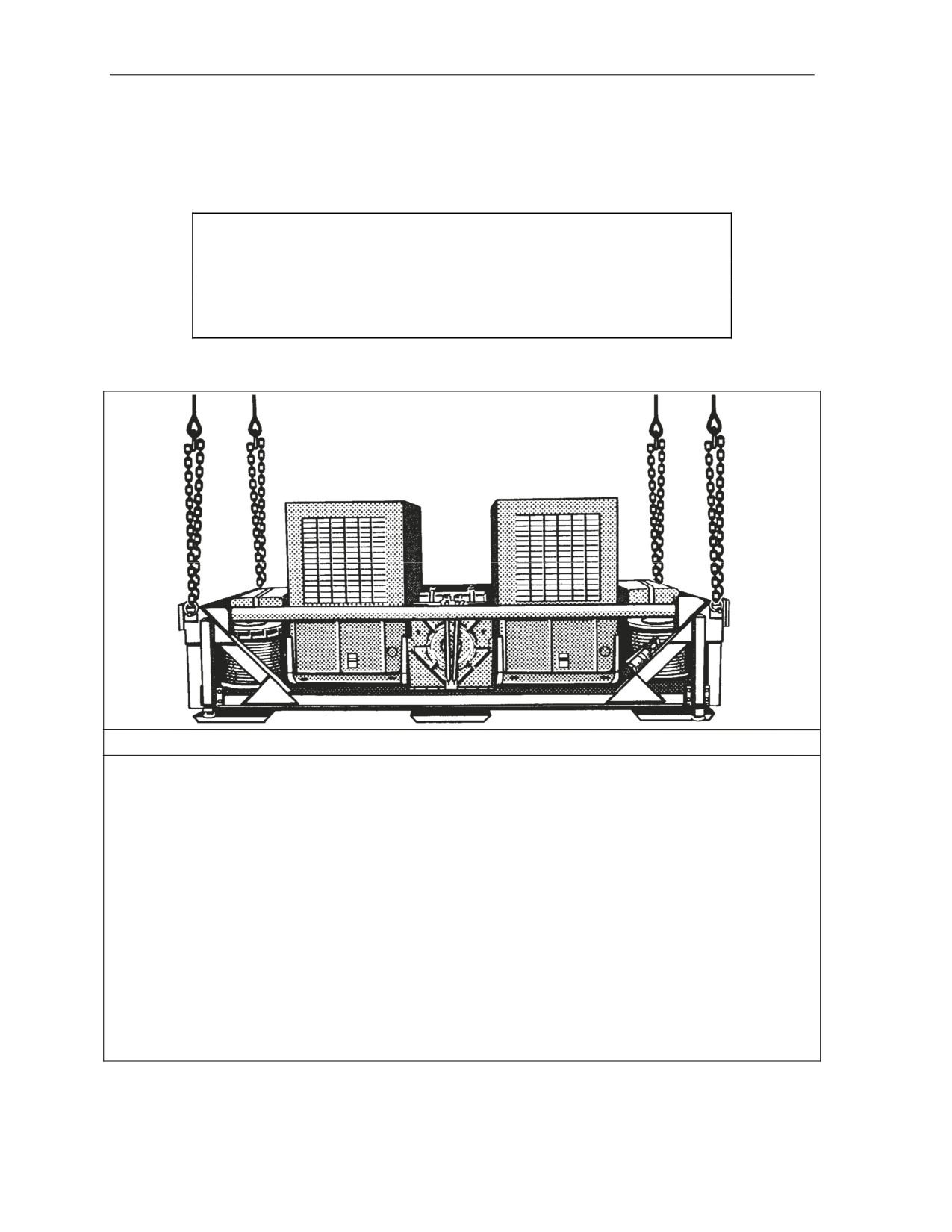
Rigging. Rig the load according to the steps in Figure 12-2.
Note. The required individual equipment (RIE) case end of the pallet is designated as the
forward end of the load.
Hookup. Two hookup teams are used for this load. The static wand person discharges the
static electricity with the static wand. The forward hookup person stands on top of the
generators and places apex fitting 1 onto the forward cargo hook. The aft hookup person
FM 4-20.199/MCRP 4-11.3E, VOL III/NTTP 3-04.13/
20 February 2009
AFMAN 11-223 (I), VOL III/COMDINST M13482.4B
12-3
Chapter 12
stands on top of the generators and places apex fitting 2 onto the aft cargo hook. The hookup
team then carefully dismounts the load and remains close to the load as the helicopter removes
slack from the sling legs. When successful hookup is assured, the hookup team quickly exits
the area underneath the helicopter to the designated rendezvous point.
CAUTION
Brief the helicopter crew to relax sling leg tension and to hover to the
side of the load when releasing the apex fitting to prevent damaging
the antenna.
Derigging. Derigging is the reverse of the preparation and rigging procedures.
RIGGING STEPS
1. Place two sling legs on apex fitting number 1. Position apex fitting number 1 on top of the
generator on the forward end.
2. Loop the chain end of the left and right sling legs through their respective lift provisions
located on the corners of the pallet. Place the correct link from Table 12-2 in the grab hook.
3. Place two sling legs on apex fitting number 2. Position apex fitting number 2 on top of the
generator on the aft end of the pallet.
4. Loop the chain end of the left and right sling legs through their respective lift provisions
located on the corners of the pallet. Place the correct link from Table 12-2 in the grab hook.
Note: DO NOT use the lift provisions on the generators.
5. Raise the apex fittings above the load. Cluster and (breakaway technique) the sling legs in
each sling set together to prevent entanglement during hookup and lift-off.
Figure 12-2. NATO Air Base SATCOM (NABS) Power Pallet, AN/TSC-85B (V)2
FM 4-20.199/MCRP 4-11.3E, VOL III/NTTP 3-04.13/
12-4
AFMAN 11-223 (I), VOL III/COMDINST M13482.4B
20 February 2009

Certified Dual-Point Rigging Procedures for Radar Satellite Equipment
DIGITAL GROUP MULTIPLEXER (DGM) DIGITAL ANTENNA MAST
PROGRAM (DAMP) PALLET TRAILER
12-4. The digital group multiplexer digital antenna mast program pallet trailer is rigged for dual-point sling
load using the following procedures:
z
Applicability. The following items in Table 12-3 are certified for the helicopter(s) listed in the
following table by the US Army Natick Soldier Center:
Table 12-3. NATO Digital Group Multiplexer Digital Antenna Mast Program Pallet Trailer
Nomenclature
Max
Sling
Link Count
Type of
Weight
Set
Front/Rear
Aircraft
(Pounds)
Digital Group Multiplexer Digital Antenna Mast
13,400
25K
13/3
CH-47
Program Pallet Trailer, Two (2) Antenna Configuration
Digital Group Multiplexer Digital Antenna Mast
14,600
25K
13/3
CH-47
Program Pallet Trailer, Three (3) Antenna
Configuration
z
Materials. The following materials are required to rig this load:
Sling set (25,000-pound capacity) with one additional apex fitting.
─ Additional chain length, part number 38850-00053-102, from a 25,000-pound capacity
sling set (4 each).
─ Additional coupling link, part number 664241, from a 25,000-pound sling set (4 each).
Tape, adhesive, pressure-sensitive, 2-inch wide roll.
Cord, nylon, Type III, 550-pound breaking strength.
Webbing, cotton, 1/4-inch, 80-pound breaking strength.
Webbing, tubular, nylon, 1/2-inch, 1,000-pound breaking strength.
Felt sheet, cattle hair, Type IV, 1/2-inch or suitable padding.
z
Personnel. Two persons can prepare and rig this load in 30 minutes.
z
Procedures. The following procedures apply to this load:
Preparation. Prepare the load using the following steps:
─ Engage the trailer parking brakes.
─ Tape the rubber flaps on the generator to the frame.
─ Adjust the leveling jacks on the front of the trailer so the trailer is level.
─ Attach an additional chain length to each sling leg chain with a coupling link.
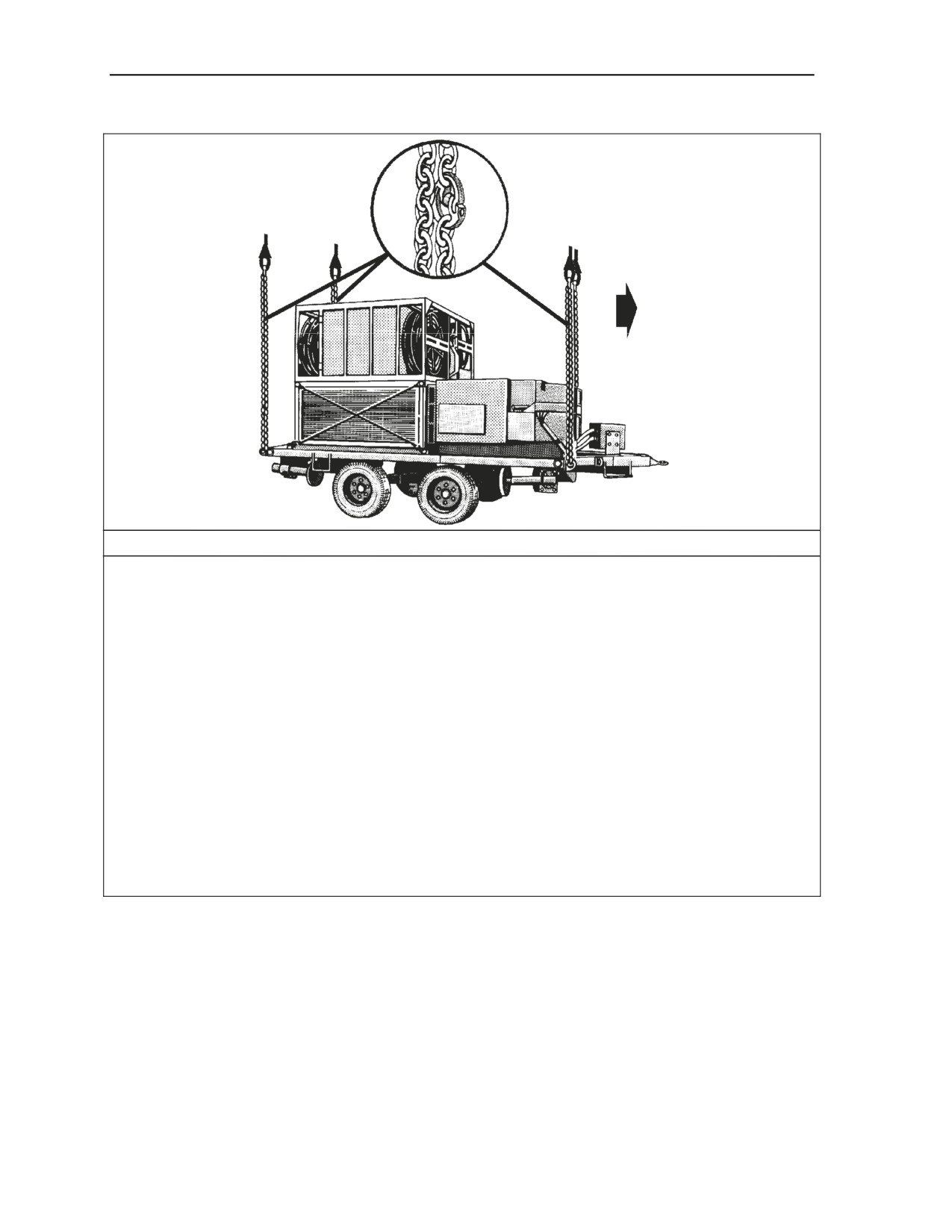
Rigging. Rig the load according to the steps in Figure 12-3.
Hookup. Two hookup teams stand on top of the trailer. The static discharge person
discharges the static electricity. The forward hookup person places apex fitting 1 onto the
forward cargo hook. The aft hookup person places apex fitting 2 onto the aft cargo hook. The
hookup teams then carefully dismount the trailer and remain close to the load as the helicopter
removes slack from the sling legs. When successful hookup is assured, the hookup teams
quickly exit the area underneath the helicopter to the designated rendezvous point.
Derigging. Derigging is the reverse of the preparation and rigging procedures.
FM 4-20.199/MCRP 4-11.3E, VOL III/NTTP 3-04.13/
20 February 2009
AFMAN 11-223 (I), VOL III/COMDINST M13482.4B
12-5
Chapter 12
RIGGING STEPS
1. Place two sling legs on apex fitting number 1. Position apex fitting number 1 on top of the
trailer.
2. Loop the chain end of the left and right sling legs through their respective front lift provisions
located on the front corner of the trailer. Place the correct link from Table 12-3 in the grab
hook. Secure the excess chain with tape or Type III nylon cord.
3. Place two sling legs on apex fitting number 2. Position apex fitting number 1 on top of the
trailer.
4. Loop the chain end of the left and right sling legs through their respective rear lift provisions
located on the rear corners of the trailer. Place the correct link from Table 12-3 in the grab
hook.
5. Pad the chains and secure the padding with tape.
6. Raise the apex fittings above the trailer. Cluster and tie (breakaway technique) the sling legs
in each sling set together to prevent entanglement during hookup and lift-off.
Figure 12-3. Digital Group Multiplexer, Digital Antenna Mast Program, Pallet Trailer
FM 4-20.199/MCRP 4-11.3E, VOL III/NTTP 3-04.13/
12-6
AFMAN 11-223 (I), VOL III/COMDINST M13482.4B
20 February 2009

Certified Dual-Point Rigging Procedures for Radar Satellite Equipment
LIGHTWEIGHT GENERATOR FRAME ASSEMBLY (AN/TSC-93B
RECONFIGURATION), SATELLITE COMMUNICATIONS
TERMINAL
12-5. The lightweight generator frame assembly (AN/TSC-93B reconfiguration), satellite communications
terminal is rigged for dual-point sling load using the following procedures:
z
Applicability. The following items in Table 12-4 are certified for the helicopter(s) listed in the
following table by the US Army Natick Soldier Center:
Table 12-4. Lightweight Generator Frame Assembly (AN/TSC-93B Reconfiguration), Satellite
Communications Terminal
Nomenclature
Max
Sling Set
Link Count
Type of
Weight
Front/Rear
Aircraft
(Pounds)
AN/TSC-93B Satellite Communications Terminal
3,644
10K
3/3
CH-47
without ALTA
AN/TSC-93B Satellite Communications Terminal
3,957
10K
3/3
CH-47
with ALTA
z
Materials. The following materials are required to rig this load:
Sling set (10,000-pound capacity) with one additional apex fitting.
Tape, adhesive, pressure-sensitive, 2-inch wide roll.
Cord, nylon, Type III, 550-pound breaking strength.
Webbing, cotton, 1/4-inch, 80-pound breaking strength.
Strap, cargo, tiedown, CGU-1/B (as required).
z
Personnel. Three persons can prepare and rig this load in 10 minutes.
z
Procedures. The following procedures apply to this load:
Preparation. Prepare the load using the following steps:
─ Secure all equipment with tiedown straps, Type III nylon cord, or tape.
─ Remove and stow the protective cover. Secure the cover with Type III nylon cord.
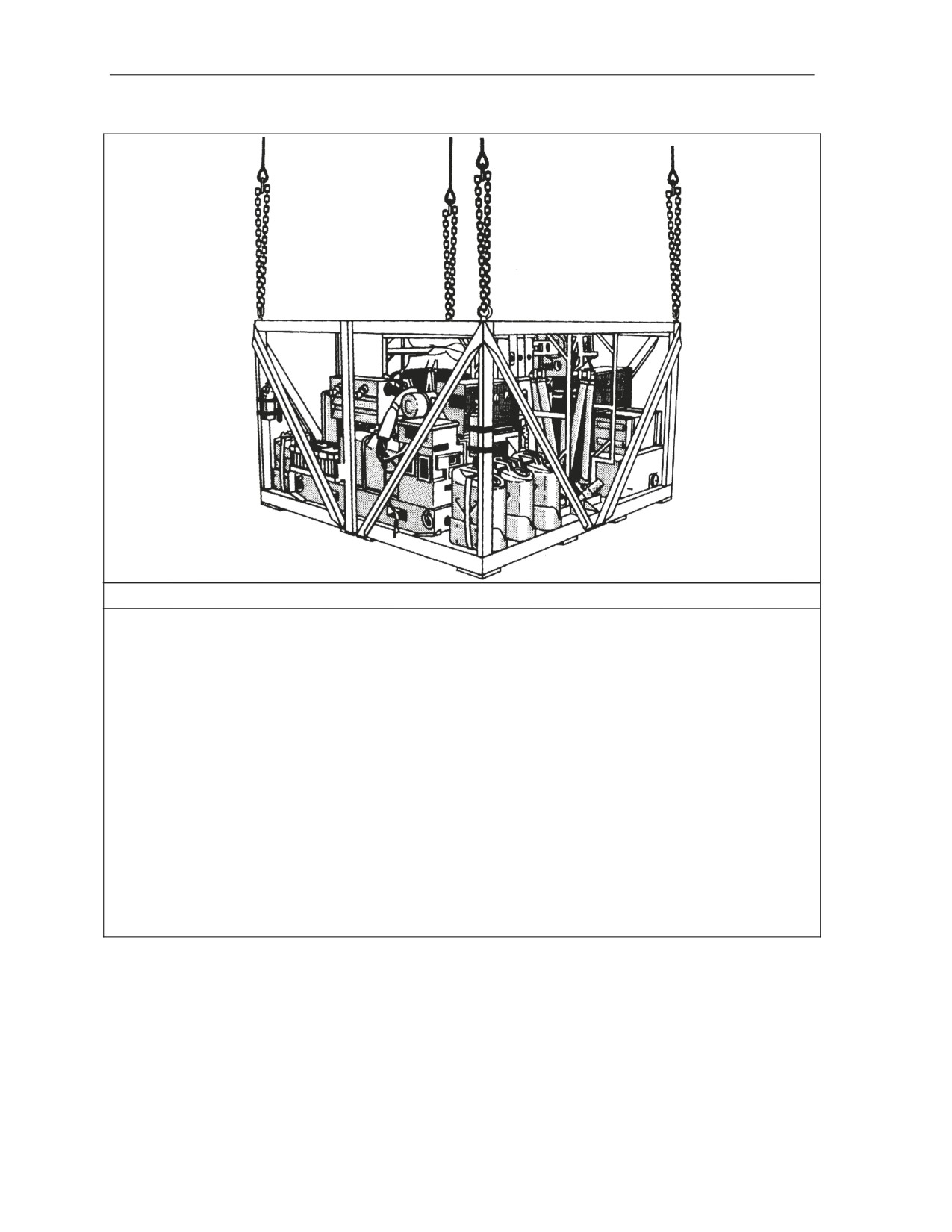
Rigging. Rig the load according to the steps in Figure 12-4.
Hookup. Two hookup teams stand on top of the frame. The static discharge person
discharges the static electricity. The forward hookup person places apex fitting 1 onto the
forward cargo hook. The aft hookup person places apex fitting 2 onto the aft cargo hook. The
hookup teams then carefully dismount the load and remain close to the load as the helicopter
removes slack from the sling legs. When successful hookup is assured, the hookup teams
quickly exit the area underneath the helicopter to the designated rendezvous point.
CAUTION
Brief the helicopter crew to relax sling leg tension and to hover to the
side of the load when releasing the apex fitting to prevent damaging
the antenna.
Derigging. Derigging is the reverse of the preparation and rigging procedures.
FM 4-20.199/MCRP 4-11.3E, VOL III/NTTP 3-04.13/
20 February 2009
AFMAN 11-223 (I), VOL III/COMDINST M13482.4B
12-7
Chapter 12
RIGGING STEPS
1. Place two sling legs on apex fitting number 1. Position apex fitting number 1 on top of the
generator pallet.
2. Loop the chain end of the left and right sling legs through their respective front lift provisions
located on the front corner of the pallet. Place the correct link from Table 12-4 in the grab
hook.
3. Place two sling legs on apex fitting number 2. Position apex fitting number 1 on top of the
generator pallet.
4. Loop the chain end of the left and right sling legs through their respective rear lift provisions
located on the rear corners of the pallet. Place the correct link from Table 12-4 in the grab
hook.
5. Raise the apex fittings above the load. Cluster and tie or tape (breakaway technique) the
sling legs in each sling set together to prevent entanglement during hookup and lift-off.
Figure 12-4. Lightweight Generator Frame Assembly
FM 4-20.199/MCRP 4-11.3E, VOL III/NTTP 3-04.13/
12-8
AFMAN 11-223 (I), VOL III/COMDINST M13482.4B
20 February 2009
Chapter 13
Certified Dual-Point Rigging Procedures for Miscellaneous
Equipment
INTRODUCTION
13-1. This chapter contains rigging procedures for dual-point lift of miscellaneous equipment that has been
certified for sling load. Each rigging procedure is found in a paragraph that includes a description of the
load, materials required for rigging, and steps to complete the procedure. An applicability paragraph is
also a part of each paragraph and identifies the certified loads. The certified dual-point rigging procedures
for miscellaneous equipment are in this section. Paragraphs 13-2 through 13-13 give detailed instructions
for rigging loads.
Note. Reach Pendants may be used on dual point loads. Place a Reach Pendant on each apex
fitting. A static discharge person is not required when using a Reach Pendant.
PALLETIZED LOADING SYSTEM (PLS), M1077 FLATRACK,
LOADED
13-2. The palletized loading system M1077 flatrack, loaded is rigged for dual-point sling load using the
following procedures:
z
Applicability. The following item in Table 13-1 is certified for the helicopter(s) listed in the
following table by the US Army Natick Soldier Center:
Table 13-1. Palletized Loading System, M1077 Flatrack, Loaded
Nomenclature
Max Weight
Sling
Link Count
Type of
(Pounds)
Set
Front/Rear
Aircraft
Palletized Loading System, M1077 Flatrack, Loaded
Min-6,500
10K
3/10
CH-47
Max-20,000
25K
5/10
z
Materials. The following materials are required to rig this load:
Sling set (10,000-pound capacity) with one additional apex fitting.
OR
Sling set (25,000-pound capacity) with one additional apex fitting.
Tape, adhesive, pressure-sensitive, 2-inch wide roll.
Cord, nylon, Type III, 550-pound breaking strength.
Webbing, cotton, 1/4-inch, 80-pound breaking strength.
PLS operating manual.
Strap, cargo, tiedown, CGU-1/B (as required).
z
Personnel. Two persons can prepare and rig this load in 20 minutes.
z
Procedures. The following procedures apply to this load:
Preparation. Prepare the load using the following steps:
FM 4-20.199/MCRP 4-11.3E, VOL III/NTTP 3-04.13/
20 February 2009
AFMAN 11-223 (I), VOL III/COMDINST M13482.4B
13-1
Chapter 13
Note. During the following steps, observe all CAUTIONS and WARNINGS noted in the
operating manual.
─ Position the load on the Flatrack, distributing the weight as evenly as possible.
─ Restrain the cargo with CGU-1/B cargo tiedown straps.
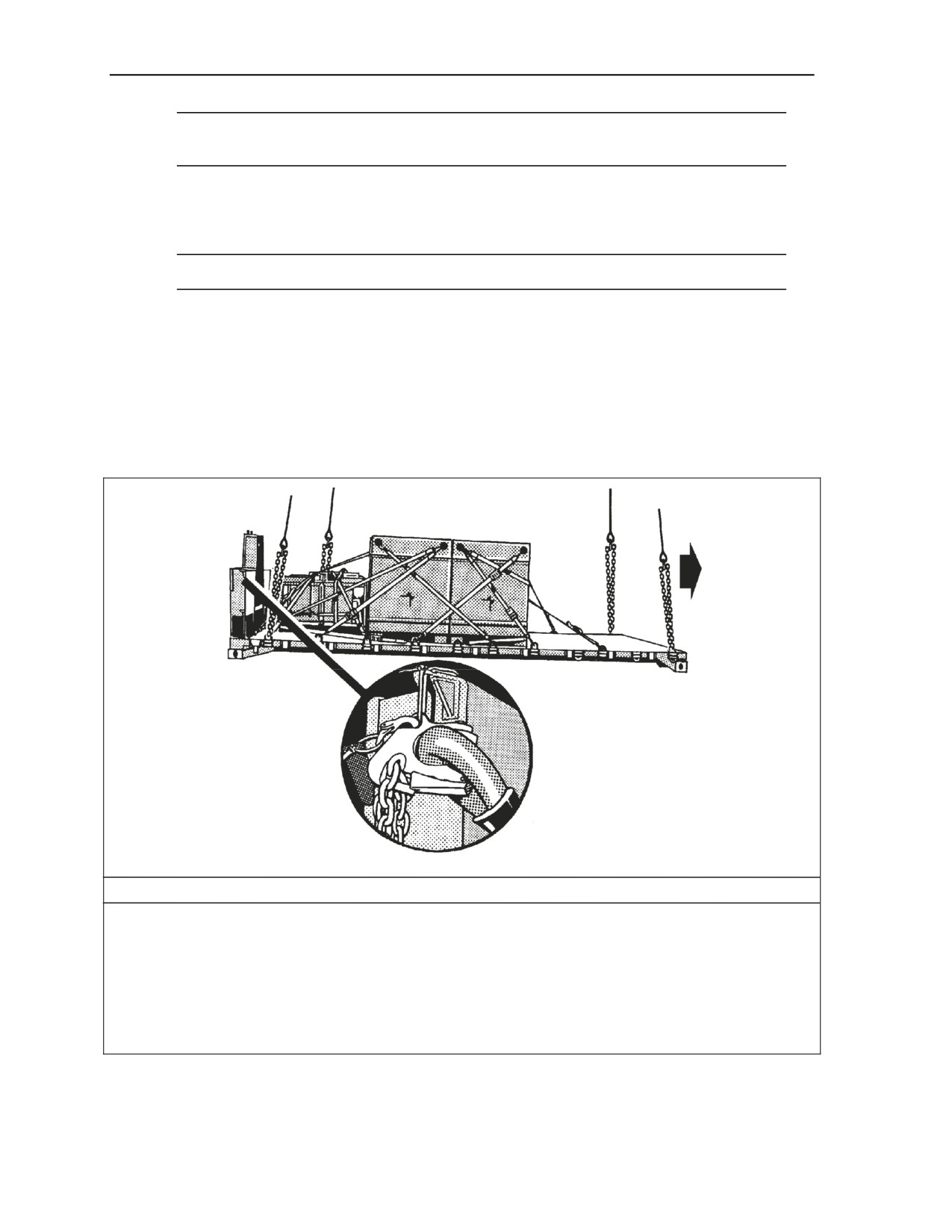
Rigging. Rig the load according to the steps in Figure 13-1.
Note. The A-frame end is considered the aft end of the load.
Hookup. Two hookup teams stand on top of the load. The static discharge person
discharges the static electricity. The forward hookup person, (non-A-frame end), places apex
fitting 1 onto the forward cargo hook. The aft hookup person places apex fitting 2 onto the aft
cargo hook. The hookup teams then carefully dismount the pallet and remain close to the load
as the helicopter removes slack from the sling legs. When successful hookup is assured, the
hookup teams quickly exit the area underneath the helicopter to the designated rendezvous
point.
Derigging. Derigging is the reverse of the preparation and rigging procedures.
RIGGING STEPS
1. Place two sling legs on apex fitting number 1. Position apex fitting number 1 on top of the load (non A-
frame end).
2. Loop the chain end of the left and right sling legs through their respective lift provision (tiedown ring
closest to the end). Place the correct link from Table 13-1 in the grab hook.
3. Place two sling legs on apex fitting number 2. Position apex fitting number 2 on top of the load (A-frame
end).
Figure 13-1. Palletized Loading System, M1077 Flatrack, Loaded
FM 4-20.199/MCRP 4-11.3E, VOL III/NTTP 3-04.13/
13-2
AFMAN 11-223 (I), VOL III/COMDINST M13482.4B
20 February 2009

Certified Dual-Point Rigging Procedures for Miscellaneous Equipment
RIGGING STEPS (Continued)
4. Loop the chain end of the left and right sling legs through their respective lift provision
(tiedown ring closest to the end). Place the correct link from Table 13-1 in the grab hook.
Secure the excess chain with tape or Type III nylon cord.
5. Tie (breakaway technique) the rear grab hooks to the A-frame.
6. Raise the apex fittings above the load. Cluster and tie (breakaway technique) the sling legs
in each sling set together to prevent entanglement during hookup and lift-off.
Figure 13-1. Palletized Loading System, M1077 Flatrack, Loaded (Continued)
PALLETIZED LOADING SYSTEM (PLS), M1077 FLATRACK, EMPTY
13-3. The palletized loading system M1077 flatrack, empty is rigged for dual-point sling load using the
following procedures:
z
Applicability. The following items in Table 13-2 are certified for the helicopter(s) listed in the
following table by the US Army Natick Soldier Center:
Table 13-2. Palletized Loading System, M1077 Flatrack, Empty
Nomenclature
Max Weight
Sling
Link Count
Type of
(Pounds)
Set
Front/Rear
Aircraft
Two M1077 Flatracks, Empty, Stacked
6,500
10K
3/10
CH-47
Three M1077 Flatracks, Empty, Stacked
9,750
10K
3/10
CH-47
z
Materials. The following materials are required to rig this load:
Sling set (10,000-pound capacity) with one additional apex fitting.
Tape, adhesive, pressure-sensitive, 2-inch wide roll.
Cord, nylon, Type III, 550-pound breaking strength.
Webbing, cotton, 1/4-inch, 80-pound breaking strength.
PLS operating manual.
z
Personnel. Two persons can prepare and rig this load in 30 minutes.
z
Procedures. The following procedures apply to this load:
Preparation. Prepare the load using the following steps:
Note. During the following steps, observe all CAUTIONS and WARNINGS noted in the
operating manual.
─ Position the flatracks one on top of the other, if required, and engage the twist locks as
described in the operating manual.
─ Safety tie the twist lock handles with Type III nylon cord to an adjacent cargo tiedown
provision.
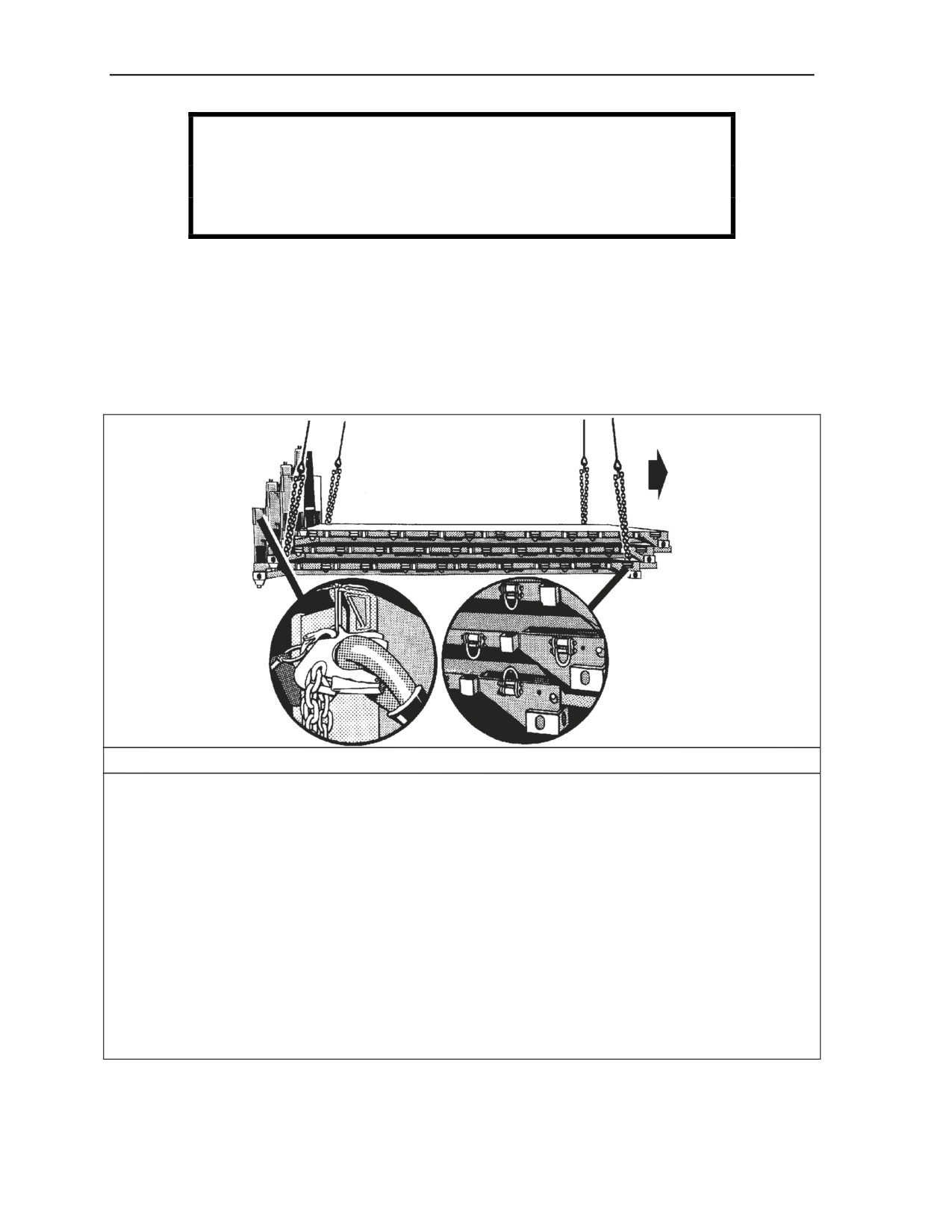
Rigging. Rig the load according to the steps in Figure 13-2.
Note. The A-frame end is considered the aft end of the load.
FM 4-20.199/MCRP 4-11.3E, VOL III/NTTP 3-04.13/
20 February 2009
AFMAN 11-223 (I), VOL III/COMDINST M13482.4B
13-3
Chapter 13
WARNING
Ensure the slings are attached to the bottom-most lift provisions
for load securement and stability.
Hookup. Two hookup teams stand on top of the load. The static discharge person
discharges the static electricity. The forward hookup person (non-A-frame end) places apex
fitting 1 onto the forward cargo hook. The aft hookup person places apex fitting 2 onto the aft
cargo hook. The hookup teams then carefully dismount the pallet and remain close to the load
as the helicopter removes slack from the sling legs. When successful hookup is assured, the
hookup teams quickly exit the area underneath the helicopter to the designated rendezvous
point.
Derigging. Derigging is the reverse of the preparation and rigging procedures.
RIGGING STEPS
1. Place two sling legs on apex fitting number 1. Position apex fitting number 1 on top of the
load (non A-frame end).
2. Loop the chain end of the left and right sling legs through their respective lift provision
(tiedown ring closest to the end). Place the correct link from Table 13-2 in the grab hook.
3. Place two sling legs on apex fitting number 2. Position apex fitting number 2 on top of the
load (A-frame end).
4. Loop the chain end of the left and right sling legs through their respective lift provision
(tiedown ring closest to the end). Place the correct link from Table 13-2 in the grab hook.
Secure the excess chain with tape or Type III nylon cord.
5. Tie (breakaway technique) the rear grab hooks to the A-frame.
6. Raise the apex fittings above the load. Cluster and tie or tape (breakaway technique) the
sling legs in each sling set together to prevent entanglement during hookup and lift-off.
Figure 13-2. Palletized Loading System, M1077 Flatrack, Empty
FM 4-20.199/MCRP 4-11.3E, VOL III/NTTP 3-04.13/
13-4
AFMAN 11-223 (I), VOL III/COMDINST M13482.4B
20 February 2009

Certified Dual-Point Rigging Procedures for Miscellaneous Equipment
ENHANCED PALLETIZED LOADING SYSTEM, FLATRACK,
LOADED
13-4. The enhanced palletized loading system, flatrack, loaded is rigged for dual-point sling load using the
following procedures:
z
Applicability. The following item in Table 13-3 is certified for the helicopter(s) listed in the
following table by the US Army Natick Soldier Center:
Table 13-3. Enhanced Palletized Loading System, Flatrack, Loaded
Nomenclature
Max Weight
Sling
Link Count
Type of
(Pounds)
Set
Front/Rear
Aircraft
Enhanced Palletized Loading System, Flatrack, Loaded
Min-10,500
25K
3/20
CH-47
Max-22,000
z
Materials. The following materials are required to rig this load:
Sling set (25,000-pound capacity) with one additional apex fitting.
Tape, adhesive, pressure-sensitive, 2-inch wide roll.
Cord, nylon, Type III, 550-pound breaking strength.
Webbing, cotton, 1/4-inch, 80-pound breaking strength.
PLS operating manual.
Strap, cargo, tiedown, CGU-1/B (as required).
z
Personnel. Two persons can prepare and rig this load in 30 minutes.
z
Procedures. The following procedures apply to this load:
Preparation. Prepare the load using the following steps:
Note. During the following steps, observe all CAUTIONS and WARNINGS noted in the
operating manual.
─ PLS personnel raise the end walls in accordance with TM 9-3990-206-14&P. The twist
locks must be in the stowage position.
─ Position the load on the flatrack, distributing the weight as evenly as possible.
─ Restrain the cargo with CGU-1/B cargo tiedown straps.
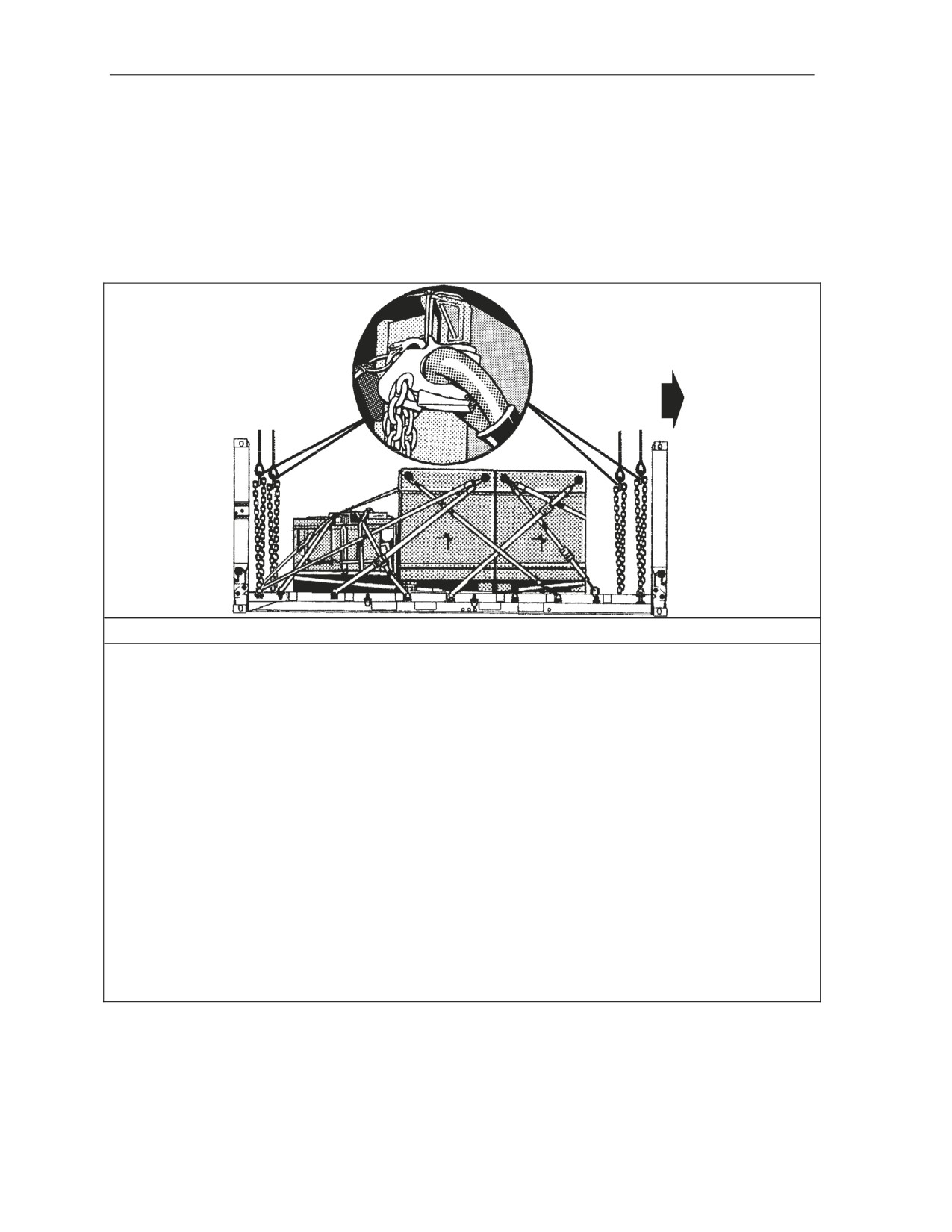
Rigging. Rig the load according to the steps in Figure 13-3.
Note. The A-frame end is considered the aft end of the load.
FM 4-20.199/MCRP 4-11.3E, VOL III/NTTP 3-04.13/
20 February 2009
AFMAN 11-223 (I), VOL III/COMDINST M13482.4B
13-5
Chapter 13
Hookup. Two hookup teams stand on top of the load. The static discharge person
discharges the static electricity. The forward hookup person (non-A-frame end) places apex
fitting 1 onto the forward cargo hook. The aft hookup person places apex fitting 2 onto the aft
cargo hook. The hookup teams then carefully dismount the pallet and remain close to the load
as the helicopter removes slack from the sling legs. When successful hookup is assured, the
hookup teams quickly exit the area underneath the helicopter to the designated rendezvous
point.
Derigging. Derigging is the reverse of the preparation and rigging procedures.
RIGGING STEPS
1. Place two sling legs on apex fitting number 1. Position apex fitting number 1 on top of the
load (end wall end).
2. Loop the chain end of the left and right sling legs through their respective lift provision
(tiedown ring closest to the end wall). Place the correct link from Table 13-3 in the grab
hook.
3. Place two sling legs on apex fitting number 2. Position apex fitting number 2 on top of the
load (A-frame end).
4. Loop the chain end of the left and right sling legs through their respective lift provision
(tiedown ring closest to the A-frame end). Place the correct link from Table 13-3 in the grab
hook. Secure the excess chain with tape or Type III nylon cord.
5. Tie (breakaway technique) the grab hooks to the end walls.
6. Raise the apex fittings above the load. Cluster and tie (breakaway technique) the sling legs
in each sling set together to prevent entanglement during hookup and lift-off.
Figure 13-3. Enhanced Palletized Loading System, Flatrack, Loaded
FM 4-20.199/MCRP 4-11.3E, VOL III/NTTP 3-04.13/
13-6
AFMAN 11-223 (I), VOL III/COMDINST M13482.4B
20 February 2009

Certified Dual-Point Rigging Procedures for Miscellaneous Equipment
ENHANCED PALLETIZED LOADING SYSTEM, FLATRACK, EMPTY
13-5. The enhanced palletized loading system, flatrack, empty is rigged for dual-point sling load using the
following procedures:
z
Applicability. The following item in Table 13-4 is certified for the helicopter(s) listed in the
following table by the US Army Natick Soldier Center:
Table 13-4. Enhanced Palletized Loading System, Flatrack, Empty
Nomenclature
Max Weight
Sling
Link Count
Type of
(Pounds)
Set
Front/Rear
Aircraft
One Enhanced, Flatrack, Empty
7,400
25K
3/20
CH-47
Two Enhanced, Flatracks, Empty, Stacked
14,800
25K
3/20
CH-47
z
Materials. The following materials are required to rig this load:
Sling set (25,000-pound capacity) with one additional apex fitting.
Tape, adhesive, pressure-sensitive, 2-inch wide roll.
Cord, nylon, Type III, 550-pound breaking strength.
Webbing, cotton, 1/4-inch, 80-pound breaking strength.
PLS operating manual.
Strap, cargo, tiedown, CGU-1/B (4 each).
z
Personnel. Two persons can prepare and rig this load in 20 minutes.
z
Procedures. The following procedures apply to this load:
Preparation. Prepare the load using the following steps:
Note. During the following steps, observe all CAUTIONS and WARNINGS noted in the
operating manual.
─ PLS personnel should lower both end walls on all enhanced flatracks in accordance
with the operating manual.
─ Position the flatracks one on top of the other, if required, and engage the twist locks as
described in the operating manual.
─ Attach a tiedown strap on the fourth tiedown ring on the bottom flatrack. Route the
strap over the end wall on the top flatrack and secure the strap to the fourth tiedown
ring on the other side of the bottom flatrack. Tighten the strap and secure the excess
with tape. Repeat this procedure using the third set of tiedown rings.
─ Repeat the above procedure on the other end of the flatrack.
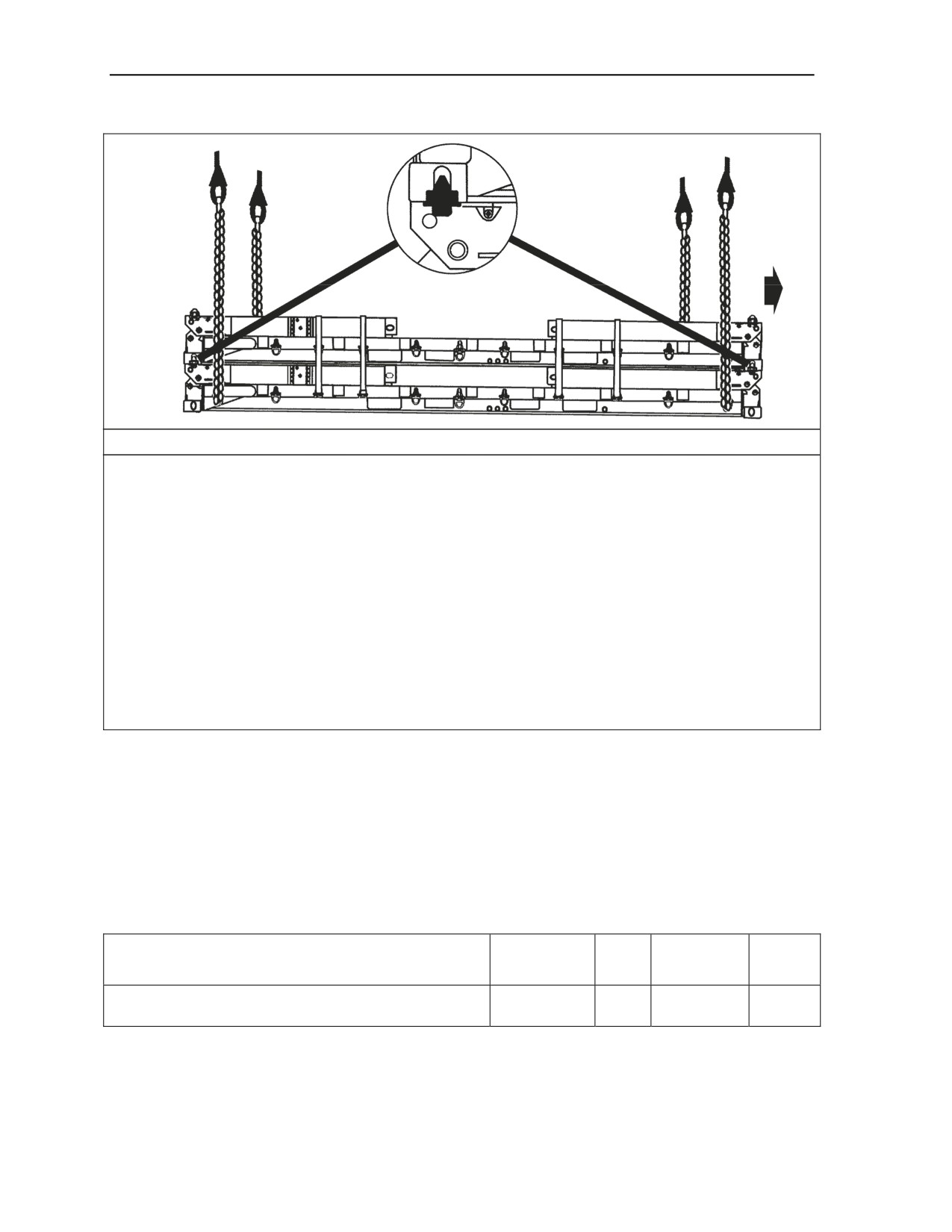
Rigging. Rig the load according to the steps in Figure 13-4.
Hookup. Two hookup teams stand on top of the load. The static discharge person
discharges the static electricity. The forward hookup person places apex fitting 1 onto the
forward cargo hook. The aft hookup person places apex fitting 2 onto the aft cargo hook. The
hookup teams then carefully dismount the pallet and remain close to the load as the helicopter
removes slack from the sling legs. When successful hookup is assured, the hookup teams
quickly exit the area underneath the helicopter to the designated rendezvous point.
Derigging. Derigging is the reverse of the preparation and rigging procedures.
FM 4-20.199/MCRP 4-11.3E, VOL III/NTTP 3-04.13/
20 February 2009
AFMAN 11-223 (I), VOL III/COMDINST M13482.4B
13-7
Chapter 13
RIGGING STEPS
1. Place two sling legs on apex fitting number 1. Position apex fitting number 1 on top of the load.
2. Loop the chain end of the left and right sling legs through their respective lift provision on the bottom
pallet (tiedown ring closest to the end). Place the correct link from Table 13-4 in the grab hook.
3. Place two sling legs on apex fitting number 2. Position apex fitting number 2 on top of the load.
4. Loop the chain end of the left and right sling legs through their respective lift provision on the bottom
pallet (tiedown ring closest to the end). Place the correct link from Table 13-4 in the grab hook. Secure
the excess chain with tape or Type III nylon cord.
5. Tie (breakaway technique) the rear grab hooks to the A-frame.
6. Raise the apex fittings above the load. Cluster and tie (breakaway technique) the sling legs in each
sling set together to prevent entanglement during hookup and lift-off.
Figure 13-4. Enhanced Palletized Loading System, Flatrack, Empty
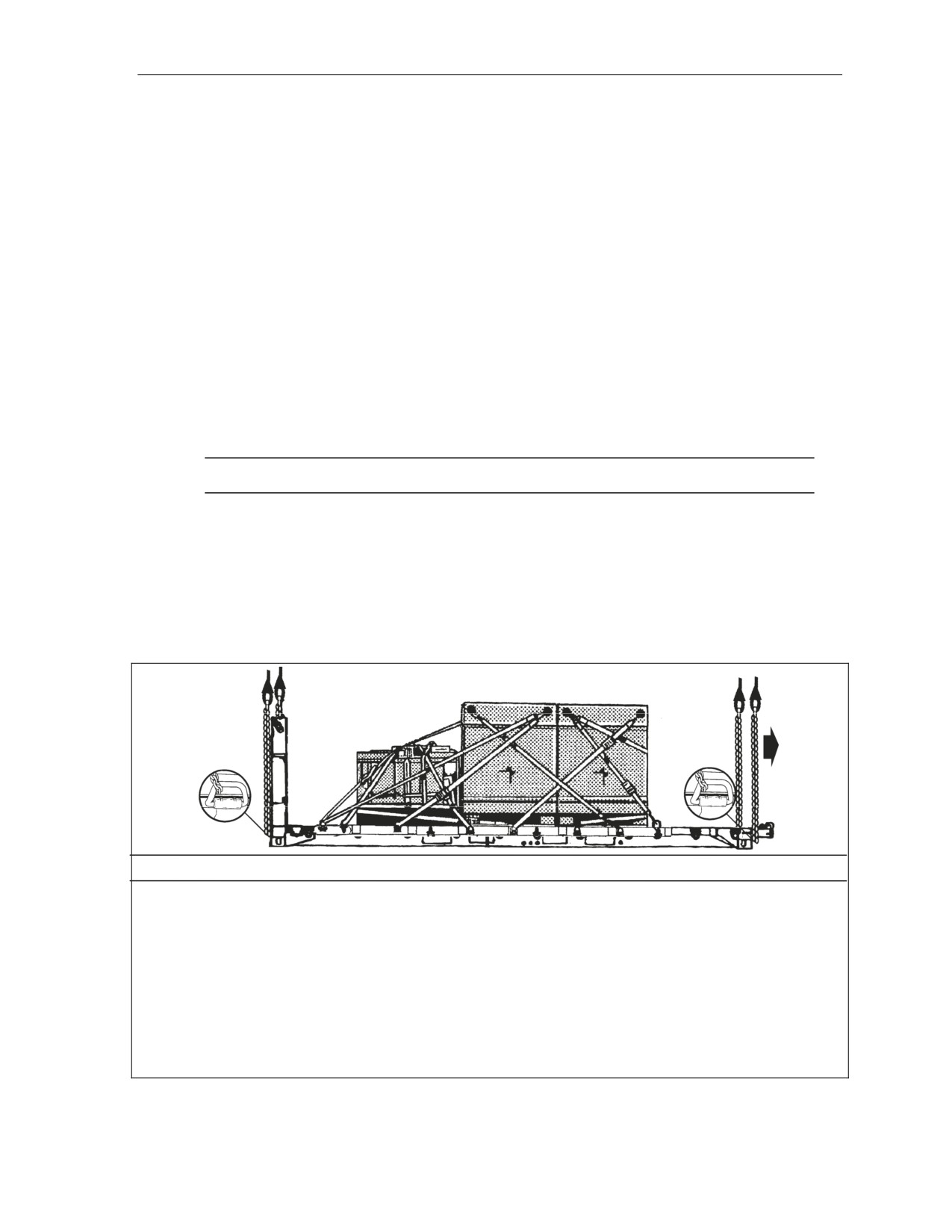
CONTAINER ROLL-IN/OUT PLATFORM (CROP), LOADED
13-6. The container roll-in/out platform, loaded is rigged for dual-point sling load using the following
procedures:
z
Applicability. The following item in Table 13-5 is certified for the helicopter(s) listed in the
following table by the US Army Natick Soldier Center:
Table 13-5. Container Roll-In/Out Platform, Loaded
Nomenclature
Max Weight
Sling
Link Count
Type of
(Pounds)
Set
Front/Rear
Aircraft
Container Roll-In/Out Platform, Loaded
Min-6,500
25K
3/25
CH-47
Max-20,000
FM 4-20.199/MCRP 4-11.3E, VOL III/NTTP 3-04.13/
13-8
AFMAN 11-223 (I), VOL III/COMDINST M13482.4B
20 February 2009
Certified Dual-Point Rigging Procedures for Miscellaneous Equipment
z
Materials. The following materials are required to rig this load:
Sling set (25,000-pound capacity) with one additional apex fitting.
Tape, adhesive, pressure-sensitive, 2-inch wide roll.
Cord, nylon, Type III, 550-pound breaking strength.
Webbing, cotton, 1/4-inch, 80-pound breaking strength.
Padding, felt or suitable substitute (as required).
Strap, cargo, tiedown, 15,000-pound capacity (supplied with platform) or CGU-1/B ( as
required).
z
Personnel. Two persons can prepare and rig this load in 10 minutes.
z
Procedures. The following procedures apply to this load:
Preparation. Prepare the load using the following steps:
─ Remove the load restraints from the stowed position and install on the platform.
─ Secure the load on the platform with tiedown straps. Secure the running end of the
straps with tape or Type I 1/4-inch cotton webbing.
Rigging. Rig the load according to the steps in Figure 13-5.
Note. The A-Frame is the rear of the platform.
Hookup. Two hookup teams stand on top of the load. The static discharge person
discharges the static electricity. The forward hookup person places apex fitting 1 onto the
forward cargo hook. The aft hookup person places apex fitting 2 onto the aft cargo hook. The
hookup teams then carefully dismount the pallet and remain close to the load as the helicopter
removes slack from the sling legs. When successful hookup is assured, the hookup teams
quickly exit the area underneath the helicopter to the designated rendezvous point.
Derigging. Derigging is the reverse of the preparation and rigging procedures.
RIGGING STEPS
1. Place two sling legs on apex fitting number 1. Position apex fitting number 1 on the front of
the platform
2. Loop the chain end of the sling legs through their respective front lift provisions on the bottom
platform. Place the correct link from Table 13-5 in the grab hook. Secure the excess chain
with tape or Type III nylon cord.
3. Place two sling legs on apex fitting number 2. Position apex fitting number 2 on the rear (A-
Frame end) of the platform.
Figure 13-5. Container Roll-In/Out Platform, Loaded
FM 4-20.199/MCRP 4-11.3E, VOL III/NTTP 3-04.13/
20 February 2009
AFMAN 11-223 (I), VOL III/COMDINST M13482.4B
13-9

Chapter 13
RIGGING STEPS (Continued)
4. Loop the chain end of the sling legs through their respective rear lift provisions on the bottom
platform. Place the correct link from Table 13-5 in the grab hook. Secure the excess chain
with tape or Type III nylon cord.
5. Raise the apex fittings above the load. Cluster and tie (breakaway technique) the sling legs
in each sling set together to prevent entanglement during hookup and lift-off.
Figure 13-5. Container Roll-In/Out Platform, Loaded (Continued)
CONTAINER ROLL-IN/OUT PLATFORM (CROP), EMPTY,
STACKED
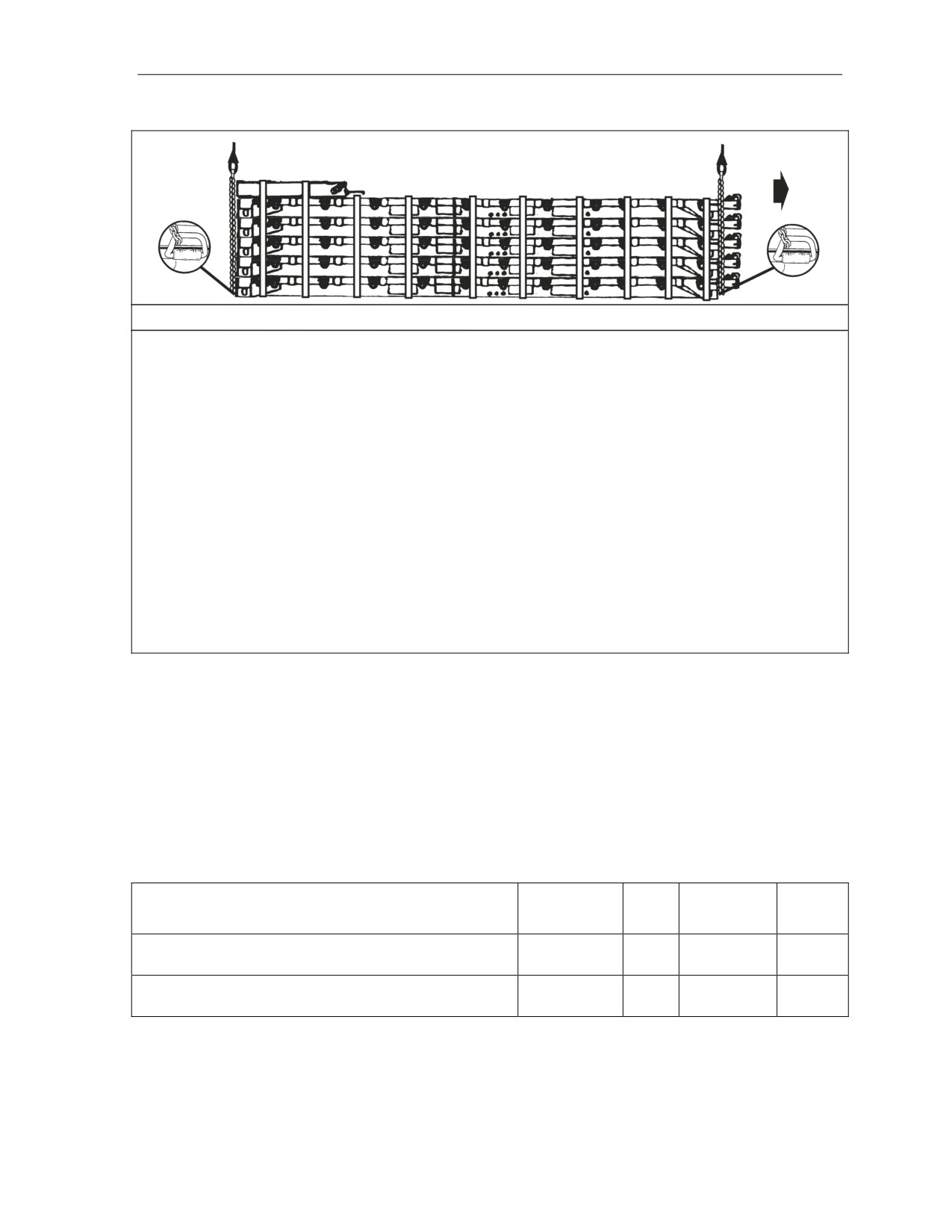
13-7. The container roll-in/out platform, empty, stacked is rigged for dual-point sling load using the
following procedures:
z
Applicability. The following item in Table 13-6 is certified for the helicopter(s) listed in the
following table by the US Army Natick Soldier Center:
Table 13-6. Container Roll-In/Out Platform, Empty, Stacked
Nomenclature
Max Weight
Sling
Link Count
Type of
(Pounds)
Set
Front/Rear
Aircraft
Two Through Five Container Roll-In/Out Platform,
Min-7,300
25K
3/25
CH-47
Empty, Stacked
Max-20,000
z
Materials. The following materials are required to rig this load:
Sling set (25,000-pound capacity) with one additional apex fitting.
Tape, adhesive, pressure-sensitive, 2-inch wide roll.
Cord, nylon, Type III, 550-pound breaking strength.
Webbing, cotton, 1/4-inch, 80-pound breaking strength.
Padding, felt or suitable substitute (as required).
Strap, cargo, tiedown, 15,000-pound capacity (supplied with platform) (2 per stacked
platform).
z
Personnel. Two persons can prepare and rig this load in 10 minutes.
z
Procedures. The following procedures apply to this load:
Preparation. Prepare the load using the following steps:
─ Ensure the load restraints are in the stowed position.
─ Secure the A-frames in the down position.
─ Stack the platforms with the A-frames at the same end and secure the platforms
together with the straps provided with the platform (a minimum of two straps per
platform are required). Ensure the straps have operational keepers on the hook ends.
Secure the loose strap ends with tape or 1/4-inch cotton webbing.
Rigging. Rig the load according to the steps in Figure 13-6.
Hookup. Two hookup teams stand on top of the load. The static discharge person
discharges the static electricity. The forward hookup person places apex fitting 1 onto the
forward cargo hook. The aft hookup person places apex fitting 2 onto the aft cargo hook. The
hookup teams then carefully dismount the pallet and remain close to the load as the helicopter
removes slack from the sling legs. When successful hookup is assured, the hookup teams
quickly exit the area underneath the helicopter to the designated rendezvous point.
Derigging. Derigging is the reverse of the preparation and rigging procedures.
FM 4-20.199/MCRP 4-11.3E, VOL III/NTTP 3-04.13/
13-10
AFMAN 11-223 (I), VOL III/COMDINST M13482.4B
20 February 2009
Certified Dual-Point Rigging Procedures for Miscellaneous Equipment
RIGGING STEPS
1. Place two sling legs on apex fitting number 1. Position apex fitting number 1 on the front of
the platform
2. Loop the chain end of the sling legs through their respective front lift provisions on the bottom
platform. Place the correct link from Table 13-6 in the grab hook. Secure the excess chain
with tape or Type III nylon cord.
3. Place two sling legs on apex fitting number 2. Position apex fitting number 2 on the rear (A-
Frame end) of the platform.
4. Loop the chain end of the sling legs through their respective rear lift provisions on the bottom
platform. Place the correct link from Table 13-6 in the grab hook. Secure the excess chain
with tape or Type III nylon cord.
5. Raise the apex fittings above the load. Cluster and tie (breakaway technique) the sling legs
in each sling set together to prevent entanglement during hookup and lift-off.
Figure 13-6. Container Roll-In/Out Platform, Empty, Stacked
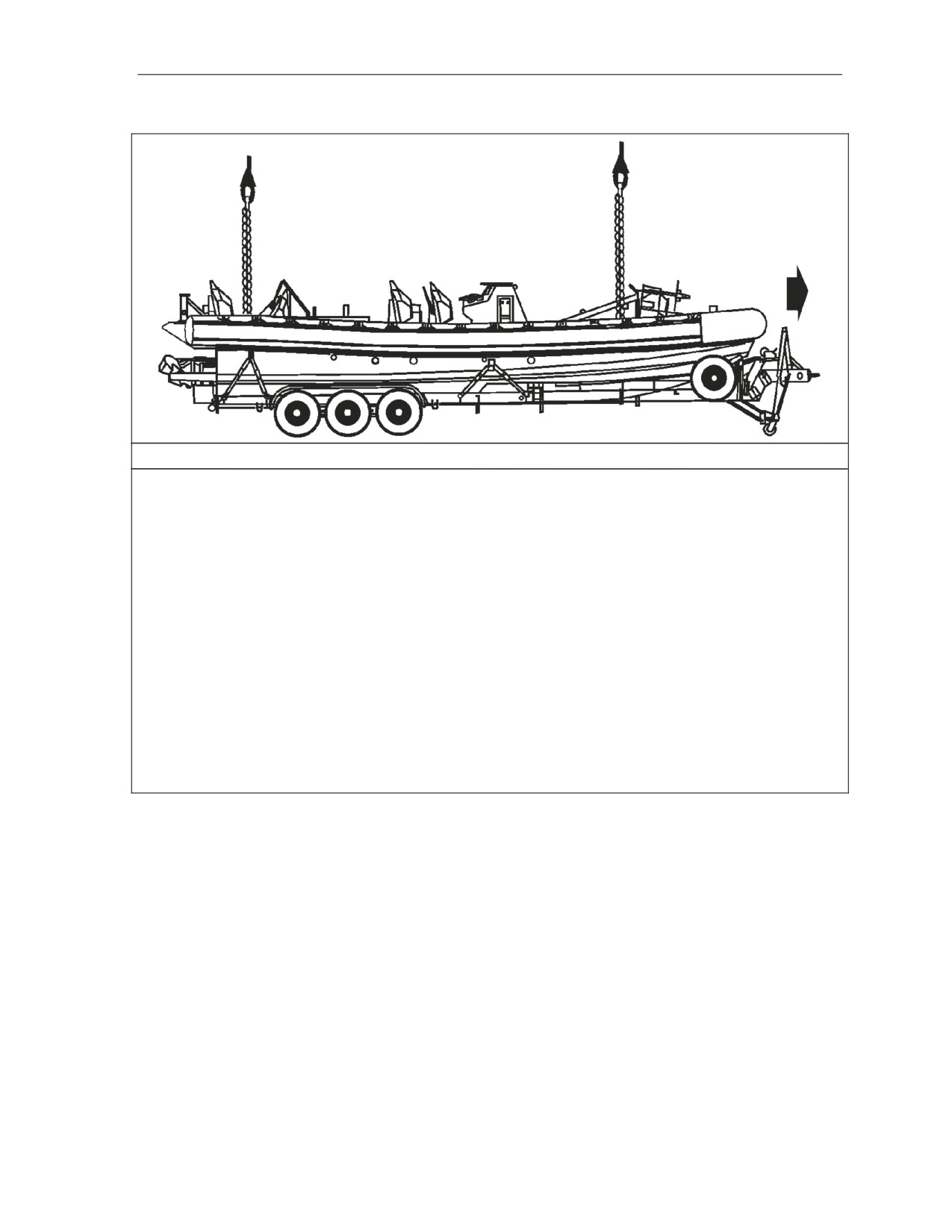
NAVAL SPECIAL WARFARE RIGID INFLATABLE BOAT (NSWRIB)
WITH OR WITHOUT TRAILER
13-8. The naval special warfare rigid inflatable boat with or without trailer is rigged for dual-point sling
load using the following procedures:
z
Applicability. The following item in Table 13-7 is certified for the helicopter(s) listed in the
following table by the US Army Natick Soldier Center:
Table 13-7. Naval Special Warfare Rigid Inflatable Boat with or without Trailer
Nomenclature
Max Weight
Sling
Link Count
Type of
(Pounds)
Set
Front/Rear
Aircraft
Naval Special Warfare Rigid Inflatable Boat without
15,070
25K
7/61
CH-47
Trailer
18,230
40K
3/45
CH-53
Naval Special Warfare Rigid Inflatable Boat with
19,240
25K
7/61
CH-47
Trailer
22,400
40K
3/45
CH-53
z
Materials. The following materials are required to rig this load:
Sling set (25,000-pound capacity) with one additional apex fitting.
OR
Sling set (40,000-pound capacity) with one additional apex fitting.
Tape, adhesive, pressure-sensitive, 2-inch wide roll.
FM 4-20.199/MCRP 4-11.3E, VOL III/NTTP 3-04.13/
20 February 2009
AFMAN 11-223 (I), VOL III/COMDINST M13482.4B
13-11

Chapter 13
Cord, nylon, Type III, 550-pound breaking strength.
Webbing, cotton, 1/4-inch, 80-pound breaking strength.
z
Personnel. Two persons can prepare and rig this load in 10 minutes.
z
Procedures. The following procedures apply to this load:
Preparation. Prepare the load using the following steps:
Note. These loads may be flown with the sponsons inflated or deflated.
─ Rotate the aft seat rack forward and secure it to the aft engine hand rail with Type III
nylon cord.
─ Secure the aft engine hand rail, lids, doors, and caps with tape or Type III nylon cord.
Note. When sling loading the NSWRIB off the trailer, ensure all the straps as well as the hard
point connection that connects the boat to the trailer are disconnected.
Note. When sling loading the NSWRIB with trailer add the following procedures.
─ Ensure the NSWRIB is properly secured to the trailer with the straps provided with the
trailer.
─ There are five connection points on the boat (two on each side and one in the front)
and nine connection points on the trailer (four on each side and one in the front).
─ The straps provided with the trailer should be 12,000-pound nylon webbing with
10,000-pound hooks on each end. An 11,000-pound load binder should also be used
with the strap.
─ Secure safety chains, intervehicular electrical cables, and brake cables on top of the
drawbar tape or Type III nylon cord.
─ Lower the lunette close to the ground and secure it in place with a 5,000-pound
tiedown strap and load binder.
─ Engage the parking brake and secure it in the engaged position.
Rigging. Rig the load according to the steps in Figure 13-7.
Note. This load is flown with the bow of the boat in front.
Hookup. Two hookup teams stand on deck of the boat. The static discharge person
discharges the static electricity. The forward hookup person places apex fitting 1 onto the
forward cargo hook. The aft hookup person places apex fitting 2 onto the aft cargo hook. The
hookup teams then carefully dismount the boat and remain close to the load as the helicopter
removes slack from the sling legs. When successful hookup is assured, the hookup teams
quickly exit the area underneath the helicopter to the designated rendezvous point.
Derigging. Derigging is the reverse of the preparation and rigging procedures.
FM 4-20.199/MCRP 4-11.3E, VOL III/NTTP 3-04.13/
13-12
AFMAN 11-223 (I), VOL III/COMDINST M13482.4B
20 February 2009
Certified Dual-Point Rigging Procedures for Miscellaneous Equipment
RIGGING STEPS
1. Place two sling legs on apex fitting number 1. Position apex fitting number 1 on the bow of
the boat.
2. Loop the chain end of the left and right sling legs through their respective lift provisions on
the front of the deck. Place the correct link from Table 13-7 in the grab hook. Secure the
excess chain with tape or Type III nylon cord.
3. Place two sling legs on apex fitting number 2. Position apex fitting number 2 on the deck at
the stern of the boat.
4. Loop the chain end of the left and right sling legs through their respective lift provision on the
stern of the boat. Place the correct link from Table 13-7 in the grab hook. Secure the excess
chain with tape or Type III nylon cord.
5. Raise the apex fittings above the load. Cluster and tie (breakaway technique) the sling legs
in each sling set together to prevent entanglement during hookup and lift-off.
Figure 13-7. Naval Special Warfare Rigid Boat with or without Trailer
FM 4-20.199/MCRP 4-11.3E, VOL III/NTTP 3-04.13/
20 February 2009
AFMAN 11-223 (I), VOL III/COMDINST M13482.4B
13-13

Chapter 13
SPECIAL OPERATIONS CRAFT-RIVERINE (SOC-R) AND NAVAL
SPECIAL WARFARE RIGID INFLATABLE BOAT (NSWRIB)
TRAILER
13-9. The special operations craft-riverine and naval special warfare rigid inflatable boat trailer are rigged
for dual-point sling load using the following procedures:
z
Applicability. The following items in Table 13-8 are certified for the helicopter(s) listed in the
following table by the US Army Natick Soldier Center:
Table 13-8. Special Operations Craft-Riverine and Naval Special Warfare Rigid Inflatable Boat
Trailer
Nomenclature
Max Weight
Sling
Link Count
Type of
(Pounds)
Set
Front/Rear
Aircraft
Naval Special Warfare Rigid Inflatable Boat Trailer
3,716
15K
5/20
CH-53
Special Operations Craft-Riverine Trailer
4,300
15K
5/20
CH-53
z
Materials. The following materials are required to rig this load:
Sling set (15,000-pound capacity) with one additional web ring.
Tape, adhesive, pressure-sensitive, 2-inch wide roll.
Cord, nylon, Type III, 550-pound breaking strength.
Webbing, cotton, 1/4-inch, 80-pound breaking strength.
z
Personnel. Two persons can prepare and rig this load in 10 minutes.
z
Procedures. The following procedures apply to this load:
Preparation. Prepare the load using the following steps:
─ Secure the utility box lid with Type III nylon cord.
─ Lower the lunette close to the ground and secure it in place with a 5,000-pound
tiedown strap and load binder.
─ Secure safety chains, intervehicular electrical cables, and brake cables on top of the
drawbar tape or Type III nylon cord.
─ Engage the parking brake and secure it in the engaged position.
─ Tape the rails on the trailer together to ensure the slings do not become entangled.
─ Tape all lights.
Rigging. Rig the load according to the steps in Figure 13-8.
Note. This load is flown with the lunette in front.
Hookup. Two hookup teams stand next to the trailer. The static discharge person
discharges the static electricity. The forward hookup person places apex fitting 1 onto the
forward cargo hook. The aft hookup person places apex fitting 2 onto the aft cargo hook. The
hookup teams then carefully dismount the trailer and remain close to the load as the helicopter
removes slack from the sling legs. When successful hookup is assured, the hookup teams
quickly exit the area underneath the helicopter to the designated rendezvous point.
Derigging. Derigging is the reverse of the preparation and rigging procedures.
FM 4-20.199/MCRP 4-11.3E, VOL III/NTTP 3-04.13/
13-14
AFMAN 11-223 (I), VOL III/COMDINST M13482.4B
20 February 2009
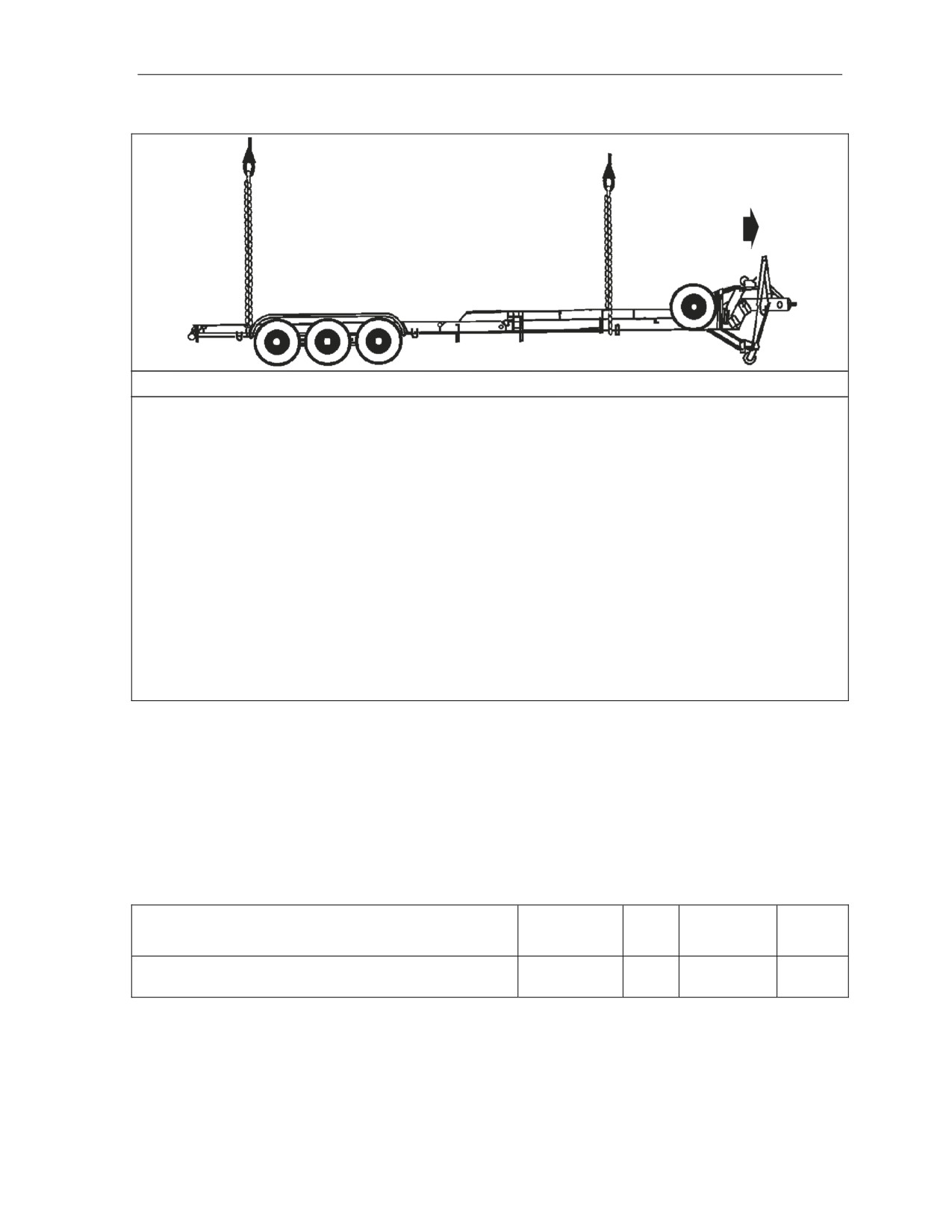
Certified Dual-Point Rigging Procedures for Miscellaneous Equipment
RIGGING STEPS
1. Place two sling legs on apex fitting number 1. Position apex fitting number 1 on the front of
the trailer.
2. Loop the chain end of sling leg 1 around the main support frame in front of the tiedown
provision on the left side of the trailer. Place the correct link from Table 13-8 in the grab
hook. Repeat this step with sling leg 2 on the right side of the trailer.
3. Place two sling legs on apex fitting number 2. Position apex fitting number 2 on the rear of
the trailer.
4. Loop the chain end of the left and right sling legs around the frame and through their
respective lift provision on the rear of the trailer. Place the correct link from Table 13-8 in the
grab hook. Secure the excess chain with tape or Type III nylon cord.
5. Raise the apex fittings above the load. Cluster and tie (breakaway technique) the sling legs
in each sling set together to prevent entanglement during hookup and lift-off.
Figure 13-8. Special Operations Craft-Riverine and Naval Special Warfare Rigid Inflatable Boat
Trailer
SPECIAL OPERATIONS CRAFT-RIVERINE (SOC-R)
13-10. The special operations craft is rigged for dual-point sling load using the following procedures:
z
Applicability. The following item in Table 13-9 is certified for the helicopter(s) listed in the
following table by the US Army Natick Soldier Center:
Table 13-9. Special Operations Craft-Riverine
Nomenclature
Max Weight
Sling
Link Count
Type of
(Pounds)
Set
Front/Rear
Aircraft
Special Operations Craft-Riverine
20,400
25K
7/36
CH-47
40K
3/22
CH-53
z
Materials. The following materials are required to rig this load:
Sling set (25,000- or 40,000-pound capacity) with one additional apex fitting.
Tape, adhesive, pressure-sensitive, 2-inch wide roll.
Cord, nylon, Type III, 550-pound breaking strength.
Webbing, cotton, 1/4-inch, 80-pound breaking strength.
FM 4-20.199/MCRP 4-11.3E, VOL III/NTTP 3-04.13/
20 February 2009
AFMAN 11-223 (I), VOL III/COMDINST M13482.4B
13-15
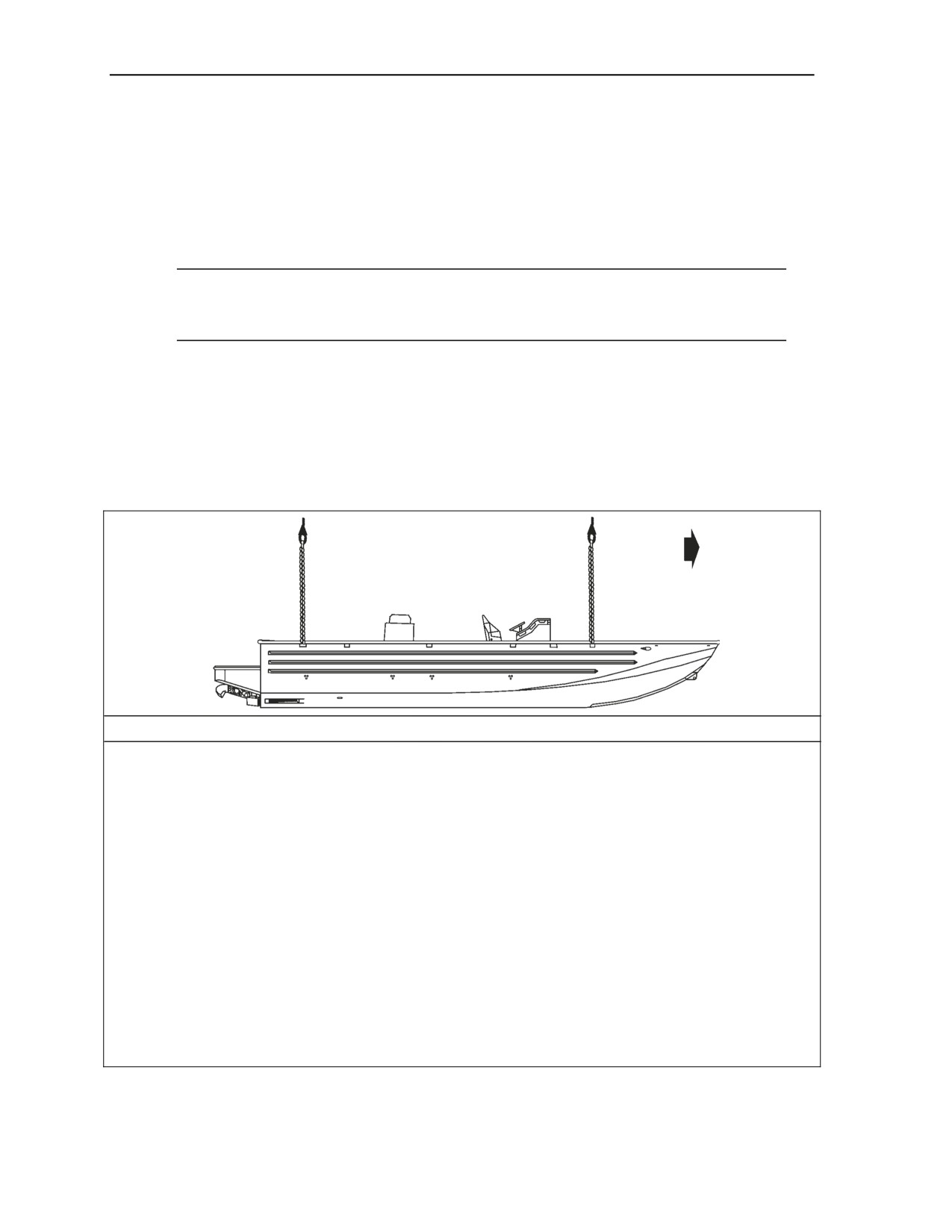
Chapter 13
z
Personnel. Two persons can prepare and rig this load in 10 minutes.
z
Procedures. The following procedures apply to this load:
Preparation. Prepare the load using the following steps:
─ Rotate the communications module to the deck and secure for travel.
─ Secure all lids, doors, and caps with tape or Type III nylon cord.
─ Secure all control knobs, control gauges, and lights with tape.
Rigging. Rig the load according to the steps in Figure 13-9.
Notes. 1. This load is flown with the bow of the boat forward.
2. When lifting the SOC-R off the trailer ensure all tiedown straps and hard points are
disconnected
Hookup. Two hookup teams stand on the deck of the boat. The static discharge person
discharges the static electricity. The forward hookup person places apex fitting 1 onto the
forward cargo hook. The aft hookup person places apex fitting 2 onto the aft cargo hook. The
hookup teams then carefully dismount the boat and remain close to the load as the helicopter
removes slack from the sling legs. When successful hookup is assured, the hookup teams
quickly exit the area underneath the helicopter to the designated rendezvous point.
Derigging. Derigging is the reverse of the preparation and rigging procedures
RIGGING STEPS
1. Place two sling legs on apex fitting number 1. Position apex fitting number 1 on the bow
deck.
2. Loop the chain end of the sling legs through their respective front lift provisions. Place the
correct link from Table 13-9 in the grab hook. Secure the excess chain with tape or Type III
nylon cord.
3. Place two sling legs on apex fitting number 2. Position apex fitting number 2 on the stern
deck.
4. Loop the chain end of the sling legs through their respective rear lift provisions. Place the
correct link from Table 13-9 in the grab hook. Secure the excess chain with tape or Type III
nylon cord.
5. Raise the apex fittings above the load. Cluster and tie or tape (breakaway technique) the
sling legs in each sling set together to prevent entanglement during hookup and lift-off.
Figure 13-9. Special Operations Craft-Riverine
FM 4-20.199/MCRP 4-11.3E, VOL III/NTTP 3-04.13/
13-16
AFMAN 11-223 (I), VOL III/COMDINST M13482.4B
20 February 2009
Certified Dual-Point Rigging Procedures for Miscellaneous Equipment
SPECIAL OPERATIONS CRAFT-RIVERINE (SOC-R) WITH SOC-R
TRAILER
13-11. The special operations craft with SOC-R trailer is rigged for dual-point sling load using the
following procedures:
z
Applicability. The following item in Table 13-10 is certified for the helicopter(s) listed in the
following table by the US Army Natick Soldier Center:
Table 13-10. Special Operations Craft-Riverine with SOC-R Trailer
Nomenclature
Max Weight
Sling
Link Count
Type of
(Pounds)
Set
Front/Rear
Aircraft
Special Operations Craft-Riverine with SOC-R Trailer
24,000
25K
7/36
CH-47
40K
3/27
CH-53
z
Materials. The following materials are required to rig this load:
Sling set (25,000- or 40,000-pound capacity) with one additional apex fitting.
Tape, adhesive, pressure-sensitive, 2-inch wide roll.
Cord, nylon, Type III, 550-pound breaking strength.
Webbing, cotton, 1/4-inch, 80-pound breaking strength.
5,000-pound capacity cargo strap with load binder (as required).
12,000-pound capacity nylon tiedown straps and 11,000-pound capacity load binders
(provided with the boat) (4 each).
Felt sheet, cattle hair, Type IV, 1/2-inch or suitable padding.
z
Personnel. Two persons can prepare and rig this load in 10 minutes.
z
Procedures. The following procedures apply to this load:
Preparation. Prepare the load using the following steps:
─ Secure the boat to the trailer starting from the bow using the following steps:
─ Route the first 12,000-pound capacity tiedown strap around the boat and trailer just aft
of the gun mounts and secure with an 11,000-pound capacity load binder.
─ Route the second 12,000-pound capacity tiedown strap around the boat and trailer in-
between the control console and the driver's seat and secure with an 11,000-pound
capacity load binder.
─ Route the third 12,000-pound capacity tiedown strap around the boat and trailer just aft
of the driver's seat, through the tiedown provisions on the trailer and secure with an
11,000-pound capacity load binder.
─ Route the fourth 12,000-pound capacity tiedown strap around the boat and trailer just
aft of the antenna mounts, through the tiedown provisions on the trailer and secure
with an 11,000-pound capacity load binder.
─ Pad all the tiedown straps where the straps contact the bottom of the hull.
─ Rotate the communications module to the deck and secure for travel.
─ Secure all lids, doors, and caps with tape or Type III nylon cord.
─ Secure all control knobs, control gauges, and lights with tape.
─ Cover the water jets with tape.
─ Lower the lunette close to the ground and secure it in place with a 5,000-pound
tiedown strap and load binder.
─ Secure safety chains, intervehicular electrical cables, and brake cables on top of the
drawbar tape or Type III nylon cord.
─ Engage the parking brake and secure it in the engaged position.
─ Tape all lights.
Rigging. Rig the load according to the steps in Figure 13-10.
FM 4-20.199/MCRP 4-11.3E, VOL III/NTTP 3-04.13/
20 February 2009
AFMAN 11-223 (I), VOL III/COMDINST M13482.4B
13-17
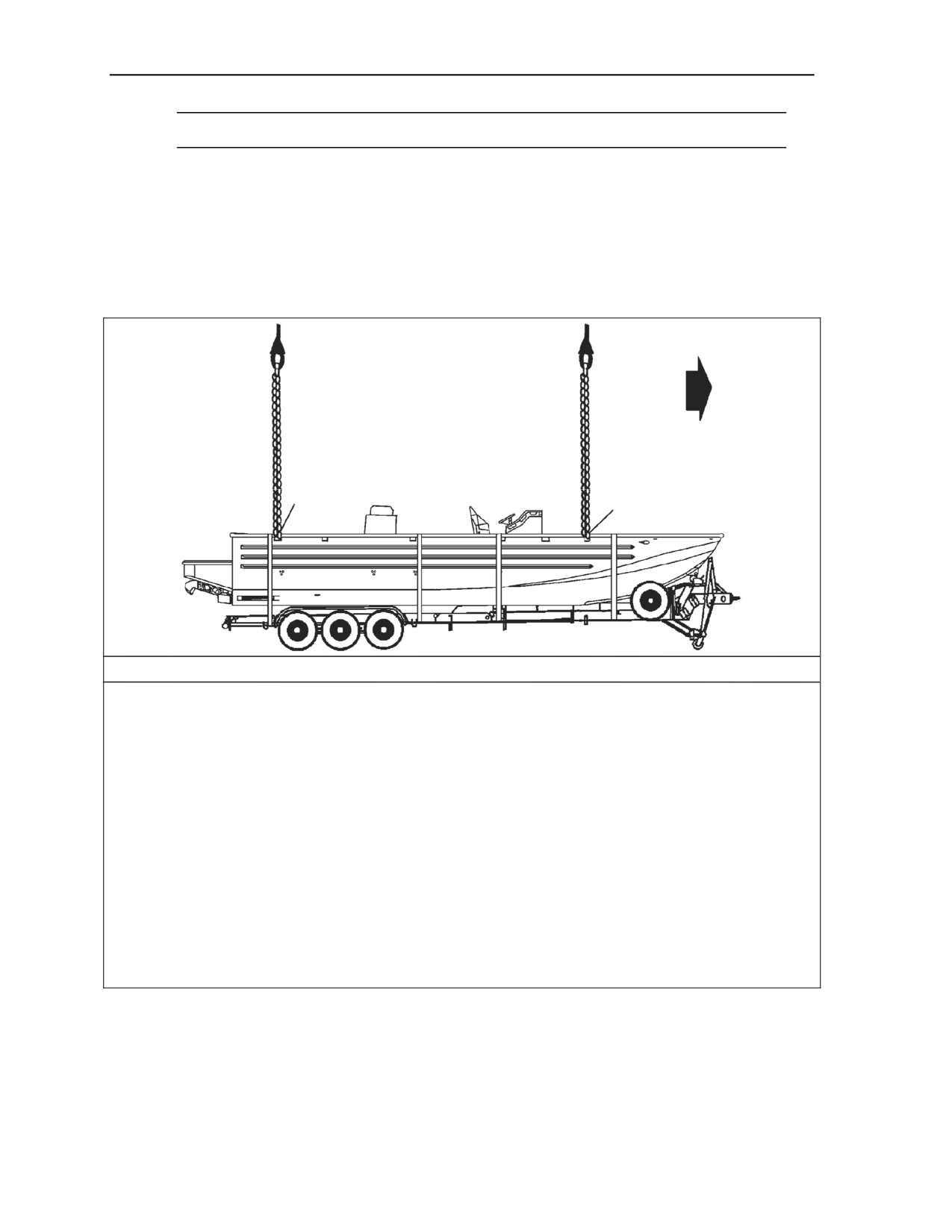
Chapter 13
Note. This load is flown with the bow of the boat forward.
Hookup. Two hookup teams stand on the deck of the boat. The static discharge person
discharges the static electricity. The forward hookup person places apex fitting 1 onto the
forward cargo hook. The aft hookup person places apex fitting 2 onto the aft cargo hook. The
hookup teams then carefully dismount the boat and remain close to the load as the helicopter
removes slack from the sling legs. When successful hookup is assured, the hookup teams
quickly exit the area underneath the helicopter to the designated rendezvous point.
Derigging. Derigging is the reverse of the preparation and rigging procedures.
RIGGING STEPS
1. Place two sling legs on apex fitting number 1. Position apex fitting number 1 on the bow
deck.
2. Loop the chain end of the sling legs through their respective front lift provisions. Place the
correct link from Table 13-10 in the grab hook. Secure the excess chain with tape or Type III
nylon cord.
3. Place two sling legs on apex fitting number 2. Position apex fitting number 2 on the stern
deck.
4. Loop the chain end of the sling legs through their respective rear lift provisions. Place the
correct link from Table 13-10 in the grab hook. Secure the excess chain with tape or Type III
nylon cord.
5. Raise the apex fittings above the load. Cluster and tie or tape (breakaway technique) the
sling legs in each sling set together to prevent entanglement during hookup and lift-off.
Figure 13-10. Special Operations Craft-Riverine (SOC-R) with SOC-R Trailer
FM 4-20.199/MCRP 4-11.3E, VOL III/NTTP 3-04.13/
13-18
AFMAN 11-223 (I), VOL III/COMDINST M13482.4B
20 February 2009