FM 4-20.199 Multiservice Helicopter Sling Load: Dual-Point Load Rigging Procedures (February 2009) - page 10
Certified Dual-Point Rigging Procedures for Engineer Equipment
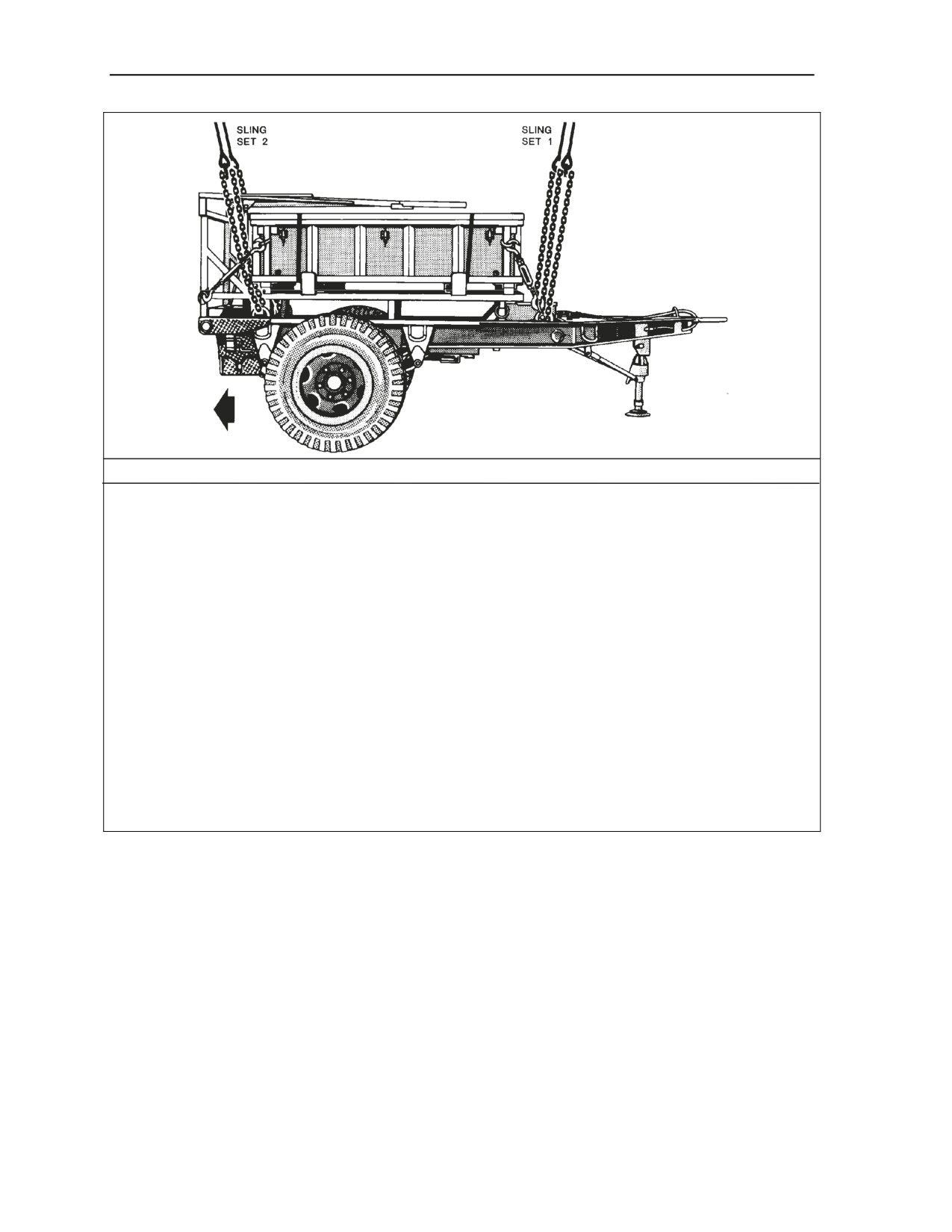
MINE CLEARING LINE CHARGE MOUNTED ON M200A1 TRAILER
8-20. The mine clearing line charge mounted on M200A1 trailer is rigged for dual-point sling load using
the following procedures:
z
Applicability. The following item in Table 8-19 is certified for the helicopter(s) listed in the
following table by the US Army Natick Soldier Center:
Table 8-19. Mine Clearing Line Charge Mounted on M200A1 Trailer
Nomenclature
Max Weight
Sling
Link Count
Type of
(Pounds)
Set
Front/Rear
Aircraft
MK155 Launcher with M68A2 Demolition Charge and
6,002
10K
10/3
CH-47
MK22 Rocket Motor
z
Materials. The following materials are required to rig this load:
Sling set (10,000-pound capacity) with one additional apex fitting.
Tape, adhesive, pressure-sensitive, 2-inch wide roll.
Cord, nylon, Type III, 550-pound breaking strength.
Webbing, cotton, 1/4-inch, 80-pound breaking strength.
Strap, cargo, tiedown, CGU-1/B (4 each).
z
Personnel. Two persons can prepare and rig this load in 20 minutes.
z
Procedures. The following procedures apply to this load:
Preparation. Prepare the load using the following steps:
─ Ensure all components are securely attached together.
─ Ensure the storage box lid is closed and secure. Secure safety chains, hoses, and any
other loose items with tape or Type III nylon cord.
─ Engage the parking brake.
─ Ensure the launch is in the collapsed or storage position.
Note. The rocket motor cannot be safely secured to the load in this configuration; therefore, the
rocket motor box must be kept separate and loaded internally into the helicopter.
Rigging. Rig the load according to the steps in Figure 8-19.
Hookup. Two hookup teams are required for this load. The static discharge person
discharges the static electricity. The forward hookup person stands on the demolition box and
places apex fitting 2 onto the forward cargo hook. The aft hookup person stands on the
demolition box (lunette end) and places apex fitting 1 onto the aft cargo hook. The hookup
teams then carefully dismount the load and remain close to the load as the helicopter removes
slack from the sling legs. When successful hookup is assured, the hookup teams quickly exit
the area underneath the helicopter to the designated rendezvous point.
Derigging. Derigging is the reverse of the preparation and rigging procedures.
FM 4-20.199/MCRP 4-11.3E, VOL III/NTTP 3-04.13/
20 February 2009
AFMAN 11-223 (I), VOL III/COMDINST M13482.4B
8-37
Chapter 8
RIGGING STEPS
1. Place two sling legs on apex fitting number 1. Position apex fitting number 1 on top of the
demolition charge container on the lunette end.
2. Loop the chain end of the left and right sling legs through their respective lift provisions
located on the trailer chassis frame aft of the lunette. Place the correct link from Table 8-19
in the grab hook.
3. Place two sling legs on apex fitting number 2. Position apex fitting number 2 on top of the aft
end of the launcher.
4. Loop the chain end of the left and right sling legs through their respective lift provisions
located on the trailer chassis below the aft end of the demolition charge container. Place the
correct link from Table 8-19 in the grab hook. Secure the excess chain with tape or Type III
nylon cord.
5. Raise the apex fittings above the load. Cluster and tie (breakaway technique) the sling legs
in each sling set together to prevent entanglement during hookup and lift-off.
Figure 8-19. Mine Clearing Line Charge Mounted on M200A1 Trailer
FM 4-20.199/MCRP 4-11.3E, VOL III/NTTP 3-04.13/
8-38
AFMAN 11-223 (I), VOL III/COMDINST M13482.4B
20 February 2009
Certified Dual-Point Rigging Procedures for Engineer Equipment
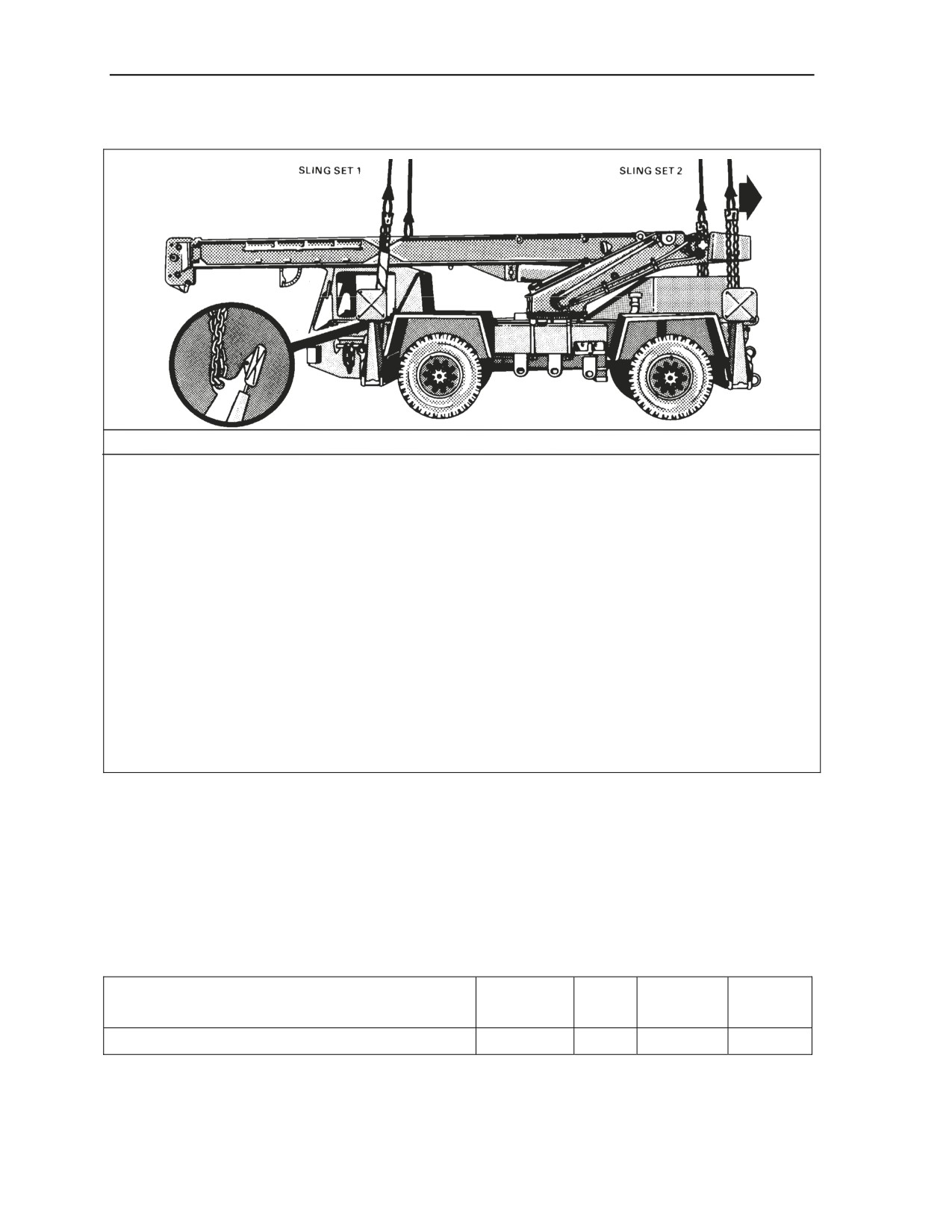
LRT-110, 7 ½-TON CRANE
8-21. The LRT-110, 7 ½-ton crane is rigged for dual-point sling load using the following procedures:
z
Applicability. The following item in Table 8-20 is certified for the helicopter(s) listed in the
following table by the US Army Natick Soldier Center:
Table 8-20. LRT-110, 7 ½-Ton Crane
Nomenclature
Max Weight
Sling
Link Count
Type of
(Pounds)
Set
Front/Rear
Aircraft
LRT-110, 7 ½-Ton Crane
24,230
25K
3/3
CH-47
z
Materials. The following materials are required to rig this load:
Sling set (25,000-pound capacity) with one additional apex fitting.
Tape, adhesive, pressure-sensitive, 2-inch wide roll.
Cord, nylon, Type III, 550-pound breaking strength.
Webbing, cotton, 1/4-inch, 80-pound breaking strength.
Strap, cargo, tiedown, CGU-1/B (1 each).
Felt sheet, cattle hair, Type IV, 1/2-inch or suitable padding.
Webbing, tubular, nylon, 1/2-inch, 1,000-pound breaking strength.
z
Personnel. Two persons can prepare and rig this load in 20 minutes.
z
Procedures. The following procedures apply to this load:
Preparation. Prepare the load using the following steps:
─ Fold the side mirrors in toward the cab and secure with tape or Type III nylon cord.
Tape the windshield wipers to the windshield.
─ Ensure the front wheels are straight and secure the steering wheel with Type III nylon
cord.
─ Engage the hand brake.
─ Secure the doors, toolbox cover, and all loose equipment with tape or Type III nylon
cord.
─ Secure the hook-block assembly to the end of the boom mast with a CGU-1/B tiedown
strap.
─ Secure the boom light power cable with tape or Type III nylon cord.
─ Insert wooden cable wedges at the drum to prevent the cable from unspooling if the
cable becomes slack.
─ Secure the cable wedges with 1/2-inch tubular nylon.
─ Ensure the fuel tank is not over 3/4 full. Inspect fuel tank cap, oil filler cap, and
battery caps for proper installation.
Rigging. Rig the load according to the steps in Figure 8-20.
Hookup. Two hookup teams are required for this load. The static discharge person
discharges the static electricity. The forward hookup person stands on the engine deck and
places apex fitting 2 onto the forward cargo hook. The aft hookup person stands on the cab
top and places apex fitting 1 onto the aft cargo hook. The hookup teams then carefully
dismount the load and remain close to the load as the helicopter removes slack from the sling
legs. When successful hookup is assured, the hookup teams quickly exit the area underneath
the helicopter to the designated rendezvous point.
Derigging. Derigging is the reverse of the preparation and rigging procedures.
FM 4-20.199/MCRP 4-11.3E, VOL III/NTTP 3-04.13/
20 February 2009
AFMAN 11-223 (I), VOL III/COMDINST M13482.4B
8-39
Chapter 8
RIGGING STEPS
1. Place two sling legs on apex fitting number 1. Position apex fitting number 1 on top of the boom directly
above the front wheels.
2. Loop the chain end of the left and right sling legs through their respective lift provisions located on the
inboard side of the front outriggers. Place the correct link from Table 8-20 in the grab hook.
3. Pad the slings where they contact the cab and secure the padding with tape or Type III nylon cord.
4. Place two sling legs on apex fitting number 2. Position apex fitting number 2 on top of the boom directly
above the rear wheels.
5. Loop the chain end of the left and right sling legs through their respective lift provisions located on the
inboard side of the rear outriggers. Place the correct link from Table 8-20 in the grab hook.
6. Raise the apex fittings above the load. Cluster and tie (breakaway technique) the sling legs in each
sling set together to prevent entanglement during hookup and lift-off.
Figure 8-20. LRT-110, 7 1/2-Ton Crane
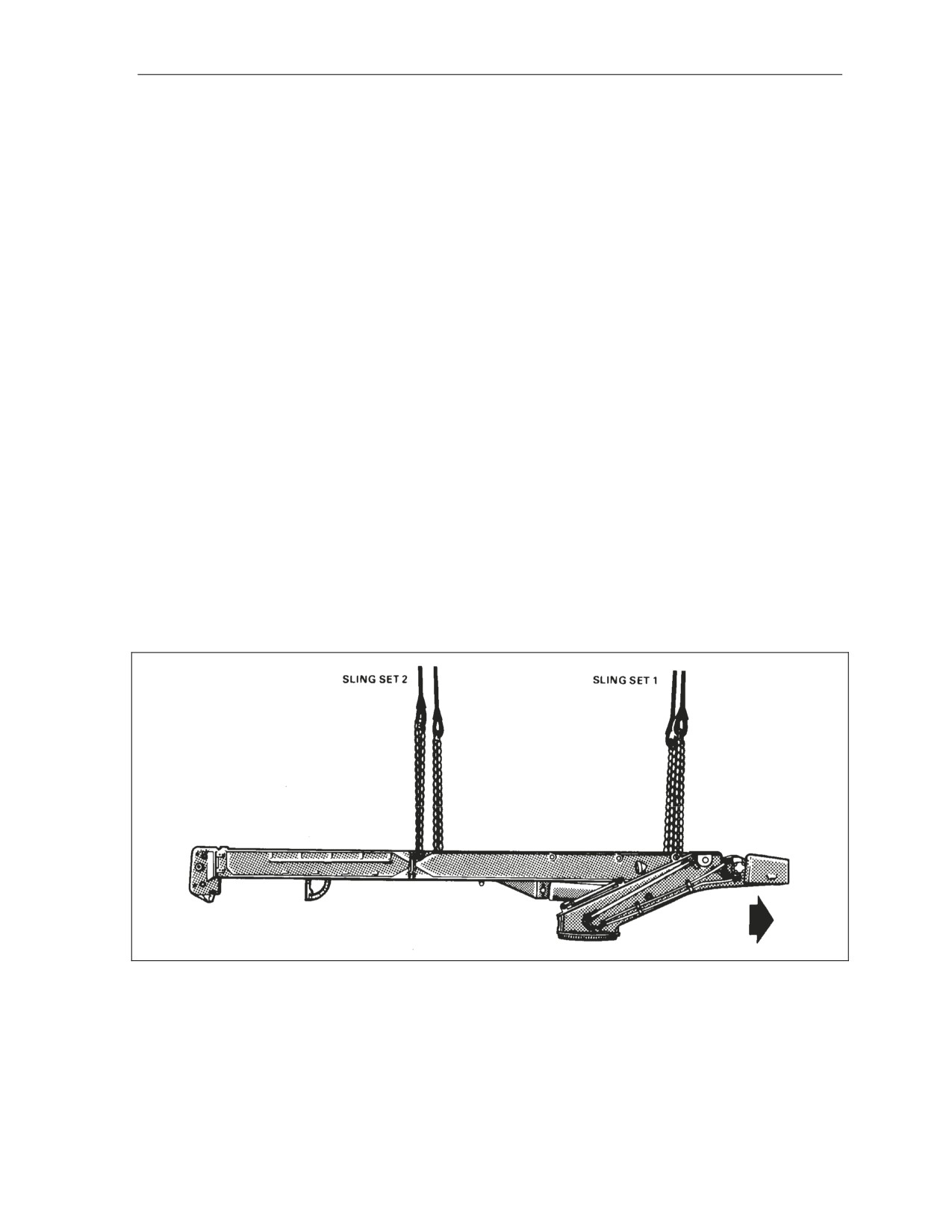
LRT-110, 7 ½-TON CRANE BOOM
8-22. The LRT-110,
7 ½-ton crane boom is rigged for dual-point sling load using the following
procedures:
z
Applicability. The following item in Table 8-21 is certified for the helicopter(s) listed in the
following table by the US Army Natick Soldier Center:
Table 8-21. LRT-110, 7 ½-Ton Crane Boom
Nomenclature
Max Weight
Sling
Link Count
Type of
(Pounds)
Set
Front/Rear
Aircraft
LRT-110, 7 ½-Ton Crane Boom
8,600
10K
3/3
CH-47
z
Materials. The following materials are required to rig this load:
Sling set (10,000-pound capacity) with one additional apex fitting.
Tape, adhesive, pressure-sensitive, 2-inch wide roll.
FM 4-20.199/MCRP 4-11.3E, VOL III/NTTP 3-04.13/
8-40
AFMAN 11-223 (I), VOL III/COMDINST M13482.4B
20 February 2009
Certified Dual-Point Rigging Procedures for Engineer Equipment
Cord, nylon, Type III, 550-pound breaking strength.
Webbing, cotton, 1/4-inch, 80-pound breaking strength.
Strap, cargo, tiedown, CGU-1/B (1 each).
Webbing, tubular, nylon, 1/2-inch, 1,000-pound breaking strength.
z
Personnel. Two persons can prepare and rig this load in 20 minutes.
z
Procedures. The following procedures apply to this load:
Preparation. Prepare the load using the following steps:
─ Sectionalize the crane according to the instructions in the operator's manual.
─ Secure the hook-block assembly to the end of the boom mast with a CGU-1/B tiedown
strap.
─ Secure the boom light power cable with tape or Type III nylon cord.
─ Insert wooden cable wedges at the drum to prevent the cable from uncoiling if the
cable becomes slack.
─ Secure the cable wedges with 1/2-inch tubular nylon.
─ Secure the boom hydraulic hoses with tape or Type III nylon cord. Ensure the hoses
are clear of the boom base.
Rigging. Rig the load according to the steps in Figure 8-21.
Hookup. Two hookup teams are required for this load. The static discharge person
discharges the static electricity.
The forward hookup person stands beside the rear
(counterweight) end and places apex fitting 1 onto the forward cargo hook. The aft hookup
person stands beside the middle of the boom and places apex fitting 2 onto the aft cargo hook.
The hookup teams then carefully dismount the load and remain close to the load as the
helicopter removes slack from the sling legs. When successful hookup is assured, the hookup
teams quickly exit the area underneath the helicopter to the designated rendezvous point.
Derigging. Derigging is the reverse of the preparation and rigging procedures.
Figure 8-21. LRT-110, 7 1/2-Ton Crane Boom
FM 4-20.199/MCRP 4-11.3E, VOL III/NTTP 3-04.13/
20 February 2009
AFMAN 11-223 (I), VOL III/COMDINST M13482.4B
8-41

Chapter 8
RIGGING STEPS
1. Place two sling legs on apex fitting number 1. Position apex fitting number 1 on top of the
boom counterweight.
2. Loop the chain end of the left and right sling legs through their respective lift provisions
located on top of boom left and right support arms. Place the correct link from Table 8-21 in
the grab hook.
3. Place two sling legs on apex fitting number 2. Position apex fitting number 2 on top of the
middle of the boom by the lift provisions.
4. Loop the chain end of the left and right sling legs through their respective lift provisions
located on sides of the boom. Place the correct link from Table 8-21 in the grab hook.
5. Raise the apex fittings above the load. Cluster and tie (breakaway technique) the sling legs
in each sling set together to prevent entanglement during hookup and lift-off.
Figure 8-21. LRT-110, 7 1/2-Ton Crane Boom (Continued)
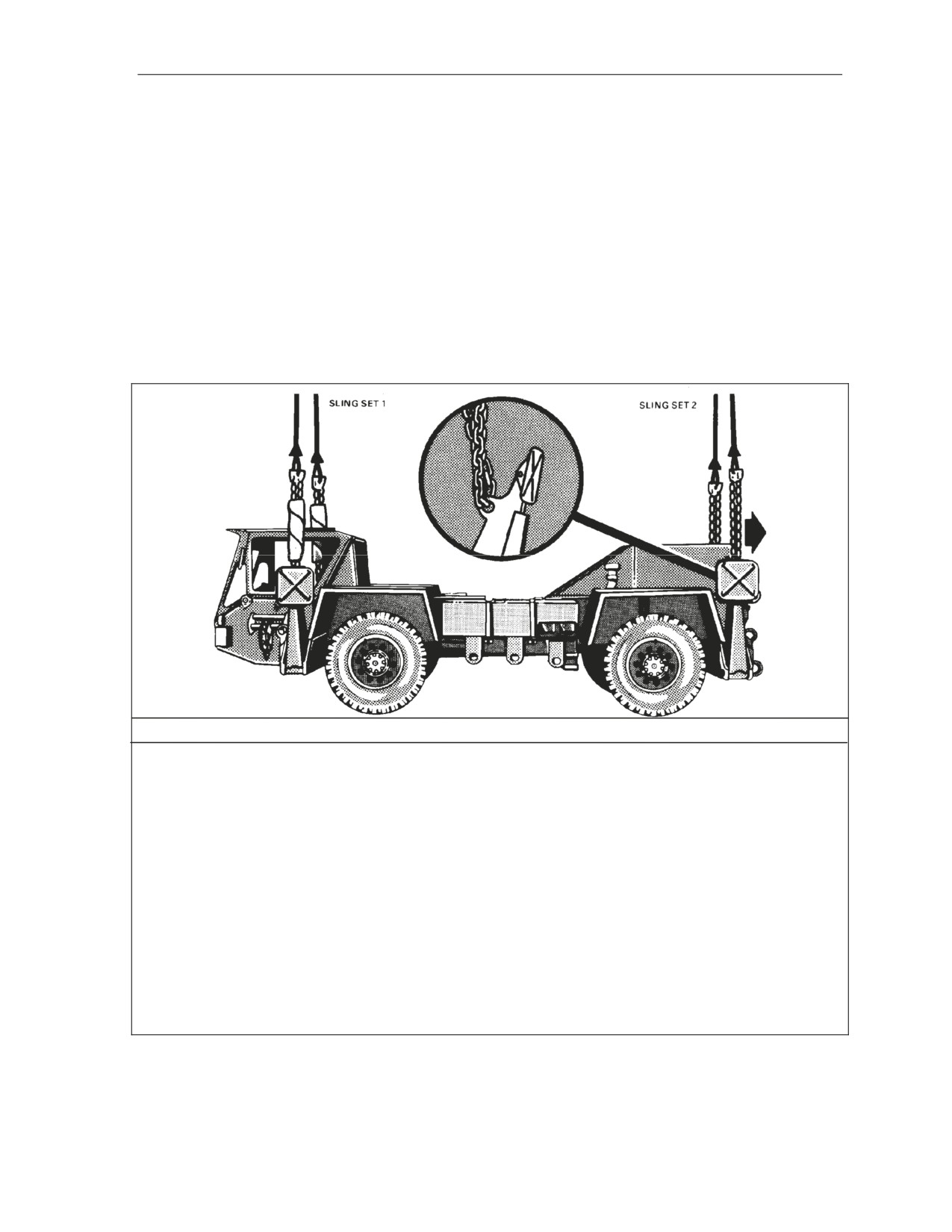
LRT-110, 7 ½-TON CRANE POWER UNIT
8-23. The LRT-110, 7 ½-ton crane power unit is rigged for dual-point sling load using the following
procedures:
z
Applicability. The following item in Table 8-22 is certified for the helicopter(s) listed in the
following table by the US Army Natick Soldier Center:
Table 8-22. LRT-110, 7 ½-Ton Crane Power Unit
Nomenclature
Max Weight
Sling
Link Count
Type of
(Pounds)
Set
Front/Rear
Aircraft
LRT-110, 7 ½-Ton Crane Power Unit
15,600
25K
3/3
CH-47
z
Materials. The following materials are required to rig this load:
Sling set (25,000-pound capacity) with one additional apex fitting.
Tape, adhesive, pressure-sensitive, 2-inch wide roll.
Cord, nylon, Type III, 550-pound breaking strength.
Webbing, cotton, 1/4-inch, 80-pound breaking strength.
Strap, cargo, tiedown, CGU-1/B (1 each).
Webbing, tubular, nylon, 1/2-inch, 1,000-pound breaking strength.
Felt sheet, cattle hair, Type IV, 1/2-inch or suitable padding.
z
Personnel. Two persons can prepare and rig this load in 20 minutes.
z
Procedures. The following procedures apply to this load:
Preparation. Prepare the load using the following steps:
─ Sectionalize the crane according to the instructions in the operator's manual.
─ Fold the side mirrors in toward the cab and secure with tape or Type III nylon cord.
Tape the windshield wipers to the windshield.
─ Ensure the front wheels are straight and secure the steering wheel with Type III nylon
cord. Engage the hand brake.
FM 4-20.199/MCRP 4-11.3E, VOL III/NTTP 3-04.13/
8-42
AFMAN 11-223 (I), VOL III/COMDINST M13482.4B
20 February 2009
Certified Dual-Point Rigging Procedures for Engineer Equipment
─ Ensure the fuel tank is not over 3/4 full. Inspect fuel tank cap, oil filler cap, and
battery caps for proper installation.
─ Secure the doors, toolbox cover, and all loose equipment with tape or Type III nylon
cord.
Rigging. Rig the load according to the steps in Figure 8-22.
Hookup. Two hookup teams are required for this load. The static discharge person
discharges the static electricity. The forward hookup person stands on the engine deck and
places apex fitting 2 onto the forward cargo hook. The aft hookup person stands on the cab
top and places apex fitting 1 onto the aft cargo hook. The hookup teams then carefully
dismount the load and remain close to the load as the helicopter removes slack from the sling
legs. When successful hookup is assured, the hookup teams quickly exit the area underneath
the helicopter to the designated rendezvous point.
Derigging. Derigging is the reverse of the preparation and rigging procedures.
RIGGING STEPS
1. Place two sling legs on apex fitting number 1. Position apex fitting number 1 on top of the boom directly
above the front wheels.
2. Loop the chain end of the left and right sling legs through their respective lift provisions located on the
inboard side of the front outriggers. Place the correct link from Table 8-22 in the grab hook.
3. Pad the slings where they contact the cab and secure the padding with tape or Type III nylon cord.
4. Place two sling legs on apex fitting number 2. Position apex fitting number 2 on top of the boom directly
above the rear wheels.
5. Loop the chain end of the left and right sling legs through their respective lift provisions located on the
inboard side of the rear outriggers. Place the correct link from Table 8-22 in the grab hook.
6. Raise the apex fittings above the load. Cluster and tie (breakaway technique) the sling legs in each
sling set together to prevent entanglement during hookup and lift-off.
Figure 8-22. LRT-110, 7 1/2-Ton Crane, Power Unit
FM 4-20.199/MCRP 4-11.3E, VOL III/NTTP 3-04.13/
20 February 2009
AFMAN 11-223 (I), VOL III/COMDINST M13482.4B
8-43
Chapter 8
SP-7 WHEEL-MOUNTED CRANE
8-24. The SP-7 wheel-mounted crane is rigged for dual-point sling load using the following procedures:
z
Applicability. The following item in Table 8-23 is certified for the helicopter(s) listed in the
following table by the US Army Natick Soldier Center:
Table 8-23. SP-7 Wheel-Mounted Crane
Nomenclature
Max Weight
Sling
Link Count
Type of
(Pounds)
Set
Front/Rear
Aircraft
SP-7 Wheel-Mounted Crane (Pettibone)
27,640
40K
3/11
CH-53
z
Materials. The following materials are required to rig this load:
Sling set (40,000-pound capacity) with one additional apex fitting.
Tape, adhesive, pressure-sensitive, 2-inch wide roll.
Cord, nylon, Type III, 550-pound breaking strength.
Webbing, cotton, 1/4-inch, 80-pound breaking strength.
Strap, cargo, tiedown, CGU-1/B (as required).
z
Personnel. Two persons can prepare and rig this load in 30 minutes.
z
Procedures. The following procedures apply to this load:
Preparation. Prepare the load using the following steps:
─ Ensure the boom is secured in the down position according to the operator's manual.
─ Secure all hatches and doors with tiedown straps or Type III nylon cord.
─ Ensure the front wheels are pointed straight ahead. Tie down the steering wheel using
Type III nylon cord.
─ Ensure the fuel tank is not over 3/4 full. Inspect fuel tank cap, oil filler cap, and
battery caps for proper installation.
─ Engage the hand brake and place the transmission in neutral.
─ Tape all windows, lights, and reflectors. Tape the exhaust opening.
Rigging. Rig the load according to the steps in Figure 8-23.
Hookup. Two hookup teams are required for this load. The static discharge person
discharges the static electricity. The forward hookup person stands on the front of the crane
and places apex fitting 1 onto the forward cargo hook. The aft hookup person stands on the
rear of the crane and places apex fitting 2 onto the aft cargo hook. The hookup teams then
carefully dismount the load and remain close to the load as the helicopter removes slack from
the sling legs. When successful hookup is assured, the hookup teams quickly exit the area
underneath the helicopter to the designated rendezvous point.
Derigging. Derigging is the reverse of the preparation and rigging procedures.
FM 4-20.199/MCRP 4-11.3E, VOL III/NTTP 3-04.13/
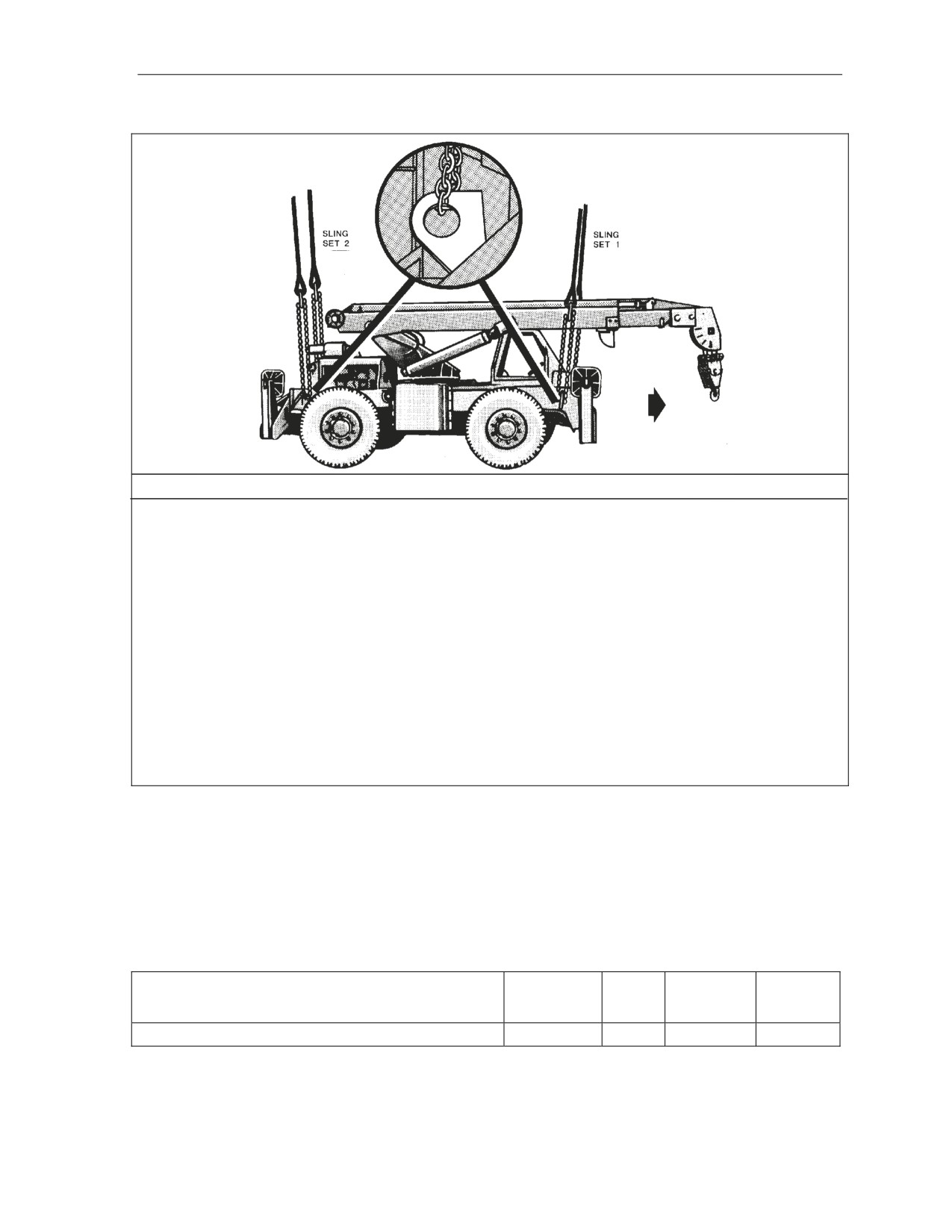
8-44
AFMAN 11-223 (I), VOL III/COMDINST M13482.4B
20 February 2009
Certified Dual-Point Rigging Procedures for Engineer Equipment
RIGGING STEPS
1. Place two sling legs on apex fitting number 1. Position apex fitting number 1 on top of the
front of the crane.
2. Loop the chain end of the left and right sling legs through their respective lift provisions
located below the front corners of the windshield. Place the correct link from Table 8-23 in
the grab hook.
3. Place two sling legs on apex fitting number 2. Position apex fitting number 2 on top of the aft
end of the crane.
4. Loop the chain end of the left and right sling legs through their respective lift provisions
located near the crane rear end. Place the correct link from Table 8-23 in the grab hook.
5. Raise the apex fittings above the load. Cluster and tie (breakaway technique) the sling legs
in each sling set together to prevent entanglement during hookup and lift-off.
Figure 8-23. SP-7 Wheel-Mounted Crane
TRUCK FORKLIFT, MC-4000
8-25. The truck forklift, MC-4000 is rigged for dual-point sling load using the following procedures:
z
Applicability. The following item in Table 8-24 is certified for the helicopter(s) listed in the
following table by the US Army Natick Soldier Center:
Table 8-24. Truck Forklift, MC-4000
Nomenclature
Max Weight
Sling
Link Count
Type of
(Pounds)
Set
Front/Rear
Aircraft
Truck Forklift, MC-4000
8,600
15K
3/25
CH-53
z
Materials. The following materials are required to rig this load:
Sling set (15,000-pound capacity) (2 each).
Tape, adhesive, pressure-sensitive, 2-inch wide roll.
FM 4-20.199/MCRP 4-11.3E, VOL III/NTTP 3-04.13/
20 February 2009
AFMAN 11-223 (I), VOL III/COMDINST M13482.4B
8-45
Chapter 8
Cord, nylon, Type III, 550-pound breaking strength.
Webbing, cotton, 1/4-inch, 80-pound breaking strength.
Strap, cargo, tiedown, CGU-1/B (as required).
z
Personnel. Two persons can prepare and rig this load in 10 minutes.
z
Procedures. The following procedures apply to this load:
Preparation. Prepare the load using the following steps:
─ Engage the parking brake and place the transmission in neutral.
─ Secure the seat cushion with Type III nylon cord.
─ Ensure the front wheels are pointed straight ahead. Tie down the steering wheel using
Type III nylon cord.
─ Ensure the fuel tank is not over 3/4 full. Inspect fuel tank cap, oil filler cap, and
battery caps for proper installation.
─ Insert the articulating lock pin to keep the forklift front and rear sections from twisting
in flight.
─ Raise the fork tines approximately 1 foot above the ground. Lift the ends of the fork
tines by hand to point upward. Secure the fork tines to the lift cylinder frame using the
tiedown strap.
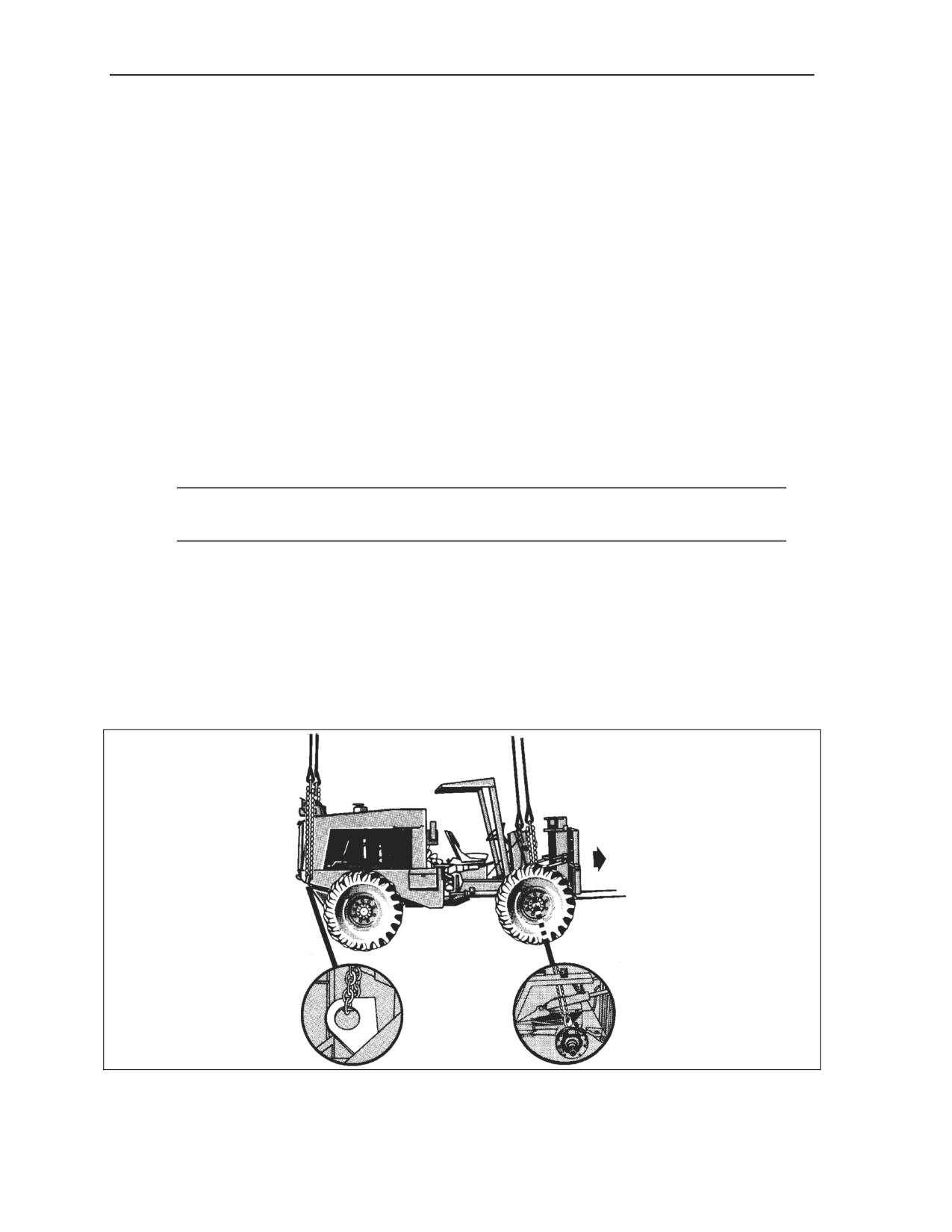
Rigging. Rig the load according to the steps in Figure 8-24.
Note: When using the 15,000-pound capacity multileg sling set, tie or tape the inner sling legs
to the outer sling legs.
Hookup. Two hookup teams are required for this load. The static discharge person
discharges the static electricity. The forward hookup person kneels on top of the ROPS and
places apex fitting 1 onto the forward cargo hook. The aft hookup person stands on the
engine deck and places apex fitting 2 onto the aft cargo hook. The hookup teams then
carefully dismount the load and remain close to the load as the helicopter removes slack from
the sling legs. When successful hookup is assured, the hookup teams quickly exit the area
underneath the helicopter to the designated rendezvous point.
Derigging. Derigging is the reverse of the preparation and rigging procedures.
Figure 8-24. Truck, Forklift, MC-4000
FM 4-20.199/MCRP 4-11.3E, VOL III/NTTP 3-04.13/
8-46
AFMAN 11-223 (I), VOL III/COMDINST M13482.4B
20 February 2009

Certified Dual-Point Rigging Procedures for Engineer Equipment
RIGGING STEPS
1. Position sling set number 1 on top of the ROPS.
2. Loop the chain end of the left and right sling legs through their respective lift provisions
located between the front tire and the chassis. Place the correct link from Table 8-24 in the
grab hook.
3. Position sling set number 2 on top of the engine deck.
4. Loop the chain end of the left and right sling legs through their respective lift provisions
located on the rear of the forklift. Place the correct link from Table 8-24 in the grab hook.
Secure the excess chain with tape or Type III nylon cord.
5. Raise the apex fittings above the load. Cluster and tie (breakaway technique) the sling legs
in each sling set together to prevent entanglement during hookup and lift-off.
Figure 8-24. Truck, Forklift, MC-4000 (Continued)
TRUCK FORKLIFT, RT-4000
8-26. The truck forklift, RT-4000 is rigged for dual-point sling load using the following procedures:
z
Applicability. The following item in Table 8-25 is certified for the helicopter(s) listed in the
following table by the US Army Natick Soldier Center:
Table 8-25. Truck Forklift, RT-4000
Nomenclature
Max Weight
Sling
Link Count
Type of
(Pounds)
Set
Front/Rear
Aircraft
Truck Forklift, RT-4000
10,860
15K
3/40
CH-53
z
Materials. The following materials are required to rig this load:
Sling set (15,000-pound capacity) (2 each).
Tape, adhesive, pressure-sensitive, 2-inch wide roll.
Cord, nylon, Type III, 550-pound breaking strength.
Webbing, cotton, 1/4-inch, 80-pound breaking strength.
Strap, cargo, tiedown, CGU-1/B (as required).
z
Personnel. Two persons can prepare and rig this load in 10 minutes.
z
Procedures. The following procedures apply to this load:
Preparation. Prepare the load using the following steps:
─ Engage the hand brake and place the transmission in neutral.
─ Raise the fork tines approximately 1 foot above the ground. Lift the ends of the fork
tines by hand to point upward. Secure the fork tines to the lift cylinder frame using the
tiedown strap.
─ Ensure the front wheels are pointed straight ahead. Tie down the steering wheel using
Type III nylon cord.
─ Ensure the fuel tank is not over 3/4 full. Inspect fuel tank cap, oil filler cap, and
battery caps for proper installation.
─ Tape the opening in the exhaust pipe.
Rigging. Rig the load according to the steps in Figure 8-25.
FM 4-20.199/MCRP 4-11.3E, VOL III/NTTP 3-04.13/
20 February 2009
AFMAN 11-223 (I), VOL III/COMDINST M13482.4B
8-47
Chapter 8
Note. When using the 15,000-pound capacity multileg sling set, tie or tape the inner sling legs
to the outer sling legs.
Hookup. Two hookup teams are required for this load. The static discharge person
discharges the static electricity. The forward hookup person stands on top of the FOPS and
places apex fitting 1 onto the forward cargo hook. The aft hookup person stands on the engine
deck and places apex fitting 2 onto the aft cargo hook. The hookup teams then carefully
dismount the load and remain close to the load as the helicopter removes slack from the sling
legs. When successful hookup is assured, the hookup teams quickly exit the area underneath
the helicopter to the designated rendezvous point.
Derigging. Derigging is the reverse of the preparation and rigging procedures.
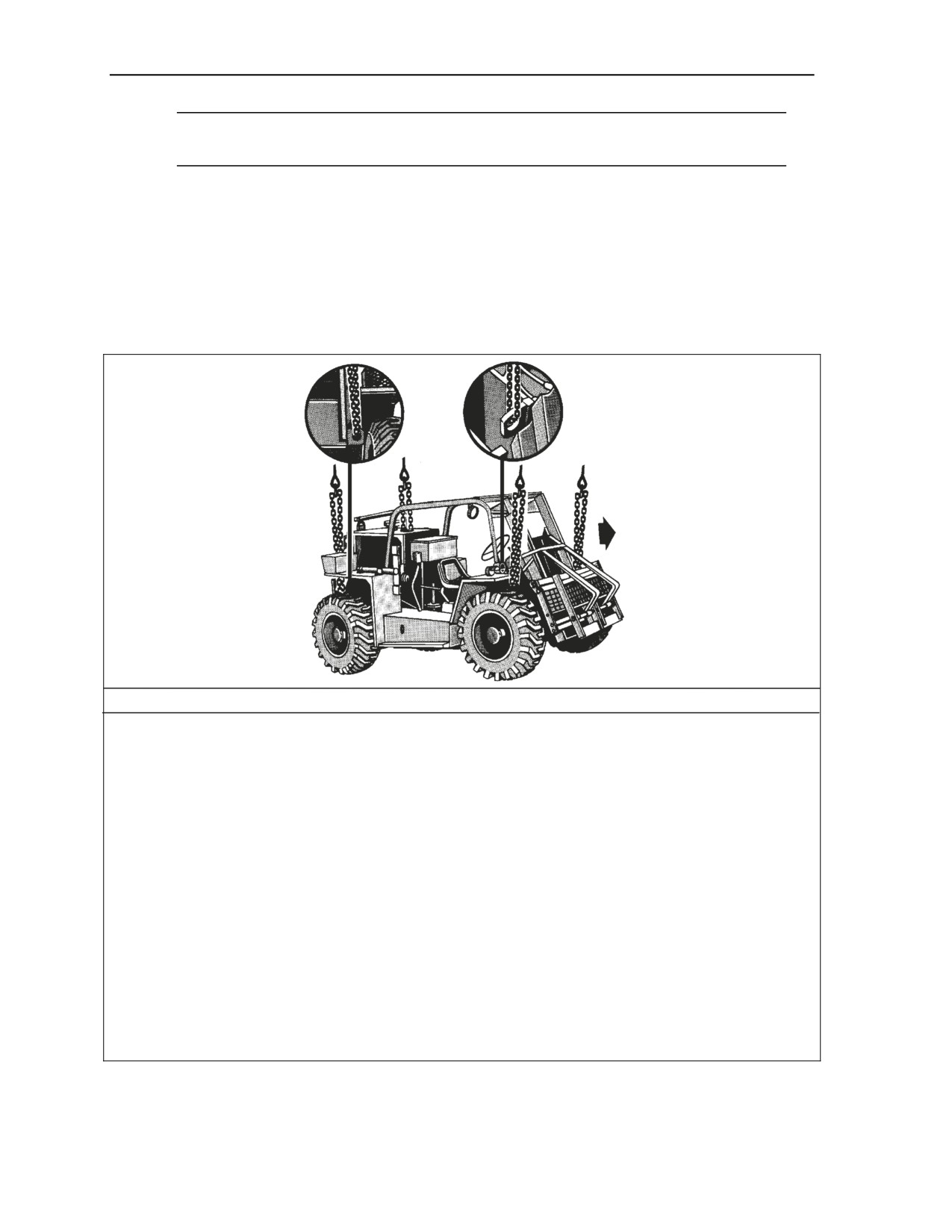
RIGGING STEPS
1. Position sling set number 1 on top of the FOPS.
2. Loop the chain end of the left and right sling legs through their respective lift provisions (not
the tiedown provisions) located directly above the forward axle housing between the front tire
and the hydraulic cylinder. Place the correct link from Table 8-25 in the grab hook.
3. Position sling set number 2 on top of the engine deck.
4. Loop the chain end of the left and right sling legs through their respective lift provisions
located above the rear winch. Place the correct link from Table 8-25 in the grab hook.
Secure the excess chain with tape or Type III nylon cord.
5. Pull the front sling legs up and tie (breakaway technique) the grablinks to the front side of the
upper light bracket. Pull the rear sling legs together on top of the engine deck and or tie
(breakaway technique) the grablinks together.
6. Raise the apex fittings above the load. Cluster and tie (breakaway technique) the sling legs
in each sling set together to prevent entanglement during hookup and lift-off.
Figure 8-25. Truck, Forklift, RT-4000
FM 4-20.199/MCRP 4-11.3E, VOL III/NTTP 3-04.13/
8-48
AFMAN 11-223 (I), VOL III/COMDINST M13482.4B
20 February 2009
Certified Dual-Point Rigging Procedures for Engineer Equipment
TRUCK FORKLIFT, MC-6000
8-27. The truck forklift, MC-6000 is rigged for dual-point sling load using the following procedures:
z
Applicability. The following item in Table 8-26 is certified for the helicopter(s) listed in the
following table by the US Army Natick Soldier Center:
Table 8-26. Truck Forklift, MC-6000
Nomenclature
Max Weight
Sling
Link Count
Type of
(Pounds)
Set
Front/Rear
Aircraft
Truck Forklift, MC-6000
19,800
40K
5/5
CH-53
z
Materials. The following materials are required to rig this load:
Sling set (40,000-pound capacity) with one additional apex fitting.
Tape, adhesive, pressure-sensitive, 2-inch wide roll.
Cord, nylon, Type III, 550-pound breaking strength.
Webbing, cotton, 1/4-inch, 80-pound breaking strength.
Strap, cargo, tiedown, CGU-1/B (4 each).
Felt sheet, cattle hair, Type IV, 1/2-inch or suitable padding.
z
Personnel. Two persons can prepare and rig this load in 10 minutes.
z
Procedures. The following procedures apply to this load:
Preparation. Prepare the load using the following steps:
─ Position the forks so they are sitting on the travel blocks and tilted all the way to the
rear.
─ Secure the engine access doors with CGU-1/B tiedown straps.
─ Secure the rear access doors with CGU-1/B tiedown straps.
─ Ensure the front wheels are pointed straight ahead. Tie down the steering wheel using
Type III nylon cord.
─ Ensure the fuel tank is not over 3/4 full. Inspect fuel tank cap, oil filler cap, and
battery caps for proper installation.
─ Engage the parking brake and place the transmission in neutral.
─ Secure the toolbox lid with Type III nylon cord.
Rigging. Rig the load according to the steps in Figure 8-26.
Hookup. Two hookup teams are required for this load. The static discharge person
discharges the static electricity. The forward hookup person stands on the front fenders and
places apex fitting 1 onto the forward cargo hook. The aft hookup person stands on the
engine deck and places apex fitting 2 onto the aft cargo hook. The hookup teams then
carefully dismount the load and remain close to the load as the helicopter removes slack from
the sling legs. When successful hookup is assured, the hookup teams quickly exit the area
underneath the helicopter to the designated rendezvous point.
Derigging. Derigging is the reverse of the preparation and rigging procedures.
FM 4-20.199/MCRP 4-11.3E, VOL III/NTTP 3-04.13/
20 February 2009
AFMAN 11-223 (I), VOL III/COMDINST M13482.4B
8-49
Chapter 8
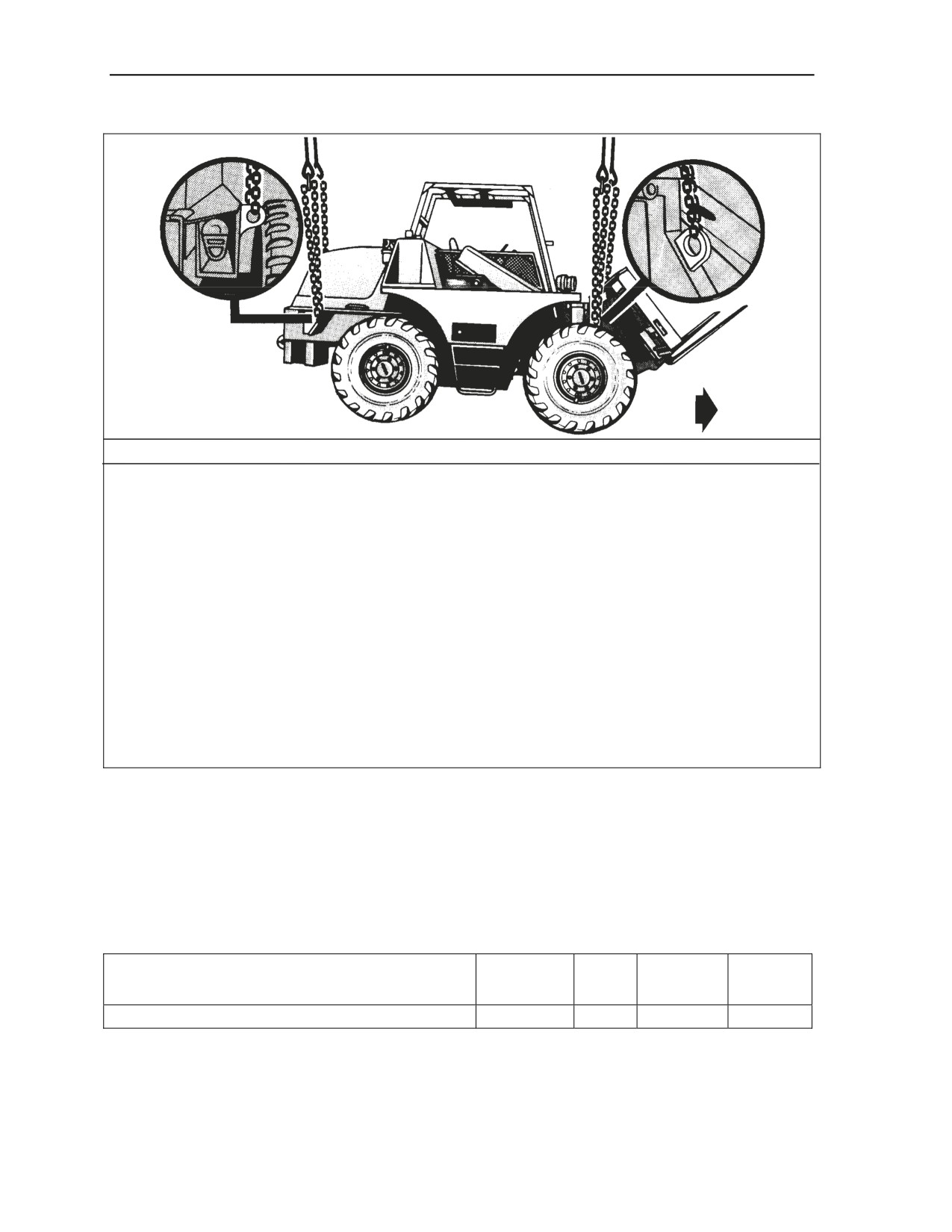
RIGGING STEPS
1. Place two sling legs on apex fitting number 1. Position sling set number 1 on the forward
edge of the ROPS.
2. Loop the chain end of the left and right sling legs through their respective lift provisions
located on the frame inboard of the top of the front tires. Place the correct link from Table 8-
26 in the grab hook.
3. Place two sling legs on apex fitting number 2. Position sling set number 2 on top of the
engine deck.
4. Loop the chain end of the left and right sling legs through their respective lift provisions
located on the frame aft of the rear tires. Place the correct link from Table 8-26 in the grab
hook.
5. Raise the apex fittings above the load. Cluster and tie (breakaway technique) the sling legs
in each sling set together to prevent entanglement during hookup and lift-off.
Figure 8-26. Truck, Forklift, MC-6000
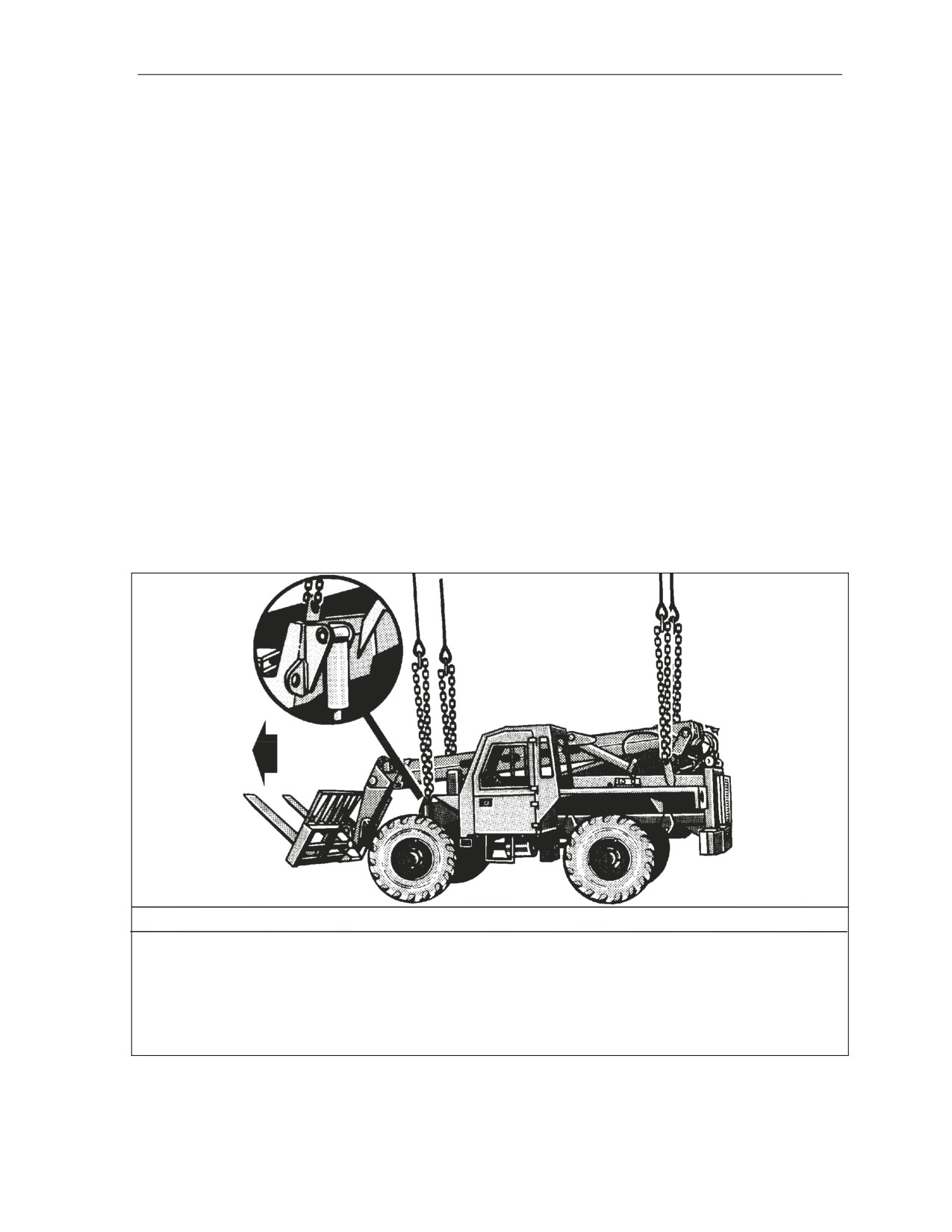
EXTENDABLE BOOM FORKLIFT (USMC)
8-28. The extendable boom forklift is rigged for dual-point sling load using the following procedures:
z
Applicability. The following item in Table 8-27 is certified for the helicopter(s) listed in the
following table by the US Army Natick Soldier Center:
Table 8-27. Extendable Boom Forklift
Nomenclature
Max Weight
Sling
Link Count
Type of
(Pounds)
Set
Front/Rear
Aircraft
Extendable Boom Forklift
25,640
40K
3/40
CH-53
z
Materials. The following materials are required to rig this load:
Sling set (40,000-pound capacity) with one additional apex fitting.
Tape, adhesive, pressure-sensitive, 2-inch wide roll.
Cord, nylon, Type III, 550-pound breaking strength.
FM 4-20.199/MCRP 4-11.3E, VOL III/NTTP 3-04.13/
8-50
AFMAN 11-223 (I), VOL III/COMDINST M13482.4B
20 February 2009
Certified Dual-Point Rigging Procedures for Engineer Equipment
Webbing, cotton, 1/4-inch, 80-pound breaking strength.
Strap, cargo, tiedown, CGU-1/B (as required).
z
Personnel. Two persons can prepare and rig this load in 10 minutes.
z
Procedures. The following procedures apply to this load:
Preparation. Prepare the load using the following steps:
─ Secure the forks against the carriage with the CGU-1/B tiedown straps.
─ Ensure the front wheels are pointed straight ahead. Tie down the steering wheel using
Type III nylon cord.
─ Ensure the fuel tank is not over 3/4 full. Inspect fuel tank cap, oil filler cap, and
battery caps for proper installation.
─ Raise the carriage 10-inches off the ground. Retract and raise the boom.
─ Set the handbrake and place the transmission in neutral.
─ Tape the end of the exhaust pipe.
Rigging. Rig the load according to the steps in Figure 8-27.
Hookup. Two hookup teams are required for this load. The static discharge person
discharges the static electricity. The forward hookup person stands on the FOPS and places
apex fitting 1 onto the forward cargo hook. The aft hookup person stands on the FOPS and
places apex fitting 2 onto the aft cargo hook. The hookup teams then carefully dismount the
load and remain close to the load as the helicopter removes slack from the sling legs. When
successful hookup is assured, the hookup teams quickly exit the area underneath the helicopter
to the designated rendezvous point.
Derigging. Derigging is the reverse of the preparation and rigging procedures.
RIGGING STEPS
1. Place two sling legs on apex fitting number 1. Position sling set number 1 on top of the
FOPS.
2. Loop the chain end of the left and right sling legs through their respective lift provisions
located on the front of the forklift. Place the correct link from Table 8-27 in the grab hook.
Figure 8-27. Extendable Boom Forklift
FM 4-20.199/MCRP 4-11.3E, VOL III/NTTP 3-04.13/
20 February 2009
AFMAN 11-223 (I), VOL III/COMDINST M13482.4B
8-51

Chapter 8
RIGGING STEPS (Continued)
3. Place two sling legs on apex fitting number 2. Position sling set number 2 on top of the
FOPS.
4. Loop the chain end of the left and right sling legs through their respective lift provisions
located on the rear of the forklift. Place the correct link from Table 8-27 in the grab hook.
Secure the excess chain with tape or Type III nylon cord.
5. Raise the apex fittings above the load. Cluster and tie (breakaway technique) the sling legs
in each sling set together to prevent entanglement during hookup and lift-off.
Figure 8-27. Extendable Boom Forklift (Continued)
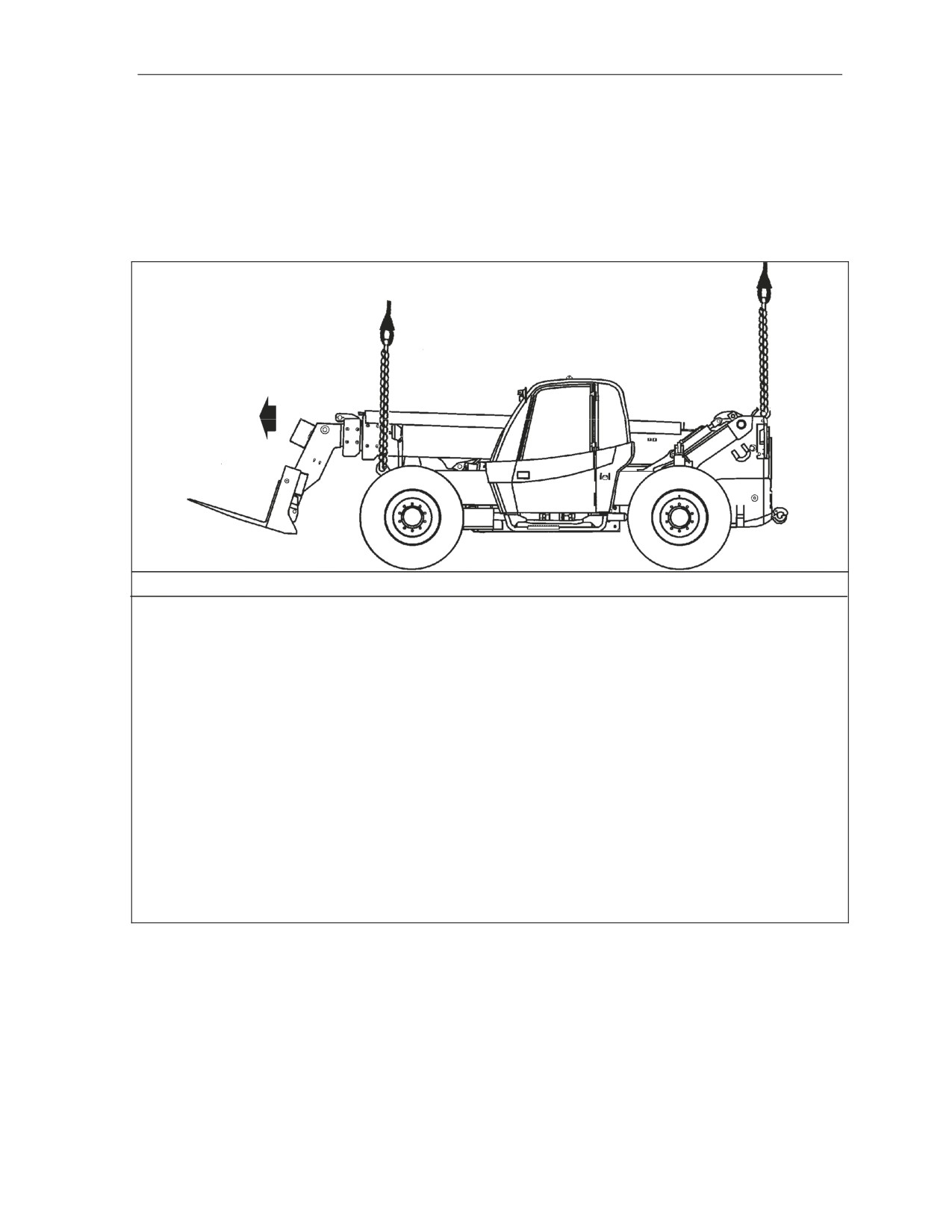
EXTENDABLE BOOM FORKLIFT (EBFL) (NEW VERSION) (USMC)
8-29. The extendable boom forklift (new version) is rigged for dual-point sling load using the following
procedures:
z
Applicability. The following item in Table 8-28 is certified for the helicopter(s) listed in the
following table by the US Army Natick Soldier Center:
Table 8-28. Extendable Boom Forklift (New Version)
Nomenclature
Max Weight
Sling
Link Count
Type of
(Pounds)
Set
Front/Rear
Aircraft
Extendable Boom Forklift (EBFL)
28,400
40K
3/48 Cab Side
CH-53
3/50 Boom Side
z
Materials. The following materials are required to rig this load:
Sling set (40,000-pound capacity).
Tape, adhesive, pressure-sensitive, 2-inch wide roll.
Cord, nylon, Type III, 550-pound breaking strength.
Webbing, cotton, 1/4-inch, 80-pound breaking strength.
Tiedown strap, cargo, CGU-1/B (as required).
z
Personnel. Two persons can prepare and rig each load in 10 minutes.
z
Procedures. The following procedures apply to this load:
Preparation. Prepare the load using the following steps:
─ Secure the forks against the carriage using the CGU-1/Bs.
─ Set the parking brake.
─ Place the gear selector lever in neutral.
─ Tape the exhaust pipe end.
─ Lower the boom and tilt the forks all the way back.
─ Secure all latches on the windows with tape or Type III nylon cord.
─ Tape the windshield wipers to the windshield.
─ Tape all lights and mirrors.
─ Secure all equipment in the cab with tape or Type III nylon cord.
─ Ensure the wheels are pointed straight ahead and secure the steering wheel with Type
III nylon cord.
─ Secure the engine cover with Type III nylon cord.
Rigging. Rig the load according to the steps in Figure 8-28.
FM 4-20.199/MCRP 4-11.3E, VOL III/NTTP 3-04.13/
8-52
AFMAN 11-223 (I), VOL III/COMDINST M13482.4B
20 February 2009
Certified Dual-Point Rigging Procedures for Engineer Equipment
Hookup. Two hookup teams stand on the side of the load. The static discharge person
discharges the static electricity. The forward hookup person places apex fitting 1 onto the
forward cargo hook. The aft hookup person places apex fitting 2 onto the aft cargo hook. The
hookup teams then carefully dismount the container and remain close to the load as the
helicopter removes slack from the sling legs. When successful hookup is assured, the hookup
teams quickly exit the area underneath the helicopter to the designated rendezvous point.
Derigging. Derigging is the reverse of the preparation and rigging procedures.
RIGGING STEPS
1. Connect 2 sling legs to apex fitting number 1. Position the apex fitting on the boom in front of
the cab.
2. Loop the chain end of the sling legs through their respective lift provisions on the front of the
vehicle. Place the correct link from Table 8-28 in the grab hook.
3. Connect 2 sling legs to apex fitting number 2. Position the apex fitting on the boom behind
the cab.
4. Loop the chain end of the sling legs through their respective lift provisions on the rear of the
vehicle. Place the correct link from Table 8-28 in the grab hook.
5. Secure all excess chain with tape or Type III nylon cord.
6. Cluster and tie (breakaway technique) the sling legs in each sling set on top of the vehicle to
prevent entanglement during hookup and lift-off.
Figure 8-28. Extendable Boom Forklift (EBFL) (New Version)
FM 4-20.199/MCRP 4-11.3E, VOL III/NTTP 3-04.13/
20 February 2009
AFMAN 11-223 (I), VOL III/COMDINST M13482.4B
8-53
Chapter 8
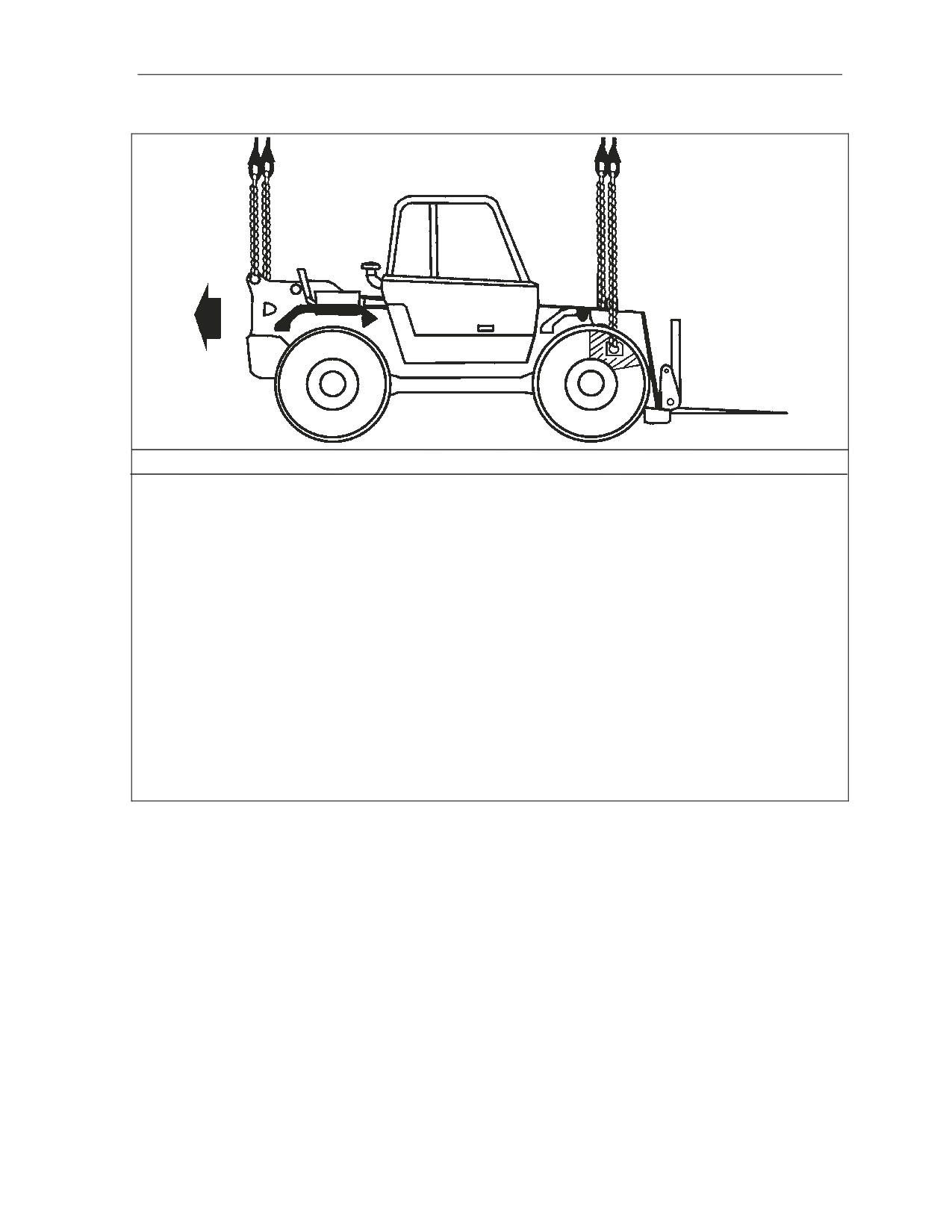
LIGHT ROUGH TERRAIN FORKLIFT (LRTF) (USMC)
8-30. The light rough terrain forklift is rigged for dual-point sling load using the following procedures:
z
Applicability. The following item in Table 8-29 is certified for the helicopter(s) listed in the
following table by the US Army Natick Soldier Center:
Table 8-29. Light Rough Terrain Forklift
Nomenclature
Max Weight
Sling
Link Count
Type of
(Pounds)
Set
Front/Rear
Aircraft
Light Rough Terrain Forklift (LRTF)
13,700
15K
3/25 Cab Side
CH-53
3/30 Boom Side
z
Materials. The following materials are required to rig this load:
Sling set (15,000-pound capacity).
Tape, adhesive, pressure-sensitive, 2-inch wide roll.
Cord, nylon, Type III, 550-pound breaking strength.
Webbing, cotton, 1/4-inch, 80-pound breaking strength.
Tie-down strap, cargo, CGU-1/B (as required).
z
Personnel. Two persons can prepare and rig each load in 10 minutes.
z
Procedures. The following procedures apply to this load:
Preparation. Prepare the load using the following steps:
─ Slide and secure the forks together in the middle of the carriage using CGU-1/Bs.
─ Set the parking brake.
─ Place the gear selector lever in neutral.
─ Tape the exhaust pipe end.
─ Secure all latches on the windows with tape or Type III nylon cord.
─ Tape the windshield wipers to the windshield.
─ Tape all lights and mirrors.
─ Secure all equipment in the cab with tape or Type III nylon cord.
─ Ensure the wheels are pointed straight ahead and secure the steering wheel with Type
III nylon cord.
─ Secure the engine cover with Type III nylon cord.
Rigging. Rig the load according to the steps in Figure 8-29.
Hookup. Two hookup teams stand on the side of the load. The static discharge person
discharges the static electricity. The forward hookup person places apex fitting 1 onto the
forward cargo hook. The aft hookup person places apex fitting 2 onto the aft cargo hook. The
hookup teams then carefully dismount the container and remain close to the load as the
helicopter removes slack from the sling legs. When successful hookup is assured, the hookup
teams quickly exit the area underneath the helicopter to the designated rendezvous point.
Derigging. Derigging is the reverse of the preparation and rigging procedures.
FM 4-20.199/MCRP 4-11.3E, VOL III/NTTP 3-04.13/
8-54
AFMAN 11-223 (I), VOL III/COMDINST M13482.4B
20 February 2009
Certified Dual-Point Rigging Procedures for Engineer Equipment
RIGGING STEPS
1. Connect 2 sling legs to apex fitting number 1. Position the apex fitting on the boom in front of
the cab.
2. Loop the chain end of the sling legs through their respective lift provisions on the front of the
vehicle. Place the correct link from Table 8-29 in the grab hook.
3. Connect 2 sling legs to apex fitting number 2. Position the apex fitting on the boom behind
the cab.
4. Loop the chain end of the sling legs through their respective lift provisions on the rear of the
vehicle. Place the correct link from Table 8-29 in the grab hook.
5. Secure all excess chain with tape or Type III nylon cord.
6. Cluster and tie (breakaway technique) the sling legs in each sling set on top of the vehicle to
prevent entanglement during hookup and lift-off.
Figure 8-29. Light Rough Terrain Forklift
FM 4-20.199/MCRP 4-11.3E, VOL III/NTTP 3-04.13/
20 February 2009
AFMAN 11-223 (I), VOL III/COMDINST M13482.4B
8-55

Chapter 8
BOAT, BRIDGE, ERECTION
8-31. The boat, bridge, erection is rigged for dual-point sling load using the following procedures:
z
Applicability. The following item in Table 8-30 is certified for the helicopter(s) listed in the
following table by the US Army Natick Soldier Center:
Table 8-30. Boat, Bridge, Erection
Nomenclature
Max Weight
Sling
Link Count
Type of
(Pounds)
Set
Front/Rear
Aircraft
Boat, Bridge, Erection
6,000
15K
4/8
CH-53
CAUTION
This load becomes extremely unstable at airspeeds above 30 knots.
z
Materials. The following materials are required to rig this load:
Sling set (15,000-pound capacity) (2 each).
Tape, adhesive, pressure-sensitive, 2-inch wide roll.
Cord, nylon, Type III, 550-pound breaking strength.
Webbing, cotton, 1/4-inch, 80-pound breaking strength.
z
Personnel. Two persons can prepare and rig this load in 15 minutes.
z
Procedures. The following procedures apply to this load:
Preparation. Prepare the load using the following steps:
─ Remove the canvas cover and stow in the rear (stern) section.
─ Secure all loose equipment with tape or Type III nylon cord.
─ Attach the front section to the rear section of the boat.
─ Tape all glass items, lights, and reflectors.
─ Ensure both cradles are not attached to the boat sections.
Rigging. Rig the load according to the steps in Figure 8-30.
Note. When using the 15,000-pound capacity multileg sling set, tie or tape the inner sling legs
to the outer sling legs.
Hookup. Two hookup teams are required for this load. The static discharge person
discharges the static electricity. The forward hookup person stands on top of the stern section
and places apex fitting 2 onto the forward cargo hook. The aft hookup person stands on top of
the bow and places apex fitting 1 onto the aft cargo hook. The hookup teams then carefully
dismount the load and remain close to the load as the helicopter removes slack from the sling
legs. When successful hookup is assured, the hookup teams quickly exit the area underneath
the helicopter to the designated rendezvous point.
Note. Brief the helicopter crew to relax the sling leg tension and hover to the side before
releasing the web ring to prevent damaging the boat.
Derigging. Derigging is the reverse of the preparation and rigging procedures.
FM 4-20.199/MCRP 4-11.3E, VOL III/NTTP 3-04.13/
8-56
AFMAN 11-223 (I), VOL III/COMDINST M13482.4B
20 February 2009
Certified Dual-Point Rigging Procedures for Engineer Equipment
RIGGING STEPS
1. Position web ring number 1 on top of the front (bow) section of the boat.
2. Loop the chain end of the left and right sling legs through their respective lifting bolts located
on the left and right side of the forward end of the stern section. Place the correct link from
Table 8-30 in the grab hook.
3. Position web ring number 2 on top of the aft (stern) section of the boat. Route the sling leg
chains to the aft (stern) side of the horizontal arms of the towing bitt.
4. Wrap the chain end of the left sling leg two times around the vertical post of the towing bitt.
Wrap the chain end of the right sling leg in the opposite direction two times around the
vertical post of the towing bitt. Ensure the chain wraps are below the horizontal bars on the
towing bitt. Place the correct link from Table 8-30 in the grab hook.
5. Raise the apex fittings above the load. Cluster and (breakaway technique) the sling legs in
each sling set together to prevent entanglement during hookup and lift-off.
Figure 8-30. Boat, Bridge Erection
FM 4-20.199/MCRP 4-11.3E, VOL III/NTTP 3-04.13/
20 February 2009
AFMAN 11-223 (I), VOL III/COMDINST M13482.4B
8-57

Chapter 8
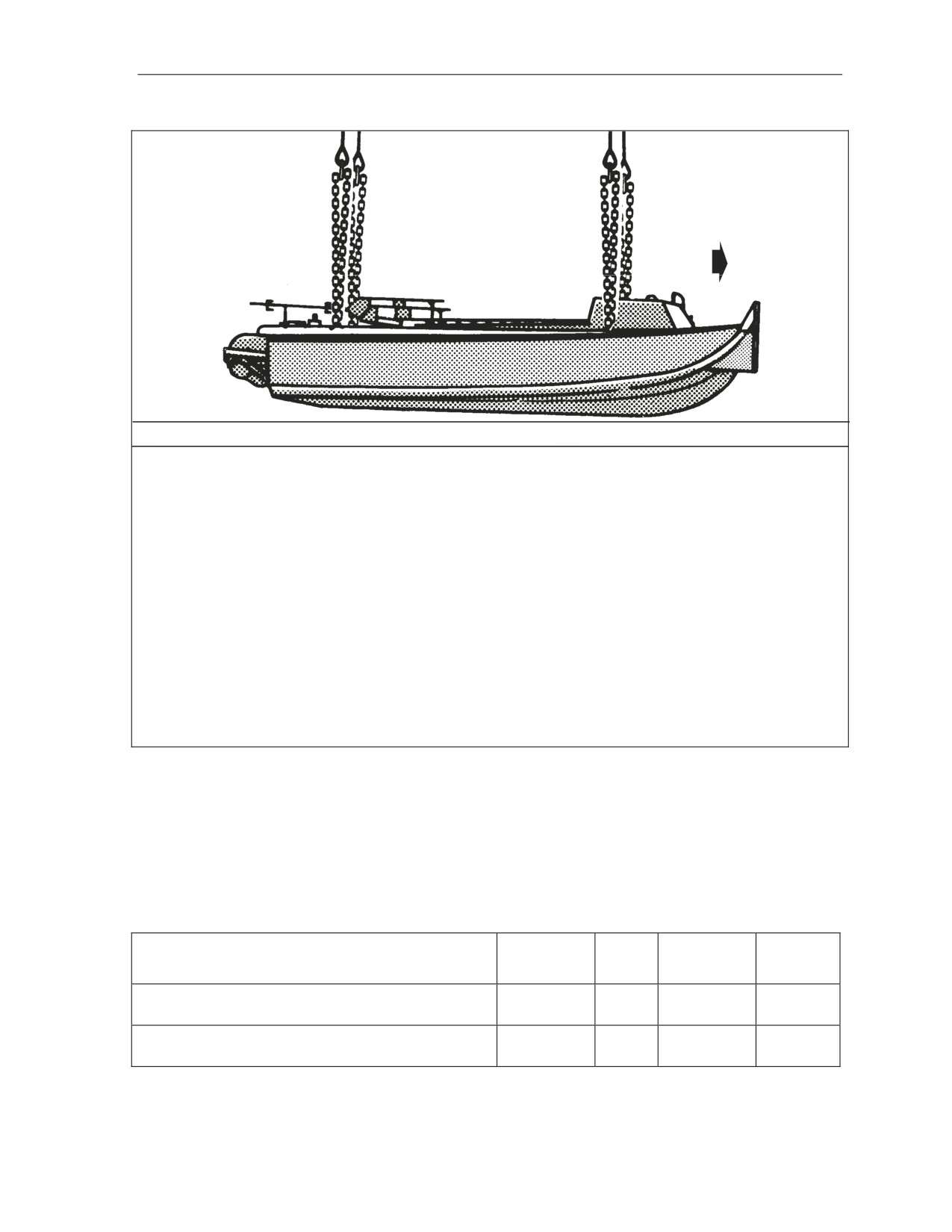
RIBBON BRIDGE ERECTION BOAT, MK2
8-32. The ribbon bridge erection boat, MK2 is rigged for dual-point sling load using the following
procedures:
z
Applicability. The following item in Table 8-31 is certified for the helicopter(s) listed in the
following table by the US Army Natick Soldier Center:
Table 8-31. Ribbon Bridge Erection Boat, MK2
Nomenclature
Max Weight
Sling
Link Count
Type of
(Pounds)
Set
Front/Rear
Aircraft
Ribbon Bridge Erection Boat, MK2
9,040
10K
10/5
CH-47
15K
CH-53
z
Materials. The following materials are required to rig this load:
Sling set (15,000-pound capacity) (2 each).
OR
Sling set (10,000-pound capacity) with one additional apex fitting.
Tape, adhesive, pressure-sensitive, 2-inch wide roll.
Cord, nylon, Type III, 550-pound breaking strength.
Webbing, cotton, 1/4-inch, 80-pound breaking strength.
Clevis assembly, medium, MS70087-2, or clevis assembly, large, MS70087-3 (4 each).
z
Personnel. Two persons can prepare and rig this load in 20 minutes.
z
Procedures. The following procedures apply to this load:
Preparation. Prepare the load using the following steps:
─ Lower and secure the antenna.
─ Remove the cab.
Note. Do not sling load the boat with the cab installed.
─ Secure all loose equipment with tape or Type III nylon cord.
─ Secure all hatches and panels with padlocks or a double length of Type III nylon cord.
Secure the jet hatches with padlocks or a double length of Type III nylon cord and
anchor cleats.
─ Tape the mast assembly upper stowage pin.
─ Attach four clevises to the four boat lifting points (triangular structures with holes)
mounted on the boat side rails. The front lifting points are approximately 8.5 feet from
the front of the boat. The rear lifting points are approximately 7.5 feet from the rear of
the boat.
Rigging. Rig the load according to the steps in Figure 8-31.
Note. When using the 15,000-pound capacity multileg sling set, tie or tape the inner sling legs
to the outer sling legs.
Hookup. Two hookup teams are required for this load. The static discharge person
discharges the static electricity. The forward hookup person stands in the bow of the boat and
places apex fitting 1 onto the forward cargo hook. The aft hookup person stands in the stern
of the boat and places apex fitting 2 onto the aft cargo hook. The hookup teams then carefully
dismount the load and remain close to the load as the helicopter removes slack from the sling
legs. When successful hookup is assured, the hookup teams quickly exit the area underneath
the helicopter to the designated rendezvous point.
Derigging. Derigging is the reverse of the preparation and rigging procedures.
FM 4-20.199/MCRP 4-11.3E, VOL III/NTTP 3-04.13/
8-58
AFMAN 11-223 (I), VOL III/COMDINST M13482.4B
20 February 2009
Certified Dual-Point Rigging Procedures for Engineer Equipment
RIGGING STEPS
1. Place two sling legs on apex fitting number 1. Position sling set number 1 on the front of the
boat.
2. Loop the chain end of the left and right sling legs through their respective lift provisions
located on the front of the boat. Place the correct link from Table 8-31 in the grab hook.
Secure the excess chain with tape or Type III nylon cord.
3. Place two sling legs on apex fitting number 2. Position sling set number 2 on the rear of the
boat.
4. Loop the chain end of the left and right sling legs through their respective lift provisions
located on the rear of the boat. Place the correct link from Table 8-31 in the grab hook.
5. Raise the apex fittings above the load. Cluster and tie (breakaway technique) the sling legs
in each sling set together to prevent entanglement during hookup and lift-off.
Figure 8-31. Ribbon Bridge Erection Boat, MK2
RIBBON BRIDGE INTERIOR BAY
8-33. The ribbon bridge interior bay is rigged for dual-point sling load using the following procedures:
z
Applicability. The following item in Table 8-32 is certified for the helicopter(s) listed in the
following table by the US Army Natick Soldier Center:
Table 8-32. Ribbon Bridge Erection Boat, MK2
Nomenclature
Max Weight
Sling
Link Count
Type of
(Pounds)
Set
Front/Rear
Aircraft
Ribbon Bridge, Interior Bay
11,800
25K
3/50
CH-47
15K
CH-53
Ribbon Bridge, Interior Bay, Improved
13,860
25K
3/50
CH-47
15K
CH-53
FM 4-20.199/MCRP 4-11.3E, VOL III/NTTP 3-04.13/
20 February 2009
AFMAN 11-223 (I), VOL III/COMDINST M13482.4B
8-59
Chapter 8
z
Materials. The following materials are required to rig this load:
Sling set (15,000-pound capacity) (2 each).
OR
Sling set (25,000-pound capacity) with one additional apex fitting.
Tape, adhesive, pressure-sensitive, 2-inch wide roll.
Cord, nylon, Type III, 550-pound breaking strength.
Webbing, cotton, 1/4-inch, 80-pound breaking strength.
z
Personnel. Two persons can prepare and rig this load in 15 minutes.
z
Procedures. The following procedures apply to this load:
Preparation. Prepare the load using the following steps:
─ The end with the roadway lock is the front of the load.
─ Ensure all the bay latches are securely fastened.
Rigging. Rig the load according to the steps in Figure 8-32.
Note. When using the 15,000-pound capacity multileg sling set, tie or tape the inner sling legs
to the outer sling legs.
Hookup. Two hookup teams are required for this load. The static discharge person
discharges the static electricity. The forward hookup person stands on top of the bridge and
places apex fitting 1 onto the forward cargo hook. The aft hookup person stands on top of the
bridge and places apex fitting 2 onto the aft cargo hook. The hookup teams then carefully
dismount the load and remain close to the load as the helicopter removes slack from the sling
legs. When successful hookup is assured, the hookup teams quickly exit the area underneath
the helicopter to the designated rendezvous point.
Derigging. Derigging is the reverse of the preparation and rigging procedures.
RIGGING STEPS
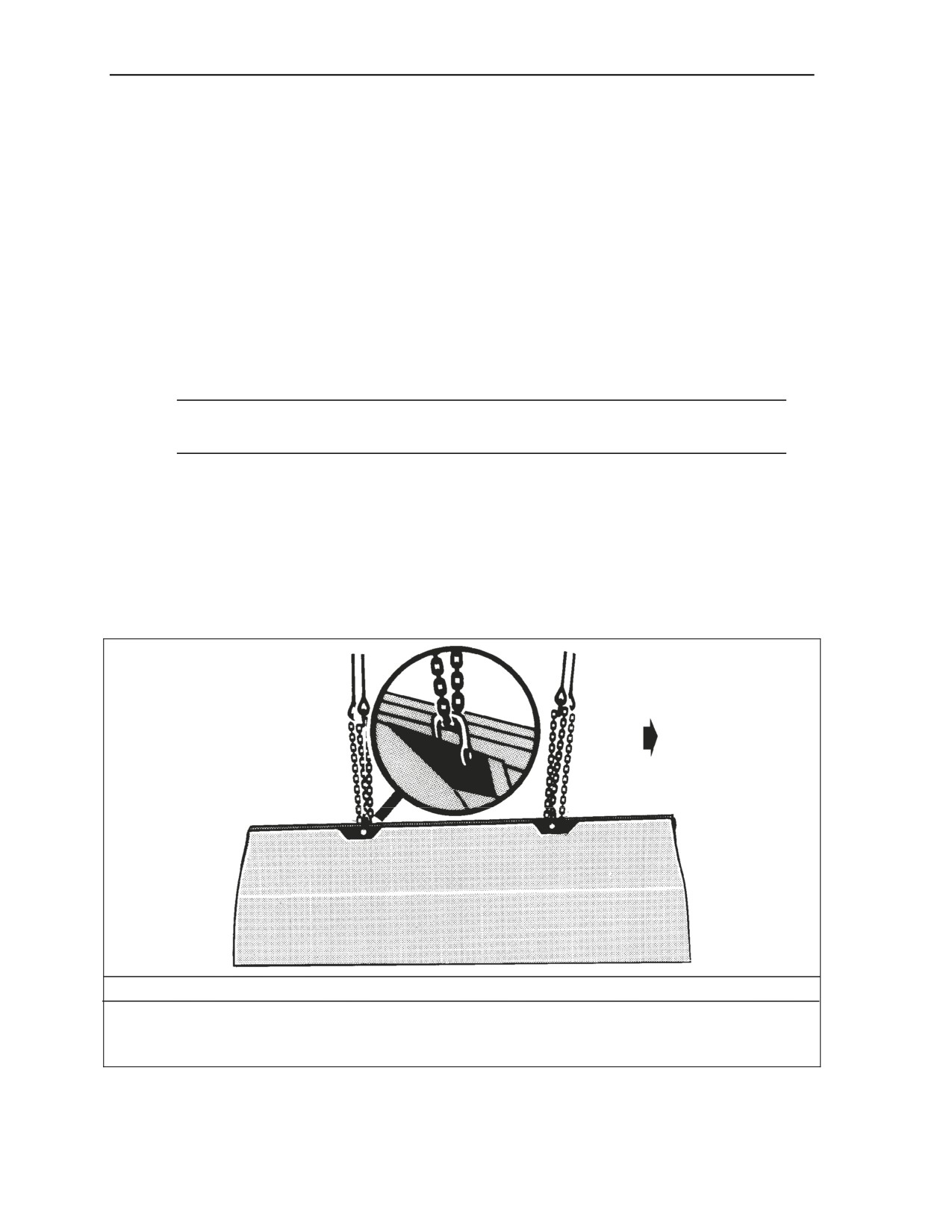
1. Place two sling legs on apex fitting number 1. Position sling set number 1 on top of the
interior bay.
Figure 8-32. Ribbon Bridge Interior Bay
FM 4-20.199/MCRP 4-11.3E, VOL III/NTTP 3-04.13/
8-60
AFMAN 11-223 (I), VOL III/COMDINST M13482.4B
20 February 2009

Certified Dual-Point Rigging Procedures for Engineer Equipment
RIGGING STEPS (Continued)
2. Loop the chain end of the left and right sling legs through their respective lift provisions (a pin
located between two plates on the top edge of the bay). Place the correct link from Table 8-
32 in the grab hook.
3. Place two sling legs on apex fitting number 2. Position sling set number 2 on top of the bay
at the rear.
4. Loop the chain end of the left and right sling legs through their respective lift provisions (a pin
located between two plates at the top rear edge). Place the correct link from Table 8-32 in
the grab hook. Secure the excess chain with tape or Type III nylon cord.
5. Pull the chain of each sling leg up tightly and tape or tie just above the lift provision.
6. Raise the apex fittings above the load. Cluster and tie (breakaway technique) the sling legs
in each sling set together to prevent entanglement during hookup and lift-off.
Figure 8-32. Ribbon Bridge Interior Bay (Continued)
RIBBON BRIDGE RAMP BAY
8-34. The ribbon bridge ramp bay is rigged for dual-point sling load using the following procedures:
z
Applicability. The following item in Table 8-33 is certified for the helicopter(s) listed in the
following table by the US Army Natick Soldier Center:
Table 8-33. Ribbon Bridge Ramp Bay
Nomenclature
Max Weight
Sling
Link Count
Type of
(Pounds)
Set
Front/Rear
Aircraft
Ribbon Bridge, Ramp Bay
11,560
25K
3/50
CH-47
15K
CH-53
Ribbon Bridge, Ramp Bay, Improved
13,270
25K
3/50
CH-47
15K
CH-53
z
Materials. The following materials are required to rig this load:
Sling set (15,000-pound capacity) (2 each).
OR
Sling set (25,000-pound capacity) with one additional apex fitting.
Tape, adhesive, pressure-sensitive, 2-inch wide roll.
Cord, nylon, Type III, 550-pound breaking strength.
Webbing, cotton, 1/4-inch, 80-pound breaking strength.
z
Personnel. Two persons can prepare and rig this load in 15 minutes.
z
Procedures. The following procedures apply to this load:
Preparation. Prepare the load using the following steps:
─ The short end of the bay is the front of the load.
─ Ensure all the bay latches are securely fastened.
Rigging. Rig the load according to the steps in Figure 8-33.
Note. When using the 15,000-pound capacity multileg sling set, tie or tape the inner sling legs
to the outer sling legs.
FM 4-20.199/MCRP 4-11.3E, VOL III/NTTP 3-04.13/
20 February 2009
AFMAN 11-223 (I), VOL III/COMDINST M13482.4B
8-61
Chapter 8
Hookup. Two hookup teams are required for this load. The static discharge person
discharges the static electricity. The forward hookup person stands on top of the ramp bay and
places apex fitting 1 onto the forward cargo hook. The aft hookup person stands on top of the
ramp bay and places apex fitting 2 onto the aft cargo hook. The hookup teams then carefully
dismount the load and remain close to the load as the helicopter removes slack from the sling
legs. When successful hookup is assured, the hookup teams quickly exit the area underneath
the helicopter to the designated rendezvous point.
Derigging. Derigging is the reverse of the preparation and rigging procedures.
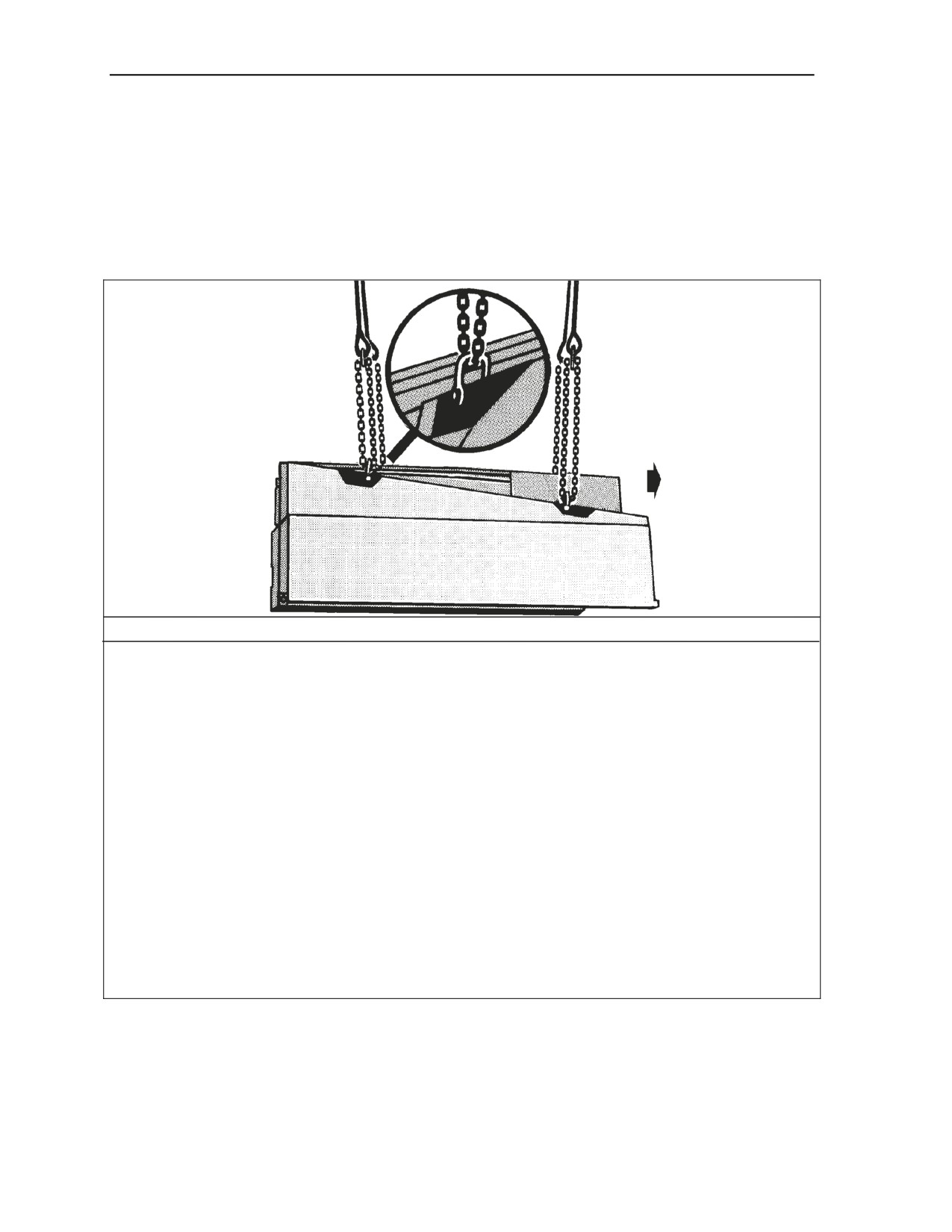
RIGGING STEPS
1. Place two sling legs on apex fitting number 1. Position sling set number 1 on top of the front
of the ramp bay.
2. Loop the chain end of the left and right sling legs through their respective lift provisions (a pin
located between two plates on the top edge of the bay). Place the correct link from Table 8-
33 in the grab hook.
3. Place two sling legs on apex fitting number 2. Position sling set number 2 on top of the ramp
bay at the rear.
4. Loop the chain end of the left and right sling legs through their respective lift provisions (a pin
located between two plates at the top rear edge). Place the correct link from Table 8-33 in
the grab hook. Secure the excess chain with tape or Type III nylon cord.
5. Pull the chain of each sling leg up tightly and tape or tie just above the lift provision.
6. Raise the apex fittings above the load. Cluster and tie (breakaway technique) the sling legs
in each sling set together to prevent entanglement during hookup and lift-off.
Figure 8-33. Ribbon Bridge, Ramp Bay
FM 4-20.199/MCRP 4-11.3E, VOL III/NTTP 3-04.13/
8-62
AFMAN 11-223 (I), VOL III/COMDINST M13482.4B
20 February 2009

Certified Dual-Point Rigging Procedures for Engineer Equipment
MEDIUM GIRDER BRIDGE (MGB) (USMC)
8-35. The medium girder bridge is rigged for dual-point sling load using the following procedures:
z
Applicability. The following item in Table 8-34 is certified for the helicopter(s) listed in the
following table by the US Army Natick Soldier Center:
Table 8-34. Medium Girder Bridge
Nomenclature
Max Weight
Sling
Link Count
Type of
(Pounds)
Set
Front/Rear
Aircraft
Medium Girder Bridge, Five Bay, Double Story,
One End, Undecked, with Building Frame and
18,240
40K
5/5
CH-53
Launching Nose
CAUTION
Due to the extreme length of this load the aircraft radar altimeter
becomes unreliable. Ensure the pilots are notified prior to pickup.
z
Materials. The following materials are required to rig this load:
Sling set (40,000-pound capacity) with one additional apex fitting.
─ Additional chain lengths, part number 607050 (4 each).
─ Additional coupling links, part number 577-0815 (4 each).
Tape, adhesive, pressure-sensitive, 2-inch wide roll.
Cord, nylon, Type III, 550-pound breaking strength.
Webbing, cotton, 1/4-inch, 80-pound breaking strength.
Strap, cargo, tiedown, CGU-1/B (8 each).
Tiedown assembly, chain, MB-1 (12 each).
Fire hose, 2 1/2-inch or larger, 8-feet long (12 each).
z
Personnel. Four persons can prepare and rig this load in 15 minutes.
z
Procedures. The following procedures apply to this load:
Preparation. Prepare the load using the following steps:
─ Ensure the launching nose is snug against the Bankseat Beam located on the front of
the bridge.
─ Ensure all tiedown chains and straps are tight and the hydraulic jacks are safety wired
in place.
─ Tape all ratchets and chain tensioners.
─ Attach an additional chain length to each sling leg chain using the coupling links.
─ Slide an 8-foot length of fire hose on each sling leg chain.
Rigging. Rig the load according to the steps in Figure 8-34.
Hookup. Two hookup teams are required for this load. The static discharge person
discharges the static electricity. The forward hookup person stands on the left girder and
places apex fitting 1 onto the forward cargo hook. The aft hookup person stands on the left
girder and places apex fitting 2 onto the aft cargo hook. The hookup teams then carefully
dismount the load and remain close to the load as the helicopter removes slack from the sling
legs. When successful hookup is assured, the hookup teams quickly exit the area underneath
the helicopter to the designated rendezvous point.
Derigging. Derigging is the reverse of the preparation and rigging procedures.
FM 4-20.199/MCRP 4-11.3E, VOL III/NTTP 3-04.13/
20 February 2009
AFMAN 11-223 (I), VOL III/COMDINST M13482.4B
8-63
Chapter 8
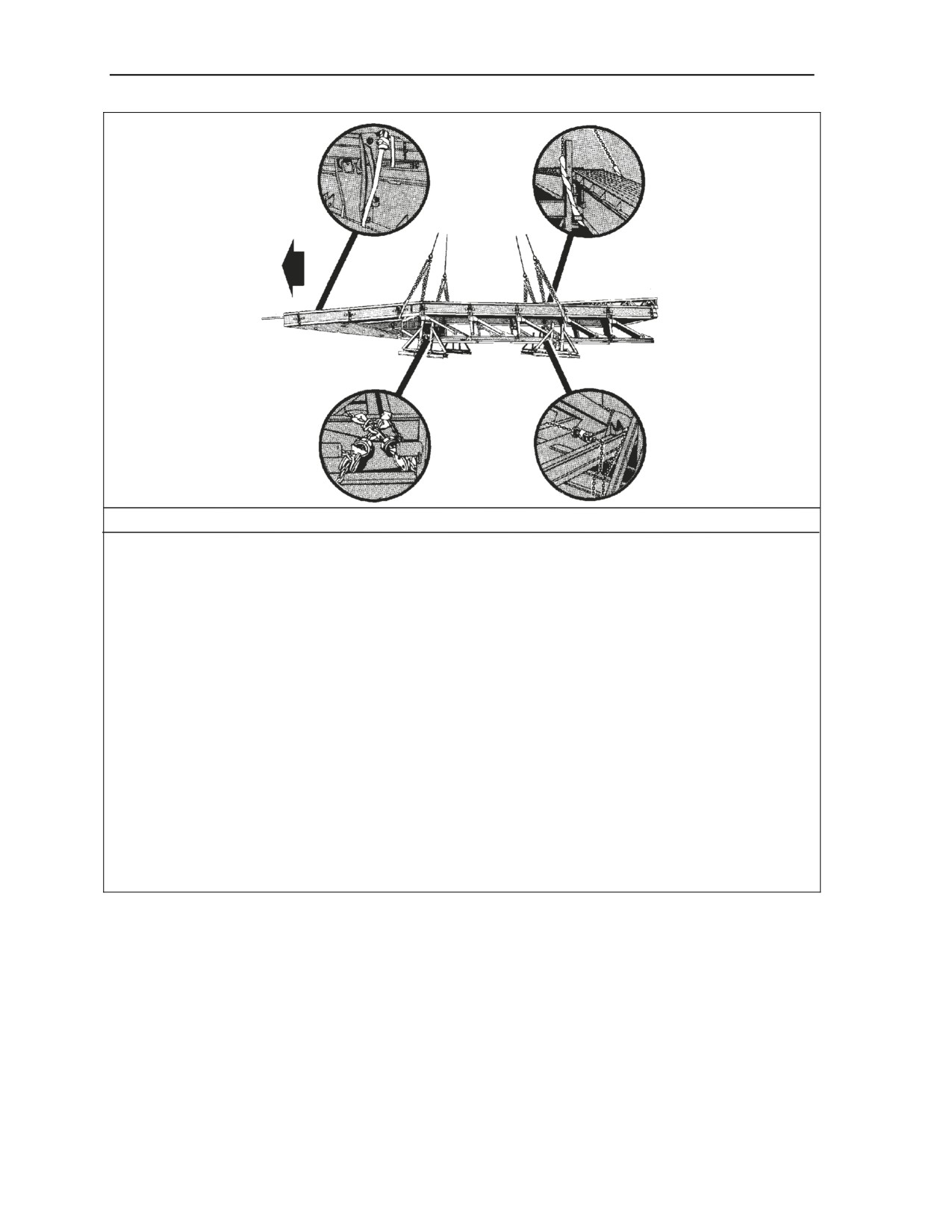
RIGGING STEPS
1. Place two sling legs on apex fitting number 1. Position sling set number 1 on top of the front
(sloped end) of the bridge.
2. Route the left sling leg to the front of the bridge. Loop the chain end around the joint
between the junction panels and the first sloping top panel. Ensure the chain loops around
each launching nose girder post. Place the correct link from Table 8-34 in the grab hook.
Repeat on the right side with the right sling leg.
3. Place two sling legs on apex fitting number 2. Position sling set number 2 on top of the
bridge at the rear.
4. Route the left sling leg to the rear of the bridge. Loop the chain end of the left sling leg
around the joint on the second bottom panel from the end formed by the vertical beam and
the diagonal beam (DO NOT LOOP THE CHAIN AT THE JOINT BETWEEN THE TOP AND
BOTTOM PANELS). Place the correct link from Table 8-34 in the grab hook. Repeat on the
right side with the right sling leg.
5. Raise the apex fittings above the load. Cluster and tie (breakaway technique) the sling legs
in each sling set together to prevent entanglement during hookup and lift-off.
Figure 8-34. Medium Girder Bridge
DRY SUPPORT BRIDGE ON M1077 FLATRACK
8-36. The dry support bridge on M1077 flatrack is rigged for dual-point sling load using the following
procedures:
z
Applicability. The following items in Table 8-35 are certified for the helicopter(s) listed in the
following table by the US Army Natick Soldier Center:
FM 4-20.199/MCRP 4-11.3E, VOL III/NTTP 3-04.13/
8-64
AFMAN 11-223 (I), VOL III/COMDINST M13482.4B
20 February 2009

Certified Dual-Point Rigging Procedures for Engineer Equipment
Table 8-35. Dry Support Bridge on M1077 Flatrack
Nomenclature
Max Weight
Sling
Link Count
Type of
(Pounds)
Set
Front/Rear
Aircraft
Dry Support Bridge Flatrack LVT (Launch Beams
13,800
25K
3/10
CH-47
and Basket)
Dry Support Bridge Flatrack T1 (Ramp Module,
19,300
25K
3/10
CH-47
Approach Ramp, and End Beam
Dry Support Bridge Flatrack T2 (Two Parallel
23,050
25K
3/10
CH-47
Modules)
Dry Support Bridge Flatrack V1 (Parallel Module
22,500
25K
3/10
CH-47
and Ramp Module)
Dry Support Bridge Flatrack V2 (Two Parallel
23,050
25K
3/10
CH-47
Modules)
z
Materials. The following materials are required to rig this load:
Sling set (25,000-pound capacity) with one additional apex fitting.
─ Chain length, part number 38850-00053-102, from a 25,000-pound capacity sling set
(8 each).
─ Coupling link, part number 9779135, from a 25,000-pound capacity sling set (8 each).
Tape, adhesive, pressure-sensitive, 2-inch wide roll.
Cord, nylon, Type III, 550-pound breaking strength.
Webbing, cotton, 1/4-inch, 80-pound breaking strength.
Tiedown straps (components of the flatrack system).
z
Personnel. Four persons can prepare and rig this load in 15 minutes.
z
Procedures. The following procedures apply to this load:
Note. The dry support bridge modules must be securely fastened to the M1077 flatrack.
Preparation. Prepare the load using the following steps:
─ Ensure the tension devices on the tiedown straps do not interfere with the routing of
the sling legs.
─ Secure all wires and cables with tape.
─ Secure all doors and caps with tape or Type III nylon cord.
─ Ensure the ladder and other equipment on the T1 module is properly stowed and
secured.
─ Attach two additional chain lengths to each sling leg chain using the coupling links.
Rigging. Rig the load according to the steps in Figure 8-35.
Hookup. Two hookup teams are required for this load. The static discharge person
discharges the static electricity. The forward hookup person stands on top of the load and
places apex fitting 1 onto the forward cargo hook. The aft hookup person stands on top of the
load and places apex fitting 2 onto the aft cargo hook. The hookup teams then carefully
dismount the load and remain close to the load as the helicopter removes slack from the sling
legs. When successful hookup is assured, the hookup teams quickly exit the area underneath
the helicopter to the designated rendezvous point.
Derigging. Derigging is the reverse of the preparation and rigging procedures.
FM 4-20.199/MCRP 4-11.3E, VOL III/NTTP 3-04.13/
20 February 2009
AFMAN 11-223 (I), VOL III/COMDINST M13482.4B
8-65
Chapter 8
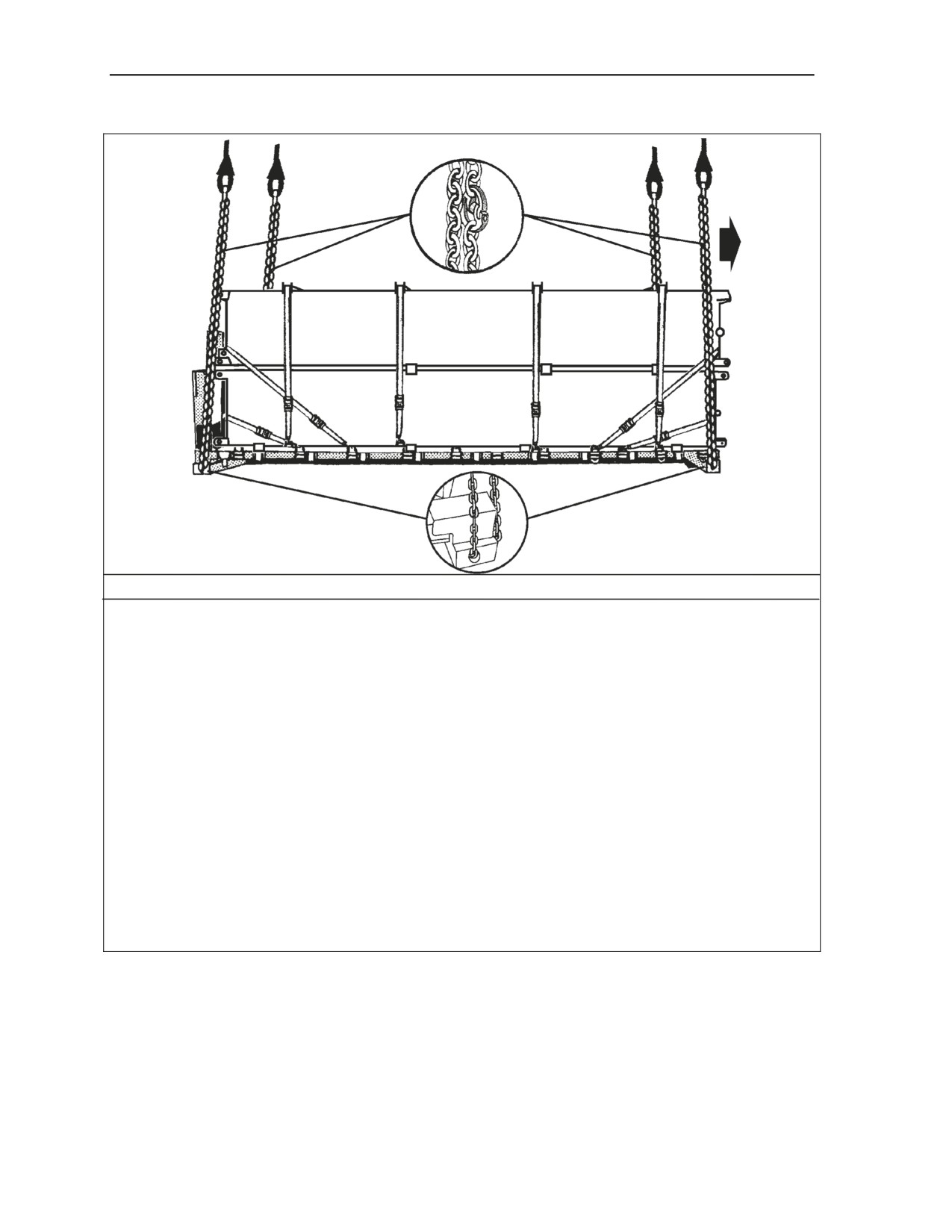
RIGGING STEPS
1. Place two sling legs on apex fitting number 1. Position sling set number 1 on top of the front
of the bridge.
2. Route the chain end through the left front ISO fittings on the corner of the M1077 flatrack.
Place the correct link from Table 8-35 in the grab hook. Repeat on the right side with the
right sling leg.
3. Place two sling legs on apex fitting number 2. Position sling set number 2 on top of the
bridge at the rear.
4. Route the chain end through the left rear ISO fittings on the corner of the M1077 flatrack.
Place the correct link from Table 8-35 in the grab hook. Repeat on the right side with the
right sling leg.
5. Raise the apex fittings above the load. Cluster and tie (breakaway technique) the sling legs
in each sling set together to prevent entanglement during hookup and lift-off. Tie the front
legs together with Type III nylon cord. Tie the rear legs to the A-frame toolboxes with Type III
nylon cord.
Figure 8-35. Dry Support Bridge on M1077 Flatrack
FM 4-20.199/MCRP 4-11.3E, VOL III/NTTP 3-04.13/
8-66
AFMAN 11-223 (I), VOL III/COMDINST M13482.4B
20 February 2009
Certified Dual-Point Rigging Procedures for Engineer Equipment
SRS-106 INTEGRATED TOWER SYSTEMS PORTABLE TOWER
TRAILER (PTT)
8-37. The SRS-106 integrated tower systems portable tower trailer is rigged for dual-point sling load using
the following procedures:
z
Applicability. The following item in Table 8-36 is certified for the helicopter(s) listed in the
following table by the US Army Natick Soldier Center:
Table 8-36. SRS-106 Integrated Tower Systems Portable Tower Trailer
Nomenclature
Max Weight
Sling
Link Count
Type of
(Pounds)
Set
Front/Rear
Aircraft
SRS-106 Integrated Tower Systems Portable
10,000
10K
40/3
CH-47
Tower Trailer
z
Materials. The following materials are required to rig this load:
Sling set (10,000-pound capacity) with one additional apex fitting.
Tape, adhesive, pressure-sensitive, 2-inch wide roll.
Cord, nylon, Type III, 550-pound breaking strength.
Webbing, cotton, 1/4-inch, 80-pound breaking strength.
z
Personnel. Two persons can prepare and rig this load in 15 minutes.
z
Procedures. The following procedures apply to this load:
Preparation. Prepare the load using the following steps:
─ Configure the trailer for transport with tower stowed and secured, outriggers retracted
and stowed, and the rear support jacks stowed. Secure all jack handles with tape and
secure the screw that stows the outriggers with Type III nylon cord so the screw cannot
be turned.
─ Place the front support jack in the fully retracted position, do not stow. Ensure the jack
base plate is in position and secure the cotter pin with tape.
─ Engage the trailer parking brake.
─ Secure all loose equipment in the storage boxes and secure the boxes closed.
─ Stow the remaining support jack base plates and secure the cotter pin with tape.
─ Secure the safety chains, emergency brake actuation lanyard, and electrical cable to the
trailer tongue with tape.
─ Cover all lights and reflectors with tape.
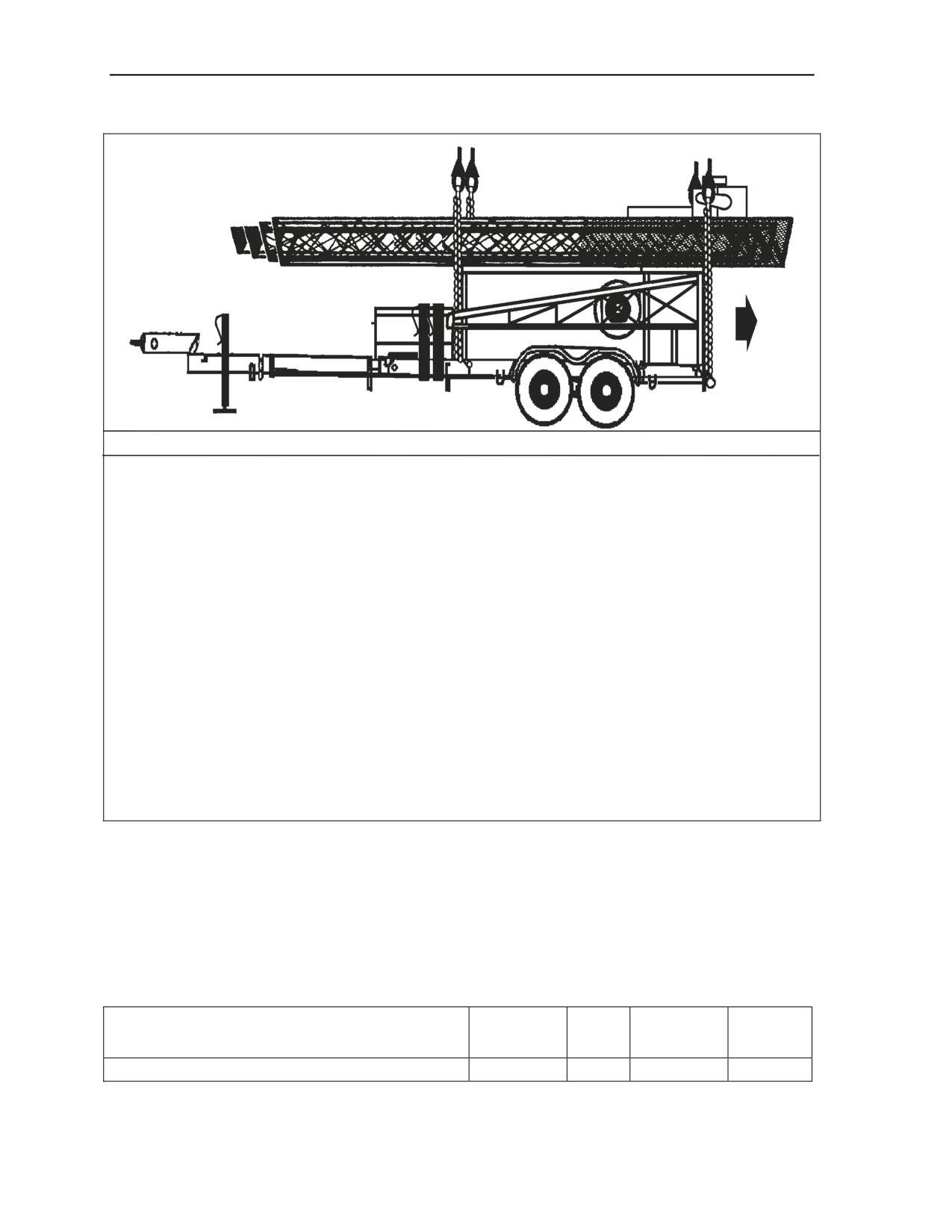
Rigging. Rig the load according to the steps in Figure 8-36.
Hookup. Two hookup teams are required for this load. The static discharge person
discharges the static electricity. The forward hookup person stands on the rear of the trailer
and places apex fitting 2 onto the forward cargo hook. The aft hookup person stands on the
front of the trailer and places apex fitting 1 onto the aft cargo hook. The hookup teams then
carefully dismount the load and remain close to the load as the helicopter removes slack from
the sling legs. When successful hookup is assured, the hookup teams quickly exit the area
underneath the helicopter to the designated rendezvous point.
Derigging. Derigging is the reverse of the preparation and rigging procedures.
FM 4-20.199/MCRP 4-11.3E, VOL III/NTTP 3-04.13/
20 February 2009
AFMAN 11-223 (I), VOL III/COMDINST M13482.4B
8-67
Chapter 8
RIGGING STEPS
1. Place two sling legs on apex fitting number 1. Position sling set number 1 on top of the tower
on the front (lunette end) of the trailer
2. Loop the chain end of the left and right sling legs over the storage boxes and inboard of the
outriggers to the front lift provisions. Place the correct link from Table 8-36 in the grab hook.
3. Place two sling legs on apex fitting number 2. Position sling set number 2 on top of the tower
at the rear of the trailer.
4. Loop the chain end of the left and right sling legs through their respective lift provisions
located on the rear of the trailer. Route the rear left sling to the outside of the control box and
secure the chain to the frame with a ¼-inch cotton webbing breakaway tie. Place the correct
link from Table 8-36 in the grab hook. Secure the excess chain with tape or Type III nylon
cord.
5. Pull the chain of each sling leg up tightly and tape or tie just above the lift provision.
6. Raise the apex fittings above the load. Cluster and tie (breakaway technique) the sling legs
in each sling set together to prevent entanglement during hookup and lift-off.
Figure 8-36. SRS-106 Integrated Tower Systems Portable Tower Trailer
M4 ROBOTIC MINE FLAIL
8-38. The M4 robotic mine flail is rigged for dual-point sling load using the following procedures:
z
Applicability. The following item in Table 8-37 is certified for the helicopter(s) listed in the
following table by the US Army Natick Soldier Center:
Table 8-37. M4 Robotic Mine Flail
Nomenclature
Max Weight
Sling
Link Count
Type of
(Pounds)
Set
Front/Rear
Aircraft
M4 Robotic Mine Flail
12,440
25K
30/3
CH-47
FM 4-20.199/MCRP 4-11.3E, VOL III/NTTP 3-04.13/
8-68
AFMAN 11-223 (I), VOL III/COMDINST M13482.4B
20 February 2009
Certified Dual-Point Rigging Procedures for Engineer Equipment
z
Materials. The following materials are required to rig this load:
Sling set (25,000-pound capacity) with one additional apex fitting.
Tape, adhesive, pressure-sensitive, 2-inch wide roll.
Cord, nylon, Type III, 550-pound breaking strength.
Webbing, cotton, 1/4-inch, 80-pound breaking strength.
z
Personnel. Two persons can prepare and rig this load in 15 minutes.
z
Procedures. The following procedures apply to this load:
Preparation. Prepare the load using the following steps:
─ Position the vehicle with the rear of the vehicle pointed into the wind.
─ Ensure the fuel tank is not over 3/4 full. Inspect the fuel tank cap, oil filter cap, and
the battery caps for proper installation.
─ Engage the parking brake and place the transmission in neutral.
─ Remove and store the fire extinguisher and all antennae inside or on top of the vehicle.
Secure with Type III nylon cord.
─ Pad the emergency control section with felt, or a suitable substitute material and secure
with tape. Tie the cover with Type III nylon cord.
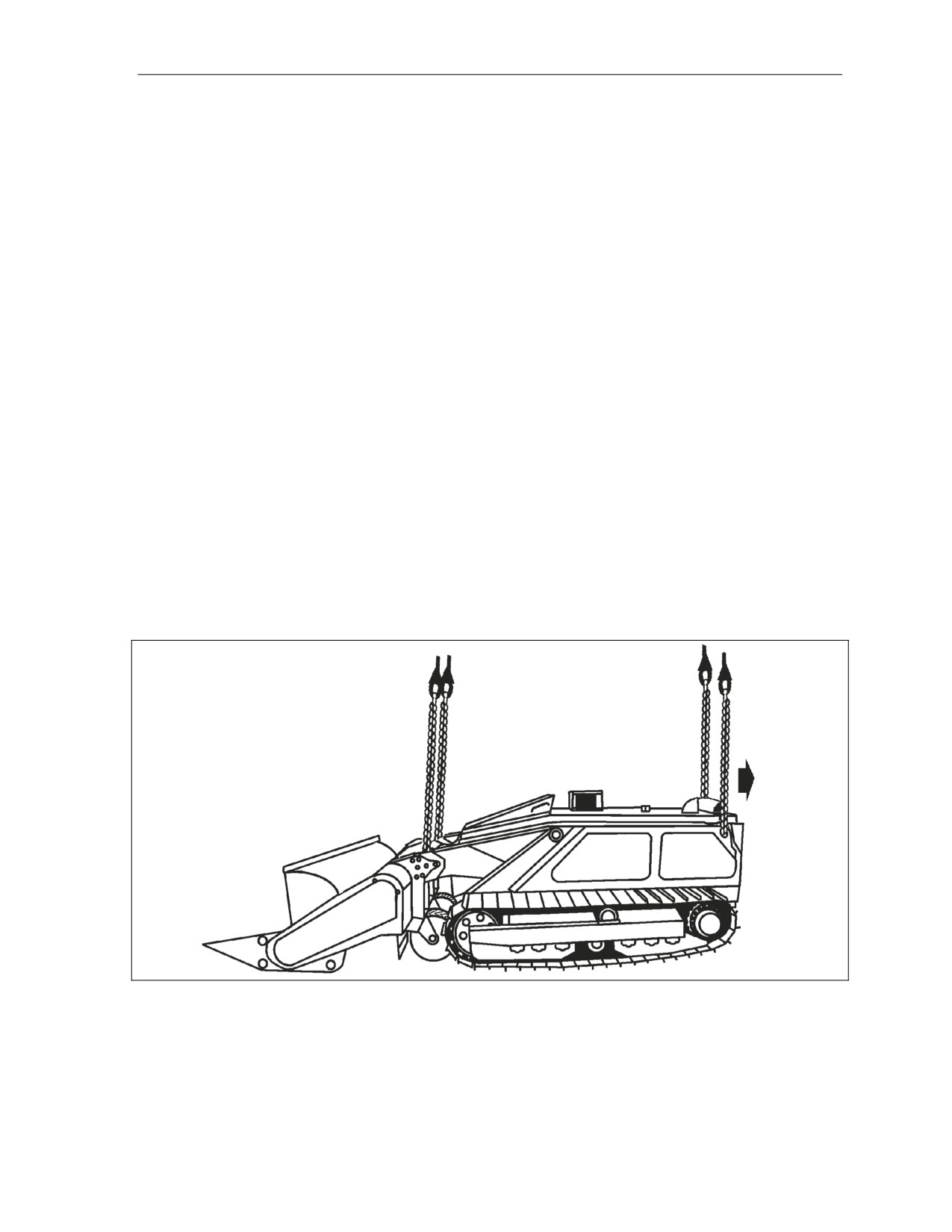
Rigging. Rig the load according to the steps in Figure 8-37.
Hookup. Two hookup teams are required for this load. The static discharge person
discharges the static electricity. The forward hookup person stands on top of the load and
places apex fitting 2 onto the forward cargo hook. The aft hookup person stands on the front
of the trailer and places apex fitting 1 onto the aft cargo hook. The hookup teams then
carefully dismount the load and remain close to the load as the helicopter removes slack from
the sling legs. When successful hookup is assured, the hookup teams quickly exit the area
underneath the helicopter to the designated rendezvous point.
Derigging. Derigging is the reverse of the preparation and rigging procedures.
Figure 8-37. M4 Robotic Mine Flail
FM 4-20.199/MCRP 4-11.3E, VOL III/NTTP 3-04.13/
20 February 2009
AFMAN 11-223 (I), VOL III/COMDINST M13482.4B
8-69

Chapter 8
RIGGING STEPS
1. Place two sling legs on apex fitting number 1. Position sling set number 1 on top of the tower
on the front (lunette end) of the mine flail.
2. Loop the chain end of the left and right sling legs to the front lift provisions located inboard of
the lift arms. Place the correct link from Table 8-37 in the grab hook.
3. Place two sling legs on apex fitting number 2. Position sling set number 2 on top of the tower
at the rear of the mine flail.
4. Loop the chain end of the left and right sling legs through their respective lift provisions.
Place the correct link from Table 8-37 in the grab hook. Secure the excess chain with tape or
Type III nylon cord.
5. Pull the chain of each sling leg up tightly and tape or tie just above the lift provision.
6. Raise the apex fittings above the load. Cluster and tie (breakaway technique) the sling legs
in each sling set together to prevent entanglement during hookup and lift-off.
Figure 8-37. M4 Robotic Mine Flail (Continued)
PNEUMATIC TOOL AND COMPRESSOR OUTFIT/HYDRAULIC
PIONEER TOOL OUTFIT (PTO) ON M353 TRAILER
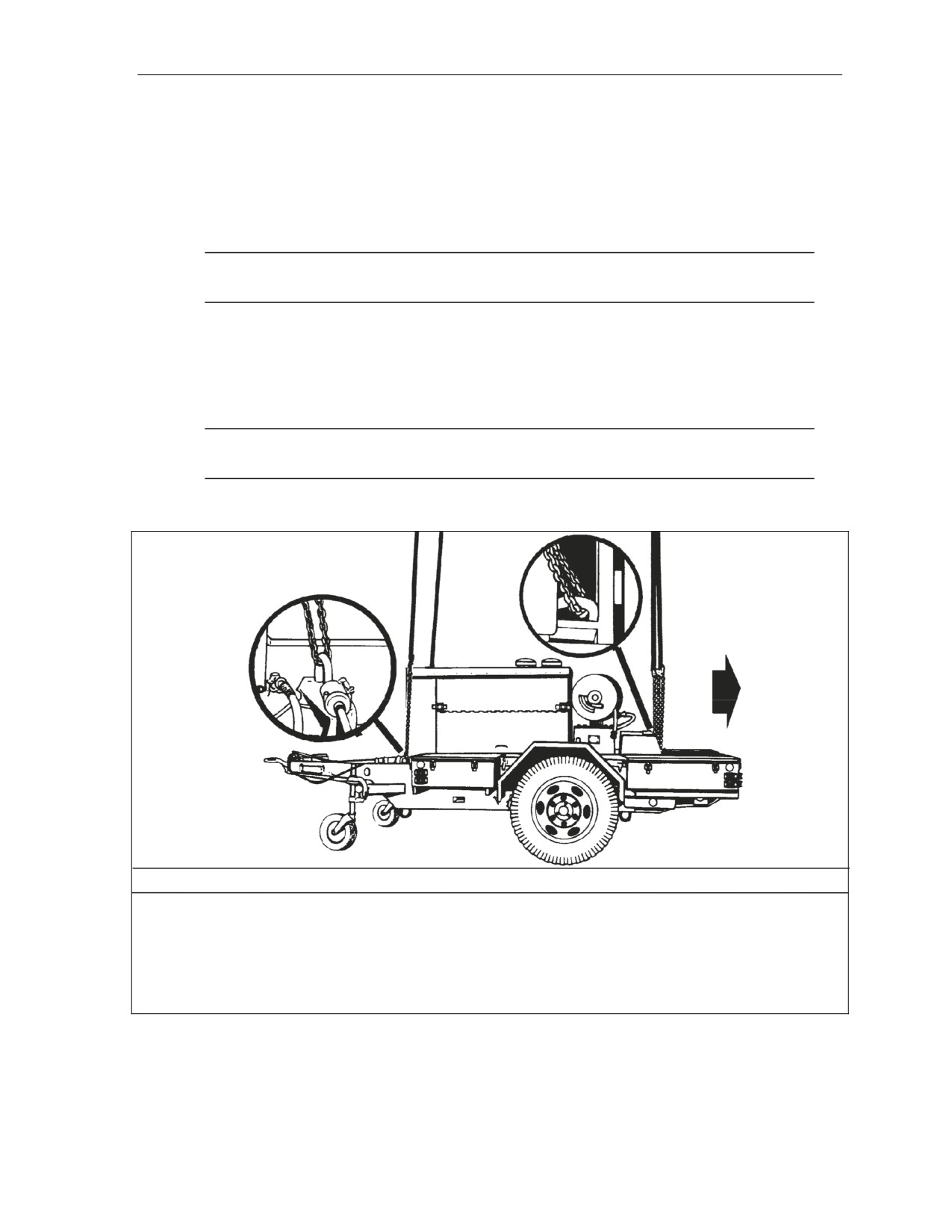
8-39. The pneumatic tool and compressor outfit/hydraulic pioneer tool outfit on M353 trailer is rigged for
dual-point sling load using the following procedures:
z
Applicability. The following items in Table 8-38 are certified for the helicopter(s) listed in the
following table by the US Army Natick Soldier Center:
Table 8-38. Pneumatic Tool and Compressor Outfit/Hydraulic Pioneer Tool Outfit on M353
Trailer
Nomenclature
Max Weight
Sling
Link Count
Type of
(Pounds)
Set
Front/Rear
Aircraft
Pneumatic tool and Compressor, TAMCN B0395
8,040
15K
5/30
CH-53
Hydraulic Pioneer and Tool Outfit
6,740
10K
3/30
CH-47
z
Materials. The following materials are required to rig this load:
Sling set (15,000-pound capacity) (2 each).
OR
Sling set (10,000-pound capacity) with one additional apex fitting.
Tape, adhesive, pressure-sensitive, 2-inch wide roll.
Cord, nylon, Type III, 550-pound breaking strength.
Webbing, cotton, 1/4-inch, 80-pound breaking strength.
Felt sheet, cattle hair, Type IV, 1/2-inch or suitable substitute.
z
Personnel. Two persons can prepare and rig this load in 15 minutes.
z
Procedures. The following procedures apply to this load:
Preparation. Prepare the load using the following steps:
FM 4-20.199/MCRP 4-11.3E, VOL III/NTTP 3-04.13/
8-70
AFMAN 11-223 (I), VOL III/COMDINST M13482.4B
20 February 2009
Certified Dual-Point Rigging Procedures for Engineer Equipment
─ Engage both hand brakes.
─ Ensure the fuel tanks are not over 3/4 full. Inspect the fuel tank cap, oil filler cap, and battery
caps for proper installation. Secure all loose gear and doors.
─ Secure the light cable to the drawbar with tape or Type III nylon cord.
─ Tape all glass items, lights, and reflectors.
─ Secure the two small wheels.
Rigging. Rig the load according to the steps in Figure 8-38.
Note. When using the 15,000-pound capacity multileg sling set, tie or tape the inner sling legs to the outer
sling legs.
Hookup. Two hookup teams are required for this load. The static discharge person discharges the
static electricity. The forward hookup person stands on top of the compressor and places apex fitting 1
onto the forward cargo hook. The aft hookup person stands on top of the compressor and places apex
fitting 2 onto the aft cargo hook. The hookup teams then carefully dismount the load and remain close
to the load as the helicopter removes slack from the sling legs. When successful hookup is assured, the
hookup teams quickly exit the area underneath the helicopter to the designated rendezvous point.
Note. Brief the helicopter crew to relax the sling leg tension and hover to the side before releasing the web
ring to prevent damaging the boat.
Derigging. Derigging is the reverse of the preparation and rigging procedures.
RIGGING STEPS
1. Place two sling legs on apex fitting number 1. Position sling set number 1 on top of the load.
2. Loop the chain end of the left and right sling legs through their respective lifting provisions
located on the front corners of the trailer. Place the correct link from Table 8-38 in the grab
hook.
Figure 8-38. Tool Outfits on M353 Trailer
FM 4-20.199/MCRP 4-11.3E, VOL III/NTTP 3-04.13/
20 February 2009
AFMAN 11-223 (I), VOL III/COMDINST M13482.4B
8-71

Chapter 8
RIGGING STEPS (Continued)
3. Place two sling legs on apex fitting number 2. Position sling set number 1 on top of the load.
4. Loop the chain end of the left and right sling legs through their respective lifting provisions
located on the rear corners of the trailer. Place the correct link from Table 8-38 in the grab
hook.
5. Pad the chains where they contact the load.
6. Raise the apex fittings above the load. Cluster and tie (breakaway technique) the sling legs
in each sling set together to prevent entanglement during hookup and lift-off.
Figure 8-30. Tool Outfits on M353 Trailer (Continued)
WATER PURIFICATION UNIT, REVERSE OSMOSIS (ROWPU)
8-40. The water purification unit, reverse osmosis is rigged for dual-point sling load using the following
procedures:
z
Applicability. The following item in Table 8-39 is certified for the helicopter(s) listed in the
following table by the US Army Natick Soldier Center:
Table 8-39. Water Purification Unit, Reverse Osmosis
Nomenclature
Max Weight
Sling
Link Count
Type of
(Pounds)
Set
Front/Rear
Aircraft
Water Purification Unit, Reverse Osmosis, MC 257,
7,400
15K
5/5
CH-53
600 gph, Skid Mounted
z
Materials. The following materials are required to rig this load:
Sling set (15,000-pound capacity) (2 each).
Tape, adhesive, pressure-sensitive, 2-inch wide roll.
Cord, nylon, Type III, 550-pound breaking strength.
Webbing, cotton, 1/4-inch, 80-pound breaking strength.
z
Personnel. Two persons can prepare and rig this load in 15 minutes.
z
Procedures. The following procedures apply to this load:
Preparation. Prepare the load using the following steps:
─ Secure all boxes, containers, and loose equipment with tape or Type III nylon cord.
─ Tape all glass fixtures, reflectors, and gages.
Rigging. Rig the load according to the steps in Figure 8-39.
Note. When using the 15,000-pound capacity multileg sling set, tie or tape the inner sling legs
to the outer sling legs.
FM 4-20.199/MCRP 4-11.3E, VOL III/NTTP 3-04.13/
8-72
AFMAN 11-223 (I), VOL III/COMDINST M13482.4B
20 February 2009
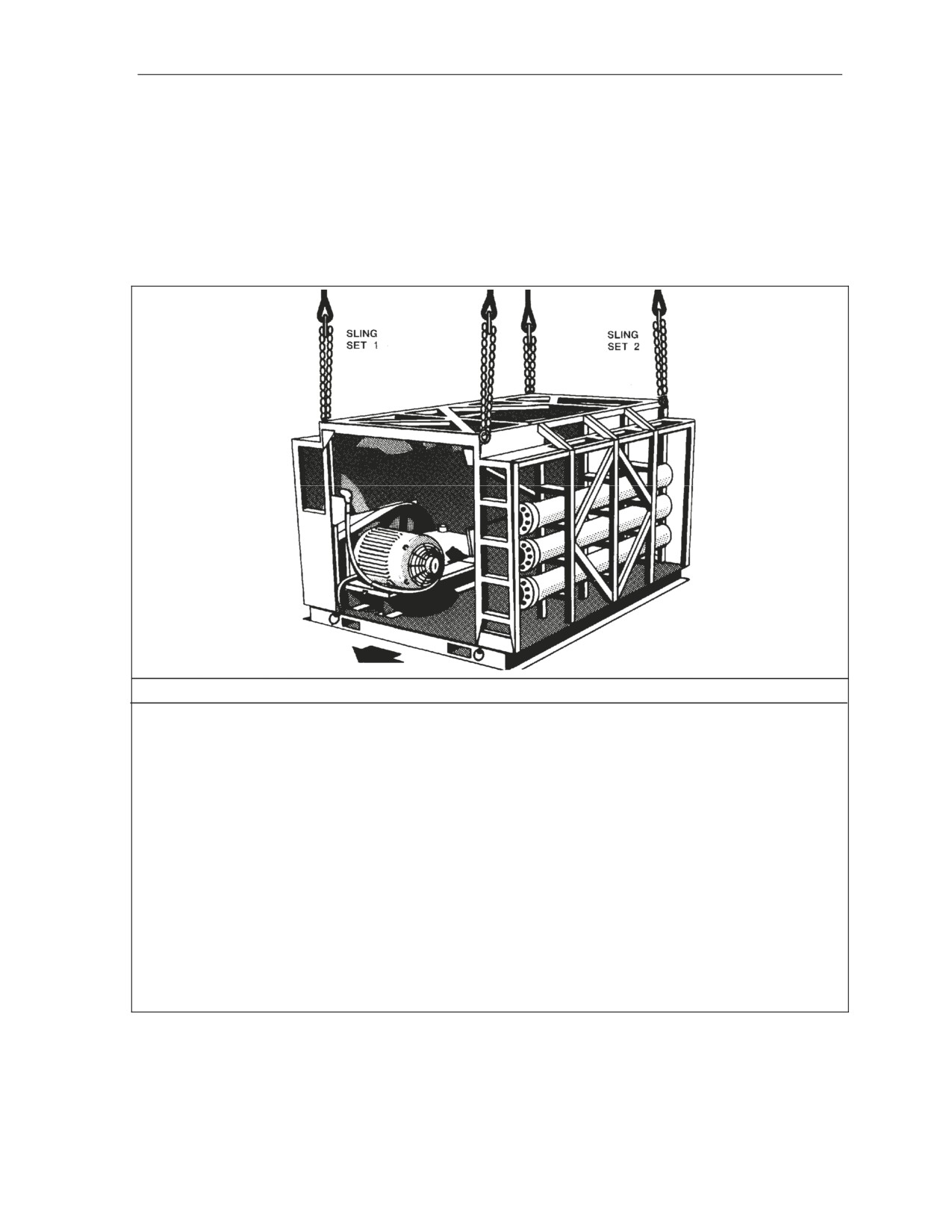
Certified Dual-Point Rigging Procedures for Engineer Equipment
Hookup. Two hookup teams are required for this load. The static discharge person
discharges the static electricity. The forward hookup person stands on top of the unit and
places apex fitting 1 onto the forward cargo hook. The aft hookup person stands on top of
the unit and places apex fitting 2 onto the aft cargo hook. The hookup teams then carefully
dismount the load and remain close to the load as the helicopter removes slack from the sling
legs. When successful hookup is assured, the hookup teams quickly exit the area underneath
the helicopter to the designated rendezvous point.
Derigging. Derigging is the reverse of the preparation and rigging procedures.
RIGGING STEPS
Note. The water pump end is designated as the forward end.
1. Position sling set number 1 on top of the pump end of the ROWPU.
2. Loop the chain end of the left and right sling legs through their respective lift provisions
located on the top corners of the unit. Place the correct link from Table 8-39 in the grab
hook.
3. Position sling set number 2 on top of the unit at the rear.
4. Loop the chain end of the left and right sling legs through their respective lift provisions
located on the top corners of the unit. Place the correct link from Table 8-39 in the grab
hook.
5. Raise the apex fittings above the load. Cluster and tie (breakaway technique) the sling legs
in each sling set together to prevent entanglement during hookup and lift-off.
Figure 8-39. Water Purification Unit, Reverse Osmosis
FM 4-20.199/MCRP 4-11.3E, VOL III/NTTP 3-04.13/
20 February 2009
AFMAN 11-223 (I), VOL III/COMDINST M13482.4B
8-73
Chapter 8
WATER PURIFICATION UNIT, REVERSE OSMOSIS (ROWPU),
TRAILER MOUNTED
8-41. The water purification unit, reverse osmosis, trailer mounted is rigged for dual-point sling load using
the following procedures:
z
Applicability. The following item in Table 8-40 is certified for the helicopter(s) listed in the
following table by the US Army Natick Soldier Center:
Table 8-40. Water Purification Unit, Reverse Osmosis, Trailer Mounted
Nomenclature
Max Weight
Sling
Link Count
Type of
(Pounds)
Set
Front/Rear
Aircraft
Water Purification Unit, Reverse Osmosis, 600 gph,
17,800
25K
3/10
CH-47
Trailer Mounted
z
Materials. The following materials are required to rig this load:
Sling set (25,000-pound capacity) with one additional apex fitting.
Tape, adhesive, pressure-sensitive, 2-inch wide roll.
Cord, nylon, Type III, 550-pound breaking strength.
Webbing, cotton, 1/4-inch, 80-pound breaking strength.
Strap, cargo, tiedown, CGU-1/B (4 each).
Felt sheet, cattle hair, Type IV, 1/2-inch or suitable padding
z
Personnel. Two persons can prepare and rig this load in 20 minutes.
z
Procedures. The following procedures apply to this load:
Preparation. Prepare the load using the following steps:
─ Drain the water from the unit.
─ Retract the trailer jacks.
─ Remove the canvas from the unit.
─ Secure all hoses and loose equipment with tape or Type III nylon cord.
─ Tape all reflectors, lights, and gages.
─ Secure the generator doors with CGU-1/B straps.
─ Ensure the fuel tanks are not over 3/4 full. Inspect the fuel tank cap, oil filler cap, and
battery caps for proper installation.
─ Engage the hand brake.
Rigging. Rig the load according to the steps in Figure 8-40.
Hookup. Two hookup teams are required for this load. The static discharge person
discharges the static electricity. The forward hookup person stands on top of the generator and
places apex fitting 1 onto the forward cargo hook. The aft hookup person stands on the frame
and places apex fitting 2 onto the aft cargo hook. The hookup teams then carefully dismount
the load and remain close to the load as the helicopter removes slack from the sling legs.
When successful hookup is assured, the hookup teams quickly exit the area underneath the
helicopter to the designated rendezvous point.
Derigging. Derigging is the reverse of the preparation and rigging procedures.
FM 4-20.199/MCRP 4-11.3E, VOL III/NTTP 3-04.13/
8-74
AFMAN 11-223 (I), VOL III/COMDINST M13482.4B
20 February 2009
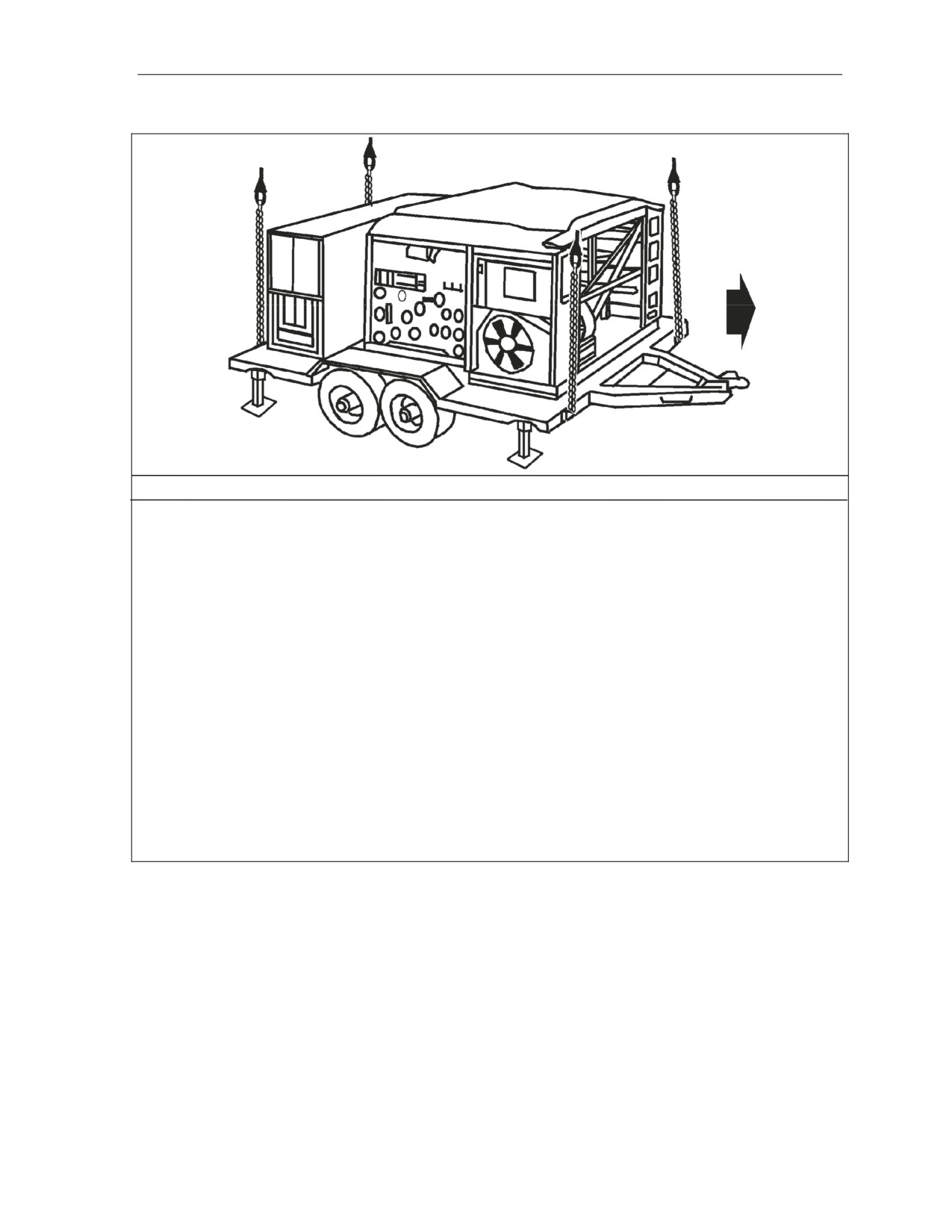
Certified Dual-Point Rigging Procedures for Engineer Equipment
RIGGING STEPS
1. Place two sling legs on apex fitting number 1. Position sling set number 1 on top of the
generator.
2. Loop the chain end of the left and right sling legs through their respective lift provisions
located on the front corners of the trailer. Place the correct link from Table 8-40 in the grab
hook.
3. Place two sling legs on apex fitting number 2. Position sling set number 2 on top of the
tongue end of the unit.
4. Loop the chain end of the left and right sling legs through their respective lift provisions
located on the rear corners of the trailer. Place the correct link from Table 8-40 in the grab
hook. Secure the excess chain with tape or Type III nylon cord.
5. Pad the slings where they contact the unit.
6. Raise the apex fittings above the load. Cluster and tie (breakaway technique) the sling legs
in each sling set together to prevent entanglement during hookup and lift-off.
Figure 8-40. Water Purification Unit, Reverse Osmosis, Trailer Mounted
FM 4-20.199/MCRP 4-11.3E, VOL III/NTTP 3-04.13/
20 February 2009
AFMAN 11-223 (I), VOL III/COMDINST M13482.4B
8-75

Chapter 8
INLAND PETROLEUM DISTRIBUTION SYSTEM (IPDS), MAINLINE
PUMP ON 20-FOOT FLATRACK
8-42. The inland petroleum distribution system, mainline pump on 20-foot flatrack is rigged for dual-point
sling load using the following procedures:
z
Applicability. The following item in Table 8-41 is certified for the helicopter(s) listed in the
following table by the US Army Natick Soldier Center:
Table 8-41. Inland Petroleum Distribution System, Mainline Pump on 20-Foot Flatrack
Nomenclature
Max Weight
Sling
Link Count
Type of
(Pounds)
Set
Front/Rear
Aircraft
Inland Petroleum Distribution System, Mainline Pump
19,500
25K
2/30
CH-47
on 20-Foot flatrack
z
Materials. The following materials are required to rig this load:
Sling set (25,000-pound capacity) with one additional apex fitting.
─ Additional chain lengths, part number 38850-00053-102 (4 each).
─ Additional coupling links, part number 664241 (4 each).
Tape, adhesive, pressure-sensitive, 2-inch wide roll.
Cord, nylon, Type III, 550-pound breaking strength.
Webbing, cotton, 1/4-inch, 80-pound breaking strength.
z
Personnel. Three persons can prepare and rig this load in 20 minutes.
z
Procedures. The following procedures apply to this load:
Preparation. Prepare the load using the following steps:
─ The pump end of the flatrack is the forward end of the load.
─ Secure all loose equipment with tape or Type III nylon cord.
─ Attach an additional chain length to each sling leg chain using a coupling link.
Rigging. Rig the load according to the steps in Figure 8-41.
Hookup. Two hookup teams are required for this load. The static discharge person
discharges the static electricity. The forward hookup person stands on the engine cover and
places apex fitting 1 onto the forward cargo hook. The aft hookup person stands on the
engine cover and places apex fitting 2 onto the aft cargo hook. The hookup teams then
carefully dismount the load and remain close to the load as the helicopter removes slack from
the sling legs. When successful hookup is assured, the hookup teams quickly exit the area
underneath the helicopter to the designated rendezvous point.
Note. Brief the pilot to relax the sling tension and hover to the side of the load when releasing
the apex fitting to prevent damaging the load.
Derigging. Derigging is the reverse of the preparation and rigging procedures.
FM 4-20.199/MCRP 4-11.3E, VOL III/NTTP 3-04.13/
8-76
AFMAN 11-223 (I), VOL III/COMDINST M13482.4B
20 February 2009