FM 4-20.199 Multiservice Helicopter Sling Load: Dual-Point Load Rigging Procedures (February 2009) - page 8
Certified Dual-Point Rigging Procedures for Tandem Loads
Tape, adhesive, pressure-sensitive, 2-inch wide roll.
Cord, nylon, Type III, 550-pound breaking strength.
Webbing, cotton, 1/4-inch, 80-pound breaking strength.
Strap, cargo, tie-down, CGU-1/B (2 each, or more as required to secure cargo).
Spreader bar assembly NSN: 4910-01-313-8839.
z
Personnel. Two persons can prepare and rig the truck in 10 minutes. Two persons can prepare
and rig the trailer in 10 minutes.
z
Procedures. Attach the trailer to the truck by placing the lunette on the pintle hook and
securing the latch with tape or Type III nylon cord. Secure the safety chains. Position the
vehicle on level ground so both the truck and trailer are in a straight line. The following
procedures apply to this load:
Preparation. Prepare the load using the following steps:
─
Fold mirrors inward and tie together with Type III nylon cord. Remove the doors and secure to
the seats with Type III nylon cord.
─
Secure all equipment and cargo inside the truck with tiedown straps, tape, or Type III nylon
cord.
─
Ensure the fuel tank is not over 3/4 full. Inspect the fuel tank cap, oil filler cap, and battery caps
for proper installation.
─
Engage the vehicle parking brake and put the transmission in neutral.
─
Ensure the front wheels are pointed straight ahead. Tie down the steering wheel, using the
securing device attached under the dashboard.
─
Ensure the turbine fuel and both fog oil tanks are not over ¾ full.
─
Set the three way valve to the off position.
─
Ensure the IR hopper latches are securely closed and the auxiliary hoses are attached to the
mounting bracket at the forward end of the inboard fog oil tank.
─
Secure all latches and doors with tape or Type III nylon cord.
─
Ensure the graphite tank is empty.
─
Extend the spreader bar until the holes line up. Install the pin and engage the keeper.
─
Position the spreader bar across the rear of the vehicle between the rear slings.
─
Ensure the tongue wheel of the trailer is in the up and locked position and the parking brake is
set.
─
Tie or tape the light cable to the top of the tongue.
─
Ensure the accompanying load in the trailer is secured with tiedown straps.
─
Route the hook portion of a CGU-1/B tiedown strap through the left rear inboard tiedown
provision located near the pintle on the rear bumper of the truck and through the left front lift
provision on the trailer. Connect the hook to the ratchet of the CGU-1/B.
─
Repeat the above procedure on the right side of the load.
─
Tighten both CGU-1/B tiedown straps at the same time. Secure the excess strap and safety the
ratchet handles in the closed position with tape. Tape tiedown straps every 24 inches to prevent
flapping during flight.
─
Connect one additional chain length to each chain on each sling set with a coupling link.
CAUTION
Do not connect the CGU-1/B tiedown strap around the truck's rear axle
or wheel.
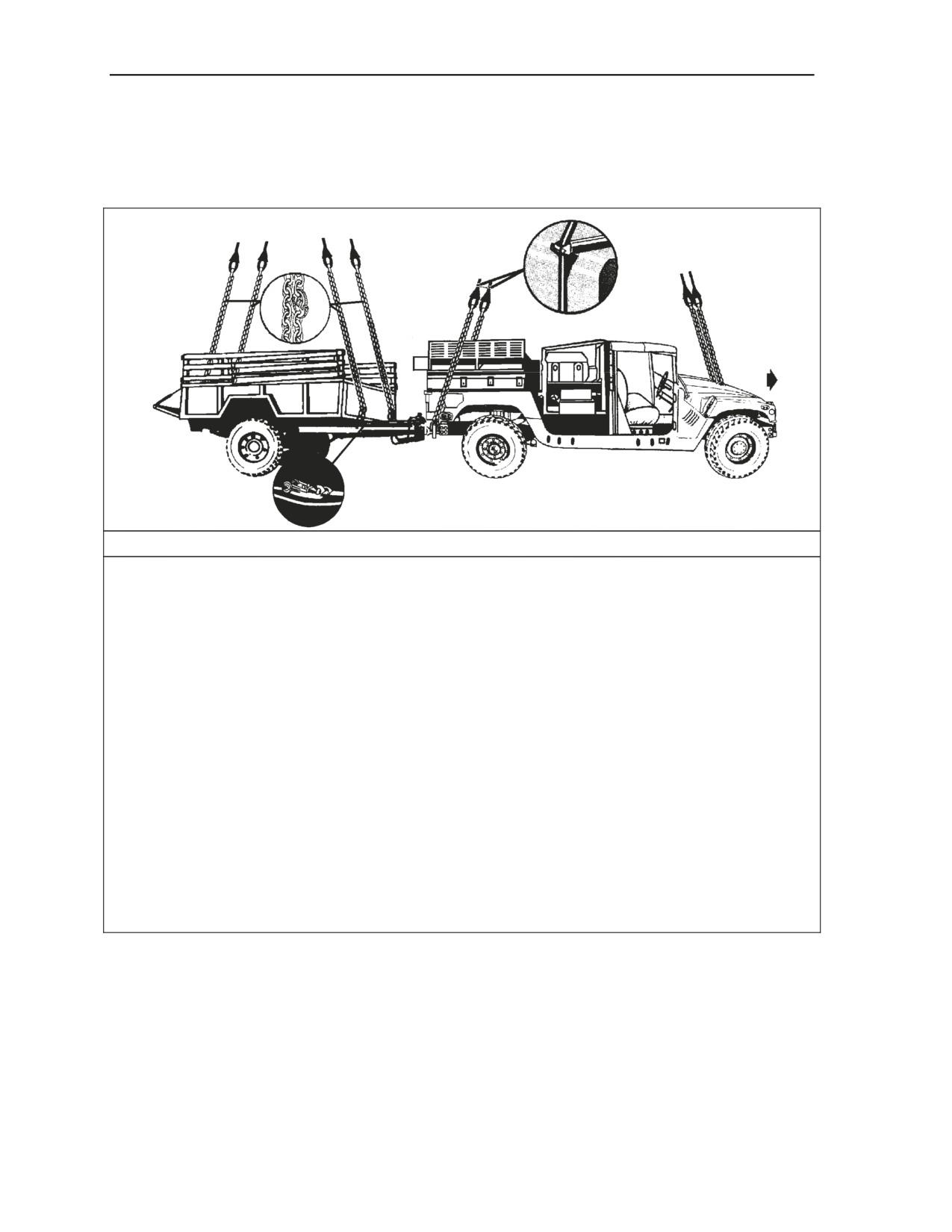
Rigging. Rig the load according to the steps in Figure 5-32.
Hookup. Two hookup teams are required for this load. The static wand person discharges
the static electricity with the static wand. The forward hookup person stands on top of the
vehicle and places apex fitting 1 onto the forward cargo hook. The aft hookup person stands
on the trailer fender and places apex fitting 2 onto the aft cargo hook. The hookup team then
FM 4-20.199/MCRP 4-11.3E, VOL III/NTTP 3-04.13/
20 February 2009
AFMAN 11-223 (I), VOL III/COMDINST M13482.4B
5-89
Chapter 5
carefully dismounts the load and remains close to the load as the helicopter removes slack
from the sling legs. When successful hookup is assured, the hookup team quickly exits the
area underneath the helicopter to the designated rendezvous point.
Derigging. Derigging is the reverse of the preparation and rigging procedures.
RIGGING STEPS
1. Position the apex fitting on top of the IR hopper or on the forward end of the fog oil tanks.
Route outer sling legs 1 and 2 to the front of the vehicle and inner sling legs 3 and 4 to the
rear. Sling legs 1 and 3 must be on the left side of the load.
2. Loop the chain end of sling leg 1 through the left front lift provision that protrudes through the
hood from inboard to outboard. Place the correct link from Table 5-32 in the grab hook.
Repeat with sling leg 2 and the right front lift provision. Secure excess chain with tape or
Type III nylon cord.
3. Place the nylon rope of sling legs 3 and 4 in the guides on the ends of the spreader bar.
Route the chain end of sling leg 3 through the lift provision located on the left end of the rear
bumper from inboard to outboard. Place the correct link from Table 5-32 in the grab hook.
Repeat with sling leg 4 and the right rear lift provision.
4. Pad the sling legs in the area where they make contact with the structure.
5. Cluster and tie (breakaway technique) all sling legs together on top of the shelter to prevent
entanglement during hookup and lift-off. Position the apex fitting of sling set 2 on top of the
trailer. Route outer sling legs 1 and 2 to the front of the trailer and inner sling legs 3 and 4 to
the rear of the trailer. Sling legs 1 and 3 must be on the left side of the load.
Figure 5-32. M1113 Truck, 1 1/4-Ton with M56 Smoke Generator and M101A2 Trailer
FM 4-20.199/MCRP 4-11.3E, VOL III/NTTP 3-04.13/
5-90
AFMAN 11-223 (I), VOL III/COMDINST M13482.4B
20 February 2009

Certified Dual-Point Rigging Procedures for Tandem Loads
RIGGING STEPS (Continued)
6. Loop the chain end of sling leg 1 through the left front lift provision located on the front of the
trailer. Place the correct link from Table 5-32 in the grab hook. Repeat with sling leg 2
through the right front lift provision. Secure excess chain with tape or Type III nylon cord.
7. Loop the chain end of sling leg 3 through the left rear lift provision. Place the correct link from
Table 5-32 in the grab hook. Repeat with sling leg 4 through the right rear lift provision.
Secure excess chain with tape or Type III nylon cord.
8. Cluster and tie (breakaway technique) all sling legs together on top of the vehicle to prevent
entanglement during hookup and lift-off.
Figure 5-32. M1113 Truck, 1 1/4-Ton with M56 Smoke Generator and M101A2 Trailer
(Continued)
M1113 TRUCK, 1 1/4-TON (HMMWV) PETROLEUM QUALITY
ANALYSIS SYSTEM (PQAS) SHELTER AND PQAS TRAILER
5-34. The M1113 truck, 1 1/4-ton petroleum quality analysis system shelter and PQAS trailer are rigged
for dual-point sling load using the following procedures:
z
Applicability. The following items in Table 5-33 are certified for the helicopter(s) listed in the
following table by the US Army Natick Soldier Center:
Table 5-33. M1113 Truck, 1 1/4-Ton Petroleum Quality Analysis System Shelter and PQAS
Trailer
Nomenclature
Max Weight
Sling Set
Link Count
Type of
(Pounds)
Front/Rear
Aircraft
M1113 with PQAS Shelter
9,640
25K
30/3
CH-47
PQAS Trailer
3,380
10K
20/45
CH-47
z
Materials. The following materials are required to rig this load:
Sling set (10,000-pound capacity).
─ Additional chain length, part number 38850-00053-101, from a 10,000-pound capacity
sling set (4 each).
─ Additional coupling link, part number 664228, from a 10,000-pound sling set (4 each).
Sling set (25,000-pound capacity).
─ Chain length, part number 38850-00053-102, from a 25,000-pound capacity sling set
(4 each).
─ Coupling link, part number 664241, from a 25,000-pound sling set (4 each).
Tape, adhesive, pressure-sensitive, 2-inch wide roll.
Cord, nylon, Type III, 550-pound breaking strength.
Webbing, cotton, 1/4-inch, 80-pound breaking strength.
Strap, cargo, tiedown, CGU-1/B (4 each).
Felt sheet, cattle hair, Type IV, 1/2-inch or suitable substitute.
FM 4-20.199/MCRP 4-11.3E, VOL III/NTTP 3-04.13/
20 February 2009
AFMAN 11-223 (I), VOL III/COMDINST M13482.4B
5-91
Chapter 5
z
Personnel. Two persons can prepare and rig the truck in 10 minutes. Two persons can prepare
and rig the trailer in 20 minutes.
z
Procedures. Attach the trailer to the truck by placing the lunette on the pintle hook and
securing the latch with tape or Type III nylon cord. Secure the safety chains. Position the
vehicle on level ground so both the truck and trailer are in a straight line. The following
procedures apply to this load:
Preparation. Prepare the load using the following steps:
─
Fold mirrors inward and tie together with Type III nylon cord. Remove the doors and
secure to the seats with Type III nylon cord.
─
Secure all equipment and cargo inside the truck and shelter with tiedown straps, tape,
or Type III nylon cord.
─
Ensure the fuel tank is not over 3/4 full. Inspect the fuel tank cap, oil filler cap, and
battery caps for proper installation.
─
Engage the vehicle parking brake and put the transmission in neutral.
─
Ensure the front wheels are pointed straight ahead. Tie down the steering wheel, using
the securing device attached under the dashboard.
─
Retract the lunette leg and secure with Type III nylon cord.
─
Secure all doors with tiedown straps or Type III nylon cord.
─
Ensure the trailer parking brakes are set.
─
Roll up and tie the large canvas covers on the shelter and tape the small canvas covers
down.
─
Close and lock all trailer doors.
─
Route the hook portion of a CGU-1/B tiedown strap through the left rear inboard
tiedown provision located near the pintle on the rear bumper of the truck and through
the mounting bracket on the front of the trailer A-frame. Connect the hook to the
ratchet of the CGU-1/B.
─
Repeat the above procedure on the right side of the load.
─
Tighten both CGU-1/B tiedown straps at the same time. Secure the excess strap and
safety the ratchet handles in the closed position with tape.
─
Connect one additional chain length to each chain on each sling set with a coupling
link.
CAUTION
Do not connect the CGU-1/B tiedown strap around the truck's rear axle
or wheel.
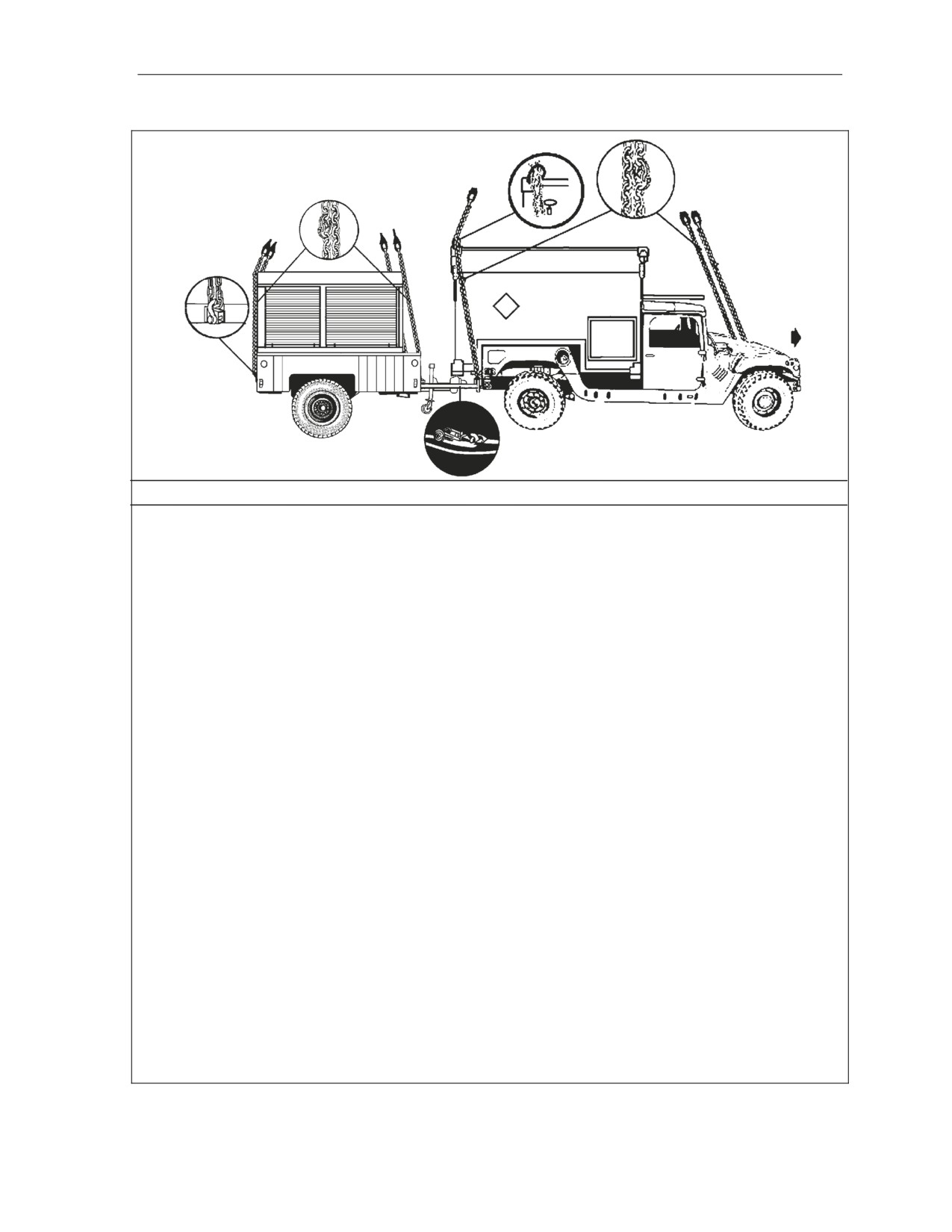
Rigging. Rig the load according to the steps in Figure 5-33.
Hookup. Two hookup teams are required for this load. The static wand person discharges
the static electricity with the static wand. The forward hookup person stands on top of the vehicle
and places apex fitting 1 onto the forward cargo hook. The aft hookup person stands on the trailer
fender and places apex fitting 2 onto the aft cargo hook. The hookup team then carefully
dismounts the load and remains close to the load as the helicopter removes slack from the sling
legs. When successful hookup is assured, the hookup team quickly exits the area underneath
the helicopter to the designated rendezvous point.
Derigging. Derigging is the reverse of the preparation and rigging procedures.
FM 4-20.199/MCRP 4-11.3E, VOL III/NTTP 3-04.13/
5-92
AFMAN 11-223 (I), VOL III/COMDINST M13482.4B
20 February 2009
Certified Dual-Point Rigging Procedures for Tandem Loads
RIGGING STEPS
1.
Position the 25,000-pound capacity sling set on top of the truck. Route outer sling legs 1 and
2 to the front of the vehicle and inner sling legs 3 and 4 to the rear. Sling legs 1 and 3 must
be on the left side of the load.
2.
Loop the chain end of sling leg 1 through the left front lift provision that protrudes through the
hood of the vehicle. Place the correct link from Table 5-33 in the grab hook. Repeat with
sling leg 2 and the right front lift provision. Secure excess chain with tape or Type III nylon
cord.
3.
Route the chain end of sling leg 3 through the left shelter lift ring. Loop the chain end through
the left lift provision on the bumper and thread back through the left shelter lift ring. Place the
correct link from Table 5-33 in the grab link. Repeat with sling leg 4 and the right rear lift
provision.
4.
Cluster and tie (breakaway technique) all sling legs together on top of the vehicle to prevent
entanglement during hookup and lift-off.
5.
Position the 10,000-pound capacity sling set 2 on top of the trailer. Route outer sling legs
1and 2 to the front of the trailer and inner sling legs 3 and 4 to the rear of the trailer. Sling
legs 1 and 3 must be on the left side of the load.
6.
Loop the chain end of sling leg 1 through the left front lift provision located on the front of the
trailer. Place the correct link from Table 5-33 in the grab hook. Repeat with sling leg 2
through the right front lift provision. Secure excess chain with tape or Type III nylon cord.
7.
Loop the chain end of sling leg 3 through the left rear lift provision. Place the correct link from
Table 5-33 in the grab hook. Repeat with sling leg 4 through the right rear lift provision.
Secure excess chain with tape or Type III nylon cord.
8.
Cluster and tie (breakaway technique) all sling legs together on top of the vehicle to prevent
entanglement during hookup and lift-off.
Figure 5-33. M1113 Truck, 1 1/4-Ton Petroleum Quality Analysis System Shelter and PQAS
Trailer
FM 4-20.199/MCRP 4-11.3E, VOL III/NTTP 3-04.13/
20 February 2009
AFMAN 11-223 (I), VOL III/COMDINST M13482.4B
5-93
This page intentionally left blank.

Chapter 6
Certified Dual-Point Rigging Procedures for Howitzers and
Weapons Systems
INTRODUCTION
6-1. This chapter contains rigging procedures for dual-point howitzer and weapon system loads that have
been certified for sling load. Each rigging procedure is found in a paragraph that includes a description of
the load, materials required for rigging, and steps to complete the procedure. An applicability paragraph is
also a part of each paragraph and identifies the certified loads. The certified dual-point rigging procedures
for howitzer and weapon system loads are in this section. Paragraphs 6-2 through 6-8 give detailed
instructions for rigging loads.
Note. Reach Pendants may be used on dual point loads. Place a Reach Pendant on each apex
fitting. A static discharge person is not required when using a Reach Pendant.
M101A1 HOWITZER, 105-MM, WITH OR WITHOUT A-22 CARGO
BAGS
6-2. The M101A1 howitzer, 105-mm, with or without A-22 cargo bags are rigged for dual-point sling
load using the following procedures:
z
Applicability. The following items in Table 6-1 are certified for the helicopter(s) listed in the
following table by the US Army Natick Soldier Center:
Table 6-1. M101A1 Howitzer, 105-mm, with or without A-22 Cargo Bags
Nomenclature
Max Weight
Sling Set
Link Count
Type of
(Pounds)
Front/Rear
Aircraft
M101A1 Howitzer
4,980
10K
30/30
CH-47
25K
12/12
M101A1 Howitzer with One A-22 Cargo Bag
7,180
25K
12/12
CH-47
M101A1 Howitzer with Two A-22 Cargo Bags
9,380
25K
12/12
CH-47
M101A1 Howitzer with Three A-22 Cargo Bags
11,580
25K
12/12
CH-47
FM 4-20.199/MCRP 4-11.3E, VOL III/NTTP 3-04.13/
20 February 2009
AFMAN 11-223 (I), VOL III/COMDINST M13482.4B
6-1
Chapter 6
z
Materials. The following materials are required to rig this load:
Sling set (10,000- or 25,000-pound capacity) with one additional apex fitting for the sling
set being used.
Note. Because of the additional weight of the A-22 cargo bags use the 25,000-pound capacity
sling set when sling loading howitzers with accompanying loads.
Tape, adhesive, pressure-sensitive, 2-inch wide roll.
Cord, nylon, Type III, 550-pound breaking strength.
Webbing, cotton, 1/4-inch, 80-pound breaking strength.
Felt sheet, cattle hair, Type IV, 1/2-inch or suitable substitute.
Additional sling leg assemblies (2,500-pound capacity) from 10,000-pound capacity sling
sets (one per A-22 cargo bag).
Additional apex fitting (one per accompanying load).
Bag, cargo, A-22 (as required).
z
Personnel. Two persons can prepare and rig this load in 10 minutes.
z
Procedures. The following procedures apply to this load:
Preparation. Prepare the load using the following steps:
─ Close and lock the breech.
─ Ensure the trails are closed and secured. Rotate the lunette downward. Safety the trail
closing lock handles with tape or Type III nylon cord.
─ Ensure the muzzle cover, breech and tube covers, and all stowed equipment are
secured with tape or Type III nylon cord.
─ Pad the gun tube above the cradle around the forward edges of the sleigh assembly
with felt padding. Secure the padding with tape or Type III nylon cord.
─ Pad each trail aft of the traveling lock shaft with felt padding. Secure the padding with
tape or Type III nylon cord.
─ Set the hand brakes.
─ If required, inspect and prepare the A-22 cargo bag in accordance with FM 4-20.197 as
close as possible to the gun trails.
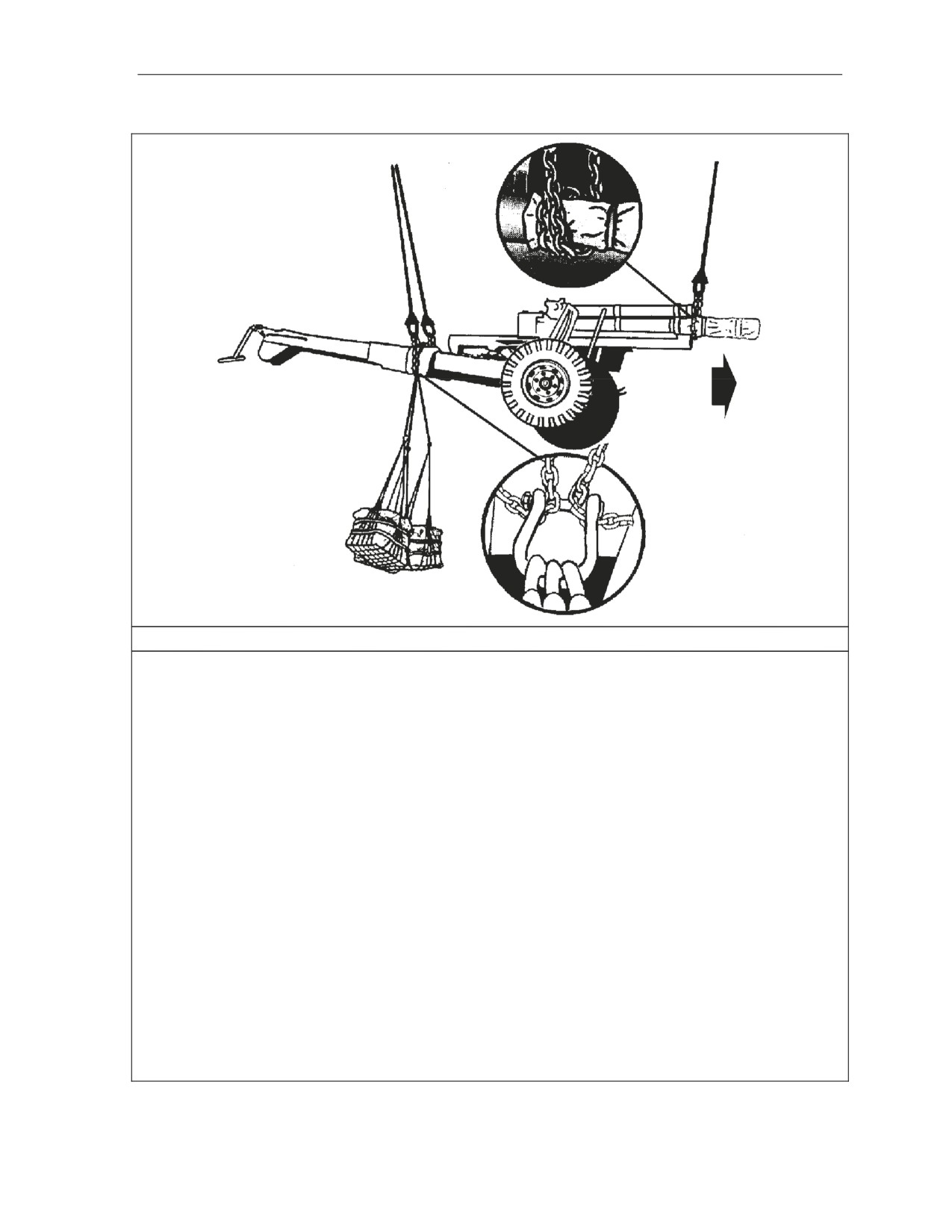
Rigging. Rig the load according to the steps in Figure 6-1.
Hookup. Two hookup teams are required for this load. The static wand person stands on
the trail of the howitzer and discharges the static electricity with the static wand. The forward
hookup person straddles the gun tube and places apex fitting 1 onto the forward cargo hook. The aft
hookup person stands on the trails and places apex fitting 2 onto the aft cargo hook. The hookup
teams then carefully dismount the howitzer and remain close to the load as the helicopter
removes slack from the sling legs. When successful hookup is assured, the hookup teams
quickly exit the area underneath the helicopter to the designated rendezvous point.
Derigging. Derigging is the reverse of the preparation and rigging procedures.
FM 4-20.199/MCRP 4-11.3E, VOL III/NTTP 3-04.13/
6-2
AFMAN 11-223 (I), VOL III/COMDINST M13482.4B
20 February 2009
Certified Dual-Point Rigging Procedures for Howitzer and Weapons Systems
RIGGING STEPS
1.
Connect two sling legs to apex fitting number 1. Position the sling set on top of the breech.
Both sling legs go around the barrel.
2.
Loop the chain end of sling leg 1 around the padded muzzle (one complete wrap). Place the
correct link from Table 6-1 in the grab hook. Loop sling leg 2 around the padded muzzle in
the opposite direction from sling leg 1 (one complete wrap). Secure excess chain with tape
or Type III nylon cord.
3.
Connect two sling legs to apex fitting number 2. Position the sling set on top of the gun trails.
4.
Wrap the left chain end around the left padded trail two complete wraps. Place the correct
link from Table 6-1 in the grab hook. Repeat with the right sling leg and the right padded gun
trail. Secure excess chain with tape or Type III nylon cord.
5.
Cluster and tie (breakaway technique) the sling legs in each sling set together to prevent
entanglement during hookup and lift-off.
6.
If required, attach the accompanying A-22 (s) by placing an additional apex fitting around the
inner chains of the rear sling legs, so the fitting is between the trails. Route the chain end of
an additional sling leg through the clevis on the A-22 cargo bag and insert link 3 in the grab
hook. Place the eye of the sling leg in the additional apex fitting between the trails. Repeat
this procedure for each A-22 cargo bag being lifted.
Figure 6-1. M101A1 Howitzer, 105-mm, with or without A-22 Cargo Bags
FM 4-20.199/MCRP 4-11.3E, VOL III/NTTP 3-04.13/
20 February 2009
AFMAN 11-223 (I), VOL III/COMDINST M13482.4B
6-3
Chapter 6
TWO M101A1 HOWITZERS, 105-MM, SIDE BY SIDE (USMC)
6-3. The two M101A1 howitzers, 105-mm, side by side are rigged for dual-point sling load using the
following procedures:
z
Applicability. The following items in Table 6-2 are certified for the helicopter(s) listed in the
following table by the US Army Natick Soldier Center:
Table 6-2. Two M101A1 Howitzers, 105-mm, Side by Side
Nomenclature
Max
Sling
Link Count
Type of
Weight
Set
Front/Rear
Aircraft
(Pounds)
Two M101A1 Howitzers, 105-mm, Side by Side
9,012
40K
Listed in
CH-53
Rigging Steps
z
Materials. The following materials are required to rig this load:
Sling set (40,000-pound capacity) with one additional apex fitting.
─ Chain length, part number 607050, from a 40,000-pound capacity sling set (2 each).
─ Coupling link, part number 577-0815, from a 40,000-pound sling set (2 each).
Tape, adhesive, pressure-sensitive, 2-inch wide roll.
Cord, nylon, Type III, 550-pound breaking strength.
Webbing, cotton, 1/4-inch, 80-pound breaking strength.
Strap, cargo, tiedown, CGU-1/B (as required).
Felt sheet, cattle hair, Type IV, 1/2-inch or suitable substitute.
Pad, energy, dissipating, honeycomb, 24 inch x 24 inch (2 each) or 4 inch x 4 inch x 24
inch wood (2 each).
z
Personnel. Two persons can prepare and rig this load in 15 minutes.
z
Procedures. The following procedures apply to this load:
Preparation. Prepare the load using the following steps:
─ Position the two howitzers side by side with the barrels facing in opposite directions.
─ Place the honeycomb or wood between the inboard wheel of one howitzer and the
inboard trail of the other howitzer. Secure the honeycomb or wood in place with a
tiedown strap. Repeat with the other tiedown strap on the inboard wheel of the other
howitzer and the inboard trail.
─ Close and lock the breech of each howitzer.
─ Ensure the trails are properly closed and secured. Rotate the lunette downward.
Secure the trail closing lock handles with tape or Type III nylon cord.
─ Remove or secure the muzzle, breech, and barrel covers.
─ Remove or pad the sight mounts.
─ Secure loose equipment with tape or Type III nylon cord. Place the section equipment
chest on the trails and secure with tiedown straps.
─ Set the hand brake.
─ Wrap padding around the gun tubes above the cradle and the forward edge of the recoil
damper assembly. Secure the padding with tape or Type III nylon cord.
─ Wrap padding around the left and right trails of both howitzers just aft of the travel
lock shaft area and secure with tape or Type III nylon cord.
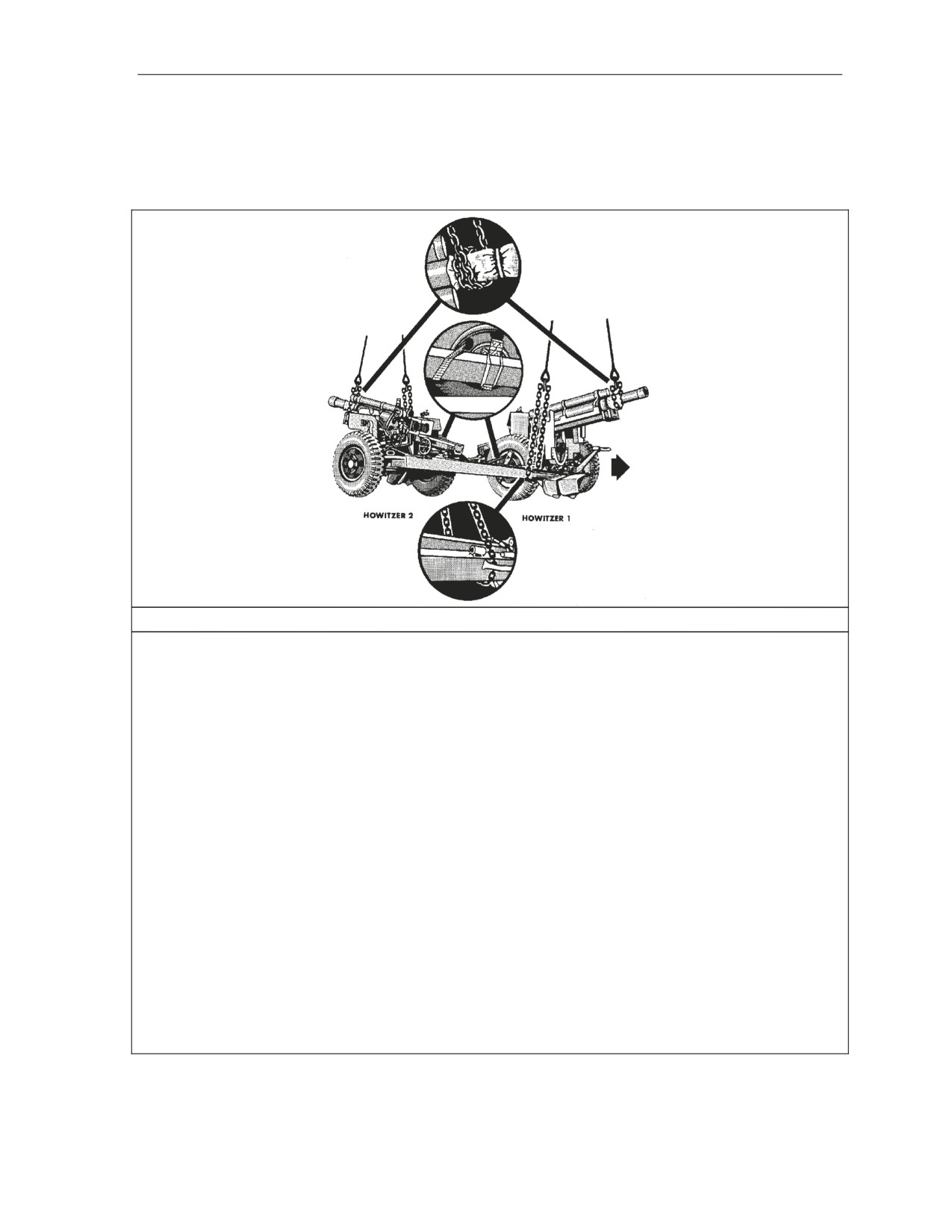
Rigging. Rig the load according to the steps in Figure 6-2.
Hookup. Two hookup teams are required for this load. The static wand person discharges
the static electricity with the static wand. The forward hookup person stands on the trail end of
howitzer 2 and places apex fitting 1 onto the forward cargo hook. The aft hookup person stands on
the trail end of howitzer 1 and places apex fitting 2 onto the aft cargo hook. The hookup teams
FM 4-20.199/MCRP 4-11.3E, VOL III/NTTP 3-04.13/
6-4
AFMAN 11-223 (I), VOL III/COMDINST M13482.4B
20 February 2009
Certified Dual-Point Rigging Procedures for Howitzer and Weapons Systems
then carefully dismount the howitzers and remain close to the load as the helicopter removes
slack from the sling legs. When successful hookup is assured, the hookup teams quickly exit
the area underneath the helicopter to the designated rendezvous point.
Derigging. Derigging is the reverse of the preparation and rigging procedures.
RIGGING STEPS
Note. The howitzer with the barrel facing in the direction of flight is designated as howitzer 1.
1. Place two sling legs on apex fitting number 1. Attach a chain length to one sling leg using the coupling
link. Position apex fitting number 1 on top of the barrel of howitzer number 1.
2. Wrap the chain end of the sling leg that does not have the additional chain length once around the
padding on the barrel of howitzer 1 and insert link 30 in the grab hook. Secure excess chain with tape
or Type III nylon cord.
3. Wrap the chain end of the other sling leg around the padding on the trail end of howitzer 2 and insert
link 55 in the grab hook. Secure excess chain with tape or Type III nylon cord.
4. Place two sling legs on apex fitting number 2. Attach a chain length to one sling leg using the coupling
link. Position apex fitting number 2 on top of the barrel of howitzer number 2.
5. Wrap the chain end of the sling leg that does not have the additional chain length once around the
padding on the barrel of howitzer 2 and insert link 30 in the grab hook. Secure excess chain with tape
or Type III nylon cord.
6. Wrap the chain end of the other sling leg around the padding on the trail end of howitzer 1 and insert
link 56 in the grab hook. Secure excess chain with tape or Type III nylon cord.
7. Cluster and tie (breakaway technique) the sling legs in each sling set together to prevent entanglement
during hookup and lift-off.
Figure 6-2. Two M101A1 Howitzers, Side by Side
FM 4-20.199/MCRP 4-11.3E, VOL III/NTTP 3-04.13/
20 February 2009
AFMAN 11-223 (I), VOL III/COMDINST M13482.4B
6-5
Chapter 6
M102 HOWITZER, 105-MM
6-4. The M102 howitzer, 105-mm is rigged for dual-point sling load using the following procedures:
z
Applicability. The following item in Table 6-3 is certified for the helicopter(s) listed in the
following table by the US Army Natick Soldier Center:
Table 6-3. M102 Howitzer, 105-mm
Nomenclature
Max Weight
Sling Set
Link Count
Type of
(Pounds)
Front/Rear
Aircraft
Howitzer, 105-mm, M102
3,330
10K
70/3
CH-47
z
Materials. The following materials are required to rig this load:
Sling set (10,000-pound capacity) with one additional apex fitting.
Tape, adhesive, pressure-sensitive, 2-inch wide roll.
Cord, nylon, Type III, 550-pound breaking strength.
Webbing, cotton, 1/4-inch, 80-pound breaking strength.
Strap, cargo, tiedown, CGU-1/B (as required).
z
Personnel. Two persons can prepare and rig this load in 10 minutes.
z
Procedures. The following procedures apply to this load:
Preparation. Prepare the load using the following steps:
─ Place muzzle and sight covers on howitzer and secure with tape or Type III nylon cord.
─ Place the section equipment chest on the end of the trails and secure with tiedown
straps.
─ Set the handbrake.
Rigging. Rig the load according to the steps in Figure 6-3.
Hookup. Two hookup teams are required for this load. The static wand person stands on
the trail of the howitzer and discharges the static electricity with the static wand. The forward
hookup person stands on the wheel and places apex fitting 1 onto the forward cargo hook. The aft
hookup person stands on the trails and places apex fitting 2 onto the aft cargo hook. The hookup
teams then carefully dismount the howitzer and remain close to the load as the helicopter
removes slack from the sling legs. When successful hookup is assured, the hookup teams
quickly exit the area underneath the helicopter to the designated rendezvous point.
Derigging. Derigging is the reverse of the preparation and rigging procedures.
FM 4-20.199/MCRP 4-11.3E, VOL III/NTTP 3-04.13/
6-6
AFMAN 11-223 (I), VOL III/COMDINST M13482.4B
20 February 2009
Certified Dual-Point Rigging Procedures for Howitzer and Weapons Systems
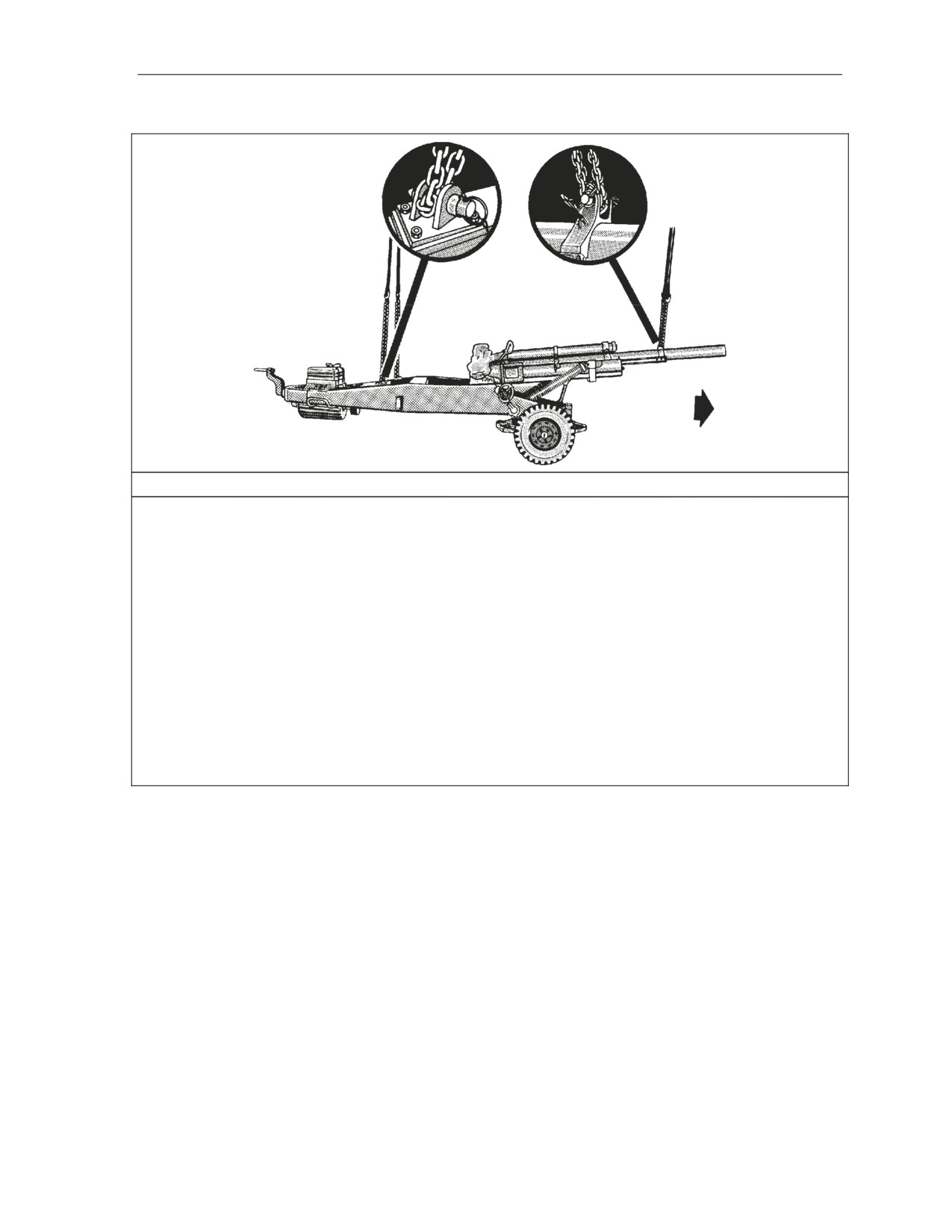
RIGGING STEPS
1. Place two sling legs on apex fitting number 1. Position apex fitting number 1 on top of the
howitzer tube.
2. Loop the chain ends of both sling legs through the lifting bracket on the howitzer tube. Place
the correct link from Table 6-3 in the grab hook. Secure the excess chain with tape or Type
III nylon cord.
3. Place two sling legs on apex fitting number 2. Position apex fitting number 2 between the
trails of the howitzer.
4. Loop the chain ends of the left and right sling legs through their respective lift provisions
located on the trails. Place the correct link from Table 6-3 in the grab hook.
5. Cluster and tie (breakaway technique) the sling legs in each sling set together to prevent
entanglement during hookup and lift-off.
Figure 6-3. M102 Howitzer
TWO M102 HOWITZERS, 105-MM, WITH OR WITHOUT ONE, TWO,
OR THREE A-22 CARGO BAGS
6-5. The two M102 howitzers, 105-mm, with or without one, two, or three A-22 cargo bags are rigged for
dual-point sling load using the following procedures:
z
Applicability. The following items in Table 6-4 are certified for the helicopter(s) listed in the
following table by the US Army Natick Soldier Center:
FM 4-20.199/MCRP 4-11.3E, VOL III/NTTP 3-04.13/
20 February 2009
AFMAN 11-223 (I), VOL III/COMDINST M13482.4B
6-7

Chapter 6
Table 6-4. Two M102 Howitzers, 105-mm, with or without One, Two, or Three A-22 Cargo Bags
Nomenclature
Max Weight
Sling Set
Link Count
Type of
(Pounds)
Front/Rear
Aircraft
Two Howitzers, 105-mm, M102
6,600
10K
Listed in
CH-47
Rigging Steps
Two Howitzers, 105-mm, M102 with One
8,800
10K
Listed in
CH-47
A-22 Cargo Bag
Rigging Steps
Two Howitzers, 105-mm, M102 with Two
11,000
25K
Listed in
CH-47
A-22 Cargo Bags
Rigging Steps
Two Howitzers, 105-mm, M102 with Three
13,200
25K
Listed in
CH-47
A-22 Cargo Bags
Rigging Steps
z
Materials. The following materials are required to rig this load:
Sling set (10,000-pound capacity) (used for rigging two howitzers or two howitzers and
one A-22 cargo bag).
─ One additional apex fitting (10,000-pound capacity) (2 additional apex fittings if
rigging an accompanying load).
─ One additional sling leg assembly (2,500-pound capacity) (2 additional sling leg
assemblies if rigging an accompanying load).
OR
Sling set (25,000-pound capacity) (used for rigging two howitzers with two or three A-22
cargo bags).
─ One additional apex fitting (25,000-pound capacity).
─ One additional apex fitting
(10,000- or
25,000-pound capacity)
(used for
accompanying load).
─ Two additional sling leg assemblies
(6,250-pound capacity) when rigging two
howitzers and two A-22 cargo bags (3 additional sling leg assemblies if rigging three
A-22 cargo bags) (6,250-pound capacity).
Clevis assembly, medium, used with 25,000-pound capacity sling set (4 each) .
Tape, adhesive, pressure-sensitive, 2-inch wide roll.
Cord, nylon, Type III, 550-pound breaking strength.
Webbing, cotton, 1/4-inch, 80-pound breaking strength.
Felt sheet, cattle hair, Type IV, 1/2-inch, 24 inches x 60 inches (2 each) or suitable
substitute.
Strap, cargo, tiedown, CGU-1/B (as required).
Pad, energy, dissipating, honeycomb, 36 inch x 36 inch (1 each) or wood block or felt
sheets (4 each).
Bag, cargo, A-22 with medium clevis (as required).
z
Personnel. Two persons can prepare and rig this load in 30 minutes. Add 15 minutes rigging
time for each A-22 cargo bag.
z
Procedures. The following procedures apply to this load:
Preparation. Prepare the load using the following steps:
─ Position the two howitzers side by side approximately 18 inches apart at the wheels
with the barrels facing the same direction.
─ Place the honeycomb pad between the two inboard wheels. Slide both howitzers
together and lash the wheels together securely with the tiedown straps.
─ Wrap a sheet of felt around each inboard trail at the center of the load to prevent
chafing between trails. Secure the padding with tape or Type III nylon cord. Ensure
the lift provisions are exposed.
FM 4-20.199/MCRP 4-11.3E, VOL III/NTTP 3-04.13/
6-8
AFMAN 11-223 (I), VOL III/COMDINST M13482.4B
20 February 2009
Certified Dual-Point Rigging Procedures for Howitzer and Weapons Systems
─ Secure all howitzer covers and loose equipment with tape or Type III nylon cord.
─ If the 25,000-pound capacity sling set is used, remove the trail lift provision pins and
install medium clevises. Reinstall the lift provision pins ensuring the pins are over the
bell portion of the clevises.
─ If required, inspect and prepare the A-22 cargo bag in accordance with FM 4-20.197 as
close as possible to the gun trails.
─ Set the handbrake.
Rigging. Rig the load according to the steps in Figure 6-4.
Hookup. Two hookup teams are required for this load. The static wand person stands on
the trail of the howitzer and discharges the static electricity with the static wand. The forward
hookup person stands on the inner wheels and places apex fitting 1 onto the forward cargo hook.
The aft hookup person stands on the trails and places apex fitting 2 onto the aft cargo hook. The
hookup teams then carefully dismount the howitzer and remain close to the load as the
helicopter removes slack from the sling legs. When successful hookup is assured, the hookup
teams quickly exit the area underneath the helicopter to the designated rendezvous point.
Derigging. Derigging is the reverse of the preparation and rigging procedures.
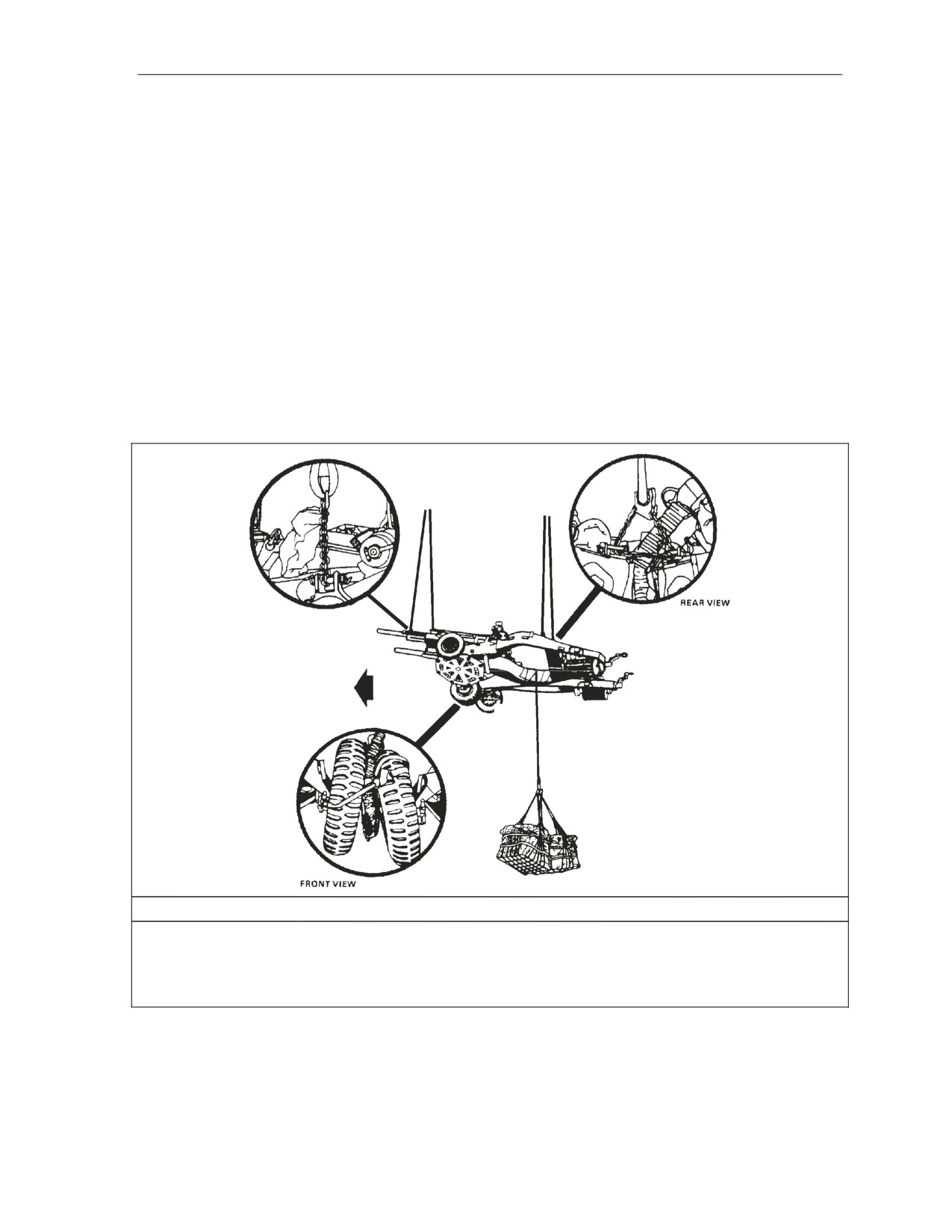
RIGGING STEPS
Note. The chain link number inside the parentheses is used for the 10,000-pound capacity sling set.
1. Connect two sling legs to apex fitting number 1. Position the apex fitting on the ground
between the barrels of the howitzers.
Figure 6-4. Two M102 Howitzers, 105-mm, with or without One, Two, or Three A-22 Cargo
Bags
FM 4-20.199/MCRP 4-11.3E, VOL III/NTTP 3-04.13/
20 February 2009
AFMAN 11-223 (I), VOL III/COMDINST M13482.4B
6-9

Chapter 6
RIGGING STEPS (Continued)
2.
Loop the chain end of sling leg 1 through the lift provision on the barrel of the left howitzer
and insert link 42 (60) in the grab hook. Repeat with sling leg 2 on the lift provision on the
barrel of the right howitzer. Secure excess chain with tape or Type III nylon cord.
3.
Connect three sling legs to apex fitting number 2. Position the apex fitting on the two inner
wheels.
4.
Route outer sling legs 1 and 2 to the outboard trails of the left and right howitzers
respectively. Route inner sling leg 3 to the two inboard trails.
5.
Loop the chain end of sling leg 1 through the lift provision or medium clevis on the outboard
trail of the left howitzer and insert link 3 (3) in the grab hook. Repeat with sling leg 2 on the
lift provision on the outboard trail of the right howitzer.
6.
Loop the chain end of inner sling leg 3 through the lift provisions or the medium clevises
located on the inboard trails of both howitzers and insert link 16 (20) in the grabhook. Secure
excess chain with tape or Type III nylon cord.
7.
Cluster and tie (breakaway technique) the sling legs in each sling set together to prevent
entanglement during hookup and lift-off.
8.
If lifting an accompanying load, wrap the chain end of the additional sling leg (s) around the
padded inboard trails and insert link 42 (60) in the grab hook. The chain should be as tight
as possible. Route the other end of the sling leg under the trail toward the accompanying
load. Place the additional apex fitting through the sling leg (s) eyelet. Place the medium
clevises of the A-22 cargo bags on the bolt of the apex fitting.
Figure 6-4. Two M102 Howitzers, 105-mm, with or without One, Two, or Three A-22 Cargo
Bags (Continued)
TWO M119A2 HOWITZERS, 105-MM, FORWARD FIRING POSITION,
SIDE BY SIDE
6-6. The two M119A2 howitzers, 105-mm, forward firing position, side by side are rigged for dual-point
sling load using the following procedures:
z
Applicability. The following items in Table 6-5 are certified for the helicopter(s) listed in the
following table by the US Army Natick Soldier Center:.
Table 6-5. Two M119A2 Howitzers, 105-mm, Forward Firing Position, Side by Side
Nomenclature
Max Weight
Sling Set
Link Count
Type of
(Pounds)
Front/Rear
Aircraft
Two Howitzers, 105-mm, M119A2
9,400
25K
Listed in
CH-47
Rigging Steps
z
Materials. The following materials are required to rig this load:
Sling set (25,000-pound capacity).
One additional apex fitting (25,000-pound capacity).
Two additional sling leg assemblies (from a 25,000-pound capacity).
Tape, adhesive, pressure-sensitive, 2-inch wide roll.
FM 4-20.199/MCRP 4-11.3E, VOL III/NTTP 3-04.13/
6-10
AFMAN 11-223 (I), VOL III/COMDINST M13482.4B
20 February 2009
Certified Dual-Point Rigging Procedures for Howitzer and Weapons Systems
Cord, nylon, Type III, 550-pound breaking strength.
Webbing, cotton, 1/4-inch, 80-pound breaking strength.
Felt sheet, cattle hair, Type IV, 1/2-inch, 24 inches x 60 inches (2 each) or suitable
substitute.
Strap, cargo, tiedown, CGU-1/B (3 each).
Sling set chain safety clamp (4 each).
Webbing, nylon, tubular, ½-inch, 1000-pound breaking strength (as required).
Netting, camouflage or pad energy dissipating (honeycomb).
z
Personnel. Three persons can prepare and rig this load in 30 minutes
z
Procedures. The following procedures apply to this load:
Preparation. Prepare the load using the following steps:
─ Place both howitzers in the forward firing position.
─ Position the two howitzers side by side approximately 18 inches apart at the wheels
with the barrels facing the same direction.
─ Ensure the wheel knock-off hubs are horizontal.
─ Place the camouflage net or honeycomb pad between the two inboard wheels.
─ Wrap a sheet of felt around each inboard trail at the center of the load to prevent
chafing between trails. Secure the padding with tape or Type III nylon cord
─ Secure the sight covers to the dial sights with tape or Type III nylon cord. Secure all
howitzer covers and loose equipment with tape or Type III nylon cord.
─ Secure the firing platforms, hand spikes, and jacks to the trail assembly with Type III
nylon cord.
─ Remove and stow the roll bars.
─ Ensure the lunettes are in the extended position. Install the towing eye stops (C-clamp)
on the lunettes and secure in place with the retaining pins.
─ If the detachable field spade is attached to the permanent spades, ensure the two
lacking pins are installed and locked. Route and tie a length of Type III nylon cord
through the key ring and around the end of the locking pin
Rigging. Rig the load according to the steps in Figure 6-5.
Hookup. Two hookup teams are required for this load. The static wand person stands on
the trail of the howitzer and discharges the static electricity with the static wand. The forward
hookup person stands on the inner wheels and places apex fitting 1 onto the forward cargo hook.
The aft hookup person stands on the trails and places apex fitting 2 onto the aft cargo hook. The
hookup teams then carefully dismount the howitzer and remain close to the load as the
helicopter removes slack from the sling legs. When successful hookup is assured, the hookup
teams quickly exit the area underneath the helicopter to the designated rendezvous point.
Derigging. Derigging is the reverse of the preparation and rigging procedures.
FM 4-20.199/MCRP 4-11.3E, VOL III/NTTP 3-04.13/
20 February 2009
AFMAN 11-223 (I), VOL III/COMDINST M13482.4B
6-11
Chapter 6
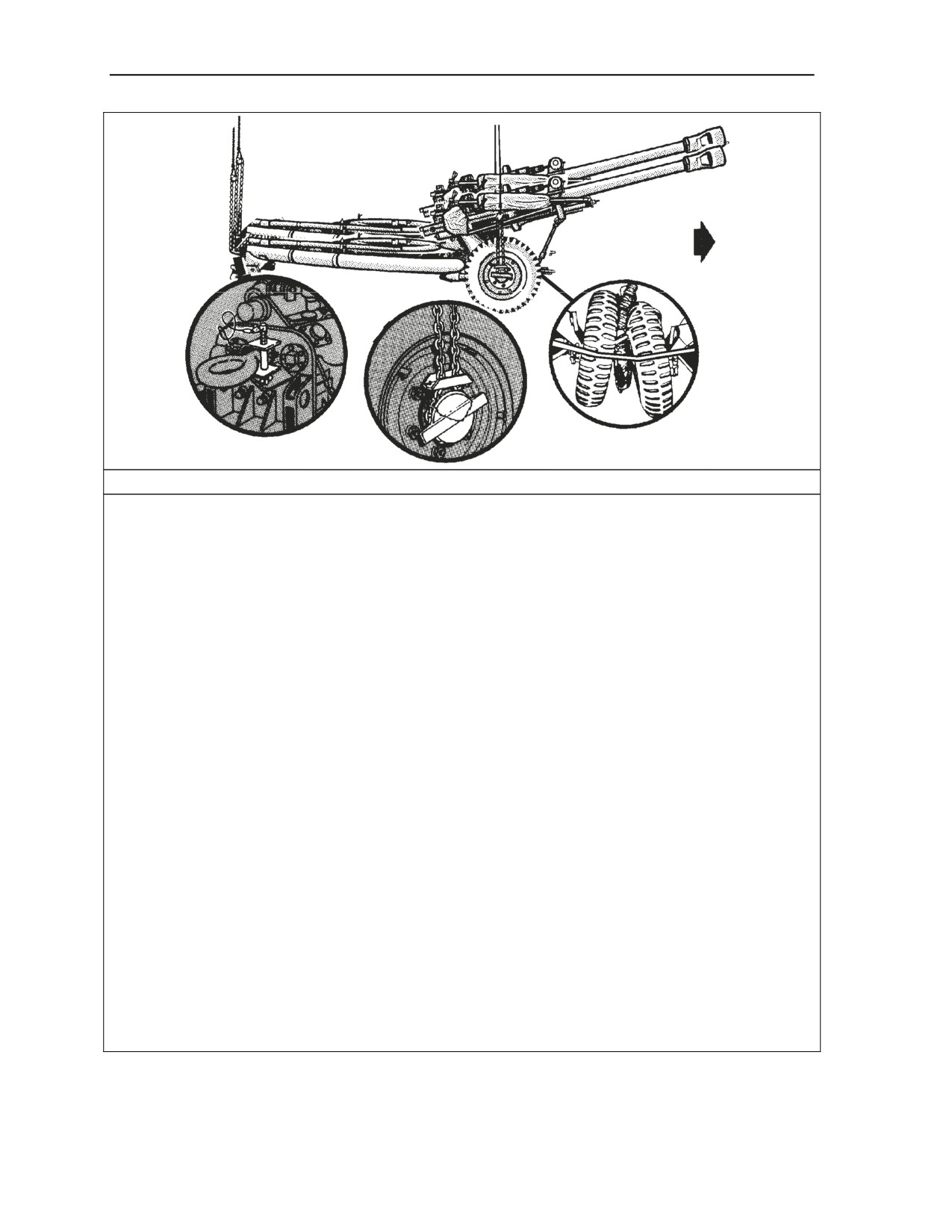
RIGGING STEPS
1.
Connect four sling legs to apex fitting number 1. Position the apex fitting on the breech
assembly. Route outer sling legs 1 and 2 to the outer wheel hubs. Route inner sling legs 3
and 4 to the inner wheel hubs.
2.
Loop the chain end of sling leg 3 around the left inside wheel hub and insert link 45 in the
grab hook. Pull the chain taut and ensure the chain is centered on the hub. Install the sling
set chain safety clamp on the two chain links closet to the top of the wheel hub as shown in
TM 9-1015-252-10. If the sling set chain safety clamp is not available, tie the two links
together with ½-inch tubular nylon webbing. Repeat with sling leg 4 on the right inside wheel
hub and place link 49 in the grab hook. Secure excess chain with tape or Type III nylon cord.
3.
Position both howitzers close together with the camouflage net and honeycomb between the
inside wheels.
4.
Loop the chain end of sling leg 1 around the left outside wheel hub and insert link 30 in the
grab hook. Pull the chain taut and ensure the chain is centered on the hub. Install the sling
set chain safety clamp on the two chain links closet to the top of the wheel hub as shown in
TM 9-1015-252-10. If the sling set chain safety clamp is not available, tie the two links
together with ½-inch tubular nylon webbing. Repeat with sling leg 2 on the right inside wheel
hub and place link 30 in the grab hook. Secure excess chain with tape or Type III nylon cord.
5.
Connect two sling legs to apex fitting number 2. Position the apex fitting on the firing platform
and route sling leg 1 to the left lunette and sling leg 2 to the right lunette.
6.
Route outer sling legs 1 and 2 to the outboard trails of the left and right howitzers
respectively. Route inner sling leg 3 to the two inboard trails.
7.
Loop the chain end of sling leg 1 through the left lunette and insert link 25 in the grab hook.
Repeat with sling leg 2 on the right lunette and insert link 25 in the grab hook. Secure excess
chain with tape or Type III nylon cord.
Figure 6-5. Two M119A2 Howitzers, 105-mm, Forward Firing Position, Side by Side
FM 4-20.199/MCRP 4-11.3E, VOL III/NTTP 3-04.13/
6-12
AFMAN 11-223 (I), VOL III/COMDINST M13482.4B
20 February 2009

Certified Dual-Point Rigging Procedures for Howitzer and Weapons Systems
RIGGING STEPS (Continued)
8. Cluster and tie (breakaway technique) the sling legs in each sling set together to prevent
entanglement during hookup and lift-off.
9. Route a CGU-1/B cargo tiedown strap around the carriage forward of the rebound brackets.
Do not tighten at this time.
10. Pad each tube trail with felt or cardboard at the point where they contact. Tape or tie the
padding in place.
11. Route two CGU-1/B cargo tiedown straps around both inboard tube trails. One forward and
one aft of the firing platform. Tighten all 3 CGU-1/B cargo tiedown straps at the same time.
Figure 6-5. Two M119A2 Howitzers, 105-mm, Forward Firing Position, Side by Side
(Continued)
M198 HOWITZER, 155-MM, TOWED WITH EXTERNAL AIRLIFT
TRAVEL LOCK ASSEMBLY
6-7. The M198 howitzer, 155-mm, towed with external airlift travel lock assembly is rigged for dual-
point sling load using the following procedures:
z
Applicability. The following item in Table 6-6 is certified for the helicopter(s) listed in the
following table by the US Army Natick Soldier Center:
Table 6-6. M198 Howitzer, 155-mm, Towed with External Airlift Travel Lock Assembly
Nomenclature
Max Weight
Sling Set
Link Count
Type of
(Pounds)
Front/Rear
Aircraft
M198 Howitzer, 155-mm, Towed with External
15,740
25K
33/3
CH-47
Airlift Travel Lock Assembly
z
Materials. The following materials are required to rig this load:
Sling set (25,000-pound capacity) with one additional apex fitting.
Tape, adhesive, pressure-sensitive, 2-inch wide roll.
Cord, nylon, Type III, 550-pound breaking strength.
Webbing, cotton, 1/4-inch, 80-pound breaking strength.
Felt sheet, cattle hair, Type IV, 1/2-inch or suitable substitute.
Strap, cargo, tiedown, CGU-1/B (as required).
Clevis assembly, large (one per lift provision).
Reach pendant, 11,000- or 25,000-pound capacity (2 each).
z
Personnel. Two persons can prepare and rig this load in 20 minutes.
z
Procedures. The following procedures apply to this load:
Preparation. Prepare the load using the following steps:
─ Secure the spades to the trails with CGU-1/B tiedown straps.
─ Secure the air hoses and electrical cable to the outboard side of the right trail with tape
or Type III nylon cord.
─ Stow and secure all equipment in place with tape or Type III nylon cord.
─ Pad the sight mounts with felt padding. Secure the padding with tape or Type III nylon
cord.
─ Attach a large clevis assembly to the trail and carriage lifting provisions.
Ensure the top carriage locking pin is in place and secured with a locking safety clip.
FM 4-20.199/MCRP 4-11.3E, VOL III/NTTP 3-04.13/
20 February 2009
AFMAN 11-223 (I), VOL III/COMDINST M13482.4B
6-13
Chapter 6
CAUTION
Do not attempt to lift the howitzer if the top carriage lock pin will not
drop into place or if the locking safety clip is missing. Either of these
conditions could result in the top carriage rotating in flight.
─ Position the barrel and install the travel lock. Secure the lock with pins.
─ Attach a reach pendant to each apex fitting in accordance with FM 4-20.197.
─ Set the handbrakes.
Rigging. Rig the load according to the steps in Figure 6-6.
Hookup. Two hookup teams are required for this load. The forward hookup person stands
on top of the gun carriage and places apex fitting 1 onto the forward cargo hook. The aft
hookup person stands on the firing base plate and places apex fitting 2 onto the aft cargo hook.
The hookup teams then carefully dismount the howitzer and remain close to the load as the
helicopter removes slack from the sling legs. When successful hookup is assured, the hookup
team quickly exits the area underneath the helicopter to the designated rendezvous point.
Note. The helicopter must approach the howitzer over the trails.
Derigging. Derigging is the reverse of the preparation and rigging procedures.
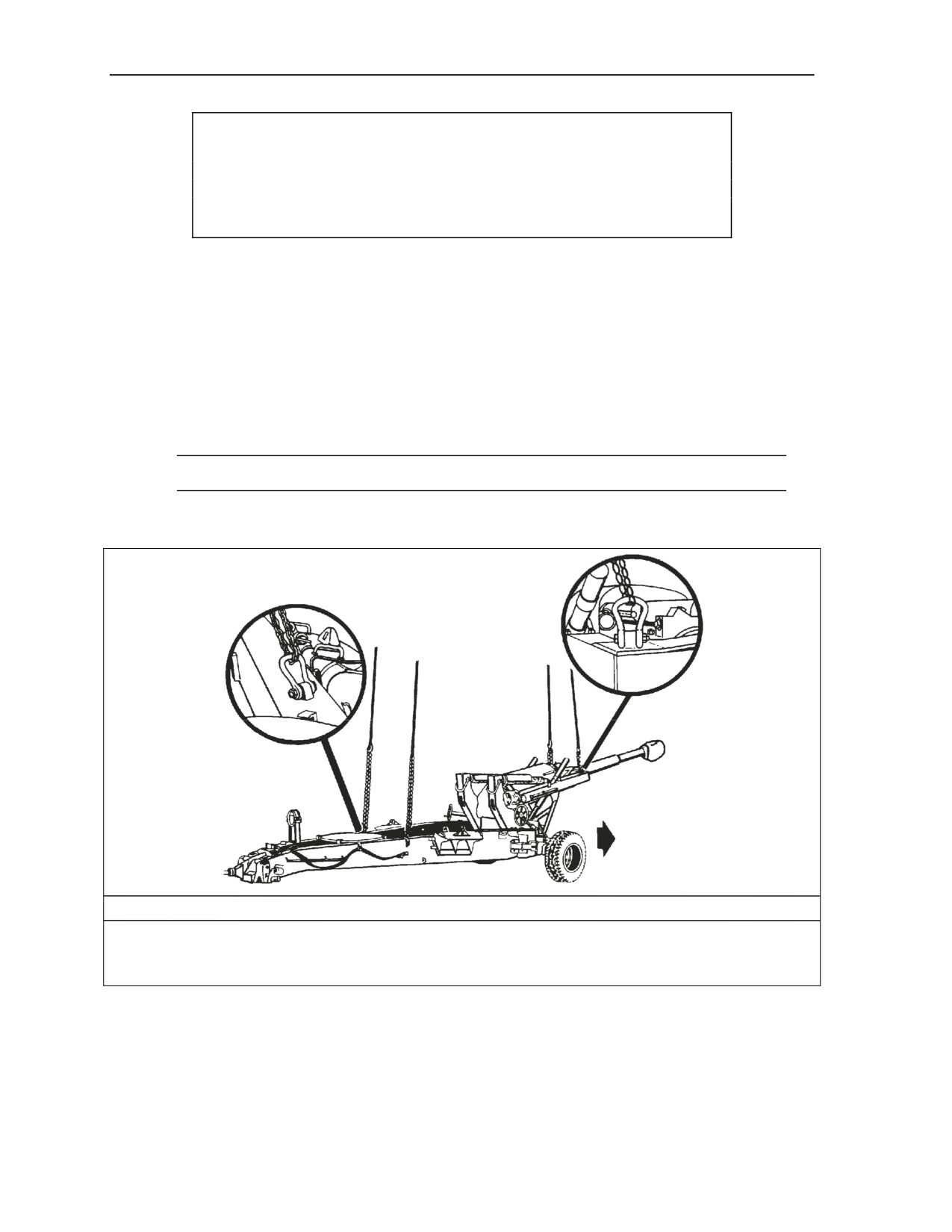
RIGGING STEPS
1. Connect two sling legs to apex fitting number 1. Position the sling set on top of the forward
end of the breech.
Figure 6-6. M198 Howitzer
FM 4-20.199/MCRP 4-11.3E, VOL III/NTTP 3-04.13/
6-14
AFMAN 11-223 (I), VOL III/COMDINST M13482.4B
20 February 2009

Certified Dual-Point Rigging Procedures for Howitzer and Weapons Systems
RIGGING STEPS (Continued)
2. Loop the chain end of the sling legs through the large clevises installed on their respective lift
provisions located on the carriage. Place the correct link from Table 6-6 in the grab hook.
Secure excess chain with tape or Type III nylon cord.
3. Connect two sling legs to apex fitting number 2. Position the sling set on top of the baseplate
between the trails.
4. Loop the chain end of the sling legs through the large clevises installed on their respective lift
provisions located on the trails. Place the correct link from Table 6-6 in the grab hook.
Secure excess chain with tape or Type III nylon cord.
5. Cluster and tie (breakaway technique) the sling legs in each sling set together to prevent
entanglement during hookup and lift-off.
Figure 6-6. M198 Howitzer (Continued)
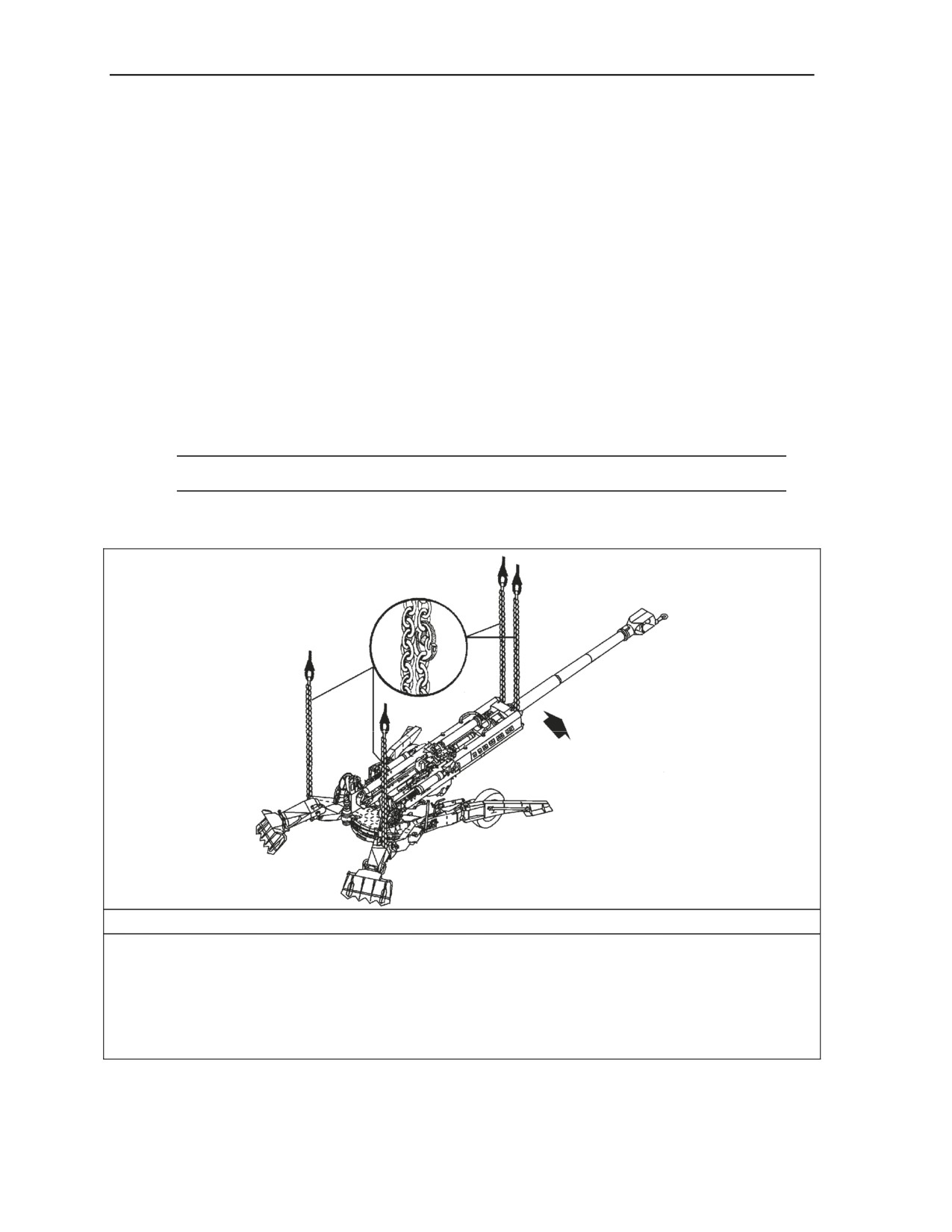
M777/M777A1/M777A2, 155-MM LIGHTWEIGHT HOWITZER
6-8. The M777/M777A1/M777A2, 155-mm lightweight howitzer is rigged for dual-point sling load using
the following procedures:
z
Applicability. The following items in Table 6-7 are certified for the helicopter(s) listed in the
following table by the US Army Natick Soldier Center:
Table 6-7. M777/M777A1/M777A2, 155-mm Lightweight Howitzer
Nomenclature
Max Weight
Sling Set
Link Count
Type of
(Pounds)
Front/Rear
Aircraft
M777, 155-mm Lightweight Howitzer
9,300
15K
80/3
CH-53
25K
CH-47
M777A1, 155-mm Lightweight Howitzer
9,800
15K
80/3
CH-53
25K
CH-47
M777A2, 155-mm Lightweight Howitzer
9,920
15K
80/3
CH-53
25K
CH-47
z
Materials. The following materials are required to rig this load:
Sling set (15,000-pound capacity) with one additional web ring.
─ Additional chain length, part number 34080-4, from a 15,000-pound capacity sling set
(4 each).
─ Additional coupling link, part number 31611, from a 15,000-pound capacity sling set
(4 each).
OR
Sling set (25,000-pound capacity) with one additional apex fitting.
─ Additional chain length, part number 38850-00053-102, from a 25,000-pound capacity
sling set (4 each).
─ Additional coupling link, part number 664241, from a 25,000-pound sling set (4 each).
Tape, adhesive, pressure-sensitive, 2-inch wide roll.
Cord, nylon, Type III, 550-pound breaking strength.
Webbing, cotton, 1/4-inch, 80-pound breaking strength.
z
Personnel. Two persons can prepare and rig this load in 20 minutes.
z
Procedures. The following procedures apply to this load:
FM 4-20.199/MCRP 4-11.3E, VOL III/NTTP 3-04.13/
20 February 2009
AFMAN 11-223 (I), VOL III/COMDINST M13482.4B
6-15
Chapter 6
Preparation. Prepare the load using the following steps:
─ Ensure the stabilizers are in the firing position.
─ The spades may be in the up (stowed position) or down (firing position).
─ Secure the air hoses and electrical cable to the supporting structure with Type III nylon
cord.
─ Stow and secure all equipment with tape or Type III nylon cord.
─ Ensure the barrel is in the firing position.
─ Extend the sling leg chains by connecting one additional chain length to each chain on
the sling set with coupling links.
Rigging. Rig the load according to the steps in Figure 6-7.
Hookup. Two hookup teams are required for this load. The static wand person discharges
the static electricity with the static wand. One hookup person stands on the tongue and places
web ring 1 onto the forward cargo hook. The other hookup person stands on the firing base plate
and places web ring 2 onto the aft cargo hook. The hookup teams then carefully dismount the
howitzer and remain close to the load as the helicopter removes slack from the sling legs.
When successful hookup is assured, the hookup team quickly exits the area underneath the
helicopter to the designated rendezvous point.
Note. The helicopter must approach the howitzer over the spades.
Derigging. Derigging is the reverse of the preparation and rigging procedures.
RIGGING STEPS
1. Place two sling legs on web ring number 1. Position apex fitting number 1 on top of the
forward end of the breech.
2. Loop the chain end of the left and right sling legs through their respective lift provision located
on both sides of the barrel. Place the correct link from Table 6-7 in the grab hook. Secure
excess chain with tape or Type III nylon cord.
Figure 6-7. M777/M777A1/M777A2, 155-mm Lightweight Howitzer
FM 4-20.199/MCRP 4-11.3E, VOL III/NTTP 3-04.13/
6-16
AFMAN 11-223 (I), VOL III/COMDINST M13482.4B
20 February 2009
Certified Dual-Point Rigging Procedures for Howitzer and Weapons Systems
RIGGING STEPS (Continued)
3. Place two sling legs on web ring number 2. Position apex fitting number 2 on top of the
baseplate between the spades.
4. Loop the chain end of the left and right sling legs through their respective lift provision located
near the spades. Place the correct link from Table 6-7 in the grab hook.
5. Cluster and tie (breakaway technique) the sling legs in each sling set together to prevent
entanglement during hookup and lift-off.
Figure 6-7. M777/M777A1/M777A2, 155-mm Lightweight Howitzer (Continued)
FM 4-20.199/MCRP 4-11.3E, VOL III/NTTP 3-04.13/
20 February 2009
AFMAN 11-223 (I), VOL III/COMDINST M13482.4B
6-17
This page intentionally left blank.

Chapter 7
Certified Dual-Point Rigging Procedures for Missile
Systems
INTRODUCTION
7-1. This chapter contains rigging procedures for dual-point missile system loads that have been certified
for sling load. Each rigging procedure is found in a paragraph that includes a description of the load,
materials required for rigging, and steps to complete the procedure. An applicability paragraph is also a
part of each paragraph and identifies the certified loads. The certified dual-point rigging procedures for
missile system loads are in this section. Paragraphs 7-2 through 7-10 give detailed instructions for rigging
loads.
Note. Reach Pendants may be used on dual point loads. Place a Reach Pendant on each apex
fitting. A static discharge person is not required when using a Reach Pendant.
AVENGER
7-2. The Avenger is rigged for dual-point sling load using the following procedures:
z
Applicability. The following items in Table 7-1 are certified for the helicopter(s) listed in the
following table by the US Army Natick Soldier Center.
Table 7-1. Avenger
Nomenclature
Max Weight
Sling Set
Link Count
Type of
(Pounds)
Front/Rear
Aircraft
10K
50/5
CH-47
Avenger on M998
8,513
15K
40/5
CH-53
40K
32/4
CH-53
10K
50/5
CH-47
Avenger on M1097
9,087
15K
40/5
CH-53
40K
32/4
CH-53
z
Materials. The following materials are required to rig this load:
Sling set (10,000- or 40,000-pound capacity) with one additional apex fitting for the sling
set being used or two 15,000-pound capacity sling sets.
Tape, adhesive, pressure-sensitive, 2-inch wide roll.
Cord, nylon, Type III, 550-pound breaking strength.
Webbing, cotton, 1/4-inch, 80-pound breaking strength.
z
Personnel. Two persons can prepare and rig this load in 15 minutes.
z
Procedures. The following procedures apply to this load:
Preparation. Prepare the load using the following steps:
─ Fold the mirrors inward and secure with Type III nylon cord.
─ Ensure the Avenger fire unit is secured to the truck. Secure all equipment inside the
fire unit with tape, lashings, or Type III nylon cord. Close and secure the door.
FM 4-20.199/MCRP 4-11.3E, VOL III/NTTP 3-04.13/
20 February 2009
AFMAN 11-223 (I), VOL III/COMDINST M13482.4B
7-1
Chapter 7
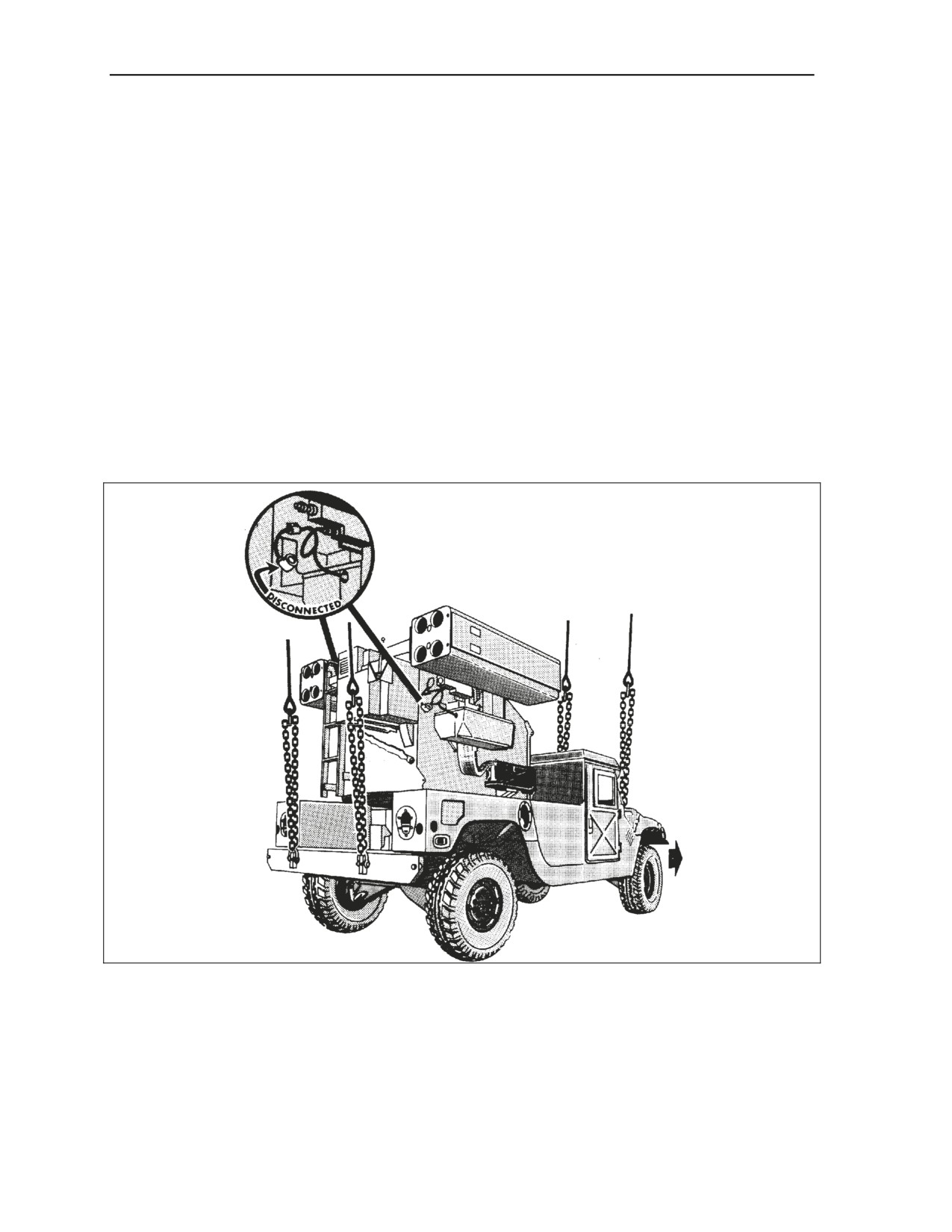
─ Disconnect the standard vehicle-mounted launcher connectors from the missile pods
and secure them to the fire unit with tape or Type III nylon cord.
─ Secure all equipment inside the vehicle with tape or Type III nylon cord. Secure the
doors shut (if installed).
─ Ensure the fuel tank is not over 3/4 full. Inspect the fuel tank cap, oil filler cap, and
battery caps for proper installation.
─ Engage the vehicle parking brake and place the transmission in neutral.
─ Ensure the front wheels are pointed straight ahead. Tie down the steering wheel using
the securing device attached under the dashboard.
Rigging. Rig the load according to the steps in Figure 7-1.
Hookup. Two hookup teams are required for this load. The hookup teams stand on top of
the firing unit. The static wand person discharges the static electricity with the static wand.
The forward hookup person places apex fitting 1 onto the forward cargo hook. The aft hookup
person places apex fitting 2 onto the aft cargo hook. The hookup teams then carefully dismount
the vehicle and remain close to the load as the helicopter removes slack from the sling legs.
When successful hookup is assured, the hookup teams quickly exit the area underneath the
helicopter to the designated rendezvous point.
Derigging. Derigging is the reverse of the preparation and rigging procedures.
Figure 7-1. Avenger
FM 4-20.199/MCRP 4-11.3E, VOL III/NTTP 3-04.13/
7-2
AFMAN 11-223 (I), VOL III/COMDINST M13482.4B
20 February 2009
Certified Dual-Point Rigging Procedures for Missile Systems
RIGGING STEPS
Note. When using the 15,000-pound capacity sling set, do not remove the two inner sling leg assemblies. Tape the two inner
unused sling legs to the two outer load-carrying sling legs.
1. Place two sling legs on apex fitting number 1. Position apex fitting number 1 on top of the
firing unit.
2. Loop the chain end of the left and right sling legs through their respective lift provisions that
protrude through the hood of the vehicle. Place the correct link from Table 7-1 in the grab
hook. Secure excess chain with tape or Type III nylon cord.
3. Place two sling legs on apex fitting number 2. Position apex fitting number 2 on top of the
firing unit.
4. Loop the chain end of the left and right sling legs through their respective lift provisions
located on the rear bumper. Place the correct link from Table 7-1 in the grab hook.
CAUTION
Do not place the sling legs in the sling leg guides located on top of the
firing unit.
5. Cluster and tie (breakaway technique) the sling legs in each sling set together to prevent
entanglement during hookup and lift-off.
Figure 7-1. Avenger (Continued)
AVENGER ON M1097/M1097A1/M1097A2 WITH ECU AND PPU WITH
OR WITHOUT BUSTLE BOX STOWED ON ROOF
7-3. The Avenger on M1097/M1097A1/M1097A2 with ECU and PPU with or without bustle box stowed
on roof is rigged for dual-point sling load using the following procedures:
z
Applicability. The following items in Table 7-2 are certified for the helicopter(s) listed in the
following table by the US Army Natick Soldier Center:.
Table 7-2. Avenger
Nomenclature
Max Weight
Sling Set
Link Count
Type of
(Pounds)
Front/Rear
Aircraft
Avenger with ECU and PPU on M1097
9,800
10K
50/3
CH-47
25K
40/5
Avenger with ECU and PPU on M1097A1
9,800
10K
50/3
CH-47
25K
40/5
Avenger with ECU and PPU on M1097A2
10,300
25K
40/5
CH-47
z
Materials. The following materials are required to rig this load:
Sling set (25,000-pound capacity) with one additional apex.
─ Additional chain length, part number 38850-00053-102, from a 25,000-pound capacity
sling set (4 each).
─ Additional coupling link, part number 664241, from a 25,000-pound capacity sling set
(4 each).
FM 4-20.199/MCRP 4-11.3E, VOL III/NTTP 3-04.13/
20 February 2009
AFMAN 11-223 (I), VOL III/COMDINST M13482.4B
7-3
Chapter 7
OR
Sling set (10,000-pound capacity) with one additional apex.
─ Additional chain length, part number 38850-00053-101, from a 10,000-pound capacity
sling set (4 each).
─ Additional coupling link, part number 557-0615, from a 10,000-pound capacity sling
set (4 each).
Tape, adhesive, pressure-sensitive, 2-inch wide roll.
Cord, nylon, Type III, 550-pound breaking strength.
Webbing, cotton, 1/4-inch, 80-pound breaking strength.
z
Personnel. Two persons can prepare and rig this load in 15 minutes.
z
Procedures. The following procedures apply to this load:
Preparation. Prepare the load using the following steps:
─ Fold the mirrors inward and secure with Type III nylon cord.
─ Ensure the Avenger fire unit is secured to the truck. Secure all equipment inside the
fire unit with tape, lashings, or Type III nylon cord. Close and secure the door.
─ Disconnect the standard vehicle-mounted launcher connectors from the missile pods
and secure them to the fire unit with tape or Type III nylon cord.
─ Secure all equipment inside the vehicle with tape or Type III nylon cord. Secure the
doors shut (if installed).
─ Ensure the fuel tank is not over 3/4 full. Inspect the fuel tank cap, oil filler cap, and
battery caps for proper installation.
─ Secure the bustle box to the box rack on the roof of the vehicle using the tiedown
straps (if needed).
Note. The bustle box can only be carried if the roof rack is installed on the roof.
─ Engage the vehicle parking brake and place the transmission in neutral.
─ Ensure the front wheels are pointed straight ahead. Tie down the steering wheel using
the securing device attached under the dashboard or Type III nylon cord.
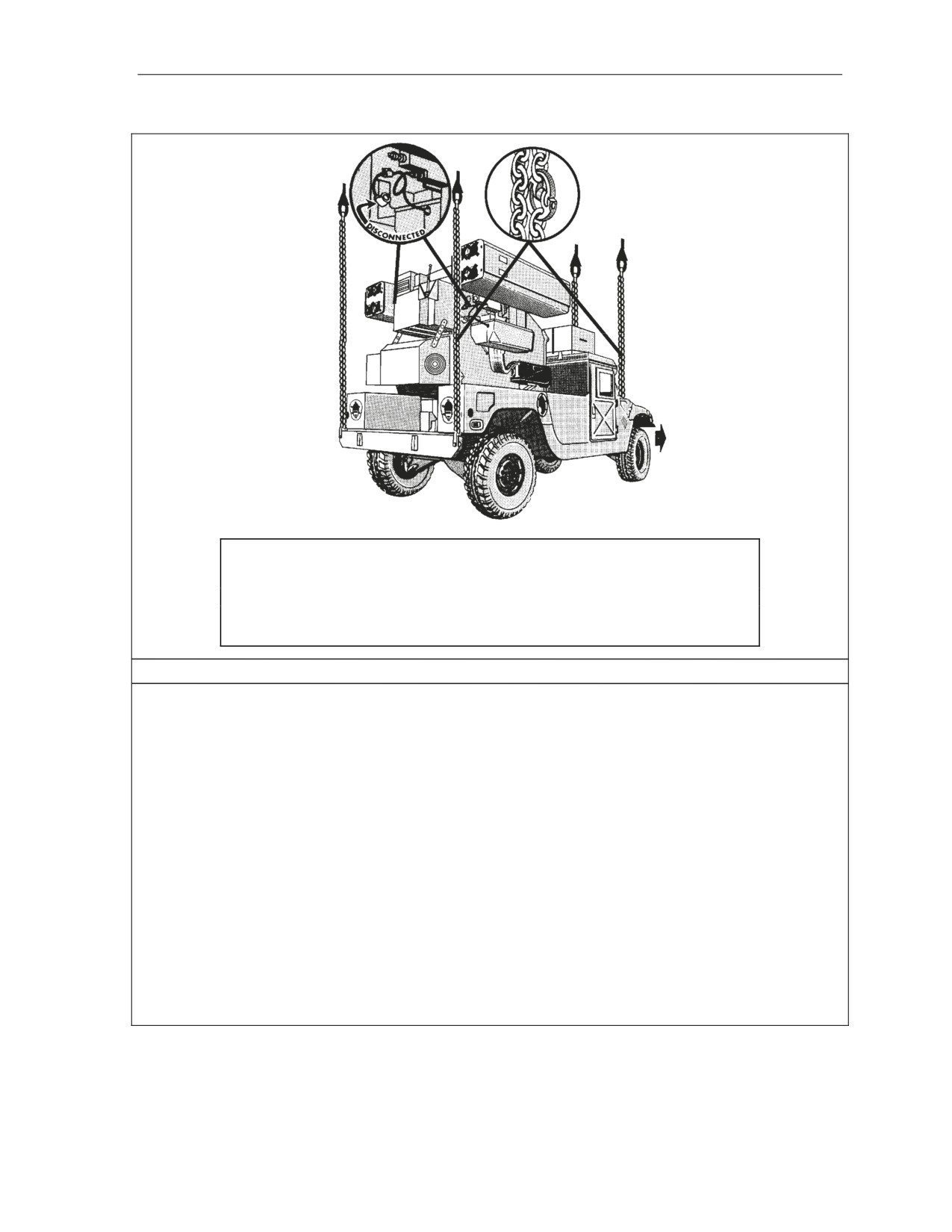
Rigging. Rig the load according to the steps in Figure 7-2.
Hookup. Two hookup teams are required for this load. The hookup teams stand on top of
the firing unit. The static wand person discharges the static electricity with the static wand.
The forward hookup person places apex fitting 1 onto the forward cargo hook. The aft hookup
person places apex fitting 2 onto the aft cargo hook. The hookup teams then carefully dismount
the vehicle and remain close to the load as the helicopter removes slack from the sling legs.
When successful hookup is assured, the hookup teams quickly exit the area underneath the
helicopter to the designated rendezvous point.
Derigging. Derigging is the reverse of the preparation and rigging procedures.
FM 4-20.199/MCRP 4-11.3E, VOL III/NTTP 3-04.13/
7-4
AFMAN 11-223 (I), VOL III/COMDINST M13482.4B
20 February 2009
Certified Dual-Point Rigging Procedures for Missile Systems
CAUTION
Do not place the sling legs in the sling leg guides located on top of the
firing unit.
RIGGING STEPS
1. Place two sling legs on apex fitting number 1. Attach an additional chain length to each chain
using coupling links. Position apex fitting number 1 on top of the vehicle roof or bustle box (if
used).
2. Loop the chain end of the left and right sling legs through their respective lift provisions that
protrude through the hood of the vehicle. Place the correct link from Table 7-2 in the grab
hook. Secure excess chain with tape or Type III nylon cord.
3. Place two sling legs on apex fitting number 2. Attach an additional chain length to each chain
using coupling links. Position apex fitting number 2 on top of the firing unit.
4. Loop the chain end of the left and right sling legs through their respective lift provisions
located on outside end of the rear bumper. Place the correct link from Table 7-2 in the grab
hook.
5. Cluster and tie (breakaway technique) the sling legs in each sling set together to prevent
entanglement during hookup and lift-off.
Figure 7-2. Avenger on M1097A2 HMMWV with ECU and PPU
FM 4-20.199/MCRP 4-11.3E, VOL III/NTTP 3-04.13/
20 February 2009
AFMAN 11-223 (I), VOL III/COMDINST M13482.4B
7-5

Chapter 7
CAUTION
Do not use the lift shackles located near the center of the rear bumper
for sling load lift provisions.
M1113 TRUCK, 1 1/4-TON (HMMWV) WITH LINE OF SIGHT ANTI-
TANK (LOSAT) FIRE UNIT WITH RELOADER CRANE AND FOUR
MISSILES
7-4. The M1113 truck, 1 1/4-ton with line of sight anti-tank fire unit with reloader crane and four missiles
are rigged for dual-point sling load using the following procedures:
z
Applicability. The following item in Table 7-3 is certified for the helicopter(s) listed in the
following table by the US Army Natick Soldier Center:
Table 7-3. M1113 Truck, 1 1/4-Ton with Line of Sight Anti-Tank Fire Unit with Reloader Crane
and Four Missiles
Nomenclature
Max Weight
Sling Set
Link Count
Type of
(Pounds)
Front/Rear
Aircraft
M1113 Truck, 1 1/4-Ton with Line of Sight Anti-
10,920
25K
40/3
CH-47
Tank Fire Unit with Reloader Crane and Four
Missiles
z
Materials. The following materials are required to rig this load:
Sling set (25,000-pound capacity).
─ Additional chain length, part number 38850-00053-102, from a 25,000-pound capacity
sling set (4 each).
─ Additional coupling link, part number 664241, from a 25,000-pound sling set (4 each).
Tape, adhesive, pressure-sensitive, 2-inch wide roll.
Cord, nylon, Type III, 550-pound breaking strength.
Webbing, cotton, 1/4-inch, 80-pound breaking strength.
Felt sheet, cattle hair, Type IV, 1/2-inch or suitable substitute.
z
Personnel. Two persons can prepare and rig the truck in 10 minutes
z
Procedures. The following procedures apply to this load:
Preparation. Prepare the load using the following steps:
─ Fold mirrors inward and tie together with Type III nylon cord. Remove the doors and
secure to the seats with Type III nylon cord.
─ Secure all equipment and cargo inside the truck with tiedown straps, tape, or Type III
nylon cord.
─ Ensure the fuel tank is not over 3/4 full. Inspect the fuel tank cap, oil filler cap, and
battery caps for proper installation.
─ Engage the vehicle parking brake and put the transmission in neutral.
─ Ensure the front wheels are pointed straight ahead. Tie down the steering wheel, using
the securing device attached under the dashboard.
─ Connect one additional chain length to each chain on each sling set with a coupling
link.
Rigging. Rig the load according to the steps in Figure 7-3.
Hookup. Two hookup teams are required for this load. The static wand person discharges
the static electricity with the static wand. The forward hookup person stands on top of the vehicle
and places apex fitting 1 onto the forward cargo hook. The aft hookup person stands on top of the
FM 4-20.199/MCRP 4-11.3E, VOL III/NTTP 3-04.13/
7-6
AFMAN 11-223 (I), VOL III/COMDINST M13482.4B
20 February 2009
Certified Dual-Point Rigging Procedures for Missile Systems
vehicle and places apex fitting 2 onto the aft cargo hook. The hookup team then carefully
dismounts the load and remains close to the load as the helicopter removes slack from the sling
legs. When successful hookup is assured, the hookup team quickly exits the area underneath
the helicopter to the designated rendezvous point.
Derigging. Derigging is the reverse of the preparation and rigging procedures.
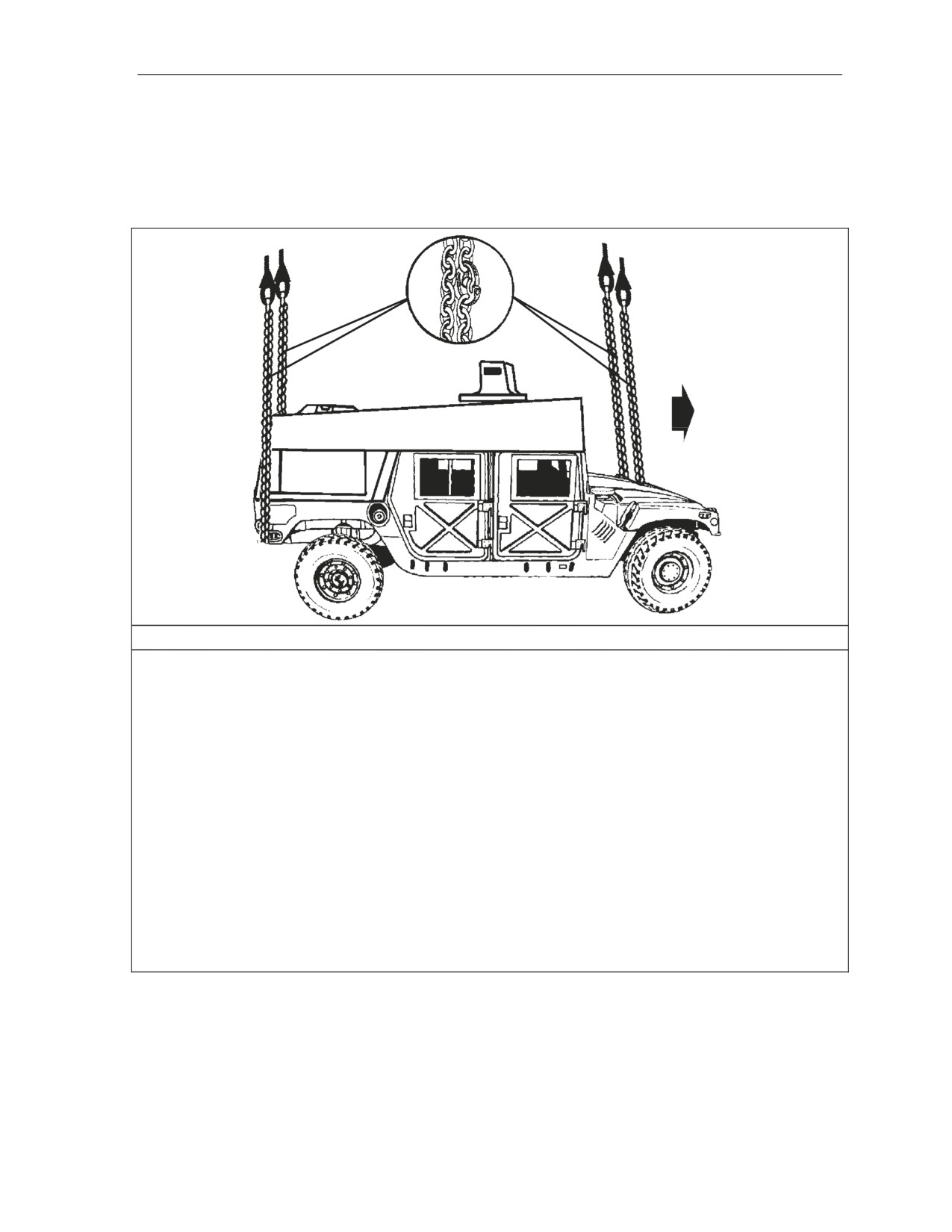
RIGGING STEPS
1. Place two sling legs on apex fitting number 1. Attach an additional chain length to each chain
using coupling links. Position apex fitting number 1 on top of the vehicle roof or bustle box (if
used).
2. Loop the chain end of the left and right sling legs through their respective lift provisions that
protrude through the hood of the vehicle. Place the correct link from Table 7-3 in the grab
hook. Secure excess chain with tape or Type III nylon cord.
3. Place two sling legs on apex fitting number 2. Position apex fitting number 2 on top of the
firing unit.
4. Loop the chain end of the left and right sling legs through their respective lift provisions
located on outside end of the rear bumper. Pad the slings where they contact the vehicle.
Place the correct link from Table 7-3 in the grab hook.
5. Cluster and tie (breakaway technique) the sling legs in each sling set together to prevent
entanglement during hookup and lift-off.
Figure 7-3. M1113 Truck, 1 1/4-Ton with Line of Sight Anti-Tank Fire Unit with Reloader Crane
and Four Missiles
FM 4-20.199/MCRP 4-11.3E, VOL III/NTTP 3-04.13/
20 February 2009
AFMAN 11-223 (I), VOL III/COMDINST M13482.4B
7-7

Chapter 7
M1097A2 TRUCK, 1 1/4-TON (HMMWV) WITH COMPLEMENTARY
LOW ALTITUDE WEAPONS SYSTEM (CLAWS)
7-5. The M1097A2 trucks, 1 1/4-ton with complementary low altitude weapons system are rigged for
dual-point sling load using the following procedures:
z
Applicability. The following items in Table 7-4 are certified for the helicopter(s) listed in the
following table by the US Army Natick Soldier Center:
Table 7-4. M1097A2 Truck, 1 1/4-Ton with Complementary Low Altitude Weapons System
Nomenclature
Max Weight
Sling Set
Link Count
Type of
(Pounds)
Front/Rear
Aircraft
M1097A2 Truck, 1 1/4-Ton with
10,300
15K
30/3
CH-53
Complementary Low Altitude Weapons System
without Missiles
M1097A2 Truck, 1 1/4-Ton with
10,300
15K
30/3
CH-53
Complementary Low Altitude Weapons System
with Two (2) Missiles Mounted on the Outside
Rails
z
Materials. The following materials are required to rig this load:
Multileg sling set (15,000-pound capacity) with one additional apex fitting.
─ Chain length, part number 34080-4, from a 15,000-pound capacity sling set (4 each).
─ Coupling link, part number 31611, from a 15,000-pound sling set (4 each).
Tape, adhesive, pressure-sensitive, 2-inch wide roll.
Cord, nylon, Type III, 550-pound breaking strength.
Webbing, cotton, 1/4-inch, 80-pound breaking strength.
z
Personnel. Two persons can prepare and rig the truck in 15 minutes
z
Procedures. The following procedures apply to this load:
Preparation. Prepare the load using the following steps:
─ Fold mirrors inward and tie together with Type III nylon cord. Remove the doors and
secure to the seats with Type III nylon cord.
─ Ensure the launcher unit is secure to the truck. Secure all equipment and cargo inside
the truck with tiedown straps, tape, or Type III nylon cord. Roll up the windows and
secure the doors shut (if installed).
─ Disconnect the standard vehicle-mounted launcher connectors from the missile pods
and secure them to the fire unit with tape or Type III nylon cord.
─ Ensure the fuel tank is not over 3/4 full. Inspect the fuel tank cap, oil filler cap, and
battery caps for proper installation.
─ Remove and secure the missile fins according to the technical manual for the missiles.
─ Engage the vehicle parking brake and put the transmission in neutral.
─ Ensure the front wheels are pointed straight ahead. Tie down the steering wheel, using
the securing device attached under the dashboard.
─ Connect one additional chain length to each chain on each sling set with a coupling
link.
Rigging. Rig the load according to the steps in Figure 7-4.
Hookup. Two hookup teams are required for this load. The static wand person discharges
the static electricity with the static wand. The forward hookup person stands on the ground
forward of the vehicle and places apex fitting 1 onto the forward cargo hook. The aft hookup person
stands on the ground aft of the vehicle and places apex fitting 2 onto the aft cargo hook. The
hookup team then carefully dismounts the load and remains close to the load as the helicopter
FM 4-20.199/MCRP 4-11.3E, VOL III/NTTP 3-04.13/
7-8
AFMAN 11-223 (I), VOL III/COMDINST M13482.4B
20 February 2009
Certified Dual-Point Rigging Procedures for Missile Systems
removes slack from the sling legs. When successful hookup is assured, the hookup team
quickly exits the area underneath the helicopter to the designated rendezvous point.
Derigging. Derigging is the reverse of the preparation and rigging procedures.
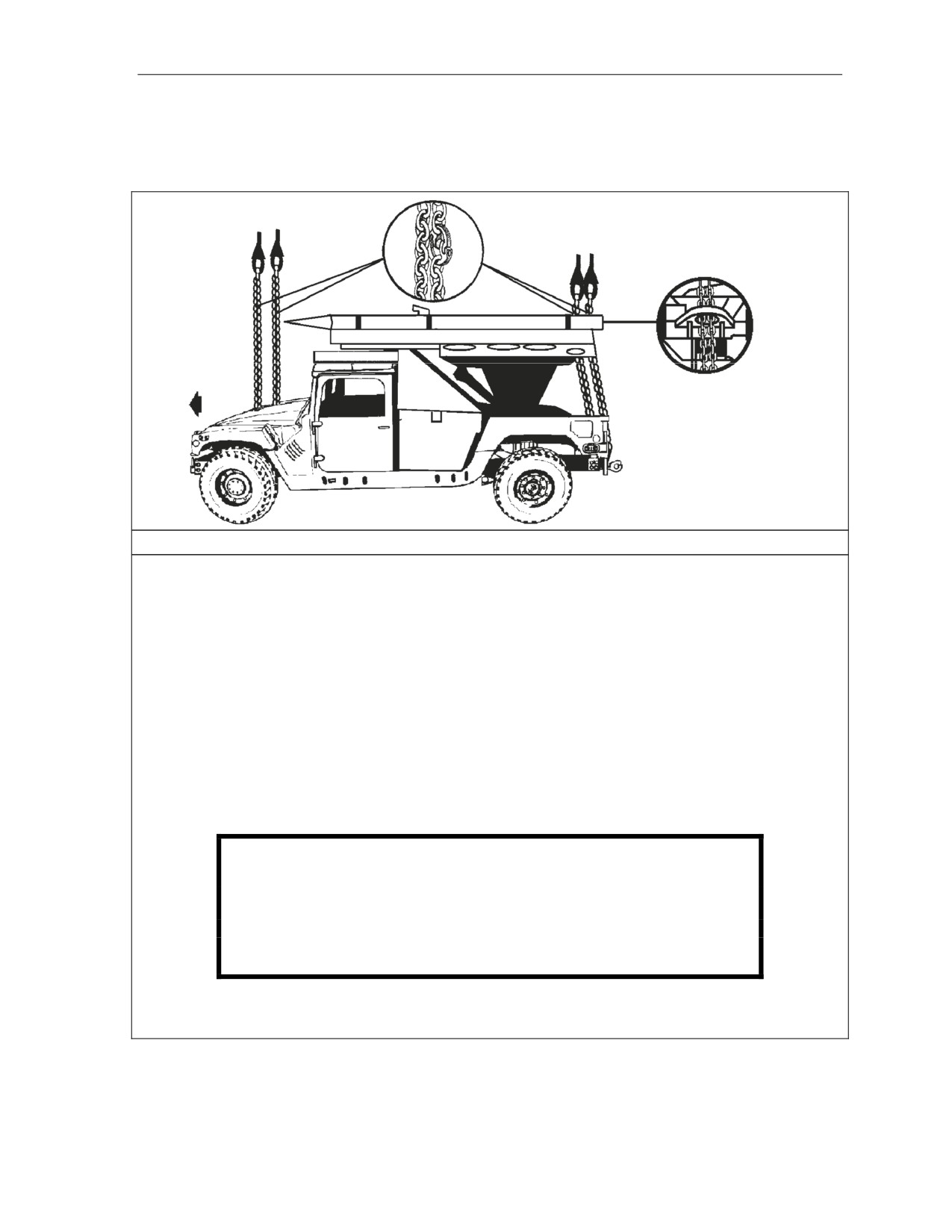
RIGGING STEPS
1. Place two sling legs on apex fitting number 1. Position apex fitting number 1 on the hood of
the vehicle.
2. Loop the chain end of the left and right sling legs through their respective lift provisions that
protrude through the hood of the vehicle. Place the correct link from Table 7-4 in the grab
hook. Secure excess chain with tape or Type III nylon cord.
3. Place two sling legs on apex fitting number 2. Position apex fitting number 2 at the rear of
the launcher unit.
4. Loop the chain end of the left and right sling legs through their respective sling guides, down
through the pear shaped lift provisions located left and right of the pintle hook on the rear
bumper. Route the chain back through the sling guide and place the correct link from Table
7-4 in the grab hook.
WARNING
If the CLAW is lifted with missiles on the rails, before firing either
missile a complete inspection by a qualified missile officer is
required.
5. Cluster and tie (breakaway technique) the sling legs in each sling set together to prevent
entanglement during hookup and lift-off.
Figure 7-4. M1097A2 Truck, 1 1/4-Ton with Complementary Low Altitude Weapons System
FM 4-20.199/MCRP 4-11.3E, VOL III/NTTP 3-04.13/
20 February 2009
AFMAN 11-223 (I), VOL III/COMDINST M13482.4B
7-9

Chapter 7
AN/MPQ-57 AND AN/MPQ-61 HIGH-POWER ILLUMINATOR RADAR
(HIPIR) PHASE II AND PHASE III MOUNTED ON THE M390
(MODIFIED) TRAILER
7-6. The AN/MPQ-57 and AN/MPQ-61 high-power illuminator radar phase II and phase III mounted on
the M390 (Modified) trailer are rigged for dual-point sling load using the following procedures:
z
Applicability. The following items in Table 7-5 are certified for the helicopter(s) listed in the
following table by the US Army Natick Soldier Center:
Table 7-5. AN/MPQ-57 and AN/MPQ-61 High-Power Illuminator Radar (HIPIR) Phase II and
Phase III Mounted on the M390 (Modified) Trailer
Nomenclature
Max Weight
Sling Set
Link Count
Type of
(Pounds)
Front/Rear
Aircraft
AN/MPQ-57 High Power Illuminator Radar on
9,480
25K
25/3
CH-47
M390 Trailer, Phase II
AN/MPQ-61 High Power Illuminator Radar on
9,530
25K
25/3
CH-47
M390 Trailer, Phase III
z
Materials. The following materials are required to rig this load:
Sling set (25,000-pound capacity) with one additional apex fitting.
Tape, adhesive, pressure-sensitive, 2-inch wide roll.
Cord, nylon, Type III, 550-pound breaking strength.
Webbing, cotton, 1/4-inch, 80-pound breaking strength.
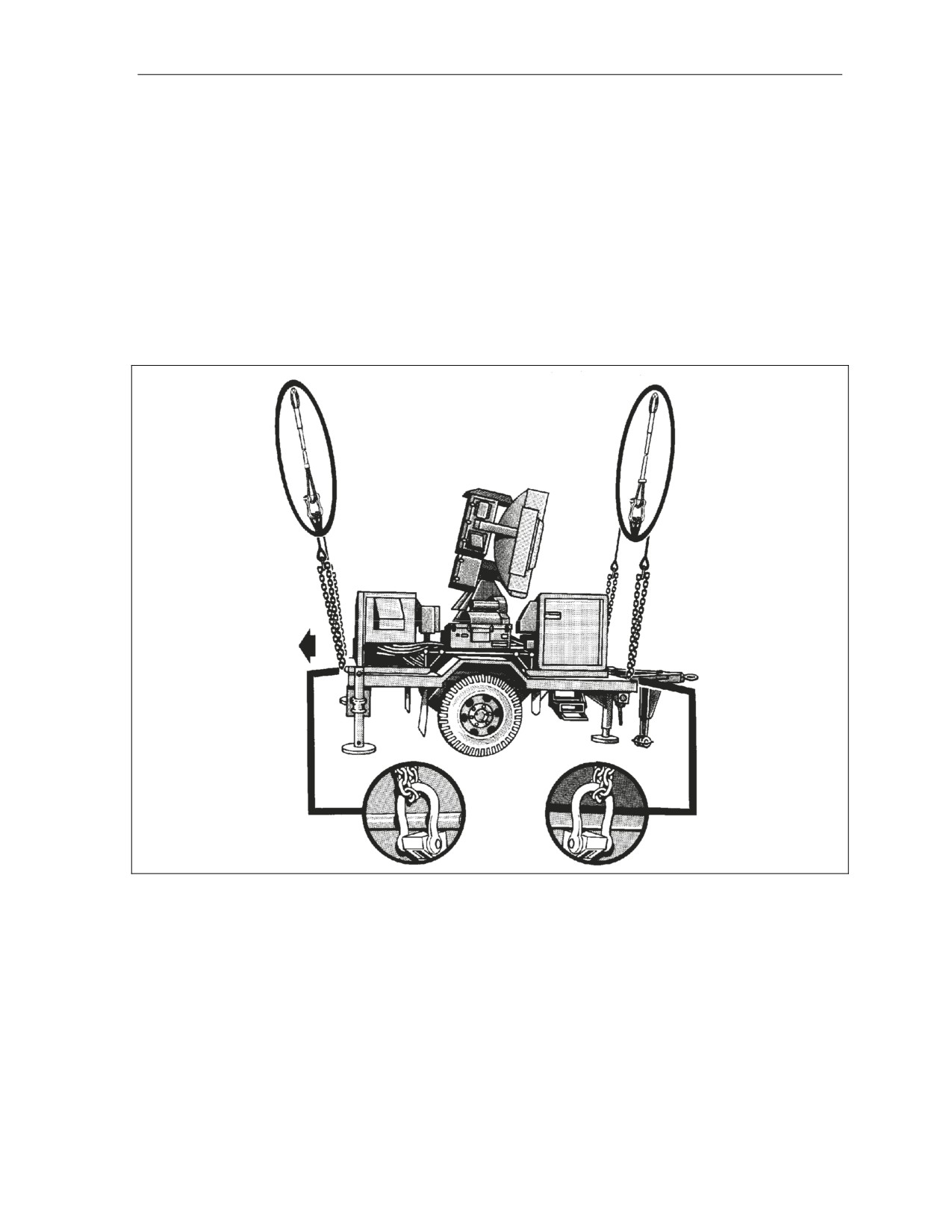
Reach pendant (11,000- or 25,000-pound capacity) (2 each).
CAUTION
Do not mix different capacity reach pendants. Use two 11,000-pound
capacity or two 25,000-pound capacity reach pendants.
z
Personnel. Two persons can prepare and rig this load in 15 minutes.
z
Procedures. The following procedures apply to this load:
Preparation. Prepare the load using the following steps:
─ Ensure the 3 1/4-ton shackles initially provided with the M390C trailer chassis have
been replaced by 6 3/4-ton clevises (NSN 4030-00-278-0699). Ensure the clevises are
properly pinned and are not damaged.
─ Prepare the HIPIR for travel according to the operator's manual and engage the parking
brakes.
─ Rotate the azimuth STOW lock clockwise until the stow pin is fully engaged with the
torque tube and the antenna cannot be further moved in either direction. The antenna
must face the lunette end of the trailer and be tilted slightly downward toward the
ground. Secure the stow pin with tape or Type III nylon cord.
─ Remove the dust covers from the radar antennas.
─ Install the VTG sensor unit dust cover, if applicable.
─ Secure all tools and equipment inside the drawers and cabinets. Secure all doors and
drawers with tape or Type III nylon cord.
─ Secure all hoses, cables, and chains to the trailer chassis or surrounding structure with
tape or Type III nylon cord.
FM 4-20.199/MCRP 4-11.3E, VOL III/NTTP 3-04.13/
7-10
AFMAN 11-223 (I), VOL III/COMDINST M13482.4B
20 February 2009
Certified Dual-Point Rigging Procedures for Missile Systems
─ Adjust the forward and rear leveling jacks to just above ground level so the HIPIR
does not flip during takeoff or landing.
─ Install a reach pendant on each of the apex fittings of the sling set.
Rigging. Rig the load according to the steps in Figure 7-5.
Hookup. Two hookup persons are required for this load. The forward hookup person
stands on the radar set group cabinet and places reach pendant 1 onto the forward cargo hook.
The aft hookup person stands on the transmitter group cabinet (lunette end) and places reach
pendant 2 onto the aft cargo hook. The hookup teams then carefully dismount the HIPIR and
remain close to the load as the helicopter removes slack from the sling legs. When successful
hookup is assured, the hookup teams quickly exit the area underneath the helicopter to the
designated rendezvous point.
Derigging. Derigging is the reverse of the preparation and rigging procedures.
Figure 7-5. AN/MPQ-57 and AN/MPQ-61 High-Power Illuminator Radar
FM 4-20.199/MCRP 4-11.3E, VOL III/NTTP 3-04.13/
20 February 2009
AFMAN 11-223 (I), VOL III/COMDINST M13482.4B
7-11

Chapter 7
RIGGING STEPS
1. Place two sling legs on apex fitting number 1. Position apex fitting and reach pendant
number 1 on top of the transmitter group cabinet (trailer lunette end).
2. Loop the chain end of the left and right sling legs through their respective lift provisions
located on the front corners of the trailer chassis. Place the correct link from Table 7-5 in the
grab hook. Secure the excess chain with tape or Type III nylon cord.
3. Pull the chain legs up and tie (breakaway technique) the grab hooks to the top of the
transmitter group cabinet.
4. Place two sling legs on apex fitting number 2. Position apex fitting and reach pendant
number 2 on the radar set group cabinet.
5. Loop the chain end of the left and right sling legs through their respective lift provisions
located on the rear corners of the trailer chassis. Place the correct link from Table 7-5 in the
grab hook.
6. Pull the chain legs up and tie (breakaway technique) the grabhooks to the top of the radar set
group cabinet.
7. Cluster and tie or tape (breakaway technique) the sling legs in each sling set together to
prevent entanglement during hookup and lift-off.
Figure 7-5. AN/MPQ-57 and AN/MPQ-61 High-Power Illuminator Radar (Continued)
PLATOON SUPPORT VAN/MAINTENANCE CENTER (PSV/MC)
7-7. The platoon support van/maintenance center is rigged for dual-point sling load using the following
procedures:
z
Applicability. The following items in Table 7-6 are certified for the helicopter(s) listed in the
following table by the US Army Natick Soldier Center:
Table 7-6. Platoon Support Van/Maintenance Center
Nomenclature
Max Weight
Sling
Link Count
Type of
(Pounds)
Set
Front/Rear
Aircraft
Platoon Support Van/Maintenance Center, M32
14,300
25K
8/46
CH-47
Platoon Support Van M934A1/A2
14,300
25K
77/39
CH-47
z
Materials. The following materials are required to rig this load:
Sling set (25,000-pound capacity) with one additional apex fitting.
Tape, adhesive, pressure-sensitive, 2-inch wide roll.
Cord, nylon, Type III, 550-pound breaking strength.
Webbing, cotton, 1/4-inch, 80-pound breaking strength.
z
Personnel. Four persons can prepare and rig this load in 60 minutes.
z
Procedures. The following procedures apply to this load:
Preparation. Prepare the load using the following steps:
─ Prepare the PSV/MC M32 van for travel according to instructions in the operator's
manual.
─ Secure all loose equipment inside the shelter with tape or Type III nylon cord.
FM 4-20.199/MCRP 4-11.3E, VOL III/NTTP 3-04.13/
7-12
AFMAN 11-223 (I), VOL III/COMDINST M13482.4B
20 February 2009
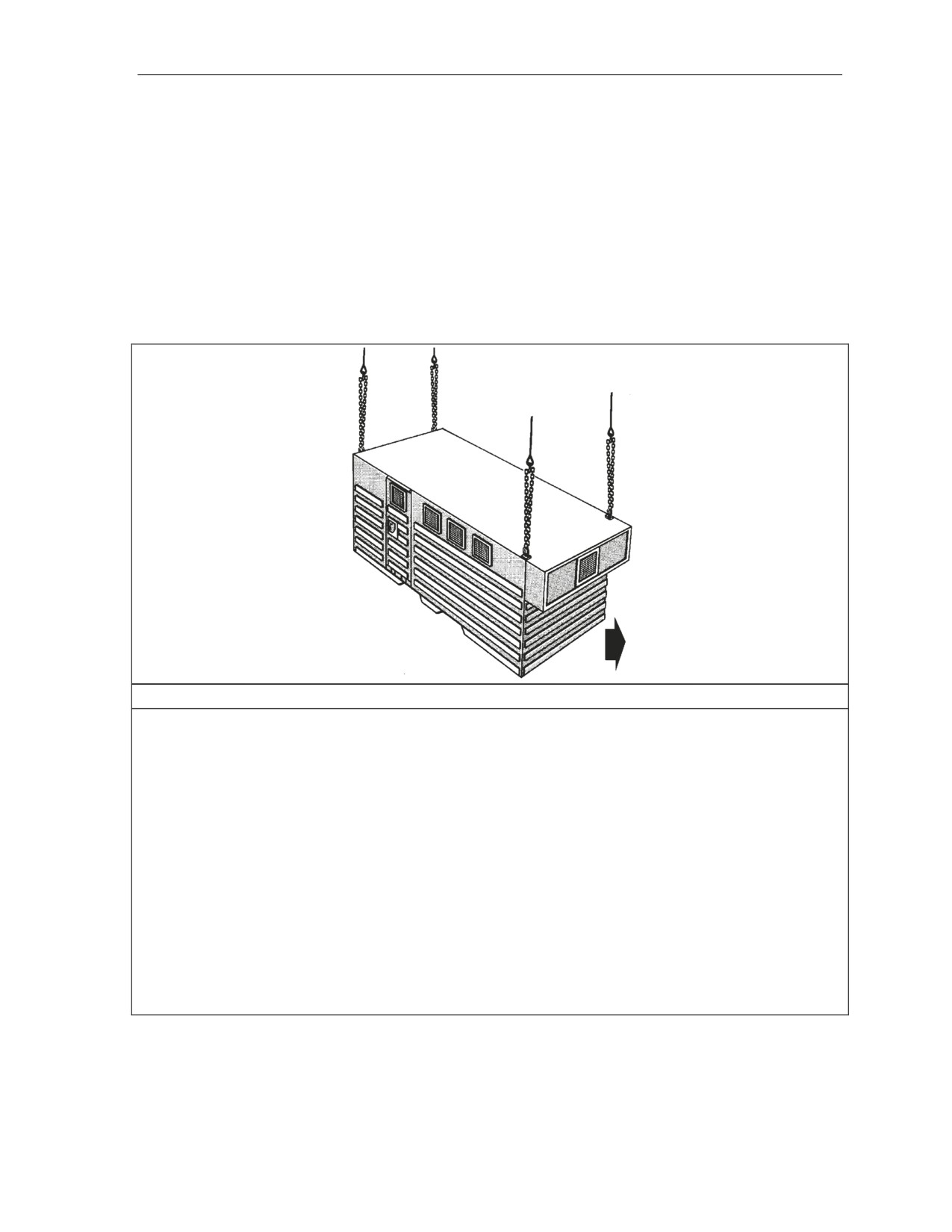
Certified Dual-Point Rigging Procedures for Missile Systems
─ Close and secure all doors and vents. Secure the door in the closed and locked
position.
Rigging. Rig the load according to the steps in Figure 7-6.
Hookup. Two hookup teams are required for this load. The static wand person discharges
the static electricity with the static wand. The forward hookup person stands on top of the
shelter and places apex fitting number 1 onto the forward cargo hook. The aft hookup person
stands on top of the shelter and places apex fitting number 2 onto the aft cargo hook. The
hookup teams then carefully dismount the shelter and remain close to the load as the helicopter
removes slack from the sling legs. When successful hookup is assured, the hookup teams
quickly exit the area underneath the helicopter to the designated rendezvous point.
Derigging. Derigging is the reverse of the preparation and rigging procedures.
RIGGING STEPS
1. Place two sling legs on apex fitting number 1. Position apex fitting number 1 on top of the
environmental control unit (ECU) end of the shelter.
2. Loop the chain end of the left and right sling legs through their respective lift provisions
located on the front corners of the shelter. Place the correct link from Table 7-6 in the grab
hook.
3. Place two sling legs on apex fitting number 2. Position apex fitting number 2 on top of aft end
of the shelter.
4. Loop the chain end of the left and right sling legs through their respective lift provisions
located on the rear corners of the shelter. Place the correct link from Table 7-6 in the grab
hook. Secure the excess chain with tape or Type III nylon cord.
5. Cluster and tie (breakaway technique) the sling legs in each sling set together to prevent
entanglement during hookup and lift-off.
Figure 7-6. Platoon Support Van/Maintenance Center, M32
FM 4-20.199/MCRP 4-11.3E, VOL III/NTTP 3-04.13/
20 February 2009
AFMAN 11-223 (I), VOL III/COMDINST M13482.4B
7-13
Chapter 7
FIELD MAINTENANCE EQUIPMENT SHOP (FME)
7-8. The field maintenance equipment shop is rigged for dual-point sling load using the following
procedures:
z
Applicability. The following items in Table 7-7 are certified for the helicopter(s) listed in the
following table by the US Army Natick Soldier Center:
Table 7-7. Field Maintenance Equipment Shop
Nomenclature
Max Weight
Sling
Link Count
Type of
(Pounds)
Set
Front/Rear
Aircraft
Field Maintenance Equipment Shop 20,
5,312
25K
75/75
CH-47
Electromechanical Shop
Field Maintenance Equipment Shop 23, Maintenance
5,341
25K
75/75
CH-47
Repair Facility
z
Materials. The following materials are required to rig this load:
Sling set (25,000-pound capacity) with one additional apex fitting.
Tape, adhesive, pressure-sensitive, 2-inch wide roll.
Cord, nylon, Type III, 550-pound breaking strength.
Webbing, cotton, 1/4-inch, 80-pound breaking strength.
z
Personnel. Four persons can prepare and rig this load in 30 minutes.
z
Procedures. The following procedures apply to this load:
Preparation. Prepare the load using the following steps:
─ Prepare the FME shop shelter for travel according to instructions in the operator's
manual.
─ Secure all loose equipment inside the shelter with tape or Type III nylon cord.
─ Close and secure all doors and vents. Secure the door in the closed and locked
position.
Rigging. Rig the load according to the steps in Figure 7-7.
Hookup. Two hookup teams are required for this load. The static wand person discharges
the static electricity with the static wand. The forward hookup person stands on top of the
shelter and places apex fitting number 1 onto the forward cargo hook. The aft hookup person
stands on top of the shelter (ECU end) and places apex fitting number 2 onto the aft cargo
hook. The hookup teams then carefully dismount the shelter and remain close to the load as
the helicopter removes slack from the sling legs. When successful hookup is assured, the
hookup teams quickly exit the area underneath the helicopter to the designated rendezvous
point.
Derigging. Derigging is the reverse of the preparation and rigging procedures
FM 4-20.199/MCRP 4-11.3E, VOL III/NTTP 3-04.13/
7-14
AFMAN 11-223 (I), VOL III/COMDINST M13482.4B
20 February 2009
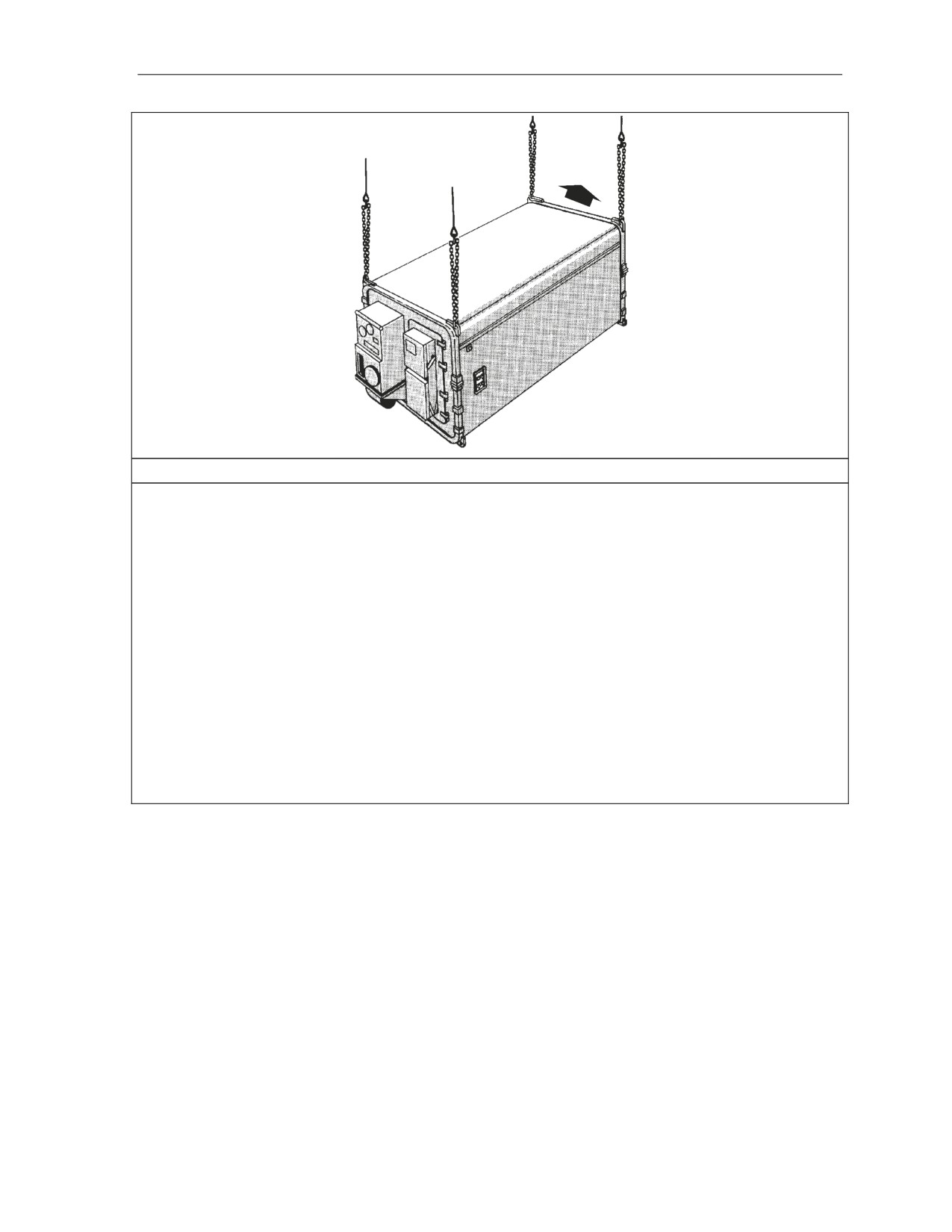
Certified Dual-Point Rigging Procedures for Missile Systems
RIGGING STEPS
1. Place two sling legs on apex fitting number 1. Position apex fitting number 1 on top of the
shelter, opposite the ECU end.
2. Loop the chain end of the left and right sling legs through their respective lift provisions
located on the front corners of the shelter. Place the correct link from Table 7-7 in the grab
hook. Secure the excess chain with tape or Type III nylon cord.
3. Place two sling legs on apex fitting number 2. Position apex fitting number 2 on top of the
ECU end of the shelter.
4. Loop the chain end of the left and right sling legs through their respective lift provisions
located on the rear corners of the shelter. Place the correct link from Table 7-7 in the grab
hook. Secure the excess chain with tape or Type III nylon cord.
5. Cluster and tie (breakaway technique) the sling legs in each sling set together to prevent
entanglement during hookup and lift-off.
Figure 7-7. Field Maintenance Equipment Shop 20, Electromechanical Shop
FM 4-20.199/MCRP 4-11.3E, VOL III/NTTP 3-04.13/
20 February 2009
AFMAN 11-223 (I), VOL III/COMDINST M13482.4B
7-15
Chapter 7
FIELD MAINTENANCE EQUIPMENT SHOP 21, UNMANNED SHOP,
ELECTRICAL EQUIPMENT
7-9. The field maintenance equipment shop 21, unmanned shop, electrical equipment is rigged for dual-
point sling load using the following procedures:
z
Applicability. The following item in Table 7-8 is certified for the helicopter(s) listed in the
following table by the US Army Natick Soldier Center:
Table 7-8. Field Maintenance Equipment Shop 21, Unmanned Shop, Electrical Equipment
Nomenclature
Max Weight
Sling
Link Count
Type of
(Pounds)
Set
Front/Rear
Aircraft
Field Maintenance Equipment Shop 21, Unmanned
5,639
25K
5/28
CH-47
Shop, Electrical Equipment
z
Materials. The following materials are required to rig this load:
Sling set (25,000-pound capacity) with one additional apex fitting.
Tape, adhesive, pressure-sensitive, 2-inch wide roll.
Cord, nylon, Type III, 550-pound breaking strength.
Webbing, cotton, 1/4-inch, 80-pound breaking strength.
z
Personnel. Four persons can prepare and rig this load in 30 minutes.
z
Procedures. The following procedures apply to this load:
Preparation. Prepare the load using the following steps:
─ Prepare the FME 21 shop shelter for travel according to instructions in the operator's
manual.
─ Secure all loose equipment inside the shelter with tape or Type III nylon cord.
─ Close and secure all doors and vents. Secure the door in the closed and locked
position.
Rigging. Rig the load according to the steps in Figure 7-8.
Hookup. Two hookup teams are required for this load. The static wand person discharges
the static electricity with the static wand. The forward hookup person stands on top of the
shelter and places apex fitting number 1 onto the forward cargo hook. The aft hookup person
stands on top of the shelter (door end) and places apex fitting number 2 onto the aft cargo
hook. The hookup teams then carefully dismount the shelter and remain close to the load as
the helicopter removes slack from the sling legs. When successful hookup is assured, the
hookup teams quickly exit the area underneath the helicopter to the designated rendezvous
point.
Derigging. Derigging is the reverse of the preparation and rigging procedures.
FM 4-20.199/MCRP 4-11.3E, VOL III/NTTP 3-04.13/
7-16
AFMAN 11-223 (I), VOL III/COMDINST M13482.4B
20 February 2009