FM 4-20.199 Multiservice Helicopter Sling Load: Dual-Point Load Rigging Procedures (February 2009) - page 6
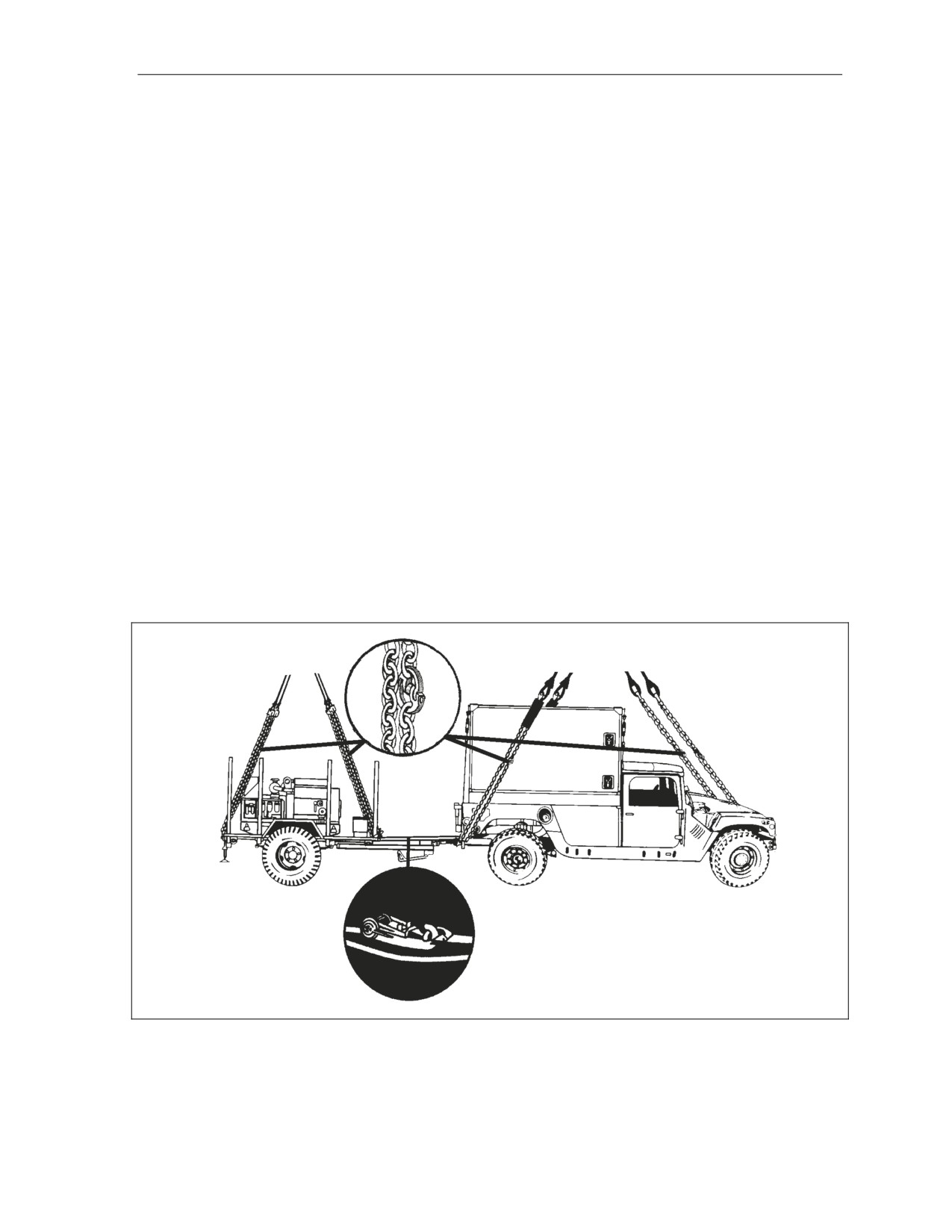
Certified Dual-Point Rigging Procedures for Tandem Loads
─ Install the lift provisions on the outer ends of the rear bumper by removing the tiedown
provisions located on the front bumper and installing on the outer ends of the front
bumper and installing on the outer ends of the rear bumper.
─ Partially retract all landing legs and secure in position with Type III nylon cord.
─ Retract the lunette leg and secure with Type III nylon cord.
─ Secure all lids, doors, and caps with tape or Type III nylon cord.
─ Ensure the parking brake is set.
─ Route the hook portion of a CGU-1/B tiedown strap through the left rear inboard
tiedown provision located near the pintle on the rear bumper of the truck and through
the mounting bracket on the front of the trailer A-frame. Connect the hook to the
ratchet of the CGU-1/B.
─ Repeat the above procedure on the right side of the load.
─ Tighten both CGU-1/B tie-down straps at the same time. Secure the excess strap and
safety the ratchet handles in the closed position with tape.
─ Connect one additional chain length to each chain on each sling set with a coupling
link.
Rigging. Rig the load according to the steps in Figure 5-3.
Hookup. Two hookup teams are required for this load. The static wand person discharges
the static electricity with the static wand. The forward hookup person kneels on top of the shelter
and places apex fitting 1 onto the forward cargo hook. The aft hookup person stands on the
generator fender and places apex fitting 2 onto the aft cargo hook. The hookup team then
carefully dismounts the trailer and remains close to the load as the helicopter removes slack
from the sling legs. When successful hookup is assured, the hookup team quickly exits the
area underneath the helicopter to the designated rendezvous point.
Derigging. Derigging is the reverse of the preparation and rigging procedures.
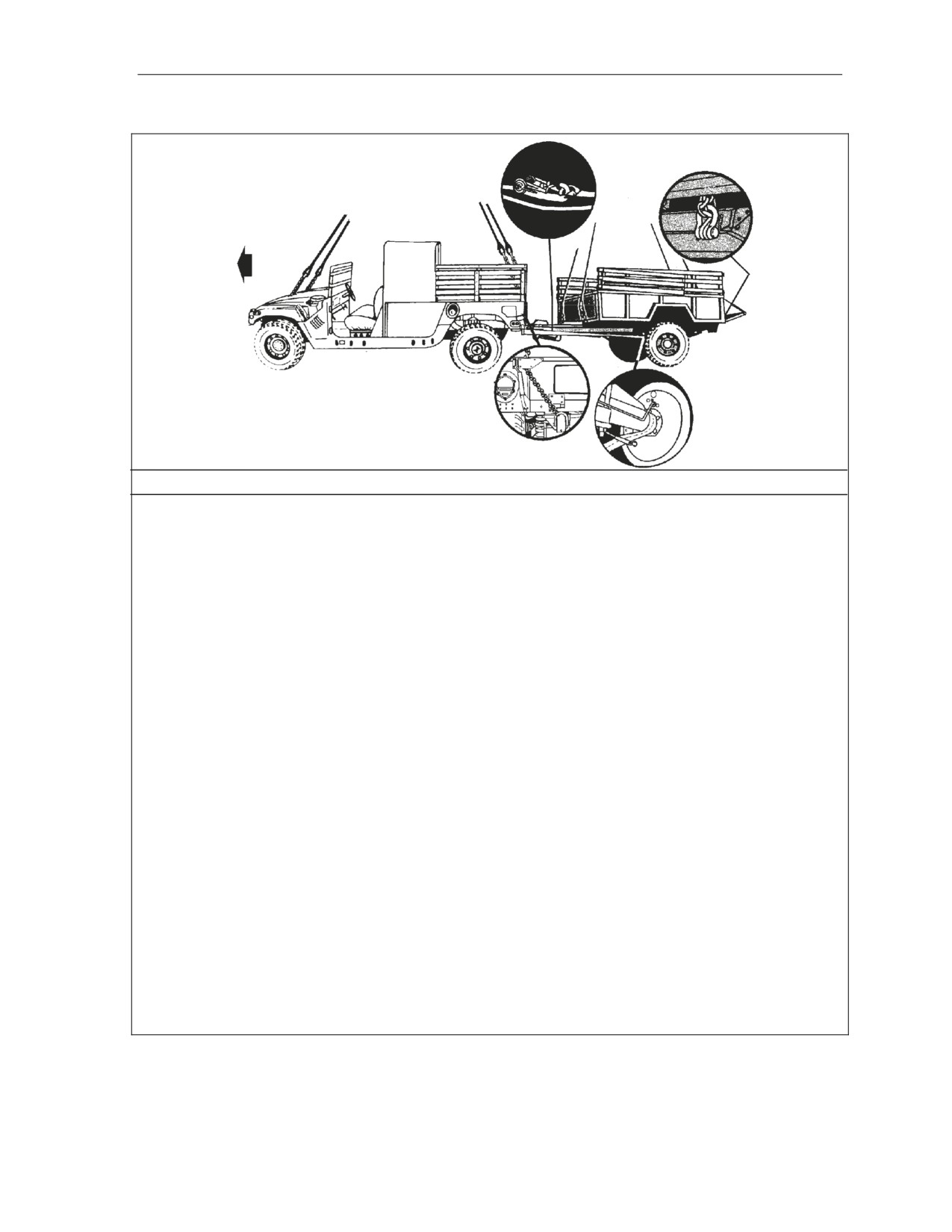
Figure 5-3. M1037 Shelter Carrier with S250/S-250E Shelter and M116A2 Trailer Mounted
Generators
FM 4-20.199/MCRP 4-11.3E, VOL III/NTTP 3-04.13/
20 February 2009
AFMAN 11-223 (I), VOL III/COMDINST M13482.4B
5-9

Chapter 5
RIGGING STEPS
1.
Position the apex fitting of sling set 1 on top of the shelter. Route outer sling legs 1 and 2 to
the front of the vehicle and inner sling legs 3 and 4 to the rear. Sling legs 1 and 3 must be on
the left side of the load.
2.
Loop the chain end of sling leg 1 through the left front lift provision that protrudes through the
hood. Place the correct link from Table 5-3 in the grab hook. Repeat with sling leg 2 and
the right front lift provision. Secure excess chain with tape or Type III nylon cord.
3.
Loop the chain end of the sling legs through their respective lift provisions located on the
outer ends of the rear bumper. Place the correct link from Table 5-3 in the grab hook.
Secure excess chain with tape or Type III nylon cord.
4.
Pad the chain where it contacts the shelter sides.
5.
Cluster and tie (breakaway technique) all sling legs together on top of the vehicle to prevent
entanglement during hookup and lift-off.
6.
Position the apex fitting of sling set 2 on top of the generator set. Route outer sling legs 1and
2 between the two front bows to the front of the generator and inner sling legs 3 and 4
between the two rear bows to the rear of the generator. Sling legs 1 and 3 must be on the
left side of the load.
7.
Loop the chain end of sling leg 1 through the left front lift provision located on the front of the
trailer. Place the correct link from Table 5-3 in the grab hook. Repeat with sling leg 2 through
the right front lift provision. Secure excess chain with tape or Type III nylon cord.
8.
Loop the chain end of sling leg 3 through the left rear lift provision. Place the correct link from
Table 5-3 in the grab hook. Repeat with sling leg 4 through the right rear lift provision.
Secure excess chain with tape or Type III nylon cord.
9.
Tie sling leg 1 to the front bow of the trailer (breakaway technique) to prevent entanglement
with the cable reel handle.
10. Cluster and tie (breakaway technique) all sling legs together on top of the trailer to prevent
entanglement during hookup and lift-off.
Figure 5-3. M1037 Shelter Carrier with S250/S-250E Shelter and M116A2 Trailer Mounted
Generators (Continued)
FM 4-20.199/MCRP 4-11.3E, VOL III/NTTP 3-04.13/
5-10
AFMAN 11-223 (I), VOL III/COMDINST M13482.4B
20 February 2009
Certified Dual-Point Rigging Procedures for Tandem Loads
M998/M1038 TRUCK, UTILITY, 1-1/4 TON (HMMWV) AND G-85/TPQ-
36 (V)7 GENERATOR GROUP ON M116A2 MODIFIED TRAILER
5-5. The M998/M1038 truck, utility, 1-1/4 ton (HMMWV) and G-85/TPQ-36 (V)7 generator group on
M116A2 modified trailer are rigged for dual-point sling load using the following procedures:
z
Applicability. The following items in Table 5-4 are certified for the helicopter(s) listed in the
following table by the US Army Natick Soldier Center:
Table 5-4. M998/M1038 Truck, Utility, 1-1/4 Ton and G-85/TPQ-36 (V)7 Generator Group
Nomenclature
Max Weight
Sling
Link Count
Type of
(Pounds)
Set
Front/Rear
Aircraft
Truck, 1 ¼-Ton, HMMWV, M998/M1038
7,000
10K
79/3
CH-47
G-85/TPQ-36 (V) 7 Generator Trailer Group
3,475
10K
52/36
CH-47
z
Materials. The following materials are required to rig this load:
Sling set (10,000-pound capacity) (2 each).
Tape, adhesive, pressure-sensitive, 2-inch wide roll.
Cord, nylon, Type III, 550-pound breaking strength.
Webbing, cotton, 1/4-inch, 80-pound breaking strength.
Strap, cargo, tie-down, CGU-1/B (2 each, or more as required to secure cargo).
Felt sheet, cattle hair, Type IV, 1/2-inch or suitable substitute.
z
Personnel. Two persons can prepare and rig the HMMWV in 15 minutes. Two persons can
prepare and rig the generator set in 10 minutes.
z
Procedures. Attach the generator set to the truck by placing the lunette on the pintle hook and
securing the latch. Secure the safety chains, cables, and hoses. Position the vehicle on level
ground so both the truck and generator set are in a straight line. The following procedures apply
to this load:
Preparation. Prepare the load using the following steps:
─ Fold mirrors forward in front of the windshield and tie together with Type III nylon
cord. Remove the doors and secure to the seats with Type III nylon cord.
─ Secure all equipment and cargo inside the truck with tiedown straps, tape, or Type III
nylon cord.
─ Ensure the fuel tanks are not over 3/4 full. Inspect the fuel tank cap, oil filler cap, and
battery caps for proper installation.
─ Engage the vehicle parking brake and put the transmission in neutral.
─ Ensure the front wheels are pointed straight ahead. Tie down the steering wheel, using
the securing device attached under the dashboard.
FM 4-20.199/MCRP 4-11.3E, VOL III/NTTP 3-04.13/
20 February 2009
AFMAN 11-223 (I), VOL III/COMDINST M13482.4B
5-11
Chapter 5
─ Retract the lunette leg and secure with Type III nylon cord.
─ Secure all lids, doors, and caps with tape or Type III nylon cord.
─ Ensure the trailer parking brakes are set.
─ Route the hook portion of a CGU-1/B tiedown strap through the left rear inboard
tiedown provision located near the pintle on the rear bumper of the truck and through
the mounting bracket on the front of the trailer A-frame. Connect the hook to the
ratchet of the CGU-1/B.
─ Repeat the above procedure on the right side of the load.
─ Tighten both CGU-1/B tiedown straps at the same time. Secure the excess strap and
safety the ratchet handles in the closed position with tape.
Rigging. Rig the load according to the steps in Figure 5-4.
Hookup. Two hookup teams are required for this load. The static wand person discharges
the static electricity with the static wand. The forward hookup person stands in the bed of the
truck and places apex fitting 1 onto the forward cargo hook. The aft hookup person stands on the
generator fender and places apex fitting 2 onto the aft cargo hook. The hookup team then
carefully dismounts the trailer and remains close to the load as the helicopter removes slack
from the sling legs. When successful hookup is assured, the hookup team quickly exits the
area underneath the helicopter to the designated rendezvous point.
Derigging. Derigging is the reverse of the preparation and rigging procedures.
FM 4-20.199/MCRP 4-11.3E, VOL III/NTTP 3-04.13/
5-12
AFMAN 11-223 (I), VOL III/COMDINST M13482.4B
20 February 2009
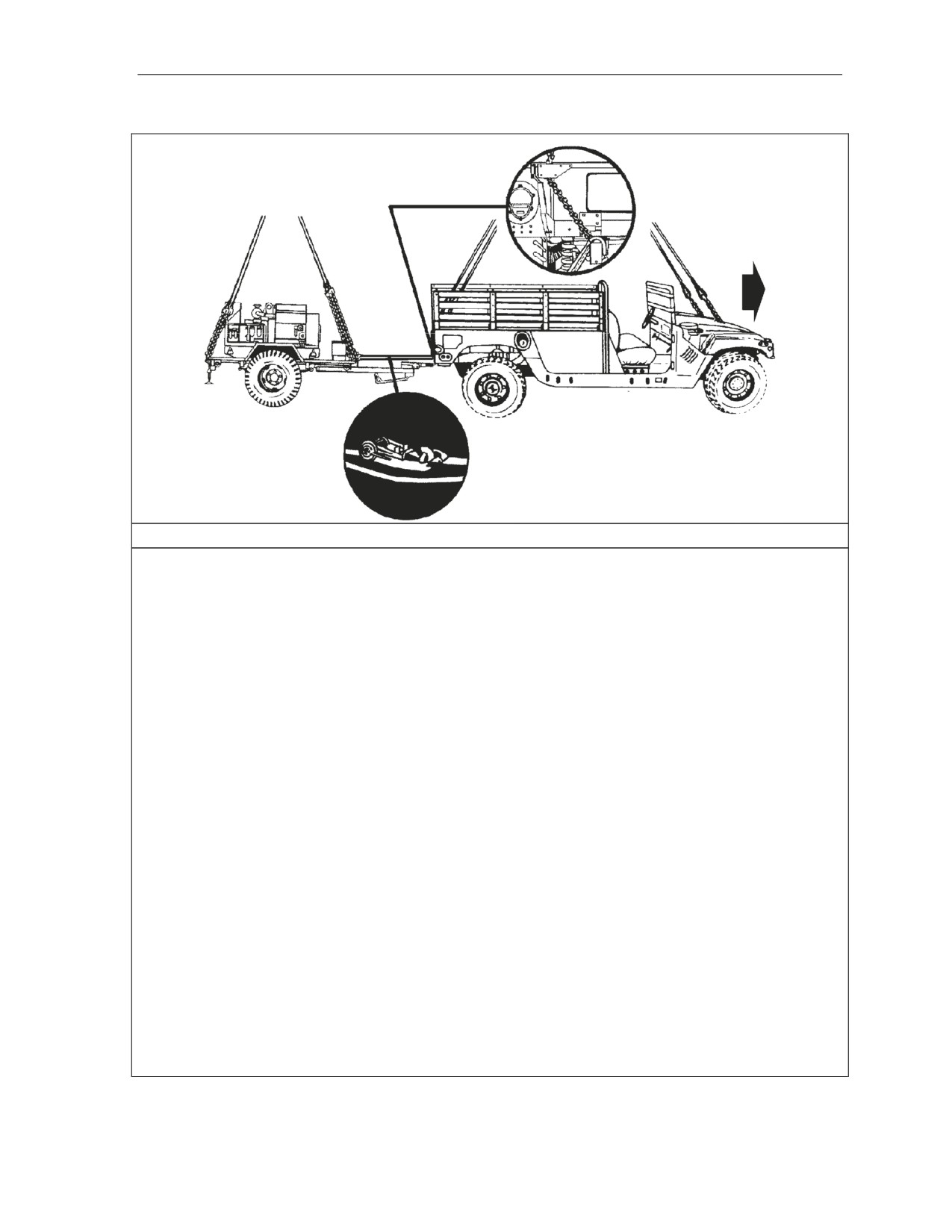
Certified Dual-Point Rigging Procedures for Tandem Loads
RIGGING STEPS
1.
Position the apex fitting of sling set 1 in the bed of the vehicle. Route outer sling legs 1and 2
to the front of the vehicle and inner sling legs 3 and 4 to the rear. Sling legs 1 and 3 must be
on the left side of the load.
2.
Loop the chain end of sling leg 1 through the left front lift provision that protrudes through the
hood. Place the correct link from Table 5-4 in the grab hook. Repeat with sling leg 2 and
the right front lift provision. Secure excess chain with tape or Type III nylon cord.
3.
Route the chain end of sling leg 3 through the sling guide in the upper left corner of the
tailgate. Loop the chain end through the left lift provision on the bumper and thread back
through the sling guide in the tailgate. Place the correct link from Table 5-4 in the grab hook.
Repeat with sling leg 4 and the right rear lift provision.
4.
Cluster and tie (breakaway technique) all sling legs together on top of the vehicle to prevent
entanglement during hookup and lift-off.
5.
Position apex fitting of sling set 2 on the trailer but not on top of the generator. Route outer
sling legs 1and 2 to the front of the trailer and inner sling legs 3 and 4 to the rear. Sling legs
1 and 3 must be on the left side of the load.
6.
Loop the chain end of sling leg 1 through the left front lift provision located near the A-frame
on the front of the trailer. Place the correct link from Table 5-4 in the grab hook. Repeat with
sling leg 2 through the right front lift provision. Secure excess chain with tape or Type III
nylon cord.
7.
Route the chain end of sling leg 3 through the left rear lift provision. Place the correct link
from Table 5-4 in the grab hook. Repeat with sling leg 4 through the right rear lift provision.
Secure excess chain with tape or Type III nylon cord.
Figure 5-4. M998/M1038 Truck, Utility, 1-1/4 Ton and G-85/TPQ-36 (V)7 Generator Group
FM 4-20.199/MCRP 4-11.3E, VOL III/NTTP 3-04.13/
20 February 2009
AFMAN 11-223 (I), VOL III/COMDINST M13482.4B
5-13

Chapter 5
RIGGING STEPS (Continued)
8. Pad the chains where they contact the load.
9. Cluster and tie (breakaway technique) all sling legs together on top of the trailer to prevent
entanglement during hookup and lift-off.
Figure 5-4. M998/M1038 Truck, Utility, 1-1/4 Ton and G-85/TPQ-36 (V)7 Generator Group
(Continued)
M1097 TRUCK, UTILITY, 1-1/4 TON (HMMWV) WITH PALLET
GROUP OA-9134/TSC, ANTENNA AS-3036/TSC AND PU-753
GENERATOR SET ON M116A2 TRAILER
5-6. The M1097 truck, utility, 1-1/4 ton with pallet group OA-9134/TSC, antenna AS-3036/TSC and PU-
753 generator set on M116A2 trailer are rigged for dual-point sling load using the following procedures:
z
Applicability. The following items in Table 5-5 are certified for the helicopter(s) listed in the
following table by the US Army Natick Soldier Center:
Table 5-5. M1097 Truck, Utility, 1-1/4 Ton with Pallet Group OA-9134/TSC, Antenna AS-
3036/TSC and PU-753 Generator Set on M116A2 Trailer
Nomenclature
Max Weight
Sling
Link Count
Type of
(Pounds)
Set
Front/Rear
Aircraft
Truck, Utility1 ¼-Ton, HMMWV, M1097 with Pallet
7,120
25K
62/3
CH-47
Group OA-9134/TSC, Antenna AS-3036/TSC
PU-753 Generator Set on M116A2 Trailer
3,000
25K
70/54
CH-47
z
Materials. The following materials are required to rig this load:
Sling set (25,000-pound capacity) (2 each).
Tape, adhesive, pressure-sensitive, 2-inch wide roll.
Cord, nylon, Type III, 550-pound breaking strength.
Webbing, cotton, 1/4-inch, 80-pound breaking strength.
Strap, cargo, tie-down, CGU-1/B (2 each, or more as required to secure cargo).
Felt sheet, cattle hair, Type IV, 1/2-inch or suitable substitute.
Spreader bar assembly NSN: 4910-01-313-8839.
Reach pendant, 11,000- or 25,000-pound capacity (2 each).
z
Personnel. Two persons can prepare and rig the M1097 HMMWV in 15 minutes. Two persons
can prepare and rig the generator set in 10 minutes.
z
Procedures. Attach the generator set to the truck by placing the lunette on the pintle hook and
securing the latch. Secure the safety chains, cables, and hoses. Position the vehicle on level
ground so both the truck and generator set are in a straight line. The following procedures apply
to this load:
FM 4-20.199/MCRP 4-11.3E, VOL III/NTTP 3-04.13/
5-14
AFMAN 11-223 (I), VOL III/COMDINST M13482.4B
20 February 2009
Certified Dual-Point Rigging Procedures for Tandem Loads
Preparation. Prepare the load using the following steps:
─
Fold the mirrors in and tie together with Type III nylon cord. Remove the doors and
secure to the seats with Type III nylon cord.
─
Ensure the antenna support structure assembly is secured to the vehicle. Secure all
loose equipment inside the antenna support structure with tape, Type III nylon cord, or
tiedown straps.
─
Secure all equipment and cargo inside the truck with tie-down straps, tape, or Type III
nylon cord.
─
Ensure the fuel tanks are not over 3/4 full. Inspect the fuel tank cap, oil filler cap, and
battery caps for proper installation.
─
Engage the vehicle parking brake and put the transmission in neutral.
─
Ensure the front wheels are pointed straight ahead. Tie down the steering wheel, using
the securing device attached under the dashboard.
─
Install the lift provisions on the outer ends of the rear bumper by removing the tiedown
provisions located on the front bumper and installing on the outer ends of the rear
bumper.
─
Partially retract all landing legs and secure in position with Type III nylon cord.
─
Retract the lunette leg and secure with Type III nylon cord.
─
Secure all lids, doors, and caps with tape or Type III nylon cord.
─
Ensure the trailer hand brake is set.
─
Route the hook portion of a CGU-1/B tiedown strap through the left rear inboard
tiedown provision located near the pintle on the rear bumper of the truck and through
the mounting bracket on the front of the trailer A-frame. Connect the hook to the
ratchet of the CGU-1/B.
─
Repeat the above procedure on the right side of the load.
─
Tighten both CGU-1/B tie-down straps at the same time. Secure the excess strap and
safety the ratchet handles in the closed position with tape. Tape the CGU-1/B every 24
inches to prevent flapping.
─
Attach one reach pendant on each sling set apex fitting.
Rigging. Rig the load according to the steps in Figure 5-5.
Hookup. Two hookup persons are required for this load. The forward hookup person
stands on top of the support structure and places reach pendant 1 onto the forward cargo hook.
The aft hookup person stands on the generator fender and places reach pendant 2 onto the aft
cargo hook. The hookup team then carefully dismounts the trailer and remains close to the
load as the helicopter removes slack from the sling legs. When successful hookup is assured,
the hookup team quickly exits the area underneath the helicopter to the designated rendezvous
point.
CAUTION
An aircrew member must monitor the spreader bar assembly at all
times. If there is any evidence of bending of the spreader bar the load
should be set down at the nearest suitable landing area.
Derigging. Derigging is the reverse of the preparation and rigging procedures.
FM 4-20.199/MCRP 4-11.3E, VOL III/NTTP 3-04.13/
20 February 2009
AFMAN 11-223 (I), VOL III/COMDINST M13482.4B
5-15
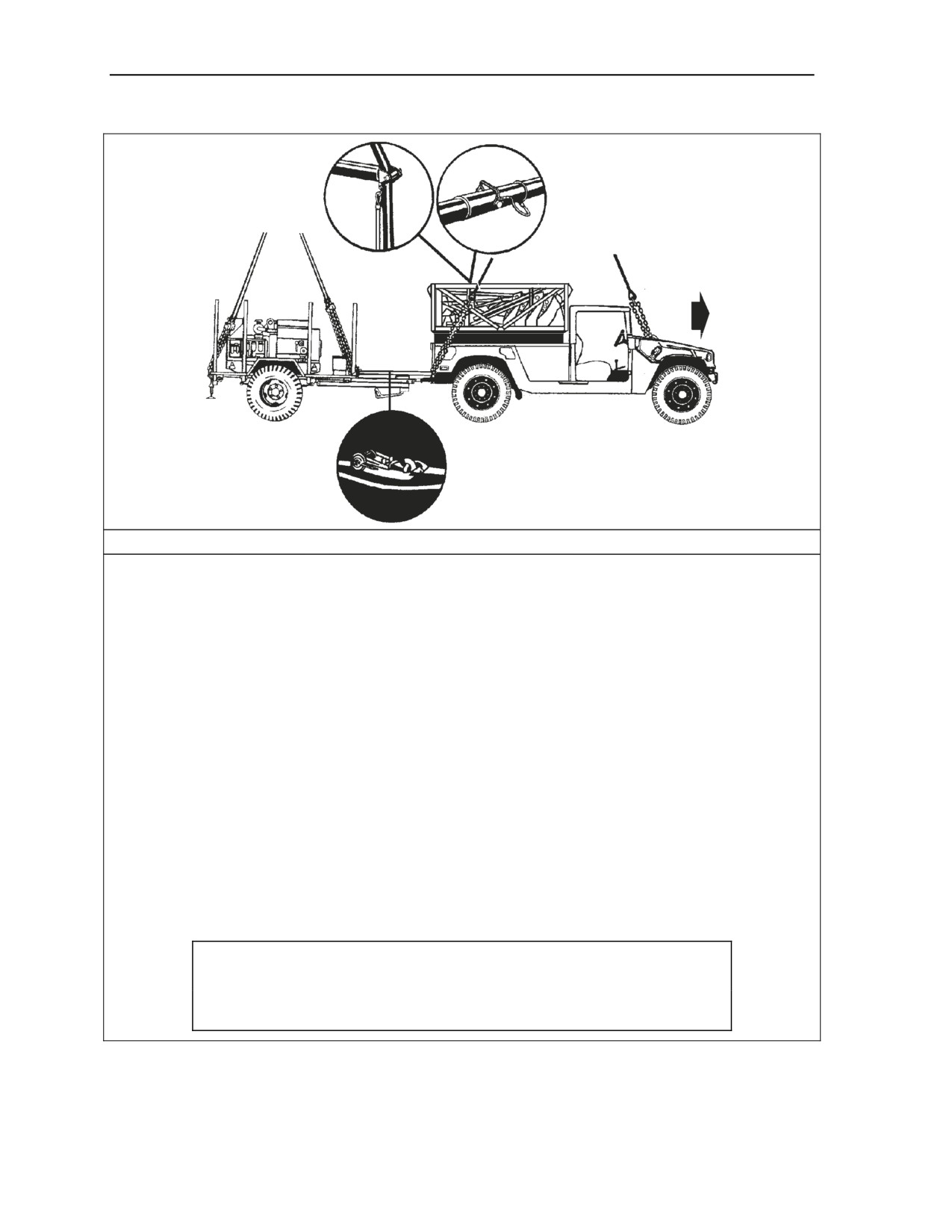
Chapter 5
RIGGING STEPS
1. Position apex fitting and reach pendant on top of the antenna support structure assembly.
Route outer sling legs 1 and 2 to the front of the vehicle and inner sling legs 3 and 4 to the
rear. Sling legs 1 and 3 must be on the left side of the load.
2. Loop the chain end of sling leg 1 through the left front lift provision that protrudes through the
hood from inboard to outboard. Place the correct link from Table 5-5 in the grab hook.
Repeat with sling leg 2 and the right front lift provision. Secure excess chain with tape or
Type III nylon cord.
3. Position the spreader bar assembly 12 inches from the rear of the antenna support structure.
Route the rear sling ropes through the guides on the end of the spreader bar. Secure the
sling ropes in the guides with the retainer pins and keepers.
4. Route the chain end of sling leg 3 through the lift provision located on the left end of the rear
bumper from inboard to outboard. Place the correct link from Table 5-5 in the grab hook.
Repeat with sling leg 4 and the right rear lift provision.
5. Remove all slack from sling legs 3 and 4. Install a breakaway tie using 1/4-inch cotton
webbing around each leg and around the top bar of the antenna support structure.
CAUTION
Do not use Type III nylon cord to make the breakaway ties.
Figure 5-5. M1097 Truck, Utility, 1-1/4 Ton (HMMWV) with Pallet Group OA-9134/TSC, Antenna
AS-3036/TSC and PU-753 Generator Set on M116A2 Trailer
FM 4-20.199/MCRP 4-11.3E, VOL III/NTTP 3-04.13/
5-16
AFMAN 11-223 (I), VOL III/COMDINST M13482.4B
20 February 2009

Certified Dual-Point Rigging Procedures for Tandem Loads
RIGGING STEPS (Continued)
6. Extend the spreader bar retainer cable down the length of the sling leg and secure to the
chain with Type III nylon cord.
7. Cluster and tie (breakaway technique) all sling legs together on top of the support structure to
prevent entanglement during hookup and lift-off.
8. Position the apex fitting and Reach Pendant of sling set 2 on top of the generator set. Route
outer sling legs 1 and 2 between the two front bows to the front of the generator and inner
sling legs 3 and 4 between the two rear bows to the rear of the generator. Sling legs 1 and 3
must be on the left side of the load.
9. Loop the chain end of sling leg 1 through the left front lift provision located on the front of the
trailer. Place the correct link from Table 5-5 in the grab hook. Repeat with sling leg 2 through
the right front lift provision. Secure excess chain with tape or Type III nylon cord.
10. Loop the chain end of sling leg 3 through the left rear lift provision. Place the correct link from
Table 5-5 in the grab hook. Repeat with sling leg 4 through the right rear lift provision.
Secure excess chain with tape or Type III nylon cord.
11. Pad the chains where they contact the load.
12. Cluster and tie or tape (breakaway technique) all sling legs together on top of the trailer to
prevent entanglement during hookup and lift-off.
Figure 5-5. M1097 Truck, Utility, 1-1/4 Ton (HMMWV) with Pallet Group OA-9134/TSC, Antenna
AS-3036/TSC and PU-753 Generator Set on M116A2 Trailer (Continued)
M1097 SHELTER CARRIER, 1-1/4 TON (HMMWV) WITH AN/TPQ-36
(V) 7, (S-250 SHELTER), OPERATIONS CONTROL GROUP AND
RADAR SET ANTENNA MOUNTED ON M116A2 TRAILER
5-7. The M1097 shelter carrier, 1-1/4 ton with AN/TPQ-36 (V) 7, (S-250 shelter), operations control
group and radar set antenna mounted on M116A2 trailer are rigged for dual-point sling load using the
following procedures:
z
Applicability. The following items in Table 5-6 are certified for the helicopter(s) listed in the
following table by the US Army Natick Soldier Center:
Table 5-6. M1097 Shelter Carrier, 1-1/4 Ton with AN/TPQ-36 (V) 7, (S-250 Shelter), Operations
Control Group and Radar Set Antenna Mounted on M116A2 Trailer
Nomenclature
Max Weight
Sling
Link Count
Type of
(Pounds)
Set
Front/Rear
Aircraft
Truck, Shelter Carrier, 1 ¼-Ton, M1097 with OKG-
8,500
10K
80/30
CH-47
398/TPW, Operations Control Group (S-250 Shelter)
Radar Set Antenna, AN/TPQ-36 (V) 7 on M116A2
2,975
10K
68/80
CH-47
Trailer
FM 4-20.199/MCRP 4-11.3E, VOL III/NTTP 3-04.13/
20 February 2009
AFMAN 11-223 (I), VOL III/COMDINST M13482.4B
5-17
Chapter 5
z
Materials. The following materials are required to rig this load:
Sling set (10,000-pound capacity) (2 each).
─ Additional chain length, part number 38850-00053-101, from a 10,000-pound capacity
sling set (8 each).
─ Additional coupling link, part number 577-0615, from a 10,000-pound sling set (8
each).
Tape, adhesive, pressure-sensitive, 2-inch wide roll.
Cord, nylon, Type III, 550-pound breaking strength.
Webbing, cotton, 1/4-inch, 80-pound breaking strength.
Strap, cargo, tie-down, CGU-1/B (2 each, or more as required to secure cargo).
Felt sheet, cattle hair, Type IV, 1/2-inch or suitable substitute.
Plywood, 4 feet x 8 feet x 3/4 inches.
Reach pendant, 11,000- or 25,000-pound capacity (2 each).
Heater hose, 3/4-inch (as required).
z
Personnel. Two persons can prepare and rig the M1097 HMMWV in 15 minutes. Two persons
can prepare and rig the antenna trailer in 20 minutes.
Note. The plywood is a full sheet which is notched to fit around the bracket located at the top of
the antenna array. Attach a piece of 3/4-inch heater hose, split lengthwise along the forward
edge of the plywood to protect the sling legs from fraying.
z
Procedures. Attach the antenna trailer to the truck by placing the lunette on the pintle hook
and securing the latch. Secure the safety chains, cables, and hoses. Position the vehicle on level
ground so both the truck and radar set are in a straight line. The following procedures apply to
this load:
Preparation. Prepare the load using the following steps:
─ Fold the mirrors in and tie together with Type III nylon cord. Remove the doors and
secure to the seats with Type III nylon cord.
─ Secure all loose equipment inside the shelter with tape, Type III nylon cord, or tiedown
straps.
─ Secure all equipment and cargo inside the truck with tiedown straps, tape, or Type III
nylon cord.
─ Ensure the fuel tank is not over 3/4 full. Inspect the fuel tank cap, oil filler cap, and
battery caps for proper installation.
─ Engage the vehicle parking brake and put the transmission in neutral.
─ Ensure the front wheels are pointed straight ahead. Tie down the steering wheel, using
the securing device attached under the dashboard.
─ Install the lift provisions on the outer ends of the rear bumper by removing the tiedown
provisions located on the front bumper and installing on the outer ends of the rear
bumper.
─ Raise the landing leg and secure in position with safety pins and tape.
─ Secure all lids, doors, and caps with tape or Type III nylon cord.
─ Ensure the trailer hand brake is set.
─ Place the radar set in the travel mode.
─ Place the sheet of plywood on the top of the antenna, firmly against the BSU. Route
and secure a CGU-1/B across the width of the plywood at the center of the array.
Hook a second CGU-1/B to the front right tiedown provision located on the front of
the right side of the trailer. Route the tiedown diagonally over the plywood and secure
the ratchet to the left rear of the stowed ground rod, the lower tiedown provision, or
FM 4-20.199/MCRP 4-11.3E, VOL III/NTTP 3-04.13/
5-18
AFMAN 11-223 (I), VOL III/COMDINST M13482.4B
20 February 2009
Certified Dual-Point Rigging Procedures for Tandem Loads
the trailer frame. Repeat the procedure on the left side of the antenna routing the
tiedown diagonally over the plywood.
─ Route the hook portion of a CGU-1/B tiedown strap through the left rear inboard
tiedown provision located near the pintle on the rear bumper of the truck and through
the mounting bracket on the front of the trailer A-frame. Connect the hook to the
ratchet of the CGU-1/B.
─ Repeat the above procedure on the right side of the load.
─ Tighten both CGU-1/B tie-down straps at the same time. Secure the excess strap and
safety the ratchet handles in the closed position with tape. Tape the CGU-1/B every 24
inches to prevent flapping.
─ Attach one reach pendant on each sling set apex fitting.
─ Connect one additional chain length to each chain on each sling set with a coupling
link.
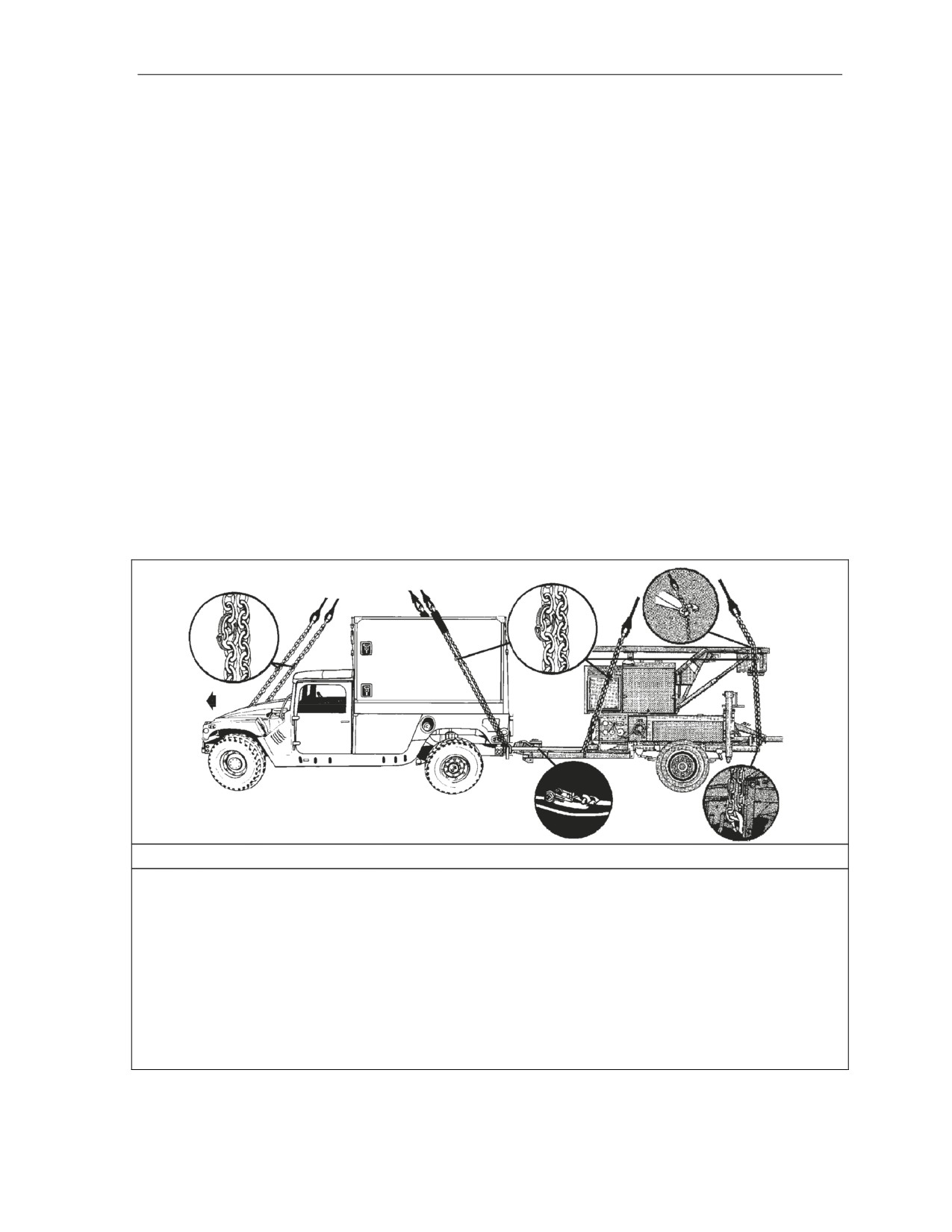
Rigging. Rig the load according to the steps in Figure 5-6.
Hookup. Two hookup persons are required for this load. The forward hookup person
stands on cab of the truck and places reach pendant 1 onto the forward cargo hook. The aft
hookup person stands on the fender of the trailer and places reach pendant 2 onto the aft cargo
hook. The hookup team then carefully dismounts the trailer and remains close to the load as
the helicopter removes slack from the sling legs. When successful hookup is assured, the
hookup team quickly exits the area underneath the helicopter to the designated rendezvous
point.
Derigging. Derigging is the reverse of the preparation and rigging procedures.
RIGGING STEPS
1. Position apex fitting and reach pendant on top of the truck. Route outer sling legs 1 and 2 to the front of
the vehicle and inner sling legs 3 and 4 to the rear. Sling legs 1 and 3 must be on the left side of the
load.
2. Loop the chain end of sling leg 1 through the left front lift provision that protrudes through the hood from
inboard to outboard. Place the correct link from Table 5-6 in the grab hook. Repeat with sling leg 2 and
the right front lift provision. Secure excess chain with tape or Type III nylon cord.
3. Loop the chain end of the sling legs through their respective lift provisions located on the outer ends of
the rear bumper. Place the correct link from Table 5-6 in the grab hook. Secure excess chain with tape
or Type III nylon cord.
Figure 5-6. M1097 Shelter Carrier, 1-1/4 Ton (HMMWV) with AN/TPQ-36 (V) 7, (S-250 Shelter),
Operations Control Group and Radar Set Antenna Mounted on M116A2 Trailer
FM 4-20.199/MCRP 4-11.3E, VOL III/NTTP 3-04.13/
20 February 2009
AFMAN 11-223 (I), VOL III/COMDINST M13482.4B
5-19

Chapter 5
RIGGING STEPS (Continued)
4.
Pad the chain where it contacts the shelter sides.
5.
Cluster and tie (breakaway technique) all sling legs together on top of the vehicle to prevent
entanglement during hookup and lift-off.
6.
Position the apex fitting of sling set 2 on top of the trailer but not on top of the radar panel.
Route outer sling legs 1 and 2 to the front of the trailer and inner sling legs 3 and 4 to the rear
of the trailer Sling legs 1 and 3 must be on the left side of the load.
7.
Loop the chain end of sling leg 1 through the left front lift provision located on the front of the
trailer near the A-frame. Place the correct link from Table 5-6 in the grab hook. Remove the
slack from the sling leg and pad the sling/chain where it contacts the antenna and plywood.
Secure the sling leg with a breakaway tie routed through a hole drilled in the plywood.
Repeat with sling leg 2 through the right front lift provision. Secure excess chain with tape or
Type III nylon cord.
8.
Loop the chain end of sling leg 3 through the left rear lift provision (the upper shackle on the
deck frame). Place the correct link from Table 5-6 in the grab hook. Remove the slack from
the sling leg and pad the sling/chain where it contacts the sling leg guide on the antenna.
Place the sling leg in the guide and secure with a breakaway tie. Repeat with sling leg 4
through the right rear lift provision. Secure excess chain with tape or Type III nylon cord.
9.
Cluster and tie (breakaway technique) all sling legs together on top of the trailer to prevent
entanglement during hookup and lift-off.
Figure 5-6. M1097 Shelter Carrier, 1-1/4 Ton (HMMWV) with AN/TPQ-36 (V) 7, (S-250 Shelter),
Operations Control Group and Radar Set Antenna Mounted on M116A2 Trailer (Continued)
M1097, 1-1/4 TON (HMMWV) WITH GENERATOR PALLET GROUP,
G-86-TPQ-36 (V)7, AND RADAR SET ANTENNA MOUNTED ON
M116A2 TRAILER
5-8. The M1097, 1-1/4 ton with generator pallet group, G-86-TPQ-36 (V)7, and radar set antenna
mounted on M116A2 trailer are rigged for dual-point sling load using the following procedures:
z
Applicability. The following items in Table 5-7 are certified for the helicopter(s) listed in the
following table by the US Army Natick Soldier Center:
Table 5-7. M1097, 1-1/4 Ton (HMMWV) with Generator Pallet Group, G-86-TPQ-36 (V)7, and
Radar Set Antenna Mounted on M116A2 Trailer
Nomenclature
Max Weight
Sling
Link Count
Type of
(Pounds)
Set
Front/Rear
Aircraft
Truck, Utility, 1 ¼-Ton, M1097 with Generator Pallet
7,400
10K
80/30
CH-47
Group, G-86-TPQ-36 (V) 7
Radar Set Antenna, AN/TPQ-36 (V) 7 on M116A2
2,975
10K
68/80
CH-47
Trailer
FM 4-20.199/MCRP 4-11.3E, VOL III/NTTP 3-04.13/
5-20
AFMAN 11-223 (I), VOL III/COMDINST M13482.4B
20 February 2009
Certified Dual-Point Rigging Procedures for Tandem Loads
z
Materials. The following materials are required to rig this load:
Sling set (10,000-pound capacity) (2 each).
Tape, adhesive, pressure-sensitive, 2-inch wide roll.
Cord, nylon, Type III, 550-pound breaking strength.
Webbing, cotton, 1/4-inch, 80-pound breaking strength.
Strap, cargo, tie-down, CGU-1/B (5 each).
Felt sheet, cattle hair, Type IV, 1/2-inch or suitable substitute.
Plywood, 4 feet x 8 feet x 3/4 inches.
Reach pendant, 11,000- or 25,000-pound capacity (2 each).
Heater hose, 3/4-inch (as required).
z
Personnel. Two persons can prepare and rig the M1097 HMMWV in 15 minutes. Two persons
can prepare and rig the antenna trailer in 20 minutes.
Note. The plywood is a full sheet which is notched to fit around the bracket located at the top of
the antenna array. Attach a piece of 3/4-inch heater hose, split lengthwise along the forward
edge of the plywood to protect the sling legs from fraying.
z
Procedures. Attach the antenna trailer to the truck by placing the lunette on the pintle hook
and securing the latch. Secure the safety chains, cables, and hoses. Position the vehicle on level
ground so both the truck and radar set are in a straight line. The following procedures apply to
this load:
Preparation. Prepare the load using the following steps:
─
Fold the mirrors in and tie together with Type III nylon cord. Remove the doors and
secure to the seats with Type III nylon cord.
─
Secure all equipment and cargo inside the truck with tiedown straps, tape, or Type III
nylon cord.
─
Ensure the fuel tanks are not over 3/4 full. Inspect the fuel tank cap, oil filler cap, and
battery caps for proper installation.
─
Engage the vehicle parking brake and put the transmission in neutral.
─
Ensure the front wheels are pointed straight ahead. Tie down the steering wheel, using
the securing device attached under the dashboard.
─
Install the lift provisions on the outer ends of the rear bumper by removing the tiedown
provisions located on the front bumper and installing on the outer ends of the rear
bumper.
─
Raise the landing leg and secure in position with safety pins and tape.
─
Secure all lids, doors, and caps with tape or Type III nylon cord.
─
Ensure the trailer hand brake is set.
─
Place the radar set in the travel mode.
─
Place the sheet of plywood on the top of the antenna, firmly against the BSU. Route
and secure a CGU-1/B across the width of the plywood at the center of the array.
Hook a second CGU-1/B to the front right tie-down provision located on the front of
the right side of the trailer. Route the tiedown diagonally over the plywood and secure
the ratchet to the left rear of the stowed ground rod, the lower tiedown provision, or
the trailer frame. Repeat the procedure on the left side of the antenna routing the
tiedown diagonally over the plywood.
─
Route the hook portion of a CGU-1/B tiedown strap through the left rear inboard
tiedown provision located near the pintle on the rear bumper of the truck and through
the mounting bracket on the front of the trailer A-frame. Connect the hook to the
ratchet of the CGU-1/B.
─
Repeat the above procedure on the right side of the load.
FM 4-20.199/MCRP 4-11.3E, VOL III/NTTP 3-04.13/
20 February 2009
AFMAN 11-223 (I), VOL III/COMDINST M13482.4B
5-21
Chapter 5
─ Tighten both CGU-1/B tie-down straps at the same time. Secure the excess strap and
safety the ratchet handles in the closed position with tape. Tape the CGU-1/B every 24
inches to prevent flapping.
─ Attach one reach pendant on each sling set apex fitting.
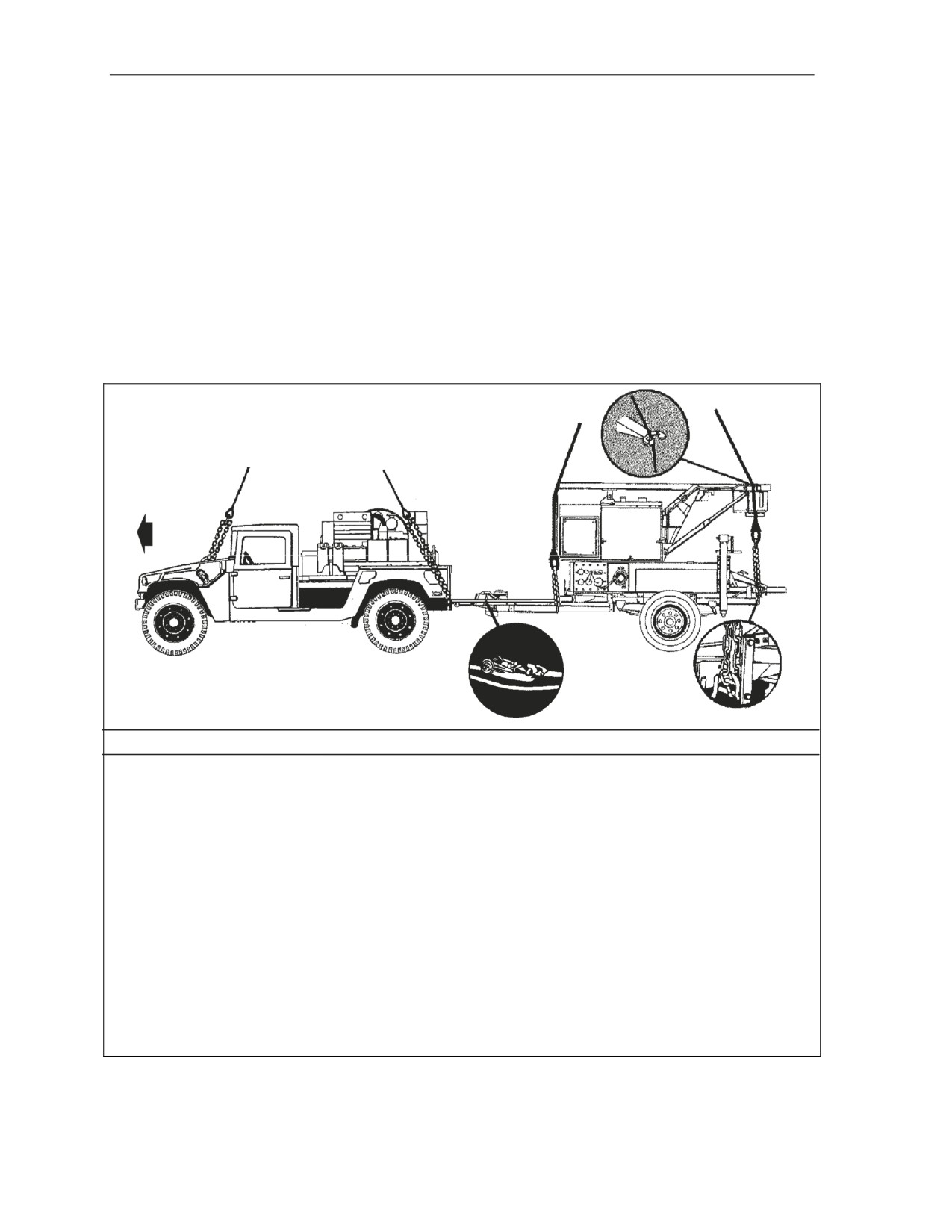
Rigging. Rig the load according to the steps in Figure 5-7.
Hookup. Two hookup persons are required for this load. The forward hookup person
stands on cab of the truck and places reach pendant 1 onto the forward cargo hook. The aft
hookup person stands on the fender of the trailer and places reach pendant 2 onto the aft cargo
hook. The hookup team then carefully dismounts the trailer and remains close to the load as
the helicopter removes slack from the sling legs. When successful hookup is assured, the
hookup team quickly exits the area underneath the helicopter to the designated rendezvous
point.
Derigging. Derigging is the reverse of the preparation and rigging procedures.
RIGGING STEPS
1. Position apex fitting and reach pendant on top of the truck. Route outer sling legs 1 and 2 to
the front of the vehicle and inner sling legs 3 and 4 to the rear. Sling legs 1 and 3 must be on
the left side of the load.
2. Loop the chain end of sling leg 1 through the left front lift provision that protrudes through the
hood from inboard to outboard. Place the correct link from Table 5-7 in the grab hook.
Repeat with sling leg 2 and the right front lift provision. Secure excess chain with tape or
Type III nylon cord.
3. Loop the chain end of the sling legs through their respective lift provisions located on the
outer ends of the rear bumper. Place the correct link from Table 5-7 in the grab hook.
Secure excess chain with tape or Type III nylon cord.
4. Cluster and tie (breakaway technique) all sling legs together on top of the vehicle to prevent
entanglement during hookup and lift-off.
Figure 5-7. M1097, 1-1/4 Ton (HMMWV) with Generator Pallet Group, G-86-TPQ-36 (V)7, and
Radar Set Antenna Mounted on M116A2 Trailer
FM 4-20.199/MCRP 4-11.3E, VOL III/NTTP 3-04.13/
5-22
AFMAN 11-223 (I), VOL III/COMDINST M13482.4B
20 February 2009

Certified Dual-Point Rigging Procedures for Tandem Loads
RIGGING STEPS (Continued)
5. Position the apex fitting of sling set 2 on top of the trailer but not on top of the radar panel.
Route outer sling legs 1 and 2 to the front of the trailer and inner sling legs 3 and 4 to the rear
of the trailer Sling legs 1 and 3 must be on the left side of the load.
6. Loop the chain end of sling leg 1 through the left front lift provision located on the front of the
trailer near the A-frame. Place the correct link from Table 5-7 in the grab hook. Remove the
slack from the sling leg and pad the sling/chain where it contacts the antenna and plywood.
Secure the sling leg with a breakaway tie routed through a hole drilled in the plywood.
Repeat with sling leg 2 through the right front lift provision. Secure excess chain with tape or
Type III nylon cord.
7. Loop the chain end of sling leg 3 through the left rear lift provision (the upper shackle on the
deck frame). Place the correct link from Table 5-7 in the grab hook. Remove the slack from
the sling leg and pad the sling/chain where it contacts the sling leg guide on the antenna.
Place the sling leg in the guide and secure with a breakaway tie. Repeat with sling leg 4
through the right rear lift provision. Secure excess chain with tape or Type III nylon cord.
8. Pad the chains or sling legs where they contact the load.
9.
Cluster and tie (breakaway technique) all sling legs together on top of the trailer to prevent
entanglement during hookup and lift-off.
Figure 5-7. M1097, 1-1/4 Ton (HMMWV) with Generator Pallet Group, G-86-TPQ-36 (V)7, and
Radar Set Antenna Mounted on M116A2 Trailer (Continued)
M1037 SHELTER CARRIER, 1-1/4 TON (HMMWV) WITH AN/TPQ-36,
(S-250 SHELTER), OPERATIONS CONTROL GROUP AND RADAR
SET ANTENNA MOUNTED ON M103A1 TRAILER
5-9. The M1037 shelter carrier, 1-1/4 ton with AN/TPQ-36, (S-250 shelter), operations control group and
radar set antenna mounted on M103A1 trailer are rigged for dual-point sling load using the following
procedures:
z
Applicability. The following items in Table 5-8 are certified for the helicopter(s) listed in the
following table by the US Army Natick Soldier Center:
Table 5-8. M1037 Shelter Carrier, 1-1/4 Ton with AN/TPQ-36, (S-250 Shelter), Operations
Control Group and Radar Set Antenna Mounted on M103A1 Trailer
Nomenclature
Max Weight
Sling
Link Count
Type of
(Pounds)
Set
Front/Rear
Aircraft
Truck, 1 ¼-Ton, M1037 with AN/TPQ-36, S-250 Shelter
8,800
10K
52/3
CH-47
Antenna, Radar, AN/TPQ-36 Mounted on M103A1
4,100
10K
20/20
CH-47
Trailer
FM 4-20.199/MCRP 4-11.3E, VOL III/NTTP 3-04.13/
20 February 2009
AFMAN 11-223 (I), VOL III/COMDINST M13482.4B
5-23
Chapter 5
z
Materials. The following materials are required to rig this load:
Sling set (10,000-pound capacity) (2 each).
─ Additional chain length, part number 38850-00053-101, from a 10,000-pound capacity
sling set (8 each).
─ Additional coupling link, part number 577-0615, from a 10,000-pound sling set (8
each).
Tape, adhesive, pressure-sensitive, 2-inch wide roll.
Cord, nylon, Type III, 550-pound breaking strength.
Webbing, cotton, 1/4-inch, 80-pound breaking strength.
Strap, cargo, tiedown, CGU-1/B (5 each).
Felt sheet, cattle hair, Type IV, 1/2-inch or suitable substitute.
Plywood, 4 feet x 8 feet x 3/4 inches.
Reach pendant, 11,000- or 25,000-pound capacity (2 each).
z
Personnel. Two persons can prepare and rig the M1037 HMMWV in 15 minutes. Two persons
can prepare and rig the antenna trailer in 20 minutes.
Note. The plywood is a full sheet which is notched to fit around the bracket located at the top of
the antenna array.
z
Procedures. Attach the antenna trailer to the truck by placing the lunette on the pintle hook
and securing the latch. Secure the safety chains, cables, and hoses. Position the vehicle on level
ground so both the truck and trailer are in a straight line. The following procedures apply to this
load:
Preparation. Prepare the load using the following steps:
─
Fold the mirrors in and tie together with Type III nylon cord. Remove the doors and
secure to the seats with Type III nylon cord.
─
Ensure the shelter is secured to the vehicle with wire rope or tiedown assemblies.
Secure all loose equipment inside the shelter with tape, Type III nylon cord, or tiedown
straps.
─
Secure all equipment and cargo inside the truck with tiedown straps, tape, or Type III
nylon cord.
─
Ensure the fuel tank is not over 3/4 full. Inspect the fuel tank cap, oil filler cap, and
battery caps for proper installation.
─
Engage the vehicle parking brake and put the transmission in neutral.
─
Ensure the front wheels are pointed straight ahead. Tie down the steering wheel, using
the securing device attached under the dashboard.
─
Install the lift provisions on the outer ends of the rear bumper by removing the tiedown
provisions located on the front bumper and installing on the outer ends of the rear
bumper. Place the lift provisions in the up position.
─
Pad and tape the trailer A-frame on the areas where the lunette handles are located.
─
Raise the landing leg and secure in position with safety pins and tape.
─
Secure all lids, doors, and caps with tape or Type III nylon cord.
─
Ensure the trailer hand brake is set.
─
Place the radar set in the travel mode.
─
Place the sheet of plywood on the top of the antenna, firmly against the BSU. Route
and secure a CGU-1/B across the width of the plywood at the center of the array.
Hook a second CGU-1/B to the front right tiedown provision located on the front of
the right side of the trailer. Route the tiedown diagonally over the plywood and secure
the ratchet to the left rear of the stowed ground rod, the lower tiedown provision, or
FM 4-20.199/MCRP 4-11.3E, VOL III/NTTP 3-04.13/
5-24
AFMAN 11-223 (I), VOL III/COMDINST M13482.4B
20 February 2009
Certified Dual-Point Rigging Procedures for Tandem Loads
the trailer frame. Repeat the procedure on the left side of the antenna routing the
tiedown diagonally over the plywood.
─ Attach the hook portion of a CGU-1/B tie-down strap down to the left front lift provision on the
trailer. Connect the ratchet to the left inside tie-down provision located near the pintle.
─ Repeat the above procedure on the right side of the load.
─ Tighten both CGU-1/B tiedown straps at the same time. Secure the excess strap and safety the
ratchet handles in the closed position with tape. Tape the CGU-1/B every 24 inches to prevent
flapping.
─ Attach one reach pendant on each sling set apex fitting.
─ Connect one additional chain length to each chain on each sling set with a coupling link.
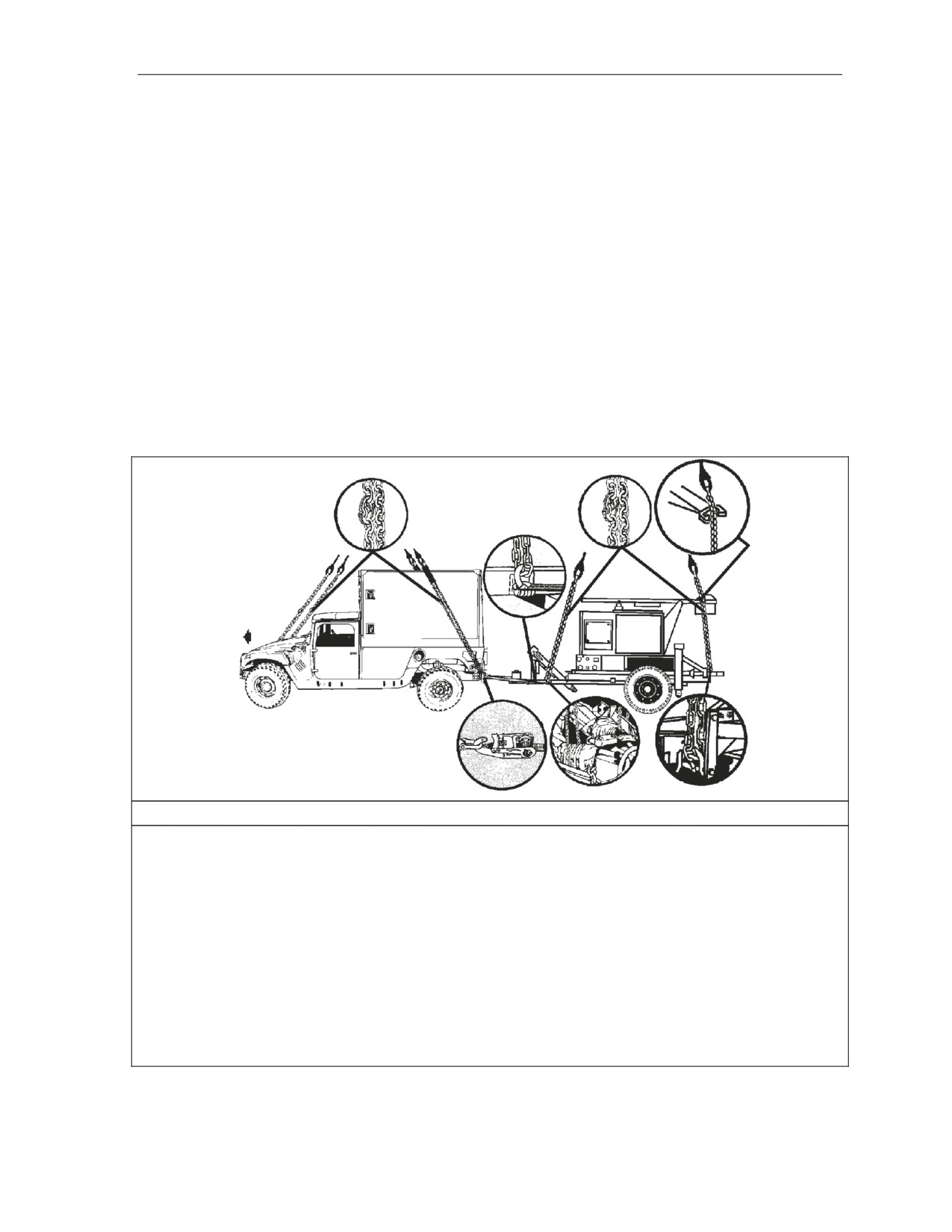
Rigging. Rig the load according to the steps in Figure 5-8.
Hookup. Two hookup persons are required for this load. The forward hookup person stands on cab
of the truck and places reach pendant 1 onto the forward cargo hook. The aft hookup person stands on the
fender of the trailer and places reach pendant 2 onto the aft cargo hook. The hookup team then carefully
dismounts the trailer and remains close to the load as the helicopter removes slack from the sling legs.
When successful hookup is assured, the hookup team quickly exits the area underneath the helicopter to
the designated rendezvous point.
Derigging. Derigging is the reverse of the preparation and rigging procedures.
RIGGING STEPS
1. Position apex fitting and reach pendant on top of the shelter. Route outer sling legs 1 and 2
to the front of the vehicle and inner sling legs 3 and 4 to the rear. Sling legs 1 and 3 must be
on the left side of the load.
2. Loop the chain end of sling leg 1 through the left front lift provision that protrudes through the
hood of the truck. Place the correct link from Table 5-8 in the grab hook. Repeat with sling
leg 2 and the right front lift provision. Secure excess chain with tape or Type III nylon cord.
3. Loop the chain end of the sling legs through their respective lift provisions located on the
outer ends of the rear bumper. Place the correct link from Table 5-8 in the grab hook.
4. Pad the chain where it contacts the shelter sides.
Figure 5-8. M1037 Shelter Carrier, 1-1/4 Ton with AN/TPQ-36, (S-250 Shelter), Operations
Control Group and Radar Set Antenna Mounted on M103A1 Trailer
FM 4-20.199/MCRP 4-11.3E, VOL III/NTTP 3-04.13/
20 February 2009
AFMAN 11-223 (I), VOL III/COMDINST M13482.4B
5-25

Chapter 5
RIGGING STEPS (Continued)
5. Cluster and tie (breakaway technique) all sling legs together on top of the vehicle to prevent
entanglement during hookup and lift-off.
6. Position the apex fitting of sling set 2 on top of the trailer but not on top of the radar panel.
Route outer sling legs 1 and 2 to the front of the trailer and inner sling legs 3 and 4 to the rear
of the trailer. Sling legs 1 and 3 must be on the left side of the load.
7. Loop the chain end of sling leg 1 around the left side of the lunette in the padded area inside
the handle. Place the correct link from Table 5-8 in the grab hook. Ensure the chain is aft of
the CGU-1/B tiedown strap. Repeat with sling leg 2 through the right front lift provision.
Secure excess chain with tape or Type III nylon cord.
8. Loop the chain end of sling leg 3 through the left rear lift provision. Place the correct link from
Table 5-8 in the grab hook. Remove the slack from the sling leg and pad the sling/chain
where it contacts the sling leg guide on the antenna. Place the sling leg in the guide and
secure with a breakaway tie. Repeat with sling leg 4 through the right rear lift provision.
Secure excess chain with tape or Type III nylon cord.
9. Cluster and tie (breakaway technique) all sling legs together on top of the trailer to prevent
entanglement during hookup and lift-off.
Figure 5-8. M1037 Shelter Carrier, 1-1/4 Ton with AN/TPQ-36, (S-250 Shelter), Operations
Control Group and Radar Set Antenna Mounted on M103A1 Trailer (Continued)
M1097 SHELTER CARRIER (HMMWV) WITH S-250 SHELTER AND
TRAILER GENERATOR SETS ON M116A2 TRAILER
5-10. The M1097 shelter carrier with S-250 shelter and trailer generator sets on M116A2 trailer are rigged
for dual-point sling load using the following procedures:
z
Applicability. The following items in Table 5-9 are certified for the helicopter(s) listed in the
following table by the US Army Natick Soldier Center:
Table 5-9. M1097 Shelter Carrier (HMMWV) with S-250 Shelter and Trailer Generator Sets on
M116A2 Trailer
Nomenclature
Max Weight
Sling
Link Count
Type of
(Pounds)
Set
Front/Rear
Aircraft
Truck, 1 ¼-Ton, M1097 with AN/TSC-93A, S-250
9,769
25K
64/22
CH-47
Shelter
Pu-753 Generator Set on M116A2 Trailer
3,000
25K
72/56
CH-47
Truck, 1 ¼-Ton, M1097 with S-250 Shelter, LOS (V1)
9,038
25K
60/20
CH-47
Truck, 1 ¼-Ton, M1097 with S-250 Shelter, LOS (V2)
9,038
25K
60/20
CH-47
Truck, 1 ¼-Ton, M1097 with S-250 Shelter, LOS (V3)
9,038
25K
60/20
CH-47
Truck, 1 ¼-Ton, M1097 with S-250 Shelter, LOS (V4)
9,038
25K
60/20
CH-47
PU-751 Generator Set on M116A2 Trailer
3,062
25K
10/15
CH-47
z
Materials. The following materials are required to rig this load:
Sling set (25,000-pound capacity) (2 each).
─ Additional chain length, part number 38850-00053-102, from a 25,000-pound capacity
sling set (8 each).
─ Additional coupling link, part number 664241, from a 25,000-pound sling set (8 each).
FM 4-20.199/MCRP 4-11.3E, VOL III/NTTP 3-04.13/
5-26
AFMAN 11-223 (I), VOL III/COMDINST M13482.4B
20 February 2009
Certified Dual-Point Rigging Procedures for Tandem Loads
Tape, adhesive, pressure-sensitive, 2-inch wide roll.
Cord, nylon, Type III, 550-pound breaking strength.
Webbing, cotton, 1/4-inch, 80-pound breaking strength.
Strap, cargo, tiedown, CGU-1/B (2 each).
Felt sheet, cattle hair, Type IV, 1/2-inch or suitable substitute.
z
Personnel. Two persons can prepare and rig the M1097 HMMWV in 15 minutes. Two persons
can prepare and rig the generator set in 10 minutes.
z
Procedures. Attach the generator set to the truck by placing the lunette on the pintle hook and
securing the latch with tape or Type III nylon cord. Secure the safety chains, cables, and hoses.
Position the vehicle on level ground so both the truck and generator set are in a straight line.
The following procedures apply to this load:
Preparation. Prepare the load using the following steps:
─
Fold mirrors inward and tie together with Type III nylon cord. Remove the doors and
secure to the seats with Type III nylon cord.
─
Ensure the shelter is secured to the vehicle using wire rope or tiedown straps. Secure
all loose equipment inside the shelter with tape, Type III nylon cord, or tie-down
straps. Close and secure the door.
─
Secure all equipment and cargo inside the truck with tiedown straps, tape, or Type III
nylon cord.
─
Ensure the fuel tanks are not over 3/4 full. Inspect the fuel tank cap, oil filler cap, and
battery caps for proper installation.
─
Engage the vehicle parking brake and put the transmission in neutral.
─
Ensure the front wheels are pointed straight ahead. Tie down the steering wheel, using
the securing device attached under the dashboard.
─
Install the lift provisions on the outer ends of the rear bumper by removing the tiedown
provisions located on the front bumper and installing on the outer ends of the front
bumper and installing on the outer ends of the rear bumper.
─
Partially retract all landing legs and secure in position with Type III nylon cord.
─
Retract the lunette leg and secure with Type III nylon cord.
─
Secure all lids, doors, and caps with tape or Type III nylon cord.
─
Ensure the parking brake is set.
─
Route the hook portion of a CGU-1/B tiedown strap through the left rear inboard
tiedown provision located near the pintle on the rear bumper of the truck and through
the mounting bracket on the front of the trailer A-frame. Connect the hook to the
ratchet of the CGU-1/B.
─
Repeat the above procedure on the right side of the load.
─
Tighten both CGU-1/B tie-down straps at the same time. Secure the excess strap and
safety the ratchet handles in the closed position with tape.
─
Connect one additional chain length to each chain on each sling set with a coupling
link.
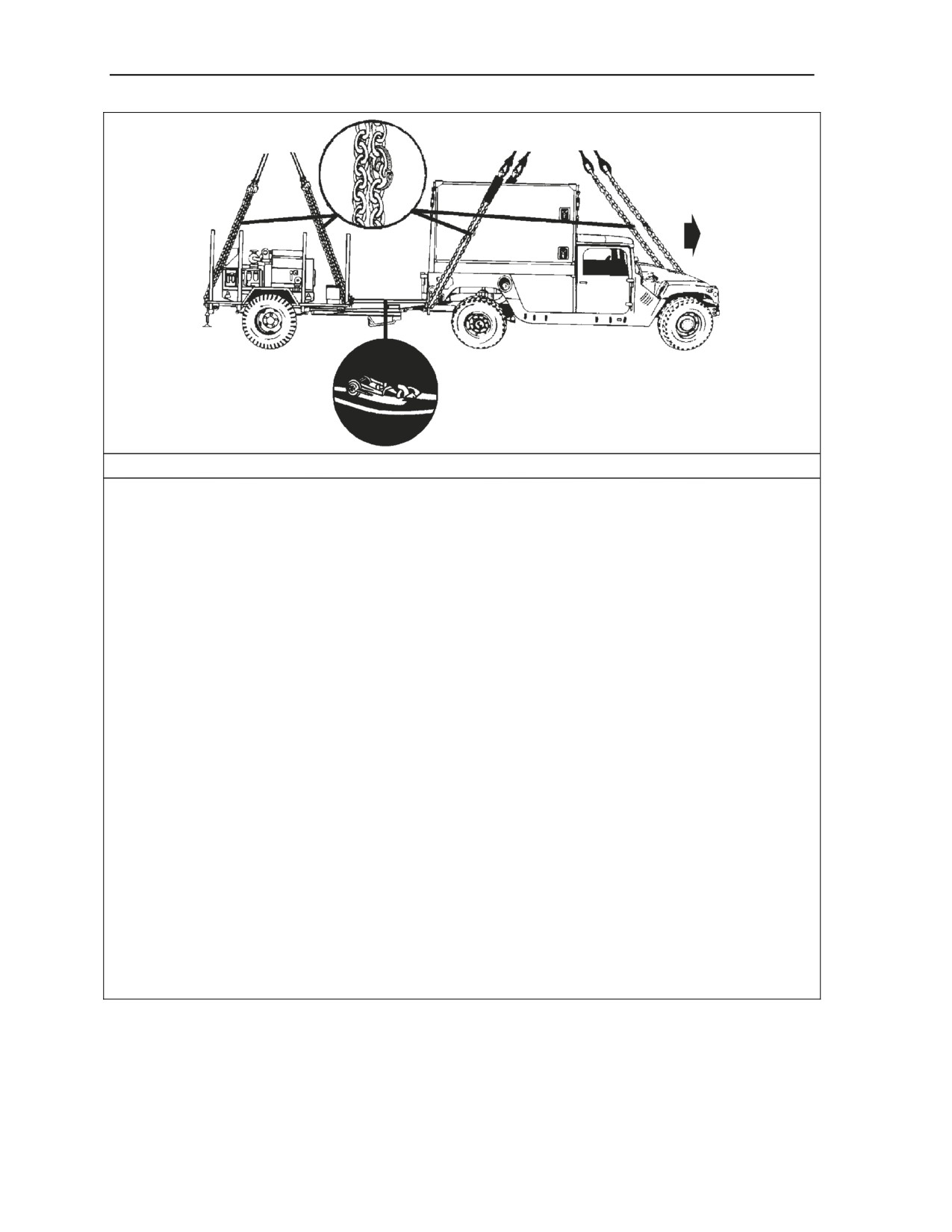
Rigging. Rig the load according to the steps in Figure 5-9.
Hookup. Two hookup teams are required for this load. The static wand person discharges
the static electricity with the static wand. The forward hookup person kneels on top of the shelter
and places apex fitting 1 onto the forward cargo hook. The aft hookup person stands on the
generator fender and places apex fitting 2 onto the aft cargo hook. The hookup team then
carefully dismounts the trailer and remains close to the load as the helicopter removes slack
from the sling legs. When successful hookup is assured, the hookup team quickly exits the
area underneath the helicopter to the designated rendezvous point.
Derigging. Derigging is the reverse of the preparation and rigging procedures.
FM 4-20.199/MCRP 4-11.3E, VOL III/NTTP 3-04.13/
20 February 2009
AFMAN 11-223 (I), VOL III/COMDINST M13482.4B
5-27
Chapter 5
RIGGING STEPS
1.
Position apex fitting on top of the shelter. Route outer sling legs 1 and 2 to the front of the vehicle and
inner sling legs 3 and 4 to the rear. Sling legs 1 and 3 must be on the left side of the load.
2.
Loop the chain end of sling leg 1 through the left front lift provision that protrudes through the hood from
inboard to outboard. Place the correct link from Table 5-9 in the grab hook. Repeat with sling leg 2 and
the right front lift provision. Secure excess chain with tape or Type III nylon cord.
3.
Loop the chain end of the sling legs through their respective lift provisions located on the outer ends of
the rear bumper. Place the correct link from Table 5-9 in the grab hook. Secure excess chain with tape
or Type III nylon cord.
4.
Pad the chain where it contacts the shelter sides.
5.
Cluster and tie (breakaway technique) all sling legs together on top of the vehicle to prevent
entanglement during hookup and lift-off.
6.
Position the apex fitting of sling set 2 on top of the generator set. Route outer sling legs 1and 2
between the two front bows to the front of the generator and inner sling legs 3 and 4 between the two
rear bows to the rear of the generator. Sling legs 1 and 3 must be on the left side of the load.
7.
Loop the chain end of sling leg 1 through the left front lift provision located on the front of the trailer.
Place the correct link from Table 5-9 in the grab hook. Repeat with sling leg 2 through the right front lift
provision. Secure excess chain with tape or Type III nylon cord.
8.
Loop the chain end of sling leg 3 through the left rear lift provision. Place the correct link from Table 5-9
in the grab hook. Repeat with sling leg 4 through the right rear lift provision. Secure excess chain with
tape or Type III nylon cord.
9.
Cluster and tie or tape (breakaway technique) all sling legs together on top of the trailer to prevent
entanglement during hookup and lift-off.
Figure 5-9. M1097 Shelter Carrier (HMMWV) with S-250 Shelter and Trailer Generator Sets on
M116A2 Trailer
FM 4-20.199/MCRP 4-11.3E, VOL III/NTTP 3-04.13/
5-28
AFMAN 11-223 (I), VOL III/COMDINST M13482.4B
20 February 2009
Certified Dual-Point Rigging Procedures for Tandem Loads
M1097 (HMMWV) WITH AN/TSQ-183, COUNTER BATTERY RADAR
AND MEP802A GENERATOR ON M116A3 TRAILER
5-11. The M1097 with AN/TSQ-183, counter battery radar and MEP802A generator on M116A3 trailer
are rigged for dual-point sling load using the following procedures:
z
Applicability. The following items in Table 5-10 are certified for the helicopter(s) listed in the
following table by the US Army Natick Soldier Center:
Table 5-10. M1097 with AN/TSQ-183 Counter Battery Radar and MEP802A Generator on
M116A3 Trailer
Nomenclature
Max Weight
Sling
Link Count
Type of
(Pounds)
Set
Front/Rear
Aircraft
Truck, 1 ¼-Ton, M1097 with AN/TSQ-183Counter
8,500
10K
80/3
CH-47
Battery Radar
MEP802A Generator on M116A3 Trailer
1,580
10K
15/20
CH-47
z
Materials. The following materials are required to rig this load:
Sling set (10,000-pound capacity) (2 each).
Tape, adhesive, pressure-sensitive, 2-inch wide roll.
Cord, nylon, Type III, 550-pound breaking strength.
Webbing, cotton, 1/4-inch, 80-pound breaking strength.
Strap, cargo, tiedown, CGU-1/B (4 each).
Felt sheet, cattle hair, Type IV, 1/2-inch or suitable substitute.
z
Personnel. Two persons can prepare and rig the M1097 HMMWV in 15 minutes. Two persons
can prepare and rig the generator set in 10 minutes.
z
Procedures. Attach the generator set to the truck by placing the lunette on the pintle hook and
securing the latch with tape or Type III nylon cord. Secure the safety chains, cables, and hoses.
Position the vehicle on level ground so both the truck and generator set are in a straight line.
The following procedures apply to this load:
Preparation. Prepare the load using the following steps:
─ Fold mirrors inward and tie together with Type III nylon cord. Remove the doors and
secure to the seats with Type III nylon cord.
─ Roll the shelter canvas forward toward the cab. Install the canvas bows over the canvas
and secure with tiedowns or Type III nylon cord.
─ Secure all equipment and cargo inside the truck with tiedown straps, tape, or Type III
nylon cord.
─ Ensure the fuel tanks are not over 3/4 full. Inspect the fuel tank cap, oil filler cap, and
battery caps for proper installation.
─ Engage the vehicle parking brake and put the transmission in neutral.
─ Ensure the front wheels are pointed straight ahead. Tie down the steering wheel, using
the securing device attached under the dashboard.
─ Install the lift provisions on the outer ends of the rear bumper by removing the tiedown
provisions located on the front bumper and installing on the outer ends of the front
bumper and installing on the outer ends of the rear bumper.
─ Retract the lunette leg and secure with Type III nylon cord.
─ Secure all lids, doors, and caps with tape or Type III nylon cord.
─ Ensure the parking brake is set.
─ Route the hook portion of a CGU-1/B tiedown strap through the left rear inboard
tiedown provision located near the pintle on the rear bumper of the truck and through
the mounting bracket on the front of the trailer A-frame. Connect the hook to the
ratchet of the CGU-1/B.
FM 4-20.199/MCRP 4-11.3E, VOL III/NTTP 3-04.13/
20 February 2009
AFMAN 11-223 (I), VOL III/COMDINST M13482.4B
5-29
Chapter 5
─ Repeat the above procedure on the right side of the load.
─ Tighten both CGU-1/B tiedown straps at the same time. Secure the excess strap and
safety the ratchet handles in the closed position with tape.
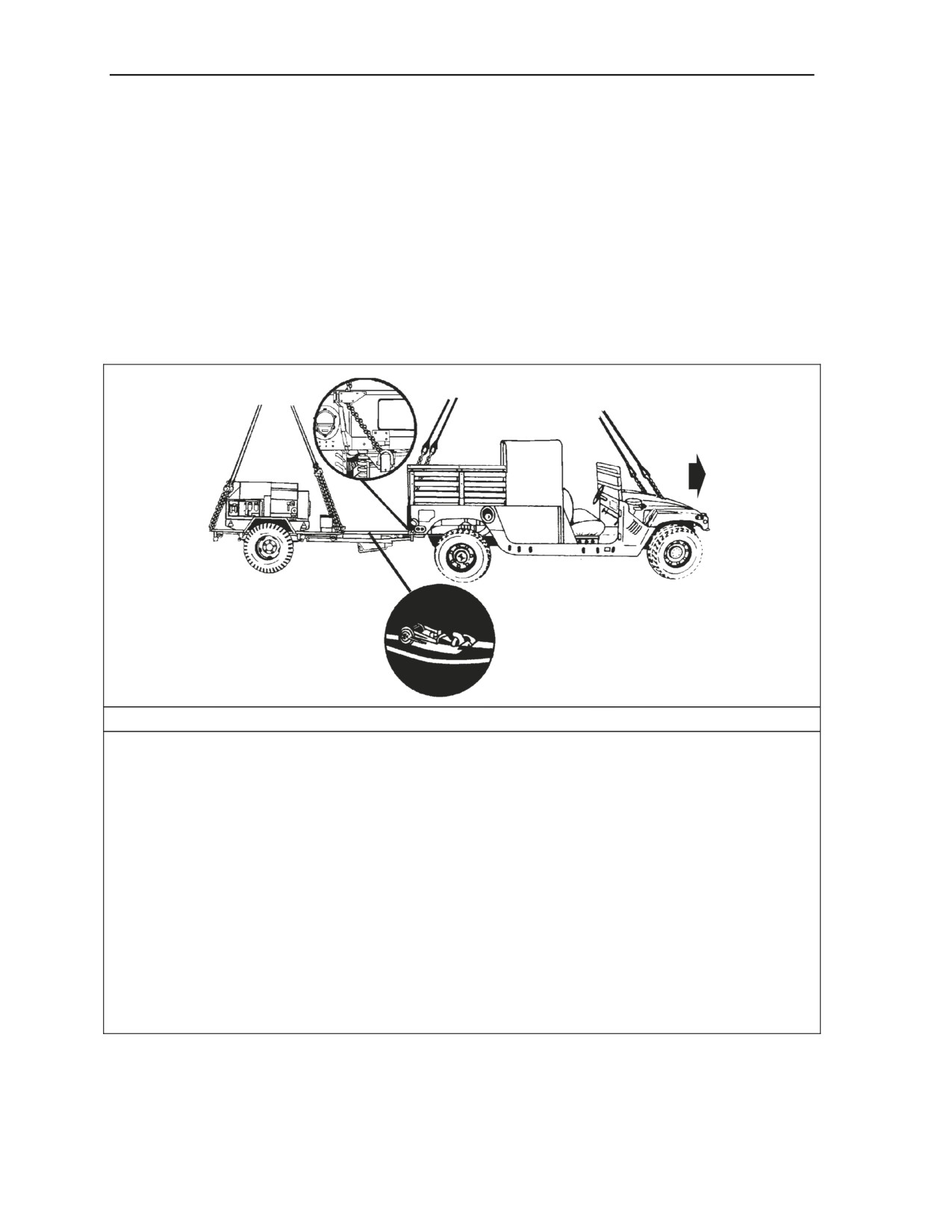
Rigging. Rig the load according to the steps in Figure 5-10.
Hookup. Two hookup teams are required for this load. The static wand person discharges
the static electricity with the static wand. The forward hookup person kneels on top of the vehicle
and places apex fitting 1 onto the forward cargo hook. The aft hookup person stands on the
generator fender and places apex fitting 2 onto the aft cargo hook. The hookup team then
carefully dismounts the trailer and remains close to the load as the helicopter removes slack
from the sling legs. When successful hookup is assured, the hookup team quickly exits the
area underneath the helicopter to the designated rendezvous point.
Derigging. Derigging is the reverse of the preparation and rigging procedures.
RIGGING STEPS
1. Position apex fitting on top of the truck. Route outer sling legs 1 and 2 to the front of the
vehicle and inner sling legs 3 and 4 to the rear. Sling legs 1 and 3 must be on the left side of
the load.
2. Loop the chain end of sling leg 1 through the left front lift provision that protrudes through the
hood of the vehicle. Place the correct link from Table 5-10 in the grab hook. Repeat with
sling leg 2 and the right front lift provision. Secure excess chain with tape or Type III nylon
cord.
3. Route the chain end of sling leg 3 through the eyelet opening in the upper left corner of the
tailgate. Loop the chain end through the left lift provision on the bumper and thread back
through the eyelet opening in the tailgate. Place the correct link from Table 5-10 in the grab
hook. Repeat with sling leg 4 and the right rear lift provision.
4. Cluster and tie (breakaway technique) all sling legs together on top of the vehicle to prevent
entanglement during hookup and lift-off.
Figure 5-10. M1097 with AN/TSQ-183 Counter Battery Radar and MEP802A Generator on
M116A3 Trailer
FM 4-20.199/MCRP 4-11.3E, VOL III/NTTP 3-04.13/
5-30
AFMAN 11-223 (I), VOL III/COMDINST M13482.4B
20 February 2009

Certified Dual-Point Rigging Procedures for Tandem Loads
RIGGING STEPS (Continued)
5. Position the apex fitting of sling set 2 on top of the generator set. Route outer sling legs 1and
2 to the front of the generator and inner sling legs 3 and 4 to the rear of the generator. Sling
legs 1 and 3 must be on the left side of the load.
6. Loop the chain end of sling leg 1 through the left front lift provision located on the front of the
trailer. Place the correct link from Table 5-10 in the grab hook. Repeat with sling leg 2
through the right front lift provision. Secure excess chain with tape or Type III nylon cord.
7. Loop the chain end of sling leg 3 through the left rear lift provision. Place the correct link from
Table 5-10 in the grab hook. Repeat with sling leg 4 through the right rear lift provision.
Secure excess chain with tape or Type III nylon cord.
8. Pad the chains where they contact the loads.
9. Cluster and tie (breakaway technique) all sling legs together on top of the trailer to prevent
entanglement during hookup and lift-off.
Figure 5-10. M1097 with AN/TSQ-183 Counter Battery Radar and MEP802A Generator on
M116A3 Trailer (Continued)
M1097 (HMMWV) WITH AN/TSQ-183, COUNTER BATTERY RADAR
AND M101A2 TRAILER
5-12. The M1097 with AN/TSQ-183, counter battery radar and M101A2 trailer are rigged for dual-point
sling load using the following procedures:
z
Applicability. The following items in Table 5-11 are certified for the helicopter(s) listed in the
following table by the US Army Natick Soldier Center:
Table 5-11. M1097 with AN/TSQ-183 Counter Battery Radar and M101A2 Trailer
Nomenclature
Max Weight
Sling
Link Count
Type of
(Pounds)
Set
Front/Rear
Aircraft
Truck, 1 ¼-Ton, M1097 with AN/TSQ-183Counter
8,500
10K
80/3
CH-47
Battery Radar
M101A2 Trailer
2,300
10K
15/20
CH-47
z
Materials. The following materials are required to rig this load:
Sling set (10,000-pound capacity) (2 each).
Tape, adhesive, pressure-sensitive, 2-inch wide roll.
Cord, nylon, Type III, 550-pound breaking strength.
Webbing, cotton, 1/4-inch, 80-pound breaking strength.
Strap, cargo, tiedown, CGU-1/B (4 each).
Felt sheet, cattle hair, Type IV, 1/2-inch or suitable substitute.
z
Personnel. Two persons can prepare and rig the M1097 HMMWV in 15 minutes. Two persons
can prepare and rig the generator set in 10 minutes.
FM 4-20.199/MCRP 4-11.3E, VOL III/NTTP 3-04.13/
20 February 2009
AFMAN 11-223 (I), VOL III/COMDINST M13482.4B
5-31
Chapter 5
z
Procedures. Attach the trailer to the truck by placing the lunette on the pintle hook and
securing the latch with tape or Type III nylon cord. Secure the safety chains, cables, and hoses.
Position the vehicle on level ground so both the truck and trailer are in a straight line. The
following procedures apply to this load:
Preparation. Prepare the load using the following steps:
─
Fold mirrors inward and tie together with Type III nylon cord. Remove the doors and
secure to the seats with Type III nylon cord.
─
Roll the shelter canvas forward toward the cab. Install the canvas bows over the canvas
and secure with tiedowns or Type III nylon cord.
─
Secure all equipment and cargo inside the truck with tie down straps, tape, or Type III
nylon cord.
─
Ensure the fuel tank is not over 3/4 full. Inspect the fuel tank cap, oil filler cap, and
battery caps for proper installation.
─
Engage the vehicle parking brake and put the transmission in neutral.
─
Ensure the front wheels are pointed straight ahead. Tie down the steering wheel, using
the securing device attached under the dashboard.
─
Install the lift provisions on the outer ends of the rear bumper by removing the tiedown
provisions located on the front bumper and installing on the outer ends of the front
bumper and installing on the outer ends of the rear bumper.
─
Retract the lunette leg and secure with Type III nylon cord.
─
Ensure the parking brake is set.
─
Remove the trailer rack and place in the bed of the trailer. Place the cargo on top of
the rack and secure with CGU-1/B cargo straps by routing the strap diagonally over
the cargo.
─
Place the trailer tailgate in the open position and hook the chain in the keeper.
─
Route a CGU-1/B tiedown strap around the bumper on the left side of the rear bumper
of the truck, back to and around the left side of the trailer axle. Do not interfere with
the hydraulic lines or brake cable on the axle. Attach the hook portion and the ratchet
of the CGU-1/B together.
─
Repeat the above procedure on the right side of the load.
─
Tighten both CGU-1/B tiedown straps at the same time. Secure the excess strap and
safety the ratchet handles in the closed position with tape.
Rigging. Rig the load according to the steps in Figure 5-11.
Hookup. Two hookup teams are required for this load. The static wand person discharges
the static electricity with the static wand. The forward hookup person kneels on top of the vehicle
and places apex fitting 1 onto the forward cargo hook. The aft hookup person stands on the
generator fender and places apex fitting 2 onto the aft cargo hook. The hookup team then
carefully dismounts the trailer and remains close to the load as the helicopter removes slack
from the sling legs. When successful hookup is assured, the hookup team quickly exits the
area underneath the helicopter to the designated rendezvous point.
Derigging. Derigging is the reverse of the preparation and rigging procedures.
FM 4-20.199/MCRP 4-11.3E, VOL III/NTTP 3-04.13/
5-32
AFMAN 11-223 (I), VOL III/COMDINST M13482.4B
20 February 2009
Certified Dual-Point Rigging Procedures for Tandem Loads
RIGGING STEPS
1.
Position apex fitting on top of the truck. Route outer sling legs 1 and 2 to the front of the vehicle and
inner sling legs 3 and 4 to the rear. Sling legs 1 and 3 must be on the left side of the load.
2.
Loop the chain end of sling leg 1 through the left front lift provision that protrudes through the hood of
the vehicle. Place the correct link from Table 5-11 in the grab hook. Repeat with sling leg 2 and the
right front lift provision. Secure excess chain with tape or Type III nylon cord.
3.
Route the chain end of sling leg 3 through the eyelet opening in the upper left corner of the tailgate.
Loop the chain end through the left lift provision on the bumper and thread back through the eyelet
opening in the tailgate. Place the correct link from Table 5-11 in the grab hook. Repeat with sling leg 4
and the right rear lift provision.
4.
Cluster and tie (breakaway technique) all sling legs together on top of the vehicle to prevent
entanglement during hookup and lift-off.
5.
Position the apex fitting of sling set 2 on top of the trailer. Route outer sling legs 1and 2 to the front of
the trailer and inner sling legs 3 and 4 to the rear of the trailer. Sling legs 1 and 3 must be on the left
side of the load.
6.
Loop the chain end of sling leg 1 through the left front lift provision located on the front of the trailer.
Place the correct link from Table 5-11 in the grab hook. Repeat with sling leg 2 through the right front lift
provision. Secure excess chain with tape or Type III nylon cord.
7.
Loop the chain end of sling leg 3 through the left rear lift provision. Place the correct link from Table 5-
11 in the grab hook. Repeat with sling leg 4 through the right rear lift provision. Secure excess chain
with tape or Type III nylon cord.
8.
Pad the chains where they contact the loads.
9.
Cluster and tie (breakaway technique) all sling legs together on top of the trailer to prevent
entanglement during hookup and lift-off.
Figure 5-11. M1097 with AN/TSQ-183 Counter Battery Radar and M101A2 Trailer
FM 4-20.199/MCRP 4-11.3E, VOL III/NTTP 3-04.13/
20 February 2009
AFMAN 11-223 (I), VOL III/COMDINST M13482.4B
5-33
Chapter 5
JOINT SURVEILLANCE TARGET ATTACK RADAR (JSTAR)
SYSTEM, WITH LMS SHELTER AND MISSION TRAILER, HMT
WITH GENERATOR
5-13. The joint surveillance target attack radar system, with LMS shelter and mission trailer, HMT with
generator are rigged for dual-point sling load using the following procedures:
z
Applicability. The following items in Table 5-12 are certified for the helicopter(s) listed in the
following table by the US Army Natick Soldier Center:
Table 5-12. JSTAR Mission Vehicle and Mission Trailer
Nomenclature
Max Weight
Sling
Link Count
Type of
(Pounds)
Set
Front/Rear
Aircraft
JSTAR Mission Vehicle, M1097 with LMS Shelter
HMMWV-9,530
10K
60/10
CH-47
and JSTAR Mission Trailer, HMT with Generator Set
Trailer-3,690
10K
40/40
JSTAR Mission Vehicle, Common Ground Station
HMMWV-9,302
25K
15/5
CH-47
(CGS) M1113 with LMS Shelter and JSTAR Mission
Trailer-4,114
25K
25/30
Trailer, HMT with Generator Set
(Modified M1102 HMT)
z
Materials. The following materials are required to rig this load:
Sling set (10,000-pound capacity) (2 each).
─ Additional chain length, part number 38850-00053-101, from a 10,000-pound capacity
sling set (8 each).
─ Additional coupling link, part number 577-0615, from a 10,000-pound sling set (8
each).
OR
Sling set (25,000-pound capacity) (2 each).
─ Chain length, part number 38850-00053-102, from a 25,000-pound capacity sling set
(8 each).
─ Coupling link, NSN 4010-01-041-9751, from a 25,000-pound sling set (8 each).
Tape, adhesive, pressure-sensitive, 2-inch wide roll.
Cord, nylon, Type III, 550-pound breaking strength.
Webbing, cotton, 1/4-inch, 80-pound breaking strength.
Strap, cargo, tiedown, CGU-1/B (2 each).
Felt sheet, cattle hair, Type IV, 1/2-inch or suitable substitute.
z
Personnel. Two persons can prepare and rig the M1097 HMMWV in 15 minutes. Two persons
can prepare and rig the generator set in 10 minutes.
z
Procedures. Attach the generator set to the truck by placing the lunette on the pintle hook and
securing the latch with tape or Type III nylon cord. Secure the safety chains, cables, and hoses.
Position the vehicle on level ground so both the truck and generator set are in a straight line.
The following procedures apply to this load:
Preparation. Prepare the load using the following steps:
─ Fold mirrors inward and tie together with Type III nylon cord. Remove the doors and
secure to the seats with Type III nylon cord.
─ Remove the two transfer cases from the trailer and stow and secure inside the shelter.
Secure all loose equipment inside the shelter with tape, Type III nylon cord, or tiedown
straps.
─ Secure all equipment and cargo inside the truck with tiedown straps, tape, or Type III
nylon cord.
FM 4-20.199/MCRP 4-11.3E, VOL III/NTTP 3-04.13/
5-34
AFMAN 11-223 (I), VOL III/COMDINST M13482.4B
20 February 2009
Certified Dual-Point Rigging Procedures for Tandem Loads
─ Ensure the fuel tanks are not over 3/4 full. Inspect the fuel tank cap, oil filler cap, and
battery caps for proper installation.
─ Engage the vehicle parking brake and put the transmission in neutral.
─ Ensure the front wheels are pointed straight ahead. Tie down the steering wheel, using
the securing device attached under the dashboard.
─ Install the lift provisions on the outer ends of the rear bumper by removing the tiedown
provisions located on the front bumper and installing on the outer ends of the front
bumper and installing on the outer ends of the rear bumper.
─ Retract the lunette leg and secure with Type III nylon cord.
─ Secure all lids, doors, and caps with tape or Type III nylon cord.
─ Ensure the parking brake is set.
─ Route the hook portion of a CGU-1/B tiedown strap through the left rear inboard tie
down provision located near the pintle on the rear bumper of the truck. Loop the
tiedown through the left front trailer lift provision located on the left front of the
trailer. Attach the hook portion of the tiedown strap to the ratchet.
Note. Do not attach the tiedown strap to the rear wheels of the vehicle. The rear wheels may
rotate during flight causing slack in the straps.
─ Repeat the above procedure on the right side of the load.
─ Tighten both CGU-1/B tiedown straps at the same time. Secure the excess strap and
safety the ratchet handles in the closed position with tape.
─ Connect one additional chain length to each chain on each sling set with a coupling
link.
Rigging. Rig the load according to the steps in Figure 5-12.
Hookup. Two hookup teams are required for this load. The static wand person discharges
the static electricity with the static wand. The forward hookup person kneels on top of the shelter
and places apex fitting 1 onto the forward cargo hook. The aft hookup person kneels on top of the
generator and places apex fitting 2 onto the aft cargo hook. The hookup team then carefully
dismounts the trailer and remains close to the load as the helicopter removes slack from the
sling legs. When successful hookup is assured, the hookup team quickly exits the area
underneath the helicopter to the designated rendezvous point.
Derigging. Derigging is the reverse of the preparation and rigging procedures.
FM 4-20.199/MCRP 4-11.3E, VOL III/NTTP 3-04.13/
20 February 2009
AFMAN 11-223 (I), VOL III/COMDINST M13482.4B
5-35
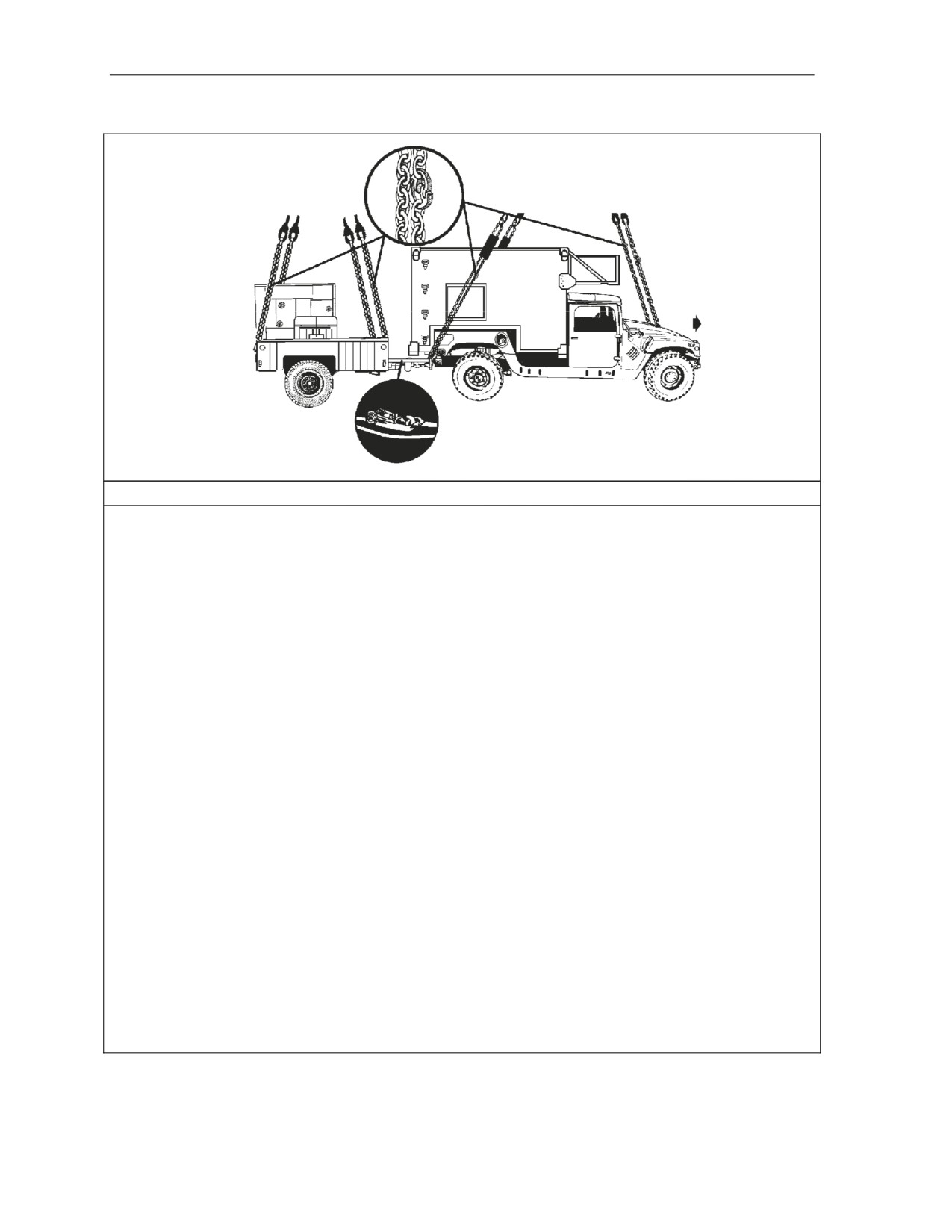
Chapter 5
RIGGING STEPS
1.
Position apex fitting on top of the shelter. Route outer sling legs 1 and 2 to the front of the vehicle and
inner sling legs 3 and 4 to the rear. Sling legs 1 and 3 must be on the left side of the load.
2.
Loop the chain end of sling leg 1 through the left front lift provision that protrudes through the hood from
inboard to outboard. Place the correct link from Table 5-12 in the grab hook. Repeat with sling leg 2
and the right front lift provision. Secure excess chain with tape or Type III nylon cord.
3.
Loop the chain end of the sling legs through their respective lift provisions located on the outer ends of
the rear bumper. Place the correct link from Table 5-12 in the grab hook. Secure excess chain with
tape or Type III nylon cord.
4.
Pad the chain where it contacts the shelter sides.
5.
Cluster and tie (breakaway technique) all sling legs together on top of the vehicle to prevent
entanglement during hookup and lift-off.
6.
Position the apex fitting of sling set 2 on top of the generator set. Route outer sling legs 1 and 2 to the
front of the generator and inner sling legs 3 and 4 to the rear of the generator. Sling legs 1 and 3 must
be on the left side of the load.
7.
Loop the chain end of sling leg 1 through the left front lift provision located on the front of the trailer.
Place the correct link from Table 5-12 in the grab hook. Repeat with sling leg 2 through the right front lift
provision. Secure excess chain with tape or Type III nylon cord.
8.
Loop the chain end of sling leg 3 through the left rear lift provision. Place the correct link from Table 5-
12 in the grab hook. Repeat with sling leg 4 through the right rear lift provision. Secure excess chain
with tape or Type III nylon cord.
9.
Cluster and tie (breakaway technique) all sling legs together on top of the trailer to prevent
entanglement during hookup and lift-off.
Figure 5-12. Joint Surveillance Target Attack Radar (JSTAR) System, M1097 (HMMWV)
Mission Vehicle with LMS Shelter and Mission Trailer, HMT with Generator
FM 4-20.199/MCRP 4-11.3E, VOL III/NTTP 3-04.13/
5-36
AFMAN 11-223 (I), VOL III/COMDINST M13482.4B
20 February 2009
Certified Dual-Point Rigging Procedures for Tandem Loads
M1097 SHELTER CARRIER, 1-1/4 TON (HMMWV) WITH AN/TPQ-
36(V)7, (S-250 SHELTER), OPERATIONS CONTROL GROUP, OKG-
398/TPW, AND M116A2 EQUIPMENT TRAILER GROUP
5-14. The M1097 shelter carrier, 1-1/4 ton with AN/TPQ-36(V)7, (S-250 shelter), operations control
group, OKG-398/TPW, and M116A2 equipment trailer group are rigged for dual-point sling load using the
following procedures:
z
Applicability. The following items in Table 5-13 are certified for the helicopter(s) listed in the
following table by the US Army Natick Soldier Center:
Table 5-13. M1097 Shelter Carrier, 1-1/4 Ton with AN/TPQ-36(V)7, (S-250 Shelter), Operations
Control Group, OKG-398/TPW, and M116A2 Equipment Trailer Group
Nomenclature
Max Weight
Sling
Link Count
Type of
(Pounds)
Set
Front/Rear
Aircraft
Truck, Shelter Carrier, M1097 with OKG-398/TPW,
8,500
10K
80/5
CH-47
Operations Control Group, (S-250 Shelter)
Equipment Trailer Group, M116A2
2,300
10K
90/70
CH-47
z
Materials. The following materials are required to rig this load:
Sling set (10,000-pound capacity) (2 each).
─ Additional chain length, part number 38850-00053-101, from a 10,000-pound capacity
sling set (8 each).
─ Additional coupling link, part number 577-0615, from a 10,000-pound sling set (8
each).
Tape, adhesive, pressure-sensitive, 2-inch wide roll.
Cord, nylon, Type III, 550-pound breaking strength.
Webbing, cotton, 1/4-inch, 80-pound breaking strength.
Strap, cargo, tiedown, CGU-1/B (2 each, or more as required to secure cargo).
Felt sheet, cattle hair, Type IV, 1/2-inch or suitable substitute.
z
Personnel. Two persons can prepare and rig the M1097 HMMWV in 15 minutes. Two persons
can prepare and rig the trailer in 15 minutes.
z
Procedures. Attach the trailer to the truck by placing the lunette on the pintle hook and
securing the latch. Secure the safety chains, cables, and hoses. Position the vehicle on level
ground so both the truck and trailer are in a straight line. The following procedures apply to this
load:
Preparation. Prepare the load using the following steps:
─ Fold the mirrors in and tie together with Type III nylon cord. Remove the doors and
secure to the seats with Type III nylon cord.
─ Secure all loose equipment inside the shelter with tape, Type III nylon cord, or tiedown
straps.
─ Secure all equipment and cargo inside the truck with tiedown straps, tape, or Type III
nylon cord.
─ Ensure the fuel tank is not over 3/4 full. Inspect the fuel tank cap, oil filler cap, and
battery caps for proper installation.
─ Engage the vehicle parking brake and put the transmission in neutral.
─ Ensure the front wheels are pointed straight ahead. Tie down the steering wheel, using the
securing device attached under the dashboard.
─ Install the lift provisions on the outer ends of the rear bumper by removing the tiedown
provisions located on the front bumper and installing on the outer ends of the rear bumper.
─ Raise the landing leg and secure in position with safety pins and tape.
FM 4-20.199/MCRP 4-11.3E, VOL III/NTTP 3-04.13/
20 February 2009
AFMAN 11-223 (I), VOL III/COMDINST M13482.4B
5-37
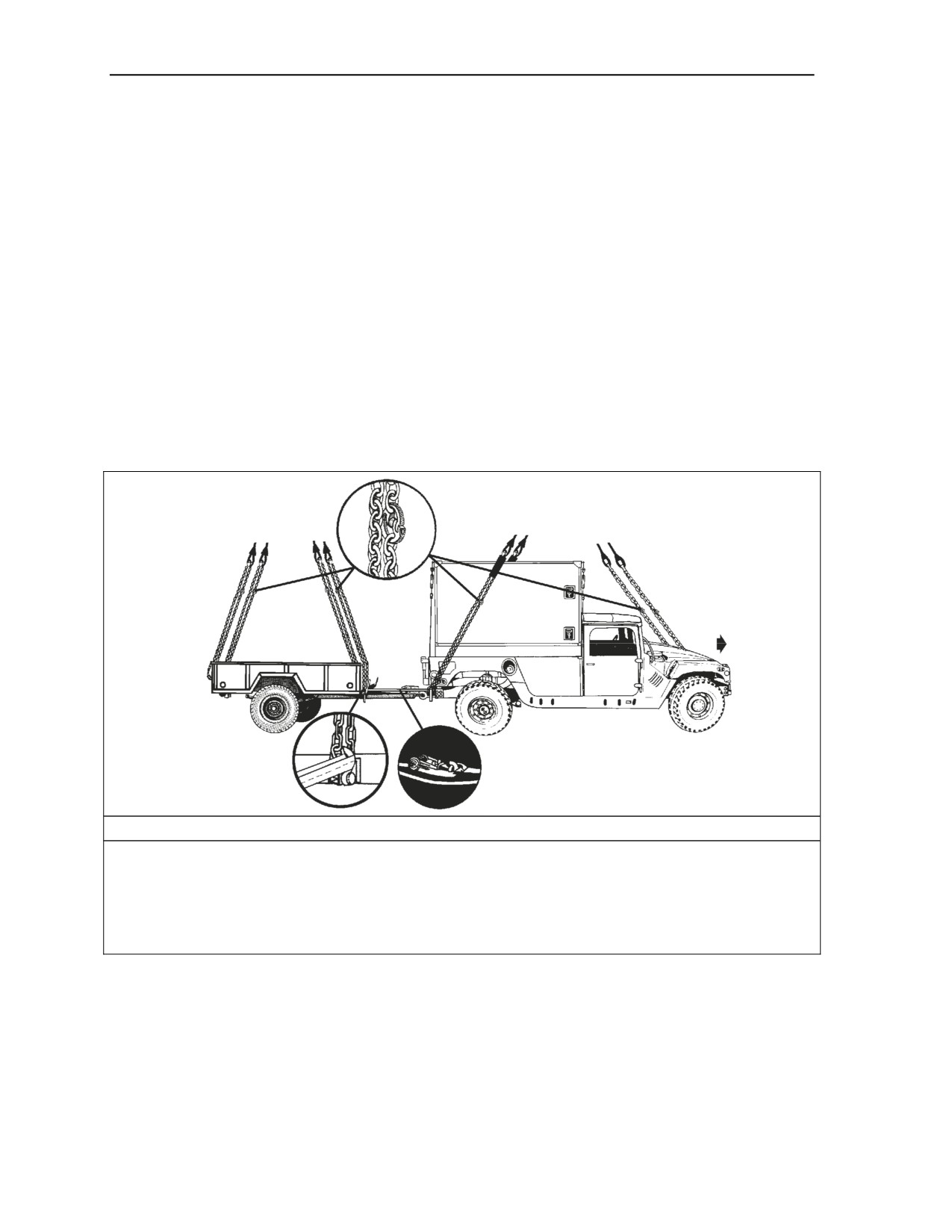
Chapter 5
─ Ensure the trailer hand brake is set.
─ Secure the equipment, canvas, and bows in the bed of the trailer with tiedown straps. Route the
straps diagonally over the equipment from front to rear.
─ Route the hook portion of a CGU-1/B tiedown strap through the left rear inboard tiedown
provision located near the pintle on the rear bumper of the truck and through the mounting
bracket on the front of the trailer A-frame. Connect the hook to the ratchet of the CGU-1/B.
─ Repeat the above procedure on the right side of the load.
─ Tighten both CGU-1/B tiedown straps at the same time. Secure the excess strap and safety the
ratchet handles in the closed position with tape. Tape the CGU-1/B tiedown strap every 24
inches to prevent flapping.
─ Connect one additional chain length to each chain on each sling set with a coupling link.
Rigging. Rig the load according to the steps in Figure 5-13.
Hookup. Two hookup persons are required for this load. The forward hookup person stands on cab
of the truck and places apex fitting 1 onto the forward cargo hook. The aft hookup person stands on the
fender of the trailer and places apex fitting 2 onto the aft cargo hook. The hookup team then carefully
dismounts the trailer and remains close to the load as the helicopter removes slack from the sling legs.
When successful hookup is assured, the hookup team quickly exits the area underneath the helicopter to
the designated rendezvous point.
Derigging. Derigging is the reverse of the preparation and rigging procedures.
RIGGING STEPS
1. Position apex fitting on top of the truck. Route outer sling legs 1 and 2 to the front of the vehicle and
inner sling legs 3 and 4 to the rear. Sling legs 1 and 3 must be on the left side of the load.
2. Loop the chain end of sling leg 1 through the left front lift provision that protrudes through the hood from
inboard to outboard. Place the correct link from Table 5-13 in the grab hook. Repeat with sling leg 2
and the right front lift provision. Secure excess chain with tape or Type III nylon cord.
Figure 5-13. M1097 Shelter Carrier, 1-1/4 Ton (HMMWV) with AN/TPQ-36(V)7, (S-250 Shelter),
Operations Control Group, OKG-398/TPW, and M116A2 Equipment Trailer Group
FM 4-20.199/MCRP 4-11.3E, VOL III/NTTP 3-04.13/
5-38
AFMAN 11-223 (I), VOL III/COMDINST M13482.4B
20 February 2009

Certified Dual-Point Rigging Procedures for Tandem Loads
RIGGING STEPS (Continued)
3. Loop the chain end of the sling legs through their respective lift provisions located on the
outer ends of the rear bumper. Place the correct link from Table 5-13 in the grab hook.
4. Pad the chain where it contacts the shelter sides.
5. Cluster and tie (breakaway technique) all sling legs together on top of the vehicle to prevent
entanglement during hookup and lift-off.
6. Position the apex fitting of sling set 2 on top of the trailer. Route outer sling legs 1 and 2 to
the front of the trailer and inner sling legs 3 and 4 to the rear of the trailer. Sling legs 1 and 3
must be on the left side of the load.
7. Loop the chain end of sling leg 1 through the left front lift provision located on the front of the
trailer. Place the correct link from Table 5-13 in the grab hook. Repeat with sling leg 2
through the right front lift provision. Secure excess chain with tape or Type III nylon cord.
8. Loop the chain end of sling leg 3 through the left rear lift provision. Place the correct link from
Table 5-13 in the grab hook. Repeat with sling leg 4 through the right rear lift provision.
Secure excess chain with tape or Type III nylon cord.
9. Cluster and tie (breakaway technique) all sling legs together on top of the trailer to prevent
entanglement during hookup and lift-off.
Figure 5-13. M1097 Shelter Carrier, 1-1/4 Ton (HMMWV) with AN/TPQ-36(V)7, (S-250 Shelter),
Operations Control Group, OKG-398/TPW, and M116A2 Equipment Trailer Group (Continued)
M1097A2 (HMMWV) WITH ADVANCED FIELD ARTILLERY
TACTICAL DATA SYSTEM (AFATDS) FULL SIZE SOFT TOP
INSTALLATION KIT (STIK) AND M101A1 TRAILER
5-15. The M1097A2 with advanced field artillery tactical data system full size soft top installation kit and M101A1
trailer are rigged for dual-point sling load using the following procedures:
z
Applicability. The following items in Table 5-14 are certified for the helicopter(s) listed in the following
table by the US Army Natick Soldier Center:
Table 5-14. M1097A2 with Advanced Field Artillery Tactical Data System Full Size Soft Top Installation Kit
and M101A1 Trailer
Nomenclature
Max Weight
Sling
Link Count
Type of
(Pounds)
Set
Front/Rear
Aircraft
System 2: CHS-2 AN/GYG-3 (V)1, with SINGARS AN/VRC-
8,103
25K
50/3
CH-47
90, AN/VRC-92 and EPLRS installed in bed. AN/VRC-92
installed in cab.
System 3: CHS-2 AN/GYG-3 (V)3, with SINGARS AN/VRC-
8,366
25K
50/3
CH-47
90, AN/VRC-92 and EPLRS installed in bed. AN/VRC-92
installed in cab.
System 4: 2 each AN/GYK-37 (V)2, with SINGARS
7,790
25K
50/3
CH-47
AN/VRC-89, AN/VRC-92 and EPLRS
Trailer, M101A1
3,200
25K
15/20
CH-47
FM 4-20.199/MCRP 4-11.3E, VOL III/NTTP 3-04.13/
20 February 2009
AFMAN 11-223 (I), VOL III/COMDINST M13482.4B
5-39
Chapter 5
z
Materials. The following materials are required to rig this load:
Sling set (25,000-pound capacity) (2 each).
─ Additional chain length, part number 38850-00053-102, from a 25,000-pound capacity
sling set (8 each).
─ Additional coupling link, NSN 4010-01-041-9751, from a 25,000-pound sling set (8
each).
Tape, adhesive, pressure-sensitive, 2-inch wide roll.
Cord, nylon, Type III, 550-pound breaking strength.
Webbing, cotton, 1/4-inch, 80-pound breaking strength.
Strap, cargo, tiedown, CGU-1/B (2 each).
Sling guides (included as part of the HMMWV STIK) (2 each).
Reach pendant (25,000-pound capacity) (2 each).
z
Personnel. Two persons can prepare and rig the M1097A2 HMMWV in 15 minutes. Two
persons can prepare and rig the generator set in 10 minutes.
z
Procedures. Attach the trailer to the truck by placing the lunette on the pintle hook and
securing the latch with tape or Type III nylon cord. Secure the safety chains, cables, and hoses.
Position the vehicle on level ground so both the truck and trailer are in a straight line. The
following procedures apply to this load:
Preparation. Prepare the load using the following steps:
─
Fold mirrors inward and tie together with Type III nylon cord. Remove the doors and
secure to the seats with Type III nylon cord.
─
Secure all equipment and cargo inside the truck and trailer with tiedown straps, tape, or
Type III nylon cord.
─
Ensure the fuel tank is not over 3/4 full. Inspect the fuel tank cap, oil filler cap, and
battery caps for proper installation.
─
Engage the vehicle parking brake and put the transmission in neutral.
─
Ensure the front wheels are pointed straight ahead. Tie down the steering wheel, using
the securing device attached under the dashboard.
─
Retract the lunette leg and secure with Type III nylon cord.
─
Ensure the trailer parking brakes are set.
─
Route the hook portion of a CGU-1/B tiedown strap through the left rear inboard
tiedown provision located near the pintle on the rear bumper of the truck and through
the mounting bracket on the front of the trailer A-frame. Connect the hook to the
ratchet of the CGU-1/B.
─
Repeat the above procedure on the right side of the load.
─
Tighten both CGU-1/B tie-down straps at the same time. Secure the excess strap and
safety the ratchet handles in the closed position with tape.
─
Install a reach pendant on each apex fitting.
─
Connect one additional chain length to each chain on each sling set with a coupling
link.
─
Ensure the STIK sling guides are properly installed.
CAUTION
Do not connect the CGU-1/B tiedown strap around the truck's rear axle
or wheel.
FM 4-20.199/MCRP 4-11.3E, VOL III/NTTP 3-04.13/
5-40
AFMAN 11-223 (I), VOL III/COMDINST M13482.4B
20 February 2009
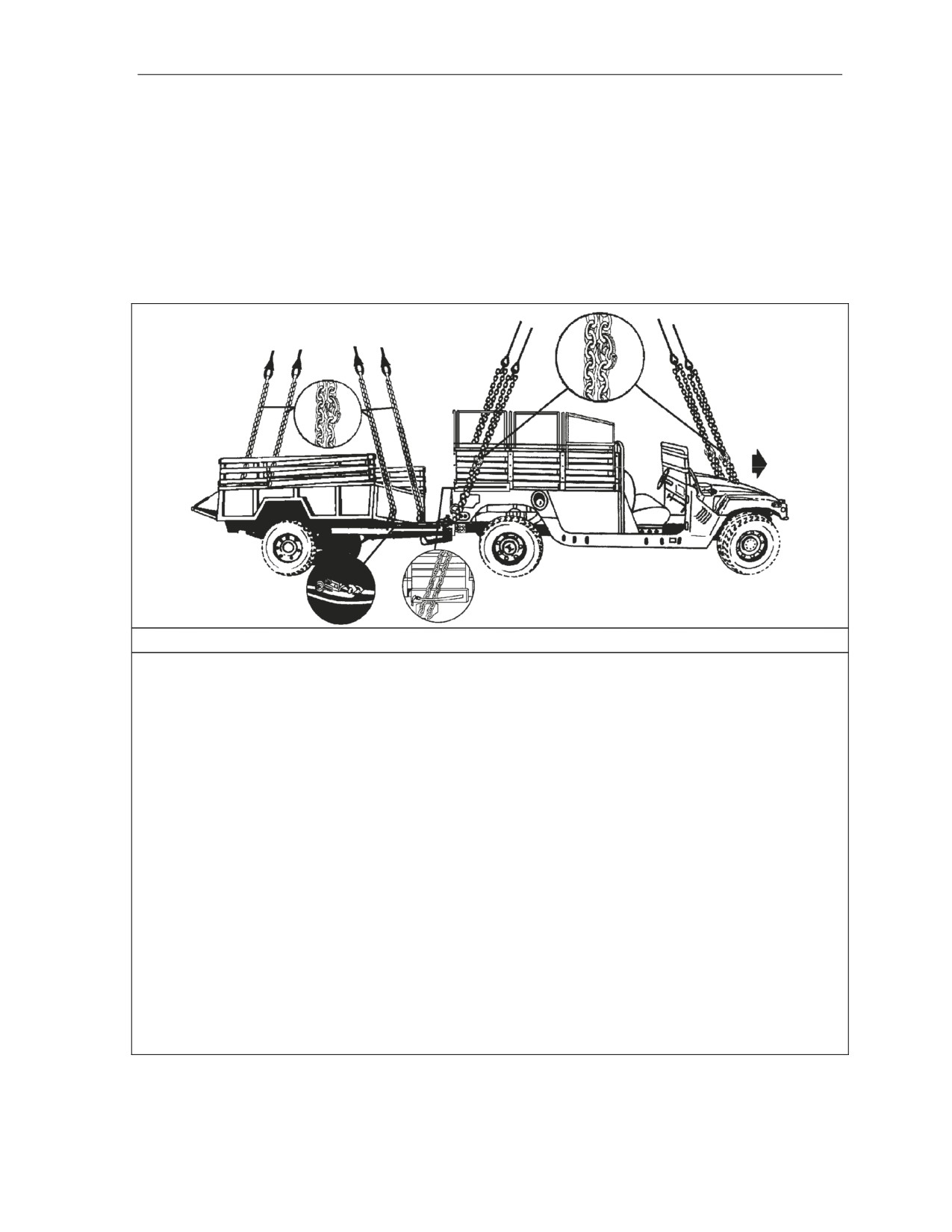
Certified Dual-Point Rigging Procedures for Tandem Loads
Rigging. Rig the load according to the steps in Figure 5-14.
Hookup. Two hookup teams are required for this load. The static wand person discharges
the static electricity with the static wand. The forward hookup person kneels on top of the truck
and places apex fitting 1 onto the forward cargo hook. The aft hookup person stands in the trailer
and places apex fitting 2 onto the aft cargo hook. The hookup team then carefully dismounts the
load and remains close to the load as the helicopter removes slack from the sling legs. When
successful hookup is assured, the hookup team quickly exits the area underneath the helicopter
to the designated rendezvous point.
Derigging. Derigging is the reverse of the preparation and rigging procedures.
RIGGING STEPS
1. Position apex fitting on top of the truck. Route outer sling legs 1 and 2 to the front of the vehicle and
inner sling legs 3 and 4 to the rear. Sling legs 1 and 3 must be on the left side of the load.
2. Loop the chain end of sling leg 1 through the left front lift provision that protrudes through the hood from
inboard to outboard. Place the correct link from Table 5-14 in the grab hook. Repeat with sling leg 2
and the right front lift provision. Secure excess chain with tape or Type III nylon cord.
3. Loop the chain end of sling leg 3 through the left guide, through the left rear lift provision located on the
outer ends of the rear bumper, and back through the left sling guide. Place the correct link from Table
5-14 in the grab hook. Repeat with sling leg 4 and the right sling guide and right rear lift provision.
Secure excess chain with tape or Type III nylon cord.
4. Cluster and tie (breakaway technique) all sling legs together on top of the vehicle to prevent
entanglement during hookup and lift-off.
5. Position the apex fitting of sling set 2 in the bed of the trailer. Route outer sling legs 1 and 2 to the front
of the trailer and inner sling legs 3 and 4 to the rear of the trailer. Route the rear chains through the
opening between the tailgate and the trailer bed and inside the trailer hinges. Sling legs 1 and 3 must
be on the left side of the load.
6. Loop the chain end of sling leg 1 through the left front lift provision located on the front of the trailer.
Place the correct link from Table 5-14 in the grab hook. Repeat with sling leg 2 through the right front lift
provision. Secure excess chain with tape or Type III nylon cord.
Figure 5-14. M1097A2 with Advanced Field Artillery Tactical Data System Full Size Soft Top
Installation Kit and M101A1 Trailer
FM 4-20.199/MCRP 4-11.3E, VOL III/NTTP 3-04.13/
20 February 2009
AFMAN 11-223 (I), VOL III/COMDINST M13482.4B
5-41

Chapter 5
RIGGING STEPS (Continued)
7. Loop the chain end of sling leg 3 through the left rear lift provision. Place the correct link from
Table 5-14 in the grab hook. Repeat with sling leg 4 through the right rear lift provision.
Secure excess chain with tape or Type III nylon cord.
8. Cluster and tie (breakaway technique) all sling legs together on top of the trailer to prevent
entanglement during hookup and lift-off.
Figure 5-14. M1097A2 with Advanced Field Artillery Tactical Data System Full Size Soft Top
Installation Kit and M101A1 Trailer (Continued)
M1097 (HMMWV) AND HIGH MOBILITY TRAILER (HMT)
5-16. The M1097 and high mobility trailer are rigged for dual-point sling load using the following
procedures:
z
Applicability. The following items in Table 5-15 are certified for the helicopter(s) listed in the
following table by the US Army Natick Soldier Center:
Table 5-15. M1097 and High Mobility Trailer
Nomenclature
Max Weight
Sling
Link Count
Type of
(Pounds)
Set
Front/Rear
Aircraft
Shadow Tactical Unmanned Aerial Vehicle (TUAV)
7,085
25K
40/10
CH-47
Troop Carrier with
Shadow Tactical Unmanned Aerial Vehicle (TUAV)
3,950
25K
40/50
CH-47
Equipment Trailer
M1097 Truck, Utility, 1 ¼-Ton, ISYSCOM Radio
8,093
10K
27/3
CH-47
Vehicle with
M1102 HMT
Min-2,477
10K
6/25
CH-47
Max-3,033
z
Materials. The following materials are required to rig this load:
Sling set (10,000-pound capacity) (2 each).
OR
Sling set (25,000-pound capacity) (2 each).
Tape, adhesive, pressure-sensitive, 2-inch wide roll.
Cord, nylon, Type III, 550-pound breaking strength.
Webbing, cotton, 1/4-inch, 80-pound breaking strength.
Strap, cargo, tiedown, CGU-1/B (2 each).
z
Personnel. Two persons can prepare and rig the M1097 HMMWV in 15 minutes. Two persons
can prepare and rig the trailer set in 15 minutes.
z
Procedures. Attach the trailer to the truck by placing the lunette on the pintle hook and
securing the latch with tape or Type III nylon cord. Secure the safety chains, cables, and hoses.
Position the vehicle on level ground so both the truck and trailer are in a straight line. The
following procedures apply to this load:
Preparation. Prepare the load using the following steps:
─ Fold mirrors inward and tie together with Type III nylon cord.
─ Secure all equipment and cargo inside the truck and trailer with tiedown straps, tape, or
Type III nylon cord.
FM 4-20.199/MCRP 4-11.3E, VOL III/NTTP 3-04.13/
5-42
AFMAN 11-223 (I), VOL III/COMDINST M13482.4B
20 February 2009
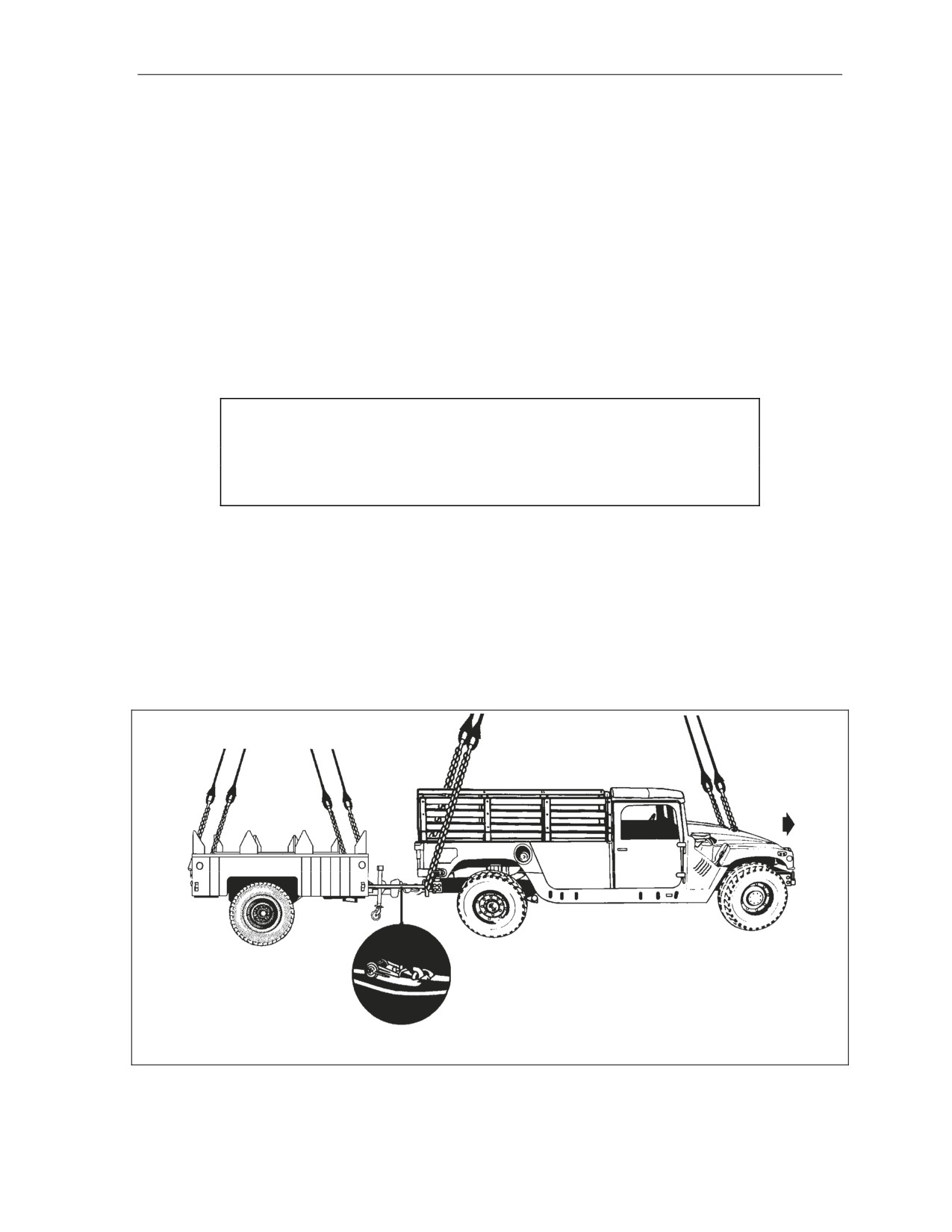
Certified Dual-Point Rigging Procedures for Tandem Loads
─ Ensure the fuel tank is not over 3/4 full. Inspect the fuel tank cap, oil filler cap, and
battery caps for proper installation.
─ Engage the vehicle parking brake and put the transmission in neutral.
─ Ensure the front wheels are pointed straight ahead. Tie down the steering wheel, using
the securing device attached under the dashboard.
─ Retract the lunette leg and secure with Type III nylon cord.
─ Ensure the trailer parking brakes are set.
─ Route the hook portion of a CGU-1/B tiedown strap through the left rear inboard
tiedown provision located near the pintle on the rear bumper of the truck and through
the mounting bracket on the front of the trailer A-frame. Connect the hook to the
ratchet of the CGU-1/B.
─ Repeat the above procedure on the right side of the load.
─ Tighten both CGU-1/B tiedown straps at the same time. Secure the excess strap and
safety the ratchet handles in the closed position with tape.
CAUTION
Do not connect the CGU-1/B tiedown strap around the truck's rear axle
or wheel.
Rigging. Rig the load according to the steps in Figure 5-15.
Hookup. Two hookup teams are required for this load. The static wand person discharges
the static electricity with the static wand. The forward hookup person kneels on the hood of the
truck and places apex fitting 1 onto the forward cargo hook. The aft hookup person stands in the
trailer and places apex fitting
2 onto the aft cargo hook. The hookup team then carefully
dismounts the load and remains close to the load as the helicopter removes slack from the sling
legs. When successful hookup is assured, the hookup team quickly exits the area underneath
the helicopter to the designated rendezvous point.
Derigging. Derigging is the reverse of the preparation and rigging procedures.
Figure 5-15. M1097 and High Mobility Trailer
FM 4-20.199/MCRP 4-11.3E, VOL III/NTTP 3-04.13/
20 February 2009
AFMAN 11-223 (I), VOL III/COMDINST M13482.4B
5-43

Chapter 5
RIGGING STEPS
1.
Position apex fitting in bed of the truck. Route outer sling legs 1 and 2 to the front of the vehicle and
inner sling legs 3 and 4 to the rear. Sling legs 1 and 3 must be on the left side of the load.
2.
Loop the chain end of sling leg 1 through the left front lift provision that protrudes through the hood from
inboard to outboard. Place the correct link from Table 5-15 in the grab hook. Repeat with sling leg 2
and the right front lift provision. Secure excess chain with tape or Type III nylon cord.
3.
Route the chain end of sling leg 3 through the eyelet opening in the upper left corner of the tailgate.
Loop the chain end through the left lift provision on the bumper and thread back through the eyelet
opening in the tailgate. Place the correct link from Table 5-15 in the grab hook. Repeat with sling leg 4
through the right rear lift provision. See insert above.
4.
Cluster and tie (breakaway technique) all sling legs together on top of the vehicle to prevent
entanglement during hookup and lift-off.
5.
Position the apex fitting of sling set 2 in the bed of the trailer. Route outer sling legs 1 and 2 to the front
of the trailer and inner sling legs 3 and 4 to the rear of the trailer. Sling legs 1 and 3 must be on the
left side of the load.
6.
Loop the chain end of sling leg 1 through the left front lift provision located on the front of the trailer.
Place the correct link from Table 5-15 in the grab hook. Repeat with sling leg 2 through the right front lift
provision. Secure excess chain with tape or Type III nylon cord.
7.
Loop the chain end of sling leg 3 through the left rear lift provision. Place the correct link from Table 5-
15 in the grab hook. Repeat with sling leg 4 through the right rear lift provision. Secure excess chain
with tape or Type III nylon cord.
8.
Cluster and tie (breakaway technique) all sling legs together on top of the trailer to prevent
entanglement during hookup and lift-off.
Figure 5-15. M1097 and High Mobility Trailer (Continued)
M1113 (HMMWV) WITH LMS SHELTER AND HIGH MOBILITY
TRAILER (HMT)
5-17. The M1113 with LMS shelter and high mobility trailer are rigged for dual-point sling load using the
following procedures:
z
Applicability. The following items in Table 5-16 are certified for the helicopter(s) listed in the
following table by the US Army Natick Soldier Center:
Table 5-16. M1113 with LMS Shelter and High Mobility Trailer
Nomenclature
Max Weight
Sling
Link Count
Type of
(Pounds)
Set
Front/Rear
Aircraft
Shadow Tactical Unmanned Aerial Vehicle (TUAV)
9,774
25K
25/10
CH-47
Maintenance Section Multifunctional (MSM)
Shadow Tactical Unmanned Aerial Vehicle (TUAV)
3,737
25K
20/30
CH-47
Equipment Maintenance Section Multifunctional (MSM)
Trailer
z
Materials. The following materials are required to rig this load:
Sling set (25,000-pound capacity) (2 each).
─ Additional chain length, part number 38850-00053-102, from a 25,000-pound capacity
sling set (8 each).
─ Additional coupling link, NSN 4010-01-041-9751, from a 25,000-pound sling set (8
each).
FM 4-20.199/MCRP 4-11.3E, VOL III/NTTP 3-04.13/
5-44
AFMAN 11-223 (I), VOL III/COMDINST M13482.4B
20 February 2009
Certified Dual-Point Rigging Procedures for Tandem Loads
Tape, adhesive, pressure-sensitive, 2-inch wide roll.
Cord, nylon, Type III, 550-pound breaking strength.
Webbing, cotton, 1/4-inch, 80-pound breaking strength.
Strap, cargo, tiedown, CGU-1/B (2 each).
Felt sheet, cattle hair, Type IV, 1/2-inch or suitable substitute.
z
Personnel. Two persons can prepare and rig the M1113 HMMWV in 15 minutes. Two persons
can prepare and rig the trailer set in 15 minutes.
z
Procedures. Attach the trailer to the truck by placing the lunette on the pintle hook and
securing the latch with tape or Type III nylon cord. Secure the safety chains, cables, and hoses.
Position the vehicle on level ground so both the truck and trailer are in a straight line. The
following procedures apply to this load:
Preparation. Prepare the load using the following steps:
─
Fold mirrors inward and tie together with Type III nylon cord.
─
Secure all equipment and cargo inside the truck and trailer with tiedown straps, tape, or
Type III nylon cord.
─
Secure all loose equipment inside the shelter with tape, Type III nylon cord, or tie-
down straps. Close and secure the door.
─
Ensure the fuel tank is not over 3/4 full. Inspect the fuel tank cap, oil filler cap, and
battery caps for proper installation.
─
Engage the vehicle parking brake and put the transmission in neutral.
─
Ensure the front wheels are pointed straight ahead. Tie down the steering wheel, using
the securing device attached under the dashboard.
─
Secure the generator release handle with Type III nylon cord.
─
Retract the lunette leg and secure with Type III nylon cord.
─
Ensure all equipment in the trailer is secured with the supplied cargo net and CGU-
1/B cargo tiedown straps or Type III nylon cord.
─
Ensure the trailer parking brakes are set.
─
Route the hook portion of a CGU-1/B tiedown strap through the left rear inboard
tiedown provision located near the pintle on the rear bumper of the truck and through
the mounting bracket on the front of the trailer A-frame. Connect the hook to the
ratchet of the CGU-1/B.
─
Repeat the above procedure on the right side of the load.
─
Tighten both CGU-1/B tiedown straps at the same time. Secure the excess strap and
safety the ratchet handles in the closed position with tape.
─
Connect one additional chain length to each chain on each sling set with a coupling
link.
CAUTION
Do not connect the CGU-1/B tiedown strap around the truck's rear axle
or wheel.
Rigging. Rig the load according to the steps in Figure 5-16.
Hookup. Two hookup teams are required for this load. The static wand person discharges
the static electricity with the static wand. The forward hookup person kneels on the top of the
shelter and places apex fitting 1 onto the forward cargo hook. The aft hookup person stands in the
trailer and places apex fitting 2 onto the aft cargo hook. The hookup team then carefully
FM 4-20.199/MCRP 4-11.3E, VOL III/NTTP 3-04.13/
20 February 2009
AFMAN 11-223 (I), VOL III/COMDINST M13482.4B
5-45
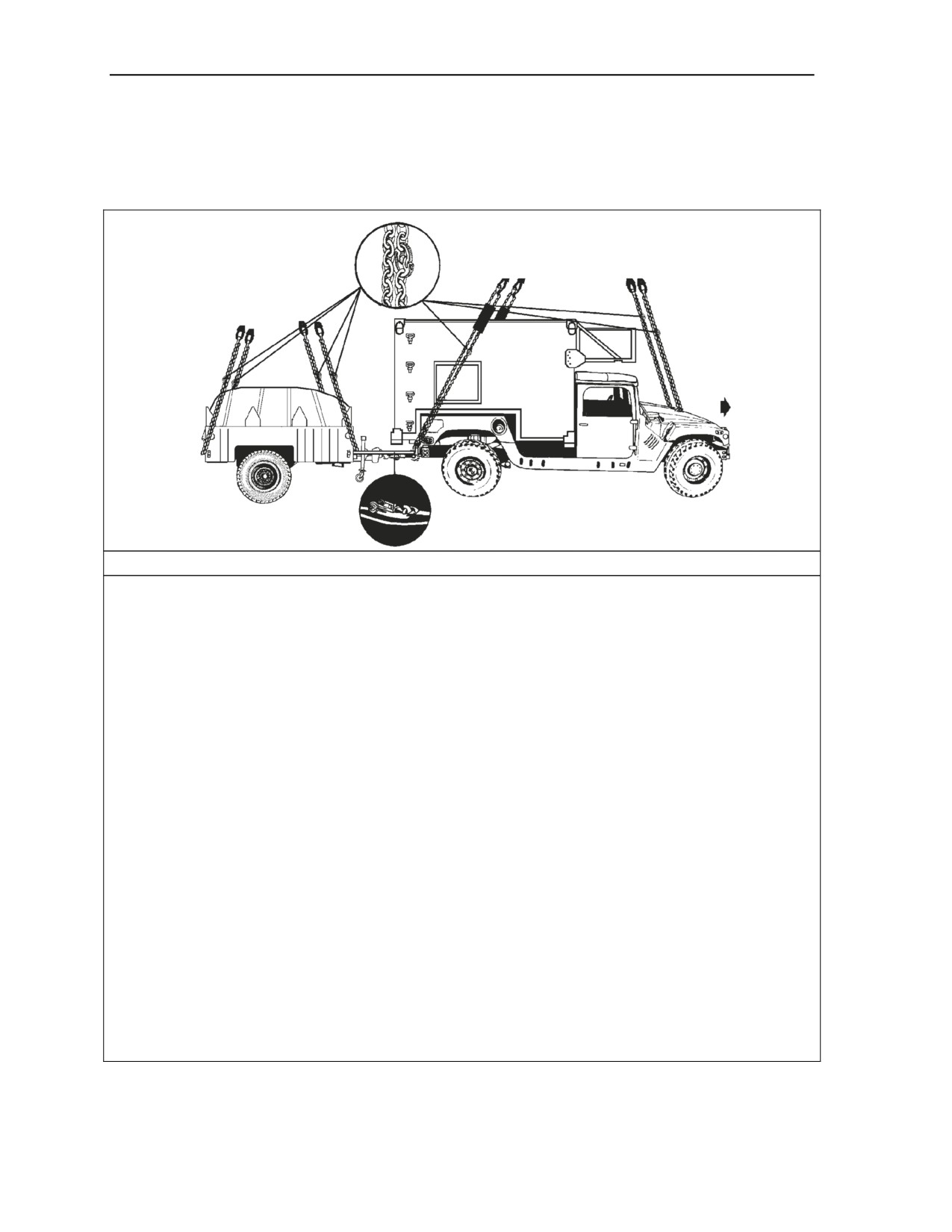
Chapter 5
dismounts the load and remains close to the load as the helicopter removes slack from the sling
legs. When successful hookup is assured, the hookup team quickly exits the area underneath
the helicopter to the designated rendezvous point.
Derigging. Derigging is the reverse of the preparation and rigging procedures.
RIGGING STEPS
1.
Position apex fitting on the roof of the truck. Route outer sling legs 1 and 2 to the front of the vehicle
and inner sling legs 3 and 4 to the rear. Sling legs 1 and 3 must be on the left side of the load.
2.
Loop the chain end of sling leg 1 through the left front lift provision that protrudes through the hood from
inboard to outboard. Place the correct link from Table 5-16 in the grab hook. Repeat with sling leg 2
and the right front lift provision. Secure excess chain with tape or Type III nylon cord.
3.
Loop the chain end of the sling legs through their respective lift provisions located on the outer ends of
the rear bumper. Place the correct link from Table 5-16 in the grab hook. Secure excess chain with
tape or Type III nylon cord.
4.
Cluster and tie (breakaway technique) all sling legs together on top of the vehicle to prevent
entanglement during hookup and lift-off.
5.
Position the apex fitting of sling set 2 in the bed of the trailer. Route outer sling legs 1 and 2 to the front
of the trailer and inner sling legs 3 and 4 to the rear of the trailer. Sling legs 1 and 3 must be on the
left side of the load.
6.
Loop the chain end of sling leg 1 through the left front lift provision located on the front of the trailer.
Place the correct link from Table 5-16 in the grab hook. Repeat with sling leg 2 through the right front lift
provision. Secure excess chain with tape or Type III nylon cord.
7.
Loop the chain end of sling leg 3 through the left rear lift provision. Place the correct link from Table 5-
16 in the grab hook. Repeat with sling leg 4 through the right rear lift provision. Secure excess chain
with tape or Type III nylon cord.
8.
Cluster and tie (breakaway technique) all sling legs together on top of the trailer to prevent
entanglement during hookup and lift-off.
Figure 5-16. M1113 with LMS Shelter and High Mobility Trailer
FM 4-20.199/MCRP 4-11.3E, VOL III/NTTP 3-04.13/
5-46
AFMAN 11-223 (I), VOL III/COMDINST M13482.4B
20 February 2009
Certified Dual-Point Rigging Procedures for Tandem Loads
TROJAN SPIRIT LITE (V)2 CENTRAL COMMUNICATIONS, AN/TSQ-
226 (V)2 ON M1113 (HMMWV) AND M1102 CARGO TRAILER
5-18. The Trojan Spirit Lite (V)2 central communications, AN/TSQ-226 (V)2 on M1113 and M1102
cargo trailer are rigged for dual-point sling load using the following procedures:
z
Applicability. The following items in Table 5-17 are certified for the helicopter(s) listed in the
following table by the US Army Natick Soldier Center:
Table 5-17. Trojan Spirit Lite (V)2 Central Communications, AN/TSQ-226 (V)2 on M1113
HMMWV and M1102 Cargo Trailer
Nomenclature
Max Weight
Sling
Link Count
Type of
(Pounds)
Set
Front/Rear
Aircraft
Trojan Spirit Lite (V)2 Central Communications,
10,180
25K
35/3
CH-47
AN/TSQ-226 on M1113 HMMWV
M1102 Trailer, Cargo, Trojan Sprit Lite (V)2
3,260
10K
40/30
CH-47
z
Materials. The following materials are required to rig this load:
Sling set (25,000-pound capacity).
─ Additional chain length, part number 38850-00053-102, from a 25,000-pound capacity
sling set (4 each).
─ Additional coupling link, part number 664241, from a 25,000-pound sling set (4 each).
Sling set (10,000-pound capacity) with one additional apex fitting.
─ Chain length, part number 38850-00053-101, from a 10,000-pound capacity sling set
(4 each).
─ Coupling link, part number 577-0615, from a 10,000-pound sling set (4 each).
Tape, adhesive, pressure-sensitive, 2-inch wide roll.
Cord, nylon, Type III, 550-pound breaking strength.
Webbing, cotton, 1/4-inch, 80-pound breaking strength.
Strap, cargo, tiedown, CGU-1/B (2 each).
z
Personnel. Two persons can prepare and rig the HMMWV in 15 minutes. Two persons can
prepare and rig the trailer in 15 minutes.
z
Procedures. Attach the trailer to the truck by placing the lunette on the pintle hook and
securing the latch with tape or Type III nylon cord. Secure the safety chains, cables, and hoses.
Position the vehicle on level ground so both the truck and trailer are in a straight line. The
following procedures apply to this load:
Preparation. Prepare the load using the following steps:
─ Fold mirrors inward and tie together with Type III nylon cord.
─ Secure all equipment and cargo inside the truck and trailer with tiedown straps, tape, or
Type III nylon cord. Secure the doors shut if installed.
─ Secure all loose equipment on the pallet with tape, Type III nylon cord, or tiedown
straps. Close and secure latches and handles with tape or Type III nylon cord.
─ Ensure the fuel tank is not over 3/4 full. Inspect the fuel tank cap, oil filler cap, and
battery caps for proper installation.
─ Engage the vehicle parking brake and put the transmission in neutral.
─ Ensure the front wheels are pointed straight ahead. Tie down the steering wheel, using
the securing device attached under the dashboard.
─ Tape the windshield in an X formation from corner to corner.
─ Secure the rear lift provisions in the up position with Type III nylon cord.
─ Retract the lunette leg and secure with Type III nylon cord.
FM 4-20.199/MCRP 4-11.3E, VOL III/NTTP 3-04.13/
20 February 2009
AFMAN 11-223 (I), VOL III/COMDINST M13482.4B
5-47
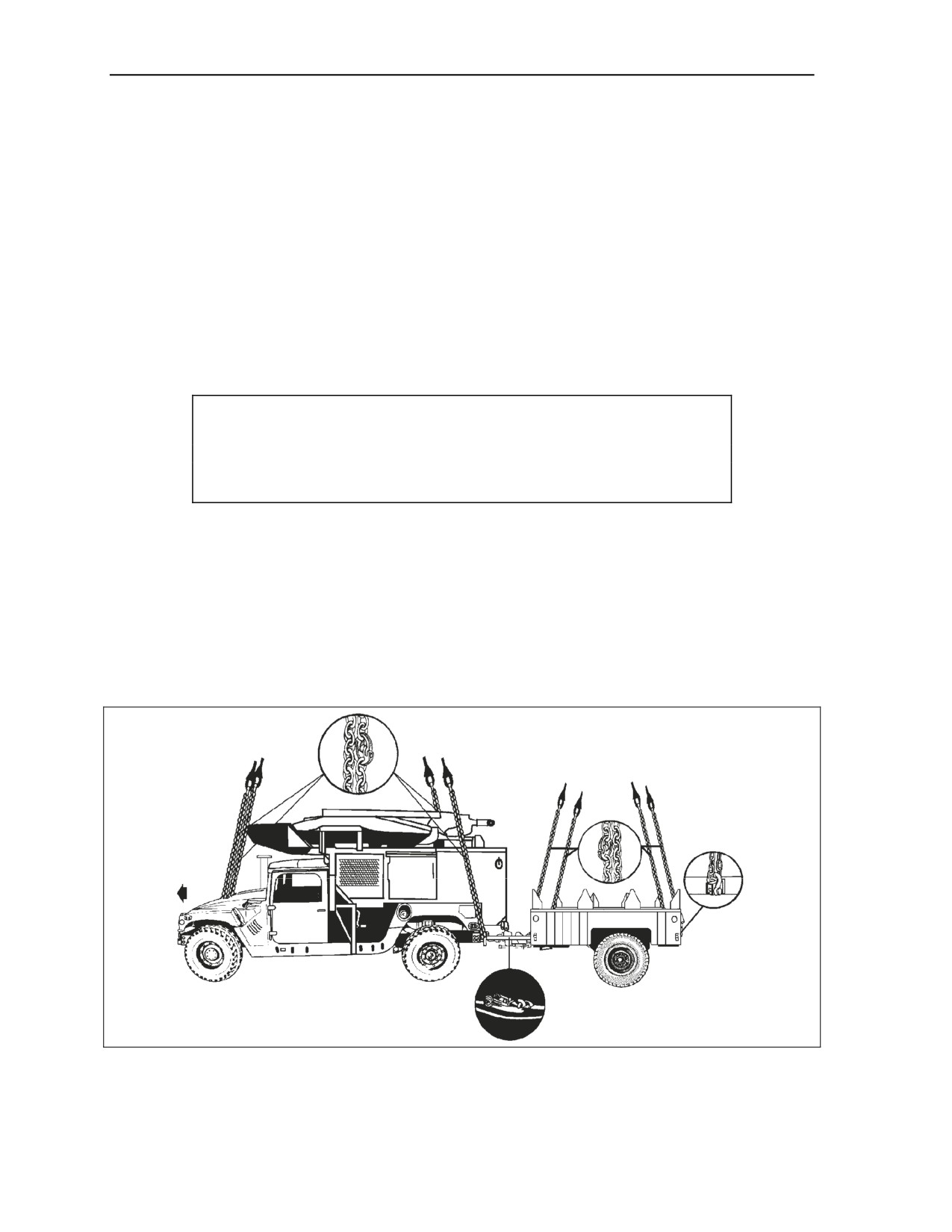
Chapter 5
─ Secure all equipment in the trailer with the supplied cargo net, cargo tiedown straps,
Type III nylon cord, and tape
─ Ensure the trailer parking brakes are set.
─ Route the hook portion of a CGU-1/B tiedown strap through the left rear inboard
tiedown provision located near the pintle on the rear bumper of the truck and through
the mounting bracket on the front of the trailer A-frame. Connect the hook to the
ratchet of the CGU-1/B.
─ Repeat the above procedure on the right side of the load.
─ Tighten both CGU-1/B tie-down straps at the same time. Secure the excess strap and
safety the ratchet handles in the closed position with tape.
─ Connect one additional chain length to each chain on the 25,000-pound capacity sling
set with a coupling link.
─ Connect one additional chain length to each chain on the 10,000-pound capacity sling
set with a coupling link.
CAUTION
Do not connect the CGU-1/B tiedown strap around the truck's rear axle
or wheel.
Rigging. Rig the load according to the steps in Figure 5-17.
Hookup. Two hookup teams are required for this load. The static wand person discharges
the static electricity with the static wand. The forward hookup person kneels on the top of the
vehicle and places apex fitting 1 onto the forward cargo hook. The aft hookup person stands on the
trailer and places apex fitting
2 onto the aft cargo hook. The hookup team then carefully
dismounts the load and remains close to the load as the helicopter removes slack from the sling
legs. When successful hookup is assured, the hookup team quickly exits the area underneath
the helicopter to the designated rendezvous point.
Derigging. Derigging is the reverse of the preparation and rigging procedures.
Figure 5-17. Trojan Spirit Lite (V)2 Central Communications, AN/TSQ-226 (V)2 on M1113
HMMWV and M1102 Cargo Trailer
FM 4-20.199/MCRP 4-11.3E, VOL III/NTTP 3-04.13/
5-48
AFMAN 11-223 (I), VOL III/COMDINST M13482.4B
20 February 2009