FM 4-20.199 Multiservice Helicopter Sling Load: Dual-Point Load Rigging Procedures (February 2009) - page 4
Certified Dual-Point Rigging Procedures for Wheeled Vehicles
MEDIUM TACTICAL VEHICLE, TRACTOR, M1088/M1088A1
2-45. The medium tactical vehicle, tractors, M1088/M1088A1 are rigged for dual-point sling load using
the following procedures:
z
Applicability. The following item in Table 2-44 is certified for the helicopter(s) listed in the
following table by the US Army Natick Soldier Center:
Table 2-44. Medium Tactical Vehicle, Tractor, M1088/M1088A1
Nomenclature
Max Weight
Sling
Link Count
Type of
(Pounds)
Set
Front/Rear
Aircraft
Medium Tactical Vehicle, Tractor, M1088/M1088A1
19,740
25K
40/3
CH-47
40K
3/20
CH-53
WARNING
Exceeding the recommended airspeed listed in Appendix C may
result in damage to the windshields of the vehicles.
z
Materials. The following materials are required to rig this load:
Sling set (25,000-pound capacity) with one additional apex fitting.
─ Additional chain length, part number 38850-00053-102, from a 25,000-pound capacity
sling set (2 each).
─ Additional coupling link, part number 9779135, from a 25,000-pound capacity sling
set (2 each).
OR
Sling set (40,000-pound capacity) with one additional apex fitting.
Tape, adhesive, pressure-sensitive, 2-inch wide roll.
Cord, nylon, Type III, 550-pound breaking strength.
Webbing, cotton, 1/4-inch, 80-pound breaking strength.
z
Personnel. Two persons can prepare and rig this load in 15 minutes.
z
Procedures. The following procedures apply to this load:
Preparation. Prepare the load using the following steps:
─ Extend the front lift provisions and lock in place using the attached pin and safety pin.
─ Roll up the windows in the cab.
─ Tape all windows, lights, and reflectors.
─ Remove the air intake cowling by loosening the clamp and twisting off. Place the
cowling on the floor board of the passenger's side.
─ Ensure the front wheels are pointed straight ahead. Tie down the steering wheel using
the driver's side seat belt.
─ Fold the side view mirrors back and secure with tape or Type III nylon cord.
─ Stow the mud flaps by bending and hooking on the mud flap hooks.
─ Engage the vehicle parking brake and put the transmission in neutral.
─ Ensure the fuel tank is not over 3/4 full. Inspect fuel tank cap, oil filler cap, and
battery caps for proper installation.
─ Tape the filler pipes behind the cab on the driver's side to prevent the sling legs from
becoming entangled.
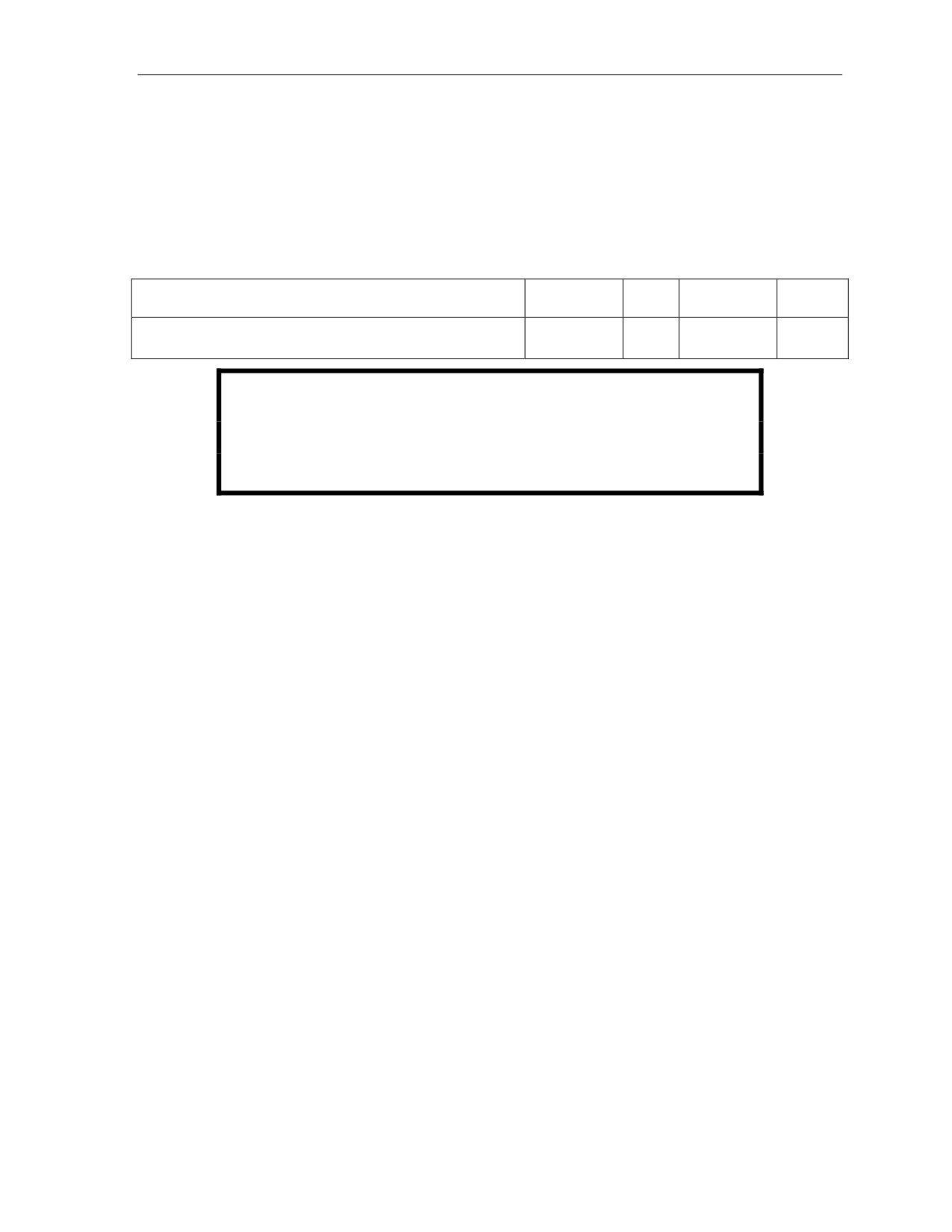
Rigging. Rig the load according to the steps in Figure 2-43.
FM 4-20.199/MCRP 4-11.3E, VOL III/NTTP 3-04.13/
20 February 2009
AFMAN 11-223 (I), VOL III/COMDINST M13482.4B
2-103
Chapter 2
Hookup. The hookup team stands on the rear of the vehicle. The static wand person
discharges the static electricity with the static wand. The forward hookup person places apex
fitting 1 onto the forward cargo hook. The aft hookup person places apex fitting 2 onto the aft
cargo hook. The hookup team then carefully dismounts the vehicle and remains close to the
load as the helicopter removes slack from the sling legs. When successful hookup is assured,
the hookup team quickly exits the area underneath the helicopter to the designated rendezvous
point.
Derigging. Derigging is the reverse of the preparation and rigging procedures.
RIGGING STEPS
1. Connect 2 sling legs to apex fitting number 1. Attach one extra chain length to each existing
chain on each sling leg using one coupling link (for 25,000-pound capacity sling sets only).
Position the apex fitting on the forward end of the bed.
2. Loop the chain end of the sling legs through their respective lift provisions located behind the
vehicle cab. Place the correct link from Table 2-44 in the grab hook and secure all excess
chain with tape or Type III nylon cord.
3. Cluster and tie or tape (breakaway technique) the sling legs on top of the spare tire to
prevent entanglement during hookup and lift-off.
Figure 2-43. Medium Tactical Vehicle, Tractor, M1088/M1088A1
FM 4-20.199/MCRP 4-11.3E, VOL III/NTTP 3-04.13/
2-104
AFMAN 11-223 (I), VOL III/COMDINST M13482.4B
20 February 2009

Certified Dual-Point Rigging Procedures for Wheeled Vehicles
RIGGING STEPS (CONTINUED)
4. Connect 2 sling legs to apex fitting number 2. Position the apex fitting on the rear of the
cargo deck.
5. Loop the chain end of the sling legs through their respective lift ring, located forward of the
5th wheel. Place the correct link from Table 2-44 in the grab hook. Secure all excess chain
with tape or Type III nylon cord.
6. Cluster and tie (breakaway technique) the sling legs together to prevent entanglement during
hookup and lift-off.
Figure 2-43. Medium Tactical Vehicle, Tractor, M1088/M1088A1 (Continued)
TRUCK, CARGO, 5-TON, M813A1/M923/M925
2-46. The trucks, cargo,
5-ton, M813A1/M923/M925 are rigged for dual-point sling load using the
following procedures:
z
Applicability. The following items in Table 2-45 are certified for the helicopter(s) listed in the
following table by the US Army Natick Soldier Center:
Table 2-45. Truck, Cargo, 5-ton, M813A1/M923/M925
Nomenclature
Max Weight
Sling
Link Count
Type of
(Pounds)
Set
Front/Rear
Aircraft
Truck, Cargo, 5-Ton, w/wo Winch, M813A1
21,120
40K
3/55
CH-53
Truck, Cargo, 5-Ton, wo Winch, M923
22,175
40K
3/55
CH-53
Truck, Cargo, 5-Ton, with Winch, M925
23,275
40K
3/55
CH-53
z
Materials. The following materials are required to rig this load:
Sling set (40,000-pound capacity) with one additional apex fitting.
Tape, adhesive, pressure-sensitive, 2-inch wide roll.
Cord, nylon, Type III, 550-pound breaking strength.
Webbing, cotton, 1/4-inch, 80-pound breaking strength.
z
Personnel. Two persons can prepare and rig this load in 15 minutes.
z
Procedures. The following procedures apply to this load:
Preparation. Prepare the load using the following steps:
─ Remove cab top and rear canvas. Fold and secure to the truck.
─ Roll down the front cab windows.
─ Remove side racks/seats and secure to the truck.
─ Secure all loose equipment inside the truck with tape, lashings, or Type III nylon cord.
─ Ensure the fuel tank is not over 3/4 full. Inspect fuel tank cap, oil filler cap, and
battery caps for proper installation.
─ Engage the parking brake and place the transmission in neutral.
─ Ensure the front wheels are pointed straight ahead. Tie down the steering wheel using
Type III nylon cord.
─ Extend the front lift provisions located aft of the front tires. Insert the bolts in the
holes, fasten nuts, and install locking pins
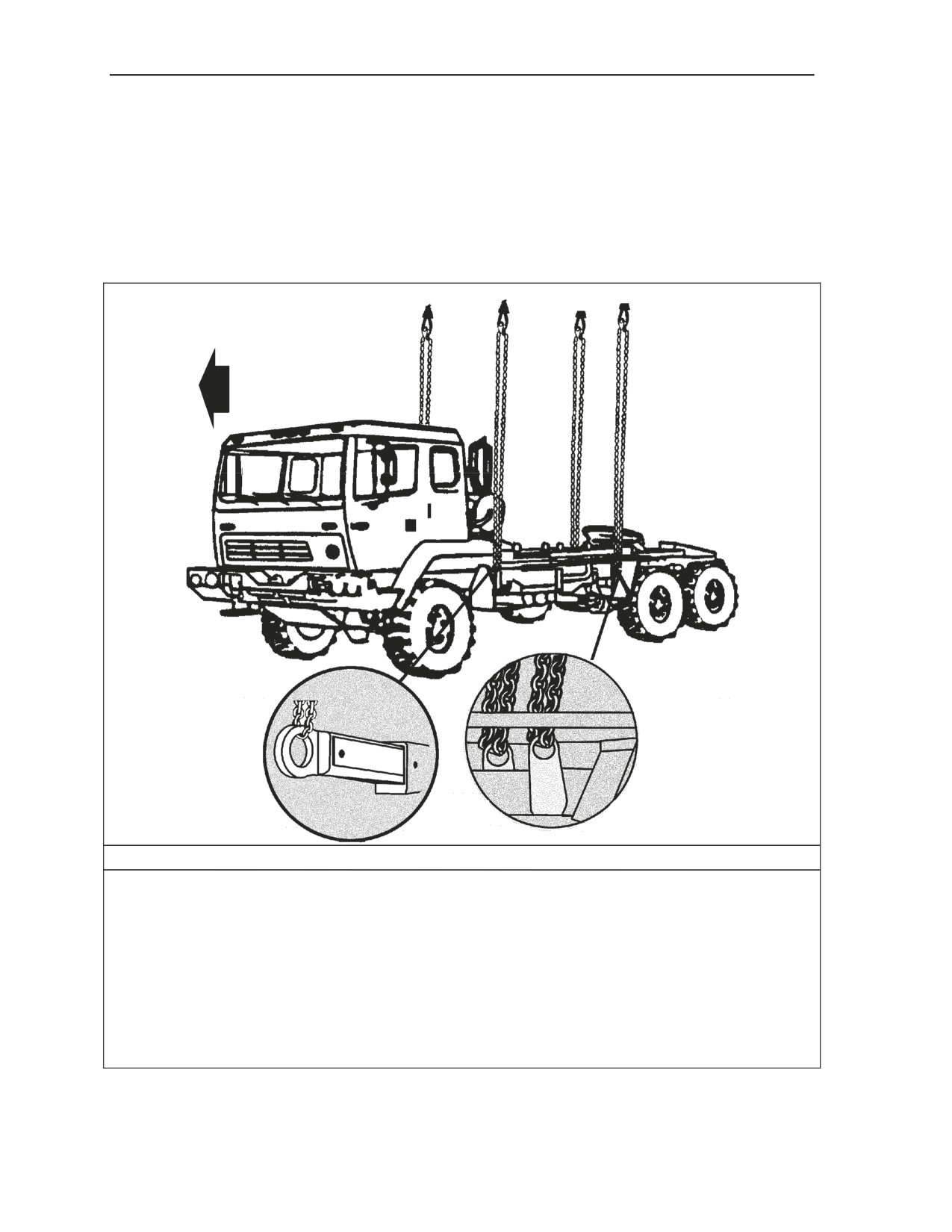
Rigging. Rig the load according to the steps in Figure 2-44.
FM 4-20.199/MCRP 4-11.3E, VOL III/NTTP 3-04.13/
20 February 2009
AFMAN 11-223 (I), VOL III/COMDINST M13482.4B
2-105
Chapter 2
Hookup. The hookup team stands in the bed of the truck. The static wand person
discharges the static electricity with the static wand. The forward hookup person places apex
fitting 1 onto the forward cargo hook. The aft hookup person places apex fitting 2 onto the aft
cargo hook. The hookup team then carefully dismounts the vehicle and remains close to the
load as the helicopter removes slack from the sling legs. When successful hookup is assured,
the hookup team quickly exits the area underneath the helicopter to the designated rendezvous
point.
Derigging. Derigging is the reverse of the preparation and rigging procedures.
RIGGING STEPS
1. Connect 2 sling legs to apex fitting number 1. Position the apex fitting in the bed of the
vehicle.
2. Loop the chain end of the sling legs through their respective lift provisions aft of the front
wheels. Route the sling legs to the rear of the mirrors. Place the correct link from Table 2-45
in the grab hook.
3. Connect 2 sling legs to apex fitting number 2. Position the apex fitting in the bed of the
vehicle.
4. Loop the chain end of the sling legs through their respective lift provisions located between
the rear wheels. Place the correct link from Table 2-45 in the grab hook. Secure all excess
chain with tape or Type III nylon cord.
5. Cluster and tie (breakaway technique) the sling legs in each sling set on top of the vehicle to
prevent entanglement during hookup and lift-off.
Figure 2-44. Truck, Cargo, 5-ton, M813A1/M923/M925
FM 4-20.199/MCRP 4-11.3E, VOL III/NTTP 3-04.13/
2-106
AFMAN 11-223 (I), VOL III/COMDINST M13482.4B
20 February 2009
Certified Dual-Point Rigging Procedures for Wheeled Vehicles
TRUCK, CARGO, 2 1/2-TON, M35A2 MODIFIED, PART OF AN
AN/MPQ-49A FORWARD AREA ALERTING RADAR (FAAR) SYSTEM
2-47. The truck, cargo, 2 1/2-ton, M35A2 modified, part of an AN/MPQ-49A forward area alerting radar
system is rigged for dual-point sling load using the following procedures:
z
Applicability. The following item in Table 2-46 is certified for the helicopter(s) listed in the
following table by the US Army Natick Soldier Center:
Table 2-46. Truck, Cargo, 2 1/2-Ton, M35A2 Modified
Nomenclature
Max Weight
Sling
Link Count
Type of
(Pounds)
Set
Front/Rear
Aircraft
Truck, 2 1/2-Ton, Modified, M35A2
10,900
25K
3/3
CH-47
z
Materials. The following materials are required to rig this load:
Sling set (25,000-pound capacity) with one additional apex fitting.
Tape, adhesive, pressure-sensitive, 2-inch wide roll.
Cord, nylon, Type III, 550-pound breaking strength.
Webbing, cotton, 1/4-inch, 80-pound breaking strength.
Tie-down strap, cargo, CGU-1/B (as required).
z
Personnel. Two persons can prepare and rig this load in 15 minutes.
z
Procedures. The following procedures apply to this load:
Preparation. Prepare the load using the following steps:
─ Remove the upper portion of the exhaust stack and secure it in the cab.
─ Remove the cab's canvas top, lower the windshield, fold the canvas top over the
windshield and secure with Type III nylon cord.
─ Secure the windshield in the down position with CGU-1/B.
─ Safety the hood closed with Type III nylon cord around the hood latch brackets and
grill.
─ Ensure the fuel tank is not over 3/4 full. Inspect fuel tank cap, oil filler cap, and
battery caps for proper installation. Ensure the battery compartment door is fastened
closed.
─ Tie down the seats and secure the doors with Type III nylon cord.
─ Engage the parking brake and place the transmission in neutral.
─ Ensure the front wheels are pointed straight ahead. Tie down the steering wheel using
Type III nylon cord.
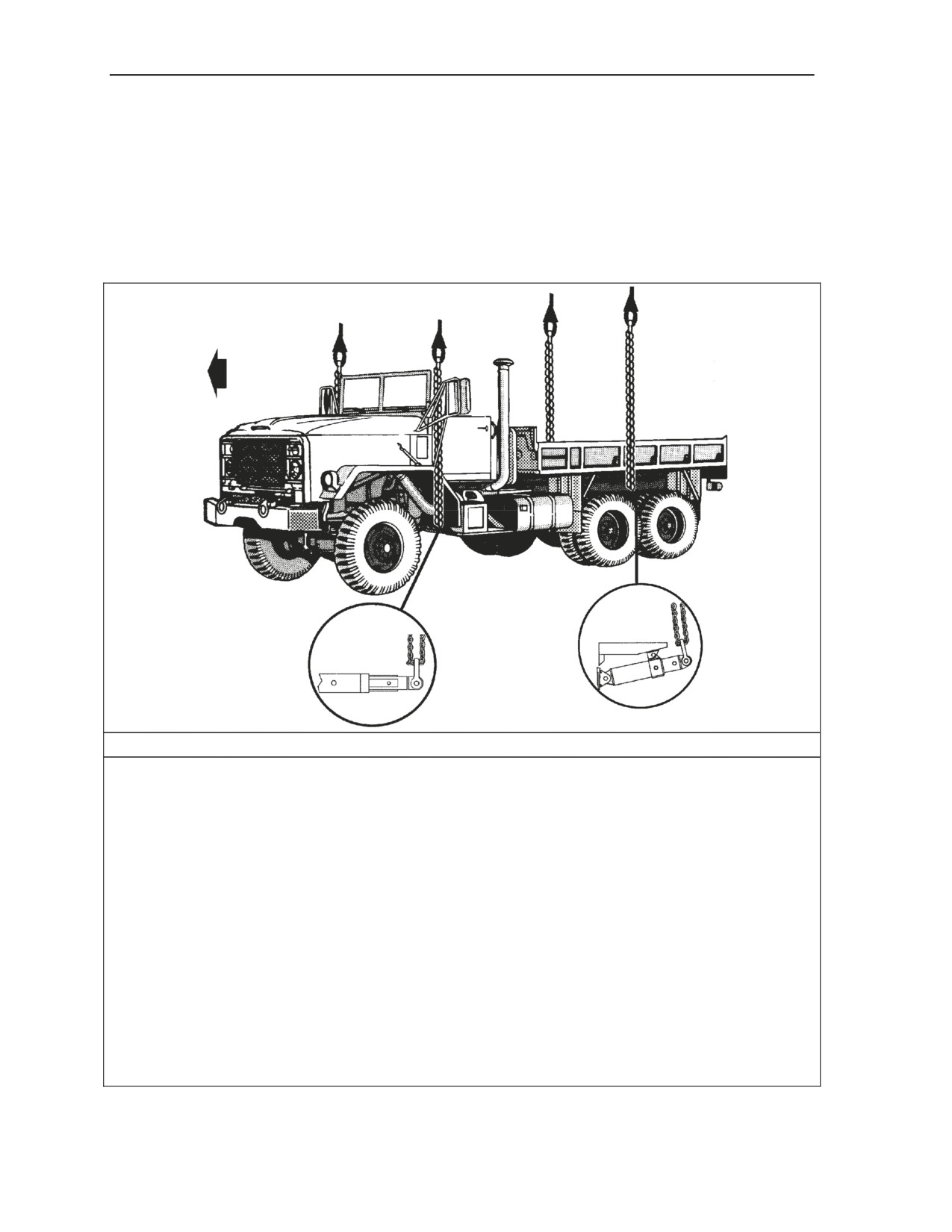
Rigging. Rig the load according to the steps in Figure 2-45.
Hookup. The static wand person discharges the static electricity with the static wand. The
forward hookup person stands on the passenger's seat and places apex fitting 1 onto the
forward cargo hook. The aft hookup person stands on the chassis and places apex fitting 2 onto
the aft cargo hook. The hookup team then carefully dismounts the vehicle and remains close
to the load as the helicopter removes slack from the sling legs. When successful hookup is
assured, the hookup team quickly exits the area underneath the helicopter to the designated
rendezvous point.
Derigging. Derigging is the reverse of the preparation and rigging procedures.
FM 4-20.199/MCRP 4-11.3E, VOL III/NTTP 3-04.13/
20 February 2009
AFMAN 11-223 (I), VOL III/COMDINST M13482.4B
2-107
Chapter 2
RIGGING STEPS
1. Connect 2 sling legs to apex fitting number 1. Position the apex fitting on the hood of the
vehicle.
2. Loop the chain end of the sling legs through their respective lift provisions on the front
bumper. Place the correct link from Table 2-46 in the grab hook.
3. Connect 2 sling legs to apex fitting number 2. Position the apex fitting on the chassis of the
vehicle.
4. Loop the chain end of the sling legs through their respective lift provision located on top of
the spring housing between the rear wheels. Place the correct link from Table 2-46 in the
grab hook.
5. Secure all excess chain with tape or Type III nylon cord.
6. Cluster and tie (breakaway technique) the sling legs in each sling set on top of the vehicle to
prevent entanglement during hookup and lift-off.
Figure 2-45. Truck, Cargo, 2 1/2-ton, M35A2 Modified
FM 4-20.199/MCRP 4-11.3E, VOL III/NTTP 3-04.13/
2-108
AFMAN 11-223 (I), VOL III/COMDINST M13482.4B
20 February 2009
Certified Dual-Point Rigging Procedures for Wheeled Vehicles
M35A3 2 1/2-TON CARGO TRUCK
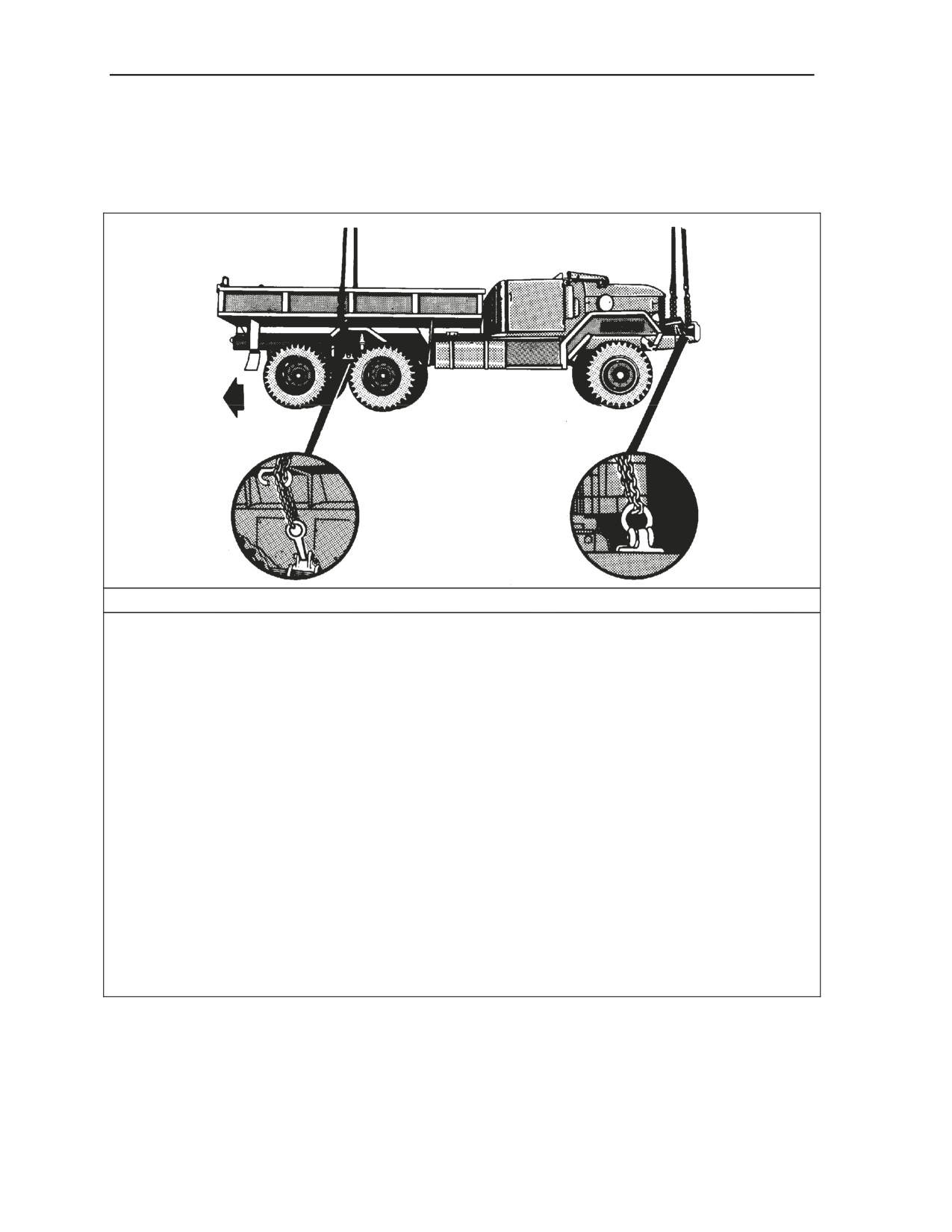
2-48. The M35A3 2 1/2-ton cargo truck is rigged for dual-point sling load using the following procedures:
z
Applicability. The following item in Table 2-47 is certified for the helicopter(s) listed in the
following table by the US Army Natick Soldier Center:
Table 2-47. M35A3 2 1/2-Ton Cargo Truck
Nomenclature
Max Weight
Sling
Link Count
Type of
(Pounds)
Set
Front/Rear
Aircraft
Truck, 2 1/2-Ton, M35A2
18,900
25K
3/50
CH-47
z
Materials. The following materials are required to rig this load:
Sling set (25,000-pound capacity) with one additional apex fitting.
─ Additional chain length, part number 38850-00053-102, from a 25,000-pound capacity
sling set (4 each).
─ Additional coupling link, part number 5779135, from a 25,000-pound capacity sling
set (4 each).
Tape, adhesive, pressure-sensitive, 2-inch wide roll.
Cord, nylon, Type III, 550-pound breaking strength.
Webbing, cotton, 1/4-inch, 80-pound breaking strength.
Felt sheet, cattle hair, Type IV, 1/2-inch or suitable padding.
Strap, cargo, tiedown, CGU-1/B (as required).
z
Personnel. Two persons can prepare and rig this load in 15 minutes.
z
Procedures. The following procedures apply to this load:
Preparation. Prepare the load using the following steps:
─ Remove the cargo compartment canvas and bows. Secure the canvas and bows in the
bed of the truck.
─ Remove the cab top canvas, lower the windshield, fold the canvas over the windshield,
and secure with Type III nylon cord.
─ Secure the windshield in the down position with the CGU-1/B cargo tiedown strap.
─ Safety tie the hood closed with Type III nylon cord around the hood latch and the grill.
─ Ensure the fuel, oil filler, radiator, and battery caps are properly installed and secured.
Ensure the battery compartment door is closed. Ensure the fuel tank is less than 3/4
full.
─ Secure the seat cushions and doors with Type III nylon cord.
─ Engage the emergency brake and place the transmission in neutral.
─ Straighten the front wheels and secure the steering wheel with Type III nylon cord.
─ Ensure the front lift provisions are in the transport position.
─ Extend the sling leg chains by connecting one additional chain length to each chain on
a 25,000-pound capacity sling set with coupling links.
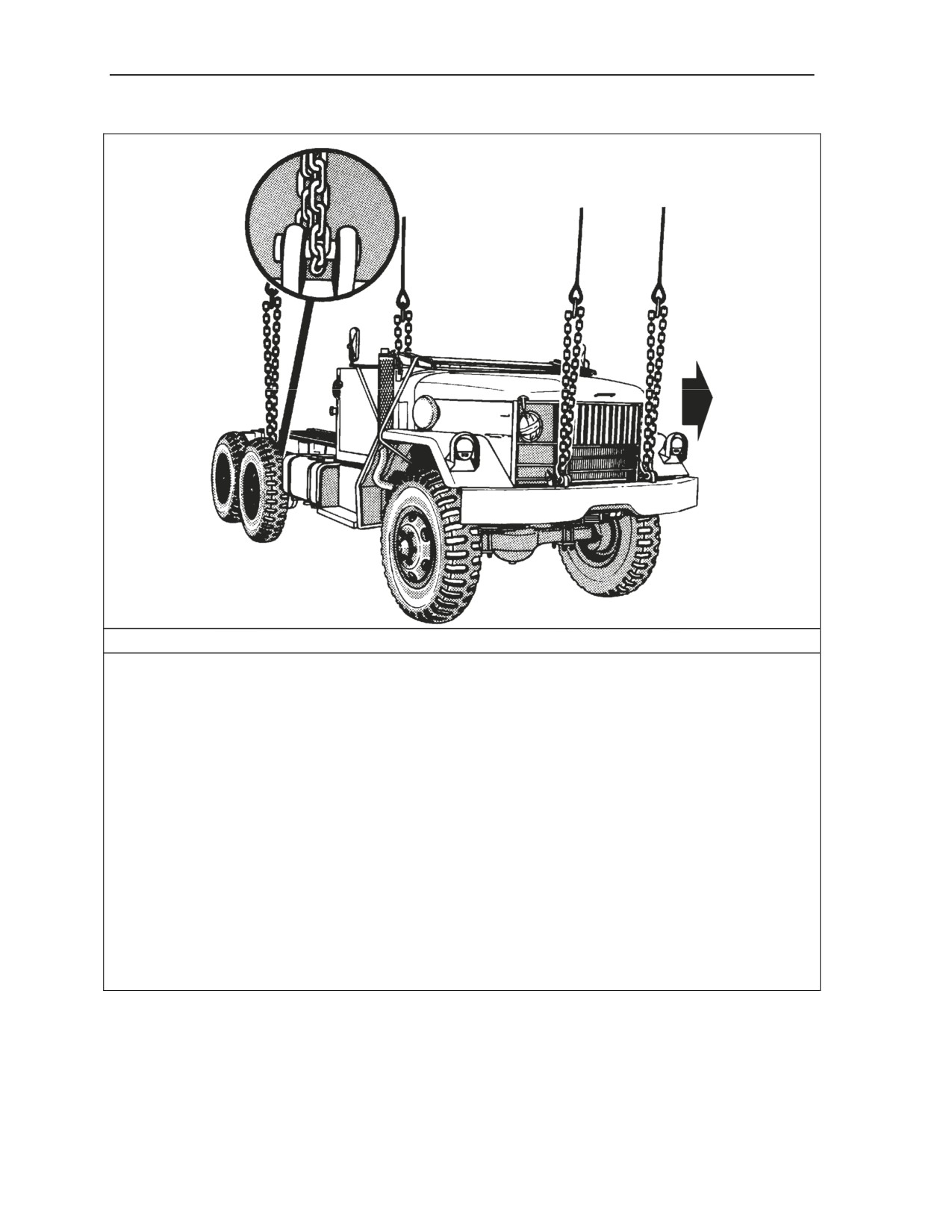
Rigging. Rig the load according to the steps in Figure 2-46.
Note: This vehicle flies aft end forward.
Hookup. Two hookup teams are used for this load. The static discharge person discharges
the static electricity. The forward hookup person stands in the truck bed and places apex
fitting 1 onto the forward cargo hook. The aft hookup person stands on the passenger seat and
places apex fitting 2 onto the aft cargo hook. The hookup teams then carefully dismount the
load and
FM 4-20.199/MCRP 4-11.3E, VOL III/NTTP 3-04.13/
20 February 2009
AFMAN 11-223 (I), VOL III/COMDINST M13482.4B
2-109
Chapter 2
remain close to the load as the helicopter removes slack from the sling legs. When successful
hookup is assured, the hookup teams quickly exit the area underneath the helicopter to the
designated rendezvous point.
Derigging. Derigging is the reverse of the preparation and rigging procedures.
RIGGING STEPS
1. Place two sling legs on apex fitting number 1. Position apex fitting number 1 in the bed of the
truck.
2. Loop the chain end of the left and right sling legs through their respective extended lift
provision located between the rear wheels. Place the correct link from Table 2-47 in the grab
hook.
3. Pull each grab hook up against the side of the truck and tie the chain in the chain guide
bracket. Pull both grab hooks together over top of the bed and tie together with 1/4-inch
cotton webbing.
4. Place two sling legs on apex fitting number 2. Position apex fitting number 2 on the hood.
5. Loop the chain end of the left and right sling legs through their respective lift provision located
on the front bumper. Place the correct link from Table 2-47 in the grab hook. Secure the
excess chain with tape or Type III nylon cord.
6. Raise the apex fittings above the load. Cluster and tie (breakaway technique) the sling legs
in each sling set together to prevent entanglement during hookup and lift-off.
Figure 2-46. M35A3 2 1/2-Ton Cargo Truck
FM 4-20.199/MCRP 4-11.3E, VOL III/NTTP 3-04.13/
2-110
AFMAN 11-223 (I), VOL III/COMDINST M13482.4B
20 February 2009
Certified Dual-Point Rigging Procedures for Wheeled Vehicles
MEDIUM TACTICAL VEHICLE REPLACEMENT (MTVR) (USMC)
2-49. The medium tactical vehicle replacement is rigged for dual-point sling load using the following
procedures:
z
Applicability. The following item in Table 2-48 is certified for the helicopter(s) listed in the
following table by the US Army Natick Soldier Center:
Table 2-48. Medium Tactical Vehicle Replacement
Nomenclature
Max Weight
Sling
Link Count
Type of
(Pounds)
Set
Front/Rear
Aircraft
Medium Tactical Vehicle Replacement
27,800
40K
30/10
CH-53
z
Materials. The following materials are required to rig this load:
Sling set (40,000-pound capacity) with one additional apex fitting.
─ Additional chain length, from a 40,000-pound capacity sling set (2 each).
─ Additional coupling link, from a 40,000-pound capacity sling set (2 each).
Tape, adhesive, pressure-sensitive, 2-inch wide roll.
Cord, nylon, Type III, 550-pound breaking strength.
Webbing, cotton, 1/4-inch, 80-pound breaking strength.
Padding, cellulose.
z
Personnel. Four persons can prepare and rig this load in 20 minutes.
z
Procedures. The following procedures apply to this load:
Preparation. Prepare the load using the following steps:
─ Fold mirrors forward/inward and tie together with Type III nylon cord.
─ Secure all equipment and cargo inside the vehicle with tape, nylon cord, or hold down
straps.
─ Ensure the fuel tank is not over 3/4 full. Place the fuel tank cap in the vent position.
Inspect the oil filler cap and battery caps for proper installation.
─ Engage the vehicle parking brake and put the transmission in neutral.
─ Ensure the front wheels are pointed straight ahead. Tie down the steering wheel using
Type III nylon cord.
─ Remove the upper sections of the exhaust stack and the breather and secure in the
vehicle.
─ Remove and secure the sideboards, tarp, and bows.
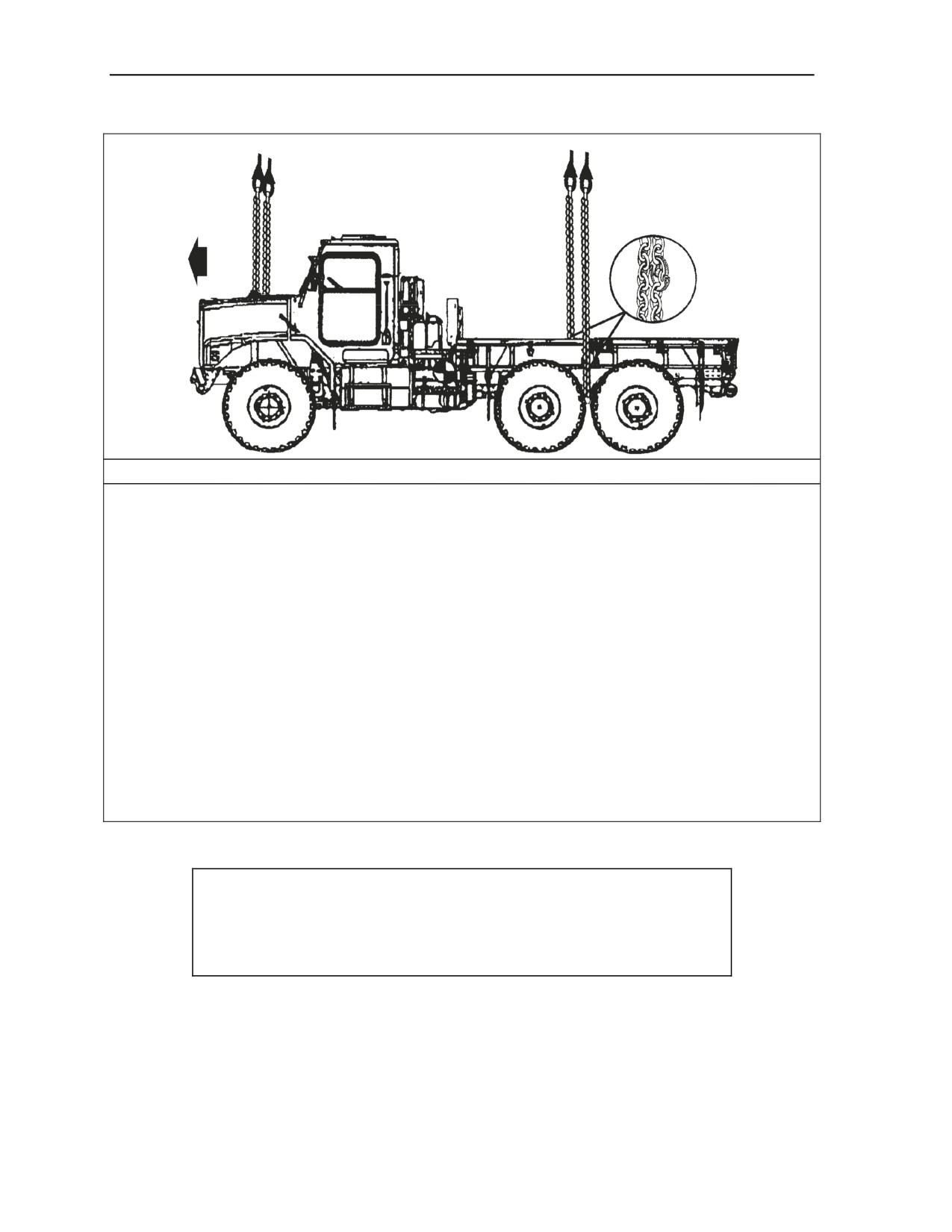
Rigging. Rig the load according to the steps in Figure 2-47.
Hookup. The hookup team stands in the bed of the vehicle. The static wand person
discharges the static electricity with the static wand. The forward hookup person places apex
fitting 1 onto the forward cargo hook. The aft hookup person places apex fitting 2 onto the aft
cargo hook. The hookup team then carefully dismounts the vehicle and remains close to the
load as the helicopter removes slack from the sling legs. When successful hookup is assured,
the hookup team quickly exits the area underneath the helicopter to the designated rendezvous
point.
Derigging. Derigging is the reverse of the preparation and rigging procedures.
FM 4-20.199/MCRP 4-11.3E, VOL III/NTTP 3-04.13/
20 February 2009
AFMAN 11-223 (I), VOL III/COMDINST M13482.4B
2-111
Chapter 2
RIGGING STEPS
1. Connect 2 sling legs to apex fitting number 1. Position the apex fitting on top of the roof.
2. Loop the chain end of the sling legs through their respective lift provisions that protrudes
through the hood. Place the correct link from Table 2-48 in the grab hook. Secure all excess
chain with tape or Type III nylon cord.
3. Connect 2 sling legs to apex fitting number 2. Position the apex fitting on bed of the truck.
4. Route the chain end of sling leg 3 through the left sling guide located near the center of the
truck bed. Loop the chain around the left lift provision located between the rear axles. Add
an additional chain length to the chain with a coupling link and route the chain end back
through the sling guide. Place the correct links from Table 2-48 in the grab hooks. Repeat
with sling leg 4 and right sling guide and right lift provision. Secure all excess chain with
tape or Type III nylon cord.
5. Cluster and tie (breakaway technique) the sling legs in each sling set on top of the vehicle to
prevent entanglement during hookup and lift-off.
Figure 2-47. Medium Tactical Vehicle Replacement
CAUTION
Attach the sling leg chain extensions to the rear legs after passing the
sling leg chain through the rear lift provisions.
FM 4-20.199/MCRP 4-11.3E, VOL III/NTTP 3-04.13/
2-112
AFMAN 11-223 (I), VOL III/COMDINST M13482.4B
20 February 2009

Certified Dual-Point Rigging Procedures for Wheeled Vehicles
FRONT POWER UNIT, MK48
2-50. The front power unit, MK48 is rigged for dual-point sling load using the following procedures:
z
Applicability. The following item in Table 2-49 is certified for the helicopter(s) listed in the
following table by the US Army Natick Soldier Center:
Table 2-49. Front Power Unit, MK49
Nomenclature
Max Weight
Sling
Link Count
Type of
(Pounds)
Set
Front/Rear
Aircraft
Front Power Unit, MK48
26,000
40K
Listed in
CH-53
Rigging Steps
z
Materials. The following materials are required to rig this load:
Sling set (40,000-pound capacity) with one additional apex fitting.
─ Additional chain length, part number 607050, from a 40,000-pound capacity sling set
(2 each).
─ Additional coupling link, part number 577-0815, from a 40,000-pound capacity sling
set (2 each).
Tape, adhesive, pressure-sensitive, 2-inch wide roll.
Cord, nylon, Type III, 550-pound breaking strength.
Webbing, cotton, 1/4-inch, 80-pound breaking strength.
z
Personnel. Two persons can prepare and rig this load in 20 minutes.
z
Procedures. The following procedures apply to this load:
Preparation. Prepare the load using the following steps:
─ Ensure the front wheels are pointed straight ahead. Tie down the steering wheel using
Type III nylon cord.
─ Engage the parking brake and place the transmission in neutral.
─ Ensure the fuel tank is not over 3/4 full. Inspect fuel tank cap, oil filler cap, and
battery caps for proper installation. Ensure the battery compartment door is fastened
closed.
─ Open the vent on top of the cab. Secure all loose equipment with tape or Type III
nylon cord. Tape the turbocharger opening and all windows.
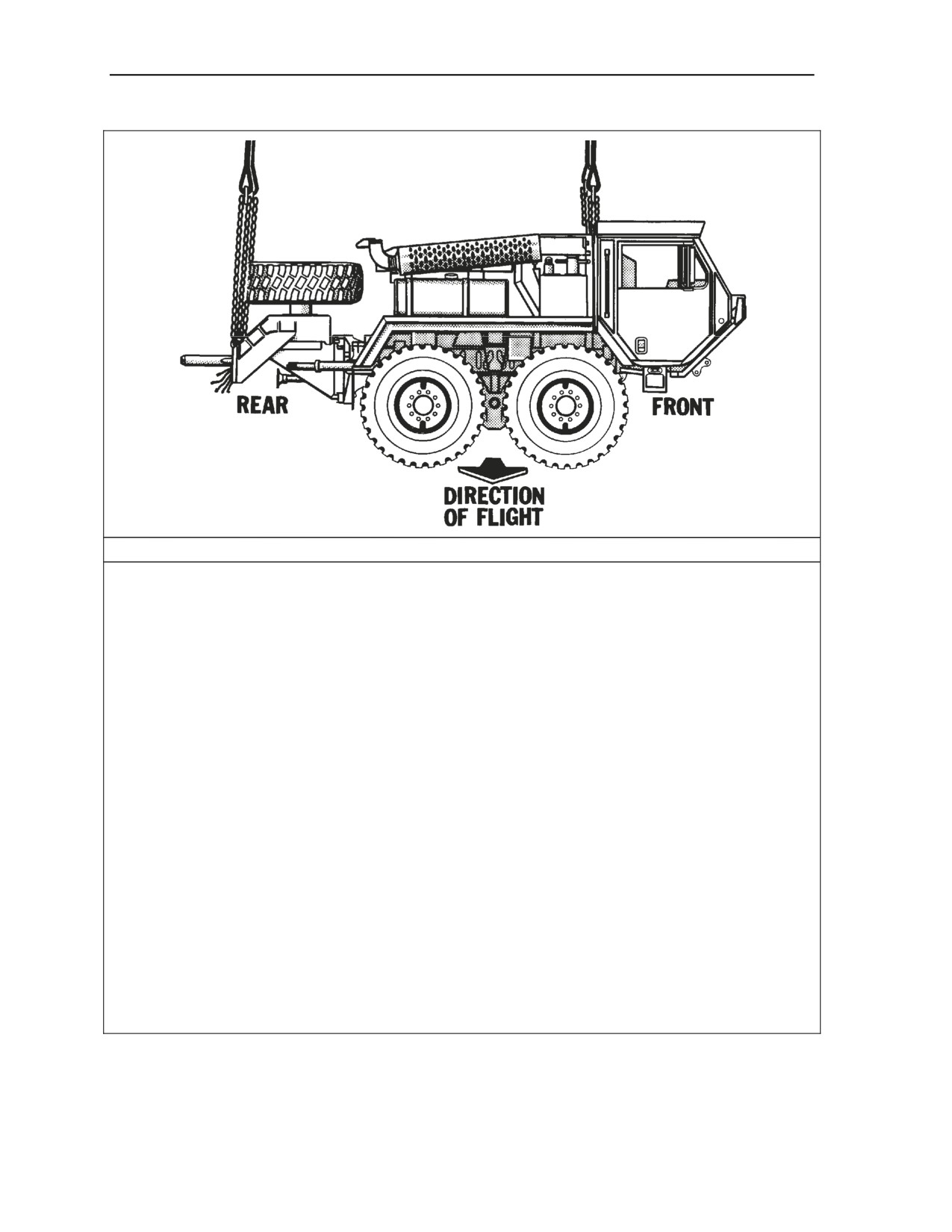
Rigging. Rig the load according to the steps in Figure 2-48.
Note: The power unit is rigged to fly sideways. The passenger side is designated as the front of
the load. The apex fitting on the passenger side must be connected first to prevent the vehicle
from tipping.
Hookup. The static wand person discharges the static electricity with the static wand. The
forward hookup person stands on the passenger's seat and places apex fitting 1 onto the
forward cargo hook. The aft hookup person stands on the chassis and places apex fitting 2 onto
the aft cargo hook. The hookup team then carefully dismounts the vehicle and remains close
to the load as the helicopter removes slack from the sling legs. When successful hookup is
assured, the hookup team quickly exits the area underneath the helicopter to the designated
rendezvous point.
Derigging. Derigging is the reverse of the preparation and rigging procedures.
FM 4-20.199/MCRP 4-11.3E, VOL III/NTTP 3-04.13/
20 February 2009
AFMAN 11-223 (I), VOL III/COMDINST M13482.4B
2-113
Chapter 2
RIGGING STEPS
1.
Connect 2 sling legs to apex fitting number 1. Position the apex fitting on top of the muffler
area.
2.
Loop the chain end of the left sling leg through the lift provision just aft of the passenger side
of the cab and insert link 41 in the grabhook.
3.
Using the coupling link, attach one additional chain length to the right sling leg chain. Loop
the chain end of the right sling leg through the lift provision on the right rear corner just aft of
the spare tire and insert link 3 in the grabhook.
4.
Connect 2 sling legs to apex fitting number 2. Position the apex fitting on the engine deck on
the driver's side.
5.
Loop the chain end of the left sling leg through the lift provision just aft of the driver's side of
the cab and insert link 41 in the grabhook.
6.
Using the coupling link, attach one additional chain length to the right sling leg chain. Loop
the chain end of the right sling leg through the lift provision on the left rear corner just aft of
the spare tire and insert link 3 in the grabhook.
7.
Secure all excess chain with tape or Type III nylon cord.
8.
Cluster and tie (breakaway technique) the sling legs in each sling set on top of the vehicle to
prevent entanglement during hookup and lift-off.
Figure 2-47. Front Power Unit, MK48
FM 4-20.199/MCRP 4-11.3E, VOL III/NTTP 3-04.13/
2-114
AFMAN 11-223 (I), VOL III/COMDINST M13482.4B
20 February 2009

Certified Dual-Point Rigging Procedures for Wheeled Vehicles
LIGHT ARMORED VEHICLE (LAV) (USMC)
2-51. The light armored vehicle is rigged for dual-point sling load using the following procedures:
z
Applicability. The following items in Table 2-50 are certified for the helicopter(s) listed in the
following table by the US Army Natick Soldier Center:
Table 2-50. Light Armored Vehicle
Nomenclature
Max Weight
Sling
Link Count
Type of
(Pounds)
Set
Front/Rear
Aircraft
Command and Control TAMCN E0946
27,060
40K
3/45
CH-53
25-MM, TAMCN E0947
28,200
40K
3/20
CH-53
Logistics, TAMCN E0948
28,200
40K
3/45
CH-53
Mortar, TAMCN E0949
27,400
40K
3/20
CH-53
Recovery Unit, TAMCN E0950
23,400
40K
3/50
CH-53
Tow Anti-Tank, TAMCN E0942
27,650
40K
3/30
CH-53
Mobile Electronic Warfare Support System- Product
29,480
40K
45/10
CH-53
Improvement Program (MEWSS-PIP)
z
Materials. The following materials are required to rig this load:
Sling set (40,000-pound capacity) with one additional apex fitting.
─ Additional chain length, part number 607050, from a 40,000-pound capacity sling set
(2 each) (required for MEWSS-PIP only).
─ Additional coupling link, part number 577-0815, from a 40,000-pound capacity sling
set (2 each) (required for MEWSS-PIP only).
Tape, adhesive, pressure-sensitive, 2-inch wide roll.
Cord, nylon, Type III, 550-pound breaking strength.
Webbing, cotton, 1/4-inch, 80-pound breaking strength.
Felt sheet, cattle hair, Type IV, 1/2-inch or suitable padding.
z
Personnel. Two persons can prepare and rig this load in 15 minutes.
z
Procedures. The following procedures apply to this load:
Preparation. Prepare the load using the following steps:
─ Secure all loose items inside the LAV.
─ Remove all antennae.
─ Ensure the parking brake is set.
─ Pad and tape all vision blocks, mirrors, and lights.
─ Secure all hatches and panels.
─ Ensure the boom is pinned down and tape the hydraulic cables. (Recovery Unit)
─ Remove the Electronic Surveillance subsystem and the Electronic Attack subsystem
according to TM 11275-15/5 and TM 0999B-10/1 (MEWSS-PIP only).
─ Extend the front sling leg chains on the MEWSS-PIP by connecting one additional
chain length to each chain on a 40,000-pound capacity sling set with coupling links.
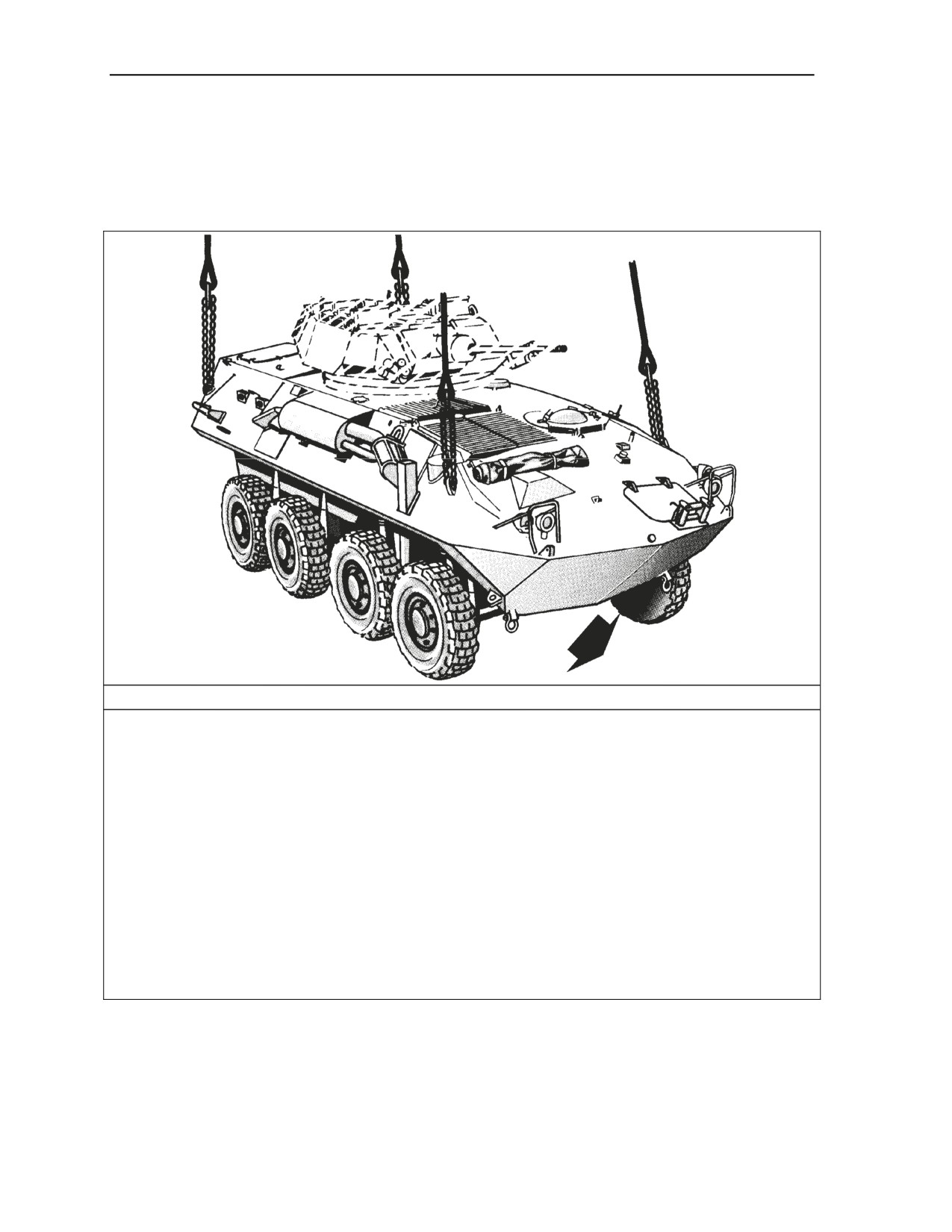
Rigging. Rig the load according to the steps in Figure 2-49.
Hookup. The hookup team stands on top of the vehicle. The static wand person
discharges the static electricity with the static wand. The forward hookup person places apex
fitting 1 onto the forward cargo hook. The aft hookup person places apex fitting 2 onto the aft
FM 4-20.199/MCRP 4-11.3E, VOL III/NTTP 3-04.13/
20 February 2009
AFMAN 11-223 (I), VOL III/COMDINST M13482.4B
2-115
Chapter 2
cargo hook. The hookup team then carefully dismounts the vehicle and remains close to the
load as the helicopter removes slack from the sling legs. When successful hookup is assured,
the hookup team quickly exits the area underneath the helicopter to the designated rendezvous
point.
Derigging. Derigging is the reverse of the preparation and rigging procedures.
RIGGING STEPS
1. Connect 2 sling legs to apex fitting number 1. Position the apex fitting on top of the LAV.
2. Loop the chain end of the sling legs through their respective lift provisions. Place the correct
link from Table 2-50 in the grab hook.
3. Connect 2 sling legs to apex fitting number 2. Position the apex fitting on top of the LAV.
4. Loop the chain end of the sling legs through their respective lift provision. Place the correct
link from Table 2-50 in the grab hook.
5. Secure all excess chain with tape or Type III nylon cord.
6. Cluster and tie (breakaway technique) the sling legs in each sling set on top of the LAV to
prevent entanglement during hookup and lift-off.
Figure 2-49. Light Armored Vehicle
FM 4-20.199/MCRP 4-11.3E, VOL III/NTTP 3-04.13/
2-116
AFMAN 11-223 (I), VOL III/COMDINST M13482.4B
20 February 2009

Chapter 3
Certified Dual-Point Rigging Procedures for Trailers
INTRODUCTION
3-1. This chapter contains rigging procedures for dual-point trailer loads that have been certified for sling
load. Each rigging procedure is found in a paragraph that includes a description of the load, materials
required for rigging, and steps to complete the procedure. An applicability paragraph is also a part of each
paragraph and identifies the certified loads. The certified dual-point rigging procedures for trailers are in
this section. Paragraphs 3-2 through 3-25 give detailed instructions for rigging loads.
Note. Reach Pendants may be used on dual-point loads. Place a reach pendant on each apex
fitting. A static discharge person is not required when using a Reach Pendant.
M101A2 3/4-TON TRAILER
3-2. The M101A2 3/4-ton trailer is rigged for dual-point sling load using the following procedures:
z
Applicability. The following items in Table 3-1 are certified for the helicopter(s) listed in the
following table by the US Army Natick Soldier Center:
Table 3-1. M101A2 3/4-Ton Trailer
Nomenclature
Max Weight
Sling
Link Count
Type of
(Pounds)
Set
Front/Rear
Aircraft
M101A2 with Accompanying Load
3,000
10K
3/20
CH-47
Command Version 1 Trailer
1,958
10K
3/20
CH-47
Command Version 2 Trailer
1,981
10K
3/20
CH-47
Len Cable Trailer
2,796
10K
3/20
CH-47
NC Support Trailer
2,643
10K
3/20
CH-47
Maintenance Trailer #2
1,430
10K
3/20
CH-47
Battalion Spares Trailer #1
1,594
10K
3/20
CH-47
Battalion Spares Trailer #2
2,206
10K
3/20
CH-47
Downsized Direct Support Section Trailer
2,700
10K
3/20
CH-47
WARNING
The M101A2 3/4-ton trailer must have a gross weight of 1,575
pounds or more. Add additional weight or cargo to any trailer
which weighs less than 1,575 pounds. Place the weight near the
center of the trailer.
FM 4-20.199/MCRP 4-11.3E, VOL III/NTTP 3-04.13/
20 February 2009
AFMAN 11-223 (I), VOL III/COMDINST M13482.4B
3-1
Chapter 3
WARNING
Maximum weight during sling load operations for any variant of
the M101A2 3/4-ton trailer is 3,000 pounds.
z
Materials. The following materials are required to rig this load:
Sling set (10,000-pound capacity) with one additional apex fitting.
Tape, adhesive, pressure-sensitive, 2-inch wide roll.
Cord, nylon, Type III.
Webbing, cotton, 1/4-inch.
Tie down, CGU-1B or dacron lashing and load binder.
z
Personnel. Two persons can prepare and rig this load in 15 minutes.
z
Procedures. The following procedures apply to this load:
Preparation. Prepare the load using the following steps:
─ Fasten the tailgate in the open position with the chains on each side hooked through the
keeper.
─ Remove the front rack and place it in the bed of the trailer. Place the accompanying
load on top of the front rack. Secure the accompanying load to the trailer using tie-
down straps. Route the straps diagonally across the load from the tailgate hinge to the
front lifting shackles.
─ Tape or tie the light cable firmly to the top of the drawbar.
─ Ensure the parking brake is set.
Rigging. Rig the load according to the steps in Figure 3-1.
Hookup. The hookup teams stand in the bed of the trailer. The static wand person
discharges the static electricity with the static wand. The forward hookup person places apex
fitting 1 onto the forward cargo hook. The aft hookup person places apex fitting 2 onto the aft
cargo hook. The hookup team then carefully dismounts the vehicle and remains close to the
load as the helicopter removes slack from the sling legs. When successful hookup is assured,
the hookup team quickly exits the area underneath the helicopter to the designated rendezvous
point.
Derigging. Derigging is the reverse of the preparation and rigging procedures.
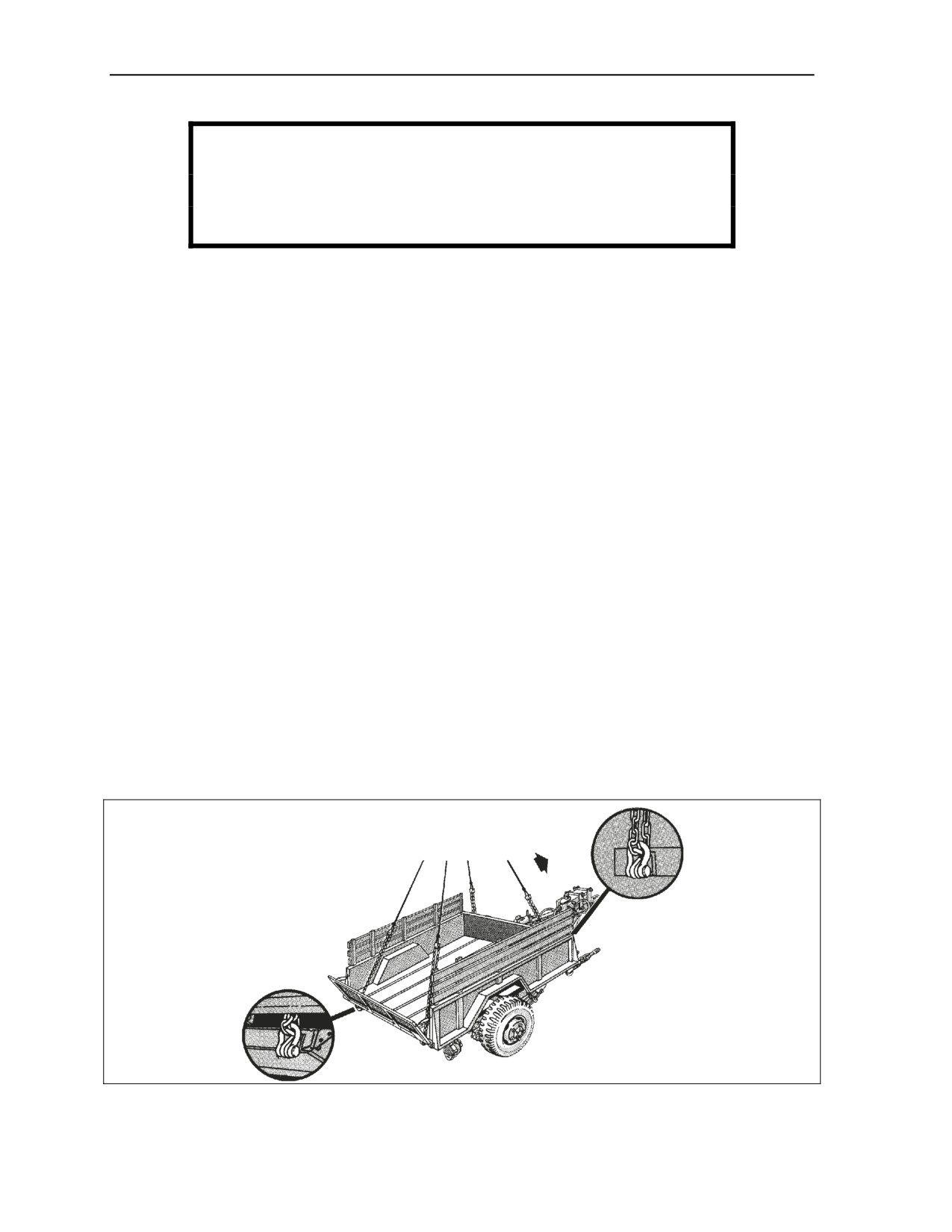
Figure 3-1. M101A2 3/4-Ton Trailer
FM 4-20.199/MCRP 4-11.3E, VOL III/NTTP 3-04.13/
3-2
AFMAN 11-223 (I), VOL III/COMDINST M13482.4B
20 February 2009

Certified Dual-Point Rigging Procedures for Trailers
RIGGING STEPS
1. Connect 2 sling legs to apex fitting number 1. Position the apex fitting on the drawbar.
2. Loop the chain end of the sling legs through their respective lift provisions located on the
front of the trailer. Place the correct link from Table 3-1 in the grab hook.
3. Connect 2 sling legs to apex fitting number 2. Route the two sling legs through the opening
between the tailgate and the trailer bed. Route each chain on the inboard side of the tailgate
hinge.
4. Loop the chain end of the sling legs through their respective lift provisions. Place the correct
link from Table 3-1 in the grab hook. Remove the slack from each rear sling leg and tape or
tie (breakaway technique) each sling leg to the side rack.
5. Secure all excess chain with tape or Type III nylon cord.
6. Cluster and tie or tape (breakaway technique) the sling legs in each sling set together to
prevent entanglement during hookup and lift-off.
Figure 3-1. M101A2 3/4-Ton Trailer (Continued)
M1048 TRAILER WITH TRACKED SUSPENSION SYSTEM (TSS)
3-3. The M1048 trailer with tracked suspension system is rigged for dual-point sling load using the
following procedures:
z
Applicability. The following item in Table 3-2 is certified for the helicopter(s) listed in the
following table by the US Army Natick Soldier Center:
Table 3-2. M1048 Trailer with Tracked Suspension System
Nomenclature
Max Weight
Sling
Link Count
Type of
(Pounds)
Set
Front/Rear
Aircraft
M1048 Trailer (TSS)
7,880
10K
16/3
CH-47
z
Materials. The following materials are required to rig this load:
Sling set (10,000-pound capacity) with one additional apex fitting.
Tape, adhesive, pressure-sensitive, 2-inch wide roll.
Cord, nylon, Type III, 550-pound breaking strength.
Webbing, cotton, 1/4-inch, 80-pound breaking strength.
z
Personnel. Two persons can prepare and rig this load in 10 minutes.
z
Procedures. The following procedures apply to this load:
Preparation. Prepare the load using the following steps:
─ Secure all loose chains, hoses, and cables to the trailer drawbar with Type III nylon
cord.
─ Secure any lids, caps, or loose items with tape or Type III nylon cord.
─ Tape or tie the light cable firmly to the top of the drawbar.
─ Place the front leveling jacks in the down position. Ensure the base of the leveling
jacks is not extended. Stow the jack handles and secure with Type III nylon cord.
Secure the rear leveling jacks in the up position. The trailer should lean downward at
the lunette end.
─ Ensure the parking brake is set.
Rigging. Rig the load according to the steps in Figure 3-2.
FM 4-20.199/MCRP 4-11.3E, VOL III/NTTP 3-04.13/
20 February 2009
AFMAN 11-223 (I), VOL III/COMDINST M13482.4B
3-3
Chapter 3
Hookup. The hookup team stands in the bed of the trailer. The static wand person
discharges the static electricity with the static wand. The hookup person places the apex fitting
onto the aircraft cargo hook. The hookup team then carefully dismounts the vehicle and
remains close to the load as the helicopter removes slack from the sling legs. When successful
hookup is assured, the hookup team quickly exits the area underneath the helicopter to the
designated rendezvous point.
Derigging. Derigging is the reverse of the preparation and rigging procedures.
RIGGING STEPS
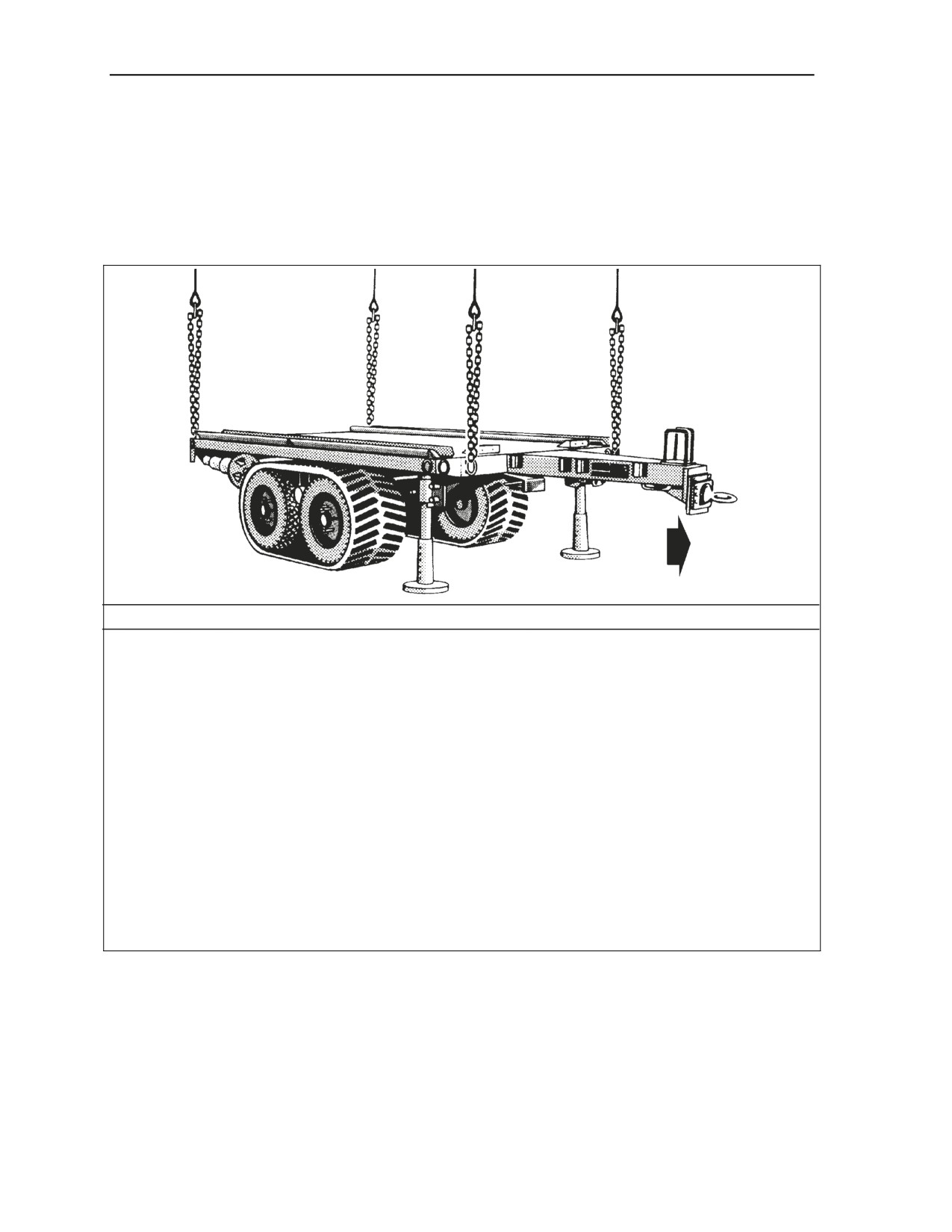
1. Connect 2 sling legs to apex fitting number 1. Position the apex fitting on the front (lunette
end) of the trailer.
2. Loop the chain end of the sling legs through their respective lift provisions located on the
front of the trailer. Place the correct link from Table 3-2 in the grab hook.
3. Connect 2 sling legs to apex fitting number 2. Position the apex fitting on the rear of the
trailer.
4. Loop the chain end of the sling legs through their respective lift provisions. Place the correct
link from Table 3-2 in the grab hook.
5. Secure all excess chain with tape or Type III nylon cord.
6. Cluster and tie (breakaway technique) the sling legs in each sling set together to prevent
entanglement during hookup and lift-off.
Figure 3-2. M1048 Trailer with Tracked Suspension System
FM 4-20.199/MCRP 4-11.3E, VOL III/NTTP 3-04.13/
3-4
AFMAN 11-223 (I), VOL III/COMDINST M13482.4B
20 February 2009
Certified Dual-Point Rigging Procedures for Trailers
M989 HEAVY-EXPANDED MOBILITY AMMUNITION TRAILER
(HEMAT)
3-4. The M989 heavy-expanded mobility ammunition trailer is rigged for dual-point sling load using the
following procedures:
z
Applicability. The following item in Table 3-3 is certified for the helicopter(s) listed in the
following table by the US Army Natick Soldier Center:
Table 3-3. M989 Heavy-Expanded Mobility Ammunition Trailer
Nomenclature
Max Weight
Sling
Link Count
Type of
(Pounds)
Set
Front/Rear
Aircraft
M989 HEMAT (Empty)
7,640
10K
40/4
CH-47
z
Materials. The following materials are required to rig this load:
Sling set (10,000-pound capacity) with one additional apex fitting.
Tape, adhesive, pressure-sensitive, 2-inch wide roll.
Cord, nylon, Type III.
Webbing, cotton, 1/4-inch.
Tie-down CGU-1/B (8 each).
z
Personnel. Two persons can prepare and rig this load in 15 minutes.
z
Procedures. The following procedures apply to this load:
Preparation. Prepare the load using the following steps:
─ At each corner of the trailer, slide the lifting provisions out until they are completely
extended. Do not lift the trailer unless the provisions are fully extended and secured in
position.
─ Remove the side and end panels. Place two panels side by side on the trailer so that
the panel ends are approximately 10 inches from the front of the trailer. Make sure the
panels are positioned lengthwise on the trailer. Place the remaining panels on top of
the respective panels on the trailer.
─ Secure the panels on the trailer with the tie-down straps. Attach the hook end of one
tie-down strap to a tie-down ring on the trailer bed beside the panels approximately 1
foot from the end of the panels. Connect and tighten the ratchet end to a tie-down ring
on the other side of the panels. Secure loose end of strap. Repeat with a second tie-
down strap at the other end of the panels.
─ To secure the panels lengthwise, route the hook end of one tie-down strap around the
vertical metal stiffeners on the top panel of the stack of panels on the left side of the
trailer. Attach the hook end to a tie-down ring on the front end of the trailer bed.
Connect and tighten the ratchet end to a tie-down ring on the other end of the stack of
panels. Secure loose end of strap. Repeat with a second tie-down strap on the other
stack of panels.
─ Tape or tie the intervehicular cable, hoses, and safety chains firmly to the top of the
drawbar with tape or Type III nylon cord.
─ Engage the parking brake.
Rigging. Rig the load according to the steps in Figure 3-3.
Hookup. The hookup teams stand in the bed of the trailer. The static wand person
discharges the static electricity with the static wand. The forward hookup person places apex
fitting 1 onto the forward cargo hook. The aft hookup person places apex fitting 2 onto the aft
cargo hook. The hookup team then carefully dismounts the vehicle and remains close to the
FM 4-20.199/MCRP 4-11.3E, VOL III/NTTP 3-04.13/
20 February 2009
AFMAN 11-223 (I), VOL III/COMDINST M13482.4B
3-5
Chapter 3
load as the helicopter removes slack from the sling legs. When successful hookup is assured,
the hookup team quickly exits the area underneath the helicopter to the designated rendezvous
point.
Derigging. Derigging is the reverse of the preparation and rigging procedures.
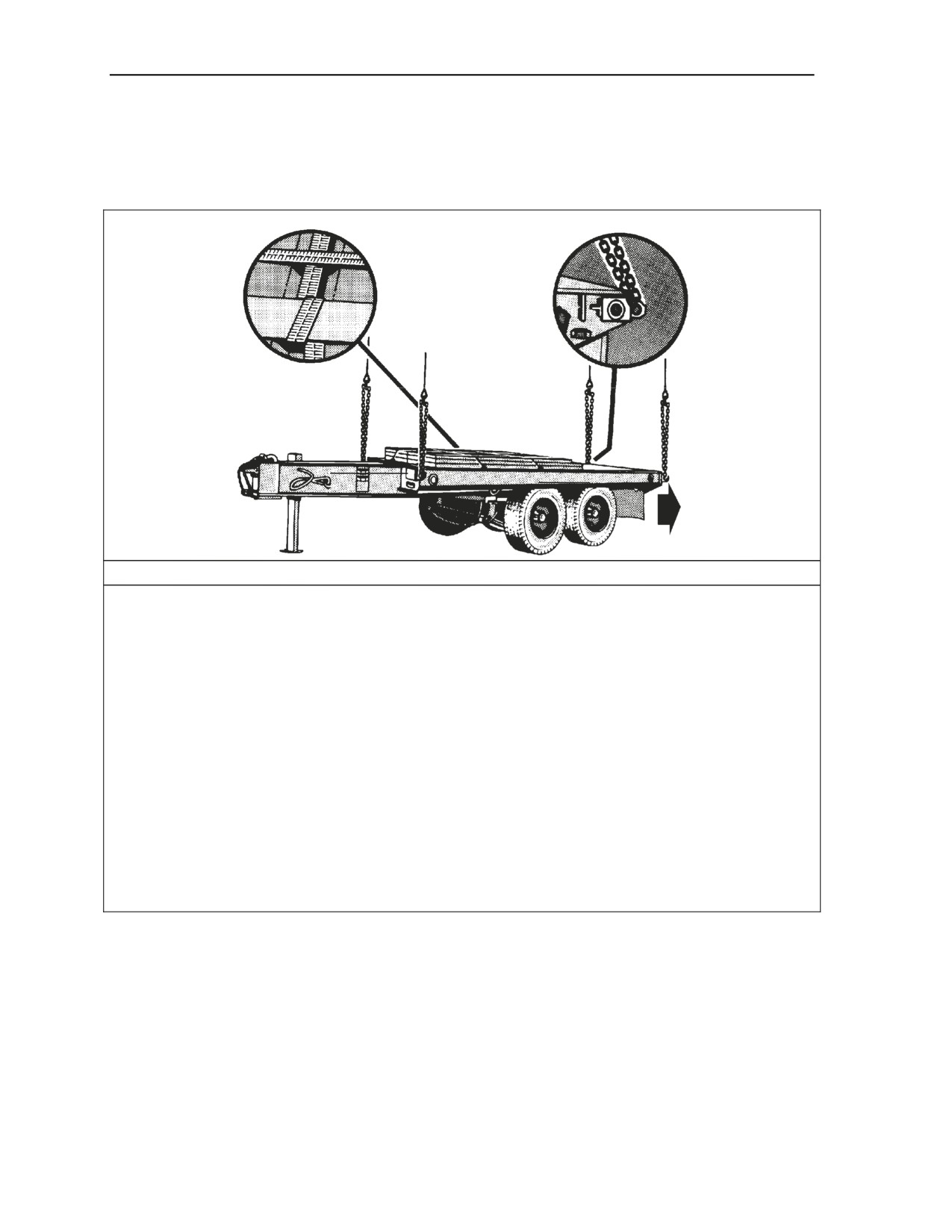
FRONT OF TRAILER
DIRECTION
OF FLIGHT
RIGGING STEPS
1. Connect 2 sling legs to apex fitting number 1. Position the apex fitting on the front (lunette
end) of the trailer.
2. Loop the chain end of the sling legs through their respective lift provisions located on the
front of the trailer. Place the correct link from Table 3-3 in the grab hook.
3. Connect 2 sling legs to apex fitting number 2. Position the apex fitting on the rear of the
trailer.
4. Loop the chain end of the sling legs through their respective lift provisions. Place the correct
link from Table 3-3 in the grab hook.
5. Secure all excess chain with tape or Type III nylon cord.
6. Cluster and tie (breakaway technique) the sling legs in each sling set together to prevent
entanglement during hookup and lift-off.
Figure 3-3. M989 Heavy-Expanded Mobility Ammunition Trailer
FM 4-20.199/MCRP 4-11.3E, VOL III/NTTP 3-04.13/
3-6
AFMAN 11-223 (I), VOL III/COMDINST M13482.4B
20 February 2009
Certified Dual-Point Rigging Procedures for Trailers
M989A1 HEAVY-EXPANDED MOBILITY AMMUNITION TRAILER
(HEMAT II)
3-5. The M989A1 heavy-expanded mobility ammunition trailer is rigged for dual-point sling load using
the following procedures:
z
Applicability. The following item in Table 3-4 is certified for the helicopter(s) listed in the
following table by the US Army Natick Soldier Center:
Table 3-4. M989A1 Heavy-Expanded Mobility Ammunition Trailer II
Nomenclature
Max Weight
Sling
Link Count
Type of
(Pounds)
Set
Front/Rear
Aircraft
M989 HEMAT II
10,650
25K
15/3
CH-47
CAUTION
The following rigging procedures are for the M989A1 HEMAT II only.
Do not use these procedures when rigging the M989 HEMAT.
z
Materials. The following materials are required to rig this load:
Sling set (25,000-pound capacity) with one additional apex fitting.
Tape, adhesive, pressure-sensitive, 2-inch wide roll.
Cord, nylon, Type III, 550-pound breaking strength.
Webbing, cotton, 1/4-inch, 80-pound breaking strength.
Tie-down CGU-1/B (as required).
z
Personnel. Two persons can prepare and rig this load in 10 minutes.
z
Procedures. The following procedures apply to this load:
Preparation. Prepare the load using the following steps:
─ Inspect the lift provisions at the four upper corners of the cargo bed.
─ Raise the trailer tongue and secure it in the up position with a CGU-1/B.
─ Secure the brake hose, safety hose, intravehicular cable(s), and safety chains to the
trailer and tongue with tape or Type III nylon cord.
─ Engage the steering lockout pin.
─ Secure the side panels to the cargo deck with CGU-1Bs.
Rigging. Rig the load according to the steps in Figure 3-4.
Hookup. The hookup teams stand on top of the M989A1. The static wand person
discharges the static electricity with the static wand. The forward hookup person places apex
fitting 1 onto the forward cargo hook. The aft hookup person places apex fitting 2 onto the aft
cargo hook. The hookup team then carefully dismounts the vehicle and remains close to the
FM 4-20.199/MCRP 4-11.3E, VOL III/NTTP 3-04.13/
20 February 2009
AFMAN 11-223 (I), VOL III/COMDINST M13482.4B
3-7
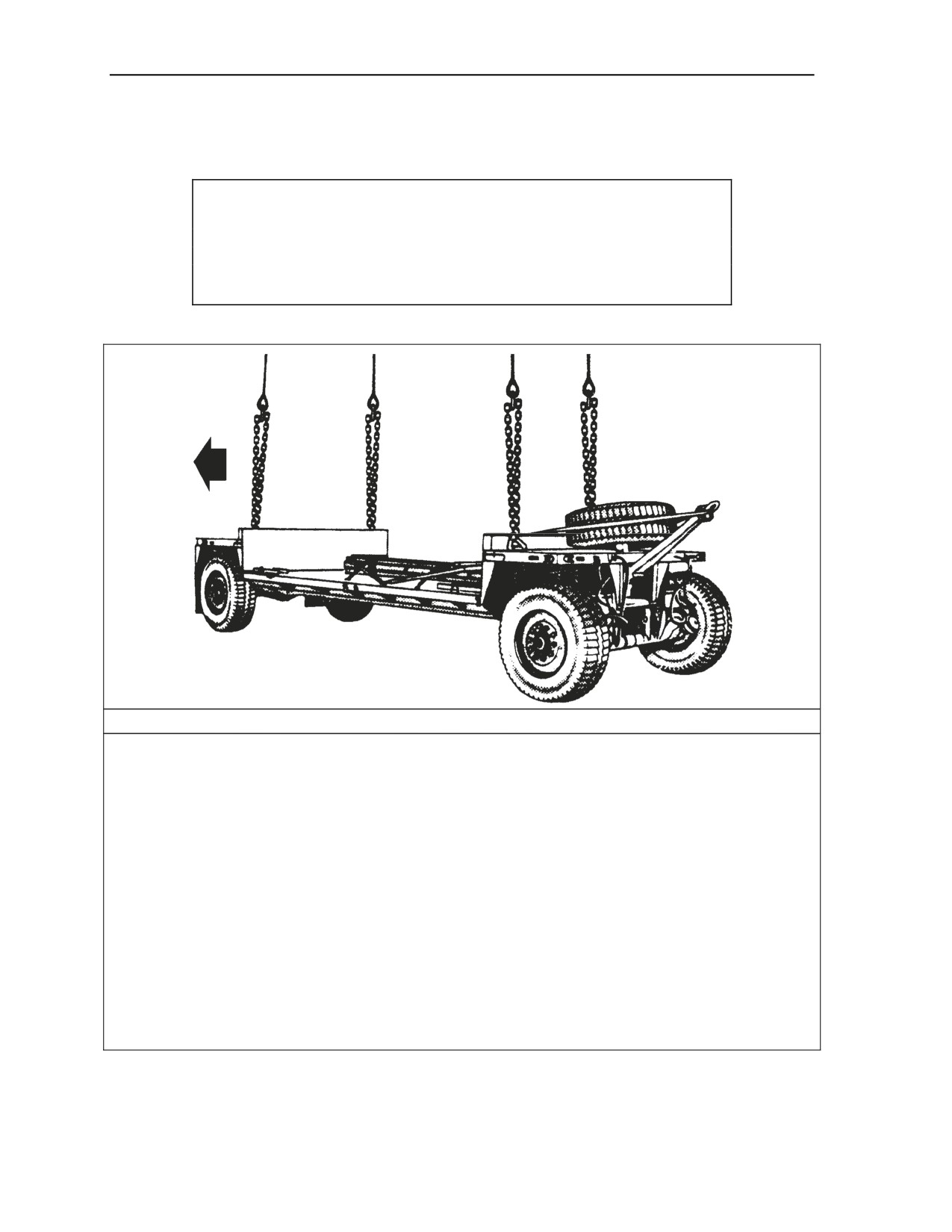
Chapter 3
load as the helicopter removes slack from the sling legs. When successful hookup is assured,
the hookup team quickly exits the area underneath the helicopter to the designated rendezvous
point.
CAUTION
Brief the helicopter crew to relax sling leg tension and hover to the side
of the load when releasing the apex fitting to prevent damage to the
panels on top of the trailer.
Derigging. Derigging is the reverse of the preparation and rigging procedures.
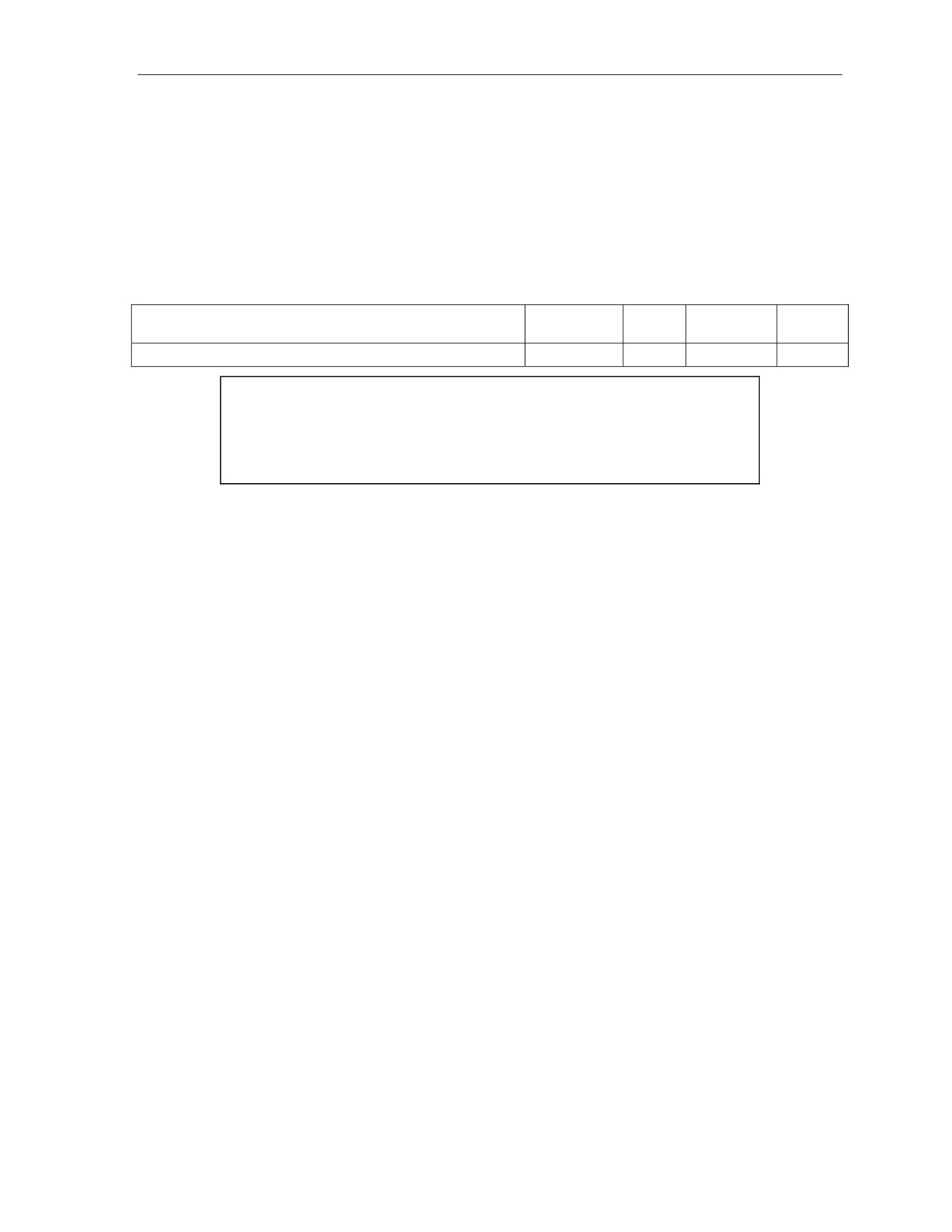
RIGGING STEPS
1. Connect 2 sling legs to apex fitting number 1. Position the apex fitting on top of the front
deck of the trailer.
2. Loop the chain end of the sling legs through their respective lift provisions located on the
front (tongue end) of the trailer. Place the correct link from Table 3-4 in the grab hook.
3. Connect 2 sling legs to apex fitting number 2. Position the apex fitting on the top of the rear
deck of the trailer.
4. Loop the chain end of the sling legs through their respective lift provisions. Place the correct
link from Table 3-4 in the grab hook.
5. Secure all excess chain with tape or Type III nylon cord.
6. Cluster and tie (breakaway technique) the sling legs in each sling set together to prevent
entanglement during hookup and lift-off
Figure 3-4. M989A1 Heavy-Expanded Mobility Ammunition Trailer II
FM 4-20.199/MCRP 4-11.3E, VOL III/NTTP 3-04.13/
3-8
AFMAN 11-223 (I), VOL III/COMDINST M13482.4B
20 February 2009
Certified Dual-Point Rigging Procedures for Trailers
MK14 TRAILER, CONTAINER HAULER
3-6. The Mk14 trailer, container hauler is rigged for dual-point sling load using the following procedures:
z
Applicability. The following item in Table 3-5 is certified for the helicopter(s) listed in the
following table by the US Army Natick Soldier Center:
Table 3-5. Mk14 Trailer, Container Hauler
Nomenclature
Max Weight
Sling
Link Count
Type of
(Pounds)
Set
Front/Rear
Aircraft
MK 14 Trailer, Container Hauler
16,000
40K
3/15
CH-53
z
Materials. The following materials are required to rig this load:
Sling set (40,000-pound capacity) with one additional apex fitting.
Tape, adhesive, pressure-sensitive, 2-inch wide roll.
Cord, nylon, Type III, 550-pound breaking strength.
Webbing, cotton, 1/4-inch, 80-pound breaking strength.
z
Personnel. Two persons can prepare and rig this load in 15 minutes.
z
Procedures. The following procedures apply to this load:
Preparation. Prepare the load using the following steps:
─ Disengage the Mk14 from the Mk48 prime mover according to the operator's manual.
─ Secure all hoses with tape or Type III nylon cord.
─ Tape all lights, reflectors, and glass fixtures.
─ Ensure all tool compartment doors are closed and secured.
─ Remove the safety retainer pins from the lifting eyelets located under the doors in the
bed of the trailer. Unscrew the lifting eyelets from their stored position and reinsert
the lifting eyelets so that the eyelet portion is accessible from the bed of the trailer
through the access doors. Screw the lifting eyelets all the way in and back out one full
turn. Reinsert the safety retainer pins to prevent the lifting eyelets from backing out in
flight.
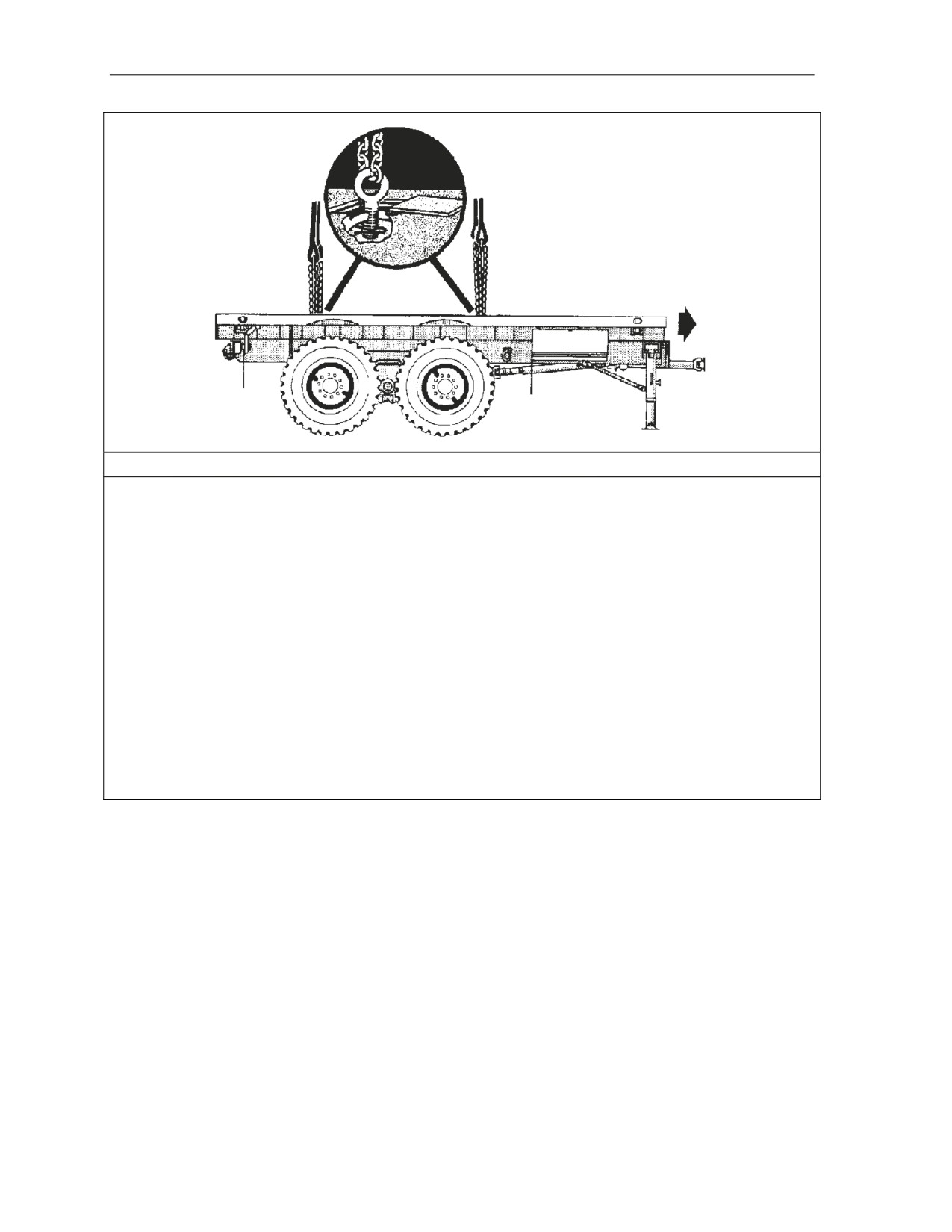
Rigging. Rig the load according to the steps in Figure 3-5.
Hookup. The hookup teams stand on the bed of the trailer. The static wand person
discharges the static electricity with the static wand. The forward hookup person places apex
fitting 1 onto the forward cargo hook. The aft hookup person places apex fitting 2 onto the aft
cargo hook. The hookup team then carefully dismounts the vehicle and remains close to the
load as the helicopter removes slack from the sling legs. When successful hookup is assured,
the hookup team quickly exits the area underneath the helicopter to the designated rendezvous
point.
Derigging. Derigging is the reverse of the preparation and rigging procedures.
FM 4-20.199/MCRP 4-11.3E, VOL III/NTTP 3-04.13/
20 February 2009
AFMAN 11-223 (I), VOL III/COMDINST M13482.4B
3-9
Chapter 3
RIGGING STEPS
1. Connect 2 sling legs to apex fitting number 1. Position the apex fitting on top of the forward
end of the trailer.
2. Loop the chain end of the sling legs through their respective lift provisions located in the bed
of the trailer. Place the correct link from Table 3-5 in the grab hook.
3. Connect 2 sling legs to apex fitting number 2. Position the apex fitting on top of the aft end of
the trailer.
4. Loop the chain end of the sling legs through their respective lift provisions in the bed of the
trailer. Place the correct link from Table 3-5 in the grab hook.
5. Secure all excess chain with tape or Type III nylon cord.
6. Cluster and tie (breakaway technique) the sling legs in each sling set together to prevent
entanglement during hookup and lift-off.
Figure 3-5. Mk14 Trailer, Container Hauler
FM 4-20.199/MCRP 4-11.3E, VOL III/NTTP 3-04.13/
3-10
AFMAN 11-223 (I), VOL III/COMDINST M13482.4B
20 February 2009
Certified Dual-Point Rigging Procedures for Trailers
MK15 TRAILER, WRECKER/RECOVERY
3-7. The Mk15 trailer, wrecker/recovery is rigged for dual-point sling load using the following
procedures:
z
Applicability. The following item in Table 3-6 is certified for the helicopter(s) listed in the
following table by the US Army Natick Soldier Center:
Table 3-6. Mk15 Trailer, Wrecker/Recovery
Nomenclature
Max Weight
Sling
Link Count
Type of
(Pounds)
Set
Front/Rear
Aircraft
MK 15 Trailer, Wrecker/Recovery
26,000
40K
3/10
CH-53
z
Materials. The following materials are required to rig this load:
Sling set (40,000-pound capacity) with one additional apex fitting.
Tape, adhesive, pressure-sensitive, 2-inch wide roll.
Cord, nylon, Type III, 550-pound breaking strength.
Webbing, cotton, 1/4-inch, 80-pound breaking strength.
Tie-down strap, cargo, CGU-1/B, as required.
z
Personnel. Two persons can prepare and rig this load in 30 minutes.
z
Procedures. The following procedures apply to this load:
Preparation. Prepare the load using the following steps:
─ Disengage the Mk15 from the Mk48 prime mover according to the operator's manual.
─ Remove the A-frame from the rear of the trailer. Stow in the trailer bed and secure
with the CGU-1/B tie-down strap.
─ Secure all hoses with tape or Type III nylon cord.
─ Tape all lights, reflectors, and glass fixtures.
─ Ensure all tool compartment doors re closed and secured.
─ Remove the safety retainer pins from the lifting eyelets located under the doors in the
bed of the trailer. Unscrew the lifting eyelets from their stored position and reinsert
the lifting eyelets so that the eyelet portion is accessible from the bed of the trailer
through the access doors. Screw the lifting eyelets all the way in and back out one full
turn. Reinsert the safety retainer pins to prevent the lifting eyelets from backing out in
flight.
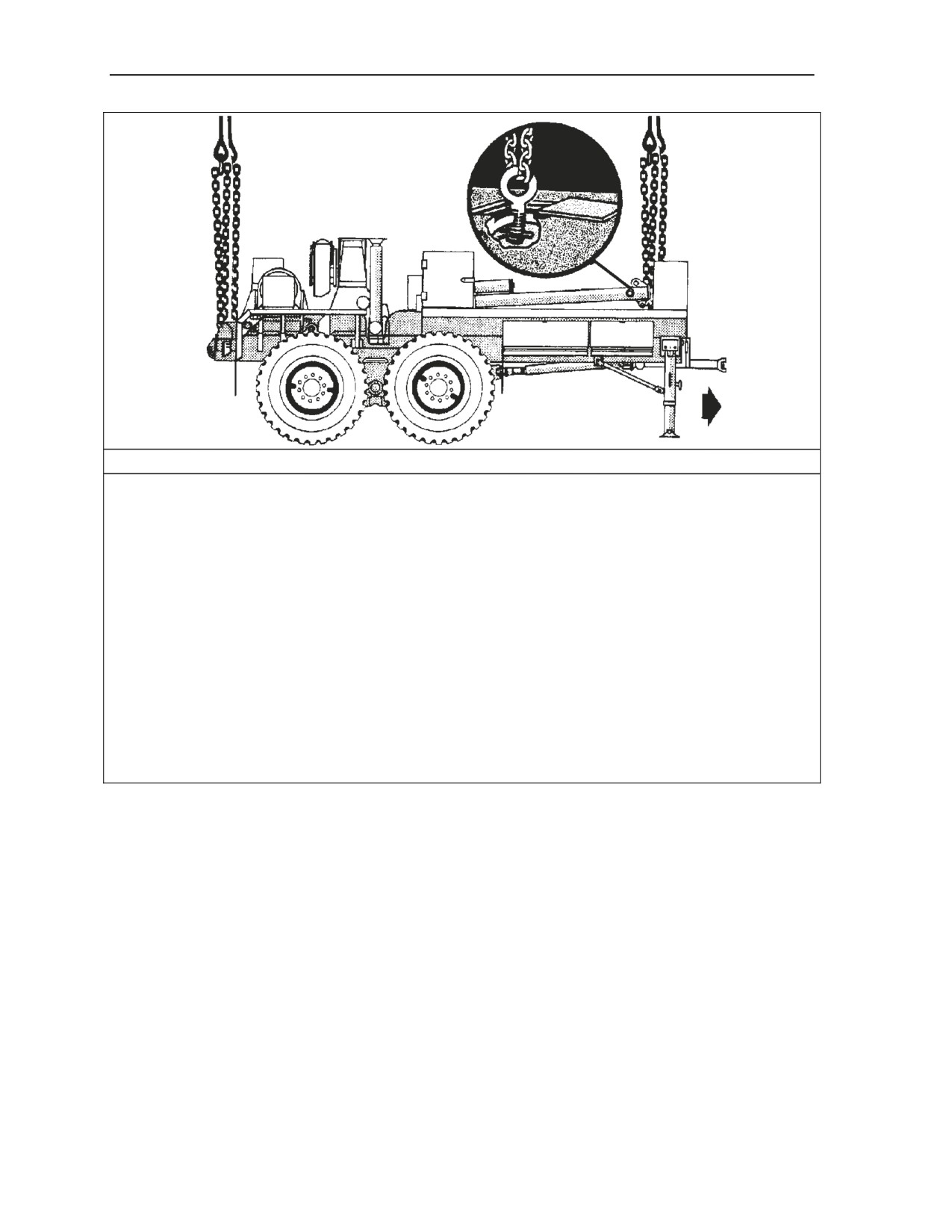
Rigging. Rig the load according to the steps in Figure 3-6.
Hookup. The hookup teams stand on the bed of the trailer. The static wand person
discharges the static electricity with the static wand. The forward hookup person places apex
fitting 1 onto the forward cargo hook. The aft hookup person places apex fitting 2 onto the aft
cargo hook. The hookup team then carefully dismounts the vehicle and remains close to the
load as the helicopter removes slack from the sling legs. When successful hookup is assured,
the hookup team quickly exits the area underneath the helicopter to the designated rendezvous
point.
Derigging. Derigging is the reverse of the preparation and rigging procedures.
FM 4-20.199/MCRP 4-11.3E, VOL III/NTTP 3-04.13/
20 February 2009
AFMAN 11-223 (I), VOL III/COMDINST M13482.4B
3-11
Chapter 3
RIGGING STEPS
1. Connect 2 sling legs to apex fitting number 1. Position the apex fitting on top of the trailer
bed behind the stowage compartment.
2. Loop the chain end of the sling legs through their respective lift provisions located in the bed
behind the stowage compartment. Place the correct link from Table 3-6 in the grab hook.
3. Connect 2 sling legs to apex fitting number 2. Position the apex fitting behind the trailer.
4. Loop the chain end of the sling legs through their respective lift provisions located on the rear
of the trailer on each side of the towing pintle hook. Place the correct link from Table 3-6 in
the grab hook.
5. Secure all excess chain with tape or Type III nylon cord.
6. Cluster and tie (breakaway technique) the sling legs in each sling set together to prevent
entanglement during hookup and lift-off.
Figure 3-6. Mk15 Trailer, Wrecker/Recovery
FM 4-20.199/MCRP 4-11.3E, VOL III/NTTP 3-04.13/
3-12
AFMAN 11-223 (I), VOL III/COMDINST M13482.4B
20 February 2009
Certified Dual-Point Rigging Procedures for Trailers
MK16 TRAILER, FIFTH-WHEEL ADAPTER
3-8. The Mk16 trailer, fifth-wheel adapter is rigged for dual-point sling load using the following
procedures:
z
Applicability. The following item in Table 3-7 is certified for the helicopter(s) listed in the
following table by the US Army Natick Soldier Center:
Table 3-7. Mk16 Trailer, Fifth-Wheel Adapter
Nomenclature
Max Weight
Sling
Link Count
Type of
(Pounds)
Set
Front/Rear
Aircraft
MK 16 Trailer, Fifth-Wheel Adapter
16,000
40K
3/3
CH-53
z
Materials. The following materials are required to rig this load:
Sling set (40,000-pound capacity) with one additional apex fitting.
Tape, adhesive, pressure-sensitive, 2-inch wide roll.
Cord, nylon, Type III, 550-pound breaking strength.
Webbing, cotton, 1/4-inch, 80-pound breaking strength.
z
Personnel. Two persons can prepare and rig this load in 30 minutes.
z
Procedures. The following procedures apply to this load:
Preparation. Prepare the load using the following steps:
─ Disengage the Mk16 from the Mk48 prime mover according to the operator's manual.
─ Secure all hoses with tape or Type III nylon cord.
─ Tape all lights, reflectors, and glass fixtures.
─ Ensure all tool compartment doors are closed and secured.
─ Remove the safety retainer pins from the lifting eyelets located under the doors in the
bed of the trailer. Unscrew the lifting eyelets from their stored position and reinsert
the lifting eyelets so that the eyelet portion is accessible from the bed of the trailer
through the access doors. Screw the lifting eyelets all the way in and back out one full
turn. Reinsert the safety retainer pins to prevent the lifting eyelets from backing out in
flight.
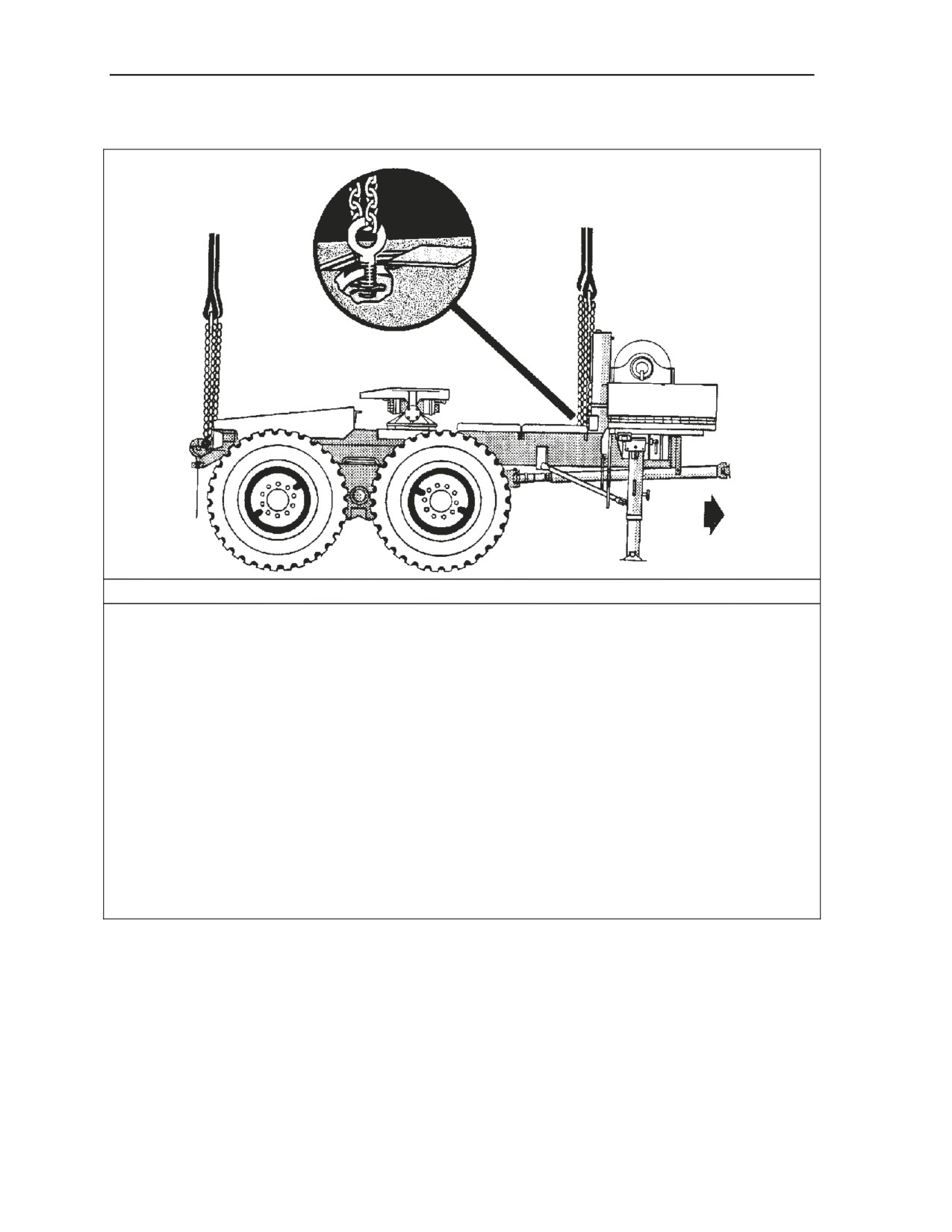
Rigging. Rig the load according to the steps in Figure 3-7.
Hookup. The hookup teams stand on the bed of the trailer. The static wand person
discharges the static electricity with the static wand. The forward hookup person places apex
fitting 1 onto the forward cargo hook. The aft hookup person places apex fitting 2 onto the aft
cargo hook. The hookup team then carefully dismounts the vehicle and remains close to the
load as the helicopter removes slack from the sling legs. When successful hookup is assured,
the hookup team quickly exits the area underneath the helicopter to the designated rendezvous
point.
Derigging. Derigging is the reverse of the preparation and rigging procedures.
FM 4-20.199/MCRP 4-11.3E, VOL III/NTTP 3-04.13/
20 February 2009
AFMAN 11-223 (I), VOL III/COMDINST M13482.4B
3-13
Chapter 3
RIGGING STEPS
1. Connect 2 sling legs to apex fitting number 1. Position the apex fitting on top of the winch.
2. Loop the chain end of the sling legs through their respective lift provisions located on the
main frame below the winch. Place the correct link from Table 3-7 in the grab hook.
3. Connect 2 sling legs to apex fitting number 2. Position the apex fitting on top of the aft end of
the trailer adapter.
4. Loop the chain end of the sling legs through their respective lift provisions located on each
side of the towing pintle hook. Place the correct link from Table 3-7 in the grab hook.
5. Secure all excess chain with tape or Type III nylon cord.
6. Cluster and tie or tape (breakaway technique) the sling legs in each sling set together to
prevent entanglement during hookup and lift-off.
Figure 3-7. Mk16 Trailer, Fifth-Wheel Adapter
FM 4-20.199/MCRP 4-11.3E, VOL III/NTTP 3-04.13/
3-14
AFMAN 11-223 (I), VOL III/COMDINST M13482.4B
20 February 2009
Certified Dual-Point Rigging Procedures for Trailers
MK17 TRAILER, DROP SIDE, CARGO
3-9. The Mk17 trailer, drop side, cargo is rigged for dual-point sling load using the following procedures:
z
Applicability. The following item in Table 3-8 is certified for the helicopter(s) listed in the
following table by the US Army Natick Soldier Center:
Table 3-8. Mk17 Trailer, Drop Side, Cargo
Nomenclature
Max Weight
Sling
Link Count
Type of
(Pounds)
Set
Front/Rear
Aircraft
MK 17 Trailer, Drop Side, Cargo
23,000
40K
4/16
CH-53
z
Materials. The following materials are required to rig this load:
Sling set (40,000-pound capacity) with one additional apex fitting.
Tape, adhesive, pressure-sensitive, 2-inch wide roll.
Cord, nylon, Type III, 550-pound breaking strength.
Webbing, cotton, 1/4-inch, 80-pound breaking strength.
z
Personnel. Two persons can prepare and rig this load in 20 minutes.
z
Procedures. The following procedures apply to this load:
Preparation. Prepare the load using the following steps:
─ Disengage the Mk17 from the Mk48 prime mover according to the operator's manual.
─ Secure all hoses with tape or Type III nylon cord.
─ Tape all lights, reflectors, and glass fixtures.
─ Ensure all tool compartment doors are closed and secured.
─ Remove the safety retainer pins from the lifting eyelets located under the doors in the
bed of the trailer. Unscrew the lifting eyelets from their stored position and reinsert
the lifting eyelets so that the eyelet portion is accessible from the bed of the trailer
through the access doors. Screw the lifting eyelets all the way in and back out one full
turn. Reinsert the safety retainer pins to prevent the lifting eyelets from backing out in
flight.
Rigging. Rig the load according to the steps in Figure 3-8.
Hookup. The hookup teams stand on the bed of the trailer. The static wand person
discharges the static electricity with the static wand. The forward hookup person places apex
fitting 1 onto the forward cargo hook. The aft hookup person places apex fitting 2 onto the aft cargo
hook. The hookup team then carefully dismounts the vehicle and remains close to the load as
the helicopter removes slack from the sling legs. When successful hookup is assured, the
hookup team quickly exits the area underneath the helicopter to the designated rendezvous
point.
Derigging. Derigging is the reverse of the preparation and rigging procedures.
FM 4-20.199/MCRP 4-11.3E, VOL III/NTTP 3-04.13/
20 February 2009
AFMAN 11-223 (I), VOL III/COMDINST M13482.4B
3-15
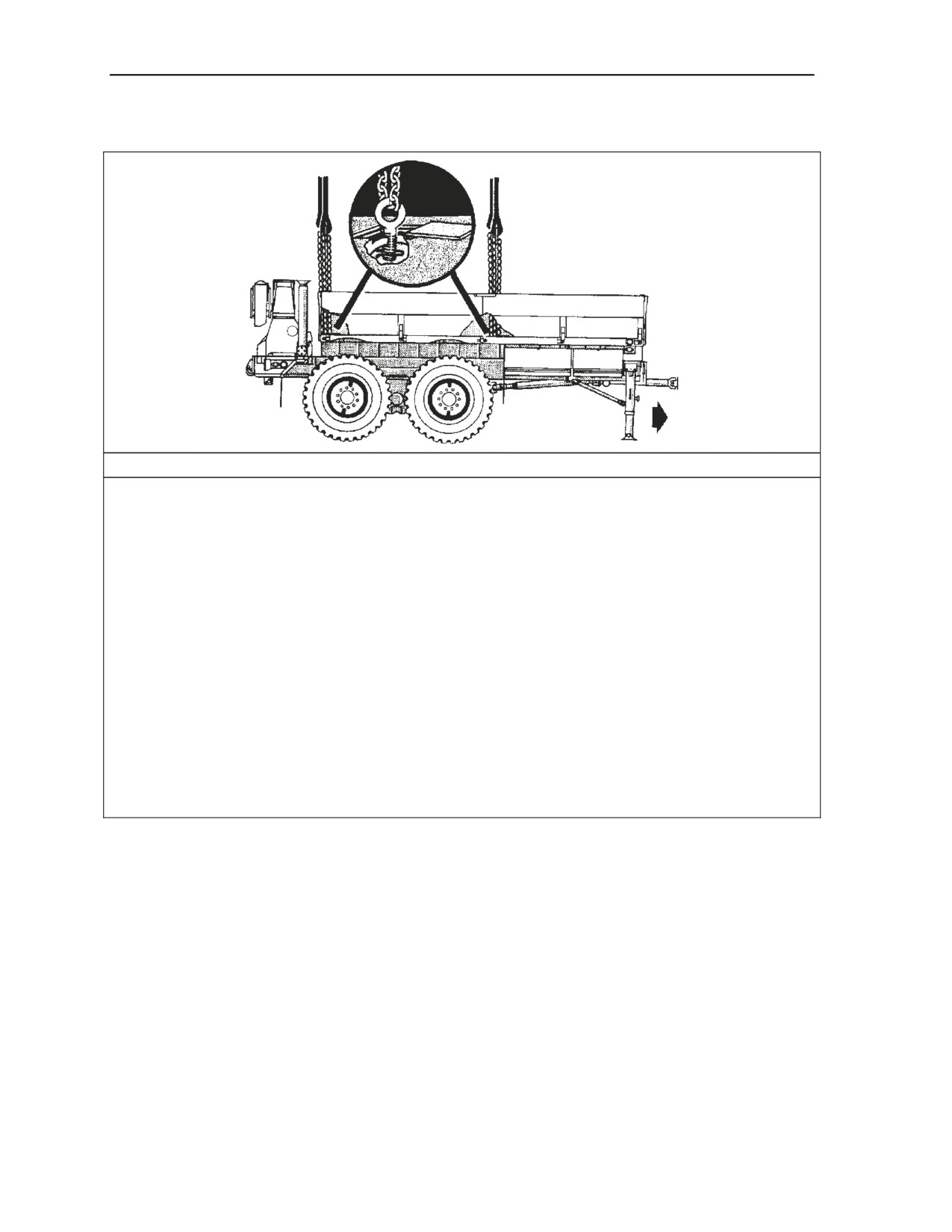
Chapter 3
RIGGING STEPS
1. Connect 2 sling legs to apex fitting number 1. Position the apex fitting on top of the front of
the trailer.
2. Loop the chain end of the sling legs through their respective lift provisions located in the
trailer bed. Place the correct link from Table 3-8 in the grab hook.
3. Connect 2 sling legs to apex fitting number 2. Position the apex fitting on top of the aft end of
the trailer.
4. Loop the chain end of the sling legs through their respective lift provisions located on the aft
end of the trailer just forward of the crane. Place the correct link from Table 3-8 in the grab
hook.
5. Secure all excess chain with tape or Type III nylon cord.
6. Cluster and tie (breakaway technique) the sling legs in each sling set together to prevent
entanglement during hookup and lift-off.
Figure 3-8. Mk17 Trailer, Drop Side, Cargo
FM 4-20.199/MCRP 4-11.3E, VOL III/NTTP 3-04.13/
3-16
AFMAN 11-223 (I), VOL III/COMDINST M13482.4B
20 February 2009
Certified Dual-Point Rigging Procedures for Trailers
M871A1 SEMITRAILER
3-10. The M871A1 semitrailer is rigged for dual-point sling load using the following procedures:
z
Applicability. The following item in Table 3-9 is certified for the helicopter(s) listed in the
following table by the US Army Natick Soldier Center:
Table 3-9. M871A1 Semitrailer
Nomenclature
Max Weight
Sling
Link Count
Type of
(Pounds)
Set
Front/Rear
Aircraft
M871A1 Semitrailer (Empty)
12,240
25K
30/3
CH-47
Note: This trailer must be empty to sling load.
z
Materials. The following materials are required to rig this load:
Sling set (25,000-pound capacity) with one additional apex fitting.
Tape, adhesive, pressure-sensitive, 2-inch wide roll.
Cord, nylon, Type III, 550-pound breaking strength.
Webbing, cotton, 1/4-inch, 80-pound breaking strength.
Tie-down strap, cargo, CGU-1/B, as required.
z
Personnel. Two persons can prepare and rig this load in 20 minutes.
z
Procedures. The following procedures apply to this load:
Preparation. Prepare the load using the following steps:
─ Level the trailer by adjusting the landing gear.
─ Remove the sideboards and tailgate panels. Secure the sideboards and tailgate panels
in the front of trailer using CGU-1/B tie-down straps.
─ Secure the compartment doors with tape or Type III nylon cord.
─ Secure the spare tire in the compartment with Type III nylon cord.
─ At each lifting provision location, pull down on the latch and push out on the bolt at
the inboard end of each lifting eye. Slide the lifting eye out from the housing as far as
it will go. Do not lift the semitrailer unless each lifting eye is fully extended.
Rigging. Rig the load according to the steps in Figure 3-9.
Hookup. The hookup teams stand on the bed of the trailer. The static wand person
discharges the static electricity with the static wand. The forward hookup person places apex
fitting 1 onto the forward cargo hook. The aft hookup person places apex fitting 2 onto the aft cargo
hook. The hookup team then carefully dismounts the vehicle and remains close to the load as
the helicopter removes slack from the sling legs. When successful hookup is assured, the
hookup team quickly exits the area underneath the helicopter to the designated rendezvous
point.
Derigging. Derigging is the reverse of the preparation and rigging procedures.
FM 4-20.199/MCRP 4-11.3E, VOL III/NTTP 3-04.13/
20 February 2009
AFMAN 11-223 (I), VOL III/COMDINST M13482.4B
3-17
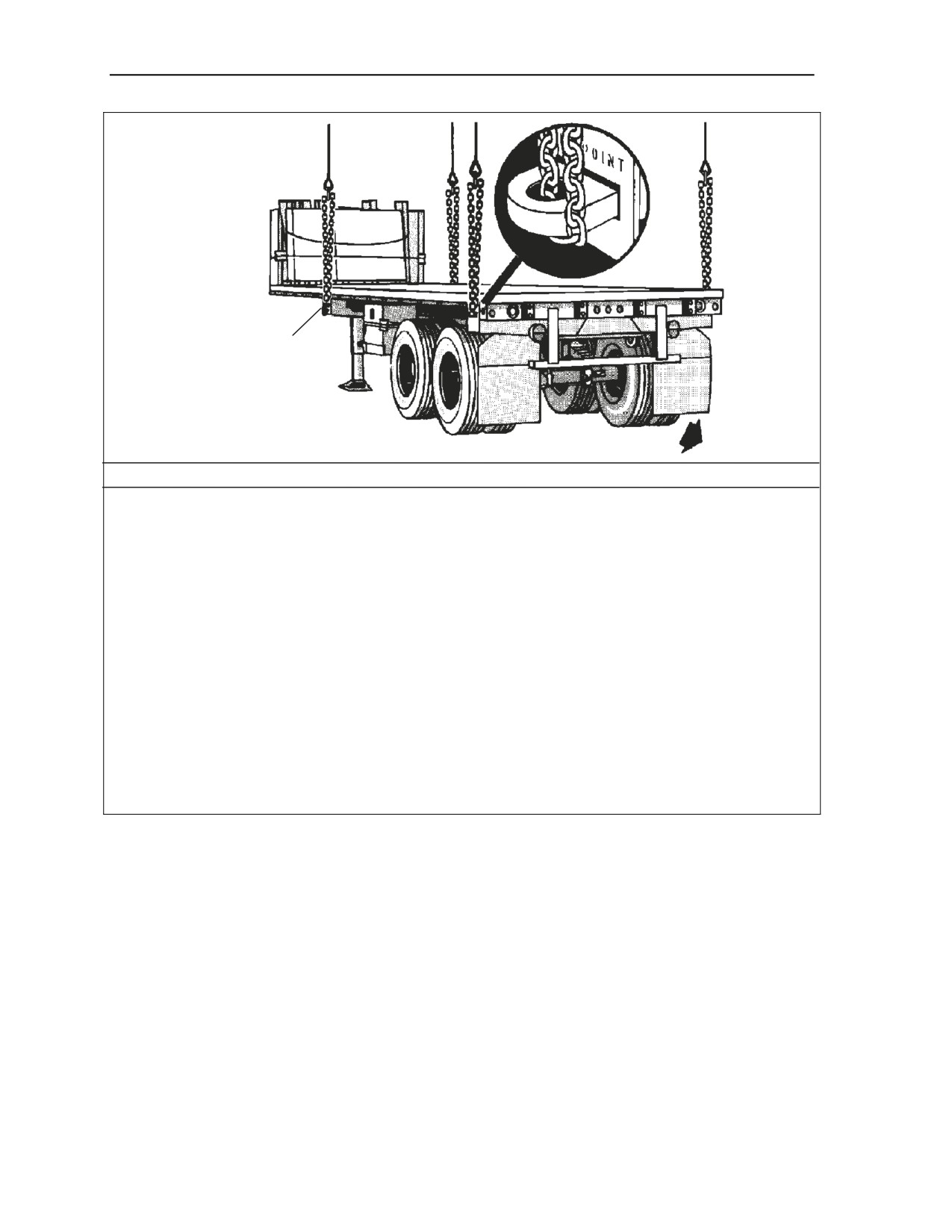
Chapter 3
LIFTING PROVISIONS
FULLY EXTENDED
RIGGING STEPS
1. Connect 2 sling legs to apex fitting number 1. Position the apex fitting on top of the kingpin
end of the trailer.
2. Loop the chain end of the sling legs through their respective lift provisions located outboard
from the landing gear. Place the correct link from Table 3-9 in the grab hook.
3. Connect 2 sling legs to apex fitting number 2. Position the apex fitting on top of the wheel
end of the trailer.
4. Loop the chain end of the sling legs through their respective lift provisions located aft of the
rear wheels. Place the correct link from Table 3-9 in the grab hook.
5. Secure all excess chain with tape or Type III nylon cord.
6. Cluster and tie (breakaway technique) the sling legs in each sling set together to prevent
entanglement during hookup and lift-off.
Figure 3-9. M871A1 Semitrailer
FM 4-20.199/MCRP 4-11.3E, VOL III/NTTP 3-04.13/
3-18
AFMAN 11-223 (I), VOL III/COMDINST M13482.4B
20 February 2009

Certified Dual-Point Rigging Procedures for Trailers
HIGH MOBILITY TRAILERS (HMT), M1101/M1102
3-11. The high mobility trailers, M1101/M1102 are rigged for dual-point sling load using the following
procedures:
z
Applicability. The following items in Table 3-10 are certified for the helicopter(s) listed in the
following table by the US Army Natick Soldier Center:
Table 3-10. High Mobility Trailers
Nomenclature
Max Weight
Sling
Link Count
Type of
(Pounds)
Set
Front/Rear
Aircraft
High Mobility Trailer (Light), M1101
3,400
10K
20/3
CH-47
High Mobility Trailer (Heavy), M1102
4,200
10K
20/3
CH-47
Tactical Messaging System (TMS), Cargo Carrier,
4,200
10K
20/3
CH-47
M1102
z
Materials. The following materials are required to rig this load:
Sling set (10,000-pound capacity) with one additional apex fitting.
Tape, adhesive, pressure-sensitive, 2-inch wide roll.
Cord, nylon, Type III, 550-pound breaking strength.
Webbing, cotton, 1/4-inch, 80-pound breaking strength.
Felt sheet, cattle hair, Type IV, 1/2-inch or suitable substitute.
Tie-down strap, cargo, CGU-1/B, as required.
z
Personnel. Two persons can prepare and rig this load in 10 minutes.
z
Procedures. The following procedures apply to this load:
Preparation. Prepare the load using the following steps:
─ Remove the two stabilizer legs from their storage location on the front of the trailer.
Place the lower support section in the fully retracted position. Install the stabilizer legs
on the rear of the trailer.
─ Install the front jack and lower the lunette as close to the ground as possible.
─ Remove the canvas cover and racks from the trailer. Place these items in the bed of the
trailer. Place the accompanying load on top of the canvas cover and secure it with the
tie-down straps.
─ Secure the light cable to the top of the drawbar with tape or Type III nylon cord.
─ Engage the parking brake.
Rigging. Rig the load according to the steps in Figure 3-10.
Hookup. The hookup teams stand in the bed of the trailer and on the drawbar. The static
wand person discharges the static electricity with the static wand. The forward hookup person
places apex fitting 1 onto the forward cargo hook. The aft hookup person places apex fitting 2 onto
the aft cargo hook. The hookup team then carefully dismounts the vehicle and remains close to
the load as the helicopter removes slack from the sling legs. When successful hookup is
assured, the hookup team quickly exits the area underneath the helicopter to the designated
rendezvous point.
Derigging. Derigging is the reverse of the preparation and rigging procedures.
FM 4-20.199/MCRP 4-11.3E, VOL III/NTTP 3-04.13/
20 February 2009
AFMAN 11-223 (I), VOL III/COMDINST M13482.4B
3-19
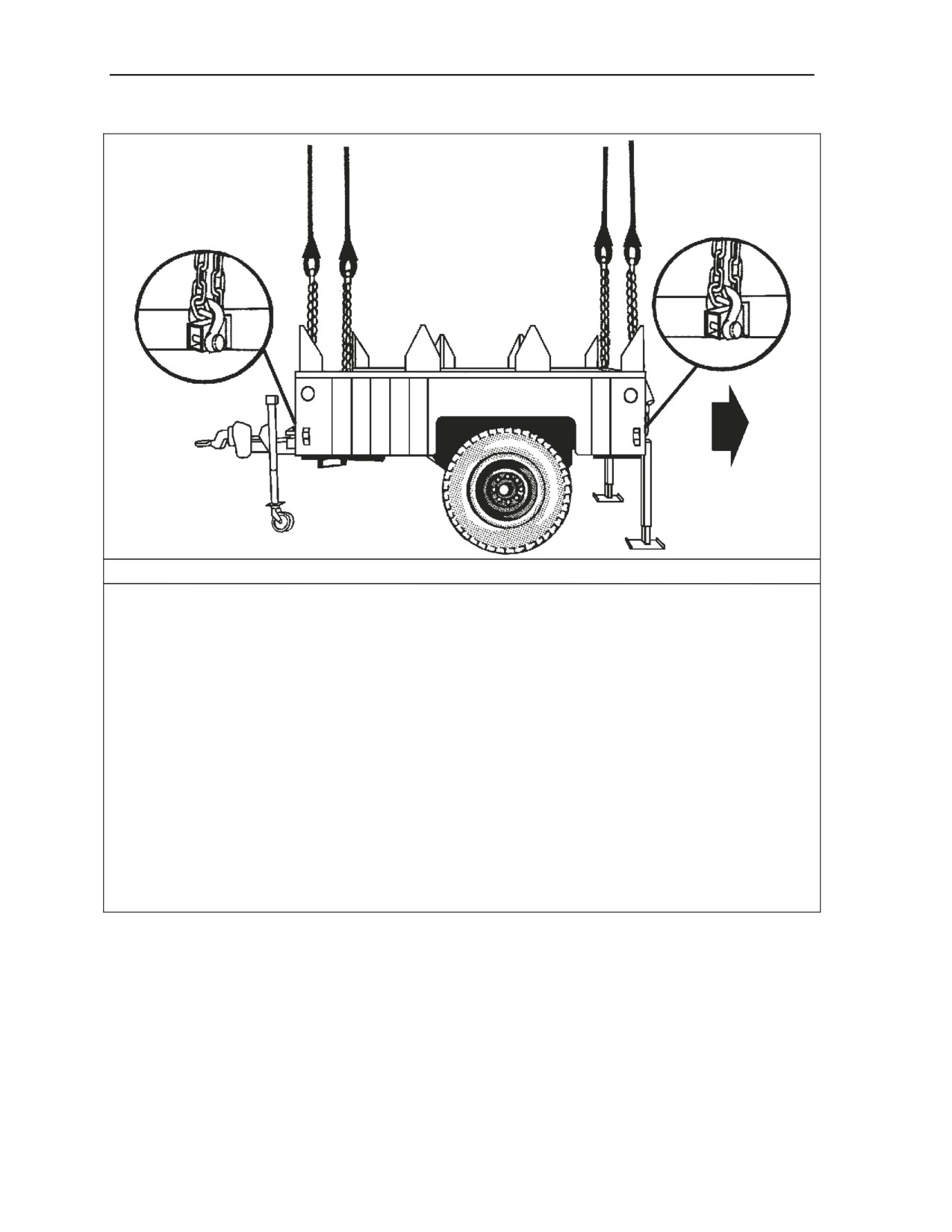
Chapter 3
RIGGING STEPS
1. Connect 2 sling legs to apex fitting number 1. Position the apex fitting on top of the trailer.
2. Loop the chain end of the sling legs through their respective lift provisions. Place the correct
link from Table 3-10 in the grab hook.
3. Connect 2 sling legs to apex fitting number 2. Position the apex fitting on top of the trailer.
4. Loop the chain end of the sling legs through their respective lift provisions. Place the correct
link from Table 3-10 in the grab hook.
5. Secure all excess chain with tape or Type III nylon cord.
6. Pad the chain at and below where the chain contacts the trailer walls.
7. Cluster and tie (breakaway technique) the sling legs in each sling set together to prevent
entanglement during hookup and lift-off.
Figure 3-10. High Mobility Trailers
FM 4-20.199/MCRP 4-11.3E, VOL III/NTTP 3-04.13/
3-20
AFMAN 11-223 (I), VOL III/COMDINST M13482.4B
20 February 2009
Certified Dual-Point Rigging Procedures for Trailers
HIGH MOBILITY TRAILERS (HMT) WITH GENERATOR FOR
JOINT SURVEILLANCE TARGET ATTACK RADAR (JSTAR)
SYSTEMS
3-12. The high mobility trailers, with generator for joint surveillance target attack radar systems are rigged
for dual-point sling load using the following procedures:
z
Applicability. The following items in Table 3-11 are certified for the helicopter(s) listed in the
following table by the US Army Natick Soldier Center:
Table 3-11. High Mobility Trailers with Generator (JSTAR)
Nomenclature
Max Weight
Sling
Link Count
Type of
(Pounds)
Set
Front/Rear
Aircraft
Mission Trailer without Transit Cases
3,960
10K
10/3
CH-47
Support Trailer without Transit Cases
3,878
10K
10/3
CH-47
z
Materials. The following materials are required to rig this load:
Sling set (10,000-pound capacity) with one additional apex fitting.
─ Additional chain length, part number 38850-00053-101, from a 10,000-pound capacity
sling set (4 each).
─ Additional coupling link, part number 577-0615, from a 10,000-pound capacity sling
set (4 each).
Tape, adhesive, pressure-sensitive, 2-inch wide roll.
Cord, nylon, Type III, 550-pound breaking strength.
Webbing, cotton, 1/4-inch, 80-pound breaking strength.
Felt sheet, cattle hair, Type IV, 1/2-inch or suitable substitute.
z
Personnel. Two persons can prepare and rig this load in 15 minutes.
z
Procedures. The following procedures apply to this load:
Preparation. Prepare the load using the following steps:
─ Engage the parking brake.
─ Secure safety chains and brake hoses to the top of the drawbar with Type III nylon
cord.
─ Secure all lids, doors, and caps with tape or Type III nylon cord.
─ Remove transit cases which will interfere with the sling legs and store them in the
shelter.
─ Install the rear stabilizer legs with the lower support section fully retracted.
─ Remove the lunette jack and secure in the trailer bed.
─ Secure the four lift rings on the trailer in the up position to a convenient point on the
load with 1/4-inch cotton webbing.
─ Connect one additional chain length to each chain of the sling set with the coupling
link.
Rigging. Rig the load according to the steps in Figure 3-11.
Hookup. The hookup teams stand in the bed of the trailer and on the drawbar. The static
wand person discharges the static electricity with the static wand. The forward hookup person
places apex fitting 1 onto the forward cargo hook. The aft hookup person places apex fitting 2 onto
the aft cargo hook. The hookup team then carefully dismounts the vehicle and remains close to
the load as the helicopter removes slack from the sling legs. When successful hookup is
assured, the hookup team quickly exits the area underneath the helicopter to the designated
rendezvous point.
Derigging. Derigging is the reverse of the preparation and rigging procedures.
FM 4-20.199/MCRP 4-11.3E, VOL III/NTTP 3-04.13/
20 February 2009
AFMAN 11-223 (I), VOL III/COMDINST M13482.4B
3-21
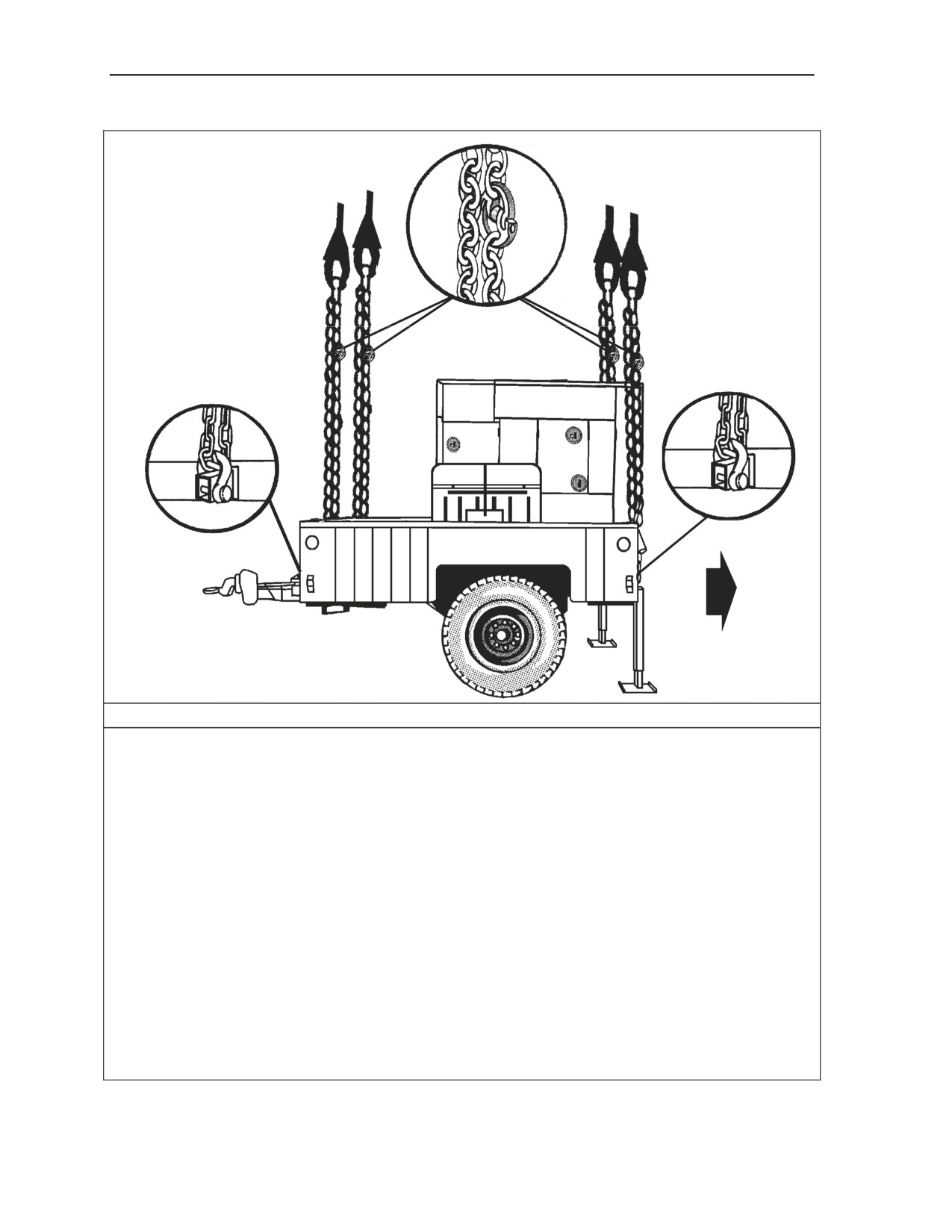
Chapter 3
RIGGING STEPS
1. Connect 2 sling legs to apex fitting number 1. Position the apex fitting on top of the
generator.
2. Loop the chain end of the sling legs through their respective lift provisions. Place the correct
link from Table 3-11 in the grab hook.
3. Connect 2 sling legs to apex fitting number 2. Position the apex fitting on top of the
generator.
4. Loop the chain end of the sling legs through their respective lift provisions. Place the correct
link from Table 3-11 in the grab hook.
5. Secure all excess chain with tape or Type III nylon cord.
6. Pad the chain/sling where they contact the generator.
7. Cluster and tie (breakaway technique) the sling legs in each sling set together to prevent
entanglement during hookup and lift-off.
Figure 3-11. High Mobility Trailers with Generator (JSTAR)
FM 4-20.199/MCRP 4-11.3E, VOL III/NTTP 3-04.13/
3-22
AFMAN 11-223 (I), VOL III/COMDINST M13482.4B
20 February 2009
Certified Dual-Point Rigging Procedures for Trailers
HIGH MOBILITY TRAILER-LIGHT (HMT), M1101 WITH AN/TSQ-
198, TACTICAL TERMINAL CONTROL SYSTEM (TTCS)
3-13. The high mobility trailer-light, M1101 with AN/TSQ-198 tactical terminal control system is rigged
for dual-point sling load using the following procedures:
z
Applicability. The following item in Table 3-12 is certified for the helicopter(s) listed in the
following table by the US Army Natick Soldier Center:
Table 3-12. High Mobility Trailer-Light (HMT), M1101 with AN/TSQ-198
Nomenclature
Max Weight
Sling
Link Count
Type of
(Pounds)
Set
Front/Rear
Aircraft
AN/TSQ-198 Tactical Terminal Control System
2,720
10K
20/3
CH-47
z
Materials. The following materials are required to rig this load:
Sling set (10,000-pound capacity) with one additional apex fitting.
Tape, adhesive, pressure-sensitive, 2-inch wide roll.
Cord, nylon, Type III, 550-pound breaking strength.
Webbing, cotton, 1/4-inch, 80-pound breaking strength.
Felt sheet, cattle hair, Type IV, 1/2-inch or suitable substitute.
Strap, cargo, tie-down, CGU-1/B (as required).
z
Personnel. Two persons can prepare and rig this load in 10 minutes.
z
Procedures. The following procedures apply to this load:
Preparation. Prepare the load using the following steps:
─ Engage the parking brake.
─ Secure safety chains and brake hoses to the top of the drawbar with Type III nylon
cord.
─ Secure all lids, doors, and caps with tape or Type III nylon cord.
─ Place additional cargo on the trailer bed and secure the cargo with CGU-1/B tiedown
straps.
─ Install the rear stabilizer legs with the lower support section fully retracted.
─ Lower the front jack so the lunette is close to the ground.
─ Secure the four lift rings on the trailer in the up position to a convenient point on the
load with 1/4-inch cotton webbing.
Rigging. Rig the load according to the steps in Figure 3-12.
Hookup. The hookup teams stand in the bed of the trailer and on the drawbar. The static
wand person discharges the static electricity with the static wand. The forward hookup person
places apex fitting 1 onto the forward cargo hook. The aft hookup person places apex fitting 2 onto
the aft cargo hook. The hookup team then carefully dismounts the vehicle and remains close to
the load as the helicopter removes slack from the sling legs. When successful hookup is
assured, the hookup team quickly exits the area underneath the helicopter to the designated
rendezvous point.
Derigging. Derigging is the reverse of the preparation and rigging procedures.
FM 4-20.199/MCRP 4-11.3E, VOL III/NTTP 3-04.13/
20 February 2009
AFMAN 11-223 (I), VOL III/COMDINST M13482.4B
3-23
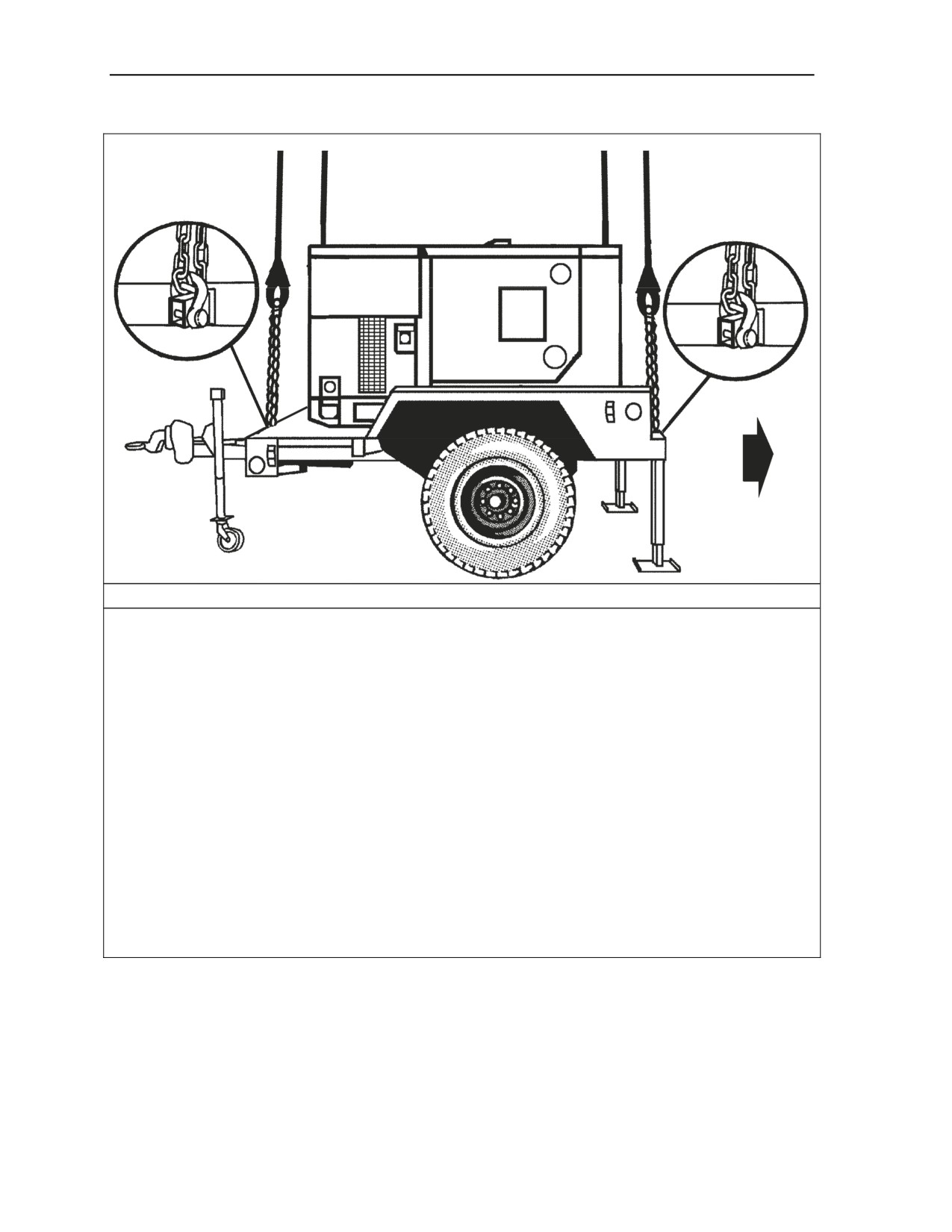
Chapter 3
RIGGING STEPS
1. Connect 2 sling legs to apex fitting number 1. Position the apex fitting on top of the
generator.
2. Loop the chain end of the sling legs through their respective lift provisions. Place the correct
link from Table 3-12 in the grab hook.
3. Connect 2 sling legs to apex fitting number 2. Position the apex fitting on top of the
generator.
4. Loop the chain end of the sling legs through their respective lift provisions. Place the correct
link from Table 3-12 in the grab hook.
5. Secure all excess chain with tape or Type III nylon cord.
6. Pad the chain/sling where they contact the generator.
7. Cluster and tie (breakaway technique) the sling legs in each sling set together to prevent
entanglement during hookup and lift-off.
Figure 3-12. High Mobility Trailer-Light (HMT), M1101 with AN/TSQ-198
FM 4-20.199/MCRP 4-11.3E, VOL III/NTTP 3-04.13/
3-24
AFMAN 11-223 (I), VOL III/COMDINST M13482.4B
20 February 2009
Certified Dual-Point Rigging Procedures for Trailers
SPECIAL OPERATIONS MEDIA SYSTEMS (SOMS B) ON
COMMANDER'S CRASH-OUT-PACKAGE SYSTEM (COPS) TRAILER
3-14. The special operations media systems on commander's crash-out-package system trailer is rigged for
dual-point sling load using the following procedures:
z
Applicability. The following items in Table 3-13 are certified for the helicopter(s) listed in the
following table by the US Army Natick Soldier Center:
Table 3-13. Special Operations Media Systems on COPS Trailer
Nomenclature
Max Weight
Sling
Link Count
Type of
(Pounds)
Set
Front/Rear
Aircraft
Environmental Control Unit (ECU) on COPS Trailer
4,080
10K
5/35
CH-47
Non- ECU on COPS Trailer
3,145
10K
5/35
CH-47
z
Materials. The following materials are required to rig this load:
Sling set (10,000-pound capacity) with one additional apex fitting.
Tape, adhesive, pressure-sensitive, 2-inch wide roll.
Cord, nylon, Type III, 550-pound breaking strength.
Webbing, cotton, 1/4-inch, 80-pound breaking strength.
Felt sheet, cattle hair, Type IV, 1/2-inch or suitable substitute.
Strap, cargo, tie-down, CGU-1/B (as required).
z
Personnel. Two persons can prepare and rig this load in 10 minutes.
z
Procedures. The following procedures apply to this load:
Preparation. Prepare the load using the following steps:
─ Engage the parking brake.
─ Secure light cables, safety chains, and brake hoses to the top of the drawbar with tape
or Type III nylon cord.
─ Secure all lids, doors, and caps with tape or Type III nylon cord.
─ Place additional cargo on the trailer bed and secure the cargo with CGU-1/B tiedown
straps.
─ Install the rear stabilizer legs with the lower support section fully retracted.
─ Lower the front jack so the lunette is close to the ground.
Rigging. Rig the load according to the steps in Figure 3-13.
Hookup. The hookup teams stand in the bed of the trailer and on the drawbar. The static
wand person discharges the static electricity with the static wand. The forward hookup person
places apex fitting 1 onto the forward cargo hook. The aft hookup person places apex fitting 2 onto
the aft cargo hook. The hookup team then carefully dismounts the vehicle and remains close to
the load as the helicopter removes slack from the sling legs. When successful hookup is
assured, the hookup team quickly exits the area underneath the helicopter to the designated
rendezvous point.
Derigging. Derigging is the reverse of the preparation and rigging procedures.
FM 4-20.199/MCRP 4-11.3E, VOL III/NTTP 3-04.13/
20 February 2009
AFMAN 11-223 (I), VOL III/COMDINST M13482.4B
3-25
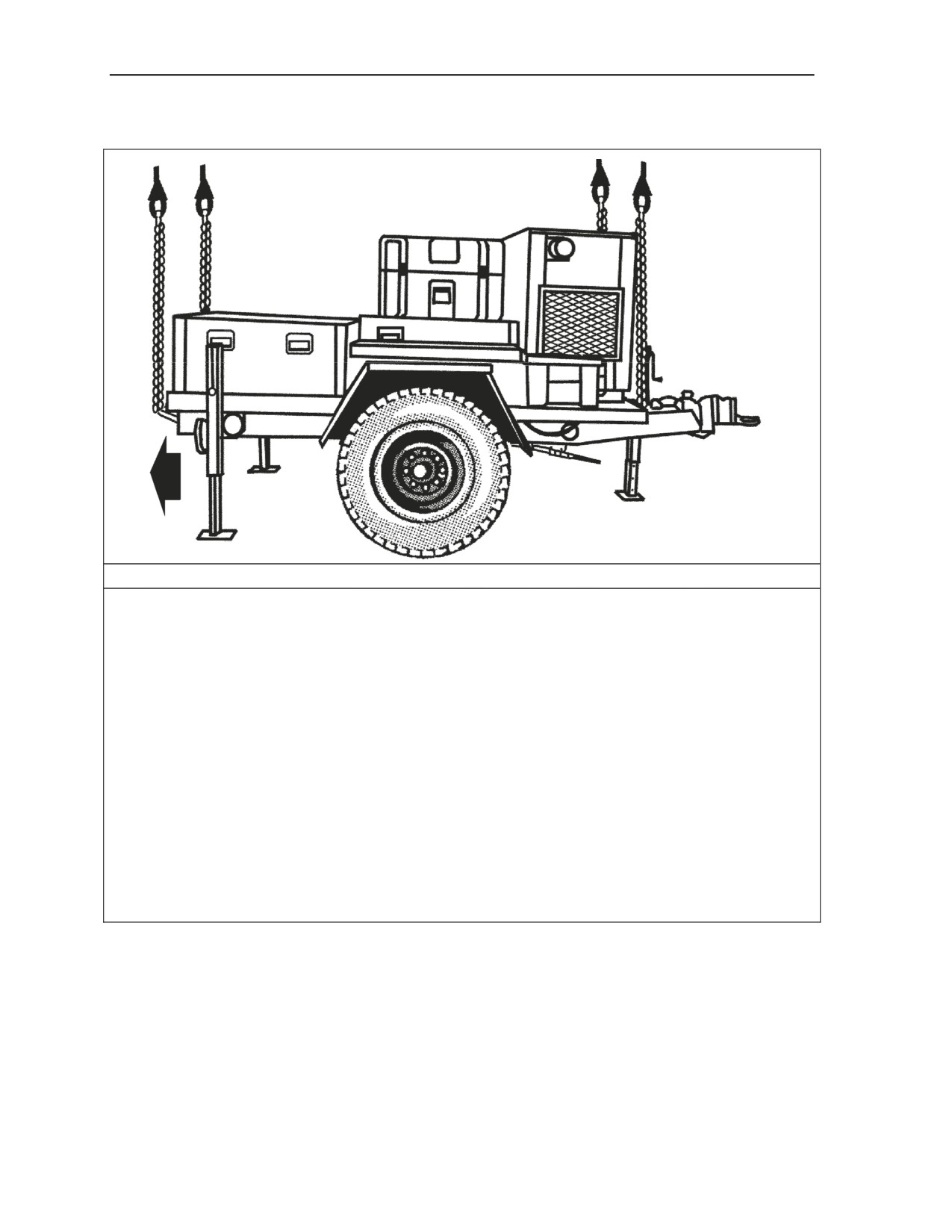
Chapter 3
RIGGING STEPS
1. Connect 2 sling legs to apex fitting number 1. Position the apex fitting on top of the trailer.
2. Loop the chain end of the sling legs through their respective lift provisions. Place the correct
link from Table 3-13 in the grab hook.
3. Connect 2 sling legs to apex fitting number 2. Position the apex fitting on top of the trailer.
4. Loop the chain end of the sling legs through their respective lift provisions. Place the correct
link from Table 3-13 in the grab hook.
5. Secure all excess chain with tape or Type III nylon cord.
6. Pad the chain/sling where they contact the trailer or generator.
7. Cluster and tie (breakaway technique) the sling legs in each sling set together to prevent
entanglement during hookup and lift-off.
Figure 3-13. Special Operations Media Systems on COPS Trailer
FM 4-20.199/MCRP 4-11.3E, VOL III/NTTP 3-04.13/
3-26
AFMAN 11-223 (I), VOL III/COMDINST M13482.4B
20 February 2009