FM 4-20.199 Multiservice Helicopter Sling Load: Dual-Point Load Rigging Procedures (February 2009) - page 5
Certified Dual-Point Rigging Procedures for Trailers
DEPLOYABLE PRINT PRODUCTION CENTER (DPPC) ON COPS
TRAILER
3-15. The special operations media deployable print production center on COPS trailer is rigged for dual-
point sling load using the following procedures:
z
Applicability. The following item in Table 3-14 is certified for the helicopter(s) listed in the
following table by the US Army Natick Soldier Center:
Table 3-14. Deployable Print Production Center on COPS Trailer
Nomenclature
Max Weight
Sling
Link Count
Type of
(Pounds)
Set
Front/Rear
Aircraft
Deployable Print Production Center on COPS Trailer
4,400
10K
5/35
CH-47
15K
CH-53
z
Materials. The following materials are required to rig this load:
Sling set (10,000-pound capacity) with one additional apex fitting.
OR
Sling set (15,000-pound capacity) (2 each).
Tape, adhesive, pressure-sensitive, 2-inch wide roll.
Cord, nylon, Type III, 550-pound breaking strength.
Webbing, cotton, 1/4-inch, 80-pound breaking strength.
Felt sheet, cattle hair, Type IV, 1/2-inch or suitable substitute.
z
Personnel. Two persons can prepare and rig this load in 10 minutes.
z
Procedures. The following procedures apply to this load:
Preparation. Prepare the load using the following steps:
─ Engage the parking brake.
─ Secure light cables, safety chains, and brake hoses to the top of the drawbar with tape
or Type III nylon cord.
─ Place additional cargo on the trailer bed and secure the cargo with CGU-1/B tiedown
straps.
─ Install the rear stabilizer legs with the lower support section fully retracted.
─ Lower the front jack so the lunette is close to the ground.
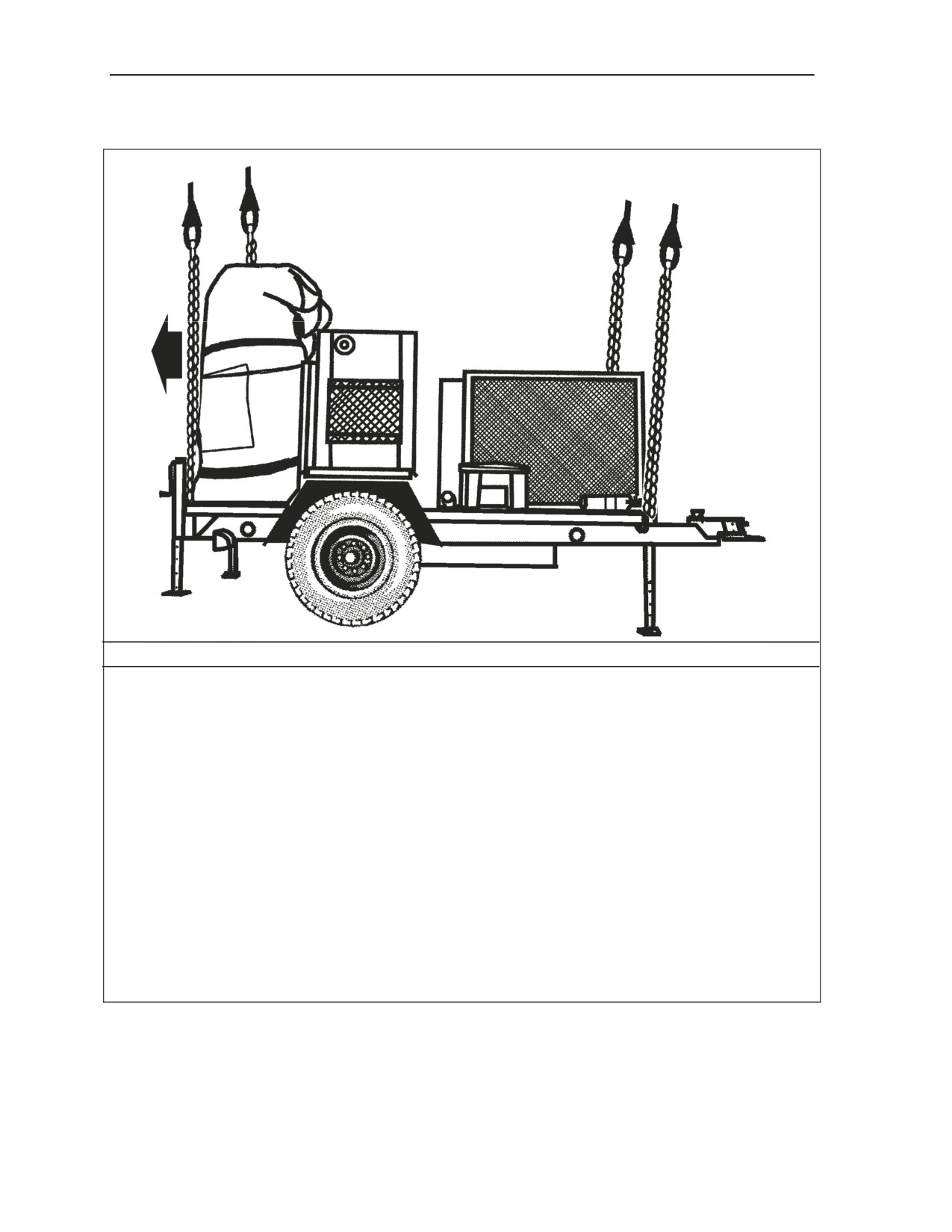
Rigging. Rig the load according to the steps in Figure 3-14.
Hookup. The hookup teams stand in the bed of the trailer and on the drawbar. The static
wand person discharges the static electricity with the static wand. The forward hookup person
places apex fitting 2 onto the forward cargo hook. The aft hookup person places apex fitting 1 onto
the aft cargo hook. The hookup team then carefully dismounts the vehicle and remains close to
the load as the helicopter removes slack from the sling legs. When successful hookup is
assured, the hookup team quickly exits the area underneath the helicopter to the designated
rendezvous point.
Derigging. Derigging is the reverse of the preparation and rigging procedures.
FM 4-20.199/MCRP 4-11.3E, VOL III/NTTP 3-04.13/
20 February 2009
AFMAN 11-223 (I), VOL III/COMDINST M13482.4B
3-27
Chapter 3
RIGGING STEPS
1. Connect 2 sling legs to apex fitting number 1. Position the apex fitting on top of the trailer.
2. Loop the chain end of the sling legs through their respective lift provisions located on the
outer ends of the front bumper (generator end). Place the correct link from Table 3-14 in the
grab hook.
3. Connect 2 sling legs to apex fitting number 2. Position the apex fitting on top of the trailer.
4. Loop the chain end of the sling legs through their respective lift provisions located on the
outer ends of the rear bumper. Place the correct link from Table 3-14 in the grab hook.
Secure all excess chain with tape or Type III nylon cord.
5. Pad the chain/sling where they contact the trailer or generator.
6. Cluster and tie (breakaway technique) the sling legs in each sling set together to prevent
entanglement during hookup and lift-off.
Figure 3-14. Deployable Print Production Center on COPS Trailer
FM 4-20.199/MCRP 4-11.3E, VOL III/NTTP 3-04.13/
3-28
AFMAN 11-223 (I), VOL III/COMDINST M13482.4B
20 February 2009
Certified Dual-Point Rigging Procedures for Trailers
M1112 400 GALLON WATER TRAILER
3-16. The M1112 400 gallon water trailer is rigged for dual-point sling load using the following
procedures:
z
Applicability. The following item in Table 3-15 is certified for the helicopter(s) listed in the
following table by the US Army Natick Soldier Center:
Table 3-15. M1112 400 Gallon Water Trailer
Nomenclature
Max Weight
Sling
Link Count
Type of
(Pounds)
Set
Front/Rear
Aircraft
M1112 400 Gallon Water Trailer (Empty)
3,860
10K
20/3
CH-47
z
Materials. The following materials are required to rig this load:
Sling set (10,000-pound capacity) with one additional apex fitting.
Tape, adhesive, pressure-sensitive, 2-inch wide roll.
Cord, nylon, Type III, 550-pound breaking strength.
Webbing, cotton, 1/4-inch, 80-pound breaking strength.
z
Personnel. Two persons can prepare and rig this load in 10 minutes.
z
Procedures. The following procedures apply to this load:
Preparation. Prepare the load using the following steps:
─ Secure all loose chains, hoses, and cables to the trailer drawbar with tape or Type III
nylon cord.
─ Ensure the tongue wheel is in the down and locked position.
─ Close and secure the tank lid.
─ Engage the parking brake.
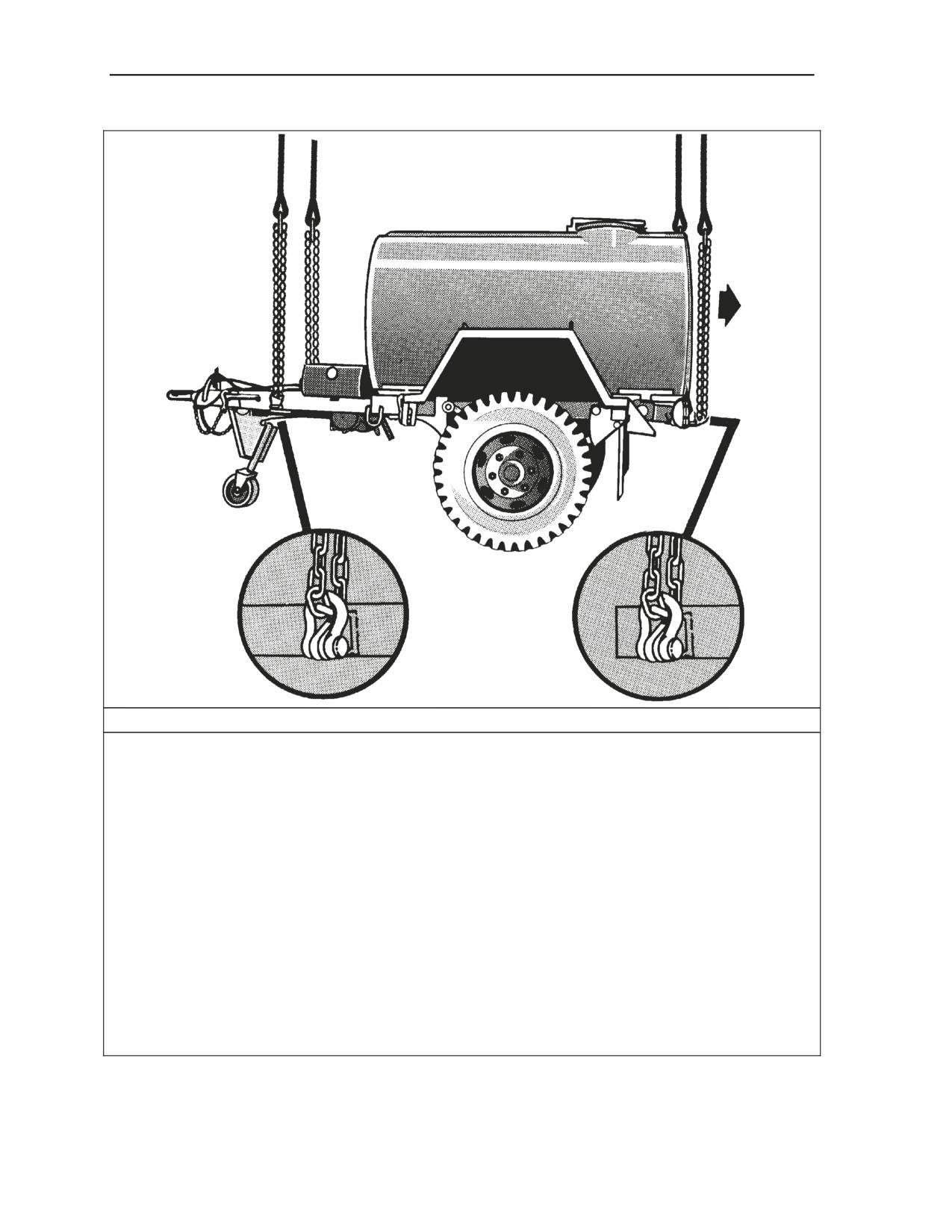
Rigging. Rig the load according to the steps in Figure 3-15.
Hookup. The hookup teams stand on the trailer fenders or on the front of the trailer. The
static wand person discharges the static electricity with the static wand. The forward hookup
person places apex fitting 1 onto the forward cargo hook. The aft hookup person places apex fitting
2 onto the aft cargo hook. The hookup team then carefully dismounts the trailer and remains
close to the load as the helicopter removes slack from the sling legs. When successful hookup
is assured, the hookup team quickly exits the area underneath the helicopter to the designated
rendezvous point.
Derigging. Derigging is the reverse of the preparation and rigging procedures.
FM 4-20.199/MCRP 4-11.3E, VOL III/NTTP 3-04.13/
20 February 2009
AFMAN 11-223 (I), VOL III/COMDINST M13482.4B
3-29
Chapter 3
RIGGING STEPS
1. Connect 2 sling legs to apex fitting number 1. Position the apex fitting on top of the forward
end (lunette end) of the trailer.
2. Loop the chain end of the sling legs through their respective lift provisions located in the
drawbar of the trailer. Place the correct link from Table 3-15 in the grab hook.
3. Connect 2 sling legs to apex fitting number 2. Position the apex fitting on top of the aft end of
the trailer.
4. Loop the chain end of the sling legs through their respective lift provisions located on the rear
bumper of the trailer. Place the correct link from Table 3-15 in the grab hook.
5. Secure all excess chain with tape or Type III nylon cord.
6. Cluster and tie (breakaway technique) the sling legs in each sling set together to prevent
entanglement during hookup and lift-off.
Figure 3-15. M1112, 400 Gallon Water Trailer
FM 4-20.199/MCRP 4-11.3E, VOL III/NTTP 3-04.13/
3-30
AFMAN 11-223 (I), VOL III/COMDINST M13482.4B
20 February 2009
Certified Dual-Point Rigging Procedures for Trailers
M105A3 TRAILER
3-17. The M105A3 trailer is rigged for dual-point sling load using the following procedures:
z
Applicability. The following item in Table 3-16 is certified for the helicopter(s) listed in the
following table by the US Army Natick Soldier Center:
Table 3-16. M105A3 Trailer
Nomenclature
Max Weight
Sling
Link Count
Type of
(Pounds)
Set
Front/Rear
Aircraft
M105A3 Trailer (Empty)
2,600
10K
40/3
CH-47
M105A3 Trailer (Loaded)
5,580
10K
40/3
CH-47
z
Materials. The following materials are required to rig this load:
Sling set (10,000-pound capacity) with one additional apex fitting.
Tape, adhesive, pressure-sensitive, 2-inch wide roll.
Cord, nylon, Type III, 550-pound breaking strength.
Webbing, cotton, 1/4-inch, 80-pound breaking strength.
z
Personnel. Two persons can prepare and rig this load in 10 minutes.
z
Procedures. The following procedures apply to this load:
Preparation. Prepare the load using the following steps:
─ Raise the trailer's jack stand so the pintle is on the ground.
─ Secure all loose chains, hoses, and cables to the trailer drawbar with tape or Type III
nylon cord.
─ Engage the parking brake.
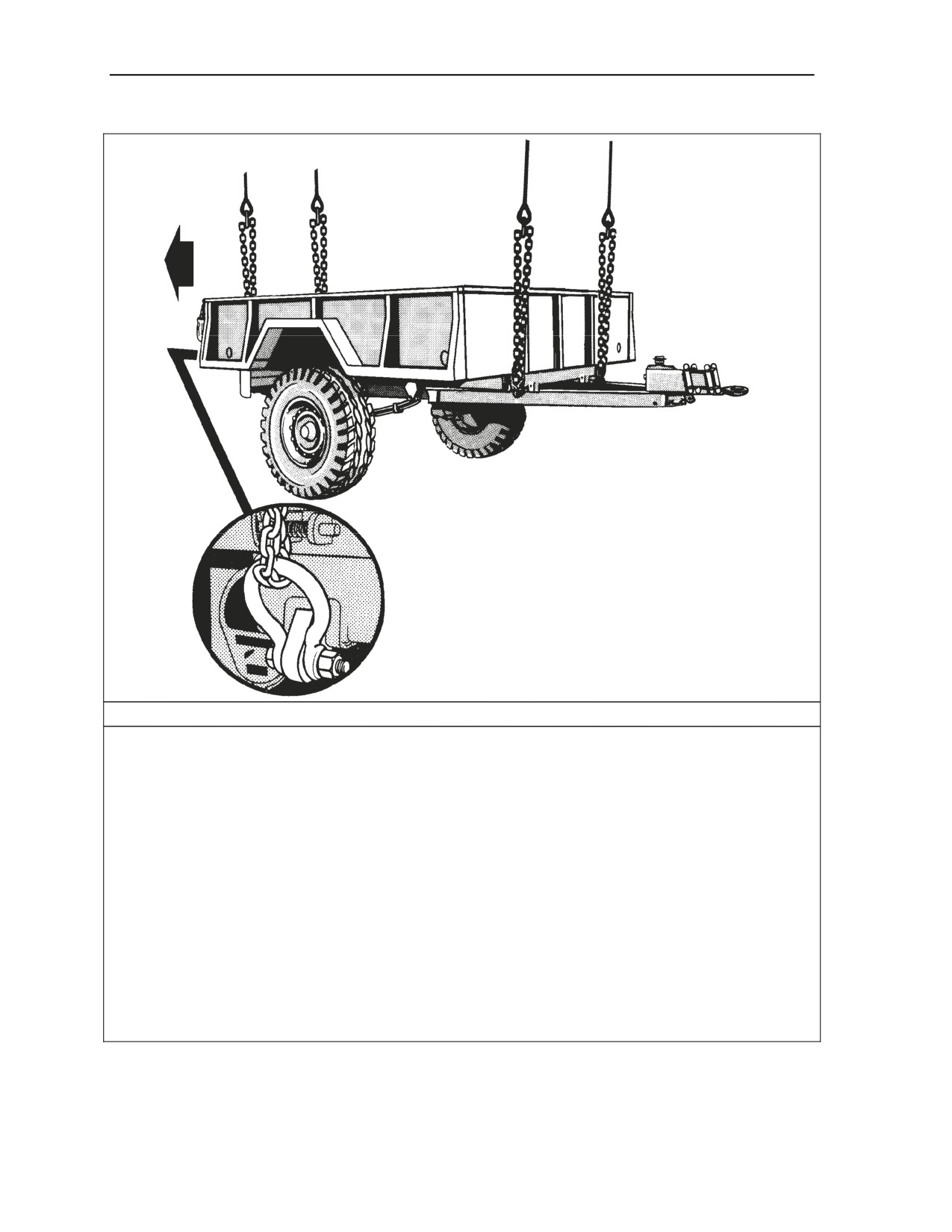
Rigging. Rig the load according to the steps in Figure 3-16.
Hookup. The hookup teams stand in the bed of the trailer. The static wand person
discharges the static electricity with the static wand. The forward hookup person places apex
fitting 1 onto the forward cargo hook. The aft hookup person places apex fitting 2 onto the aft cargo
hook. The hookup team then carefully dismounts the trailer and remains close to the load as
the helicopter removes slack from the sling legs. When successful hookup is assured, the
hookup team quickly exits the area underneath the helicopter to the designated rendezvous
point.
Derigging. Derigging is the reverse of the preparation and rigging procedures.
FM 4-20.199/MCRP 4-11.3E, VOL III/NTTP 3-04.13/
20 February 2009
AFMAN 11-223 (I), VOL III/COMDINST M13482.4B
3-31
Chapter 3
RIGGING STEPS
1. Connect 2 sling legs to apex fitting number 1. Position the apex fitting on top of the forward
end (lunette end) of the trailer.
2. Loop the chain end of the sling legs through their respective lift provisions located in the front
of the trailer. Place the correct link from Table 3-16 in the grab hook.
3. Connect 2 sling legs to apex fitting number 2. Position the apex fitting on top of the aft end of
the trailer.
4. Loop the chain end of the sling legs through their respective lift provisions located on the aft
end of the trailer. Place the correct link from Table 3-16 in the grab hook.
5. Secure all excess chain with tape or Type III nylon cord.
6. Cluster and tie (breakaway technique) the sling legs in each sling set together to prevent
entanglement during hookup and lift-off.
Figure 3-16. M105A3 Trailer
FM 4-20.199/MCRP 4-11.3E, VOL III/NTTP 3-04.13/
3-32
AFMAN 11-223 (I), VOL III/COMDINST M13482.4B
20 February 2009

Certified Dual-Point Rigging Procedures for Trailers
M1082 LIGHT MEDIUM TACTICAL VEHICLE (LMTV) AND M1095
MEDIUM TACTICAL VEHICLE (MTV) TRAILERS
3-18. The M1082 light medium tactical vehicle and M1095 medium tactical vehicle trailers are rigged for
dual-point sling load using the following procedures:
z
Applicability. The following items in Table 3-17 are certified for the helicopter(s) listed in the
following table by the US Army Natick Soldier Center:
Table 3-17. M1082 Light Medium Tactical Vehicle and M1095 Medium Tactical Vehicle Trailers
Nomenclature
Max Weight
Sling
Link Count
Type of
(Pounds)
Set
Front/Rear
Aircraft
M1082 LMTV Trailer
11,510
25K
10/3
CH-47
M1095 MTV Trailer
15,780
25K
20/3
CH-47
z
Materials. The following materials are required to rig this load:
Sling set (25,000-pound capacity) with one additional apex fitting.
Tape, adhesive, pressure-sensitive, 2-inch wide roll.
Cord, nylon, Type III, 550-pound breaking strength.
Webbing, cotton, 1/4-inch, 80-pound breaking strength.
z
Personnel. Two persons can prepare and rig this load in 10 minutes.
z
Procedures. The following procedures apply to this load:
Preparation. Prepare the load using the following steps:
─ Position the trailer's jack stand in the down position so the trailer sets level.
─ Secure all loose chains, hoses, and cables to the trailer drawbar with tape or Type III
nylon cord.
─ Engage the parking brake.
─ Extend the lift provision bars to the widest position and lock into place with the
locking pins. Secure the locking pins in place with tape.
Note: Ensure the lift eyes on the lift provision bars are perpendicular to the ground.
─ Remove the side and end panels and stow in the storage boxes under the bed of the
trailer. Secure the storage latches with tape.
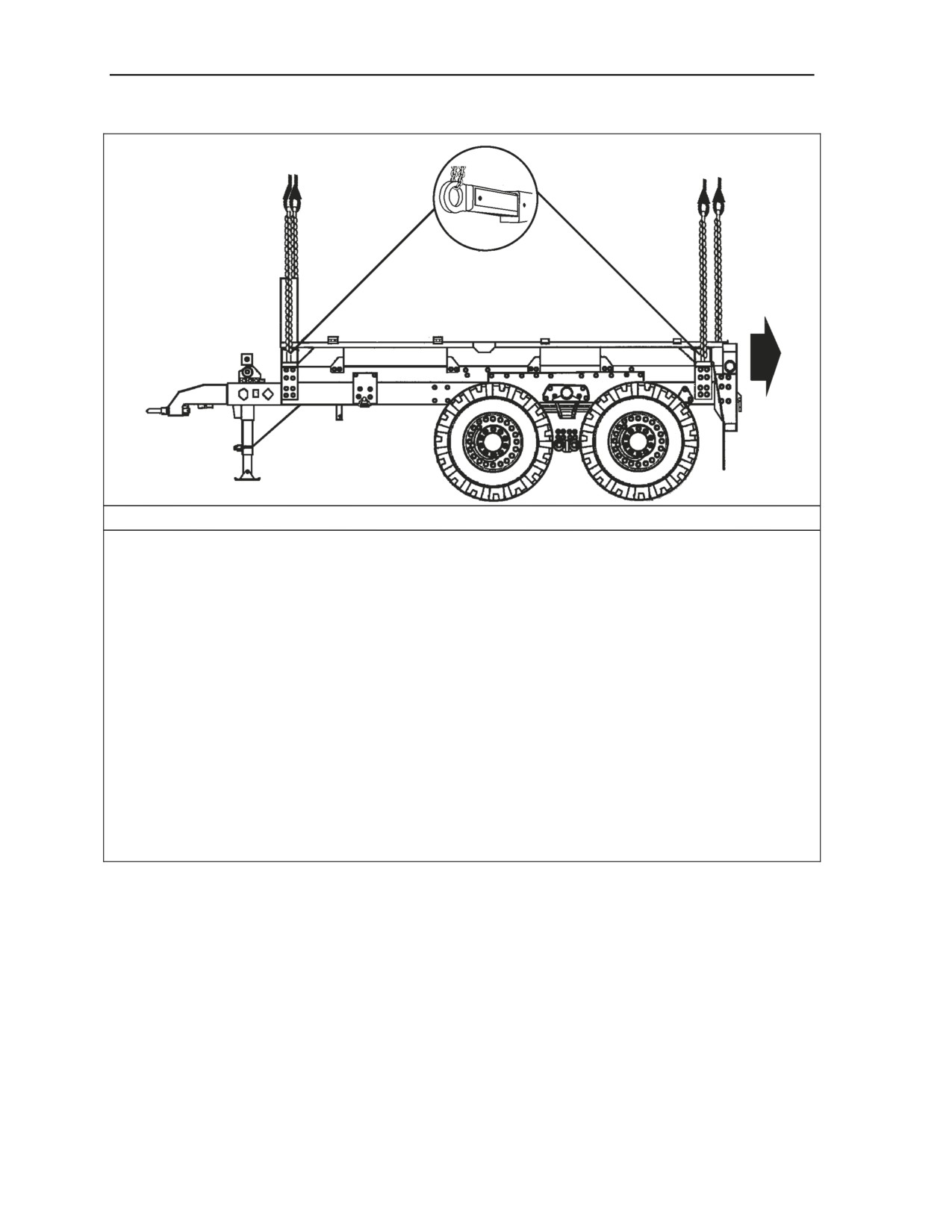
Rigging. Rig the load according to the steps in Figure 3-17.
Hookup. The hookup teams stand in the bed of the trailer. The static wand person
discharges the static electricity with the static wand. The forward hookup person places apex
fitting 1 onto the forward cargo hook. The aft hookup person places apex fitting 2 onto the aft cargo
hook. The hookup team then carefully dismounts the trailer and remains close to the load as
the helicopter removes slack from the sling legs. When successful hookup is assured, the
hookup team quickly exits the area underneath the helicopter to the designated rendezvous
point.
Derigging. Derigging is the reverse of the preparation and rigging procedures.
FM 4-20.199/MCRP 4-11.3E, VOL III/NTTP 3-04.13/
20 February 2009
AFMAN 11-223 (I), VOL III/COMDINST M13482.4B
3-33
Chapter 3
RIGGING STEPS
1. Connect 2 sling legs to apex fitting number 1. Position the apex fitting on top of the forward
end (lunette end) of the trailer.
2. Loop the chain end of the sling legs through their respective lift provision bar located on the
front end (lunette end) of the trailer. Place the correct link from Table 3-17 in the grab hook.
3. Connect 2 sling legs to apex fitting number 2. Position the apex fitting on top of the aft end of
the trailer.
4. Loop the chain end of the sling legs through their respective lift provision bar located on the
aft end of the trailer. Place the correct link from Table 3-17 in the grab hook.
5. Secure all excess chain with tape or Type III nylon cord.
6. Cluster and tie or tape (breakaway technique) the sling legs in each sling set together to
prevent entanglement during hookup and lift-off.
Figure 3-17. M1082 Light Medium Tactical Vehicle and M1095 Medium Tactical Vehicle Trailers
FM 4-20.199/MCRP 4-11.3E, VOL III/NTTP 3-04.13/
3-34
AFMAN 11-223 (I), VOL III/COMDINST M13482.4B
20 February 2009
Certified Dual-Point Rigging Procedures for Trailers
ASSAULT COMMAND POST WITH HIGH MOBILITY WHEEL SET
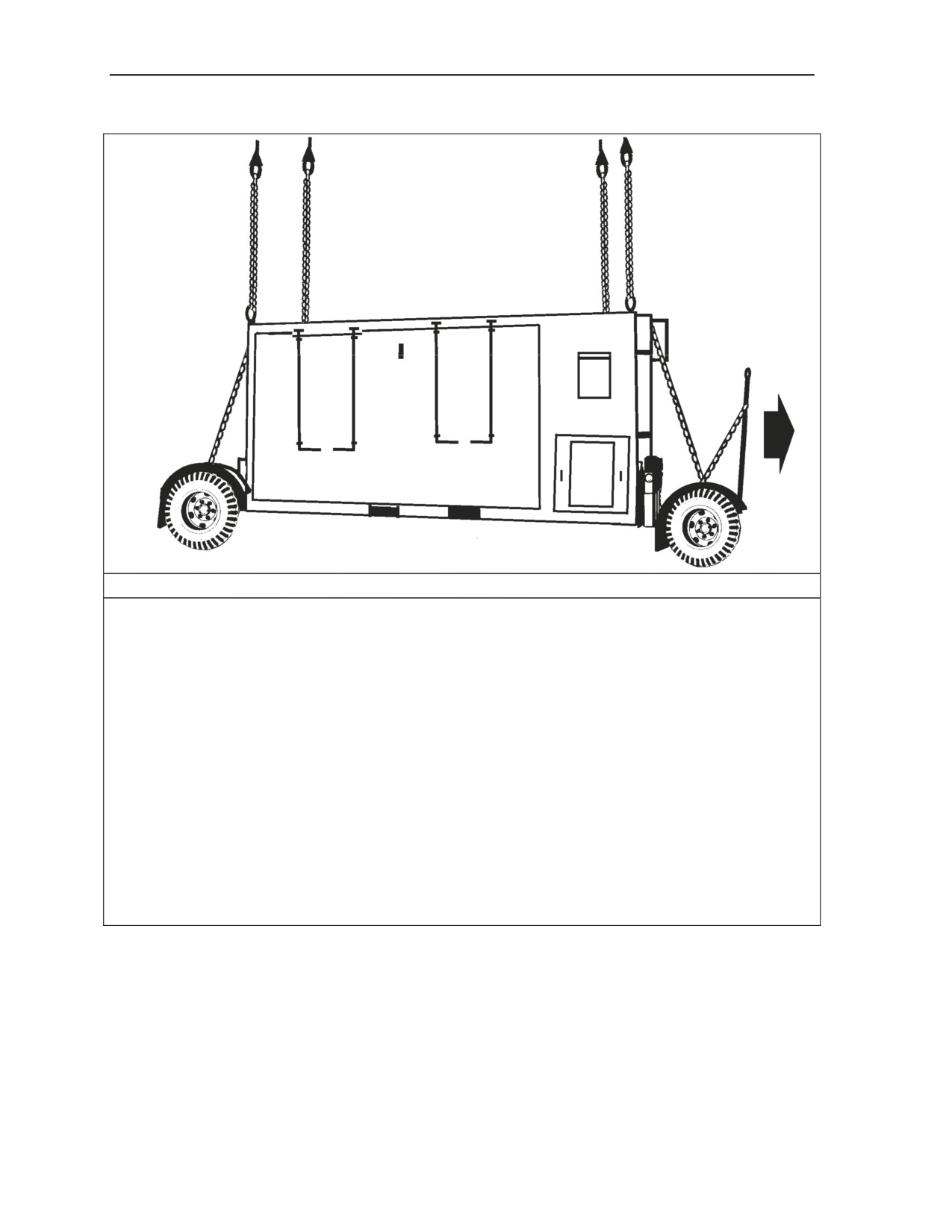
3-19. The assault command post with high mobility wheel set is rigged for dual-point sling load using the
following procedures:
z
Applicability. The following items in Table 3-18 are certified for the helicopter(s) listed in the
following table by the US Army Natick Soldier Center:
Table 3-18. Assault Command Post with High Mobility Wheel Set
Nomenclature
Max
Sling
Link Count
Type of
Weight
Set
Front/Rear
Aircraft
(Pounds)
Assault Command Post (ACP) Housed in
13,240
25K
ECU is Front
CH-47
Expandable Light Airmobile Shelter (ELAMS),
20/3
with High Mobility Wheel Set
Upgraded Assault Command Post (ACP) Housed
14,600
25K
ECU is Front
CH-47
in Expandable Light Airmobile Shelter (ELAMS),
20/3
with High Mobility Wheel Set
z
Materials. The following materials are required to rig this load:
Sling set (25,000-pound capacity) with one additional apex fitting.
Tape, adhesive, pressure-sensitive, 2-inch wide roll.
Cord, nylon, Type III, 550-pound breaking strength.
Webbing, cotton, 1/4-inch, 80-pound breaking strength.
z
Personnel. Two persons can prepare and rig this load in 15 minutes.
z
Procedures. The following procedures apply to this load:
Preparation. Prepare the load using the following steps:
─ Ensure manufacturer approved tiedown assemblies (2 each) are in place between the
shelter and each wheel set.
─ Remove all antennas and secure inside the shelter.
─ Secure all lids, doors, and caps with tape or Type III nylon cord.
─ Secure all loose equipment inside the shelter with tape, lashings, or Type III nylon
cord.
─ Secure the tow bar in the up position with Type III nylon cord.
Rigging. Rig the load according to the steps in Figure 3-18.
Hookup. The hookup teams stand on the roof of the shelter. The static wand person
discharges the static electricity with the static wand. The forward hookup person places apex
fitting 1 onto the forward cargo hook. The aft hookup person places apex fitting 2 onto the aft cargo
hook. The hookup team then carefully dismounts the vehicle and remains close to the load as
the helicopter removes slack from the sling legs. When successful hookup is assured, the
hookup team quickly exits the area underneath the helicopter to the designated rendezvous
point.
Derigging. Derigging is the reverse of the preparation and rigging procedures.
FM 4-20.199/MCRP 4-11.3E, VOL III/NTTP 3-04.13/
20 February 2009
AFMAN 11-223 (I), VOL III/COMDINST M13482.4B
3-35
Chapter 3
RIGGING STEPS
1. Connect 2 sling legs to apex fitting number 1. Position the apex fitting on the roof of the
shelter.
2. Loop the chain end of the sling legs through their respective lift provisions located on the top
front corners of the shelter. Place the correct link from Table 3-18 in the grab hook.
3. Connect 2 sling legs to apex fitting number 2. Position the apex fitting on the roof of the
shelter.
4. Loop the chain end of the sling legs through their respective lift provision bar located on the
top rear corners of the shelter. Place the correct link from Table 3-18 in the grab hook.
5. Secure all excess chain with tape or Type III nylon cord.
6. Cluster and tie (breakaway technique) the sling legs in each sling set together to prevent
entanglement during hookup and lift-off.
Figure 3-18. Assault Command Post with High Mobility Wheel Set
FM 4-20.199/MCRP 4-11.3E, VOL III/NTTP 3-04.13/
3-36
AFMAN 11-223 (I), VOL III/COMDINST M13482.4B
20 February 2009
Certified Dual-Point Rigging Procedures for Trailers
CONTAINERIZED KITCHEN MOUNTED ON THE CONTAINERIZED
KITCHEN TRAILER
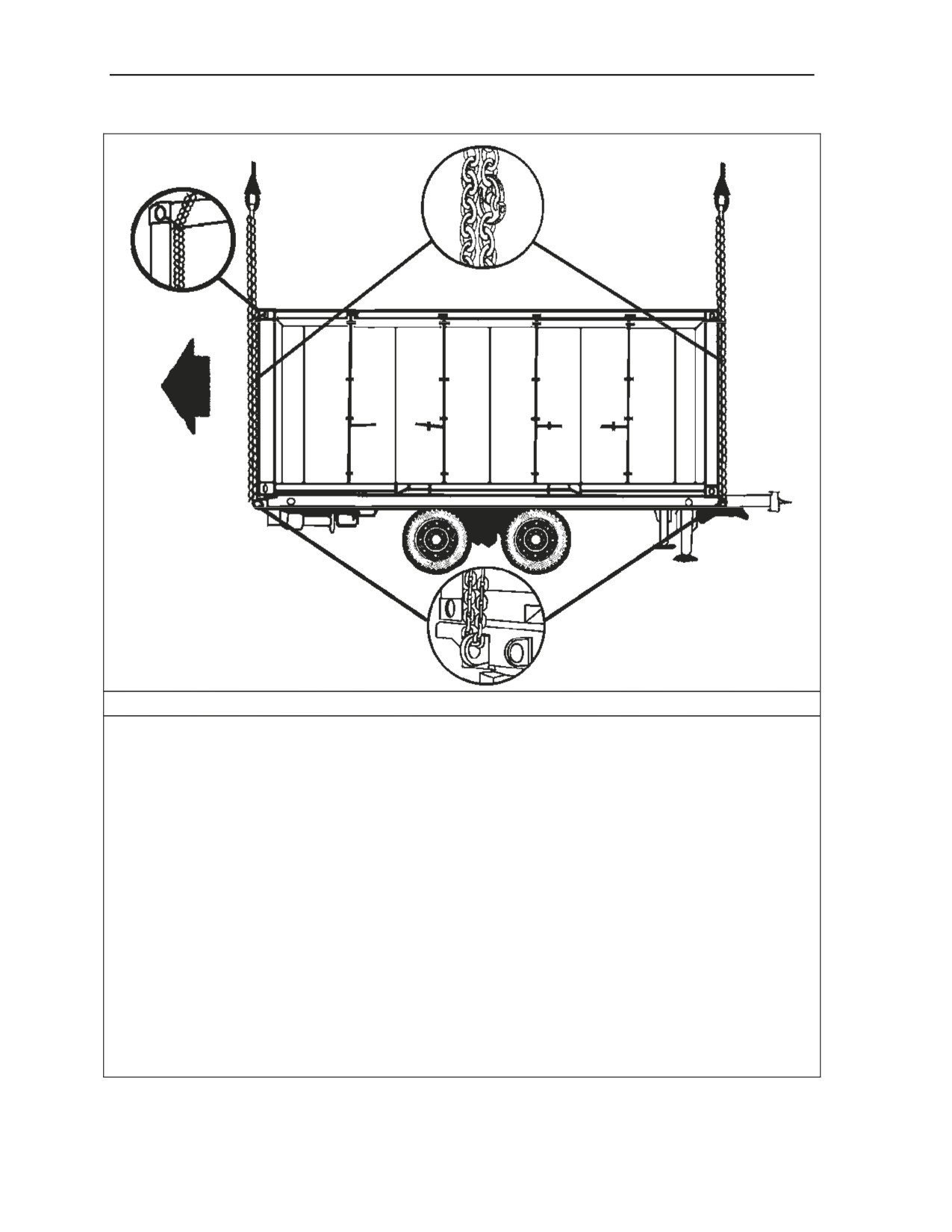
3-20. The containerized kitchen mounted on the containerized kitchen trailer is rigged for dual-point sling
load using the following procedures:
z
Applicability. The following item in Table 3-19 is certified for the helicopter(s) listed in the
following table by the US Army Natick Soldier Center:
Table 3-19. Containerized Kitchen Mounted on the Containerized Kitchen Trailer
Nomenclature
Max Range
Sling
Link Count
Type of
(Pounds)
Set
Front/Rear
Aircraft
Containerized Kitchen on Containerized Kitchen
18,900-
25K
3/50
CH-47
Trailer
20,840
z
Materials. The following materials are required to rig this load:
Sling set (25,000-pound capacity) with one additional apex fitting.
─ Additional chain length, part number 38850-00053-102, from a 25,000-pound capacity
sling set (8 each).
─ Additional coupling link, part number 664241, from a 25,000-pound capacity sling set.
Tape, adhesive, pressure-sensitive, 2-inch wide roll.
Cord, nylon, Type III, 550-pound breaking strength.
Webbing, cotton, 1/4-inch, 80-pound breaking strength.
z
Personnel. Two persons can prepare and rig this load in 10 minutes.
z
Procedures. The following procedures apply to this load:
Preparation. Prepare the load using the following steps:
─ Secure all loose chains, hoses, and cables to the trailer drawbar with tape or Type III
nylon cord.
─ Secure all lids, doors, and caps with tape or Type III nylon cord.
─ Ensure the front stabilizer legs are extended and in the down position and the rear
stabilizer legs are in the up and stowed position.
─ Lower the tongue support leg so the lunette is lower than the rear of the trailer.
Rigging. Rig the load according to the steps in Figure 3-19.
Hookup. The hookup teams stand on the trailer roof. The static wand person discharges
the static electricity with the static wand. The forward hookup person places apex fitting 1 onto
the forward cargo hook. The aft hookup person places apex fitting 2 onto the aft cargo hook. The
hookup team then carefully dismounts the trailer and remains close to the load as the helicopter
removes slack from the sling legs. When successful hookup is assured, the hookup team
quickly exits the area underneath the helicopter to the designated rendezvous point.
Derigging. Derigging is the reverse of the preparation and rigging procedures.
FM 4-20.199/MCRP 4-11.3E, VOL III/NTTP 3-04.13/
20 February 2009
AFMAN 11-223 (I), VOL III/COMDINST M13482.4B
3-37
Chapter 3
RIGGING STEPS
1. Connect 2 sling legs to apex fitting number 1. Attach two extra chain lengths to each existing
chain on each sling leg using coupling links (for 25,000-pound capacity sling sets only).
Position the apex fitting on top of the aft end of the trailer.
2. Loop the chain end of the sling legs through their respective lift provisions located on the
frame of the trailer. Place the correct link from Table 3-19 in the grab hook.
3. Connect 2 sling legs to apex fitting number 2. Attach two extra chain lengths to each existing
chain on each sling leg using coupling links (for 25,000-pound capacity sling sets only).
Position the apex fitting on top of the front (lunette end) of the trailer.
4. Loop the chain end of the sling legs through their respective lift provisions located on the
frame of the trailer. Place the correct link from Table 3-19 in the grab hook.
5. Secure all excess chain with tape or Type III nylon cord.
6. Cluster and tie (breakaway technique) the sling legs in each sling set together to prevent
entanglement during hookup and lift-off. Safety tie each chain to the respective ISO
provision with Type I, 1/4-inch cotton webbing.
Figure 3-19. Containerized Kitchen Mounted on the Containerized Kitchen Trailer
FM 4-20.199/MCRP 4-11.3E, VOL III/NTTP 3-04.13/
3-38
AFMAN 11-223 (I), VOL III/COMDINST M13482.4B
20 February 2009

Certified Dual-Point Rigging Procedures for Trailers
M31 EXPEDITIONARY ARRESTING GEAR SYSTEM (EAGS)
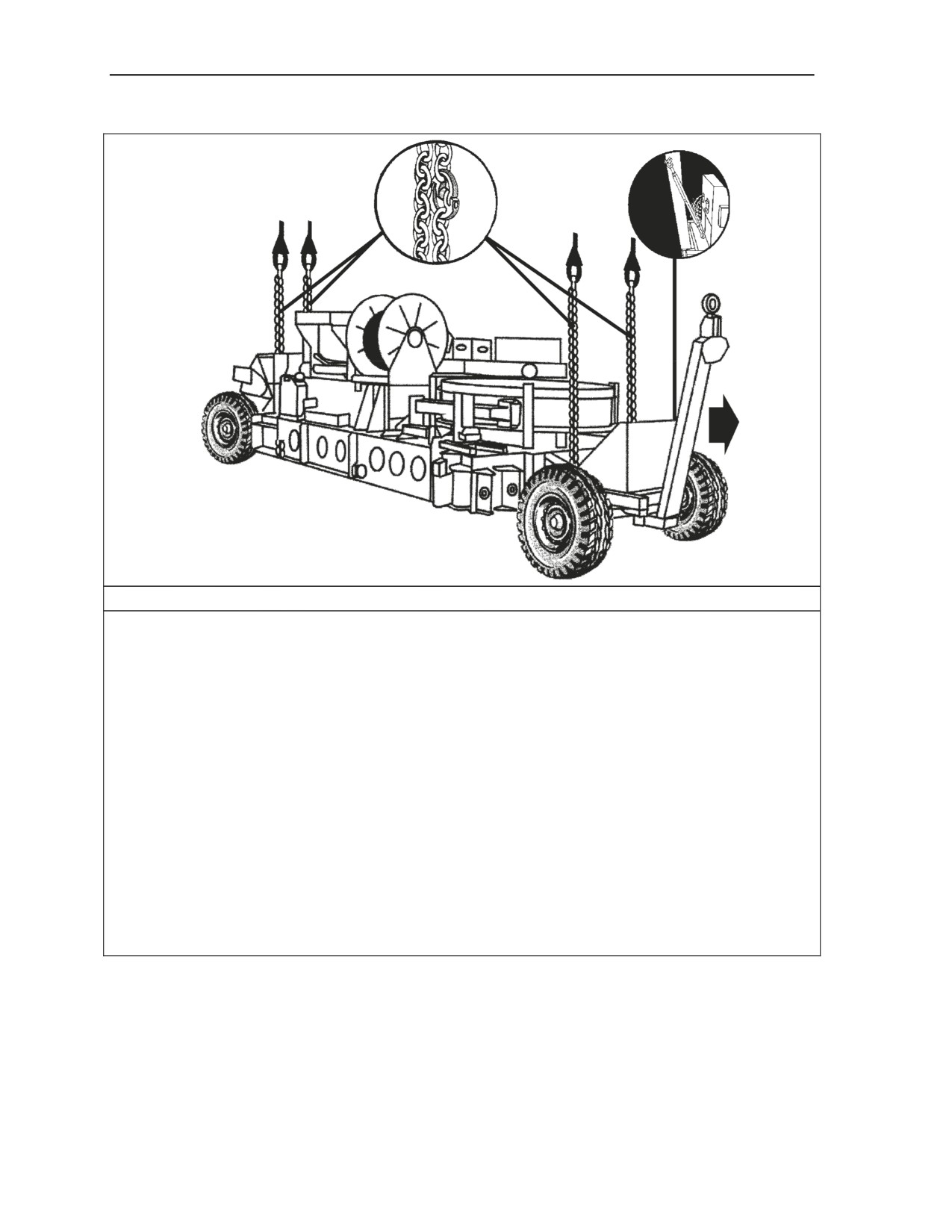
3-21. The M31 expeditionary arresting gear system is rigged for dual-point sling load using the following
procedures:
z
Applicability. The following item in Table 3-20 is certified for the helicopter(s) listed in the
following table by the US Army Natick Soldier Center:
Table 3-20. M31 Expeditionary Arresting Gear System
Nomenclature
Max Weight
Sling
Link Count
Type of
(Pounds)
Set
Front/Rear
Aircraft
M31 Expeditionary Arresting Gear System
17,466
40K
Right 3/21
CH-53
Left 5/22
Note: The front of the EAGS is the end with the large towbar.
z
Materials. The following materials are required to rig this load:
Sling set (40,000-pound capacity) with one additional apex fitting.
─ Additional chain length, part number 607050, from a 40,000-pound capacity sling set
(4 each).
─ Additional coupling link, NSN 4010-01-081-5114, from a 40,000-pound sling set (4
each).
Tape, adhesive, pressure-sensitive, 2-inch wide roll.
Cord, nylon, Type III, 550-pound breaking strength.
Webbing, cotton, 1/4-inch, 80-pound breaking strength.
Strap, tiedown, 5,000-pound capacity (included with system) (as required).
z
Personnel. Two persons can prepare and rig this load in 15 minutes.
z
Procedures. The following procedures apply to this load:
Note: The EAGS must be in the transport mode.
Preparation. Prepare the load using the following steps:
─ Secure the drawbar in the up position with the included tie rod.
─ Secure the safety chains and brake cables to the drawbar with Type III nylon cord.
─ Secure all lids, doors, and caps with tape or Type III nylon cord.
─ Ensure the stabilizing legs are retracted and stowed.
─ Secure all stowed equipment with the provided tiedown straps.
─ Connect one additional chain length to each chain on each sling set with a coupling
link.
Rigging. Rig the load according to the steps in Figure 3-20.
Hookup. The hookup teams stand on top of the trailer. The static wand person discharges
the static electricity with the static wand. The forward hookup person places apex fitting 1 onto
the forward cargo hook. The aft hookup person places apex fitting 2 onto the aft cargo hook. The
hookup team then carefully dismounts the trailer and remains close to the load as the helicopter
removes slack from the sling legs. When successful hookup is assured, the hookup team
quickly exits the area underneath the helicopter to the designated rendezvous point.
Derigging. Derigging is the reverse of the preparation and rigging procedures.
FM 4-20.199/MCRP 4-11.3E, VOL III/NTTP 3-04.13/
20 February 2009
AFMAN 11-223 (I), VOL III/COMDINST M13482.4B
3-39
Chapter 3
RIGGING STEPS
1. Connect 2 sling legs to apex fitting number 1. Position the apex fitting on top of the forward
end (tow bar end) of the trailer.
2. Loop the chain end of the sling legs through their respective lift provisions located on the
front end (tow bar end) of the trailer. Place the correct link from Table 3-20 in the grab hook.
Tape the slings to the radiator.
3. Connect 2 sling legs to apex fitting number 2. Position the apex fitting on top of the aft end of
the trailer.
4. Loop the chain end of the sling legs through their respective lift provisions located on the aft
end of the trailer. Place the correct link from Table 3-20 in the grab hook.
5. Secure all excess chain with tape or Type III nylon cord.
6. Cluster and tie (breakaway technique) the sling legs in each sling set together on top of the
spindle to prevent entanglement during hookup and lift-off.
Figure 3-20. M31 Expeditionary Arresting Gear System
FM 4-20.199/MCRP 4-11.3E, VOL III/NTTP 3-04.13/
3-40
AFMAN 11-223 (I), VOL III/COMDINST M13482.4B
20 February 2009
Certified Dual-Point Rigging Procedures for Trailers
STANDARD AUTOMOTIVE TOOLS SET (SATS) TRAILER
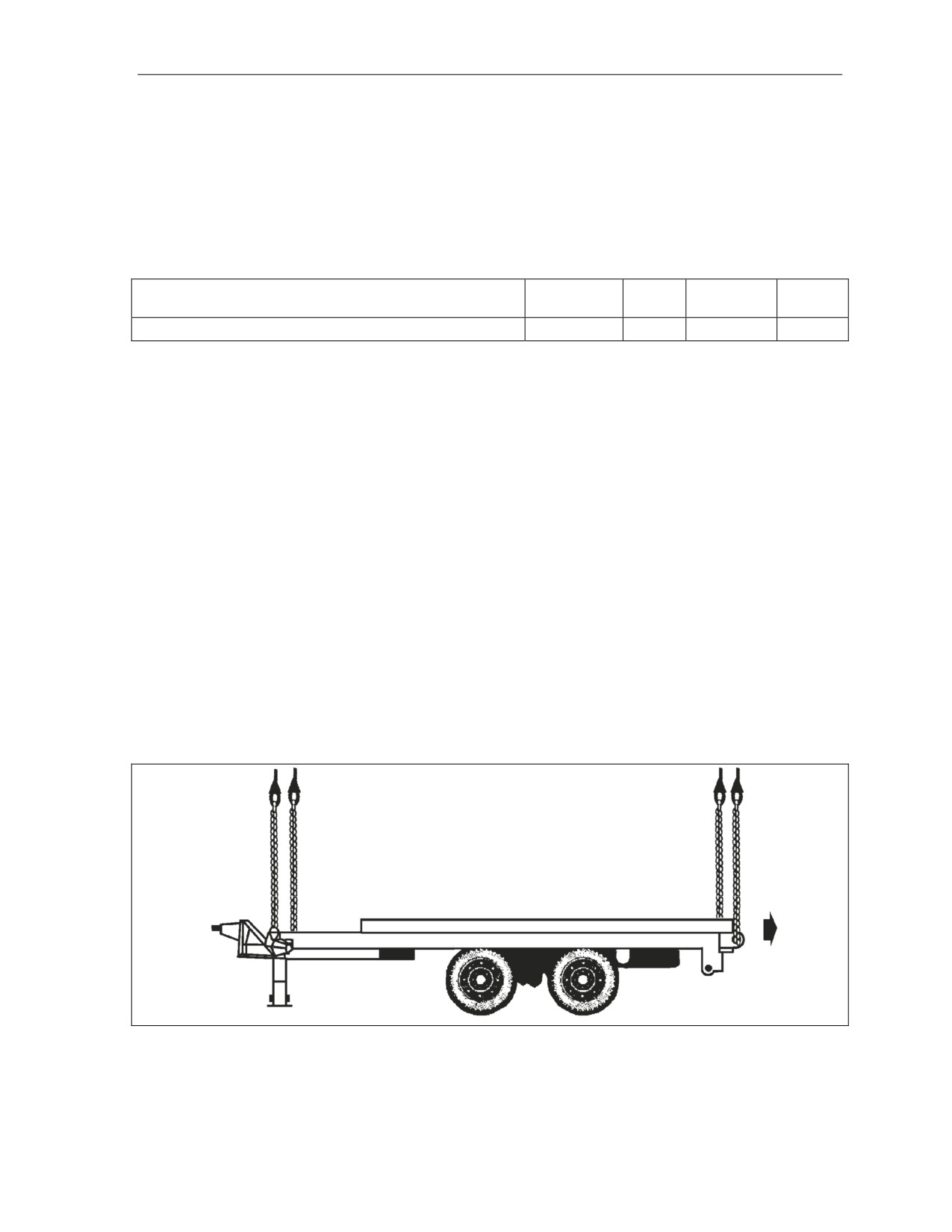
3-22. The standard automotive tools set trailer is rigged for dual-point sling load using the following
procedures:
z
Applicability. The following item in Table 3-21 is certified for the helicopter(s) listed in the
following table by the US Army Natick Soldier Center:
Table 3-21. Standard Automotive Tools Set Trailer
Nomenclature
Max Weight
Sling
Link Count
Type of
(Pounds)
Set
Front/Rear
Aircraft
Standard Automotive Tools Set Trailer
6,580
10K
3/50
CH-47
z
Materials. The following materials are required to rig this load:
Sling set (10,000-pound capacity) with one additional apex fitting.
Tape, adhesive, pressure-sensitive, 2-inch wide roll.
Cord, nylon, Type III, 550-pound breaking strength.
Webbing, cotton, 1/4-inch, 80-pound breaking strength.
z
Personnel. Two persons can prepare and rig this load in 10 minutes.
z
Procedures. The following procedures apply to this load:
Preparation. Prepare the load using the following steps:
─ Secure all loose chains, hoses, and cables to the trailer drawbar with tape or Type III nylon cord.
─ Ensure the front stabilizer legs are extended and in the down position and the rear stabilizer legs
are in the up and stowed position.
─ Lower the tongue support leg so the lunette is lower than the rear of the trailer.
─ Ensure the ramp is stowed and secured.
Rigging. Rig the load according to the steps in Figure 3-21.
Hookup. The hookup teams stand in the bed of the trailer. The static wand person discharges the
static electricity with the static wand. The forward hookup person places apex fitting 1 onto the forward
cargo hook. The aft hookup person places apex fitting 2 onto the aft cargo hook. The hookup team then
carefully dismounts the trailer and remains close to the load as the helicopter removes slack from the
sling legs. When successful hookup is assured, the hookup team quickly exits the area underneath the
helicopter to the designated rendezvous point.
Derigging. Derigging is the reverse of the preparation and rigging procedures.
Figure 3-21. Standard Automotive Tools Set Trailer
FM 4-20.199/MCRP 4-11.3E, VOL III/NTTP 3-04.13/
20 February 2009
AFMAN 11-223 (I), VOL III/COMDINST M13482.4B
3-41

Chapter 3
RIGGING STEPS
1. Connect 2 sling legs to apex fitting number 1. Position the apex fitting on the bed of the
trailer.
2. Loop the chain end of the sling legs through their respective lift provisions located on the
front corners of the trailer. Place the correct link from Table 3-21 in the grab hook.
3. Connect 2 sling legs to apex fitting number 2. Position the apex fitting on the bed of the
trailer.
4. Loop the chain end of the sling legs through their respective lift provisions located on the rear
corners of the trailer. Place the correct link from Table 3-21 in the grab hook.
5. Secure all excess chain with tape or Type III nylon cord.
6. Cluster and tie (breakaway technique) the sling legs in each sling set together to prevent
entanglement during hookup and lift-off.
Figure 3-21. Standard Automotive Tools Set Trailer (Continued)
SMALL EMPLACEMENT EXCAVATOR (SEE) TRANSPORTER
3-23. The small emplacement excavator transporter is rigged for dual-point sling load using the following
procedures:
z
Applicability. The following item in Table 3-22 is certified for the helicopter(s) listed in the
following table by the US Army Natick Soldier Center:
Table 3-22. Small Emplacement Excavator Transporter
Nomenclature
Max Weight
Sling
Link Count
Type of
(Pounds)
Set
Front/Rear
Aircraft
Trailer, Two Axle, 20,000-Pound Capacity, SEE
10,880
15K
30/3
CH-53
Transporter
z
Materials. The following materials are required to rig this load:
Sling set (15,000-pound capacity) with one additional web ring.
Tape, adhesive, pressure-sensitive, 2-inch wide roll.
Cord, nylon, Type III, 550-pound breaking strength.
Webbing, cotton, 1/4-inch, 80-pound breaking strength.
Strap, cargo, tiedown, CGU-1/B (as required).
z
Personnel. Two persons can prepare and rig this load in 15 minutes.
z
Procedures. The following procedures apply to this load:
Preparation. Prepare the load using the following steps:
─ Position the trailer with the rear axle facing the direction of flight.
─ Secure all loose chains, hoses, and cables to the trailer drawbar with tape or Type III
nylon cord.
─ Ensure the front stabilizer legs are extended and in the down position.
─ Secure the ramps and equipment on the trailer bed with chains, tiedown straps,
lashings or Type III nylon cord.
─ Ensure the spare tire is installed and secured correctly.
─ Rotate the mud flaps up into the stowed position.
FM 4-20.199/MCRP 4-11.3E, VOL III/NTTP 3-04.13/
3-42
AFMAN 11-223 (I), VOL III/COMDINST M13482.4B
20 February 2009
Certified Dual-Point Rigging Procedures for Trailers
CAUTION
Ensure the cargo and equipment on the trailer bed does not interfere
with the routing of the sling legs.
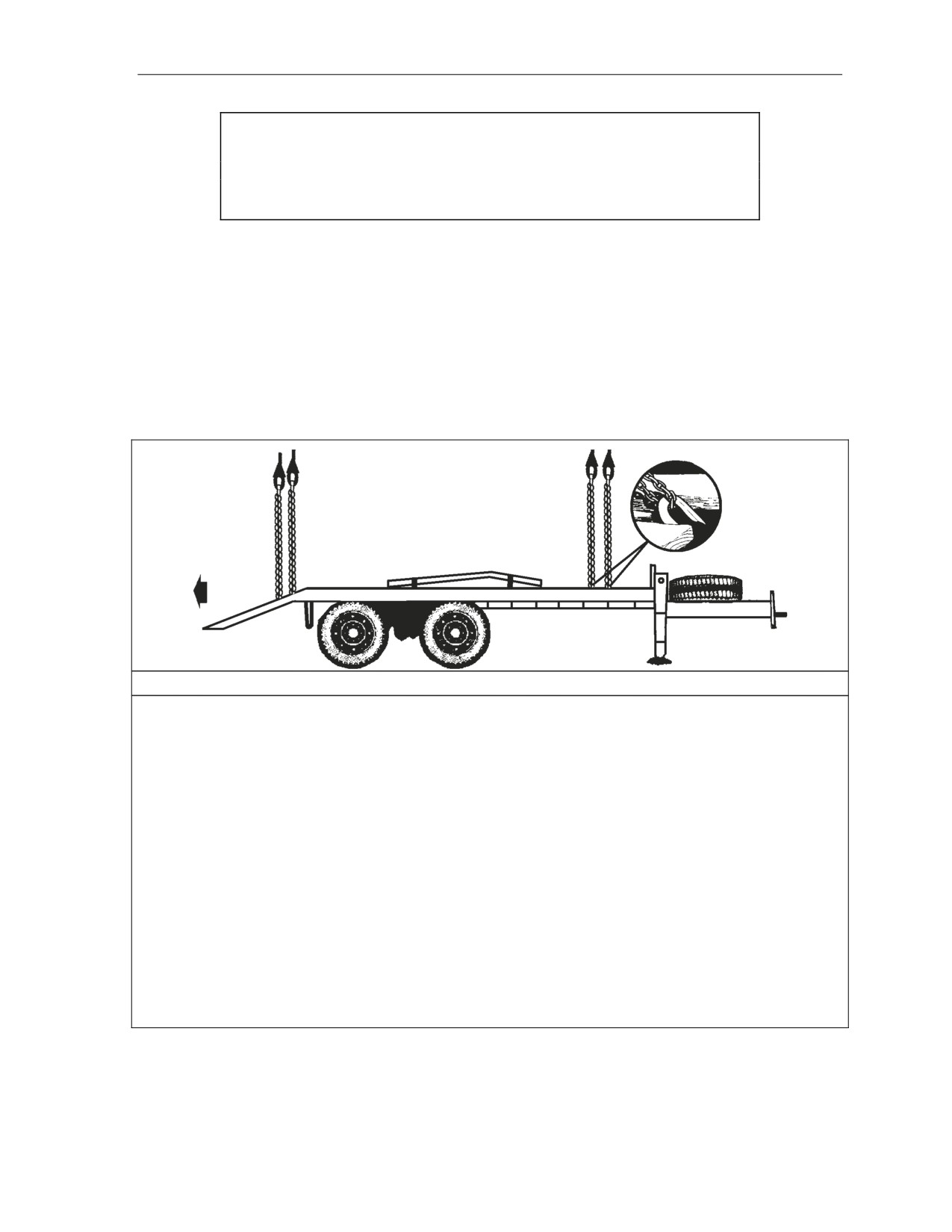
Rigging. Rig the load according to the steps in Figure 3-22.
Hookup. The hookup teams stand in the bed of the trailer. The static wand person
discharges the static electricity with the static wand. The forward hookup person places apex
fitting 1 onto the forward cargo hook. The aft hookup person places apex fitting 2 onto the aft cargo
hook. The hookup team then carefully dismounts the trailer and remains close to the load as
the helicopter removes slack from the sling legs. When successful hookup is assured, the
hookup team quickly exits the area underneath the helicopter to the designated rendezvous
point.
Derigging. Derigging is the reverse of the preparation and rigging procedures.
RIGGING STEPS
1. Connect 2 sling legs to apex fitting number 1. Position the apex fitting on the bed of the
trailer.
2. Loop the chain end of the sling legs through their respective lift provisions located on the
front (lunette end) of the trailer bed. Place the correct link from Table 3-22 in the grab hook.
3. Connect 2 sling legs to apex fitting number 2. Position the apex fitting on the bed of the
trailer.
4. Loop the chain end of the sling legs through their respective lift provisions located on the
ramp of the trailer. Place the correct link from Table 3-22 in the grab hook.
5. Secure all excess chain with tape or Type III nylon cord.
6. Cluster and tie (breakaway technique) the sling legs in each sling set together to prevent
entanglement during hookup and lift-off.
Figure 3-22. Small Emplacement Excavator Transporter
FM 4-20.199/MCRP 4-11.3E, VOL III/NTTP 3-04.13/
20 February 2009
AFMAN 11-223 (I), VOL III/COMDINST M13482.4B
3-43

Chapter 3
STANDARD AUTOMOTIVE TOOLS SET (SATS) MOUNTED ON SATS
TRAILER
3-24. The standard automotive tools set trailer is rigged for dual-point sling load using the following
procedures:
z
Applicability. The following items in Table 3-23 are certified for the helicopter(s) listed in the
following table by the US Army Natick Soldier Center:
Table 3-23. Standard Automotive Tools Set Mounted on SATS Trailer
Nomenclature
Max Weight
Sling
Link Count
Type of
(Pounds)
Set
Front/Rear
Aircraft
Standard Automotive Tools Set with Core Tool Set
17,340
25K
5/30
CH-47
Standard Automotive Tools Set with Core and Mod 1
19,240
25K
5/30
CH-47
Tool Set
Standard Automotive Tools Set with Core, Mod 1, and
19,968
25K
5/30
CH-47
Mod 2 Tool Sets
z
Materials. The following materials are required to rig this load:
Sling set (25,000-pound capacity) with one additional apex fitting.
─ Additional chain length, part number 38850-00053-102, from a 25,000-pound capacity
sling set (8 each).
─ Additional coupling link, part number 664241, from a 25,000-pound capacity sling set.
Tape, adhesive, pressure-sensitive, 2-inch wide roll.
Cord, nylon, Type III, 550-pound breaking strength.
Webbing, cotton, 1/4-inch, 80-pound breaking strength.
z
Personnel. Two persons can prepare and rig this load in 10 minutes.
z
Procedures. The following procedures apply to this load:
Preparation. Prepare the load using the following steps:
─ Secure all loose chains, hoses, and cables to the trailer drawbar with tape or Type III
nylon cord.
─ Secure all loose equipment inside the shelter with tape, Type III nylon cord, and
tiedown straps.
─ Secure all lids, doors, and caps with tape or Type III nylon cord.
─ Ensure the front stabilizer legs are extended and in the down position and the rear
stabilizer legs are in the up and stowed position.
─ Lower the tongue support leg so the lunette is lower than the rear of the trailer.
─ Ensure the ramp is stowed and secured.
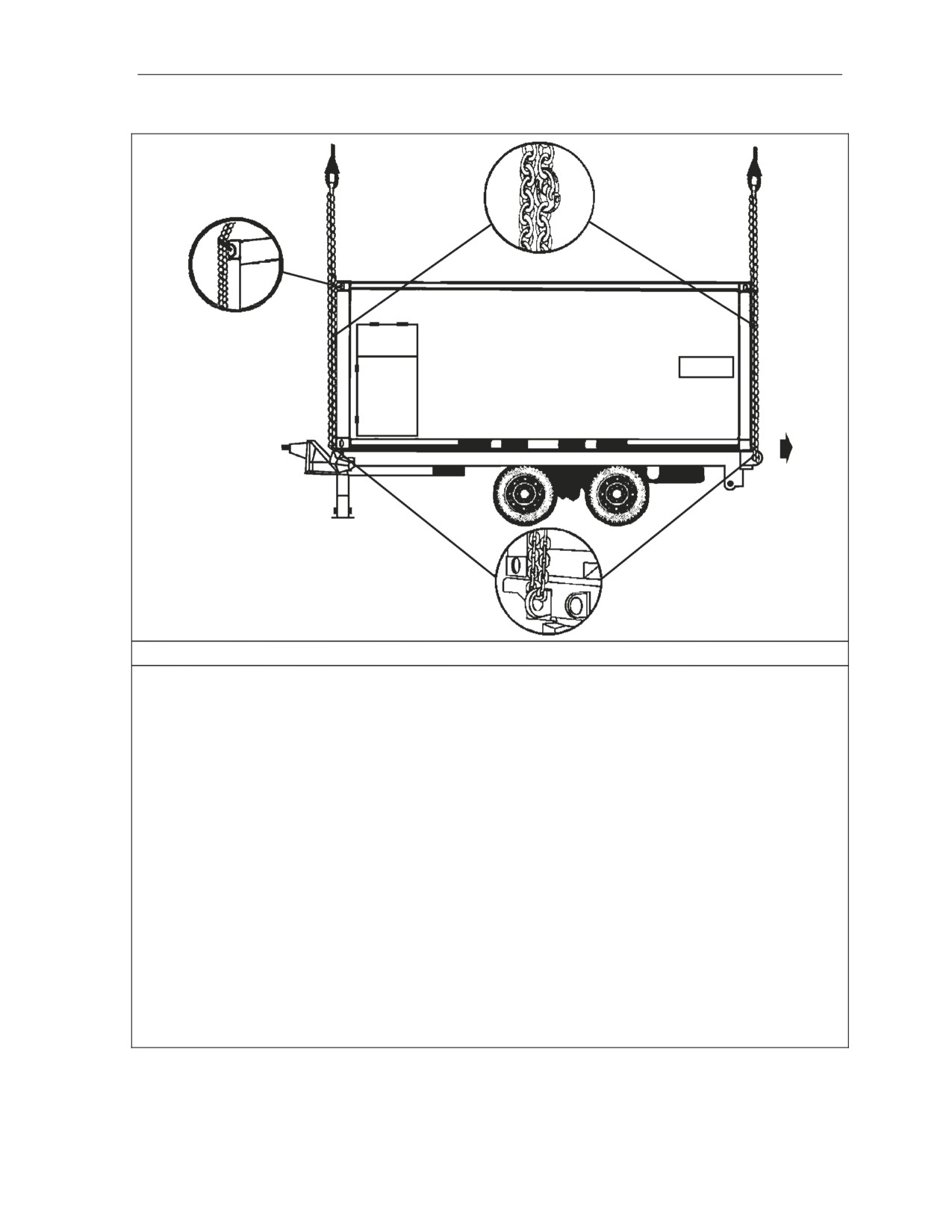
Rigging. Rig the load according to the steps in Figure 3-23.
Hookup. The hookup teams stand on the top of the shelter. The static wand person
discharges the static electricity with the static wand. The forward hookup person places apex
fitting 1 onto the forward cargo hook. The aft hookup person places apex fitting 2 onto the aft cargo
hook. The hookup team then carefully dismounts the trailer and remains close to the load as
the helicopter removes slack from the sling legs. When successful hookup is assured, the
hookup team quickly exits the area underneath the helicopter to the designated rendezvous
point.
Derigging. Derigging is the reverse of the preparation and rigging procedures.
FM 4-20.199/MCRP 4-11.3E, VOL III/NTTP 3-04.13/
3-44
AFMAN 11-223 (I), VOL III/COMDINST M13482.4B
20 February 2009
Certified Dual-Point Rigging Procedures for Trailers
RIGGING STEPS
1. Connect 2 sling legs to apex fitting number 1. Attach two extra chain lengths to each existing
chain on each sling leg using coupling links (for 25,000-pound capacity sling sets only).
Position the apex fitting on top of the aft end of the trailer.
2. Loop the chain end of the sling legs through their respective lift provisions located on the
frame of the trailer. Place the correct link from Table 3-23 in the grab hook.
3. Connect 2 sling legs to apex fitting number 2. Attach two extra chain lengths to each existing
chain on each sling leg using coupling links (for 25,000-pound capacity sling sets only).
Position the apex fitting on top of the front (lunette end) of the trailer.
4. Loop the chain end of the sling legs through their respective lift provisions located on the
frame of the trailer. Place the correct link from Table 3-23 in the grab hook.
5. Secure all excess chain with tape or Type III nylon cord.
6. Cluster and tie (breakaway technique) the sling legs in each sling set together to prevent
entanglement during hookup and lift-off. Safety tie each chain to the respective ISO
provision with Type I 1/4-inch cotton webbing.
Figure 3-23. Standard Automotive Tools Set Mounted on SATS Trailer
FM 4-20.199/MCRP 4-11.3E, VOL III/NTTP 3-04.13/
20 February 2009
AFMAN 11-223 (I), VOL III/COMDINST M13482.4B
3-45
Chapter 3
M817A3 SEMI-TRAILER
3-25. The M871A3 semi-trailer is rigged for dual-point sling load using the following procedures:
z
Applicability. The following item in Table 3-24 is certified for the helicopter(s) listed in the
following table by the US Army Natick Soldier Center:
Table 3-24. M871A3 Semi-Trailer
Nomenclature
Max Weight
Sling
Link Count
Type of
(Pounds)
Set
Front/Rear
Aircraft
M871A3 Semi-Trailer
17,660
25K
75/3
CH-47
z
Materials. The following materials are required to rig this load:
Sling set (25,000-pound capacity) with one additional apex fitting.
─ Additional chain length, part number 38850-00053-102, from a 25,000-pound capacity
sling set (4 each).
─ Additional coupling link, part number 664241, from a 25,000-pound capacity sling set
(4 each).
Tape, adhesive, pressure-sensitive, 2-inch wide roll.
Cord, nylon, Type III, 550-pound breaking strength.
Webbing, cotton, 1/4-inch, 80-pound breaking strength.
Strap, cargo, CGU-1/B (as required).
z
Personnel. Two persons can prepare and rig this load in 15 minutes.
z
Procedures. The following procedures apply to this load:
Preparation. Prepare the load using the following steps:
─ Connect one additional chain length to each chain of the sling set with the coupling
link.
─ Ensure the spare tire is installed and secured correctly.
─ Rotate the mud flaps up into the stowed position
─ Ensure the ramp or equipment on the trailer is stowed and secured with chains or
tiedown straps.
CAUTION
Ensure the cargo and equipment on the trailer bed does not interfere
with the routing of the sling legs.
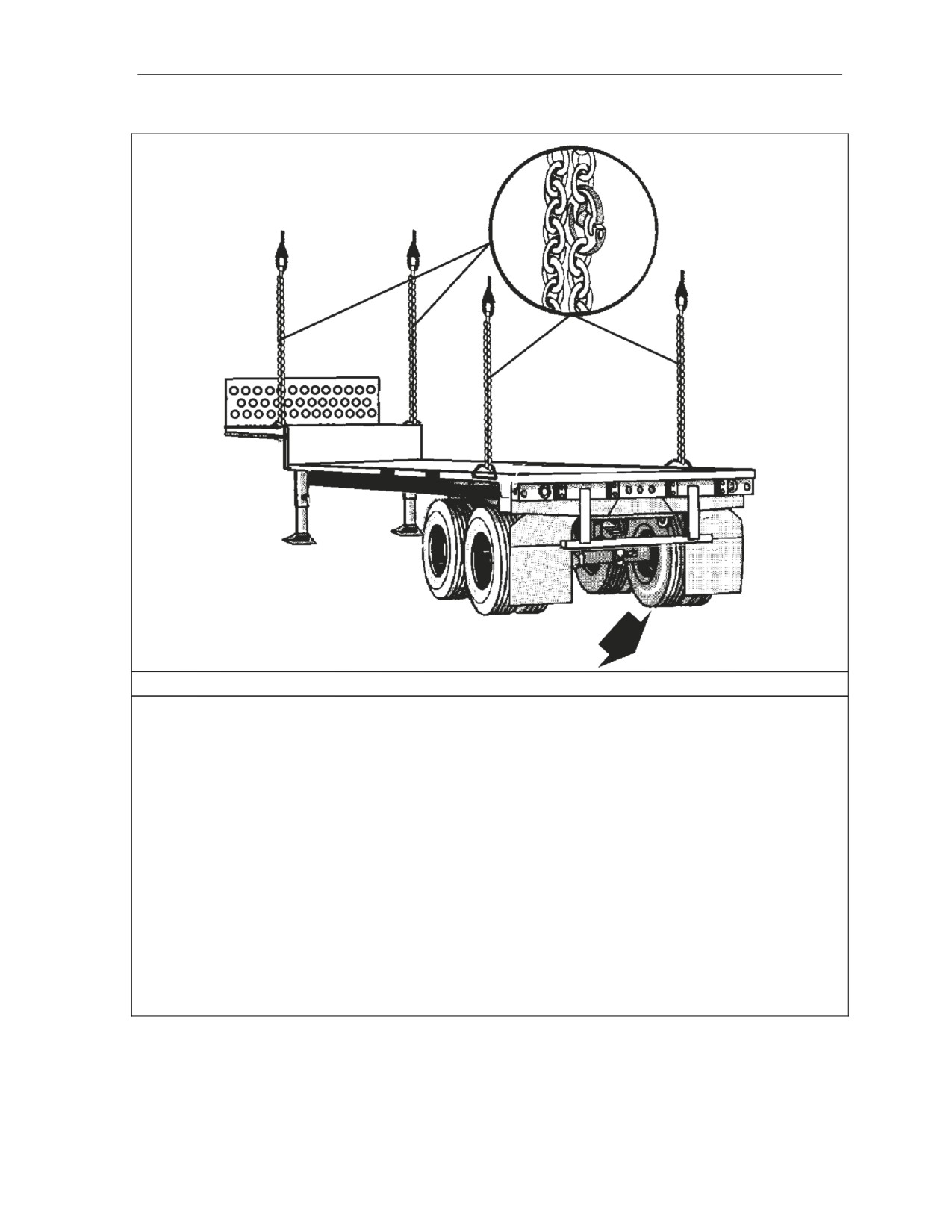
Rigging. Rig the load according to the steps in Figure 3-24.
Hookup. The hookup teams stand on the top of the trailer. The static wand person
discharges the static electricity with the static wand. The forward hookup person places apex
fitting 1 onto the forward cargo hook. The aft hookup person places apex fitting 2 onto the aft cargo
hook. The hookup team then carefully dismounts the trailer and remains close to the load as
the helicopter removes slack from the sling legs. When successful hookup is assured, the
hookup team quickly exits the area underneath the helicopter to the designated rendezvous
point.
Derigging. Derigging is the reverse of the preparation and rigging procedures.
FM 4-20.199/MCRP 4-11.3E, VOL III/NTTP 3-04.13/
3-46
AFMAN 11-223 (I), VOL III/COMDINST M13482.4B
20 February 2009
Certified Dual-Point Rigging Procedures for Trailers
RIGGING STEPS
1. Connect 2 sling legs to apex fitting number 1. Position the apex fitting on the bed of the
trailer.
2. Loop the chain end of the sling legs through their respective lift provisions located on the
front of the trailer bed. Place the correct link from Table 3-24 in the grab hook.
3. Connect 2 sling legs to apex fitting number 2. Position the apex fitting on the bed of the
trailer.
4. Loop the chain end of the sling legs through their respective lift provisions located on the rear
of the trailer. Place the correct link from Table 3-24 in the grab hook.
5. Secure all excess chain with tape or Type III nylon cord.
6. Cluster and tie (breakaway technique) the sling legs in each sling set together to prevent
entanglement during hookup and lift-off.
Figure 3-24. M871A3 Semi-Trailer
FM 4-20.199/MCRP 4-11.3E, VOL III/NTTP 3-04.13/
20 February 2009
AFMAN 11-223 (I), VOL III/COMDINST M13482.4B
3-47
This page intentionally left blank.

Chapter 4
Certified Dual-Point Rigging Procedures for Trailers with
Mounted Generators
INTRODUCTION
4-1. This chapter contains rigging procedures for dual-point trailers with mounted generators that have
been certified for sling load. Each rigging procedure is found in a paragraph that includes a description of
the load, materials required for rigging, and steps to complete the procedure. An applicability paragraph is
also a part of each paragraph and identifies the certified loads. The certified dual-point rigging procedures
for trailers with mounted generators are in this section. Paragraphs
4-2 through 4-6 give detailed
instructions for rigging loads.
Note: Reach Pendants may be used on dual point loads. Place a Reach Pendant on each apex
fitting. A static discharge person is not required when using a Reach Pendant.
M116A2 TRAILER-MOUNTED POWER UNITS, GENERATORS, AND
POWER PLANTS
4-2. The M116A2 trailer-mounted power units, generators, and power plants are rigged for dual-point
sling load using the following procedures:
z
Applicability. The following items in Table 4-1 are certified for the helicopter(s) listed in the
following table by US Army Natick Soldier Center:
Table 4-1. M116A2 Trailer-Mounted Power Units, Generators, and Power Plants
Nomenclature
Max Weight
Sling
Link Count
Type of
(Pounds)
Set
Front/Rear
Aircraft
PU-751/M, 5kW, Generator Variants:
3,000
10K
3/40
CH-47
LOS V1/V2/V3/V4
Planning Trailer
Radio Access Trailer
PU-753/M, 10kW, Generator Variants:
NC OPS Trailer
SCC TECH Trailer
NC MGMT Trailer
LEN MGMT Trailer
3,000
10K
3/40
CH-47
LEN OPS Trailer
SEN V1 Trailer
SEN V2 Trailer
Maintenance #1 Trailer
AN/TSQ-182
FM 4-20.199/MCRP 4-11.3E, VOL III/NTTP 3-04.13/
20 February 2009
AFMAN 11-223 (I), VOL III/COMDINST M13482.4B
4-1
Chapter 4
z
Materials. The following materials are required to rig this load:
Sling set (10,000-pound capacity) with one additional apex fitting.
Tape, adhesive, pressure-sensitive, 2-inch wide roll.
Cord, nylon, Type III, 550-pound breaking strength.
Webbing, cotton, 1/4-inch, 80-pound breaking strength.
z
Personnel. Two persons can prepare and rig this load in 15 minutes.
z
Procedures. The following procedures apply to this load:
Preparation. Prepare the load using the following steps:
─ Secure all loose chains, hoses, and cables to the trailer drawbar with Type III nylon
cord.
─ Secure any lids, caps, or loose items with tape or Type III nylon cord.
─ Partially retract all landing legs and secure in position with Type III nylon cord.
─ Retract the lunette and secure in position with Type III nylon cord.
─ Ensure the parking brake is set.
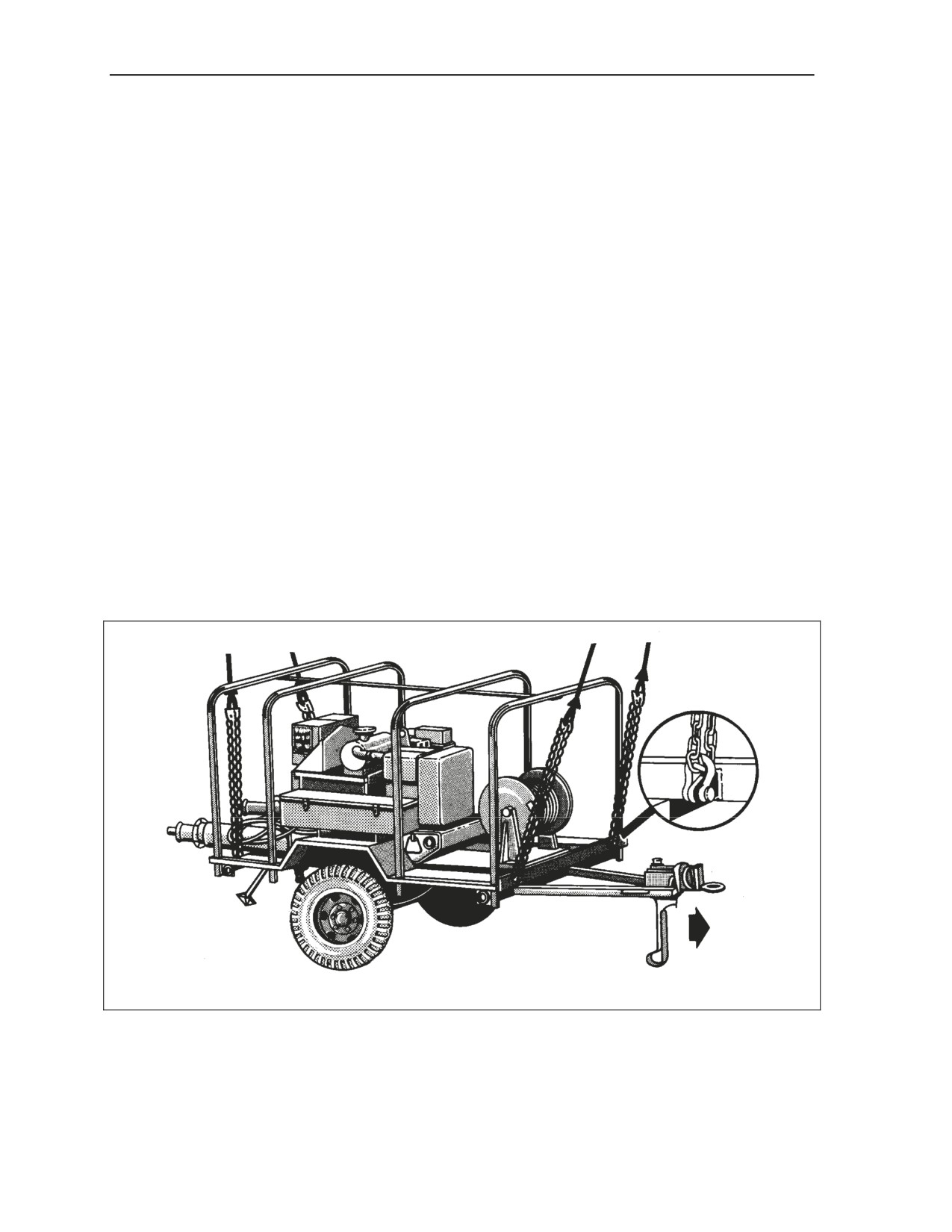
Rigging. Rig the load according to the steps in Figure 4-1.
Hookup. The hookup teams stand on the trailer fenders. The static wand person
discharges the static electricity with the static wand. The forward hookup person places apex
fitting 1 onto the forward cargo hook. The aft hookup person places apex fitting 2 onto the aft cargo
hook. The hookup team then carefully dismounts the trailer and remains close to the load as
the helicopter removes slack from the sling legs. When successful hookup is assured, the
hookup team quickly exits the area underneath the helicopter to the designated rendezvous
point.
Derigging. Derigging is the reverse of the preparation and rigging procedures.
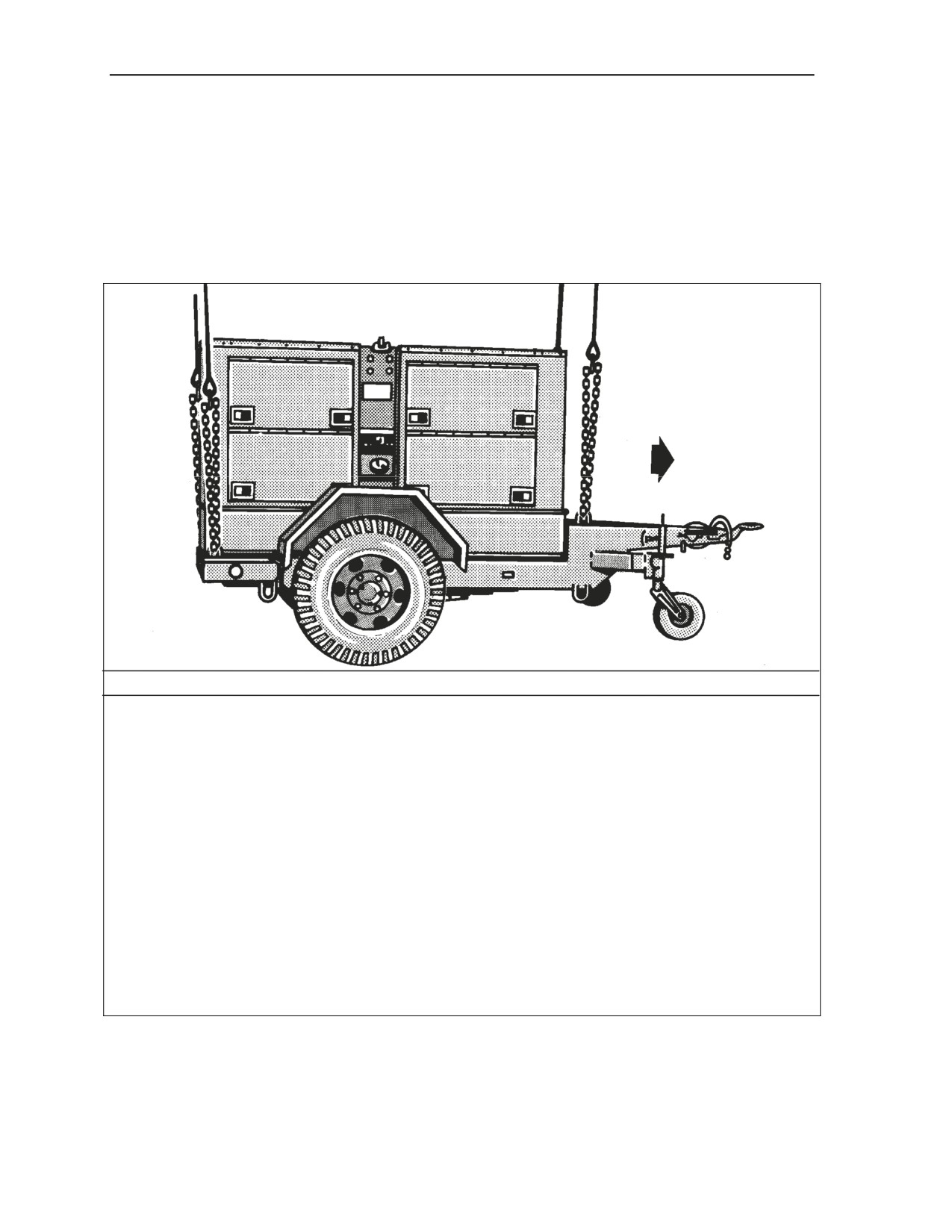
Figure 4-1. M116A2 Trailer-Mounted Power Units, Generators, and Power Plants
FM 4-20.199/MCRP 4-11.3E, VOL III/NTTP 3-04.13/
4-2
AFMAN 11-223 (I), VOL III/COMDINST M13482.4B
20 February 2009

Certified Dual-Point Rigging Procedures for Trailers with Mounted Generators
RIGGING STEPS
1. Connect 2 sling legs to apex fitting number 1. Position the apex fitting on the drawbar.
2. Loop the chain end of the sling legs through their respective lift provisions located on the
front of the trailer. Place the correct link from Table 4-1 in the grab hook.
3. Connect 2 sling legs to apex fitting number 2. Position the apex fitting behind the generator.
4. Loop the chain end of the sling legs through their respective lift provisions. Place the correct
link from Table 4-1 in the grab hook.
5. Secure all excess chain with tape or Type III nylon cord.
6. Cluster and tie (breakaway technique) the front sling legs on the top front of the generator
set. Tape the sling legs to the front bow to prevent entanglement with the cable reel handle.
7. Cluster and tie (breakaway technique) the rear sling legs on the top rear of the generator set.
Figure 4-1. M116A2 Trailer-Mounted Power Units, Generators, and Power Plants (Continued)
M353 TRAILER CHASSIS WITH MOUNTED GENERATORS
4-3. The M353 trailer chassis with mounted generators are rigged for dual-point sling load using the
following procedures:
z
Applicability. The following items in Table 4-2 are certified for the helicopter(s) listed in the
following table by the US Army Natick Soldier Center:
Table 4-2. M353 Trailer Chassis with Mounted Generators
Nomenclature
Max Weight
Sling
Link Count
Type of
(Pounds)
Set
Front/Rear
Aircraft
M353 Trailer Chassis
2,720
15K
10/15
CH-53
MEP-005-A
6,220
15K
10/15
CH-53
MEP-006-A
7,720
15K
10/15
CH-53
MEP-114-A
6,220
15K
10/15
CH-53
MEP-115-A
6,320
15K
10/15
CH-53
z
Materials. The following materials are required to rig this load:
Sling set (15,000-pound capacity) with one additional web ring.
Tape, adhesive, pressure-sensitive, 2-inch wide roll.
Cord, nylon, Type III, 550-pound breaking strength.
Webbing, cotton, 1/4-inch, 80-pound breaking strength.
z
Personnel. Two persons can prepare and rig this load in 10 minutes.
z
Procedures. The following procedures apply to this load:
Preparation. Prepare the load using the following steps:
─ Secure all loose chains, hoses, and cables to the trailer drawbar with Type III nylon
cord.
─ Secure any lids, caps, or loose items with tape or Type III nylon cord.
─ Ensure the parking brake is set.
FM 4-20.199/MCRP 4-11.3E, VOL III/NTTP 3-04.13/
20 February 2009
AFMAN 11-223 (I), VOL III/COMDINST M13482.4B
4-3
Chapter 4
Rigging. Rig the load according to the steps in Figure 4-2.
Hookup. The hookup teams stand on the trailer. The static wand person discharges the
static electricity with the static wand. The forward hookup person places apex fitting 1 onto the
forward cargo hook. The aft hookup person places apex fitting 2 onto the aft cargo hook. The
hookup team then carefully dismounts the trailer and remains close to the load as the helicopter
removes slack from the sling legs. When successful hookup is assured, the hookup team
quickly exits the area underneath the helicopter to the designated rendezvous point.
Derigging. Derigging is the reverse of the preparation and rigging procedures.
RIGGING STEPS
1. Connect 2 sling legs to web ring number 1. Position the web ring on top of the front of the
trailer.
2. Loop the chain end of the sling legs through their respective lift provisions located on the
front of the trailer. Place the correct link from Table 4-2 in the grab hook.
3. Connect 2 sling legs to web ring number 2. Position the web ring on top of the aft end of the
trailer.
4. Loop the chain end of the sling legs through their respective lift provisions. Place the correct
link from Table 4-2 in the grab hook.
5. Secure all excess chain with tape or Type III nylon cord.
6. Cluster and tie (breakaway technique) the legs of each sling set on top of the generator set to
prevent entanglement during hook-up and lift off.
Figure 4-2. M353 Trailer Chassis with Mounted Generators
FM 4-20.199/MCRP 4-11.3E, VOL III/NTTP 3-04.13/
4-4
AFMAN 11-223 (I), VOL III/COMDINST M13482.4B
20 February 2009

Certified Dual-Point Rigging Procedures for Trailers with Mounted Generators
M200A1 TRAILER-MOUNTED POWER UNITS, GENERATORS, AND
POWER PLANTS
4-4. The M200A1 trailer-mounted power units, generators, and power plants are rigged for dual-point
sling load using the following procedures:
z
Applicability. The following items in Table 4-3 are certified for the helicopter(s) listed in the
following table by the US Army Natick Soldier Center:
Table 4-3. M200A1 Trailer-Mounted Power Units, Generators, and Power Plants
Nomenclature
Max Weight
Sling
Link Count
Type of
(Pounds)
Set
Front/Rear
Aircraft
PU-405 A/M Power Unit, 15kW, with Acoustic
6,740
10K
3/10
CH-47
Suppression Kit (ASK)
PU-406 B/M Power Unit, 30kW, with Acoustic
7,250
10K
3/10
CH-47
Suppression Kit (ASK)
PU-806, 60 kW, 400 Hz Power Unit with MEP816A,
7,250
10K
3/10
CH-47
60kW, 400Hz, Generator Set
z
Materials. The following materials are required to rig this load:
Sling set (10,000-pound capacity) with one additional apex fitting.
Tape, adhesive, pressure-sensitive, 2-inch wide roll.
Cord, nylon, Type III, 550-pound breaking strength.
Webbing, cotton, 1/4-inch, 80-pound breaking strength.
Felt sheet, cattle hair, Type IV, 1/2-inch or suitable substitute.
z
Personnel. Two persons can prepare and rig this load in 15 minutes.
z
Procedures. The following procedures apply to this load:
Preparation. Prepare the load using the following steps:
─ Secure all loose chains, hoses, and cables to the trailer drawbar with Type III nylon
cord.
─ Secure any lids, caps, or loose items with tape or Type III nylon cord.
─ Lower the lunette as far as possible by adjusting the landing legs
─ Ensure the hand brakes are set.
Rigging. Rig the load according to the steps in Figure 4-3.
Hookup. The hookup teams stand on the trailer fenders. The static wand person
discharges the static electricity with the static wand. The forward hookup person places apex
fitting 1 onto the forward cargo hook. The aft hookup person places apex fitting 2 onto the aft cargo
hook. The hookup team then carefully dismounts the trailer and remains close to the load as
the helicopter removes slack from the sling legs. When successful hookup is assured, the
hookup team quickly exits the area underneath the helicopter to the designated rendezvous
point.
Derigging. Derigging is the reverse of the preparation and rigging procedures.
FM 4-20.199/MCRP 4-11.3E, VOL III/NTTP 3-04.13/
20 February 2009
AFMAN 11-223 (I), VOL III/COMDINST M13482.4B
4-5
Chapter 4
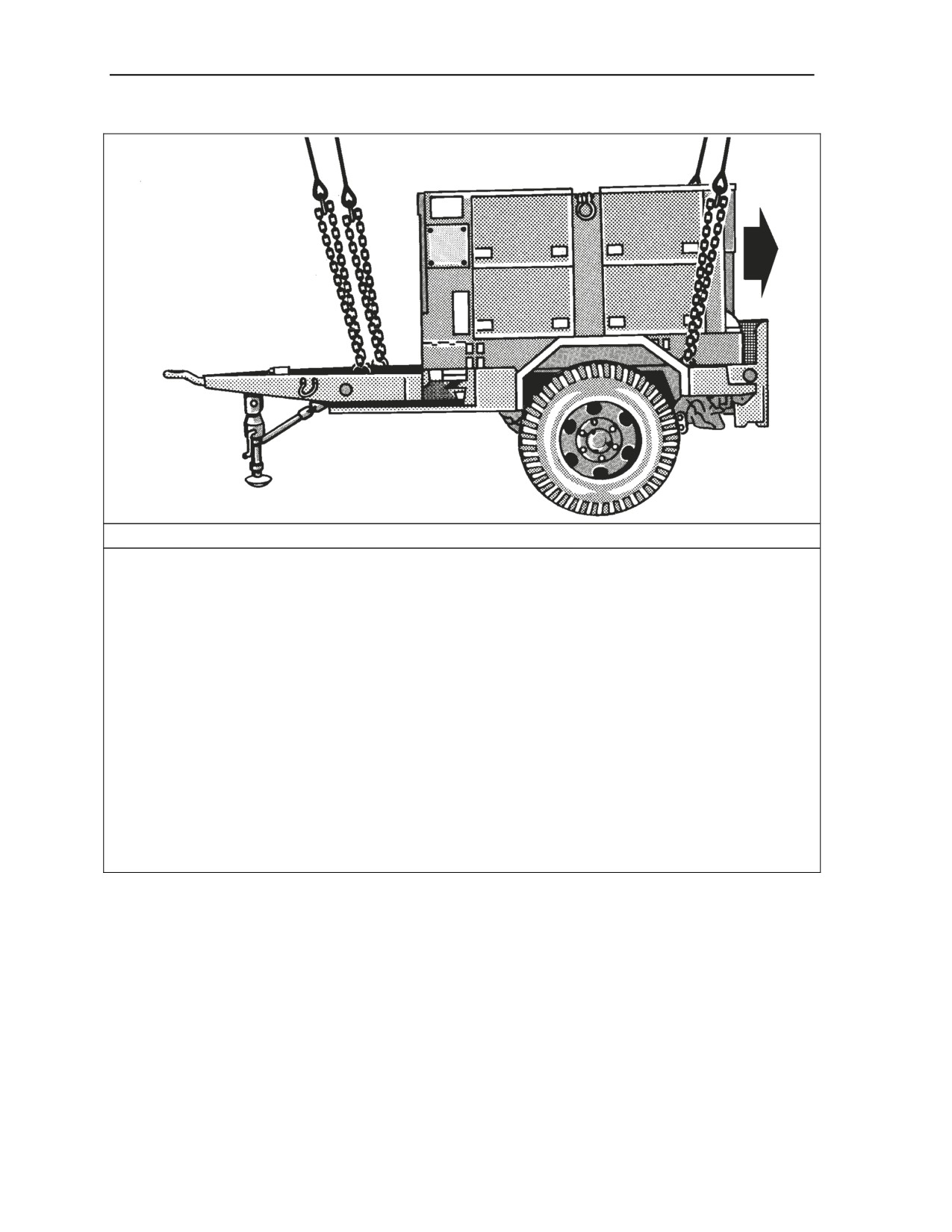
RIGGING STEPS
1. Connect 2 sling legs to apex fitting number 1. Position the apex fitting on top of the front of
the trailer.
2. Loop the chain end of the sling legs through their respective lift provisions located on the
front of the trailer. Place the correct link from Table 4-3 in the grab hook.
3. Connect 2 sling legs to apex fitting number 2. Position the apex fitting on top of the aft end of
the trailer.
4. Loop the chain end of the sling legs through their respective lift provisions. Place the correct
link from Table 4-3 in the grab hook.
5. Secure all excess chain with tape or Type III nylon cord.
6. Cluster and tie (breakaway technique) the legs of each sling set on top of the generator set to
prevent entanglement during hook-up and lift off.
Figure 4-3. M200A1 Trailer-Mounted Power Units, Generators, and Power Plants
FM 4-20.199/MCRP 4-11.3E, VOL III/NTTP 3-04.13/
4-6
AFMAN 11-223 (I), VOL III/COMDINST M13482.4B
20 February 2009
Certified Dual-Point Rigging Procedures for Trailers with Mounted Generators
HIGH MOBILITY TRAILER WITH AN/MJQ-35A POWER UNIT
4-5. The high mobility trailer with AN/MJQ-35A power unit is rigged for dual-point sling load using the
following procedures:
z
Applicability. The following item in Table 4-4 is certified for the helicopter(s) listed in the
following table by the US Army Natick Soldier Center:
Table 4-4. High Mobility Trailer with AN/MJQ-35A Power Unit
Nomenclature
Max Weight
Sling
Link Count
Type of
(Pounds)
Set
Front/Rear
Aircraft
AN/MJQ-35A, 5kW, 69Hz, Power Plant
3,540
10K
20/3
CH-47
z
Materials. The following materials are required to rig this load:
Sling set (10,000-pound capacity) with one additional apex fitting.
Tape, adhesive, pressure-sensitive, 2-inch wide roll.
Cord, nylon, Type III, 550-pound breaking strength.
Webbing, cotton, 1/4-inch, 80-pound breaking strength.
Felt sheet, cattle hair, Type IV, 1/2-inch or suitable substitute.
z
Personnel. Two persons can prepare and rig this load in 10 minutes.
z
Procedures. The following procedures apply to this load:
Preparation. Prepare the load using the following steps:
─ Secure all loose chains, hoses, and cables to the trailer drawbar with Type III nylon
cord.
─ Secure any lids, caps, or loose items with tape or Type III nylon cord.
─ Remove the rear stabilizer legs from their stowage location and install them with the
lower support section fully retracted.
─ Lower the lunette as close as possible to the ground.
─ Ensure the hand brakes are set.
Rigging. Rig the load according to the steps in Figure 4-4.
Hookup. The hookup teams stand on the trailer bed. The static wand person discharges
the static electricity with the static wand. The forward hookup person places apex fitting 1 onto
the forward cargo hook. The aft hookup person places apex fitting 2 onto the aft cargo hook. The
hookup team then carefully dismounts the trailer and remains close to the load as the helicopter
removes slack from the sling legs. When successful hookup is assured, the hookup team
quickly exits the area underneath the helicopter to the designated rendezvous point.
Derigging. Derigging is the reverse of the preparation and rigging procedures.
FM 4-20.199/MCRP 4-11.3E, VOL III/NTTP 3-04.13/
20 February 2009
AFMAN 11-223 (I), VOL III/COMDINST M13482.4B
4-7
Chapter 4
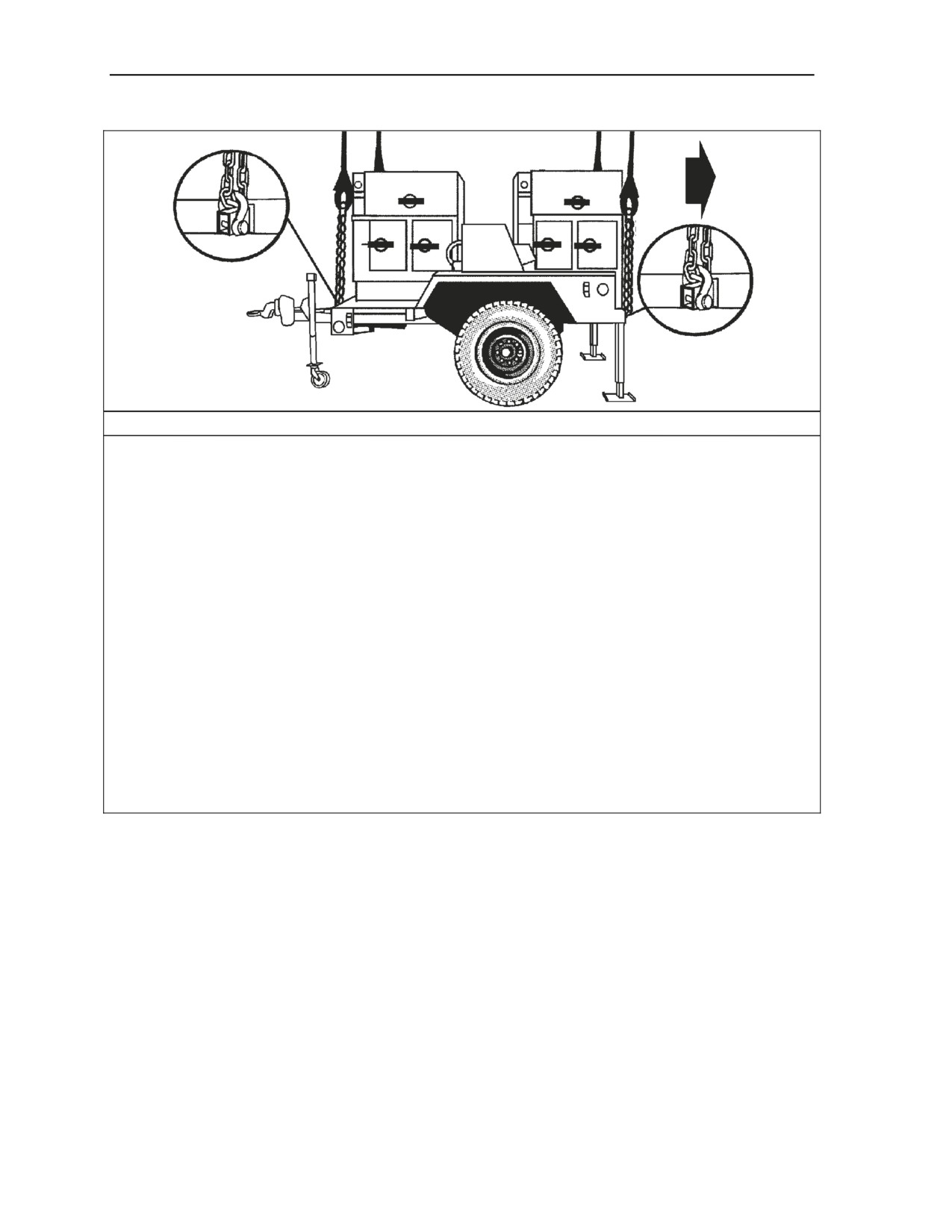
RIGGING STEPS
1. Connect 2 sling legs to apex fitting number 1. Position the apex fitting on top of the front of
the trailer.
2. Loop the chain end of the sling legs through their respective lift provisions located on the
front of the trailer. Place the correct link from Table 4-4 in the grab hook.
3. Connect 2 sling legs to apex fitting number 2. Position the apex fitting on top of the aft end of
the trailer.
4. Loop the chain end of the sling legs through their respective lift provisions. Place the correct
link from Table 4-4 in the grab hook.
5. Secure all excess chain with tape or Type III nylon cord.
6. Pad the slings or chains where they may contact the generator. Secure the padding with
tape.
7.
Cluster and tie (breakaway technique) the legs of each sling set on top of the generator set
to prevent entanglement during hook-up and lift off.
Figure 4-4. High Mobility Trailer with AN/MJQ-35A Power Unit
FM 4-20.199/MCRP 4-11.3E, VOL III/NTTP 3-04.13/
4-8
AFMAN 11-223 (I), VOL III/COMDINST M13482.4B
20 February 2009
Certified Dual-Point Rigging Procedures for Trailers with Mounted Generators
AVIATION GROUND POWER UNIT
4-6. The aviation ground power unit is rigged for dual-point sling load using the following procedures:
z
Applicability. The following item in Table 4-5 is certified for the helicopter(s) listed in the
following table by the US Army Natick Soldier Center:
Table 4-5. Aviation Ground Power Unit
Nomenclature
Max Weight
Sling
Link Count
Type of
(Pounds)
Set
Front/Rear
Aircraft
Aviation Ground Power Unit
4,190
10K
3/3
CH-47
z
Materials. The following materials are required to rig this load:
Sling set (10,000-pound capacity) with one additional apex fitting.
Tape, adhesive, pressure-sensitive, 2-inch wide roll.
Cord, nylon, Type III, 550-pound breaking strength.
Webbing, cotton, 1/4-inch, 80-pound breaking strength.
Strap, cargo, tie-down, CGU-1/B (4 each).
Webbing, nylon, tubular, 1/2-inch, 1000-pound breaking strength.
z
Personnel. Two persons can prepare and rig this load in 10 minutes.
z
Procedures. The following procedures apply to this load:
Preparation. Prepare the load using the following steps:
─ Stow and secure the tow bar in the raised position with 1/2-inch tubular nylon
webbing.
─ Secure all loose equipment inside the unit with Type III nylon cord. Close all doors
and secure the handles with tape.
─ Route a CGU-1/B tie-down strap horizontally around the unit. Position the strap 16
inches down from the top of the unit. Repeat this procedure with a second strap
positioned 8 inches above the first strap.
─ Route a strap through the forklift provision and vertically around the unit. Repeat this
procedure using the second forklift provision.
─ Tape or remove the exhaust cover to prevent damage during flight.
─ Ensure the hand brakes are set.
─ Ensure the fuel tank is not more than 3/4 full. Inspect fuel tank cap, oil filler caps, and
battery caps to ensure they are installed properly and are secure.
Rigging. Rig the load according to the steps in Figure 4-5.
Hookup. The hookup teams stand on top of the unit. The static wand person discharges
the static electricity with the static wand. The forward hookup person places apex fitting 1 onto
the forward cargo hook. The aft hookup person places apex fitting 2 onto the aft cargo hook. The
hookup team then carefully dismounts the trailer and remains close to the load as the helicopter
removes slack from the sling legs. When successful hookup is assured, the hookup team
quickly exits the area underneath the helicopter to the designated rendezvous point.
Derigging. Derigging is the reverse of the preparation and rigging procedures.
FM 4-20.199/MCRP 4-11.3E, VOL III/NTTP 3-04.13/
20 February 2009
AFMAN 11-223 (I), VOL III/COMDINST M13482.4B
4-9
Chapter 4
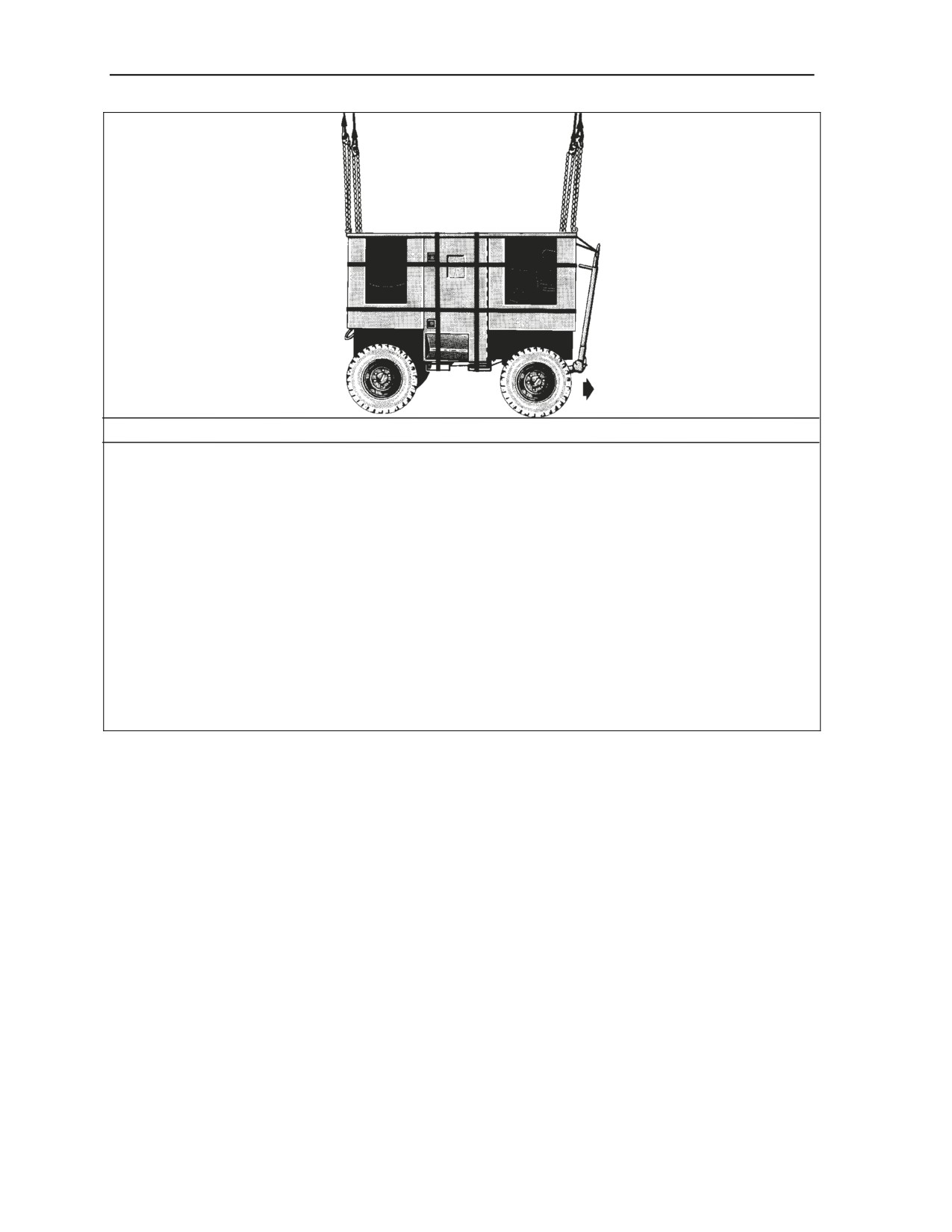
RIGGING STEPS
1. Connect 2 sling legs to apex fitting number 1. Position the apex fitting on top of the tongue
end of the unit.
2. Loop the chain end of the sling legs through their respective lift provisions located on the
front of the trailer. Place the correct link from Table 4-5 in the grab hook.
3. Connect 2 sling legs to apex fitting number 2. Position the apex fitting on top of the aft end of
the unit.
4. Loop the chain end of the sling legs through their respective lift provisions. Place the correct
link from Table 4-5 in the grab hook.
5. Cluster and tie breakaway technique) the legs of each sling set on top of the generator set
to prevent entanglement during hook-up and lift off.
Figure 4-5. Aviation Ground Power Unit
FM 4-20.199/MCRP 4-11.3E, VOL III/NTTP 3-04.13/
4-10
AFMAN 11-223 (I), VOL III/COMDINST M13482.4B
20 February 2009

Chapter 5
Certified Dual-Point Rigging Procedures for Tandem Loads
INTRODUCTION
5-1. This chapter contains rigging procedures for dual-point tandem loads that have been certified for
sling load. Each rigging procedure is found in a paragraph that includes a description of the load, materials
required for rigging, and steps to complete the procedure. An applicability paragraph is also a part of each
paragraph and identifies the certified loads. The certified dual-point rigging procedures for tandem loads
are in this section. Paragraphs 5-2 through 5-34 give detailed instructions for rigging loads.
Note: Reach Pendants may be used on dual point loads. Place a Reach Pendant on each apex
fitting. A static discharge person is not required when using a Reach Pendant.
M998/M1038 TRUCK, UTILITY, 1-1/4 TON (HMMWV) WITH
M101A1/A2 TRAILER, CARGO
5-2. The M998/M1038 truck, utility, 1-1/4 ton with M101A1/A2 trailer, cargo is rigged for dual-point
sling load using the following procedures:
z
Applicability. The following items in Table 5-1 are certified for the helicopter(s) listed in the
following table by the US Army Natick Soldier Center:
Note. Field commanders should note that minor bending of the front wall of the
M101A1/M101A2 trailer may occur as a result of sling loading due to the compression from the
slings. The possibility of bending does not pose a safety threat to flight or ground personnel and
will not affect the operation of the trailer.
Table 5-1. M998/M1038 Truck, Utility, 1-1/4 Ton with M101A1/A2 Trailer, Cargo
Nomenclature
Max Weight
Sling
Link Count
Type of
(Pounds)
Set
Front/Rear
Aircraft
Truck, 1 ¼-Ton, HMMWV, M998, Empty
5,200
10K
76/3
CH-47
Truck, 1 ¼-Ton, HMMWV, M998, Loaded
7,700
10K
76/3
CH-47
Truck, 1 ¼-Ton, HMMWV, M1038, Empty
5,327
10K
76/3
CH-47
Truck, 1 ¼-Ton, HMMWV, M1038, Loaded
7,700
10K
76/3
CH-47
Trailer, Cargo, M101A1/M101A2, Empty
1,280
10K
59/36
CH-47
Trailer, Cargo, M101A1/M101A2, Loaded
2,780
10K
59/36
CH-47
Notes. 1. The maximum certified combined load weight is 10,480 pounds.
2. The recommended airspeed for combined loads weighing 6,607 pounds or less is
100 knots.
3. The recommended airspeed for combined loads weighing between 6,607 and 10,480
pounds or less is 110 knots.
FM 4-20.199/MCRP 4-11.3E, VOL III/NTTP 3-04.13/
20 February 2009
AFMAN 11-223 (I), VOL III/COMDINST M13482.4B
5-1
Chapter 5
z
Materials. The following materials are required to rig this load:
Sling set (10,000-pound capacity) (2 each).
Tape, adhesive, pressure-sensitive, 2-inch wide roll.
Cord, nylon, Type III, 550-pound breaking strength.
Webbing, cotton, 1/4-inch, 80-pound breaking strength.
Strap, cargo, tie-down, CGU-1/B (2 each, or more as required to secure cargo).
Reach pendant, 11K or 25K, OPTIONAL EQUIPMENT.
z
Personnel. Two persons can prepare and rig the M998/M1038 HMMWVs in 15 minutes. Two
persons can prepare and rig the M101A1/M101A2 trailer in 10 minutes.
z
Procedures. Attach the trailer to the truck by placing the lunette on the pintle hook and
securing the latch. Secure the safety chains, cables, and hoses to the trailer. Position the vehicle
on level ground so both the truck and trailer are in a straight line. The following procedures
apply to this load:
Preparation. Prepare the load using the following steps:
─ Fold mirrors forward in front of the windshield and tie together with Type III nylon
cord. Remove the doors and secure to the seats with Type III nylon cord.
─ Secure all equipment and cargo inside the truck with tie-down straps, tape, or Type III
nylon cord.
─ Ensure the fuel tank is not over 3/4 full. Inspect fuel tank cap, oil filler cap, and
battery caps for proper installation.
─ Engage the vehicle parking brake and put the transmission in neutral.
─ Ensure the front wheels are pointed straight ahead. Tie down the steering wheel, using
the securing device attached under the dashboard.
─ Secure all equipment and cargo inside the trailer with tie-down straps, tape, or Type III
nylon cord.
─ Place the tailgate in the open position.
─ Remove the tarp and front rack and place it in the bed of the trailer. Place the
accompanying load on top of the front rack. Secure the accompanying load to the
trailer using tie-down straps. Route the straps diagonally across the load from the
tailgate hinge to the front lifting shackles.
─ Ensure the parking brake is set.
─ Attach the hook portion of a CGU-1/B tie-down strap down to the left front lift
provision on the trailer. Connect the ratchet to the left inside tie-down provision
located near the pintle.
─ Repeat the above procedure on the right side of the load.
─ Tighten both CGU-1/B tie-down straps at the same time. Safety the ratchet handles in
the closed position with tape.
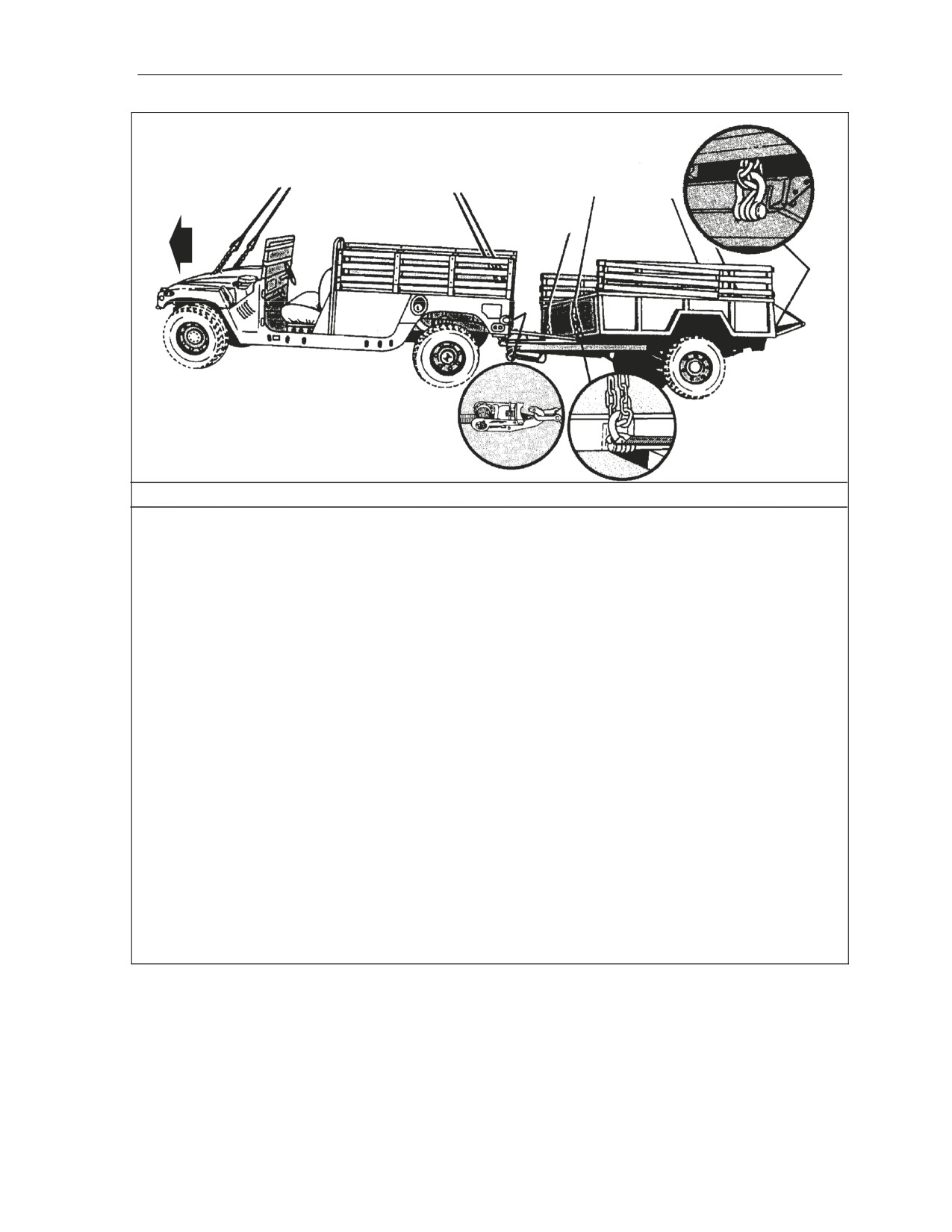
Rigging. Rig the load according to the steps in Figure 5-1.
Hookup. Two hookup teams are required for this load. The static wand person stands in
the bed of the HMMWV and discharges the static electricity with the static wand. The forward
hookup person stands in the bed of the HMMWV and places apex fitting 1 onto the forward cargo
hook. The aft hookup person stands in the bed of the trailer and places apex fitting 2 onto the aft
cargo hook. The hookup team then carefully dismounts the trailer and remains close to the load
as the helicopter removes slack from the sling legs. When successful hookup is assured, the
hookup team quickly exits the area underneath the helicopter to the designated rendezvous
point.
Derigging. Derigging is the reverse of the preparation and rigging.
FM 4-20.199/MCRP 4-11.3E, VOL III/NTTP 3-04.13/
5-2
AFMAN 11-223 (I), VOL III/COMDINST M13482.4B
20 February 2009
Certified Dual-Point Rigging Procedures for Tandem Loads
RIGGING STEPS
Note. The following rigging procedures should result in the load assuming the following
characteristics during lift-off. EMPTY: HMMWV should be 1-2 degrees nose down and the trailer
should be level. LOADED: HMMWV and trailer should be level.
1. Position the apex fitting of sling set 1 in the bed of the vehicle. Route outer sling legs 1 and 2
to the front of the vehicle and inner sling legs 3 and 4 to the rear. Sling legs 1 and 3 must be
on the left side of the load.
2. Loop the chain end of sling leg 1 through the left front lift provision that protrudes through the
hood. Place the correct link from Table 5-1 in the grab hook. Repeat with sling leg 2 and
the right front lift provision. Secure excess chain with tape or Type III nylon cord.
3. Route the chain end of sling leg 3 through the eyelet opening in the upper left corner of the
tailgate. Loop the chain end through the left lift provision on the bumper and thread back
through the eyelet opening in the tailgate. Place the correct link from Table 5-1 in the grab
hook. Repeat with sling leg 4 and the right rear lift provision.
4. Cluster and tie (breakaway technique) all sling legs together on top of the vehicle to prevent
entanglement during hookup and lift-off.
5. Position apex fitting of sling set 2 in the trailer bed. Route outer sling legs 1 and 2 to the front
of the trailer and inner sling legs 3 and 4 to the rear. Route the rear chains through the
opening between the tailgate and the trailer bed inside of the tailgate hinges. Sling legs 1
and 3 must be on the left side of the load.
Figure 5-1. M998/M1038 Truck, Utility, 1-1/4 Ton (HMMWV) with M101A1/A2 Trailer, Cargo
FM 4-20.199/MCRP 4-11.3E, VOL III/NTTP 3-04.13/
20 February 2009
AFMAN 11-223 (I), VOL III/COMDINST M13482.4B
5-3

Chapter 5
RIGGING STEPS (Continued)
6. Loop the chain end of sling leg 1 through the left front lift provision located on the front of the
trailer. Place the correct link from Table 5-1 in the grab hook. Repeat with sling leg 2 through
the right front lift provision. Secure excess chain with tape or Type III nylon cord.
7. Route the chain end of sling leg 3 through the left rear lift provision. Place the correct link
from Table 5-1 in the grab hook. Repeat with sling leg 4 through the right rear lift provision.
Secure excess chain with tape or Type III nylon cord.
8. Cluster and tie (breakaway technique) all sling legs together on top of the trailer to prevent
entanglement during hookup and lift-off.
Figure 5-1. M998/M1038 Truck, Utility, 1-1/4 Ton (HMMWV) with M101A1/A2 Trailer, Cargo
(Continued)
M1037 SHELTER CARRIER (HMMWV) WITH M101A2 TRAILER,
CARGO
5-3. The M1037 shelter carrier with M101A1/A2 trailer, cargo is rigged for dual-point sling load using
the following procedures:
z
Applicability. The following items in Table 5-2 are certified for the helicopter(s) listed in the
following table by the US Army Natick Soldier Center:
Note. Field commanders should note that minor bending of the front wall of the
M101A1/M101A2 trailer may occur as a result of sling loading due to the compression from the
slings. The possibility of bending does not pose a safety threat to flight or ground personnel and
will not affect the operation of the trailer.
Table 5-2. M1037 Shelter Carrier with M101A2 Trailer, Cargo
Nomenclature
Max Weight
Sling
Link Count
Type of
(Pounds)
Set
Front/Rear
Aircraft
M1037 NC Support Vehicle
8,227
10K
80/30
CH-47
M1037 LEN Cable Vehicle
8,148
10K
80/30
CH-47
M1037 with SCC Command V1 S-250 Shelter
8,346
10K
80/30
CH-47
M1037 with SCC Command V2 S-250 Shelter
8,346
10K
80/30
CH-47
M1037 with Management 2 S-250 Shelter
7,905
10K
80/30
CH-47
NC Support M101A2, Trailer
2,643
10K
90/70
CH-47
LEN Cable Vehicle M101A2, Trailer
2,796
10K
90/70
CH-47
SSC Command V1 M101A2 Trailer
1,981
10K
90/70
CH-47
SSC Command V2 M101A2 Trailer
1,430
10K
90/70
CH-47
Management 2 M101A2 Trailer
1,430
10K
90/70
CH-47
Note. The NC support vehicle and the LEN cable vehicle have an enclosed canvas cargo bed,
not the S-250 shelter.
FM 4-20.199/MCRP 4-11.3E, VOL III/NTTP 3-04.13/
5-4
AFMAN 11-223 (I), VOL III/COMDINST M13482.4B
20 February 2009
Certified Dual-Point Rigging Procedures for Tandem Loads
z
Materials. The following materials are required to rig this load:
Sling set (10,000-pound capacity) (2 each).
─ Additional chain length, part number 38850-00053-101, from a 10,000-pound capacity
sling set (8 each).
─ Additional coupling link, part number 577-0615, from a 10,000-pound sling set (8
each).
Tape, adhesive, pressure-sensitive, 2-inch wide roll.
Cord, nylon, Type III, 550-pound breaking strength.
Webbing, cotton, 1/4-inch, 80-pound breaking strength.
Strap, cargo, tie-down, CGU-1/B (2 each, or more as required to secure cargo).
Felt sheet, cattle hair, Type IV, 1/2-inch or suitable substitute.
z
Personnel. Two persons can prepare and rig the M1037 HMMWV in 15 minutes. Two persons
can prepare and rig the M101A2 trailer in 10 minutes.
z
Procedures. Attach the trailer to the truck by placing the lunette on the pintle hook and
securing the latch. Secure the safety chains, cables, and hoses to the trailer. Position the vehicle
on level ground so both the truck and trailer are in a straight line. The following procedures
apply to this load:
Preparation. Prepare the load using the following steps:
─
Fold mirrors forward in front of the windshield and tie together with Type III nylon
cord. Remove the doors and secure to the seats with Type III nylon cord.
─
Ensure the shelter is secured to the vehicle using wire rope or tie-down straps. Secure
all loose equipment inside the shelter with tape, Type III nylon cord, or tie-down
straps. Close and secure the door.
─
Secure all equipment and cargo inside the truck with tie-down straps, tape, or Type III
nylon cord.
─
Ensure the fuel tank is not over 3/4 full. Inspect the fuel tank cap, oil filler cap, and
battery caps for proper installation.
─
Engage the vehicle parking brake and put the transmission in neutral.
─
Ensure the front wheels are pointed straight ahead. Tie down the steering wheel, using
the securing device attached under the dashboard.
─
Install the lift provisions on the outer ends of the rear bumper by removing the tiedown
provisions located on the front bumper and installing on the outer ends of the rear
bumper.
─
Secure all equipment and cargo inside the trailer with tie-down straps, tape, or Type III
nylon cord.
─
Place the tailgate in the open position.
─
Remove the tarp and front rack and place it in the bed of the trailer. Place the
accompanying load on top of the front rack. Secure the accompanying load to the
trailer using tie-down straps. Route the straps diagonally across the load from the
tailgate hinge to the front lifting shackles.
─
Ensure the parking brake is set.
─
Attach the hook portion of a CGU-1/B tie-down strap down to the left front lift
provision on the trailer. Connect the ratchet to the left inside tie-down provision
located near the pintle.
─
Repeat the above procedure on the right side of the load.
─
Tighten both CGU-1/B tie-down straps at the same time. Secure the excess strap and
safety the ratchet handles in the closed position with tape.
─
Connect one additional chain length to each chain on each sling set with the coupling
links.
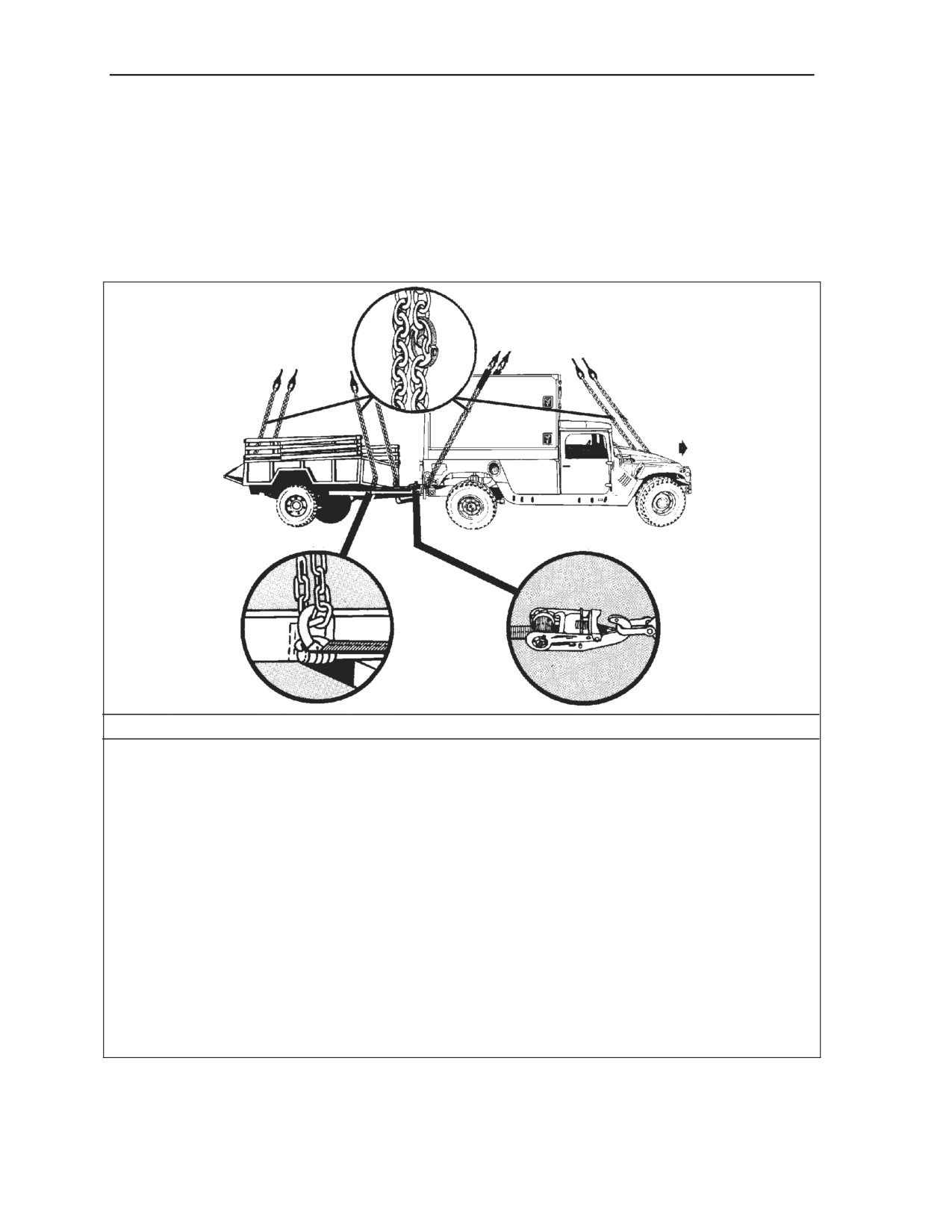
Rigging. Rig the load according to the steps in Figure 5-2.
FM 4-20.199/MCRP 4-11.3E, VOL III/NTTP 3-04.13/
20 February 2009
AFMAN 11-223 (I), VOL III/COMDINST M13482.4B
5-5
Chapter 5
Hookup. Two hookup teams are required for this load. The static wand person discharges
the static electricity with the static wand. The forward hookup person kneels on top of the shelter
and places apex fitting 1 onto the forward cargo hook. The aft hookup person stands in the bed of
the trailer and places apex fitting 2 onto the aft cargo hook. The hookup team then carefully
dismounts the trailer and remains close to the load as the helicopter removes slack from the
sling legs. When successful hookup is assured, the hookup team quickly exits the area
underneath the helicopter to the designated rendezvous point.
Derigging. Derigging is the reverse of the preparation and rigging procedures.
RIGGING STEPS
1. Position the apex fitting of sling set 1 on top of the shelter. Route outer sling legs 1and 2 to
the front of the vehicle and inner sling legs 3 and 4 to the rear. Sling legs 1 and 3 must be on
the left side of the load.
2. Loop the chain end of sling leg 1 through the left front lift provision that protrudes through the
hood. Place the correct link from Table 5-2 in the grab hook. Repeat with sling leg 2 and
the right front lift provision. Secure excess chain with tape or Type III nylon cord.
3. Loop the chain end of the sling legs through their respective lift provisions located on the
outer ends of the rear bumper. Place the correct link from Table 5-2 in the grab hook.
Secure excess chain with tape or Type III nylon cord.
4. Pad the chain where it contacts the shelter sides.
5. Cluster and tie (breakaway technique) all sling legs together on top of the vehicle to prevent
entanglement during hookup and lift-off.
Figure 5-2. M1037 Shelter Carrier with M101A2 Trailer, Cargo
FM 4-20.199/MCRP 4-11.3E, VOL III/NTTP 3-04.13/
5-6
AFMAN 11-223 (I), VOL III/COMDINST M13482.4B
20 February 2009

Certified Dual-Point Rigging Procedures for Tandem Loads
RIGGING STEPS (Continued)
6. Position the apex fitting of sling set 2 in the trailer bed. Route outer sling legs 1and 2 to the
front of the trailer and inner sling legs 3 and 4 to the rear. Route the rear chains through the
opening between the tailgate and the trailer bed and inside of the trailer hinges. Sling legs 1
and 3 must be on the left side of the load.
7. Loop the chain end of sling leg 1 through the left front lift provision located on the front of the
trailer. Place the correct link from Table 5-2 in the grab hook. Repeat with sling leg 2 through
the right front lift provision. Secure excess chain with tape or Type III nylon cord.
8. Route the chain end of sling leg 3 through the left rear lift provision. Place the correct link
from Table 5-2 in the grab hook. Repeat with sling leg 4 through the right rear lift provision.
Secure excess chain with tape or Type III nylon cord.
9. Cluster and tie (breakaway technique) all sling legs together on top of the trailer to prevent
entanglement during hookup and lift-off.
Figure 5-2. M1037 Shelter Carrier with M101A2 Trailer, Cargo (Continued)
M1037 SHELTER CARRIER (HMMWV) WITH S-250/S-250E SHELTER
AND M116A2 TRAILER MOUNTED GENERATORS, PU-
751/PU753/PU-620/M
5-4. The M1037 Shelter Carrier with S-250/S-250E shelter and M116A2 trailer mounted generators, PU-
751/PU753/PU-620/M are rigged for dual-point sling load using the following procedures:
z
Applicability. The following items in Table 5-3 are certified for the helicopter(s) listed in the
following table by the US Army Natick Soldier Center:
Table 5-3. M1037 Shelter Carrier with S250/S-250E Shelter and M116A2 Trailer Mounted
Generators
Nomenclature
Max Weight
Sling
Link Count
Type of
(Pounds)
Set
Front/Rear
Aircraft
M1037 with LOS (V1) S-250 Shelter and PU-751/M
M1037-8,246
10K
HMMWV-80/30
CH-47
Generator
PU-751-2,772
PU-751-90/20
M1037 with LOS (V2) S-250 Shelter and PU-751/M
M1037-7,851
10K
HMMWV-80/30
CH-47
Generator
PU-751-2,776
PU-751-90/20
M1037 with NC LOS (V3) S-250 Shelter and PU-
M1037-8,225
10K
HMMWV-80/30
CH-47
751/M Generator
PU-751-2,772
PU-751-90/20
M1037 with LEN LOS (V4) S-250 Shelter and PU-
M1037-8,125
10K
HMMWV-80/30
CH-47
751/M Generator
PU-751-2,772
PU-751-90/20
M1037 with SCC Planning S-250E Shelter and PU-
M1037-8,003
10K
HMMWV-80/30
CH-47
751/M Generator
PU-751-2,531
PU-751-90/20
M1037 with Radio Accessories S-250 Shelter and
M1037-8,226
10K
HMMWV-80/30
CH-47
PU-751/M Generator
PU-751-2,751
PU-751-90/20
M1037 with SEN (V1) S-250E Shelter and PU-
M1037-8,231
10K
HMMWV-80/30
CH-47
753/M Generator
PU-753-2,759
PU-751-90/20
Table 5-3. M1037 Shelter Carrier with S250/S-250E Shelter and M116A2 Trailer Mounted
Generators (Continued)
FM 4-20.199/MCRP 4-11.3E, VOL III/NTTP 3-04.13/
20 February 2009
AFMAN 11-223 (I), VOL III/COMDINST M13482.4B
5-7

Chapter 5
Nomenclature
Max Weight
Sling
Link Count
Type of
(Pounds)
Set
Front/Rear
Aircraft
M1037 with SEN (V2) S-250E Shelter and
M1037-8,354
10K
HMMWV-80/3
CH-47
PU-753/M Generator
PU-753-2,759
PU-751-90/20
M1037 with Maintenance 1 S-250 Shelter and
M1037-8,084
10K
HMMWV-80/3
CH-47
PU-753/M Generator
PU-753-2,680
PU-751-90/20
M1037 with NC Operations S-250E Shelter
M1037-8,222
10K
HMMWV-80/3
CH-47
and PU-753/M Generator
PU-753-2,681
PU-751-90/20
M1037 with NC Management S-250E Shelter
M1037-7,921
10K
HMMWV-80/3
CH-47
and PU-753/M Generator
PU-753-2,681
PU-751-90/20
M1037 with LEN Operations S-250E Shelter
M1037-8,309
10K
HMMWV-80/3
CH-47
and PU-753/M Generator
PU-753-2,759
PU-751-90/20
M1037 with LEN Management S-250E
M1037-8,288
10K
HMMWV-80/30
CH-47
Shelter and PU-753/M Generator
PU-753-2,681
PU-751-90/20
M1037 with SCC Technical S-250E Shelter
M1037-8,075
10K
HMMWV-80/30
CH-47
and PU-753/M Generator
PU-753-2,681
PU-751-90/20
M1037 S-250 Shelter and PU-625/G
M1037-8,800
10K
HMMWV-80/30
CH-47
Generator
PU-625-2,000
PU-751-90/20
z
Materials. The following materials are required to rig this load:
Sling set (10,000-pound capacity) (2 each).
─ Additional chain length, part number 38850-00053-101, from a 10,000-pound capacity
sling set (8 each).
─ Additional coupling link, part number 577-0615, from a 10,000-pound sling set (8
each).
Tape, adhesive, pressure-sensitive, 2-inch wide roll.
Cord, nylon, Type III, 550-pound breaking strength.
Webbing, cotton, 1/4-inch, 80-pound breaking strength.
Strap, cargo, tie-down, CGU-1/B (2 each, or more as required to secure cargo).
Felt sheet, cattle hair, Type IV, 1/2-inch or suitable substitute.
z
Personnel. Two persons can prepare and rig the M1037 HMMWV in 15 minutes. Two persons
can prepare and rig the generator set in 10 minutes.
z
Procedures. Attach the generator set to the truck by placing the lunette on the pintle hook and
securing the latch. Secure the safety chains, cables, and hoses. Position the vehicle on level
ground so both the truck and generator set are in a straight line. The following procedures apply
to this load:
Preparation. Prepare the load using the following steps:
─ Fold mirrors forward in front of the windshield and tie together with Type III nylon
cord. Remove the doors and secure to the seats with Type III nylon cord.
─ Ensure the shelter is secured to the vehicle using wire rope or tie-down straps. Secure
all loose equipment inside the shelter with tape, Type III nylon cord, or tie-down
straps. Close and secure the door.
─ Secure all equipment and cargo inside the truck with tie-down straps, tape, or Type III
nylon cord.
─ Ensure the fuel tanks are not over 3/4 full. Inspect the fuel tank cap, oil filler cap, and
battery caps for proper installation.
─ Engage the vehicle parking brake and put the transmission in neutral.
─ Ensure the front wheels are pointed straight ahead. Tie down the steering wheel, using
the securing device attached under the dashboard.
FM 4-20.199/MCRP 4-11.3E, VOL III/NTTP 3-04.13/
5-8
AFMAN 11-223 (I), VOL III/COMDINST M13482.4B
20 February 2009