FM 4-20.199 Multiservice Helicopter Sling Load: Dual-Point Load Rigging Procedures (February 2009) - page 3
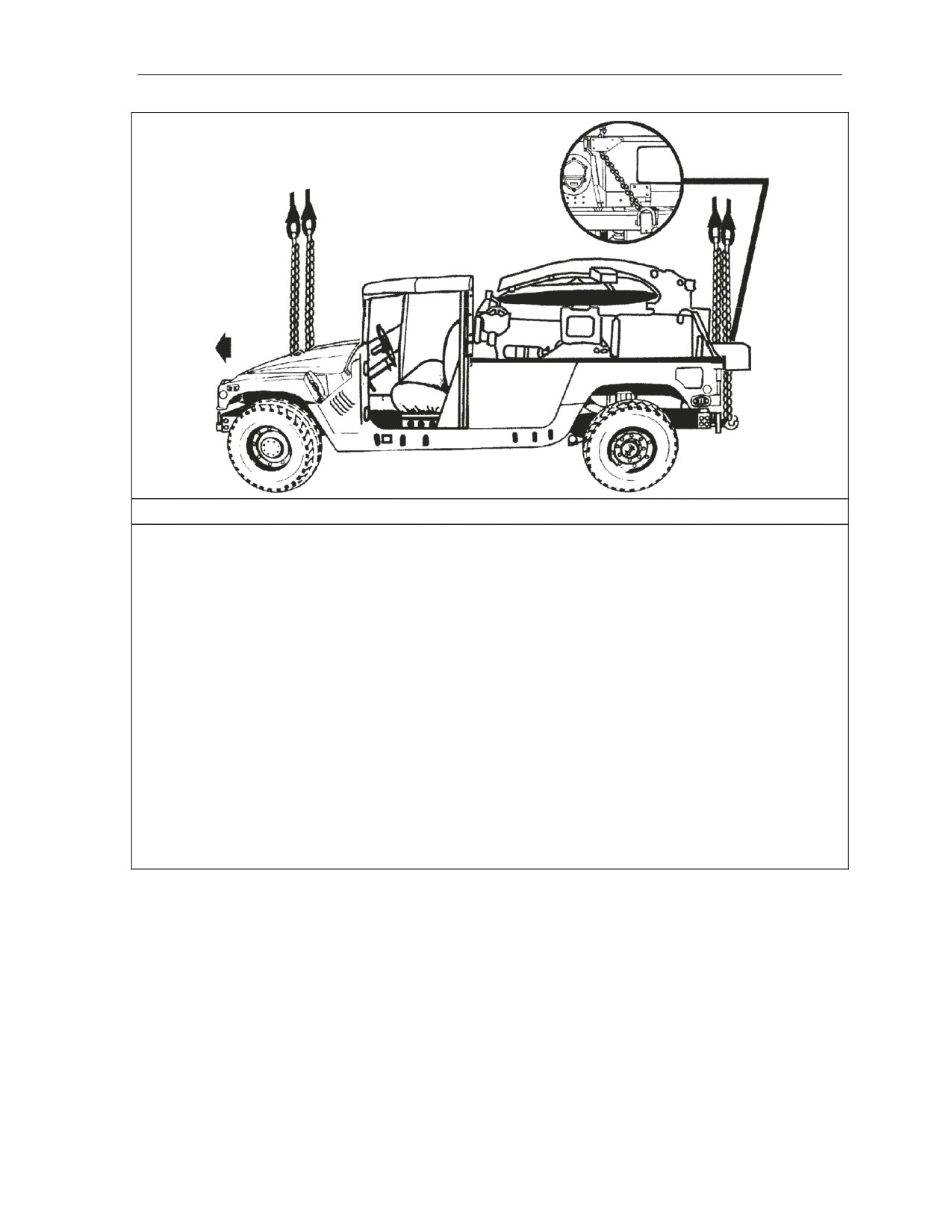
Certified Dual-Point Rigging Procedures for Wheeled Vehicles
RIGGING STEPS
1. Connect 2 sling legs to apex fitting number 1. Position the apex fitting on the hood of the
vehicle.
2. Loop the chain end of the sling legs through their respective lift provisions that protrudes
through the hood. Place the correct link from Table 2-25 in the grab hook.
3. Connect 2 sling legs to apex fitting number 2. Position the apex fitting on top of the pallet.
4. Loop the chain end of the sling legs through their respective eyelet openings in the upper
corner of the tailgate. Loop the chain end through the lift shackle on the rear bumper and
thread back through the eyelet opening in the tailgate. Place the correct link from Table 2-25
in the grab hook.
5.
Secure all excess chain with tape or Type III nylon cord.
6. Cluster and tie (breakaway technique) the sling legs in each sling set on top of the vehicle to
prevent entanglement during hookup and lift-off.
Figure 2-24. M1097A2 with the Secure Mobile Anti-Jam Reliable Tactical Terminal
FM 4-20.199/MCRP 4-11.3E, VOL III/NTTP 3-04.13/
20 February 2009
AFMAN 11-223 (I), VOL III/COMDINST M13482.4B
2-63
Chapter 2
TROJAN SPIRIT LITE (V)2 CENTRAL COMMUNICATIONS, AN/TSQ-
226 (V)2 ON M1113 HMMWV
2-27. The Trojan Spirit Lite (V)2 central communications, AN/TSQ-226 (V)2 on M1113 is rigged for
dual-point sling load using the following procedures:
z
Applicability. The following item in Table 2-26 is certified for the helicopter(s) listed in the
following table by the US Army Natick Soldier Center:
Table 2-26. Trojan Spirit Lite (V)2 Central Communications, AN/TSQ-226 (V)2 on M1113
Nomenclature
Max Weight
Sling
Link Count
Type of
(Pounds)
Set
Front/Rear
Aircraft
Trojan Spirit Lite (V)2 Central Communications
11,500
25K
35/3
CH-47
AN/TSQ-226 (V) 2 on M1113 HMMWV
z
Materials. The following materials are required to rig this load:
Sling set (25,000-pound capacity) with one additional apex fitting.
─ Additional chain length, part number 38850-00053-102, from a 25,000-pound capacity
sling set (4 each).
─ Additional coupling link, part number 5779135, from a 25,000-pound capacity sling
set (4 each).
Tape, adhesive, pressure-sensitive, 2-inch wide roll.
Cord, nylon, Type III, 550-pound breaking strength.
Webbing, cotton, 1/4-inch, 80-pound breaking strength.
z
Personnel. Two persons can prepare and rig this load in 20 minutes.
z
Procedures. The following procedures apply to this load:
Preparation. Prepare the load using the following steps:
─ Extend the sling leg chains by connecting one additional chain length to each chain on
a 25,000-pound capacity sling set with coupling links.
─ Fold mirrors forward inward and tie together with Type III nylon cord.
─ Secure all equipment on the pallet with tape, Type III nylon cord, or tiedown straps.
Close and secure all latches and handles with tape or Type III nylon cord.
─ Secure all equipment and cargo inside the vehicle with tape, nylon cord, or lashings.
Secure the doors shut if installed.
─ Ensure the fuel tank is not over 3/4 full. Inspect fuel tank cap, oil filler cap, and
battery caps for proper installation.
─ Engage the vehicle parking brake and put the transmission in neutral.
─ Ensure the front wheels are pointed straight ahead. Tie down the steering wheel, using
the securing device attached under the dashboard.
─ Tape the windshield in an X formation from corner to corner.
─ Secure the rear lift provisions in the up position with Type III nylon cord.
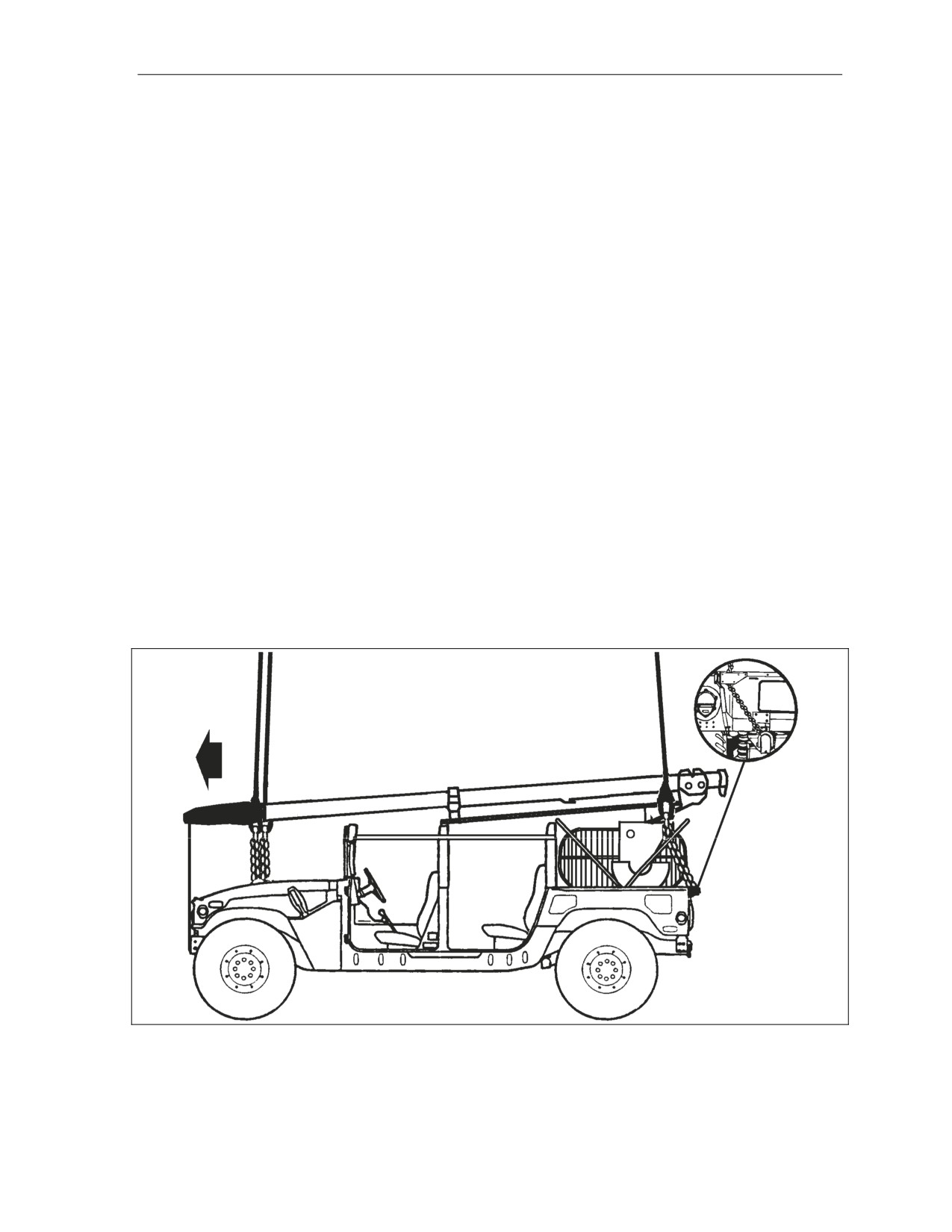
Rigging. Rig the load according to the steps in Figure 2-25.
Hookup. The hookup team stands on top of the vehicle. The static wand person
discharges the static electricity with the static wand. The forward hookup person places apex
fitting 1 onto the forward cargo hook. The aft hookup person places apex fitting 2 onto the aft
cargo hook. The hookup team then carefully dismounts the vehicle and remains close to the
load as the helicopter removes slack from the sling legs. When successful hookup is assured,
the hookup team quickly exits the area underneath the helicopter to the designated rendezvous
point.
Derigging. Derigging is the reverse of the preparation and rigging procedures.
FM 4-20.199/MCRP 4-11.3E, VOL III/NTTP 3-04.13/
2-64
AFMAN 11-223 (I), VOL III/COMDINST M13482.4B
20 February 2009
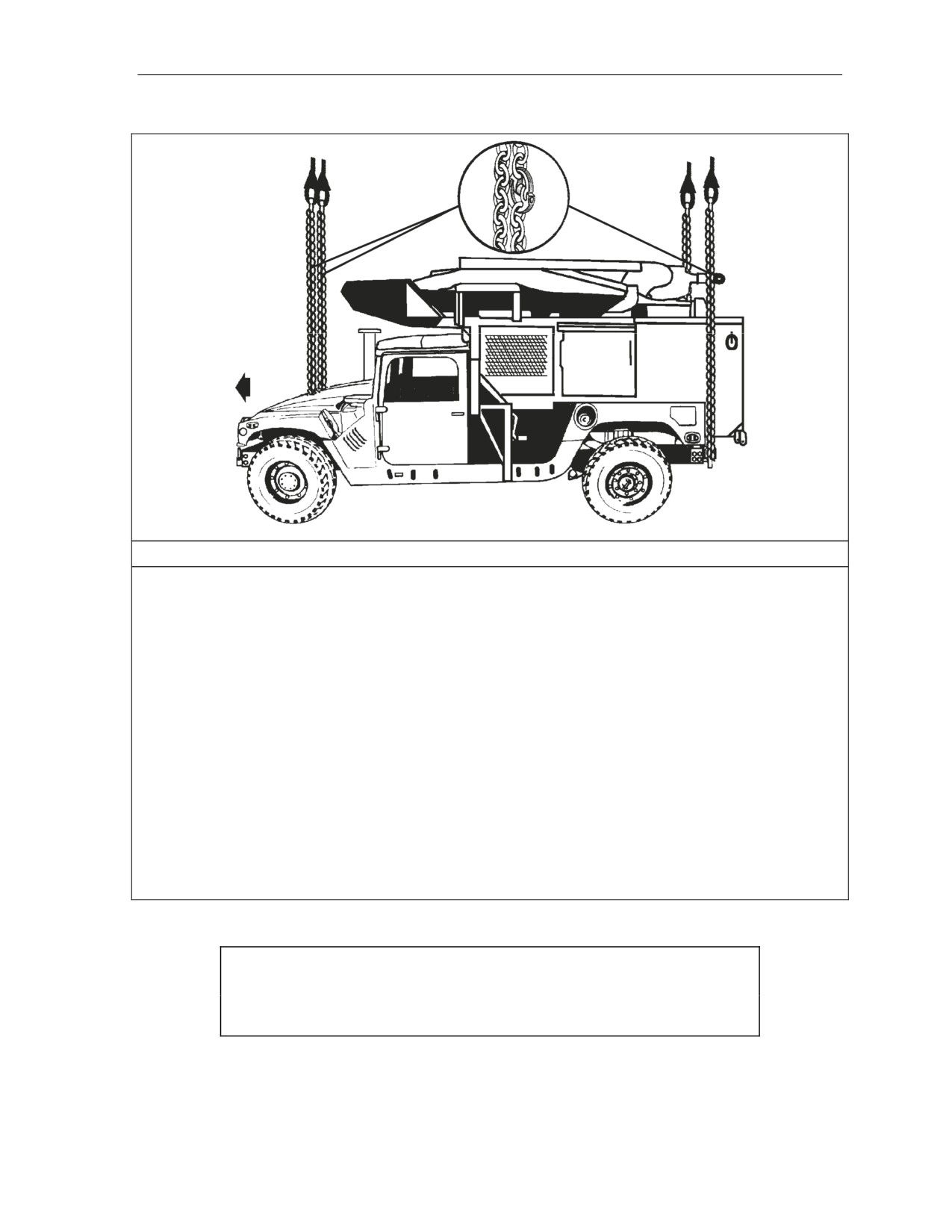
Certified Dual-Point Rigging Procedures for Wheeled Vehicles
RIGGING STEPS
1. Connect 2 sling legs to apex fitting number 1. Position the apex fitting on top of the vehicle.
2. Loop the chain end of the sling legs through their respective lift provisions that protrudes
through the hood. Place the correct link from Table 2-26 in the grab hook. Secure all
excess chain with tape or Type III nylon cord.
3. Connect 2 sling legs to apex fitting number 2. Position the apex fitting on top of the pallet.
4. Loop the chain end through the respective lift provision located on the outside end of the
bumper. Place the correct links from Table 2-26 in the grab hooks. Secure all excess chain
with tape or Type III nylon cord.
5. Remove all slack from the rear sling legs and secure the sling legs on top of the pallet with
breakaway ties.
6. Cluster and tie (breakaway technique) the sling legs in each sling set on top of the vehicle to
prevent entanglement during hookup and lift-off.
Figure 2-25. Trojan Spirit Lite (V)2 Central Communications, AN/TSQ-226 (V)2 on M1113
CAUTION
Do not route the outside sling legs through the tailgate sling guides.
FM 4-20.199/MCRP 4-11.3E, VOL III/NTTP 3-04.13/
20 February 2009
AFMAN 11-223 (I), VOL III/COMDINST M13482.4B
2-65
Chapter 2
TACTICAL SUPER HIGH FREQUENCY (SHF) SATELLITE
TERMINAL (TSST) ON M1113 HMMWV
2-28. The tactical super high frequency satellite terminal on M1113 is rigged for dual-point sling load
using the following procedures:
z
Applicability. The following item in Table 2-27 is certified for the helicopter(s) listed in the
following table by the US Army Natick Soldier Center:
Table 2-27. Tactical Super High Frequency Satellite Terminal on M1113
Nomenclature
Max Weight
Sling
Link Count
Type of
(Pounds)
Set
Front/Rear
Aircraft
Tactical Super High Frequency Satellite Terminal on
10,340
25K
40/3
CH-47
M1113
z
Materials. The following materials are required to rig this load:
Sling set (25,000-pound capacity) with one additional apex fitting.
─ Additional chain length, part number 38850-00053-102, from a 25,000-pound capacity
sling set (4 each).
─ Additional coupling link, part number 5779135, from a 25,000-pound capacity sling
set (4 each).
Tape, adhesive, pressure-sensitive, 2-inch wide roll.
Cord, nylon, Type III, 550-pound breaking strength.
Webbing, cotton, 1/4-inch, 80-pound breaking strength.
Felt sheet, cattle hair, Type IV, 1/2-inch or suitable padding.
z
Personnel. Two persons can prepare and rig this load in 25 minutes.
z
Procedures. The following procedures apply to this load:
Preparation. Prepare the load using the following steps:
─ Extend the sling leg chains by connecting one additional chain length to each chain on
a 25,000-pound capacity sling set with coupling links.
─ Fold mirrors forward inward and tie together with Type III nylon cord.
─ Secure all loose equipment on the primary mover with tape or Type III nylon cord.
Close and secure all latches and handles with tape or Type III nylon cord. Secure all
equipment and cargo inside the vehicle with tape, nylon cord, or lashings. Remove the
doors and secure them inside the vehicle.
─ Ensure the fuel tank is not over 3/4 full. Inspect fuel tank cap, oil filler cap, and
battery caps for proper installation.
─ Engage the vehicle parking brake and put the transmission in neutral.
─ Ensure the front wheels are pointed straight ahead. Tie down the steering wheel, using
the securing device attached under the dashboard.
─ Tape the windshield in an X formation from corner to corner.
─ Tape all lights and instruments.
─ Pad the cooling fan shroud with felt or other suitable substitute.
Rigging. Rig the load according to the steps in Figure 2-26.
Hookup. The hookup team stands on top of the vehicle. The static wand person
discharges the static electricity with the static wand. The forward hookup person places apex
fitting 1 onto the forward cargo hook. The aft hookup person places apex fitting 2 onto the aft
cargo hook. The hookup team then carefully dismounts the vehicle and remains close to the
load as the helicopter removes slack from the sling legs. When successful hookup is assured,
the hookup team quickly exits the area underneath the helicopter to the designated rendezvous
point.
Derigging. Derigging is the reverse of the preparation and rigging procedures.
FM 4-20.199/MCRP 4-11.3E, VOL III/NTTP 3-04.13/
2-66
AFMAN 11-223 (I), VOL III/COMDINST M13482.4B
20 February 2009
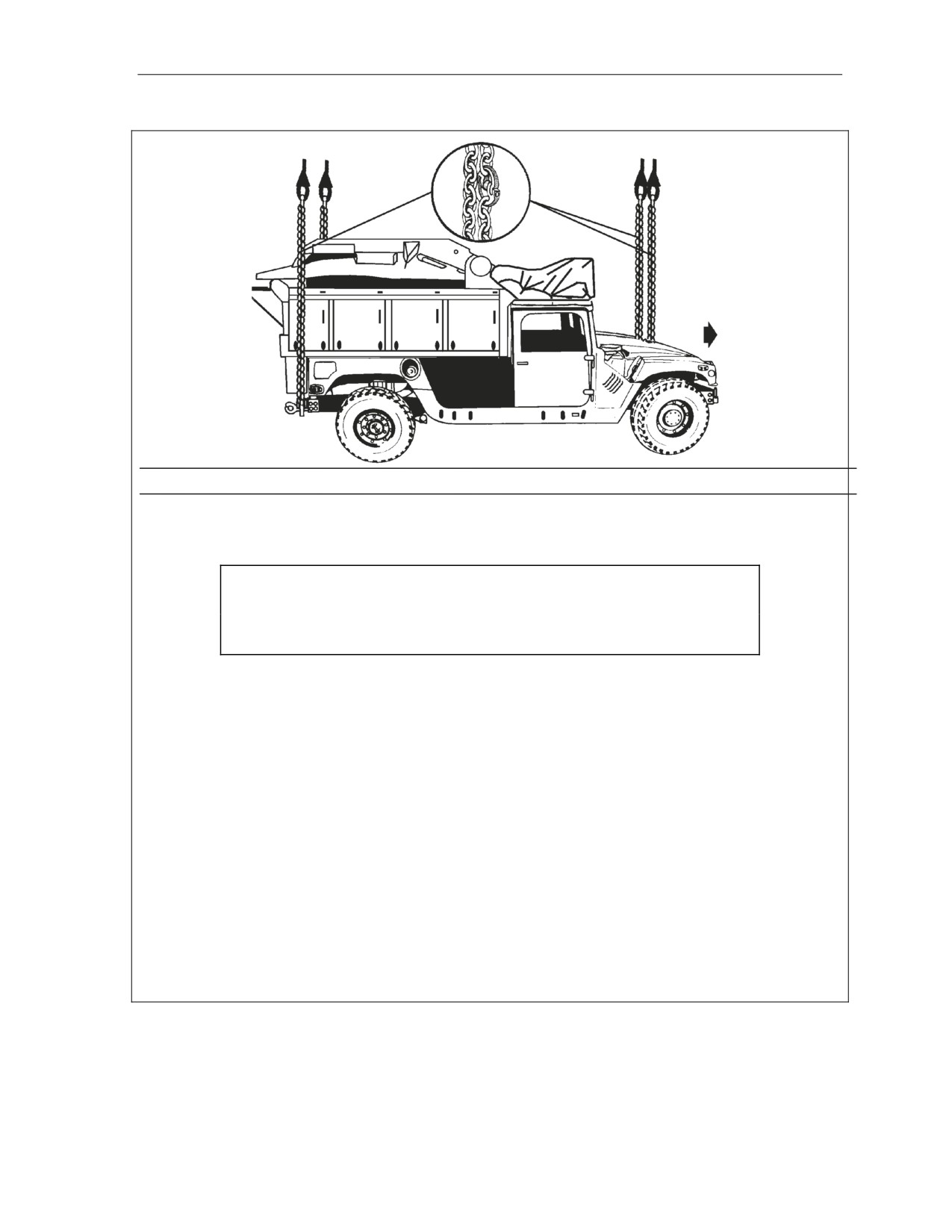
Certified Dual-Point Rigging Procedures for Wheeled Vehicles
RIGGING STEPS
1. Connect 2 sling legs to apex fitting number 1. Position the apex fitting on top of the load above the
satellite dish.
CAUTION
Do not step on the satellite dish.
2. Loop the chain end of the sling legs through their respective lift provisions that protrudes through the
hood. Place the correct link from Table 2-27 in the grab hook. Secure all excess chain with tape or
Type III nylon cord.
3. Position the left and right rear center sling guides so the open portion is facing the rear of the vehicle.
4. Connect 2 sling legs to apex fitting number 2. Position the apex fitting above the satellite dish.
5. Loop the left chain end through the top left rear corner sling guide and through the outboard left rear
bumper lift provision and back through the top left corner sling guide. Place the correct links from Table
2-27 in the grab hook. Remove all slack in the chain and secure the chain to the top left corner sling
guide with a double length of Type I, 1/4-inch cotton webbing. Secure the chain leg to the center sling
guide with a length of Type I, 1/4-inch cotton webbing. Safety tie the chain leg every 2 feet with a length
of Type I, 1/4-inch cotton webbing to points on the load. Repeat with the right sling leg through the top
right rear center sling guide and the right rear lift provision. Secure all excess chain with tape or Type III
nylon cord.
6. Cluster and tie (breakaway technique) the sling legs in each sling set on top of the vehicle to prevent
entanglement during hookup and lift-off.
Figure 2-26. Tactical Super High Frequency Satellite Terminal on M1113
FM 4-20.199/MCRP 4-11.3E, VOL III/NTTP 3-04.13/
20 February 2009
AFMAN 11-223 (I), VOL III/COMDINST M13482.4B
2-67

Chapter 2
CAUTIONS
1. Do not use the lift shackles located near the center of the rear
bumper for sling load lift provisions.
2.
Ensure the outboard rear bumper lift provisions are installed
correctly and there is a 2-inch clearance between the round portion of
the lift provision and the end of the bumper when the lift provision is in
the raised position.
TACTICAL SUPER SATELLITE TERMINAL (TSST) MOBILE POWER
UNIT (MPU) ON M1113 HMMWV
2-29. The tactical super satellite terminal mobile power unit on M1113 is rigged for dual-point sling load
using the following procedures:
z
Applicability. The following item in Table 2-28 is certified for the helicopter(s) listed in the
following table by the US Army Natick Soldier Center:
Table 2-28. Tactical Super Satellite Terminal Mobile Power Unit on M1113
Nomenclature
Max Weight
Sling
Link Count
Type of
(Pounds)
Set
Front/Rear
Aircraft
Tactical Super Satellite Terminal Mobile Power Unit
10,520
25K
20/3
CH-47
on M1113
z
Materials. The following materials are required to rig this load:
Sling set (25,000-pound capacity) with one additional apex fitting.
─ Additional chain length, part number 38850-00053-102, from a 25,000-pound capacity
sling set (4 each).
─ Additional coupling link, part number 5779135, from a 25,000-pound capacity sling
set (4 each).
─ Tape, adhesive, pressure-sensitive, 2-inch wide roll.
─ Cord, nylon, Type III, 550-pound breaking strength.
─ Webbing, cotton, 1/4-inch, 80-pound breaking strength.
─ Felt sheet, cattle hair, Type IV, 1/2-inch or suitable padding.
z
Personnel. Two persons can prepare and rig this load in 25 minutes.
z
Procedures. The following procedures apply to this load:
Preparation. Prepare the load using the following steps:
─ Extend the sling leg chains by connecting one additional chain length to each chain on
a 25,000-pound capacity sling set with coupling links.
─ Fold mirrors forward inward and tie together with Type III nylon cord.
─ Secure all loose equipment inside the MPU with tape or Type III nylon cord. Close
and secure all latches and handles with tape or Type III nylon cord.
─ Secure all equipment and cargo inside the vehicle with tape, nylon cord, or lashings.
Remove the doors and secure them inside the vehicle.
─ Ensure the fuel tank is not over 3/4 full. Inspect fuel tank cap, oil filler cap, and
battery caps for proper installation.
─ Engage the vehicle parking brake and put the transmission in neutral.
FM 4-20.199/MCRP 4-11.3E, VOL III/NTTP 3-04.13/
2-68
AFMAN 11-223 (I), VOL III/COMDINST M13482.4B
20 February 2009
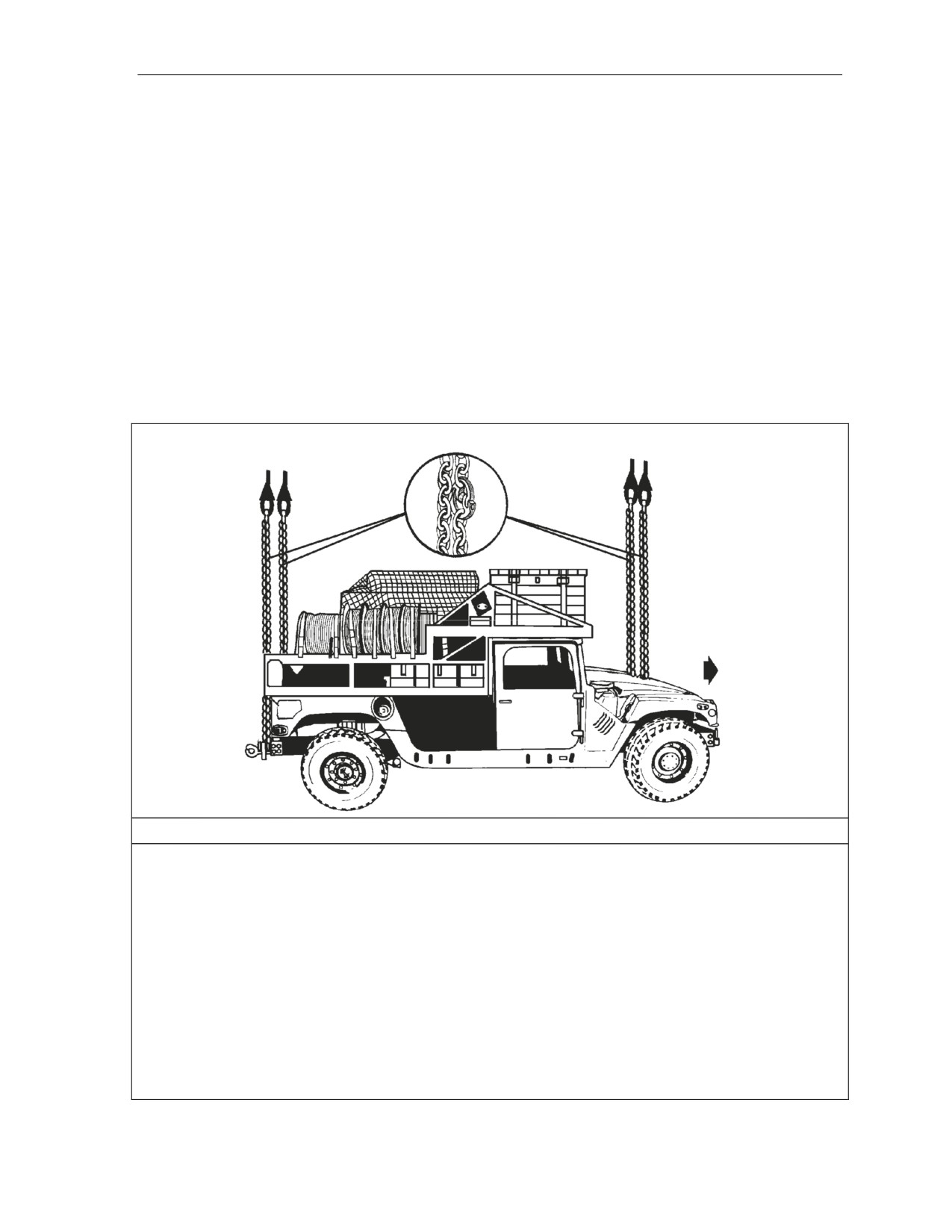
Certified Dual-Point Rigging Procedures for Wheeled Vehicles
─ Ensure the front wheels are pointed straight ahead. Tie down the steering wheel, using
the securing device attached under the dashboard.
─ Tape the windshield in an X formation from corner to corner.
─ Tape all lights and instruments.
─ Ensure all components and accessories of the MPU are in their original storage racks.
Secure in place using the original tiedown straps and nets.
Rigging. Rig the load according to the steps in Figure 2-27.
Hookup. The hookup team stands on top of the vehicle. The static wand person
discharges the static electricity with the static wand. The forward hookup person places apex
fitting 1 onto the forward cargo hook. The aft hookup person places apex fitting 2 onto the aft
cargo hook. The hookup team then carefully dismounts the vehicle and remains close to the
load as the helicopter removes slack from the sling legs. When successful hookup is assured,
the hookup team quickly exits the area underneath the helicopter to the designated rendezvous
point.
Derigging. Derigging is the reverse of the preparation and rigging procedures.
RIGGING STEPS
1. Connect 2 sling legs to apex fitting number 1. Position the apex fitting on top of the load
above the satellite dish.
2. Loop the chain end of the sling legs through their respective lift provisions that protrudes
through the hood. Place the correct link from Table 2-28 in the grab hook. Secure all
excess chain with tape or Type III nylon cord.
3. Ensure the safety pins are installed in the two rear top sling guides.
4. Connect 2 sling legs to apex fitting number 2. Position the apex fitting above the satellite
dish.
Figure 2-27. Tactical Super Satellite Terminal Mobile Power Unit on M1113
FM 4-20.199/MCRP 4-11.3E, VOL III/NTTP 3-04.13/
20 February 2009
AFMAN 11-223 (I), VOL III/COMDINST M13482.4B
2-69

Chapter 2
RIGGING STEPS (Continued)
5. Loop the left chain end through the rear top left sling guide and through the left rear lift
provision and back through the top left corner sling guide. Place the correct links from Table
2-28 in the grab hook. Remove all slack in the chain and secure the chain to the top left
sling guide with a double length of Type I, 1/4-inch cotton webbing. Safety tie the chain leg
every 2 feet with a length of Type I, 1/4-inch cotton webbing to points on the load. Repeat
with the right sling leg through the top right rear sling guide and the right rear lift provision.
Secure all excess chain with tape or Type III nylon cord.
6. Cluster and tie (breakaway technique) the sling legs in each sling set on top of the vehicle to
prevent entanglement during hookup and lift-off.
Figure 2-27. Tactical Super Satellite Terminal Mobile Power Unit on M1113 (Continued)
CAUTION
Do not use the outboard lift provisions on the bumper of the MPU.
AN/MRC-142B RADIO TERMINAL SET WITH 30M MAST ON M998
HMMWV
2-30. The AN/MRC-142B radio terminal set with 30M mast on M998 is rigged for dual-point sling load
using the following procedures:
z
Applicability. The following item in Table 2-29 is certified for the helicopter(s) listed in the
following table by the US Army Natick Soldier Center:
Table 2-29. AN/MRC-142B Radio Terminal Set with 30M Mast on M998
Nomenclature
Max Weight
Sling
Link Count
Type of
(Pounds)
Set
Front/Rear
Aircraft
AN/MRC-142B Radio Terminal Set with 30M Mast on
7,500
15K
40/3
CH-53
M998
z
Materials. The following materials are required to rig this load:
Sling set (15,000-pound capacity) with one additional web ring.
Tape, adhesive, pressure-sensitive, 2-inch wide roll.
Cord, nylon, Type III, 550-pound breaking strength.
Webbing, cotton, 1/4-inch, 80-pound breaking strength.
z
Personnel. Two persons can prepare and rig this load in 20 minutes.
z
Procedures. The following procedures apply to this load:
Preparation. Prepare the load using the following steps:
─ Fold the mirrors inward for added protection and tie together with Type III nylon cord.
─ Remove the canvas cover and doors. Secure the canvas and doors inside the vehicle
with tape, Type III nylon cord, or tiedown straps.
─ Secure all equipment and cargo inside the vehicle cab with tape, Type III nylon cord,
or tiedown straps.
─ Ensure the fuel tank is not over 3/4 full. Inspect fuel tank cap, oil filler cap, and
battery caps for proper installation.
FM 4-20.199/MCRP 4-11.3E, VOL III/NTTP 3-04.13/
2-70
AFMAN 11-223 (I), VOL III/COMDINST M13482.4B
20 February 2009
Certified Dual-Point Rigging Procedures for Wheeled Vehicles
─ Engage the vehicle parking brake and put the transmission in neutral.
─ Ensure the front wheels are pointed straight ahead. Tie down the steering wheel, using
the securing device attached under the dashboard or type III nylon cord.
─ Stow and secure the Shore Mounted Accessory Kit (SMAK) antenna mast. Install the
mast cover and secure with tape.
─ Rotate the antenna array dishes 180 degrees from the normal stowage position; so the
curved sides are facing out.
─ Ensure the offset adapters are stowed and secured.
─ Ensure the left and right SMAK antenna arrays are secured in the normal stowage
position.
─ Secure the power amplifier case in the normal stowage location over right rear wheel
well.
─ Secure the cables on the spools on the left rear wheel well.
─ Secure the universal power supply in normal stowage location between the front seats.
─ Stow and secure radio equipment.
─ Secure the rear roof bow in the rear most position to the SMAK antenna mast with
Type III nylon cord.
─ Tape the windshield in an X formation from corner to corner.
Rigging. Rig the load according to the steps in Figure 2-28.
Hookup. The hookup team stands in the bed of the vehicle. The static wand person
discharges the static electricity with the static wand. The hookup person places the apex fitting
on the cargo hook. The hookup team then carefully dismounts the vehicle and remains close to
the load as the helicopter removes slack from the sling legs. When successful hookup is
assured, the hookup team quickly exits the area underneath the helicopter to the designated
rendezvous point.
Derigging. Derigging is the reverse of the preparation and rigging procedures.
Figure 2-28. AN/MRC-142B Radio Terminal Set with 30M Mast on M998
FM 4-20.199/MCRP 4-11.3E, VOL III/NTTP 3-04.13/
20 February 2009
AFMAN 11-223 (I), VOL III/COMDINST M13482.4B
2-71

Chapter 2
RIGGING STEPS
1. Connect 2 sling legs to apex fitting number 1. Position the apex fitting on top of the SMAK
antenna mast.
2. Loop the chain end of the sling legs through their respective lift provisions that protrudes
through the hood. Place the correct link from Table 2-29 in the grab hook. Secure all
excess chain with tape or Type III nylon cord.
3. Connect 2 sling legs to apex fitting number 2. Position the apex fitting on top of the SMAK
antenna mast.
4. Route the chain end of sling leg 3 under the rear roof bow and through the eyelet opening in
the upper left corner of the tailgate. Loop the chain end through the left lift provision on the
bumper and thread back through the eyelet opening in the tailgate. Place the correct link
from Table 2-29 in the grab hook. Repeat with sling leg 4 and the right rear lift provision.
5. Cluster and tie (breakaway technique) the sling legs in each sling set on top of the vehicle to
prevent entanglement during hookup and lift-off.
Figure 2-28. AN/MRC-142B Radio Terminal Set with 30M Mast on M998 (Continued)
M998 (HMMWV) WITH TWO MRC-127 STACKS
2-31. The M998 with two MRC-127 stacks is rigged for dual-point sling load using the following
procedures:
z
Applicability. The following item in Table 2-30 is certified for the helicopter(s) listed in the
following table by the US Army Natick Soldier Center:
Table 2-30. M998 with Two MRC-127 Stacks
Nomenclature
Max Weight
Sling
Link Count
Type of
(Pounds)
Set
Front/Rear
Aircraft
MRC-127 Stacks (Two) on M998
8,010
10K
80/3
CH-47
z
Materials. The following materials are required to rig this load:
Sling set (10,000-pound capacity) with one additional apex fitting.
Tape, adhesive, pressure-sensitive, 2-inch wide roll.
Cord, nylon, Type III, 550-pound breaking strength.
Webbing, cotton, 1/4-inch, 80-pound breaking strength.
Felt sheet, cattle hair, Type IV, 1/2-inch or suitable padding.
z
Personnel. Two persons can prepare and rig this load in 20 minutes.
z
Procedures. The following procedures apply to this load:
Preparation. Prepare the load using the following steps:
─ Fold mirrors forward in front of the windshield for added protection and tie together
with Type III nylon cord. Remove the canvas covering the bed of the truck. Fold the
canvas and secure it over the windshield of the vehicle. Remove the doors and
secure to the seats with Type III nylon cord.
─ Secure all equipment and cargo inside the vehicle with tape, nylon cord, or lashings.
Remove the antennas and stow inside the vehicle.
─ Ensure the fuel tank is not over 3/4 full. Inspect fuel tank cap, oil filler cap, and
battery caps for proper installation.
FM 4-20.199/MCRP 4-11.3E, VOL III/NTTP 3-04.13/
2-72
AFMAN 11-223 (I), VOL III/COMDINST M13482.4B
20 February 2009
Certified Dual-Point Rigging Procedures for Wheeled Vehicles
─ Engage the vehicle parking brake and put the transmission in neutral.
─ Ensure the front wheels are pointed straight ahead. Tie down the steering wheel, using
the securing device attached under the dashboard.
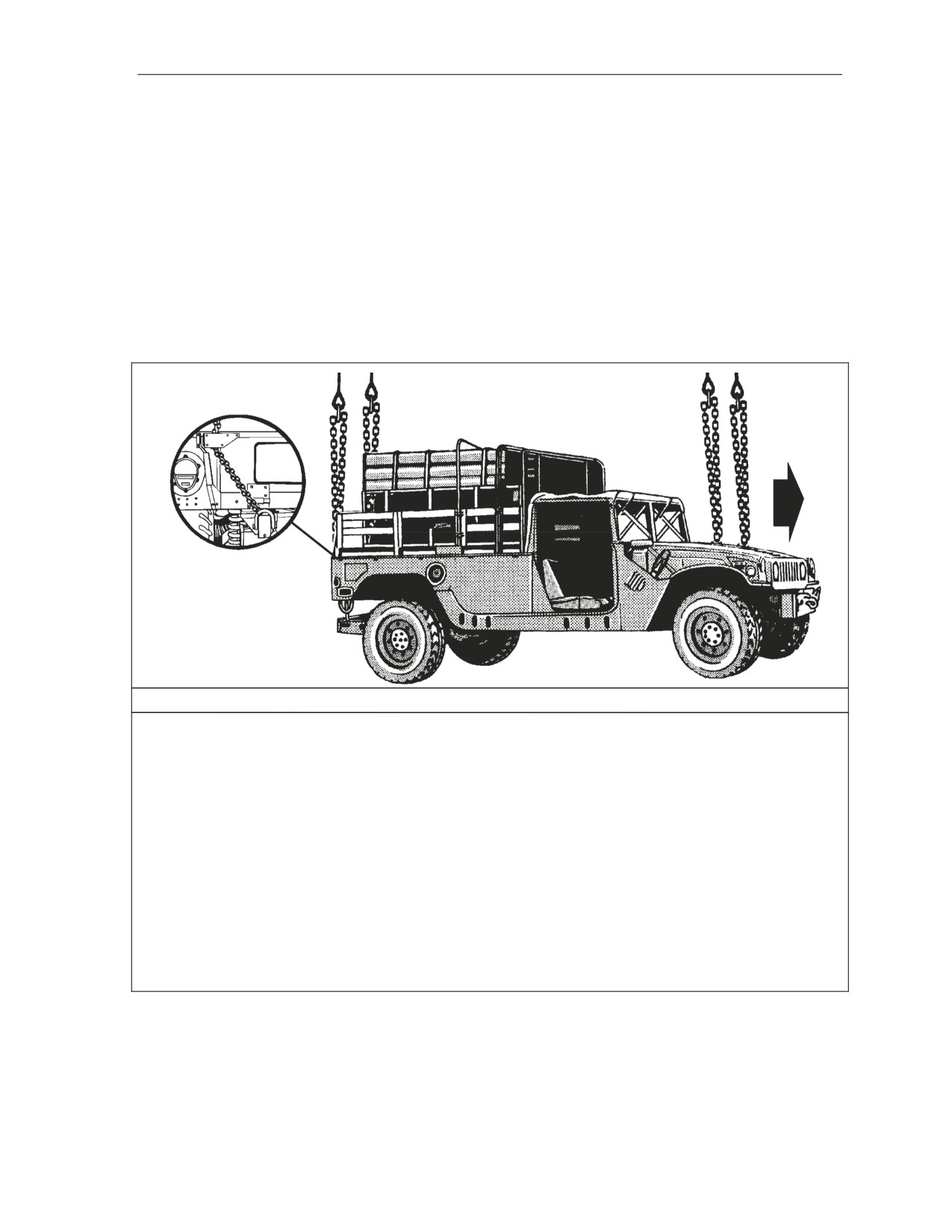
Rigging. Rig the load according to the steps in Figure 2-29.
Hookup. The hookup team stands in the bed of the vehicle. The static wand person
discharges the static electricity with the static wand. The forward hookup person places apex
fitting 1 onto the forward cargo hook. The aft hookup person places apex fitting 2 onto the aft
cargo hook. The hookup team then carefully dismounts the vehicle and remains close to the
load as the helicopter removes slack from the sling legs. When successful hookup is assured,
the hookup team quickly exits the area underneath the helicopter to the designated rendezvous
point.
Derigging. Derigging is the reverse of the preparation and rigging procedures.
RIGGING STEPS
1. Connect 2 sling legs to apex fitting number 1. Position the apex fitting on the hood of the
vehicle.
2. Loop the chain end of the sling legs through their respective lift provisions that protrudes
through the hood. Place the correct link from Table 2-30 in the grab hook.
3. Connect 2 sling legs to apex fitting number 2. Position the apex fitting in the cargo bed of the
vehicle.
4. Loop the chain end of the sling legs through their respective eyelet openings in the upper
corner of the tailgate. Loop the chain end through the lift shackle on the rear bumper and
thread back through the eyelet opening in the tailgate. Place the correct link from Table 2-30
in the grab hook.
Figure 2-29. M998 with Two MRC-127 Stacks
FM 4-20.199/MCRP 4-11.3E, VOL III/NTTP 3-04.13/
20 February 2009
AFMAN 11-223 (I), VOL III/COMDINST M13482.4B
2-73

Chapter 2
RIGGING STEPS (Continued)
5. Wrap the rear slings with padding where they contact the vehicle.
6. Secure all excess chain with tape or Type III nylon cord.
7. Cluster and tie (breakaway technique) the sling legs in each sling set on top of the vehicle to
prevent entanglement during hookup and lift-off.
Figure 2-29. M998 with Two MRC-127 Stacks (Continued)
M998/M1038 (HMMWV) WITH LIGHTWEIGHT TACTICAL FIRE
CONTROL SYSTEMS (LTACFIRE)/TACTICAL TERMINAL
CONTROL SYSTEMS (TTCS)
2-32. The M998/M1038 with lightweight tactical fire control systems tactical terminal control systems are
rigged for dual-point sling load using the following procedures:
z
Applicability. The following items in Table 2-31 are certified for the helicopter(s) listed in the
following table by the US Army Natick Soldier Center:
Table 2-31. M998/M1038 with Lightweight Tactical Fire Control Systems Tactical Terminal
Control Systems
Nomenclature
Max Weight
Sling
Link Count
Type of
(Pounds)
Set
Front/Rear
Aircraft
LTACFIRE, Single Station
5,297
10K
40/3
CH-47
LTACFIRE, Dual Station
6,215
10K
40/3
CH-47
AN/TAQ-198 TTCS
6,015
10K
40/3
CH-47
z
Materials. The following materials are required to rig this load:
Sling set (10,000-pound capacity) with one additional apex fitting.
Tape, adhesive, pressure-sensitive, 2-inch wide roll.
Cord, nylon, Type III, 550-pound breaking strength.
Webbing, cotton, 1/4-inch, 80-pound breaking strength.
z
Personnel. Two persons can prepare and rig this load in 15 minutes.
z
Procedures. The following procedures apply to this load:
Preparation. Prepare the load using the following steps:
─ Fold mirrors forward in front of the windshield for added protection and tie together
with Type III nylon cord. Remove the canvas cab top and the doors. Secure to the
seats with Type III nylon cord.
─ Secure all equipment and cargo inside the vehicle with tape, nylon cord, or lashings.
─ Ensure the fuel tank is not over 3/4 full. Inspect fuel tank cap, oil filler cap, and
battery caps for proper installation.
─ Engage the vehicle parking brake and put the transmission in neutral.
─ Ensure the front wheels are pointed straight ahead. Tie down the steering wheel, using
the securing device attached under the dashboard.
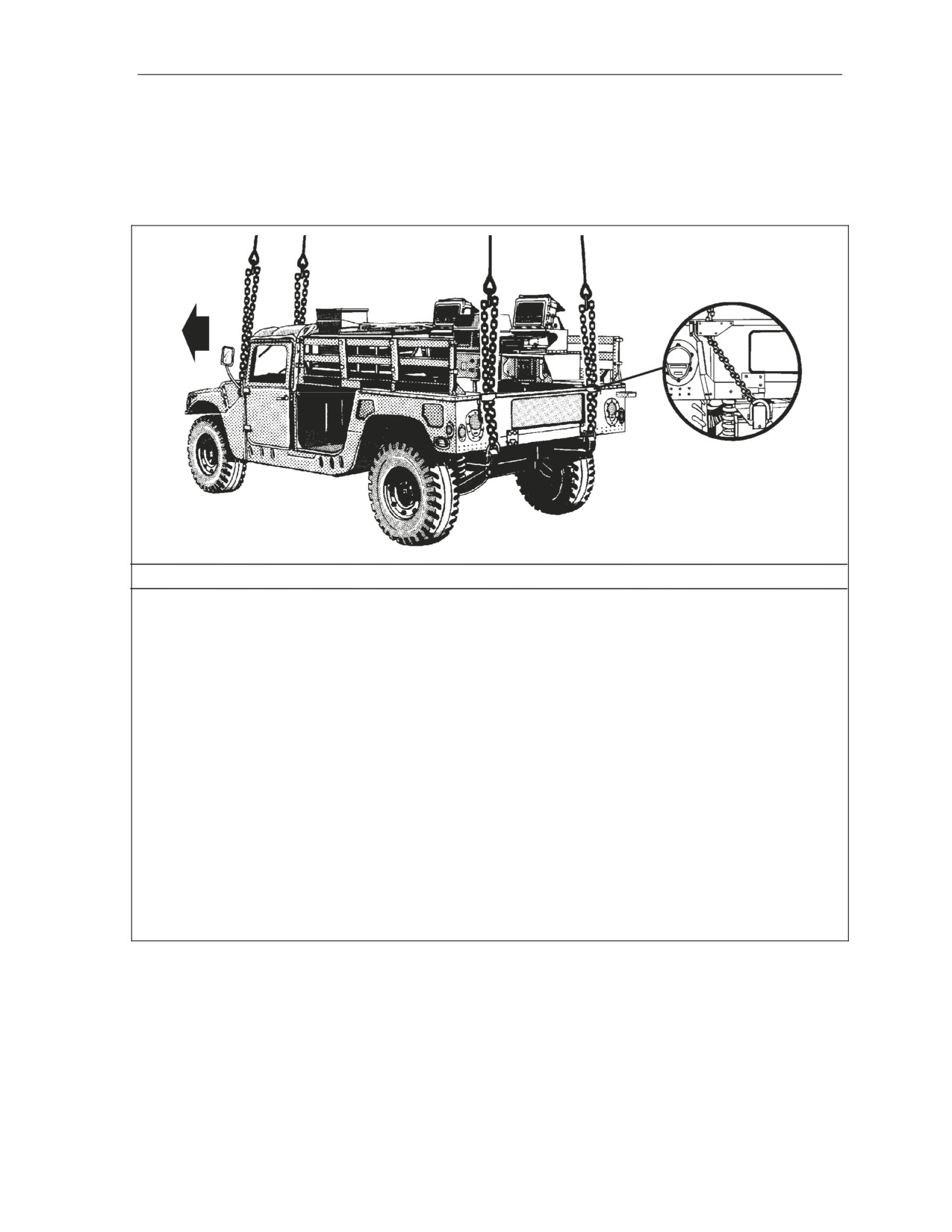
Rigging. Rig the load according to the steps in Figure 2-30.
Hookup. The hookup team stands in the bed of the vehicle. The static wand person
discharges the static electricity with the static wand. The forward hookup person places apex
fitting 1 onto the forward cargo hook. The aft hookup person places apex fitting 2 onto the aft
FM 4-20.199/MCRP 4-11.3E, VOL III/NTTP 3-04.13/
2-74
AFMAN 11-223 (I), VOL III/COMDINST M13482.4B
20 February 2009
Certified Dual-Point Rigging Procedures for Wheeled Vehicles
cargo hook. The hookup team then carefully dismounts the vehicle and remains close to the
load as the helicopter removes slack from the sling legs. When successful hookup is assured,
the hookup team quickly exits the area underneath the helicopter to the designated rendezvous
point.
Derigging. Derigging is the reverse of the preparation and rigging procedures.
RIGGING STEPS
1. Connect 2 sling legs to apex fitting number 1. Position the apex fitting on the hood of the
vehicle.
2. Loop the chain end of the sling legs through their respective lift provisions that protrudes
through the hood. Place the correct link from Table 2-31 in the grab hook.
3. Connect 2 sling legs to apex fitting number 2. Position the apex fitting in the cargo bed of the
vehicle.
4. Loop the chain end of the sling legs through their respective eyelet openings in the upper
corner of the tailgate. Loop the chain end through the lift shackle on the rear bumper and
thread back through the eyelet opening in the tailgate. Place the correct link from Table 2-31
in the grab hook.
5. Secure all excess chain with tape or Type III nylon cord.
6. Cluster and tie (breakaway technique) the sling legs in each sling set on top of the vehicle to
prevent entanglement during hookup and lift-off.
Figure 2-30. M998/M1038 with Lightweight Tactical Fire Control Systems Tactical Terminal
Control Systems
FM 4-20.199/MCRP 4-11.3E, VOL III/NTTP 3-04.13/
20 February 2009
AFMAN 11-223 (I), VOL III/COMDINST M13482.4B
2-75

Chapter 2
M1097A2 (HMMWV) WITH ADVANCED FIELD ARTILLERY
TACTICAL DATA SYSTEM (AFATDS) FULL SIZE OR PARTIAL
SOFT TOP INSTALLATION KIT (STIK)
2-33. The M1097A2 with advanced field artillery tactical data system full size or partial soft top
installation kit is rigged for dual-point sling load using the following procedures:
z
Applicability. The following items in Table 2-32 are certified for the helicopter(s) listed in the
following table by the US Army Natick Soldier Center:
Table 2-32. M1097A2 with Advanced Field Artillery Tactical Data System Full Size or Partial
Soft Top Installation Kit
Nomenclature
Max Weight
Sling
Link Count
Type of
(Pounds)
Set
Front/Rear
Aircraft
System 2: CHS-2 AN/GYG-3(V)1, with SINGARS
8,103
10K
50/3
CH-47
AN/VRC-90, AN/VRC-92 and EPLRS Installed in the
Bed. AN/VRC-92 Installed in Cab.
System 3: CHS-2 AN/GYG-3(V)3, with SINGARS
8,366
10K
50/3
CH-47
AN/VRC-90, AN/VRC-92 and EPLRS Installed in the
Bed. AN/VRC-92 Installed in Cab.
System 4: 2 each AN/GYK-37(V)2, with SINGARS
7,790
10K
50/3
CH-47
AN/VRC-89, AN/VRC-92 and EPLRS.
z
Materials. The following materials are required to rig this load:
Sling set (10,000-pound capacity) with one additional apex fitting.
─ Additional chain length, part number 38850-00053-101, from a 10,000-pound capacity
sling set (4 each).
─ Additional coupling link, part number 5779125, from a 10,000-pound capacity sling
set (4 each).
Tape, adhesive, pressure-sensitive, 2-inch wide roll.
Cord, nylon, Type III, 550-pound breaking strength.
Webbing, cotton, 1/4-inch, 80-pound breaking strength.
Padding, cellulose.
z
Personnel. Two persons can prepare and rig this load in 10 minutes.
z
Procedures. The following procedures apply to this load:
Preparation. Prepare the load using the following steps:
─ Extend the sling leg chains by connecting one additional chain length to each chain on
a 10,000-pound capacity sling set with coupling links.
─ Fold mirrors forward in front of the windshield for added protection and tie together
with Type III nylon cord.
─ Secure all equipment and cargo inside the vehicle with tape, nylon cord, or lashings.
Remove and secure the doors in the front of the vehicle.
─ Ensure the fuel tank is not over 3/4 full. Inspect fuel tank cap, oil filler cap, and
battery caps for proper installation.
─ Engage the vehicle parking brake and put the transmission in neutral.
─ Ensure the front wheels are pointed straight ahead. Tie down the steering wheel, using
the securing device attached under the dashboard.
─ Tape the windshield in an X formation from corner to corner.
FM 4-20.199/MCRP 4-11.3E, VOL III/NTTP 3-04.13/
2-76
AFMAN 11-223 (I), VOL III/COMDINST M13482.4B
20 February 2009
Certified Dual-Point Rigging Procedures for Wheeled Vehicles
─ Install the lift provisions on the outer ends of the rear bumper.
─ Extend the sling leg chains by connecting one additional chain length to each chain
using the coupling links.
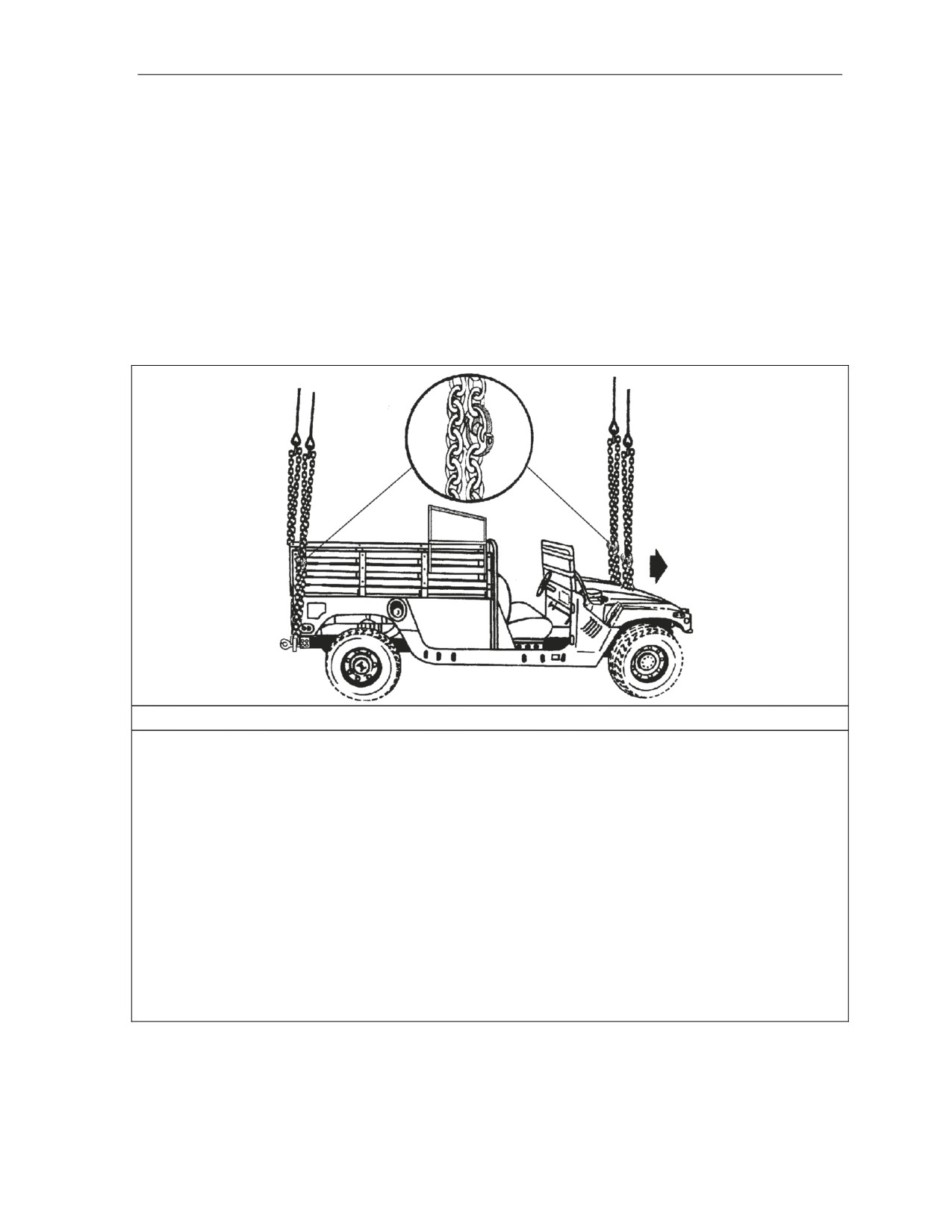
Rigging. Rig the load according to the steps in Figure 2-31.
Hookup. The hookup team stands on top of the vehicle. The static wand person
discharges the static electricity with the static wand. The forward hookup person places apex
fitting 1 onto the forward cargo hook. The aft hookup person places apex fitting 2 onto the aft
cargo hook. The hookup team then carefully dismounts the vehicle and remains close to the
load as the helicopter removes slack from the sling legs. When successful hookup is assured,
the hookup team quickly exits the area underneath the helicopter to the designated rendezvous
point.
Derigging. Derigging is the reverse of the preparation and rigging procedures.
RIGGING STEPS
1. Connect 2 sling legs to apex fitting number 1. Position the apex fitting on top of the shelter.
2. Loop the chain end of the sling legs through their respective lift provisions that protrudes
through the hood. Place the correct link from Table 2-32 in the grab hook.
3. Connect 2 sling legs to apex fitting number 2. Position the apex fitting on top of the shelter.
4. Loop the chain end of the sling legs through their respective lift provisions located on the
outer ends of the rear bumper. Place the correct link from Table 2-32 in the grab hook.
5. Secure all excess chain with tape or Type III nylon cord.
6. Cluster and tie (breakaway technique) the sling legs in each sling set on top of the vehicle to
prevent entanglement during hookup and lift-off.
Figure 2-31. M1097A2 with Advanced Field Artillery Tactical Data System Full Size or Partial
Soft Top Installation Kit
FM 4-20.199/MCRP 4-11.3E, VOL III/NTTP 3-04.13/
20 February 2009
AFMAN 11-223 (I), VOL III/COMDINST M13482.4B
2-77

Chapter 2
CAUTION
Do not use the lift shackles located near the center of the rear bumper
for sling load lift provisions.
M1037 (HMMWV) WITH AN/TPQ-36 FIREFINDER GENERATOR
PALLET
2-34. The M1037 with AN/TPQ-36 Firefinder generator pallet is rigged for dual-point sling load using the
following procedures:
z
Applicability. The following item in Table 2-33 is certified for the helicopter(s) listed in the
following table by the US Army Natick Soldier Center:
Table 2-33. M1037 with AN/TPQ-36 Firefinder Generator Pallet
Nomenclature
Max Weight
Sling
Link Count
Type of
(Pounds)
Set
Front/Rear
Aircraft
AN/TPQ-36 Firefinder Generator Pallet
7,700
10K
80/45
CH-47
z
Materials. The following materials are required to rig this load:
Sling set (10,000-pound capacity) with one additional apex fitting.
Tape, adhesive, pressure-sensitive, 2-inch wide roll.
Cord, nylon, Type III, 550-pound breaking strength.
Webbing, cotton, 1/4-inch, 80-pound breaking strength.
z
Personnel. Two persons can prepare and rig this load in 15 minutes.
z
Procedures. The following procedures apply to this load:
Preparation. Prepare the load using the following steps:
─ Fold mirrors forward in front of the windshield for added protection and tie together
with Type III nylon cord. Remove the canvas cab top and the doors. Secure to the
seats with Type III nylon cord.
─ Ensure the generator is secured to the truck. Secure all lids, doors, and vents on the
generator with tape or Type III nylon cord. Safety tie all chains and hoses with tape or
Type III nylon cord.
─ Secure all equipment and cargo inside the vehicle with tape, nylon cord, or lashings.
─ Ensure the fuel tank is not over 3/4 full. Inspect fuel tank cap, oil filler cap, and
battery caps for proper installation.
─ Engage the vehicle parking brake and put the transmission in neutral.
─ Ensure the front wheels are pointed straight ahead. Tie down the steering wheel, using
the securing device attached under the dashboard.
─ Tape the windshield in an X formation from corner to corner.
Rigging. Rig the load according to the steps in Figure 2-32.
Hookup. The hookup team stands in the bed of the vehicle. The static wand person
discharges the static electricity with the static wand. The forward hookup person places apex
fitting 1 onto the forward cargo hook. The aft hookup person places apex fitting 2 onto the aft
cargo hook. The hookup team then carefully dismounts the vehicle and remains close to the
load as the helicopter removes slack from the sling legs. When successful hookup is assured,
the hookup team quickly exits the area underneath the helicopter to the designated rendezvous
point.
Derigging. Derigging is the reverse of the preparation and rigging procedures.
FM 4-20.199/MCRP 4-11.3E, VOL III/NTTP 3-04.13/
2-78
AFMAN 11-223 (I), VOL III/COMDINST M13482.4B
20 February 2009
Certified Dual-Point Rigging Procedures for Wheeled Vehicles
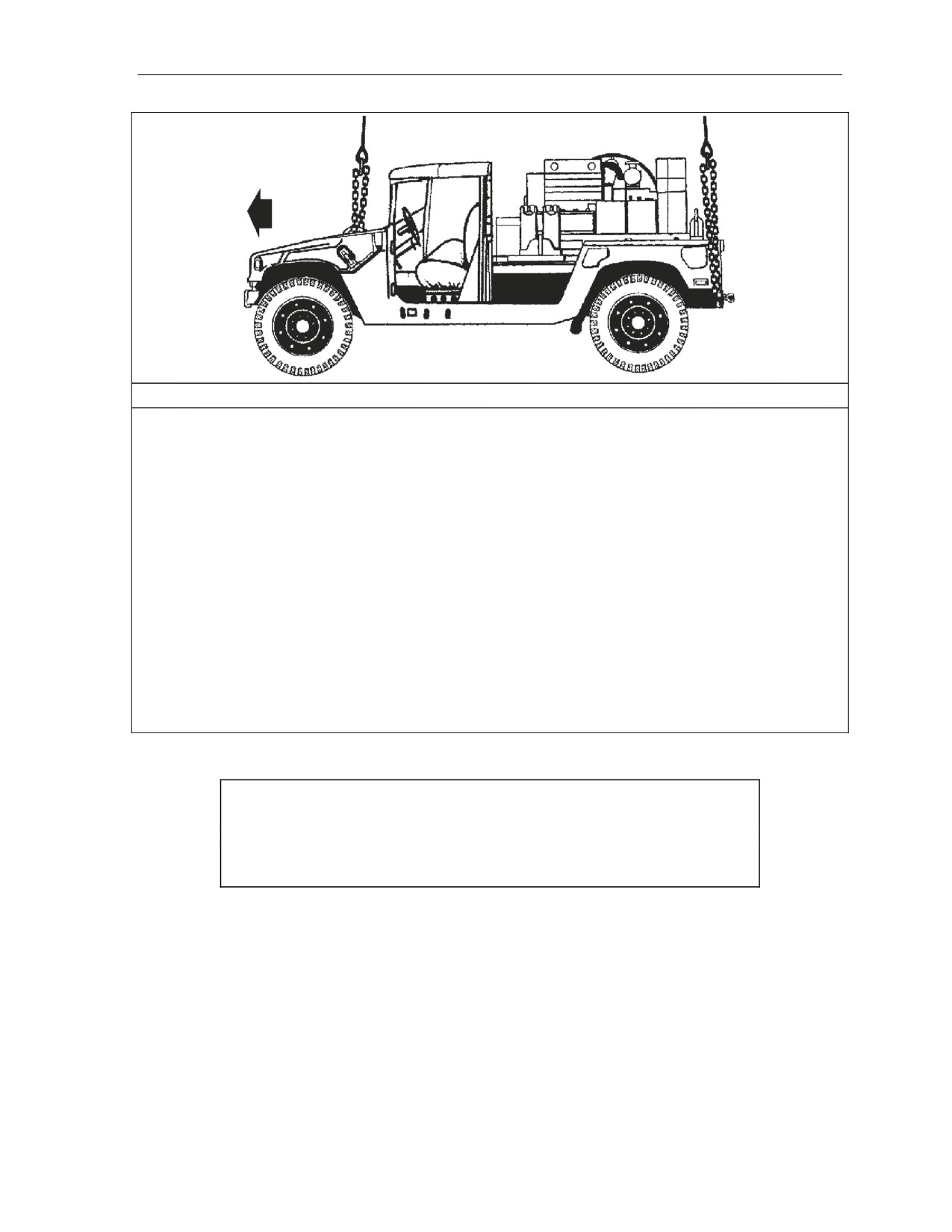
RIGGING STEPS
1. Connect 2 sling legs to apex fitting number 1. Position the apex fitting on the hood of the
vehicle.
2. Loop the chain end of the sling legs through their respective lift provisions that protrudes
through the hood. Place the correct link from Table 2-33 in the grab hook.
3. Connect 2 sling legs to apex fitting number 2. Position the apex fitting in the cargo bed of the
vehicle.
4. Loop the chain end of the sling legs through their respective lift shackle on the outside end of
the rear bumper. Place the correct link from Table 2-33 in the grab hook.
5. Secure all excess chain with tape or Type III nylon cord.
6. Cluster and tie (breakaway technique) the sling legs in each sling set on top of the vehicle to
prevent entanglement during hookup and lift-off.
Figure 2-32. M1037 with AN/TPQ-36 Firefinder Generator Pallet
CAUTION
Do not use the lift shackles located near the center of the rear bumper
for sling load lift provisions.
FM 4-20.199/MCRP 4-11.3E, VOL III/NTTP 3-04.13/
20 February 2009
AFMAN 11-223 (I), VOL III/COMDINST M13482.4B
2-79
Chapter 2
M998 HMMWV WITH MAN PORTABLE AIR DEFENSE SYSTEMS
(MANPADS)
2-35. The M998 with man portable air defense systems is rigged for dual-point sling load using the
following procedures:
z
Applicability. The following item in Table 2-34 is certified for the helicopter(s) listed in the
following table by the US Army Natick Soldier Center:
Table 2-34. M998 with Man Portable Air Defense Systems
Nomenclature
Max Weight
Sling
Link Count
Type of
(Pounds)
Set
Front/Rear
Aircraft
Man Portable Air Defense Systems on M998
7,700
10K
40/3
CH-47
z
Materials. The following materials are required to rig this load:
Sling set (10,000-pound capacity) with one additional apex fitting.
Tape, adhesive, pressure-sensitive, 2-inch wide roll.
Cord, nylon, Type III, 550-pound breaking strength.
Webbing, cotton, 1/4-inch, 80-pound breaking strength.
z
Personnel. Two persons can prepare and rig this load in 15 minutes.
z
Procedures. The following procedures apply to this load:
Preparation. Prepare the load using the following steps:
─ Fold mirrors forward in front of the windshield for added protection and tie together
with Type III nylon cord. Secure the doors.
─ Secure all equipment and cargo inside the vehicle with tape, Type III nylon cord, or
lashings.
─ Ensure the fuel tank is not over 3/4 full. Inspect fuel tank cap, oil filler cap, and
battery caps for proper installation.
─ Engage the vehicle parking brake and put the transmission in neutral.
─ Ensure the front wheels are pointed straight ahead. Tie down the steering wheel, using
the securing device attached under the dashboard.
Rigging. Rig the load according to the steps in Figure 2-33.
Hookup. The static wand person discharges the static electricity with the static wand. The
forward hookup person places apex fitting 1 onto the forward cargo hook. The aft hookup
person places apex fitting 2 onto the aft cargo hook.
The hookup team then carefully
dismounts the vehicle and remains close to the load as the helicopter removes slack from the
sling legs. When successful hookup is assured, the hookup team quickly exits the area
underneath the helicopter to the designated rendezvous point.
Derigging. Derigging is the reverse of the preparation and rigging procedures.
FM 4-20.199/MCRP 4-11.3E, VOL III/NTTP 3-04.13/
2-80
AFMAN 11-223 (I), VOL III/COMDINST M13482.4B
20 February 2009
Certified Dual-Point Rigging Procedures for Wheeled Vehicles
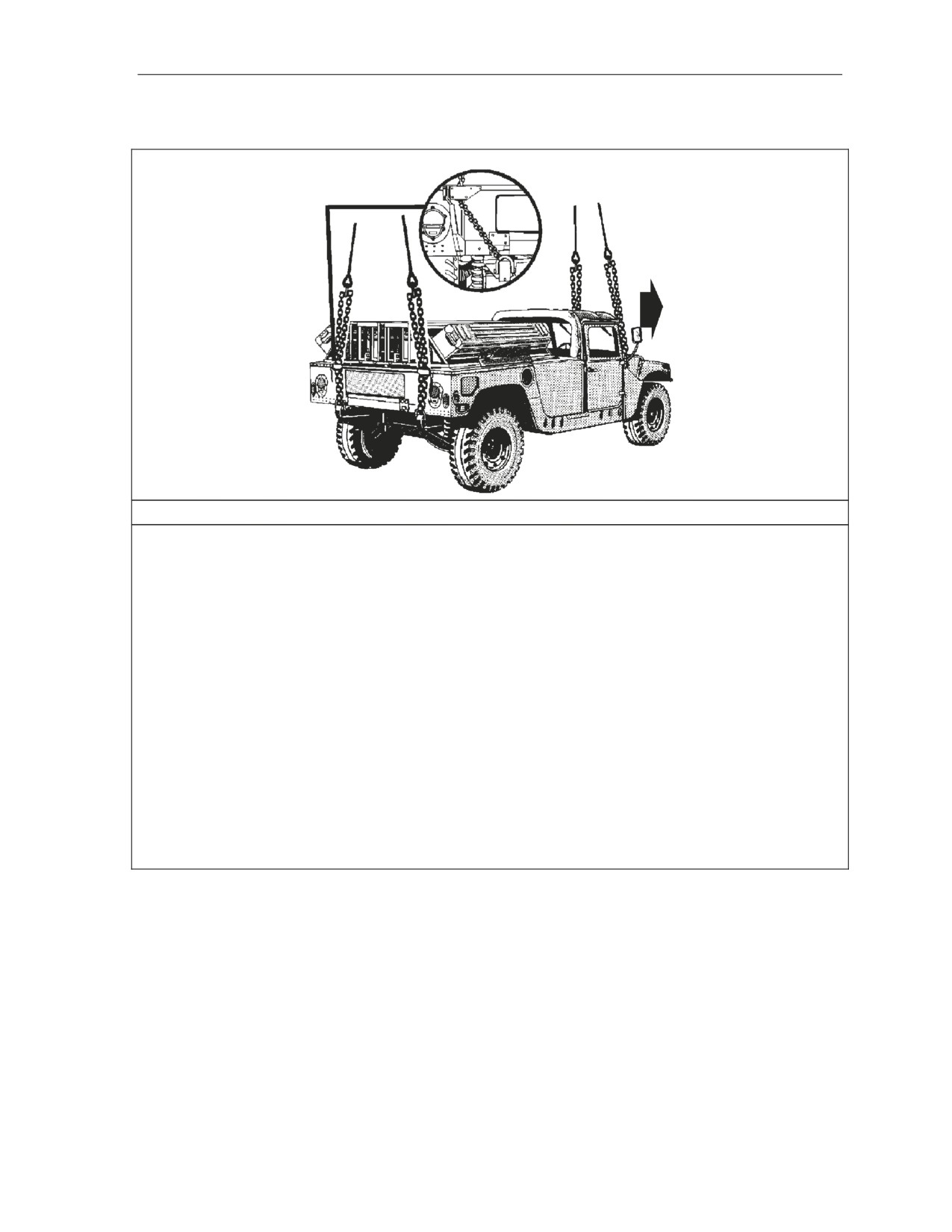
RIGGING STEPS
1. Connect 2 sling legs to apex fitting number 1. Position the apex fitting on the hood of the
vehicle.
2. Loop the chain end of the sling legs through their respective lift provisions that protrudes
through the hood. Place the correct link from Table 2-34 in the grab hook.
3. Connect 2 sling legs to apex fitting number 2. Position the apex fitting on top of the shelter.
4. Loop the chain end of the sling legs through their respective eyelet openings in the upper
corner of the tailgate. Loop the chain end through the lift shackle on the rear bumper and
thread back through the eyelet opening in the tailgate. Place the correct link from Table 2-34
in the grab hook.
5. Secure all excess chain with tape or Type III nylon cord.
6. Cluster and tie (breakaway technique) the sling legs in each sling set on top of the vehicle to
prevent entanglement during hookup and lift-off.
Figure 2-33. M998 with Man Portable Air Defense Systems
M1097 (H-HMMWV) WITH AN/TPQ-42, METEOROLOGICAL
HYDROGEN GENERATOR (MHG)
2-36. The M1097 with AN/TPQ-42, meteorological hydrogen generator is rigged for dual-point sling load
using the following procedures:
z
Applicability. The following item in Table 2-35 is certified for the helicopter(s) listed in the
following table by the US Army Natick Soldier Center:
FM 4-20.199/MCRP 4-11.3E, VOL III/NTTP 3-04.13/
20 February 2009
AFMAN 11-223 (I), VOL III/COMDINST M13482.4B
2-81
Chapter 2
Table 2-35. M1097 with AN/TPQ-42, Meteorological Hydrogen Generator
Nomenclature
Max Weight
Sling
Link Count
Type of
(Pounds)
Set
Front/Rear
Aircraft
AN/TPQ-42 Meteorological Hydrogen Generator
10,000
10K
40/3
CH-47
15K
25/3
CH-53
z
Materials. The following materials are required to rig this load:
Sling set (10,000-pound capacity) with one additional apex fitting.
OR
Multileg sling set with one additional web ring.
Tape, adhesive, pressure-sensitive, 2-inch wide roll.
Cord, nylon, Type III, 550-pound breaking strength.
Webbing, cotton, 1/4-inch, 80-pound breaking strength.
z
Personnel. Three persons can prepare and rig this load in 20 minutes.
z
Procedures. The following procedures apply to this load:
Preparation. Prepare the load using the following steps:
─ Fold mirrors forward in front of the windshield for added protection and tie together
with Type III nylon cord.
─ Secure all equipment and cargo inside the vehicle with tape, nylon cord, or lashings.
Secure the doors shut if installed.
─ Ensure the fuel tank is not over 3/4 full. Inspect fuel tank cap, oil filler cap, and
battery caps for proper installation.
─ Engage the vehicle parking brake and put the transmission in neutral.
─ Ensure the front wheels are pointed straight ahead. Tie down the steering wheel, using
the securing device attached under the dashboard.
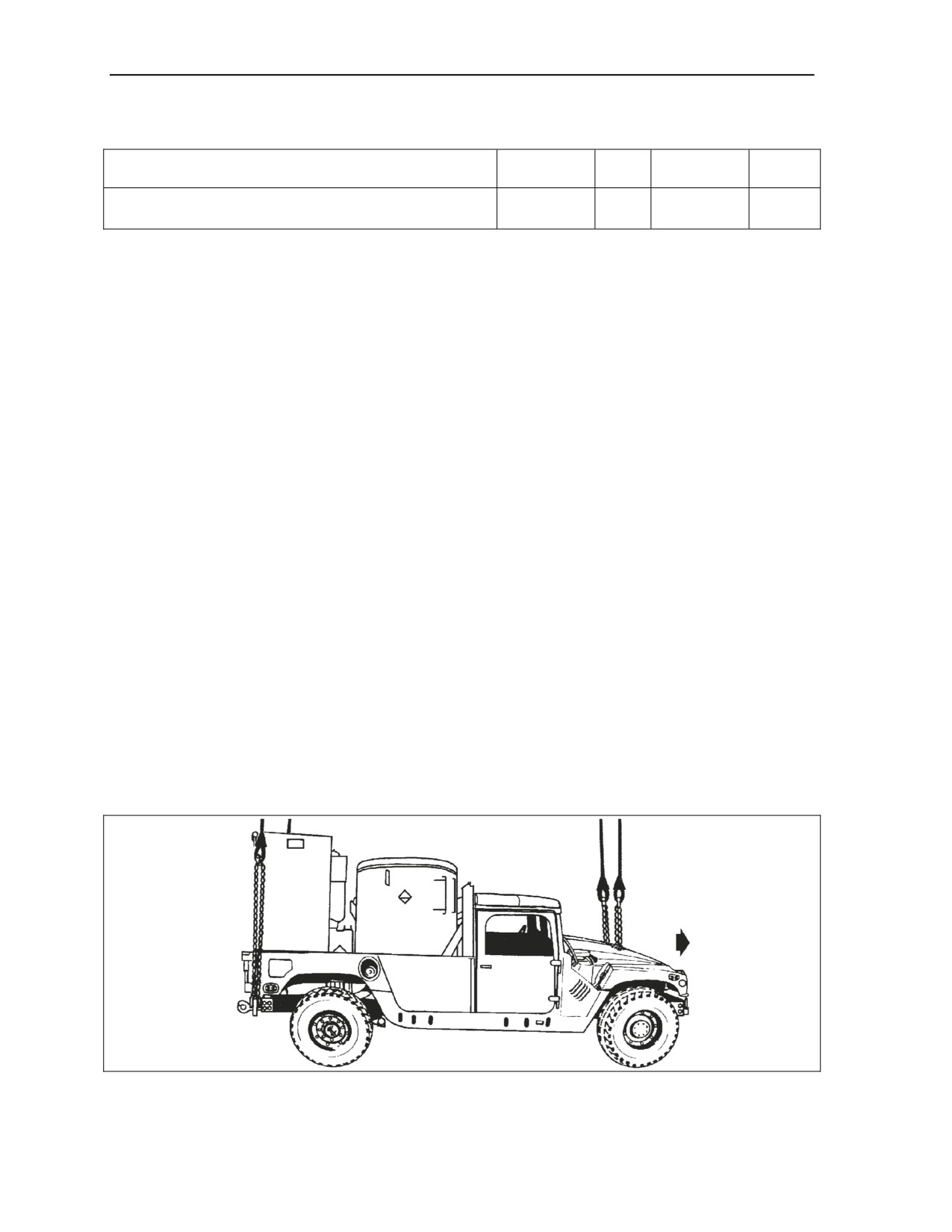
Rigging. Rig the load according to the steps in Figure 2-34.
Hookup. The hookup team stands in the rear of the vehicle. The static wand person
discharges the static electricity with the static wand. The forward hookup person places apex
fitting 1 onto the forward cargo hook. The aft hookup person places apex fitting 2 onto the aft
cargo hook. The hookup team then carefully dismounts the vehicle and remains close to the
load as the helicopter removes slack from the sling legs. When successful hookup is assured,
the hookup team quickly exits the area underneath the helicopter to the designated rendezvous
point.
Derigging. Derigging is the reverse of the preparation and rigging procedures.
Figure 2-34. M1097 with AN/TPQ-42, Meteorological Hydrogen Generator
FM 4-20.199/MCRP 4-11.3E, VOL III/NTTP 3-04.13/
2-82
AFMAN 11-223 (I), VOL III/COMDINST M13482.4B
20 February 2009

Certified Dual-Point Rigging Procedures for Wheeled Vehicles
RIGGING STEPS
1. Connect 2 sling legs to apex fitting number 1. Position the apex fitting on the hood of the
vehicle.
2. Loop the chain end of the sling legs through their respective lift provisions that protrudes
through the hood. Place the correct link from Table 2-35 in the grab hook.
3. Connect 2 sling legs to apex fitting number 2. Position the apex fitting in the bed of the
vehicle.
4. Loop the chain end of the sling legs through their respective lift shackle on the outside end of
the rear bumper. Place the correct link from Table 2-35 in the grab hook.
5. Secure all excess chain with tape or Type III nylon cord.
6. Cluster and tie (breakaway technique) the sling legs in each sling set on top of the vehicle to
prevent entanglement during hookup and lift-off.
Figure 2-34. M1097 with AN/TPQ-42, Meteorological Hydrogen Generator (Continued)
CAUTION
Do not use the lift shackles located near the center of the rear bumper
for sling load lift provisions.
M1037 (H-HMMWV) WITH COMPRESSED AIR-FOAM SYSTEM,
MOBILE (CAFSM)
2-37. The M1037 with compressed air-foam system, mobile is rigged for dual-point sling load using the
following procedures:
z
Applicability. The following item in Table 2-36 is certified for the helicopter(s) listed in the
following table by the US Army Natick Soldier Center:
Table 2-36. M1037 with Compressed Air-Foam System, Mobile
Nomenclature
Max Weight
Sling
Link Count
Type of
(Pounds)
Set
Front/Rear
Aircraft
Compressed Air-Foam System, Mobile on M1037
6,400
15K
40/3
CH-53
(Empty)
z
Materials. The following materials are required to rig this load:
Multileg sling set with one additional web ring.
Tape, adhesive, pressure-sensitive, 2-inch wide roll.
Cord, nylon, Type III, 550-pound breaking strength.
Webbing, cotton, 1/4-inch, 80-pound breaking strength.
z
Personnel. Three persons can prepare and rig this load in 15 minutes.
z
Procedures. The following procedures apply to this load:
FM 4-20.199/MCRP 4-11.3E, VOL III/NTTP 3-04.13/
20 February 2009
AFMAN 11-223 (I), VOL III/COMDINST M13482.4B
2-83
Chapter 2
Preparation. Prepare the load using the following steps:
─ Fold mirrors forward in front of the windshield for added protection and tie together
with Type III nylon cord. Remove the canvas top and doors. Secure to the seats with
Type III nylon cord.
─ Ensure the CAFSM is secured to the truck. Secure all lids, doors, and vents on the
CAFSM with tape or Type III nylon cord. Safety tie all chains and hoses with tape or
Type III nylon cord.
─ Secure all equipment and cargo inside the vehicle with tape, nylon cord, or lashings.
Secure the doors shut if installed.
─ Ensure the fuel tank is not over 3/4 full. Inspect fuel tank cap, oil filler cap, and
battery caps for proper installation.
─ Engage the vehicle parking brake and put the transmission in neutral.
─ Ensure the front wheels are pointed straight ahead. Tie down the steering wheel, using
the securing device attached under the dashboard.
─ Tape the windshield in an X formation from corner to corner.
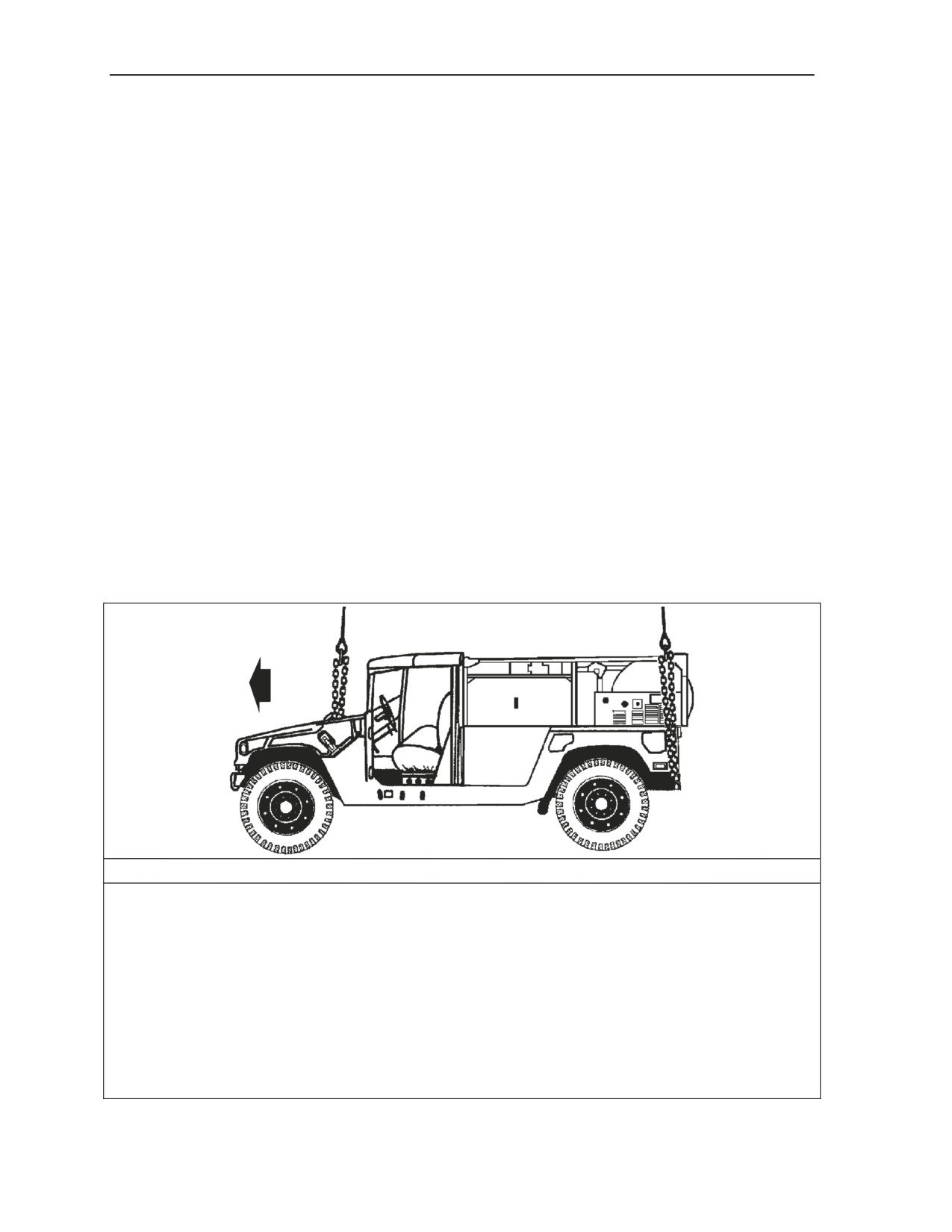
Rigging. Rig the load according to the steps in Figure 2-35.
Hookup. The hookup team stands in the rear of the vehicle. The static wand person
discharges the static electricity with the static wand. The forward hookup person places apex
fitting 1 onto the forward cargo hook. The aft hookup person places apex fitting 2 onto the aft
cargo hook. The hookup team then carefully dismounts the vehicle and remains close to the
load as the helicopter removes slack from the sling legs. When successful hookup is assured,
the hookup team quickly exits the area underneath the helicopter to the designated rendezvous
point.
Derigging. Derigging is the reverse of the preparation and rigging procedures.
RIGGING STEPS
1. Connect 2 sling legs to apex fitting number 1. Position the apex fitting on the hood of the
vehicle.
2. Loop the chain end of the sling legs through their respective lift provisions that protrudes
through the hood. Place the correct link from Table 2-36 in the grab hook.
3. Connect 2 sling legs to apex fitting number 2. Position the apex fitting in the bed of the
vehicle.
4. Loop the chain end of the sling legs through their respective lift shackle on the outside end of
the rear bumper. Place the correct link from Table 2-36 in the grab hook.
Figure 2-35. M1037 with Compressed Air-Foam System, Mobile
FM 4-20.199/MCRP 4-11.3E, VOL III/NTTP 3-04.13/
2-84
AFMAN 11-223 (I), VOL III/COMDINST M13482.4B
20 February 2009

Certified Dual-Point Rigging Procedures for Wheeled Vehicles
RIGGING STEPS (Continued)
5. Secure all excess chain with tape or Type III nylon cord.
6. Cluster and tie or tape (breakaway technique) the sling legs in each sling set on top of the
vehicle to prevent entanglement during hookup and lift-off.
Figure 2-35. M1037 with Compressed Air-Foam System, Mobile (Continued)
CAUTION
Do not use the lift shackles located near the center of the rear bumper
for sling load lift provisions.
M1113 (HMWWV) WITH PETROLEUM QUALITY ANALYSIS
SYSTEM (PQAS) SHELTER
2-38. The M1113 with petroleum quality analysis system shelter is rigged for dual-point sling load using
the following procedures:
z
Applicability. The following item in Table 2-37 is certified for the helicopter(s) listed in the
following table by the US Army Natick Soldier Center:
Table 2-37. M1113 with Petroleum Quality Analysis System Shelter
Nomenclature
Max Weight
Sling
Link Count
Type of
(Pounds)
Set
Front/Rear
Aircraft
Petroleum Quality Analysis System Shelter on M1113
9,460
25K
30/3
CH-47
z
Materials. The following materials are required to rig this load:
Sling set (25,000-pound capacity) with one additional apex fitting.
─ Additional chain length, part number 38850-00053-102, from a 25,000-pound capacity
sling set (4 each).
─ Additional coupling link, part number 5779135, from a 25,000-pound capacity sling
set (4 each).
Tape, adhesive, pressure-sensitive, 2-inch wide roll.
Cord, nylon, Type III, 550-pound breaking strength.
Webbing, cotton, 1/4-inch, 80-pound breaking strength.
Webbing, nylon, 1/2-inch, 1000-pound breaking strength.
z
Personnel. Two persons can prepare and rig this load in 20 minutes.
z
Procedures. The following procedures apply to this load:
Preparation. Prepare the load using the following steps:
─ Extend the sling leg chains by connecting one additional chain length to each chain on
a 25,000-pound capacity sling set with coupling links.
─ Fold mirrors forward inward and tie together with Type III nylon cord.
─ Secure all loose equipment inside the shelter with tape or Type III nylon cord and
tiedown straps. Close and secure the rear access door. Lower the roof to the stop and
pin in position. Secure the pins in place with tape.
─ Secure all equipment inside the truck or on the roof rack with tape, Type III nylon
cord, or tiedown straps.
─ Ensure the fuel tank is not over 3/4 full. Inspect fuel tank cap, oil filler cap, and
battery caps for proper installation.
FM 4-20.199/MCRP 4-11.3E, VOL III/NTTP 3-04.13/
20 February 2009
AFMAN 11-223 (I), VOL III/COMDINST M13482.4B
2-85
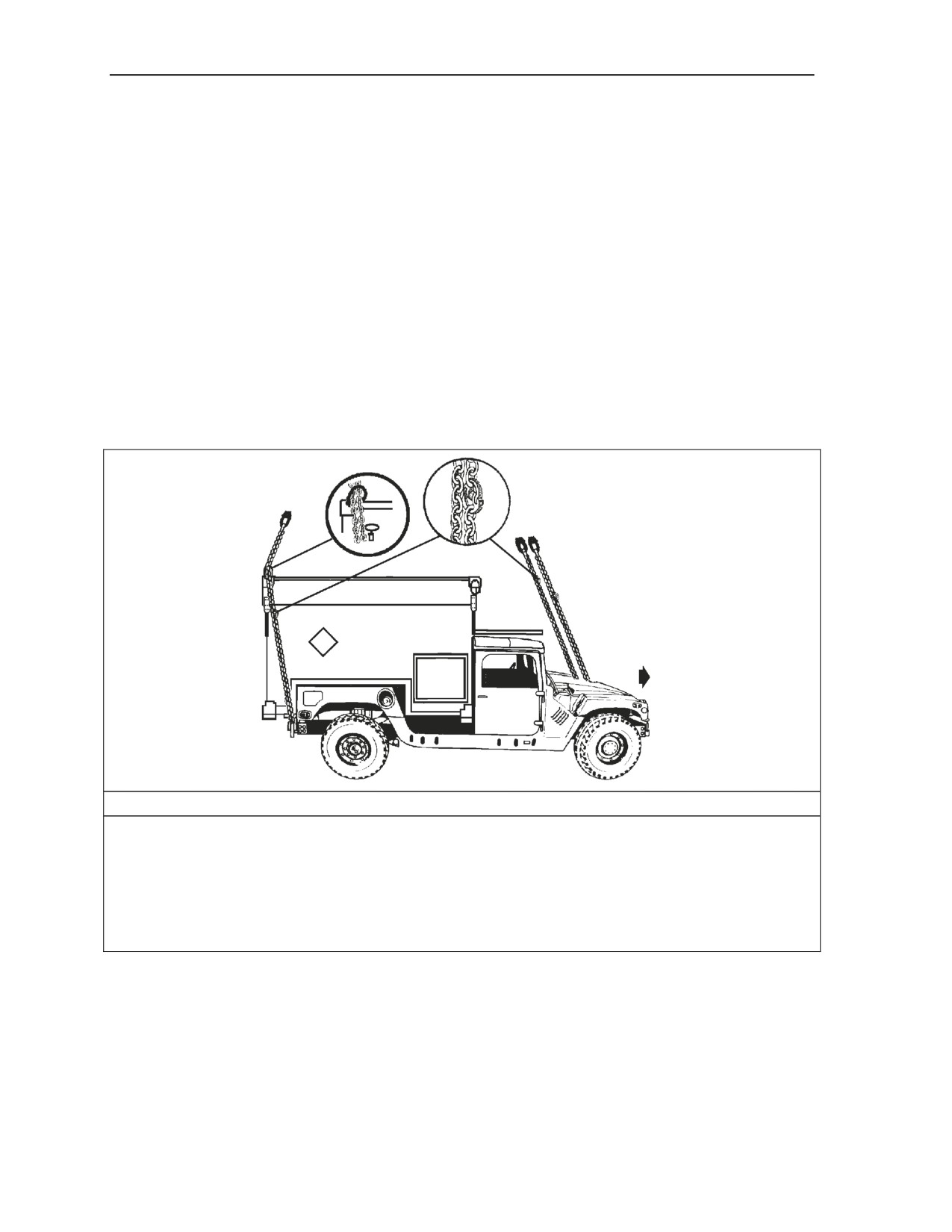
Chapter 2
─ Engage the vehicle parking brake and put the transmission in neutral.
─ Ensure the front wheels are pointed straight ahead. Tie down the steering wheel, using
the securing device attached under the dashboard.
─ Tape the windshield in an X formation from corner to corner.
─ Roll up and secure the large canvas covers on top of the shelter. Tape the small canvas
covers down.
─ Tape the windshield in an X formation from corner to corner.
Rigging. Rig the load according to the steps in Figure 2-36.
Hookup. The hookup team stands on top of the shelter. The static wand person
discharges the static electricity with the static wand. The forward hookup person places apex
fitting 1 onto the forward cargo hook. The aft hookup person places apex fitting 2 onto the aft
cargo hook. The hookup team then carefully dismounts the vehicle and remains close to the
load as the helicopter removes slack from the sling legs. When successful hookup is
assured, the hookup team quickly exits the area underneath the helicopter to the
designated rendezvous point.
Derigging. Derigging is the reverse of the preparation and rigging procedures.
RIGGING STEPS
1. Connect 2 sling legs to apex fitting number 1. Position the apex fitting on top of the shelter.
2. Loop the chain end of the sling legs through their respective lift provisions that protrudes
through the hood. Place the correct link from Table 2-37 in the grab hook.
3. Connect 2 sling legs to apex fitting number 2. Position the apex fitting on top of the shelter.
Figure 2-36. M1113 with Petroleum Quality Analysis System Shelter
FM 4-20.199/MCRP 4-11.3E, VOL III/NTTP 3-04.13/
2-86
AFMAN 11-223 (I), VOL III/COMDINST M13482.4B
20 February 2009

Certified Dual-Point Rigging Procedures for Wheeled Vehicles
RIGGING STEPS (Continued)
4. Route the right sling leg chain through the right rear shelter lift ring (inboard to outboard) to
the right rear lift provision located on the outer end of the rear bumper. Continue routing the
chain back through the right rear shelter lift ring (outboard to inboard) and back to the grab
hook. Place the correct link from Table 2-37 in the grab hook. Repeat the procedure using
the left sling leg chain, left rear shelter lift ring, and the left lift provision located on the end of
the bumper.
5. Remove all the excess slack between the lift provisions and the shelter lift rings.
6. Secure all excess chain with tape or Type III nylon cord.
7. Cluster and tie (breakaway technique) the sling legs in each sling set on top of the vehicle to
prevent entanglement during hookup and lift-off.
Figure 2-36. M1113 with Petroleum Quality Analysis System Shelter (Continued)
M1123 CARGO/TROOP CARRIER (HMMWV) WITH MARINE
ARMOR KIT, FULLY ARMORED TROOP SECTION (USMC)
2-39. The M1123 cargo/troop carrier with Marine Armor Kit, fully armored troop section is rigged for
dual-point sling load using the following procedures:
z
Applicability. The following item in Table 2-38 is certified for the helicopter(s) listed in the
following table by the US Army Natick Soldier Center:
Table 2-38. M1123 Cargo/Troop Carrier with Marine Armor Kit, Fully Armored Troop Section
Nomenclature
Max Weight
Sling
Link Count
Type of
(Pounds)
Set
Front/Rear
Aircraft
M1123 Cargo/Troop Carrier with MAK Fully Armored
10,300
15K
35/3
CH-53
Troop Section
z
Materials. The following materials are required to rig this load:
Sling set (15,000-pound capacity) with one additional web ring.
─ Additional chain length, from a 15,000-pound capacity sling set (4 each).
─ Additional coupling link, from a 15,000-pound sling set (4 each).
Tape, adhesive, pressure-sensitive, 2-inch wide roll.
Cord, nylon, Type III, 550-pound breaking strength.
Webbing, cotton, 1/4-inch, 80-pound breaking strength.
Felt sheet, cattle hair, Type IV, 1/2-inch or suitable padding.
z
Personnel. Two persons can prepare and rig this load in 15 minutes.
z
Procedures. The following procedures apply to this load:
Preparation. Prepare the load using the following steps:
─ Extend the sling leg chains by connecting one additional chain lengths to each chain on
a 15,000-pound capacity sling set with a coupling link.
─ Fold mirrors forward inward and tie together with Type III nylon cord.
─ Secure all equipment and cargo inside the vehicle with tape, nylon cord, or lashings.
Remove antennas and stow inside the vehicle. Secure the doors shut.
FM 4-20.199/MCRP 4-11.3E, VOL III/NTTP 3-04.13/
20 February 2009
AFMAN 11-223 (I), VOL III/COMDINST M13482.4B
2-87
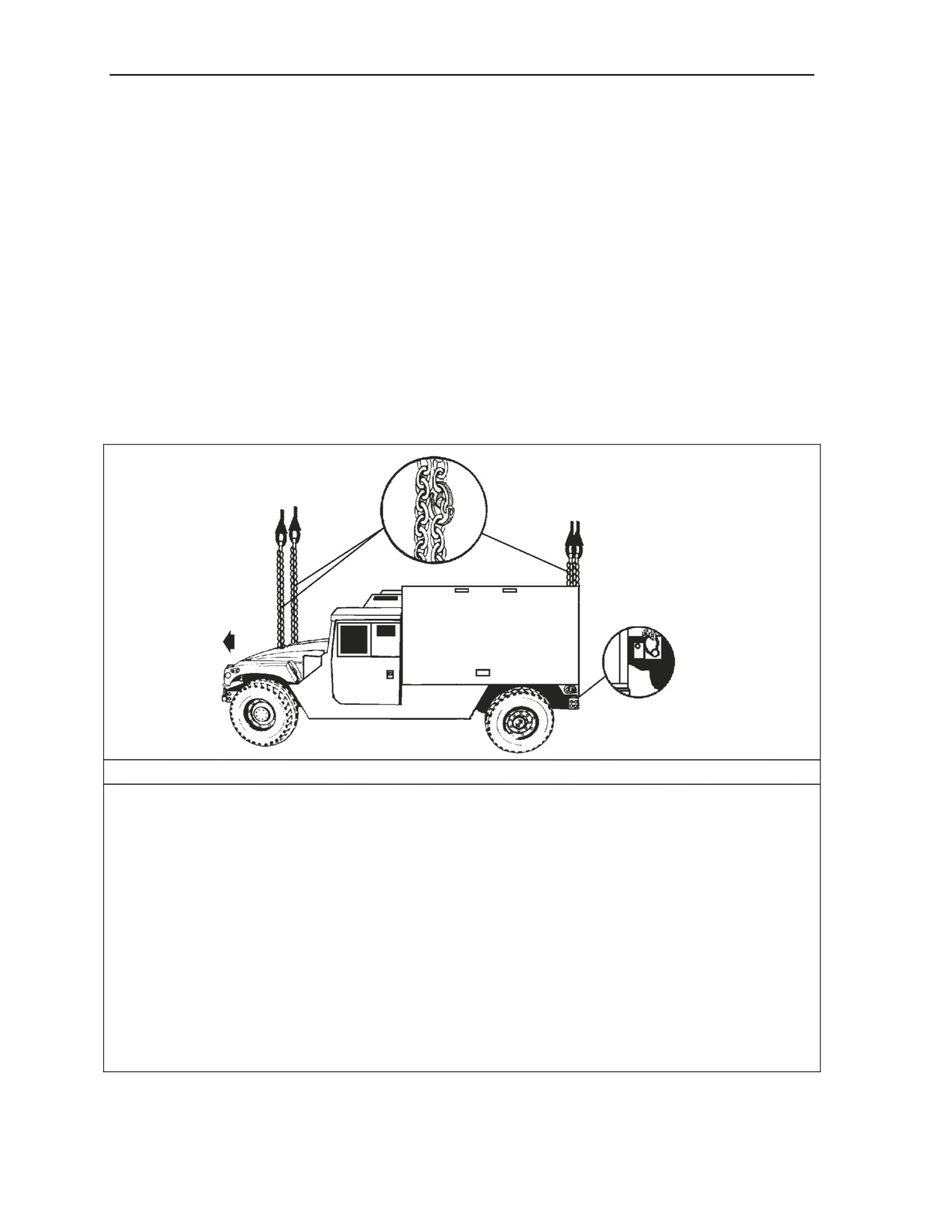
Chapter 2
─ Ensure the fuel tank is not over 3/4 full. Inspect fuel tank cap, oil filler cap, and
battery caps for proper installation.
─ Engage the vehicle parking brake and put the transmission in neutral.
─ Ensure the front wheels are pointed straight ahead. Tie down the steering wheel, using
the securing device attached under the dashboard.
─ Secure the doors and door handles on the armored troop section with Type III nylon
cord.
Rigging. Rig the load according to the steps in Figure 2-37.
Hookup. The hookup team stands on top of the vehicle. The static wand person
discharges the static electricity with the static wand. The forward hookup person places apex
fitting 1 onto the forward cargo hook. The aft hookup person places apex fitting 2 onto the aft
cargo hook. The hookup team then carefully dismounts the vehicle and remains close to the
load as the helicopter removes slack from the sling legs. When successful hookup is assured,
the hookup team quickly exits the area underneath the helicopter to the designated rendezvous
point.
Derigging. Derigging is the reverse of the preparation and rigging procedures.
RIGGING STEPS
1. Connect 2 sling legs to web ring number 1. Position the web ring on top of the vehicle.
2. Loop the chain end of the sling legs through their respective lift provisions that protrudes
through the hood. Place the correct link from Table 2-38 in the grab hook. Secure all
excess chain with tape or Type III nylon cord.
3. Connect 2 sling legs to web ring number 2. Position the web ring on top of the shelter.
4. Loop the chain end through the respective lift provision located on the rear of the vehicle,
near the center. Place the correct links from Table 2-38 in the grab hooks. Secure all
excess chain with tape or Type III nylon cord.
5. Cluster and tie (breakaway technique) the sling legs in each sling set on top of the vehicle to
prevent entanglement during hookup and lift-off.
Figure 2-37. M1123 Cargo/Troop Carrier with Marine Armor Kit, Fully Armored Troop Section
FM 4-20.199/MCRP 4-11.3E, VOL III/NTTP 3-04.13/
2-88
AFMAN 11-223 (I), VOL III/COMDINST M13482.4B
20 February 2009
Certified Dual-Point Rigging Procedures for Wheeled Vehicles
INTERIM FAST ATTACK VEHICLE TRUCK (IFAV), LONG WHEEL
BASE
2-40. The interim fast attack vehicle truck, long wheel base is rigged for dual-point sling load using the
following procedures:
z
Applicability. The following item in Table 2-38 is certified for the helicopter(s) listed in the
following table by the US Army Natick Soldier Center:
Table 2-39. Interim Fast Attack Vehicle Truck, Long Wheel Base
Nomenclature
Max Weight
Sling
Link Count
Type of
(Pounds)
Set
Front/Rear
Aircraft
Interim Fast Attack Vehicle Truck, Long Wheel Base
5,720
15K
40/3
CH-53
z
Materials. The following materials are required to rig this load:
Sling set (15,000-pound capacity for the CH-53 only) with one additional web ring.
Tape, adhesive, pressure-sensitive, 2-inch wide roll.
Cord, nylon, Type III, 550-pound breaking strength.
Webbing, cotton, 1/4-inch, 80-pound breaking strength.
Padding, cellulose.
z
Personnel. Two persons can prepare and rig this load in 10 minutes.
z
Procedures. The following procedures apply to this load:
Preparation. Prepare the load using the following steps:
─ Fold mirrors forward in front of the windshield for added protection and tie together
with Type III nylon cord. Remove all canvas covers.
─ Secure all equipment and cargo inside the vehicle with tape, nylon cord, or lashings.
─ Ensure the fuel tank is not over 3/4 full. Inspect fuel tank cap, oil filler cap, and
battery caps for proper installation.
─ Engage the vehicle parking brake and put the transmission in neutral.
─ Ensure the front wheels are pointed straight ahead. Tie down the steering wheel using
Type III nylon cord.
─ Tape the windshield in an X formation from corner to corner.
Rigging. Rig the load according to the steps in Figure 2-38.
Hookup. The hookup team stands on the vehicle. The static wand person discharges the
static electricity with the static wand. The forward hookup person places apex fitting 1 onto
the forward cargo hook. The aft hookup person places apex fitting 2 onto the aft cargo hook.
The hookup team then carefully dismounts the vehicle and remains close to the load as the
helicopter removes slack from the sling legs. When successful hookup is assured, the hookup
team quickly exits the area underneath the helicopter to the designated rendezvous point.
Derigging. Derigging is the reverse of the preparation and rigging procedures.
FM 4-20.199/MCRP 4-11.3E, VOL III/NTTP 3-04.13/
20 February 2009
AFMAN 11-223 (I), VOL III/COMDINST M13482.4B
2-89
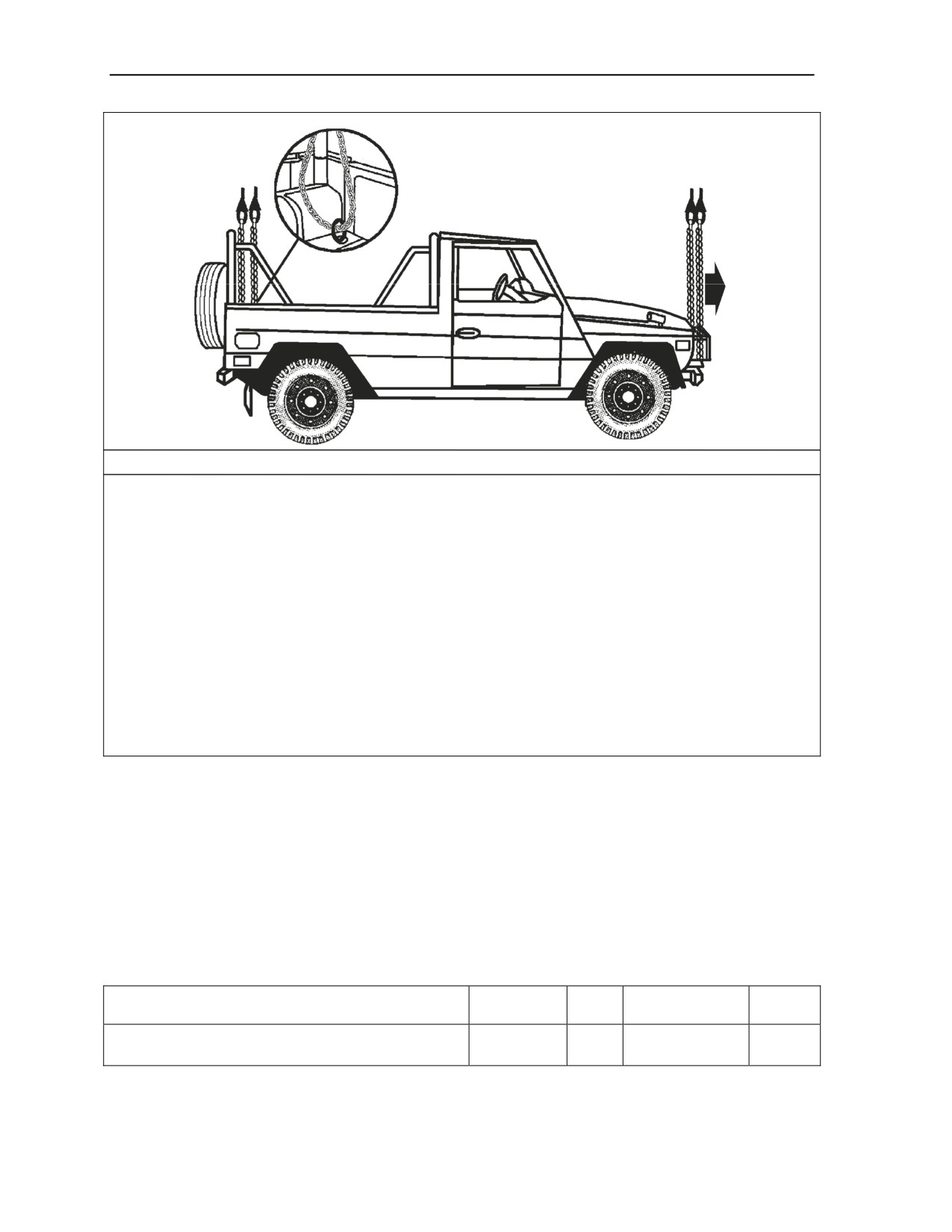
Chapter 2
RIGGING STEPS
1. Connect 2 sling legs to web ring number 1. Position the apex fitting on the hood of the vehicle.
2. Loop the chain end of the sling legs through their respective lift provisions located on the front bumper
of the vehicle. Place the correct link from Table 2-39 in the grab hook.
3. Connect 2 sling legs to web ring number 2. Position the apex fitting in the cargo bed of the vehicle.
4. Loop the chain end of the sling legs through their respective lift provision located in the rear corners of
the cargo bed. Place the correct link from Table 2-39 in the grab hook.
5. Secure all excess chain with tape or Type III nylon cord.
6. Cluster and tie (breakaway technique) the sling legs in each sling set on top of the vehicle to
prevent entanglement during hookup and lift-off.
Figure 2-38. Interim Fast Attack Vehicle Truck, Long Wheel Base
INTERIM FAST ATTACK VEHICLE TRUCK (IFAV), LONG WHEEL
BASE, SIDE BY SIDE (SHOTGUN)
2-41. The interim fast attack vehicle truck, long wheel base side by side (shotgun) is rigged for dual-point
sling load using the following procedures:
z
Applicability. The following item in Table 2-40 is certified for the helicopter(s) listed in the
following table by the US Army Natick Soldier Center:
Table 2-40. Interim Fast Attack Vehicle Truck, Long Wheel Base, Side by Side (Shotgun)
Nomenclature
Max Weight
Sling
Link Count
Type of
(Pounds)
Set
Front/Rear
Aircraft
Interim Fast Attack Vehicle Truck, Long Wheel
11,440
15K
Listed in
CH-53
Base, Side by Side
Rigging Steps
z
Materials. The following materials are required to rig this load:
Sling set, 15,000-pound capacity (2 each).
FM 4-20.199/MCRP 4-11.3E, VOL III/NTTP 3-04.13/
2-90
AFMAN 11-223 (I), VOL III/COMDINST M13482.4B
20 February 2009
Certified Dual-Point Rigging Procedures for Wheeled Vehicles
Tape, adhesive, pressure-sensitive, 2-inch wide roll.
Cord, nylon, Type III, 550-pound breaking strength.
Webbing, cotton, 1/4-inch, 80-pound breaking strength.
Padding, cellulose.
Strap, tiedown, cargo, CGU-1/B (3 each).
z
Personnel. Three persons can prepare and rig this load in 15 minutes.
z
Procedures. The following procedures apply to this load:
Preparation. Prepare the load using the following steps:
─ Fold mirrors forward in front of the windshield for added protection and tie together
with Type III nylon cord. Remove all canvas covers.
─ Secure all equipment and cargo inside the vehicle with tape, nylon cord, or lashings.
─ Ensure the fuel tank is not over 3/4 full. Inspect fuel tank cap, oil filler cap, and
battery caps for proper installation.
─ Engage the vehicle parking brake and put the transmission in neutral.
─ Ensure the front wheels are pointed straight ahead. Tie down the steering wheel using
Type III nylon cord.
─ Tape the windshield in an X formation from corner to corner.
─ Secure the vehicle camouflage net (in the bag) to each vehicle. Attach one net to the
forward roadside of the right vehicle and the other to the rear curbside of the left
vehicle.
─ Position the vehicles as close together as possible and ensure the vehicles are facing in
the same direction. Route a CGU-1/B cargo tiedown strap through the inboard
tiedown provision located below the front bumper of each vehicle. Connect the hooks
together and tighten the straps.
─ Route a CGU-1/B cargo tiedown strap through the pintles of both vehicles and connect
the hooks together. Tighten the strap. Route the second CGU-1/B cargo tiedown strap
around the inboard roll bars located directly behind the front seat and connect the
hooks together. Tighten the straps.
Rigging. Rig the load according to the steps in Figure 2-39.
Hookup. The hookup team stands on the vehicle. The static wand person discharges the
static electricity with the static wand. The forward hookup person places apex fitting 1 onto
the forward cargo hook. The aft hookup person places apex fitting 2 onto the aft cargo hook.
The hookup team then carefully dismounts the vehicle and remains close to the load as the
helicopter removes slack from the sling legs. When successful hookup is assured, the hookup
team quickly exits the area underneath the helicopter to the designated rendezvous point.
Derigging. Derigging is the reverse of the preparation and rigging procedures.
FM 4-20.199/MCRP 4-11.3E, VOL III/NTTP 3-04.13/
20 February 2009
AFMAN 11-223 (I), VOL III/COMDINST M13482.4B
2-91
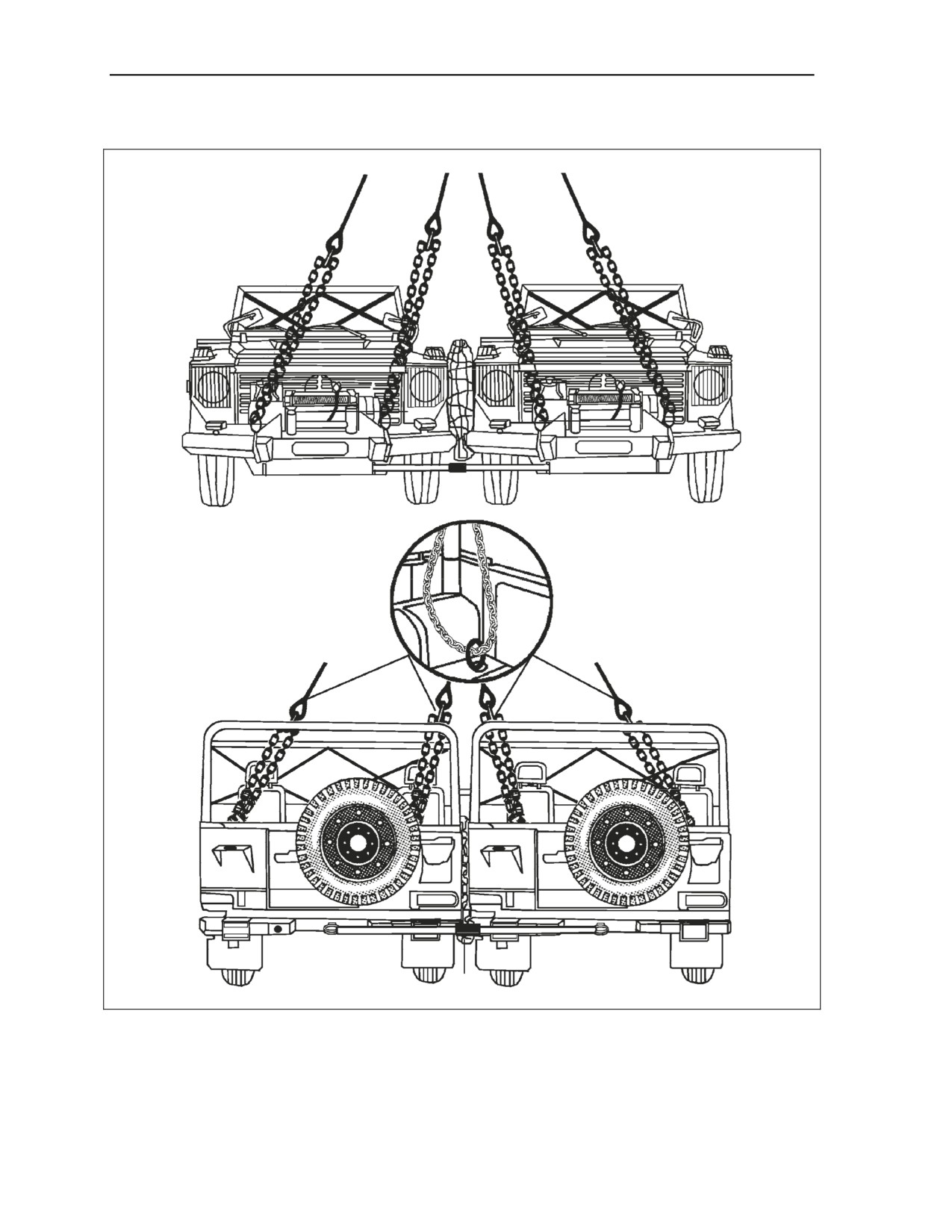
Chapter 2
FRONT VIEW
CAMO
NET
REAR VIEW
CAMO
NET
Figure 2-39. Interim Fast Attack Vehicle Truck, Long Wheel Base, Side by Side (Shotgun)
FM 4-20.199/MCRP 4-11.3E, VOL III/NTTP 3-04.13/
2-92
AFMAN 11-223 (I), VOL III/COMDINST M13482.4B
20 February 2009

Certified Dual-Point Rigging Procedures for Wheeled Vehicles
RIGGING STEPS
1. Position sling set 1 on the hood of one of the vehicles.
2. Loop the chain end of sling legs 1 and 2 through their respective outboard lift provisions located on the
front of each vehicle. Place link 3 in the grab hook.
3. Loop the chain end of sling legs 3 and 4 through their respective inboard lift provisions located on the
front of each vehicle. Place link 10 in the grab hook. Ensure the chains are routed through the chain
guides.
4. Position sling set 2 in the bed of one of the vehicles.
5. Loop the chain end of sling legs 1 and 2 through their respective lift provision located in the outside rear
corners of the cargo bed. Place link 45 in the grab hook.
6. Loop the chain end of sling legs 3 and 4 through their respective lift provision located in the inside rear
corners of the cargo bed. Place link 60 in the grab hook.
7. Secure all excess chain with tape or Type III nylon cord.
8. Cluster and tie tape (breakaway technique) the sling legs in each sling set on top of the vehicle to
prevent entanglement during hookup and lift-off.
Figure 2-39. Interim Fast Attack Vehicle Truck, Long Wheel Base, Side by Side (Shotgun)
(Continued)
MEDIUM TACTICAL VEHICLES M1083/M1083A1/M1084/M1085/
M1086/M1090/M1090A1/M1093/M1094
2-42. The medium tactical vehicles M1083/M1083A1/M1084/M1085/M1086/M1090/M1090A1/M1093
M1094 are rigged for dual-point sling load using the following procedures:
z
Applicability. The following items in Table 2-41 are certified for the helicopter(s) listed in the
following table by the US Army Natick Soldier Center:
Table 2-41. Medium Tactical Vehicles M1083/M1083A1/M1084/M1085/M1086/M1090/
M1090A1/M1093/M1094
Nomenclature
Max Weight
Sling
Link Count
Type of
(Pounds)
Set
Front/Rear
Aircraft
Medium Tactical Vehicle, Cargo, M1083
23,200
25K
30/20
CH-47
Medium Tactical Vehicle, Cargo, M1083A1
23,200
25K
30/20
CH-47
Medium Tactical Vehicle, Cargo, M1083
28,000
40K
24/16
CH-53
Medium Tactical Vehicle, Cargo, M1083A1
28,000
40K
24/16
CH-53
Medium Tactical Vehicle, Cargo, with Material
28,000
40K
19/16
CH-53
Handling Equipment, M1084
Medium Tactical Vehicle, Cargo, Longbed, M1085
28,000
40K
24/16
CH-53
Medium Tactical Vehicle, Cargo, Longbed, with
28,000
40K
17/16
CH-53
Material Handling Equipment, M1086
Medium Tactical Vehicle, Dump Truck, M1090
22,100
25K
30/3
CH-47
FM 4-20.199/MCRP 4-11.3E, VOL III/NTTP 3-04.13/
20 February 2009
AFMAN 11-223 (I), VOL III/COMDINST M13482.4B
2-93
Chapter 2
Table 2-41. Medium Tactical Vehicles M1083/M1083A1/M1084/M1085/M1086/M1090/
M1090A1/M1093/M1094 (Continued)
Nomenclature
Max Weight
Sling
Link Count
Type of
(Pounds)
Set
Front/Rear
Aircraft
Medium Tactical Vehicle, Dump Truck, M1090A1
23,200
25K
30/3
CH-47
Medium Tactical Vehicle, Dump Truck, M1090
22,100
40K
3/10
CH-53
Medium Tactical Vehicle, Dump Truck, M1090A1
24,817
40K
3/10
CH-53
Medium Tactical Vehicle, Cargo, Airdrop Variant,
23,200
25K
30/20
CH-47
M1093
Medium Tactical Vehicle, Dump Truck, Airdrop
22,770
25K
30/3
CH-47
Variant, M1094
WARNING
Exceeding the recommended airspeed listed in Appendix C may
result in damage to the windshields of the vehicles.
z
Materials. The following materials are required to rig this load:
Sling set (25,000-pound capacity) with one additional apex fitting.
─ Additional chain length, part number 38850-00053-102, from a 25,000-pound capacity
sling set (2 each).
─ Additional coupling link, part number 5779135, from a 25,000-pound capacity sling
set (2 each).
OR
Sling set (40,000-pound capacity) with one additional apex fitting.
─ Additional chain length, part number 607050, from a 40,000-pound capacity sling set
(2 each).
─ Additional coupling link, part number 577-0815, from a 40,000-pound capacity sling
set (2 each).
Tape, adhesive, pressure-sensitive, 2-inch wide roll.
Cord, nylon, Type III, 550-pound breaking strength.
Webbing, cotton, 1/4-inch, 80-pound breaking strength.
z
Personnel. Two persons can prepare and rig this load in 15 minutes.
z
Procedures. The following procedures apply to this load:
Preparation. Prepare the load using the following steps:
─ Fold the cab sides up and fasten the roof to the cab if the cab is in the stowed/airdrop
position.
─ Extend the front lift provisions and the rear load spreaders and lock in place using the
attached pin and safety pin.
─ Roll up the windows in the cab.
─ Tape all windows, lights, and reflectors.
─ Remove the air intake cowling by loosening the clamp and twisting off. Place the
cowling on the floor board of the passenger's side.
─ Ensure the front wheels are pointed straight ahead. Tie down the steering wheel using
the driver's side seat belt.
─ Fold the side view mirrors back and secure with tape or Type III nylon cord.
FM 4-20.199/MCRP 4-11.3E, VOL III/NTTP 3-04.13/
2-94
AFMAN 11-223 (I), VOL III/COMDINST M13482.4B
20 February 2009
Certified Dual-Point Rigging Procedures for Wheeled Vehicles
─ Safety the cargo bed walls securing clips in the secured position with tape (only if the
cargo bed walls are not stowed in the racks under the bed).
─ Stow and secure the cab protector (dump trucks only).
─ Stow the mud flaps by bending and hooking on the mud flap hooks.
─ Engage the vehicle parking brake and put the transmission in neutral.
─ Ensure the fuel tank is not over 3/4 full. Inspect fuel tank cap, oil filler cap, and
battery caps for proper installation.
─ Tape the filler pipes behind the cab on the driver's side to prevent the sling legs from
becoming entangled.
─ Secure any cargo in the bed of the vehicle.
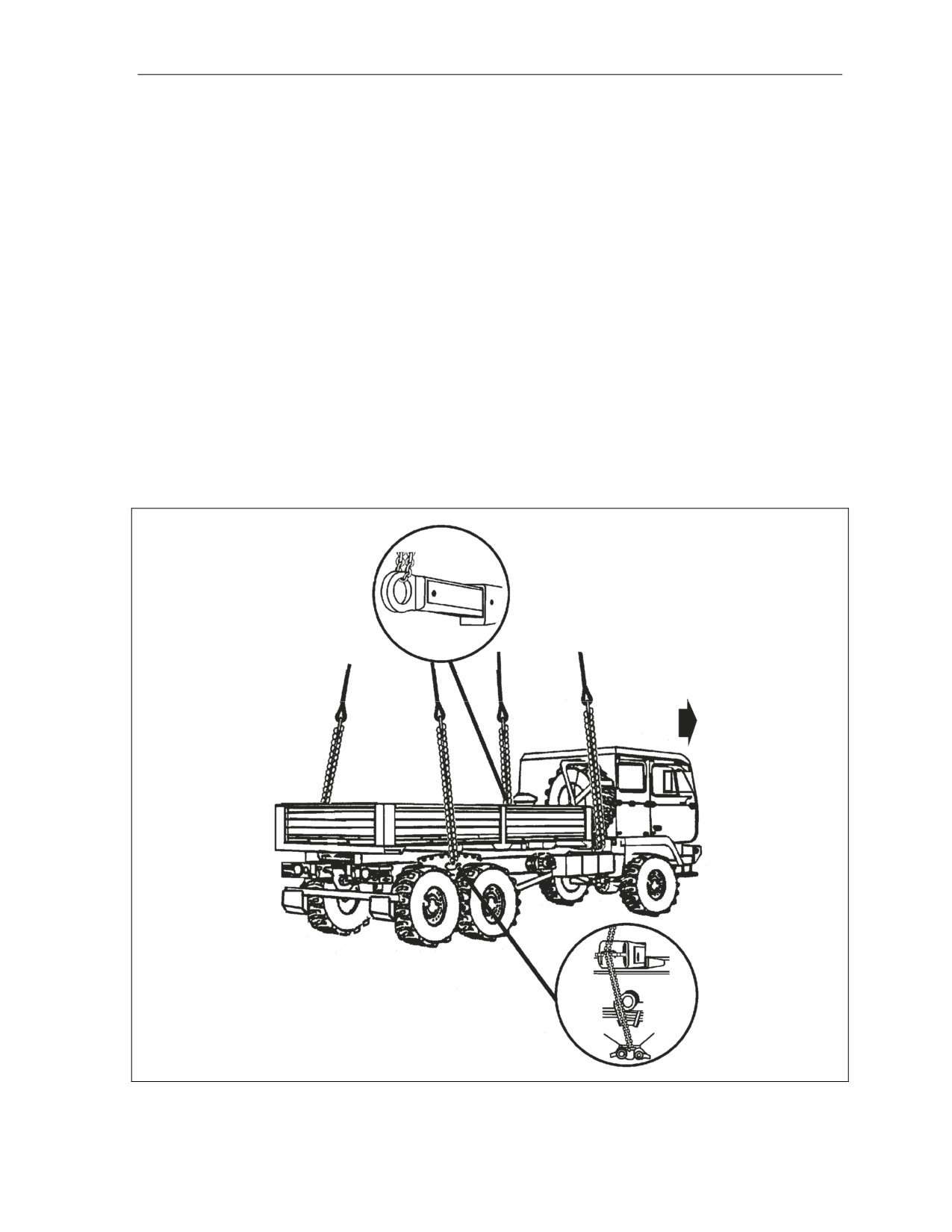
Rigging. Rig the load according to the steps in Figure 2-40.
Hookup. The hookup team stands in the bed of the vehicle. The static wand person
discharges the static electricity with the static wand. The forward hookup person places apex
fitting 1 onto the forward cargo hook. The aft hookup person places apex fitting 2 onto the aft
cargo hook. The hookup team then carefully dismounts the vehicle and remains close to the
load as the helicopter removes slack from the sling legs. When successful hookup is assured,
the hookup team quickly exits the area underneath the helicopter to the designated rendezvous
point.
Derigging. Derigging is the reverse of the preparation and rigging procedures.
Figure 2-40. Medium Tactical Vehicles
FM 4-20.199/MCRP 4-11.3E, VOL III/NTTP 3-04.13/
20 February 2009
AFMAN 11-223 (I), VOL III/COMDINST M13482.4B
2-95

Chapter 2
RIGGING STEPS
1.
Connect 2 sling legs to apex fitting number 1. Position the apex fitting on the forward end of
the bed.
2.
Loop the chain end of the sling legs through their respective lift provisions located behind the
vehicle cab. Place the correct link from Table 2-41 in the grab hook and secure all excess
chain with tape or Type III nylon cord.
3.
Cluster and tie (breakaway technique) the sling legs on top of the spare tire to prevent
entanglement during hookup and lift-off.
4.
Connect 2 sling legs to apex fitting number 2. Attach one extra chain length to each existing
chain on each sling leg using one coupling link. Position the apex fitting on the rear of the
cargo bed.
5.
Route the left and right chains through their respective rear load spreader and loop the chain
end of the sling legs through their respective lift ring located on the chassis between the tires.
Route the chains back through the rear load spreaders and place the correct link from Table
2-41 in the grab hook. Secure all excess chain with tape or Type III nylon cord.
6.
Cluster and tie (breakaway technique) the sling legs together to prevent entanglement during
hookup and lift-off.
Figure 2-40. Medium Tactical Vehicles (Continued)
LIGHT MEDIUM TACTICAL VEHICLES (LMTV) M1078/M1078A1/
M1079A1/M1081
2-43. The light medium tactical vehicles M1078/M1078A1/M1079A1/M1081 are rigged for dual-point
sling load using the following procedures:
z
Applicability. The following items in Table 2-42 are certified for the helicopter(s) listed in the
following table by the US Army Natick Soldier Center:
Table 2-42. Light Medium Tactical Vehicles M1078/M1078A1/M1079A1/M1081
Nomenclature
Max Weight
Sling
Link Count
Type of
(Pounds)
Set
Front/Rear
Aircraft
Light Medium Tactical Vehicle, Cargo, M1078
23,200
25K
30/20
CH-47
Light Medium Tactical Vehicle, Cargo, M1078A1
23,200
25K
30/20
CH-47
Light Medium Tactical Vehicle, Shop Van, M1079A1
23,200
25K
30/20
CH-47
Light Medium Tactical Vehicle, Cargo, M1081
23,200
25K
30/20
CH-47
WARNING
Exceeding the recommended airspeed listed in Appendix C may
result in damage to the windshields of the vehicles.
FM 4-20.199/MCRP 4-11.3E, VOL III/NTTP 3-04.13/
2-96
AFMAN 11-223 (I), VOL III/COMDINST M13482.4B
20 February 2009
Certified Dual-Point Rigging Procedures for Wheeled Vehicles
z
Materials. The following materials are required to rig this load:
Sling set (25,000-pound capacity) with one additional apex fitting.
─ Additional chain length, part number 38850-00053-102, from a 25,000-pound capacity
sling set (6 each).
─ Additional coupling link, part number 5779135, from a 25,000-pound sling set (6
each).
─ Tape, adhesive, pressure-sensitive, 2-inch wide roll.
─ Cord, nylon, Type III, 550-pound breaking strength.
─ Webbing, cotton, 1/4-inch, 80-pound breaking strength.
z
Personnel. Two persons can prepare and rig this load in 15 minutes.
z
Procedures. The following procedures apply to this load:
Preparation. Prepare the load using the following steps:
─ Fold the cab sides up and fasten the roof to the cab if the cab is in the stowed/airdrop
position (airdrop variant only).
─ Extend the front lift provisions and the rear load spreaders and lock in place using the
attached pin and safety pin.
─ Roll up the windows in the cab.
─ Tape all windows, lights, and reflectors.
─ Remove the air intake cowling by loosening the clamp and twisting off. Place the
cowling on the floor board of the passenger's side.
─ Ensure the front wheels are pointed straight ahead. Tie down the steering wheel using
the driver's side seat belt.
─ Fold the side view mirrors back and secure with tape or Type III nylon cord.
─ Safety the cargo bed walls securing clips in the secured position with tape (only if the
cargo bed walls are not stowed in the racks under the bed).
─ Stow the mud flaps by bending and hooking on the mud flap hooks.
─ Engage the vehicle parking brake and put the transmission in neutral.
─ Ensure the fuel tank is not over 3/4 full. Inspect fuel tank cap, oil filler cap, and
battery caps for proper installation.
─ Tape the filler pipes behind the cab on the driver's side to prevent the sling legs from
becoming entangled.
─ Secure any cargo in the bed of the vehicle.
Rigging. Rig the load according to the steps in Figure 2-41.
Hookup. The hookup team stands in the bed of the vehicle. The static wand person
discharges the static electricity with the static wand. The forward hookup person places apex
fitting 1 onto the forward cargo hook. The aft hookup person places apex fitting 2 onto the aft
cargo hook. The hookup team then carefully dismounts the vehicle and remains close to the
load as the helicopter removes slack from the sling legs. When successful hookup is assured,
the hookup team quickly exits the area underneath the helicopter to the designated rendezvous
point.
Derigging. Derigging is the reverse of the preparation and rigging procedures.
FM 4-20.199/MCRP 4-11.3E, VOL III/NTTP 3-04.13/
20 February 2009
AFMAN 11-223 (I), VOL III/COMDINST M13482.4B
2-97
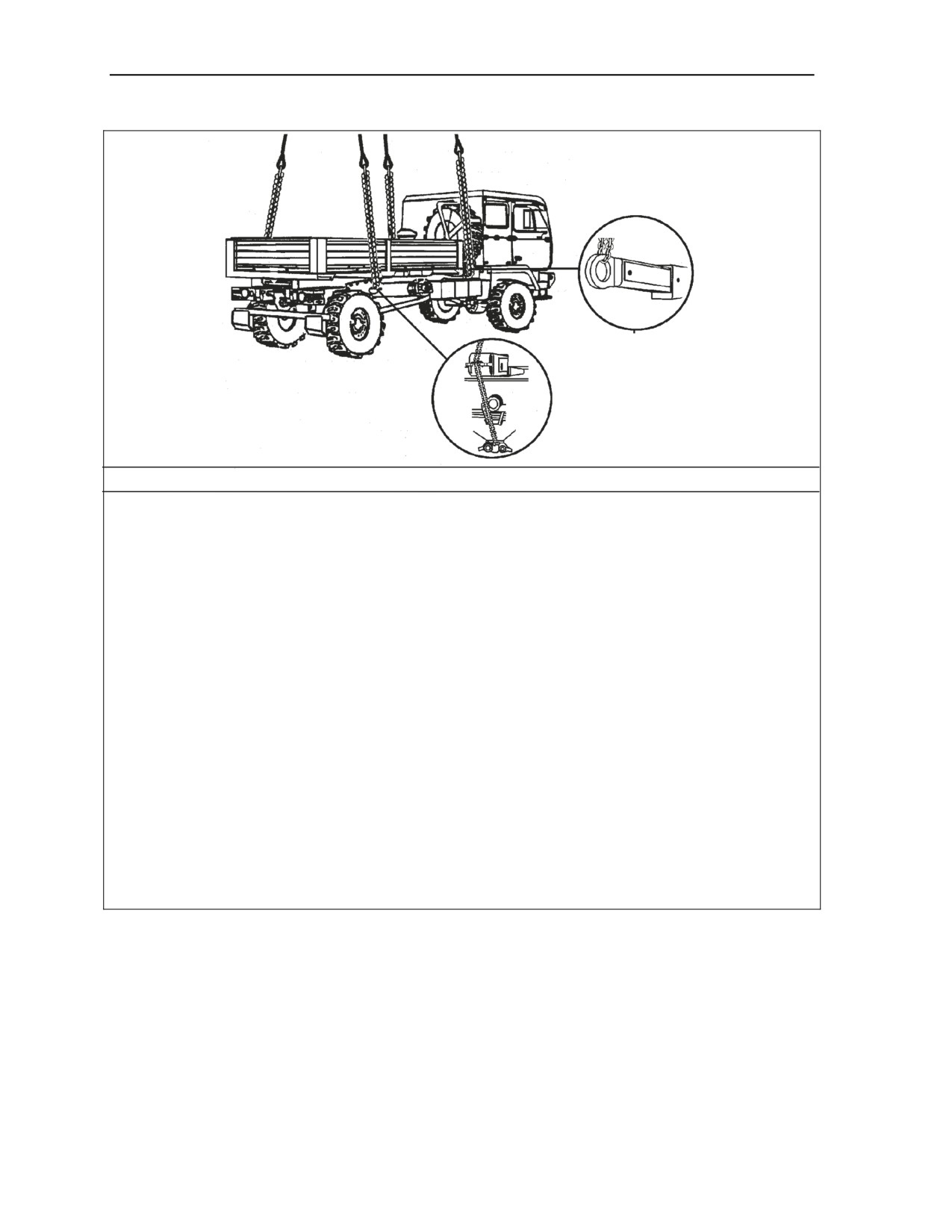
Chapter 2
RIGGING STEPS
1.
Connect 2 sling legs to apex fitting number 1. Attach one extra chain length to each existing
chain on each sling leg using one coupling link. Position the apex fitting on the forward end
of the bed.
2.
Loop the chain end of the sling legs through their respective lift provisions located behind the
vehicle cab. Place the correct link from Table 2-42 in the grab hook and secure all excess
chain with tape or Type III nylon cord.
3.
Cluster and (breakaway technique) the sling legs on top of the spare tire to prevent
entanglement during hookup and lift-off.
4.
Connect 2 sling legs to apex fitting number 2. Attach two extra chain lengths to each existing
chain on each sling leg using one coupling link for each additional chain length added.
Position the apex fitting on the rear of the cargo bed.
5.
Route the left and right chains through their respective rear load spreader and loop the chain
end of the sling legs through their respective lift ring, located on the chassis near the rear
axle. Route the chains back through the rear load spreaders and place the correct link from
Table 2-42 in the grab hook. Secure all excess chain with tape or Type III nylon cord.
6.
Cluster and tie (breakaway technique) the sling legs together to prevent entanglement during
hookup and lift-off.
Figure 2-41. Light Medium Tactical Vehicles
FM 4-20.199/MCRP 4-11.3E, VOL III/NTTP 3-04.13/
2-98
AFMAN 11-223 (I), VOL III/COMDINST M13482.4B
20 February 2009

Certified Dual-Point Rigging Procedures for Wheeled Vehicles
LIGHT MEDIUM TACTICAL VEHICLES (LMTV) M1078/M1078A1/
M1081 WITH TYPE III CARGO BED COVER AND MEDIUM
TACTICAL VEHICLES (MTV) M1083/M1083A1/M1093 WITH TYPE IV
CARGO BED COVER
2-44. The light medium tactical vehicles M1078/M1078A1/M1081 with type III cargo bed cover and
medium tactical vehicles M1083/M1083A1/M1093 with type IV cargo bed cover are rigged for dual-point
sling load using the following procedures:
z
Applicability. The following items in Table 2-43 are certified for the helicopter(s) listed in the
following table by the US Army Natick Soldier Center:
Table 2-43. LMTVs and MTVs with Cargo Bed Covers
Nomenclature
Max Weight
Sling
Link Count
Type of
(Pounds)
Set
Front/Rear
Aircraft
Type III Cargo Bed Cover (deployed or stowed) on
23,200
25K
25/3
CH-47
Light Medium Tactical Vehicle, Cargo,
M1078/M1078A1/M1081
30/20Type IV Cargo Bed Cover (deployed or stowed)
23,200
25K
20/3
CH-47
on Medium Tactical Vehicle, Cargo,
M1083/M1083A1/M1093
WARNING
Exceeding the recommended airspeed listed in Appendix C may
result in damage to the windshields of the vehicles.
Note: Certified cargo bed cover NSNs are:
Type III Camouflage:
5411-01-472-7852
Type III Sand:
5411-01-479-1932
Type IV Camouflage:
5411-01-472-7857
Type IV Sand:
5411-01-479-1933
FM 4-20.199/MCRP 4-11.3E, VOL III/NTTP 3-04.13/
20 February 2009
AFMAN 11-223 (I), VOL III/COMDINST M13482.4B
2-99
Chapter 2
z
Materials. The following materials are required to rig this load:
Sling set (25,000-pound capacity) with one additional apex fitting.
─ Additional chain length, part number 38850-00053-102, from a 25,000-pound capacity
sling set (6 each).
─ Additional coupling link, part number 5779135, from a 25,000-pound capacity sling
set (6 each).
Tape, adhesive, pressure-sensitive, 2-inch wide roll.
Cord, nylon, Type III, 550-pound breaking strength.
Webbing, cotton, 1/4-inch, 80-pound breaking strength.
z
Personnel. Two persons can prepare and rig this load in 15 minutes.
z
Procedures. The following procedures apply to this load:
Preparation. Prepare the load using the following steps:
─ Fold the cab sides up and fasten the roof to the cab if the cab is in the stowed/airdrop
position (airdrop variant only).
─ Extend the front lift provisions and the rear load spreaders and lock in place using the
attached pin and safety pin.
─ Roll up the windows in the cab.
─ Tape all windows, lights, and reflectors.
─ Remove the air intake cowling by loosening the clamp and twisting off. Place the
cowling on the floor board of the passenger's side.
─ Ensure the front wheels are pointed straight ahead. Tie down the steering wheel using
the driver's side seat belt.
─ Fold the side view mirrors back and secure with tape or Type III nylon cord.
─ Safety the cargo bed walls securing clips in the secured position with tape (only if the
cargo bed walls are not stowed in the racks under the bed).
─ Stow the mud flaps by bending and hooking on the mud flap hooks.
─ Engage the vehicle parking brake and put the transmission in neutral.
─ Ensure the fuel tank is not over 3/4 full. Inspect fuel tank cap, oil filler cap, and
battery caps for proper installation.
─ Tape the filler pipes behind the cab on the driver's side to prevent the sling legs from
becoming entangled.
─ Secure any cargo that is stowed in the cargo bed cover with lashings, Type III nylon
cord, or tape.
FM 4-20.199/MCRP 4-11.3E, VOL III/NTTP 3-04.13/
2-100
AFMAN 11-223 (I), VOL III/COMDINST M13482.4B
20 February 2009
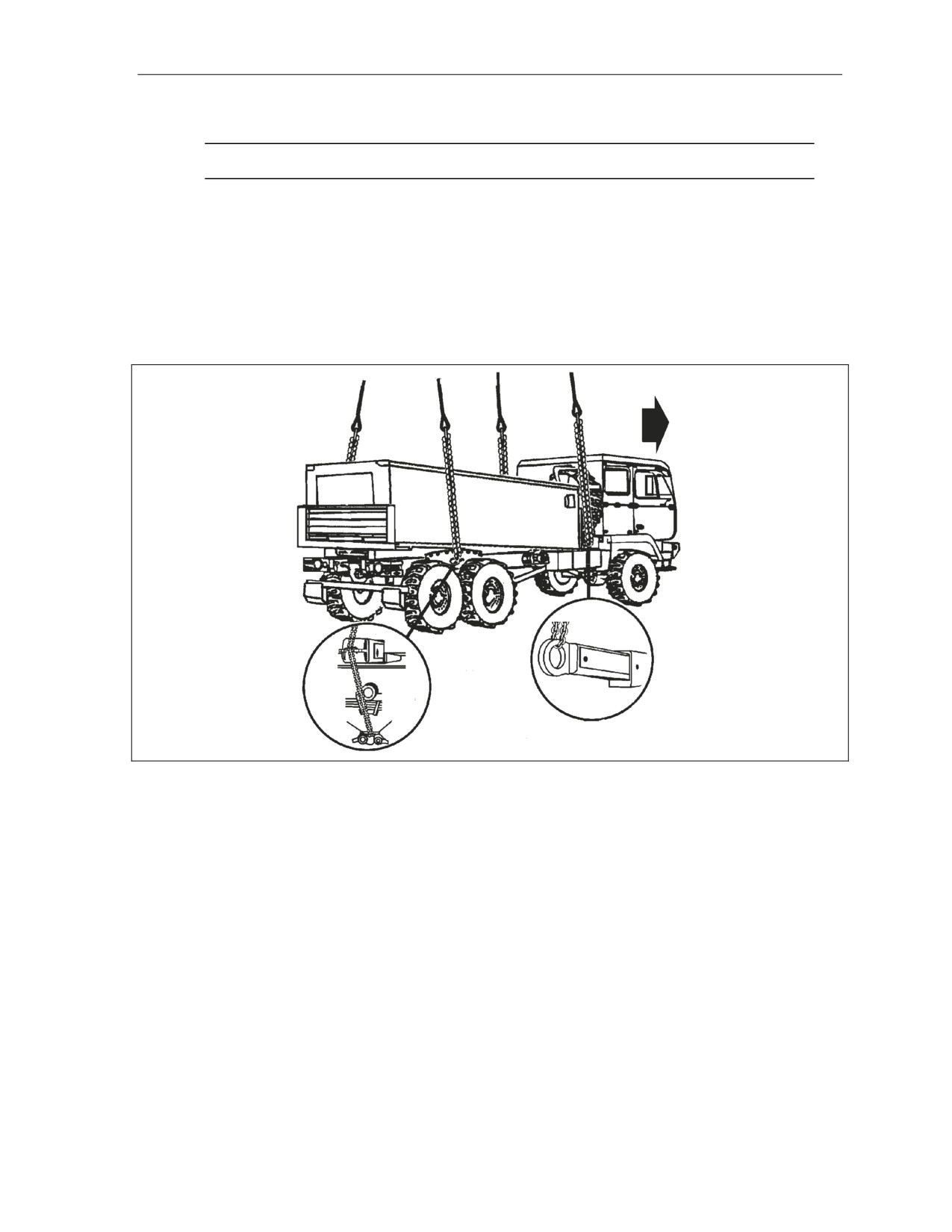
Certified Dual-Point Rigging Procedures for Wheeled Vehicles
Rigging. Rig the load according to the steps in Figure 2-42.
Note: Figure 2-42 shows an MTV. The LMTVs only have one rear axle.
Hookup. The hookup team stands on the cargo bed cover. The static wand person
discharges the static electricity with the static wand. The forward hookup person places apex
fitting 1 onto the forward cargo hook. The aft hookup person places apex fitting 2 onto the aft
cargo hook. The hookup team then carefully dismounts the vehicle and remains close to the
load as the helicopter removes slack from the sling legs. When successful hookup is assured,
the hookup team quickly exits the area underneath the helicopter to the designated rendezvous
point.
Derigging. Derigging is the reverse of the preparation and rigging procedures.
Figure 2-42. LMTVs and MTVs with Cargo Bed Covers
FM 4-20.199/MCRP 4-11.3E, VOL III/NTTP 3-04.13/
20 February 2009
AFMAN 11-223 (I), VOL III/COMDINST M13482.4B
2-101
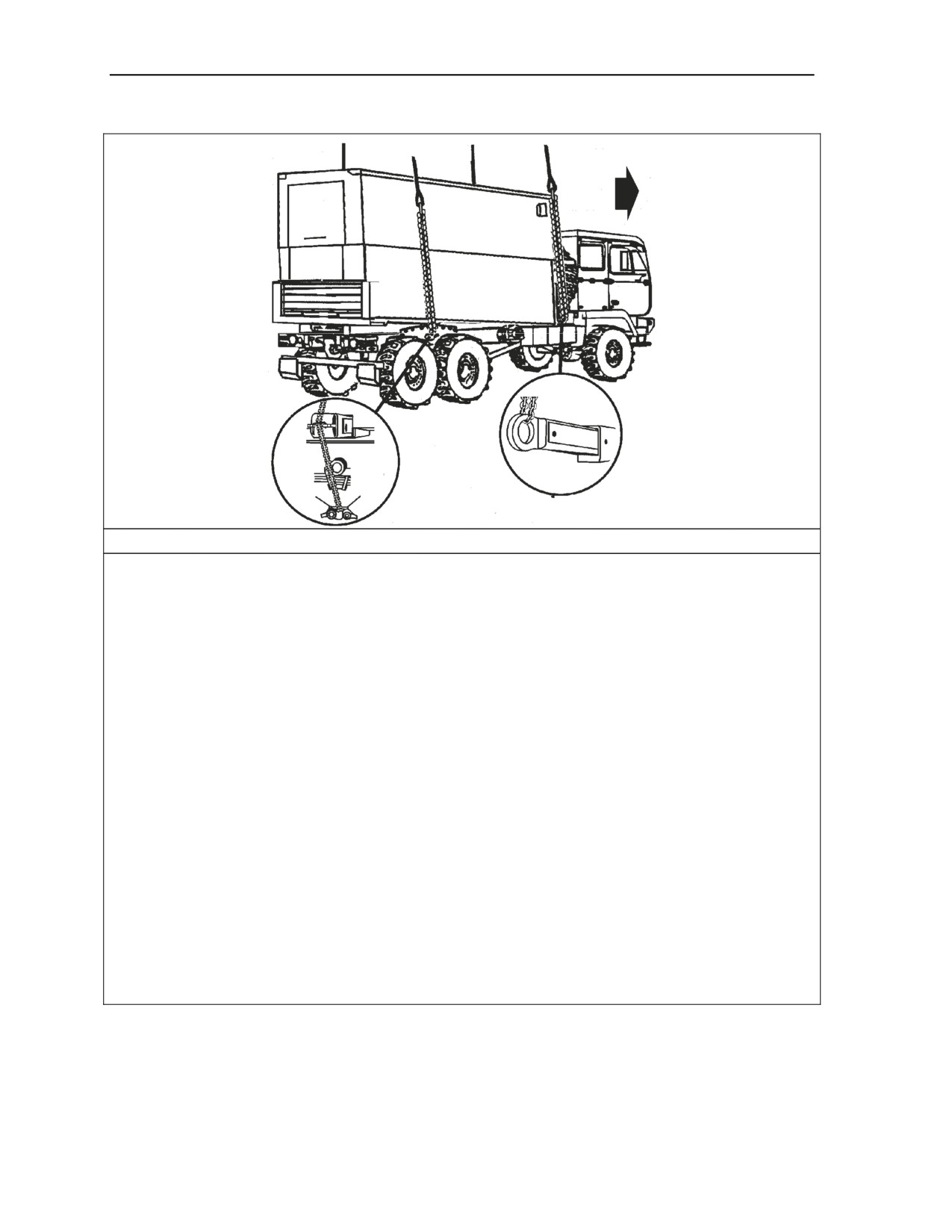
Chapter 2
RIGGING STEPS
1.
Connect 2 sling legs to apex fitting number 1. Attach one extra chain length to each existing
chain on each sling leg using one coupling link. Position the apex fitting on the forward end
of the cargo bed cover.
2.
Loop the chain end of the sling legs through their respective lift provisions located behind the
vehicle cab. Place the correct link from Table 2-43 in the grab hook and secure all excess
chain with tape or Type III nylon cord.
3.
Cluster and tie (breakaway technique) the sling legs on top of the spare tire to prevent
entanglement during hookup and lift-off.
4.
Connect 2 sling legs to apex fitting number 2. Attach two extra chain lengths to each existing
chain on each sling leg using one coupling link for each additional chain length added.
Position the apex fitting on the rear of the cargo bed cover.
5.
Route the left and right chains through their respective rear load spreader and loop the chain
end of the sling legs through their respective lift ring, located on the chassis near the rear
axle. Route the chains back through the rear load spreaders and place the correct link from
Table 2-43 in the grab hook. Secure all excess chain with tape or Type III nylon cord. Close
the safety gate on each of the rear load spreaders.
6.
Cluster and tie (breakaway technique) the sling legs together to prevent entanglement during
hookup and lift-off.
Figure 2-42. LMTVs and MTVs with Cargo Bed Covers (Continued)
FM 4-20.199/MCRP 4-11.3E, VOL III/NTTP 3-04.13/
2-102
AFMAN 11-223 (I), VOL III/COMDINST M13482.4B
20 February 2009