FM 4-20.199 Multiservice Helicopter Sling Load: Dual-Point Load Rigging Procedures (February 2009) - page 7

Certified Dual-Point Rigging Procedures for Tandem Loads
RIGGING STEPS
1.
Position the apex fitting of the 25,000-pound capacity sling set on the roof of the shelter.
Route outer sling legs 1 and 2 to the front of the vehicle and inner sling legs 3 and 4 to the
rear. Sling legs 1 and 3 must be on the left side of the load.
2.
Loop the chain end of sling leg 1 through the left front lift provision that protrudes through the
hood from inboard to outboard. Place the correct link from Table 5-17 in the grab hook.
Repeat with sling leg 2 and the right front lift provision. Secure excess chain with tape or
Type III nylon cord.
3.
Loop the chain end of sling leg 3 through the left rear lift provision located on the outer end of
the rear bumper. Place the correct link from Table 5-17 in the grab hook. Repeat with sling
leg 4 and the right rear lift provision located on the outer end of the rear bumper ensuring the
sling leg is routed between the handholds on the right side of the system. Remove the slack
and secure sling leg 4 to the front handhold with a breakaway tie.
4.
Position the apex fitting of the 10,000-pound sling set on top of the trailer. Route outer sling
legs 1and 2 to the front of the trailer and inner sling legs 3 and 4 to the rear of the trailer.
Sling legs 1 and 3 must be on the left side of the load.
5.
Loop the chain end of sling leg 1 through the left front lift provision located on the front of the
trailer. Place the correct link from Table 5-17 in the grab hook. Repeat with sling leg 2
through the right front lift provision. Secure excess chain with tape or Type III nylon cord.
6.
Loop the chain end of sling leg 3 through the left rear lift provision. Place the correct link from
Table 5-17 in the grab hook. Repeat with sling leg 4 through the right rear lift provision.
Secure excess chain with tape or Type III nylon cord.
7.
Cluster and tie (breakaway technique) all sling legs together on top of the vehicle and the
trailer to prevent entanglement during hookup and lift-off.
Figure 5-17. Trojan Spirit Lite (V)2 Central Communications, AN/TSQ-226 (V)2 on M1113
HMMWV and M1102 Cargo Trailer (Continued)
JSTAR COMMON GROUND STATION (CGS) SUPPORT VEHICLE,
M1097 HMMWV AND M1102 HIGH MOBILITY TRAILER
5-19. The JSTAR common ground station support vehicle, M1097 HMMWV and M1102 high mobility
trailer are rigged for dual-point sling load using the following procedures:
z
Applicability. The following items in Table 5-18 are certified for the helicopter(s) listed in the
following table by the US Army Natick Soldier Center:
Table 5-18. JSTAR Common Ground Station Support Vehicle, M1097 HMMWV and M1102 High
Mobility Trailer
Nomenclature
Max Weight
Sling
Link Count
Type of
(Pounds)
Set
Front/Rear
Aircraft
CGS JSTAR Support Vehicle, M1097 HMMWV
5,600
25K
45/5
CH-47
M1102 Trailer (Modified), CGS JSTAR Support Trailer
3,652
25K
50/50
CH-47
z
Materials. The following materials are required to rig this load:
Sling set (25,000-pound capacity) (2 each).
FM 4-20.199/MCRP 4-11.3E, VOL III/NTTP 3-04.13/
20 February 2009
AFMAN 11-223 (I), VOL III/COMDINST M13482.4B
5-49
Chapter 5
─ Additional chain length, part number 38850-00053-102, from a 25,000-pound capacity
sling set (8 each).
─ Additional coupling link, part number 664241, from a 25,000-pound sling set (8 each).
Tape, adhesive, pressure-sensitive, 2-inch wide roll.
Cord, nylon, Type III, 550-pound breaking strength.
Webbing, cotton, 1/4-inch, 80-pound breaking strength.
Strap, cargo, tiedown, CGU-1/B (2 each).
z
Personnel. Two persons can prepare and rig the HMMWV in 15 minutes. Two persons can
prepare and rig the trailer in 15 minutes.
z
Procedures. Attach the trailer to the truck by placing the lunette on the pintle hook and
securing the latch with tape or Type III nylon cord. Secure the safety chains, cables, and hoses.
Position the vehicle on level ground so both the truck and trailer are in a straight line. The
following procedures apply to this load:
Preparation. Prepare the load using the following steps:
─ Fold mirrors inward and tie together with Type III nylon cord.
─ Secure all equipment and cargo inside the truck and trailer with tiedown straps, tape, or
Type III nylon cord. Secure the doors shut if installed.
─ Ensure the fuel tank is not over 3/4 full. Inspect the fuel tank cap, oil filler cap, and
battery caps for proper installation.
─ Engage the vehicle parking brake and put the transmission in neutral.
─ Ensure the front wheels are pointed straight ahead. Tie down the steering wheel, using
the securing device attached under the dashboard.
─ Tape the windshield in an X formation from corner to corner.
─ Secure the rear lift provisions in the up position with Type III nylon cord.
─ Retract the lunette leg and secure with Type III nylon cord.
─ Ensure the trailer parking brakes are set.
─ Route the hook portion of a CGU-1/B tiedown strap through the left rear inboard
tiedown provision located near the pintle on the rear bumper of the truck and through
the mounting bracket on the front of the trailer A-frame. Connect the hook to the
ratchet of the CGU-1/B.
─ Repeat the above procedure on the right side of the load.
─ Tighten both CGU-1/B tie-down straps at the same time. Secure the excess strap and
safety the ratchet handles in the closed position with tape.
─ Connect one additional chain length to each chain on the 25,000-pound capacity sling
set with a coupling link.
CAUTION
Do not connect the CGU-1/B tiedown strap around the truck's rear axle
or wheel.
Rigging. Rig the load according to the steps in Figure 5-18.
Hookup. Two hookup teams are required for this load. The static wand person discharges
the static electricity with the static wand. The forward hookup person kneels on the top of the
vehicle and places apex fitting 1 onto the forward cargo hook. The aft hookup person stands on the
trailer and places apex fitting
2 onto the aft cargo hook. The hookup team then carefully
dismounts the load and remains close to the load as the helicopter removes slack from the sling
legs. When successful hookup is assured, the hookup team quickly exits the area underneath
the helicopter to the designated rendezvous point.
Derigging. Derigging is the reverse of the preparation and rigging procedures.
FM 4-20.199/MCRP 4-11.3E, VOL III/NTTP 3-04.13/
5-50
AFMAN 11-223 (I), VOL III/COMDINST M13482.4B
20 February 2009
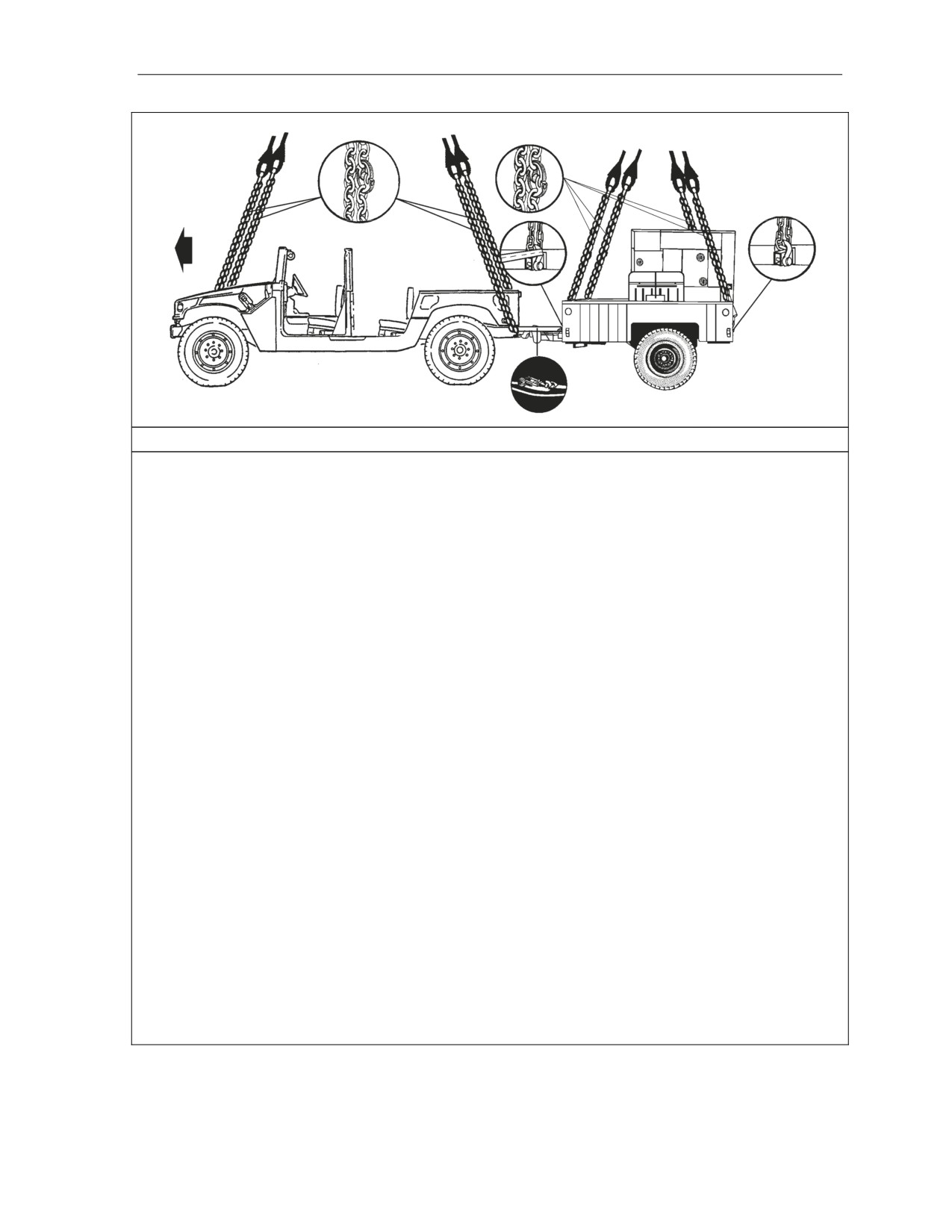
Certified Dual-Point Rigging Procedures for Tandem Loads
RIGGING STEPS
1.
Position apex fitting on top of the truck. Route outer sling legs 1 and 2 to the front of the
vehicle and inner sling legs 3 and 4 to the rear. Sling legs 1 and 3 must be on the left side of
the load.
2.
Loop the chain end of sling leg 1 through the left front lift provision that protrudes through the
hood from inboard to outboard. Place the correct link from Table 5-18 in the grab hook.
Repeat with sling leg 2 and the right front lift provision. Secure excess chain with tape or
Type III nylon cord.
3.
Loop the chain end of sling leg 3 through the left rear lift provision located on the outer ends
of the rear bumper. Place the correct link from Table 5-18 in the grab hook. Repeat with
sling leg 4 and the right rear lift provision. Secure excess chain with tape or Type III nylon
cord.
4.
Cluster and tie (breakaway technique) all sling legs together on top of the vehicle to prevent
entanglement during hookup and lift-off.
5.
Position the apex fitting of sling set 2 in the bed of the trailer. Route outer sling legs 1 and 2
to the front of the trailer and inner sling legs 3 and 4 to the rear of the trailer. Sling legs 1 and
3 must be on the left side of the load.
6.
Loop the chain end of sling leg 1 through the left front lift provision located on the front of the
trailer. Place the correct link from Table 5-18 in the grab hook. Repeat with sling leg 2
through the right front lift provision. Secure excess chain with tape or Type III nylon cord.
7.
Loop the chain end of sling leg 3 through the left rear lift provision. Place the correct link from
Table 5-18 in the grab hook. Repeat with sling leg 4 through the right rear lift provision.
Secure excess chain with tape or Type III nylon cord.
8.
Cluster and tie (breakaway technique) all sling legs together on top of the trailer to prevent
entanglement during hookup and lift-off.
Figure 5-18. JSTAR Common Ground Station Support Vehicle, M1097 HMMWV and M1102
High Mobility Trailer
FM 4-20.199/MCRP 4-11.3E, VOL III/NTTP 3-04.13/
20 February 2009
AFMAN 11-223 (I), VOL III/COMDINST M13482.4B
5-51
Chapter 5
M1097 TRUCK, UTILITY, 1 1/4-TON (HMMWV) WITH AN/MPQ-64
TACTICAL QUIET GENERATOR (TQG) AND HIGH MOBILITY
TRAILER (HMT) WITH SENTINEL ANTENNA TRANSCEIVER
GROUP (ATG)
5-20. The M1097 Truck, Utility, 1 1/4-Ton with AN/MPQ-64 Tactical Quiet Generator and High Mobility
Trailer with Sentinel Antenna Transceiver Group are rigged for dual-point sling load using the following
procedures:.
z
Applicability. The following items in Table 5-19 are certified for the helicopter(s) listed in the
following table by the US Army Natick Soldier Center:
Table 5-19. M1097 Truck, Utility, 1 1/4-Ton with AN/MPQ-64 Tactical Quiet Generator and High
Mobility Trailer with Sentinel Antenna Transceiver Group
Nomenclature
Max Weight
Sling
Link Count
Type of
(Pounds)
Set
Front/Rear
Aircraft
M1097 HMMWV with AN/MPQ-64 TQG
7,800
10K
27/3
CH-47
HMT with Sentinel ATG with Spreader Bar Modification
3,900
10K
6/30
CH-47
z
Materials. The following materials are required to rig this load:
Sling set (10,000-pound capacity) (2 each).
Tape, adhesive, pressure-sensitive, 2-inch wide roll.
Cord, nylon, Type III, 550-pound breaking strength.
Webbing, cotton, 1/4-inch, 80-pound breaking strength.
Strap, cargo, tiedown, CGU-1/B (2 each).
Plywood, 3/4-inch x 4-foot x 6-foot.
Reach pendants (2 each).
Spreader bar assembly (component of ATG/Trailer).
Felt sheet, cattle hair, Type IV, 1/2-inch or suitable substitute.
Reach pendant, 11,000- or 25,000-pound capacity (2 each).
z
Personnel. Two persons can prepare and rig the M1097 HMMWV in 10 minutes. Two persons
can prepare and rig the generator set in 10 minutes.
z
Procedures. Attach the ATG trailer to the truck by placing the lunette on the pintle hook and
securing the latch with tape or Type III nylon cord. Secure the safety chains, cables, and hoses.
Position the vehicle on level ground so both the truck and ATG trailer are in a straight line. The
following procedures apply to this load:
Preparation. Prepare the load using the following steps:
─ Fold mirrors inward and tie together with Type III nylon cord. Remove the doors and
the rear window. Secure the doors and window to the seats with Type III nylon cord.
─ Ensure all vents are closed and secured. Secure all loose equipment inside the vehicle
with tape, Type III nylon cord, or tiedown straps.
─ Ensure the fuel tanks are not over 3/4 full. Inspect the fuel tank cap, oil filler cap, and
battery caps for proper installation.
─ Engage the vehicle parking brake and put the transmission in neutral.
FM 4-20.199/MCRP 4-11.3E, VOL III/NTTP 3-04.13/
5-52
AFMAN 11-223 (I), VOL III/COMDINST M13482.4B
20 February 2009
Certified Dual-Point Rigging Procedures for Tandem Loads
─ Ensure the front wheels are pointed straight ahead. Tie down the steering wheel, using
the securing device attached under the dashboard.
─ Install the lift provisions on the outer ends of the rear bumper by removing the tiedown
provisions located on the front bumper and installing on the outer ends of the rear
bumper.
─ Partially retract all landing legs and secure with Type III nylon cord.
─ Secure all lids, doors, and caps with tape or Type III nylon cord.
─ Ensure the parking brake is set.
─ Route the hook portion of a CGU-1/B tiedown strap through the left rear inboard
tiedown provision located near the pintle on the rear bumper of the truck. Loop the
tiedown through the left front trailer lift provision located on the left front of the
trailer. Attach the hook portion of the tiedown strap to the ratchet.
Note: Do not attach the tiedown strap to the rear wheels of the vehicle. The rear wheels may
rotate during flight causing slack in the straps.
─ Repeat the above procedure on the right side of the load.
─ Tighten both CGU-1/B tiedown straps at the same time. Secure the excess strap and
safety the ratchet handles in the closed position with tape.
─ Pad the top Sensor Interface Unit (SIU) latch on the roadside to prevent sling leg
interference.
─ Cut and position pieces of plywood over the antenna boxes on top of the ATG. Secure
the plywood by drilling holes and lacing Type III nylon cord through the holes to
convenient places on the load. Ensure the plywood is securely tied to prevent it from
flying off during flight.
─ Attach a reach pendant on each sling set in accordance with FM 4-20.197.
Rigging. Rig the load according to the steps in Figure 5-19.
Hookup. Two hookup teams are required for this load. The forward hookup person stands
on top of the HMMWV wheel well and places the reach pendant with apex fitting 1 onto the
forward cargo hook. The aft hookup person stands on top of the trailer wheel well and places
the reach pendant with apex fitting 2 onto the aft cargo hook. The hookup team then carefully
dismounts the load and remains close to the load as the helicopter removes slack from the sling
legs. If the CGU-1/B tiedown straps loosen up the load should be set down and the tiedown
straps retightened. When successful hookup is assured, the hookup team quickly exits the
area underneath the helicopter to the designated rendezvous point
Note. Advise the aircraft commander to release the sling set apex fitting on the side of the
HMMWV and ATG to prevent damage.
Derigging. Derigging is the reverse of the preparation and rigging procedures.
FM 4-20.199/MCRP 4-11.3E, VOL III/NTTP 3-04.13/
20 February 2009
AFMAN 11-223 (I), VOL III/COMDINST M13482.4B
5-53
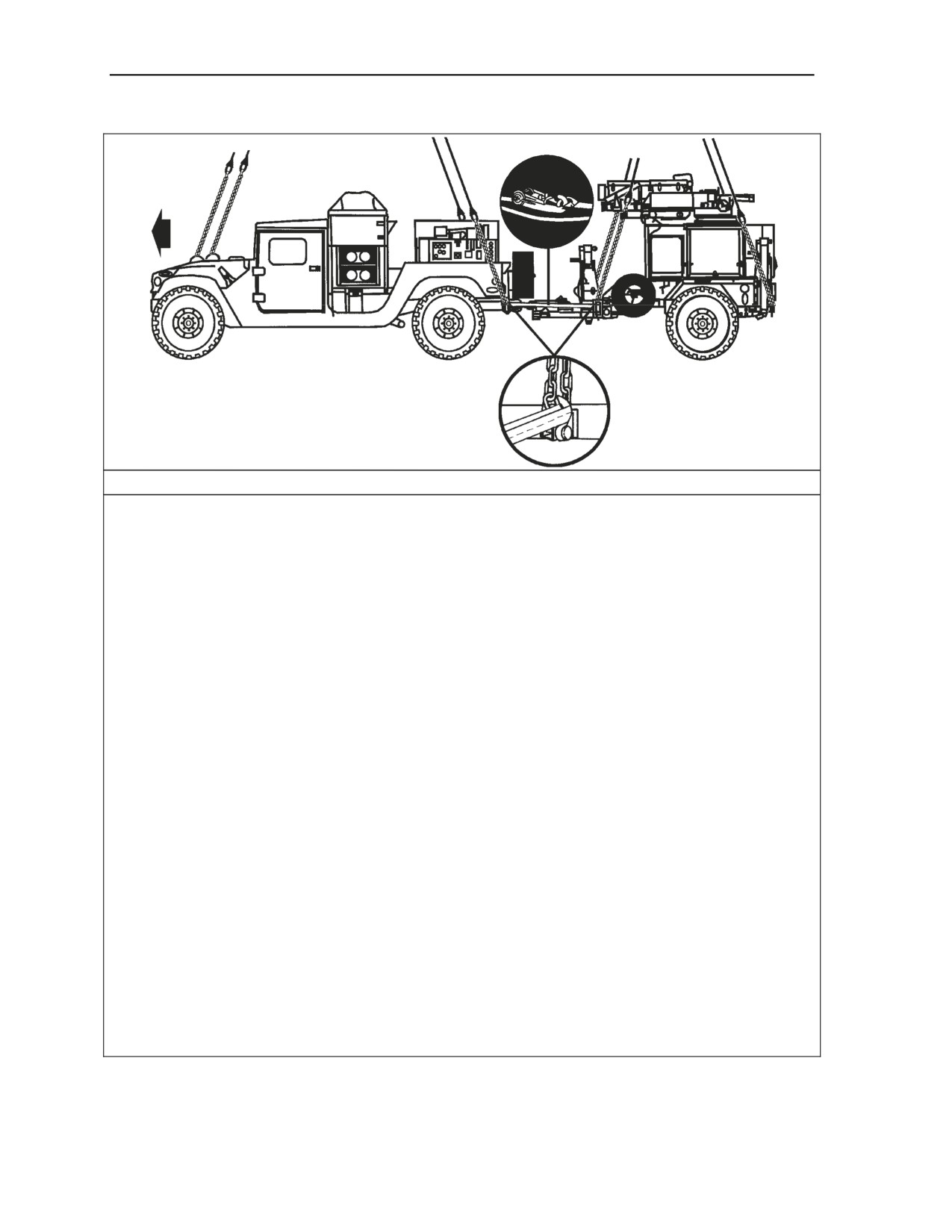
Chapter 5
RIGGING STEPS
1.
Position the reach pendant and apex fitting 1 on top of the roof of the vehicle. Route outer
sling legs 1 and 2 to the front of the vehicle and inner sling legs 3 and 4 to the rear. Sling
legs 1 and 3 must be on the left side of the load.
2.
Loop the chain end of sling leg 1 through the left front lift provision that protrudes through the
hood. Place the correct link from Table 5-19 in the grab hook. Repeat with sling leg 2 and
the right front lift provision. Secure excess chain with tape or Type III nylon cord.
3.
Loop the chain end of sling legs 3 and 4 through their respective lift provisions located on the
outer ends of the rear bumper. Place the correct link from Table 5-19 in the grab hook.
4.
Cluster and tie (breakaway technique) all sling legs together on top of the vehicle to prevent
entanglement during hookup and lift-off.
5.
Position the reach pendant and apex fitting of sling set 2 on top of the trailer. Route outer
sling legs 1 and 2 to the front of the trailer and inner sling legs 3 and 4 to the rear of the
trailer. Sling legs 1 and 3 must be on the left side of the load.
6.
Route the chain end of sling leg 1 through the left side loop of the spreader bar, through the
left front lift provision located on the front of the trailer, and back through the left loop of the
spreader bar. Place the correct link from Table 5-19 in the grab hook. Repeat with sling leg
2 through the right spreader bar loop and right front lift provision. Tie or tape (breakaway
technique) sling legs 1 and 2 together at 3-foot intervals on top of the trailer.
7.
Loop the chain end of sling leg 3 through the left rear lift provision located on the rear of the
trailer. Place the correct link from Table 5-19 in the grab hook. Repeat with sling leg 4
through the right rear lift provision. Secure excess chain with tape or Type III nylon cord. Tie
or tape (breakaway technique) sling legs 3 and 4 together at 3-foot intervals on top of the
trailer.
Figure 5-17. M1097 HMMWV with AN/MPQ-64 TQG and HMT with Sentinel ATG
FM 4-20.199/MCRP 4-11.3E, VOL III/NTTP 3-04.13/
5-54
AFMAN 11-223 (I), VOL III/COMDINST M13482.4B
20 February 2009
Certified Dual-Point Rigging Procedures for Tandem Loads
M1097, 1-1/4 TON (HMMWV) WITH GENERATOR PALLET GROUP
AND PU 799 G-85/TPQ-36 GENERATOR GROUP ON M116A3
TRAILER
5-21. The M1097, 1-1/4 Ton with Generator Pallet Group and PU 799 G-85/TPQ-36 Generator Group on
M116A3 Trailer are rigged for dual-point sling load using the following procedures:
z
Applicability. The following items in Table 5-20 are certified for the helicopter(s) listed in the
following table by the US Army Natick Soldier Center:
Table 5-20. M1097, 1-1/4 Ton with Generator Pallet Group and PU 799 G-85/TPQ-36 Generator
Group on M116A3 Trailer
Nomenclature
Max Weight
Sling
Link Count
Type of
(Pounds)
Set
Front/Rear
Aircraft
Truck, ! ¼-Ton, HMMWV M1097
7,400
10K
80/30
CH-47
G-85/TPQ-36 Generator Trailer Group
3,075
10K
52/36
CH-47
z
Materials. The following materials are required to rig this load:
Sling set (10,000-pound capacity) (2 each).
Tape, adhesive, pressure-sensitive, 2-inch wide roll.
Cord, nylon, Type III, 550-pound breaking strength.
Webbing, cotton, 1/4-inch, 80-pound breaking strength.
Strap, cargo, tie-down, CGU-1/B (2 each, or more as required to secure cargo).
Felt sheet, cattle hair, Type IV, 1/2-inch or suitable substitute.
z
Personnel. Two persons can prepare and rig the HMMWV in 15 minutes. Two persons can
prepare and rig the generator set in 10 minutes.
z
Procedures. Attach the generator set to the truck by placing the lunette on the pintle hook and
secure the latch. Secure the safety chains, cables, and hoses with tape or Type III nylon cord.
Position the vehicle on level ground so both the truck and generator set are in a straight line.
The following procedures apply to this load:
Preparation. Prepare the load using the following steps:
─ Fold mirrors forward in front of the windshield and tie together with Type III nylon
cord. Remove the doors and secure to the seats with Type III nylon cord.
─ Secure all equipment and cargo inside the truck with tiedown straps, tape, or Type III
nylon cord.
─ Ensure the fuel tanks are not over 3/4 full. Inspect the fuel tank cap, oil filler cap, and
battery caps for proper installation.
─ Engage the vehicle parking brake and put the transmission in neutral.
─ Ensure the front wheels are pointed straight ahead. Tie down the steering wheel, using
the securing device attached under the dashboard.
─ Retract the lunette leg and secure with Type III nylon cord.
─ Secure all lids, doors, and caps with tape or Type III nylon cord.
─ Ensure the trailer parking brakes are set.
─ Route the hook portion of a CGU-1/B tiedown strap through the left rear inboard
tiedown provision located near the pintle on the rear bumper of the truck and through
the mounting bracket on the front of the trailer A-frame. Connect the hook to the
ratchet of the CGU-1/B.
─ Repeat the above procedure on the right side of the load.
─ Tighten both CGU-1/B tiedown straps at the same time. Secure the excess strap and
safety the ratchet handles in the closed position with tape.
FM 4-20.199/MCRP 4-11.3E, VOL III/NTTP 3-04.13/
20 February 2009
AFMAN 11-223 (I), VOL III/COMDINST M13482.4B
5-55
Chapter 5
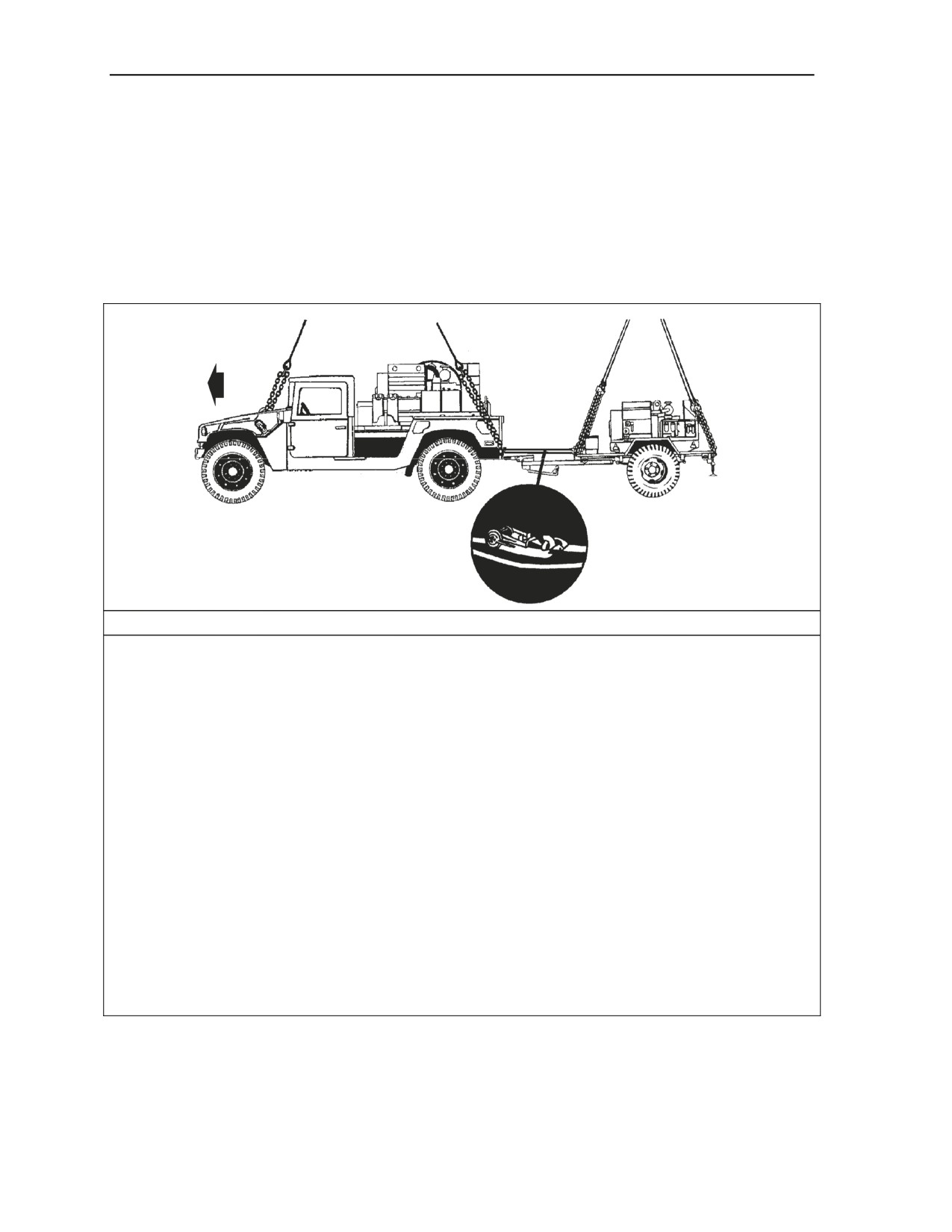
Rigging. Rig the load according to the steps in Figure 5-20.
Hookup. Two hookup teams are required for this load. The static wand person discharges
the static electricity with the static wand. The forward hookup person stands in the bed of the
truck and places apex fitting 1 onto the forward cargo hook. The aft hookup person stands on the
generator fender and places apex fitting 2 onto the aft cargo hook. The hookup team then
carefully dismounts the trailer and remains close to the load as the helicopter removes slack
from the sling legs. When successful hookup is assured, the hookup team quickly exits the
area underneath the helicopter to the designated rendezvous point.
Derigging. Derigging is the reverse of the preparation and rigging procedures.
RIGGING STEPS
1. Position the apex fitting of sling set 1 in the bed of the vehicle. Route outer sling legs 1 and 2
to the front of the vehicle and inner sling legs 3 and 4 to the rear. Sling legs 1 and 3 must be
on the left side of the load.
2. Loop the chain end of sling leg 1 through the left front lift provision that protrudes through the
hood. Place the correct link from Table 5-20 in the grab hook. Repeat with sling leg 2 and
the right front lift provision. Secure excess chain with tape or Type III nylon cord.
3. Route the chain end of sling leg 3 through the sling guide in the upper left corner of the
tailgate. Loop the chain end through the left lift provision on the bumper and thread back
through the sling guide in the tailgate. Place the correct link from Table 5-20 in the grab
hook. Repeat with sling leg 4 and the right rear lift provision.
4. Cluster and tie (breakaway technique) all sling legs together on top of the vehicle to prevent
entanglement during hookup and lift-off.
5. Position apex fitting of sling set 2 on the trailer but not on top of the generator. Route outer
sling legs 1 and 2 to the front of the trailer and inner sling legs 3 and 4 to the rear. Sling
legs 1 and 3 must be on the left side of the load.
Figure 5-20. M1097, 1-1/4 Ton with Generator Pallet Group and G-85/TPQ-36 Generator Group
FM 4-20.199/MCRP 4-11.3E, VOL III/NTTP 3-04.13/
5-56
AFMAN 11-223 (I), VOL III/COMDINST M13482.4B
20 February 2009

Certified Dual-Point Rigging Procedures for Tandem Loads
RIGGING STEPS (Continued)
6. Loop the chain end of sling leg 1 through the left front lift provision located near the A-frame
on the front of the trailer. Place the correct link from Table 5-20 in the grab hook. Repeat
with sling leg 2 through the right front lift provision. Secure excess chain with tape or Type III
nylon cord.
7. Route the chain end of sling leg 3 through the left rear lift provision. Place the correct link
from Table 5-20 in the grab hook. Repeat with sling leg 4 through the right rear lift provision.
Secure excess chain with tape or Type III nylon cord.
8. Pad the chains where they contact the load.
9. Cluster and tie (breakaway technique) all sling legs together on top of the trailer to prevent
entanglement during hookup and lift-off.
Figure 5-20. M1097, 1-1/4 Ton with Generator Pallet Group and G-85/TPQ-36 Generator Group
(Continued)
M1113 SHELTER CARRIER (HMMWV) WITH LMS SHELTER AND
PU-798 GENERATOR ON M116A3 TRAILER
5-22. The M1113 shelter carrier with LMS shelter and PU-798 generator on M116A3 trailer are rigged for
dual-point sling load using the following procedures:
z
Applicability. The following items in Table 5-21 are certified for the helicopter(s) listed in the
following table by the US Army Natick Soldier Center:
Table 5-21. M1113 Shelter Carrier with LMS Shelter and PU-798 Generator on M116A3 Trailer
Nomenclature
Max Weight
Sling
Link Count
Type of
(Pounds)
Set
Front/Rear
Aircraft
M1113 Shelter Carrier, HMMWV, with Digital
10,100
25K
35/5
CH-47
Topographic Support System-Light (DTSS-L), AN/TYQ-
67 (V)1
M1113 Shelter Carrier, HMMWV, with Integrated
9,982
25K
35/5
CH-47
System Control (ISYSCOM) (V)1, (V)2
PU-798 Generator on M116A3 Trailer
2,457
25K
55/40
CH-47
z
Materials. The following materials are required to rig this load:
Sling set (25,000-pound capacity) (2 each).
─ Additional chain length, part number 38850-00053-102, from a 25,000-pound capacity
sling set (8 each).
─ Additional coupling link, part number 664241, from a 25,000-pound sling set (8 each).
Tape, adhesive, pressure-sensitive, 2-inch wide roll.
Cord, nylon, Type III, 550-pound breaking strength.
Webbing, cotton, 1/4-inch, 80-pound breaking strength.
Strap, cargo, tiedown, CGU-1/B (2 each).
Felt sheet, cattle hair, Type IV, 1/2-inch or suitable substitute.
z
Personnel. Two persons can prepare and rig the truck in 15 minutes. Two persons can prepare
and rig the generator set in 15 minutes.
FM 4-20.199/MCRP 4-11.3E, VOL III/NTTP 3-04.13/
20 February 2009
AFMAN 11-223 (I), VOL III/COMDINST M13482.4B
5-57
Chapter 5
z
Procedures. Attach the generator set to the truck by placing the lunette on the pintle hook and
securing the latch with tape or Type III nylon cord. Secure the safety chains, cables, and hoses.
Position the vehicle on level ground so both the truck and generator set are in a straight line. Tie
the front lift provisions on the trailer in the up position with Type I, 1/4-inch cotton webbing.
The following procedures apply to this load:
Preparation. Prepare the load using the following steps:
─
Fold mirrors inward and tie together with Type III nylon cord. Remove the doors and
secure to the seats with Type III nylon cord. Tape the windshield with an X formation
from corner to corner.
─
Secure all loose equipment inside the shelter with tape, Type III nylon cord, or tie-
down straps. Close and secure the door.
─
Secure all equipment and cargo inside the truck with tiedown straps, tape, or Type III
nylon cord.
─
Ensure the fuel tanks are not over 3/4 full. Inspect the fuel tank cap, oil filler cap, and
battery caps for proper installation.
─
Engage the vehicle parking brake and put the transmission in neutral.
─
Ensure the front wheels are pointed straight ahead. Tie down the steering wheel, using
the securing device attached under the dashboard.
─
Install the lift provisions on the outer ends of the rear bumper by removing the tiedown
provisions located on the front bumper and installing them on the outer ends of the rear
bumper.
─
Partially retract all landing legs and secure in position with Type III nylon cord.
─
Retract the lunette leg and secure with Type III nylon cord.
─
Secure all lids, doors, and caps with tape or Type III nylon cord.
─
Ensure the trailer parking brake is set.
─
Route the hook portion of a CGU-1/B tiedown strap through the left rear inboard
tiedown provision located near the pintle on the rear bumper of the truck and through
the left front lift provision of the trailer. Connect the hook to the ratchet of the CGU-
1/B.
─
Repeat the above procedure on the right side of the load.
─
Tighten both CGU-1/B tie-down straps at the same time. Secure the excess strap and
safety the ratchet handles in the closed position with tape.
CAUTION
Do not connect the CGU-1/B tiedown strap around the truck's rear axle
or wheel.
─ Connect one additional chain length to each chain on each sling set with a coupling
link.
Rigging. Rig the load according to the steps in Figure 5-21.
Hookup. Two hookup teams are required for this load. The static wand person discharges
the static electricity with the static wand. The forward hookup person kneels on top of the shelter
and places apex fitting 1 onto the forward cargo hook. The aft hookup person stands on the
generator fender and places apex fitting 2 onto the aft cargo hook. The hookup team then
carefully dismounts the vehicle and the trailer and remains close to the load as the helicopter
removes slack from the sling legs. When successful hookup is assured, the hookup team
quickly exits the area underneath the helicopter to the designated rendezvous point.
Derigging. Derigging is the reverse of the preparation and rigging procedures.
FM 4-20.199/MCRP 4-11.3E, VOL III/NTTP 3-04.13/
5-58
AFMAN 11-223 (I), VOL III/COMDINST M13482.4B
20 February 2009
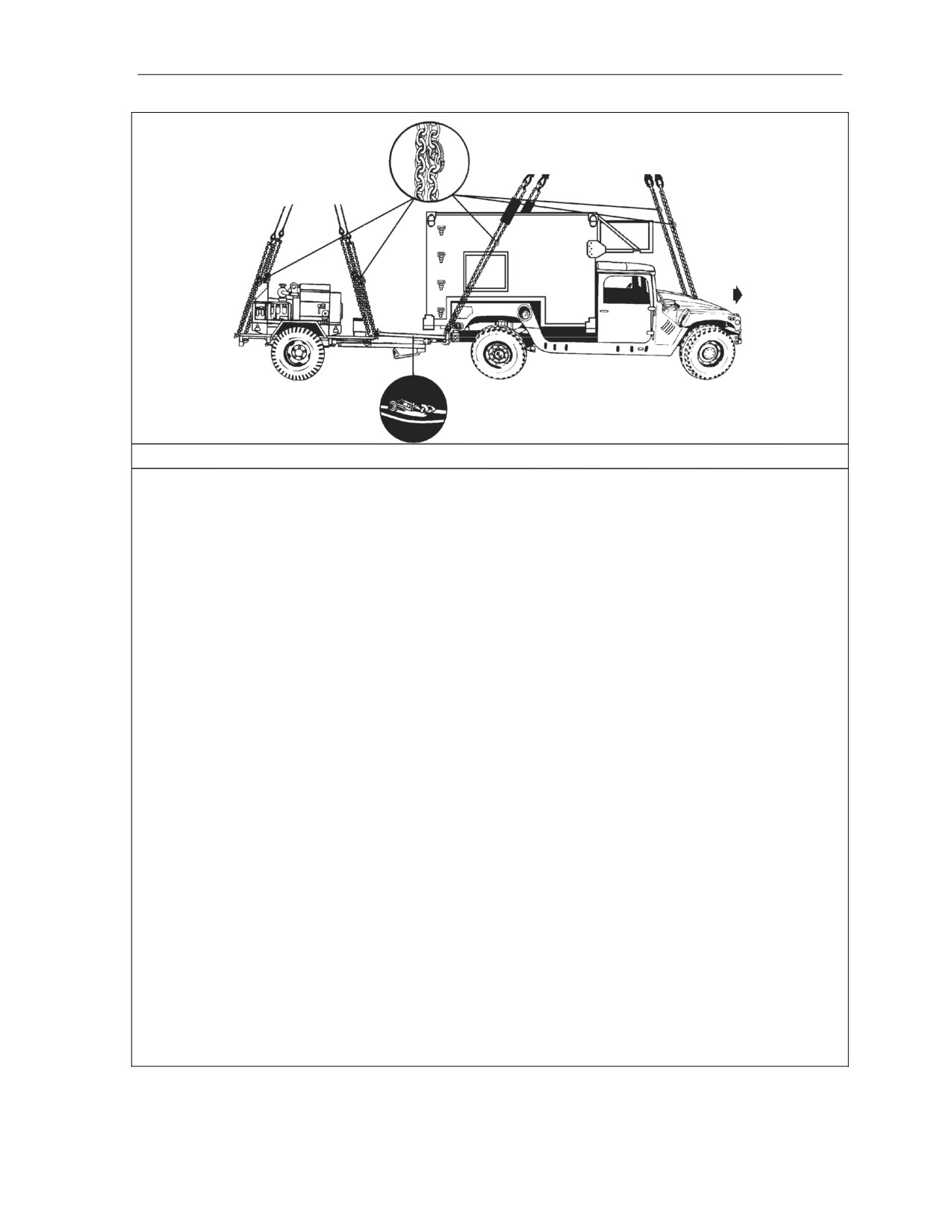
Certified Dual-Point Rigging Procedures for Tandem Loads
RIGGING STEPS
1.
Position apex fitting on top of the shelter. Route outer sling legs 1 and 2 to the front of the
vehicle and inner sling legs 3 and 4 to the rear. Sling legs 1 and 3 must be on the left side of
the load.
2.
Loop the chain end of sling leg 1 through the left front lift provision that protrudes through the
hood from inboard to outboard. Place the correct link from Table 5-21 in the grab hook.
Repeat with sling leg 2 and the right front lift provision. Secure excess chain with tape or
Type III nylon cord.
3.
Loop the chain end of the sling legs through their respective lift provisions located on the
outer ends of the rear bumper. Place the correct link from Table 5-21 in the grab hook.
Secure excess chain with tape or Type III nylon cord.
4.
Pad the chain where it contacts the shelter sides.
5.
Cluster and tie (breakaway technique) all sling legs together on top of the vehicle to prevent
entanglement during hookup and lift-off.
6.
Position the apex fitting of sling set 2 on top of the generator set. Route outer sling legs 1
and 2 to the front of the generator and inner sling legs 3 and 4 to the rear of the generator.
Sling legs 1 and 3 must be on the left side of the load.
7.
Loop the chain end of sling leg 1 through the left front lift provision located on the front of the
trailer. Place the correct link from Table 5-21 in the grab hook. Repeat with sling leg 2
through the right front lift provision. Secure excess chain with tape or Type III nylon cord.
8.
Loop the chain end of sling leg 3 through the left rear lift provision. Place the correct link from
Table 5-21 in the grab hook. Repeat with sling leg 4 through the right rear lift provision.
Secure excess chain with tape or Type III nylon cord.
9.
Cluster and tie tape (breakaway technique) all sling legs together on top of the trailer to
prevent entanglement during hookup and lift-off.
Figure 5-21. M1113 Shelter Carrier (HMMWV) with LMS Shelter and PU-798 Generator on
M116A3 Trailer
FM 4-20.199/MCRP 4-11.3E, VOL III/NTTP 3-04.13/
20 February 2009
AFMAN 11-223 (I), VOL III/COMDINST M13482.4B
5-59
Chapter 5
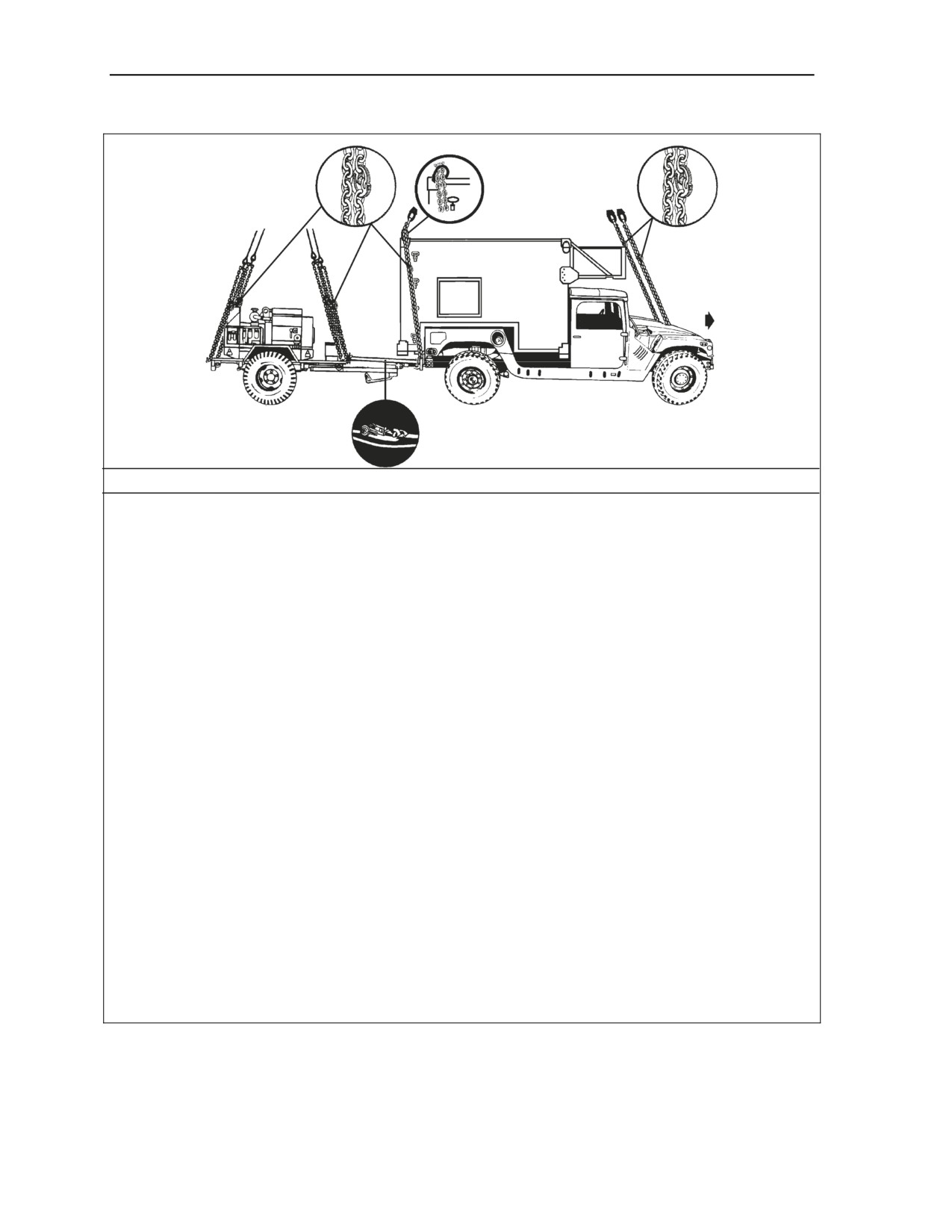
M1097A2 SHELTER CARRIER (HMMWV) WITH LMS SHELTER
USING SHELTER LIFT RINGS AS SLING GUIDES AND PU-798
GENERATOR ON M116A3 TRAILER
5-23. The M1097A2 shelter carriers with LMS shelter using shelter lift rings as sling guides and PU-798
generator on M116A3 trailer are rigged for dual-point sling load using the following procedures:
z
Applicability. The following items in Table 5-22 are certified for the helicopter(s) listed in the
following table by the US Army Natick Soldier Center:
Table 5-22. M1097A2 Shelter Carrier with LMS Shelter Using Shelter Lift Rings as Sling
Guides and PU-798 Generator on M116A3 Trailer
Nomenclature
Max Weight
Sling
Link Count
Type of
(Pounds)
Set
Front/Rear
Aircraft
Analysis Control Team-Enclave, AN/TYQ-103
9,960
25K
60/5
CH-47
PU-798 Generator on M116A3 Trailer
2,600
10K
90/75
CH-47
z
Materials. The following materials are required to rig this load:
Sling set (25,000-pound capacity) (2 each).
─ Additional chain length, part number 38850-00053-102, from a 25,000-pound capacity
sling set (4 each).
─ Additional coupling link, part number 664241, from a 25,000-pound sling set (4 each).
Sling set (10,000-pound capacity) with one additional apex fitting.
─ Chain length, part number 38850-00053-101, from a 10,000-pound capacity sling set
(4 each).
─ Coupling link, part number 577-0615, from a 10,000-pound sling set (4 each).
Tape, adhesive, pressure-sensitive, 2-inch wide roll.
Cord, nylon, Type III, 550-pound breaking strength.
Webbing, cotton, 1/4-inch, 80-pound breaking strength.
Strap, cargo, tiedown, CGU-1/B (2 each).
z
Personnel. Two persons can prepare and rig the truck in 20 minutes. Two persons can prepare
and rig the generator set in 15 minutes.
z
Procedures. Attach the generator set to the truck by placing the lunette on the pintle hook and
securing the latch with tape or Type III nylon cord. Secure the safety chains, cables, and hoses.
Position the vehicle on level ground so both the truck and generator set are in a straight line. Tie
the front lift provisions on the trailer in the up position with Type I. 1/4-inch cotton webbing.
The following procedures apply to this load:
Preparation. Prepare the load using the following steps:
─ Fold mirrors inward and tie together with Type III nylon cord. Remove the doors and
secure to the seats with Type III nylon cord. Tape the windshield with an X formation
from corner to corner.
─ Secure all loose equipment inside the shelter with tape, Type III nylon cord, or tie-
down straps. Close and secure the door.
─ Secure all equipment and cargo inside the truck with tiedown straps, tape, or Type III
nylon cord.
FM 4-20.199/MCRP 4-11.3E, VOL III/NTTP 3-04.13/
5-60
AFMAN 11-223 (I), VOL III/COMDINST M13482.4B
20 February 2009
Certified Dual-Point Rigging Procedures for Tandem Loads
─ Ensure the fuel tanks are not over 3/4 full. Inspect the fuel tank cap, oil filler cap, and
battery caps for proper installation.
─ Engage the vehicle parking brake and put the transmission in neutral.
─ Ensure the front wheels are pointed straight ahead. Tie down the steering wheel, using
the securing device attached under the dashboard.
─ Install the lift provisions on the outer ends of the rear bumper by removing the tiedown
provisions located on the front bumper and installing them on the outer ends of the rear
bumper.
─ Tie the shelter’s rear lift rings together with Type III nylon cord across the top of the
shelter. The lift rings should be positioned facing the front of the vehicle.
─ Partially retract all landing legs and secure in position with Type III nylon cord.
─ Retract the lunette leg and secure with Type III nylon cord.
─ Secure all lids, doors, and caps with tape or Type III nylon cord.
─ Ensure the trailer parking brake is set.
─ Route the hook portion of a CGU-1/B tiedown strap through the left rear inboard
tiedown provision located near the pintle on the rear bumper of the truck and through
the left front lift provision of the trailer. Connect the hook to the ratchet of the CGU-
1/B.
─ Repeat the above procedure on the right side of the load.
─ Tighten both CGU-1/B tie-down straps at the same time. Secure the excess strap and
safety the ratchet handles in the closed position with tape.
CAUTION
Do not connect the CGU-1/B tiedown strap around the truck's rear axle
or wheel.
─ Connect one additional chain length to each chain on each sling set with a coupling
link.
Rigging. Rig the load according to the steps in Figure 5-22.
Hookup. Two hookup teams are required for this load. The static wand person discharges
the static electricity with the static wand. The forward hookup person kneels on top of the shelter
and places apex fitting 1 onto the forward cargo hook. The aft hookup person stands on the
generator fender and places apex fitting 2 onto the aft cargo hook. The hookup team then
carefully dismounts the vehicle and the trailer and remains close to the load as the helicopter
removes slack from the sling legs. When successful hookup is assured, the hookup team
quickly exits the area underneath the helicopter to the designated rendezvous point.
Derigging. Derigging is the reverse of the preparation and rigging procedures.
FM 4-20.199/MCRP 4-11.3E, VOL III/NTTP 3-04.13/
20 February 2009
AFMAN 11-223 (I), VOL III/COMDINST M13482.4B
5-61
Chapter 5
RIGGING STEPS
1.
Position apex fitting on top of the shelter. Route outer sling legs 1 and 2 to the front of the vehicle and
inner sling legs 3 and 4 to the rear. Sling legs 1 and 3 must be on the left side of the load.
2.
Loop the chain end of sling leg 1 through the left front lift provision that protrudes through the hood from
inboard to outboard. Place the correct link from Table 5-22 in the grab hook. Repeat with sling leg 2
and the right front lift provision. Secure excess chain with tape or Type III nylon cord.
3.
Route the right sling leg chain through the right rear shelter lift ring to the right rear lift provision located
on the outer end of the rear bumper. Continue routing the chain back through the right rear shelter lift
ring and back to the grab hook. Place the correct link from Table 5-22 in the grab hook. Repeat the
procedure using the left sling leg chain, left rear shelter lift ring, and the left lift provision located on the
end of the bumper.
4.
Cluster and tie (breakaway technique) all sling legs together on top of the vehicle to prevent
entanglement during hookup and lift-off.
5.
Position the apex fitting of sling set 2 on top of the generator set. Route outer sling legs 1 and 2 to the
front of the generator and inner sling legs 3 and 4 to the rear of the generator. Sling legs 1 and 3 must
be on the left side of the load.
6.
Loop the chain end of sling leg 1 through the left front lift provision located on the front of the trailer.
Place the correct link from Table 5-22 in the grab hook. Repeat with sling leg 2 through the right front lift
provision. Secure excess chain with tape or Type III nylon cord.
7.
Loop the chain end of sling leg 3 through the left rear lift provision. Place the correct link from Table 5-
22 in the grab hook. Repeat with sling leg 4 through the right rear lift provision. Secure excess chain
with tape or Type III nylon cord.
8.
Cluster and tie (breakaway technique) all sling legs together on top of the trailer to prevent
entanglement during hookup and lift-off.
Figure 5-22. M1097A2 Shelter Carrier with LMS Shelter Using Shelter Lift Rings as Sling
Guides and PU-798 Generator on M116A3 Trailer
FM 4-20.199/MCRP 4-11.3E, VOL III/NTTP 3-04.13/
5-62
AFMAN 11-223 (I), VOL III/COMDINST M13482.4B
20 February 2009
Certified Dual-Point Rigging Procedures for Tandem Loads
M1113 SHELTER CARRIER (HMMWV) WITH LMS SHELTER USING
SHELTER LIFT RINGS AS SLING GUIDES AND PU-798
GENERATOR ON M116A3 TRAILER
5-24. The M1113 shelter carriers with LMS shelter using shelter lift rings as sling guides and PU-798
generator on M116A3 trailer are rigged for dual-point sling load using the following procedures:
z
Applicability. The following items in Table 5-23 are certified for the helicopter(s) listed in the
following table by the US Army Natick Soldier Center:
Table 5-23. M1113 Shelter Carrier with LMS Shelter Using Shelter Lift Rings as Sling Guides
and PU-798 Generator on M116A3 Trailer
Nomenclature
Max Weight
Sling
Link Count
Type of
(Pounds)
Set
Front/Rear
Aircraft
Analysis Control Team-Enclave, AN/TYQ-103
11,500
25K
60/5
CH-47
PU-798 Generator on M116A3 Trailer
2,600
10K
90/75
CH-47
z
Materials. The following materials are required to rig this load:
Sling set (25,000-pound capacity) (2 each).
─ Chain length, part number 38850-00053-102, from a 25,000-pound capacity sling set
(4 each).
─ Coupling link, part number 664241, from a 25,000-pound sling set (4 each).
Sling set (10,000-pound capacity) with one additional apex fitting.
─ Chain length, part number 38850-00053-101, from a 10,000-pound capacity sling set
(4 each).
─ Coupling link, part number 577-0615, from a 10,000-pound sling set (4 each).
Tape, adhesive, pressure-sensitive, 2-inch wide roll.
Cord, nylon, Type III, 550-pound breaking strength.
Webbing, cotton, 1/4-inch, 80-pound breaking strength.
Strap, cargo, tiedown, CGU-1/B (2 each).
z
Personnel. Two persons can prepare and rig the truck in 20 minutes. Two persons can prepare
and rig the generator set in 15 minutes.
z
Procedures. Attach the generator set to the truck by placing the lunette on the pintle hook and
securing the latch with tape or Type III nylon cord. Secure the safety chains, cables, and hoses.
Position the vehicle on level ground so both the truck and generator set are in a straight line. Tie
the front lift provisions on the trailer in the up position with Type I, 1/4-inch cotton webbing.
The following procedures apply to this load:
Preparation. Prepare the load using the following steps:
─ Fold mirrors inward and tie together with Type III nylon cord. Remove the doors and
secure to the seats with Type III nylon cord. Tape the windshield with an X formation
from corner to corner.
─ Secure all loose equipment inside the shelter with tape, Type III nylon cord, or tie-
down straps. Close and secure the door.
─ Secure all equipment and cargo inside the truck with tiedown straps, tape, or Type III
nylon cord.
─ Ensure the fuel tanks are not over 3/4 full. Inspect the fuel tank cap, oil filler cap, and
battery caps for proper installation.
FM 4-20.199/MCRP 4-11.3E, VOL III/NTTP 3-04.13/
20 February 2009
AFMAN 11-223 (I), VOL III/COMDINST M13482.4B
5-63
Chapter 5
─ Engage the vehicle parking brake and put the transmission in neutral.
─ Ensure the front wheels are pointed straight ahead. Tie down the steering wheel, using
the securing device attached under the dashboard.
─ Install the lift provisions on the outer ends of the rear bumper by removing the tiedown
provisions located on the front bumper and installing them on the outer ends of the rear
bumper.
─ Tie the shelter’s rear lift rings together with Type III nylon cord across the top of the
shelter. The lift rings should be positioned facing the front of the vehicle.
─ Partially retract all landing legs and secure in position with Type III nylon cord.
─ Retract the lunette leg and secure with Type III nylon cord.
─ Secure all lids, doors, and caps with tape or Type III nylon cord.
─ Ensure the trailer parking brake is set.
─ Route the hook portion of a CGU-1/B tiedown strap through the left rear inboard
tiedown provision located near the pintle on the rear bumper of the truck and through
the left front lift provision of the trailer. Connect the hook to the ratchet of the CGU-
1/B.
─ Repeat the above procedure on the right side of the load.
─ Tighten both CGU-1/B tie-down straps at the same time. Secure the excess strap and
safety the ratchet handles in the closed position with tape.
CAUTION
Do not connect the CGU-1/B tiedown strap around the truck's rear axle
or wheel.
─ Connect one additional chain length to each chain on each sling set with a coupling
link.
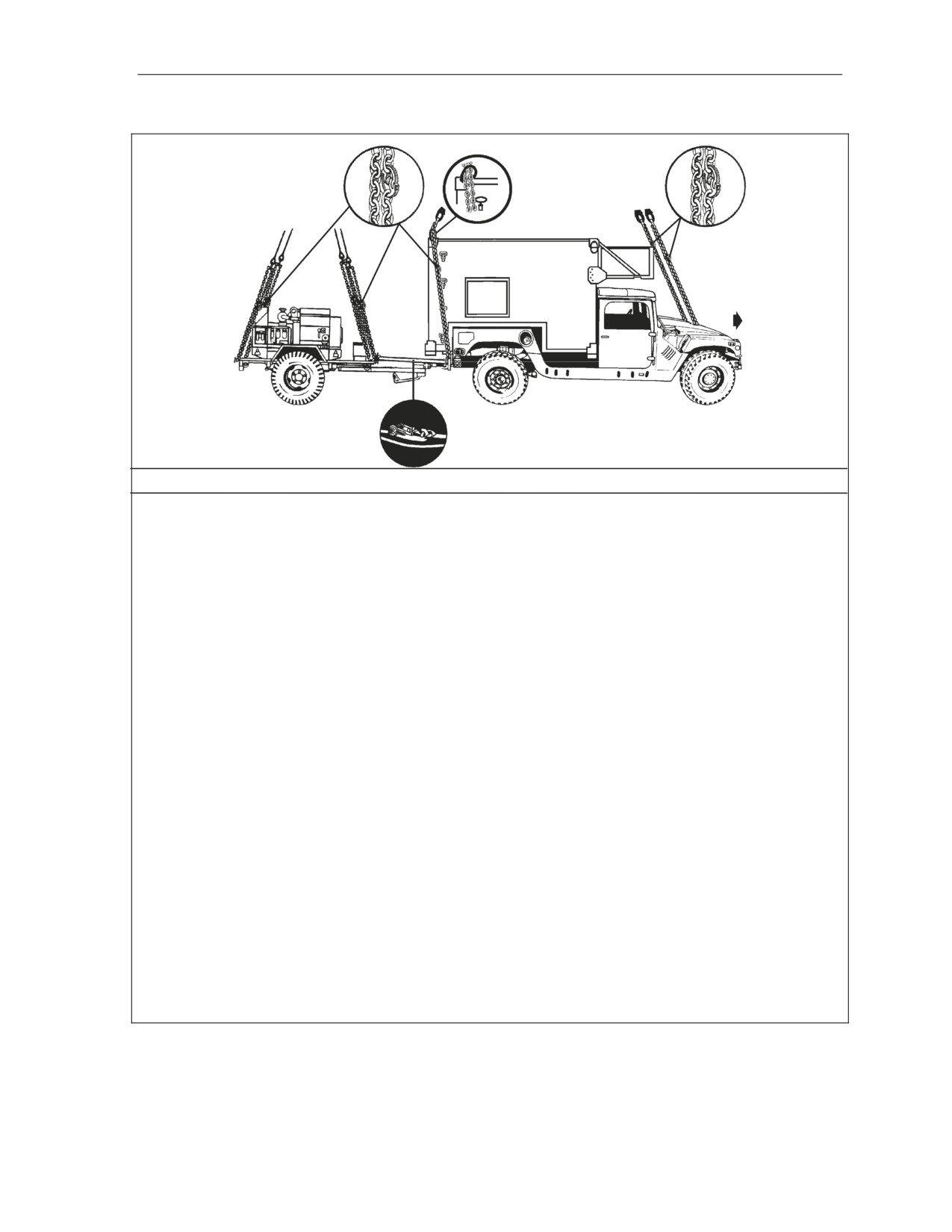
Rigging. Rig the load according to the steps in Figure 5-23.
Hookup. Two hookup teams are required for this load. The static wand person discharges
the static electricity with the static wand. The forward hookup person kneels on top of the shelter
and places apex fitting 1 onto the forward cargo hook. The aft hookup person stands on the
generator fender and places apex fitting 2 onto the aft cargo hook. The hookup team then
carefully dismounts the vehicle and the trailer and remains close to the load as the helicopter
removes slack from the sling legs. When successful hookup is assured, the hookup team
quickly exits the area underneath the helicopter to the designated rendezvous point.
Derigging. Derigging is the reverse of the preparation and rigging procedures.
FM 4-20.199/MCRP 4-11.3E, VOL III/NTTP 3-04.13/
5-64
AFMAN 11-223 (I), VOL III/COMDINST M13482.4B
20 February 2009
Certified Dual-Point Rigging Procedures for Tandem Loads
RIGGING STEPS
1.
Position apex fitting on top of the shelter. Route outer sling legs 1 and 2 to the front of the vehicle and
inner sling legs 3 and 4 to the rear. Sling legs 1 and 3 must be on the left side of the load.
2.
Loop the chain end of sling leg 1 through the left front lift provision that protrudes through the hood from
inboard to outboard. Place the correct link from Table 5-23 in the grab hook. Repeat with sling leg 2
and the right front lift provision. Secure excess chain with tape or Type III nylon cord.
3.
Route the right sling leg chain through the right rear shelter lift ring to the right rear lift provision located
on the outer end of the rear bumper. Continue routing the chain back through the right rear shelter lift
ring and back to the grab hook. Place the correct link from Table 5-23 in the grab hook. Repeat the
procedure using the left sling leg chain, left rear shelter lift ring, and the left lift provision located on the
end of the bumper.
4.
Cluster and tie (breakaway technique) all sling legs together on top of the vehicle to prevent
entanglement during hookup and lift-off.
5.
Position the apex fitting of sling set 2 on top of the generator set. Route outer sling legs 1 and 2 to the
front of the generator and inner sling legs 3 and 4 to the rear of the generator. Sling legs 1 and 3 must
be on the left side of the load.
6.
Loop the chain end of sling leg 1 through the left front lift provision located on the front of the trailer.
Place the correct link from Table 5-23 in the grab hook. Repeat with sling leg 2 through the right front lift
provision. Secure excess chain with tape or Type III nylon cord.
7.
Loop the chain end of sling leg 3 through the left rear lift provision. Place the correct link from Table 5-
23 in the grab hook. Repeat with sling leg 4 through the right rear lift provision. Secure excess chain
with tape or Type III nylon cord.
8.
Cluster and tie tape (breakaway technique) all sling legs together on top of the trailer to prevent
entanglement during hookup and lift-off.
Figure 5-23. M1113 Shelter Carrier with LMS Shelter Using Shelter Lift Rings as Sling Guides
and PU-798 Generator on M116A3 Trailer
FM 4-20.199/MCRP 4-11.3E, VOL III/NTTP 3-04.13/
20 February 2009
AFMAN 11-223 (I), VOL III/COMDINST M13482.4B
5-65

Chapter 5
M1097A2 SHELTER CARRIER (HMMWV) WITH S-250 SHELTER
AND TRAILER GENERATOR SETS ON M116A3 TRAILER
5-25. The M1097A2 shelter carrier with S-250 shelter and trailer generator sets on M116A3 trailer are
rigged for dual-point sling load using the following procedures:
z
Applicability. The following items in Table 5-24 are certified for the helicopter(s) listed in the
following table by the US Army Natick Soldier Center:
Table 5-24. M1097A2 Shelter Carrier with S-250 Shelter and Trailer Generator Sets on M116A3
Trailer
Nomenclature
Max Weight
Sling
Link Count
Type of
(Pounds)
Set
Front/Rear
Aircraft
Truck, (HMMWV) M1097A2 with LOS (V1) in S-250
8,246
10K
80/30
CH-47
Shelter
Truck, (HMMWV) M1097A2 with Small Extension Node
8,354
10K
80/30
CH-47
Switch, AN/TTC-48E (V)2
PU-797 Generator Set on M116A3 Trailer
2,320
10K
10/15
CH-47
PU-798 Generator Set on M116A3 Trailer
2,457
10K
10/15
CH-47
z
Materials. The following materials are required to rig this load:
Sling set (10,000-pound capacity) (2 each).
─ Additional chain length, part number 38850-00053-101, from a 10,000-pound capacity
sling set (8 each).
─ Additional coupling link, part number 38850-00053-101, from a 10,000-pound sling
set (8 each).
Tape, adhesive, pressure-sensitive, 2-inch wide roll.
Cord, nylon, Type III, 550-pound breaking strength.
Webbing, cotton, 1/4-inch, 80-pound breaking strength.
Strap, cargo, tiedown, CGU-1/B (2 each).
Felt sheet, cattle hair, Type IV, 1/2-inch or suitable substitute.
z
Personnel. Two persons can prepare and rig the M1097A2 HMMWV in 15 minutes. Two
persons can prepare and rig the generator set in 10 minutes.
z
Procedures. Attach the generator set to the truck by placing the lunette on the pintle hook and
securing the latch with tape or Type III nylon cord. Secure the safety chains, cables, and hoses.
Position the vehicle on level ground so both the truck and generator set are in a straight line.
The following procedures apply to this load:
Preparation. Prepare the load using the following steps:
─ Fold mirrors inward and tie together with Type III nylon cord. Remove the doors and
secure to the seats with Type III nylon cord.
─ Secure all loose equipment inside the shelter with tape, Type III nylon cord, or tiedown
straps. Close and secure the door.
─ Secure all equipment and cargo inside the truck with tiedown straps, tape, or Type III
nylon cord. Secure the doors shut if installed.
─ Ensure the fuel tanks are not over 3/4 full. Inspect the fuel tank cap, oil filler cap, and
battery caps for proper installation.
─ Engage the vehicle parking brake and put the transmission in neutral.
─ Ensure the front wheels are pointed straight ahead. Tie down the steering wheel, using
the securing device attached under the dashboard.
─ Partially retract all landing legs and secure in position with Type III nylon cord.
FM 4-20.199/MCRP 4-11.3E, VOL III/NTTP 3-04.13/
5-66
AFMAN 11-223 (I), VOL III/COMDINST M13482.4B
20 February 2009
Certified Dual-Point Rigging Procedures for Tandem Loads
─ Retract the lunette leg and secure with Type III nylon cord.
─ Secure all lids, doors, and caps with tape or Type III nylon cord.
─ Ensure the parking brakes are set.
─ Route the hook portion of a CGU-1/B tiedown strap through the left rear inboard
tiedown provision located near the pintle on the rear bumper of the truck and through
the mounting bracket on the front of the trailer A-frame. Connect the hook to the
ratchet of the CGU-1/B.
─ Repeat the above procedure on the right side of the load.
─ Tighten both CGU-1/B tie-down straps at the same time. Secure the excess strap and
safety the ratchet handles in the closed position with tape.
─ Connect one additional chain length to each chain on each sling set with a coupling
link.
CAUTION
Do not connect the CGU-1/B tiedown strap around the truck's rear axle
or wheel.
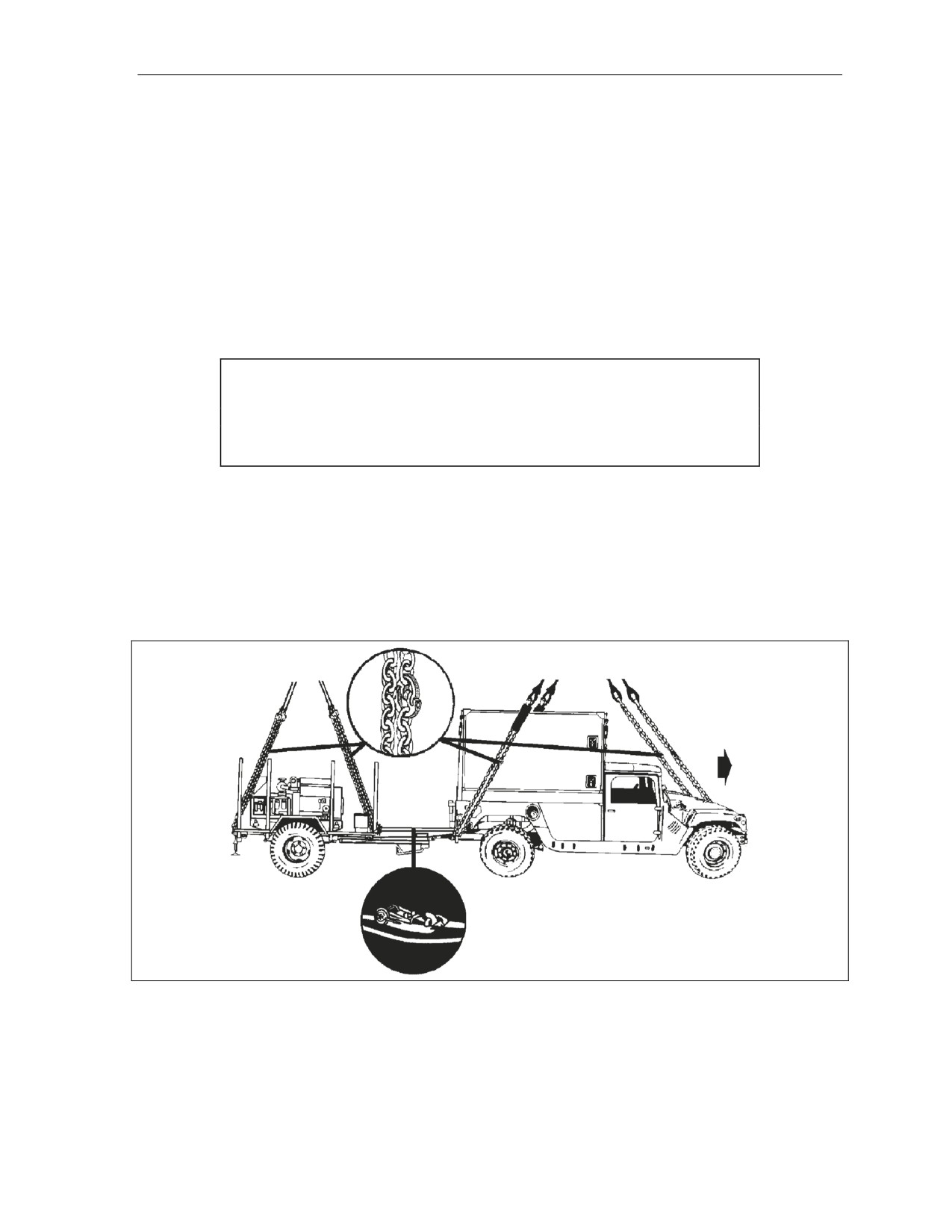
Rigging. Rig the load according to the steps in Figure 5-24.
Hookup. Two hookup teams are required for this load. The static wand person discharges the static
electricity with the static wand. The forward hookup person kneels on top of the shelter and places apex
fitting 1 onto the forward cargo hook. The aft hookup person stands on the generator fender and places
apex fitting 2 onto the aft cargo hook. The hookup team then carefully dismounts the trailer and remains
close to the load as the helicopter removes slack from the sling legs. When successful hookup is assured,
the hookup team quickly exits the area underneath the helicopter to the designated rendezvous point.
Derigging. Derigging is the reverse of the preparation and rigging procedures.
Figure 5-20. M1097A2 Shelter Carrier with S-250 Shelter and Trailer Generator Sets on
M116A3 Trailer
FM 4-20.199/MCRP 4-11.3E, VOL III/NTTP 3-04.13/
20 February 2009
AFMAN 11-223 (I), VOL III/COMDINST M13482.4B
5-67
Chapter 5
RIGGING STEPS
1.
Position apex fitting on top of the shelter. Route outer sling legs 1 and 2 to the front of the
vehicle and inner sling legs 3 and 4 to the rear. Sling legs 1 and 3 must be on the left side of
the load.
2.
Loop the chain end of sling leg 1 through the left front lift provision that protrudes through the
hood from inboard to outboard. Place the correct link from Table 5-24 in the grab hook.
Repeat with sling leg 2 and the right front lift provision. Secure excess chain with tape or
Type III nylon cord.
3.
Loop the chain end of the sling legs through their respective lift provisions located on the
outer ends of the rear bumper. Place the correct link from Table 5-24 in the grab hook.
Secure excess chain with tape or Type III nylon cord.
4.
Pad the chain where it contacts the shelter sides.
5.
Cluster and tie (breakaway technique) all sling legs together on top of the vehicle to prevent
entanglement during hookup and lift-off.
6.
Position the apex fitting of sling set 2 on top of the generator set. Route outer sling legs 1and
2 to the front of the generator and inner sling legs 3 and 4 to the rear of the generator. Sling
legs 1 and 3 must be on the left side of the load.
7.
Loop the chain end of sling leg 1 through the left front lift provision located on the front of the
trailer. Place the correct link from Table 5-24 in the grab hook. Repeat with sling leg 2
through the right front lift provision. Secure excess chain with tape or Type III nylon cord.
8.
Loop the chain end of sling leg 3 through the left rear lift provision. Place the correct link from
Table 5-24 in the grab hook. Repeat with sling leg 4 through the right rear lift provision.
Secure excess chain with tape or Type III nylon cord.
9.
Cluster and tie (breakaway technique) all sling legs together on top of the trailer to prevent
entanglement during hookup and lift-off.
Figure 5-24. M1097A2 Shelter Carrier with S-250 Shelter and Trailer Generator Sets on
M116A3 Trailer (Continued)
M1097A2 (HMMWV) WITH ADVANCED FIELD ARTILLERY
TACTICAL DATA SYSTEM (AFATDS) SOFT TOP INSTALLATION
KIT (STIK) AND PU-797 GENERATOR SET ON M116A3 TRAILER
5-26. The M1097A2 with advanced field artillery tactical data system soft top installation kit and PU-797
generator set on M116A3 trailer are rigged for dual-point sling load using the following procedures:
FM 4-20.199/MCRP 4-11.3E, VOL III/NTTP 3-04.13/
5-68
AFMAN 11-223 (I), VOL III/COMDINST M13482.4B
20 February 2009

Certified Dual-Point Rigging Procedures for Tandem Loads
z
Applicability. The following items in Table 5-25 are certified for the helicopter(s) listed in the
following table by the US Army Natick Soldier Center:
Table 5-25. M1097A2 with Advanced Field Artillery Tactical Data System Soft Top Installation
Kit and PU-797 Generator Set on M116A3 Trailer
Nomenclature
Max Weight
Sling
Link Count
Type of
(Pounds)
Set
Front/Rear
Aircraft
System 2: CHS-2 AN/GYG-3(V)1, with SINGARS
8,103
25K
50/3
CH-47
AN/VRC-90, AN/VRC-92 and EPLRS Installed in the
Bed. AN/VRC-92 Installed in Cab.
System 3: CHS-2 AN/GYG-3(V)3, with SINGARS
8,366
25K
50/3
CH-47
AN/VRC-90, AN/VRC-92 and EPLRS Installed in the
Bed. AN/VRC-92 Installed in Cab.
System 4: 2 each AN/GYK-37(V)2, with SINGARS
7,790
25K
50/3
CH-47
AN/VRC-89, AN/VRC-92 and EPLRS.
PU-797 Generator Set on M116A3 Trailer
1,800
25K
15/20
CH-47
z
Materials. The following materials are required to rig this load:
Sling set (25,000-pound capacity) (2 each).
─ Additional chain length, part number 38850-00053-102, from a 25,000-pound capacity
sling set (8 each).
─ Additional coupling link, NSN 4010-01-041-9751, from a 25,000-pound sling set (8
each).
Tape, adhesive, pressure-sensitive, 2-inch wide roll.
Cord, nylon, Type III, 550-pound breaking strength.
Webbing, cotton, 1/4-inch, 80-pound breaking strength.
Strap, cargo, tiedown, CGU-1/B (2 each).
Sling guides (included as part of the HMMWV STIK) (2 each).
Reach pendant (25,000-pound capacity) (2 each).
z
Personnel. Two persons can prepare and rig the M1097A2 HMMWV in 15 minutes. Two
persons can prepare and rig the generator set in 10 minutes.
z
Procedures. Attach the generator set to the truck by placing the lunette on the pintle hook and
securing the latch with tape or Type III nylon cord. Secure the safety chains, cables, and hoses.
Position the vehicle on level ground so both the truck and generator set are in a straight line.
The following procedures apply to this load:
Preparation. Prepare the load using the following steps:
─ Fold mirrors inward and tie together with Type III nylon cord. Remove the doors and
secure to the seats with Type III nylon cord.
─ Secure all equipment and cargo inside the truck with tiedown straps, tape, or Type III
nylon cord.
─ Ensure the fuel tanks are not over 3/4 full. Inspect the fuel tank cap, oil filler cap, and
battery caps for proper installation.
─ Engage the vehicle parking brake and put the transmission in neutral.
─ Ensure the front wheels are pointed straight ahead. Tie down the steering wheel, using
the securing device attached under the dashboard.
─ Partially retract all landing legs and secure in position with Type III nylon cord.
─ Retract the lunette leg and secure with Type III nylon cord.
─ Secure all lids, doors, and caps with tape or Type III nylon cord.
─ Ensure the parking brakes are set.
FM 4-20.199/MCRP 4-11.3E, VOL III/NTTP 3-04.13/
20 February 2009
AFMAN 11-223 (I), VOL III/COMDINST M13482.4B
5-69
Chapter 5
─ Route the hook portion of a CGU-1/B tiedown strap through the left rear inboard
tiedown provision located near the pintle on the rear bumper of the truck and through
the mounting bracket on the front of the trailer A-frame. Connect the hook to the
ratchet of the CGU-1/B.
─ Repeat the above procedure on the right side of the load.
─ Tighten both CGU-1/B tie-down straps at the same time. Secure the excess strap and
safety the ratchet handles in the closed position with tape.
─ Install a reach pendant on each apex fitting.
─ Connect one additional chain length to each chain on each sling set with a coupling
link.
─ Ensure the STIK sling guides are properly installed.
CAUTION
Do not connect the CGU-1/B tiedown strap around the truck's rear axle
or wheel.
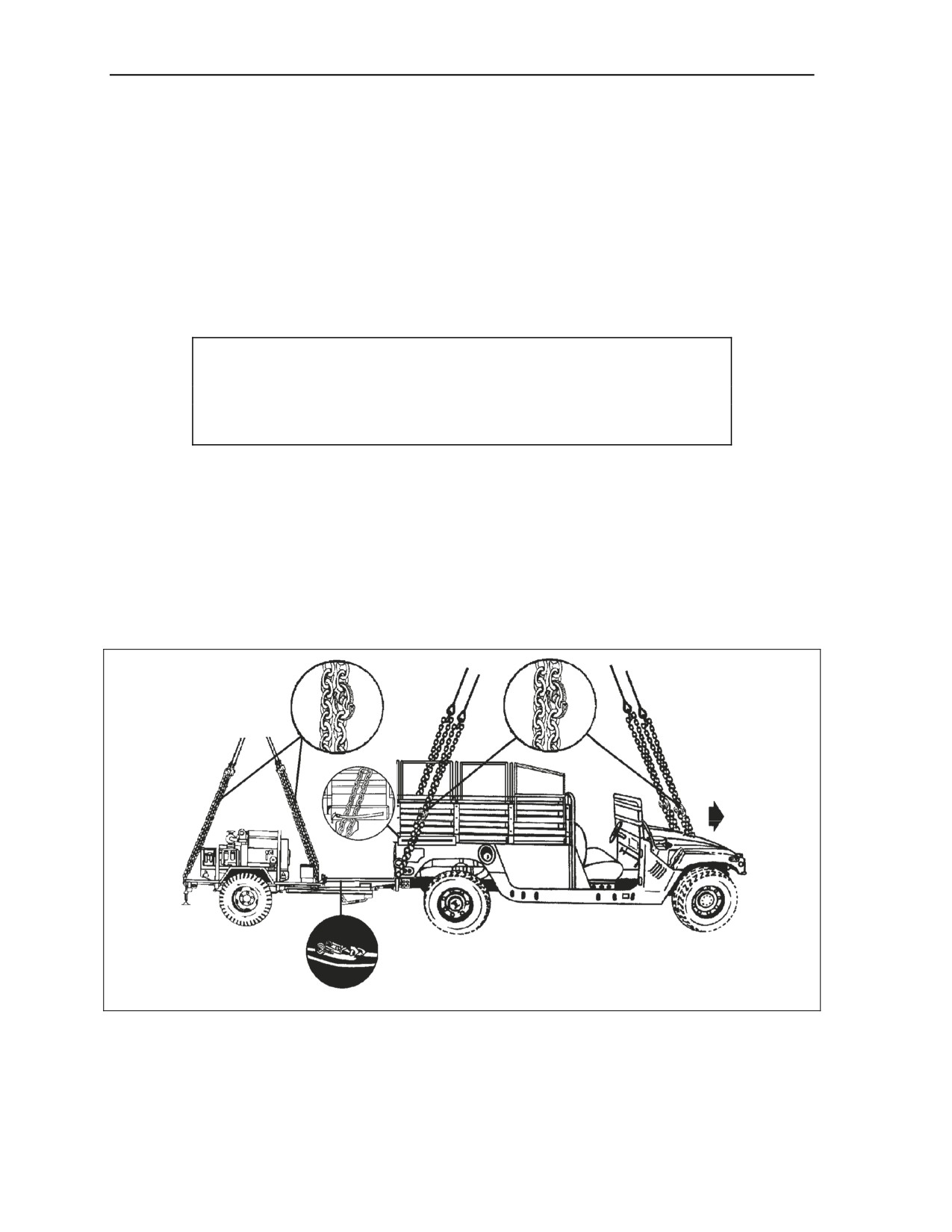
Rigging. Rig the load according to the steps in Figure 5-25.
Hookup. Two hookup teams are required for this load. The static wand person discharges
the static electricity with the static wand. The forward hookup person kneels on top of the truck
and places apex fitting 1 onto the forward cargo hook. The aft hookup person stands on the
generator fender and places apex fitting 2 onto the aft cargo hook. The hookup team then
carefully dismounts the trailer and remains close to the load as the helicopter removes slack
from the sling legs. When successful hookup is assured, the hookup team quickly exits the
area underneath the helicopter to the designated rendezvous point.
Derigging. Derigging is the reverse of the preparation and rigging procedures.
Figure 5-25. M1097A2 with Advanced Field Artillery Tactical Data System Soft Top Installation
Kit and PU-797 Generator Set on M116A3 Trailer
FM 4-20.199/MCRP 4-11.3E, VOL III/NTTP 3-04.13/
5-70
AFMAN 11-223 (I), VOL III/COMDINST M13482.4B
20 February 2009
Certified Dual-Point Rigging Procedures for Tandem Loads
RIGGING STEPS
1.
Position apex fitting on top of the truck. Route outer sling legs 1 and 2 to the front of the
vehicle and inner sling legs 3 and 4 to the rear. Sling legs 1 and 3 must be on the left side of
the load.
2.
Loop the chain end of sling leg 1 through the left front lift provision that protrudes through the
hood from inboard to outboard. Place the correct link from Table 5-25 in the grab hook.
Repeat with sling leg 2 and the right front lift provision. Secure excess chain with tape or
Type III nylon cord.
3.
Loop the chain end of sling leg 3 through the left guide, through the left rear lift provision
located on the outer ends of the rear bumper, and back through the left sling guide. Place
the correct link from Table 5-25 in the grab hook. Repeat with sling leg 4 and the right sling
guide and right rear lift provision. Secure excess chain with tape or Type III nylon cord.
4.
Cluster and tie (breakaway technique) all sling legs together on top of the vehicle to prevent
entanglement during hookup and lift-off.
5.
Position the apex fitting of sling set 2 on top of the generator set. Route outer sling legs 1and
2 to the front of the generator and inner sling legs 3 and 4 to the rear of the generator. Sling
legs 1 and 3 must be on the left side of the load.
6.
Loop the chain end of sling leg 1 through the left front lift provision located on the front of the
trailer. Place the correct link from Table 5-25 in the grab hook. Repeat with sling leg 2
through the right front lift provision. Secure excess chain with tape or Type III nylon cord.
7.
Loop the chain end of sling leg 3 through the left rear lift provision. Place the correct link from
Table 5-25 in the grab hook. Repeat with sling leg 4 through the right rear lift provision.
Secure excess chain with tape or Type III nylon cord.
8.
Cluster and tie or tape (breakaway technique) all sling legs together on top of the trailer to
prevent entanglement during hookup and lift-off.
Figure 5-25. M1097A2 with Advanced Field Artillery Tactical Data System Soft Top Installation
Kit and PU-797 Generator Set on M116A3 Trailer (Continued)
M1097 (HMMWV) WITH METEOROLOGICAL MEASURING SET IN
LMS SHELTER AND AN/MJQ-35 POWER PLANT ON M116A3
TRAILER
5-27. The M1097 with meteorological measuring set in LMS shelter and AN/MJQ-35 power plant on
M116A3 trailer are rigged for dual-point sling load using the following procedures:
z
Applicability. The following items in Table 5-26 are certified for the helicopter(s) listed in the
following table by the US Army Natick Soldier Center:
FM 4-20.199/MCRP 4-11.3E, VOL III/NTTP 3-04.13/
20 February 2009
AFMAN 11-223 (I), VOL III/COMDINST M13482.4B
5-71
Chapter 5
Table 5-26. M1097 with Meteorological Measuring Set in LMS Shelter and AN/MJQ-35 Power
Plant on M116A3 Trailer
Nomenclature
Max Weight
Sling
Link Count
Type of
(Pounds)
Set
Front/Rear
Aircraft
Meteorological Measuring Set, AN/TMQ-41 in LMS on
8,200
25K
40/3
CH-47
M1097
AN/MJQ-35 Power Plant with two (2) MEP-802A, 5kW,
3,737
25K
40/60
CH-47
60 Hz Generator Sets on M116A3 Trailer
z
Materials. The following materials are required to rig this load:
Sling set (25,000-pound capacity) (2 each).
─ Additional chain length, part number 38850-00053-102, from a 25,000-pound capacity
sling set (8 each).
─ Additional coupling link, NSN 4010-01-041-9751, from a 25,000-pound sling set (8
each).
Tape, adhesive, pressure-sensitive, 2-inch wide roll.
Cord, nylon, Type III, 550-pound breaking strength.
Webbing, cotton, 1/4-inch, 80-pound breaking strength.
Strap, cargo, tiedown, CGU-1/B (2 each).
Felt sheet, cattle hair, Type IV, 1/2-inch or suitable substitute.
z
Personnel. Two persons can prepare and rig the M1097 HMMWV in 15 minutes. Two persons
can prepare and rig the generator trailer in 15 minutes.
z
Procedures. Attach the trailer to the truck by placing the lunette on the pintle hook and
securing the latch with tape or Type III nylon cord. Secure the safety chains, cables, and hoses.
Position the vehicle on level ground so both the truck and trailer are in a straight line. The
following procedures apply to this load:
Preparation. Prepare the load using the following steps:
─
Fold mirrors inward and tie together with Type III nylon cord.
─
Secure all equipment and cargo inside the truck and trailer with tiedown straps, tape, or
Type III nylon cord.
─
Secure all loose equipment inside the shelter with tape, Type III nylon cord, or tiedown
straps. Close and secure the door.
─
Ensure the fuel tank is not over 3/4 full. Inspect the fuel tank cap, oil filler cap, and
battery caps for proper installation.
─
Engage the vehicle parking brake and put the transmission in neutral.
─
Ensure the front wheels are pointed straight ahead. Tie down the steering wheel, using
the securing device attached under the dashboard.
─
Partially retract all landing legs and secure with Type III nylon cord.
─
Retract the lunette leg and secure with Type III nylon cord.
─
Secure all lids, doors, and caps with tape or Type III nylon cord.
─
Ensure the trailer parking brakes are set.
─
Route the hook portion of a CGU-1/B tiedown strap through the left rear inboard
tiedown provision located near the pintle on the rear bumper of the truck and through
the mounting bracket on the front of the trailer A-frame. Connect the hook to the
ratchet of the CGU-1/B.
─
Repeat the above procedure on the right side of the load.
─
Tighten both CGU-1/B tiedown straps at the same time. Secure the excess strap and
safety the ratchet handles in the closed position with tape.
─
Connect one additional chain length to each chain on each sling set with a coupling
link.
FM 4-20.199/MCRP 4-11.3E, VOL III/NTTP 3-04.13/
5-72
AFMAN 11-223 (I), VOL III/COMDINST M13482.4B
20 February 2009
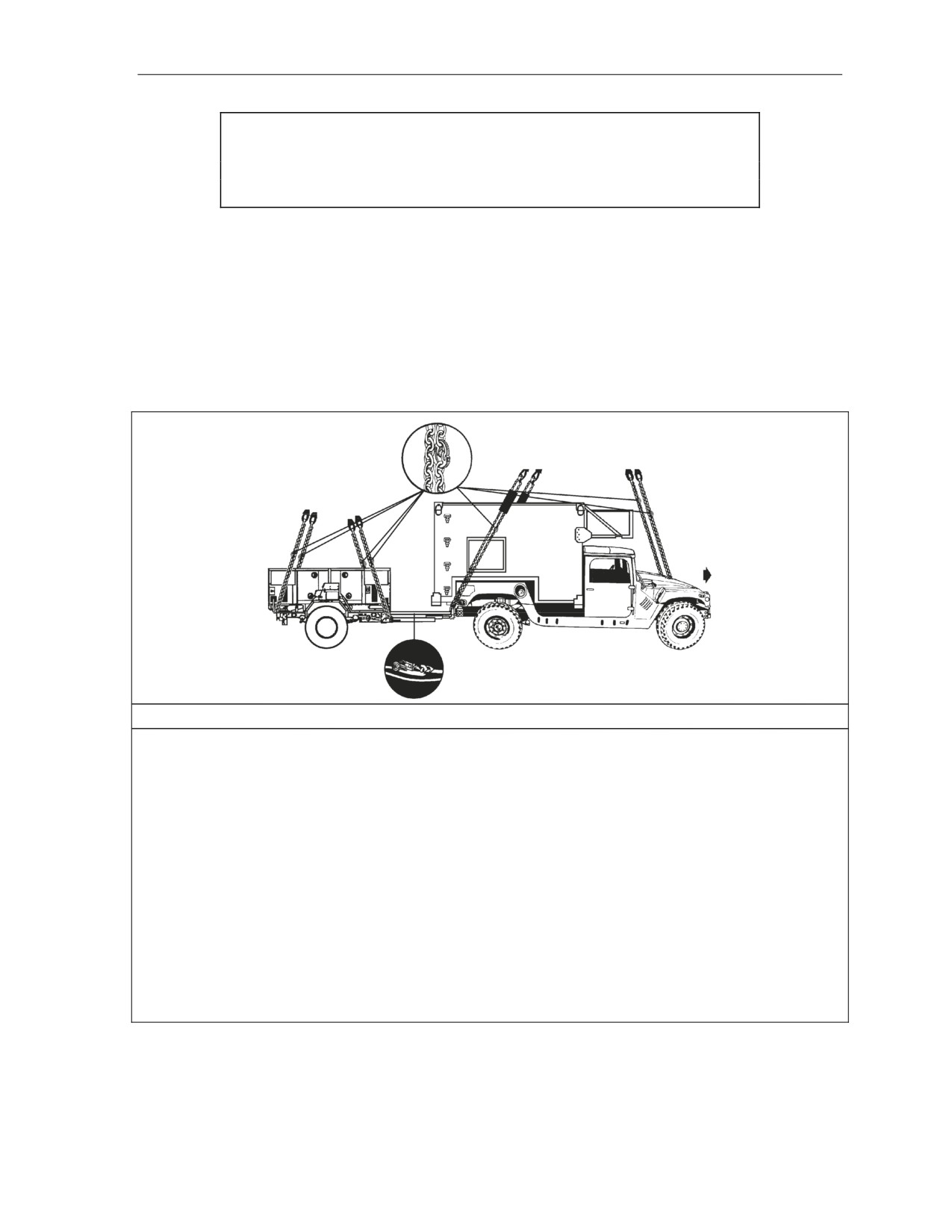
Certified Dual-Point Rigging Procedures for Tandem Loads
CAUTION
Do not connect the CGU-1/B tiedown strap around the truck's rear axle
or wheel, or front lift provisions on the trailer.
Rigging. Rig the load according to the steps in Figure 5-26.
Hookup. Two hookup teams are required for this load. The static wand person discharges
the static electricity with the static wand. The forward hookup person kneels on the top of the
shelter and places apex fitting 1 onto the forward cargo hook. The aft hookup person stands on the
generator fender and places apex fitting 2 onto the aft cargo hook. The hookup team then
carefully dismounts the load and remains close to the load as the helicopter removes slack
from the sling legs. When successful hookup is assured, the hookup team quickly exits the
area underneath the helicopter to the designated rendezvous point.
Derigging. Derigging is the reverse of the preparation and rigging procedures.
RIGGING STEPS
1. Position apex fitting on the roof of the shelter. Route outer sling legs 1 and 2 to the front of
the vehicle and inner sling legs 3 and 4 to the rear. Sling legs 1 and 3 must be on the left
side of the load.
2. Loop the chain end of sling leg 1 through the left front lift provision that protrudes through the
hood from inboard to outboard. Place the correct link from Table 5-26 in the grab hook.
Repeat with sling leg 2 and the right front lift provision. Secure excess chain with tape or
Type III nylon cord.
3. Loop the chain end of the sling legs through their respective lift provisions located on the
outer ends of the rear bumper. Place the correct link from Table 5-26 in the grab hook.
Secure excess chain with tape or Type III nylon cord.
4. Cluster and tie (breakaway technique) all sling legs together on top of the vehicle to prevent
entanglement during hookup and lift-off.
Figure 5-26. M1097 (HMMWV) with Meteorological Measuring Set in LMS Shelter and AN/MJQ-
35 Power Plant on M116A3 Trailer
FM 4-20.199/MCRP 4-11.3E, VOL III/NTTP 3-04.13/
20 February 2009
AFMAN 11-223 (I), VOL III/COMDINST M13482.4B
5-73

Chapter 5
RIGGING STEPS (Continued)
5. Position the apex fitting of sling set 2 on top of the generator. Route outer sling legs 1 and 2
to the front of the generator and inner sling legs 3 and 4 to the rear of the generator. Sling
legs 1 and 3 must be on the left side of the load.
6. Loop the chain end of sling leg 1 through the left front lift provision located on the front of the
trailer. Place the correct link from Table 5-26 in the grab hook. Repeat with sling leg 2
through the right front lift provision. Secure excess chain with tape or Type III nylon cord.
7. Loop the chain end of sling leg 3 through the left rear lift provision. Place the correct link from
Table 5-26 in the grab hook. Repeat with sling leg 4 through the right rear lift provision.
Secure excess chain with tape or Type III nylon cord.
8. Cluster and tie (breakaway technique) all sling legs together on top of the trailer to prevent
entanglement during hookup and lift-off.
Figure 5-26. M1097 (HMMWV) with Meteorological Measuring Set in LMS Shelter and AN/MJQ-
35 Power Plant on M116A3 Trailer (Continued)
M1113 (HMMWV) WITH LMS SHELTER AND SHADOW TACTICAL
UNMANNED AERIAL VEHICLE (TUAV) LAUNCH RECOVERY
TRAILER
5-28. The M1113 with LMS shelter and shadow tactical unmanned aerial vehicle launch recovery trailer
are rigged for dual-point sling load using the following procedures:
z
Applicability. The following items in Table 5-27 are certified for the helicopter(s) listed in the
following table by the US Army Natick Soldier Center:
Table 5-27. M1113 with LMS Shelter and Shadow Tactical Unmanned Aerial Vehicle (TUAV)
Launch Recovery Trailer
Nomenclature
Max Weight
Sling
Link Count
Type of
(Pounds)
Set
Front/Rear
Aircraft
Shadow Tactical Unmanned Aerial Vehicle, Air Vehicle
10,320
25K
30/10
CH-47
Transport
Shadow Tactical Unmanned Aerial Vehicle,
3,737
25K
40/60
CH-47
Launch/Recovery Trailer
z
Materials. The following materials are required to rig this load:
Sling set (25,000-pound capacity) (2 each).
─ Additional chain length, part number 38850-00053-102, from a 25,000-pound capacity
sling set (8 each).
─ Additional coupling link, NSN 4010-01-041-9751, from a 25,000-pound sling set (8
each).
Tape, adhesive, pressure-sensitive, 2-inch wide roll.
Cord, nylon, Type III, 550-pound breaking strength.
Webbing, cotton, 1/4-inch, 80-pound breaking strength.
Strap, cargo, tiedown, CGU-1/B (2 each).
Felt sheet, cattle hair, Type IV, 1/2-inch or suitable substitute.
FM 4-20.199/MCRP 4-11.3E, VOL III/NTTP 3-04.13/
5-74
AFMAN 11-223 (I), VOL III/COMDINST M13482.4B
20 February 2009
Certified Dual-Point Rigging Procedures for Tandem Loads
z
Personnel. Two persons can prepare and rig the M1113 HMMWV in 15 minutes. Two persons
can prepare and rig the trailer set in 20 minutes.
z
Procedures. Attach the trailer to the truck by placing the lunette on the pintle hook and
securing the latch with tape or Type III nylon cord. Secure the safety chains, cables, and hoses.
Position the vehicle on level ground so both the truck and trailer are in a straight line. The
following procedures apply to this load:
Preparation. Prepare the load using the following steps:
─
Fold mirrors inward and tie together with Type III nylon cord.
─
Secure all equipment and cargo inside the truck and trailer with tiedown straps, tape, or
Type III nylon cord.
─
Secure all loose equipment inside the shelter with tape, Type III nylon cord, or tiedown
straps. Close and secure the door.
─
Ensure the fuel tank is not over 3/4 full. Inspect the fuel tank cap, oil filler cap, and
battery caps for proper installation.
─
Engage the vehicle parking brake and put the transmission in neutral.
─
Ensure the front wheels are pointed straight ahead. Tie down the steering wheel, using
the securing device attached under the dashboard.
─
Deploy the trailer rear landing legs and place in the fully retracted position. Secure the
stowage straps with tape or Type III nylon cord.
─
Ensure the rear lift provisions are oriented above the rear landing legs.
─
Retract the lunette leg and secure with Type III nylon cord.
─
Secure all lids, doors, and caps with tape or Type III nylon cord.
─
Secure the beam support segments to the rails with Type III nylon cord.
─
Ensure the shuttle is secured in the stowed position.
─
Ensure the trailer parking brakes are set.
─
Connect the hook portion of a CGU-1/B tiedown strap to the left rear inboard tiedown
provision located near the pintle on the rear bumper of the truck. Connect the other
side to the underside of the trailer frame.
─
Repeat the above procedure on the right side of the load.
─
Tighten both CGU-1/B tiedown straps at the same time. Secure the excess strap and
safety the ratchet handles in the closed position with tape.
─
Connect one additional chain length to each chain on each sling set with a coupling
link.
CAUTION
Do not connect the CGU-1/B tiedown strap around the truck's rear axle
or wheel, or front lift provisions on the trailer.
Rigging. Rig the load according to the steps in Figure 5-27.
Hookup. Two hookup teams are required for this load. The static wand person discharges
the static electricity with the static wand. The forward hookup person kneels on the top of the
shelter and places apex fitting 1 onto the forward cargo hook. The aft hookup person stands on the
trailer and places apex fitting
2 onto the aft cargo hook. The hookup team then carefully
dismounts the load and remains close to the load as the helicopter removes slack from the sling
legs. When successful hookup is assured, the hookup team quickly exits the area underneath
the helicopter to the designated rendezvous point.
Derigging. Derigging is the reverse of the preparation and rigging procedures.
FM 4-20.199/MCRP 4-11.3E, VOL III/NTTP 3-04.13/
20 February 2009
AFMAN 11-223 (I), VOL III/COMDINST M13482.4B
5-75
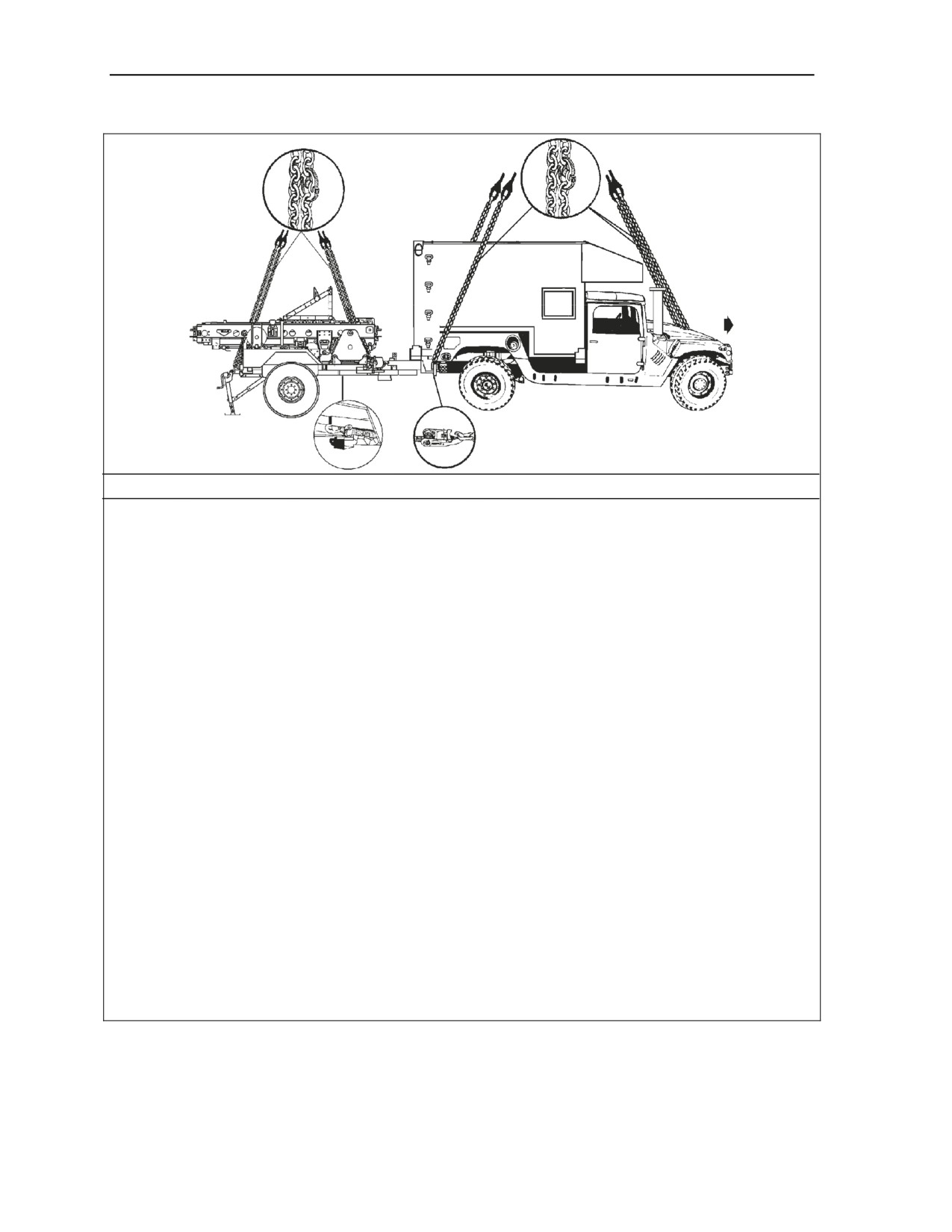
Chapter 5
RIGGING STEPS
1.
Position apex fitting on the roof of the shelter. Route outer sling legs 1 and 2 to the front of
the vehicle and inner sling legs 3 and 4 to the rear. Sling legs 1 and 3 must be on the left
side of the load.
2.
Loop the chain end of sling leg 1 through the left front lift provision that protrudes through the
hood from inboard to outboard. Place the correct link from Table 5-27 in the grab hook.
Repeat with sling leg 2 and the right front lift provision. Secure excess chain with tape or
Type III nylon cord.
3.
Loop the chain end of the sling legs through their respective lift provisions located on the
outer ends of the rear bumper. Place the correct link from Table 5-27 in the grab hook.
Secure excess chain with tape or Type III nylon cord.
4.
Cluster and tie (breakaway technique) all sling legs together on top of the vehicle to prevent
entanglement during hookup and lift-off.
5.
Position the apex fitting of sling set 2 on top of the trailer. Route outer sling legs 1 and 2 to
the front of the trailer and inner sling legs 3 and 4 to the rear of the trailer. Sling legs 1 and 3
must be on the left side of the load.
6.
Loop the chain end of sling leg 1 through the left front lift provision located on the front of the
trailer. Place the correct link from Table 5-27 in the grab hook. Repeat with sling leg 2
through the right front lift provision. Secure excess chain with tape or Type III nylon cord.
7.
Loop the chain end of sling leg 3 through the left rear lift provision. Place the correct link from
Table 5-27 in the grab hook. Repeat with sling leg 4 through the right rear lift provision.
Secure excess chain with tape or Type III nylon cord.
Figure 5-27. M1113 with LMS Shelter and Shadow Unmanned Aerial Vehicle Launch Recovery
Trailer
FM 4-20.199/MCRP 4-11.3E, VOL III/NTTP 3-04.13/
5-76
AFMAN 11-223 (I), VOL III/COMDINST M13482.4B
20 February 2009

Certified Dual-Point Rigging Procedures for Tandem Loads
RIGGING STEPS (Continued)
8. Raise each chain on the trailer until tight and tie the chain to the rail with 1/4-inch cotton
webbing.
9. Cluster and tie (breakaway technique) all sling legs together on top of the trailer to prevent
entanglement during hookup and lift-off.
Figure 5-27. M1113 with LMS Shelter and Shadow Unmanned Aerial Vehicle Launch Recovery
Trailer (Continued)
M998/M1038 1 1/4-TON CARGO TRUCK (HMMWV) AND M102, 105-
MM HOWITZER
5-29. The M998/M1038 1 1/4-ton cargo truck and M102, 105-mm howitzer are rigged for dual-point sling
load using the following procedures:
z
Applicability. The following items in Table 5-28 are certified for the helicopter(s) listed in the
following table by the US Army Natick Soldier Center:
Table 5-28. M998/M1038 1 1/4-Ton Cargo Truck and M102, 105-mm Howitzer
Nomenclature
Max Weight
Sling Set
Link Count
Type of
(Pounds)
Front/Rear
Aircraft
Truck, Cargo, 1 ¼-Ton, M998/M1038 without
7,700
10K
36/8
CH-47
Accompanying Load
Truck, Cargo, 1 ¼-Ton, M998/M1038 with
7,700
10K
40/8
CH-47
Accompanying Load
Howitzer, M102, without Accompanying Load
3,330
10K
83/9
CH-47
Howitzer, M102, with Accompanying Load
3,330
10K
58/6
CH-47
Accompanying Load
2,860
5K or
N/A
CH-47
10K Net
Truck, Cargo, 1 ¼-Ton, 1097A1 and M102
HMMWV-7,840
10K
40/10
CH-47
Howitzer without Accompanying Load
M102-3,330
10K
80/10
z
Materials. The following materials are required to rig this load:
Sling set (10,000-pound capacity) (2 each).
Tape, adhesive, pressure-sensitive, 2-inch wide roll.
Cord, nylon, Type III, 550-pound breaking strength.
Webbing, cotton, 1/4-inch, 80-pound breaking strength.
Strap, cargo, tiedown, CGU-1/B (2 each).
Felt sheet, cattle hair, Type IV, 1/2-inch or suitable substitute.
Clevis assembly, Type V platform, NSN 1670-01-162-2372, (2 each, 5 each if using a
25,000-pound capacity sling set). Three medium clevis assemblies may be substituted for the
three Type V platform clevises used on the howitzer when using 25,000-pound capacity sling
sets.
5,000- or 10,000-pound capacity net (used for accompanying load).
Clevis assembly, large, or apex fitting (10,000-pound capacity).
z
Personnel. Two persons can prepare and rig the M998/M1038 HMMWV in 15 minutes. Two
persons can prepare and rig the howitzer in 10 minutes.
z
Procedures. Attach the howitzer to the truck by placing the lunette on the pintle hook and
securing the latch with tape or Type III nylon cord. Secure the safety chains. Position the
FM 4-20.199/MCRP 4-11.3E, VOL III/NTTP 3-04.13/
20 February 2009
AFMAN 11-223 (I), VOL III/COMDINST M13482.4B
5-77
Chapter 5
vehicle on level ground so both the truck and howitzer are in a straight line. The following
procedures apply to this load:
Preparation. Prepare the load using the following steps:
─
Fold mirrors inward and tie together with Type III nylon cord. Remove the doors and
secure to the seats with Type III nylon cord.
─
Secure all equipment and cargo inside the truck with tiedown straps, tape, or Type III
nylon cord.
─
Ensure the fuel tank is not over 3/4 full. Inspect the fuel tank cap, oil filler cap, and
battery caps for proper installation.
─
Engage the vehicle parking brake and put the transmission in neutral.
─
Ensure the front wheels are pointed straight ahead. Tie down the steering wheel, using
the securing device attached under the dashboard.
─
Secure the brake light cable to the howitzer trail with tape or Type III nylon cord.
─
Secure the cover over the howitzer sights.
─
Place the section equipment chest on the end of the trails and secure with tiedown
straps.
─
Engage the howitzer hand brake.
─
Position a Type V platform clevis assembly in the tiedown provision located on the
outboard side of the truck frame above the left rear wheel. Ensure the bolt end of the
clevis is facing toward the howitzer. Route the free end of one tiedown strap under the
howitzer left trail, up over the trail box cross member support, through the Type V
platform clevis, and connect it to the hook on the ratchet.
─
Repeat the above procedure on the right side of the load.
─
Position padding between the strap and the angled bracket (gusset) located forward of
the rear lift provision on the truck.
─
Tighten both CGU-1/B tiedown straps at the same time. Secure the excess strap and
safety the ratchet handles in the closed position with tape.
CAUTION
Do not attach the tiedown straps to the rear wheels. The wheels may
rotate in flight and the straps may become loose.
─ Prepare and rig the cargo net, if used, in accordance with FM 4-20.197. Position the
cargo net close enough to the howitzer so the lifting legs and apex fitting can be routed
under the howitzer trails. Connect the large clevis or 10,000-pound capacity apex
fitting to the cargo net apex fitting.
Rigging. Rig the load according to the steps in Figure 5-28.
Hookup. Two hookup teams are required for this load. The static wand person discharges
the static electricity with the static wand. The forward hookup person stands in the bed of the
vehicle and places apex fitting 1 onto the forward cargo hook. The aft hookup person stands on the
trails of the howitzer and places apex fitting 2 onto the aft cargo hook. The hookup team then
carefully dismounts the load and remains close to the load as the helicopter removes slack
from the sling legs. When successful hookup is assured, the hookup team quickly exits the
area underneath the helicopter to the designated rendezvous point.
Note. Advise the aircraft commander to release the sling set apex fitting on the side of the
howitzer away from the gun sights to prevent damage.
Derigging. Derigging is the reverse of the preparation and rigging procedures.
FM 4-20.199/MCRP 4-11.3E, VOL III/NTTP 3-04.13/
5-78
AFMAN 11-223 (I), VOL III/COMDINST M13482.4B
20 February 2009
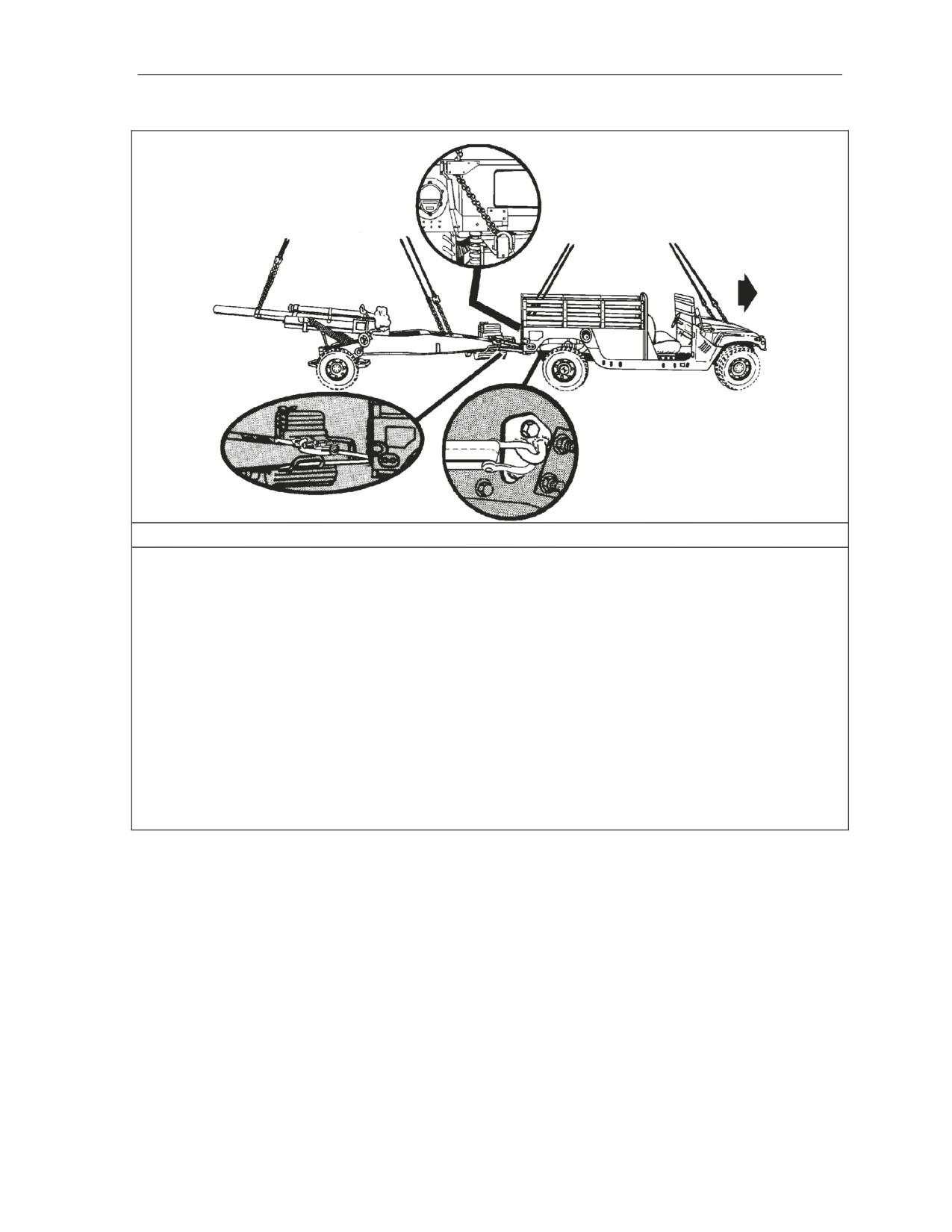
Certified Dual-Point Rigging Procedures for Tandem Loads
RIGGING STEPS
Note. If a 25,000-pound capacity sling set is used to rig the howitzer, attach a Type V platform clevis to each lift provision on
the howitzer. Position the bell portion of the clevis on the lift provision pin.
1. Position apex fitting on top of the truck bed. Route outer sling legs 1 and 2 to the front of the
vehicle and inner sling legs 3 and 4 to the rear. Sling legs 1 and 3 must be on the left side of
the load.
2. Loop the chain end of sling leg 1 through the left front lift provision that protrudes through the
hood of the vehicle. Place the correct link from Table 5-28 in the grab hook. Repeat with
sling leg 2 and the right front lift provision. Secure excess chain with tape or Type III nylon
cord.
3. Route the chain end of sling leg 3 through the eyelet opening in the upper left corner of the
tailgate. Loop the chain end through the left lift provision on the bumper and thread back
through the eyelet opening in the tailgate. Place the correct link from Table 5-28 in the grab
hook. Repeat with sling leg 4 and the right rear lift provision.
Figure 5-28. M998/M1038 Cargo Truck and M102, 105-mm Howitzer
FM 4-20.199/MCRP 4-11.3E, VOL III/NTTP 3-04.13/
20 February 2009
AFMAN 11-223 (I), VOL III/COMDINST M13482.4B
5-79

Chapter 5
RIGGING STEPS (Continued)
4. Cluster and tie (breakaway technique) all sling legs together on top of the vehicle to prevent
entanglement during hookup and lift-off.
5. Position the apex fitting of sling set 2 on top of the breech. Route outer sling legs 1 and 2 to
the trails and inner sling legs 3 and 4 to the barrel. Sling legs 1 and 3 must be on the left
side of the load.
6. Loop the chain end of sling leg 1 through the lift provision located on the left trail. If an
accompanying load is carried, loop the chain end through the lift provision, through the large
clevis or apex fitting connected to the accompanying load. Place the correct link from Table
5-28 in the grab hook. Repeat with sling leg 2 through the lift provision on the right trail.
Secure excess chain with tape or Type III nylon cord.
7. Loop the chain end of sling legs 3 and 4 through the lift provision located on the howitzer
barrel. Place the correct link from Table 5-28in the grab hook. Secure excess chain with
tape or Type III nylon cord.
8. Cluster and tie (breakaway technique) all sling legs together on top of the trailer to prevent
entanglement during hookup and lift-off.
Figure 5-28. M998/M1038 Cargo Truck and M102, 105-mm Howitzer (Continued)
M1037/M1097 TRUCK, UTILITY, 1 1/4-TON (HMMWV) AND M119,
105-MM HOWITZER
5-30. The M1037/M1097 truck, utility, 1 1/4-ton and M119, 105-mm howitzer are rigged for dual-point
sling load using the following procedures:
z
Applicability. The following items in Table 5-29 are certified for the helicopter(s) listed in the
following table by the US Army Natick Soldier Center:
Table 5-29. M1037/M1097 Truck, Utility, 1 1/4-Ton and M119, 105-mm Howitzer
Nomenclature
Max Weight
Sling Set
Link Count
Type of
(Pounds)
Front/Rear
Aircraft
Truck, Cargo, 1 ¼-Ton, M1037/M1097
7,320
10K
80/3
CH-47
Howitzer, 105-mm, M119, (M1037 as Prime
4,160
10K
Leg 1- 28
Mover)
Leg 2-30
CH-47
Leg 3-20
Howitzer, 105-mm, M119, (M1097 as Prime
4,160
10K
Leg 1- 55
Mover)
Leg 2-40
CH-47
Leg 3-30
z
Materials. The following materials are required to rig this load:
Sling set (10,000-pound capacity) (2 each).
Tape, adhesive, pressure-sensitive, 2-inch wide roll.
Cord, nylon, Type III, 550-pound breaking strength.
Webbing, cotton, 1/4-inch, 80-pound breaking strength.
Strap, cargo, tiedown, CGU-1/B (4 each).
Felt sheet, cattle hair, Type IV, 1/2-inch or suitable substitute.
Clevis assembly, Type V platform, NSN 1670-01-162-2372, (2 each).
Webbing, nylon, tubular, 1/2-inch, 1,000-pound breaking strength.
FM 4-20.199/MCRP 4-11.3E, VOL III/NTTP 3-04.13/
5-80
AFMAN 11-223 (I), VOL III/COMDINST M13482.4B
20 February 2009
Certified Dual-Point Rigging Procedures for Tandem Loads
z
Personnel. Two persons can prepare and rig the M1037/M1097 HMMWV in 15 minutes. Two
persons can prepare and rig the howitzer in 10 minutes.
z
Procedures. Attach the howitzer to the truck by placing the lunette on the pintle hook and
securing the latch with tape or Type III nylon cord. Secure the safety chains. Position the
vehicle on level ground so both the truck and howitzer are in a straight line. The following
procedures apply to this load:
Preparation. Prepare the load using the following steps:
─
Fold mirrors inward and tie together with Type III nylon cord. Remove the doors and
secure to the seats with Type III nylon cord.
─
Secure all equipment and cargo inside the truck with tiedown straps, tape, or Type III
nylon cord.
─
Ensure the fuel tank is not over 3/4 full. Inspect the fuel tank cap, oil filler cap, and
battery caps for proper installation.
─
Engage the vehicle parking brake and put the transmission in neutral.
─
Ensure the front wheels are pointed straight ahead. Tie down the steering wheel, using
the securing device attached under the dashboard.
─
Place the howitzer in the folded-towed position. Ensure the knock-off hub is in the
horizontal position. Engage the right wheel parking brake (wheel with knock-off hub)
only.
─
Ensure the lunette is in the extended position. Install the towing eye stop (C-clamp) on
the lunette and secure in position with its retaining pin.
─
Secure the brake light cable to the trails with tape or Type III nylon cord.
─
Secure the sight cover to the dial sight with tape or Type III nylon.
─
Secure the firing platform, hand spike, and jack to the trail assembly with Type III
nylon cord.
─
If the detachable field spade is attached to the permanent spades, ensure the two
locking pins are installed and locked in place. Route and tie a length of Type III nylon
cord through the key ring of the safety cable and around the other end of the locking
pin.
─
Position a Type V platform clevis assembly in the tiedown provision located on the
outboard side of the truck frame above the left rear wheel. Ensure the bolt end of the
clevis is facing toward the howitzer. Route the free end of one tiedown strap under the
howitzer left trail, through the Type V platform clevis, and connect it to the hook on
the ratchet.
─
Route a second strap under and around the trail tube, aft (closer to the gun wheel hub),
of the triangular brace on the M119 trails, through the Type V platform clevis, and
connect it to the hook on the ratchet.
─
Repeat the procedures in the previous two steps on the right side of the load.
─
Position padding between the strap and the angled bracket (gusset) located forward of
the rear lift provision on the truck.
─
Tighten all CGU-1/B tiedown straps at the same time. Secure the excess strap and
safety the ratchet handles in the closed position with tape.
CAUTION
Do not attach the tiedown straps to the rear wheels. The wheels may
rotate in flight and the straps may become loose.
Rigging. Rig the load according to the steps in Figure 5-29.
Hookup. Two hookup teams are required for this load. The static wand person discharges
the static electricity with the static wand. The forward hookup person stands in the bed of the
FM 4-20.199/MCRP 4-11.3E, VOL III/NTTP 3-04.13/
20 February 2009
AFMAN 11-223 (I), VOL III/COMDINST M13482.4B
5-81
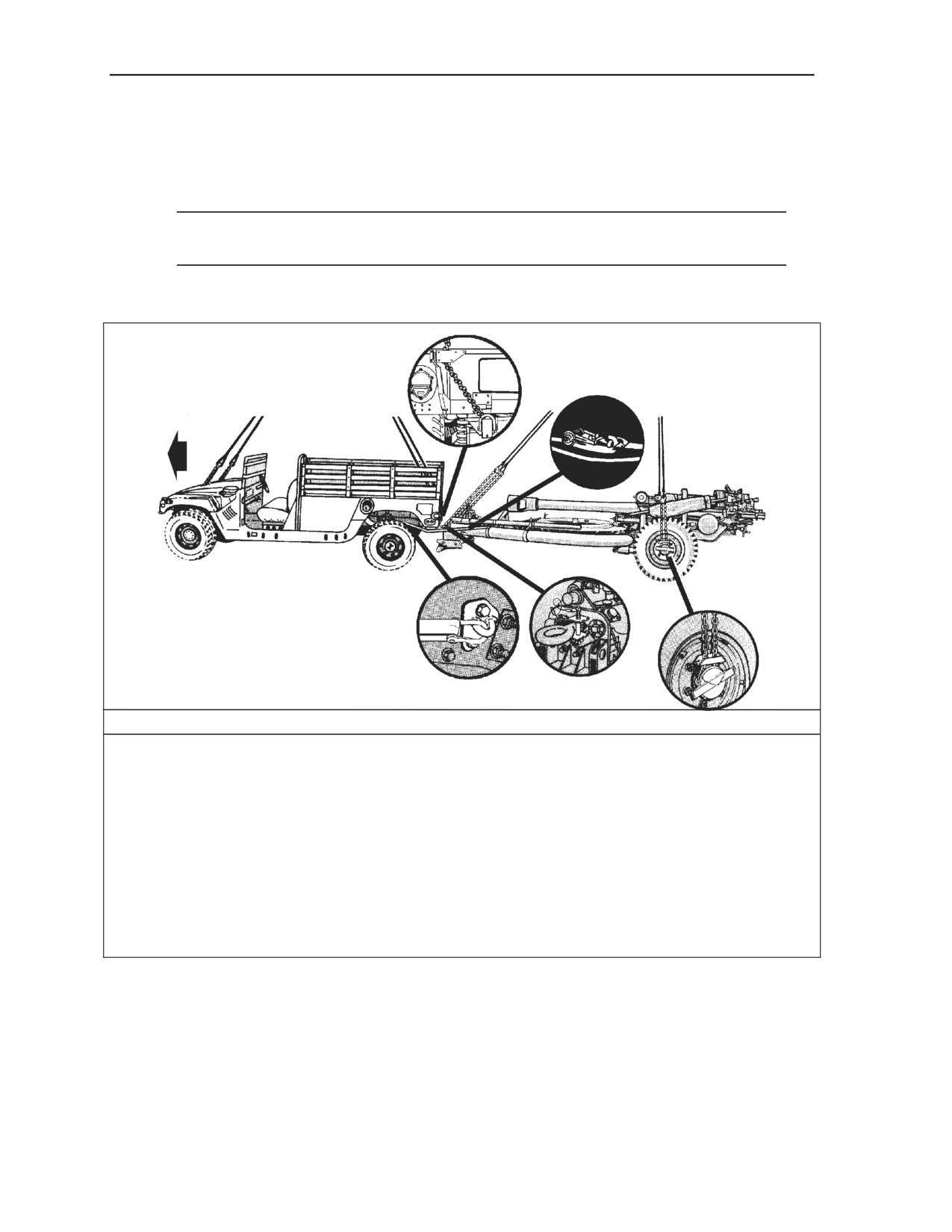
Chapter 5
vehicle and places apex fitting 1 onto the forward cargo hook. The aft hookup person stands on the
firing platform of the howitzer and places apex fitting 2 onto the aft cargo hook. The hookup team
then carefully dismounts the load and remains close to the load as the helicopter removes slack
from the sling legs. When successful hookup is assured, the hookup team quickly exits the
area underneath the helicopter to the designated rendezvous point.
Note. Advise the aircraft commander to release the sling set apex fitting on the side of the
howitzer away from the gun sights to prevent damage.
Derigging. Derigging is the reverse of the preparation and rigging procedures.
RIGGING STEPS
Note. The sling set on the howitzer may use 3 or 4 sling legs. If the fourth sling leg is used, it will be
attached to the lunette with the same link count as sling leg 3. Tape or tie sling legs 3 and 4 together
at 2-3 foot intervals over the entire length of the sling legs.
1. Position apex fitting on top of the truck bed. Route outer sling legs 1 and 2 to the front of the
vehicle and inner sling legs 3 and 4 to the rear. Sling legs 1 and 3 must be on the left side of
the load.
2. Loop the chain end of sling leg 1 through the left front lift provision that protrudes through the
hood of the vehicle. Place the correct link from Table 5-29 in the grab hook. Repeat with
sling leg 2 and the right front lift provision. Secure excess chain with tape or Type III nylon
cord.
Figure 5-29. M1037/M1097 Truck, Utility, 1 1/4-Ton and M119, 105-mm Howitzer
FM 4-20.199/MCRP 4-11.3E, VOL III/NTTP 3-04.13/
5-82
AFMAN 11-223 (I), VOL III/COMDINST M13482.4B
20 February 2009

Certified Dual-Point Rigging Procedures for Tandem Loads
RIGGING STEPS (Continued)
3.
Route the chain end of sling leg 3 through the eyelet opening in the upper left corner of the
tailgate. Loop the chain end through the left lift provision on the bumper and thread back
through the eyelet opening in the tailgate. Place the correct link from Table 5-29 in the grab
link. Repeat with sling leg 4 and the right rear lift provision.
4.
Cluster and tie (breakaway technique) all sling legs together on top of the vehicle to prevent
entanglement during hookup and lift-off.
5.
Position the apex fitting of sling set 2 on top of the barrel over the firing platform. Route outer
sling legs 1 and 2 to the wheel hubs and inner sling leg 3 to the lunette. Sling leg 1 must be
on the left wheel hub.
6.
Loop the chain end of sling leg 1 around the left wheel hub. Pull the sling leg taut to remove
the slack from the chain. Install the sling set safety clamp on the chain links as close to the
hub as possible. If the clamp is not available, tie the chain links together with 1/2- inch
tubular nylon. Place the correct link from Table 5-29 in the grab hook. Repeat with sling leg
2 through the lift provision on the right trail. Secure excess chain with tape or Type III nylon
cord.
7.
Loop the chain end of sling leg 3 through the lunette. Place the correct link from Table 5-29 in
the grab hook. Secure excess chain with tape or Type III nylon cord.
8.
Cluster and tie (breakaway technique) all sling legs together on top of the trailer to prevent
entanglement during hookup and lift-off.
Figure 5-29. M1037/M1097 Truck, Utility, 1 1/4-Ton and M119, 105-mm Howitzer (Continued)
M1025A2 TRUCK, 1 1/4-TON (HMMWV) WITH LINE OF SIGHT
ANTI-TANK (LOSAT) RELOADER CRANE AND HIGH MOBILITY
RESUPPLY TRAILER (HMT)
5-31. The M1025A2 truck, 1 1/4-ton with line of sight anti-tank reloader crane and high mobility resupply
trailer are rigged for dual-point sling load using the following procedures:
z
Applicability. The following items in Table 5-30 are certified for the helicopter(s) listed in the
following table by the US Army Natick Soldier Center:
Table 5-30. M1025A2 Truck, 1 1/4-Ton with Line of Sight Anti-Tank Reloader Crane and High
Mobility Resupply Trailer
Nomenclature
Max Weight
Sling Set
Link Count
Type of
(Pounds)
Front/Rear
Aircraft
Truck, Cargo, 1 ¼-Ton, M1025A2 with LOSAT
8,240
10K
65/35
CH-47
Reloader Crane
LOSAT Resupply Trailer (HMT) with 8 Missiles
4,100
10K
72//87
CH-47
z
Materials. The following materials are required to rig this load:
Sling set (10,000-pound capacity) (2 each).
Tape, adhesive, pressure-sensitive, 2-inch wide roll.
Cord, nylon, Type III, 550-pound breaking strength.
Webbing, cotton, 1/4-inch, 80-pound breaking strength.
FM 4-20.199/MCRP 4-11.3E, VOL III/NTTP 3-04.13/
20 February 2009
AFMAN 11-223 (I), VOL III/COMDINST M13482.4B
5-83
Chapter 5
Strap, cargo, tiedown, CGU-1/B (4 each).
Felt sheet, cattle hair, Type IV, 1/2-inch or suitable substitute.
z
Personnel. Two persons can prepare and rig the truck in 10 minutes. Two persons can prepare
and rig the trailer in 20 minutes.
z
Procedures. Attach the trailer to the truck by placing the lunette on the pintle hook and
securing the latch with tape or Type III nylon cord. Secure the safety chains. Position the
vehicle on level ground so both the truck and trailer are in a straight line. The following
procedures apply to this load:
Preparation. Prepare the load using the following steps:
─ Fold mirrors inward and tie together with Type III nylon cord. Remove the doors and
secure to the seats with Type III nylon cord.
─ Secure all equipment and cargo inside the truck with tiedown straps, tape, or Type III
nylon cord.
─ Ensure the fuel tank is not over 3/4 full. Inspect the fuel tank cap, oil filler cap, and
battery caps for proper installation.
─ Engage the vehicle parking brake and put the transmission in neutral.
─ Ensure the front wheels are pointed straight ahead. Tie down the steering wheel, using
the securing device attached under the dashboard.
─ Retract the lunette leg and secure with Type III nylon cord.
─ Secure all doors with tiedown straps or Type III nylon cord.
─ Ensure the trailer parking brakes are set.
─ Route the hook portion of a CGU-1/B tiedown strap through the left rear inboard
tiedown provision located near the pintle on the rear bumper of the truck and through
the mounting bracket on the front of the trailer A-frame. Connect the hook to the
ratchet of the CGU-1/B.
─ Repeat the above procedure on the right side of the load.
─ Tighten both CGU-1/B tiedown straps at the same time. Secure the excess strap and
safety the ratchet handles in the closed position with tape.
CAUTION
Do not connect the CGU-1/B tiedown strap around the truck's rear axle
or wheel.
Rigging. Rig the load according to the steps in Figure 5-30.
Hookup. Two hookup teams are required for this load. The static wand person discharges
the static electricity with the static wand. The forward hookup person stands on top of the vehicle
and places apex fitting 1 onto the forward cargo hook. The aft hookup person stands on the trailer
fender and places apex fitting 2 onto the aft cargo hook. The hookup team then carefully
dismounts the load and remains close to the load as the helicopter removes slack from the sling
legs. When successful hookup is assured, the hookup team quickly exits the area underneath
the helicopter to the designated rendezvous point.
Derigging. Derigging is the reverse of the preparation and rigging procedures.
FM 4-20.199/MCRP 4-11.3E, VOL III/NTTP 3-04.13/
5-84
AFMAN 11-223 (I), VOL III/COMDINST M13482.4B
20 February 2009
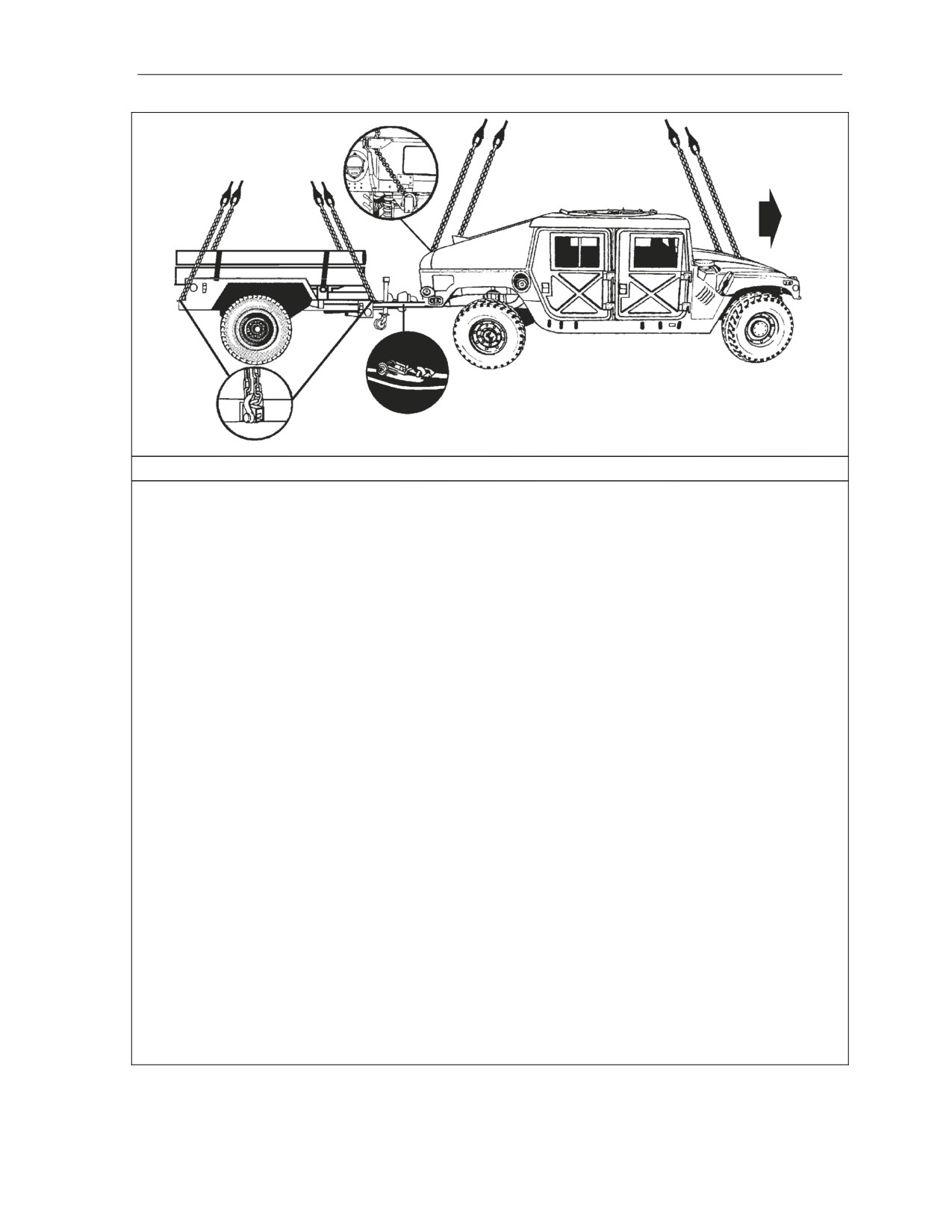
Certified Dual-Point Rigging Procedures for Tandem Loads
RIGGING STEPS
1.
Position apex fitting on top of the truck. Route outer sling legs 1 and 2 to the front of the
vehicle and inner sling legs 3 and 4 to the rear. Sling legs 1 and 3 must be on the left side of
the load.
2.
Loop the chain end of sling leg 1 through the left front lift provision that protrudes through the
hood of the vehicle. Place the correct link from Table 5-30 in the grab hook. Repeat with
sling leg 2 and the right front lift provision. Secure excess chain with tape or Type III nylon
cord.
3.
Route the chain end of sling leg 3 through the eyelet opening in the upper left corner of the
tailgate. Loop the chain end through the left lift provision on the bumper and thread back
through the eyelet opening in the tailgate. Place the correct link from Table 5-30 in the grab
link. Repeat with sling leg 4 and the right rear lift provision.
4.
Cluster and tie (breakaway technique) all sling legs together on top of the vehicle to prevent
entanglement during hookup and lift-off.
5.
Position the apex fitting of sling set 2 on top of the trailer. Route outer sling legs 1 and 2 to
the front of the trailer and inner sling legs 3 and 4 to the rear of the trailer. Sling legs 1 and 3
must be on the left side of the load.
6.
Loop the chain end of sling leg 1 through the left front lift provision located on the front of the
trailer. Place the correct link from Table 5-30 in the grab hook. Repeat with sling leg 2
through the right front lift provision. Secure excess chain with tape or Type III nylon cord.
7.
Loop the chain end of sling leg 3 through the left rear lift provision. Place the correct link from
Table 5-30 in the grab hook. Repeat with sling leg 4 through the right rear lift provision.
Secure excess chain with tape or Type III nylon cord.
8.
Cluster and tie (breakaway technique) all sling legs together on top of the vehicle to prevent
entanglement during hookup and lift-off.
Figure 5-30. 1025A2 Truck, 1 1/4-Ton with Line of Sight Anti-Tank Reloader Crane and High
Mobility Resupply Trailer
FM 4-20.199/MCRP 4-11.3E, VOL III/NTTP 3-04.13/
20 February 2009
AFMAN 11-223 (I), VOL III/COMDINST M13482.4B
5-85
Chapter 5
M1113 TRUCK, 1 1/4-TON (HMMWV) WITH LINE OF SIGHT ANTI-
TANK (LOSAT) FIRE UNIT AND HIGH MOBILITY RESUPPLY
TRAILER (HMT)
5-32. The M1113 truck, 1 1/4-ton with line of sight anti-tank fire unit and high mobility resupply trailer
are rigged for dual-point sling load using the following procedures:
z
Applicability. The following items in Table 5-31 are certified for the helicopter(s) listed in the
following table by the US Army Natick Soldier Center:
Table 5-31. M1113 Truck, 1 1/4-Ton with Line of Sight Anti-Tank Fire Unit and High Mobility
Resupply Trailer
Nomenclature
Max Weight
Sling Set
Link Count
Type of
(Pounds)
Front/Rear
Aircraft
Truck, Cargo, 1 ¼-Ton, M1113 with LOSAT
10,920
25K
30/5
CH-47
Fire Unit
LOSAT Resupply Trailer (HMT) with 8 Missiles
4,100
10K
65/50
CH-47
z
Materials. The following materials are required to rig this load:
Sling set (10,000-pound capacity).
Sling set (25,000-pound capacity).
─ Additional chain length, part number 38850-00053-102, from a 25,000-pound capacity
sling set (4 each).
─ Additional coupling link, NSN 4010-01-041-9751, from a 25,000-pound sling set (4
each).
Tape, adhesive, pressure-sensitive, 2-inch wide roll.
Cord, nylon, Type III, 550-pound breaking strength.
Webbing, cotton, 1/4-inch, 80-pound breaking strength.
Strap, cargo, tiedown, CGU-1/B (4 each).
Felt sheet, cattle hair, Type IV, 1/2-inch or suitable substitute.
z
Personnel. Two persons can prepare and rig the truck in 10 minutes. Two persons can prepare
and rig the trailer in 20 minutes.
z
Procedures. Attach the trailer to the truck by placing the lunette on the pintle hook and
securing the latch with tape or Type III nylon cord. Secure the safety chains. Position the
vehicle on level ground so both the truck and trailer are in a straight line. The following
procedures apply to this load:
Preparation. Prepare the load using the following steps:
─ Fold mirrors inward and tie together with Type III nylon cord. Remove the doors and
secure to the seats with Type III nylon cord.
─ Secure all equipment and cargo inside the truck with tiedown straps, tape, or Type III
nylon cord.
─ Ensure the fuel tank is not over 3/4 full. Inspect the fuel tank cap, oil filler cap, and
battery caps for proper installation.
─ Engage the vehicle parking brake and put the transmission in neutral.
─ Ensure the front wheels are pointed straight ahead. Tie down the steering wheel, using
the securing device attached under the dashboard.
─ Retract the lunette leg and secure with Type III nylon cord.
─ Secure all doors with tiedown straps or Type III nylon cord.
─ Ensure the trailer parking brakes are set.
─ Route the hook portion of a CGU-1/B tiedown strap through the left rear inboard
tiedown provision located near the pintle on the rear bumper of the truck and through
FM 4-20.199/MCRP 4-11.3E, VOL III/NTTP 3-04.13/
5-86
AFMAN 11-223 (I), VOL III/COMDINST M13482.4B
20 February 2009
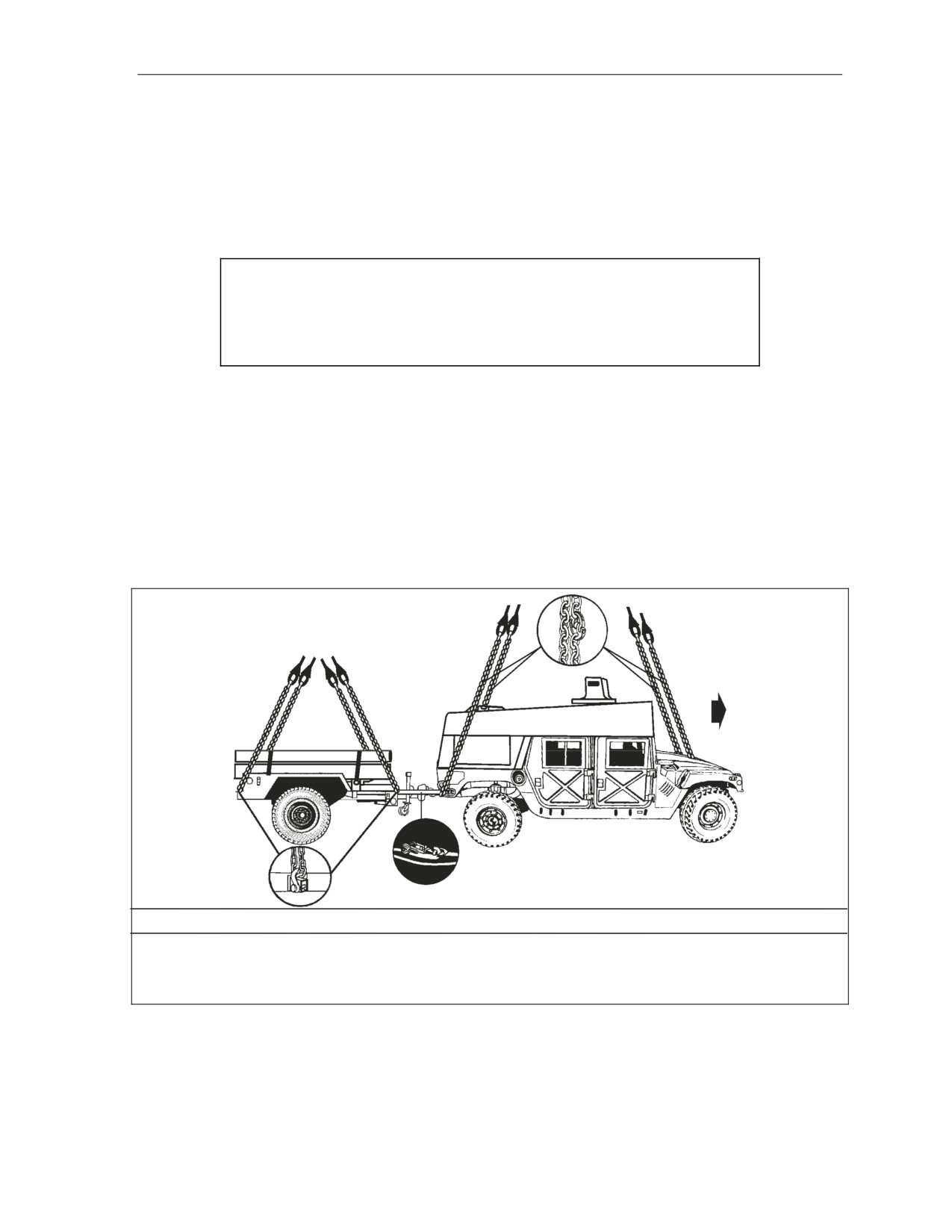
Certified Dual-Point Rigging Procedures for Tandem Loads
the mounting bracket on the front of the trailer A-frame. Connect the hook to the
ratchet of the CGU-1/B.
─ Repeat the above procedure on the right side of the load.
─ Tighten both CGU-1/B tiedown straps at the same time. Secure the excess strap and
safety the ratchet handles in the closed position with tape.
─ Connect one additional chain length to each chain on each sling set with a coupling
link.
CAUTION
Do not connect the CGU-1/B tiedown strap around the truck's rear axle
or wheel.
Rigging. Rig the load according to the steps in Figure 5-31.
Hookup. Two hookup teams are required for this load. The static wand person discharges
the static electricity with the static wand. The forward hookup person stands on top of the vehicle
and places apex fitting 1 onto the forward cargo hook. The aft hookup person stands on the trailer
fender and places apex fitting 2 onto the aft cargo hook. The hookup team then carefully
dismounts the load and remains close to the load as the helicopter removes slack from the sling
legs. When successful hookup is assured, the hookup team quickly exits the area underneath
the helicopter to the designated rendezvous point.
Derigging. Derigging is the reverse of the preparation and rigging procedures.
RIGGING STEPS
1. Position the 25,000-pound capacity sling set on top of the truck. Route outer sling legs 1 and
2 to the front of the vehicle and inner sling legs 3 and 4 to the rear. Sling legs 1 and 3 must
be on the left side of the load.
Figure 5-31. M1113 Truck, 1 1/4-Ton with Line Of Sight Anti-Tank Fire Unit and High Mobility
Resupply Trailer
FM 4-20.199/MCRP 4-11.3E, VOL III/NTTP 3-04.13/
20 February 2009
AFMAN 11-223 (I), VOL III/COMDINST M13482.4B
5-87

Chapter 5
RIGGING STEPS (Continued)
2.
Loop the chain end of sling leg 1 through the left front lift provision that protrudes through the
hood of the vehicle. Place the correct link from Table 5-31 in the grab hook. Repeat with
sling leg 2 and the right front lift provision. Secure excess chain with tape or Type III nylon
cord.
3.
Route the chain end of sling leg 3 through the eyelet opening in the upper left corner of the
tailgate. Loop the chain end through the left lift provision on the bumper and thread back
through the eyelet opening in the tailgate. Place the correct link from Table 5-31 in the grab
link. Repeat with sling leg 4 and the right rear lift provision.
4.
Cluster and tie (breakaway technique) all sling legs together on top of the vehicle to prevent
entanglement during hookup and lift-off.
5.
Position the 10,000-pound capacity sling set 2 on top of the trailer. Route outer sling legs 1
and 2 to the front of the trailer and inner sling legs 3 and 4 to the rear of the trailer. Sling legs
1 and 3 must be on the left side of the load.
6.
Loop the chain end of sling leg 1 through the left front lift provision located on the front of the
trailer. Place the correct link from Table 5-31 in the grab hook. Repeat with sling leg 2
through the right front lift provision. Secure excess chain with tape or Type III nylon cord.
7.
Loop the chain end of sling leg 3 through the left rear lift provision. Place the correct link from
Table 5-31 in the grab hook. Repeat with sling leg 4 through the right rear lift provision.
Secure excess chain with tape or Type III nylon cord.
8.
Cluster and tie (breakaway technique) all sling legs together on top of the vehicle to prevent
entanglement during hookup and lift-off.
Figure 5-31. M1113 Truck, 1 1/4-Ton with Line of Sight Anti-Tank Fire Unit and High Mobility
Resupply Trailer (Continued)
M1113 TRUCK, 1 1/4-TON (HMMWV) WITH M56 SMOKE
GENERATOR AND M101A2 TRAILER
5-33. The M1113 truck, 1 1/4-ton with M56 smoke generator and M101A2 trailer are rigged for dual-point
sling load using the following procedures:
z
Applicability. The following items in Table 5-32 are certified for the helicopter(s) listed in the
following table by the US Army Natick Soldier Center:
Table 5-32. M1113 Truck, 1 1/4-Ton with M56 Smoke Generator and M101A2 Trailer
Nomenclature
Max Weight
Sling Set
Link Count
Type of
(Pounds)
Front/Rear
Aircraft
M1113 with M56 Smoke Generator without
9,400
10K
65/3-Left
CH-47
Graphite in Tank
65/14-Right
M101A2 Trailer
3,000
10K
50/40
CH-47
z
Materials. The following materials are required to rig this load:
Sling set (10,000-pound capacity) (2 each).
─ Additional chain length, part number 38850-00053-101, from a 10,000-pound capacity
sling set (8 each).
─ Additional coupling link, part number 664228, from a 10,000-pound sling set (8 each).
FM 4-20.199/MCRP 4-11.3E, VOL III/NTTP 3-04.13/
5-88
AFMAN 11-223 (I), VOL III/COMDINST M13482.4B
20 February 2009