FM 4-20.199 Multiservice Helicopter Sling Load: Dual-Point Load Rigging Procedures (February 2009) - page 9
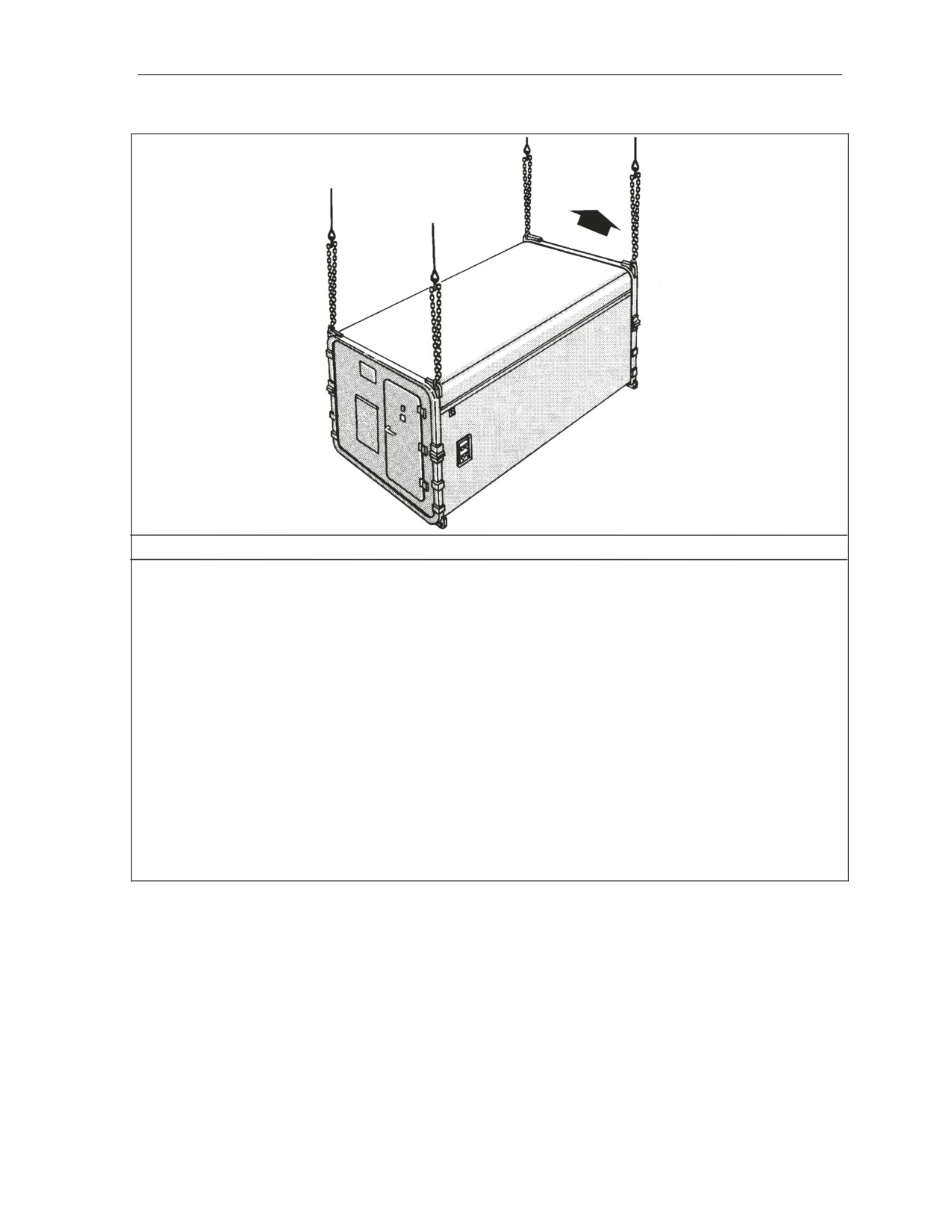
Certified Dual-Point Rigging Procedures for Missile Systems
RIGGING STEPS
1. Place two sling legs on apex fitting number 1. Position apex fitting number 1 on top of the
shelter, opposite the door end.
2. Loop the chain end of the left and right sling legs through their respective lift provisions
located on the front corners of the shelter. Place the correct link from Table 7-8 in the grab
hook.
3. Place two sling legs on apex fitting number 2. Position apex fitting number 2 on top of the
door end of the shelter.
4. Loop the chain end of the left and right sling legs through their respective lift provisions
located on the rear corners of the shelter. Place the correct link from Table 7-8 in the grab
hook. Secure the excess chain with tape or Type III nylon cord.
5. Cluster and tie (breakaway technique) the sling legs in each sling set together to prevent
entanglement during hookup and lift-off.
Figure 7-8. Field Maintenance Equipment Shop 21, Unmanned Shop, Electrical Equipment
PLATOON COMMAND POST (PCP)/BATTERY COMMAND POST
(BCP)
7-10. The platoon command post/battery command post is rigged for dual-point sling load using the
following procedures:
z
Applicability. The following items in Table 7-9are certified for the helicopter(s) listed in the
following table by the US Army Natick Soldier Center:
FM 4-20.199/MCRP 4-11.3E, VOL III/NTTP 3-04.13/
20 February 2009
AFMAN 11-223 (I), VOL III/COMDINST M13482.4B
7-17

Chapter 7
Table 7-9. Platoon Command Post / Battery Command Post
Nomenclature
Max Weight
Sling
Link Count
Type of
(Pounds)
Set
Front/Rear
Aircraft
Platoon Command Post, AN/MSW-20, Phase II, on
10,244
25K
3/70
CH-47
M390C Trailer
Platoon Command Post, AN/MSW-20, Phase III, on
9,300
25K
3/70
CH-47
M390C Trailer
Battery Command Post, AN/MSW-21, Phase III, on
9,980
25K
3/70
CH-47
M390C Trailer
z
Materials. The following materials are required to rig this load:
Sling set (25,000-pound capacity) with one additional apex fitting.
─ Additional chain length, part number 38850-00053-102, from a 25,000-pound capacity
sling set (2 each).
─ Additional coupling link, part number 664-241, from a 25,000-pound capacity sling set
(2 each).
Line, multiloop, 4-loop, 8-ply, NSN 1670-01-062-6307 (2 each).
Tape, adhesive, pressure-sensitive, 2-inch wide roll.
Cord, nylon, Type III, 550-pound breaking strength.
Webbing, cotton, 1/4-inch, 80-pound breaking strength.
Clevis assembly, NSN 4030-00-278-0699 (6 each).
Webbing, nylon, tubular, 1,000-pound breaking strength.
CAUTION
Do not substitute any sling equipment in place of the specified sling set
or multiloop lines. The two multiloop lines and the sling set, with the
additional apex fitting, chain lengths, and additional coupling links, are
to be stored in the kit bag and only used for sling loading the
PCP/BCP.
z
Personnel. Two persons can prepare and rig this load in 30 minutes.
z
Procedures. The following procedures apply to this load:
Preparation. Prepare the load using the following steps:
─ Prepare the PCP/BCP for travel according to instructions in the operator's manual.
─ Ensure the 3 1/4-ton clevises provided with the trailer chassis have been replaced with
6 3/4-ton clevises (NSN 4030-00-278-0699). Ensure the clevises are pinned and not
damaged.
─ Engage the parking brakes.
─ Adjust the leveling jack pads to just above ground level. Lock into position.
─ Secure all hoses, cables, and chains to the adjacent structure with tape or Type III
nylon cord.
─ Tape the towing provisions on the bottom corners of the shelter to prevent the rigging
crew from routing the sling leg chain ends through the towing provisions.
─ Using 1/2-inch tubular nylon, tie the front and rear lifting rings together tightly on top
of the left side of the shelter so the lifting rings are facing each other. Repeat the
procedure with the top lifting rings on the right side of the shelter.
FM 4-20.199/MCRP 4-11.3E, VOL III/NTTP 3-04.13/
7-18
AFMAN 11-223 (I), VOL III/COMDINST M13482.4B
20 February 2009
Certified Dual-Point Rigging Procedures for Missile Systems
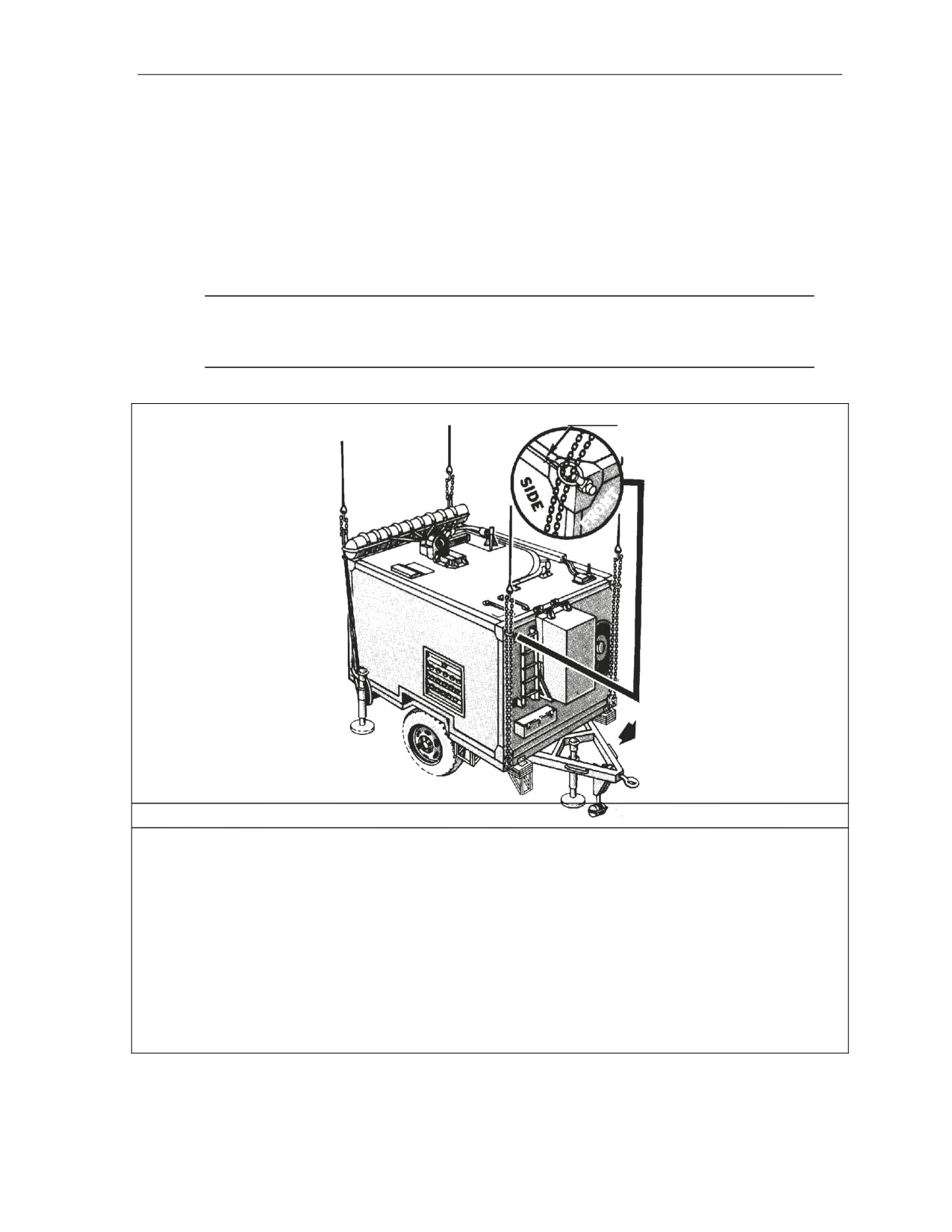
Rigging. Rig the load according to the steps in Figure 7-9.
Hookup. Two hookup teams are required for this load. The static wand person discharges
the static electricity with the static wand. The forward hookup person stands on top of the
shelter and places apex fitting number 1 onto the forward cargo hook. The aft hookup person
stands on top of the shelter and places apex fitting number 2 onto the aft cargo hook. The
hookup teams then carefully dismount the shelter and remain close to the load as the helicopter
removes slack from the sling legs. When successful hookup is assured, the hookup teams
quickly exit the area underneath the helicopter to the designated rendezvous point.
Derigging. Derigging is the reverse of the preparation and rigging procedures.
Note. Do not remove the additional chain sections from sling set 1. Keep sling sets 1 and 2
intact for ease in future use. Store the 12-foot multiloop lines in the kit bag with the two sling
sets.
½-INCH TUBLAR
NYLON WEBBING
RIGGING STEPS
1. Place two sling legs on apex fitting number 1. Connect an additional chain length to each
sling leg chain using the coupling links. Position apex fitting number 1 on top of the shelter
on the lunette end.
2. Route the chain end of the left sling leg down through the upper lifting ring on the top left
corner of the shelter, through the trailer lifting provision located on the front left corner of the
trailer chassis, and back up through the upper lifting ring on the top left corner of the shelter.
Place the correct link from Table 7-9 in the grab hook.
3. Repeat the above procedures using the right sling leg and the right lifting provision.
Note. Do not route the chain ends through the towing provision on the base of the shelter.
Figure 7-14. Platoon Command Post/Battery Command Post
FM 4-20.199/MCRP 4-11.3E, VOL III/NTTP 3-04.13/
20 February 2009
AFMAN 11-223 (I), VOL III/COMDINST M13482.4B
7-19
Chapter 7
RIGGING STEPS (Continued)
4. Choker hitch a 12-foot line around the rear left leveling jack stand on the trailer chassis.
Ensure the loop of the knot is facing to the rear of the trailer. Route the free end of the 12-
foot multiloop line up through the lifting ring on the top corner of the shelter. Ensure the
choker hitch is tight around the jack stand and the individual plies of the multiloop line remain
aligned. Tape or tie the multiloop line as necessary.
Note. Do not route the 12-foot multiloop line through the towing provision on the base of the shelter.
5. Repeat the above procedures on the right side of the shelter using the remaining 12-foot
multiloop line.
6. Place two sling legs on apex fitting number 2. Position apex fitting number 2 on top of the
IFF end of the shelter.
7. Loop the chain end of the left sling leg through the open loop at the free end of the 12-foot
multiloop line on the left rear corner of the shelter. Place the correct link from Table 7-9 in
the grab hook. Secure the excess chain with tape or Type III nylon cord.
8. Repeat the above procedure using the right multiloop line and the right sling leg.
9. Cluster and tie (breakaway technique) the sling legs in each sling set together to prevent
entanglement during hookup and lift-off.
Figure 7-9. Platoon Command Post/Battery Command Post (Continued)
FM 4-20.199/MCRP 4-11.3E, VOL III/NTTP 3-04.13/
7-20
AFMAN 11-223 (I), VOL III/COMDINST M13482.4B
20 February 2009

Chapter 8
Certified Dual-Point Rigging Procedures for Engineer
Equipment
INTRODUCTION
8-1. This chapter contains rigging procedures for dual-point lift of engineer equipment loads that have
been certified for sling load. Each rigging procedure is found in a paragraph that includes a description of
the load, materials required for rigging, and steps to complete the procedure. An applicability paragraph is
also a part of each paragraph and identifies the certified loads. The certified dual-point rigging procedures
for engineer equipment loads are in this section. Paragraphs 8-2 through 8-42 give detailed instructions for
rigging loads.
Note. Reach Pendants may be used on dual point loads. Place a Reach Pendant on each apex
fitting. A static discharge person is not required when using a Reach Pendant.
D5B TRACTOR DOZER, SECTIONALIZED
8-2. The D5B tractor dozer, sectionalized is rigged for dual-point sling load using the following
procedures:
z
Applicability. The following items in Table 8-1 are certified for the helicopter(s) listed in the
following table by the US Army Natick Soldier Center:
Table 8-1. D5B Tractor Dozer, Sectionalized
Nomenclature
Max Weight
Sling
Link Count
Type of
(Pounds)
Set
Front/Rear
Aircraft
Tractor Dozer, D5B, Power Section
18,915
25K
8/57
CH-47
Tractor Dozer, D5B, Track Section
13,735
25K
12/21
CH-47
z
Materials. The following materials are required to rig this load:
Sling set (25,000-pound capacity) (2 each) with two additional apex fittings.
Tape, adhesive, pressure-sensitive, 2-inch wide roll.
Cord, nylon, Type III, 550-pound breaking strength.
Webbing, cotton, 1/4-inch, 80-pound breaking strength.
z
Personnel. Four persons can sectionalize this load in 2 1/2 hours and rig each section in 15
minutes.
z
Procedures. The following procedures apply to this load:
Preparation. Prepare the load using the following steps:
─ Sectionalize the dozer according to the operator's manual. Do not remove the winch
and winch pump.
─ Remove the exhaust stack and secure it on top of the winch with Type III nylon cord.
─ Remove the pre-air cleaner and secure it on the seat with Type III nylon cord.
FM 4-20.199/MCRP 4-11.3E, VOL III/NTTP 3-04.13/
20 February 2009
AFMAN 11-223 (I), VOL III/COMDINST M13482.4B
8-1
Chapter 8
─ Tape all lights and gages.
─ Secure the seat with Type III nylon cord.
─ Ensure the fuel tank is not over 3/4 full. Inspect fuel tank cap, oil filler cap, and
battery caps for proper installation.
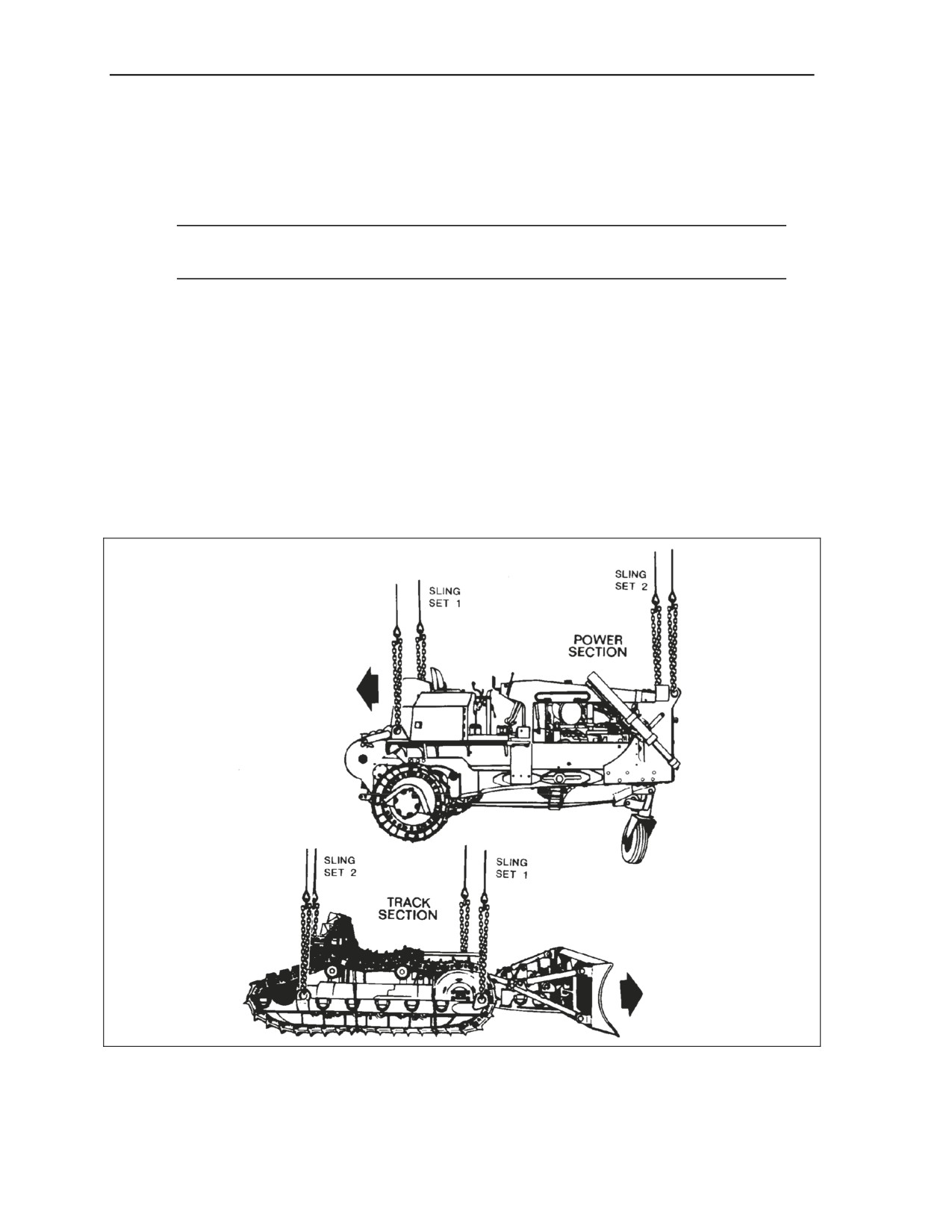
Rigging. Rig the load according to the steps in Figure 8-1.
Note. Hookup of this load presents substantial risk of damage to the load or injury to the
hookup personnel. Use of a reach pendant is recommended for this load.
Hookup. Two hookup teams are required for this load. The power section hookup team
stands on the top of the power section. The static wand person discharges the static electricity
with the static wand. The forward hookup person stands on the driver's seat and places apex fitting
1 onto the forward cargo hook. The aft hookup person stands on the engine compartment and places
apex fitting 2 onto the aft cargo hook. The track section hookup team stands on top of the track
section. The static wand person discharges the static electricity with the static wand. The
forward hookup person places apex fitting 1 onto the forward cargo hook. The aft hookup person
places apex fitting 2 onto the aft cargo hook. The hookup teams then carefully dismount the
sections and remain close to the load as the helicopter removes slack from the sling legs.
When successful hookup is assured, the hookup teams quickly exit the area underneath the
helicopter to the designated rendezvous point.
Derigging. Derigging is the reverse of the preparation and rigging procedures.
Figure 8-1. D5B Tractor Dozer, Sectionalized
FM 4-20.199/MCRP 4-11.3E, VOL III/NTTP 3-04.13/
8-2
AFMAN 11-223 (I), VOL III/COMDINST M13482.4B
20 February 2009

Certified Dual-Point Rigging Procedures for Engineer Equipment
RIGGING STEPS, POWER SECTION
1.
Place two sling legs on apex fitting number 1. Position apex fitting number 1 on top of the
fuel tank.
2.
Loop the chain end of the left and right sling legs through their respective lift provisions
located on each side of the fuel tank. Place the correct link from Table 8-1 in the grab hook.
3.
Place two sling legs on apex fitting number 2. Position apex fitting number 2 on top of the
engine compartment.
4.
Loop the chain end of the left and right sling legs through their respective lift provisions
located on the front corners. Place the correct link from Table 8-1 in the grab hook. Secure
excess chain with tape or Type III nylon cord.
5.
Cluster and tie (breakaway technique) the sling legs in each sling set together to prevent
entanglement during hookup and lift-off.
RIGGING STEPS, TRACK SECTION
1.
Place two sling legs on apex fitting number 1. Position apex fitting number 1 on top of the
forward (blade) end.
2.
Loop the chain end of the left and right sling legs through their respective lift provisions
located in front of the forward wheels. Place the correct link from Table 8-1 in the grab hook.
Secure excess chain with tape or Type III nylon cord.
3.
Place two sling legs on apex fitting number 2. Position apex fitting number 2 on top of the
rear end of the track section.
4.
Loop the chain end of the left and right sling legs through their respective lift provisions
located near the aft end of the track. Place the correct link from Table 8-1 in the grab hook.
Secure excess chain with tape or Type III nylon cord.
5.
Cluster and tie (breakaway technique) the sling legs in each sling set together to prevent
entanglement during hookup and lift-off.
Figure 8-1. D5B Tractor Dozer, Sectionalized (Continued)
TRACTOR FULL TRACKED, CASE MODEL 1150
8-3. The tractor full tracked, Case model 1150 is rigged for dual-point sling load using the following
procedures:
z
Applicability. The following item in Table 8-2 is certified for the helicopter(s) listed in the
following table by the US Army Natick Soldier Center:
Table 8-2. Tractor Full Tracked, Case Model 1150
Nomenclature
Max Weight
Sling
Link Count
Type of
(Pounds)
Set
Front/Rear
Aircraft
Tractor Full Tracked with Bucket, Case Model 1150
27,000
40K
8/16
CH-53
FM 4-20.199/MCRP 4-11.3E, VOL III/NTTP 3-04.13/
20 February 2009
AFMAN 11-223 (I), VOL III/COMDINST M13482.4B
8-3
Chapter 8
z
Materials. The following materials are required to rig this load:
Sling set (40,000-pound capacity) with one additional apex fitting.
─ Additional chain length, part number 607050, from a 40,000-pound capacity sling set
(4 each).
─ Additional coupling link, part number 577-0815, from a 40,000-pound sling set (4
each).
─ Tape, adhesive, pressure-sensitive, 2-inch wide roll.
─ Cord, nylon, Type III, 550-pound breaking strength.
─ Webbing, cotton, 1/4-inch, 80-pound breaking strength.
─ Felt sheet, cattle hair, Type IV, 1/2-inch or suitable padding.
z
Personnel. Two persons can prepare and rig this load in 30 minutes.
z
Procedures. The following procedures apply to this load:
Preparation. Prepare the load using the following steps:
─ Raise the bucket 2 to 3 feet off the ground.
─ Tape the air filter intake, the exhaust pipe opening, and all lights.
─ Ensure the winch line is completely reeled in.
─ Engage the hand brake and place the transmission in neutral.
─ Ensure the fuel tank is not over 3/4 full. Inspect fuel tank cap, oil filler cap, and
battery caps for proper installation.
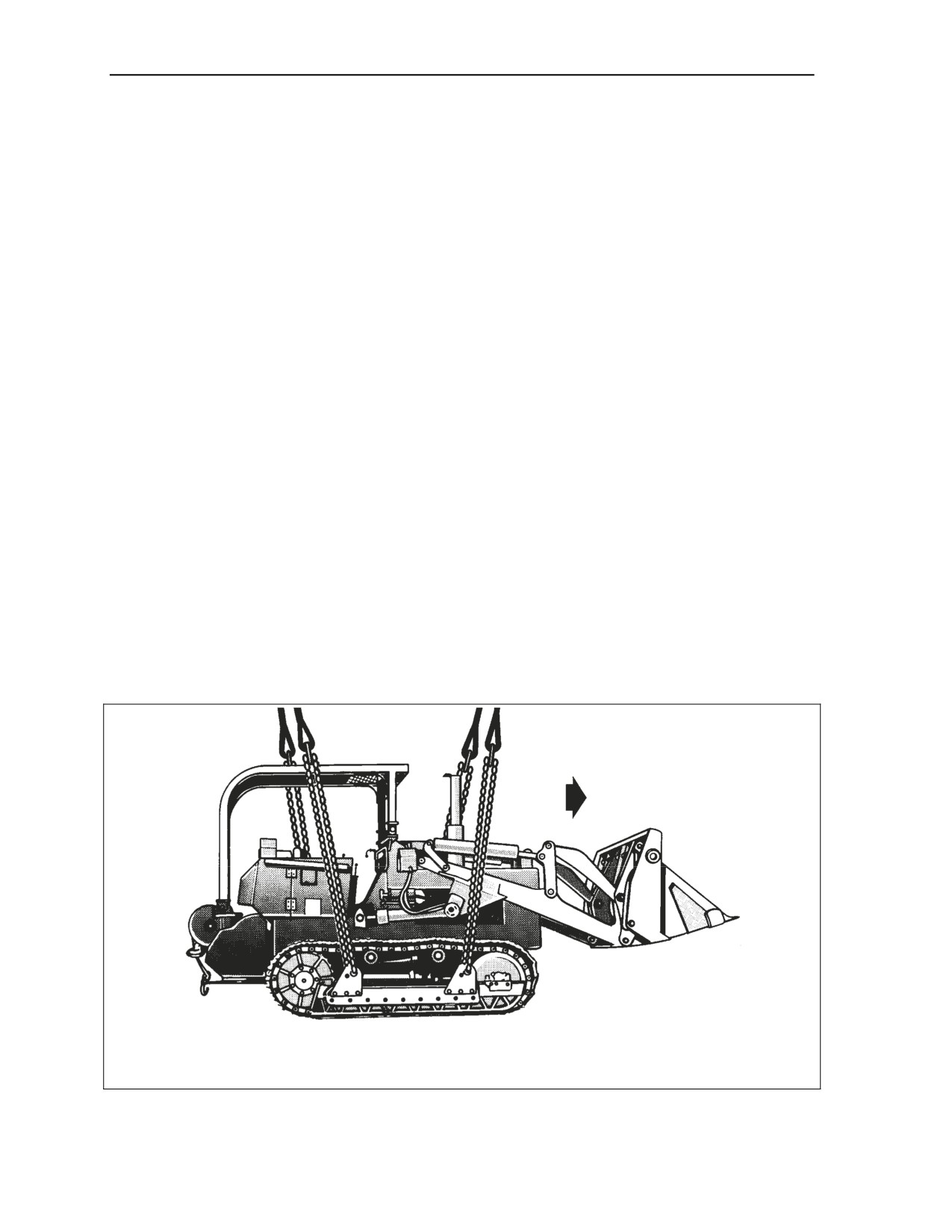
Rigging. Rig the load according to the steps in Figure 8-2.
Hookup. Two hookup teams are required for this load. The static discharge person
discharges the static electricity. The forward hookup person stands on the engine deck and
places apex fitting 1 onto the forward cargo hook. The aft hookup person stands on the roll
over protection system (ROPS) and places apex fitting 2 onto the aft cargo hook. The
hookup teams then carefully dismount the tractor and remain close to the load as the helicopter
removes slack from the sling legs. When successful hookup is assured, the hookup teams
quickly exit the area underneath the helicopter to the designated rendezvous point.
Derigging. Derigging is the reverse of the preparation and rigging procedures.
Figure 8-2. Tractor, Full-Tracked, Case Model 1150
FM 4-20.199/MCRP 4-11.3E, VOL III/NTTP 3-04.13/
8-4
AFMAN 11-223 (I), VOL III/COMDINST M13482.4B
20 February 2009

Certified Dual-Point Rigging Procedures for Engineer Equipment
RIGGING STEPS
Note. The additional chain section is added after each sling leg chain is looped through the lift provision because the coupling
link will not fit through the opening in the lift provision.
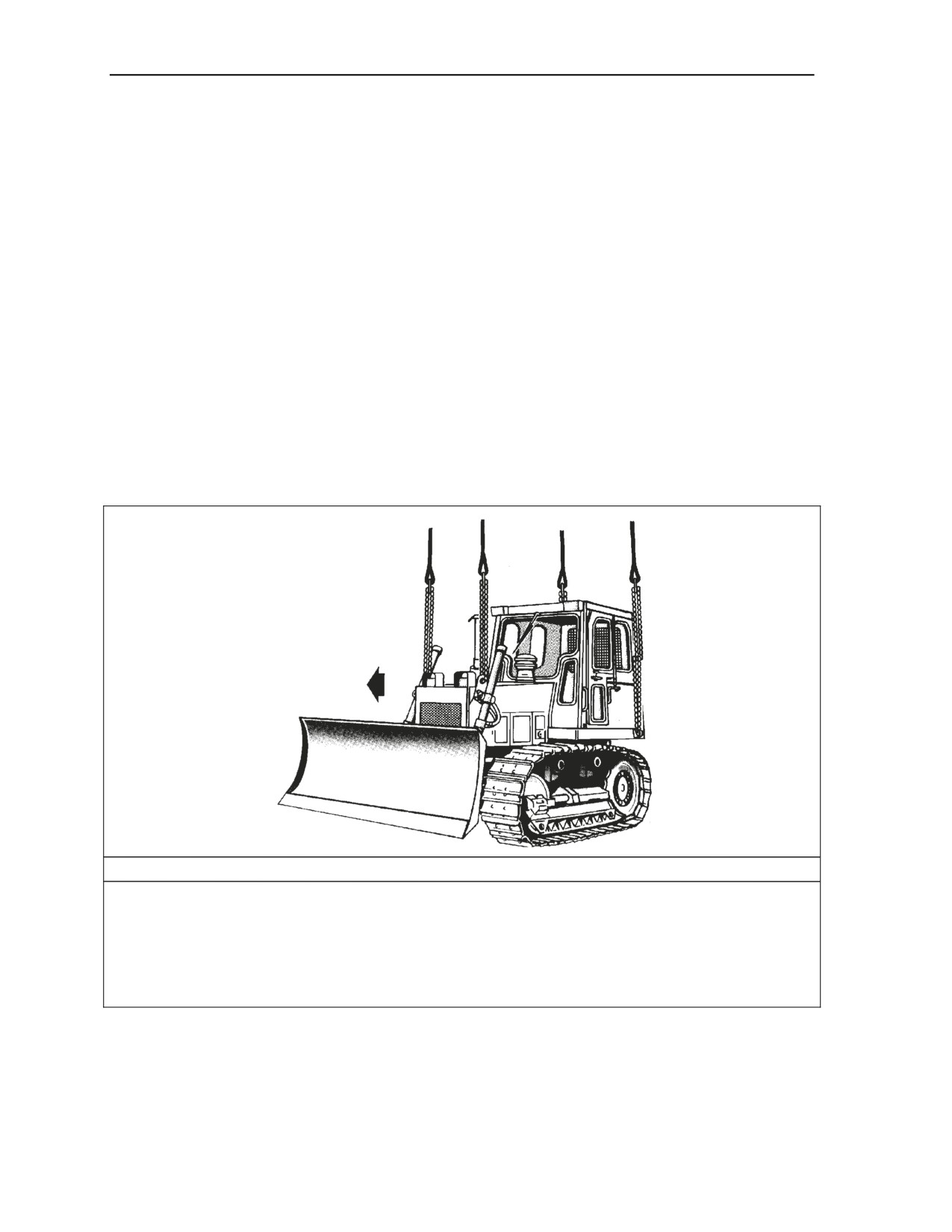
1. Place two sling legs on apex fitting number 1. Position apex fitting number 1 on top of the
engine compartment.
2. Loop the chain end of the left and right sling legs through their respective lift provisions
located aft of the front idler. Using the coupling link, add the chain length to the sling leg
chain. Place the correct link from Table 8-2 in the grab hook.
3. Place two sling legs on apex fitting number 2. Position apex fitting number 2 on top of the
ROPS.
4. Loop the chain end of the left and right sling legs through their respective lift provisions
located forward of the aft drive sprockets. Using the coupling link, add the chain length to
the sling leg chain. Place the correct link from Table 8-2 in the grab hook. Secure the
excess chain with tape or Type III nylon cord.
5. Pad the chains where they contact the load.
6. Cluster and tie (breakaway technique) the sling legs in each sling set together to prevent
entanglement during hookup and lift-off.
Figure 8-2. Tractor, Full-Tracked, Case Model 1150 (Continued)
TRACTOR FULL TRACKED, CASE MODEL 1150E
8-4. The tractor full tracked, Case model 1150E is rigged for dual-point sling load using the following
procedures:
z
Applicability. The following item in Table 8-3 is certified for the helicopter(s) listed in the
following table by the US Army Natick Soldier Center:
Table 8-3. Tractor Full Tracked, Case Model 1150E
Nomenclature
Max Weight
Sling
Link Count
Type of
(Pounds)
Set
Front/Rear
Aircraft
Tractor Full Tracked, Case Model 1150E
24,062
40K
5/50
CH-53
z
Materials. The following materials are required to rig this load:
Sling set (40,000-pound capacity) with one additional apex fitting.
─ Additional chain length, part number 607050, from a 40,000-pound capacity sling set
(2 each).
─ Additional coupling link, part number 577-0815, from a 40,000-pound sling set (2
each).
Tape, adhesive, pressure-sensitive, 2-inch wide roll.
Cord, nylon, Type III, 550-pound breaking strength.
Webbing, cotton, 1/4-inch, 80-pound breaking strength.
Felt sheet, cattle hair, Type IV, 1/2-inch or suitable padding.
Tiedown assembly, chain, MB-1 (10,000-pound capacity).
z
Personnel. Two persons can prepare and rig this load in 30 minutes.
z
Procedures. The following procedures apply to this load:
FM 4-20.199/MCRP 4-11.3E, VOL III/NTTP 3-04.13/
20 February 2009
AFMAN 11-223 (I), VOL III/COMDINST M13482.4B
8-5
Chapter 8
Preparation. Prepare the load using the following steps:
─ Raise the bucket 2 to 3 feet off the ground. Secure the blade in the UP position with
the MB-1 tiedown chain.
─ Twist the lights inward. Tape the exhaust pipe opening, lights, and all glass.
─ Ensure the winch line is completely reeled in.
─ Engage the hand brake and place the transmission in neutral.
─ Secure all lids, caps, and doors with tape or Type III nylon cord.
─ Ensure the fuel tank is not over 3/4 full. Inspect fuel tank cap, oil filler cap, and
battery caps for proper installation.
Rigging. Rig the load according to the steps in Figure 8-3.
Hookup. Two hookup teams are required for this load. The static discharge person
discharges the static electricity. The forward hookup person stands on the engine deck and
places apex fitting 1 onto the forward cargo hook. The aft hookup person stands on the rear of
the deck or on top of the cab and places apex fitting 2 onto the aft cargo hook. The hookup
teams then carefully dismount the tractor and remain close to the load as the helicopter
removes slack from the sling legs. When successful hookup is assured, the hookup teams
quickly exit the area underneath the helicopter to the designated rendezvous point.
Derigging. Derigging is the reverse of the preparation and rigging procedures.
RIGGING STEPS
Note. The additional chain section is added to the aft sling leg chain after the sling leg chain is
looped through the lift provision because the coupling link will not fit through the opening in the lift
provision.
1. Place two sling legs on apex fitting number 1. Position apex fitting number 1 on top of the
engine compartment.
Figure 8-3. Tractor, Full-Tracked, Case Model 1150E
FM 4-20.199/MCRP 4-11.3E, VOL III/NTTP 3-04.13/
8-6
AFMAN 11-223 (I), VOL III/COMDINST M13482.4B
20 February 2009

Certified Dual-Point Rigging Procedures for Engineer Equipment
RIGGING STEPS (Continued)
2. Loop the chain end of the left and right sling legs through their respective lift provisions
located on the front end of the engine compartment. Place the correct link from Table 8-3 in
the grab hook.
3. Place two sling legs on apex fitting number 2. Position apex fitting number 2 on top of the
cab.
4. Loop the chain end of the left and right sling legs through their respective lift provisions
located near the base of the cab. Using the coupling link, add the chain length to the sling
leg chain. Place the correct link from Table 8-3 in the grab hook. Secure the excess chain
with tape or Type III nylon cord.
5. Pad the chains where they contact the load.
6. Cluster and tie (breakaway technique) the sling legs in each sling set together to prevent
entanglement during hookup and lift-off.
Figure 8-3. Tractor, Full-Tracked, Case Model 1150E (Continued)
TRACTOR (DOZER), FULL TRACKED, TYPE III, JD 450G
8-5. The tractor (dozer), full tracked, type III JD 450G is rigged for dual-point sling load using the
following procedures:
z
Applicability. The following items in Table 8-4 are certified for the helicopter(s) listed in the
following table by the US Army Natick Soldier Center:
Table 8-4. Tractor (Dozer), Full Tracked, Type III JD 450G
Nomenclature
Max Weight
Sling
Link Count
Type of
(Pounds)
Set
Front/Rear
Aircraft
Tractor (Dozer), Full Tracked Type III JD 450G
18,300
25K
3/10
CH-47
Tractor (Dozer), Full Tracked Type III JD 450G without
17,700
25K
3/10
CH-47
ROPS
Tractor (Dozer), Full Tracked Type III JD 450G without
16,160
25K
3/10
CH-47
ROPS and Winch
z
Materials. The following materials are required to rig this load:
Sling set (25,000-pound capacity) with one additional apex fitting.
─ Additional chain length, part number 38850-00053-102, from a 25,000-pound capacity
sling set (4 each).
─ Additional coupling link, part number 664241, from a 25,000-pound sling set (4 each).
Tape, adhesive, pressure-sensitive, 2-inch wide roll.
Cord, nylon, Type III, 550-pound breaking strength.
Webbing, cotton, 1/4-inch, 80-pound breaking strength.
Heavy padding (1/4 section of a steel-belted tire or a length of fire hose or equivalent) (2
each).
z
Personnel. Two persons can prepare and rig this load in 15 minutes.
Procedures. The following procedures apply to this load:
Preparation. Prepare the load using the following steps:
FM 4-20.199/MCRP 4-11.3E, VOL III/NTTP 3-04.13/
20 February 2009
AFMAN 11-223 (I), VOL III/COMDINST M13482.4B
8-7
Chapter 8
─ Connect one additional chain length to each chain on each sling set with a coupling
link.
─ Prepare the tractor for mission needs using the operator's manual. Special tools may be
required to remove the ROPS or winch.
─ Tape rear sling guides on the ROPS, all lights, gages, and glass.
─ Engage the hand brake and place the transmission in neutral.
─ Secure all loose equipment with tape or Type III nylon cord.
─ Ensure the fuel tank is not over 3/4 full. Ensure the fuel tank cap is in the vent position.
Inspect the oil filter caps and battery caps for proper installation.
Rigging. Rig the load according to the steps in Figure 8-4.
Hookup. Two hookup teams are required for this load. The static discharge person
discharges the static electricity. The forward hookup person stands on top of the dozer and
places apex fitting 2 onto the forward cargo hook. The aft hookup person stands on the ROPS
or aft deck and places apex fitting 1 onto the aft cargo hook. The hookup teams then carefully
dismount the dozer and remain close to the load as the helicopter removes slack from the sling
legs. When successful hookup is assured, the hookup teams quickly exit the area underneath
the helicopter to the designated rendezvous point.
Derigging. Derigging is the reverse of the preparation and rigging procedures.
RIGGING STEPS
Note. Padding for the rear chains cannot be added until the chains have been routed through the
sling guides and attached to the grab hooks.
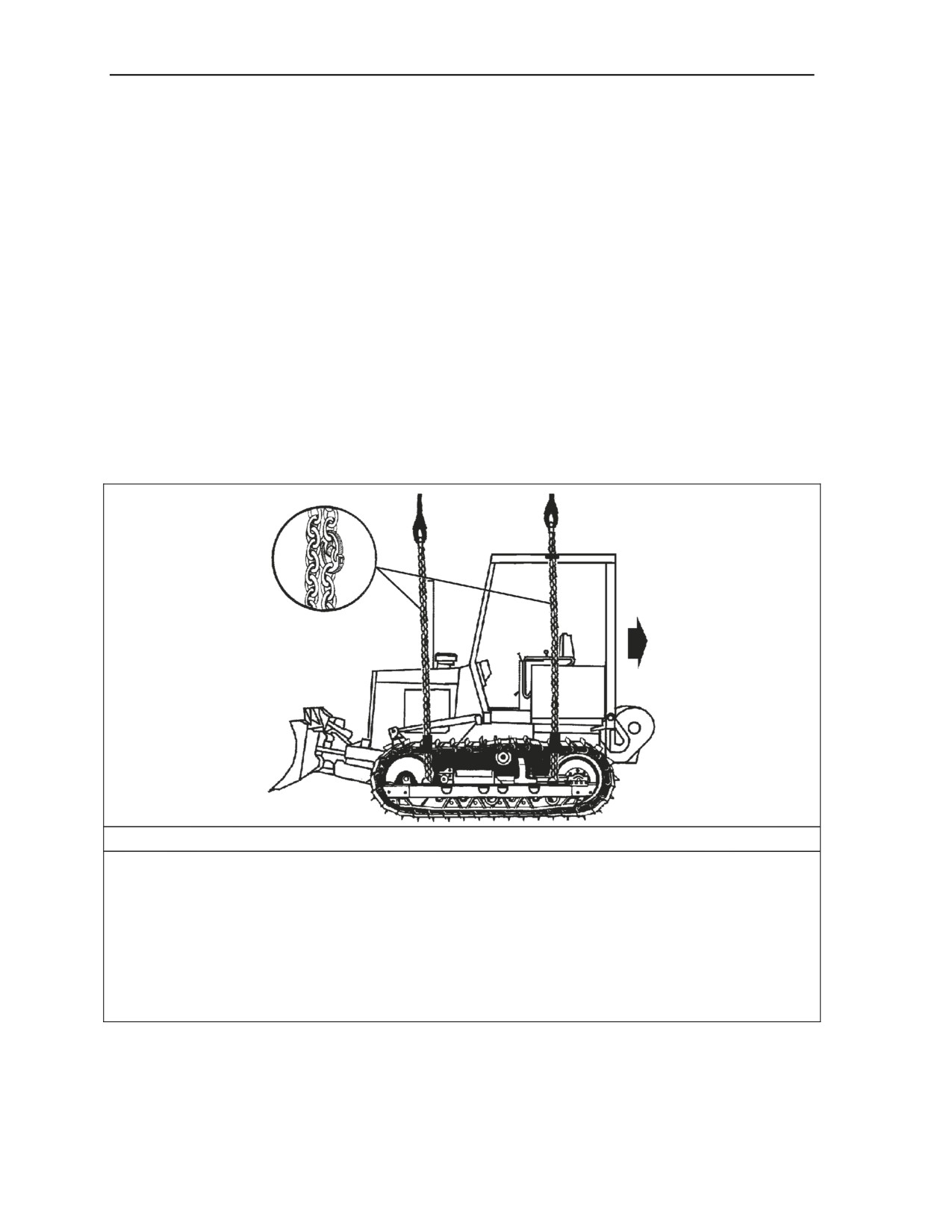
1. Place two sling legs on apex fitting number 1. Position apex fitting number 1 on top of the
engine compartment.
2. Loop the chain end of the left and right sling legs through their respective lift provisions
located aft of the front idler. Place the correct link from Table 8-4 in the grab hook.
Figure 8-4. Tractor (Dozer), Full-Tracked, Type III, JD450G
FM 4-20.199/MCRP 4-11.3E, VOL III/NTTP 3-04.13/
8-8
AFMAN 11-223 (I), VOL III/COMDINST M13482.4B
20 February 2009

Certified Dual-Point Rigging Procedures for Engineer Equipment
RIGGING STEPS (Continued)
3. Place two sling legs on apex fitting number 2. Position apex fitting number 2 on top of the
ROPS.
4. Loop the chain end of the left sling leg through the left rear sling guide on the ROPS, down
through the left rear lift provision, and back up through the left rear sling guide. Place the
correct link from Table 8-4 in the grab hook. Secure the excess chain with tape or Type III
nylon cord. Repeat the above procedures using the right sling leg on the right side of the
dozer.
5. Secure heavy padding to the slings in the area where they contact the tracks.
6. Raise the apex fittings above the dozer. Cluster and tie (breakaway technique) the sling legs
in each sling set together to prevent entanglement during hookup and lift-off.
Figure 8-4. Tractor (Dozer), Full-Tracked, Type III, JD450G (Continued)
IC45 CRAWLER CARRIER
8-6. The IC45 crawler carrier is rigged for dual-point sling load using the following procedures:
z
Applicability. The following item in Table 8-5 is certified for the helicopter(s) listed in the
following table by the US Army Natick Soldier Center:
Table 8-5. IC45 Crawler Carrier
Nomenclature
Max Weight
Sling
Link Count
Type of
(Pounds)
Set
Front/Rear
Aircraft
IC45 Crawler Carrier
16,540
25K
15/3
CH-47
40K
15/3
CH-53
z
Materials. The following materials are required to rig this load:
Sling set (25,000-pound capacity) with one additional apex fitting.
OR
Sling set (40,000-pound capacity) with one additional apex fitting.
Tape, adhesive, pressure-sensitive, 2-inch wide roll.
Cord, nylon, Type III, 550-pound breaking strength.
Webbing, cotton, 1/4-inch, 80-pound breaking strength.
z
Personnel. Two persons can prepare and rig each load in 20 minutes.
z
Procedures. The following procedures apply to this load:
Preparation. Prepare the load using the following steps:
─ Secure all loose equipment with tape or Type III nylon cord.
─ Ensure the fuel tank is not over 3/4 full. Inspect the fuel tank cap, oil filter cap, and the
battery caps for proper installation.
─ Place the transmission in neutral and engage the parking brake.
─ Secure all latches, covers, and panels with tape or type III nylon cord.
Rigging. Rig the load according to the steps in Figure 8-5.
FM 4-20.199/MCRP 4-11.3E, VOL III/NTTP 3-04.13/
20 February 2009
AFMAN 11-223 (I), VOL III/COMDINST M13482.4B
8-9
Chapter 8
Hookup. The hookup team stands on top of the load. The static wand person discharges
the static electricity with the static wand. The forward hookup person places apex fitting 1 onto
the forward cargo hook. The aft hookup person places apex fitting 2 onto the aft cargo hook.
The hookup team then carefully dismounts the vehicle and remains close to the load as the
helicopter removes slack from the sling legs. When successful hookup is assured, the hookup
team quickly exits the area underneath the helicopter to the designated rendezvous point.
Derigging. Derigging is the reverse of the preparation and rigging procedures.
RIGGING STEPS
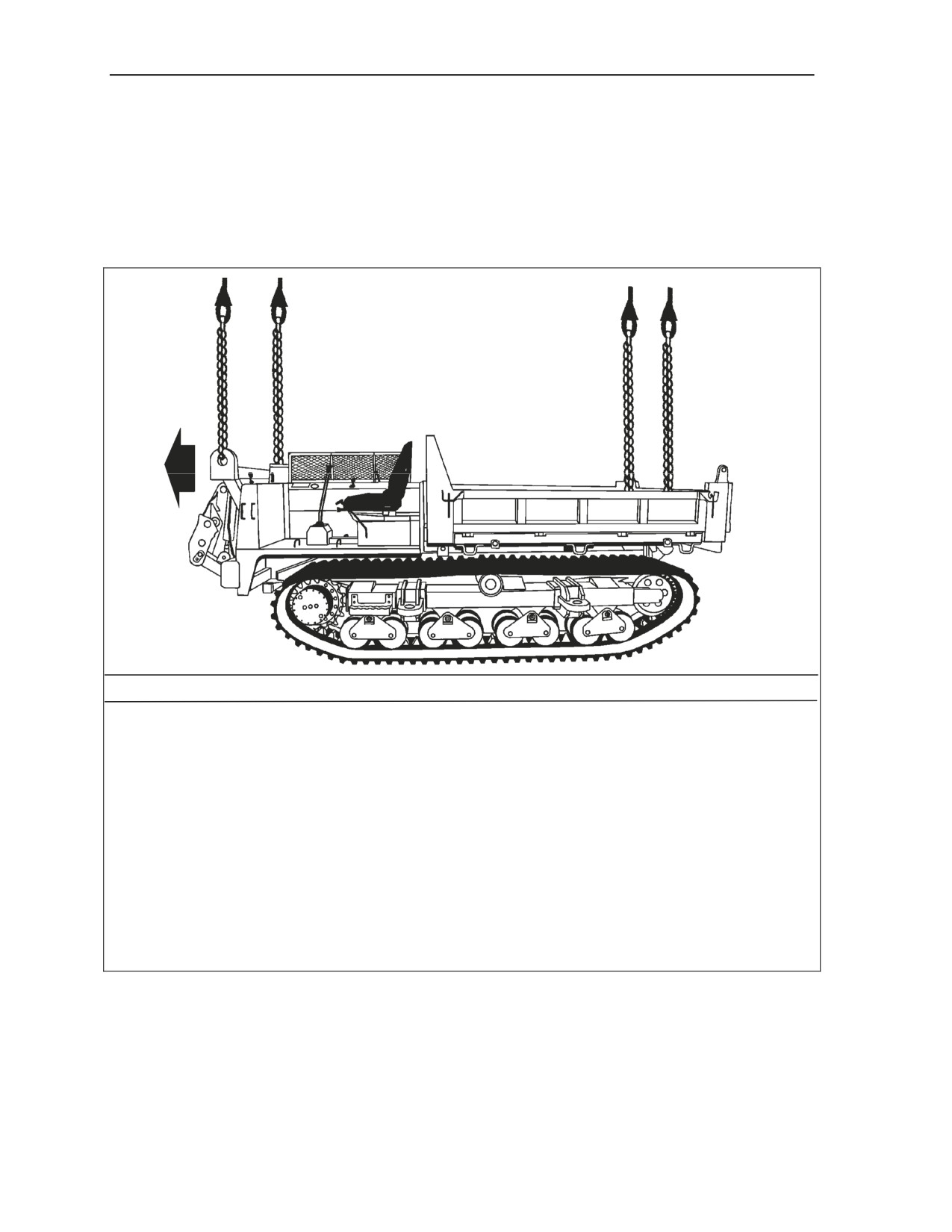
1. Connect two sling legs to apex fitting number 1.
2. Loop the chain end of the left and right sling legs through their respective front lift provisions
located on the front of the IC45. Place the correct link from Table 8-5 in the grab hook.
Secure the excess chain with Type III nylon cord.
3. Connect two sling legs to apex fitting number 2.
4. Loop the chain end of the left and right sling legs through their respective rear lift provisions
located the bed of the vehicle. Place the correct link from Table 8-5 in the grab hook.
5. Cluster and tie (breakaway technique) the sling legs together on top of the ROPS to prevent
entanglement during hookup and lift-off.
Figure 8-5. IC45 Crawler Carrier
FM 4-20.199/MCRP 4-11.3E, VOL III/NTTP 3-04.13/
8-10
AFMAN 11-223 (I), VOL III/COMDINST M13482.4B
20 February 2009
Certified Dual-Point Rigging Procedures for Engineer Equipment
TRACTOR, WHEELED, INDUSTRIAL, CASE MODEL 580
8-7. The tractor, wheeled, industrial, case model
580 is rigged for dual-point sling load using the
following procedures:
z
Applicability. The following items in Table 8-6 are certified for the helicopter(s) listed in the
following table by the US Army Natick Soldier Center:
Table 8-6. Tractor, Wheeled, Industrial, Case Model 580
Nomenclature
Max Weight
Sling
Link Count
Type of
(Pounds)
Set
Front/Rear
Aircraft
Tractor, Case Model 580
10,000
15K
37/59
CH-53
z
Materials. The following materials are required to rig this load:
Sling set (15,000-pound capacity) with one additional web ring.
─ Additional chain length, part number 34080-4, from a 15,000-pound capacity sling set
(2 each).
─ Additional coupling link, part number 31611, from a 15,000-pound sling set (2 each).
Tape, adhesive, pressure-sensitive, 2-inch wide roll.
Cord, nylon, Type III, 550-pound breaking strength.
Webbing, cotton, 1/4-inch, 80-pound breaking strength.
Strap, cargo, tiedown, CGU-1/B (2 each).
z
Personnel. Two persons can prepare and rig this load in 20 minutes.
z
Procedures. The following procedures apply to this load:
Preparation. Prepare the load using the following steps:
─ Connect one additional chain length to each chain on the forward sling legs with a
coupling link.
─ Raise the front bucket halfway and tilt the bucket towards the rear.
─ Position the backhoe arm with the bucket in the UP position. Secure the arm with the
CGU-1/B tiedown straps to prevent swinging. Route the tiedowns from the stabilizer
to the arm.
─ Engage the hand brake and place the transmission in neutral.
─ Secure all caps lids and doors with tape or Type III nylon cord. Tape all lights, gages,
and glass.
─ Ensure the fuel tank is not over 3/4 full. Ensure the fuel tank cap is in the vent position.
Inspect the oil filter caps and battery caps for proper installation.
Rigging. Rig the load according to the steps in Figure 8-6.
Hookup. Two hookup teams are required for this load. The static discharge person
discharges the static electricity. The forward hookup person stands on top of the engine deck
and places apex fitting 1 onto the forward cargo hook. The aft hookup person stands on the
ROPS or aft deck and places apex fitting 2 onto the aft cargo hook. The hookup teams then
carefully dismount the dozer and remain close to the load as the helicopter removes slack from
the sling legs. When successful hookup is assured, the hookup teams quickly exit the area
underneath the helicopter to the designated rendezvous point.
Derigging. Derigging is the reverse of the preparation and rigging procedures.
FM 4-20.199/MCRP 4-11.3E, VOL III/NTTP 3-04.13/
20 February 2009
AFMAN 11-223 (I), VOL III/COMDINST M13482.4B
8-11
Chapter 8
RIGGING STEPS
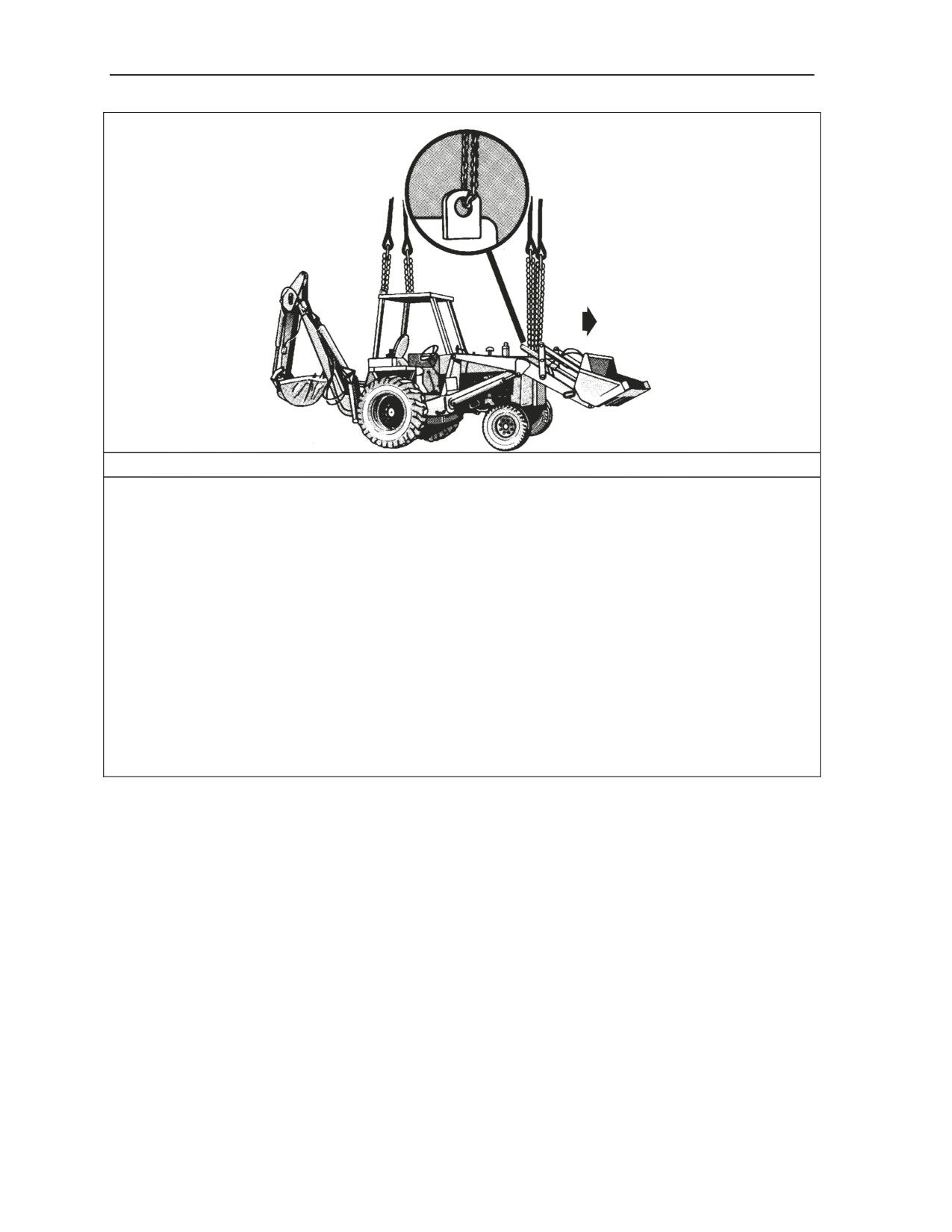
1. Place two sling legs on apex fitting number 1. Position apex fitting number 1 on top of the
engine compartment.
2. Loop the chain end of the left and right sling legs through their respective lift provisions
located on the front corners of the engine hook. Place the correct link from Table 8-6 in the
grab hook. Secure the excess chain with tape or Type III nylon cord.
3. Place two sling legs on apex fitting number 2. Position apex fitting number 2 on top of the
ROPS.
4. Loop the chain end of the left and right sling legs through their respective lift provisions
located on the rear corners of the ROPS. Place the correct link from Table 8-6 in the grab
hook. Secure the excess chain with tape or Type III nylon cord.
5. Raise the apex fittings above the tractor. Cluster and tie (breakaway technique) the sling
legs in each sling set together to prevent entanglement during hookup and lift-off.
Figure 8-6. Tractor, Wheeled, Industrial, Case Model 580
FM 4-20.199/MCRP 4-11.3E, VOL III/NTTP 3-04.13/
8-12
AFMAN 11-223 (I), VOL III/COMDINST M13482.4B
20 February 2009
Certified Dual-Point Rigging Procedures for Engineer Equipment
420-D BACKHOE LOADER
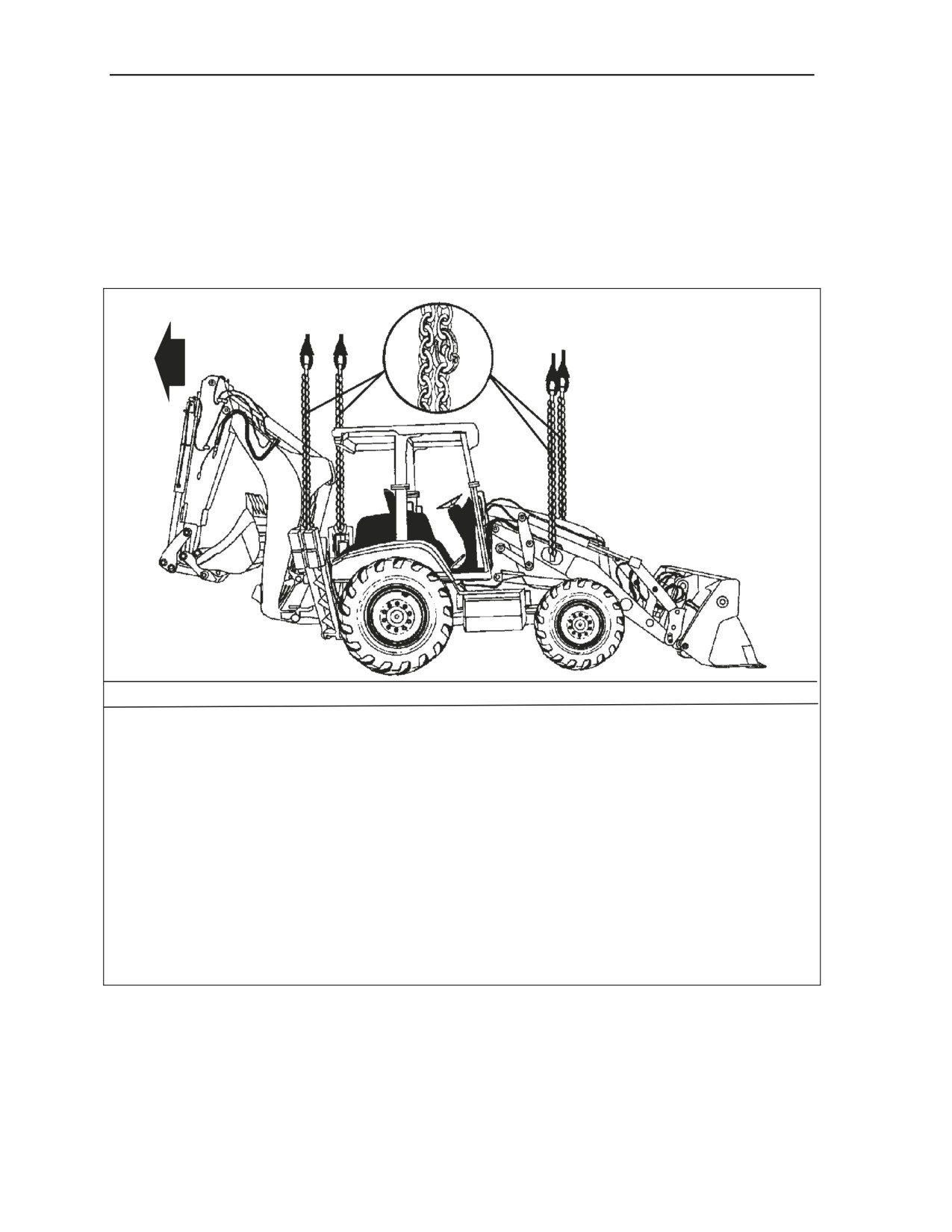
8-8. The 420-D backhoe loader is rigged for dual-point sling load using the following procedures:
z
Applicability. The following item in Table 8-7 is certified for the helicopter(s) listed in the
following table by the US Army Natick Soldier Center:
Table 8-7. 420-D Backhoe Loader
Nomenclature
Max Weight
Sling
Link Count
Type of
(Pounds)
Set
Front/Rear
Aircraft
420-D Backhoe Loader
19,540 (AF)
25K
15/3
CH-47
18,160 (USMC)
40K
3/3
CH-53
z
Materials. The following materials are required to rig this load:
Sling set (25,000-pound capacity).
─ Additional chain length, part number, 38850-00053-102, from a 25,000-pound capacity
sling set (4 each).
─ Additional coupling link, part number 664241, from a 25,000-pound capacity sling set (4
each).
OR
Sling set (40,000-pound capacity).
─ Additional chain length, part number, 607050, from a 40,000-pound capacity sling set (4
each).
─ Additional coupling link, part number 577-0815, from a 40,000-pound capacity sling set
(4 each).
Tape, adhesive, pressure-sensitive, 2-inch wide roll.
Cord, nylon, Type III, 550-pound breaking strength.
Webbing, cotton, 1/4-inch, 80-pound breaking strength.
z
Personnel. Two persons can prepare and rig each load in 20 minutes.
z
Procedures. The following procedures apply to this load:
Preparation. Prepare the load using the following steps:
─ Secure all loose equipment in the cab with tape or Type III nylon cord.
─ Remove the exhaust stack and secure it on the floor of the cab.
─ Ensure the fuel tank is not over 3/4 full. Inspect the fuel tank cap, oil filter cap, and the
battery caps for proper installation.
─ Place the transmission in neutral and engage the parking brake.
─ Secure the seat cushion with Type III nylon cord.
─ Secure all latches, covers, and panels with tape or type III nylon cord.
─ Elevate the bucket halfway and tilt the bucket to the rear. Lower the bucket to the
surface. Ensure the front end loader assembly travel locks, located at the ends of both
front end loader boom cylinders are properly pinned in place.
─ Tie or tape the hydraulic lines and hoses in close proximity to the front lift provisions.
─ Connect one additional chain length to each chain of the sling set with the coupling link.
FM 4-20.199/MCRP 4-11.3E, VOL III/NTTP 3-04.13/
20 February 2009
AFMAN 11-223 (I), VOL III/COMDINST M13482.4B
8-13
Chapter 8
Rigging. Rig the load according to the steps in Figure 8-7.
Hookup. The hookup team stands on top of the load. The static wand person discharges
the static electricity with the static wand. The forward hookup person places apex fitting 1 onto
the forward cargo hook. The aft hookup person places apex fitting 2 onto the aft cargo hook.
The hookup team then carefully dismounts the vehicle and remains close to the load as the
helicopter removes slack from the sling legs. When successful hookup is assured, the hookup
team quickly exits the area underneath the helicopter to the designated rendezvous point.
Derigging. Derigging is the reverse of the preparation and rigging procedures.
RIGGING STEPS
1. Connect two sling legs to apex fitting number 1.
2. Loop the chain end of the left and right sling legs through their respective front lift provisions
located on the bucket arms. Place the correct link from Table 8-7 in the grab hook. Secure
the excess chain with Type III nylon cord.
3. Connect two sling legs to apex fitting number 2
4. Loop the chain end of the left and right sling legs through their respective rear lift provisions
located on the balance support arms. Place the correct link from Table 8-7 in the grab hook.
5. Cluster and tie (breakaway technique) the sling legs together on top of the ROPS to prevent
entanglement during hookup and lift-off.
Figure 8-7. 420-D Backhoe Loader
FM 4-20.199/MCRP 4-11.3E, VOL III/NTTP 3-04.13/
8-14
AFMAN 11-223 (I), VOL III/COMDINST M13482.4B
20 February 2009
Certified Dual-Point Rigging Procedures for Engineer Equipment
SMALL EMPLACEMENT EXCAVATOR (SEE)
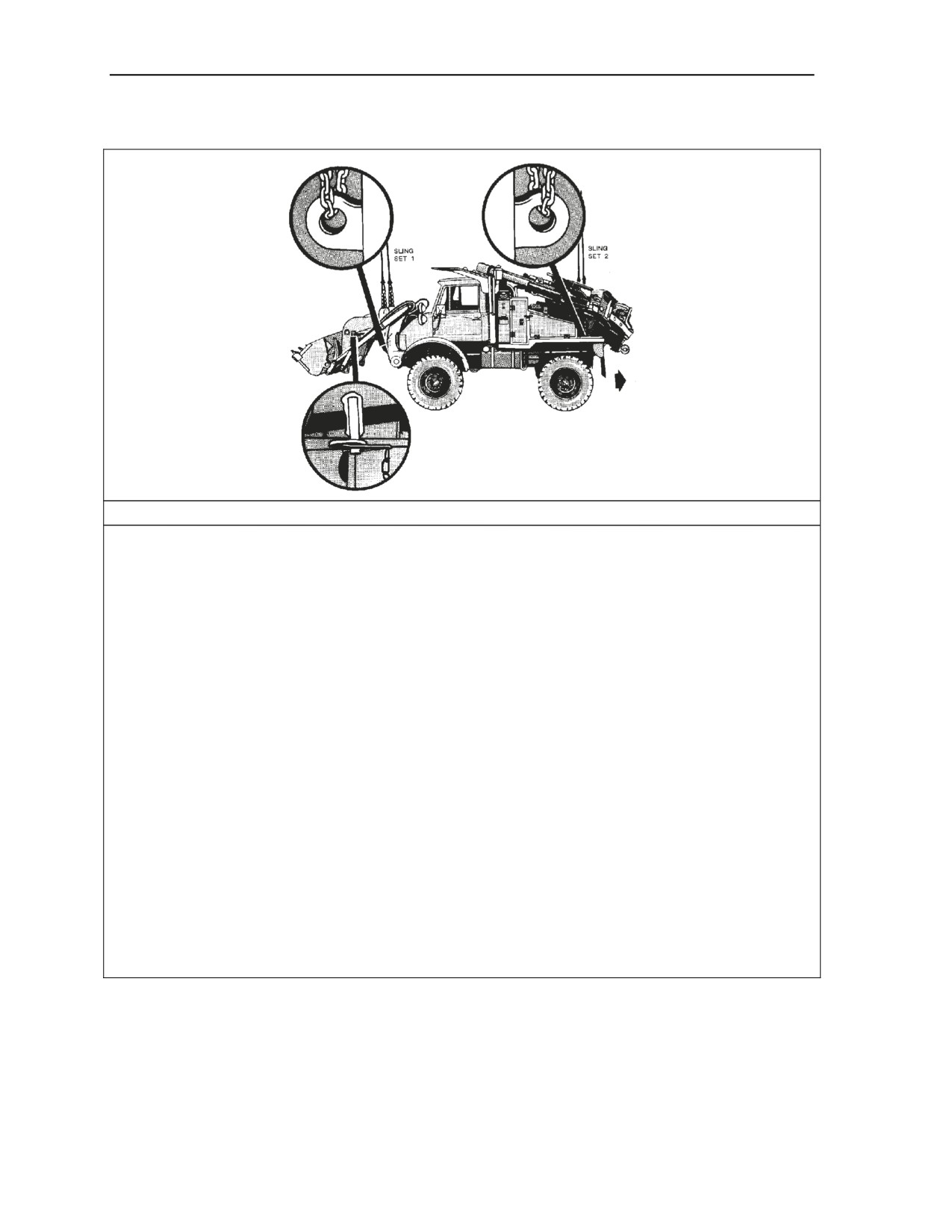
8-9. The small emplacement excavator is rigged for dual-point sling load using the following procedures:
z
Applicability. The following item in Table 8-8 is certified for the helicopter(s) listed in the
following table by the US Army Natick Soldier Center:
Table 8-8. Small Emplacement Excavator
Nomenclature
Max Weight
Sling
Link Count
Type of
(Pounds)
Set
Front/Rear
Aircraft
Small Emplacement Excavator
16,240
25K
Listed in
CH-47
16,240
40K
Rigging Steps
CH-53
z
Materials. The following materials are required to rig this load:
Sling set (25,000-pound capacity) with one additional apex fitting.
OR
Sling set (40,000-pound capacity) with one additional apex fitting.
Tape, adhesive, pressure-sensitive, 2-inch wide roll.
Cord, nylon, Type III, 550-pound breaking strength.
Webbing, cotton, 1/4-inch, 80-pound breaking strength.
Felt sheet, cattle hair, Type IV, 1/2-inch or suitable padding.
z
Personnel. Two persons can prepare and rig this load in 30 minutes.
z
Procedures. The following procedures apply to this load:
Preparation. Prepare the load using the following steps:
─ Elevate the bucket halfway and tilt toward the rear. Ensure that the front end loader
assembly travel locks located at the end of both front end loader boom cylinders are
properly pinned in place.
─ Secure the steering wheel, doors, and all loose equipment with tape or Type III nylon
cord.
─ Remove the pre-air cleaner and secure it on the seat with Type III nylon cord.
─ Tape the exhaust pipe opening, all lights, and glass.
─ Fold side mirrors inboard and tie together with Type III nylon cord. Tape the
windshield wipers to the windshield and secure the engine compartment hood with
tape or Type III nylon cord.
─ Engage the hand brake and place the transmission in neutral.
─ Secure all hydraulic lines with tape or Type III nylon cord.
─ Ensure the fuel tank is not over 3/4 full. Inspect fuel tank cap, oil filler cap, and battery
caps for proper installation.
Rigging. Rig the load according to the steps in Figure 8-8.
Hookup. Two hookup teams are required for this load. The static wand person discharges
the static electricity with the static wand. The forward hookup person stands on top of the falling
object protection system (FOPS) and places apex fitting 2 onto the forward cargo hook. The aft
hookup person stands on top of the FOPS and places apex fitting 1 onto the aft cargo hook. The
hookup teams then carefully dismount the sections and remain close to the load as the
helicopter removes slack from the sling legs. When successful hookup is assured, the hookup
teams quickly exit the area underneath the helicopter to the designated rendezvous point.
Derigging. Derigging is the reverse of the preparation and rigging procedures.
FM 4-20.199/MCRP 4-11.3E, VOL III/NTTP 3-04.13/
20 February 2009
AFMAN 11-223 (I), VOL III/COMDINST M13482.4B
8-15
Chapter 8
RIGGING STEPS
Note. Use the conversion chart in Appendix B for 40,000-pound capacity sling set link counts.
1. Place two sling legs on apex fitting number 1. Position apex fitting number 1 on forward end
of the FOPS.
2. Loop the chain end of the left and right sling legs through their respective lift provisions
located on the front bumper inboard of the front end loader support arms. Place link 3 in the
grab hook.
3. Place two sling legs on apex fitting number 2. Position apex fitting number 2 on top of the aft
end of the FOPS.
4. Loop the chain end of the left sling leg through the left lift provision (closest to the operator's
seat) located at the top left between the left rear wheel and frame. Place link 5 in the grab
hook.
5. Loop the chain end of the right sling leg through the right lift provision (closest to the backhoe
bucket) located at the top right between the right rear wheel and frame. Place link 10 in the
grab hook. Secure the excess chain with tape or Type III nylon cord.
6. Pad the chains where they contact the load.
7. Raise the apex fittings above the tractor. Cluster and tie (breakaway technique) the sling
legs in each sling set together to prevent entanglement during hookup and lift-off.
Figure 8-8. Small Emplacement Excavator
FM 4-20.199/MCRP 4-11.3E, VOL III/NTTP 3-04.13/
8-16
AFMAN 11-223 (I), VOL III/COMDINST M13482.4B
20 February 2009
Certified Dual-Point Rigging Procedures for Engineer Equipment
HIGH MOBILITY MATERIEL HANDLER (HMMH)
8-10. The high mobility materiel handler is rigged for dual-point sling load using the following
procedures:
z
Applicability. The following item in Table 8-9 is certified for the helicopter(s) listed in the
following table by the US Army Natick Soldier Center:
Table 8-9. High Mobility Materiel Handler
Nomenclature
Max Weight
Sling
Link Count
Type of
(Pounds)
Set
Front/Rear
Aircraft
High Mobility Materiel Handler
15,650
25K
3/56
CH-47
z
Materials. The following materials are required to rig this load:
Sling set (25,000-pound capacity) with one additional apex fitting.
Tape, adhesive, pressure-sensitive, 2-inch wide roll.
Cord, nylon, Type III, 550-pound breaking strength.
Webbing, cotton, 1/4-inch, 80-pound breaking strength.
Felt sheet, cattle hair, Type IV, 1/2-inch or suitable padding.
z
Personnel. Two persons can prepare and rig this load in 30 minutes.
z
Procedures. The following procedures apply to this load:
Preparation. Prepare the load using the following steps:
─ Ensure all travel locks are pinned in place.
─ Secure the steering wheel, doors, and all loose equipment with tape or Type III nylon
cord.
─ Fold side mirrors inboard and tie together with Type III nylon cord. Tape the
windshield wipers to the windshield and secure the engine compartment hood with
tape or Type III nylon cord.
─ Engage the hand brake and place the transmission in neutral.
─ Secure all hydraulic lines with tape or Type III nylon cord.
─ Ensure the fuel tank is not over 3/4 full. Inspect fuel tank cap, oil filler cap, and
battery caps for proper installation.
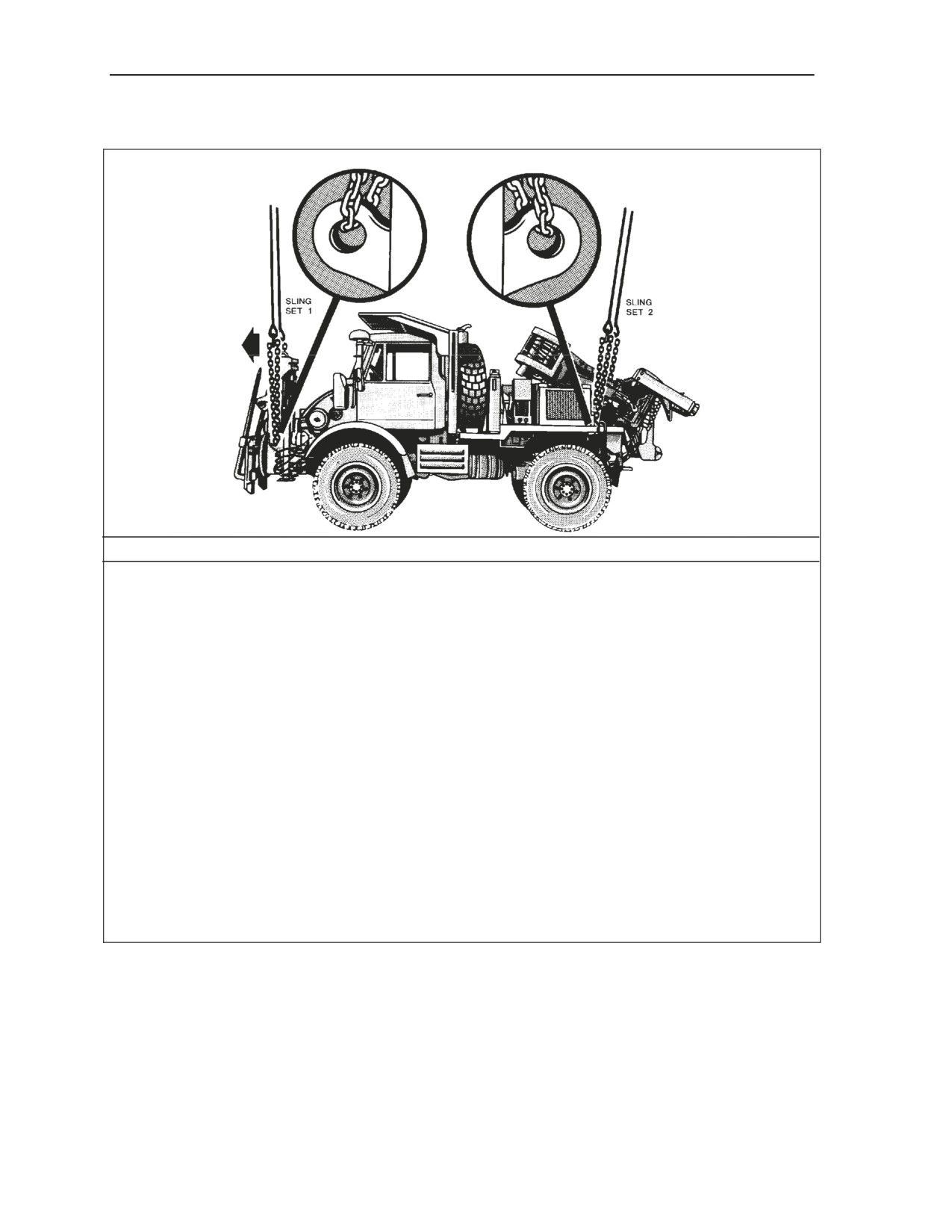
Rigging. Rig the load according to the steps in Figure 8-9.
Hookup. Two hookup teams are required for this load. The static wand person discharges
the static electricity with the static wand. The forward hookup person stands on top of the FOPS
and places apex fitting 1 onto the forward cargo hook. The aft hookup person stands on top of the
FOPS and places apex fitting 2 onto the aft cargo hook. The hookup teams then carefully
dismount the sections and remain close to the load as the helicopter removes slack from the
sling legs. When successful hookup is assured, the hookup teams quickly exit the area
underneath the helicopter to the designated rendezvous point.
Derigging. Derigging is the reverse of the preparation and rigging procedures.
FM 4-20.199/MCRP 4-11.3E, VOL III/NTTP 3-04.13/
20 February 2009
AFMAN 11-223 (I), VOL III/COMDINST M13482.4B
8-17
Chapter 8
RIGGING STEPS
1. Place two sling legs on apex fitting number 1. Position apex fitting number 1 on forward end
of the FOPS.
2. Loop the chain end of the left and right sling legs through their respective lift provisions
located near the front bumper outboard of the forklift frame. Place the correct link from Table
8-9 in the grab hook.
3. Place two sling legs on apex fitting number 2. Position apex fitting number 2 on top of the aft
end of the FOPS.
4. Loop the chain end of the left and right sling legs through their respective lift provisions
located on the frame inboard of the rear wheels. Place the correct link from Table 8-9 in the
grab hook. Secure the excess chain with tape or Type III nylon cord.
5. Pad the chains where they contact the load. Position the aft sling legs at their contact point
with the crane boom and tie (breakaway technique).
6. Raise the apex fittings above the tractor. Cluster and tie (breakaway technique) the sling
legs in each sling set together to prevent entanglement during hookup and lift-off.
Figure 8-9. High Mobility Materiel Handler
FM 4-20.199/MCRP 4-11.3E, VOL III/NTTP 3-04.13/
8-18
AFMAN 11-223 (I), VOL III/COMDINST M13482.4B
20 February 2009

Certified Dual-Point Rigging Procedures for Engineer Equipment
950BS SCOOP LOADER, SECTIONALIZED
8-11. The 950BS scoop loader, sectionalized is rigged for dual-point sling load using the following
procedures:
z
Applicability. The following items in Table 8-10 are certified for the helicopter(s) listed in the
following table by the US Army Natick Soldier Center:
Table 8-10. 950BS Scoop Loader, Sectionalized
Nomenclature
Max Weight
Sling
Link Count
Type of
(Pounds)
Set
Front/Rear
Aircraft
950BS Scoop Loader, Work Section
15,830
25K
55/3
CH-47
950BS Scoop Loader, Power Section
16,110
25K
10/20
CH-47
z
Materials. The following materials are required to rig this load:
Sling set (25,000-pound capacity) (2 each) with two additional apex fittings.
─ Additional chain length, part number 38850-00053-102 from a 25,000-pound capacity
sling set (2 each).
─ Additional coupling link, part number 664241, from a 25,000-pound sling set (2 each).
Tape, adhesive, pressure-sensitive, 2-inch wide roll.
Cord, nylon, Type III, 550-pound breaking strength.
Webbing, cotton, 1/4-inch, 80-pound breaking strength.
Tiedown assembly, 15-foot dacron (2 each).
Tiedown assembly, chain, MB-1 (10,000-pound capacity) (2 each).
z
Personnel. Four persons can sectionalize the scoop loader in 2.5 hours. Two persons can
prepare and rig this load in 20 minutes per section.
z
Procedures. The following procedures apply to this load:
Preparation. Prepare the load using the following steps:
─ Sectionalize the scoop loader according to the instructions in the operator's manual.
─ Secure the bucket lift arm assembly to the work section housing with two MB-1 chain
tiedown assemblies. Pass a chain around the left side of the bucket control group arm
cross tube, through the lift point on the housing, and secure the running ends with an
MB-1 tensioning device. Repeat this procedure on the right side of the cross tube.
CAUTION
The chains must be tight to prevent sagging of the hydraulic system
during flight.
─ Cover all hitch pins and pivot holes with plastic and tape to prevent contamination by
dust and dirt on both sections.
─ Tape all lights.
─ Secure tool basket lid, located in the bucket, with Type III nylon cord.
─ Secure all power section hoses and cables located on the front of the section with Type
III nylon cord.
─ Secure the floating axle in level position with two 15-foot dacron tiedown assemblies.
On the left side, pass the running end of a tiedown strap down through the tiedown
provision aft of the axle, under the axle, and up through the tiedown provision forward
of the axle. Secure the running ends of the strap using a D-ring and load binder on top
FM 4-20.199/MCRP 4-11.3E, VOL III/NTTP 3-04.13/
20 February 2009
AFMAN 11-223 (I), VOL III/COMDINST M13482.4B
8-19
Chapter 8
of the axle. Repeat this procedure on the right side. Fold and secure excess webbing
and load binder with cotton webbing or tape.
─ Install the low velocity airdrop suspension provisions on the left and right sides of the
operator's platform (these provisions are used as forward lift provisions for sling load).
Torque the mounting bolts to 640 + 80 foot-pounds.
─ Remove the exhaust stack and stow on the component tray mounted in the work
section bucket. Cover the opening of the exhaust stack with tape.
─ Remove the pre-air cleaner and pad. Stow the pre-air cleaner in the stowage
compartment located behind the operator's seat. Cover the opening of the pre-air
cleaner with tape.
─ Fold the back of the operator seat down and secure in place with Type III nylon cord.
Secure the seat belt over the seat back.
─ Tape all lights and gages.
─ Secure all doors and covers with tape or Type III nylon cord.
─ Place controls in neutral and release brakes.
─ Ensure the fuel tank is not over 3/4 full. Inspect fuel tank cap, oil filler cap, and
battery caps for proper installation.
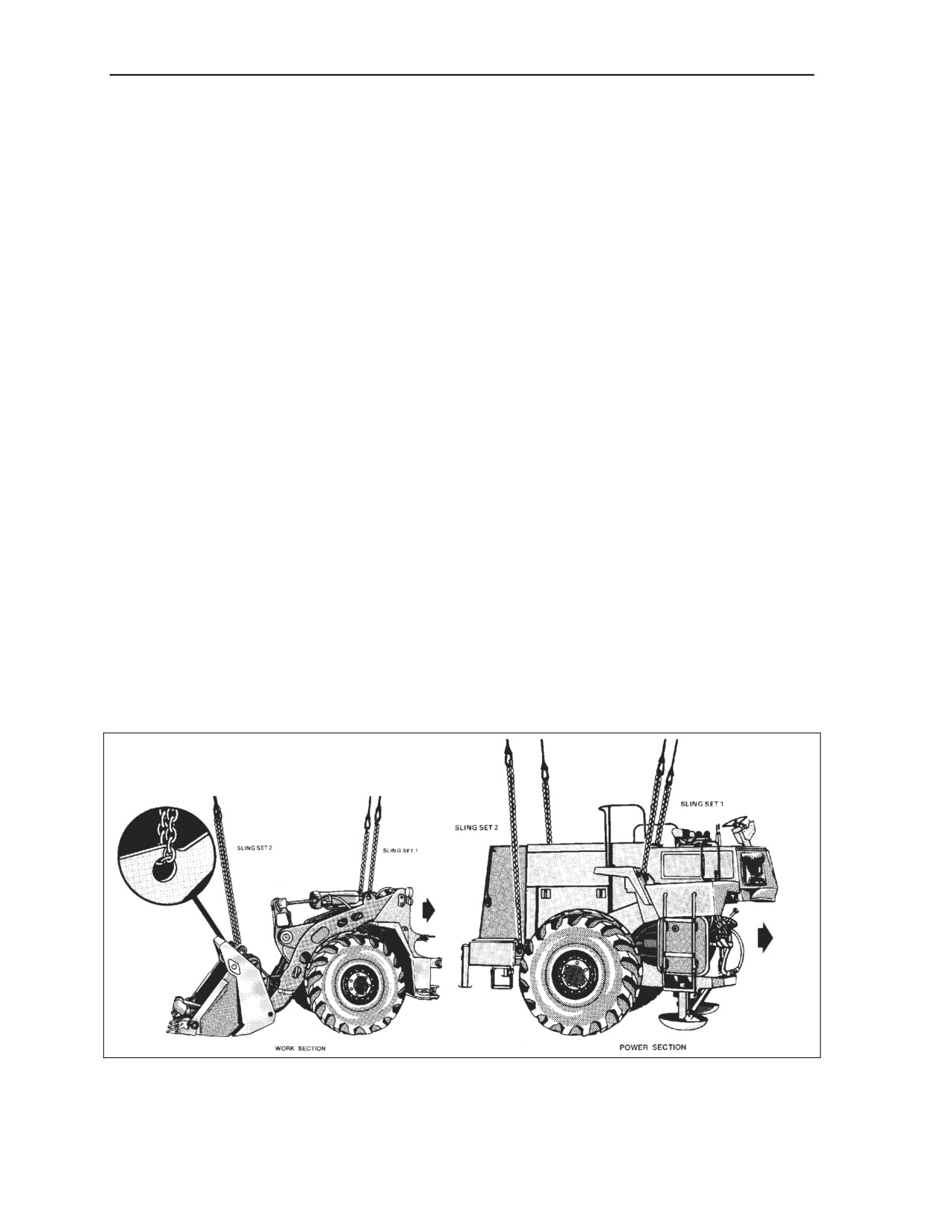
Rigging. Rig the load according to the steps in Figure 8-10.
Hookup. Two hookup teams are required for each section. The static discharge person
discharges the static electricity. The work station hookup team stands on the left and right
fenders. The static discharge person discharges the static electricity. The forward hookup
person places apex fitting 1 onto the forward cargo hook. The aircraft must then move forward
in order to hookup apex fitting number two. The aft hookup person places apex fitting 2 onto
the aft cargo hook. The power station hookup team stands on the operator's platform and
engine hood. The static discharge person discharges the static electricity. The forward hookup
person places apex fitting 1 onto the forward cargo hook. The aft hookup person places apex
fitting 2 onto the aft cargo hook. The hookup teams then carefully dismount the sections and
remain close to the load as the helicopter removes slack from the sling legs. When successful
hookup is assured, the hookup teams quickly exit the area underneath the helicopter to the
designated rendezvous point.
Derigging. Derigging is the reverse of the preparation and rigging procedures.
Figure 8-10. 950BS Scoop Loader, Sectionalized
FM 4-20.199/MCRP 4-11.3E, VOL III/NTTP 3-04.13/
8-20
AFMAN 11-223 (I), VOL III/COMDINST M13482.4B
20 February 2009

Certified Dual-Point Rigging Procedures for Engineer Equipment
RIGGING STEPS WORK SECTION
1.
Place two sling legs on apex fitting number 1. Position apex fitting number 1 on top of the aft
end of the work section (opposite the bucket end).
2.
Loop the chain end of the left and right sling legs through their respective lift provisions
located on top of the bucket lift arms. Place the correct link from Table 8-10 in the grab hook.
Secure the excess chain with tape or Type III nylon cord.
3.
Place two sling legs on apex fitting number 2. Position apex fitting number 2 on top of the
bucket.
4.
Loop the chain end of the left and right sling legs through their respective lift provisions
located on the rear of the bucket. Place the correct link from Table 8-10 in the grab hook.
5.
Raise the apex fittings above the load. Cluster and tie (breakaway technique) the sling legs
in each sling set together to prevent entanglement during hookup and lift-off.
RIGGING STEPS POWER SECTION
1.
Place two sling legs on apex fitting number 1. Position apex fitting number 1 on top of the
power section immediately behind the operator's seat.
2.
Loop the chain end of the left and right sling legs through their respective lift provisions
located on the operator's platform. Place the correct link from Table 8-10 in the grab hook.
Secure the excess chain with tape or Type III nylon cord.
3.
Place two sling legs on apex fitting number 2. Using the coupling links add an additional
chain length to each sling leg chain. Position apex fitting number 2 on top of the engine
deck.
4.
Loop the chain end of the left and right sling legs through their respective lift provisions
located on the forward end of the battery box. Place the correct link from Table 8-10 in the
grab hook. Secure the excess chain with tape or Type III nylon cord.
5.
Raise the apex fittings above the load. Cluster and tie (breakaway technique) the sling legs
in each sling set together to prevent entanglement during hookup and lift-off.
Figure 8-10. 950BS Scoop Loader, Sectionalized (Continued)
FM 4-20.199/MCRP 4-11.3E, VOL III/NTTP 3-04.13/
20 February 2009
AFMAN 11-223 (I), VOL III/COMDINST M13482.4B
8-21
Chapter 8
130GS GRADER, SECTIONALIZED
8-12. The 130GS grader, sectionalized is rigged for dual-point sling load using the following procedures:
z
Applicability. The following items in Table 8-11 are certified for the helicopter(s) listed in the
following table by the US Army Natick Soldier Center:
Table 8-11. 130GS Grader, Sectionalized
Nomenclature
Max Weight
Sling
Link Count
Type of
(Pounds)
Set
Front/Rear
Aircraft
130GS Grader, Front Section with Scarifier and
16,120
25K
3/77
CH-47
ROPS and Low-Velocity Airdrop (LVAD)
Suspension Provisions Removed
130 GS Grader, Rear Section
14,270
25K
36/56
CH-47
z
Materials. The following materials are required to rig this load:
Sling set (25,000-pound capacity) (2 each) with two additional apex fittings.
Tape, adhesive, pressure-sensitive, 2-inch wide roll.
Cord, nylon, Type III, 550-pound breaking strength.
Webbing, cotton, 1/4-inch, 80-pound breaking strength.
Felt sheet, cattle hair, Type IV, 1/2-inch or suitable padding
Strap, cargo, tiedown (as required).
Plastic bags.
z
Personnel. Two persons can prepare and rig each section in 20 minutes after removing the
ROPS and LVAD suspension provision and sectionalizing the grader.
z
Procedures. The following procedures apply to this load:
Preparation. Prepare the load using the following steps:
─ Sectionalize the grader according to the instructions in the operator's manual.
─ Remove the ROPS and LVAD suspension provisions mounted on the front bolster.
─ Ensure the fuel tank is not over 3/4 full. Inspect fuel tank cap, oil filler cap, and
battery caps for proper installation.
─ On the front section use CGU-1/B tiedown straps to secure each side of the front axle
to front tiedown points.
─ Loosen the front headlight bar, rotate 180 degrees, and retighten. Pad headlights with
padding and tape.
─ Tape the work light on the front end of the operator's platform.
─ Secure the steering wheel to the horizontal control bar on both sides with Type III
nylon cord.
─ Secure the seat with Type III nylon cord.
─ Cover all pivot points in the articulated hitch group with plastic bags and tape.
─ On the rear section, cover all pivot points in the articulated hitch group with plastic
bags and tape.
─ Remove the throttle handle and place in the toolbox.
─ Tape all lights and gages.
─ Pad the instrument panel with padding and tape.
─ Remove the exhaust stack and air cleaner and secure to the top rails with Type III
nylon cord.
─ Pad and tape the rear working lights and taillights.
─ Secure the doors closed with Type III nylon cord.
Rigging. Rig the load according to the steps in Figure 8-11.
FM 4-20.199/MCRP 4-11.3E, VOL III/NTTP 3-04.13/
8-22
AFMAN 11-223 (I), VOL III/COMDINST M13482.4B
20 February 2009
Certified Dual-Point Rigging Procedures for Engineer Equipment
Hookup. Two hookup teams are required for each section. The static discharge person
discharges the static electricity. The front section hookup team stands on top of the front
section. The forward hookup person places apex fitting 1 onto the forward cargo hook. The
aft hookup person places apex fitting 2 onto the aft cargo hook. The rear section hookup team
stands on top of the engine compartment. The forward hookup person places apex fitting 1
onto the forward cargo hook. The aft hookup person places apex fitting 2 onto the aft cargo
hook. The hookup teams then carefully dismount the sections and remain close to the load as
the helicopter removes slack from the sling legs. When successful hookup is assured, the
hookup teams quickly exit the area underneath the helicopter to the designated rendezvous
point.
Derigging. Derigging is the reverse of the preparation and rigging procedures.
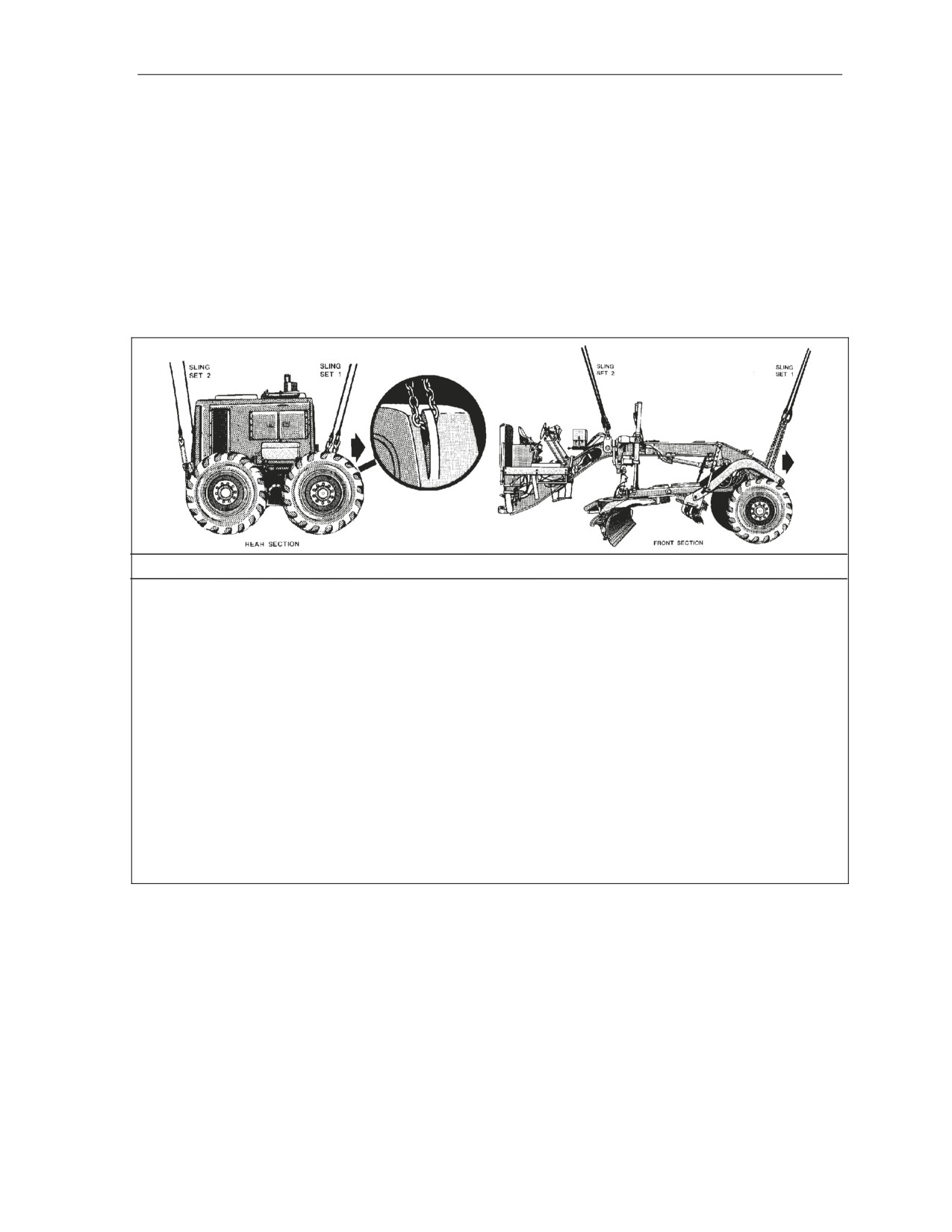
RIGGING STEPS FRONT SECTION
1. Place two sling legs on apex fitting number 1. Position apex fitting number 1 on top of the
front wheels.
2. Loop the chain end of the left and right sling legs through their respective lift provisions.
Place the correct link from Table 8-11 in the grab hook.
3. Place two sling legs on apex fitting number 2. Position apex fitting number 2 on top of the
front section above the blade.
4. Loop the chain end of the left and right sling legs through their respective lift provisions.
Place the correct link from Table 8-11 in the grab hook. Secure the excess chain with tape or
Type III nylon cord.
5. Raise the apex fittings above the load. Cluster and tie (breakaway technique) the sling legs
in each sling set together to prevent entanglement during hookup and lift-off.
Figure 8-11. 130GS Grader, Sectionalized
FM 4-20.199/MCRP 4-11.3E, VOL III/NTTP 3-04.13/
20 February 2009
AFMAN 11-223 (I), VOL III/COMDINST M13482.4B
8-23

Chapter 8
RIGGING STEPS REAR SECTION
1. Place two sling legs on apex fitting number 1. Position apex fitting number 1 in front of the
forward set of wheels.
2. Loop the chain end of the left and right sling legs through their respective lift provisions
located inboard of the forward wheels. Place the correct link from Table 8-11 in the grab
hook. Secure the excess chain with tape or Type III nylon cord.
3. Place two sling legs on apex fitting number 2. Position apex fitting number 2 behind the rear
set of wheels.
4. Loop the chain end of the left and right sling legs through their respective lift provisions.
Place the correct link from Table 8-11 in the grab hook. Secure the excess chain with tape or
Type III nylon cord.
5. Raise the apex fittings above the load. Cluster and tie (breakaway technique) the sling legs
in each sling set together to prevent entanglement during hookup and lift-off.
Figure 8-11.
130GS Grader, Sectionalized (Continued)
613BS SCRAPER, ELEVATING, SECTIONALIZED
8-13. The 613BS scraper, elevating, sectionalized is rigged for dual-point sling load using the following
procedures:
z
Applicability. The following item in Table 8-12 is certified for the helicopter(s) listed in the
following table by the US Army Natick Soldier Center:
Table 8-12. 613BS Scraper, Elevating, Sectionalized
Nomenclature
Max Weight
Sling
Link Count
Type of
(Pounds)
Set
Front/Rear
Aircraft
613BS Scraper, Elevating, Sectionalized
16,330
25K
40/15
CH-47
Note. The scraper power section is not certified as a dual point load because of the suspension
point configuration.
z
Materials. The following materials are required to rig this load:
Sling set (25,000-pound capacity) with one additional apex fitting.
Tape, adhesive, pressure-sensitive, 2-inch wide roll.
Cord, nylon, Type III, 550-pound breaking strength.
Webbing, cotton, 1/4-inch, 80-pound breaking strength.
Plastic bags (4 each).
z
Personnel. Four persons can sectionalize the scraper in one hour. Two persons can prepare and
rig this load in 20 minutes.
z
Procedures. The following procedures apply to this load:
Preparation. Prepare the load using the following steps:
─ Sectionalize the scraper according to the instructions in the operator's manual.
─ Stow elevator motor hoses and hanger arms on elevator flights in the bowl, and secure
with Type III nylon cord.
─ Secure hydraulic cylinders up in the stowed position with doubled Type III nylon cord.
FM 4-20.199/MCRP 4-11.3E, VOL III/NTTP 3-04.13/
8-24
AFMAN 11-223 (I), VOL III/COMDINST M13482.4B
20 February 2009
Certified Dual-Point Rigging Procedures for Engineer Equipment
─ Fold and secure the step located on the outside of the bowl.
─ Fold and secure all hoses and wires with Type III nylon cord.
─ Tape all lights.
─ Secure the toolbox lid with Type III nylon cord.
─ Cover all hitch pin and pin holes with plastic bags and tape.
Rigging. Rig the load according to the steps in Figure 8-12.
Hookup. Two hookup teams are required for this load. The static discharge person
discharges the static electricity. The forward hookup person stands forward of the rock guard
and places apex fitting 1 (bumper end) onto the forward cargo hook. The aft hookup person
places apex fitting 2 onto the aft cargo hook. The hookup teams then carefully dismount the
sections and remain close to the load as the helicopter removes slack from the sling legs.
When successful hookup is assured, the hookup teams quickly exit the area underneath the
helicopter to the designated rendezvous point.
Derigging. Derigging is the reverse of the preparation and rigging procedures.
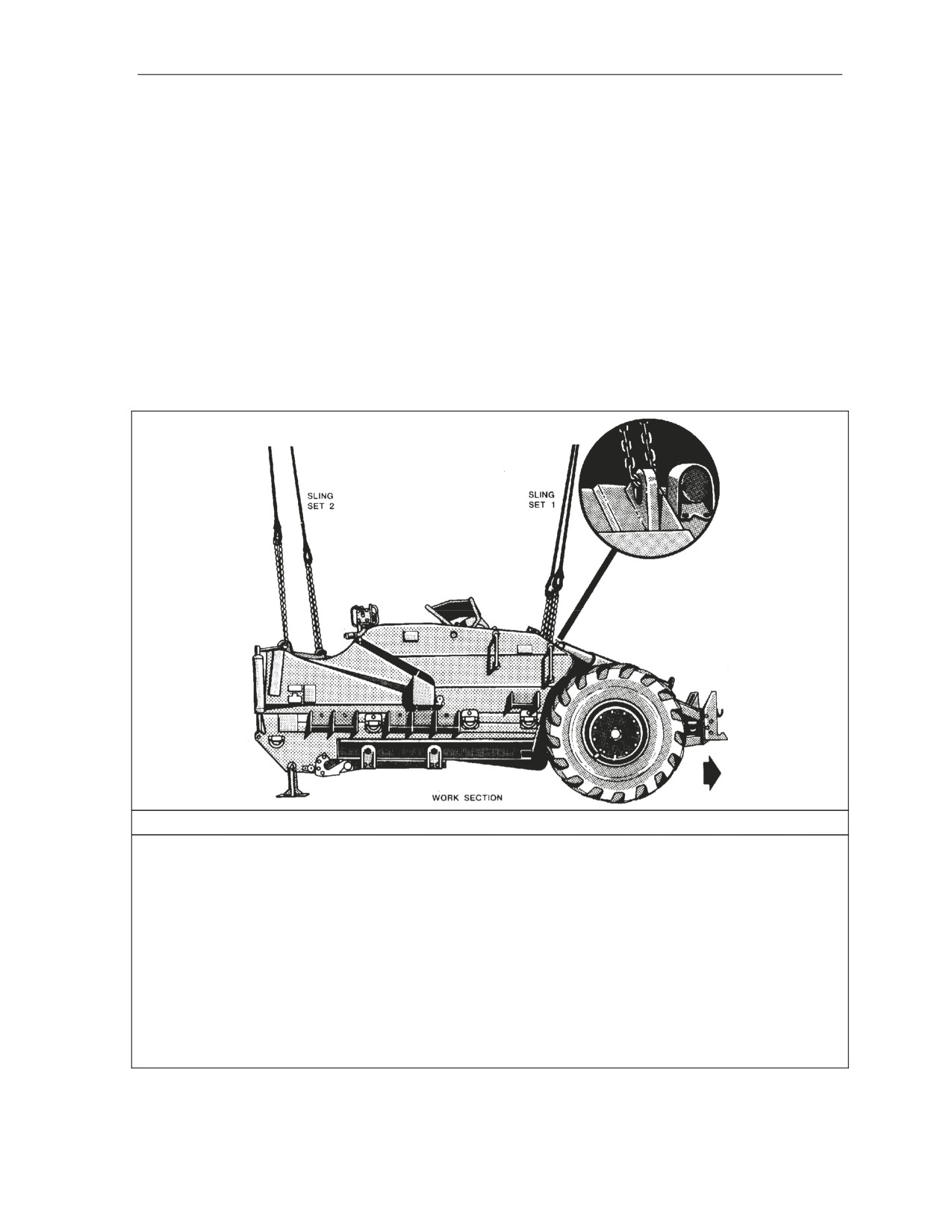
RIGGING STEPS
1. Place two sling legs on apex fitting number 1. Position apex fitting number 1 on the aft end of
the rock guard, near the wheels.
2. Loop the chain end of the left and right sling legs through their respective lift provisions
located on the aft deck near the wheels. Place the correct link from Table 8-12 in the grab
hook. Secure the excess chain with tape or Type III nylon cord.
3. Pull and tie (breakaway technique) the two sling legs to the rock guard.
4. Place two sling legs on apex fitting number 2. Position apex fitting number 2 on top of the
rock guard.
Figure 8-12.
613BS Scraper, Elevating, Sectionalized
FM 4-20.199/MCRP 4-11.3E, VOL III/NTTP 3-04.13/
20 February 2009
AFMAN 11-223 (I), VOL III/COMDINST M13482.4B
8-25

Chapter 8
RIGGING STEPS (Continued)
5. Loop the chain end of the left and right sling legs through their respective lift provisions
located on the front end of the bowl. Place the correct link from Table 8-12 in the grab hook.
Secure the excess chain with tape or Type III nylon cord.
6. Pull and tie (breakaway technique) the two sling legs to the rock guard.
7. Raise the apex fittings above the load. Cluster and tie (breakaway technique) the sling legs
in each sling set together to prevent entanglement during hookup and lift-off.
Figure 8-12.
613BS Scraper, Elevating, Sectionalized (Continued)
613WDS WATER DISTRIBUTOR, SECTIONALIZED
8-14. The 613WDS water distributor, sectionalized is rigged for dual-point sling load using the following
procedures:
z
Applicability. The following item in Table 8-13 is certified for the helicopter(s) listed in the
following table by the US Army Natick Soldier Center:
Table 8-13. 613WDS Water Distributor, Sectionalized
Nomenclature
Max Weight
Sling
Link Count
Type of
(Pounds)
Set
Front/Rear
Aircraft
613WDS Water Distributor, Work Section
15,400
25K
30/45
CH-47
Note. The distributor power section is not certified as a dual point load because of the
suspension point configuration.
z
Materials. The following materials are required to rig this load:
Sling set (25,000-pound capacity) with one additional apex fitting.
Tape, adhesive, pressure-sensitive, 2-inch wide roll.
Cord, nylon, Type III, 550-pound breaking strength.
Webbing, cotton, 1/4-inch, 80-pound breaking strength.
Plastic bags (4 each).
z
Personnel. Four persons can sectionalize the scraper in one hour. Two persons can prepare and
rig this load in 20 minutes.
z
Procedures. The following procedures apply to this load:
Preparation. Prepare the load using the following steps:
─ Sectionalize the distributor according to the instructions in the operator's manual.
─ Secure the distribution control panel and cable on top of the tank with Type III nylon
cord.
─ Secure hydraulic cylinders up in the stowed position with doubled Type III nylon cord.
─ Ensure the tank manhole cover is closed and secured.
─ Secure the hose and reel with Type III nylon cord.
─ Close and secure the toolbox and hose stowage compartment covers with Type III
nylon cord.
─ Cover all hitch pin and pin holes with plastic bags and tape.
Rigging. Rig the load according to the steps in Figure 8-13.
FM 4-20.199/MCRP 4-11.3E, VOL III/NTTP 3-04.13/
8-26
AFMAN 11-223 (I), VOL III/COMDINST M13482.4B
20 February 2009
Certified Dual-Point Rigging Procedures for Engineer Equipment
Hookup. Two hookup teams are required for this load and stand on the work section. The
static discharge person discharges the static electricity. The forward hookup person places
apex fitting 1 (bumper end) onto the forward cargo hook. The aft hookup person places apex
fitting 2 onto the aft cargo hook. The hookup teams then carefully dismount the sections and
remain close to the load as the helicopter removes slack from the sling legs. When successful
hookup is assured, the hookup teams quickly exit the area underneath the helicopter to the
designated rendezvous point.
Derigging. Derigging is the reverse of the preparation and rigging.
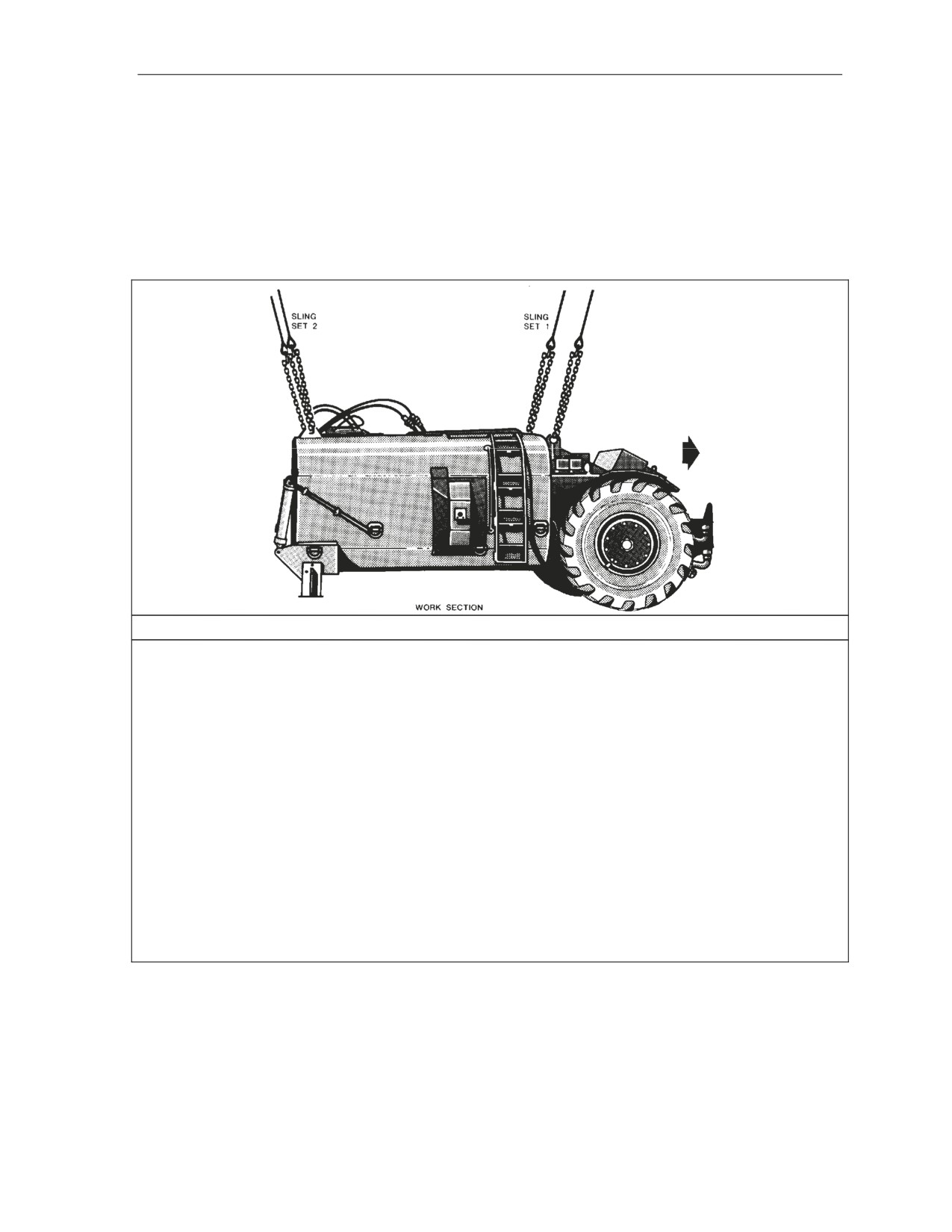
RIGGING STEPS
1. Place two sling legs on apex fitting number 1. Position apex fitting number 1 above the aft
(wheel) end of the water tank.
2. Loop the chain end of the left and right sling legs through their respective lift provisions
located on the corners of the water tank. Place the correct link from Table 8-13 in the grab
hook. Secure the excess chain with tape or Type III nylon cord.
3. Place two sling legs on apex fitting number 2. Position apex fitting number 2 on forward end
of the tank.
4. Loop the chain end of the left and right sling legs through their respective lift provisions
located on the front end of the tank. Place the correct link from Table 8-13 in the grab hook.
Secure the excess chain with tape or Type III nylon cord.
5. Raise the apex fittings above the load. Cluster and tie (breakaway technique) the sling legs
in each sling set together to prevent entanglement during hookup and lift-off.
Figure 8-13. 613WDS Water Distributor, Sectionalized
FM 4-20.199/MCRP 4-11.3E, VOL III/NTTP 3-04.13/
20 February 2009
AFMAN 11-223 (I), VOL III/COMDINST M13482.4B
8-27
Chapter 8
ROLLER, TOWED, VIBRATING
8-15. The roller, towed, vibrating is rigged for dual-point sling load using the following procedures:
z
Applicability. The following item in Table 8-14 is certified for the helicopter(s) listed in the
following table by the US Army Natick Soldier Center:
Table 8-14. Roller, Towed, Vibrating
Nomenclature
Max Weight
Sling
Link Count
Type of
(Pounds)
Set
Front/Rear
Aircraft
Roller, Towed, Vibrating
4,830
10K
3/3
CH-47
z
Materials. The following materials are required to rig this load:
Sling set (10,000-pound capacity) with one additional apex fitting.
Tape, adhesive, pressure-sensitive, 2-inch wide roll.
Cord, nylon, Type III, 550-pound breaking strength.
Webbing, cotton, 1/4-inch, 80-pound breaking strength.
z
Personnel. Two persons can prepare and rig this load in 10 minutes.
z
Procedures. The following procedures apply to this load:
Preparation. Prepare the load using the following steps:
─ Lift the tongue and position the support leg in its stowed or travel position and secure
with Type III nylon cord.
─ Secure the battery box cover, fuel cap, hoses, and any loose items with tape or Type III
nylon cord.
─ Ensure the fuel tank is not over 3/4 full. Inspect fuel tank cap, oil filler cap, and
battery caps for proper installation.
Rigging. Rig the load according to the steps in Figure 8-14.
Hookup. Two hookup teams are required for this load and stand beside the roller. The
static discharge person discharges the static electricity. The forward hookup person places
apex fitting 2 onto the forward cargo hook. The aft hookup person places apex fitting 1 onto
the aft cargo hook. The hookup teams then carefully dismount the sections and remain close
to the load as the helicopter removes slack from the sling legs. When successful hookup is
assured, the hookup teams quickly exit the area underneath the helicopter to the designated
rendezvous point.
Derigging. Derigging is the reverse of the preparation and rigging procedures.
FM 4-20.199/MCRP 4-11.3E, VOL III/NTTP 3-04.13/
8-28
AFMAN 11-223 (I), VOL III/COMDINST M13482.4B
20 February 2009
Certified Dual-Point Rigging Procedures for Engineer Equipment
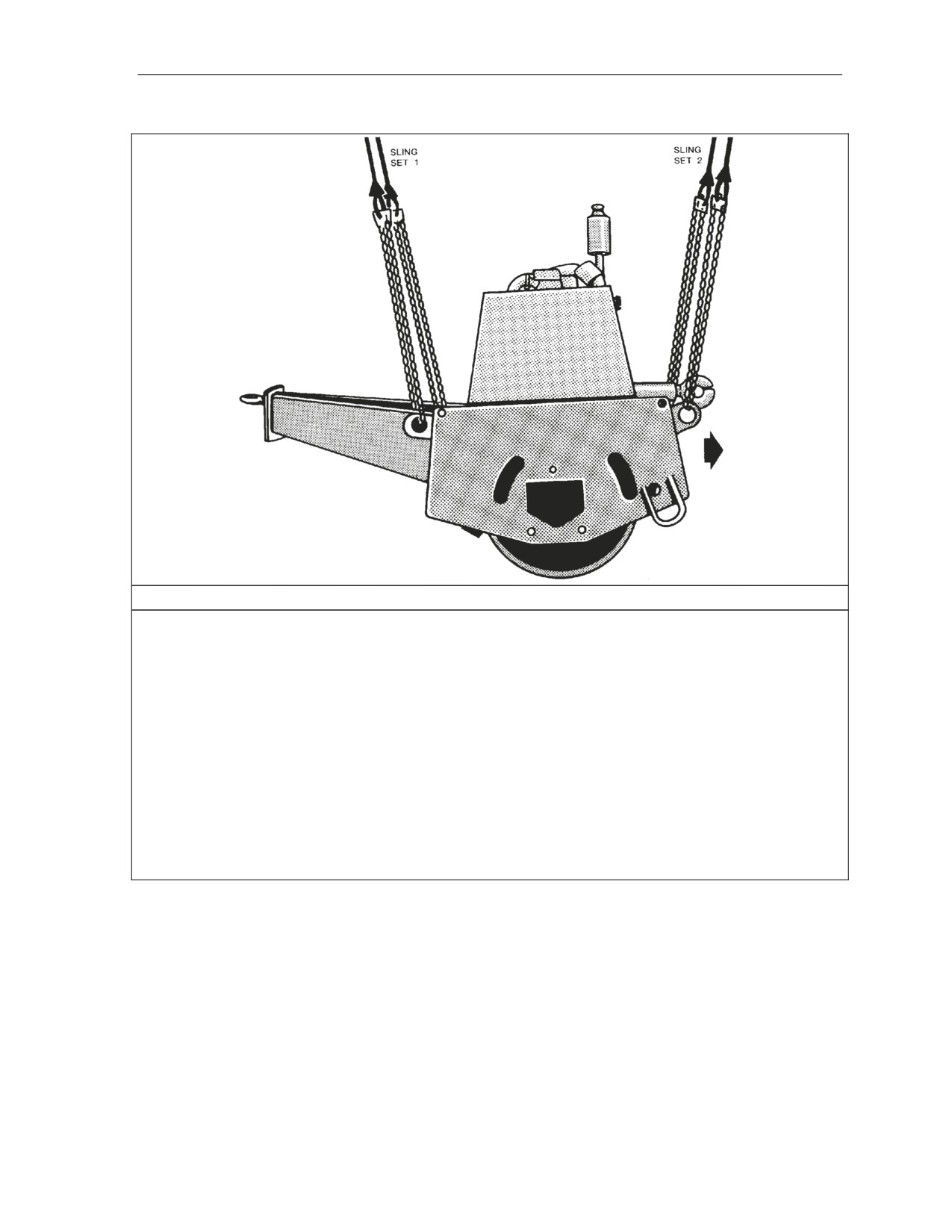
RIGGING STEPS
1. Place two sling legs on apex fitting number 1. Position apex fitting number 1 on the tongue.
2. Loop the chain end of the left and right sling legs through their respective lift provisions
located on the tongue end of the roller. Place the correct link from Table 8-14 in the grab
hook.
3. Place two sling legs on apex fitting number 2. Position apex fitting number 2 behind the
roller.
4. Loop the chain end of the left and right sling legs through their respective lift provisions
located on the rear end of the roller. Place the correct link from Table 8-14 in the grab hook.
5. Raise the apex fittings above the load. Cluster and tie (breakaway technique) the sling legs
in each sling set together to prevent entanglement during hookup and lift-off.
Figure 8-14. Roller, Towed, Vibrating
ROLLERS, TOWED
8-16. The rollers, towed are rigged for dual-point sling load using the following procedures:
z
Applicability. The following items in Table 8-15 are certified for the helicopter(s) listed in the
following table by the US Army Natick Soldier Center:
FM 4-20.199/MCRP 4-11.3E, VOL III/NTTP 3-04.13/
20 February 2009
AFMAN 11-223 (I), VOL III/COMDINST M13482.4B
8-29
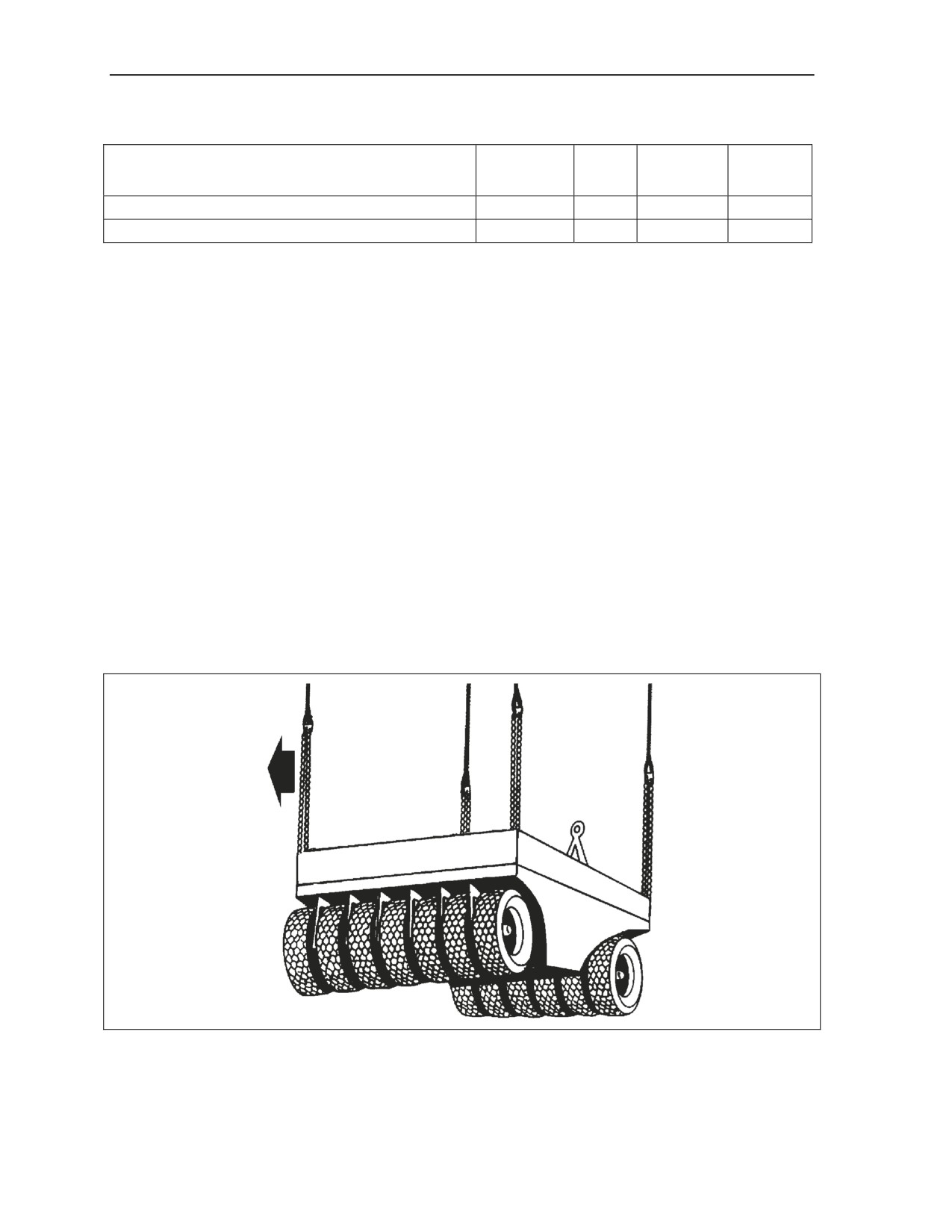
Chapter 8
Table 8-15. Rollers, Towed
Nomenclature
Max Weight
Sling
Link Count
Type of
(Pounds)
Set
Front/Rear
Aircraft
Roller, Towed, RO3402
4,600
10K
3/30
CH-47
Roller, Hercules, PT-11
3,520
10K
3/3
CH-47
z
Materials. The following materials are required to rig this load:
Sling set (10,000-pound capacity) with one additional apex fitting.
Tape, adhesive, pressure-sensitive, 2-inch wide roll.
Cord, nylon, Type III, 550-pound breaking strength.
Webbing, cotton, 1/4-inch, 80-pound breaking strength.
Strap, cargo, tiedown, CGU-1/B (2 each).
z
Personnel. Two persons can prepare and rig this load in 10 minutes.
z
Procedures. The following procedures apply to this load:
Preparation. Prepare the load using the following steps:
─ Secure the drain plugs with tape.
─ Raise the tongue and secure with the CGU-1/B tiedown straps.
Rigging. Rig the load according to the steps in Figure 8-15.
Hookup. Two hookup teams are required for this load. The static discharge person
discharges the static electricity. The forward hookup person stands on the forward end of the
roller and places apex fitting 2 onto the forward cargo hook. The aft hookup person stands on
the rear of the roller and places apex fitting 1 onto the aft cargo hook. The hookup teams then
carefully dismount the load and remain close to the load as the helicopter removes slack from
the sling legs. When successful hookup is assured, the hookup teams quickly exit the area
underneath the helicopter to the designated rendezvous point.
Derigging. Derigging is the reverse of the preparation and rigging procedures.
Figure 8-15. Towed Rollers
FM 4-20.199/MCRP 4-11.3E, VOL III/NTTP 3-04.13/
8-30
AFMAN 11-223 (I), VOL III/COMDINST M13482.4B
20 February 2009

Certified Dual-Point Rigging Procedures for Engineer Equipment
RIGGING STEPS
1. Place two sling legs on apex fitting number 1. Position apex fitting number 1 on top of the
roller.
2. Loop the chain end of the left and right sling legs through their respective lift provisions
located on the front corner of the roller. Place the correct link from Table 8-15 in the grab
hook.
3. Place two sling legs on apex fitting number 2. Position apex fitting number 2 on top of the
roller.
4. Loop the chain end of the left and right sling legs through their respective lift provisions
located on the rear corners of the roller. Place the correct link from Table 8-15 in the grab
hook.
5. Raise the apex fittings above the load. Cluster and tie (breakaway technique) the sling legs
in each sling set together to prevent entanglement during hookup and lift-off.
Figure 8-15. Towed Rollers (Continued)
VIBRATING ROLLER, CATERPILLAR, RO-33
8-17. The vibrating roller, Caterpillar, RO-33 is rigged for dual-point sling load using the following
procedures:
z
Applicability. The following item in Table 8-16 is certified for the helicopter(s) listed in the
following table by the US Army Natick Soldier Center:
Table 8-16. Vibrating Roller, Caterpillar, RO-33
Nomenclature
Max Weight
Sling
Link Count
Type of
(Pounds)
Set
Front/Rear
Aircraft
Vibrating Roller, Caterpillar, RO-33
16,425
25K
30/3
CH-47
z
Materials. The following materials are required to rig this load:
Sling set (25,000-pound capacity) with one additional apex fitting..
Tape, adhesive, pressure-sensitive, 2-inch wide roll.
Cord, nylon, Type III, 550-pound breaking strength.
Webbing, cotton, 1/4-inch, 80-pound breaking strength.
Lumber, 2-inch x 4-inch (as required).
Felt sheet, cattle hair, Type IV, 1/2-inch or suitable padding.
z
Personnel. Two persons can prepare and rig this load in 15 minutes.
z
Procedures. The following procedures apply to this load:
Preparation. Prepare the load using the following steps:
─ Place the transmission in neutral and set the parking brake.
─ Ensure the fuel tank is not over 3/4 full. Ensure the fuel tank cap is in the vent
position. Inspect the oil filter cap and battery caps for proper installation.
─ Secure the seat cushion to the frame with tape or Type III nylon cord.
─ Remove and secure the exhaust stack.
─ Tape all lights and gauges. Secure all loose covers and panels with tape or Type III
nylon cord.
FM 4-20.199/MCRP 4-11.3E, VOL III/NTTP 3-04.13/
20 February 2009
AFMAN 11-223 (I), VOL III/COMDINST M13482.4B
8-31
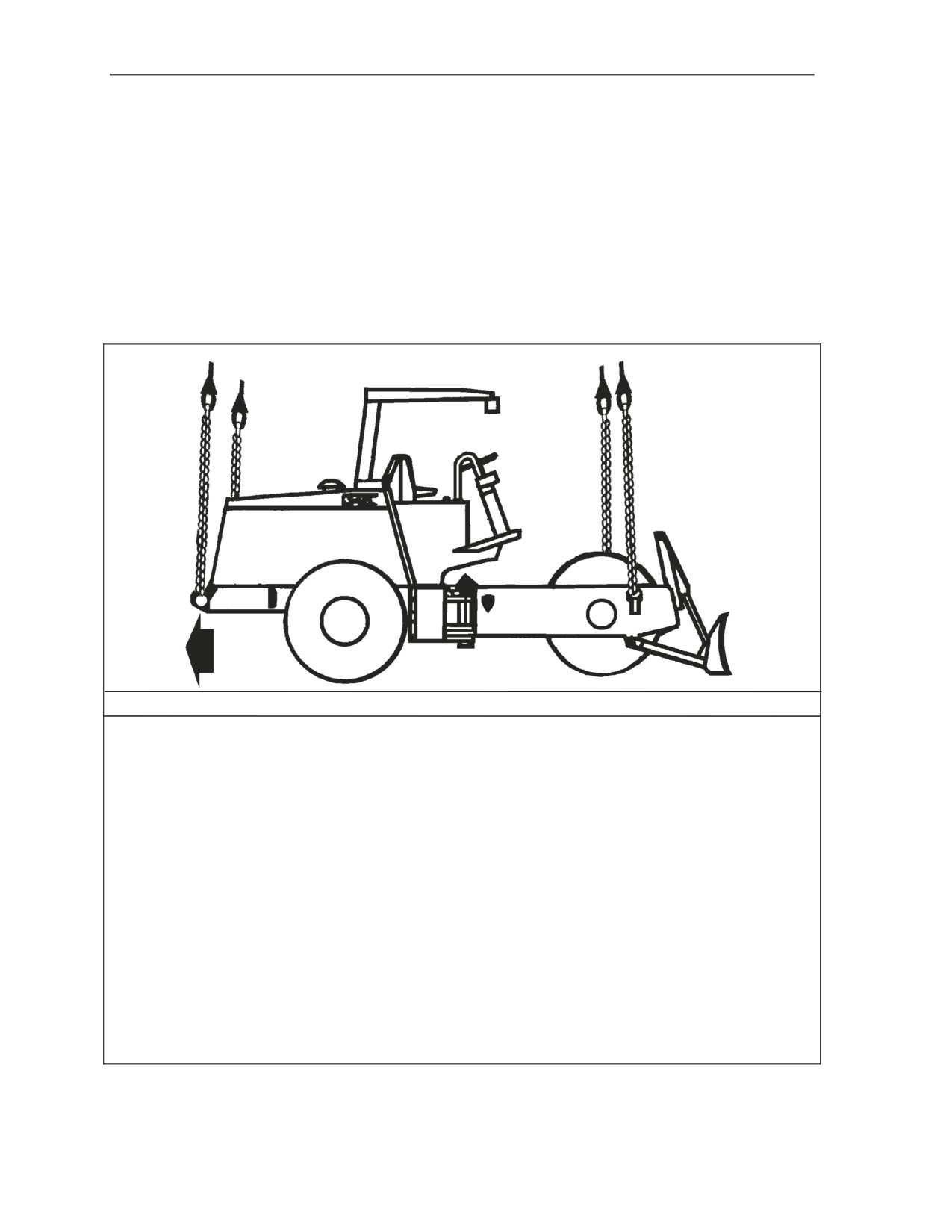
Chapter 8
─ Tie down the steering wheel with Type III nylon cord.
─ Place the wooden block in the pivot point at the center of the roller to prevent the two
halves from flexing during flight.
Rigging. Rig the load according to the steps in Figure 8-16.
Hookup. The hookup team stands beside the roller. The static wand person discharges the
static electricity with the static wand. The forward hookup person places apex fitting 2 onto
the forward cargo hook. The aft hookup person places apex fitting 1 onto the aft cargo hook.
The hookup team then moves clear of the load but remains close to the load as the helicopter
removes slack from the sling legs. When successful hookup is assured, the hookup team
quickly exits the area underneath the helicopter to the designated rendezvous point.
Derigging. Derigging is the reverse of the preparation and rigging procedures.
RIGGING STEPS
1. Connect 2 sling legs to apex fitting number 1. Position the apex fitting next to the front of the
roller.
2. Loop the chain end of the sling legs through their respective lift provisions. Place the correct
link from Table 8-16 in the grab hook.
3. Connect 2 sling legs to apex fitting number 2. Position the apex fitting on top of the aft end
(engine compartment end) of the roller.
4. Loop the chain end of the sling legs through their respective lift provisions located on the aft
end of the roller. Place the correct link from Table 8-16 in the grab hook.
5. Pad the chain where it contacts the engine compartment. Secure all excess chain with tape
or Type III nylon cord.
6. Cluster and tie (breakaway technique) the sling legs in each sling set together to prevent
entanglement during hookup and lift-off.
Figure 8-16. Vibrating Roller, Caterpillar, RO-33
FM 4-20.199/MCRP 4-11.3E, VOL III/NTTP 3-04.13/
8-32
AFMAN 11-223 (I), VOL III/COMDINST M13482.4B
20 February 2009
Certified Dual-Point Rigging Procedures for Engineer Equipment
ROLLER, COMPACTOR, VIBRATOR
8-18. The roller, compactor, vibrator is rigged for dual-point sling load using the following procedures:
z
Applicability. The following item in Table 8-17 is certified for the helicopter(s) listed in the
following table by the US Army Natick Soldier Center:
Table 8-17. Roller, Compactor, Vibrator
Nomenclature
Max Weight
Sling
Link Count
Type of
(Pounds)
Set
Front/Rear
Aircraft
Roller, Compactor, Vibrator
24,340
40K
41/3
CH-53
z
Materials. The following materials are required to rig this load:
Sling set (40,000-pound capacity) with one additional apex fitting.
─ Additional chain length, part number 607050, from a 40,000-pound capacity sling set
(2 each).
─ Additional coupling link, part number 577-0815, from a 40,000-pound sling set (2
each).
Tape, adhesive, pressure-sensitive, 2-inch wide roll.
Cord, nylon, Type III, 550-pound breaking strength.
Webbing, cotton, 1/4-inch, 80-pound breaking strength.
Felt sheet, cattle hair, Type IV, 1/2-inch or suitable padding
Strap, cargo, tiedown, CGU-1/B (as required).
z
Personnel. Two persons can prepare and rig this load in 30 minutes.
z
Procedures. The following procedures apply to this load:
Preparation. Prepare the load using the following steps:
─ Ensure the roller is secured in the down position according to the instructions in the
operator's manual. Secure all hatches and door panels with CGU-1/B tiedown straps.
─ Tape the air filter intake and the exhaust pipe opening. Tape the windows, lights, and
reflectors.
─ Engage the hand brake and place the transmission in neutral.
─ Ensure the fuel tank is not over 3/4 full. Inspect fuel tank cap, oil filler cap, and
battery caps for proper installation.
Rigging. Rig the load according to the steps in Figure 8-17.
Hookup. Two hookup teams are required for this load. The static discharge person
discharges the static electricity. The forward hookup person stands on the forward end of the
compactor and places apex fitting 1 onto the forward cargo hook. The aft hookup person
stands on the rear of the compactor and places apex fitting 2 onto the aft cargo hook. The
hookup teams then carefully dismount the load and remain close to the load as the helicopter
removes slack from the sling legs. When successful hookup is assured, the hookup teams
quickly exit the area underneath the helicopter to the designated rendezvous point.
Derigging. Derigging is the reverse of the preparation and rigging procedures.
FM 4-20.199/MCRP 4-11.3E, VOL III/NTTP 3-04.13/
20 February 2009
AFMAN 11-223 (I), VOL III/COMDINST M13482.4B
8-33
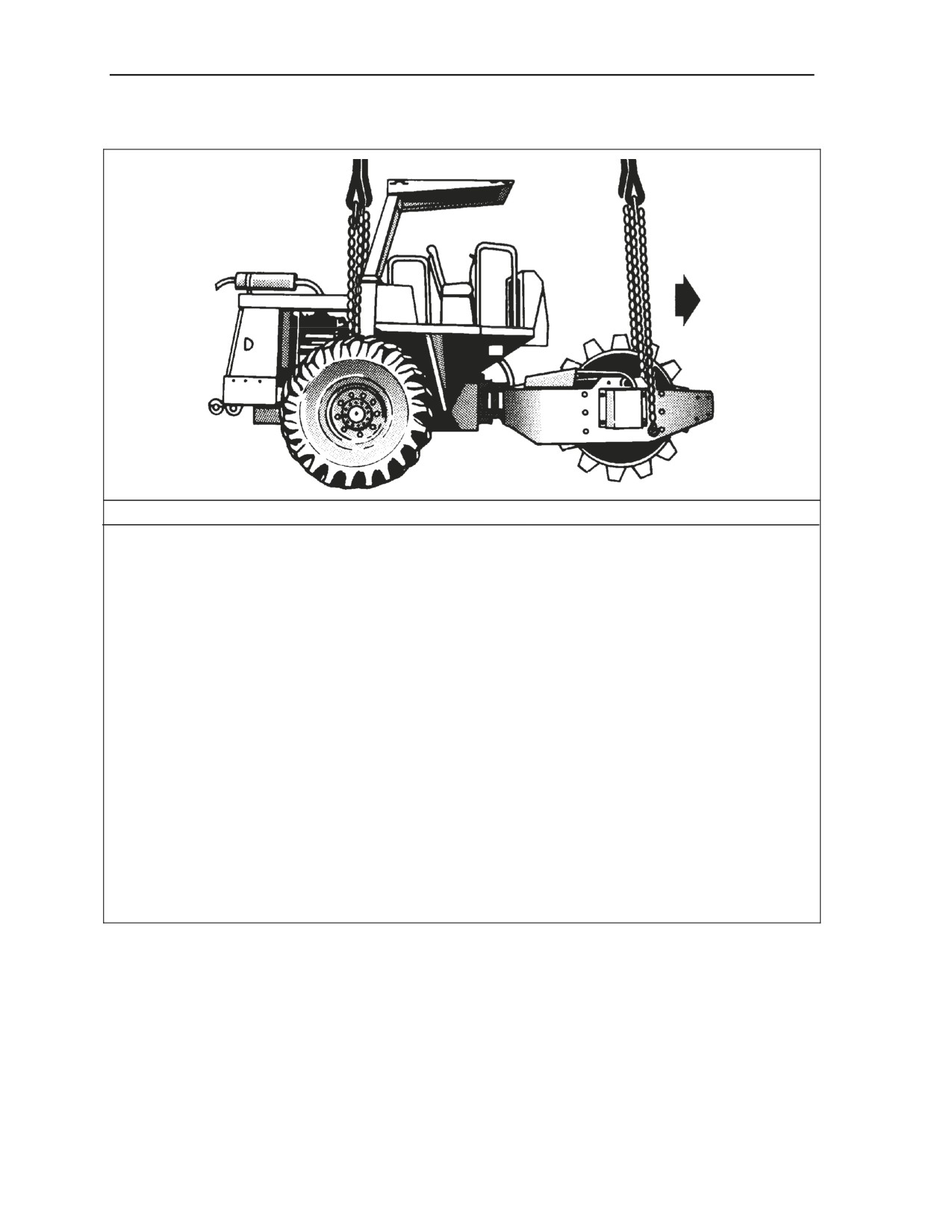
Chapter 8
RIGGING STEPS
1. Place two sling legs on apex fitting number 1. Attach an additional chain length to each sling
leg chain with the coupling link. Position apex fitting number 1 on top of the front of the
compactor.
2. Loop the chain end of the left and right sling legs through their respective lift provisions
located at the bottom of the roller supporting arm. Place the correct link from Table 8-17 in
the grab hook. Secure the excess chain with tape or Type III nylon cord.
3. Place two sling legs on apex fitting number 2. Position apex fitting number 2 on top of the
rear of the compactor.
4. Loop the chain end of the left and right sling legs through their respective lift provisions
located between the engine and the rear tire. Place the correct link from Table 8-17 in the
grab hook.
5. Pad the sling legs where the legs rub against the engine housing. Secure the padding with
tape or Type III nylon cord.
6. Raise the apex fittings above the load. Cluster and tie (breakaway technique) the sling legs
in each sling set together to prevent entanglement during hookup and lift-off.
Figure 8-17. Roller, Compactor, Vibrator
FM 4-20.199/MCRP 4-11.3E, VOL III/NTTP 3-04.13/
8-34
AFMAN 11-223 (I), VOL III/COMDINST M13482.4B
20 February 2009
Certified Dual-Point Rigging Procedures for Engineer Equipment
MINE CLEARING LINE CHARGE MOUNTED ON M353 TRAILER
8-19. The mine clearing line charge mounted on M353 trailer is rigged for dual-point sling load using the
following procedures:
z
Applicability. The following item in Table 8-18 is certified for the helicopter(s) listed in the
following table by the US Army Natick Soldier Center:
Table 8-18. Mine Clearing Line Charge Mounted on M353 Trailer
Nomenclature
Max Weight
Sling
Link Count
Type of
(Pounds)
Set
Front/Rear
Aircraft
MK155 Launcher with M68A2 Demolition Charge and
6,372
10K
3/3
CH-47
MK22 Rocket Motor
z
Materials. The following materials are required to rig this load:
Sling set (10,000-pound capacity) with one additional apex fitting.
Tape, adhesive, pressure-sensitive, 2-inch wide roll.
Cord, nylon, Type III, 550-pound breaking strength.
Webbing, cotton, 1/4-inch, 80-pound breaking strength.
Strap, cargo, tiedown, CGU-1/B (4 each).
z
Personnel. Two persons can prepare and rig this load in 10 minutes.
z
Procedures. The following procedures apply to this load:
Preparation. Prepare the load using the following steps:
─ Ensure all components are securely attached together.
─ Ensure the storage box lid is closed and secure. Secure safety chains, hoses, and any
other loose items with tape or Type III nylon cord.
─ Engage the parking brake.
Note. The rocket motor cannot be safely secured to the load in this configuration; therefore, the
rocket motor box must be kept separate and loaded internally into the helicopter.
Rigging. Rig the load according to the steps in Figure 8-18.
Hookup. Two hookup teams are required for this load. The static discharge person
discharges the static electricity. The forward hookup person stands on the trailer chassis and
places apex fitting 2 onto the forward cargo hook. The aft hookup person stands on the trailer
chassis and places apex fitting 1 (lunette end) onto the aft cargo hook. The hookup teams then
carefully dismount the load and remain close to the load as the helicopter removes slack from
the sling legs. When successful hookup is assured, the hookup teams quickly exit the area
underneath the helicopter to the designated rendezvous point.
Derigging. Derigging is the reverse of the preparation and rigging procedures.
FM 4-20.199/MCRP 4-11.3E, VOL III/NTTP 3-04.13/
20 February 2009
AFMAN 11-223 (I), VOL III/COMDINST M13482.4B
8-35
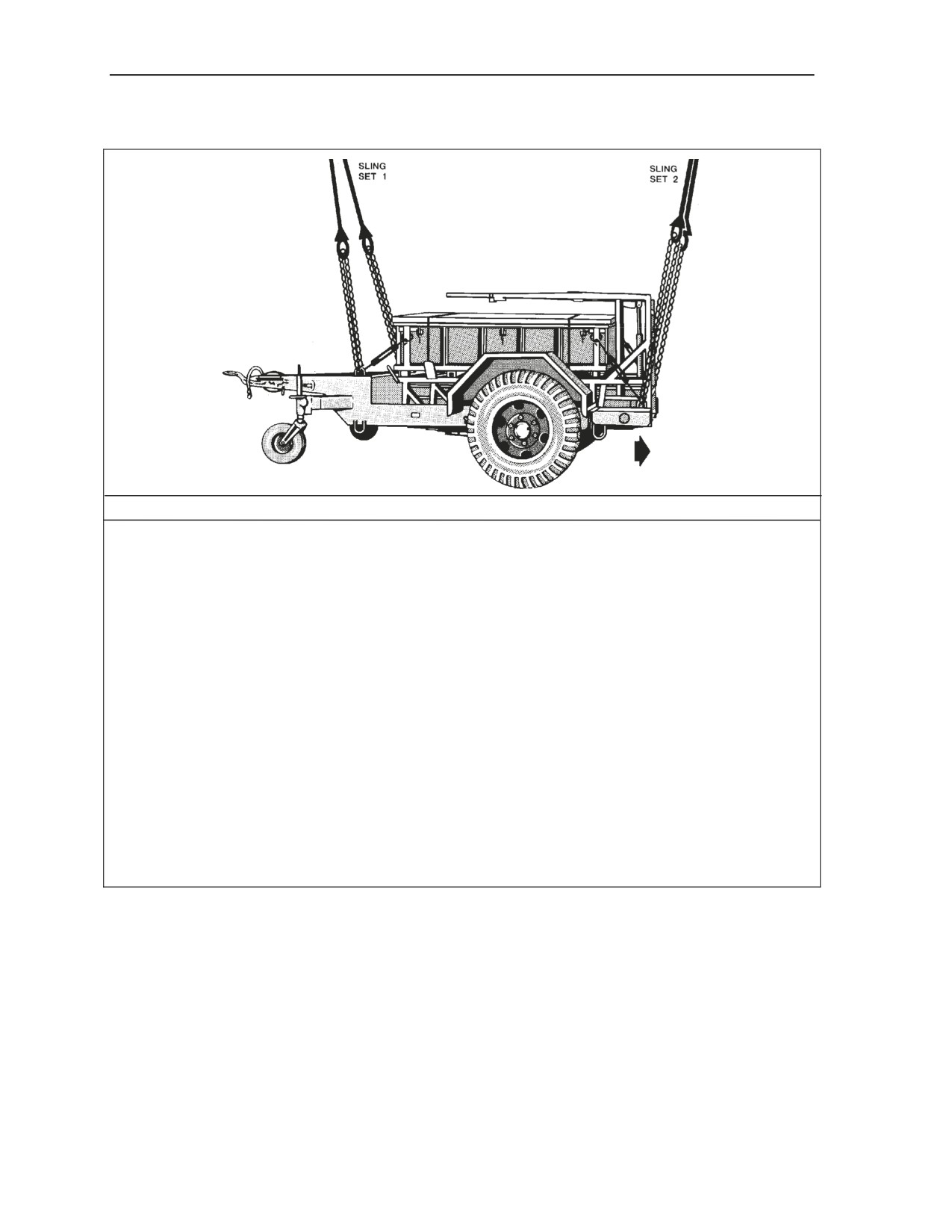
Chapter 8
RIGGING STEPS
1. Place two sling legs on apex fitting number 1. Position apex fitting number 1 on the trailer
tongue.
2. Loop the chain end of the left and right sling legs through their respective lift provisions
located aft of the trailer leveling wheels. Place the correct link from Table 8-18 in the grab
hook.
3. Place two sling legs on apex fitting number 2. Position apex fitting number 2 on top of the aft
end of the launcher.
4. Loop the chain end of the left and right sling legs through their respective lift provisions
located aft of the trailer wheels by the bumper. Place the correct link from Table 8-18 in the
grab hook.
5. Pull and tie (breakaway technique) the sling legs to the launch rail.
6. Raise the apex fittings above the load. Cluster and tie (breakaway technique) the sling legs
in each sling set together to prevent entanglement during hookup and lift-off.
Figure 8-18. Mine Clearing Line Charge Mounted on M353 Trailer
FM 4-20.199/MCRP 4-11.3E, VOL III/NTTP 3-04.13/
8-36
AFMAN 11-223 (I), VOL III/COMDINST M13482.4B
20 February 2009