FM 20-32 Mine/Countermine Operations (August 2001) - page 12
Appendix F
Mine Awareness
Mine awareness should actually be entitled mine/UXO awareness. If only
mines are emphasized, ordnance (bomblets, submunitions) may be
overlooked, and it has equal if not greater killing potential. The main
objective of mine awareness is to save lives, so it is important to ensure
that soldiers are well-informed and thoroughly trained. This appendix
outlines the tasks needed for soldiers and units to survive in a mined/UXO
environment.
Mine awareness should be emphasized at all levels of command, and it
involves soldier and leader skills. Soldier skills are a mix of individual and
collective tasks that are required for an element to maintain its combat
effectiveness in and around a mined environment. It is important to note
that a soldier’s basic mine-awareness skills are critical to his and the unit’s
survival. Leader skills involve planning missions, assessing situations,
and tracking/disseminating mine information. A unit must be proficient in
all mine-awareness skills to effectively operate in a mined environment.
SOLDIER
Soldier skills involve individual and collective tasks that are required for basic
survival in a mined/UXO environment. They include minefield indicators,
probing techniques, mine-detector operation, extraction drills, survival rules,
casualty treatment, and evacuation drills.
VISUAL INDICATORS
Mine/UXO indicators are part of all combat operations. Understanding and
recognizing mine indicators could determine whether or not a soldier becomes
a casualty. The following may indicate the presence of mines/UXO:
• Trip wires.
• Signs of road repair (such as new fill or paving, road patches, ditching,
culvert work).
• Signs placed on trees, posts, or stakes. Threat forces mark their
minefields to protect their own forces.
• Dead animals.
• Damaged vehicles.
• Disturbances in previous tire tracks or tracks that stop unexplainably.
• Wires leading away from the side of the road. They may be firing wires
that are partially buried.
Mine Awareness F-1
FM 20-32
• Odd features in the ground or patterns that are not present in nature.
Plant growth may wilt or change color, rain may wash away some of
the cover, the cover may sink or crack around the edges, or the
material covering the mines may look like mounds of dirt.
• Civilians. They may know where mines or booby traps are located in
the residential area. Civilians staying away from certain places or out
of certain buildings are good indications of the presence of mines or
booby traps. Question civilians to determine the exact locations.
• Pieces of wood or other debris on a road. They may be indicative of
pressure or pressure-release FDs. These devices may be on the surface
or partially buried.
• Patterns of objects that could be used as a sighting line. The enemy
can use mines that are fired by command, so road shoulders and areas
close to the objects should be searched.
PROBING
Probing is very time-consuming and is used primarily for clearing operations,
self-extraction, and covert breaching operations. Detection of mines by visual
or electronic methods should be confirmed by probing. Use the following
procedures and techniques when probing for mines:
• Roll up your sleeves and remove your jewelry to increase sensitivity.
Wear a Kevlar helmet, with the chin strap buckled, and a protective
fragmentation vest.
• Stay close to the ground and move in a prone position to reduce the
effects of an accidental blast. When moving into a prone position, the
prober should—
— Squat down without touching his knees to the ground.
— Scan forward up to 2 meters and to the sides up to 3 meters for
mine indicators.
— Probe the area around his feet and as far forward as possible.
— Kneel on the ground after the area is found to be clear and
continue probing forward until he is in a prone position.
• Use sight and touch to detect trip wires, fuses, and pressure prongs.
• Use a slender, nonmetallic object as a probe.
• Probe every 5 centimeters across a 1-meter front.
• Gently push the probe into the ground at an angle that is less than 45
degrees.
DANGER
Use extreme caution when probing. If the probe is pushed
straight down, its tip may detonate a pressure fuse.
• Apply just enough pressure on the probe to sink it slowly into the
ground.
F-2 Mine Awareness
C3, FM 20-32
• If the probe encounters resistance and does not go into the ground
freely, carefully pick the soil away with the tip of the probe and remove
the loose dirt by hand. Care must be taken to prevent functioning the
mine.
• When a solid object is touched, stop probing and use two fingers from
each hand to carefully remove the surrounding soil and identify the
object.
• If the object is a mine, remove enough soil to show the mine type and
mark its location. Do not attempt to remove or disarm the mine. Use
explosives to destroy detected mines in place or use a grappling hook
and rope to cause mines to self-detonate. Metal grappling hooks
should not be used on magnetic-fused mines.
Probing is extremely stressful and tedious. The senior leader must set a limit
to the time a prober is actually probing in the minefield. To determine a
reasonable time, the leader must consider METT-TC factors, weather
conditions, the threat level, the unit’s stress level, and the prober’s fatigue
level and state of mind. As a rule, 20 to 30 minutes is the maximum amount of
time that an individual can probe effectively.
AN/PSS-12
METALLIC MINE DETECTOR
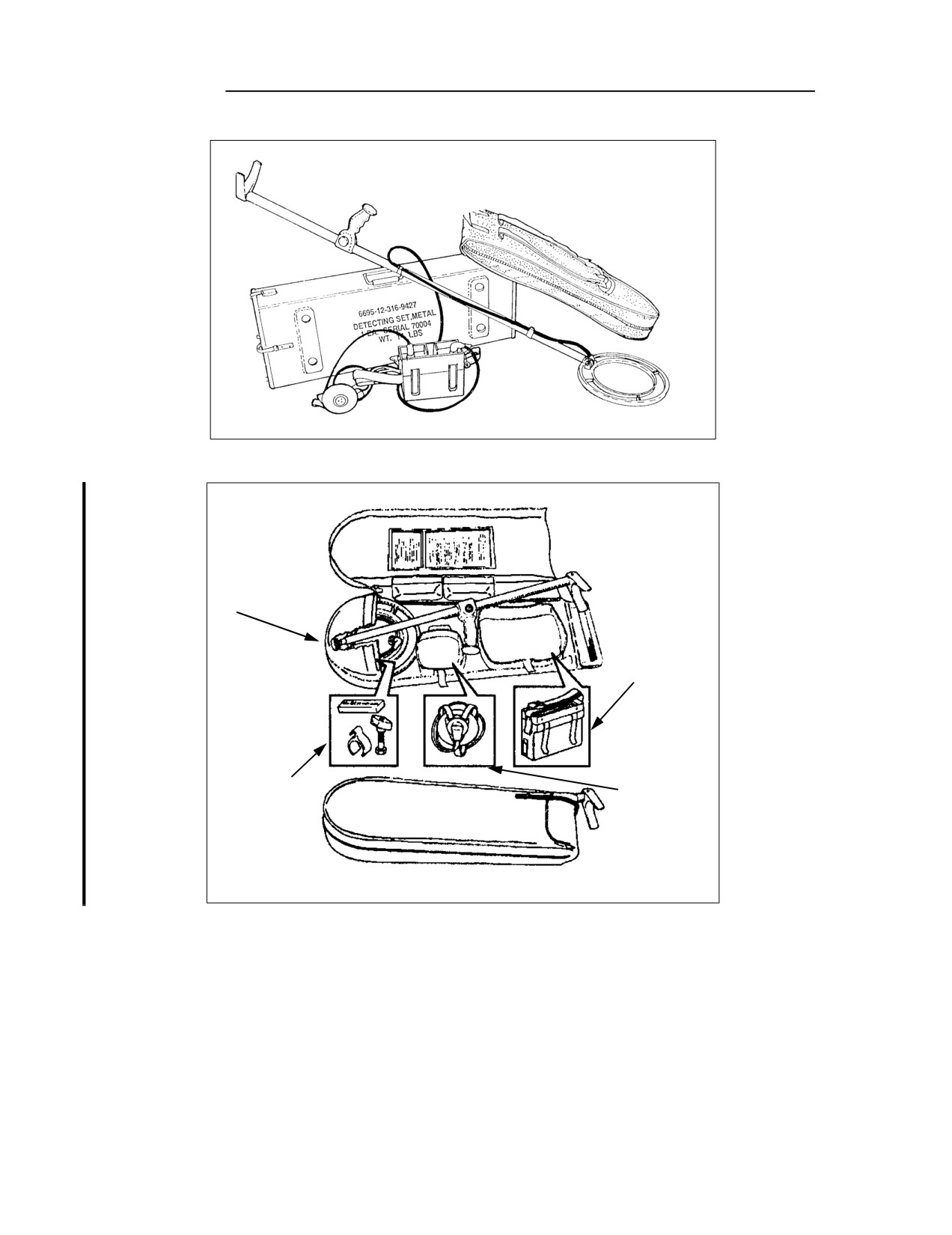
The AN/PSS-12 mine detector (Figure F-1, page F-4) is a man-portable
metallic mine-detection system that is used to detect AT and AP land mines.
Its search head contains two concentric coils—the transmitting (outer) coil
and the receiving (inner) coil. During operation, the transmitting coil emits a
magnetic field symmetrically above and below the search head. When this
field encounters metal objects, it induces currents in these objects. When the
induced currents reach the receiving coil, an auditory signal is provided to the
operator. The detector is able to detect large metal mines from a distance of
several feet, but can detect low-metal mines from only a few inches.
WARNING
It is important to understand that the mine
detector is only effective when there is a
sufficient amount of metal in the mine.
Unpacking
The system is stored and transported in a single carrying case.
• Open the pressure-relief valve in the carrying case.
• Release the latches on the carrying case and open the top.
• Remove the bag that contains system components.
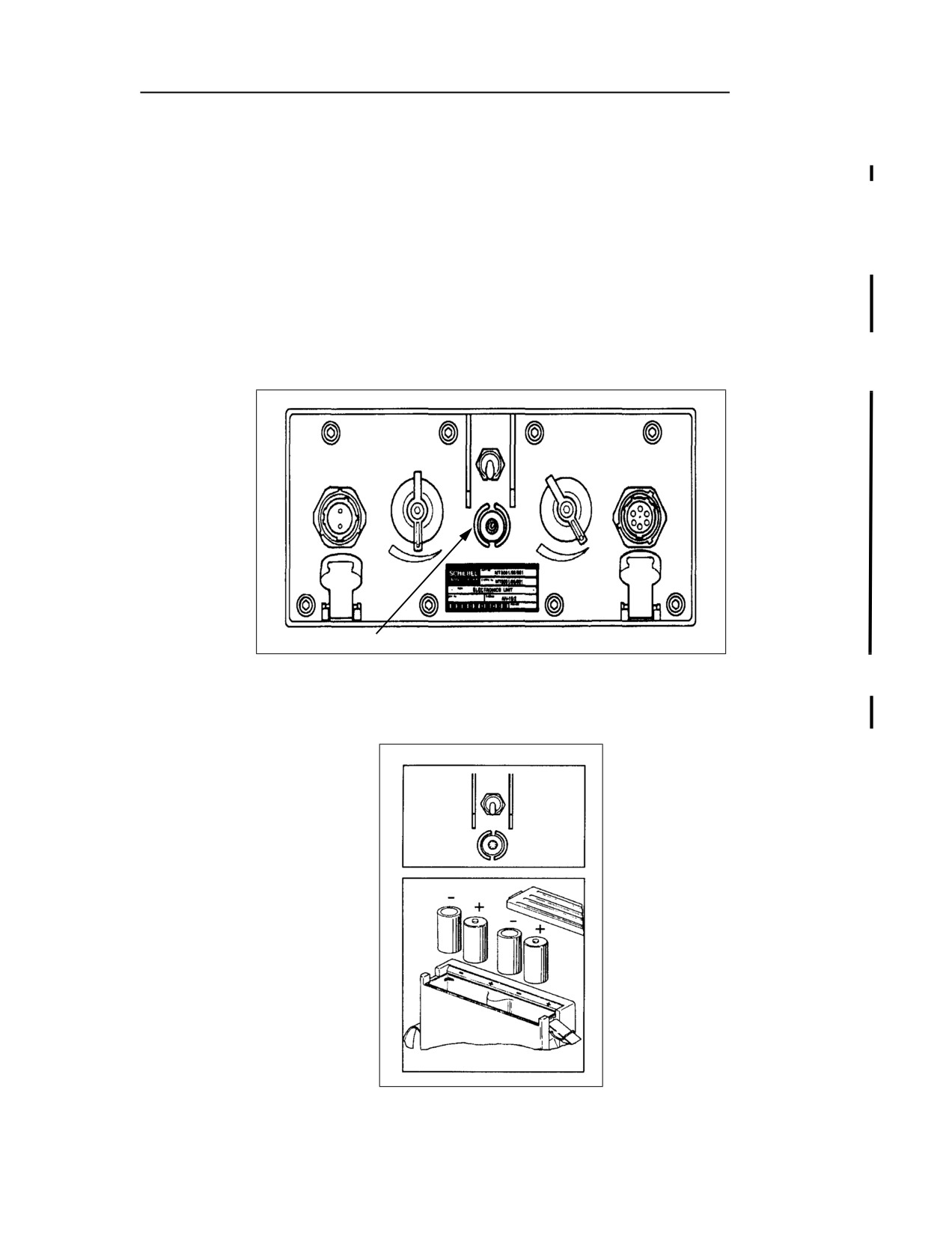
• Unzip the bag and ensure that all components are present (Figure F-2,
page F-4).
• Remove the following items from the bag carefully:
— Telescopic pole and search-head assembly with cable and plug.
— Electronic unit.
Mine Awareness F-3
C3, FM 20-32
Figure F-1. AN/PSS-12 metallic mine detector
Telescopic
pole and
search-
head
assembly
Electronic
unit
Spare
plastic bolt,
spare cable
clamps,
Headset
and a 5-cm
with cable
test piece
and plug
Figure F-2. AN/PSS-12 packed components
— Headset with cable and plug.
• Ensure that the bag contains the following spare parts and test items:
— Spare plastic bolt.
— Spare cable clamps.
— 5-centimeter test piece.
• Inspect the search head for cracks or damage.
F-4 Mine Awareness
C3, FM 20-32
• Inspect cable connectors for damage and check for bent pins.
• Inspect hook and pile material on headphones for serviceability.
• Inspect cables to ensure that they are not cut, broken, or frayed.
• Inspect the electronic unit for cracks, damage, and completeness. This
includes ensuring that all switches and knobs are present and
functional.
• Ensure that telescopic pole is not bent, dented, or damaged and can be
extended and retracted.
Electronic-Unit Setup
• Ensure that the power switch on the electronic unit is in the OFF
position (Figure F-3).
ON
LOUDNESS
SENSITIVITY
HEADPHONE
SEARCH HEAD
OFF
Indicator lamp
Figure F-3. Electronic unit
• Release the latches on the battery-compartment cover and remove the
cover (Figure F-4).
ON
OFF
Figure F-4. Battery installation
Mine Awareness F-5
C3, FM
20-32
• Insert batteries according to markings.
WARNING
Ensure that the battery cover is completely closed and the latches
are in the proper position. This prevents the inadvertent opening
of the battery compartment during operation. Failure to do this
could result in injury, damage to the equipment, and/or improper
operation.
•
Reinstall and latch the battery cover. Ensure that the latches are in
the proper closed position.
•
Press in the catch (located just below the arm support) to unlock the
telescopic pole from the transport position. Turn the outer tube until
the catch snaps into the guide groove. Pull the telescopic pole out to a
suitable length. Ensure that the telescopic pole is locked in one of
three fixed positions.
•
Connect the headphones and the detector-head cables to the electronic
unit. Fit the protective caps of the cable connectors to the
corresponding rubber caps on the electronic unit.
•
Put on the headphones. Place the straps of the headphones over the
forehead and on top of the head. The hook and pile material goes
behind the head at the nape of the neck.
•
Connect the detector-head cable to the lower (plastic) portion of the
telescopic pole.
— Attach the lower cable clamp 5 centimeters above the wing nut.
— Attach the second cable clamp 5 centimeters down from the
junction of the lower and upper (aluminum) portion of the
telescopic pole.
— Attach the third cable clamp between the other two cable clamps.
Do not attach the cable to this middle clamp. This clamp will
become the sensitivity marker clamp.
WARNING
The cable should not be attached to the aluminum portion of the pole,
because it causes the sensitivity of the mine detector to fluctuate.
• Adjust the position of the handle by loosening the knurl nut.
Retighten the nut when the handle is properly positioned.
• Adjust the position of the search head so that it will be parallel to the
ground.
• Attach the electronic unit to the operator’s load-bearing equipment
(LBE) belt using the belt clips. Right-handed soldiers should put the
electronic unit on the left hip. Left-handed soldiers should put the
electronic unit on the right hip. Put the safety strap over the shoulder.
F-6 Mine Awareness
C3, FM 20-32
Electronic-Unit Controls and Indicators
The AN/PSS-12 electronic unit has the following controls and indicators
(Figure F-3, page F-5):
•
On/off switch. This switch is the power control for the AN/PSS-12. It
must be in the ON position when detection is being conducted.
•
Loudness control. This is the volume control for the audible alarm. It
should be adjusted to a comfortable listening level during use.
•
Sensitivity control. The sensitivity control is used to adjust the
detection characteristics of the mine-detector head. Details on how to
set the sensitivity are provided below.
•
Indicator lamp. This lamp indicates low battery voltage or a system
malfunction. It provides a short flash when the unit is turned on and
flashes continuously when the batteries are low or there is a
malfunction.
•
Audible signals.
— The system provides an audible signal through the headset when
the search head is over or very near a metal object. The signal is a
continuous tone that at first resembles a growl. The tone increases
to a higher pitch as the search head is moved closer to a metal
source (such as a mine) and decreases in pitch when moved away.
— The AN/PSS-l2 has a check tone that is provided every 1 to 2
seconds. The tone resembles a clicking sound, and its purpose is to
continuously inform the operator that the system is functioning
satisfactorily. If the check tone disappears or its frequency
decreases, discontinue searching and determine the malfunction.
— A flashing indicator lamp and a continuous tone (the same tone
heard with a target return, except it does not abate when moved
away) on the headphone indicates low battery voltage. If the unit's
indicator lamp flashes, change the batteries and readjust the unit.
Operation
Once the system is assembled, it is ready for adjustments prior to operation.
Remove rings, watches, and other jewelry before adjusting or using the
system.
Power Up/Sensitivity Adjustments
• Turn the sensitivity and loudness knobs completely counterclockwise.
• Look at the indicator lamp on the electronic unit and turn the on/off
switch to the ON position. The lamp should give a short flash. If it
does not, ensure that the batteries are correctly installed or insert new
batteries. If the lamp flashes continuously, the battery voltage may be
low.
• Hold the search head approximately 0.6 meter above the ground, and
turn the sensitivity knob clockwise until a continuous tone is heard.
Mine Awareness F-7
C3, FM
20-32
While this is being done, adjust the loudness control to a comfortable
listening level.
•
Turn the sensitivity knob slightly counterclockwise until the tone
ceases. The check tone (a clicking sound) should still be heard every 1
to 2 seconds. Readjust the loudness control if necessary. If the check
tone disappears or its frequency decreases, discontinue searching and
determine the malfunction.
•
Set the sensitivity in either of the following two ways:
— The preferred method is to use the most difficult to detect type of
mine (made safe without changing the metal content) that is
expected to be encountered.
— In the absence an actual mine, use the 5-centimeter test piece that
comes with the AN/PSS-12 packed components.
•
Bury the mine (if you have a mine) at the deepest depth that threat
mines are expected to be found. If you do not have a mine, bury the
5-centimeter test piece vertically so that the metal portion is at the
deepest depth which threat mines are expected to be found. In the
absence of more specific information, bury the test piece at a depth of
5 centimeters). This places the top of the test piece flush with the
ground’s surface.
•
Place the detector head lightly on the ground directly above the mine/
test piece and adjust the sensitivity knob so that the mine is detected
and you have an easily heard signal from the headset. Now, move the
detector away from the mine/test piece until the signal ceases to be
heard.
•
Float the detector head lightly on the ground at a 0.3-meter-per-
second movement rate across the mine/test piece. With the detector
head in motion, check to see if the signal can again be easily heard. If
not, increase the sensitivity until the signal can be easily heard.
NOTE: The higher the sensitivity is set (between just being able to
detect the mine/test piece and where the signal from the soil first
becomes audible) the less the chance of missing a mine, but the more
the chance of a false alarm rate.
WARNING
In some conditions, you may not be able to detect a target mine/test
piece at the deepest depth the threat mine is expected to be
encountered. Do not use the AN/PSS-12 to detect mines in those
conditions.
NOTE: Adjusting the sensitivity with the mine/test piece buried in
soil that is similar to the soil where the detector will be used is very
important. Otherwise, the sensitivity setting is simply a guess,
because different soil types and moisture content influence the
sensitivity of the detector.
F-8 Mine Awareness
C3, FM 20-32
Sensitivity Level
The AN/PSS-12's sensitivity setting drifts over time. During use, soldiers
should check the detector's sensitivity every 1 to 2 meters of forward advance
in the mine lane.
• With the sensitivity properly set using a buried mine/test piece, the
detector is moved to an adjacent place on the ground over a clear area.
• To check the detector, a metal object (bayonet or other metal object) is
slid down the lower (plastic) portion of the telescopic pole until the
operator hears the same auditory signal that was emitted when the
search head was placed over the buried mine/test piece.
• At this point on the lower plastic shaft, the middle plastic cable clamp
(the middle clamp previously attached without the cable) is
positioned. This clamp now becomes the sensitivity marker clamp.
• At approximately every 1 to 2 meters of forward advance in the mine
lane (or more often if desired), the same metal object (bayonet) is
moved down the shaft to the sensitivity marker clamp and the
operator listens to determine if the same auditory signal is emitted.
When the same auditory signal is not heard, the sensitivity knob is
adjusted up or down until the same auditory signal is replicated and
maintained.
NOTE: It is important that the operator maintain a consistent body
posture and angle between the telescopic pole and the search head
each time a sensitivity check is made.
DANGER
Low batteries may reduce detector performance well
before the indicator light comes on. If you need to
frequently adjust the sensitivity knob to maintain a
constant sensitivity setting or if the indicator light comes
on, discard all batteries and replace them with new ones.
Failure to do this could result in injury or death.
DANGER
Discontinue searching and readjust the sensitivity if the
check tone disappears or its frequency decreases. Failure
to do this could result in injury or death.
Search Methods
• Sweep across the lane, keeping the entire search head in light contact
with the ground. Sweeping speed should be approximately 0.3 meter
per second. Each sweep must be a minimum of 1.5 meters and must
overlap the edge of the lane by at least one-half the width of the search
head. Each sweep should advance forward at no more than 6 inches
per sweep. The sweep and advance must be maintained as described,
otherwise gaps will be left between sweep paths or at the edge of the
lane and a low-metal mine can be missed.
Mine Awareness F-9
C3, FM
20-32
• Perform a sensitivity check at approximately every 1 to 2 meters of
forward advance in the mine lane (or more often if desired) and make
adjustments as necessary. It is important that the operator maintain a
consistent body posture and angle between the telescopic pole and the
search head each time a sensitivity check is made.
• Pat the search head lightly on the ground (each pat advancing no more
than one-half the width of the search head) in low vegetation or rocky
or uneven ground where smooth sweeping cannot be performed.
Ensure that the wing nut is tight, so that the position between the
head and telescopic pole is fixed.
NOTE: Many conditions of vegetation may not allow getting the
search head on the ground. Do not push through vegetation to get the
search head on the ground. Different environments will require
slightly different techniques. If you cannot get the search head on or
very near the surface of the ground, the detector will not detect low-
metal mines.
NOTE: The AN-PSS/12 detector’s performance is reduced when the
cable between the electronic unit and the top cable clamp is
permitted to hang unrestrained during sweeps. The soldier can
control this problem by holding the cable in his free hand.
WARNING
Always be aware of the potential for booby traps. The search head
should never be swept where its path cannot be visually cleared. If trip
wires are a threat, other techniques to detect trip wires should be used
before sweeping.
Alarm Investigation/Mine Identification
When an auditory signal is heard, the soldier must investigate further to
determine if the signal is a reliable indication of a mine.
• End the sweep procedure and begin the investigation procedure at the
first auditory indication from the detector of metal in the ground. The
purpose of the investigation is to determine if the signal is repeatable
and, therefore, a likely indication of a mine. If so, the investigation
continues with the purpose of gaining more information concerning
the size, type (high-metal or low-metal mine), and specific location of
the signal source.
NOTE: In some cases, the detector may provide a weak signal that
cannot be repeated during the initial investigation process. Do not
give up on the reliability of the signal until the sensitivity of the
detector has been checked to ensure that it has not drifted to the low
side.
NOTE: A footprint is defined as the entire area on the ground where a
mine or metallic source causes the detector to generate an auditory
signal. Small footprints, often as small as 10 to 15 centimeters in
diameter, will indicate low-metal mines. Footprints as large as 60 to
122 centimeters in diameter may indicate high-metal mines.
F-10 Mine Awareness
C3, FM 20-32
• Note the location on the ground (at the center of the search head)
where the signal is first heard. Then attempt to develop a set of points
on the ground that identifies the source footprint.
— Develop this footprint by first moving the search head away from
the signal source until no signal is heard and then sliding the
search head toward the signal from several clock positions.
— Note the specific location of the center of the search head at each
location where the auditory signal begins. Once the signal is
detected, the detector is no longer slid toward the potential source
to avoid coming closer than necessary to a potential mine.
— Repeat this process and mark or note the locations on the ground
until the size and shape of the footprint can be understood.
Typically, the pattern will resemble a semicircle with the 6 o’clock
position nearest the operator.
WARNING
The large footprints of high-metal mines may mask signals from low-
metal mines within the footprint. Always assume that there are low-
metal mines within the large footprint area.
• Identify the center of very large footprints (if important). The airborne
technique may be quicker than the method previously discussed to
identify the perimeter.
— The search head must be adjusted so that it can be held above the
ground with the head parallel to the surface.
— The detector can then be manipulated above the source until the
signal can be heard at only a single point. Move the search head in
a crossing pattern, which should produce a smaller and smaller
signal area as the pattern is repeated at gradually increasing
heights. Near the surface, the signal can be heard over a broad
lateral area, but as the search head is raised higher off the ground,
this area becomes progressively smaller. As the search head is
raised higher off the ground, the area where the signal can still be
heard is reduced to a point.
— The center of the mine or metal source should be directly below
this point. Do not ignore the potential for low-metal mines to be
hidden in this large footprint on the ground.
WARNING
Always be aware of the potential for booby traps and UXO. The search
head should never be swept where its path cannot be visually cleared.
If trip wires are a threat, other techniques to detect trip wires should be
used before sweeping.
Mine Awareness F-11
C3, FM 20-32
Other Operational Actions
• Keep mine detectors at least
2
meters apart during setting,
adjustment, and operational phases to prevent interference.
• Change the batteries immediately if the indicator lamp flashes, a
constant audible tone is heard, or the check tone (clicking sound) stops
and readjust the sensitivity. The search sensitivity is affected long
before the lamp begins flashing, and the unit will be unusable until
fresh batteries are installed.
• Ensure that only the lower part of the telescopic pole is used when the
equipment is operated by a soldier in the prone position.
• Turn the unit off after completing the search operations.
Disassembly and Packing
• Ensure that the on/off switch on the electronic unit is in the OFF
position.
• Disconnect the headphones from the electronic unit.
• Detach the cable connection on the electronic unit for the magnetic
search head, and replace the protective caps on the plug and socket.
• Release the electronic unit's battery-cover latches, and remove the
battery cover.
• Remove the batteries, and ensure that none of the battery cases have
ruptured; if they have, notify your supervisor. Reinstall the battery
cover and latch it.
• Remove the cable clips from the telescopic pole.
• Collapse the telescopic pole to its travel length, and turn its outer tube
until it is locked by the catch. Loosen the plastic restraining bolt, and
fold in the magnetic search head.
• Pack the components in the carry bag as shown in Figure F-2, page F-
4. For long-term storage, do not put batteries in the carry bag. Close
and zip the carry bag.
• Place the carry bag in the metal transport case, and latch the case.
Close the pressure-relief valve.
As in probing, the senior leader must set a limit to the time an individual can
use the mine detector. The time limit is determined by METT-TC factors,
weather conditions, the threat level, the unit's stress level, and the
individual's fatigue level and state of mind. As a rule, 20 to 30 minutes is the
maximum amount of time an individual can use the detector effectively.
F-12 Mine Awareness
C3, FM 20-32
EVACUATION DRILLS
A well-developed, well-rehearsed evacuation drill is necessary to extract an
individual or a unit from a mined area. Units must develop evacuation drills
for dismounted and mounted operations. Each type of operation should
include two drills—one using a mine detector (mounted extraction) and one
without using a mine detector (dismounted extraction).
Mounted Extraction
•
The convoy commander halts the convoy and reports to higher
headquarters.
•
No vehicles move and no troops dismount unless directed to do so.
•
Elements provide 360-degree security from vehicles.
•
Troops thrown from vehicles should not move. Personnel are extracted
by using dismounted evacuation procedures if electronic detectors are
not available.
•
The senior leader, if engineers are not available, assesses the situation
and directs vehicles to back up along the entry-route tracks. If an
immediate threat exists, occupants of damaged vehicles evacuate out
the rear of the vehicle and along the vehicle-entry tracks. If no
immediate threat exists, occupants of damaged vehicles remain in the
vehicle until it is extracted.
•
Engineers, if available, sweep the area and provide a cleared path for
movement. They—
— Clear a lane that is wide enough for the towing vehicle.
— Use all available tow cables to increase the distance before towing
if an M88 is unavailable. Remember, an M88 has a wider track
base than other tracked vehicles.
— Ensure that all towing-shackle sets are complete and mounted.
— Ensure that the towing vehicle has tow cables on the front and the
rear if possible.
— Ensure that rear cables are attached to the lower mounts. This
allows the crew to recover the vehicle without touching the
ground.
— Pull the vehicle out at least two-vehicle lengths before switching to
a tow bar. When towing a vehicle after a mine strike, the chance of
fire is greater because of possible damage to the vehicle.
— Provide first aid and conduct casualty evacuation or have medics
provide treatment and medical evacuation.
— Guide vehicles through the safe area.
— Mark, record, and report the threat.
•
Continue the mission.
Mine Awareness F-13
C3, FM 20-32
Dismounted Extraction
•
All personnel freeze and crouch into a low-silhouette position. Be
cautious when making this movement to ensure that you do not
detonate another mine. If a protective mask is worn on your hip, do
not allow it to come in contact with the ground because contact may
detonate a mine. Do not help casualties because you could also become
a casualty.
•
The leader designates a security element and a soldier to assist in
casualty evacuation.
•
Soldiers extract along the path they entered. If possible, they step in
the same places as before; if impossible, they probe their way out.
•
The security element, consisting of individuals who are not in the
minefield, sets up security for the unit.
•
The soldier extracting the casualty—
— Probes a 1-meter-wide path to the casualty and marks the cleared
path with foot powder or marking tape as it is probed.
— Probes around the casualty to clear the area.
— Performs first aid.
— Carries the casualty out of the minefield along the cleared path.
(Stretcher parties do not enter the area unless a 2-meter-wide
path has been cleared to the casualty.)
•
The unit marks the threat and assembles back at the rally point.
•
The unit reports the incident when it is 50 to 100 meters away from
the minefield. If soldiers are in the minefield and radio transmission is
required, move the transmitter at least 300 meters from the minefield.
This prevents accidental mine detonation from the radio signal.
•
The unit provides first aid and conducts casualty evacuation or has
medics provide treatment and medical evacuation.
•
The unit continues the mission.
Extraction from Scatterable Mines
• The individual who discovers the mine initiates the alarm according to
the unit SOP.
• Unit personnel at the command post receive the alarm and alert
others.
• The unit TOC requests counterbattery fire if the mines are artillery-
delivered.
• Vehicle commanders check the immediate area. They do not dismount.
Inspect the vehicle for mines and/or trip wires. Note and record the
location of all mines found on or around the vehicle.
• Personnel leave any vehicle that is touching or is blocked by AT mines
in place until the remainder of the unit is out of the minefield.
F-14 Mine Awareness
C3, FM 20-32
•
Unit leaders identify unmovable vehicles and designate one or more
lanes for remaining personnel and vehicles to use when exiting the
minefield.
•
Leaders identify a clearance team to extract remaining vehicles and
personnel. The clearance team—
— Uses visual means to locate mines and marks vehicle lanes at
least 4 meters wide. Personnel mark lanes according to the tactical
situation and the threat in the area; however, they mark them so
that team personnel can reenter the minefield and recover
equipment and vehicles.
— Destroys or removes all mines in lanes, using a grapnel hook or
other means as necessary, in the sequence directed by the team
leader. Personnel detonate unmovable mines to reduce personnel
injury and equipment damage.
•
Vehicle commanders direct personnel to ground-guide vehicles out of
the minefield. Ground guides—
— Ensure that individual elements move only when directed by the
chain of command.
— Place equipment that is not in contact with a mine or a trip wire
onto vehicles.
— Direct vehicles to the designated exit lane or, if safer, allow
vehicles to exit the minefield on their own.
•
Clearance team personnel, aided by unit personnel, remove
equipment and vehicles remaining after initial extraction from the
minefield. They—
— Reenter the minefield using the same exit routes.
— Detonate the minimum number of mines necessary to remove
vehicles and equipment from the minefield.
— Avoid touching mines. Personnel should take all possible
precautions to ensure that mines are not jarred.
— Place sandbags near mines, if possible, to minimize damage to
vehicles and equipment.
— Remove mines from equipment by using a line or other remote
means. Ensure that the entire team is far enough from the mine to
avoid casualties if it explodes.
— Place explosive charges to minimize vehicle damage when
detonating mines on the ground.
•
Clearance team personnel—
— Clear sufficient mines to allow for mission accomplishment if the
position cannot be evacuated.
— Clear and mark communication lanes between positions.
•
Continue the mission.
Mine Awareness F-15
C3, FM 20-32
Survival Rules
Many of our allies have extensive experience in mine operations. Among them
is Canada. They have produced several manuals and videotapes on mine
awareness and have developed the following survival rules. They are very
practical and can be applied to our soldiers as well.
• If you did not drop it, do not pick it up.
• All terrain and structures are potentially mined or booby-trapped.
• Beware of areas associated with basic human needs. They could be
mined or booby-trapped.
• Immediately report all confirmed or suspected mines.
• Leave mine disposal to the EOD personnel and combat engineers.
• Avoid touching or removing foreign objects, no matter how attractive.
They could be mined or booby-trapped.
• Avoid verges because they could be mined. Stay on the traveled road.
• Mark and avoid UXOs if possible. Consider them unstable.
• Develop and rehearse effective evacuation drills.
A convoy provides better protection against mine and UXO threat than a
single vehicle. In convoy movement, some rules of thumb should be followed:
• The lead vehicle should be one of the heaviest (2½-ton, 5-ton) vehicles
in the unit and be hardened against a mine threat.
• A high-mobility, multipurpose, wheeled vehicle
(HMMWV) or a
HEMMT should not lead a convoy unless absolutely necessary. These
vehicles are extremely vulnerable to mine and UXO threat and are
difficult to harden without commercial products.
Casualty Treatment and Evacuation
Casualty treatment and evacuation should be a part of every mission order.
Incorporate the following elements into the unit SOP, and ensure that soldiers
understand them. Emphasize that rushing to help a mine victim can lead to
the rescuer becoming a casualty.
• Reassure the casualty.
• Do not panic and create another casualty.
• Call higher headquarters at the earliest opportunity, and request a
specialist engineer and medical help as soon as possible.
• Extract yourself and mark the path as you go.
• Reenter along the marked path.
• Clear a path to the casualty.
• Administer first aid.
• Recover the casualty.
F-16 Mine Awareness
C3, FM 20-32
• Mark the area after it is clear, record it on the map, and report to
higher headquarters.
Medical personnel and combat lifesavers should anticipate and train for the
following injuries:
• Blast injuries with fragments embedded.
• Burns.
• Fractures.
• Traumatic amputations.
• Blunt trauma.
• Psychological anxiety reaction.
LEADER
Leader skills in effective planning, risk management, and mine-data tracking/
dissemination can greatly enhance force protection and reduce casualties in a
mined environment. Unit leaders must train themselves and their
subordinates on mine-awareness tasks.
RISK MANAGEMENT
Risk management reduces the frequency of mine and UXO strikes and
diminishes the physical effects when they do occur. It is used to identify
hazards, define risks, identify methods for control, and identify
responsibilities for implementation. The risk-management process enables
commanders and staffs to define acceptable risk levels and implement
controls until risks are commensurate with the mission. Risk management is
a simple, five-step process:
• Identify hazards.
• Assess the risk of each hazard.
• Make risk decisions and develop controls.
• Implement controls.
• Supervise.
Identify Hazards
This is often the most difficult part of risk management. A mine hazard is the
condition that results from the interactions of a mine, a catalyst (such as
activation from a soldier or vehicle), and a common spatial relationship. These
hazards are defined in terms of mine types (AT, AP, fuses, metal content,
AHD), how a soldier might encounter mines (dismounted or mounted and the
type of vehicle), and the locations where encounters would be most likely.
Mines are seldom employed in isolation, so complete hazard definition
includes the complex obstacle and the covering fires.
Mine Awareness F-17

C3, FM 20-32
Assess the Risk of Each Hazard
This requires determining the probability of a mine strike and the effects of
the strike. An effective risk assessment is critical for evaluating the combat
effectiveness of a unit in a mined environment. Risk-assessment criteria is
developed by using Table F-1. A sample risk assessment is shown in Table F-2,
page F-19.
Table F-1. Risk-assessment criteria
Hazard Probability
Frequent
Probable
Occasional
Remote
Improbable
(A)
(B)
(C)
(D)
(E)
Likely to
So unlikely,
Will occur
Unlikely, but
Likely to
occur
can assume
several times
possible to
Single Item
occur
sometime
occurrence
during life of
occur during
frequently
during life of
will not take
item
life of item
item
place
Unlikely but
Unlikely to
Occurs
Will occur
Will occur
reasonably
Fleet/Inventory
occur, but
continuously
frequently
several times
expected to
possible
occur
CATASTROPHIC
(death or system
I
High
High
High
High
Medium
loss)
CRITICAL
(severe injury or
occupational
II
High
High
High
Medium
Low
illness or major
damage)
MARGINAL
(minor injury or
occupational
III
High
Medium
Medium
Low
Low
illness or minor
damage)
NEGLIGIBLE
(less than minor
IV
Medium
Low
Low
Low
Low
injury, illness, or
damage)
Make Risk Decisions and Develop Controls
This step requires decision makers to identify actions that can reduce the
probability and/or severity to acceptable levels. This may be accomplished by
taking actions to reduce the probability of a mine strike or by providing more
protection to the soldier or materiel to reduce severity of a mine strike. Often,
it is a combination of the two.
Implement Controls
Leaders must apply the identified controls to reduce the probability and
severity of a mine strike.
F-18 Mine Awareness
C3, FM 20-32
Table F-2. Sample risk assessment
DIRECTIONS: Circle the appropriate number in each section and total them. Appropriate directions
are at the end of the assessment block.
TRAINING (Circle One)
1. Experience working in mined areas
2. No experience working in mined areas, but trained
3. No experience or training working in or around mined areas
TYPE OF AREA (Circle One)
1. Area known by friendly forces to be clear of mines
2. Old confrontation line or suspected mined area
3. Area known to be mined
LIGHT AND WEATHER (Circle One)
1. Daylight with clear weather
2. Daylight with poor weather
3. Darkness
MISSION (Circle One)
1. One that your soldiers have done before
2. One that your subordinate leaders have done before
3. An unfamiliar type of mission
ON OR OFF ROAD (Circle One)
1. Approved division/corps route
2. Paved road
3. Unpaved road
4. Cross-country
SLEEP (Circle One)
1. 6 hours of sleep in last 24
2. 4 hours of sleep in last 24
3. 2 hours of sleep in last 24
4. Awake for more than 24 hours.
TYPE OF VEHICLES IN CONVOY (Circle One)
1. Armored
2. Mixed, armored vehicles leading
3. Wheeled
4. On foot
AVAILABILITY OF MINE INFORMATION (Circle One)
1. Updated mined-area graphics in each vehicle
2. Updated mined-area graphics in the lead vehicle or a reliable, knowledgeable guide is available
3. No upgraded mined-area graphics are available
GROUND COVER (Circle One)
1. Dry, hard ground with short grass
2. Dry, hard ground with long grass or vegetation
3. Wet, muddy ground or snow less than 10 centimeters deep
4. Snow more than 10 centimeters deep
ROAD USE (Circle One)
1. Heavy tracked vehicles or trucks recently used the road
2. Light wheeled vehicles recently used the road
3. No traffic observed on the road; some tire marks
4. No traffic observed on the road; no tire marks
10-16 Continue the mission. Keep following training and common-sense rules that apply to working
around mines.
17-24 Continue the mission. Remember to stress safety and mine awareness when you brief soldiers.
Ensure that leaders maintain positive control of personnel.
25-35 Consider postponing the mission until better conditions are attained. If you must continue the
mission, constantly stress mine awareness and safety. Ask higher headquarters for engineer support to
accomplish the mission. Conduct mine-awareness training.
Mine Awareness F-19
C3, FM 20-32
Supervise
This step ensures that controls are implemented and that a measure of
quality control exists to ensure a quantified level of clearance.
The key to using risk management successfully is to employ it at each
echelon—from the commander, through the tactical planner, to the soldiers
executing the mission. Each level identifies hazards, eliminates or reduces
hazards as feasible, and communicates the residual hazards to the next lower
echelon. As such, each echelon works as a filter to control unacceptable risks.
• Training provides soldiers with an understanding of equipment
limitations and plays a critical role in the risk-management process.
Capabilities and limitations of Army systems are taken into
consideration during the development of doctrine and TTP.
• Risk management at the tactical planning level requires a thorough
knowledge and awareness of the hazards and potential controls that
can be employed. The planning process requires a methodical and
disciplined technique to identify the hazards and develop appropriate
controls for operating in a mined environment. The controls for
countermine operations, discussed in Chapters 9 and 11 and in FM
3-34.2, provide a framework for risk-managing hazards associated
with mines.
• The execution level is the culminating point of risk management. It is
where soldiers and leaders employ the systems provided to accomplish
the mission. The amount of residual hazards remaining after the
filtering process from echelons above may well determine success. The
individual soldier is the last element to control any residual hazards.
Optimizing the components of risk management at the tactical planning level
is more challenging as emerging technologically dependent systems bring
more variables into the mission. While tactical intelligence is the key element
in identifying mine-related hazards, technical knowledge is the key element in
assessing the risks associated with mine hazards. This knowledge assimilates
the tactical intelligence with the capabilities of the unit’s equipment, the
performance of threat mines, and the protection provided to our soldiers by
their vehicles or personal protective equipment. The staff engineer, using his
engineer C2 system to risk-manage each COA, provides the maneuver
commander and his staff with information on risks and potential controls
early on in the planning process. Each subsequent commander must perform
the same analysis and incorporate the mine threat into risk management.
RECORDING AND MINE-DATA TRACKING
Obtaining and disseminating information are the keys to battlefield
management. Units encountering minefields or explosive devices should
follow a five-step process—stop, secure, mark, report, and avoid. Units must
provide adequate information to their higher headquarters to ensure that
follow-on elements are well informed. Information must include known or
suspected minefield locations, types of mines (if known), the marking method,
the time encountered, and any additional information that may be of use to
the clearing unit.
F-20 Mine Awareness
C3, FM 20-32
Division and maneuver brigade engineer planning cells must establish a
central control cell for mine-clearance information. The central control cell—
• Maintains a current situation map and overlay that depicts friendly
and enemy mines and obstacles.
• Maintains and updates information on minefield tracking and route
status.
• Receives and maintains minefield recording forms within the unit’s
AO (includes host-nation minefield data if available).
• Maintains a database of mine information.
• Processes, analyzes, updates, and disseminates the information to
subordinate commanders and staff.
MINE-INCIDENT REPORT
A mine incident includes any unplanned activity involving a mine, UXO, or
booby trap. It also includes near misses that could have resulted in potential
damage or injury. The mine-incident report is a technical report that follows a
serious-incident report. The report should be submitted as soon as possible
(the local SOP will indicate time requirements). A sample mine-incident
report is shown in Figure 11-12, page 11-26.
TRAINING
Modern combat is complex, lethal, and demanding. Soldiers must be capable
of performing their missions in any type of battlefield environment. Current
doctrine and TTP provide soldiers with guidelines to accomplish their tasks
and quality equipment provides the means. The common thread that connects
doctrine, tactics, and equipment is quality training. To fight and win, units
must train their soldiers to execute all wartime missions successfully. They
must use every training opportunity to improve soldier, leader, and unit task
performance. Without quality training, no amount of world-class equipment
can make the soldier effective or make him survive in a wartime environment.
Even the best doctrine in the world is worthless unless soldiers receive
effective training. This is especially true with mine-awareness training.
Soldiers must be trained to think mine awareness as well as perform mine-
related actions. Decisions, actions, and reactions must become automatic to
every soldier. This requires that all soldiers receive mine-awareness training
early in their careers. It must begin at early entry training with basic
individual tasks and continue through advanced unit training with collective
tasks. Soldiers who survive mine threats can survive mine warfare, but it
requires continual training.
INDIVIDUAL TRAINING
Basic Mine-Awareness Training
This is the most important phase for preparing soldiers to survive in a mine
environment. Individual soldiers must be trained to a level that meets the
environment they will face on the modern battlefield. Basic mine-awareness
tasks (mine detection, survival rules, minefield indicators, and procedures for
self-extraction from a minefield) must begin early in the soldier’s career.
Mine Awareness F-21
C3, FM 20-32
With an estimated 80 to 100 million mines deployed worldwide, countermine
considerations must become second nature to mission planners. From CSS
operations in the rear area to close combat operations in the main battle area,
there is no place on the battlefield that is safe from mines. This is especially
true with the threat of SCATMINEs that are deployed from aircraft and
indirect-fire sources. The need for initial countermine training will get more
critical as the modern battlefield becomes more lethal.
Annual Mine-Awareness Training
Units exercising military skills at the National Training Center, Joint Reserve
Training Center, or the Combat Maneuver Training Center can reinforce and
evaluate their awareness training. Soldiers should be fully trained on the
individual and collective tasks that are required to support their unit’s mine-
related missions before deploying to the combat training centers. An effective
method to meet this challenge is a well-planned annual training program that
trains soldiers on individual and collective mine-awareness tasks. The plan
should address the requirements for initial collective-task training and
sustainment training.
Predeployment Mine-Awareness Training
With an ever-changing global environment, the probability of projecting US
forces to various geographical locations is very real. It is extremely critical
that units be situationally aware. Each flash point in the world contains its
own type of threat. Many of these threats can be neutralized or reduced
through quality predeployment training. Quality predeployment mine-
awareness training enhances the ability of the unit to perform its mission and
increases the confidence of soldiers.
Units must train intensively when alerted for a deployment. Predeployment
training is the time to polish and refine training and to focus on theater-
specific operations. Predeployment training is intended to augment individual
and collective training, not replace it.
In-Theater Mine-Awareness Training
Training does not end with predeployment training. Units must train in the
country where they deploy. They need to plan and conduct routine
sustainment training on individual and collective mine-awareness tasks. This
is an essential ingredient of force-protection operations. In-theater mine-
awareness training reinforces the soldier’s existing skills and places mine
survival in the forefront of each soldier’s mind.
LEADER TRAINING
Officers and NCOs must receive mine-awareness training in basic and career
courses. Commissioned and noncommissioned leaders must be trained on the
use and the employment of the equipment that they will use in the field.
Officer basic courses and officer and NCO advanced courses must include
access to modeling/simulation training. Using modeling/simulation enables
the leader to practice decision-making, employment, and sustainment
operations in a simulated mine environment. This develops the situational
awareness required for timely, accurate decisions.
F-22 Mine Awareness
C3, FM 20-32
UNIT TRAINING
The Army Training and Evaluation Program remains the most effective
measure of individual and collective training effectiveness short of actual
combat. It provides leaders with the opportunity to verify the effectiveness of
virtual and actual training without endangering soldiers with mine effects.
Units must include mine-threat scenarios in their home-station training
exercises. Basic missions include minefield detection, reduction, marking,
proofing, and recording. Commanders are required to assess their unit’s state
of proficiency in mine-awareness tasks on a routine basis.
Mine awareness is a critical, perishable skill. It must be trained effectively
and sustained on a continuous basis. If a unit properly trains its soldiers on
mine awareness, it will maintain its force, boost its soldiers’ confidence in
their abilities, and accomplish its mission more effectively. Mine awareness is
not a liability; it is an investment in a unit's future.
Mine Awareness F-23
Appendix G
Countermine Data
This appendix provides a compilation of countermine information to assist
commanders in the decision-making process for countermine operations.
BREACHING ASSETS VERSUS THREAT OBSTACLES
Tables G-1 and G-2, pages G-2 through G-8, provide general guidance on the
effect of breaching assets versus threat obstacles.
FOREIGN MINE DATA
Tables G-3 through G-7, pages G-9 through G-12, provide foreign mine
characteristics.
FOREIGN MINEFIELD EMPLACEMENT DATA
Table G-8, page G-13, provides foreign minefield emplacement data.
Information is presented in the probability of occurrence based on historical
data.
FOREIGN MINE DELIVERY SYSTEMS
Table G-9, pages G-14 and G-15, contains characteristics of foreign mine
delivery systems.
NOTE: Blank areas in the above tables indicate that the information
is not applicable or that it was unavailable when this manual was
published.
Countermine Data G-1
Table G-1. Mounted breaching assets versus threat obstacles
Track-Width
Full-Width AT
Side-Atk
Cmd-Det
AT Ditch and
Wire
Asset
Remarks
AT Mine
Mine
AT Mine
Blast Mine
Other Gaps
Obstacles
MCB with
Is more than 90
Do not use
Do not use
Do not use
May be
Do not use
The MCB provides almost 100 percent
dog-bone
percent
against
effective at
clearance of simple pressure-fused AT
assembly
effective to 12
magnetic-
filling in some
mines when used with the MICLIC.
inches deep at
influence
shallow gaps
The MCB has minimal impact on the M1's
speeds less
mines; is more
or trenches
maneuverability and speed when not
than 10 kph
than 99
plowing.
(soil
percent
The main gun should be traversed to the
dependent)
effective
side to prevent damage in the event of a
against tilt-rod
mine detonation when plowing.
mines
The reduction site should be relatively flat
and free of large rocks and other
obstructions.
Plowing operations should begin about
100 m short of the suspected minefield
and continue 100 m past its suspected
end (typically 2 to 2 1/2 minutes to cover
300 to 400 m overall).
Plowing operations should be performed
in a straight line to keep the vehicle out of
uncleared ground.
Fifteen percent of pressure-fused AT-mine
encounters across the MCB’s width can
be expected to detonate under the skid
shoe, probably disabling the blade.
The MCB is vulnerable to coupled mines
and may be stopped by log-hurdle
obstacles laid within a minefield as part of
a complex obstacle.
A second plow should not be used to clear
the center of the lane because this will
simply push mines into the area cleared
by the first plow.
Table G-1. Mounted breaching assets versus threat obstacles (continued)
Track-Width AT
Full-Width AT
Side-Atk
Cmd-Det
AT Ditch and
Wire
Asset
Remarks
Mine
Mine
AT Mine
Blast Mine
Other Gaps
Obstacles
These AT mines are fitted with magnetic-
influence fuses and AHDs may disable the
blade.
Dismounts should expect to encounter
some pressure-fused AP mines in the
breached lane that may be missed by the
Is effective
blade.
against
magnetic-
The MCB clears a 180 inch-wide lane but
influence
leaves a 26 inch-wide area uncleared of
MCB with
See above
mines; is more
Do not use
Do not use
See above
Do not use
simple pressure-fused mines and a 54
IDA
than 99 percent
inch-wide area uncleared of double-
effective
impulse mines (under the skid shoes) in the
against tilt-rod
middle of the breached lane.
mines
The berms and furrows left by the MCB aid
in immediately marking the breached lane.
Live mines remain in both berms and may
roll back into the cleared lane. Over time,
these may vibrate free and roll back into the
breached lane.
Is more than 90
Normally used to detect the leading edge of
percent effective
a conventionally laid tactical minefield and
to 12 inches
to proof lanes/routes cleared by other
deep at speeds
means.
less than 5 to 15
Do not use
Use caution when crossing on an AVLB.
kph (soil
against
MCR
May become stuck or ineffective in muddy
dependent)
magnetic-
(including
conditions.
influence
Panther)
Has reduced
The MCR is vulnerable to coupled mines.
mines; is more
Do not use
Do not use
Do not use
Do not use
with dog-
effectiveness
than 99 percent
The MCR is designed to withstand up to
bone
against some
effective
two detonations per side.
assembly
(mostly Italian)
against tilt-rod
blast-hardened
The MCR clears a 160 inch-wide lane but
mines
mines
leaves a 72 inch-wide area uncleared in the
middle of the breached lane. NOTE: The
Do not use
M113 also has 72 inches between tracks
against double-
and must use extreme caution when
impulse mines
following the MCR.
Table G-1. Mounted breaching assets versus threat obstacles (continued)
Track-Width
Full-Width AT
Side-Atk
Cmd-Det
AT Ditch and
Wire
Asset
Remarks
AT Mine
Mine
AT Mine
Blast Mine
Other Gaps
Obstacles
MCR with
See above
Is effective
Do not use
Do not use
Do not use
Do not use
Multiple rollers are required to provide the
IDA
against
overlap necessary for proofing the route’s
magnetic-
entire width when the MCR is used for
influence
proofing during route-clearance
mines; is more
operations.
than 99
Vehicle speed is limited to 5 to 15 kph.
percent
The main gun should be traversed to the
effective
side to prevent damage in the event of a
against tilt-rod
mine detonation when rolling a suspected
mines
mined area.
The IDA may be damaged by detonated
mines.

Table G-2. Dismounted breaching assets versus threat obstacles
Trip-Wire/Break-
Influence-
Pressure-Fused
Cmd-Det
Wire
Asset
Wire-Fused AP
Fused AP
Remarks
AP Mine
Blast Mine
Obstacles
Mine
Mine
Provides a 0.6- x 45-m footpath from a
Effectively clears
25-m standoff
Effectively cuts 99
95 percent,
Clears a
APOBS
percent of trip
Is ineffective
Is ineffective
Can be deployed by two men in 2 minutes
including blast-
footpath
wires in its path
resistant types
Consists of two manpack units weighing
approximately 55 lbs each
Effectively clears
Provides a 0.6- x 15-m footpath
85 percent of
Can be deployed by a squad in 5 minutes
simple pressure-
Effectively cuts 99
Bangalore
Clears a
fused mines; is
percent of trip
Is ineffective
Is ineffective
Consists of ten 1.5-m-long sections
torpedo
footpath
less effective
wires in its path
weighing 13 lbs each
against blast-
Is ineffective against AT mines
hardened mines
Has a range of 80 to 100 m when
launched
Can be thrown 15 to 20 m when hand
thrown
Is somewhat
Isineffective;
Isineffective;
Must consider the lethal range/radius (up
effective at
however, it
however, it
to 90 m in some cases) of fragmenting AP
Effectively clears
clearing trip-
may snag
may snag
mines that may be encountered, and
Grapnel hook
99 percent of trip
wire-fused
Is ineffective
the wires
the wires
select a covered position or move back an
and WLGH
wires/break wires
mines
between the
between the
adequate distance before pulling the
in a single pass
integrated
control unit
observer and
grapnel
with wire
and its mines
his mines
obstacles
Helps increase confidence by grappling an
area several times
Is hampered by thick vegetation/overhead
obstructions which may reduce the range/
effectiveness of the WLGH

Table G-2. Dismounted breaching assets versus threat obstacles (continued)
Trip-Wire/Break-
Influence-
Pressure-Fused
Cmd-Det
Wire
Asset
Wire-Fused AP
Fused AP
Remarks
AP Mine
Blast Mine
Obstacles
Mine
Mine
Is effective at
locating all buried
mines; however,
extreme caution
Is ineffective; the
Ensure that
should be used
soldier must rely
observer is
when probing for
Probe
on clearance by
Do not use
neutralized
Is ineffective
small mines (less
other means and
before
than 3-inch dia)
visual detection
approaching
and sensitive
mines (more than
10 lbs actuating
force)
Do not cut a slack
wire until both
ends have been
Is effective;
checked if break-
sound can
Ensure that
wire-fused mines
beminimized
observer is
may be present;
by wrapping
Wire cutter
Is ineffective
Do not use
neutralized
do not cut taught
the wire with
before
trip wires until both
a cloth
approaching
ends have been
before
checked for
cutting it
tension-release
FDs
Is used as a last resort
Is a relatively slow method for clearing
visually detected ordnance
Ensures protection of weapons operator
Is effective
Is effective against
Is effective against
against
Works better with larger caliber weapons
Gunfire
surface-laid
surface-laid
Do not use
Is ineffective
surface-laid
(up to 25 mm), incendiary ammo works
munitions
munitions
munitions
best
May be the only option open to artillery,
MP, and transportation units for dealing
with SCATMINEs in the absence of
engineers and reduction assets

Table G-2. Dismounted breaching assets versus threat obstacles (continued)
Trip-Wire/Break-
Influence-
Pressure-Fused
Cmd-Det
Wire
Asset
Wire-Fused AP
Fused AP
Remarks
AP Mine
Blast Mine
Obstacles
Mine
Mine
Is armored
Is effective against
against
simple pressure-
Do not use if the presence of AT mines is
fragmenting
fused AP mines
suspected, because AT mines can destroy
threats
the MiniFlail.
MiniFlail
Is less effective
Is effective
Is ineffective
Do not use
Is vulnerable
against blast-
Can clear at a rate of about 1,500 square
to command-
hardened AP
meters per hour
detonated
mines
blast mines
Cannot detect
monofilament
fishing line used
for trip wires; it is
Is very effective at
undetectable by
Ensure that
finding metallic
Is less effective against low-metal mines
the AN/PSS-12.
observer is
mines
and in areas contaminated with metal
AN/PSS-12
Visual detection
Do not use
neutralized
Is ineffective
fragments (artillery, mortar, small arms) or
Is less effective
and other
before
areas that have heavily mineralized soils
against low-metal
neutralization
approaching
mines
means should be
used first in any
area suspected of
having trip wires.

Table G-2. Dismounted breaching assets versus threat obstacles (continued)
Trip-Wire/Break
Pressure-Fused
Influence-Fused
Cmd-Det
Wire
Asset
Wire-Fused AP
Remarks
AP Mine
AP Mine
Blast Mine
Obstacles
Mine
Place at least a
Ensure that
Place at least a 1-
1-lb charge within
observer is
pound charge
6 inches of the
neutralized
within 6 inches of
mine after the
before
Is effective when
simple pressure-
mine at the end of
approaching
used to make an
fused mines
a trip wire has
Can use
Demolitions
Do not use
improvised
been located
Ensure that the
elevated
bangalore
charge is placed
Can use elevated
charges if
torpedo
within an inch of
charges if
necessary
blast-hardened
necessary against
against
mines
the claymore and
claymore-type
stake-type mines
mines
May be effective
Ensure that
against very small
observer is
Can reduce
(up to 1 oz of
Can reduce
neutralized
casualty severity
Blast
explosive) mines
casualty severity
before
against
Is ineffective
overshoes
against
approaching
Is ineffective
fragmenting
fragmenting mines
against mines with
Can reduce
mines
more than 1-oz
casualty
explosive weight
severity
Ensure that
Will protect
observer is
Can reduce
personnel near
Can reduce
neutralized
casualty severity
the individual who
casualty severity
before
IBASIC
against
Is ineffective
detonates a
against
approaching
fragmenting
pressure-fusedAP
fragmenting mines
Can reduce
mines
mine
casualty
severity

Table G-3. Foreign track-width AT mines
Mechanically
Simple
Double
Origin
Scatterable
Metallic
Nonmetallic
Blast Hardened
AHD
Planted
Pressure
Impulse
Russia
TM-46/57/62
PTM-1
TM-46/57/62M
TM-62B/D/P
TM-46/57/62
TM-46/57
TMN-46
China
Type 72
Type 84B
Type 72
Type 72
Type 84B
Type 72
Type 72
TMM-1,
Yugo
TMM-1
TMM-1
TMA-1/2/3/4/5
TMA-1/2/5
TMA-3/4
TMA-1/2/3/4/5
PT-MI-K,
PT-MI-K,
PT-MI-BA III,
PT-MI-K,
PT-MI-K,
Czech
PT-MI-BA II/III
PT-MI-BA III
PT-MI-D
PT-MI-D
PT-MI-BA II
PT-MI-D
VS-1.6/2.2,
VS-1.6,
VS-1.6/2.2,
VS-1.6/2.2,
Italy
VS-1.6/2.2
TC-.6/6, SB-81
SB-81
TC-.6/6, SB-81
TC-3.6/6, SB-81
France
M-51, M-52
M-51, M-52
M-51, M-52
M-51
L9 Barmine,
L9 Barmine,
L9 Barmine,
UK
MK-7
L9 Barmine
L9 Barmine
MK-7
MK-7
MK-7
PM-60,
PM-60,
Ger
PM-60, DM-11
DM-21
PM-60, DM-11
DM-11, DM-21
DM-11, DM-21

Table G-4. Foreign full-width AT mines
Mechanically
Magnetic
Seismic
Origin
Scatterable
Tilt Rod
Coupled
AHD
Planted
Influence
Influence
Russia
TM-62/72/89
PTM-3
TMK-2
TM-62/72/89
TM-62/72/89
TM-62/72/89
China
Type 84C
Type 84A
Type 84A
Yugo
TMRP-6
KB-2
TMRP-6
TMRP-6, KB-2
TMRP-6, KB-2
Czech
PT-MI-P
M-51, M-52,
HPD series,
France
HPD series
Lance
HPD series
Model 1953
Model 1954
M-51, Lance
Hungary
UKA-63
UKA-63
UKA-63
VS-HCT/HCT-2,
VS-HCT/HCT-2,
VS-HCT/HCT-2,
VS-SATM1,
Italy
SB-MV,
Fuse option
SB-MV,
SB-MV
VS-HCT
VS-SATM1
VS-SATM1
Sweden
FFV-028
FFV-028
Fuse 15
FFV-028
L9 Barmine,
L9 Barmine,
L9 Barmine,
UK
L9 Barmine
HB-876
MK-7
HB-876
MK-7, HB-876
DM-31, AT-2,
DM-31, AT-2,
Germany
DM-31
AT-2, MIFF
MIFF
MIFF
Romania
MC-71
Table G-5. Foreign side-attack AT mines
Origin
Command
Break Wire
Influence
AHD
Russia
MON-100/200/500, TM-83
LMG
TM-73/83
Yugo
TMRP-6, COBRA
France
MIACAH F1
MIACAH F1
MIACAH F1
UK
L14
L14
AJAX
AJAX
Germany
DM-12
Sweden
FFV-016, AT-4
Table G-6. Foreign pressure-fused AP mines
Simple
Small
Low-Operating
Blast
Origin
Scatterable
Low Metal
Pronged Fuse
AHD
Pressure
Diameter
Threshold
Hardened
PMN, PMD-6,
Russia
PFM-1
PMN, PMD-6
OZM series
PMN-2
PFM-1
Type 72A,
Type-72,
Type 72A,
China
GLD-111
Type 58,
GLD-111
Type 58,
Type 72A/B
GLD-111
GLD-111
GLD-111
PMA-1,
PMA-1/3,
PROM-1/2,
Yugo
PMA-1/2/3
PMA-2
PMD-1
PMD-1
PMR-3
PP-MI-D,
PP-MI-SR,
Czech
PP-MI-D
PP-MI-BA
PP-MI-SR II
TS-50, VS-50,
TS-50, VS-50,
VS-50,
TS-50, SB-33,
Italy
SB-33,
Valmara 59/69
SB-33,
SB-33,
VS-MK2
VS-MK2
VS-MK2
VS-MK2
France
M-59
M-59
M-59
M-59
UK
Ranger
Ranger
Ranger
Germany
DM-11
PPM-2
DM-11
DM-11
Table G-7. Foreign trip-wire/break-wire-fused AP mines
Origin
Scatterable
Trip Wire
Break Wire
Russia
POM-2
POMZ-2, OZM series, MON series
OZM series, MON series
China
Type 58, Type 59, Type 66, Type 69
Yugo
PROM-1/2/KD, PMR-2/3/4, MRUD
PROM-1/2/KD, PMR-2/3/4, MRUD
Czech
PP-MI-SR, PP-MI-SR II, PP-MI-SK
Italy
VS-SAPFM3
Valmara 59/69, BM-85, P-25, P-40, VS-DAFM1
France
M1951/1955, MAPED F1
M1951/1955
UK
PAD
Germany
DM-31, SM-70

FM 20-32
Table G-8.
Foreign emplaced minefields
Russia
Iraq
North Korea
Bosnia
Manually
Antitrack AT
1
1
1
1
Antihull AT
2
3
3
2
Side-attack AT
3
4
3
4
Blast AP
1
1
1
1
Directional AP
1
4
1
Bounding AP
1
1
2
1
Stake AP
1
4
1
1
Mechanically
Antitrack AT
1
1
1
4
Antihull AT
2
3
1
Vehicle Scattered
Antitrack AT
1
Antihull AT
1
Blast AP
Directional AP
Bounding AP
Simple Frag
1
Artillery/MLRS
Antitrack AT
1
4
Antihull AT
1
1
Blast AP
Directional AP
Bounding AP
Stake AP
1
Helicopter/Fixed-Wing Aircraft
Antitrack AT
1
1
Antihull AT
1
Blast AP
1
1
Directional AP
Bounding AP
Stake AP
1
NOTE: Scored from 1
(most common) to 4 (very rare).
Countermine Data G-13

Table G-9.
Foreign mine delivery systems
Origin
System
Type1
Range
Mine Payload
Density2
Remarks
Russia
BM-21
R
20 km
PTM-1/3, POM-2
1.5
1,000 x 500 m per battery
BM -22
R
35 km
PTM 1/3, POM-2
1.5
PKPI
F, H
NA
PTM 1/3, PFM-1, POM-2
1.5
Lays relatively narrow strips
KSMU
F
NA
PTM 1/3, PFM-1, POM-2
1.5
UMZ
V
NA
PTM 1/3, POM-2
1.5
GMZ/PMZ-4
MP
NA
Varies
0.4 to 1.0
3 systems can emplace 1,200 m with
624 mines in 26 minutes
VMR-1/2
H
NA
Varies
0.4 to 1.0
3 Mi-8s can lay 1,200 to 3,000 m
with 1,200 mines
China
Type 83
R
15 km
Type 84
0.5
900 x 800 m per battery
Yugo
M87
R
50 km
KB-2
0.5
900 x 500 m per battery
Italy
FIROS 25
R
22 km
VS-HCL, VS-Mk,
0.5
1,000 x 500 m per battery
VS-SAPFM 3
FIROS 30
R
35 km
VS-HCL, VS-Mk,
0.5
VS-SAPFM 3
DAT
H
NA
Varies
1.2
Lays relatively narrow strips of up to
320 AT mines
Istrice
V
NA
SATM1, VS-Mk 2
EL,
Max 1.6
Typically 360 x 140 m
VS-SAPFM 3
ST-AT/V
MP
NA
Varies
0.3 to 1.5
240 mines per hour
Grillo 90
MD
NA
SATM1, VS-Mk 2
EL
0.5
5 AT or 15 AP mines per dispenser
Sweden
FFV-5821
MP
NA
FFV-028
0.4 to 1.4
300 buried mines per hour or 500
surface-laid mines per hour
France
Minotaur
V
NA
Lance
0.7
1,200 x 600 m with 800 mines
EBG
V
NA
Lance
1.5
60 x 600 m with 40 mines
155-mm How
A
18 km
Lance
8 mines per round
Matenin
MP
NA
HPD series
0.4 to 1.4
500 mines per hour
UK
JP-233
F
NA
HB 876
430 mines per Tornado aircraft
Barmine layer
MP
NA
L9 Barmine
0.4 to 0.9
Up to 700 mines per hour
Ranger
V
NA
L10
1,296 mines per dispenser
Table G-9. Foreign mine delivery systems (continued)
Origin
System
Type1
Range
Mine Payload
Density2
Remarks
Germany
Skorpion
V, H
NA
AT-2
0.4
1,500 x 50 m with 600 mines
MW-1
F
NA
MIFF, MUSPA
0.5
55 to 500 m wide and 200 to 2,500 m
long with 892 AT mines
LARS
R
14 km
AT-2
0.5
1,836 AT mines per launcher, 1,000
x 500 m per battery
MARS
R
30 km
AT-2
0.3
1,000 x 500 m with 336 AT mines per
launcher
FFV-5821
MP
NA
DM-31
0.4 to 1.4
300 buried mines per hour or 500
surface-laid mines per hour
1 A = artillery, H = helicopter, F = fixed-wing aircraft, R = rocket, V = vehicle dispensed, MD = man-portable dispenser, MP = mechanical planter
2 AT mines per meter of front

Appendix H
Metric Conversion Chart
This appendix complies with current Army directives which state that the
metric system will be incorporated into all new publications. Table H-1
is a
conversion chart.
Table H-1. Metric conversion chart
US Units
Multiplied By
Metric Units
Feet
0.3048
Meters
Inches
2.54
Centimeters
Inches
0.0254
Meters
Inches
25.4001
Millimeters
Miles
1.6093
Kilometers
Pounds
453.59
Grams
Pounds
0.4536
Kilograms
Metric Units
Multiplied By
US Units
Centimeters
0.3937
Inches
Grams
0.03527
Ounces
Kilograms
2.2046
Pounds
Kilometers
0.62137
Miles
Meters
3.2808
Feet
Meters
39.37
Inches
Meters
1.0936
Yards
Millimeters
0.03937
Inches
Metric Conversion Chart H-1
Glossary
1LT
first lieutenant
1SG
first sergeant
2LT
second lieutenant
AA
avenue of approach
ACE
armored combat earthmover
ACR
armored cavalry regiment
AD
armor division
ADA
air-defense artillery
ADAM
area-denial artillery munition
ADE
assistant division engineer
AHD
antihandling device
AI
area of interest
ALO
air liaison officer
ammo
ammunition
AO
area of operations
AP
antipersonnel
APB
antipersonnel blast
APC
armored personnel carrier
APDS
armor-piercing discarding sabot
APF
antipersonnel fragmentation
APL
antipersonnel land mine
APOBS
Antipersonnel Obstacle Breaching System
AR
Army regulation
ASP
ammunition supply point
Glossary-1