FM 20-32 Mine/Countermine Operations (August 2001) - page 10
FM 20-32
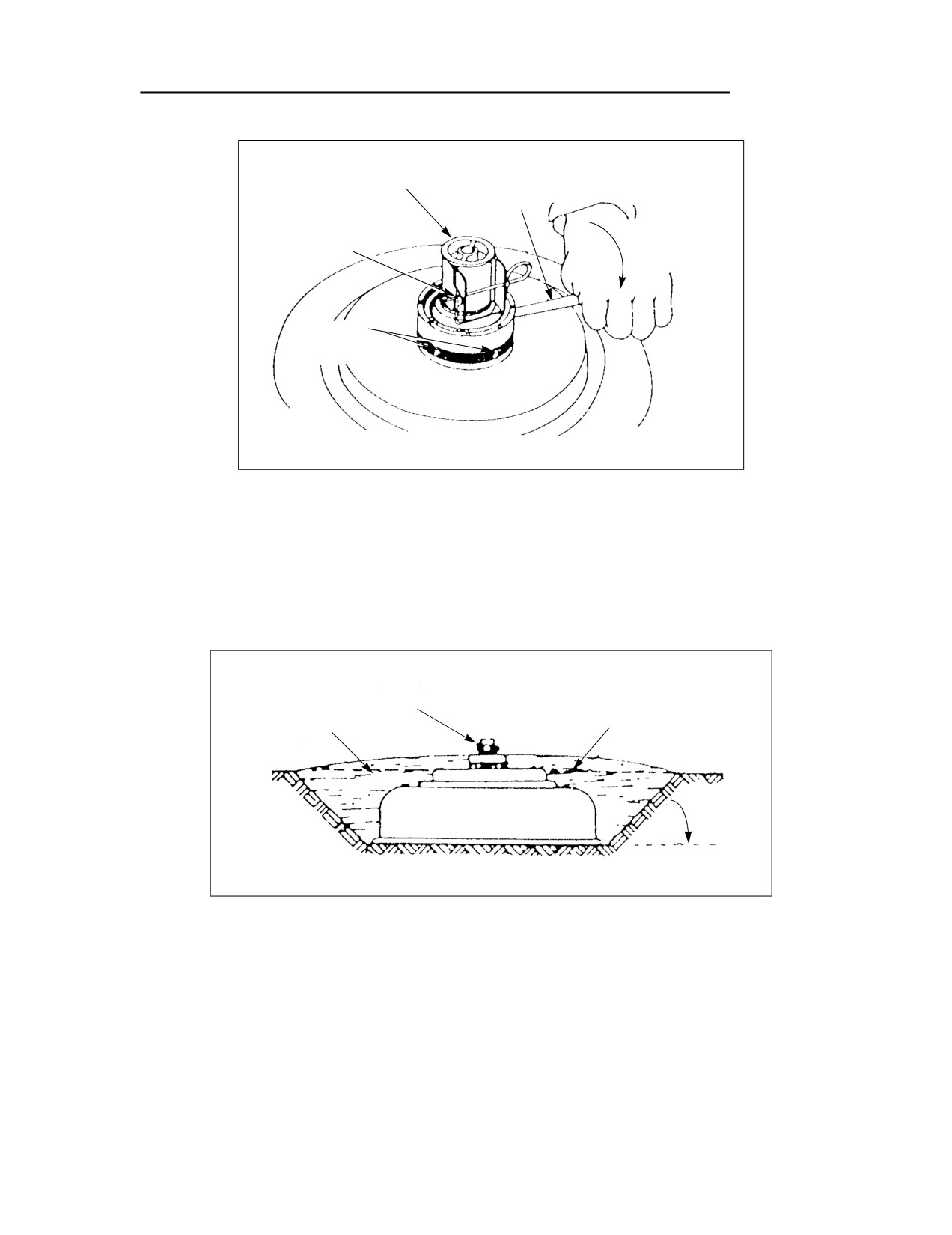
M624 fuse
Extension-rod
piece
Tighten
Safety pin
clockwise.
Holes to
tighten fuse
Figure A-16. Tightening the fuse with the extension rod
— Dig the sides of the hole at a 45-degree angle to prevent vehicles
from bridging the mine.
• Emplace the mine.
— Place the mine in the hole.
— Cover the mine with 2 centimeters of soil (Figure A-17).
Keep debris away
from the tilt rod.
2 cm
Replaced soil
45o
Figure A-17. M15 mine in the hole
NOTE: The M15 AT mine (with the M624 fuse) can be used in the tilt-
rod or pressure role. In the tilt-rod role only, assemble all three
pieces of the extension rod (Figure A-18, page A-16) and thread the
extension rod into the threaded pressure ring of the fuse (Figure A-
19, page A-16).
Installation and Removal of US Mines and Firing Devices A-15
FM 20-32
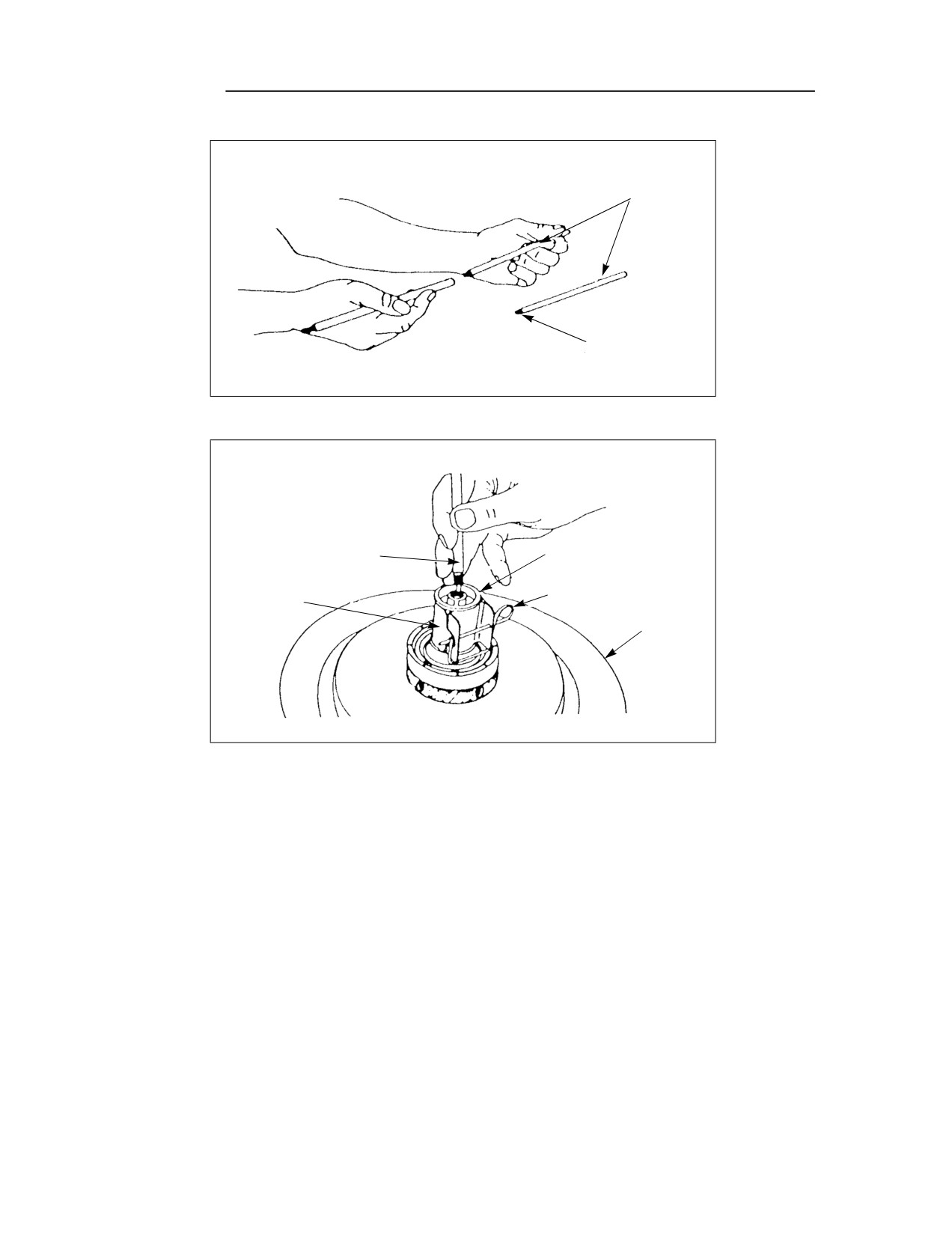
Extension-rod pieces
Threaded end
Figure A-18. Extension-rod assembly
Extension-rod
Pressure ring
assembly
Safety pin
M624 fuse
M15 mine
Figure A-19. Assembly of the extension rod into the fuse ring
• Arm the mine.
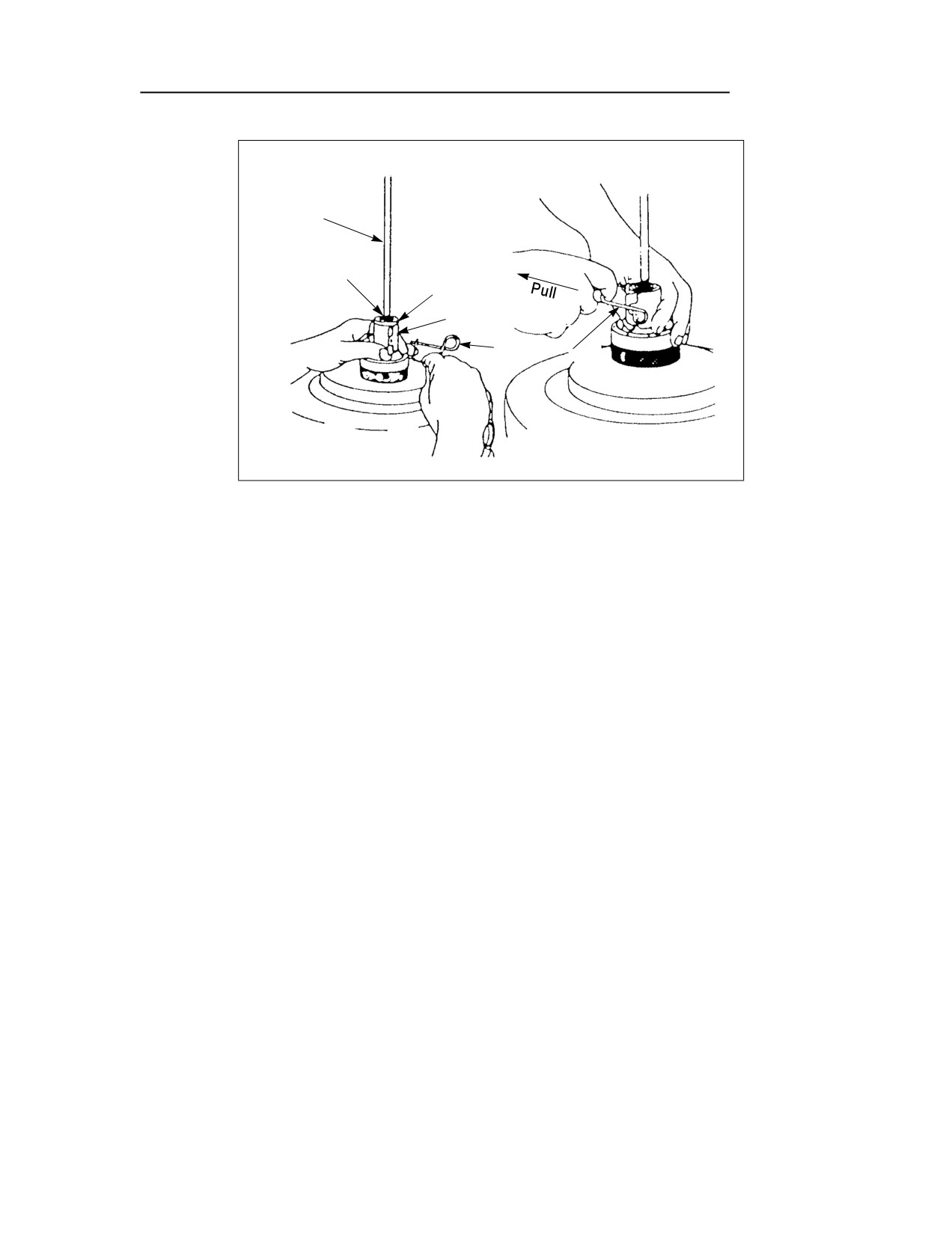
— Use your right hand to raise the safety pin to the horizontal
position, and grasp the safety band and safety stop with your left
hand. Note the position of the thumb in Figure A-20.
— Remove the safety pin with your right index finger, pulling it to
the right.
— Remove the safety stop carefully while holding the safety band in
place.
— Remove the safety band.
• Camouflage the mine.
— Camouflage the mine with twigs, grass, or other material in the
area. Place mines with extension rods in tall grass, if possible.
Ensure that no pressure is applied to the tilt rod or the fuse.
A-16 Installation and Removal of US Mines and Firing Devices
FM 20-32
Left
Extension rod
hand
Right hand
Pressure ring
Safety stop
Safety band
Safety pin
Left hand
Right
hand
Figure A-20. Removal of safety pin
— Place excess soil in sandbags and remove them from the area.
— Give the band, the stop, the pull-ring assembly, the arming plug,
and the end closure to the NCOIC.
REMOVAL USING THE M624 FUSE
• Disarm the mine.
— Clear camouflage away from the mine carefully.
— Assemble the band, the stop, and the safety-pin assembly on the
fuse so that the pressure ring is immobilized.
— Remove the extension rod.
• Check for AHDs.
— Hold the mine firmly in place with one hand, without putting
pressure on the fuse.
— Feel for AHDs with the other hand by digging around the sides of
and underneath the mine.
• Remove the mine.
— Remove the mine from the hole.
— Remove the fuse from the mine; use the extension rod if necessary.
— Replace the end closure on the fuse.
— Install the arming plug into the fuse well.
INSTALLATION USING THE M603 FUSE
• Inspect the mine.
— Do not use the mine if it is dented, cracked, or damaged.
Installation and Removal of US Mines and Firing Devices A-17
FM 20-32
— Use the M20 wrench to remove the arming plug from the mine.
— Inspect the fuse well for foreign material. If foreign material is
present, turn the mine upside down and gently tap the bottom
with your hand to dislodge the material. If you cannot remove the
debris, replace the arming plug and do not use the mine.
— Ensure that the booster retainer ring is seated in the fuse well. If
the retainer ring is missing, replace the mine.
• Perform a function check with the arming plug.
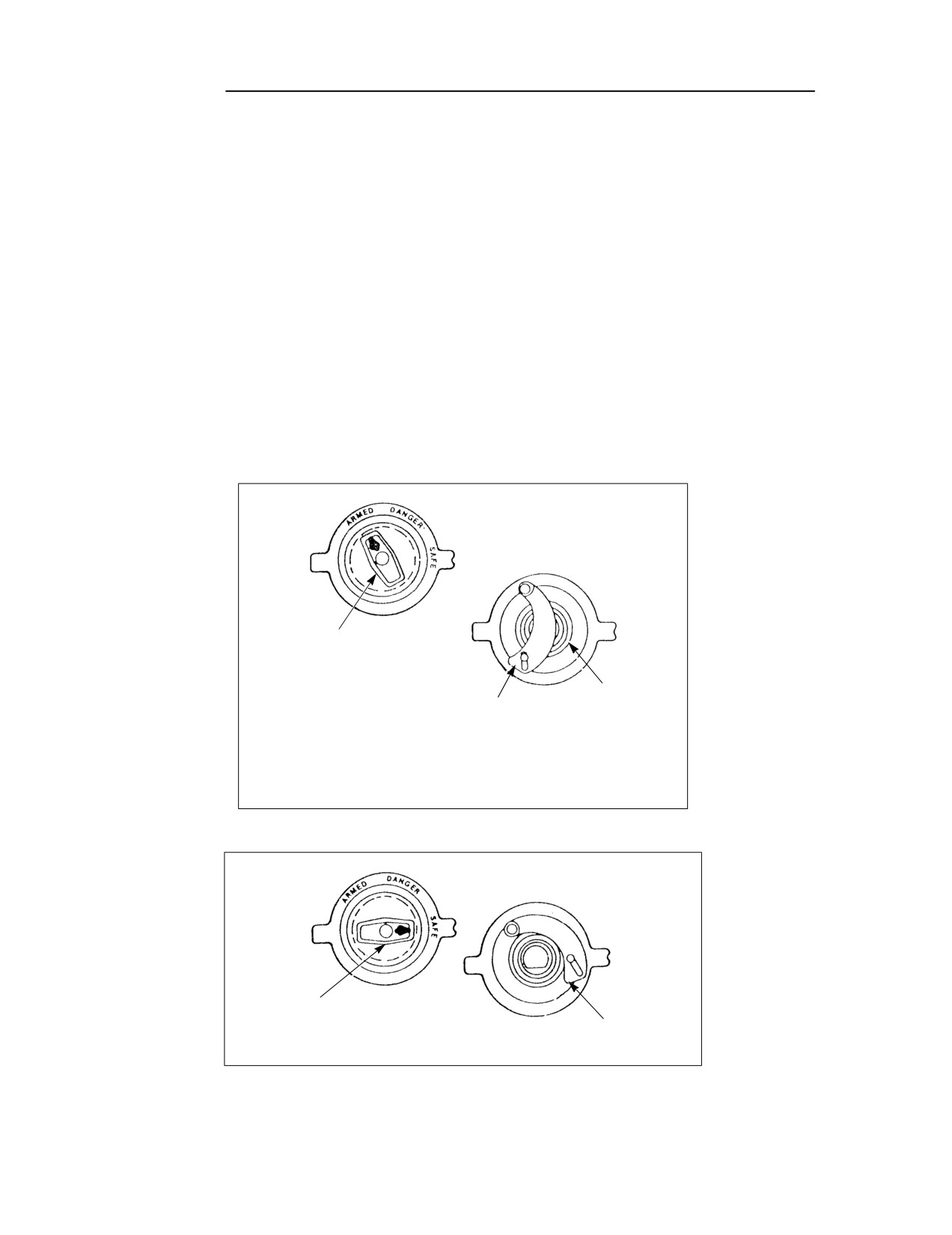
— Turn the setting knob to the ARMED position. Ensure that the
shutter bar moves across the bottom of the arming plug (Figure A-
21)
— Turn the setting knob to the SAFE position. Ensure that the
shutter bar moves back across the bottom of the arming plug
(Figure A-22). NOTE: If the shutter bar does not go into the
SAFE or ARMED position, notify the NCOIC.
Setting knob in
ARMED position
Coil
Shutter bar in
spring
ARMED position
NOTE: A coil spring may not
be present in older models.
Figure A-21. ARMED position
Setting knob in
SAFE position
Shutter bar in
SAFE position
Figure A-22. SAFE position
A-18 Installation and Removal of US Mines and Firing Devices
FM 20-32
• Fuse the mine.
— Remove the M603 fuse from the metal shipping container and
inspect it for serviceability. The green end of the detonator must
show in the bottom of the fuse.
— Remove the safety fork; use the hooked end of an M20 wrench if
necessary (Figure A-23).
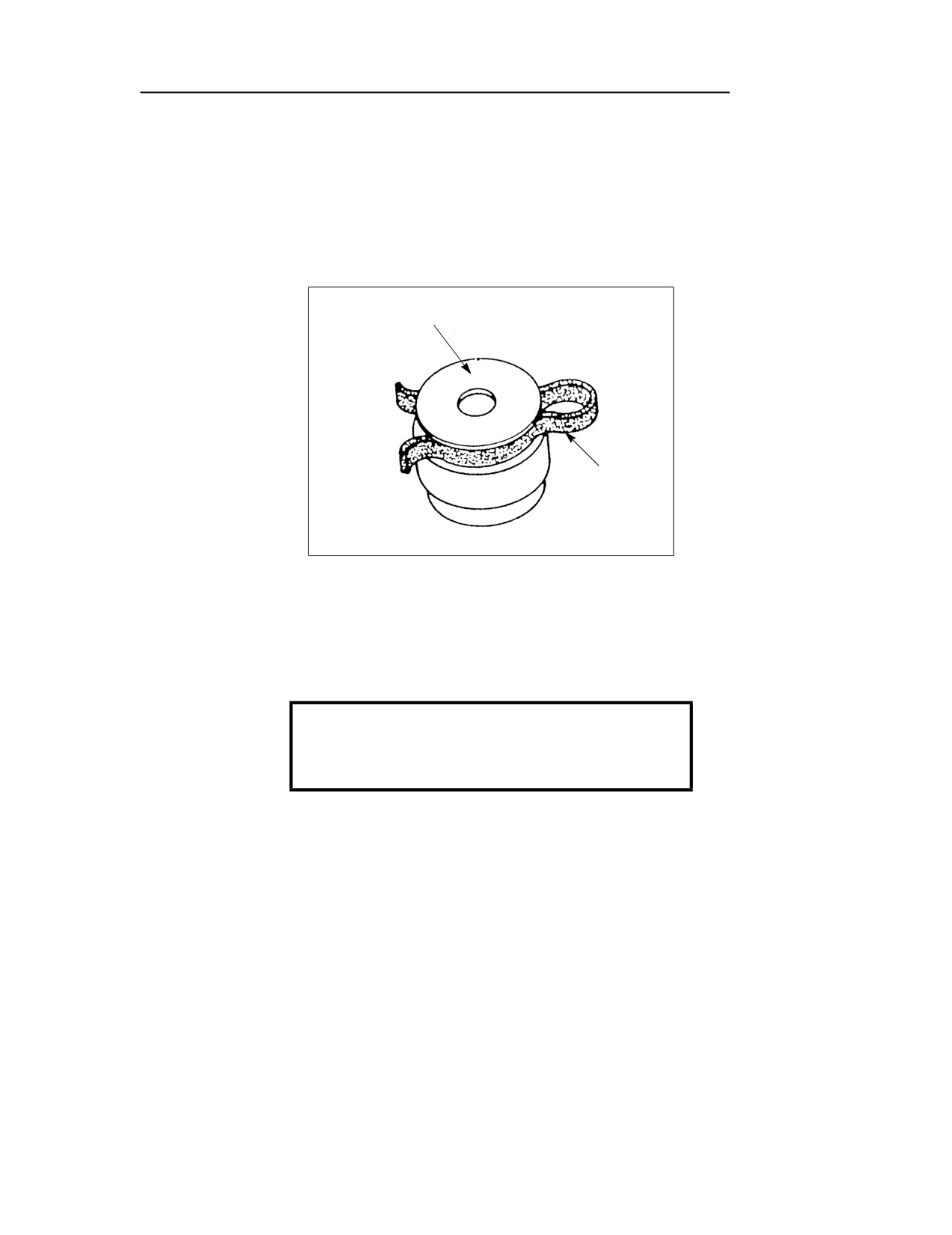
Fuse pressure plate
Safety fork
Figure A-23. Safety fork
— Insert the fuse into the fuse well carefully until it seats securely
on top of the booster retaining ring.
— Perform a clearance test using the tab end of the M20 wrench
(Figure A-24, page A-20).
WARNING
If the fuse pressure plate interferes with the tab end
of the M20 wrench, investigate the cause and notify
the NCOIC. DO NOT arm the mine.
NOTE: For long-term emplacement, smear a thin layer of silicone
grease or similar lubricant on the arming plug, the threads, and the
gasket.
— Ensure that the setting knob is in the SAFE position.
— Screw the arming plug into the mine by hand. Ensure a watertight
seal by tightening the arming plug with the M20 wrench.
• Dig a hole to fit the mine.
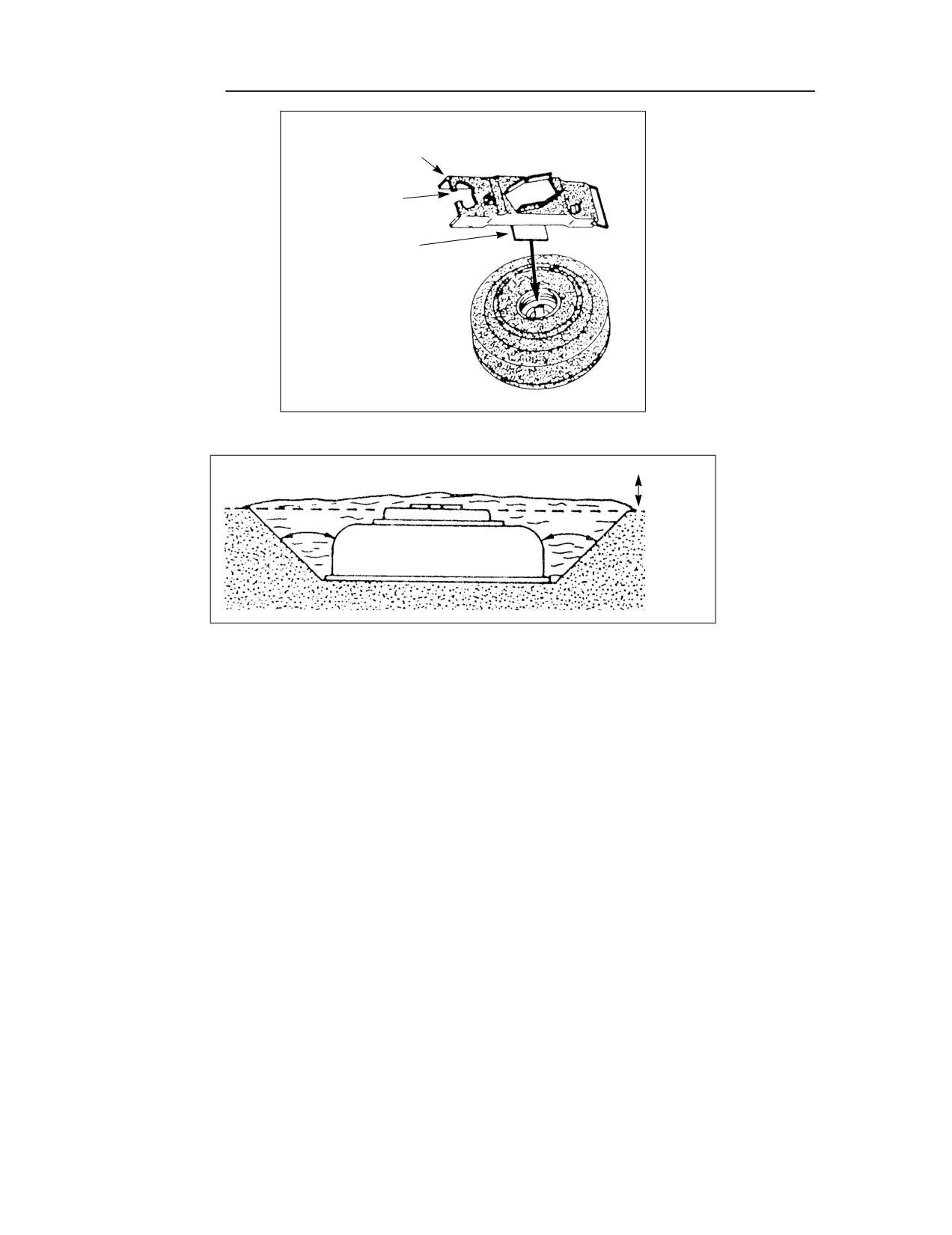
— Dig a hole deep enough so that the top of the pressure plate is
about 3 centimeters below ground level.
— Dig the sides of the hole at a 45-degree angle to prevent vehicles
from bridging the mine (Figure A-25, page A-20).
• Emplace the mine.
Installation and Removal of US Mines and Firing Devices A-19
FM 20-32
M20 arming wrench
Hook end
Tab end
Figure A-24. Clearance test
3 cm
45o
45o
Figure A-25. M15 mine in the hole
— Place the mine in the hole.
— Cover the mine with soil until it is level with the top of the
pressure plate.
• Use the M20 wrench to arm the mine by turning the setting knob from
the SAFE position to the ARMED position.
• Camouflage the mine.
— Cover the mine with 3 to 5 centimeters of soil.
— Camouflage the mine, place excess soil in sandbags, and remove
sandbags from the area.
— Give the safety clip to the NCOIC.
REMOVAL USING THE M603 FUSE
• Disarm the mine.
— Clear the soil from the top of the mine carefully.
— Hold the mine firmly in place with one hand, without putting
pressure on the pressure plate.
— Feel for AHDs with the other hand by digging around the sides of
and underneath the mine.
A-20 Installation and Removal of US Mines and Firing Devices
FM 20-32
— Use the M20 wrench to turn the setting knob to the SAFE
position.
• Remove the mine.
— Remove the mine from the hole.
— Use the M20 wrench to turn the arming plug counterclockwise,
and remove the arming plug.
— Remove the M603 fuse from the fuse well and replace the safety
fork.
— Install the arming plug.
M19
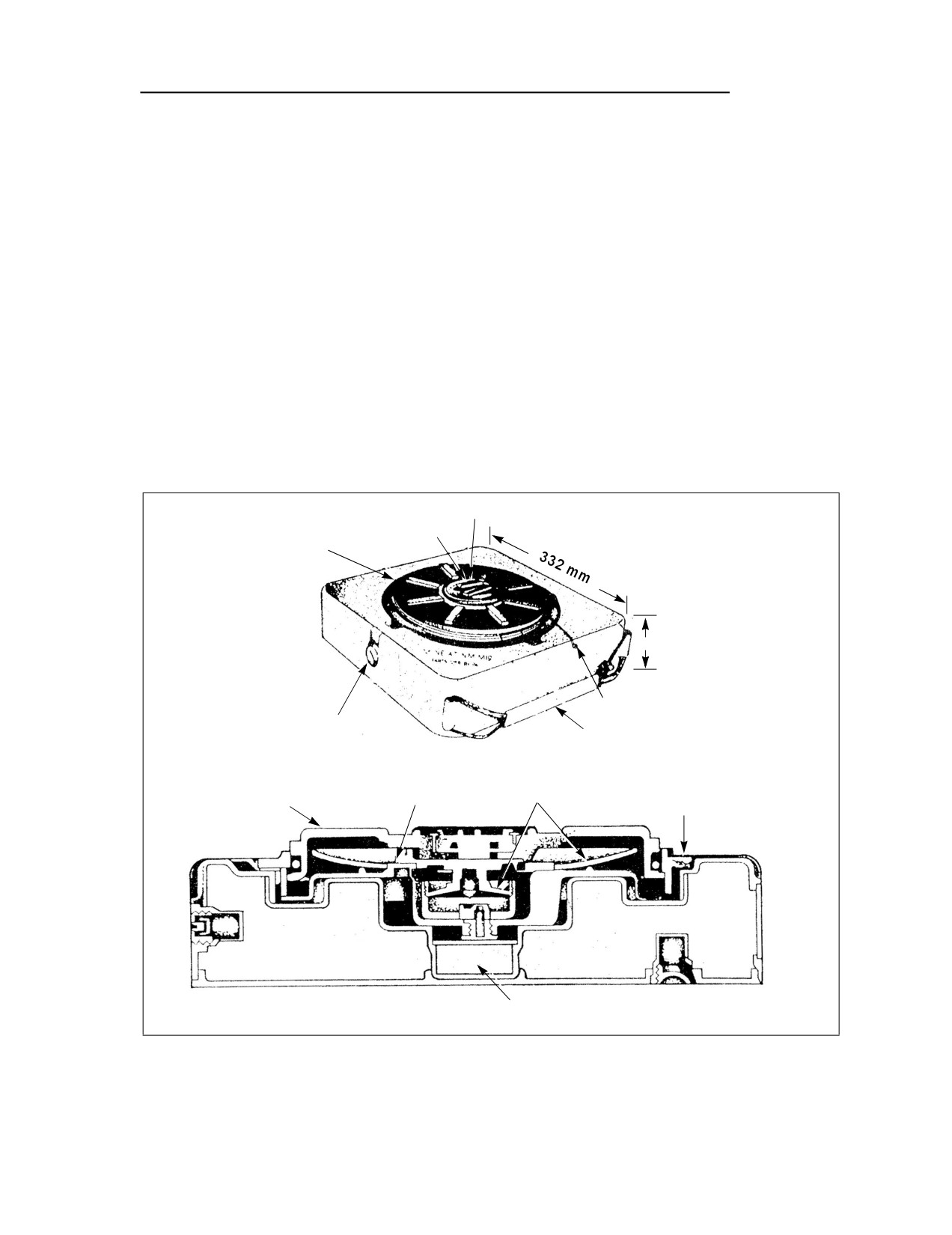
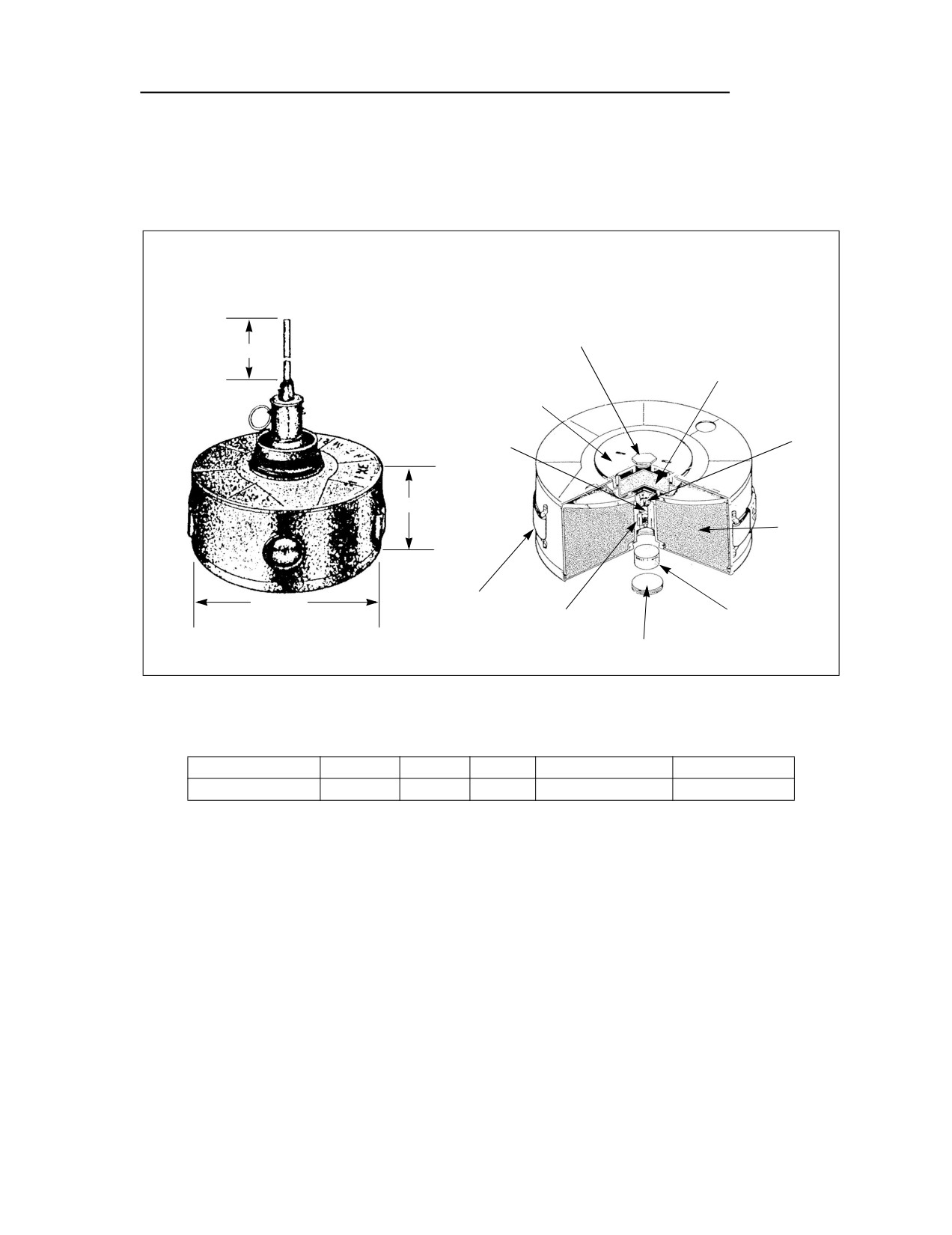
The M19 AT mine (Figure A-26) is housed in a square, plastic case and holds
9.45 kilograms of Composition B (HE charge). It consists of an M606 integral
pressure fuse and two secondary fuse wells—one in the side and one in the
bottom. The fuse body contains a pressure plate, a Belleville spring, a setting
knob, a step plate, a firing-pin assembly, and a detonator.
Setting knob in
Safety clip
SAFE position
Pressure plate
94 mm
Safety-clip cord
Activator-well plug
Carrying-cord
handle
Belleville springs
M606 integral-
Pressure plate
Step plate
pressure fuse
HE charge
Tetryl booster pellet
Figure A-26. M19 AT mine
Installation and Removal of US Mines and Firing Devices A-21
FM 20-32
CHARACTERISTICS
Main Charge
Diameter
Height
Weight
No Mines per Box
Weight per Box
Comp B, 9.45
kg
332 mm
94 mm
12.6 kg
2
32.5 kg
•
The M19 is employed in tactical and nuisance minefields.
•
The M19 is buried or surface-laid.
•
The M19 requires a force of 157 to 225 kilograms to detonate.
•
Standard FDs may be used with the M2 activator in any of the
secondary fuse wells of the M19.
INSTALLATION
WARNING
Emplace and remove the mine while in the
prone position.
•
Inspect the mine.
— Do not use the mine if it is dented, cracked, or damaged.
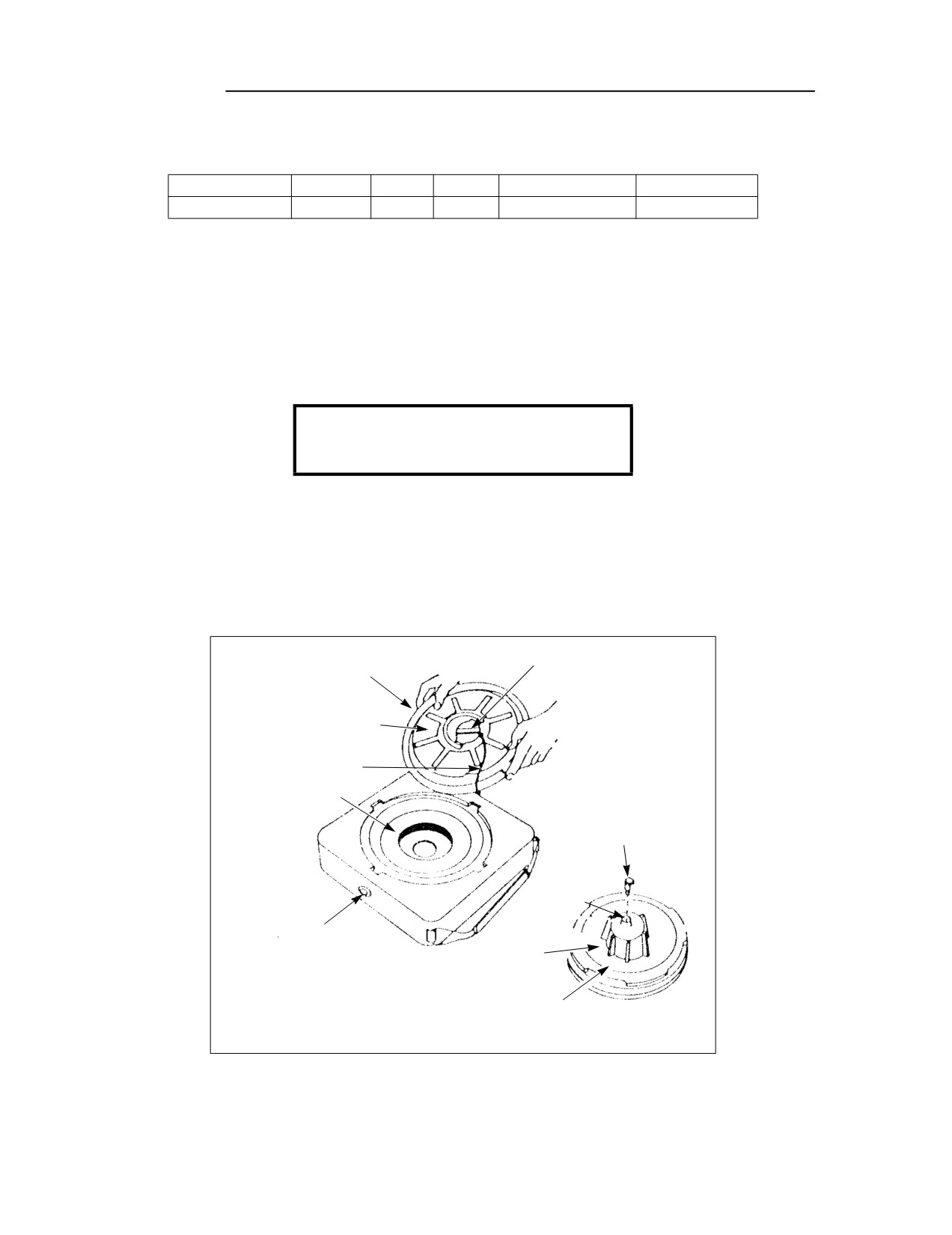
— Remove the M606 fuse from the fuse well by
turning
it
counterclockwise a quarter turn (Figure A-27).
— Ensure that the rubber gasket is on the M606 fuse.
Setting knob
M606 fuse
Pressure plate
Safety-clip cord
Fuse well
Shipping plug
Detonator
well
Activator well
Detonator-holder
assembly
Bottom of
pressure plate
Figure A-27. Removal of the pressure plate
A-22 Installation and Removal of US Mines and Firing Devices
FM 20-32
— Remove any foreign material from the fuse well.
— Ensure that the setting knob is in the SAFE position and that the
safety clip is in place.
— Use the M22 wrench to remove the shipping plug from the
detonator well.
— Inspect the detonator well for foreign material. If foreign material
is present, gently tap the pressure plate with your hand to
dislodge the material.
• Test the position of the firing pin (Figure A-28).
Armed
Safe
Figure A-28. Firing pin
— Ensure that the firing pin is at the edge of the well when the
setting knob is in the SAFE position.
— Remove the safety clip.
— Use the M22 wrench to turn the setting knob to the ARMED
position. Ensure that the firing pin is in the center of the well.
— Use the M22 wrench to turn the setting knob back to the SAFE
position. Ensure that the firing pin moves back to the side of the
well. NOTE: If the firing pin is not in the correct position
when the setting knob is in the ARMED or SAFE position,
notify the NCOIC.
— Replace the safety clip.
•
Use the M22 wrench to screw the M50 detonator into the detonator
well.
•
Use the M22 wrench to tighten the M606 fuse into the fuse well.
•
Dig a hole to fit the mine.
— Dig a hole deep enough so that the top of the pressure plate will be
even with or slightly below ground level.
Installation and Removal of US Mines and Firing Devices A-23
FM 20-32
— Dig the sides of the hole at a 45-degree angle to prevent vehicles
from bridging the mine.
•
Emplace the mine.
— Place the mine in the hole.
— Cover the mine with soil until it is level with the top of the
pressure plate.
•
Arm the mine.
— Remove the safety clip.
— Use the M22 wrench to turn the setting knob from the SAFE
position to the ARMED position.
•
Camouflage the mine.
— Cover the mine with 3 centimeters of soil.
— Camouflage the mine, place excess soil in sandbags, and remove
sandbags from the area.
— Give the safety clip and the shipping plug to the NCOIC.
REMOVAL
•
Disarm the mine.
— Clear the soil from the top of the mine carefully.
— Hold the mine firmly in place with one hand, without putting
pressure on the pressure plate.
— Feel for AHDs with the other hand by digging around the sides of
and underneath the mine.
— Use the M22 wrench to turn the setting knob to the SAFE
position.
— Replace the safety clip on the M606 fuse.
•
Remove the mine.
— Remove the mine from the hole.
— Use the M22 wrench to remove the M606 fuse by turning it
counterclockwise and lifting it out of the fuse well.
— Use the M22 wrench to remove the detonator from the detonator
well.
— Replace the shipping plug in the detonator well.
— Replace the pressure plate in the mine.
M21
The M21 AT mine (Figure A-29) utilizes a direct-energy warhead that is
designed to produce a K-Kill. It is used in conjunction with the M607 fuse. The
M21 produces a K-Kill against heavy tanks, unless the mine is activated
under the track. It can be buried with a tilt rod, or it can be surface-laid with
A-24 Installation and Removal of US Mines and Firing Devices
FM 20-32
or without a tilt rod. If the M21 is surface-laid with a tilt rod, it must be
staked to prevent it from being knocked over and causing the warhead to be
directed away from the target. The M21 is not compatible with any
mechanical mine-dispensing system.
Shipping plug
511 mm
M607 fuse
Black-powder
expelling charge
Concave
steel plate
Firing pin
M42 primer
115 mm
HE
charge
230 mm
Carrying
strap
Delay
M120 booster
element
Closing plug
Figure A-29. M21 AT mine
CHARACTERISTICS
Main Charge
Diameter
Height
Weight
No Mines per Box
Weight per Box
Comp H6, 4.95 kg
230 mm
115 mm
7.8 kg
4
41 kg
• The M21 requires a minimum of 130.5 kilograms of pressure to
detonate.
• The M21 can be used with a tilt-rod assembly, requiring 1.7 kilograms
of pressure on the extension rod to cause a 20-degree deflection.
• The M21 is the only conventional US AT mine with a direct-energy
warhead.
Installation and Removal of US Mines and Firing Devices A-25
FM 20-32
INSTALLATION
WARNING
Emplace and remove the mine while in the
prone position.
• Inspect the mine.
— Do not use the mine if it is dented, cracked, or damaged.
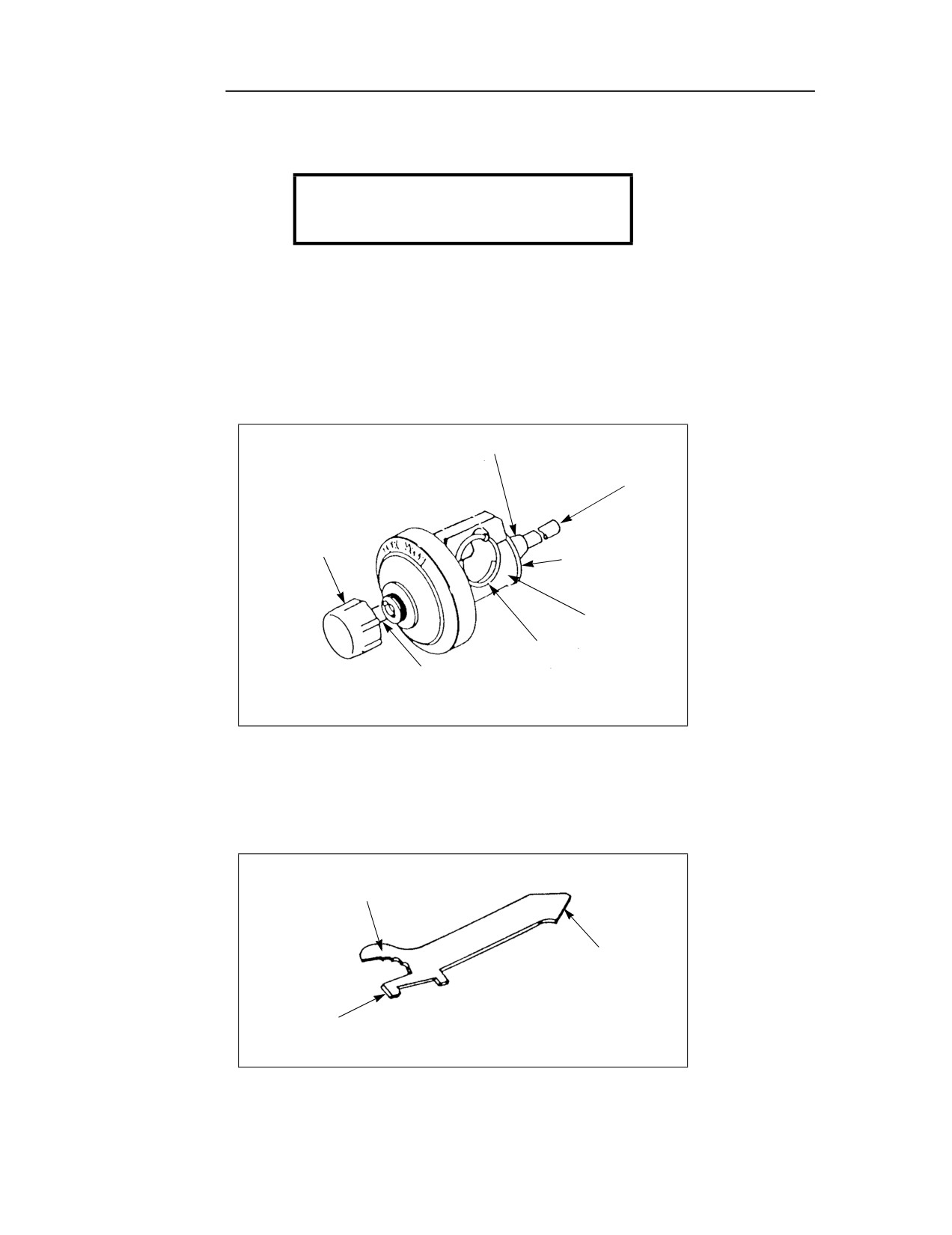
— Ensure that the cotter pins on the fuse pull-ring assembly and the
fuse-closure assembly are securely in place (Figure A-30).
— Inspect the fuse to ensure that the neck portion behind the tile
collar is not cracked.
Extension-rod adaptor
Extension rod
Closure
assembly
Pressure ring
Band
Pull-ring
assembly
Fork
Figure A-30. M607 fuse
• Insert the booster.
— Use the screwdriver end of the M26 wrench (Figure A-31) to
remove the closing plug from the bottom of the mine.
Closure-assembly end
Screwdriver
end
Shipping-plug end
Figure A-31. M26 wrench
A-26 Installation and Removal of US Mines and Firing Devices
FM 20-32
— Inspect the booster well for foreign material. If foreign material is
present, gently tap the top of the mine with your hand to dislodge
the material. If you cannot remove the debris, replace the closing
plug and do not use the mine.
— Insert the M120 booster (with the washer side toward the fuse)
into the booster well.
— Replace the closing plug with the M26 wrench.
•
Fuse the mine.
— Remove the shipping plug from the fuse well with the M26
wrench.
— Inspect the fuse well for foreign material. If foreign material is
present, gently shake the mine to dislodge the material. If black
powder falls out of the fuse well or you cannot remove the foreign
material, do not use the mine.
— Remove the closure assembly from the M607 fuse with the M26
wrench. Ensure that the gasket remains in place on the fuse.
— Screw the fuse hand-tight into the fuse well.
•
Dig a hole to fit the mine.
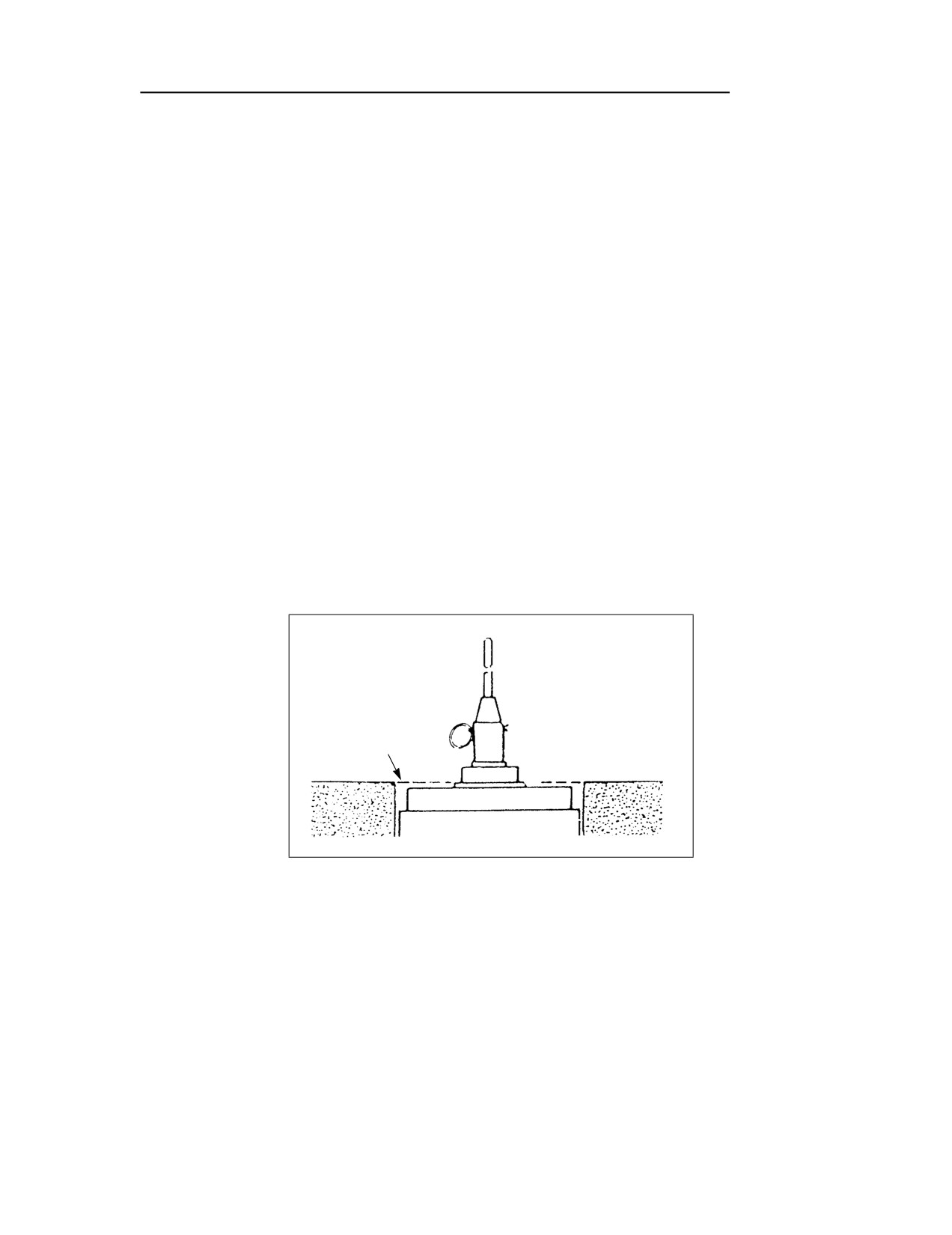
— Dig a hole deep enough so that the top of the mine will be at
ground level (Figure A-32).
Ground level
Figure A-32. Buried M21 mine
— Check the bottom of the hole to ensure that the ground is solid
enough to support the mine. If necessary, place a flat object under
the mine to provide a firm foundation. Allow additional depth for
the object.
• Emplace the mine.
— Place the mine in the hole.
— Cover the mine with soil until it is level with the top of the mine.
Ensure that no soil falls around or under the plastic collar.
Installation and Removal of US Mines and Firing Devices A-27
FM 20-32
— Press the soil firmly around the sides of the mine.
• Assemble the extension rod. NOTE: For pressure operation, do
not use the extension-rod assembly.
— Screw the extension rod onto the M607 fuse.
— Ensure that the extension rod is pointing straight up.
• Arm the mine.
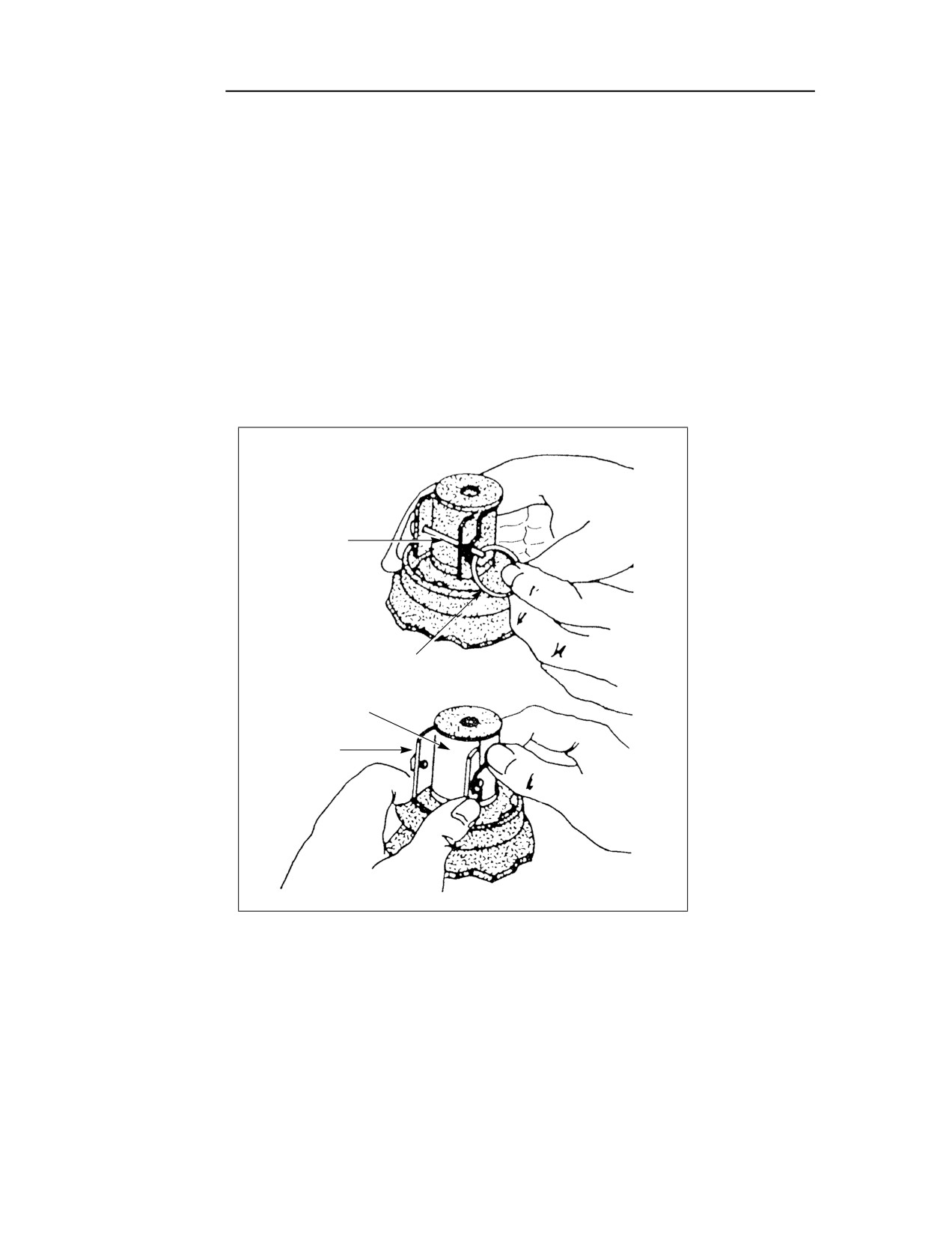
— Squeeze the end of the cotter pin together on the pull ring.
— Remove the cotter pin by holding the fuse firmly in one hand and
pulling the pull ring with the other hand.
— Remove the band and the stop slowly and carefully from the neck
of the fuse (Figure A-33).
Cotter pin
Pull-ring assembly
Stop
Band
Figure A-33. Removing the band and the stop
• Camouflage the mine.
— Camouflage the mine with twigs, grass, or other material in the
area. Place mines with extension rods in tall grass, if possible.
Ensure that no pressure is applied to the tilt rod or the fuse.
— Place the excess soil in sandbags and remove them from the area.
A-28 Installation and Removal of US Mines and Firing Devices
C2, FM 20-32
— Give the band, the stop, the pull ring, the shipping plugs, and the
closure assembly to the NCOIC.
REMOVAL
•
Disarm the mine.
— Clear the camouflage away from the mine carefully.
— Attach the band and the stop to the fuse.
— Insert the cotter pin into the band and the stop. Spread the ends of
the cotter pin.
— Remove the extension rod.
•
Check for AHDs.
— Hold the mine firmly in place with one hand, without putting
pressure on the fuse.
— Feel for AHDs with the other hand by digging around the sides of
and underneath the mine.
•
Remove the mine.
— Remove the mine from the hole.
— Remove the fuse from the mine.
— Install the closure assembly on the fuse.
— Install the shipping plug into the fuse well of the mine.
— Remove the closing plug from the bottom of the mine.
— Remove the booster from the mine.
— Install the closing plug into the booster well.
SECTION III. FIRING DEVICES AND ACTIVATORS
An FD performs the function of a mine fuse by providing an alternative means
to detonate the mine. It is normally used in conjunction with a standard fuse
so that a mine will have two separate explosive chains. The purpose of the
second firing chain is to prevent the enemy from disarming or removing mines
after emplacement. When used for this purpose, the FD is called an AHD and
it is designed to function by detonating the attached mine or another explosive
charge nearby if unauthorized personnel attempt to remove or tamper with
the mine. NOTE: US forces will not employ AHDs on AP mines. Both the
M19 and the M15 have two secondary fuse wells for attaching an FD and an
activator.
There are two standard US FDs—M5 pressure release and M142
multipurpose. They utilize a spring-loaded striker and a standard base and
are designed to function in one or more of the following modes:
Installation and Removal of US Mines and Firing Devices A-29
C2, FM 20-32
• Pressure.
• Pressure release.
• Tension.
• Tension release.
M5
PRESSURE-RELEASE FIRING DEVICE (MOUSETRAP)
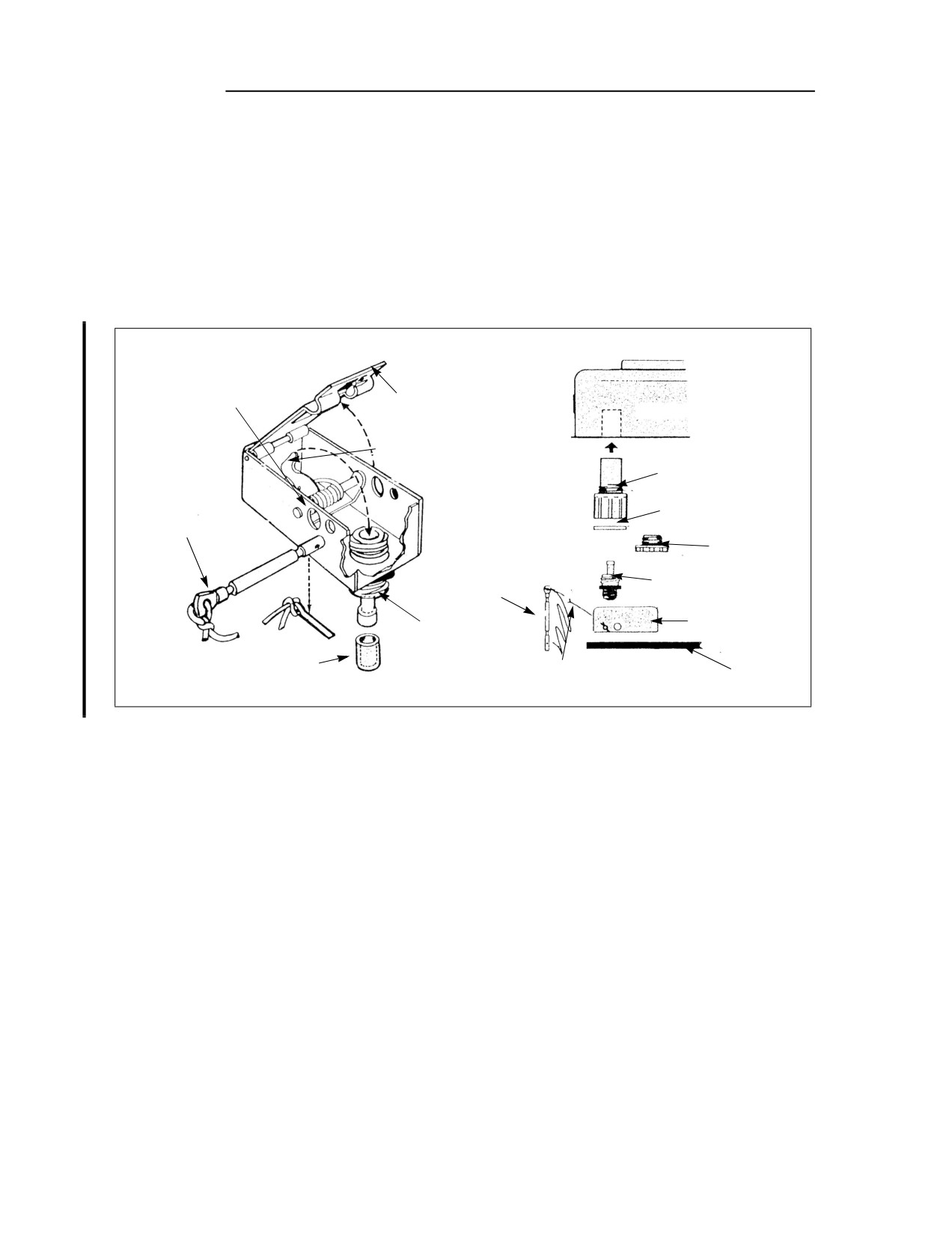
The M5 FD (Figure A-34) is activated by the release of pressure. Lifting or
removing a restraining weight releases the striker to fire the cap.
Interceptor or
improvised positive
safety-pin hole
Release
plate
Firing pin
Activator
Locking
Gasket
safety pin
Cap
Locking
Standard base
safety pin
M5 pressure-
release FD
Standard
base
Protective cap
Interceptor pin
Pressure base
(always remove)
(thin wire)
Figure A-34. M5 FD
CHARACTERISTICS
• Case: Metal.
• Color: Olive-drab.
• Length: 445 millimeters.
• Width: 239 millimeters.
• Height: 175 millimeters.
• Internal action: Mechanical with hinged striker release.
• Initiating action: Removal of restraining weight, 2.25 kilograms
or
more.
• Accessories: Pressure board.
• Safeties: Safety pin and hole for interceptor pin.
• Packaging: Four complete FDs and four plywood pressure boards are
packaged in a paper carton, five cartons are packaged in a fiberboard
box, and 10 fiberboard boxes are shipped in a wooden box.
A-30 Installation and Removal of US Mines and Firing Devices
FM 20-32
INSTALLATION
• Dig a hole deep enough to bury the mine on a firm foundation. The
pressure plate should be slightly above ground level.
WARNING
Ensure that the mine and the FD are resting on
a firm foundation before removing the pins.
• Remove the protective cap from the standard base. Assemble the FD.
• Use a coat hanger as a positive safety pin. Place the mine in the hole.
Leave enough room to remove the pins.
• Bury and camouflage the mine.
• Arm the mine.
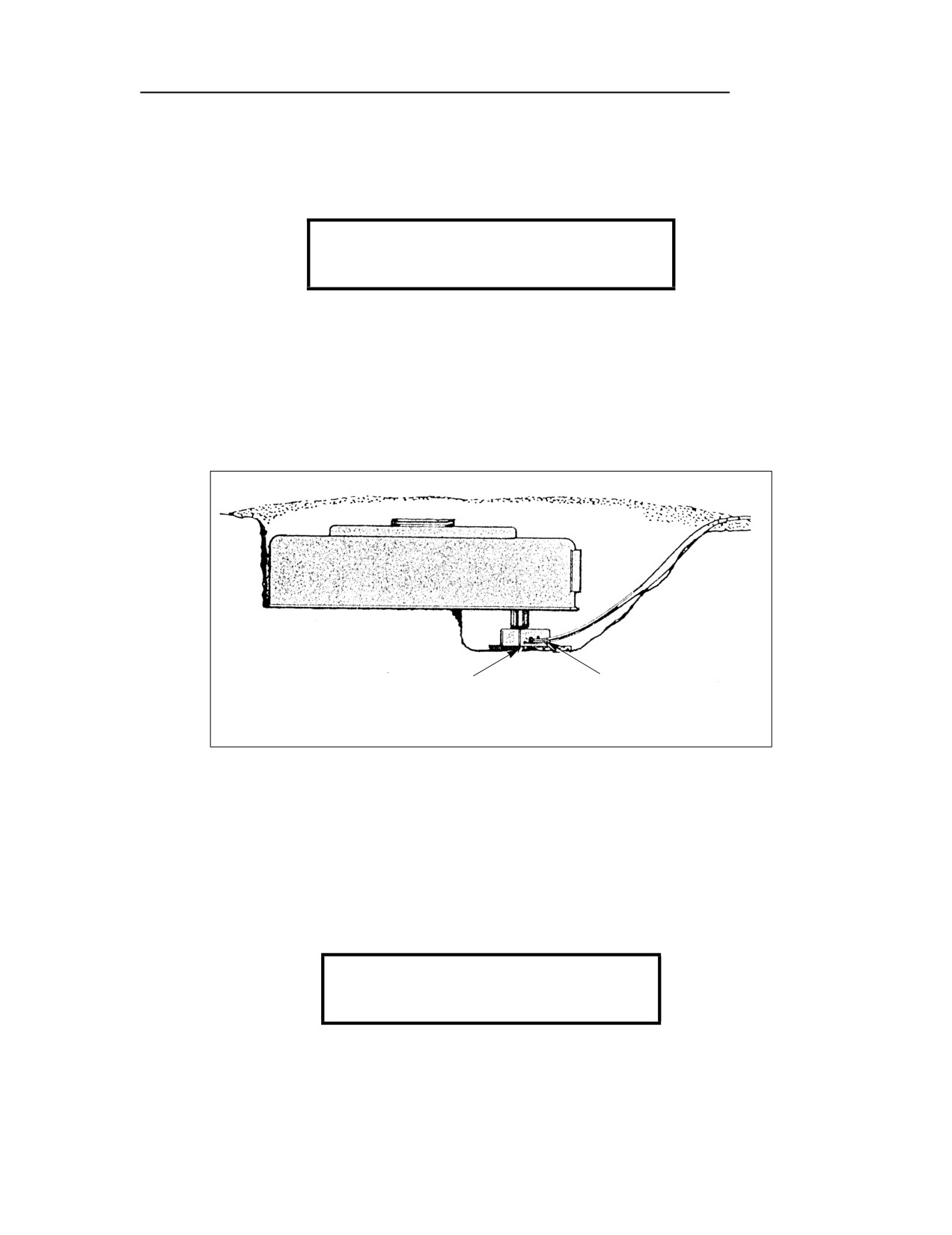
• Remove the locking safety pin (Figure A-35).
Positive safety pin in
Locking safety pin
interceptor hole (remove last)
(remove first)
Figure A-35. Arming the M15
• Remove the positive safety pin
(interceptor pin). NOTE: If the
positive safety pin is difficult to remove or if you hear a click
when removing the locking safety pin, carefully remove the
mine and replace the FD.
REMOVAL
• Uncover the mine carefully and inspect it for tampering. Locate and
carefully uncover the FD.
WARNING
DO NOT release the pressure being applied
to the device.
• Insert the positive safety pin into the interceptor hole, and then insert
the locking safety pin into the safety-pin hole.
Installation and Removal of US Mines and Firing Devices A-31
FM 20-32
• Disarm and remove the mine. Recover the FD.
M142 MULTIPURPOSE FIRING DEVICE
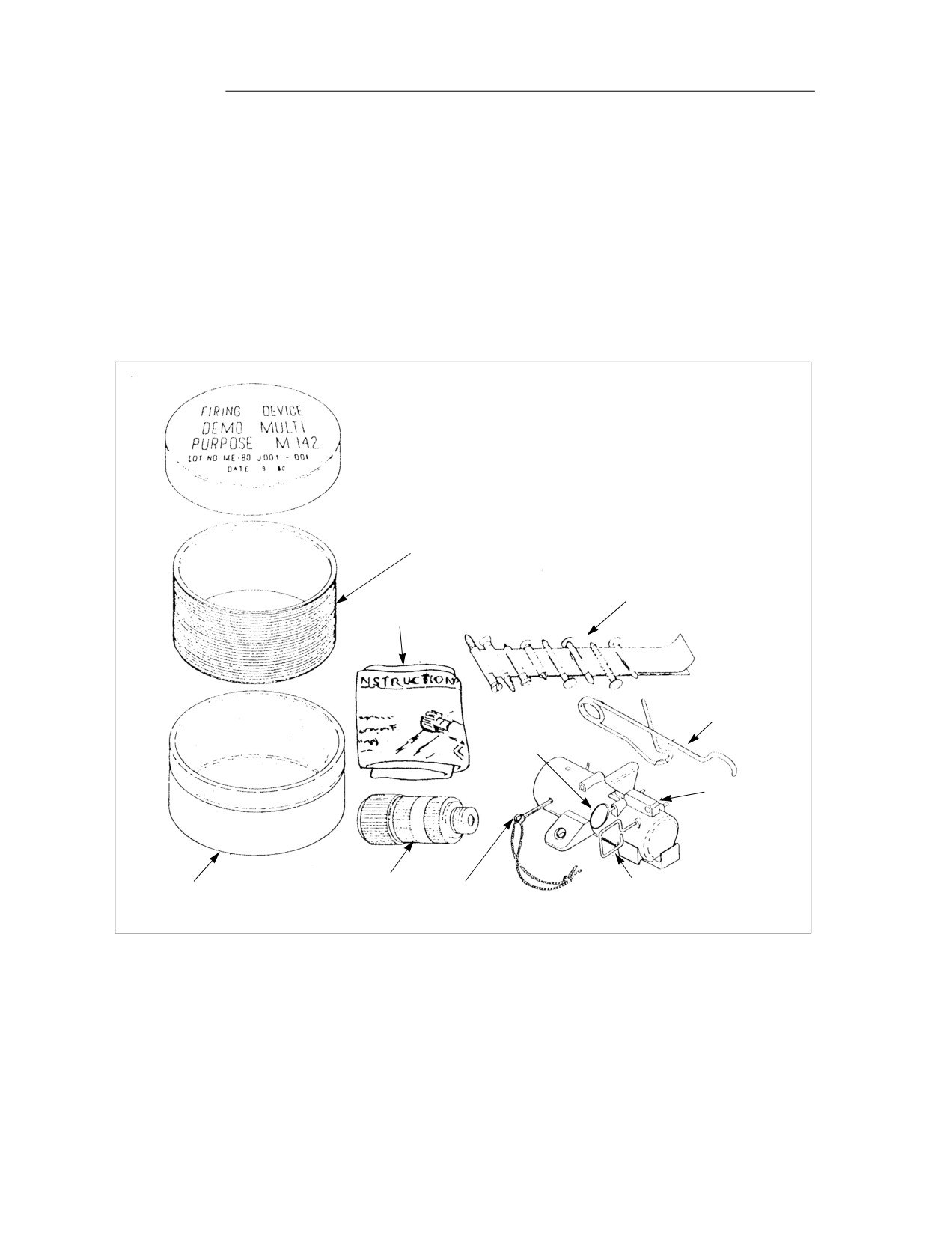
The M142 FD (Figure A-36) can be designed to function in the following
modes:
• Pressure (11 kilograms or more).
• Pressure release (between 2 and 67 kilograms).
• Tension (3 kilograms or more).
• Tension release.
Spool or trip wire
Fastening devices
Instruction sheet
Tension-release
device
Round-head
safety pin
FD
Explosive
coupler
Square-head
Shipping
Positive safety
safety pin
container
(remove last)
Figure A-36. M142 FD
Although primarily intended for booby-trap applications, the M142 can be
readily adapted as an AHD. The M142 comes with a coupling device and a
primer that accepts a standard nonelectric blasting cap. The initiating action
sets off an explosive chain that passes from the FD and the primer to the
blasting cap, and then via the detonating cord to the main charge. However,
the coupling device with the primer will not initiate the detonating cord alone
A-32 Installation and Removal of US Mines and Firing Devices
C1,
FM 20-32
without a blasting cap attached, and it is not adaptable to any activator or
secondary fuse well. When the M142 is used as an AHD, the coupling device is
removed and an M1 or M2 standard base is used.
CHARACTERISTICS
• Case: Plastic.
• Color: Olive-drab.
• Diameter: 190.5 millimeters.
• Length: 571.5 millimeters.
• Internal action: Spring-driver striker.
• Safeties: Positive safety pin, square-head pivot pin, round-head pivot
pin, and alternative safety-pin hole.
• Accessories: Nail and screw fasteners, coupling assembly, tension-
release attachment, 15-meter spool of trip wire, and vinyl instruction
sheet.
• Packaging: Round, metal can containing FD with accessories.
ARMING AND DISARMING
Arming and disarming procedures vary based on the activation mode.
Detailed instructions are printed on a weatherproof, vinyl sheet included in
each FD package.
M1
AND M2
ACTIVATORS
When FDs are employed with M15 and M19 AT mines, they require the use of
an M1 or M2 activator.
Activators are essentially detonator boosters that are designed to magnify the
explosive force generated by an FD with a standard base and transfer the
force to the main charge. Activators may be used with either type of FD to
supply an AT mine with a secondary fuse for antihandling purposes. The M1
activator is used with the M15 AT mine, and the M2 activator is used with the
M19 AT mine. The activator also performs the function of an adapter for
attaching the FD to the mine. One end of the activator is threaded externally
for insertion in the secondary well of the mine; the other end is threaded
internally to receive the standard base coupling of the FD.
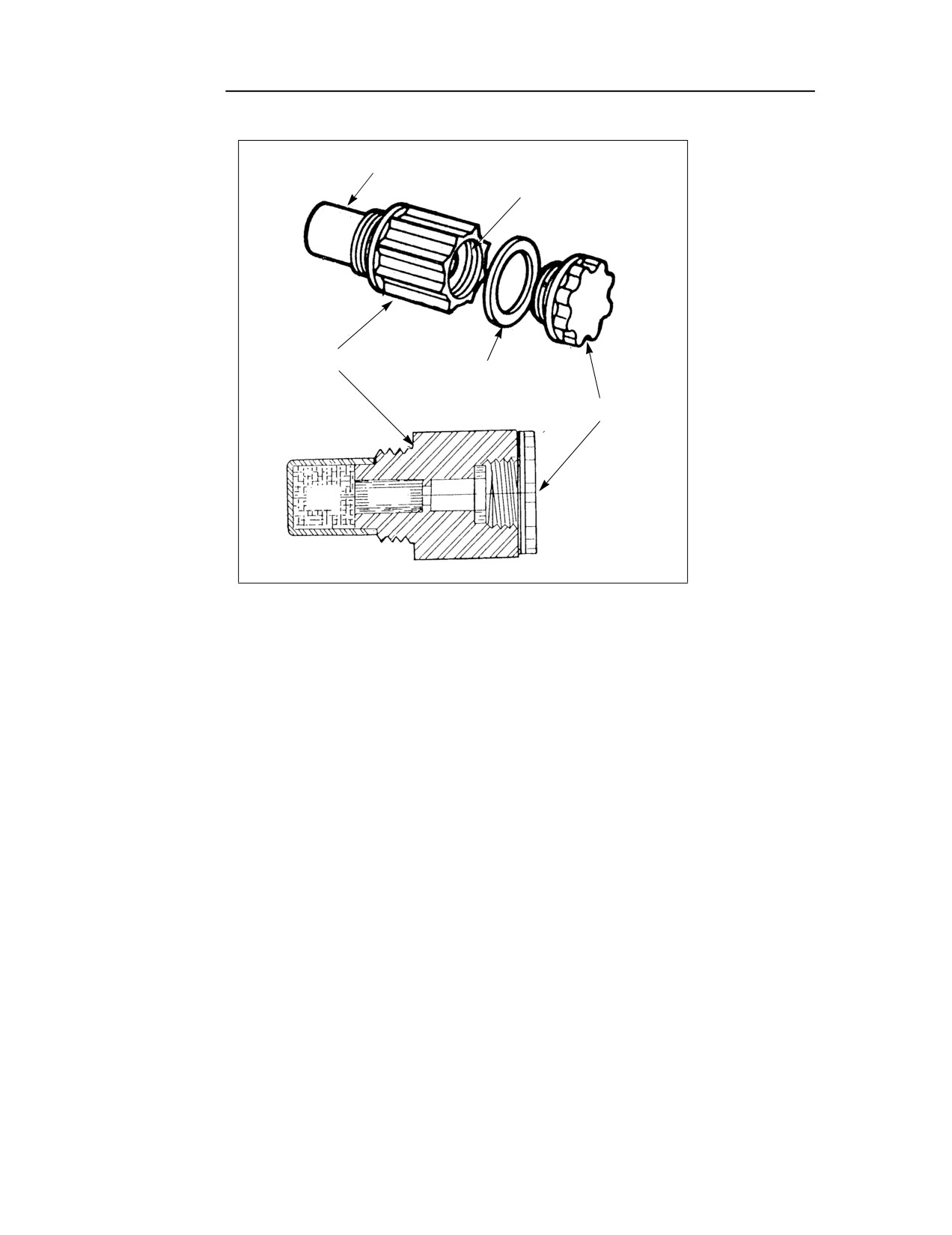
The M1 activator (Figure A-37, page A-34) is 54 millimeters long (with cap), is
made of olive-drab plastic, contains a detonator, and has a threaded closing
plug and a gasket. It has a cylindrical, unthreaded cap that is cemented to the
opposite end of the body and contains a tetryl booster charge. The threaded
end, which screws into the mine, is 25 millimeters in diameter.
The M2 activator is similar to the M1 except that it contains an HE pellet, and
its overall length, with cap, is 53 millimeters.
Installation and Removal of US Mines and Firing Devices A-33
FM 20-32
Tetryl cup
Well for standard base
Plastic body
Gasket
Cap
Figure A-37. M1 activator
A-34 Installation and Removal of US Mines and Firing Devices

C2
Appendix B
Controls and Components of
Special-Purpose Munitions
This appendix provides characteristics and detailed descriptions of US
special-purpose munitions. The use of these munitions is outlined in
Chapter 4.
SELECTABLE LIGHTWEIGHT ATTACK MUNITION
The SLAM is a multipurpose munition with antidisturbance and antitamper
features. There are two models of the SLAM—one is self-neutralizing (M2)
and the other is self-destructing (M4). The M2 is solid green and has no labels,
brands, or other distinguishing marks. The M4 is green with a black warhead
(EFP) face.
Employment methods for the SLAM are outlined in Chapter 4.
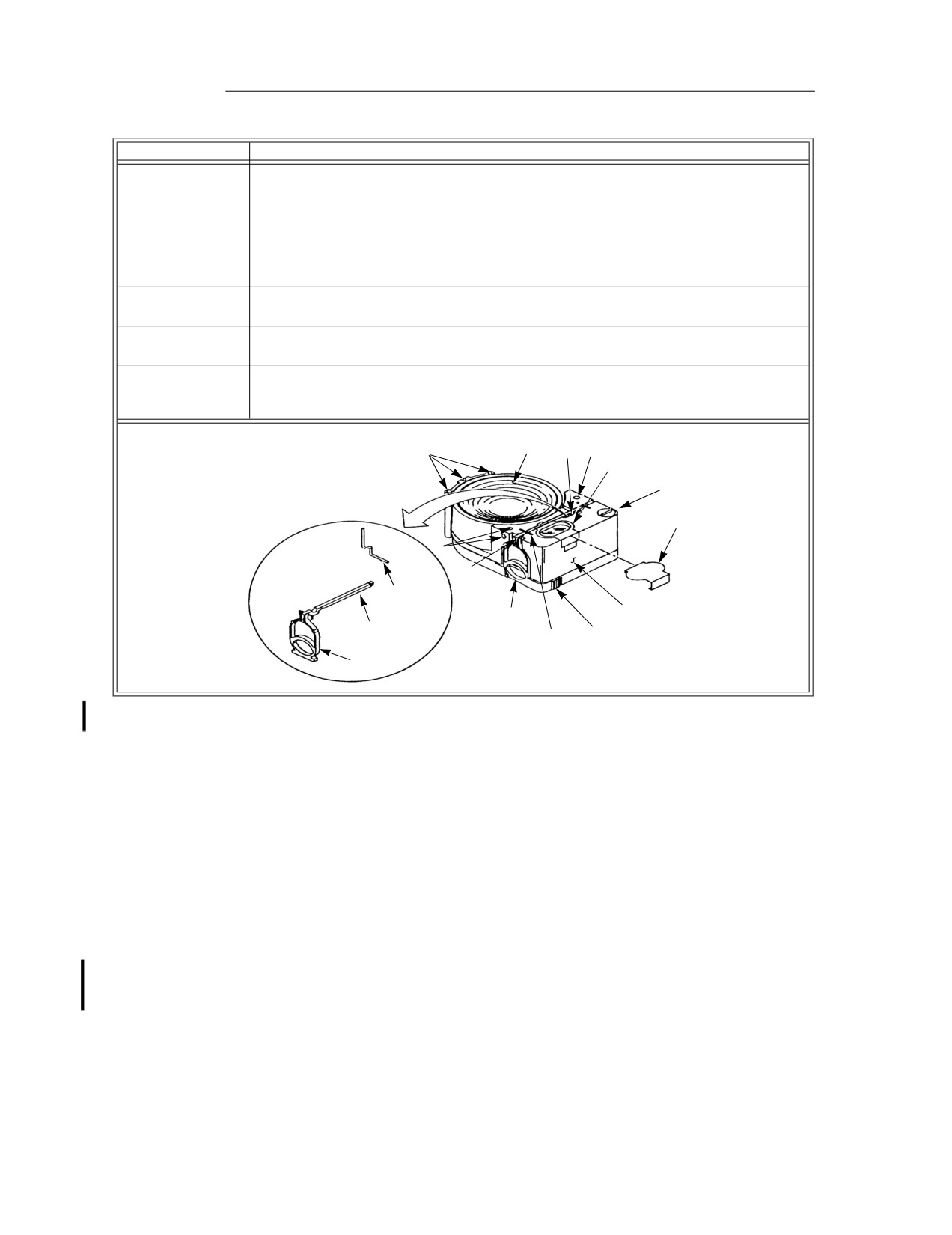
Figure B-1 describes and illustrates the major components of the SLAM.
Component
Description
The mounting holes are used to secure the carrying strap or the mounting wire to the
Mounting holes (1)
SLAM when attaching the SLAM to trees and so forth.
Two bore sights and an omega sight are located on the top of the SLAM and are used to
Bore sights (2)
aim the SLAM at targets.
The selector switch is used to select operating modes and times. It has eight detent
positions. The switch is against a stop (in the shipping position), which is the only switch
position that allows the SLAM to fit in the reusable environmental protective pack.
Turning clockwise, there are three positions for selecting the operating time (4, 10, and
24 hours). Setting any of these positions will select an internal sensor mode of
Selector switch (3)
operation, which is a magnetic sensor for mine mode and a passive infrared sensor for
side-attack mode. These three positions will cause the SLAM to self-destruct (M4) or
self-neutralize (M2) at the end of the selected operating time. Continuing clockwise, the
last four positions select an internal timer, which sets the minutes until demolition. These
positions are 15, 30, 45, and 60 minutes.
There is a shear pin mounted across the SLAM’s lever slot. If the shear pin is sheared,
Activation-lever
thereby breaking the seal, the lever may have been pulled and the SLAM may be an
shear pin (4)
electronic dud. If the shear pin is broken, it should only be used in the command-
detonation mode.
The safety pin slides from the body and starts the SLAM’s timing. It is pried from its latch
Safety pin (7)
with the tip of the lever. Once the safety pin is pulled, it cannot be reinserted.
Figure B-1. SLAM components
Controls and Components of Special-Purpose Munitions B-1
C2, FM 20-32
Component
Description
The SLAM is equipped with a passive infrared sensor that detects trucks and light
armored vehicles by sensing the change in background temperature as vehicles cross in
Passive infrared
front of the SLAM. The sensor is directional and is aligned with the EFP. The sensor is
sensor (8) and
active when the SLAM is operating with the selector switch set to 4, 10, or 24 hours and
cover (9)
the sensor cover is removed to expose the infrared sensor (such as, during the side-
attack mode). The SLAM will self-destruct (M4) or self-neutralize (M2) if the selected
time expires before it is detonated by vehicle passage.
Blasting-cap well
The threaded plug seals the blasting-cap well. It is removed to mount a standard military
and plug (10)
blasting cap with a priming adapter.
The warhead is an EFP that is designed to defeat light armored vehicles. The EFP forms
Warhead (11)
within the first 5 inches of flight and has an effective range of 25 feet.
The housing assembly contains the fusing, electronics, and S&A components. It also
Housing assembly
provides a structural interface for the warhead, the sights, the activation lever, the
(12)
passive infrared sensor, the selector switch, and the safety pin.
2
11
7
1
8
10
9
1
6
7
5
12
6
3
4
5
Figure B-1. SLAM components (continued)
M93
HORNET
The M93 Hornet is a lightweight (35 pounds) AT/antivehicular munition that
one person can carry and employ. It is a one-time use, nonrecoverable
munition that is capable of destroying vehicles using sound and motion as
detection methods. The Hornet will automatically search, detect, recognize,
and engage moving targets, using top attack at a maximum standoff distance
of 100 meters. It is employed by units equipped with an M71 RCU. The RCU is
a hand-held encoding unit that interfaces with the Hornet when the remote
mode is selected at the time of employment. After encoding, the RCU can be
used to arm the Hornet, reset SD times, and destruct the Hornet.
Employment methods of the Hornet are outlined in Chapter 4.
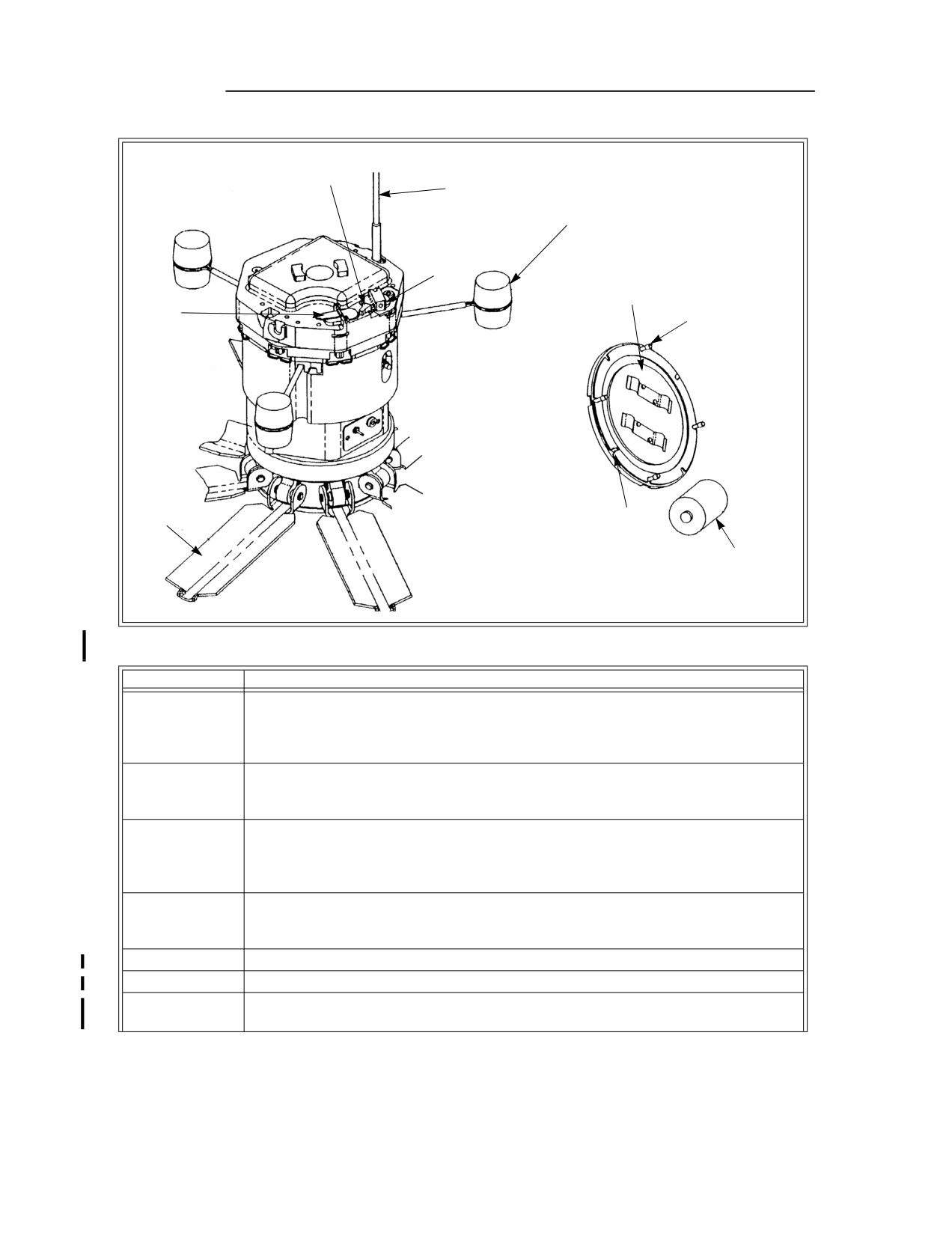
Figure B-2 describes and illustrates the major components of the Hornet.
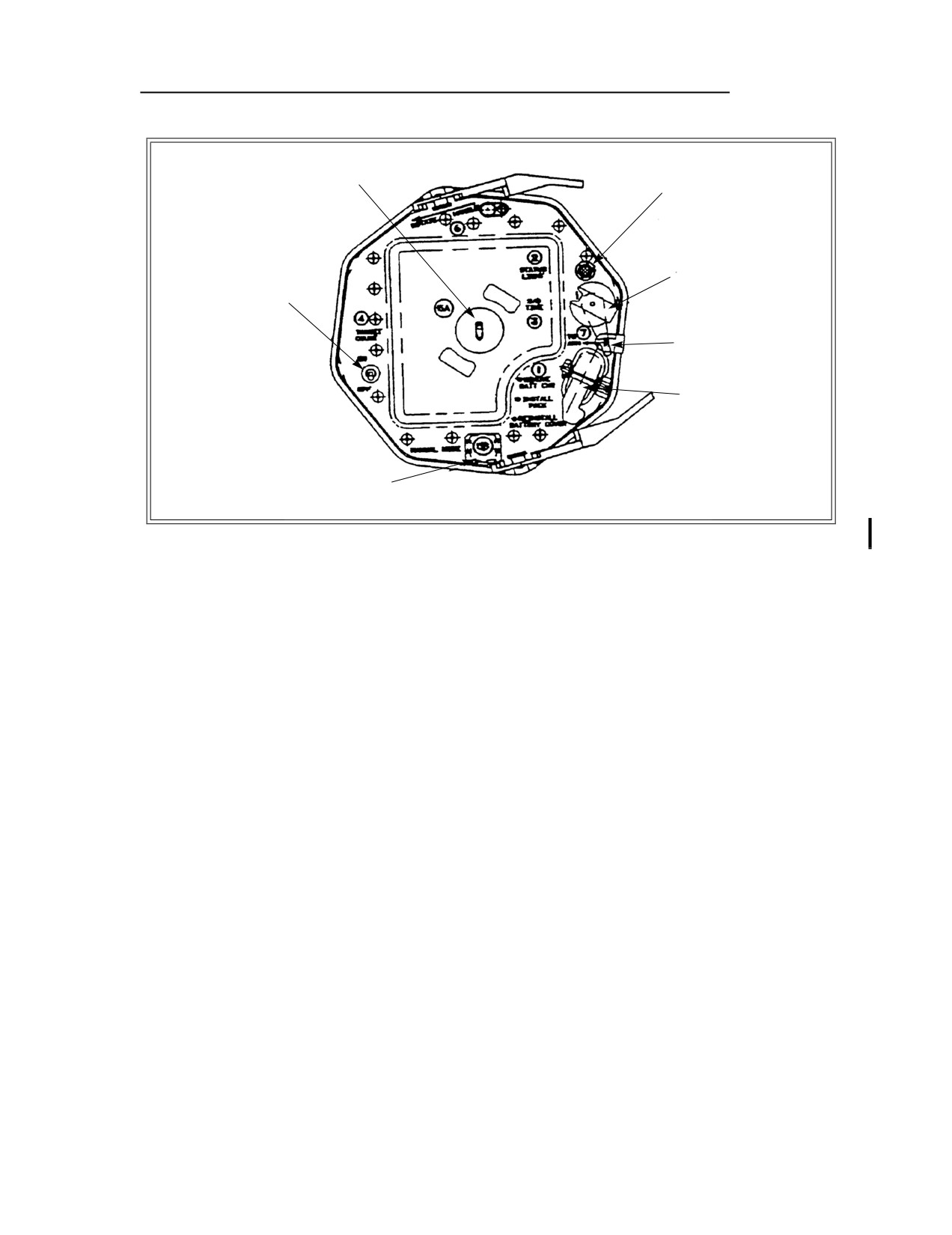
Figure B-3, page B-4, describes and illustrates the controls and indicators of
the Hornet.
B-2 Controls and Components of Special-Purpose Munitions

C2, FM 20-32
Component
Description
Support legs (1)
Support legs are used to stabilize the Hornet when it is deployed.
The active battery-pack cover provides a seal to protect and secure the active battery
Active battery-
pack. The latch is lifted up to remove the cover, the active battery pack is installed, and
pack cover (2)
the cover is then reinstalled and latched down. A line secures the battery-pack cover to
the control panel of the munition.
The SD switch is a six-position rotary switch that is used to select the SD time and
unlock the arm control switch. The SD switch is also used to unlock the arming lever.
This is done by rotating the switch to the setting “U.” A red lock element is extended 1/8
inch from the side of the munition when the SD switch is in the unlock position. The SD
time is preset to Setting 1 when the Hornet is shipped. SD times are as follows:
SD switch (3)
Setting
Time
1
4 hours
2
48 hours
3
5 days
4
15 days
5
30 days
The arm control switch consists of an arming lever interlocked with the SD switch and
the S&H band assembly to prevent inadvertent actuation. Until the S&H band assembly
Arm control
is removed and the SD switch is placed in the unlock position, the arming lever cannot
switch (4)
be moved to the arm position. An internal lock secures the arming lever in the arm
position.
When the geophone seismic sensor detects a potential target, usually at ranges up to
Microphones (5)
600 meters, it alerts the munition to start listening with the three microphones that
extend from the munition body. They track the two loudest noise sources that are heard.
Antenna (6)
The antenna provides a means for the Hornet to receive M71 RCU commands.
Capture screws
These are four flat-head screws that secure the bottom plate to the munition body. They
(7)
are removed along with the bottom plate to access the battery compartment.
The bottom plate provides a seal to protect and secure the battery compartment and
Bottom plate (8)
connect the batteries once they are installed.
D-cell batteries
The battery compartment houses four D-cell batteries. A drawing on the inside of each
(9)
battery tube shows battery orientation.
The dowel pin ensures that the bottom plate is in the correct orientation to properly
Dowel pin (10)
connect the batteries.
Figure B-2. Hornet components
Controls and Components of Special-Purpose Munitions B-3
C2, FM 20-32
4
6
5
3
8
2
7
1
10
9
Figure B-2. Hornet components (continued)
Component
Description
This device is used as part of the RCU interface. The RCU interface consists of the
Magnetic
MCD and keyed tabs. In the remote arming mode, the RCU is placed on top of the MCD
coupling device
and minefield code data is transferred to the munition. Upon successful encoding, the
(MCD) (1)
status light begins to flash.
The target switch is a toggle switch used to select the type of target engagement. This
Target switch (2)
gives the operator the choice between detecting and destroying only heavy armored
vehicles or all vehicles.
The manual select switch is a push-button switch, protected by a plastic cover that must
Manual select
be removed to access the switch. Successful activation of the switch will cause the
switch (3)
status light to flash. This switch is used to allow the operator to employ the Hornet
without the RCU.
The status light is a visual indicator for the operator during the munition setup. It is a
Status light (4)
green light-emitting diode (LED) that indicates a self-test was successfully performed or
an operating-mode selection was successfully selected.
SD switch (5)
See Figure B-2, page B-3.
Arming lever (6)
See Figure B-2.
Active battery-
See Figure B-2.
pack cover (7)
Figure B-3. Hornet controls and indicators
B-4 Controls and Components of Special-Purpose Munitions
C2, FM 20-32
1
4
5
2
6
7
3
Figure B-3. Hornet controls and indicators (continued)
Controls and Components of Special-Purpose Munitions B-5
C2
Appendix C
Threat Mine/Countermine Operations
This appendix is intended to complement the information presented in
other manuals on threat obstacle tactics. It applies to most threat armies
and their surrogates. Commanders should use this information to give
added realism to unclassified training, although obstacle employment
norms can change with METT-TC factors for a given AO. Therefore,
preoperational training on templating, intelligence, reconnaissance, and
reduction procedures must be based on the best information available
before deployment.
Appendix G contains a compilation of countermine data.
MINE OPERATIONS
Threat formations contain considerable organic minefield emplacement
capability. Threat rapid-mining capability presents a serious challenge to
friendly maneuver.
To lay mines and place obstacles rapidly during offensive operations, threat
armies form a special team from regimental and divisional assets. This team
is called a mobile obstacle detachment (MOD). The MOD places AT mines on
the most likely avenues for armored attacks or counterattacks. MODs are
positioned on the flanks of a march formation for rapid deployment and are
normally close to AT reserves. During the march, MODs reconnoiter avenues
into the flanks and identify the most likely avenues for tank movement. At
secured objectives, MODs reinforce existing obstacles and place new obstacles
to assist in the defeat of counterattacks.
The combined arms commander orders the organization of MODs and
determines their composition based on the combat situation and available
troops. Engineer elements in a division MOD come from the divisional
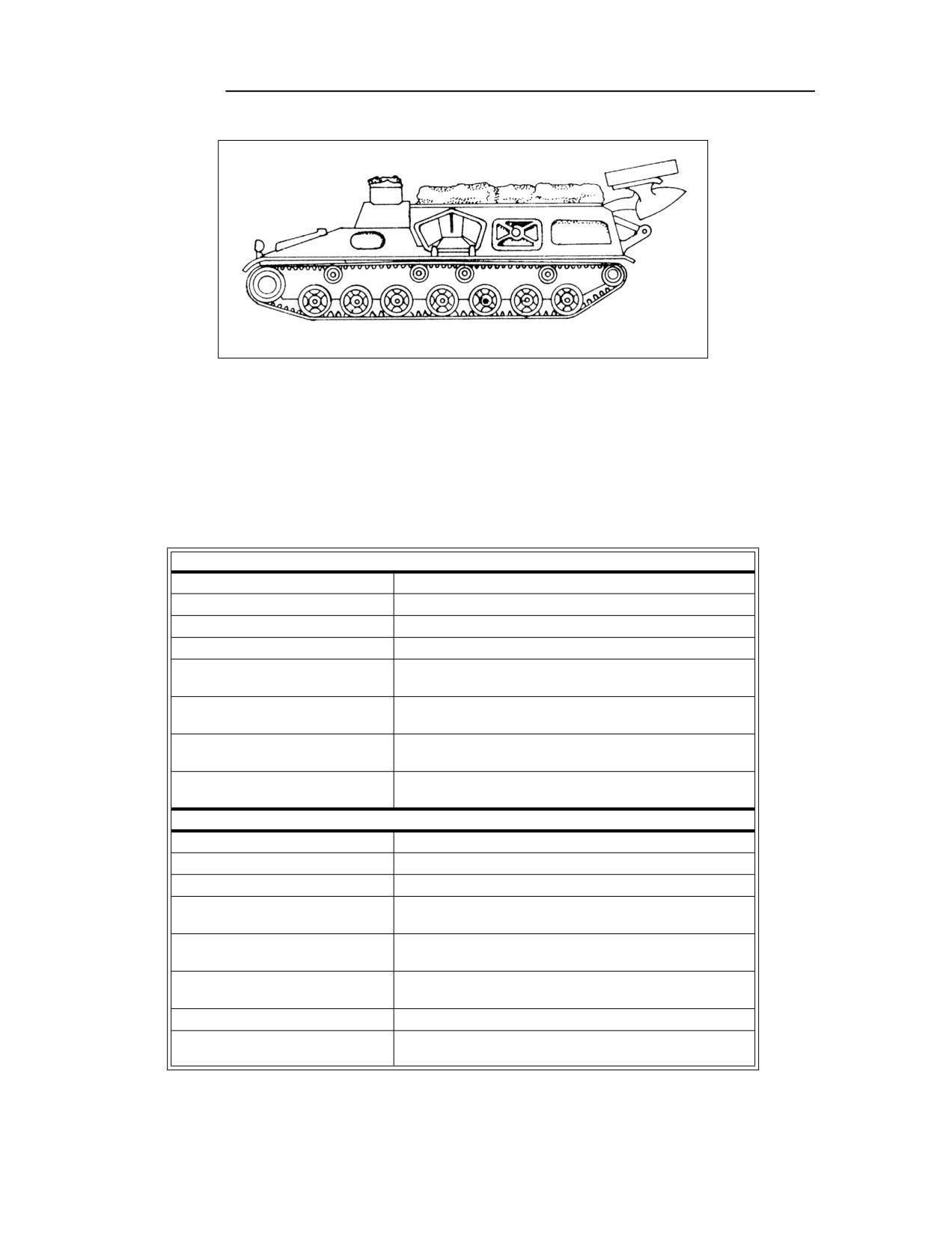
engineer battalion and normally consist of three armored tracked mine layers
known as GMZs (Figure C-1, page C-2). This platoon-sized element has two or
three trucks that carry mines for immediate resupply. For the regimental
MOD, the regimental engineer company normally provides a platoon-sized
unit equipped with two or three GMZs. The platoon travels in BTR-50/60s and
has 600 AT mines.
The GMZ dispenses mines at a predetermined spacing of 5.5 meters. Mine-
laying helicopters also support the MOD. The HIP and HIND-D helicopters
carry two or three dispenser pods of AP or AT mines. Artillery-fired
SCATMINEs can also support the MOD. Three GMZs can lay a 1,200-meter,
three-row minefield, containing 624 mines, in 26 minutes. Doctrinally, this
minefield would be broken into several minefields, each 200 to 300 meters
long.
Threat armies use obstacles extensively throughout the depth of their defense,
and their tactics are chosen well. Shallow obstacles are reduced quickly and
easily. For example, a shallow, one-row minefield is essentially reduced by
blowing one or two mines in the row. A threat rapidly emplaced minefield
Threat Mine/Countermine Operations C-1
FM 20-32
Figure C-1. GMZ armored tracked mine layer
consists of three or four 200- to 300-meter rows, spaced 20 to 40 meters apart,
with mines spaced 4 to 6 meters apart. As a rule, the minefield covers the
depth of a football field.
Table C-1 provides detailed information on standard threat AT and AP
minefields. Terrain and tactical situations dictate the actual dimensions and
distances of minefields.
Table C-1. Normal parameters for threat-style minefields
AT Minefields
Front (situation-dependent)
200 to 300 meters
Depth
40 to 120 meters
Number of rows
3 or 4
Distance between rows
20 to 40 meters
4 to 6 meters for antitrack mines; 9 to 12 meters for
Distance between mines
anithull mines
550 to 750 antitrack mines per kilometer; 300 to 400
Outlay, normal
antihull mines per kilometer
1,000+ antitrack mines per kilometer; 500+ antihull
Outlay, increased effect
mines per kilometer
57% for antitrack mines (750 per kilometer); 85% for
Probability of destruction
antihull mines (400 per kilometer)
AP Minefields
Front (situation-dependent)
30 to 300 meters
Depth
10 to 150 meters
Number of rows
3 or 4
5+ meters for blast mines; 25 to 50 meters for
Distance between rows
fragmentation mines
1 meter for blast mines; 50 meters (or twice the lethal
Distance between mines
radius of fragmentation) for fragmentation mines
2,000 to 3,000 HE/blast mines per kilometer; 100 to 300
Outlay, normal
fragmentation mines per kilometer
Outlay, increased effect
2 to 3 times the normal outlay
15 to 20% for HE/blast mines (2,000 per kilometer); 10
Probability of destruction
to 15% for fragmentation mines (100 per kilometer)
C-2 Threat Mine/Countermine Operations
FM 20-32
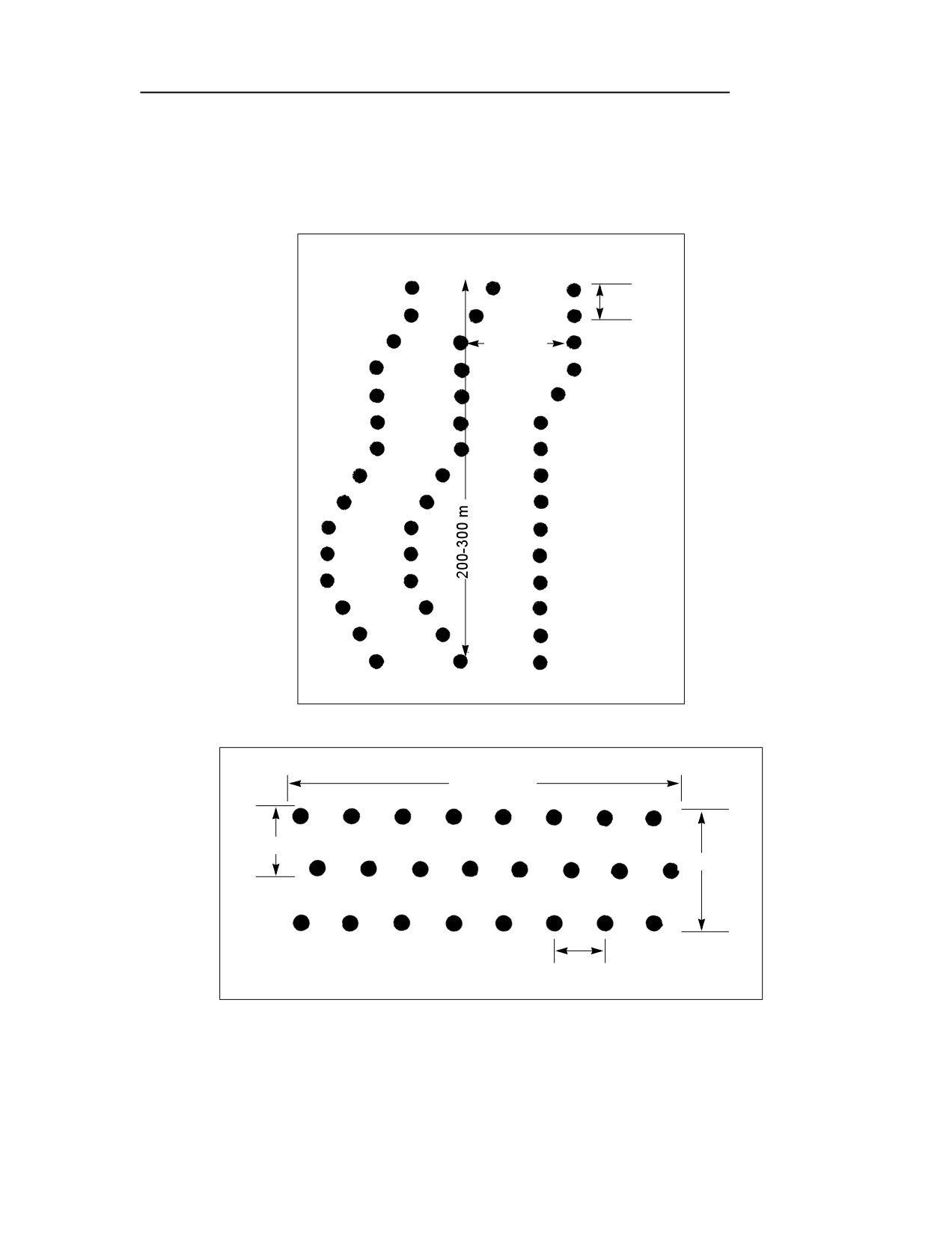
Figure C-2 shows a standard rapidly emplaced minefield. The threat army
typically uses such a minefield when they are in a hasty defense (offense is
temporarily stalled).
Figures C-3 shows a standard antitrack minefield.
5.5 m
20-40 m
Figure C-2. Threat-style rapidly emplaced minefield
200-300 m
20-40 m
40-80 m
4-6 m
Figure C-3. Threat-style antitrack minefield
Threat Mine/Countermine Operations C-3
FM 20-32
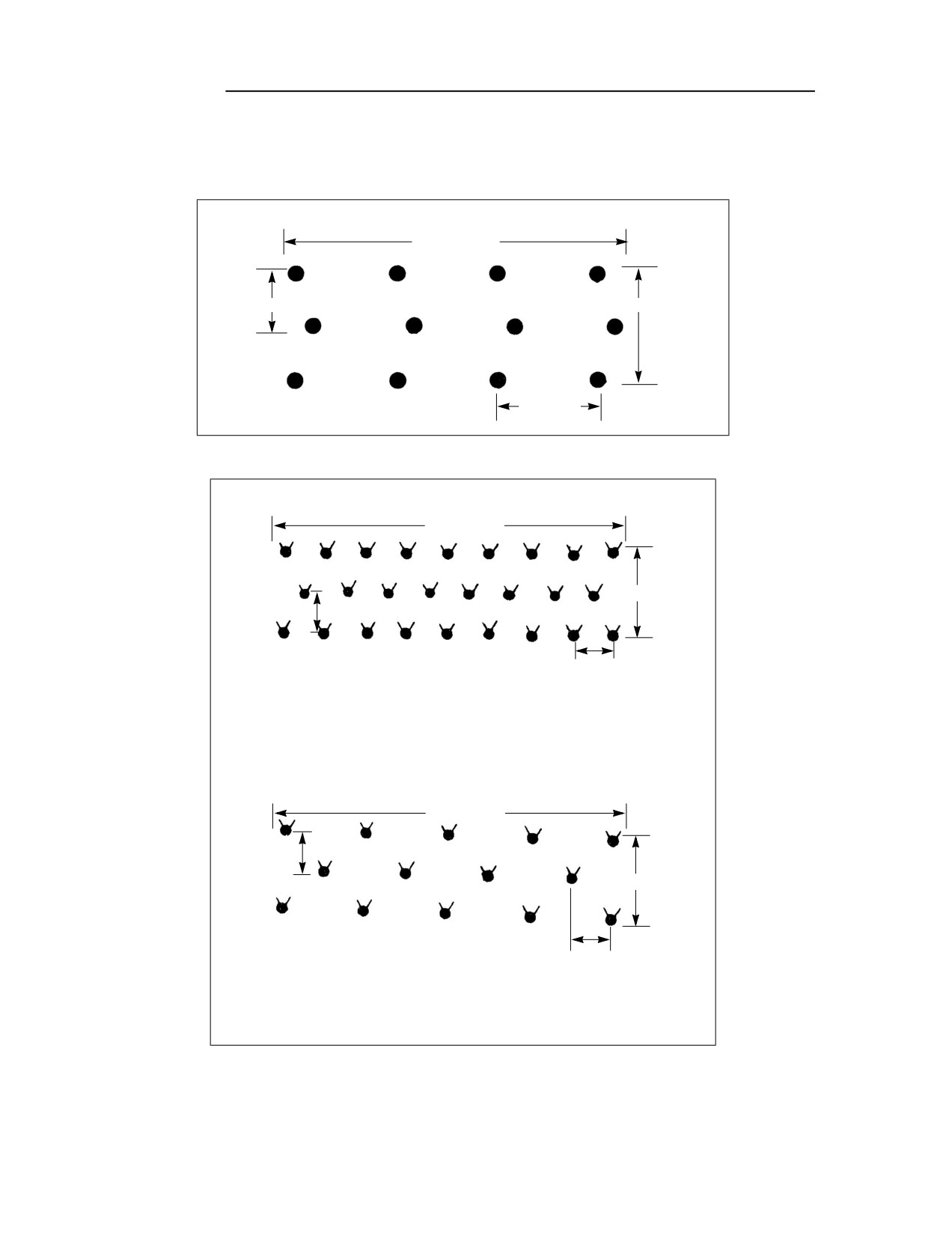
Figure C-4 shows a standard antihull minefield.
Figure C-5 shows a standard AP minefield.
200-300 m
20-40 m
70-80 m
9-12 m
Figure C-4. Threat-style antihull minefield
30-300 m
10-150 m
5+ m
1m
Blast Mines
Types: PMN, MPMD-GM
Density: 2,000-3,000 per kilometer
30-300 m
25 m
10-150 m
25-50 m
Fragmentation Mines
Types: OZM4, POMZ-2M
Density: 100-300 per kilometer
Figure C-5. Threat-style AP minefield
C-4 Threat Mine/Countermine Operations
FM 20-32
Threat armies also emplace mixed minefields. They are not the same as US
mixed minefields. Threat armies normally emplace three rows of AT mines,
then several rows of AP mines. AT and AP mines are not mixed in the same
row.
Threat engineers use two fundamental drills to emplace mines:
• When emplacing armed mines, the drill uses a crew of five sappers.
The first crew member (the senior man and operator) is in the mine-
layer’s seat and monitors the operation of the mine layer and the
motion of the mines in the guide chute. He also sets the mine spacing
and controls the actions of the GMZ. The second and third members
take mines out of containers and place them in the intake chute at
intervals between the guide tray's drive chain. The GMZ driver steers
the vehicle along the indicated route at the established speed.
• When emplacing unarmed mines, two or three additional sappers are
assigned to arm the mines. After emplacing the mines, one sapper
trails the mine layer, marks emplaced mines with pennants, and
partially camouflages the mines. The remaining sapper(s) then arm
the mines.
Special precautions are taken when emplacing AP minefields. Threat doctrine
only allows PMN mines to be surface-laid from mine layers. POMZ-2M mines
are emplaced with the truck-and-tray technique. Extra effort is required to
assemble, emplace, and deploy the trip wire and to camouflage the POMZ-2M
mine.
Using three GMZs, a threat MOD can emplace 1,200 meters of a three-row AT,
surface-laid minefield, containing 624 AT mines, in 26 minutes. This does not
include the 12- to 15-minute reload and travel times. Travel and reload times
increase during limited visibility.
Threat forces can also have ground-emplaced SCATMINE capability. One such
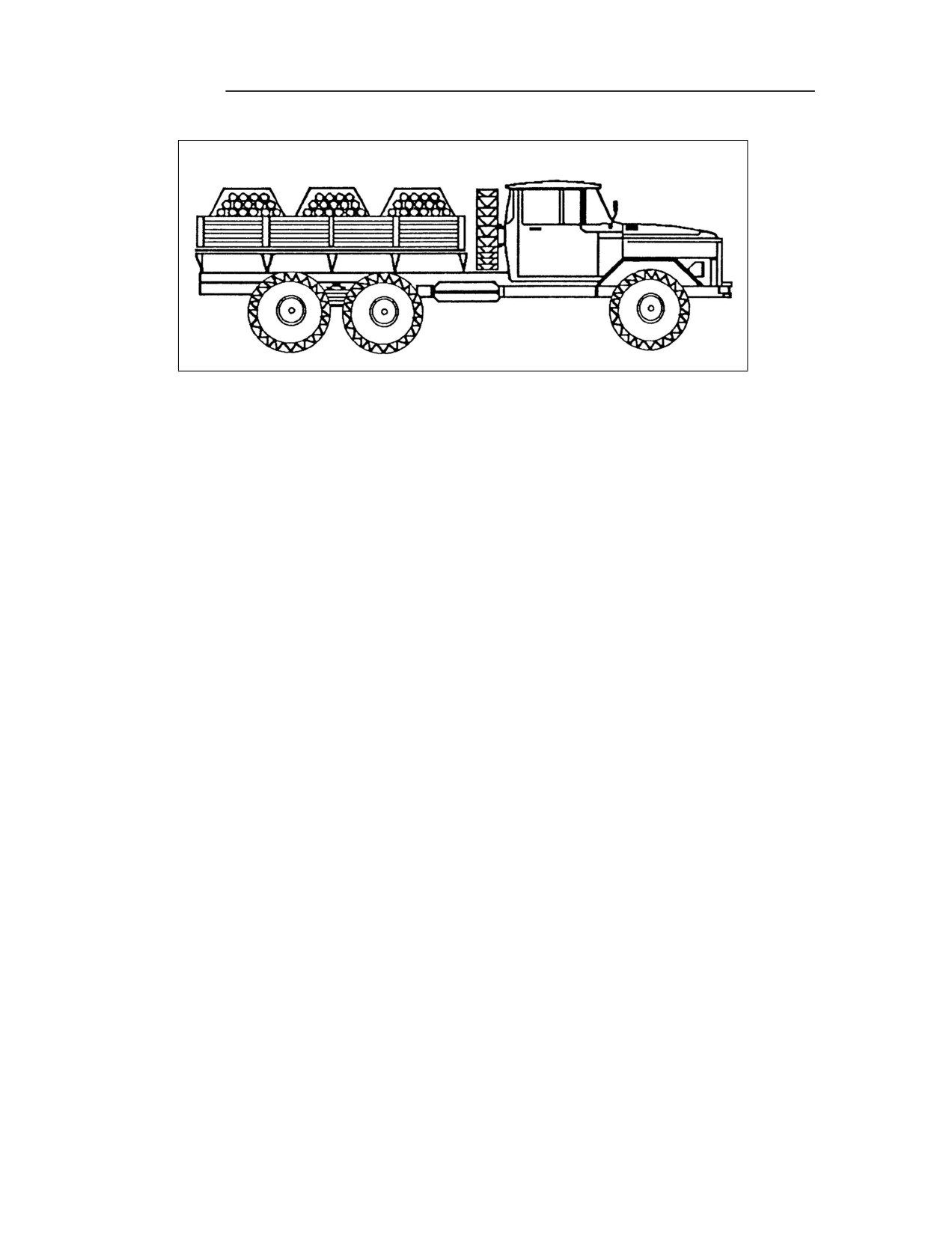
system is the UMZ SCATMINE system (Figure C-6, page C-6). There are
three UMZ truck-mounted SCATMINE systems in each combat regiment. The
UMZ consists of six firing modules mounted on the back of a Zil-131 truck.
Each module has 30 firing tubes, for a total of 180 firing tubes per system.
Depending on the type of minefield desired, the UMZ can lay 180 to 11,520
mines without reloading. The UMZ can launch an AT or AP minefield 30 to 60
meters from the vehicle while the truck is driving 10 to 40 kph. It takes two
men 1½ to 2 hours to reload the UMZ. One UMZ can lay a three-row
minefield, 150 to 1,500 meters long, depending on the type of mine that is
used.
UMZ vehicles are usually deployed together as a mobile obstacle/mine-laying
detachment. The UMZ is used to lay minefields that protect subunit positions
and flanks and the boundaries between subunits. UMZ-laid minefields also
cover firing lines and gaps in combat formations. The UMZ can quickly close
gaps in existing minefields and increase the density of mines on armor
avenues of approach.
For hand-emplaced SCATMINEs, there is a man-portable SCATMINE
dispenser. The PKM weighs 2.63 kilograms (without the mine canister) and
consists of a single launch tube with a base mount, a blasting machine, and a
reel of electric ignition wire. The operator loads a propelling charge and a
mine canister into the launch tube and mounts the tube on the edge of a
trench or firing parapet. He then aims the tube, connects the ignition wire to
Threat Mine/Countermine Operations C-5
FM 20-32
Figure C-6. UMZ SCATMINE system
the tube, and moves to a safe distance. At an initiating point, the operator
connects the ignition wire to the blasting machine and initiates the system.
The PKM propels the canister 30 to 100 meters, depending on the type of
mine. It lays an AP minefield that is 10 by 20 meters (POM-1S mine canister),
10 by 40 meters (POM-2S mine canister), or 20 by 10 meters (PFM-1S mine
canister). It takes a trained operator 5 minutes to set up the PKM and create a
minefield. The PKM can also be used to launch the PTM-1S and PTM-3 AT
mine canisters.
Threat forces use the PKM to lay minefields that protect subunit positions
and flanks and the boundaries between subunits. PKM-laid minefields also
cover firing lines and gaps in combat formations. The PKM can quickly close
breaches in existing minefields and increase the density of mines on armor
avenues of approach.
The type and complexity of an obstacle depends on the installing unit.
Maneuver and artillery soldiers usually install simple single-system
minefields that are protective in nature. Engineer soldiers install complex
obstacles that can include AHDs. Engineer obstacle placement is usually
equipment-intensive. Threat engineer effort generally concentrates on tactical
obstacles unless maneuver soldiers are unable to employ the necessary
protective obstacles. Threat units continue to improve the obstacles,
supporting their positions by marking the friendly side of the obstacles,
burying mines, and adding AHDs.
CHEMICAL MINES
Chemical land mines are AP mines with command- or target-detonated fuses,
and they are filled with a persistent chemical (nerve or blister) agent. US
policy prohibits their use by US personnel. However, this does not preclude
their use by other countries, and US forces may encounter them during
operations. When used, they are normally used in defense and retrograde
operations. They are mixed with HE mines to form a HE chemical minefield.
Chemical mines are normally encountered in tactical or nuisance minefields,
and some countries use them in protective minefields. When an integrated HE
chemical minefield is laid, it serves the following purposes:
• Chemical mines discourage the use of explosive, rapid mine-clearing
devices because they create a chemical hazard in the area.
C-6 Threat Mine/Countermine Operations
FM 20-32
• HE mines reduce the speed of enemy forces crossing the minefield.
Speed is further reduced by forcing the enemy to use protective
clothing and masks.
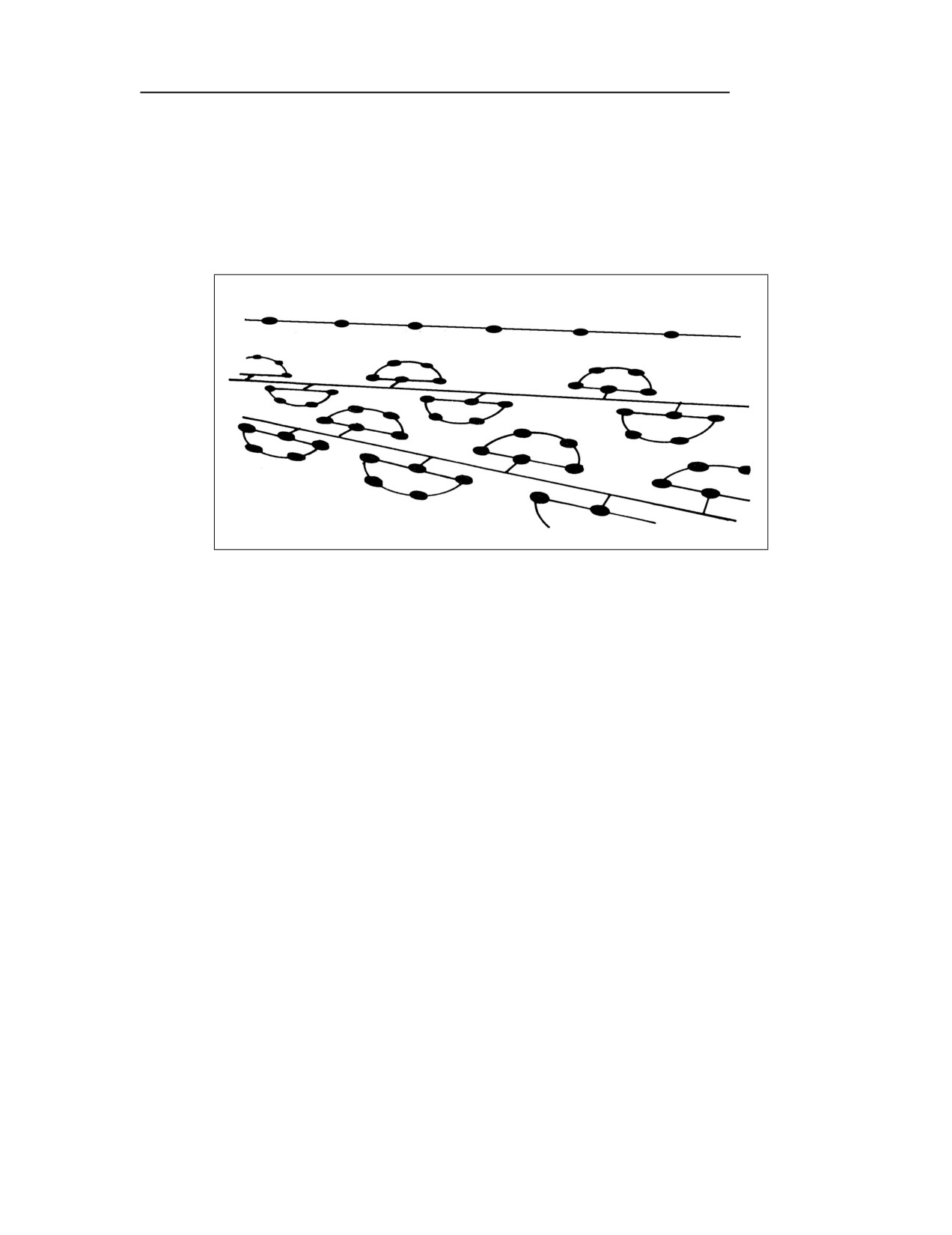
Chemical mines will usually be added to existing HE minefields by laying
additional strips of chemical mines in a random pattern or by adding HE
chemical strips or rows to the front or rear of existing fields (Figure C-7).
Chemical mines
Regular mine
clusters
Figure C-7. Chemical-mine employment
No particular branch is responsible for clearing chemical mines. Planning
chemical countermine operations is a brigade-level responsibility. When
reducing chemical mines, consider prevailing and expected wind conditions.
Commanders must ensure that friendly troops are protected when chemical
agents are released. The release of chemical agents occurs as a result of
enemy fire or friendly breaching attempts. Contact-actuated chemical mines
are not likely to create a major downwind hazard because only single mines or
small groups may be set off at one time.
COUNTERMINE OPERATIONS
In offensive operations, threat engineers clear lanes through obstacles when
they cannot be bypassed. Although clearing obstacles applies to the march and
the defense, the most critical performance of this task occurs during the
attack. Engineers can be required to clear mines delivered by air, artillery, and
rockets well ahead of NATO's forward edge. They must breach obstacles
contained within NATO strongpoints. Threat forces must also clear their own
minefields when making the transition from defense to offense. In the offense,
threat forces breach or bypass remotely delivered minefields in their form-up
areas or routes of movement to the attack line. They also breach obstacles
along the forward edge of the battle area and deep within NATO defenses.
Although clearing passages through obstacles is a primary task for threat
engineers, any maneuver element may encounter mines. Engineers may not
be able to respond to every encounter, so maneuver troops are also required to
breach through remotely emplaced obstacles.
ORGANIZATION
A movement support detachment (MSD) supports the movement of maneuver
forces. It is task-organized from divisional or regimental engineer assets and
Threat Mine/Countermine Operations C-7
FM 20-32
can be platoon- to company-size. The MSD is equipped with route- and mine-
clearing vehicles and devices. Depending on the mission (which comes directly
from the combined arms commander or the chief of engineer services), an
MSD is capable of filling craters, clearing minefields, preparing bypasses
around major obstructions, and identifying NBC-contaminated areas.
The divisional engineer battalion can form two or three MSDs. During
marches, MSDs travel in advance of the main body and clear obstructions
reported by division reconnaissance elements. When they are deployed on
main routes, they are under the protection of an advance guard or forward
security element. When deployed on other routes, the leading regiments
provide MSDs from organic engineer assets. An MSD at this level might
consist of an engineer platoon, with one or two dozers and up to three tanks
fitted with dozer blades. MSDs can be protected by a platoon of infantry or
tanks and are usually accompanied by chemical-reconnaissance personnel.
They can detect, mark, and breach hasty minefields that are not properly
covered by fire. If MSDs encounter properly defended minefields, their
clearing capabilities are limited.
Each battalion forms an obstacle-clearing group to create gaps in explosive
and nonexplosive obstacles. Normally a part of a battalion-level MSD, the
group follows first-echelon companies in APCs and creates gaps for those
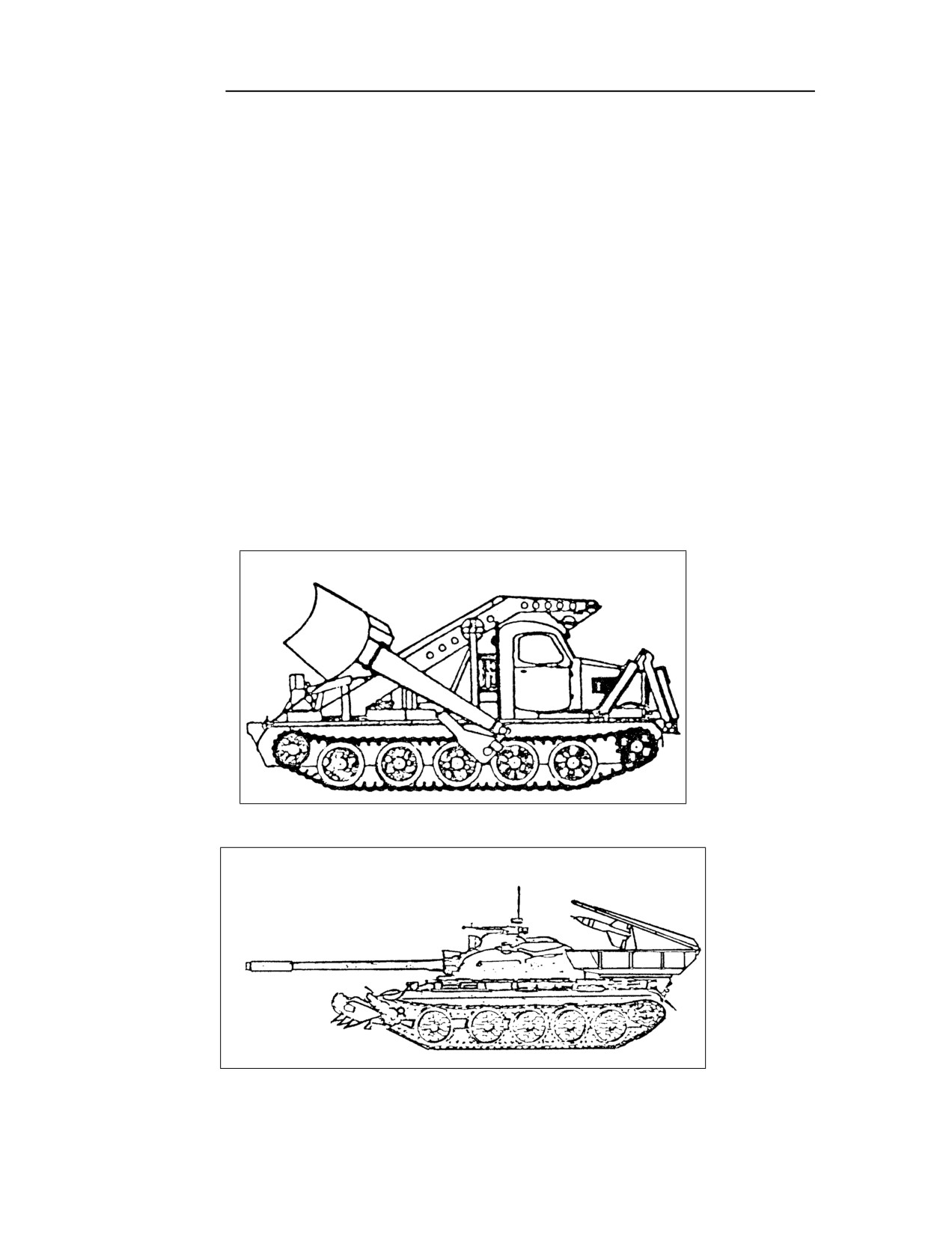
forces. These units may possess BAT-M vehicles with BTU bulldozer blades
(Figure C-8) or KMT-series mine plows (Figure C-9).
Figure C-8. BAT-M with BTU bulldozer blade
Figure C-9. KMT-4 plow
C-8 Threat Mine/Countermine Operations
FM 20-32
An obstacle-clearing detachment is created when more resources are needed
to clear obstacles and debris. This usually occurs in urban environments and
under conditions of massive destruction. An obstacle-clearing detachment is
similar to an MSD, but its sole mission is to clear debris. Like an MSD, its
composition depends on the mission scope, the mission objective, and the
tempo of the offensive.
The divisional engineer battalion of the motorized rifle or tank division has a
sapper company to clear obstacles. The company commander receives a
mission to clear minefields. He then determines the exact location of the
obstacle, ascertains the assets to devote to the task, and plans the
methodology for success. Teams may be created to manually breach lanes
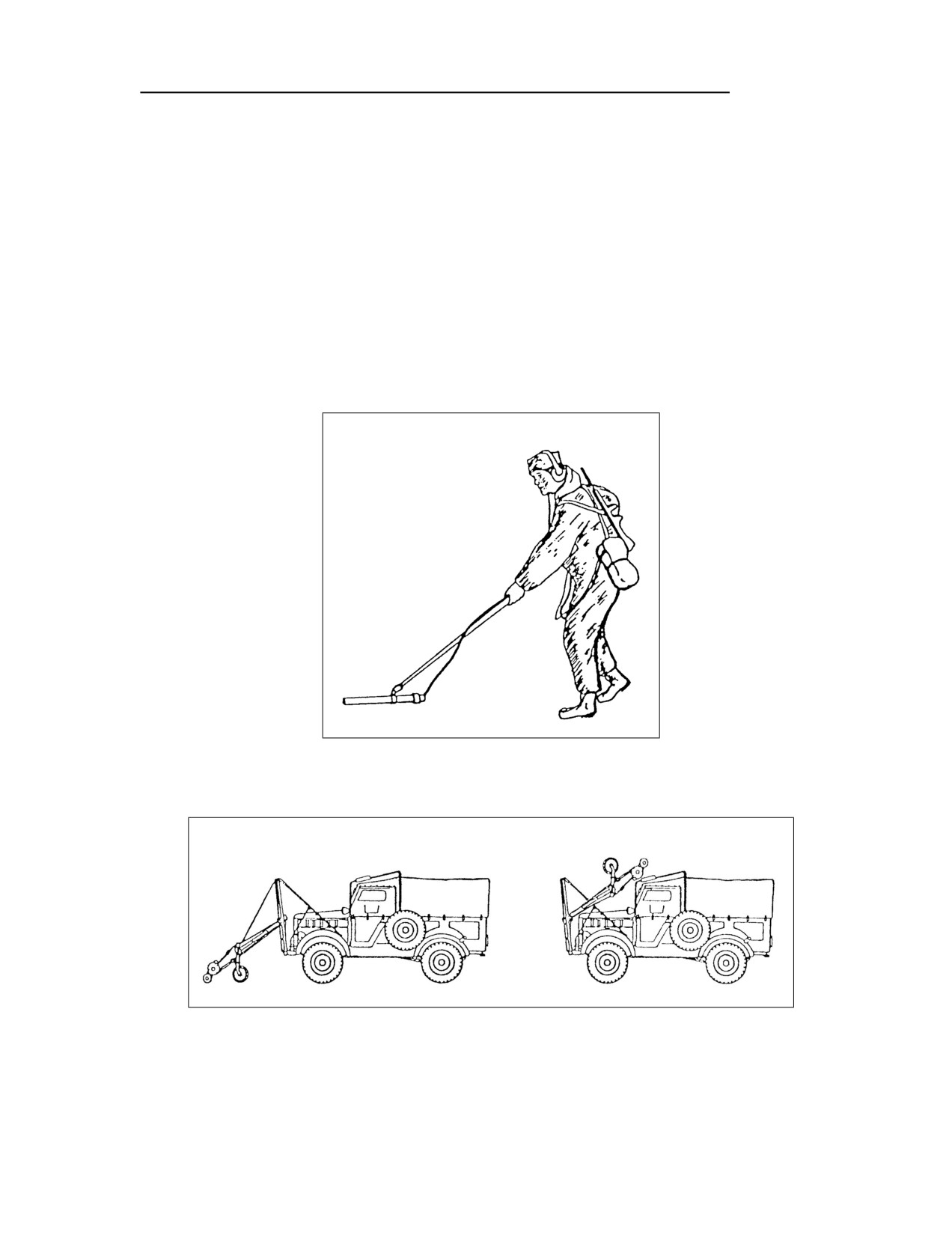
using probes, IMP portable mine detectors (Figure C-10), and shovels. Larger
tasks may necessitate the use of vehicle-mounted DIM mine detectors (Figure
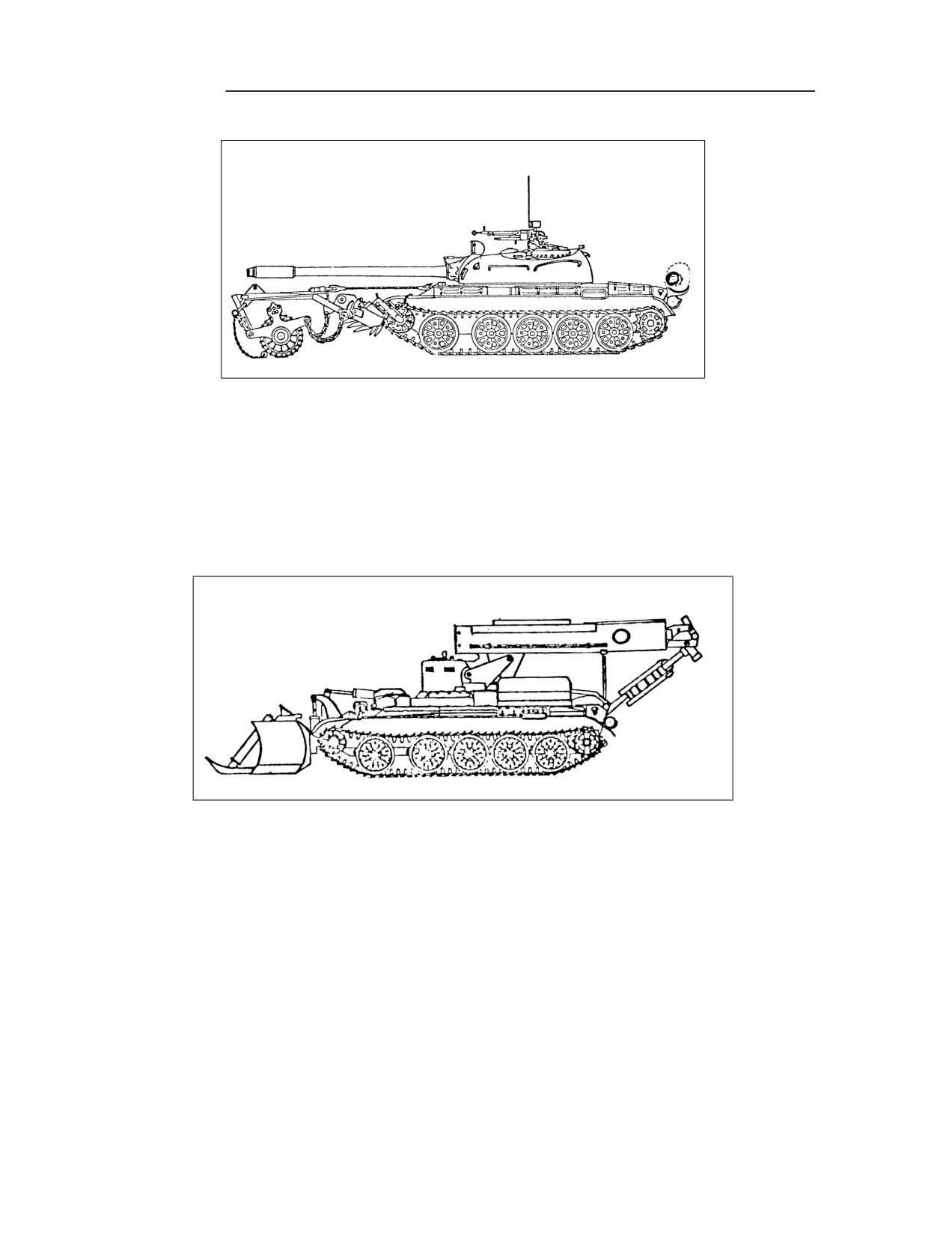
C-11), armored vehicle mine plows and/or rollers (Figure C-12, page C-10),
and explosive line charges. When necessary or more practical, mines are
explosively destroyed in place.
Figure C-10. IMP portable mine detector
Figure C-11. DIM mine detector
Threat Mine/Countermine Operations C-9
FM 20-32
Figure C-12. KMT-5 plow-roller combination
The engineer company of the motorized rifle or tank regiment has breaching
equipment such as KMT-series mine plows and rollers and BTU bulldozer
blades located in its technical platoon. Because of limited assets in the
technical platoon, coupled with the responsibility of forming its own MSD, the
regiment can receive a sapper section from the divisional sapper company. An
additional IMR armored engineer tractor (Figure C-13), BTR-50/60, and
M1979 armored mine clearer (Figure C-14) and manual breaching equipment
come with the sapper section.
Figure C-13. IMR armored engineer tractor
Maneuver units usually breach remotely emplaced obstacles by using
attached, built-in breaching equipment (BTUs and KMTs). In order to carry
out this task successfully, all subunit commanders must organize constant
reconnaissance, notify subordinates about mined areas in a timely manner,
train personnel on the means and methods for handling remotely emplaced
mines, and clear terrain in a timely manner. They must also train their own
teams for independent actions when removing combat equipment from mined
areas. Plows in the threat army are considered maneuver-force assets, and one
plow is assigned to each tank platoon. The BMP has recently been equipped
with track-width mine plows, but the allocation has not been determined.
C-10 Threat Mine/Countermine Operations
FM 20-32
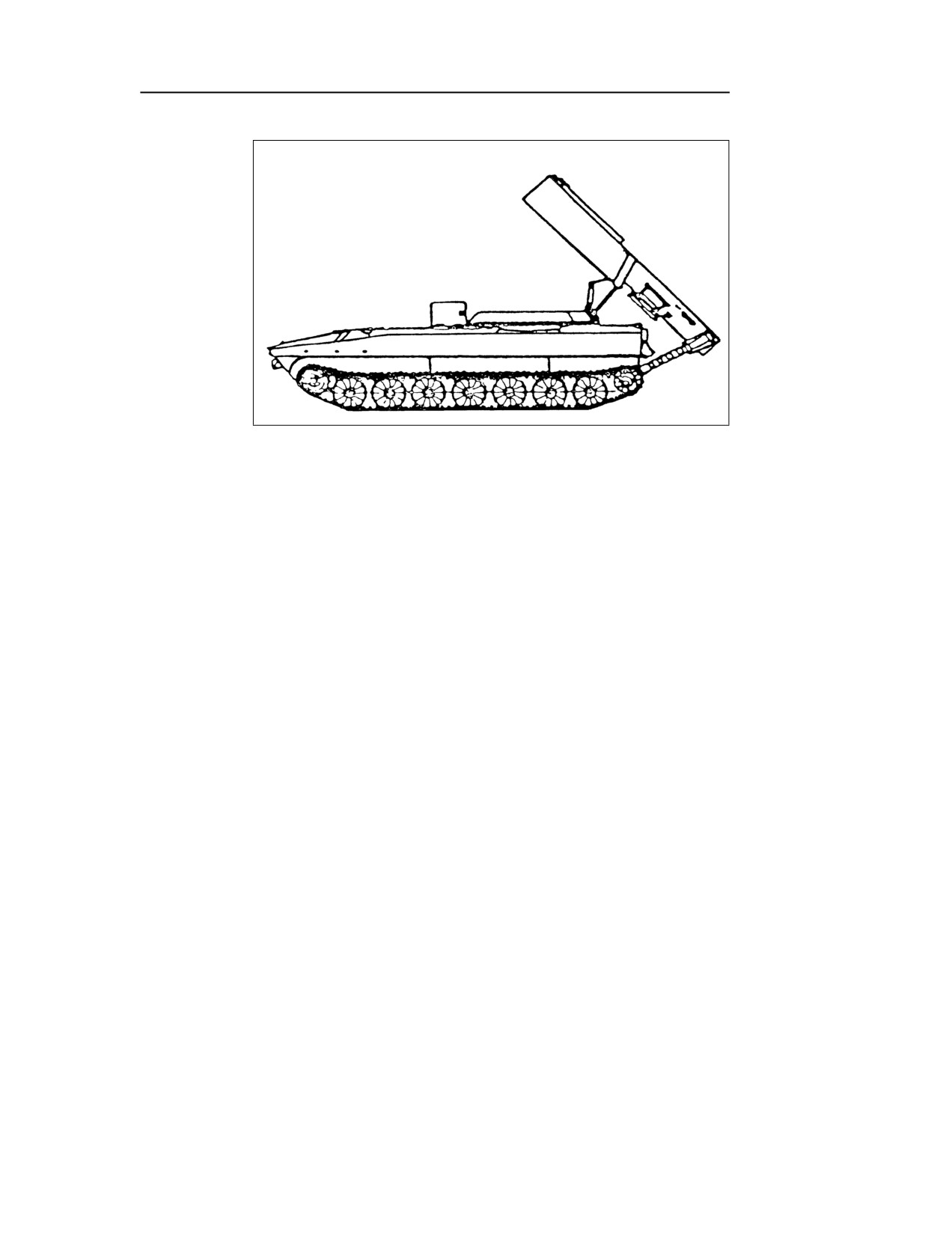
Figure C-14. M1979 armored mine clearer
EQUIPMENT
Several pieces of equipment are used by threat armies to detect and clear
mines.
BAT-M Dozer
The BAT-M dozer (Figure C-8, page C-8) is a modified artillery tractor with a
hydraulically operated bulldozer blade and crane. It is sometimes called a
roader by Russians. The BAT-M dozer clears obstacles, fills craters, prepares
bridge approaches, and performs other heavy pioneer tasks. It can also be
configured for snowplowing.
The second generation BAT-M is the BAT-2. The BAT-2 is able to carry an 8-man
engineer squad and operate in an NBC environment. It is replacing the BAT-M.
KMT-Series Plows and Rollers
KMT-4
The KMT-4 mine-clearing plow (Figure C-9, page C-8) was developed in the
1960s to fit on a T-545/55 tank. It actually consists of two plows (one mounted
in front of each track), and each plow has five attached teeth. When the plow
is lowered, the teeth dig into the ground and remove mines from the path of
the tank. A plow is lighter than a roller and permits tanks to retain their
cross-country mobility. The estimated clearing speed is 10 kph, and the depth
of clearance is 10 centimeters.
Three plows are issued per tank company (one per platoon). However, these
assets are normally held in the engineer company of a tank or MRR.
KMT-5
The KMT-5 mine-clearing plow-roller combination (Figure C-12, page C-10)
consists of two plows and two rollers attached to the front of a tank hull. The
plows or the rollers can be used, depending on terrain features, the type of
soil, and the mine fuse. Plows and rollers cannot be used simultaneously. The
rollers function against pressure-fused mines. The system can survive 5 to 6
kilograms of explosives, five or six times. The KMT-5 also includes a luminous
lane-marking device for night operations.
Threat Mine/Countermine Operations C-11
FM 20-32
KMT-6
The KMT-6 mine-clearing plow was introduced with the T-64 and T-72 tanks
in the early 1970s. It has operating characteristics similar to those of the
KMT-4.
KMT-10
The KMT-10 mine-clearing plow is fitted to the BMP-2 infantry combat
vehicle.
IMP Portable Mine Detector
The IMP portable mine detector (Figure C-10, page C-9) weighs 7 kilograms
and can detect mines buried to a depth of 45 centimeters. It has a tubular
search head (one transmitting and two receiving coils encased in plastic) and a
four-section handle. Power is furnished by four flashlight batteries that
permit 20 hours of continuous operation. Two tuning controls are mounted on
the handle. The coils in the search head compromise an induction bridge and
are initially balanced for zero coupling. When the head passes over a metallic
object, the induction bridge becomes unbalanced and produces an audible
signal in the headset.
DIM Vehicle-Mounted Mine Detector
The DIM vehicle-mounted mine detector (Figure C-11, page C-9) is primarily
used to clear roads during convoys and road marches. It sweeps at a speed of
10 kph with a 2.2-meter width. It can detect metallic mines at a depth of 25
centimeters. The brakes on the DIM automatically engage when a mine is
detected. Cross-country use of the DIM is limited.
IMR Armored Engineer Tractor
The IMR armored engineer tractor (Figure C-13, page C-10) is mounted on a
modified T-54/55 chassis. The turret is removed and a hydraulic crane, which
can be fitted with either a grab or an excavator bucket, is emplaced. An
adjustable, hydraulically operated blade is mounted on the front. The crane
operator is provided with an armored cupola. The IMR can operate in an NBC
environment.
M1979 Armored Mine Clearer
The M1979 armored mine clearer (Figure C-14, page C-11) is mounted on the
chassis of an amphibious 122-millimeter, 2S1 self-propelled howitzer. It has a
turret-like superstructure that contains three rockets on launch ramps. These,
along with the upper part of the superstructure, are hydraulically elevated for
firing. The rocket range is estimated at 200 to 400 meters. Each rocket is
connected to 170 meters of mine-clearing hose via a towing line. The hose is
folded and stowed in the uncovered base of the turret and connected to the
vehicle with a cable. The cable allows the vehicle crew to reposition the hose
after launching.
C-12 Threat Mine/Countermine Operations
This chapter implements STANAG 2990.
Appendix D
Air Volcano
The air Volcano system provides a three-dimensional capability that
allows units to emplace minefields in deep, close, and rear operations. It
provides US forces with the capability to employ minefields rapidly under
varied conditions. The air Volcano can be used to emplace tactical
minefields; reinforce existing obstacles; close lanes, gaps, and defiles;
protect flanks; and deny the enemy use of potential air-defense sites.
Volcano minefields are ideal for flank protection of advancing forces and
for operating in concert with air and ground cavalry units on flank-guard
or screen missions.
COMPONENTS
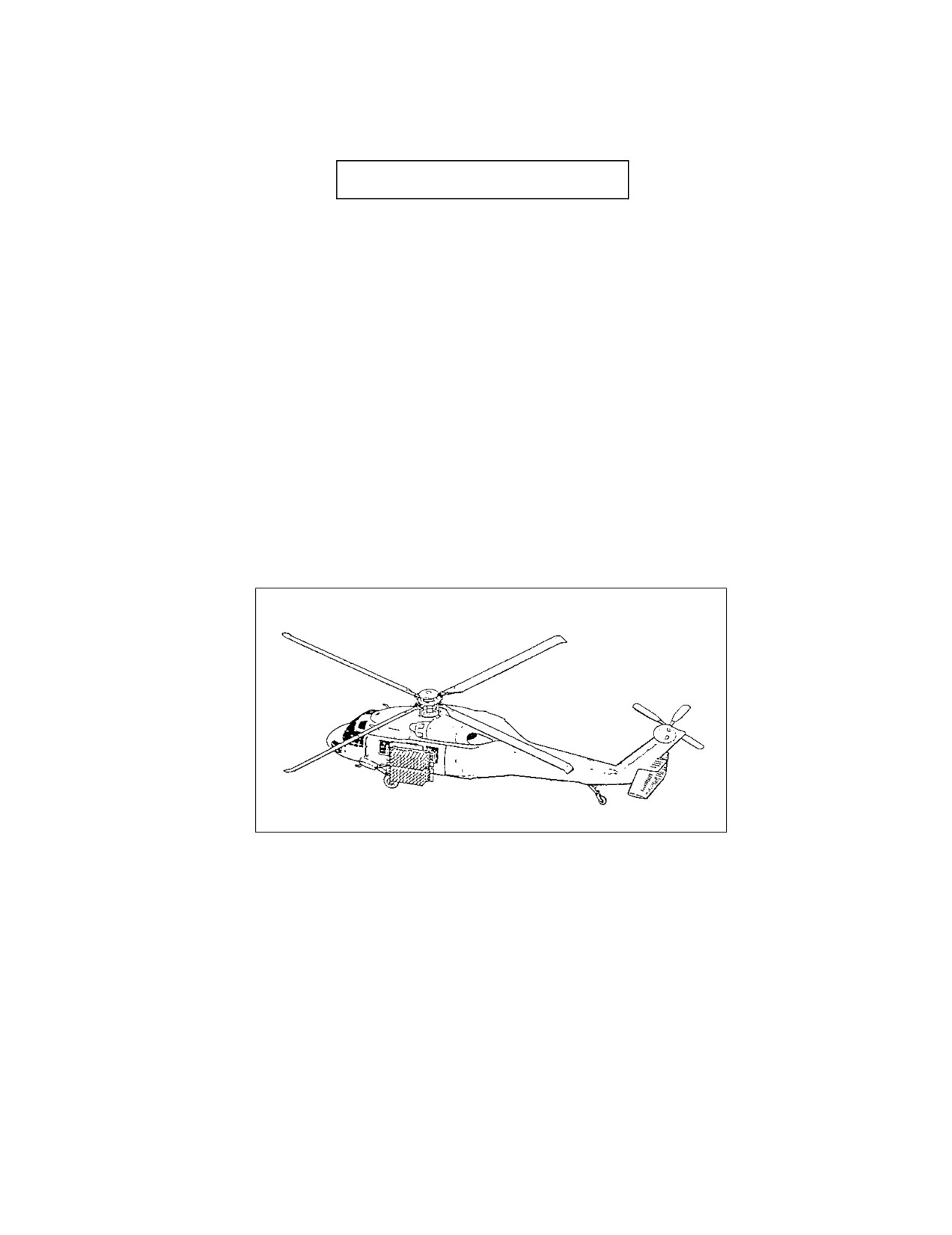
The air Volcano system (Figure D-1) consists of an M87-series mine canister,
an M139 dispenser, and vehicle-specific mounting hardware (UH-60
Blackhawks require a jettison kit).
Figure D-1. Air Volcano system
M87-SERIES MINE CANISTER
The M87-series mine canister is the same canister used for the ground
Volcano system:
• M87. Prepackaged with five AT mines, one AP mine, and a propulsion
device inside a tube housing.
• M87A1. Prepackaged with six AT mines and a propulsion device
inside a tube housing.
The mixture of mines is fixed and cannot be altered in the field. The mines in
each canister are electrically connected with a web that functions as a lateral
Air Volcano D-1
FM 20-32
dispersion device as the mines exit the canister. Spring fingers mounted on
each mine prevent the mine from coming to rest on its edge. AT mines have a
delay-arm time of 2 minutes 30 seconds; AP mines have a delay-arm time of 4
minutes. All canisters are capable of dispensing mines with 4-hour, 48-hour, or
15-day SD times. SD times are selected prior to dispensing and do not require
a change or modification in the base M87-series mine canister.
M139 DISPENSER
The M139 dispenser consists of an electronic DCU and four launcher racks;
each rack holds 40 M87-series mine canisters. The racks provide the
structural strength and the mechanical support required for launch and
provide the electrical interface between the mine canisters and the DCU.
Mounting hardware for the UH-60A Blackhawk includes a jettison
subassembly to propel the Volcano racks and canisters away from the aircraft
in the event of an emergency.
The operator uses the DCU to electrically control the dispensing operation
from within the aircraft. The DCU provides controls for the arming sequence
and the delivery speed selection, and it sets mine SD times. The DCU allows
the operator to start and stop mine dispensing at anytime. A counter on the
DCU indicates the number of canisters remaining on each side of the aircraft.
Mines are dispensed from their canisters by an explosive propelling charge, 35
to 70 meters from the aircraft’s line of flight. The aircraft flies at a minimum
altitude of 1.5 meters, at speeds of 20 to 120 knots. It can deliver up to 960
mines per sortie.
LIMITATIONS
The total weight of the air Volcano system is 2,886 kilograms. An aircraft will
be close to its maximum gross weight when it contains the Volcano system and
a full crew. Based on weather and environmental conditions, the aircraft may
be required to execute the mission without a full fuel load, thus reducing
enroute time.
The flight crew cannot operate the M60D machine gun with the air Volcano
system installed, and it takes 3 to 4 hours to install the air Volcano system on
a UH-60A Blackhawk.
EMPLOYMENT
The air Volcano is the fastest method for emplacing large tactical minefields.
When employed by combat aviation elements in support of maneuver units,
close coordination between aviation and ground units ensures that mines are
emplaced accurately and quickly. Although placement is not as precise as it is
with ground systems, air Volcano minefields can be placed accurately enough
to avoid the dangers inherent in minefields emplaced by artillery or jet
aircraft.
Air Volcano minefields can be emplaced in friendly and enemy territories.
They should not be planned in areas of enemy observation and fire, because
the helicopter is extremely vulnerable while flying at the steady altitude, the
speed, and the path required to emplace the minefield. The air Volcano is the
D-2 Air Volcano
FM 20-32
best form of a situational obstacle because of its short emplacement time. Its
employment varies depending on the type of operation.
DEEP OPERATIONS
Employment
The air Volcano is employed in deep operations to—
• Disrupt enemy formations along key AAs and choke points.
• Fix enemy formations in EAs to enhance target acquisition by attack
helicopters, CAS, artillery, or a combination of weapon platforms.
• Provide area denial of possible enemy artillery and ADA sites that will
affect future friendly schemes of maneuver.
AH-64 security is essential to air Volcano missions because the target area
must not be in the enemy formation’s direct line of sight. It may require two
suppression of enemy air defense (SEAD) missions to get the air Volcano
across the FLOT to the target location. This removes the security aircraft from
the battle. All air Volcano missions require planning, designation, and control
during the execution of air corridors (routes).
Aviation Configuration
The air Volcano can be used in deep operations, but it has distinct limitations.
The aircraft can maintain a speed of 80 to 90 knots (UH-60A) for 90 to 120
kilometers, depending on the wind and the temperature (see Table D-1, page
D-4).
The aircraft cannot employ the door guns for self-defense with the Volcano
system mounted. The attack aircraft averages 100 to 120 knots while
targeting enemy formations that are 150 to 200 kilometers deep. In order for
the air Volcano to go deep, the attack aircraft must slow down or special
security/escort aircraft must be assigned for protection. The security/escort
can be AH-64s or OH-58D Kiowa Warriors (KWs). KWs have many
advantages—they are not a primary killing platform, and they are very good
at quickly securing an area. The air Volcano requires one or two security
aircraft for protection, and there should also be a backup aircraft for the
mission.
Fire-Support Coordination
The division main (light force) or brigade main (mechanized force) FSE is
responsible for coordinating and executing fires in support of air Volcano
missions. Upon completion of the target meeting, the FSE, the assistant
division/brigade engineer, and the G3/S3 air representative will coordinate to
ensure that the air-coordination/tasking order will support the mission and
the planned SEAD fires.
If the mission is a deep aviation attack, the aviation element FSE is
responsible for coordinating through the forward command post to the
division/brigade main FSE. If the forward command post has jumped forward
or has not deployed, the aviation element FSE will coordinate directly with
the division/brigade main FSE.
Air Volcano D-3