FM 20-32 Mine/Countermine Operations (August 2001) - page 8
C3, FM 20-32
Linear Clearance
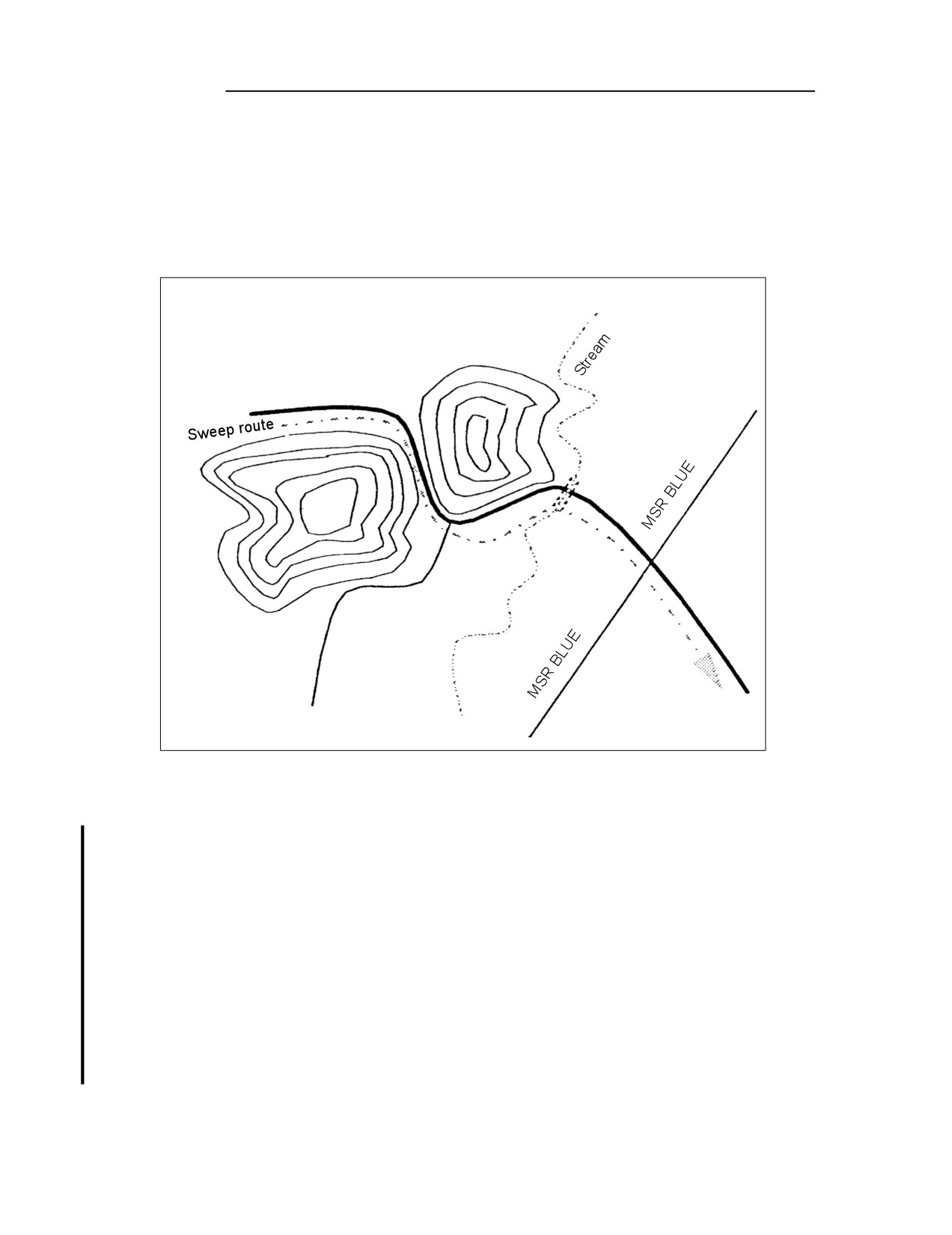
In linear clearance (Figure 11-5), sweep and security teams begin route
clearance at Point A and complete it at Point B. This method provides the best
assurance of route coverage. Although this is an effective method, it is not the
most secure method in a high-threat environment. It is also time-intensive
and constrains the maneuver commander’s flexibility.
MSR WHITE
Figure 11-5. Linear clearance method
Combat Clearance
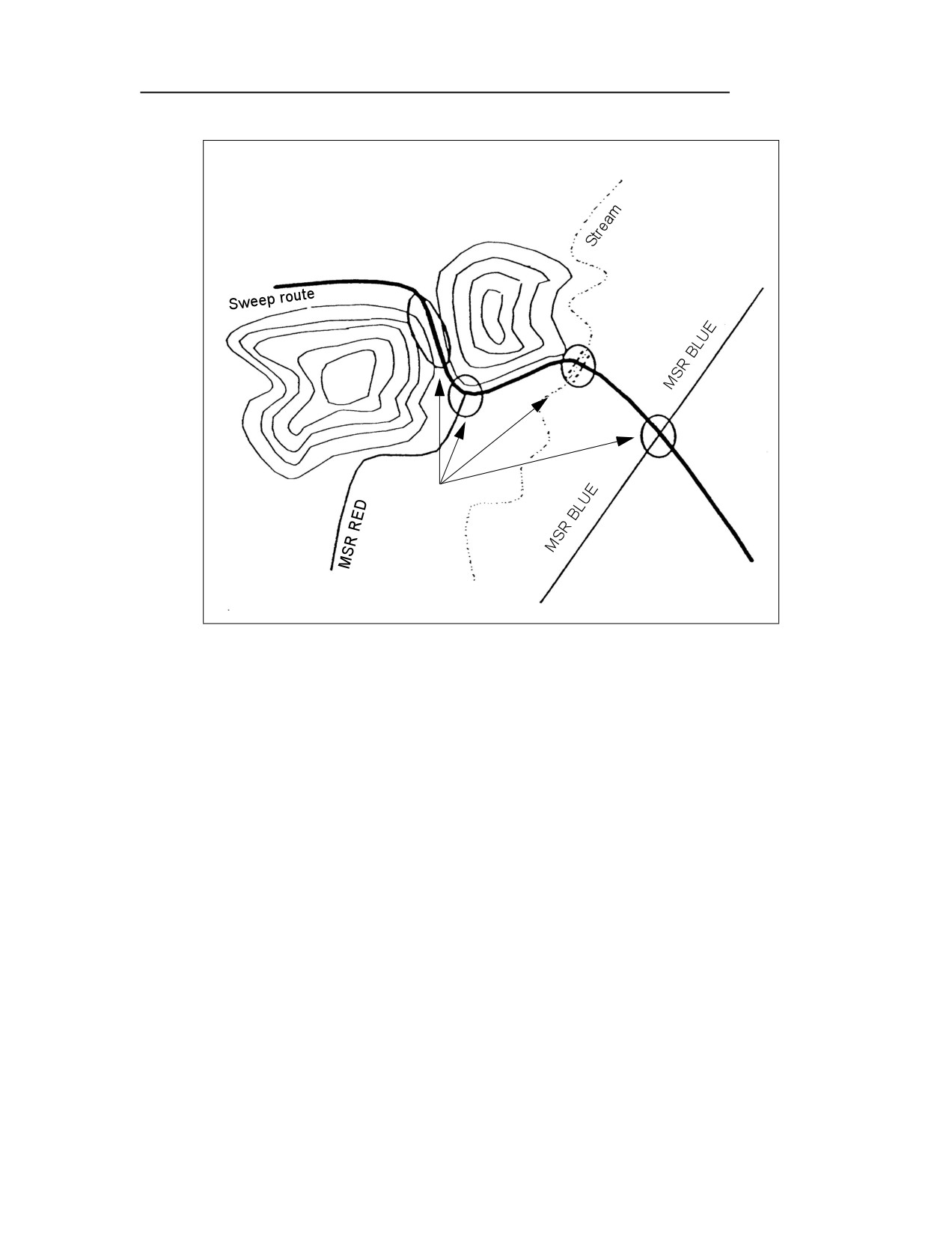
Whereas linear clearance focuses on a specific route, combat clearance
(Figure 11-6) focuses on specific points along a route. As mentioned previously,
IPB and EBA can identify areas for likely mine and ambush locations. These
areas become NAIs or objectives for combat clearance missions. The combat
clearance method divides a route into sections according to the number of
suspected high-threat areas. Once the sweep element (maneuver and engineer
forces) secures and sweeps these areas, the route is considered clear. Combat
forces can patrol the route from these objectives to ensure that the route is
secure, and if necessary, the sweep element can sweep the surrounding area if
a minefield is found. Following the seizure of these objectives, the commander
must assume a moderate risk that the S2 and the force engineer have
identified all high-threat areas and that the route is clear of mines. Combat
clearance is ideal for dismounted (light) forces since it provides the maximum
use of surprise and concealment.
11-12 Route and Area Clearance
C3, FM 20-32
MSR WHITE
Objectives/NAIs
for clearance
efforts
Figure 11-6. Combat clearance method
Combined Clearance
This method combines the complete clearance capabilities of the linear
clearance method with the security and surprise elements of the combat
clearance method. Combined clearance is a two-phase, force-intensive
operation and may require a battalion-size effort, depending on the length of
the route. First, identify high-threat areas through IPB/EBA and target them
as NAIs and/or objectives to secure. Then, clear obstacles and enemy forces
before the movement of sweep elements. The sweep team moves down the
road and clears any obstacles missed or not identified during the planning
process. The main advantage of this method is that the TF commander has
immediately secured MSRs, allowing him to push out (expand forces out past
the secured area and secure additional areas) and find the enemy with a
degree of confidence that follow-on forces will be much safer.
Types
There are two types of sweep operations—deliberate and hasty. Deliberate
and hasty clearance operations can be modified to meet the time and
equipment limitations of the TF, but the commander assumes greater risk
when the clearance type is modified.
Route and Area Clearance 11-13
C3, FM 20-32
Deliberate
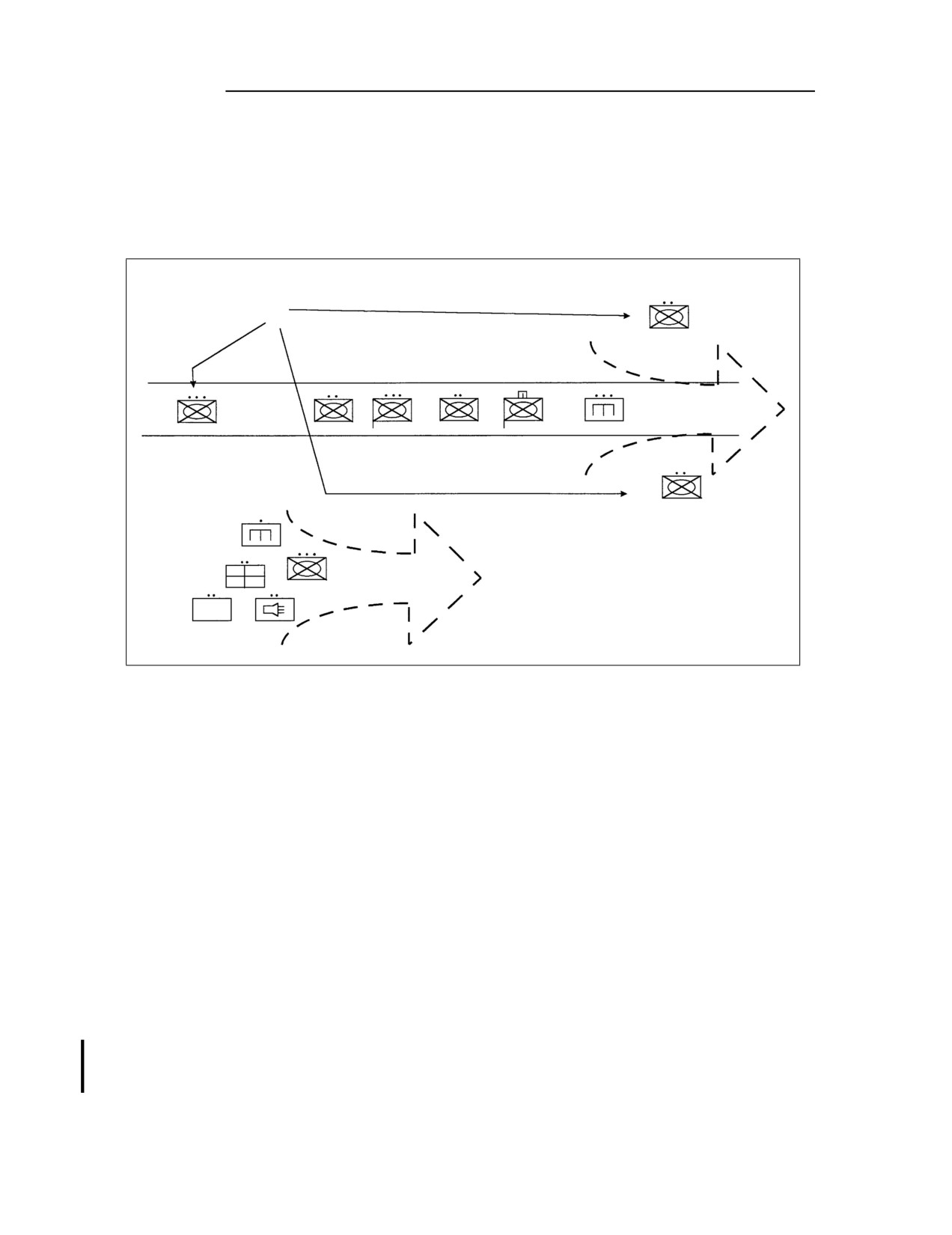
A deliberate sweep (Figure 11-7) is very thorough and includes a complete
sweep of the entire road (shoulders, culverts, ditches, and bridges). It is the
most time-consuming sweep operation and relies on electronic (primary) and
visual (secondary) detection systems.
Support force
Breach force
Assault force
MP
Figure 11-7. Deliberate route clearance
The platoon sweep team (Figure 11-2, page 11-9) is dismounted to focus its
attention on the entire length of the route. The support force (company-size)
secures at least 100 meters on the flanks and 100 meters forward to clear
possible enemy direct-fire systems and overwatching elements in front of the
breach force. This not only allows the breach force to focus solely on the route
but also clears the area of off-route and command-detonated mines.
If enemy contact is made, the support force fixes the threat while the assault
force reacts. The sweep teams withdraw to a location that provides
concealment and/or security. Mechanical detection provides a third means of
detection and is the method used to proof the route after the sweep team has
passed through the area. The deliberate sweep includes a route
reconnaissance and looks at all areas of a route, including bypasses. The
deliberate sweep focuses on thoroughness rather than speed. This method is
very slow and tedious and should only be used when time is not a factor; 80 to
100 meters can be covered per hour.
Hasty
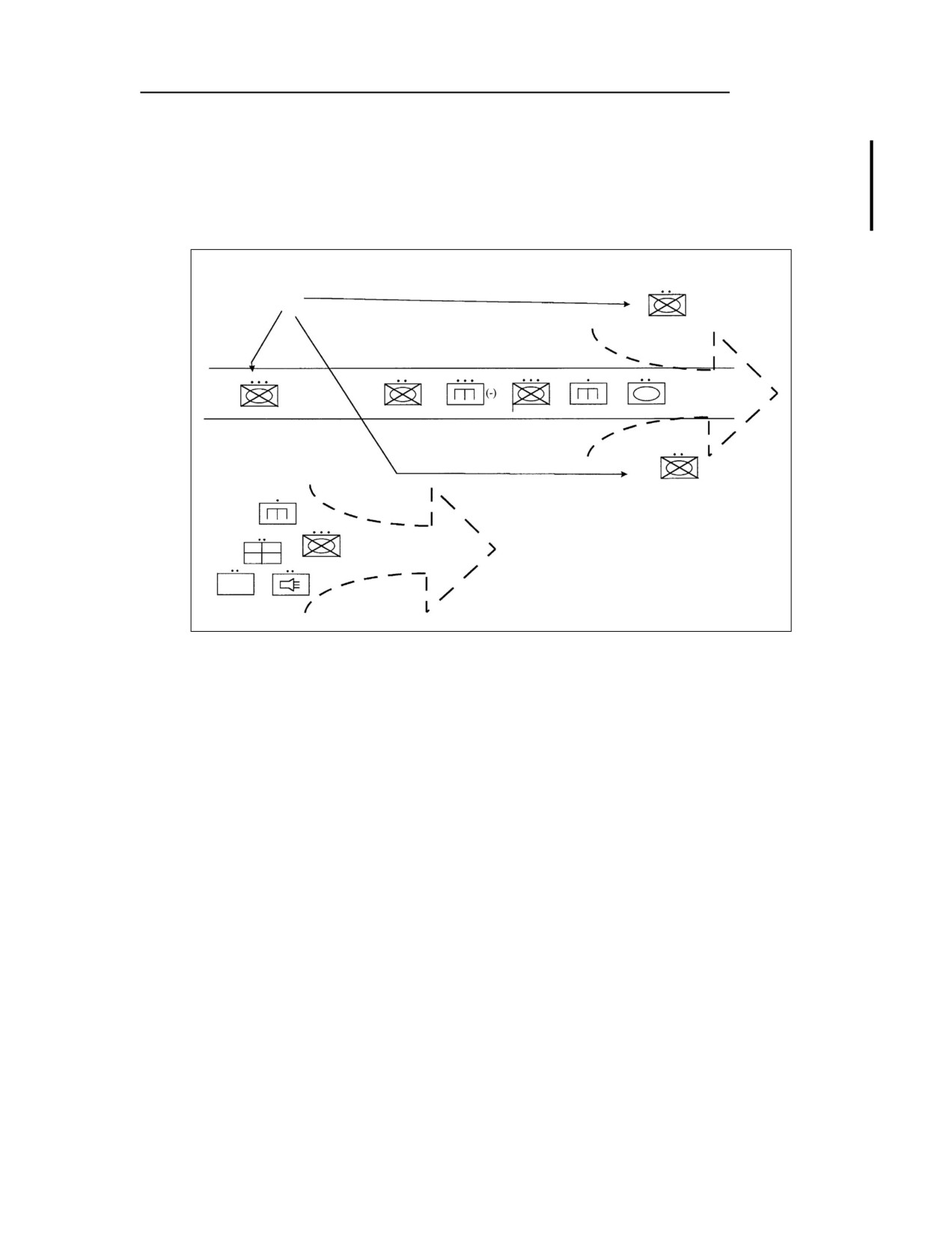
A hasty sweep (Figure 11-8) consists of visual inspection, physical search or
probing, and the use of mine detectors. It is the fastest, most risky method and
is suited for an armored or mechanized team. It relies primarily upon visual
11-14 Route and Area Clearance
C3, FM 20-32
detection (thermal sights or the naked eye) for minefield identification. The
breach force looks for mines, wire, and other minefield indicators. The road
surface, culverts, ditches, and bridges are inspected and searched. Visual
detection is accompanied by a mechanical proofing system. Electronic mine
detectors are used by sweep teams to check all suspected areas.
Support force
Breach force
Assault force
MP
Figure 11-8. Hasty route clearance
The support force includes a maneuver platoon that provides overwatching
fire and/or security. Actions upon enemy contact are the same as in a
deliberate sweep. The primary objective of this technique is speed, moving
approximately 3 to 5 kph. This method is extremely similar to the instride
breach method when encountering minefields.
The sweep team focuses on identifying immediate risks to traffic, neutralizing
those risks, and continuing on with the mission. A hasty sweep is used during
the combat clearance method to validate the areas that were not deliberately
cleared by the sweep team. It is also used if the METT-TC analysis does not
permit a deliberate sweep or if the need for a road to be opened is urgent.
Time and distance factors may be imposed. A light force may not have an
MCR system but can conduct the same sweep method with an improvised
roller system, or the force can use a sandbagged, 5-ton truck moving
backwards as a last-resort method. Using MCRs or their equivalent is
absolutely imperative due to the high risk of encountering a minefield. The
mine rake or plow is not a satisfactory substitute because it destroys road
surfaces.
AREA CLEARANCE
Area clearance is also a combined arms mission. Clearing operations occur
when engineers receive a mission to clear an area of mines or to clear a
Route and Area Clearance 11-15
C3, FM 20-32
specific minefield in a friendly AO. In most cases, the minefield has been
reported and may already be marked on all sides. The engineer unit receiving
the mission must base its plans on available information and prepare
equipment based on the estimate.
PLANNING
Planning area-clearance operations is very similar to planning breach
operations. Commanders and staffs plan and coordinate all the breaching
tenets.
Intelligence
Intelligence is particularly important for discovering the types of mines and
mine fuses the enemy employs. The engineer uses this information to
determine which clearance and neutralization techniques offer the best
chance for success and minimize the risk to the sweep teams. Intelligence also
helps the commander determine the need for outside resources, such as EOD
and SOF elements.
The information needed for area-clearance operations includes—
• Minefield location.
• Minefield orientation.
• Presence of wire as an obstacle.
• Location of gaps and bypasses.
• Minefield composition (buried or surface-laid mines, AT or AP mines,
AHDs, trip wires, and minefield depth).
• Types of mines, employment techniques, fuses, and booby-trap
configurations.
• Information on whether or not the minefield is marked and, if it is
marked, the material used.
• Possibility of hostile forces in the area.
Fundamentals
You must plan to apply the four fundamentals of breaching operations
(SOSR), but you may not execute all of them due to the lack of enemy
presence.
Organization
Task organization is similar to that used for route-clearance operations. The
breach force is the clearance element, and the support force is responsible for
all security and maneuver responsibilities. There is no assault force in area-
clearance operations. Table 11-3 shows a sample task organization for an area
clearance. The size of the force can be tailored, based on the probability of
contact.
Mass
Sufficient maneuver and engineer assets must be allocated to the clearance
company team. The length and width of the route and the amount of time
11-16 Route and Area Clearance

C3, FM 20-32
Table 11-3. Sample task organization for an area clearance
Team
Support Force
Breach Force
•
Mechanized infantry platoon
•
Engineer platoon with
•
Mortar section
organic vehicles
Heavy
•
FIST
•
Medical team (two
•
Armor platoon
ambulances)
•
EOD team
•
Bradley platoon with dismount
•
Engineer platoon with
capability
organic vehicles
Light/heavy
•
60-mm mortar section
•
Medical team (two
•
Forward observer
ambulances)
•
One infantry platoon (light)
•
EOD team
•
AT/MP section with M60/MK19 mix
•
Engineer squad (-)
•
60-mm mortar section
•
Medical team (two
Light
•
Forward observer
ambulances)
•
Two infantry platoons (light)
•
EOD team
available determines the size of the sweep team. A platoon is normally used to
clear a 200- by 300-meter minefield; additional assets are required to clear
larger and multiple minefields.
Synchronization
All aspects of synchronization should be implemented when planning area
clearance. It is especially important that rehearsals be conducted at the
combined arms level. Rehearsals should include—
• Reaction to enemy contact.
• Reaction to an ambush.
• Communications exercise.
• Fire support (obscuration smoke, immediate suppression fires, critical
friendly zones for counterfire radar, and no-fire area around the
clearance site).
• CSS
(maneuver, casualty evacuation, marking materials, and
demolitions resupply).
PLANNING CONSIDERATIONS
Area-clearance BOS planning considerations are parallel to route-clearance
planning considerations. Brigade and battalion TF staffs should use the
planning considerations outlined on pages 11-3 through 11-7 plus the ones
outlined below:
• Intelligence. Focus on the most probable enemy attack method and
AAs.
• Maneuver.
— Clear and secure flanks (at least 500 meters) and the farside of the
area to be cleared.
— Provide security for the cleared area.
Route and Area Clearance 11-17
C3, FM 20-32
• Fire support. Ensure that the area-clearance team has a FIST
coordinator. The FIST should be collocated with the support force OIC.
• Mobility/survivability. Establish minefield control points along the
area to be cleared.
• CSS.
— Ensure that the medical team consists of one or two ambulances
and that it is located with the breach force.
— Ensure that all personnel wear flak vests or IBASIC (Figure 11-1,
page 11-6).
• C2.
— Determine the area length, using clearly definable perimeter
points.
— Coordinate with adjacent units, the host nation, NGOs, PVOs, and
SOF.
TASK ORGANIZATION
The battalion TF will focus a company team (minus) as the main effort to
conduct area clearance.
Support Force
This force is comprised of two maneuver platoons and an OIC. The support
force provides flank security, forward security, and protection for the breach
force. It neutralizes hostile forces that are encountered by the company team.
The support force secures the area 500 meters beyond the area to be cleared.
METT-TC factors will affect the actual distance based on the threat and the
weapon systems. The support force OIC establishes static security positions
around the area until the clearance operation is complete. He also has control
of fires and the responsibility to neutralize any hostile force.
Breach Force
The breach force is comprised of an engineer platoon that is organized into
sweep teams, a medical team, and an EOD team (or one that is on call). The
sweep team (squad-size) is organized as shown in Figure 11-3, page 11-10. The
breach force’s mission is to sweep and clear the area of mine and explosive
threats.
METHODS AND TYPES
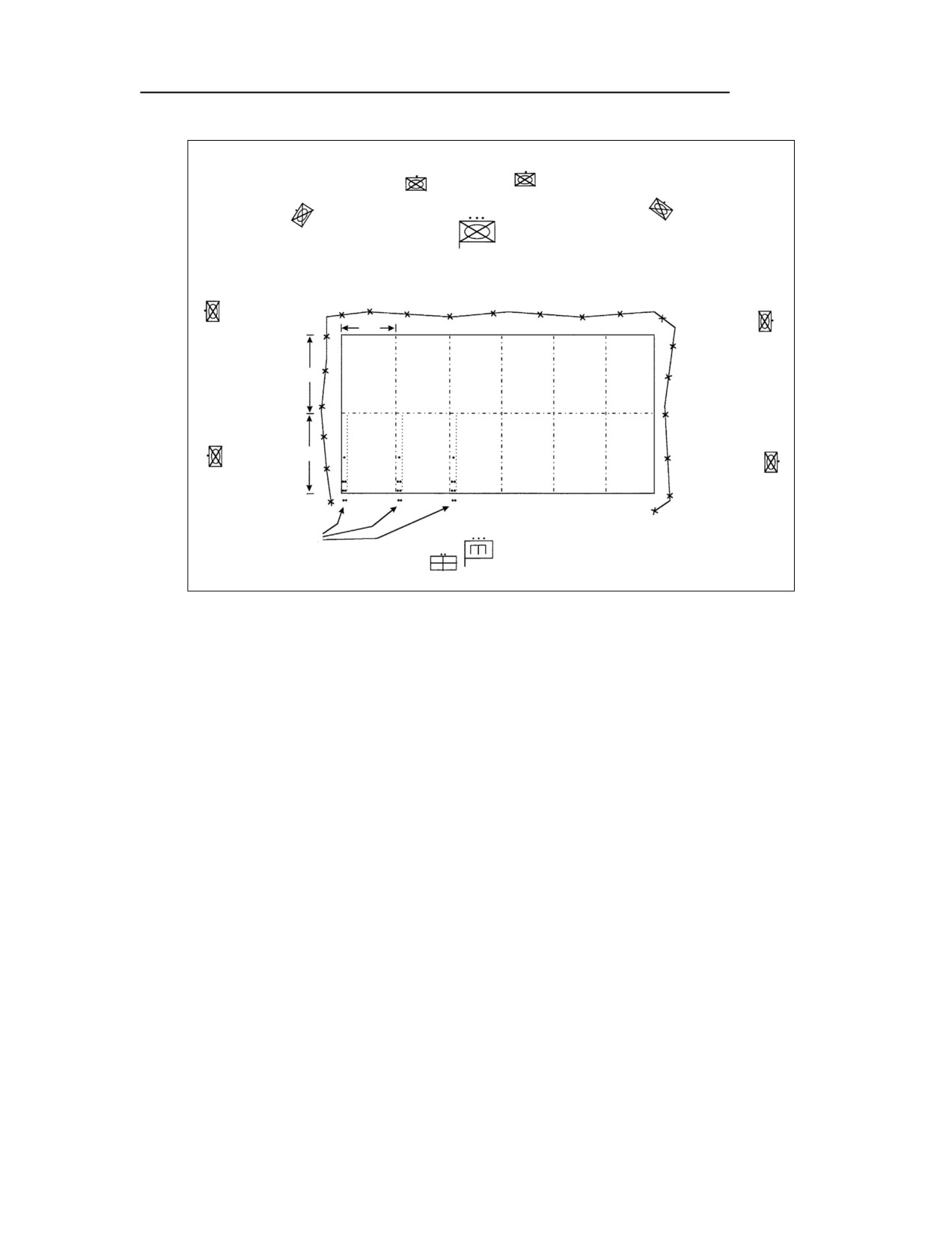
The breach force OIC determines the perimeter of the area to be cleared and
ensures that it is marked. The OIC divides the area into sections to be cleared
(Figure 11-9). The sections should be no larger than 40 meters wide and 100
meters long. This is an optimal-sized area for a sweep team to clear at one
time. The OIC assigns squad-size sweep teams to each section.
The squads clear their assigned sections using the sweeping techniques
discussed earlier in this chapter. As the sections are cleared, they are marked
for safety and control purposes. This process is continued until the entire area
is cleared. Progress is reported to the company team commander as required.
11-18 Route and Area Clearance
C3, FM 20-32
Support force OIC
40 m
G
H
I
J
K L
100 m
A
B
C
D
E F
100 m
Sweep teams
(lanes are 2 m)
Figure 11-9. Area clearance site layout
IMPROVISED MINE THREAT
Mines are not always employed conventionally by military forces organic to
the host nation or its enemies. In many cases, they are also employed by
terrorists against allied forces or the host-nation populace. In these cases, the
threat increases because of the improvised methods in which the mines were
emplaced. In conventional emplacement of mines, a pattern emerges from the
emplacing force’s doctrine, and the threat can easily be reduced by using this
knowledge. There is less pattern in the case of improvised mining methods,
and this makes detection and removal very difficult.
Improvised mining has many different employment techniques. In most of the
techniques shown below, a UXO can easily be employed in place of a mine:
• Coupling mines. Coupling is done by linking one mine to another,
usually with detonating cord. When the initial mine is detonated, it
detonates the linked mine. This technique is done to defeat
countermine equipment.
• Boosting mines. Buried mines are stacked atop one another, and the
farthest mine from the surface is fused. This reduces the probability of
detection and increases the force of the blast.
• Sensitizing AT mines. On some nonmetallic AT mines, the pressure
plate can be cracked and the spring removed or the mine’s explosive
can be cut into smaller blocks and employed as powerful AP mines.
Route and Area Clearance 11-19
C3, FM 20-32
The pressure plate can be removed from metallic AT mines and
employed in the same manner. Alternatively, a pressure-fused AP
mine can be placed on the top of an AT mine.
• Mixing training mines with live mines. Hostile forces can employ
training mines at the start of a minefield and emplace live mines
toward the end. The sweep element falsely believes that the minefield
is phony and becomes complacent in its reduction activities. When this
technique is used, live mines are painted to resemble training mines.
• Daisy-chaining mines. Command-detonated AP mines are commonly
used in daisy chaining. Hostile forces link the mines with trip wires or
detonating cord. When the initial mine is detonated, the other mines
will detonate.
MINE LOCATIONS
Hostile forces normally place more than one mine in each mined area. Do not
focus the detection effort solely on a horizontal mine threat, such as on the
ground or in culverts. The mine threat is also vertical, such as in trees or
attached to an overpass. Clearance efforts must accommodate the three-
dimensional battlefield. Mines may be placed in—
• Frequently used roadways.
• Brush and other traffic obstructions placed on roadways.
• Bridge bypasses and fording sites.
• Road junctions.
• Obvious turnarounds, bypasses, culverts, ditches, and shoulders.
• Key logistic points (water, fuel, food).
• Debris along a route.
DISPOSITION OF MINES
The following actions should be taken when a suspected mine is found:
• Mark the suspected mine location; do not leave any mine unmarked.
• Search for electric wires and trip wires in the immediate area. Trace
the wires in both directions to determine if items are attached to
them. If there is nothing attached and the IPB does not state
otherwise, cut loose trip wires and electric wires.
DANGER
Never cut taut trip wires. Alert the security element to search for an enemy that
may be manning a command-detonated mine. Keep troops away from the mine
until all the wires are traced and cut. Be alert for booby traps and ambush. If
booby traps are found, use the clearance procedures outlined in Chapter 13.
• Probe the suspected mine location and uncover enough of the object to
identify it. Other personnel should stay at least 30 meters away.
11-20 Route and Area Clearance
C3, FM 20-32
— If the object is a mine, the prober withdraws and notifies the OIC.
The OIC decides to bypass the mine, destroy it in place, remove it
with a grapnel, or notify EOD for hand neutralization.
— If the object is debris, get in a protected position and carefully
remove the debris with a grapnel hook. Be alert for booby traps or
AHDs wired to the debris.
MINE-REMOVAL TECHNIQUES
A mine can be bypassed, detonated in place, pulled out by a rope or a wire, or
neutralized and removed by hand. The method used depends on the location of
the mine, the type of the mine and the fuse, and the tactical situation.
Methods of removal and actions on finding a mine should be addressed in the
OPORD and rehearsed prior to executing the mission.
Trip-wire and tilt-rod mines can be detonated by throwing a grapnel, with a
rope attached, past the trip wire or tilt rod and pulling the grapnel back to
actuate the mine. Grapnels may be improvised from any available material,
such as a bent drift pin or scrap material.
A hand-emplaced charge is the standard demolition material used to destroy a
mine in place (see FM 5-250). A 1-pound block of explosive placed next to a
mine is sufficient to detonate most mines. A charge can be placed next to each
mine in a group, then the charges can be connected and fired simultaneously.
Rope or wire can be used to pull a mine out of its installed position. This is a
safe method and only detonates mines that are equipped with AHDs. It also
reduces noise and cratering. A tripod (Figure 10-21, page 10-23) makes it
easier to pull a mine out of a hole on the first attempt. Use the following
procedures to remove mines:
• Uncover only enough of the mine to expose a handle or a projection.
Attach a 60-meter length of rope or wire to the mine or engage a
grapnel. If there is no projection, engage a grapnel on the bottom side
of the mine, opposite the direction of pull.
DANGER
Do not move the mine while uncovering it or attaching
the rope because movement might detonate an AHD.
• Ensure that the covered area is not mined. Take cover and lie in a
prone position at least 50 meters from the mine. Pull the rope to
remove the mine from the hole.
• Wait at least 30 seconds before leaving cover and approaching the
mine if the mine type is unknown. This guards against the possibility
of a delay firing mechanism.
• Dispose of the mine according to the unit directive or SOP.
HAND NEUTRALIZATION
Appendix A discusses procedures for hand neutralization of US mines.
Foreign mines and booby traps should only be neutralized by EOD personnel.
Route and Area Clearance 11-21
C3, FM 20-32
Mines are neutralized by hand, when—
• Units are conducting a covert breach.
• The mine is located on a bridge, building, or other facility required for
use by friendly forces.
• Neutralization by other means is not possible.
• The mine can be positively neutralized by hand and is required for
reuse.
• The mine type is unknown and recovery must be attempted for
intelligence purposes.
• Chemical mines are located in areas where contamination would
restrict the use of the area by friendly troops.
SAFETY
The following safety procedures should be observed during route and area
clearance:
• Personnel should wear helmets and flak jackets to protect them
against fragmentation. Sweep team members should wear IBASIC, if
available.
• Vehicle floorboards should be sandbagged.
• Vehicles should be dispersed at 50-meter intervals. This ensures that
a mine detonated by one vehicle will not cause casualties in other
vehicles.
• One person at a time should be allowed at a suspected mine location.
• Personnel should assume that mines and explosive devices are
equipped with AHDs until proven otherwise.
• Personnel should not run and should move only in previously cleared
areas.
• Armored vehicles should have their hatches open to vent the pressure
pulse from a mine detonation.
• Soldiers should wear ballistic and laser protective spectacles (BLPS)
or lightly tinted, protective eyewear to reduce eye fatigue and improve
their ability to recognize mine indicators.
REPORTS
Dissemination of information is the key to battlefield management. Units
encountering minefields or explosive devices should follow a five-step
process—stop, secure, mark, report, and avoid. Units must provide adequate
information to their higher headquarters to ensure that follow-on elements
are well informed. Information must include the known or suspected
minefield location, types of mines (if known), the marking method, the time
the minefield was encountered, and any additional information that may be of
use to the clearing unit.
Division and maneuver brigades must establish a central control cell for mine
clearance information. This cell receives and gathers all mine and explosive
11-22 Route and Area Clearance
C3, FM 20-32
threat data within the unit’s AO. Mine-contact reports are reported through
maneuver command channels with a priority of flash or immediate. The
information is then jointly controlled in the operations cell and the central
mine control cell by the engineer staff officer, the G3/S3, and the Assistant
Chief of Staff, G2 (Intelligence) (G2)/S2. The mine contact database is jointly
maintained by the engineer and the G2/S2, who subsequently conduct pattern
analysis and integrate it into intelligence and operational updates.
The central mine control cell performs the following actions:
• Maintains a current situation map and overlay that depict friendly
and enemy mines and obstacles.
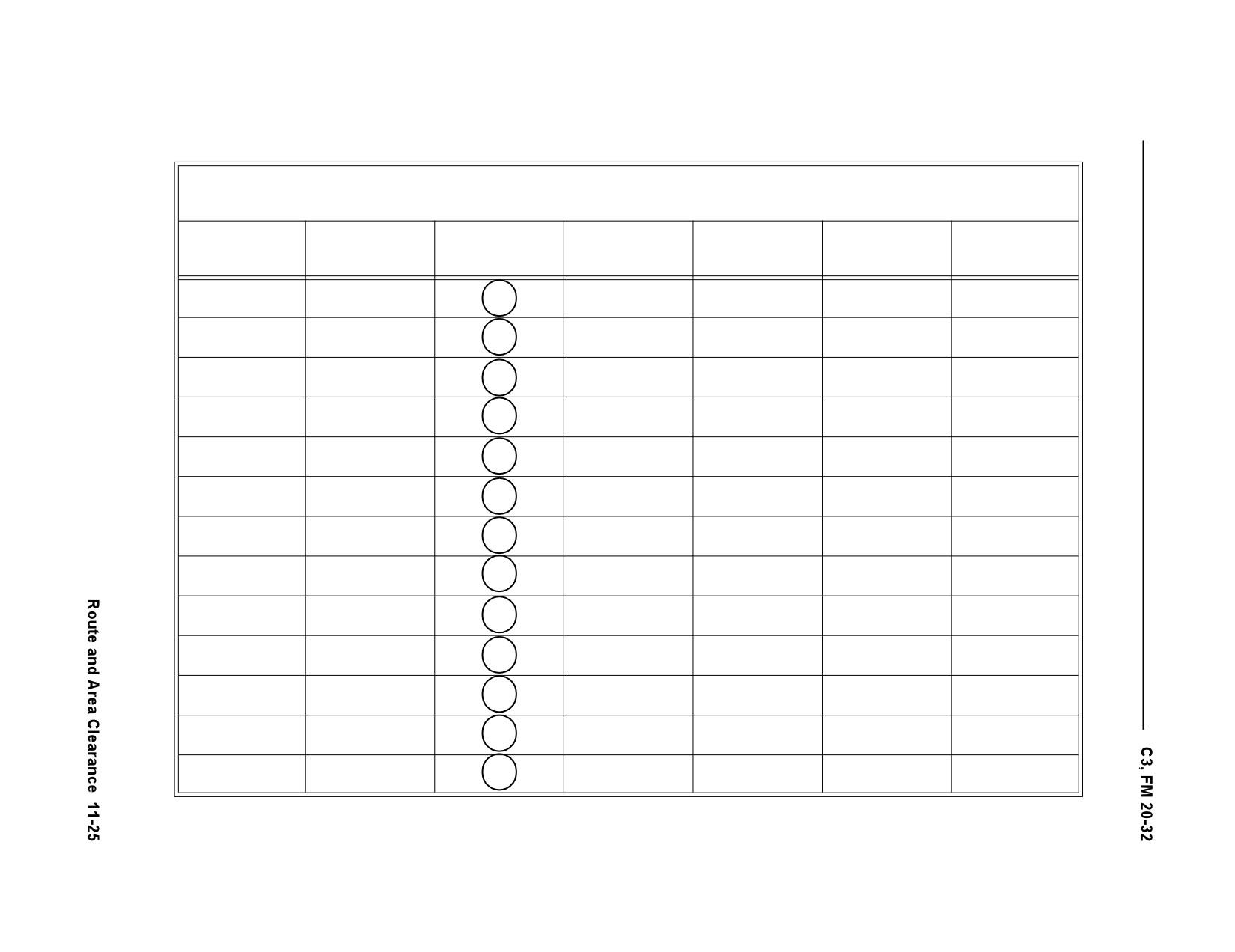
• Maintains and updates enemy obstacle (Figure 11-10, page 11-24) and
route status (Figure 11-11, page 11-25) information.
• Receives and maintains minefield recording forms (US and foreign)
within the unit’s operational area (this includes host-nation minefield
data, if available).
• Maintains a mine-contact database. (This could be a clearinghouse for
future operations.)
• Processes, analyzes, and updates information; disseminates the
information to subordinate commanders and staff.
SITUATION REPORT
Clearing units submit a situation report to higher headquarters if enemy
activity is encountered or if an explosive device is discovered. This information
should be tracked in the TOC and the CTCP. Information must be
disseminated to subordinate units, especially CSS elements.
PROGRESS REPORT
The clearing unit submits progress and completion reports until the clearance
operation is complete. Progress reports must be timely and accurate. Report
format and frequency are established in the OPORD before the clearance
mission is executed.
Route and Area Clearance 11-23

C3, FM 20-32
11-24 Route and Area Clearance
ROUTE STATUS REPORT
As of: __________________
Responsible
Status (Red,
Route Name
As Of
Start Point
End Point
Remarks
Unit
Amber, Green)
Figure 11-11. Sample route status report

C3, FM 20-32
MINE INCIDENT REPORT
A mine incident includes any unplanned activity involving a mine, UXO, or a
booby trap. It also includes near misses that could have resulted in damage or
injury. The mine incident report (Figure 11-12) is a technical report that
follows a serious incident report (SIR), and it should be submitted as soon as
possible (local SOP will indicate time requirements).
MINE INCIDENT REPORT
DATE:
FROM:
THRU:
TO:
REFERENCE SIR #__________
A. Incident DTG
A1. dd/time/zone/mm/yy
Include a site sketch as an
B1. Map sheet/UTM/grid reference (8 digit)
attachment.
B. Incident location
B2. Location (road, field, building)
B3. Emplacement (buried, surface-laid, off-
route)
C1. Casualties (rank, name, date of
awareness training, time in the mission area,
C. Effects (to
protection equipment used)
complement
information already in
C2. Vehicle damage (number, type, extent of
Include a photo if possible.
the SIR)
damage)
C3. Collateral damage
D1. Type of mine (AT, AP, make, model)
D2. Type of booby trap (pull, release,
D. Device suspected
pressure)
D3. Type of UXO (dropped, thrown, projected)
D4. Unknown (detail, color, shape, size)
E1. Activity at the time of the incident
E2. Degree of previous use of the route, area,
location
E. Circumstances
E3. Date of previous clearance and proofing
by engineers
E4. Where the route, area, or location is
monitored
F1. Recommendations to prevent
F. Recommendations
reoccurrence
G. Miscellaneous
G1. Any other pertinent data
Figure 11-12. Sample mine incident report
11-26 Route and Area Clearance
PART THREE
Special Mining Operations
Part three provides tactical and technical information on special-mining operations,
such as using booby traps and expedient devices. It also discusses mining in rivers,
urban terrain, and unique environments. Restrictions and responsibilities are outlined
in detail for the employment and the clearance of special mines and devices.
Chapter 12
Mining Operations in Special Environments
Mines are emplaced and encountered in all environments, some of which
need special consideration to understand effective employment, detection,
and/or removal.
STREAMBED AND RIVER MINING
EMPLOYMENT
Conventional AT mines are much more effective in water than on land
because water transmits the shock effect better than air. Vehicle support
members, tracks, and wheels are damaged by a mine blast. Small vehicles are
overturned and almost completely destroyed. Because water amplifies and
transmits shock waves, mines equipped with pressure-actuated fuses are
subject to sympathetic detonation at greater distances in water than on land.
M15 and M19 AT mines can be used for streambed and river mining. The M21
AT mine should not be used because it is very difficult to arm and disarm
underwater, and it can be easily functioned by drifting debris. To avoid
sympathetic detonation, AT mines must be at least 14 meters apart in water
that is less than 61 centimeters deep, and at least 25 meters apart in water
that is deeper than 61 centimeters. The mined areas are chosen to take
advantage of stream and adjacent area characteristics. Water depth within
the minefield should not exceed 1 meter because it is difficult to work in
deeper water, and pressure-actuated fuses are usually ineffective against
waterborne vehicles.
Current velocity must be considered when emplacing mines in a streambed or
a river. If the mines are placed deeper than 45 centimeters, they must be
recovered by engineer divers:
• A lightweight diver has diving restrictions based on current velocity.
• A scuba diver is restricted to a maximum current velocity of 0.5 meter
per second.
Mining Operations in Special Environments 12-1
C2, FM 20-32
• A surface-supplied diver is restricted to a maximum current velocity of
1.3 meters per second.
Seasonal current velocity should also be considered if the minefield is to be in
place for an extended period of time. Additional information on diving
restrictions can be found in FMs 20-11 and 5-490.
Since sand in inland waters continuously moves downstream, it may be
difficult to locate and remove mines planted on sandbars or downstream from
sandbars. If the site has a muddy bottom, the mud should not be deeper than
46 centimeters and there must be a hard base underneath it. The enemy is
unlikely to choose a fording point where vehicles mire easily. If underwater
obstacles (gravel, rock, stumps) are bigger than the mine, the area cannot be
easily mined. If such areas must be used, place the mines so that they are
exposed to vehicle wheels or tracks. Armored vehicles usually enter and exit
streams at points where the incline is less than 45 percent. After entering a
stream, vehicles often travel upstream or downstream before exiting.
Carefully examine riverbank formations and underwater obstacles to predict
the trail a vehicle will use to ford the stream.
EMPLACEMENT
When emplacing mines in streams and rivers, always work in pairs. Prepare
the mine on land near the emplacement site. Coat fuse threads and wells with
silicone grease (a waterproof lubricant) or a heavy grease to minimize the
chances of water leaking into the mine. Waterproof joints between the
pressure plate and the mine case with silicone grease. As a rule of thumb,
waterproofed mines are reliable up to 3 months when immersed without
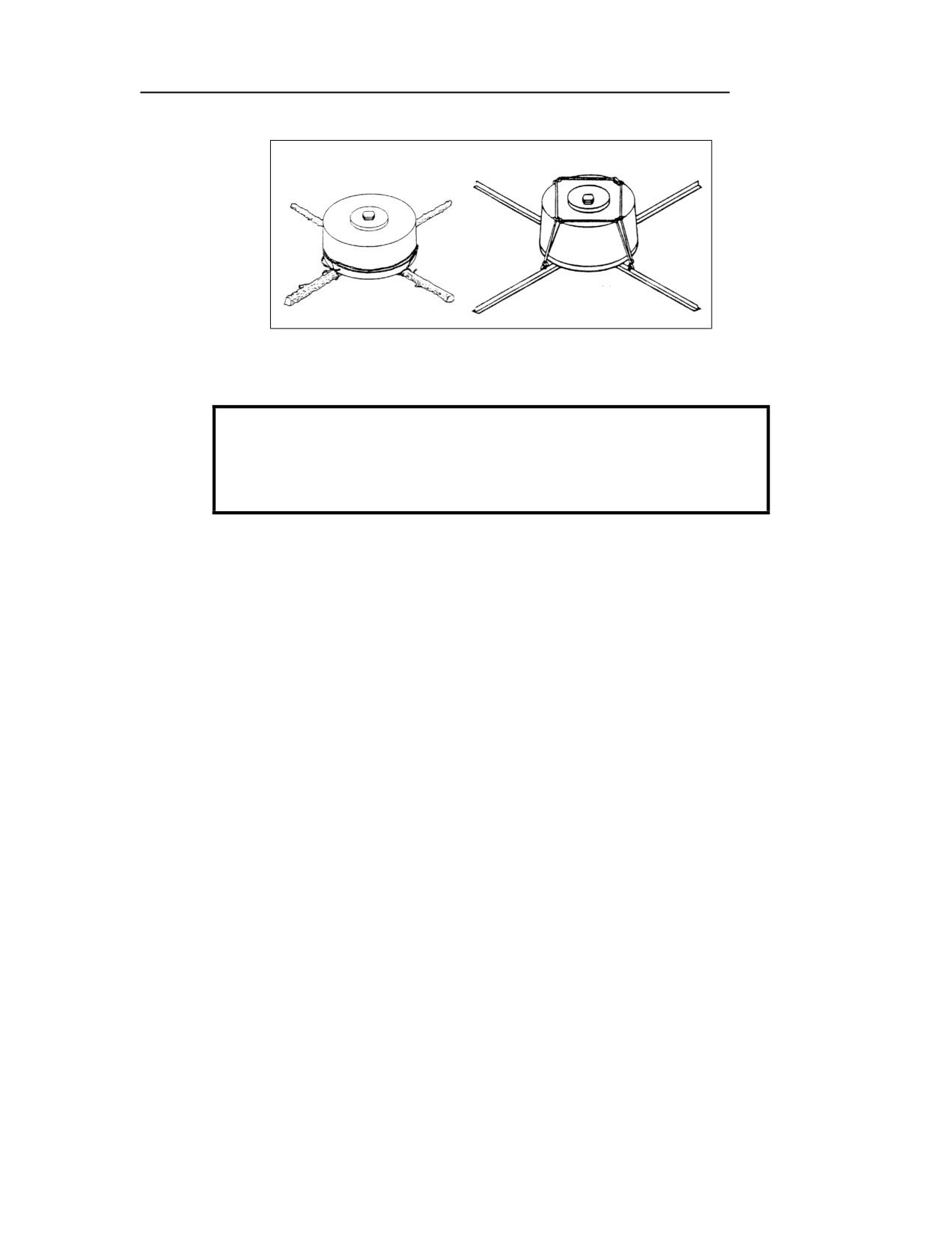
waterproof coverings. Secure the mine with outriggers to prevent drifting:
• Construct field-improvised outriggers with—
— Two green limbs that are about 3 centimeters in diameter and 1
meter long. Green limbs are recommended because they are
stronger and less likely to float than those which are dried out and
dead. (Steel pickets, sign posts, fence rails, or similar items having
the proper dimensions may also be used.)
— Two pieces of clothesline, manila line, or similar material that are
about 1 meter long.
• Fasten the limbs to the underside of the mine and secure them with
the line (Figure 12-1).
• Approach the emplacement position from the downstream side. To
prevent dragging the outrigger or contacting objects in the stream,
carry the mine by grasping its sides, not by its carrying handle.
• Place the mine and the outrigger on the stream bottom. Stake down
outriggers after they are emplaced to prevent drifting. If staking is
impossible, place sandbags or large rocks on the outriggers for better
anchorage.
• Arm the fuse.
12-2 Mining Operations in Special Environments
FM 20-32
Green limbs
U-shaped pickets
Figure 12-1. Outrigger techniques
RECOVERY
WARNING
Mines may have drifted downstream and/or been tampered with by
enemy forces. Removal by any method other than explosive breaching
(see TM 9-1375-213-12) is extremely hazardous and is not recommended.
If the situation demands recovery by hand, proceed with utmost caution.
A two-person recovery team—
• Slowly proceeds 2 meters downstream from where the mine was
emplaced and then carefully probes for the mine. If the mine was
placed deeper than 45 centimeters, it must be recovered by engineer
divers.
• Removes any foreign material from the top of the mine and disarms it.
• Carries the mine ashore and removes the fuse and the detonator.
Engineer divers normally emplace new mines or mines that have not been
submersed in water; but if the mine and the fuse show no evidence of damage
or deterioration, the mine can be resused. If the mine is reused, mark it to
indicate that it has been immersed in water; for example, place the letter W on
the pressure plate.
RECORDING
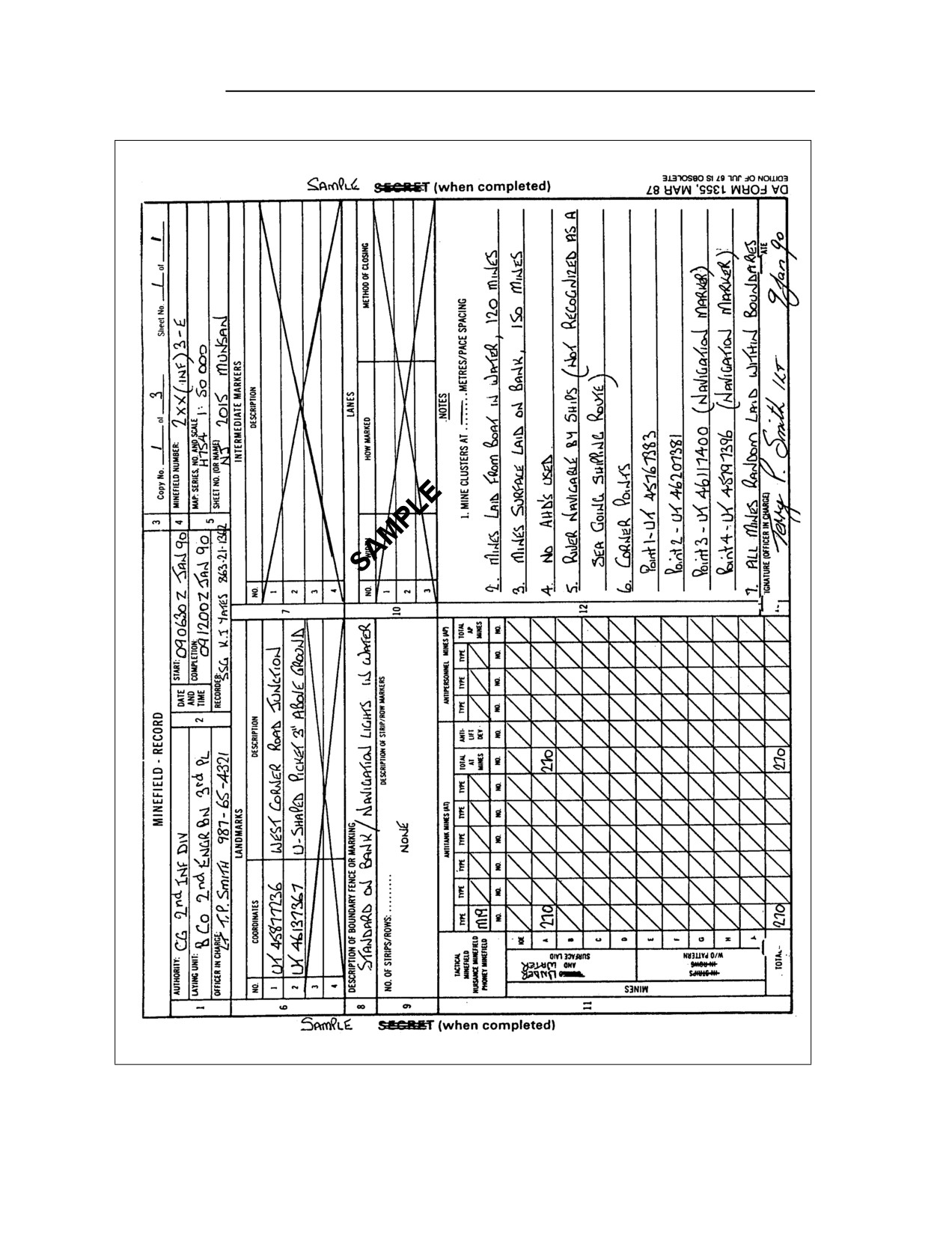
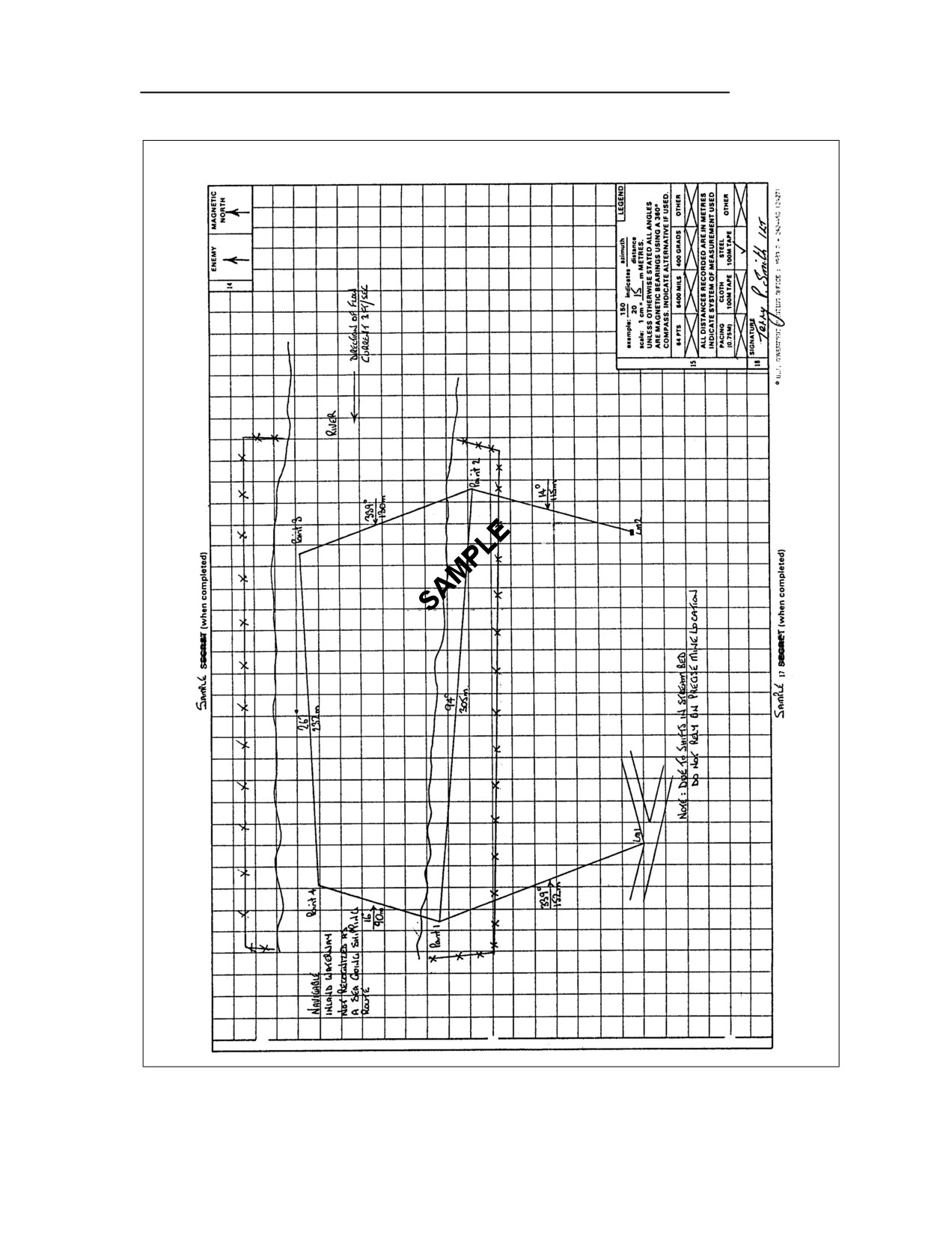
The minefield is recorded on DA Form 1355 (Figures 12-2a and 12-2b, pages
12-4 and 12-5).
SAFETY
In addition to normal safety measures, underwater mining requires
evaluation of the tactical situation and application of special safety
techniques. The turbidity, the velocity, and the depth of the water and the
condition of the bottom require that laying-party personnel be able to swim
well. Prolonged immersion of personnel, especially in cold temperatures, must
be avoided. Sudden drop-offs, rocks, and other objects that are likely to cause
personnel to lose their footing must be considered. Other safety measures
include the following:
• Work in pairs.
Mining Operations in Special Environments 12-3
FM 20-32
Figure 12-2a. Sample DA Form 1355 (front side) for river mining
12-4 Mining Operations in Special Environments
FM 20-32
Figure 12-2b. Sample DA Form 1355 (inside) for river mining
Mining Operations in Special Environments 12-5
FM 20-32
• Emplace mines from upstream to downstream to prevent personnel
and equipment from being swept into the mined area.
• Stay on the downstream side of the mine when arming the fuse.
• Place the mine as flat as possible on the bottom to prevent drifting.
Use green saplings or other nonbuoyant material to construct
outriggers.
• Do not arm the mine before it is laid.
• Carry the mine horizontally or edgewise to the current to reduce water
resistance on the mine's pressure plate.
URBAN-TERRAIN MINING
Characteristics of urban areas (such as a high proportion of hard-surfaced
roads) prohibit a simple transition from open- to urban-area mine
employment techniques and doctrine. The advantages of abundant cover and
concealment, maneuver restrictions, and observation already possessed by the
defender of an urban area can be significantly enhanced by the proper use of
mines. Terrain modified through the process of urbanization provides a
unique battle environment.
The major characteristics of urban terrain which are likely to impact on mine
warfare include the following:
•
Multistoried buildings add a vertical dimension to the battle.
Basements and floors become part of the battle scene. The
vulnerability of combat vehicles increases because attack from above
or below is likely.
•
Fighting is done at close range, often face-to-face, and seldom exceeds
50 meters. Some weapons, particularly large-caliber weapons, are
unsuitable at a short range.
•
Sewers, subways, and tunnels provide covered and concealed
passageways for the movement of troops on both sides. Detailed
knowledge of the location and the status of these tunnels is needed to
successfully wage an urban battle.
•
Streets and parking lots are modified to withstand continuous use by
vehicles. Major routes and lots are paved. A high density and complex
pattern of streets provide numerous avenues of advance. Burying
mines is extremely difficult. Most mines are surface-laid and
camouflaged with rubble and debris to avoid detection.
•
Movement by vehicle is difficult. Streets are littered by rubble and
cratered if the city has been bombed or subjected to artillery attack.
Bridges and overpasses are likely to be destroyed or blocked. Traffic
flow is highly channelized.
•
Extensive map and chart data are needed by the commander. For
example, the commander should know the locations of telephone,
electric, gas, water, and sewer connections; substations; and
generating and pumping stations.
12-6 Mining Operations in Special Environments
FM 20-32
ANTIPERSONNEL MINES
US policy prohibits the use of non-self-destructing AP mines for all US forces
except those on the Korean Peninsula. However, US forces can expect to
encounter AP mines that are emplaced by other countries in support of
MOBA. They are employed to block infantry approaches through or over
underground passageways; open spaces; street, roof, and building obstacles;
and dead spaces.
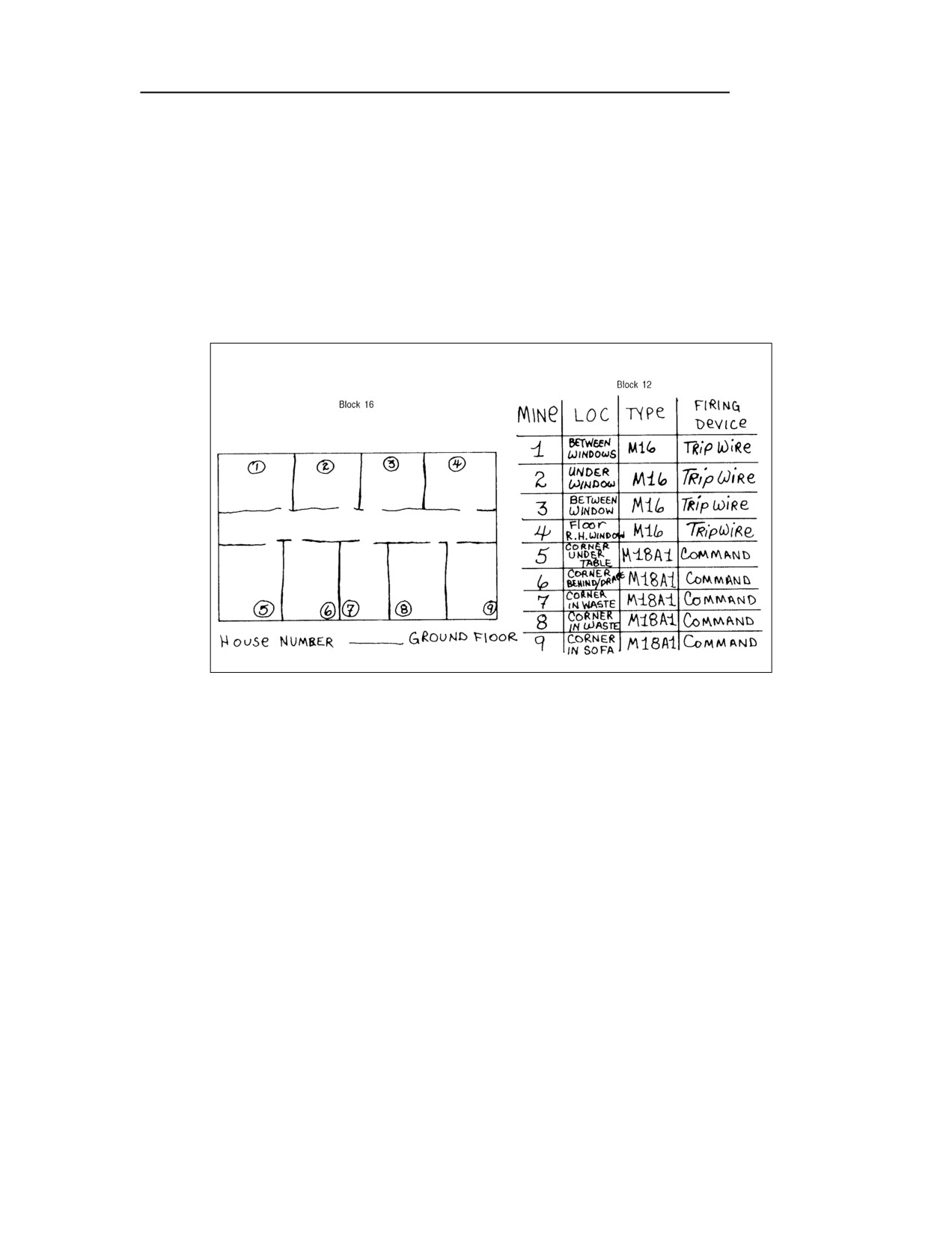
When AP mines are encountered (Korea Only: or used) in MOBA, mine
locations are recorded on DA Form 1355 as shown in Figure 12-3)
Figure 12-3. Building sketch and mine plan (DA Form 1355)
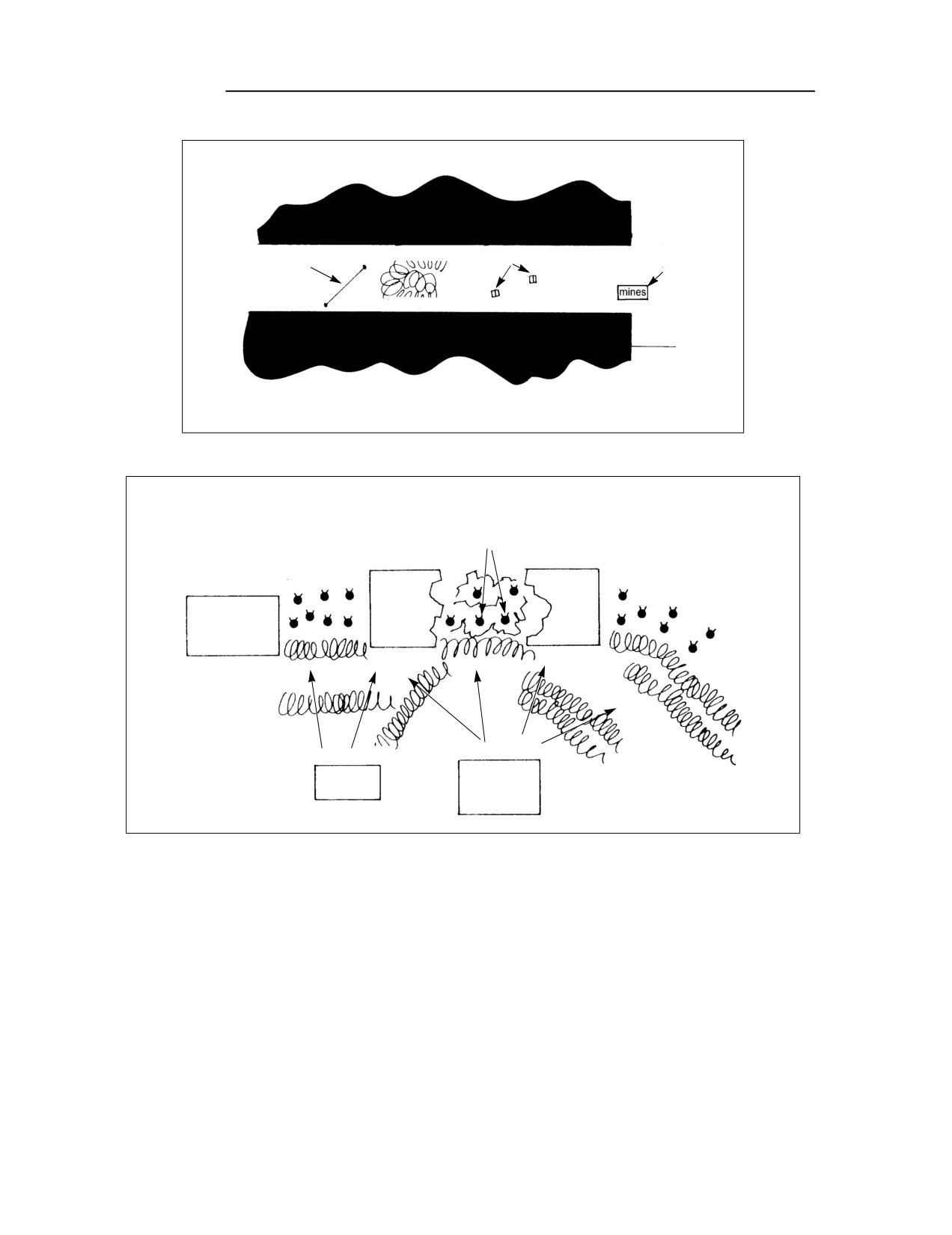
Underground Passageways
Subways, sewers, cellars, and utility tunnels provide protected movement
routes for troops. In large cities where underground systems are numerous
and complex, limited manpower may dictate that forces employ obstacles to
block key passageways with wire and AP mines. (See Figure 12-4, page 12-8.)
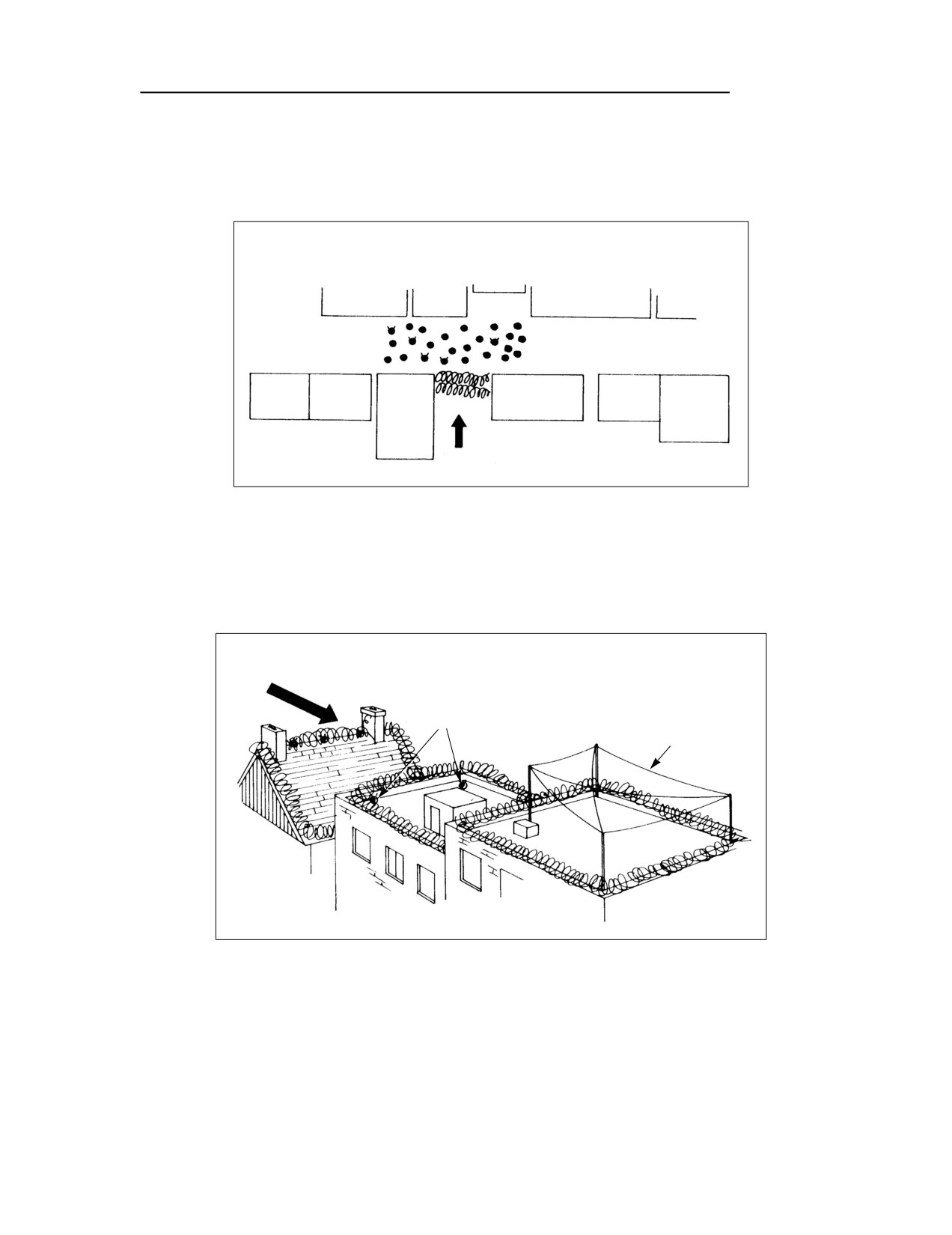
Open Spaces
Open spaces include gaps between buildings, courtyards, residential yards,
gardens, parks, and parking lots. In some cases, mines can be concealed in
rubble or buried. However, the characteristics of most terrain surfaces,
coupled with limited time and resources, dictate that mines be surface-laid.
(See Figure 12-5, page 12-8.)
Mining Operations in Special Environments 12-7
FM 20-32
Warning sign
Trip wire
Wire/rubble Unattended sensors
for defenders
Enemy
Anchor points
Figure 12-4. Underground passageway
Concealed AP mines
with trip wires
AP
AP
minefield
minefield
Overwatching fires
Overwatching fires
Figure 12-5. Open spaces
12-8 Mining Operations in Special Environments
FM 20-32
Street Obstacles
Hand-emplaced AP mines can be emplaced on street surfaces, on railroad
lines, and in areas along shallow waterways. (See Figure 12-6.)
Overwatching fires
Figure 12-6. Street obstacles
Roof Obstacles
Mines and booby traps supplement wire obstacles to deny operations that
require air assault onto rooftops. They also prevent occupation on roofs that
afford good observation points and fields of fire. (See Figure 12-7.)
Overwatching fires
Wire with booby traps
and directional
fragmentation mines
Antihelicopter
obstacle
Figure 12-7. Roof obstacles
Mining Operations in Special Environments 12-9
C2, FM 20-32
Building Obstacles
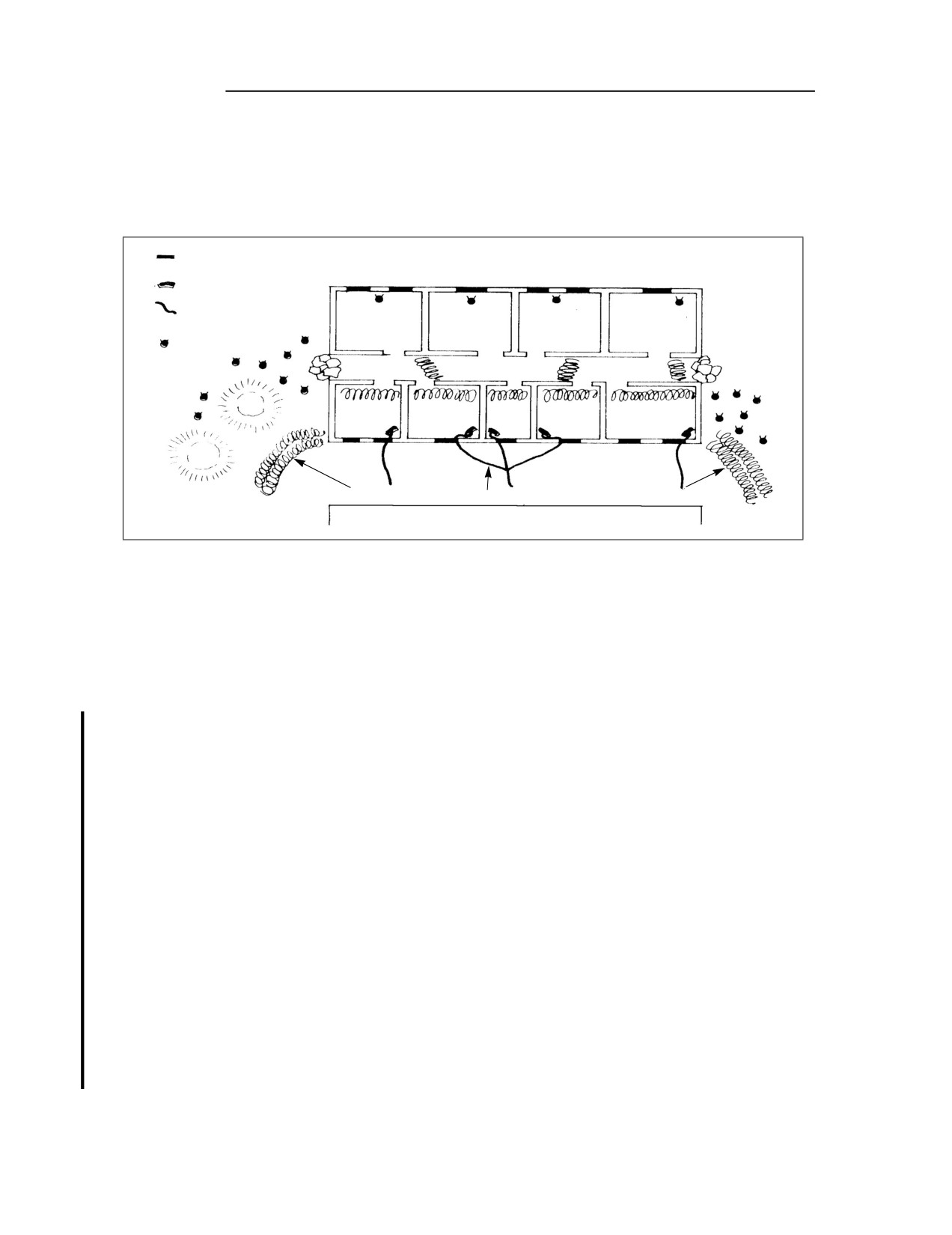
Building obstacles include areas within and adjacent to buildings. Forces can
lay mines in conjunction with wire obstacles to deny infantry access to covered
routes and weapon positions (Figure 12-8).
Boarded up window
Directional AP mine
Buried directional
With trip
With trip
With trip
With trip
AP mine wire
wires
wires
wires
wires
AP mine
Overwatching fires
Overwatching fires
Overwatching fires
Defensive fires
Figure 12-8. Building obstacles
Dead Spaces
Obstacles and mines can be emplaced to restrict infantry movement in areas
that cannot be observed and in areas that are protected from direct fire.
Employment
The following AP mines are effective in urban terrain:
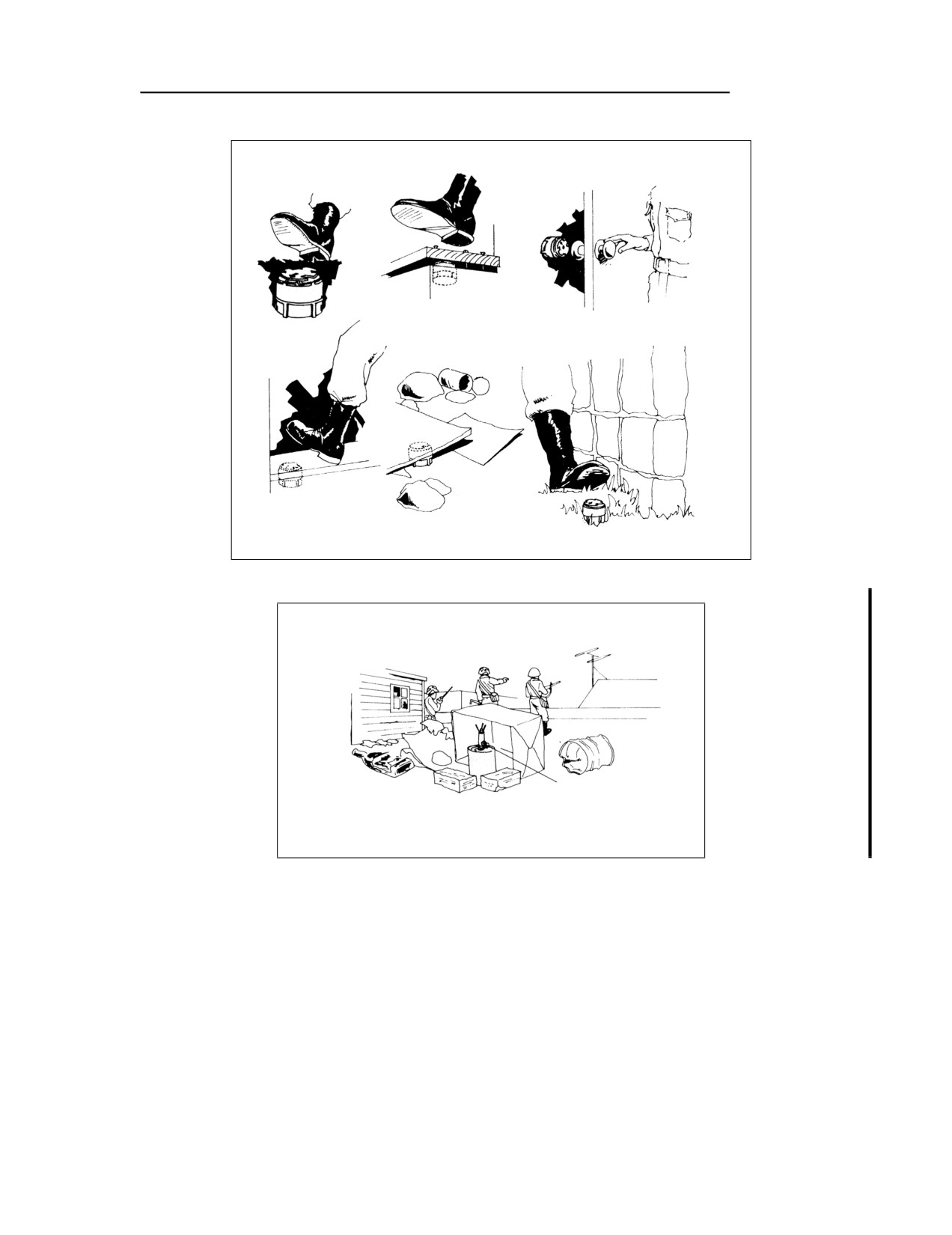
• M14 (used by US forces in Korea only). Its small size makes it
ideal for obscure places, such as stairs and cellars. It can be
used in conjunction with metallic AP and AT mines to confuse
and hinder breaching attempts. (See Figure 12-9.)
• M16
(used by US forces in Korea only). With trip-wire
actuation, its lethal radius covers large areas such as rooftops,
backyards, and cellars. An added advantage can be gained by
attaching twine or wire to the release-pin ring to expediently
rig the mine for command detonation. (See Figure 12-10.)
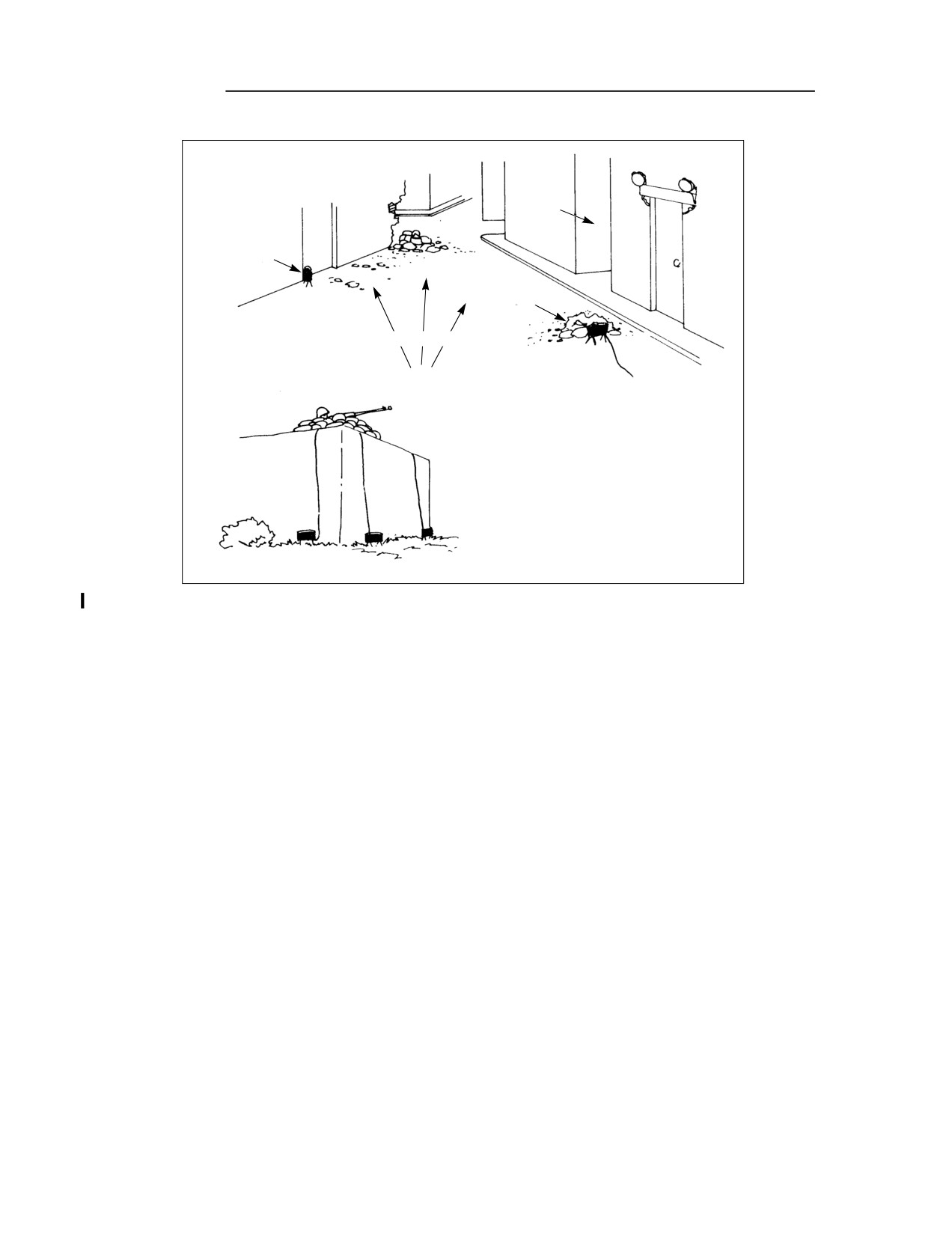
• M18A1 (claymore). Numerous innovative applications of claymore
munition deployment can be found for defensive warfare in urban
areas (Figure 12-11, page 12-12). With remote firing, a series of
claymore mines along a street establishes a highly effective ambush
zone. Mines can also be employed on the sides of buildings, in
abandoned vehicles, or in any other sturdy structure. Numerous
opportunities exist for effectively sited, well-concealed mine
employment above the terrain surface. Claymore munitions can be
used to fill the dead space in the FPF of automatic weapons. They
present a hazard when used in confined, built-up areas. Exercise
caution when using them close to friendly forces because there is a
danger of backblast.
12-10 Mining Operations in Special Environments
C2, FM 20-32
Under steps
Behind doors
In footpaths
In rubble
Under thresholds
At base of walls and fences
Figure 12-9. Probable M14 AP mine emplacement
Rooftops
Trip wire (command-
detonated)
Figure 12-10. Probable M16 AP mine emplacement
Mining Operations in Special Environments 12-11
C2, FM 20-32
On streets
In alleys
In rubble
Outside
buildings
On streets
Overwatching fires
Coverage for dead spaces
Figure 12-11. Probable M18A1 munition emplacement
CONVENTIONAL ANTITANK MINES
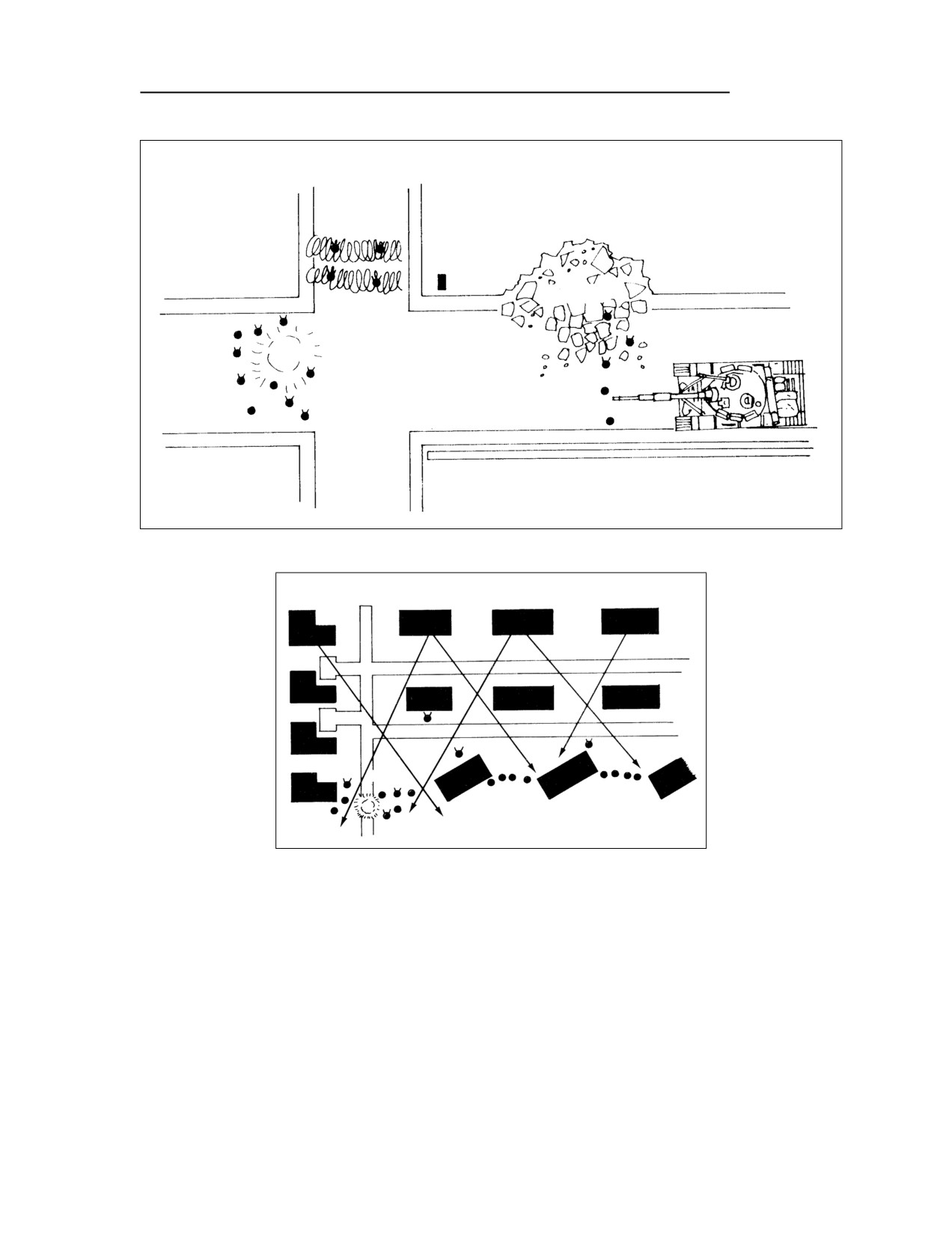
Enemy tanks, infantry fighting vehicles (IFVs), and direct-fire support
weapons are restricted to streets, railroad lines, and, in some instances,
waterways. (See Figure 12-12.) M15, M19, and M21 mines are used primarily
in tactical and nuisance minefields; but they are occasionally used in
protective minefields. They should be employed with other obstacles and
covered by fire. Conventional AT mines emplaced in streets or alleys block
routes of advance in narrow defiles. Concealment of large AT mines is
accomplished by placing them in and around rubble and other obstacles.
Extensive labor requirements generally prohibit burying mines in difficult
terrain types.
In dispersed residential areas, obstacles are required to reduce the enemy’s
infantry mobility through and between houses and in open areas. They also
prevent armored vehicles from moving between houses and along streets. AT
minefield patterns should extend outward from the streets, incorporating
open areas between buildings and streets to prevent easy bypass of street
obstacles.
Significant labor and mine materials are required to deploy conventional
mines between widely spaced buildings, in high-rise construction, and in
industrial and transportation areas. Therefore, SCATMINEs should be
seriously considered as viable alternatives. Some situations, such as the one
shown in Figure 12-13, provide opportunities for the effective employment of
mines in tactical and nuisance minefields.
12-12 Mining Operations in Special Environments
FM 20-32
In artificial
barrier
Off-route AT
mine
Supplementing road crater
Figure 12-12. AT mine emplacement in urban areas
Figure 12-13. AT mine emplacement in industrial and transportation areas
SCATTERABLE MINES
Area-Denial Artillery Munitions and Remote Antiarmor Mines
In addition to the advantages (such as reducing required resources and
emplacement time) applicable to all SCATMINE systems, ADAMs and
RAAMs have two specific advantages. They are the most rapidly deployed
SCATMINE systems, and preplanning artillery-delivered minefields increases
the rate at which nuisance minefields can be emplaced. Secondly, these mines
can be delivered under enemy fire. Employment of ADAMs and RAAMs is
most effective when the enemy's intentions are known and their forces are
committed to an avenue of advance. (See Figure 12-14, page 12-14.)
Mining Operations in Special Environments 12-13
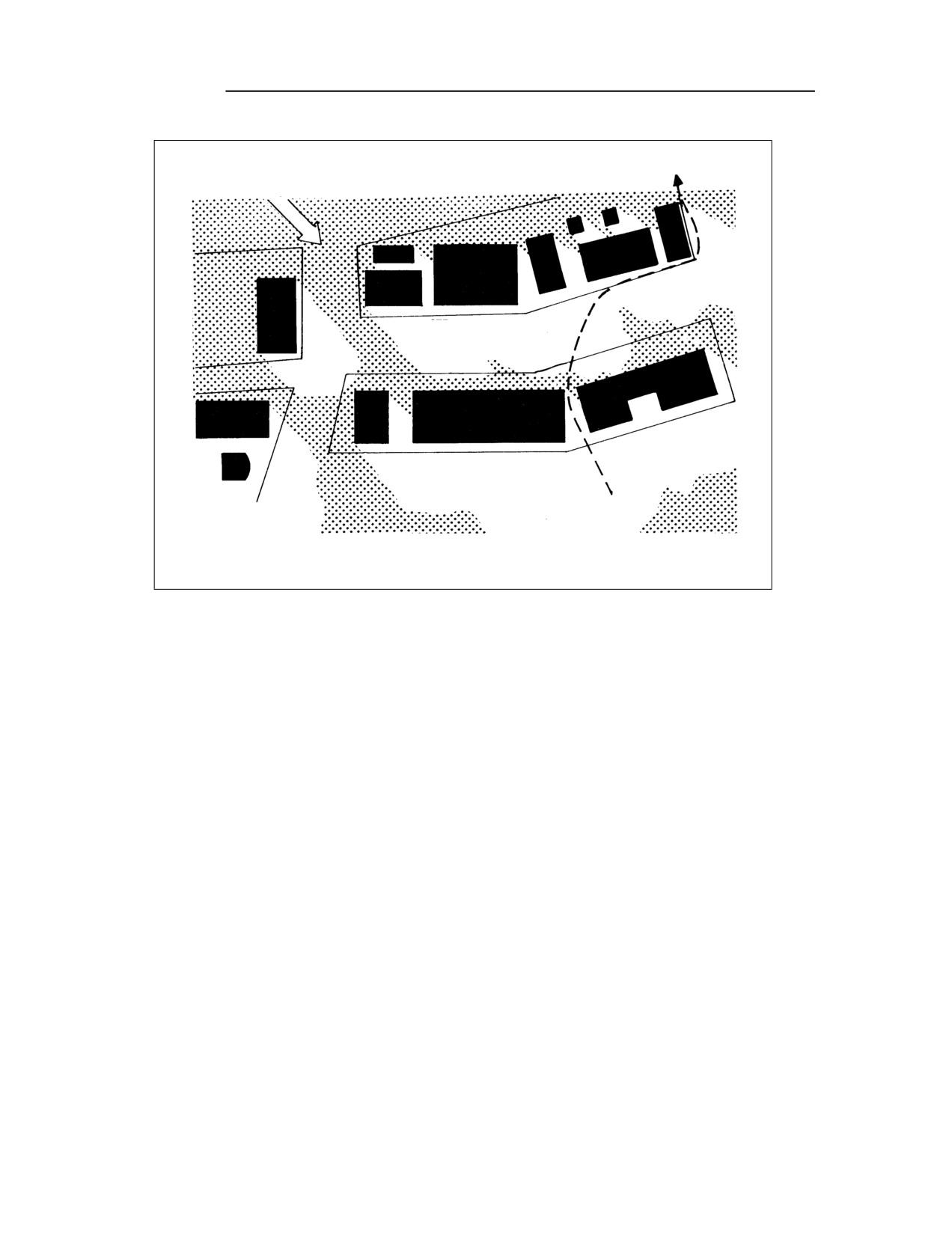
FM 20-32
Artillery delivery
Potential enemy route
through areas with
low mine-density
NOTE: Unshaded areas cannot
be mined by assigned artillery.
Figure 12-14. ADAM/RAAM employment
Using ADAMs/RAAMs in urban terrain involves five specific problem areas:
• Difficulty in precise minefield siting. Accurate siting is extremely
critical due to the typically restrictive avenues of advance and may be
futile due to the difficulty in adjusting artillery rounds in an
environment that obscures observation. Further, buildings tend to
create unmined shadow zones.
• Uncertainty of ADAM/RAAM survivability upon impact with a
building or ground surfaces that are characteristic in urban areas.
• Likely availability of artillery firing units. ADAM/RAAM
emplacement may not be a priority of the maneuver commander,
because his supporting units may not have enough ADAM/RAAM
munitions on hand. Assuming the availability of artillery assets for an
ADAM/RAAM mission could prove disastrous for defending forces.
• High detectability of these mines on bare and lightly covered surfaces.
This permits the enemy to seek out unmined passageways or pick
through lightly seeded areas. If you use the doctrinal guidelines for
emplacing artillery-delivered mines on top of the advancing enemy or
immediately in front of them, the desired obstacle intent (disrupt,
turn, fix, block) and enhanced fires are achieved.
• Difficulty in achieving a good, random pattern. Hard-surfaced areas
cause mines to bounce and roll. Some mines (especially AT mines) will
land on top of buildings and are ineffective.
12-14 Mining Operations in Special Environments
C2, FM 20-32
Air Volcano
The primary advantage of the air Volcano system is its capability to site and
emplace minefields accurately. This depends on the helicopter's
maneuverability over the selected minefield terrain and the proper
coordination between ground forces and aviation support. Disadvantages
include vulnerability and the high replacement cost of the helicopter.
However, in view of the system's operational concept, employment in urban
terrain (which provides little exposure of the helicopter) actually increases the
practicality of employing this system in urban areas. Mine survival rate on
impact with a hard surface is another potential problem.
Ground Volcano
Three aspects of the ground Volcano distinguish it from other SCATMINE
systems:
• The dispenser is organic to supporting combat engineers, making it
readily available to support the maneuver commander's defensive
plan.
• Delivery siting is accurately pinpointed to the ground.
• Better opportunities exist to record the presence of a minefield. In
contrast to artillery-delivered and air Volcano systems, the ground
Volcano is delivered by engineers who are normally located with and
report directly to the maneuver commander.
Some primary factors may degrade ground Volcano deployment in urban
terrain. The requirement to emplace minefields before an actual attack in
order to reduce system vulnerability is the most significant factor. This makes
the minefield detectable and provides more reaction time for the enemy to
alter their scheme of maneuver. The delivery of mines depends on terrain
trafficability. The prime mover and the launch vehicle must negotiate the
terrain over which mines are to be dispensed.
Modular Pack Mine System
The MOPMS is ideally suited for employment in urban terrain (Figure 12-15,
page 12-16). The module can be hidden from enemy view, and the mines can
be dispensed after attackers are committed to a route of advance. Additionally,
mines can be emplaced rapidly under enemy fire. In contrast to other
SCATMINE systems, the commander controls when and where mines are
dispensed and how they are detonated, regardless of the enemy situation.
Gator
When considered for employment in urban terrain, Gators encompass the
same problems as artillery-delivered and air Volcano mine systems.
DECEPTION MEASURES
Phony minefields can be established rapidly with negligible effort and cost.
They have the distinct advantage of blocking the enemy but not friendly
forces. Although it is difficult to fake a surface-laid minefield, expedients such
as soup pans, seat cushions, and cardboard boxes have historically proven
effective in delaying and channelizing attacking forces. These objects, as well
Mining Operations in Special Environments 12-15
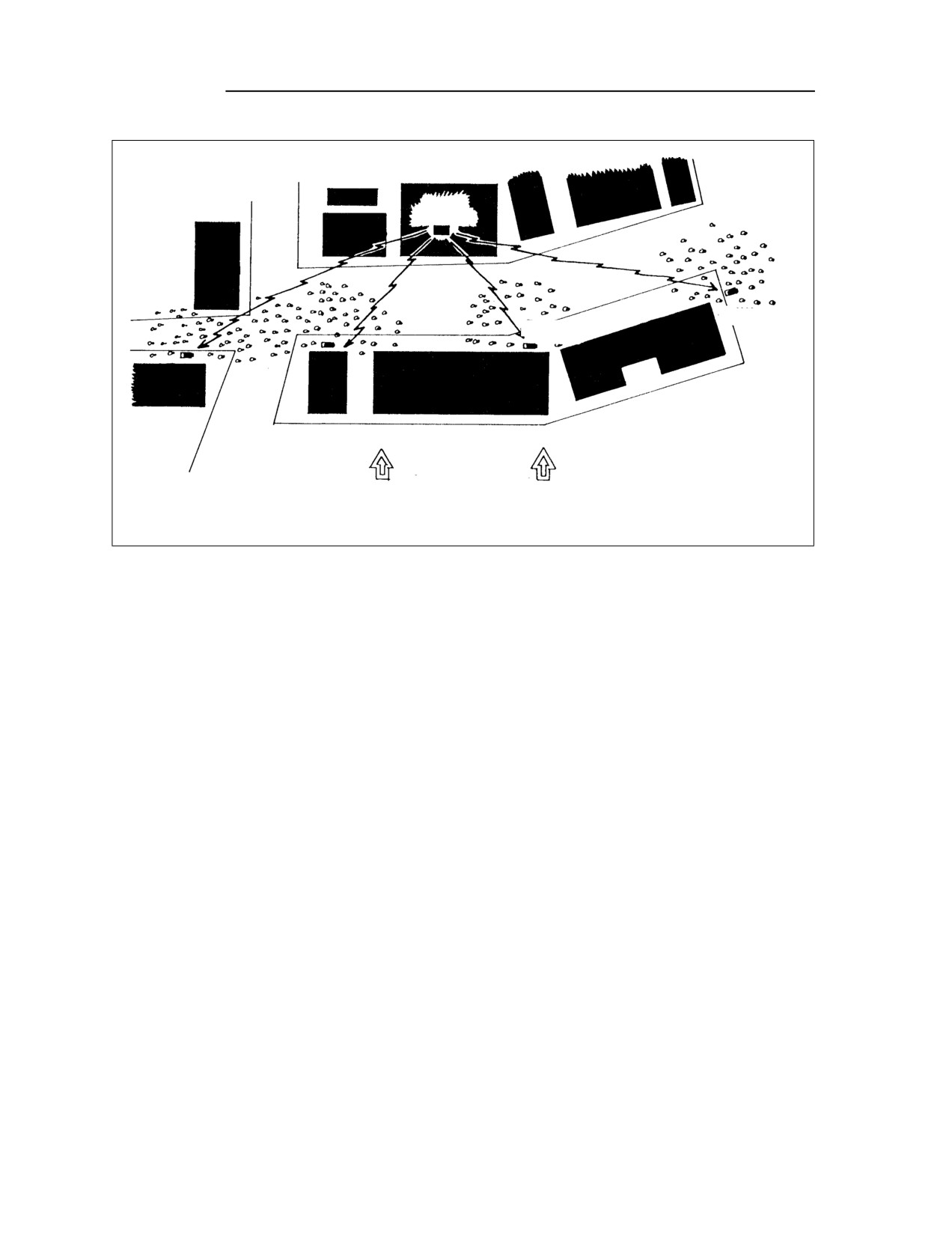
FM 20-32
MOPMS transmitter
MOPMS
MOPMS
MOPMS
Direction of enemy advance
Figure 12-15. MOPMS employment
as other ones readily available in urban areas, can be used as phony
minefields or used to cover real mines. A more realistic phony minefield could
be created with inert or training mines.
Inadequate minefield camouflage in urban terrain is viewed as a critical
constraint in deploying conventional mines and SCATMINEs. Smoke can be
deployed from various dispensers, but it must be dense and accurately
employed and released.
SPECIAL ENVIRONMENTS
COLD REGIONS
Mine employment in cold regions poses special problems—the principal one
being emplacement. Mine burial is extremely difficult in frozen ground. The
freezing water in soil causes it to have high strength and penetration
resistance, so digging times are greatly increased if not impractical. However,
there are several means to overcome this problem. In some cases, the
minefield can be laid out before the soil freezes. To do this, dig holes for each
individual mine and insert a plug into the hole to protect its shape and
prevent it from being filled in. A wide variety of material can be used for
plugs. Ideally, the plug should be economical, easy to remove, and rigid enough
to maintain the depth and shape of the hole. Sandbags, plastic bags filled with
sand or sawdust, or logs make excellent plugs. If the minefield cannot be
prechambered, mechanical means can be used to dig holes. When available,
civilian construction equipment (particularly large earth augers) can be used
to drill holes for mine emplacement.
12-16 Mining Operations in Special Environments
FM 20-32
To assure detonation of buried, pressure-actuated mines, they should be
placed in a hole that is shallow enough for the pressure plate to be above
ground. Covering spoil should be a maximum of 1 centimeter deep.
When burial is impossible, mines are placed on the surface. Heavy snow cover
may reduce the effectiveness of both buried and surface-laid mines by causing
them to be bridged. Mines laid in deep snow should be placed as close as
possible to the surface and supported by boards or compacted snow.
Waterproof mines before emplacement in cold regions. Mines can also be
placed in plastic bags before burial. In some cases, a layer of ice may form over
the top of the pressure plate. Although the load required to break the ice is
slightly higher than that required to activate the fuse, thin layers of external
ice will have little effect on mine functioning. When possible, tilt-rod mines
should be used in cold regions because they are less susceptible to ice and
snow. Magnetic mines are not significantly affected by snow, although cold
weather decreases battery life.
Camouflaging a minefield in a cold region is difficult. Mines should be painted
white when snow is expected to remain on the ground for extended periods of
time. Minefield signature tracks should be swept away, or deliberate tracks
should be made to give the impression of a safe area.
Korea Only: When trip-wire mines are employed in snow, the wire
should be about 10 meters long, with a slight amount of slack left in
the wire. The trip wires should be supported approximately 46
centimeters above the ground to avoid degradation by snowfall.
JUNGLES
Fuses and explosive components deteriorate very rapidly in jungle climates.
As a result, mines and mine material require more frequent and extensive
maintenance and inspection. Waterproof mines employed in humid climates.
The rapid growth of vegetation hinders maintenance recovery and removal.
Dense vegetation may cause mines to become inoperable or windblown foliage
can detonate them. FM 90-5 provides detailed information on jungle
operations.
DESERTS
In desert climates, fuses and explosive components deteriorate slowly. The
terrain and the situation determine how mines will be emplaced. Mine boards
will normally be required to provide support in soft, shifting sand. Mines
emplaced in the desert have a tendency to shift position, and the spacing
between mines and rows should be increased to prevent sympathetic
detonation. Blowing sand may expose buried mines or cover surface-laid
mines. Sand may also cause mines to malfunction. It is important to realize
the difficulty of accurately recording minefield locations in vast, open, desert
areas void of recognizable terrain features. More mines are required for desert
operations. Typically, desert minefields are much larger and have a lower
density than those used in Europe or Korea. FM 90-3 provides detailed
information on desert operations.
Mining Operations in Special Environments 12-17
FM 20-32
12-18 Mining Operations in Special Environments
C2
Chapter 13
Booby Traps and Expedient Devices
During war and OOTW, booby traps can be found anywhere at anytime.
They can kill or incapacitate their unsuspecting victims. This chapter
provides information on booby-trap employment concepts, detection
techniques, marking and recording procedures, and removal guidelines.
This chapter also provides an overview of expedient devices and their
employment considerations.
SECTION I. SETTING BOOBY TRAPS
US policy restricts the use of booby traps by US personnel. This does not
preclude their use by other countries, so US forces may encounter them during
operations.
The use of booby traps is limited only by the imagination of the force
employing them. They—
• Are usually explosive in nature.
• Are actuated when an unsuspecting person disturbs an apparently
harmless object or performs a presumably safe act.
• Are designed to kill or incapacitate.
• Cause unexpected, random casualties and damage.
• Create an attitude of uncertainty and suspicion in the enemy's mind,
thereby, lowering his morale and inducing a degree of caution that
restricts or slows his movement.
Many booby traps are constructed using military equipment and ammunition.
Improvised traps are used during counterinsurgency missions in low-intensity
conflicts.
The corps commander is the employment authority for booby traps. He can
delegate this authority to the division commander. If authority is given to set
booby traps, US personnel will adhere to the rules for international law
applicable to armed conflict. There are several uses of booby traps that are
prohibited. Remember, these restrictions are not observed by all countries; US
personnel must still be cautious when approaching objects in areas where
booby traps are supposedly prohibited.
International law prohibits the use of booby traps as follows:
• Booby traps and other devices are prohibited if they are attached to or
associated with—
Booby Traps and Expedient Devices 13-1
FM
20-32
— Internationally recognized protective emblems, signs, or signals.
— Sick, wounded, or dead personnel.
— Burial or cremation sites or graves.
— Medical facilities, equipment, or supplies.
— Children’s toys or other portable objects or products that are
designed for their feeding, health, hygiene, clothing, or education.
— Food or drink.
— Kitchen utensils or appliances except in military establishments,
military locations, or supply depots.
— Objects that are clearly religious in nature.
— Historic monuments, works of art, or places of worship.
— Animals or their carcasses.
•
Booby traps are prohibited in cities, villages, and other areas that
contain civilians if combat between ground forces is not taking place
or does not appear to be imminent, unless—
— Booby traps are placed on or in the close vicinity of a military
objective.
— Measures (guards, warning, or fences) are taken to protect
civilians from booby-trap effects.
TACTICS
Booby traps are psychological weapons. They make the enemy cautious and
slow it down. These actions, in turn, cause enemy casualties. Do not waste
time attempting to set elaborate traps that are undetectable or impossible to
disarm. Also, do not waste time developing difficult sites, because simple traps
usually have the same chance of catching the enemy. Even if booby traps are
detected and cleared, their aim is achieved.
The principles governing the use of booby traps and nuisance mines are
identical, so consider using them in conjunction with one another. They have
characteristics that make them suitable for use in different situations:
• Nuisance mines are quicker to lay and safer to use than booby traps,
and they are normally used in outside locations where they can be
buried.
• Booby traps are normally used in urban areas, structures, and places
where mines are easily detected.
Booby traps and nuisance mines are particularly suited for defensive
operations. They are used to—
• Slow the enemy's advance.
• Deny the enemy use of facilities and material.
• Warn of enemy approach.
13-2 Booby Traps and Expedient Devices
FM 20-32
• Deter the enemy from using ground not covered by direct fire.
• Plan defensive operations.
In offensive operations, booby traps and nuisance mines are employed on an
opportunity basis during raids and patrols. Formal instruction is not usually
issued by the staff.
Exercise caution when using bobby traps in offensive operations because they
may hinder the operation. In advance and pursuit operations, they are
primarily used by patrols and raiding parties. They slow down enemy follow-
up actions and hinder the enemy’s repair and maintenance teams after raids.
The following considerations pertain to defensive operations but may be
relevant to offensive operations and must be considered when briefing troops:
• Booby trapping is rarely given a high priority and is usually
peripheral to other engineer tasks.
• Nuisance mines are more cost-effective than booby traps, unless booby
traps are used in situations that allow their full potential to be
exploited. If it is easier, use nuisance mines instead of booby traps.
To maximize the effect of booby traps and nuisance mines, the staff provides
engineer commanders with the following information:
• Purpose. Booby traps are time-consuming and dangerous to set. Do
not waste time and effort setting traps that are unlikely to be actuated
or that are not specifically designed to achieve the required aim. For
example, if booby traps are being used against troops, small, simple
traps designed to incapacitate will achieve this result just as well as
complicated ones with large charges. If the aim is to destroy vehicles,
use mines.
• Location. The precise location for booby traps and nuisance mines can
only be determined by the setting unit. Areas must be delineated and
recorded so that there is no threat to friendly forces in the event of
reoccupation.
• Time setting starts and time available for setting. The time setting
starts affects other engineer tasks, and the length of time available for
setting governs the number of men required.
• Number of safe routes required. Safe routes are important during
general withdrawals where authority has been given to booby-trap
positions as they are evacuated. They also provide safe areas for the
covering force to launch counterattacks.
• Likelihood of reoccupation. Even if the enemy has not detonated booby
traps, they might have interfered with them. Therefore, do not set
booby traps when areas are to be vacated to meet short-term tactical
requirements or when reoccupation is expected soon.
Intelligence personnel provide information to assist the setting unit in
maximizing the effect of booby traps. The nature and the type of traps
required depend on the enemy unit. For example, while paying particular
attention to dead space and defilade positions, use mines or widely dispersed
Booby Traps and Expedient Devices 13-3
C2, FM 20-32
traps (with large charges) against a mechanized enemy. Conversely, use small
traps and AP mines (in places that afford cover) against an infantry enemy.
SITING
If the first obstacle or installation the enemy strikes is booby-trapped or
nuisance-mined, he is delayed while he clears it. The enemy is further delayed
by an increased degree of caution. His troops know that additional traps and
mines can be encountered. Booby traps and nuisance mines are generally
located—
• In and around buildings, installations, and field defenses.
• In and around road craters or any obstacle that must be cleared.
• In natural, covered resting places along routes.
• In likely assembly areas.
• In the vicinity of stocks of fuel, supplies, or materials.
• At focal points and bottlenecks in the road or rail systems
(particularly the ones that cannot be bypassed).
The setting-party commander is responsible for the detailed siting and design
of booby traps. Consider all the information about the enemy soldier and his
operating procedures when selecting places and objects to trap. Also, consider
the traps from the enemy’s point of view and assess the courses open to the
enemy when he encounters them. This can expose weaknesses in your initial
plan and bring about changes to the proposed layout, or it can result in a
different location being selected. In addition, determine the effort required by
the enemy to bypass the traps. This shows whether the imposed delay justifies
the effort required to set the booby traps in the selected location.
TYPES OF TRAPS
Booby traps are designed to—
• Be actuated by persons carrying out their normal duties.
• Take advantage of human nature.
The following booby traps can often be detected because they are designed to
make the person do something:
• Bait. Usually consists of objects that arouse someone’s interest, such
as attractive or interesting items that have apparently been left
behind or discarded during a rapid evacuation.
• Decoy. The most common decoy consists of two traps—one designed to
be detected, the other designed to actuate when personnel deal with
the first one. The first trap can be a dummy. A classic form of a decoy
is to place booby traps or nuisance mines in locations from which the
decoy mine can be removed.
• Bluff. A bluff is a hoax and usually consists of a dummy trap.
13-4 Booby Traps and Expedient Devices
C2, FM 20-32
• Double bluff. A double bluff only appears to be a bluff. Personnel
believe the trap is safe or can be disarmed. For example, a number of
traps can be set that are disarmed when the detonating cord is
removed from the charge. The double bluff is achieved by setting
another trap that appears to be the same, but it actually explodes
when the detonating cord is removed from the charge. Double bluffs
rely on a reduced awareness and alertness caused by repetition.
COMPONENTS AND PRINCIPLES
There are two initiation methods for explosive booby traps—electric and
nonelectric. Both methods can be constructed using many different types of
FDs. FDs can be secured to the charge (direct connection) or located away
from it (remote connection). They are actuated by one or more methods. It is
impossible to describe every type of trap that may be encountered; however,
most are constructed and operated by using components similar to those listed
below:
• FD.
• Power source (battery, for example).
• Connection (usually detonating cord or electric wires).
• Blasting cap.
• Main charge.
Figure 13-1, page 13-6, shows how typical electric and nonelectric traps can be
made.
ACTUATION METHODS
Many sophisticated booby-trap devices are now being manufactured that
operate on vibration, sound, temperature change, and other methods. Current
intelligence on the booby trap being used in the AO should be gathered so that
countermeasures can be developed and practiced. Most FDs found in the
combat zone are simple mechanisms designed to be actuated by pull, pressure,
pressure release, or tension release (Figure 13-2, page 13-7).
METHODS OF CONNECTION
Procedures can be varied when it is safe to do so. For example, instead of
connecting the FD to a charge already in position, preconnect trap components
and then position the trap.
Small charges (up to 1 kilogram) are sufficient for AP traps, but larger
quantities can be used to increase their effect. Shrapnel can be produced by
packing stones, scrap metal, nails, or other material around the charge. AT
traps require large charges (up to 6.75 kilograms for wheeled vehicles and
11.25 kilograms or more for tracked vehicles).
REMOTE
Follow the procedures listed below when assembling a remotely connected
trap using an M142 FD (similar to the illustration in Figure 13-3, page 13-7):
• Design the trap and collect necessary materials.
Booby Traps and Expedient Devices 13-5
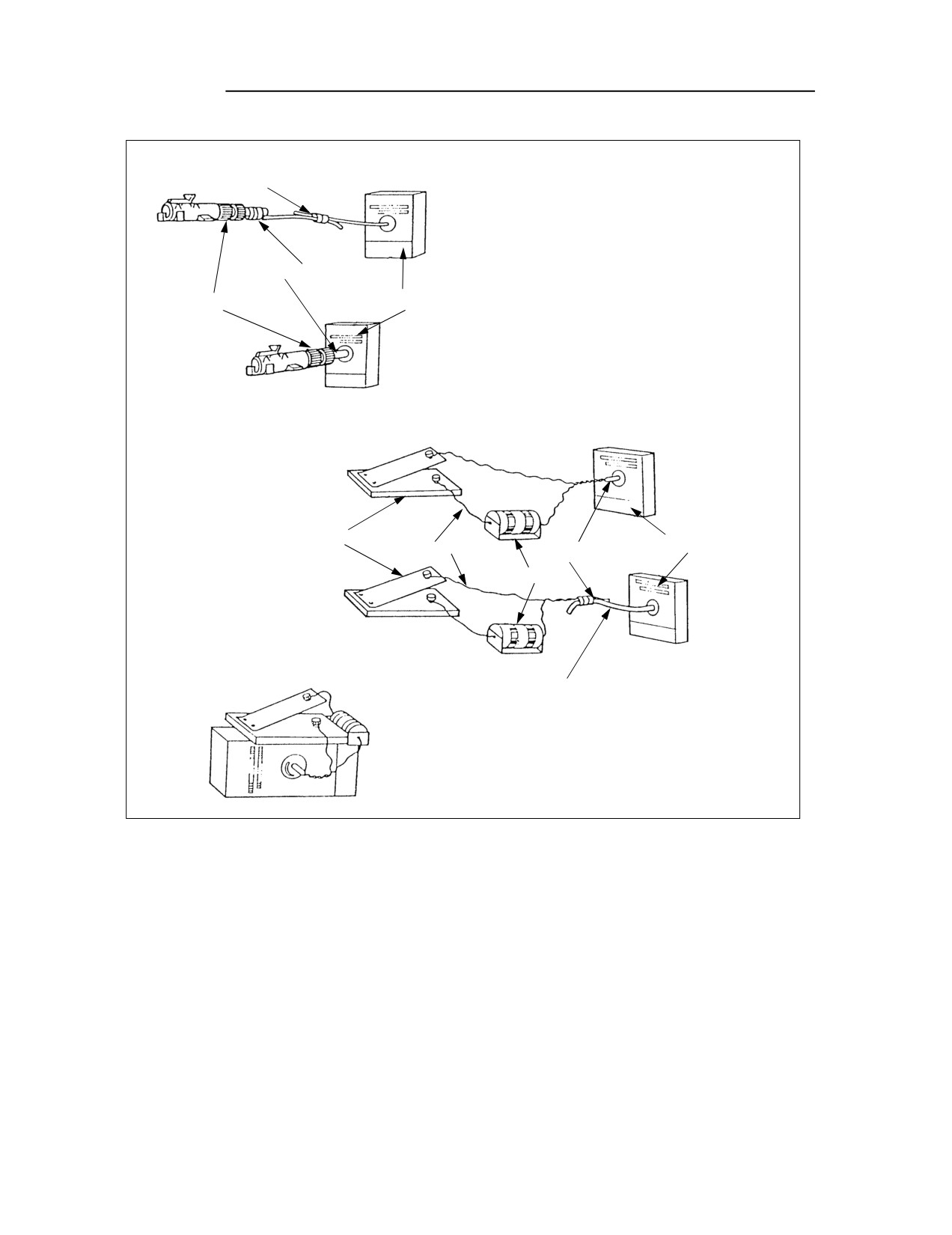
FM 20-32
Detonating cord
REMOTE
Blasting cap
Charge
FD
DIRECT
DIRECT
FD
Electrical cable
Charge
Blasting cap
Battery
REMOTE
Detonating cord
DIRECT
Figure 13-1. Typical electric and nonelectric booby traps
• Test the M142 FD.
• Lay the detonating cord from the charge location to the FD location.
• Position the charge.
• Connect the detonating cord to the charge.
• Prepare the coupler.
• Tape a length (46 centimeters, minimum) of detonating cord to the
coupler’s blasting end.
• Prepare and position the M142, set it to operate in the desired
manner, and remove the round- or square-headed pin.
13-6 Booby Traps and Expedient Devices
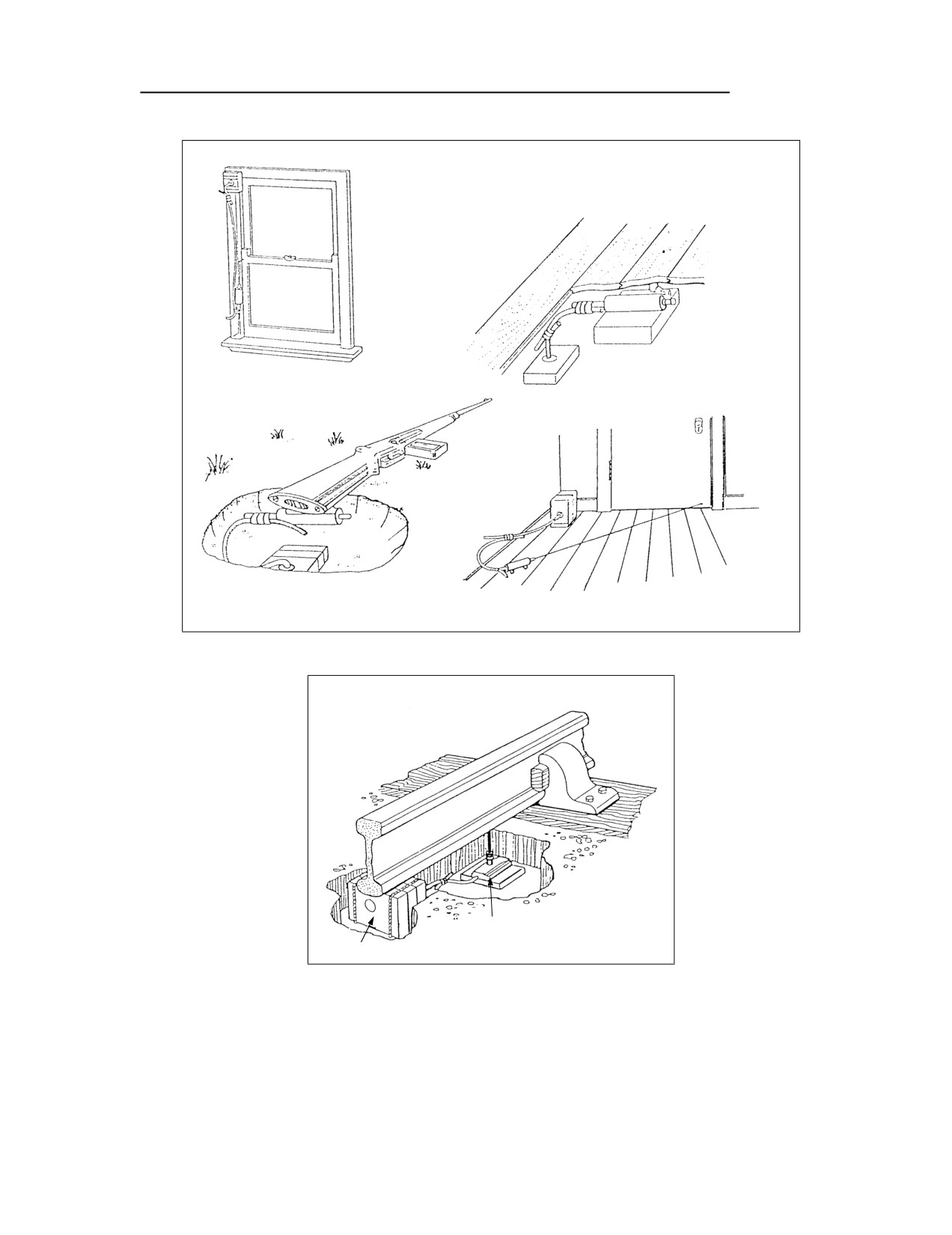
FM 20-32
Pressure
Pull
Pressure release
Tension release
Figure 13-2. Methods of actuation
Pressure switch
Charge
Figure 13-3. Remotely connected traps
• Ensure that the two detonating cords are not touching but can be
conveniently connected when necessary.
• Remove any materials and other signs of laying, and fully camouflage
the area.
Booby Traps and Expedient Devices 13-7