FM 20-32 Mine/Countermine Operations (August 2001) - page 7
FM 20-32
Known to
be <100 m
62 m
100 m
Inert
Inert
Actual charge
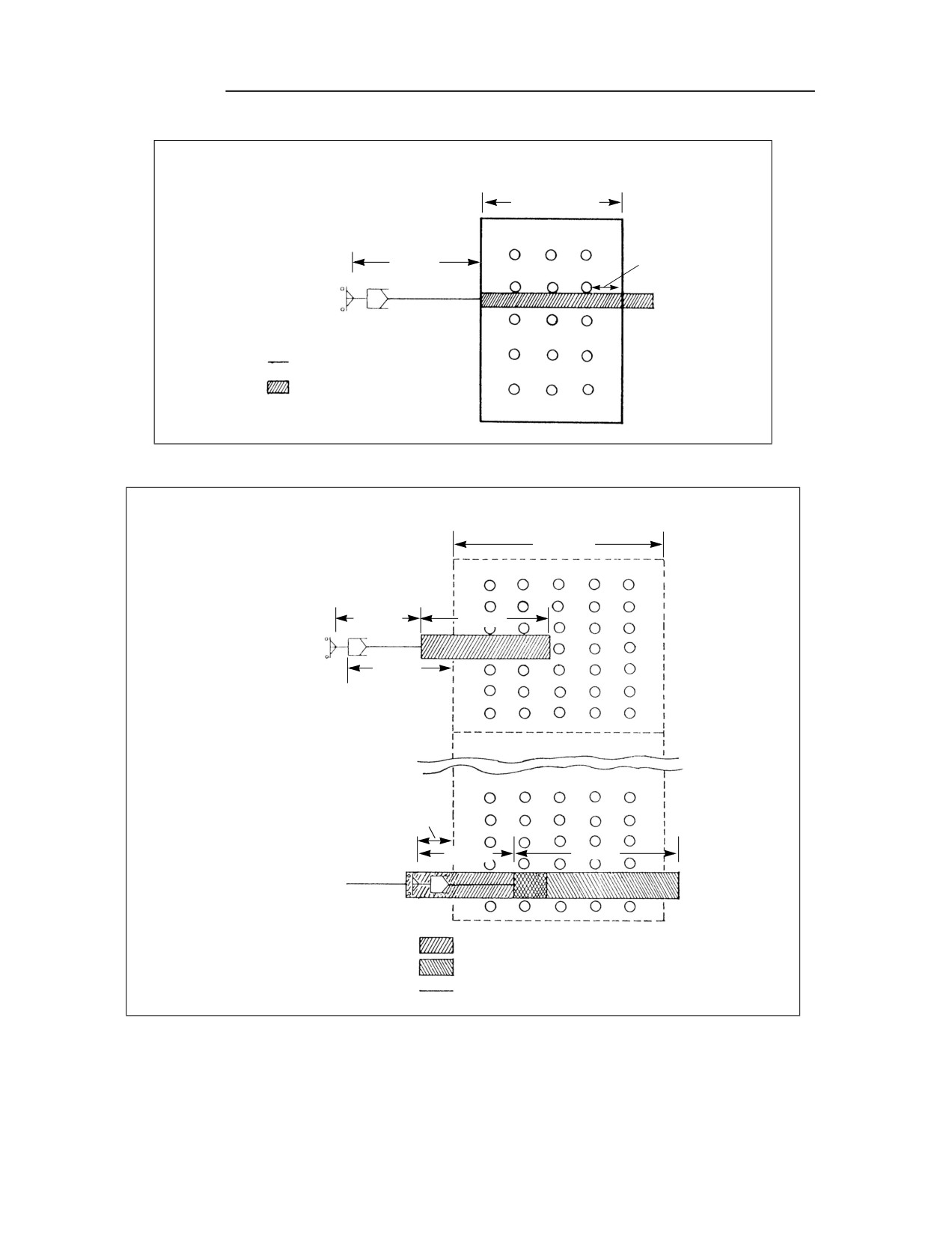
Figure 10-6. MICLIC employment in a minefield less than 100 meters deep
100+ m
62 m
100 m
First MICLIC
100 m
25 m
62 m
100 m
Second MICLIC
First charges
Second charges
Inert
Figure 10-7. MICLIC employment in a minefield of uncertain depth or greater than 100 meters
10-10 Minefield Reduction

C2, FM 20-32
The neutralization of mines by blast depends on the peak pressure and the
impulse. For the MICLIC, the impulse is at a maximum of 3 meters from the
line charge (on both sides) and decreases the closer it gets toward the line
charge, to a minimum of 1 meter from the line charge. This decrease on
impulse causes a skip zone (Figure 10-8). This does not mean that
neutralization is equal to zero percent; it means that it is not equal to 100
percent. Mines that are buried deeper than 10 centimeters and located 1 to 2
meters from the line charge have a high probability of not being neutralized.
5m
4m
3m
2m
Skip zone
1m
Line charge
1m
Skip zone
2m
3m
4m
5m
Figure 10-8. Skip zone
Minefield Reduction 10-11
C2, FM 20-32
Antipersonnel Obstacle Breaching System
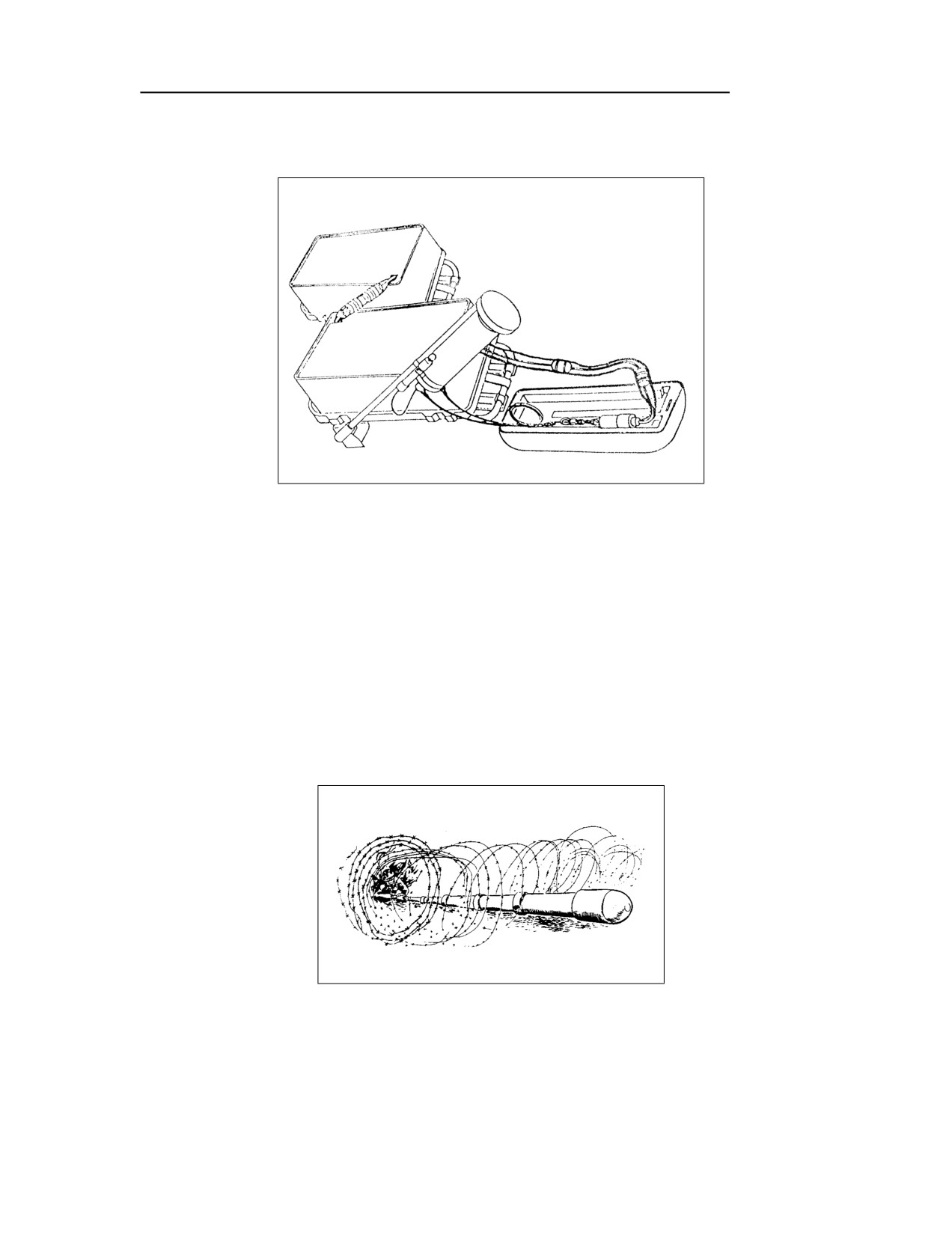
The Antipersonnel Obstacle Breaching System (APOBS) (Figure 10-10) is a
man-portable device that is capable of quickly creating a footpath through AP
mines and wire entanglements. The APOBS is normally employed by combat
engineers, infantry soldiers, or dismounted armored cavalry personnel. The
APOBS provides a lightweight, self-contained, two-man, portable line charge
that is rocket-propelled over AP obstacles from a standoff position away from
the edge of the obstacle.
For dismounted operations, the APOBS is carried in 25-kilogram backpacks
by no more than two soldiers for a maximum of 2 kilometers. One backpack
assembly consists of the rocket-motor launch mechanism, containing a 25-
10-12 Minefield Reduction
FM 20-32
Figure 10-9. APOBS
meter line-charge segment and 60 attached grenades. The other backpack
assembly contains a 20-meter line-charge segment and 48 attached grenades.
The total weight of the APOBS is approximately 54 kilograms. It is capable of
breaching a footpath that is approximately 0.6 by 45 meters and is fired from
a 25-meter standoff.
M1A1/M1A2 Bangalore Torpedo
The bangalore torpedo (Figure 10-11) is a manually emplaced, explosive-filled
pipe that was designed as a wire breaching device, but it is also effective
against simple pressure-activated AP mines. It is issued as a demolition kit
and consists of ten 1.5-meter tubes. Each tube contains 4 kilograms of high
explosives and weighs 6 kilograms. The kit clears a 1- by 15-meter lane.
Figure 10-10. Bangalore torpedo
The bangalore torpedo is used by dismounted infantry and engineer troops.
An individual soldier or a pair of soldiers connects the number of sections
needed and pushes the torpedo through the AP minefield before priming it. A
Minefield Reduction 10-13
FM 20-32
detailed reconnaissance is conducted before employing the bangalore torpedo
to ensure that trip wires have not been used.
The bangalore torpedo generates one short impulse and is not effective
against pronged, double-impulse, or pressure-resistant AP and AT mines.
WARNING
Do not modify the bangalore torpedo. Cutting the
bangalore in half or performing any other modification
could cause the device to explode.
MECHANICAL
MCBs and MCRs are fielded as armor battalion sets that contain 12 MCBs
and 4 MCRs. Blades clear lanes through minefields, while rollers are used to
detect minefields and proof lanes created by other means. Rollers are not a
good primary system for lane reduction because multiple mine detonations
destroy the roller system and the vehicle pushing it. (The roller is designed to
resist two conventional-mine or three scatterable-mine strikes, depending on
the mine type.)
The CEV, the ACE, and dozer blades were not designed for breaching
minefields and should be employed only as a last resort, because using them is
extremely hazardous to the crew and equipment. However, CEVs or ACEs can
effectively clear a lane through AP scatterable minefields because they
sustain little or no damage and offer protection to the crew. When using a
dozer to clear a path through minefields, the operator is exposed to mine
effects. Before clearing begins, the operator's cabin should be sandbagged or
up-armored and the lane should be cleared of trip wires. When using an
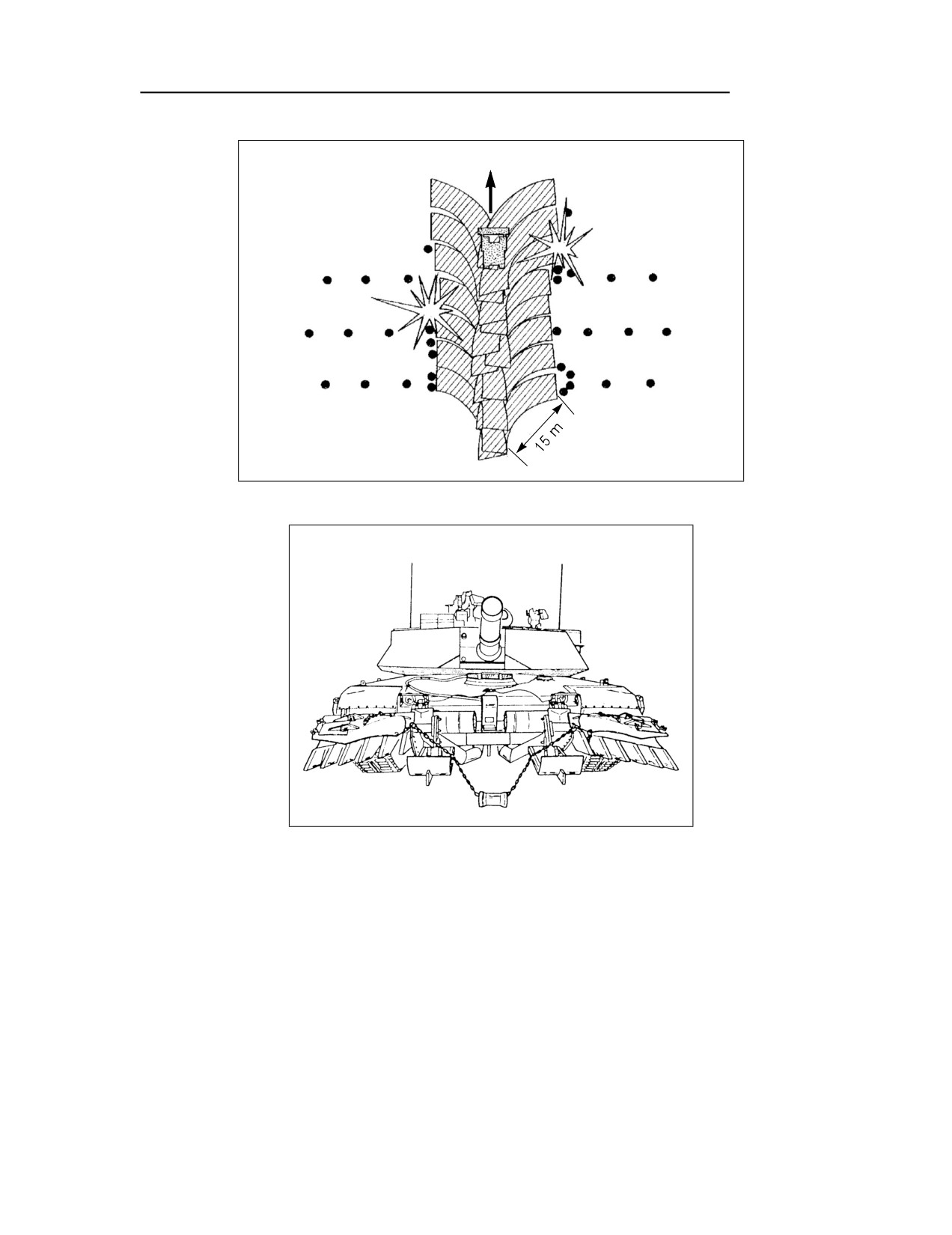
engineer blade to clear a path through a scatterable minefield, use the skim
technique (Figure 10-12). Start skimming 100 meters from the suspected
minefield leading edge.
Mine-Clearing Blade
The MCB (Figure 10-13) is used to remove land mines from the minefield. It
consists of a blade arrangement with scarifying teeth to extract mines, a
moldboard to cast mines aside, and leveling skids to control the depth of the
blade.
The MCB lifts and pushes mines, which are surface-laid or buried up to 31
centimeters deep, to the side of the track-width lanes. The blade has three
depth settings—21, 25, and 31 centimeters. The blade creates a 1.5-meter
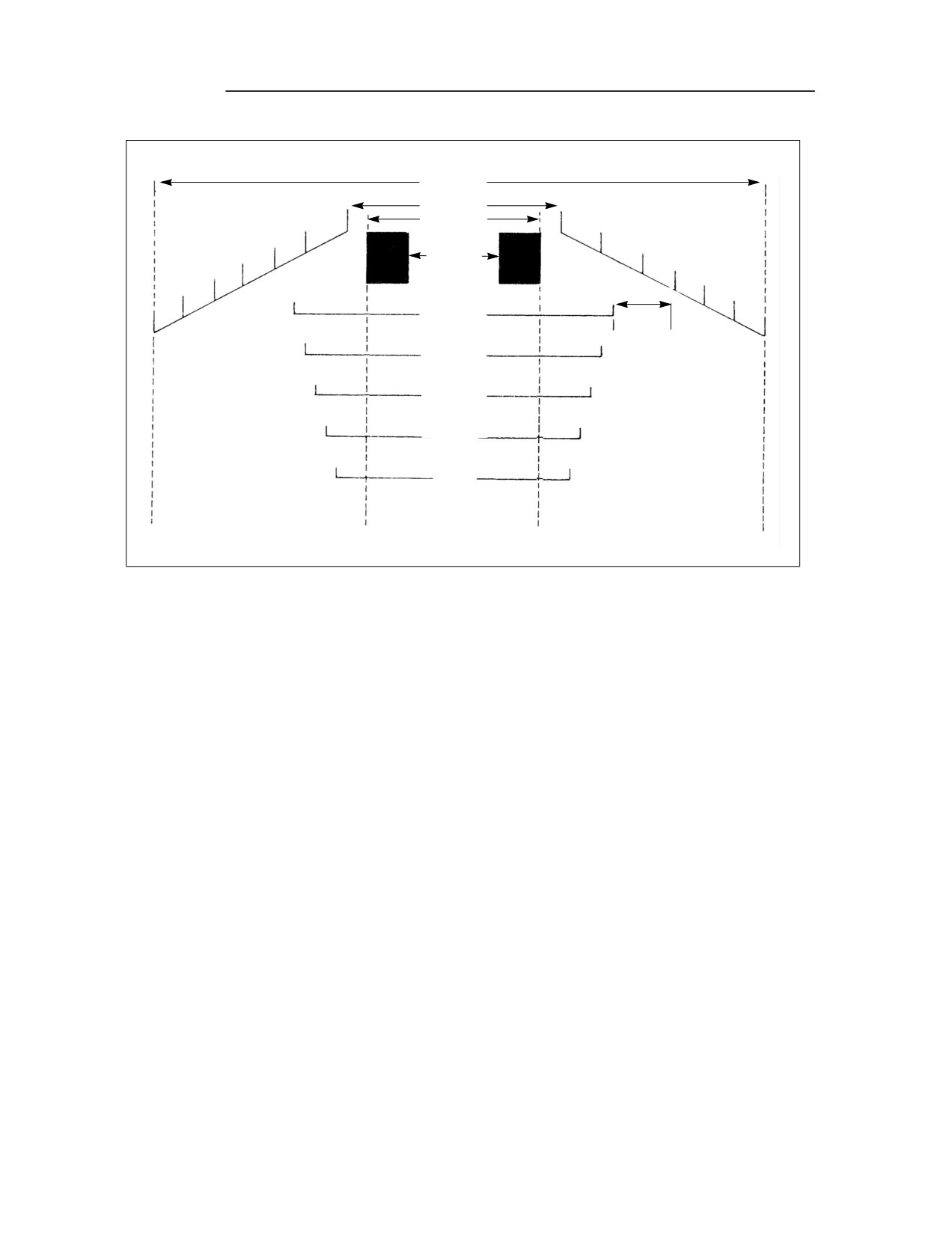
cleared path in front of each track. Figure 10-14, page 10-16, shows inside
clearance distances between tracks of common track vehicles in relationship
to the uncleared area left by the MCB.
Mines armed with AHDs, magnetic fuses, or seismic fuses may be activated
when they are lifted by the blade; and they may disable the blade. Mines lifted
by the blade are left in the spoil on each side of the furrowed path and remain
a hazard until they are removed. Double-impulse mines that are lifted into the
spoil on the side have a probability of functioning into the hull of the plowing
vehicle. The skid shoe for each blade exerts adequate pressure to activate
10-14 Minefield Reduction
FM 20-32
Figure 10-11. Skim technique
Figure 10-12. MCB
most single-impulse mines, which effectively clears a section of the centerline
by explosive detonation. This action may disable the blade. Multiple-impulse
pressure fuses encountered by the skid shoe are not defeated. A dog-bone
assembly between the blades defeats tilt-rod mines. The improved dog-bone
assembly (IDA) projects a magnetic signature and defeats tilt-rod and
magnetic mines.
The MCB weighs approximately 3,150 kilograms and can be mounted on an
M1 tank without special preparation or modification. Mounting requires lift
capability and takes up to an hour, so it must be mounted well in advance of
the mission. It is not easy to mount or transfer the MCB to another tank
under battlefield conditions.
Minefield Reduction 10-15
FM 20-32
457 cm
163 cm
137 cm
66 cm
M1 IP
226 cm
63.5
cm
221 cm
M60A3
201 cm
M88
M2/M3
191 cm
183 cm
M113
Plowed path
Uncleared
strip
Figure 10-13. Mine-blade width compared to track-vehicle widths
Once mounted, an electric motor raises and lowers the blade. When it is in the
raised position, it minimally effects the M1's maneuverability and speed. This
will not greatly impact the employment of the weapon system except when the
blade is in operation. The MCB is also equipped with an emergency, quick-
disconnect feature.
The M1 should perform plowing operations from 8 to 10 kph, depending on
soil conditions. It cannot maneuver but must continue in a straight path
through the minefield to avoid damaging the blade. The main gun must be
traversed to the side during plowing because mine detonation under the blade
may cause the gun to be thrown violently into the air, damaging the tube. The
area selected for the lane must be relatively flat and free of rocks or other
obstacles.
The operator begins plowing approximately 100 meters from the estimated
minefield leading edge. He creates a lane extending another 100 meters
beyond the estimated minefield far edge to ensure that the lane extends
through the entire minefield. Multiple vehicles crossing the breach will
deepen the cut made by the MCB, and pressure-fused mines left in the
uncleared strip will be dangerous. The uncleared strip should be cleared as
soon as possible.
Mine-Clearing Roller
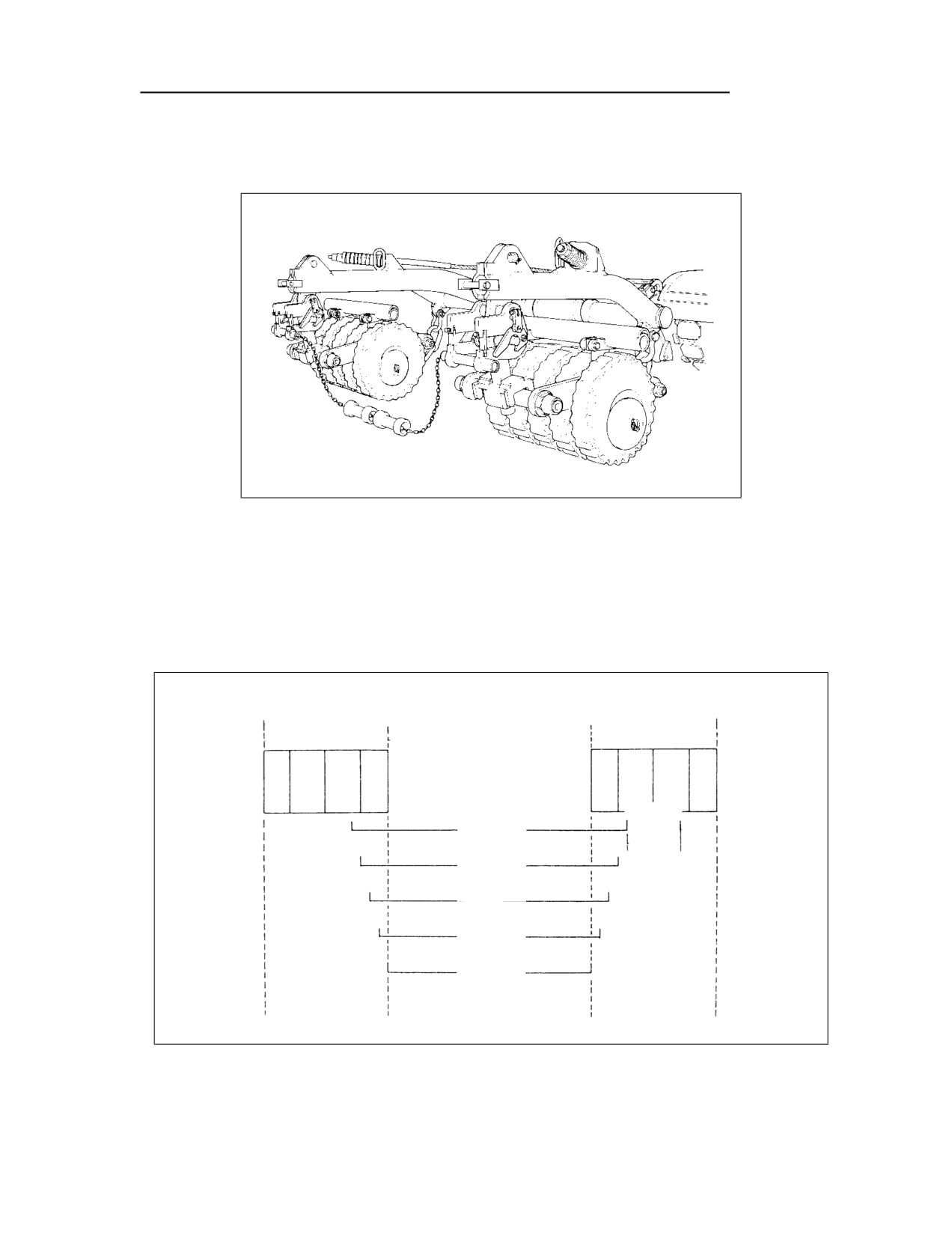
The MCR (Figure 10-15) consists of a roller assembly, a mounting kit, and a
hand winch kit. The roller assembly weighs approximately 9,072 kilograms
and consists of two push beams mounted to the front of the tank. The rollers
10-16 Minefield Reduction
FM 20-32
are designed to defeat most single-pulse, pressure-activated AT and AP mines.
The roller creates a 1.1-meter-wide cleared path in front of each track.
Figure 10-14. MCR
Figure 10-16 shows inside clearance distances between tracks of common
track vehicles in relationship to the uncleared area left by the MCR. A dog-
bone-and-chain assembly between the rollers defeats tilt-rod mines. The IDA
can be fitted to the roller. The roller is designed to withstand multiple mine
explosions before damage; however, this depends on the size of the mines.
Large blasts may destroy the roller or the vehicle or injure the crew.
407 cm
112 cm
183 cm
112 cm
M1 IP
226 cm
63.5
cm
221 cm
M60A3
201 cm
M88
191 cm
M2/M3
M113
183 cm
Roller path
Uncleared
strip
Figure 10-15. Mine-roller width compared to track-vehicle widths
Minefield Reduction 10-17
FM
20-32
The roller can be mounted on an M1 or M60 tank that is modified with a
permanently attached mine-roller mounting kit. Mounting the roller to a tank
is a cumbersome, time-consuming operation because it is very difficult under
battlefield conditions and requires lift capability. The roller tank is limited to
a speed of 5 to 15 kph. When employed in a suspected minefield, the MCR
must travel in a relatively straight path, because tight turns may cause the
roller to deviate from the path of the track and leave the tank vulnerable to
mines. Ground fluctuations, bumps, and berms may cause the roller to lift
from the ground and miss mines.
The MCR is not designed to negotiate gaps on its own; however, it can be used
on AVLB caution crossings. In this situation, the curbing from the bridge is
removed. To prevent damage to the bridge’s hydraulic line, the tank driver
uses a strap to lift the dog bone and chain when crossing the bridge. The main
gun must be traversed to the side when a mine encounter is possible or
imminent, because a mine blast can throw the roller or parts of the roller
violently into the air and damage the tube. The main gun should only be fired
from a temporary halt.
When the situation and the mission permit, MCRs may be employed as lead
vehicles to detect minefields. This is most viable when the supported element
is traveling in a column. The roller may also be used to lead a supported
element traveling in a tactical formation other than a column, but it is less
effective than other methods because—
• Vehicles not directly behind the roller may encounter mines passed by
the roller.
• The roller may travel well into or completely through a widely spaced
minefield without encountering a mine, thus giving the formation a
false sense of security.
• A mine encountered by the roller may not be on the leading edge of the
minefield.
• The roller vehicle is extremely vulnerable because it can only use its
weapon system from a temporary halt.
Rollers are best used to proof lanes in obstacles that are breached by other
means, such as a MICLIC or an MCB. A roller pulling a trailer-mounted
MICLIC can proof a lane created by a MICLIC that was launched by another
vehicle. The roller then fires the second MICLIC and proofs its own lane.
If rollers participate in a deliberate breach operation or if the force
incorporates rollers into a hasty breach plan, rollers must be mounted before
rehearsals. Unmounted rollers that not being used for the mission are carried
in the TF formation on M916 tractor trailers. Rollers require lift capability
(such as an M88), a secure location, and 30 to 60 minutes to mount on a tank
that is fitted with a mounting kit.
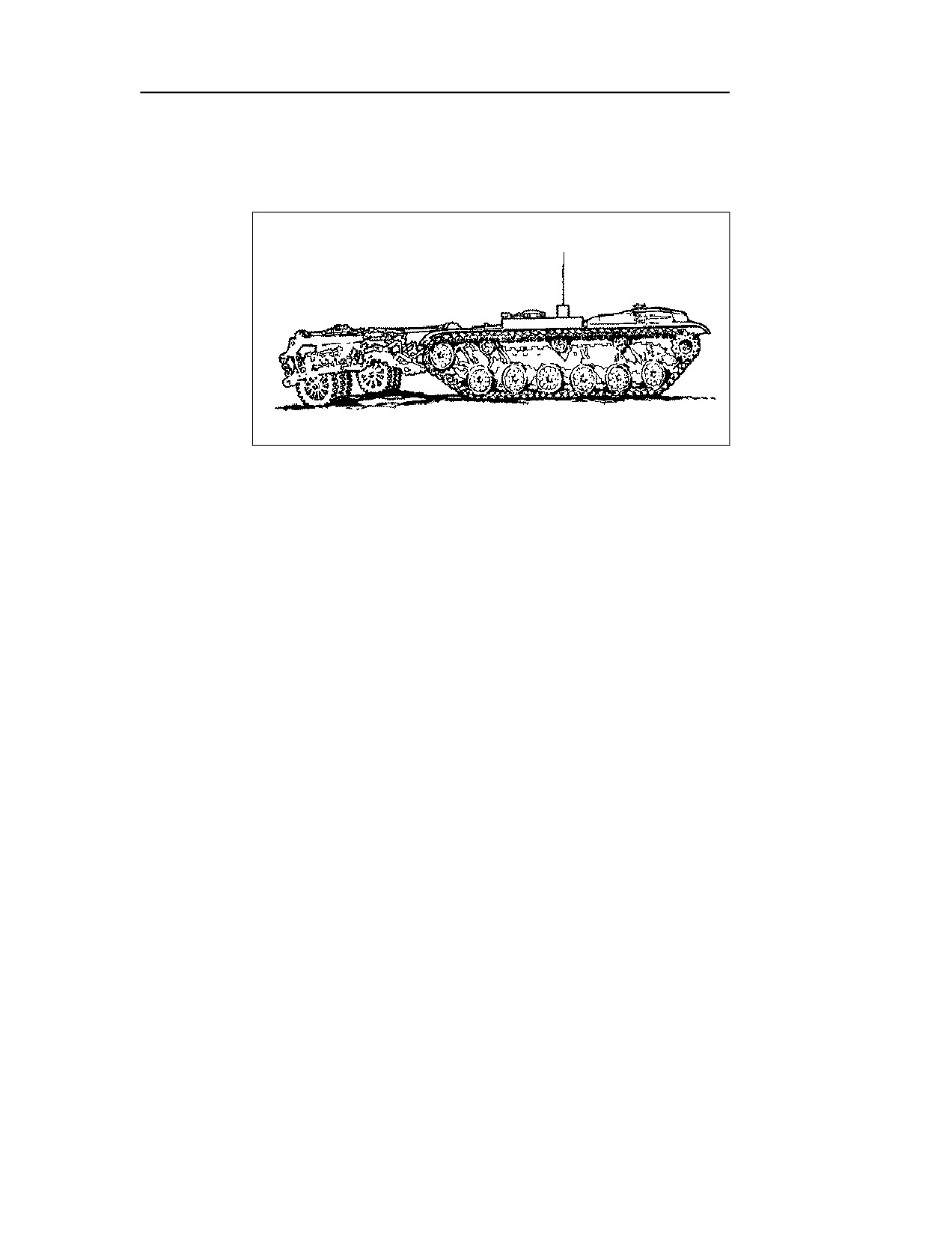
Panther
The M60 Panther (Figure 10-17) is one of several developmental countermine
systems used by US forces during operations Joint Endeavor and Joint Task
Force Eagle. The Panther is a remotely controlled vehicle with mine rollers,
and it is used to proof lanes and assembly areas. The system consists of a
10-18 Minefield Reduction
FM 20-32
turretless M60 tank, Israeli mine rollers, an antimagnetic actuating device,
and an RCU that is mounted in a separate vehicle. Additionally, a remote
video camera allows the operator to see the road ahead.
Figure 10-16. Panther
During route clearance or proofing operations, the Panther is the lead vehicle
on the route. It is followed closely by an armored control vehicle, usually an
M113. The control vehicle contains the Panther operator, the RCU, and the
monitor. The monitor displays the route being proofed or cleared through a
camera mounted on the Panther. The Panther is controlled from the
commander copula or troop hatch of the control vehicle. The control vehicle
should be approximately 200 to 300 meters behind the Panther, and its
hatches should be secured open. Crew members in the control vehicle should
be wearing Improved Body Armor System, Individual Countermine (IBASIC)
protective garments.
Mine rollers can be raised for limited travel while mounted on the Panther. If
the distance is excessive, the rollers must be transported on a cargo carrier.
Rollers must be adjusted before every mission to ensure that they have
contact with the ground and that their weight is uniformly distributed. To
ensure proper coverage and overlap of rollers, at least three passes should be
conducted. Passes should have a minimum of 30 centimeters overlap. Inside
roller distances are the same as the MCR.
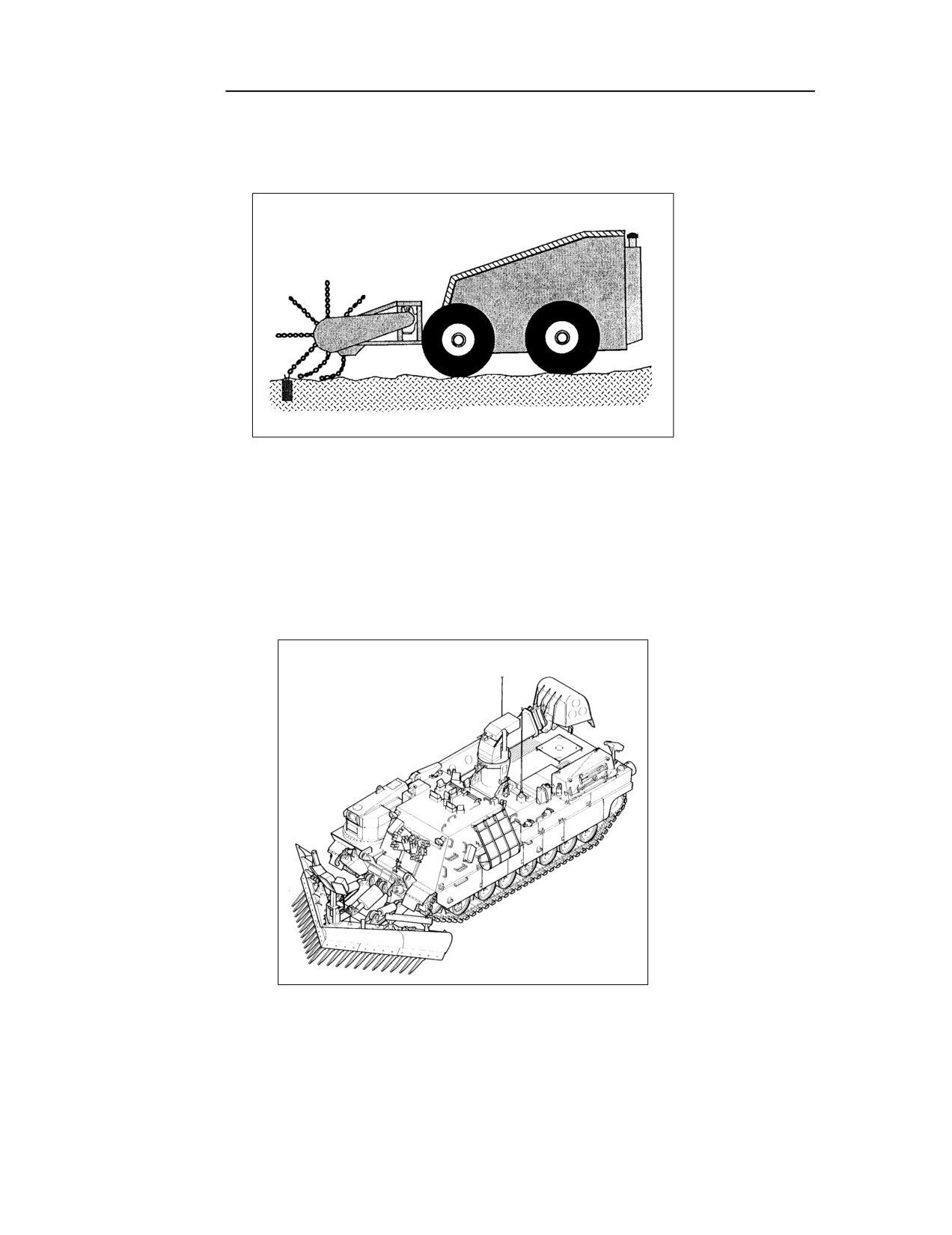
MiniFlail
The MiniFlail (Figure 10-18. page 10-20) is a remotely operated, line-of-sight,
AP-mine and UXO neutralization system that was developed for use by US
light forces. It can clear at a rate of 1,200 square meters per hour. The
MiniFlail detonates or disables AP mines from a safe operating distance. The
MiniFlail neutralizes by striking objects with a rotating chain assembly, called
a flail, and clears a foot path approximately 1.1 meters wide. The system
neutralizes AP mines and UXO by detonation, mechanical destruction, or
displacement from the cleared lane. The MiniFlail is approximately 1.3
meters wide, 1.3 meters high, 3 meters long, and weighs 1,100 kilograms. The
system is operated by a hand-held controller that has a maximum range of
300 meters. It is fully armored with a material similar to Kevlar, and the tires
Minefield Reduction 10-19
FM 20-32
are filled with foam. The flail is a self-articulating, hydraulically powered
shaft with 84 chains; each chain is 0.5 meter long.
Figure 10-17. MiniFlail
M1 Grizzly
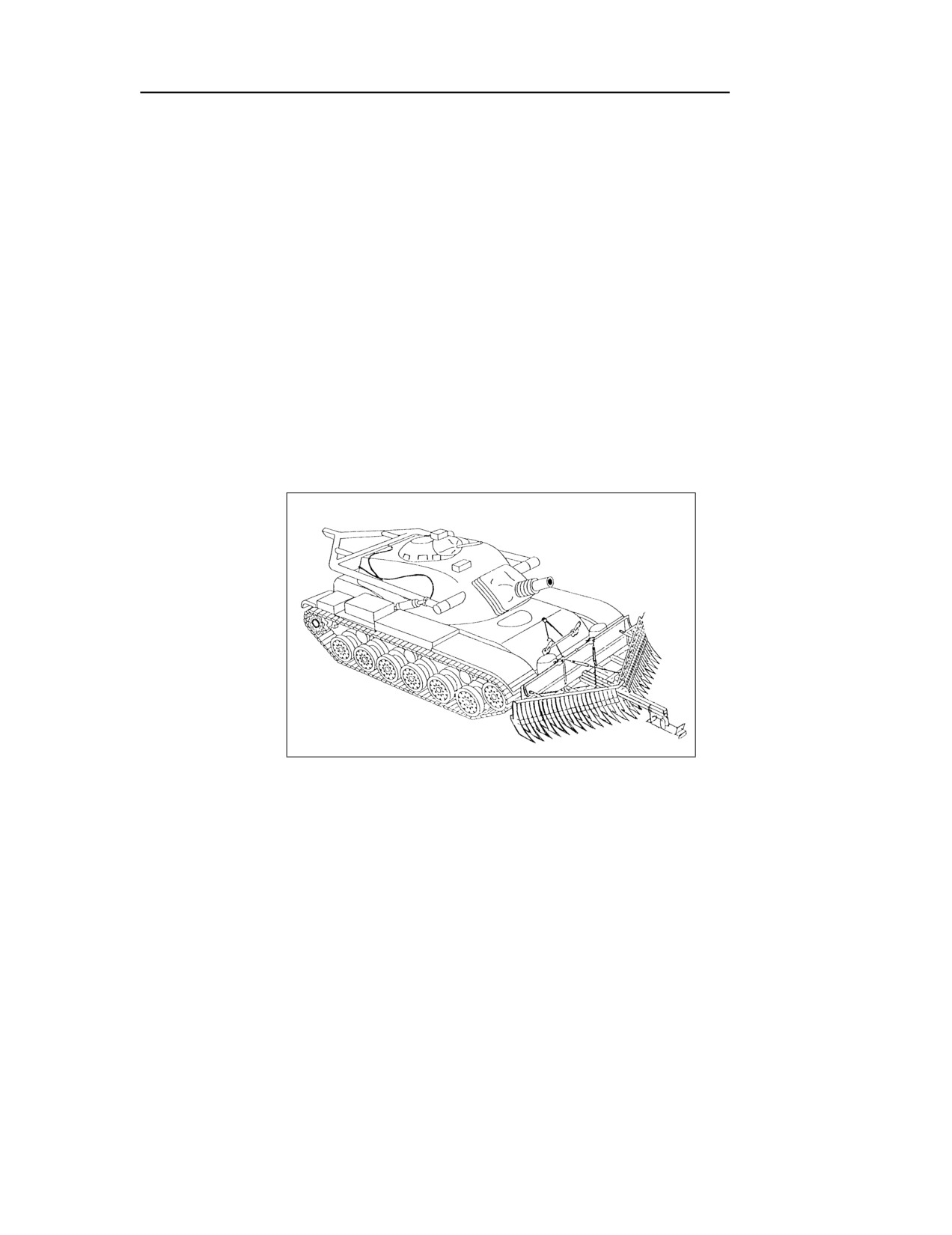
The Grizzly (Figure 10-19) provides a hasty capability for breaching complex
obstacles of mines, wire, posts, rubble, and tank ditches to create a lane for
other vehicles to follow. The Grizzly’s primary features are a full-width, 4.2-
meter MCB and a power arm. The power arm has a reach of 9 meters and a
bucket capacity of 1.2 cubic meters. Its primary missions are to reduce berms
and fill AT ditches.
Figure 10-18. Grizzly
The system is armed with an M240 7.62-millimeter machine gun and an
MK19 40-millimeter grenade launcher. The Grizzly has an M1-series tank
chassis.
10-20 Minefield Reduction
FM 20-32
The Grizzly lifts and pushes mines, which are surface-laid or buried up to 31
centimeters deep, to the side of full-width lanes. The blade has multiple depth
settings, depending on the mission, and it creates a 4.2-meter-wide cleared
path. When plowing, the Grizzly is restricted to less than 10 kph, depending
on soil conditions. The operator begins plowing approximately 100 meters
from the estimated minefield leading edge. He creates a lane extending
another 100 meters beyond the estimated minefield far edge to ensure that
the lane extends through the entire minefield.
The Grizzly has integrated digital features to enhance battlefield awareness.
Some of the digital features are thermal and video cameras, ground-speed
sensors, terrain-mapping sensors, and an integrated commander’s control
station.
Combat Engineer Vehicle with Full-Width Mine Rake
NOTE: The CEV with full-width mine rake will be used in Korea only.
This system consists of a wedge-shaped rake that is mounted to a CEV blade
(Figure 10-20).
Figure 10-19. CEV with mine rake
The rake weighs 2,025 kilograms and is lifted off its transport vehicle with a
HEMTT, a wrecker, an M88, or a CEV boom. The CEV crew uses basic-issue
items to install the rake, and installation takes approximately 30 minutes.
The rake has a skid shoe to maintain a raking depth of 31 centimeters. The
CEV with mine rake provides a vehicle-width clearance (4.5 meters) at 5 to 10
kph. The rake has a quick-disconnect feature. It lifts surface-laid and buried
mines (up to 31 centimeters deep) and pushes them off to both sides.
The CEV with mine rake is used to clear lanes during minefield breaching.
While it can be employed as the first breaching asset into a minefield, a
MICLIC should be used first to eliminate as many mines as possible. The rake
is then used to proof the lane. The system can pull a MICLIC and fire it before
proofing. Raking begins 100 meters before the minefield and continues 100
meters beyond the suspected limit. The CEV maintains a straight course
through the minefield. If the skid shoe is damaged, the operator reduces speed
and manually controls the blade depth. This is very difficult and risky.
Minefield Reduction 10-21
FM 20-32
Mine-Clearing/Armor-Protection Kit
The mine-clearing/armor-protection kit (MCAP) consists of two parts—the
mine-clearing rake and the armor protection.
The rake uses a tine that is mounted on a diagonal beam. The rake assembly
is designed to sift through the soil, lift out mines, and windrow buried and
surface-laid mines to the right of the vehicle. The system clears a 30-
centimeter-deep path through a minefield. The rake has a skid shoe that acts
as a depth control guide for the operator.
The armor protects the crew against mine blast, small-arms fire, and artillery
fire. Protection is also provided for the engine, the fuel tank, and exposed
hydraulic cylinders and lines. Ballistic glass blocks are provided at each vision
port to permit unrestricted view and operation of the vehicle and the
equipment.
The MCAP is mounted on a D7 dozer to perform minefield breaching and lane
widening. Proofing the lane must be conducted after the dozer has cleared the
lane. Some AP mines may still be left in the lane.
ELECTRONIC
The Field-Expedient Countermine System (FECS) is a series of copper coils
that fit over the front of tracked and wheeled vehicles. Power is supplied by
the vehicle’s battery. The coil emits a large magnetic signature that detonates
magnetically fused mines located 2 to 5 meters in front of the vehicle. The
FECS is designed to defeat magnetically influenced mines only and must be
used with other countermine systems.
MANUAL
When stealth is required or advanced mechanical equipment is unavailable,
manual breaching procedures can be used. Engineers use hand-emplaced
explosives, grapnel hooks attached to ropes, probes, mine detectors, and hand-
emplaced marking equipment to manually breach obstacles. This is the only
method that works in all situations and under all conditions because certain
types of terrain, weather, and sophisticated fuses can severely degrade the
effectiveness of rollers, plows, and line charges.
Surface-Laid Minefields
The enemy possesses a significant mechanical, mine-burying capability. It has
the capacity and the propensity for the labor-intensive effort required to bury
mines by hand; however, the enemy often lays mines on the surface. Buried
mines are usually found in a highly prepared defense that requires a
deliberate breach operation. Training and execution of surface and buried
minefield breaches should always assume the presence of AHDs and trip
wires until proven otherwise.
From covered positions, the engineers first use grapnel hooks to check for trip
wires in the lane. The limited range of the tossed hook requires the procedure
to be repeated through the estimated width of the obstacle. A demolition team
then moves through the lane. The team places a line main down the center of
the lane, ties the line from the explosives into the line main, and places blocks
of explosives next to surface-laid mines. After the mines are detonated, the
10-22 Minefield Reduction

FM 20-32
team makes a visual check to ensure that all of the mines were cleared before
directing a proofing roller and other traffic through the lane.
Manual procedures must be well-practiced. Members of the demolition team
are assigned special tasks, such as grappler, detonating-cord man, and
demolitions man. All of the members should be cross-trained on all the
procedures. Demolitions are prepared for use before arriving at the breach
site. An engineer platoon uses squads in series through the minefield to clear
a lane for a company team. The platoon must rehearse reduction procedures
until execution is flawless, quick, and technically safe. During the breach, the
engineer platoon will be exposed in the lane for 5 minutes or more depending
on the mission, the minefield depth, and the platoon’s level of training.
Buried Minefields
Manually reducing a buried minefield is extremely difficult to perform as part
of a breaching operation. It is usually part of a clearance operation. If the
mine burrows are not easily seen, mine detectors and probes must be used to
locate the mines. The mines are then destroyed by hand-emplaced charges. As
an alternative, the mines can be removed by using a grappling hook and, if
necessary, a tripod (Figure 10-21). Using a tripod provides a vertical lift on the
mine, making it easier to pull the mine out of the hole.
Figure 10-20. Tripod
The platoon leader organizes soldiers into teams with distinct, rehearsed
missions including grappling, detecting, marking, probing, and emplacing
demolitions and detonating cord. The platoon is exposed in the obstacle for
long periods of time.
Grappling Hook
The grappling hook (grapnel) is a multipurpose tool that is used for manual
obstacle reduction. Soldiers use it to detonate mines from a standoff position
by activating trip wires and AHDs. After the grapnel is used to clear the trip
wires in a lane, dismounted engineers can move through the minefield,
visually locate surface-laid mines, and prepare the mines for demolition. In
buried minefields, soldiers grapple, then enter the minefield with mine
detectors and probes.
There two types of grapnel hooks—hand-thrown and weapon-launched.
Minefield Reduction 10-23
FM 20-32
Hand-Thrown
A 60+-meter light rope is attached to the grapnel for hand-throwing. The
throwing range is usually no more than 25 meters. The excess rope is used for
the standoff distance when the thrower begins grappling. The thrower tosses
the grapnel and seeks cover before the grapnel and rope touch the ground in
case their impact detonates a mine. He then moves backward, reaches the end
of the excess rope, takes cover, and begins grappling. Once the grapnel is
recovered, the thrower moves forward to the original position, tosses the
grapnel, and repeats the procedure at least twice. He then moves to the end of
the grappled area and repeats this sequence through the depth of the
minefield.
Weapon-Launched
A 150-meter light rope is attached to a lightweight grapnel that is designed to
be fired from an M16A1 or M16A2 rifle using an M855 cartridge. The grapnel
is pushed onto the rifle muzzle, with the opening of the retrieval-rope bag
oriented toward the minefield. The firer is located 25 meters from the leading
edge of the minefield, and he aims the rifle muzzle at a 30- to 40-degree angle
for maximum range. Once fired, the grapnel will travel 75 to 100 meters from
the firer’s position. After the weapon-launched grapnel hook (WLGH) has
been fired, the firer secures the rope, moves 60 meters from the minefield,
moves into a prone position, and begins to grapnel. The WLGH can be used
only once, but it can be reused up to 20 times for training (blanks are used to
fire the grapnel for training).
Multiple grapplers can clear a lane of trip wires quickly and thoroughly, but
they must time their efforts and follow procedures simultaneously, if possible.
A hit on a trip wire or a pressure fuse can destroy the hook and the cord, so
engineers should carry extras.
PROOFING
Proofing is done by passing a mine roller or another mine-resistant vehicle
through the minefield as the lead vehicle to verify that a lane is free of mines.
An MCB, a Panther, a MiniFlail, or an MCR can be used to proof lanes. If the
risk of live mines remaining in the lane does not exceed the risk of loss to
enemy fires while waiting, proofing may not be practical. Some mines are
resistant to some breaching techniques (for example, magnetically fused
mines may be resistant to the MICLIC blast), so proofing should be done when
the time available, the threat, and the mission allow.
During a limited clearing operation, proof upgraded breach lanes following a
breach. After the minefield is completely cleared, proof the routes used
through the area.
MARKING
This section implements STANAGs 2036 and 2889.
This section provides commanders with a standard system for marking breach
lanes and bypasses. It centers around a systematic, phased upgrade of lane
marking. Each upgrade conforms to the tactical requirements for that phase
10-24 Minefield Reduction
C2, FM 20-32
of the attack, from initial reduction of the obstacle to the passage of larger
follow-on forces, as well as the return traffic necessary to sustain the force.
Additional guidelines are discussed in FM 3-34.2.
Marking breach lanes and bypasses is critical to obstacle reduction. Effective
lane marking allows the commander to project forces through the obstacle
quickly, with combat power and C2. It gives the assaulting force confidence in
the safety of the lane and helps prevent unnecessary minefield casualties.
There are two critical components of the lane-marking system:
• Lane-marking pattern (location of markers indicating the entrance,
the lane, and the exit).
• Marking device (type of hardware emplaced to mark the entrance, the
lane, and the exit).
The lane-marking system outlined in this section centers around standardized
marking patterns rather than the marking device. Standardizing the marking
pattern is critical to offensive operations. A common lane pattern—
• Enables cross attachments and adjacent units to recognize breach
lanes easily with minimal knowledge of a particular unit's tactical
SOP.
• Gives all forces a standardized set of visual cues that are needed to
pass through a lane safely while maintaining their momentum.
• Facilitates quick conversion to the lane-marking requirements of
STANAGs 2889 and 2036 (discussed later in this chapter).
The standard lane-marking hardware is decided by unit commanders. This
gives units greater flexibility and allows them to adopt marking devices that
are tailor-made for their type of unit and operational focus (such as an
armored or light force, a mounted or dismounted attack, limited visibility,
thermal capability). However, regardless of the type of device used, it must
support the standard lane-marking pattern outlined in the following
paragraphs. Therefore, commanders should consider these guidelines and
examples before developing or adopting their own marking system.
LANE-MARKING TERMS
The definitions in the following paragraphs provide a common basis for
discussing lane marking.
Entrance Markers
Entrance markers indicate the start of a reduced lane through an obstacle.
They signify the friendly-side limit of the obstacle and the point at which
movement is restricted by the lane width and path. Entrance markers are
placed to the left and the right of the entrance point and spaced the width of
the reduced lane. They must be visually different from handrail markers to
help the force distinguish this critical point in the lane.
Handrail Markers
Handrail markers define the lane path through the obstacle and indicate the
limits of the lane width. As a minimum, mounted and dismounted lanes will
Minefield Reduction 10-25
FM 20-32
have a left handrail marker. Mounted and dismounted forces moving through
the lane should keep the left handrail marker immediately to their left. As the
operation progresses, lane marking may be upgraded to include left and right
handrail markers.
Exit Markers
Exit markers indicate the far side of the reduced lane through an obstacle.
Like entrance markers, exit markers must be distinguishably different from
handrail markers; however, the exit may be marked the same as the entrance.
Exit markers are placed to the left and the right of the exit point and spaced
the width of the reduced lane. This visual reference is critical when only the
left handrail is marked. The combination of entrance markers, left handrail
markers, and exit markers provide the driver and the tank commander with
visual cues so that they can safely pass through a reduced lane.
Entrance Funnel Markers
Entrance funnel markers augment entrance marking. The V formed by a
funnel marker forces the platoon into a column and helps drivers and tank
commanders make last-minute adjustments before entering a lane.
Final-Approach Markers
Final-approach markers are highly visible, robust markers that augment the
visual signature of entrance funnel markers. They are critical when initial
assault forces must maneuver to the breaching site. Normally, the initial
assault force can observe the breaching area but cannot clearly distinguish
entrance funnel markers. Final-approach markers provide the assault force
commander with a highly visible RP toward which to maneuver his formation.
They also signal company team commanders to begin changing from combat
column to column formation, with platoons in combat column.
Far Recognition Markers
Far recognition markers are highly visible markers that are located between
the final-approach marker and the friendly unit. They are primarily used
when passing forces are denied direct observation of the final-approach
marker due to distance, visibility, or terrain. When possible, far recognition
markers should be different from the final-approach marker. Far recognition
markers indicate the point at which forces begin changing their formation to
posture for the passage. A single far recognition marker may serve up to two
initial breach lanes. Once lanes are upgraded to two-way traffic, far
recognition markers are required for each two-way lane. When a far
recognition marker serves more than one lane, a guide or a traffic-control post
(TCP) is collocated with the far recognition marker that is nearest to the
breach.
Guides and Traffic-Control Posts
A TCP or a guide consists of a two-man team with communications means.
The team assists the commander in controlling the movement of forces. When
possible, military police (MP) should man TCPs. However, the commander
may initially use other personnel as guides to man critical far recognition
markers until the MP establish full TCPs. TCPs and guides provide the
commander with a man on the ground who controls traffic flow to the
10-26 Minefield Reduction
C2, FM 20-32
appropriate lanes. When there are multiple lanes branching off a single far
recognition marker, the TCP can assist in breaking parts of the formation off
into various lanes. The TCP can also help modify the traffic flow when lanes
have been closed for maintenance, for lane expansion, or by enemy
SCATMINEs. The guide or TCP must give the assault force commander the
azimuth and distance to the final-approach marker, identify the device used
for the final-approach marker, and provide the level of the lane-marking
pattern. For light forces, guides may physically escort passing units from the
far recognition marker to the lane entrance.
LEVELS OF LANE MARKING AND PATTERNS
The three standard levels of marking for breach lanes and bypasses are
initial, intermediate, and full.
Each lane-marking level provides an increase in lane signature and capability.
Lane requirements change as a breaching operation matures from an initial
breach to the forward passage of large combat forces.
Initial lane-marking requirements are driven by the nature of the fight
through the obstacle. Marking must be rapid, providing only the bare
minimum signature needed to pass small units who make up the initial
assault force. This contrasts with the lane requirements of later phases of an
offense where larger units are passed to subsequent objectives. Here, the lane
signature must be more extensive and more visible, because it must guide
larger forces over a greater distance to the lane's entrance without
interruption. Two-way traffic becomes a priority for the simultaneous forward
passage of combat units as well as the return traffic (such as ambulances and
empty supply vehicles) that is necessary to sustain the force. Lane-marking
limits must be absolutely clear to the most inexperienced driver or crewman.
A fully developed lane must support two-way traffic and be completely
marked.
Bypasses are not marked the same as lanes. They are marked with directional
panels indicating the direction of the bypass. The limits of the mine threat
must be marked to prevent friendly forces from entering the minefield.
Marking the direction of the bypass and the minefield limits will enable the
maneuvering element to bypass the minefield without having to unnecessarily
defile through a marked lane. Further information on bypass marking can be
found in FM 3-34.2.
Commanders must be aware of how the needs of the force change with the
operation so that they can anticipate lane-marking and lane-capability
requirements. Integrating the levels of lane marking into the overall
breaching plan ensures that the unit's needs are satisfied. Forces necessary to
mark, maintain, and upgrade lanes must be allocated and tasked with the
mission. The phases of the scheme of maneuver and the service-support plan
are the basis for analyzing lane requirements. The following paragraphs
describe lane-marking patterns in detail and provide guidelines on when the
commander should upgrade lane marking and lane capability.
Initial Lane Marking
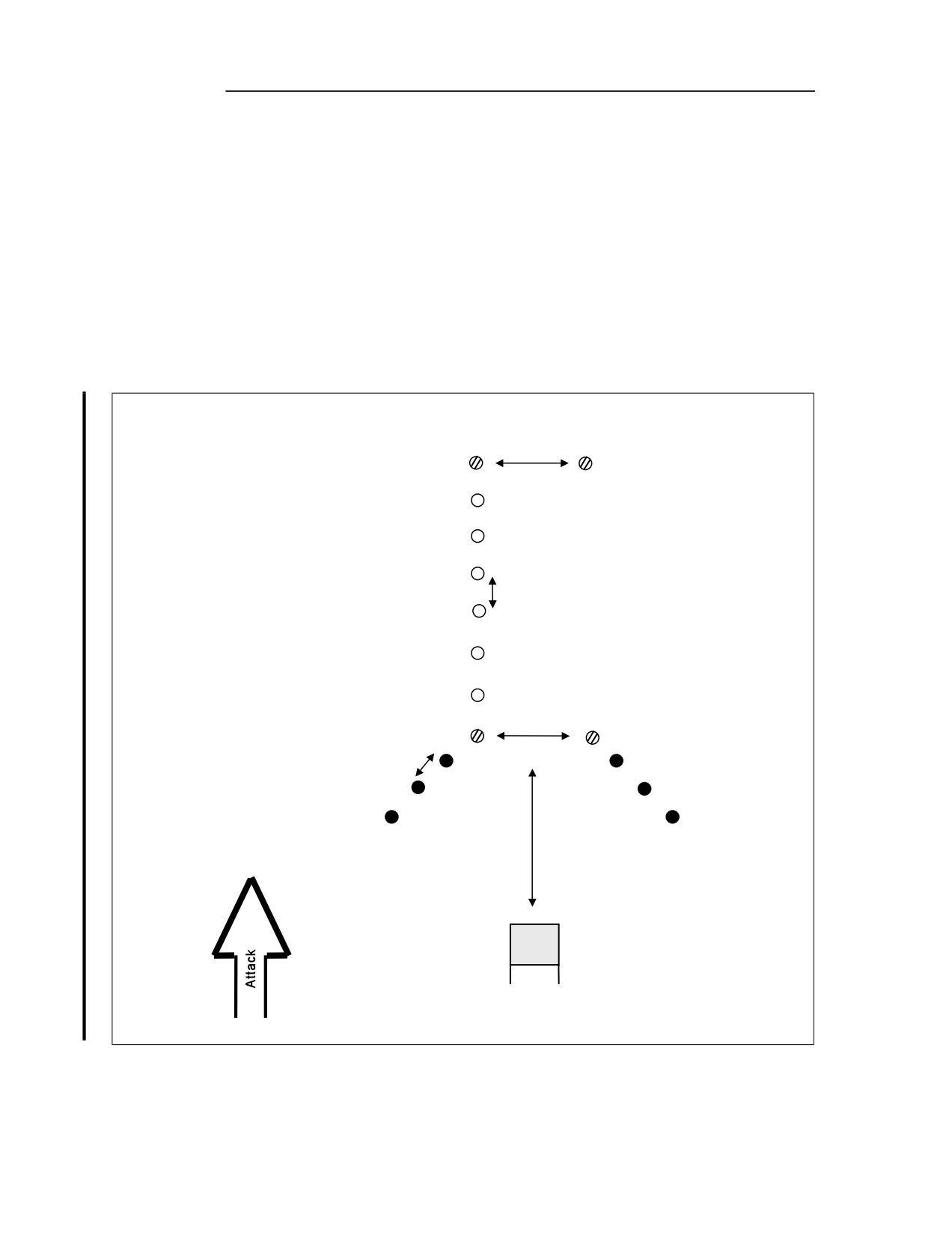
Initial lane marking (Figure 10-22, page 10-28) is emplaced by the breach
force immediately after the lane is reduced and proofed. It provides a signal to
Minefield Reduction 10-27
C2, FM 20-32
the assault force commander that the lane is ready for traffic. Initial lane
marking is kept to a minimum, centering on markings needed to pass
immediate assault forces through the lane to seize the initial foothold on the
objective. Normally, the assault force can observe the breach and does not
need the more visual signature of a mature lane marking. The initial lane-
marking pattern has the following markers:
• Entrance.
• Exit.
• Left handrail.
• Entrance funnel.
• Final-approach.
4.5 m (1 m*)
Exit markers
The distance between markers is
driven by METT-TC. Distances
shown are a recommendation.
Left-handrail markers
15 m (5 m*)
4.5 m (1 m*)
Entrance markers
15 m
(4.5 m*)
Entrance-
200 m (30 m*)
funnel
markers
Final-
approach
marker
*Distance for dismounted lanes
Figure 10-21. Initial lane marking
10-28 Minefield Reduction
FM 20-32
The entrance, left handrail, and exit markers are the first markers emplaced
by the breach force because they define the location and the limits of the
reduced lane.
• Entrance markers are placed to the left and the right of the reduced
lane's entrance point, and they are spaced the width of the lane (4.5
meters for mounted lanes, 1 meter for dismounted lanes).
• Left handrail markers are placed at the left limit of the lane, along the
entire path. Handrail markers are placed at 15-meter intervals for
mounted forces and at 5-meter intervals for dismounted forces.
Commanders may have to modify the intervals based on the terrain,
the visibility, the lane length, and the lane path.
• Exit markers are placed to the left and the right of the reduced lane's
exit point, and they are spaced the width of the lane (4.5 meters for
mounted lanes, 1 meter for dismounted lanes).
Once the entrance, left handrail, and exit markers are emplaced, the breach
force emplaces the entrance funnel markers and the final-approach marker.
• Entrance funnel markers are placed at
15-meter intervals for
mounted forces and at 5-meter intervals for dismounted forces. They
are placed diagonal to the lane entrance and form a 45-degree V
(Figure 10-22).
• The final-approach marker is centered on the lane and placed at least
200 meters from the lane entrance for mounted forces. For dismounted
forces, the nature of the attack may initially preclude using a final-
approach marker; however, as soon as the mission allows, a final-
approach marker is placed 30 meters from the entrance. Final-
approach markers for mounted and dismounted forces must be placed
on high ground to ensure that they are clearly visible. The commander
may modify the recommended distance for the final-approach marker,
based on the terrain and the visibility.
Intermediate Lane Marking
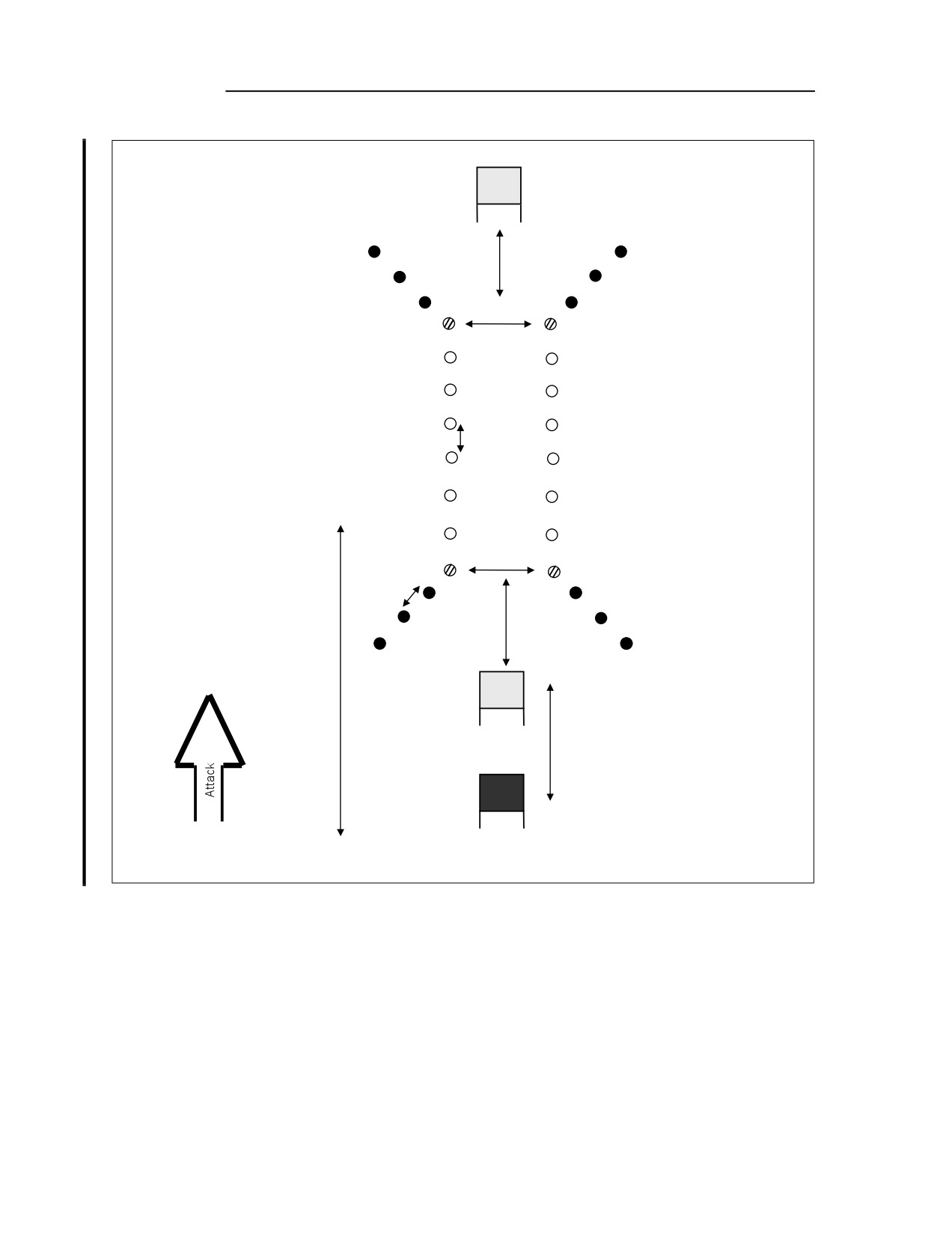
Upgrading initial lane marking to intermediate lane marking (Figure 10-23,
page 10-30) is triggered by one of two key events—the commitment of larger
combat forces who are unable to directly observe the breach or the rearward
passage of sustainment traffic (casualty evacuation and vehicle recovery).
Intermediate lane marking has two goals:
• Increasing the lane signature to help the passage of larger, more
distant combat forces.
• Providing sufficient marking for two-way, single-lane traffic.
Intermediate lane marking builds on initial lane marking by adding right
handrail markers, exit funnel markers, far recognition markers, and a farside
final-approach marker.
The commander sets the priority of marker emplacement based on the
situation. If the scheme of maneuver requires the immediate passage of larger
combat forces, the right handrail markers and the far recognition marker may
be the priority. On the other hand, if it is necessary to ground evacuate
casualties or to recover vehicles, emplacing right handrail markers, exit
funnel markers, and a farside final-approach marker may be required first.
Minefield Reduction 10-29
C2, FM 20-32
The distance between markers is
Farside final-
driven by METT-TC. Distances
approach marker
shown are a recommendation.
200 m (30 m*)
Exit-funnel
markers
4.5 m (1 m*)
Exit markers
Left-handrail
Right-handrail
markers
15 m (5 m*)
markers
4.5 m (1 m*)
Entrance markers
15 m
(4.5 m*)
Entrance-
200 m
funnel
(30 m*)
markers
700 m (230 m*)
Final-
approach
marker
500 m (200 m*)
Far-recognition
marker
Guide or TCP
*Distance for dismounted lanes
Figure 10-22. Intermediate lane marking
When upgrading to intermediate marking, the first step is to emplace the
right handrail markers. Right handrail markers define the rightmost limit of
the lane. They are placed the width of the lane as defined by the entrance and
exit markers. The right handrail follows a path parallel to the left handrail
through the obstacle. Right handrail markers are placed at the same interval
as left handrail markers.
Exit funnel markers and a farside final-approach marker are emplaced to
mirror the entrance markers. Exit funnel markers prevent the premature
deployment of the passing force into combat formation before it is safely
10-30 Minefield Reduction
FM 20-32
outside the obstacle. They also become the entrance funnel markers for
rearward passing traffic, giving these forces the visual cues needed to line
themselves up on the lane. The exit funnel markers are augmented by a
farside final-approach marker to help rearward passing forces clearly identify
the lane from their side. The farside final-approach marker is centered on the
lane and placed 200 meters (mounted forces) or 30 meters (dismounted forces)
from the exit.
A far recognition marker completes intermediate lane marking. It provides
commanders with a visual signature or a series of signatures for guiding their
movement toward the lane. For mounted forces, the far recognition marker
nearest to the breach lane is placed 500 meters from the lane entrance or on
the nearest terrain feature. Dismounted forces may require a system of guides
instead of far recognition markers for passing combat forces; however, far
recognition markers must be emplaced as soon as possible to reduce guide
requirements for passing mounted sustainment traffic. This gives the assault
force commander the space needed to transition his formation to companies in
combat column. Far recognition markers may be emplaced before or
concurrent with exit markers, based on the mission and the situation.
The commander collocates guides or TCPs at the far recognition marker when
he feels the situation requires more positive control over traffic flow.
Commanders should plan for the use of full-time guides once they have
upgraded to intermediate marking. TCPs become mission-critical during
limited visibility or in restrictive terrain. They should also be used when a
single far recognition marker feeds more than one breach lane. TCPs must be
manned with a minimum of two soldiers and must have FM communications
with the controlling headquarters. It is essential that soldiers acting as guides
or TCPs know the—
• Azimuth and distance to the breach lane and the
8-digit grid
coordinate of the lane.
• Level of lane marking.
• Type of final-approach marker used.
• Traffic-control plan and march order.
• Up-to-date status of lane marking, maintenance, and so forth.
Full Lane Marking
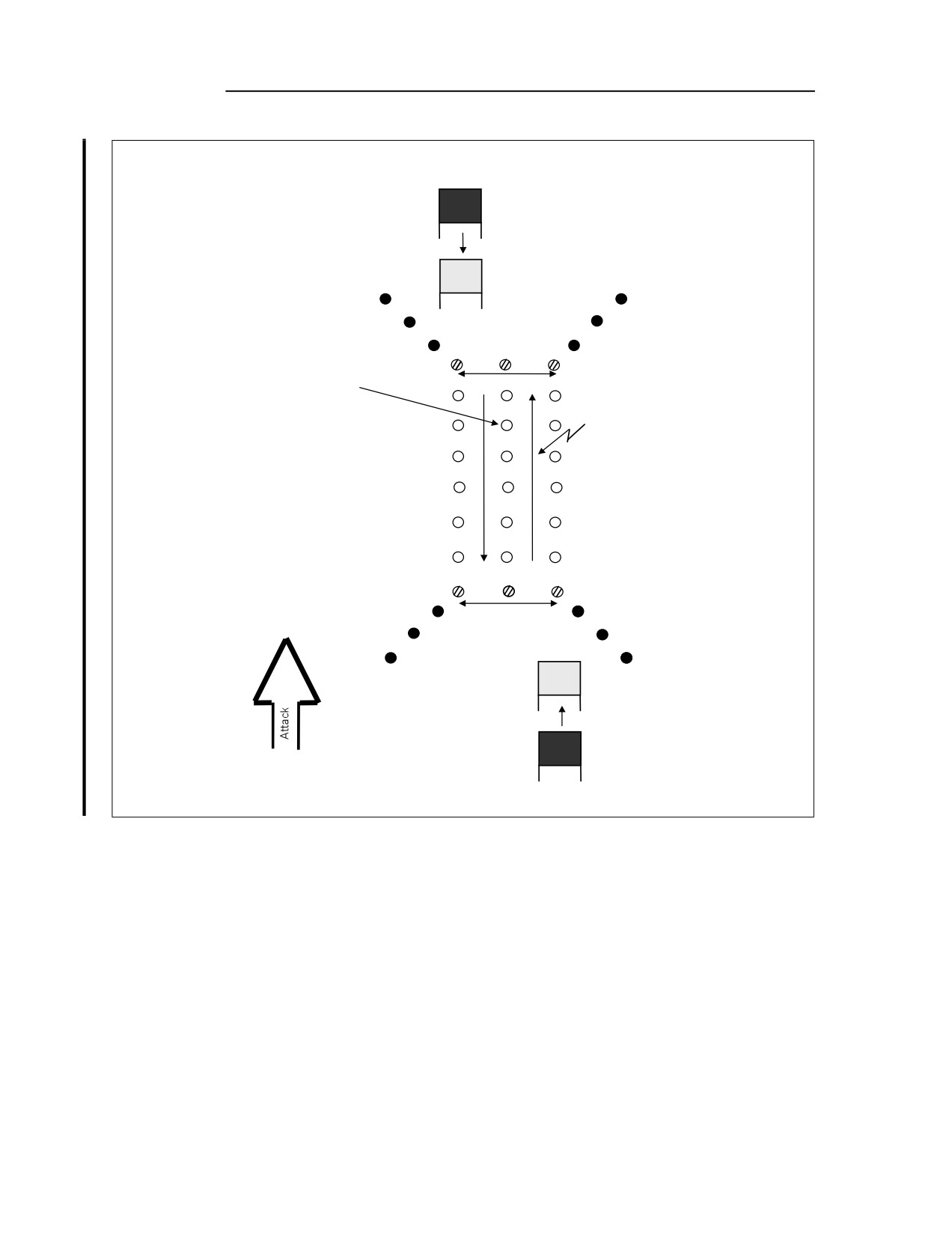
Expanding breach lanes to full (two-way) lane marking (Figure 10-24, page
10-32) is resource-intensive and is not normally a part of an initial breach
operation. A fully matured lane is one that will support uninterrupted, two-
way traffic. Expanding a breach lane to a full lane involves expanding the
width of the lane to accommodate two-way traffic and modifying the marking
pattern to give forward and rearward passing forces the same visual
signature. Upgrading to a full lane is normally assigned to follow-on engineer
forces, since it is usually beyond the immediate capability of engineers with
forward units.
Upgrading intermediate lane marking to full lane marking begins by
temporarily closing the lane, rerouting traffic, and expanding the lane width.
The initial reduced and proofed lane is always expanded to the left, in relation
to the direction of the attack. Engineers reduce and proof the obstacle
beginning at the left handrail to give a total lane width of 10 meters (5 meters
Minefield Reduction 10-31
C2, FM 20-32
Guide or TCP
The distance between markers is
driven by METT-TC. Distances
Far-recognition
shown are a recommendation.
marker
Return
traffic
Final-approach
marker
Funnel
markers
Entrance/exit markers
Left handrail for
10 m
forward and return
traffic
Original lane
Right handrail
Right handrail
(return traffic)
(forward traffic)
Entrance/exit markers
Funnel
10 m
markers
Final-approach
marker
Forward
traffic
Far-recognition
marker
Guide or TCP
Figure 10-23. Full lane marking
each way). The expansion width requirement is the same for armored and
light forces, because both forces must be able to pass mounted sustainment
and combat forces during this phase.
Once the engineers expand the lane width to 10 meters, they ensure that
entrance, exit, handrail, funnel, and final-approach markers are replaced on
the return lane. All markings are the same as described in previous
paragraphs.
The full lane-marking pattern has three entrance and three exit markers.
They are placed the width of forward and return lanes and are visually
different from other markers. Units must be trained to recognize that three
entrance markers indicate a two-way traffic lane and that they should always
use the rightmost lane.
10-32 Minefield Reduction

C2, FM 20-32
Entrance and exit funnel markers are placed slightly different from previous
marking patterns. They extend out from the entrance and exit markers on the
right side only.
Final-approach markers are placed 200 meters from, and centered on,
entrances of forward and return lanes. This helps forces clearly identify the
entrance points from either direction.
Far recognition markers are placed a maximum of 500 meters from the lane
entrance or on the nearest terrain feature from forward and return final-
approach markers.
COMMANDER'S GUIDANCE FOR LANE MARKING
Table 10-1 provides a summary of lane-marking levels, guidelines on unit
responsibilities, and events that trigger lane upgrade. In the table, who refers
to the unit responsible for lane upgrade marking and when describes events
that trigger the need to upgrade.
Table 10-1. Lane-marking levels, unit responsibilities, and trigger events
Initial
Intermediate
Full (Two Way)
Who
TF breach force
TF breach force
Brigade
Passing battalion- or
Passing brigade- or battalion-size
Obstacle is reduced
company-size forces
forces
Passing force which
When
Passing platoon- or
cannot see the lane
Situation requires uninterrupted
company-size assault forces
Passing TF combat
sustainment traffic
trains
Entrance
Add right handrail
Expand lane width to 10 meters
Exit
Add exit funnel
Adjust entrance/exit
Add farside final
Markers
Left handrail
Adjust left/right handrails to new width
approach
Entrance funnel
Add far recognition
Add far recognition
Final approach
Add guides or TCPs
Add farside guides or TCPs
Minefield Reduction 10-33

FM 20-32
LANE-MARKING DEVICES
The majority of lane marking in the field is done by using nonstandard
marking devices. When adopting a nonstandard marking device, commanders
should consider the guidelines summarized in Table 10-2.
Table 10-2. Guidelines for lane-marking devices
Marker
Mounted Forces
Dismounted Forces
Visible by TC and driver
Visible by a dismounted soldier in
(buttoned up) from 50 meters
a prone position from 15 meters
Lightweight, quick, and easy to
Handrail and funnel
Quick and easy to emplace,
emplace (a dismounted soldier
markers
minimizing the need to expose
should be able to carry enough
soldiers outside the carrier
markers for the lane and still be
able to fire and maneuver)
Visible by TC buttoned up from
Visible by a dismounted soldier
100 meters
from 50 meters
Visually different from handrail
Visually different from handrail
Entrance and exit
and funnel markers
and funnel markers
markers
Quick and easy to emplace (may
require soldiers to dismount to
Lightweight, quick, and easy to
emplace)
emplace
Easily man-portable
Visible by TC (not buttoned up)
Visible by a dismounted soldier
from 500 meters
on the march from 100 meters
Final-approach and
Visually different from each other
Visually different from each other
far recognition
Visually alterable to facilitate
Visually alterable to facilitate
markers
traffic control through multiple
traffic control through multiple
lanes
lanes
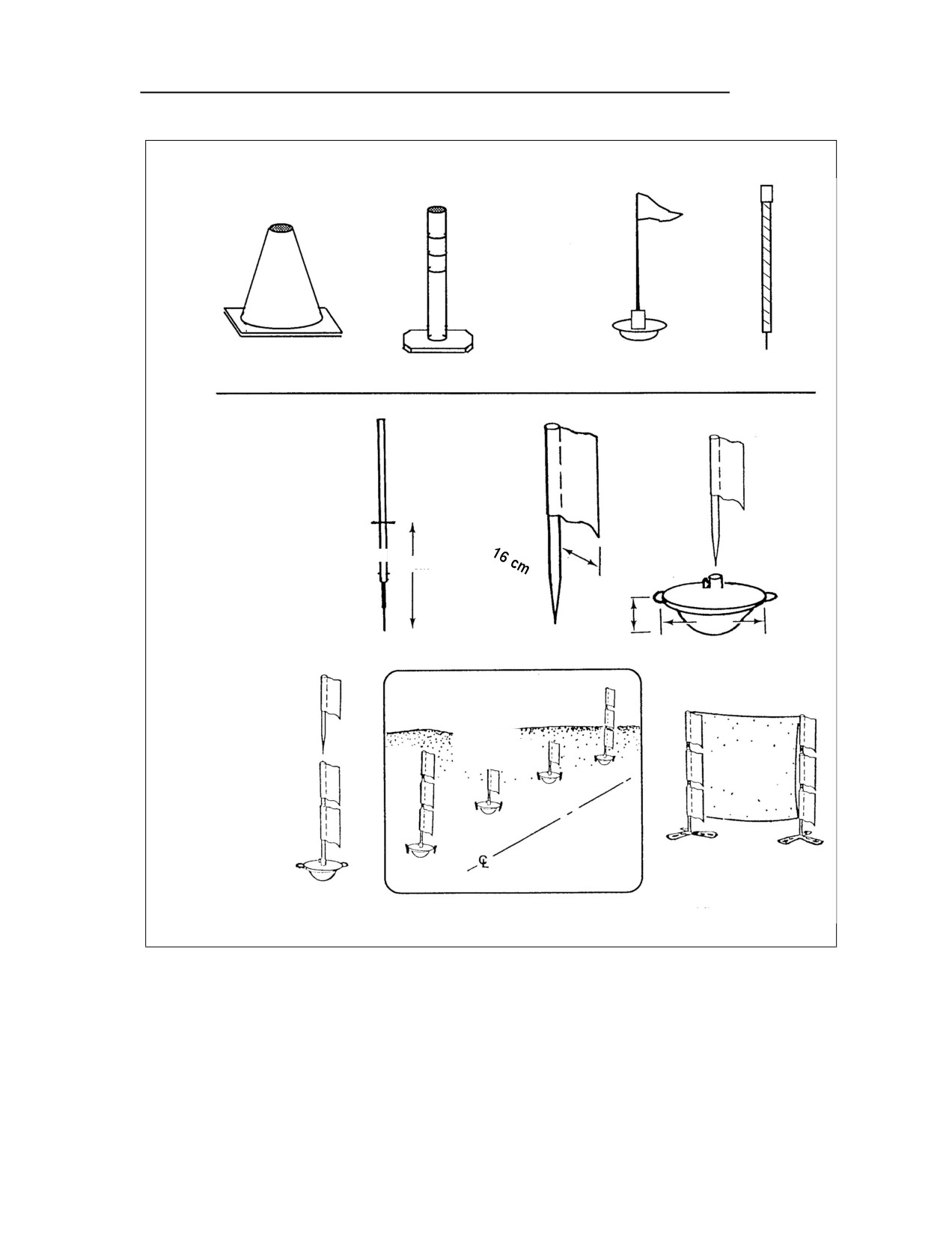
Figure 10-25 shows some of the devices that can be utilized for lane marking,
and they are easily procured or fabricated. This is not an inclusive listing but
is intended to show commanders some of the options.
Some general requirements for lane marking are—
• Markers must be able to withstand the rigors of the terrain, the
weather, and the battlefield.
• Markers should be easy to modify, using minimal manpower and
equipment, when visibility is limited.
• Lane-marking panels should have thermal and IR reflective marking
so that they can be easily identified during limited visibility.
• Enhancements for limited visibility should be a constant source rather
than a pulsating strobe. Strobes do not make the marking pattern
readily apparent, particularly when approaching from an angle.
10-34 Minefield Reduction
FM 20-32
Traffic cone
Highway marker
Tippy Tom
HEMMS pole
NOTE: Cut 61 cm
VS-17
above the base to
panel strip
make a short pole.
Stake
straps
Base
61 cm
plate
26 cm
10 cm
Short pole
HEMMS pole
Short-pole
assembly
Exit marker
NOTE: Stack 3
short poles to
Left
make a long pole.
handrail
marker
VS-17
panel
Far recognition marker
Entrance
marker
using camouflage
Long-pole
support system
assembly
Figure 10-24. Marking devices
Minefield Reduction 10-35
FM 20-32
The following standard marking sets are available through normal supply
channels:
• Minefield marking set number 2, line item number (LIN): M49096,
NSN: 9905-00-375-9180.
• HEMMS, LIN: M49483, NSN: 9905-01-019-0140.
MARKING REQUIREMENTS OF THE NORTH ATLANTIC TREATY ORGANIZATION
The following paragraphs paraphrase the lane-marking requirements
outlined in STANAGs 2889 and 2036. They also establish the procedures used
by US forces to modify intermediate and full lane marking to STANAG
standard. With the combined nature of warfare, commanders need to be aware
of their responsibilities for marking hazardous areas, particularly breach
lanes.
STANAGs 2889 and 2036 state that the type of marking device, pattern, and
lighting used to mark breach lanes in forward areas is at the discretion of
national authorities or the authorized commander. This gives commanders
who are participating in a combined operation the flexibility to mark lanes
consistent with their respective Army's standard. It also outlines minimum
requirements for the lane-marking pattern before it is used by troops of other
nations; however, commanders must plan for converting a lane to NATO
standard as early as possible. When converting to NATO standard, the
STANAG directs commanders to use lane-marking devices as stated below.
Within an offensive operation, marking a lane to NATO standard will not
normally occur until after the lane is matured to a full lane.
Marking Pattern and Device
The intermediate lane marking discussed earlier satisfies the minimum lane-
marking pattern that must be used before forces from another country are
able to pass through a lane. STANAGs 2889 and 2036 state that regardless of
the marking device used, the entrance point, exit point, and left and right
handrails are the minimum required lane signature. Therefore, once the lane
is marked to the intermediate level, allied forces can use the lane without any
additional marking.
STANAG 2889 requires that commanders convert marking devices to NATO
standard as early as possible. Figure 10-26 shows a NATO standard marker.
The marker is placed at right angles to the direction of travel, so that the
white portion of the arrow points inward to the lane, indicating the safe side of
the lane. The red portion is outward, indicating the lane limit or dangerous
side of the lane. STANAG 2889 also requires that markers be large enough to
be visible from 50 meters under most daylight conditions and have a field life
of 60 days.
Conversion to NATO Standard Marking
To convert intermediate and full lane marking to NATO standard, affix NATO
markers to long pickets and replace the existing entrance, exit, funnel, and
handrail markers one for one (Figure 10-27).
Two NATO markers are used for entrance and exit markers to make them
distinctly different. One NATO marker is affixed to each funnel marker and to
10-36 Minefield Reduction
C2, FM 20-32
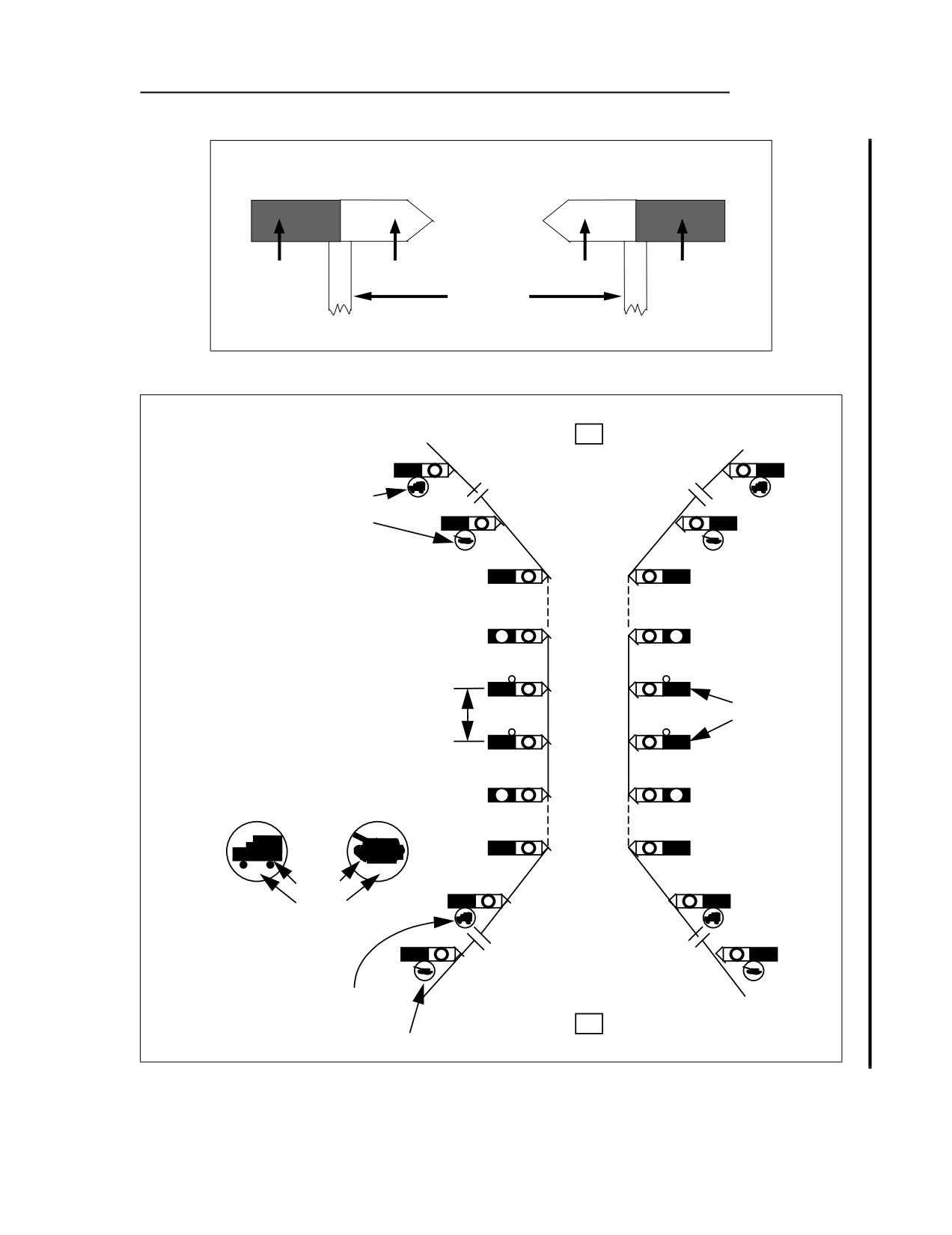
Lane markers painted red and white are erected at intervals of
about 30 meters from the lane entrance to the exit.
(Red)
(White)
(White)
(Red)
Lane
Markers must be placed at right angles to the direction of the lane.
Figure 10-25. NATO standard marker
Guide sign
Illuminated wheel or track
sign fixed beneath route
markers (see Note 5)
NOTES:
1.
Minimum lane width = 4.5 m
Route
Normal one-way lane width = 8 m
markers
Normal two-way lane width = 16 m
2.
The use of separate track and wheel
routes and the distance of the route
Entrance/
junction from the lane is a decision
exit lights
for the tactical commander.
3.
The marking interval within the lane
should be 30 m.
4.
On separate routes for wheeled and
30
m
Lane
Route markers
tracked vehicles, the appropriate
yellow and black illuminated sign
may be fixed beneath the route
marker.
5.
Only approach and exit markers are
Entrance/
required.
exit lights
or
Black
Yellow
Illuminated wheel or
track sign fixed
beneath route
markers (see Note 5)
Guide sign
Figure 10-26. NATO lane-marking conversion
Minefield Reduction 10-37
C2, FM 20-32
each left and right handrail marker. When converting full lane marking, the
center handrail is marked with a modified NATO marker. The combination of
a modified center handrail marker and directional arrows at each lane
entrance provides allied forces with the signature necessary to distinguish
two separate lanes. In addition, a barbwire or concertina fence (one strand
minimum) is laid 1 meter above the ground to connect funnel markers,
entrance markers, handrail markers, and exit pickets.
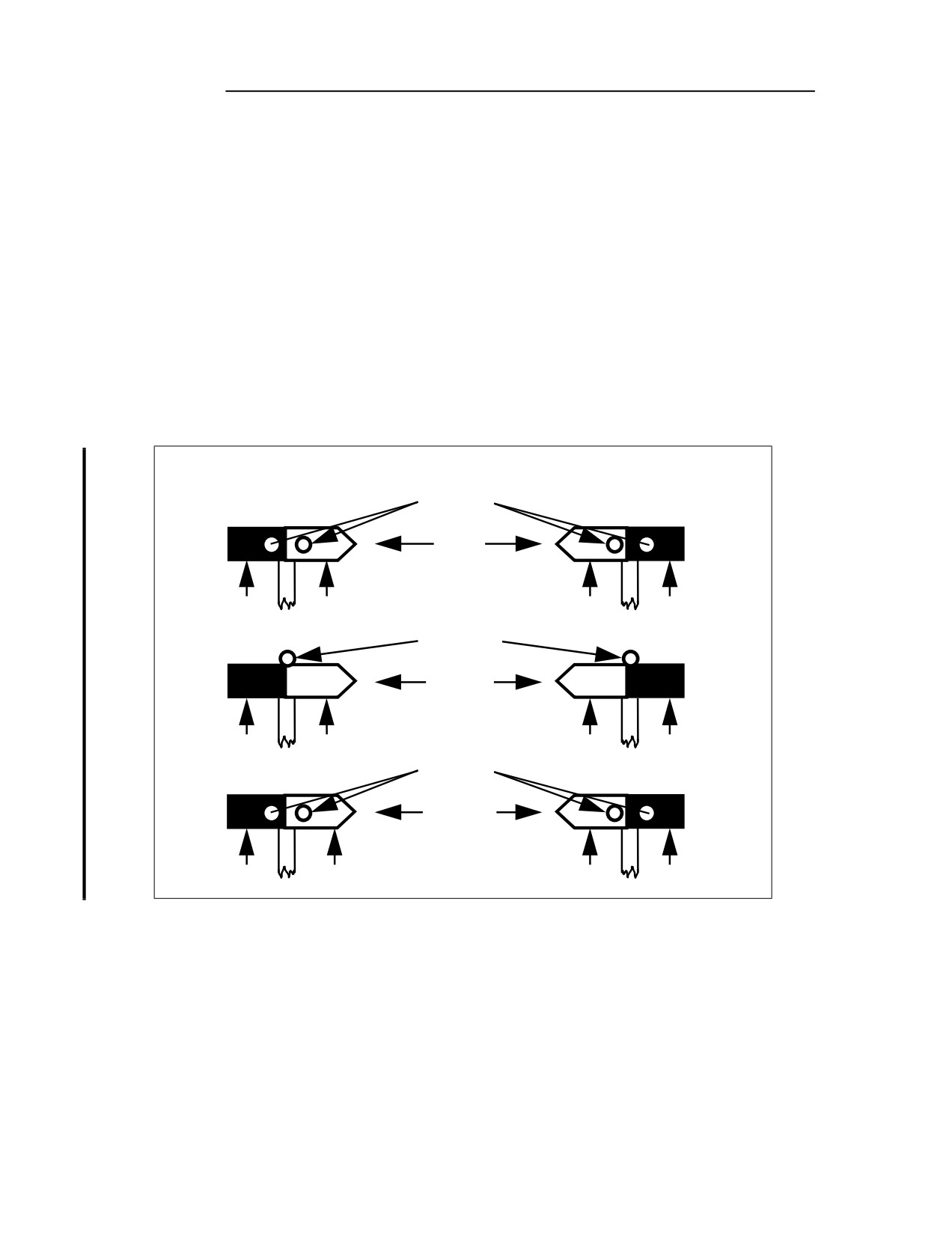
NATO uses white or green lights to illuminate markers at night (Figure 10-28).
Entrance and exit markers are marked with two green or white lights placed
horizontally, so that the safe and dangerous markings on them are clearly
visible. One white or green light is used on funnel and handrail markers. The
commander decides whether the light is placed on top of the NATO marker or
placed so that it illuminates the markers. Lights must be visible from a
minimum of 50 meters under most conditions and have a continuous life of 12
hours.
Lights (green
or white)
Exit
markers
(Red)
(White)
(White)
(Red)
Lights (green
or white)
Lane
markers
(Red)
(White)
(White)
(Red)
Lights (green
or white)
Entrance
markers
(Red)
(White)
(White)
(Red)
Figure 10-27. NATO standard marking for limited visibility
The mission to convert intermediate or full lane marking to NATO standard is
normally assigned to corps-level engineer battalions working in the division
rear area. In special cases, divisional engineer battalions may be tasked with
NATO marking.
10-38 Minefield Reduction
C2
Chapter 11
Route and Area Clearance
The ability to move forces and material to any point in an AO is basic to
combat power and often decides the outcome of combat operations.
Maneuver relies on the availability of LOC within an AO; and during
OOTW, clear LOC is essential to the movement of forces. Units must
conduct route and area clearance to ensure that LOC enables safe passage
of combat, combat support (CS), and CSS organizations. Clearance
operations are best-suited for rear-area and stability support operations.
ROUTE CLEARANCE
Route clearance is a combined arms operation. Units must clear LOC of
obstacles and enemy activity that disrupt battlefield circulation.
PLANNING
The principles of breaching operations (Chapter 9) apply to the development
and execution of the route-clearance mission. The breaching tenets
(intelligence, fundamentals, organization, mass, and synchronization) should
be the basis for planning.
Intelligence
Incorporating the IPB and METT-TC factors into route-clearance operations
will enable units to predict what the enemy will do and where it will do it. The
IPB and the EBA offer ideal methods for establishing a SITEMP. After the S2
and the engineer identify the most probable threat sites, the S2 designates
them as NAIs. These NAIs are the focus of the reconnaissance effort.
Engineers work in concert with other reconnaissance assets to confirm the
presence or absence of ambushes, UXO, and minefields. The information
gathered from the IPB and the reconnaissance effort determines the method
and the type of route clearance necessary. It also helps the commander
determine any outside resources (EOD, SOF) that he may need.
Fundamentals
SOSR may not be executed, but it is planned as it is in breaching operations.
Units must be prepared to execute SOSR fundamentals as necessary.
Organization
Task organization for a route clearance is similar to the task organization for
a deliberate breach. The clearance company team is organized into breach,
support, and assault forces. The breach force conducts clearing operations, the
support force isolates the area being cleared, and the assault force performs
security functions beyond the clearance site (traffic control points) and assists
Route and Area Clearance 11-1

FM 20-32
the breach force in disengagement, as required. Table 11-1 shows a sample
task organization for a route clearance.
Table 11-1. Sample task organization for a route clearance
Team
Support Force
Assault Force
Breach Force
•
Mechanized infantry
•
Mechanized infantry platoon
•
Engineer platoon with
platoon with
•
Engineer squad
organic vehicles
dismount capability
•
Mortar section
•
Armor platoon with
Heavy
•
Armor platoon
•
Medical team (two ambulances)
plows and rollers
•
PSYOP team
•
FIST
•
MP element
Two infantry platoons
•
Bradley platoon with dismount
•
Engineer platoon with
(light)
capability
organic vehicles
•
Engineer squad
•
Armor platoon with
•
60-mm mortar section
plows and rollers
Light/Heavy
•
Medical team (two ambulances)
•
PSYOP team
•
Forward observer
•
MP element
Two infantry platoons
•
AT/MP section with M60/MK19 mix
•
Engineer squad (+)
(light)
•
60-mm mortar section
•
Infantry platoon (light)
•
Medical team (two ambulances)
•
AT/MP section with
Light
•
PSYOP team
M60/MK19 mix
•
Forward observer
•
MP element
Mass
Sufficient maneuver and engineer assets must be allocated to the clearance
company team. The length and the width of the route and the type of
clearance to be conducted determine the size of the sweep team. Clearing a
Class A military road with the deliberate sweep technique requires at least
two engineer squads due to the total lane width to be cleared and the
requirement for the rotation of mine-detector operators. Depending on the
type of sweep operations, the commander can expect a 50 percent loss of sweep
assets. Normally, as in breaching, a 50 percent redundancy of engineer assets
should be allocated to the sweep team.
Synchronization
All aspects of synchronization should be implemented when planning route
clearance. It is especially important that rehearsals be conducted at the
combined arms level. Rehearsals should include—
• Reaction to enemy contact.
• Reaction to an ambush.
• Communications exercise.
• Fire support (obscuration smoke, immediate suppression fires, critical
friendly zones for counterfire radar, and no-fire area around the
clearance site).
11-2 Route and Area Clearance
FM 20-32
• CSS
(maneuver, casualty evacuation, marking materials, and
demolitions resupply).
PLANNING CONSIDERATIONS
The purpose of breaching is to project combat power to the farside of an
obstacle, and breaching usually occurs under enemy fire. Route-clearance
operations focus on opening and maintaining LOC to ensure the safe passage
of combat, CS, and CSS organizations. Like breaching, route-clearance
operations require extensive BOS coordination. The following planning
considerations should be used by brigade and battalion TFs when planning
route-clearance operations:
Intelligence
•
Identify choke points, bridges, tunnels, critical road junctions, and
other built-up areas. These are the most suspect areas for obstacle
emplacement. However, depending on the enemy’s overall mission, it
may not always emplace obstacles at these locations. This is especially
true if the enemy’s goal is to psychologically disrupt our convoys.
•
Maintain a situation map with a graphics overlay that reflects the
most current intelligence information.
•
Maintain an incident map with a graphics overlay to facilitate a
pattern analysis.
•
Maintain a threat order-of-battle database, such as how the enemy
will disrupt unit LOC.
•
Develop a detailed R&S plan that incorporates modern battlefield
techniques and systems, such as ground sensors, forward-looking
airborne radar, and satellite images. As a minimum—
— Coordinate for UAV support, if available.
— Develop infiltration routes to support recon and security at likely
enemy ambush sites.
— Develop an estimate of impact to civilians on the battlefield
(COBs). COBs include local nationals, nongovernment
organizations (NGOs), and private volunteer organizations
(PVOs).
— Conduct a daily flight over the area to provide up-to-the-minute
intelligence. When available, coordinate ASTAMIDS coverage.
— Coordinate with the USAF to periodically check the route (for
example, using an AC-130 Specter gunship).
•
Provide an intelligence update to company team leaders before
departure. This should be in the form of a 1:50,000 enemy SITEMP
overlay (confirmed and suspected/templated).
•
Establish liaison with the host nation, NGOs, and SOF.
Maneuver
•
Provide personnel for TCPs.
Route and Area Clearance 11-3
FM 20-32
•
Clear and secure flanks (at least 100 meters) and the farside of
suspected and known obstacle locations.
•
Close the route to US-controlled traffic during route-clearance
operations to minimize the target presented to enemy forces.
•
Identify and clear potential sniper positions before beginning obstacle
reduction or clearance.
•
Provide security for the cleared route.
•
Give operational control (OPCON) of aviation assets to the route-
clearance commander for clearance-support missions.
•
Plan the building of static security points along the cleared route to
reduce the probability of reseeding.
Fire Support
•
Plan smoke for templated locations.
•
Position mortars to ensure continuous coverage of the operation (move
and set up with the support force).
•
Prepare fires within the tactical rules of engagement.
•
Ensure that the route-clearance team has a FIST coordinator. The
clearance commander should locate the FIST element well forward in
the order of march.
•
Designate obstacle clearance sites as critical friendly zones for
counterfire radar and no-fire areas.
NOTES:
1. Priority targets shift in conjunction with company team movement
on the main supply route (MSR).
2. Clearance of fires is the responsibility of the maneuver commander
of the sector where the target is located.
3. Adequate Q-36 radar coverage is necessary for deliberate sweep
operations.
Mobility/Survivability
• Provide detailed OBSTINTEL on minefields. It must include the—
— Description of mines or explosive devices most likely encountered.
— Composition and pattern of obstacle(s).
— Enemy actions or techniques used during obstacle emplacement.
• Conduct deliberate sweep operations 100 meters past the obstacle or
suspected threat.
• Report, clear, and mark mines, obstacles, and explosive devices to
facilitate unimpeded movement.
• Ensure that lane marking meets the standards outlined in Chapter 10
and that materials and techniques are standard throughout the route.
11-4 Route and Area Clearance
FM 20-32
•
Consider including road repair equipment and material as part of the
sweep element (for example, a 5-ton dump truck filled with soil and an
ACE to spread the soil).
•
Keep all radios, electronic equipment, and aviation assets at a safe
distance during reduction operations.
•
Block uncleared roads and trails that branch from the route being
cleared. This protects units from inadvertently traveling an uncleared
route.
•
Debrief the chain of command and the TF S2 on the location, the
composition, and the orientation of all obstacles cleared and
encountered. This assists the S2 and the engineer in IPB/EBA pattern
analysis.
Air-Defense Artillery
•
Consider the possibility of an air attack.
•
Use the following passive air-defense measures:
— Eliminate glare by using mud, tape, cardboard, or camouflage nets
to cover headlights, mirrors, and portions of windshields.
— Reduce dust clouds by reducing speed.
— Plan routes that offer natural concealment.
— Use air guards.
•
Increase the distance between vehicles.
•
Incorporate Stinger missile teams into the support force.
Combat Service Support
• Ensure that clearance operations are supported by a logistical/combat
health support (CHS) package from the brigade support area.
• Plan for air and ground evacuation of casualties. The preferred
evacuation method is by air; the routine method is by ground.
— Conduct an air-mission brief with air ambulance assets, to include
pickup zones and markers. Rehearse procedures for evacuation
requests.
— Ensure that the medical team consists of one or two ambulances.
Locate the medical team with the support force.
— Identify the ambulance exchange point along the route to be
cleared.
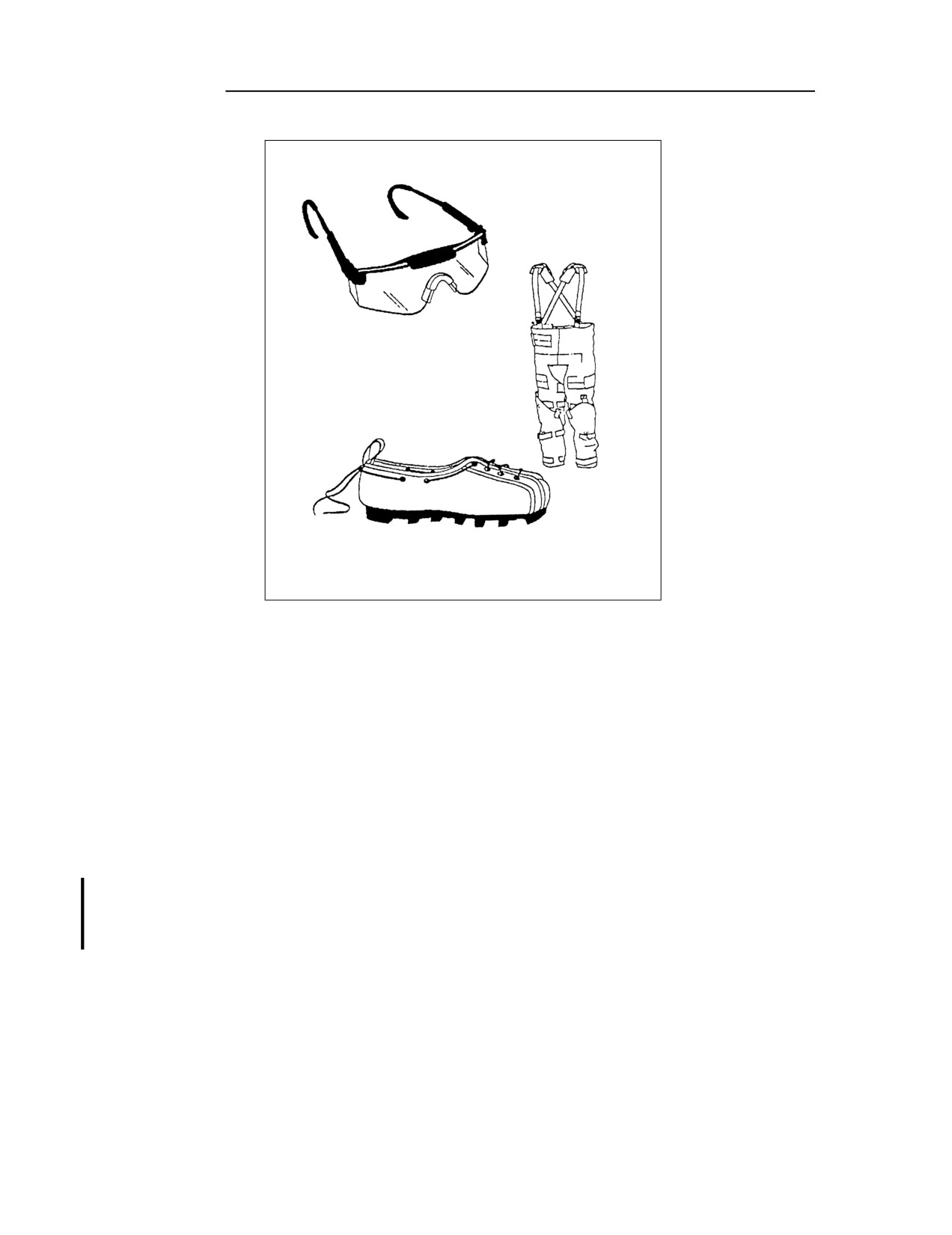
• Ensure that all personnel wear flak vests or IBASIC (Figure 11-1,
page 11-6).
• Ensure that all vehicles have tow cables in the front and the rear for
extraction purposes.
• Ensure that all vehicles carrying troops have hardening (sandbags on
floors and sides).
Route and Area Clearance 11-5
C2, FM 20-32
SPECS
Antifragmentation
protective trousers
AP overboots
Figure 11-1. IBASIC
• Provide MP and explosive-sniffing dogs to help in clearance and
provide security for convoys during and after clearing operations.
Command and Control
NOTE: The company team commander is required to operate on three
separate frequencies—battalion command network, company team
command network, and fire-support network.
• Designate, recognize, and include minefield indicators (Chapter 10) as
part of company team rehearsals.
• Designate a reserve force (at least platoon-size) that is mechanized or
air-assault capable.
• Ensure that proper rehearsals are planned and conducted according to
FM 3-34.2. As a minimum, the clearance force should rehearse actions
on the obstacle, actions on enemy contact, casualty evacuation, and
the control of COBs.
• Ensure that the tasked unit has a clear understanding of the mission,
intent, and end state. For example, the clearing unit commander
should understand that his unit must clear the road width, including
the shoulders, and secure the route.
• Assign clearance responsibilities to brigade and battalion assets.
• Ensure that the maneuver commander/TF S3—
11-6 Route and Area Clearance
FM 20-32
— Controls the movement of all personnel and equipment along the
route (travel authorization is coordinated through the S4).
— Prepares a mine risk assessment of the mission before issuing the
OPORD. (An example of a mine risk assessment is shown in
Appendix F.)
— Tracks the status of routes (red, amber, green) in the TF sector,
based on the amount of time since the route was cleared and the
intelligence and enemy situations.
— Tracks the progress of the clearance operation and integrates it
into the maneuver and CSS plans.
— Determines the route length, using clearly definable start and end
points.
— Sets priorities for the route-clearance element.
— Coordinates with adjacent units, the host nation, NGOs, PVOs,
and SOF.
Special Operations
•
Ensure that psychological operations
(PSYOP)/civil affairs
(CA)
support the counterintelligence effort by conducting civilian
interviews.
•
Direct civilians along the MSR to the displaced-personnel holding
areas or along the routes that the brigade has indicated for use.
•
Employ PSYOP/CA teams forward to disperse civilians and provide
traffic management to isolate the route during clearance operations.
TASK ORGANIZATION
A brigade or battalion TF normally conducts clearance-in-zone operations. To
clear a route, the battalion TF focuses a company team as the main effort on
the proposed MSR. Table 11-1, page 11-2, shows a sample task organization
for a route clearance.
Support Force
This force is comprised of two maneuver platoons and the maneuver company
team XO. The support force provides flank security, rear security, and
protection to the breach force. It neutralizes hostile forces encountered by the
company team. In rugged terrain or highly mined areas, moving the assault
force on the flanks would be too risky. Aviation assets can provide flank
security while ground forces provide rear security. The assault force also
searches for suspected off-route mines.
Assault Force
This force is comprised of a maneuver platoon, an engineer squad, a mortar
section, a medical team, a PSYOP team, an EOD team (or one that is on call),
and a forward observer. The assault force’s mission is the same as in a
breaching operation (Chapter 9).
Route and Area Clearance 11-7

C3, FM 20-32
Breach Force
This force is comprised of a maneuver platoon (including the commander) and
an engineer platoon (minus). The breach force sweeps the route and reduces
mine and explosive threats. It is further task-organized into sweep teams.
A sweep team is a trained detection team that searches for mines and
explosive devices. The organization of the sweep team depends on the type of
sweep mission and the length, the width, and the surface composition
(pavement, gravel, dirt) of the area to be swept. A platoon-size element can
normally clear a 4.5-meter-wide path, and a squad-size element can normally
clear a 1.5-meter-wide path. If the route is wider or time does not permit
multiple passes of the route, additional engineer assets are required. Table 11-
2 outlines personnel and equipment requirements for a sweep team.
Table 11-2. Personnel and equipment requirements for a sweep team
Personnel
Support Personnel
Equipment
•
NCOIC
•
Medics
•
One panel marker
•
Mine-detector
•
Vehicle operator
•
Operational map with required maneuver graphics
operators
•
Four smoke grenades (minimum)
•
Probers/markers
•
Six mine detectors (includes three backups) and extra
•
Radio operator
batteries
•
Demolition teams
•
Two grappling hooks with 60 meters of rope each
•
One demolition kit or bag for each demolition man
•
Six probes
•
Mine marking material
•
Lane marking tape
•
Ten stakes
Platoon-Size Sweep Team
The normal configuration for a platoon-size sweep team is twelve soldiers in a
modified column (Figure 11-2). The platoon leader supervises the entire
operation. This configuration is best suited for sweeping routes in friendly
territory that is not under constant surveillance.
When sweeping in areas where 100 percent coverage is required, the team
should establish a clear lane from which to operate. This is conducted by the
grapple hook being thrown one additional time into the suspected minefield.
The cord on the grapple hook is pulled taunt, with the free end secured to a
stake.
This establishes a left or right physical boundary marker for the mine-
detector operator to use as a guide. The first mine-detector operator will
sweep a 1.5-meter lane left or right of this cord, up to the grapple hook. At the
hook, a second stake will be emplaced to hold the boundary line and the
grapple hook will be thrown again and pulled for trip wires as before. A fourth
throw will serve as the boundary marker through the suspected minefield.
This procedure will continue until the first mine-detector operator is out of the
minefield on the farside.
The boundary marker will then be secured to stakes, using the lane marking
tape. A second boundary maker will be placed 1 meter to the left or right of the
original boundary marker, depending on which side was swept. This will
11-8 Route and Area Clearance
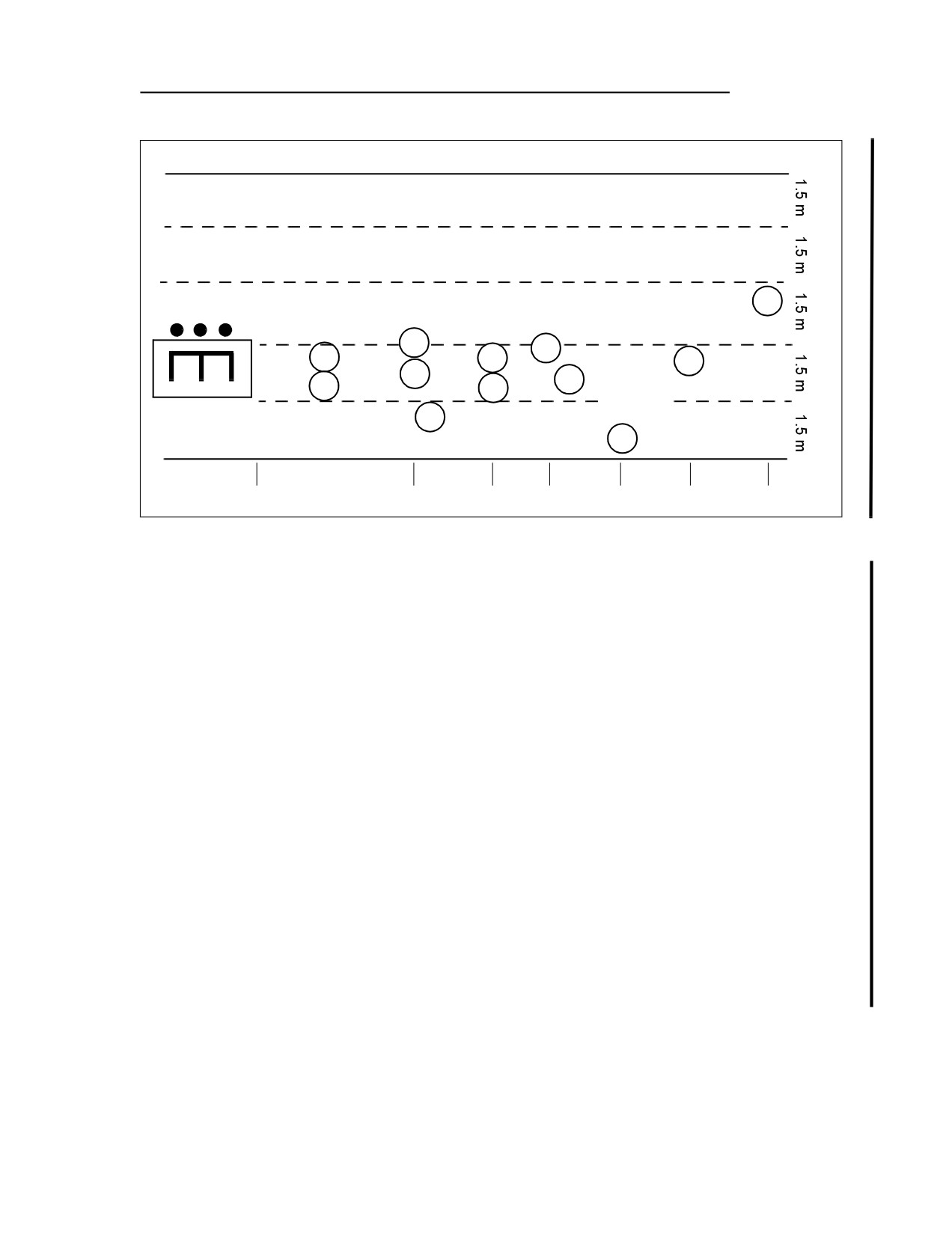
C3, FM 20-32
Subarea to be cleared
Mine-
Subarea to be cleared
detector
operator
Relief mine-
Relief
1
detector
Mine-
prober/
operators Radio
NCOIC
detector
marker
operator
operator
8
4
11
6
(-)
2
9
5
Mine-
12
7
detector
Demolition
Prober/
operator
Relief
10
demolition
man
marker
man
3
50 m
30 m
10 m
30 m
30 m
30 m
Figure 11-2. Platoon-size sweep team
establish a fixed 1-meter lane. The 0.5-meter area that was not included in the
original lane is to ensure that no gaps in coverage were missed on the edge of
the first lane.
The unit will then stretch a piece of marking tape out from across the clear
footpath, moving it left or right 1.5 meters and staking it down on both ends.
This will be repeated as many times as necessary.
Always mark lanes that have not been cleared with a piece of marking tape
across the entry to that lane to prevent personnel from using the lane before it
has been swept. After multiple lanes are physically marked, the unit can
perform a platoon-size sweep. Lanes should be swept and cleared by working
out from the original 1-meter footpath. As the cleared area becomes bigger, the
marking tape is removed to allow the passage of personnel and equipment
though the cleared lane.
As subsequent lanes are being swept, the marking tape will need to be secured
on the outside edge of the lane. Always conduct a thorough sweep of the spot
where the stake will be placed. Stake intervals will depend on terrain and
atmospheric conditions.
Soldiers 1, 2, and 3 (mine-detector operators) lead the sweep team in echelon.
Each sweep team covers 1.5 meters of front, and sweep teams are spaced 30
meters apart to prevent fatalities from accidental detonation by other mine-
detector operators. If required, a fourth mine-detector operator can be added
to the detection column.
Soldiers 4 (NCOIC) and 5 (prober/marker) follow 30 meters behind the last
mine-detector operator (Soldier 3) and are centered in the cleared lane. The
prober/marker is responsible for marking the cleared lane on both sides.
Route and Area Clearance 11-9
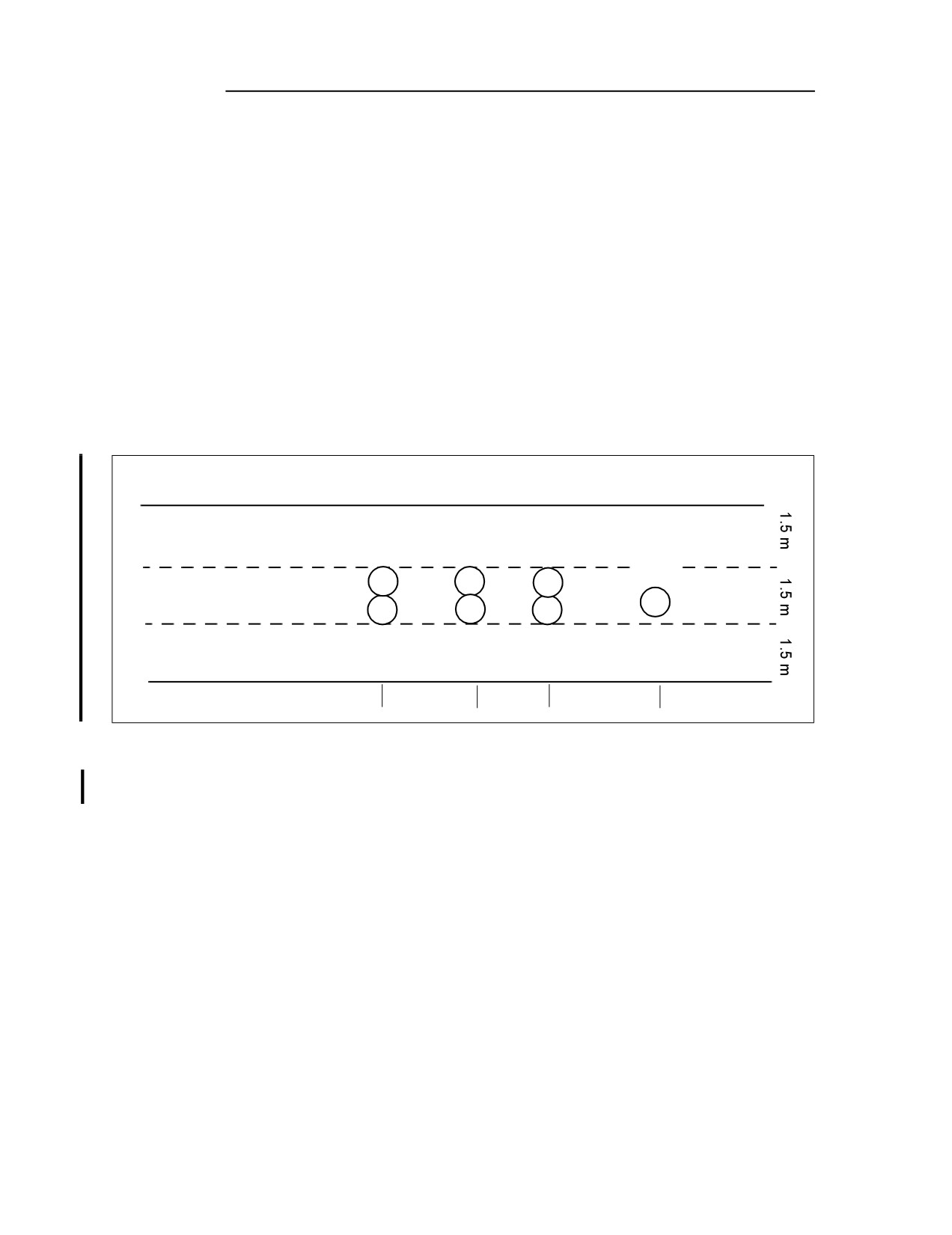
C3, FM 20-32
Soldiers 6 (radio operator) and 7 (demolition man) follow 10 meters behind
Soldiers 4 and 5 and are centered in the cleared lane.
Soldiers 8, 9, 10 (relief mine-detector operators), 11 (relief prober/marker),
and 12 (reserve demolition man) follow 30 meters behind Soldiers 6 and 7. If a
fourth mine-detector operator is added to the column, an additional relief
mine-detector operator must also be added.
The remaining platoon members help the support force or act as a reserve
force, as required. They should first be integrated into the sweep team as a
relief element and then moved forward as needed.
Squad-Size Sweep Team
The normal configuration for a squad-size sweep team is seven soldiers in a
modified column (Figure 11-3). The squad leader supervises the entire sweep
operation. This configuration is designed for sweeping routes in friendly
territory that is not under constant surveillance.
Subarea to be cleared
Relief
prober/
Radio
NCOIC
Mine-
marker
operator
detector
operator
7
4
2
1
6
5
3
Demolition
Prober/
Relief mine-
Cleared area
man
marker
detector
operator
30 m
10 m
30 m
Figure 11-3. Squad-size sweep team
Soldier 1 (mine-detector operator) leads the sweep team and covers a 1.5-
meter-wide path.
Soldiers 2 (NCOIC) and 3 (prober/marker) follow 30 meters behind Soldier 1
and are centered in the cleared lane. The prober/marker is responsible for
marking the cleared lane on both sides.
Soldiers 4 (radio operator) and 5 (demolition man) follow 10 meters behind
Soldiers 2 and 3 and are centered in the cleared lane.
Soldiers 6 (relief mine-detector operator) and 7 (relief prober/marker) follow
30 meters behind Soldiers 4 and 5. If the squad cannot use seven team
members, the relief prober/marker position can be eliminated from the
formation.
The engineer platoon can configure the platoon into squad-size sweep teams
and place them in echelon (Figure 11-4).
11-10 Route and Area Clearance
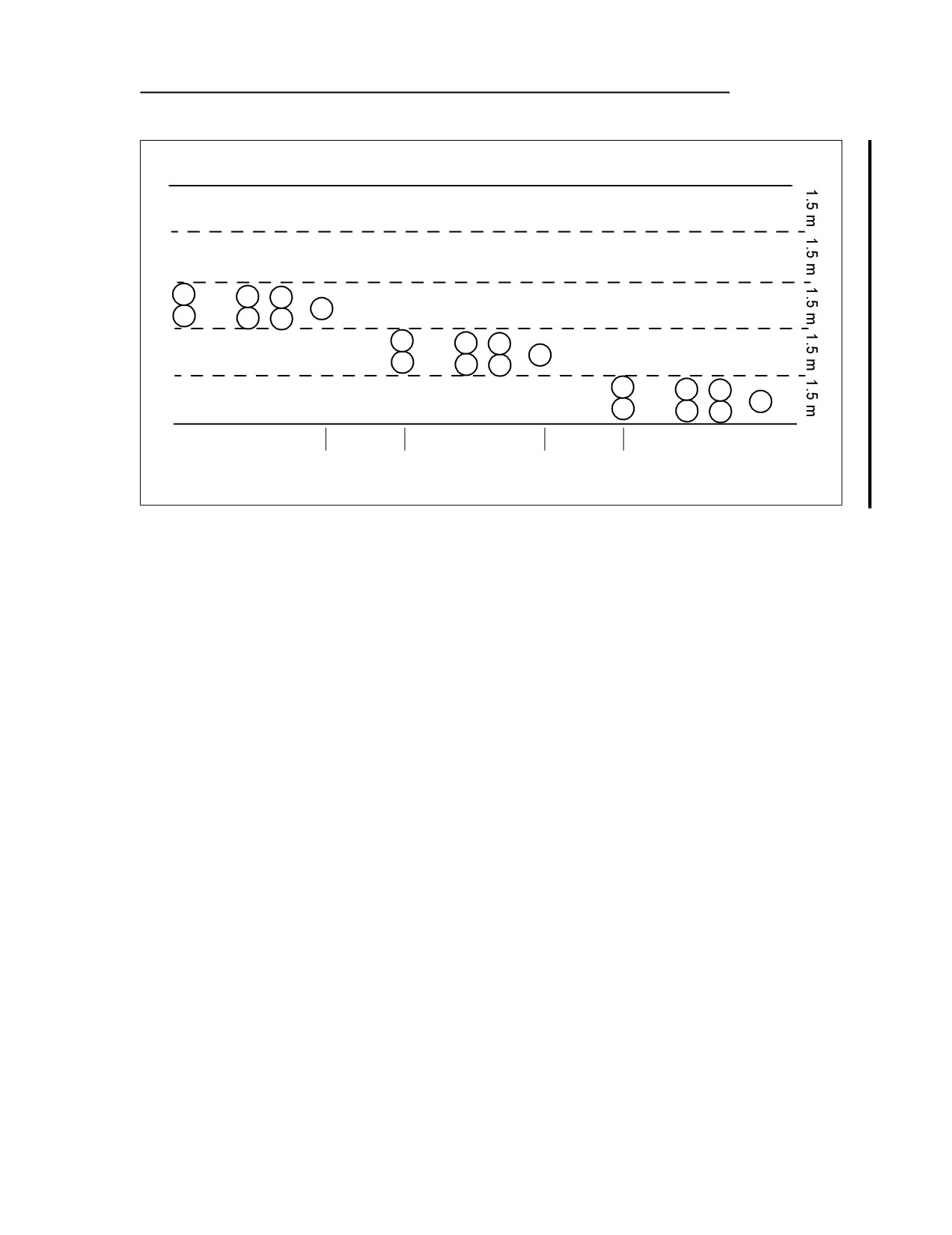
C3, FM 20-32
Subarea to be cleared
Subarea to be cleared
7
4
2
1
6
5
3
7
4
2
1
6
5
3
7
4
2
1
6
5
3
30 m
30 m
3rd squad
2nd squad
1st squad
Figure 11-4. Sweep teams in echelon
METHODS AND TYPES
The information gathered from the IPB and the reconnaissance effort
determines the method and the type of route clearance to conduct. The
determination is based on the situation, the time available, the threat level,
and available assets.
During OOTW, it is recommended that former warring faction (FWF)
engineer-equivalent clearance teams precede US forces clearance teams
within the FWF’s AO. Do not assume that FWF clearance teams will be
thorough in their clearance operation. Treat the route as unsafe until US or
allied force clearance teams have proofed the route to confirm that it is
cleared.
Methods
There are three methods of route clearance—linear, combat, and combined.
The method employed depends on the situation, the time available, and the
clearance assets available. The maneuver force should always establish static
security positions at critical locations following the completion of route
clearance.
Route and Area Clearance 11-11