FM 20-32 Mine/Countermine Operations (August 2001) - page 5
C2, FM 20-32
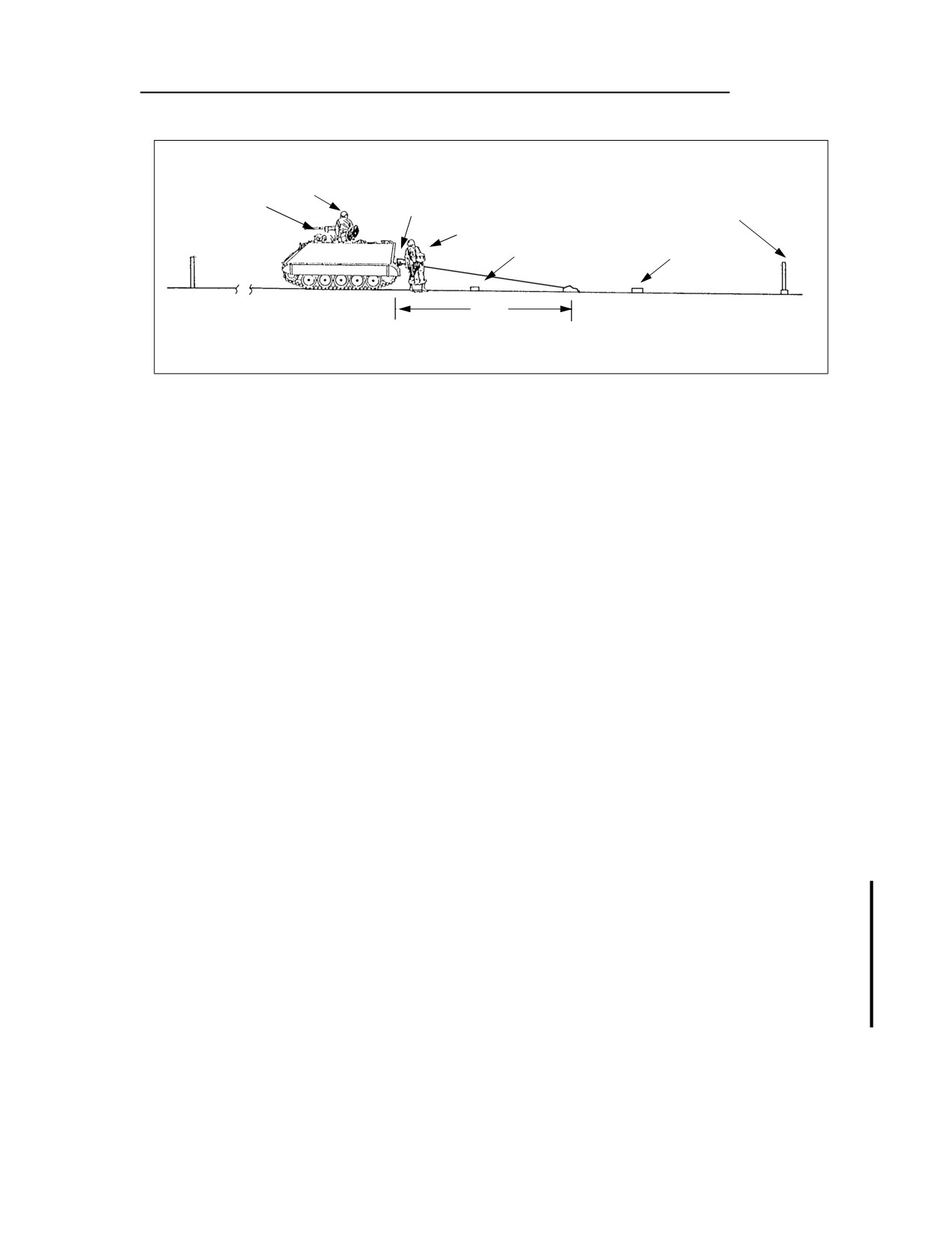
Air guard
Driver
Spotter/feeder
Start row marker
Siting
Layer
picket
Mine
Mine
6m
Figure 6-8. Measuring distances between mines with sandbags
— Soldier 4 walks behind the vehicle and arms mines.
— After the mine row is armed and camouflaged, Soldier 4 buries
pins, clips, and shipping plugs 30 centimeters to the rear of the
start row marker.
— The sapper team repeats the above steps until the end of the row
is reached.
• Digging team, if needed. (The NCOIC selects the mine to be buried by
each soldier and supervises the operation.)
— Follows the laying party along the friendly side of the row.
— Digs in mines but leaves them exposed until arming is complete.
— Korea Only: Arms AP mines in a cluster before arming AT
mines.
MARKING, RECORDING, AND REPORTING ROW MINEFIELDS
Marking procedures for row minefields are the same as those for other
minefields (see Chapter 2).
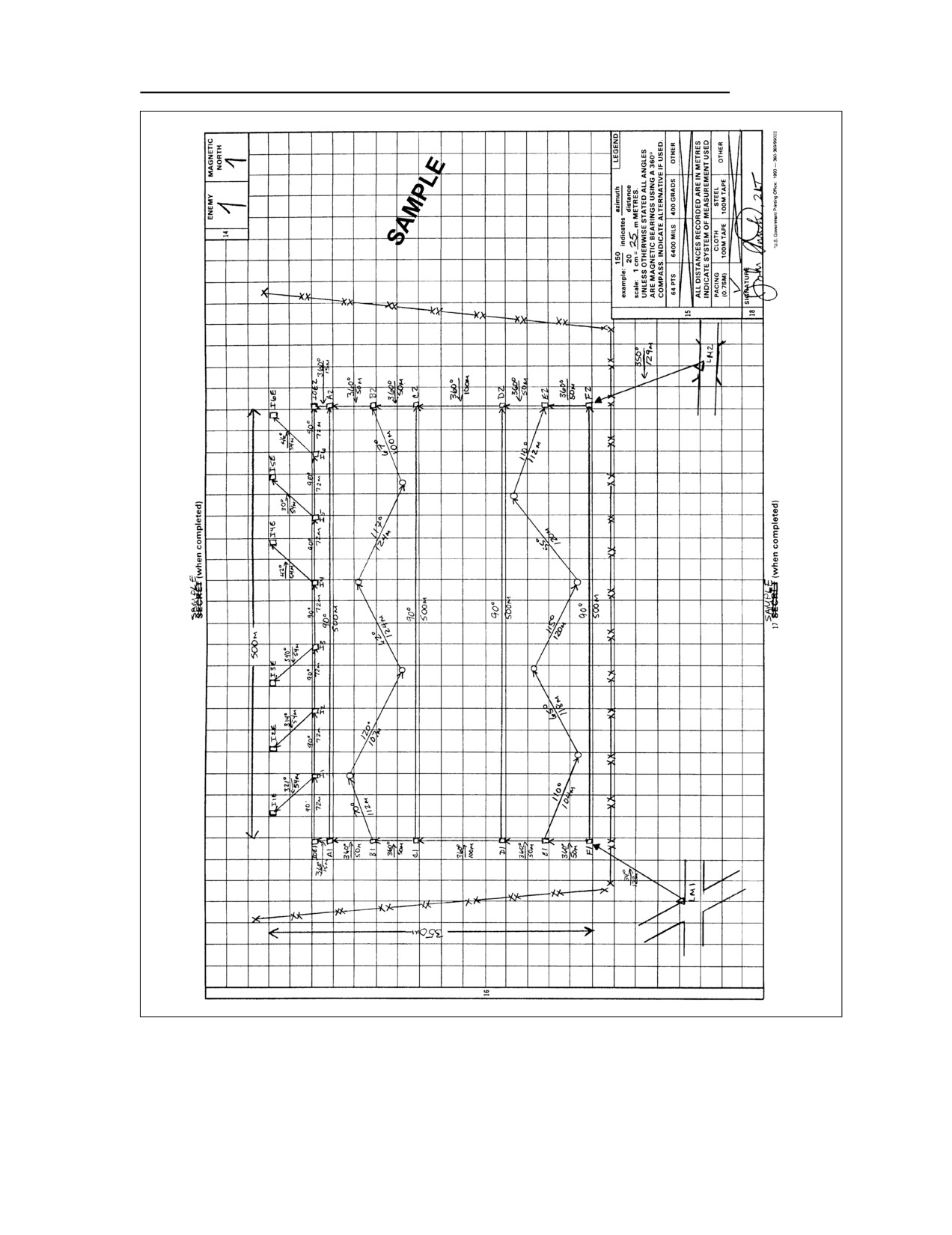
Row minefields are recorded on DA Form 1355 (Figures 6-9a and 6-9b, pages
6-26 and 6-27). Reporting procedures for intent, initiation, status, and
completion reports are detailed in Chapter 8.
STANDARDIZED TACTICAL ROW MINEFIELDS
The specific composition of a tactical row minefield depends on METT-TC
factors and available resources. To aid in standardization of platoon
techniques, four compositions have been developed to match desired obstacle
effects. Using standardized minefields facilitates planning the obstacle type,
size, and logistical requirements. It is imperative that the design and the
effect of these minefields are well understood. They are an integral part of
combined arms obstacle doctrine and form the cornerstone of engineer
obstacle operations.
Row Mining 6-25
FM 20-32
Figure 6-9b. Sample DA Form 1355 for a row minefield (back)
Row Mining 6-27
FM 20-32
DISRUPT AND FIX
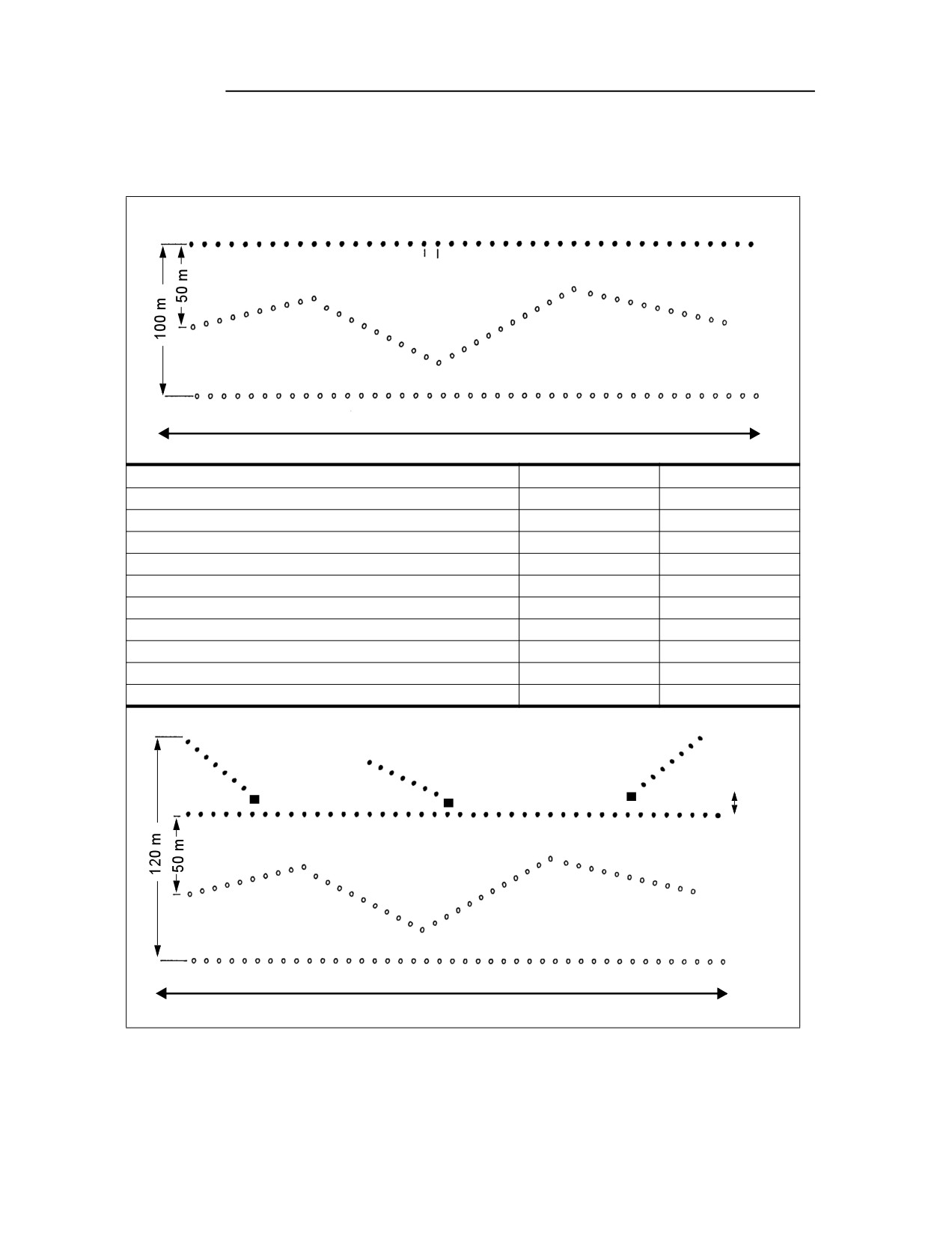
Disrupt and fix row minefields (Figure 6-10) are similarly constructed, but a
fix minefield has an IOE and does not have AHDs.
DISRUPT
Row A
6m
Row B
Row C
250 m
Disrupt
Fix
Front
250 m
250 m
Depth
100 m
120 m
Rows of AT full-width mines
1
1
Rows of AT track-width mines
2
2
IOE
No
Yes
AHD
No
No
Platoon hours required
1.5
1.5
Full-width mines
42
63
Track-width mines
84
84
Density
0.5
0.6
FIX
IOE
I3 Marker
I1 Marker
I2 Marker
15 m
Row A
Row B
Row C
250 m
Figure 6-10. Standardized disrupt and fix row minefields
6-28 Row Mining
FM 20-32
Disrupt and fix row minefields are emplaced as follows:
•
Row A.
— 42 full-width AT mines (tilt-rod) are placed 6 meters apart.
— No turning points.
— Mines are surface-laid (staked) or buried.
•
Row B.
— Start and end row markers are emplaced 50 meters behind Row A.
— 42 track-width AT mines are placed 6 meters apart.
— Preferably no more than 3 turning points.
— Mines are surface-laid or buried.
•
Row C.
— Emplaced 100 meters behind Row A.
— 42 track-width AT mines are placed 6 meters apart.
— No turning points.
— Mines are surface-laid or buried.
•
IOE (fix minefield only).
— 3 IOE short rows.
— A separate IOE baseline.
— The IOE baseline is on the enemy side, 15 meters from Row A.
— 7 full-width AT mines are placed 6 meters apart on each IOE short
row.
— Mines are buried.
— The first IOE short row is placed 48 meters from the IOE end
marker, the next short row is 84 meters from the first short row,
and the third short row is 84 meters from the second short row.
TURN
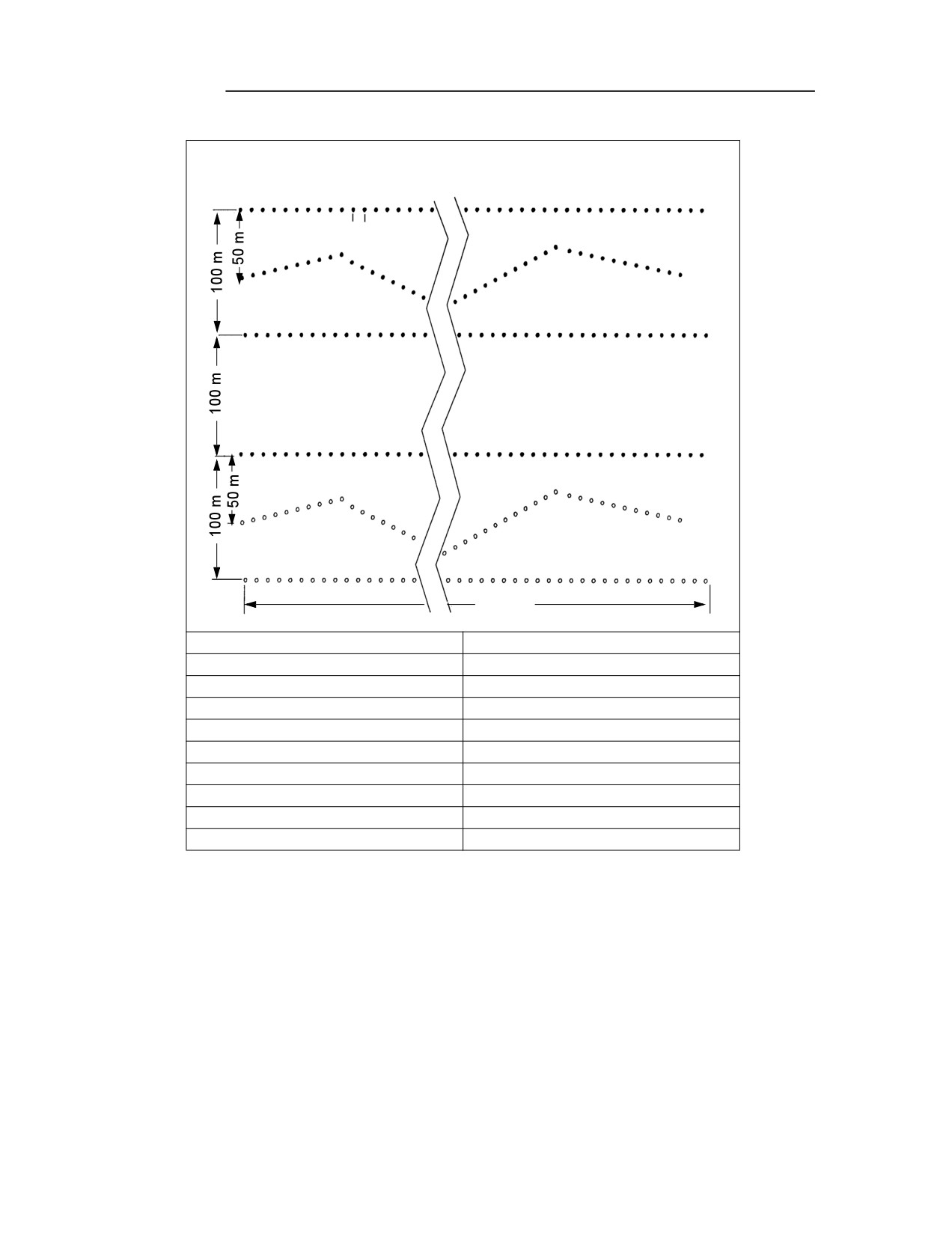
A turn minefield (Figure 6-11, page 6-30) consists of four rows of full-width
mines and two rows of track-width mines.
A turn row minefield is emplaced as follows:
• Row A.
— 84 full-width AT mines (tilt-rod) are placed 6 meters apart.
— No turning points.
— Mines are surface-laid (staked) or buried.
• Row B.
— Start and end row markers are emplaced 50 meters behind Row A.
— 84 full-width AT mines (tilt-rod) are placed 6 meters apart.
Row Mining 6-29
FM 20-32
NOTE: The center of the minefield shown in this figure is
omitted for clarity.
Row A
6m
Row B
Row C
Row D
Row E
Row F
500 m
Front
500 m
Depth
300 m
Rows of AT full-width mines
4
Rows of AT track-width mines
2
IOE
No
AHD
No
Platoon hours required
3.5
Full-width mines
336
Track-width mines
168
Density
1.0
Figure 6-11. Standardized turn row minefield
— Preferably no more than 5 turning points.
— Mines are surface-laid (staked) or buried.
• Row C.
— Emplaced 100 meters behind Row A.
— 84 full-width AT mines (tilt-rod) are placed
6 meters apart.
— No turning points.
— Mines are surface-laid (staked) or buried.
6-30 Row Mining
FM 20-32
•
Row D.
— Emplaced 100 meters behind Row C.
— 84 full-width AT mines (tilt-rod) are placed 6 meters apart.
— No turning points.
— Mines are surface-laid (staked) or buried.
•
Row E.
— Start and end row markers are emplaced 50 meters behind Row D.
— 84 track-width AT mines are placed 6 meters apart.
— Preferably no more than 5 turning points.
— Mines are surface-laid or buried.
•
Row F.
— Emplaced 100 meters behind Row D.
— 84 track-width AT mines are placed 6 meters apart.
— No turning points.
— Mines are surface-laid or buried.
BLOCK
A block minefield (Figure 6-12, page 6-32) has an IOE (Korea Only: and AP
mines) and has 20 percent AHDs in two of its rows of full-width mines. AHDs
are placed in Rows B and C for the best effect. (Korea Only: A block
minefield also requires 84 M16 or M14 AP mines and has a density of
0.17 M16/M14 AP mine per linear meter.)
A block row minefield is emplaced as follows:
• Row A.
— 84 full-width AT mines (tilt-rod) are placed 6 meters apart.
— No turning points.
— Mines are surface-laid (staked) or buried.
• Row B.
— Start and end row markers are emplaced 50 meters behind Row A.
— 84 full-width AT mines (tilt-rod) are placed 6 meters apart.
— Preferably no more than 5 turning points.
— Mines are surface-laid (staked) or buried.
• Row C.
— Emplaced 100 meters behind Row A.
— 84 full-width AT mines (tilt-rod) are placed 6 meters apart.
— No turning points.
Row Mining 6-31
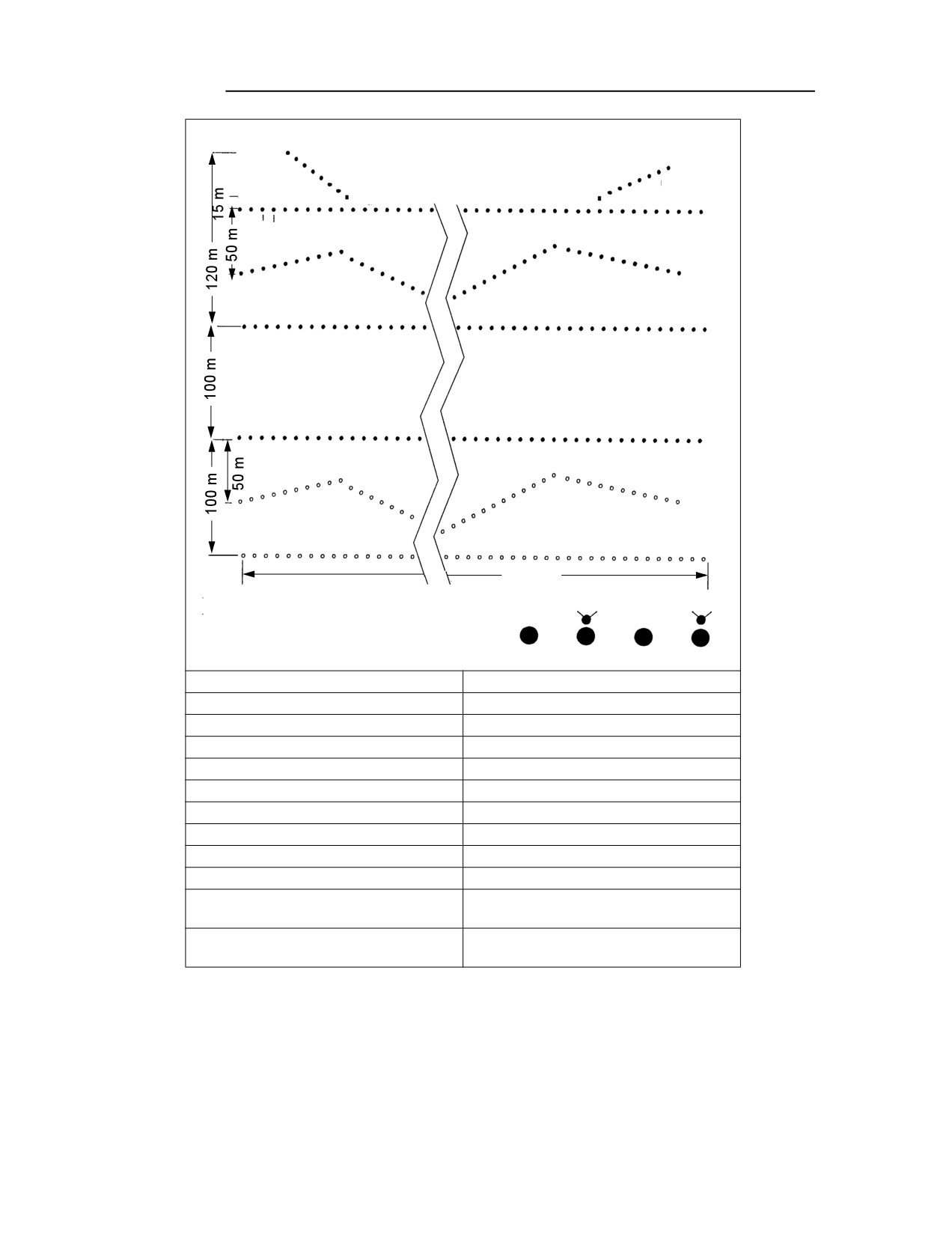
FM 20-32
NOTE: The center of the minefield shown
in this figure is omitted for clarity.
IOE
I6 marker
I1 marker
6m
Row A
Row B
Row C
Row D
Row E
Row F
500 m
AP mine employment
Front
500 m
Depth
320 m
Rows of AT full-width mines
4
Rows of AT track-width mines
2
IOE
Yes
AHD
Yes
Platoon hours required
5
Full-width mines
378
Track-width mines
168
AT mine density
1.1
Korea Only:
84
AP frag mines
Korea Only:
0.17
AP mine density
Figure 6-12. Standardized block row minefield
6-32 Row Mining
FM 20-32
— Mines are surface-laid (staked) or buried.
•
Row D.
— Emplaced 100 meters behind Row C.
— 84 full-width AT mines (tilt-rod) are placed 6 meters apart.
— No turning points.
— Mines are surface-laid (staked) or buried.
•
Row E.
— Start and end row markers are emplaced 50 meters behind Row D.
— 84 track-width AT mines are placed 6 meters apart.
— Preferably no more than 5 turning points.
— Mines are surface-laid or buried.
•
Row F.
— Emplaced 100 meters behind Row D.
— 84 track-width AT mines are placed 6 meters apart.
— No turning points.
— Mines are surface-laid or buried.
•
IOE.
— 6 IOE short rows.
— A separate IOE baseline.
— 7 full-width AT mines are placed 6 meters apart on each IOE short
row.
— Mines are buried.
— The first IOE short row is placed 72 meters from the IOE end
marker, and the five subsequent IOE short rows are placed at
72-meter intervals on the IOE baseline.
•
Korea Only: AP mines.
— AP mines are placed on two rows of full-width AT mines.
— AP mines are placed in a cluster around AT mines.
— One AP mine is placed in front of every other AT mine.
HASTY PROTECTIVE ROW MINEFIELDS
Hasty protective row minefields are temporary in nature and are used as part
of a unit's defensive perimeter. Units usually use mines from their basic load.
If time permits, mines should be buried to increase their effectiveness, but
they can be surface-laid. The minefield can be easily recovered because AHDs,
nonmetallic mines, or low-metallic mines are not used. Mines are employed
outside the hand-grenade range but within the range of small-caliber
weapons. All mines are picked up by the emplacing unit upon leaving the
Row Mining 6-33
FM 20-32
area, unless enemy pressure prevents mine retrieval or the minefield is being
transferred to a relieving commander.
RULES
The brigade commander has the initial authority to employ hasty protective
row minefields. This authority may be delegated to the battalion or company
commander on a mission-by-mission basis.
Most of the rules governing hasty protective row mining are defined in
STANAG 2036. A summary of those rules and some additional rules that
apply are shown below.
•
Rows.
— Rows are marked and recorded. They are designated by letters (A,
B, and so forth) with Row A being closest to the enemy.
— The minimum distance between rows of AT mines is 8 meters.
— Korea Only: The minimum distance between any row and a
row containing AP mines is 15 meters.
— The distance between the start row marker and the first mine in a
row is the mine spacing for that row.
— An IOE row is not used.
— Start and end row markers are permanent markers and must be
made of detectable material.
•
General.
— The spacing between mines is at least 4 meters to prevent
sympathetic detonation. There is no maximum distance between
mines within the row.
— Mines are at least 15 meters from the perimeter fence.
— The minefield must be fenced on all sides if M18A1 AP mines are
employed and the minefield will be in place for more than 72
hours.
— The minefield has at least one landmark that is located to the rear,
never to the extreme side or front.
— The minefield has an easily identifiable RP (tree, stump, stake).
— Back azimuths are not used to record the minefield.
— Measurements are in meters.
— AHDs, nonmetallic mines, or low-metallic mines are not used.
— Minefields are recorded on DA Form 1355-1-R (see Chapter 8).
SITE LAYOUT
Requesting and receiving permission to lay mines is the first step when
emplacing a hasty protective row minefield. The next step is conducting a
thorough leader's reconnaissance of the proposed minefield area. Identify
mine locations that cover likely AAs, enhance key weapon systems, and cover
dead space. Establish an easily identifiable RP between the minefield and the
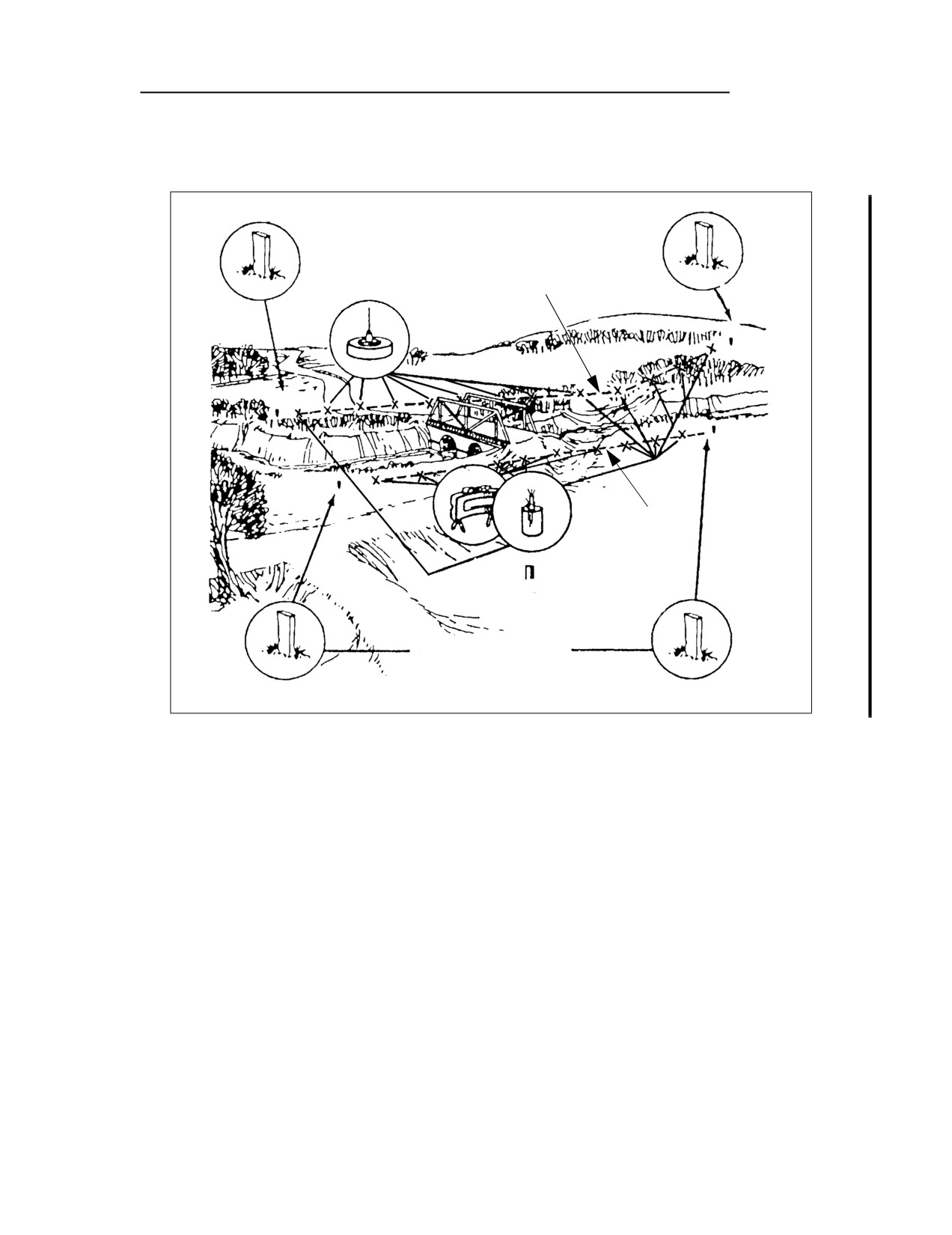
unit position. From the RP, visualize mines as running in rows parallel to the
unit position (Figure 6-13). After the RP is established and the minefield is
6-34 Row Mining
C2, FM 20-32
visualized, complete recording and emplace the mines, but do not arm them.
This procedure simplifies recording and makes retrieval quicker and safer.
A
A
1
2
Row A
Row B
RP
B
B
2
1
End row markers
Figure 6-13. Site layout
Mine Rows
The row closest to the enemy is designated as Row A; succeeding rows are
designated B, C, D, and so on. The ends of rows are shown by two end row
markers. They are labeled with the letter of the row and the number 1 for the
right end of the row or the number 2 for the left end of the row. The rows are
numbered from right to left, facing the enemy. The marker should be an easily
identifiable object, such as a wooden stake with a nail or a steel picket so that
it can be found with an AN/PSS-12 mine detector.
Laying Procedures
From the RP, the leader measures the magnetic azimuth, in degrees, to a
selected point on the right side (facing the enemy) of the tentative minefield.
He paces off the distance and records it in meters. This point (B1) marks the
beginning of the second row. The leader places a marker at B1 and records the
azimuth and the distance on DA Form 1355-1-R.
Row Mining 6-35
FM
20-32
From B1, the leader measures the azimuth and distance to a second point on
the right side of the minefield (facing the enemy). He places a marker at this
point (A1), and records the information.
The leader measures the distance and the azimuth from A1 to the location of
the first mine in that row. The distance (or spacing) from the end row marker
to the first mine is the mine spacing for that row. After the leader records the
location, the mine is emplaced, but it is not armed.
The distance and azimuth are measured from the first mine to the second
mine, and so on, until all the mines are emplaced and the locations are
recorded. This procedure is repeated for the second row. As each mine is
recorded, it is assigned a number to identify it in the minefield record.
When the last mine location is recorded for a row, the distance and the
azimuth are measured from that point to another arbitrary point, A2 or B2. A
marker is placed here in the same manner as A1 and B1. Next, the distance
and azimuth from the RP to B2 and from B2 to A2 are measured and recorded.
When all the mines have been placed and recorded, the leader measures the
distance and the azimuth between the RP and a permanent landmark that
can be found on the map. He records the information on DA Form 1355-1-R.
The landmark is used to assist others in locating the minefield if it is
transferred or unexpectedly abandoned.
Mines can be armed after recording is complete. Mines nearest the enemy are
armed first, allowing soldiers to safely work their way back to the unit
position. Pins and clips are buried 30 centimeters behind row markers, the RP,
or any easily identifiable, accessible location. Record the location of the pins
and clips in the remarks section of DA Form 1355-1-R. The leader then reports
the completion of the minefield to higher headquarters.
If the minefield is transferred to another unit, the transferring unit leader
briefs the gaining unit leader. The gaining unit leader signs and dates the
mines-transferred block on the DA Form 1355-1-R. The form is destroyed
when the minefield is removed. If the minefield is abandoned unexpectedly,
the DA Form 1355-1-R is forwarded to higher headquarters.
Mine Removal
When removing mines from a hasty protective row minefield, the leader first
determines the best method to use:
• If the minefield has been under constant observation from the time it
was laid and has not been tampered with, the squad leader directs the
personnel who laid the mines to pick up the same mines. He uses DA
Form 1355-1-R preceded by a mine detector to determine the types of
mines to be removed and where they are located.
• If the minefield has not been under constant observation, may have
been tampered with, or the personnel who laid the mines are not
available or do not remember the location of the mines, the squad
leader uses DA Form 1355-1-R and a clearance team as outlined in
Chapter 11 to locate and remove mines.
6-36 Row Mining
C2, FM 20-32
The leader retrieves safety devices, shipping plugs, and other items that
accompanied the emplaced mines. Using the azimuths and distances provided
on the DA Form 1355-1-R, the removal team starts at the RP and moves to B1.
They then move from B1 to the mine and remove the mine. If B1 is destroyed,
the team moves from the RP to B2. The team then shoots a back azimuth
(subtract 180 degrees) from the recorded azimuth from B2 to the first mine
and removes the mine. Personnel continue this process until all the mines
have been removed. The stakes at Al, B1, A2, and B2 are necessary because it
is safer to find a stake than to find an armed mine.
The removal team observes basic safety precautions by maintaining 30 meters
between personnel, not running, and moving only in cleared areas. The team
starts with the row closest to the defender and works toward the enemy.
Personnel—
• Check the sides and bottoms of the mines for AHDs, and disarm or
mark the mines as they are found.
• Replace all pins, clips, and other safety devices before the mines are
removed from the ground.
• Turn arming dials to SAFE or UNARMED; or if mines have screw-
type fuses, remove the fuses and take them away from the mines.
• Lift the mines from the holes after they have been rendered safe.
— If a mine was put in place and kept in sight by the individual who
removes it, he lifts it directly from the hole after rendering it safe.
— If a mine has not been kept in sight, the individual attaches a
60-meter rope or wire to the mine, takes cover, and pulls the mine
from the hole.
• As each mine is removed, place a tick mark beside it on the DA Form
1355-1-R.
• Assemble all the mines in one location for accountability.
NOTE: AHDs are not used in hasty protective row minefields.
However, as a safety precaution, consider all mines to be equipped
with AHDs until proven otherwise.
The leader confirms the removal of the mines and accounts for the number of
mines, by type, as recorded on the DA Form 1355-1-R. The leader may find it
necessary to confirm an exploded mine to account for all the mines.
To confirm a mine explosion that was not witnessed, identify the crater or
traces of burnt soil made by the detonated mine and place a tick mark beside
the mine number on the DA Form 1355-1-R. Ensure that the crater found in
the vicinity of the mine was caused by a land mine and not by artillery. A mine
crater is normally circular, and it shows traces of burnt soil. The impact and
the soil dispersion of artillery is normally elongated.
The squad leader confirms that each mine is disarmed and safe. The removal
team cleans and repacks serviceable mines for future use and destroys the
others; they repack serviceable mines in their original containers and store
them according to the unit SOP and local regulations. The removal team
Row Mining 6-37
FM 20-32
removes and stores the row markers. The leader submits a report to his higher
headquarters stating that the minefield has been removed and that the area
is clear.
6-38 Row Mining
This chapter implements STANAG 2036.
Chapter 7
Standard-Pattern Minefields
Emplacing standard-pattern minefields is laborious and time-consuming,
but it allows better mine concealment than row mining. Standard-pattern
laying is well suited for protective and nuisance minefields. It can be used
in terrain where the nature of the ground makes row mining
impracticable.
To achieve their maximum effect, mines must be laid so that they cannot
be seen and so that a vehicle's wheel or track or a person’s foot exerts
enough pressure to detonate them.
The method used to lay mines depends on the mine operation, the type of
ground in which the mine is to be laid, and the type of ground cover that is
available for camouflage.
COMPONENTS
MINE STRIPS
The mine strip is the foundation of a standard-pattern minefield. If a mine
strip was laid in one straight line, the enemy could easily locate the mines;
therefore, mine strips are laid in several segments as shown in Figure 7-1,
page 7-2.
When siting, laying, and recording mine strips, all measurements are
expressed in meters. Directions are recorded as magnetic azimuths, in
degrees.
MINE CLUSTERS
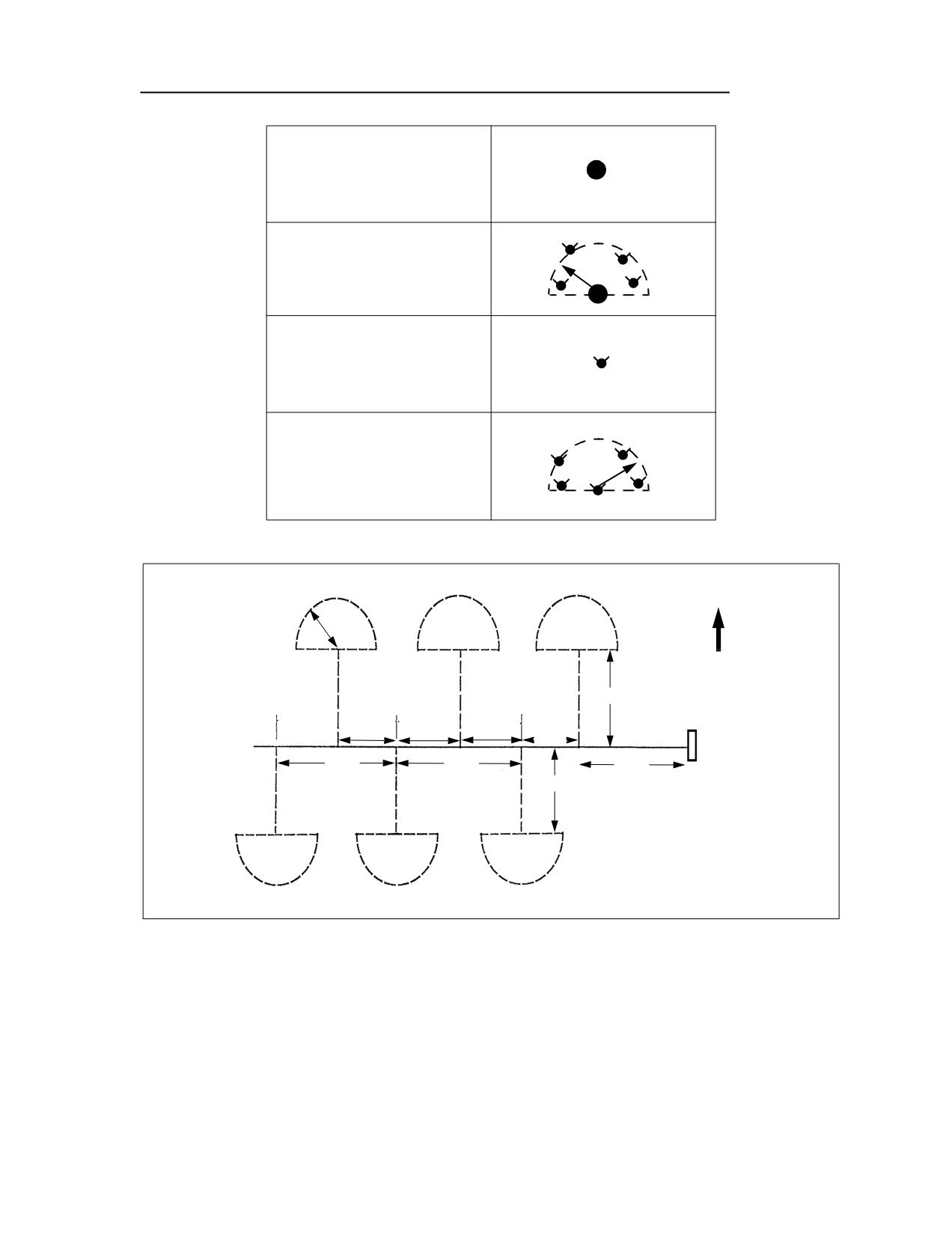
The cluster is the basic unit of a minefield. It consists of one to five mines that
are laid within a 2-meter-radius semicircle (Figure 7-2, page 7-3). When
clusters are placed in a mine strip, they are numbered progressively and may
consist of—
• One AT mine.
• Korea Only: One AT mine and one to four AP mines.
• Korea Only: One to five AP mines.
Standard-Pattern Minefields 7-1
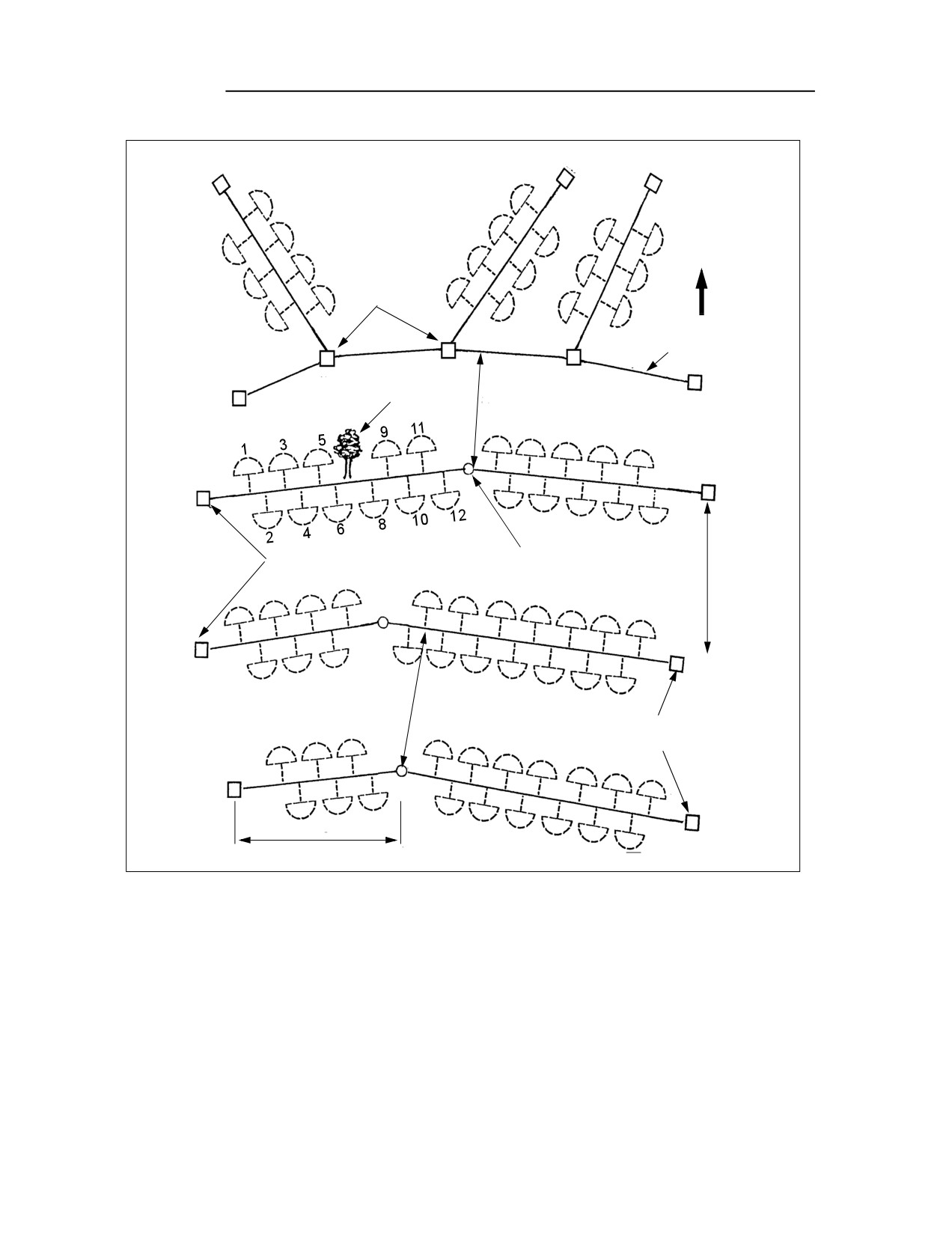
FM 20-32
ENEMY
Marking of IOE
strips
IOE baseline
i2
IOE1
i1
i3
Cluster omitted
15 m (min)
IOE2
A2
A1
Turning point
End points of
15 m (min)
mine strip
B2
B1
15 m (min)
End points of
mine strip
C1
C2
Strip segment
Figure 7-1. Minefield layout
Clusters are placed at 6-meter intervals, center to center, to form rows. Two
parallel rows, 6 meters apart, form a mine strip. The arrangement of clusters
in a mine strip is shown in Figure 7-3.
RULES FOR POSITIONING CLUSTERS WITHIN A STRIP
The first cluster is placed on the enemy side of the strip centerline, 6 meters
from the beginning-of-strip marker. The following clusters are numbered
consecutively. Odd-numbered clusters are always on the enemy side of the
7-2 Standard-Pattern Minefields
FM 20-32
Individual laying of AT mine (to
be at base of cluster)
Korea Only: Cluster with one
AT mine plus several AP mines
within or on a 2-meter semicir-
cle of the AT mine (the AT mine
must be the base mine)
Korea Only: Individual laying
of AP mine (to be at base of
cluster)
Korea Only: Cluster with sev-
eral AP mines within or on a 2-
meter semicircle of the center
AP mine (the most easily
detected mine is the base
mine)
Figure 7-2. Cluster compositions
ENEMY
2m
3m
3m
3m
3m
3m
Beginning-of-
Centerline
strip marker
6m
6m
6m
3m
Figure 7-3. Arrangement of clusters in a mine strip
strip centerline. The direction of laying follows the numbering (A1 to A2, B1 to
B2, and so on).
The IOE is normally the first part of the minefield encountered by the enemy.
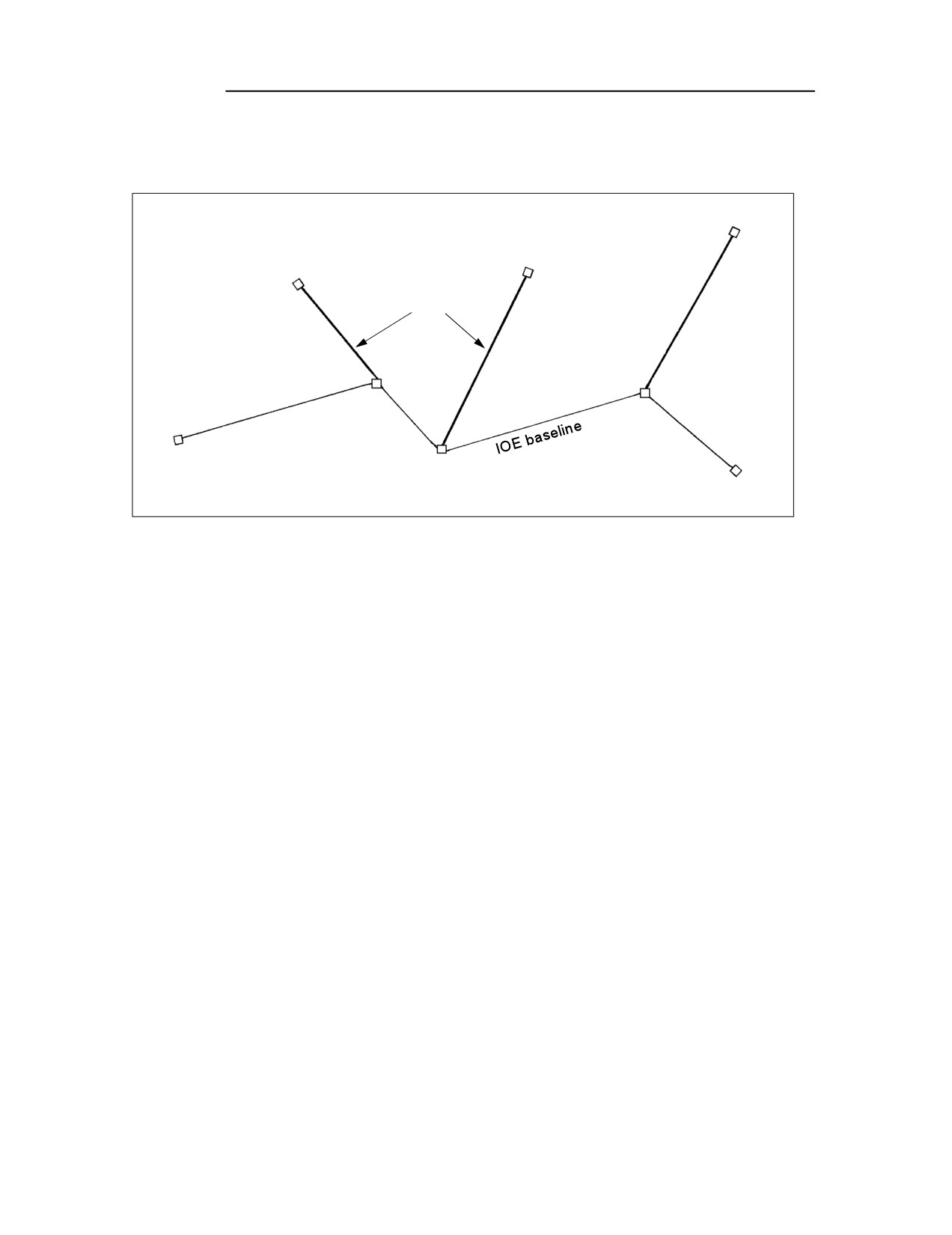
It consists of a baseline from which short strips are extended (Figure 7-4, page
7-4). Short strips along the IOE deceive the enemy on the minefield’s pattern,
spacing, and size. IOE placement and composition are largely dictated by the
Standard-Pattern Minefields 7-3
FM 20-32
time allowed for laying the minefield, terrain conditions at the laying site, and
the tactical situation.
I1E
I2E
I3E
IOE short strips
I3
I1
IOE2
IOE1
I2
Figure 7-4. IOE baseline with short strips
The IOE baseline extends from one end point (IOE1) to another end point
(IOE2). The laying direction is indicated by end-of-strip markers. Laying
always begins at IOE1. Intermediate or turning points are marked in
consecutive order beginning with I1. On the enemy side of the IOE baseline,
short strips are extended from turning points at irregular angles. They are
identified by turning-point markers.
Turning points should be no more than 45 degrees from the last azimuth. The
length of short strips is not standard. A marker is emplaced at the end of each
short strip. Markers are numbered in consecutive order beginning with I1E
for recording purposes. No trip wires are used in the IOE, but AHDs may be
employed.
Korea Only: AP mines actuated by trip wires are placed on the enemy
side of each regular strip. No more than one mine per cluster uses
trip wires, and no more than two trip wires extend from the mine.
Trip wires are angled toward the enemy and should be at least 2
meters from the cluster, the lane border, and the minefield boundary.
Trip wires are only used with AP fragmentation mines; they are not
considered to be AHDs.
STANDARD-PATTERN MINEFIELD RULES
The following rules apply to tactical and protective standard-pattern
minefields. They do not apply to nuisance minefields.
Clusters
• A cluster is a 2-meter-radius semicircle located 3 meters off the strip
centerline.
• There are two types of clusters—live and omitted.
7-4 Standard-Pattern Minefields
FM 20-32
— A live cluster contains one AT mine. (Korea Only: A live cluster
contains as many as five mines, only one can be an AT
mine).
— Omitted clusters do not contain mines, but they are numbered and
recorded on DA Form 1355 (see Chapter 8).
•
Clusters are omitted within lanes and gaps; in areas less than 2
meters from boundaries, lanes, or another cluster (including the IOE);
and in areas where the terrain (trees, rocks) prohibits emplacement.
•
The base mine in a live cluster is the first mine laid. It is 3 meters
from the strip centerline.
•
When a live cluster contains an AT mine, the mine is always used as
the base mine. (Korea Only: If an AT mine is not present, the
largest metallic AP mine is the base mine.)
•
The first cluster in a mine strip is located on the enemy side, 6 meters
from the beginning-of-strip marker.
•
The minimum distance between a cluster and a lane, a gap, a
boundary, or another cluster is 2 meters (measured from the edge of
the cluster).
•
Cluster composition is the number of mines, by type, in any cluster in
a specific group.
•
Cluster composition remains the same through the entire mine strip
and is recorded on DA Form 1355.
•
Korea Only: The types of AP mines may vary within a cluster.
•
The cluster boundary must at least 15 meters from the minefield
perimeter fence.
•
Clusters are numbered, beginning with the first cluster on the enemy
side. Odd-numbered clusters are always on the enemy side of the
strip, and even-numbered clusters are always on the friendly side.
Regular Strips
•
A regular strip (sometimes referred to as a lettered strip) consists of a
strip centerline and two rows of clusters (Row 1, enemy side; Row 2,
friendly side).
•
Regular strips are marked and recorded. They are designated by
letters (A, B, and so forth), with Strip A being closest to the enemy.
•
A standard-pattern minefield contains at least three regular strips.
•
The minimum distance between strip centerlines is 15 meters; there is
no maximum distance.
•
Safety tapes are used to ensure that personnel installing trip wires do
not move forward into armed clusters. A safety tape is used behind
each regular strip. Safety tapes are 8 meters from the strip centerline
(3 meters from the outer edge of the cluster).
Standard-Pattern Minefields 7-5
FM 20-32
•
The marking of end points indicates the direction of laying
(for
example, A1 to A2).
IOE
•
The IOE consists of a baseline from which short strips are extended.
•
The IOE is located on the enemy side of the minefield.
•
The number of clusters in an IOE is approximately one-third the
number used in a regular strip.
•
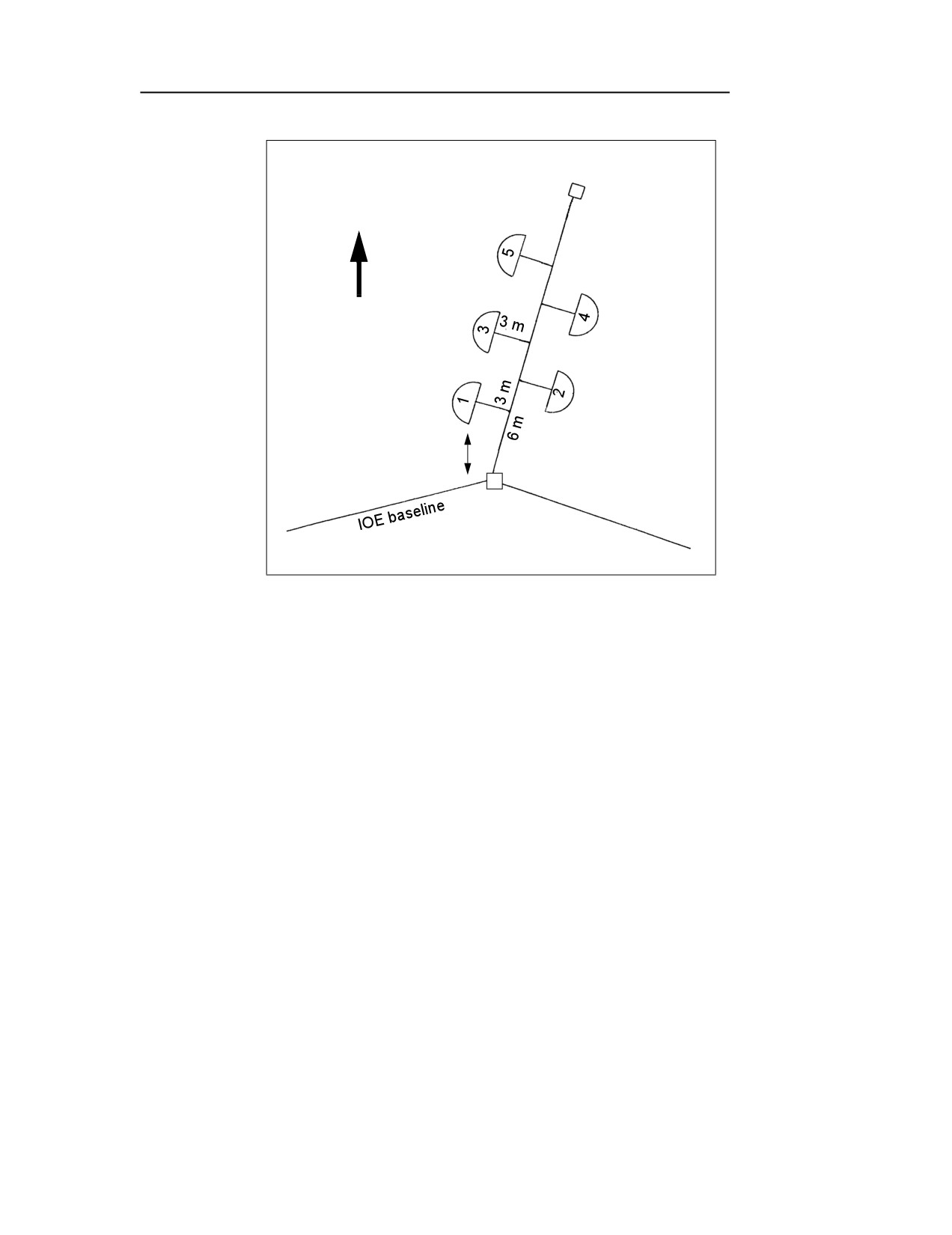
The first cluster along a short strip is placed on the enemy side and
must be at least 6 meters from the IOE baseline; the cluster boundary
must be at least 2 meters from the IOE baseline (Figure 7-5). If the
short strip is exactly parallel to the enemy direction of travel, the
NCOIC designates the enemy side of the strip.
•
The IOE baseline is labeled at the beginning (IOE1) and end (IOE2)
according to the direction mines are emplaced.
•
Short strips are labeled at turning points (I1) and at the end (I1E).
•
The IOE contains a safety tape that is 2 meters behind the IOE
baseline and runs parallel with it.
•
The IOE baseline is at least 15 meters from any point of the strip
centerline of a regular strip; there is no maximum distance.
•
An IOE short strip is at least 15 meters from another IOE short strip;
there is no maximum distance.
•
AHDs may be employed.
IOE Short Strips
•
Short strips originate from turning points along the IOE baseline.
•
The number and length of short strips depend on the tactical situation
and the resources available.
Trip Wires (Korea Only)
• Trip wires are not used in an IOE.
• Trip wires may be used in regular strips, but only one mine
per cluster may be actuated by a trip wire.
• Trip wires are employed no closer than every third cluster.
• No more than two trip wires can be used on one mine.
• Trip wires are used only on the enemy side of the strip.
• Trip wires are not considered AHDs.
• Trip wires are located at least 2 meters from a lane, a safety
tape, a cluster, another trip wire, the IOE baseline, and the
minefield perimeter fence.
• Trip wires can only be used with AP fragmentation mines.
Turning Points
• Clusters must be at least 3 meters from turning points.
7-6 Standard-Pattern Minefields
FM 20-32
I1E
ENEMY
Short strip
2 m (min)
I1
Figure 7-5. Clusters on an IOE short strip
•
The first cluster after a turning point is laid on the opposite side of the
strip centerline from the last cluster before the turning point.
•
The angle of any given turning point cannot exceed 45 degrees from
the last azimuth. (This ensures a minimum distance of 2 meters
between cluster boundaries in the same row.)
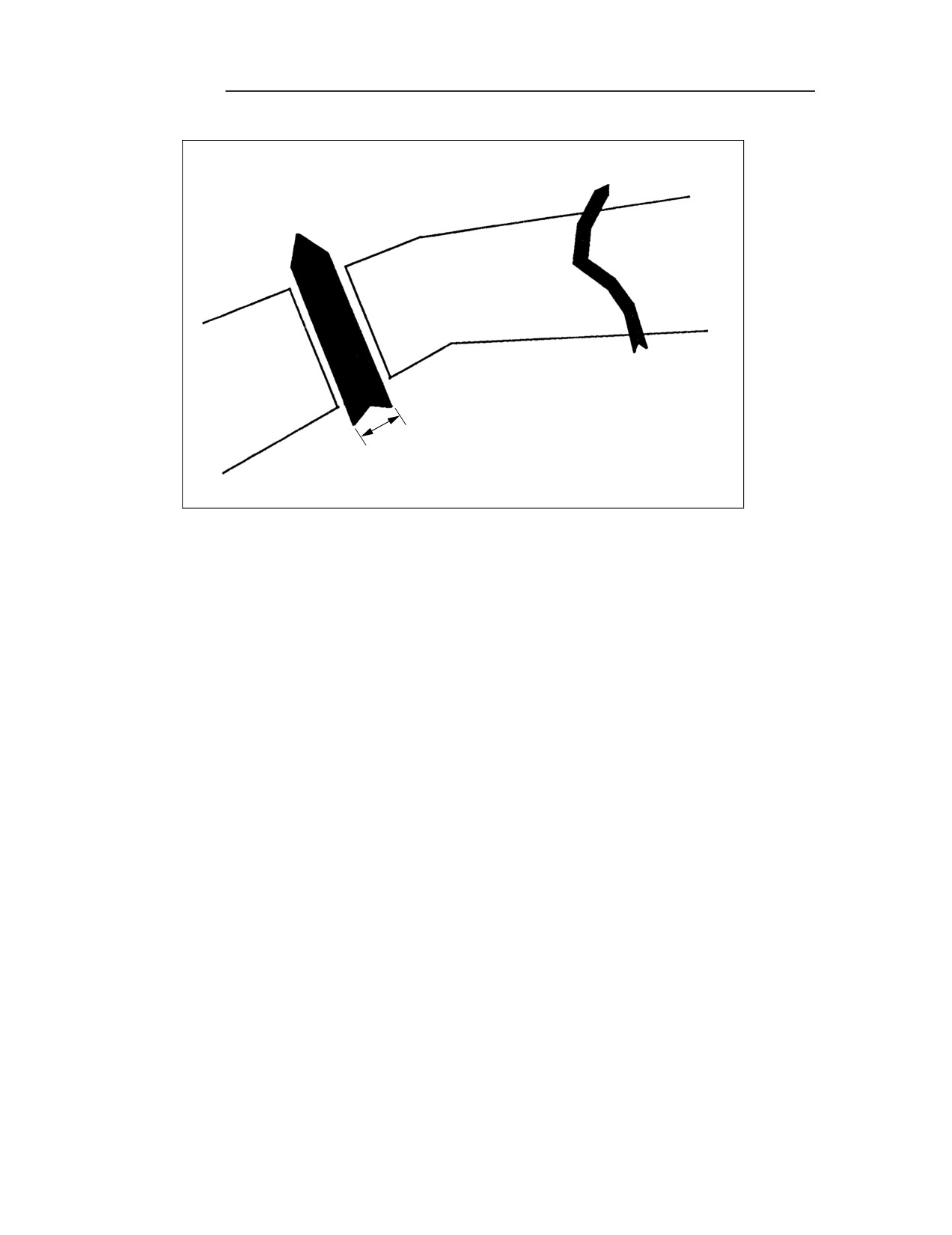
Lanes
•
Minefield lanes (Figure 7-6, page 7-8) are used by dismounted patrols
and vehicles.
•
Lanes are sited before laying begins.
•
Lane locations should not be obvious.
•
Clusters are not laid within 2 meters of lane edges.
•
Lanes are zigzagged, not straight.
•
Lanes cross the strip centerline at approximately right angles.
•
Direction changes will not exceed 45 degrees. (This ensures that long
vehicles will be able to negotiate turns.)
•
The number of lanes must be sufficient to ensure that no one lane is
overused and turned into an obvious track.
•
Sufficient mines are stockpiled so that the responsible unit can close
lanes suspected of being located by the enemy.
•
Recommended minefield lane widths are—
— Footpath: 1 meter.
Standard-Pattern Minefields 7-7
FM 20-32
Lane
Perimeter fence
Gap
100 m
(min)
Figure 7-6. Minefield lanes and gaps
— One-way vehicle lane: 8 meters.
— Two-way vehicle lane: 16 meters.
Gaps
•
Minefield gaps (Figure 7-6) are left so that friendly forces can pass
through the minefield in tactical formation.
•
Gaps must be at least 100 meters wide.
•
Gaps are sited before laying begins.
•
Gaps are located along recognizable features (fences, tracks, creeks).
•
Gaps should run straight through a minefield and not contain bends.
•
Sufficient mines must be stockpiled so that the responsible unit can
close gaps when necessary.
•
Gaps should closely resemble the rest of the minefield so that they will
not be discovered by the enemy.
•
The ground within a gap should be disturbed with tracks to represent
the passage of a mine-carrying vehicle.
•
Signs of mine laying (digging, scattered spoil, crates) should be visible
in a gap.
General
•
The farthest extremities of a regular strip determine the minefield
front.
•
Minefield depth is measured from the first to the last strip and
includes the IOE (if applicable).
•
Strips can be laid left to right or right to left.
•
Back azimuths are not used to record the minefield.
7-8 Standard-Pattern Minefields
FM 20-32
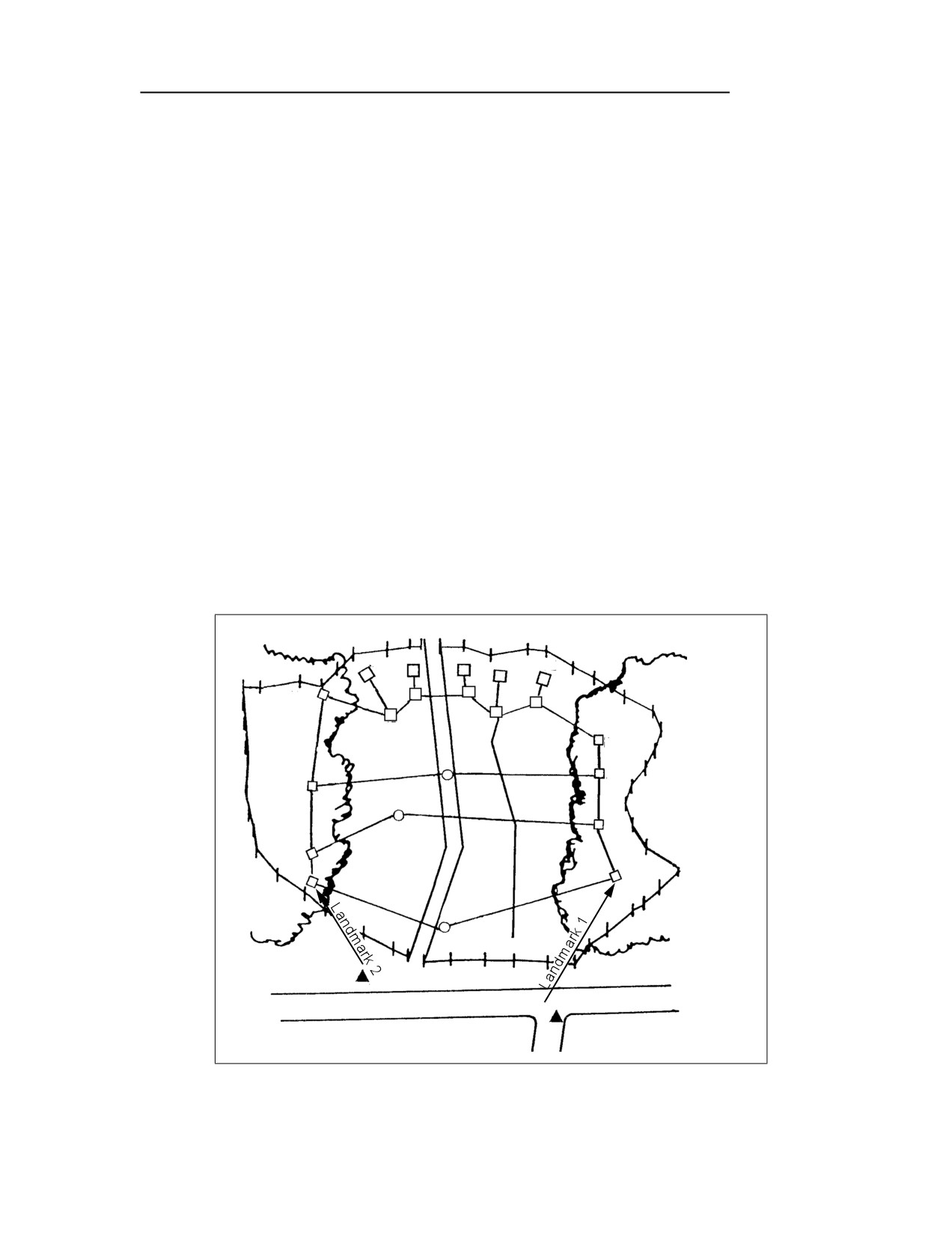
• The minefield will have two landmarks located to the rear, never to
the extreme side or front.
• GPSs can be used to determine the coordinates for minefield
landmarks and reference points.
WARNING
Do not use GPSs to chart or record minefield perimeter coordinates
or to determine safe routes through or around existing minefields.
• If landmarks are more than 200 meters away from the last regular
strip or are out of the direct line of sight, intermediate markers are
placed at least 75 meters from the last end-of-strip marker.
• Landmarks can be used for more than one minefield. They are
recorded on DA Form 1355.
LOGISTICAL CALCULATIONS
Emplacing standard-pattern minefields allows the unit to calculate the
number of mines required for a minefield accurately.
To simplify the calculation process, a minefield requirements computation
work sheet (Figure 6-1, pages 6-5 through 6-8) has been developed. Step-by-
step procedures for completing the work sheet are shown in Figure 6-2, pages
6-9 through 6-14.
CLUSTER CALCULATION
Accuracy is essential when emplacing a standard-pattern minefield. The
following check system has been designed so that the minefield OIC can
accurately record the number of mines laid. Compare the strip feeder report
with the—
• Number of pins and clips returned by the laying party.
• Mine tally sheet.
• Cluster computation.
EXAMPLE: You receive a strip feeder report for Strip A. There are 26
clusters in the strip. The strip has three segments (30, 42, and 21 meters) and
two turning points.
Step 1. Add the total length of the strip as determined by the recording party.
30 + 42 + 21 = 93 meters
Step 2. The first and last cluster in the strip are located 6 meters in from the
end-of-strip markers. Subtract 12 from Step 1.
93 - 12 = 81 meters
Step 3. Clusters are not located on turning points. Multiply the number of
turning points by 3 and subtract it from Step 2.
81 - (3 × 2) = 75 meters
Step 4. Divide Step 3 by the cluster spacing.
75 ÷ 3 = 25 clusters
Step 5. Add one cluster, because when a line is divided, there is one more
interval than spacing.
25 + 1 = 26 clusters
Standard-Pattern Minefields 7-9

FM 20-32
From these computations, the minefield OIC is able to cross-check the
information on the strip feeder report. In this example, Strip A should have a
total of 26 clusters, less any omitted clusters.
PLATOON ORGANIZATION
The platoon is the basic unit used to install a standard-pattern minefield.
Orders to the laying unit OIC specify the proposed location, the length, and
the mine type and density. The platoon organization and equipment are
shown in Table 7-1.
Table 7-1. Platoon organization and equipment
Personnel
Officer
NCO
EM
Equipment
Officer: Map, lensatic compass,
notebook, and minefield record
Supervisory
1
1
0
forms
NCO: Map, lensatic compass, and
notebook
Stakes or pickets,
Siting party
0
1
3
sledgehammers, engineer tape on
reels, and nails to peg tape
Rolls of barbwire or concertina,
marking signs, lane signs, wire
Marking party
0
1
2
cutters, gloves, sledgehammers,
pickets, and picket pounder
Sketching equipment, lensatic
Recording
0
1
2
compass, minefield record forms,
party
map, and metric tape
First laying
Notebook for squad leader, picks,
0
1
6-8
party
shovels, and sandbags
Second laying
0
1
6-8
Same as first laying party
party
Third laying
0
1
6-8
Same as first laying party
party
Totals
1
7
25-31
The OIC performs a map study, and if the situation permits, conducts a
ground reconnaissance of the site. He determines locations for mine strips,
landmarks, fences, mine dumps, and approaches. Using the minefield
requirements computation work sheet (Figure 6-1, pages 6-5 through 6-8), the
OIC determines the required number of mines and other materials. He
arranges for mines to be delivered and organizes the platoon into siting,
laying, recording, marking, and mine-dump parties.
Siting Party
The siting party places boundary stakes or pickets as strip markers at the
beginning and end of each mine strip and at the points where strips change
direction. It lays tape on the centerlines of each strip, lane, and traffic path.
After siting is complete, the siting party augments other parties.
7-10 Standard-Pattern Minefields
FM 20-32
Laying Parties
One laying party is responsible for installing, arming, and camouflaging all
the mines on a strip or a portion of a strip. Each laying party is then assigned
additional strips.
Recording Party
The recording party obtains the necessary reference data, prepares DA Form
1355
(see Chapter 8), and when needed, installs intermediate markers.
Marking Party
The marking party erects fences and signs to mark minefield boundaries and
lanes. After marking is complete, the marking party augments other parties.
Mine-Dump Party
The mine-dump party, controlled by the PSG, is composed of personnel who
are not working as members of other teams. It accounts for all Class IV and V
supplies that arrive from other sources, organizes mine sets at the mine
dump, and hauls additional supplies as required. The PSG is not required to
stay at the mine dump continuously; he has the flexibility to move around the
area to perform other activities.
MINE-EMPLACEMENT PROCEDURES
Mine-emplacement procedures are shown in Figure 7-7. In the illustration,
the minefield is laid from right to left.
I5E
I4E
I3E
I2E I1E
IOE2
I3
I4
I1
I5
I2
IOE1
A1
A2
B1
First fence
picket
B2
C2
C1
Figure 7-7. Mine-emplacement procedures
Standard-Pattern Minefields 7-11
FM
20-32
The OIC arrives at the site with the siting and marking parties. He goes to the
right or left (depending on the laying direction) rear boundary of the
minefield. This part of the minefield is the farthest from the enemy. The OIC
indicates the starting point of the rear strip (this is Strip C in a three-strip
minefield), and the siting party emplaces a beginning-of-strip marker.
The OIC designates a starting point for the marking party that is at least 15
meters to the right of the boundary stake. He indicates where the minefield
marking fence should be placed. The marking party immediately begins to
install fence pickets, working in a counterclockwise direction.
When all the pickets are installed, the marking party encircles the field with a
single strand of barbwire (at waist height) and emplaces mine signs.
Personnel emplace a second strand of barbwire if required.
From the boundary stake of Strip C, the OIC moves in the direction of the
enemy and establishes the starting point of Strip B. Strip centerlines should
not be parallel nor less than 15 meters apart. Two members of the siting party
emplace a beginning-of-strip marker at the starting point of Strip B. The
remaining two members lay tape between the two strips and fasten the tape to
the ground at frequent intervals to prevent movement. This procedure is
followed until the beginning-of-strip markers of the three regular strips (C, B,
and A) and the IOE on the right-hand side of the minefield have been
installed.
At the IOE beginning-of-strip marker (IOE1), the OIC gives the siting party a
sketch of the minefield and instructions on siting the IOE baseline and strip
centerlines. The NCOIC and one other member of the siting party
immediately begin setting stakes to indicate the IOE baseline. The centerline
laying team lays tape on the IOE baseline, leaving tape reels where tapes run
out. Short strips extending from the IOE baseline are established at the same
time. Each short strip starts with a marker that is designated as I1, I2, and so
forth and ends with a marker that is designated as I1E, I2E, and so forth.
Turning points are not used on short strips.
Upon reaching the IOE end-of-strip marker (IOE2), the NCO moves away
from the enemy side, establishes the left boundary stake of Strip A, stakes out
Strip A, and repeats the procedure until all strip centerlines are taped. All
stakes are driven flush with the ground.
While the IOE is being taped, the recording party obtains reference data for
the DA Form 1355. Working behind the siting party, the recording party
starts from Landmark 1 (designated by the OIC) and proceeds to C1. After C2
has been sited, the recording party proceeds from Landmark 2 to C2 to
establish the distance and the azimuth. Finally, the recording party ties C1
and C2 to both landmarks in case one of the landmarks is removed or
destroyed. The amount of detail obtained by the recording party depends on
the tactical classification of the minefield and any special orders. Aerial
photographs taken of the minefield before the tracing tape is removed become
valuable supplements to the DA Form 1355.
As soon as laying parties arrive at the site with mines, they establish mine
dumps a minimum of 150 meters apart and 50 meters behind the field. They
uncrate and stack AT mines and place fuses and detonators in separate boxes.
7-12 Standard-Pattern Minefields
FM 20-32
Fuse types are not mixed. (Korea Only: AP mines are left in their crates,
and the crate lids are removed.)
When the siting party completes the centerline staking, it installs lane tapes
and traffic tapes, respectively. Lane tapes are used by tactical vehicles and
patrols. Traffic tapes are used by laying personnel to assist in camouflage and
to reduce the amount of traffic on strip centerlines. Traffic tapes are laid
perpendicular to the minefield trace at 100-meter intervals.
MINE EMPLACEMENT
The laying party must know the cluster composition of the strip, the location
of any omitted cluster, and future lane locations. When the centerline tape for
a regular strip has been installed, the NCOIC designates all but two members
of the laying party to emplace mines in the ground. The remaining two
soldiers, usually the most experienced, are designated as fusers and are
responsible for arming mines. Layers carry the maximum load of mines to be
used as base mines in the clusters. Fusers carry the fuses and the detonators.
The NCOIC moves to the right or left (depending on the laying direction)
beginning-of-strip marker of the strip and organizes the layers into one
column to his rear, directly on the centerline. He measures 6 meters along the
centerline for the first cluster and, pointing perpendicular from the centerline
and in the direction of the enemy, indicates the placement of the base mine.
The first layer on the enemy side places a mine on the ground, 3 meters from
the centerline.
The NCO measures 3 more meters and indicates the placement of the second
base mine on the opposite (friendly) side of the strip. The first layer on that
side places a base mine on the ground. As the initial load of mines is laid, each
layer returns to the nearest mine dump for another load. Fusers follow behind
layers and insert mine fuses, but they do not arm the mines. This procedure is
followed until the end-of-strip marker on the far side of the minefield is
reached.
Korea Only: The NCO tells layers the number and type of mines to be
placed next to the base mine in each cluster. As AP mines are being
placed, the NCO proceeds along the strip and ensures that the proper
number of AP mines is placed in each cluster. The NCO places a spool
of trip wire next to the mines that are to be activated by trip wire.
When all the mines are positioned in clusters, one layer is assigned to dig the
holes for all the mines in a cluster. He places the spoil from the holes in
sandbags and leaves the sandbags beside the base mine in each cluster. The
layer checks the positioning of the mines in the holes, removes the mines from
the holes, and places the mines beside the holes. (Korea Only: The layers
anchor trip wires with nails or stakes and wrap the loose ends of trip
wires around the fuses.)
When digging has progressed at least 25 meters from the first mine laid, the
arming procedure begins. Fusers arm all the mines in a cluster, beginning
with the mine farthest from the centerline and work backward. They place all
the mines in the holes (Korea Only: attach trip wires) and arm and
camouflage the mines. They place filled sandbags on the centerline of the
Standard-Pattern Minefields 7-13
C2, FM 20-32
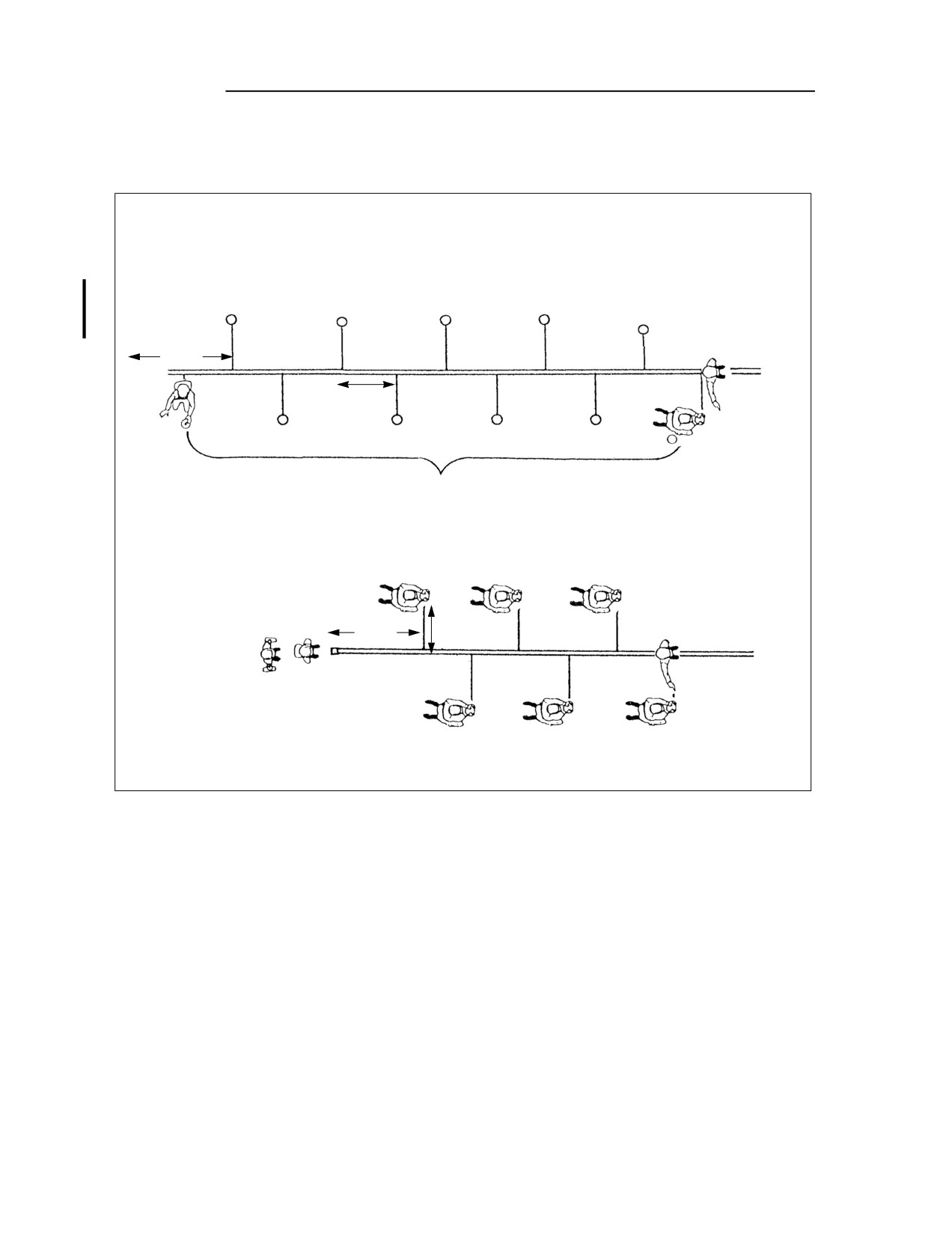
strip, opposite the base mine. Fusers keep their back toward the centerline.
Other personnel must remain at least 25 meters from the fusers (Figure 7-8).
Enemy
Boundary
stake
NCOIC
6m
Tape
3m
Fuser
Layer
25 m (minimum)
Enemy
Layer
Layer
3m
NCOIC
6m
Tape
Boundary
Fuser
stake
Layer
Layer
Layer
Figure 7-8. Laying and fusing mines
Mines located in lanes are not initially buried. They are placed aside to
prevent confusion when counting clusters. The mines can be buried after the
lane is closed. Upon completing the arming operation, fusers give the safety
clips to the NCO, who verifies that all the mines have been armed and
camouflaged. The NCO checks the strip and ensures that sandbags, tape, and
debris have been picked up. The NCO gives the safety clips to the PSG, who
buries them 30 centimeters to the rear of the beginning-of-strip marker.
All mines and other explosive items are recorded upon issue. They are
summarized on a mines tally sheet (see Table 7-2). If more than one mine
7-14 Standard-Pattern Minefields

FM 20-32
dump is established, a mines tally sheet is kept at each dump and the
information is later transferred to a master tally sheet.
Table 7-2. Sample mines tally sheet
Strip/Laying
Movement of
M15
M16
Trip Wire
AHD Type
Party
Mines
No forecasted
23
46
—
—
IOE strip/
No issued
23
46
—
—
Party 1
No returned
—
—
—
—
No used
23
46
—
—
No forecasted
81
154
35
—
Strip A/
No issued
81
154
35
—
Party 2
No returned
7
6
9
—
No used
74
148
26
—
No forecasted
Strips B, C, D,
No issued
and so forth
No returned
No used
No forecasted
No issued
Total
No returned
No used
Date _______ Rank _____ Name ______________________ Signature __________________________
The PSG ensures that the number of mines used per tally sheet is entered on
the DA Form 1355.
When a lane is no longer required through a minefield, it is closed by a lane-
closure team that consists of one NCO and two other soldiers. Before closure
starts, the NCO checks the minefield record to ascertain the—
• Width of the lane.
• Cluster composition of each strip.
• Total number of mines required.
• Number of strips that intersect the lane.
• Azimuth of each strip.
• Distance between strips, along the lane centerline.
• Location of the mine dump.
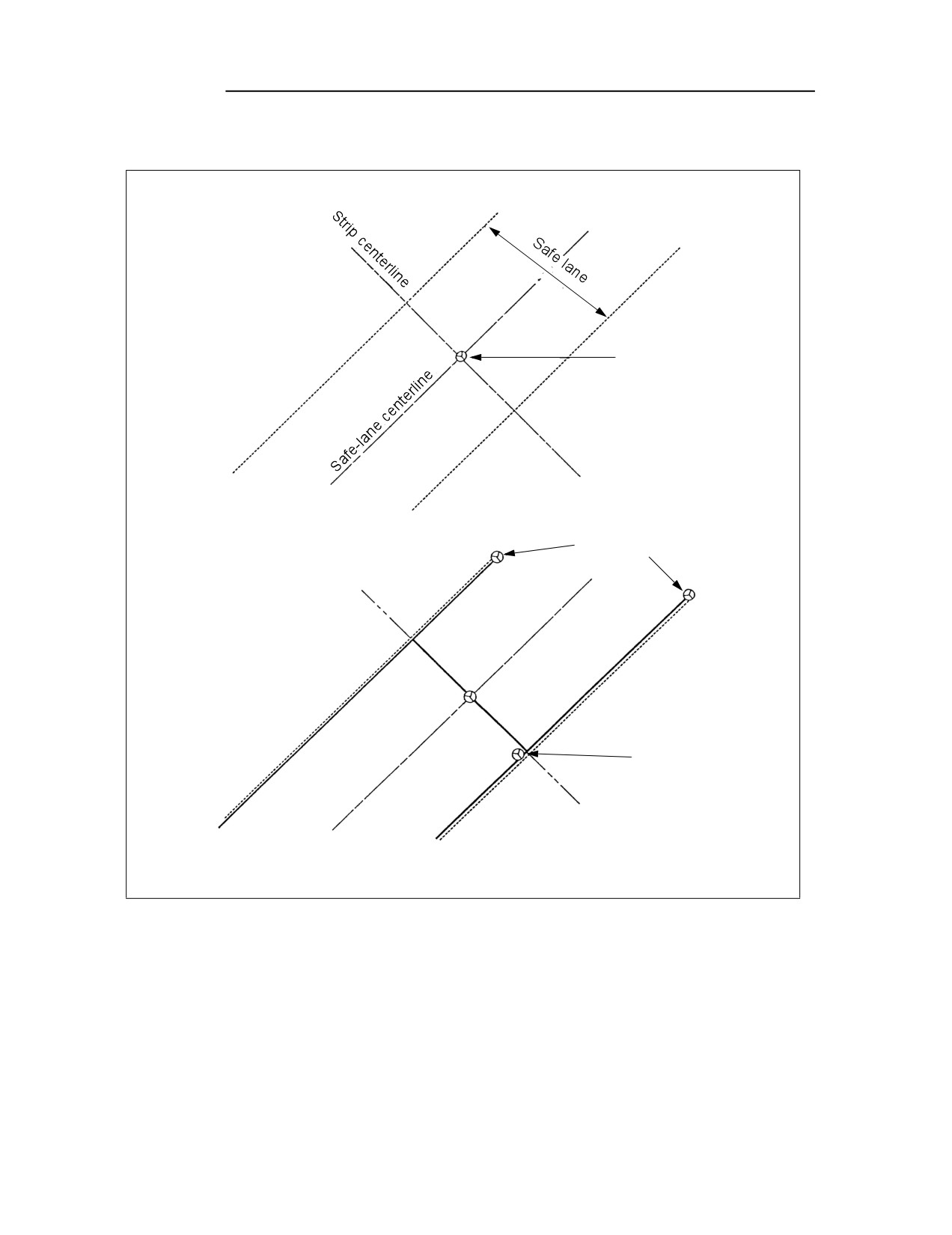
The procedures for lane closure is as follows (see Figure 7-9, page 7-16):
• The lane-closure team moves along the safe-lane centerline until it
arrives at the strip safe-lane marking picket.
• The NCO lays out a strip centerline tape and a tape along both sides of
the safe lane to mark its boundaries.
• The team lays clusters.
• The team recovers the tapes.
Standard-Pattern Minefields 7-15
FM 20-32
• The above steps are repeated at successive strips.
• The NCO amends the DA Form 1355.
Strip/safe-lane
marking picket
Engineer tape
(safe lane)
Engineer tape
(strip centerline)
Figure 7-9. Lane closure
NOTE: When gaps must be closed, fences are temporarily erected
along the side boundaries. They are removed later to avoid the
indication of a passage through the minefield.
NCOICs do not act as working members of their parties; they ensure that—
• No one moves back into a mined area.
• Any irregularity, such as an omitted cluster, is recorded.
7-16 Standard-Pattern Minefields
FM 20-32
• All safety devices are recovered and checked against the minefield
record.
Safety tapes are used to create a network of safe routes through a minefield.
They may be removed progressively but are normally left in place until the
minefield is complete.
Korea Only: When trip wires are used, safety tapes are laid between
strips where the trip wire will be positioned (including Strip A and
the IOE baseline). If trip wires are not used, safety tapes are
recommended but are not mandatory.
NUISANCE MINEFIELDS
SITING
Consider the following factors when siting a nuisance minefield:
• The effort needed by the enemy to bypass a mined area.
• The importance of an area or a route to the enemy.
• Achievement of the goal (use the minimum amount of effort needed to
maximize casualties and the effect on enemy morale).
Remember, the more ingenuous the methods of concealment, the longer it will
take to lay mines.
Observation and covering fires are not essential and are seldom feasible for
nuisance minefields. Their value depends on effective siting and concealment
to cause surprise.
The minefield OIC is responsible for detailed siting and the design of a
nuisance minefield. He must consider the minefield from the enemy's point of
view and assess the courses open to the enemy when he encounters it. Such
considerations may expose weaknesses in the initial plan and bring about a
change to the proposed minefield layout or may lead to a decision to site the
minefield elsewhere.
LOCATION
In wooded or hilly terrain, the enemy's logistics transport will normally be
confined to existing routes. Nuisance mines at selected sites along roads can
impose considerable delay on the enemy and have a cumulative effect on his
resources and morale. The best sites for axial mining are—
• Natural defiles and constructed areas that are difficult to bypass
(cuts, embankments, causeways, fords, forest tracks, built-up areas).
• In the vicinity of road craters, AT ditches, and any obstacles that have
to be cleared.
• Around culverts.
• Demolished bridges, particularly the home bank, including likely
adjacent crossing places and alternative building sites.
• Likely assembly areas.
• Covered approaches or dead space.
Standard-Pattern Minefields 7-17
FM 20-32
• In the vicinity of enemy-needed fuel, supplies, and engineering
materials that cannot be destroyed or removed.
• Railroads (in or near culverts, bridges, sharp turns, tunnels, steep
grades). Mines should be laid where enemy trains cannot bypass the
mined area on branches or spurs.
LAYING
There is no requirement for recording the precise location of individual
nuisance mines. Recording mine positions that are laid to a pattern is easy
and quick. Pattern laying should be used when it can be done without
prejudicing concealment.
When the number of mines to be laid on the site makes it impracticable or
undesirable to lay mines in a pattern, they may be scatter-laid unless
otherwise directed. Scatter-laying by hand is useful in road blocks, bridge
abutments, and craters when it would be difficult and wasteful to lay mines in
a pattern. Again, scatter-laying along routes to be denied to the enemy will
add considerably to the delay imposed. All available types of AT mines
(Korea Only: and AP mines) are used to make nuisance minefields complex
and difficult to remove. Combinations of mine types should be varied
constantly so that each minefield presents a clearance problem. Deeply buried
mines can be included; however, they take much longer to lay. These mines
may be worthwhile around craters, where the enemy is likely to need
earthmoving equipment.
If a nuisance minefield is laid in a standard pattern, standard procedures are
followed. If mines are selectively positioned, procedures must be tailored to
suit the situation. In all occasions, however, the following rules should be
observed:
• The intended position for each mine is clearly marked on the ground
before laying begins.
• Laying parties work in pairs, and each pair is detailed to lay specific
mines.
INSPECTION AND MAINTENANCE
Mines that are left in the ground for an extended period of time may
deteriorate and malfunction for one or more of the following reasons:
• Moisture may have entered the igniter or body of the mine and either
neutralized the explosive or corroded the metal parts. Such actions
may be aggravated by local factors (soil acidity, wide temperature
swings).
• Frost or heat may have subjected the mine to mechanical strain and
caused distortion.
• Insects or vegetation may have caused obstructions.
• Animals may have turned mines over or detonated them.
Technical inspections should only be made by experienced engineers or EOD
personnel. When a minefield deteriorates below the operating level, additional
mine strips and/or rows must be added to restore its effectiveness. They are
7-18 Standard-Pattern Minefields
FM 20-32
sited to the front or rear of the existing minefield to increase its depth. New
mine strips and/or rows are treated as a separate, additional minefield.
Technical inspections of minefields are normally done at three-month
intervals, and personnel work in pairs. They are done more frequently during
extreme weather conditions.
HANDOVER
Minefield handover is an extremely important task. The following items need
to be addressed between emplacing and overwatching units:
• Discussing minefield compositions.
• Discussing the minefield configuration and walking and/or riding the
minefield trace.
• Discussing lane closure, if applicable.
• Training the unit on how to the close lane, if applicable.
• Discussing obstacle protection against enemy dismounted patrols.
• Signing over the written report (Figure 2-26, page 2-54).
• Discussing indirect fires.
• Reporting completion of handover to higher headquarters.
• Forwarding a copy of the written report and the DA Form 1355 to
higher headquarters.
Standard-Pattern Minefields 7-19
FM 20-32
7-20 Standard-Pattern Minefields
This chapter implements STANAG 2036.
Chapter 8
Reporting and Recording
Reporting and recording mine and minefield/munition field information is
critical to the success of a unit’s mission. It not only provides tactical data
for the commander, but it also provides force-protection information to
subordinate and adjacent units.
MINEFIELD/MUNITION FIELD REPORTS
A minefield/munition field report is an oral, electronic, or written
communication that concerns friendly or enemy mining activities. The report
format is specified by the local command. It is submitted by the emplacing
unit commander through operational channels to the G3/S3 of the authorized
headquarters. The headquarters integrates the report with terrain
intelligence and disseminates it along with tactical intelligence. The report is
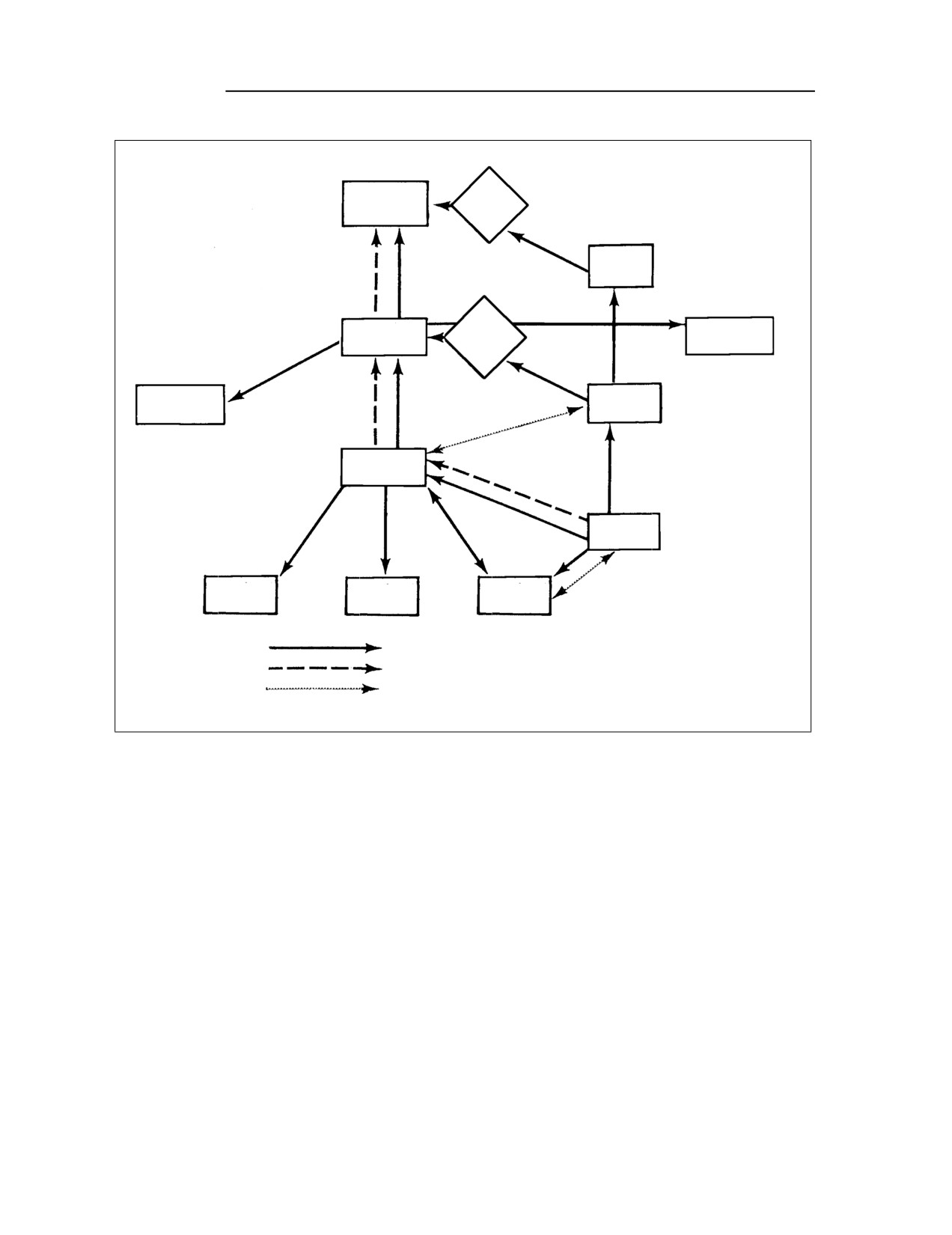
sent by the fastest, most secure means available. Figure 8-1, page 8-2,
summarizes the minefield/munition field report flow at the division level and
below.
REPORT OF INTENTION
When planning to emplace a minefield/munition field, the unit must submit a
report of intention to notify their higher headquarters. The report doubles as a
request when it is initiated at levels below emplacement authority. The report
includes—
• Tactical purpose of the minefield/munition field.
• Estimated number and type of mines to be emplaced.
• Location.
• Proposed start and completion times.
• Type of minefield/munition field.
• Whether mines are surface-laid or buried.
• Whether AHDs are used.
• Location and width of lanes and gaps.
Conventional minefields/munition fields that are part of an OPLAN or a
general defense plan (GDP) approved by the authorizing commander do not
require a report of intention because inclusion in an OPLAN or a GDP implies
an intention to lay.
REPORT OF INITIATION
A report of initiation is mandatory. It informs higher headquarters that
emplacement has begun and that the area is no longer safe for friendly
movement and maneuver. The report specifies the time emplacement began
Reporting and Recording 8-1
FM 20-32
Division
ADE
G3
Engineer
battalion
Brigade
Brigade
Adjacent
S3
engineer
brigade
Adjacent
Engineer
TF
company
TF
S3
Engineer
platoon
Maneuver
Maneuver
Maneuver
company
company
company
Report
Record
Critical coordination
Figure 8-1. Conventional minefield/munition field reporting chain
and identifies the location and the target number of minefields/munition
fields.
REPORT OF COMPLETION
A report of completion is usually an oral report to the authorizing commander.
It indicates that the minefield/munition field is complete and functional. A
report of completion is immediately followed by a completed DA Form 1355 or
1355-1-R.
REPORT OF TRANSFER
Minefield/munition field responsibility is transferred from one commander to
another in a report of transfer (Figure 2-26, page 2-54). This report is signed
by the transferring and receiving commanders. It includes a certificate stating
that the receiving commander was shown or otherwise informed of all the
mines within the transferring commander’s zone of responsibility. The report
states that the receiving commander assumes responsibility for those mines.
8-2 Reporting and Recording
FM 20-32
The report of transfer is sent to the next higher commander who has authority
over the transferring and receiving commanders.
REPORT OF CHANGE
A report of change is made immediately upon any change or alteration to a
previously reported minefield/munition field. It is sent to the next higher
commander and through channels to the headquarters that keeps the written
minefield/munition field record. A report of change is made by the commander
responsible for surveillance and maintenance of the minefield/munition field.
PROGRESS REPORTS
During the emplacing process, the commander may require periodic reports
on the amount of work completed.
MINEFIELD/MUNITION FIELD RECORDS
Most conventional minefields/munition fields are recorded on DA Form 1355;
hasty protective row minefields/munition fields are recorded on DA Form
1355-1-R.
The laying unit prepares the minefield/munition field record. The OIC signs
the form and forwards it to the next higher command as soon as possible.
Once the information is entered on the form, the form is classified SECRET,
NATO SECRET, or SECRET-ROKUS. (When used for training, the record is
marked SAMPLE.) The number of copies prepared depends on the type of
minefield/munition field emplaced and the local procedures. Unit SOPs should
provide advanced guidance on how minefield/munition field information is to
be passed to higher, lower, and adjacent commands. Minefield/munition field
records are circulated on a need-to-know basis. Large minefields/munition
fields are recorded on two or more DA Forms 1355.
Once the minefield/munition field is removed, the date of removal, the time
removal was complete, and the name of the unit that removed the minefield/
munition field will be placed in the remarks block of the form. The form will
then be forwarded to the unit’s central control cell for mine clearance
information. The central control cell will retain the form for two years and
then destroy it.
When changes are made to an existing minefield/munition field, a new record
must be prepared. This record is marked REVISED. It shows the minefield/
munition field as it is after changes. The original minefield/munition field
number remains unchanged. Some changes which require a new record are—
• Relocation of mines in safe lanes.
• Relocation of safe lanes.
• Changed lane or minefield/munition field marking.
• Inclusion of the minefield/munition field into a larger minefield/
munition field system.
• Removal or detonation of mines.
• Addition of mines to the minefield/munition field.
Conventional minefield/munition field records are forwarded through
operational channels to theater army headquarters (TAHQ) where they will
be maintained on file by the theater engineer. If a TAHQ has not been
established, minefield/munition field records are maintained on file with the
assistant corps engineer of the AO where the minefield/munition field is
located.
Reporting and Recording 8-3
FM 20-32
MINEFIELD RECORD
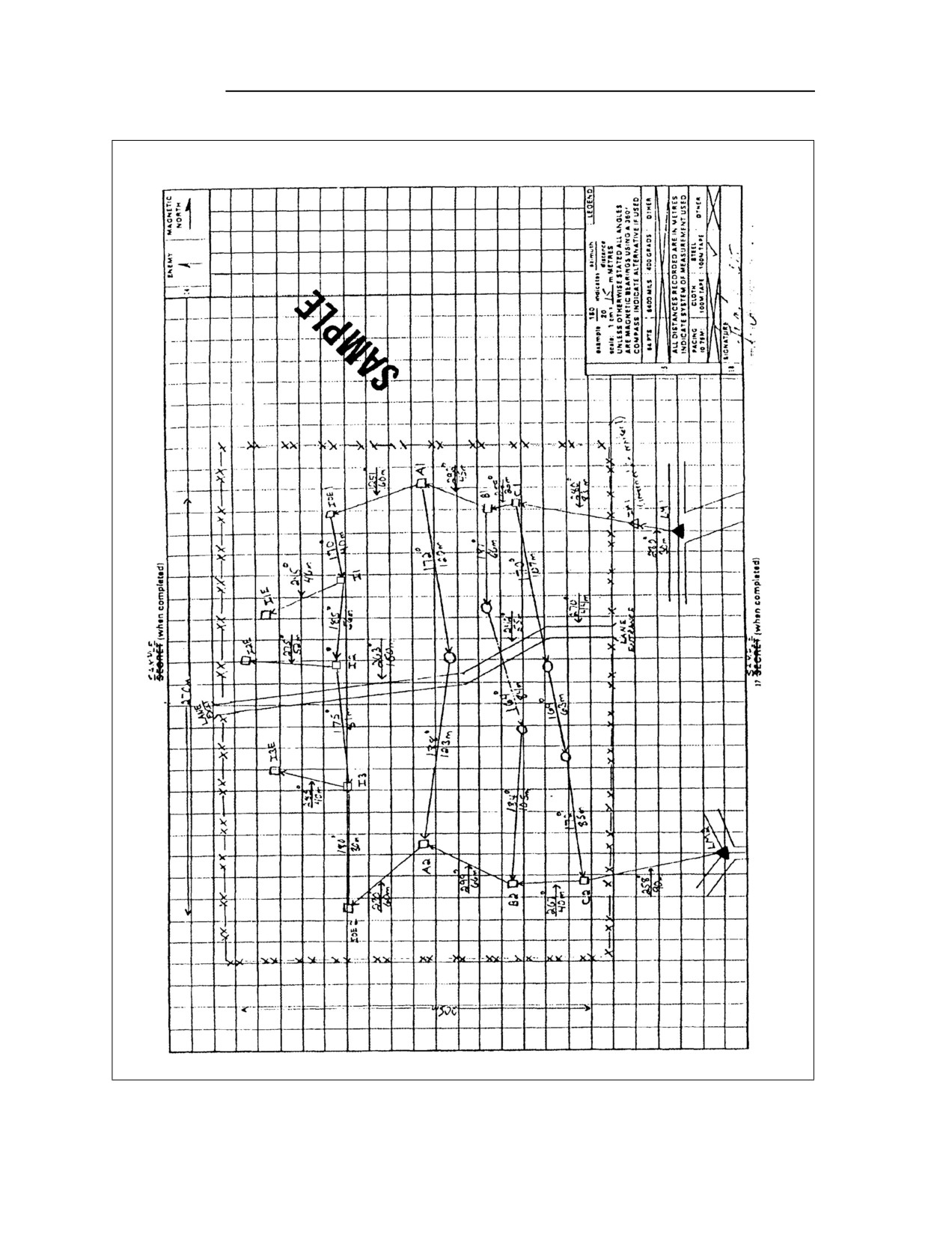
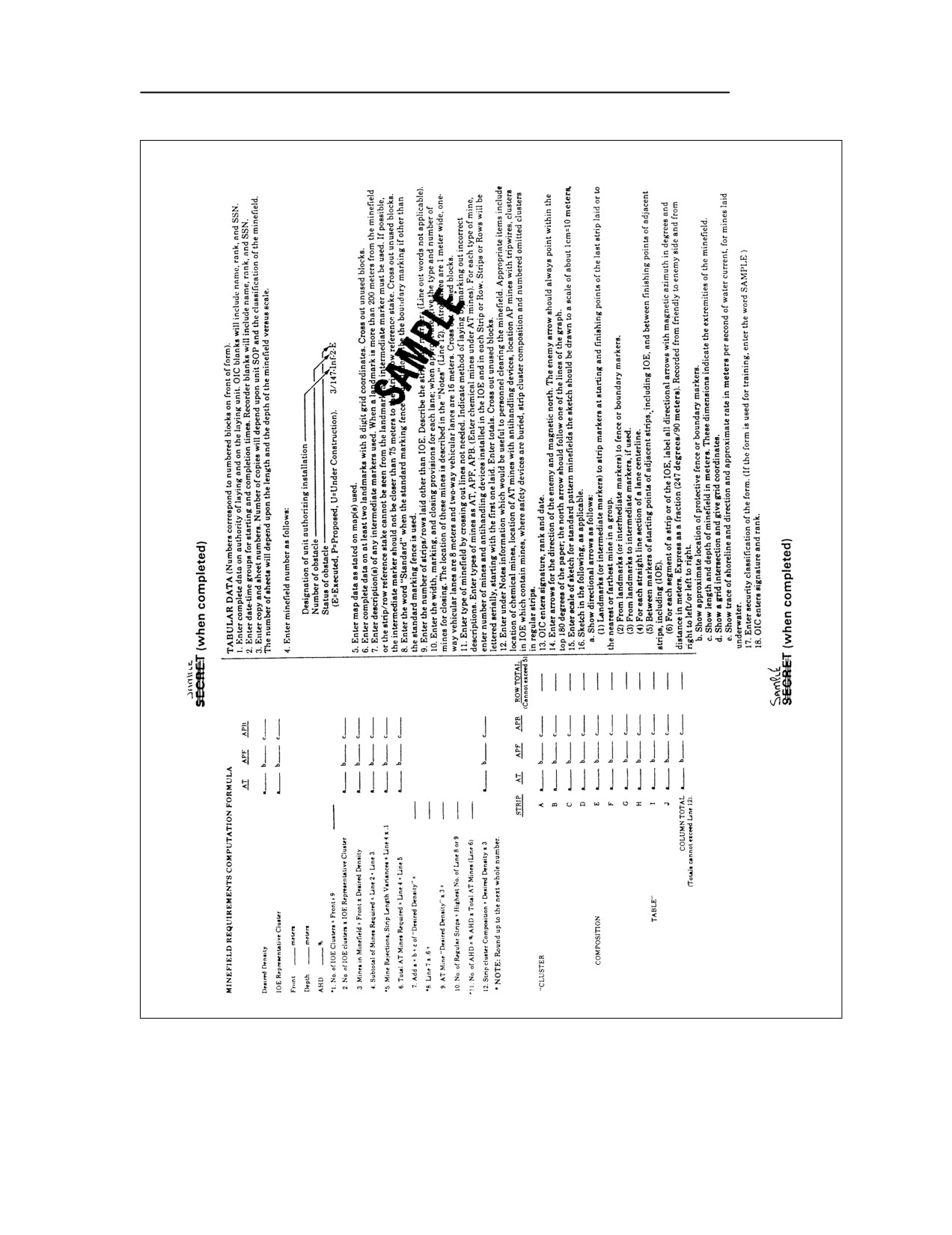
DA Form 1355 consists of a single sheet that is printed on both sides and
folded in half. The front side contains blocks of tabular data, the inside is a
graph of 1-centimeter squares for a scaled sketch of the field, and the back
side includes a computation formula and instructions. The scale for plotting
minefields/munition fields depends on the size of the field. To avoid using two
sheets for the sketch, adjust the scale so that one form will support the sketch.
For very large minefields/munition fields, two sheets may be required. The
system of measurement and the scale size must be indicated in the legend
block. A second form may be used to support any additional information in the
notes block. Any blocks or lines not used on the form must be crossed out to
avoid unauthorized entries on the form.
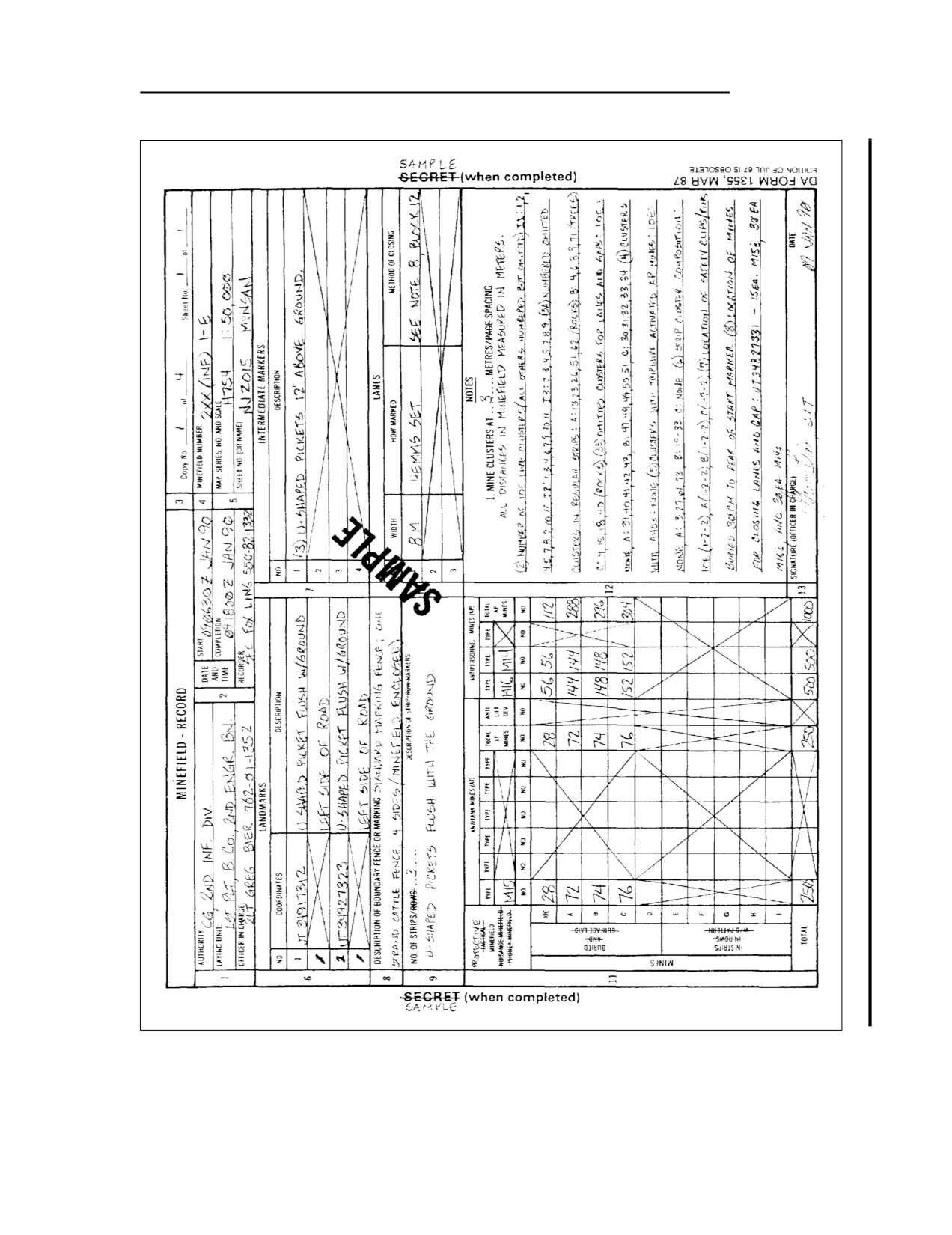
An example of a completed DA Form 1355 is shown in Figures 8-2a through 8-2c,
pages 8-5 through 8-7.
The following step-by-step instructions are provided for completing DA Form
1355:
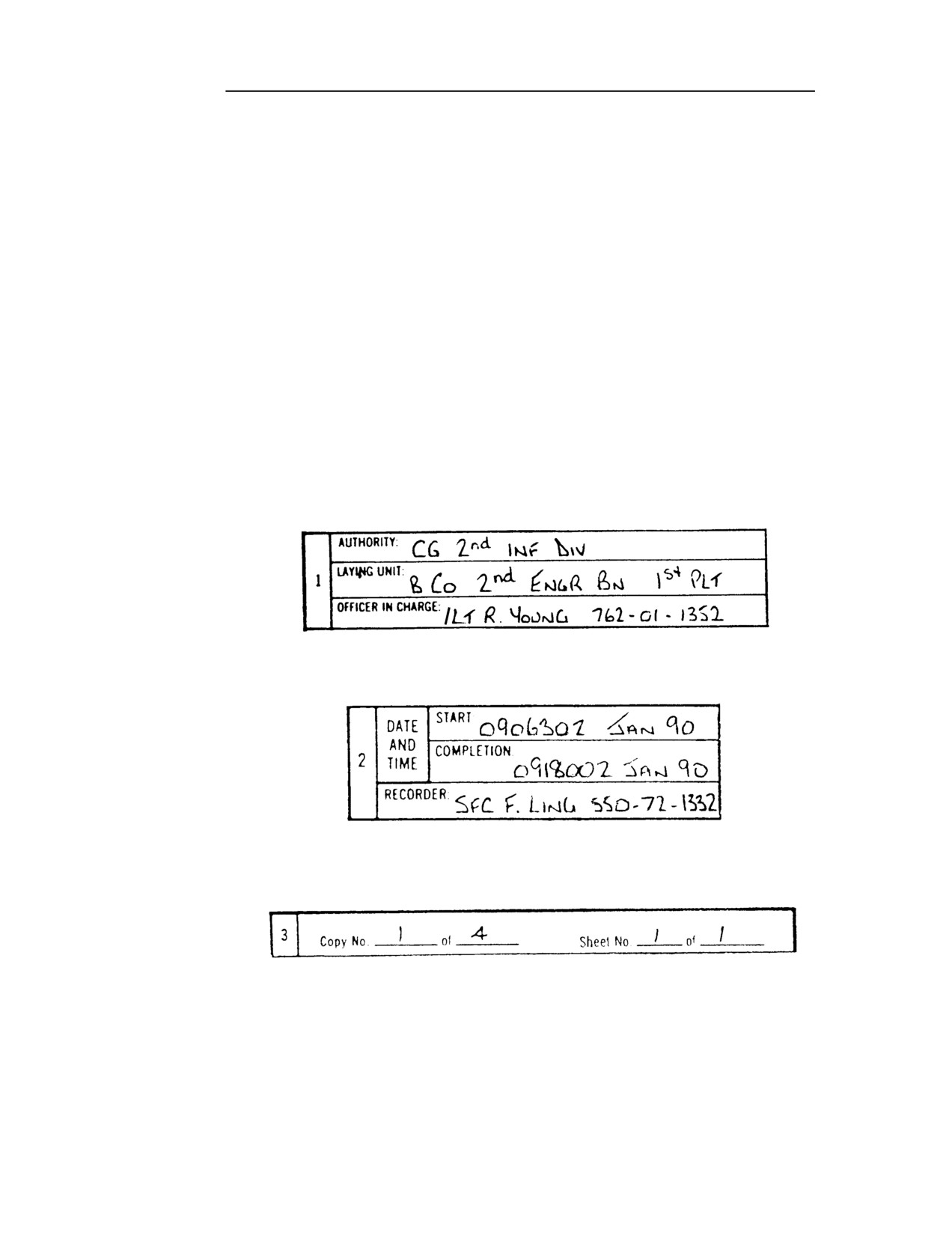
Block 1. Enter complete data on the laying authority and the laying unit. The
OIC block should include rank, name, and social security number (SSN).
Block 2. Enter the date-time group (DTG) for start and completion times. The
recorder block includes rank, name, and SSN.
Block 3. Enter the copy and the sheet number. The number of copies
prepared depends on the unit SOP and the minefield/munition field
classification.
NOTE: The minefield/munition field record is forwarded by the
laying unit. One copy is retained by the overwatching unit, one copy
by the next higher command, one copy by the unit central control cell
(for mine clearance information), and one copy by the proper
national territorial authority.
8-4 Reporting and Recording
C2, FM 20-32
Figure 8-2a. Sample DA Form 1355 (front side) for a standard-pattern minefield/munition field
Reporting and Recording 8-5
FM 20-32
Figure 8-2b. Sample DA Form 1355 (inside) for a standard-pattern minefield/munition field
8-6 Reporting and Recording
FM 20-32
Figure 8-2c. Sample DA Form 1355 (back side) for a standard-pattern minefield/munition field
Reporting and Recording 8-7