FM 20-32 Mine/Countermine Operations (August 2001) - page 4
FM 20-32
Enemy movement
100 m
Squad
W W W W W W W W W W
no 1
Squad
50 to
W W W W W W W W W
no 2
100 m
Conventional
minefield
MOPMS
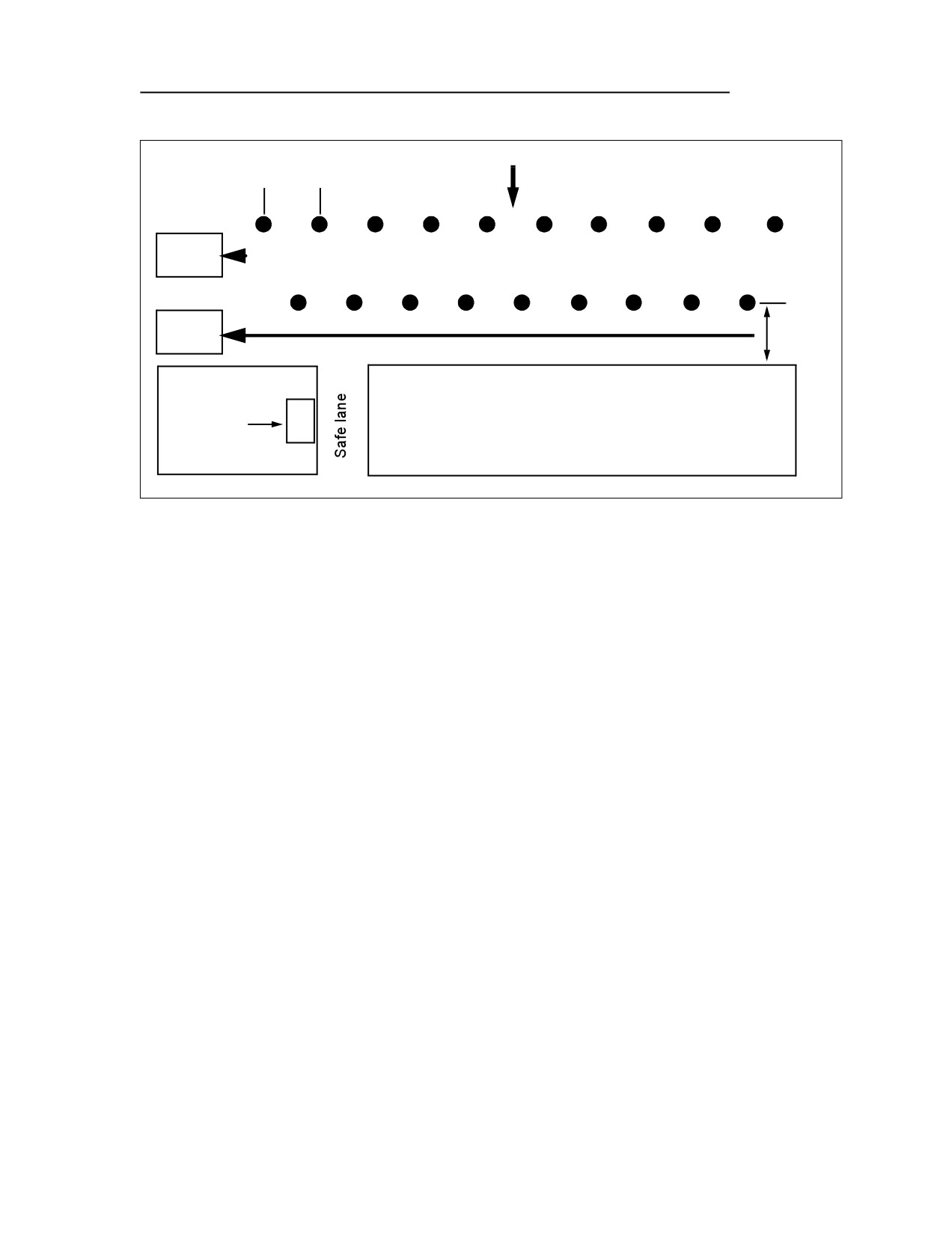
Figure 4-9. Hornet reinforcing a conventional minefield
• Select the SD time.
• Encode the Hornet with the M71 RCU and verify functionality via a
flashing status light.
• Reinstall the cover.
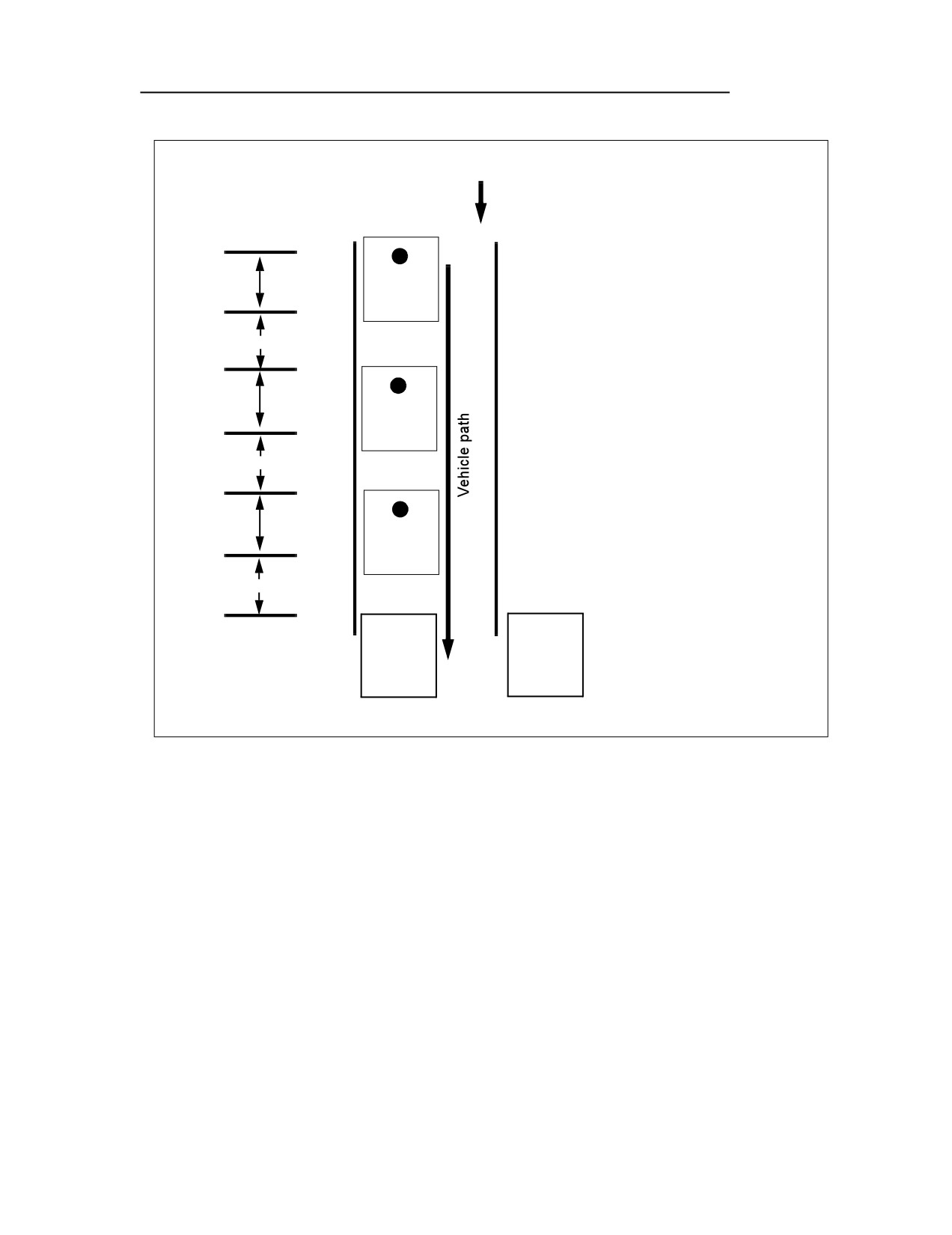
Each emplacement vehicle moves to the first Hornet emplacement site in each
row. The emplacing soldier and the arming soldier dismount. The emplacing
soldier is handed a Hornet from the vehicle. He emplaces the Hornet at the
designated site and returns to the vehicle.
The arming soldier rotates the handle on the Hornet, removes the cover and
the safety and handling (S&H) band, rotates the SD switch to U, and pushes
the arm switch to ARM. He then returns to the vehicle, taking the cover and
the S&H band with him. The vehicle travels to the next Hornet emplacement
site.
After all the Hornets in the two leading rows have been emplaced and armed,
the emplacing vehicles exit through the safe lane and usually secure it with a
MOPMS. The emplacement vehicles must be at least 475 meters (safe standoff
distance) from the nearest Hornet within 30 minutes. Before sending a remote
arming signal, vehicles must wait at least 36 minutes after the arming switch
is thrown on the last Hornet emplaced. If a rear row is required, it is emplaced
at this time. The Hornets are then remotely armed with the M71 RCU, when
required. They are now capable of covering the minefield by fire and engaging
threat tracked vehicles.
Special-Purpose Munitions 4-9
FM 20-32
Scatterable Minefield Reinforcement
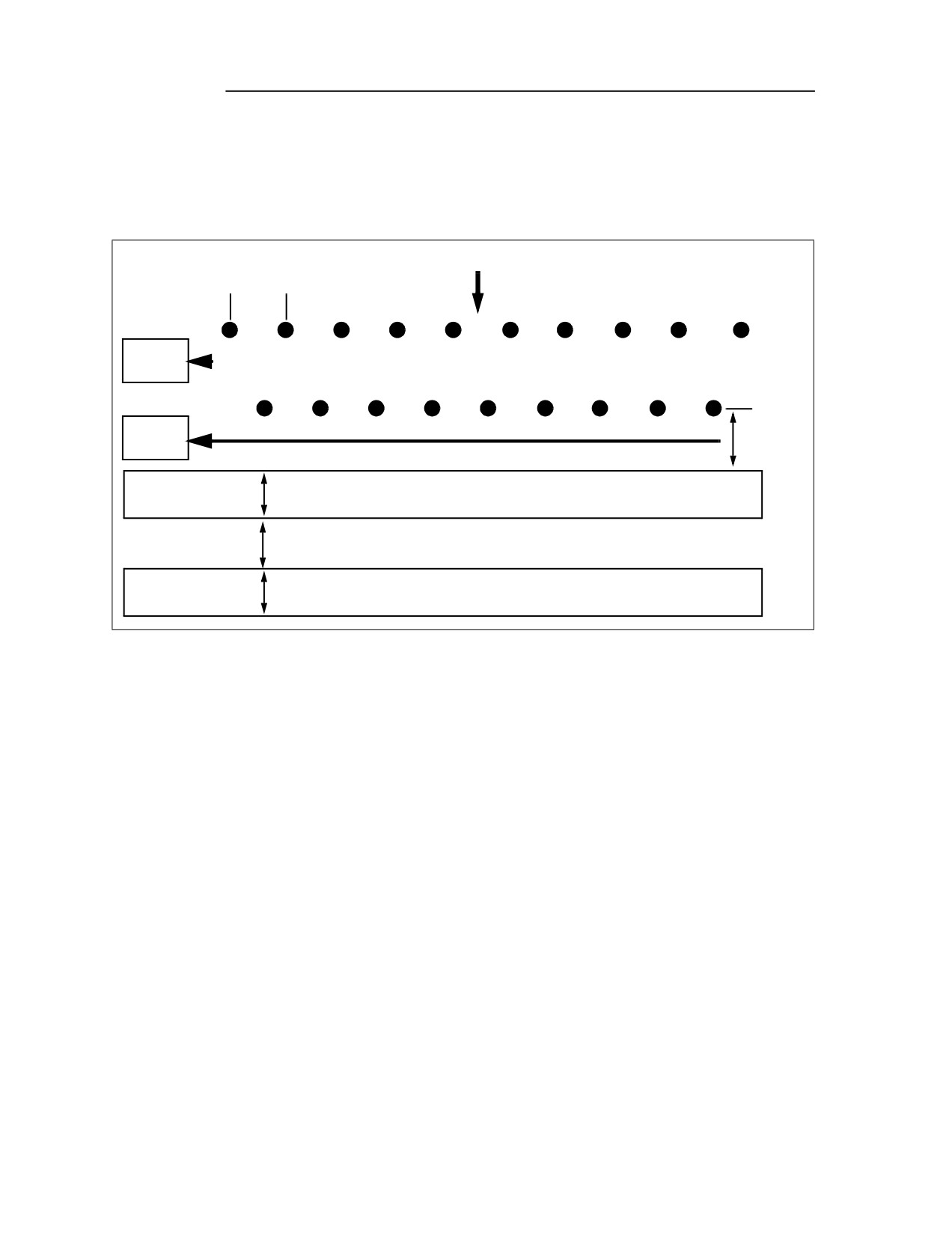
The Hornet can be used to reinforce a Volcano or MOPMS turn, block, or fix
minefield (Figure 4-10). Hornet munitions are emplaced, using the same
procedures as above, before the Volcano or MOPMS minefield is emplaced.
Enemy movement
100 m
Squad
W W W W W W W W W W
no 1
Squad
50 to
W W W W W W W W W
no 2
100 m
35 m
Volcano mine strip
50 m
35 m
Volcano mine strip
Figure 4-10. Hornet reinforcing a Volcano minefield
To ensure that the Volcano dispensing vehicle has sufficient time to reach the
safe standoff distance (475 meters), Volcano dispensing should start no later
than 30 minutes (minus the Volcano dispensing time) after the first Hornet is
armed. This allows Hornet emplacing squads to be finished or nearly finished
before the Volcano dispenser begins emplacing the minefield.
Area-Disruption Obstacle
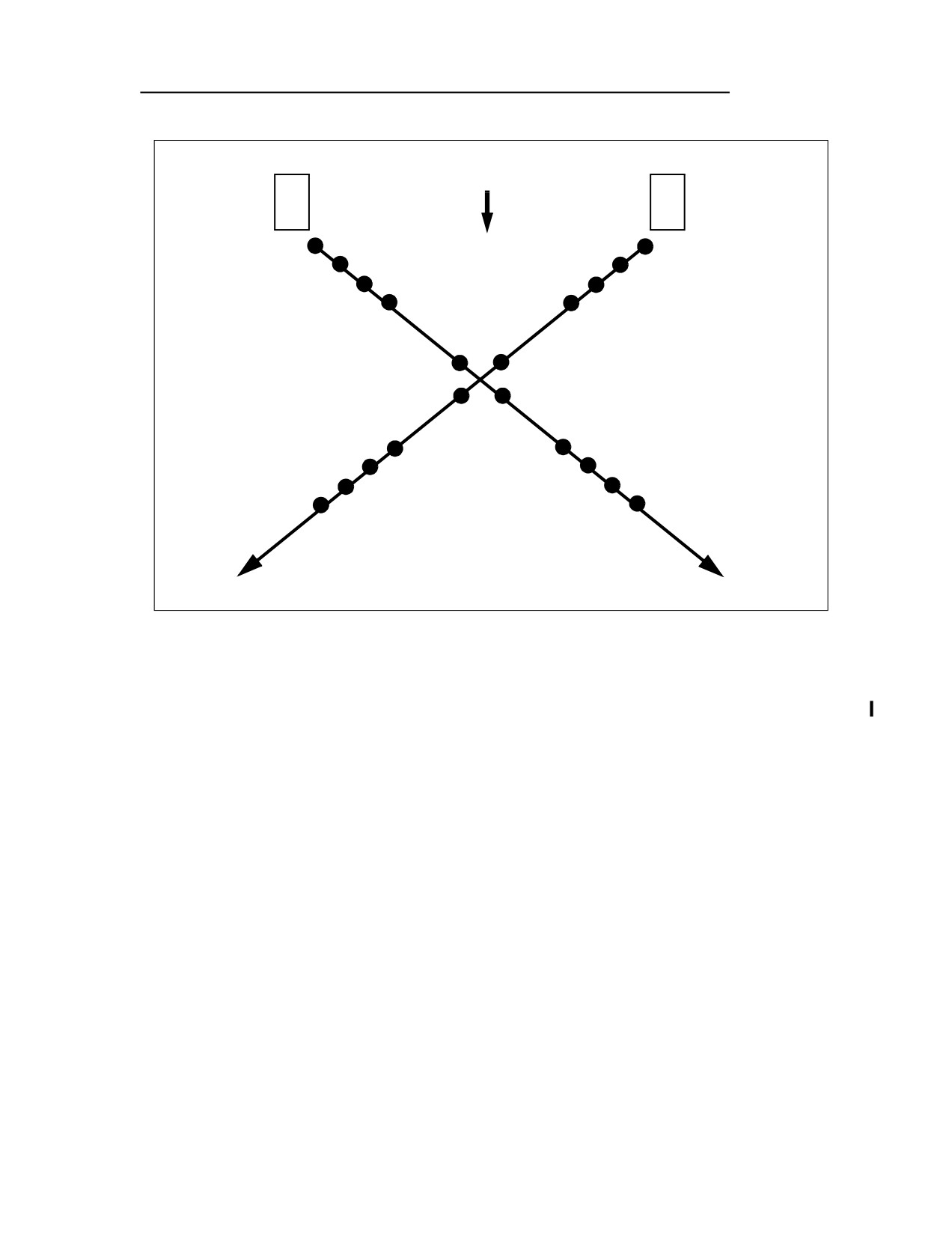
When the X-pattern is employed, the Hornet is very effective as a disrupting
obstacle (Figure 4-11). An area-disruption obstacle is employed to disrupt the
enemy's approach prior to the start of the direct-fire battle. It causes
disruption and attrition of the advancing threat force and encourages follow-
on forces to seek an alternate route. Therefore, multiple area-disruption
obstacles will typically be employed to adequately cover the cross-country AA.
This requires coordinated action among multiple squads.
An engineer platoon emplaces a Hornet area-disruption obstacle. The obstacle
typically consists of 20 Hornets (five clusters of four Hornets each) employed
in an X-pattern over a 1- by 1-kilometer area. Individual Hornets are
emplaced 100 meters apart. Emplacing this obstacle must be done as a
dispense-and-roll operation to ensure that the emplacing vehicles can reach
the safe standoff distance (475 meters) from any armed Hornets.
4-10 Special-Purpose Munitions
C2, FM 20-32
Squad no 1
Squad no 2
Enemy movement
W
W
W
W
W
W
W
W
W
W
W W
W
W
W
W
W
W
W
W
NOTE: Arrows indicate direction of emplacement.
Figure 4-11. Hornet area-disruption obstacle
Area-disruption obstacles are normally armed by remote, but they can be
manually armed under the following conditions:
• METT-TC requires rapid emplacement and arming.
• Terrain reconnaissance determines that there are no major
impediments (rough terrain, vegetation) to maneuver.
• Emplacement is done during daylight hours
(mission-oriented
protective posture [MOPP] level 0 only).
Hornets are prearmed the same as above. Two squads lay the Hornets in
unison, starting with the two emplacement sites closest to the enemy. Each
squad drives in a straight line, crossing paths at the middle of the X, and
emplaces ten Hornets.
A soldier in the back of each emplacing vehicle throws the arming switch and
sets the Hornet down or drops it off (base down) the back of the vehicle. After
all the Hornet clusters are emplaced, squad vehicles quickly travel to the 475-
meter safe standoff distance (no further than 2 kilometers) to prepare for
remote arming. Hornets can be remotely armed 36 minutes after the arming
switch is thrown on the last Hornet emplaced. If manual arming is used,
Hornets automatically arm at the end of their safe-separation time (5 to 6
minutes after the arming switch is thrown).
Special-Purpose Munitions 4-11
C2, FM 20-32
Gauntlet Obstacle
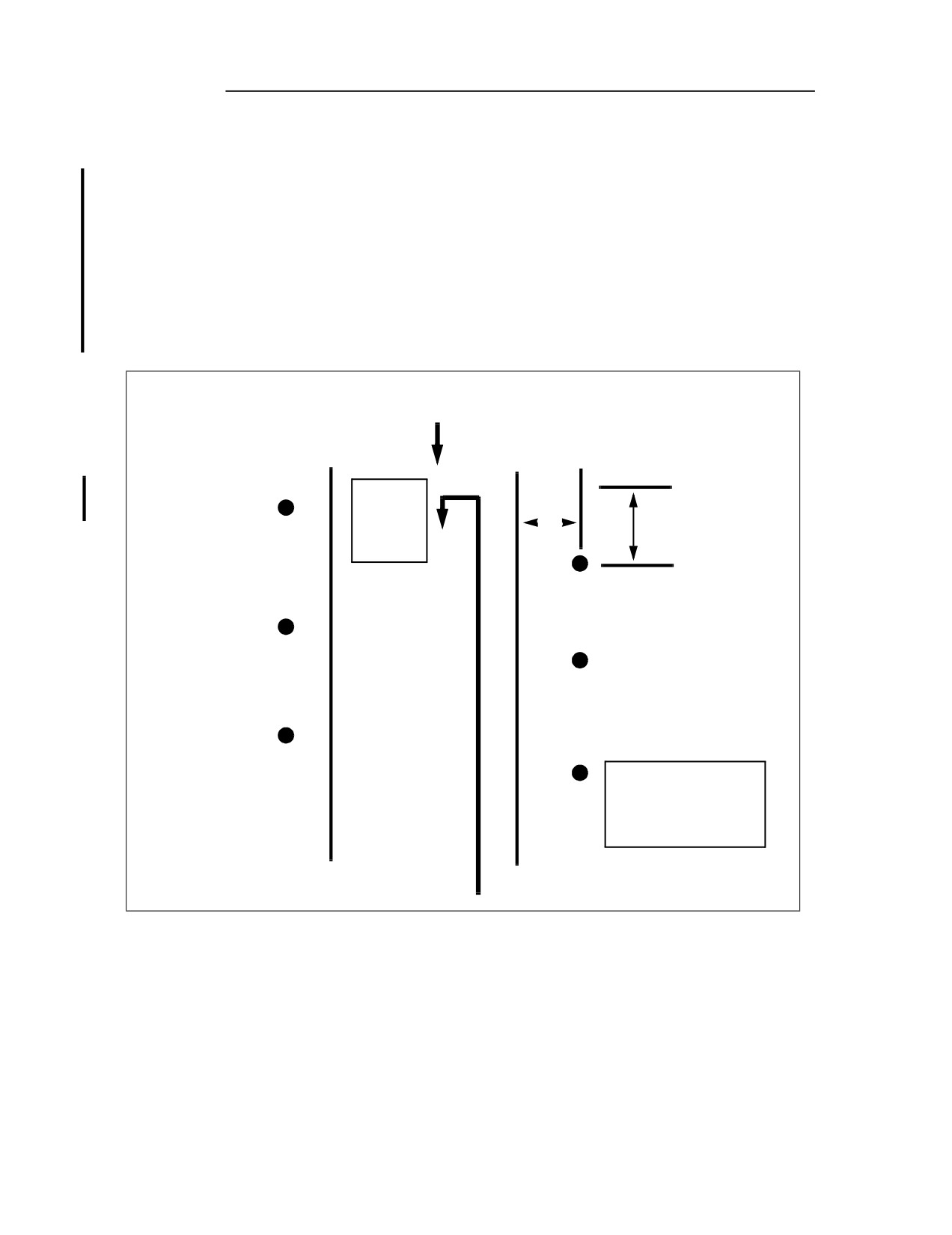
Hornet gauntlet obstacles (Figure 4-12) are emplaced by an engineer platoon
and are very effective in constricted terrain along the enemy’s AA and at
choke points. A Hornet gauntlet typically consists of 40 to 50 Hornets
employed in a series of clusters (Figure 4-13). Each cluster contains 3 to 6
Hornets. The Hornets in each cluster are emplaced at 50-meter intervals,
perpendicular to the road centerline, on alternating sides of the road/AA, and
25 to 50 meters (depending on the terrain and the vegetation) off the side of
the road/AA. The distance between clusters varies from 750 to 2,000 meters so
that the advancing threat force is kept guessing about when they will
encounter the next cluster.
Enemy movement
Squad
leader
50 m
and
50 m
W
driver
W
W
W
W
Initial emplacement
position (located up to
W
10 kilometers from the
mine dump)
Figure 4-12. Hornet gauntlet obstacle (one cluster)
Before laying any Hornets, the munitions are prearmed as above. Soldiers also
set the target switch to HVY for clusters closest to the enemy, so that the
Hornets will only engage heavy tracked vehicles. The intent is to make threat
forces commit to a route they perceive to be clear.
Hornets are emplaced beginning on the friendly side of the cluster. The first
engineer squad emplaces Hornet munitions beginning with the cluster closest
to the enemy. The emplacement vehicle drives even with the first Hornet
4-12 Special-Purpose Munitions
FM 20-32
Enemy movement
1st cluster
250 m
W
010023Sep
750 to 2,000 m
ASSUMPTIONS:
1. The gauntlet consists
of nine clusters.
2d cluster
250 m
W
2. Each squad in the
platoon employs three
clusters of three to six
750 to 2,000 m
010023Sep
Hornets.
3. All Hornets are armed
3d cluster
250 m
by the manual mode,
W
from clusters one through
nine.
750 to 2,000 m
010023Sep
1st engr
2d engr
2d engr squad
squad
squad
begins arming
Figure 4-13. Hornet gauntlet obstacle (platoon)
emplacement site. The emplacing soldier dismounts, and a soldier in the
vehicle hands him a Hornet. The emplacing soldier then proceeds to the
Hornet emplacement site. The vehicle travels to a point even with each
subsequent emplacement site. A soldier deploys at each emplacing site to lay
one of the remaining Hornet munitions in the cluster. The vehicle then turns
around and stops even with the last Hornet (on the enemy side) in the cluster.
Upon reaching the Hornet employment location, each emplacing soldier
removes the cover and the S&H band, rotates the SD switch to U, and on the
command (audible or visual signal) of the NCOIC, pushes the arm switch to
ARM. Once the Hornets’ arming switches are thrown, soldiers return to the
road, taking the covers and the S&H bands with them, and wait to be picked
up by the emplacement vehicle. After all the soldiers are in the emplacing
vehicle, the driver quickly travels to the safe standoff distance (475 meters).
The Hornet munitions in the first cluster will arm at the end of the safe-
separation time (5 to 6 minutes).
Special-Purpose Munitions 4-13
FM 20-32
The squad repeats the emplacement process for the next Hornet cluster in the
gauntlet, taking care not to emplace any Hornets or drive within 475 meters of
the previous cluster. Each squad in the platoon typically emplaces three
clusters in the Hornet gauntlet, or 9 to 18 total Hornets.
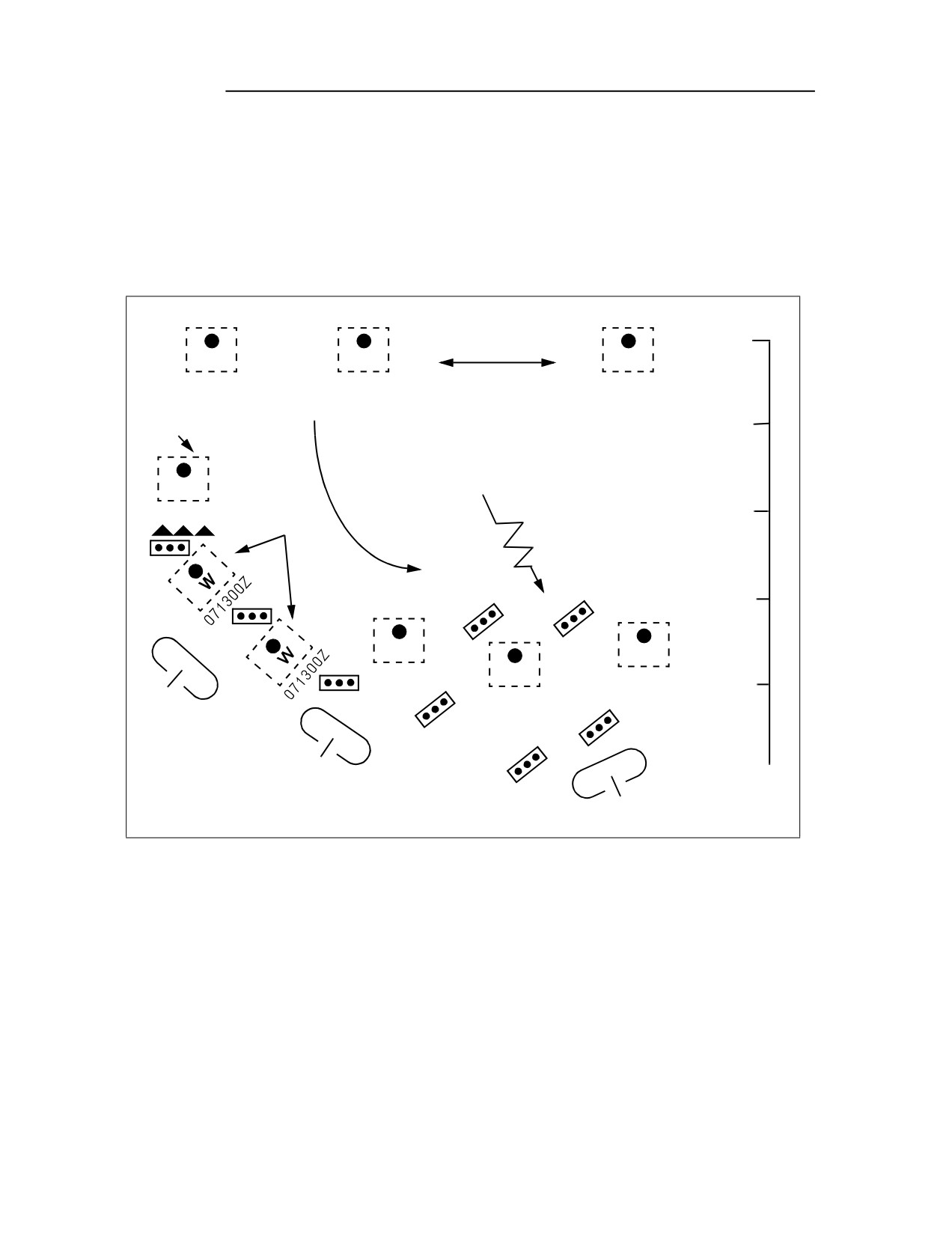
Figure 4-14 shows Hornet emplacement in the battle space. The example used
is in support of a defensive position where Volcano mines are used as tactical
obstacles.
5 km
W
W
Hornet
W
X-pattern
071000Z
071030Z
071035Z
Hornet conventional
4 km
obstacle integration
W
Hornet
071000Z
3 km
gauntlets
2 km
W
W
071200Z
W
071130Z
1 km
071230Z
Figure 4-14. Hornet-enhanced turn-and fix-obstacle groups
Deep-Battle Interdiction Weapon
SOF or ranger units emplace Hornet munitions in the deep battle area as
interdiction weapons. A typical mission requires a unit ranging in size from a
six-man team to an entire company. The number of Hornets carried by the
unit depends on the mission and the mode of insertion (vehicle, aircraft, or
dismounted troops); a man can normally carry only one Hornet. Hornets are
typically used to support a raid against an enemy position or complex and at
bridges or choke points along high-speed AAs used by advancing second-
echelon forces or for resupply. In these roles, the Hornets are employed similar
to the clusters in a gauntlet obstacle.
4-14 Special-Purpose Munitions
C2, FM 20-32
Camouflage and Concealment
The best camouflage and concealment for the Hornet is tall grass and brush.
The Hornet can be partially buried if the terrain or the vegetation does not
provide effective natural camouflage and concealment. Placing the Hornet in a
hole degrades its performance, so it should only be done when Hornets cannot
be covered by fires or protected from tampering by dismounted enemy. The
following conditions must be met:
• The depth of the hole must not exceed 4 inches, because the acoustic
sensors must be above ground level.
• The hole must not restrict the Hornet’s ability to rotate and tilt its
body and to fire the sublet. To meet this requirement, the hole must be
at least 36 inches wide and flat enough to support the munition.
Although the Hornet should be placed on a flat surface if possible, it
can operate on slopes up to 15 degrees.
Munitions placed at ground level should be no closer to obstructions than the
distances shown in Table 4-1.
Table 4-1. Hornet minimum emplacement distances
Maximum
Minimum Employment
Obstruction Height
Distance from Obstruction
1m
3m
2.4 m
5m
6.5 m
15 m
25 m
25 m
When the Hornet is emplaced and concealed, remove all indicators of excess
soil and camouflage material before performing the arming sequence.
RECORDING AND MARKING
When the Hornet munition field is completed, the OIC will identify an NCO to
be the recorder. The NCO will collect data from the NCOICs of the emplacing
squads and complete DA Form 1355 as outlined in Chapter 8. The OIC will
ensure that the DA Form 1355 is completed timely and accurately.
Marking the Hornet munition field will be completed as prescribed in Chapter
2. The fence will be no closer than 150 meters from the nearest Hornet
munition. Marking must be completed before emplacing the munitions.
Special-Purpose Munitions 4-15
FM 20-32
4-16 Special-Purpose Munitions
This chapter implements STANAG 2990.
Chapter 5
Conventional Mines
Conventional mines are hand-emplaced mines that require manual
arming. This type of mine laying is labor-, resource-, and transport-
intensive. Soldiers emplace conventional mines within a defined, marked
boundary and lay them individually or in clusters. They record each mine
location so that the mines can be recovered. Soldiers can surface lay or
bury conventional mines and may place AHDs on AT mines.
ANTITANK MINES
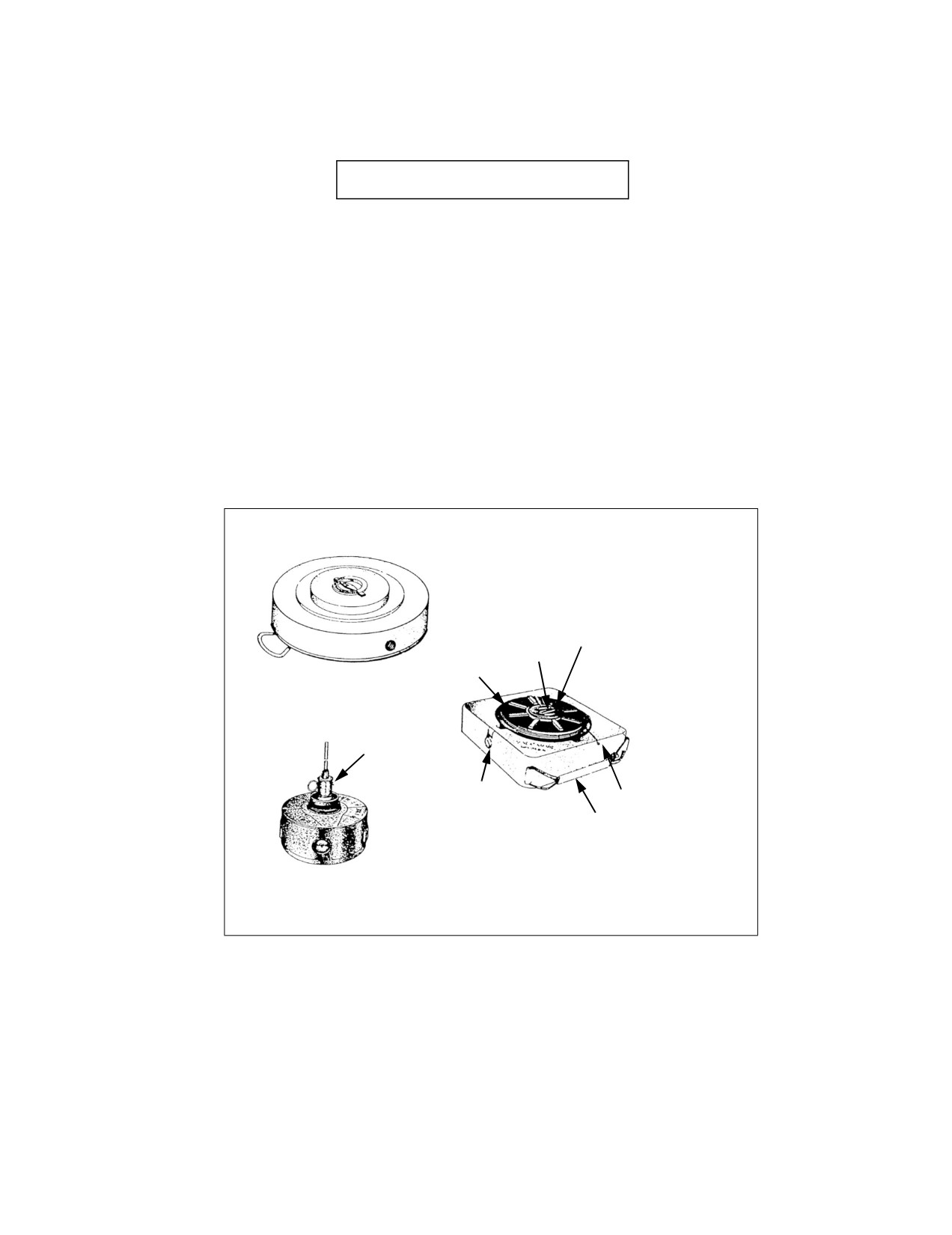
The M15, M19, and M21 AT mines are used by US forces. They are shown in
Figure 5-1, and their characteristics are listed in Table 5-1, page 5-2.
Setting knob
Safety
in S position
clip
Pressure
M15
plate
M607 fuse
Activator-well
Safety-clip cord
plug
Carrying-cord handle
M19
M21
Figure 5-1. AT mines
M15
The M15 AT mine is 337 millimeters in diameter and 125 millimeters high. It
weighs 13.5 kilograms and contains 9.9 kilograms of Composition B explosive.
The primary fuse well is on the top center of the mine; secondary fuse wells
are on the side and bottom. The M15 can contain the following fuses:
Conventional Mines 5-1

FM 20-32
Table 5-1. Characteristics of AT mines
Explosive
Mine
Mines per
Mine
DODIC
Fuse
Warhead
AHD
Weight
Weight
Container
M15 w/
K180
Pressure
Blast
Yes
9.9 kg
13.5 kg
1
M603 fuse
M15 w/
K180 (mine)
Tilt rod
Blast
Yes
9.9 kg
13.5 kg
1
M624 fuse
K068 (fuse)
M19
K250
Pressure
Blast
Yes
9.45 kg
12.6 kg
4
M21
K181
Tilt rod or
SFF
Yes*
4.95 kg
7.6 kg
4
pressure
*Conventional AHDs will not couple with this mine; however, the M142 multipurpose FD can be emplaced
under this mine.
• M603 fuse. When the M603 fuse is employed on the primary fuse well,
the M15 is a track-width mine that is activated by 158 to 338
kilograms on the pressure plate. This produces an M-Kill.
• M624 fuse. When the M624 fuse (with tilt rod) is employed on the
primary fuse well, the M15 is a full-width mine that is activated by a
deflection of 20 degrees or 1.7 kilograms of pressure to the tilt rod.
Depending on the armor, this produces an M-Kill or a K-Kill.
M19
The M19 AT mine is a low-metallic, square-shaped mine that measures 332 by
332 millimeters and is 94 millimeters high. It weighs 12.6 kilograms and
contains 9.45 kilograms of Composition B explosive, a tetryl booster pellet,
and an M606 integral fuse. When the setting knob on the pressure plate is in
the S (safe) position, the mine cannot function by action of the main fuse.
After the safety clip has been removed and the setting knob turned to the A
(armed) position, a force of 157.5 to 225 kilograms on the pressure plate
depresses the Belleville spring and begins the firing chain. A standard FD
may be used with the M2 activator in any of the secondary fuse wells on the
sides or the bottom of the mine. When the M19 is employed, it is difficult to
detect because of its plastic construction. It produces an M-Kill with a blast
effect.
M21
The M21 AT mine is 230 millimeters in diameter and 206 millimeters high. It
weighs 7.6 kilograms and has 4.95 kilograms of Composition H6 explosive.
The mine is activated by 1.7 kilograms of pressure against a 61-centimeter-long
rod on the end of the M607 fuse. It uses an M-S plate to produce a K-Kill. The
M21 with tilt rod must be buried or staked (use three stakes at the 12, 4, and
8 o'clock positions) so that enemy vehicles will not tip the mine over. Without
the tilt rod, the mine is activated by 130.5 kilograms of pressure on the M607
fuse and produces an M-Kill by blast effect.
5-2 Conventional Mines
C2, FM 20-32
ANTIPERSONNEL MINES
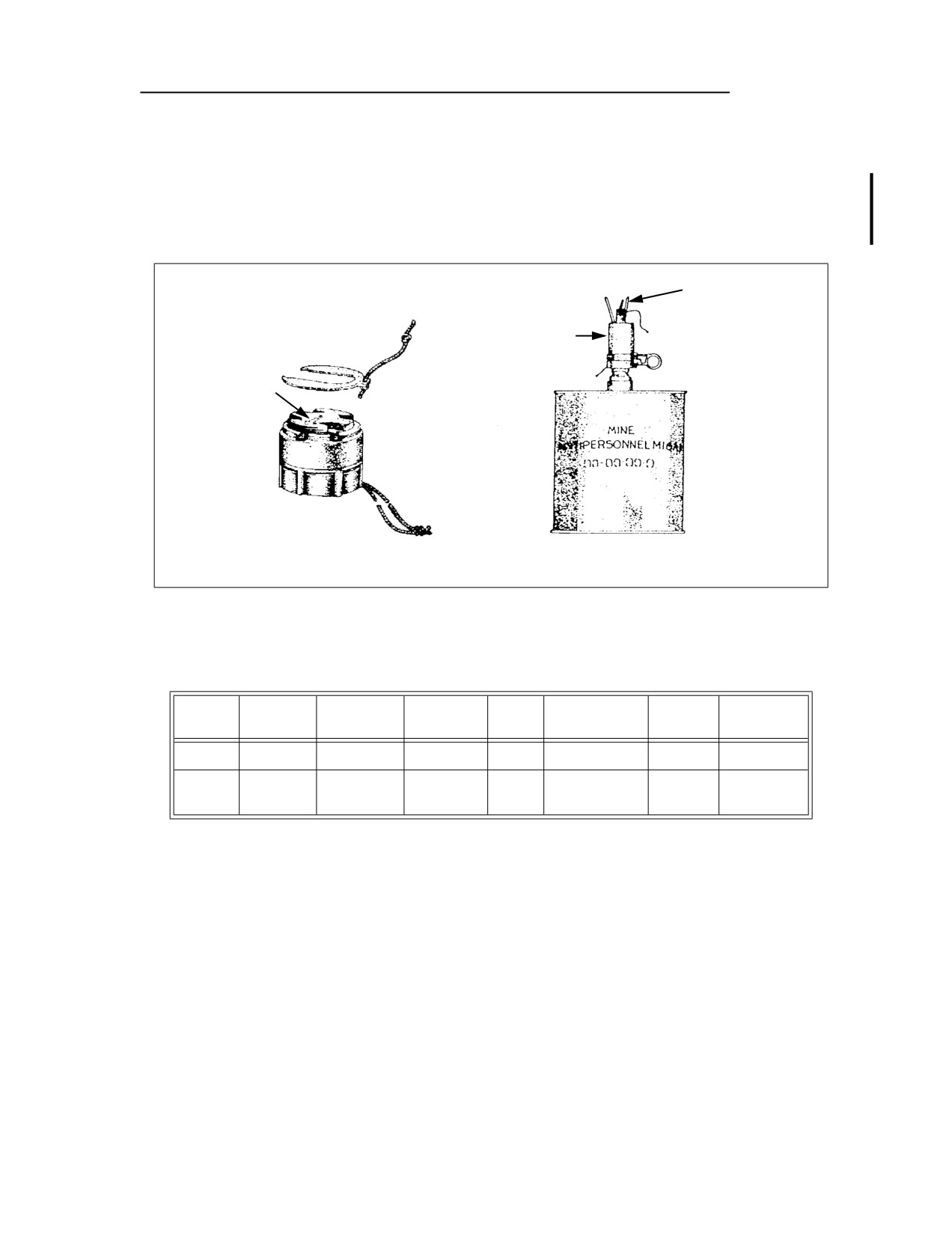
The M14 and M16 AP mines are used by US forces on the Korean
peninsula. They are also used by many other countries. The M16 AP
mine is likely to be seen in a modified form. These mines are shown in
Figure 5-2, and their characteristics are listed in Table 5-2.
Pressure prongs
Fuse
Pull cord
Release-pin
ring
Indicating
Safety clip
arrow
Carrying cord
M14
M16
Figure 5-2. AP mines
Table 5-2. Characteristics of AP mines
Mine
DODIC
Fuse
Warhead
AHD
Explosive
Mine
Mines per
Weight
Weight
Container
M14
K121
Pressure
Blast
No
28.4 g
99.4 g
90
M16-
K092
Pressure
Bounding
No
450 g
3.5 kg
4
series
or trip wire
frag
M14
The M14 AP mine is a low-metallic blast mine consisting of a main
charge (28.4 grams of tetryl) and a plastic fuse with a steel firing pin.
It is cylindrical in shape (56 millimeters in diameter and 40
millimeters high) and weighs 99.4 grams. The pressure plate has an
indented, yellow arrow that points to the A or S position on top of the
fuse body. A force of 11.5 to 13.5 kilograms depresses the pressure
plate and causes the Belleville spring to drive the firing pin into the
detonator. The M14 is not designed to kill, but to incapacitate. The
M14 AP mine has been modified by gluing a metal washer to the
bottom of the mine. The modification was directed to improve the
detectability of the mine. Unmodified mines are not authorized for
use by US forces.
Conventional Mines 5-3
FM 20-32
M16
The M16 AP mine is a bounding fragmentation mine that consists of a
mine fuse (M605), trinitrotoluene (TNT) explosive, a propelling
charge, and a projectile that are contained in a sheet-steel case. The
mine is 103 millimeters in diameter, 199 millimeters high (including
the fuse), and weighs 3.5 kilograms. The principal difference between
the M16, M16A1, and M16A2 versions are in the construction of the
detonators and boosters. The casualty radius is 27 meters for the M16
and M16A1 and 30 meters for the M16A2. A pressure of 3.6 to 9
kilograms applied on one or more of the three prongs of the M605
fuse or a pull of 1.4 to 4.5 kilograms on the trip wire will activate the
mine.
EMPLACING MINES
The method used to lay and conceal each type of mine depends on the method
of mine operations, the type of ground in which the mine is to be laid, and the
type of ground cover available for camouflage.
Standard-pattern mine laying is laborious and time-consuming, but it is more
effective and flexible than row mine laying and allows better mine
concealment. Standard-pattern mine laying is well suited for protective
minefields, and it can be used in terrain where the nature of the ground
makes row mine laying impractical.
To achieve the maximum effect, mines must be laid where they cannot be seen
and where a vehicle or a person exerts enough pressure to detonate them. The
following rules should be applied to achieve the maximum effects of mines:
MINES WITH PRONGS
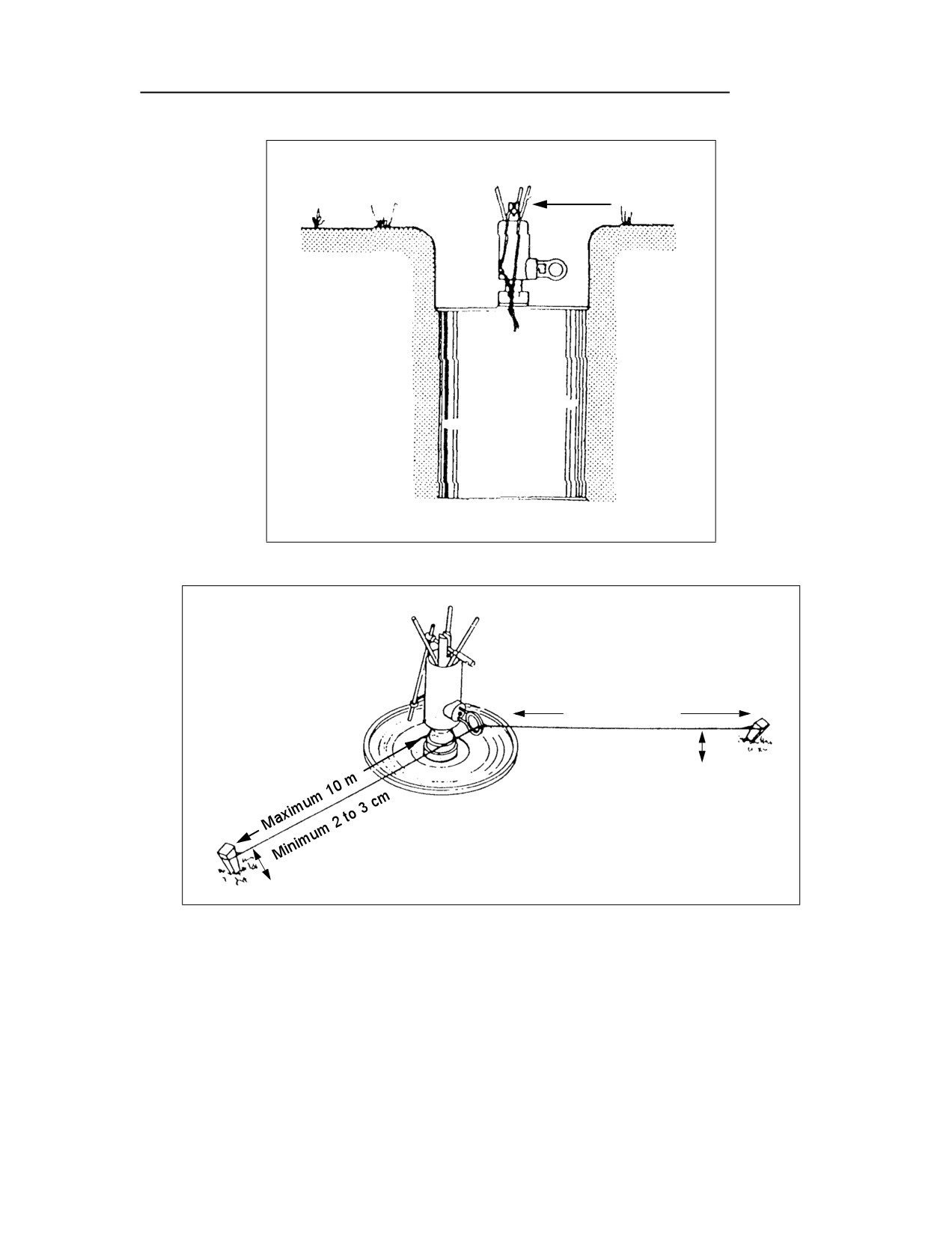
Korea Only: If the mine is activated by its prongs, it should be buried
flush with the ground so that only the tips of the mechanism are
exposed (Figure 5-3). A mine buried in this manner is held firmly
upright. The target exerts a direct, downward pressure rather than a
sideways thrust. The mine is protected from damage and is difficult
to see. If it is buried more deeply, it becomes unreliable because the
layer of spoil may prevent the mine mechanism from operating.
If the mine is activated by a trip wire, it should be buried so that the trip
wire is at least 2 to 3 centimeters above the ground (Figure 5-4).
MINES WITH PRESSURE PLATES
Mines with pressure plates will function when completely buried as long as
the cushion of earth above them is not too thick. AT mines are normally
buried with the top of the mine approximately 5 centimeters below ground
level.
5-4 Conventional Mines
FM 20-32
Pressure Actuation
Prongs
Figure 5-3. Prong-activated AP mine
Maximum 10 m
Minimum 2 to 3 cm
Figure 5-4. Trip-wire-activated AP mine
Conventional Mines 5-5
FM 20-32
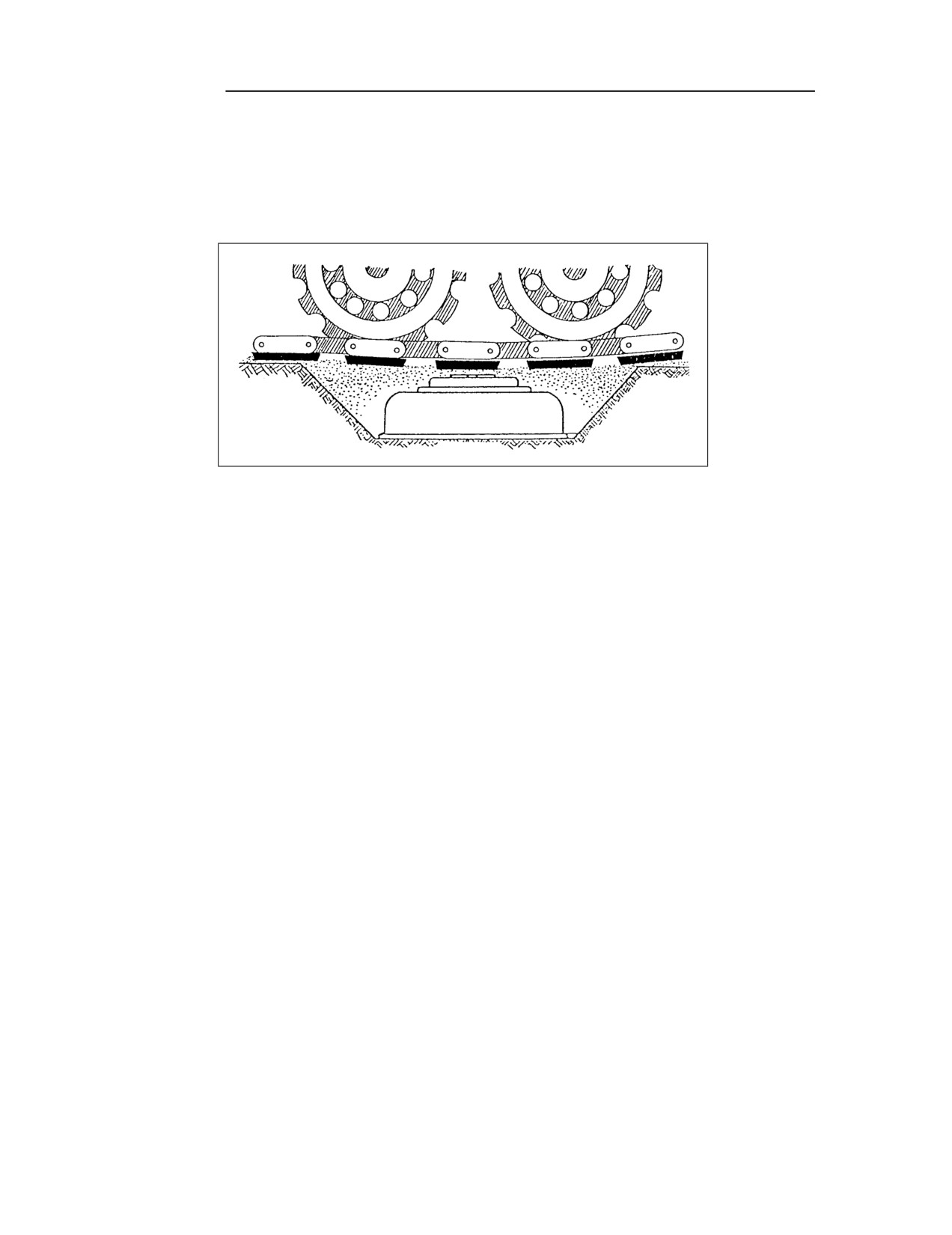
Korea Only: AP mines are usually placed in a hole and covered with
camouflage material. If the hole is only slightly larger than the mine,
the weight of the target may be supported by the shoulder of the hole,
and the mine will fail to activate. Such bridging action can be
avoided if the hole is dug much wider than the mine (Figure 5-5).
Figure 5-5. Buried mine with pressure plate
MINES WITH TILT RODS
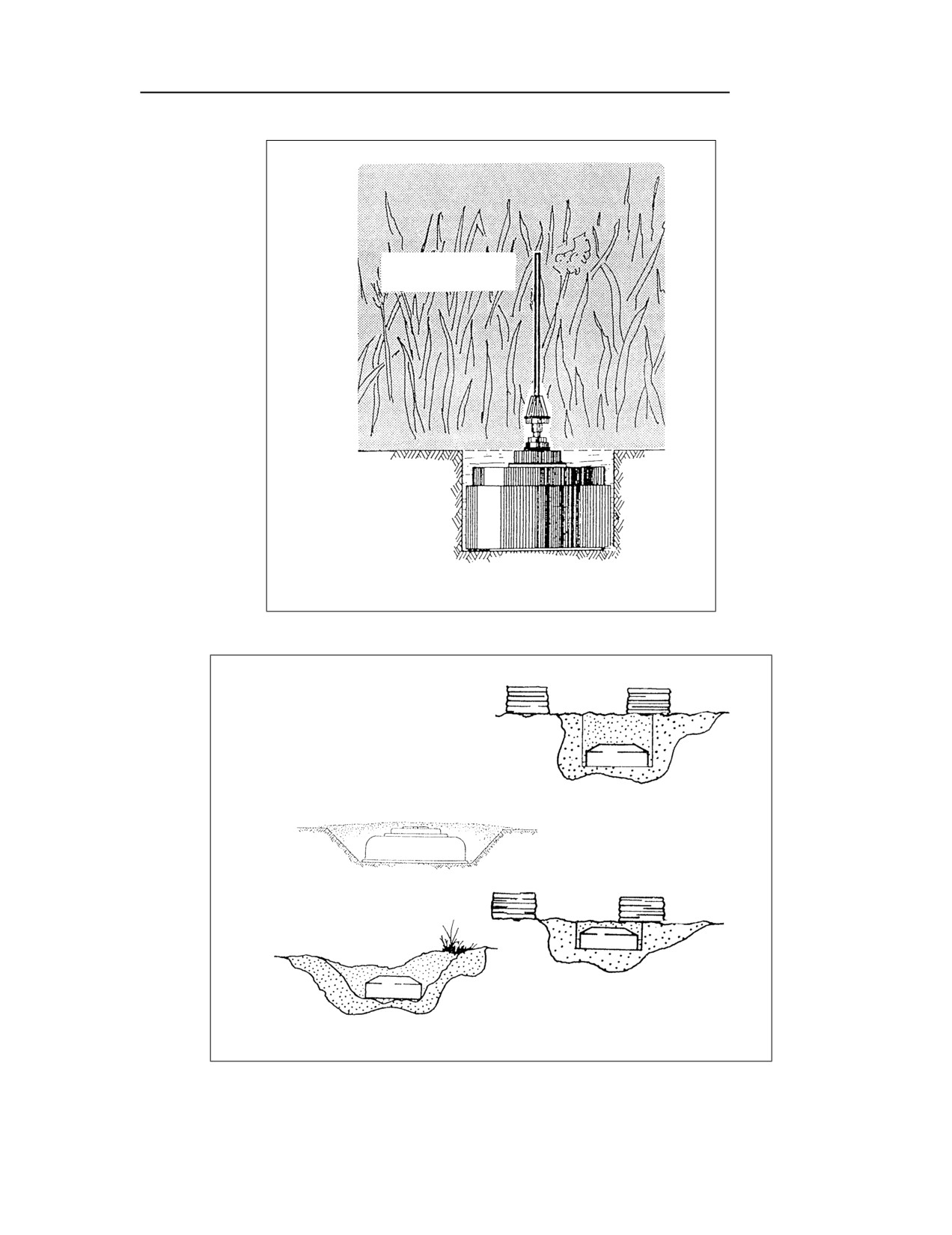
Tilt-rod fuses normally require the body of the mine to be buried and the tilt-
rod assembly to be clear of the ground (Figure 5-6). A tilt-rod fuse is preferred
in areas where vegetation is sufficient to conceal the extension rod.
Camouflage materials are carefully used to prevent premature detonation or
interference with the normal functioning of the fuse. Extension rods are
camouflaged before the mine is armed. If tilt rod mines are surface-laid, they
must be staked.
BEARING BOARDS
High pressure is required to activate AT mines. When burying a mine in soil
that has a low bearing pressure (such as soft sand or clayey soil), it may be
necessary to place a board or another bearing plate under the mine.
Otherwise, the mine may not detonate when it is forced down.
CONCEALMENT
After digging the hole for a mine, place the spoil in a sandbag to reduce the
evidence of mining. If a sandbag is not available, heap the spoil. Camouflage
all traces of digging after the mine is laid. If the ground cover is turf or other
matted, root material, remove spoil that cannot be hidden. Cut the sod in an
X, I, or U shape in the area where the mine is to be placed; lay the mine; and
then roll the sod back in place to camouflage the mine. Loose earth over a
mine will eventually consolidate, so the mine location should have a small
mound immediately after laying (Figure 5-7). Ensure that the mound is
inconspicuous and that it blends with the surrounding area. It is very
important that you make a final check after concealing each mine so that you
can correct faults progressively, because they cannot be corrected later.
AT mines in standard-pattern minefields should be buried. However if
conditions dictate, mines with a single-impulse fuse may be laid on the
surface. Mines with double-impulse fuses should always be buried, because if
5-6 Conventional Mines
FM 20-32
Use natural cover
to hide the tilt rod.
Make steep slopes to
prevent tipping.
Ensure that the mine has
a firm, level base.
Figure 5-6. Buried mine with tilt rod
RIGHT - The hole is much
larger than the mine and the
pressure plate is 5 cm below
the surface (AT mines).
RIGHT - A small mound is
left and covered with the
original sod or camouflage.
WRONG - The mine
is too deep.
WRONG - A depression is
left and not camouflaged.
WRONG - The hole
is too small.
Figure 5-7. Buried and concealed mines
Conventional Mines 5-7
C2, FM 20-32
they are surface-laid, they may be physically damaged when pressure is
exerted by a tracked vehicle. Buried mines also have some resistance to
countermeasures, but surface-laid mines have none. Consideration must also
be given to sympathetic detonation of AT mines (Table 5-3). US conventional
mines do not have integral AHDs, so allow extra time to lay mines with AHDs.
Table 5-3. Sympathetic detonation chart
Type
M16
M15
M19
Surface-laid
NA
4.0 m
4.0 m
Buried flush
1.5 m
2.4 m
5.5 m
Buried 5 cm
NA
1.5 m
4.8 m
The difficulty of burying mines in very rocky ground and the necessity for
surface laying will have a bearing on which mines are suitable. For example,
small, blast-type AP mines are hard to detect and easy to camouflage. They
are much easier to camouflage than larger fragmentation mines. The type of
AT mine used will make little difference, because the mine’s size will always
make camouflage very difficult.
MANEUVER ASSISTANCE
During large mine-laying operations, engineers seldom have sufficient
manpower to carry out all minefield tasks. Other combat arms units must
often provide work parties. Engineers must be capable of organizing,
controlling, and supervising combined arms work parties. They must also
instruct them in new equipment and techniques. Work parties may be
integrated with engineers or given certain tasks that are within their
capabilities.
When laying a standard-pattern minefield, consider supplementing work
parties with other combat arms soldiers to perform the following:
• Executing Class IV/V supply point or mine dump missions. Soldiers
uncrate and prepare mines and remove empty boxes and residue.
• Laying. Soldiers position mines within strips and dig holes.
• Marking. Soldiers construct the perimeter fence and emplace mine
signs.
Unpacking, preparing, and loading mines are the most time-consuming tasks
when laying a row minefield; and they are ideal tasks for other combat arms
soldiers.
5-8 Conventional Mines
This chapter implements STANAG 2036.
Chapter 6
Row Mining
Row mining is a means of emplacement for tactical minefields. For
example, a typical tactical minefield could contain several rows of
regularly spaced mines.
USE
Row mining is not a new idea. It has been used since the beginning of modern
mine warfare and is very effective. It is especially effective in support of
maneuver-oriented doctrine. Row mining is faster than standard-pattern
mining and improves the maneuver commander's flexibility by providing him
an obstacle that requires less manpower effort.
Mines may be surface-laid or buried, and they are often laid directly from a
slow-moving vehicle. This reduces the time and the personnel required to
emplace a minefield. Row mining can be used as a tactical or situational
obstacle. Minefields are usually emplaced at or near the FLOT, along flank
AAs, to support security operations. Speed and efficiency make row mining a
desirable option, and row mining supports current doctrine.
RULES
Rules governing authority, reporting, recording, and marking are generally
the same for row minefields as they are for other minefields. Row mining is
simply a method of laying mines.
The most important factor in row mining is the requirement for strict C2. Row
mining is potentially the most hazardous form of mine laying. It entails
vehicles and personnel moving in and around mines without the safety of a
centerline strip. Leaders must place extreme emphasis on safety because the
laying procedure is very rapid.
Most of the rules governing row mining are defined in STANAG 2036. A
summary of those rules and some additional rules that apply are shown below.
• Rows.
— There are two types of mine rows—regular and short. Short rows
are described under IOE rules below.
— Regular rows are marked and recorded. They are designated by
letters (A, B, and so forth), with Row A being closest to the enemy.
— The minimum distance between rows of AT mines is 8 meters.
— Korea Only: The minimum distance between any row and a
row containing AP mines is 15 meters.
Row Mining 6-1
FM
20-32
— The distance between the start row marker and the first mine in a
row is the mine spacing for that row.
— Start and end row markers are permanent markers and must be
made of detectable material.
•
Clusters.
— Clusters are placed on the row centerline and directed toward the
enemy side.
— A cluster in row mining usually consists of one AT mine (Korea
Only: but it may also contain AP mines).
— Cluster composition must remain the same throughout the row.
— Korea Only: Different types of AP mines may be used in a
cluster.
— Korea Only: The total number of mines in one cluster will
not exceed five; no more than one will be an AT mine.
— The type of AT mine may vary from one cluster to another.
— Korea Only: A cluster of AP mines can be laid in a 2-meter
semicircle on the enemy side of the baseline.
— When a cluster contains a mine that is equipped with an AHD, the
mine is armed before the AHD is armed. The cluster is not armed
until all personnel are at least 60 meters away.
— Omitted clusters do not contain mines. They are recorded on DA
Form 1355 (see Chapter 8).
— Clusters are omitted within lanes, within gaps, in areas less than
2 meters from boundaries and lanes, and in areas where the
terrain (trees, rocks) prohibits emplacement.
•
IOE.
— The IOE is located on the enemy side of the minefield.
— The IOE baseline must be at least 15 meters from Row A.
— IOE mines are buried.
— IOE short rows are labeled at start (I1) and end (I1E) points.
— IOE short rows must be at least 15 meters apart.
•
Korea Only: Trip wires.
— Trip wires can be used in regular rows, but only one mine
per cluster can be actuated by a trip wire.
— No more than two trip wires can be used on a mine.
— Trip wires are not considered AHDs.
— Trip wires must be at least 2 meters from a minefield lane,
a cluster, another trip wire, an IOE short row, or a
minefield perimeter fence.
6-2 Row Mining
FM 20-32
— Trip wires can only be used with AP fragmentation mines.
•
Lanes.
— Lanes are sited before laying begins. Lane locations should not be
obvious.
— Clusters must be at least 2 meters from lane edges.
— The number of lanes must be sufficient to ensure that no one lane
is overused and turned into an obvious track.
— Sufficient mines must be stockpiled so that the responsible unit
can seal lanes suspected of being located by the enemy.
•
General.
— The spacing between mines or clusters can vary from 4 to 10
meters but must remain constant within the row.
— Mines and clusters must be at least 15 meters from the perimeter
fence.
— If the distance between a mine or a cluster and any turning point
is less than the spacing for that row, omit that mine or cluster. The
mine immediately following a turning point is always located at
the mine spacing for that row.
— The minefield has two landmarks located to the rear, never to the
extreme side or front.
— Global-positioning systems (GPSs) can only be used to determine
the coordinates for minefield landmarks and reference points
(RPs).
WARNING
Do not use GPSs to chart or record minefield perimeter coordinates
or to determine safe routes through or around existing minefields.
— If landmarks are more than 200 meters away from the last row or
are out of the direct line of sight, intermediate row markers or
landmarks are placed at least 75 meters from the last end row
marker.
— Landmarks can be used for more than one minefield. This must be
recorded in the remarks block of DA Form 1355.
— Back azimuths are not used to record the minefield.
— Measurements are in meters.
LOGISTICS
CALCULATIONS
To simplify the calculation process, a minefield requirements computation
work sheet (Figure 6-1, pages 6-5 through 6-8) has been developed. This work
sheet is provided to the platoon leader or sergeant as a step-by-step guide to
the mathematics involved in the logistical computation process. Properly
Row Mining 6-3
FM
20-32
completed, the work sheet provides the number of mines to order (by type), the
number of regular strips to be emplaced, cluster composition, the estimated
man-hours required to install the minefield, the amount of fencing and
marking material required, the number of truckloads required to carry the
mines, and the number of rolls of engineer tape required.
Step-by-step procedures for completing the work sheet are shown in Figure 6-2,
pages 6-9 through 6-14. Each step is explained in the example to facilitate the
understanding of the logic behind the calculations.
Use the following steps to determine the number of AT mines required for a
row minefield when not using the standard row minefields discussed later in
this chapter. Round the resulting numbers up to the nearest whole number.
Step 1. Determine the number of mines required.
density × front = number of mines
Step 2. Determine the number of mines per row.
front ÷ mine Spacing = number of mines per row
Step 3. Determine the number of rows.
number of mines ÷ number of mines per row = number of rows
Step 4. Determine the actual number of mines.
number of mines per row × number of rows = number of mines
Step 5. Determine the number of mines to request (includes a 10 percent
resource factor).
number of mines × 1.1 = number of mines to request
Step 6. Determine the number of vehicle loads by using Table 2-8, page 2-45.
Step 7. Determine the fencing and marking material required.
Sample Problem: Your platoon has been tasked to emplace a 400-meter row
minefield with a density of 0.5-0-0 (AT-AP fragmentation-AP blast). You have
decided to space the mines 6 meters apart. Determine the number of M15
mines to order and the number of 5-ton dump trucks (with sideboards)
required to deliver the mines.
• Step 1. 0.5 × 400 meters = 200 mines
• Step 2. 400 ÷ 6 = 66.6 = 67 mines per row
• Step 3. 200 ÷ 67 = 2.98 = 3 rows
• Step 4. 67 × 3 = 201 mines
• Step 5. 201 × 1.1 = 221.1 = 222 mines
• Step 6. 222 ÷ 204 = 1.08 = 2 5-ton trucks
• Step 7.
— Concertina: ([400 × 2] + [200 × 2] + 160) × 1.4 = 1,904 meters of
concertina
— Pickets: 1,904 ÷ 15 = 126.9 = 127 pickets
— Signs: 127 pickets = 127 signs
6-4 Row Mining
FM 20-32
MINEFIELD REQUIREMENTS COMPUTATION WORK SHEET
GIVEN
Desired density
AT ______
APF ______
APB _____
IOE representative cluster
AT ______
APF ______
APB _____
Front
______ meters
Depth
______ meters
Percentage of AHDs
______%
Type of mines
AT ______
APF ______
APB _____
Type of truck/trailer
___________
Lanes/gaps/traffic tapes
______
Trip-wire safety tapes
______
PART 1. NUMBER OF MINES
A. IOE live clusters = front ÷ 9
______ ÷ 9
= _____ (round up)
AT
APF
APB
B. IOE representative cluster ×
______
______
______
Number of IOE clusters =
× ____
× ____
× ____
Number of mines in IOE
______
______
______
C. Desired density ×
______
______
______
Minefield front =
× ____
× ____
× ____
Mines in regular strips
______
______
______
D. Subtotal of mines
______
______
______
(line B + line C)
E. 10% excess factor =
× 1.10
× 1.10
× 1.10
Total number of mines to order
______
______
______
(round up for each)
PART 2. NUMBER OF REGULAR STRIPS
A. Add desired density
AT _____
+ APF _____
+ APB ____= _____
B. 0.6 × line A above
0.6 × _____ = _____ (round up)
C. 3 × AT desired density
3 × _____ = _____
Figure 6-1. Minefield requirements computation work sheet
Row Mining 6-5
FM 20-32
D. Number of regular strips required = highest number of line B or C _____
PART 3. NUMBER OF AHDs
% AHDs × total number of AT mines _____
PART 4. STRIP CLUSTER COMPOSITION
A. Desired density
AT: 3 × _____ = _____ APF: 3 × _____ = _____ APB: 3 × _____ = _____
B. Cluster composition table
STRIP
AT
APF
APB
STRIP TOTAL
(cannot exceed 5)
A
_____
_____
_____
_____
B
_____
_____
_____
_____
C
_____
_____
_____
_____
D
_____
_____
_____
_____
E
_____
_____
_____
_____
F
_____
_____
_____
_____
G
_____
_____
_____
_____
H
_____
_____
_____
_____
I
_____
_____
_____
_____
TOTAL
_____
_____
_____
_____
(Cannot exceed
desired density × 3
as computed in A above)
PART 5. NUMBER OF MAN-HOURS FOR INSTALLATION
Number of mines ÷ emplacement rate = mines per man-hour
Number of AT mines:______ ÷ 4 = _____ (round up)
Number of APF mines:______ ÷ 8 = _____ (round up)
Number of APB mines:______ ÷ 16 = _____ (round up)
_____ + _____ + _____ × 1.2 = _____ man-hours (round up)
Figure 6-1. Minefield requirements computation work sheet (continued)
6-6 Row Mining
FM 20-32
PART 6. AMOUNT OF FENCING AND MARKING MATERIAL
A. Concertina wire or single-strand barbwire
([front × 2] + [depth × 2] + 160) × 1.4 = meters of concertina or single-strand barbwire required
([_____ × 2] + [_____ × 2] + 160) × 1.4 = _____ (round up)
Number of pickets = amount of concertina or single-strand barbwire ÷ 15
______ ÷ 15 = _____ (round up)
- OR -
B. Double-strand barbwire
([front × 2] + [depth × 2] + 160) × 2.8 = meters of double-strand barbwire required
([_____ × 2] = [_____ × 2] + 160) × 2.8 = _____ (round up)
Number of pickets = amount of double-strand barbwire ÷ 30
______ ÷ 30 = _____ (round up)
C. Number of signs = number of pickets = _____
PART 7. NUMBER OF TRUCKLOADS
AT mines
_____ cases per truck × _____ mines per case = _____ mines per truck
_____ mines required ÷ _____ mines per truck = _____ truckloads of AT mines
APF mines
_____ cases per truck × _____ mines per case = _____ mines per truck
_____ mines required ÷ _____ mines per truck = _____ truckloads of APF mines
APB mines
_____ cases per truck × _____ mines per case = _____ mines per truck
_____ mines required ÷ _____ mines per truck = _____ truckloads of APB mines
Total truckloads
_____ AT truckloads + _____ APF truckloads + _____ APB truckloads =
_____ total truckloads required (round up)
Figure 6-1. Minefield requirements computation work sheet (continued)
Row Mining 6-7
FM 20-32
PART 8. AMOUNT OF ENGINEER TAPE
A. Minefield boundaries depth × 2 = _____ × 2 = _____
B. Regular strips
front × number of regular strips = _____ × _____ = _____
C. IOE
front + (number of IOE clusters × 3) = _____ + (____ × 3) = _____
D. Lanes and gaps
depth × 2 × number of lanes and gaps = _____ × 2 × _____ = _____
E. Traffic tapes
depth × number of traffic tapes _____ × _____ = _____
F. Trip-wire safety tape
front × number of regular strips with trip wire _____ × _____ = ______
G. Subtotal (lines A + B + C + D + E + F)
_____ + _____ + _____ + ______ + _____ + _____ = _____ meters (round up)
H. Number of rolls to order (line G × 1.2)
______ × 1.2 = _____ meters
_____ meters ÷ 170 meters per roll = _____ rolls of engineer tape (round up)
PART 9. SANDBAGS
A. Number of clusters in IOE (from 1A) = _____
B. Number of clusters in minefield = number of clusters in IOE × 3 × number of regular strips (from
2D) =
_____
C. Total number of clusters (line A + line B) = _____
D. Number of sandbags = number of clusters × 3 sandbags per cluster (line C × 3) = _____
Figure 6-1. Minefield requirements computation work sheet (continued)
6-8 Row Mining
C2, FM 20-32
Basic information pertaining to the minefield is normally determined by the engineer company commander
or the staff engineer. It is provided to the OIC or NCOIC of the emplacing unit during the mission briefing.
In this example, the following guidance is given to the emplacing unit:
Desired density
AT 1
APF 4
APB 8
IOE representative cluster
AT 1
APF 2
APB 2
Front
200 meters
Depth
300 meters
Percentage of AHDs
10%
Type of mines
AT M15
APF M16A2
APB M14
Type of truck/trailer
5-ton dump (with sideboards)
Lanes/gaps/traffic tapes
1 lane, 1 traffic tape (foot troops)
Trip-wire safety tapes
3
The rest of this work sheet is completed by using the above information.
The regular strip has a cluster density of one cluster every 3 meters. The IOE has a cluster density of one-
third that of a regular strip, or one cluster every 9 meters. Therefore, to obtain the number of clusters in the
IOE, the length of the strip is divided by 9. Decimals are rounded up to the next higher whole number.
PART 1. NUMBER OF MINES
Step 1.
IOE live clusters
200 ÷ 9 = 23 (rounded up)
The representative cluster composition for the IOE clusters is established and provided by the commander
based on METT-TC factors. The number of clusters in the IOE is multiplied by the cluster composition to
determine the number of mines, by type, in the entire IOE.
Step 2.
AT
APF
APB
IOE representative cluster ×
1
2
2
Number of IOE clusters =
23
23
23
Number of mines in IOE
23
46
46
The minefield front multiplied by the desired density determines the number of mines in the minefield.
NOTE: The desired density pertains only to the regular strips and does not take into account the
number of mines in the IOE which were calculated in Step 2.
Figure 6-2. Step-by-step procedures for completing the minefield requirements
computation work sheet
Row Mining 6-9
FM 20-32
Step 3.
Desired density ×
1
4
8
Minefield front =
200
200
200
Mines in regular strips
200
800
1,600
The number of mines required for the IOE (Step 2) is added to the number of mines in the regular strips
(Step 3).
Step 4. Subtotal of mines
(Step 2 + 3)
223
846
1,646
Ten percent is added to the total number of mines required to allow for damaged items and irregularities in
terrain and strip length. This is accomplished by multiplying the total number of mines (Step 4) by 1.1. Dec-
imals are rounded up to the next higher whole number.
Step 5.
10% excess factor =
1.1
1.1
1.1
Total number of mines to order
246
931
1,811
These figures represent the total number of mines, by type, required for the entire minefield. When order-
ing by the case rather than by individual mines, the total should be divided by the number of mines per
case and rounded up to the next whole case. (See Table 2-8, page 2-45.)
PART 2. NUMBER OF REGULAR STRIPS
Step 1.
Add desired density
AT 1
+ APF 4
+ APB 8 = 13
Each regular mine strip has a cluster every 3 meters; therefore, its density is one-third cluster per meter of
front. A total density of 13 mines per meter of front in the previous example would equal 3 × 13 or 39 mines
per 3 meters of front. Clusters may contain a maximum of five mines, so the resulting figure must be
divided by 5. In short, to determine the minimum number of regular strips required, the total density must
be multiplied by three-fifths (3 meters between clusters and five mines per cluster). For ease of calculation,
three-fifths is converted to the decimal 0.6. Decimals are rounded up to the next highest whole number.
Step 2.
0.6 × Step 1
0.6 × 13 = 8 (rounded up)
The calculations to determine the minimum number of regular strips previously described are not suitable
when the ratio of AT to AP mines is greater than 1:4. For example, if the desired density is 1-1-1, the total
density is 3. The minimum number of strips would be 3 × 3/5 = 1.8, rounded up to 2 strips. However,
because of the restriction on the number of AT mines per cluster, it is impossible to obtain a density of 1 AT
mine per meter of front with only 2 strips. A minimum of 3 regular strips is required. The alternative means
of determining the number of regular strips is founded by multiplying the AT desired density by 3.
Figure 6-2. Step-by-step procedures for completing the minefield requirements
computation work sheet (continued)
6-10 Row Mining
FM 20-32
Step 3.
3 × AT desired density
3×1=3
The number of regular strips calculated by the first method and the alternative method are compared, and
the higher figure is used as the minimum number of regular strips. The 8 determined by the 3/5 rule is
larger than the 3 determined by the alternative method. Therefore, the minimum number of regular strips in
the example is 8.
Step 4.
Number of regular strips required = highest number of Step 2 or 3 = 8
PART 3. NUMBER OF AHDs
0.1 × 223 = 23 (rounded up)
PART 4. STRIP CLUSTER COMPOSITION
The cluster composition table is prepared by the OIC of the laying unit to control the allocation of mines to
a regular strip. The cluster composition remains constant within a particular strip, but it may vary among
different strips. As the mines are allocated by strip, no more than 1 AT mine can be placed in each repre-
sentative cluster, and each cluster can have a maximum of 5 mines.
A tabular format is prepared (see Figure 6-1, page 6-6) to facilitate the distribution of mines by emplace-
ment personnel. Note that each component of the desired density is multiplied by 3. The number 3 is
always used regardless of the minimum number of regular strips because it is the number of mine strips
required to give a minefield density of 1 mine per meter of front when a cluster contains only 1 mine of
each type. Each mine strip has a cluster every 3 meters; therefore, it has a density of one-third mine per
meter when a cluster contains 1 of each type of mine.
Step 1. Desired density
AT: 3 × 1 = 3
APF: 3 × 4 = 12
APB: 3 × 8 = 24
The total of each column in the table cannot exceed the number of mines above. For example, with an APF
desired density of 4, 3 × 4 = 12, so the total APF mines in the representative cluster composition for each
of the regular strips cannot exceed 12.
PART 5. NUMBER OF MAN-HOURS FOR INSTALLATION
Remember, the total number of mines includes the mines in regular strips and the mines in IOE short
strips. The laying rates are—
AT mines: 4 per man-hour.
APF mines: 8 per man-hour.
APB mines: 16 per man-hour.
Figure 6-2. Step-by-step procedures for completing the minefield requirements
computation work sheet (continued)
Row Mining 6-11
FM 20-32
The number of man-hours required for each mine type is computed and rounded up. These amounts are
totalled and a 20 percent excess factor is included by multiplying the total by 1.2. The resulting figure is the
total number of man-hours required for emplacement and represents straight work time only. It does not
take into account the time for transportation to and from the emplacement site, meals, and breaks; limited
visibility; or NBC conditions. The commander should use his judgment and past experience to determine
the time required for transportation, meals, and breaks. When working under limited visibility or NBC con-
ditions, the total man-hours (after the excess factor has been included) should be multiplied by 1.5.
In this example, a total of 357 man-hours is required as determined below. Note that each decimal is
rounded to the next higher whole number.
Number of mines ÷ emplacement rate = mines per man-hour
Number of AT mines
246 ÷ 4 = 62 (rounded up)
Number of APF mines
961 ÷ 8 = 121 (rounded up)
Number of APB mines
1,811 ÷ 16 = 114 (rounded up)
Total
62 + 121 + 114 = 297 × 1.2 = 357 (rounded up)
PART 6. AMOUNT OF FENCING AND MARKING MATERIAL
Standard-pattern minefields must be marked and fenced. The amount of fencing required depends on
whether barbwire (single- or double-strand) or concertina is used.
The amount of wire for a single-strand barbwire or a single-strand concertina fence is calculated with the
following formula:
([front × 2] + [depth × 2] + 160) × 1.4
The amount of wire for a double-strand barbwire fence is calculated with the following formula:
([front × 2] + [depth × 2] + 160) × 2.8
Step 1.
Concertina Wire or Single-Strand Barbwire
([200 × 2] + [300 × 2] + 160) × 1.4 = 1,624
The number of pickets required is determined by dividing the total amount of fence by 15.
Number of pickets = amount of fence ÷ 15
1,624 ÷ 15 = 109 (rounded up)
Step 2.
Double-Strand Barbwire
([200 × 2] + [300 × 2] + 160) × 2.8 = 3,248 (rounded up)
The number of pickets required is determined by dividing the total amount of fence by 30.
Number of pickets = amount of fence ÷ 30
3,248 ÷ 30 = 109 (rounded up)
Figure 6-2. Step-by-step procedures for completing the minefield requirements
computation work sheet (continued)
6-12 Row Mining
FM 20-32
The number of minefield marking signs is equal to the number of pickets.
NOTE: These calculations determine the marking and fencing materials required for the minefield
perimeter only. Additional materials may be required for lanes and gaps.
PART 7. NUMBER OF TRUCKLOADS
The number of vehicles required depends on the type and amount of mines as well as the type of vehicles
available. The total mines, by type, required is divided by the haul capacity of available vehicles to deter-
mine the number of truckloads required to transport the mines.
In this example, crated M15 AT mines, M16A2 APF mines, and M14 APB mines are hauled in M930 5-ton
dump trucks (with sideboards). (See Table 2-8, page 2-45).
AT mines:
246 mines required ÷ 204 mines per truck = 1.2 truckloads of AT mines
APF mines:
931 mines required ÷ 888 mines per truck = 1.05 truckloads of APF mines
APB mines:
1,811 mines required ÷ 13,770 mines per truck = 0.13 truckloads of APB mines
Total truckloads:
1.2 AT truckloads + 1.05 APF truckloads + 0.13 APB truckloads = 2.38 truckloads = 3 truckloads
(rounded up) required
PART 8. AMOUNT OF ENGINEER TAPE
An extensive amount of engineer tape is used to mark the initial layout of a standard-pattern minefield.
Engineer tape comes in 170-meter rolls and is used to mark several portions of the minefield.
NOTE: In this example, only one lane and one roll of traffic tape is required.
Step 1.
Minefield boundaries
depth × 2 300 × 2 = 600
Step 2.
Regular strips
front × number of regular strips
200 × 8 = 1,600
Step 3.
IOE
front + (number of IOE clusters × 3)
200 + (23 × 3) = 269
Step 4.
Lanes and gaps
depth × 2 × number of lanes and gaps
300 × 2 × 1 = 600
Step 5.
Traffic tape
depth × number of traffic tapes
300 × 1 = 300
Figure 6-2. Step-by-step procedures for completing the minefield requirements
computation work sheet (continued)
Row Mining 6-13
FM 20-32
Step 6.
Trip-wire safety tape
front × number of regular strips with trip wire
200 × 3 = 600
Step 7.
Total of Steps 1 through 6 = 600 + 1,600 + 269 + 600 + 300 + 600 = 3,969 meters
Step 8.
Add 20% excess
total amount of engineer tape required for the minefield × 1.2 =
3,969 × 1.2 = 4,762.8 = 4,763 (rounded up)
Step 9.
Total number of rolls
total amount of engineer tape, in meters, from Step 8 ÷
170 meters per roll = 4,763 meters ÷ 170 = 28.02 = 29 rolls
PART 9. SANDBAGS
To determine the number of sandbags for the removal of spoil.
Step 1.
Number of clusters in IOE (Part 1, Step 1) = 23
Step 2.
Number of clusters in minefield = number of clusters in IOE × 3 × number of regular strips (Part 1, Step
4)
23 × 3 × 8 = 552
Step 3.
Total number of clusters (add Steps 1 and 2) = 575
Step 4.
Number of sandbags = number of clusters × 3 sandbags per cluster
575 x 3 = 1,725
Figure 6-2. Step-by-step procedures for completing the minefield requirements
computation work sheet (continued)
TASK ORGANIZATION
To maximize the efficiency of the row-mining process, the platoon leader must
task-organize his platoon. The organization of the task, as a whole, is intricate
and places great demands on the leader. Leave nothing to chance when
planning and executing a row minefield, because each situation is different.
Make allowances for transporting, handling, and controlling the mines. The
officer in charge (OIC) and the squad leaders must be able to exercise control
throughout the task under all conditions. Always observe safety.
Organize the platoon into four parties—siting and recording, marking, mine
dump, and laying.
6-14 Row Mining
FM 20-32
Siting-and-Recording Party
The platoon leader directs the party and is responsible for siting, recording,
and reporting the minefield. This party consists of one or two soldiers and a
vehicle to carry material. (If a vehicle is not available, increase the party to
three soldiers.) Because siting is usually done in daylight, the party must take
appropriate physical-security measures. The party starts well ahead of the
actual laying, sets out control markers, and avoids using sharp turns. The
party marks the vehicle traffic routes to and from the minefield rows.
When siting is complete, the OIC identifies one member of the party to be the
recorder and assigns the remaining soldiers to other tasks. The recorder
collects data from the laying party NCOIC and completes DA Form 1355 as
outlined in Chapter 8. The OIC ensures that the DA Form 1355 is completed
timely and accurately.
Marking Party
This party is composed of an NCOIC and personnel who are not working as
members of other teams. After the minefield is sited, the marking party
emplaces fence posts, wire, and marking signs.
Mine-Dump Party
This party is controlled by the platoon sergeant (PSG) and is composed of
personnel who are not working as members of other teams. The mine-dump
party accounts for all strip packages that arrive from other sources, sets up
vehicle mine sets at the mine dump, and hauls supplies as required. The PSG
places row packages in a location that maximizes speed and provides
concealment for minefield emplacement, and he also ensures that the mine
dump is prepared for night operations. The party marks the mine dump’s
entrance and exit and the routes to them. The PSG verifies the strip feeder
reports with the squad leaders upon the completion of each row and passes
the reports to the recording party. The PSG is not required to stay at the mine
dump continuously; he has the flexibility to move around the area to perform
other activities.
The mine-dump party creates vehicle sets by setting aside the number of
mines and fuses that are required by each laying vehicle. The party loosens
and then hand-tightens arming and shipping plugs, helps load the mines onto
laying vehicles, and disposes of residue. Soldiers may also assist the marking
party and provide local security. For initial vehicle loads, the mine-dump party
may be assisted by the laying party.
Laying Party
This party consists of an NCOIC, four soldiers, and a vehicle to carry the
mines. The NCOIC controls the movement of each laying vehicle. He directs
each vehicle to start and stop laying and controls immediate-action drills. The
NCOIC initiates a strip feeder report with the PSG or the mine-dump NCOIC,
receives azimuths from the siting party, and directs his element to the correct
row. He is responsible for replacing the temporary row markers with
permanent markers and for ensuring that mines are laid according to the
azimuths, mines are spaced correctly, and the strip feeder report is accurate.
Row Mining 6-15
FM 20-32
The NCOIC ensures that the end row marker is emplaced at the completion of
each row, and he closes the strip feeder report with the PSG.
NOTE: Using tilt-rod fuses requires additional soldiers to stake
mines, insert fuses, and arm mines.
When laying three rows at once, each laying party consists of an APC or an
organic squad vehicle and a carrier, sapper, and digging team.
Carrier Team
This team is comprised of the APC driver and the track commander (TC).
They ensure that the APC maintains the proper speed and stays on the proper
course.
Sapper Team
This team is composed of the squad leader and the remaining squad members.
It provides personnel to lay and arm mines. Each soldier carries wrenches and
fuses. The squad leader supervises laying and tasks personnel who are not
needed for laying to other parties.
Digging Team
The digging team buries mines. It consists of an NCOIC and several soldiers
(may be soldiers from supported maneuver units) who are equipped with
suitable digging tools. Increase the arming party by two to speed up the laying
process or task personnel who are not needed to other parties. NOTE: If
mines are surface-laid, there is no digging team.
SITE LAYOUT
Once the platoon leader has coordinated the location of the minefield(s) with
the maneuver commander, siting in the minefield can begin. Siting is the first
step in the actual laying process and is done for safety and control. Although
the minefield may be emplaced at night or during limited visibility, the siting
party should site the minefield under favorable conditions, preferably during
daylight. Siting consists of identifying landmarks; establishing routes; and
emplacing start, end, and intermediate row markers. Actual control measures
(stakes or pickets) should not stand out to such an extent that they give away
the minefield orientation, but they must be easily discernible to the laying
party.
Certain features, like thick woods and deep, wide streams, are natural
obstacles. Mine rows should be laid to reinforce terrain and increase the
effectiveness of the minefield.
Mine Rows
Mine rows are labeled with a letter and should be laid in order. Row A is
nearest the enemy, followed by rows B, C, D, E, and so forth. When laying
tactical minefields, each row has permanent start and end row markers.
Intermediate markers may be required, depending on the row length and the
terrain. Platoon leaders determine the number of laying vehicles to be
employed. The preferred technique is to use three vehicles so that three rows
can be laid simultaneously. Using more than three vehicles is beyond the
6-16 Row Mining
FM 20-32
platoon’s C2 capabilities and is not considered. The distance between rows is
determined by the following factors:
• Depth and density of the minefield.
• Terrain.
• Suitability of the ground.
• Desired obstacle intent.
NOTE: Rows are spaced 50 meters apart in standardized row
minefields (discussed later in this chapter).
Mine Spacing
The minefield OIC determines the mine spacing. The desired density, the
availability of laying vehicles, the number of rows, and the possibility of
sympathetic detonation (Table 5-3, page 5-8) affect the distance between
mines. NOTE: Mines are spaced 6 meters apart in standardized row
minefields (discussed later in this chapter).
Control Measures
Control measures are temporary markers that are used to guide vehicles and
troops during row-mining operations. Markers are constructed of different
materials for different uses. For example, use VS17 panels on poles for start
and end row markers, and use M133 hand-emplaced minefield marking set
(HEMMS) poles with flags for intermediate markers. Use the following
temporary markers:
• Start row (does not replace the mandatory permanent marker).
• Start laying (first intermediate marker after the start row marker).
• Intermediate (used between the last row marker and the next visible
point, not more than 100 meters away).
• Change of direction or turning point
(actually consists of three
markers—warning, turning point, and new direction).
• Stop laying.
• End row (does not replace the mandatory permanent marker).
The following materials may be used to construct temporary markers:
• U-shaped pickets.
• HEMMS poles.
• Wooden posts.
• Steel rods.
• Engineer tape.
• VS17 panels.
Control measures for laying mines at night require lights or infrared (IR)
equipment as follows:
• Chem-lights placed in U-shaped pickets or hand-held.
Row Mining 6-17
FM 20-32
• Directional flashlights taped in U-shaped pickets or hand-held.
• HEMMS lights used with U-shaped pickets or poles.
• Lights from a minefield marking set number 2.
• IR reflectors.
NOTE: The use of control measures should be incorporated into unit
standard operating procedures (SOPs).
Procedures
The minefield OIC arrives on the site with the siting-and-recording party. He
selects Landmark 1 and then sites the left (or right) boundary fence and start
row markers (all start and end row markers are permanent markers). The
siting-and-recording party takes distances and azimuths to be used in
preparing the recording form. If the tactical situation permits and the
marking party is ready, emplacement of the fence should begin.
If the minefield is to have an IOE row, the siting-and-recording party proceeds
across the IOE and establishes I1, I1E, I2, I2E, and so on until it reaches the
end. Personnel proceed down the right (or left) boundary and emplace start
row marker A1. Proceeding from A1 to A2, they place intermediate markers as
required. Personnel use different colored markers to identify each row (for
example: Row A, red light; Row B, green light; Row C, blue light). For IR
markings, they use multiple horizontal IR light sources that are spaced at
least 6 inches apart (for example: Row A, one light; Row B, two lights; Row C,
three lights). When they reach A2, they emplace an end row marker and
repeat the procedure from B1 to B2, C1 to C2, and so on until they emplace all
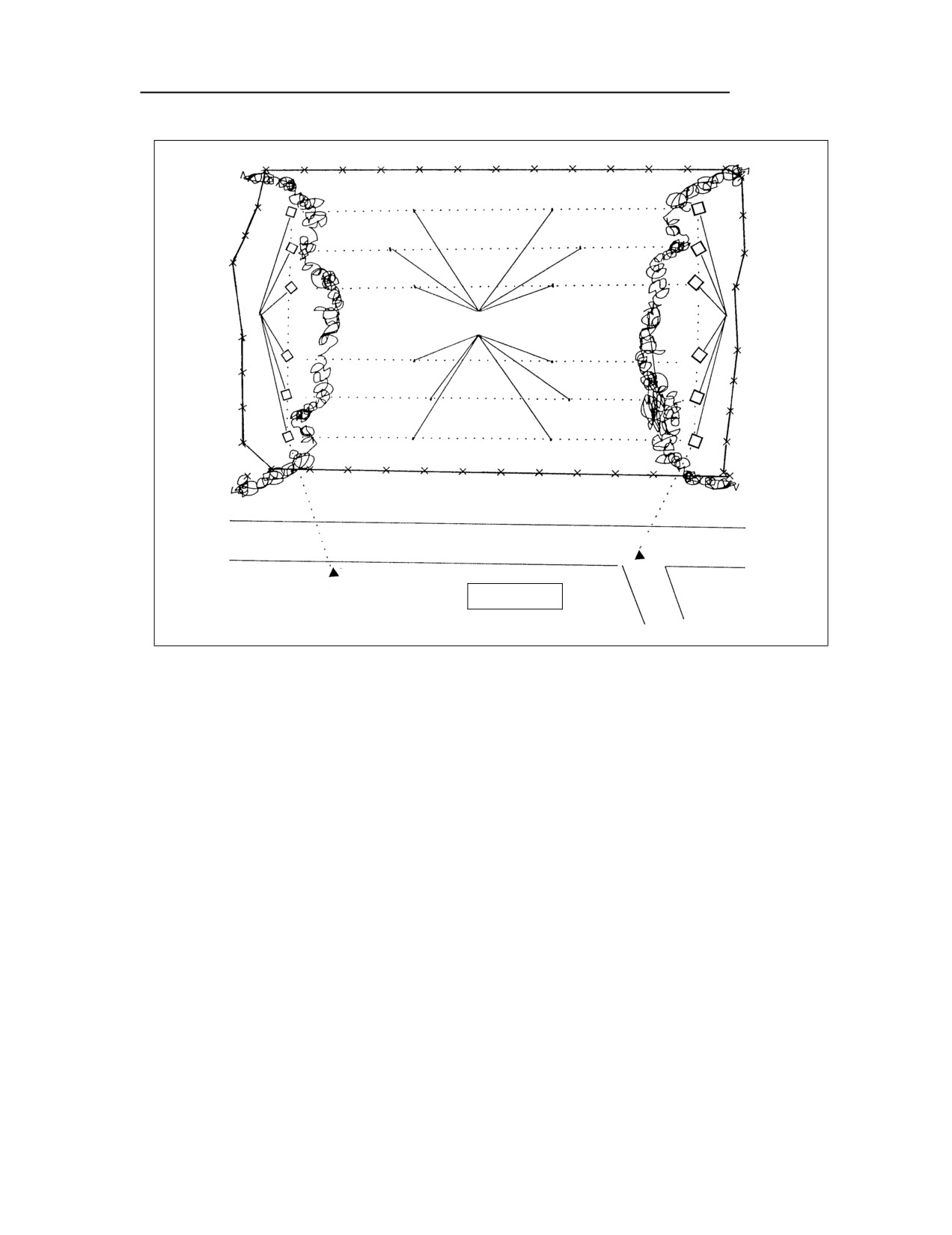
the required control measures (Figure 6-3). The siting-and-recording party
establishes Landmark 2 and the left (or right) rear fence location. Personnel
also assist the PSG in siting mine dumps near the minefield.
MINE-LAYING VEHICLES
Soldiers normally lay row minefields from a tactical vehicle. Consider
vulnerability, capacity, and trafficability when selecting a vehicle. Before
emplacing the minefield and preparing the vehicle for mine laying, drive it in
a random pattern across the minefield site. The random pattern deceives the
enemy by masking the actual laying pattern. Load enough mines so that each
vehicle can complete at least one entire row before reloading, but do not stack
fused mines more than two-high.
LAYING A ROW MINEFIELD
The following drills demonstrate how to lay a minefield:
Drill 1
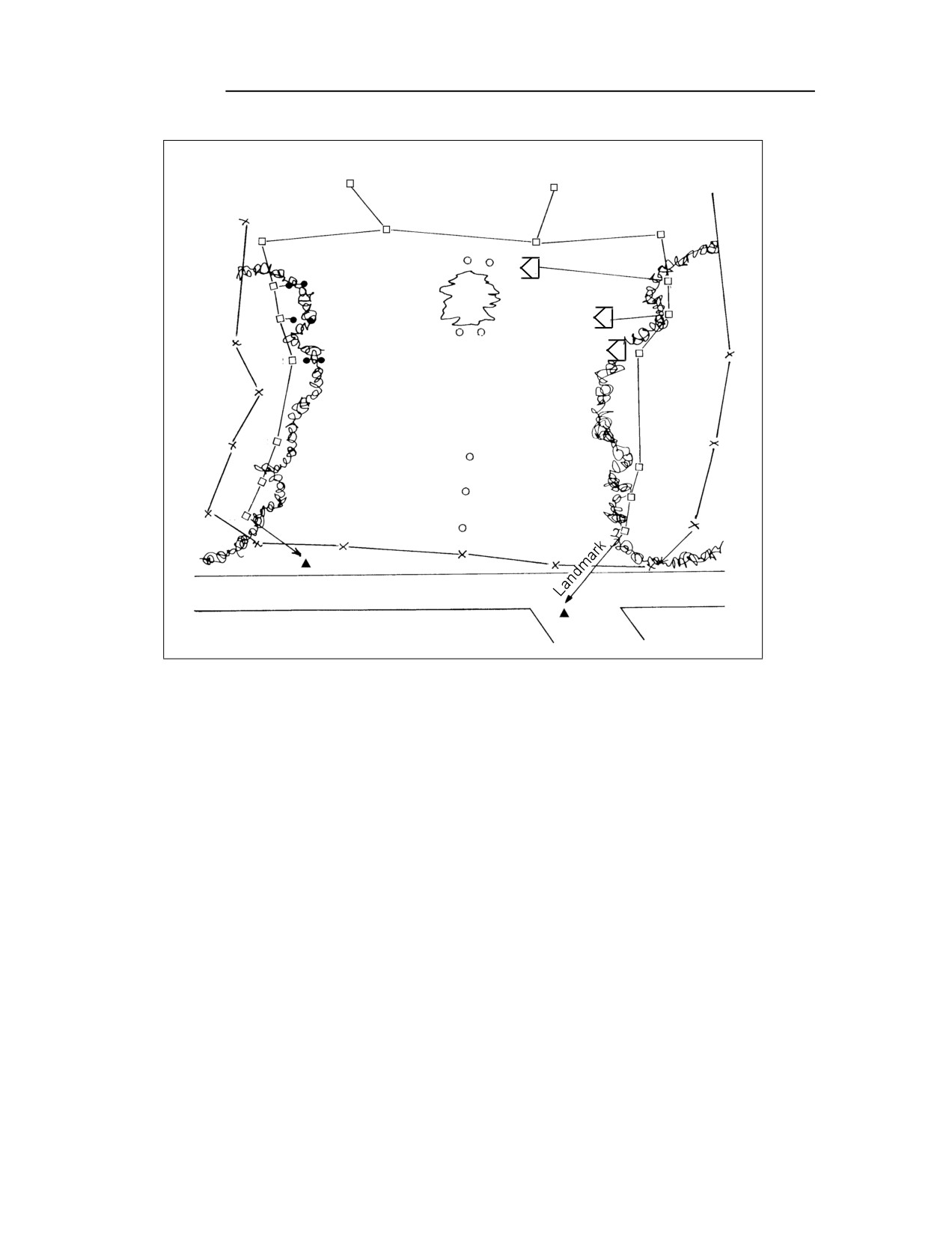
Squad vehicles arrive on the site and proceed down the left (or right) boundary
of the minefield to their assigned row. (A separate party must be detailed to
install the IOE.) At the start row marker, the squad vehicle moves into
position and prepares to lay mines. The squad leader for Row A directs Vehicle
1 to move out.
Mines are laid on the ground at the required spacing, along the temporary
markers positioned by the siting-and-recording party.
6-18 Row Mining
FM 20-32
A2
A1
B2
B1
C2
C1
End
Start
row
Intermediate control markers
row
markers
D2
D1
markers
E2
E1
F2
F1
Fence location
Landmark 1
Landmark 2
Mine dump
Figure 6-3. Site layout
As mines are laid, the arming party moves behind the vehicle and arms the
mines. Personnel remove temporary markers installed by the siting-and-
recording party and replace the end row markers with permanent markers.
When Vehicle 1 moves a safe distance (approximately 25 meters) along Row A,
Vehicle 2 begins to lay mines on Row B. When Vehicle 2 moves a safe distance
along Row B, Vehicle 3 begins to lay mines on Row C.
The marking party continues to emplace the left and right boundary fences
(Figure 6-4a, page 6-20).
The IOE party exits the minefield outside the left (or right) boundary after it
completes the IOE.
When Vehicles 1 and 2 finish their assigned rows, they move past the end row
marker and execute a left (or right) turn and wait for Vehicle 3 to complete its
row. All vehicles move in column down the left (or right) boundary to the mine
dump, load the next row’s mines, and then move to their next assigned row.
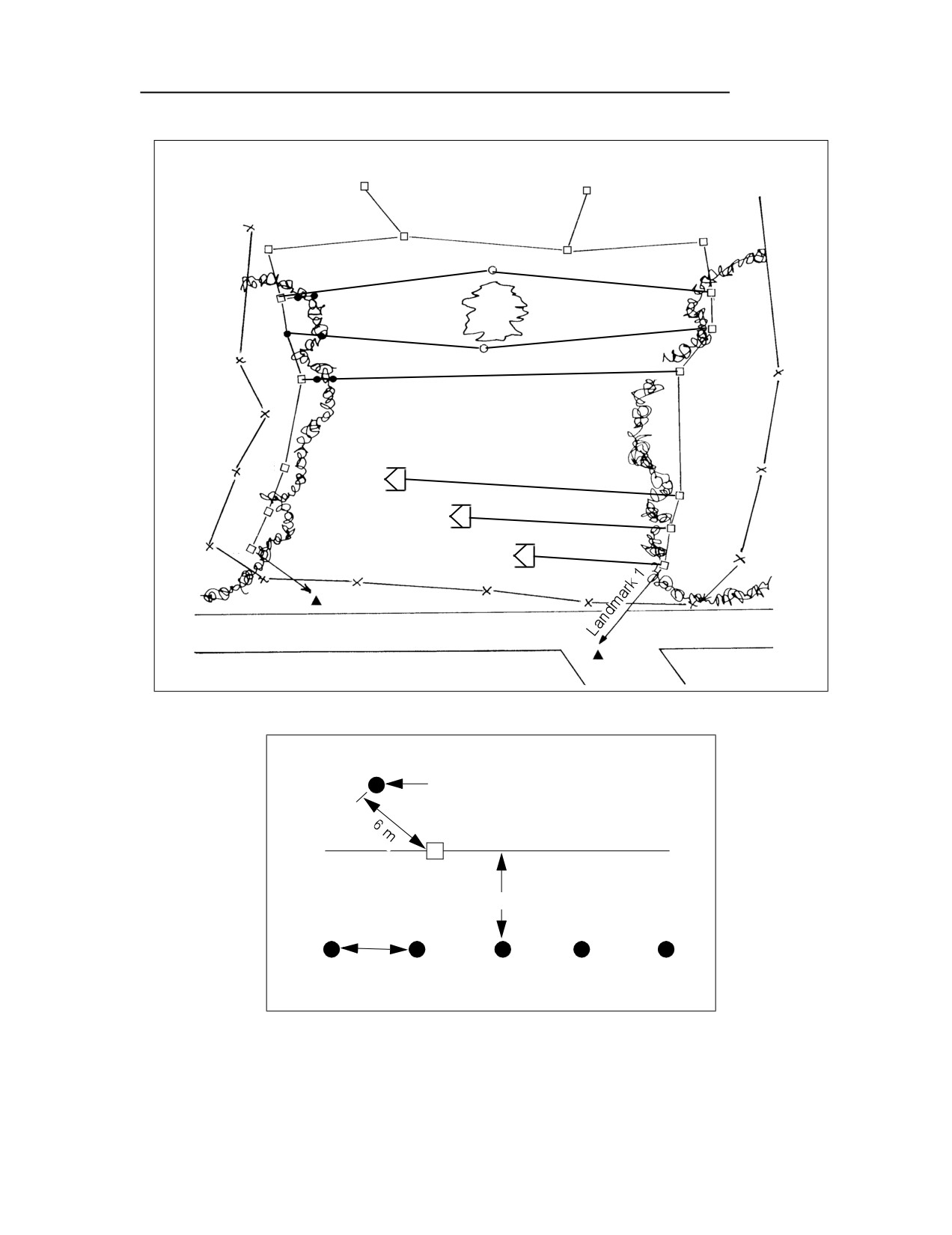
The process of laying and arming mines is repeated (Figure 6-4b, page 6-21).
After the minefield is laid, all the vehicles exit down the left (or right)
boundary and out the rear. The marking party completes the rear boundary
fence, and the recording party completes DA Form 1355. The OIC or PSG
ensures that the DA Form 1355 is complete and accurate and signs it.
Row Mining 6-19
FM 20-32
I2E
I1E
IOE1
IOE2
I2
I1
A2
Vehicle 1
A1
B2
Vehicle 2
B1
Vehicle 3
C1
C2
D2
D1
E
E
F
F
Landmark
Figure 6-4a. Laying a minefield
Drill 2
This drill may be used to speed up mine laying; however, strict C2 is vital to
ensure security and safety. This method is difficult to use when the terrain is
rugged or when weather or visibility is subject to change.
The drill is conducted by three squad vehicles, each laying one row. Row B has
turning points and Rows A and C do not. If the minefield has six rows, Row E
has turning points and Rows D and F do not. The squad leader (laying leader)
in Row B (and Row E, if required) is in charge of the overall laying.
Squad vehicles arrive on the site and proceed down the left (or right) boundary
of the minefield to their assigned row. Squad vehicles move into position at
start row markers and prepare to lay mines.
The laying leader directs Vehicle 1 to move out on Row A. The sapper team
lays mines on the ground at the required spacing. If an IOE is required, the
Row A team emplaces the IOE concurrently with Row A and at the same
spacing. When Vehicle 1 reaches the IOE short-row start marker, the laying
party lays mines along an azimuth designated by the laying leader (Figure 6-
5). After the IOE short row is laid, Vehicle 1 returns to Row A and continues
laying mines.
6-20 Row Mining
FM 20-32
I2E
I1E
IOE1
IOE2
I2
I1
A1
A2
B1
B2
C1
C2
D2
D1
E2
E1
F2
F1
Landmark 2
Figure 6-4b. Laying a minefield (continued)
First mine in the IOE
short row
15 m
Row A
6m
Figure 6-5. Laying an IOE short row
Row Mining 6-21

FM 20-32
After all the mines are laid, the arming party moves behind the vehicle and
arms the mines. Personnel remove temporary markers and replace start and
end row markers with permanent markers. The arming party must be
distinguishable from everyone else. The last member of the arming party
should wear a colored vest or carry a specific colored chem-light. No one is
allowed behind the last member of the arming party.
The NCOIC completes a strip feeder report (Figure 6-6) and gives it to the
recording party. The strip feeder report includes the number of mines laid, the
type of mines laid, azimuths of IOE strips and turning points, AHDs emplaced
(by cluster number), and any other information (such as omitted mines) the
platoon leader requires.
STRIP FEEDER REPORT FOR STRIP/ROW _________
Type of
Number
AHDs by
IOE-Strip
Turning-Point
Remarks
Mine
of Mines
Cluster
Azimuth
Azimuth
Figure 6-6. Sample strip feeder report
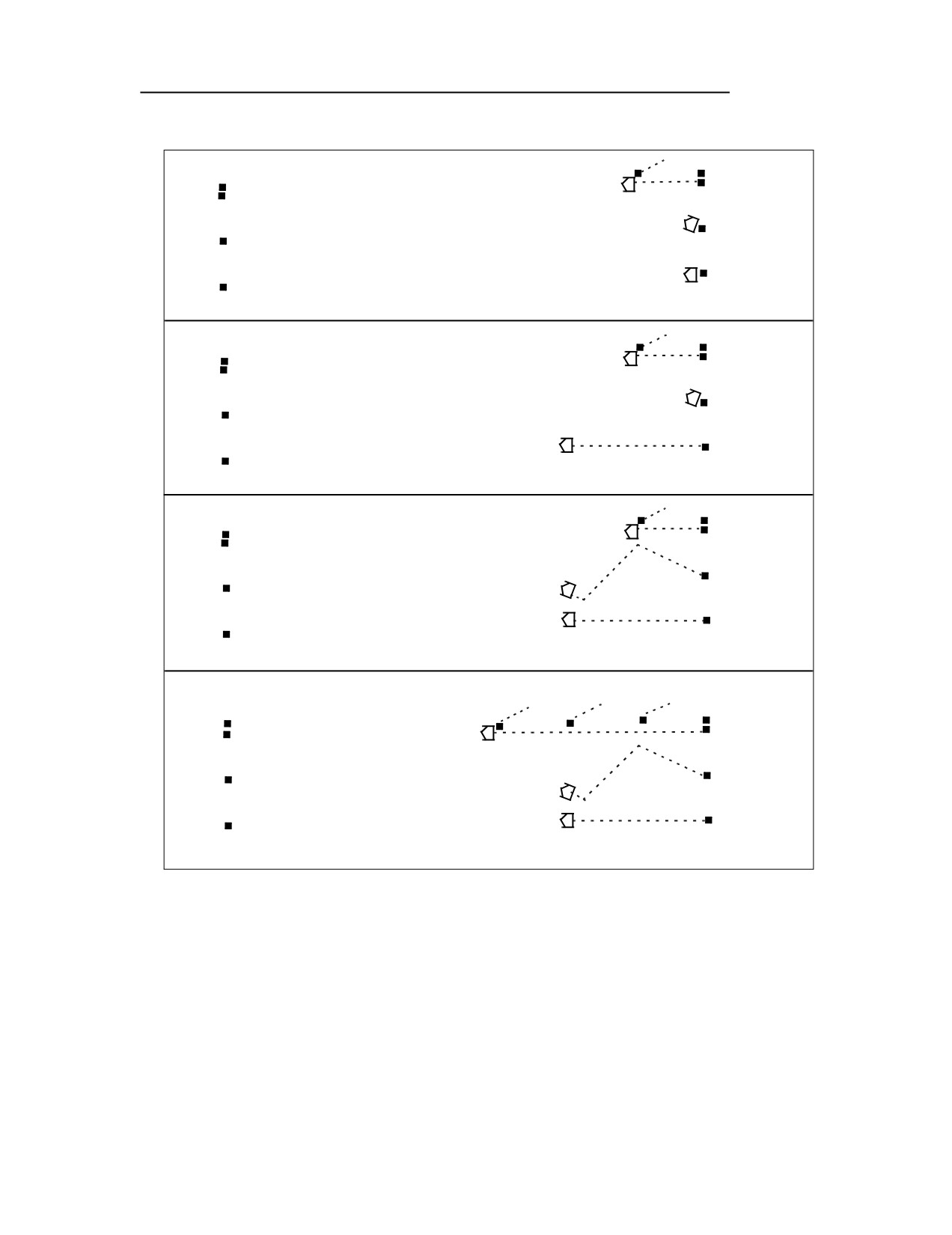
Vehicle 1 moves down Row A and lays mines until the laying leader directs it
to stop. (The laying leader chooses vehicle stops to coincide with the locations
of turning points.) The laying leader then directs Vehicle 3 to begin laying
mines along Row C. Vehicle 3 lays mines on Row C until the laying leader
directs it to stop (somewhere well past Vehicle 1).
Vehicle 2 moves toward Vehicle 1 and begins to lay mines on Row B. He lays
mines to within 15 meters of Vehicle 1. Vehicle 2 then turns toward Vehicle 3
and lays mines on Row B to within 15 meters of Vehicle 3. Vehicle 2 then turns
back toward Vehicle 1 and continues to lay mines in this pattern until Row B
is laid.
Figure 6-7 shows vehicle positions when using the above method to lay a row
minefield.
NOTES:
1. At night or during low visibility, Vehicle 1 has two red flashlights
and Vehicle 3 has two green flashlights. The flashlights are held side
by side, and pointed toward Vehicle 2. The driver of Vehicle 2 moves
forward until he is within 15 meters of the lights or until the light
holder turns the lights off.
6-22 Row Mining
FM 20-32
IOE1
IOE2
A1
A2
Vehicle 1
Vehicle 2
B1
B2
Vehicle 3
C1
C2
Step 1: Vehicle 1 lays mines until it is stopped by the laying leader.
IOE1
IOE2
A1
A2
Vehicle 1
Vehicle 2
B1
B2
C1
C2
Vehicle 3
Step 2: Vehicle 3
lays mines until it is stopped by the laying leader.
IOE1
IOE2
A1
A2
Vehicle 1
B1
B2
Vehicle 2
C1
C2
Vehicle 3
Step 3: Vehicle 2
lays mines, turns at Vehicle 1, and lays mines toward Vehicle 3.
IOE2
IOE1
A1
A2
Vehicle 1
B2
B1
Vehicle 2
Vehicle 3
C1
C2
Step 4: Vehicle 1
repeats Step 1, to include emplacing IOE strips.
Figure 6-7. Laying a row minefield
2. If the platoon leader feels that low visibility or other reasons
preclude the use of vehicle positions as turning points, he may have
the siting party emplace turning-point markers (three intermediate
markers) for Vehicle 2 to use as a guide. In this event, the three
vehicles emplace mines simultaneously.
After Vehicles 1 and 2 finish their assigned rows, they move past the end row
marker, execute a left (or right) turn, and wait for Vehicle 3 to complete its
row. All the vehicles move in column down the left (or right) boundary to their
next assigned row, if there is one, and continue to lay and arm mines. This
Row Mining 6-23
FM 20-32
process is repeated until the entire minefield is laid. All the vehicles then exit
the minefield down the left (or right) boundary and out the rear. The marking
party completes the rear boundary fence, and the recording party completes
DA Form 1355. The OIC or PSG ensures that the DA Form 1355 is complete
and accurate and signs it.
IMMEDIATE-ACTION DRILL
If the enemy attacks the platoon during minefield emplacement, the laying
party should execute the following actions:
• Sapper teams enter vehicles and recover spacing sandbags.
• Vehicle 1 exits the minefield by making a wide turn around the front
of the other two vehicles.
• Vehicle 2 follows by making a wide turn around the front of Vehicle 3.
• Vehicle 3 exits the minefield.
• The three squads conduct the immediate-action drill as ordered by the
platoon leader.
SQUAD DRILL
During row mining, the squad in each laying vehicle performs the following
actions:
•
Squad leader.
— Directs the squad to start laying mines.
— Supervises mine arming and placing.
— Allocates a vehicle, if possible, to help remove spoil from the site.
•
Carrier team.
— Moves the APC to the row start point.
— Lowers the APC ramp until it is horizontal or opens the rear door.
(If using the APC ramp to distribute mines, chains the ramp open
to support the weight.)
— Moves the APC at a low speed (3 to 5 kph) in a straight line toward
the row end point.
•
Sapper team.
— Soldier 1 ties the rope to the end of the lowered ramp or the tow
pintle.
— Soldier 2 ties the partially filled sandbag on the other end of the
rope. (The rope length from the end of the ramp door to the
sandbag is the correct spacing between mines [Figure 6-8]).
— Soldier 3 (squad leader) positions the team members. Soldier 1 is
at the rear of the compartment, Soldier 2 sits on the edge of the
APC ramp or open door, and Soldier 4 walks behind the APC.
— Soldier 1 fuses a mine and passes it to Soldier 2. (Korea Only: If
AP mines are also laid, they are given out simultaneously.)
— Soldier 2 records all the mines issued.
— Soldier 2 places the fused mine on the ground when the sandbag
tied to the rope is even with the previously laid mine.
— Soldier 3 (squad leader) walks behind the vehicle and supervises
mine laying.
6-24 Row Mining