FM 20-32 Mine/Countermine Operations (August 2001) - page 2
FM 20-32
charge reduction assets. In short, the minefield must discourage any attempts
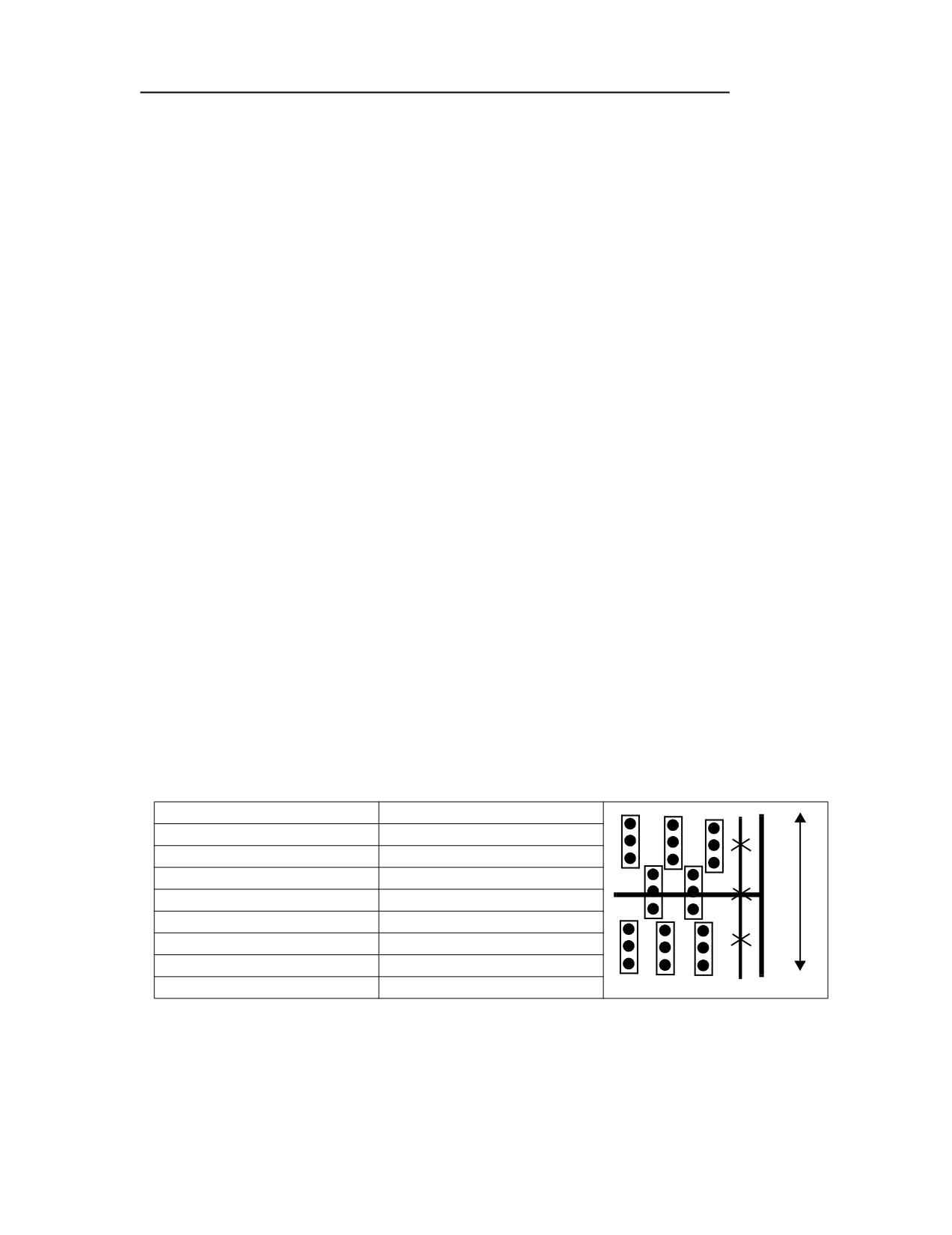
to breach and must entice the enemy to bypass rather than reduce. Figure 2-7
depicts a turn effect on an attacking battalion, with turn-effect minefields
arrayed in a group across a 1,500-meter AA. The angle of the minefields
should be subtle, encouraging the enemy to bypass individual minefields.
Each minefield overlaps another one to tie the minefields together and
prevent gaps. This is considered in the resource factor (1.2) for a turn-obstacle
group. This factor, multiplied by the width of the AA, equals the amount of
linear obstacle effort required for this turn effect.
As shown in Figure 2-4, page 2-9, turn-effect minefields must be extremely
lethal and achieve approximately 80 percent probability of encounter. In other
words, an enemy vehicle attempting to reduce or pass through the minefield
will likely encounter a mine. This forces the small-unit commander to make
an immediate decision—breach or bypass. A lethal minefield that is covered
by intense fires and has an easily detectable bypass reduces breach decisions
to instinct and causes the enemy to choose the bypass (turn). To produce this
lethality, the majority of mines should be full-width AT. Full-width mines in
the first rows the enemy encounters and in the depth of the minefield either
exhaust the enemy's breaching assets or convince him to bypass early. AHDs
are not required because the enemy force will seldom commit to dismounted
breach when faced with intense direct and indirect fires. An IOE should not be
used because the enemy must be able to determine the orientation of the
minefield and the bypass.
Block
A block effect (Figure 2-8) integrates fire planning and obstacle effort to stop
an attacker along a specific AA or prevent him from passing through an EA.
Block obstacles are complex and are integrated with intense fires; they do not
stop an attacker by themselves. Individual block obstacles are employed
successively in a relatively shallow area. When the enemy reduces one block
obstacle, it is critical that he encounters another, thus denying him to project
combat power and maintain momentum. Block obstacles must defeat the
enemy's breaching effort (mounted and dismounted) as well as his maneuver.
A block effect must span the entire width of an AA and prevent a bypass.
Resource factor
2.4 x AA
Group dimensions
W = 1.0 x AA
Probability of kill
80%
Minefield front
500 m
1.0
Minefield depth
300+ m
AT mines
Yes (pressure/tilt)
AP mines
No (Korea Only: Yes)
AHD
Yes
IOE
Yes
Figure 2-8. Block-effect group
The typical block-effect minefield is 500 meters wide and 300+ meters deep
(includes an IOE). Figure 2-8 depicts a block effect on an attacking battalion.
Note how individual minefields are arrayed to affect the entire width of the
Mine-Warfare Principles 2-13
FM 20-32
AA but in a relatively shallow depth. Eight block-effect minefields are
required in this example to achieve the necessary depth and width. The block
group is the most resource-intensive. A resource factor of 2.4 is multiplied by
the width of the AA to determine the linear obstacle effort required.
The lethality of a block-effect minefield (80 percent or higher) is similar to
that of a turn-effect minefield (see Figure 2-4, page 2-9). The lethality of the
group is considerably higher, since there are enough minefields in the group to
cover more than twice the width of the AA. This lethality is produced by a
density slightly greater than one mine per meter of front and the use of
predominantly full-width AT mines.
A block-effect minefield must be capable of defeating mechanical and
dismounted breach efforts. Therefore, AHDs (Korea Only: and AP mines)
are used to target dismounted breaching. An IOE confuses the attacker about
the exact minefield limits and complicates his employment of mechanical
reduction assets. The depth of the block-effect minefield requires employing
multiple line charges.
The above minefields are not standard solutions to every situation. The
terrain could dictate a decrease or an increase in the effort required.
Incorporating other reinforcing obstacles (AT ditches, road craters, wire,
SCATMINEs) aid in attacking the different reduction assets.
TACTICAL-OBSTACLE INTEGRATION PRINCIPLES
Tactical minefields are considered tactical obstacles and follow the same basic
integration principles. Tactical obstacle C2 focuses on obstacle emplacement
authority and obstacle control.
OBSTACLE EMPLACEMENT AUTHORITY
Obstacle emplacement authority is the jurisdiction that a unit commander
has to emplace tactical obstacles. In a theater of operations (TO), theater
commanders have the authority to emplace obstacles. In most cases, they
delegate that authority to corps commanders who further delegate it to
division commanders. Division commanders then have obstacle emplacement
authority in their area of operations (AO), unless the authority is
subsequently withheld or restricted by a higher commander. Commanders
subordinate to corp and division do not have the authority to emplace
obstacles unless the higher commander delegates authority for a current
operation. Commanders use control measures and other specific guidance or
orders to grant obstacle emplacement authority to subordinate commanders.
Emplacement authority for SCATMINEs is covered in Chapter 3.
OBSTACLE CONTROL
Commanders exercise obstacle control to ensure that obstacles support
current and future operations. Obstacle control ensures that subordinate
commanders emplace obstacles to best support the higher commander’s
scheme of maneuver. It also ensures that subordinate commanders do not
interfere with future operations. Commanders maintain obstacle control by
focusing or withholding emplacement authority or by restricting the types or
locations of obstacles. Commanders use control measures, specific guidance,
and orders to maintain obstacle control.
2-14 Mine-Warfare Principles

FM 20-32
OBSTACLE CONTROL MEASURES
Obstacle control measures are specific control measures that simplify
granting obstacle emplacement authority and providing obstacle control for all
levels of command (Table 2-1). Obstacle control measures are classified as—
• Zone.
• Belt.
• Group.
• Restriction.
Table 2-1. Echelons of obstacle control and effect
Obstacle
Echelon
Specific
Size of Enemy AA/MC
Planning Guidance
Control
Obstacle
Armored
Light vs
Measure
Effects
Armored
Assigned
Corps or
Division/
Brigade/
Requires anticipating
Zone
Optional
division
brigade
battalion
belts and intents
Optional but
Brigade/
Battalion/
Requires anticipating
Belt
Brigade
normal
battalion
company
groups and intents
Corps,
brigade,
Company/
Based on individual
Group
Mandatory
Battalion/TF
division, or
platoon
obstacle norms
battalion/TF
Used only when
necessary to support
Restriction
All
NA
NA
NA
the scheme of
maneuver
A protective obstacle is the only obstacle that can be employed outside a
designated obstacle zone, belt, or group.
A specific obstacle effect (disrupt, turn, fix, or block) may be assigned to
obstacle control measures. This enables the commander to direct the overall
effect of obstacles within a designated zone, belt, or group to support his plan.
At corps and division levels, assigning specific effects to obstacle zones is
optional. At brigade level, the commander will normally assign a specific effect
to the obstacle belts. At TF and battalion levels, obstacle effects for obstacle
groups are required. This ensures that subordinate commanders emplace
tactical obstacles that support the maneuver and fire plans. Assigning a
specific obstacle effect to a control measure becomes obstacle intent, giving the
obstacle effect, target, and location. Obstacle intent provides a direct link
between the obstacle plan, the scheme of maneuver, the commander's intent,
and the fire plan (direct and indirect). Obstacle intent is critical at brigade
level and below, and it becomes the foundation for obstacle group development
and design at the TF level.
Obstacle Zones
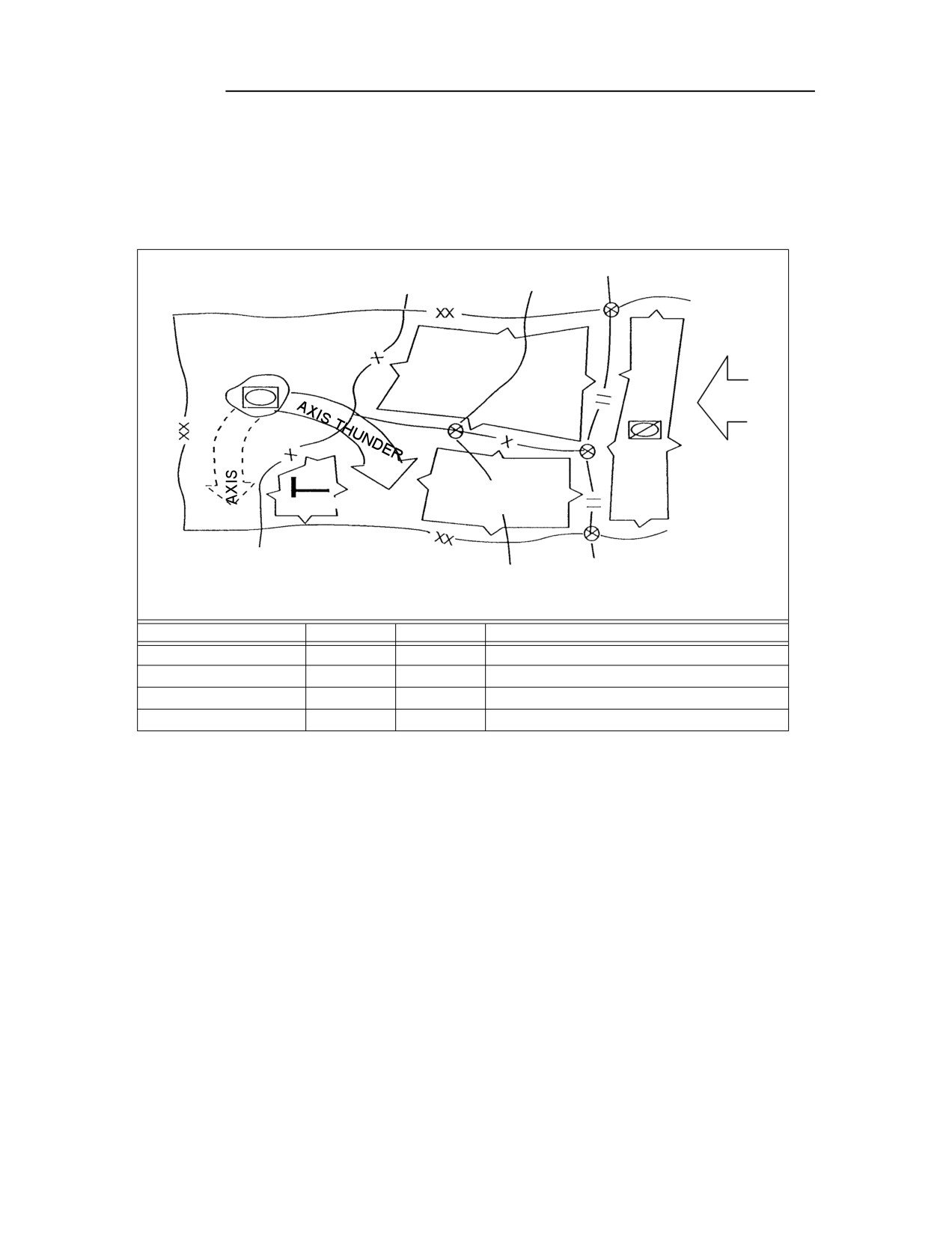
Obstacle zones (Figure 2-9, page 2-16) are graphic control measures that corps
and division commanders use to grant obstacle emplacement authority to
Mine-Warfare Principles 2-15
FM 20-32
brigades (including armored cavalry regiments [ACRs] and other major
subordinate units). Corps and division commanders use zones to ensure that
subordinates emplace obstacles that support the higher commander’s scheme
of maneuver, and to ensure that the obstacles do not interfere with future
operations.
PL JAGUAR
PL LION
PL TIGER
52 ID
ZONE
ZONE A
D
x
2
ENEMY
II
ZONE B
ZONE
(RESTRICTED
PL TIGER
52 ID
PL JAGUAR
PL LION
Obstacle number prefix: IO52
Unit
Zone
Priority
Remarks
1st Brigade
A
3
3d Brigade
B
2
No SCATMINEs with SD after H+2
3d Brigade
C
1
Block intent
Cavalry Squadron
D
4
Figure 2-9. Obstacle zones
Obstacle Belts
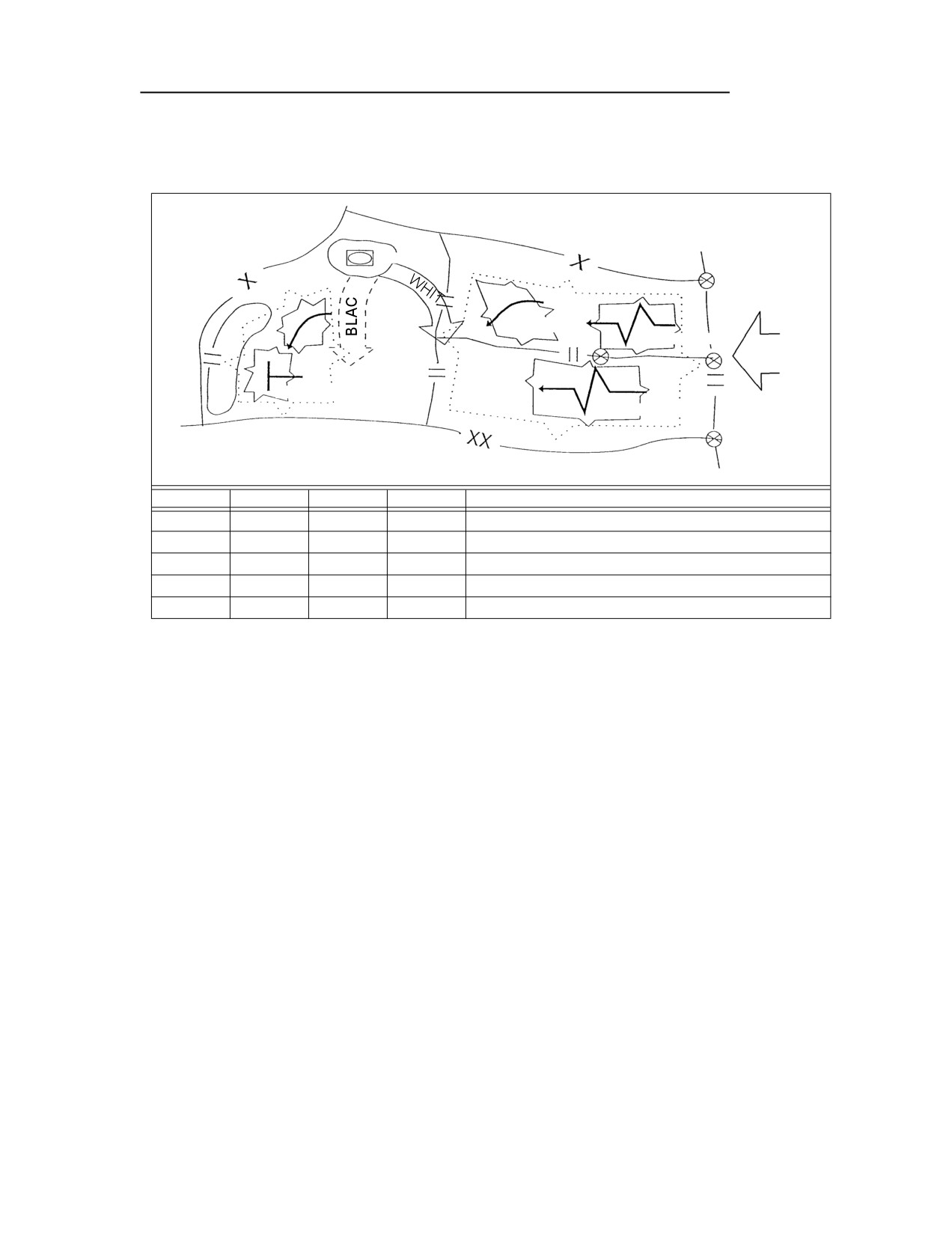
Obstacle belts (Figure 2-10) are graphic control measures that brigade
commanders use to constrain tactical-obstacle employment, and the belts
should not cross unit boundaries. Commanders plan obstacle belts within
assigned obstacle zones to grant obstacle emplacement authority to their
major subordinate units. This is normally the first level in which the
commander assigns an intent to the obstacle plan. It gives TF commanders
the necessary guidance on the overall effect of obstacles within a belt. It does
not designate that all obstacle groups within the belt must be the same effect.
It simply means that the sum effect of groups within the belt must achieve the
assigned belt effect. This serves to synchronize the obstacle effort within the
brigade, particularly between adjacent TFs. Obstacle belts also focus obstacles
2-16 Mine-Warfare Principles
FM 20-32
in support of the brigade scheme of maneuver and ensure that obstacles do not
interfere with the maneuver of any higher headquarters.
I
A
1-78
BELT B2
1-79
BELT B1
BE
ENEMY
LT
BP
1-78
1-4
1-4
18
BELT C2
ZONE C
ZONE B
BELT B3
Unit
Belt
Intent
Priority
Remarks
1-78
C1
Turn
2
1-78
C2
Block
1
1-79
B1
Fix
5
No long-duration SCATMINEs; must SD by H+2
1-79
B2
Turn
3
No long-duration SCATMINEs; must SD by H+2
1-4
B3
Fix
4
No long-duration SCATMINEs; must SD by H+2
Figure 2-10. Obstacle belts
Belts are planned to attack enemy regiments based on an analysis of enemy
battalion MCs. Brigades allocate maneuver companies based on the motorized
rifle battalion (MRB) AAs and organize TFs to defeat the motorized rifle
regiment (MRR). Obstacle belts and their intents are directed against MRR
AAs. This provides the appropriate level of guidance while preserving the TF's
need to refine the obstacle intent, based on how the TF will fight its allocated
companies.
Obstacle Groups
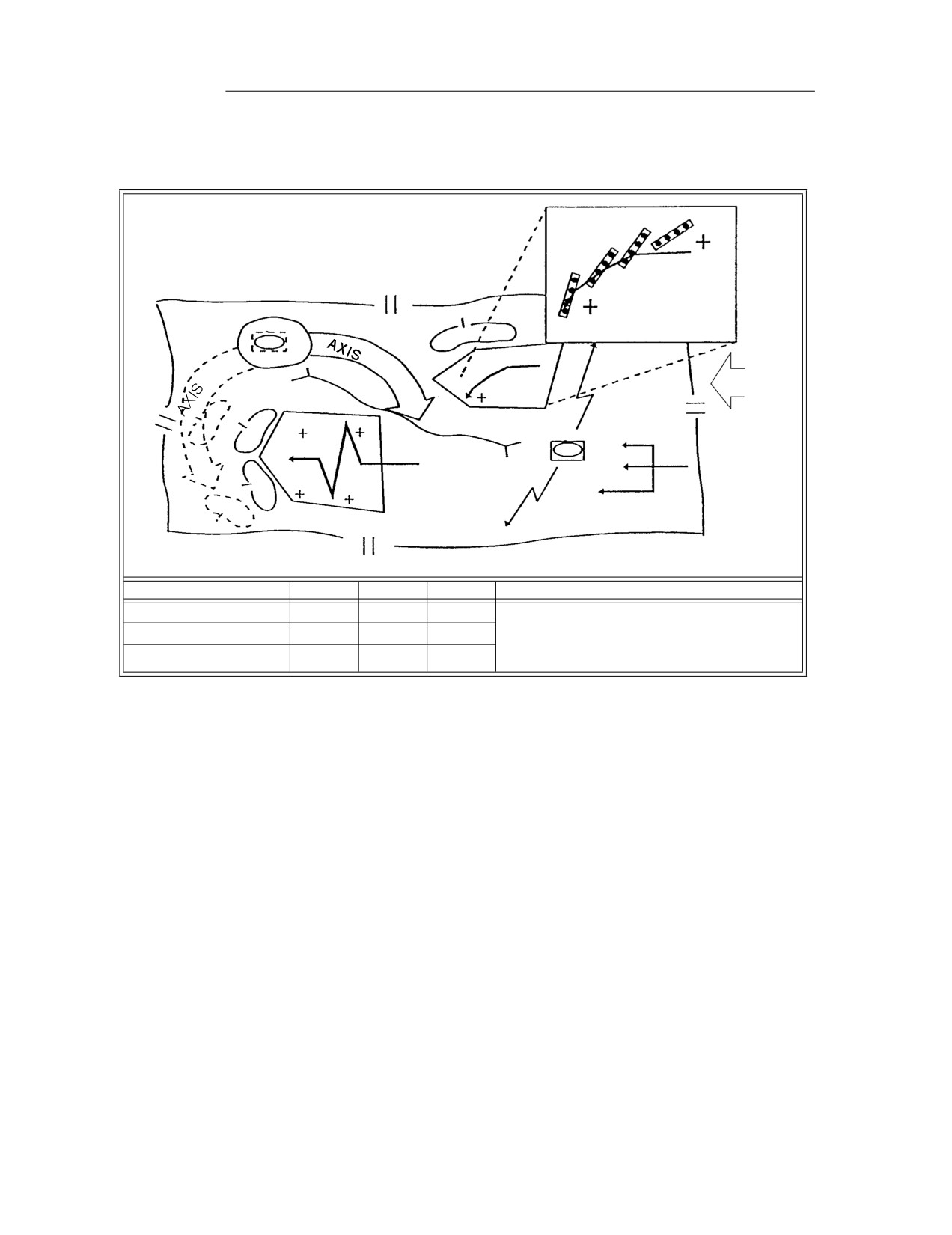
Obstacle groups (Figure 2-11, page 2-18) contain one or more individual
obstacles that are grouped together to provide a specific obstacle effect. TFs
use obstacle groups to ensure that company teams emplace individual
obstacles that support the TF scheme of maneuver. In rare cases, brigades,
divisions, or even corps may use obstacle groups for specific tactical obstacles.
Mine-Warfare Principles 2-17
FM 20-32
Also, units perform detailed integration of obstacle groups with direct- and
indirect-fire plans.
Individual
01
obstacles
B3B
02
I
30
A
1-4
01
EA RED
B3B
ENEMY
02
21
05
20
I
EA
03
A
1-4
B3C
B3A
06
04
10
11
Unit/BP
Group
Intent
Priority
Remarks
Company A/Screen
B3A
Disrupt
3
All groups restricted:
• Long-duration SCATMINEs are not allowed.
Team B/BP 30
B3B
Turn
1
• Short-duration SCATMINEs must be
Team D/BP 10
B3C
Fix
2
emplaced by H-3.
Figure 2-11. Obstacle groups
A TF allocates platoons against motorized rifle company (MRC) MCs and
task-organize them into companies/teams to defeat MRBs. Likewise, direct-
fire plans are designed based on the maneuver of MRBs and independent
MRCs. Therefore, obstacle groups are used to attack the maneuver of MRB-
size forces. Groups are designed specifically to support the direct-fire plan of
the TF. The TF designates groups rather than obstacles because the location
of individual obstacles hinges on siting at the company/team level. The group
effect or obstacle intent drives obstacle siting and is therefore more important
to convey to commanders. There can be more than one type of obstacle group
to support the overall intent of an obstacle belt. This is because the belt design
is based on the brigade’s scheme of maneuver, without knowing the TF’s
direct-fire plan and scheme of maneuver. Groups are developed once the fire
plan is established.
Obstacle Restrictions
Commanders at all levels may use obstacle restrictions to provide additional
obstacle control. They may use obstacle restrictions to limit the specific types
of obstacles used (for example, no buried mines and no SCATMINEs that do
not self-destruct within 48 hours). These restrictions ensure that subordinates
do not use obstacles with characteristics that impair future operations. It also
allows commanders to focus the use of limited resources for the main effort by
restricting their use elsewhere. Commanders may also use restrictions to
2-18 Mine-Warfare Principles
FM 20-32
prevent subordinates from emplacing obstacles in a certain area. This type of
restriction may be shown graphically as an obstacle-restricted area.
FRATRICIDE PREVENTION
The modern tendency toward maneuver warfare and the disappearance of the
linear battlefield places repositioning forces at an increased risk of fratricide
by minefields. Obstacle control and the use of graphic obstacle control
measures are vital in preventing minefield fratricide at every echelon.
Obstacle control is further facilitated by positive C2 of all sustainment traffic,
tactical repositioning, obstacle turnover, well-established and disseminated
traffic plans with traffic control, and strict adherence to minefield marking
procedures (discussed later in this chapter).
MANEUVER-PLAN SUPPORT
Commanders include obstacle planning in each level of the decision-making
process. This ensures that obstacle integration is effective and that the
obstacle plan is flexible enough to allow changes during the planning,
preparation, and execution phases of an operation. The following method is
used to integrate obstacle planning at the TF level; it uses the decision-
making doctrine contained in FM 101-5. Obstacle planning for brigade and
higher levels can be found in FM 90-7.
The focus of obstacle planning is to integrate obstacles into the maneuver
direct- and indirect-fire plans. This planning is directive and detailed in
nature and focuses on the determination of obstacle groups and the type and
amount of prepared positions. Actual obstacle siting, emplacement, and
position location are the purview of the company/team commander and are
normally supported by an engineer platoon.
TF-level defensive planning is part of the military decision-making process.
The engineer battlefield assessment (EBA) process provides the basis for
integrating engineer issues into the decision-making process.
Mission Analysis
The key activities during mission analysis are to—
• Determine facts and assumptions.
• Analyze relative combat power.
• Analyze the engineer battalion’s/brigade’s mission and the
commander’s intent.
• Issue the commander’s guidance.
Determine Facts and Assumptions
Defensive planning normally starts with the receipt of a warning order (WO)
from the higher headquarters to defend. The company executive officer (XO)
and the battlefield information control center (BICC) (or the TF engineer and
the Intelligence Officer [US Army] [S2]) begin by developing a situation
template (SITEMP) that includes a modified combined obstacle overlay
(MCOO). The MCOO is a product developed during the intelligence
preparation of the battlefield (IPB) process. The MCOO development is a joint
effort of the engineer and the intelligence section of the TF’s tactical
operations center (TOC).
The MCOO should define the AAs and the MCs within the TF’s AO. This
information is vital to obstacle planning. Obstacles are placed on AAs to
attack enemy maneuver. The AA analysis details potential EAs and indicates
where forces can defend with limited survivability construction, because a
reverse slope or undulating terrain provides natural concealment and cover.
Mine-Warfare Principles 2-19
FM 20-32
The threat evaluation and the enemy course-of-action (COA) development
detail how the enemy will potentially attack. They also provide an insight as
to what and where the enemy’s objective and routes might be. The SITEMP
helps the engineer to understand how the enemy will traverse through the
TF’s sector and allows the engineer to gain an understanding of how and
where he can best attack the enemy’s maneuver.
The SITEMP also depicts how the enemy’s reconnaissance forces will enter
the sector. This is especially important when countering the enemy’s ability to
reconnoiter obstacle efforts.
The engineer must articulate the current capabilities of the engineer forces,
its current combat power, and its ability to support the TF. Assumptions of
future capability or potential reinforcement by other engineers should be
analyzed. Specific characteristics of special engineer equipment and
SCATMINE systems are detailed for the staff. An initial Class IV/V supply-
point location and an operation plan should be developed with the TF staff
(note that the TF has responsibility for Class IV/V supply-point operation).
The XO/first sergeant (1SG) works with the TF and the engineer battalion
Supply Officer (US Army) (S4) to ensure that delivery of Class IV/V barrier
material supports the TF countermobility plan.
Analyze Relative Combat Power
The engineer compares friendly and enemy combat power and identifies
possible obstacle requirements that offset potential enemy breaching and
direct- and indirect-fire capabilities. The actual inclusion of the obstacles
normally occurs after COA development. During this phase, the engineer
finishes his EBA to gain an understanding for the engineer company’s ability
to support the TF.
Analyze the Engineer Battalion’s/Brigade’s Mission and the Commander’s Intent
The staff analyzes and identifies information from the maneuver brigade
order and the commander’s intent that will potentially impact defensive
planning. The engineer analyzes the maneuver brigade/engineer battalion
commander’s intent to determine potential obstacle placement, obstacle
intent, and construction priority based on his concept of the operation.
The TF must identify tasks and limitations imposed from the brigade
operation order (OPORD). These might include obstacle belts with or without
specific intents, obstacle-restricted areas, or restrictions on the type of
obstacles. Also, the brigade OPORD might specify reserve, situational, or
directed obstacle groups.
The engineer must identify the TF’s total obstacle capabilities. Available
assets include engineer units, SCATMINE systems, and other units that can
provide additional manpower for obstacle construction. Engineer-equipment
status, work rates, and the time available must be evaluated in detail.
NOTE: Work rates should only be used in the absence of unit-
developed planning factors.
Table 2-2 provides planning factors for the mine dump. Tables 2-3 through 2-6,
pages 2-21 through 2-23, provide planning factors for obstacles. Special focus
to limited visibility work rates and engineer squad strengths must be made
when making total-capability estimates. Plan to accomplish obstacle siting
2-20 Mine-Warfare Principles

FM 20-32
and Class IV/V supply-point setup during daylight hours, and plan to emplace
mines during limited visibility hours as much as possible.
Table 2-2. Planning factors for the mine dump
Number of Personnel
Quantity of Mines
Required Equipment
2-man team (2 minutes per mine)
25 mines per hour
Shears, metal cutting
Grease, automotive and artillery
Squad (7 soldiers and an NCO)
100 mines per hour
Rags
300 mines per hour; 3,600 mines
Platoon (with leadership)
Work gloves
per day
Flashlight
Night-vision goggles
Company
10,800 mines per day
Pliers
NOTE: Soldiers work 50 minutes per hour, 12 hours per day.
Table 2-3. Planning factors for work rates
Survivability
Time Required to Construct
With D7F Dozer
With ACE
With SEE
Hull-defilade position
1 BTH
1.5 BTH
NA
Turret-defilade position
2.5 BTH
3.5 BTH
NA
HMMWV TOW position
1.5 BTH
2 BTH
NA
Vehicle-protective position
0.75 BTH
1 BTH
NA
Dismount-crew position
NA
NA
1 SEEH
Individual-fighting position
NA
NA
0.5 SEEH
Countermobility
With D7F Dozer
With ACE
In Man-Hours
Antitank ditch
1 BTH/70 m
1 BTH/50 m
NA
Standardized disrupt minefield
NA
NA
1.5 PH
Standardized fix minefield
NA
NA
1.5 PH
Standardized turn minefield
NA
NA
3.5 PH
Standardized block minefield
NA
NA
5 PH
Triple-standard concertina
NA
NA
1 PH/300 m
Road crater
NA
NA
1.5 SH
Point minefield
NA
NA
1 SH
Concertina roadblock
NA
NA
1 SH
Bridge demolition (massive)
NA
NA
2 SH
Bridge demolition (steel)
NA
NA
1 SH
Mine preparation at the TF Class IV/V
NA
NA
1 SH/100 mines
supply point
LEGEND:
BTH (blade team hour). One blade team working for one hour. A blade team consists of two engineer
blades (two dozers, two ACEs, or one ACE and one dozer). One vehicle digs (cutter) while the other
spreads the spoil (striker). A dozer-ACE blade team uses the dozer BTH.
SEEH (SEE hour). One SEE working for one hour.
PH (platoon hour). One platoon (3 squads) working for one hour.
SH (squad hour). One squad working for one hour.
Mine-Warfare Principles 2-21

C2, FM 20-32
Table 2-4. Planning factors for standardized row minefields
Effect
Resource
Front
Depth
Full-Width
Track-Width
Frag AP Mines
Factor
AT Mines
AT Mines
Disrupt
0.5
250 m
100 m
42
84
NA
Fix
1.0
250 m
120 m
63
84
NA
Turn
1.2
500 m
300 m
336
168
NA
Block
2.4
500 m
320 m
378
168
84
(Korea Only)
Table 2-5. Planning factors for scatterable minefields
System
Minefield Size
SD Time
Arming Time
Within 1 min
400 x 400 m
4 hr
ADAM
after ground
200 x 800 m
48 hr
impact
400 x 400 m
4 hr
RAAM
2 min 45 sec
200 x 800 m
48 hr
Turn or block (1 per load):
•
Ground: 555 x 320 m
Volcano (one load = 160
4 hr
•
Air: 557 x 320 m
canisters or 960 mines
5 days
2 min
Fix or disrupt (4 per load):
[800 AT and 160 AP])
15 days
•
Ground: 277 x 120 m
•
Air: 278 x 120 m
MOPMS
70 x 35 m
4 hr*
89 sec
*Can be recycled 3 times for a total of 13 hr
2-22 Mine-Warfare Principles

FM
20-32
Table 2-6. Ranges of common weapons
Weapon
Maximum
Planning
Effective Range
Range*
FRIENDLY WEAPON SYSTEMS
M16A2
580 m
400 m
M249 SAW
1,000 m
800 m
M60
1,100 m
1,100 m
Area
350 m
350 m
M203
Point
160 m
160 m
Area
1,830 m
1,830 m
M2, .50 Cal
Point
1,200 m
1,200 m
Area
2,200 m
2,200 m
MK19
Point
1,600 m
1,600 m
AT4
300 m
300 m
M47 Dragon
1,000 m
800 m
Javelin
2,000 m
2,000 m
105 mm
2,500 m
2,000 m
M1 Abrams tank
120 mm
3,000 m
2,500 m
25 mm (APDS)
3,000 m
1,700 m
M2 Bradley ITV
25 mm (HEI-T)
3,000 m
1,700 m
TOW2
3,750 m
3,750 m
HE
3,400 m
50 m (min)
60-mm mortar
WP
4,800 m
50 m (min)
ILLUM
931 m
50 m (min)
HE
4,595 m
75 m (min)
81-mm mortar
WP
4,595 m
75 m (min)
ILLUM
3,150 m
75 m (min)
HE
6,840 m
770 m (min)
4.2-in mortar
WP
5,650 m
920 m (min)
ILLUM
5,490 m
400 m (min)
SOVIET-STYLE WEAPON SYSTEMS
BMP, 73 mm
800 m
800 m
AT3 missile
3,000 m
3,000 m
AT5 missile
4,000 m
4,000 m
BMP-2
2,000 m
2,000 m
BTR, 14.5 mm
2,000 m
1,000 m
T-72 tank, 125 mm
2,100 m
2,000 m
T-80 tank, 125 mm
2,400 m
2,000 m
T-80 AT8
4,000 m
4,000 m
*The planning range is based on ideal weather conditions during daylight.
Mine-Warfare Principles 2-23
FM 20-32
Issue the Commander’s Guidance
The commander should be as specific as possible with his initial obstacle
guidance. If the commander narrows the COA focus, he should also provide
obstacle guidance. His guidance is a key factor to an early start and must be
solicited if not offered.
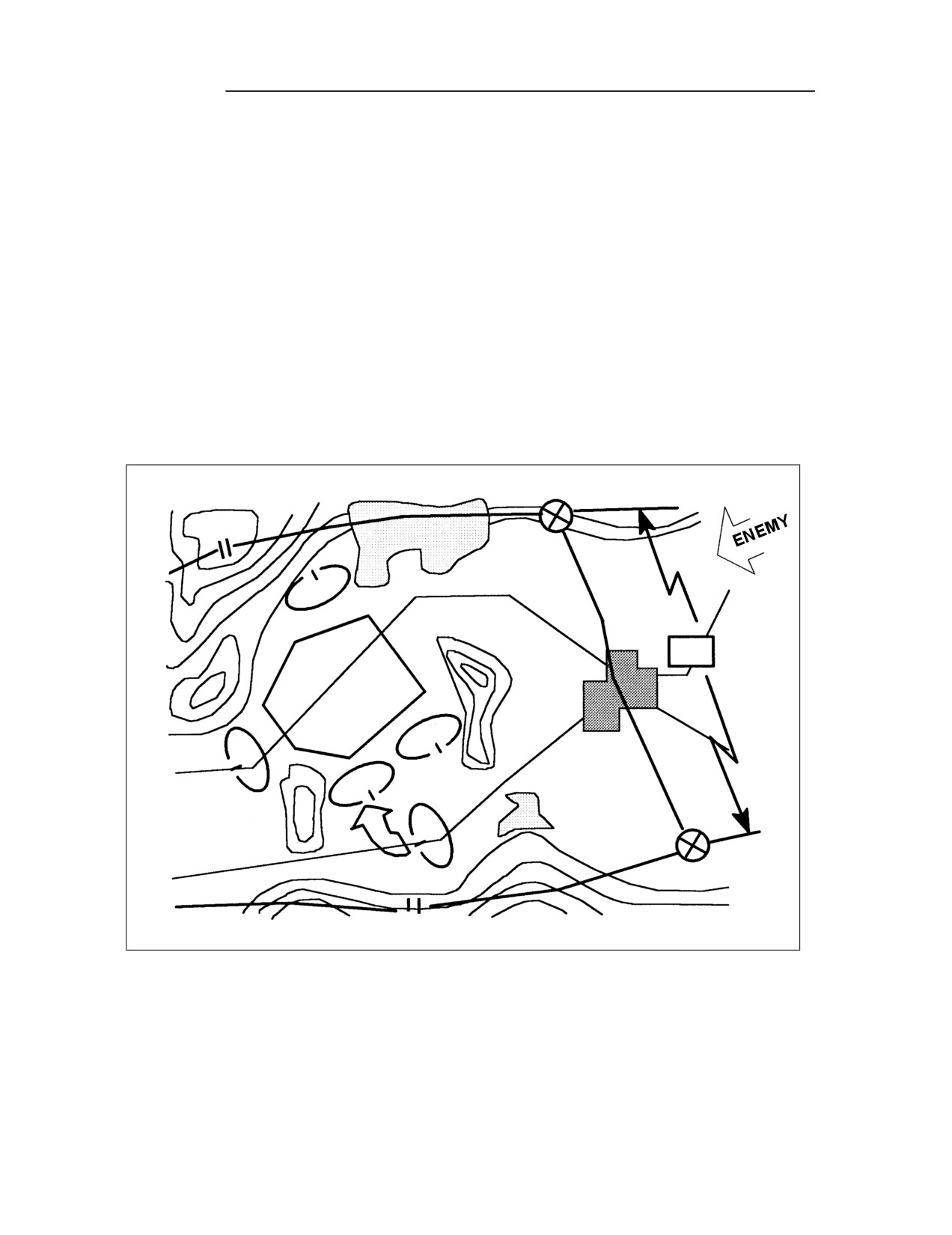
Course-of-Action Development
Detailed planning begins following the COA development (Figure 2-12). The
engineer focuses on four specifics of obstacle planning in the scheme of
engineer operations (SOEO) for the defensive plan:
• Direct-/indirect-fire analysis.
• Obstacle-intent integration.
• Obstacle priority.
• Mobility requirements.
D
SCT
EA TEE
A
C
B
Figure 2-12. TF defense COA
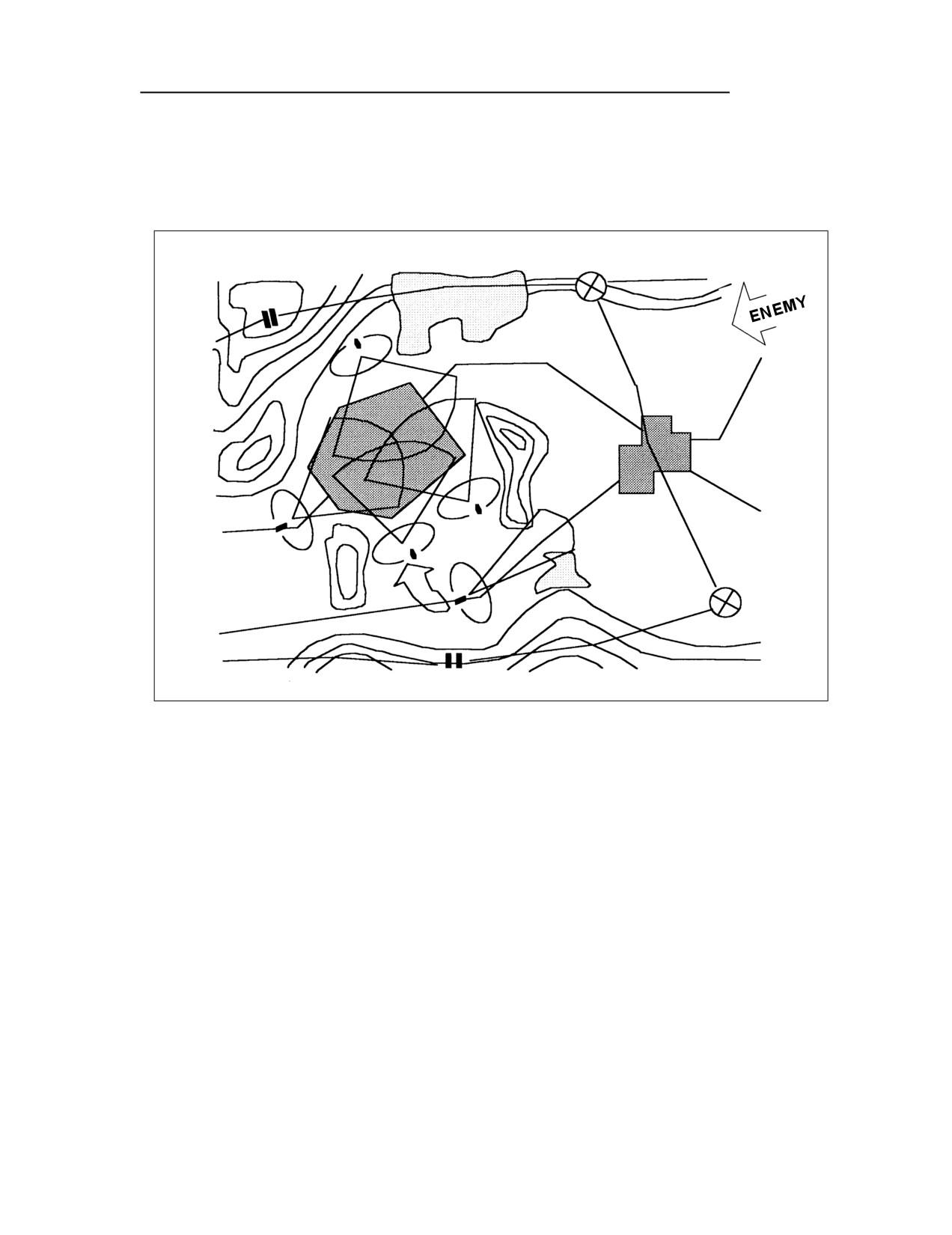
Direct-/Indirect-Fire Analysis
The direct-/indirect-fire analysis examines how engineers can best use
obstacles (within the commander’s intent) to enhance the direct-/indirect-fire
plan. Figure 2-13 shows a sample direct-fire analysis. This analysis can be
2-24 Mine-Warfare Principles
FM 20-32
used to formulate obstacle locations with the direct-fire plan. The engineer
must have a fundamental understanding of the direct-/indirect-fire and
maneuver plans and the TF’s organization of the EA to effectively integrate
obstacles with the direct-/indirect-fire plan.
Figure 2-13. TF direct-fire analysis
Synchronization of direct and indirect fires with obstacles multiplies the
relative effect on the enemy. An obstacle is an excellent location for
preplanned artillery and mortar fires. These fires can eliminate dismounted
breaching efforts. Indirect fires contribute to the threat’s ability to breach,
making the obstacle more effective and providing direct-fire systems a higher
probability to kill.
Obstacle-Intent Integration
The engineer determines locations for the directed obstacle groups. Groups
are placed on the COA overlay to support the maneuver plan. This location is
for planning only and will normally be adjusted after the ground
reconnaissance.
Obstacle groups target specific enemy elements based on the SITEMP. The
engineer generally allocates an obstacle group against a battalion-size AA.
This approach mirrors the staff’s placement of a company/team against the
same enemy force. The company’s/team’s fire responsibility drives the
placement of the obstacle groups. The engineer advises the commander on
Mine-Warfare Principles 2-25
FM 20-32
which specific effect each directed obstacle group must achieve. He plans
obstacle groups to—
• Disrupt the enemy.
• Turn the enemy into an area where friendly units can mass fires.
• Fix the enemy in the EA and enhance his direct-fire destruction.
• Block the enemy from using an AA.
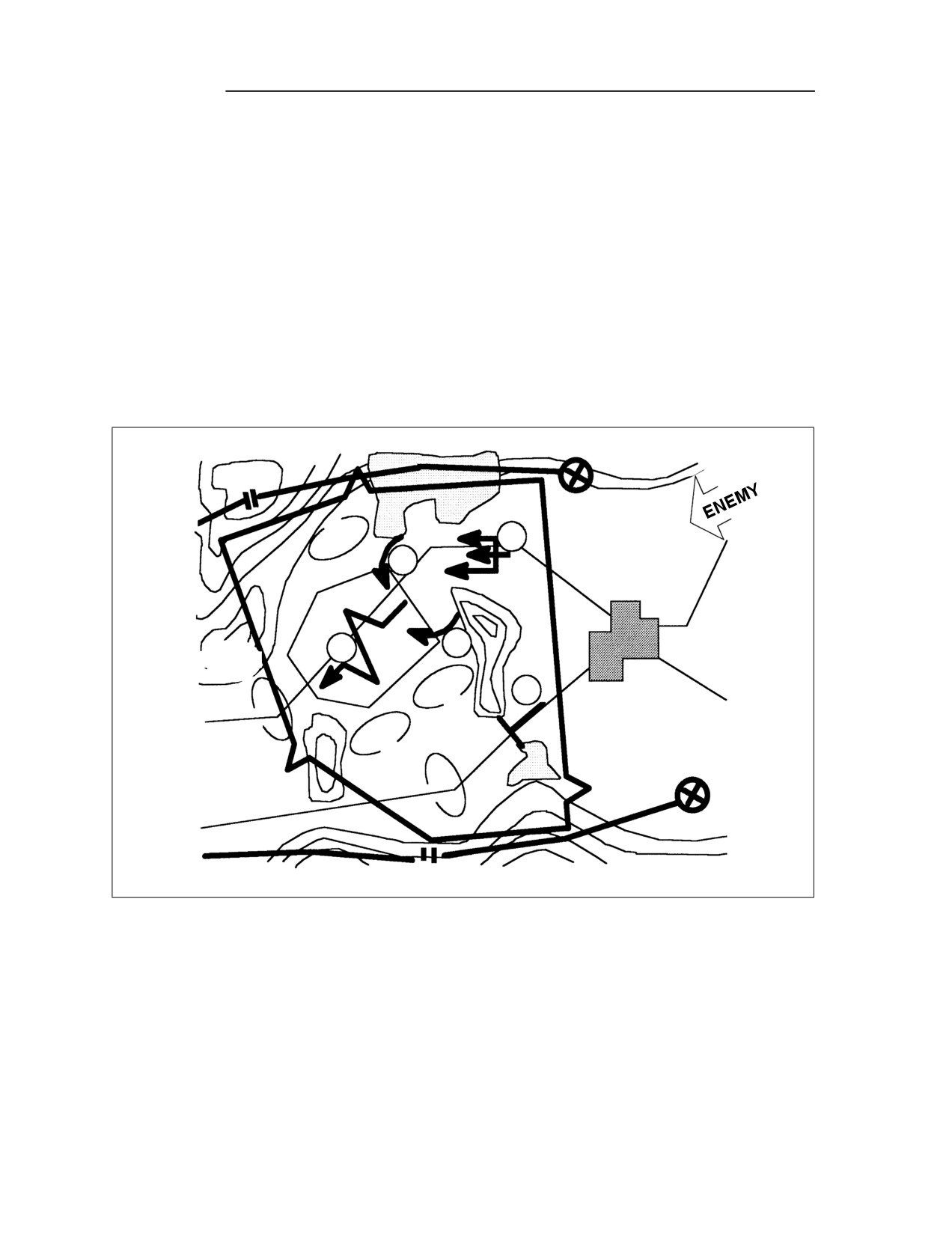
The engineer integrates directed obstacle groups with the COA. The obstacle
effects are shown on the COA overlay using obstacle-effect graphics (Figure 2-14).
The engineer draws the obstacle-group graphic to reflect the location, the
target, and the specific intent of the group as accurately as possible. The
engineer should visualize how the terrain naturally effects maneuver. Terrain
visualization is vital to proper obstacle-group design.
4
2
5
3
BELT A1
1
Figure 2-14. TF obstacle-intent integration and priorities
Note the placement and the effect of obstacle groups in Figure 2-14. First, the
engineer must manipulate the MRB into the EA. The turn groups (2 and 5),
combined with a heavy volume of AT fires from a company team at the turning
point, achieves this. In the EA, particularly where the TF fires are massed, a
fix group (3) slows the enemy and increases the effects of the fires. A block
group (1) in the south, along with direct fires from a company team, will stop
the advance of any element along the southern AA. A disrupt group (4), with
indirect fires, will break up the C2 and the tempo of the attacking force.
2-26 Mine-Warfare Principles
FM 20-32
Protective obstacles in front of all team positions protect the teams from the
enemy's final assault.
Obstacle Priority
The staff determines the priority of each group depicted on the overlay.
Priority is established by the commander’s intent and the most likely enemy
COA. The obstacle priority should reflect the TF’s greatest obstacle
requirement. The primary obstacle effort can be with an economy of force
where the commander needs more obstacles to overcome a shortage of direct-
fire systems. The TF engineer should be cognizant of flank protection, weapon
types and ranges, and the overall commander’s intent for the entire force
before placing obstacle priority on the main EA. Priorities assist the engineer
in allocating resources and ensuring that the most critical obstacle groups are
emplaced first.
In Figure 2-14, the first priority is to turn the enemy where the fires are
massed. The second priority is to deny the enemy access (block effect) to the
southern AA. The fix effect is the third priority because it enhances the TF
fires in the EA but only slows the enemy). The block effect is a higher priority
than the fix effect because it stops the enemy from flanking the TF. The
disrupt effect is the last priority.
Mobility Requirements
The engineer identifies the TF’s mobility requirements. Obstacle groups
should not be arrayed along potential counterattack routes or where there is a
potential to hamper unit repositioning. Mobility assets should be used to
counter potential enemy situational obstacles and friendly obstacles that
might hinder friendly maneuver. The TF engineer must consider the
commander’s mobility requirements and plan for mobility assets so he can be
ready when and where he is needed.
Course-of-Action Analysis
The staff war-games the COAs to determine their viability and recommends
the best COA to the commander. The engineer refines the SOEO during this
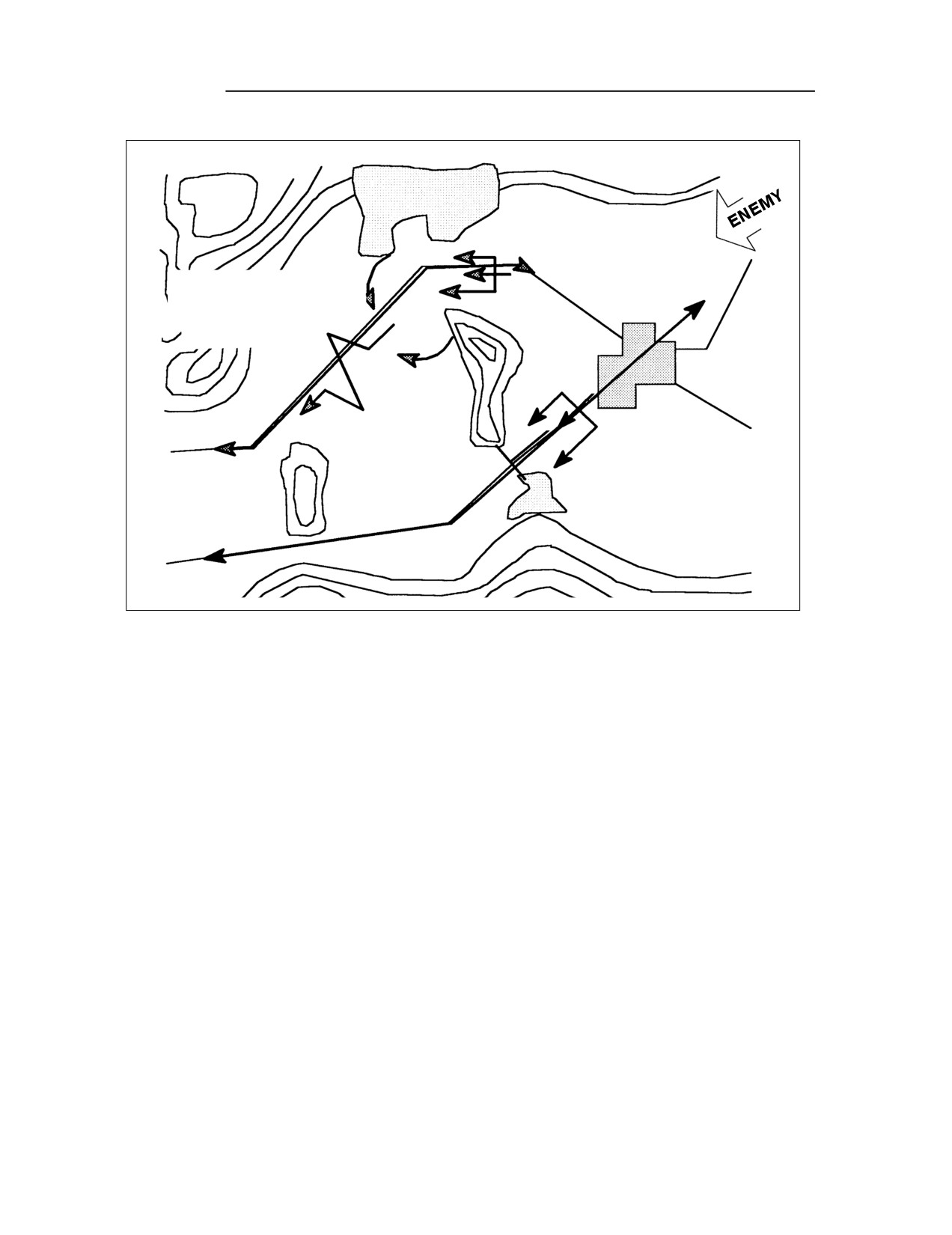
process as well. Obstacles should be considered within the context of the
maneuver COA (Figure 2-15, page 2-28).
The engineer staff officer should consider the following:
• Enemy reactions at the obstacle groups (breaching or bypassing
capability) versus the desired obstacle effect.
• Enemy breaching capabilities that make one obstacle type preferable
to another (such as an AT ditch versus a minefield).
• Obstacle locations that hinder friendly maneuver.
• The compatibility of obstacle effects and weapon-system capabilities.
• Adequate direct-/indirect-fire control measures and targeting that
support the obstacle effect. The effects of artillery and obstacles must
be synchronized to gain the desired effect on the enemy’s maneuver.
• Locations and types of enemy situational obstacles that make one type
of breaching asset preferable to another.
Mine-Warfare Principles 2-27
FM 20-32
Marked bypasses to
support EA
rehearsal
Situational disrupt
Lanes for
obstacle group
withdrawal of
scouts
Figure 2-15. Obstacle-plan refinement
After war gaming, the staff adjusts the COA (including the obstacle plan) by—
• Changing the location of obstacle groups.
• Changing the obstacle effects.
• Adding more situational obstacles.
• Adding more reserve obstacles.
• Identifying other mobility requirements.
• Refining artillery targets based on obstacle-group changes.
Mobility Requirements
The staff determines which obstacles require lanes and determines the closure
criteria for the lanes. It also determines obstacle-restricted areas that support
the TF’s maneuver. Lanes and bypasses are determined using tactical
repositioning requirements developed during the COA analysis. Requirements
for rehearsal movement, placement of the target reference point (TRP), and
logistical support of forward TF elements are also considered in lane
development. Mobility requirements identified during COA development are
synchronized and refined during COA analysis. Additional mobility
requirements identified during war gaming are resourced and planned. (Lane
marking is discussed later in this chapter.)
2-28 Mine-Warfare Principles
FM 20-32
Obstacle Design/Resourcing
After the COA analysis, the engineer conducts a detailed study of the obstacle
plan to determine resource requirements. Groups are resourced using the
methods previously discussed. The TF engineer resources the obstacle groups
based on their assigned priorities. Once the engineer has developed the
resource requirements for the obstacle groups, he plans the individual
obstacles within the group.
If time permits, a detailed ground reconnaissance of the obstacle-group
location can be conducted. This will allow a more detailed analysis of the
obstacle requirement for that AA, and then the engineer can plan individual
obstacles. The TF engineer usually designates the intent to guide the
companies/teams; the company/team commanders and their supporting
engineers complete the actual design of the obstacle groups.
Decision and Execution
The engineer makes adjustments to the SOEO based on the COA that the
commander approves. The engineer then provides oral, written, and/or
graphical orders with sufficient detail to allow the subordinate units to
conduct the operation. The engineer provides critical information using the
scheme-of-obstacle overlay and the obstacle-execution matrix.
Scheme-of-Obstacle Overlay
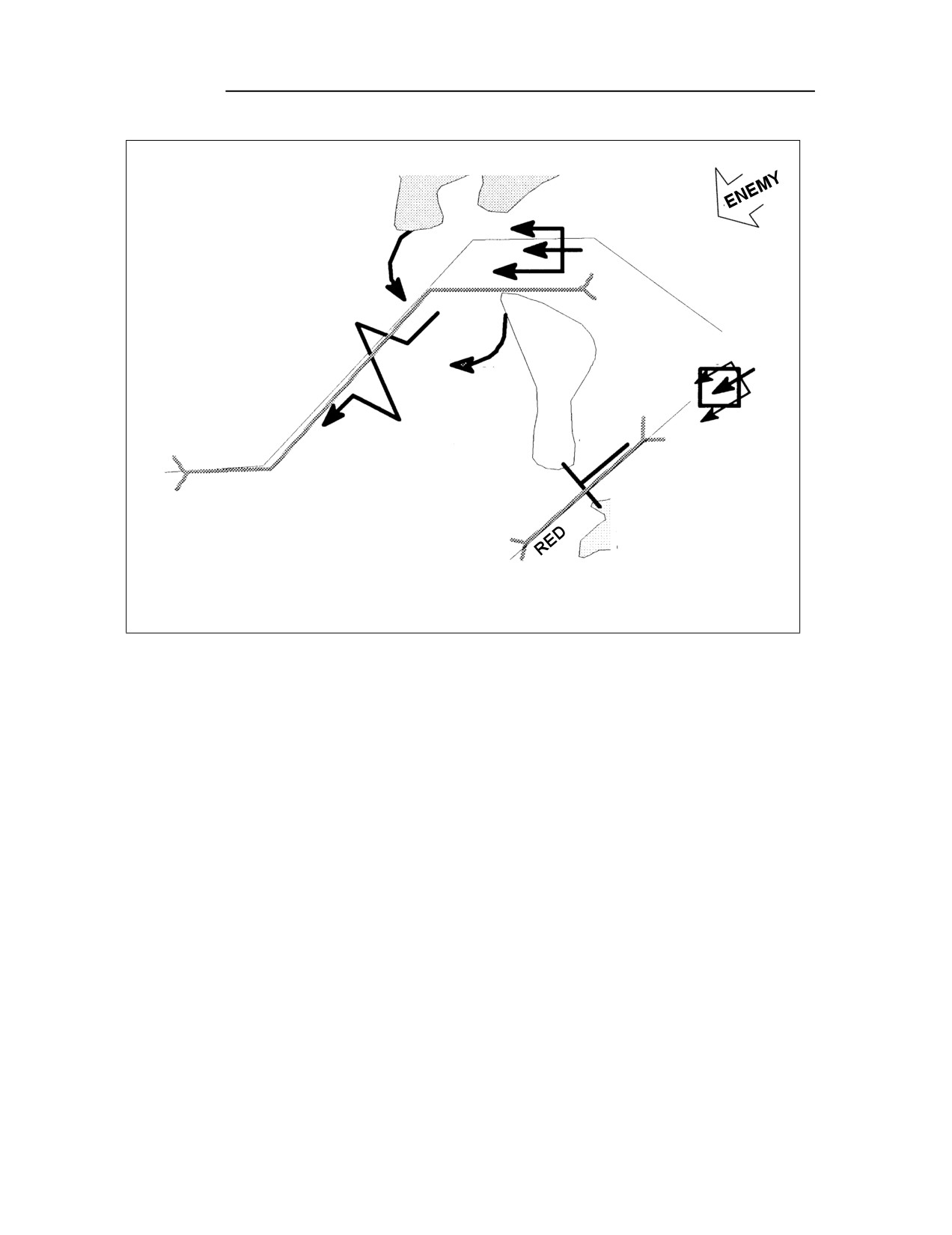
The scheme-of-obstacle overlay (Figure 2-16, page 2-30) depicts the location of
the TF’s obstacle groups, brigade-directed obstacle groups (if any), and
obstacle belts within the TF’s sector. The overlay also includes any obstacle
restrictions dictated from a higher headquarters. The overlay depicts the
obstacle groups using the standardized obstacle-effect symbols. The overlay
does not generally show individual obstacles unless the engineer has had
sufficient time to conduct a thorough ground reconnaissance where exact
obstacle locations have been identified. The engineer must exercise extreme
caution if he uses individual obstacles on the overlay. He must ensure that
inexperienced leaders do not attempt to emplace obstacles exactly as shown on
the overlay, but instead, properly site the obstacle with the company/team
commander. The scheme-of-obstacle overlay graphically depicts how the
commander seeks to influence enemy maneuver through obstacles.
Obstacle-Execution Matrix
The obstacle-execution matrix includes specific instructions and detailed
information concerning the obstacle groups shown on the scheme-of-obstacle
overlay. Develop an obstacle-execution matrix for all situational, reserve, and
direct obstacles within the TF area. As a minimum, the matrix should include
the information shown in Figure 2-17, page 2-31.
Mine-Warfare Principles 2-29
FM 20-32
Co D sites
Co D sites
A1D.
A1E.
No bypass allowed
at wood line.
A1D
A1E
Tm C sites A1C
and removes
A1C
bypass markings
S
for Lane Blue.
A1B
Tm A sites
A1B.
A1A
BLUE
Lane Red closed
Tm B sites A1A. No
after scouts have
bypasses allowed
passed. Tm B
after lane closure.
closes the lane
with MOPMS.
Figure 2-16. Scheme-of-obstacle overlay
2-30 Mine-Warfare Principles

FM 20-32
Mine-Warfare Principles 2-31
FM 20-32
SITING AND EMPLACING TACTICAL MINEFIELDS
This section outlines the principles for siting tactical minefields to support the
company/team. These principles apply to all methods of emplacement—
standard pattern, row mining, and SCATMINE systems. The focal point of the
discussion on siting is the coordination that must occur between the
emplacing engineer (normally the engineer platoon leader) and the maneuver
company commander. Coordination between the engineer platoon and the
maneuver company is perhaps the most vital component of effective obstacle
integration, and it is also a vital component in EA development. Obstacles are
directly integrated with weapon effects, capability, and the fire plan at this
level. The two subcomponents of tactical-obstacle siting are coordinating with
the maneuver commander and siting the minefield.
COORDINATING WITH THE MANEUVER COMMANDER
Effective coordination with the maneuver company/team commander who will
fight the obstacle(s) is essential to realizing the full potential of minefields as
a combat multiplier. In short, the emplacing engineer becomes the maneuver
company/team commander's team engineer for the mission. The engineer, the
fire-support team (FIST), and the maneuver commander must work closely to
ensure complete integration of the minefield into all aspects of the company
plan. The engineer must be integrated into the maneuver company/team EA
development process. Throughout each step of the process, the engineer must
provide the maneuver commander and the FIST with the engineer expertise
necessary to ensure complete and effective obstacle integration.
Before the emplacing engineer can conduct effective coordination, he must
have tools and information from the TF order that serves as common ground
between the emplacing engineer, the FIST, and the maneuver commander.
The order drives the integration of tactical obstacles into the fire plan and
ensures that the obstacles affect their intended enemy target in a way that
supports the scheme of maneuver.
Modified Combined Obstacle Overlay
The MCOO is a product from the IPB process that graphically depicts the
maneuverability of the terrain. It depicts slow-go and no-go terrain relative to
the type of enemy force. It also defines AAs and MCs that the enemy may use
for its attack. Since tactical obstacles attack the enemy's maneuver and must
complement the existing terrain, the MCOO is vital to obstacle siting. It helps
ensure that obstacles correctly address the enemy AAs and MCs. It also helps
select how and what part of the enemy formation will be directly attacked by
obstacles, and it shows the effect the obstacles will have on the enemy's
maneuver.
Situation Template
The SITEMP is developed by the maneuver battalion S2 and the TF engineer
during the IPB. It estimates how the enemy will attack, in terms of size and
type of units, and the formations it will use. Tactical obstacles are employed to
produce specific effects on specific enemy targets. Therefore, the SITEMP
helps the engineer and the maneuver commander site and emplace obstacles
in a way that attacks the intended target. The SITEMP may also depict the
2-32 Mine-Warfare Principles
FM 20-32
likely routes for enemy reconnaissance elements. This helps the engineer and
the maneuver commander analyze requirements for reconnaissance and
surveillance (R&S) patrols that defeat enemy attempts to reconnoiter the
obstacles and reduce enemy effectiveness before the attack. The type of
formations the S2 expects the enemy to use during the entire course of the
attack is also vital information. The SITEMP should identify when the enemy
is in march, prebattle, and attack formations. The enemy formation may
impact on the necessary front of obstacle groups and the obstacle groups’
effectiveness in achieving the intended effect on enemy maneuver.
Commander's Intent
The emplacing engineer, the FIST, and the maneuver commander must have a
common understanding of the battalion commander's intent. The battalion
commander's intent is his vision of the battle and normally outlines what
actions the unit must do to accomplish the mission. The commander's intent
may include key aspects of the plan that he wants to emphasize to
subordinates to synchronize the actions of subordinates toward a single
purpose. The engineer must understand the commander's intent and how it
relates to integrating obstacles. The engineer should always ensure that the
obstacles he is emplacing support the commander's overall intent.
Maneuver Graphics and the Fire Plan
In order to fully support the scheme of maneuver, the engineer must have and
understand the maneuver graphics on the battalion's operational overlay. The
maneuver graphics use symbols to depict the missions of each subunit within
the battalion. Maneuver control measures such as battle positions, sectors,
phase lines, passage lanes/points, and counterattack axis are vitally
important to understanding the plan and integrating tactical obstacles. The
maneuver graphics may include direct-fire control measures that direct how
and where combat forces will mass, shift, and lift fires to destroy the enemy.
Direct-fire control measures include EAs, trigger lines, and TRP and unit
boundaries. In short, they dictate the direct-fire responsibilities of each
subordinate. Understanding the direct-fire plan and the organization of the
engagement is fundamental to integrating obstacles with fires. The maneuver
graphics also give the engineer an appreciation of how tactical obstacles
supporting one unit must complement the adjacent units. This is particularly
true of adjacent EAs or plans requiring any tactical repositioning of forces.
Obstacle-Execution Matrix
The obstacle-execution matrix includes specific instructions and detailed
information concerning the obstacle groups shown on the scheme-of-obstacle
overlay. This matrix gives the engineer critical information on minefield
groups that will be emplaced within the company's/team's AO. As a minimum,
the obstacle-execution matrix should include the information shown in Figure
2-17, page 2-31.
Scheme-of-Obstacle Overlay
At the maneuver battalion level, the scheme-of-obstacle overlay depicts the
location of brigade-directed belts, TF obstacle groups, and any directed
obstacles within the battalion sector. Any obstacle restrictions attached to an
obstacle control measure (belt or group) that preclude the employment of
Mine-Warfare Principles 2-33
FM 20-32
certain types of obstacles are annotated on the overlay. A scheme-of-obstacle
overlay is a graphic control measure that defines the general location of the
obstacle groups and the effect to be achieved by them. The scheme-of-obstacle
overlay does not normally depict individual obstacle locations. The location of
individual obstacles within a group is determined during the siting process
between the emplacing engineer and the maneuver company commander.
When overlaid on the maneuver graphics and the SITEMP, the scheme-of-
obstacle overlay should depict the essential elements of obstacle integration:
• Enemy targeted by the obstacle.
• Location of the obstacle on the battlefield.
• Unit covering the obstacle.
• Directed link between the obstacle effects and the fire plan.
Fire-Support Plan
The emplacing engineer should be familiar with the key elements of the fire-
support plan. He must understand the general scheme of fires and how the
fires support the scheme of maneuver, the commander's intent, and the
obstacle plan. Normally, the emplacing engineer does not need the entire fire-
support overlay depicting the location of all targets. However, he should know
the location of fire-support targets directed by the battalion to cover obstacles.
The emplacing engineer should know who has the priority of fires for each
phase of the battle. The emplacing engineer should also know the location and
the type of priority targets or FPF allocated to the maneuver company he is
supporting. During coordination with the maneuver company, the emplacing
engineer should discuss the fire-support plan with the company FIST and get
updates on changes to the plan as well as any company-level fire-support
plans that may impact on the integration of obstacles.
Combat Service Support
The engineer must be familiar with the plan for combat service support (CSS).
In particular, the engineer must know the location of major supply routes into
and through the battalion area, the location of the battalion logistics release
point (LRP), what routes the maneuver company will take from its position to
the LRP, and the location of key battalion logistics nodes. The emplacing
engineer must always be cognizant of the sustainment traffic flow and the
impact obstacle emplacement has on sustainment operations. Of particular
concern to the engineer is the location of the Class IV/V supply point and the
routes to it.
Battlefield Operating System
During coordination with the maneuver company commander, a checklist or a
framework is a useful tool for organizing thoughts and formulating questions.
Below is a list of considerations or points of coordination that should drive the
integration of the emplacing engineer and the maneuver company
commander. The list is organized using the Battlefield Operating System
(BOS) because it provides a logical sequence and a framework that is easily
remembered.
• Intelligence.
2-34 Mine-Warfare Principles
FM 20-32
— Enemy AAs and MCs (mounted and dismounted).
— Likely enemy COA and possible reactions to the obstacles.
— Enemy breach capability.
— Enemy reconnaissance routes and friendly counterreconnaissance
or R&S plans, particularly company-level patrols.
— Likely enemy formations and transitions between formations.
•
Maneuver.
— Specified, implied, and essential tasks of the maneuver company.
— Higher commander's intent.
— Organization of the defensive position, including—
> Task organization (type of weapons).
> Decisive point or defeat mechanism.
> Organization of direct fires in the EA.
> Location and marking of direct-fire control measures.
> Position of weapons to cover assigned direct-fire
responsibilities.
— Tactical mobility requirements of the maneuver company and any
adjacent units, including—
> Counterattack axis.
> Repositioning of forces and their routes to alternate,
supplementary, or subsequent battle positions.
> Employment of reserves.
> Passage of lines.
— Obstacle protection measures.
•
Mobility/survivability.
— Intent of tactical obstacles covered by the maneuver company
(enemy target, obstacle location, and obstacle effect).
— Obstacle control measures and restrictions imposed by higher
headquarters.
— Mobility requirements
(lanes/gaps), as identified above in
maneuver.
— Mutual support between the obstacle location, the fire plan,
obstacle effects, and survivability positions.
— Security for engineers provided by the maneuver unit supported.
•
Fire support.
— Location of the company FIST and frequency of fire support.
— Updates on the tentative fire-support plan.
Mine-Warfare Principles 2-35
FM
20-32
— Allocation of fires to the company, including—
> Artillery or mortar targets.
> Priority targets, types of targets, and the FPF.
— Covering obstacles and their effects with indirect fires.
— Indirect-fire control measures to synchronize direct fires, indirect
fires, and obstacles.
— Area-denial artillery munition (ADAM)/remote antiarmor mine
(RAAM) use (lane closure and breached obstacle repair).
— Registering fires.
(Deconflict with obstacle emplacement;
registration should occur after obstacles are sited but before
emplacement.)
— Company fire-support execution matrix.
— Means for obtaining fire support, if enemy contact is made during
emplacement.
•
Air defense.
— Enemy air AAs during emplacement.
— Update on changes to air-defense warning and weapons status.
— Location of air-defense systems that can cover engineers
emplacing obstacles.
— Method of obtaining early air-defense warning.
•
CSS.
— Tentative location of the mine dump, if used, within the company
position and routes from the mine dump to obstacles.
— Routes the company plans on using to conduct logistics package
(LOGPAC) operations that must remain open.
— Manpower assistance for operations at the Class IV/V supply point
and the mine dump.
— Casualty evacuation routes for scouts, observation posts (OPs),
and ADA systems.
•
C2.
— Location of the commander during defensive preparation.
— Frequency-modulated (FM) net of the supported company and the
means of communication.
— Unit boundaries affecting obstacle emplacement.
— Time and place of the company/team order.
— Coordination that must occur with adjacent units.
— Obstacle reporting and recording requirements.
2-36 Mine-Warfare Principles
FM 20-32
— Control and execution of situational and reserve obstacles.
— Lane-closure responsibilities and procedures.
— Time and method of obstacle turnover, including lanes.
— Company/team understanding of the obstacle intent.
SITING THE MINEFIELD
The emplacing engineer and the company/team commander site individual
obstacles to achieve synchronization between the obstacle effect and fires.
Siting is a key component to the EA development process, and it represents
the final adjustments to the obstacle location and the fire control measures
before emplacement.
Certain preconditions are necessary to site individual obstacles. First, the
company/team commander decides where he plans to mass fires and marks
the necessary fire control measures on the ground. The location of these
control measures must be clear, since they are the basis for obstacle siting.
The commander then identifies tentative locations for key weapons within the
position or the sector. Finally, the commander and the engineer must both
understand the intent of the obstacle group.
Obstacle siting concentrates on marking the obstacle group as a whole instead
of marking each individual obstacle. In broken terrain, however, it may be
easier to site individual obstacles. The company/team commander and the
emplacing engineer use vehicles or soldiers from the company/team, the
engineer platoon, or both to simulate the enemy force and do the physical
marking. The simulated enemy force moves into the EA to the enemy side of
the obstacle group. The engineer platoon leader and the company/team
commander collocate near the weapons covering the obstacle. As a technique,
one or all of the tanks, Bradleys, and other crew-served weapons may occupy
their position and contribute to the siting process. All participants in the
siting process use a common FM net to communicate during siting.
The simulated enemy force moves into the EA, simulating the enemy's attack.
It deploys into a formation of front that is similar to the expected enemy
formation. Once it is near the marked fire control measures, it places markers
at intervals as it drives the trace of the obstacle-group effect (or individual
obstacles in broken terrain). It remains oriented on key fire control measures
to ensure that obstacle location and effect are synchronized with fires. During
the process, each participant verifies that he can cover the obstacle, notes the
location of fire control measures and obstacles, and records the appropriate
data on range cards. As the simulated force drives the obstacle trace, siting
participants also identify dead space and requirements to refine the location of
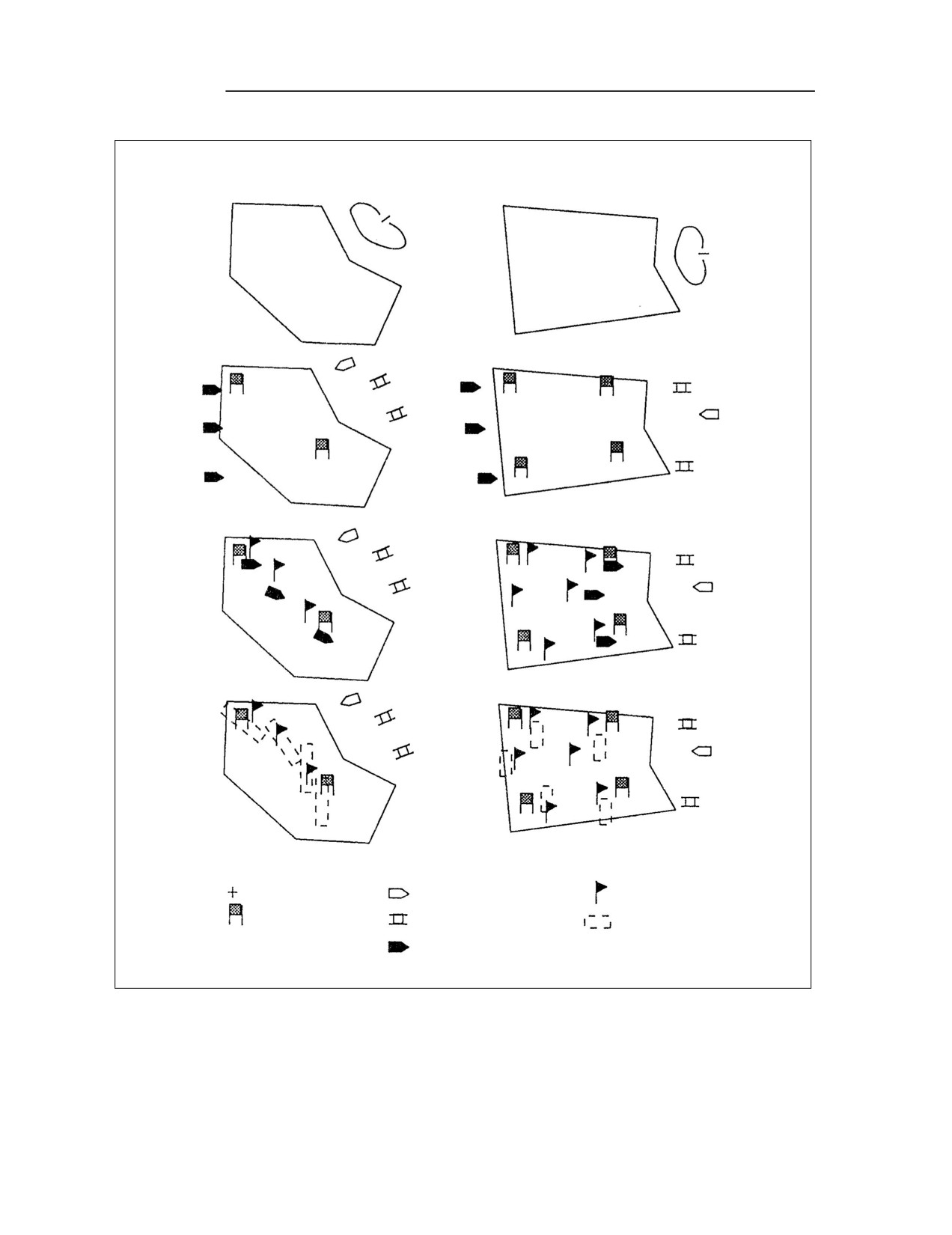
the obstacle group and fire control measures. Figure 2-18, page 2-38, illustrates
how the engineer and the company/team commander work together to site
turn- and fix-obstacle groups.
Mine-Warfare Principles 2-37
FM 20-32
TURN-OBSTACLE
FIX-OBSTACLE
GROUP
GROUP
01
01
11
03
EA
EA
15
04
02
02
Planned TRP
Bradley position
Group marker
Marked TRP
Tank position
Individual minefield
Engineer vehicle
Figure 2-18. Minefield siting
2-38 Mine-Warfare Principles
FM 20-32
Once the company/team marks the general limits and the orientation of the
obstacle group, the engineers can begin marking individual obstacles (if not
already done). To mark individual obstacles, the engineer platoon uses the
group markers as guides. As shown in Figure 2-18, the group markers may
lend themselves well as the start and end points of individual obstacles;
however, this is not always the case. As the engineer platoon refines the group
limits into the site of individual obstacles, the platoon can then begin the
necessary site layout based on the method of obstacle emplacement.
Siting is not the last thing done during preparations. The time and resources
involved in emplacing tactical obstacles require that siting begins
concurrently with establishing the defensive position. It is imperative that the
unit sites the obstacles as soon as the company/team commander has
established the EA and identified tentative positions for key weapons. It is not
necessary that all weapons are in place and dug in before siting. Normally,
well-marked fire control measures and one known position per maneuver
platoon (not dug in) are all that is required to site the obstacles effectively.
EMPLACING MINEFIELDS
Based on the group effect, resources allocated, and the engineer plan, the
platoon leader determines the method of emplacement for individual
minefields. The procedures for emplacing scatterable, row, and standard-
pattern minefields are contained in Chapters 3, 6, and 7, respectively.
The engineer must determine the number of individual minefields needed to
make up the group and ensure the allocation of required resources. The
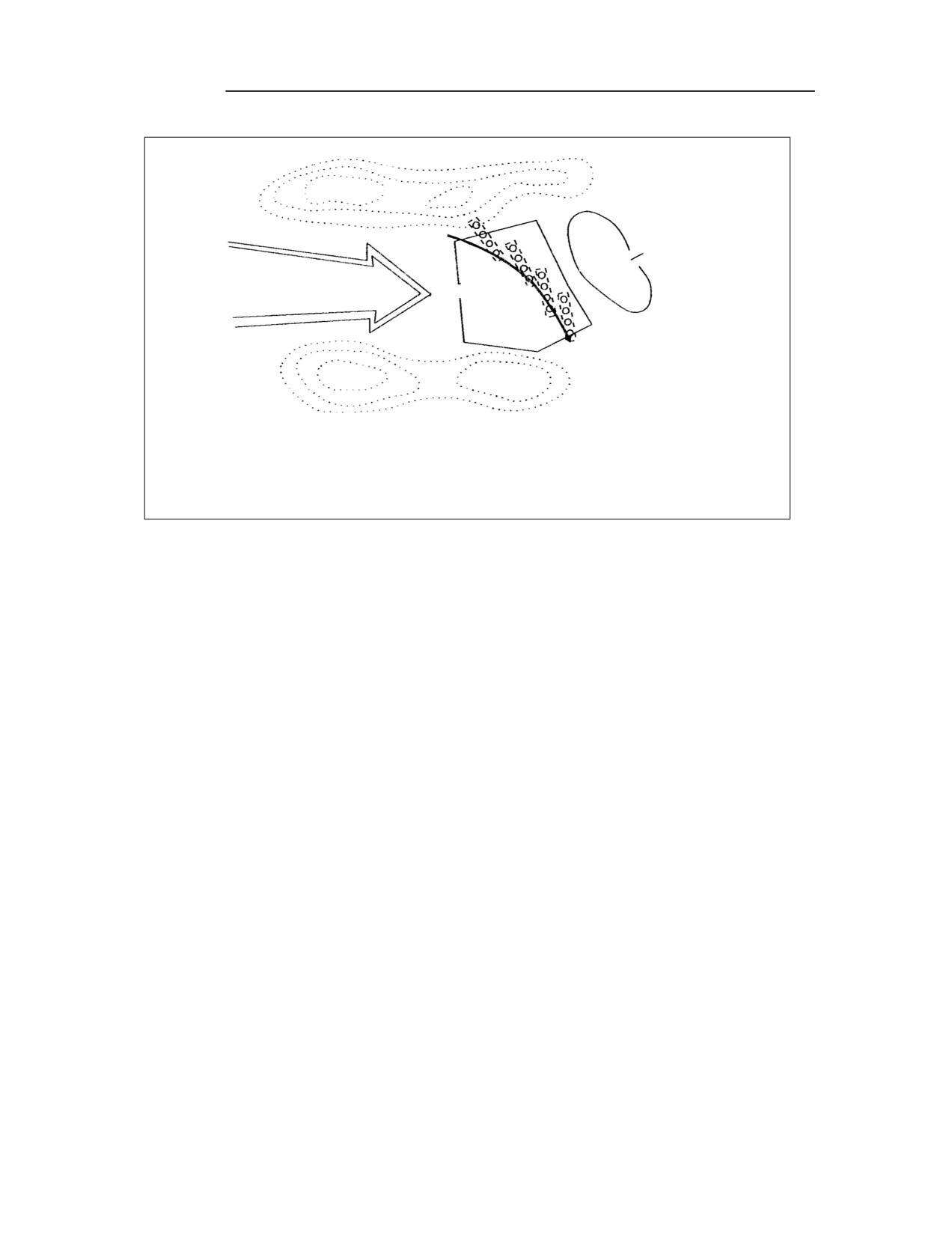
amount of linear obstacle effort for a group is equal to the width of the AA,
multiplied by the resource factor. In Figure 2-19, page 2-40, the AA is 1,500
meters wide, the tactical-obstacle effect is to turn the enemy, and the resource
factor is 1.2. The linear minefield requirement is 1,800 meters. One turn-effect
minefield has a front of 500 meters (1,800/500 = 4 minefields [round up]). The
number of mines and the time required to emplace each minefield depends on
the emplacement method.
MINEFIELD SUPPLY OPERATIONS
Requests for Class IV/V obstacle material that are originated at TF level or
below go to the TF S4. The TF S4 processes the requests and sends them to
the forward support battalion (FSB). The FSB processes the requests and
forwards them to the brigade-level FSB, the division material-management
center (DMMC), and the corps material-management center (CMMC).
The issue of Class IV obstacle material normally involves large quantities of
material; therefore, corps support elements normally use their transportation
assets to deliver the material directly to the emplacement sites or to the Class
IV/V supply point.
Units request Class V obstacle material somewhat differently. The TF S4
notifies the brigade S4 of Class V requirements. The brigade S4 notifies the
division ammunition officer (DAO) in the DMMC, who authorizes Class V
issue by the ammunition transfer point (ATP). Class V obstacle material,
Mine-Warfare Principles 2-39
FM 20-32
AA or MC
1,500
Width of AA/MC = 1,500 m
Determine number of minefields in the group
Obstacle effect: Turn
1,500 x 1.2 = 1,800 m linear effort
Linear effort resource factor: 1.2
1,800/500
= 4 turn minefields (round up)
Turn minefield front norm: 500 m
Figure 2-19. Example of minefield resourcing
unlike most ammunition, is delivered to the user at the obstacle emplacement
site or the Class IV/V supply point.
A supply request includes the quantity, the required delivery time, the
transportation responsibilities, and the desired delivery location. The quantity
includes the total for each type of obstacle. There may be several Department
of Defense identification codes (DODICs) and national stock numbers (NSNs)
involved, depending on the types of obstacles required. The required delivery
time is very important for ensuring an early start on the preparation of the
battlefield because the lack of material could adversely affect the mission.
Transportation responsibilities must be clearly understood. Material handling
equipment (MHE) is required to ensure a rapid turnaround of haul assets.
In addition, the brigade staff coordinates with the TF staff to identify the
location of Class IV/V supply points in the TF sectors. Prompt identification of
TF Class IV/V supply points is required if the obstacle material is forwarded
from the corps into the TF sector. If the material is not forwarded into the TF
sector, the brigade is responsible for delivering it to the TF.
At the TF level, sustaining obstacle operations is an extremely difficult task.
Centralized throughput operations by the corps or the division stop at the TF
level. Mass quantities of obstacle material, especially mines, are centrally
received, broken down into minefield packages, and then distributed
throughout the sector based on the obstacle plan. At some point in the
distribution plan, the TF turns over control of the obstacle material to
engineers who then emplace the obstacles. Obstacle logistics (especially for
mine warfare) at the TF level can be complex, require prudent use of scarce
haul assets and MHE, and demand positive C2.
2-40 Mine-Warfare Principles
FM 20-32
The supply of obstacle material may vary slightly for obstacle groups
developed at corps, division, and brigade levels. The staff at the level where
the obstacle group is planned determines the resources required for the
obstacle. It also determines how the emplacing unit will get the material. For
example, if the corps staff plans a reserve obstacle group but the detailed
planning is done at TF level, the TF resources the obstacle group. However, if
the corps staff plans the obstacle group in detail, it determines the resources
required. The corps staff also plans the delivery of obstacle material to the
emplacing unit. Alternately, the corps staff could direct the emplacing unit to
pick up the obstacle material from a location such as the corps storage area.
This section describes some of the underlying principles in mine supply
operations. It concentrates on the flow of Class IV/V material (mines) through
the battalion sector. The maneuver unit is responsible for the flow of obstacle
material within the maneuver battalion sector; however, it is effectively a
shared responsibility between the engineer and the maneuver unit.
RESUPPLY NODES
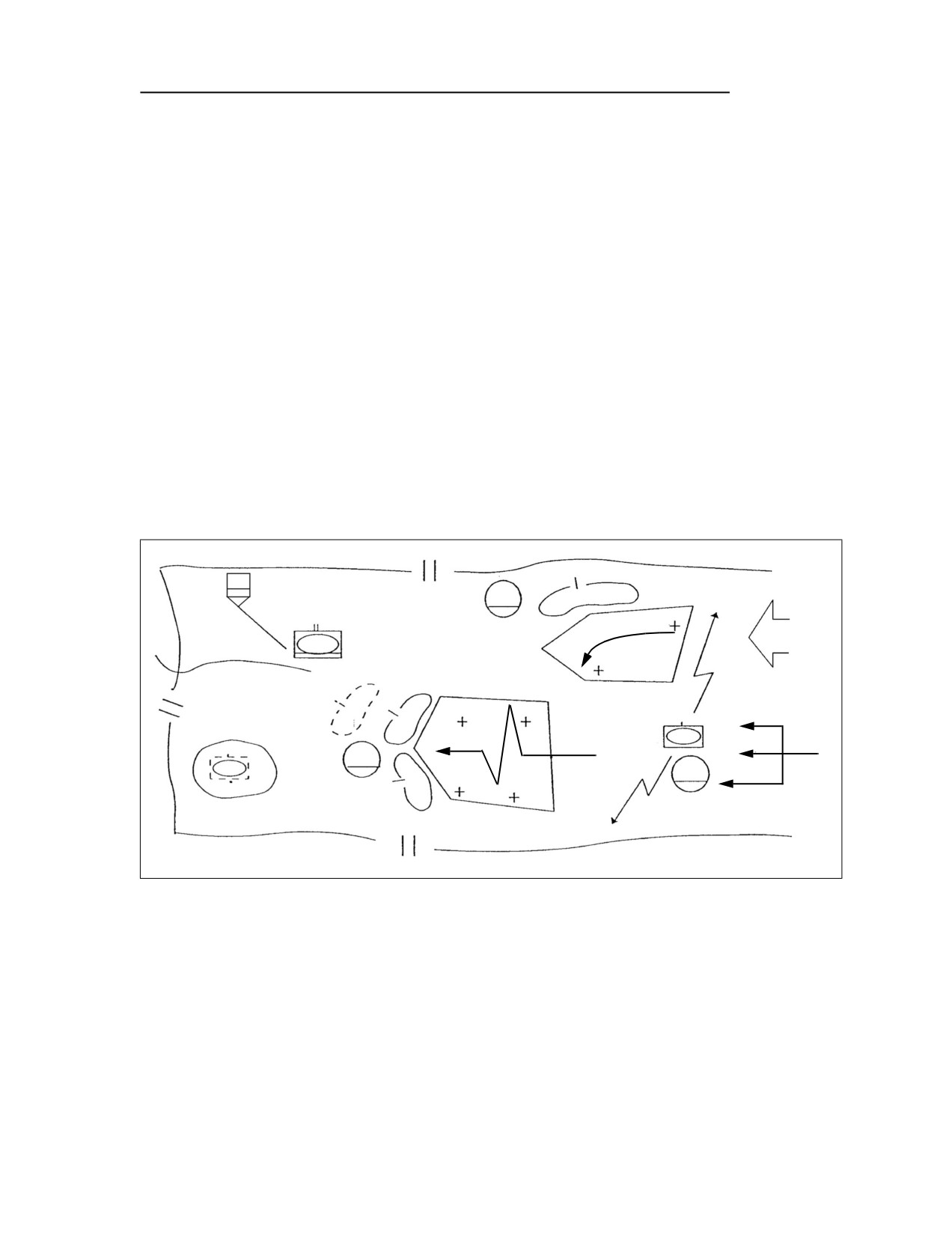
There are two critical mine resupply nodes within the TF sector—the Class
IV/V supply point and the mine dump. The relative locations of the Class IV/V
supply point and the mine dump are shown in Figure 2-20.
CLASS IV/V SUPPLY
30
POINT (MINES)
01
EA RED
MINE
ENEMY
COMBAT
DUMP
B3
TRAINS
MSR
02
05
03
21
20
EA BLUE
A
1-4
A
1-4
B3C
B3A
06
10
04
MINE
MINE
DUMP
DUMP
Figure 2-20. Mine resupply
Class IV/V Supply Point
A Class IV/V supply point is a central receiving point for obstacle material in a
TF sector. It is where the TF receives and transfers control of obstacle
material pushed forward by higher levels. The supply point is established and
operated by the TF and is centrally located to support all planned obstacles
within the TF sector. Where the tactical-obstacle plan allows, the supply point
should be located near the TF combat trains to better facilitate C2 and the
availability of equipment. The TF combat trains command post (CTCP) should
Mine-Warfare Principles 2-41

FM
20-32
provide C2 of operations at the Class IV/V supply point. The TF engineer will
normally furnish a representative that provides technical assistance to the
CTCP.
The main purpose of a Class IV/V supply point operation is to receive obstacle
material and reconfigure it based on the requirements for each obstacle group.
Each supply point must have a dedicated S4 representative to track the flow
of obstacle material in and out of the supply point. The supply point should
have dedicated MHE to off-load the bulk quantities of obstacle material and
reconfigure them into minefield packages as required. Obstacle material is
normally broken down into minefield packages if the material is not already
delivered in combat-configured loads. This may require a dedicated engineer
representative to ensure that obstacle material is configured properly. Table 2-
7 shows personnel requirements for a Class IV/V supply point.
Table 2-7. Personnel requirements for a Class IV/V supply point
Personnel
Responsibilities
Provides overall C2 and Class IV/V accountability
TF S4/S4 NCOIC
Coordinates for MHE
Is assisted by the RTO
Supervises organization of Class IV/V material into
packages to support obstacle groups
TF engineer representative
Provides technical assistance on Class IV/V supply-
point setup and mine uncrating and inspection
Infantry squad*
Downloads incoming Class V trucks
Infantry squad*
Downloads incoming Class IV trucks
Infantry squad*
Uploads outgoing Class IV/V trucks
Two infantry squads*
Uncrates and inspects mines
Support PL/PSG
Provides C2 for cross loading of Class IV/V material
Infantry squad*
Provides local security for the Class IV/V supply point
* or equivalent-sized element from a supported unit
The most labor-intensive task at the Class IV/V supply point is the uncrating
of mines. This requires dedicated manpower from the supported maneuver
force and the tools needed to break shipping bands and uncrate the mines
from their containers. Another important aspect of uncrating mines is
tracking fuses and booster charges. As the mines are uncrated, fuses and
booster charges are separated. However, the same number and type of fuses
and booster charges must be task-organized with minefield packages. This
requires strict supervision; mistakes can quickly lead to confusion and a waste
of emplacement time.
Because of the assets involved at a Class IV/V supply point, a TF is normally
capable of operating only one supply point at any given time. If the TF sector
is extremely wide or deep, several supply points may be planned; however,
only one can be operated at a time, based on the commander's priorities for
obstacle emplacement.
2-42 Mine-Warfare Principles
FM 20-32
Mine Dump
A mine dump is the most forward mine resupply node. It is where mines are
task-organized into mine-strip packages and then inspected, prepared, and
loaded onto emplacing vehicles. A mine dump is not a permanent supply
point, and it is not always used. Its use depends on the method of minefield
resupply, and these techniques are discussed in more detail later in this
chapter. When used, one mine dump supports a single obstacle group. It is
activated or deactivated upon initiation and completion of the obstacle group’s
emplacement. Mine-dump operations are primarily an engineer company or
platoon responsibility. However, it is a good technique to augment mine-dump
operations with personnel from the company/team overwatching the obstacle
group being emplaced. A mine dump may be located in the vicinity of the
company/team position or closer to the obstacle group.
There are three critical tasks that must be accomplished at the mine dump:
• The minefield packages are further task-organized into mine-strip
packages (complete with the right number, type, and mix of fuses and
boosters) as they are transported to the mine dump. For example, if a
platoon is emplacing a standardized disrupt row minefield, mines are
task-organized into three mine-strip packages. As the engineer
platoon moves to the mine dump to resupply, each emplacing vehicle
loads a designated mine-strip package.
• The mines are prepared for emplacement; but they are not fused at
the mine dump. Preparation includes loosening and greasing fuse and
booster wells and ensuring proper functioning of the mine.
• The mines are transloaded onto emplacing vehicles or a mine-delivery
system.
Transportation of mines from the Class IV/V supply point to the mine dump is
a supported TF responsibility. However, it is normally shared between the
engineer company and the TF, since neither one has the haul capability to
simultaneously service all active mine dumps.
RESUPPLY RULES
The following rules govern mine resupply:
• Mines should be uncrated at the Class IV/V supply point to preserve
transportation assets going forward.
• Mines are task-organized into minefield packages at the Class IV/V
supply point.
• Transportation from the Class IV/V supply point to the mine dump is
a shared engineer and maneuver unit responsibility when a mine
dump is used.
• Mines are inspected and prepared at the last supply node (Class IV/V
supply point or mine dump) before they are loaded onto an emplacing
vehicle or a mine-delivery system.
Mine-Warfare Principles 2-43
FM 20-32
• Class IV/V supply points are set up using authorized ammunition
procedures and distance requirements.
SUPPLY LOCATION
Consider the following when selecting a location for the Class IV/V supply
point or the mine dump:
• Carrying capacity. The location of key supply nodes and the type of
resupply method used depends in part on the type, amount, and
availability of haul assets. The carrying capacity plays a large role. In
short, the more material a vehicle can carry, the more turnaround
time you can afford. Table 2-8 provides the mine haul capacity for
various types of vehicles.
• Traffic circuit. Vehicles must be able to enter, load, unload, and exit
without interfering with the loading and unloading of other vehicles.
• Camouflage and cover. Protection from observation and thermal
imaging is desired. Protection from artillery and air attack should be
considered. Residue must be removed.
• Defense. The site must be organized for defense against enemy patrols
and saboteurs.
• Time. Time factors for handling the obstacle material, to include all
unloading, uncrating, inspecting, and loading, must be considered.
• Operators. Leaders and soldiers must be specifically allocated to
operate Class IV/V supply points and mine dumps. They will probably
remain there until the task is complete. The supply node may have to
be collocated with or be near a source of manpower. Table 2-7, page 2-42,
provides general guidance on how much manpower is required to
sustain mine resupply operations.
RESUPPLY METHODS
The methods for obstacle material resupply are—
• Supply point.
• Service station.
• Tailgate.
In each method, corps or division transport delivers Class IV/V supplies
forward to a designated Class IV/V supply point in each TF sector. The
primary differences in the methods are how the material is delivered from the
Class IV/V supply point to the obstacle location and whether or not mine
dumps are established.
Supply Point
The supply-point method (Figure 2-21, page 2-46) requires that the emplacing
engineer platoon return to the Class IV/V supply point each time it resupplies.
This method does not require a separate mine dump. In effect, it moves the
normal tasks associated with a mine dump to the supply point. Mines are
prepared and inspected at the supply point as they are being loaded onto an
emplacing vehicle or a mine-delivery system.
2-44 Mine-Warfare Principles

C2, FM 20-32
Table 2-8. Class IV/V haul capacity
Vehicle
HMMWV
2
51
34
27
55
56
15
1
NA
1
1,124 kg, 6 cu m
M35 2½-ton truck
4
102
69
55
111
113
30
2
2
2
2,250 kg, 12.5 cu m
M1078 2½-ton truck
4
102
69
55
111
113
30
2
2
2
2,250 kg, 13.4 cu m
M54 5-ton truck
7
204
138
109
222
227
61
5
3
5
4,500 kg, 13.6 cu m
M1083 5-ton truck
8
204
138
109
222
227
61
5
3
5
4,500 kg, 15.6 cu m
M930 5-ton dump truck
(without sideboards)
2
112
64
32
168
71
23
3
2
2
4,500 kg, 3.8 cu m
M930 5-ton dump truck
(with sideboards)
4
204
138
70
222
153
51
5
3
4
4,500 kg, 8.2 cu m
M1090 5-ton dump truck
2
112
64
32
168
71
23
3
2
2
4,500 kg, 3.8 cu m
HEMTT truck
8
408
277
128
444
317
94
10
7
8
9,000 kg, 15 cu m
12-ton S&T
13
489
333
208
533
514
148
12
9
13
10,800 kg, 24.5 cu m
40-ton lowboy
27
1,466
1,035
419
1,777
1,035
308
30
27
27
36,000 kg, 49.3 cu m
M548 cargo
8
244
166
125
266
272
74
6
4
6
5,400 kg, 14.9 cu m
M1077 PLS flat rack
9
440
352
164
586
293
110
11
9
9
14,900 kg, 17.6 cu m
No of mines per box
NA
1
2
4
4
90
21
240
NA
30
Weight per box (kg)
531
22
33
41
21
20
73
833
1,195
810
Size of box (cu m)
1.8
0.04
0.05
0.12
0.03
0.06
0.16
1.6
1.8
1.8
1The number of concertina = bundles; 1 bundle =
40 rolls
2Line charge + rocket
Several considerations may drive the use of supply-point resupply. First, if
there are no additional haul assets to transport obstacle material forward
from the Class IV/V supply point, the supply-point method may be the only
viable technique. Secondly, the minefield group may be close enough to the
supply point that any other method is less efficient.
• Advantages.
— Minimizes unloading and loading of material.
— Requires minimal augmentation of haul assets.
Mine-Warfare Principles 2-45
FM 20-32
Class IV/V supply
point (mines)
Entrance
S4/engineer
representatives
Corps/division truck
Received mine
Task-organized mine
package
Emplacing vehicle
Exit
Figure 2-21. Supply-point resupply method
— Allows manpower and equipment to be massed at a single supply
point.
— Streamlines C2 of material.
• Disadvantages.
— Requires more movement of the platoon, which may take away
from emplacement time.
— Requires that the platoon move in and out of the area where the
minefields are being emplaced, increasing the risk of fratricide.
— May disrupt the emplacement of individual obstacles when
emplacing vehicles cannot carry enough material to start and
complete the obstacle. This causes emplacing vehicles to stop
work, reload, and pick up where they left off.
— Requires a larger Class IV/V supply point that is capable of
receiving mass quantities of obstacle material and multiple
loading platoons simultaneously.
Service Station
The service-station method (Figure 2-22) centers on the activation of a mine
dump forward of the Class IV/V supply point. The mines are transported to a
mine dump using a combination of engineer and TF haul assets that are
normally under the control of the emplacing engineer. At the mine dump,
material is stockpiled and prepared by the mine-dump party. Obstacle
2-46 Mine-Warfare Principles
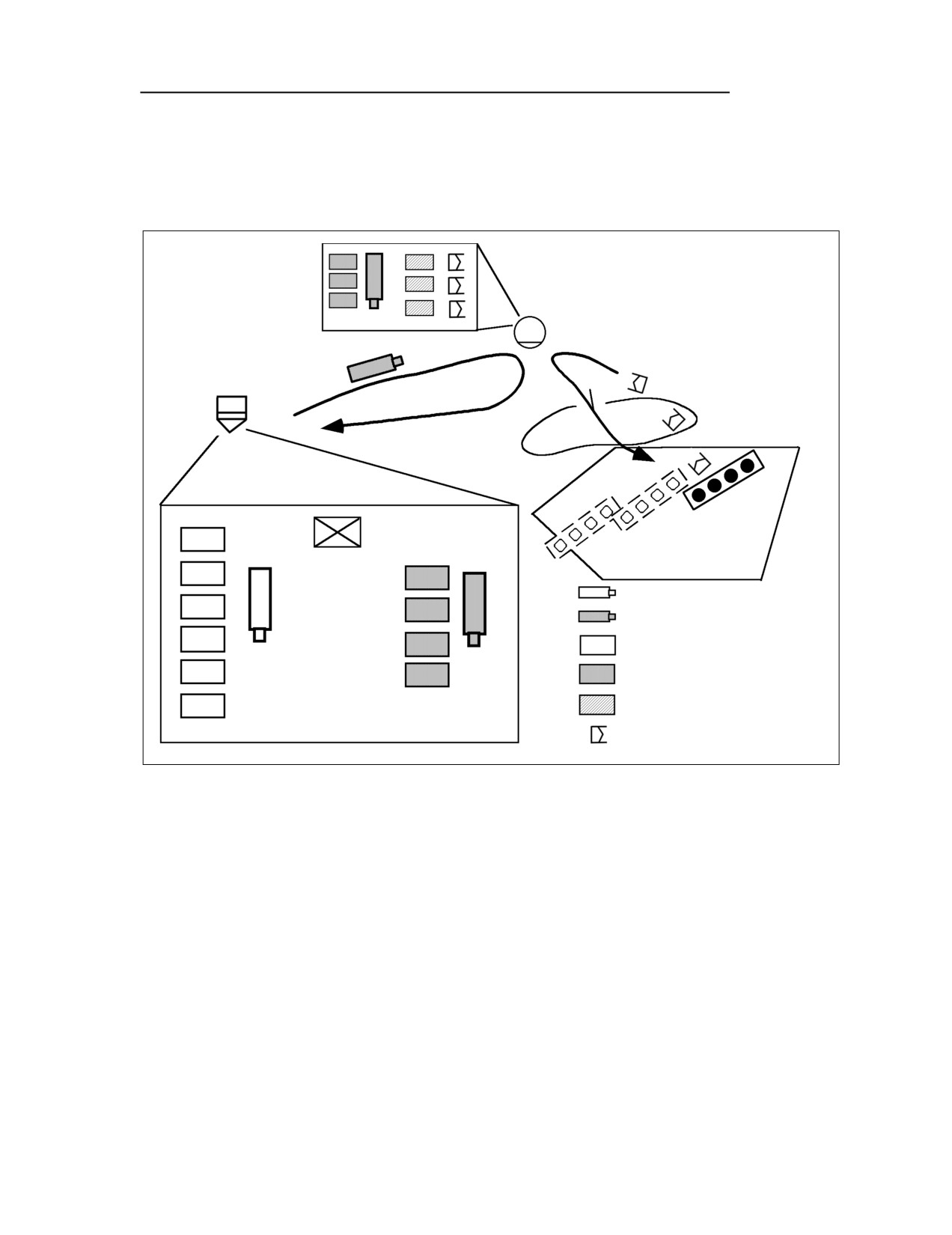
FM 20-32
material is further task-organized into minefield and mine-strip packages.
The emplacing platoon moves to a mine dump to resupply emplacing vehicles
or dispensers. Once the obstacle group is emplaced, the mine dump is
deactivated or moved to support another obstacle group.
Mine dump
Class IV/V supply
point (mines)
Entrance
S4/engineer
representatives
Corps/division truck
Battalion/engineer truck
Received mine
Task-organized mine package
Task-organized mine-strip
package
Exit
Emplacing vehicle
Figure 2-22. Service-station resupply method
There are several considerations for using the service-station method. First, it
is used when the obstacle group is located too far from the Class IV/V supply
point to allow efficient turnaround. Since this method provides for prestocking
obstacle material forward, it is used when available haul assets have a
relatively small capacity. This requires making frequent, short-duration
resupply trips and stocking mines to keep pace with emplacement. It also
streamlines emplacement since there is an opportunity to task-organize the
mines into mine-strip packages, based on the emplacement method and the
type of minefield. Finally, while it still requires the emplacing platoon to stop
laying and resupply, it minimizes the distance and the amount of time the
platoon must travel to reload. This requires that a small party be left at the
minefield to help pick up where emplacement stopped.
• Advantages.
Mine-Warfare Principles 2-47
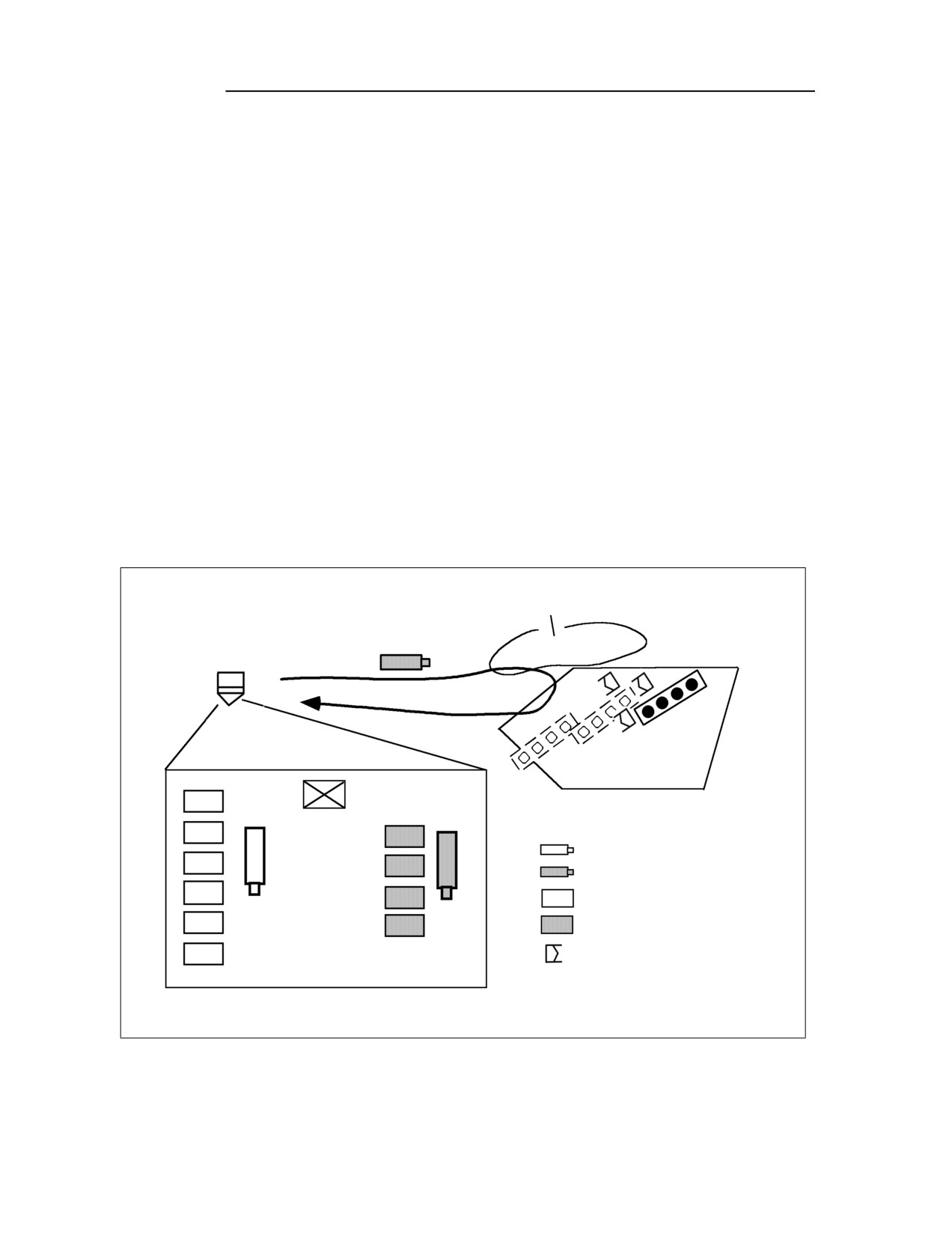
FM 20-32
— Allows prestockage of obstacle material to keep pace with
emplacement.
— Minimizes the distance and the amount of time the emplacing
platoon must travel to reload.
— May provide additional manpower and security if it is located near
a company/team.
• Disadvantages.
— Requires additional loading and unloading of obstacle material.
— May require augmentation with haul assets.
— Disrupts emplacement by requiring the emplacing platoon to stop
obstacle emplacement, move to the supply point, reload, and
return to the minefield.
Tailgate
The tailgate resupply method (Figure 2-23) transports obstacle material
directly from the Class IV/V supply point to the emplacing platoon at the
obstacle site. Obstacle material is transported with TF and engineer haul
assets. Obstacle material is transloaded by emplacing engineers to emplacing
vehicles or dispensers at the obstacle site.
Class IV/V supply
point (mines)
Entrance
S4/engineer
representatives
Corps/division truck
Battalion/engineer truck
Received mine
Task-organized mine package
Emplacing vehicle
Exit
Figure 2-23. Tailgate resupply method
2-48 Mine-Warfare Principles
FM 20-32
Two overriding considerations drive the decision to use the tailgate resupply
method. First, if obstacle emplacement is being conducted during limited
visibility, the tailgate method is the primary resupply method. It minimizes
disruption of emplacement and the chance of fratricide as engineers move
back into the work area after reloading. Secondly, tailgate resupply is the
primary method used when establishing a hasty defense or when the situation
is unclear and an attack can happen at anytime. Since obstacle material
remains loaded until transferred to an emplacing vehicle, the tailgate method
enables engineers to quickly break contact without risking a loss of obstacle
material to the enemy. The tailgate resupply method is the preferred method
for light forces.
• Advantages.
— Minimizes loading and unloading of obstacle material.
— Allows engineers to break contact rapidly in the event of enemy
attack without losing obstacle material to the enemy.
— Minimizes the movement of platoons in and out of the minefield
(suitable for limited visibility).
• Disadvantages.
— Requires augmentation by high-capacity transportation assets
that are capable of offsetting the loss in turnaround time if the
vehicle has to wait at the obstacle site.
— May result in inefficient use of haul assets.
— Complicates C2 in linking mine transport assets with emplacing
engineers since the engineers continue emplacement.
— Causes task-organizing of minefield packages to be conducted
concurrently with loading.
MINEFIELD MARKING
CRITERIA
Minefields must be marked to prevent fratricide. Marking ensures that
friendly soldiers do not accidentally enter a minefield, and it is a requirement
under STANAGs and Geneva Convention agreements. When emplacing
minefields behind the forward line of own troops (FLOT) (in the main battle or
rear area), mark the minefields on all four sides. This includes air-delivered
Volcano minefields that are sited and emplaced before the enemy attacks.
Gator, RAAM, and ADAM minefields are exceptions to the rule. To preserve
the system's flexibility and because of the relative inaccuracy of emplacement,
these minefields are not normally marked before emplacement unless the
tactical situation permits. Marking the area where mines are to be emplaced
by artillery or fixed-wing aircraft is not recommended. Mines could likely be
emplaced outside the marked area.
Forward of the FLOT, minefields are not generally marked before
emplacement. However, commanders must make every attempt to mark these
minefields as soon as the tactical situation allows. For scatterable minefields,
Mine-Warfare Principles 2-49
FM 20-32
a commander may choose to remove markings once the self-destruct (SD) time
of the mines has expired; but the location of the minefield must still be
recorded and forwarded to higher and adjacent units in case some of the mines
did not self-destruct.
PERIMETER
Construct a perimeter fence (Figure 2-24) to mark a minefield. Start
emplacing the perimeter fence before emplacing mines, preferably during site
layout if the tactical situation permits. For conventional minefields, ensure
that the perimeter fence is at least 15 meters outside the nearest mine or
cluster. For scatterable minefields, the area inside the perimeter fence must
include the safety zone. (See Chapter 3 for more details.)
Place warning signs for areas containing emplaced mines. Space the warning
signs 10 to 50 meters apart, depending on the terrain. If using pickets and
barbwire to mark the minefield, ensure that the wire is waist-high. If using
concertina wire, use a one-roll height. Place additional strands of barbwire or
rolls of concertina at the discretion of the commander.
TECHNIQUES
A commander may decide to mark individual minefields in an obstacle group
or to mark the group as a whole (Figure 2-25, page 2-52). Depending on the
size and the location of minefields, either technique may have the advantage
of using fewer resources or labor. Normally, marking individual minefields in
a fix-obstacle group requires less resources than marking the entire obstacle
group. The opposite is usually true for disrupt-, turn-, and block-obstacle
groups. The decision to mark individual minefields or obstacle groups should
not be based solely on logistical considerations. A commander must consider
the amount of tactical and/or sustainment movement required in and around
the obstacle groups as well as the capability of the unit’s C2 forces.
The following advantages and disadvantages to marking individual minefields
versus marking the obstacle group are provided to help commanders make the
best decision.
Marking Individual Minefields
• Advantages.
— Returning units forward of the minefields have more routes
(tactical lanes or bypasses) through the obstacle group.
— Tactical lanes need only pass through individual minefields.
— Mine recovery is easier.
• Disadvantages.
— Obstacle may not provide the desired effect.
— Enemy units can more easily bypass individually marked
minefields in a fix- or block-obstacle group.
Marking Obstacle Groups
• Advantages.
2-50 Mine-Warfare Principles
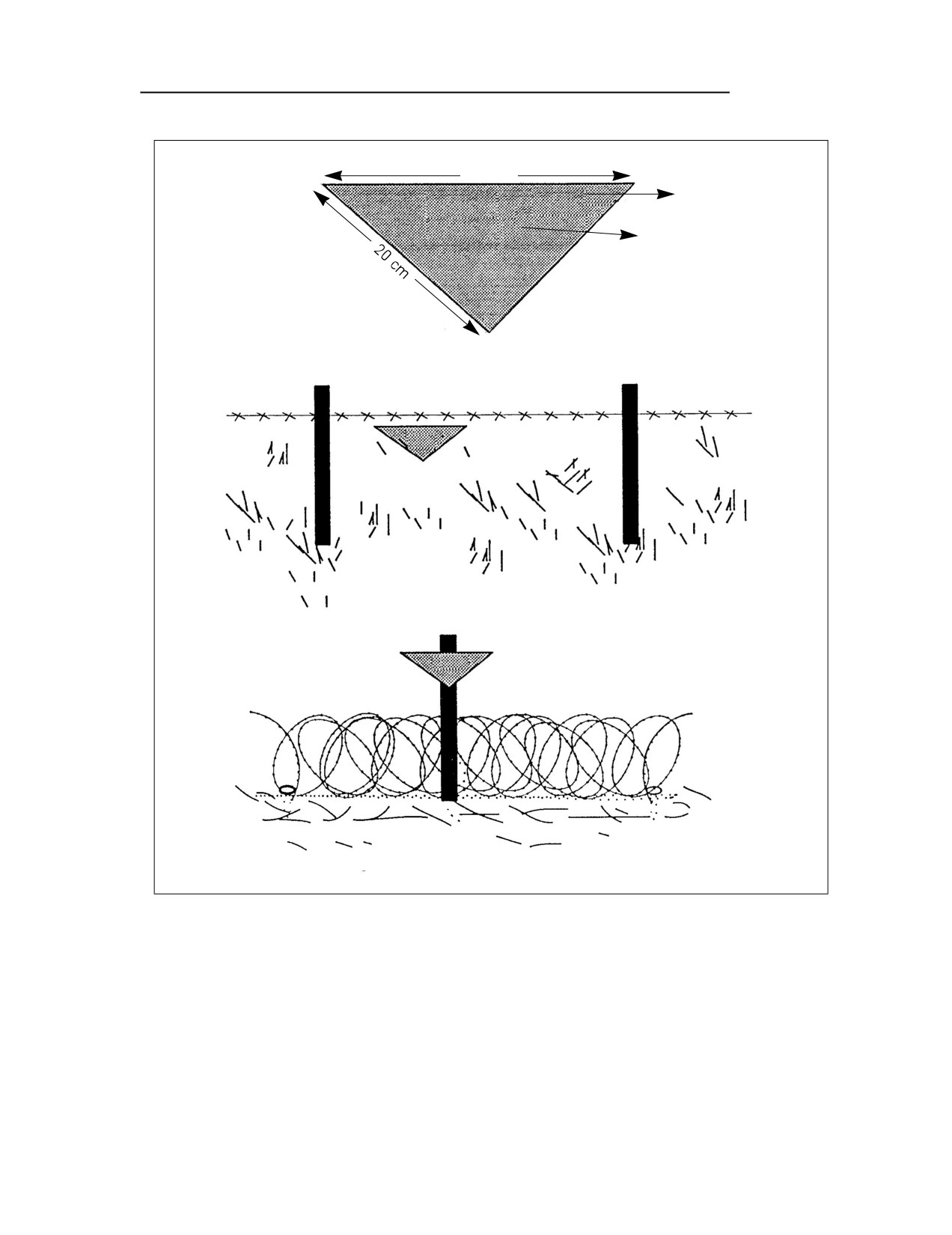
FM 20-32
28 cm
Red
MINES
White
Warning sign for areas containing mines
Mines
Barbwire fencing for a minefield
Mines
Concertina fencing for a minefield
Figure 2-24. Minefield marking
— Obstacle is more likely to provide the desired effect.
— The enemy cannot easily discern individual minefields and decide
when to employ breach assets in a fix-or block-effect minefield.
• Disadvantages.
— Friendly patrols cannot clearly see if the minefield is tampered
with unless they are within the perimeter fence.
Mine-Warfare Principles 2-51
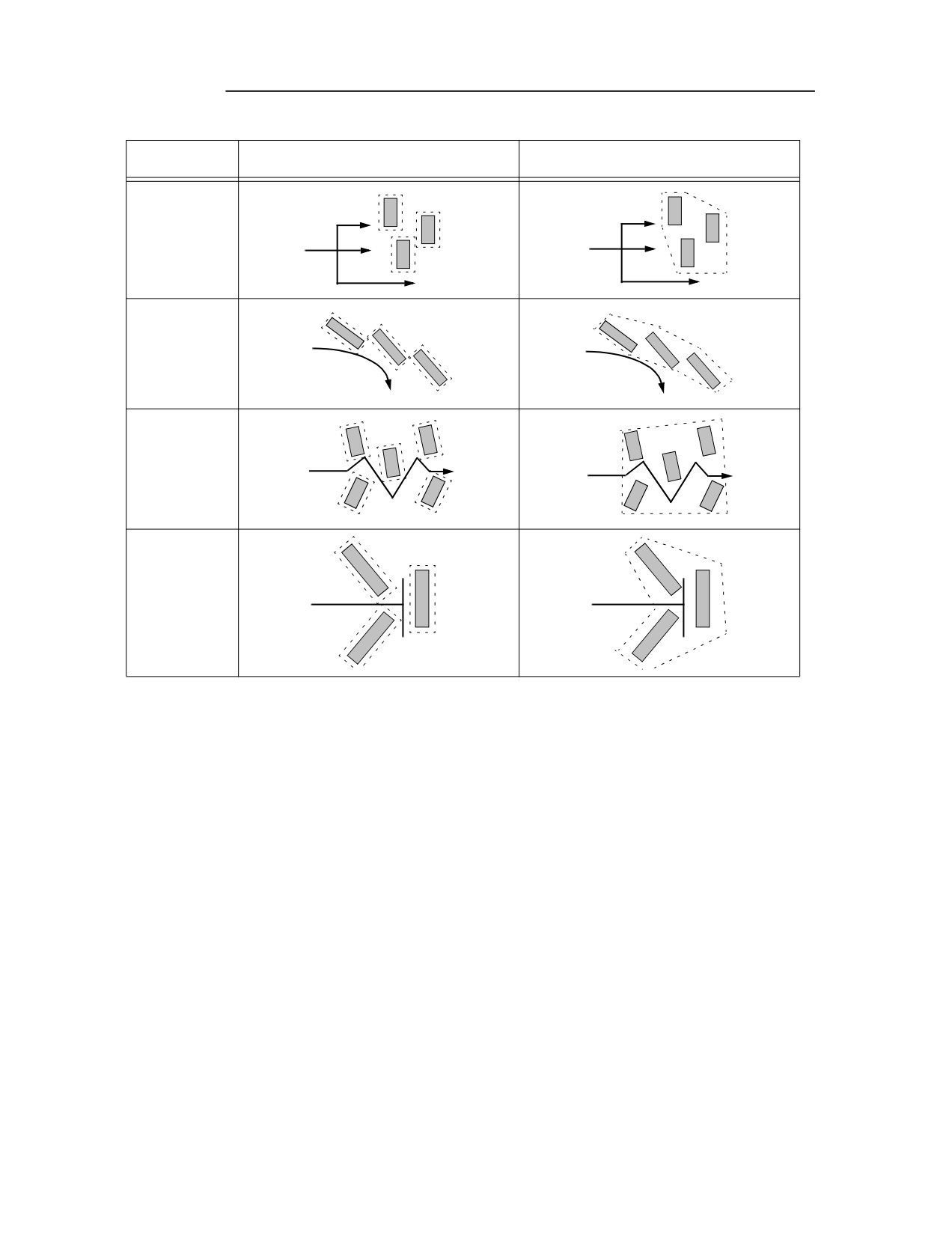
FM 20-32
Obstacle
Individual Minefield
Obstacle Group
Effect
Disrupt
Turn
Fix
Block
Figure 2-25. Marking of minefields and obstacle groups
— Tactical lanes need to pass through the entire obstacle group.
Friendly units passing through the lanes will be slowed
considerably.
MINEFIELD TURNOVER
Once an obstacle group is completed, the emplacing unit conducts minefield or
obstacle turnover with the owning unit. Occasionally, the owning unit will
transfer responsibility for a minefield to another unit. Minefield or obstacle
turnover ensures that the commander of the owning unit is familiar with the
minefield and understands his responsibilities concerning it. Turnover is
conducted whether or not there are lanes/gaps to be closed. Minefield turnover
is a must; the time and the location for the turnover is established during the
initial siting coordination.
The engineer must verbally address the following items with the
overwatching company/team:
• Intelligence.
— Provide an update on enemy activity forward of the minefield.
2-52 Mine-Warfare Principles