FM 20-32 Mine/Countermine Operations (August 2001) - page 1
This reprint includes Changes 1, 2, and 3.
FM 20-32
Mine/Countermine
Operations
Headquarters,
Department of the Army
DISTRIBUTION RESTRICTION: Approved for public release; distribution is unlimited.
C2
*FM 20-32
Field Manual
Headquarters
No. 20-32
Department of the Army
Washington, DC, 29 May 1998
MINE/COUNTERMINE OPERATIONS
Table of Contents
Page
LIST OF ILLUSTRATIONS
x
Figures
x
Tables
xv
PREFACE
xvii
CHAPTER 1. INTRODUCTION
1-1
MECHANICS OF MINES
1-1
Characteristics and Functioning
1-1
Components and Initiating Actions
1-2
ANTITANK MINES
1-4
Types of Kills
1-4
Types of Sensing
1-5
Types of Warheads
1-5
ANTIPERSONNEL MINES
1-5
Types of Kills
1-5
Types of Sensing
1-6
Types of Effects
1-6
ANTIHANDLING DEVICES
1-6
Part One. Mine Operations
CHAPTER 2. MINE-WARFARE PRINCIPLES
2-1
MINE-WARFARE CONCEPTS
2-1
TYPES OF MINEFIELDS
2-1
Protective Minefields
2-2
Tactical Minefields
2-3
Nuisance Minefields
2-4
Phony Minefields
2-4
PROTECTIVE VERSUS TACTICAL MINEFIELDS
2-5
TACTICAL MINEFIELDS
2-5
Minefield Variables
2-7
Design
2-10
DISTRIBUTION RESTRICTION: Approved for public release; distribution is unlimited.
____________________________
*This manual supersedes FM 20-32, 30 September 1992.
i
C2
Page
TACTICAL-OBSTACLE INTEGRATION PRINCIPLES
2-14
Obstacle Emplacement Authority
2-14
Obstacle Control
2-14
Obstacle Control Measures
2-15
Fratricide Prevention
2-19
Maneuver-Plan Support
2-19
SITING AND EMPLACING TACTICAL MINEFIELDS
2-32
Coordinating with the Maneuver Commander
2-32
Siting the Minefield
2-37
Emplacing Minefields
2-39
Determining Resource Requirements
2-39
MINEFIELD SUPPLY OPERATIONS
2-39
Resupply Nodes
2-41
Resupply Rules
2-43
Supply Location
2-44
Resupply Methods
2-44
MINEFIELD MARKING
2-49
Criteria
2-49
Perimeter
2-50
Techniques
2-50
MINEFIELD TURNOVER
2-52
MINEFIELD INSPECTION AND MAINTENANCE
2-55
CHAPTER 3. SCATTERABLE MINES AND MINE DELIVERY SYSTEMS
3-1
GENERAL CHARACTERISTICS
3-1
Antipersonnel Mines
3-1
Antitank Mines
3-3
CAPABILITIES
3-5
Faster Response
3-5
Remote Placement
3-5
Increased Tactical Flexibility
3-5
Efficiency
3-5
Increased Lethality
3-5
LIMITATIONS
3-5
Extensive Coordination
3-5
Proliferation of Targets
3-6
Visibility
3-6
Accuracy
3-6
Orientation
3-6
LIFE CYCLE
3-6
LETHALITY AND DENSITY
3-7
Lethality and Tactical-Obstacle Effect
3-7
Density
3-8
COMMAND AND CONTROL
3-9
AUTHORITY
3-9
COORDINATION
3-10
EMPLOYMENT AND EMPLACEMENT
3-10
Area-Denial Artillery Munitions and Remote Antiarmor Mines
3-11
Gator
3-14
Volcano
3-17
Modular Pack Mine System
3-27
ii
C2
Page
MARKING
3-26
Safety Zones
3-27
Fragment Hazard Zones
3-27
Fencing
3-28
CHAPTER 4. SPECIAL-PURPOSE MUNITIONS
4-1
M18A1 CLAYMORE
4-2
SELECTABLE LIGHTWEIGHT ATTACK MUNITION
4-3
Operating Modes
4-3
Antitamper Feature
4-6
M93 HORNET
4-6
Employment Considerations
4-7
Employment Roles
4-7
Tactical Emplacement
4-8
Recording and Marking
4-15
CHAPTER 5. CONVENTIONAL MINES
5-1
ANTITANK MINES
5-1
M15
5-1
M19
5-2
M21
5-2
ANTIPERSONNEL MINES
5-3
M14
5-3
M16
5-4
EMPLACING MINES
5-4
Mines With Prongs
5-4
Mines With Pressure Plates
5-4
Mines With Tilt Rods
5-6
Bearing Boards
5-6
Concealment
5-6
Maneuver Assistance
5-8
CHAPTER 6. ROW MINING
6-1
USE
6-1
RULES
6-1
LOGISTICS
6-3
Calculations
6-3
Task Organization
6-14
Site Layout
6-16
Mine-Laying Vehicles
6-18
Laying a Row Minefield
6-18
Immediate-Action Drill
6-24
Squad Drill
6-24
Marking, Recording, and Reporting Row Minefields
6-25
STANDARDIZED TACTICAL ROW MINEFIELDS
6-25
Disrupt and Fix
6-28
Turn
6-29
Block
6-31
HASTY PROTECTIVE ROW MINEFIELDS
6-33
Rules
6-34
Site Layout
6-34
iii
Page
CHAPTER 7. STANDARD-PATTERN MINEFIELDS
7-1
COMPONENTS
7-1
Mine Strips
7-1
Mine Clusters
7-1
Rules for Positioning Clusters Within a Strip
7-2
Standard-Pattern Minefield Rules
7-4
LOGISTICAL CALCULATIONS
7-9
Cluster Calculation
7-9
Platoon Organization
7-10
Mine-Emplacement Procedures
7-11
Mine Emplacement
7-13
NUISANCE MINEFIELDS
7-17
Siting
7-17
Location
7-17
Laying
7-18
Inspection and Maintenance
7-18
Handover
7-19
CHAPTER 8. REPORTING AND RECORDING
8-1
MINEFIELD/MUNITION FIELD REPORTS
8-1
Report of Intention
8-1
Report of Initiation
8-1
Report of Completion
8-2
Report of Transfer
8-2
Report of Change
8-3
Progress Reports
8-3
MINEFIELD/MUNITION FIELD RECORDS
8-3
Minefield Record
8-4
Hasty Protective Row Minefield Record
8-17
Nuisance Minefield
8-20
SCATTERABLE MINEFIELD/MUNITION FIELD REPORTING AND RECORDING
8-20
MINEFIELD/MUNITION FIELD OVERLAY SYMBOLS
8-25
Part Two. Counteroperations
CHAPTER 9. COUNTERMINE OPERATIONS
9-1
DEFINITIONS
9-1
Obstacle
9-1
Reduction
9-1
Breaching
9-1
Area Clearance
9-1
Route Clearance
9-1
Mine Neutralization
9-1
Proofing
9-2
Demining
9-2
BREACHING OPERATIONS
9-2
Intelligence
9-2
Fundamentals
9-4
Organization
9-4
Mass
9-5
Synchronization
9-5
iv
C3
Page
CLEARING OPERATIONS
9-6
Upgrade of Breach Lanes
9-6
Area Clearance
9-7
Demining
9-7
CHAPTER 10. MINEFIELD REDUCTION
10-1
DETECTING
10-1
Visual
10-1
Physical
10-2
Electronic
10-3
Mechanical
10-6
REPORTING
10-7
REDUCING
10-7
Explosive
10-7
Mechanical
10-14
Electronic
10-22
Manual
10-22
PROOFING
10-24
MARKING
10-24
Lane-Marking Terms
10-25
Levels of Lane Marking and Patterns
10-27
Commander's Guidance for Lane Marking
10-33
Lane-Marking Devices
10-34
Marking Requirements of the North Atlantic Treaty Organization
10-36
CHAPTER 11. ROUTE AND AREA CLEARANCE
11-1
ROUTE CLEARANCE
11-1
Planning
11-1
Planning Considerations
11-3
Task Organization
11-7
Methods and Types
11-11
AREA CLEARANCE
11-15
Planning
11-16
Planning Considerations
11-17
Task Organization
11-18
Methods and Types
11-18
IMPROVISED MINE THREAT
11-19
MINE LOCATIONS
11-20
DISPOSITION OF MINES
11-20
Mine-Removal Techniques
11-21
Hand Neutralization
11-21
SAFETY
11-22
REPORTS
11-22
Situation Report
11-23
Progress Report
11-23
Mine Incident Report
11-26
v
C2
Page
Part Three. Special Mining Operations
CHAPTER 12. MINING OPERATIONS IN SPECIAL ENVIRONMENTS
12-1
STREAMBED AND RIVER MINING
12-1
Employment
12-1
Emplacement
12-2
Recovery
12-3
Recording
12-3
Safety
12-3
URBAN-TERRAIN MINING
12-6
Antipersonnel Mines
12-7
Conventional Antitank Mines
12-12
Scatterable Mines
12-13
Deception Measures
12-15
SPECIAL ENVIRONMENTS
12-16
Cold Regions
12-16
Jungles
12-17
Deserts
12-17
CHAPTER 13. BOOBY TRAPS AND EXPEDIENT DEVICES
13-1
Section I. Setting Booby Traps
13-1
TACTICS
13-2
SITING
13-4
TYPES OF TRAPS
13-4
COMPONENTS AND PRINCIPLES
13-5
ACTUATION METHODS
13-5
METHODS OF CONNECTION
13-5
Remote
13-5
Direct
13-8
PLANNING, SETTING, AND RECORDING
13-8
Timeliness
13-8
Orders and Briefing
13-8
Rehearsal
13-9
Organization and Procedure
13-9
Reporting and Recording
13-10
SITES
13-14
SAFETY
13-14
Section II. Clearing Booby Traps
13-14
INDICATIONS
13-15
DETECTION
13-15
CLEARING METHODS
13-15
COMBAT CLEARANCE
13-16
CLEARANCE IN SECURE AREAS
13-17
Policy and Planning
13-17
Control Point
13-18
Control and Size of Parties
13-18
Marking
13-18
Clearing of Open Areas
13-18
Clearing of Buildings
13-19
Exterior Reconnaissance and Entry
13-19
Search Techniques
13-19
vi
C2
Page
Clearing Installations and Facilities
13-21
Clearing Obstacles
13-21
Clearing Secure Areas
13-21
CLEARANCE METHODS
13-22
IMPROVISED TRAPS
13-23
NONEXPLOSIVE TRAPS
13-23
Punji
13-23
Closing Trap
13-23
Spike Board
13-28
Venus Flytrap
13-28
Section III. Expedient Devices
13-29
AUTHORIZATION
13-29
EMPLOYMENT AND CONSTRUCTION TECHNIQUES
13-29
High-Explosive, Artillery-Shell Antitank Device
13-30
Platter Charge
13-31
Improvised Claymore
13-31
Grapeshot Antipersonnel Device
13-32
Barbwire Antipersonnel Device
13-32
APPENDIX A. INSTALLATION AND REMOVAL OF US MINES
AND FIRING DEVICES
A-1
Section I. Antipersonnel Mines
A-2
M14
A-2
Characteristics
A-2
Installation
A-3
Removal
A-5
M16
A-6
Characteristics
A-6
Installation
A-7
Removal
A-10
Section II. Antitank Mines
A-11
M15
A-11
Characteristics
A-12
Installation Using the M624 Fuse
A-13
Removal Using the M624 Fuse
A-17
Installation Using the M603 Fuse
A-17
Removal Using the M603 Fuse
A-20
M19
A-21
Characteristics
A-22
Installation
A-22
Removal
A-24
M21
A-24
Characteristics
A-25
Installation
A-26
Removal
A-29
Section III. Firing Devices and Activators
A-29
M5 PRESSURE-RELEASE FIRING DEVICE (MOUSETRAP)
A-30
Characteristics
A-30
Installation
A-31
Removal
A-31
vii
C3
Page
M142 MULTIPURPOSE FIRING DEVICE
A-32
Characteristics
A-33
Arming and Disarming
A-33
M1 AND M2 ACTIVATORS
A-33
APPENDIX B. CONTROLS AND COMPONENTS OF
SPECIAL-PURPOSE MUNITIONS
B-1
SELECTABLE LIGHTWEIGHT ATTACK MUNITION
B-1
M93 HORNET
B-1
APPENDIX C. THREAT MINE/COUNTERMINE OPERATIONS
C-1
MINE OPERATIONS
C-1
CHEMICAL MINES
C-6
COUNTERMINE OPERATIONS
C-7
Organization
C-7
Equipment
C-11
APPENDIX D. AIR VOLCANO
D-1
COMPONENTS
D-1
M87-Series Mine Canister
D-1
M139 Dispenser
D-2
LIMITATIONS
D-2
EMPLOYMENT
D-2
Deep Operations
D-3
Close Operations
D-4
Rear Operations
D-5
Minefield Effects
D-6
Planning
D-8
EMPLACEMENT
D-18
Outside Friendly Territory
D-20
Within Friendly Territory
D-20
REPORTING
D-22
Scatterable Minefield Warning
D-22
Scatterable Minefield Report and Record
D-22
APPENDIX E. SAFETY AND TRAINING
E-1
STORAGE
E-1
LIVE-MINE TRAINING
E-3
LIVE-MINE DEMONSTRATIONS
E-5
M16 Antipersonnel Mine
E-5
M18A1 Antipersonnel Munition
E-6
M15, M19, and M21 Antitank Mines
E-7
RISK ASSESSMENT FOR LIVE-MINE DEMONSTRATIONS
E-8
RISK ASSESSMENT FOR LIVE-MINE TRAINING
E-10
APPENDIX F. MINE AWARENESS
F-1
SOLDIER
F-1
Visual Indicators
F-1
Probing
F-2
AN/PSS-12 Metallic Mine Detector
F-3
Evacuation Drills
F-13
viii
C3
Page
LEADER
F-17
Risk Management
F-17
Recording and Mine-Data Tracking
F-20
Mine-Incident Report
F-21
TRAINING
F-21
Individual Training
F-21
Leader Training
F-22
Unit Training
F-23
APPENDIX G. COUNTERMINE DATA
G-1
BREACHING ASSETS VERSUS THREAT OBSTACLES
G-1
FOREIGN MINE DATA
G-1
FOREIGN MINEFIELD EMPLACEMENT DATA
G-1
FOREIGN MINE DELIVERY SYSTEMS
G-1
APPENDIX H. METRIC CONVERSION CHART
H-1
GLOSSARY
Glossary-1
REFERENCES
References-1
INDEX
Index-1
ix
C2
LIST OF ILLUSTRATIONS
Figures
Page
Figure
1-1. Mine components
1-2
Figure
1-2. Methods of actuating mines
1-3
Figure
1-3. Types of fuses
1-4
Figure
1-4. AHD incorporating a release mechanism
1-7
Figure
1-5. AHD not attached to the mine
1-7
Figure
1-6. Hand-emplaced US AHDs
1-8
Figure
2-1. Tactical versus protective obstacles
2-6
Figure
2-2. Tactical-obstacle effects
2-6
Figure
2-3. Minefield variables
2-7
Figure
2-4. Vehicle mine encounter probability versus minefield density
2-9
Figure
2-5. Disrupt-effect group
2-10
Figure
2-6. Fix-effect group
2-11
Figure
2-7. Turn-effect group
2-12
Figure
2-8. Block-effect group
2-13
Figure
2-9. Obstacle zones
2-16
Figure
2-10. Obstacle belts
2-17
Figure
2-11. Obstacle groups
2-18
Figure
2-12. TF defense COA
2-24
Figure
2-13. TF direct-fire analysis
2-25
Figure
2-14. TF obstacle-intent integration and priorities
2-26
Figure
2-15. Obstacle-plan refinement
2-28
Figure
2-16. Scheme-of-obstacle overlay
2-30
Figure
2-17. Sample obstacle-execution matrix
2-31
Figure
2-18. Minefield siting
2-38
Figure
2-19. Example of minefield resourcing
2-40
Figure
2-20. Mine resupply
2-41
Figure
2-21. Supply-point resupply method
2-46
Figure
2-22. Service-station resupply method
2-47
Figure
2-23. Tailgate resupply method
2-48
Figure
2-24. Minefield marking
2-51
Figure
2-25. Marking of minefields and obstacle groups
2-52
Figure
2-26. Sample obstacle-turnover work sheet
2-54
Figure
3-1. AP SCATMINEs
3-2
Figure
3-2. AT SCATMINE
3-3
Figure
3-3. Emplacement of ADAMs and RAAMs
3-11
Figure
3-4. Gator SCATMINE system
3-15
Figure
3-5. Gator minefield
3-17
Figure
3-6. Volcano mine system
3-18
Figure
3-7. Volcano components
3-18
Figure
3-8. Volcano disrupt and fix minefields
3-21
Figure
3-9. Volcano turn and block minefields
3-22
Figure
3-10. MOPMS
3-22
x
C2
Page
Figure
3-11. MOPMS emplacement and safety zone
3-23
Figure
3-12. MOPMS in a disrupt minefield
3-25
Figure
3-13. MOPMS in a fix minefield
3-26
Figure
3-14. Ground Volcano minefield
3-27
Figure
4-2. M18A1 claymore
4-2
Figure
4-3. SLAM
4-3
Figure
4-4. SLAM in bottom-attack mode
4-4
Figure
4-5. SLAM in side-attack mode
4-5
Figure
4-6. SLAM in timed-demolition mode
4-5
Figure
4-7. SLAM in command-detonation mode
4-5
Figure
4-8. M93 Hornet
4-6
Figure
4-9. Hornet reinforcing a conventional minefield
4-9
Figure
4-10. Hornet reinforcing a Volcano minefield
4-10
Figure
4-11. Hornet area-disruption obstacle
4-11
Figure
4-12. Hornet gauntlet obstacle (one cluster)
4-12
Figure
4-13. Hornet gauntlet obstacle (platoon)
4-13
Figure
4-14. Hornet-enhanced turn-and fix-obstacle groups
4-14
Figure
5-1. AT mines
5-1
Figure
5-2. AP mines
5-3
Figure
5-3. Prong-activated AP mine
5-5
Figure
5-4. Trip-wire-activated AP mine
5-5
Figure
5-5. Buried mine with pressure plate
5-6
Figure
5-6. Buried mine with tilt rod
5-7
Figure
5-7. Buried and concealed mines
5-7
Figure
6-1. Minefield requirements computation work sheet
6-5
Figure
6-2. Step-by-step procedures for completing the minefield requirements
computation work sheet
6-9
Figure 6-3. Site layout
6-19
Figure 6-4a. Laying a minefield
6-20
Figure 6-4b. Laying a minefield (continued)
6-21
Figure 6-5. Laying an IOE short row
6-21
Figure 6-6. Sample strip feeder report
6-22
Figure 6-7. Laying a row minefield
6-23
Figure 6-8. Measuring distances between mines with sandbags
6-25
Figure 6-9a. Sample DA Form 1355 for a row minefield (front)
6-26
Figure 6-9b. Sample DA Form 1355 for a row minefield (back)
6-27
Figure 6-10. Standardized disrupt and fix row minefields
6-28
Figure 6-11. Standardized turn row minefield
6-30
Figure 6-12. Standardized block row minefield
6-32
Figure 6-13. Site layout
6-35
Figure 7-1. Minefield layout
7-2
Figure 7-2. Cluster compositions
7-3
Figure 7-3. Arrangement of clusters in a mine strip
7-3
Figure 7-4. IOE baseline with short strips
7-4
Figure 7-5. Clusters on an IOE short strip
7-7
Figure 7-6. Minefield lanes and gaps
7-8
Figure 7-7. Mine-emplacement procedures
7-11
Figure 7-8. Laying and fusing mines
7-14
Figure 7-9. Lane closure
7-16
xi
C2
Page
Figure 8-1. Conventional minefield/munition field reporting chain
8-2
Figure 8-2a. Sample DA Form 1355 (front side) for a standard-pattern
minefield/munition field
8-5
Figure 8-2b. Sample DA Form 1355 (inside) for a standard-pattern
minefield/munition field
8-6
Figure 8-2c. Sample DA Form 1355 (back side) for a standard-pattern
minefield/munition field
8-7
Figure 8-3a. Sample DA Form 1355 (front side) for a Hornet minefield/munition field
8-12
Figure 8-3b. Sample DA Form 1355 (back side) for a Hornet minefield/munition field
8-13
Figure 8-4. Sample DA Form 1355-1-R
8-18
Figure 8-5. Hasty protective row minefield/munition field record
8-19
Figure 8-6a. Sample DA Form 1355 (front side) for a nuisance minefield/munition field
8-21
Figure 8-6b. Sample DA Form 1355 (inside) for a nuisance minefield/munition field
8-22
Figure 8-7. Scatterable minefield/munition field report and record work sheet
8-23
Figure 8-8. Sample SCATMINWARN
8-24
Figure 8-9. Scatterable minefield/munition field report and record
for an ADAM/RAAM artillery mission
8-24
Figure 8-10. Sample SCATMINWARN for an artillery mission
8-25
Figure 8-11. Minefield/munition field overlay symbols
8-26
Figure 9-1. Sample OBSTINTEL report
9-3
Figure 10-1. AN/PSS-12 mine detector
10-3
Figure 10-2. ASTAMIDS
10-4
Figure 10-3. IVMMD components
10-5
Figure 10-4. MICLIC
10-8
Figure 10-5. AVLM
10-8
Figure 10-6. MICLIC employment in a minefield less than 100 meters deep
10-10
Figure 10-7. MICLIC employment in a minefield of uncertain depth
or greater than 100 meters
10-10
Figure 10-8. Skip zone
10-11
Figure 10-10. APOBS
10-13
Figure 10-11. Bangalore torpedo
10-13
Figure 10-12. Skim technique
10-15
Figure 10-13. MCB
10-15
Figure 10-14. Mine-blade width compared to track-vehicle widths
10-16
Figure 10-15. MCR
10-17
Figure 10-16. Mine-roller width compared to track-vehicle widths
10-17
Figure 10-17. Panther
10-19
Figure 10-18. MiniFlail
10-20
Figure 10-19. Grizzly
10-20
Figure 10-20. CEV with mine rake
10-21
Figure 10-21. Tripod
10-23
Figure 10-22. Initial lane marking
10-28
Figure 10-23. Intermediate lane marking
10-30
Figure 10-24. Full lane marking
10-32
Figure 10-25. Marking devices
10-35
Figure 10-26. NATO standard marker
10-37
Figure 10-27. NATO lane-marking conversion
10-37
Figure 10-28. NATO standard marking for limited visibility
10-38
Figure 11-1. IBASIC
11-6
xii
C3
Page
Figure
11-2. Platoon-size sweep team
11-9
Figure
11-3. Squad-size sweep team
11-10
Figure
11-4. Sweep teams in echelon
11-11
Figure
11-5. Linear clearance method
11-12
Figure
11-6. Combat clearance method
11-13
Figure
11-7. Deliberate route clearance
11-14
Figure
11-8. Hasty route clearance
11-15
Figure
11-9. Area clearance site layout
11-19
Figure
11-10. Sample enemy obstacle report
11-24
Figure
11-11. Sample route status report
11-25
Figure
11-12. Sample mine incident report
11-26
Figure
12-1. Outrigger techniques
12-3
Figure
12-2a. Sample DA Form 1355 (front side) for river mining
12-4
Figure
12-2b. Sample DA Form 1355 (inside) for river mining
12-5
Figure
12-3. Building sketch and mine plan (DA Form 1355)
12-7
Figure
12-4. Underground passageway
12-8
Figure
12-5. Open spaces
12-8
Figure
12-6. Street obstacles
12-9
Figure
12-7. Roof obstacles
12-9
Figure
12-8. Building obstacles
12-10
Figure
12-9. Probable M14 AP mine emplacement
12-11
Figure
12-10. Probable M16 AP mine emplacement
12-11
Figure
12-11. Probable M18A1 AP mine emplacement
12-12
Figure
12-12. AT mine emplacement in urban areas
12-13
Figure
12-13. AT mine emplacement in industrial and transportation areas
12-13
Figure
12-14. ADAM/RAAM employment
12-14
Figure
12-15. MOPMS employment
12-16
Figure
13-1. Typical electric and nonelectric booby traps
13-6
Figure
13-2. Methods of actuation
13-7
Figure
13-3. Remotely connected traps
13-7
Figure
13-4. Standard booby-trap sign
13-9
Figure
13-5a. Sample DA Form 1355 (front side) for a booby-trapped area
13-12
Figure
13-5b. Sample DA Form 1355 (inside) for a booby-trapped area
13-13
Figure
13-6. Improvised electrical FDs
13-24
Figure
13-7. Improvised nonelectric FDs (shear-pin operated)
13-25
Figure
13-8. Improvised nonelectric FDs (spring-operated)
13-25
Figure
13-9. Improvised, electric delay devices
13-26
Figure
13-10. Improvised, nonelectric delay devices
13-26
Figure
13-11. Typical punjis
13-27
Figure
13-12. Side-closing trap
13-27
Figure
13-13. Spike board
13-28
Figure
13-14. Venus fly trap
13-28
Figure
13-15. HE, artillery-shell AT device
13-30
Figure
13-16. Platter charge
13-31
Figure
13-17. Improvised claymore device
13-32
Figure
13-18. Grapeshot AP device
13-33
Figure
13-19. Barbwire AP device
13-33
Figure A-1. M14 AP mine
A-2
Figure A-2. M22 wrench
A-3
Figure A-3. M14 mine in ARMED position
A-4
Figure A-4. Removal of safety clip
A-4
xiii
C2
Page
Figure A-5. Bottom view of M14 mine
A-5
Figure A-6. M16A1 AP mine
A-6
Figure A-7. M16A1 mine and M25 wrench
A-7
Figure A-8. M605 fuse
A-8
Figure A-9. Safety pins
A-9
Figure A-10. Buried mine with a trip wire
A-9
Figure A-11. Metal collar on an M605 fuse
A-10
Figure A-12. M15 AT mine
A-12
Figure A-13. M20 wrench
A-13
Figure A-14. Correct safety-pin configuration
A-14
Figure A-15. Greasing the M624 fuse
A-14
Figure A-16. Tightening the fuse with the extension rod
A-15
Figure A-17. M15 mine in the hole
A-15
Figure A-18. Extension-rod assembly
A-16
Figure A-19. Assembly of the extension rod into the fuse ring
A-16
Figure A-20. Removal of safety pin
A-17
Figure A-21. ARMED position
A-18
Figure A-22. SAFE position
A-18
Figure A-23. Safety fork
A-19
Figure A-24. Clearance test
A-20
Figure A-25. M15 mine in the hole
A-20
Figure A-26. M19 AT mine
A-21
Figure A-27. Removal of the pressure plate
A-22
Figure A-28. Firing pin
A-23
Figure A-29. M21 AT mine
A-25
Figure A-30. M607 fuse
A-26
Figure A-31. M26 wrench
A-26
Figure A-32. Buried M21 mine
A-27
Figure A-33. Removing the band and the stop
A-28
Figure A-34. M5 FD
A-30
Figure A-35. Arming the M15
A-31
Figure A-36. M142 FD
A-32
Figure A-37. M1 activator
A-34
Figure B-1. SLAM components
B-1
Figure B-2. Hornet components
B-3
Figure B-3. Hornet controls and indicators
B-4
Figure C-1. GMZ armored tracked mine layer
C-2
Figure C-2. Threat-style rapidly emplaced minefield
C-3
Figure C-3. Threat-style antitrack minefield
C-3
Figure C-4. Threat-style antihull minefield
C-4
Figure C-5. Threat-style AP minefield
C-4
Figure C-6. UMZ SCATMINE system
C-6
Figure C-7. Chemical-mine employment
C-7
Figure C-8. BAT-M with BTU bulldozer blade
C-8
Figure C-9. KMT-4 plow
C-8
Figure C-10. IMP portable mine detector
C-9
Figure C-11. DIM mine detector
C-9
Figure C-12. KMT-5 plow-roller combination
C-10
Figure C-13. IMR armored engineer tractor
C-10
Figure C-14. M1979 armored mine clearer
C-11
xiv
C3
Page
Figure D-1. Air Volcano system
D-1
Figure D-2. Turn obstacle
D-6
Figure D-3. Block obstacle
D-7
Figure D-4. Disrupt obstacle
D-7
Figure D-5. Fix obstacle
D-8
Figure D-6. Site layout
D-15
Figure D-7. Sample Volcano card
D-17
Figure D-8. Fencing for an air Volcano minefield
D-21
Figure E-1. M16 AP mine
E-6
Figure E-2. M18A1 AP mine
E-7
Figure E-3. M15 and M19 AT mines
E-8
Figure E-4. M21 AT mine
E-8
Figure E-5. Excerpt from Risk-Assessment Techniques Manual, prepared by the
Department of Transportation’s Transportation Safety Institute, August 1986
E-9
Figure E-6. Preliminary hazard-analysis work sheet (arming M15)
E-11
Figure E-7. Preliminary hazard-analysis work sheet (disarming M15)
E-12
Figure E-8. Preliminary hazard-analysis work sheet (arming M16)
E-13
Figure E-9. Preliminary hazard-analysis work sheet (disarming M16)
E-14
Figure E-10. Preliminary hazard-analysis work sheet (arming M19)
E-15
Figure E-11. Preliminary hazard-analysis work sheet (disarming M19)
E-16
Figure E-12. Preliminary hazard-analysis work sheet (arming M21)
E-17
Figure E-13. Preliminary hazard-analysis work sheet (disarming M21)
E-18
Figure E-14. Preliminary hazard-analysis work sheet (command detonation)
E-19
Figure E-15. Preliminary hazard-analysis work sheet (peripheral factors)
E-20
Figure F-1. AN/PSS-12 metallic mine detector
F-4
Figure F-2. AN/PSS-12 packed components
F-4
Figure F-3. Electronic unit
F-5
Figure F-4. Battery installation
F-5
Tables
Table 2-1. Echelons of obstacle control and effect
2-15
Table 2-2. Planning factors for the mine dump
2-21
Table 2-3. Planning factors for work rates
2-21
Table 2-4. Planning factors for standardized row minefields
2-22
Table 2-5. Planning factors for scatterable minefields
2-22
Table 2-6. Ranges of common weapons
2-23
Table 2-7. Personnel requirements for a Class IV/V supply point
2-42
Table 2-8. Class IV/V haul capacity
2-45
Table 3-1. Characteristics of AP SCATMINEs
3-2
Table 3-2. Characteristics of AT SCATMINEs
3-4
Table 3-3. SD windows
3-7
Table 3-4. Emplacement authority
3-9
Table 3-5. Coordination responsibilities
3-10
Table 3-6. RAAM and ADAM minefield density and size
3-14
Table 3-7. Marking scatterable minefields
3-26
Table 3-8. Safety and fragment hazard zones
3-28
Table 4-1. Hornet minimum emplacement distances
4-15
xv
C3
Page
Table
5-1. Characteristics of AT mines
5-2
Table
5-2. Characteristics of AP mines
5-3
Table
5-3. Sympathetic detonation chart
5-8
Table
7-1. Platoon organization and equipment
7-10
Table
7-2. Sample mines tally sheet
7-15
Table
8-1. Minefield/munition field obstacle numbering system
8-8
Table
8-2. Abbreviations for obstacle types
8-9
Table
9-1. Lane widths
9-4
Table
10-1. Lane-marking levels, unit responsibilities, and trigger events
10-33
Table
10-2. Guidelines for lane-marking devices
10-34
Table
11-1. Sample task organization for a route clearance
11-2
Table
11-2. Personnel and equipment requirements for a sweep team
11-8
Table
11-3. Sample task organization for an area clearance
11-17
Table
13-1. Tactical reports
13-11
Table
13-2. Clearing equipment
13-17
Table C-1. Normal parameters for threat-style minefields
C-2
Table D-1. Air Volcano capabilities and limitations
D-4
Table D-2. Air Volcano minefield data
D-6
Table D-3. Planning process (H-hour sequence)
D-11
Table D-4. Air Volcano dispensing times based on air speed
D-19
Table E-1. Mine color-coding system
E-2
Table F-1. Risk-assessment criteria
F-18
Table F-2. Sample risk assessment
F-19
Table G-1. Mounted breaching assets versus threat obstacles
G-2
Table G-2. Dismounted breaching assets versus threat obstacles
G-5
Table G-3. Foreign track-width AT mines
G-9
Table G-4. Foreign full-width AT mines
G-10
Table G-5. Foreign side-attack AT mines
G-11
Table G-6. Foreign pressure-fused AP mines
G-11
Table G-7. Foreign trip-wire/break-wire-fused AP mines
G-12
Table G-8. Foreign emplaced minefields
G-13
Table G-9. Foreign mine delivery systems
G-14
Table H-1. Metric conversion chart
H-1
xvi
C2
Preface
Field Manual (FM) 20-32 provides United States (US) armed forces with tactical, technical, and
procedural guidance for conducting mine and countermine operations. It applies to all elements of
the combined arms team for maneuver and engineer staff planning and coordination. The manual
is presented in three parts—mine operations, counteroperations, and special-mining operations.
The guidance provided focuses on individual skills of emplacing and removing mines, team and
squad tasks, platoon and company organization and planning, and battalion/task force (TF)
organization and coordination for successful obstacle reduction and breaching operations.
The provisions of this publication support existing doctrine established by FMs 5-34, 5-100, 90-7,
and 90-13-1. It also contains new and improved techniques for emplacing row mines; marking,
reporting, and recording minefields; reducing simple and complex obstacles; and emplacing a
standard-pattern minefield. This manual reflects new doctrine from FMs 5-10, 5-71-2, and 5-71-3.
This publication implements the following International Standardization Agreements
(STANAGs) between North Atlantic Treaty Organization (NATO) forces:
• STANAG 2036. Land Minefield Laying, Marking, Recording, and Reporting Procedures.
Edition 5.
• STANAG 2889. Marking of Hazardous Areas and Routes Through Them. Edition 3.
• STANAG 2990. Principles and Procedures for the Employment in Land Warfare of
Scatterable Mines with a Limited Laid Life. Edition 1.
NOTE: US policy regarding the use and employment of antipersonnel land mines
(APLs) outlined in this FM is subject to the Convention on Certain Conventional
Weapons and Executive Orders. Current US policy limits the use of non-self-
destructing APLs to (1) defending the US and its allies from armed aggression across
the Korean demilitarized zone and (2) training personnel engaged in demining and
countermine operations. The use of the M18A1 claymore in the command-detonation
mode is not restricted under international law or Executive Order.
All references to US employment of non-self-destructing APLs (such as row mining) in this
manual are intended to provide doctrine for use in Korea only. This information is provided in
bold lettering throughout the manual. Detailed doctrine on APLs is also provided to ensure that
US forces recognize how the enemy can employ these weapons.
As the US military seeks to end its reliance on APLs, commanders must consider the increased
use of other systems such as the M18A1 claymore, nonlethal barriers (such as wire obstacles),
sensors and surveillance platforms, and direct and indirect fires.
This publication includes the following appendixes:
• Appendix A. Installation and Removal of US Mines and Firing Devices.
• Appendix B. Controls and Components of Special-Purpose Munitions.
• Appendix C. Threat Mine/Countermine Operations.
• Appendix D. Air Volcano.
• Appendix E. Safety and Training.
• Appendix F. Mine Awareness.
• Appendix G. Countermine Data.
• Appendix H. Metric Conversion Chart.
xvii
The proponent for this publication is Headquarters, US Army Training and Doctrine Command
(TRADOC). Forward comments and recommendations on Department of the Army (DA) Form
2028 to Commandant, US Army Engineer School, ATTN: ATSE-DME-MWF, Fort Leonard Wood,
Missouri 65473-5000.
Unless this publication states otherwise, nouns and pronouns do not refer exclusively to men.
xviii
Chapter 1
Introduction
This chapter provides the mechanics and characteristics of antitank (AT)
mines and munitions, antipersonnel (AP) mines and munitions, and
antihandling devices (AHDs). The information contained in this chapter
also provides a foundation for the rest of the manual.
Land-based mines and munitions are hand-emplaced, remote-delivered,
ground-delivered, or air-delivered:
• Hand-emplaced mines and munitions require manual arming and
are labor-, resource-, and transport-intensive.
• Remote- and air-delivered mines and munitions require less time
and labor; however, they are not as precisely placed as hand-
emplaced mines and munitions.
• Ground-delivered mines are less resource-intensive than hand-
emplaced mines. They are not precisely placed; however, the
minefield boundaries are.
Soldiers can surface lay or bury mines and munitions and can place AHDs
on hand-emplaced AT mines.
NOTE: Some countries employ AHDs on AP mines, but US forces
are not authorized to employ AHDs on any type of AP mine.
MECHANICS OF MINES
CHARACTERISTICS AND FUNCTIONING
A land mine is an explosive device that is designed to destroy or damage
equipment or personnel. Equipment targets include ground vehicles, boats,
and aircraft. A mine is detonated by the action of its target, the passage of
time, or controlled means. There are two types of land-based mines—AT and
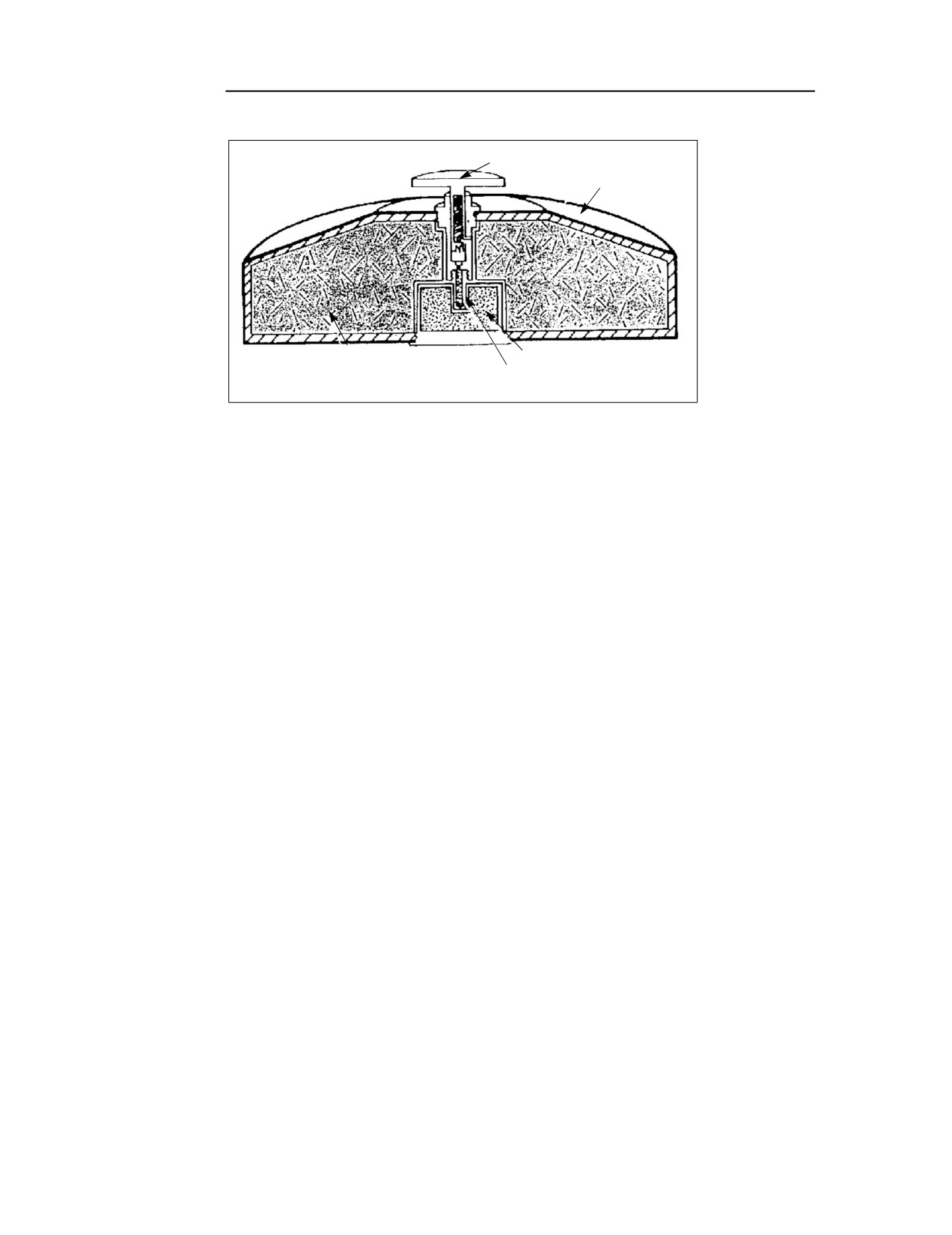
AP. Mines generally consist of the following parts (Figure 1-1, page 1-2):
• Firing mechanism or other device (sets off the detonator or igniter
charge).
• Detonator or igniter (sets off the booster charge).
• Booster charge (may be attached to the fuse or the igniter or be part of
the main charge).
• Main charge (in a container; usually forms the body of the mine).
• Casing (contains all the above parts).
Introduction 1-1
FM 20-32
Firing mechanism
Casing
Main charge
Booster charge
Detonator or igniter
Figure 1-1. Mine components
COMPONENTS AND INITIATING ACTIONS
A firing mechanism prevents the mine from exploding until it makes contact
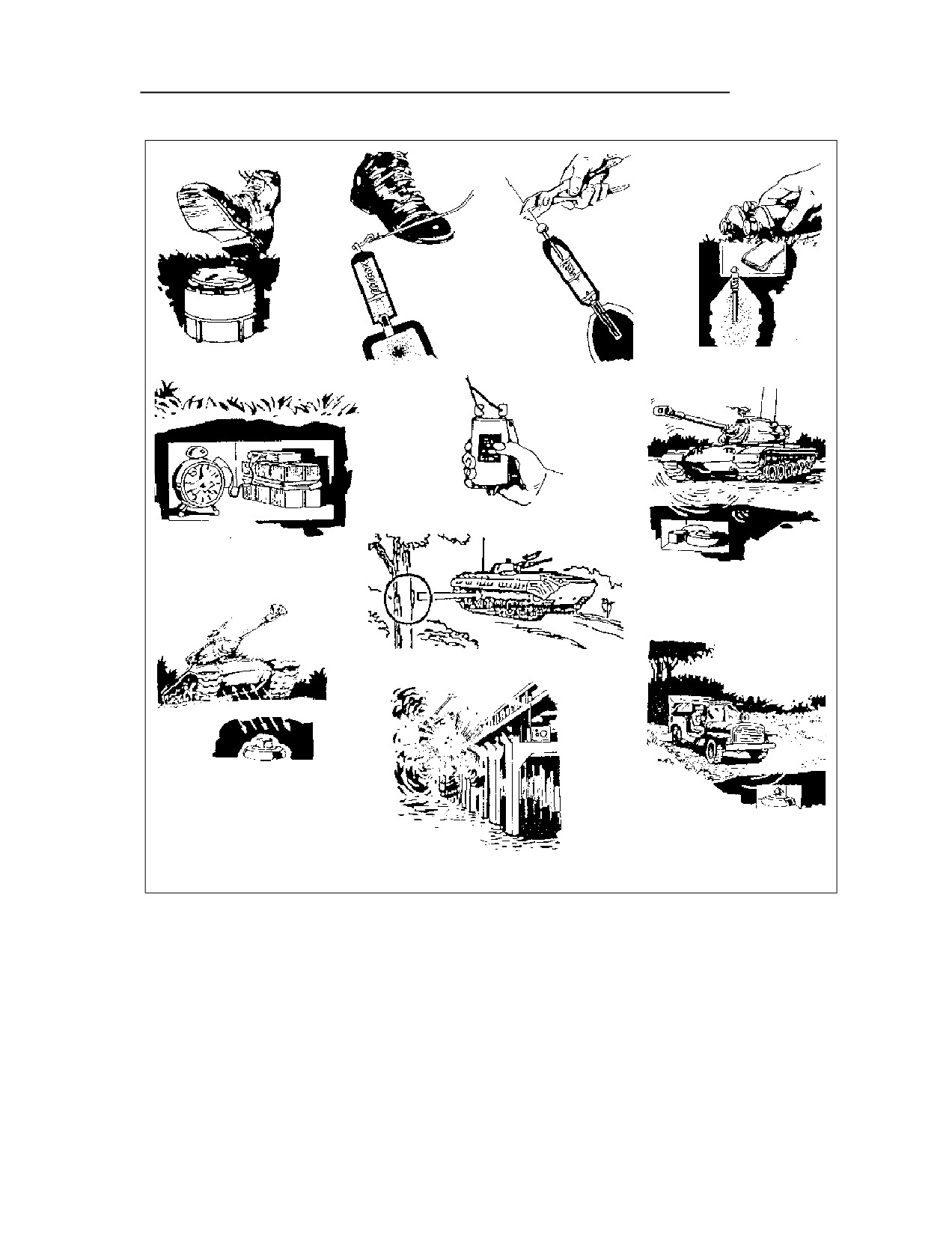
with, or is influenced by, its target. Once a mine has been armed, the firing
mechanism may be actuated by the following methods (Figure 1-2):
• Applying pressure (including tilt rod).
• Pulling a trip wire.
• Releasing tension or breaking a trip wire.
• Releasing pressure.
• Passage of time (time-delay mechanism).
• Impulses.
— Electrical.
— Vibration.
— Magnetic-influence.
— Electromagnetic-frequency.
— Infrared-sensored.
— Acoustic.
To arm some mines, you must position the igniter, set the mechanism properly,
and disengage the safety device (usually by removing a safety pin). The fuse is
the initial component in the firing chain; it has a low-explosive (LE) powder
but is highly sensitive. The fuse is actuated by an initiating action. Although
mines are issued with a standard fuse, alternate fuses are issued separately
for some mines.
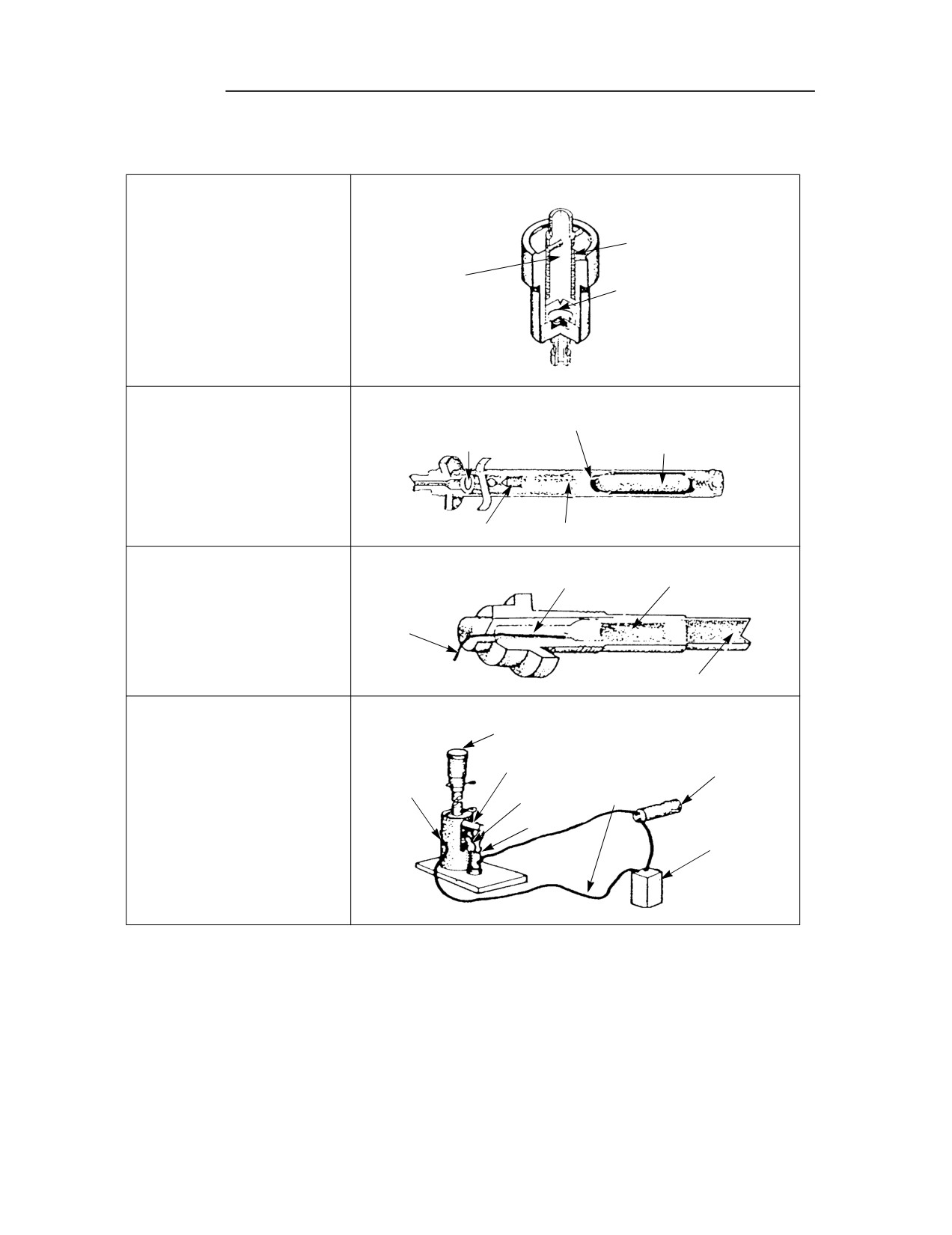
The four main fuse types are shown in Figure 1-3, page 1-4.
1-2 Introduction
FM 20-32
Pressure
Pressure-release
Pull
Tension-release
Electrical
Time-delay
Vibration
Infrared-sensored
Magnetic-influence
Acoustic
Electromagnetic-frequency
Figure 1-2. Methods of actuating mines
Introduction 1-3
FM 20-32
Striker spring
Mechanical. A spring drives a
Striker
striker against a percussion cap,
Percussion cap
which fires the detonator.
Chemical. A small container of a
Restraining wire
chemical compound is broken by
Primer
Chemical container
the initiating action. The chemical
compound reacts with another
substance to generate heat,
which ignites the detonator.
Firing
Firing-pin spring
Chemical compound
Delay charge
Friction. The initiating action
ignites substances inside the
Trip wire
fuse by friction. The flame fires
the detonator.
Detonator
Plunger head
Contact rod
Electric detonator
Electric-
Electrical. The initiating action
Contact
Spring clip
wire leads
closes an electrical circuit, which
Contact
functions an electrical detonator.
Battery
Figure 1-3. Types of fuses
ANTITANK MINES
AT mines are designed to immobilize or destroy vehicles and their occupants.
TYPES OF KILLS
An AT mine produces a mobility kill (M-Kill) or a catastrophic kill (K-Kill). An
M-Kill destroys one or more of the vehicle's vital drive components (for
1-4 Introduction
C2, FM 20-32
example, breaks a track on a tank) and immobilizes the target. An M-Kill does
not always destroy the weapon system and the crew; they may continue to
function. In a K-Kill, the weapon system and/or the crew is destroyed.
TYPES OF SENSING
AT fuses fall into three design categories:
• Track-width. Usually pressure-actuated, requiring contact with the
wheels or tracks of a vehicle.
• Full-width. Activated by several methods—acoustics, magnetic-
influence, tilt-rod, radio-frequency, infrared-sensored, command, or
vibration. Tilt-rod or magnetic-influence fuses are the most common.
Full-width fuses are designed to be effective over the entire target
width and can cause a K-Kill from penetration and spalling metal or
from secondary explosions. When a full-width fuse is activated solely
by contact with the wheels or tracks of the target vehicle, it usually
causes an M-Kill because most of the energy is absorbed by the wheels
or tracks.
• Off-route. Designed to be placed along the side of a route likely to be
taken by armored vehicles. It has numerous fuzing possibilities,
including infrared, seismic, break wire, and magnetic. It produces an
M-Kill or a K-Kill, depending on the location of the target at the time
of mine detonation.
TYPES OF WARHEADS
AT mines can be identified by their warheads:
• Blast AT mines derive their effectiveness from the force generated by
high-explosive (HE) detonation. They usually produce an M-Kill when
the blast damages the track or the vehicle, but a K-Kill is also
possible.
• Shaped-charge mines use a directed-energy warhead. A shaped charge
is formed by detonating an explosive charge behind a cone of dense
metal or other material. Upon detonation, the cone collapses and
forms a metal slug and a gaseous metal jet that penetrate the target.
A K-Kill is probable if the crew or ammunition compartment is hit.
• Explosive-formed penetrating (EFP) mines have an explosive charge
with a metal plate in front. Upon detonation, the plate forms into an
inverted disk, a slug, or a long rod. A K-Kill is probable if the crew or
ammunition compartment is hit.
ANTIPERSONNEL MINES
TYPES OF KILLS
AP mines can kill or incapacitate their victims. The injuries and deaths they
cause commit medical resources, degrade unit morale, and damage
nonarmored vehicles. Some types of AP mines may break or damage the track
on armored vehicles.
Introduction 1-5
C2, FM 20-32
TYPES OF SENSING
AP mines can be fused in many ways, to include pressure, seismic, wire, or
command detonation:
• Pressure fuses usually activate an AP mine when a load is placed on
the fuse.
• Seismic fuses activate an AP mine when the sensor detects vibrations.
• Trip wires or break wires activate an AP mine when something
disturbs barely visible wires.
• Command-detonated mines are activated by a soldier when he detects
the enemy in the mines’ blast area.
TYPES OF EFFECTS
AP mines contain five types of effects:
• Blast. Cripples the foot or leg of a soldier who steps on it; can also
burst the tires of a wheeled vehicle that passes over it.
• Bounding-fragmentation. Throws a canister into the air; the canister
bursts and scatters shrapnel throughout the immediate area.
• Direct-fragmentation. Propels fragments in the general direction of
enemy soldiers.
• Stake-fragmentation. Bursts and scatters shrapnel in all general
directions.
• Chemical. Disperses a chemical agent to whoever activates it;
contaminates the surrounding area.
ANTIHANDLING DEVICES
AHDs perform the function of a mine fuse if someone attempts to tamper with
the mine. They are intended to prevent moving or removing the mine, not to
prevent reduction of the minefield by enemy dismounts. An AHD usually
consists of an explosive charge that is connected to, placed next to, or
manufactured in the mine. The device can be attached to the mine body and
activated by a wire that is attached to a firing mechanism. US forces can
employ AHDs on conventional AT mines only. Other countries employ AHDs
on AT and AP mines.
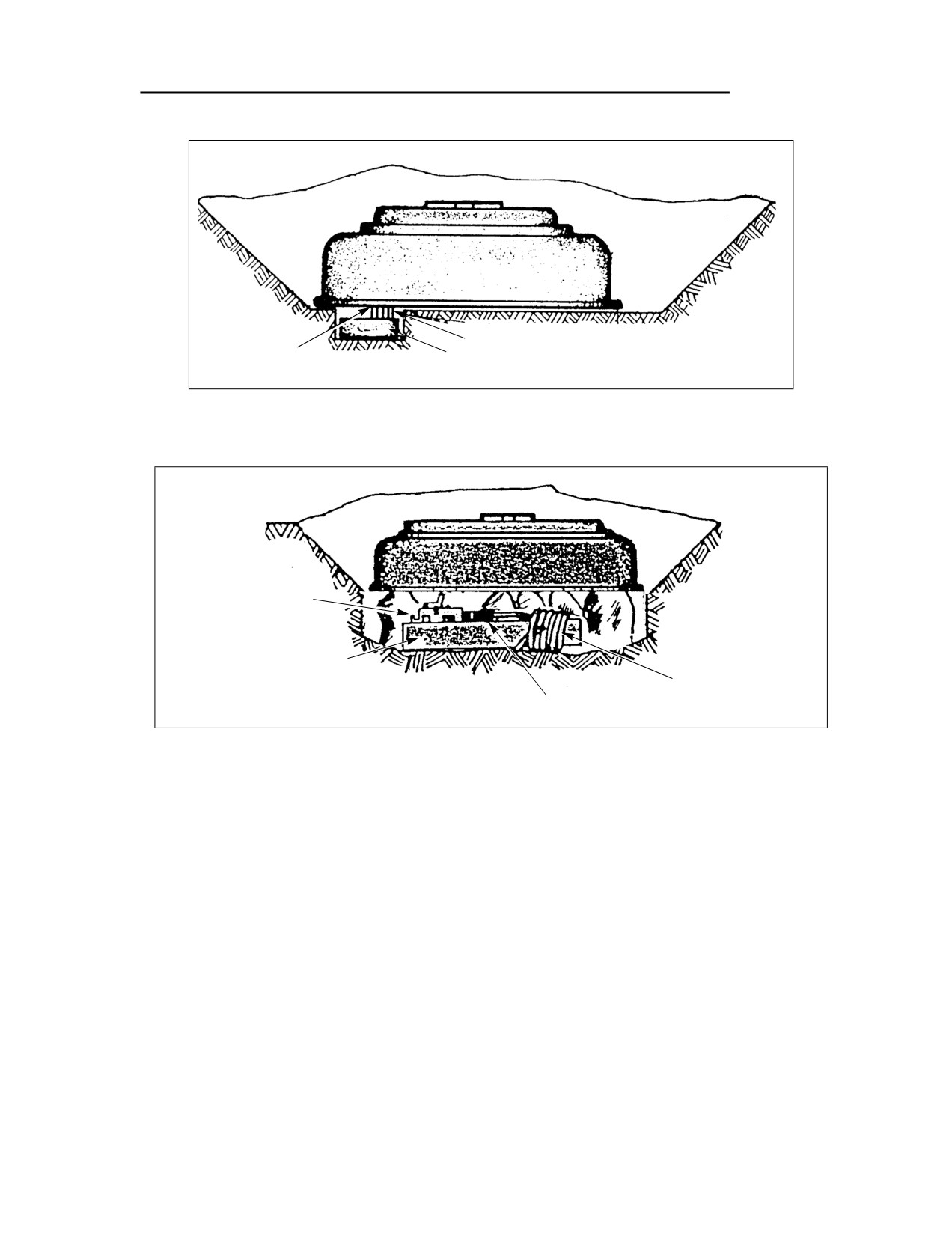
Some mines have extra fuse wells that make it easier to install AHDs (Figure
1-4). An AHD does not have to be attached to the mine; it can be placed
underneath the mine (Figure 1-5). Mines with AHDs are sometimes
incorrectly called booby-trapped mines.
1-6 Introduction
C2, FM 20-32
Secondary
Activator
fuse well
M5 pressure-release FD
Figure 1-4. AHD incorporating a release mechanism
M142 multipurpose
FD (pressure-release
model)
C4 explosive
Detonating cord
Blasting cap
Figure 1-5. AHD not attached to the mine
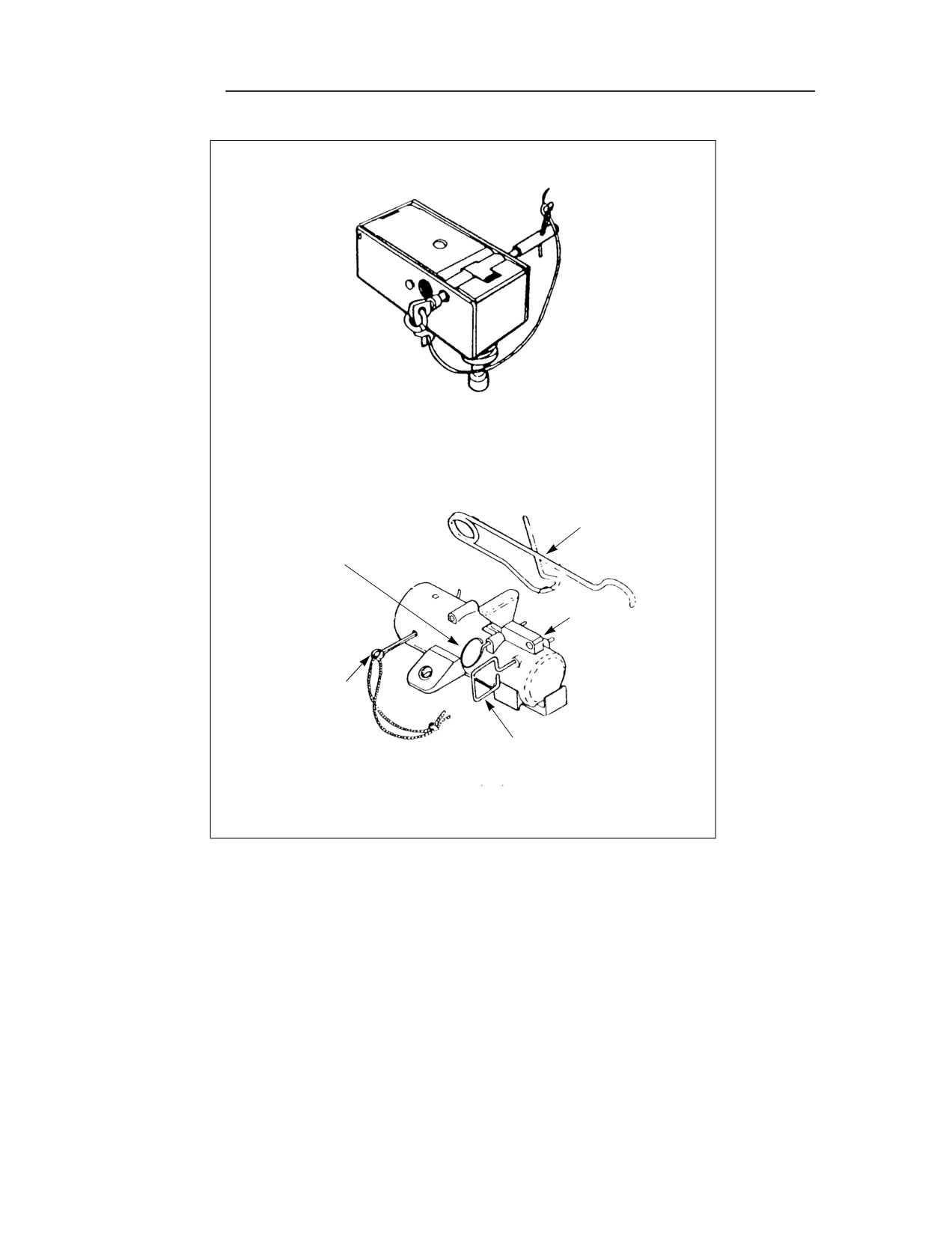
The following hand-emplaced AHDs are used by US forces (Figure 1-6, page 1-8):
• M5 pressure-release firing device (FD).
• M142 multipurpose FD.
These devices use a spring-loaded striker with a standard base, and they
function in one or more modes—pressure, pressure-release, tension, and/or
tension-release. When an FD is employed as an AHD on certain AT mines, it
requires the use of an M1 or M2 activator. FDs and activators are described in
Appendix A.
Introduction 1-7
FM 20-32
M5 Pressure-Release FD
Tension-release
device
Round-head safety pin
FD
Positive safety
(remove last)
Square-head safety pin
M142 Multipurpose FD
Figure 1-6. Hand-emplaced US AHDs
1-8 Introduction
PART ONE
Mine Operations
This part of the manual provides tactical and technical information on mines,
minefields, and mine-delivery systems; emplacement and employment methods and
responsibilities; and reporting and recording procedures for US mine operations.
Current US policy for restrictions on AP mines and other devices is also discussed.
Chapter 2
Mine-Warfare Principles
This chapter provides guidance to staff personnel who must plan the
employment of minefields for tactical operations. It defines the four types
of minefields—protective, tactical, nuisance, and phony. The remainder of
the chapter provides guidance on the employment of tactical minefields—
specifically their functions, designs, and integration principles.
MINE-WARFARE CONCEPTS
Mines are explosive devices that are emplaced to kill, destroy, or incapacitate
enemy personnel and/or equipment. They can be employed in quantity within
a specified area to form a minefield, or they can be used individually to
reinforce nonexplosive obstacles. They can also be emplaced individually or in
groups to demoralize an enemy force. A minefield is an area of ground that
contains mines or an area of ground that is perceived to contain mines (a
phony minefield). Minefields may contain any type, mix, or number of AT and/
or AP mines. Minefields are used to—
• Produce a vulnerability on enemy maneuver that can be exploited by
friendly forces.
• Cause the enemy to piecemeal his forces.
• Interfere with enemy command and control (C2).
• Inflict damage to enemy personnel and equipment.
• Exploit the capabilities of other weapon systems by delaying enemy
forces in an engagement area (EA).
• Protect friendly forces from enemy maneuver and infiltration.
TYPES OF MINEFIELDS
There are four general types of minefields—protective, tactical, nuisance, and
phony. Each type is determined by its distinct battlefield purpose. Therefore,
Mine-Warfare Principles 2-1
C2, FM 20-32
minefields are employed differently, and they target the enemy in unique
ways that support the overall concept of the operation.
• Protective minefields are employed to protect soldiers, equipment,
supplies, and facilities from enemy attacks or other threats.
• Tactical minefields directly effect the enemy's maneuver in a way that
gives the defending force a positional advantage.
• Nuisance minefields impose caution on enemy forces and disrupt,
delay, and sometimes weaken or destroy follow-on echelons.
• Phony minefields deceive the enemy about the exact location of real
minefields. They cause the attacker to question his decision to breach
and may cause him to expend his reduction assets wastefully. Phony
minefields may be employed in conjunction with other minefields, but
should be used only after the enemy has become mine-sensitive.
It is important to distinguish the difference between the types of minefield
and the means of emplacement. Volcano, Modular Pack Mine System
(MOPMS), standard-pattern, and row mining are not types of minefields; they
are just some of the means used to emplace tactical, nuisance, and protective
minefields. They may also be the method of emplacement that is replicated by
a phony minefield.
PROTECTIVE MINEFIELDS
Protective minefields are employed to protect soldiers, equipment, supplies,
and facilities from enemy attacks or other threats. Other threats range from
enemy surveillance to theft of supplies and equipment. In tactical operations,
protective minefields provide friendly forces with close-in protection and
defeat the enemy’s ability to maneuver or utilize the tenants of offense. They
deny mechanized penetration and dismounted infiltration. In military
operations other than war (MOOTW), protective minefields may focus on
preventing unauthorized access to facilities and installations, rather than
assisting in the destruction of an enemy force.
Protective minefields are usually employed and emplaced at the small-unit
level (platoon or company/team). The authority to emplace protective
minefields is normally delegated to the company/team commander. In some
cases, such as a hasty defense, protective minefields are laid on short notice by
units that use mines from their basic load or local stock. More commonly,
protective minefields are used as part of a unit's deliberate defense. The mines
are laid so that they are easy to detect and recover by the laying unit.
An important aspect of protective minefields is the requirement to recover
them before leaving the area. This is often overlooked and is difficult to
control because they are emplaced at the small-unit level. When a unit is
being relieved in place by an adjacent unit, protective minefields are turned
over to the relieving unit (minefield turnover is further defined later in this
chapter). The decentralized emplacement of protective obstacles makes
consolidating reports and records difficult and requires command
involvement.
Much like final protective fires (FPF), protective minefields provide the
defender with close-in protection during the enemy's final assault. Protective
minefields serve two purposes. First, they impose a delay on an attacker that
Mine-Warfare Principles 2-2
C2, FM 20-32
allows the defender time to break contact as the unit displaces to another
battle position. Secondly, they break up the enemy's assault to complete its
destruction. The composition of a protective minefield is driven by the
vulnerability of the defender:
• Dismounted infantry is the greatest close-combat threat to a
defending tank company/team. Protective minefields encountered in
this case consist predominantly of AP mines that limit enemy
dismounts from closing with the armor defender.
• A tank force is the greatest threat to an infantry defense. Protective
minefields in this case consist predominantly of AT mines that reduce
the enemy's ability to close quickly onto the infantry's position.
Neither AP nor AT mines are used in isolation. The preponderance of mine
composition is designed against the most severe close-combat threat and the
likelihood of that threat.
A protective minefield may take many forms. It may be only a few mines in
front of a platoon, or it may be a standard-pattern minefield around an
airfield. Protective minefields are used in both close and rear operations, and
they are classified as either hasty or deliberate:
•
Hasty protective minefields are temporary in nature and are used as
part of a unit's defense perimeter. They are usually laid by units using
mines from their basic load. If time permits, mines should be buried to
increase their effectiveness; but they can be laid on top of the ground.
AHDs and low-metallic mines are not used so that the minefield can
be easily recovered. Mines are employed outside the hand-grenade
range but within the range of small-caliber weapons. All mines are
picked up by the emplacing unit upon leaving the area, unless enemy
pressure prevents mine retrieval or the minefield is being transferred
to a relieving commander. The brigade commander has the initial
authority to employ hasty protective minefields. This authority may
be delegated to a battalion or company commander on a mission basis.
Procedures for emplacing a hasty protective row minefield are
contained in Chapter 6.
•
Deliberate protective minefields are more permanent, require more
detailed planning, and usually require more resources. They are
commonly used to protect static assets (vital sites)—logistical sites,
communication nodes, depots, airfields, missile sites, air-defense
artillery (ADA) sites, and permanent-unit locations. A typical
deliberate protective minefield is the standard-pattern minefield;
however, a row minefield can also be used. Deliberate protective
minefields are usually emplaced for extended periods of time and can
be transferred to another unit. Techniques for emplacing deliberate
protective minefields are discussed in Chapters 6 and 7.
TACTICAL MINEFIELDS
Tactical minefields are employed to directly attack enemy maneuver and to
give the defender a positional advantage over the attacker. Tactical minefields
may be employed by themselves or in conjunction with other types of tactical
obstacles. They attack the enemy's maneuver by disrupting its combat
Mine-Warfare Principles 2-3
C2, FM 20-32
formations, interfering with its C2, reducing its ability to mass fires, causing
him to prematurely commit limited breaching resources, and reducing his
ability to reinforce. The defender masses fires and maneuver to exploit the
positional advantage created in part by tactical obstacles.
Tactical minefields add an offensive dimension to the defense. They are a
commander's tool for recapturing and maintaining the initiative that is
normally afforded to an attacker. Combined with fires, tactical obstacles force
the attacker to conform to the defender's plan.
Tactical minefields may be emplaced during offensive operations to protect
exposed flanks, isolate the objective area, deny enemy counterattack routes,
and disrupt enemy retrograde. This chapter further discusses the principles
behind designing, integrating, siting, and emplacing tactical minefields.
NUISANCE MINEFIELDS
Nuisance minefields are a form of tactical minefields. They are mainly used to
impose caution on enemy forces and to disrupt, delay, and sometimes destroy
follow-on echelons. Once nuisance minefields are emplaced, they do not
require cover by observation or direct fire. Nuisance minefields are usually
irregular in size and shape; they can be a single group of mines or a series of
mined areas. They can be used to reinforce existing obstacles and can also be
rapidly emplaced on main avenues of approach (AAs). Conventional mines
and scatterable mines (SCATMINEs) may be used in nuisance minefields.
PHONY MINEFIELDS
Phony minefields are areas of ground that are altered to give the same
signature as a real minefield and thereby deceive the enemy. Phony minefields
serve two primary functions. First, they confuse an attacker's breach cycle and
cause him to question his breach decision. Secondly, they may cause an
attacker to wastefully expend reduction assets to reduce mines that are not
really there.
The success of phony minefields depends on the enemy's state of mind. The
bluff succeeds best when the enemy is mine-conscious and has already
suffered the consequences of a mine encounter. A fear of mines can quickly
evolve into paranoia and break the momentum of the enemy's attack.
Therefore, phony minefields are normally employed in conjunction with real
minefields and are seldom employed alone. Once the enemy has become mine-
conscious, phony minefields may produce considerable tactical effects with
very little investment in time, labor, and material. Phony minefields may also
be used to extend the front and depth of live minefields when mines or labor
are in short supply or when time is restricted. They may be used to conceal
minefield gaps through live minefields. There is no guarantee that phony
minefields will achieve their purpose.
There are two mission-essential tasks inherent in the employment of a phony
minefield:
• The phony minefield must completely replicate a live minefield in
every detail, using a specific method of emplacement as a model. This
becomes the deception story, and every aspect of the phony minefield
must support the deception story. For example, if the deception story is
Mine-Warfare Principles 2-4
C2, FM 20-32
a buried row minefield, the depth, front, and marking must be similar
to that of a live buried row minefield. The ground should be disturbed,
and tracks should be made on the ground in the same pattern as other
minefields to give the ground the same signature. Occasional empty
mine crates, discarded fuses, or other mine-laying supplies add to the
deception.
• The deception story must never be compromised. Once emplaced, the
phony minefield must be regarded by friendly forces as live until the
tactical situation no longer warrants maintaining the deception. This
can be extremely painful for the friendly unit. There is great
temptation to drive through, rather than around, a known phony
minefield—particularly if it is intended to be a gap between live
minefields. However, one vehicle driving through a phony minefield
and observed by enemy reconnaissance compromises the minefield’s
effectiveness.
Live mines are never laid in a phony minefield. A minefield designated as
phony implies that the area contains no live mines. Emplacing even a single
live mine within a phony minefield makes it a live minefield. Empty tins and
such may be laid in a phony minefield but is seldom worthwhile. Minefield
marking and covering fire should be the same as for a live minefield.
Employment authority and reporting requirements are the same as for the
minefield being simulated.
PROTECTIVE VERSUS TACTICAL MINEFIELDS
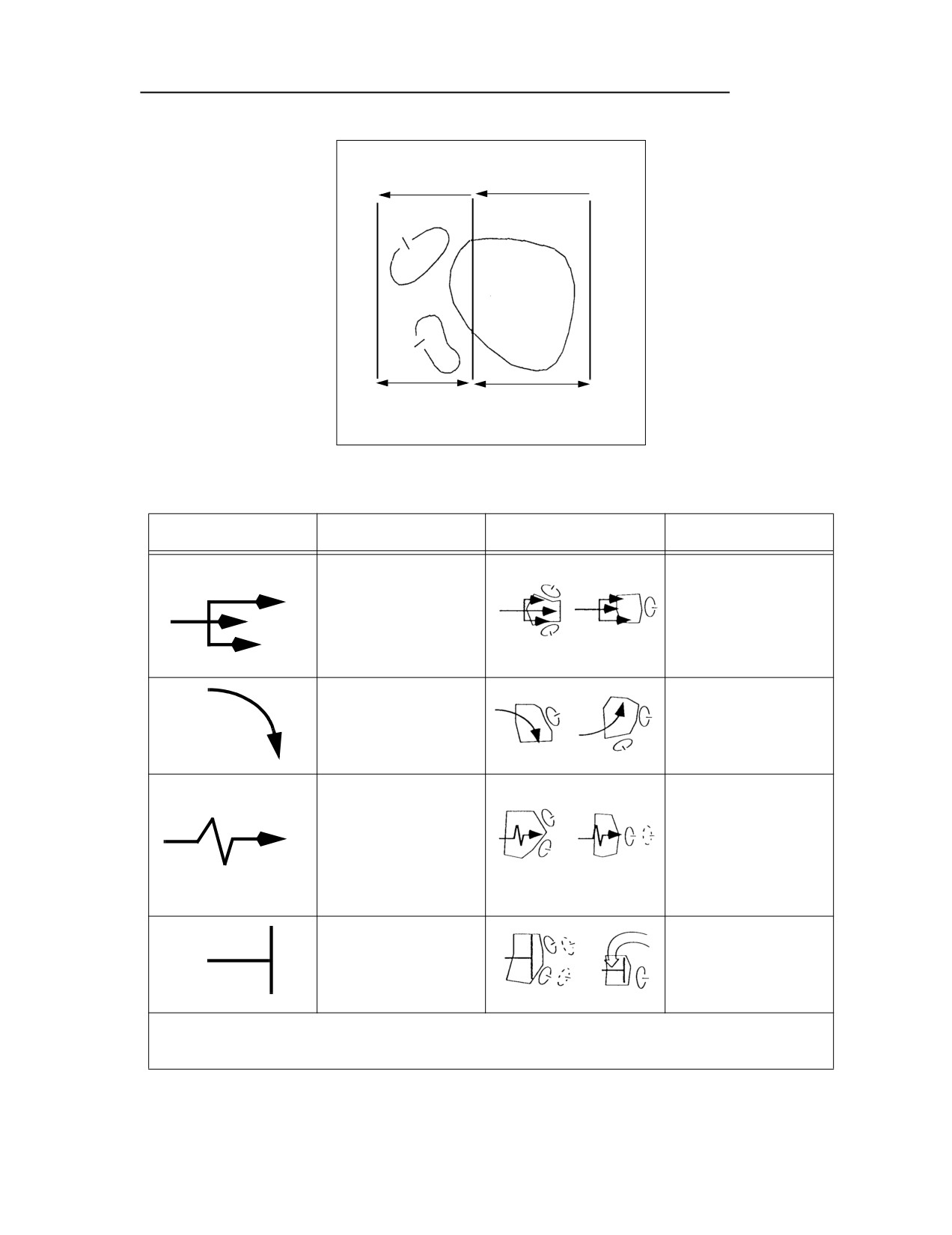
As discussed, minefields can be tactical or protective obstacles (Figure 2-1,
page 2-6). Tactical and protective obstacles have different purposes with
regard to the enemy's maneuver. This difference causes them to have a
particular relative place on the battlefield. Tactical obstacles attack enemy
maneuver and are placed on the battlefield where the enemy maneuvers from
march, prebattle, and attack formations. Protective obstacles are used to
protect the force from the enemy's final assault onto the force's position.
Protective obstacles are close to defensive positions and are tied in with the
FPF of the defending unit. Additional information on obstacles can be found in
FM 90-7.
TACTICAL MINEFIELDS
Tactical minefields are designed, sited, emplaced, and integrated with fires to
produce four specific tactical-obstacle effects—disrupt, turn, fix, and block
(Figure 2-2, page 2-6). Each obstacle effect has a specific impact on an enemy's
ability to maneuver, mass, and reinforce. Obstacle effects also increase the
enemy's vulnerability to friendly fires. They support the friendly scheme of
maneuver by manipulating the enemy in a way that is critical to the
commander's intent. Minefield design is the means by which an emplacing
unit varies minefield width, minefield depth, mine density, mine composition,
the use of AHDs, and the irregular outer edge (IOE) to best achieve one of the
four tactical-obstacle effects. Modifying these variables is at the heart of
tactical minefield employment principles.
Mine-Warfare Principles 2-5
C2, FM 20-32
Enemy
Enemy maneuver
assault
phase
EA
Protective
Tactical
obstacles
obstacles
Figure 2-1. Tactical versus protective obstacles
Obstacle Effect
Application
Examples Conveying
Description
Intent
The short arrow
Causes an enemy to
indicates where an
break up its formation
Disrupt
enemy is attacked by
and tempo, interrupt its
obstacles. The longer
timetable, commit its
arrows indicate where
reduction assets
the bypass is allowed
prematurely, and
and attacked by fires.
piecemeal the attack.
The heel of the arrow is
Manipulates an enemy’s
the anchor point. The
maneuver in a desired
Turn
direction of the arrow
direction.
indicates the desired
direction of turn.
The irregular part of the
Slows an enemy within
arrow indicates where
a specific area,
Fix
an enemy advance is
normally an EA. Gives
slowed by obstacles.
the defender time to
acquire, target, and
destroy the attacking
enemy throughout the
depth of an EA.
The ends of the vertical
Stops an enemy along a
Block
line indicate the limit of
specific AA or prevents
an enemy’s advance
it from passing through
and where obstacles tie
an EA.
in to no-go terrain.
NOTES:
1. Arrows indicate the direction of enemy attack.
2. Minefields must be integrated with fires to achieve the desired effect.
Figure 2-2. Tactical-obstacle effects
Mine-Warfare Principles 2-6
C2, FM 20-32
MINEFIELD VARIABLES
First, it is important to understand how the variables relate to minefield
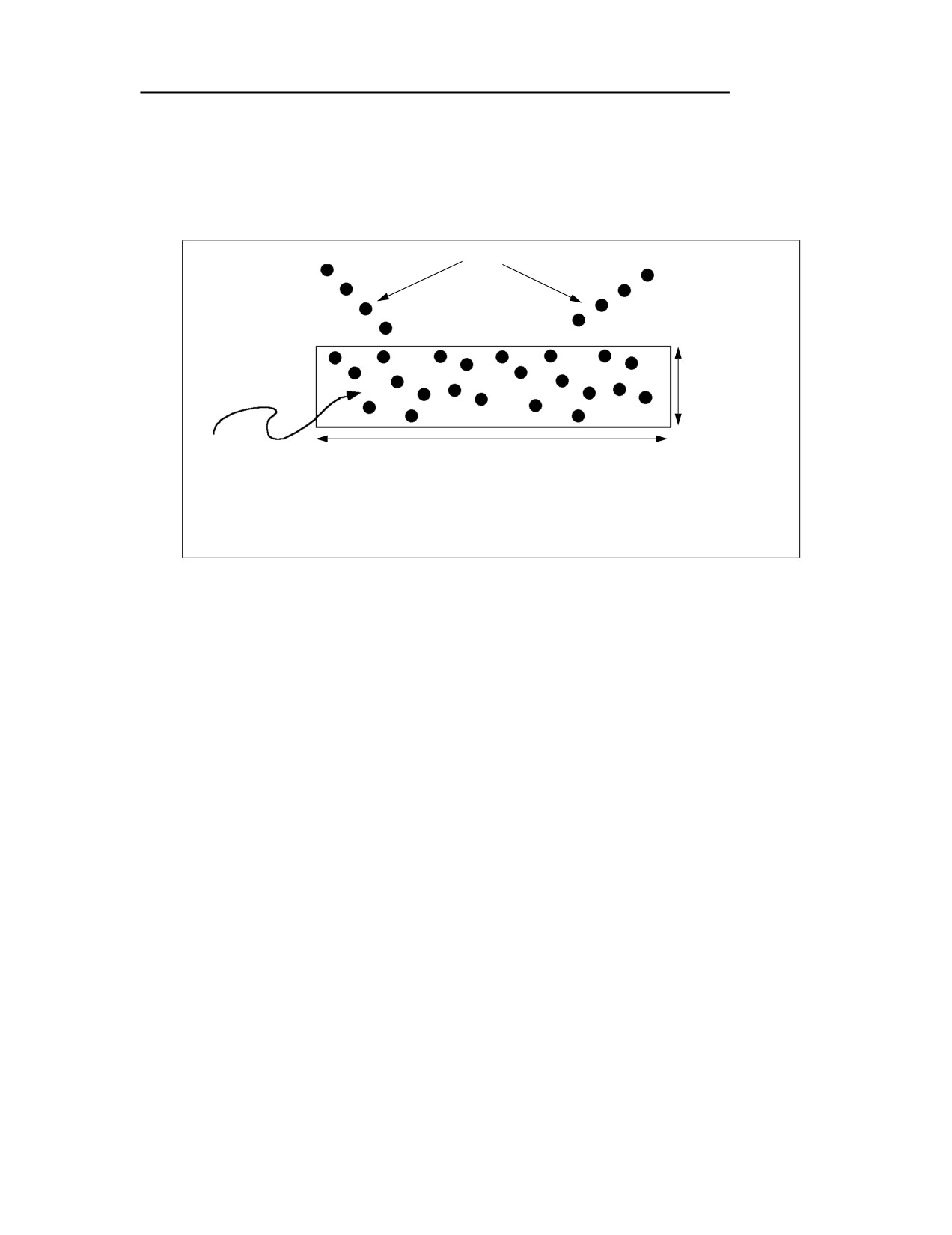
effects. Figure 2-3 clearly defines some of the terms used to discuss minefield
variables.
IOE
Assume
Minefield
100 mines
depth 100 m
Minefield front
200 m
Linear density: 100 mines ÷ 200 meters = 0.5 mine per meter of front
Area density: 100 mines ÷ (100 x 200) = 0.005 mine per square meter
Figure 2-3. Minefield variables
Front
Minefield front is the dimension of a minefield that defines how much of the
attacking enemy formation is affected by the minefield. The front of a
minefield is based on the desired obstacle effect (disrupt, turn, fix, or block)
and the attack front of a company-size enemy force. The front of an attacking
enemy depends largely on the type of enemy force (armored, motorized, or
dismounted infantry) and norms by which the enemy army fights. For
armored warfare, the minefield front is based on effecting a doctrinal company
attack front of 500 meters (13 to 18 combat vehicles). For dismounted warfare,
the minefield front is based on effecting a company attack front of 150 meters.
The front may vary and require a study of enemy force and terrain. Groups of
individual minefields are employed to achieve a larger front for battalion and
larger enemy formations. For example, a battalion consisting of 52 to 72
combat vehicles has a front of 1,500 meters and requires more minefields.
Depth
Minefield depth is based on the amount of reduction assets that will be
required by an enemy to reduce a lane. The standard should start with 100
meters and increase in depth if denying the enemy the use of a mobility
corridor (MC) is the intent (turn or block).
Density
Minefield density depicts the number of mines in a minefield. It is expressed
in linear or area density:
Mine-Warfare Principles 2-7
C2, FM 20-32
• Linear density is the average number of mines within a 1-meter-wide
path through the minefield's depth, anywhere along the front. In
Figure 2-3, page 2-7, the minefield contains 100 mines, with a
minefield front of 200 meters. The linear density is 0.5 mine per meter
of front (100 mines/200 meters of front).
• Area density is the average number of mines within a square meter,
anywhere in the minefield. In Figure 2-3, the minefield contains 100
mines within a 20,000-square-meter area. The area density is 0.005
mine per square meter (100 mines/[200 meters x 100 meters]). Area
density is normally used to express the density of scatterable
minefields.
Mine Composition
This variable includes the effective use of different types of mines. By using
full-width mines, the probability of kill increases for the minefield. AT mines
with AHDs (Korea Only: as well as AP mines) are used where the enemy is
expected to use dismounted reduction techniques.
Antitank Mines
If the enemy is an armored force, tactical obstacles are predominantly AT
mines. Track-width mines (M15s with the M603 fuse) have a lower probability
of kill (M-Kill or K-Kill) than full-width mines (M21s and M15s with the M624
fuse). The ratio of full-width versus track-width mines in a minefield depends
on the kill required. In general, a track-width minefield does not adequately
affect the enemy's maneuver.
Antipersonnel Mines
AP mines target dismounted soldiers. Their composition in tactical minefields
depends on the threat and the enemy's reduction assets. Based on current
technology, most breaching operations are accomplished by mechanical or
explosive means. (Korea Only: If the minefield group’s intent is to
exhaust the enemy's breaching assets, AP mines should be integrated
to attack its dismounted reduction ability.)
Probabilities of Encounter and Kill
The probabilities of encounter and kill measure a minefield's lethality.
Probability of Encounter
The probability of encounter is measured by the chance (in percent) that a
vehicle, blindly moving through a minefield, will detonate a mine. The
probability of encounter is based on mine density, the type of mine, and the
type of enemy vehicle. In short, the more dense a minefield, the higher the
probability is of encountering a mine. Probability of encounter also depends on
the fuse capability of the mines. Tilt-rod and magnetic-influence mines will
detonate if they are encountered anywhere along the width of the enemy
vehicle. Pressure-fused mines detonate if a vehicle's track or wheel actually
runs over them. The probability of encounter is also affected by the type of
enemy vehicle. The smaller the width or track signature of the vehicle, the
less likely it will encounter and detonate a mine.
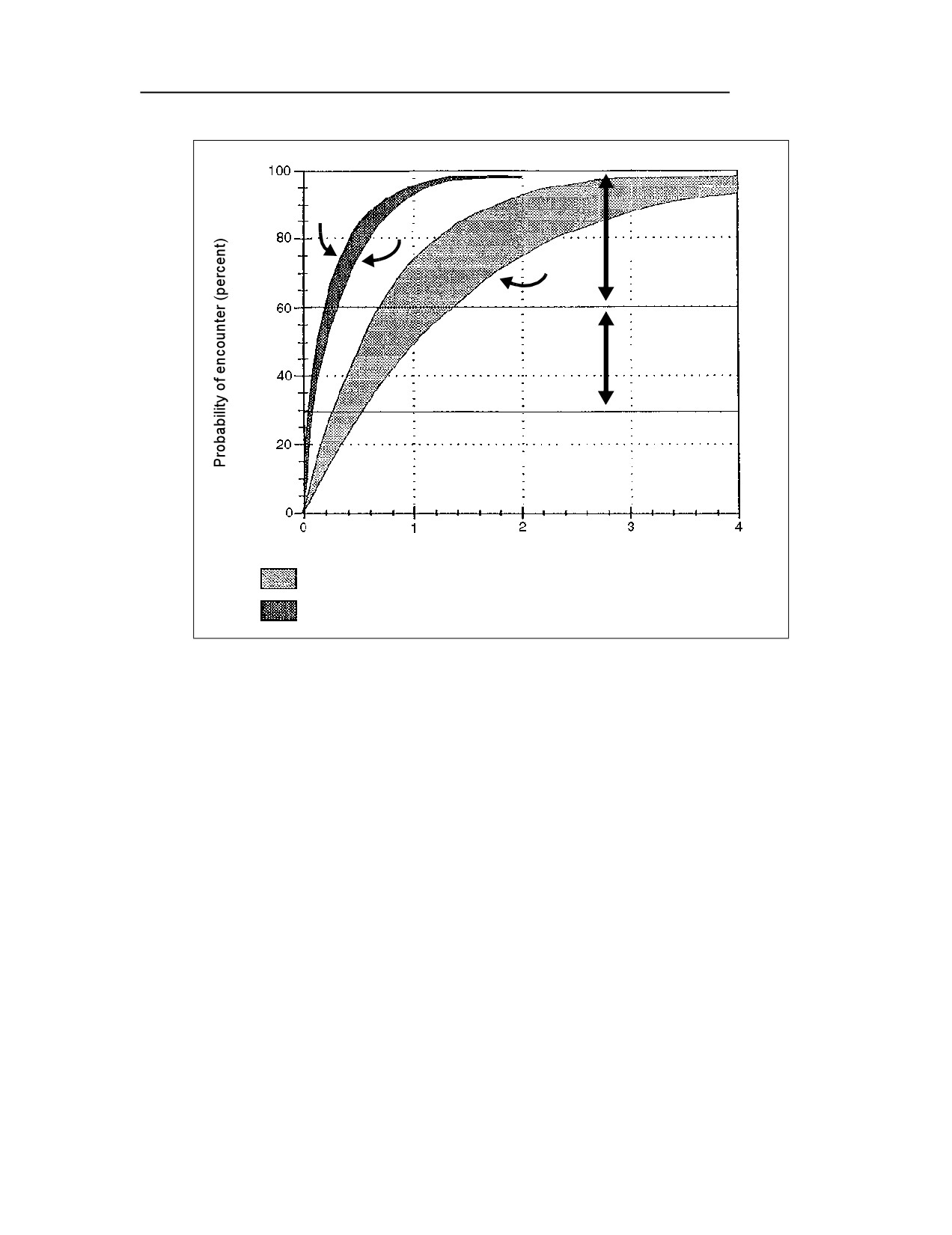
Figure 2-4 illustrates the relationship between mine density and the
probability of encounter for light versus heavy tracked vehicles and for track-
width versus full-width mines. Figure 2-4 also provides general guidance for
varying the mine density to yield the necessary probability of encounter when
developing disrupt, fix, turn, and block minefields. Varying mine density is
further discussed later in this chapter.
Mine-Warfare Principles 2-8
FM 20-32
(Tanks)
(Tanks)
(APCs)
TURN AND
BLOCK
(APCs)
DISRUPT
AND FIX
Minefield linear density (mines per meter)
Pressure-fused mines (track-width)
Tilt-rod or magnetic-influence mines (full-width)
Figure 2-4. Vehicle mine encounter probability versus minefield density
Probability of Kill
The probability of kill is measured by the chance (in percent) that a vehicle
will no longer be mission-capable (M-Kill or K-Kill) because of mine effects. It
is a function of the combined probability that a vehicle will encounter a mine
and the probability that the mine effect will produce an M-Kill or a K-Kill.
Antihandling Devices
Emplacing AHDs on mines is time-intensive. AHDs are added to a minefield
to discourage manual removal and reuse of mines by the enemy and to
demoralize the enemy who is attempting to reduce the minefield. AHDs do not
prevent an enemy from reducing the minefield; they only discourage manual
reduction methods.
Irregular Outer Edge
An IOE is a strip/row or multiple strips/rows of mines that normally extend
toward the enemy from the first (enemy side) row of mines. An IOE is
employed to break up the otherwise regular pattern of a minefield. It is used
to confuse the enemy about the exact limits of the minefield, particularly its
leading edge. An IOE adds an unknown quality to a minefield that makes the
enemy’s decision of whether to breach or bypass more difficult. The effect an
IOE has on enemy actions may increase the overall lethality of a minefield.
Mine-Warfare Principles 2-9
C2, FM 20-32
DESIGN
Modifying minefield variables to achieve the desired obstacle effect is a
challenge for the engineer, both technically (resourcing and designing) and
tactically (supporting the maneuver scheme). Experience will provide the best
basis for designing minefields. Figures 2-5 through 2-8, pages 2-10 through 2-13,
provide guidelines for varying minefield depth, front, density, and composition
to best achieve disrupt, fix, turn, and block effects.
These are guidelines, not fixed rules. Minefield designs must be based
on a threat analysis. The designs are simply considerations or
parameters to use when designing tactical minefields, regardless of
the emplacement method. They apply to conventional mine-laying
techniques as well as the employment of SCATMINE dispensers. These
parameters give the engineer the flexibility to design and emplace tactical
minefields based on mission, enemy, terrain, troops, time available, and
civilian considerations (METT-TC) (particularly resources and terrain) and
still achieve the required effect. These norms are also the basis for developing
minefield packages and emplacement procedures outlined throughout this
manual. Chapter 3 discusses the characteristics and emplacement procedures
for each of the SCATMINE systems, Chapter 6 outlines procedures for row
mining using conventional mines, and Chapter 7 is dedicated to the standard-
pattern minefield. Each chapter describes standard disrupt, fix, turn, and
block minefield packages particular to that method of emplacement or
dispensing system.
Each tactical-obstacle effect has a specific resourcing factor. In short, this
numeric value helps determine the amount of linear obstacle effort that is
needed to achieve the desired effect. The resource factor is multiplied by the
width of the AA or MC to get the total amount of linear obstacle effort
required. The linear obstacle effort is then divided by the minefield front norm
for the specific effect (rounded up) to yield the number of individual minefields
required in the obstacle group.
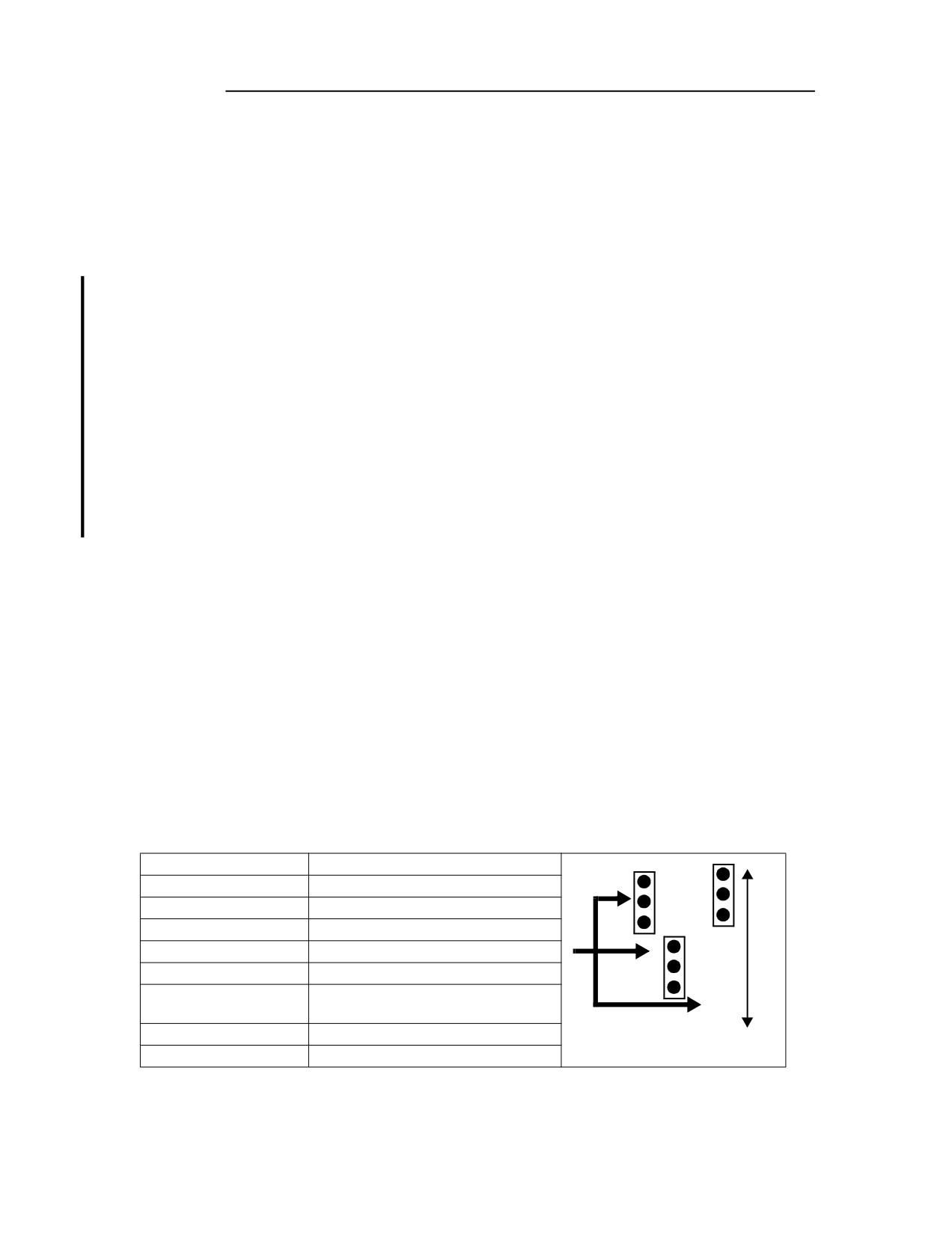
Disrupt
A disrupt effect (Figure 2-5) focuses fire planning and obstacle effort to cause
the enemy to break up its formation and tempo, interrupt its timetable,
commit reduction assets prematurely, and piecemeal the attack. It also
deceives the enemy about the location of friendly defensive positions,
separates combat echelons, or separates combat forces from their logistical
support. A disrupt effect should not be time-, manpower-, or resource-
intensive. It should not be visible at long range but easily detected as the
enemy nears it. Commanders normally use the disrupt effect forward of EAs.
Resource factor
0.5
(3 point obstacles) x AA
Group dimensions
W = 0.5 x AA
Probability of kill
50%
Minefield front
250 m
0.5
Minefield depth
100 m
AT mines
Yes (pressure/tilt)
AP mines
No (Korea Only: optional, based on
threat analysis)
AHD
Optional, based on threat analysis
IOE
No
Figure 2-5. Disrupt-effect group
2-10 Mine-Warfare Principles
FM 20-32
Normally, only half of the enemy's AA is attacked with minefields or other
tactical obstacles to achieve a disrupt effect. For a minefield to disrupt an
enemy company, half of the formation must react to the minefield. The typical
width of a disrupt-effect minefield is 250 meters with a standard minefield
depth of 100 meters. When designing a disrupt effect to attack an enemy
battalion, three disrupt-effect minefields are arrayed in a group to achieve a
width that is about half the size of the battalion's attack front (750 meters of
minefield). Multiply the resource factor of 0.5 by the width of the AA to
provide the amount of linear obstacle effort required for the disrupt effect.
When the AA is narrow, an alternative disrupt group is three point obstacles
along the AA.
Disrupt-effect minefields should be designed with approximately 50 percent
probability of mine encounter to achieve the desired disrupt effect (see Figure
2-4, page 2-9). They should contain predominantly track-width AT mines and
include full-width AT mines at the leading edge of the minefield to increase
the probability of mine encounter. This should cause the enemy to commit its
reduction assets.
AHDs can be added to disrupt-effect minefields to frustrate the enemy's
breaching and clearing operations. However, adding AHDs may be too
resource-intensive for the return in effect. An IOE is not required.
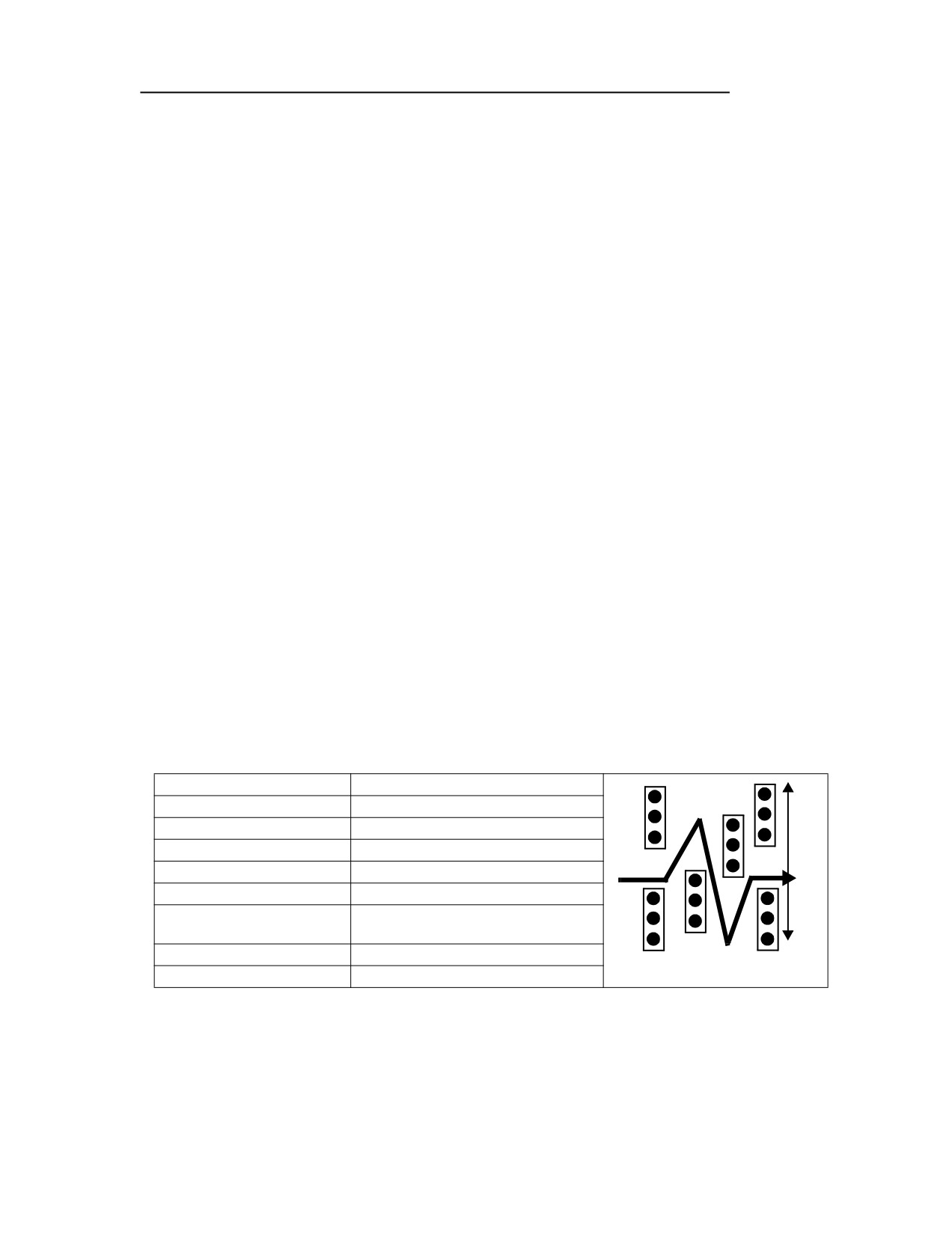
Fix
A fix effect (Figure 2-6) focuses fire planning and obstacle effort to slow an
attacker within a specific area, normally an EA. The fix effect is primarily
used to give the defender time to acquire, target, and destroy the attacking
enemy throughout the depth of an EA or AA. A fix effect may be used to
generate the time necessary for the force to break contact and disengage as
the enemy maneuvers into the area (typically used for delays). Fix-effect
minefields in the obstacle group must be employed in depth, causing the
enemy formation to react and breach repeatedly. Fix-obstacle groups must
span the entire width of the AA. Commanders normally use the fix effect
inside the EA.
Resource factor
1.0 x AA
Group dimensions
W = 1.0 x AA
Probability of kill
50%
Minefield front
250 m
1.0
Minefield depth
120 m
AT mines
Yes (pressure/tilt)
AP mines
No (Korea Only: optional, based on
threat analysis)
AHD
Optional, based on threat analysis
IOE
Yes
Figure 2-6. Fix-effect group
Individual fix-effect minefields must not appear too difficult to reduce. The
enemy should be enticed into the area. The concept is to employ multiple
minefields that individually attack a portion of a deploying company
Mine-Warfare Principles 2-11
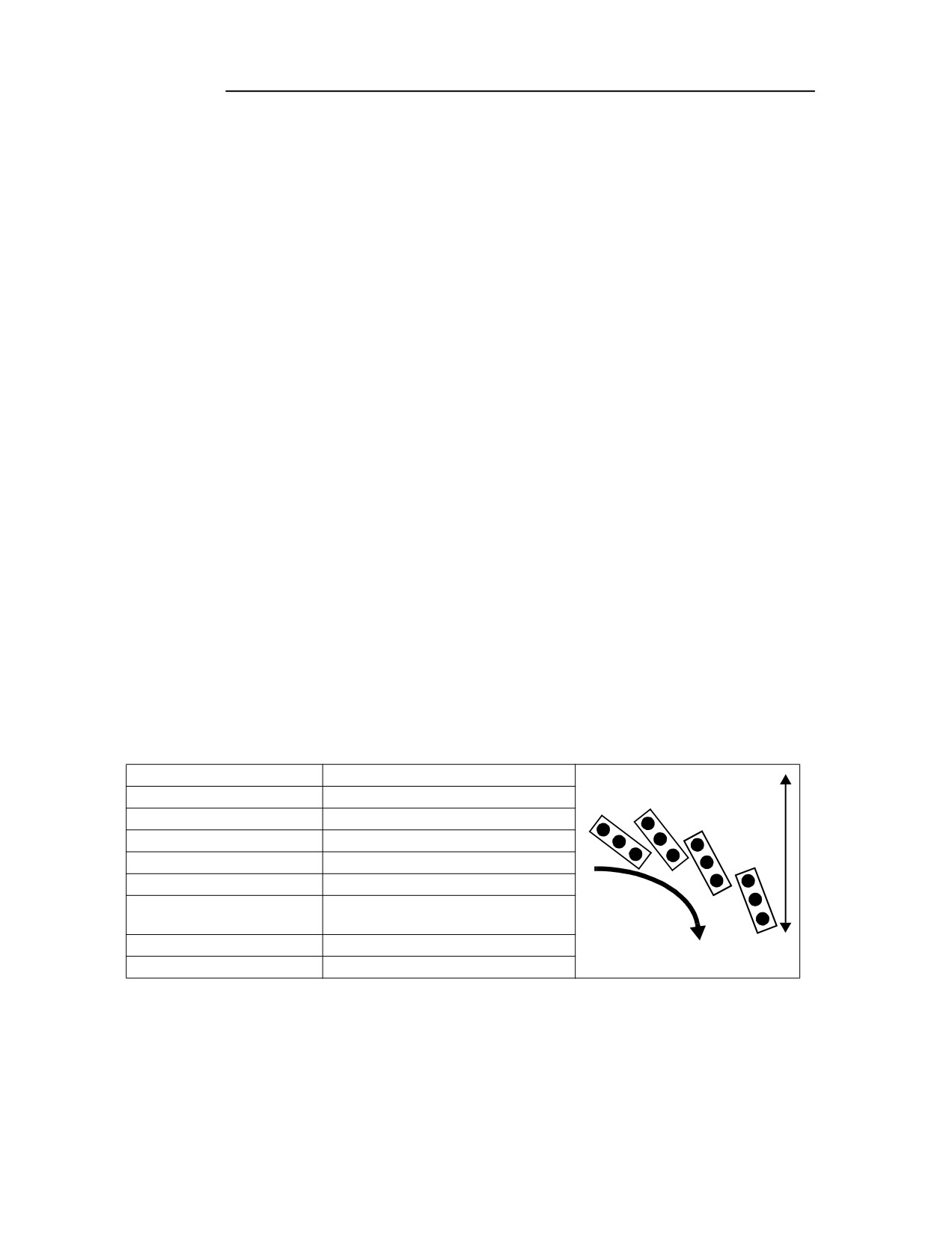
FM 20-32
formation. Therefore, the fix-effect minefield front is 250 meters. It takes on
the characteristics of a disrupt-effect minefield with a similar density,
composition, and probability of encounter (Figure 2-4, page 2-9), with two
exceptions. First, AHDs are not used because the application of massed direct
and indirect fires complicate the enemy's breaching effort. Secondly, an IOE is
added to further delay the enemy and confuse the attacker on the exact
orientation of individual minefields. This also serves to increase the effective
lethality of the minefield. The majority of mines are track-width AT, but full-
width AT mines are used in the IOE and the leading edge of the minefield
because they are the most lethal.
While individual minefields are designed to attack only portions of an enemy
company formation, the fix-obstacle group is resourced, arranged, and sited to
attack the entire front of an enemy battalion. Figure 2-6, page 2-11, depicts a
fix group effect on an attacking enemy battalion. In this case, six fix-effect
minefields are arrayed in an area the full width of the battalion AA (1,500
meters) by 1,500 meters deep. Accordingly, the resource factor for a fix-effect
minefield group is one; the amount of linear minefield that should be
resourced equals the width of the AA.
Turn
A turn effect (Figure 2-7) manipulates the enemy's maneuver in a desired
direction. One technique or a combination of techniques aids in achieving the
turn effect. First, in order to entice the enemy to maneuver in the desired
direction rather than reduce the obstacle, the obstacle must have a subtle
orientation relative to the enemy’s approach. Secondly, the obstacle and fires
must allow bypass in the direction desired by the friendly scheme of
maneuver. Obstacles in the start of the turn are visible and look more complex
than those in the direction of the turn. Finally, the obstacle is tied into
severely restricted terrain (restricted terrain as a minimum) at the initial
point of the turn. The point where the severely restricted terrain feature and
the minefield meet is known as the anchor point. Commanders normally use
the turn effect on the flanks of an EA.
Resource factor
1.2 x AA
Group dimensions
W = 1.0 x AA
Probability of kill
75%
Minefield front
500 m
1.0
Minefield depth
300 m
AT mines
Yes (pressure/tilt)
AP mines
No (Korea Only: optional, based on
threat analysis)
AHD
Optional, based on threat analysis
IOE
No
Figure 2-7. Turn-effect group
The standard turn-effect minefield has a width of 500 meters and a depth of
300 meters. One turn-effect minefield affects the entire width of an enemy
company's front. It must be deep enough to cause multiple applications of line-
2-12 Mine-Warfare Principles
///////////////////////////////////////