FM 20-32 Mine/Countermine Operations (August 2001) - page 6
FM 20-32
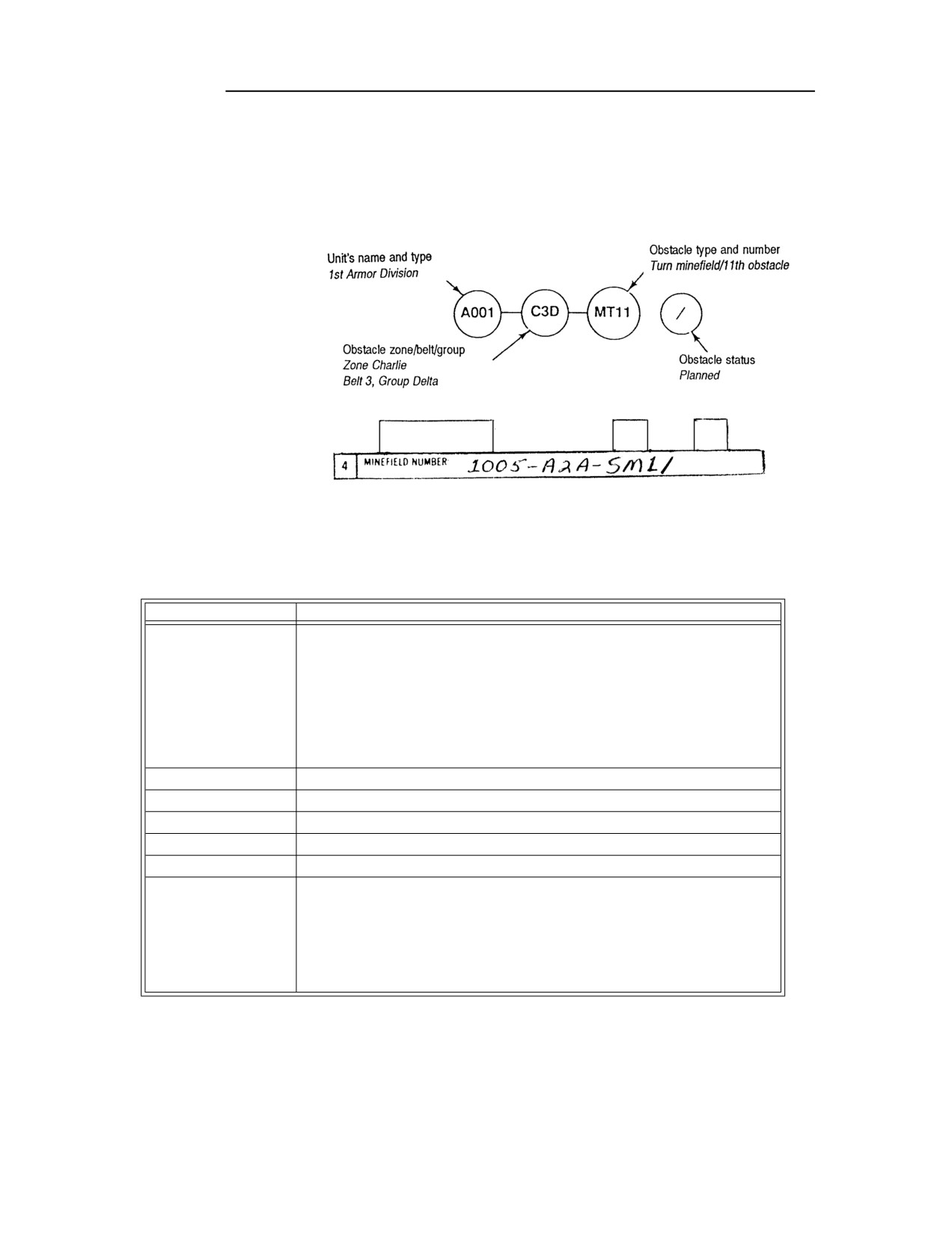
Block 4. The minefield/munition field obstacle numbering system (Table 8-1)
consists of 11 characters and 1 obstacle status symbol. It shows the type of
obstacle, the belt and the zone in which it is located, and the headquarters
that established the zone. Abbreviations for obstacle types are shown in Table
8-2.
Example: Obstacle number I005-A2A-SM21/ indicates that the 5th Infantry
Division planned the obstacle in Zone A. It is the 21st obstacle in Group A,
Belt 2, and has not been executed. The obstacle is a MOPMS.
Table 8-1. Minefield/munition field obstacle numbering system
Character
Description
Alphanumeric description of the headquarters type and numerical
designation that established the obstacle zone; character 1 designates the
unit type with a letter:
•
A = armor division or brigade
1 through 4
•
I = infantry division or brigade
•
C = cavalry division
•
R = cavalry regiment
•
Z = corps
5
Letter indicating the obstacle zone
6
Number indicating the belt number in the obstacle zone
7
Letter indicating the group in the obstacle belt
8 and 9
Letters indicating the obstacle type (see Table 8-2)
10 and 11
Two numbers indicating the obstacle number in the group
One of four characters indicating the obstacle status—
•
/ = planned obstacle
•
— = obstacle being prepared
12
•
+ = prepared obstacle (This sign is for reserve demolition targets
and may indicate a readiness state of safe or armed.)
•
X = completed obstacle
8-8 Reporting and Recording
C2, FM
20-32
Table 8-2. Abbreviations for obstacle types
B—Bridge Demolition
W—Wire Obstacle
BA
Abutment
WA
Double apron
BS
Span
WB
Booby-trapped
BC
Abutment and span
WF
Tanglefoot
M—Minefield/Munition Field
WG
General-purpose, barbed tape
MD
Disrupt
WN
Nonstandard
MT
Turn
WR
Road block
MF
Fix
WT
Triple standard
MB
Block
R—Road Crater
MN
Nonstandard
RH
Hasty
MP
Protective
RD
Deliberate
MQ
Nuisance
RM
Mined
MS
Standard pattern
M—Miscellaneous
S—Scatterable Minefield/Munition Field
AD
AT ditch
SA
ADAM
AR
Rubble by CEV gun
SB
Gator
AB
Rubble by blade
SR
RAAM
AT
Abatis
SF
ADAM and RAAM
AE
Rubble by explosives
SM
MOPMS
AM
Movable MOBA obstacle (car, bus)
SV
Volcano
AN
Expedient nonstandard
H—Hand-Emplaced Munitions
AL
Log crib, log obstacle
HH
Hornet
AP
Post obstacle (hedgehog, tetrahedron)
HS
SLAM
AH
Log hurdle
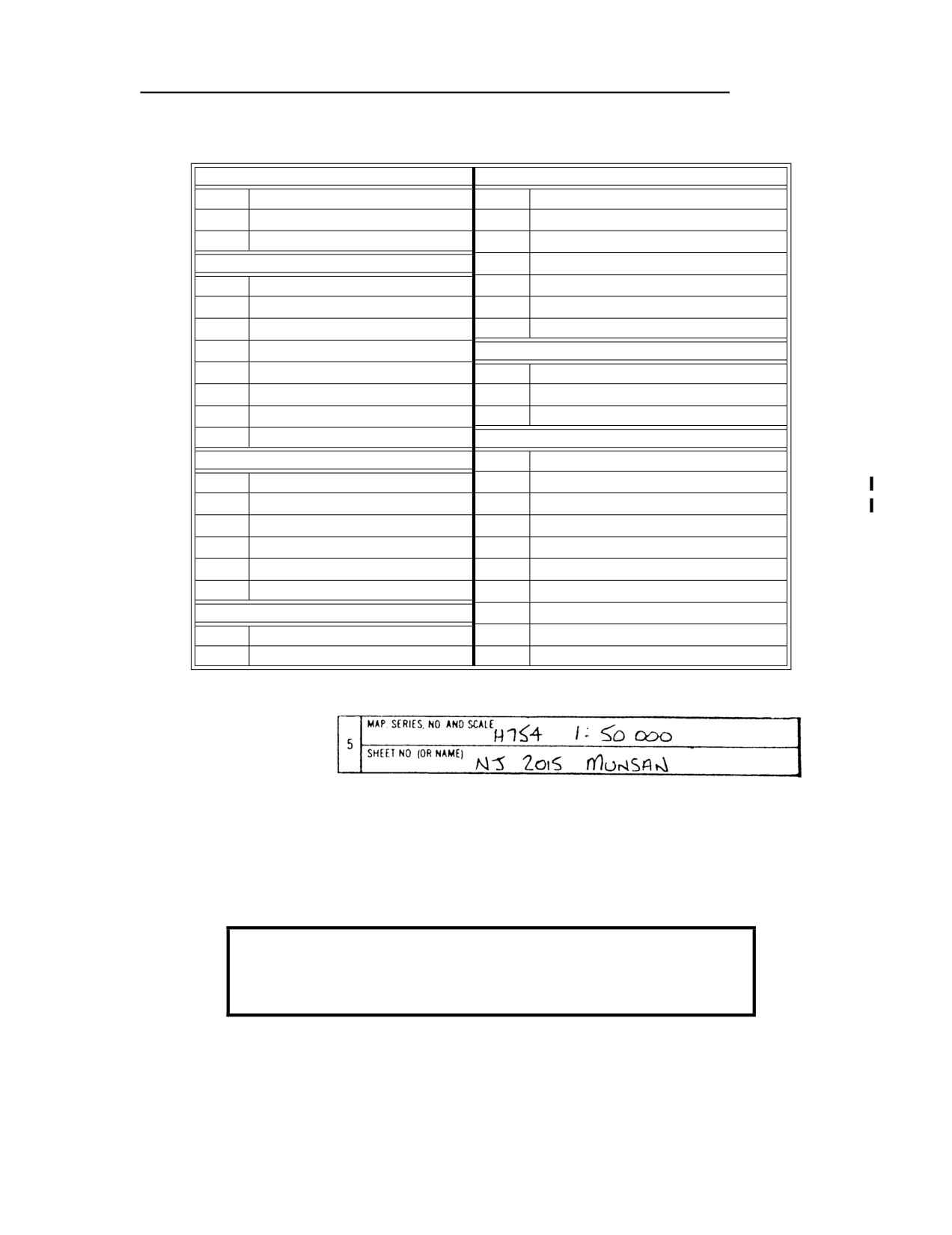
Block 5. Enter the map data as stated on the map(s) used.
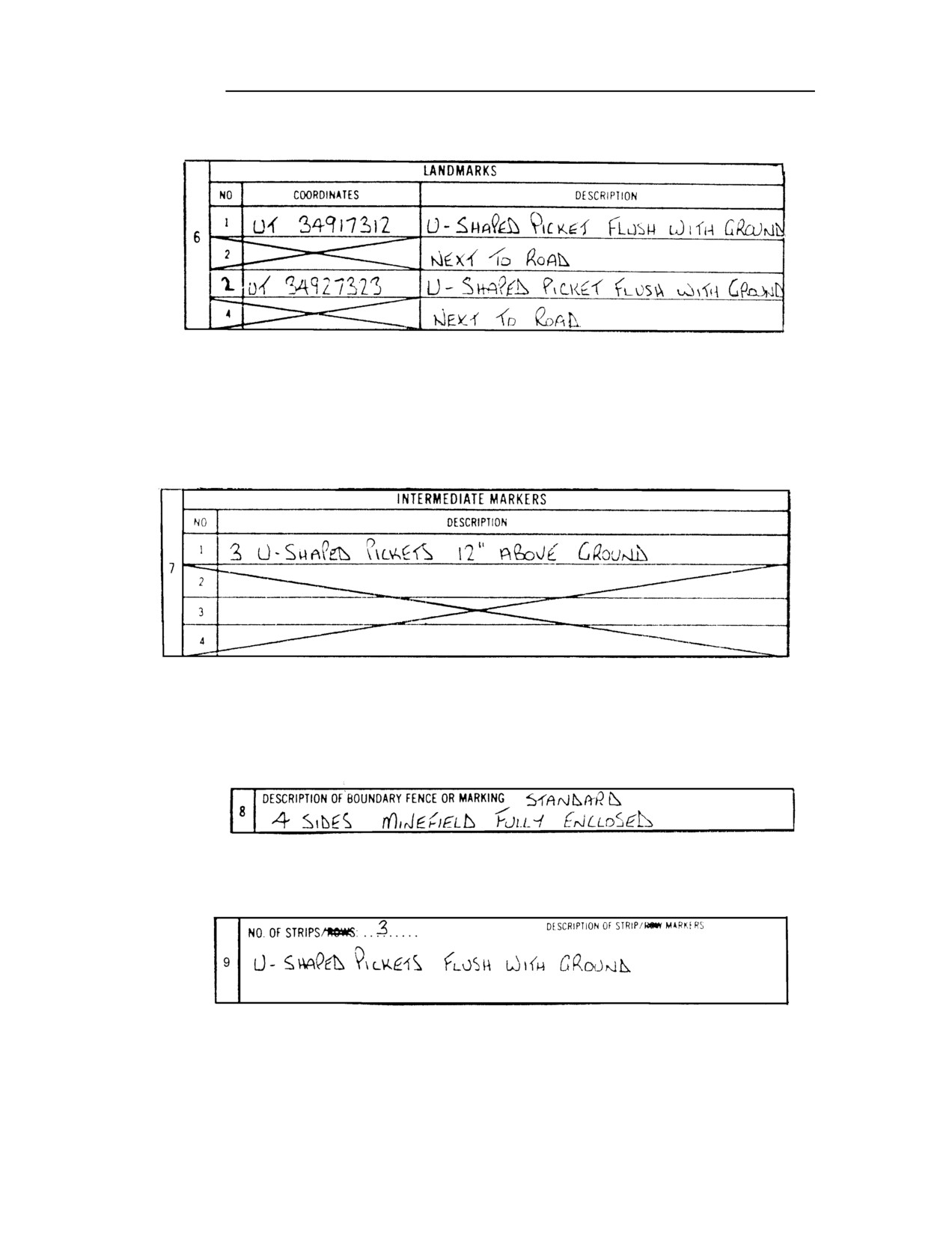
Block 6. Enter the grid coordinates and a description of at least two
landmarks. If the landmarks are roads, trails, or routes, enter their name or
number. This makes identification easier when removing the minefield/
munition field. When recording minefields/munition fields, GPSs can only be
used to determine the coordinates for minefield/munition field landmarks and
RPs.
WARNING
Do not use GPSs to chart or record minefield/munition field
perimeter coordinates or to determine safe routes through or around
existing minefields/munition fields.
Reporting and Recording 8-9
FM 20-32
Block 7. Enter the description of intermediate markers, if applicable. When a
landmark is more than 200 meters from the minefield/munition field, or a
strip or row reference stake cannot be seen from the landmark, an
intermediate marker must be used. If possible, the intermediate marker is at
least 75 meters from the strip or row reference stake.
Block 8. Enter the word STANDARD when a standard marking fence is used.
Describe the boundary marking if a standard marking fence is not used. (Use
two sides and the rear for a tactical minefield/munition field; use four sides for
a protective minefield/munition field.)
Block 9. Enter the number of strips or rows laid. (Do not include the IOE.)
Describe the strip or row markers. Cross out words that do not apply.
Block 10. Enter the width, the marking, and the provisions for each lane.
When appropriate, give the types of mines and the number of each type of
mine for closing. (The location of these mines is described in Block 12.)
8-10 Reporting and Recording
C2, FM 20-32
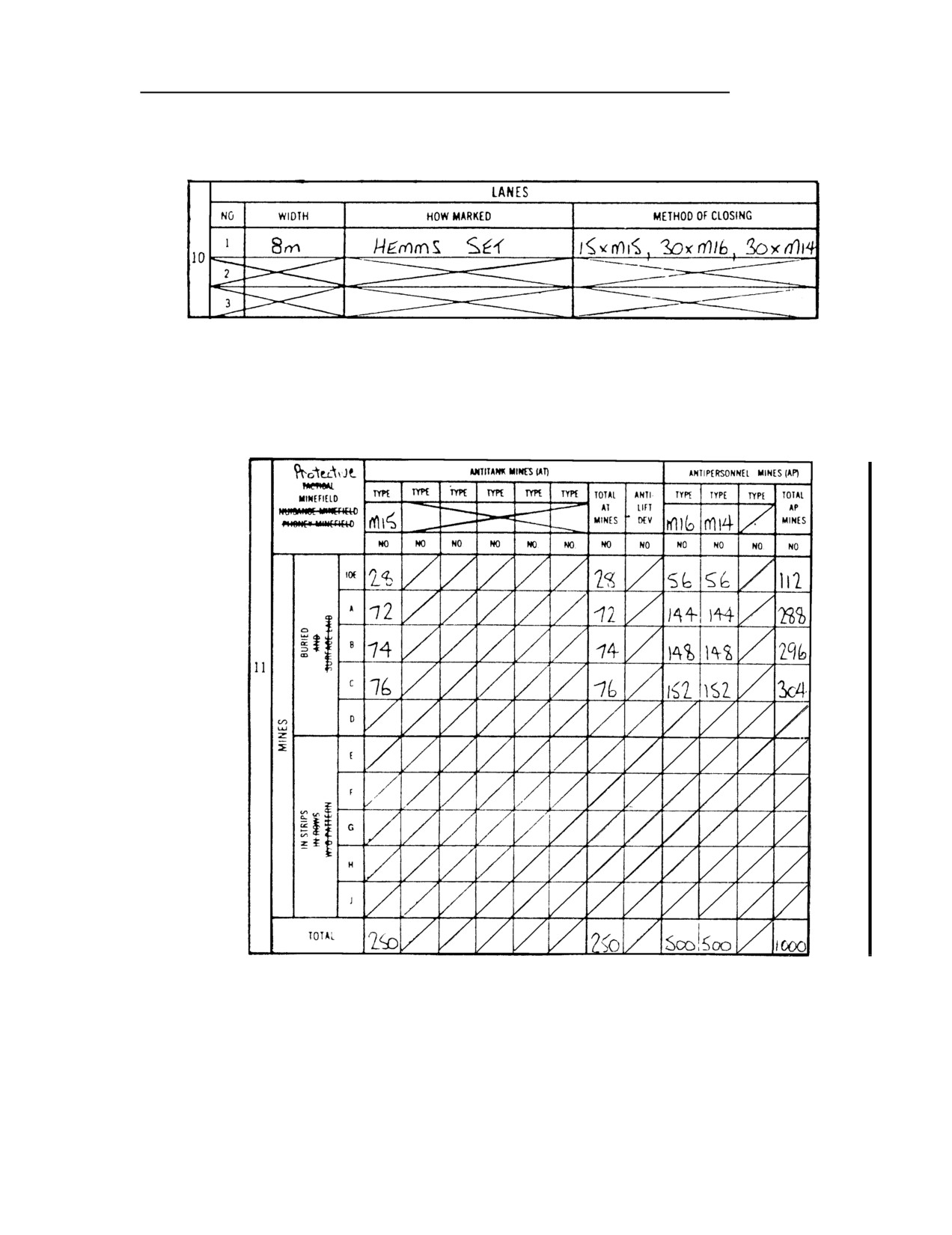
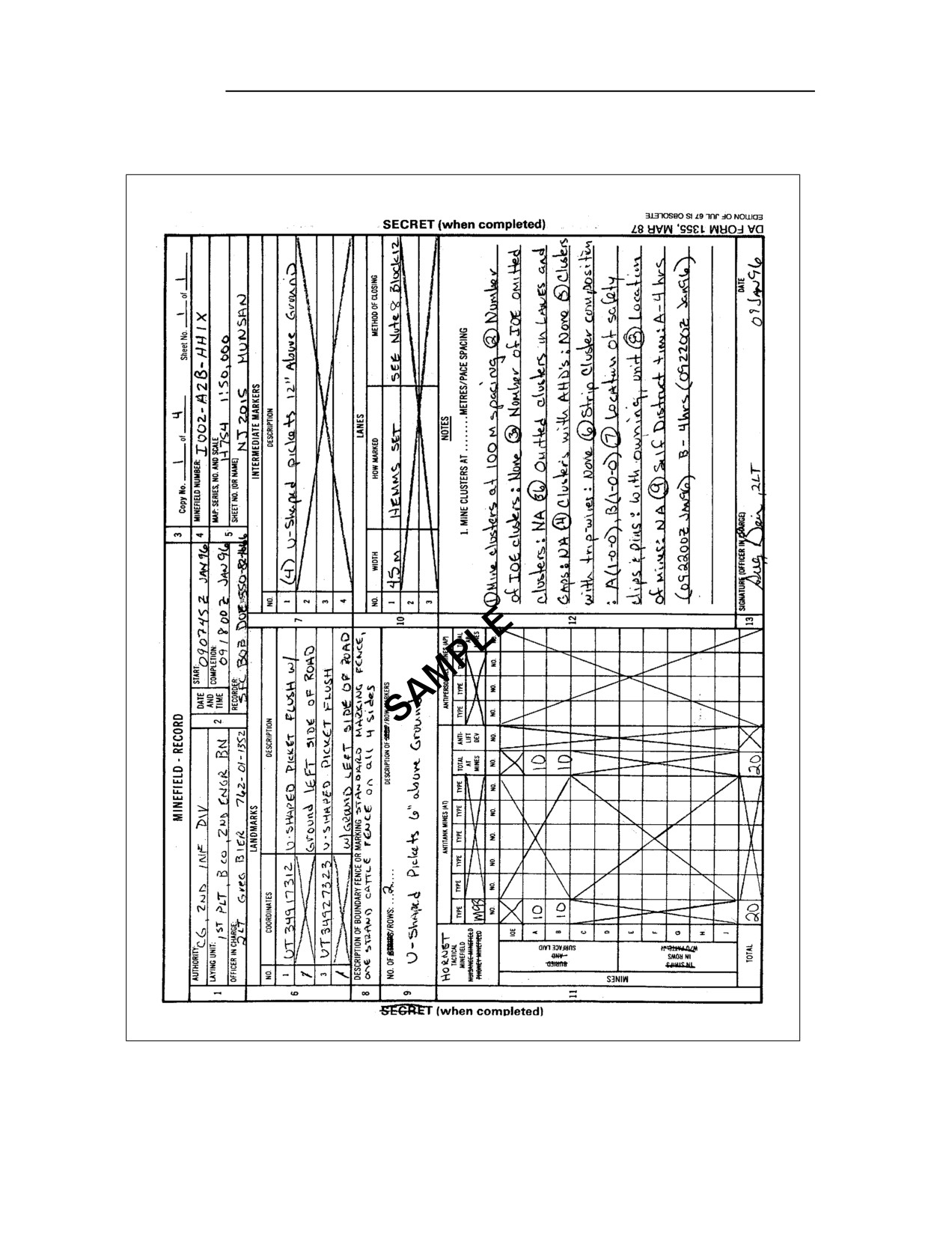
Block 11. Enter the type of minefield/munition field by crossing out the lines
that are not needed. Indicate the method of laying by crossing out incorrect
descriptions. Enter the types of mines and the number of each type of mine.
Also enter the number of AHDs installed in the IOE and in each row. Letter
the strips or rows sequentially, starting with the first one laid. Enter totals.
If the type of munition field is Hornet, enter “Hornet” above the word
“tactical” and line out “nuisance minefield” and “phoney minefield.” (See
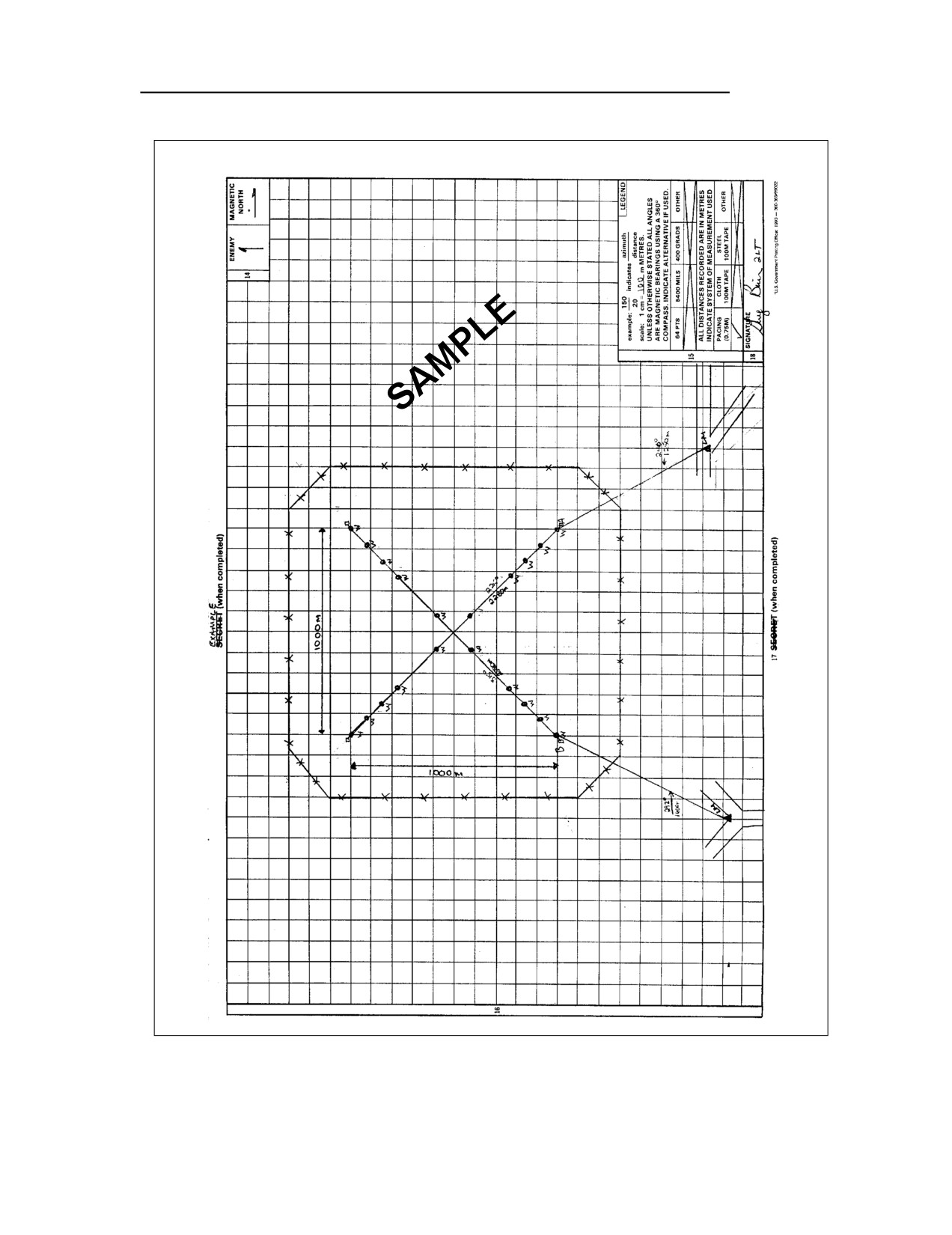
Figures 8-3a and 8-3b, pages 8-12 and 8-13.)
Reporting and Recording 8-11
FM 20-32
Figure 8-3a. Sample DA Form 1355 (front side) for a Hornet minefield/munition field
8-12 Reporting and Recording
FM 20-32
Figure 8-3b. Sample DA Form 1355 (back side) for a Hornet minefield/munition field
Reporting and Recording 8-13
FM 20-32
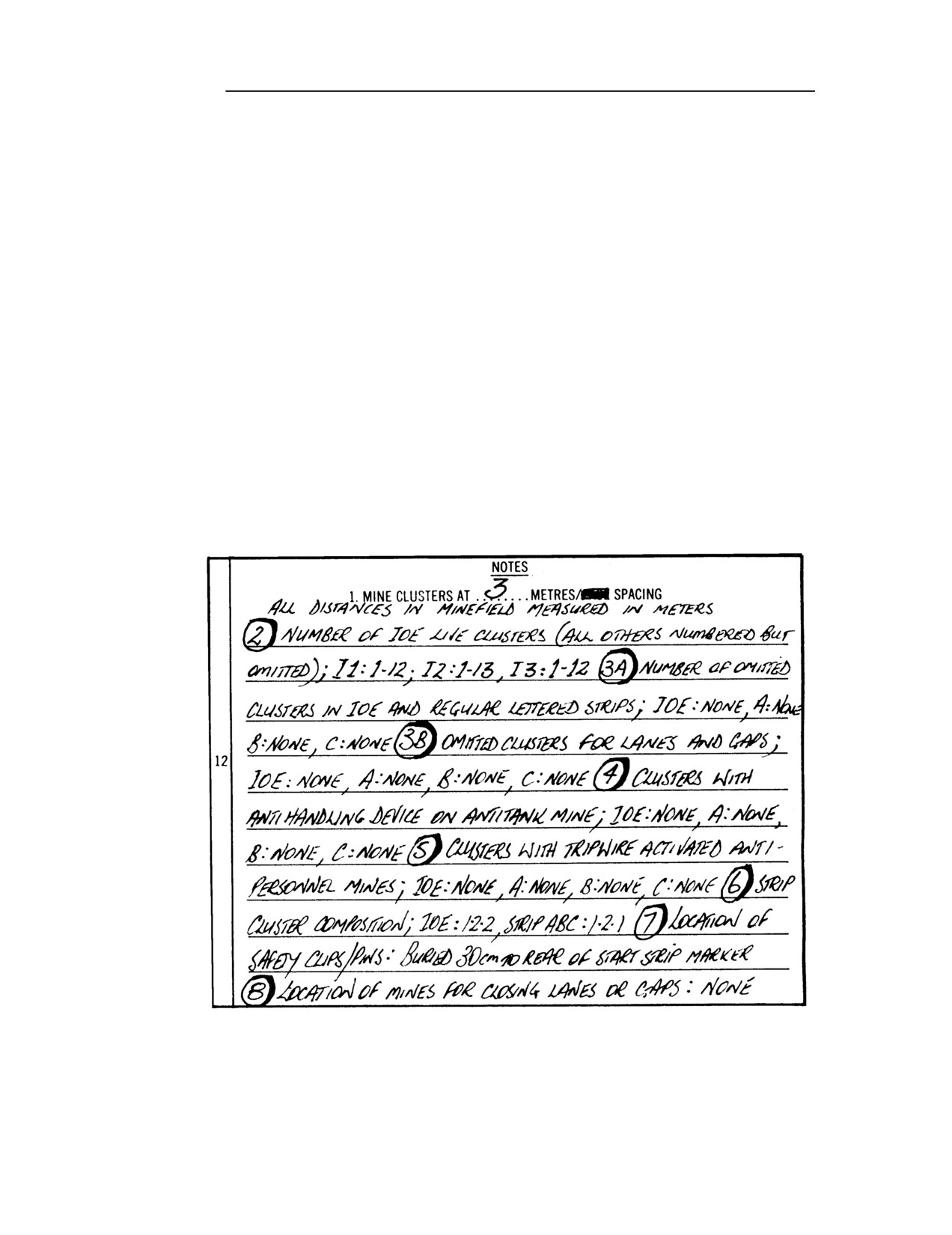
Block 12. As a minimum, enter the following items in Block 12. Also enter
any additional information that would be useful when removing the minefield/
munition field.
1. Mine clusters at ____ meters spacing.
2. Number of IOE live clusters (all others numbered but omitted).
3a. Number of omitted clusters in the IOE and in regular strips and why
they were omitted.
3b. Omitted clusters in lanes and gaps.
4. Clusters with AHDs (identify the mine and the type of device used).
5. Clusters with trip-wire-actuated AP mines.
6. Strip cluster composition.
7. Location of safety clips and pins (buried 30 centimeters to the rear of
each start strip or row marker).
8. Location of mines for closing lanes and gaps.
9. SD time for special munitions.
8-14 Reporting and Recording
FM 20-32
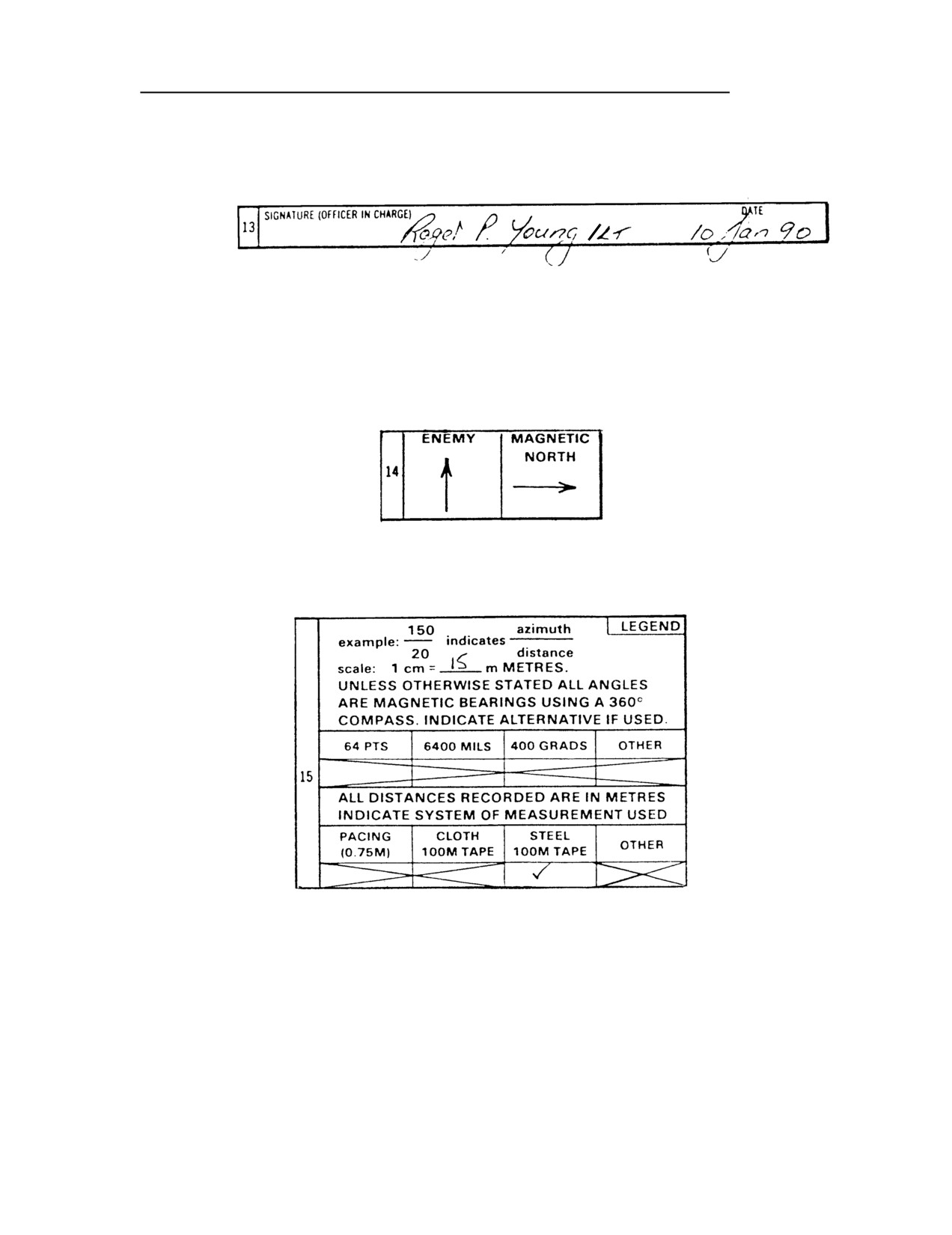
Block 13. The emplacing unit OIC signs and dates the form.
The front side of DA Form 1355 is now complete. Continue on the inside as
follows:
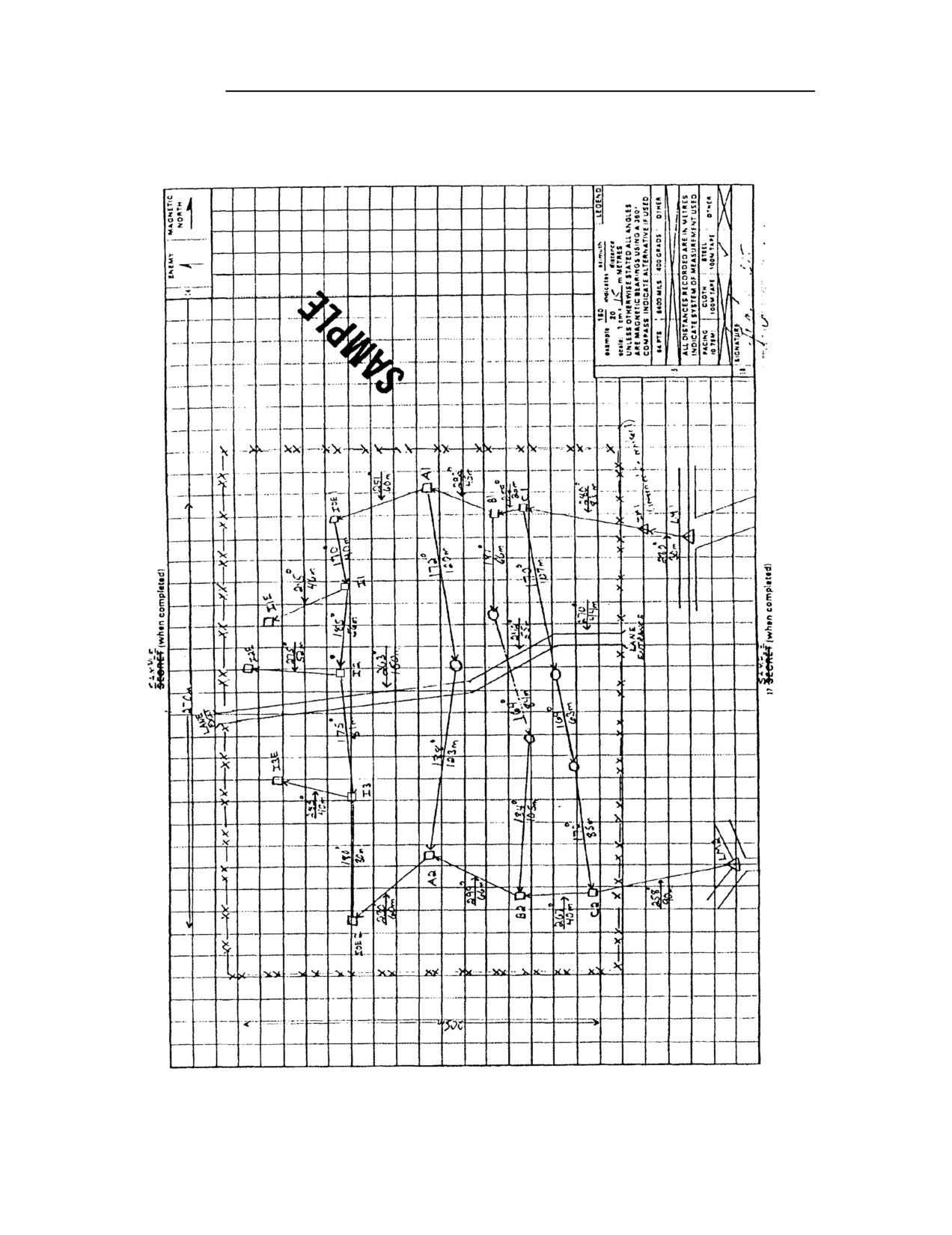
Block 14. When completing the sketch, enter arrows for the direction of the
enemy and the magnetic north. The enemy arrow will always point within the
top 180 degrees of the form; the north arrow will follow one of the graph lines.
Block 15. If a compass was not available, enter what was used in the
information block. Indicate the system of measurement and the scale used.
Reporting and Recording 8-15
FM 20-32
Block 16. Enter the information shown below on the sketch:
8-16 Reporting and Recording
C2, FM 20-32
Block 17. Enter the security classification of the form. If the form was used
for training, enter the word SAMPLE.
Block 18. The emplacing unit OIC signs the signature block.
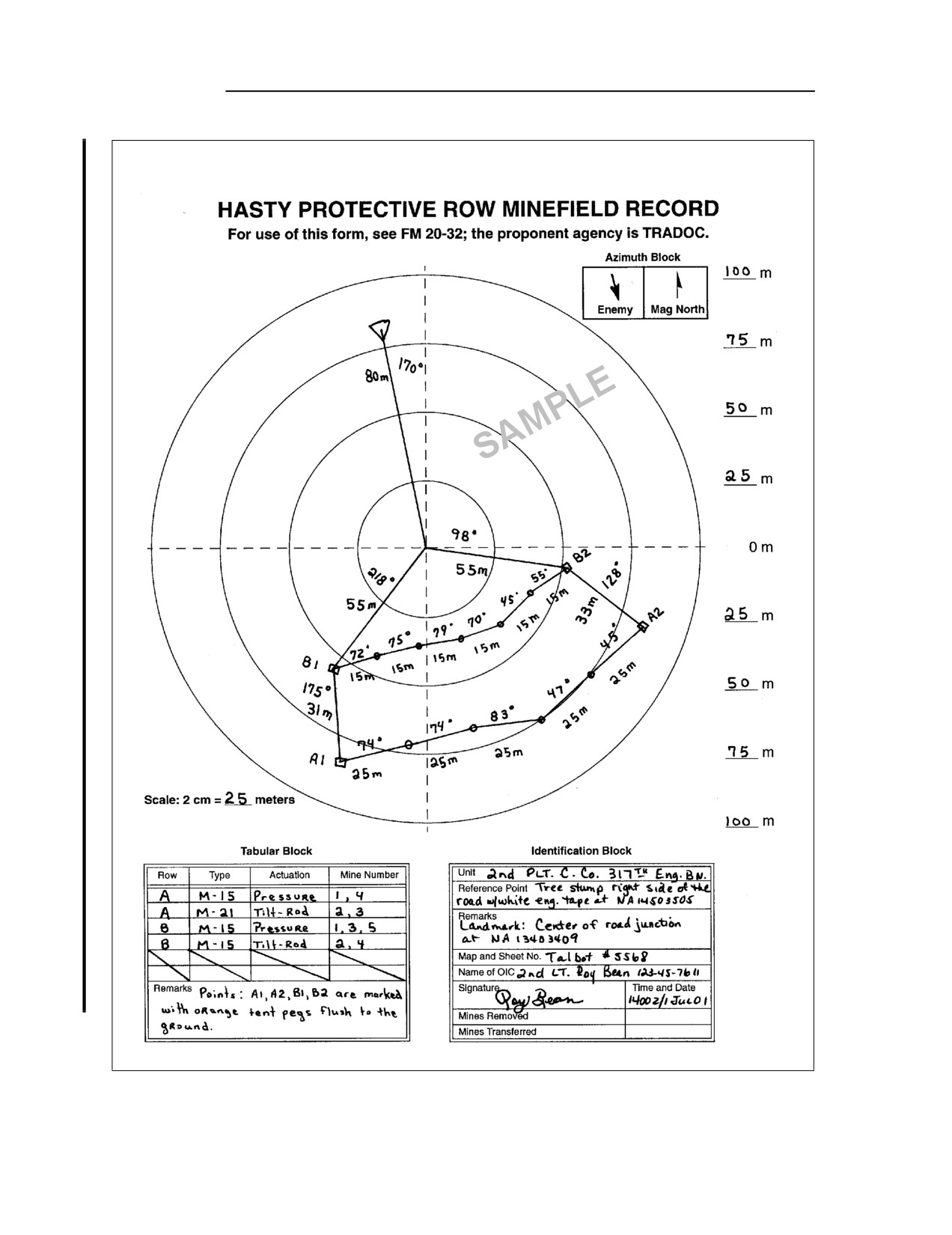
HASTY PROTECTIVE ROW MINEFIELD RECORD
Hasty protective row minefields/munition fields are recorded on DA Form
1355-1-R (Figure 8-4, page 8-18). DA Form 1355-1-R will be printed on 8½- by
11-inch paper. A copy for local reproduction is available in the back of this FM.
DA Form 1355-1-R is also available on the Army Electronic Library (AEL) CD-
ROM (EM 0001) and the USAPA web site (www.usapa.army.mil).
Use the following formula to determine the scale used on DA Form 1355-1-R:
Distance from RP to the farthest point in the minefield + 10 meters ÷ 4 = scale
Example: 90 meters + 10 meters = 100 meters ÷ 4 = 25 meters
The number 4 is a constant and represents the four concentric rings on DA
Form 1355-1-R. Ten is added as a safety margin to ensure that the minefield/
munition field sketch is entirely contained within the largest ring. The
distance between rings is 2 centimeters; therefore, the scale used in this
example is 2 centimeters = 25 meters.
Reporting and Recording 8-17
C2, FM 20-32
Figure 8-4. Sample DA Form 1355-1-R
8-18 Reporting and Recording
FM 20-32
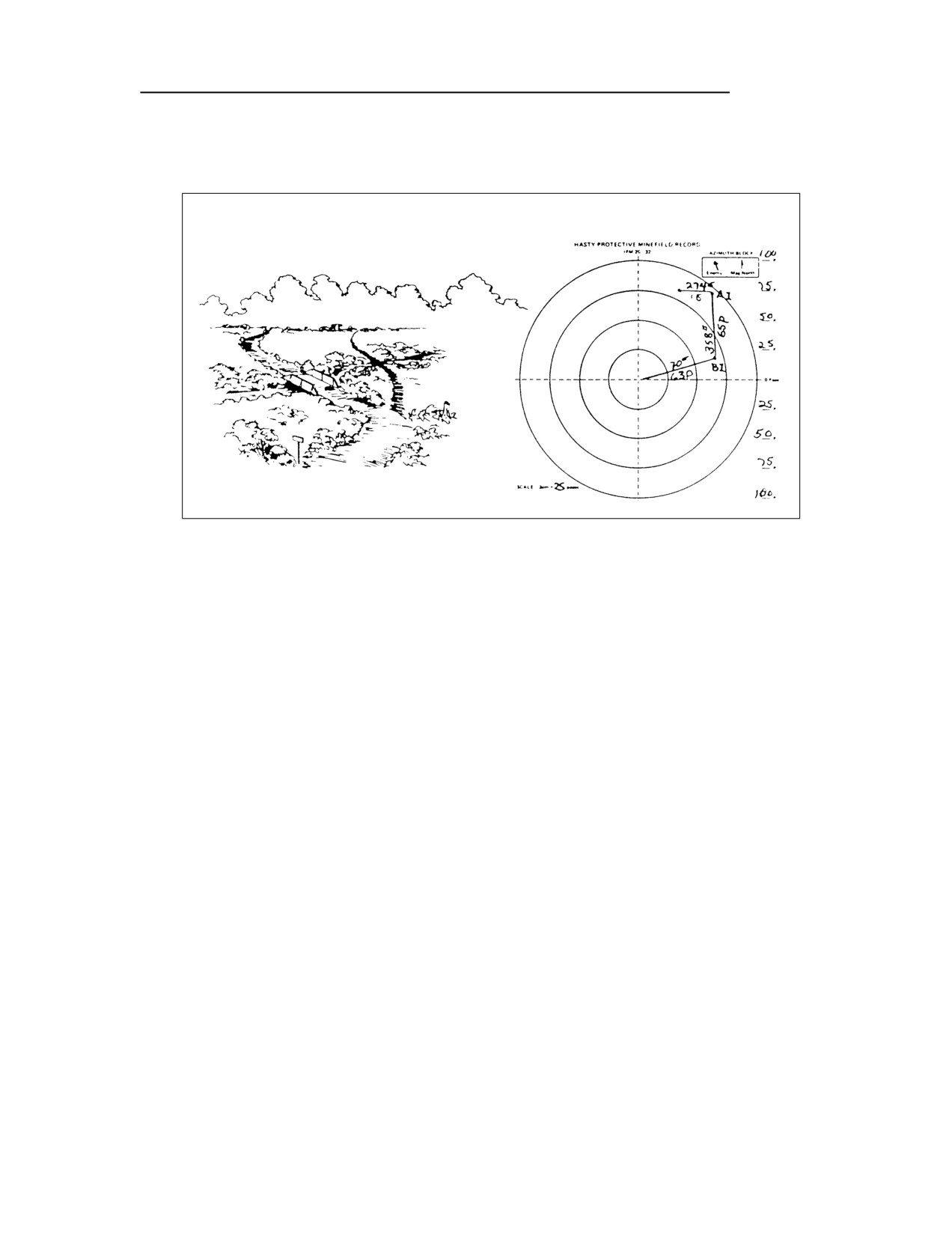
The following step-by-step instructions are provided for completing DA Form
1355-1-R (see Figure 8-5):
A1
B1
RP
Figure 8-5. Hasty protective row minefield/munition field record
From the RP, the leader measures the magnetic azimuth, in degrees, to a
specific point on the right side (facing the enemy) of the tentative minefield/
munition field. He determines the distance and records it in meters. He
identifies the method of measurement in the remarks block of DA Form 1355-
1-R (for example, distances were paced out and multiplied by 0.75 to convert
the measurement to meters). This point, called B1 (if there are two rows),
marks the beginning of the second row. A marker is placed at B1, and the
leader records the azimuth and the distance.
The leader measures the azimuth and the distance from B1 to a second point
on the right side of the minefield/munition field (facing the enemy). A marker
is placed at this point and recorded as A1.
The leader measures the distance and the azimuth from A1 to the location of
the first mine in that row and records the information.
The distance (or spacing) from the end row marker to the first mine is the
spacing between all the mines in that row. After the location is recorded, the
mine is emplaced, but it is not armed.
The leader measures the distance and the azimuth from the first mine to the
second, and so on, until all the mines are emplaced and their locations are
recorded. This procedure is repeated for the second row. As each mine is
recorded, it is assigned a number to identify it in the minefield/munition field
record. When the last mine location is recorded for a row, the distance and the
azimuth are measured from that point to another arbitrary point, A2 or B2. A
marker is placed here in the same manner as A1 and B1. Next, the distance
and the azimuth from the RP to B2 and from B2 to A2 are measured and
recorded.
Reporting and Recording 8-19
FM 20-32
When all the mines have been emplaced and recorded, the leader measures
the distance and the azimuth between the RP and a permanent landmark
that can be found on the map. He records the information on DA Form 1355-1-
R. The landmark is used to help locate the minefield/munition field if it is
transferred or unexpectedly abandoned. Finally, the tabular and
identification blocks are completed.
Mines can be armed after recording is complete. The mines nearest the enemy
are armed first, allowing soldiers to safely work their way back to the unit's
position. Pins and clips can be buried 30 centimeters behind row markers, the
RP, or any easily identifiable, accessible location. Note the location in the
remarks section of DA Form 1355-1-R. The leader then reports the completion
of the minefield/munition field to higher headquarters.
If the minefield/munition field is transferred to another unit, the receiving
unit leader is briefed by the transferring unit leader. The receiving unit leader
signs and dates the mines transferred block on the DA Form 1355-1-R. When
the minefield/munition field is removed, the form is destroyed. If the
minefield/munition field is abandoned unexpectedly, the DA Form 1355-1-R
must be forwarded to higher headquarters.
NUISANCE MINEFIELD
It is unnecessary to record the precise location of individual nuisance mines
that are laid in a pattern. Recording the position of a minefield/munition field
that is laid in a pattern (either a standard pattern or one adopted for the
situation) is easy and quick. However, the number of mines to be laid on site
may make it impracticable or undesirable to lay mines in a pattern. In this
case, they may be laid individually and their positions accurately recorded.
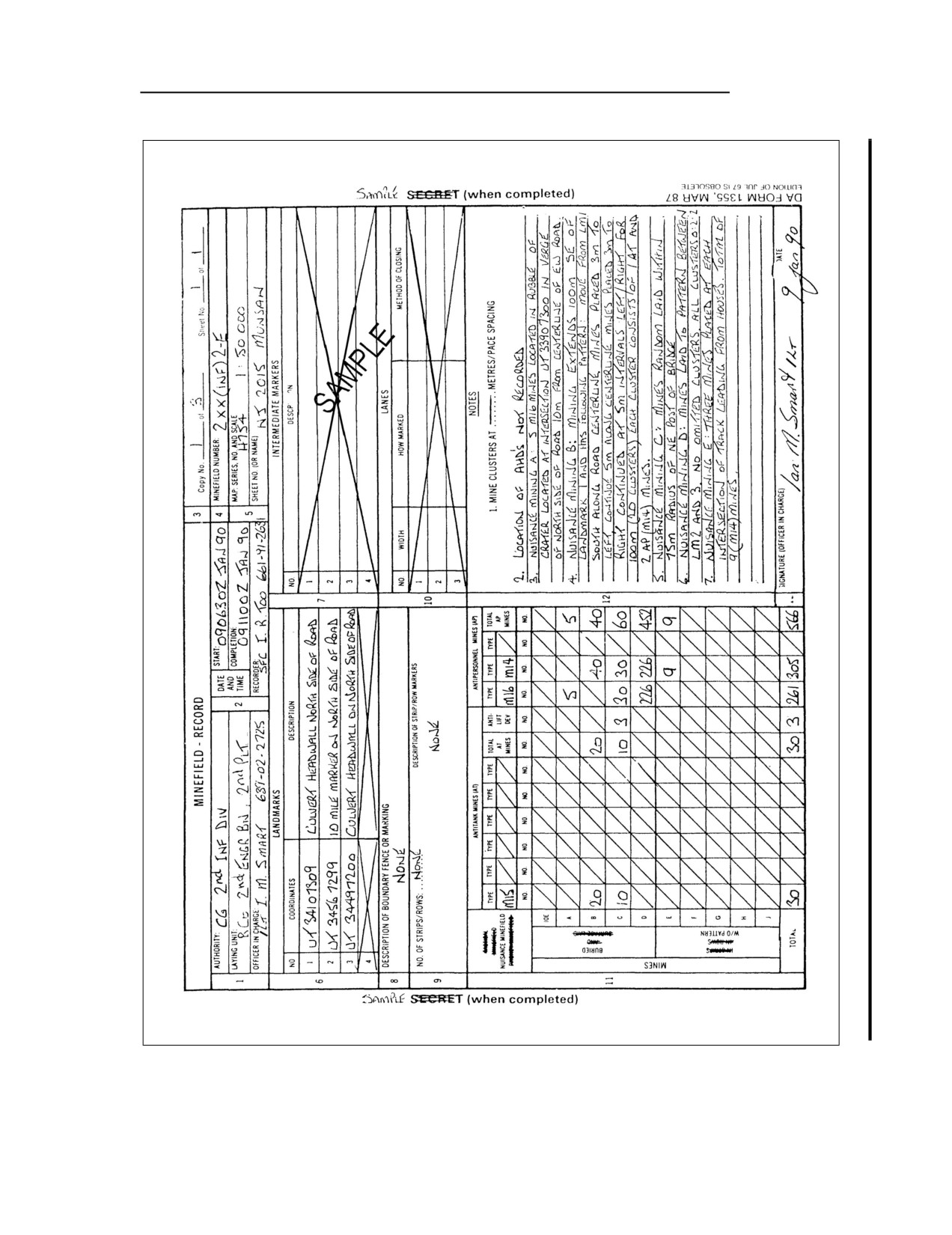
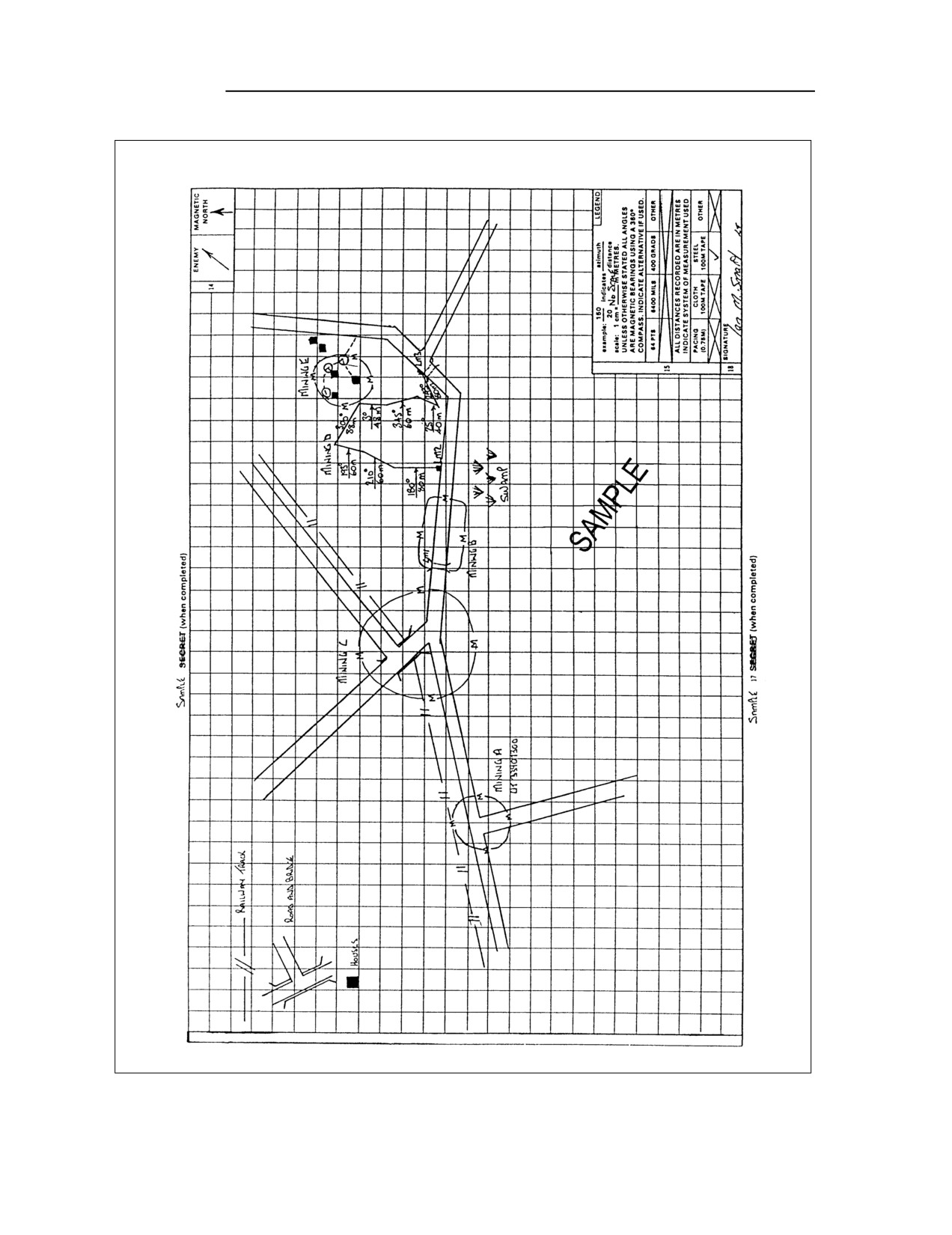
Figures 8-6a and 8-6b, pages 8-21 and 8-22 provide an example of a completed
nuisance minefield/munition field record.
SCATTERABLE MINEFIELD/MUNITION FIELD REPORTING AND
RECORDING
The speed and responsiveness of SCATMINE employment require accurate,
uniform, and timely reports. All known information on scatterable minefields/
munition fields is simply and rapidly reported to all affected units. Although
SCATMINES have SD capability, they are still recorded; and the information
is disseminated to prevent casualties to friendly forces.
Since the locations of individual SCATMINEs are unknown, they cannot be
recorded in detail. For most systems, a safety zone is calculated from one or
more aim points. For example, a RAAM minefield/munition field is recorded
based on the target location (the grid coordinates given to the firing battery).
The size of the minefield/munition field depends on the number of rounds
fired, the number of aim points, and the angle of fire. An artillery-delivered
minefield/munition field is recorded by plotting it on a map, based on the aim
point and the safety zone specified in the scatterable minefield/munition field
report and record that was prepared by the emplacing unit. A ground-Volcano
minefield/munition field can be recorded more accurately by plotting each of
the minefield/munition field corner points rather than an aim point.
8-20 Reporting and Recording
C2, FM 20-32
Figure 8-6a. Sample DA Form 1355 (front side) for a nuisance minefield/munition field
Reporting and Recording 8-21
FM 20-32
Figure 8-6b. Sample DA Form 1355 (inside) for a nuisance minefield/munition field
8-22 Reporting and Recording

C2, FM 20-32
To facilitate reporting and recording of scatterable minefields/munition fields,
a simple, uniform procedure is used. This procedure combines the report and
the record into one document (Figure 8-7) that is applicable for all delivery
systems.
Line
Information Required
Data
No
1
Approving authority
Enter the approving authority, such as CDR 3AD.
If the minefield/munition field is part of an obstacle plan, enter the
obstacle number, such as 2XXX0157. This number represents II
2
Target/obstacle number
Corps, target number 157. If the minefield/munition field is not a
part of an obstacle plan or does not have a number, then leave
this line blank or enter NA.
Type of emplacing
Enter the type system that emplaced the minefield/munition field,
3
system
such as artillery or Volcano.
Enter AP for antipersonnel mines and AT for antitank mines. If
4
Type of mines
both types of mines are used, enter AP/AT.
Enter the DTG the minefield/munition field was emplaced and the
5
Life cycle
DTG the last mine SDs.
If the system used to emplace the minefield/munition field uses a
Aim point/corner points
single aim point to deliver the mines, enter that aim point, such as
6-14
of minefield/munition
MB 10102935. If the system has distinct corner points (Volcano),
field
enter those corner points, such as MB 17954790, MB 18604860,
MB 18504890, and MB 18054895.
If an aim point is given in Line 6, enter the size of the safety zone
from that aim point. Example: Artillery emplaces a minefield/
Size of safety zone from
munition field from aim point MB 10102935, and the safety zone
15
aim point
is 1,000 x 1,000 m. Enter 500 m so that personnel plotting or
receiving the information can plot the coordinates and go 500 m
in each direction from the aim point to plot the safety zone.
Enter the unit emplacing mines and the report number, such as
Unit emplacing mines/
BCO 23 ENGR BN 4. Reports should be numbered
16
report number
consecutively. This would be the fourth minefield/munition field
that B Company has emplaced.
Person completing
Enter the person’s name completing the report, such as SFC
17
report
Jones.
18
DTG of report
Enter the DTG of the report, such as 160735ZOCT90.
19
Remarks
Include any other items the reporting unit may feel are important.
Figure 8-7. Scatterable minefield/munition field report and record work sheet
In addition to the scatterable minefield/munition field report and record, the
SCATMINWARN (a sample is shown in Figure 8-8, page 8-24) notifies
effected units that SCATMINEs will be emplaced. These two reports are the
only reports used with scatterable mines.
A completed scatterable minefield/munition field report and record for an
ADAM/RAAM artillery mission is shown in Figure 8-9, page 8-24. Note that
on line 6, only one grid coordinate is given. It is the aim point used when the
mission was fired. Also note that the 500-meter distance from the aim point
(line 15) designates a safety zone that is 1,000 by 1,000 meters.
Reporting and Recording 8-23

C2, FM 20-32
Line
Message
Alpha
Emplacing system
Bravo
AT (Yes or No)
Charlie
AP (Yes or No)
Delta
4 aim or corner points
Echo
Grid coordinates of aim points/corner
points and size of the safety zone
Foxtrot
DTG of the life cycle
Figure 8-8. Sample SCATMINWARN
Line No
Information Required
Data
1
Approving authority
CDR 3AD
2
Target/obstacle number
2XXX0157
3
Type of emplacing system
Artillery
4
Type of mines
AT/AP
5
Life cycle
0816102-082020OCT90
6
Aim point/corner points of minefield/munition field
MB 10102935
7
8
9
10
11
12
13
14
15
Size safety zone from aim point
500 m
16
Unit emplacing mines/report number
2/48FA/2
17
Person completing report
SFC Hollins
18
DTG of report
061645ZOCT90
19
Remarks
NA
Figure 8-9. Scatterable minefield/munition field report and record
for an ADAM/RAAM artillery mission
8-24 Reporting and Recording
C2, FM 20-32
The SCATMINWARN provides affected units with the necessary warning to
plan and execute their operations. The information is kept to a minimum to
ensure rapid dissemination. The report may be sent orally, digitally, or hard
copy. It is sent before or immediately after the mines have been emplaced. A
completed SCATMINWARN for an artillery mission is shown in Figure 8-10.
Line
Message
Alpha
Artillery
Bravo
Yes
Charlie
Yes
Delta
One
Echo
MB 10102935 500 m
Foxtrot
081610Z-081920ZOCT90
Figure 8-10. Sample SCATMINWARN for an artillery mission
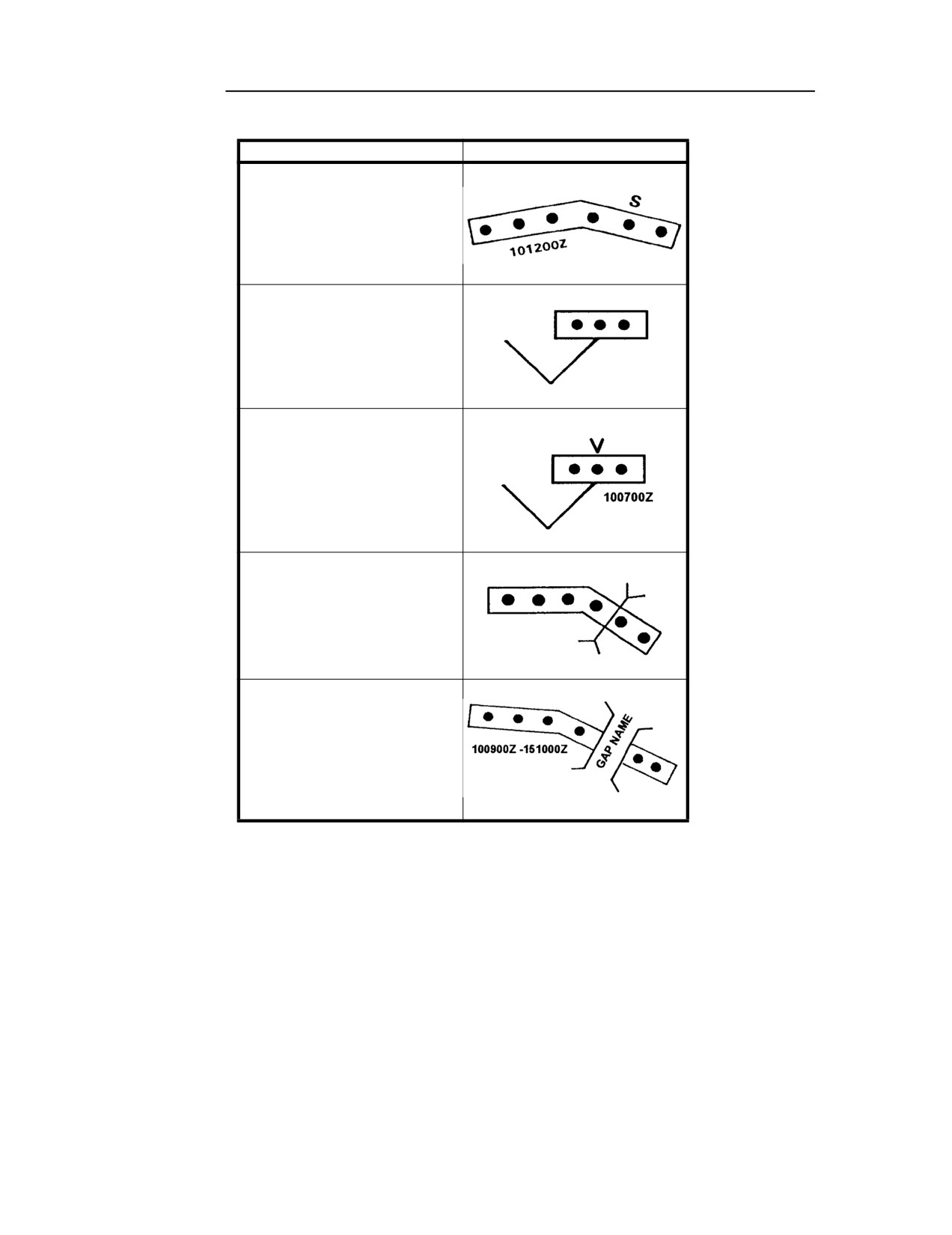
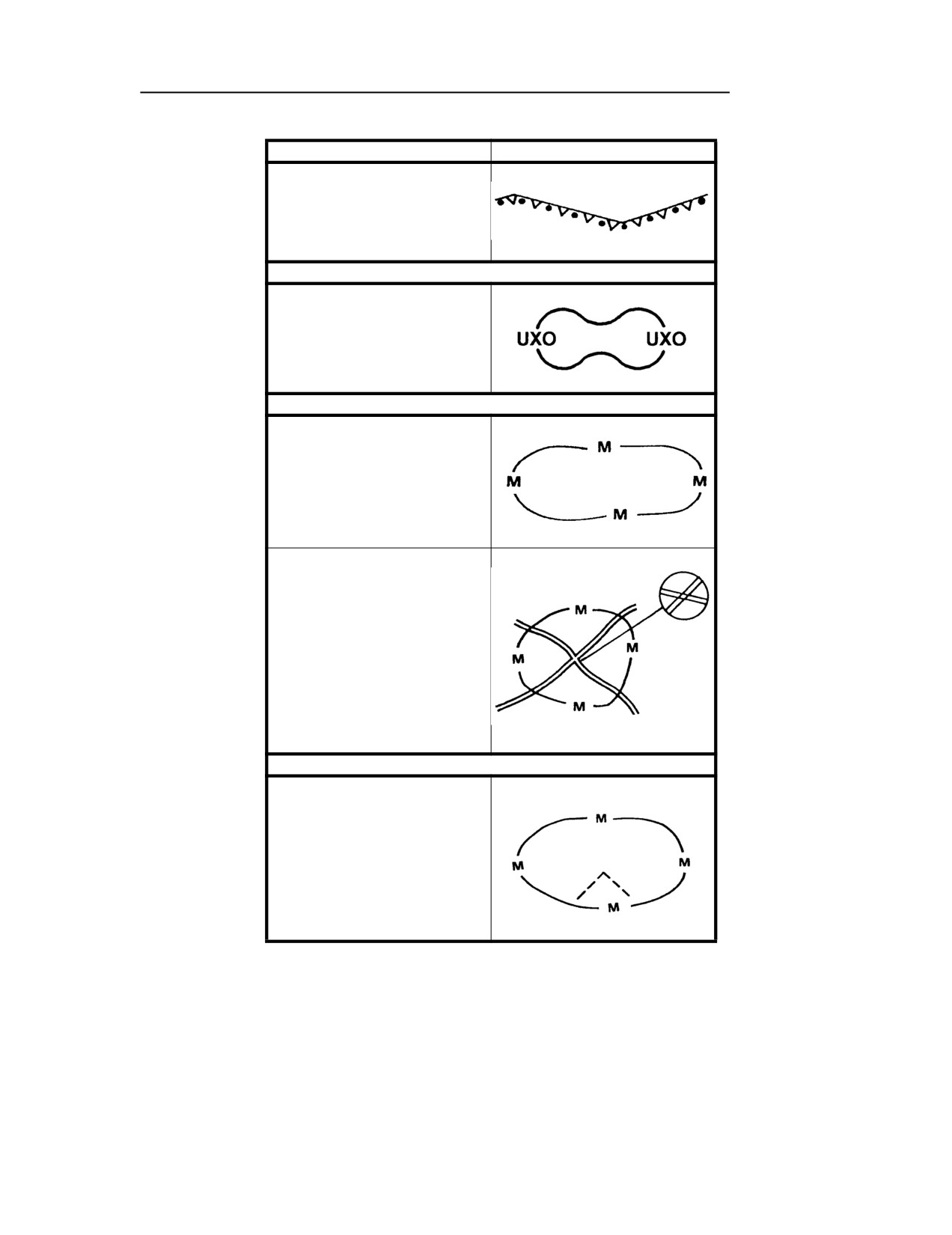
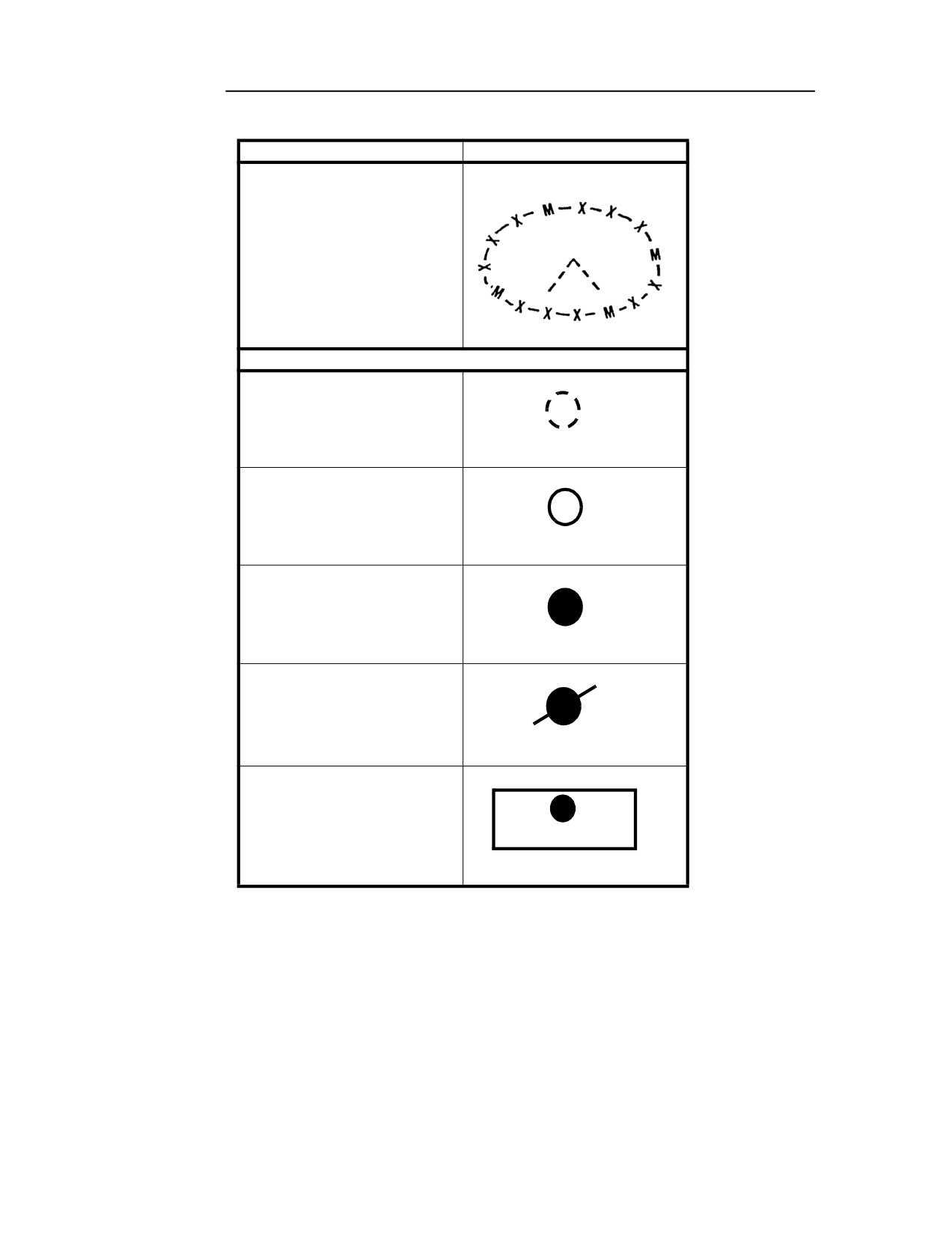
MINEFIELD/MUNITION FIELD OVERLAY SYMBOLS
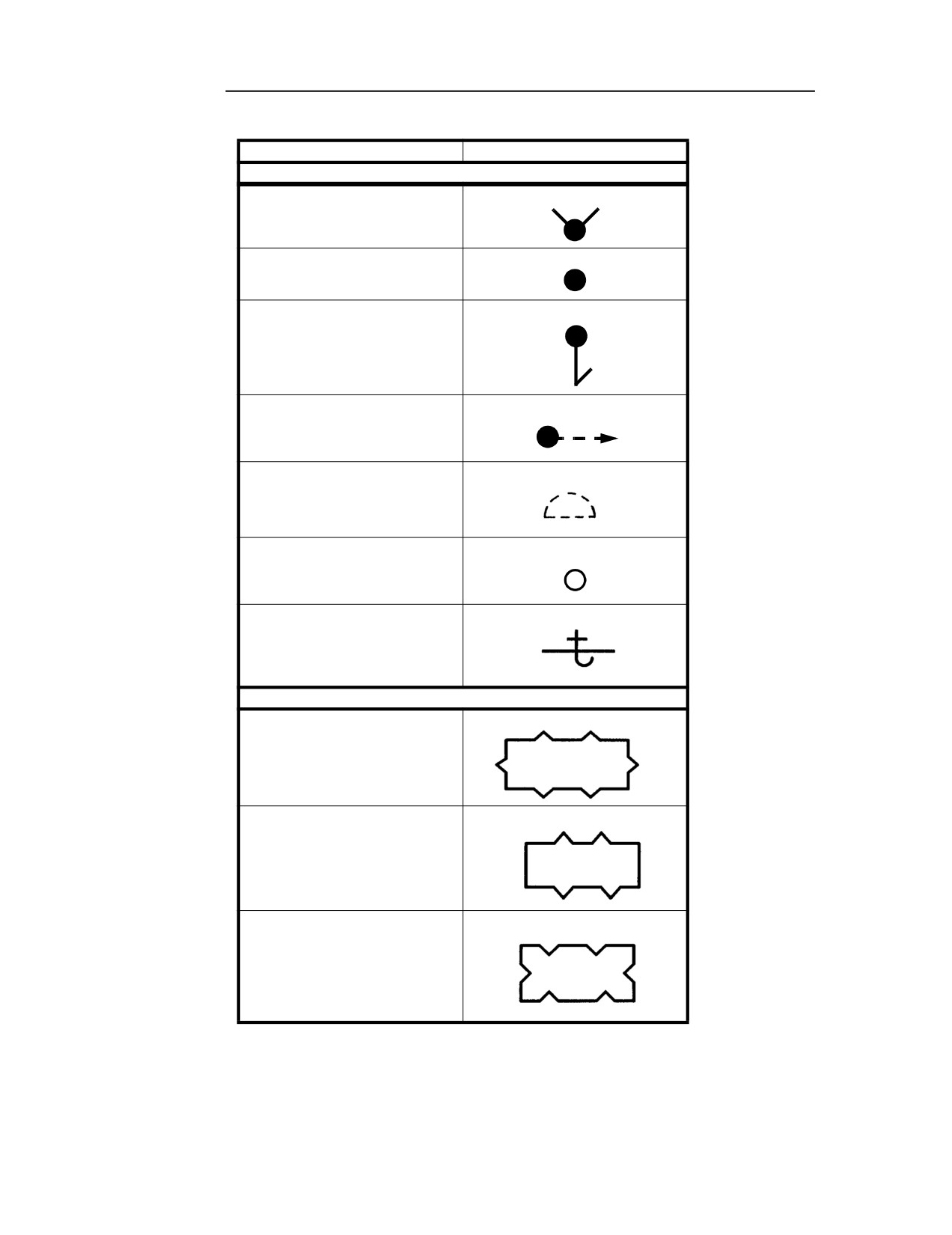
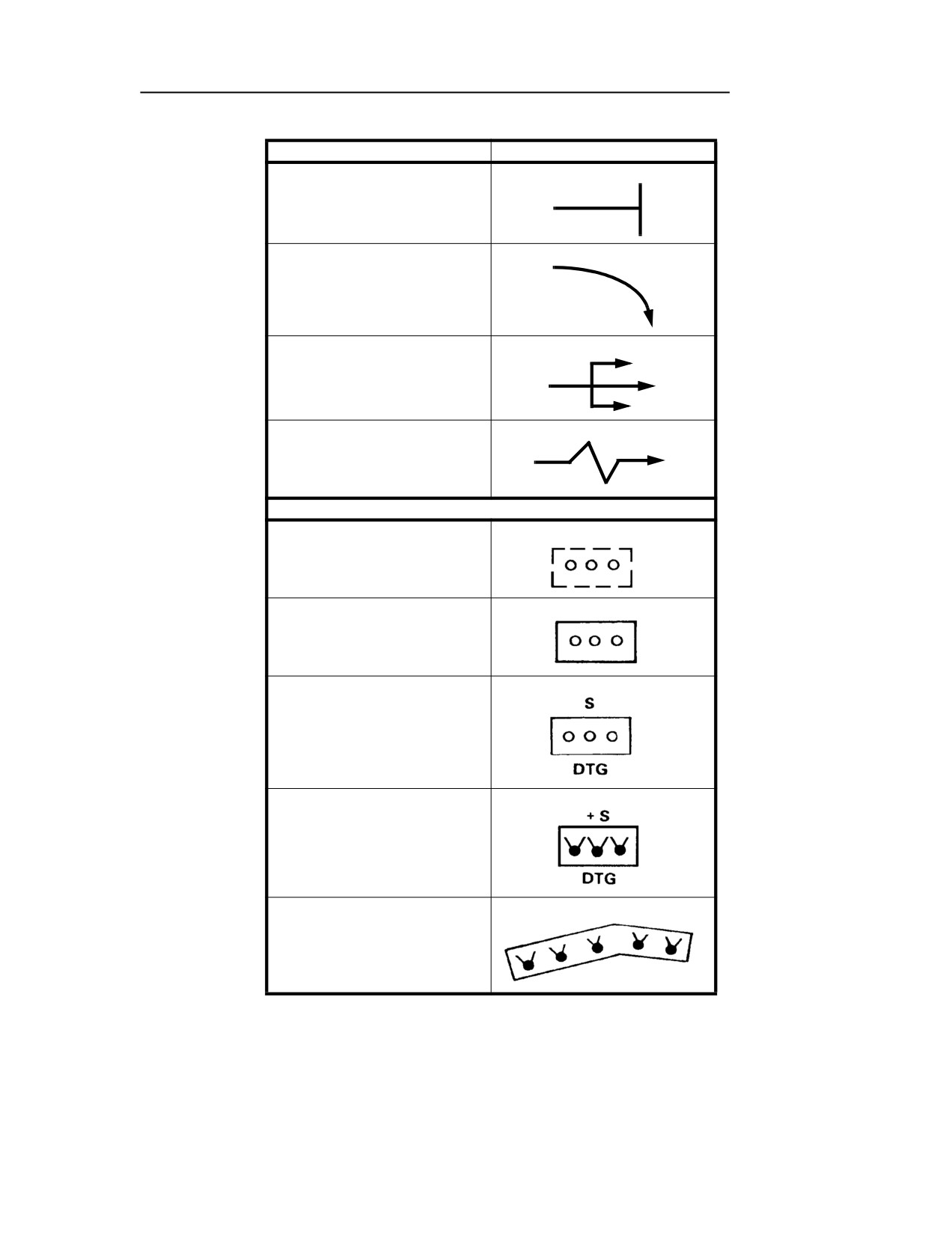
The symbols contained in Figure 8-11, pages 8-26 through 8-30, are extracted
from FM 101-5-1 and are provided for posting mine data on maps and
overlays.
Reporting and Recording 8-25
FM 20-32
Description
Symbol
Minefield/Munition Fields
Korea Only: AP mine
AT mine
AT mine with AHD
Directional mine (arrow points in
direction of main effect)
Mine cluster
Mine, type unspecified
Trip wire
Control Measures
Zone
Belt
Restrictions
Figure 8-11. Minefield/munition field overlay symbols
8-26 Reporting and Recording
FM 20-32
Description
Symbol
Block effect
Turn effect
Disrupt effect
Fix effect
Conventional
A planned minefield/munition
field consisting of unspecified
mines
A completed minefield/munition
field consisting of unspecified
mines
Scatterable minefield/munition
field (DTGs used for SD times)
Conventional AP minefield/
munition field reinforced with
SCATMINEs
Tactical AP row minefield/
munition field (outline drawn to
scale)
Figure 8-11. Minefield/munition field overlay symbols (continued)
Reporting and Recording 8-27
FM 20-32
Description
Symbol
Tactical minefield/munition field
of scatterable AT mines, effective
until 101200Z
Completed AT minefield/muni-
tion field (drawn away from the
location and connected by a vec-
tor)
Executed Volcano minefield/
munition field (DTG used for SD
time)
Lane in conventionally laid AT
minefield/munition field
Gap in conventionally laid AT
minefield/munition field (DTG
opened to DTG closed)
Figure 8-11. Minefield/munition field overlay symbols (continued)
8-28 Reporting and Recording
FM 20-32
Description
Symbol
AT ditch reinforced with AT mines
UXO
UXO area
Nuisance
Nuisance minefield/munition field
Demolished crossroads with nui-
sance mines
Phony
Phony minefield/munition field
Figure 8-11. Minefield/munition field overlay symbols (continued)
Reporting and Recording 8-29
FM 20-32
Description
Symbol
Phony minefield/munition field,
fenced
Hornet Symbology
Planned
W
Unarmed
W
Armed
W
Expended
W
Armed munition field (DTG used
for SD time)
W
DTG
Figure 8-11. Minefield/munition field overlay symbols (continued)
8-30 Reporting and Recording
PART TWO
Counteroperations
This part of the manual provides overall guidance for conducting counteroperations by
US forces. The types of breaching and clearing operations conducted, the tasks
performed, and the equipment required are described in detail. Responsibilities and
planning considerations are outlined for each operation.
Chapter 9
Countermine Operations
Countermine operations are undertaken to breach or clear a minefield. All
the tasks fall under breaching or clearing operations and include
detecting, reporting, reducing, proofing, and marking.
DEFINITIONS
OBSTACLE
The term obstacle is used often in this chapter because the same breaching
and clearing operations are used for minefields and other obstacles. For the
purpose of this manual, breaching and clearing tactics, techniques, and
procedures (TTP) focus solely on minefields.
REDUCTION
Reduction is the act or actions taken against an obstacle that diminishes its
original effect. For example, creating a lane in a minefield would yield a
reduction of the minefield obstacle.
BREACHING
Breaching is the employment of TTP to project combat power to the far side of
an obstacle. It is a synchronized combined arms operation that is under the
control of the maneuver commander.
AREA CLEARANCE
Area clearance is the total elimination or neutralization of an obstacle or
portions of an obstacle. Clearing operations are not conducted under fire. They
are usually performed by follow-on engineer forces after a breaching operation
or anytime in a friendly AO where an obstacle is a hazard or hinders
movement.
ROUTE CLEARANCE
Route clearance is the removal of mines along preexisting roads and trails.
MINE NEUTRALIZATION
Mine neutralization occurs when a mine is rendered incapable of firing on
passage of a target. The mine may still be dangerous to handle.
Countermine Operations 9-1
C2, FM 20-32
PROOFING
Proofing is done by passing a mine roller or other mine-resistant vehicle
through a lane as the lead vehicle. It verifies that a lane is free of mines.
DEMINING
Demining is the complete removal of all mines and UXO within a geopolitical
boundary after hostilities cease.
BREACHING OPERATIONS
Breaching is a synchronized combined arms operation that is under the
control of the maneuver commander. FM 3-34.2 provides combined arms
commanders and staffs with doctrine TTP that are needed to successfully
overcome obstacles. Breaching operations make maneuver possible in the face
of enemy obstacle efforts. Since obstacles may be encountered anywhere,
maneuver forces integrate breaching operations into all movement plans.
When possible, enemy minefields are bypassed to maintain the momentum
and conserve critical countermobility assets. However, when making the
decision to bypass rather than breach, consider the likelihood of friendly units
being channelized into kill zones. Bypassing is done by maneuvering around a
minefield or, if aviation assets are available, moving over the minefield. When
maneuvering around an obstacle, attempt to locate a portion of the force in
overwatch positions to cover the bypass of the main element. Even when the
decision is made to conduct a breach, scouts should continue to reconnoiter for
bypass routes.
The first step in understanding breaching operations is to know the obstacle
breaching theory. Knowing the theory behind breaching operations equips the
engineer and the maneuver commander with fundamentals that are needed to
integrate breach into the tactical planning, preparation, and execution of an
operation.
Successful breaching operations are characterized by the application of the
following tenets of breaching:
INTELLIGENCE
In any operation where enemy obstacles interfere with friendly maneuver,
obstacle intelligence (OBSTINTEL) becomes a priority intelligence
requirement (PIR). Finding enemy obstacles or seeing enemy obstacle activity
validates and refines the S2's picture of the battlefield. OBSTINTEL helps
determine enemy intentions, plans, and strength. The force engineer is the
unit's expert on enemy countermobility, and he assists the S2 in templating
enemy obstacles and analyzing OBSTINTEL.
When collecting OBSTINTEL, reconnaissance is a combined arms activity
that includes engineers. An engineer squad moves with scouts or the patrol
and conducts dismounted reconnaissance of templated or discovered obstacles.
Additional information on reconnaissance can be found in FM 5-170.
Reconnaissance teams gather the following OBSTINTEL information from
the reconnaissance:
• Minefield location. Plot the perimeter location on a large-scale map
and refer to recognizable landmarks.
9-2 Countermine Operations

FM 20-32
•
Perimeter description. Describe how the perimeter is fenced. If it is
unfenced, describe how it is marked. If it is unmarked, show how it
was recognized.
•
Nuisance mines. If you discover a nuisance mine forward of the
minefield’s outer edge, remember, there may be others. Assembly
areas might also be mined.
•
Types of mines. Indicate whether mines are AT or AP or have
unknown fuses (self-neutralized or SD). If possible, recover specimens
of unknown or new mines and note the details.
•
Details of any other devices. Describe booby traps, trip wires, and
flares.
•
Laying method. Indicate whether mines are buried or surface-laid.
•
Density and pattern. Include the mine spacing and the number of
mine rows; estimate the mine density based on this information.
•
Minefield depth. Provide the distance between strips or rows and
describe markers.
•
Safe lanes and gaps. Plot the location of suspected safe lanes and gaps
and describe their markings.
•
Ground conditions. Include information on general ground conditions.
•
Other obstacles. Plot the location and the construction of other
obstacles.
•
Enemy defenses. Describe the enemy's location and size. Include the
location of enemy direct-fire weapons.
NOTE: Engineers engaged in reconnaissance for OBSTINTEL should
rarely, if ever, be used to reduce obstacles during the reconnaissance.
Each reconnaissance team commander submits a detailed OBSTINTEL report
to the next higher headquarters when the reconnaissance is complete. A
sample OBSTINTEL report is shown in Figure 9-1.
Letter
Explanation
Designation
A
Map sheet(s).
B
Date and time the information was collected.
C
Type of minefield (AT, AP, or mixed).
D
Grid references of minefield extremities, if known.
E
Depth of minefield.
F
Estimated time required to clear the minefield.
G
Estimated material and equipment required to clear the minefield.
H
Routes for bypassing the minefield, if any.
I-Y
Grid references of lanes (entry and exit) and width of lanes, in meters.
Additional information such as types of mines used, unknown mines, or types of
Z
booby traps.
Figure 9-1. Sample OBSTINTEL report
Countermine Operations 9-3

FM 20-32
FUNDAMENTALS
Suppress, obscure, secure, and reduce (SOSR) are the breaching fundamentals
that must be applied to ensure success when breaching against a defending
enemy. This TTP will always apply but may vary based on specific situations.
Suppress
Suppression is the focus of all available fires on enemy personnel, weapons,
and equipment to prevent effective fires on friendly forces. The purpose of
suppression is to protect forces who are reducing the obstacle and
maneuvering through it and to soften the enemy’s initial foothold.
Obscure
Obscuration hampers enemy observation and target acquisition, and it
conceals friendly activities and movement. Obscuration smoke deployed on or
near the enemy position minimizes the enemy’s vision.
Secure
The force secures the breaching site to prevent the enemy from interfering
with reduction and to prevent the enemy’s passage through lanes created
during reduction. In general, enemy tactical obstacles are secured by fires,
and protective obstacles are secured by force.
Reduce
Reduction means creating lanes through or over the obstacle to allow passage
of the attacking force. The lanes must be sufficient to allow the force to cross
and accomplish the mission. (Table 9-1 provides information on lane widths.)
The unit reducing the minefield marks the minefield and lane locations and
reports their conditions to higher headquarters.
Table 9-1. Lane widths
Lane
Width
Remarks
Allows passage of dismounted troops so that they may continue
Assault footpath
1 meter
an attack or secure the far side of a minefield while vehicle
lanes are being breached
Allows passage of breaching and assault forces (initial lanes
Initial lane
4.5 meters
are widened and marked as soon as the tactical situation
allows)
Intermediate lane
4.5 meters
Upgrades sign posting and further defines exit markers
Full lane
10 meters
Allows passage of two-way traffic
ORGANIZATION
The commander organizes the force to accomplish SOSR breaching
fundamentals quickly and effectively. This requires him to organize support,
breach, and assault forces with the necessary assets to accomplish their
missions.
Support Force
The support force is primarily responsible for eliminating the enemy's ability
to interfere with the breaching operation. It must isolate the battlefield with
fires and suppress enemy fires that are covering the breach location. This
involves massive direct and indirect fire to destroy enemy vehicles and
personnel who are able to bring fire on the breach force.
9-4 Countermine Operations
FM 20-32
Breach Force
The breach force creates lanes that enable the assault force to pass through
the obstacle and continue the attack. It is also responsible for marking lanes
(length and entry points) to speed passage of assault and follow-on forces. The
breach force is a combined arms force. It includes engineers, breaching assets,
and enough maneuver force to provide local security. The breach force must be
able to deploy and begin reducing the obstacle as soon as enemy fires have
been suppressed. It must be capable of creating a minimum of one lane for
each assaulting company or two lanes for an assaulting TF. At a minimum,
the lanes must be marked and their locations and conditions reported to
higher headquarters and follow-on units as prescribed in the unit's SOP. The
commander should expect a 50 percent loss of mobility assets in close combat.
Assault Force
The assault force destroys or dislodges the enemy on the far side of the
obstacle. It secures the far side by physical occupation in most breaching
operations. The assault force may be tasked to assist the support force with
suppression while the breach force reduces the obstacle. The assault force
must be sufficient in size to seize objectives that eliminate fires on the
breaching site.
MASS
Breaching is conducted by rapidly applying concentrated force at a designated
point to crack the obstacle and rupture the defense. Massed combat power is
directed against an enemy weakness. Smoke and terrain help isolate the
enemy force that is under attack. The commander also masses engineers and
breaching equipment to reduce the obstacle. The breach force is organized and
equipped to use several different reduction techniques in case the primary
technique fails (a key vehicle is destroyed or casualties render dismounted
engineers ineffective). Additional reduction assets are present to handle the
unexpected (50 percent over the requirement are normally positioned with the
breach force).
SYNCHRONIZATION
Breaching operations require precise synchronization of the SOSR breaching
fundamentals by support, breach, and assault forces. Failure to synchronize
effective suppression and obscuration with reduction and assault can result in
rapid, devastating losses of friendly troops in the obstacle or the enemy's fire
sack. The commander cannot adequately synchronize his force's application of
combat power in the short time available to him when he encounters an
obstacle. The number of decisions that he must make while under fire in an
unclear situation will rapidly overwhelm him. Even with a force trained to
execute a combined arms breach, synchronizing all the necessary tasks
remains a complex, difficult process. The commander uses the following
principles to ensure synchronization through proper planning and force
preparation:
• Detailed reverse planning.
• Clear subunit instructions.
• Effective C2.
• A well-rehearsed force.
Countermine Operations 9-5
FM 20-32
CLEARING OPERATIONS
Clearing is the total elimination or neutralization of mines from an area. It is
not usually conducted under enemy fire, but it can be conducted by engineers
during war or after hostilities as part of nation assistance.
A limited clearing operation can be conducted by follow-on engineers after the
breaching force has reduced the minefield and secured the area. Engineers
initially improve existing breach lanes by widening and marking them, and
they also clear and mark new lanes through the minefield. The clearing
operation supports the continued passage of forces.
A clearing operation is also conducted to eliminate all the mines in a minefield
(previously identified, reported, and marked in a friendly AO) that hinders
mobility or is a hazard to friendly forces.
UPGRADE OF BREACH LANES
Lane clearance is more deliberate than lane breaching and normally takes
longer. Follow-on engineers upgrade breach lanes to improve existing lanes
through minefields and to create new lanes. This clearing operation is
intended to further reduce the minefield so that follow-on units can pass
through it quickly.
The breach force that initially reduced the obstacle and marked the lanes
turns over the lanes to follow-on engineers. Follow-on engineers can expect
lane widths of 4.5 meters. The total number of lanes depends on the size of the
lead assault force. Two to four assault lanes are normal if the lead unit was
brigade-size.
If forces continue to pass through existing lanes while further reduction and
clearance is conducted, follow-on engineers first begin reducing new lanes. At
a minimum, two lanes are required for an assaulting TF and one lane is
required for an assaulting company/team.
A limited amount of mechanical breaching assets is available for clearing
operations. Follow-on engineers will probably not have tank-mounted mine-
clearing blades (MCBs) or mine-clearing rollers (MCRs). The main mechanical
clearing asset is an armored dozer with a mine rake. Mine-clearing line
charges (MICLICs) are used if available. Engineers conducting clearing
operations—
• Ensure that lanes are a minimum of 100 meters apart.
• Reduce additional lanes by using the equipment and techniques
outlined in Chapter 10.
• Widen lanes to 10 meters to allow two-way traffic.
• Mark breach lanes by using the original marking system or the
division SOP. (Marking procedures are outlined in Chapter 10.)
• Emplace entrance, exit, and left and right lane markers to provide day
and night capability.
Traffic control is critical during lane reduction and when shifting lanes to
improve existing lanes. Engineers conducting reduction and clearance may
also provide guides at the lanes. Control procedures are outlined in FM
90-13-1.
To eliminate the danger of forces entering the minefield adjacent to lanes, the
minefield is marked with fencing (barbwire or concertina) and mine markers.
9-6 Countermine Operations
C2, FM 20-32
Marking is emplaced across the front, on both sides, between lanes, and to the
left and right of the crossing site as far out as practical.
Engineers may also help remove damaged vehicles from minefield lanes.
Recovery vehicles should be available near lanes for this purpose.
AREA CLEARANCE
Clearing operations are done when engineers receive a mission to clear an
area of mines or to clear a specific minefield in a friendly AO. The minefield
was reported and may already be marked on all sides. The worst case would
be if the minefield was reported but not marked and its limits were unknown.
The engineer unit receiving the mission bases plans on available information
and prepares equipment based on the estimate. Detailed techniques and
procedures for area and route clearance operations are outlined in Chapter 11.
Actions at the minefield begin with a thorough reconnaissance to identify the
minefield limits and the types of mines. This is a time-consuming process that
is hazardous to shortcut. Identified limits are marked with an expedient
system of single-strand barbwire or concertina. In this situation, since all
mines must be destroyed, the unit takes a systematic approach to clearing
mines. The procedure depends on the types of mines and whether the mines
are buried or surface-laid.
If mines are magnetic- or seismic-fused, mechanical assets are used. Pressure
mines can be destroyed by using hand-emplaced explosives. When a manual
procedure is used, eliminate trip wires on AP mines with grapnel hooks before
moving forward to detect mines.
Using the manual procedure, engineers visually detect mines or detect them
with mine detectors and probes. They also mark mines for destruction by
explosives. Chapter 11 contains information on minesweeping procedures.
After the mines are destroyed, engineers proof used lanes and routes to ensure
that all the mines were eliminated. This is done by using a mine roller or
another blast-resistant device. Proofing is discussed further in Chapter 10.
DEMINING
Demining is the complete removal of all mines and UXO to safeguard the
civilian population within a geopolitical boundary after hostilities cease. It is
an extremely manpower- and time-intensive operation and is sometimes
contracted. Although not a formal Army mission or function, SOFs may
provide special expertise in training demining organizations, acting as
advisors, and taking the lead in providing clearance equipment or techniques
that can be useful in demining operations. Demining TTP are outlined in TC
31-34.
Countermine Operations 9-7
FM 20-32
9-8 Countermine Operations
C2
Chapter 10
Minefield Reduction
Reduction is the physical creation of a lane through a minefield. It is a
fundamental of breaching operations as discussed in Chapter 9 and in FM
3-34.2. A number of tasks (detecting, reporting, reducing, proofing, and
marking) directly support or are included in minefield reduction.
DETECTING
Detection is the actual confirmation and location of mines. It may be
accomplished through reconnaissance, or it may be unintentional (such as a
vehicle running into a mine). Mine detection is used in conjunction with
intelligence-gathering operations, minefield bypass reconnaissance, and
breaching and clearing operations. There are four types of detection
methods—visual, physical (probing), electronic, and mechanical.
VISUAL
Visual detection is part of all combat operations. Personnel visually inspect
the terrain for the following minefield indicators:
•
Trip wires.
•
Signs of road repair (such as new fill or paving, road patches, ditching,
culvert work).
•
Signs placed on trees, posts, or stakes. Threat forces mark their
minefields to protect their own forces.
•
Dead animals.
•
Damaged vehicles.
•
Disturbances in previous tire tracks or tracks that stop unexplainably.
•
Wires leading away from the side of the road. They may be firing wires
that are partially buried.
•
Odd features in the ground or patterns that are not present in nature.
Plant growth may wilt or change color, rain may wash away some of
the cover, the cover may sink or crack around the edges, or the
material covering the mines may look like mounds of dirt.
•
Civilians. They may know where mines or booby traps are located in
the residential area. Civilians staying away from certain places or out
of certain buildings are good indications of the presence of mines or
booby traps. Question civilians to determine the exact locations.
•
Pieces of wood or other debris on a road. They may be indicative of
pressure or pressure-release FDs. These devices may be on the surface
or partially buried.
Minefield Reduction 10-1
FM 20-32
• Patterns of objects that could be used as a sighting line. The enemy
can use mines that are fired by command, so road shoulders and areas
close to the objects should be searched.
PHYSICAL
Physical detection (probing) is very time-consuming and is used primarily for
clearing operations, self-extraction, and covert breaching operations.
Detection of mines by visual or electronic methods should be confirmed by
probing. Use the following procedures and techniques when probing for mines:
• Roll up your sleeves and remove your jewelry to increase sensitivity.
Wear a Kevlar helmet, with the chin strap buckled, and a protective
fragmentation vest.
• Stay close to the ground and move in a prone position to reduce the
effects of an accidental blast. When moving into a prone position—
— Squat down without touching your knees to the ground.
— Scan forward up to 2 meters and to the sides up to 3 meters for
mine indicators.
— Probe the area around your feet and as far forward as possible.
— Kneel on the ground after the area is found to be clear, and
continue probing forward until you are in a prone position.
• Use sight and touch to detect trip wires, fuses, and pressure prongs.
• Use a slender, nonmetallic object as a probe.
• Probe every 5 centimeters across a 1-meter front.
• Gently push the probe into the ground at an angle that is less than 45
degrees.
DANGER
Use extreme caution when probing. If the probe is pushed
straight down, its tip may detonate a pressure fuse.
• Apply just enough pressure on the probe to sink it slowly into the
ground.
• If the probe encounters resistance and does not go into the ground
freely, carefully pick the soil away with the tip of the probe and remove
the loose dirt by hand. Care must be taken to prevent functioning the
mine.
• When you touch a solid object, stop probing and use two fingers from
each hand to carefully remove the surrounding soil and identify the
object.
• If the object is a mine, remove enough soil to show the mine type and
mark its location. Do not attempt to remove or disarm the mine. Use
explosives to destroy detected mines in place, or use a grappling hook
and rope to cause mines to self-detonate. Do not use metal grappling
hooks on magnetic-fused mines.
10-2 Minefield Reduction
C2, FM 20-32
Probing is extremely stressful and tedious. The senior leader must set a limit
to the time a prober can actually probe in the minefield. To determine a
reasonable time, the leader must consider METT-TC factors, weather
conditions, the threat level, the unit’s stress level, and the prober’s fatigue
level and state of mind. As a rule, 20 to 30 minutes is the maximum amount of
time that an individual can probe effectively.
ELECTRONIC
Electronic detection is effective for locating mines, but this method is time-
consuming and exposes personnel to enemy fire. In addition, the suspected
mines must be confirmed by probing.
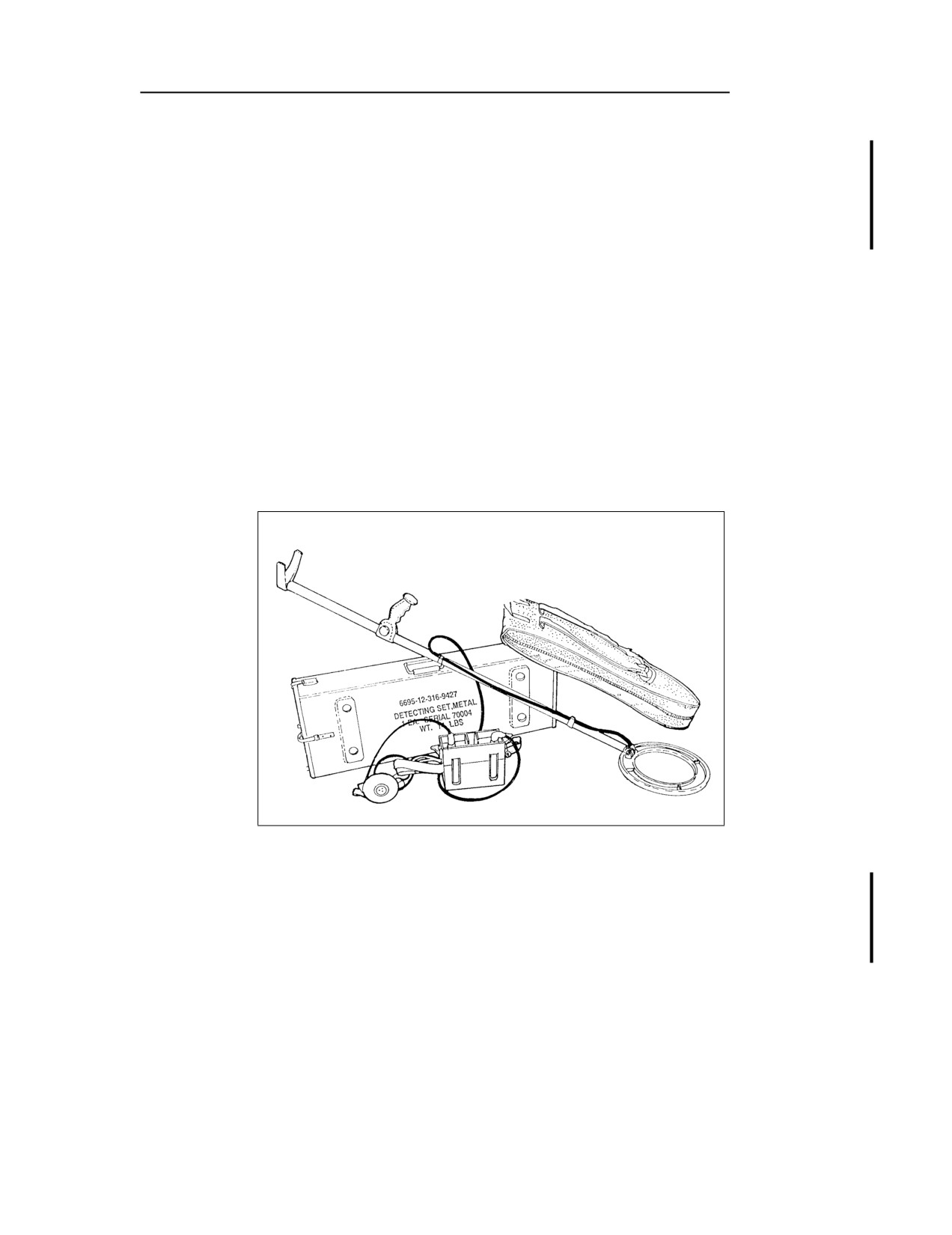
AN/PSS-12 Mine Detector
The AN/PSS-12 mine detector (Figure 10-1) can only detect metal, but most
mines have metal components in their design. The detector can locate and
identify plastic or wooden mines by a slight metallic signature. Employment
and operation procedures for the AN/PSS-12 are discussed in Appendix F, and
technical data is available in TM 5-6665-298-10. The detector is hand-held
and identifies suspected mines by an audio signal in the headphones.
Figure 10-1. AN/PSS-12 mine detector
As in probing, consideration must be taken for the maximum amount time an
individual can operate the detector. The leader considers METT-TC factors,
weather conditions, the threat level, the unit’s stress level, and the
individual’s fatigue level and state of mind. As a rule, 20 to 30 minutes is the
maximum amount of time an individual can use the detector effectively.
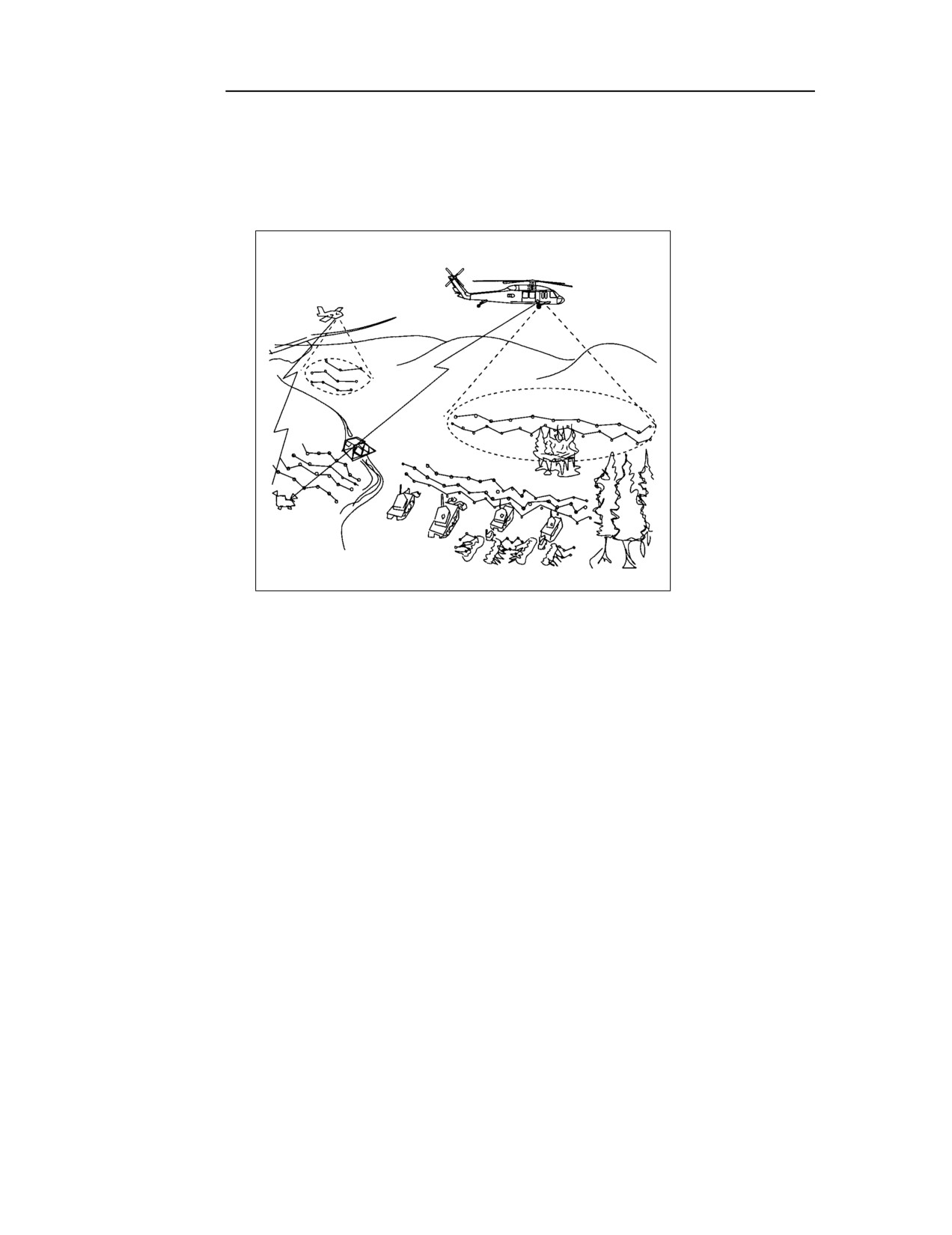
Airborne Standoff Minefield Detection System
The Airborne Standoff Minefield Detection System (ASTAMIDS) (Figure 10-2,
page 10-4) provides US forces with the capability to detect minefields rapidly.
Environmental conditions must be favorable for aircraft and ASTAMIDS
operations. ASTAMIDS can be mounted on a UH-60 Blackhawk helicopter, an
unmanned aerial vehicle (UAV), or a fixed-wing aircraft. The system detects
Minefield Reduction 10-3
FM 20-32
and classifies thermal and other anomalies as suspected minefields along
routes or in areas of interest. ASTAMIDS can be used to protect advancing
forces and can operate in concert with air and ground units in reconnaissance
missions.
Figure 10-2. ASTAMIDS
System Components
ASTAMIDS hardware and software components consist of a sensor with
associated electronics and the minefield-detection algorithm and processor
(MIDAP). Surrogate equipment includes an air-data package (GPS, radar
altimeter, inertial measurement unit [IMU]), a power supply, a work
station(s), a digital data recorder, mounting racks, and a modified floor for the
specific aircraft.
Operators view the data displayed on the monitors, communicate with the
aircrew, and perform other functions (such as changing data tapes and
producing reports). The aircrew must maintain an altitude of 300 feet and an
airspeed of approximately 70 knots for the system to detect mines accurately
within the sensor’s ground swath (approximately 215 feet wide). The system
has a 2-hour operational capability, based on standard flight time for the
mission profile.
Employment Concept
ASTAMIDS is a fast method for detecting tactical minefields. When it is
employed by aviation elements in support of maneuver units, close
coordination between aviation and ground units assures that minefield
detection is reported accurately and quickly. ASTAMIDS is not as precise as
ground detection systems, but it is accurate enough to help mitigate the
dangers inherent with minefields. It can be used in both friendly and enemy
territories. The use of a Blackhawk ASTAMIDS in areas of threat observation
10-4 Minefield Reduction
FM 20-32
and fire must be planned and coordinated very carefully, because a helicopter
is extremely vulnerable while flying the mission profile required for detection
(steady altitude, speed, and path).
Once airborne and at its start point, the ASTAMIDS system is placed in the
correct detection mode, based on the intended mission (route or area
reconnaissance). When the system indicates an initial detection, the operator
communicates it to the pilot. The pilot then flies a verification pass over the
indicated area. If the system again indicates a detection, the pilot resumes the
mission (route reconnaissance) or continues the survey pattern to determine
the minefield borders (area reconnaissance). If no detection is indicated on the
verification pass, the operator instructs the pilot to resume the flight plan.
Interim Vehicle-Mounted Mine Detector
The interim vehicle-mounted mine detector (IVMMD) is used in all levels of
conflict and OOTW. The IVMMD is mounted on a blast- and fragmentation-
survivable vehicle; it is designed to detect and mark buried and surface-laid,
metallic AT mines. The primary mission of the IVMMD is to detect mines
during route clearance. The system should not be used when operating in an
environment where the enemy employs mines that are not pressure-fused.
System Components
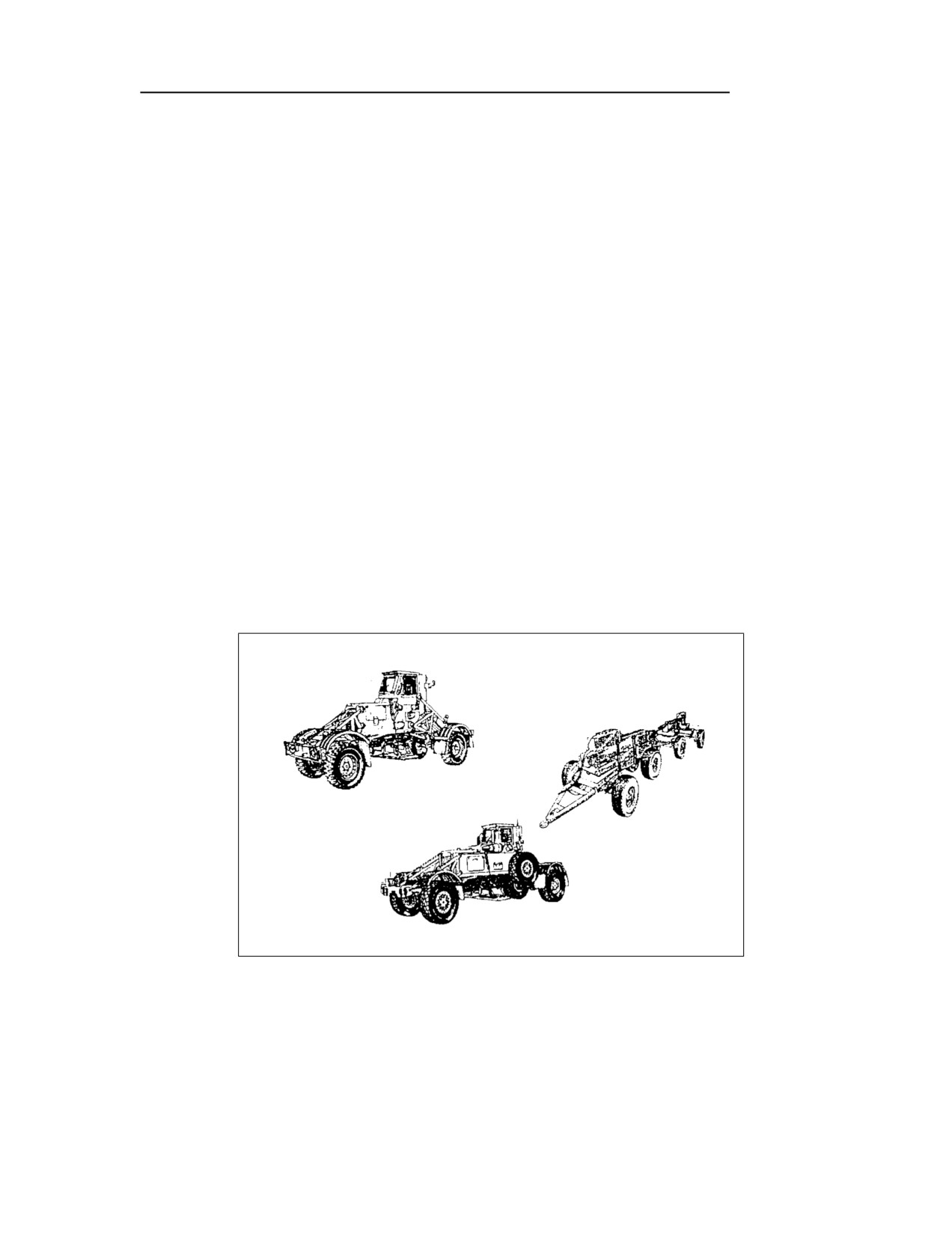
A complete IVMMD (Figure 10-3) consists of one mine-detection vehicle
(MDV), one towing/mine-detection vehicle (T/MDV), three mine detonation
trailers, a spare-wheel module for the MDV, a spare-wheel module for the T/
MDV, and a container of spare parts.
MDV
Mine detonation
trailers
T/MDV
Figure 10-3. IVMMD components
The MDV’s only mission is to detect mines. It can negotiate vertical slopes up
to a 20 percent grade. The MDV employs a 4-cylinder engine and a manual
transmission to propel the 4.8-ton vehicle with a 3-meter-wide detection array.
The detection array consists of two separate induction coils (one for the left
side and one for the right side) that detect magnetic fields below the vehicle.
Minefield Reduction 10-5
FM
20-32
The detection array is suspended between the two axles of the vehicle. When
the detector encounters a metallic object, the operator is notified by an audible
signal in the earphone. A visual signal appears on the dashboard that denotes
which side of the array detected the object. The operator then stops the
vehicle, backs it up, and reencounters the metallic object. (The MDV has two
detection modes—the locate mode is used to identify the metal object, and the
pinpoint mode is used to find the center of the object.) When the operator
encounters the strongest signal, he activates the marking system (a nozzle
mounted on the rear frame and centered on each detection array) that deploys
a water-based ink onto the roadway.
The T/MDV has a 6-cylinder engine and the same detection and marking
system as the MDV. The T/MDV tows three detonation trailers. The
recommended maximum operating speed while towing the trailers is 20 kph.
The T/MDV (with trailers) can negotiate vertical slopes up to a 20 percent
grade; however, going down such slopes is difficult. The T/MDV must be in
first gear, and the trailer brakes must be deployed to decrease the speed of the
vehicle when going down a slope.
The mine detonation trailers are very heavy, and they are specifically
designed to apply heavy ground pressure that initiates pressure-activated
mines. Each trailer has two axles of different lengths so that the three trailers
provide a full 3-meter-wide proofing capability behind the T/MDV. If a mine
detonates underneath the trailers, the wheel bolts are designed to sheer so
that repair is limited to replacing a single wheel.
The detection array is suspended between the two axles of the MDV. Although
the vehicle is designed to produce very little ground pressure, it will detonate
most pressure-fused mines, depending on the sensitivity of their fuses.
• The MDV produces 27.9 pounds per square inch (psi) of ground
pressure when the tires are inflated to 14.5 psi and 21.8 psi of ground
pressure when the tires are inflated to 8.7 psi.
• The T/MDV produces 49.8 psi of ground pressure when the tires are
inflated to 29 psi and 23.4 psi of ground pressure when the tires are
inflated to 8.7 psi.
Employment Concept
The IVMMD is used to support route-clearance operations. Clearance
operations ensure that LOC are safe for the passage of personnel and
equipment. The IVMMD should not be used during hours of limited visiblity,
because it hampers the operator’s ability to see surface-laid mines and visual
signatures that indicate mining activities.
MECHANICAL
The track-width mine roller is a mechanical minefield-detection system. It is
most effectively deployed to lead columns on route movement, but it can be
used to precede tactical formations. In column movement, unit vehicles travel
a narrow path, and one or two mine rollers can effectively detect mines in the
path. Mine rollers can also be used to detect minefields in front of deployed
tactical formations; however, more than one roller is required for a good
probability of detection.
10-6 Minefield Reduction
FM 20-32
REPORTING
Intelligence concerning enemy minefields is reported by the fastest means
available. Spot reports (SPOTREPs) are the tactical commander's most
common source of minefield intelligence. They originate from patrols that
have been sent on specific minefield reconnaissance missions or from units
that have discovered minefield information in the course of their normal
operations. The information is transmitted to higher headquarters.
REDUCING
Minefield reduction and clearing equipment is broken down into explosive,
mechanical, electronic, and manual. Combat engineers and the operators of
breach assets practice and become proficient in these reduction means. They
integrate them into the breach drills of the units they support. The team
applies different TTP to breach drills and prepares and rehearses them as
part of the TF plan.
EXPLOSIVE
M58A4
Mine-Clearing Line Charge
The MICLIC (Figure 10-4, page 10-8) is a rocket-propelled, explosive line
charge. It is used to reduce minefields that contain single-impulse, pressure-
activated AT mines and mechanically activated AP mines. It clears a 14- by
100-meter path. The MICLIC has a 62-meter standoff distance from the
launcher to the detonation point. The MICLIC’s effectiveness is limited
against prong AP mines, magnetically activated mines (including some
SCATMINEs), top-attack mines, side-attack mines, and mines containing
multiple-impulse or delay-time fuses. It also has little effect on other
obstacles, such as log and concrete barriers, antivehicular ditches, and walls.
The shock effect and the psychological impact of the detonation make the
MICLIC a useful weapon in a close fight or in MOBA.
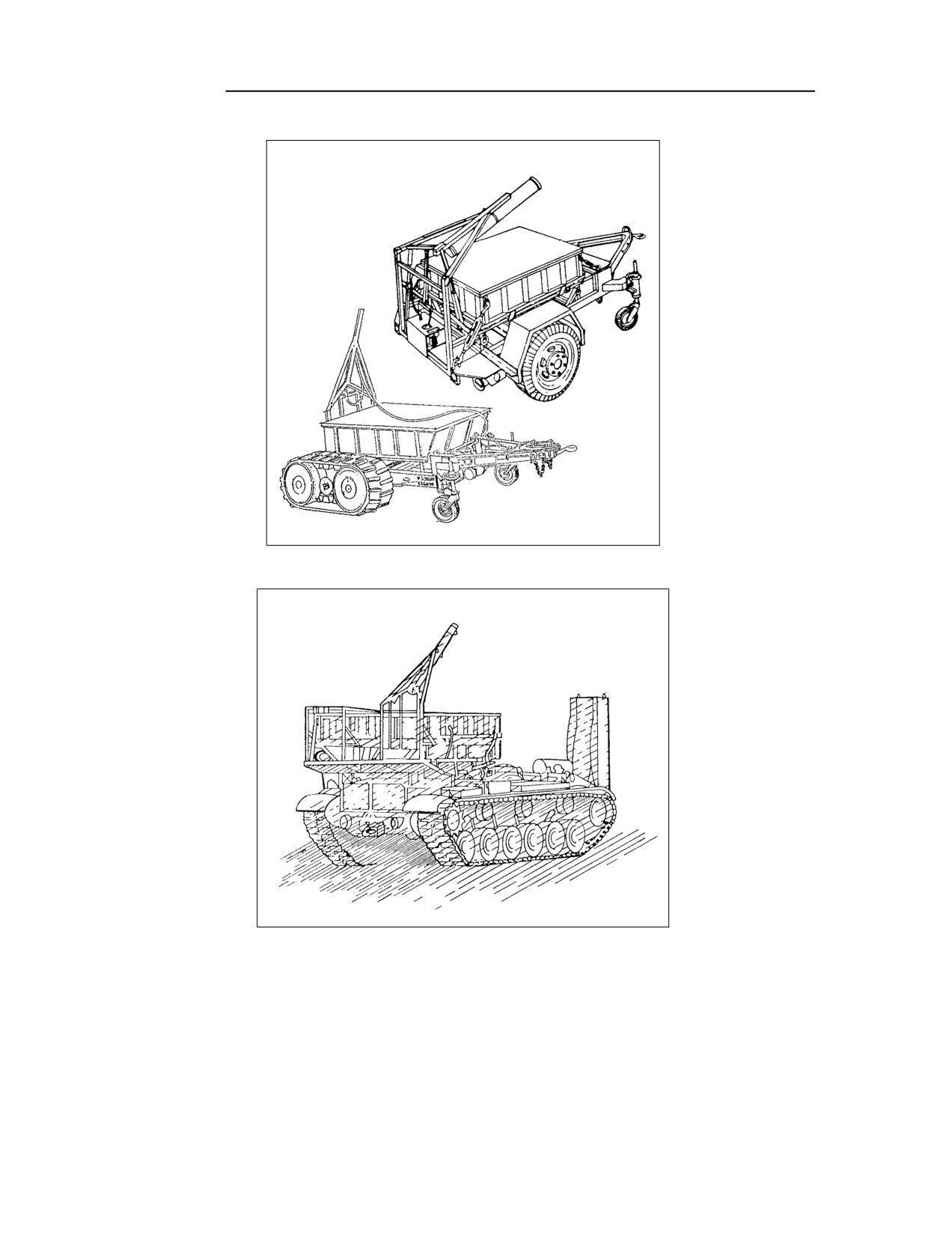
The MICLIC is mounted on a rubber-tired trailer, or two MICLICs can be
mounted on an armored vehicle-launched bridge (AVLB), with the bridge
downloaded, using a fabricated I-beam frame (procedures for mounting the
MICLIC on the AVLB are outlined in TM 9-1375-215-14&P). This is called an
armored vehicle-launched MICLIC (AVLM) (Figure 10-5, page 10-8), and it is
the preferred system because no trailer is involved to hinder the mobility of
the vehicle.
Towing vehicles for the trailer-mounted MICLIC are a combat engineer
vehicle (CEV), an M113 APC, M2 and M3 Bradleys, an M9 armored combat
earthmover (ACE), a 5-ton wheeled vehicle, and a 2½-ton wheeled vehicle. The
trailer limits the MICLIC’s mobility in rough terrain and degrades the
maneuverability of the towing vehicle, thereby increasing vulnerability. Since
the MICLIC is critical to the breach, it is kept under the protection of the force
and is moved to the breach site along easily trafficable, covered, and concealed
routes. This effectively prevents the towing vehicle from performing any other
task (firing or maneuvering) or serving as an engineer squad vehicle unless
MICLIC employment is the squad’s only mission. This is an important
consideration when selecting the towing vehicle because this vehicle must be
solely dedicated to the mission.
Minefield Reduction 10-7
FM 20-32
Figure 10-4. MICLIC
Figure 10-5. AVLM
The MICLIC can be fired from within an armored vehicle without exposing
soldiers to fires; however, the prefiring preparations must be done in advance
at a covered and concealed location near the breach site. The initiating cable is
brought into the vehicle through the hatch, which must be left ajar, or through
the portal of the periscope, which has been removed. Therefore, the crew is not
afforded nuclear, biological, chemical (NBC) protection. When the MICLIC is
10-8 Minefield Reduction
FM 20-32
fired from a wheeled vehicle, however, the crew must move to a covered
position outside the backblast area. The special-purpose cable on the firing
control switch is long enough to allow adequate standoff.
The vehicle operator must be proficient in all aspects of preparing and
deploying the MICLIC, including the critical aspect of selecting the optimum
breach site. Although the operator will be directed to the breach site by the
engineer platoon leader or the breach force commander, ensuring that he can
independently accomplish the task will simplify the operation and greatly
enhance its likelihood of success. The towing vehicle and the operator must be
selected well in advance and be dedicated solely to the task. The operator
must be included in all rehearsals and planning sessions and, if possible,
during leaders' reconnaissances.
Each MICLIC trailer transports and fires one charge, and then it must be
reloaded. The AVLM can fire both MICLICs before reloading. The loaded
charge container weighs 1,283 kilograms, so a lifting device such as a 5-ton
wrecker or a HEMTT is needed. Reloading, which can be done by an
experienced crew in about 20 minutes, entails loading a rocket on the rail and
lifting a new charge container onto the launcher. The reloading operation
must be done in a covered and concealed location.
The exact limits and depth of an enemy minefield are seldom known before
the breach. This is particularly true when the situation is unclear, and the
minefield is encountered simultaneously with enemy contact. The first and
only indication that a unit is in a minefield may be when a vehicle encounters
a mine. The leading edge of the minefield still may be an uncertainty, because
the vehicle could have hit a mine in an interior row. The number of MICLICs
needed to clear a single lane through a minefield depends on the minefield
depth:
• Clearing a lane through a minefield less than
100 meters deep
requires one MICLIC (Figure 10-6, page 10-10). The leading edge of
the minefield is identified and, if possible, confirmed by
reconnaissance. The MICLIC is deployed from a minimum standoff
distance of 62 meters from the leading edge of the minefield.
• Clearing a lane through a minefield more than 100 meters deep or of
uncertain depth requires two or more MICLICs (Figure 10-7, page 10-
10). If the leading edge cannot be identified, the MICLIC is deployed
100 meters from the possible edge or stricken vehicle. When the first
MICLIC is detonated, a second MICLIC moves 25 meters into the first
MICLIC’s path and fires its charge. This extends the lane an
additional 87 meters. Additional MICLICs are used for minefields of
extreme depth, and each one moves down the lane 25 meters into the
path created by the previous charge.
Minefield Reduction 10-9