FM 3-19.13 LAW ENFORCEMENT INVESTIGATIONS (JANUARY 2005) - page 11
FM 3-19.13
Table C-1. Checklist for an Evidence Room Inspection or Inventory (Continued)
Yes
No
NA
Was the DA Form 4137 sent with the evidence?
Was the return receipt or registered mail permanently attached to the original
DA Form 4137 when it was returned?
Was evidence properly handled to maintain the chain of custody if it was sent by
means other than registered mail? (Evidence may be hand-carried or shipped by an
installation transportation officer on a government bill of lading [GBL].)
Was a copy of the shipping document obtained and attached to the suspense copy
of DA Form 4137 if evidence was shipped by GBL?
Was a copy of the shipping document obtained and attached to the suspense copy
of DA Form 4137 if evidence was shipped by GBL?
Was the shipping document kept with the suspense copy of DA Form 4137 until—
z
Notice was received from the addressee indicating receipt of the evidence?
z
The evidence was returned to the evidence room?
Were the original and duplicate custody documents properly annotated and sent
with the evidence when the evidence was permanently transferred from one
evidence room to another?
Did the custodian who received this evidence enter the next document number of
the receiving room on both copies?
Was the previous document number lined through in such a manner that it
remained legible?
Was evidence for military judicial proceedings sent directly to the requesting SJA or
other agency by first class registered mail?
Did the SJA or agency return the evidence to the evidence custodian in the same
manner?
Were requests for USACIL analysis from non-CID or nonmilitary police Army
activities (for example, SJA, unit commanders, alcohol and drug abuse program
coordinators) coordinated with and made by the local CID elements?
z
Were items of material value or physical evidence in a criminal investigation
mishandled, contaminated, or improperly accounted for?
z
Were USACIL elements made aware of incidents of suspected criminal
activity as defined in AR 195-2, paragraphs 3-2 through 3-3?
z
Was help given when a CID element decided that it had no interest in the
circumstances of direct referrals to a USACIL?
z
Did the CID provide proper laboratory request forms, addresses, and advice
on packaging and transmittal?
z
Were the date, name, and unit of the CID representative coordinated with
entered in item 11 of DA Form 3655?
FINAL DISPOSITION
AR 195-5, paragraph 2-8
Was evidence disposed of as soon as possible after it had served its purpose or
was determined to be of no value as evidence?
Was evidence released to trial counsel for judicial proceedings returned as soon as
possible to the custodian for final disposition?
Evidence Room Inspection or Inventory Checklist C-11

FM 3-19.13
Table C-1. Checklist for an Evidence Room Inspection or Inventory (Continued)
Yes
No
NA
Did the trial counsel immediately notify the custodian so that the evidence custody
document could be properly annotated if an item of evidence was made part of the
trial record?
Was the inclusion of evidence in the trial record considered the final disposition?
Was the original evidence custody document sent to the SJA of the commander
with general courts-martial jurisdiction over the subject when final action had been
taken in known subject cases?
Did the SJA complete the final disposal authority part of the DA Form 4137 if the
evidence was no longer needed? (When evidence must be retained, this part of the
form is not completed; a brief statement giving the reason for keeping the evidence
is furnished to the custodian on separate correspondence. In unusual cases, where
there is a high risk of losing the original DA Form 4137 [for example, isolated units
that must mail the DA Form 4137 to the servicing SJA for disposition approval], a
letter or memorandum may be substituted for disposition approval.)
Was enough information furnished to allow the SJA to make a decision when it was
used?
Was the return correspondence from the SJA giving disposition approval attached
to the original DA Form 4137 for file at USACRC?
Was evidence in an investigation for which no subject was identified disposed of 3
months after the completion of the investigation without SJA approval?
Was the evidence disposed of earlier with SJA approval?
NOTE: In some situations, it may be advisable to keep the evidence longer than 3 months.
Did the evidence custodian obtain the approval of the commander, SAC, PM, or
representative, for disposal of evidence when the subject was not known?
Was this approval given by completing the final disposal authority section of the
original DA Form 4137?
Were controlled substances received by the evidence custodian that did not apply
to an investigation immediately disposed of under the authority outlined above?
(Disposition may be made immediately after determining that the substance cannot
be linked to a suspect.)
Were items of possible evidence that were determined to have no value as
evidence by the CID special agent or military police before they were sent to the
evidence custodian disposed of by the special agent or military police?
Was evidence disposed of only after consulting with the immediate supervisor and
getting approval? (This does not include controlled substances that were found.)
Was verbal permission obtained (followed by written permission) for the disposal of
evidence in an investigation for which no subject had been identified?
Was disposal of evidence done according to AR 195-5?
Were items of evidence disposed of immediately when it was not practical or
desirable to keep them (for example, automobiles, serial numbered items, items
required for use by the owner, undelivered mail, large amounts of money, or
perishable or unstable items)?
NOTE: Do not enter evidence into the evidence room if it can be disposed of immediately.
Was the disposal of evidence coordinated with the SJA?
Did the SJA complete the final disposal authority portion of the DA Form 4137?
C-12 Evidence Room Inspection or Inventory Checklist
FM 3-19.13
Table C-1. Checklist for an Evidence Room Inspection or Inventory (Continued)
Yes
No
NA
Was the final disposal authority part of the DA Form 4137 completed (as in the case
of evidence in an investigation for which no subject had been identified) when
evidence was permanently released to an external agency?
Did the SJA give legal advice when a legal question on methods of disposal arose?
Was US government property released to the organization to which it was issued?
Was personal property that was legal to own released to the rightful owner?
Were US Government Treasury checks and money orders from an APO money
order facility returned to the issuing APO?
Were other types of negotiable instruments (for example, money orders, travelers
checks, and checks owned by a business firm) released to the firm?
Were negotiable instruments destroyed if the firm did not want them returned?
Were US postal money orders that were not identified as the property of a specific
person sent to the Military Money Order Division, Postal Data Center, P.O. Box
14965, St. Louis, MO 63182 (except for US Government Treasury checks and
money orders from an APO money order facility)?
z
Was a letter of transmittal that had the investigative case number, date of
final report of investigation, offense, and complete identification of both the
subject and victim included?
z
Did the letter also state that information on the ROI or MPR could be
obtained by contacting the USACRC, USACIDC, ATTN: (office symbol),
6010 6th Street, Fort Belvoir, VA 22060-5585?
z
Was a first-class letter sent immediately to the Military Money Order
Division, Postal Data Center if it was foreseen that postal money orders
would be kept as evidence for more than 120 days from the date received
by the evidence custodian?
z
Did the first-class letter list the serial number and symbol number of each
money order and the reasons for detention? (This may prevent the issue of
duplicate money orders.)
Were negotiable instruments and other documents obtained from a person
returned?
Were known document standards released to the agency, person from whom the
standards were received, or the rightful owner, as appropriate?
Were exemplars and other documents of no value to the person or agency from
whom they were received placed in a case file or destroyed?
Were items of personal property that no longer had evidentiary value and belonged
to deceased or missing Army personnel released to the summary court officer
appointed to dispose of the decedent’s effects?
Were controlled substances destroyed in the presence of a witness who was a CID
special agent or in grade E6 or above? (The witness must not have been involved
in the chain of custody.)
Were controlled substances burned or was another method used that made it
permanently useless?
NOTE: For final disposal of marijuana used for training, see paragraph 2-9.
Was counterfeit currency and coins and counterfeiting equipment released to the
nearest office of the USSS, unless the USSS directed otherwise?
Evidence Room Inspection or Inventory Checklist C-13
FM 3-19.13
Table C-1. Checklist for an Evidence Room Inspection or Inventory (Continued)
Yes
No
NA
Was the disposal of counterfeiting equipment coordinated with the supporting
USSS office before release?
z
Was evidence of this type that was seized in the Far East sent to the USSS
office in Hawaii?
z
Was evidence of this type that was seized in Europe, Africa, or the Middle
East sent to the USSS representative at the US Embassy in Paris France?
z
Was evidence of this type that was seized in the Caribbean Sea and Central
and South America areas sent to the USSS office in Hato Rey, Puerto Rico?
Firearms and ammunition.
z
Were US government firearms, ammunition, and explosives that were kept
as evidence returned to the proper military unit?
z
Were US government firearms, ammunition, and explosives released to the
installation accountable officer, per AR 710-2, paragraph 2-5q, if the unit
could not be identified?
z
Were contraband firearms and ammunition that were kept as evidence
disposed of after coordination was made with the USACIL firearms
examiner?
z
Were legal personal weapons that were impounded for minor infractions (for
example, failure to register per local laws) returned to the rightful owner
when the legal requirements had been met and they were no longer needed
as evidence?
z
Was nongovernment ammunition (live or inert) that was kept as evidence
reported for turn-in to the supporting DRMO, per DOD 4160.21-M, for
destruction using the procedures in DA Pamphlet 710-2-1, Chapter 3? (The
evidence custodian may keep the items until the DRMO possesses the turn-
in forms and provides specific disposal instructions.)
Was evidence of obvious value turned in to the DRMO per DOD 4160.21-M when
the owner was unknown or could not be located?
Were items of evidence that were found at crime scenes, had no known owner, and
were of no obvious value (for example, matchbooks, beer cans, bottles, glass
fragments, and wooden sticks) destroyed by crushing, burning, or other methods
used to render the items useless or harmless?
Was money turned in to a US Army finance officer when the owner was not known
or could not be located after reasonable attempts?
Was a DD Form 1131 filled out?
Was a copy of DD Form 1131 attached to the original custody document?
Were post exchange items, commissary items, and items illegally introduced into a host country that were
connected with black market, customs, and postal investigations disposed of per—
z
Local regulations?
z
Status of forces agreements?
z
Law or customs of the host country?
Were limitation .0015 contingency funds (CID funds) that were held as evidence
disposed of per AR 195-4?
C-14 Evidence Room Inspection or Inventory Checklist
FM 3-19.13
Table C-1. Checklist for an Evidence Room Inspection or Inventory (Continued)
Yes
No
NA
Were CID funds that no longer had value as evidence promptly deposited with the
local FAO on DD Form 1131?
Did personnel who prepared the DD Form 1131 ensure that the accounting
classification cited was the same as the one on the voucher the CID funds were
originally disbursed on before depositing funds with the FAO?
Was a copy of DD Form 1131 showing the return of funds given to the proper
certifying and approving officer?
Was the IRS office in the geographical area notified when $10,000 or more (US or
foreign money) was imported outside the United States during a criminal
investigation and was kept as evidence?
Was a notice of levy sent by the IRS to the unit holding the funds if there was a tax
liability?
Were funds in the amount of the levy released to the IRS?
Were the remaining funds released elsewhere (as required) per AR 195-5,
paragraph 2-7?
RELEASE OF MARIJUANA
AR 195-5, paragraph 2-10
Was marijuana that was held by custodians and no longer had value as evidence
released subject to the following?
z
Did the officer responsible for training marijuana detection dogs submit a
written request to the evidence custodian?
z
Did the request list the approximate amount of marijuana needed for
training?
z
Was a copy of this request attached to the custody document for the
marijuana?
z
Was marijuana that was approved for final disposal, per AR 195-5,
paragraph 2-8, released for training purposes?
z
Did the evidence custodian consider this a final disposal and annotate it on
the original DA Form 4137?
z
Did the amount of marijuana released at one time exceed 200 grams per
dog?
z
Was more released for the same dog until the current supply was exhausted
or was no longer suitable for training purposes?
z
Did the person receiving the marijuana properly account for it?
z
Did the person dispose of any that remained if it was replaced or was no
longer required for training?
Was the marijuana listed on a new DA Form 4137?
Was the first “Released By” section signed by the custodian releasing
the marijuana, and was the first “Received By” section signed by the
person receiving it?
Did dog handlers and other personnel handling the marijuana maintain
the chain of custody?
Evidence Room Inspection or Inventory Checklist C-15

FM 3-19.13
Table C-1. Checklist for an Evidence Room Inspection or Inventory (Continued)
Yes
No
NA
Did they secure the marijuana in an office safe or a similar container
when it was not being used for training?
Was it noted on the DA Form 4137 when the marijuana became too old
for training, was lost, or was consumed by the dog?
Was the marijuana burned in the presence of a witness when all or part
of it was determined to be of no further value for training and was this
annotated on the DA Form 4137?
Was the DA Form 4137 then filed in the reference or training files of the
office responsible for the training?
NOTE: Marijuana may be used for training CID and military police personnel in the techniques of
identification and “field testing,” subject to the provisions above.
Was the unused marijuana, including residue, returned to the evidence custodian
for final disposition?
Did training personnel receive and return the marijuana on the same date?
(Marijuana should not be kept any longer than needed to complete the training.)
FIELD TESTING OF NONNARCOTIC CONTROL SUBSTANCES
AR 195-5, paragraph 2-11
NOTE: Field testing of nonnarcotic controlled substances by CID agents and MPIs is authorized.
Were the results of field tests verbally furnished to the commander concerned as
soon as possible?
Was evidence consumed through field testing deducted from the DA Form 4137?
Was the chain-of-custody section marked to show the disposal of the amount
consumed?
Did the person whose name appears in the chain of custody on the DA Form 4137
match the person who conducted the test as recorded on the CID Form 36?
Was a copy of CID Form 36 attached to both the original and first copies of the
DA Form 4137?
Was the evidence sent to USACIL for forensic analysis when the action
commander indicated that a person would not be court-martialed for an offense that
involved use or possession of marijuana?
Was evidence always sent to the USACIL for analysis when court-martial action
against the offender was considered?
Were cases accepted that involved the simple use or possession of marijuana and
for which the SJA or a representative decided that no analysis was required?
Did the commander and SJA concerned coordinate closely to determine the
commander’s intentions and to ensure that proper USACIL support was provided
when needed?
Did the SJA or his representative promptly notify the proper CID or military police
elements when the status of a case changed and there was no longer a need for
laboratory analysis?
INSPECTIONS
AR 195-5, paragraph 3-1
Did the commander, SAC, or PM supervise the evidence custodian?
C-16 Evidence Room Inspection or Inventory Checklist
FM 3-19.13
Table C-1. Checklist for an Evidence Room Inspection or Inventory (Continued)
Yes
No
NA
Was the evidence custodian directly responsible for the proper handling and
processing of evidence?
Did the evidence custodian inspect the evidence once each month?
Was this inspection made in lieu of a physical security inspection per AR 190-13?
Did the inspector determine that—
z
The evidence room was orderly and clean?
z
Structural and security requirements of AR 195-5 were being met?
z
Evidence was being received, processed, safeguarded, and disposed of per
AR 195-5?
INVENTORIES
AR 195-5, paragraph 3-2
Were inventories made—
z
Once during each calendar quarter?
z
When there was a change of the primary evidence custodian?
z
When there was a breach of security or the loss of evidence stored in the
evidence room?
Did the evidence custodian and a disinterested officer, appointed for this purpose,
make a joint inventory of the evidence stored in the evidence room every quarter?
Did the commander, SAC, or PM send a written request to the proper commander
to appoint a disinterested commissioned or warrant officer?
Did the appointing authority give the requesting activity a copy of the appointing
document (memorandum)?
Did the evidence custodian retain this until the inventory was complete and make a
ledger entry per AR 195-5, paragraph 3-2?
Was the disinterested officer a current member of USACIDC or a military police
officer?
Did the disinterested officer—
z
Become familiar with the provisions of AR 195-5 before conducting the
inventory?
z
Count the evidence in the evidence room and verify that it corresponded
with that shown on DA Form 4137?
z
Cross-reference all DA Forms 4137 (including those in suspense files) with
entries in the evidence ledger to ensure the accountability of all evidence?
z
Ensure that copies of DA Form 4137 in the suspense files were properly
annotated with the—
Registered mail number if sent to USACIL or another agency?
Proper signature if released for court-martial, investigations under Article
32, UCMJ, or other official purposes?
z
Ask the evidence custodian to verify the weight of drug evidence or of
controlled substances for inspection?
z
Provide the evidence custodian with a copy of the appointing document?
Evidence Room Inspection or Inventory Checklist C-17
FM 3-19.13
Table C-1. Checklist for an Evidence Room Inspection or Inventory (Continued)
Yes
No
NA
Did the incoming and the outgoing primary custodians make a joint physical
inventory of all the evidence room when the evidence custodian was changed?
(Joint inventories may be made along with quarterly inventories by disinterested
officers; however, each type of inventory should be recorded separately.)
Were all evidence records carefully checked to ensure proper documentation and
accountability?
Did the outgoing custodian resolve all discrepancies before the transfer of
accountability?
NOTE: A joint inventory does not need to be made when the alternate custodian replaces the primary
custodian for 30 days or less.
Was a joint inventory done before it was known whether the primary custodian
would be gone 30 days or less?
Was another inventory done when the primary custodian returned?
Was an inventory done by the person assigned for the inquiry (see AR 195-5,
paragraph 3-3) when evidence was lost or the security of the evidence room was
breached?
Was the inventory done in the presence of the evidence custodian?
Were sealed containers of fungible evidence breached when making any type of
inventory?
Was the evidence sealed in a new container per AR 195-5, paragraph 2-7d, when it
was breached?
RECORDED INSPECTIONS
AR 195-5, paragraph 3-2
Was the following statement entered in the evidence ledger immediately below the
last entry and signed by the commander, SAC, or PM?
I, (NAME), certify that on (DATE), per AR 195-5, inspected the evidence room.
Evidence is being processed per AR 195-5 (with no exceptions or the following
exceptions).
__________________________________________________________________
__________________________________________________________________
(Signature)
C-18 Evidence Room Inspection or Inventory Checklist

FM 3-19.13
Table C-1. Checklist for an Evidence Room Inspection or Inventory (Continued)
Yes
No
NA
RECORDED INVENTORIES
AR 195-5, paragraph 3-2
Were quarterly inventories recorded in the evidence ledger as follows?
We the undersigned, certify that on (DATE), per AR 195-5, a joint inventory was
made of the evidence room. All evidence was properly accounted for (with no
exceptions or the following exceptions).
____________________________________________________
____________________________________________________
(Signature of officer)
(Signature of evidence custodian)
(Printed name, grade, unit)
(Memorandum, date, issuing HQ)
Were change of custodian inventories entered in the evidence ledger immediately
below the last entry and signed by both the incoming and the outgoing primary
custodian?
I, (NAME), assume the position of primary custodian and accept responsibility for
all evidence shown on DA Form 4137 in the evidence document files. A joint
inventory was made on (DATE), with (NAME), the outgoing evidence custodian.
Any discrepancies have been resolved to my satisfaction.
(Signature of incoming primary evidence custodian)
(Signature of outgoing primary evidence custodian or person appointed as primary
evidence custodian per AR 195-5, paragraph 3-b[3])
Were all DA Forms 4137 that were in the document file noted and signed to show
the change of custody on satisfactory completion of the inventory?
Did the custodian ensure that copies of DA Form 4137 in the suspense file were properly annotated with the—
z
Registered mail receipt number if sent to a USACIL or another agency?
z
Proper signature if released for court-martial, investigations under Article 32,
UCMJ, or other official purposes?
Was a joint inventory done if the alternate custodian became the primary custodian
due to death, extension of absence beyond 30 days, sudden illness, or emergency
transfer of the primary custodian?
Did the alternate custodian and a person appointed by the commander supervising
the evidence room do the joint inventory?
Was the “Released By” block of each DA Form 4137 noted “NA-Custodian Unable
to Sign” in this situation?
Evidence Room Inspection or Inventory Checklist C-19

FM 3-19.13
Table C-1. Checklist for an Evidence Room Inspection or Inventory (Continued)
Yes
No
NA
Did the alternate custodian complete the “Received By” block to accept custody for
the evidence described on the DA Form 4137?
Was the reason the primary custodian was unable to sign noted in the “Purpose of
Change of Custody” block?
Did the person appointed to make the inventory with the alternate custodian sign
under the ledger entry that showed the inventory?
INQUIRIES
AR 195-5, paragraph 3-3
Was an inquiry or investigation made per AR 15-6 or AR 195-3 if evidence was lost
or the security of the evidence room was breached?
Did the proper region, separate field office, or USACIL commander initiate inquiries
or investigations?
Were losses or breaches during evidence handling and the initiation of inquiries
reported to Commander, USACIDC, ATTN: CIOP-ZA, 6010 6th Street, Fort Belvoir,
VA 22060?
Did the inquiry fail to account for or recover the evidence? (If this was the case,
relief for accountability of the evidence must be granted. For military police
activities, this will be done by the installation or activity commander with an
information copy of the entire proceedings sent through the MACOM PM to HQDA
(DAMO-ODL), Washington, DC 20310-0440. For CID activities, relief will be
granted by the appropriate USACIDC group commander, with an information copy
of the entire proceedings furnished to the commander, USACIDC, ATTN: CIOP-ZA,
6010 6th Street, Fort Belvoir, VA 22060-5585.)
z
Was relief from further accountability for evidence granted, allowing the
custody document to be closed?
z
Did the relief from further accountability have any bearing on administrative
or judicial actions taken against those responsible?
SECURITY STANDARDS FOR EVIDENCE STORAGE
AR 195-5, paragraph 4-1
Was the evidence room set up using the security standards outlined in AR 195-5?
(Evidence should be stored in a room designated as an evidence room; however,
circumstances may necessitate use of some other structure or container. A
structure, such as a vault, that exceeds or equals the requirements of AR 195-5 is
acceptable. Evidence storage facilities cannot be used to store property that is not
evidence.)
EVIDENCE ROOM
AR 195-5, paragraph 4-2
Is the evidence room in the same building as the operational or administrative staffs
of the USACIDC unit or PM?
Evidence room construction.
C-20 Evidence Room Inspection or Inventory Checklist

FM 3-19.13
Table C-1. Checklist for an Evidence Room Inspection or Inventory (Continued)
Yes
No
NA
z
Were the walls extended from the floor to the true ceiling? (Walls and
ceilings may be made of masonry or wood. Walls or ceilings that are of
wooden-stud construction must have a combined exterior and interior
thickness of at least 1 inch. Permanently installed flooring [other than
masonry] may be used if the floor cannot be breached without causing
considerable damage to the building structure.)
z
Was number 6-gauge steel mesh with a 2-inch diamond grid, permanently
attached to the interior wall or ceiling if walls and ceiling could not be
constructed as above? (Walls or ceilings may also be lined with steel plates
at least 1/8-inch thick.)
z
Was a prefabricated steel mesh cage installed within the room as an
evidence facility due to the walls, flooring, or ceiling of the room not meeting
structural standards? (The cage must be number 6-gauge steel, conform to
OCE drawing 40-21-01, and be permanently attached to the floor. When a
cage creates a space between the original walls of the room and the cage,
the added space must not be used for anything except the processing of
evidence.)
Doorway construction.
z
Was there only one doorway that allowed access to and from the evidence
room?
z
Did entrance into the evidence room require opening two successive doors?
z
Did the door to the cage serve as the second door if an interior steel mesh
cage was used? (In this case the outer door was of solid core wood or
metal.)
z
Were two doors hung one behind the other if a steel mesh cage was not
used? (One door may be made of steel mesh welded to a steel frame. The
second door may be of solid core wood with the exterior reinforced with a
steel plate not less than 1/8 inch thick.)
z
Were vertical steel bars at least 1/3 inch thick and spaced no more than 4
inches apart if a barred door was used?
z
Were horizontal bars welded to the vertical bars and spaced so that
openings did not exceed 32 square inches?
z
Were the doors hung so that the doorframe was not separated from the door
casing? (Either door may be hung on the outside of the doorway.)
z
Were door hinges installed so that the doors could not be removed without
seriously damaging the door or doorjamb?
z
Were all exposed hinge pins spot-welded or bradded to prevent removal?
(This is not required when safety stud hinges are used or when the hinge
pins are on the inside of the door. A safety hinge has a metal stud on the
face of one hinge leaf and a hole in the face of the other leaf. As the door
closes, the stud enters the hole and goes through the full thickness of the
leaf. This creates a “bolting” effect.)
z
Was the outer door secured by one high-security, key-opened padlock?
(These padlocks conformed to military specifications MIL-P43607 [GL]
[High-Security Padlock], FSN 5430-799-8248. The changeable combination
padlock for the inner door conforms to requirements of military specification
FF-P-110, 1969.)
Evidence Room Inspection or Inventory Checklist C-21

FM 3-19.13
Table C-1. Checklist for an Evidence Room Inspection or Inventory (Continued)
Yes
No
NA
z
Were all locks used with a heavy steel hasp and staple?
z
Were the hasp and staple attached with smooth-headed bolts or rivets that
went through the entire thickness of the door or doorjamb?
z
Were the bolts or rivets spot-welded or bradded on the inside of the door?
z
Were heavy-duty hasps and staples attached so that they could not be
removed when the doors are closed?
z
Was only one door used for evidence rooms under 24-hour surveillance? (If
this was the case, the single door should be of solid wood or covered with
metal to prevent anyone from looking into the evidence room. It should be
secured with a high-security padlock as discussed above.)
Window construction.
z
Were the number of windows kept to the essential minimum?
z
Were all windows covered with steel, iron bars, or steel mesh?
z
Were steel bars at least 3/8 inch thick and vertical bars spaced not more
that 4 inches apart?
z
Were horizontal bars welded to the vertical bars and spaced so that the
openings did not exceed 32 square inches?
z
Were the ends of the bars securely embedded in the wall or welded to a
steel channel frame fastened securely to the window casing?
z
Was acceptable steel mesh that was made from high carbon manganese
(no less than fifteen hundredths of an inch thick) with a grid of no more than
2 inches from center to center used?
z
Was number 6-gauge steel mesh with a 2-inch diamond grid used if high
carbon manganese steel was not available?
z
Was the steel mesh welded or secured to a steel channel which was
fastened to the building by smooth-headed bolts that went through the entire
window casing?
z
Was the steel mesh spot-welded or bradded on the interior or cemented into
the structure itself to prevent forced entry?
z
Were appropriate measure taken when air conditioners were installed in
windows or outside walls?
INTERNAL FIXTURES FOR EVIDENCE ROOMS
AR 195-5, paragraph 4-3
Evidence rooms.
z
Were there containers for high-value items, narcotics, and weapons?
Was there at least one container for added security of high-value items
(for example, watches and jewelry) and large quantities of narcotics
evidence (for example, 1 ounce of heroin or 1 kilogram of marijuana)?
Were there bins or shelves to store small amounts of narcotic evidence
(for example, a package of marijuana cigarettes or pillbox of capsules)?
NOTE: Firearms and ammunition are always stored in containers.
C-22 Evidence Room Inspection or Inventory Checklist
FM 3-19.13
Table C-1. Checklist for an Evidence Room Inspection or Inventory (Continued)
Yes
No
NA
Were containers such as field safes, filing cabinets, lockers, or locally
made containers able to be secured with at least one locking device?
Were containers that weighed less than 300 pounds secured to the
structure so that removal would be as difficult as breaking into the
container itself? (This may be done with a chain secured to the container
and fastened to a part of the building; it could be fastened to a radiator, a
water pipe, an eyelet installed for this specific purpose, or another
similar object. When several containers are used, they may be fastened
together without being fastened to the structure if the combined weight
of all the containers fastened together is at least 300 pounds. The
containers and any chains attached to them may be secured with either
heavy-duty pin tumbler padlocks or combination padlocks.)
z
Were there shelves, bins, or cabinets in the evidence room to allow neat and
orderly arrangement of evidence? (The use of adjustable shelves is
recommended whenever possible. Uniform-sized envelopes arranged
numerically by document numbers are recommended when storing small
items [for example, controlled substances] on shelves.)
z
Was there a worktable in the evidence room large enough for the custodian
to use while processing incoming and outgoing evidence?
z
Was there a refrigerator in the evidence room? (A refrigerator is not required
to be a permanent fixture in the evidence room; however, one should be
readily available to use when perishable or unstable items must be stored.)
TEMPORARY EVIDENCE FACILITIES
AR 195-5, paragraph 4-3
Was a temporary evidence facility needed due to the size, amount, and type of
evidence collected; the physical location of the CID or military police element; or the
time the evidence was acquired?
Was a safe or a secure filing cabinet used for temporary storage of evidence during
nonduty hours, pending release to the evidence custodian?
Was access to the safe or filing cabinet restricted to the person who collected the
evidence, the military police duty investigator, or the military police desk sergeant?
Was a key-opened padlock used in lieu of a combination padlock?
Was one key secured in a separate envelope in the safe that contained the
combinations and extra keys to padlocks for the evidence room?
Were there at least three temporary containers so that duty personnel had an
individual container for use during the weekend?
Were temporary containers secured to the structure or fastened together as
explained above?
Was a CONEX used as a temporary evidence room?
Was a separate building or fenced enclosure used when there—
z
Were unusually large items of physical evidence (for example, motor
vehicles)?
z
Was a large amount of recovered property that could not be placed in the
evidence room?
Evidence Room Inspection or Inventory Checklist C-23
FM 3-19.13
Table C-1. Checklist for an Evidence Room Inspection or Inventory (Continued)
Yes
No
NA
Was a fenced enclosure used only when there was no suitable building? (Normally,
evidence that requires a fenced enclosure can be processed, photographed, and
released after consulting with the SJA. However, if an enclosure or separate
building must be used for temporary storage, the responsible supervisor and the
evidence custodian must take action to protect the evidence.)
KEY AND COMBINATION CONTROL
AR 195-5, paragraph 4-4
Did only the primary and alternate custodians know the combination for locks used
in an evidence room?
Were copies of all combinations recorded on Standard Form (SF) 700?
Were these forms kept in sealed envelopes in the safe of the CID commander,
SAC, or PM?
Did each key-operated lock have two keys?
z
Was one key for each lock in the constant possession of the primary
evidence custodian?
z
Was the duplicate key put in a separate sealed envelope and secured in the
safe of the CID commander, SAC, or PM?
Were lock combinations changed when the primary or alternate was changed?
Were all combinations and key locks changed upon possible compromise?
Were keys transferred from the primary custodian to the alternate only if the primary
custodian was absent for more than 8 duty hours or 72 nonduty hours?
Were master key padlocks or set locks used, in any capacity, in the evidence
room?
C-24 Evidence Room Inspection or Inventory Checklist
Appendix D
Electronic Devices
Electronic devices may contain data crucial to an investigation. Many
electronic devices contain memory that requires continuous power to
maintain the information, such as battery or alternating current (AC)
power. Unplugging the power source or allowing the battery to discharge
can result in lost data. After determining the mode of collection, collect
and store the power supply adaptor or cable (if present) with the recovered
device.
COMPUTER SYSTEMS
D-1. A computer system typically consists of a main base unit (sometimes
called a central processing unit [CPU]), data storage devices, a monitor, a
keyboard, and a mouse. It may stand alone or be connected to a network.
There are many types of computer systems, such as laptops, desktops, tower
systems, modular rack-mounted systems, minicomputers, and mainframe
computers. Additional components include modems, printers, scanners,
docking stations, and external data storage devices. For example, a desktop is
a computer system consisting of a case, motherboard, CPU, and data storage
device with an external keyboard and a mouse.
z
Primary uses. Computer systems are used for all types of computing
functions and information storage, including word processing,
calculations, communications, and graphics.
z
Potential evidence. The device itself may be evidence of component
theft, counterfeiting, or remarking.
CENTRAL PROCESSING UNIT
D-2. Often called the chip, the CPU is a microprocessor located inside the
computer. The microprocessor is located in the main computer box on a
printed circuit board with other electronic components.
z
Primary uses. The CPU performs all arithmetic and logical functions
in the computer. It controls the operation of the computer.
z
Potential evidence. The device itself may be evidence of component
theft, counterfeiting, or remarking.
Electronic Devices D-1
FM 3-19.13
MEMORY
D-3. Memory is information stored on removable circuit boards inside the
computer. It is usually not retained when the computer is powered down.
z
Primary uses. Memory stores the user's programs and data while the
computer is in operation.
z
Potential evidence. The device itself may be evidence of component
theft, counterfeiting, or remarking.
HARD DRIVES
D-4. A hard drive is a sealed box containing rigid platters (disks) coated with
a substance capable of storing data magnetically. It can be encountered in the
case of a PC as well as externally in a stand-alone case.
z
Primary uses. A hard drive is used to store information, such as
computer programs, text, pictures, video, and multimedia files.
z
Potential evidence. The device itself may be evidence of component
theft, counterfeiting, or remarking.
MEMORY CARDS
D-5. Memory cards are removable electronic storage devices that do not lose
the information when power is removed from the card. It may even be possible
to recover erased images from memory cards. Memory cards can store
hundreds of images in a credit card-sized module. They can be used in a
variety of devices, including computers, digital cameras, and PDAs. Examples
are memory sticks, smart cards, flash memory, and flash cards.
z
Primary uses. Memory cards provide additional, removable methods
of storing and transporting information.
z
Potential evidence. The device itself may be evidence of component
theft, counterfeiting, or remarking.
MODEMS
D-6. Modems can be internal and external (analog, DSL, ISDN, and cable). A
laptop computer may use a wireless modem or PC card.
z
Primary uses. A modem is used to facilitate electronic
communication by allowing the computer to access other computers
and/or networks via a telephone line, wireless, or another
communications medium.
z
Potential evidence. Evidence is most commonly found in files that
are stored on hard drives and storage devices and media. Files can be
user-created, user-protected, computer-created, or other types of data
files.
USER-CREATED FILES
D-7. User-created files may contain important evidence of criminal activity
such as address books and database files that may prove criminal association,
still or moving pictures that may be evidence of pedophile activity, and
communications between criminals, such as email or letters. Also, drug deal
D-2 Electronic Devices
FM 3-19.13
lists may often be found in spreadsheets. The following are examples of user-
created files:
z
Audio/video files.
z
Calendars.
z
Documents or text files.
z
Internet bookmarks/favorites.
USER-PROTECTED FILES
D-8. Users have the opportunity to hide evidence in a variety of forms. For
example, they may encrypt or password protect data that are important to
them. They may also hide files on a hard disk, within other files, or under an
innocuous name. The following are examples of user-protected files:
z
Compressed files.
z
Encrypted files.
z
Hidden files.
z
Misnamed files.
z
Password-protected files.
z
Cryptography.
D-9. Evidence can also be found in files and other data areas created as a
routine function of the computer's operating system. In many cases, the user
is not aware that data are being written to these areas. Passwords, Internet
activity, and temporary backup files are examples of data that can often be
recovered and examined.
D-10. There are components of files that may have evidentiary value
including the date and time of creation, modification, deletion, access, user
name or identification, and file attributes. Even turning the system on can
modify some of this information.
COMPUTER-CREATED FILES
D-11. The following are some examples of computer-created files:
z
Backup files.
z
Configuration files.
z
Cookies.
z
Hidden files.
z
History files.
z
Log files.
z
Printer spool files.
z
Swap files.
z
System files.
z
Temporary files.
OTHER DATA AREAS
D-12. The following are considered other data areas:
z
Bad clusters.
z
Computer date, time, and password.
Electronic Devices D-3
FM 3-19.13
z
Deleted files.
z
Free space.
z
Hidden partitions.
z
Lost clusters.
z
Metadata.
z
Other partitions.
z
Reserved areas.
z
Slack space.
z
Software registration information.
z
System areas.
z
Unallocated space.
SMART CARDS, DONGLES, AND BIOMETRIC SCANNERS
D-13. A smart card is a small handheld device that contains a microprocessor
capable of storing a monetary value, an encryption key or authentication
information (password), a digital certificate, or other information. A dongle is
a small device that plugs into a computer port that contains types of
information similar to information on a smart card. A biometric scanner is a
device connected to a computer system that recognizes physical
characteristics of an individual (for example, fingerprint, voice, and retina).
z
Primary uses. Smart cards provide access control to computers or
programs or function as encryption keys.
z
Potential evidence. Identification/authentication information on the
card and the user, the level of access, configurations, permissions, and
the device itself may be evidence.
NETWORK COMPONENTS
LOCAL AREA NETWORK CARD OR NETWORK INTERFACE CARD
D-14. LAN cards or network interface cards (NICs) are indicative of a
computer network. Network components are network cards and associated
cables. Network cards also can be wireless.
z
Primary uses. A LAN/NIC card is used to connect computers. Cards
allow for the exchange of information and resource sharing.
z
Potential evidence. The device itself as well as the media access
control (MAC) address may be evidence.
ROUTERS, HUBS, AND SWITCHES
D-15. Routers, hubs, and switches are used in networked computer systems.
Routers, hubs, and switches provide a means of connecting different
computers or networks. They can frequently be recognized by the presence of
multiple cable connections.
z
Primary uses. This equipment is used to distribute and facilitate the
distribution of data through networks.
z
Potential evidence. The devices themselves as well as configuration
files for routers may be evidence.
D-4 Electronic Devices
FM 3-19.13
SERVERS
D-16. A server is a computer that provides services for other computers
connected to it via a network. Any computer, including a laptop, can be
configured as a server.
z
Primary uses. Servers provide shared resources such as email, file
storage, Web page services, and print services for a network.
z
Potential evidence. The device itself may be evidence of component
theft, counterfeiting, or remarking.
NETWORK CABLES AND CONNECTORS
D-17. Network cables can be different colors, thicknesses, and shapes and
have different connectors. Differences depend on the components they are
connected to.
z
Primary uses. Network cables and connectors connect components of
a computer network.
z
Potential evidence. The devices themselves may be evidence.
MISCELLANEOUS ELECTRONIC ITEMS
D-18. There are many additional types of electronic equipment (too numerous
to be listed) that might be found at a crime scene. However, there are many
nontraditional devices that can be an excellent source of investigative
information and/or evidence. Some examples are credit card skimmers, cell
phone cloning equipment, caller ID boxes, audio recorders, and Web TV. Fax
machines, copiers, and multifunction machines may have internal storage
devices and may contain information of evidentiary value. The search of this
type of evidence may require a search warrant.
ANSWERING MACHINES
D-19. An answering machine is an electronic device that is part of a telephone
or connected between a telephone and the landline connection. Some models
use magnetic tape or tapes, while others use an electronic (digital) recording
system.
z
Primary uses. An answering machine records voice messages from
callers when the called party is unavailable or chooses not to answer a
telephone call. It usually plays a message from the called party before
recording the message.
z
Special concerns. Batteries have a limited life; data could be lost if
they fail. Therefore, appropriate personnel (for example, an evidence
custodian, lab chief, or forensic examiner) should be informed that a
device powered by batteries is in need of immediate attention.
z
Potential evidence. Answering machines can store voice messages
and, in some cases, the time and date information about when the
message was left. They may also contain other voice recordings.
Answering machines may provide the following potential evidence:
Caller ID information.
Deleted messages.
The last number called.
Electronic Devices D-5
FM 3-19.13
Memos.
Telephone numbers and names.
Tapes.
DIGITAL CAMERAS
D-20. A digital camera is a digital recording device for images and video.
Related storage media and conversion hardware make it capable of
transferring images and video to computer media.
z
Primary uses. Digital cameras capture images and/or video in a
digital format that is easily transferred to computer storage media for
viewing and/or editing.
z
Potential evidence. Digital cameras may provide the following
potential evidence:
Images.
Removable cartridges.
Sound.
The time and date stamp.
Video.
HANDHELD DEVICES (PERSONAL DIGITAL ASSISTANTS AND ELECTRONIC
ORGANIZERS)
D-21. Description. A personal digital assistant (PDA) is a small device that
can be used for computing, as a telephone/fax, for paging, for networking, and
for other functions. It is typically used as a personal organizer. A handheld
computer approaches the full functionality of a desktop computer system.
Some do not contain disk drives, but may contain PC card slots that can hold a
modem, a hard drive, or another device. They usually include the ability to
synchronize their data with other computer systems, most commonly by a
connection in a cradle. If a cradle is present, attempt to locate the associated
handheld device.
z
Primary uses. Handheld devices are used for computing, storing
information, and communicating.
z
Special concerns. Batteries have a limited life; data could be lost if
they fail. Therefore, appropriate personnel (for example, a evidence
custodian, lab chief, or forensic examiner) should be informed that a
device powered by batteries is in need of immediate attention.
z
Potential evidence. Handheld devices may provide the following
potential evidence:
An address book.
Appointment calendars/information.
Documents.
Emails.
Handwriting.
A password.
D-6 Electronic Devices
FM 3-19.13
A telephone book.
Text messages.
Voice messages.
PAGERS
D-22. A pager is a handheld, portable electronic device that can contain
volatile evidence (such as, telephone numbers, voice mails, and emails). Cell
phones and personal digital assistants also can be used as paging devices.
z
Primary uses. Pagers are used for sending and receiving electronic
messages, numeric (often telephone numbers) and alphanumeric
(often including emails).
z
Special concerns. Batteries have a limited life; data could be lost if
they fail. Therefore, appropriate personnel (for example, an evidence
custodian, lab chief, or forensic examiner) should be informed that a
device powered by batteries is in need of immediate attention.
z
Potential evidence. Pagers may provide the following potential
evidence:
Address information.
Emails.
Telephone numbers.
Text messages.
Voice messages.
PRINTERS
D-23. A printer is one of a variety of printing systems (thermal, laser, inkjet,
and impact) connected to the computer via a cable (serial, parallel, universal
serial bus (USB), or firewire) or accessed via an infrared port. Some printers
contain a memory buffer, allowing them to receive and store multiple page
documents while they are printing. Some models may also contain a hard
drive.
z
Primary uses. Printers are used for printing text and images from
the computer to paper.
z
Potential evidence. Printers may maintain usage logs and time and
date information, and they may store network identity information (if
attached to a network). In addition, unique characteristics may allow
for the identification of a printer. Printers may provide the following
potential evidence:
Documents.
A hard drive.
Ink cartridges.
Network identity/information.
Superimposed images on the roller.
The time and date stamp.
The user’s usage log.
Electronic Devices D-7
FM 3-19.13
REMOVABLE STORAGE DEVICES AND MEDIA
D-24. Removable storage devices and media are used to store electrical,
magnetic, or digital information. Examples are floppy disks, CDs, digital
versatile disks (DVDs), cartridges, and tapes.
z
Primary uses. Removable storage devices and media are portable
devices that can store computer programs, text, pictures, video, and
multimedia files.
z
Potential evidence. The device itself may be evidence of component
theft, counterfeiting, or remarking. New types of storage devices and
media come on the market frequently, so one must stay current on
advances in technology to ensure that all devices are being checked for
evidentiary value properly.
SCANNERS
D-25. A scanner is an optical device connected to a computer. It scans a
document and sends it to the computer as a file.
z
Primary uses. Scanners convert documents and pictures to electronic
files, which can then be viewed, manipulated, or transmitted on a
computer.
z
Potential evidence. The device itself may be evidence. Having the
capability to scan may help prove illegal activity (for example, child
pornography, check fraud, counterfeiting, and identity theft). In
addition, imperfections such as marks on the glass may allow for
unique identification of a scanner used to process documents.
TELEPHONES
D-26. Telephones are a handset either by itself (as with cell phones), a remote
base station (cordless), or connected directly to the landline system. They
draw power from an internal battery, an electrical plug-in, or the telephone
system.
z
Primary uses. Telephones are used for two-way communication from
one instrument to another using landlines, radio transmission,
cellular systems, or a combination. Telephones are capable of storing
information.
z
Special concerns. Batteries have a limited life; data could be lost if
they fail. Therefore, appropriate personnel (for example, an evidence
custodian, lab chief, or forensic examiner) should be informed that a
device powered by batteries is in need of immediate attention.
z
Potential evidence. Many telephones can store names, telephone
numbers, and caller identification information. Additionally, some cell
telephones can store appointment information, receive electronic mail
and pages, and may act as a voice recorder. Telephones may provide
the following potential evidence:
Appointment calendars/information.
Caller identification information.
The electronic serial number.
Emails.
D-8 Electronic Devices
FM 3-19.13
Memos.
Passwords.
Telephone books.
Text messages.
Voice mail.
Web browsers.
COPIERS
D-27. Some copiers maintain user access records and history of copies made.
Copiers with the scan once/print many feature allow documents to be scanned
once into memory, and then printed later.
D-28. Copiers may provide the following potential evidence:
z
Documents.
z
The time and date stamp.
z
The user’s usage log.
CREDIT CARD SKIMMERS
D-29. Credit card skimmers are used to read information contained on the
magnetic stripe of plastic cards. Cardholder information contained on the
tracks of the magnetic stripe may provide the following potential evidence:
z
The card expiration date.
z
Credit card numbers.
z
The user's address.
z
The user's name.
DIGITAL WATCHES
D-30. There are several types of digital watches available that can function as
pagers that store digital messages. They may store additional information,
such as address books, appointment calendars, emails, and notes. Some also
have the capability of synchronizing information with computers.
FAX MACHINES
D-31. Fax machines can store preprogrammed telephone numbers and a
history of transmitted and received documents. In addition, some contain
memory that allows multiple-page faxes to be scanned in and sent at a later
time and incoming faxes to be held in memory and printed later. Some may
store hundreds of pages of incoming and/or outgoing faxes.
D-32. Fax machines may provide the following potential evidence:
z
Documents.
z
Film cartridges.
z
Telephone numbers.
z
Send and receive logs.
Electronic Devices D-9
FM 3-19.13
GLOBAL POSITIONING SYSTEMS
D-33. Global positioning systems (GPSs) can provide information on previous
travel via destination information, waypoints, and routes. Some automatically
store the previous destinations and include travel logs.
D-34. GPSs may provide the following potential evidence:
z
Home location.
z
Previous destinations.
z
Travel logs.
z
Waypoint coordinates.
z
A waypoint name.
D-10 Electronic Devices
Appendix E
Affidavit/Authorization to Search and Seize or Apprehend
Electronic Devices
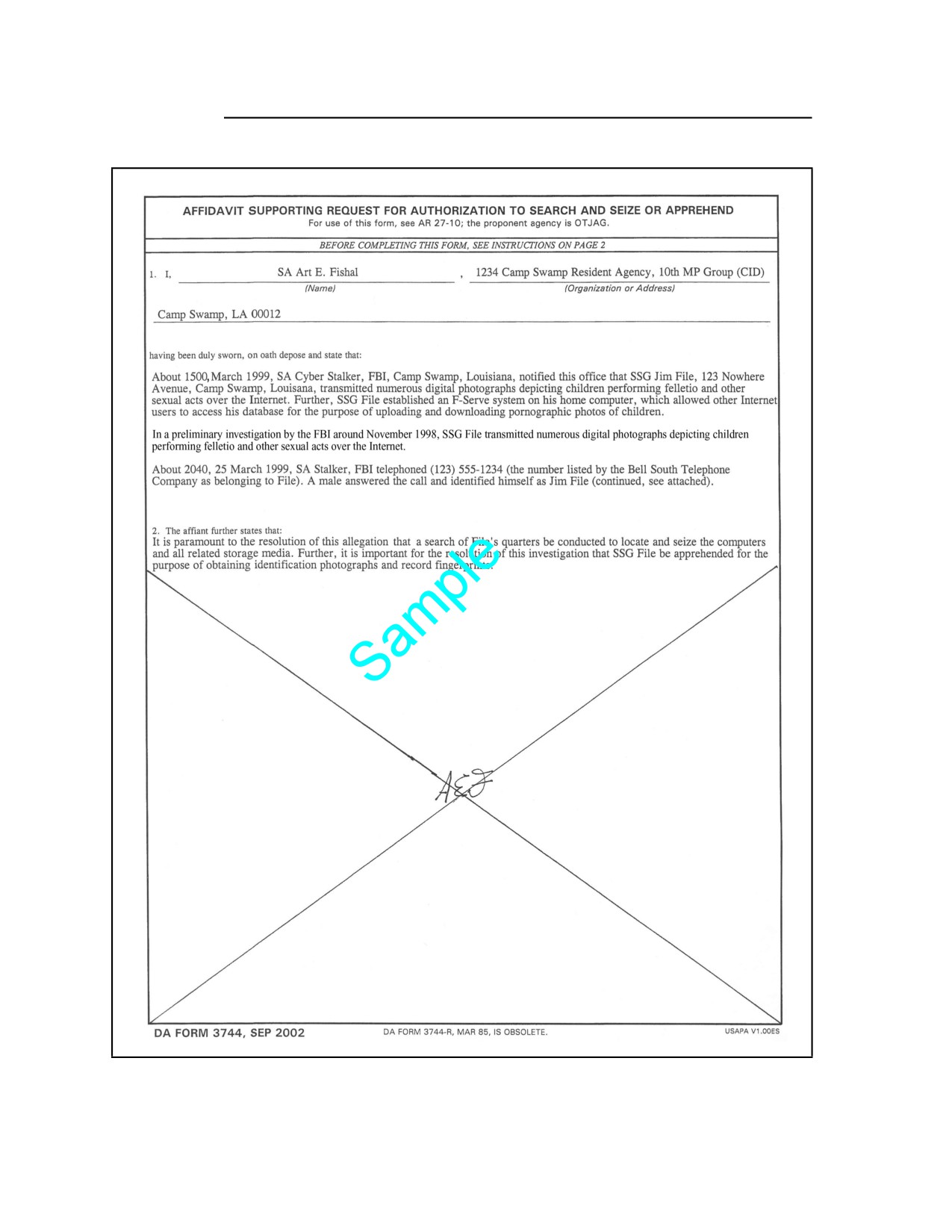
Search authorizations issued by a US magistrate or civilian judge at the
state or federal level or the consent of the property owner is required
before searching privately owned electronic devices. However, in almost all
cases, courts have held a relatively high standard with regard to the
specificity of computer-related search authorizations. Investigative
personnel seeking search authorization must be able to articulate specific
and recent information pertaining to the individual items cited on the
affidavit and authorization in order to establish probable cause. (See
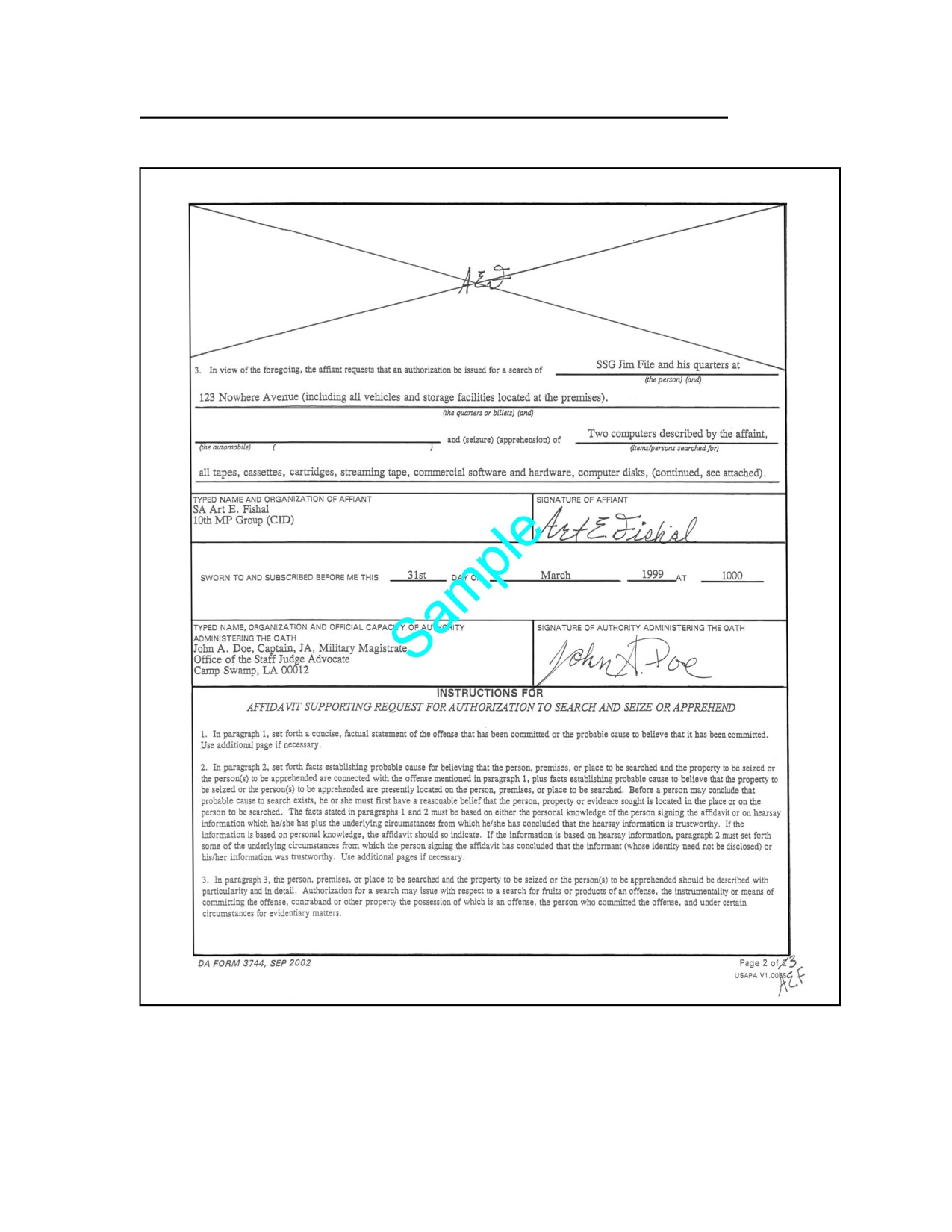
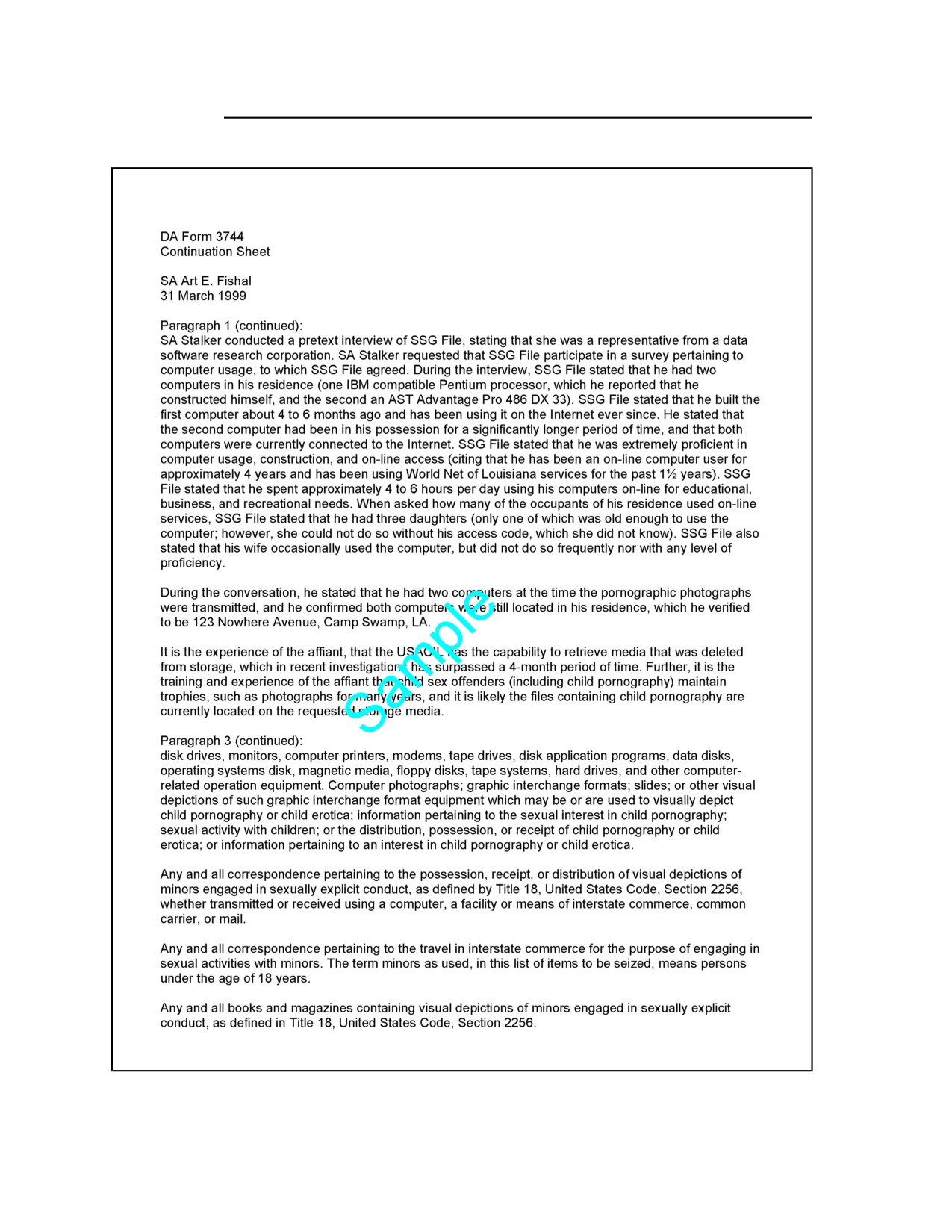
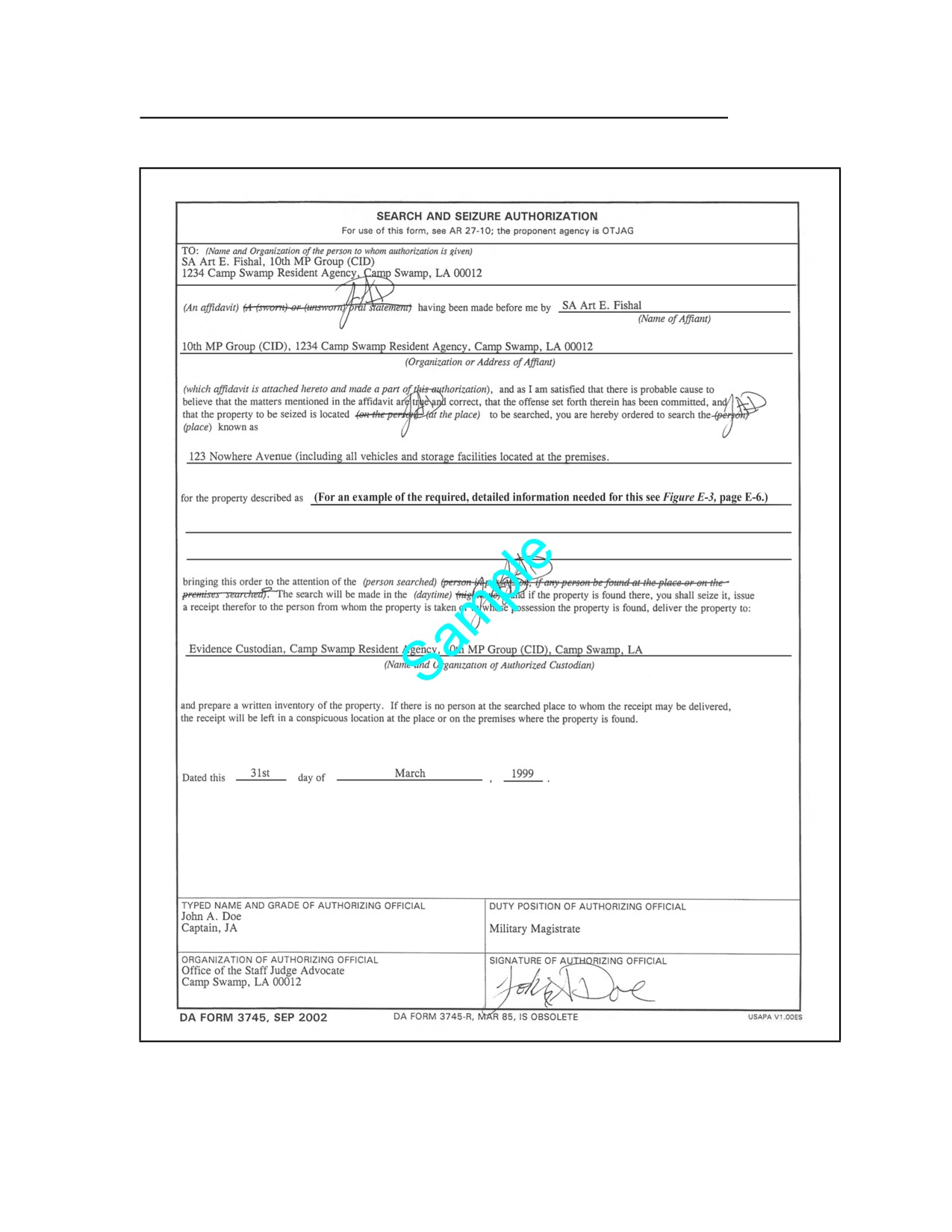
Figures E-1, E-2, and E-3, pages E-2, E-5, and E-6.) In many instances,
information that is several months old cannot be used to generate probable
cause, and more recent information gained through pretext phone calls or
online undercover operations may be required to develop current and
reliable information.
Affidavit/Authorization to Search and Seize or Apprehend Electronic Devices E-1
FM 3-19.13
Figure E-1. Sample of DA Form 3744
E-2 Affidavit/Authorization to Search and Seize or Apprehend Electronic Devices
FM 3-19.13
Figure E-1. Sample of DA Form 3744 (Continued)
Affidavit/Authorization to Search and Seize or Apprehend Electronic Devices E-3
FM 3-19.13
Figure E-1. Sample of DA Form 3744 (Continued)
E-4 Affidavit/Authorization to Search and Seize or Apprehend Electronic Devices
FM 3-19.13
Figure E-2. Sample of DA Form 3745
Affidavit/Authorization to Search and Seize or Apprehend Electronic Devices E-5
FM 3-19.13
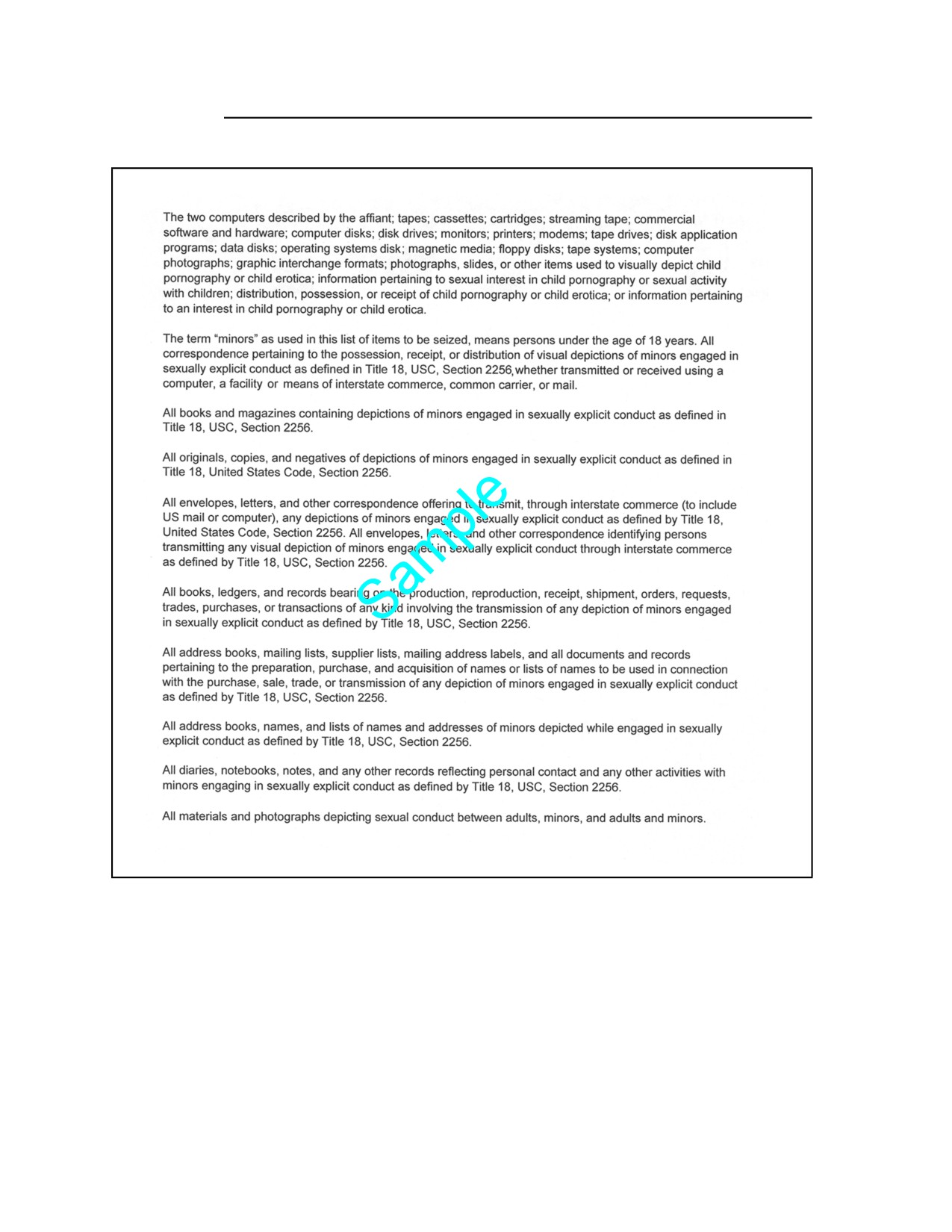
Figure E-3. Sample of a Detailed Property Description
E-6 Affidavit/Authorization to Search and Seize or Apprehend Electronic Devices
Appendix F
Violent Crime Scene Checklist
Conducting a felony criminal investigation can be complicated. There are a
number of important and detail-oriented activities that need to be
completed within the first 24 to 48 hours. Keeping accountability of these
tasks can be a daunting mission, made more arduous when the felony
involves a violent crime and an entire team is involved in completing
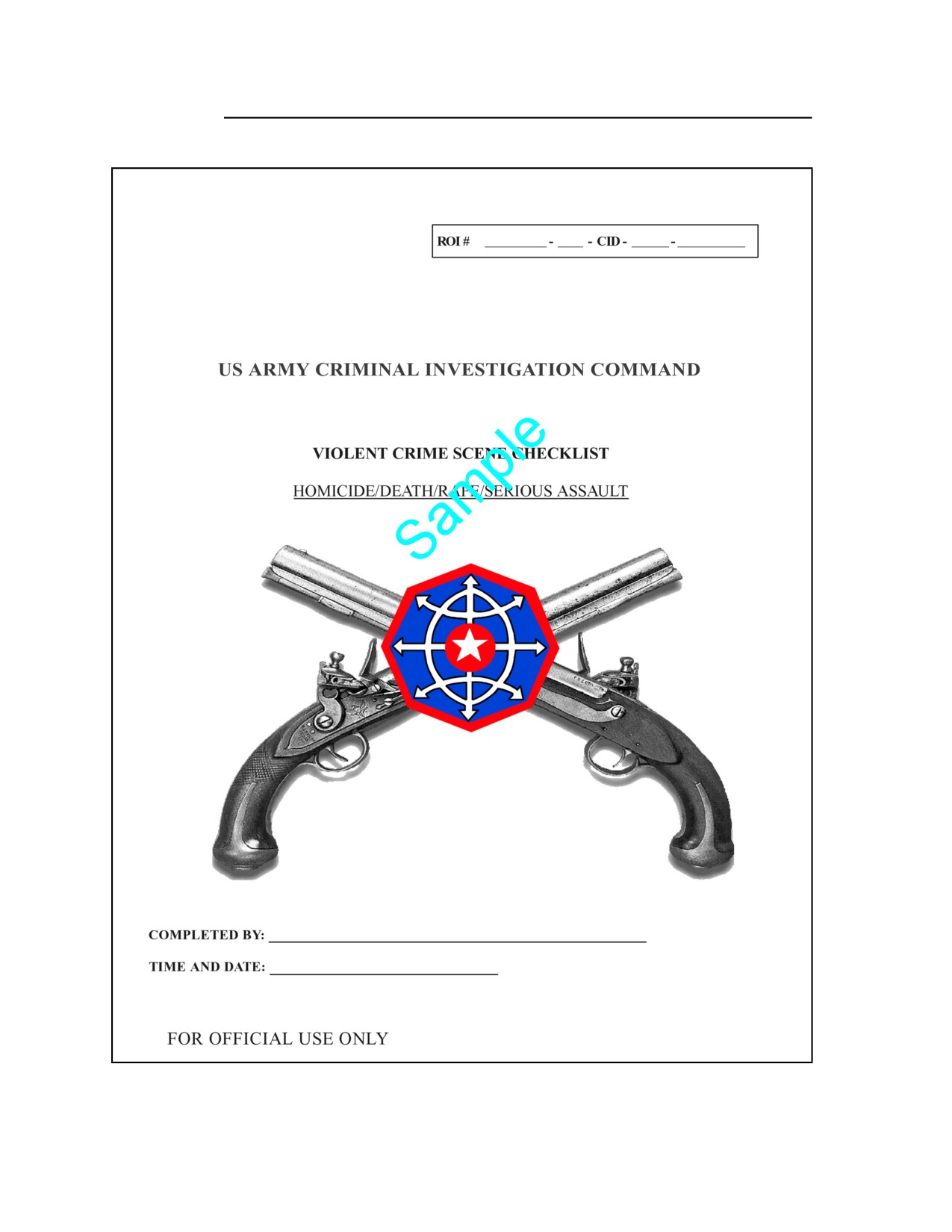
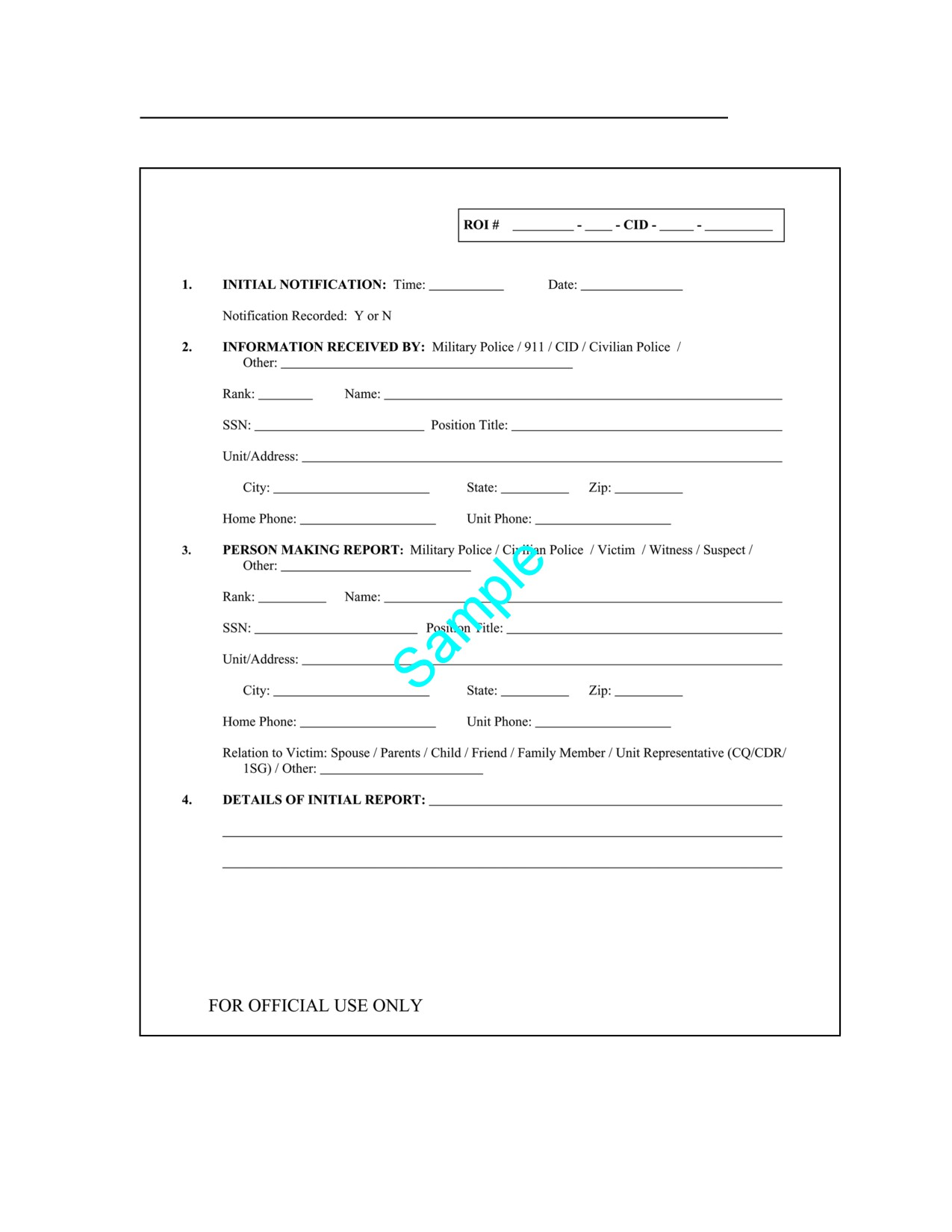
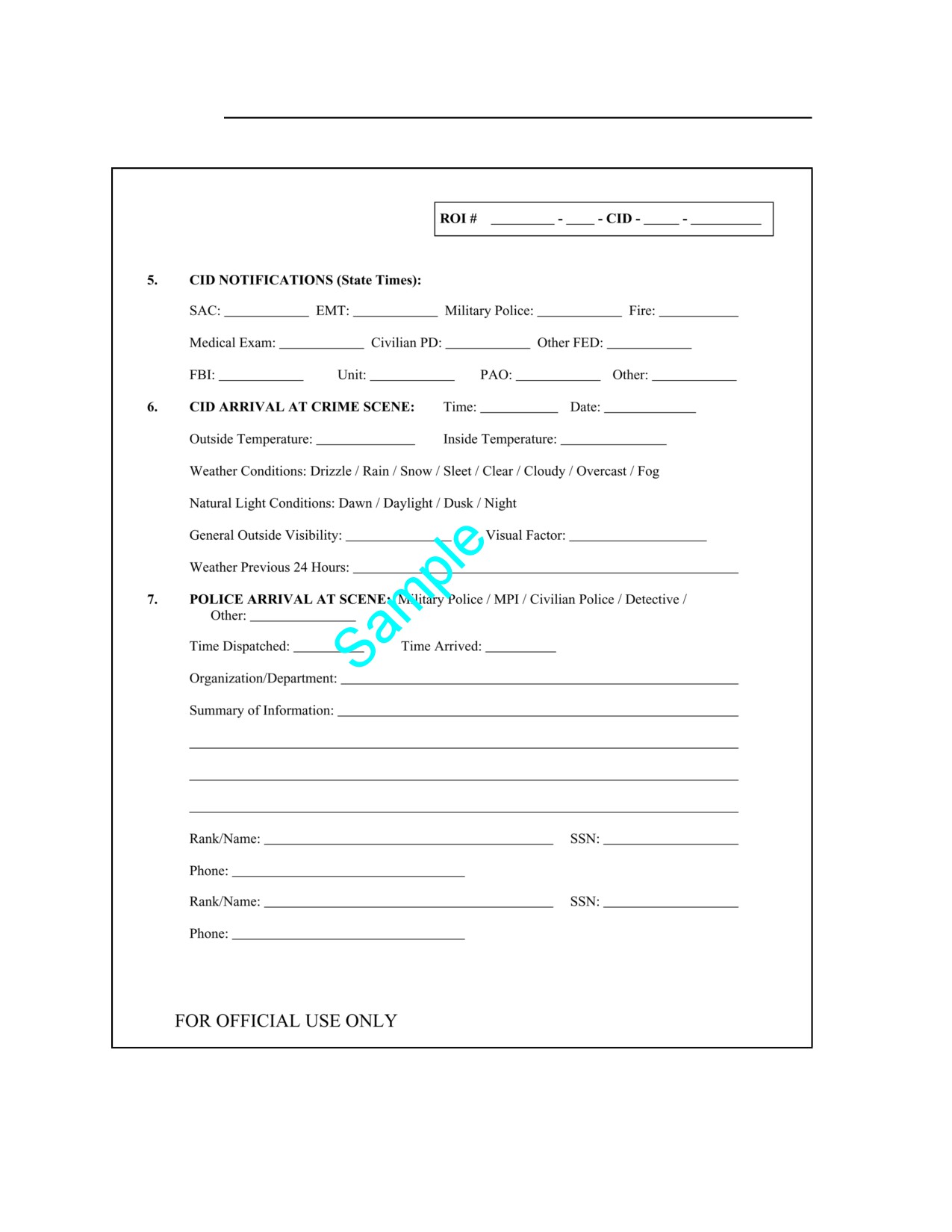
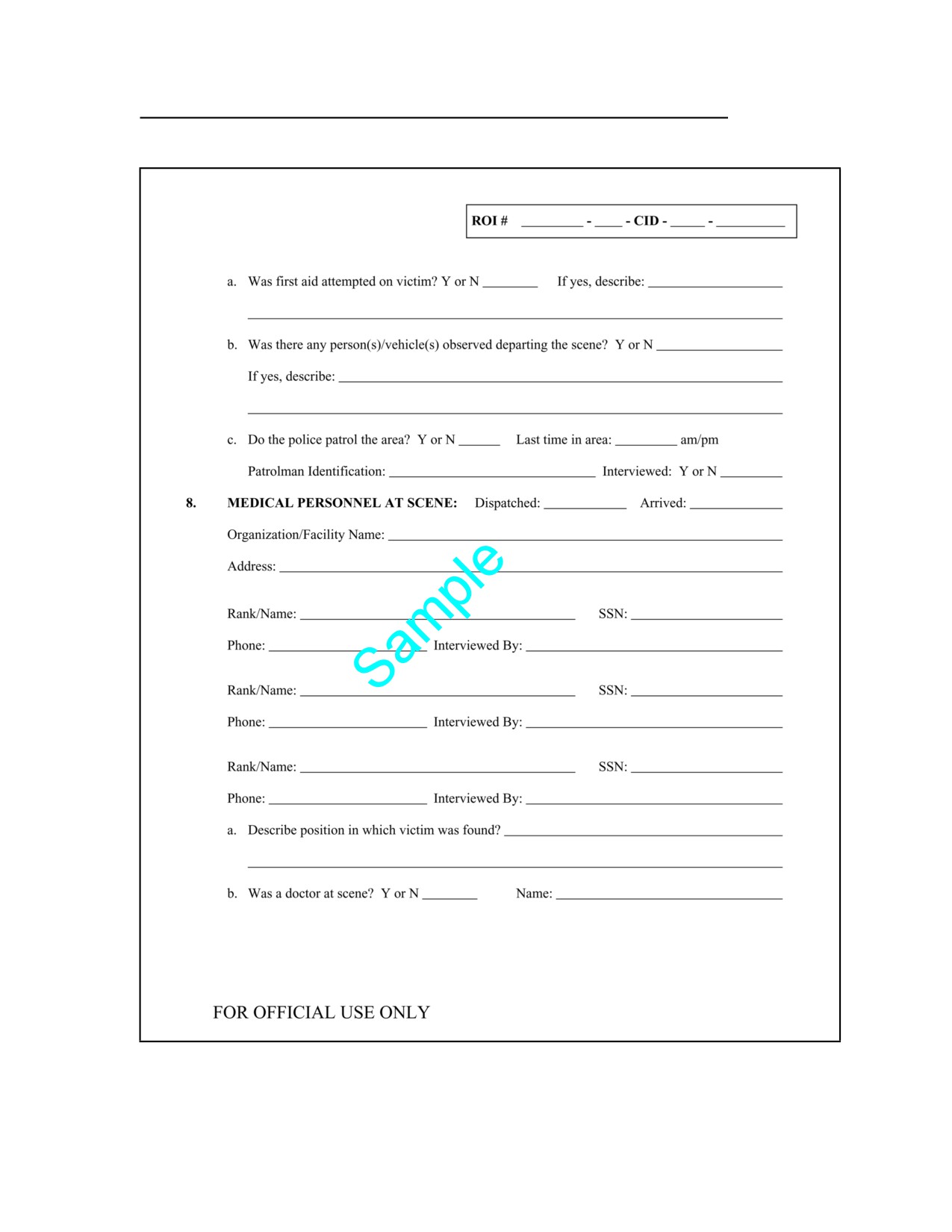
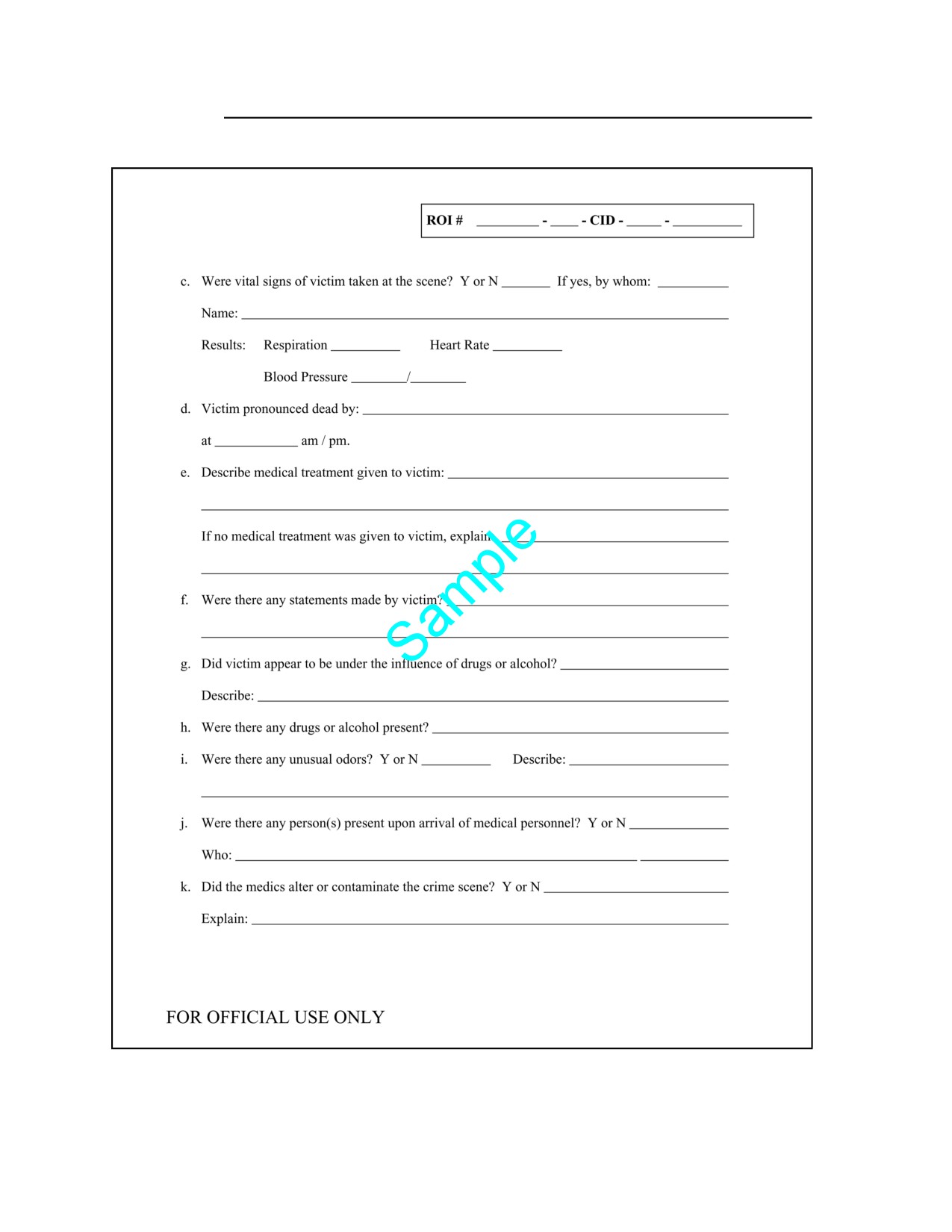
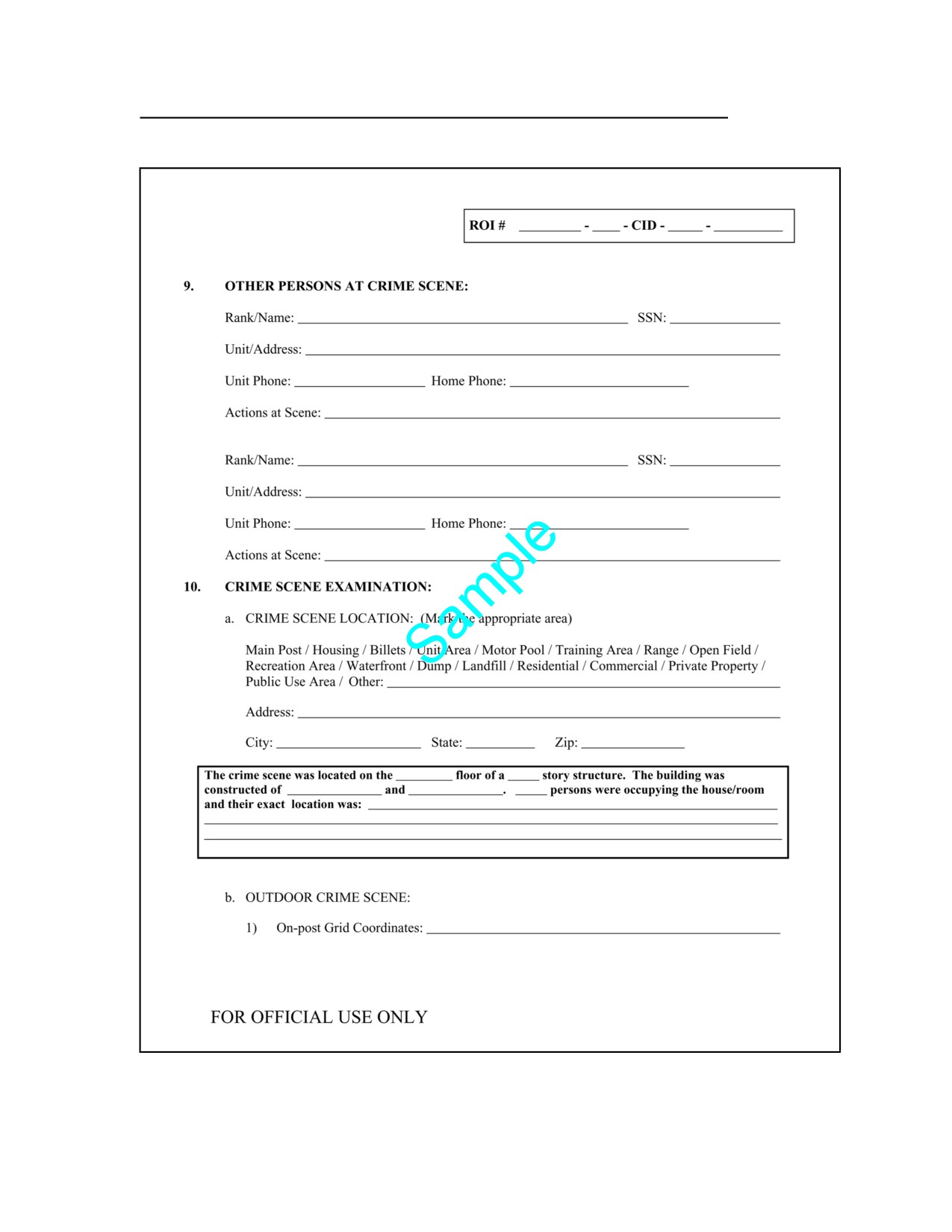
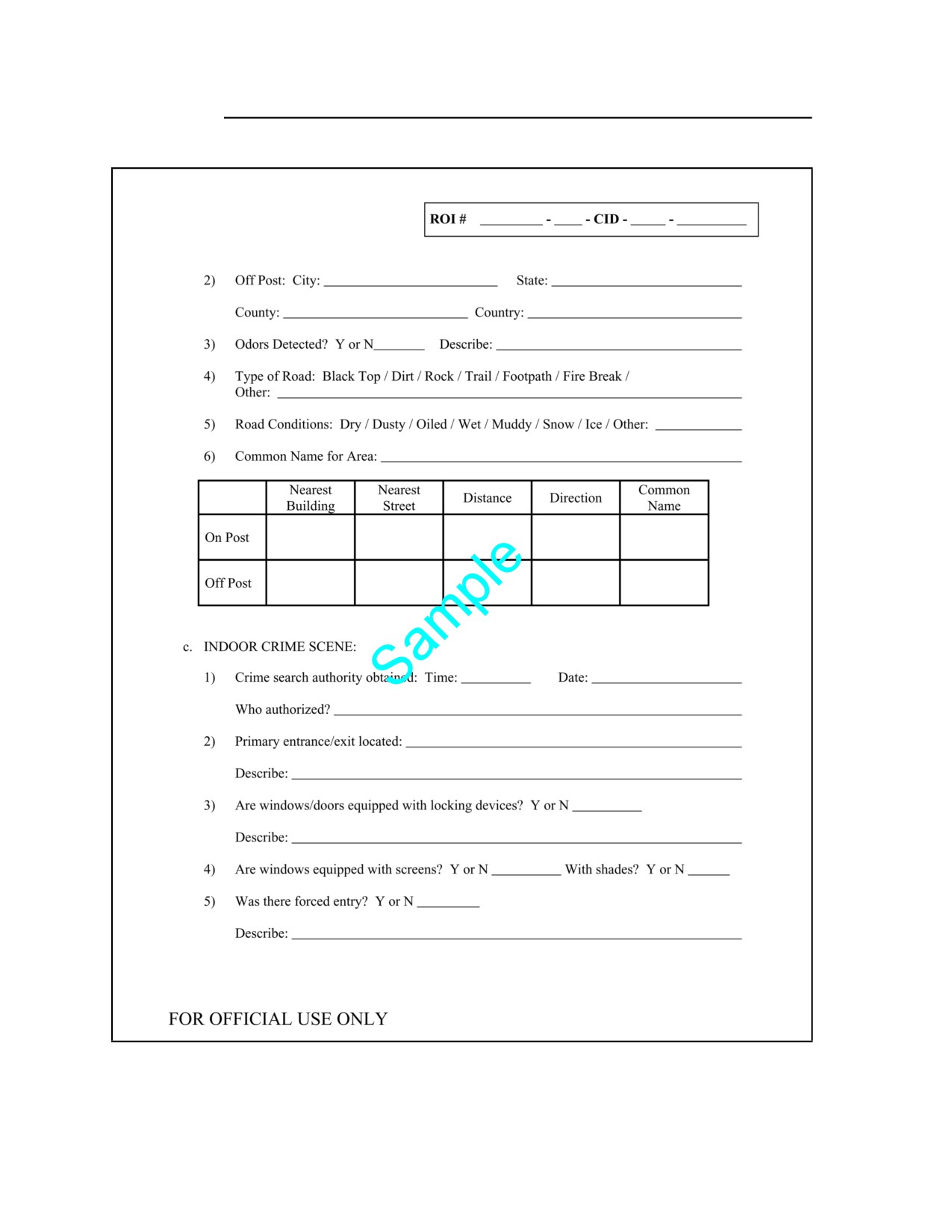
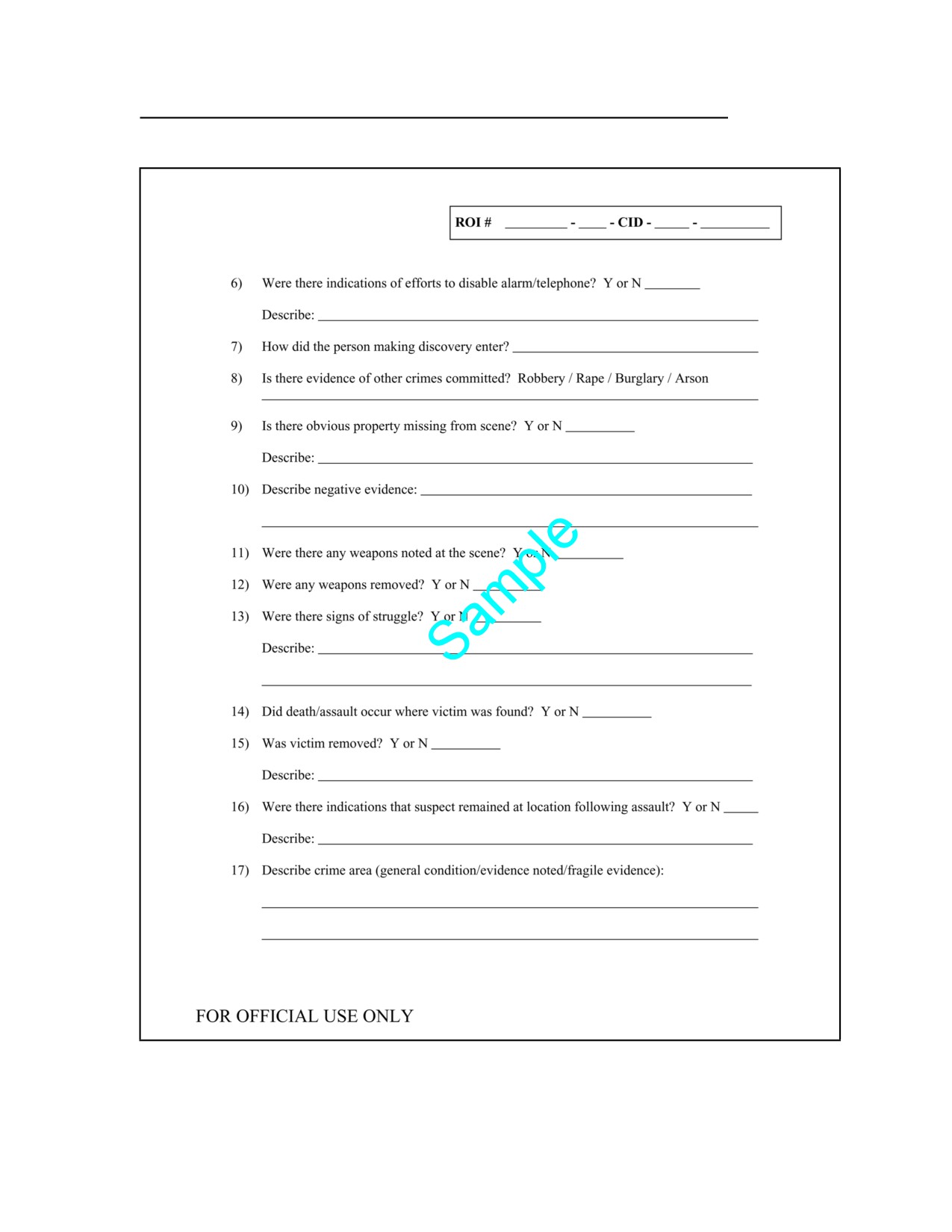
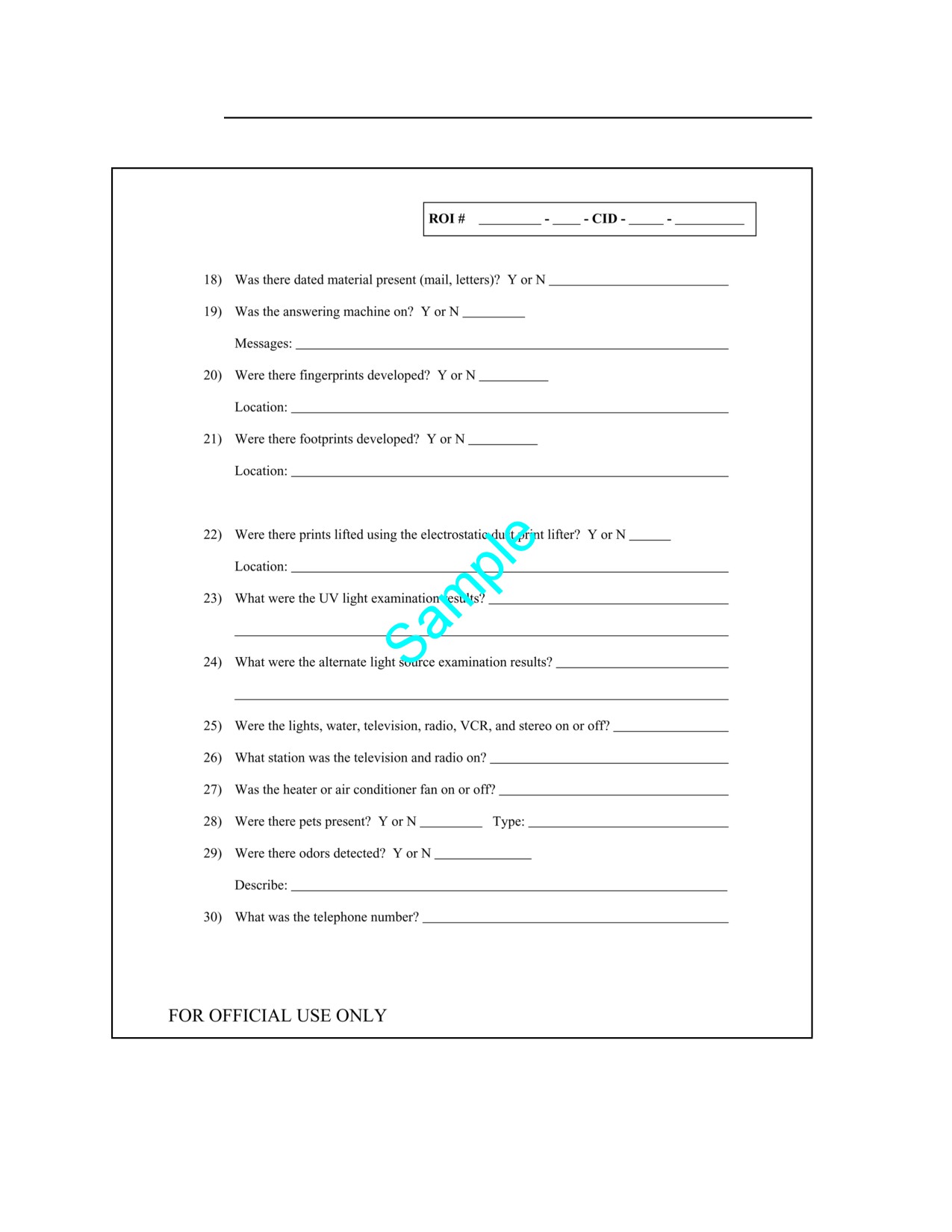
them. The following checklist (Figure F-1, pages F-2 through F-20) is an
exceptional investigative tool, that allows the case agent to maintain a
written record of the activities and also ensure that all the essential tasks
are completed in a timely and thorough manner.
Violent Crime Scene Checklist F-1
FM 3-19.13
Figure F-1. Sample of a Violent Crime Scene Checklist
F-2 Violent Crime Scene Checklist
FM 3-19.13
Figure F-1. Sample of a Violent Crime Scene Checklist (Continued)
Violent Crime Scene Checklist F-3
FM 3-19.13
Figure F-1. Sample of a Violent Crime Scene Checklist (Continued)
F-4 Violent Crime Scene Checklist
FM 3-19.13
Figure F-1. Sample of a Violent Crime Scene Checklist (Continued)
Violent Crime Scene Checklist F-5
FM 3-19.13
Figure F-1. Sample of a Violent Crime Scene Checklist (Continued)
F-6 Violent Crime Scene Checklist
FM 3-19.13
Figure F-1. Sample of a Violent Crime Scene Checklist (Continued)
Violent Crime Scene Checklist F-7
FM 3-19.13
Figure F-1. Sample of a Violent Crime Scene Checklist (Continued)
F-8 Violent Crime Scene Checklist
FM 3-19.13
Figure F-1. Sample of a Violent Crime Scene Checklist (Continued)
Violent Crime Scene Checklist F-9
FM 3-19.13
Figure F-1. Sample of a Violent Crime Scene Checklist (Continued)
F-10 Violent Crime Scene Checklist