FM 3-19.13 LAW ENFORCEMENT INVESTIGATIONS (JANUARY 2005) - page 9
FM 3-19.13
z
Was the writer nervous or intoxicated at the time?
z
Was the writer physically impaired as a result of injury or illness?
23-10. If the questioned document is written on a special form, the
investigator should talk to the individuals who normally use such forms. This
will allow the investigator to examine the place where they are kept and find
out who could have had access to them.
23-11. The investigator should encourage all victims and witnesses to name
possible suspects. He should ascertain the reasons for their suspicions. This
list should be used to check on victims and suspects. It may be of help to look
into their financial status and business practices to check for motives.
Checking the emotional stability of the victims and suspects may also be of
value. The investigator can then try to reduce the number of suspects from
which he needs to obtain dictated and collected known writings.
23-12. The investigator should try to learn how and when the document was
made or used. He should get a description of the suspect's appearance, actions,
conversation, and any identification he may have used. The number of
suspects and the number of individuals present when the document was
offered or found are also of value. The investigator should find out how the
document was determined to be false or why it is suspected of being false.
23-13. If the signature is that of a known person, that person should be
interviewed to verify that he or she denies writing or signing the document. In
some cases, the questioned document must be shown to the victim. If possible,
the investigator should avoid showing the document to the victim until after
he has obtained dictated known writings or he should ensure that there is a
time lag between the two actions so the format of the questioned document is
not fresh in the victim's mind. It is best if the investigator does not let the
victim handle the questioned document as it may negate a latent fingerprint
examination. It is possible that the victim of a case may have actually made
the questioned writing. Known writings of the victim will also assist the lab
forensic document examiner in determining whether a questioned writing
involves a simulation of the victim's writing style. For these reasons, the
investigator should always obtain and submit known writings of the victim for
lab examination.
HANDWRITING AND HANDWRITING COMPARISONS
23-14. After the investigator has conducted a preliminary investigation and
collected the evidence, he may need to request a forensic document
examination in order to attempt to identify the writer of a questioned
handwriting or handprinting.
23-15. A forensic document examiner conducts these examinations by
comparing the writing on the questioned document to known writings already
submitted. The investigator should obtain known writings of victims,
suspects, or anyone else he thinks may have written the questioned entries.
(See paragraph 23-23, page 23-5.)
23-16. Handwriting and handprinting identification is based on the many
individual characteristics that distinguish each individual's writing from that
of others. These characteristics include size, slant, letterforms, proportions,
Questioned Documents
23-3
FM 3-19.13
height relationships, beginning and ending strokes, connecting strokes, i dots,
t crossings, spacing, baseline habit, arrangement, and many others. In
natural writing, these characteristics are made by habit, and the writer is not
usually consciously aware of all of them. In handwriting and handprinting
examinations, these characteristics are compared to determine if there are
enough matching characteristics or different characteristics to support the
identification or elimination of a writer.
LINE QUALITY
23-17. Line quality is perhaps the single most important characteristic
evaluated in the comparison of handwriting for identification. The success of a
handwriting comparison is largely dependent on the naturalness of the
writings involved, both the questioned and the known. Anything other than
natural writing is, to some degree, artwork. Artwork is not identifiable as to
authorship because it does not contain the habitual, unconscious writing
habits that make handwriting identifiable. Line quality is the tool the
document examiner uses to gauge the naturalness of the writing submitted for
comparison.
23-18. The natural writing of a skilled writer flows smoothly. The beginning
and ending strokes are tapered because the pen is moving when it touches the
paper and when it is removed from the paper. Long curving strokes are
smooth in their curving movements and free of tremor or signs of hesitation.
Vertical up and down strokes display natural variation in pen pressure by
changes in the width and darkness of the ink line. Connecting strokes
between small internal letters are regular direction changes, short smooth
curves, and small well-formed loops. There is an absence of false starts and
retouching. It appears to have been rapidly and reflexively written, without
conscious thought about the writing process. Handwriting with poor line
quality lacks one or more of these features.
23-19. Poor line quality sometimes appears in genuine writing. Illness or
injury may affect the quality of the written product. Fear or stress may
influence the skill displayed by the writer. Handwriting ability may be
affected by the ingestion of drugs and alcohol. The conditions under which a
person writes may also detract from the quality of the written line. It is very
difficult to write fluently while riding in the back seat of a moving vehicle or
when the paper is resting on the rough surface of a well-used field table.
23-20. More importantly to the investigator, poor line quality may also be the
result of an attempt by the writer to effect a forgery by tracing or simulating
the handwriting habits of someone else. Signs of tracings or simulations
include blunt beginning and ending strokes; a tremulous writing line
indicative of slow, careful drawing; curved lines which lack smoothness;
corrected mistakes; and misinterpretations of letterforms. Unskilled forgers
are also prone to patch, touch up, or try to improve a completed forgery.
23-21. Poor line quality can also be indicative of disguised writing. To hamper
handwriting identification, the suspect may disguise both questioned and
known writings. Poor line quality usually results from an attempt to
consciously control the writing process. Other indicators of disguise are
23-4 Questioned Documents
FM 3-19.13
inconsistent letterforms, bizarre letterforms, unnaturally large or small
writing, extreme angularity, and excessively elaborate writing.
23-22. An awareness of the difference between good and poor line quality in
writing can help an investigator spot possible forgeries when screening
records during an investigation and enable him to recognize disguised,
dictated known writings when they are being created by a suspect.
KNOWN WRITINGS
23-23. Because handwriting and handprinting examinations are done by
comparison, the known writings must be comparable in kind to the questioned
writing. The known writing must contain the same words or, at least, the
same letters and letter combinations as the questioned writings. Cursive
handwriting generally must be compared to cursive handwriting, not
handprinting. Handprinting generally must be compared to handprinting, not
handwriting. Capital letters must be compared to capital letters. Lowercase
letters must be compared to lowercase letters.
23-24. There are two types of known writings, each with advantages and
disadvantages. Both types should be obtained, if possible.
COLLECTED KNOWN WRITINGS
23-25. These are writings collected from various sources that the writer
prepared for purposes usually unrelated to the investigation. For example,
they may include military records, other government documents, employment
documents, financial records, personal correspondence, or negotiated personal
checks. The advantages of this type of known writing are that they were
usually written naturally with no intent to disguise the appearance and they
show the individual's writing over a period of time. The disadvantages are
that they may not be fully comparable to the questioned writing, and the
number available is likely to be limited.
DICTATED KNOWN WRITINGS
23-26. These are writings prepared under the supervision of the investigator.
The advantage of this type of writing is that the investigator can control the
form used, the content of the writing, the type of writing, the number
prepared, and the manner in which the writings are prepared. The main
disadvantages are that the writer may attempt to disguise the writing and the
writings only show the individual's writing as it appears on a single occasion.
23-27. When obtaining dictated known writings the investigator should—
z
Obtain collected known writings first.
z
Be familiar with the appearance of the individual's natural writing.
z
Obtain paper or forms similar to the questioned document.
z
Use a writing instrument similar to that used for the questioned
document (if it is not an ordinary ballpoint pen, he should also get
some writings with a black ballpoint pen).
z
Use a copy of the questioned document to dictate the questioned text
and ensure comparability of the known writings.
Questioned Documents
23-5
FM 3-19.13
z
Dictate the questioned writing to the writer.
z
Have the writer positioned in a similar position during the dictated
writing as that of the questioned document (such as standing or
sitting)
23-28. The dictated known writings should be prepared on blank forms (such
as government forms or checks) or in a format (such as paper size or
arrangement) similar to the questioned document. When using copies of forms
or checks, the investigator should ensure that they are clean copies with white
backgrounds (not gray or dark), such as those copied from designer checks so
that the writing is readable.
23-29. The investigator should include all of the entries that the person may
have written. As each sample is completed, the investigator should remove it
from the writer’s sight. Each sample should be numbered and marked with
the investigator’s initials and the time and date. It is also necessary to obtain
several examples without giving the writer any instructions. If instructions
are necessary to ensure comparability (such as cursive versus printing or
capital versus lowercase letters), the investigator should note the instructions
given on the back of the first sample to which it applies. If the writer is
suspected of trying to disguise the writing, additional examples should be
obtained.
23-30. The writer should not be shown the questioned writing and multiple
samples, such as signatures, should not be put on the same sheet of paper.
Writings should be obtained on one side of the paper, only. If the questioned
document has writing on both sides, the back should be duplicated separately.
23-31. For questioned signatures, personal checks, and similar brief writings,
the investigator should get about 25 repetitions. For documents about the
length of a short note, the investigator should get 10 to 15. For questioned text
that is one or more full pages in length, he should get at least one complete
repetition of the text and then get additional repetitions of important parts,
such as admissions or text that is the essence of the crime (such as a threat or
obscenity). The investigator should consider getting additional repetitions of
the first and last paragraphs if there are no particularly important parts.
23-32. If the investigator has a number of questioned documents with many
repeated entries, such as personal checks, the number of known writings to
duplicate each document can be reduced. The investigator should ensure that
he gets several samples of all of the questioned entries, especially those that
only appear on one questioned document.
23-33. One to three samples written with the individual's hand that he does
not normally use for writing should be obtained. These are usually enough,
but if the person shows real ability with this hand or if the writing looks like
the questioned document, the investigator should get more.
23-34. The investigator may have a document that contains obscene or
classified words or phrases. Dictated known writings may be made without
the objectionable words or classified information if the document is long
enough. But the elimination of such words must not leave the dictated known
writings incomplete for comparison. Dictated known writings of short
documents of this type must normally be produced in full.
23-6 Questioned Documents
FM 3-19.13
23-35. If the person objects to obscene words in the dictated known writings,
the investigator should use nonobscene words with the same letters and letter
combinations as the obscene words. The investigator should ensure that the
dictated known writing (words) he chooses includes the beginning and ending
letters of the obscene word. The substitute words should be in the exact same
position in the sentence. A similar method can be used for classified
documents. If omitting the classified portion can produce the dictated known
writing, the investigator should do so.
TRACINGS AND SIMULATIONS
23-36. The author of a tracing or simulation usually cannot be identified by
handwriting comparison because these are not the author's natural
handwriting. However, a simulation is sometimes so poorly done that
identifying characteristics may remain. It may be possible to associate a
tracing or simulation with the specific genuine writing used as a model to
produce it.
TRACING
23-37. A tracing is a duplicate of another individual’s writing, typically a
signature, made using the writing line of a genuine writing as a model or
guide. Several methods may be used. The most common involve viewing the
model through the paper onto which the tracing will be placed, with or
without the aid of backlighting, or transferring a guideline from the model
signature to another piece of paper using carbon paper or other means. A
tracing may show signs of having been slowly drawn. The investigator should
be alert to the possibility of recognizing and seizing the genuine writing that
was used as a model.
SIMULATION
23-38. A simulation is a freehand imitation of another individual's writing,
typically a signature. It may show signs of having been slowly drawn. It
commonly involves the use of a genuine writing as a model. The investigator
should be alert to the possibility of recognizing and seizing the genuine
writing that was used as a model.
WRITINGS ON WALLS AND SIMILAR SURFACES
23-39. Some questioned writings are written on walls, doors, and similar
surfaces. If necessary, the investigator should consider removing the surface
to secure the writing as evidence. Whether the surface is removed or not, the
writing should be photographed. Ideally, photographs should be taken using a
normal focal length lens (approximately 50 millimeters) from a position
directly in front of the writing using available light and including all of the
writing in the photograph, along with a scale indicating size. Because of the
lack of space, it may be necessary for the investigator to use overlapping
photographs (photographs taken from a variety of angles or a wide-angle
lens). It may also be necessary for the investigator to use a flash or other
artificial light. A flash pointed directly at a flat surface usually produces a
glare in the center of the photograph that obliterates the writing. The
Questioned Documents
23-7
FM 3-19.13
investigator should consider using a bounced, diffused, or low-angle flash. He
should try a variety of approaches to ensure usable results.
23-40. Dictated known writings obtained to compare with such questioned
writings should mostly be obtained in the usual manner, at a table using
normal-sized paper. But large sheets of paper taped to a wall or a large tablet
on an easel may be used to simulate the vertical surface and large writing size
of the questioned writing.
WRITING INDENTATIONS
23-41. Writing indentations are produced when the pressure of writing on a
sheet of paper is transmitted to the sheet or sheets of paper beneath it. This
often occurs with writing on tablets of paper. It can also occur on loose sheets
and any other paper beneath a sheet being written on. Writing indentations
can be important in many types of investigations, but they can be especially
helpful in cases involving anonymous notes. The note may bear indentations
of writing that can lead the investigator to the writer.
23-42. It may be possible to read writing indentations in the field with the
help of a light held at a low angle to the page. The investigator should not
attempt any other method (such as a pencil or fingerprint powder) to enhance
these indentations.The Questioned Document Division, USACIL, is equipped
to develop and preserve writing indentations (even those too faint to see).
23-43. The investigator should ensure that no new indentations are added to
documents that will be examined for writing indentations. He should protect
the document with cardboard or place it in a rigid container. The investigator
should ensure that it is not placed in an envelope or beneath other documents
that will be written on.
ALTERATIONS
23-44. An alteration occurs when someone tries to change a document or
obliterate part of the text on a document. Such documents can be submitted to
the Questioned Document Division, USACIL, with a request to attempt to
determine if an alteration has occurred or to attempt to decipher the original
entry that was altered or obliterated.
TYPEWRITTEN DOCUMENTS
23-45. Sometimes a typewritten questioned document can be linked to the
typewriter used to type it. For this to be possible, the typewriter or the typing
element (if present) must have developed individual characteristics, usually in
the form of damage or other mechanical defects, which appear on documents
typed on that machine. The individual characteristics may include damaged
letters, alignment problems, or other things. Typewritten text from a
typewriter with no individual characteristics may not be distinguishable from
that of another typewriter of the same make and model in good condition.
23-46. On typewriters of the older, typebar design, the individual
characteristics belong to the typewriter. On newer, single-element (such as
daisy wheel or ball element) typewriters, the individual characteristics are
23-8 Questioned Documents
FM 3-19.13
likely to be on a removable typing element. It is important to locate the typing
element used to type the questioned document.
23-47. It may be possible to reduce the number of suspect typewriters or
typing elements by doing a field comparison of the type style on the
questioned document with the type style of the typewriters or typing
elements.
23-48. First, the investigator should look for obvious differences. A very
different type size or type style will tell him that a different typing element (in
the case of removable element machines) or typewriter (in the case of typebar
machines) is involved. Different letter spacing, such as 10 characters per inch
versus 12 characters per inch, can show a difference between older machines;
but on newer typewriters, this setting can be changed.
23-49. Next, the investigator should examine the typed characters. He should
check the upper and lowercase letters of the M and W first, as they are often
the most distinctive in style. Their differences may be easily recognized. The
bottom of the staffs of the lowercase may or may not have serifs (cross strokes)
at the bottom. The two outside staffs may have serifs, and the center staffs
none. The center V-like formation of the capital M may descend to the baseline
or stop varying distances above it. If it descends to the baseline, it may or may
not have a serif. The inverted V of the center formation of the W may or may
not extend to the top of the line formed by the outer portions of the letter and
may or may not have a serif at the top. Other characters with designs that
help distinguish between typestyles are the letters g, t, a, r, y, i, f, and the
numerals. If the letters and numerals are not distinguishable with ease, the
investigator should submit typewriter exemplars to the lab.
23-50. Before obtaining typewriter exemplars, the investigator should check
the ribbon of the suspect typewriter. If the ribbon is a carbon film ribbon that
passes through the typewriter only once and bears transparent images of the
letters typed, the investigator must remove the ribbon cartridge. He should
not take exemplars on this ribbon. He should seize it as evidence and preserve
it for a possible typewriter ribbon examination. The investigator should use
another ribbon known to be unconnected with the investigation to obtain the
exemplars.
23-51. When obtaining typewriter exemplars, the investigator should
duplicate the content and formatting of the questioned document. It is
desirable (but not essential) for the document examiner to be able to overlay
the questioned and known writings. The investigator should pay particular
attention to the letter case (upper or lower), margins, tabs, spacing between
letters and words, and line spacing.
23-52. If the questioned document consists of about a one-half page, it should
be reproduced in its entirety. If the document is lengthy, the first 20 to 30
lines should be reproduced. The remainder of the questioned document should
then be examined. Any words, numerals, or symbols not appearing in the first
20 to 30 lines should be added to the sample. The words proceeding and
following the material to be added should be included and typed as it appears
in the questioned document.
Questioned Documents
23-9
FM 3-19.13
23-53. The investigator should type or note the make, model, and serial
number of the typewriter on the exemplars. He should mark them as evidence
in the usual way and account for them according to AR 195-5. The investigator
should find out when the ribbon on the machine was last changed. He should
learn the nature and date of the latest repair work done on the typewriter.
23-54. If possible, the investigator should collect known typewriting produced
on the suspect typewriter from office files or wherever they might be found.
Typewriter characteristics can change with use, maintenance, or repair, and it
may be important to locate documents typed on about the same date as the
questioned document. Sometimes changes in the condition of a typewriter can
be used, together with dated collected typewriter standards, to determine the
approximate date a questioned document was typed.
23-55. Consider seizing the suspect typewriter and typing element as
evidence if present. Coordinate with USACIL before shipping a typewriter for
examination. However, it may be possible to complete the examination using
only the typewriter exemplars. It may be helpful to submit separate typing
elements to USACIL with the exemplars and questioned document.
TYPEWRITER RIBBONS AND CORRECTION TAPES
23-56. Some typewriters and computer printers have carbon film ribbons that
pass through the typewriter once and bear transparent images of the typed
characters. The Questioned Document Division can read these ribbons to
attempt to locate a questioned text or to determine what was typed on the
typewriter from which they were taken. Fabric ribbons or multistrike carbon
film ribbons cannot be read.
23-57. Sometimes it is possible to link a carbon film ribbon to a document by
comparison of irregularities in the carbon transfer, paper fiber impressions on
the ribbon, or other characteristics. If a typewriter has a correction tape that
is used to strike over or lift off typographical errors, the tape should be seized.
It may be possible to match characters on the tape to corrected errors on a
questioned document.
COMPUTER PRINTER DOCUMENTS
23-58. Most types of modern computer printers are simple and reliable
devices that are less likely than typewriters to place individual characteristics
on the documents they produce. However, individual characteristics maybe
present, so consider obtaining known documents from suspect printers and
submitting them for examination. Coordinate with the Questioned Document
Division before submitting the printer for examination.
PHOTOCOPIED DOCUMENTS
23-59. A copy produced on a photocopier or similar device can sometimes be
linked to the copier that produced it. This is done by matching individual
markings placed on the photocopy by the copier with those on known
photocopies from the suspect photocopier. Such markings may result from
trash particles or marks on the glass platen of the machine, from damage to
23-10 Questioned Documents
FM 3-19.13
the copying drum, from images of parts of the machine included in the copy, or
from other sources.
23-60. It is also possible to eliminate a particular photocopier or similar
device from having produced a questioned copy. This is usually done by
comparing class characteristics of a questioned copy with those of known
copies made by the suspect machine, but it may also be done by other means.
23-61. When investigating cases in which the evidence is a photocopy, it is
important to locate and seize the particular copy that is the evidence or
instrument of the crime. Additional copies of such documents are commonly
made after the offense for administrative purposes, and these subsequent
copies are much less useful, both as evidence and for the purpose of forensic
examinations. The copy seized is evidence and must be accounted for
according to AR 195-5.
PHOTOCOPIER EXEMPLARS
23-62. A clean, blank sheet of paper the same size as the questioned copy
should be submitted to USACIL. It should be without paper impurities or
other marks that can be copied by the copier. This sheet of paper should be
saved as evidence as an item separate from the exemplars and submitted to
USACIL. The investigator should—
z
Place the sheet of paper on the glass platen of the copier and make 10
copies on paper the same size as the questioned copy.
z
Remove the sheet of paper, close the copier lid, and make
10
additional copies.
z
Open the copier lid and, with no paper on the platen, make 10 copies.
z
Feed the blank sheet through the feeder, if the copier uses a sheet
feeder, and make 10 copies.
z
Keep the blank sheet and each group of copies separate and note how
they were obtained.
23-63. Since the individual characteristics of photocopiers can be changed or
eliminated by cleaning and maintenance, the investigator should attempt to
collect existing photocopies known to have been made on the suspect machine.
Ideally, these existing photocopies should have been made around the same
time as when the questioned document was produced. Similarly, collected
standards can sometimes be used to determine the approximate date a
questioned copy was produced.
PRINTED DOCUMENTS
23-64. Documents produced by one of the various types of printing processes
(such as offset, letterpress, or flexography) may become evidence in a criminal
Questioned Documents
23-11
FM 3-19.13
investigation. There are several forensic examinations that may be requested
for these documents, depending on the circumstances. These include—
z
Determining what method was used to print the document.
z
Determining whether the document is genuine or counterfeit.
z
Determining which printing job the document was printed on.
z
Determining the approximate date on which the document was
printed.
23-65. Other examinations may be possible. The information and standards
needed by USACIL will vary depending on the issues and circumstances. The
Questioned Document Division should be contacted for guidance.
MECHANICAL IMPRESSIONS
23-66. Occasionally, investigators will encounter documents with mechanical
impressions made by a device, such as a check protector or an embossed seal.
A forensic examination may be needed to determine whether the impression is
genuine or whether the impression can be associated with the device alleged
to have produced it.
23-67. In such cases, the investigator should obtain the suspect device and
submit it to USACIL for comparison with the questioned document. If seizing
the device is not possible, he should prepare about 20 exemplars with the
device and submit them. If the device has data that can be changed, such as
on a check protector, the investigator should change it to duplicate the
information on the questioned document. Also, he should try to collect
standards prepared with the device about the same date as the questioned
document.
23-68. If the investigator believes that a mechanical impression on a
document is fraudulent, he should obtain specimens of genuine impressions
and submit them for comparison. Coordination with USACIL is
recommended.
RUBBER STAMPS
23-69. Questioned rubber stamp images on documents can be compared to
suspect rubber stamps or to documents bearing rubber stamp images from a
known source. Although rubber stamps can be mass produced, they may
acquire individual features, such as manufacturing defects or damage and
wear resulting from use.
23-70. It is best to seize suspect rubber stamps and submit them to USACIL
for comparison with the questioned stamp impression. If the stamp cannot be
seized, the investigator should prepare rubber stamp exemplars. They should
be prepared using different amounts of ink and with different amounts of
pressure. The investigator should ensure that the entire surface of the stamp
is reproduced and make impressions from different angles, if necessary.
23-71. Whether the investigator submits the rubber stamp or exemplars, it is
important that he attempts to locate and obtain any existing documents on
which the stamp was used. The individual characteristics of rubber stamps
23-12 Questioned Documents
FM 3-19.13
may change with use and cleaning. It may be necessary to have existing
documents on which the suspect rubber stamp was used on around the same
time as the questioned stamp image. With such documents, it may be possible
to establish the approximate date the questioned rubber stamp image was
made.
INK EXAMINATIONS
23-72. The Questioned Document Division is equipped to do nondestructive
examinations of inks including infrared, infrared luminescence, UV, and other
nonchemical examinations.These examinations are usually performed for the
purpose of detecting alterations, deciphering obliterations, or determining
that entries were made in different inks.
23-73. All of these examinations attempt to detect a difference between inks.
Nondestructive examinations are limited to the following potential results:
the inks are different, or no difference was detected between the two inks (a
difference may exist though one was not detected). Destructive ink
examinations are currently conducted by the US Secret Service (USSS). The
optimum potential finding by destructive examination is that no differences
exist between two inks.
PAPER EXAMINATIONS
23-74. Paper can be examined to determine its physical characteristics. Pieces
of paper can be compared to determine whether they are different or whether
no difference can be found. Some characteristics found in some papers, such as
watermarks, may help determine the source of the paper or even when it was
produced.
23-75. A paper examination, along with other evidence, may be useful if you
suspect that the paper used for a document is the wrong kind or a page has
been added or substituted in a multipage document. It may also show that the
paper of a questioned document is of a type available to a particular suspect or
from a particular source.
TORN, CUT, AND SHREDDED DOCUMENTS
23-76. Examining torn, cut, or shredded documents may serve one of two
purposes: matching a paper fragment to another piece of paper from which it
was separated for the purpose of associating the fragment with a source; and
reconstructing torn, cut, or shredded pieces of a document so that the
document may be seen whole. In such cases, it is important to recover all
fragments and protect them from further damage.
23-77. Sometimes document fragments can be reconstructed in the field
without USACIL involvement. In such cases, the investigator should not use
tape, glue, or any other permanent adhesive. When a high-security shredder
or another good quality shredder has shredded documents, it may be
impossible to reconstruct the document.
Questioned Documents
23-13
FM 3-19.13
DOCUMENT DATES
23-78. It is possible to determine the date, or approximate date, that a
document was prepared. It is also possible to determine that a document was
not prepared on the date alleged.
23-79. The forensic techniques that may allow these findings are varied but
may include typewriter, photocopier, ink, and paper examinations. Much of
the potential for reaching any results at all will depend on information
gathered by the investigator about the date, circumstances, and methods
alleged in preparing the questioned document. The collection of various
standards may be necessary, especially samples of genuine documents of the
same type prepared on or about the alleged date.
23-80. The best approach and potential for a useful result in this type of
examination varies considerably with the facts of the case. Coordination with
the Questioned Document Division is recommended.
CHARRED DOCUMENTS
23-81. It is often possible to read text on a charred document. A charred
document is different from ashes. A charred document has been blackened
and made brittle from exposure to high heat without enough oxygen to burn.
To be examined, the pieces must be large enough to have legible text. Charred
documents are very fragile. Pick them up by sliding a sheet of paper beneath
them and, using this sheet as a support, transfer the charred documents to a
shallow, cotton-lined box (such as a pie box). Sheet cotton stapled to the top
and bottom inner surfaces of the box will prevent movement by the charred
document.
23-82. If a single charred document is relatively flat, it may be placed
between two panes of glass that you then tape together. If feasible, the
charred documents should be sent to the lab by courier. This will preclude
unneeded handling and prevent destruction. In some cases, the laboratory
examiner should be asked to come to the location of the document. If neither of
these two preferred methods is practical, careful packaging is needed to
preclude destruction.
COPIES AS EVIDENCE
23-83. Original documents, rather than copies, should always be obtained as
evidence when they are available. Originals are the best evidence to present
in court, and they are the best for the purpose of forensic examinations. Some
forensic examinations can only be performed on an original. Handwriting
comparisons using copies typically yield poorer results than could have been
obtained with an original.
23-84. Sometimes an original document is not available because it cannot be
located or has been destroyed. In other cases, a copying process has been used
to fabricate a document that did not exist as an original. In these cases, a copy
is obtained as evidence.
23-85. It is important to get the best copy available. If a copy has been used as
the instrumentality of a crime, that copy should be obtained, rather than
23-14 Questioned Documents
FM 3-19.13
subsequent copies. If a copy is obtained as a substitute for a missing original,
the investigator should try to obtain a copy that was made directly from the
original. He should try to avoid getting copies of copies.
23-86. If an original document is to be considered as evidence, but is not
available, then the investigator must obtain a copy of the original to use as
evidence, and it must be accounted for according to AR 195-5. The investigator
should obtain a copy even if he expects to obtain the original later.
23-87. The copy the investigator submits to USACIL for examination must be
the evidence copy, not a case file copy or a copy made especially for laboratory
submission. If expert testimony or a laboratory report will be used in court,
the same copy examined by the laboratory examiner must also be introduced
as evidence in court.
COURT AUTHENTICATION
23-88. In order for expert testimony or a laboratory report to be admitted as
evidence in a trial, the evidence examined must have been admitted as
evidence. In order to be admitted, the evidence must be authenticated, that is,
shown to be what its proponent claims. The presiding judge decides
authentication and admissibility.
23-89. It is particularly important to be aware of this requirement with
regard to known writings. Dictated known writings may be authenticated by
the testimony of the investigator who obtained them. Collected known
writings may be authenticated by one of several means. The investigator
should review Military Rules of Evidence (specifically rules 901, 902, and 903)
or Federal Rules of Evidence (as appropriate) and consult his legal advisor.
LATENT PRINTS ON DOCUMENTS
23-90. Consider requesting a latent print examination on questioned
document evidence. Latent prints on paper are relatively permanent, and it is
uncommon for additional handling to obliterate them.
23-91. Using gloves or forceps while handling these documents and placing
them into an envelope should protect them. The investigator should use a
pencil for evidence markings and place the markings in a place less likely to
have been handled by the suspect.
23-92. When both questioned document and latent print examinations are to
be done, the questioned document examination is done first, and the
document is protected for the latent print examination. Latent print
examinations on paper normally degrade the document in a manner that
would hamper a subsequent questioned document examination.
EVIDENCE SUBMITTED
23-93. All evidence should be submitted at one time. A case cannot be
examined until all evidence is received. If evidence or documents are
requested from another office, the added material should be obtained before
forwarding the referrals to the lab. This precludes the lab having to hold
Questioned Documents
23-15
FM 3-19.13
referrals that cannot be examined pending receipt of other evidence. If the
examination requires an original document on file at the Defense Finance and
Accounting Service (DFAS) and DFAS will not release it to the investigator,
request that DFAS send the document directly to USACIL. The investigator
should retain any other document evidence (that is to be examined) until
notified by DFAS or USACIL that such documents have been sent or received
before submitting the other evidence.
ON-SITE ASSISTANCE
23-94. Investigations occur that justify on-site assistance by USACIL
Forensic Document Examiners. When large numbers of questioned documents
are involved, document examiners can assist investigators in screening the
documents for those most likely to be productive for handwriting and other
examinations. When large numbers of suspect writers, copy machines,
typewriters, and other sources of documents are involved, document
examiners can screen the sources (such as personnel records or post locator
cards) to identify the source of questioned documents. On-site assistance trips
by USACIL document examiners have been extremely successful. The
investigative and lab examiner hours saved by these trips have been
significant.
23-16 Questioned Documents
Chapter 24
Deoxyribonucleic Acid Evidence
Serological evidence often consists of microscopic particles and is generally
not obvious at a crime scene. It may be DNA on glass or blood on a victim's
clothing. Serological evidence is similar to trace evidence in that it can
easily be overlooked or destroyed. A sound, prosecutable case concerning
serological evidence begins the moment that an investigator arrives at a
scene. It includes the processes he uses in evaluating, collecting, and
preserving serological evidence and the court testimony that he or the
evidence examiner provides. A suspect may leave blood, hair, and fibers at
a crime scene. Likewise, a suspect may carry this evidence away from the
scene.
DEOXYRIBONUCLEIC ACID
24-1. DNA is the basic component of an individual’s entire genetic structure.
Virtually every cell of the human body contains DNA. The DNA in an
individual’s cells is the same for each type of cell, such as an individual's
saliva, hair, and skin. All cells with the exception of sex cells have the same
DNA. An individual’s DNA remains the same throughout his life.
24-2. DNA is a powerful tool in an investigation because no two people have
the same DNA (with the exception of identical twins). Because of that
difference, DNA collected from a crime scene can link or eliminate a suspect to
the evidence. It can place a person at a particular location that the person
denies having been. DNA from relatives can assist in identifying a victim even
when a body does not exist. The individuality of DNA allows the linking of a
suspect from one crime scene to another when the evidence of separate crime
scenes is compared. This capability may be within a small community,
statewide, or even nationwide. The uniqueness of an individual’s DNA can
positively identify a suspect or exonerate an innocent suspect.
EVIDENCE IDENTIFICATION
24-3. DNA evidence can be collected from basically anywhere. Only a few cells
are required to obtain useful DNA information relevant to an investigation.
DNA has helped solve numerous investigations when creative investigators
collected evidence from unlikely sources. One such investigation involved a
murder case being solved by taking DNA from saliva in a dental impression
mold and matching it up with DNA swabbed from a bite mark on the victim.
Investigators must realize that although they may not be able to see evidence
(DNA cells), it does not mean that there is not enough DNA cells present for
typing. Typing is a technical process performed by laboratory technicians and,
because of this distinction. Typing allows laboratory technicians to identify a
specific pattern present in an individual’s genetic makeup. Table 24-1 shows a
Deoxyribonucleic Acid Evidence
24-1

FM 3-19.13
myriad of locations where DNA evidence can be obtained, what that evidence
is, and the biological source of origination of the DNA. DNA testing of urine
Table 24-1. DNA Evidence
Possible Location of DNA
Source of the
Evidence
Collection
on the Evidence
Evidence
Baseball bat or
Handle and end
Skin, blood, and/or
Place in a clean paper bag
similar weapon
tissue
after allowing the wet fluids to
air-dry.
Hat, bandanna, or
Inside
Hair and/or dandruff
Place in a clean paper bag.
mask
Eyeglasses
Nosepiece, earpieces, and
Skin
Place in a clean paper bag.
lens
Facial tissue or
Surface area
Mucus, blood, semen,
Place in a clean paper bag
cotton swab
and/or earwax
after allowing the wet fluids to
air-dry.
Dirty laundry
Surface area
Blood and/or semen
Place in a clean paper bag.
Toothpick
Tips
Saliva
Allow to dry, place in (bond)
paper, and complete a
pharmacy fold.
Used cigarette
Cigarette butt
Saliva
Allow to dry, place in (bond)
paper, and complete a
pharmacy fold.
Stamp or
Licked area
Saliva
Allow to dry, place in (bond)
envelope
paper, and complete a
pharmacy fold.
Tape, ligature, or
Inside and outside surface
Skin
Place in a clean paper bag.
other binding item
Bottle, can, or
Sides and mouthpiece
Saliva
Place in a clean paper bag.
glass
Used condom
Inside and outside surface
Semen and/or vaginal
Allow to dry, place in (bond)
or rectal cells
paper, and complete a
pharmacy fold.
Blanket, pillow, or
Surface area
Hair, semen, urine, and/
Place in a clean paper bag
sheet
or saliva
after allowing the wet fluids to
air-dry.
Bite mark
Individual's skin or clothing
Saliva
Swab saliva with a cotton
swab and place in a clean
paper bag.
Fingernail or
Scrapings
Blood and/or tissue
Place in bond paper and
partial fingernail
complete a pharmacy fold.
may be conducted to prove or disprove whether an individual is the source of a
specimen in which illegal drugs have been identified.
24-2 Deoxyribonucleic Acid Evidence
FM 3-19.13
COLLECTION AND PRESERVATION
24-4. Investigators and laboratory examiners work together to determine the
most probative pieces of evidence and establish priorities. The collection and
preservation of DNA evidence in itself is not defined in this section; however,
it is important to note that the initial collection of evidence is a key and
vulnerable link in the chain of events leading to successful DNA testing.
Investigators should aim to collect and properly preserve potential evidence
for DNA testing while minimizing the possibility of contamination. Each type
of evidence that may bear potential DNA evidence outlines the procedures
required for collecting and processing that particular type of evidence under
its individual heading, such as fingernails and blood samples. It is important
that personnel handling biological evidence be aware of the potential for the
presence of hazardous pathogens, such as the human immunodeficiency virus
(HIV) and the hepatitis B virus. Some DNA samples are collected and
submitted to the USACIL CODIS laboratory as outlined in this chapter.
CONTAMINATION
24-5. Great attention to contamination issues is necessary when identifying,
collecting, and preserving DNA evidence because even minute samples of
DNA can be used as evidence. DNA evidence can become easily contaminated
when DNA from another source gets mixed with the DNA relevant to an
investigation. The initial responders to the scene of a crime, investigators, and
laboratory personnel must be aware of this. They must be careful not to cough
on potential evidence. They must not run their hands through their hair and
then handle evidence. To avoid contaminating possible DNA evidence, the
investigator should—
z
Wear gloves and change them often.
z
Use disposable instruments or clean them thoroughly before and after
handling each sample.
z
Avoid touching the area where he believes DNA may exist.
z
Avoid talking, sneezing, and coughing over evidence.
z
Avoid touching his face, nose, and mouth when collecting and
packaging evidence.
z
Air-dry the evidence thoroughly before packaging.
TRANSPORT AND STORAGE
24-6. It is important to keep evidence that may contain DNA dry and at room
temperature during transport and while in storage. While being careful to
secure possible DNA evidence in paper bags or envelopes, it is necessary to
seal, label, and maintain a proper chain of custody. Proper identification of the
evidence and the location from where it was obtained are crucial to the chain
of custody. Personnel handling the possible DNA evidence must never place it
in plastic bags. This may produce undesirable moisture that would damage
the DNA. Just as important, personnel handling possible DNA evidence
should not allow it to be exposed to overly hot conditions (such as an
investigator’s vehicle without air-conditioning) or direct sunlight. Again, these
conditions can damage DNA evidence.
Deoxyribonucleic Acid Evidence
24-3
FM 3-19.13
ELIMINATION SAMPLES
24-7. The effective use of DNA may require the collection and analysis of
elimination samples. The elimination samples may be necessary to determine
whether the evidence came from the suspect or from another source. Military
police and investigators responding to a scene must think ahead. If a crime
occurred in the bathroom of a residence, the investigator should determine
who resides at that location that may have DNA present. It is these
individuals that elimination DNA samples should be taken from. The DNA
(specifically from blood samples) of a deceased victim of a crime is collected
from the medical examiner. Collecting elimination samples may be very
sensitive in nature. In considering a rape investigation, it may be necessary to
collect and analyze the DNA of the victim's recent consensual partners, if any,
to eliminate them as potential contributors of DNA suspected to be from the
suspect. If this is necessary, the help of a qualified victim advocate should be
enlisted. Extreme sensitivity and a full explanation of why the request is
being made should be given to the victim.
BODY FLUIDS
24-8. Body fluids, such as blood and saliva, provide the necessary DNA to link
or dismiss a suspect to a crime. Body fluids must be collected carefully and
forwarded to the laboratory. Even dried body fluids can be collected and
forwarded to the laboratory for comparisons.
BLOOD
24-9. In crimes of violence, blood evidence is very valuable if handled
properly. It can indicate to an investigator if a victim's body was or was not
moved from the location in which the victim was killed. This indication comes
from a pool of blood that is in the vicinity of the victim's body or the lack of a
pool of blood. The manner in which blood is present, such as splatters or
transfers, may also assist the investigator. (See Chapter 5.)
24-10. Sometimes liquid blood samples must be sent to the laboratory with
other evidence. A medical officer or a trained medical technician should draw
blood samples. Medical personnel may take samples of body fluids like blood
and urine from soldiers without their consent when authorized to do so by a
search warrant or search authorization. Fluid samples may be taken from
nonconsenting soldiers without a warrant or authorization if a delay could
destroy the evidence. The samples should be taken at a medical facility where
proper precautions can be taken to prevent contamination of the samples.
Medical facilities have sterile containers available for sending samples to the
laboratory.
24-11. The amount of liquid blood needed for laboratory DNA examination is
about 5 milliliters or one tube. The tube of blood should be sent with an
anticoagulant in a purple-top tube. If there is a delay in sending drawn blood
to the laboratory, refrigeration should be used, but the sample should not be
frozen. The preferred method is a punch card dried sample.
24-12. Examiners performing a preliminary laboratory examination of an
alleged bloodstain use chemical tests to tell if the stain is a bloodstain. If the
24-4 Deoxyribonucleic Acid Evidence
FM 3-19.13
results are negative, the stain cannot be blood. If the results are positive,
further examination and testing are required. The chemical tests may not be
conclusive. Other substances, common chemical compounds, and certain body
discharges may also give positive results. The inability of the laboratory to
provide information on bloodstain evidence is often due to unsuitable samples.
Late shipment or contamination of evidence can cause unsuitable samples.
24-13. If testing shows that the stain is a bloodstain, it must then be
determined if the blood is human. The evidence value of a bloodstain may be
seriously impaired unless the stain is shown conclusively to be human blood.
A suspect may claim that the stain is blood from an animal that the suspect
has handled in some way.
SEMEN
24-14. In the case of a rape or sexual assault, it may be alleged that the
suspect had an emission. If so, the identification of semen is of paramount
importance. Semen is a colorless, sticky fluid produced in the male
reproductive organs. It is often found in the form of stains on clothing,
bedding, or other articles.
24-15. Fresh, undried semen has a characteristic odor. Semen contains
thousands of minute organisms, known as spermatozoa, which die as the
semen dries. Spermatozoa keep their shape indefinitely if they are not
destroyed through handling. In its dried state, semen appears as a grayish-
white, sometimes yellowish, stain. It gives a starchy stiffness to the part of the
fabric that has been stained. Suspected fluid or stains may be identified as
semen by the laboratory even if the attacker has had a vasectomy. Specific
tests for semen involve the identification of the spermatozoa and chemical
testing of the stain. Items believed to bear seminal stains should be handled
with care at all times.
24-16. Inspection of evidence under UV light sometimes helps find the
location of semen stains. Semen stains have fluorescent qualities. Laundering
may remove traces of seminal stains; the investigator should check for them
in any event.
HAIRS
24-17. The value of hairs as evidence in criminal cases has been clearly
recognized. Hairs are seldom conclusive evidence but, in conjunction with
other details, they have proven to be important and essential aids to
investigators. The investigator must capitalize on the importance of this type
of evidence during the initial phase of the investigation.
24-18. The origin and texture of hairs found at a crime scene or on the body,
clothing, or headgear of a suspect or a victim may be highly important as
evidence. This is especially true in homicides and sex crimes. Hairs may be
pulled out during the crime and left at the scene or on the victim. Hair
transfer may take place during any physical contact between a suspect and a
victim. Hair may fall out under conditions that a suspect is not aware of and
cannot guard against. Properly handled, hair and fibers may yield excellent
investigative leads and add to the evidence facts being assembled.
Deoxyribonucleic Acid Evidence
24-5
FM 3-19.13
24-19. Structurally, a hair is composed of the tip end, cuticle, cortex, medulla,
and bulb or root. Each of these parts provides the laboratory examiner with
definite information. During examination, the laboratory will usually first see
if the hair samples are animal or human. If the hairs are from an animal, a
general determination of the species may be made to see if the hair came from
a cat, a dog, a horse, a cow, or another animal.
24-20. In the case of human hairs, a laboratory determination may yield
several findings. It may show the race of a person. It may show where on the
body the hair originated, such as the head, face, chest, armpit, limb, or pubic
area. A finding may show if the hair was removed naturally or forcibly. The
laboratory determination may show if the hair was bleached, dyed, or waved.
It may also show whether the hair was cut with a dull or a sharp instrument
(if the cutting was recent) and whether it had been crushed or burned. It may
also show whether blood grouping and sex can be estimated or determined.
24-21. Laboratory comparisons of hair will generally result in one of the three
following conclusions:
z
The hairs are dissimilar and did not come from the same individual.
z
The hairs match in terms of microscopic characteristics and blood
groupings and came from the same person or another person whose
hair has the same microscopic characteristics.
z
The comparisons show that no conclusion could be reached concerning
the origin of the hair.
NOTE: The laboratory can now conduct DNA testing of hair, proving
or disproving that hair originated from a particular person.
24-22. Hair and fiber evidence is very susceptible to cross contamination.
Evidence gathered from a suspect and a victim must not be intermingled. It
must be individually collected, marked, and kept separated during packing for
shipment. Detailed examinations of hair and fiber should be left to the
laboratory.
24-23. Twenty hair strands are considered a minimum sample. Only a doctor
should collect sample hairs from the body of a victim or a suspect. These
samples should be obtained from any of the parts of the body that could be
involved in the crime. Hair combings and representative samples of pulled
hairs should be submitted.
24-24. Hair should be placed on a clean piece of paper; the paper should be
folded into a packet and put into a clean container.
24-25. When transparent adhesive tape is used to collect the hairs, the tape
should be placed with the adhesive side down on the inside of a document
protector, with the paper insert removed, or on the inside of a plastic bag. The
document protector or plastic bag should be sealed in another container.
Under no circumstances should the tape be affixed to an index card or other
paper. Envelopes that are sealable around all edges and plastic or kapok bags
should be used as containers for hairs.
24-6 Deoxyribonucleic Acid Evidence
FM 3-19.13
FINGERNAIL SCRAPINGS AND BROKEN FINGERNAILS
24-26. Fingernail scrapings should be exploited to the fullest advantage. The
cause of abrasions and scratches found on many parts of the body are often
from fingernails. The face, neck, arms, thighs, and genitals are the places
commonly attacked. These places should be medically examined, carefully.
The form, extent, and location of abrasions will depend on the circumstances
in each case.
24-27. A victim’s resistance to a sexual assault often results in gouges caused
by the suspect’s or victim’s fingernails. Minute particles of fibers, skin, blood,
hair, and cosmetics found under the fingernails may help link the suspect and
the victim.
24-28. Examination of the fingernails of an unidentified corpse may show
that individual's occupation. Fingernails that are trimmed and bear scratches
but not regularly manicured may indicate some manual labor. Fingernails
that are beveled, brittle, growing tight at the corners, rounded at the ends,
and regularly manicured may indicate a lack of manual labor. Fingernail
scrapings may also show that a person has handled narcotics, marijuana, or
poison.
24-29. The residue under a suspect’s fingernails may have traces of
substances from the crime scene or from the victim’s body or clothing.
Scrapings should be taken from all of the suspect's fingers, preferably before
the suspect can bathe or clean his nails. Scrapings should be kept separate
and placed in appropriate containers. In taking fingernail scrapings from a
suspect or a victim, a knife, a file, or any other hard, sharp instrument should
not be used. It may cause bleeding and contaminate the nail scrapings. The
best item to use is the blunt end of a flat, wooden toothpick. A different
toothpick should be used for each finger. As the scrapings from each finger are
taken, the toothpick and the scrapings should be placed on a clean piece of
paper. The paper should be folded and placed in a proper container. Each
container should be marked to show the finger from which the scraping was
taken. The packed scrapings are then sent to the laboratory for examination.
24-30. Broken fingernail fragments can also provide DNA evidence that can
link a suspect to a crime scene or victim. They should be collected and
processed in the same manner as other physical evidence.
COMBINED DEOXYRIBONUCLEIC ACID INDEX SYSTEM
24-31. The CODIS is an FBI program that consists of a database containing
DNA profiles. This program allows federal, state, and local crime laboratories
to compare DNA profiles and subsequently, when a match is derived, initiate
an investigation.
24-32. The CODIS consists of four separate indexes or parts of the database.
Each index contains a different type of DNA profile. Searching the indexes
against themselves and each other to find matches can generate investigative
leads. These indexes include the forensic, the offender, the unidentified
human remains, and the relatives of missing persons.
Deoxyribonucleic Acid Evidence
24-7
FM 3-19.13
THE FORENSIC INDEX
24-33. This database of DNA profiles is developed from biological material
that was left at or carried away from a crime scene. The material is believed to
belong to a suspect. Some common sources for the forensic file include—
z
Semen from vaginal swabs, panties, bedding, and so forth taken from
rape investigations.
z
Cigarette butts or drink containers left at burglary scenes.
z
Blood from suspects left at crime scenes, such as a burglary, an
assault, or a murder.
THE OFFENDER INDEX
24-34. This is a database of DNA profiles developed from individuals
convicted of qualifying offenses. The federal government, all states, and the
military have laws requiring sample collections from convicted individuals.
Under the Military Convicted Offender Program, samples from individuals
convicted by a general court-martial or special court-martial of qualifying
military offenses are collected and sent to the USACIL CODIS laboratory for
processing. The qualifying military offenses include—
z
Violent crimes.
z
Burglaries.
z
Housebreakings.
z
A variety of charges under UCMJ, Article 134.
THE UNIDENTIFIED HUMAN REMAINS INDEX
24-35. This index contains profiles developed from bodies or body parts found
and deduced victim profiles. A deduced victim profile is one developed from
DNA thought to belong to the missing victim. Examples include the victim's
toothbrush and blood found at the scene believed to belong to the victim.
THE RELATIVES OF MISSING PERSONS INDEX
24-36. This index contains profiles voluntarily contributed by the relatives of
missing persons for comparison to unidentified human remains. Search
restrictions apply to this index.
COMBINED DEOXYRIBONUCLEIC ACID INDEX SYSTEM
PROCEDURES
24-37. The procedure for an investigator to get the profile from his case into
CODIS is easy. All the investigator has to do is submit his case to USACIL.
The work then rests with the USACIL DNA examiner. The examiner selects
the profile from that case that is allowable in CODIS and then submits it to
the CODIS laboratory. The CODIS laboratory enters the profile and searches
it first against the local database and then against the National DNA
Database. The profile continues to be searched routinely.
24-8 Deoxyribonucleic Acid Evidence
FM 3-19.13
24-38. Investigators should submit unknown subject cases to USACIL for
DNA analysis. These are the types of cases that CODIS can help with the
most.
24-39. When an investigator submits evidence from his case to USACIL, if
appropriate, the evidence profile is entered into the forensic file regardless of
whether there is a match to a suspect. If there is a match, the investigator
receives a telephone call followed by a formal report. When a match is seen in
the CODIS software, it must go through a confirmation process. After
confirmation, the investigator is notified and is given the opportunity to have
any questions answered.
Deoxyribonucleic Acid Evidence
24-9
Chapter 25
Trace Evidence
Trace evidence can be defined as anything small enough to be easily
overlooked by the investigator and transferred from one individual or item
to another through contact or other means. Such evidence often consists of
microscopic particles. Virtually any type of material can play a potential
role as trace evidence. Trace evidence at a crime scene may be as obvious
as soil or as inconspicuous as dust particles. Often, trace evidence is easily
overlooked, mishandled, and discarded as useless.
OVERVIEW
25-1. Trace evidence is often referred to as contact evidence, contact transfer
evidence, or transfer evidence. Its use is based on the belief that every contact
leaves a trace; therefore, finding these traces can help establish associations
or links. Trace evidence may be left at a crime scene by the suspect or may be
carried away by him. The suspect may leave toolmarks, soil, paint chips, and
similar traces, or he may carry away items, such as glass fragments, soil, or
safe insulation. Similar traces may cling to his person, clothing, or equipment.
25-2. Investigators and other personnel handling evidence must be alert to
the effect that poor handling has on trace evidence. Improper handling of
trace evidence may negate the value of evidence that would otherwise be
admissible in court. For example, if a suspect returns to the scene of a crime
before it is completely processed, he could later claim that trace materials
found there were left during his return visit. Thoughtless mixing of trace
evidence found at different locations of the crime scene can also make the
evidence worthless. Personnel collecting, processing, and examining evidence
must always observe the cardinal rule (avoid contamination) for its handling.
GUNSHOT RESIDUE ANALYSIS
25-3. GSR may be defined as everything that exits a firearm during its
discharge except the intact bullet. These residues originate primarily from the
primer mixture, the propellant, the bullet, the bullet jacket, and the cartridge
case.
25-4. There are two types of GSR tests conducted at the lab. The first test,
referred to as the proximity test, is performed to search for and identify
unburnt-powder particles and to measure muzzle-to-target distances using
the residue patterns left on the target. The other test, known as the GSR test,
is performed to detect primer residue in determining if an individual has
handled or fired a weapon.
Trace Evidence 25-1
FM 3-19.13
COLLECTING GUNSHOT RESIDUE
25-5. GSR is extremely fragile. It must be collected as soon as possible,
especially on a live subject. As time passes between an incident and the time
of collecting GSR, the likelihood that a detectable amount will remain on the
subject’s hands reduces. When GSR kits are used on live subjects after 12
hours has elapsed, the residue is not normally analyzed since no GSR
attributable to the incident under investigation could be reasonably expected
to still be present.
25-6. GSR is collected using commercially available kits that are analyzed
using SEM/EDS. The person who does the collecting should wear the gloves
from the kit to prevent contamination, use the instructions included with the
kit, and must not have fired or cleaned a weapon within the past day.
25-7. The determination of whether a subject has recently handled or
discharged a firearm is accomplished by analyzing primer particles. Primer
particles are formed when components of the primer mixture are vaporized
and subsequently cool and condense upon discharge of a firearm. Primer
particles are usually microscopically small (1 to 5 micrometers in diameter)
spherical particles containing lead, barium, and antimony or some
combination of these elements involved in their formation. Spherical particles
in this size range (containing all three of these elements) are considered
highly specific for GSR.
25-8. The SEM/EDS collection kits allow the USACIL to analyze primer
particles. In SEM/EDS analysis, the particles are imaged and the elements
present in each individual particle are determined. The collection kits contain
everything necessary for proper collection of potential primer particle
evidence.
25-9. These GSR kits consist of aluminum stubs covered with an adhesive
material (basically double-sided tape). A container and a lid protect the stubs.
The lid doubles as a holder for the stub when it is removed from the container.
The stub is used to remove potential primer particles by pressing it against a
surface suspected of harboring primer particles (such as an individual’s hand),
lifting the stub, and blotting the area. This is a lot like using a piece of tape to
remove lint from clothing. The surface is usually the hands of a suspected
shooter; however, suspected primer particles may be collected from other
surfaces (such as clothing or weapons) provided the presence of GSR on the
object would aid in the investigation.
PREPARING GUNSHOT RESIDUE FOR THE LABORATORY
25-10. When sending shot or powder pattern exhibits to the laboratory for
examination, ensure that the following requirements are met:
z
Only the clothing that contains the bullet or shot penetration should
be sent if the exhibit is on clothing.
z
The laboratory should be consulted if the exhibit is on skin, doors,
walls, or other surfaces.
z
A written description of the garment containing the suspected shot or
powder residue (including the location of the suspected shot or
25-2 Trace Evidence
FM 3-19.13
powder) should be sent to the laboratory. The person recovering the
exhibit (evidence) must maintain a copy of this description.
z
Each article of clothing should be marked by attaching a tag to it to
indicate its source of origination. Linings should be marked with ink
or an indelible pencil in an area away from the suspected residue.
z
Clothing should be wrapped in clean paper after it has been dried and
then forwarded to the USACIL laboratory.
FIBERS
25-11. Placing a suspect at the scene of a crime is an important element in a
criminal investigation. This can be achieved by locating textile fibers from the
victim’s clothing or the crime scene on the suspect’s clothing or by locating
fibers like those in the suspect's clothing at the crime scene.
25-12. Textile fibers can be exchanged between two individuals, between an
individual and an object, and between two objects. When fibers are matched
with a specific source (such as fabric from the victim, the suspect, and/or the
scene), a value is placed on that association. This value is dependent on many
factors including the type of fiber found, the color or variation of color in the
fiber, the number of fibers found, the location of fibers at the crime scene or on
the victim, and the number of different fibers at the crime scene or on the
victim that match the clothing of the suspect.
25-13. Whether a fiber is transferred and detected is dependent on the nature
and duration of the contact between the suspect and the victim or crime scene.
It also depends on the persistence of the fibers after the transfer and the types
of fabric involved in the contact.
25-14. Emergency personnel, medical examiners, and investigators must
handle the victim’s clothing carefully to minimize fiber loss. Fibers
transferred onto an assault victim’s or suspect’s clothing will be lost if the
victim and suspect move about and brush or wash the clothing. It is difficult to
predict precisely how many fibers might remain on the clothing of a living
victim or suspect after a given period of time, but it is important for
investigators to retrieve and preserve the clothing of these individuals as soon
as possible.
FIBER EVIDENCE (ASSIGNING SIGNIFICANCE)
25-15. Whenever a fiber found on the clothing of a victim matches the known
fibers of a suspect’s clothing, it can be a significant event. Matching dyed
synthetic fibers or dyed natural fibers can be very meaningful; whereas,
matching common fibers, such as white cotton or blue denim cotton would be
less significant. In some situations, however, the presence of white cotton or
blue denim cotton may still have some meaning in resolving the truth of an
issue. The discovery of cross transfers and multiple fiber transfers between
the suspect’s clothing and the victim’s clothing dramatically increases the
likelihood that these two individuals had physical contact.
25-16. When a fiber examiner matches a questioned fiber to a known item of
clothing, there are only two possible explanations: The fiber actually
originated from the item of clothing or the fiber did not originate from the
Trace Evidence 25-3
FM 3-19.13
item of clothing. In order to say that the fiber originated from the item of
clothing, the clothing either had to be the only fabric of its type ever produced
or still remaining on earth, or the transfer of fibers from the clothing had to be
directly observed. Since neither of these situations is likely to occur or be
known, fiber examiners will conclude that the fibers could have originated
from the clothing or that the fibers are consistent with originating from the
clothing. The only way to say that a fiber did not originate from a particular
item of clothing is to know the actual history of the garment or to have
actually observed the fiber transfer from another garment.
25-17. It is argued that the large volume of fabric produced reduces the
significance of any fiber association discovered in a criminal case. It can never
be stated with certainty that a fiber originated from a particular garment
because other garments were likely produced using the same fiber type and
color. The inability to positively associate a fiber with a particular garment to
the exclusion of all other garments, however, does not mean that the fiber
association is without value.
NATURAL FIBERS
25-18. Many different natural fibers originating from plants and animals are
used in the production of fabric. Cotton fibers are the plant fibers most
commonly used in textile material, with the cotton type, the fiber length, and
the degree of twist contributing to the diversity of these fibers. Processing
techniques and color applications also influence the value of cotton fiber
identification. Other plant fibers used in the production of textile materials
include flax (linen), ramie, sisal, jute, hemp, kapok, and coir. The
identification of less common plant fibers at a crime scene or on the clothing of
a suspect or victim would have increased significance.
25-19. The animal fiber most frequently used in the production of textile
materials is wool, and the most common wool fibers originate from sheep. The
end use of sheep’s wool often dictates the fineness or coarseness of woolen
fibers. Finer woolen fibers are used in the production of clothing; whereas,
coarser fibers are found in carpet.
25-20. The diameter of fibers and the degree of scale protrusion of fibers are
other important characteristics. Although sheep’s wool is most common,
woolen fibers from other animals may also be found. These include camel,
alpaca, cashmere, mohair, and others. The identification of less common
animal fibers at a crime scene or on the clothing of a suspect or victim would
have increased significance.
MAN-MADE FIBERS
25-21. More than half of all fibers used in the production of textile materials
are man-made. Some man-made fibers originate from natural materials, such
as cotton or wood; others originate from synthetic materials. Polyester and
nylon fibers are the most commonly encountered man-made fibers followed by
acrylics, rayons, and acetates.
25-22. There are also many other less common man-made fibers. The amount
of production of a particular man-made fiber and its end use influence the
degree of rarity of a given fiber.
25-4 Trace Evidence
FM 3-19.13
25-23. The shape of a man-made fiber can determine the value placed on that
fiber. The cross section of a man-made fiber can be manufacturer-specific.
Some cross sections are more common than others, and some shapes may only
be produced for a short period of time. Unusual cross sections encountered
during examination can add increased significance to a fiber association.
FIBER COLOR
25-24. Color influences the value given to a particular fiber identification.
Several dyes are often used to give a fiber a desired color. Individual fibers can
be colored before being spun into yarns. Yarns can be dyed, and fabrics made
from them can be dyed. Color can also be applied to the surface of fabric, as
found in printed fabrics. How color is applied and absorbed along the length of
the fiber are important comparison characteristics. Color fading and
discoloration can also lend increased value to a fiber association.
FIBER NUMBER
25-25. The number of fibers on the clothing of a victim identified as matching
the clothing of a suspect is important in determining actual contact. If there is
a great number of fibers, it is likely that contact actually occurred between
these individuals.
FIBER LOCATION
25-26. Where the fibers are found also affects the value placed on a particular
fiber association. The location of fibers on different areas of the body or on
specific items at the crime scene influences the significance of the fiber
association.
FIBER TRANSFER AND PERSISTENCE
25-27. Textile fibers are transferred to the surface of a fabric either by direct
transfer (primary transfer) or indirect transfer (secondary transfer). The
likelihood of transfer depends on the types of fabric involved in the contact
and the nature and duration of the contact. Studies have shown that
transferred fibers are lost rather quickly, depending on the types of fabrics
involved and on the movement of the clothing after contact. For example, the
clothing of a homicide victim would tend to retain transferred fibers for a
longer period of time because the victim is not moving.
NATURE OF CONTACT
25-28. The type of physical contact between a suspect and a victim can
determine the number of fibers transferred and the value placed on their
discovery. Violent physical contact of an extended duration will often result in
numerous fiber transfers.
MULTIPLE FIBER ASSOCIATIONS
25-29. Multiple fiber types found on different items of clothing or fabric from
the suspect, victim, and crime scene greatly increase the likelihood that
contact occurred between these individuals and the scene. Each associated
Trace Evidence 25-5
FM 3-19.13
fiber type is considered to be an independent event and multiple associations
undermine a coincidence defense.
FIBERS AS EVIDENCE
25-30. Since fiber evidence is generally small in nature, care should be taken
to prevent loss or contamination. The processing considerations given to fibers
are the same as for hair evidence (Chapter 24). The following are several
methods that could be used in the collecting of fiber evidence:
z
Visual search.
z
Alternate light source.
z
Additional magnification search aid.
z
Taping.
25-31. When obtaining samples of fabrics as possible fiber donors, the
samples should be representative of all the types and colors in the fabric of the
item. All items should be sealed and labeled for identification.
25-32. Recovery of evidence should be the most direct but least intrusive
technique practical. This could include picking, scraping, or vacuuming.
SOIL
25-33. Soils and rock may vary throughout a localized area. The differences
between two visibly different soils, such as sand or clay, are easily recognized.
However, minor differences between similar appearing soils may only be
revealed by a thorough examination of their mineral compositions. Therefore,
standard samples of the soil collected from a crime scene should be collected
for comparison with the soil recovered from a suspect (such as from his
clothing, shoes, or vehicle).
SOIL COLLECTION METHOD
25-34. At scenes where there are distinct footwear and/or tire track
impressions or areas of disturbed earth, soil samples should be collected from
beside each impression. These standard soil samples should be collected from
a depth equal to that of the impression in that area. For deep impressions, it
may be necessary to collect several samples from throughout the depth of the
impression. For scenes where there are no distinct footwear and/or tire track
impressions or areas of disturbed earth and the soil within the potential crime
scene area varies in color and texture, samples of each visually distinct soil
should be obtained. A minimum of six standard soil samples should be
collected.
25-35. If a scene is void of distinct impressions and appears to have soils of
the same or nearly similar appearing soil, samples should be collected from
throughout the scene in an attempt to obtain a collection of soils that are
representative of any variety that may be present in the area. Under these
circumstances, soil standards should be collected from the upper-most layer,
not more than 1/4 to 1/2 inch, since the materials that are present at that
depth are most representative of what may have been transferred. At a
minimum, six standard soil samples should be collected. A garden trowel is a
25-6 Trace Evidence
FM 3-19.13
common tool that can be used to collect soil standards; however, the trowel
should be thoroughly cleaned between each sample.
25-36. Plastic screw-top, urine specimen containers capable of holding at least
120 milliliters may be used for packaging standard soil samples. These
containers should be available from the nearest hospital or clinic. Each
container should be filled completely. Alternatively, if these types of sample
containers are not available, collect approximately 1/2 to 1 cup from each area.
25-37. For situations where the suspect may have walked through wet or
muddy soil at the crime scene and then used a vehicle to leave the scene, the
floor mats and the brake, clutch, and gas pedals should be examined for the
presence of soil similar to that at the scene. If the investigator finds similar
soils, he must remove the mats and/or pedals from the vehicle and submit
them to the laboratory for examination. Distinct clumps of soil that may be
present should be collected separately. General debris that is present on most
automotive floor mats or floorboards consists of material that has
accumulated over a period of time and is, generally, of little or no value for
comparison with soil samples from a crime scene. Similarly, the investigator
should attempt to collect questioned soil as discrete clumps (packaged
individually) from the tires, fenders, or wheel wells of the vehicle to ensure
that each sample represents a single source. Soil from vehicle wheel wells may
have been deposited in layers. Therefore, the soil should be sampled in such a
way as to remove the full thickness of the soil and preserve the layers. Each of
these samples should be packaged individually to ensure that each one
represents a single source.
25-38. Suspects should be questioned as to the origin of any soil that may be
present, such as on their shoes or in or on a vehicle. Soil samples from the
locations indicated by the suspect should be collected. These are the suspect's
alibi standards. Should the soil on a suspect’s shoes match that from the crime
scene, but not that from the location where the suspect said it came, the
implications are obvious. But should it match the standards from where the
suspect said it originated, it provides corroboration of the suspect's statement.
LABORATORY TESTING
25-39. Given a sufficient number of standard samples for comparison,
laboratory testing can show if a questioned soil removed from a suspect’s
clothes, shoes, or vehicle could have come from the crime scene. In rare
instances, sufficient, unique, and inclusive materials (for example, vegetable
matter [such as seeds] and materials [such as paint chips or glass]) are
present in both the standard and questioned soils. The questioned soil can be
directly associated with a crime scene sample. Finally, laboratory comparisons
of standard and questioned soils may demonstrate that the questioned soil
could not have originated from the same source as the standard samples.
BUILDING MATERIALS, SAFE INSULATIONS, AND SIMILAR
EVIDENCE
25-40. When a building is broken into, the suspects may damage or break
through a variety of building materials such as glass, paint, plaster,
fiberglass, insulating materials, sheetrock, cinder block, mortar, brick, and
Trace Evidence 25-7
FM 3-19.13
caulking and sealing materials. It is possible that these materials may have
been transferred to the clothing of the suspect or to the tools used during the
break-in. Standards of samples should be obtained from each of these
materials.
25-41. Penetration of the walls of a safe may cause its insulation to be broken.
Pieces of insulation and insulation dust may be scattered about the scene and
become deposited in or on the suspect’s clothing and on any tools used. Thus,
known standards of the safe insulation should be collected as comparison
standards. The suspect’s clothing, shoes, and tools should be collected and
submitted to the laboratory for examination. A close examination of the scene
may also reveal footprints in the dust that should be preserved for comparison
purposes.
GLASS FRACTURES AND FRAGMENTS
25-42. Even though glass is usually considered to be class characteristic
evidence, variations in its composition and properties make it a potentially
valuable type of physical evidence. When a piece of glass that has been broken
is reconstructed (such as from a headlight in a hit and run accident), it may
assume an individuality when the fractured pieces fit together. It is for these
reasons that an investigator must be particular when collecting glass.
25-43. When a suspect breaks a window, glass particles rebound up to ten feet
or more toward the direction from which the force is applied, thus allowing for
the suspect to be showered in glass fragments. This process is known as
backward fragmentation. Glass fragments can easily be embedded in the
shoes and clothing of any individual who is within range of the breakage.
Additionally, glass fragments can get into hair and wounds and on or in the
skin of the suspect or individuals who are near the scene. The object or
projectile used to break a window may also have glass fragments in it.
DETERMINING THE DIRECTION OF FORCE
25-44. It is essential that a crime scene technician and investigator
understand the manners in which glass reacts to force. This knowledge is
often critical in determining whether a crime has been committed in the
manner presented by the parties at the scene.
25-45. Broken glass shows two kinds of fractures: primary (first-made
fractures) and secondary (subsequent fractures). Primary fractures are radial.
They look like the spokes of a wheel as they radiate away from the point of
pressure, such as the point in which a rock is thrown or a projectile is shot
through a window. Radial fractures start on the opposite side of the force.
Secondary fractures are concentric and are the result of continuing pressure.
They form a series of broken circles or arcs around the point of impact and
between the radial lines. Concentric fractures start on the same side of the
glass as the original force. (See Figure 25-1.)
25-46. On radial fractures, the direction of force used to break the window is
on the same side as the almost parallel parts of the rib marks and opposite
that of the perpendicular parts of the rib marks. The relationship of the force
to the rib marks reverses for concentric fractures; the side of the
25-8 Trace Evidence
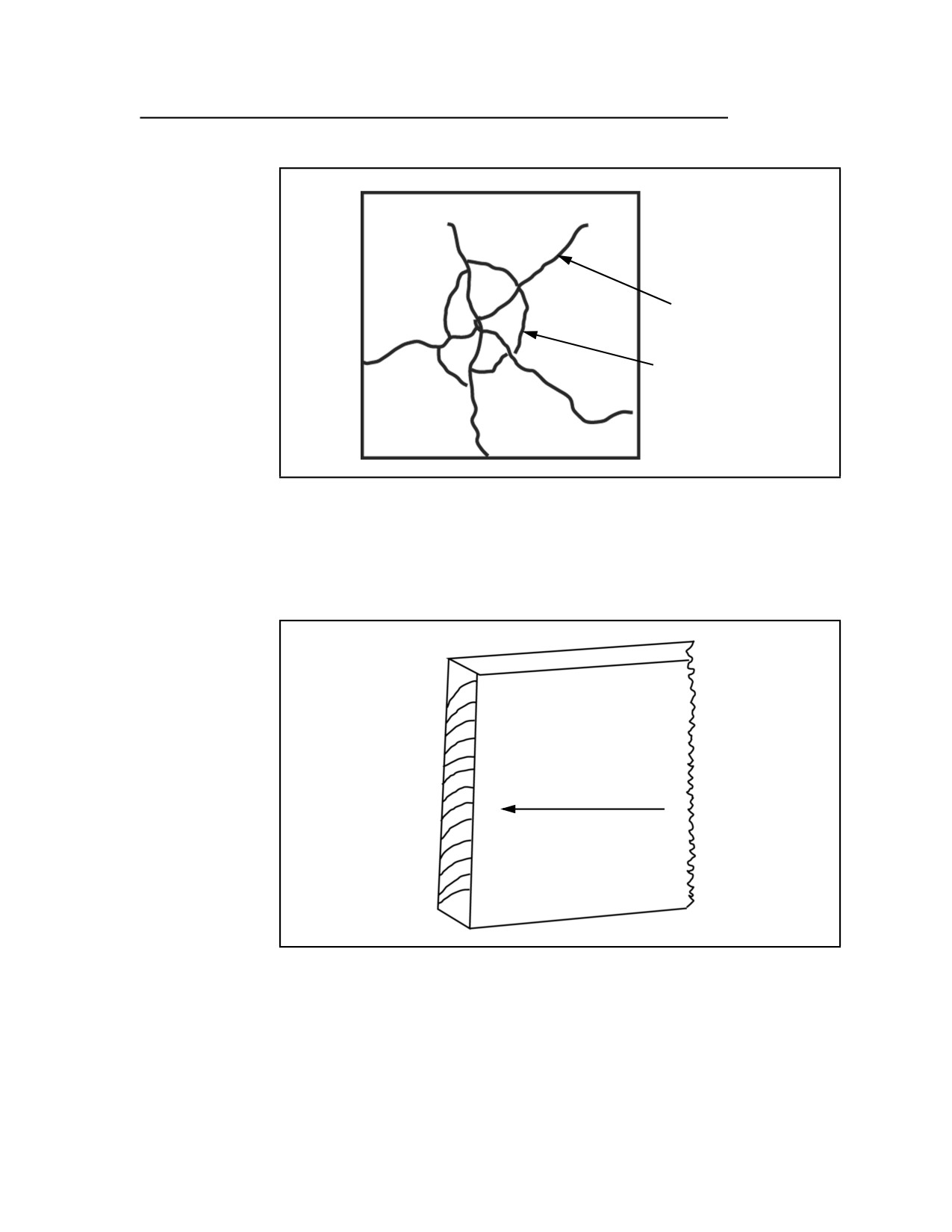
FM 3-19.13
Radial fracture
Concentric fracture
Figure 25-1. Example of a Radial and Concentric Fracture
perpendicular part of the rib mark is the side from which the breaking force
came. (See Figure 25-2.) These observations should always be made on radial
fractures of glass fragments nearest the point of impact (within the first
concentric fracture).
Direction of force
Figure 25-2. Example of a Concentric Fracture
COLLECTING THE GLASS
25-47. When glass from a window or doorframe is broken, pieces of glass often
remain in the frame. The investigator should mark the original inside or
outside surface and the orientation (such as top or bottom) of each remaining
piece before its removal. If necessary, the entire frame may be removed if
Trace Evidence 25-9
FM 3-19.13
toolmarks or other evidence is relevant. Standards of wood, putty, paint, or
other materials should be collected at this time. An investigator should do the
following:
z
Remove all larger pieces of glass first because they may contain latent
prints. Handle the glass carefully because the prints could be another
source of evidence.
z
Photograph all glass fragments exactly as they are found and
document their location on the crime scene sketch before collecting
them.
z
Consider what occurred at the crime scene from the time of the
incident to the time of his arrival, realizing that moving glass pieces
and extracting the remaining glass pieces in the window or doorframe
may extend fractures, thereby, creating an opportunity for confusion
or reversed findings by the lab technician. He must also determine
whether the suspect caused the characteristics in the broken glass or
whether other individuals, such as medical personnel or witnesses,
introduced them.
z
Wear rubber or cloth gloves while collecting glass.
z
Pick up larger pieces of glass by their edges avoiding the flat surfaces
as much as possible.
z
Preserve the edges of glass fragments as the fragments are collected.
The edges can help lab technicians determine the manner in which
the glass was broken.
z
Use rubber-tipped tweezers or similar type tools to handle smaller
fragments. This will help prevent further damage to the fragments.
z
Wrap each piece of glass separately and securely to avoid shifting and
breakage during movement.
z
Collect samples of known glass from each broken window or source.
z
Package questioned pieces of glass separately from known pieces of
glass.
z
Submit all of the pieces of glass collected from the scene to help
determine the point of impact after they are fitted together and to
improve the likelihood of a match during forensics testing of recovered
questioned pieces.
z
Submit the victim’s and suspect’s clothing, with each clothing item
packaged separately in a paper bag, to the lab. The lab can determine
if glass fragments from the scene are on the suspect's clothing and can
establish a link between the suspect and the scene.
PRESERVING GLASS COLLECTIONS
25-48. To preserve glass collections, wrap the larger glass or glass fragments
in soft paper, cotton, or other similar material to prevent breakage. Never
package glass fragments in glass containers. An investigator must be careful
to avoid damage to prints or other substances on glass that are sent to the
laboratory or saved as evidence. Smaller fragments may be wrapped in bond
paper using the pharmacy fold. (See Appendix I.) The wrapped glass is placed
in containers and stabilized so that the glass will not shift during movement.
The wrappings and containers should be marked “Fragile.” Evidence that will
25-10 Trace Evidence
FM 3-19.13
be examined by the laboratory must be packed carefully. Friction, shifting, or
contact with other items can destroy or contaminate the evidence.
MARKING THE FRAGMENTS
25-49. The investigator should mark glass fragments with an indelible
marker, a scriber, or a diamond point pencil. A piece of properly marked
adhesive tape may also be used. The investigator initials, dates, and
annotates the time on each piece of glass. Marks are annotated where there is
no likelihood of latent prints or where material of evidentiary value may be
present. The investigator should place marks on the side of the glass that was
facing up when found (or on the inside if the glass was taken from a window
frame or door). This helps in the reassembly of fragments and in the
reconstruction of the incident. The investigation should include a sequence
number that, when keyed, matches the investigator’s notes, photographs, and
sketches and will identify where the fragments were found. Fragments that
are too small for markings should be placed in containers. Both the container
and lid should be marked.
RECONSTRUCTING FRAGMENTS
25-50. Only the laboratory can truly reconstruct a piece of fractured glass. An
investigator may want to place pieces of glass in relation to one another to get
a better look at the fractures but should not do this on a continuous basis.
How the reconstruction is done depends on the size and shape of the object.
The fragments are not sent to the laboratory in a reconstructed form as
damage may result during shipping and handling.
25-51. Investigators must take care not to rub the fractured edges of the glass
against each other. This may cause more fracturing and destroy parts of the
ridgeline marking. One way to avoid this is to keep the edges at least a pencil
point's width apart. When as many pieces of the glass as possible are in place,
the outlines may then be traced onto paper. The investigator should make
notes on the paper and fit the markings on the pieces for future reference. If a
more permanent reconstruction is needed later, the fragments may be fixed to
a piece of plywood or heavy cardboard with tape or glue.
25-52. It is more difficult to reconstruct a curved or irregular-shaped piece of
glass, such as a bottle or jar. Both the size and the shape of the object must be
determined. Some pieces (such as automobile headlight lenses) may have
patterns cast or cut into them. These can be compared and matched more
easily than smooth glass surfaces. In many cases, the pattern may be matched
independent of the fractured edges. But the exact matching of edges is still the
most conclusive evidence of common source.
25-53. The laboratory may be able to complete a partial reconstruction on
curved glass that originated from a bottle, lenses, or a similar curved item.
This may allow an approximation of the size, such as the curvature. The
investigator should keep in mind that these are only rough approximations.
Lenses are made in round, oval, and other shapes with their spherical
surfaces not always being completely regular in contour.
Trace Evidence 25-11
FM 3-19.13
FIELD EXAMINATION OF FRACTURES
25-54. In the field, investigators must be able to distinguish between
fractures caused by heat and those caused by blunt force. They must also be
able to distinguish these kinds of fractures from those created by a high-speed
impact like that of a bullet. A basic knowledge of the characteristics of safety
glass is also helpful. There are two types of safety glass: laminated and
tempered. Laminated glass will generally remain intact when fractured;
tempered glass is made to produce many small fragments and will not remain
intact when fractured.
BULLET HOLE FRACTURES
25-55. Checking glass for bullet holes may provide useful information. It may
be possible to determine the direction from which a bullet was fired.
Sometimes the sequence of a series of bullet holes can be learned. Sometimes
the type of ammunition used and the distance from which the bullet was fired
may also be learned.
25-56. Often, the direction from which a bullet enters a piece of glass is easily
discernible. A bullet makes a somewhat clean-cut hole in the side of entrance.
As it penetrates, it pushes glass fragments ahead of it. This causes a saucer-
shaped or coning depression on the exit side with a greater diameter than the
entrance hole. Determining direction becomes more difficult when several
bullets enter safety glass closely together. When the last bullets enter the
glass surface there are already a number of cracks. As a result, small pieces
are knocked out around the holes on both sides.
25-57. Sometimes it is important to know which of two or more bullet holes in
a pane of glass was made first. This may be determined from the fractures.
When a fracture traveling across glass meets a fracture that is already
present, the newer fracture will be stopped. If fractures from one bullet hole
are stopped by those of another, it may be concluded that the blocking fracture
was made first.
25-58. The angle from which a bullet enters a piece of glass may be found by
the amount of chipping at the exit crater. If a bullet strikes glass straight on,
chipping around the exit hole will be fairly even. If a bullet enters from the
right of the glass, very little chipping will be found on the right side of the exit
hole. Instead, there will be a lot of chipping around the left side of the exit
hole. The entrance hole will show straight and short radial fractures on the
right, while one or two long radial fractures should appear on the left. If a
bullet enters from the left of the glass, these fractures will be reversed.
25-59. To learn the angle from which a bullet was fired, the bullet hole should
be compared with test shots fired from varied known angles. The test shots
should be fired through the same type of glass and under the same conditions
with the same type of weapon and ammunition as the original bullet hole. The
lab is equipped to conduct test fires of weapons and ammunition.
25-60. An ammunition type can sometimes be learned from the size and
features of the bullet hole. Bullet holes in safety glass offer more evidence
than those in window glass because safety glass fragments do not fall. When a
bullet goes through a pane of glass in a sideways fashion, it is often hard to
25-12 Trace Evidence
FM 3-19.13
show the caliber of the bullet. Investigators should coordinate with the lab to
learn the best way to submit evidence for this test. The lab can usually
estimate the caliber and type of weapon used.
BLUNT-OBJECT FRACTURES
25-61. Glass fractures caused by a blunt object will show a pattern of
fractures like, but not as regular as, those from a bullet. This difference is
mainly due to the impacting force being dispersed over a greater area. It may
be more difficult to tell which side the impact came from, but it can still be
determined by the ridgelines on the edges of the radial fractures.
25-62. Anomalous fracture patterns can occur if the impact is close to a frame
that is rigidly holding the glass pane. It is not recommended that the
investigator attempt to partly reconstruct the object to find the radial and
concentric fractures. The 3 R rule (in radial fractures, the stress lines are at
right angles to the rear) applies most of the time; however, anomalous
patterns do occur under some conditions.
HEAT FRACTURES
25-63. Recognizing heat fractures in glass can help you eliminate areas of
concern in your investigation. Fractures due to heat are wave-shaped. They do
not show a regular pattern of radial and concentric lines like fractures caused
by impact. Heat fractures also show little, if any, curve patterns (stress lines)
along the edges. Expansion of the glass (stretching action) occurs first on the
side exposed to the heat. Glass splinters will often fall toward that side.
Reconstruction of a glass object fractured by heat will show the wave-shaped
fracture pattern.
25-64. If the stress lines are smooth, or almost smooth, and no point of impact
is found, the investigator must consider other factors like the circumstances
under which the fragments were found and their location. He may conclude
that the fracture was due to excessive heat.
LABORATORY EXAMINATION OF FRAGMENTS AND FRACTURES
25-65. Glass fragments and fractures may yield important leads when
examined by trained technicians. The lab can analyze glass fragments and
fractures by a variety of means. In the case of comparing questioned glass
fragments with a possible source, such as a broken window, a scientific
examination of the physical and chemical properties of the glass could
establish that the questioned glass could have originated from the window
glass or eliminate that possibility altogether. Larger fragments of questioned
glass can sometimes be physically matched to glass from the broken item. In
this case, it is possible to conclude that the questioned and the suspected
source were, at one time, a single unit. Examination of fractured glass may
yield information as to the type of glass from which it originated. The
manufacturer’s name or logo may be imprinted or molded in the glass and
could provide additional information. Examination of reconstructed glass
items such as windowpanes may show the direction of a blow and the direction
and angle of impact. It may also show the sequence of breaks and, in the case
Trace Evidence 25-13
FM 3-19.13
of multiple bullet holes, the sequence of the holes and the side from which
they originated.
PAINT
25-66. Paint evidence commonly results from breaking and entering
incidents, automobile accidents, and other crimes in which forcible contact has
been made with painted surfaces. The type of paint evidence that results is
usually in the form of chips and smears. When a suspect attempts to break
into a safe, vault, window (sill), or door, paint can be transferred to and from
the tools that are being used to commit the offense. Paint chips are frequently
produced in automobile accidents in which two vehicles collide. These
situations can also produce paint smear evidence, such as when two vehicles
sideswipe each other.
COLLECTING PAINT EVIDENCE
25-67. Paint evidence should be carefully collected for examination by the
USACIL. When the collection process is a result of an automobile accident, the
investigator should—
z
Search the accident scene for paint fragments and pieces of vehicle
body parts.
z
Pick up paint chips or smears by using tweezers or by placing a piece
of clean paper under them and lifting them up.
z
Place paint chips or smears in a box with a soft lining (to prevent
altering the chips or smears).
z
Pack multiple paint evidence separately.
z
Submit entire vehicle components, such as a fender or bumper, when
paint transfer is minimal and the severity of the crime warrants.
z
Collect samples of questioned paint transfers from each vehicle area.
In addition, collect control samples of paint from undamaged areas on
the same body panel and directly adjacent to each area where a
questioned transfer has been collected.
z
Mark the evidence container with the exact location from where the
paint evidence was collected, the date, the investigator's initials, and
the case number.
25-68. When collecting paint evidence involving tools, the investigator should
send the tools to the lab examiner. If the tools are suspected of having left
impression marks, such as on a windowsill, he should send sample
impressions with the tools. When collecting the paint samples from a surface,
such as around the windowsill, the investigator should chip the paint from the
surface to the foundation rather than scrape it. Chipping the paint allows its
layered structure to remain intact. Each layer can then be a point of
comparison.
COLLECTING CLOTHING
25-69. If clothing is collected as evidence, the investigator should not examine
the items for paint fragments. To do so risks the loss of paint chips, especially
25-14 Trace Evidence
FM 3-19.13
those too small to be seen with the naked eye. These items should be marked
for identification, packaged, and sent to the USACIL for examination.
Trace Evidence 25-15
PART FIVE
Acquisition of Police Information
Part Five describes the often dangerous task of obtaining police information and
CRIMINT by operating undercover or employing surveillance techniques. Only the
most experienced law enforcement personnel should employ these techniques and
procedures. The chapters of Part Five provide the reader with information on the
methods and motives of criminals and their associates and those individuals who
provide valuable information about criminal activity to police.
Chapter 26
Surveillance Operations
In law enforcement, surveillance refers to the covert observation of
individuals, places, or objects for the purpose of gathering police
information or CRIMINT. In both tactical and nontactical environments,
military police and CID personnel employ surveillance techniques in
support of law enforcement and security operations. Surveillance
techniques are often used to identify criminal activity associated with
terrorism, organized crime, drug and contraband trafficking, and serious
crimes against individuals.
OVERVIEW
26-1. A vital function of surveillance is the protection of military police and
CID personnel performing undercover operations, such as drug suppression.
Only experienced investigators should be assigned surveillance operations
designed to protect undercover personnel. Failure to maintain observation can
result in unnecessary risks to the undercover investigator.
26-2. The surveillance techniques described here are most often employed in
drug suppression operations. However, these techniques can be easily
modified for other police and security activities. Other surveillance objectives
include—
z
Supporting PIO.
z
Obtaining evidence of a crime.
z
Locating individuals by watching their places of activity and their
associates.
z
Checking the reliability of informants.
z
Locating hidden property or contraband.
z
Obtaining probable cause for requesting search warrants.
Surveillance Operations
26-1
FM 3-19.13
z
Preventing the commission of an act of crime or apprehending a
suspect in the commission of a crime.
z
Obtaining information for later use during interrogations.
z
Developing leads and information received from other sources.
QUALIFICATIONS
26-3. Police personnel are selected for surveillance operations based on their
skill, experience, and resourcefulness. They must have well-developed
observation and description skills. Surveillants must have patience and be
able to endure long tedious hours of observation. Usually, police personnel
who are selected are of average height and weight and devoid of unique
physical features. The ability to blend in with their surroundings is extremely
important. Sometimes they are chosen for ethnic or language qualifications.
The type of surveillance and the area where it will take place are important
factors to consider when selecting a surveillance team.
26-4. Every member of the surveillance team must know the elements of proof
of various crimes to know when the suspect has committed an offense that
warrants apprehension. Surveillance teams should not be too quick to
apprehend suspects. They should keep the suspect under surveillance until
the crime is completed, unless it would cause bodily harm to a victim.
Continuing the surveillance, even after all elements of a crime have been
committed, can also lead to other criminal information. The decision to
continue the surveillance after a crime has been committed must be approved
by the senior member of the surveillance team.
PLANNING
26-5. Surveillance operations are planned and coordinated. One of the initial
tasks in planning and conducting surveillance is the designation of an
investigator in charge. When a number of investigators are involved, a tactical
plan is developed, outlining the duties of each investigator. Conducting a
reconnaissance of the area that is to be surveilled and coordinating with other
agencies should be planned. If the surveillance is likely to be lengthy,
arrangements should be made for suitable relief. A prearranged, secure
system of communicating with headquarters or superiors and central
coordination must be established. Suitable signals for communicating
information between surveillance investigators should be developed and
thoroughly understood by all participants. The type of information that might
be communicated through such signals would include the following:
z
Take the lead.
z
The suspect has stopped.
z
The suspect has made a contact or a drop.
z
There is countersurveillance.
z
The suspect has spotted the surveillance.
Explanations for being at a particular place at a particular time should also be
discussed in the eventuality that a suspect approaches and accuses the
investigator of following him.
26-2 Surveillance Operations