FM 3-19.13 LAW ENFORCEMENT INVESTIGATIONS (JANUARY 2005) - page 8
FM 3-19.13
from fire,” or “keep cool” (as appropriate). Evidence needing refrigeration can
be damaged or destroyed if left unattended in a post office over a weekend.
19-26. The method for transporting evidence to the crime lab depends on the
type of evidence and the urgency of need for the results. Evidence is normally
sent by registered mail but may be hand-carried or transported by
government carrier. Federal law prohibits transmitting certain types of
merchandise through postal channels. The nearest postmaster should be
consulted if there is any question on mailing. Coordination should also be
made with the USACIL before these items are forwarded.
19-27. Chemicals, gases, unexploded bombs, detonators, fuses, blasting caps,
and other explosive or inflammable materials cannot be sent by mail.
Transmittal of these items of evidence must conform to the provisions of US
Postal Service (USPS) Publication 52, CFR, OSHA guidelines, interstate
commerce regulations, and appropriate state and municipal ordinances.
Before these items are forwarded, the laboratory should be notified about the
planned shipment. The notification should include instructions on packing the
materials. This will reduce the danger involved in unpacking these items at
the laboratory.
EVIDENCE LEDGER
19-28. All evidence logged into the evidence room is recorded in an evidence
ledger. The evidence ledger is the bound record book (federal serial number
[FSN] 7530-00-286-8363) kept by the evidence custodian. The evidence ledger
provides double accountability through cross-reference with DA Form 4137.
The evidence ledger accounts for the document number assigned to DA Form
4137 and DA Form 4002. The evidence ledger follows the disposition schedule
set by AR 25-400-2. The ledger is destroyed 3 years after a final disposition is
made of all items entered in it.
19-29. Evidence ledger books can be used for more than a single calendar
year. Smaller offices that do not receive large quantities of evidence use ledger
books for several years. A single book is used for consolidated evidence rooms,
recording evidence from different offices in the same numerical sequence that
it was received in the evidence room.
19-30. The cover of the evidence ledger book is labeled and marked with
Modern Army Record-Keeping System (MARKS) file number 195-5a, the
organization or activity responsible for the evidence room, and the dates
spanned by the ledger book entries.
19-31. The evidence ledger is prepared with six columns that span two facing
pages when the book is opened. Each page does not have to show the column
headings. As a minimum, the first page of the ledger and the first page
beginning a new calendar year should show the column headings. A commonly
used practice is to mark the column headings on the inside covers of the book,
19-10 Evidence Management and Control
FM 3-19.13
then trim off the top of the ledger pages so the headings are visible when the
book is opened. Ledger headings include—
z
Document number and date received. This column contains the
document number assigned to the evidence custody document. The
date DA Form 4137 was received in the evidence room is entered
below this number.
z
Criminal Investigation Division control number or military
police report number. The office investigative file number assigned
to the investigation to which the evidence pertains is entered in this
column. A USACIDC evidence custodian will also enter the MPR
number in the remarks column when the evidence pertains to both a
CID and military police investigation.
z
Description of the evidence. A brief description of the evidence is
entered in this column, such as “.38 cal pistol, SN# 000000,” or “25
handwriting exemplars of SGT Smith.” A single line in the ledger is
used to record each single item of evidence. The same item number
listed on DA Form 4137 will identify each item of evidence in the
ledger. Items that are considered fungible or other evidence that is
sealed in a container will be described briefly with information taken
from the data on DA Form 4137. This entry does not imply that the
evidence custodian has inventoried these items.
z
Date of final disposition. The date the evidence was disposed, as
shown in the “Chain of Custody” section of DA Form 4137, is entered
in this column. When DA Form 4137 contains several items that are
not disposed of on the same date, the date of disposition for each item
should be recorded on the same line. When all the items in an entry
are disposed of on the same day, only one date is required to be
entered, followed by the words “all items” (such as 12 Jan XX - all
items).
z
Final disposition. The method of final disposition for each item of
evidence is entered in this column on the same line. When all items in
the entry have been disposed of in the same manner, the means of
disposal may be listed once, preceded by the words “all items” (such as
“all items burned”). Both the date and method of final disposition
must match what is shown in the chain-of-custody portion of the
evidence custody document for each item of evidence.
z
Remarks. The evidence custodian may use this column to record
necessary information. When fungible or other evidence is received in
a sealed container and cannot be inventoried, the notation “SCRCNI”
is required in this column. If .0015 funds are retained as evidence,
“.0015 funds” must also be noted in this column. The other types of
entries are optional and commonly made in pencil to facilitate
changing. Some examples include the names of the case agent,
owners, subjects, victims, location of evidence in the evidence room,
and the dates to and/or from USACIL for examination.
19-32.
Both vertical and horizontal lines are used to separate entries. Black
ink should be used to make the entries. The lines separating the entries may
be in a different color. No blank pages or lines will be left between ledger
pages or ledger entries. Erroneous entries will be lined through with a single
Evidence Management and Control
19-11
FM 3-19.13
line, so they may still be read and initialed by the evidence custodian. Any
spaces between ledger entries or at the bottom of a ledger page will be lined
through and the word “VOID” written in capital letters in the space and
initialed by the custodian. No white correction fluid will be used in the
evidence ledger to conceal mistakes.
EVIDENCE DISPOSITION
19-33. Evidence will be expeditiously disposed of as soon as possible after it
has served its purpose or has no further evidentiary value. Methods of
disposition are detailed in AR 195-5.
19-34. Evidence returned to the owner for final disposition requires a receipt
for registered mail. The original DA Form 4137 will not be sent with the
evidence. When the receipt for registered mail is returned, it will be
permanently attached to the original DA Form 4137.
19-35. The final disposition of evidence also has particular requirements
when sending it to another office. When evidence is permanently transferred
from one evidence room to another, the original and a duplicate copy of the
evidence custody document (with properly annotated chains of custody) will be
sent with the evidence. The transferring office will make a legible copy of the
original evidence custody document, which will be placed in the closed
evidence custody document file in place of the original copy of the evidence
custody document. The evidence custodian who receives this evidence will
enter the next document number of the receiving evidence room on both copies
of DA Form 4137. The previous document number will be lined through so
that the number is still legible.
19-36. Sometimes evidence is made a permanent record of trial. Evidence
released to the TC for judicial proceedings will be returned as soon as possible
to the custodian for final disposition. If an item of evidence is made part of the
record of trial, the TC will immediately notify the custodian so DA Form 4137
can be annotated properly. This will be considered the final disposition of the
evidence.
19-37. Evidence obtained by investigators or military police at a crime scene
or during an investigation may be released to another law enforcement agency
without SJA approval when that agency assumes full investigative
jurisdiction and responsibility or jurisdiction and responsibility for just that
portion of the investigation to which the evidence pertains. The evidence does
not need to be processed into the evidence room before release unless the
release cannot be made before close of business on the first working day after
the evidence is acquired. Investigators and military police will ensure that the
evidence is properly recorded on a DA Form 4137 and that the chain-of-
custody section is complete upon release of the evidence.
19-38. The USACIDC commander, SAC, or PM (in the case of military police
investigations) will review and give approval of the release of the evidence by
completing the final disposition authority section of the evidence custody
document. Since the final disposition approving authority may not be
available to give prior authorization for the release of evidence, this approval
may be given after the fact with the final disposition authority annotated on
19-12 Evidence Management and Control
FM 3-19.13
the final copy of the evidence custody document. A copy of the evidence
custody document will be maintained in the case file and release of the
evidence will be documented in the report. Consideration should be given to
photographing the evidence before its release.
19-39. Sometimes evidence is of no value after laboratory analysis. These
items (contained in the evidence room) may be disposed of after consulting
with the proper SJA or civilian prosecutor if a subject has been identified or
upon approval of the USACIDC commander or SAC in an investigation with
no subject identified.
19-40. Controlled substances received by the evidence custodian that do not
apply to an investigation may be immediately disposed of after approval has
been received from the USACIDC commander, SAC, or PM (as appropriate). A
copy of DA Form 4137 will be filed with the appropriate police report.
Disposition may be made immediately after determining that the substance
cannot be linked to a suspect.
19-41. Items of potential evidence that are determined to have no value as
evidence by the USACIDC special agent or military police before they are
released to the evidence custodian may be disposed of by the agent or military
police. This does not include controlled substances. The evidence custody
document chain of custody will be completed to show the final disposition
made for the item and the evidence custody document filed in the case file.
The method of disposal will be according to AR 195-5 (released to the unit or
activity, returned to the rightful owner, or destroyed, as appropriate).
19-42. When it is not practical or desirable to keep items of evidence, such as
vehicles, serial-numbered items, items required for use by the owner,
undelivered mail, large amounts of money, and perishable or unstable items,
disposal action may be taken immediately. If such items can be immediately
disposed of, it will not be necessary to enter them into the evidence room. This
should be coordinated with the office of the SJA. The office of the SJA will
complete the final disposal authority portion of DA Form 4137. When it is not
possible to get written approval from the office of the SJA before the disposal
of the evidence, oral permission should be obtained followed by written
approval. Photographing the evidence before release should be considered and
discussed with the office of the SJA.
19-43. When final action has been taken in known subject cases, the original
evidence custody document will be taken by the evidence custodian or sent to
the SJA officer appointed as TC for the commander of the subject or the
civilian prosecutor if the subject is a civilian. An SJA or civilian prosecutor
will complete the final disposal authority part of DA Form 4137 if the evidence
is no longer needed. When evidence must be retained, this part of the form
will not be completed; a brief statement giving the reason for keeping the
evidence will be furnished to the evidence custodian using separate
correspondence. In unusual cases, where there is a high risk of losing the
original DA Form 4137 (such as isolated units that must mail a DA Form 4137
to the servicing SJA officer for disposition approval), a memorandum may be
substituted for disposition approval. When this is used, enough information
will be furnished to allow the SJA or civilian prosecutor to make a decision.
Evidence Management and Control
19-13
FM 3-19.13
The return correspondence from the SJA or civilian prosecutor giving
disposition approval will be attached to the original DA Form 4137.
19-44. Evidence in an investigation for which no subject has been identified
may be disposed of 3 months after the completion of the investigation without
the approval of the office of the SJA. Evidence may be disposed of earlier with
approval of the office of the SJA. However, care must be taken with serious
crimes when it is possible that a subject may later be identified. In such cases,
it may be advisable to keep the evidence longer than 3 months. When the
subject is not known (3 months after completion of the investigation),
USACIDC evidence custodians will obtain final disposition approval of the
commander or SAC. Military police evidence custodians will obtain disposition
approval from the supported PM. Approval will be given by completing the
final disposal authority section of the original DA Form 4137.
19-45. In some instances, such as unsolved rapes, homicides, or solved cases
which will require a protracted appeals process resulting from a general
courts-martial (GCM), evidence needs to be retained longer than usually
required after the completion of a final report. In these situations, AR 195-5
provides guidance on the packaging of evidence pertaining to one
investigation in consolidated sealed containers. The evidence should be
packaged in cardboard boxes in the presence of a disinterested witness. A
certificate should be completed listing the evidence documents in the box (by
document number) and the date the carton was inventoried and sealed. Then
the evidence custodian and disinterested witness should sign the certificate. A
copy of the certificate should be attached to the container. The evidence
custodian and disinterested witness should sign the container seal according
to AR 195-5. A copy of the certificate should be attached to each evidence
custody document for evidence sealed in the container. The original certificate
is attached to the original DA Form 4137 of the first evidence custody
document listed on the certificate. No firearms can be placed in the container.
The evidence custody documents continue to be maintained in the open
evidence custody document files. The container will remain sealed during
inventories unless a breach of the seal or tampering is detected.
INSPECTIONS AND INVENTORIES
19-46. The evidence room is inspected once a month. The results of this
inspection are recorded in the evidence ledger and signed by the inspector.
This inspection will be made in lieu of a physical security inspection according
to AR 190-13 and is not required monthly if no evidence has been received,
maintained, disposed of, or otherwise accounted for in the evidence room since
the last monthly inspection. Appendix C provides guidelines and a checklist
for evidence room inspections or inventories.
MONTHLY INSPECTION
19-47. The monthly inspection is intended to be an inspection of the evidence
room operation, not an inventory. The inspector will determine if the evidence
room is orderly and clean; structural and security requirements of AR 195-5
are being met; and evidence is being received, processed, safeguarded, and
disposed of according to AR 195-5. The inspector also checks to see if evidence
19-14 Evidence Management and Control
FM 3-19.13
temporarily released for laboratory examination or presentation at a judicial
proceeding has been released for an excessive period of time. If so, an
annotation is made in the evidence ledger and the custodian contacts the
appropriate agency to inquire about the status of the evidence.
INVENTORIES
19-48. An inventory will be conducted of all the evidence stored in the
evidence room and all temporary evidence facilities once a quarter, upon
change of the primary evidence custodian, upon loss of evidence stored in the
evidence room, or upon breach of security of the evidence room.
19-49. The evidence custodian and a disinterested officer will conduct the
quarterly inventory jointly. The disinterested officer will not be a current
member of USACIDC or an officer assigned to military police activities or
units on the installation. The guidelines for disinterested officers conducting a
joint inventory are established in AR 195-5 and should be read by the
inspecting officer before conducting the joint inventory. The disinterested
officer will make a physical count of evidence to verify that evidence in the
evidence room corresponds with that shown on DA Form 4137. The
disinterested officer will cross-reference all DA Forms 4137 (including those in
suspense files) with entries in the evidence ledger to ensure the accountability
of all evidence and proper annotation of the copies of DA Forms 4137 in the
suspense file.
19-50. When a primary evidence custodian changes, the incoming and
outgoing primary evidence custodians will make a joint physical inventory of
all evidence in the evidence room. An entry must be made in the ledger as
detailed in AR 195-5. Upon satisfactory completion of the change of custodian
inventory, all DA Forms 4137 in the open evidence custody document files will
be noted and signed to show the change of custody. When some items of
evidence have been retained in the evidence room while other evidence was
recorded on a voucher and sent to USACIL (or other external agency), the
incoming primary custodian will sign the first copy of the evidence custody
document retained in the USACIL suspense file to assume custody of the
retained evidence. This situation creates another type of “legal gap” in the
chain of custody, which is covered by the change of custodian entry recorded in
the evidence ledger.
SECURITY STANDARDS
19-51. The outer door of the evidence room will be secured with an
appropriate high-security key-operated padlock, never a combination lock.
Combination locks of an approved design may be used inside the evidence
room or on the inner door to the evidence room for security. Only the primary
and alternate evidence custodians will know the combinations of locks used in
an evidence room. Each key-operated padlock will have two keys. One key to
each lock will be in the constant possession of the primary custodian. The
duplicate key will be put in a separate sealed envelope and secured in the safe
of the appropriate supervisor.
19-52. Lock combinations will be changed when the primary or alternate
evidence custodian changes. All combinations and key-operated padlocks will
Evidence Management and Control
19-15
FM 3-19.13
be changed upon any possible compromise. Keys will be transferred from the
primary custodian to the alternate only if the primary custodian is to be
absent for more than one duty day or three nonduty days. Master- or set-
keyed padlocks will never be used, in any capacity, in an evidence room. There
will be no classified materials or property stored in an evidence depository
that is not evidence. AR 195-5 establishes the physical construction standards
for evidence facilities.
19-53. The evidence room is required by the provisions of AR 195-5 to contain
certain items and other specific equipment to facilitate the proper handling of
evidence. This equipment includes the following:
z
At least one securable container for high-value items and large
quantities of narcotics (more than one ounce of cocaine or heroin or
more than one kilogram of marijuana).
z
Bins, file drawers, or shelves for smaller amounts of evidence.
z
An approved safe for the storage of weapons and ammunition.
z
A refrigerator (required to be a permanent fixture in the evidence
room) to store items such as blood and DNA samples.
z
A work table and/or desk to process and package evidence.
z
A separate General Services Administration (GSA)-approved safe for
the storage of controlled-substance training aids (optional).
z
Separate filing cabinets for the evidence custody document files (open
and closed) and associated evidence room files.
TEMPORARY EVIDENCE CONTAINERS
19-54. A temporary evidence facility may be needed when investigators are
operating in remote locations or other unusual situations. Normally, a safe or
secure filing cabinet will be used for temporary storage of evidence. Access to
the safe or filing cabinet will be restricted to the person securing the
container. A key-opened padlock should be used instead of a combination
padlock. One key should be secured in a separate envelope in the safe that
contains the extra keys to padlocks to the evidence room. Master- or set-keyed
padlocks are prohibited.
19-55. There should be one container per duty agent, depending on the
volume of evidence handled, so that each duty agent has a container for use
during the absence of the evidence custodian. This will limit the change in
custody of evidence when duty personnel change and the custodian is not
available.
19-56. Temporary containers will be secured to the structure or fastened
together as specified for high-security containers located in the evidence room.
A container express (CONEX) or military-owned demountable container
(MILVAN) may be converted with specific security reinforcements, outlined in
AR 195-5, to serve as temporary evidence storage facilities. A separate
building or fenced enclosure may be used as long as access can be restricted
and controlled by a single person. This is usually required only for unusually
large items or quantities of evidence. Since the acquisition of these items
cannot be predicted, evidence custodians should have a facility identified to
use for this purpose.
19-16 Evidence Management and Control
Chapter 20
Fingerprints
Fingerprint evidence remains the most positive means of personal
identification in forensics, to date. Though often compared with other
modern innovations such as DNA, fingerprint evidence results in positive
identifications whereas other evidence does not. Fingerprint evidence can
also distinguish between identical twins. Identifications can be effected
from fingerprints made in a victim's blood, paint, or other contaminants,
which no other form of evidence can accomplish. There should not be
competition between fingerprint evidence and other innovations because
all should work hand in hand to solve identification questions.
DESCRIBING TYPES OF PRINTS
20-1. Latent prints can be seen or unseen and often require development. The
word “latent” means “hidden,” but normally the term latent prints refers to
those prints left at crime scenes and/or on items of evidence. Another category
of latent prints is patent prints. Patent prints are impressions that are visible
in some form of contaminant. Plastic prints are those impressions left in
materials, such as wax, window putty, or other pliable materials.
20-2. Record prints are the controlled recordings of the friction ridge skin
contained on the palms of the hands and each finger, using various methods
such as fingerprint cards, printer’s ink, or electronic recording by way of “live
scan.” Though there are many variations on how to obtain record prints, the
principles are the same. Traditionally, the term major case prints refers to
finger and palm prints. Record prints can also be taken from feet, which also
bear friction ridge skin. Record prints must be submitted for all victims,
witnesses, suspects, medical and law enforcement personnel, and anyone
known or suspected of handling evidence or entering a crime scene. Once
legible and complete elimination prints for investigators are on file at
USACIL, there is no requirement to resubmit record prints for each
investigation conducted. In some cases, it may be necessary to record ear and
lip prints for comparison. The laboratory should be contacted for guidance in
these cases.
Fingerprints
20-1
FM 3-19.13
SEARCHING FOR, IDENTIFYING, AND PROCESSING LATENT PRINTS
20-3. Prints deposited on items of evidence are generally divided into the
following two basic categories:
z
Porous evidence. This type of evidence can absorb fingerprint
residue into its surface. Porous evidence can be best described as a
sponge that absorbs residue; for example, paper, checks, currency,
unfinished wood, cardboard, and other similar material. These items
do not require treatment by the crime scene investigators. In fact, the
investigator should not attempt to process fingerprints on porous
items of evidence because laboratory-processing procedures are best
for this type of evidence. Clean gloves should be worn at all times
when handling porous evidence. Little danger exists of destroying
latent prints on porous evidence, but a high possibility does exist of
accidentally depositing additional latents. All porous evidence should
be placed in a paper envelope, bag, box, or wrapped in paper and
sealed. The outside of the container should be marked with unique,
identifiable markings. Investigators should be aware that the
laboratory cautions against the field use of chemical agents
commercially marketed for the development of latent prints on porous
materials. Some of these products are of poor quality and can damage
or destroy latent prints. Latents developed in the field can fade or
totally disappear before laboratory examination. An example is
latents that are developed using iodine and ninhydrin, which produce
“fugitive” prints or prints that fade within a short period of time after
initial development. If an investigator believes that a scene or
evidence could best be processed using such chemicals, he should
consult with USACIL for advice and guidance.
z
Nonporous evidence. This type of evidence does not readily absorb
water into its surface; for example, plastic bags, painted or sealed
woods, metal, glass, some glossy magazine covers, knives, guns,
computer equipment, and like materials. All nonporous evidence
selected for latent-print examination should be processed as soon as
possible. If ridge detail is visible, photographs should be exposed of
them before any further processing. All nonporous evidence should
then be exposed to superglue fuming. For most evidence, this fuming
process could be all the processing necessary before shipment to the
laboratory. In other circumstances, fumed latents can be
photographed, powdered, and lifted. Do not submit evidence to the
laboratory if the investigator has powdered the latent prints and they
are capable of being lifted. Send only the photographs taken before
lifting and the actual lifts. However, evidence requiring examination
by other divisions of the laboratory should never be processed with
fingerprint powder because contamination can hinder other
examination processes. Evidence requiring additional examination
merely needs to be fumed with superglue as soon as possible.
NOTE: Superglue should not be used on any evidence being
submitted for trace evidence examinations.
20-2 Fingerprints
FM 3-19.13
PRESERVING LATENT PRINTS
20-4. Latent prints on nonporous evidence are often deposited on the surface
of an item and are extremely vulnerable. Wearing gloves does not protect the
latent prints from being destroyed if they are touched, rubbed, or smeared;
they only prevent additional prints from being deposited. When it cannot be
determined from appearance whether a drop of water would be absorbed into
a surface, the evidence should be handled and processed as nonporous (such
as a leather wallet, cigarette cartons, and shiny cardboard boxes).
Photography, superglue-fuming, and fingerprint-powdering are techniques
used to preserve latent prints.
PHOTOGRAPHY
20-5. The very first step in latent print preservation is photography. Visible
latent prints should always be photographed to prevent the loss of evidence.
Latent prints deposited in grease, blood, paint, and other visible substances
will often not require additional processing before photography. Always use a
scale in evidence photography and steady the camera using a tripod. It is best
to use a macro lens, filling the entire frame. Do not use digital photographic
field-issued equipment; digital photography has not advanced technologically
for the recording of latent print evidence. Traditional photography is still
required for latent print evidence to be suitable for identification. If there is no
other choice but to use digital photography, use maximum resolution (largest
photo file size) settings combined with good lighting and a tripod.
20-6. Attempt to keep the back of the camera parallel to the surface bearing
the latent print. If it is necessary to photograph the evidence from an angle to
catch the light in a manner that increases the contrast of the latent print,
additional photographs should also be made of the same area with the camera
back parallel to the surface bearing the latent print.
SUPERGLUE-FUMING TECHNIQUE
20-7. Superglue fuming, or cyanoacrylate fuming, remains the most effective
way to develop, protect, and preserve latent prints on nonporous evidence.
The superglue-fuming process can be accelerated using heat or chemicals.
USACIL suggests heat to accelerate the fuming process. After the latent
prints are developed, package and ship them to the laboratory. Studies
conducted by USACIL have shown that latent prints on evidence that was
superglue-fumed in the field are preserved better and have a significantly
greater chance of being identified than latent prints not superglue-fumed, but
forwarded to the laboratory as found. Superglue fuming preserves latent print
evidence making it stable for shipment to the laboratory without any further
processing. It can simply be placed in an envelope, bagged, or wrapped in
paper without special packaging materials and shipped to the laboratory.
Superglue-fuming procedures are as follows:
z
Evidence should be placed in a suitably sized, sealed container and in
an area that is well-ventilated.
z
A test print should be placed in a container where it can be seen or
checked. A small piece of a clear plastic bag will work.
Fingerprints
20-3
FM 3-19.13
z
A few drops of liquid superglue should be put on a piece of foil or
laboratory tin and placed on a coffee cup warmer, or a similar heat
source, inside the container.
z
The evidence should be observed—this is critical. When the test print
has developed, any latent prints on the evidence will also develop.
z
The evidence should be removed from the container and placed in a
paper envelope, bag, box, or wrapped in paper to be transported to the
laboratory.
20-8. Large items of evidence can be fumed in much the same way. The
investigator may have to build a makeshift tent or enclosure to seal in the
evidence. Latent prints developed with superglue fuming on large or
immovable items of evidence should be dusted with fingerprint powder,
photographed, and lifted. Only the lifts should be sent to the laboratory. This
effort saves shipping and handling costs of large bulky items.
20-9. Caution should always be used to ensure the safety of investigators who
are using this fuming process. Superglue fumes should not be inhaled or
exposed to the investigator's eyes, especially if he is wearing contact lenses
because these situations can create medical illnesses.
FINGERPRINT-POWDERING TECHNIQUE
20-10. The traditional fingerprint-powdering technique is still a vital piece of
the identification and preservation process of fingerprint evidence. The
preferred method of recovering latent fingerprints from a crime scene
(especially those that are located on large, bulky, or immovable items) is to
superglue fume it first and then powder and lift the latents.
20-11. Many latent prints can be developed and preserved using a fingerprint
brush and powder. All latent prints developed with a brush and powder must
be photographed (with a scale) before lifting. Latent prints found in dust,
grease, blood, or other contaminants should not be processed using fingerprint
powders. Fingerprint powders are supplied in crime scene kits in several
colors. In most instances, the best powders to use are the black or gray
general-purpose powders. Always choose a powder that contrasts best with
the background of the evidence and the color of the lifter used. Fluorescent
powders can be used to develop latent prints on multicolored surfaces. These
powders require the use of an alternate light source or UV light to be able to
photograph. Effective use of these light sources requires training and
experience. They are very costly and can cause health issues. Only long-wave,
UV light should be used; short-wave, UV light is harmful to the eyes and skin.
Anytime UV light is used to develop latent prints, investigators must wear
protective goggles and clothing.
20-12. Many types of fingerprint brushes are used to apply fingerprint
powder. Examples of these brushes are fiberglass, animal hair, and feather
brushes. For overhead work or in situations where it is critical that the brush
elements do not come in contact with the surface, magnetic wands and
20-4 Fingerprints
FM 3-19.13
magnetic powders are used. The procedures for using fingerprint powders are
as follows:
z
Check the surface first using a test print. Lightly brush an area away
from the subject surface and determine if any latent prints are
present. If none are present, wipe the surface and apply and process a
test print to determine how acceptable the surface is to the fingerprint
powder processing. The investigator can make a test print by wiping
an ungloved finger on his face or neck to collect skin oils. He should
apply his finger to the test surface to deposit a latent fingerprint.
z
Pour a very small amount of powder out onto a sheet of paper. Never
dip the fingerprint brush into the container, this causes
contamination and spoils the working properties of the powder.
z
Touch the powder only with the tip of the brush. Shake off any excess
powder and brush the surface using only the very tips of the powder-
filled brush. The key to proper print development is to use a small
amount of powder and a delicate touch. Use a twirling method to
ensure that the sides of the bristles are not coming into contact with
the surface and destroying latent prints.
z
Watch for the latent print to become visible to ensure that it is not
overbrushed. Overbrushing can destroy the print.
z
Brush following the contour of the ridges and stop when the ridge
detail is developed.
z
Stop brushing when the ridge detail is complete.
z
Discard any unused powder; never return contaminated powder to the
container.
20-13. All developed prints should be photographed and then lifted. All lifts
and photographs should be submitted to the laboratory for evaluation,
examination, and comparison. All latent print photographs should include a
scale. Sometimes a second lift of the same area is necessary to achieve the best
possible lift. Superglue-fumed prints can be powdered and lifted many times
without destroying the print; however, latent prints that have not been fixed
using the superglue process can diminish or be destroyed while attempting to
lift them.
LIFTING LATENT PRINTS
20-14. The most common means used to lift latent prints are commercially
produced lifting devices, such as hinge lifters, lifting tapes, rubber and gel
lifters, and various types of liquid lifting mediums. Hinge lifters and
transparent lifting tape have the advantage of presenting the lifted latent
print in its correct perspective. Latent prints on rubber lifters are in a
reversed perspective and must be reversed again using photographic
techniques to properly visualize and compare the latent print. However,
rubber lifters generally work better than hinge lifters. Transparent lifting
tape works better for taking prints from curved or uneven surfaces.
Transparent tapes used in office work, such as cellophane tape, are not
suitable for lifting fingerprints except in dire circumstances. A lift background
that contrasts the color of the powder should always be used. A gel lifter is not
as tacky as hinge, tape, and rubber lifters. It can be used on surfaces that are
Fingerprints
20-5
FM 3-19.13
more fragile where paint might be pulled away with a powdered print and is
excellent for lifting dust prints. Hinge and rubber lifters and lifting tape store
well; gel lifters may require refrigeration.
20-15. A lifter large enough to cover the entire print should always be used.
The plastic cover should be removed from the rubber lifter with care in one
steady movement. Any pause can result in a crease being left on the lifter
surface. The adhesive side of the lifter should be placed to the developed,
powdered print. It should be pressed down evenly and smoothed out over the
surface. If an air pocket is sealed under the surface of the lifter, an attempt
should be made to force it out. Use pressure or a pin to puncture the lifter and
release the air by applying pressure to the bubbled area. The lifter should be
peeled from the surface in one smooth even motion.
20-16. Transparent lifting tape is applied in much the same way as
commercial lifters. One end of the tape should be placed on one side of the
latent print and smoothed out across the surface of the print. Air bubbles
should be worked out using a pin, if necessary, to expel air trapped under the
surface of the tape. The tape should be pulled free with one continuous
motion. The tape should be mounted on materials that contrast the
fingerprint powder used. A black background should be used for gray or white
powders. A white background should be used for black or dark powders.
Commercial mounting cards usually offer the best types of mounting surfaces
and have contrasting surfaces on each side of the card. Lifting tapes can be
used to lift large areas of latent prints by being applied in overlapping strips,
and a rubberized roller can be used to work out air bubbles. All of the strips
should be pulled free from the surface in one continuous motion with all of the
strips connected together. They should be mounted as one connected piece.
20-17. Many types of silicone and liquid lifting materials are available for
lifting latent prints from uneven surfaces, such as appliances, computer
equipment, and vehicle interiors. Most types work by pouring them over the
powdered latent print and removing them after they dry.
CONDUCTING CHEMICAL PROCESSING
20-18. Only trained laboratory personnel should conduct the vast majority of
chemical processing of latent print evidence in an approved laboratory facility;
however, there are some instances where chemical processing can and should
be conducted in the field by trained investigators. USACIL should be
consulted when there is doubt about using chemical processing. The
premature or improper use of chemical processes in the field can result in the
loss and/or damage of latent print evidence. Most chemical processes are
fugitive in nature, meaning that once the latent prints are developed with
chemicals, they will fade and often disappear before the occurrence of proper
photography and comparison of the evidence. One type of processing that may
be used is small particle reagent (SPR). SPR may be more of a physical
process than a chemical process in that the resulting action is physical in
nature.
20-19. SPR is used on wet items of nonporous evidence, such as those covered
in moisture or submerged in bodies of reagent. Metallic particles suspended in
water, lodge themselves in the fatty and waxy residue of the latent print after
20-6 Fingerprints
FM 3-19.13
moisture has washed everything else away. SPR is simply applied and then
rinsed away with water. It also works on metal and masonry type surfaces. It
can be photographed and lifted as with powdered prints, after drying. SPR
comes in contrasting colors and UV formulas.
OBTAINING RECORD PRINTS OF LIVING INDIVIDUALS
20-20. To classify, analyze, and compare record fingerprints, they must be
complete and clear. It takes practice to obtain suitable record fingerprints and
could take several attempts to obtain suitable prints from a particular
individual.
20-21. Both the person being fingerprinted and the person taking the
fingerprints should always sign and date the record fingerprint cards before
the printing process, which will lessen the chances of smearing wet ink. It is
difficult in court to prove the origin of record prints without both signatures.
All blocks on the fingerprint card should be completed before using any ink to
avoid smearing the prints after they have been transferred to a fingerprint
card. The subject should wash and dry his hands thoroughly to remove any
dirt, sweat, or grime. The subject's hands should be examined to ensure that
they are absent of intentional disguises, such as coatings and any disfiguring.
The following equipment is normally required for printing:
z
FBI Form Federal Document (FD) 249 (Arrest and Institutional
Fingerprint Card).
z
Fingerprint card holder.
z
Printer's ink.
z
Ink roller.
z
Ink plate.
TAKING RECORD PRINTS
20-22. Record prints are taken to show the entire friction ridge skin surface of
the fingers, thumbs, and palms. Record fingerprints for submission to the
laboratory should consist of at least two completed FBI fingerprint cards and
a set of fully rolled fingers and fully rolled palm prints to include the web and
side areas of the palms. (See Appendix G.) To prepare for recording the prints,
the fingerprint card should be secured in the holding device. A small dab of
ink should be placed on the inking plate and rolled until a thin, even film
covers the surface. The consistency of the ink should appear almost opaque.
20-23. The motions for inking the finger and recording the finger are the
same. The fingers are rolled from nail edge to nail edge and from
approximately 1/8 inch below the crease of the first joint to as far up as
possible. This area will allow for the recording of all ridge characteristics
required for correct classification of each finger. The finger is rolled through
the ink and then rolled in the corresponding block of the fingerprint card.
When the investigator takes record fingerprints, he should grasp the top of
the subject's hand to ensure that the finger to be printed is extended. The
investigator uses his other hand to hold the finger at the base where it meets
the palm. He tells the subject to look away, relax, and allow him to do all the
rolling. Each finger should be rolled in one continuous and smooth motion.
Fingerprints
20-7
FM 3-19.13
The fingers and thumbs are rolled from awkward to comfortable, meaning
from left nail edge to right nail edge for fingers on the right hand and right
nail edge to left nail edge for fingers on the left hand. This allows the
investigator to work with the anatomic features of the hands without fighting
the natural resistance of the hands. The finger should not be rolled back and
forth on the ink or the card since this will cause over inking, distortion, and
ink lines to appear on the recordings. The pressure should be firm and even.
Pressing too hard causes the furrows (grooves between the ridges) to fill in
with ink. It is important that the investigator ensures the correct finger is
rolled in the designated block.
20-24. The investigator will have to roll each finger in its entirety for cases
being submitted to the laboratory. This means the investigator will have to
use the ink roller to ink each finger separately and then roll that entire finger
from nail edge to nail edge and from the tip where it connects with the palm of
the hand. This will ensure that each joint of each finger is recorded. The tips
of the fingers should also be rolled. They should be rolled from side to side just
above the corresponding finger on the paper used to record the entire fingers.
A separate full-finger card or piece of bond paper must be used.
PLAIN OR SIMULTANEOUS PRINTS
20-25. After all fingerprint blocks have been completed, the plain or
simultaneous prints at the bottom of the card should be completed. They
verify the order of the rolled record fingerprints and show characteristics that
are sometimes distorted in rolled prints. Simultaneous prints are made on the
card by pressing (not rolling) the four inked fingers onto the card in the
appropriate blocks at a slight angle so they fit the space. The subject should
hold his fingers straight and stiff. His hand should be level with his wrist. His
wrists should be grasped with one hand and the fingers should be pressed
onto the cards with the other hand. Thumbs are recorded by inking each
thumb and pressing it on the appropriate thumb impression block.
RECORD PALM PRINTS
20-26. The investigator must obtain record palm prints from a person each
time his record fingerprints are obtained for an investigation, especially if
that case is being submitted to the laboratory. Ink should be applied to the
subject's palms using the ink roller. Using the inking plate would cause ink
lines, created by the edge of the plate, to appear in the record palm print. The
palm print card or a piece of bond paper should be wrapped around a tubular
object. The subject's heel or base of his palm should be placed on the tubular
object and the palm rolled in a pulling motion from the heel of his hand to his
fingertips. The investigator should ensure that he records the entire center
areas of the subject's palms, which will require direct pressure being applied
to the back of his hand. The investigator should also record his web area
(between his thumb and index finger), thenar edge (the edge of his palm on his
thumb side), and knife edge (the side of the palm opposite the thumb side).
Several recordings of each palm should be taken to ensure that all areas are
recorded properly.
20-8 Fingerprints
FM 3-19.13
PROBLEM RECORD PRINTS
20-27. Excessive perspiration and dirty hands and equipment may cause
problems when recording prints. The investigator should always start with
clean equipment and clean fingers. When the person whose fingers are being
recorded are wet from perspiration, each finger should be wiped with alcohol,
quickly inked, and rolled onto the fingerprint card. This process should be
followed with each finger. Some people have dry and/or rough hands. Rubbing
them with lanolin, lotions, or creams can often make them soft enough for
clear, unsmudged prints. If the ridges are very worn or fine, alternate
methods must be used to obtain prints, much like the methods for recording
“postmortem records” (see paragraph 20-30). When nothing seems to work,
USACIL should be consulted for suggestions and guidance.
20-28. If the hands and fingers are deformed, normal printing steps cannot be
followed. The ink should be applied directly to the fingers with a spatula or
small roller, and then a square piece of paper should be rotated around the
finger. When an acceptable print has been made, the square is taped to the
proper box of the fingerprint card.
20-29. If there is an extra finger (usually a little finger or a thumb), the
innermost five are printed as usual on the card. The extra digit is then printed
on the reverse of the card. Webbed fingers should be printed as best as
possible in the rolled and plain impressions blocks of the fingerprint card. If a
finger or a fingertip has been amputated, it should be noted in the proper box
(such as AMP, 1st joint, FEB 1993 or TIP AMP).
OBTAINING RECORD PRINTS OF DECEASED INDIVIDUALS
20-30. Full record finger and palm prints are always obtained from deceased
individuals. The record prints are used to identify the deceased and/or
eliminate them as the source of the latent print evidence. The process of
taking postmortem record finger and palm prints has always been
cumbersome, but it is too important to take lightly. The investigator only has
one opportunity to obtain postmortem prints before the body is interned. This
process must be completed with accuracy and diligence. The key is to prepare
for the process.
20-31. The means used to record the prints depend on the condition of the
fingers and the investigator's ingenuity. For the recently dead, the process is
the same as for live subjects. The process of inking the fingers and using
inking spoons and square paper tabs on the fingers might be used if rigor has
started. When rigor mortis is present, the investigator may have to massage
and straighten the fingers. Breaking rigor requires a certain technique, and
massaging the fingers and hands takes time (about 10 minutes per hand).
Rigor can be broken using finger spoons or by bending the fingers backward
and pressing down on the middle joint of the finger. If the investigator is not
having any success using conventional methods, he should process the fingers
and palms using equipment and other methods.
Fingerprints
20-9
FM 3-19.13
EQUIPMENT
20-32. The following items can be used for processing fingerprints and palm
prints of deceased individuals:
z
Black or aluminum fingerprint powder.
z
A fingerprint brush (soft-hair type).
z
Transparencies made from fingerprint cards without a textured
surface.
z
White case file labels (precut to finger block size and full-length size).
z
Larger mailing labels for palm prints.
z
Blank transparencies or document protectors.
z
A permanent marker.
z
Extra large ziplock plastic bags.
z
Latex gloves.
METHODS
NOTE: The methods for obtaining record prints of deceased
individuals include before and during procedures.
20-33. Before beginning, the investigator should think “safety first”. He
should wear latex gloves when processing deceased individuals. When
finished and before removing his gloves, he should put the postmortem prints
just taken into a ziplock bag and discard the magic marker used to label the
prints.
20-34. It is recommended that the body lie out for about an hour before taking
the prints so that the body can adjust to room temperature, lessening the
problems of condensation during recording. The easiest position from which to
take the record prints is to lay the deceased in a prone position (face down)
with the arms stretched out in front of the body.
20-35. The hands of the deceased should be clean and dry. The investigator
may have to use some alcohol swabs to ensure that the skin is dry enough to
receive a light dusting of powder. It may be necessary to massage the fingers
and palms to make them more pliable and receptive to the print-taking
process. This massaging will open up the palm area for better record taking. A
small worktable should be used for laying out the supplies and equipment.
This makes the printing process easier.
20-36. During the printing process, the fingerprint powder should be brushed
on the palm side of the right thumb of the deceased. If the investigator always
starts with the right hand in the following order: thumb, index, middle, ring,
little finger, and then the left hand in the same finger order, it will help him
stay organized and keep him from making mistakes with labeling. He should
place a precut, white case file label on the tip of the finger and gently smooth
out the label, molding it to the finger. He should use the same process until
the complete fingerprint card is full. The larger labels should be used to
complete the simultaneous prints.
20-37. To obtain full record fingerprints, the entire finger should be powdered
from tip to base (where the finger joins the palm) and from nail edge to nail
20-10 Fingerprints
FM 3-19.13
edge. Again, the investigator should gently and steadily peel the label from
the finger and attach it to the back of the blank transparency. He should
immediately write on the front of the transparency just below the applied
label which finger it is so as not to lose track or get the labels out of order. The
investigator should remember that, when viewing the ridge detail through the
transparency, it is a reversal of the pattern on the actual finger. The following
includes methods for obtaining fingertip prints, palm prints, and guidance for
special cases:
z
Fingertips. The tip of the finger can be powdered and a label applied
across the tip from side to side. This process should ensure that all of
the ridge detail available has been captured. The recorded tip should
be placed just above the corresponding finger on the blank
transparency. The investigator should remember to keep all the labels
for the same finger together on a transparency and label each
accordingly. These same steps should be repeated for all ten fingers.
z
Palm prints. The investigator should use the same method for taking
palm prints as he did for taking fingerprints, but this time he should
use the larger mailing labels. In most cases, the investigator will have
to overlap two labels in order to obtain all the ridge detail on the
palms. The investigator should remember to keep those two labels
together when removing them from the hand and applying them to the
back of the transparency. He should gently mold the labels to cover
the center of the palms, the edges of each palm, both the little finger
and thumb sides, the area where the wrist connects to the forearm
(the wrist bracelet area), and the interdigital area where the palm
connects to the fingers.
NOTE: In some cases where fingers and/or palms are too damaged
to allow for the powdering of the skin, photography or other
methods may have to be applied.
z
Special cases. The hardest record prints to obtain are those from a
body that has started to decompose. It may require techniques beyond
the investigator's expertise. When the hands are badly damaged, the
investigator may need to coordinate with USACIL for guidance on
how to proceed.
Fingerprints
20-11
Chapter 21
Firearms, Ammunition, and Toolmarks
Solving a crime that involves firearms often depends on the scientific
examination of evidence by a qualified examiner at USACIL. Laboratory
examination may show that a projectile (the part that exits the weapon) or
a cartridge case was fired using a specific firearm. Firearm function
testing might show that an accidental discharge was possible. Other tests
can show the presence or absence of gunpowder residues in the barrel of a
firearm. A projectile or cartridge case may show the caliber and type of
firearm that fired it. It may also tell the manufacturer of the ammunition.
Tests could show the distance between the muzzle of the firearm and the
target and the point of entrance and/or the exit of a bullet in clothing,
wood, glass, or metal.
OVERVIEW
21-1. Investigators do not perform firearms identification tests in the field.
Firearms examiners do the identification tests at the crime laboratory and
give the test results to the investigator in the field. They also give expert
testimony in court, when needed. While only a qualified examiner may give
expert testimony, the solving of a crime involving firearms depends largely on
how the investigator collects and preserves firearm evidence.
RECOVERY AND PRESERVATION OF EVIDENCE
21-2. Any item that may need the services of a firearms examiner must be
handled with care to ensure that it is not altered or damaged. For instance,
the investigator should have medical personnel cut around bullet holes to
leave them intact when the victim's clothes are removed. Garments should be
cut a good distance away from bullet holes to leave the holes and area
surrounding them intact. The investigator should also ensure that the items
do not become contaminated. The investigator should ensure that care is used
when clothing and similar items are involved.
21-3. Recovering projectiles at a crime scene is often difficult. The
investigator should never probe for, or try to extract, a projectile with other
than rubber or heavily taped tools. It is often best to take a small section of
the wall, ceiling, or the like of with the projectile still in it. By forwarding it
intact to the laboratory, the investigator prevents damage to the projectile.
21-4. Latent print processing is very difficult on the parts of firearms that
have a slight oily film; however, it is possible to get usable impressions. Latent
print techniques will not normally hinder the examinations of the firearms
examiner, and superglue fuming does not have an impact on GSR in the
Firearms, Ammunition, and Toolmarks
21-1
FM 3-19.13
barrel or chamber. At the lab, the fingerprint and firearms examiners will
coordinate their efforts.
EVIDENCE MARKING
21-5. Evidence should be marked so it can be readily identified later.
Firearms, known to be of evidentiary value, are marked immediately. Those
seized or impounded to decide their value are not to be marked, scratched, or
defaced in anyway. These items are marked only after it is decided that the
firearm has value as evidence. Common sense should be used in marking
antique firearms and highly engraved firearms. Their value should be
protected. Also, areas on the firearm where latent prints could be found
should be avoided and not marked.
21-6. The investigator should place his initials and the time and date of
recovery on each item of evidence so he can positively identify the evidence at
a later date. When several similar items are found, an identifying number
should be added on each item. No two items of evidence in the same case
should bear the same identifying numbers. The investigator should put a
description of each item and all identifying marks involved in the same case in
his notes. The identifying number has no bearing on the numbers of the
exhibits in the ROI.
21-7. Marking tools may be used for inscribing identifying markings on
firearms evidence. Diamond point pencils or scribers are ideal. Dental picks
make excellent marking devices when the curved tip is cut off and the point
made needle sharp. Firearms are usually marked on the side of the frame. All
parts of the firearm that leave imprints on either the bullet or cartridge case
should be removed and marked. For example, a conventional 9-millimeter
caliber semiautomatic pistol should be marked in three places (see
Figure 21-1): the barrel that marks the bullet; the slide that contains the
extractor, the breech face, and the firing pin; and the receiver that includes
the ejector that marks the cartridge case.
21-8. All parts of a firearm should be marked the same. Marks should be put
where they can be seen but do not interfere with existing markings or
stampings on the firearm. The magazine should be marked on the floor plate
(bottom) or on the exterior portion of the magazine body and then submitted
with the suspect firearm.
21-9. Some revolvers have interchangeable cylinders that should be marked
on both the cylinder and barrel. Some revolvers have a removable side plate
and should be marked on the side of the frame that cannot be removed (see
Figure 21-2).
21-10. Firearms having removable bolts, such as a semiautomatic, an
automatic, and a bolt-action should be marked on the bolt, barrel, and frame.
If the barrel of a firearm cannot be removed without tools, it does not need to
be marked. But marking the barrel, even under these circumstances, adds
certainty. A projectile submitted as an exhibit may be jacketed or lead. No
markings should be placed on the projectile. Identification marks may cause
the loss of trace evidence or evidence marks. Containers, such as pillboxes and
plastic vials with cotton packing material can be used for sealing fired bullets.
21-2 Firearms, Ammunition, and Toolmarks
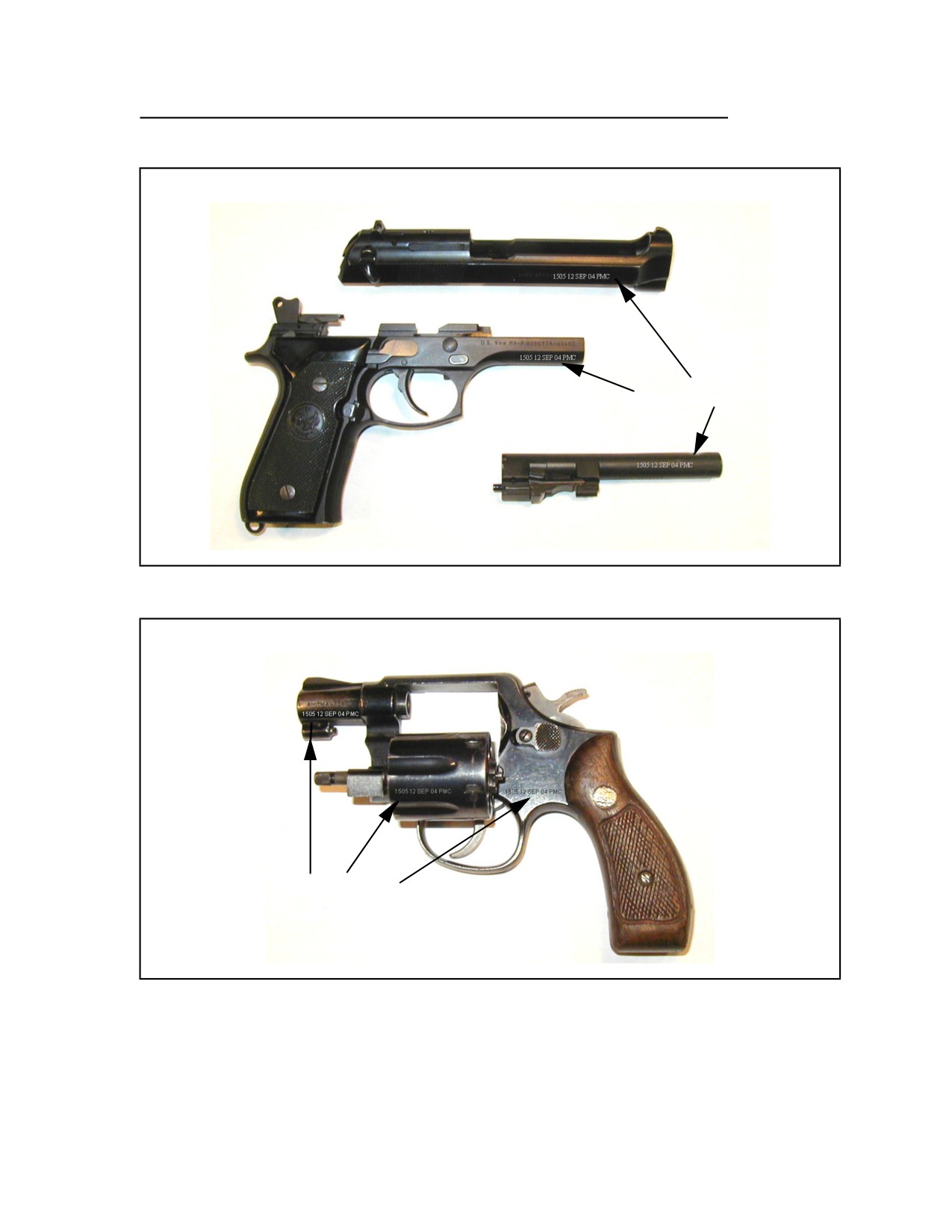
FM 3-19.13
Time, date, initials
Figure 21-1. Marked 9-Millimeter Pistol
Time, date, initials
Figure 21-2. Marked Revolver
The containers should be sealed with evidence tape or an equivalent. The
containers should then be marked with the date, time, and initials of the
individual doing the packing so they cross over the sealed tape. If the package
is opened before it arrives at USACIL, it will be apparent. Deformed
Firearms, Ammunition, and Toolmarks
21-3
FM 3-19.13
projectiles and jacket fragments must also be placed in a container and
marked as described above.
21-11. Cartridge cases are not marked. They are treated the same as
projectiles and then placed in containers. Shotgun shell cases, wads, or shot
columns are not marked. Shot pellets, such as bird shot and buckshot known
to be from one source can be placed together in a container. Containers should
be marked for identification.
EVIDENCE TRANSMITTAL
21-12. Unload the firearms to be examined at the USACIL before preparing
them for shipment. If a firearm cannot be unloaded, contact the USACIL for
advice and shipping instructions. Firearms may be shipped by US mail as
allowed by postal laws and regulations. Live ammunition, propellant powders,
primers, or explosives may be sent using a private shipping company, freight,
or courier. A local post office can be contacted for more information.
21-13. Firearms should be wrapped in a clean, protective covering. This
prevents dust, lint, and other foreign matter from filtering into the
mechanisms. They should be packed in suitable shipping containers. Special
packaging procedures should be used when the evidence is to be examined for
fingerprints. USACIL should be contacted for questions about packing or
shipping evidence.
21-14. Firearms should not be cleaned before shipping them to the lab. If
there is a lot of moisture in the firearm barrel, is should be removed (as much
as possible) to stop rust from forming. A single dry patch should be used. This
fact should be recorded in the investigator's notes and on the laboratory
request. A collection of rust makes it hard for the laboratory examiner to
conduct a comparison test. In special cases, when firearms must be cleaned,
the USACIL should be consulted and the cleaning patch should be sent to the
laboratory with the firearm.
21-15. All ammunition found in the possession of a suspect or at the scene of a
crime is seized and held as evidence. The laboratory may have enough
ammunition of the same type to use for test needs. The laboratory firearms
division should be contacted to learn if it has the right ammunition. If not,
arrangements should be made for the ammunition collected as evidence to be
sent to the laboratory with the firearm.
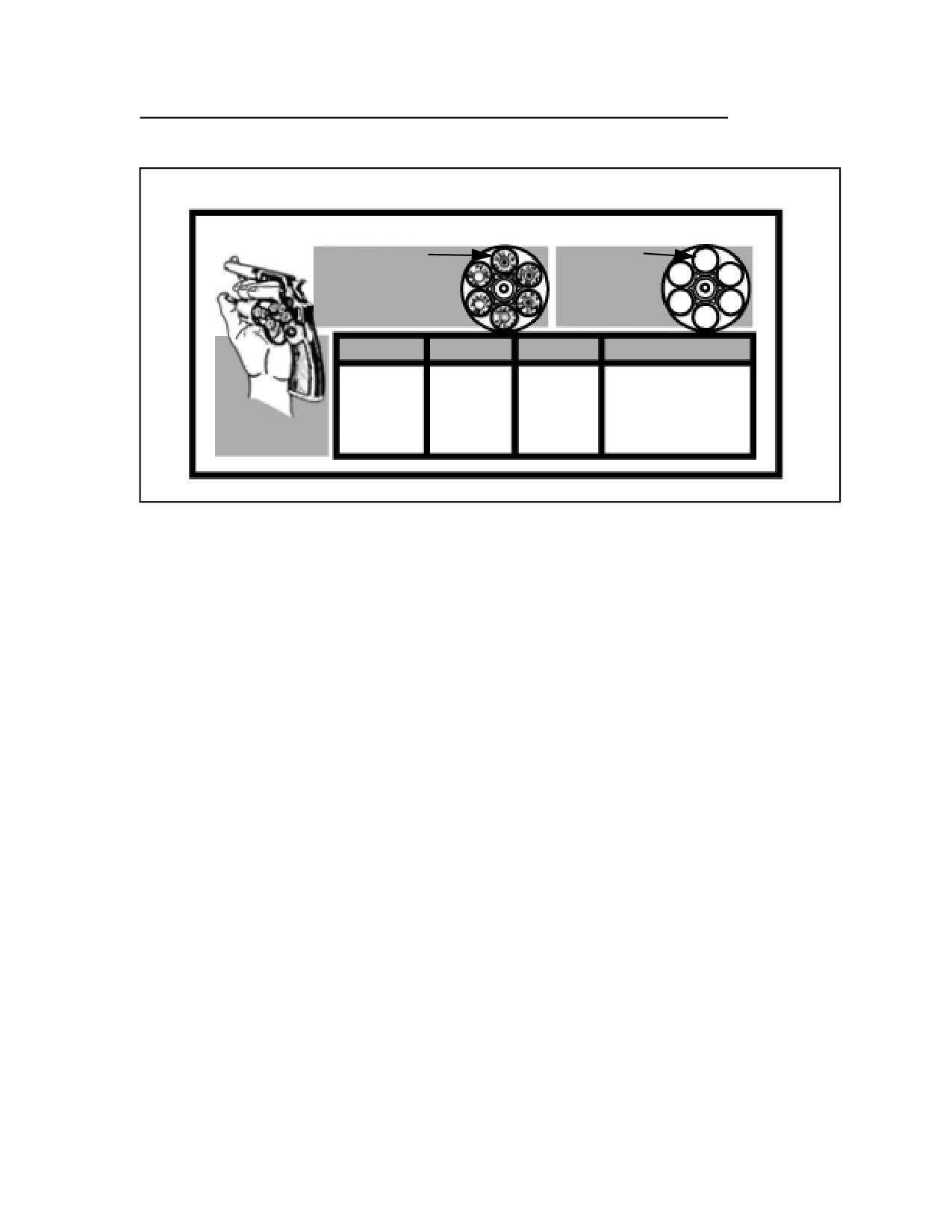
21-16. When revolvers having loaded cartridges or fired cases are obtained, a
diagram should be made of the rear face of each cylinder. The position of the
loaded cartridges or the fired cases should be shown with respect to one
another and the firing pin. An arrow should be scratched on each side or the
rear face of the cylinder (under the firing pin) to show the position that the
chamber was in when the revolver was found. This should be done on the
revolver and also on the diagram. The diagram, complete with legend, lets the
laboratory examiner relate the fired cartridges to the chamber of the cylinder
in which they were fired (see Figure 21-3).
21-17. Clothing items sent to the firearms division for proximity tests should
be packed so the area around the entrance hole in the garment does not
21-4 Firearms, Ammunition, and Toolmarks
FM 3-19.13
Cylinder mark
Cylinder
1
Scratch an arrow on the
diagram
rear face of the cylinder to
6
2
show the chamber position
under the hammer when
5
3
the weapon was recovered.
4
Investigator’s
Chamber
Condition
Marker
Mark
Position
CW/1
#1
Fired
US Cartridge Co
CW/2
#2
Fired
Remington Arms Co
CW/3
#3
Fired
Winchester Repeating Arms Co
CW/4
#4
Misfire
Dominion Cartridge Co
Facing rear
CW/5
#5
Loaded
Western Cartridge Co
CW/6
#6
Loaded
Peters Cartridge Co
of cylinder
Figure 21-3. Notation of the Position of the Cartridges in a Recovered Revolver
become contaminated. This is done by sandwiching the part of the garment
containing the GSR between sheets of cardboard or brown paper.
LABORATORY TESTING
21-18. Testing by laboratory examiners can provide the investigator with
information he is not able to determine by field examination. For instance, in
gunshot wounds, powder residues may be deposited either on the skin or
clothing. Only pathologists or other qualified medical individuals can give an
expert opinion on gunshot flesh wounds and their powder patterns. Only
laboratory examiners can give an expert opinion on powder residue in
clothing. By firing a suspect firearm and using ammunition of the type that
left the residue, a laboratory examiner can do tests to learn the approximate
distance from the muzzle to the target. These proximity tests are based on the
dispersion of gunpowder residues. They are, of course, subject to limitations. A
scaled photograph of the wound may be helpful to a firearms examiner who is
examining the clothing worn by the victim. Normally, with a muzzle to target
distance in excess of 2 1/2 feet, no discernible gunpowder residue pattern will
be present.
21-19. Sometimes a firearm has had a serial number or other die-stamped
lettering removed. Showing ownership or otherwise identifying the item may
depend on discerning the serial number. Restoration of serial numbers or
other identification data is performed at USACIL and should not be attempted
by the investigator.
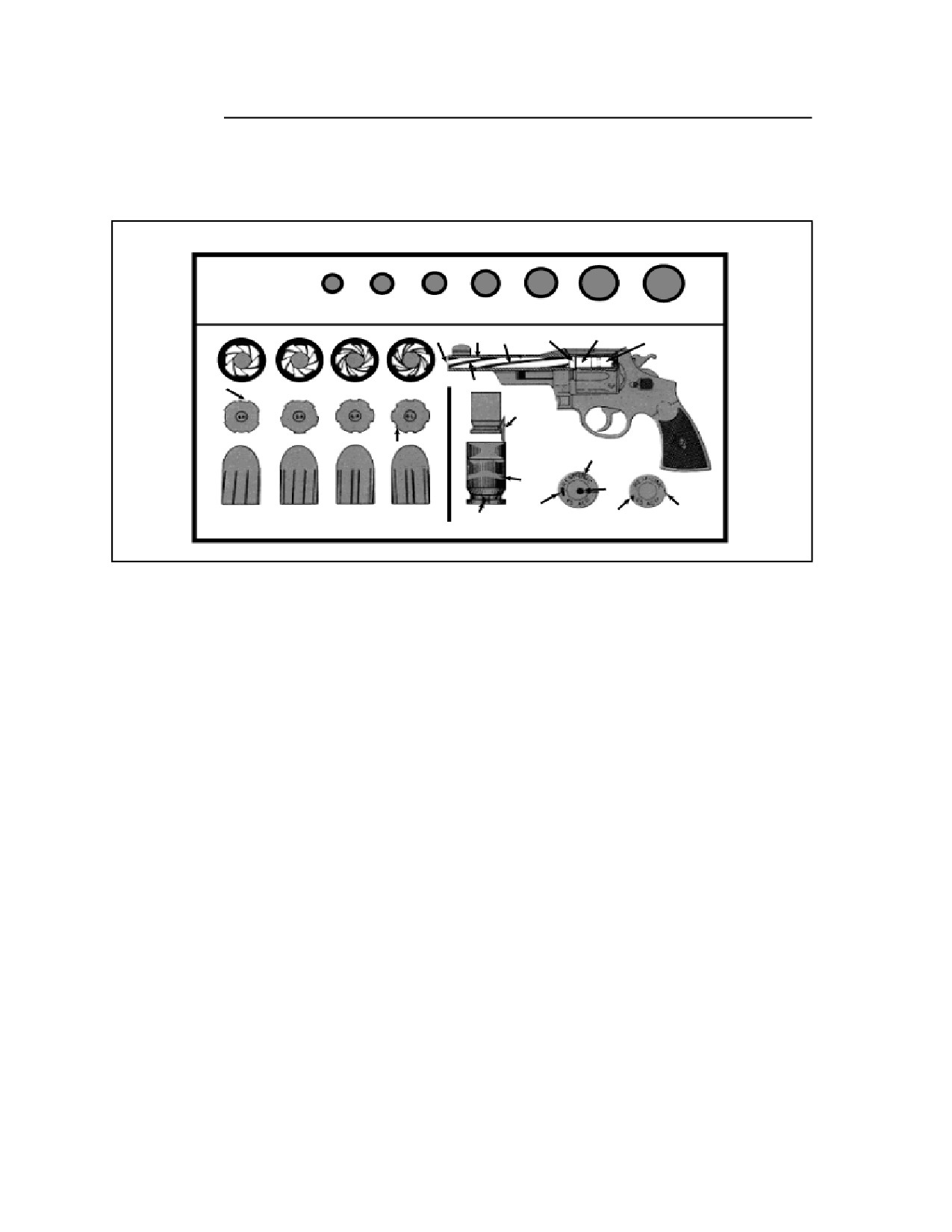
21-20. Often, the laboratory can examine a projectile or even a cartridge case
alone to learn facts of the class characteristics of the involved firearm. The
laboratory can tell the caliber and type of firearm (pistol, revolver, or rifle)
from which the projectile was fired. The number and width of lands and
Firearms, Ammunition, and Toolmarks
21-5
FM 3-19.13
grooves in the rifling and the direction of twist may also be provided (see
Figure 21-4).
Common Calibers
English
(inches)
.22 Cal
.25 Cal
.30 Cal
.32 Cal
.38 Cal
.44 Cal
.45 Cal
Metric
(millimeters)
(5.5 mm)
(6.35 mm)
(7.65 mm)
(8 mm)
(9 mm)
(11.3 mm)
(11.4 mm)
Barrel Rifling
MuzzleBarrel
GrooveForcioneChamberCartridge case
Land
Land
Bullet Cross Section
Extractor
engaging
shell rim
Bullet Side View
Groove
Cartridge Case
Breechblock traces
Circular
bulge of
Firing pin
case
crater
Ejector
mark
Right twist
Right twist
Right twist
Left twist
Ejector
Extractor
Extractor hook
four grooves
five grooves
six groovessix grooves
scars
Impressions of circular toolmarks on breech.
Figure 21-4. Class Characteristics of Firearms
TEST FIRING
21-21. If a firearm is sent to the laboratory with projectiles, cartridge cases, or
both, tests can be done to see if these components were fired from that
firearm. If the class characteristics of these components are consistent with
the characteristics of components fired from a firearm like the exhibit firearm,
test firing will be done. The test projectiles and cartridge cases will be
microscopically compared with the exhibit items. If there are numerous
firearms that are suspect in a case, it may not be wise to ship all the firearms.
In such cases, the supporting laboratory should be contacted for advice.
21-22. All firearms uncovered during the investigation of homicides, suicides,
assaults, and robberies should be submitted for function testing. The value of
learning if a firearm will function and if it functions safely is often overlooked.
It might be that a firearm could not have discharged accidentally as stated by
a suspect or that a particular firearm could not be of fired at all.
TOOLMARKS
21-23. A toolmark is an impression, cut, scratch, gouge, or abrasion made by a
tool in contact with an object. A tool can make a negative impression, an
abrasion or friction mark, or a combination of the two.
21-24. A negative impression is made when a tool is pressed against or into a
receptive surface. The mark made by a crowbar used to pry open a door or a
window is a negative impression. An abrasion or friction mark is made when a
tool cuts into or slides across a surface. A pair of pliers, a bolt cutter, knife, ax,
or saw can make this type of mark. A drill, a plane, or a die in manufacturing
21-6 Firearms, Ammunition, and Toolmarks
FM 3-19.13
could also make it. A combination mark is made, for example, when a crowbar
is forced into the space between a door and its facing and pressure is then
applied to the handle of the tool to force the door open. The forced insertion of
the crowbar makes an abrasion or friction mark. The levering action produces
a negative impression. The visible result is a combination of the two.
21-25. No two tools are alike in every detail. Thus, they will not leave
identical impressions. Tools may have obvious differences in size, width,
thickness, or shape. They also have minute differences that are only seen
when the tools are examined under a microscope. These minute differences
can be caused by manufacturing, grinding and finishing, uneven wear, and
unusual use or misuse. They may also be caused by accidents, sharpening,
and alterations or modifications made by the users of the tools. From these
minute differences, it may be possible to identify the tool that made a given
impression.
21-26. When a toolmark is discovered, it should be photographed with a
measuring device as soon as possible. It should always be photographed before
it is moved, disturbed, or altered in any way. Photographs provide a
permanent record of the evidence in its original state and location. They
match original evidence with any casts or molds made. They also satisfy the
legal need for records of original evidence.
21-27. The toolmark should be visually examined to note its gross
appearance. This can tell you what type of tool or shape of tool to look for. The
gross appearance of a tool impression may not be complete or well-defined.
For example, a hammer impression on a steel safe may not include the edges
of the hammerhead. Thus, the shape of the head cannot be shown. When this
occurs, all suspect tools that could have made the mark must be sent to the
laboratory to be examined.
21-28. The surface that bears the impression of a toolmark may have been
painted. If so, a careful check may show that flakes or chips of paint were
removed. The paint flakes may be sticking to the tool that made the
impression and can be compared to the paint from the impression surface to
determine possible common origin. If a tool is found with paint like that of the
painted surface and the flake patterns look alike, the paint pattern formation
should be photographed since some of the paint flakes may become dislodged
during transmittal to USACIL. Additionally, flakes of paint could have been
removed and transferred from a painted tool to the surface bearing the
impression. A trace-evidence examiner can examine paint flakes to determine
their origin.
21-29. A tool should never be placed into a toolmark to see if it fits or if it
could have made the impression. This could prevent any evidence on the tool
and its marks or the paint on the tool and the object bearing the toolmark
from being admitted in court.
21-30. Laboratory examination of toolmarks is based on the same principles
and techniques used for fingerprint and firearm identification. Tools leave
unique characteristic traces that cannot be exactly reproduced by any other
tool. In the lab, test marks are made with suspect tools on materials like those
on which the toolmarks are present. The test marks are then compared with
the suspect toolmarks under a comparison microscope.
Firearms, Ammunition, and Toolmarks
21-7
FM 3-19.13
21-31. Often, the laboratory will find that the suspect tool made the toolmark
in question. Such findings, however, are not always possible. Sometimes the
material on which the toolmarks are found does not record minor tool
imperfections. These imperfections are needed for positive identification of the
evidence mark. In such cases, the examination may yield other valuable
information that can be used as a lead for further investigation.
21-32. An examination of toolmarks without a suspect tool can also be of
value. Comparing the toolmarks found at each scene may link a series of
burglaries. A match of the lengthwise markings on two pieces of wire may
show that both were manufactured at the same time, having been drawn
through the same die during production. A suspect's possession of a piece of
wire that matches a piece found at a crime scene would show the possession
was more than accidental. Wood shavings from a drill, a plane, or another tool
that is able to produce wood chips may be matched with the tool producing
them.
21-33. The toolmarks present on a doorjamb, door, or safe should be checked
to ensure that they are sufficient to actually open the door. Sometimes, the
suspect will open the door with a key or combination and then close the door
on the tool to make it appear as if someone had broken in.
21-34. Each piece of evidence to be sent to the laboratory must be marked for
identification and wrapped separately. Evidence samples should not share the
same package unless all danger of mixing has been removed. Toolmark
evidence should be wrapped and packaged so that the toolmark and the tool
will not be damaged and trace particles will not be lost. The cutting blades or
tips of the tool should be covered to prevent damage. If the item to be
examined has to be removed by cutting, always mark the end that is cut and
the questioned end to be examined.
21-35. Original evidence is less subject to attack in court than reproductions.
Often, photographs and casts do not show the evidence well enough for
identification purposes at the lab. Some authorities recommend that casting
or other means of taking impressions of a toolmark should only be used as a
last resort. A casting is never as good as an original impression. This is
especially true of toolmarks made in soft materials like wood, putty, and
paint. Many of the casting media suited to these materials will not reproduce
the fine details needed for identification. An impression or a cast cannot
reproduce scratches in paint from minute irregularities in the edge of a tool. A
cast or mold should only be made from a toolmark when there is a good reason
for not removing the original evidence.
21-36. The investigator should decide if the original evidence that bears the
toolmark should be removed to send to the lab. This is a judgment call.
Sending original evidence to the laboratory is highly desired. But wholesale
removal of property or parts of valuable structures is not desired or needed.
The decision should be based on the importance of the case and the value of
the toolmark compared with other evidence at hand. The distance of the crime
scene from the laboratory should be considered. The tool-marked object should
be checked to see if it belongs to the US government or is civilian property.
21-37. If the evidence is civilian property, the investigator must contact the
owner to make arrangements to return, replace, or pay for the items removed.
21-8 Firearms, Ammunition, and Toolmarks
FM 3-19.13
He should ensure that competent witnesses are present during the removal of
the evidence. This prevents later claims against the US government. It also
verifies the original condition of the evidence.
21-38. If a toolmark can be removed to send to the lab, a piece of the object
large enough to keep the toolmark from splintering, bending, twisting, or
abrading should be removed. If the marked part of a door, window sash,
windowsill, or doorsill is removed, that portion of the window or doorframe
that is adjacent to the marked area should also be removed. Any window
latch, door latch, bolt, hasp, or lock that has been cut, broken, or forced for
entry should be obtained. Any tools found at the crime scene must also be sent
to the laboratory with the toolmarks.
21-39. Each item of evidence should be clearly marked with the case number,
initials, and the date and time of removal. The evidence should also be
marked to show the inside, outside, top, and bottom surfaces and the area
bearing the toolmark. If the surface bearing the toolmark is painted, samples
of the paint should be sent to the lab. Even though paint could not be seen on
the tool, enough particles may be present for analysis and comparison at the
lab. Since some tools are also painted, there may be paint from the tool on the
toolmark surface. This can also be compared for possible common origin.
21-40. The angle at which the tool was held when it made the mark could be
known. If it is, all information that can be provided on the various angles
formed by the tool when it was used will greatly help the examiner. The
details of the incident should be given to include the measurements of the
toolmarks from the floor. If a window was involved, the details should include
its location (such as in the basement, first floor, or second floor).
21-41. A toolmark may be on metal and not removable. Samples of the metal
should be taken and sent to the lab. Particles of metal may adhere to the tool
in addition to the paint. The metal particles can be analyzed and identified by
the laboratory examiner.
21-42. If cut pieces of wire are to be sent, the suspect end of the wire should be
clearly marked. When cutting the wire to send to the lab, it should not be cut
with the suspect tool. Matching the cut ends of wire can help identify related
items. For instance, if the owner cannot positively identify a stolen automobile
radio, matching a radio wire to the wire attached to a car can show it to be
originally from that vehicle. Toolmarks also appear on rubber tires. These
marks can be successfully matched the same as any other toolmarks.
SERIAL NUMBERS
21-43. Serial numbers are placed on many manufactured objects to
distinguish one item or model from another. Serial numbers may consist of
numerals, letters, symbols, or a combination of the three. Serial numbers are
often the only way to show ownership. Items with serial numbers can often be
traced from the manufacturer to the wholesaler and on to the jobber, the
retailer, and (finally) the purchaser.
21-44. Owners of items lacking manufacturer's serial numbers often place
their own marks or serial numbers on the items. This helps identify the item if
it is stolen.
Firearms, Ammunition, and Toolmarks
21-9
FM 3-19.13
21-45. Serial numbers or private marks may be stamped, molded, etched, or
engraved. Some items, such as automobiles, firearms, and watches, bear
serial numbers on several parts. If an object is found and the serial numbers
seem to have been removed, the object should be searched for other numbers.
Such numbers are often found in hard-to-find places.
21-46. Military services buy in large quantities. Often, they do not initially
record individual serial numbers. Lot numbers and shipping and receiving
documents account for the shipments. Sometimes other means are used to
speed the movement of supplies. Often, the manufacturer of a serially
numbered item can give the lot number. The manufacturer may also have
data of other recorded items bought by military services. As the bulk shipment
is broken down for issue to units, the serial numbers are often used for records
and identification. Lot numbers or shipping document numbers often narrow
the search to the unit of ownership.
21-47. There is no easy way to know if a serial number that has been removed
can be restored, and there is no method that can be used in the field to find
out. The laboratory can determine whether or not a serial number can be
restored. All items that seem to have had the serial numbers removed should
be sent to the lab.
21-48. Neither the material from which an item is made nor the method used
to affix the serial number automatically preclude restoration. Serial numbers
have been restored under the most adverse conditions. Conversely, restoration
attempts have failed when conditions seemed most favorable.
JEWELER’S MARKS
21-49. While jewelers' marks are not serial numbers, their use in tracing
stolen property can be of value. When an item is given to a jeweler for repair,
it is common practice for the jeweler to place a small, identifying mark in a
hard-to-see place on the item. This mark is often inscribed with a very fine
engraving tool. The mark is engraved under magnification. Therefore, the
mark is often visible only when viewed under equal magnification.
21-50. Jewelers in the same location often know each other's markings. When
a mark is found, an attempt should be made to locate the jeweler who
inscribed it. The jeweler may be able to identify the person who brought the
item to the jewelry shop.
21-10 Firearms, Ammunition, and Toolmarks
Chapter 22
Impressions and Casts
Footwear and tires are highly complex and precisely engineered. Features
that are incorporated into the manufacture of footwear and tires can
become very useful in impression examination. Logos, lettering, numbers,
or other markings may be clues to the brand, style, or manufacturer.
Expert examiners take advantage of these unique aspects of footwear and
tires to place or eliminate individuals at crime scenes. It is what occurs to
the footwear and tires after they are put into use that makes them
individual and highly identifiable. It is the individual wear and damage to
the friction surfaces, which makes every footwear and tire unique.
FOOTWEAR AND TIRE TRACK IMPRESSIONS
22-1. One of the most overlooked types of evidence at the scene of a crime is
footwear and tire track evidence. Due to the lack of awareness and training in
the collection and preservation of footwear and tire track impressions, most
crime scene investigators do not give proper consideration to this type of
evidence. Fortunately, criminals also forget the importance of this evidence.
Criminals have long recognized the need to protect themselves from leaving
fingerprints at the scene of a crime by wearing gloves, but often forget about
footwear and tire track impressions. Generally, perpetrators do not
intentionally destroy these types of impressions.
22-2. Crime scenes generally contain numerous footwear and tire track
impressions from witnesses, police, fire, and medical responders. Neither the
volume of impressions present nor the trampling of the crime scene preclude
the perpetrator's footwear or tire track impressions from being found and/or
identified. Successful identification is often made solely from partial
impressions. Many times footwear impressions are not visible in existing
ambient light conditions. Proper lighting and search techniques can assist in
locating valuable impression evidence. Most surfaces are conducive to
footwear impressions. Surfaces such as rough, uneven carpeting or even
masonry should never be discounted without proper examination. Although
poor weather conditions can destroy some impressions, this should not be
accepted as fact in all cases. Excellent footwear impressions can still be found
in mud puddles, under fallen snow, below the overhang of a house, under
shrubs, and in numerous other hiding places.
IMPRESSION SEARCHES
22-3. When searching for impressions, a system should be used to ensure that
the entire crime scene area is covered to include a search beyond the scene.
One small area at a time should be searched in a systematic way, such as
Impressions and Casts
22-1
FM 3-19.13
using a grid search or concentric circle search. Also, looking at the crime scene
from an overall perspective or even from overhead should be considered.
Sometimes this could mean using resources such as helicopters to view a field
or large area where tire tracks are suspected or entry and/or exit routes are
not obvious. Getting above the scene can give a different perspective of the
area. Impression evidence normally requires the investigator to view things
from a particular angle with particular lighting before it is revealed or can be
seen from the best vantage point.
LIGHTING TECHNIQUES
22-4. Existing lighting conditions should be used first to detect obvious
footwear impressions. Especially those made in some form of contaminant,
such as blood, grease, mud, and other visible residues. Each impression
should be marked when it is located using a system of placards, signs, or
labels with some form of alphanumeric designator that is easily seen in a
photograph and identifiable. The area should be darkened, if possible, and
searched using a bright, intense light at an oblique, side-lit angle. The light
source should be held just above and parallel to the surface being searched.
Raising and lowering the light will cause the shadows to fall differently in the
impression and allow for adjustments for the best possible visualization of the
impression. The rule is the deeper the impression, the higher the angle
required for best visualization. A portable floodlight is most effective;
however, a bright flashlight will also work well. Remember, an investigator is
normally searching for residue or dust impressions, which are not visible in
normal room light. A search using oblique lighting is an excellent technique
for detecting impressions on smooth surfaces, such as flooring and furniture.
Impressions on carpeting or other rough or porous surfaces may still be
invisible even with the oblique light. An electrostatic lifting device may be
required to search these types of areas for dry-residue impressions.
CHEMICAL SEARCHES
22-5. Chemical searches are often necessary to detect and develop latent
footwear impressions at crime scenes, such as faint blood impressions. In this
case, the floor or substrate needs to be removed where impressions are
suspected and then sent to the laboratory for processing. In some instances,
on-scene assistance from laboratory personnel may be necessary. Each case
offers its own unique set of circumstances.
FOOTWEAR AND TIRE TRACK SEARCH AREAS
22-6. When searching for footwear or tire track impressions, there are specific
areas that an investigator should search. They are identified as follows:
z
Areas to search for footwear impressions include—
The point of entry (both interior and exterior).
The path traveled from the point of entry to the area where the
crime occurred.
The immediate area where the crime took place.
The path traveled from the area where the crime occurred to the
point of exit.
22-2 Impressions and Casts
FM 3-19.13
Other areas where the perpetrator may have walked to include
beyond the scene.
The point of exit (both interior and exterior).
z
Areas to search for tire track impressions include—
The route traveled to the location where the crime occurred.
The area where the crime took place.
The route traveled from the location where the crime occurred.
Any other areas where the suspect vehicle might have traveled or
parked.
NOTE: Searches beyond the scene can sometimes reveal areas
where a vehicle has paused waiting for an accomplice or where a
vehicle has been parked to hide it until it was needed.
IMPRESSION COLLECTION AND PRESERVATION
22-7. Collecting and preserving footwear and tire track impression requires
special attention and care. Impressions can be easily damaged or destroyed.
CRIME SCENE IMPRESSIONS
22-8. Footwear and tire track impressions are collected and preserved using
the same methods and techniques. Footwear and tire track impressions are
extremely fragile in nature. Environmental elements, improper safeguarding
of the scene, time, and improper processing and collection techniques can
often destroy this type of evidence. Impressions must be collected and
preserved as close to their original state as possible to be useful. The evidence
should be protected from destruction by natural elements or accidental
damage by covering it with a trash can lid, a cardboard box, or another
suitable object. Large areas may have to be roped off, and guards may need to
be posted. A suspect's footwear should never be placed in or near a crime scene
impression because it could contaminate the crime scene impression and
jeopardize its integrity, making future findings invalid.
PHOTOGRAPHY
22-9. Photography establishes the integrity of the evidence and is one of the
best techniques for capturing and preserving impressions. There are two types
of photography necessary to record crime scene impressions: general crime
scene photography and examination-quality photography.
z
General crime scene photography. This includes long-range
photography, which means shooting overall photographs of the entire
scene where the impression is located. Footwear or tire track
impressions at the crime scene are marked and a general overall
photograph is exposed depicting the location of the impression in
relationship to the remainder of the scene. General photography also
includes medium-range or establishing photography (a photograph of
the impression as it relates to a specific area of the scene or other
pieces of evidence). General photography is used to help show the
direction of travel and position in relation to other impressions.
Finally, a close-up is taken of the overall impression showing its
Impressions and Casts
22-3
FM 3-19.13
appearance at the scene. Digital photography may be used for general
photography.
z
Examination-quality photography. This includes close-up
photography of footwear and tire track impressions that will be used
by an evidence examiner for evaluation, comparison, identification,
and verification. All examination-quality photographs must be taken
with a film camera. Never use digital photography for close-up or
examination-quality photographs. At present, digital cameras do not
produce the resolution needed for examination-quality photographs.
For this type of photography, a 35-millimeter film camera with an off-
camera flash is required. It is recommended that a 35-millimeter
camera be used with ISO 100 black and white film. If black and white
film is not available, use ISO 100 or 200 color film. Never take a
photograph of footwear or tire track impressions without a tripod, a
scale, and a flash. The camera should be focused on the impression;
the impression should fill the entire frame. This allows for the
greatest possible resolution when enlarging photographs.
Photography considerations include the following:
Proper camera position. A tripod is absolutely necessary for
examination-quality photography. Many investigators mistakenly
assume that they can handhold a camera steady enough for
examination-quality photographs. When the image is enlarged,
the distortion caused by any slight movement is exaggerated and
becomes obvious. The camera should be placed on a tripod directly
over the impression. This sometimes requires inverting the center
rail of the tripod so that the camera can be mounted underneath.
The back of the camera or the film plane should be parallel to the
impression to avoid distortion and allow for the greatest possible
resolution when enlarging photographs.
Scales and labels. A measurement scale or ruler must always
appear in evidence photographs. A scale or ruler allows for the
photograph to be enlarged to the exact scale of the impression for a
one-to-one comparison. Ink pens, coins, or business cards, for
example, should not be used. The scale must be placed on the
same level and as close as possible to the same plane as the
impression. An L-shaped measuring device that measures the
length and width will produce the most useful results. The same
label or marker used in the overall photographs should be placed
in the picture with the scale to identify which impression is being
photographed.
Lighting. Oblique lighting should always be used because it
provides the greatest amount of contrast by casting shadows in
the impression, thus capturing better details. In order to obtain
this shadowing, the flash should be detached from the camera and
used through the flash extension cord. Using a flash mounted on
the camera does not produce detailed images. To obtain the
oblique lighting required, the flash should be held at about a 45°
angle and about 3 to 5 feet to one side of the impression.
Depending on the depth of the impression, this angle may vary
(the deeper the impression the greater the flash angle).
22-4 Impressions and Casts
FM 3-19.13
Photographs should be taken with the flash held at four different
directions from the impression. North, south, east, and west
directions will provide sufficient shadow variances to yield the
best details. A shadow indicator (such as a thumbtack, an ink pen,
or a golf tee) should be positioned in the shot to allow the
examiner to determine the direction the light is coming from. This
aids the examiner in his comparison work. If suitable conditions
do not exist in the ambient light of the scene (such as too much
direct sunlight), a shadow should be cast over the impression with
a large piece of cardboard or other suitable material and then
illuminated by using an electronic flash.
SPECIAL CONSIDERATIONS FOR TIRE TRACK IMPRESSIONS
22-10. Investigators should be familiar with the information printed on the
sidewalls of tires. This information can be crucial in identifying a particular
tire. See Appendix H for a complete discussion on how to read a tire sidewall.
22-11. Tire track impressions are dealt with in much the same manner as
footwear impressions. If tire track impressions are short, the entire
impression should be cast. Longer impressions should be cast in sections that
are no longer than 3 feet to prevent breakage during shipment to the
laboratory. One good 3-foot cast is often sufficient to identify the impression of
a specific tire. The likelihood of identifying a tire track to a tire increases with
the amount of cast evidence submitted. Casts should be made of each found
tire track found.
NOTE: Testimony regarding combinations of designs taken from a set
of four tire track impressions at the crime scene corresponding to the
designs of a set of four tires from a suspect's vehicle is of obvious
value.
22-12. Suspect tires should be sent to the lab with the casts. The rims should
be left on the tires and the tires should be inflated at the same level as when
they were collected. The lab may need to make test prints with the tires and
additional information will be necessary. Each tire sent should be identified as
to the wheel position and the type of vehicle from which the tires were
collected. Sketches, photographs, and other notes should be used to show the
tire positions. Often, digital photographs of the tire track impressions and the
tires on the suspect vehicle can be emailed to the laboratory in advance of the
laboratory request to determine the evidential value of the suspect tires. This
screening process saves time, effort, and shipping costs.
TWO-DIMENSIONAL IMPRESSION LIFTING
22-13. Two-dimensional footwear or tire track impressions should only be
lifted when the item bearing the impression cannot be readily removed from
the crime scene: for example, footwear impressions on doors or vehicles;
footwear impressions on immovable or heavy objects; a dusty tire track
impression on a garage or warehouse floor; or any impression on a heavy,
bulky, valuable, or sensitive surface or item. Impressions should also be made
when it is not cost effective to forward the item to the laboratory. Coordination
Impressions and Casts
22-5
FM 3-19.13
should be made with USACIL before the collection and shipment of this type
of evidence.
22-14. There are various methods available for lifting two-dimensional
impression evidence. The following are the preferred methods:
z
Electrostatic dust print lifter. An electrostatic dust print lifter is a
device used to make electrostatic lifts of dry substances, such as dust,
powder, and other lightweight dry residues and debris deposited in
impression evidence. It works on the principles of static electrical
charges. A piece of statically charged Mylar® film attracts the dust
particles to the film, collecting the impression. It is a highly effective
method of collection and renders excellent detail suitable for
identification. An electrostatic dust print lifter can be used on porous
or nonporous evidence. Again, the surface must be dry. Electrostatic
lifting is considered to be nondestructive and may be used for
searching as well as for collecting. Blind searches can be made by
laying out the film over an area suspected to contain latent dust
impressions, charging the film, and examining the lift. This works
well on carpeted entrance and exit ways. Lifts can be made of vertical
surfaces as well, such as on doors and walls, by simply taping the film
to the surface and lifting as normal. Electrostatic lifts are very fragile
in the sense that the film holds much of its charge even after the
collection process and continues to attract dust and particles, which
can obscure the impression. The film must be placed in a suitable box
and sealed as soon as possible to prevent damage. A flat, sturdy box
(such as a photographic paper box, shirt box, or clean unused pizza
box) is recommended for collection of this type of impression. The box
must be wiped out before use to clean away dust or paper residue.
Place the film silver-side down and the impression side up into the
bottom of the box. Secure the film to the bottom of the box by taping
down its four corners. Close the box and tape shut all the edges of the
boxes, making it nearly airtight.
z
Gelatin lifters. Gelatin lifters, also called gel lifters, should only be
used after photography and an electrostatic dust print lifter has been
considered. Gelatin lifters differ from typical fingerprint lifters and
are excellent for footwear impressions. They are made with reduced
adhesive properties and can be used successfully on fragile surfaces.
They are soft and pliable and can lift good detail from rough surfaces.
In fact, they can lift an impression from newsprint without tearing or
sticking to the paper. An investigator must be aware of the contrast
issues when choosing the appropriate color of lifter. If the footwear
impression is in dust, the black gel lifters are the best choice. If the
impression is in a darker substance, use the white.
z
Standard lifters. Most standard lifters are not very useful in lifting
footwear impressions because they are normally too small to
accomplish the job. There are some products that are specifically cut
to footwear size but are too tacky and the backing is too flimsy causing
too many air bubbles and distorting the impression. Rubber footwear
lifters are sufficient for lifting footwear impressions and come in a
variety of colors and sizes. An image it always in the reversed position
22-6 Impressions and Casts
FM 3-19.13
after using opaque lifters to lift it and must be reversed at the
laboratory using photographic techniques.
z
Chemical processing. An arsenal of chemical processing techniques
is available to develop impressions. However, trained laboratory
personnel must perform all chemical processing of impressions in an
approved laboratory facility. Laboratory examiners and technicians
are trained to use many types of chemical processes in a safe and
efficient manner. The premature or improper use of chemical
processes in the field will result in the loss and/or damage of footwear
impressions. Most chemical processes are fugitive in nature, meaning
that once the prints are developed with chemicals in the field, they
will fade and often disappear before proper photography and
comparison of the evidence.
THREE-DIMENSIONAL IMPRESSION CASTING
22-15. When casting a three-dimensional impression, there are several steps
to consider. The first step consists of preparing the impression without
contaminating or destroying it while the last step consists of annotating
identifying data.
PREPARING IMPRESSIONS
22-16. To obtain a good cast, it is sometimes necessary to prepare the
impression. The impression should always be photographed first. When the
impression is located outdoors, it should be determined whether any debris
might have blown into it. Debris should be removed carefully using a
pocketknife or tweezers. Do not attempt to remove debris that is part of the
impression or was present when the impression was made. When impressions
are made over rocks, sticks, or other debris, excellent reproduction or detail
can be adjacent to these items. If a loose leaf or twig has managed to fall into
the impression after it was made, it can be carefully removed.
22-17. In some cases, an investigator may want to make a practice cast of his
own impression before trying to make the evidence cast to determine the
strength of the ground. It may be necessary to strengthen the soil in which the
impression is found by spraying it with a plastic spray or lacquer. Hair spray
and spray paint may also be used. Spraying directly on the print may damage
individual characteristics used to effect identification. Instead, the spray
should be directed against cardboard or other material so that a fine mist
settles gently into the print. It should then be dried and sprayed again. The
number of coats required can be determined by examining the test print.
Three to ten coats are not unusual in sandy soil. Thin coats are better than
heavy coats, which can damage the impression.
CASTING DENTAL STONE OR DENTAL COMPOUND
22-18. Since 1986, dental stone, dye stone, or other stone-based products have
been the recommended material for making casts of footwear and tire track
impressions. Materials with the word “plaster” in the title should not be used
to cast impressions as they are too soft, are much harder to work with, and dry
very slowly. Dental stone is much more durable and stronger than other
Impressions and Casts
22-7
FM 3-19.13
casting materials; it dries faster, captures greater detail, does not require
reinforcement materials, and does not require frames. Dental stone is readily
available from local dental supply companies or military dental facilities in
emergency situations.
MIXING DENTAL STONE
22-19. Dental stone can be premeasured and stored in large ziplock bags. It
takes 6 ounces of water to every 1 pound of dental stone. A footwear
impression requires about 2 to 3 pounds of dental stone and 12 to 15 ounces of
water. A good measuring device for the proper amounts of water is the use of a
beverage can, which typically holds 12 ounces. Large batches are
recommended for casting tire tracks. Dental stone is very forgiving. If the
mixture is too dry, water is simply added. If the mixture is too wet, more
dental stone is added. The water is simply poured into the ziplock bag of
material and the two are mixed inside the zip-lock bag and kneaded until the
mixture is about the same consistency as pancake batter. Some water may
need to be added if the mixture is too thick. A little too thin is better than too
thick. This technique should be practiced before actual impressions are
collected.
POURING DENTAL STONE INTO THE IMPRESSION
22-20. When using dental stone, forms are seldom required as long as the
surface is somewhat level. A partial form can be used to control the flow of
castings on the lower side if the impression is on a slope. Normally, the
material can be poured and shaped by directing the flow. The dental stone will
often act like pancake batter confining itself by its volume. If the dental stone
is mixed in a plastic bag, cut or tear off the bottom corner and allow the
mixture to flow out the hole. The mixture should not be poured directly into
the impression. The mixture should be poured by holding the opening at
ground level next to the edge of the impression on the high side and allowing
the mixture to flow onto the ground and into the impression. Pieces of
cardboard or other stiff materials can be used as a deflection panel to slow the
flow of liquid from damaging the impression when pouring the cast. Once the
entire surface of the impression is covered, it should be overfilled gently with
any excess material to build the thickness of the cast for strength. If
necessary, a second batch can be poured directly over the first.
COMPLETING THE CAST
22-21. After pouring, but before it dries, the cast should be marked for
identification. The data can be written into the surface of the cast using a
paper clip, toothpick, or similar item to make a permanent marking. The
minimum data should be the investigator's initials and the time and date. If
known, the case number should also be inscribed. An arrow indicating north
may be inscribed to help determine the relationship of this evidence to other
evidence, and the arrow could help to prove the direction of travel. If more
than one impression is being collected and they were marked for photography,
that identifying number or letter used should also be annotated on the cast. A
typical footwear cast can dry enough to be collected in approximately 30 to 35
minutes. After collection, the cast should be allowed to dry another 72 hours
22-8 Impressions and Casts
FM 3-19.13
before packaging and shipping to the laboratory. The cast should not be
cleaned; only bulky clods of dirt should be removed. The dirt aids in protecting
the cast during handling and shipment. Furthermore, cleaning techniques
and equipment can damage and scratch the surface of the cast rendering it
useless and destroying its individual characteristics.
SNOW CASTING
22-22. There are many ways to collect impressions in snow. One of the best
methods (also the easiest and quickest) is to spray the impression with a spray
wax made specifically for impression recovery before photographing. After
fixing the impression with the spray wax, the required photographs should be
taken. The spray wax will allow for better contrast in the photograph. A single
can of spray wax is normally enough for about three impressions. The spray
wax should be cured for approximately 15 minutes before the dental stone
mixture is poured into the impression. Water that is as cold as possible should
be used to mix with the dental stone for the best results. One trick is to set a
bucket of water in the snow while working and add snow to the water until the
snow stops melting. This is a good indication that the water is cold enough not
to melt the snow in the impression. The dental stone should be poured into the
impression and not off to the side as in other impressions. If it is poured off to
the side, especially if the snow is deep, the impression could cave in, allowing
the material to find the path of least resistance into the snow. The cast should
be dried and then removed from the snow. The snow should not be removed
from the cast; it should be allowed to melt away and then air-dried indoors for
72 hours before packaging for shipment to the laboratory. If spray wax is not
available, any contrasting spray paint can be used to highlight the print for
photography. The spray paint helps to seal the impression for casting the
same as the spray wax.
WATER CASTING
22-23. It is very possible to cast an impression that is submerged beneath the
water, especially in puddles of water and at the edges or banks of a lake or
stream. Sometimes it is possible to dam around the impression and siphon off
most of the water. Experience shows it is not a good idea to siphon away all of
the water because the water sometimes acts as a stabilizer for the impression.
If possible, a form should be placed around the impression extending above
the waterline. The form should not be placed so close to the impression that it
will disturb or destroy the impression. After removing as much water as
possible, dry dental stone should slowly be sprinkled over the impression,
allowing it to precipitate down through the water and into the impression. A
flour sifter or large saltshaker can help evenly disperse the dental stone. This
process should continue until the cast begins to build up. Approximately one
inch of dental stone should be allowed to settle into the impression. A separate
mixture of enough dental stone material to cover the entire framed area
should be prepared. The mixture should be poured into the framed area of the
impression, displacing the water from the impression. The casting material
should have two hours of drying time before it is removed. The cast should be
fully dried before shipping to the laboratory for examination. The cast should
not be cleaned.
Impressions and Casts
22-9
FM 3-19.13
CRIME LABORATORY SUBMISSION
22-24. Casts must be carefully packaged since they are fragile evidence. One
of the most important considerations in sending a cast to the laboratory is
ensuring that the cast is completely dry. Casts that are not dry may develop
fungus and subsequently deteriorate. Casts should not be packaged in plastic
wrappings, just dry paper. Plastic promotes moisture and moisture promotes
decay. Other packaging considerations are the same as for preparing evidence
to be sent to the laboratory. However, the outer packaging should state, “Do
Not Refrigerate” as refrigeration damages the cast. Submit all shoes, tires,
and casts on a chain of custody. The impression film does not have to be on a
chain of custody.
22-10 Impressions and Casts
Chapter 23
Questioned Documents
For many investigations, a document or a document-related item becomes
evidence of the crime or about the person who committed the crime. Often,
a document is the instrument of the crime.
OVERVIEW
23-1. The Questioned Document Division, USACIL, conducts forensic
examinations of document evidence. Examinations commonly conducted
include handwriting and handprinting comparison, alteration and
obliteration examinations, typewriting examinations, photocopy
examinations, and other nonchemical examinations relating to document
evidence.
EVIDENCE COLLECTION
23-2. The investigator should take notes about the process when collecting
evidence involving a questioned document. The notes will later help refresh
the investigator's memory if he is called to testify. The investigator should
note the place, time, and date he collected the document. He should also note
the name of the person he received the document from and how it was
marked. Information about the history and contents of the document should
be included. Later the investigator may add notes about the handling and
disposition of the document. All of this information may be of value later in
the investigation or in court.
23-3. The questioned document must be identified so it will not be confused
with other documentary evidence. The document should be marked to identify
it at a later date. The investigator should examine it to find a good place to put
his initials and the time and date. He should use care in choosing this
location. The identification data should be as inconspicuous as possible. It
should not, in any way, interfere with any writings or impressions on the
document. A corner on the back of a document is most commonly used. The
investigator should remember to note in his records how and where it was
marked.
23-4. Questioned documents must be protected from damage. A questioned
document should never be folded, crumpled, or carried unprotected in a
pocket. It should be placed in some sort of protective cover. It is best to use a
paper envelope in which the document easily fits. The container should be
made to fit the document. The document should not be folded to fit the
container. Its evidence tag should be attached to the outside of the envelope.
There should be no writing on the envelope with the document inside (see
paragraph 23-41). When shipping to the lab, enough heavy wrapping material
Questioned Documents
23-1
FM 3-19.13
should be placed around it to stop it from being bent, torn, or folded in transit.
With torn documents, the pieces should be placed in a protective covering and
placed in the most obvious and logical positions. Transparent plastic
document protectors are not suitable for use with some document materials.
They should be used with caution, if at all. Typewriting made with a carbon
ribbon and the toner on some photocopies may stick to the plastic and be lifted
off the paper.
23-5. Questioned documents often represent valuable transactions.
Sometimes they can be used as evidence for a victim in a civil suit to recover
losses suffered because of a fraudulent transaction. The victim will need
assurance that the document will be returned after the case is complete. The
investigator should give a property receipt to the person who gives him the
document. He should ensure that the receipt describes the document in
enough detail to permit future identification. It should not have statements as
to the value of the document. The description should be limited to the physical
aspects of the document. Similar receipts should be given for any other items
like pens, pencils, or paper that the investigator collects.
23-6. The document may need to be examined for fingerprints. The
investigator should handle it with tweezers or cloth gloves so his fingerprints
are not added. The document should not be subjected to any strong light for
prolonged periods. But it may be viewed with a UV light for a short time to
compare or contrast its fluorescence or reflectance with other similar
documents or possible paper sources. Documents should be handled so that
any indented markings are not destroyed or added.
23-7. The investigator should make copies of the questioned document for use
during the investigation. The original must then be placed in the evidence
depository until the lab requires it for examination. Photocopying and
photographing are acceptable methods for making copies. The investigator
should avoid feeding the document through any kind of sheet-feeding
mechanism. This could result in damage to the document.
INTERVIEWS
23-8. The investigator should question all persons affected by the document.
For example, in a case concerning a forged check, the investigator should
question the cashier or the teller who accepted the check, the person whose
signature had been allegedly forged, and a representative of the bank on
which the check was drawn. Any bank, business, or other organization that
will be affected by the questioned document should be contacted. Information
about past dealings with the person whose signature was allegedly forged may
give helpful clues. Other incidents in which the same forms or method of
operation were used may be discovered.
23-9. If the document was prepared or signed in the presence of a witness, the
witness should be questioned about the method of preparation. These
questions should include the following:
z
Was it written with the right or left hand?
z
Was it written quickly or slowly?
z
Was it written on top of other papers or on a hard surface?
23-2 Questioned Documents