FM 3-19.13 LAW ENFORCEMENT INVESTIGATIONS (JANUARY 2005) - page 7
FM 3-19.13
are filled out in pencil. Thus, they could be erased. But most of the time, the
perpetrator makes new pages because the items are not authorized or are not
authorized in the quantity ordered under the TOE or TDA of the unit.
INVESTIGATIVE APPROACH
15-29. The first step in investigating supply fraud is to identify the supply
system in which the fraud or theft occurred. Then determine if the system is
at the retail (installation or organization) or wholesale (depot or
manufacturer) level of the US Army logistical system. Determine if the system
is manual or computer-automated. Manual and automated systems use the
same forms, but their operational principles differ at the local level. The
manual system uses a property book reflecting TOE and TDA equipment on
individual property pages. The automated system uses computer listings
reflecting all authorized and on-hand equipment on a single printout.
15-30. After determining the system from which a supply item is missing,
review the supply transaction register, called a document register, and see
which unit or organization requested the item. Obtain the document number
of the requisition. Then carefully follow it through the audit trail. Check each
level of the supply system furnishing material to the supply activity that has
physically issued and shipped the item to the requestor. Obtain a copy of the
request at each step of this initial investigative path for backup. Then begin
following the issue trail that leads from the supply activity that was the issuer
to the requestor or user. The points along the path of issue will reflect at what
point the item was taken from US Army control. Obtain copies of all requests
for issue, issue documents, shipping reports, or the like of. When the
investigator has copies of all these documents, continue the investigation as if
investigating a larceny.
15-31. Not all supply frauds occur as diversions from a supply system. Many
items are reported stolen from a storage area. To investigate the loss, obtain
the supply documents verifying that the items were physically present at the
activity reporting the loss. Determine the inventory procedures of the activity.
Then establish the time frame extending from the date when the items were
last seen at the activity to the date when the loss was noted. If the items were
last present at an inventory, apply larceny investigative techniques and
procedures to find the perpetrator. If the items were known to be missing
before the last inventory and they were carried on the inventory as being on
hand, the provisions of AR 735-5 apply. The property book officer must make a
ROS. Be aware that inventory shortages are often reported as supply
larcenies. This is done in an attempt to cover poor supply management
techniques and to generate a criminal investigation instead of an ROS.
PETROLEUM DISTRIBUTION FRAUD
15-32. Fraud in the petroleum distribution system can be minor pilferage or
systematic theft. It can also be falsification of multimillion dollar orders by a
purchasing conspiracy among contracting officials and oil companies. A study
of AR 70-12 and FM 10-67-1 should give the investigator the knowledge of
petroleum operations needed to investigate most petroleum fraud.
Fraud Investigations
15-9
FM 3-19.13
Investigations of extremely large losses from conspiracies are usually outside
the Army law enforcement purview.
15-33. Pilferage may occur in “nickel-and-dime” losses of petroleum in
amounts as low as 5 or 10 gallons a day. The methods of pilferage may range
from recording the wrong amounts on DA Form 3643 (Daily Issues of
Petroleum Products) to siphoning gas from a vehicle tank. Investigators can
discover these losses by simply monitoring the amount of gas used and then
comparing that amount with the amount stated on the form. If pilferage is
discovered, use the gasoline theft detection kit and undertake surveillance to
catch the offenders.
15-34. Larger, systematic losses are usually from theft by a supplier.
Suppliers may use false tanks. They may trap petroleum in buckets inside the
delivery vehicle or add air or heat to the delivery line just before it connects to
the meter. They may also conspire with a government attendant to leave some
of the petroleum in the delivery vehicle. Large-scale theft usually means the
government attendant is not making the checks required by AR 70-12 or is
conspiring with the supplier. In the latter case, a fluid-like water is usually
mixed with the petroleum to cover the shortage.
15-35. Sometimes paperwork is falsified to cover a loss. It is easy to cover
shortages by adding gallons to those a driver signs for on the DA Form 3643 or
by falsifying entries on the form. The driver, for example, may be receiving
10.2 gallons and signing for 11 gallons. At a large issue point, several hundred
gallons a week can be lost by this method. Use surveillance and cross-check
the logbook against the DA Forms 3643 to help prove the fraud.
CONTRACTING FRAUD
15-36. Contracts embrace all types of agreements to procure supplies or
services. The investigation of crimes like fraud and bribery involving
government contractors is within the purview of the FBI. However, under
AR 27-10, which affects the MOU between the FBI and DOD the investigation
may be done by military investigators depending on whether any federal
statutes were violated. In cases where it appears that a government employee
has violated a departmental regulation involving standards of conduct but has
not violated any federal statutes, military investigators normally conduct the
inquiries. They investigate to obtain the detailed information on which the
commander needs to base his action. An investigation of this nature, while
mainly of administrative interest, may be conducted concurrently with a
criminal investigation.
15-37. All suspected criminal conduct and noncompetitive practices related to
contracting must be reported. Reports of possible fraud or violations of
antitrust laws must contain a certified statement of the facts of the
dereliction. The reports must include affidavits, depositions, records of action
(if applicable), and other relevant data. This reporting may require
preliminary investigation of allegations of a criminal nature for referral to the
DOJ and the FBI for determination of prosecutive interest. It may include
supplying details for consideration of debarring persons or firms from
participating in procurement contracting. It may include furnishing
15-10 Fraud Investigations
FM 3-19.13
information to a commander to help him decide whether or not to take
administrative or disciplinary action in connection with procurement.
15-38. Government personnel engaged in contracting may violate statutory
prohibitions and administrative regulations by accepting gratuities or
conspiring to defraud the government. Their wrongful act and malfeasance in
the performance of duty, when established as fact, may be both legally and
administratively actionable. Government contracting personnel may perform
a lawful act in a manner prohibited by regulations or perform the act in a
manner not directed by regulations. Their misfeasance would be
administratively actionable. Their actions violate the UCMJ. Government
contracting personnel who fail to follow procedures required by acquisition
regulations are guilty of nonfeasance. Even if the omission is not a part of a
scheme to defraud the government, it is nevertheless actionable.
STANDARDS-OF-CONDUCT VIOLATION
15-39. Regulatory standards of conduct and ethics apply to contracting
officers and all military or civilian personnel engaged in contracting actions
and related processes. In contracting, many decisions are largely a matter of
personal judgment. Contracting is necessarily carried on, to a great extent,
through personal contacts and relationships. Thus, high ethical standards of
conduct are essential to protect the interests of the government. The
standards of conduct for government civilians and military personnel are set
forth in Part 1, Title 48, CFR (48 CFR 1) and DODD 5500.7.
15-40. Any act that compromises the DA or that impairs confidence in
government relations with industry or individuals must be avoided. Violations
of regulatory standards of ethics and conduct may involve such variable
factors as judgment, previous experience and relationships, and individual
interpretation of ethics. Whatever the circumstances, the ethical standards of
all individuals charged with the administration and expenditure of
government funds must be above reproach and suspicion in every respect and
at all times.
INVESTIGATING
15-41. An investigator should familiarize himself with the contracting process
and the laws and regulations that apply before conducting an investigation.
Irregularities often occur in the contracting process due to the complexity of
statutory provisions, administrative regulations, and departmental or agency
procedures. The investigator must be reasonably familiar with these laws,
regulations, and procedures to recognize deviations from normal contractual
processes.
15-42. Discovering contracting irregularities requires continuous scrutiny of
each step of the process from the inception of the contract to its termination.
Easy identification of the exact spot where an irregularity has occurred is a
rarity. It takes an extensive study of a contract and the regulations pertaining
to it before the investigator can expect to successfully undertake a contract
investigation. The investigator's familiarity with these matters is a basic tool
for exploring the causes of, and contributing factors to, contract irregularities.
Fraud Investigations
15-11
FM 3-19.13
15-43. Begin the investigation by methodically and carefully separating
pertinent issues and completely reviewing all related records, regulations, and
procedural requirements. Approach contractors, government contracting
personnel, and others connected with the issues in question on an informed
and perservering basis. Appropriate curiosity is essential to a definitive
investigation. Take nothing for granted. Check and confirm verification
information, statements, time sequences, and observations. Seek
corroborative evidence. Exhaust all leads to clear up matters not fully
understood or completely clear. Seek to clarify and verify dates at the
beginning of the investigation. Delays may permit suspects to develop
collusive measures or cover stories to alter or substitute records.
15-44. The most valuable sources of information will be government
employees. They have a basic obligation to report suspected wrongdoings.
Nurture their confidence and trust. If you receive information with a
stipulation of confidence, honor it.
15-45. Former employees are often willing to become involved in an
investigation; especially if they feel they have been treated unfairly during
their employment or in connection with their separation from government
service. Review records of employees separated from government service to
find those who may have observed a questioned action during their
employment.
15-46. A discreet inquiry among trade groups can often produce revealing
information as to whether or not procurement actions involving a particular
agency or firm are “clean.” Perhaps the most willing, if not the most
knowledgeable sources of information, will be disgruntled, unsuccessful
bidders.
15-47. Most of the human sources of information are likely to have only a
general suspicion or a fragmentary knowledge of an alleged irregularity.
However, some may be able to supply enough information to permit a rapid
and thorough evaluation of the situation. Use your knowledge of the
contracting processes to evaluate and convert their statements into leads.
15-48. The investigator should get full information on any allegations. It may
indicate which individuals and processes are suspect. If allegations are in
writing, contact the writers to seek more information. Often, they can provide
names, dates, or places not initially reported. Check their motives for making
the allegations. Anonymous allegations are often unfounded and made for
ulterior motives. Investigate all such allegations to confirm or refute them.
CHECKING THE ACTIONS OF GOVERNMENT EMPLOYEES
15-49. There may have been a premature and/or unauthorized release of
procurement information. Contractors may have been permitted access to
areas or offices where contracting actions were discussed and where
prerelease information could have been obtained. Contracting officers could
have failed to furnish complete information to boards of award. Boards of
award may have failed to consider all relevant factors. This is particularly
true if the senior, best informed, or dominating member is in a position to
exert undue influence. Contracting officers could have failed to enforce all
provisions of a contract. Inspections, delivery of government-furnished
15-12 Fraud Investigations
FM 3-19.13
property, delivery schedules, or closing of completed contracts are particularly
open to fraud. See if government-furnished property was released to a
contractor before it was needed, enabling the contractor to use it on other
products. Supervisors may have failed to ensure proper use of government-
furnished or government-owned property, or they may have failed to exercise
adequate controls over, or accountability for, such property particularly upon
completion of a contract.
CHECKING INSPECTION PROCEDURES
15-50. The preaward survey inspections may have been inadequate. The
reports of inspection of the contractor's facilities may be false or misleading.
Inspectors may have failed to inspect contractor products. They may have
permitted the contractor to use inferior materials. They may have allowed the
contractors to meet weight specifications by adding unauthorized materials.
They may have allowed contractors to deviate from weight or density
specifications. See if the contract administrator failed to document actions in
the contract file that could result in savings or that could be detrimental to
the government.
15-51. Check the actions of contractors. Learn if gratuities were given to a
government employee. See if frequent visits or telephone calls that could have
gained information resulting in a more favorable position for the contractor
were made to government employees. Check for substitution of rejected or
substandard items with acceptable items in shipments, with or without the
inspector's knowledge.
15-52. See if the contractor could have presented false data or incorrect
information before the award of a contract. Also, check specifications and sole-
source procurements.
15-53. Specifications can be slanted to favor the product of a particular
manufacturer. Sole-source contracts must be checked to ensure that
individuals in engineering, supply, maintenance, or the like of have not
inserted specifications for their own interest.
Fraud Investigations
15-13
Chapter 16
Robbery
Robbery is a serious offense that may be carried out by a variety of means.
Robbery occurs when an item of value is deliberately taken from a victim.
The item could be taken from his presence and against his will by the use
of force or violence or by instilling fear. The victim's fear can be of
immediate or future threat of injury to him, his property, or the person or
property of a family member or anyone in the victim's company at the time
of the robbery. Because larceny or attempted larceny is an important
element of robbery, it is essential for the investigator to be familiar with
the elements of larceny and related offenses.
OVERVIEW
16-1. Serious crimes on military installations often come under the
jurisdiction of federal law enforcement agencies, due to exclusive federal
jurisdiction. In some cases, bank robberies, car thefts, and thefts of US
property are investigated by the FBI. Federal agencies outside the military
who have sole or concurrent jurisdiction are called immediately. Local
authorities are contacted as a matter of routine police coordination.
16-2. The most common commercial robberies involve shoppettes, gas
stations, liquor stores, cab drivers, and other businesses or activities that
operate during the evening hours and involve cash transactions. Other
robberies include—
z
Street robberies.
z
Vehicular robberies.
z
Residential robberies (home invasions).
z
Bank robberies.
z
Robberies in schools.
16-3. The types of robbery investigated most frequently by military
investigators are muggings and planned robberies of post facilities. The
principles and techniques used to investigate these robberies also apply to
residential, vehicular, bank, and other robberies that are encountered less
often. The elements of proof for the offense of robbery remain the same
regardless of the type of robbery being investigated.
16-4. Normally, robberies are reported soon after they are committed and law
enforcement response is quick. The likelihood of locating the offender of a
robbery depends on how long it takes to obtain a description of the assailant
and broadcast it to responding patrols, which is the beginning of the
investigative process. Frequently, mugging type robberies are committed by
people who live on the street or who are involved in drug-related activities.
Robbery
16-1
FM 3-19.13
Consequently, patrols responding to a robbery scene may drive past a suspect
who fled the immediate area, then continued walking away from the area to
avoid raising suspicion. Rapid dissemination of suspect descriptions can aid
responding patrols in detaining potential suspects who may not otherwise be
identified.
ELEMENTS OF A ROBBERY
16-5. There are three basic elements of a robbery. These elements state
that—
z
There must have been a larceny committed with all of the elements of
larceny present.
z
An item must have been taken from a victim or from his presence.
z
An item must have been taken from a victim by actual or threatened
force or violence.
16-6. If the threat of force is enough to cause a victim to fear that force will be
used and keeps him from resisting, it is robbery. Holding a victim at gunpoint
is sufficient threat to support the offense of robbery.
16-7. For example, an intruder enters a house and points a gun at the owner.
The owner, who is afraid of the gun, tells the intruder where his valuables are
hidden in the house. The intruder then ties the owner up and goes into the
room where the valuables are hidden. The intruder commits the offense of
robbery, as well as housebreaking or burglary (as appropriate), when he takes
the valuables.
COMBINATION OF LESSER-INCLUDED OFFENSES
16-8. The offense of robbery combines the offenses of assault (Chapter 8) and
larceny (Chapter 10). Thus, if the elements of proof do not support a charge of
robbery, they may support a charge for either assault or larceny (lesser
offenses). However, the elements of proof can only support both offenses if the
larceny occurred before the presentation or use of force. For instance, someone
steals the property of another and is subsequently observed doing so by the
owner. The owner of the property then confronts the suspect. Pursuant to the
confrontation, the suspect assaults the owner and flees the scene. This would
warrant both larceny and assault charges but would not support the charge of
robbery. If there is not enough evidence to show requisite force or engendered
fear, a charge of larceny may result. If evidence fails to support a charge of
larceny and the element of force is present, a charge of assault may result.
16-9. More than one robbery may occur at one time. If a group of people is
threatened and property is taken from each person, there is more than one
offense. There are as many robberies committed as there are victims who were
deprived of their property. Each instance of taking is considered a separate
offense. However, when several people are threatened and property is taken
from only one victim, there is only one robbery and several assaults.
16-2 Robbery
FM 3-19.13
SPECIAL CONSIDERATIONS FOR ROBBERIES
16-10. When investigating robbery complaints, investigators should remain
aware of other illegal activities that may be associated with the offense under
investigation. For instance, during the course of an investigation, it may be
determined that an alleged victim may not have been robbed. The alleged
victim may have reported robbery to claim money from the government or to
legitimize his theft of other funds. Additionally, in some instances, a drug
dealer or prostitute who is not paid for his merchandise or services may report
that he was robbed. If he reports the theft of the illegal substances or services
honestly, he may be charged with appropriate criminal charges. If he reports
the robbery as the theft of funds, which he calculated based on his respective
value, the victim may be charged with false swearing or making a false
complaint, as appropriate.
INVESTIGATION OF A ROBBERY
16-11. An investigator who responds to a robbery should observe areas for
possible assailants while en route to the scene, such as a person running or
driving recklessly away from the scene. Upon arrival at the scene, the
investigator follows the basic steps in crime scene processing. Actions at the
scene include—
z
Interviewing the victim and/or the complainant.
z
Identifying and interviewing witnesses.
z
Conducting a crime scene investigation.
z
Identifying the assailant.
16-12. An investigator determines and documents the events that led up to
the robbery. This includes—
z
The movements of the victim and others.
z
A detailed physical description of the assailant and any accomplices.
NOTE: The investigator should get this information from individuals
while it is still fresh in their minds.
z
A detailed description of the methods and actions used by the
assailant and any accomplices to the crime.
z
A description of the weapons and vehicles used in the offense.
INTERVIEWING THE VICTIM AND/OR THE COMPLAINANT
16-13. Interview the victim of a robbery more than once. At a later interview,
the victim may recall details not remembered or thought to be unimportant
during the initial interview. It will help even if the victim recalls only a few
details about the assailant.
16-14. The initial interview of the victim should be restricted to descriptive
data that will aid in the detention of potential suspects. A subsequent
interview should be conducted to obtain detailed information in the form of a
formal statement.
Robbery
16-3
FM 3-19.13
16-15. Question the victim to get a description of the assailant. Ask about the
assailant's voice, mannerisms, jewelry, tattoos, scars, distinguishing features,
physical appearance, clothing, and so forth. Note what conversation occurred
between the assailant and the victim. If the assailant had accomplices, note
what they said to each other. The wording of verbal threats or demands
uttered by the assailant must be carefully documented. Written threats and
demands must be retained and examined.
16-16. Assailants can be difficult to identify because many robberies,
especially muggings, occur after dark or under conditions that make the
assailant's features hard to see. Even when the assailant directly confronts
his victim, the victim is not able to provide an accurate description because of
his emotional state.
16-17. Try to ascertain what type of approach the assailant used, and obtain a
detailed description of the items taken from the victim and their value.
Determine where the victim was immediately before the attack and what he
was doing at the time of the attack. When a victim does not have a viable
reason for being where the attack took place, the disclosure of additional
information pertinent to the crime may result. Determine which direction the
assailant went when he left the scene, and determine if he left on foot or by
vehicle.
16-18. If the victim is injured, request permission to take photographs of the
injuries. Follow the same photographing procedures used with an assault
victim described in Chapter 8.
CONDUCTING A CRIME SCENE INVESTIGATION
16-19. Verify the crime scene by having the victim show the exact location
and actions of the suspect during the robbery to ensure that the crime did
occur. Look for items that the suspect may have discarded at or near the
scene. Refer to Chapter 5 for the procedures to follow when conducting a crime
scene investigation.
16-20. The collection and preservation of evidence usually common to a
robbery includes—
z
Bite marks.
z
Ligatures.
z
Glass.
z
Paint.
z
Cigarette butts.
z
Documents.
z
Fingerprints.
z
Seminal stains.
z
Fabrics.
z
Shoe prints.
z
Blood.
z
Small objects.
z
Firearms and ammunition.
z
Soil.
16-4 Robbery
FM 3-19.13
z
Hairs and fibers.
z
Tape.
z
GSR.
z
Tire tracks.
z
Dust prints.
z
Tool impressions.
IDENTIFYING AND INTERVIEWING WITNESSES
16-21. Identifying and interviewing witnesses is critical to solving robberies.
Military police or other investigators must help get the names of every person
in the facility. They must check for witnesses outside the building in the event
that someone may have seen the assailant flee. The witnesses should be
interviewed separately.
IDENTIFYING THE ASSAILANT
16-22. As leads develop to the robbery, there are many people and places that
an investigator can seek out to gain more information. Investigators should
check—
z
Known or suspected drug addicts. Addicts are often desperate for
money to support their habit and are compelled to rob others as a
rapid means in which to obtain more drugs.
z
Pawnshops periodically for items taken in robberies. Many addicts are
careless as to how they exchange stolen items for cash and are quick to
make exchanges without hiding their identity.
z
The computer for like vehicles when automobiles have been involved.
The victim should then be asked to view the photographic
identification file of the local USACIDC office and, if possible, the local
police department files.
16-23. Because robbery is a recidivistic crime, the techniques and
mannerisms of an assailant are clues to his identity. Investigators should—
z
Look for the use of same or similar locations. Perhaps there is a
pattern of using parking lots, parade grounds, or stairwells.
z
Determine what types of weapons were used, if any.
z
Compare methods of approach and the number of assailants involved
in each attack.
z
Ascertain what the assailant said as an opening statement to the
victim. If any conversation was held with the victim or among the
accomplices, learn what was said.
z
Ask about the assailant's peculiarities of accent or pronunciation of
certain words.
z
Note any violence that was used against the victim. Specifically, note
how and where an injury may have been inflicted.
z
Recognize that most people who find something that works will, by
nature, continue to use it. This action solidifies an MO and will assist
investigators in linking crimes that may have been committed by the
same individual or group of individuals.
Robbery
16-5
FM 3-19.13
16-24. One of the most effective means in identifying a suspect is to compile a
composite sketch, which is the result of several victim and witness accounts.
This allows for the integration of key features provided by different
individuals, who observed several different aspects of the assailant. If the
composite can be developed in sufficient detail, prepare and distribute
CID Form 88 (Wanted Poster). Investigators should consider if requesting and
offering a reward is warranted and, if so, disseminate copies of the wanted
poster to local and resident federal agencies. Post them on the installation and
around the area where the offense was committed. A few days after posting
them, return to the area where the offense occurred to determine if they have
been removed. If the posters are being removed, a surveillance operation may
be an effective means to identify who is removing them and may help
determine if that person is the suspect. On occasion, the post and local
newspapers and local TV stations may be used as other means of publicizing
the poster.
16-25. When an assailant is identified, obtain legal authorization to search
him. Search him for injuries and items transferred from the victim or scene.
Recover his clothing and collect known samples, if appropriate, and consider
searching the suspect's home and possessions, such as his car and storage
areas for evidence that links him to the victim or scene.
ESTABLISHMENT OF MODUS OPERANDI
16-26. Investigators must note facts pointing to a certain MO. Matching the
MO of an unsolved robbery with cases from other police agencies may lead to
identifying and apprehending the responsible parties. Investigators must—
z
Consider if the target was cased weeks in advance.
z
Determine if there was a detailed timetable of operations. Did the
suspect appear to be monitoring or calling out time? This may be
evidence of a plan, rehearsals, and an MO.
z
Note the number of individuals used to commit the robbery and how
their tasks were split. Sometimes one person directs the operation and
others perform the actual work of the robbery. Tasks may be handled
by roles, such as a driver, a gunman, a lookout, and an inside man.
z
Check the techniques used and how individuals were positioned
during the robbery. Did they use verbal commands, written or verbal
demands, and/or visual signals? What did they call the other team
members when issuing directions?
z
Establish what kind of equipment was used and the types of facial
disguises were used.
z
Attempt to capture the conversations between the suspects in each
witness interview and determine if the conversations provide any
insight into the robbery and the suspect's escape plan.
16-6 Robbery
FM 3-19.13
16-27. Both positive and negative actions may have influenced the suspect's
plans. Consideration should be given to—
z
Whether fewer employees worked on the day of the crime because of
lighter patronage. This factor may have entered into the suspect's
planning. Habitual movements by employees could also have been
used to the suspect's advantage.
z
The level of familiarity of the location robbed to the assailants, which
may indicate that they received assistance from an employee, or they
expended a significant amount of time in learning the routines and
weaknesses of security personnel and procedures.
z
Reviewing surveillance tapes for several weeks before the robbery to
detect suspicious activity of suspects that was not noticed during
surveillance activities.
16-28. In the commission of some robberies, especially those of convenience
stores and gas stations, the suspects may not have taken the time to
extensively plan and observe their target location. In the vast majority of
robberies involving banks and other cash facilities, it is almost certain that
suspects reconnoiter the target location to determine when and how cash is
moved, what the security protocols are, and how they can be defeated.
Whenever a robbery occurs at the peak of cash flow periods or while funds are
being moved, there is an extremely high likelihood that extensive planning
preceded the robbery. The suspects may have even rehearsed their actions at
a mock-up facility, which will likely only be determined by disseminating
information to the public and requesting public involvement in solving the
crime.
STRONG-ARM ROBBERY OR MUGGINGS
16-29. Assailants who mug others are often the least professional of all
assailants; they generally use strong-arm tactics or other unsophisticated
means of committing their crime, such as using a gun or weapon to overcome
potential resistance. Most muggings occur out of necessity and opportunity;
therefore, assailants who mug do not generally know their targets, nor can
they control other factors, such as passers-by who may witness the attack. The
actions of an inexperienced assailant who mugs someone may be based only
on a need for money and a sudden chance to victimize a person who is alone.
Due to these factors, they are likely to commit one or more careless mistakes
or complacently walk into a nearby establishment subsequent to the attack.
16-30. Individuals who take wallets, purses, or other items (which can be
linked to the victim) generally do not want to possess them any longer than
they have to. They will frequently flee the immediate area and hide where
they believe they will not be discovered. Once in hiding, perhaps behind a
shrub or garbage dumpster, they will sort through the items taken and
discard the items they do not want. Conduct canvass interviews and a crime
scene examination that includes a search beyond the scene. Look for discarded
items and review surveillance tapes of local area establishments (such as
liquor stores, gas stations, automated teller machines, and so forth) to help
identify the assailant. Frequently, latent fingerprint impressions will be
deposited on discarded items because it is cumbersome to rifle through the
Robbery
16-7
FM 3-19.13
contents of a wallet or purse while wearing gloves. The recovery of these items
may prove to be valuable evidence.
16-31. Experienced individuals who mug often plan their actions or use the
same methods to identify their target. They may enlist the aid of others to
serve as watch outs or helpers in the attack. Those who mug normally try to
select individuals who are alone or will not likely be able to defend themselves
and are believed to have a large sum of money. They select locations that are
free of witnesses and that will provide the advantage of surprise. The patterns
or MOs associated with these assailants can aid investigators in predicting
additional attacks and can be used to proactively thwart these crimes.
ROBBERY OF MONEY-HANDLING FACILITIES
16-32. The fastest way to effect the apprehension of individuals who rob post
facilities is to quickly seal off the area and catch the assailant before he can
flee the scene and dispose of the stolen property. This is accomplished through
planning and conducting mock exercises between post facilities and the
military police. Employees of a facility notify the military police desk of a
robbery and the desk dispatches patrols to the training site and orders the
closure of all access control points. This exercise allows military police to
respond in a preplanned, rehearsed manner, which leads to the successful
blocking of avenues of escape in an actual robbery.
16-33. In most post facilities where high-dollar amounts of money are
handled, there are video-recording devices inside and outside. Investigators
should obtain these vital pieces of evidence and analyze them for clues to
identify the assailants. The video should be viewed away from the victims of
the robbery and then compared to the interviews of the victims to prove or
disprove the account of the robbery.
16-8 Robbery
Chapter 17
Sex Offenses
Investigators may be required to investigate the alleged commission of sex
offenses contained in the MCM. They may also investigate alleged sexual
activity of individuals subject to the UCMJ if these activities conflict with
current Army policy, bring discredit upon the military, or involve security
matters. The investigation may result in an administrative action under
the provisions of ARs or it may result in a court-martial action under the
provisions of the MCM. In all cases, an investigator must conduct a
complete, thorough, and impartial investigation.
OVERVIEW
17-1. The investigation of alleged sex offenses must be tactful and discreet,
regardless of gender and age. Detailed information about a sex offense may
become public knowledge at the time of the trial, but the investigative process
must not start or add to rumors that often circulate after the discovery of a sex
offense. The provisions of AR 195-2 govern the dissemination of publicity
related to such incidents.
17-2. The reporting of an alleged commission of a sex offense can create public
pressure to identify and apprehend a suspect and to prevent future offenses.
This pressure may hurt a suspect’s right to a complete and fair investigation
of the charges. Because of the nature of sex offenses, an investigator must
work quickly during the preliminary investigation. Investigators must be
aware of hasty or rash conclusions during this phase of the investigation
because they can cause innocent individuals to be falsely branded as sex
offenders.
17-3. Every sexual offense is different. When arriving at the scene, the
investigator must determine the psychological and physical state of the
victim. This will aid in developing a course of action. Rape is perhaps the most
serious crime, excluding homicide, that an investigator will investigate. The
trauma of rape can be a long-lasting one. It is essential that investigators who
are assigned rape cases have a special knowledge and understanding of rape
victims and suspects.
17-4. During the conduct of a sex offense investigation, the investigator—
z
Directs the main effort of the investigation toward finding out if an
offense did occur, the specific nature of the offense, and who
committed the offense.
z
Collects evidence to prove or disprove the fact of the offense.
z
Maintains records so the chain of custody can be shown at a trial by
court-martial or can support administrative action.
Sex Offenses
17-1
FM 3-19.13
z
Does not analyze the mental condition of the subject in the
investigator's report.
z
Avoids recording a personal evaluation of the suspect.
z
Directs the investigation toward apprehending the suspect.
z
Allows legal and medical authorities to determine the disposition of
the suspect according to their professional analyses.
TYPES OF OFFENSES AND ACTIVITIES
17-5. Adultery, prostitution, solicitation, and pandering violate the UCMJ.
When a person solicits or advises (with wrongful intent) someone to commit a
sexual offense, it is a violation of the UCMJ, Article 134. It does not matter if
the solicitation or advice is acted upon. The solicitation may be by means
other than verbal or in writing. The solicitor may act alone or through other
individuals to commit the offense. An attempt or conspiracy to commit any sex
offense may be charged under the UCMJ. This may be important when a sex
offense was planned or tried but not completed to the point that the needed
elements of the offense can be shown.
ADULTERY
17-6. Adultery is sexual intercourse between a male and female when one of
the two is lawfully married to a third person at the time of intercourse.
Adultery violates the UCMJ, Article 134.
PROSTITUTION
17-7. Prostitution is the engaging of sexual intercourse for pay or reward.
Prostitution by members of the US Armed Forces is punishable under the
UCMJ, Article 134. When prostitution of a person not subject to the UCMJ
occurs on a military base, it is investigated by military police and referred to
the proper authorities.
PANDERING
17-8. Pandering is the wrongful or unlawful compelling, inducing, enticing, or
procuring of an individual to engage in acts of prostitution with individuals
directed to the prostitute by the panderer. It is also the arranging by the
panderer of sexual intercourse or sodomy between two people.
VOYEURISM
17-9. Voyeurism invades an individual’s privacy. It is the trespassing of an
individual’s property to gaze through an opening at seminude or nude
individuals without their consent. Voyeurism is often (not always) done for
autoerotic purposes. Generally, the voyeur must deviate from normal activity
or trespass on an individual’s property for the express purpose of invading an
individual’s privacy. If done from the voyeur’s abode or from a public vantage
point, it may not be a violation. This offense is punishable under the UCMJ as
it may bring discredit upon the Armed Forces.
17-2 Sex Offenses
FM 3-19.13
INDECENT EXPOSURE
17-10. Indecent exposure is the willful, wrongful exposing to public view the
private portions of one’s anatomy in an indecent manner. It applies to both
male and female exhibitionists. Indecent exposure and any oral or written
communication between individuals that contains indecent, insulting, or
obscene language violates the UCMJ.
INDECENT ACTS
17-11. The taking of any immoral, improper, or indecent liberties with or the
commission of any lewd or lascivious act upon or with the body of a child
under age 16 is a violation of the UCMJ. The intent is to arouse or gratify lust,
passion, or sexual desire. The desire can be that of the person committing the
act, the child, or both. Actual touching is not required.
ADULT-CONSENSUAL SEXUAL MISCONDUCT
17-12. Indecent, lewd, and lascivious acts like mutual masturbation or
indecent fondling of another are also violations of the UCMJ. Either or both
participants may be prosecuted. Whether or not a participant is prosecuted
depends on the individual's ability to intend to commit or to cooperate in such
an act. Similarly, consensual homosexual activity defined as two individuals
of the same sex engaging in mutual sexual activities including but not limited
to sodomy, mutual masturbation, or anal intercourse is a violation of the
UCMJ. Consensual homosexual activity is different from nonconsensual
homosexual activity where a person of the same sex victimizes an individual
sexually. In those instances, a criminal investigation must be conducted.
17-13. Current DA and DOD policy mandate that law enforcement will not
conduct an investigation of adult-consensual sexual misconduct when it is the
only allegation involved. Such allegations are investigated only if approved by
the Commander, USACIDC. As this is an ever-changing policy, investigative
personnel must remain vigilant in their review of DODI 5505.8 and
AR 600-20.
CARNAL KNOWLEDGE AND SODOMY
17-14. Carnal knowledge and sodomy are violations of the UCMJ. Carnal
knowledge is an act of sexual intercourse between a male and a female who is
under 16 years of age and to whom the male is not married. Any penetration is
enough to complete the offense.
17-15. Sodomy is an act of unnatural carnal copulation with a person of either
sex or with an animal. Any penetration is enough to complete the offense.
Emission is not necessary. If the act is done with a child who is under 16 years
of age, the penalty is more severe.
SEXUAL ASSAULT
17-16. Indecent assault, assault with the intent to commit sodomy or rape,
and rape are all in violation of the UCMJ. Indecent assault occurs when a
suspect takes indecent, lewd, or lascivious liberties with a person to whom the
suspect is not married. The liberties must be without the victim’s consent and
Sex Offenses
17-3
FM 3-19.13
against the victim’s will. The intent is to gratify the suspect's lust or sexual
desire. The offense applies to both males and females.
17-17. Assault with intent to commit sodomy is made on a victim without the
victim’s consent and against the victim’s will. This offense includes attempts
to commit cunnilingus, fellatio, or anal intercourse. Assault with intent to
commit rape occurs when a man intends to have sexual intercourse with a
woman by force and without her consent. It is enough that he intends to
overcome by force any resistance to his penetrating the woman's person.
Actual touching is not needed.
RAPE
17-18. Rape is an act of sexual intercourse committed by any person by force
and without consent. Any penetration is enough to complete the offense.
Among the offenses that may be included in a charge of rape are assault,
assault and battery, and assault with intent to commit rape. Indecent assault
and taking indecent, lewd, and lascivious liberties with a female may also be
included.
INVESTIGATION OF SEX OFFENSES
17-19. When called to investigate a sex offense, the investigator—
z
Makes a note of the time, date, and person making the notification.
z
Records the weather conditions and any other information that may
help when prosecuting the offender.
z
Notes the time he arrives on the scene.
z
Gets as many details as possible from those who report sex offenses.
The who, what, when, where, why, and how should be answered
quickly and clearly to establish jurisdiction.
z
Coordinates with required agencies and those that may assist in the
investigation.
17-20. The investigator's first contact with the victim is of great importance.
The investigator must not assume that the victim is old enough or mature
enough to cope psychologically with the offense. An investigator's interest in
the victim and a concern for the victim's welfare are factors in the victim’s
future cooperation. If the victim is a child, appoint an individual who is
comfortable around children to stay with the child until the parents, other
family members, or a family friend arrives.
17-21. At the crime scene, quick, thorough security must be established. A lot
of physical evidence at a sexual-assault crime scene is fragile and special care
must be taken to protect it. One investigator, at a minimum, should be
assigned the responsibility of conducting a crime scene examination.
Additional details concerning methodologies for initiating a crime scene
search can be found in Chapter 5.
17-22. Medical personnel must examine all victims as soon as possible
because the value of serological evidence is reduced by delay. Detailed
questioning of the victim can be done later to get leads and information
related to the offense. Find out by whom, in what setting and manner, and to
17-4 Sex Offenses
FM 3-19.13
what extent the victim has been questioned about the offense. The more
victims are interviewed, the more reluctant they may be to talk. Do not allow
other interested investigators to question a victim. Because of the nature of
sexual assaults, one investigator should be assigned exclusively to the victim.
This will enable that investigator to develop a rapport with the victim, which
will hopefully enhance later cooperation.
17-23. During the initial contact with the victim, the investigator must instill
confidence in the victim that he is qualified to investigate the offense. Be
sincere and display true concern for the victim’s situation. Explain to the
victim what is being done and why. When there is enough information to
enable other personnel to begin crime scene processing, the victim must be
taken quickly to the nearest medical facility for a thorough examination.
Explain that the clothing worn during the attack must be examined for
evidence, and make arrangements for the victim to obtain a change of
clothing.
17-24. Sometimes, the suspect is still at the scene. In these cases, a third
investigator is required to apprehend and process the suspect. In such cases,
the suspect must also be examined. Ensure that the victim and suspect are
not transported in the same vehicle or interviewed in the same office.
Otherwise, trace evidence may be transferred after the crime.
17-25. Victims and suspects who are subject to the UCMJ are examined by
medical officers at the nearest military or civilian medical facility. Before the
examination, the investigator should provide the examining physician with
details about the victim, the subject, and the crime scene. This will facilitate a
more comprehensive examination where the required items of evidence are
obtained for a successful resolution and prosecution of the investigation.
17-26. The examination must be done in a reasonable way for both the victim
and the suspect. If possible, obtain the consent of both parties. If the victim or
the suspect will not consent to the examination and collection, a legal search
authorization must be obtained. Such searches are allowed if they are not
unreasonable or morally reprehensible. A search of any part of the body not
normally open to public view may be made without an individual's consent if it
is incident to a lawful apprehension. Use only the degree of force needed to do
the search and ensure that a complete chain of custody is kept for all collected
evidence.
17-27. Individuals not subject to the UCMJ may choose to be examined by
either a civilian doctor of their choice or a medical officer. They cannot be
forced to submit to an examination by a medical officer. The fact that the
suspect is military or that the military is investigating the offense does not
alter a civilian's right to choose an examining doctor or to refuse a military
examination.
17-28. Obtain a parent's or guardian’s written permission before a child is
examined or treated by a medical officer. A parent or guardian should be with
the child and present during the examination. Explain very tactfully that an
examination is needed for the investigation. Advise them that it should be
shown by medical opinion that the offense did take place.
Sex Offenses
17-5
FM 3-19.13
17-29. The examining physician may not be aware of the evidence-seeking
objective of the examination unless he is told. His main concern is for the
welfare of his patient. For this reason, the investigator must advise the
physician of the areas of interest to the case and the evidence samples needed
for the investigation.
17-30. USACIL can examine most of the evidence needed for sex offense
investigations. Examinations of parts of a human or animal body and of
materials from a human or animal body require other services.
17-31. Vaginal, anal, and oral swabs and blood samples collected by the
doctor who examines a victim or a suspect should be processed at USACIL. A
vaginal smear should also be taken and sent to the hospital to be tested for the
presence of motile sperm to verify a fresh complaint. Motile sperm presence
would not be able to be determined by the time the specimen would reach the
crime lab. Separate the samples, and provide one vaginal swab for motile
sperm and the remainder of the swabs for the crime lab. The samples must
meet the requirements of the sexual assault kit, NSN 6640-01-046-2693.
Submit all of the swabs used to make smears on glass slides. They are best for
crime lab purposes.
17-32. If the victim indicates that he is sexually active, hair and blood
standards should be collected from the victim’s sexual partners for
elimination purposes. This should also be done for roommates or other
persons who live in the immediate area of a crime scene, because these
persons may have contributed hair or other DNA material that is recovered
during crime scene activities. Send all physical evidence, such as hair, blood,
and foreign materials taken from the body of the victim or suspect and
comparison samples to the laboratories immediately.
EVIDENCE OBTAINED FROM VICTIMS
17-33. The victim’s body is the crime scene and it may conceal evidence of a
crime. From this evidence, the examining physician can give expert
testimony. Wounds, bruises, cuts, abrasions, and irritations may help to show
penetration, violence, or resistance. These should be described in the doctor’s
notes, reports, and testimony. This evidence may provide leads to the type of
suspect and the weapons used. Photographic records are quite helpful to the
prosecution.
ALTERNATE LIGHT SOURCE
17-34. Frequently, there is evidence present on the victim, whether the victim
is living or dead that is not visible to the naked eye. The victim should be
examined using an alternate light source. Bite marks, contusions, and fiber
evidence, which may not be evident, become readily available when viewed
under a light source. To conduct the examination, first ask the victim (if he is
able to communicate) where to look for evidence. Other victims will require a
greater area of search. To conduct the examination, activate the light source,
put on the appropriate goggles, and slowly examine the area. Different
substances will fluoresce at different light wavelengths and may be readily
visible with the goggles. Any potential evidence discovered should be
17-6 Sex Offenses
FM 3-19.13
photographed and documented. If visible evidence is present, collect it
according to Chapter 5.
SWAB SPECIMENS
17-35. Whether the victim is living or dead, the genitalia, anus and nearby
areas may show traces of the victim’s or suspect’s blood and semen. The
following exams and measures will be conducted by the medical officer when
the victim is living and by the forensic pathologist when the victim is
deceased:
z
Swab specimens of material from the vagina, breasts, mouth, and
anus for examination.
z
Swab specimens from bite marks. Swab the bites with water and air
dry the swabs before sending them to the crime lab.
z
Collect foreign material from the pubic and anal areas, the legs, and
the stomach for examination of semen, blood, or other evidence. Often,
dried semen may be present in the pubic area. This can be cut off and
placed into a coin envelope for later analysis.
z
View and document wounds, abrasions, skin damage, feces, mucous
materials, and lubricants found in the pubic, anal, and oral areas.
z
Make the same checks of both individuals in an alleged sodomy case
when the active or passive roles of the individuals are unknown.
17-36. All of the approved sexual assault determination kits contain the
required materials for the examination. If an approved kit is not available,
standard medical treatment facilities will usually have adequate supplies.
HAIR AND FIBER SAMPLES
17-37. Foreign hairs and fibers on the body must be collected as evidence. A
method most often used on homicide victims is combing with a new fine-tooth
pocket comb. It is the best way to find loose hairs and fibers. Pack the teeth of
the comb with absorbent cotton along the comb's base where the teeth meet
the spine. Use separate combs for the head and pubic areas. Use transparent
tape to collect fibers from other areas.
17-38. Medical personnel take samples of hair from the head and pubic area
by pulling the hairs. Entire strands of hair should be taken. Care should be
taken not to dislodge foreign materials or damage the hair ends. Each sample
should consist of 15 to 20 hairs.
17-39. Each hair sample must be packed in a white, totally sealable envelope
or plastic bag. It must be labeled carefully and identified by the initials of the
doctor who took it. The samples should be sent to the appropriate crime lab for
examination.
SALIVA, URINE, AND BLOOD SAMPLES
17-40. Saliva, urine, and blood samples should be taken for typing; for testing
for venereal diseases; and for examining for alcohol, narcotics, and poisons. If
there is any suspicion of the use of a “date rape” drug, a urine specimen must
be expeditiously obtained. This evidence quickly metabolizes and will vanish.
Drug analysis is accomplished by way of a urine specimen obtained and
Sex Offenses
17-7
FM 3-19.13
forwarded to the Division of Forensic Toxicology at the Office of the Armed
Forces Medical Examiner's Office, Armed Forces Institute of Pathology
(AFIP), Walter Reed Army Medical Center, Washington, DC. Evidence should
be submitted on AFIP Form 1323 (AFIP/Division of Forensic Toxicology—
Toxicological Request Form). This form is not only the laboratory request, but
the chain of custody for that specimen. If a blood alcohol test is requested,
blood should be obtained in a “gray-top” (sodium chloride) tube and submitted
in the same manner as the urine specimen.
17-41. If the victim was menstruating at the time of the offense, any tampons
found should be submitted (after they are dried). If a sanitary napkin was
worn at the time of the crime, it should also be taken to compare with evidence
stains. An early morning, first-time urine specimen should also be collected
for a pregnancy test. Sufficient blood samples should be sent to the crime lab
to compare with evidence stains. All evidence collected by the doctor must be
put in separate containers and marked.
FINGERNAIL CLIPPINGS
17-42. The doctor should take fingernail clippings from each finger.
Right-hand clippings must be kept separate from left-hand clippings. The
clippings, properly packed and marked, should be sent to the crime lab. This is
especially critical if the victim or subject has been scratched. Hands and
fingers can then be swabbed using a sterile swab in cases involving digital
penetration.
CLOTHING
17-43. The clothing the victim wore during the crime is needed as evidence.
The investigator must legally and promptly obtain the victim's clothing. The
victim’s family may destroy valuable evidence in an effort to clean or to
dispose of the garments. Even if a garment has been cleaned, it should be
secured.
17-44. Mark each item for identification. Clothing must be packaged in
separate paper containers to be sent to the laboratory. If a garment is wet or
has damp blood or seminal stains, dry it at room temperature without a fan or
artificial heat. The garment must not become contaminated while it is being
dried or stored. Do not allow it to come in contact with any other clothing.
Clothing should be packaged and sealed as soon as possible in order to
preserve any evidence present. These items should be delivered to the
evidence custodian in a sealed package and remain that way until the
evidence is examined at the laboratory.
BED LINENS
17-45. If the offense is committed in a bed, all bed linens should be marked for
identification. Packaging requirements are the same as clothing.
VICTIM PHOTOGRAPHS
17-46. Take photographs to preserve graphic evidence of the appearance of
the victim. The photos can show wounds, bruises, and lacerations that may
heal or disappear by the time a suspect is brought to trial. Use color film, as it
17-8 Sex Offenses
FM 3-19.13
will enhance the evidentiary value of the photographs. The photographs and
negatives should be taken, processed, and handled in a way that preserves
their integrity. This will ensure their admissibility in court and prevent them
from falling into the hands of unauthorized individuals. The photographs
should be used only for the purpose of investigation and prosecution.
17-47. Photographs of living victims taken by law enforcement personnel
should be limited to those parts of the body normally visible when the victim
is clothed. Photographs may be needed of the genetalia to substantiate and
illustrate medical testimony. Photographs may not be taken of these parts of
the victim's body except with his express written consent. If the victim is a
minor, consent must be received from the victim's parents or guardians before
taking the photographs. The photographs should only be made under the
supervision of the examining physician.
17-48. A female must be present when a female is photographed. Military
police may photograph the bodies of deceased victims without permission of
the next of kin. Bruises should be photographed four times with 24 hours of
separation (initial, 24 hours, 48 hours, and 72 hours later). Ensure that the
photographs exposed do not unnecessarily embarrass the victim or his family
members.
17-49. If the victim of an alleged sodomy is an animal, have it examined by a
veterinarian. It should be searched for wounds, bruises, abrasions, human
semen, blood, and hair and clothing fibers. Hair and blood samples should be
taken and swab samples should be taken from body openings. If the animal is
to be destroyed, a picture of it (showing evidence of the assault) should be
taken first. If the animal is dead, the veterinarian should do a complete
autopsy. The veterinarian can give expert testimony in court about the
examination and findings.
EVIDENCE OBTAINED FROM SUSPECTS
17-50. The suspect is examined for wounds, bruises, cuts, or abrasions. These
may have been caused by the victim's struggle or from an act of forced sex.
The entire body, particularly the genitals and pubic area, should be searched
for blood, semen, hair, feces, vaginal debris, or other matter from the victim.
For sodomy suspects, the oral and anal areas should be examined as well.
Evidence is collected to compare with materials from the victim’s body or the
crime scene. Hair, blood, saliva samples, and fingernail scrapings are taken.
The methodology and amounts of each of these samples are similar and in the
same amounts. All evidence must be properly sealed, marked, and sent to the
crime laboratory.
17-51. Suspects do not have the legal right to refuse to have their photograph
taken. Wounds on the suspect should be exposed and photographed. As with
victims, bruises should be photographed four times with 24 hours of
separation (initial, 24 hours, 48 hours, and 72 hours later).
Sex Offenses
17-9
FM 3-19.13
SCENE PROCESSING
17-52. While the victim is receiving medical attention, the crime scene should
be processed. Investigators should—
z
Process the crime scene according to Chapter 5.
z
Make photographs and sketches of the scene.
z
Gather and process items of evidence.
z
Collect the clothing worn by both the victim and the suspect.
z
Search for seminal stains on clothing and bedding.
z
Search for pubic and head hair of the suspect.
z
Look for blood at the scene if the sex offense involved an assault.
z
Check entrance and exit points when the incident occurred indoors,
and look for items left by the assailant.
z
Make a thorough search of the area that the victim declared in the
initial interview to be the exact point of the attack.
z
Search the bathroom if the attack was made in a residence. Many sex
offenders will use the bathroom after committing a sex offense.
z
Check the kitchen, such as the refrigerator and trash cans for any
evidence that the assailant may have used to discard any evidence.
CONSENT DETERMINATION
17-53. Whatever the age of the victim, if consent to a sex offense is material to
the case, find out if the victim encouraged, resisted, or consented to the act.
Intimidation, coercion, threats, or fraud may be given as reason for not
resisting. If such a reason is given, make note of the acts, threats, or
statements that were made. Obtain a detailed description of any weapons
used.
17-54. Do not assume from a victim’s occupation, associates, habits, or
appearance that the victim is promiscuous and most likely consented. Do not
infer this from the fact that the victim has associated with the accused. The
courts decide whether or not consent was given. The investigator collects
evidence that may show consent or the lack of it.
17-55. Testimony on the character of the victim of a sex offense may be of
value in showing whether consent was given. If there is conflicting character
testimony, polygraph tests may be in order. An investigator may also secure
testimony from unbiased individuals who are familiar with the victim. Try to
learn if the victim was mentally incapable of legally consenting to sexual
intercourse at the time of the act because of drugs, alcohol, age, disease,
injury, or psychiatric condition.
17-56. Check to see if the victim has ever made false sexual allegations, and
determine if the victim has a motive for a false complaint. The complaint may
be a means of concealing an indiscretion. Consider the following questions:
z
Did the victim fail to get the expected pay for an act of prostitution?
z
Is the victim conscience-stricken because of a seduction?
z
Does the victim want revenge against the suspect or want to force a
marriage?
17-10 Sex Offenses
FM 3-19.13
z
Does a female victim think that she is pregnant and hopes to remove
the stigma of indiscretion?
z
Is the victim hoping for a cash settlement from the suspect or his
family?
z
Does the victim believe the US government will pay damages to
someone assaulted by a service member?
17-57. Statements and accusations that the victim is of lewd repute, habits, or
associations or has engaged in specific sex acts with the suspect or other
individuals may be admissible evidence. These points should be checked in
detail. Although these points may be true, such individuals can be bona fide
victims of sex offenses. Investigators must be alert for attempts by an accused
to make up untrue stories of past sex acts with the victim. A suspect may
produce other individuals who claim such experiences. On the other hand,
check on efforts by relatives or friends to provide the victim with a good
reputation that is not deserved. It is important to remain unbiased, gather all
of the facts, and remain vigilant in the pursuit of the truth.
SUSPECT IDENTIFICATION
17-58. As with any other crime, sex crimes require that your investigation be
a marriage of physical and testimonial evidence. The objective of a criminal
investigation is to solve the crime by placing the suspect and the victim at the
crime scene at a particular point in time. This, coupled with your ability to
answer who, what, where, when, why, and how will result in a successful
investigation.
17-59. When checking leads, keep in mind that sex crimes do not just have
one type of a suspect. Anyone can commit a sex offense. Think of the unusual.
Whoever had the chance to commit the crime can be suspect. This is in spite of
an excellent reputation, law abiding past, or high station in life.
17-60. The first steps in apprehending a suspect often relate to whether the
victim or witnesses know or can identify the person. If the suspect is known or
if a description is available, send this promptly to military police patrols to
make the apprehension. All resources must be used to identify, search, and
apprehend the suspect. Descriptions of individuals recently apprehended by
military police may be matched with the description of the wanted suspect.
17-61. Think about what the victim or witness said the suspect wore. Make a
detailed visual examination of all the suspect's clothing. It should be
examined for evidence of the offense, physical contact with the victim, and
presence at the crime scene. Clothing should be packaged and sealed as soon
as possible in order to preserve any evidence present. These items should be
delivered to the evidence custodian in a sealed package and remain that way
until the evidence is examined at the laboratory. An investigator must be
particularly attuned to all types of physical evidence. Trace evidence is minute
and easily overlooked, it is frequently not seen at all with the unaided eye.
17-62. Sometimes items belonging to friends or associates of a suspect need to
be examined. This is done if there is evidence that the suspect has loaned,
borrowed, or exchanged clothing. Places where the suspect may have disposed
of incriminating evidence should be searched. Many sex offenders take items
Sex Offenses
17-11
FM 3-19.13
of clothing from their victims. Physical objects symbolic of sex and obscene
literature and photographs are often found in the possession of suspects.
Because some suspects will not want these items left around their homes, the
investigator should get permission to search a suspect's place of business.
Other items that might give a clue to the identity of a sex offender are tape
recordings of previous sexual acts or letters from friends discussing his shared
participation in unusual sexual activity.
17-63. To obtain suspect leads if the victim is dead, trace the victim's recent
movements. Identify individuals with whom the victim was last seen. Seek
witnesses who saw any individuals near the crime scene or the place where
the victim was last seen alive. Photographs of the victim may help in locating
witnesses. Check the victim’s associates and places he frequented for leads.
The only lead may be the name of the person with whom the victim was
supposed to be with. It could also be the place at which the victim was
believed to be just before or at the time of the offense.
17-64. Medical personnel can help identify and locate the suspect. They may
be asked to identify persons recently seeking treatment for injuries that may
be associated with a sexual assault. They may also be able to account for the
activities and recent whereabouts of patients who may be suspect. There are
special considerations with regard to privileged medical information.
Normally, there is no right to privacy in military treatment facilities.
17-65. If leads do not develop elsewhere, check MO offenses or sex offender
files. Try to identify individuals who have committed similar crimes or other
sex crimes or who have used similar criminal methods. Accurate and detailed
records of unrelated sex crimes can lead to early detection of a sex offender. A
check of these individuals and their recent activities may result in leads.
Check assault records. Assaults may sometimes be sex-related. Remember
that rape, although a sex crime, is not about having sexual relations but
rather about control and domination. Often, an assailant with latent-sadistic
sexual overtones makes unprovoked assaults on women and children. Check
on the larcenies of or mutilation of women's garments. These offenses are
often treated as juvenile pranks. But experience has shown that these offenses
may be the first step toward deviate sexual offenses.
17-12 Sex Offenses
Chapter 18
War Crimes
Today, the lawmaking treaties and customary laws that first determined
what constituted a war crime are firmly intact. However, with the
judgments of recent tribunals, decisions have been made to declare certain
misconduct inclusive of war crimes. The following pages describe the
expected behavior of any person (regardless of whether he is friend or foe
or military or civilian) toward another person during times of war as
established by the provisions of treaties or conventions and internationally
recognized customs of nations. When the behaviors of individuals do not
comply with these provisions, they may constitute war crimes and require
investigation.
OVERVIEW
18-1. The law of land warfare, which is both written and unwritten, exists to
regulate the conduct of armed hostilities. It is inspired by the desire to
diminish the evils of war by—
z
Protecting combatants and noncombatants from unnecessary
suffering.
z
Safeguarding certain fundamental human rights of individuals who
fall into the hands of the enemy, particularly prisoners of war (POWs),
the wounded and sick, and civilians.
z
Facilitating the restoration of peace.
18-2. The laws of war are derived from the following two principal sources:
z
International treaties or conventions like the Hague Conventions and
the Geneva Conventions.
z
The body of unwritten laws that have been established by custom and
are recognized by authorities on international law.
LAWMAKING TREATIES AND CUSTOMARY LAWS
18-3. The laws of war treaties have a force equal to that of laws enacted by
Congress. They must be observed by all individuals in the United States.
Customary laws are binding upon the United States, its citizens, and other
individuals serving it.
18-4. The Geneva Conventions spell out the customary laws of war. In the
case of armed conflict (not on an international level) in the territory of one of
the High Contracting Parties, each party is bound to apply some basic
provisions. Individuals who do not take an active part in hostilities shall be
treated humanely. This includes members of armed forces who have laid down
their arms and those removed from the conflict by sickness, wounds,
War Crimes
18-1
FM 3-19.13
detention, or other cause. No distinction in treatment will be made by race,
color, religion, sex, birth, wealth, or any other similar criteria. The wounded
and sick will be collected and cared for. Certain acts are prohibited, at any
time and place, with respect to these nonparticipants. There will be no—
z
Violence to life and person, murder of any kind, mutilation, torture, or
cruel treatment.
z
Hostages taken.
z
Outrages upon personal dignity. Humiliating and degrading
treatment are expressly forbidden.
z
Sentences passed or executions carried out without prior judgment by
a legitimate court affording all the judicial guarantees viewed as
essential by civilized individuals.
18-5. See FM 27-10 and DA Pam 27-1 for war crimes, lawmaking treaties,
and customary laws.
DEFINITIONS
18-6. To better understand war crimes, the following terms are defined:
z
War crimes. The technical expression for violations of the laws of war
by any individual or individuals (military or civilian). Every violation
of the laws of war is a war crime.
z
Rape. Sexual intercourse by a man or woman without his or her
consent and by force or deception.
z
Genocide. The deliberate and systematic destruction of a racial,
political, or cultural group. (Genocide is punishable under
international law regardless of whether the offense was committed in
time of war or peace.)
COORDINATION OF SUPPORT
18-7. War crime investigations often have high-level government interest.
They generate national and international news media coverage. War crime
investigations must be coordinated directly with the Army theater
commander and his staff. They can coordinate directly with the US Embassy
and senior officials of an occupied country and the major combat units within
the area.
ESTABLISHING LIAISON WITH HIGHER HEADQUARTERS
18-8. When an investigator is called to investigate an alleged war crime, his
initial contact is with the Army theater PM. Access to the US Embassy and
the Army theater commander should be coordinated through USACIDC
elements within the theater of operations (TO).
18-9. The theater HQ can provide various types of personnel and logistical
support, such as office space, communications, billeting spaces, and field
equipment. Support should be established through an MOU or a formal
tasking for support to investigative operations. MPIs should coordinate with
USACIDC elements within the theater to determine what resources are
available.
18-2 War Crimes
FM 3-19.13
REPORTING TO USACIDC
18-10. There must be a means for reporting to USACIDC in Washington, D.C.
Established satellite communications in conjunction with secured cell phone
lines should be used. They offer real-time, secured conversations and a quick
means of reporting information. These lines also allow for three-way
conversations to be established in the event that legal or other advice is
necessary during the reporting process. Military police and DOD investigators
coordinate appropriate investigative information and findings with
USACIDC, within a deployed environment, based upon the reporting criteria
established by the USACIDC field element.
TAKING SPECIALIZED EQUIPMENT
18-11. The USACIDC team must be well supplied with proper equipment and
able to operate under adverse conditions. The USACIDC team must bring the
specialized equipment it will need. Computers and their component parts,
writing materials, forms (even if they are programmed on the computer), and
portable files are a necessity. Maps, aerial photographs, tape recorders, and
cameras will be useful. A camera and tape recorder are useful for referral to
statements and individuals. Digital, 35-millimeter, and/or instant cameras
should be on-hand to photograph interviewees at the end of each interview.
The photographs are valuable as an identification tool and may be useful in
future trials.
DETERMINING THE ATTIRE
18-12. In some areas, the combat uniform is needed. In others, civilian
clothing is preferred. The determining factor for attire, in addition to climate
and war conditions, is the established policies within the TO. If civilian
clothing is authorized and determined to be more advantageous to a
successful interview, then that clothing should be worn.
IDENTIFICATION OF WAR CRIMES
18-13. Violations of the laws of war may include conspiracy and attempts to
commit war crimes. An individual may commit war crimes in which the
individual and the commander or only the commander may be held
accountable, or war crimes may be committed by an organization to include
that of a given government. In all cases, the war crime has to be identified and
investigated.
DETERMINING WHAT CONSTITUTES A WAR CRIME
18-14. Violations of the Geneva Conventions are specific crimes of the laws of
war and include—
z
The willful killing of noncombatants.
z
The torture or inhumane treatment of combatants and
noncombatants, to include performing biological experiments that
willfully cause great suffering or serious injury to the body or health.
z
The unlawful deportation, transfer, or confinement of protected
persons, such as a clergyman.
War Crimes
18-3
FM 3-19.13
z
The forcing of protected persons to serve in the forces of a hostile
power.
z
The taking of hostages and excessive destruction and appropriation of
property not justified by military necessity and carried out
indiscriminately.
18-15. In addition to the grave breaches of the Geneva Conventions, the
following are some of the representative acts identified in FM 27-10 that
constitute war crimes:
z
Making use of poisoned or otherwise forbidden arms or ammunition.
z
Requesting quarters by using treacherous means.
z
Maltreating dead bodies.
z
Misusing the Red Cross emblem or its equivalent.
z
Abusing or firing on the flag of truce.
z
Pillaging or purposelessly causing destruction of protected places.
z
Violating the terms of surrender.
z
Firing on hospital zones.
18-16. In 1998, the Tribunal for the Former Yugoslavia became the first
international court to determine that an individual accountable for rape was
also accountable for war crimes. The Tribunal determined that rape is now
inclusive of war crimes when committed under the laws of land warfare. In
2001, the Tribunal set another precedence by convicting former Bosnian Serb
soldiers of systematically raping and torturing Muslim females. This same
court established sexual enslavement as a war crime.
DETERMINING WHAT IS NOT A WAR CRIME
18-17. The occurrence of criminal acts taking place before the declaration of
war or after the termination of a war by agreement or unilateral declaration of
one of the parties, by complete subjugation of an enemy before termination of
war, or by termination of war or armed conflict by simple cessation of
hostilities with exception (see FM 27-10) are not war crimes. These criminal
acts will be investigated as are crimes that are committed in time of peace.
WAR CRIME INVESTIGATIONS
18-18. Investigations of war crimes are conducted when committed by an
enemy against US personnel and when committed by US personnel against an
enemy. One of the most important actions an investigator can take during the
investigation of a war crime is to maintain steady communications with his
chain of command. These communications keep the command informed and
allow the command the precise moment of knowing if and when to pass the
investigation on to another investigative agency. An example of such an
investigation is that of a suspected series of murders that turns into a
suspected genocide. The investigation is required to move out of the hands of
investigators and into the investigatory purviews of the United Nations (UN),
although investigators may continue to support the UN in the investigation.
18-19. When investigating war crimes, investigators work closely with the
office of the SJA, which answers to the commander for the administration of
18-4 War Crimes
FM 3-19.13
war crime matters. Investigators also collect and report pertinent police
intelligence to military intelligence, counterintelligence, and other
investigative agencies of the United States and the HN.
INITIATING THE INVESTIGATION
18-20. When a CID investigator receives a report of a war crime, he takes the
same steps that he does in the notification of any criminal activity. He
initiates CID Form 28 (Agent Activity Summary [AAS]) and annotates the
date, time, and details of the notification. Each time the investigator makes a
related action to the case, he annotates it in detail on CID Form 28. When the
investigator makes or observes significant achievements during the
investigation, he annotates these results on CID Form 94 (Agent Investigation
Report [AIR]). This form is compiled by the agent and is attached to the final
CID report that is submitted to a suspect's commander. In addition to these
two forms, the investigator maintains a daily journal in which he records, in
abbreviated style, the significant operational decisions and developments of
the day. (See CID Regulation 195-1 for prescribed formats.)
18-21. War crime investigations are conducted using standard investigative
techniques that include—
z
Protecting and processing the crime scene using standard procedures
documented by the investigator's notes, photographs, and sketches.
z
Collecting, marking, packaging, and shipping evidence.
z
Interviewing witnesses.
z
Identifying suspects.
18-22. At war crime scenes, investigators must be aware of potential
environmental hazards, such as areas devastated by war that may have
unexploded munitions present. Investigators must exercise due caution in
moving in and around the scene and ensure that onlookers are carefully
removed from the scene. The onlookers could be potential witnesses and
subsequent claimants and must be evaluated as such.
18-23. Investigators will not discuss claims with potential claimants. It is
advisable to have SJA personnel available to answer any claims questions
from victims and their families that arise against the US government for
injuries sustained by war crimes.
OVERCOMING INTERVIEW OBSTACLES
18-24. Standard interview techniques must be modified with war crime
survivors and witnesses. A very prominent problem that must be overcome in
these interviews is the language barrier. The investigative team must have
experienced, reliable, and competent interpreters. Interpreters must be able
to convey the attitude and personality of the investigators. It is best if part of
the investigative team is fluent in languages of those being interviewed.
Investigators will be able to convey their own ideas and thoughts much more
clearly to the interviewees. US interpreters from a military intelligence unit
or the supporting unit may be used; however, these US interpreters lack
USACIDC background, investigative experience, and the ability to reflect the
investigator's personality.
War Crimes
18-5
FM 3-19.13
18-25. A less effective alternative is to use a local national. Even with good
language skills, he may hurt the investigation. Local national interpreters are
often indifferent to the outcome of an investigation. They may have no
patience with very old, young, or confused witnesses. Local nationals are often
unreliable or do not associate themselves with the USACIDC mission. Like
US interpreters, they lack USACIDC background and investigative
experience and are often unable to reflect the personality of the investigators
for whom they interpret. If United States or local national interpreters must
be added to the USACIDC investigation team, provisions for payment,
billeting, and messing must be made. Only interpreters of the highest caliber
should be selected for the mission, and an extensive background check should
be considered.
18-26. A second problem bearing on interviews involves cultural differences.
Interviewees may be fearful and apprehensive, and they may be illiterate and
lack sophistication. In some parts of the world, every day points of reference
are nonexistent, such as standard units of measure, western calendars, and
directional points of the compass. Consideration must be made to overcome
these differences.
18-27. A third problem stemming from investigators is the human tendency
to be less disciplined and systematic in questioning when conducting a long
series of interviews on the same topic. The chief investigator can help
eliminate this issue by soliciting the entire investigative team's help in
preparing a comprehensive list of key questions to ask during the interviews.
This list will elicit the most complete statements from the interviewees and
will ensure uniformity of coverage from one interviewee to the next.
CHOOSING AN INTERVIEW SITE
18-28. Choosing an interview site is important to the results of the interview
and can help offset some of the above problems. Interviews are best done in an
atmosphere near the witnesses' homes, which allows many more witnesses
including the very young and the very old to be questioned. USACIDC funds
can be used to provide cigarettes, gum, and like items for interviewees and
will also be used to supply the investigative team with the national currency.
With this currency, investigators can ensure interviewees that they will be
reimbursed for out-of-pocket expenses incurred incidental to the interviews.
18-6 War Crimes
PART FOUR
Evidence
Part Four lays the foundation for evidence management and control and describes
the important role of the evidence custodian. Chapter 19 establishes proper
procedures for maintaining the physical integrity of evidence and lawfully seized items
for temporary and permanent custody. The remainder of the chapters in Part Four
describe the collection, preservation, and forensic analysis of evidence. Additionally,
these chapters are intended to educate the reader on the many innovative forensic
and technical services provided by USACIL.
Chapter 19
Evidence Management and Control
This chapter describes the evidence custodian’s responsibilities for
managing and controlling evidence. In addition to the guidance provided
by AR 195-5, law enforcement managers are encouraged to develop local
SOPs that serve as quick references for evidence management and control.
Patrol and security personnel, desk sergeants, and investigators should be
familiar with the procedures for properly receiving, handling, accounting
for, and storing evidence.
OVERVIEW
19-1. Evidence is the legal data that conclusions or judgments may be based
on. It is the documentary or verbal statements and material objects
admissible as testimony in a court of law. There is an increased demand for
scientific evidence since it is objective by nature and not subject to confusion,
memory lapse, and perjury like human witnesses. To admit lawfully seized
items into evidence at a trial, they must be authenticated. Critical to
authentication of evidence is a well-documented chain of custody. Often, the
person obtaining the evidence, such as the military police desk sergeant and
the evidence custodian all share this responsibility.
19-2. Military police patrols and security personnel obtaining evidence are
required to accurately list all evidence on a DA Form 4137 and properly mark
and tag evidence. The desk sergeant ensures that a correctly completed
voucher, tag, and MPR accompanies all evidence received at the military
police desk. He safeguards the evidence until it is properly released to an
investigator or the evidence custodian.
Evidence Management and Control
19-1
FM 3-19.13
PRIMARY AND ALTERNATE EVIDENCE CUSTODIANS
19-3. For both military police and USACIDC activities, the evidence
custodian is appointed in writing and should meet the requirements of
AR 195-5. Appointment orders will be kept in the evidence room under file
number 310-2c. They will remain on file until the primary and alternate
custodian no longer retain their positions. The evidence custodian ensures the
integrity and physical characteristics of property and evidence items for
temporary and permanent custody. He maintains a continuous permanent
record showing the chain-of-custody signature log of all items under the
control of the evidence room. He is responsible for all necessary maintenance
of the evidence until authorization is granted for proper disposal. The
evidence custodian also manages all temporary releases of evidence and, when
required, the submission of evidence to USACIL for laboratory examination.
REPOSITORY GUIDELINES
19-4. The evidence custodian ensures that a DA Form 4137 is correctly
completed before accepting the actual evidence. Physical evidence will be
released to the evidence custodian no later than the first working day after it
is acquired. If the evidence room is geographically in a separate location, it
will be released physically or through registered mail no more than two
working days after it is acquired.
19-5. If the evidence is suspected drugs, the evidence custodian should check
to see if a completed CID Form 36 is attached and that the field test is
recorded properly (if conducted). Figures 19-1 and 19-2 is a sample of a
completed DA Form 4137.
19-6. Once the evidence custodian receives a DA Form 4137, a document
number is assigned to it (not the item). The evidence custody document
number will consist of the document number “001”, which indicates that it is
the first evidence custody document for the investigating office followed by the
calendar year, such as “03”. Subsequent DA Forms 4137 are given document
numbers in increasing order, such as 001-03, 002-03, and 003-03.
19-7. Evidence is then assigned a location within the evidence room. This
location is written in pencil at the bottom of DA Form 4137. This is done in
case the evidence is moved to a new location within the evidence room.
19-8. The evidence custodian will retain the original and the first copy of
DA Form 4137. The second copy will be given to the investigator or military
police to be placed in the proper case file.
19-9. The original and first copy of the evidence vouchers will be placed in a
file no thicker than 3/4 inch and will contain no more than 50 vouchers. The
number and year of the documents in the folder will be shown on the outside,
such as 01-02 through 50-02. When a new folder is needed, it should be
marked, such as 51-02 through 100-02. As many folders as required should be
made, but should not exceed 50 vouchers per folder.
19-10. The original DA Form 4137 will accompany the evidence when it is
temporarily released from the evidence room. When evidence must be released
to the USACIL or another authorized agency, the first copy of DA Form 4137
19-2 Evidence Management and Control
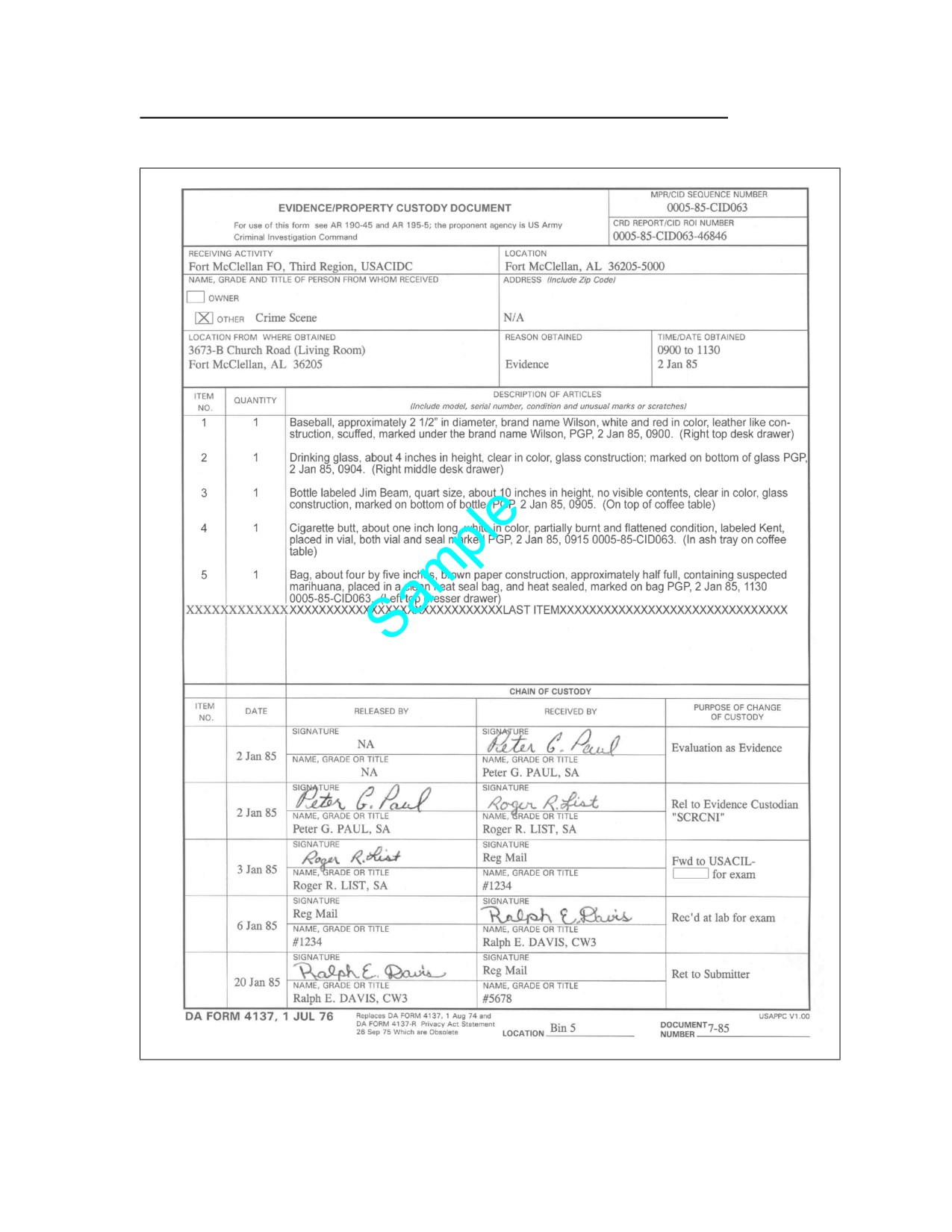
FM 3-19.13
Figure 19-1. Sample DA Form 4137, Page 1
Evidence Management and Control
19-3
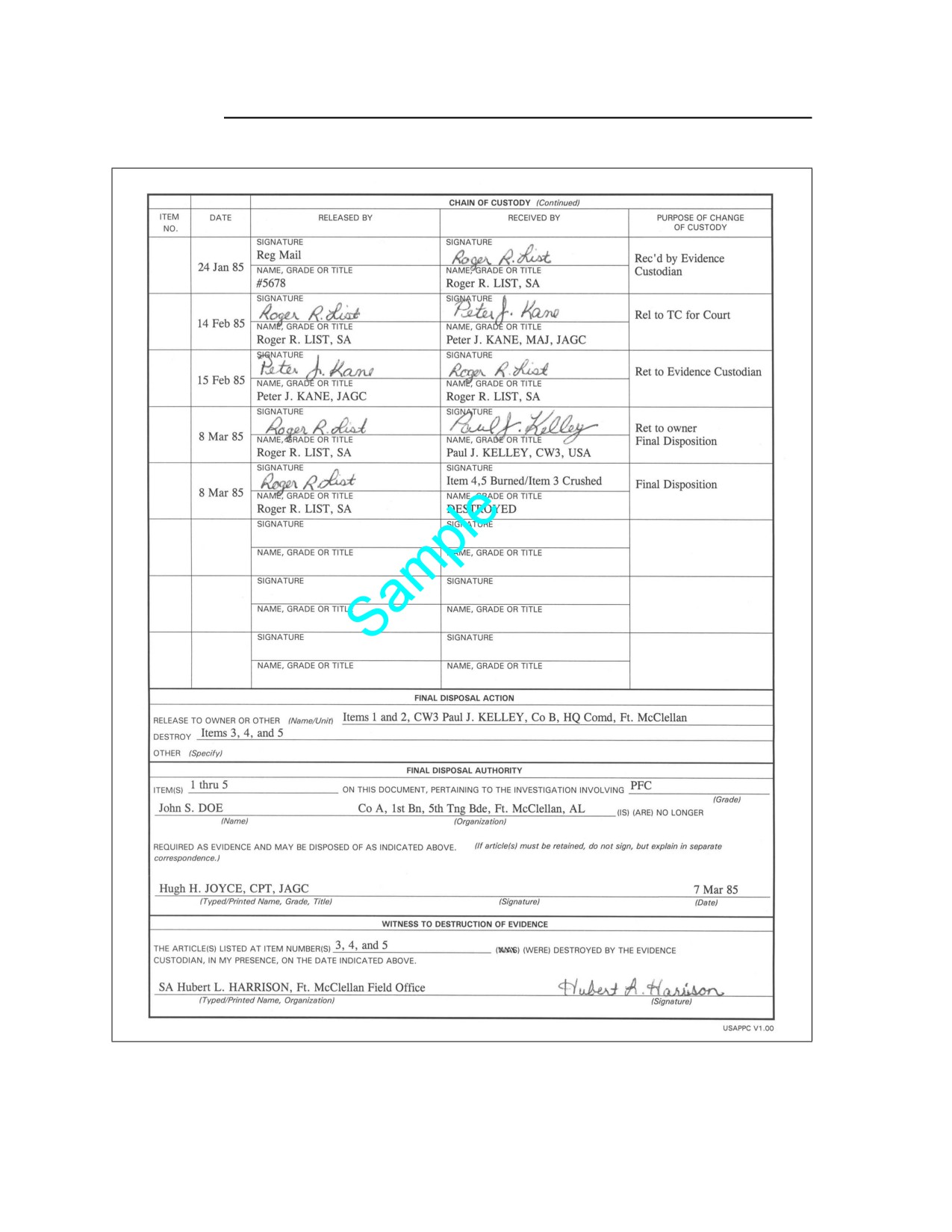
FM 3-19.13
Figure 19-2. Sample DA Form 4137, Page 2
19-4 Evidence Management and Control
FM 3-19.13
will be separated from the original and retained in the appropriate suspense
folder. The original DA Form 4137 will accompany the evidence being
released.
SUSPENSE FOLDERS
19-11. The following three suspense folders are required in the evidence
room:
z
USACIL. The first copy of the evidence voucher that is sent to the
crime laboratory will be placed in this folder.
z
Adjudication. This folder is for evidence that is temporarily released
to Article 32 investigating officers, courts, SJA officers, or other legal
proceedings.
z
Pending disposition approval. The first copy of the evidence
voucher is stored in this folder when the original is sent to the SJA for
approval of disposition.
19-12. Other folders can be used if needed as management tools. The evidence
custodian should establish a suspense system to maintain the status of
evidence at all times and assist in the timely disposition of evidence.
19-13. After all of the items of evidence listed on DA Form 4137 have been
properly disposed of, the original evidence custody document will be placed in
an inactive evidence custody document file under file number 195-5a. These
files are established for the original evidence custody documents closed during
each calendar year, rather than the numerical sequence method of controlling
active evidence custody documents.
19-14. The closed evidence custody document files will be held in the evidence
room or the administrative files area in the office, and disposed of as specified
in AR 25-400-2. Once the original evidence custody document has been placed
in the inactive evidence custody document file, any remaining copies may be
destroyed.
SENDING EVIDENCE
19-15. When evidence has been identified for USACIL examination, the case
agent will provide the evidence custodian with the original and three copies of
a completed DA Form 3655 (Crime Lab Examination Request). Refer to the
sample DA Form 3655 (Figures 19-3 and 19-4, page 19-6). The original and
one copy of the lab request is sent to USACIL with the evidence. One copy is
retained in the USACIL suspense folder with the first copy of DA Form 4137.
One copy (annotated with the registered mail number and the date the
evidence was forwarded to USACIL) is returned to the case agent to be placed
in the case file.
19-16. Upon mailing the evidence, the evidence ledger should be updated to
reflect the submission of the items of evidence to USACIL. This entry should
be recorded in pencil to allow erasure upon the return of the item from
USACIL.
Evidence Management and Control
19-5
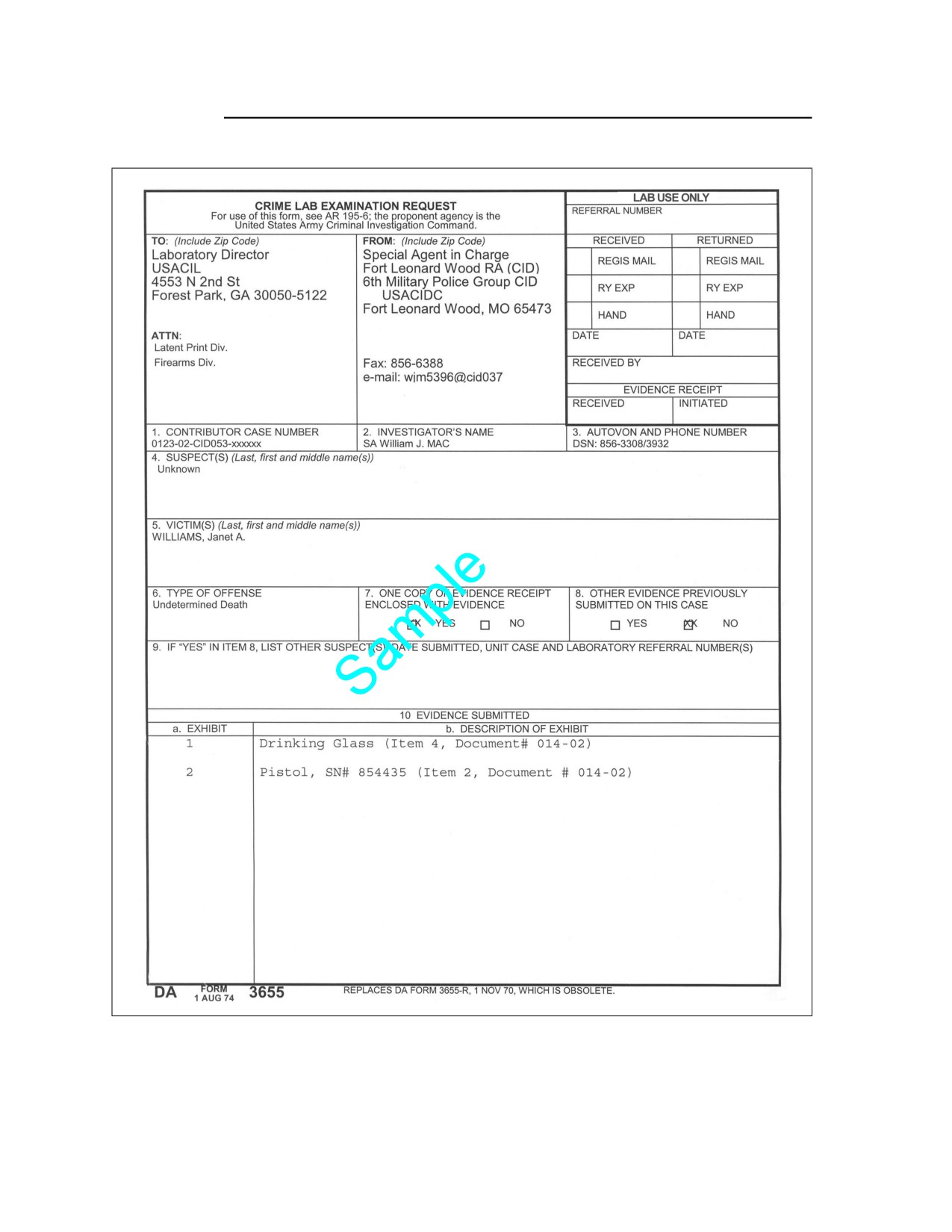
FM 3-19.13
Figure 19-3. Sample DA Form 3655
19-6 Evidence Management and Control
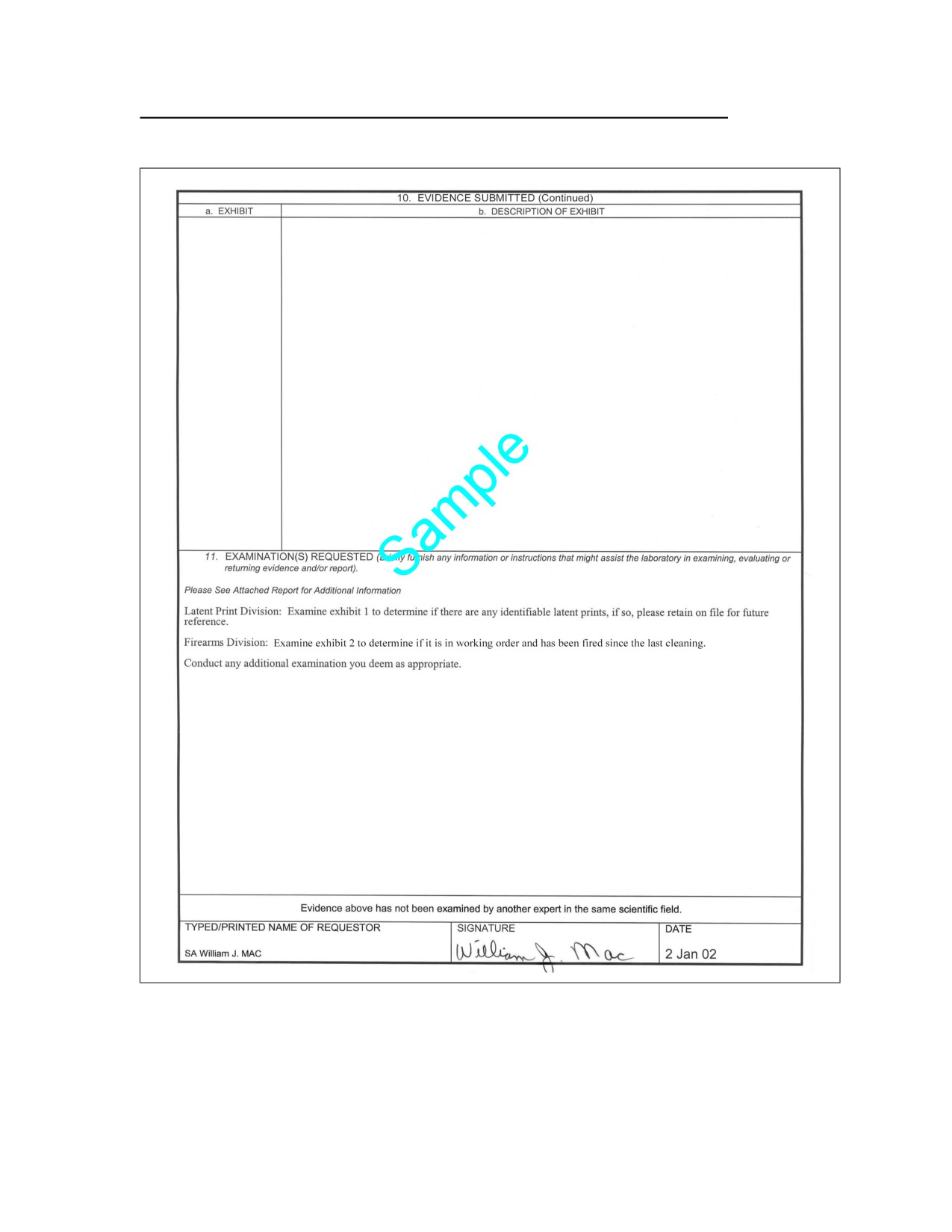
FM 3-19.13
Figure 19-4. Sample DA Form 3655, Reverse Side
RETURNING EVIDENCE
19-17. Upon the return of the evidence from USACIL, the evidence custodian
must verify that the items returned from USACIL match the items on the
evidence custody documents included with the evidence. Mistakes by USACIL
Evidence Management and Control
19-7
FM 3-19.13
in returning the proper items of evidence are rare, but they can occur.
Complete the chain of custody on both the original and first copy (suspense
copy) of the evidence custody documents. Return the evidence to the proper
bin or file, and refile the evidence custody document. The evidence custodian
must then update the evidence ledger to show the return of the evidence and
its location in the evidence room (if recorded in the “remarks” column).
19-18. When either a portion of a controlled substance or an entire item of
evidence is consumed during analysis, the evidence custodian will ensure that
a copy of the laboratory examination report documenting the amount of
evidence consumed and returned is attached to the evidence custody
document.
19-19. When a controlled substance (evidence) is returned to the evidence
custodian after temporary release for other than laboratory examination, any
apparent changes in the substance will be annotated in the “Purpose of
Change of Custody” column on DA Form 4137. A memorandum for record
(MFR) explaining the apparent changes will be prepared and attached to the
evidence custody document by the evidence custodian. If the change is due to
the conduct of a field test, a copy of the field test form will be attached and no
MFR is required.
19-20. Whenever documents, such as laboratory reports, field test results,
and memorandums are attached to an evidence custody document, they
become a permanent part of the chain of custody for that evidence. All
documents must be maintained with the evidence custody document, even
after the final disposition has been completed and the inactive evidence
custody document placed in the closed evidence custody document file.
19-21. MFRs and/or evidence custody documents generated by USACIL
examiners are not required for items otherwise exempt from evidence custody
documents. They are also not required for evidential material standards or
controls recovered or removed from items properly accounted for on existing
evidence custody documents (such as hair, fibers, debris, pieces of questioned
fabric with stains, fabric standards, soil, paint, and glass fragments). Such
evidence will be properly packaged, preserved, and returned to the original
container. If practical, this evidence should be physically attached to the item
from which it was removed or recovered. For example, hair collections from a
sheet should be placed in a heat-sealed bag and stapled to the sheet. In this
way, the item is returned essentially as it was received with each container
holding the original item and all appropriate samples collected or derived, as
appropriate.
WRAPPING, PACKING, AND TRANSMITTING EVIDENCE TO THE LAB
19-22. Each item of evidence within the shipping container should be in a
separate, sealed container and marked appropriately with an individual's
initials and the date and time. Failure to adhere to this procedure may result
in the loss and/or contamination of evidence and problems with the chain of
custody. Each item should be packed in a way that will minimize friction and
prevent the item from shifting, breaking, leaking, or contacting other
evidence. (See Figure 19-5, a.) Evidence should be packed in cotton or other
soft paper items (not susceptible to being broken, marred, or damaged). Each
19-8 Evidence Management and Control
FM 3-19.13
packaged and sealed item should be labeled using a DA Form 4002 that
corresponds with the entry on DA Form 4137. The individually sealed items of
evidence should be placed in a shipping container (envelope or box). The
envelope or box should be sealed with paper tape. The individual's initials or
signature should be placed across the paper tape used to seal the shipping
container and then covered with transparent tape. (See Figure 19-5, b.)
19-23. Supporting documentation, such as photographs, sketches, copies of
the initial report, and victim and subject statements (when available) are
often very useful to the laboratory examiner (particularly in violent crimes)
and should be forwarded to the laboratory with a DA Form 3655. These
documents frequently give the examiners vital information that they would
not necessarily get from the laboratory request. Supporting documentation
should be attached or packaged with DA Form 3655 and placed on the outside
of the shipping container. (See Figure 19-5, c and d.) These documents should
not be placed in the shipping container because the documentation is reviewed
at the division level before the case is assigned to an examiner and before the
evidence is picked up and inventoried.
19-24. The original and one copy of DA Form 3655 and the original
DA Form 4137 obtained from the evidence custodian should be placed in an
envelope. The envelope should be sealed and addressed to the laboratory with
an attention line to the specific division, such as the document, fingerprint, or
firearm division. This sealed envelope should be taped securely to the box or
envelope containing the evidence. (See Figure 19-5, e.) The box should be
wrapped in heavy paper or the envelope should be sealed inside another
envelope. Address the package to USACIL. (See Figure 19-5, f.)
c
a
b
d
e
f
Figure 19-5. Wrapping and Packaging Evidence
19-25. Packages containing items of evidence that require careful or selective
handling while in transit should be labeled: “corrosive,” “fragile,” “keep away
Evidence Management and Control
19-9