FM 8-10-6 MEDICAL EVACUATION IN A THEATER OF OPERATIONS TACTICS, TECHNIQUES, AND PROCEDURES - page 10
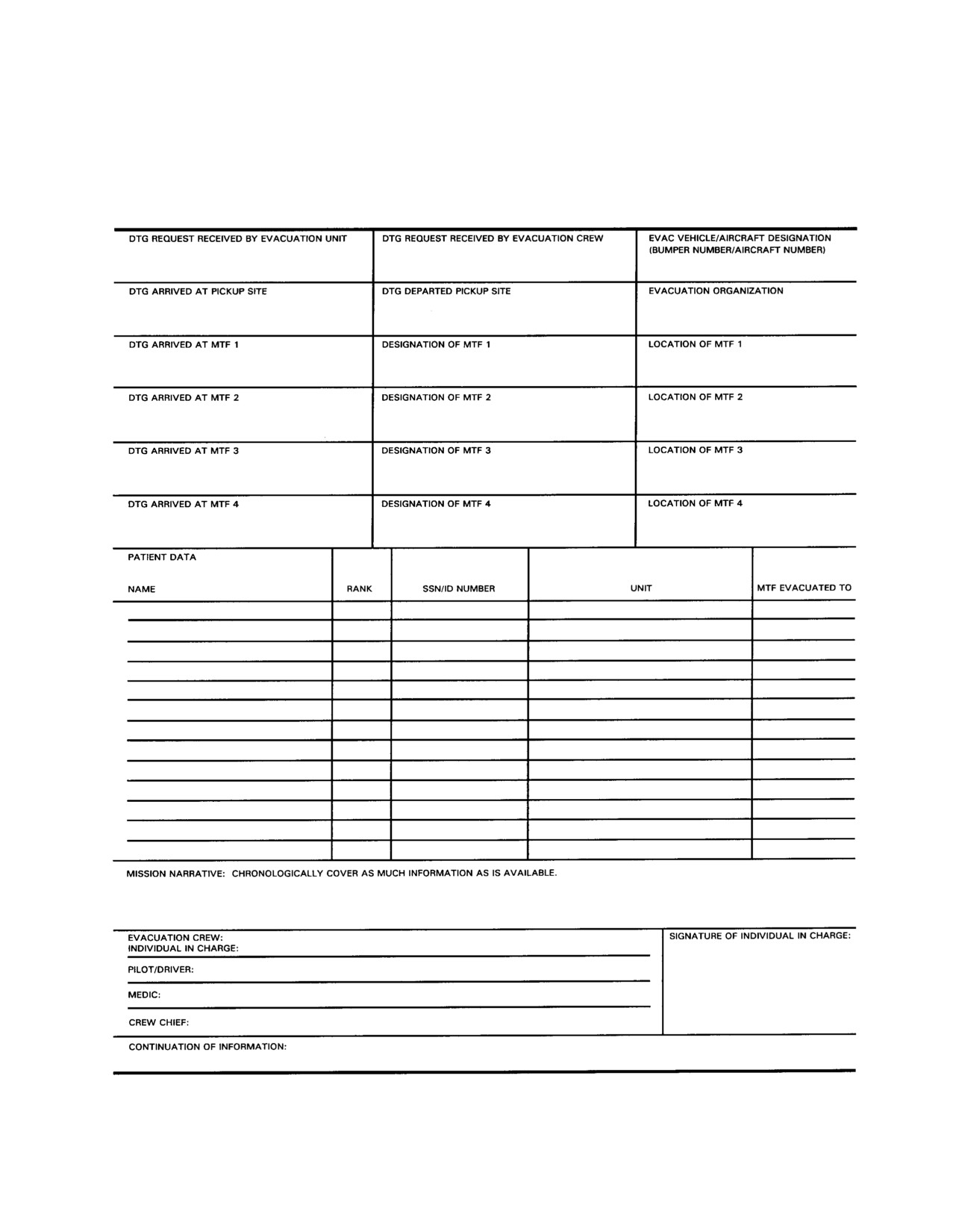
FM 8-10-6
Table I-1. Medical Evacuation Request amd Mission Completion Record (Continued)
SAMPLE FORMAT
I-3
FM 8-10-6
APPENDIX J
PROCEDURES FOR LITTER EVACUATION TRAINING
J-1.
General
To safely transport a patient by litter and to ensure litter bearers are not injured by using incorrect lifting
procedures, training is required for litter bearers. This appendix provides the techniques and procedures
necessary to accomplish litter evacuation.
J-2.
Basic Guides for Training Litter Bearers
Litter bearers are normally grouped into squads of four to carry patients. For this reason, litter procedures
for squads of four are effective in training individuals to be litter bearers. The following guidelines promote
uniformity and accuracy in training methods:
Several squads may be trained at the same time by one individual, or each squad may be
instructed separately by an instructor or trained squad leader.
For the initial training procedures, a litter without a patient on it can be used to simulate a
loaded litter.
For later training, some personnel can be designated as patients. These individuals should be
frequently rotated with the ones carrying the litters so that all may participate in each phase of instruction.
For more realistic training in the handling of the different types of injuries, patients may wear
moulages, bandages, and splints to simulate actual wounds or injuries.
The persons designated as patients may be positioned on the ground at suitable intervals near a
line of litters, first with the head and later with the feet toward the litters. As the instruction progresses,
their positions may be varied. Lastly, they may be dispersed or concealed to simulate positions that the
wounded might occupy on a battlefield.
J-3.
Litter Commands
Litter procedures are not to be considered precision drills; however, certain preparatory commands and
commands of execution are used to facilitate instruction. A preparatory command states the movement or
formation to be carried out and mentally prepares the individual for its execution. A command of execution
tells when the command is to be carried out. For purposes of identification in the discussion of the different
types of procedures, preparatory commands will be in lower case with initial capital letters and commands
of execution will be in capital letters.
NOTE
The use of formal commands is for training and their use is not
anticipated during combat operations.
J-1
FM 8-10-6
J-4.
Formation for Instruction
First, align the trainees into four ranks; then give the commands to form litter squads. This is accomplished
as follows:
a. The trainees count off from front to rear, one through four, thus forming the litter squads and
designating each trainees position in the litter squad by number. Each number carries with it specific
responsibilities in the litter squad. The trainee designated number 1 is the squad leader.
b. The squad leaders count off from right to left, designating a number for each litter squad.
c.
The formation is then opened to provide each squad adequate space for performance.
d. Since exceptional circumstances may make it necessary to use two-bearer litter squads, the
instruction should include procedures for these reduced squads, using bearers 2 and 3 of the four-bearer
squad.
J-5.
Procedures to Procure, Ground, Open, Close, and Return the Litter
a. To Procure Litter. Upon the command of Procure, LITTER, the squad leader (bearer number 1)
steps forward, goes to the source of supply, picks up the litter, and returns to his original position covered
by bearers numbers 2, 3, and 4.
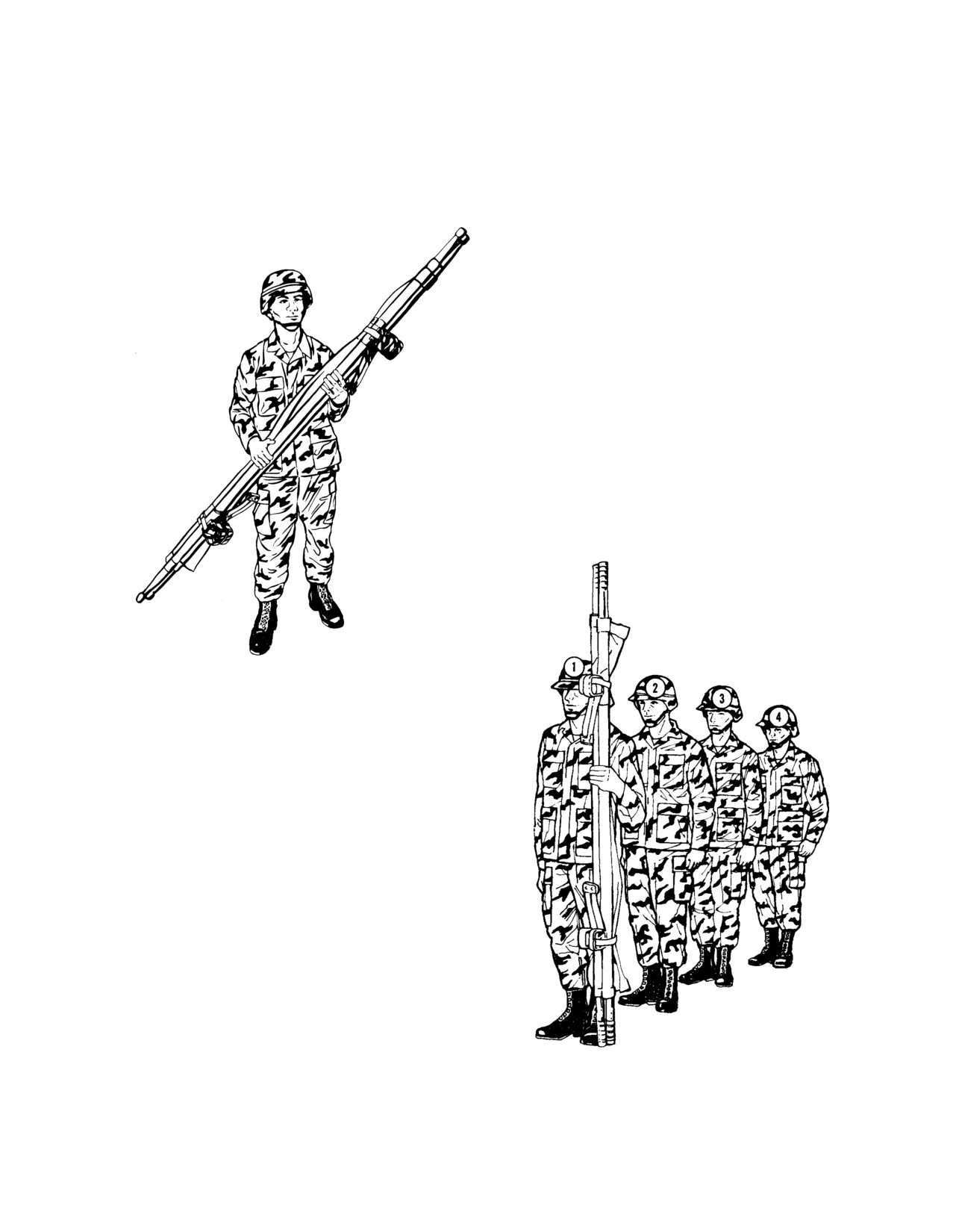
(1) The closed litter is carried at high port except near helicopters where it is kept level with
the ground to avoid contacting the rotor blades. At high port, the litter is carried diagonally across the body
with the left wrist in front of the left shoulder and the right wrist near the right hip (Figure J-1).
(2) After bearer number 1 returns to his original position in the squad, he holds the litter in
an upright position on his left side with the metal stirrups away from his body (Figure J-2).
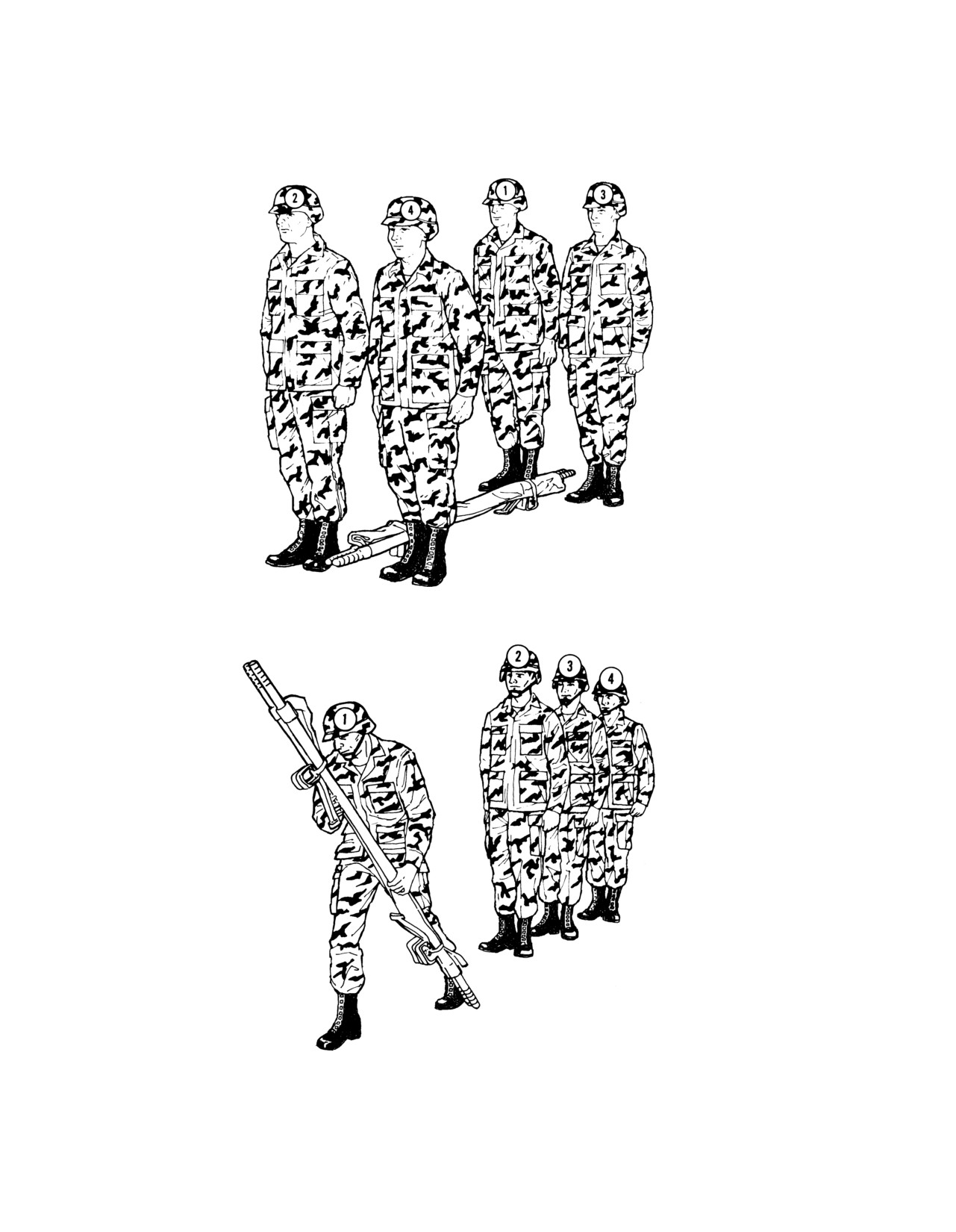
b. To Ground Litter. Upon command of Ground, LITTER, bearer number 1 lowers the litter to
the ground. With the litter squad in formation, bearer number 1 places his left foot beside the litter handles,
steps forward with his right foot, and lowers the litter to the ground so that it rests on the stirrups (Figure
J-3). Then upon command of Litter, POSTS, the other three bearers move into their positions at the sides of
the litter. Bearer number 2 moves to the right front, bearer number 3 moves to the left rear, and bearer
number 4 moves to the left front (Figure J-4).
c.
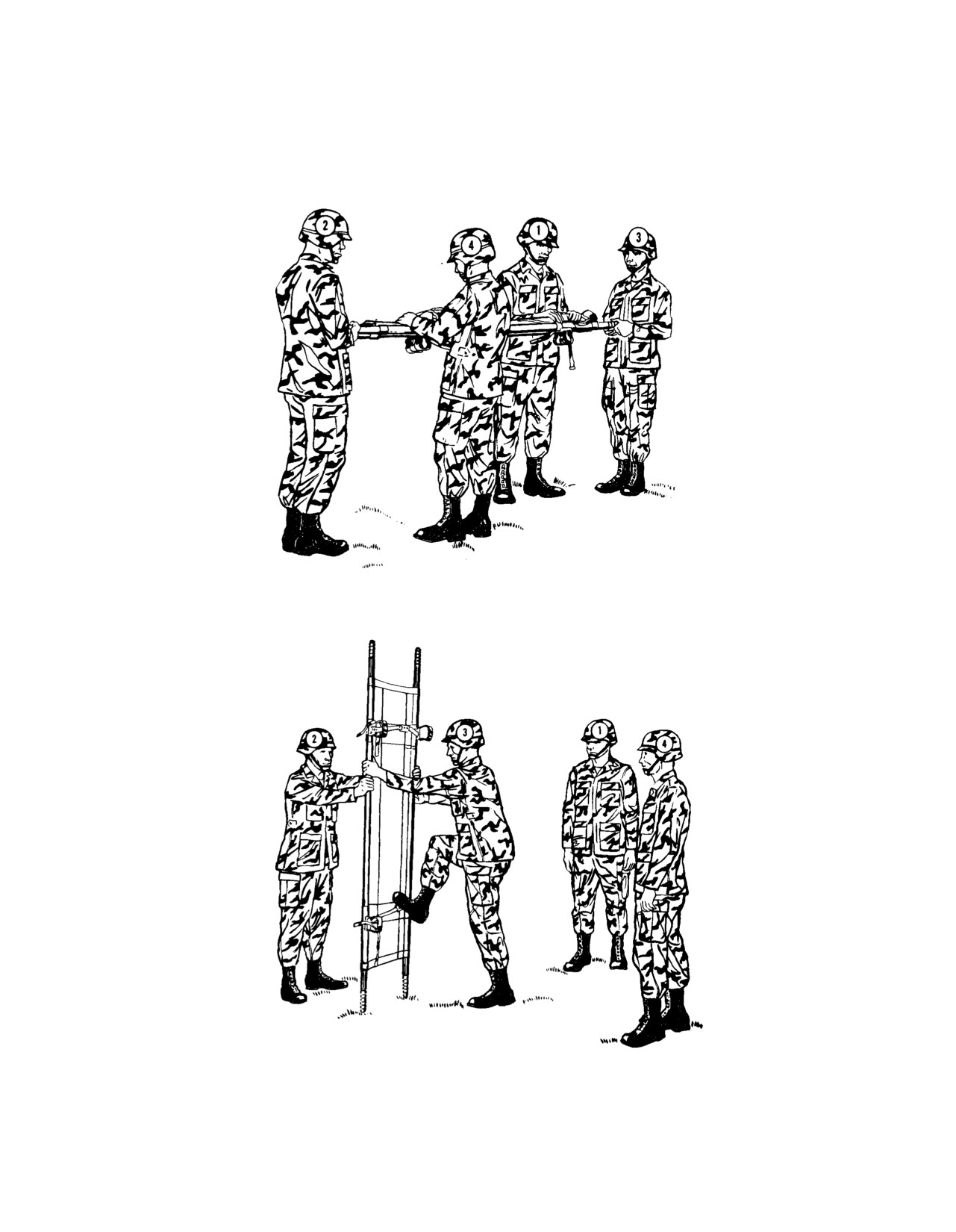
To Open Litter. Upon command of Open, LITTER, all bearers face the litter and execute the
command. With all bearers facing the litter, bearers numbers 2 and 3 pick up the litter from the ground and
support it, while bearers numbers 1 and 4 unfasten the litter straps. (Figure J-5). Bearers numbers 2 and 3
extend the litter by pulling the handles apart with the canvas up. Then bearer number 2 lowers his end of
the litter to the ground and bearer number 3 raises his end of the litter until it is in a vertical position. Using
his foot, bearer number 3 extends the lower spreader bar into a locked position, reverses the litter, and
extends the other spreader bar. Bearer number 3 then lowers the litter to the ground with the canvas in the
up position (Figure J-6).
J-2
FM 8-10-6
Figure J-1. Carrying litter at high port.
Figure J-2. Litter squad with litter.
J-3
FM 8-10-6
Figure J-3. Grounding litter (step one).
Figure J-4. Grounding litter (step two) (position of Litter, POSTS).
J-4
FM 8-10-6
Figure J-5. Opening litter (step one).
Figure J-6. Opening litter (step two).
J-5
FM 8-10-6
d. To Close Litter. Upon command of Close, LITTER, bearer number 2 supports the litter while
bearer number 3 releases the spreader bars and turns the bars against the litter poles. Bearers numbers 2
and 3 then lift the litter, move the poles together, and support the litter. Bearers numbers 1 and 4 fold the
canvas smoothly on top of the poles and secure the canvas and the poles in place with the litter straps.
e.
To Return Litter. At the completion of the instruction and upon command of Return, LITTER,
bearer number 1 returns the litter to supply.
J-6.
Procedures for Loading a Patient onto a Litter
After the patient has been located, the general nature of his wounds determined, emergency treatment
given, and the litter opened and positioned, the bearers load the patient onto the litter.
a. To Load a Litter (Four Bearers). Upon the following commands, the bearers position
themselves, lift the patient, position the litter, and lower the patient onto the litter:
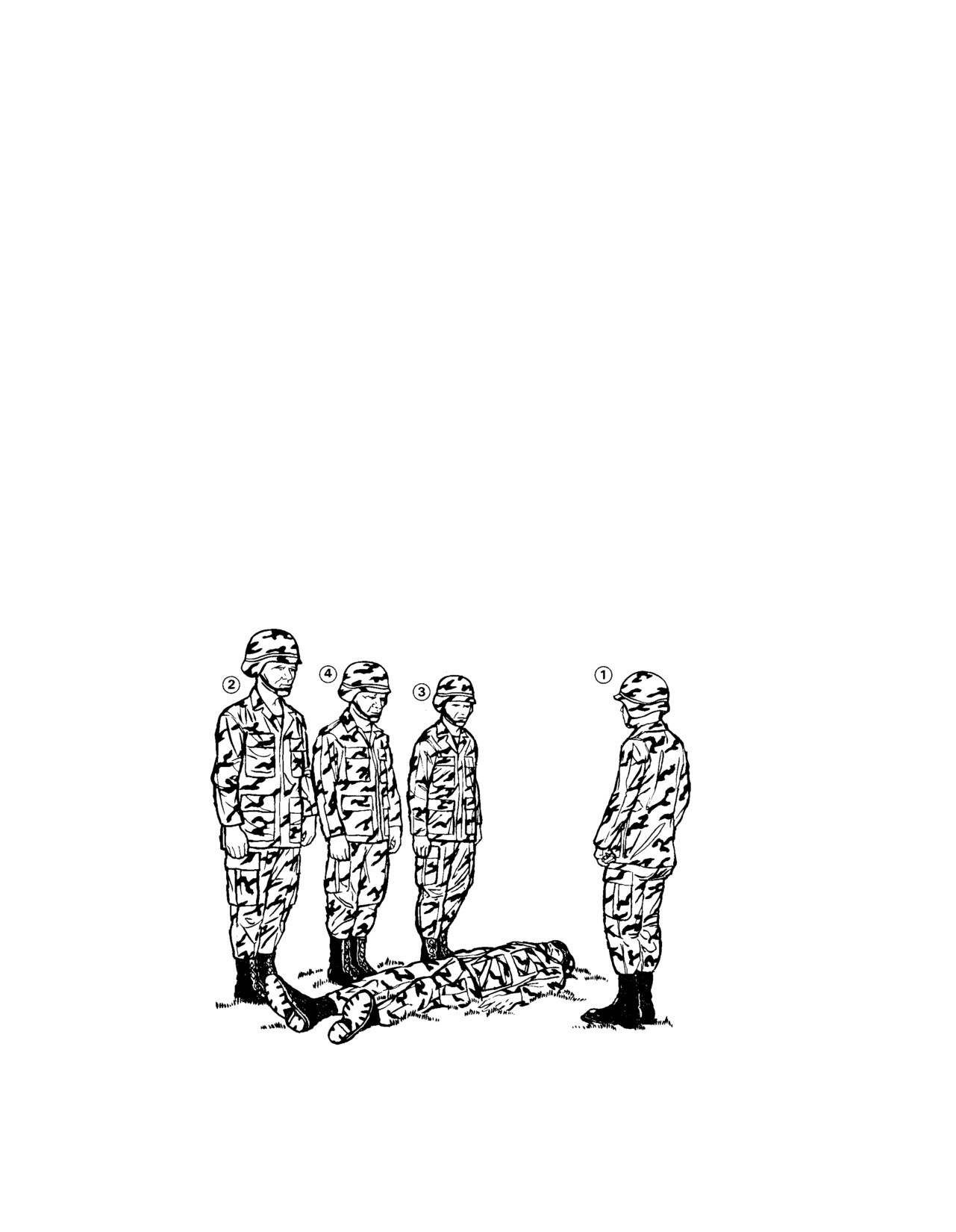
(1) At the command, Right (Left) Side, POSTS, the bearers take the following positions
facing the patient: bearer number 2 at the right (left) ankle; bearer number 3 at the right (left) shoulder;
bearers numbers 4 and 1 at the right and left hips, respectively (Figure J-7).
Figure J-7. Squad at right side, POSTS.
J-6
FM 8-10-6
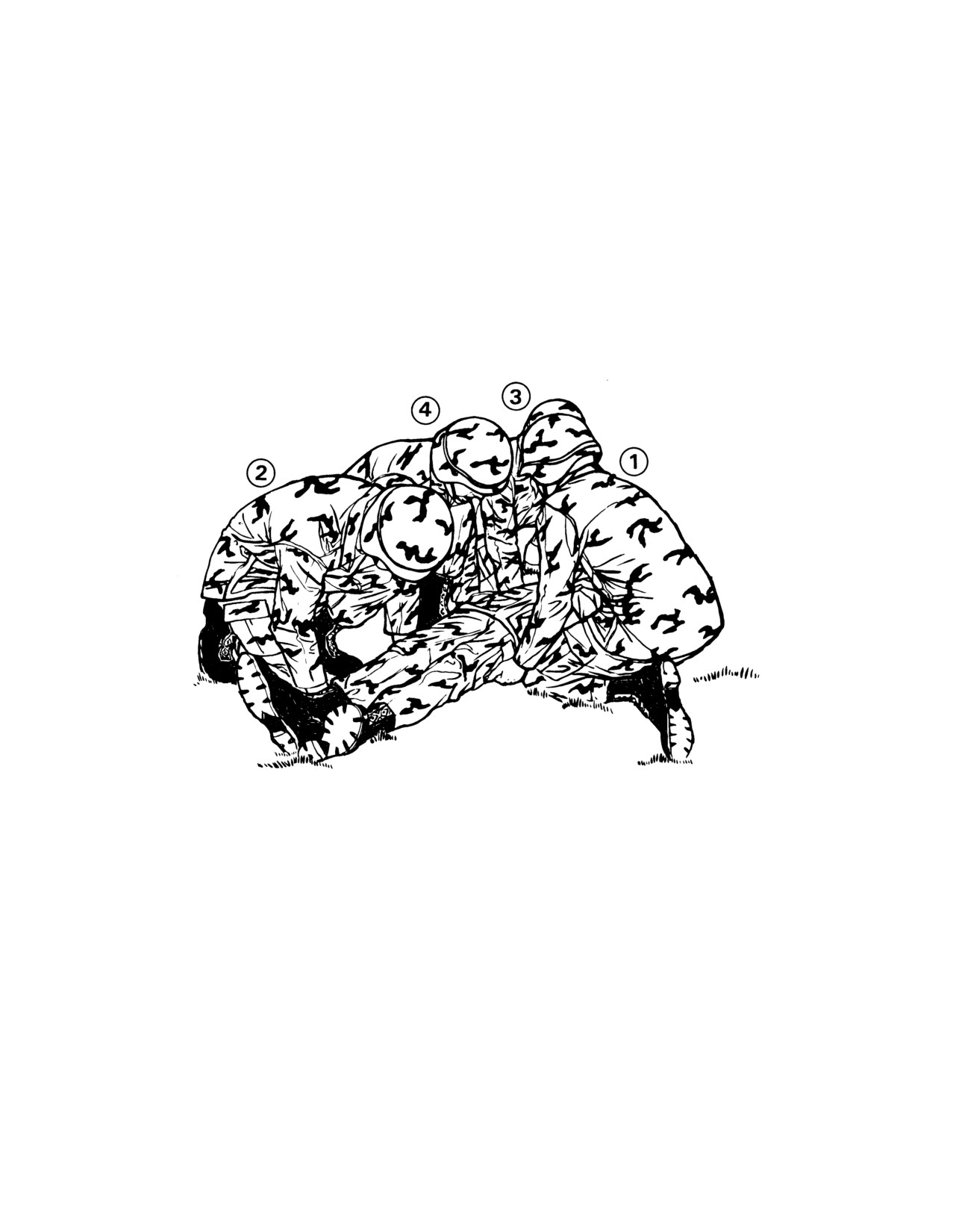
(2) At the command, Lift, PATIENT, each bearer kneels on his knee that is nearest the
patients feet. Bearer number 2 passes his forearms under the patients legs, carefully supporting any
fracture, if required. Bearers numbers 1 and 4 place their arms under the small of the patients back and
thighs without locking hands. Bearer number 3 passes one hand under the patients neck to the farther
armpit and uses the other hand to support the nearer shoulder. All bearers lift the patient slowly and
carefully and place him upon the knees of the three bearers who are on the same side (Figure J-8).
Figure J-8. Lifting patient to load litter (step one).
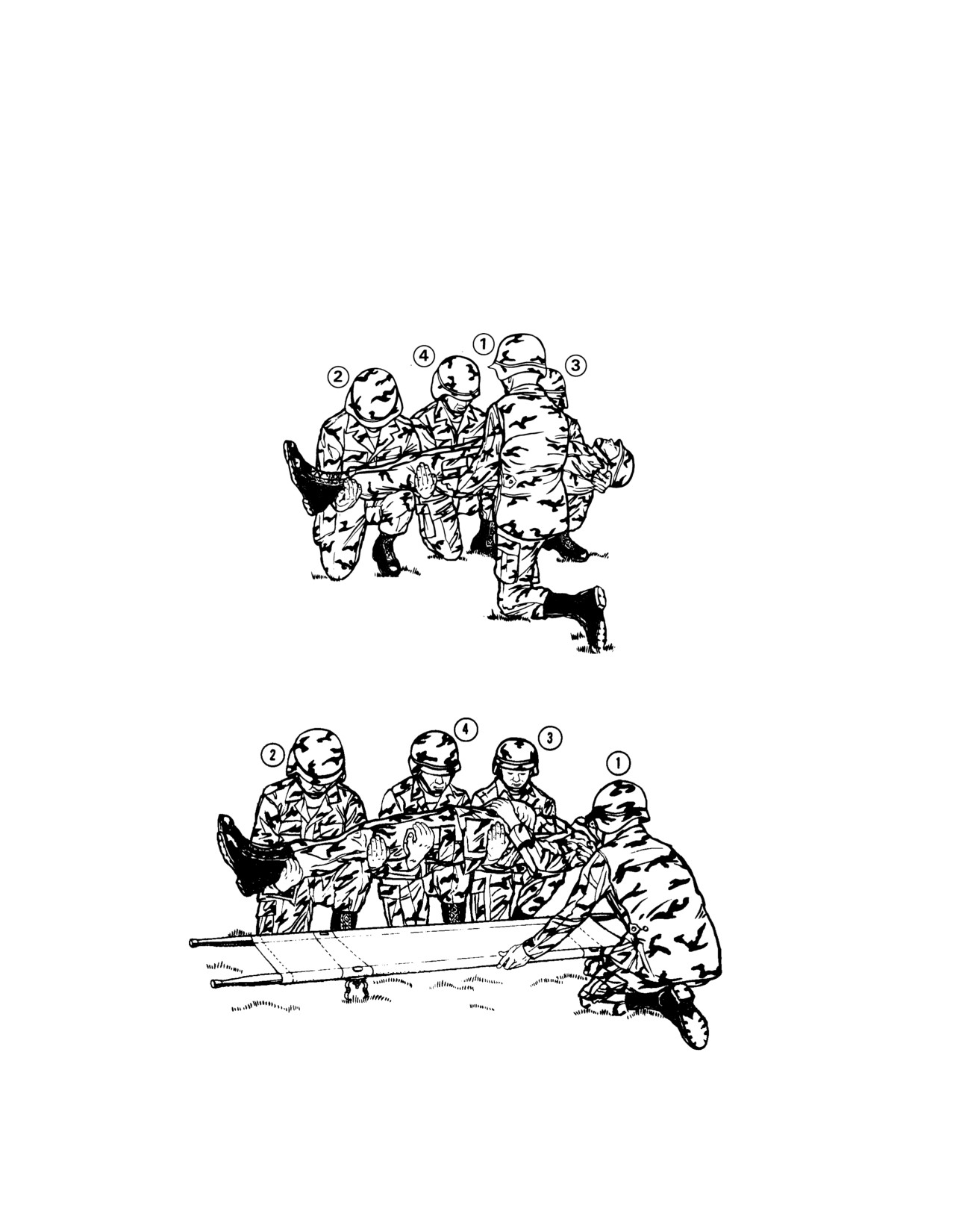
(3) At the preparatory command Lower, bearer number 1 resumes his former kneeling
position opposite the other three bearers and prepares to assist in lowering the patient. As soon as
the patient is firmly supported on the knees of the three bearers, the bearer on the opposite side (bearer
number 1) relinquishes his hold and reaches for the litter (Figure J-9). He places the litter under the patient
and against the ankles of the other bearers. At the command of execution, PATIENT, the patient is lowered
gently onto the litter (Figure J-10). Without further orders, all bearers rise and resume their positions at
Litter, POST.
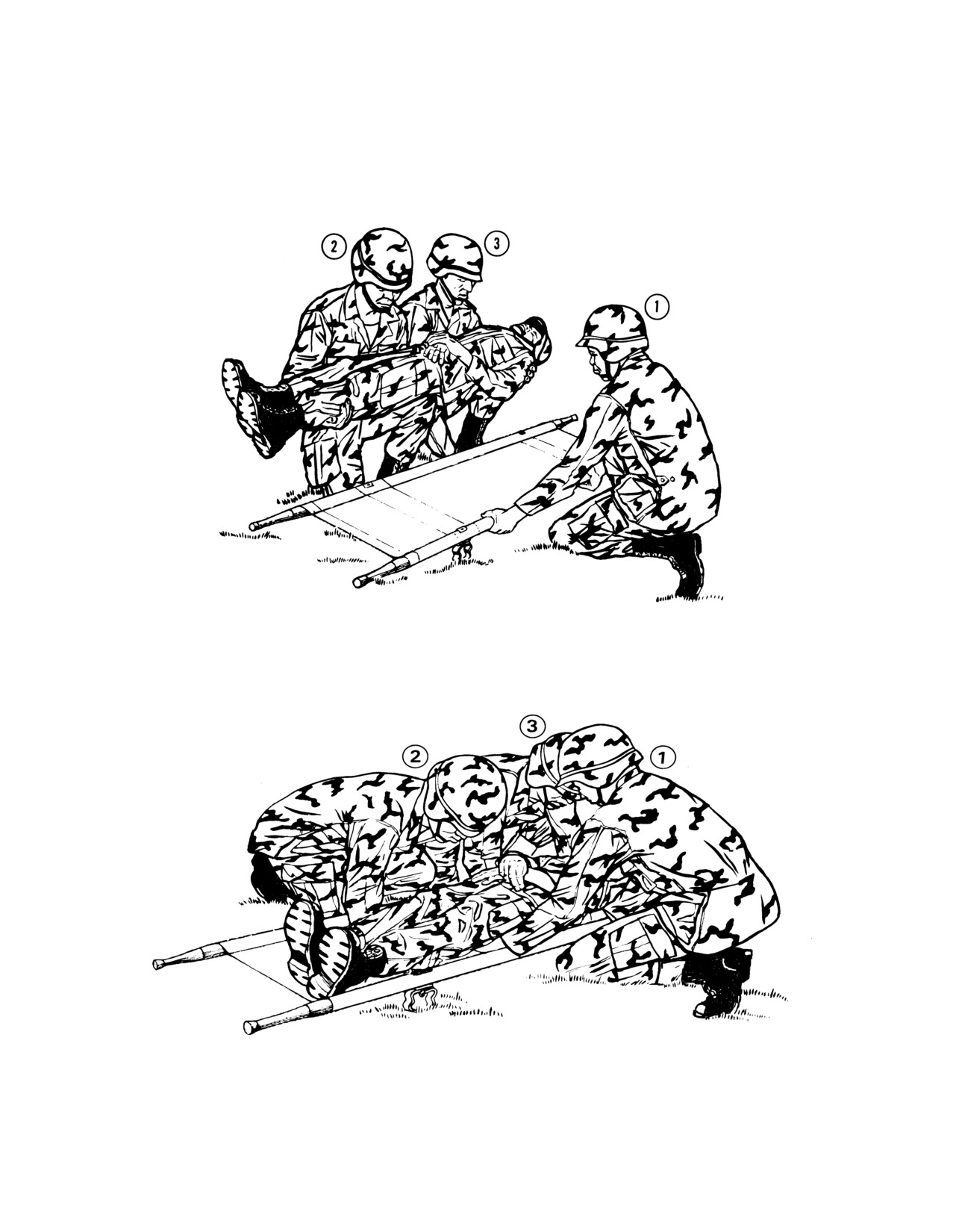
b. To Load Litter (Three Bearers). In the absence of one man from the litter squad, bearers
numbers 2 and 3 with the assistance of bearer number 1, lift the patient and lower him onto the litter. To lift
the patient with three bearers, bearer number 2 places his arms under the legs and thighs of the patient.
Bearer number 3 places his arms under the small of the back and shoulders of the patient. Bearer number 1,
J-7
FM 8-10-6
on the opposite side of the litter, places his arms under the patients knees and back. The patient is
supported on the knees of bearers numbers 2 and 3, while bearer number 1 places the litter in position
(Figure J-11). All three bearers lower the patient onto the litter (Figure J-12). The procedures are
performed upon the commands cited in paragraph a above.
Figure J-9. Lifting patient to load litter (step two).
Figure J-10. Lifting patient to load litter (step three).
J-8
FM 8-10-6
Figure J-11. Lifting patient to load litter (three bearers).
Figure J-12. Lowering patient onto litter (three bearers).
J-9
FM 8-10-6
c.
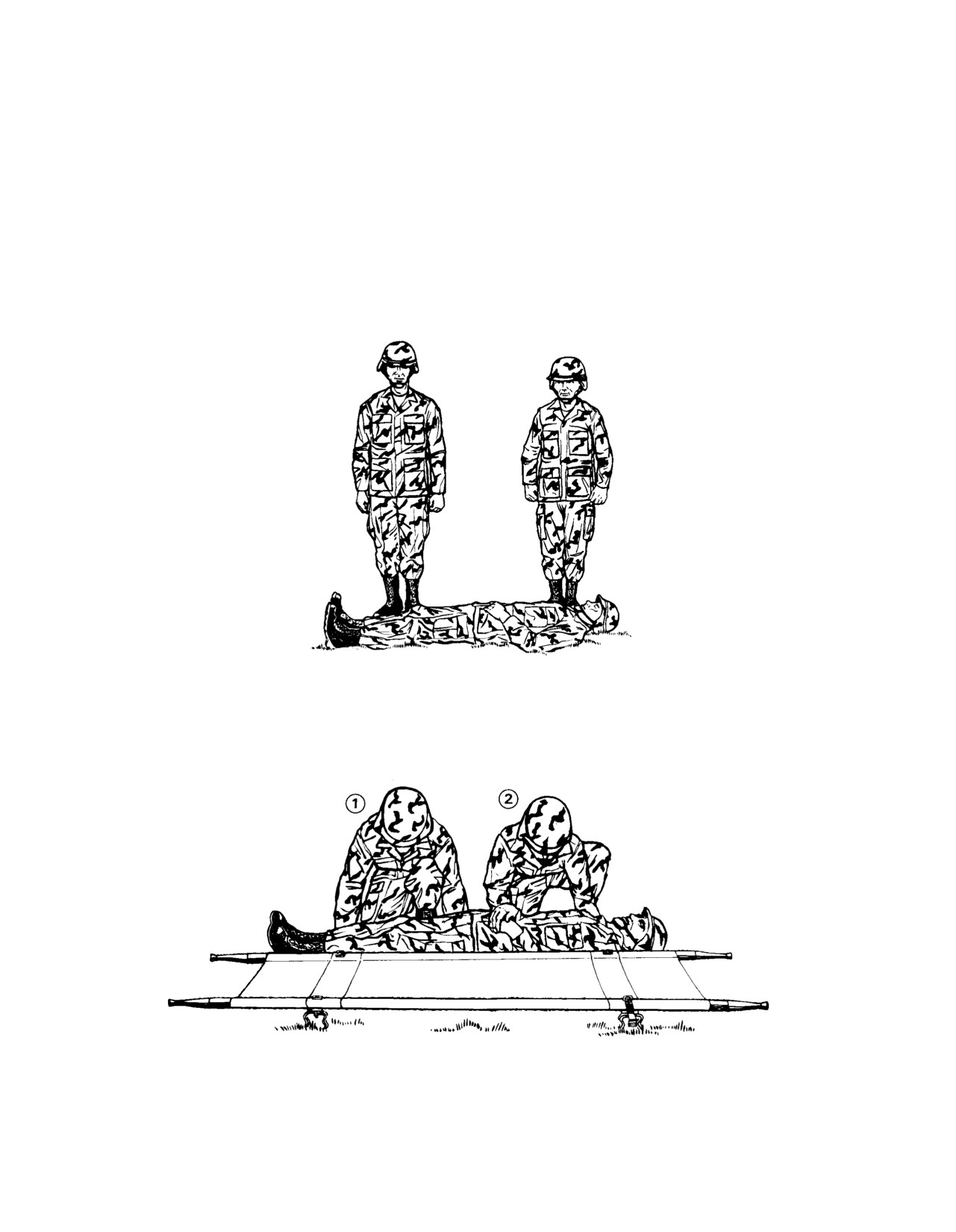
To Load Litter (Two Bearers). The procedures for loading litters with the two bearers on the
same side are illustrated in Figures J-13 through J-16.
(1) At the command to Right Side, POSTS, bearers numbers 1 and 2 take positions at the
patients right thigh and shoulder, respectively (Figure J-13).
Figure J-13. Two bearers at right side, POSTS.
(2) At the preparatory command, Lift, each bearer kneels on his knee nearer the patients
feet. Bearer number 1 passes his arms beneath the patients hips and knees. Bearer number 2 passes his
arms beneath the small of the patients back (Figure J-14).
Figure J-14. Lifting patient with two bearers on the same side (step one).
J-10
FM 8-10-6
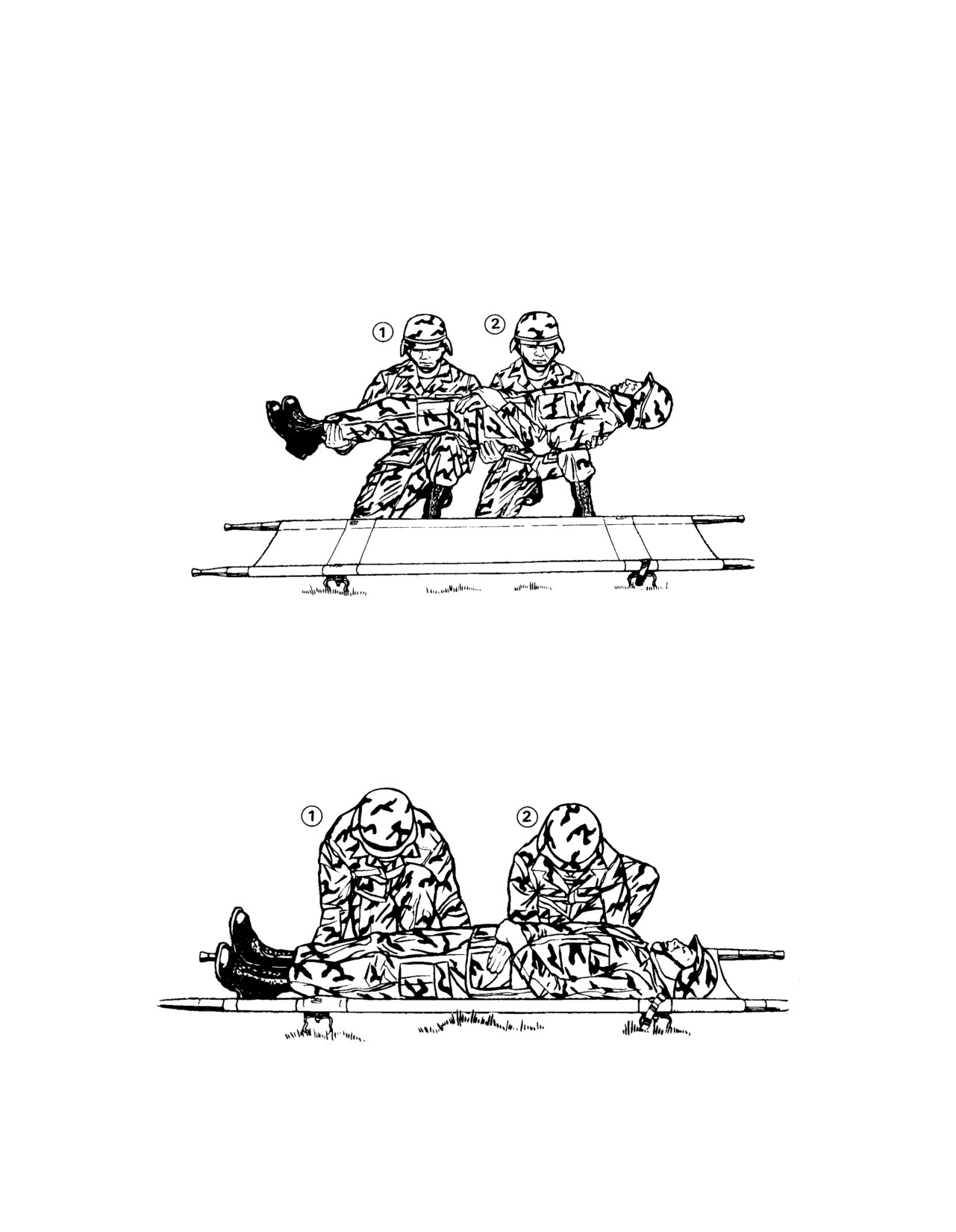
(3) At the command of execution, PATIENT, the bearers lift together, raising the patient
upon their knees. Readjusting their hold, they rise to their feet and move as close as possible to the side of
the litter (Figure J-15).
Figure J-15. Lifting patient with two bearers on the same side (step two).
(4) At the preparatory command, Lower, the bearers kneel and place the patient on their knees.
At the command of execution, PATIENT, the bearers gently place the patient onto the litter (Figure J-16).
They then rise and resume the position of Litter, POSTS, without command.
Figure J-16. Lowering patient onto litter with two bearers on the same side.
J-11
FM 8-10-6
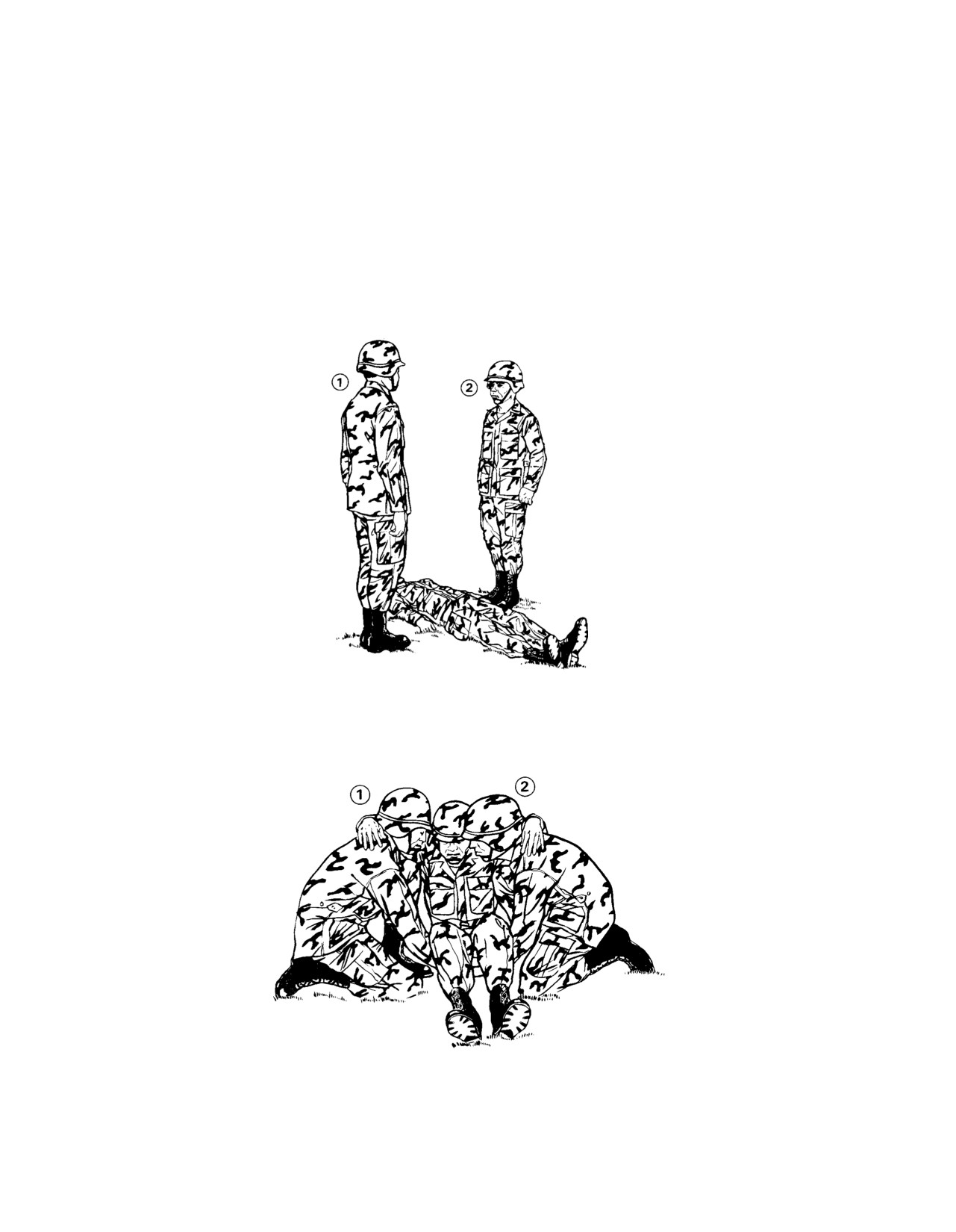
d. To Load Litter with Conscious Patient (Two Bearers). If the patient is conscious and able to
hold onto the bearers, the following procedure is used:
(1) At the command, On Each Side, POSTS, bearers numbers 1 and 2 face the patient and
take positions at the patients right and left hips, respectively (Figure J-17).
Figure J-17. Two bearers, one on each side, POSTS.
(2) At the command of execution, PATIENT, the bearers lift the patient, both rising together, and
carry him to the center of the litter (Figures J-18 and J-19).
Figure J-18. Lifting patient with two bearers, one on each side (step one).
J-12
FM 8-10-6
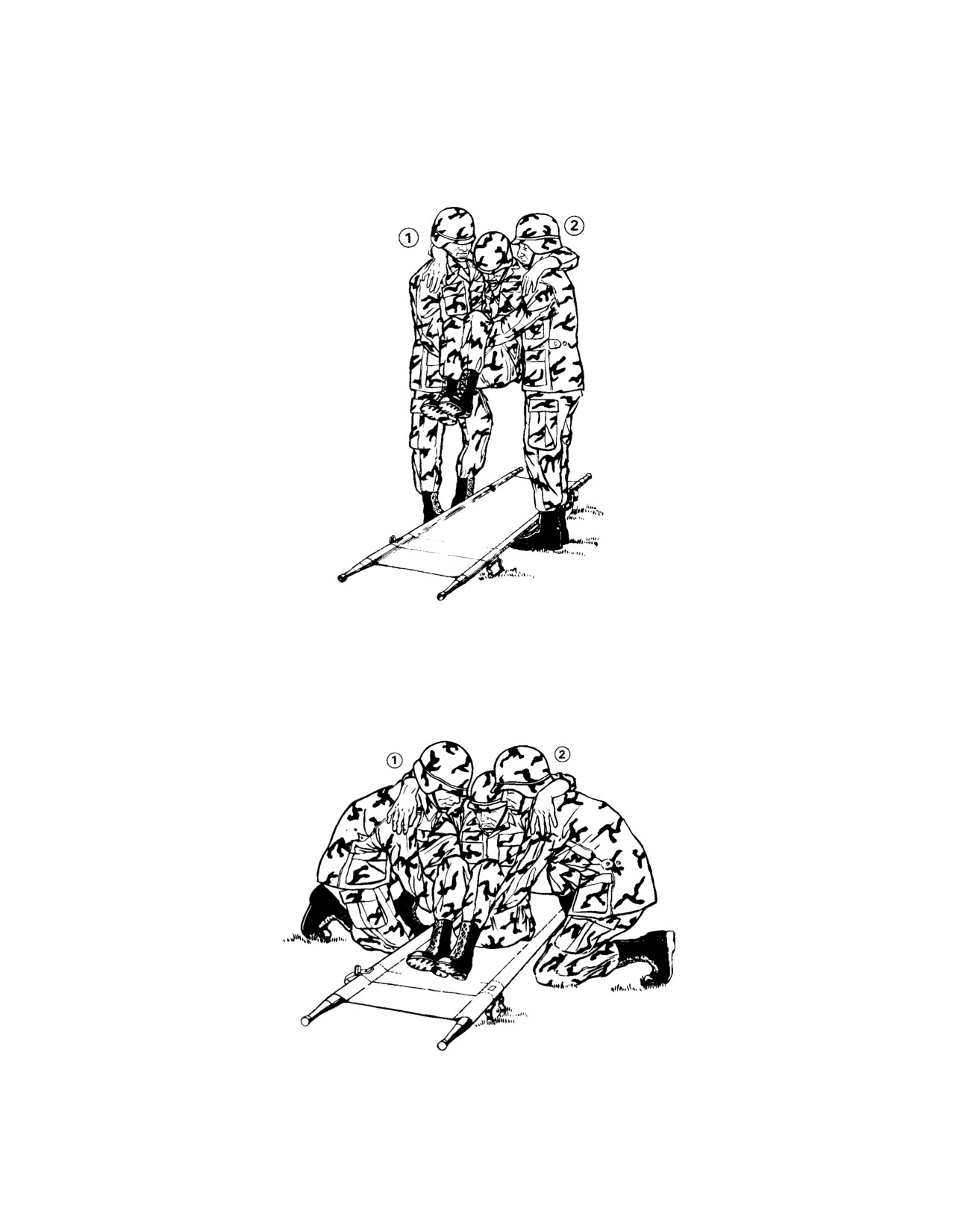
Figure J-19. Lifting patient with two bearers, one on each side (step two).
(3) At the command, Lower, PATIENT, the bearers stoop and lower the patient onto the litter in
a sitting position. The patient then releases his hold on the bearers necks. Both bearers assist the patient to
lie down. They then resume the position of Litter, POSTS, without commands (Figure J-20).
Figure J-20. Lowering patient onto litter (two bearers,one on each side).
J-13
FM 8-10-6
e.
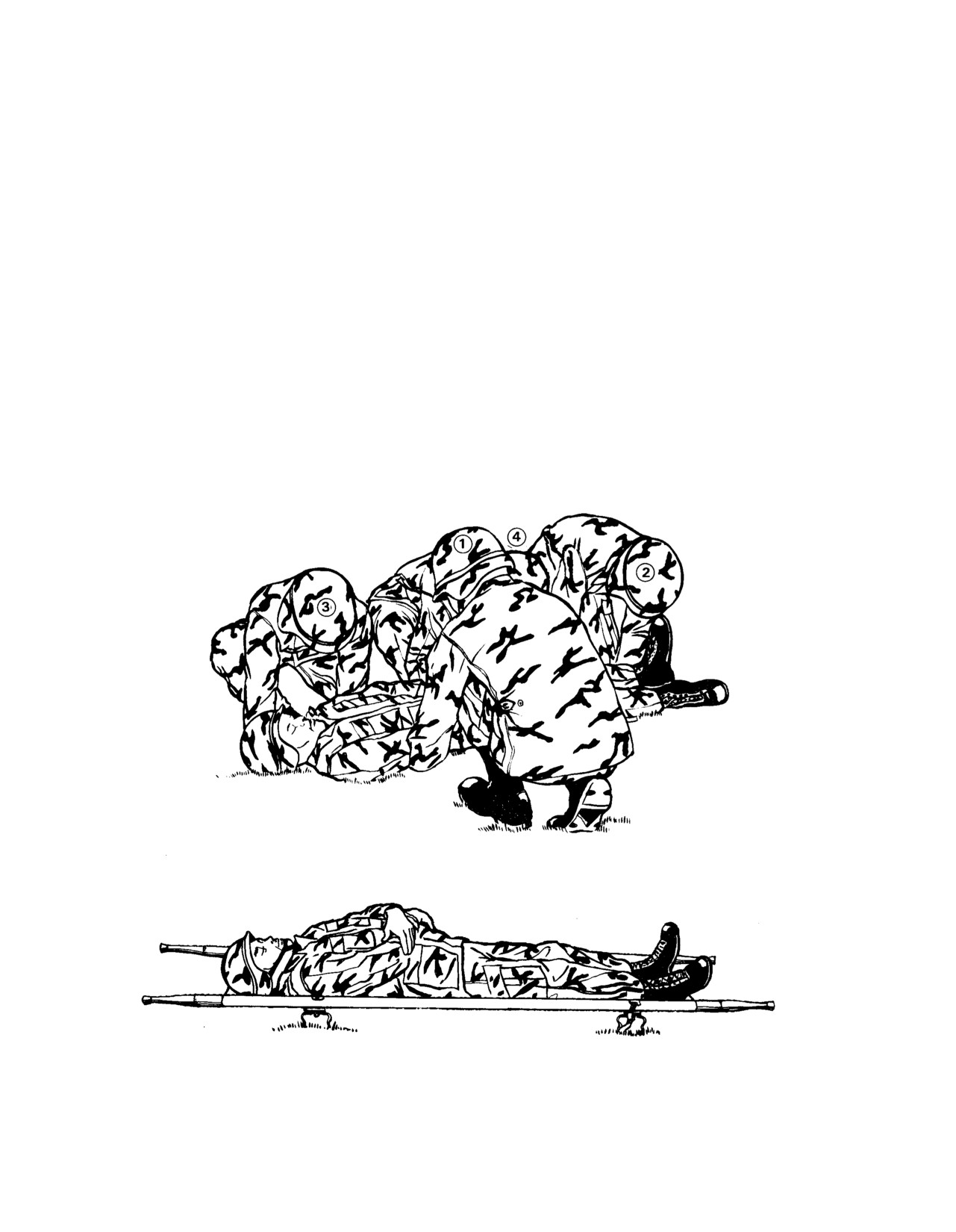
To Load Patient with Back Injury. To avoid aggravating the condition of a patient with an
actual or suspected back injury, the bearers proceed as follows (Figure J-21):
(1) Each bearer kneels on his knee nearer the patients feet.
(If the patient is unable to hold
his arms in front of him, his wrists should be tied loosely before placing him on the litter. This will prevent
injury to his arms.)
(2) Bearer number 1 places a blanket, coat, or jacket in a firm roll or in a position to support
the arch of the patients back. Bearer number 3 places one hand under the patients head and the other hand
under his shoulders. Bearer number 4 places his hands under the small of the back and buttocks. Bearer
number 2 places his hands under the thighs and calves. Bearer number 1 assists bearer number 4 in
supporting the small of the patients back.
Figure J-21. Lifting patient with back injury.
J-14
FM 8-10-6
(3) At the command, Lift, PATIENT, all bearers gently lift the patient off the ground about
8 inches. Bearers ensure that proper alignment is maintained. Bearer number 1 places the litter under the
patient and adjusts the roll under the patients back.
(4) At the command, Lower, PATIENT, the three bearers lean forward and with the aid of
bearer number 1, lower the patient onto the litter.
J-7.
Procedures for Carrying a Loaded Litter
After the patient has been loaded onto the litter, the litter is lifted and carried as described below.
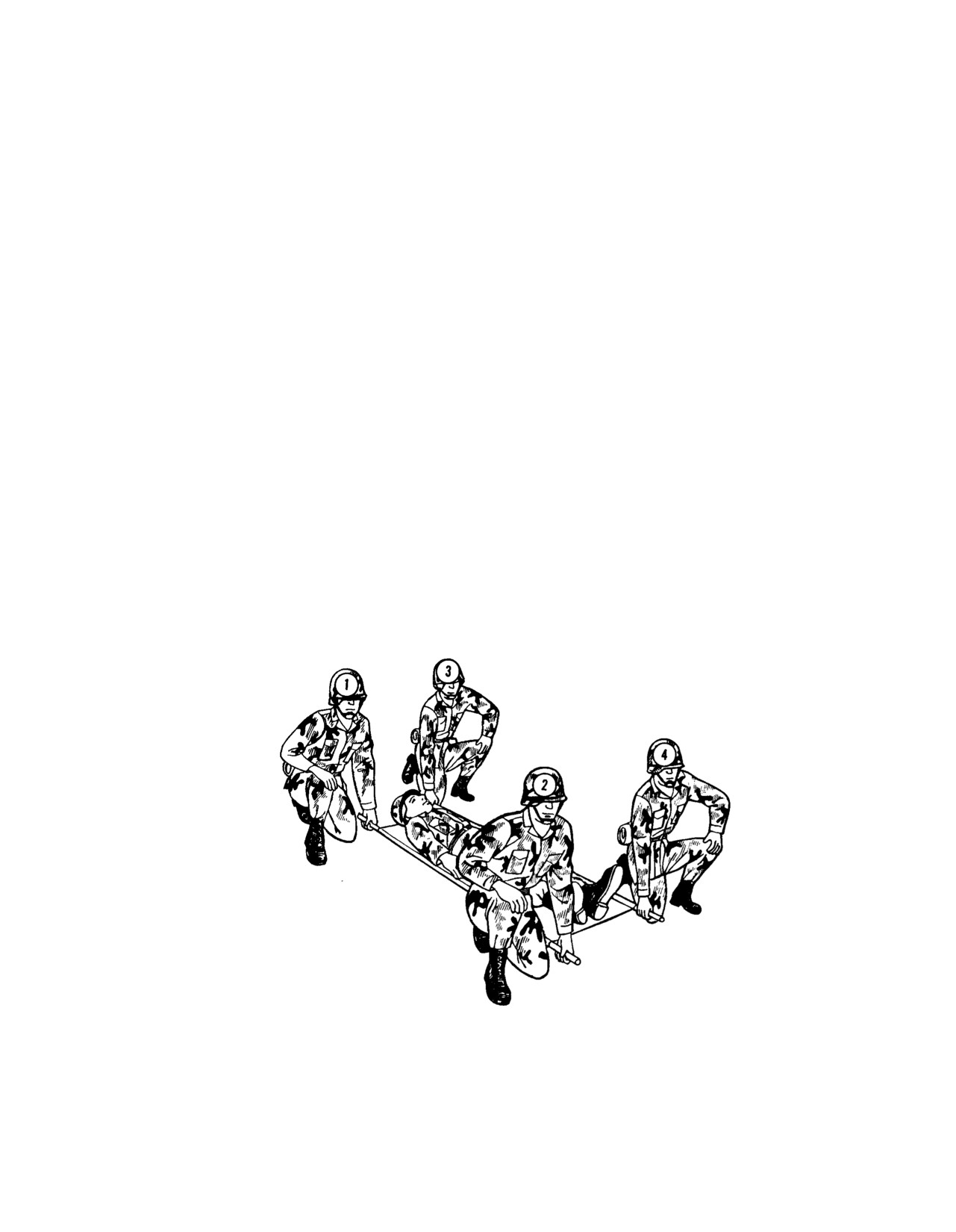
a. To Lift Loaded Litter. Resuming the position of Litter, POSTS, and facing in the direction of
travel, the bearers lift the loaded litter upon the command Prepare to Lift, LIFT (Figure J-22).
(1) At the preparatory command, Prepare to Lift, each bearer kneels on his knee closest to the
litter. He grasps the litter handle with the hand nearest the litter and places his other hand on his raised knee.
(2) At the command of execution, LIFT, all bearers rise together keeping the litter level.
When lifting, bearers should use leg muscles, not their back muscles.
Figure J-22. Lifting the loaded litter.
J-15
FM 8-10-6
b. To Carry a Loaded Litter. The type of carry used in transporting a litter patient depends upon
the type of terrain as well as the obstacles involved. It may be necessary to use several types of carries.
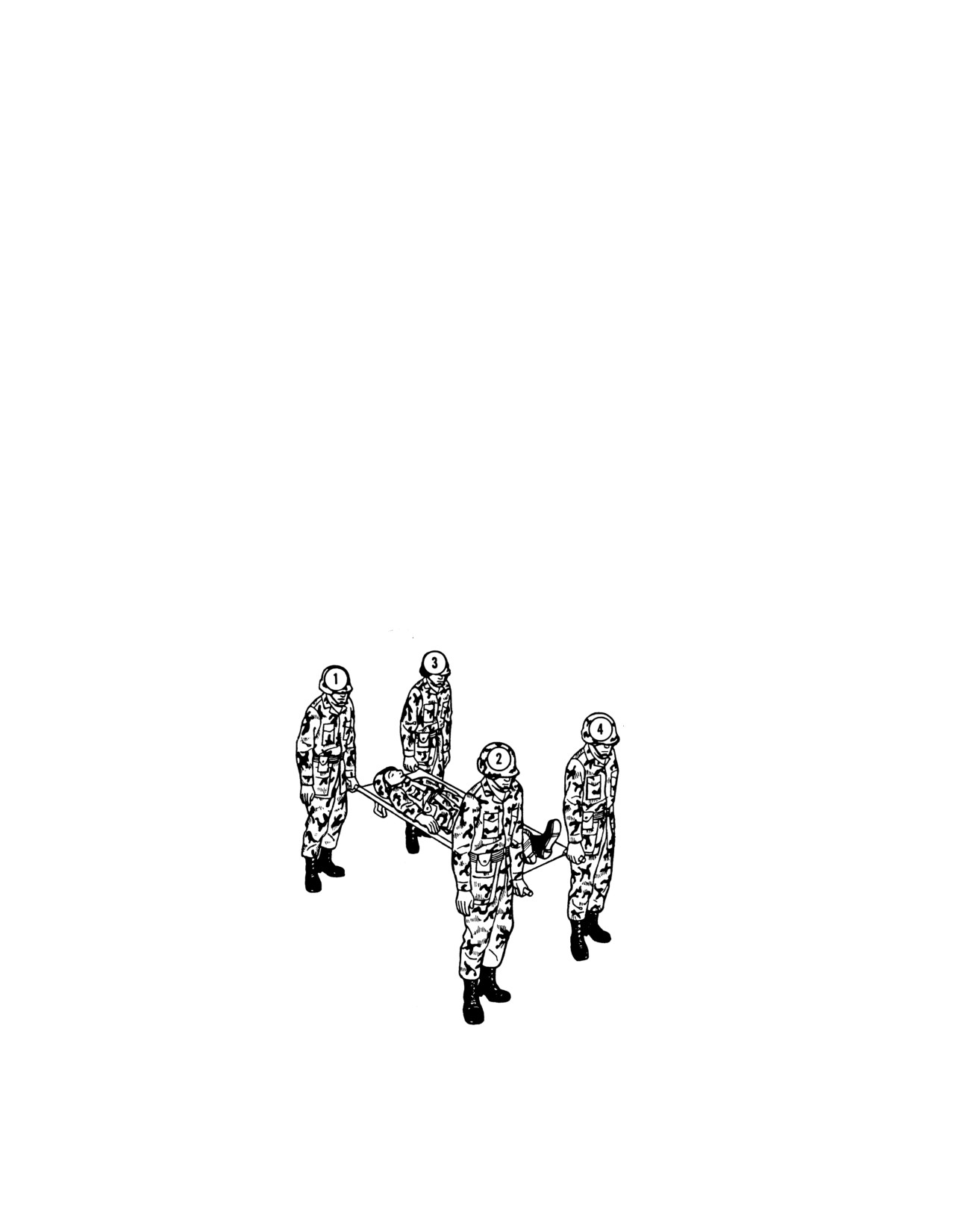
(1) After the bearers lift the loaded litter, they are in position for the four-man carry (Figure
J-23) which is used when the terrain is smooth and level. The command to proceed is Four-Man Carry,
MOVE. With modifications, this carry is also used to pass under low obstacles.
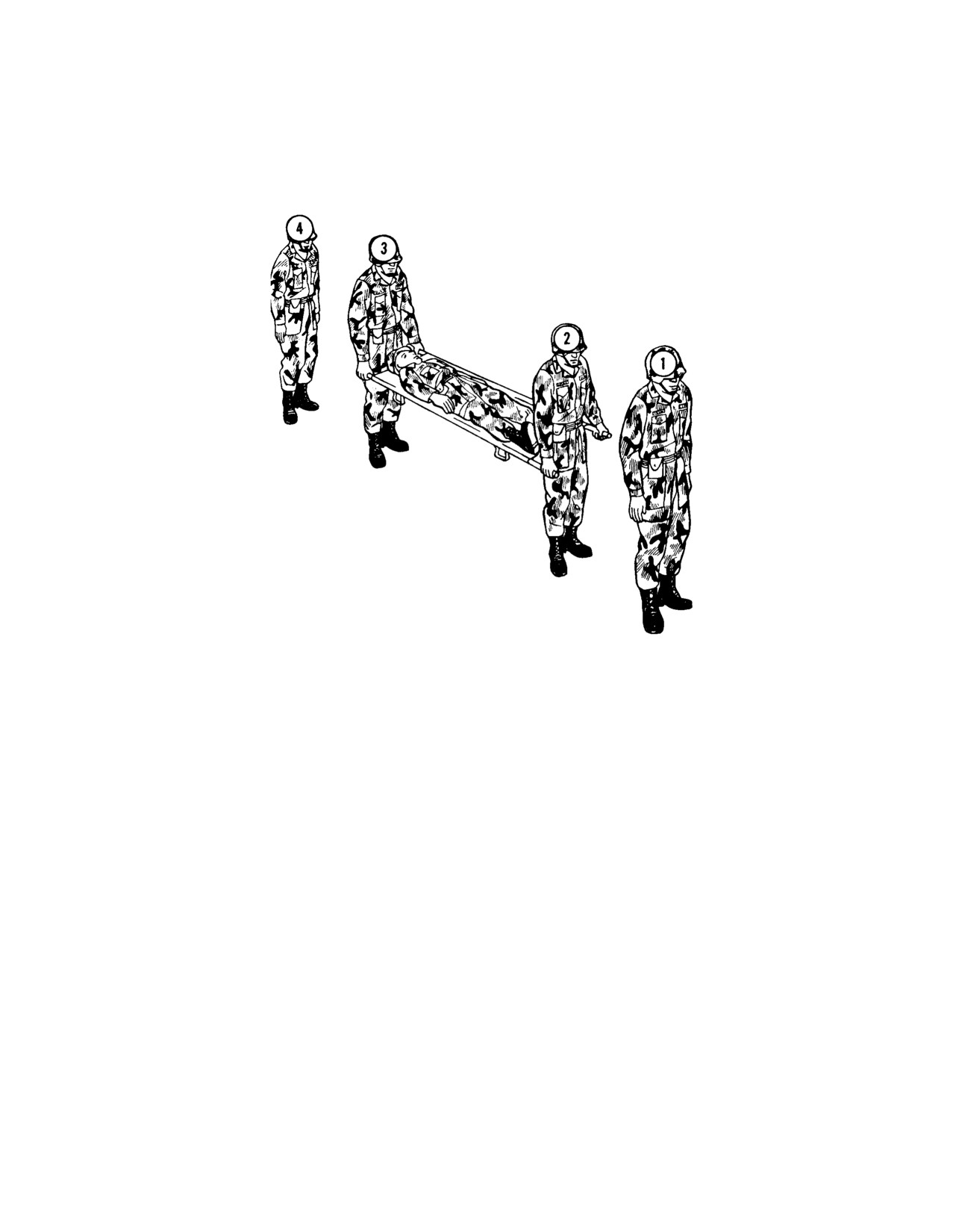
(2) The command Two-Man Carry, MOVE, is given to enable the litter squad in a four-man
carry to pass through or over narrow passages such as trails, bridges, gangplanks, and catwalks (Figure
J-24). After the litter bearers reach the end of such passages, they change back to the four-man carry. With
modification, this carry can also be used to pass through such obstacles as culverts or tunnels. Both bearers
carrying the litter face the patient and crawl on their knees through these obstacles. This requires one
bearer to crawl backwards.
(a) With the litter squad in the position of the four-man carry, the preparatory
command, Two-Man Carry, is given. Bearers numbers 2 and 3 change their holds on the litter handles to
the other hand, step between the handles, and take the full support of the litter as bearers numbers 1 and 4
release their holds.
(b) Bearer number 1 steps one pace in front of the squad to lead, and bearer number 4
falls one pace to the rear to follow.
Figure J-23. Four-man carry for smooth, level terrain.
J-16
FM 8-10-6
Figure J-24. Two-man carry for narrow trails and passages.
(c) At the command of execution, MOVE, the four bearers proceed through the
passage.
(3) The command Litter Post Carry, MOVE, is given to enable the litter squad in a four-man
carry to move over rough terrain (Figure J-25).
(a) With the litter squad in position of the four-man carry, the preparatory command,
Litter Post Carry, is given. Bearers numbers 2 and 3 step between the handles of the litter and take hold of
the handles. Bearers numbers 1 and 4 then release their holds.
(b) Bearers numbers 1 and 4 move to the sides of the litter and grasp the litter poles.
(c) At the command of execution, MOVE, the four bearers proceed carefully over the
rough terrain.
(4) Except when the patient has a fracture of a lower extremity, the litter is carried uphill or
upstairs with the patients head forward. Therefore, before proceeding with the uphill carry, the litter must
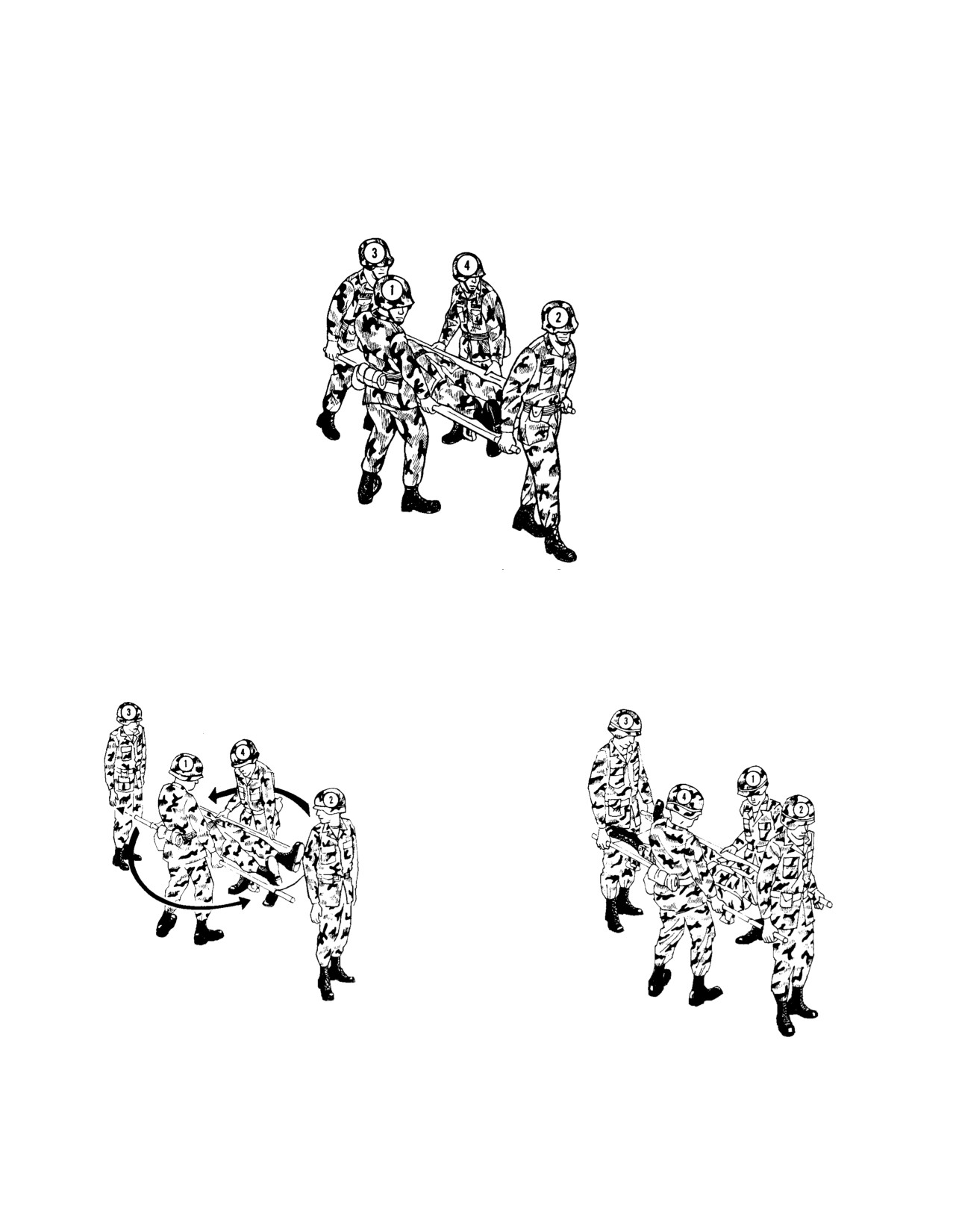
first be turned correctly. From the position of four-man carry (Figure J-23), the litter squad first moves into
the position of litter post carry (Figure J-25); then the command Prepare to Rotate, ROTATE (Figure J-26)
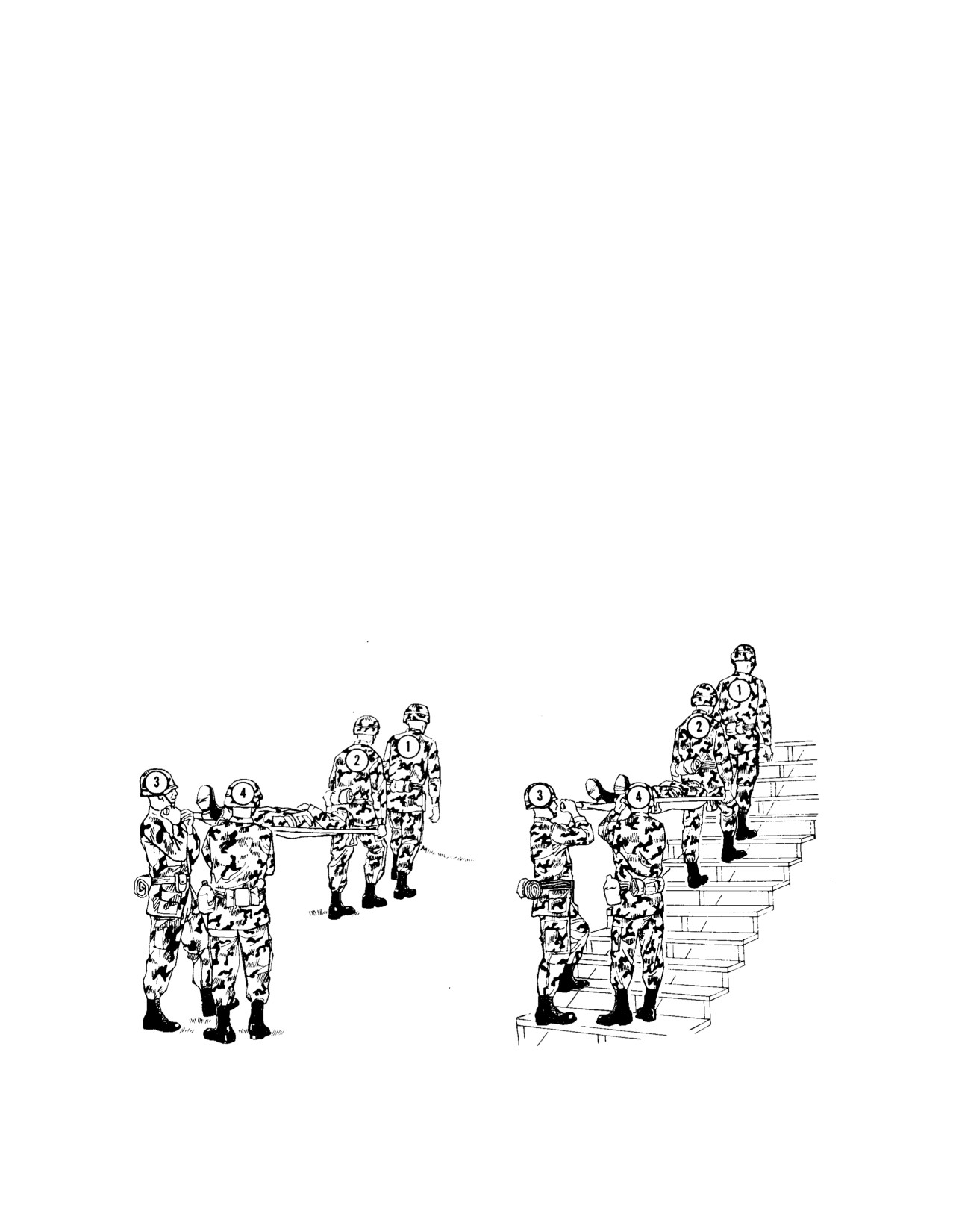
is given and followed by command, Uphill (Upstairs) Carry, MOVE (Figure J-27).
J-17
FM 8-10-6
Figure J-25. Litter post carry for rough terrain.
Figure J-26. Rotation of the litter for uphill or upstairs carry and for ambulance loading.
J-18
FM 8-10-6
(a) With the litter squad in the position of litter post carry, the preparatory command,
Prepare to Rotate, is given. Bearers numbers 2 and 3 release the litter handles and step one pace away,
allowing bearers numbers 1 and 4 to support the litter at its sides.
(b) At the command of execution, ROTATE, bearers numbers 1 and 4 move 180
degrees counterclockwise, thus placing the patients head in the direction of travel with bearer number 1
still on the patients right side.
(c) As soon as bearers numbers 2 and 3 observe that the rotation has been completed,
they resume their positions at the litter handles. The rotation of the litter places bearer number 2 at the
patients head.
(d) After the litter is rotated so that the patients head is in the direction of travel, the
squad halts.
(e) At the preparatory command, Uphill (Upstairs) Carry, bearer number 4 moves to
the foot of the litter and takes hold of the litter handle released by bearer number 3. Bearer number 1 moves
in front of the squad.
(f)
At the command of execution, MOVE, the squad proceeds uphill (upstairs) with
bearer number 1 preceding the squad. Bearers numbers 3 and 4 keep the litter level.
Figure J-27. Uphill and upstairs carry.
J-19
FM 8-10-6
(5) Except when the patient has a fracture of a lower extremity, the litter should be carried
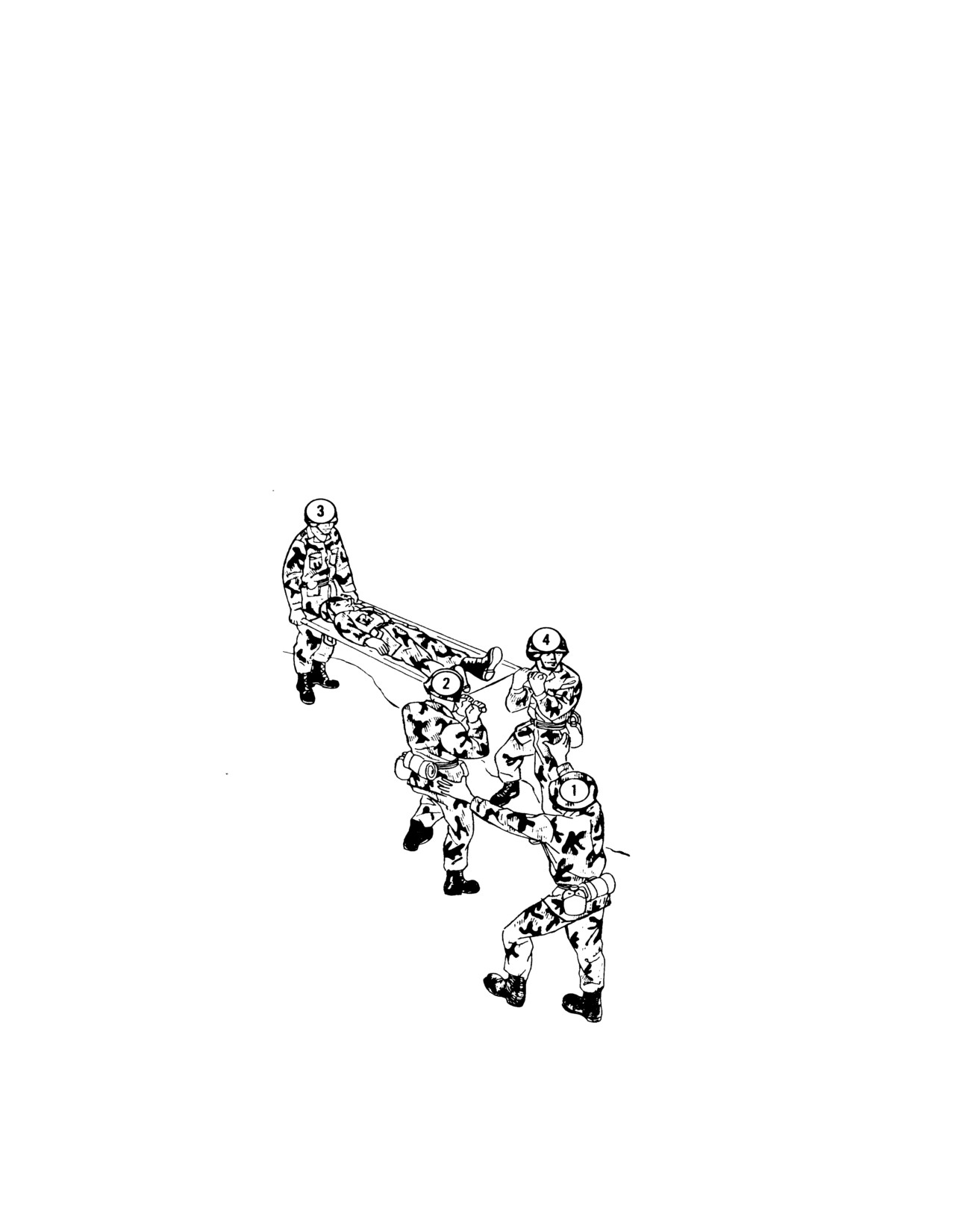
downhill or downstairs with the patients feet forward. The command Downhill (Downstairs) Carry,
MOVE (Figure J-28) is given when the litter squad is in the position of four-man carry (Figure J-23) or in
the position of litter post carry (Figure J-25) provided it has been used to rotate the loaded litter or to move
it over rough terrain just prior to carrying it downhill (downstairs).
(a) With the litter squad in the position of the four-man carry, the preparatory
command, Downhill (Downstairs) Carry, is given. Bearer number 3 takes the full support of the litter at the
patients head, and bearers numbers 2 and 4 remain in their positions at the patients feet.
(b) Bearer number 1 moves to the front, facing the squad. He supports bearers
numbers 2 and 4 and ensures that they keep the litter level as they move downhill (downstairs).
Figure J-28. Downhill or downstairs carry.
J-20
FM 8-10-6
c.
To Lower Loaded Litter. Before lowering the litter to the ground, the bearers resume the
position of four-man carry. At the preparatory command Lower, LITTER, each bearer slowly kneels on the
knee closer to the litter and gently places the litter on the ground. The squad then stands without command.
For balance and support when lowering the litter, each bearer places his free hand on his other knee which
remains in an upright position.
J-8.
Procedures for Surmounting Obstacles
In litter transportation, bearers must be able to surmount various artificial and natural obstacles such as
fences, high walls, deep trenches, wide streams, and stairwells with small landings. Specific commands for
surmounting these obstacles are neither necessary nor feasible, as they must be given in conjunction with
the commands for the appropriate litter carry. Common sense must also be used in adapting specific
procedures to individual situations.
a. Litter Obstacle Course. A litter obstacle course is a useful training tool for surmounting
obstacles and for the physical conditioning of bearers. An obstacle course can be constructed to simulate
most types of natural and artificial obstructions that litter bearers are likely to meet. Where construction of
such a course is impracticable, many obstacles can be simulated from existing facilities.
b. Methods for Surmounting Obstacles. A number of methods, as well as modifications in litter
carries, which enable the litter squad to surmount various obstacles, are discussed below.
(1) Surmounting a fence or low wall.
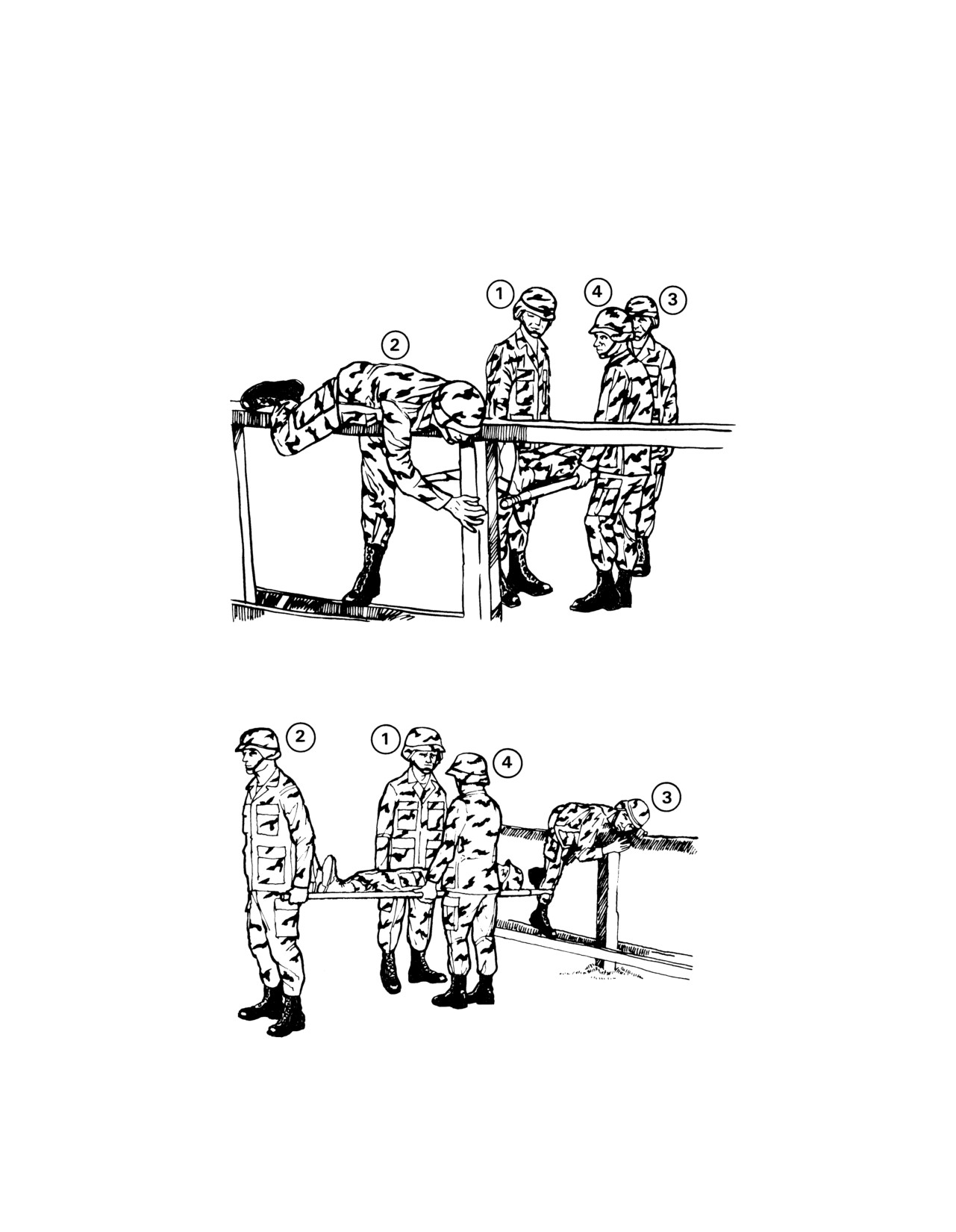
(a) With the litter squad in the position of Litter Post, CARRY, bearer number 2
releases his grasp of the front handles at the patients feet and crosses the obstacle, maintaining a low
silhouette. Bearers numbers 1, 3, and 4 then advance the litter until bearer number 2 can resume his grip of
the front handles (Figure J-29).
(b) The litter is rested on the obstacle with the stirrups placed on the side of the
obstacles in the direction of travel. Bearers numbers 2 and 3 support the litter by the front and rear handles,
respectively, while bearers numbers 1 and 4 cross the obstacle maintaining a low silhouette. Having passed
the obstacle, bearers number 1 and 4 grasp the litter poles near the rear handles held by bearer number 3.
Bearer number 3 then releases his hold of the rear handles and crosses the obstacle, maintaining a low
silhouette. Bearer number 3 resumes his grasp on the rear handles and bearers numbers 1 and 4 adjust the
position of their holds (Figure J-30).
NOTE
The litter should be lifted and not dragged across the top of the
obstacle.
J-21
FM 8-10-6
Figure J-29. Surmounting a fence or low wall (step one).
Figure J-30. Surmounting a fence or low wall (step two).
J-22
FM 8-10-6
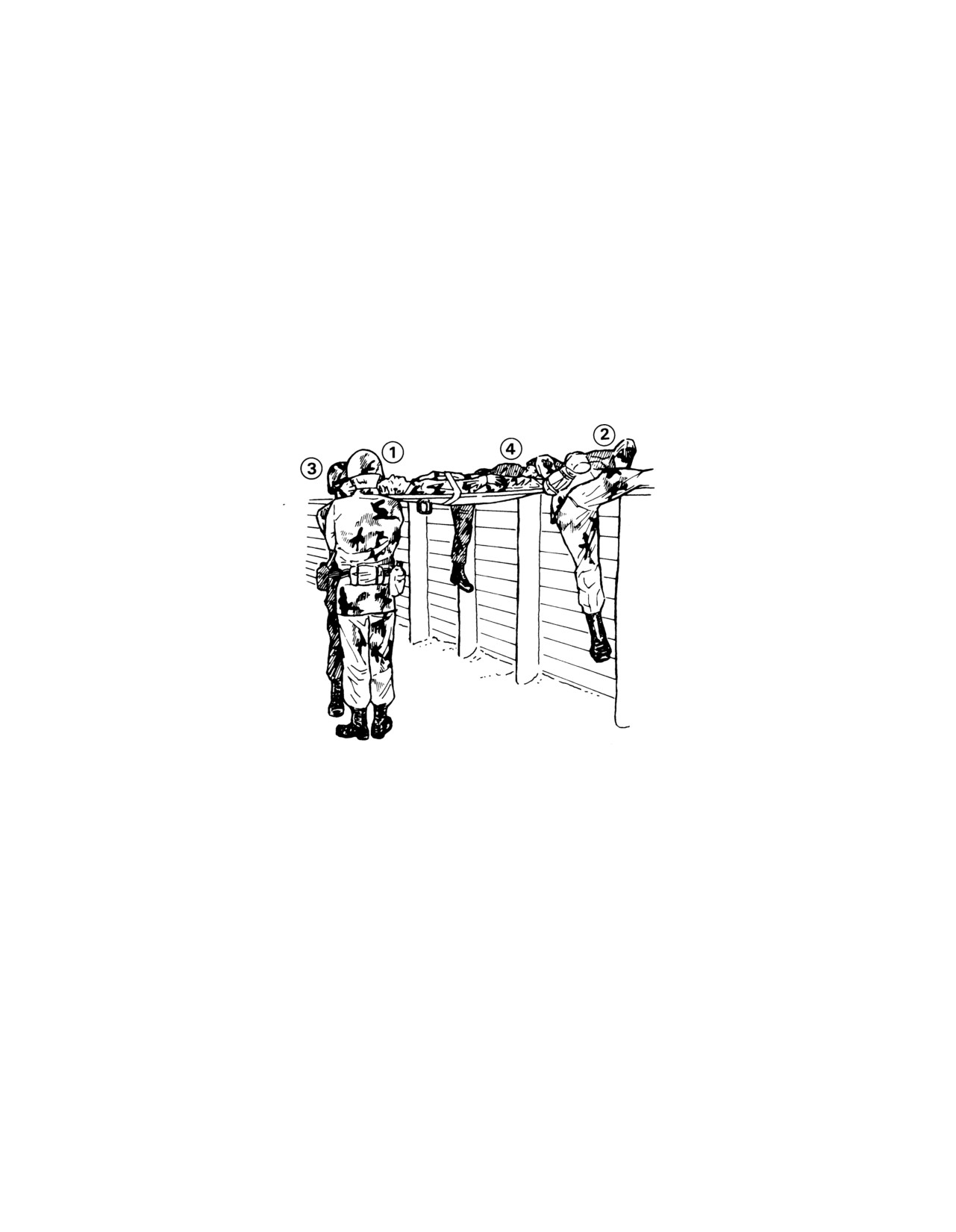
(2) Surmounting a high wall. With the litter squad in the position of the four-man carry, the
bearers turn and face each other. Together they raise the litter approximately chest high, step close to the
litter, letting their bent elbows touch their chests. The front bearers place the front stirrups beyond the wall,
scale the wall and drop to the other side. All four bearers move the litter forward until the rear stirrups are
against the wall, taking care to avoid scraping the patients back. The rear bearers then scale the wall and
drop to the other side and lift their end of the litter off the wall (Figure J-31). The bearers then resume the
four-man carry.
Figure J-31. Surmounting a high wall.
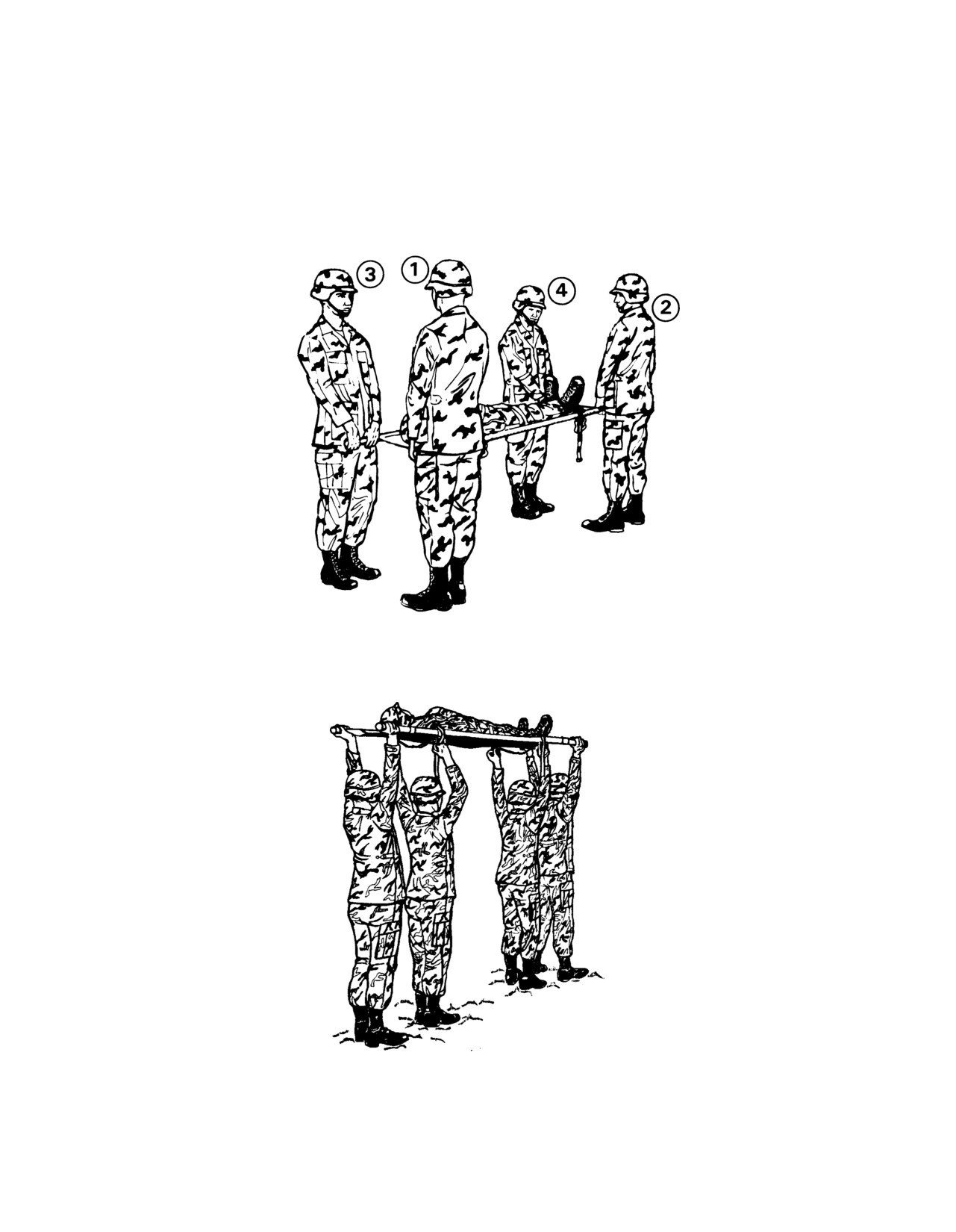
(3) Fording streams and crossing deep trenches.
(a) With the litter squad in position for the four-man carry, the bearers turn and face
each other, determining who is the taller of the two at each end of the litter. Together they raise the litter
over their heads, keeping it level. If they are in a trench, they lift the litter above the top of the trench
(Figure J-32).
(b) The taller bearer at each end of the litter moves between the handles, facing in the
direction of travel and grasps the handles as close to the canvas as possible. The shorter bearer at each end
moves under the litter, facing in the direction of travel and grasps the stirrups, which compensate for the
differences in height. If all bearers are of equal height, the bearers under the litter grasp the litter poles to
the side of the stirrups nearer the ends (Figure J-33).
J-23
FM 8-10-6
Figure J-32. Fording streams and crossing deep trenches (overhead carry, step one).
Figure J-33. Fording streams and crossing deep trenches (overhead carry, step two).
J-24
FM 8-10-6
NOTE
Should the front bearer step into a hole as they proceed across the
stream and release his hold, the other three bearers could keep the
litter in position.
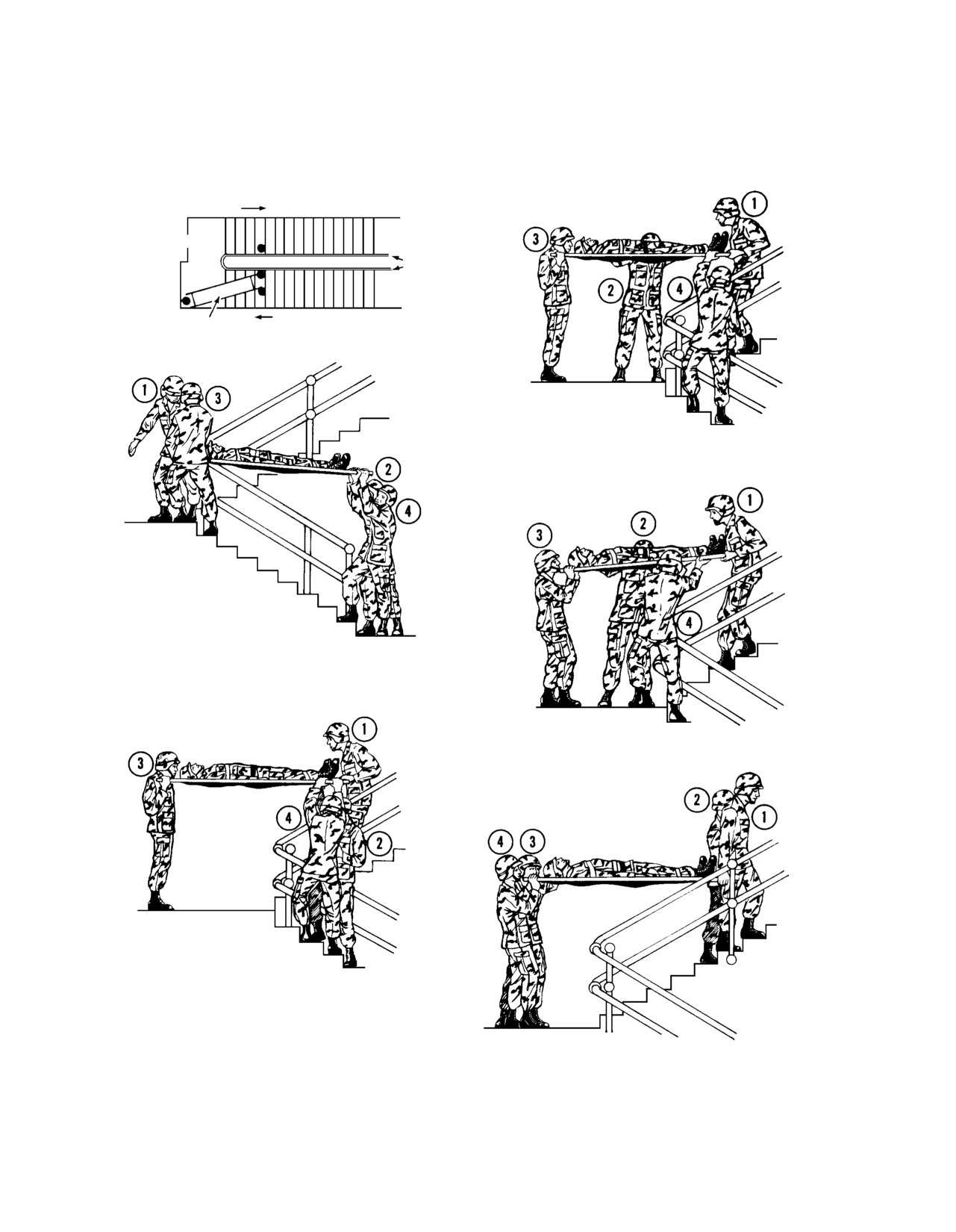
(4) Carrying a litter patient up a stairwell with small landings. The steps for this procedure
(Figure J-34) are
(a) The litter squad proceeds upstairs to the landing with bearers numbers 1 and 3
supporting the head of the litter and bearers numbers 2 and 4 supporting the foot of the litter.
(b) Upon arrival at the landing, bearer number 3 turns facing the head of the litter and
supports it while bearer number 1 proceeds several steps up the next flight of stairs. Bearers numbers 2 and
4 raise the foot of the litter until bearer number 1 can grasp the handle released by bearer number 2. Bearer
number 2 then moves to the side of the litter.
(c) With bearer number 2 helping bearer number 1 to support the litter, bearer number 1
grasps the handle released by bearer number 4.
(d) Bearer number 4 continues to help support the litter on the side as he moves up the
stairs.
(e) Bearer number 4 assists bearer number 3 in carrying the head of the litter while
bearer number 2 advances and assists bearer number 1 in carrying the foot of the litter to the next landing.
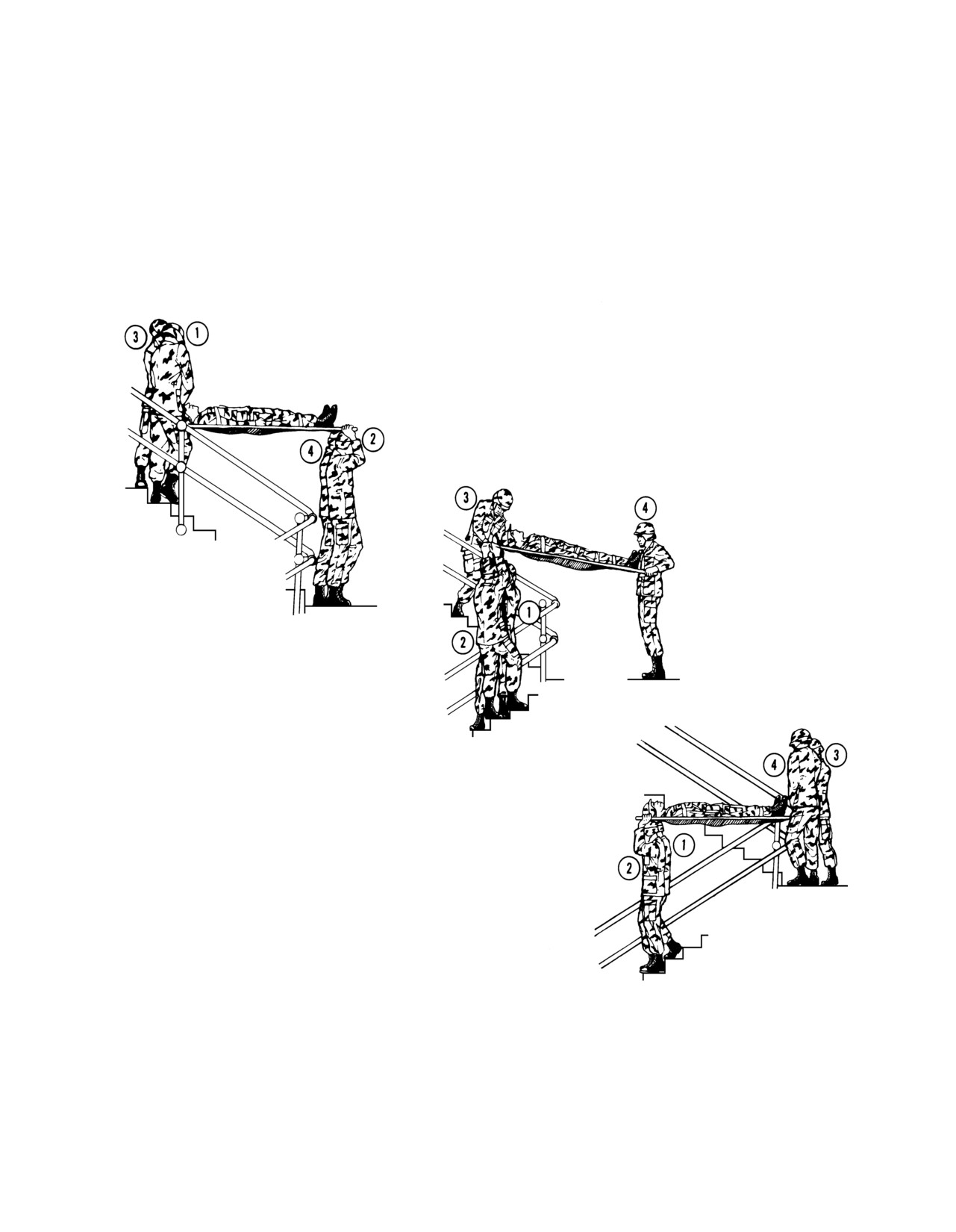
(5) Carrying a litter patient down a stairwell with a small landing. The steps for this
procedure (Figure J-35) are
(a) The litter squad proceeds down the steps to the first landing with bearers numbers 1
and 3 supporting the head of the litter and bearers numbers 2 and 4 supporting the foot of the litter.
(b) Upon arrival at the first landing, bearer number 4 turns and faces toward the litter
and supports the foot of the litter while bearer number 3 supports the head of the litter. Bearers numbers
1 and 2 descend a few steps to the lower flight of stairs and receives the head of the litter from bearer
number 3.
(c) Bearer number 3 moves to the foot of the litter to assist bearer number 4 while
bearers numbers 1 and 2 support the head of the litter. They then move down the stairs to the next landing.
J-25
FM 8-10-6
Figure J-34. Carrying a litter patient up a stairwell with small landings.
J-26
FM 8-10-6
Figure J-35. Carrying a litter patient down a stairwell with small landings.
J-27
FM 8-10-6
APPENDIX K
SELECTION OF PATIENTS FOR AEROMEDICAL EVACUATION
AND PATIENT CLASSIFICATION CODES AND PRECEDENCE
K-1. General
Patient classification codes provide information to evacuators and treatment personnel in an abbreviated
form. They can be used to complete administrative reporting requirements pertaining to the evacuation of
patients.
Paragraphs K-2 through K-5 implement STANAG 3204 and AIR STD 61/71.
K-2. Selection of Patients for Aeromedical Evacuation
Patients selected for evacuation by air must be cleared for the proposed flight by the attending physician
and/or health care provider at the OMF, staging element, or an en route care facility. The health care
provider must balance fitness considerations with the availability of suitable in-flight medical care, urgency
of treatment by the next echelon of care, and the operational capabilities of the available aircraft.
a. Forward Aeromedical Evacuation. The paramount need is to evacuate the patient from the
point of injury to the initial point of treatment as quickly as possible. Helicopters will be used for airlift,
and in these circumstances, the only available personnel will often be combat lifesavers trained in first aid
or combat/flight medics. The principles for conducting evacuation in forward areas is discussed in STANAG
2087.
b. Tactical and Strategic Intratheater and Intertheater Aeromedical Evacuation. The benefit to
the patient for evacuation to an area where appropriate MTFs are available must be balanced against the
ability of the patient to withstand the anticipated environmental conditions of the flight.
(1) When AE is carried out with pressurized aircraft, appropriately fitted and carrying a
trained in-flight medical crew, the patient is subjected only to minor mechanical disturbance and a slight
degree of oxygen lack that can be countered with oxygen therapy.
(2) In wartime AE, however, conditions may often be much less favorable. Account must
be taken of the effects on the prospective passenger of less significant changes in atmospheric pressure and
cabin temperature, turbulence, and workload and capability of the in-flight medical crew operating with
restricted facilities. Further, the type of aircraft and the flight plan (duration of flight and intervening stops)
also impact on care and stability of the patients.
c.
Clinical Selection Criteria. There are no absolute contraindications to AE. Each case must be
judged on its merits, weighing the advantage to the patient of transfer against the possible harmful effects of
the flight. Sometimes a calculated risk must be taken.
K-1
FM 8-10-6
(1) However, as a guide it would be wise to accept the following types of patients only when
there is no other acceptable means of transport:
Patients in the infective stage of serious communicable diseases. If any are carried,
appropriate precautions must be taken for the protection of the other patients/crew members.
Sick and wounded patients whose general condition is poor and they may not
survive the flight or whose medical condition will severely deteriorate.
Patients whose upper and lower jaws are immobilized. Such patients require
constant supervision by persons who are competent and equipped to remove the tie materials immediately
should the patient become airsick or vomit. Fixation by intermaxillary elastics is preferable to wire because
of the ease of cutting.
Pregnant patients beyond the 240th day of pregnancy are not routinely acceptable
for AE, but may be moved if determined necessary to the patients mental and/or physical health by
competent medical authority.
(2) Patient with any of the following conditions require special consideration in selection for
AE (particularly in unpressurized aircraft [helicopter]):
Respiratory embarrassment. Patients whose unaided vital capacity is less than 900
milliliters (ml) should not normally be moved by air without a mechanical respirator.
Cardiac failure or early postmyocardial infarction.
Severe anemia (less than 2.5 million red blood cells [RBC] per cubic millimeter or
less than 7 grams hemoglobin per 100 ml) estimated as near as possible to the proposed flight and not more
than 72 hours beforehand.
Trapped gas within any of the body cavities (such as a pneumothorax). Post-
laparotomy or thoracotomy patients should not normally be moved within 10 days of operations except in
pressurized aircraft.
Patients in plaster of paris casts should be escorted since limbs may swell during
flight, necessitating bivalving of the cast. Casts applied less than 72 hours prior to the flight are to be of the
GYPSONA type and are split (including all dressings) down to the skin level. Patients with lower limb
plasters are normally litter cases unless the cast has been on for more than 7 days and there is no residual
tissue swelling.
Detached retina, intraocular hemorrhage, or any choroidal or retinal injury.
Hypoxia can increase intraocular tension and cause meiosis.
K-2
FM 8-10-6
Patients with subarachnoid hemorrhage should be moved either before 48 hours or
after 6 weeks have elapsed.
Patients with vascular anastomosis should not be subjected to AE evacuation for 14
days.
(3) Patients with critical medical or surgical conditions (such as penetrating wounds or
injuries of the chest or abdomen) should be stabilized if at all possible before AE.
K-3. Briefing of Patients Prior to Aeromedical Evacuation
When patients are evacuated by aircraft (routinely in Echelons III, IV, and V), they should be briefed on the
following points:
a. A number of ambulatory patients will be detailed to assist with the evacuation of litter patients
in any emergency.
b. Safety belts and litter straps are to be properly fastened in accordance with orders given by the
pilot.
c.
Patients are instructed on the proper position to assume in preparing for an emergency. Flight
crews and CCAT ensure that seat safety harnesses have been tightened.
d. Ambulatory patients, with the exception of those designated to assist litter patients, are the first
to leave a downed aircraft.
e.
Immobilized litter patients are freed from litters and assisted in leaving the aircraft. Litters
will not normally be removed from their fastenings in view of the limited time available to evacuate the
aircraft.
f.
Mentally disturbed patients should be quieted so that the orderly removal of other patients will
not be jeopardized.
K-4. International Standardization Agreement Codes
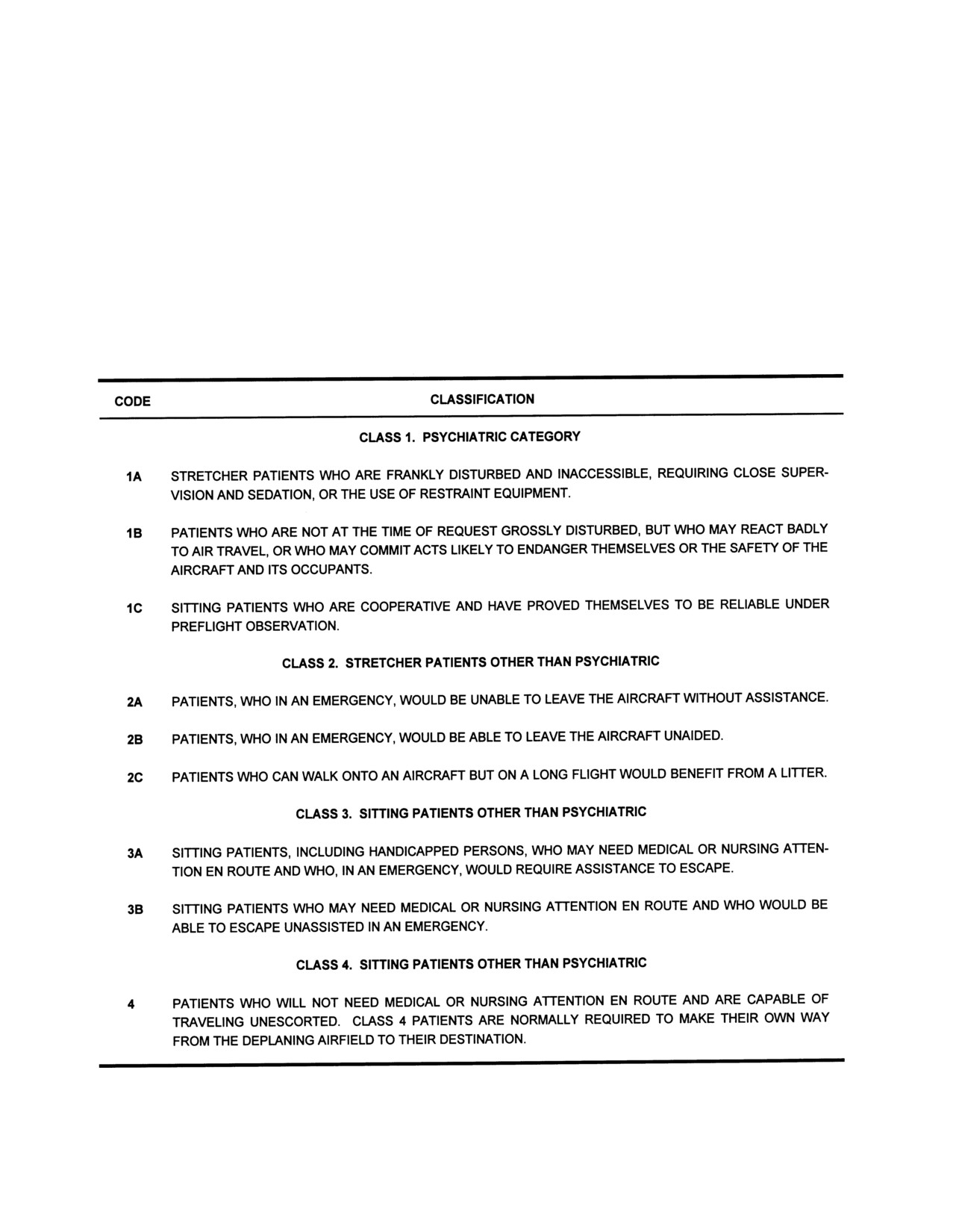
Table K-1 provides the patient classification codes defined in international standardization agreements.
K-5. International Standardization Evacuation Precedence
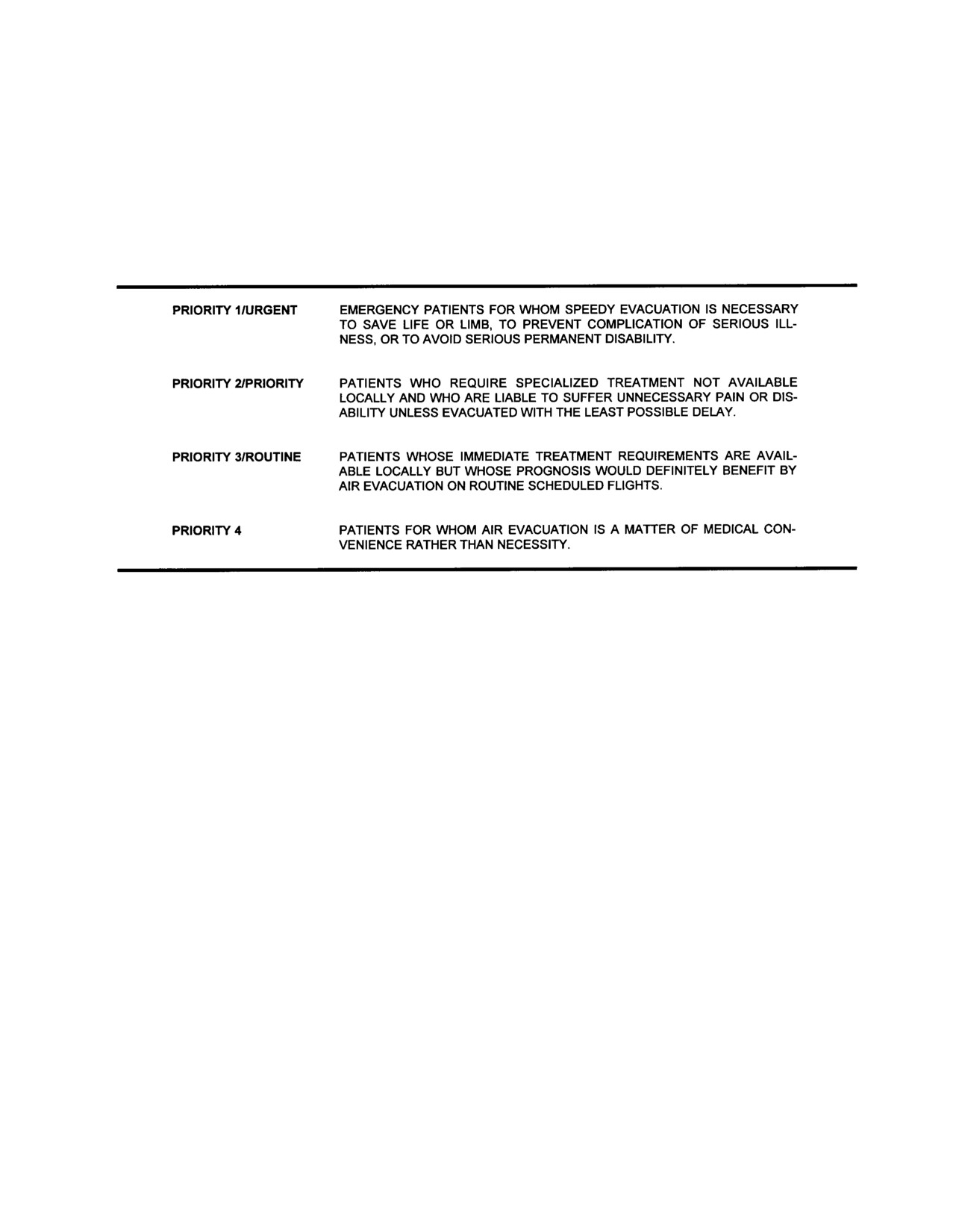
Patients for AE will be given appropriate degrees of priority so that, if aircraft space is limited, the
more urgent patients may be evacuated before those whose conditions are less serious. The degrees
K-3
FM 8-10-6
of priority are depicted in Table K-2.
(The evacuation precedence used by the USAF is essentially the same
as this listing. It contains a few word changes and introduces specific time limits. It does not contain
Priority 4.)
Table K-1. Patient Classification Codes
K-4
FM 8-10-6
Table K-2. Patient Priorities as Designated in STANAG 3204 and Air Standard 61/71.
K-6. Patient Classification
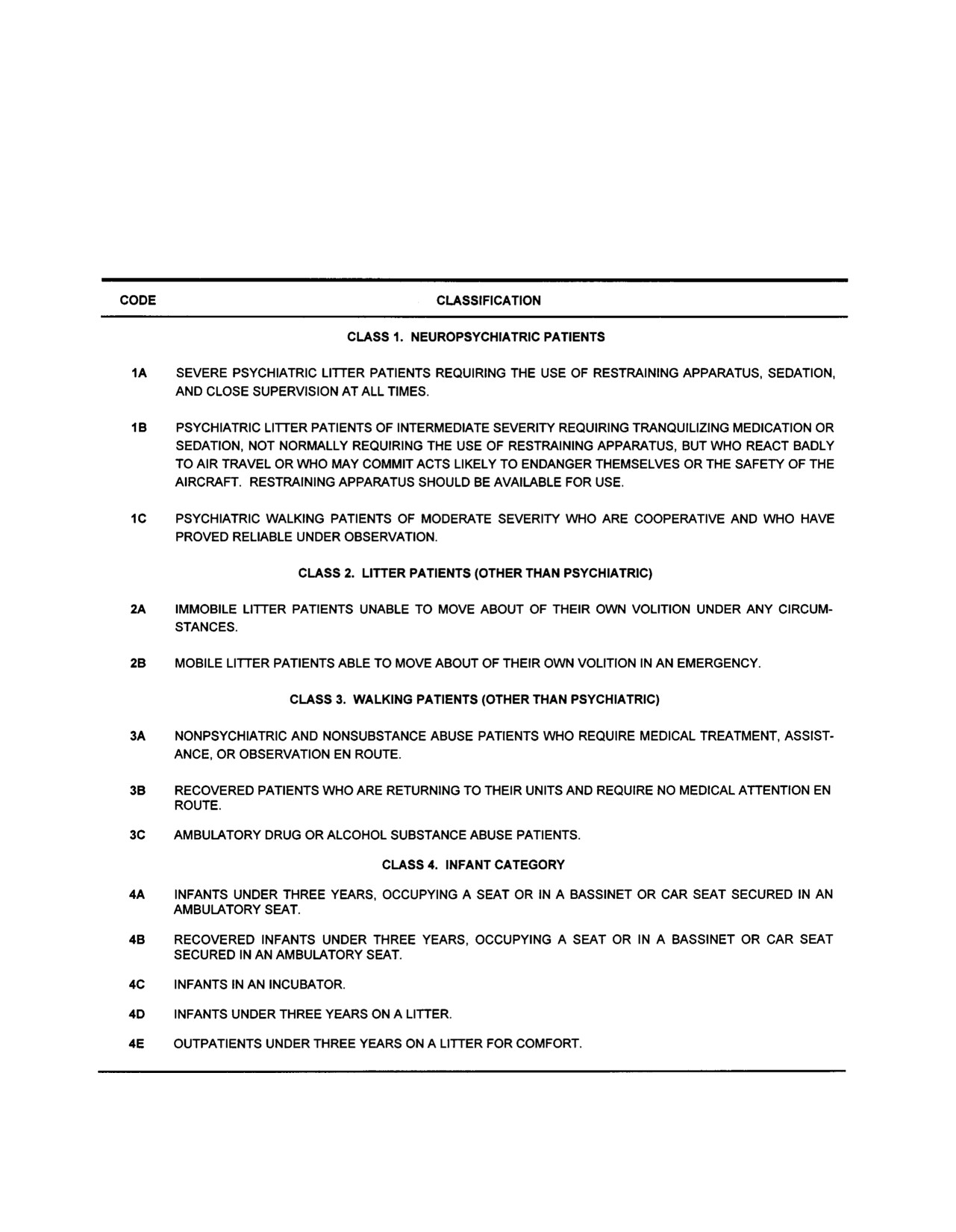
Table K-3 provides the patient classification codes used aboard USAF aircraft and that can be used in
completing DD Form 601 (Appendix H). These codes are expanded to include categories of patients and
other personnel which may or may not apply on the battlefield (such as infants, relatives, or friends).
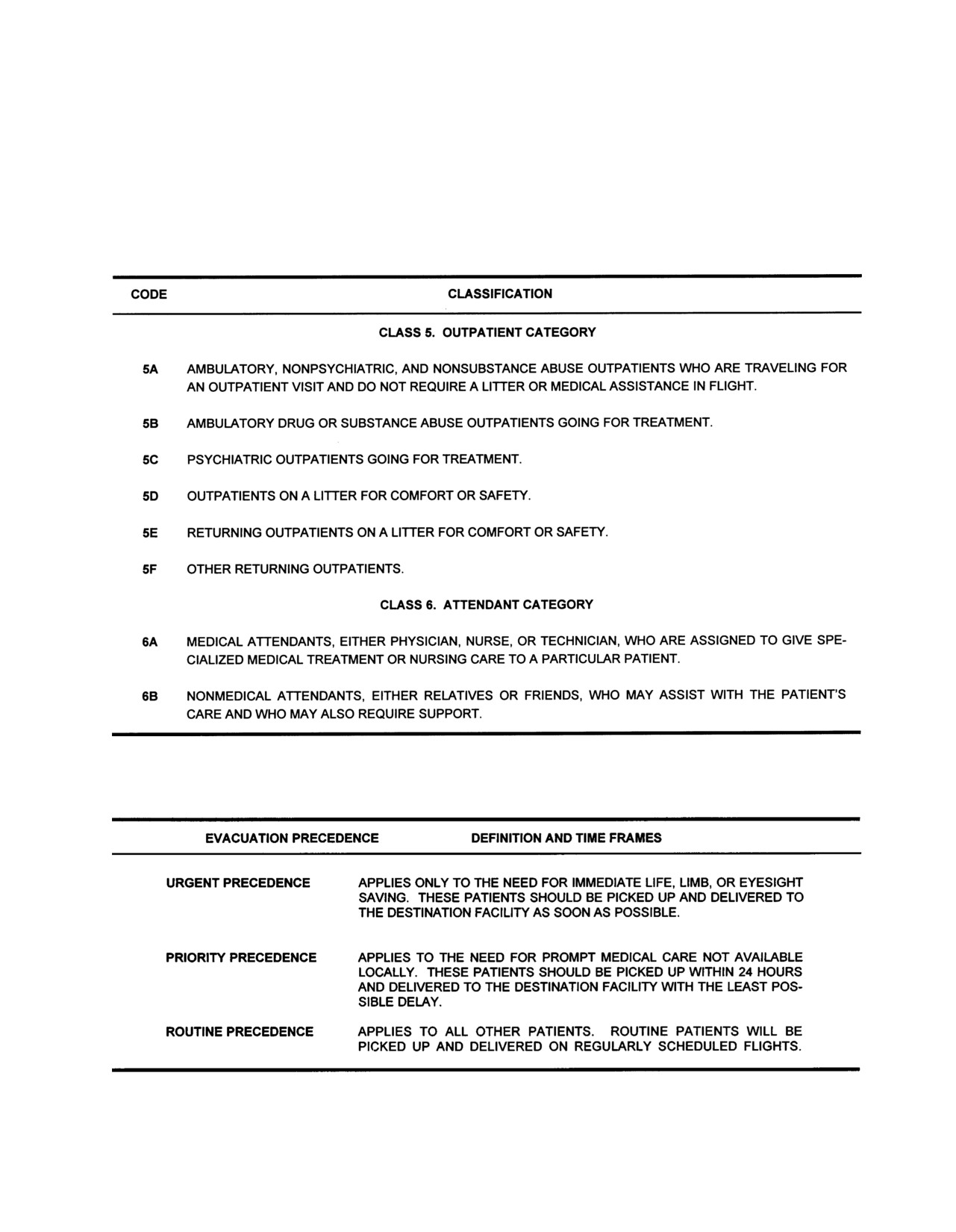
K-7. United States Air Force Evacuation Precedence
The evacuation precedence used by the USAF is dramatically different than that employed by the US Army
medical evacuation system. These precedence should not be confused. Table K-4 provides the evacuation
precedence and time frames used by the USAF.
K-5
FM 8-10-6
Table K-3. Patient Classification Codes
K-6
FM 8-10-6
Table K-3. Patient Classification Codes (Continued)
Table K-4. Evacuation Precedence Used by the United States Air Force
K-7
FM 8-10-6
APPENDIX L
RISK MANAGEMENT
L-1. General
a. Risk management is the process of identifying, assessing, and controlling risks arising from
operational factors and making decisions that balance risk costs with mission benefits. Leaders and soldiers
at all levels use risk management. It applies to all missions and environments across the wide range of
Army operations.
b. For an in-depth discussion of risk management, refer to FM 100-14. This manual also
provides a sample risk management work sheet for use in assessing risks.
L-2. Types of Risks
Hazards can exist, regardless of enemy or adversary actions, in areas with no direct enemy contact and in
areas outside the enemys or adversarys influence. The two types of risk that exist across the wide range of
Army operations are tactical risks and accident risks.
a. Tactical risk is risk concerned with hazards that exist because of the presence of either an
enemy or an adversary. It applies to all levels of war and across the spectrum of operations.
b. Accident risk includes all operational risk considerations other than tactical risk. It includes
risks to the friendly force. It also includes risks posed to civilians by an operation, as well as an operations
impact on the environment. It can include activities associated with hazards concerning friendly personnel,
civilians, equipment readiness, and environmental conditions.
L-3. Hazards
A hazard is an actual, or potential, condition where the following can occur due to exposure to the hazard:
Injury, illness, or death of personnel.
Damage to or loss of equipment and property.
Mission degradation.
L-4. Risk Management Steps
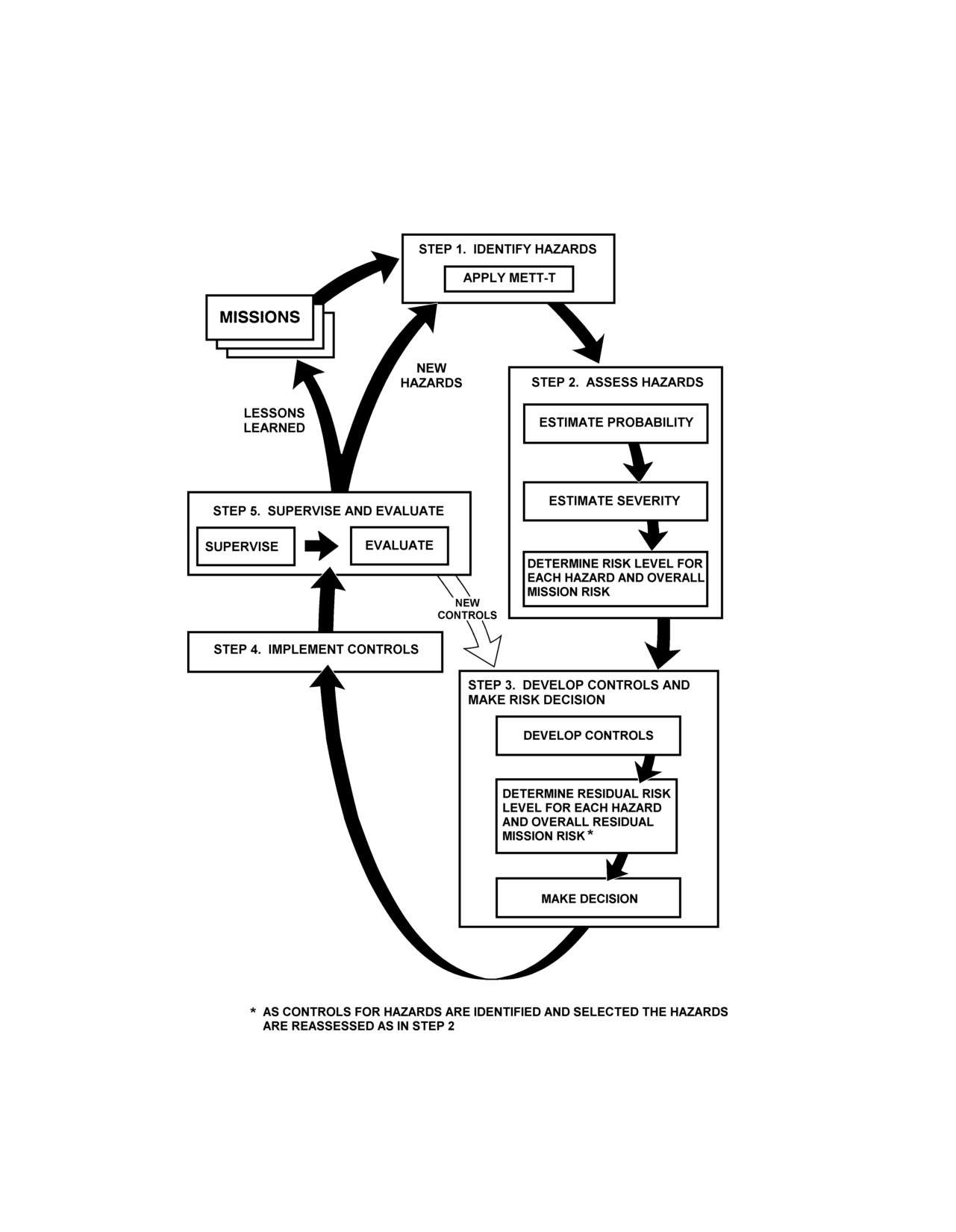
a. Risk management is a five-step approach (Figure L-1) for ensuring that operations and mission
accomplishment are not compromised by accidents.
b. The five steps of risk management are
(1) Identify hazards. Identify the most probable hazards for the mission. Hazards are
conditions with the potential of causing injury to personnel, damage to equipment, loss of material, or a
L-1
FM 8-10-6
Figure L-1. Five steps of risk management.
L-2
FM 8-10-6
lessening of the ability to perform a task or mission. The most probable hazards are those created by
readiness shortcomings in the operational environment. When a list of frequently recurring hazards is
applied to a specified task or mission, the most probable hazards can be identified.
(2) Assess hazards to determine risks. Once the most probable hazards are identified,
analyze each to determine the probability of its causing an accident and the probable effect of the accident.
Also, identify control options to eliminate or reduce the hazard.
(3) Develop controls and make risk decisions. Weigh the risk against the benefits of
performing the operation. Accept no unnecessary risks; make any residual risk decisions at the proper level
of command.
(4) Implement controls. Integrate specific controls into OPLANs, OPORDs, TSOPs, and
rehearsals. Communicate controls down to the individual soldier.
(5) Supervise and evaluate. Determine the effectiveness of controls in reducing the
probability and effect of identified hazards. Ensure that risk control measures are performing as expected.
Include follow-up reviews during and after actions to ensure all went according to plan, reevaluating or
adjusting the plan as required, and developing lessons learned.
L-5. Risk Management Principles
The principles which guide risk management are
Integrating risk assessment into mission planning, preparation, and execution.
Making risk management decisions at the appropriate level in the chain of command.
Accepting no unnecessary risk.
L-6. Risk Assessment
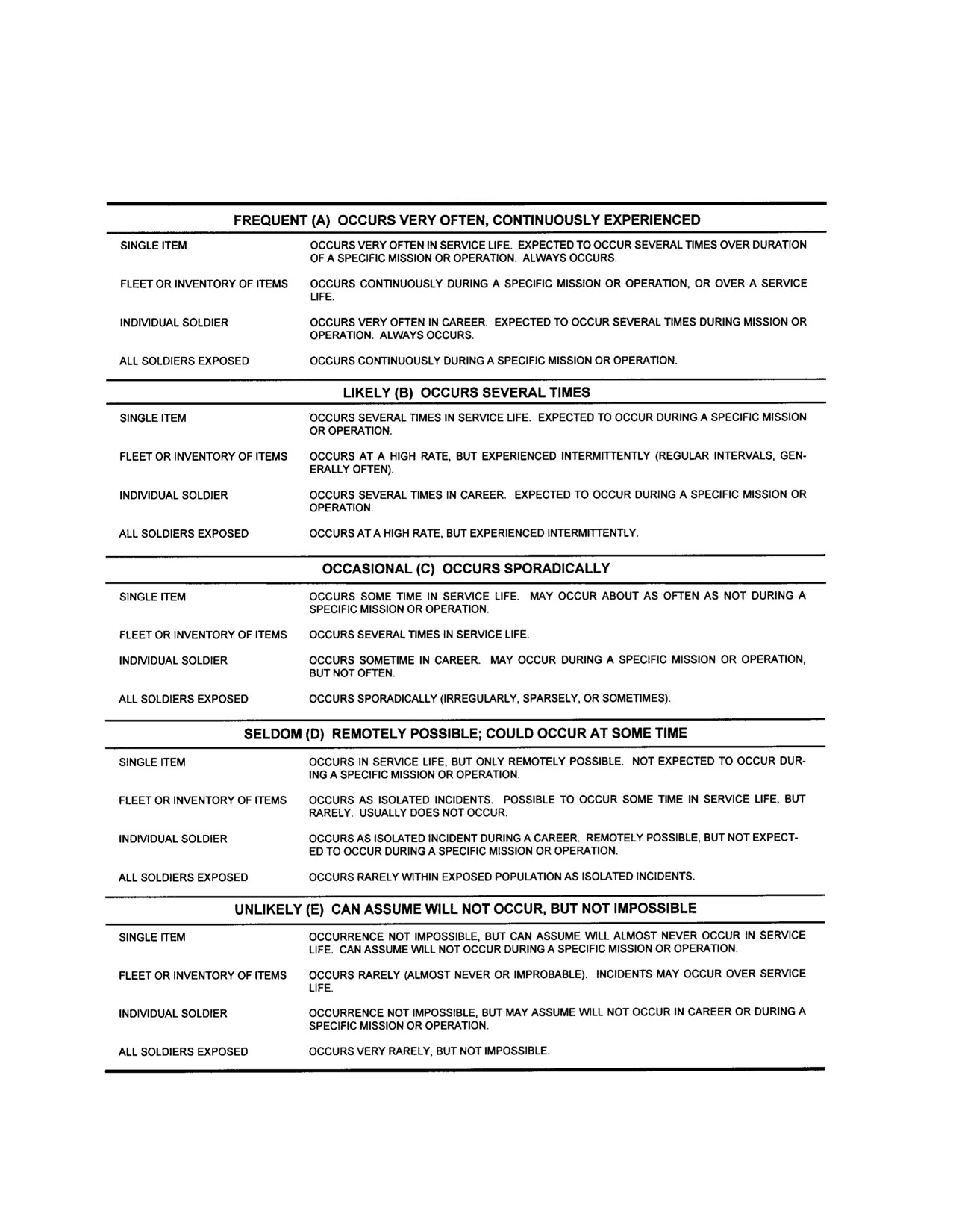
a. Leaders and staffs assess each hazard in relation to the probability of a hazardous incident.
The probability levels estimated for each hazard may be based on mission, COAs being developed and
analyzed, or frequency of a similar event. Table L-1 provides a summary of the five degrees of probability.
The letters in parentheses following each degree (A through E) provide a symbol for depicting probability.
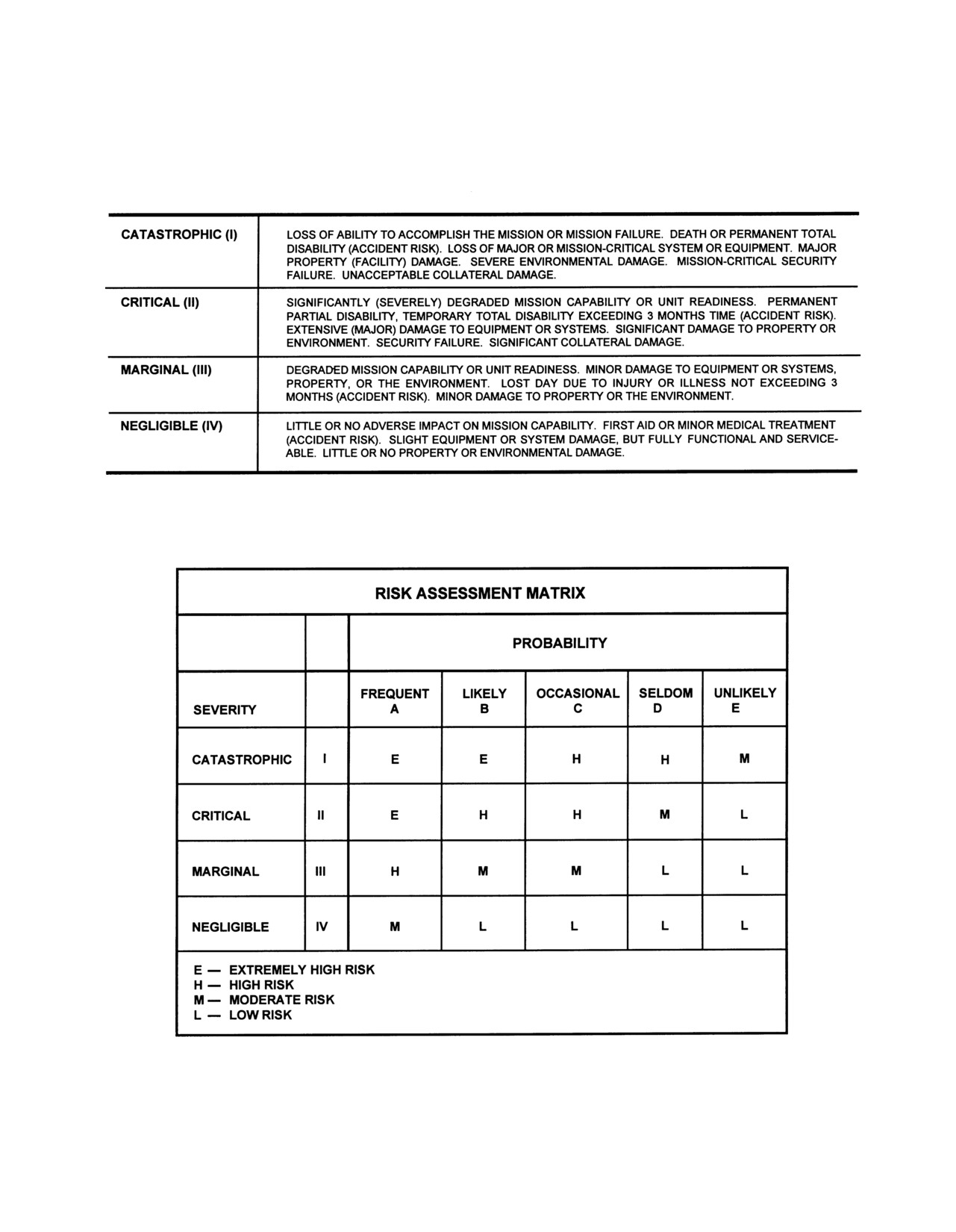
Table L-2 provides a summary of the hazard severity. Figure L-2 is the US Army risk assessment matrix.
b. There are four levels of risk. These levels are
Low Risk. Low risk operations are where normal caution, supervision, and safety
procedures ensure a successful and safe mission.
L-3
FM 8-10-6
Table L-1. Hazard Probability
L-4
FM 8-10-6
Table L-2. Hazard Severity
Figure L-2. Risk assessment matrix.
L-5