FM 8-10-6 MEDICAL EVACUATION IN A THEATER OF OPERATIONS TACTICS, TECHNIQUES, AND PROCEDURES - page 8
FM 8-10-6
SL slight.
SV severe.
e.
The FMC may also be used for CRO cases. Certain cases not admitted to an MTF are CRO.
For CRO cases, DA Form 3647 or the FMC is prepared and a register number assigned. When DA Form
3647 is used, Items 7, 10, 14, 24, 27, 30, and the name of the admitting officer need not be completed.
When the FMC is used, Item 11 need not be completed.
f.
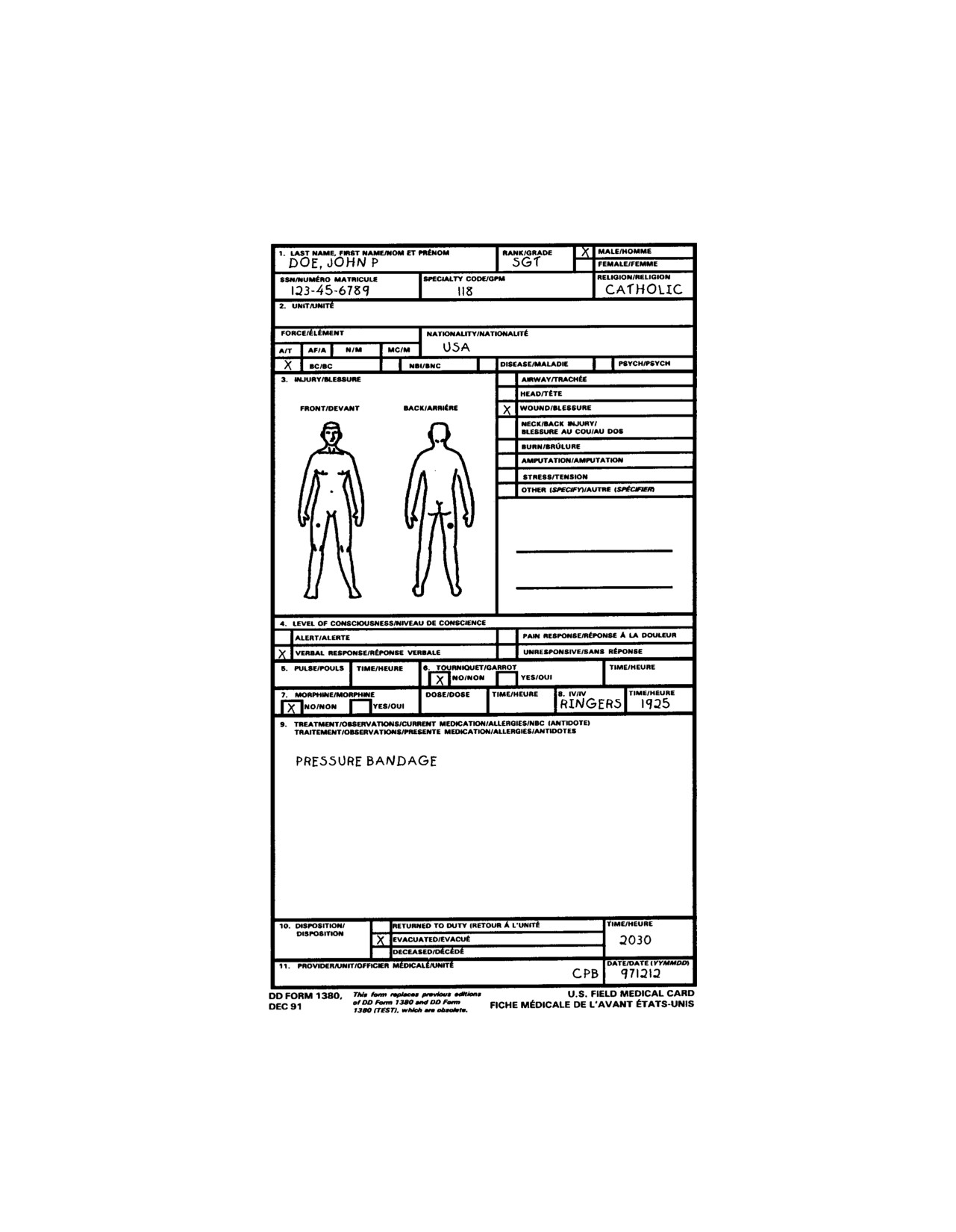
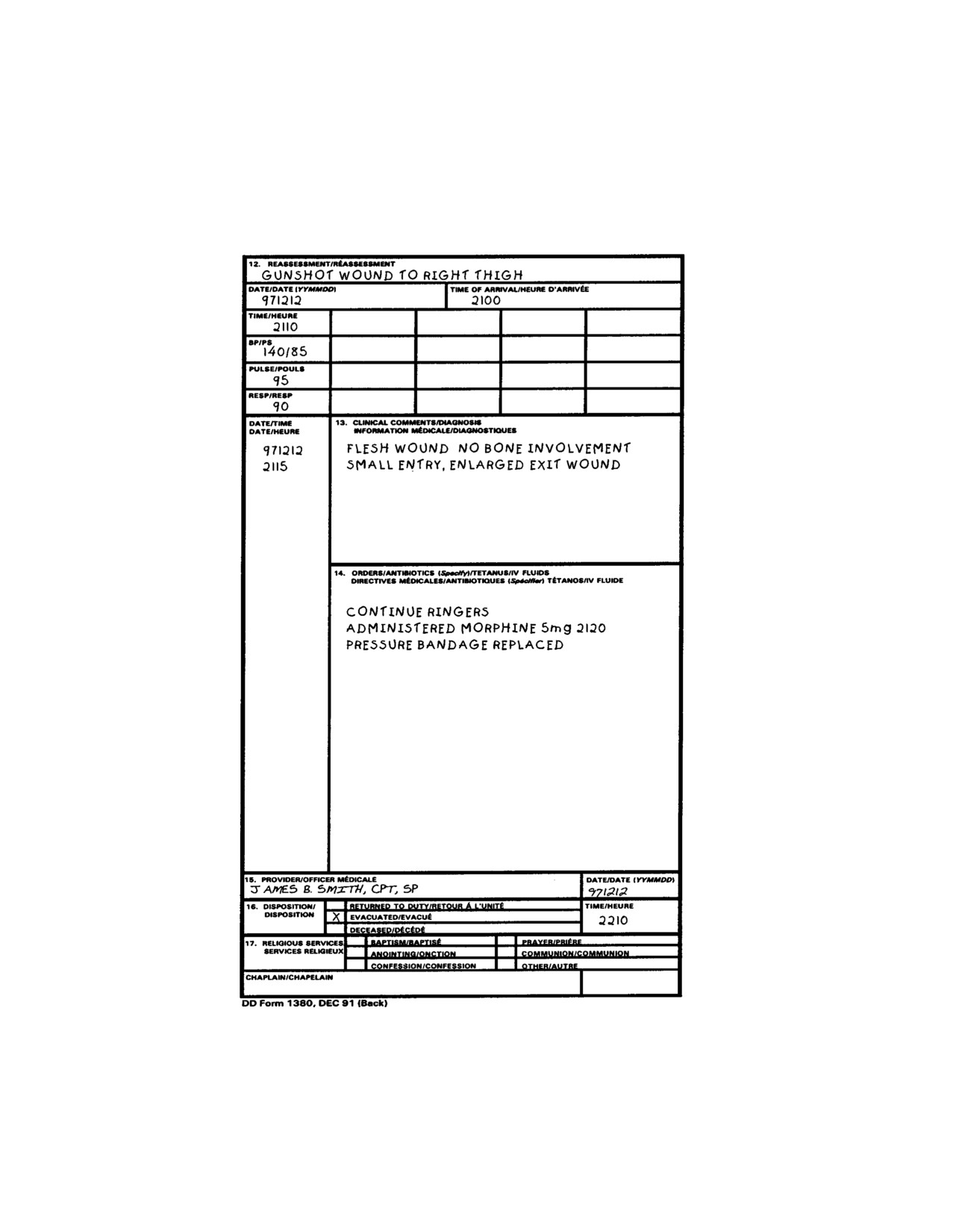
Figure C-1 provides a sample DD Form 1380 completed by the combat medic. Figure C-2 is
a sample of reassessment accomplished at the BAS.
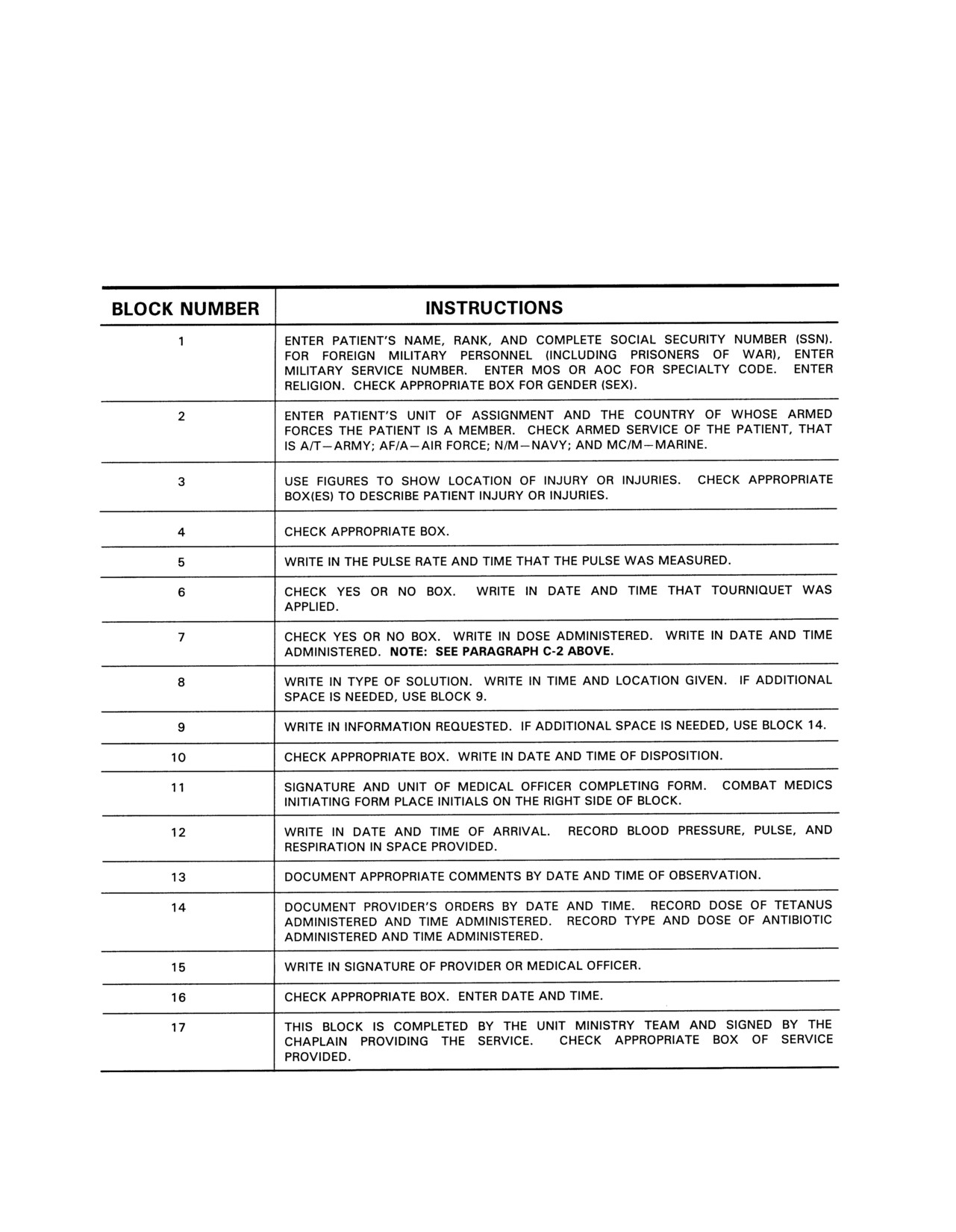
g. Instructions for the completion of DD Form 1380 are contained in Table C-1. Officer and
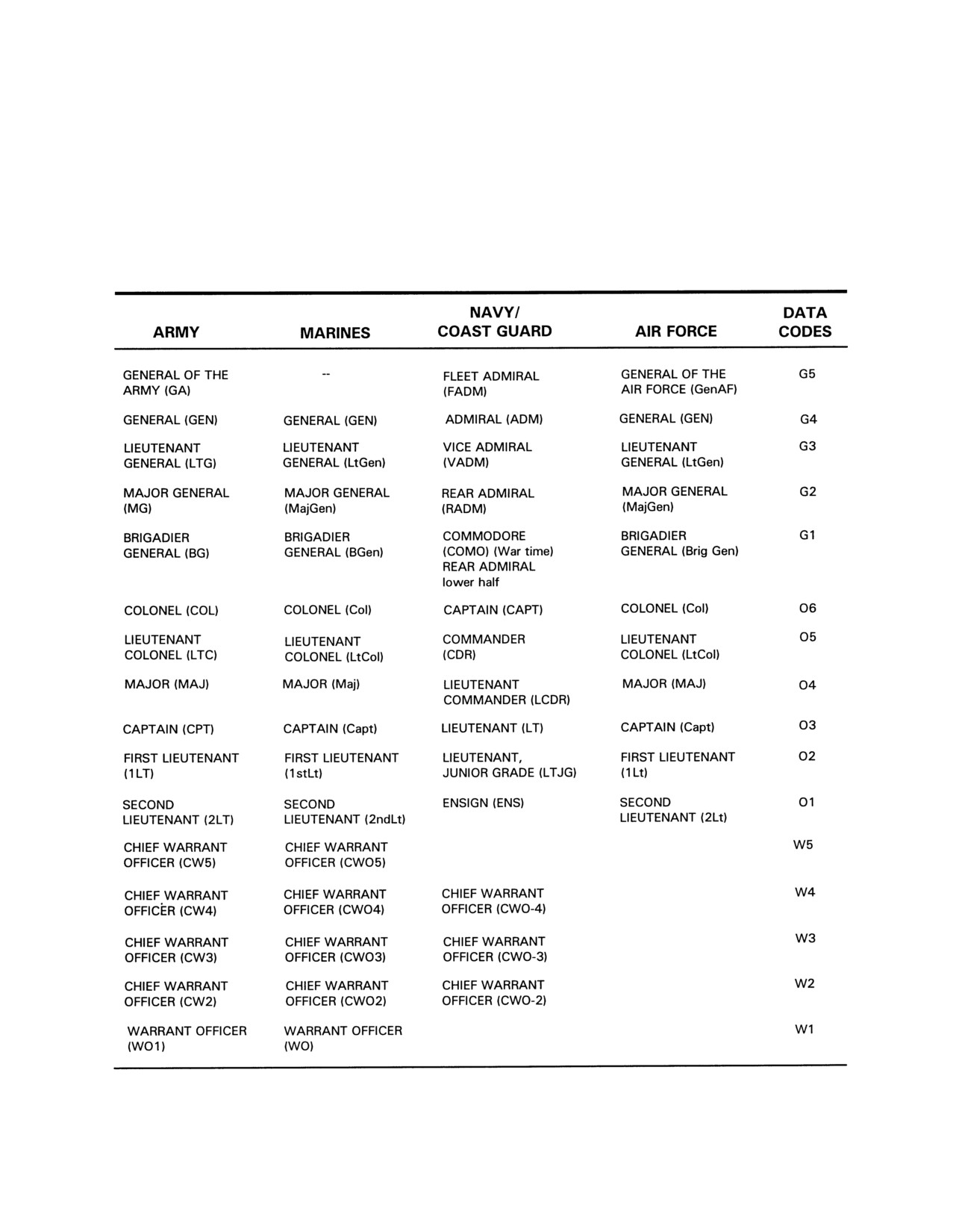
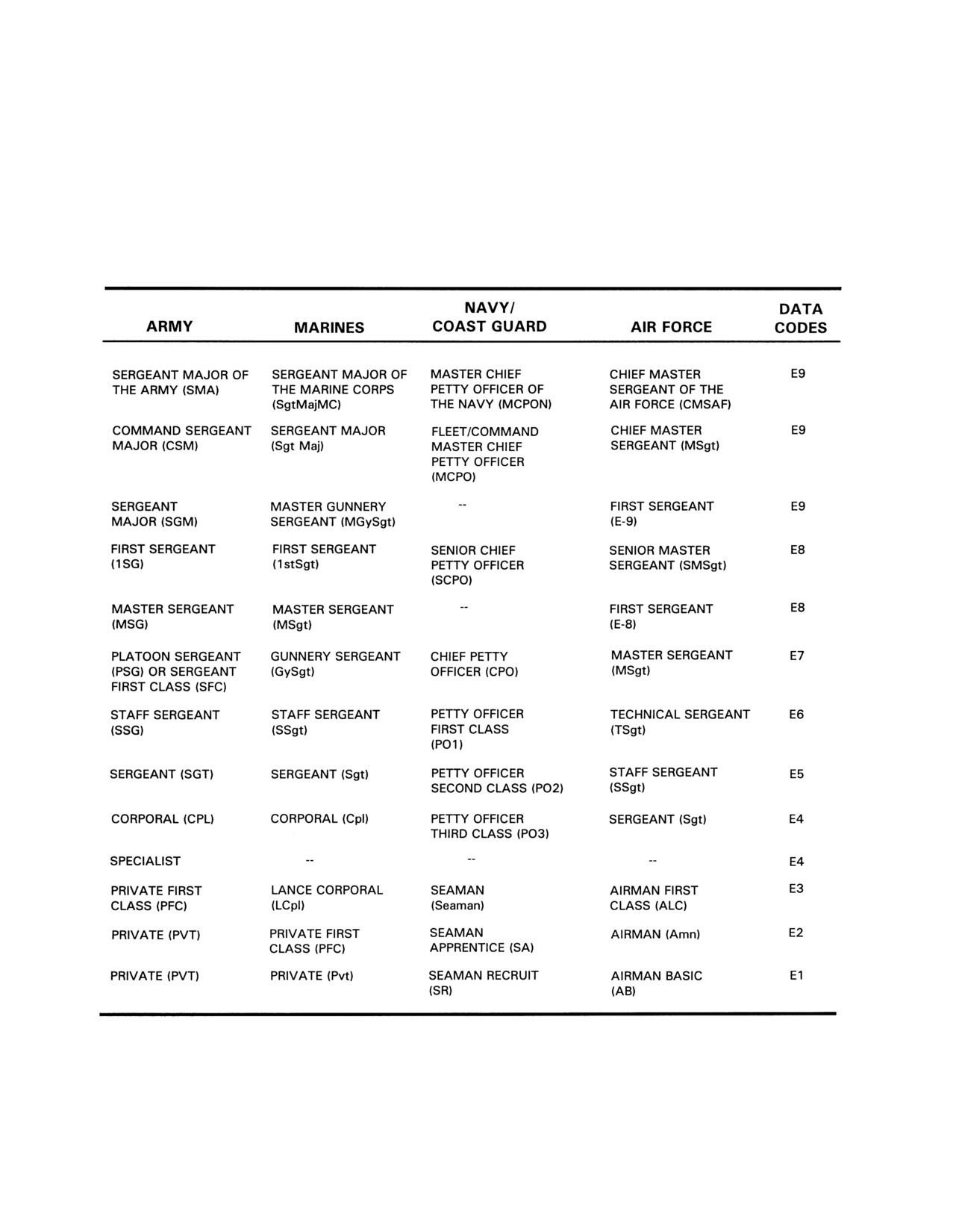
enlisted grade structure to be used in completing this form are contained in Table C-2.
C-4. Disposition of Field Medical Cards
a. In a CZ, if the DD Form 1380 is generated but the patient is not admitted to a hospital, the
form will be sent to the medical C2 headquarters or the command surgeon for statistical coding as specified
in the TSOP. Once the DD Form 1380 is coded, it is forwarded for inclusion in the individuals records.
(Specific addresses and disposition instructions are provided in AR 40-66 and AR 25-400-2).
b. When a patient is evacuated and upon his arrival at a hospital, the DD Form 1380 will be used
to prepare the inpatient treatment record (ITR). The DD Form 1380 will then become part of the ITR.
c.
The original DD Form 1380 used to record outpatient treatment in peacetime operations or
during training exercises will be forwarded to the custodian of the patients HREC or OTR for inclusion in
the record.
C-5. Field Medical Record Jacket
The Field Medical Record Jacket (DA Form 4006) may be used as an envelope for the DD Form 1380. To
keep the jacket from being opened while the patient is in transit, pertinent personnel and medical data on the
patient may be recorded on the outside. The movement of the patient may also be recorded. When the
jacket has been so used, it becomes a part of the ITR.
C-3
FM 8-10-6
Table C-1. Instructions for Completing DD Form 1380
C-4
FM 8-10-6
Table C-2. Officer and Enlisted Grade Structure
C-5
FM 8-10-6
Table C-2. Officer and Enlisted Grade Structure (Continued)
C-6
FM 8-10-6
Figure C-1. Information on DD Form 1380 completed by the combat medic.
C-7
FM 8-10-6
Figure C-2. Reassessment completed by the battalion aid station and annotated on the DD Form 1380.
C-8
FM 8-10-6
APPENDIX D
MEDICAL REENGINEERING INITIATIVE
MEDICAL EVACUATION UNITS
D-1. General
The MRI reorganized medical units to alleviate deficiencies apparent in the MF2K units. In the medical
evacuation arena, changes to the medical evacuation battalion and the medical company, air ambulance
were minor; these units are not classified as MRI units. More significant structural changes in the medical
company, ground ambulance were made.
D-2. Headquarters and Headquarters Detachment, Medical Evacuation Battalion
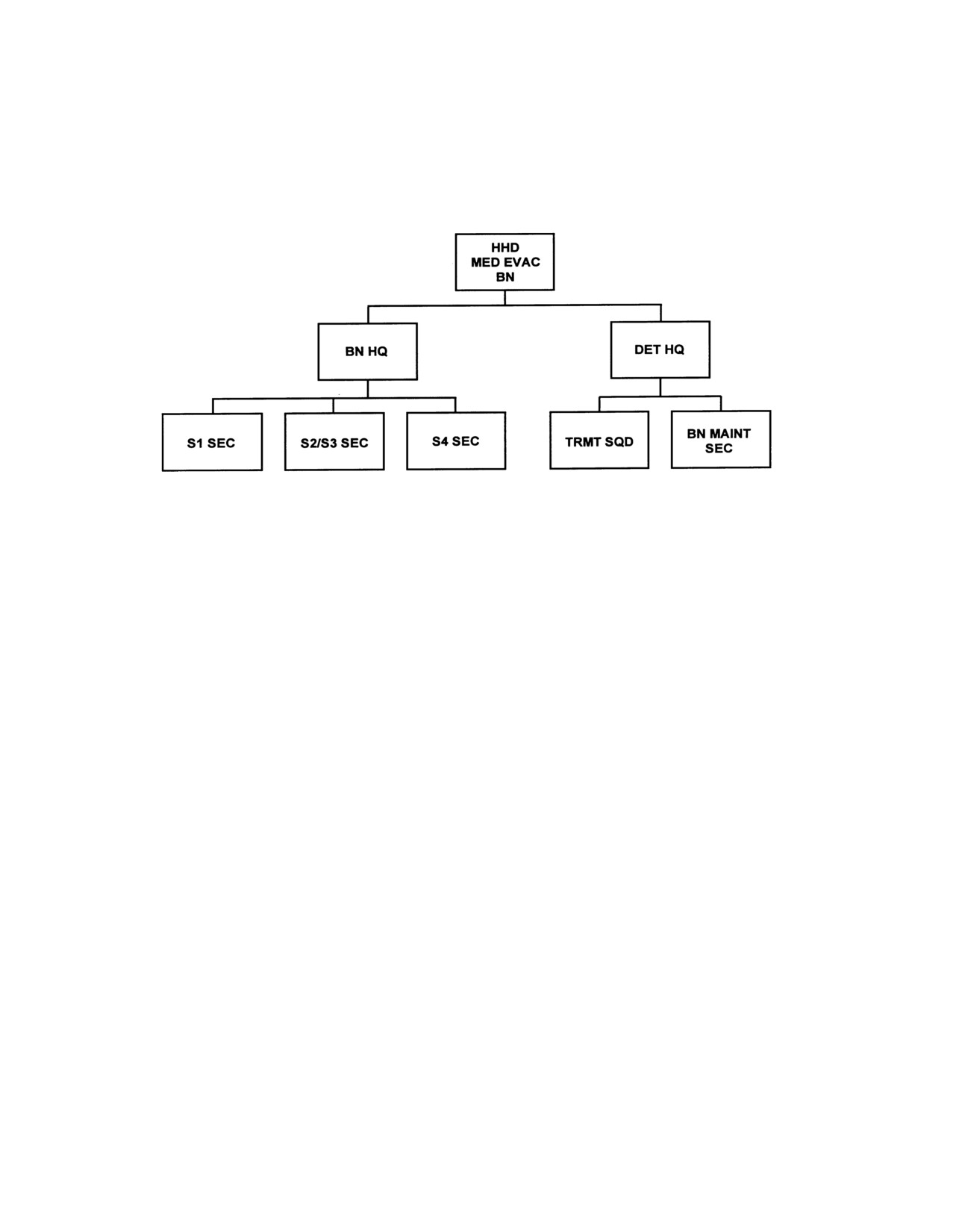
a. The mission of the medical evacuation battalion (Figure D-1) is to provide C2 and logistical
support of assigned and attached air and ground ambulance medical evacuation within the TO. This unit is
normally assigned to the medical brigade and provides
Command, control, and supervision of operations, training, and administration of
combinations of medical companies (air and ground ambulance).
Staff and technical supervision of aviation operations, safety, and AVUM-level main-
tenance within attached air ambulance companies.
Coordination of medical evacuation operations and communications functions on a
continuous two-shift basis.
Unit-level CHS and aviation medicine support for units within the battalion.
Battalion-level maintenance support for wheeled vehicles, to include vehicle recovery
operations support to assigned or attached units.
Combat health logistics support to attached units.
One cook to augment the food service capabilities of the supporting unit.
b. The medical evacuation battalion is capable of performing unit-level maintenance on vehicles,
generators, and communications equipment.
c.
This unit is dependent upon the corps/ASCC for religious, finance, legal, personnel and
administrative services, GRREG, bath and clothing exchange, COMSEC equipment maintenance, and
military police support.
d. Additional resources were included in the headquarters to enhance the operations capability
and maintenance functions.
D-1
FM 8-10-6
Figure D-1. Headquarters and headquarters detachment, medical evacuation battalion.
D-3. Medical Company, Air Ambulance
a. The mission of the medical company, air ambulance is to provide aeromedical evacuation and
support within the TO. This unit is assigned to the medical brigade and further attached to a medical
evacuation battalion. This unit provides
Fifteen helicopter ambulances to evacuate critically wounded or other patients consistent
with evacuation priorities and operational considerations, from points as far forward as possible, to divisional
MTFs and corps-level hospitals. Single patient lift capability for the UH-1 is 90 litter patients or 135
ambulatory patients, or some combination thereof; UH-60 is 60 litter patients or 105 ambulatory patients, or
some combination thereof.
Three forward support teams (three helicopters each) that can be individually or group
deployed in support of unique or emergency operations worldwide.
Air crash rescue support.
Expeditious delivery of whole blood, biologicals, and medical supplies to meet critical
requirements.
Rapid movement of medical personnel and accompanying equipment/supplies to meet the
requirements for mass casualty, reinforcement/reconstitution, or emergency situations.
Movement of patients between hospitals, ASFs, hospital ships, and casualty receiving
and treatment ships, and seaports and railheads in both the corps and EAC.
Fuel handling and transport (to include hot refuel operations) for all organic aircraft that
operate in four different geographic locations.
D-2
FM 8-10-6
Food service support to the HHD, medical evacuation battalion when collocated.
b. The basis of allocation is
One unit in DS of each division or equivalent force supported. Further, one unit is in
general support in the corps per two divisions or fraction thereof; or .333 units per separate brigade or
ACR.
One unit per theater for the purpose of evacuating patients to and from hospital ships.
Other basis of allocation will be determined by CHS planners based on METT-TC or major theater war.
c.
The medical company, air ambulance performs AVUM on all organic aircraft and unit
maintenance on all equipment (less medical).
d. This unit is dependent upon
Appropriate elements of the corps or ASCC for CHS, religious, legal, finance, and
personnel and administrative services.
The HHD, medical evacuation battalion for unit-level (Echelon I) CHS and aviation
medicine support.
The supporting AVIM organization for aviation intermediate support.
e.
For additional information on this unit, refer to FM 8-10-26.
D-4. Medical Company, Ground Ambulance
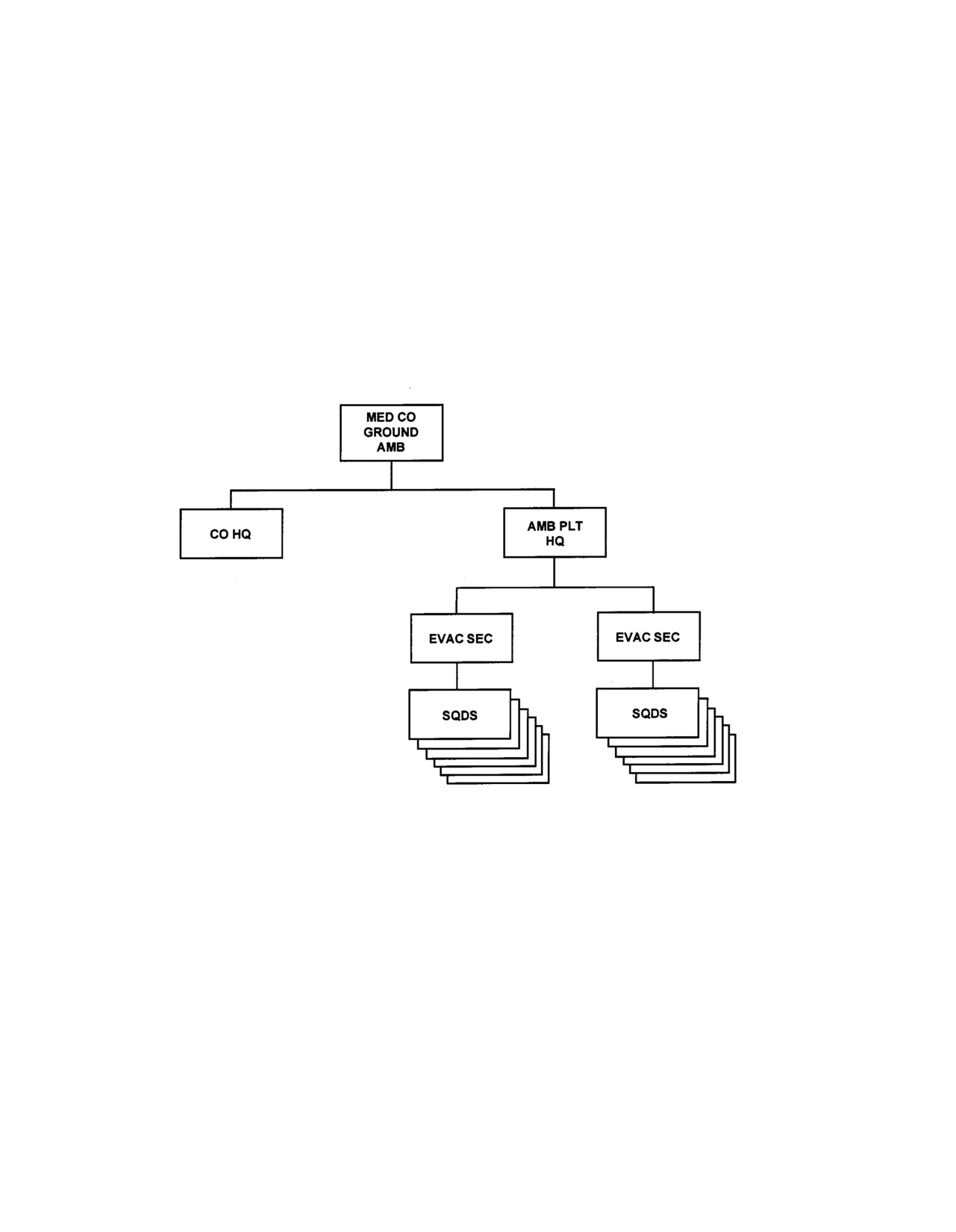
a. The mission of the medical company, ground ambulance (Figure D-2) is to provide ground
evacuation of patients within the TO. It is assigned to the medical evacuation battalion or medical brigade.
This unit provides
Single lift capability for the evacuation of 96 litter patients or 192 ambulatory patients.
Evacuation of patients from division medical companies to CZ hospitals.
Evacuation of patients from ASMCs to supporting hospitals.
Reinforcement of division medical company evacuation assets, when required.
Reinforcement of covering force and deep battle operations, when required.
Movement of patients between hospitals and ASFs, seaports, or railroads in both the
corps and EAC.
D-3
FM 8-10-6
Area evacuation support beyond the capability of the ASMB.
Emergency movement of medical supplies.
Food service and vehicle refueling support for the HHD, medical evacuation battalion.
Figure D-2. Medical company, ground ambulance.
b. The medical company, ground ambulance performs unit maintenance on communications-
electronics equipment and wheeled vehicles.
c.
This unit is dependent upon
Appropriate elements of the corps/ASCC for CHS, religious, finance, legal, personnel
and administrative services, laundry and bath, generator equipment maintenance, and military police support.
The HHD, medical evacuation battalion for unit-level CHS and treatment teams to
provide CHS.
D-4
FM 8-10-6
d. The MRI process has resulted in an update to reflect current standards of grade, manpower
requirements criteria, and basis of issue plans.
(1) The major changes include
The number of ambulances decreased from 40 to 24. This resulted in the following
changes:
Platoon headquarters reduced from four to two.
Ambulance platoon headquarters reduced from four to two.
Ambulance sections reduced from four to two and redesignated as evacuation
sections.
Ambulance squads reduced from 20 to 12.
Ambulance drivers (medical specialists) reduced from 90 to 48.
Revision of the capabilities as discussed above.
(2) The redesign of this unit permits more responsive medical evacuation support through
the reduction of the span of control for the C2 element; split-based capability with the addition of the
executive officer; and a more flexible and modular design.
D-5
FM 8-10-6
APPENDIX E
USE OF THE HIGH PERFORMANCE HOIST IN
MEDICAL EVACUATION OPERATIONS
Section I. CREW RESPONSIBILITIES
E-1. General
a. The minimum number of crew members needed to execute a hoist rescue operation is four.
This includes the PC, PI, crew chief (hoist operator), and flight-qualified medic. As crew coordination is
the key to successful hoist operations, each crew member must thoroughly understand the duties of all
persons involved in the effort. If the patient is disabled, the PC designates a crew member to descend on the
hoist to assist the patient.
b. Throughout this chapter the term patient denotes a medical patient, casualty, or survivor.
E-2. Primary Crew Responsibilities
a. The PC has overall C2 of the operation. He supervises planning and preflight procedures as
well as briefing the crew on all mission details. He coordinates crew activities and is responsible for their
proficiency and performance. Although his primary duty is to fly the helicopter, the situation may require
him to operate the hoist by using the cockpit controls.
NOTE
For simplicity, the paragraphs relating to flight techniques are written
assuming the PC is the pilot at the controls. However, the PC often
directs who flies the aircraft.
b. The PI has the responsibility throughout the operation to remain oriented with the horizon and
to assist both the PC and the hoist operator, if needed. If an emergency situation arises he will be directed
by the PC to employ the hoist cable cutter. He must be familiar with all crew member tasks and be able to
perform them. If the hoist operator is directed to leave the helicopter to aid a patient, the PI may be
required to operate the hoist.
c.
The hoist operator inspects the hoist and all other mission-essential equipment prior to takeoff.
His most crucial task is to guide the PC over the patient. The hoist operator is responsible for deploying
smoke and flare devices. He operates the hoist and assists in lifting the patient into the helicopter.
d. The flight medic provides EMT to the patient. He may be required to leave the helicopter to
assist the patient. The flight medic should also be proficient in operating the hoist.
E-1
FM 8-10-6
Section II. INTERCREW COMMUNICATIONS
E-3. General
To successfully accomplish hoist rescue operations, all members of the rescue team must be able to
communicate accurately and concisely. All crew members must be able to communicate the necessary
information even if voice communications are impossible or impractical.
E-4. Intercrew Communications
The primary means of communicating throughout the hoist operations is voice communications over the
helicopter interphone system (hot mike); however, the PC or PI may elect to remain on the command radio
and depress the interphone switch. If the interphone fails, hand signals are used.
a. Operational terminology. During the operation, communications between the PC and hoist
operator should be clear and concise. To avoid confusion, no more than one direction should be given at a
time. The PC acknowledges each direction. The following terminology is recommended for use by the
hoist operator and should be standardized in the unit TSOP.
(1) Area is in sight.
(2) Patient is in sight
feet aheadcorrect right (or left, as applicable).
(3) On course, patient is straight aheadon course.
(4) Back
feet
(5) Forward
feet.
(6) Up
feet.
(7) Down
feet.
(8) Left
feet.
(9) Right
feet.
NOTE
The commands listed in E-4a(2) and (4) through (9) refer to relative
distance. The distance may, in fact, be greater or lesser than feet.
The flight crew should rehearse hoist operations so that they are
synchronized in their execution and confident that they understand all
the commands given.
E-2
FM 8-10-6
(10)
Hold.
(Used when in position and centered over patient.)
NOTE
The word STOP should never be used.
(11)
Hoist begins initial descent.
(12)
Hoist is halfway down.
(13)
Hoist is on the ground (in the water, as applicable).
(14)
Aircraft is clear of all obstacles.
(15)
Patient is on the hoist, ready for pickup.
(16)
Ground personnel are clear.
(17)
Cable is tight/slack is out.
(18)
Pilot, lift the load.
(19)
Load is off the ground.
(20)
Give load height in 1-foot increments until the load is stabilized and at 10 feet.
(21)
Load is clear of barriers.
(22)
Load is 20 feet below the aircraft.
(23)
Give load height in 5-foot increments until the load is stabilized 5 feet below the aircraft.
(24)
Load is even with the skid tubes or wheels.
(25)
Load is secure in the aircraft.
(26)
Rear is ready and secure.
b.
Hand signals.
(1) Hand signals should be preplanned and practiced before the operation. It is important
that the hand signals not impair the crews ability to fly the aircraft. When using hand signals, the PC and hoist
operator should be positioned on opposite sides of the helicopter, or the PI can relay these signals to the PC.
E-3
FM 8-10-6
(2) The following are examples of hand signals used during hoist operations to direct the PC:
(a) Movement of the helicopter can be indicated by moving the open hand in the
desired direction with the palm facing in that direction.
(b) Hold in present position is indicated by a clenched fist.
(c) Movement of the hoist is indicated by extending the thumb either up or down from
a clenched fist.
(d) Fingers are used to indicate numbers of feet.
Section III. EMPLOYMENT
E-5. General
Hoist rescue operations must be conducted in a systematic manner to ensure that the operation is handled in
the safest possible way. All crew members must be aware of what phase the operation is in at any given
time.
E-6. Hoist Rescue Operational Phases
Once the patient has been located, hoist rescue operations can be divided into four distinct phases. These
phases are
a. Visual Preparation. Upon sighting the patient, smoke is dropped to mark his position and to
determine wind direction. If radio communications with the patient have been established, position marking
may not be necessary. If the wind direction is known, other marking devices, such as lights and panel
markers, may be used.
b. Pattern Phase. A flight pattern is established during the second phase of the operation to bring
the helicopter into position. The type of pattern to be flown is determined by the PC and is influenced
by the PCs position in the cockpit. The left seat provides a greater field of vision. However, control of
the hoist in the UH-1 cockpit is available in the right seat only. The unit TSOP designates the seat for the
PC.
c.
Recovery Phase. This is the most critical phase of the operation and requires the highest
degree of crew coordination. Recovery techniques vary depending upon the environmental factors in the
AO.
d. Departure Phase. In this phase, the patient is secured in the aircraft and the equipment is
positioned for departure from the hoist site. The aircraft is then prepared for departure.
E-4
FM 8-10-6
Section IV. ENVIRONMENTAL FACTORS
E-7. General
Hoist operations are conducted over both water and land and in varying degrees of illumination such as
daylight, overcast conditions, and at night. The crew must train in all types of environmental conditions to
ensure they are able to accomplish their stated mission.
NOTE
For safety reasons, crew members performing water recovery opera-
tions must be swimmers. They should also be helicopter emergency
egress device (HEED) trained and equipped.
E-8. Water Recovery Operations
a. Visual Preparation.
(1) Upon the initial sighting of the patient, a marine locator marker is deployed in the
immediate vicinity to mark the position and to determine the wind direction. The patient must be kept in
sight until the initial smoke is dropped. The PC flies into the wind maneuvering over the patient so that the
hoist operator can drop the smoke in the vicinity of the patient. If a marine locator marker is not available,
fluorescein sea markers from the water survival kit are effective.
(2) Once the wind direction is determined, additional smoke may be employed to aid in
spatial orientation. Smoke should be dropped at the lowest possible altitude and airspeed. The smoke must
land in a spot close enough to the patient to provide adequate wind information, but should not obscure his
position when approaching into the wind. The PC must keep the hoist operator continuously informed of
their position in the pattern during the approach (on the downwind leg, on the base leg, and on the final
approach). The hoist operator advises the PC when the smoke has been released.
b. Pattern Phase. Once the smoke is employed, the PC plans and establishes a flight pattern that
places the helicopter in position for the recovery.
(1) If the PC is in the right seat, a right-hand pattern should be flown so that the PC can keep
the patient in sight.
(2) The final approach should permit the helicopter to arrive at a hover far enough from the
patient so that the
Waves and rotor wash are not a hazard to the patient.
E-5
FM 8-10-6
Rescue device can be lowered into the water at a safe distance from the patient.
(3) The PC advises the hoist operator of their position throughout the approach and advises
when he has the patient in sight.
(4) The hoist operator acknowledges all calls and informs the PC when he has the patient in
sight on the final approach.
(5) The PC and PI maintain the proper altitude and position once the final approach has been
completed.
c.
Recovery Phase.
(1) Once the hover has been established, the PI makes a power-available check to ensure that
the helicopter has sufficient power to continue the operation. The check should be performed at the lowest
altitude possible. When the PC is ready to continue with the recovery, he advises the hoist operator to
lower the rescue device and directs the helicopter to the patient. The hoist operator then lowers the rescue
device and gives directional instructions to the PC to move the helicopter on a straight course to the patient.
Before he loses sight of the patient, the PC should transfer his hover reference to the smoke markers that
have been placed upwind. He should not attempt to watch the pickup, as spatial disorientation may result.
As the helicopter moves slowly toward the patient, the rescue device should be lowered. He ensures that
the rescue device enters the water at least 20 to 30 feet before reaching the patient. This assures that the
device does not strike and injure the patient. Flotation gear is provided for the patient at this time.
CAUTION
Static electricity built up on the hoist cable and the rescue device
must be discharged by touching the device to the water before
attempting the pickup.
(2) When the rescue device is in the water and easily accessible to the patient, the hoist
operator directs the PC to hover to that position. When the patient is observed to be secured on the device
and ready for hoisting, the
Hoist operator takes up any slack in the cable and notifies the PC that the pickup is
ready to proceed.
Copilot makes a final power check to ensure that sufficient power is available for
recovery.
Pilot-in-command applies sufficient power to lift the patient clear of the water
(approximately 10 feet) or the PC may also direct the hoist operator to lift the patient with the hoist.
E-6
FM 8-10-6
Hoist operator begins hoisting until the patient is in the helicopter cabin.
(3) During the pickup, the PC devotes his full attention to maintaining a steady hover using
all available reference points and the hoist operators instructions. The PI monitors the instruments and
remains oriented with the horizon throughout the operation to assist the PC. The hoist operators instructions
to the PC must be clear and concise (refer to paragraph E-4).
(4) The hoist operator advises the PC when the patient is safely inside the helicopter and
secured in the cabin. The PC then transitions from a hover to forward flight.
CAUTION
The lateral center of gravity (CG) limits may be exceeded if all
crew members and passengers are positioned on the same side
of the helicopter.
E-9. Land Operations
a.
Visual Preparation. Determining wind velocity and approximate distance is important to
successful hoist operations. Although smoke may be used as a means for determining the approximate wind
velocity and direction, observing vegetation in the area may be easily employed as an alternate means. If
smoke is used, it should be deployed in an area that is open enough to be seen from anywhere in the hoist
pattern. Care should be taken to select a nonflammable target area.
b.
Pattern Phase.
(1) As in water operations, the pattern flown should allow the PC to maintain visual contact
with the patient. Terrain factors and conditions encountered at the rescue site must be evaluated to
determine the best approach to be used. The PC must keep the hoist operator informed at all times as to the
type of pattern to be flown and the position of the helicopter in the pattern.
(2) The PC devotes his full attention to maintaining a steady hover by using all available
references and the hoist operators instructions. The PI monitors the engine instruments and remains
oriented with the horizon. The presence of trees, wires, or other obstacles requires extreme caution
in approaching the patient. Since all crew members must aid the PC in rotor-tip clearance, all doors and
ramps are open for maximum visibility. The hoist operator must give clear and concise instructions to the
PC. He must also supply continual commentary on the progress of the pickup throughout the pattern phase.
CAUTION
Static electricity built up on the hoist cable and rescue device
must be discharged by touching the device to the ground before
attempting the pickup.
E-7
FM 8-10-6
c.
Recovery Phase. Prior to hoisting the patient, the hoist operator takes up any slack in the
cable and notifies the PC that the patient is ready for pickup. The PC then makes a final determination that
sufficient power is available to safely accomplish the recovery. The PC applies sufficient power to lift the
patient clear of the ground (approximately 10 feet) or if the tactical situation requires, the hoist operator
raises the patient while the helicopter remains in a stationary hover. Both techniques have proven acceptable;
however, the aircraft lift is preferred. The PC decides which technique to apply depending on the given
situation. The first procedure provides the PC better control of the aircraft as the patient is lifted off the
ground which may be needed in confined areas. In tactical situations, however, the second method may be
used to avoid unmasking the aircraft. The hoist operator advises the PC when the patient is safely inside the
helicopter and secured in the cabin. The PC then transitions from a hover to forward flight.
E-10. Night Recovery Operations
Flying, especially hovering, at night is difficult because visual ground references are not easily distin-
guishable. When hovering over water or dense vegetation, ground contrast and reference points are
virtually nonexistent. Without visual clues, the PCs ability to judge movement is severely impaired.
Constant head movement and scanning are essential throughout the maneuver to maintain altitude and
position. Because of this increased workload, it is recommended that the crew chief (hoist operator) operate
the hoist rather than the PC.
a. Illumination.
(1) Chemical lights may be attached to rescue equipment to provide illumination. The lights
aid the hoist operator, as well as the personnel on the surface, to determine the position of the equipment
during the operation.
NOTE
To activate the chemical light, remove it from the foil package and
bend the light stick until a pop is heard. Shake the chemical light stick
vigorously to facilitate the chemical reaction.
(2) Due to spatial disorientation at night while flying or hovering over water, continuous
flare illumination should be used whenever possible. Flares improve depth perception and reference to the
water. Multiple smoke or marking devices deployed on the water during water recoveries assist in
determining wind direction and provide a visual reference for hovering. Caution must be used to prevent
smoke from restricting visibility in the immediate recovery area.
(3) As in night water recoveries, flare illumination provides the best possible conditions for
conducting land pickups at night. Flare illumination, however, is not absolutely necessary. Helicopter
lights normally provide adequate lighting to safely accomplish the recovery.
E-8
FM 8-10-6
b. Night Vision Goggles.
(1) In a tactical environment, the amount of illumination which can be used during the
recovery operation should be considered. It may be necessary to use NVG in order to maintain adequate
concealment.
(2) Infrared (IR) chemical lights, designed for use with the NVG, may be attached to rescue
equipment to provide the hoist operator with visual clues during hoisting procedures.
(A 30-minute high-
intensity light stick and a 12-hour low intensity light stick are also available.)
Section V. INERT PATIENT RECOVERIES
E-11. General
If it is determined that the patient is unconscious or unable to board the rescue device, the PC directs one of
the crew members to prepare to exit the helicopter and another to act as the hoist operator. If the hoist
operator is directed to leave the helicopter, the PI moves to operate the hoist. If a medic is available, he
may exit the helicopter while the other crew members maintain their positions.
E-12. Procedural Guidance
a. The crew member performing the duties of hoist operator dons the safety harness over the
hoist operator vest. He ensures that the crew member preparing to leave the helicopter is secured in the
rescue device or hoisting vest. Flotation gear must be worn during all water recoveries, and if necessary,
be provided to the patient. The PC is notified when the preparations are completed.
CAUTION
Static electricity built up on the hoist cable and rescue device
must be discharged by touching the device to the ground before
attempting the pickup.
b. Once the crew member is ready to exit the helicopter, he is lowered to the surface where he
leaves the rescue device and secures the patient for hoisting. The hoist operator then notifies the PC when
ready to begin hoisting. The PC determines if adequate power is available to accomplish the recovery.
c.
The PC applies sufficient power to lift the patient off the ground (approximately 10 feet) or
the hoist operator raises the patient while the helicopter remains at a stationary hover. The hoist operator
then hoists the patient, pulls him into the cabin, and removes the patient from the device. The crew member
is then retrieved from the surface. The hoist operator must keep the PC informed of the progress of
E-9
FM 8-10-6
the recovery. When all personnel are safely inside the cabin, the PC is notified. The PC then transi-
tions from a hover to forward flight. If the PI has served as hoist operator, he returns to his position in the
cockpit.
Section VI. METEOROLOGICAL AND TERRAIN FACTORS
E-13. General
Hoist rescue operations are conducted over various types of terrain and in a number of weather conditions.
The aircraft crew must be familiar with the unique requirements within their mission area and must train in
these conditions to ensure the safety of the hoist operation.
E-14. Performance Planning
a. Prior to hoist operations, the PC must consult the appropriate operators manual, specifically
the performance charts. These charts correlate the effects of altitude, temperature, and gross weight on
aircraft performance. Data is available for virtually all environmental conditions.
b. The performance planning card (PPC) enables the PC to determine if the aircraft can perform
the mission under the current meteorological conditions. It is critical that the PC assess environmental
conditions which can be expected at the rescue site, especially if they differ from those at the departure
point. During high altitude missions, it is recommended that the PI continually update the PPC to compensate
for gross weight changes and CG shifts.
(1) Under adverse conditions, the amount of weight that can be carried may be limited and
the aircraft may be unable to sustain the high hover necessary for hoist operations. Wind direction and
velocity must also be considered. For maximum control of the aircraft, the PC should avoid excessive
tailwinds and right crosswinds.
(Refer to the aircraft operators manual for wind limitations.)
(2) The PC must manage fuel consumption to ensure sufficient fuel is available to complete
the mission. Aircraft can be equipped to carry auxiliary fuel tanks to extend the range. However, these
tanks reduce the cabin area and the added weight will limit the size of the load. The auxiliary tanks also
effect the aircrafts CG.
E-15. Mountain Operations
The rugged terrain and dense forest characteristics of mountain environments often necessitate the use of
hoists to extract personnel. Variable weather, winds, icing, and altitude adversely affect aircraft
performance. These factors require precise aircraft control and detailed flight planning to prevent
interruptions and delays.
E-10
FM 8-10-6
a. Altitude.
(1) Density altitude is the most important meteorological factor affecting aircraft performance
over mountainous terrain. Density altitude is dependent upon temperature, relative humidity, and pressure
altitude. It provides the basis for determining lift capability. An increase in any of the three basic elements
increases density altitude and decreases lift capability. As density altitude increases, increased torque or
power is required.
(2) In the mountains, density altitude can vary significantly depending upon the time of day.
Furthermore, the density altitude at the point of departure may be quite different from that at the pickup
site. For example, density altitude normally peaks in the late afternoon and reaches its low point at dawn.
The power available/power required margin must be large enough to absorb transient power requirements
caused by turbulence, wind shifts, and patient weight. In a high density altitude environment, power checks
are critical. Maintaining a minimum of 10 percent above required power is recommended.
b. Wind. Wind is the principal weather hazard experienced in the mountains. Even moderate
winds (11 to 20 knots) can produce significant turbulence as they pass over mountain ridges. Predicting
wind conditions can be difficult due to the multitude of terrain variations. Each type has an effect on the
flow of air. On the windward side of mountains, the direction of airflow is normally steady even though its
strength may vary. On the leeward side of crests, wind is turbulent with strong vertical currents. The
effects of turbulence may be alleviated by flying above terrain features and avoiding the lee side of all peaks
and ridges. Ridges and saddles should be approached at the highest altitude possible and crossed at a 45
degree angle. Training and experience flying in these conditions minimize the hazards produced by wind
and turbulence.
c.
Icing. Icing can occur on aircraft in weather conditions such as low clouds and fog. In
mountainous terrain, icing occurs when moist air is lifted over high peaks. Ice producing areas are usually
on the windward side of peaks to about 4,000 feet above the peak, and possibly higher when the air is
unstable. Army helicopters are not capable of flight in severe icing conditions. As ice forms on rotor
blades, it results in a significant decrease in lift and autorotational capabilities. Asymmetrical shedding can
occur which causes a severe rotor blade imbalance.
d. Additional Information. For additional information on medical evacuation operations in
mountainous terrain, refer to paragraphs 5-2 and 9-12 through 9-13.
E-16. Jungle Operations
Jungle terrain is often rugged and swampy with dense towering trees. Some jungles are composed of
several canopies with trees more than 100-feet tall. There are few suitable LZs and thick jungle foliage
complicates communications between ground and air resources.
a. Density Altitude. Jungle weather is generally hot, humid, and very unstable. In this
environment, density altitude becomes an overriding consideration. As density altitude increases, engine
efficiency decreases and the power required can become critical under high gross weight conditions.
E-11
FM 8-10-6
b. Signals. Signals are difficult to see or hear from under dense tropical growth. In order to
locate personnel on the ground, it may be necessary to use emergency signaling devices. A wide streambed
is a good place to signal from, especially where there are sandbars. Other open areas may also be used;
however, caution must be exercised due to the increased vulnerability to sniper and small arms fire.
c.
Additional information. For additional information on medical evacuation operations in jungle
environments, refer to paragraph 5-3.
E-17. Extreme Cold Weather Operations
Cold weather flying conditions may be encountered in many parts of the world and the severity varies with
latitude and season. In this harsh environment, rapidly changing weather poses the greatest hazard to the
flight crew. Terrain in the arctic and antarctic regions ranges from mountain peaks and glaciers, to flat
plains. Although open areas are available, the surface may not be desirable for landing. It may be
necessary to use the high performance hoist to extract the patient.
a. Environmental Considerations.
Navigation in arctic regions may be hampered by the rapidly shifting landscape, snow-
covered landmarks, and the lack of NAVAIDS. In addition, magnetic compasses become unreliable in the
northern- and southernmost latitudes. Under these conditions, a combination of radio navigation, dead
reckoning, and pilotage may have to be used to locate the patient.
Radio communications are generally good, but may be temporarily disrupted by electrical
disturbances (auroras). Some frequencies may be blocked for weeks.
Static electricity creates a serious problem in cold weather. It can be generated by the
movement of an aircraft through the air, by brushing snow or ice from the aircraft, or by dragging the steel
cables over the ground. During hoist operations, pilots should key the mike immediately before load
pickup. However, the charge will buildup again rapidly.
CAUTION
Before touching rescue equipment, ground personnel must either
allow the equipment to hit the ground or use a grounding device
to avoid an electrical shock.
b. Ambient Light Conditions.
Summer in the polar regions produces almost continuous daylight. Conversely, during
winter there are only 3 to 4 hours of daylight. During night operations, a solid snow cover reflects available
light, making it much brighter than without snow. It may still be necessary to use aircraft lighting, NVG, or
emergency lighting in order to complete a hoist mission.
E-12
FM 8-10-6
Lighting conditions in mountainous terrain can create hazards. Flight through mountain
passes during overcast conditions, combined with a solid snow cover, can be difficult. Visual references
are easily lost and can result in vertigo. The PC should constantly check visual references with the aircraft
altitude instruments.
c.
Temperature. In polar regions, summer temperatures above 65° F are common except on
glaciers and frozen seas. Winter temperatures sometimes drop to -70° F. Similar temperature extremes are
experienced in subpolar regions.
d. Structural Icing. Aircraft performance is highly dependent upon temperature. Generally it
improves as the temperature drops; that is, until icing becomes a factor. The most hazardous condition
associated with the cold is aircraft structural icing. Army Regulation 95-1 prohibits Army aircraft from
flying into known or forecasted severe icing conditions. Icing is most common when the temperature is
between 32° F (0° Celsius [C]) and -4° F (-20° C) and when visible moisture such as clouds, drizzle, rain,
or wet snow are present. Icing is rarely experienced in those areas which maintain temperatures of below
-20° C.
e.
Safety Considerations.
Fly at altitudes below the freezing level or clear of any visible moisture. Remain in
visual meteorological conditions and stay clear of clouds.
Rotor-blade icing begins near the blade root. Ice buildup can cause loss of lift, resulting
in an increase in power to maintain lift, and ultimately, an increase in engine temperature.
Ice on the wire windscreen prevention device or wipers of the aircraft is the first sign of
icing. The windows in the aircraft, even in the worst icing conditions, normally will not ice over.
Asymmetrical ice shedding occurs when one rotor blade sheds ice, leaving the rotor out
of balance. This condition of disequilibrium can lead to severe vibration. Ice shedding can also cause
foreign object damage from ice ingested into the engine. When icing is encountered, descend to an altitude
clear of clouds. Autorotational capability can be lost in a matter of minutes if ice is allowed to form on the
rotor blades.
CAUTION
Shedding ice can be a hazard to ground personnel during start-
up, hover, and shutdown.
f.
Additional information. For additional information on medical evacuation operations in
extreme cold conditions, refer to paragraph 5-5.
E-13
FM 8-10-6
Section VII. SAFETY AND EMERGENCY PROCEDURES
FOR HOIST MISSIONS
E-18. General
a. The information contained in this section is intended to supplement unit TSOPs and operator
manuals. The primary importance of this section is to ensure that rescue equipment can be safely used for
the tasks for which it was developed.
b. Safety officers are responsible for
Ensuring that safety and rescue equipment is periodically tested.
Determining the serviceability of the equipment in accordance with applicable technical
manuals.
c.
All unit-level maintenance will be completed including required testing, inspection, and
maintenance.
E-19. Safety Factors
Only equipment tested and approved for use in military aircraft will be used during hoist rescue operations.
a. Hoist Cable.
The hoist operator must ensure that the cable does not become tangled in objects on the
ground or in the water. The entire length of the cable should be kept in view at all times. If the cable does
become tangled, an attempt should be made to free it by letting out more slack and manipulating it.
Extreme care should be used when applying tension to the cable.
WARNING
If the cable should break, the whiplash action could cause
injury to personnel or damage the helicopter.
b. Pendulum Action. Extreme care should be taken when hoisting the patient. If the pendulum
action and rotation of the patient are not stopped immediately, the movement may become uncontrollable.
Pendulum action may be dampened by moving the cable in a 1- or 2-foot circle in the opposite direction of
the patients movement.
E-14
FM 8-10-6
WARNING
If the pendulum action is not stopped, do not continue to raise the
patient. Continuing to raise the patient while experiencing pen-
dulum action will only worsen the effect.
c.
Protective Gloves. These gloves should be worn by the hoist operator over the Nomex flight
gloves. The gloves should be made of heavy-duty leather and should prevent injury to the operator when
manipulating the cable.
d. Vest, Hoist Operator, and Lifeline. The hoist operator vest, connected to the aircraft with a
lifeline, is used both by the hoist operator and the medic during rescue operations. The vest and lifeline
must be inspected regularly to ensure serviceability. While wearing the vest, avoid contact with moisture,
hydraulic fluid, oil, grease, fuel, or acidic material.
WARNING
Always wear the safety harness on top of the hoist operator vest.
This allows the crew member to quickly release the safety har-
ness and exit the aircraft during an emergency egress.
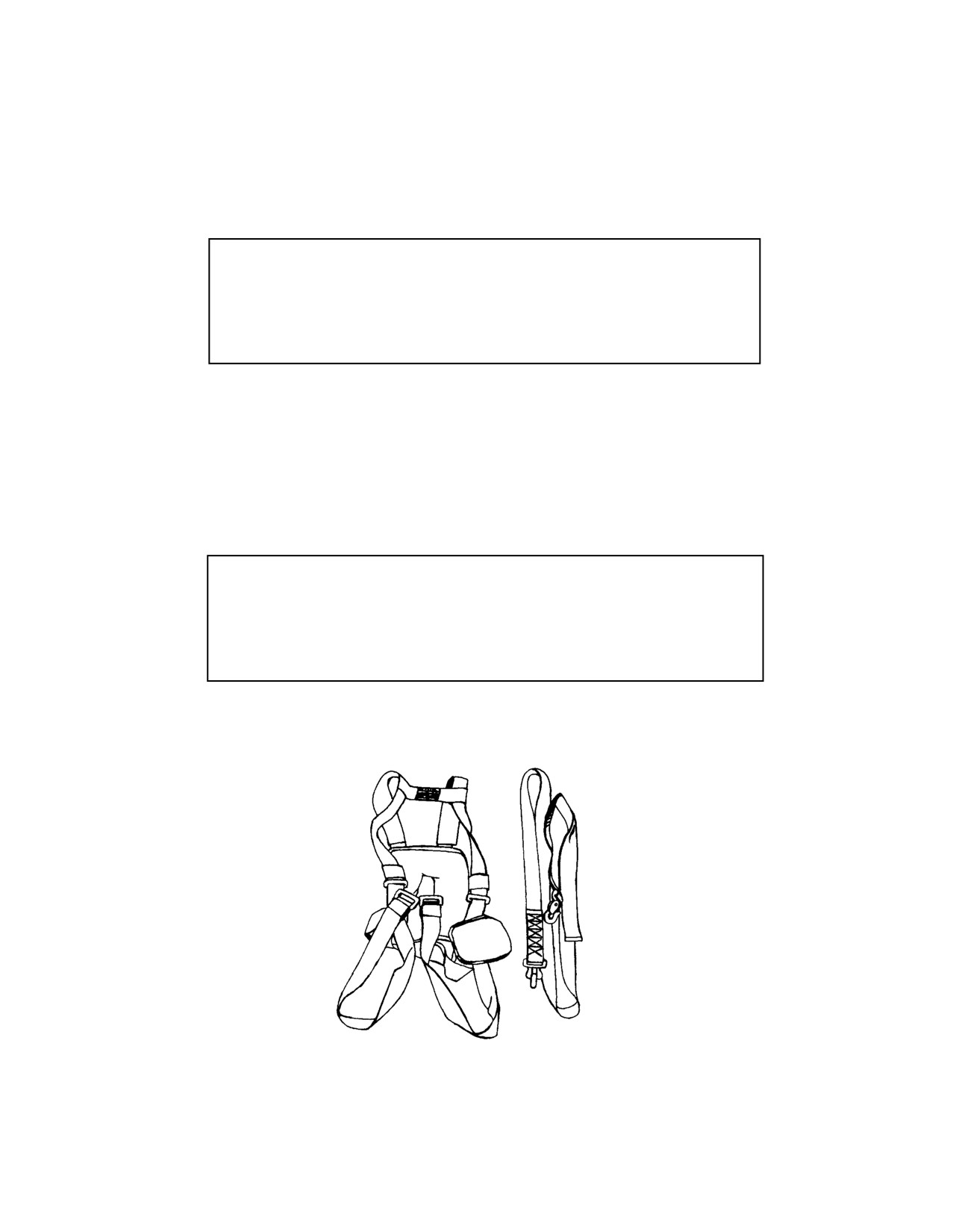
The hoist operator vest (Figure E-1) consists of a Rachel knit vest with straps which crisscross the shoulders,
waist, and hips. A D-ring, located at the center back of the vest, attaches the lifeline to the vest.
Figure E-1. Vest, hoist operator, and lifeline.
E-15
FM 8-10-6
e.
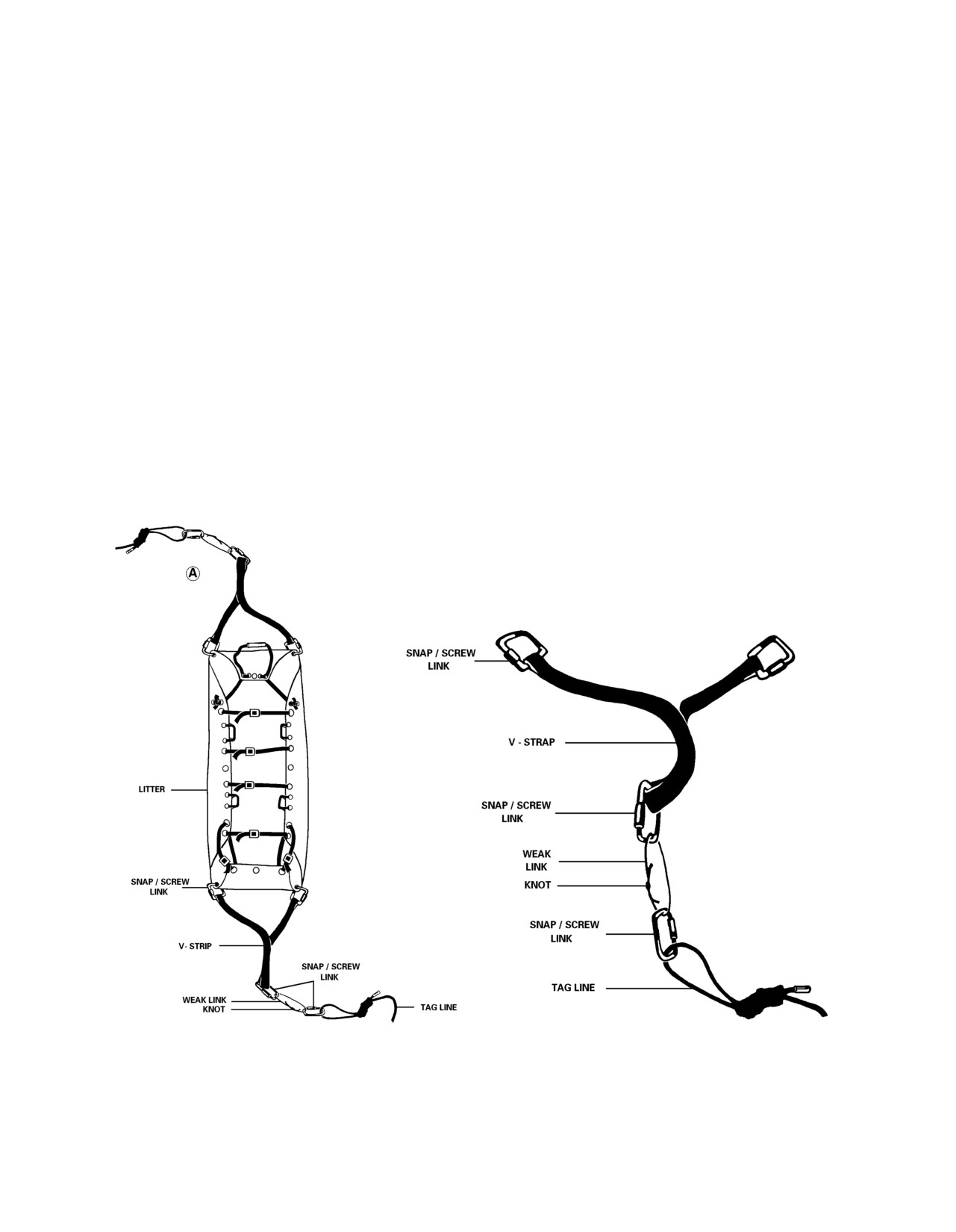
Tag Line and Weight Bag.
The use of a tag line is mandatory when hoisting patients in a horizontal or vertical
position under noncombat conditions. If used properly, the tag line keeps the litter from spinning or
swinging and provides positive control over the litter during hoisting operations. The tag line should be at
least 250 feet in length and made of 3/8-inch diameter kernmantle style nylon rope with a polypropylene core
or nylon sheath.
(Both ends will have a snap link attached with one attached to a weak link and the other to
a weight or weight bag. The weak link is then attached with a second snap link to the litters V-strap). (For
proper connection of the tag line, refer to Figure E-2.) It is important that the tag line be equipped with a
weight at the loose end. This weight prevents the tag line from being blown back up into the helicopter rotor
system and provides a weight for lowering the rope back to the ground if necessary. A locally fabricated
weight bag may be used to store the rope when not in use. The weight of a separate weight or weight and
bag together should be at least 5 pounds. The weight bag may be manufactured of canvas or nylon and
should have a weight securely fastened into the bottom of the bag. The use of tag lines under combat
conditions is dependent upon the tactical situation.
Figure E-2. Connection of the weak link to SKED litter and the tag line.
(AMethod using V-strap.)
E-16
FM 8-10-6
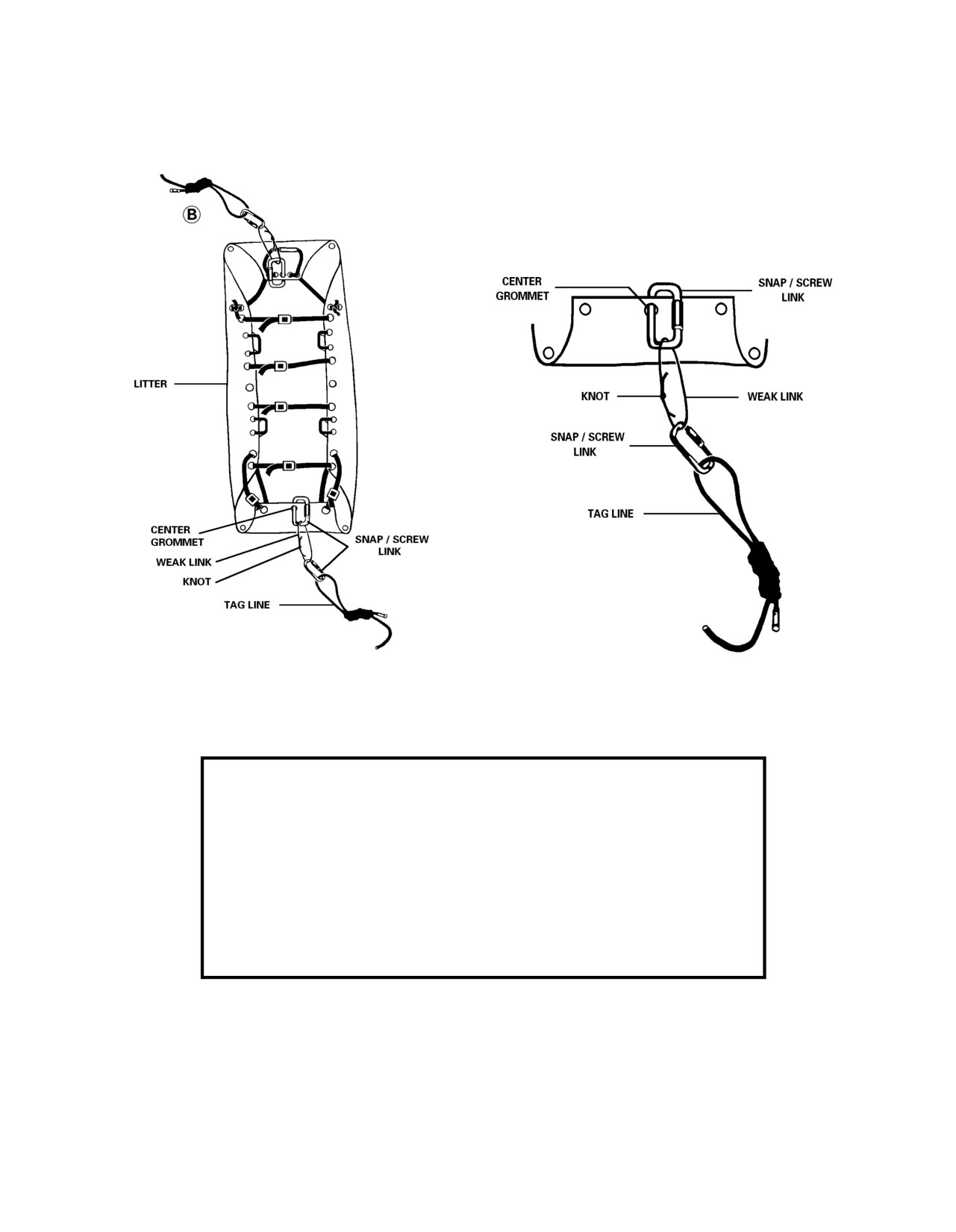
Figure E-2. Connection of the weak line to SKED litter and tag line (continued).
(BAlternate method of using center grommet.)
WARNING
1. The tag line should never be secured to an object on the
ground or in the water while a hoist mission is in progress.
The soldier holding the tag line should wear leather gloves
to prevent injury to his hands. Injury can result from friction
while handling the rope.
2. Do not allow a spin to start when using any flat surface
litter system.
The weak link is a device used to quickly detach the tag line from the litter being hoisted.
If the tag line becomes entangled with an object, it will break away at the weak link when enough pull is
asserted by ground personnel or by the helicopter.
E-17
FM 8-10-6
To use the weak link, attach the tag line with a snap link or screw link to one end of the
weak link an inch or more away from the weak link knot. Attach the other end of the weak link one inch
away from the knot to another snap link or skew link attached to the V-strap which is attached to the litter
(Figure E-2A). An alternate method is to connect the weak link to a snap link or screw link which is
attached to the center grommet of the SKED litter (Figure E-2B).
WARNING
A new weak link must be used for each live hoist mission.
NOTE
During hoist training, multiple unmanned lifts may be made using the
same weak link. The used weak link should be disposed of properly.
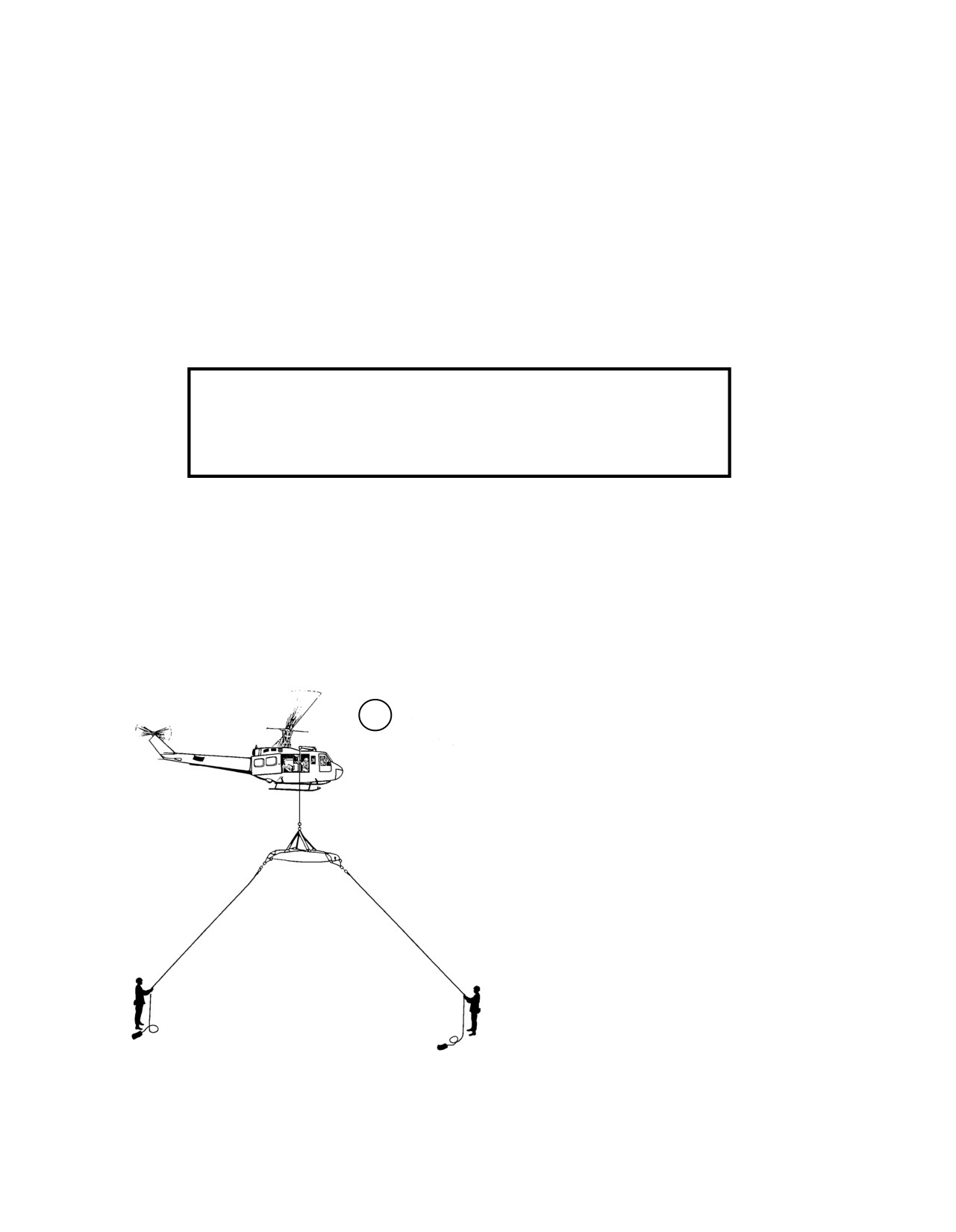
Proper placement of personnel during hoisting operation with any flat surface litter
system is essential to prevention of litter spin. Refer to Figure E-3 for proper placement of tag line
personnel.
A PREFERRED PLACEMENT
USE OF TWO TAG LINES IS THE SAFEST WAY TO
PREVENT A LITTER FROM SPINNING. TWO TAG
LINES SHOULD ALWAYS BE USED IN TRAINING AND
NONHOSTILE SITUATIONS FOR BETTER CONTROL
OF THE LITTER. THIS POSITIONING AFFORDS MAXI-
MUM VISIBILITY FOR THE PILOT AND BOTH AIR AND
GROUND CREWS.
NOTE: THE POSITIONING OF THE GROUND CREW
AS SHOWN IS AN IMPORTANT FACTOR IN MAIN-
TAINING CONTROL OF THE LITTER. THIS POSITION-
ING PROVIDES THE PILOT AND AIRCREW MAXIMUM
VISIBILITY AND THE ANGLE OF THE TAG LINE
AFFORDS MAXIMUM CONTROL OF THE LITTER.
Figure E-3. Placement of personnel for hoisting flat surface litter systems.
E-18
FM 8-10-6
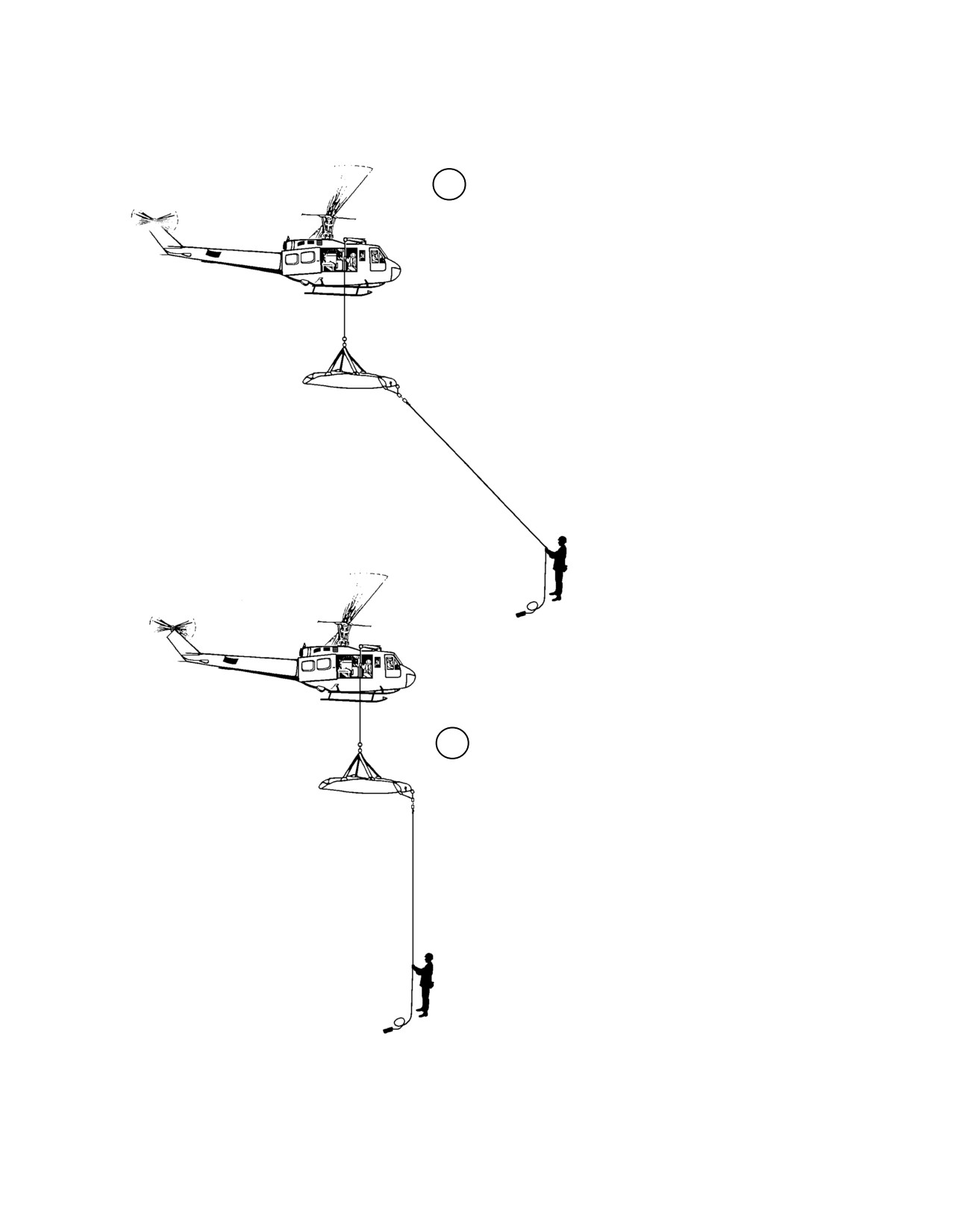
B ACCEPTABLE PLACEMENT
IF THERE IS ONLY ONE SOLDIER AVAILABLE ON THE
GROUND TO ASSIST IN THE HOIST OPERATION, ONE
TAG LINE MAY BE USED. TO OBTAIN ADEQUATE CON-
TROL OF THE LITTER, THE SOLDIER ON THE GROUND
SHOULD BE POSITIONED TO AFFORD MAXIMUM VISI-
BILITY FOR THE PILOT AND AIRCREW.
NOTE: THE POSITIONING OF THE GROUND CREW AS
SHOWN IS AN IMPORTANT FACTOR IN MAINTAINING
CONTROL OF THE LITTER. THIS POSITIONING PRO-
VIDES THE PILOT AND AIRCREW MAXIMUM VISIBILITY
AND THE ANGLE OF THE TAG LINE AFFORDS MAXI-
MUM CONTROL OF THE LITTER.
C LEAST DESIRABLE PLACEMENT
WHEN THE TAG LINE MUST BE HANDLED AT THE LEAST
DESIRABLE ANGLE DUE TO TERRAIN, VEGETATION, OR
OTHER OBSTACLES, THERE IS AN INCREASED RISK OF
SPIN AND/OR WEAK LINK SEPARATION.
Figure E-3. Placement of personnel for hoisting flat surface litter systems (continued).
E-19
FM 8-10-6
E-20. Emergency Procedures
If a partial loss of power occurs while hoisting and the altitude cannot be maintained, the patient should be
immediately lowered to the surface to lighten the helicopter. If the situation deteriorates to the point where
further action is required to prevent settling to the surface, the following action must be taken:
a. If hoisting overland, the patient should first be lowered to the ground and freed from the hoist.
It may be necessary to cut the cables as soon as the survivor is safely on the ground. Initiate the emergency
procedures described in the applicable operators manual. Should inadvertent landing occur, the PC
attempts to maneuver away from ground personnel. The preflight briefing should cover the direction that
ground personnel and crew members move in the event of such an emergency. All nonessential personnel
on the ground should remain a safe distance from the operation.
b. If hoisting over water, the patient should be lowered into the water and the cable cut to avoid
dragging him in the water as described above. Emergency actions are initiated according to the applicable
technical manual. Should an inadvertent landing occur, the aircraft should be maneuvered clear of the
patient in the water, if at all possible.
c.
In the event of a sudden and complete loss of power, the PC performs an emergency
autorotation maneuvering away from the patient, if possible.
d. A recovery may be continued if the hoist mechanism fails to raise or lower from the cable
extended position. The patient should be advised of the problem by hand and arm signals and instructed to
remain firmly attached to the recovery device. Before transitioning to forward flight, the helicopter should
climb to an altitude that affords the patient clearance from all obstacles. With the patient suspended from
the helicopter, the PC proceeds at a slow speed to a safe landing area.
WARNING
As pendulum action and rotation may become uncontrol-
lable if airspeed is too great, care must be used when
attempting forward flight with the hoist cable extended and
a patient attached.
e.
During landings, with the patient still suspended, care is exercised to prevent dragging the
patient and tangling the cable in the tail rotor. The hoist operator or PC must maintain light tension on the
cable during landing. After the patient has been gently lowered to the ground, the emergency cable cutter
may be used to free the cable from the helicopter to permit landing. The helicopter may be hovered to the
side of the patient and landed with the cable attached. After landing, the cable is detached from the patient
and stored in the helicopter.
E-20
FM 8-10-6
E-21. Tactical Considerations
a. The focus of a hoist operation must change drastically in a combat rescue mission as opposed
to a peacetime recovery. In a peacetime recovery, emphasis is on slow, decisive movements. The flight
crew takes as much time as is necessary to effect the hoist operation giving priority to the safety of all
concerned and patient comfort. Under combat conditions, the speed of the operation must be the primary
focus to reduce exposure time. The following should be considered:
Do not overfly pickup site.
Look for the best hover location that offers cover and concealment.
Prepare the aircraft for hoist operations prior to reaching the pickup site.
Do not put aircrew members on the ground unless absolutely necessary for patient
survival.
Do not loiter near or circle the pickup site while awaiting patient preparation.
Keep all aircraft active emitters turned off while on station, if possible.
Use the forest penetrator or hoisting vest to hoist patients whenever conditions permit.
Keep time on station to a minimum.
Use all available aircraft survivability equipment (ASE).
b. The success of a combat hoist operation is dependent on
Undetected entry into the pickup area.
Rapid completion of the hoist operation.
Protected departure from the rescue site.
c.
Combat hoist rescue operations are high-risk missions. Actions which support the safety and
principles of hoist operations will reduce the risk and enhance the success of these missions.
Section VIII. FOREST PENETRATOR
E-22. General
The forest penetrator is a folding rescue seat designed for both land and water rescue operations. The forest
penetrator is designed to penetrate thick foliage when lowered to the ground. This piece of equipment can
accommodate up to three patients in a single lift. The flotation collar, when fastened around the forest
penetrator, allows flotation of the complete assembly during water rescue operations.
E-21
FM 8-10-6
E-23. Configuration of the Forest Penetrator
a. The forest penetrator is a compact device weighing about 211/2 pounds. The forest penetrator
is 34-inches long and 8 inches in diameter when extended. Each seat is 43/4-inches wide and 111/2-inches
long. The seats on the forest penetrator are spring-loaded in the retracted position (flush against the shaft of
the penetrator). A spring-loaded retaining latch is provided under each seat to secure the seat in the
extended position. To release the seat, push down on the seat and pull down on the latch. The seat will
snap back into the retracted position.
b. Three webbed safety straps are provided to secure patients. Each strap extends 4 feet 91/4
inches, with an adjustable quick ejection snap hook attached to the upper section of the penetrator. The
straps terminate with a yellow fabric, marked TIGHTENED. Yellow webbing tabs (with hook tape) marked
PULL OUT are sewn to the safety straps for attachment to the fabric cover storage openings. The yellow fabric
cover has a 17-inch slide fastener and three storage openings (with pile tape) for securing safety straps.
c.
The flotation collar is made of bright orange foam rubber for high visibility and weighs 2.6
pounds. It is 201/4-inches long, with 73/4 inches in diameter at the top and a 4-inch diameter at the bottom.
The flotation collar is 9 inches in diameter when installed on the forest penetrator and the seats are in the
stowed position. In this configuration, the penetrator will float with its top approximately 6 inches above
the water.
E-24. Application
When an LZ is unavailable, the forest penetrator can be attached to the rescue hoist to lift patients not
requiring a hoisting litter. As many as three patients can be lifted at one time when conditions permit. The
PC decides the number of patients to be lifted. The forest penetrator can be used with a hoist on the
UH-1H/V, UH-60, or the CH-47.
CAUTION
Patients with spinal, pelvic, or neck injuries, or who are uncon-
scious will not be hoisted on the forest penetrator.
E-25. Employment of the Forest Penetrator
a. The hoist operator connects the forest penetrator to the hoist hook. He coordinates with the
PC and proceeds to lower the assembly to ground personnel.
b. Before handling the device, ground personnel allow the forest penetrator to touch the ground
to discharge any static electricity.
E-22
FM 8-10-6
c.
The necessary number of wing seats is extended.
d. Safety straps are removed from their protective cover. The straps are placed under the
patients arms, around his back, and fastened to the hook of the penetrator.
e.
Once the hoist operator has been signaled that the patient is secure, the PC is notified and the
patient is lifted into the helicopter.
f.
Once the hoist has reached the fully raised position, the crew member, placing an arm around
the patient and the forest penetrator, rotates the patient so he is facing away from the aircraft.
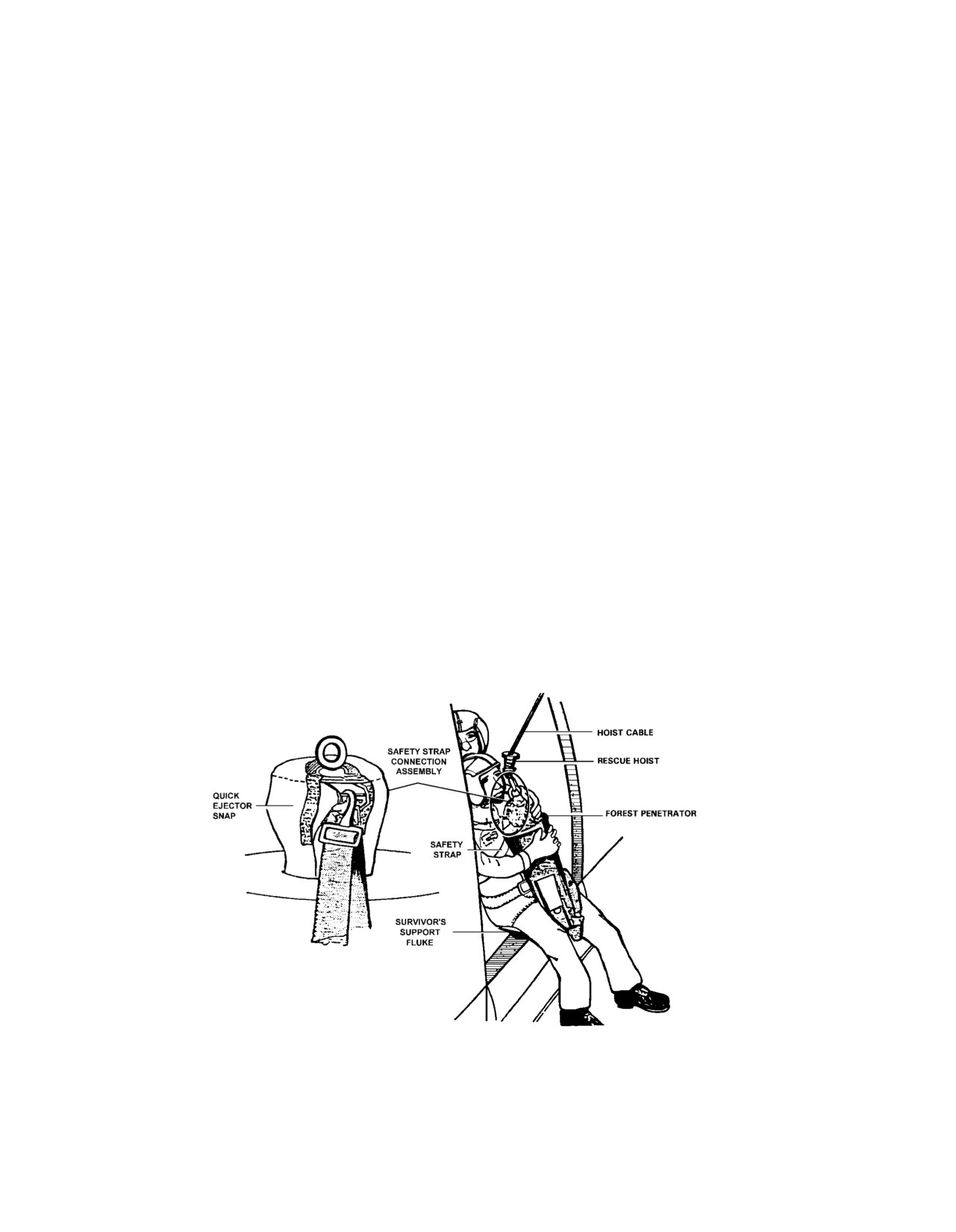
g. The crew member simultaneously pulls the patient into the aircraft and lowers him onto the
deck (Figure E-4).
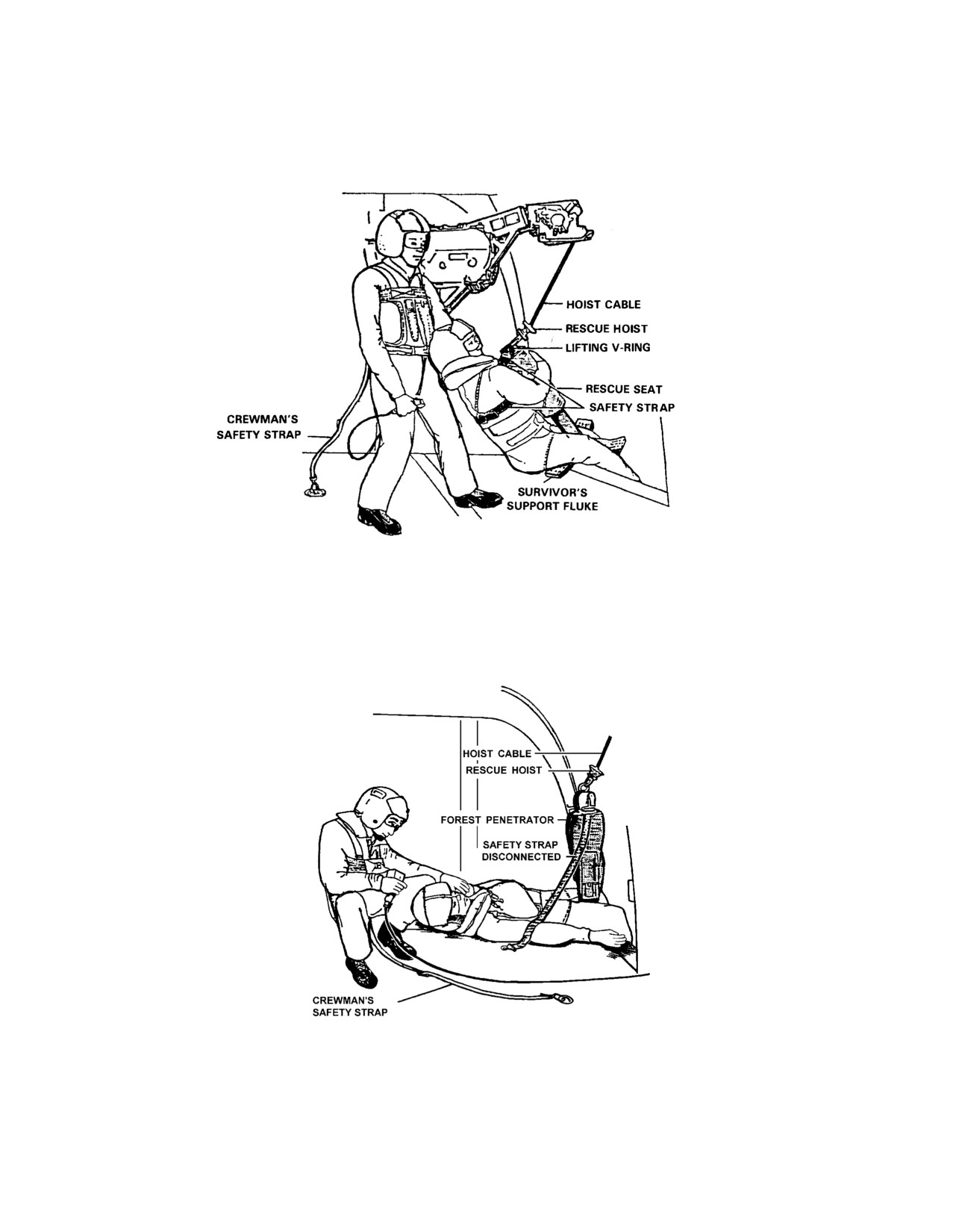
h. The crew member continues to lower the penetrator until the edge of the support fluke is
resting on the aircraft deck (Figure E-5).
i.
The crew member continues to lower the penetrator until the patient is lying on his back on the
aircraft deck.
j.
Once the patient is lying on his back with the penetrator on top of him, the crew member
releases the safety straps and raises the penetrator off the patient (Figure E-6), secures the patient, and
reports to the PC when ready for forward flight.
Figure E-4. Crew member lowers forest penetrator.
E-23
FM 8-10-6
Figure E-5. Crew member lowers the rescue seat until the edge of the patients support fluke is
resting on the aircraft deck.
Figure E-6. Crew member raises the forest penetrator off of the patient with the hoist.
E-24
FM 8-10-6
Section IX. SKED RESCUE SYSTEM
E-26. General
The SKED litter is a compact and lightweight patient transport system designed to evacuate one patient at a
time. It is used for both land and water rescue. The SKED litter provides the patient with support and
protection, but it is not designed as a spinal immobilization device. If a spinal injury is suspected, the
patient is to be secured using a spinal backboard prior to being placed on the litter (paragraph 9-6). A
backboard must be used in conjunction with the SKED litter on patients who have sustained shoulder
injuries. When the SKED litter is used with the hoist operator vest, the medic can be hoisted simultaneously
with the patient. This allows the medic to continue resuscitation or oxygen therapy during the hoist rescue
operation.
E-27. Configuration
a. The SKED litter (Figure 9-7) is olive drab green and weighs approximately 16 pounds with
accessories. It consists of a
3-foot by 8-foot sheet of low-density polyethylene plastic with rows of
grommets along its edges. The patient is secured by enveloping him in the litter and securing him with
lashing straps threaded through the grommets. Four nylon straps are used in hand-carrying the litter.
b. The SKED carrying case is used to transport the litter, spinal immobilizer device, lift slings,
tow straps, and the vertical lift rope.
c.
For high-angle operations, the litter is used in a vertical configuration with two lift slings and a
3/8-inch static kernmantle rope as a bridle.
d. The SKED basic rescue system includes the following:
Litter.
Backpack.
Towing harness.
Horizontal lift sling.
Vertical lift sling.
Large carabiner.
Tow strap.
e.
For water operations, the SKED litter can also be used with a flotation kit. The flotation
system enables the SKED litter to float vertically in the water providing enough positive flotation to support
E-25
FM 8-10-6
the patient and two rescuers. The inflatable logs are made of a nylon outer shell. They are equipped with a
carbon dioxide (CO2 ) rapid inflator, an oral inflator, and a quick dump valve which allows the float logs to
deflate in seconds for rapid breakdown and storage. The quick dump valve also acts as an overpressure
valve to prevent overinflation.
E-28. Operation of the SKED Litter
a. Preparing the SKED Litter.
(1) Remove the litter from the carrying case and place it on the ground.
(2) Unfasten the chest strap, place one foot on the SKED, and unroll it completely.
(3) Bend the SKED litter in half (opposite way of curl) and back roll. Repeat with the
opposite end of the litter. This will allow the SKED litter to lay flat.
b. Placing the Patient on the SKED Litter Using the Log Roll Method.
(1) Place the SKED litter next to the patient. Ensure that the head end of the litter is adjacent
to the head of the patient. Place cross straps under SKED.
(2) Log roll the patient away from the litter and slide the SKED litter as far under the patient
as possible. Gently roll patient down onto the SKED litter.
(3) Slide the patient to the center of the litter. Be sure to keep the patients spinal column as
straight as possible.
(4) Pull straps out from under the SKED litter and fasten to the buckles.
c.
Placing the Patient on the Litter Using the Slide Method.
(1) Position the foot end of the SKED litter at the head of the patient.
(2) Straddle the litter and support the patients head, neck, and shoulders.
(3) Grasp the foot straps of the SKED litter and slide it under the patient.
(4) Center the patient on the SKED litter and fasten the straps with the buckles.
d. Positioning and Fastening the Straps with the Buckles.
(1) Lift the sides of the SKED litter and fasten the four cross straps with the buckles directly
opposite the straps.
E-26
FM 8-10-6
(2) Feed the foot straps through the unused grommets at the foot end of the SKED litter and
fasten with the buckles.
e.
Lifting and Descending (Horizontal).
(1) Insert one end of the head strap through the lift slot at the head end of the litter.
NOTE
Two nylon webbing straps rated at 3,800 pounds each are used for
horizontal lift or descent. The head strap is 4-inches shorter than the
foot strap and is used at the head end of the litter only.
(2) Bring the strap under the SKED litter and through the lift slot on the opposite side.
(3) Equalize the strap and repeat the procedure with the other strap at the foot end of the
litter.
(4) Equalize all four straps and secure them to the large steel locking carabiner.
(5) Before hoisting, hoist operator ensures that ground personnel have a tag line attached to
the foot end of the litter and are ready for hoisting.
(6) While the litter is being lowered, or hoisted back up into the aircraft, ground personnel
use the tag line to prevent the litter from swinging or spinning. The tag line is also used to keep the litter
parallel to the aircraft and the patients head toward the tail rotor.
f.
Lifting or Descending (Vertical).
(1) Pass each end of the rope through the grommets at the head end of the litter. Leave
approximately 1 to 2 feet between the knot and the litter.
NOTE
A 30-foot length of 3/8-inch static kernmantle rope with a figure eight
knot tied in the center is used to configure the SKED litter for a
vertical lift or descent.
(2) Continue feeding the rope through all available grommets and carrying handles all the
way to the foot end of the SKED litter. Ensure both ends of the rope are even.
E-27
FM 8-10-6
(3) Pass the ends of the rope through the grommets at the foot end of the SKED litter. Tie
the ends of the rope together with a square knot.
(4) Bring the ends of the rope up and over the end of the SKED. Pass the rope through the
carrying handles and secure it with a square knot. For safety, add a half-hitch knot.
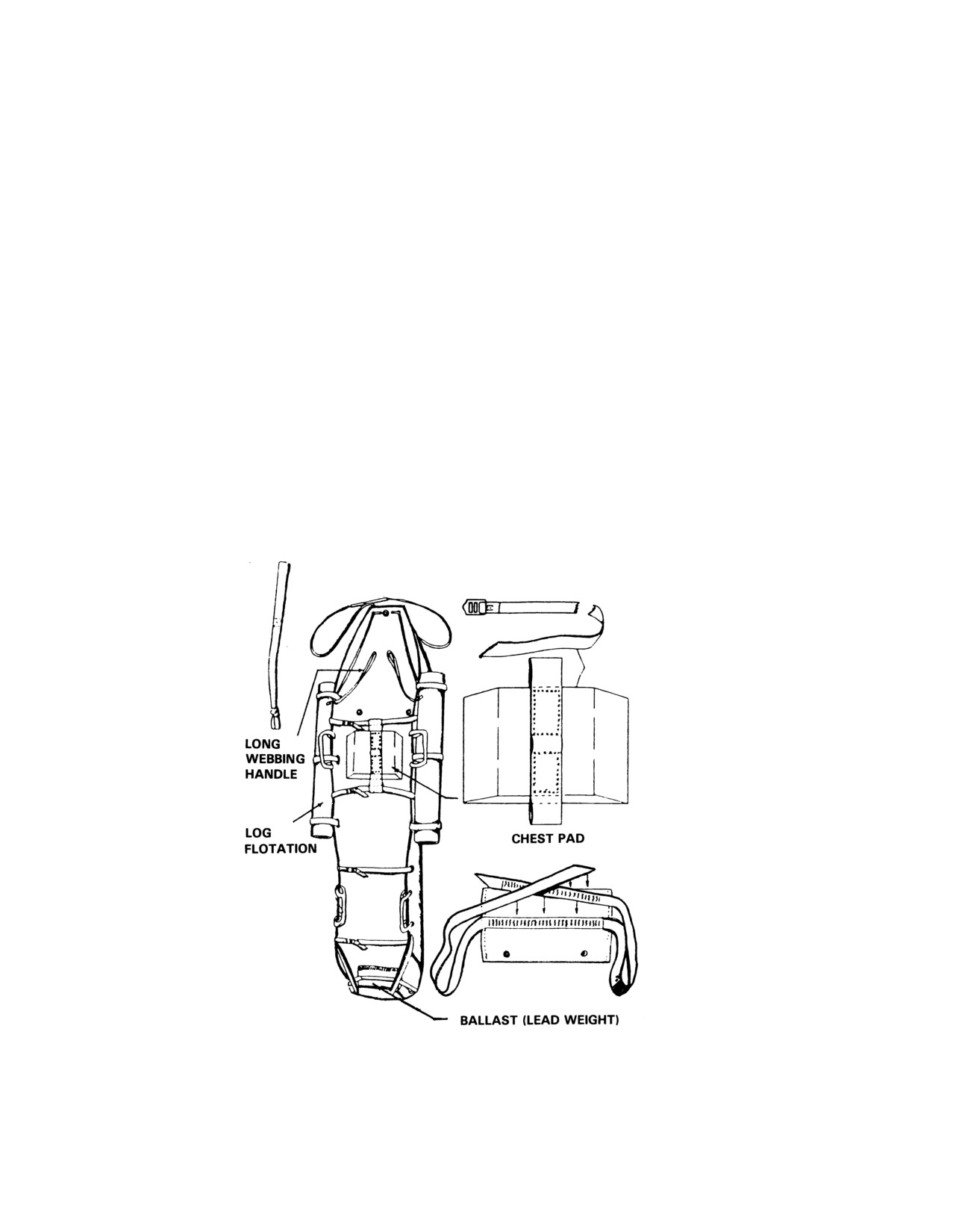
g. Conducting Water Operations (Figure E-7).
(1) Unroll the SKED litter and lay it flat.
(2) Fasten the two lower cross straps and tighten them enough to pull the sides up and
prevent the SKED litter from bending. Fasten the two foot straps bringing the foot end up to form a
toboggan-like shape.
Figure E-7. SKED litter configured for water operations.
E-28
FM 8-10-6
(3) Attach the ballast (lead weight) inside the foot end of the SKED litter by placing it
between the two grommets at the foot end. Pass the straps through the grommets from the inside out, and
lay them across the Velcro on the ballast bag.
(4) Attach the two long webbing handles by passing them, from the outside in, through the
unused grommets in the shoulder area.
(5) Attach the flotation logs to the SKED litter by passing one end of the retaining straps
through the proper slots in the SKED litter and fasten them to their opposite ends using the buckles. It is
critical that the straps go all the way around the logs and through the slots on the SKED litter.
(6) The SKED logs can be inflated either before or after attachment.
(7) Upper cross straps pass through the loops on the chest pad. Cross straps should then be
fastened and left in a loose position.
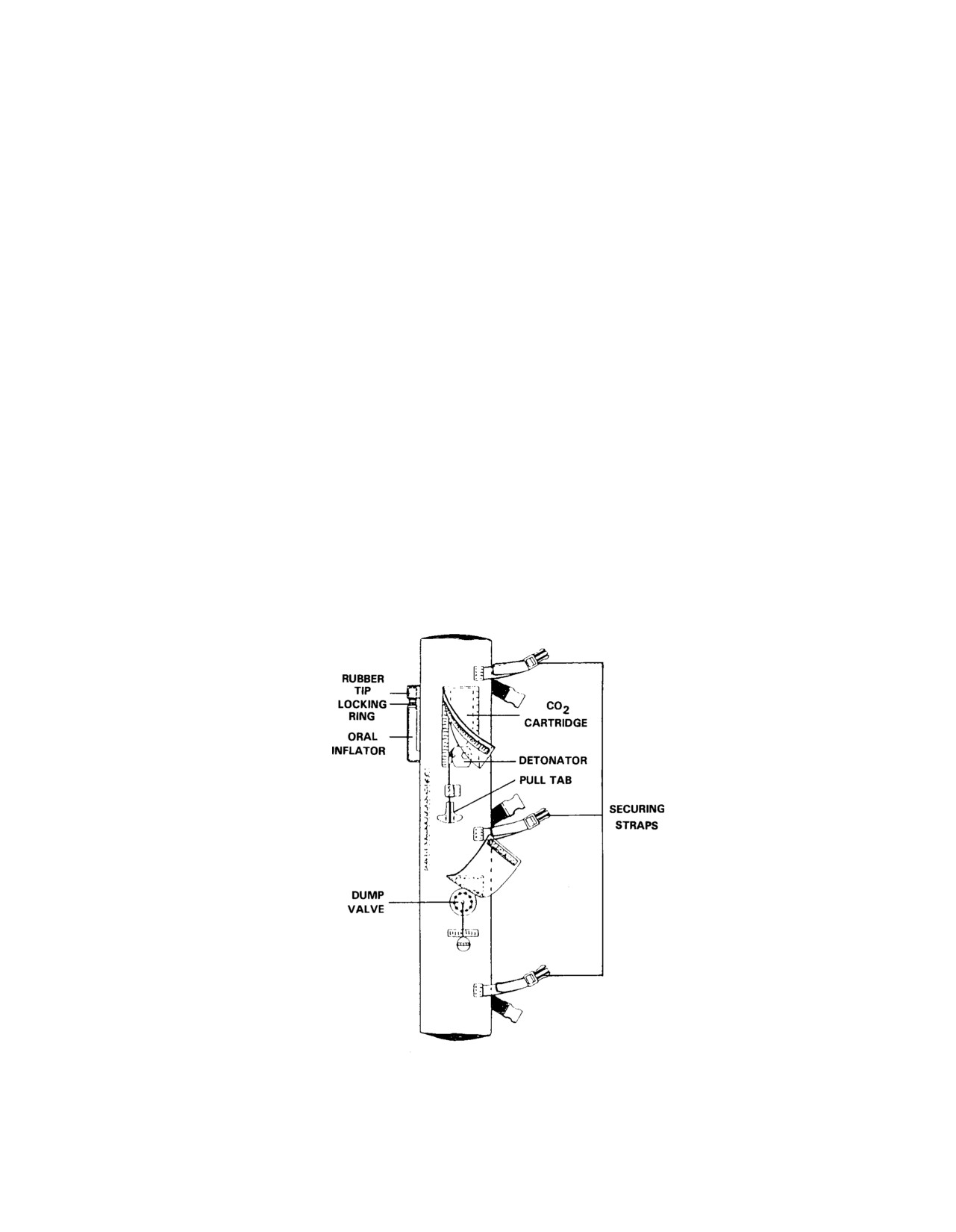
h. Inflating the Flotation Log (Figure E-8).
(1) Pull on the inflator tab to activate the CO2. Do not remove the CO2 cylinder from the
detonator until you have a replacement cylinder. Removing the CO2 cylinder allows the float to deflate.
Figure E-8. Inflating the flotation log.
E-29