FM 8-10-6 MEDICAL EVACUATION IN A THEATER OF OPERATIONS TACTICS, TECHNIQUES, AND PROCEDURES - page 9
FM 8-10-6
(2) To use the oral inflator, turn the locking ring to allow the end to be depressed. Press the
rubber tip against your teeth to open the valve and blow into it. When the desired amount of air is inside the
float, release the inflator and secure the locking ring. The oral inflator has a spring-loaded safety valve
which must be depressed to add or release air. The locking ring prevents the accidental release of air.
(3) To deflate the flotation log, pull the ball attached to the dump valve and squeeze the float
until deflated.
E-29. Maintenance of the SKED Litter
a. All cleaning and preventive maintenance performed on the SKED litter and its components
takes place at the unit level.
b. All SKED litters and accessories are subject to an inspection upon issue and a calendar
inspection in each subsequent year. The SKED litter should also be inspected after every vertical or
horizontal ascent or descent. All components used in salt water rescue operations must be rinsed in fresh
water as soon as possible.
(1) To perform a serviceability inspection on the SKED litter, complete the following steps:
(a) Remove all equipment from carrying case.
(b) Unroll the SKED litter and remove all ropes and straps.
(c) Inspect all ropes and straps for cuts, tears, and abrasions.
(d) Check all hardware for security of attachment, condition, and ease of operation.
(e) Check the litter for cuts, tears, and holes.
(f)
Examine the carrying case for stains, dirt, and general condition.
(2) To repack the SKED litter, complete the following steps:
NOTE
When not in use, the SKED litter is stored in the carrying case.
(a) Lay the litter out and place the chest strap, buckle side down, under the foot end of
the SKED.
(b) Starting at the head end, roll the SKED up as tight as possible.
E-30
FM 8-10-6
(c) Continue to roll the SKED up using the knee to keep the litter from unrolling.
(d) Fasten the chest strap to the buckle and place the SKED litter in the back pack.
Section X. RESCUE (STOKES) LITTER
E-30. General
The Stokes litter and flotation kit are designed to perform helicopter rescue operations in areas not suitable
for landing and where other evacuation means are not available or practical.
a. The Stokes litter carries one patient and can be used with the high performance hoist overland
or overwater. The Stokes litter, when fitted with a backboard, can be used to immobilize a patient who has
suffered a back injury.
b. For use overwater, a flotation kit must be installed in order to keep the litter upright and
stable. This kit consists of flotation logs, lift inserts, ballast bar, and a two-piece rescue litter hoisting
sling.
E-31. Configuration
The Stokes litter is a metal litter with wire mesh netting for the bed (paragraph 9-2(a)(6)). The flotation kit
for the Stokes litter is designed to support the upper half of the litter, keeping that portion of the litter high
in the water while the chest pad keeps the patients face out of the water and prevents the litter from
overturning. A ballast bar is placed on the foot of the litter to assist in keeping the litter floating at the
proper angle. Retaining straps are used to secure the patient to the litter. Once secured to the Stokes litter,
the patient requires no additional flotation devices.
E-32. Function
a. Once the aircraft has arrived at the rescue site, the hoist operator prepares the litter for
hoisting and notifies the PC when ready to lower the litter. The PC then directs the hoist operator to begin
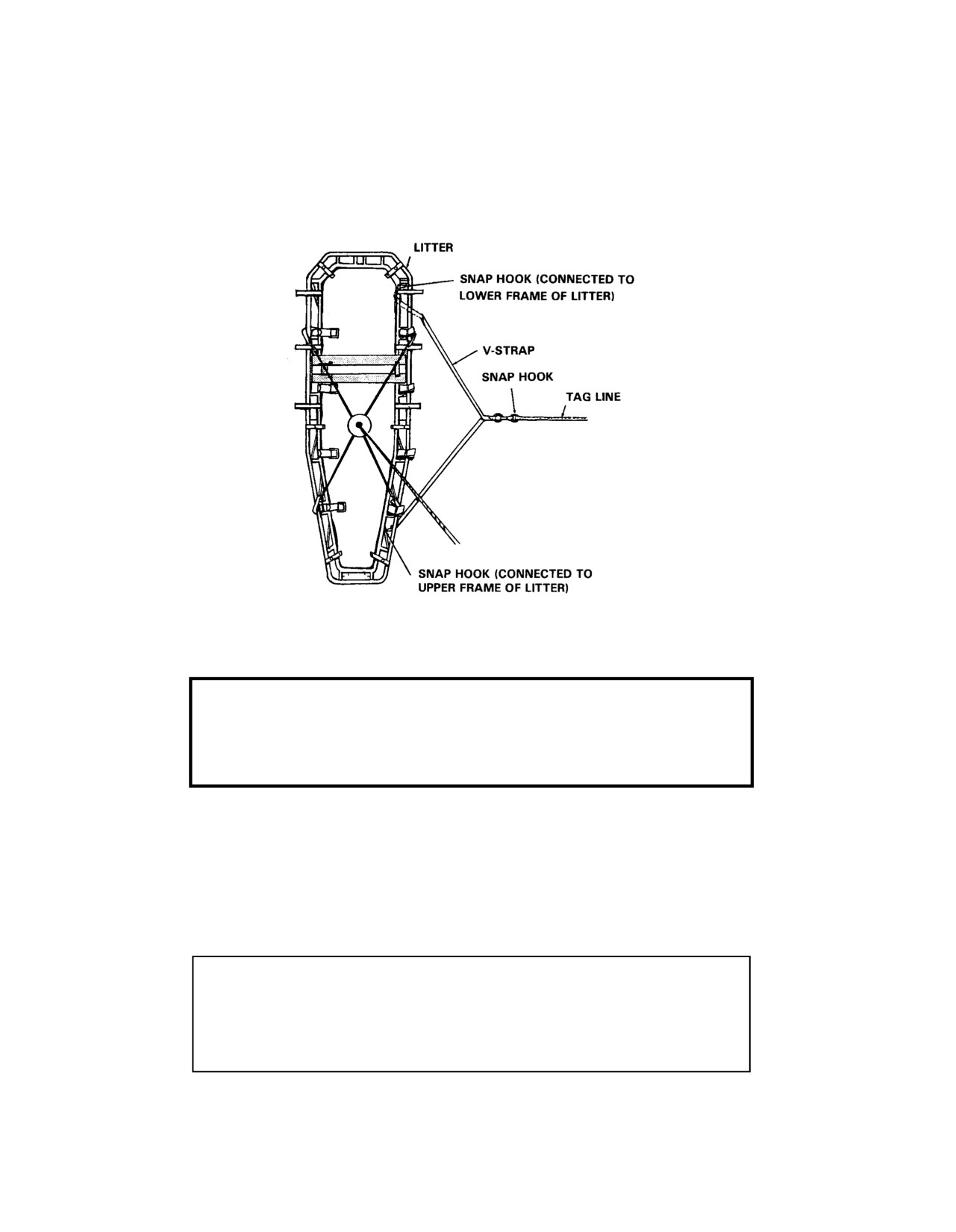
lowering the litter, along with the tag line. Figure E-9 depicts the proper attachment of the tag line. Before
hoisting, the hoist operator ensures that ground personnel have the tag line and are ready for the litter to be
raised.
b. While the litter is being lowered, or hoisted back up into the aircraft, the ground personnel use
the tag line to prevent the litter from swinging. The tag line is also used to keep the litter parallel to the
skids of the aircraft and the patients head toward the tail rotor.
E-31
FM 8-10-6
Figure E-9. Tag line attached to Stokes litter.
WARNING
Do not touch the litter until it contacts the ground and
discharges the built-up static electricity.
c.
The ground personnel disconnect the litter and signal to the hoist operator.
d. The hoist operator notifies the PC that the litter has been disconnected. Once the litter is
disconnected, the PC repositions his aircraft to a tactically safe area to await instructions. Aircrews should
never loiter in or circle around the pickup area while waiting.
CAUTION
Rifles, grenades, or other weapons and munitions and radios
must be removed from the patient before placing him in the litter.
E-32
FM 8-10-6
e.
Once the ground personnel have the patient secured in the litter, they signal for the helicopter
to move into position and lower the rescue hook.
f.
The ground personnel then connect the hoisting sling to the rescue hook and signal to the hoist
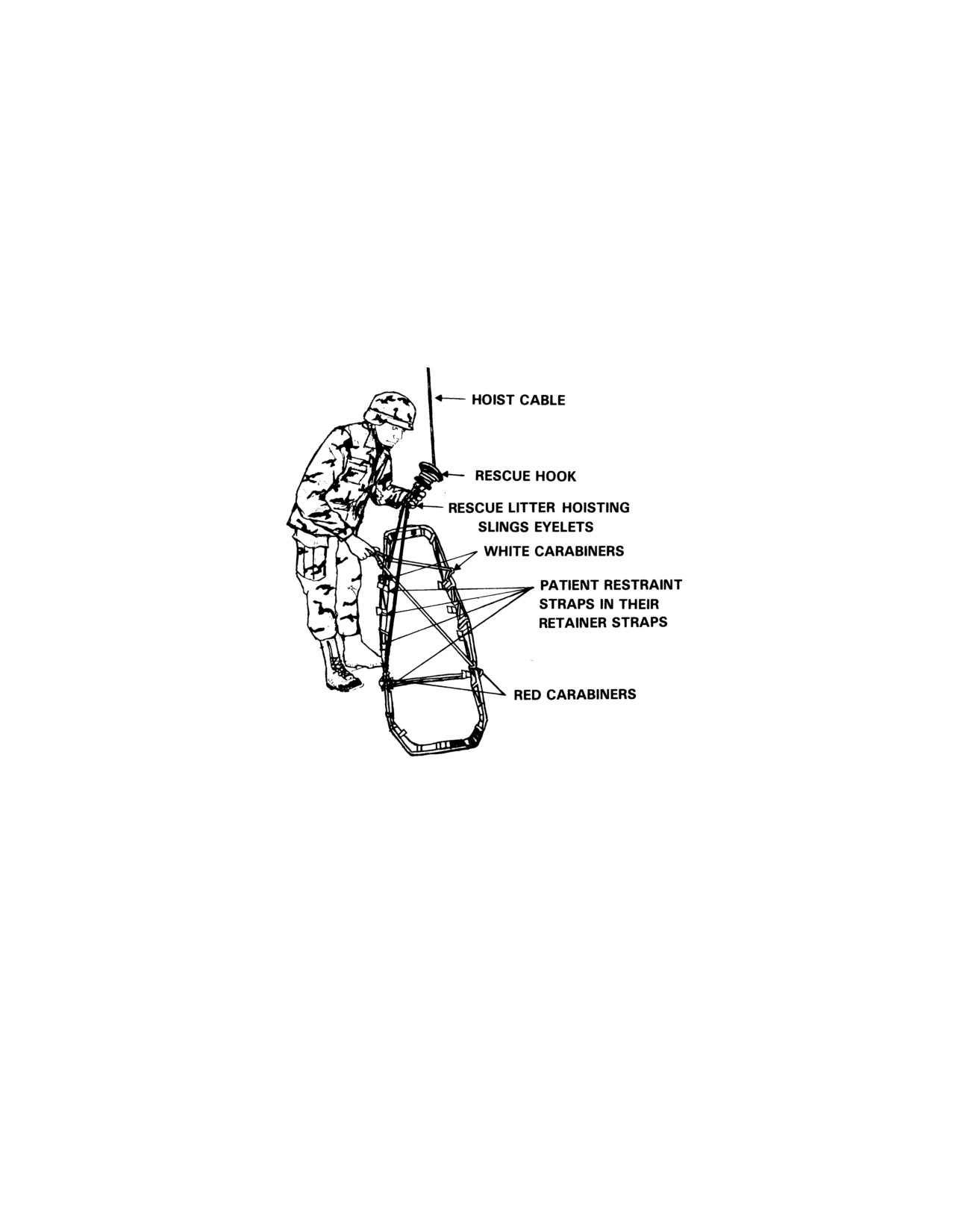
operator that the litter is ready to be hoisted (Figure E-10).
Figure E-10. Attaching hoisting slings to the rescue hooks.
NOTE
Red carabiners and white carabiners can be used to distinguish the
head and foot ends of the Stokes litter for attaching the hoisting cables.
The Stokes litter should be marked with colored paint corresponding
to the carabiners.
g. In water rescues, a device must be employed to keep the litter afloat and to keep the head of
the patient out of the water. The flotation device for the Stokes litter is similar to the US Coast Guard collar
and is designed to support a patient in water. It is recommended that units having an AO that includes
bodies of water have flotation devices on hand for use with this litter.
E-33
FM 8-10-6
E-33. Maintenance
All serviceability inspections and cleaning of the Stokes litter are accomplished at the unit level.
a. Calendar Inspection. The calendar inspection includes a visual inspection for cracked welds
and tubes, pinholes, security of mesh, and evidence of wear at the hoisting cable attaching points. The
cables, carabiners, and hardware are visually inspected for wear and corrosion, and for signs of breakage,
slippage, and fatigue.
b. Preflight Inspection. A preflight check is completed prior to each deployment of the Stokes
litter to ensure safety. This visual inspection is done as a part of the overall preflight checks.
Section XI. POLELESS SEMIRIGID LITTER
E-34. General
a. The poleless semirigid litter is constructed of canvas reinforced by wood. It can easily be
stored aboard the aircraft because it is lightweight. It can also be folded longitudinally into a manageable
size.
b. The patient is secured on the litter by canvas flaps that are laid over the patient from either side
with his arms outside. The flaps and, subsequently, the patient are secured by five seat belt-like straps. The
patients head is secured by a heavy canvas hood immobilizer. The hood holds the head in place with two
straps: one across the forehead, and one across the chin.
c.
This litter is also discussed in paragraph 9-2(a)(4).
E-35. Employment of the Poleless Semirigid Litter
To use the poleless semirigid litter, the following steps should be followed:
a. The patient is placed on the litter using the log roll method, if necessary.
b. The patient is secured to the litter using the straps across the body and head. The flaps are
folded over the patient with arms on the outside, and the straps are firmly tightened, except in areas where
serious injuries exist. The top four straps are routed over the body, and the bottom strap is routed under the
feet for added support of the body weight.
c.
Avoid strapping over or around injured extremities. For example, in the case of a fractured
leg, the bottom strap would be routed under the foot of the uninjured leg to avoid worsening the injury.
d. The patients head is secured by two straps (one under the chin and one over the forehead).
The chin strap must be routed over the chin to avoid choking should the patient slide down in the litter
E-34
FM 8-10-6
slightly during hoisting. In the event of a serious head injury, the hood assembly is easily removed from the
litter. This allows the medic to attend to the injury even after the patient has been secured to the litter. The
hood can then be reattached to the litter and to the patient prior to hoisting.
e.
The litter is hoisted in the upright position using the large ring at the head of the litter. The
ring at the bottom of the litter is used for the tag line. The litter has a carrying handle at each corner of the
litter for maneuvering the litter on the ground.
E-36. Function
a. Once the aircraft has arrived at the rescue site, the hoist operator prepares the litter for
hoisting and notifies the PC when he is ready to lower the litter. The PC then directs the hoist operator to
begin lowering the litter, along with the tag line. Before hoisting, the hoist operator ensures that ground
personnel have the tag line and are ready for the litter to be lowered.
b. As the litter is being lowered, or hoisted back to the aircraft, the ground personnel use the tag
line to keep the litter from swinging.
WARNING
To avoid serious shock, do not touch the litter until the hoist
hook touches the ground and discharges the static electricity.
c.
The ground personnel disconnect the litter and signal to the hoist operator.
d. Once the hoist operator has notified the PC that the litter has been disconnected, the PC then
repositions the aircraft to a tactically safe area to await instructions to return to complete the hoist operation.
Aircrews should never loiter in or circle the pickup area.
e.
All equipment, such as weapons, grenades, or radios, must be removed from the patient prior
to placing him on the litter.
f.
Once the ground personnel have the patient secured in the litter, they signal the helicopter to
move into position and lower the rescue hook.
g. The ground personnel then hook the ring at the head of the litter.
h. The hoist operator guides the litter into the door.
i.
Once the patient is secure in the aircraft, the hoist operator recovers the tag line.
j.
The hoist operator readies the cabin for forward flight and reports to the PC.
E-35
FM 8-10-6
E-37. Maintenance
Cleaning and serviceability inspections are to be accomplished at the unit level.
a. Inspection. The litter is inspected in a systematic method starting at the top lifting ring,
moving downward and finishing with the bottom lifting ring.
(1) The top lifting ring is carefully inspected for any sign of corrosion, cracks, wear, or
burrs. If any of these conditions are found, the litter is unserviceable until repaired.
(2) The lifting ring attachment straps are inspected for signs of any rips, tears, rotting, or
loose stitching.
(3) On the head harness assembly, the inspection includes determining if all attachment clips
are present and serviceable. The fabric portion of the harness is inspected for rips, tears, and rotting.
(4) The main body of the litter is inspected for tears, runs, or rips in the canvas. Ensure that
the belt buckles fasten securely and have no rips or tears in the material. There should be no loose stitching
or torn seams.
(5) The wood slats on the litter should be removed and visually inspected for cracked,
broken, or splintered pieces.
b. Repairs and Modifications. Any repairs or modifications to the poleless semirigid litter are to
be performed at echelons above the unit level.
Section XII. SURVIVORS SLING (HORSE COLLAR)
AND CABLE WEIGHT COVER
E-38. General
The survivors sling (horse collar) and cable weight cover are used in performing helicopter rescue operations
where landing is impossible, either overland or overwater. It can be used to lower a rescuer as well as raise
a patient to the helicopter. The cable weight cover is a cushioned cover device that envelopes the metal in
the hoist cylinder.
E-39. Configuration
a. The horse collar is a buoyant device consisting of a kapok filling encased in a bright yellow,
waterproof cover. Webbing, woven through the cover with both ends terminating in two V-rings, is used
to attach the sling to the helicopter rescue hook. Two retainer straps, one long with a quick-ejector snap and
one short with a V-ring, are fastened to the webbing of the sling and are enclosed in slide fastener-secured
envelopes.
E-36
FM 8-10-6
b. The cable weight cover has four snap fasteners and a cord tie that keeps the cover secure
around the cable weight. The cable weight cover protects the patient from injury that could result from
accidental contact with the metal cable weight.
E-40. Function
a. A webbing strap running through the cover has a V-ring at both ends and is used for attaching
to the double rescue hook on the cable. Two red retainer straps marked PULL, one with a quick ejector
snap and the other with a V-ring, are provided with the sling and are enclosed in zippered pockets.
b. Once the aircraft is over the patient, the hoist operator readies the survivors sling for use and
advises the PC when the sling is ready to be lowered. The PC then directs the hoist operator to lower the
sling to the patient or ground personnel.
WARNING
Do not grab the webbing handle on the survivors sling. This
may raise the patients arms which could cause the patient
to fall from the sling before entry into the aircraft.
c.
The medic or ground personnel signal to the hoist operator once they have placed the patient in
the survivors sling and are ready for hoisting.
d. Once the patient has been hoisted to the aircraft door, the hoist operator lowers the patient
while simultaneously pulling him into the aircraft.
e.
Once inside the aircraft, the hoist operator
(1) Releases the safety strap.
(2) Secures the patient in the aircraft.
(3) Disconnects the survivors sling from the hoist.
(4) Reports to the PC when ready for forward flight.
E-41. Maintenance
Cleaning of the survivors sling and cable weight cover is performed at the unit level. Component repairs
or other maintenance actions required are performed at the intermediate level or higher.
E-37
FM 8-10-6
a. Calendar Inspection.
(1) All survivors slings and cable weight covers are inspected upon issue and then again
each subsequent year.
(2) This inspection consists of a visual inspection, marking inspection, and proof-loading
testing.
b. Visual Inspection.
(1) Inspect the fabric for cuts, deterioration, and abrasions.
(2) Inspect the seams for proper adhesion and stitching.
(3) Inspect the retainer straps for security of attachment and wear.
(4) Inspect all hardware for security of attachment and wear.
c.
Marking Inspection. Ensure markings are correct and legible. Restore faded markings.
E-42. Modifications
The only authorized modification at the unit level of maintenance is the fabrication of the assist handle.
Section XIII. HOISTING VEST
E-43. General
The hoisting vest is sometimes referred to as a full body fishnet. It is designed to evacuate one patient at a
time. It is used for overland rescues and shipboard transfers of uninjured or ambulatory patients. If
overwater hoisting is expected, a flotation device shall be worn over the hoisting vest.
E-44. Configuration
The hoisting vest is constructed of green lightweight nylon mesh material and is designed to accommodate
one person. To facilitate donning and size adjustments of the vest, two rings are provided for each of the
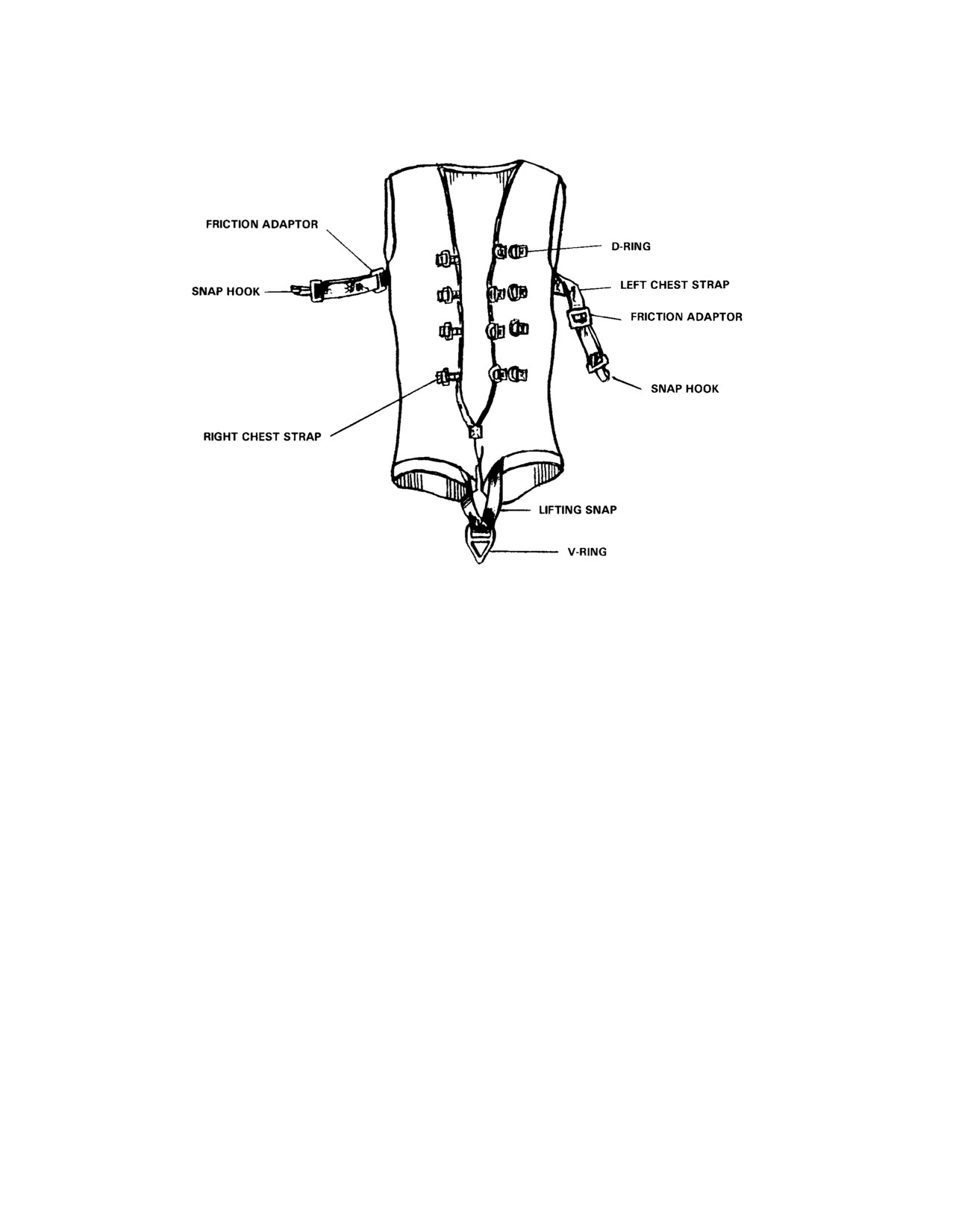
four snap hooks. Two adjustable chest straps shall be attached to the lifting V-ring for hoisting (Figure
E-11).
E-38
FM 8-10-6
Figure E-11. Hoisting vest.
E-45. Employment of the Hoisting Vest
a. Should the aircrew elect to use the hoisting vest for a personnel transfer from the aircraft to the
ground, the following procedures should be followed:
(1) The crew member helps the transferee don the hoisting vest.
(2) The transferee steps through the leg openings and draws up the vest. He then places his
arms through the openings (coat fashion) and pulls the vest over the shoulders with the opening in front.
(3) The crew member connects the snap hooks to the rings. He then attaches the back
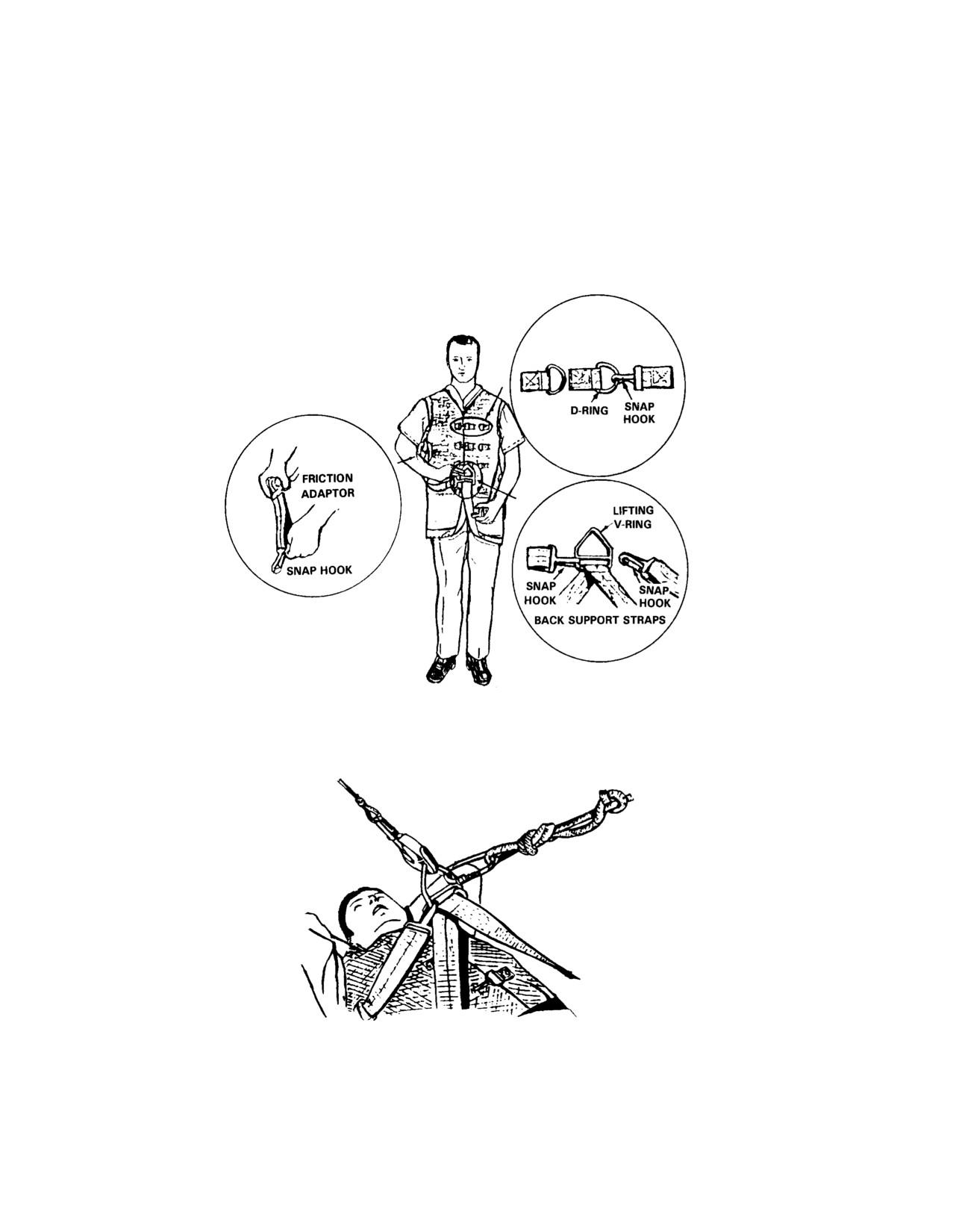
support straps with the snap hooks to the lifting V-ring (Figure E-12). The crew member then connects the
lifting V-ring to the rescue hook and signals the hoist operator to transfer the patient.
NOTE
The tag line procedures are used to increase the safety factor of the
transfer.
b. When performing the single-man hoist recovery (Figure E-13), place the patient in the hoisting
vest and fasten the torso snaps. Attach the adjustable chest lifting straps to the lower portion of the V-ring
E-39
FM 8-10-6
on the leg lifting strap. Attach the rescue hook to the lifting V-ring of the hoisting vest. Adjust the hoisting
vest chest straps as necessary to ensure a level or upright position. Ensure the knurled fitting on the locking
carabiner is down and locked.
Figure E-12. Hoisting vest donning procedures
Figure E-13. Single-man hoist to vest.
E-40

FM 8-10-6
c.
When performing the dual-man hoist recovery (Figure E-14), attach the rescue hook to the
locking carabiner of the crewman hoisting vest. Attach the locking carabiner of the belay line through the
lifting V-ring of the hoisting vest. Route a locking carabiner between the lifting V-ring of the hoisting vest
and attach to both locking carabiners. Connect the locking carabiner to the hoisting vest lifting the V-ring
of the survivors vest. Ensure the knurled fittings on the locking carabiners are down and locked.
Figure E-14. Dual-man hoist to vest.
E-46. Maintenance of the Hoisting Vest
a. All cleaning and preventive maintenance performed on the hoisting vest is done at the
organizational level.
b. The hoisting vest should also be inspected after every ascent and descent. If the hoisting vest
is used during salt water rescue operations, the vest must be rinsed in fresh water as soon as possible after its
use.
(1) A serviceability inspection on the hoisting vest is accomplished by
Inspecting the seams for broken stitching.
Inspecting all straps for cuts, tears, and abrasions.
E-41
FM 8-10-6
Inspecting the nylon mesh material for cuts, tears, dirt, and general condition.
Checking all hooks, rings, and friction adaptors for the security of attachment,
corrosion, damage, wear, and ease of operation.
(2) If faults are found, do not use the hoisting vest until repairs are made.
(3) Any repairs to the hoisting vest are performed at echelons above the organizational level.
E-42
FM 8-10-6
APPENDIX F
THE USE OF SMOKE AND OBSCURANTS IN MEDICAL
EVACUATION OPERATIONS
F-1. General
a. This appendix provides guidance for AMEDD personnel in the use of smoke and obscurants in
medical evacuation operations.
b. The modern battlefield extends from the rear area of friendly units, across the main battle
area, deep into the enemys territory. Throughout the battlefield, forces acquire and engage targets based
on visual, laser, and microwave technologies. Friendly and enemy units use smoke and obscurants across
the battlefield as a combat multiplier. The use of smoke and obscurants to mask combat operations is
dictated by the tactical commander. He normally provides the operational guidance for units or elements
operating in an area requiring obscuration. Permission to employ smoke and obscurants solely to mask
medical evacuation operations may not be approved. However, if the tactical commanders plan indicates
that smoke operations are to be employed in a given AO, the CHS planner should consider both the
advantages and disadvantages posed by their employment. Factors to consider are the
Phase of the tactical operation in which smoke and obscurants will be employed.
Effect on ground and air evacuation routes when operating in an obscured environment
(such as limited hours of use, checkpoints or convoy requirements, or the elimination of NOE approaches).
Potential for exploiting the use of the cover and concealment provided for clearing the
battlefield of casualties, especially in the defense.
Potential requirements for smoke generation to perform the medical evacuation mission
which would not detract from the tactical capability and requirements.
c.
Smoke can also be used to identify unit areas or LZs for which a medical evacuation request
has been received. Further, smoke can indicate wind direction at a landing site for air ambulance operations.
d. For specific information on the employment of smoke and smoke generation equipment, refer
to FM 3-50.
F-2. Employment of Smoke and Obscurants
Smoke and obscurants are employed to protect friendly forces from attack during the offense or defense.
a. Smoke and obscurants disrupt enemy combat operations throughout the depth of the battlefield
and across the operational continuum. They
Disrupt the ability to communicate.
Conceal friendly forces.
F-1
FM 8-10-6
Deceive the enemy.
Identify and signal.
Degrade the effect of DE weapons.
b. The benefit to CHS forces is derived through the tactical commanders use of smoke to
obscure friendly tactical maneuvers. This obscuration
Prohibits the enemy from knowing how many casualties have been inflicted.
Aids the movement of CHS units and equipment.
Enhances the ability to resupply forward deployed CHS elements.
Aids in the tactical deception plan.
F-3. Geneva Conventions and the Use of Smoke and Obscurants in Medical Evacuation
Operations
a. The 1949 Geneva Conventions for the Amelioration of the Condition of the Wounded and
Sick in Armed Forces in the Field (GWS) provides protection of medical personnel and units from
intentional attack so long as they carry out no duties harmful to the enemy (Article 21, GWS). In order to
facilitate their identification so as to prevent their intentional attack, medical units, equipment, and personnel
are authorized to display the distinctive emblem of the Red Cross (Article 42, GWS). Under tactical
conditions, when requirements for concealment outweigh those for recognition, all distinctive emblems may
be obscured or removed from medical equipment if ordered by competent military authority and authorized
by Army regulations. Display of the distinctive emblem is not required to afford the right against intentional
attack; attack of medical units, equipment, and personnel not displaying the distinctive emblem is prohibited
if opposing forces realize that the forces about to be attacked are medical units performing humanitarian
duties.
b. The use of smoke or obscurants in medical evacuation operations does not differ from the use
of camouflage techniques and is not prohibited by the GWS. Its only effect will be to obscure the identity of
units as they perform their humanitarian mission. Given the lethality of the modern battlefield, however, it
would be difficult, if not impossible, to say that such obscuration of these units, equipment, and personnel
would necessarily increase their risk from unintentional attack.
c.
It is recognized that, with the advent of precision-guided munitions and electro-optical or laser
target acquisition devices, there will be a substantial use of smoke and other obscurants on the modern
battlefield as a result of normal combat operations. The legitimate use of obscurants by combatants to
thwart the accuracy of precision guided munitions may increase the risk to units and equipment not
employing obscurants. This may possibly place medical units and equipment at greater risk if they fail to
employ them. Further, medical evacuation operations will have to be carried out on the battlefield as
medical personnel find it, which will include obscurants employed for normal combat operations.
F-2
FM 8-10-6
d. For additional information on the protections afforded by the Geneva Conventions, refer to
Appendix A and FM 8-10.
F-4. Use of Smoke in Aeromedical Evacuation and Hoist Rescue Operations
a. Smoke can be used effectively in aeromedical evacuation and overland hoist rescue operations
to
Identify the landing site.
Ensure the LZ is controlled by friendly forces.
Determine surface wind direction.
Provide cover and concealment.
(1) Colored smoke is an excellent daytime marking method. The smoke generated from a
smoke grenade is difficult to detect more than 2 to 3 miles away, but an aircraft in the area should have little
difficulty in noting its location. As more than one unit may be operating in a given area, it is important that
the unit requesting an aeromedical evacuation mission be able to signal the aircraft as to the correct landing
site to use. Radio communications produce an electronic signature. The electronic signature created from a
prolonged transmission to guide an air ambulance to the landing site may not be an acceptable tactical risk.
(2) When a unit employs colored smoke to mark a landing site, the aircrew should identify
the color and confirm it with the ground personnel. The transmission time required for this procedure is
limited, thereby reducing the electronic signature.
(3) The employment of smoke at the landing site also enables the aircrew to determine the
wind direction.
(4) In some environmental conditions (such as desert operations), the phenomenon of
inversion occurs. When this occurs, the smoke and obscurants used in normal combat operations may
provide an upper layer of smoke under which the air ambulance can operate.
b. The use of smoke on aeromedical evacuation operations can be a disadvantage if incorrectly
employed or if the smoke generated in the tactical operation interferes with the medical evacuation mission.
Smoke can obscure the landing site and make NOE approaches unusable. Further, smoke on the battlefield
can force aircraft to fly at higher than planned heights. This increases the risk of being acquired by the
enemy.
c.
In overwater hoist rescue operations, the employment of smoke for marking the patient pickup
area, for determining surface wind conditions, and for spatial orientation is essential. The smoke employed
by the aircrew must not interfere with the conduct of the operation or mask the location of the individual to
be rescued.
F-3
FM 8-10-6
F-5. Employment of Smoke in Ground Medical Evacuation Operations
The employment of smoke during ground evacuation operations must be in consonance with the tactical
commanders plan. Smoke can mask medical evacuation operations on the battlefield, but must not
interfere with the tactical mission. In all combat operations, but especially in MOUT, smoke can be
employed to cover and conceal
Movement across open areas.
Extraction of casualties from vehicles.
Entry and exit into/out of structures.
F-4
FM 8-10-6
APPENDIX G
TACTICAL STANDING OPERATING PROCEDURE
G-1. General
This appendix provides a sample TSOP for a medical evacuation battalion. It should not be considered as
all-inclusive. It may be supplemented with the information and procedures required for operating within a
specific command or special operation.
G-2. Purpose of the Tactical Standing Operating Procedure
The TSOP prescribes policy, guidance, and procedures for routine support of tactical operations of a
specific unit. It should cover broad areas of unit operations, but be sufficiently detailed to provide newly
assigned personnel with the guidance required for them to perform their mission. A TSOP may be modified
by the TSOP and OPLANs/OPORDs of higher headquarters. It applies to a specific unit and all subordinate
units assigned and attached. Should a TSOP not be in conformity with the TSOP of the higher headquarters,
the higher headquarters TSOP governs. The TSOP is periodically reviewed and updated as required.
G-3. Format for the Tactical Standing Operating Procedure
a. There is not a standard format for all TSOPs; however, it is recommended that a unit TSOP
follow the format used by its higher headquarters. The TSOP can be divided into sections (specific
functional areas or major operational areas) and further subdivided into annexes. An annex can be further
subdivided into appendixes and then into tabs. Appendixes can be used to provide detailed information on
major subdivisions of the annex, and tabs can be used to provide additional information (such as report
formats or area layouts) addressed in the appendix.
b. Regardless of the format used, the TSOP follows a logical sequence in the presentation of
material. It should discuss the chain of command, major functions and staff sections of the unit, operational
requirements, required reports, necessary coordination with higher and subordinate elements for mission
accomplishment, programs (such as command information, PMM, and combat stress control) and other
relevant topics.
c.
Pagination of the TSOP can be accomplished by starting with page 1 and numbering the
remaining pages sequentially. If the TSOP is subdivided into sections, annexes, appendixes, and tabs, a
numbering system that clearly identifies the location of the page within the document can be used. Annexes
are identified by letter and are listed alphabetically. Appendixes are identified by numbers and arranged
sequentially within a specific annex. Tabs are identified by a letter and are listed alphabetically within a
specific appendix. After numbering the initial sections using the standard numbering system (sequentially
starting with page 1 through to the end of the sections), number the annexes and their subdivisions. They
are numbered as the letter of the annex, the number of the appendix, the letter of the tab, and the page
number. For example, page 4 of Annex D is written as D-4; page 2 of Appendix 3 to Annex D is written
as D-3-2; page 5 of Tab A to Appendix 3 of Annex D is written as D-3-A-5. This system of numbering
makes the pages readily identifiable as to their place within the document as a whole.
G-1
FM 8-10-6
d. In addition to using a numbering system to identify specific pages within the TSOP, descriptive
headings should be used on all pages to identify the subordinate elements of the TSOP.
(1) The first page of the TSOP should be prepared on the units letterhead. The remaining
pages of the major sections should include the unit identification in the upper right hand corner of the page
(for example:
XXX Medical Evacuation Battalion).
(2) A sample heading for an Annex is:
ANNEX B (Command Post) to XXX Medical
Evacuation Battalion.
(3) A sample heading for an Appendix to Annex B is: APPENDIX 3 (Command Post
Security) to ANNEX B (Command Post) to XXX Medical Evacuation Battalion.
(4) A sample heading for a Tab to Appendix 3 to Annex B is:
Tab A (Tactical Operations
Center [TOC] Security) to APPENDIX 3 (Command Post Security) to ANNEX B (Command Post) to XXX
Medical Evacuation Battalion.
e.
As the TSOP is developed there may be an overlap of material from one annex to another.
This is due in part to similar functions that are common to two or more staff sections. Where overlaps
occur, the material presented should not be contradictory. All discrepancies will be resolved prior to the
authentication and publication of the TSOP. The TSOP is authenticated by the unit commander.
G-4. Sample Tactical Standing Operating Procedure (Sections)
The information contained in this paragraph can be supplemented. It is not intended to be an all-inclusive
listing. Different commands will have unique requirements that need to be included.
a. The first section of the TSOP identifies the specific unit/headquarters that developed it.
(1) Scope. This document establishes and prescribes procedures to be followed by the unit
identified and its assigned, attached, or OPCON units/elements.
(2) Purpose. This document provides policy and guidance for routine tactical operations of
this headquarters and its assigned, attached, or OPCON units.
(3) Applicability. Except when modified by policy guidance, TSOP, or OPLANs/OPORDs
of the higher headquarters, this document applies to this unit and to all units assigned, attached, or under
OPCON for combat operations. These orders, however, do not replace judgment and common sense. In
cases of nonconformity, the document of the higher headquarters governs. Each subordinate element will
prepare a unit TSOP, conforming to the guidance herein.
(4) References. This paragraph can include any pertinent regulations, policy letters, higher
headquarters TSOP, or any other appropriate documents.
G-2
FM 8-10-6
(5) General information. This paragraph discusses the required state of readiness of the
unit; primary, secondary, and contingency missions; procedures for operating within another commands
AO; and procedures for resolution of conflicts with governing regulations, policies, and procedures.
b. The second section of the TSOP discusses the specific organization.
(1) Organization. This paragraph furnishes specific information concerning the authority
for establishing the unit, such as applicable MTOE or other staffing documentation.
(2) Succession of command. The guidance for determining the succession of command is
discussed.
(3) Task organization. Task organization is contingent on the mission and will be approved
by the headquarters ordering deployment.
(4) Joint, multinational, and interagency operations. This paragraph provides guidance on
any issues concerning C2 and TF organization in joint, multinational (Appendix M), and interagency
operations. It also provides guidance on liaison officer requirements.
(5) Organizational charts. Contained in Annex A.
c.
The third section of the TSOP discusses the unit functions.
(1) Battalion headquarters. This paragraph discusses the C2 of the assigned, attached, and
OPCON units.
(2) Headquarters detachment. This paragraph discusses the functions of the headquarters
detachment element, such as supervising movements, internal arrangements, area layout, physical security,
and operation of the headquarters and staff.
(3) Attached, assigned, and OPCON units. This paragraph discusses the missions and
functions of these units (such as providing medical evacuation of patients, emergency movement of blood
and blood products, biologicals, CHL, and transportation of medical personnel and equipment).
(4) Staff responsibilities. This paragraph lists the units key personnel and their duties as
prescribed in FM 101-5 and any command specific duties.
d. The fourth section of the TSOP pertains to staff operations and is subdivided into annexes.
G-5. Sample Tactical Standing Operating Procedure (Annexes)
Annexes are used to provide detailed information on a particular function or area of responsibility. The
commander determines the level of specificity required for the TSOP. Depending upon the complexity of
the material to be presented, the annex may be further subdivided into appendixes and tabs. If the annex
G-3
FM 8-10-6
contains broad guidance or does not provide formats for required reports, paragraphs may be used. The
annex should not require further subdivision. However, as the material presented becomes more complex,
prescribes formats, or contains graphic materials, the annex may require additional subdivision. This
paragraph discusses the subdivision of the annex by appendixes. It does not contain examples of subdividing
the information presented in the appendixes into tabs. Applicable references such as ARs, FMs, and
technical manuals should be provided in each annex. The number of annexes and their subdivisions
presented below are not to be considered as an all-inclusive listing. Different commands will have unique
requirements; therefore, supplementation of the information presented is permitted.
a. Annex A.
(Organizational Charts).
b. Annex B.
(Command Post).
(1) General. The battalion may operate main and/or forward CPs depending on the mission
and tactical situation. Characteristics of the CPs include
Main CP. Normally located in the corps rear area. Personnel staffing is tailored to
provide planning, coordinating, and C2 of assigned/attached/OPCON units. The area location for the main
CP is selected by the battalion S3; the exact site is designated by the commander in coordination with the
executive officer and battalion S3. The executive officer designates work areas within the main CP. The
commander, HHD, serves as the headquarters commandant. His duties include coordinating for and
obtaining construction, maintenance, and logistical services and support for the CP.
Forward CP. Normally established in the objective area or at an ISB. The ISB is
the forward designated staging base at which final preparation for assault operations are controlled and is
generally a safe area for support operations. The forward CP is tailored to extend the commanders span of
control and to better assess the situation on the ground and coordinate the arrival and subsequent activities
of CHS organizations within the AO.
(2) Battalion tactical operations center.
Definition. The TOC is the command element of the battalion containing communi-
cations and personnel required to command, control, and coordinate CHS operations. The TOC is located
within a secure, controlled area whether at a main CP or forward CP.
Purpose. The purpose of the TOC is to provide the commander, in a secure
environment, current evaluated information and recommendations concerning CHS operations.
Responsibilities. The battalion commander has overall supervision and control
over the TOC. The battalion executive officer operates the TOC and has primary staff responsibility in the
absence of the commander.
Operations. The TOC will operate on a 24-hour basis. It is principally staffed by
each primary staff section furnishing necessary manpower as required. Secure and nonsecure telephone
communications connect the TOC to other staff sections within the CP area. Access to the TOC is strictly
G-4
FM 8-10-6
controlled by means of an access roster, and if available, security badges. Only essential personnel and
authorized visitors are allowed to enter. Each staff section will maintain a standing operating procedure
(SOP) on the organization and operation of its element. All elements within the TOC will, when appropriate,
maintain a current situational map of their specific operations. Discussion and portrayal of tactical plans
outside of the security area is prohibited.
Composition of the TOC. This is a listing of those personnel comprising the TOC.
It normally includes the commander, executive officer, command sergeant major, principal staff members,
and other specific staff members such as the S3 (air) or the battalion aviation maintenance officer.
Tactical operations center configuration. This is a schematic representation of the
physical layout of the TOC.
(3) Responsibilities for the main CP services. The HHD commanders main mission is to
support the headquarters, medical evacuation battalion. He has the personnel and resources assigned to
facilitate this mission. He plans and coordinates for providing shower, laundry, transportation, maintenance,
and other required services. He is also responsible for establishing and maintaining security; supplying fuel
and other POL products; establishing the support area for the main CP (orderly room, supply room, motor
pool, billets, and dining facilities); providing and operating generators to meet electrical requirements.
(4) Camouflage. This appendix discusses what camouflage procedures are required, to
include type and amount of required camouflage materials (such as nets and shrubs); display of the Geneva
Conventions distinctive emblem on facilities, vehicles, and aircraft on the ground (STANAG 2931); and
other pertinent policies, guidance, or procedures.
(5) Message center. This establishes procedures for the handling of classified messages;
provides delivery and service of IMMEDIATE and FLASH messages to the appropriate staff section;
establishes procedures for preparing outgoing messages; and establishes a delivery service to the servicing
message center for transmission of outgoing messages.
c.
Annex C.
(Administration and Personnel). This annex outlines procedures relating to
administrative and personnel matters and associated activities.
(1) Personnel accountability.
Personnel Daily Summary (PDS). This provides the procedures for filling out and
submitting a daily personnel status report. The instructions may include requirements for encrypting the
report prior to transmission, and specific guidance on time of submission, corrections, or other administrative
requirements.
Casualty Feeder Report. This report is submitted on DA Form 1156. Instructions
on the completion of the form and submission requirements are included.
Witness statements on individuals. These statements are completed only when the
recovery of a body is not possible or cannot be identified. It is submitted to the S1 within 24 hours of the
incident.
G-5
FM 8-10-6
(2) Personnel management.
Replacements. Individual replacements will not be readily available during the
initial phases of operations. The S1 will automatically initiate replacement requests for personnel who
are reported on the PDS report as wounded in action (WIA), missing in action (MIA), or killed in action
(KIA).
Personnel actions. All personnel actions will be channeled through the S1.
Company executive officers and first sergeants will be the company points of contact. Actions will be
handled expeditiously and meet suspense dates (tactical situation permitting).
Efficiency reports. This paragraph provides pertinent information on the completion
and submission of these reports.
Award recommendations. This paragraph delineates the responsibilities for and
guidance concerning submitting recommendations for awards and for scheduling and conducting award
ceremonies.
Promotions. This paragraph discusses the procedures for submitting recom-
mendations for promotion and scheduling and conducting promotion ceremonies.
Correspondence. All correspondence addressed to higher headquarters will be
submitted through the S1. Requirements for submission, preparation, and approval are also provided.
Personnel records. This paragraph discusses requirements for coordination for this
support and the procedures for having correspondence included in the official military personnel records of
personnel assigned and attached.
(3) Personnel services. Personnel services are those activities pertaining to soldiers as
individuals. Unless prohibited by the tactical situation, the services listed below will be available to all
assigned and attached units.
Sporting activities and morale and welfare activities.
American Red Cross.
Finance. This service includes disbursements and currency control, payday
activities, currency conversion, check cashing, and the appointment of Class A agents.
Legal services. Information and specific guidance on administrative boards, courts-
martial authority and jurisdiction, legal assistance, and general services should be provided.
Religious activities. Religious activities include chaplain support, services available
from different faiths, schedule of services, and hospital visitations.
Postal services. This includes hours of operation and services available.
G-6
FM 8-10-6
Post exchange services. This includes hours of operation and availability.
Distribution. Pick up and delivery schedules and any command-specific issues/
procedures are provided.
(4) Graves registration. Commanders at all levels are responsible for the recovery,
identification, and evacuation of US dead. This section discusses the responsibilities and procedures for
unit-level GRREG activities for assigned and attached personnel.
NOTE
This activity is for unit members only. Medical evacuation units do
not accept nor transport the remains of nonunit members. Remains
will not be transported in ambulances under any circumstances.
Responsibilities. This paragraph discusses both unit and battalion requirements.
Disposition. Specific guidance on procedures, GRREG collection points, trans-
portation requirements, and the handling of remains are provided.
Hasty burials. Specific requirements for conducting hasty burials, marking, and
reporting of grave sites are included.
Personal effects. Guidance on accounting for personal effects and requirements for
burial should a hasty burial be required is contained in this paragraph.
Disposition of civilian and EPWs remains. The local civilian government is
responsible for the burial of remains of its citizens. The remains of EPWs should be accomplished in
separate cemeteries from US and allied personnel. If this is not possible, separate sections of the same
cemetery should be used.
Contaminated remains. This paragraph discusses handling and disposition require-
ments (to include protective clothing), procedures, and marking and reporting of burial site.
(5) Public information. This annex contains procedures for obtaining approval on the public
release of information to include the hometown news release program. In overseas locations, specific
guidance on the interaction of unit members with the news media should be provided.
(6) Maintenance of law, order, and discipline. This appendix should provide applicable
regulations, policy, and command guidance on topics such as serious incident reports, notifications, and
submission formats, straggler control, confinement of military prisoners, and EPWs (also discussed in (7)
below).
G-7
FM 8-10-6
(7) Enemy prisoners of war. This appendix discusses the unit responsibilities of EPWs
surrendered to the medical unit. These procedures do not pertain to EPW patients captured by other units.
Medical personnel do not guard, search, or interrogate EPWs while in the CHS system; guards are
provided by nonmedical personnel designated by the tactical commander for these duties. Until EPW
personnel can be evacuated to an EPW collection point, medical personnel should remember and enforce
the basic skills: segregate, safeguard, silence, secure, and speed.
(The speed portion of evacuating EPWs
to designated collection points is of paramount importance to medical units.)
NOTE
The treatment of EPWs is governed by international and US law and
the provisions of the Geneva Conventions. Personnel should be aware
of these requirements and have ready access to the applicable regula-
tions and policy guidance.
(8) Allied, coalition, and interagency personnel. This paragraph should provide guidance on
the eligibility of allied, coalition, and interagency personnel for evacuation by Army ambulance and
destination locations.
d. Annex D.
(Intelligence and Security). This annex pertains to intelligence requirements and
procedures and operations security (OPSEC) considerations.
(1) Intelligence. The S2 has the responsibility of collecting information to assist the
commander in reaching logical decisions as to the best COAs to pursue. Priority information requirement
(PIR) may include the location, type, and strength of the air defense threat; location, type, and strength of
enemy air defense radars; known or suspected NBC activity; the medical threat; and issues which the
commander considers to be PIR. In addition to PIR, the commanders critical information requirements
(CCIR) are also considered.
(2) Intelligence reports. The S2 is responsible for disseminating all applicable estimates,
analyses, periodic intelligence reports, and intelligence summaries generated within the battalion or received
from higher headquarters. Information on submission of reports and suspenses on intelligence products and
reports should also be addressed in this appendix.
(3) Weather data. As the battalion has air ambulance companies assigned or attached,
weather data has significant impact. Weather conditions can also disrupt ground evacuation efforts.
(4) Reports. These include information acquired during the routine performance of duty by
pilots, ambulance drivers, and medics.
(5) Counterintelligence.
G-8
FM 8-10-6
Camouflage. When ordered or directed by the tactical commander, all units will
initiate and continually strive to improve camouflage operations of positions, vehicles, and equipment.
Noise and light discipline is emphasized at all times.
Communications security. These measures will be enforced at all times. The
specific requirements and considerations are included.
Signs and countersigns. This paragraph lists the signs and countersigns to be used
during hours of darkness. It also includes reporting requirements and procedures if the sign/countersign is
lost or compromised.
Signal operating instructions.
Document security. This paragraph discusses the procedures for marking and
safeguarding classified material, both work documents and completed documents.
(Reporting requirements
in the event of compromise are also included.)
(6) Captured or surrendered personnel, equipment, supplies, and documents. This appendix
provides specific guidance on the handling of captured personnel, equipment, supplies, and documents.
The disposition of captured medical equipment and supplies is governed by the Geneva Conventions and is
protected against intentional destruction.
(7) Security. This appendix discusses weapons security and checks, safeguarding of patient
weapons, aircraft security, SOI (communications) security, TOC security, Sensitive Item Status Report, and
escape and evasion.
e.
Annex E. (Operations). This annex establishes procedures for S3 operations within the
medical evacuation battalion, and provides a basis for standardization of medical evacuation operations in a
tactical environment. It is essential that these procedures be standardized to ensure common understanding,
facilitate control and responsiveness, and enhance mission accomplishment. Information on readiness
levels, threat levels, warning levels, camouflage, security, area damage control, operations, and leader
checklists (Appendix N) is also included.
(1) Operational Situation Report. Requirements for preparation, format, and submission of
this report are discussed in this appendix.
(2) Operations security. This appendix provides the guidance and procedures for secure
planning and conduct of combat operations.
Priority intelligence requirements and security classification.
Responsibilities. The commander is ultimately responsible for denying information
to the enemy. The S3 is responsible to the commander for the overall planning and execution of operations.
The S2 has the principle staff interest in assuming the required degree of OPSEC and has the primary staff
responsibility for coordinating the efforts of all other staff elements in this regards. The OPSEC officer is
G-9
FM 8-10-6
responsible for the preparation of the PIR and providing classification guidance. Additionally, the OPSEC
officer identifies the priorities for OPSEC analysis and develops OPSEC countermeasures. The S2
coordinates with the S3 in planning OPSEC.
Hostile intelligence threat. The different sources of intelligence (human intelligence,
signal intelligence, and so forth) are discussed.
Operational security program. This includes physical security, information security,
and signal security.
Document downgrading/declassification and classification authority.
(3) Terrorist threat and countermeasures. This appendix provides guidance on security
measures to counter the terrorist threat, both on an individual and unit level (Appendix O).
(4) Minefield threat. This appendix provides guidance on the potential of minefields being
established in the AO and delineates reporting requirements.
(Specific minefield extraction techniques are
contained in Annex L of this TSOP.)
(5) Operations security and countermeasures. This appendix discusses camouflage, light
discipline, noise discipline, physical security, information security, and signal security.
(6) Unit location update. This appendix provides timely information on the location of main
and forward CPs, location of subordinate unit CPs, location of helipads, and location of POL points.
(7) Flight operations. This appendix provides information concerning Army aviation LZs
throughout the corps area and division areas; required reports; airdrop information; and mission debriefing.
(8) Communications-electronics. This appendix establishes communications policies, proce-
dures, and responsibilities for the installation, operation, and maintenance of communications-electronics
equipment.
Responsibilities of the battalion communications-electronics NCOIC.
Concept of operations.
Command and control.
Radio communications.
Radio teletypewriter communications.
Message/communications center service.
Message handling procedures.
G-10
FM 8-10-6
Wire communications.
Switchboard operations.
Communications security and operations.
Intelligence security.
Meaconing, intrusion, jamming, and interference (MIJI) reporting and electronic
communications countermeasures.
Security violations. This prescribes procedures for reporting any event of action
which may have jeopardized the security of communications.
Destruction of material.
Daily shift inventory.
Physical security.
Transmission security.
Security areas. This discusses access procedures and rosters, access approval
requirements, and prohibited items.
Inventory of classified materials.
Communications security officers and custodians. The appointment procedures,
orders requirements, and duties of personnel are described.
Safety. This discusses requirements for grounding, handling, and storing COMSEC
equipment.
Power units.
(8) Rear battle responsibilities. This appendix discusses rear battle responsibilities, task
organization, and support for reaction forces.
f.
Annex F.
(Nuclear, Biological, and Chemical Defense). This annex prescribes the policy,
guidance, and procedures for NBC defensive operations.
(1) Responsibilities.
(2) Nuclear, biological, and chemical reporting requirements and procedures.
G-11
FM 8-10-6
Contamination avoidance.
Protection. Protection pertains to those measures each soldier must take before,
during, and after an NBC attack to survive and continue the mission.
Decontamination. This discusses equipment requirements, procedures, and types
of decontamination (such as hasty). This paragraph also provides guidance on deploying clean ambulances
into a contaminated area.
Mission-oriented protection posture. This appendix provides guidance on the
garments required for the different MOPP levels and identification procedures for personnel in MOPP.
Radiation exposure guidance. Establishes OEG. Discussion in this appendix
includes determining what constitutes a radiologic hazard, prescribing acceptable limits of potential casualty-
producing doses of radiation, minimizing exposure, and protecting against electromagnetic pulses.
Masking and unmasking procedures.
Radiological monitoring and survey operations.
g. Annex G. (Logistics). This annex establishes logistics procedures for subordinate units when
operating in a field environment.
(1) Nonmedical supply and services. A discussion of applicability, responsibilities, policy,
classes of supply, requisition and delivery procedures, hours of operation, and other supply-relevant topics
and available services (such as laundry and bath) can be addressed in this section.
(2) Combat health logistics. This paragraph discusses supply and resupply procedures for
Class VIII; policies and procedures for the backhaul of emergency Class VIII on medical vehicles; and
hours of operation for the supporting CHL facility.
(3) Food service. This appendix discusses responsibilities, hours of operation, Class I
supplies, sanitation requirements, layout of field kitchen, fuel storage, maintenance, safety precautions, and
administration, such as headcounts, required reports, shift schedules, MREs, and inspections/visits of
subordinate unit kitchens.
(4) Transportation/movement requirements. This appendix may cover the following areas:
deployability data
(Appendix P), applicability; responsibilities; policies on speed, vehicle markings,
transporting flammable materials, transporting ammunition and weapons, and so on; convoy procedures;
safety; and accident reporting.
(5) Fire prevention and protection. Guidance on the use of the tent stoves, flammable
materials, use of cigarettes, matches, and lighters, electrical wiring and appliances, safety of tents and
occupants, spacing of tents, stoves and ranges, installation of British thermal unit (BTU) heaters, and fire-
fighting equipment are presented in this appendix.
G-12
FM 8-10-6
(6) Field hygiene and sanitation. This appendix provides uniform guidance and procedures
for the performance of functions related to field hygiene and sanitation. It includes policies, communicable
disease control, field water supply, water containers and cans, water purification bags, food sanitation,
latrines, liquid waste disposal, and garbage and rubbish disposal.
(7) Conventional ammunition down/upload procedures. This appendix delineates responsibi-
lities and provides guidance and procedures for the requisition, storage, and distribution of ammunition and
weapons, reporting requirements, and safety.
(8) Petroleum, oils, and lubricants accounting.
(9) Combat health logistics support. The CHL concept of operations, requisition and
distribution procedures, accountability, and reports are provided in this appendix.
(10) Maintenance. This appendix includes information on the maintenance requirements of the
battalion and the location and hours of operation of maintenance units and collection points. Maintenance for
medical equipment, vehicles, aircraft, and communications and other categories of equipment are discussed.
h. Annex H. (Safety). This annex establishes minimum essential safety guidance for commanders
and units. It includes risk assessment (Appendix L), accident reporting, safety measures, emergency
procedures, vehicle safety, ground guide procedures, fire prevention and protection, antennas, climate,
survival training, animal and arthropods hazards, personal protective measures, hearing conservation,
carbon monoxide poison, helicopter safety, and refueling operations.
i.
Annex I.
(Civil-Military Operations). This annex discusses the participation in civil-military
operations (CMO). Medical elements are often involved in CMO, humanitarian assistance, and disaster
relief operations. The activities which may be covered include providing
Direct support medical evacuation for the operation.
Guidance on developing a medical evacuation system in a HN.
Training to a HNs medical infrastructure.
j.
Annex J.
(Mass Casualty Situations). This annex discusses the procedures for providing
medical evacuation support to mass casualty situations, to include coordination for nonmedical transportation
assets and the augmentation of these assets with medical personnel to provide en route patient care. It
discusses evacuation capabilities of US forces (Appendix Q).
k.
Annex K.
(High-Capacity Air Ambulance Operations). This annex discusses change of
mission considerations and required procedures when the high capacity air ambulance is called into service.
l.
Annex L.
(Minefield Operations). This annex discusses notification procedures, training
requirements, and techniques for clearing pathways to casualties, marking mines, and extracting personnel
and equipment.
(Extraction techniques are provided in paragraphs 8-9 and 8-10 of this manual.)
G-13
FM 8-10-6
APPENDIX H
PATIENT REGULATING FORMS SAMPLE FORMAT
Section I. USE OF DD FORM 600, PATIENTS BAGGAGE TAG
H-1. General
a. A DD Form 600, Patients Baggage Tag, is prepared for and firmly affixed to each piece of
baggage accompanying patients traveling by military common carrier. When a patients journey is to be
made in several stages, one tag serves throughout the entire trip, even though the patient may be moved by
more than one common carrier. A copy of the patients travel orders should also be placed inside each
piece of baggage to ensure the prompt return of misdirected items. Do not use DD Form 600 for baggage
not moving aboard the train, aircraft, or vessel with the patient. Such items are moved as ordinary
unaccompanied baggage, in accordance with applicable Service directives.
b. The classification for patients being aeromedically evacuated is contained in Appendix K.
H-2. Preparation of DD Form 600
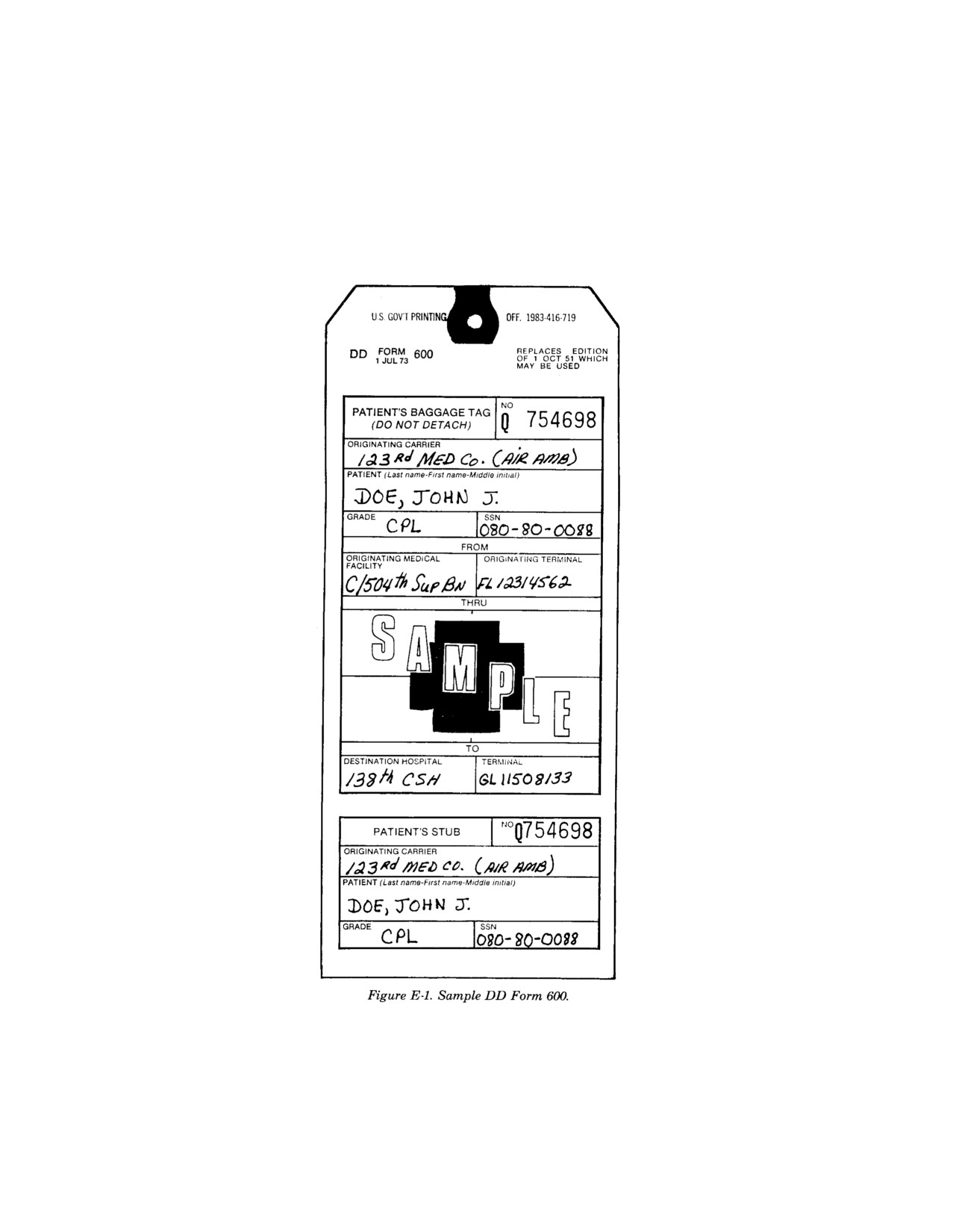
The OMF completes DD Form 600 (Figure H-1) and firmly attaches it to each piece of baggage
accompanying the patient. All items except the thru block (which is en route staging facilities should be
completed, prior to arriving at the MASF.
NOTE
For HCAA operations, if the OMF (a FSMC or MSMC) does not
have this form available, the form will be completed by the MASF.
H-3. Receipt for Checked Baggage
Detach the patients stub from the DD Form 600 and give it to the patient as his receipt for checked
baggage. If the patient is unable to safeguard the stub, give it to the senior medical attendant accompanying
the patient. As accompanying medical personnel are relieved, the patients stub is turned over to the
succeeding senior medical attendant. At the destination terminal, the accompanying medical attendant
delivers the stub to the representative of the destination hospital accepting the delivery of the patient.
H-4. Disposition of DD Form 600
The Patients Baggage Tag and accompanying stub may be destroyed when baggage is returned to the
patient or the DD Form 600 is replaced by a local baggage tag and stub at the destination hospital.
H-1
FM 8-10-6
Figure H-1. Sample DD Form 600.
H-2
FM 8-10-6
Section II. USE OF DD FORM 601, PATIENT EVACUATION MANIFEST
H-5. General
A DD Form 601 is prepared for each patient to be transferred. All patients destined for the same off-load
terminal may be listed on the same manifest form. The off-load terminal may not be the patients final
destination. For example, the patient is evacuated by ground to a CSH. However, due to the seriousness of
his condition, he is evacuated by air from the CSH to a GH in the EAC. Medical treatment facilities must
maintain close liaison with local support elements or medical evacuation battalions to ensure proper
coordination with corps is affected. Support elements may waive the requirements for preparation of DD
Form 601 providing the support element prepares an adequate patient manifest and furnishes copies to the
originating and destination MTFs.
H-6. Preparation of DD Form 601
The OMF prepares DD Form 601. The required number of copies is determined locally and should be
included in the unit SOP. Complete this form in accordance with the directions contained on the form and
the following instructions:
NOTE
For HCAA operations, if the OMF (a FSMC or MSMC) does not
have this form available, the form will be completed by the MASF.
a. Number manifests by Julian date with a number consisting of the last digit of the calendar year
and the serial number of the manifest on that day and separated by a hyphen. For example, the tenth
manifest issued on 19 December 1989 is numbered 9353-10 with the 9 being the last digit of the
calendar year, the 353 being the Julian date for that day, and the 10 representing the number of
manifests prepared so far on that day.
b. All attendants (medical and nonmedical) are identified on the DD Form 601 directly following
the information on the patient they are attending. If the en route medical care and surveillance is being done
by only one individual, his name and information should be included after the last patient entry. Do not list
the patients attendant as an emergency addressee.
c.
Enter the term Prisoner below the name of the OMF for patients in a prisoner status.
d. Enter the words Under Investigation to identify patients who are under investigation, but
not formally charged with a serious crime.
e.
Enter the term DA to identify patients with a history of drug abuse.
H-3
FM 8-10-6
f.
When necessary, deletions and changes should be initialed by the individual who signed the
manifest. If a patient is listed on the manifest who cannot be moved, line out all entries pertaining to that
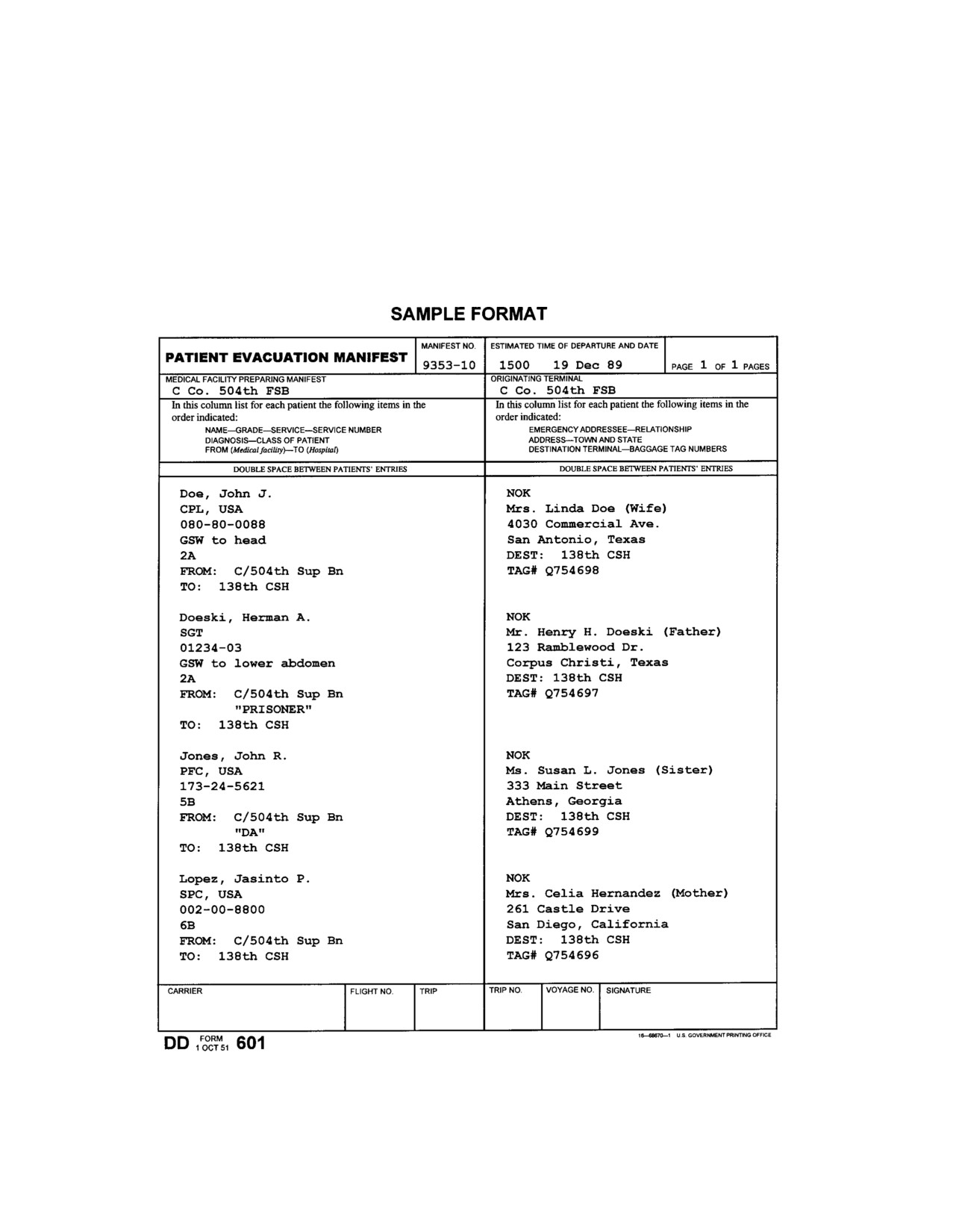
patient and initial the change. See Figure H-2 for a sample DD Form 601.
Figure H-2. Sample DD Form 601.
H-4
FM 8-10-6
H-7. Disposition of DD Form 601
At the loading point give the DD Form 601 to the senior medical person present. He will check all patients
and baggage listed on the manifest. He will note any changes and return a signed copy acknowledging
receipt for all manifested patients and baggage. The OMF retains the signed copy of the form for 12
months, after which it may be destroyed.
Section III. USE OF DD FORM 602, PATIENT EVACUATION TAG
This paragraph implements NATO STANAG 2132.
H-8. General
a. Department of Defense Form 602 is the patients in-transit medical record. The attending
physician prescribes en route medical care requirements on this form before the patient departs the OMF,
and all en route treatments are noted on the form during the patients journey. The tag consists of the
Ships Record Office Tab, the Embarkation Tab, and the Debarkation Tab. Only the basic tag is
normally required. The Embarkation Tab and Debarkation Tab may be completed and used locally.
b. All patients must wear a patient identification band while in the USAF AE system. This is not
required by the Army evacuation system.
H-9. Preparation of DD Form 602
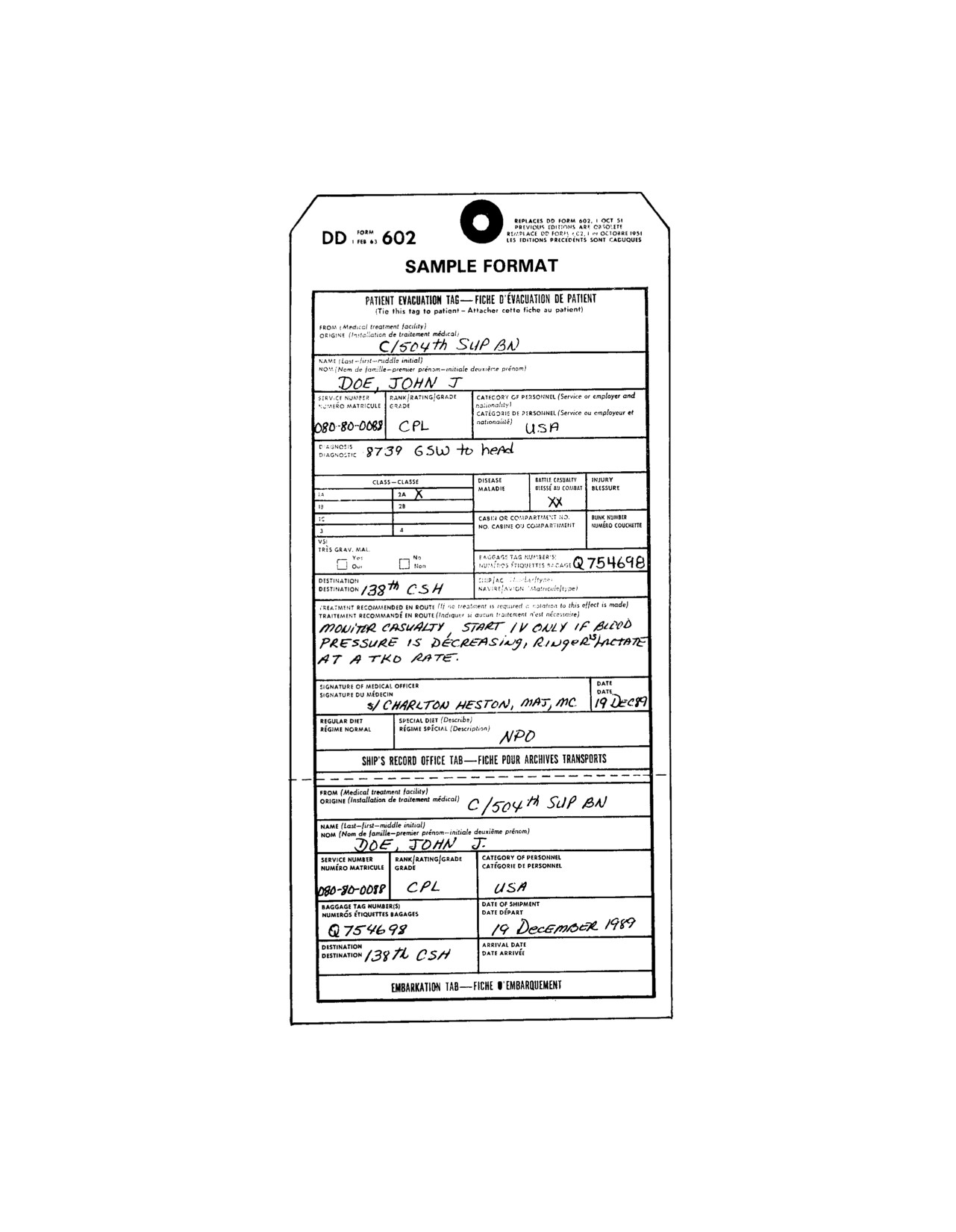
The OMF prepares DD Form 602 (Figures H-3 and H-4), entering all pertinent information except Cabin
or Compartment No. and Bunk No. This information, when required, is entered by the medical
attendant. If a battle casualty does not have a DD Form 1380 attached when picked up, the medical
attendant will initiate a DD Form 602 and attach it to the patient. If a patients journey is in several stages,
en route ASFs use the original tag for recording pertinent medical data and forward it with the patient when
he departs for the next leg of his journey.
a. Enter all diagnoses, including only such detail as is useful in caring for the patient during his
journey.
b. In the Diagnosis section, enter in red pencil the terms:
(1)
Prisoner for patients in a prisoner status.
(2)
Under Investigation for patients who are under investigation (but not formally charged)
for a serious crime.
H-5
FM 8-10-6
(3)
DA for patients with a history of drug abuse.
c.
Check the space Battle Casualty only if the patient actually falls into this category as defined
in governing regulations of his Service. Patients who are not battle casualties, but under treatment
primarily for nonbattle wounds or other injuries are classed as Injury.
d. Enter the same baggage tag numbers as shown on DD Form 600.
e.
Enter treatment recommended en route in the space provided. En route medication, with
dosage as prescribed by the attending physician, must be recorded in this section. If a patient requires tube
feeding, a copy of the tube feeding formula must be attached to DD Form 602 to ensure that he receives the
same tube feeding throughout his journey.
H-10. Continued Use of DD Form 602
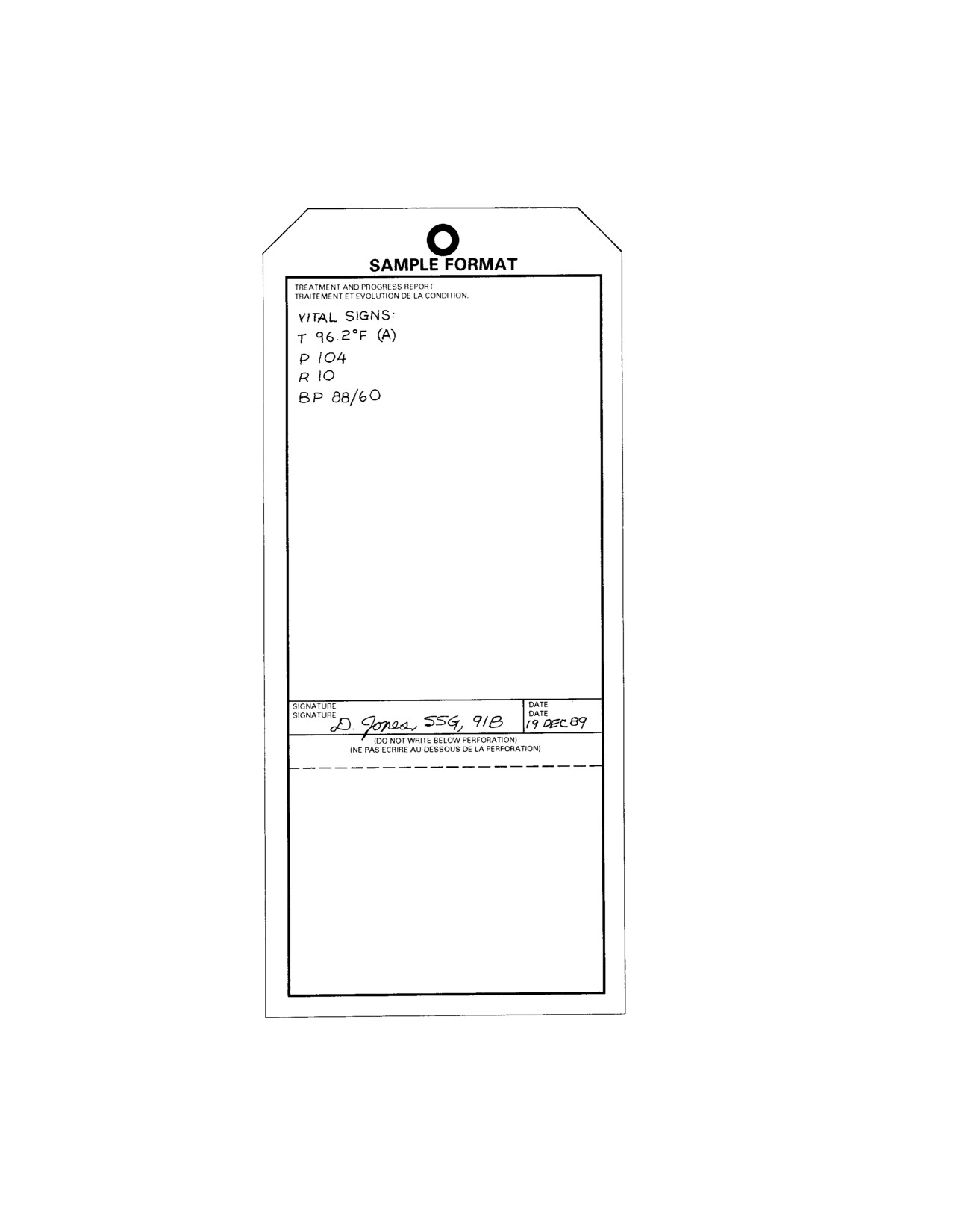
a. While in the AE system, the medical personnel providing en route medical care use the
reverse side of the form to note patient examinations and treatments, where such information is not
sufficient to justify opening the patients clinical record. Further, treatments administered at en route MTFs
or ASFs are also annotated. All treatment entries include the time that the actual treatment was administered.
This entry must be recorded in Greenwich mean time and indicated by use of the suffix Z.
b. At all intermediate stops prior to arrival at the destination MTF, the name of the facility and
the dates of the patients arrival and departure are annotated, such as Letterman Army Medical Center, 7
Feb9 Feb 89.
H-11. Disposition of DD Form 602
The destination hospital staples the basic tag of DD Form 602 to the Standard Form (SF) 602 in the patients
health record. The Embarkation Tab and Debarkation Tab may be retained by the AE unit or disposed
of locally.
H-6
FM 8-10-6
Figure H-3. Sample DD Form 602 (front side).
H-7
FM 8-10-6
Figure H-4. Sample DD Form 602 (back side).
H-8
FM 8-10-6
APPENDIX I
SAMPLE FORMAT FOR MEDICAL EVACUATION MISSION
COMPLETION RECORD
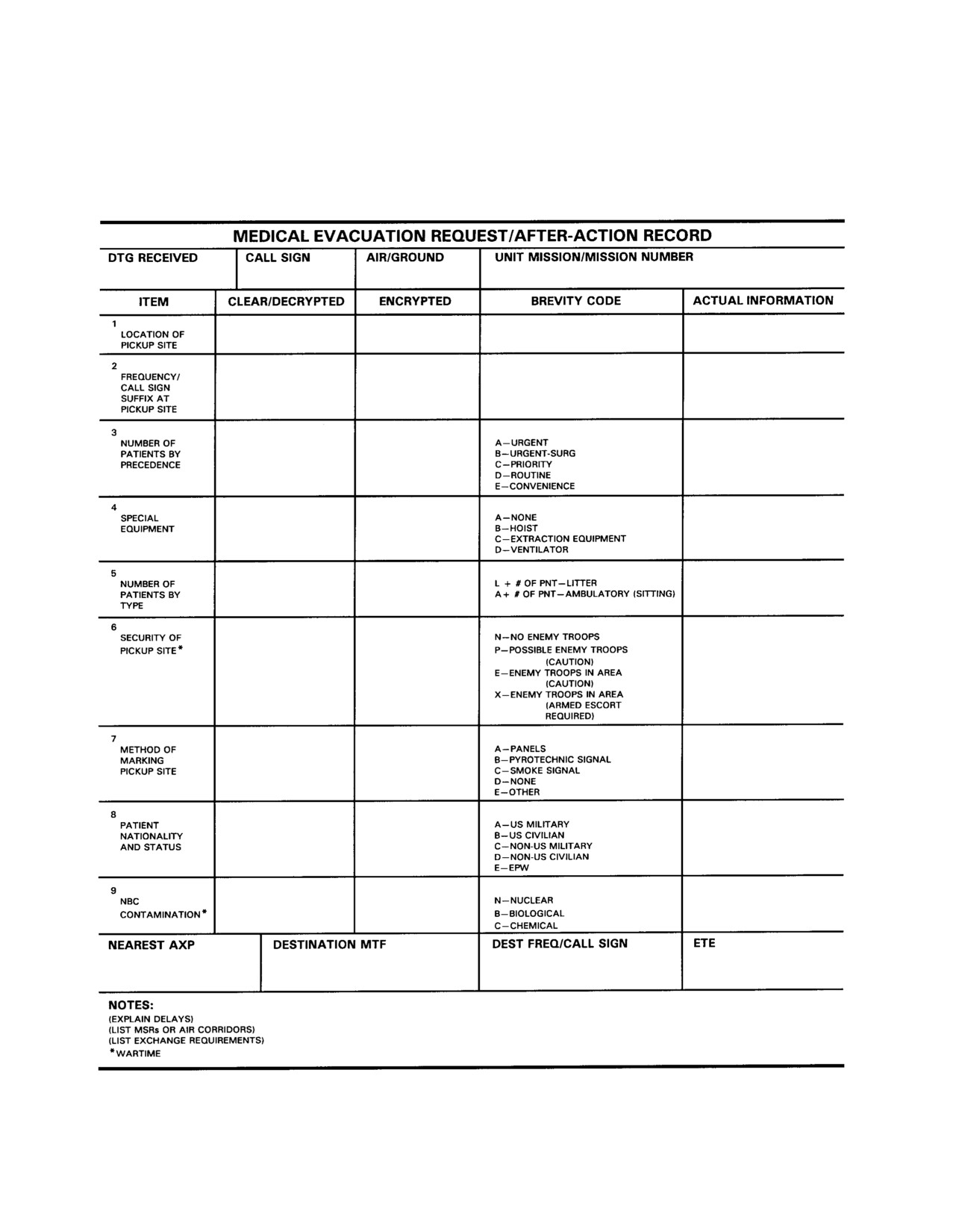
Once the medical evacuation mission is completed, an after-action record of this mission should be
maintained. The information contained in this sample record provides historical data and lessons-learned
information. This information can be used as a management tool for ensuring that medical evacuation
missions are properly equipped and performed in a timely manner. Further, the record provides information
on the patients condition and procedures accomplished which may have a bearing on either administrative
or legal proceedings. The sample format depicted in Table I-1 may be revised to meet the needs of the
command and included in the unit TSOP.
I-1
FM 8-10-6
Table I-1. Medical Evacuation Request and Mission Completion Record
SAMPLE FORMAT
I-2