FM 8-10-6 MEDICAL EVACUATION IN A THEATER OF OPERATIONS TACTICS, TECHNIQUES, AND PROCEDURES - page 7
FM 8-10-6
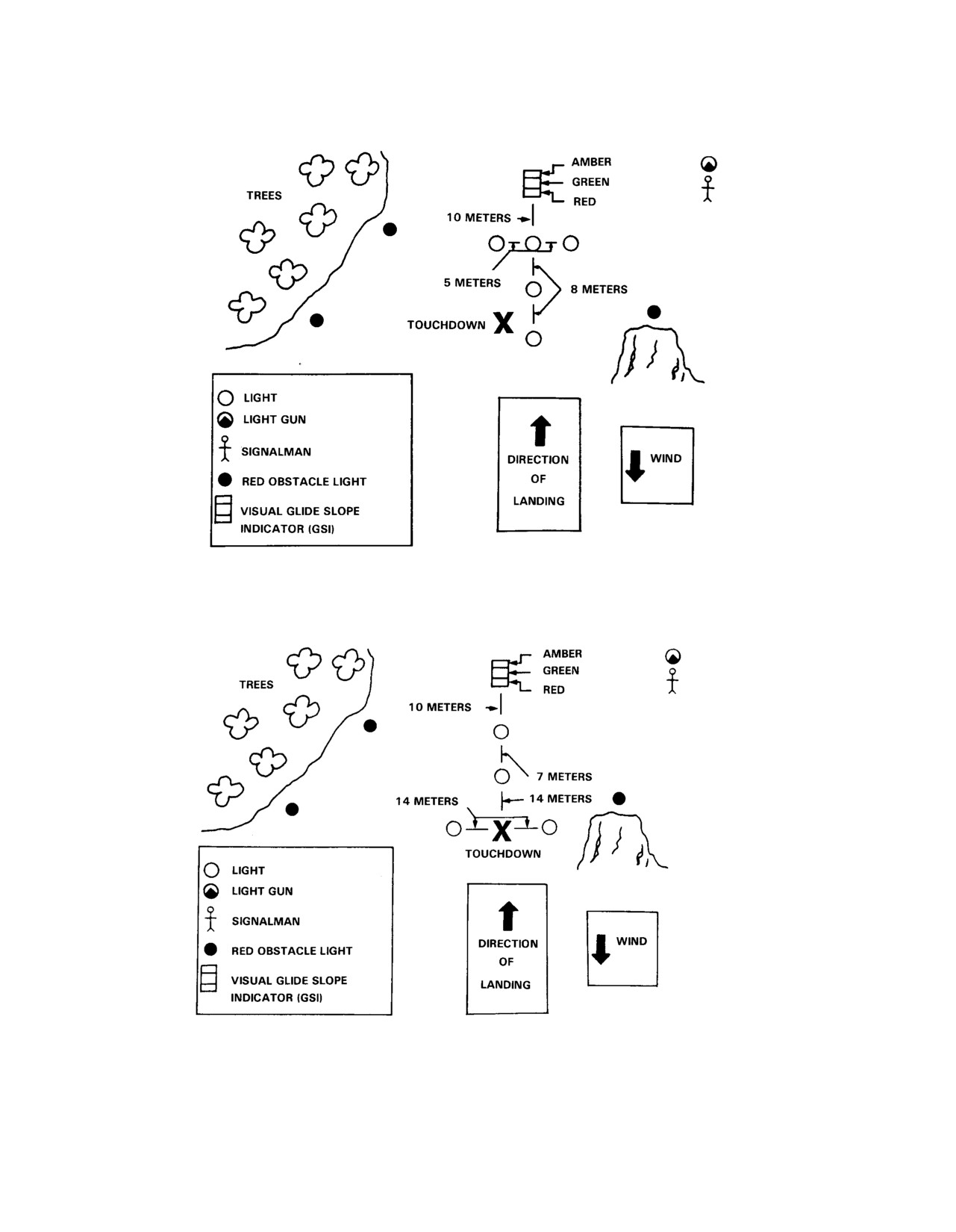
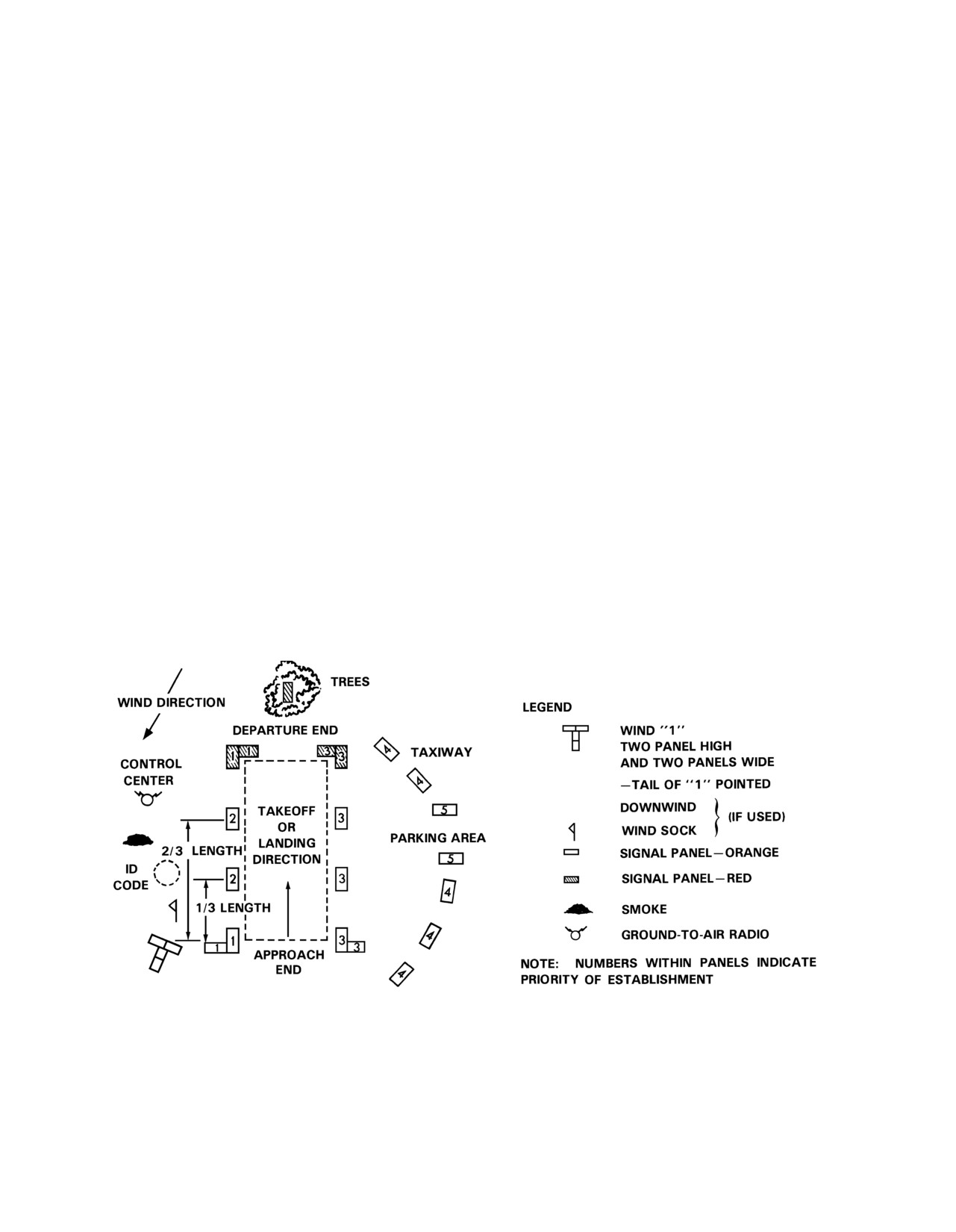
Figure 10-27. Field expedient landing zone (night).
Figure 10-28. Field expedient inverted landing zone (night).
10-40
FM 8-10-6
10-26. Loading Patients Aboard Rotary-Wing Aircraft
a. Responsibility for Loading and Securing. The pilot is responsible for ensuring that the litter
squad follows the prescribed methods for loading and securing litters and related equipment. The final
decision regarding how many patients may be safely loaded rests with the pilot.
b. Safety Measures. When loading and unloading a rotary-wing aircraft, certain precautionary
measures must be observed. Litter bearers must present as low a silhouette as possible and must keep clear
of the rotors at all times. The helicopter must not be approached until a crew member signals to do so. The
litter bearers should approach the aircraft at a 45-degree angle from the front of the helicopter. If the
helicopter is on a slope and conditions permit, loading personnel should approach the aircraft from the
downhill side. Directions given by the crew must be followed, and litters must be carried parallel to the
ground. Smoking is not permitted within 50 feet of the aircraft.
10-27. Loading Patients Aboard the UH-60A Blackhawk
a. Interior of the UH-60A Blackhawk. This helicopter, as with the UH-1H/V, has a number
of possible seating or cargo configurations. A major difference in preparing the UH-60A to carry litters is
that a medical evacuation kit must be installed. This kit consists of a seat/converter assembly unit and a
litter support unit. The seat/converter assembly provides for three rear-facing seats which allows the
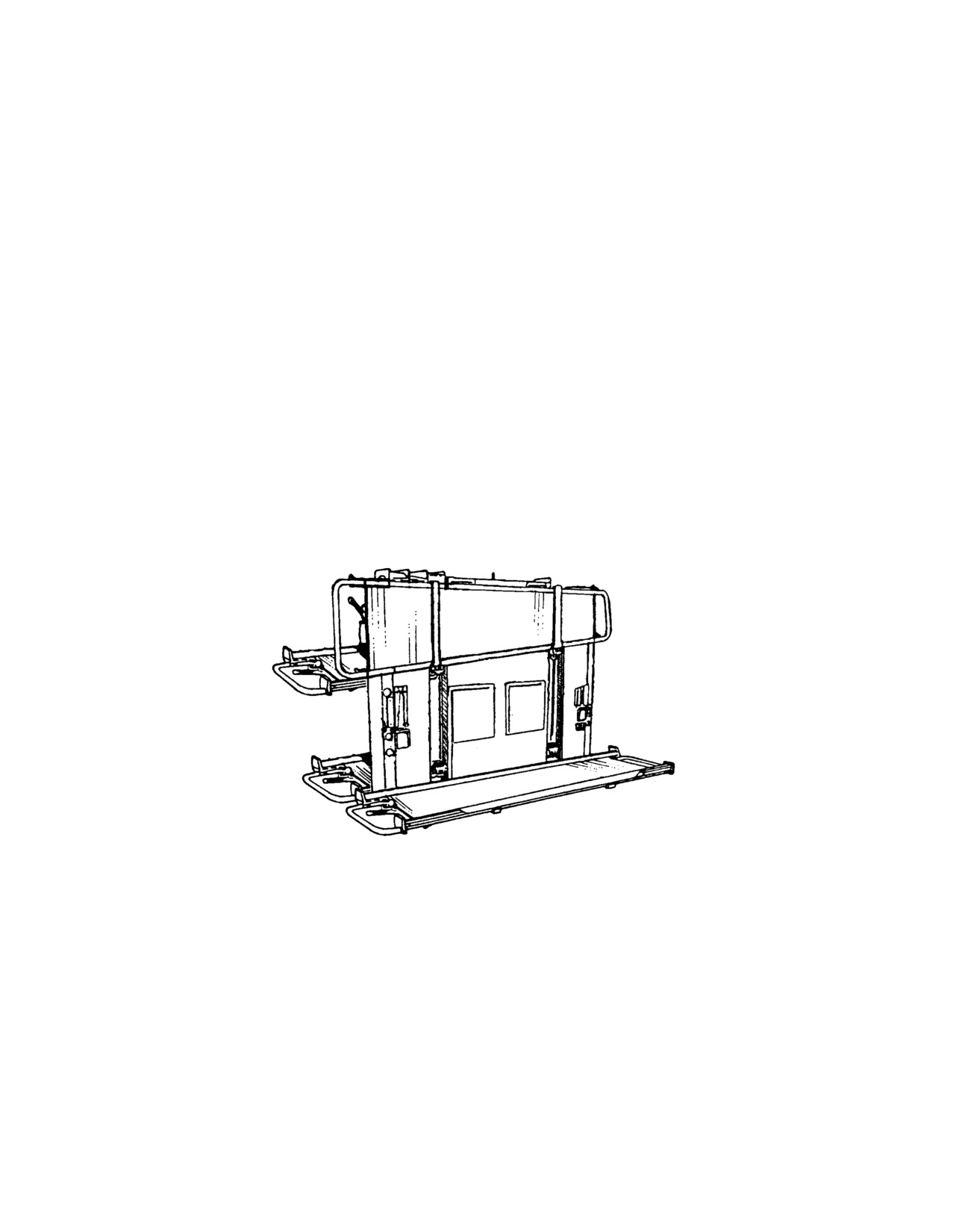
medical attendant and crew chief to monitor patients. The litter support unit consists of a center pedestal
which can be rotated 90 degrees about the vertical axis for the loading and unloading of patients. The litter
support unit has a capacity of four to six litter patients. The patients can be loaded from either side of the
aircraft. Only the upper litter supports in the four-litter configuration can be tilted for loading and
unloading patients.
NOTE
When the six-litter modification kit is installed, the center pedestal can
no longer be rotated.
If litter patients are not being evacuated, a maximum of six ambulatory patients can be seated on the litter
support unit (three on each side). A seventh ambulatory patient can be seated on a troop seat.
NOTE
Only three litters can be loaded when using the internal rescue hoist.
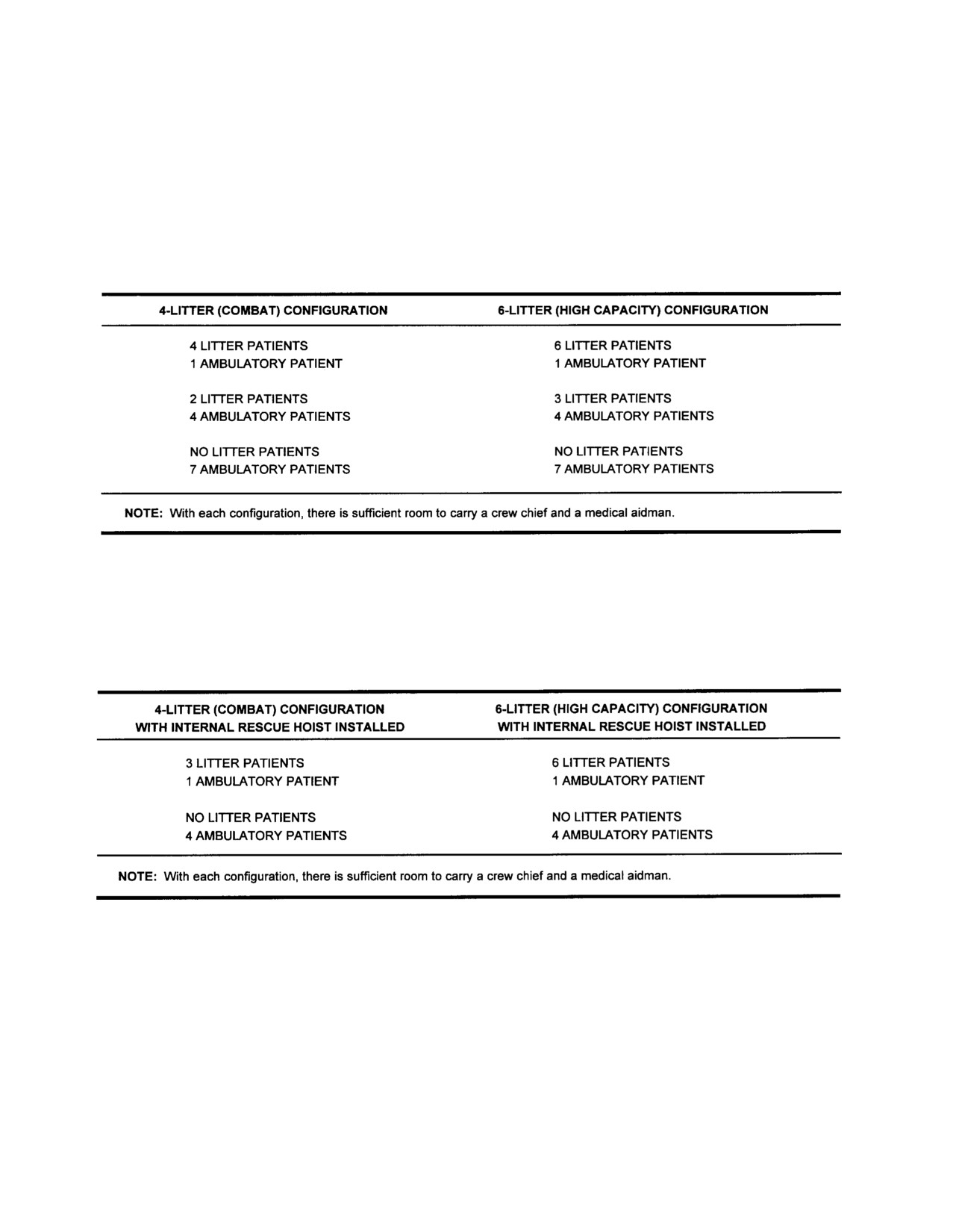
When the medical evacuation kit is installed, a number of cabin configurations are possible. (See Tables
10-3 and 10-4.)
10-41
FM 8-10-6
Table 10-3. Patient Configurations, UH-60A Medical Evacuation Kit
Table 10-4. Patient Configurations, UH-60A Medical Evacuation Kit
with Internal Rescue Hoist Installed
b. Guides for Loading Patients.
(1) Litter patients should be positioned in the helicopter according to the nature of their
injuries or condition. Personnel aboard the aircraft supervise the loading and positioning of the patients.
Normally, the helicopter has a crew of four. The crew consists of a pilot in command (PC), copilot (PI),
crew chief, and flight medic.
10-42
FM 8-10-6
(2) The most seriously injured patients are loaded last on the bottom pans of the litter support
unit. However, if it is anticipated that a patients medical condition may require in-flight emergency
medical care (such as cardiopulmonary resuscitation), he should be loaded onto either of the top pans to
facilitate access to him.
(3) The structuring of the litter support unit allows patients to receive IV fluids and oxygen
in flight. Patients receiving IV fluids can be placed on any of the litter pans, depending on their injuries or
condition.
(4) Patients in traction splits should be loaded last and on a bottom pan.
(5) The UH-60A has the capability to be loaded on both sides simultaneously. Patients
should be loaded so that upon rotating the litter support, the patients head will be forward in the cabin. To
accomplish this, patients loaded on the left side of the aircraft should be loaded head first and patients
loaded on the right side of the aircraft should be loaded feet first (left and right sides are determined from
the position of the PCs seat, looking forward). When the six-litter configuration is used, the fifth and sixth
litter patients are loaded with the carousel in the fly position. The patients heads should face toward the
front of the aircraft.
c.
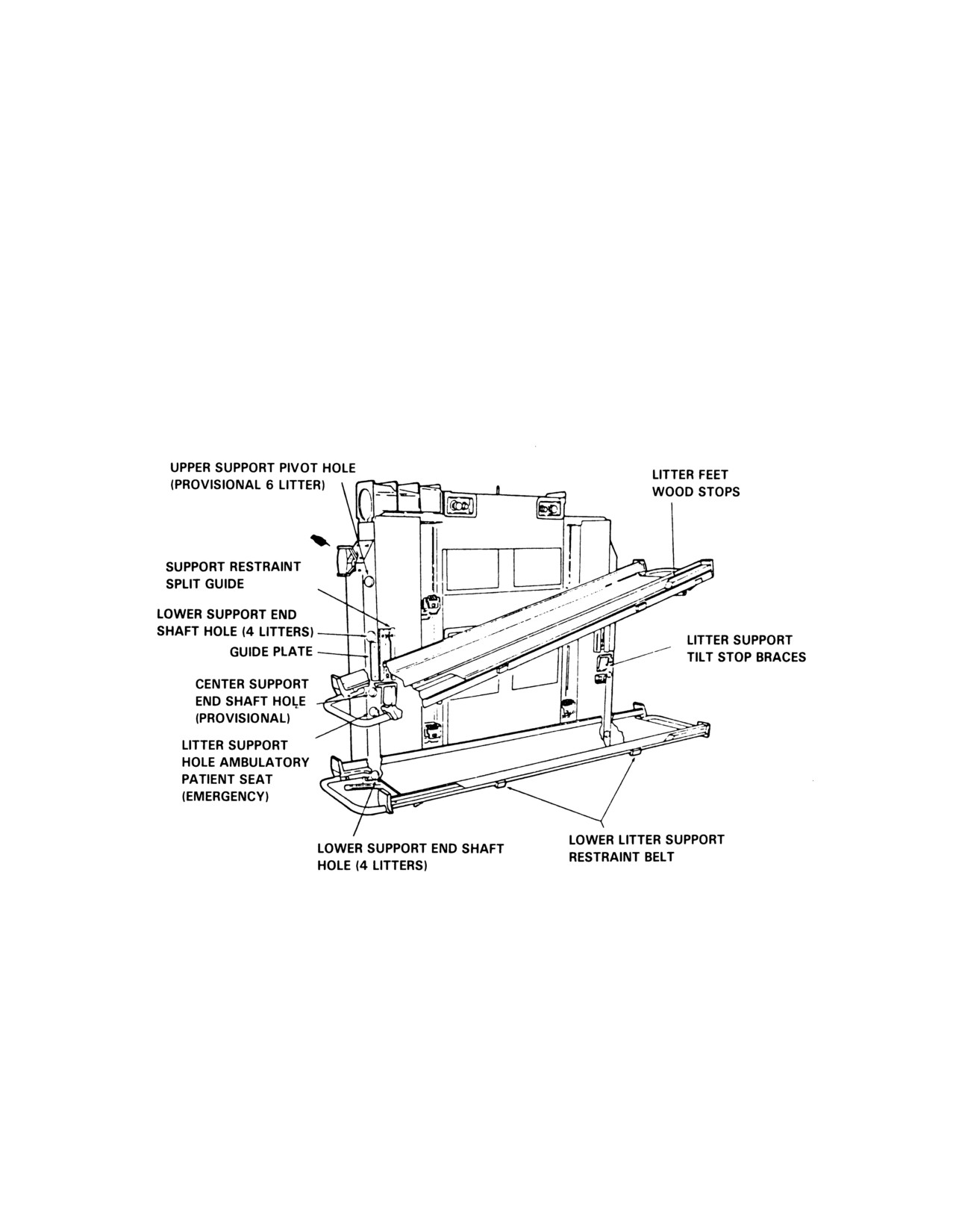
Installing Litter Pan Supports. Each litter support is attached to the center pedestal by two end
pivot shafts and by two T-shaped fittings. These fittings and shafts allow for the removal, interchange, or re-
positioning of the supports. There are five pivot shaft support holes at both ends on the right and left side of the
center console. Behind the holes are support rollers for the pivot shafts. From top to bottom, the top hole is
provided for the upper litter in the six-litter configuration. The second hole is for the upper litter support of
a four-litter configuration. These end holes line up with a central pivot hole, which accommodates a central
pivot shaft on the litter support. Only this litter position allows midposition pivoting for loading or unload-
ing. The third hole is for the center litter of the six-litter configuration. The fourth hole is used when instal-
ling the litter support as a seat for evacuating ambulatory patients. The fifth hole is used for the lower litter
support in the four-litter configuration. The third, fourth, and fifth positions do not provide a tilt function.
(1) Lower litter support installation. Before installing, each center pivot shaft must be
retracted and unlocked. The center pivot shaft handle must be secured in the handle retainer. End pivot
handles must be in the tilt position.
(a) Engage T-bars on litter support with split retention fittings at the bottom of the
pedestal.
(b) Line up the end pivot shafts with holes. Disengage the pivot shaft lever locks and
move the end pivot shaft lever toward the pedestal. The pivot shaft is, then, fully inserted into the pivot
shaft holes on the pedestal and the handle lock is engaged.
(c) Repeat step (b) for the other end of litter support.
(2) Upper litter support installation. Before installing, each center pivot pin must be unlocked
and retracted. The handle is then disengaged from its retainer. The end pivot handles must be in the tilt
position.
10-43
FM 8-10-6
(a) Tilt the outer edge of litter support slightly down and engage the T-bars into split
retention fittings at the second support hole from the top of the pedestal.
(b) Raise the outer edge of the litter support until the support is level.
(c) Insert the end pivot shaft into the pedestal by pulling on the pivot shaft lever lock
and moving the lever toward the pedestal until the end pivot shaft engages partway in end pivot support
hole.
(d) Turn the center pivot shaft lock handle counterclockwise until it is horizontal.
(e) Push the center pivot shaft toward the pedestal until the shaft is fully inserted into
the center pivot shaft hole. The opposite end of the litter support should be raised or lowered to align the
center shaft on the support with the center hole on the pedestal.
(f)
Turn the center pivot lock lever clockwise to the horizontal position.
(g) Repeat step (c) above for the other end of the litter support. Now slide both end
pivot shafts in fully by moving the pivot lever lock handle to the engaged position.
(3) Upper litter support relocation for six-litter configuration.
(a) Remove the litter support from the second support hole from the top of the pedestal.
The removal of the litter support is the reverse of its installation. Before relocation, each center pivot pin
must be locked and the handles must be secured in the handle retainer.
(b) Line up the end pivot shafts with the top support holes. Then fully insert and
engage the handle lock.
(c) Repeat steps (a) and (b) above for other end of litter support.
(4) Middle litter support installation for six-litter configuration.
(a) Remove the litter support from the fifth (bottom) support hole. The removal of the
litter support is the reverse of its installation.
(b) Align the end pivot shafts with third support hole from the top of the pedestal to
relocate it. Then fully insert and engage handle lock.
(c) Repeat steps (a) and (b) above for other end of litter support.
(5) Bottom litter support installation for six-litter configuration. To complete the six-litter
configuration, the modification kit is required. The kit consists of a tube assembly and a restraint assembly
for each side.
10-44
FM 8-10-6
(a) Insert the restraint assembly using the plate quick disconnect fittings into the proper
quick attachment fittings on the cargo floor. Pull up on the restraint assembly to check for secure
installation.
(b) Attach tube assembly longitudinally to the proper tie down restraint rings on the
cargo floor. Ensure that the restraint rings are properly secured to the bracket tube support with the
attached pin (Figure 10-29).
(c) Repeat steps (a) and (b) above for the other end of the litter support.
Figure 10-29. Litter pan in the load and unload (tilt) position (same at other side of pedestal).
(6) Litter support installation for ambulatory patient seating.
(a) Prepare supports as in c(1) above.
(b) Engage the T-bar on the litter pan with the split retention brackets below the
support tilt stop brackets.
10-45
FM 8-10-6
(c) Position the litter support at the second from the bottom litter support end pivot hole
on the pedestal.
(d) Line up the end pivot shafts with the holes. Disengage pivot shaft lever lock and
move pivot shaft lever toward the pedestal. Fully insert the pivot shaft into pivot shaft hole on the pedestal
and engage handle lock.
(e) Repeat step (c) for the other end of litter support.
(7) Storage of litter pans.
(a) Lower stowage brackets to the horizontal position and insert the retaining pin
through stowage bracket into pedestal.
WARNING
Improper positioning of the stowage bracket retaining pin
reduces the holding capability of the stowage bracket and
may cause it to shear the pivot bolt during a crash sequence.
(b) Place the litter pan in the stowed position against the center pedestal.
(c) Secure the litter pan to the center pedestal by routing the opposite web strap around
the upper portion of the litter pan handle. Secure the metal clasp to the metal ring.
NOTE
The use of the opposite strap reduces excess movement of litter pan.
(d) Use opposite web strap to secure the upper side of the litter pan handle as described
in step (c) above, while the same side web strap is used to secure the bottom side of the stored litter pan
handle.
(e) Remove the stowed litter pans by reversing steps (a)(d) above.
d. Loading of Upper Litters. For ease of loading, the upper litter pans may be tilted. Upper litter
pans are supported by a center pivot shaft and two end pivot shafts, one at each end of the litter pan. To tilt
the upper support for the loading and unloading of litter patients, the center shaft remains locked to the
pedestal and the end shafts are disengaged for support pivoting.
10-46
FM 8-10-6
NOTE
This system was designed to pivot about the center shaft allowing
either end to be tilted downward. Although the supports may be
pivoted at either end, more effort is required when a loaded litter is
installed.
e.
Loading and Securing Patients.
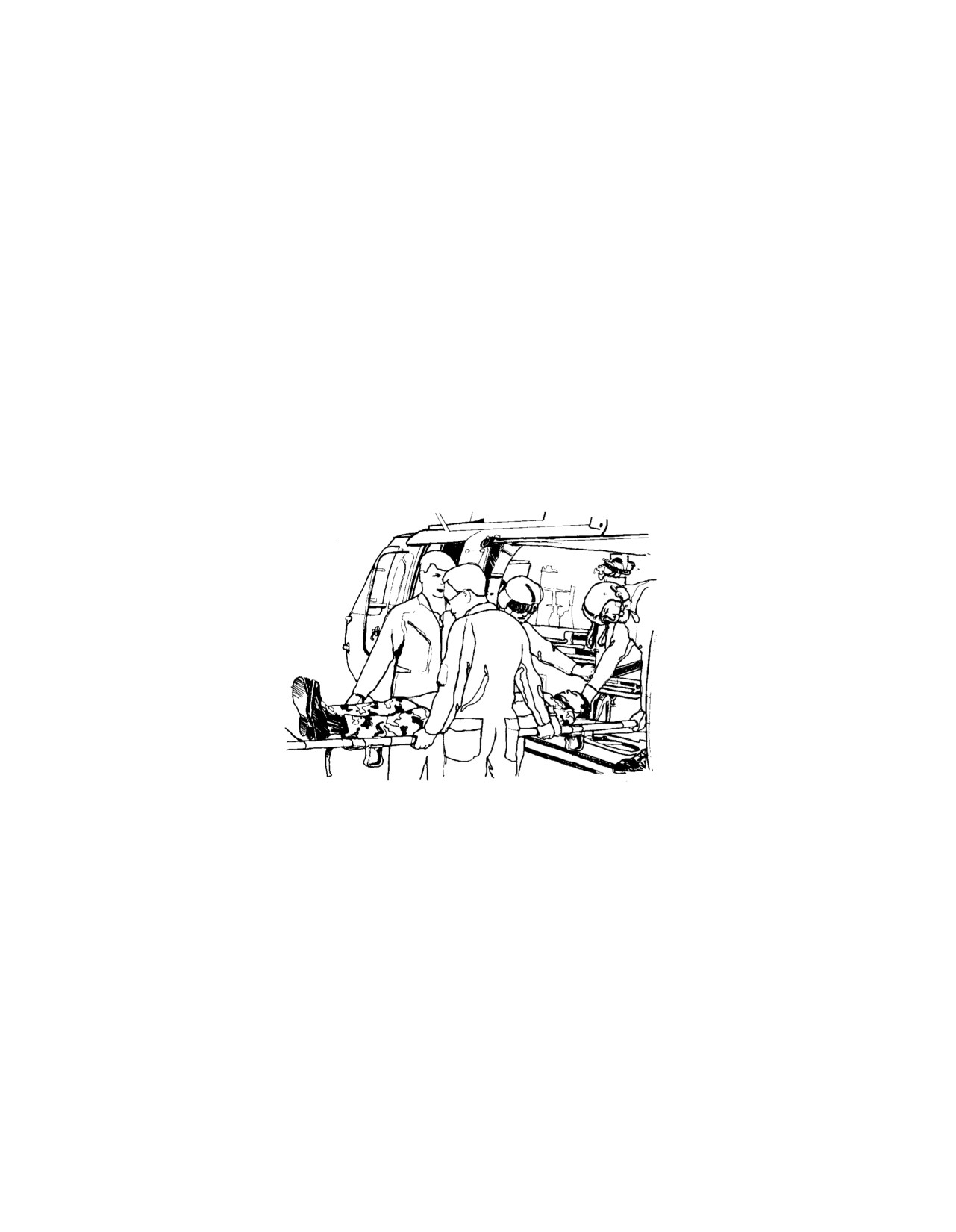
(1) In loading four litter patients with a four-man litter squad, the litters are loaded from the
top to bottom. The sequence for loading litters from one side of the aircraft with the carousel turned is
upper right, upper left, lower right, and then lower left. To load litters from both sides of the aircraft
simultaneously, the sequence is upper then lower (Figure 10-30).
Figure 10-30. Loading litter into UH-60A.
(a) The litter support unit is rotated 90 degrees clockwise to receive the litter patients.
The flight crew lowers the top pan to accept the litter and stands by to assist. This is accomplished as the
litter squad approaches the aircraft.
(b) The litter squad moves into the semioverhead carry, lifting the litter just high
enough for the litter stirrups of one end to slide onto the litter pan. The litter squad slides the litter forward.
The flight crew member guides and assists the litter squad, until the litter stirrups of both ends are secured
on the pan. The litter squad departs as the flight crew member raises the pan back to its upright position and
secures it. The flight crew member fastens the litter straps attached to the litter support assembly.
(c) After the first litter is loaded, the squad leaves the aircraft as a team to obtain
another litter patient. The second, third, and fourth litters are loaded in the same manner, except that the
bottom pans are not tilted to receive patients.
10-47
FM 8-10-6
(d) After having loaded four litter patients, the litter support unit is rotated 90 degrees
counterclockwise and locked in the in-flight position. The cargo doors must be closed for flight.
(2) The loading of six litter patients requires the repositioning of the litter support prior
to loading. The loading procedure remains the same as the four-litter configuration except for the following:
(a) The top litter support no longer tilts. This necessitates overhead loading and may
require additional assistance.
(b) After four litters are loaded, the pedestal must be rotated back to the locked
position. The restraint and tube assembly modification kit is then installed. The last two litters are side
loaded between the restraints, with the patients heads toward the front of the aircraft. They are secured.
(3) When the aircraft is to receive a mixed load of litter and ambulatory patients, one top pan
of the litter support is removed and repositioned just above the bottom pan on the same side. The aircraft
can now accommodate two or three litter and four ambulatory patients (Figure 10-31).
Figure 10-31. Litter support.
(a) The litter support unit is rotated clockwise to receive the litter patients, except for
the third litter in the six-litter configuration. The litters are loaded as described in paragraph e(1) above.
Upon loading and securing the litter patients, the litter support unit is rotated counterclockwise to the in-
flight position. The third litter is then loaded when the six-litter configuration is used.
(b) Ambulatory patients are escorted to the aircraft by ground personnel. They are
assisted into their seats and secured with the seat belts attached to the litter support unit.
(c) The cargo doors are now closed for flight.
10-48
FM 8-10-6
WARNING
To prevent further injury to patients, all end support pins of
the installed litter pans must be in the locked position for
flight.
f.
Unloading Patients. The aircraft is unloaded in the reverse order of the loading procedure.
The pans are normally unloaded bottom pan first, then top, to ensure that the most seriously injured patients
are unloaded first.
10-28. Loading Patients Aboard the UH-1H/V Iroquois
a. Interior of the UH-1H/V Iroquois. This helicopter has several litter and seating configurations.
A change, to meet operational requirements, can be made from one configuration to another within a few
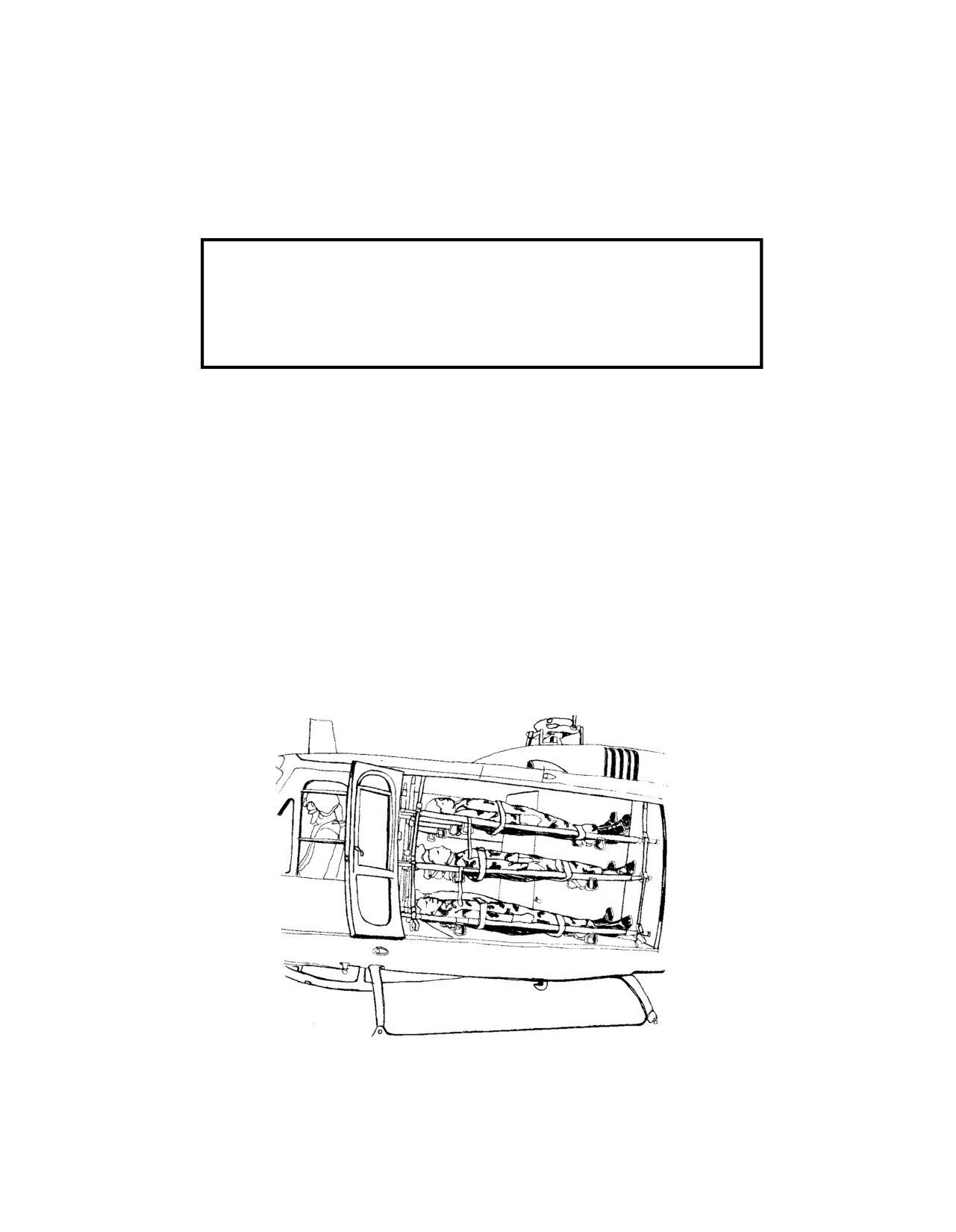
minutes. Facilities for carrying a tier of three litters loaded lengthwise in the aircraft are located on each
side of the helicopter cargo compartment (Figure 10-32). This gives the helicopter a maximum litter
capacity of six or a total of nine ambulatory patients. This configuration is normally used in rear areas to
move large numbers of stable patients. The normal configuration for the aircraft is three litter patients
loaded crosswise and four ambulatory patients. The maximum load the helicopter can lift must be
considered. This load capacity varies with the altitude and temperature. The pilot advises the personnel on
the ground of his load capacity.
Figure 10-32. Interior view of UH-1H/V Iroquois six-litter configuration.
10-49
FM 8-10-6
b. Guides for Loading Patients. Patients are normally loaded from the top tier down to the
bottom tier, with the most seriously injured loaded last.
(1) Litter patients should be positioned in the helicopter according to the nature of their
injuries or condition. Personnel aboard the helicopter supervise the loading of the aircraft.
(2) The most seriously injured patients are placed in the bottom litter tiers to permit in-flight
care.
(3) Litter patients receiving IV fluids should not be positioned on the top row of litter tiers
but should be placed as low as possible in the litter rack.
(4) Patients in Hare traction splints with splint supports and footrests must be loaded last and
placed directly on the floor of the helicopter.
c.
Loading and Securing Patients.
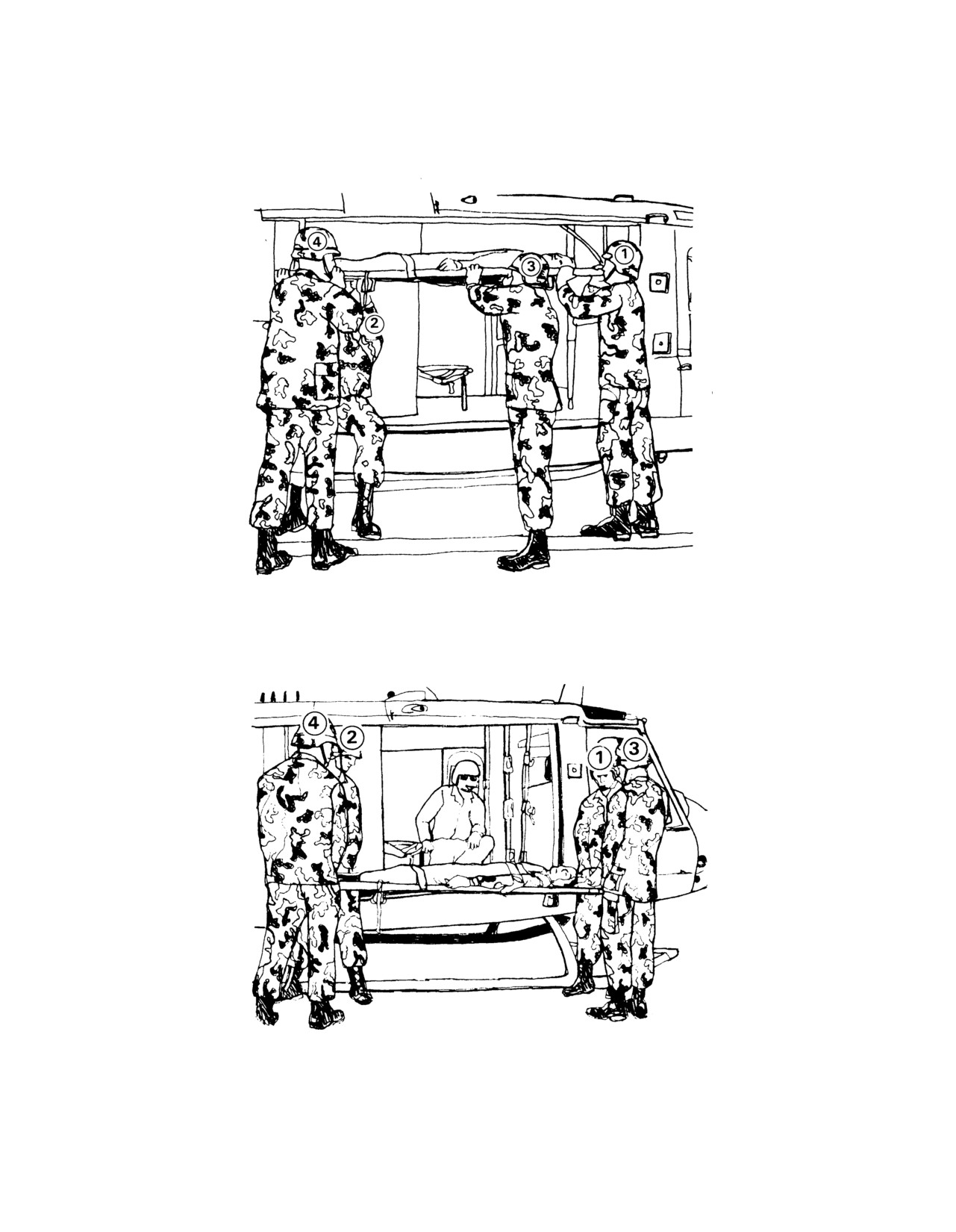
(1) In loading six litter patients with a four-man litter squad, the litters are loaded from both
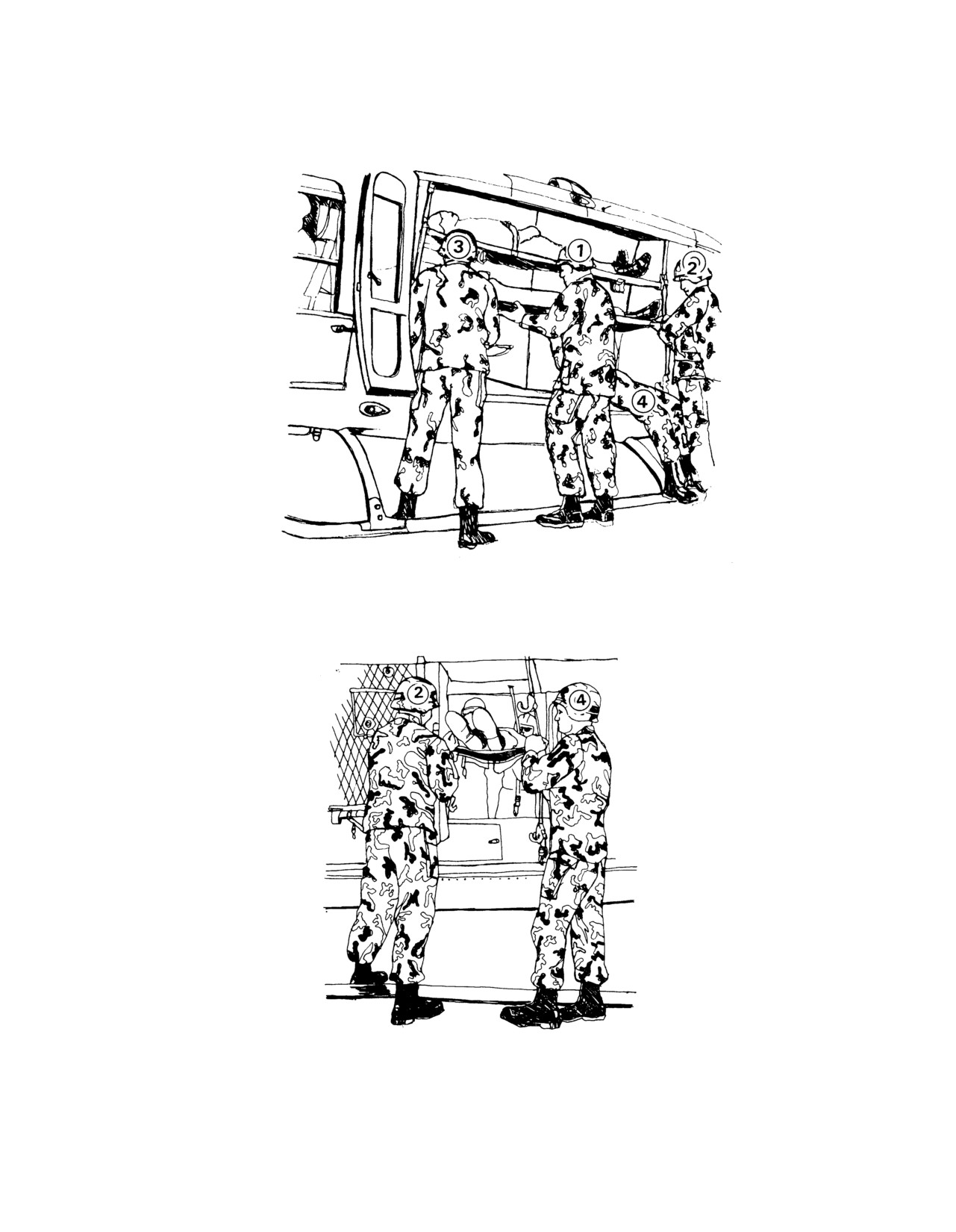
sides of the aircraft and from top to bottom. Figures 10-33 and 10-34 illustrate procedures for loading the
right side. Figure 10-35 illustrates procedures for loading the left side.
(2) When the helicopter is equipped for mixed loading (Figures 10-36 through 10-38), three
litters are loaded crosswise and four ambulatory patients are loaded in the side seats.
(a) When loading from the left, the litter squad moves to the side of the helicopter with
the litter perpendicular to the cargo compartment; then the squad moves into a litter post carry. Bearers
numbers 1 and 3 give their litter handles to the crew members who place the handles in the litter support
brackets on the far side of the aircraft. Bearers numbers 2 and 4 secure the foot of the litter.
(b) After the first litter is loaded, the squad leaves the helicopter to obtain another litter
patient. The second and third litters are loaded in the same way as the first one. After the three litter
patients are loaded, the ambulatory patients are taken to the aircraft and directed to their seats.
d. Unloading Patients. The aircraft is unloaded in the reverse order of loading. The tiers are
unloaded from bottom to top on one side and then on the other side. At the unloading command, the litter
squad moves to the helicopter and the bearers take their proper places at the litter. The squad then performs
its duties in the reverse order of loading.
10-50
FM 8-10-6
Figure 10-33. Loading air ambulance (UH-1H/V) from right side (step one).
Figure 10-34. Loading air ambulance (UH-1H/V) from right side (step two).
10-51
FM 8-10-6
Figure 10-35. Loading air ambulance (UH-1H/V) from left side.
Figures 10-36. Loading litter crosswise in air ambulance (UH-1H/V).
10-52
FM 8-10-6
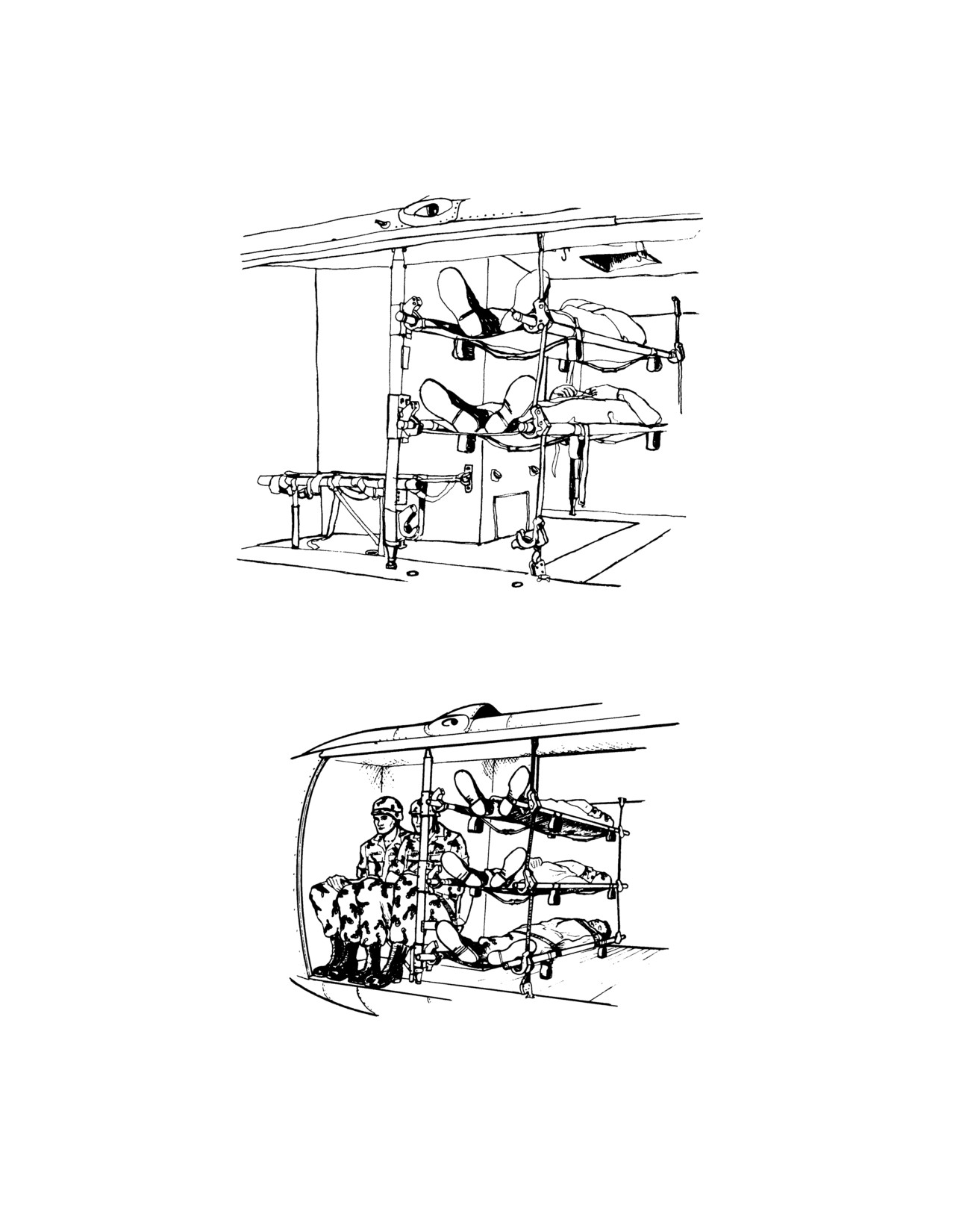
Figure 10-37. Air ambulance (UH-1H/V) with two litters loaded crosswise.
Figure 10-38. Air ambulance (UH-1H/V) with mixed load of litter and ambulatory patients.
10-53
FM 8-10-6
Section IV. UNITED STATES ARMY NONMEDICAL AIRCRAFT
10-29. General
The US Army has both fixed-wing and rotary-wing aircraft. These aircraft are employed in both the CZ
and EAC.
10-30. Army Fixed-Wing Aircraft
The capability of Army fixed-wing aircraft to land on and take off from selected small, unprepared areas
permits the evacuation of patients from AOs which would be inaccessible to larger aircraft. These aircraft
can fly slowly and maintain a high degree of maneuverability. This capability further enhances their value
in forward areas under combat conditions. Army fixed-wing aircraft are limited in speed and range as
compared with larger transport-type aircraft. When adequate airfields are available (Figures 10-39 and
10-40), fixed-wing aircraft may be used in forward areas for patient evacuation. This is a secondary
mission for these aircraft which will be used only to augment dedicated air ambulance capabilities. (Field
Manual1-300 discusses airfield operations.)
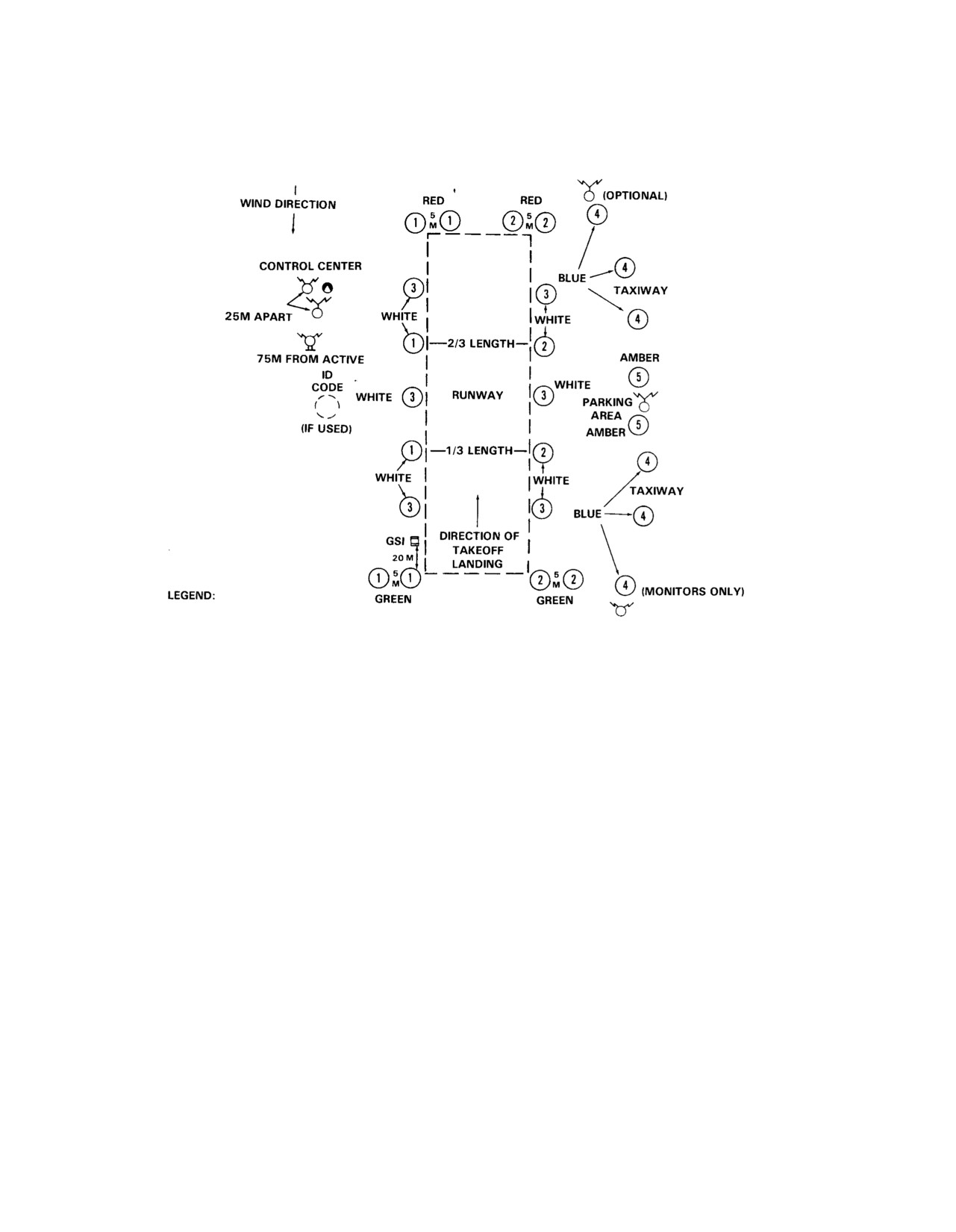
Figure 10-39. Marking and lighting of airplane LZ (day).
10-54
FM 8-10-6
Figure 10-40. Marking and lighting of airplane LZ (night).
10-31. U-21/C-12 Aircraft
The U-21 Ute and C-12 Huron are used as utility (U-21) and passenger/cargo (C-12) aircraft. These
aircraft are not normally employed as evacuation aircraft. In emergency situations, both of these aircraft
can be configured to evacuate litter and ambulatory patients.
a. The U-21 Ute is a twin turbine, propeller-driven utility aircraft with a normal cruise speed of
210 knots and an endurance of over 5 hours flying time. It is capable of accommodating ten ambulatory
patients, or three litter patients plus three ambulatory patients and a medic.
b. The C-12 Huron is the newest addition to the Armys fixed-wing aircraft inventory. Depending
on the model, its normal cruise speed ranges from 240 to 260 knots with 5 to 6 hours endurance. It is
capable of carrying eight ambulatory patients, or two litter and four ambulatory.
10-32. Loading Patients Aboard Army Fixed-Wing Aircraft
The personnel who transport patients to the landing strip load the patients aboard the aircraft. They may be
required to assist in configuring the aircraft for litters. Litters are generally loaded from the top downward
and from the front to the rear. The four-man litter squad plus the crew chief normally load these aircraft.
10-55
FM 8-10-6
The crew chief or another member of the aircraft crew supervises the loading of all patients. Bearer
number 2 normally enters the aircraft to assist the crew chief in loading the litters.
10-33. The CH-47 (Chinook)
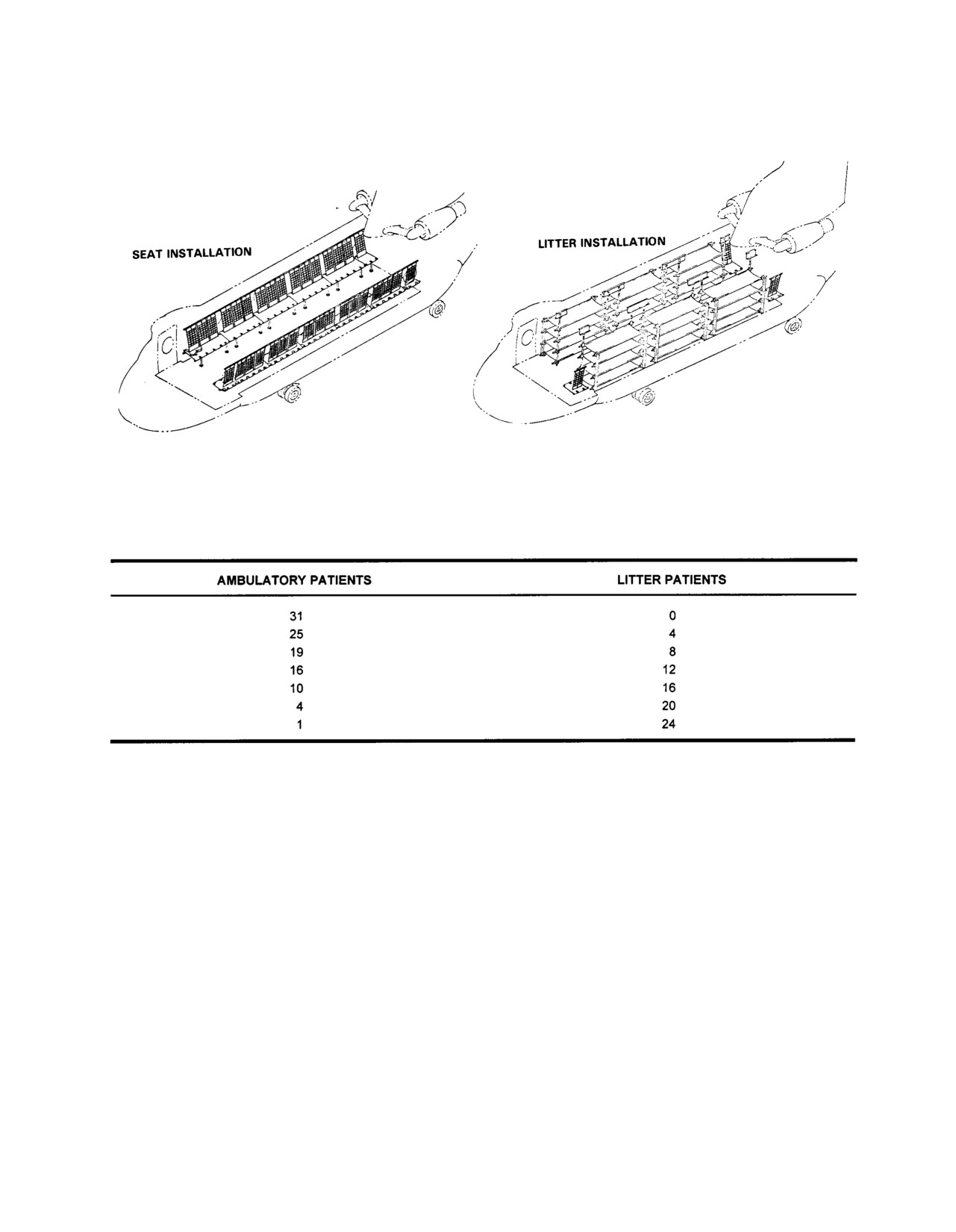
a. The CH-47 (Chinook) helicopter (Figure 10-41), has a capacity of 24 litter patients, or 31
ambulatory patients, or a combination of litter and ambulatory patients. The aircrafts overall size and rotor
blade diameter make it unsuitable for use in smaller or more confined areas.
b. The CH-47 helicopter should not be brought into a LZ that is smaller than 40 meters in
diameter.
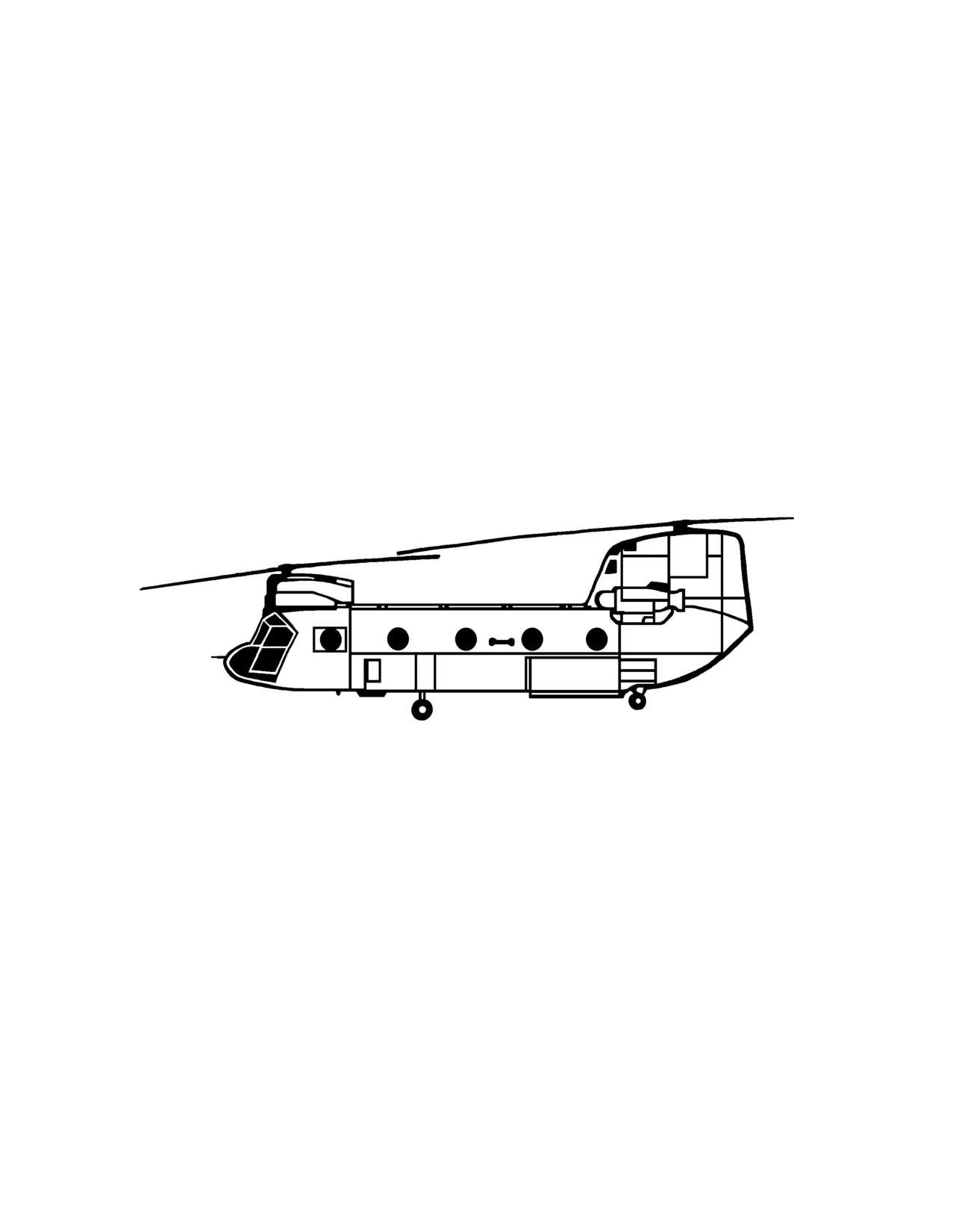
Figure 10-41. CH-47 (Chinook) helicopter.
10-34. Loading Patients Aboard the CH-47 (Chinook)
a. Interior of the CH-47 (Chinook).
(1) This helicopters maximum capacity is 24 litter patients or 31 ambulatory patients. The
31 ambulatory patients are seated in the ten 3-man seats and the 1-man seat as shown in Figure 10-42. The
two 1-man seats are used by crew members.
(2) When carrying 24 litter patients, the seats are replaced with six tiers of litters, four litters
high. The two 1-man seats in the rear section should remain in place for the crew members. The 1-man
seat at the left front may also be left in place provided it is needed.
(3) The combinations of litter and ambulatory patients the CH-47 is capable of accom-
modating are provided in Table 10-5.
10-56
FM 8-10-6
Figure 10-42. Interior view of CH-47 (Chinook).
Table 10-5. Litter and Ambulatory Configuration of the CH-47 (Chinook)
b. Litter Support Kits. These kits are available for use in adapting the helicopters interior to
evacuate litter patients. These kits contain 12 litter poles, stored in the front of the cargo compartment and
12 litter straps, stored in overhead recesses. The poles contain safety attachments for securing them along
the side walls of the compartment. The pull-down straps on the aisle side are secured to floor studs.
Permanently attached to each litter pole and each strap are four litter support brackets with locking devices
for securing litter handles in place. It is not necessary to remove the seats before adapting the compartment
for litter patients. The seats can be folded against the wall and strapped in place.
c.
Loading of Litter Patients. The loading of litter patients aboard the CH-47 helicopter is
similar to loading patients aboard the UH-1H/V air ambulance except the litter squad is not assisted by the
crew members. In a 2-man carry, the litter squad carries each litter patient through the lowered rear door
and ramp to the litter rack where he is to be placed. The squad then moves into a 4-man carry and places
the litter patient into the appropriate tier. The litter racks should be loaded from front to rear and from top
to bottom. Litter patients requiring in-flight medical care should be positioned to facilitate this care. If the
helicopter is to be loaded with a combination of litter and ambulatory patients, the litter patients should be
positioned to the rear of the ambulatory patients whenever possible.
10-57
FM 8-10-6
Section V. UNITED STATES AIR FORCE AIRCRAFT
10-35. General
Most USAF cargo aircraft can be used for AE. The aircraft used for forward airlift movement of troops
and supplies may be reconfigured for the AE mission on the return flight (provided proper equipment is
available). However, more likely USAF AE will be accomplished by dedicated (aircraft identified for AE
only) or designated (mission scheduled specifically for AE) AE aircraft. The flexibility and responsiveness
provided to AE by designated or dedicated AE missions also improves cargo and passenger airlift throughput
by not pulling scheduled cargo missions from their scheduled routes to support AE.
10-36. Types of Air Force Transport Aircraft and Units
a. The C-130 Hercules Transport. This aircraft is a four-engine, turbo-propeller driven aircraft
with a pressurized, air-conditioned cabin and a self-contained loading ramp. In the normal patient
configuration, this aircraft can accommodate 50 litter and 27 ambulatory patients. This can be varied for as
many as 70 litters with no ambulatory patients, or 85 ambulatory patients with no litters. These figures
represent maximum patient capacity and would not be used routinely. The medical crew is normally
provided by the USAF. It consist of two flight nurses and three AE technicians. These crews can be
augmented by CCAT teams or personnel to care for the stabilized patients. The C-130 can land on and take
off from short, austere runways. It can also be used on landing strips such as those found in forward base
operations. Its normal use is within a TO for tactical and assault airlift. The ambulance bus maybe backed
up to the ramp at the tail of the aircraft for easy enplaning of litter patients. The C-130 can also be used for
intertheater airlift missions, if required. This aircraft is also used for HCAA operations.
b. The C-9A Nightingale. This aircraft is a T-tailed aeromedical airlift with two jet engines and a
pressurized, air-conditioned cabin. The Nightingale is the military version of the DC-9 airliner with an
interior specifically designed for in-flight patient care. It is the only aircraft in the USAF inventory that is
dedicated to the medical evacuation mission. It has a self-contained patient enplaning ramp and can
accommodate 40 litter patients, 40 ambulatory patients, or a combination of both. The ambulance bus
maybe backed up to the ramp at the tail of the aircraft for easy enplaning of litter patients. This aircraft can
operate from and between CZ, EAC, or CONUS from improved mile long runways. The medical crew
normally consists of two flight nurses and three AE technicians. These crews can be augmented by CCAT
teams or personnel to care for the stabilized patients.
c.
The C-141 Starlifter. This aircraft is a four-engine, jet cargo transport aircraft. The cabin is
pressurized, heated, or cooled, as required. The ambulance bus may be backed to the ramp at the tail of the
aircraft for easy enplaning of litter patients. The C-141 can accommodate 103 litter patients, 147 ambulatory
patients, or a combination of both. Normally, the aircraft will be configured to accommodate 48 litters and
38 seats. Maximum capacity is not routinely used, as crowding detracts from patient care. The usual
medical crew is two flight nurses and three AE technicians. These crews can be augmented by CCAT
teams or personnel to care for the stabilized patients. The C-141 is used for all missions of the AMC
intertheater AE system. With the backhaul capacity, these intercontinental cargo aircraft provide AE from
a TO to CONUS.
10-58
FM 8-10-6
d. The C-5 Galaxy. The C-5 is the USs largest aircraft. The aircraft is normally a cargo mover,
with a payload of over 200,000 pounds. If required, it could carry up to 70 ambulatory patients in its upper-
aft passenger compartment in addition to its cargo load. This aircraft is considered an aircraft of opportunity
and is only used if absolutely necessary.
e.
The C-17A. This aircraft is a four-engine, jet driven aircraft with a pressurized, air-conditioned
cabin and a self-contained loading ramp. In the normal patient configuration, this aircraft can accommodate
36 litter and 54 ambulatory patients. These figures represent maximum patient capacity. The medical crew
is provided by the USAF. It consists of two flight nurses and three AE technicians. These crews can be
augmented by CCAT teams or personnel to care for the stabilized patients. The C-17A can land and take
off from short, austere runways. It can also be used on landing strips such as those found in forward base
operations. Its normal use is within a TO for tactical and assault airlift. When available, the ambulance bus
may be backed to the ramp at the tail of the aircraft for easy enplaning of litter patients. The C-17A can also
be used for both intratheater and intertheater airlift missions, and will normally be maintained under AMC
control.
f.
The KC-135 and KC-10. These aircraft are four-engine, jet driven aircraft with a pressurized,
air-conditioned cabin. In the normal patient configuration, this aircraft can accommodate 8 litters and 24
ambulatory patients. The litter patients would be loaded and secured to the floor of the aircraft for
transport. Because these aircraft do not have loading ramps, either a ramp or cargo loader must be used to
load and unload patients. The MASF or ASF/ASTS coordinate with the aerial port functions to arrange for
loading equipment. The medical crews are provided by the USAF. These crews can be augmented by
CCAT teams or personnel to care for the stabilized patients. The KC-135 and KC-10 operate from rear,
fixed, improved runways. The benefits of these aircraft are their speed and range that exceeds the
capability of any previously mentioned aircraft.
g. United States Air Force. The USAF has functionally organized units specifically designed to
perform AE. There are two basic types of units. Either type of organization can provide for the operation
of the AECC, AEOT, MASF, ASF/ASTS, in-flight medical crews, and AELT personnel.
(1) Aeromedical aircraft units (flights, squadrons, groups, or wings) combine personnel for
operation of the aircraft and medical personnel in the same organization.
(2) Aeromedical evacuation units
(flights, squadrons, or groups) are strictly medical
organizations. These units possess no organic aircraft; they rely on the capability of cargo, passenger, and
AE aircraft.
10-37. Aeromedical Evacuation Civil Reserve Air Fleet Aircraft
The AE Civil Reserve Air Fleet (CRAF) aircraft is the Boeing 767. The B-767 is a wide-body, long-range,
twin-engine aircraft. In times of national conflict and on the National Command Authorities (NCA)
activation, the second stage of AE CRAF, a large portion of the aircraft contracted, can be modified with
predesigned ship sets to accommodate up to 87 litters. Once configured, the aircraft will be flown in a
strategic role, evacuating patients from the TO to CONUS. The medical crew composition will consist of
10-59
FM 8-10-6
two standard crews (four flight nurses and six aeromedical technicians). These crews can be augmented by
CCAT teams or personnel to care for the stabilized patients.
10-38. Preparing Aircraft to Receive Patients
The aircraft crew is responsible for preparations to receive litter patients. Before the patients are loaded,
the medical crew director inspects the aircraft to ensure that the required supplies and equipment are
available and in operating order. The items inspected include
Accessories, such as litter straps, clamps, and stanchions.
Rigging to ensure security.
Medical equipment and other movable items to ensure that they are properly fastened to
withstand flying conditions and that they constitute no hazard to occupants of the aircraft.
Cabin-to-cockpit communications system to ensure that it is operative. This is accomplished
by making a communications check with the pilot.
Patients survival and other equipment as it is loaded on the aircraft to ensure conformity with
the existing instructions for the particular aircraft.
10-39. Developing the Loading Plan
a. The plan for loading patients aboard a large transport aircraft depends upon the capacity of the
aircraft, the length of the flight, the severity of the patients medical condition, and the number of litter and
ambulatory patients to be transported. Transport aircraft carry the litters in tiers, normally three or four
litters high. In developing a loading plan, the objective is to place each litter patient in the space that
provides the most comfort for him without detracting from the ability to provide care. It is necessary to
consider
Diagnosis.
Preflight preparation or medication to be given the patient.
Point where he is to be unloaded.
Amount of care required during flight.
b. The following factors should be considered when developing the loading plan:
Patients in plaster casts or splints must be placed on the side of the aircraft which would
make the injured limb accessible for treatment.
10-60
FM 8-10-6
Litter patients with certain conditions requiring travel in a sitting or semiprone position
require the same amount of space as two litters.
Patients requiring bedpans, IV infusions, special treatment, or dressings during flight
should be placed in the middle tier where they are more accessible for care.
Patients who are unable to help themselves should, if possible, be located near the crew
to facilitate visibility and observation.
Patients suffering mental disturbances should be located in positions that afford maximum
observation.
Patients with communicable diseases should be loaded in the lower levels of the rear
litter tiers to reduce airborne pathogens and to limit blood/body fluid distribution.
Patients who are restless, such as those with head injuries, or those who are unconscious
should be placed on the bottom tiers.
Patients with coughs and those subject to airsickness should be placed on the bottom tier
and positioned at the downwind end of the normal ventilation flow.
After the patients are loaded, their personal effects should be stowed in the baggage
compartment or the rear portion of the cabin.
A preflight briefing is given to all patients. The medical crew director is responsible for
ensuring that this briefing is conducted before each flight. The briefing should be complete and conducted
in such a way as not to alarm patients who are flying for the first time.
10-40. Documentation Required
a. When a patient enters the USAF AE system, specific documentation is required to accompany
the patient (Appendix H). The OMF is normally responsible for completing this documentation. In the
Army CHS chain, this is normally accomplished at Echelon III facilities or higher.
b. Patients treated at Echelon II facilities will have a FMC, completed and it will be forwarded
with the patient when evacuated. The DD Form 1380 provides a record of treatment the patient received.
(Refer to Appendix C for information required for completing this form.)
c.
The DD Form 600, Patients Baggage Tag, is completed by the OMF. If the Echelon II
facility does not have access to this form, all personal items and personal protective equipment accompanying
the patient should be labeled with the patients name and social security number (SSN).
d. The DD Form 601, Patient Evacuation Manifest, will be completed by the MASF if the
Echelon II facility does not have access to this form.
10-61
FM 8-10-6
e.
The DD Form 602, Patient Evacuation Tag, is a record of the patients medical treatment.
When evacuating a patient aboard during HCAA operations, the DD Form 1380 will suffice as a treatment
record if the DD Form 602 is not available.
f.
Patient classification codes used in completion of these forms are contained in Appendix K.
10-41. Patient Assessment Information
Medical assessment considerations for medically evacuating a patient by air (in a pressurized aircraft) are
provided in Appendix K.
10-62
FM 8-10-6
APPENDIX A
EFFECTS OF GENEVA CONVENTIONS ON
MEDICAL EVACUATION
A-1. General
a. The conduct of armed hostilities on land is regulated by customary international law and
lawmaking treaties such as the Hague and Geneva Conventions. The rights and duties set forth in the Con-
ventions are part of the supreme law of the land. The United States is obligated to adhere to these obli-
gations even when an opponent does not. It is a DOD and Army policy to conduct operations in a manner
consistent with these obligations.
b. An in-depth discussion of the provisions applicable to medical units and personnel is provided
in FM 8-10. This appendix discusses only those articles or actions which affect medical evacuation
operations. Questions regarding the implementation and interpretation of applicable treaties should be
directed to the servicing Staff Judge Advocate.
A-2. Distinctive Markings and Camouflage of Medical Facilities and Evacuation Platforms
This paragraph implements STANAG 2454 and QSTAG 512.
a. All US medical facilities and units, except veterinary, display the distinctive flag of the
Geneva Conventions. This flag consists of a red cross on a white background. It is displayed over the unit
or facility and in other places as necessary to adequately identify the unit or facility as a medical facility.
NOTE
The Geneva Conventions authorizes the use of the following distinctive
emblems on a white background: Red Cross; Red Crescent; and Red
Lion and Sun. In operations conducted in countries using an emblem
other than the Red Cross on a white background, US soldiers must be
made aware of the different official emblems. United States forces
are legally entitled to only display the Red Cross. However, com-
manders have authorized the display of both the Red Cross and the
Red Crescent to accommodate HN concerns and to ensure that
confusion of emblems would not occur. Such use of the Red Crescent
must be in a smaller size than the Red Cross.
A-1
FM 8-10-6
This paragraph implements STANAG 2931.
b. Camouflage of medical facilities (medical units, medical vehicles, and medical aircraft on the
ground) is authorized when the lack of camouflage might compromise tactical operations. The marking of
facilities and the use of camouflage are incompatible and should not be undertaken concurrently.
If the failure to camouflage endangers or compromises tactical operations, the camouflage
of medical facilities may be ordered by a NATO commander of at least brigade level or equivalent. Such an
order is to be temporary and local in nature and is rescinded as soon as circumstances permit.
It is not envisioned that fixed, large medical facilities will be camouflaged.
A-3. Medical Aircraft
a. Medical aircraft exclusively employed for the removal of wounded and sick and for the
transport of medical personnel and equipment shall not be attacked, but shall be respected by the belligerents,
while flying at heights, times, and on routes specifically agreed upon between the belligerents concerned.
b. The medical aircraft shall bear, clearly marked, the distinctive emblem together with their
national colors on their lower, upper, and lateral surfaces.
c.
Unless agreed otherwise, flights over enemy or enemy-occupied territory are prohibited.
d. Medical aircraft shall obey every summons to land. In the event that a landing is thus
imposed, the aircraft with its occupants may continue its flight after examination, if any.
e.
In the event of involuntary landing in enemy or enemy-occupied territory, the wounded and
sick, as well as the crew of the aircraft, shall be prisoners of war; medical personnel will be treated as
prescribed in these conventions.
A-4. Self-Defense and Defense of Patients
When engaging in medical evacuation operations, medical personnel are entitled to defend themselves and
their patients. They are only permitted to use individual small arms.
a. The mounting or use of offensive weapons on dedicated medical evacuation vehicles and
aircraft jeopardizes the protections afforded by the Geneva Conventions. These offensive weapons can
include, but are not limited to
Machine guns.
Grenade launchers.
A-2
FM 8-10-6
Hand grenades.
Light antitank weapons.
b. Medical personnel are only permitted to fire in their personal defense and for the protection of
the wounded and sick in their charge against marauders and other persons violating the law of war.
A-5. Enemy Prisoners of War
a. Sick, injured, or wounded EPWs are treated and evacuated through normal medical channels,
but are physically segregated from US, allied, or coalition patients. The EPW patient is evacuated from the
CZ as soon as his medical condition permits.
b. Personnel resources to guard EPW patients are provided by the echelon commander. Medical
personnel do not guard EPW patients.
A-6. Compliance with the Geneva Conventions
a. The US is a party to the 1949 Geneva Conventions. Two of these Conventions afford
protection for medical personnel, facilities, and evacuation platforms (to include aircraft on the ground). All
CHS personnel should thoroughly understand the provisions of the Geneva Conventions that apply to
medical activities. Violation of these Conventions can result in the loss of the protection afforded by them.
Medical personnel should inform the tactical commander of the consequences of violating the provisions of
these Conventions. The consequences can include the following:
Medical evacuation assets subjected to attack and destruction by the enemy.
Combat health support capability degraded.
Captured medical personnel becoming prisoners of war rather than retained persons.
They may not be permitted to treat fellow prisoners.
Loss of protected status for medical unit, personnel, or evacuation platforms (to include
aircraft on the ground).
b. Because even the perception of impropriety can be detrimental to the mission and US interests,
CHS commanders must ensure that they do not give the impression of impropriety in the conduct of medical
evacuation operations. For example, if a medical evacuation commander included in the TSOP rules
governing the use of automatic or crew-served weapons, it would give the impression that the unit possessed
and intended to use these types of weapons. Under the provisions of the Geneva Conventions, medical units
are only authorized individual small arms for use in the defense of the patients under their care and for
themselves. Even though the unit did not possess these types of weapons, the entry in the TSOP could be
misinterpreted and a case made that the commander intended to use these weapons in violation of the
Geneva Conventions.
A-3
FM 8-10-6
APPENDIX B
MEDICAL EVACUATION ESTIMATE AND PLAN
Section I. MEDICAL EVACUATION ESTIMATE
B-1. General
a. The CHS estimate and plan considers all AMEDD functional areas during the planning
process. The medical evacuation portion of the CHS plan is an integral part of providing a seamless health
care delivery system from the point of injury or wounding through successive echelons of care to the
definitive treatment in CONUS, if required. Depending upon what level of command the medical evacuation
estimate and plan is developed will determine whether it is written out in detail, overlays developed, or is
provided verbally. Regardless of the mode of dissemination, the same planning steps and considerations
should be used.
b. Refer to FM 8-42 and FM 8-55 for additional information on CHS planning.
B-2. Sample Format for the Medical Evacuation Estimate of the Situation
____________
(Classification)
References: Maps, overlays, charts, or other documents required to understand the plan. Reference to a
map will include the map series number and country or geographical area, if required; sheet
number and name, if required; edition; and scale.
1.
MISSION: (Statement of the medical evacuation mission.)
2.
SITUATION AND CONSIDERATIONS:
a.
Enemy Situation. (In a traditional military operation, this paragraph discusses the capabilities
and weakness of the enemy. However, in stability operations and support operations, a true enemy may not
exist. This paragraph can be modified to discuss issues such as the terrorist threat, insurgents, and
opposition groups. In some situations, such as disaster relief operations, this paragraph can discuss
negative factors impacting on the mission. These negative factors can include looters and lawlessness,
continued destruction from natural or man-made causes [such as continued flooding, aftershocks, and
explosions], or an increase in the medical threat as arthropod and rodent vectors increase.)
(1) Strength and disposition.
(The size of the opposition force and its placement on the
battlefield is important during the planning process for medical evacuation operations. When evacuation
routes are selected, caution must be exercised to ensure medical evacuation assets are not compromised by
going through enemy-held territory or by being ambushed by isolated pockets of resistance. Further, this
information is vital in determining if medical evacuation assets [both ground and air] will require a security
escort provided by CS forces before entering areas of the battlefield.)
____________
(Classification)
B-1
FM 8-10-6
____________
(Classification)
(2) Combat efficiency.
(Information on actual combat units or other forces, their training
status, and their level of expertise and experience can be identified here. The level of CHS training and the
development of a health care delivery system can also be included.)
(3) Capabilities.
(This paragraph should discuss the potential capability to interfere with or
disrupt medical evacuation operations.)
(4) Logistics situation.
(This can include information on how well supplied the enemy/
opposition force is with food, clothing, or other vital logistics factors. It may also include the financial
backing and availability of future support from outside individuals/groups/nations.)
(5) State of health.
(The state of health of the enemy is an important factor. An army that is
not healthy or that is fatigued, undernourished, and stressed from continuous operations may not have the
will to continue the battle. In stability operations and support operations, the health of the population and
the ability to care for them may be a factor in the political unrest in a nation.)
(6) Weapons.
(This should include a discussion of the enemys weapons that present the
greatest threat to air and ground evacuation personnel and vehicles. Ground assets are more likely to face
a small arms threat while performing their mission; air assets are vulnerable to surface-to-air weapons and
when on the ground to small-arms fire.)
b. Friendly Situation.
(1) Strength and disposition.
(This should include all forces [US, allied, coalition, and HN]
and should be maintained on overlays. It may also include liaison officers, interpreter support, and
coordination requirements.)
(2) Combat efficiency.
(The health of the command has a significant impact on this factor.
Additionally, when there are significant numbers of DNBI casualties, the medical evacuation workload will
increase.)
(3) Present and projected operations.
(Medical evacuation planners must be familiar with
plans for current and projected operations. A risk management assessment of current and projected
operations is conducted [Appendix L]. Patient collecting points and AXPs must be designated during the
planning process. Medical evacuation planners must also be able to anticipate changing requirements to
ensure continuous medical evacuation is available to the supported force.)
(4) Logistics situation.
(Since medical evacuation vehicles conduct CHL backhaul, the
medical evacuation planner must maintain visibility of the current CHL situation.)
____________
(Classification)
B-2
FM 8-10-6
____________
(Classification)
(5) Rear area protection plan.
(Medical units play an important role in the rear area
protection plan and should be included in the planning process.)
(6) Weapons.
(Medical units only have small arms for self-defense and defense of their
patients. Medical vehicles and aircraft should not carry any automatic or crew-served weapons; to do so
would result in the loss of the protections afforded under the Geneva Conventions for the unit, medical
personnel, and patients under its care.)
c.
Characteristics of the Area of Operations.
(1) Terrain.
(This paragraph should discuss any aspects of the terrain that will either hinder
or enhance the execution of the evacuation mission. It should discuss both natural and man-made terrain,
as medical evacuation in built-up areas can pose significant challenges not found on a natural battlefield.
Medical personnel must be able to recover injured and wounded soldiers from below ground and from upper
levels of man-made structures. If the plan requires combat within urbanized terrain, armor ambulances
provide added protection for medical personnel and their patients; augmentation should be requested if
armor ambulances are not organic to the unit. If additional resources will be required to accomplish
evacuation due to impassable or difficult terrain [such as in mountain operations where additional litter
bearers and medical personnel are required], it should also be addressed here. Further, the type of terrain
to be traversed, such as rugged mountain or jungle swamps may require a patient [who would otherwise be
ambulatory] to be transported on a litter until easier terrain is encountered.)
(2) Weather and climate.
(This should include a discussion of current weather conditions
and seasonal variants. Weather conditions impact both ground and air evacuation operations; however, the
most significant impact may be on aeromedical evacuation as severely inclement weather can ground all
aircraft. It should also discuss the impact that the weather has on the terrain [such as rivers being frozen in
winter or tundra becoming impassable in spring]. The climate may pose problems with acclimation as well
as place additional requirements to sustain personnel during evacuation on evacuation assets [litter
evacuation in the mountains in extreme cold weather operations may require warming tents and the
capability to sustain the patient during nighttime when evacuation is difficult].)
(3) Dislocated civilian population and enemy prisoners of war.
(Dislocated civilians fleeing
an area of hostilities can clog roadways leading away from the conflict area. This congestion on road
networks may make evacuation along these routes almost impossible. The establishment of camps to sustain
these categories of personnel may interrupt the road network requiring detours and lengthened evacuation
times. Injured, ill, or wounded EPW are evacuated using the same evacuation means but are segregated
from US, allied, or coalition patients. Coordination for nonmedical guards for EPW patients being
evacuated through medical channels must be accomplished.)
(4) Flora and fauna.
(This should include a discussion of indigenous plants and wildlife that
pose a threat to evacuation crews.)
____________
(Classification)
B-3
FM 8-10-6
____________
(Classification)
(5) Disease.
(Medical evacuation crews must be aware of the endemic and epidemic diseases
in the AO. They should be taking any prescribed chemoprophylaxis and practicing individual PVNTMED
measures [PMM].)
(6) Local resources.
(Medical evacuation crews should be aware of any potential services
available in the civilian community and appropriate policy guidance on how to obtain these services in an
emergency [such as fuel, repair parts, or water]. The medical evacuation planner should consider the
availability of HN commercial transportation assets to augment medical evacuation assets, if required by a
mass casualty situation.)
(7) Other.
(This may include language capabilities and liaison or interpreter requirements
due to a multinational force environment or interaction with HN personnel; customs, ethnic issues, or
religious beliefs of the population or participating forces; the role and support requirements for interagency
operations; or the relationship and interaction with private volunteer organizations [PVOs] and nongovern-
mental organizations [NGOs].)
d. Strengths to be Supported. (A determination of eligible beneficiaries outside of the traditionally
supported personnel is required in multinational operations [refer to Appendix M for information on
multinational operations], stability operations, and support operations.)
(1) United States uniformed services.
(a) Army.
(b) Navy.
(c) Air Force.
(d) Marines.
(e) Coast Guard.
(2) Department of Defense civilians.
(3) Other United States Government employees.
(4) Allied forces.
(5) Coalition forces.
(6) Host-nation forces.
____________
(Classification)
B-4
FM 8-10-6
_____________
(Classification)
(7) Enemy prisoners of war.
(8) United States Government contract personnel.
(9) Indigenous civilians.
(10) Refugees.
(11) Detainees.
(12) Internees.
(13) Nongovernmental organization personnel.
(14) Private volunteer organizations personnel.
(15) Others.
e.
Health of the Command.
(1) Acclimation of troops.
(Medical evacuation crews require acclimation when introduced
into an AO where the temperature range and elevation are different from their home station. Medical
evacuation operations involve heavy lifting and may require extended periods of time to complete. To
reduce the risk of injury to litter bearers and to facilitate the evacuation effort, medical and nonmedical
personnel engaged in these operations should be acclimated to the AO and a work/rest schedule should be
developed and implemented.)
(2) Presence of disease.
(The presence of disease impacts medical evacuation operations in
two areas. The presence of disease in the AO [usually at subclinical levels in the native population]
contributes to the incidence of disease manifesting itself within the supported force. As DNBI rates increase,
so do the requirements for medical evacuation. Medical evacuation personnel are also susceptible to the
endemic and epidemic diseases within the AO and/or multinational force. High rates of DNBI for medical
personnel will adversely impact the medical evacuation capability.)
(3) Status of immunizations and/or chemoprophylaxis.
(Commanders must ensure appro-
priate measures are taken to protect their soldiers from DNBI. The records of replacement personnel need
to be screened to ensure all required immunizations have been received and appropriate chemoprophylaxis/
barrier creams for the AO initiated/provided.)
(4) Status of nutrition.
(The nutrition status of the troops involved impacts on the susceptibility
to disease and environmental injuries, morale, and fatigue. The medical evacuation commander must also
ensure that his evacuation crews carry sufficient supplies of meals, ready to eat [MREs] to sustain themselves
____________
(Classification)
B-5
FM 8-10-6
____________
(Classification)
and their patients should delays in evacuation be experienced [such as delays resulting from shifts in the
battle or inclement weather].)
(5) Clothing and equipment.
(Special requirements for clothing and equipment to support a
particular operation should be obtained prior to the beginning of the operation [for example, cold weather
clothing for extreme cold weather operations; additional blankets for patients being transported (either to
adding padding or warmth); or block and tackle equipment for medical evacuation operations conducted in
mountainous terrain or in built-up areas].)
(6) Fatigue.
(Mandatory work/rest schedules and sleep plans for air crews and ground
evacuation personnel must be developed and implemented.)
(7) Morale.
(8) Status of training.
(This can include any specialized training required for the conduct of
a specific operation [for example: helicopter crews require deck-landing qualifications to perform shore-to-
ship evacuation with US Navy ships or orientation to the social, political, economic, religious, and ethnic
issues of a HN or supported population or training nonmedical personnel in the proper techniques for
carrying litters].)
(9) Other as appropriate.
f.
Assumptions.
(Assumptions may be required as a basis for initiating, planning, or preparing
the estimate. Assumptions are modified to factual data when specific planning guidance becomes available.)
g. Special Factors.
3.
MEDICAL EVACUATION MISSION ANALYSIS:
a.
Patient Estimates.
(Indicate rates and numbers by type unit/division/corps/EAC.)
(1) Number of patients anticipated.
(The anticipated number of patients affects the number
and type of medical evacuation resources required.)
(2) Distribution within the area of operations.
(Distribution within the AO is an important
consideration because varying types of terrain will generate different requirements for support. Operations
conducted in mountainous terrain rely heavily on manual and litter evacuation techniques, are labor
intensive, and require more time to complete. Differences in road composition, traffic density, and
abundance/absence of paved roads will impact differently on the type of support required. Further, if the
____________
(Classification)
B-6
FM 8-10-6
____________
(Classification)
distance between Echelon II and Echelon III MTFs exceeds the capability of US Army air ambulances, the
use of the HCAA should be anticipated and preplanned. Coordination with the USAF is required to imple-
ment this procedure [see paragraph c(10) below].)
(3) Distribution in time during the operation (evacuation time).
(As the battle progresses
over time and space, medical evacuation assets may be reallocated to support the units in contact. The
medical evacuation plan must be sufficiently flexible to enable the commander to shift resources as required.)
(4) Areas of patient density.
(Areas with a high patient density may require augmentation of
the medical evacuation assets supporting that location.)
(5) Possible mass casualties.
(Mass casualty situations should be anticipated when possible.
Evaluation of the general threat and medical threat in the AO can facilitate the medical evacuation planner
in forecasting evacuation requirements. When dealing with mass casualty situations, the use of nonmedical
transportation platforms should be included. Augmentation of these vehicles by medical personnel to
provide en route care will assist in reducing the deterioration of the patients medical condition until arrival
at an MTF.)
(6) Lines of patient drift.
(This indicates what routes injured soldiers are most likely to take
from the battlefield. It is usually the most direct route over the least demanding terrain, such as at the base
of the hill rather than over the hill where climbing would be required.)
(7) Evacuation routes/corridors.
(Evacuation routes should be preplanned, indicated on the
medical evacuation overlay, and reconnaissance accomplished. Routes that provide lucrative targets, have
significant obstacles to circumvent, or will be unduly congested due to fleeing refugees or other displaced
persons should only be used if no other routes are available.)
b. Support Requirements.
(This paragraph discusses the type of support required for the
operation and its command relationship. Specific guidance on trigger points and release points from a
particular category of support should be included.)
(1) Direct support.
(2) General support.
(3) Operational control.
c.
Medical Evacuation Procedures.
(1) Evacuation overlays. (Evacuation overlays must be developed to facilitate the evacuation
effort. Both supporting and supported units must maintain and update [as required] overlays throughout the
operation.)
____________
(Classification)
B-7
FM 8-10-6
____________
(Classification)
(2) Communications.
(Medical evacuation frequencies must be designated at the outset of
the operation. Requirements for liaison officers, A2C2, and interpreters must be anticipated.)
(3) Patient collecting points.
(Location, staffing, and activation trigger [such as crossing a
phase line] must be known to supported and supporting units.)
(4) Ambulance exchange points. (Location, staffing, and activation trigger [such as crossing
a phase line] must be known to supported and supporting units).
NOTE
If an AXP is staffed with a treatment element, it is no longer considered
to be an AXP but rather it becomes the forward element of a BAS or
clearing station. The AXP is only a location on the ground where the
patient is transferred from one evacuation platform to another. If it is
staffed, it is usually staffed by one member of the evacuation platoon
to direct returning ambulances to the area where the last ambulance
departed from. The element designating the AXP is responsible for
staffing it. Ambulance exchange points may be rendezvous points to
be used only once during the operation.
NOTE
Ambulance exchange points should not be used as resupply points for
Class VIII. Planning on pushing Class VIII to these points may result
in the loss of the Class VIII materiel, as there may not be anyone at
the point to receive the supplies.)
(5) Ambulance shuttle system.
(The ambulance [or litter] shuttle system is a management
tool to facilitate the medical evacuation of forward areas. It is discussed in depth in Chapter 4.)
(6) Manual evacuation. (Requirements for manual evacuation should be anticipated. Manual
evacuation should only be used for short distances as it is both time-consuming and difficult for the bearers
to sustain.)
(7) Litter evacuation.
(In some terrain, litter evacuation may be the only means available to
move the patient from the point of injury. This technique is used quite frequently in jungle, swamp, or
____________
(Classification)
B-8
FM 8-10-6
____________
(Classification)
mountainous terrain. As soon as it is possible, the patient should be transferred to another means of
evacuation such as a pack animal, vehicle, aircraft, or watercraft. Litter evacuation is time-consuming and
the personnel acting as litter bearers require frequent rest breaks. If the distance to be covered by litter
teams is excessive, a litter shuttle system should be implemented. When possible, a medic should be part of
the litter team to provide continuous evaluation and en route care if required.)
(8) Mass casualty situation.
(Specific guidance should be provided for procedures to be used
during these situations; for example, only MINIMAL category personnel should be evacuated using
nonmedical evacuation assets without augmentation of medical personnel.)
(9) Shore-to-ship evacuation.
(As mentioned earlier under training, requirements for deck-
landing qualifications, designated frequencies, or other operationally specific information should be
included.)
(10) High capacity air ambulance operations.
(This paragraph needs to address the coordi-
nation required with the USAF and DMOC to implement this type of operation, the trigger mechanism, the
length of time between the preplanned flights, documentation required for evacuation aboard a USAF
aircraft and who will complete it [OMF or MASF], location of the MASF, and what unit will receive the
incoming patients at the corps airfield [if known].)
d. Casualty Evacuation (Transportation).
(1) Medical augmentation.
(Units and/or facilities capable of providing medical augmenta-
tion support should be identified and tasked as appropriate.)
(2) Manual evacuation.
(3) Litter evacuation.
(A medic should be included as a member of the litter team when there
is a significant distance to be covered.)
(4) Pack animals.
(In some remote locations, the use of pack animals may be the most
feasible form of transportation from the point of injury to a place where vehicles, aircraft, or watercraft
become accessible. Whenever possible, medical personnel should accompany patients evacuated in this
manner.)
(5) Nonmedical vehicle. (Nonmedical vehicles which could be preplanned for use for casualty
transport should be identified. Further, guidance on the use of vehicles of opportunity should also be
discussed.)
(6) Nonmedical aircraft. (Nonmedical aircraft which could be preplanned for use for casualty
transport should be identified. Guidance on the use of aircraft of opportunity should also be discussed.)
____________
(Classification)
B-9
FM 8-10-6
____________
(Classification)
(7) Nonmedical watercraft.
(Nonmedical boats, ships, or other watercraft which could be
preplanned for use for casualty transport should be identified. Further, guidance on the
use of these
platforms of opportunity should also be discussed.)
e.
Resources Available.
(1) Organic.
(2) Assigned.
(3) Attached.
(4) Air Force.
(5) Navy.
(6) Marines.
(7) Coast Guard.
(8) Allied.
(9) Coalition.
(10) Host nation.
(11) Other governmental agencies
(12) Nongovernmental agencies.
(13) Other.
f.
Use of Smoke and Obscurants. (In most cases, medical units will not have a high priority for
the use of smoke and obscurants [Appendix F]; however, if the supported combat or CS units have it
planned, medical evacuation units can take advantage of the situation to clear the battlefield of patients.
Guidance on the use of colored smoke to identify the pickup location for patients can also be provided.)
g. Courses of Action.
(As a result of the above considerations and analysis, determine and list
all logical courses of action [COAs] which will support the commanders OPLAN and accomplish the
medical evacuation mission. Consider all TSOPs, policies, and procedures that are in effect. Courses of
action are expressed in terms of WHAT, WHEN, WHERE, HOW, and WHY.)
____________
(Classification)
B-10
FM 8-10-6
____________
(Classification)
4.
EVALUATION AND COMPARISON OF COURSES OF ACTION:
a.
Compare the probable outcome of each COA to determine which one offers the best chance of
success. This may be done in two steps:
(1) Determine and state those anticipated difficulties which will have a different effect on the
COAs listed.
(2) Evaluate each COA against each significant difficulty to determine the strengths and
weaknesses inherent to each.
b. Compare all COAs listed in terms of significant advantages and disadvantages, or in terms of
the major considerations that emerged during the above evaluation.
5.
CONCLUSIONS:
a.
Indicate whether the mission set forth in paragraph 1 can (cannot) be supported.
b. Indicate which COA can best be supported from the medical evacuation standpoint.
c.
List the limitations and deficiencies in the preferred COA that must be brought to the
commanders attention.
d. List factors adversely affecting the completion of the mission.
/s/
Medical Evacuation Unit Commander
Annexes (as required)
DISTRIBUTION:
____________
(Classification)
B-11
FM 8-10-6
Section II. MEDICAL EVACUATION ANNEX TO THE
COMBAT HEALTH SUPPORT PLAN
B-3. General
Once the estimate is completed, the medical evacuation annex to the CHS plan can be developed. A
discussion of the CHS plan is provided in FM 8-42 and FM 8-55.
B-4. Sample Format for the Medical Evacuation Annex to the Combat Health Support Plan
____________
(Classification)
MEDICAL EVACUATION
1.
CONCEPT OF SUPPORT: (Discusses the type of support [organic, DS, GS, or OPCON].)
2.
ASSIGNMENTS, ATTACHMENTS, AND OPERATIONAL CONTROL: (Discusses the types
of units/teams available and their relationship to the C2 headquarters.)
3.
ASSIGNMENT OF RESPONSIBILITIES:
a.
Mission.
(Delineates the mission and responsibilities of medical evacuation teams and units.)
b. Location.
(Delineates the area of responsibilities for forward-sited evacuation assets. This
information can be depicted on overlays.)
c.
Trigger Mechanisms.
(Discusses the activation of PCPs, AXPs, and HCAA operations based
on predetermined events.)
d. Coordination Requirements.
(Discusses liaison requirements, interpreter requirements, and
coordination requirements with allied, coalition, and HN forces, PVOs, and NGOs, as well as coordination
requirements with the sister Services and other governmental agencies.)
____________
(Classification)
B-12
FM 8-10-6
APPENDIX C
USE OF DD FORM 1380, US FIELD MEDICAL CARD
SAMPLE FORMAT
C-1. General
The FMC (DD Form 1380) (AR 40-66) is used to record basic patient identification data and to describe the
problem requiring medical attention and the medical care provided. The FMC is made so that it can be
attached to the casualty.
This paragraph implements STANAGs 2132 and 2350 and QSTAGs 230 and 470.
C-2. Use of the US Field Medical Card
a. The combat medic first attending battle casualties will initiate DD Form 1380 by completing
blocks 1, 3, 4, 7, and 9 and by entering as much information in the remaining blocks as time permits. The
combat medic enters his initials in the far side of the signature block (Block 11).
NOTE
1. The ambulance crew must be familiar with completing this form
and should maintain a stock of them in the ambulance. The ambulance
crew may be the first medical personnel to attend to a casualty.
2. When morphine is administered to a casualty in the field environ-
ment the dose, ZULU time, date, route or entry, and name of the drug
must be entered onto the DD Form 1380. Additionally, the combat
medic (or other health care provider) must mark the casualty with the
letter M and the hour of injection (such as M 0830) on the fore-
head with a skin pencil or another semipermanent marking substance.
The empty syrette, injection device, or its envelope should be attached
to the casualtys clothing.
b. Aid stations record medical care provided on the DD Form 1380 any time that the aid station
is operational and does not have access to the patients health record (HREC) or outpatient treatment record
(OTR).
c.
Treatment teams providing Echelon II medical care use the DD Form 1380 any time that care
is provided and the patients HREC is not readily available. If a patient is treated in a holding section or is
expected to return for additional treatment or evaluation, an OTR may be initiated using standard medical
record forms. The OTR need not be filed in a DA Form 3444-series record. When the patient is returned
C-1
FM 8-10-6
to duty or when treatment and evaluation are completed, the medical officer summarizes care provided on
DD Form 1380 and this form is disposed of according to the procedures outlined in AR 40-66. When the
patient is evacuated, treatment will be summarized on DD Form 1380 and it (along with all forms and
records initiated) will accompany the patient during evacuation.
d. Medical treatment facilities providing Echelons III and IV care will use DD Form 1380 to
record outpatient care provided when the patients HREC is not readily available (as stated in a, b, and c
above.)
C-3. Preparation of the Field Medical Card
a. A medical officer will complete DD Form 1380 or supervise its completion. When DD Form
1380 has been initiated by a medic, the supervising AMEDD officer will complete, review, and sign the DD
Form 1380.
b. In the TO, DD Form 1380 will be prepared for any patient treated at BASs, clearing stations,
and MTFs and may also be used for carded for record only (CRO) cases. When evacuated, the DD Form
1380 will be attached to the patients clothing, where it will remain until the patient arrives at a hospital or
RTDs. If the patient dies, DD Form 1380 will remain attached to the body until internment, when it is
removed. If the body cannot be identified, the registration number given the remains by the Mortuary
Affairs element will be noted on DD Form 1380.
c.
Under combat conditions, DD Form 1380 for patients being evacuated may be only partially
completed. Otherwise, all entries should be completed as fully as possible.
d. All abbreviations authorized for use on DA Form 3647 may also be used on DD Form 1380.
However, except for those listed below, abbreviations may not be used for diagnostic terminology.
Abr W abraded wound.
Cont W contused wound.
FC fracture (compound) open.
FCC fracture (compound) open comminuted.
FS fracture simple (closed).
LW lacerated wound.
MW multiple wounds.
Pen W penetrating wound.
Perf W perforating wound.
C-2