FM 8-10-6 MEDICAL EVACUATION IN A THEATER OF OPERATIONS TACTICS, TECHNIQUES, AND PROCEDURES - page 5
FM 8-10-6
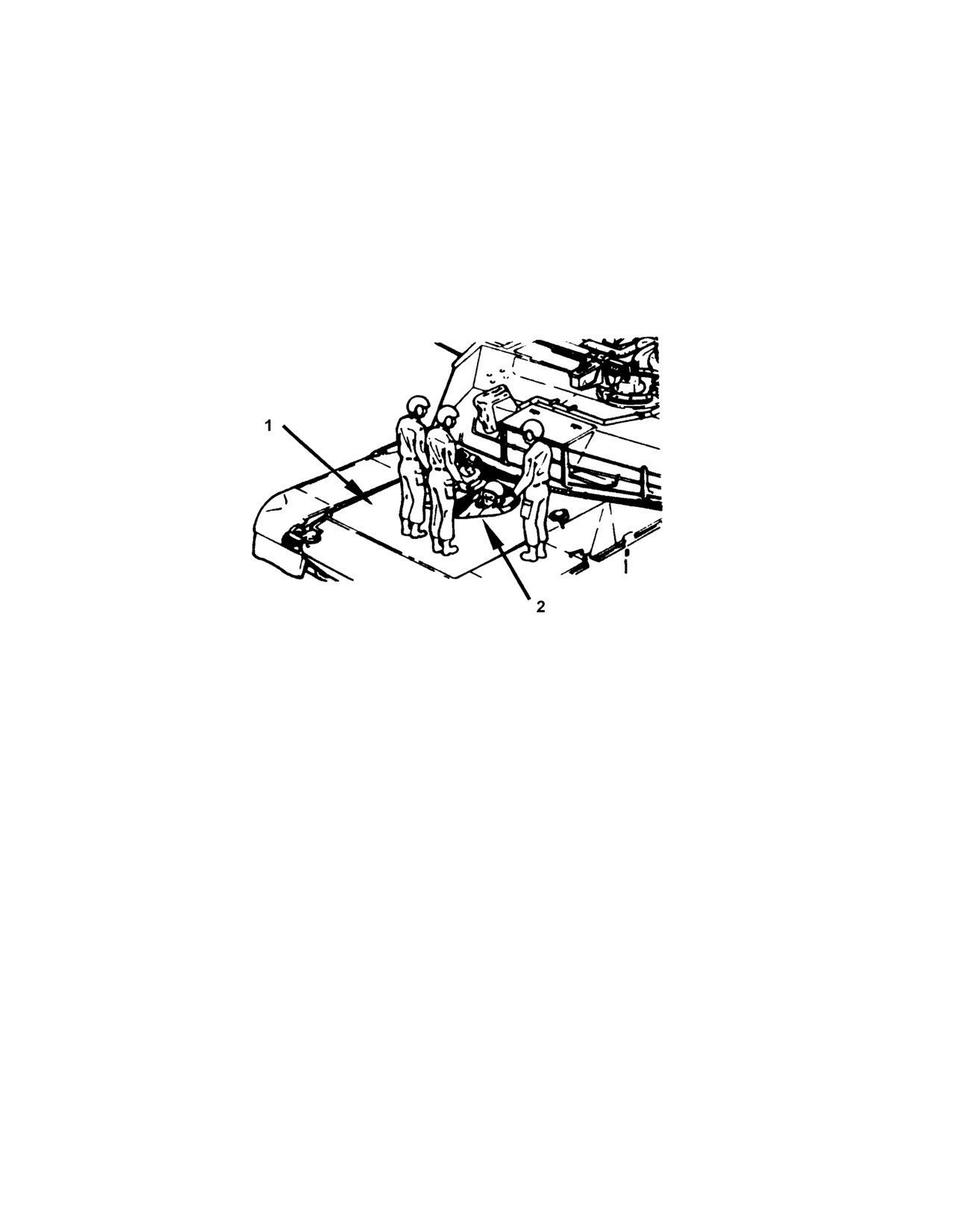
(7) Three crew members (Figure 8-24) stand on the hull (1) around the drivers hatch
opening (2).
Figure 8-24. The crew members stand on the hull of the tank to extract the injured driver
through the drivers hatch.
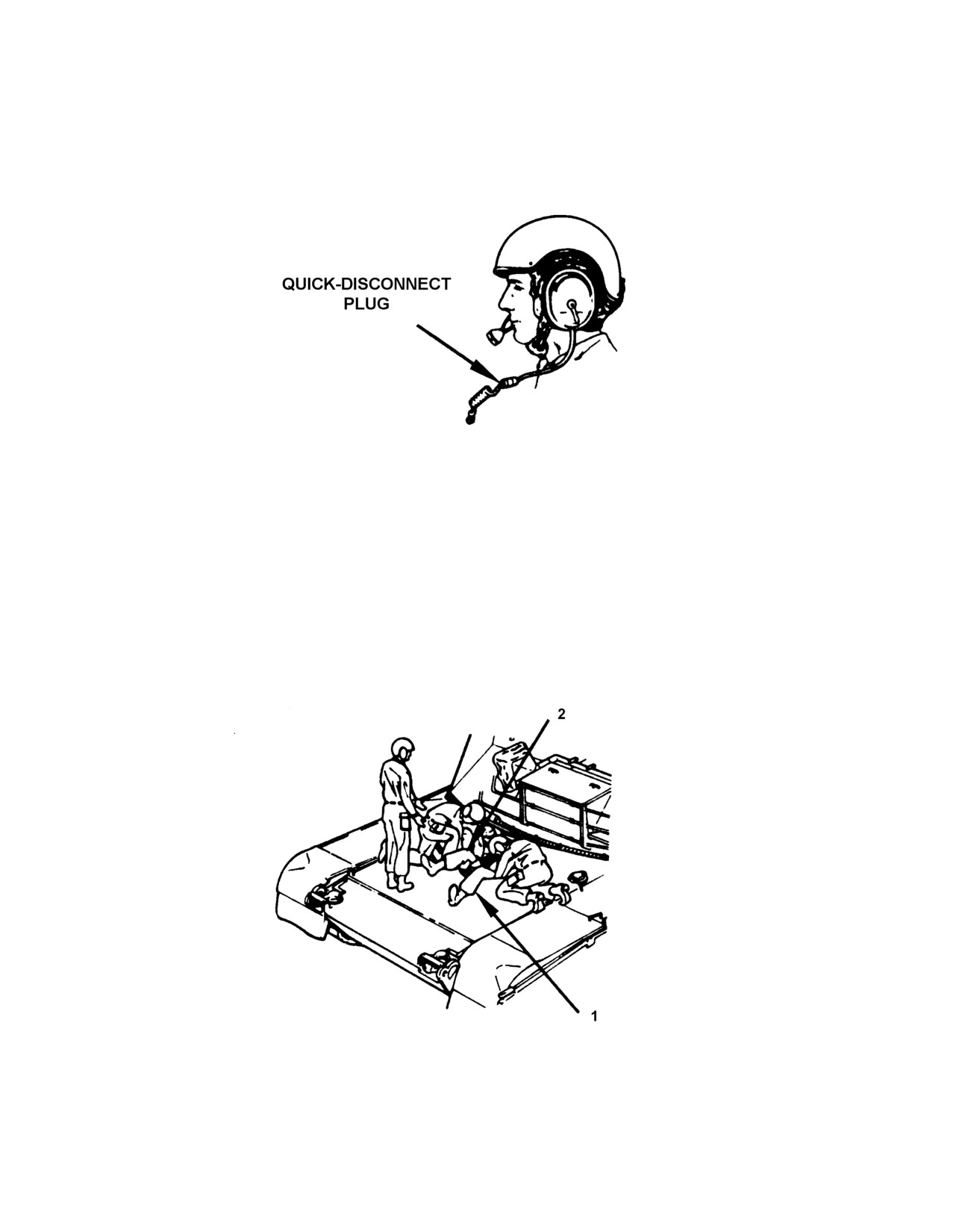
(8) One crew member on the hull reaches into the drivers hatch opening and disconnects the
leads to the drivers helmet at the quick-disconnect plug (Figure 8-25).
NOTE
If a combat medic or an ambulance team member is available and
a head or spine injury is possible or suspected, medical personnel
will stabilize the neck as much as possible prior to attempting to
extract the casualty. The neck may be stabilized using a cervical
collar, Kendricks Extrication Device
(KED), manual stabilization
(using forearms of the rescuer, as appropriate when no equipment
is available). Depending upon the tactical situation, these proce-
dures may be abbreviated if the vehicle and its crew are in imminent
danger.
(9) Stow the drivers steer-throttle control.
8-29
FM 8-10-6
Figure 8-25. Disconnect drivers helmet.
(10) Raise headrest to stowed position and gently lower the drivers head.
(11) Rescuers should attempt to keep the casualtys head and neck as still as possible.
(12) The crew member (Figure 8-26) on the right side of the drivers hatch opening grasps
the injured drivers left leg (1) and lays it on the hull.
(13) While supporting the injured soldiers torso, the crew member (Figure 8-26) on the left
side of the drivers hatch opening grasps the injured drivers right leg (2) and lays it on the hull.
Figure 8-26. The crew members on the right and left sides of the drivers hatch.
8-30
FM 8-10-6
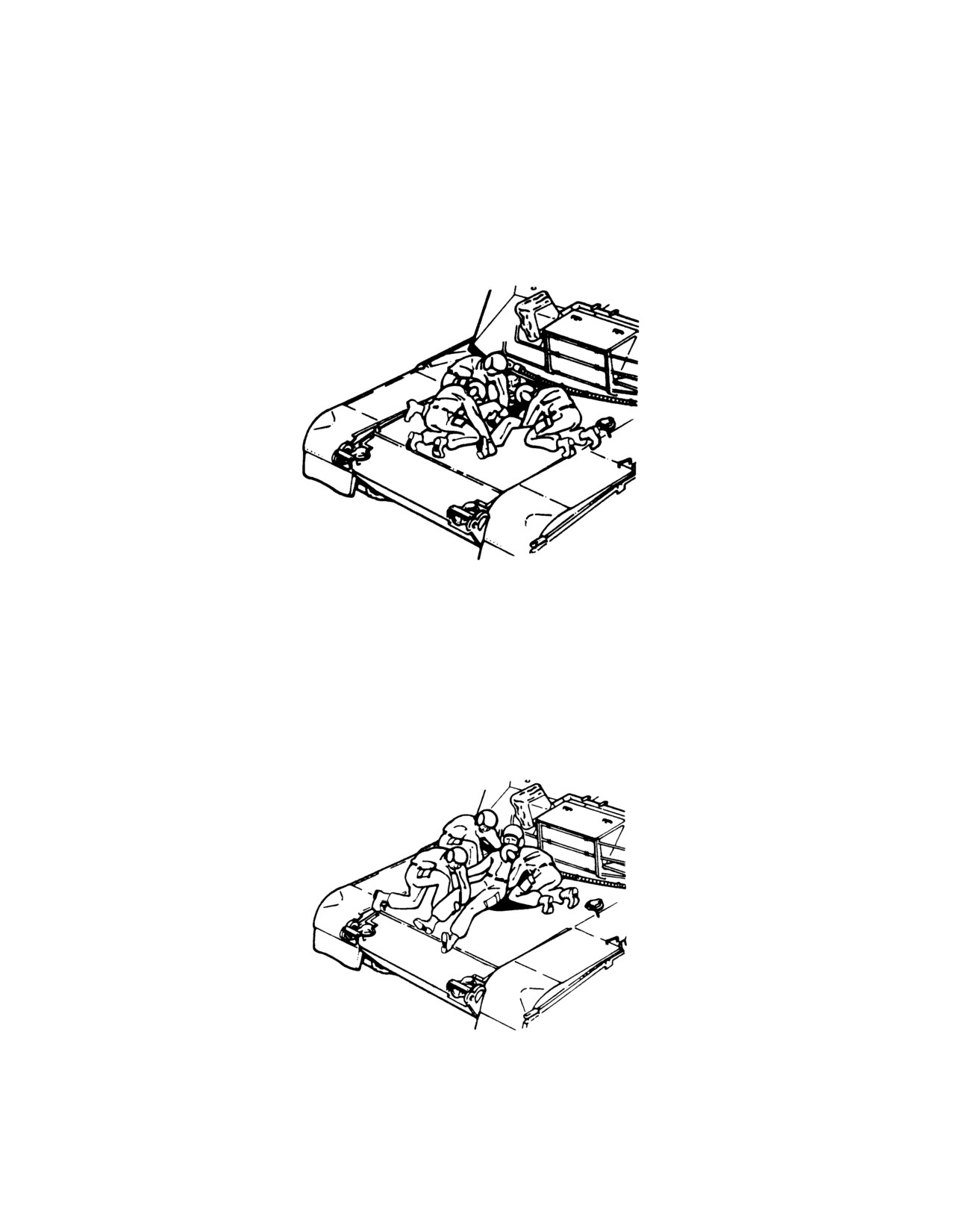
(14) The remaining crew member grasps the injured driver by both ankles (Figure 8-27).
Figure 8-27. Third crew member grasps both ankles of the injured driver.
(15) While stablilizing the injured soldiers head and neck as much as possible, all three crew
members pull and change grips as necessary to remove the injured driver from the drivers hatch opening
(Figure 8-28).
(16) Lay the injured driver on the hull and administer first aid (buddy aid or combat lifesaver
aid) or EMT (combat medic and/or ambulance team member), as appropriate.
Figure 8-28. The crew members place the injured driver on the hull of the tank.
8-31
FM 8-10-6
b. Removing an Injured Crew Member from a Tank Through the Loaders Hatch.
DANGER
Before traversing the turret, make sure the drivers
body is clear of the turret or you could kill him.
NOTE
Three crew members are needed to remove an injured crew member
through the loaders hatch. To remove
An injured driver through the loaders hatch, begin at
Step (1).
Another injured crew member through the loaders hatch,
execute Steps (4), (13), (14), (15), and (16).
(1) The crew member in the turret traverses the turret so that the drivers hatch (1) (Figure
8-21) is under the rear turret (2) and the main gun is over the rear deck.
(2) Lock turret in place.
(3) Open loaders hatch.
(4) Prepare loaders machine gun for travel.
(5) Stow loaders guards.
(6) Stow loaders seat.
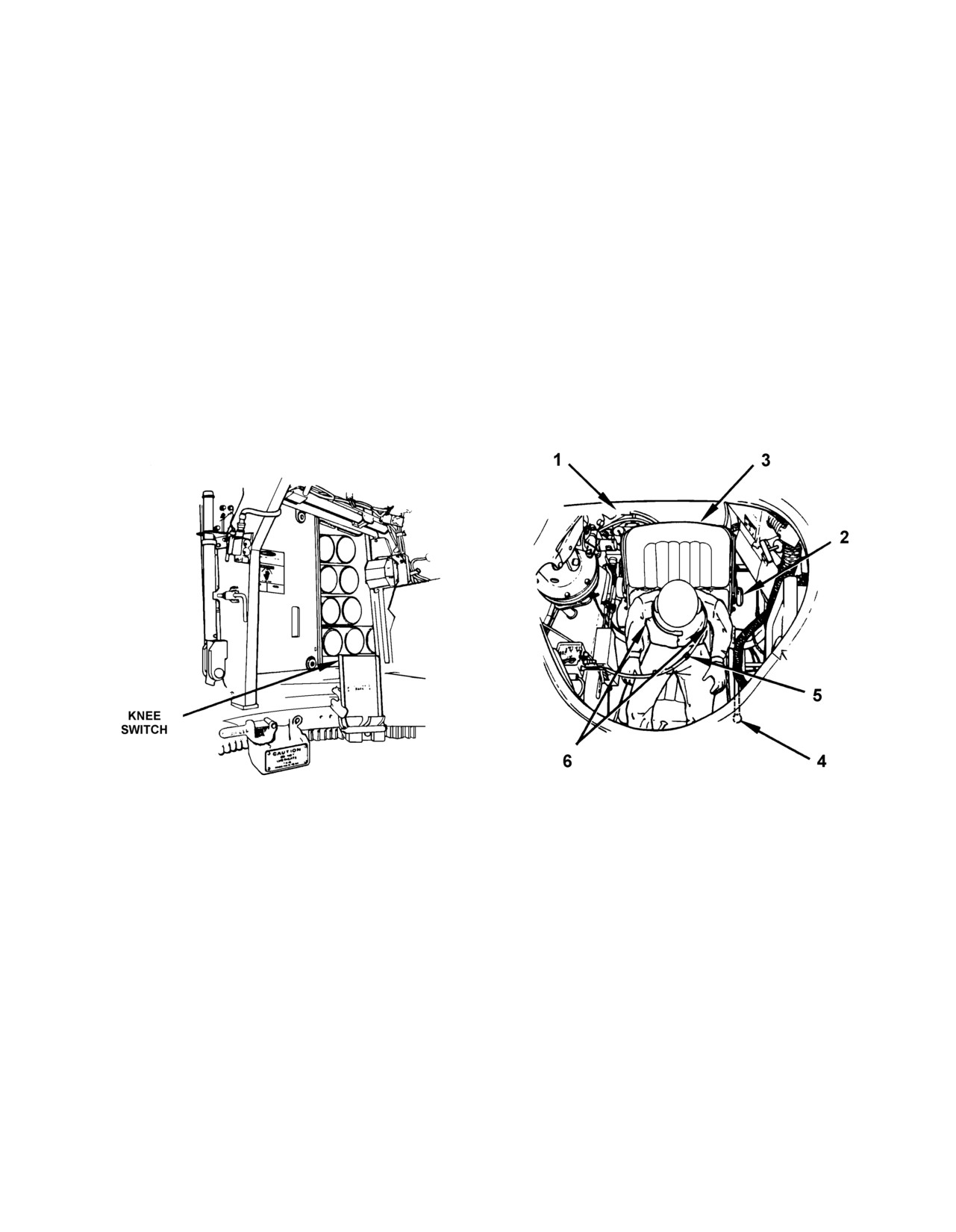
(7) Swing knee switch (Figure 8-29) up to the safe position.
(8) Swing loaders safety guard open.
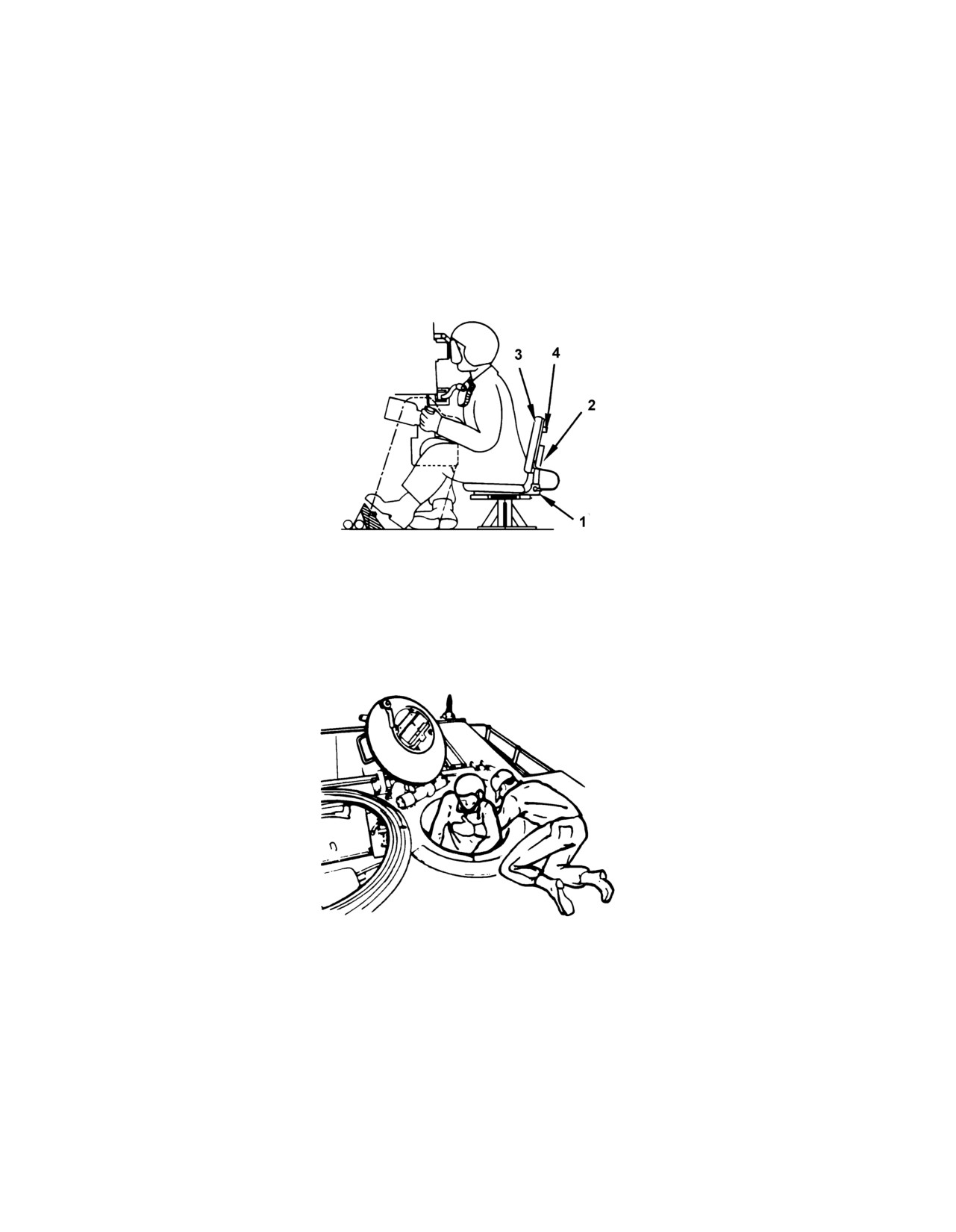
(9) The crew member in the turret reaches into the drivers station (1) and adjusts the seat as
follows (Figure 8-30):
(a) Grasp the upper seat adjustment lever (2) with left hand.
8-32
FM 8-10-6
(b) Push the adjustment lever (2) all the way in and hold.
(c) Grasp the right top corner of the seat back cushion (3) with the right hand; pull it all
the way down.
(d) Let go of the adjustment lever (2).
(e) Make sure the drivers seat is in the down position. If not, grasp the seat lever (4)
with the left hand and push in toward the driver. When the seat starts to go down, let go of the lever (4).
Gently lower the seat.
(f)
Let go of the back seat cushion (2).
Figure 8-29. Knee switch.
Figure 8-30. The drivers station.
(10) The crew member in the turret reaches into the drivers station and disconnects the leads
to the drivers helmet at the quick-disconnect plug.
(11) Raise the headrest to the stowed position and gently lower the drivers head.
(12) One crew member in the turret grasps the injured driver under the arms (6) (Figure 8-30)
and pulls him into the turret. Another crew member in the turret grasps the injured driver and helps to pull
him into the turret.
NOTE
Rescuers should always attempt to stabilize the injured soldiers head
and neck prior to moving him.
8-33
FM 8-10-6
(13) If the gunner is being removed, pull the pins (1) (Figure 8-31) from the seat back posts
(2) and pull the seat back (3) by grabbing the strap (4).
Figure 8-31. Seat assemblage.
(14) Two crew members in the turret move the injured crew member to the area under the
loaders hatch opening (Figure 8-32).
Figure 8-32. Loaders hatch opening.
(15) One crew member gets on the turret next to the loaders hatch opening.
(16) The two other crew members in the turret lift the injured crew member up so that the
crew member on the turret can grasp the injured crew member.
8-34
FM 8-10-6
(17) Close the loaders knee guard.
(18) Lay the injured driver on the turret and administer first aid (buddy aid or combat
lifesaver aid) or EMT (combat medic and/or ambulance team member), as appropriate.
8-8.
Evacuation from the Bradley Infantry Fighting Vehicle
a. Steps in Casualty Evacuation.
(1) Observe the vehicle for fire.
(2) Extract the casualty from the vehicle.
NOTE
As discussed in paragraph 8-7 and within the limits of specific situation
(tactical situation, time available, and equipment availability) the
injured soldiers head and neck should be stabilized prior to ex-
tractation.
(3) Check and treat the casualty.
(4) Evacuate the casualty.
b. Vehicle Exit Procedures.
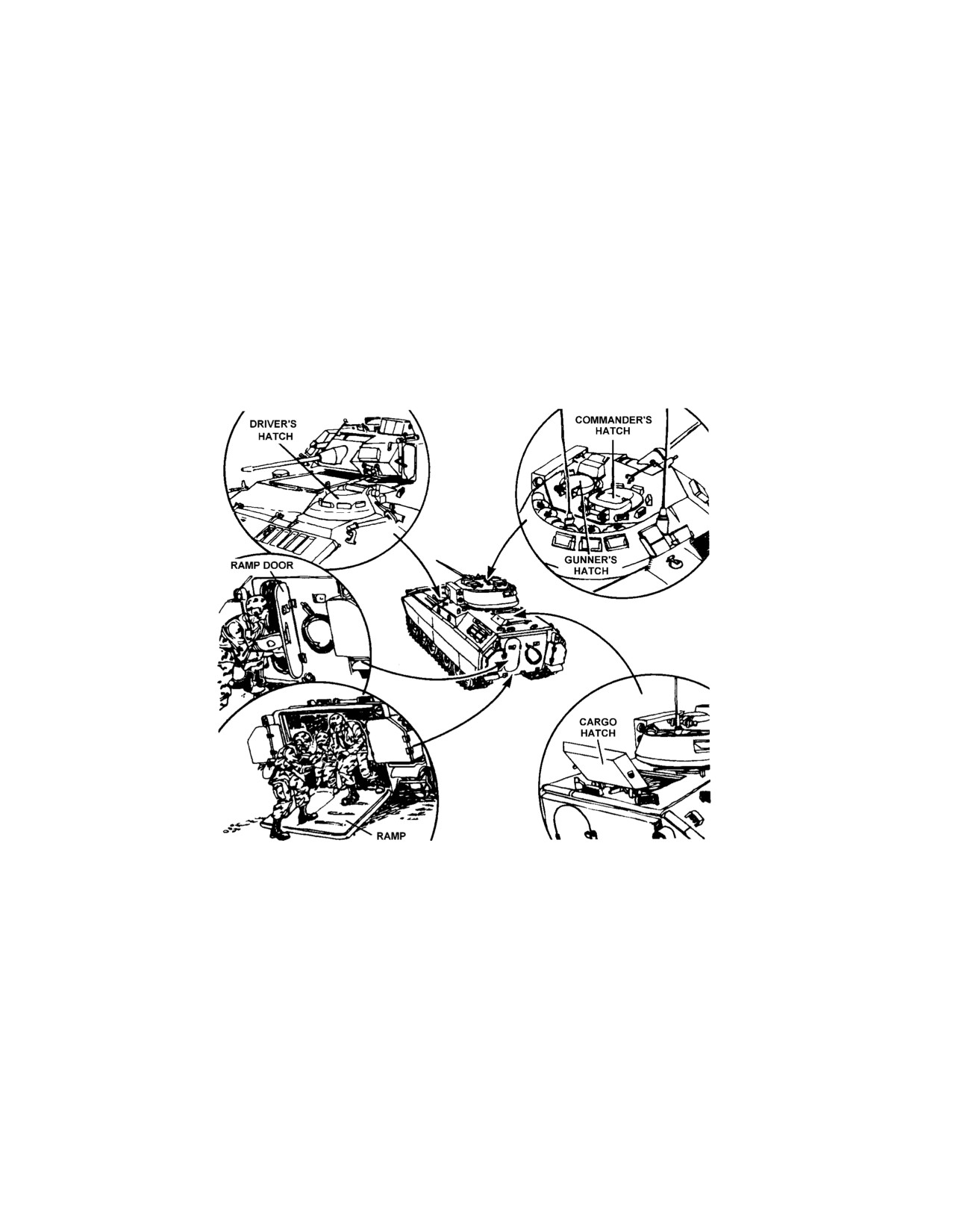
(1) The M2 BIFV is equipped with six exits (Figure 8-33). Some of these exits are used to
evacuate specific crew members while others are used to evacuate any of the crew. The exits are
Commanders hatch.
Gunners hatch.
Drivers hatch.
Cargo hatch.
Ramp door.
Ramp.
(2) When possible, the commanders, gunners, and drivers hatches are the evacuation exits
for personnel from each of these three positions. If any or all of these exits are blocked, or if the tactical
8-35
FM 8-10-6
situation prevents their use, casualties from these three positions are evacuated through the troop
compartment and out the ramp door or the ramp.
(3) The ramp is the main exit used to evacuate casualties from the troop compartment. The
ramp door is used if the ramp is inoperative and cannot be opened. Because of the difficulty in evacuating
casualties through the cargo hatch, it should be used only as a last resort.
Figure 8-33. BIFV exit points.
c.
Casualty Evacuation Procedures.
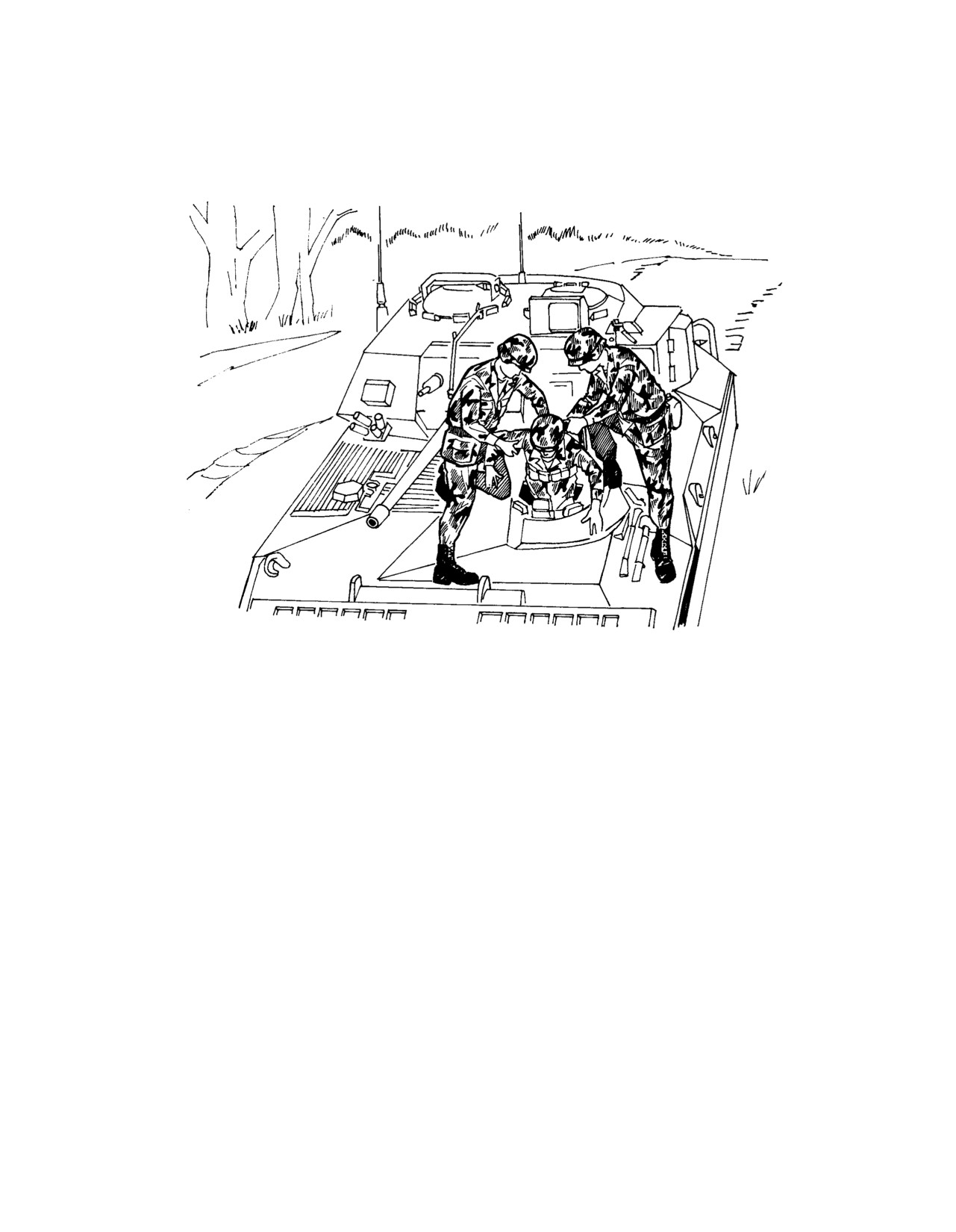
(1) Driver. When possible, the driver is evacuated through the drivers hatch. After the
hatch is unlocked and opened from the outside, one member of the evacuation squad leans, head first, into
the hatch to ensure that the engine is off, range selector is in gear, and hand brake is set. The squad
member raises the drivers seat to the full upright position, unbuckles the drivers seat belt, and removes his
helmet. Depending on the drivers injuries, he is lifted out of the vehicle by two individuals (helped by
another from inside the vehicle when possible). A pistol belt placed around the drivers chest can be used to
help pull him from the vehicle (Figure 8-34).
8-36
FM 8-10-6
Figure 8-34. Evacuating BIFV driver.
(a) If the drivers hatch is inoperable or the vehicle is receiving enemy fire, it may be
necessary to evacuate the driver through the troop compartment and out the ramp. The drivers seat back is
lowered, his seat belt is unbuckled, and his helmet removed. The evacuation team then pulls him over the
vehicle seats taking care not to further injure the driver.
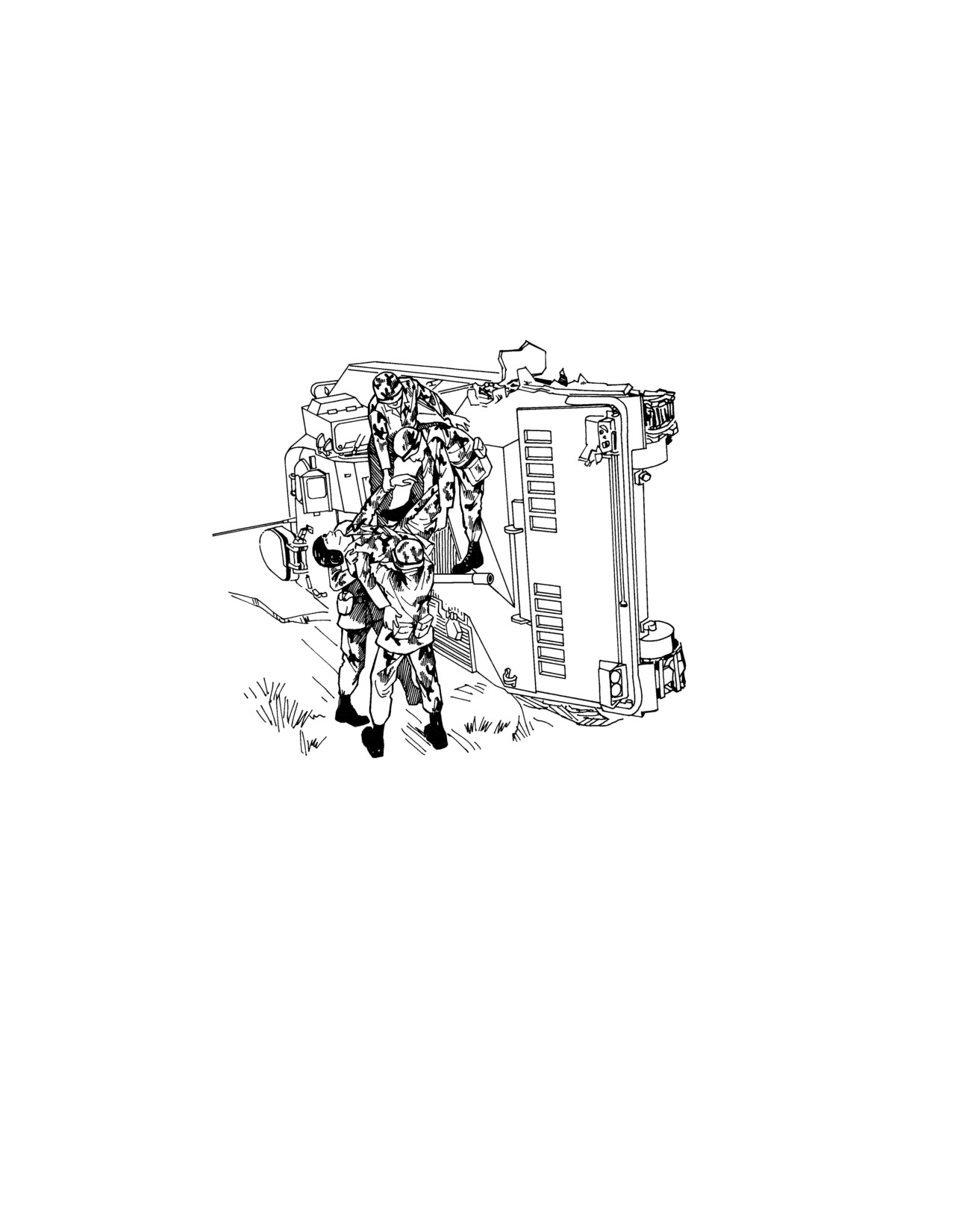
(b) If the vehicle is on its side, the driver must also be supported during the evacuation
process to prevent further injury. If the vehicle is on its left side, it requires two people to remove the
driver because the hatch opening will be next to the ground. If the vehicle is on its right side, four people
will be required to remove the driver and pass him down from the vehicle to the ground (Figure 8-35).
(2) Vehicle commander and gunner. The methods of evacuating the vehicle commander and
the gunner depend upon whether one or both are casualties and whether or not the turret is operational.
(a) If the turret is operational and only one soldier is injured, the uninjured soldier
rotates the turret to the 6400 mil position. This action aligns the turret opening with the turret shield door.
The turret power drive should then be turned off to prevent the turret from moving during the
evacuation. The injured soldier is rotated to the center of the turret and pulled from his seat. He is guided
through the turret shield opening and moved into the troop compartment and out the ramp. If the turret
cannot be rotated, the evacuation must be accomplished through the turret hatches.
8-37
FM 8-10-6
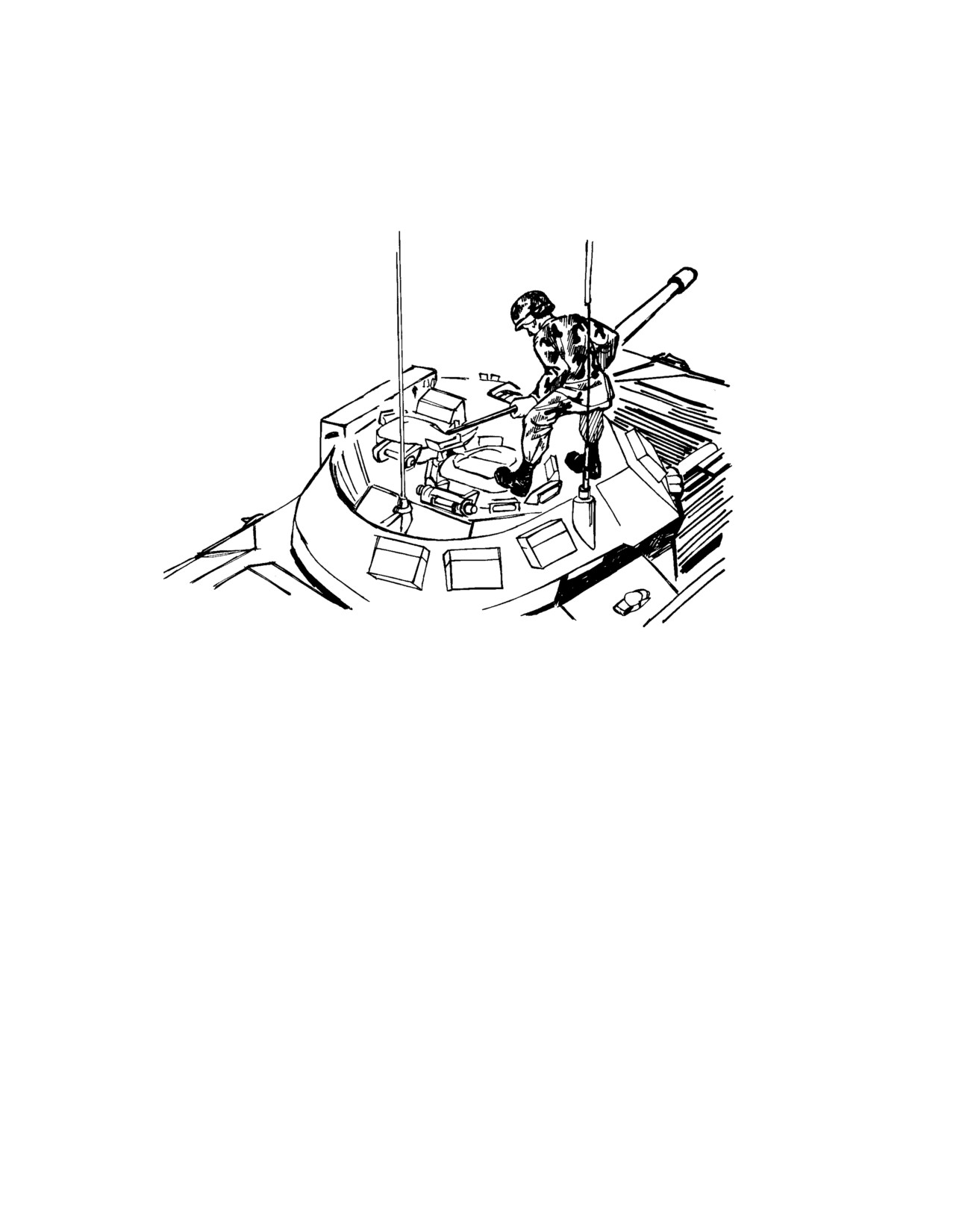
(b) If the turret hatch cover does not function, the hatch will have to be opened from
the top of the vehicle. A crowbar and mattock head are used to pry open the gunners hatch, using the
mattock head as a pivot for the crowbar. The hatch can be opened by prying between the gunners right
periscope and the vehicle commanders left periscope (Figure 8-36).
Figure 8-35. BIFV driver evacuation, vehicle on side.
(3) Soldiers in the troop compartment. Injured soldiers in the troop compartment will be
evacuated through the ramp, ramp door, or cargo hatch. The casualties seat belts must be unbuckled and
their helmets disconnected or headsets removed. They will then be evacuated through the most convenient
exit.
NOTE
During peacetime training and whenever possible, the KED can be
used to remove a casualty from a tank to more effectively stabilize the
spine. Stabilizing the spine should be accomplished with the equip-
ment on hand in all but the most dangerous circumstances.
8-38
FM 8-10-6
Figure 8-36. Opening gunners hatch from outside vehicle.
8-9.
Minefield Extraction
In modern warfare and stability operations and support operations, it is a common occurrence for soldiers to
come upon minefields. Often times the minefield hazard is not recognized until a mine has detonated and a
portion of the unit is already in the minefield. A well-developed, well-rehearsed evacuation drill is
necessary to extract an individual or a unit from a mined area. Units should develop evacuation drills for
both dismounted and mounted operations. It is helpful for units/personnel to observe the local residents to
determine if there is an area that they avoid. Often this is an indication of where a minefield may be
located. Units encountering minefields should seek assistance from their higher headquarters for engineer
or explosive ordnance disposal (EOD) personnel to clear the minefield. However, all soldiers should be
trained on minefield extraction techniques and minefield survival rules (paragraph 8-10). Refer to FM 20-
32 for additional information on mine awareness.
a. Dismounted Extraction.
(1) All personnel freeze and crouch into a low, silhouetted position. Be cautious when
making this movement to ensure that soldiers do not detonate another mine. If a protective mask is worn on
the hip, do not allow it to come in contact with the ground because contact may detonate a mine. Individuals
must overcome the urge to rush to the help of casualties; this will prevent them from also becoming
casualties.
8-39
FM 8-10-6
(2) The leader designates a security element and a soldier to assist in casualty evacuation.
(3) Soldiers extract along the path they entered. They step in the same places as before if
possible; if impossible to do so, they probe their way out.
(4) The security element sets up in a security position. This element should consist of
individuals who are not in the minefield.
(5) The soldier extracting the casualty performs the following steps:
NOTE
Whenever possible, a two-man team should be used to remove an
injured soldier from a minefield. A single soldier carrying a casualty
has a higher potential to stagger under the weight of his burden and/or
to lose his balance and fall.
(a) Probes a 1-meter path to the casualty.
(Refer to the Soldiers Manual of Common
Tasks [SMCT] [Soldier Training Publication (STP) 21-1-SMCT] for additional information.
(b) Marks the cleared path with foot powder or marking tape as it is probed.
(c) Probes around the casualty to clear the area.
(d) Performs first aid (nonmedical soldier) or EMT (medic).
(e) Carry casualty out of the minefield along the cleared path.
(Litter teams do not
enter the area unless a 2-meter path has been cleared to the casualty.)
(6) Once clear of the minefield, the unit marks the threat and assembles back at the rally point.
(7) Report the incident to higher headquarters once you have cleared the minefield. If no
personnel remain in the minefield, you should be 50 to 100 meters away from the minefield before using the
radio. However, if personnel remain in the minefield, you must be at least 300 meters away from it before
transmitting.
CAUTION
DO NOT use the radio in the minefield. If soldiers are in the
minefield and radio transmission is required, move the transmitter
at least 300 meters from the minefield to transmit. This will
prevent accidental mine detonation from the radio signal.
8-40
FM 8-10-6
(8) Evacuate the casualties. It is preferable that dedicated medical evacuation assets be used
due to the severity of trauma wounds sustained from mine detonations. If medical personnel are not
available, the combat lifesaver should provide enhanced first aid and initiate an IV. The combat lifesaver
should accompany the casualties until medical personnel become available.
b. Mounted Extraction.
(1) The convoy commander halts the convoy and reports to higher headquarters.
(2) No vehicles move and no troops dismount unless directed to do so.
(3) Elements provide 360 degree security from vehicles.
(4) Check the disabled/damaged vehicle for casualties. Uninjured passengers should move to
an undamaged vehicle if possible. Troops thrown from vehicles should not move if possible; extract by
using dismounted evacuation procedures, as required. If necessary, casualties will require assistance to
move to another vehicle.
(5) If engineers are not available, the senior leader assesses the situation and directs vehicles
to back up along the entry-route tracks. If an immediate threat exists, occupants of damaged vehicles
evacuate out the rear of the vehicle and along the vehicle-entry tracks. If no immediate threat exists,
occupants of damaged vehicles remain in the vehicle until it is extracted.
(6) If engineers are available, they sweep the area and provide a cleared path for movement.
Vehicles are recovered from the minefield using the following procedures:
(a) Engineers clear a lane that is wide enough for towing the vehicle.
(b) If an M88 is unavailable, use all available tow cables to increase the distance before
towing.
NOTE
The M88 has a wider track base than other tracked vehicles. The
actual scenario, availability of vehicles, and the placement pattern of
the mines will determine if a vehicle other than the M88 may be used.
(c) Ensure that all towing shackle sets are complete and mounted.
(d) The towing vehicle should have tow cables on the front and the rear if possible.
(e) Rear cables should be attached to the lower mounts; this allows the crew to recover
the vehicle without touching the ground.
8-41
FM 8-10-6
(f)
Pull the vehicle out at least two-vehicle lengths before switching to a tow bar.
(g) When towing a vehicle after a mine strike, the chance of fire is greater because of
possible damage to the vehicle.
(7) Evacuate the casualties. It is preferable that dedicated medical evacuation assets be used
due to the severity of trauma wounds sustained from mine detonations. If medical personnel are not
available, the combat lifesaver should provide enhanced first aid and initiate an IV. The combat lifesaver
should accompany the casualties until medical personnel become available.
(8) Road guards guide vehicles through the safe area.
(9) Mark, record, and report the threat if not accomplished by this time.
8-10. Rules for Surviving Minefields and Acquiring Casualties
a. As the number of minefields encountered in stability operations and support operations
increases, it is important that each soldier be trained in and aware of rules for surviving minefields.
Soldiers should consider that all terrain and structures are potentially mined or booby-trapped. The rules
for surviving minefields are
If you did not drop it, do not pick it up.
Beware of areas associated with basic human needs. They could be mined or booby-
trapped.
Leave mine disposal to the EOD personnel and combat engineers.
All terrain and structures are potentially mined or booby-trapped.
Avoid touching or removing foreign objects, no matter how attractive. They could be
mined or booby-trapped.
Stay on the traveled road. Adjacent areas may be mined.
Do not use the radio while in the minefield (paragraph 8-9a[7]).
Immediately report all confirmed or suspected mines.
Mark and avoid unexploded ordnance (UXO) if possible. Consider them unstable.
Develop and rehearse effective evacuation drills.
8-42
FM 8-10-6
b. In convoy movement, some rules of thumb should be considered. The lead vehicle should be
one of the heaviest vehicles in the unit and be hardened against a mine threat. They provide better protec-
tion against mine and UXO threat. If possible, do not lead a convoy with a HMMWV. This type of vehicle
is extremely vulnerable to mine and UXO threat and is difficult to harden without commercial products.
c.
Procedures for removing casualties from minefields must be included in the unit TSOP.
Medical personnel and units may become involved with minefield extraction operations should they
encounter a minefield, or if they are assisting a supported unit.
NOTE
It must be strongly emphasized to all soldiers that rushing to help a
mine victim can lead to the rescuer becoming a casualty.
d. Medical personnel should
Reassure the casualty that help is coming. Assess the conscious casualtys medical
condition. Direct self-aid measures, as appropriate. Advise the casualty not to attempt to move.
Do not panic and create another casualty.
Notify the higher headquarters of the situation and request engineer support.
Extract yourself (if located in the minefield), marking the path as you go.
Reenter along the marked path if one exists.
Clear a path to the casualty (paragraphs 8-9 and 8-10).
Provide EMT.
Once the area is clear, mark it, record it on the map, and report to higher headquarters.
e.
Medical personnel should anticipate and train for mine explosion injuries. Ground and air
medical evacuation personnel should refine their skills for the care of these patients while en route from the
point of injury to the supporting MTF. Unit medics should also train combat lifesavers to more effectively
provide enhanced first aid for these injuries. Mine explosion injuries include
Blast injuries with fragments embedded.
Burns.
Traumatic amputations.
Blunt trauma.
Psychological anxiety reaction.
8-43
FM 8-10-6
CHAPTER 9
LITTER EVACUATION
9-1.
General
After patients are picked up in a forward area by litter bearers, they may be moved by surface or air assets
to points as far to the rear as required by their medical condition and the tactical situation. The patient who
must be transported on a litter is referred to as a litter patient.
This paragraph implements STANAG 2040 and QSTAG 519.
9-2.
Types of Litters
A litter may be prefabricated or may be improvised from available materials. The Armed Forces use
several types of standard litters. This standardization allows a patient to travel in various vehicles on the
same litter; thereby, minimizing the possibility of further injury and saving valuable time.
a. Standard Litters. Standard litters are prefabricated and may have accessories to be used with
them.
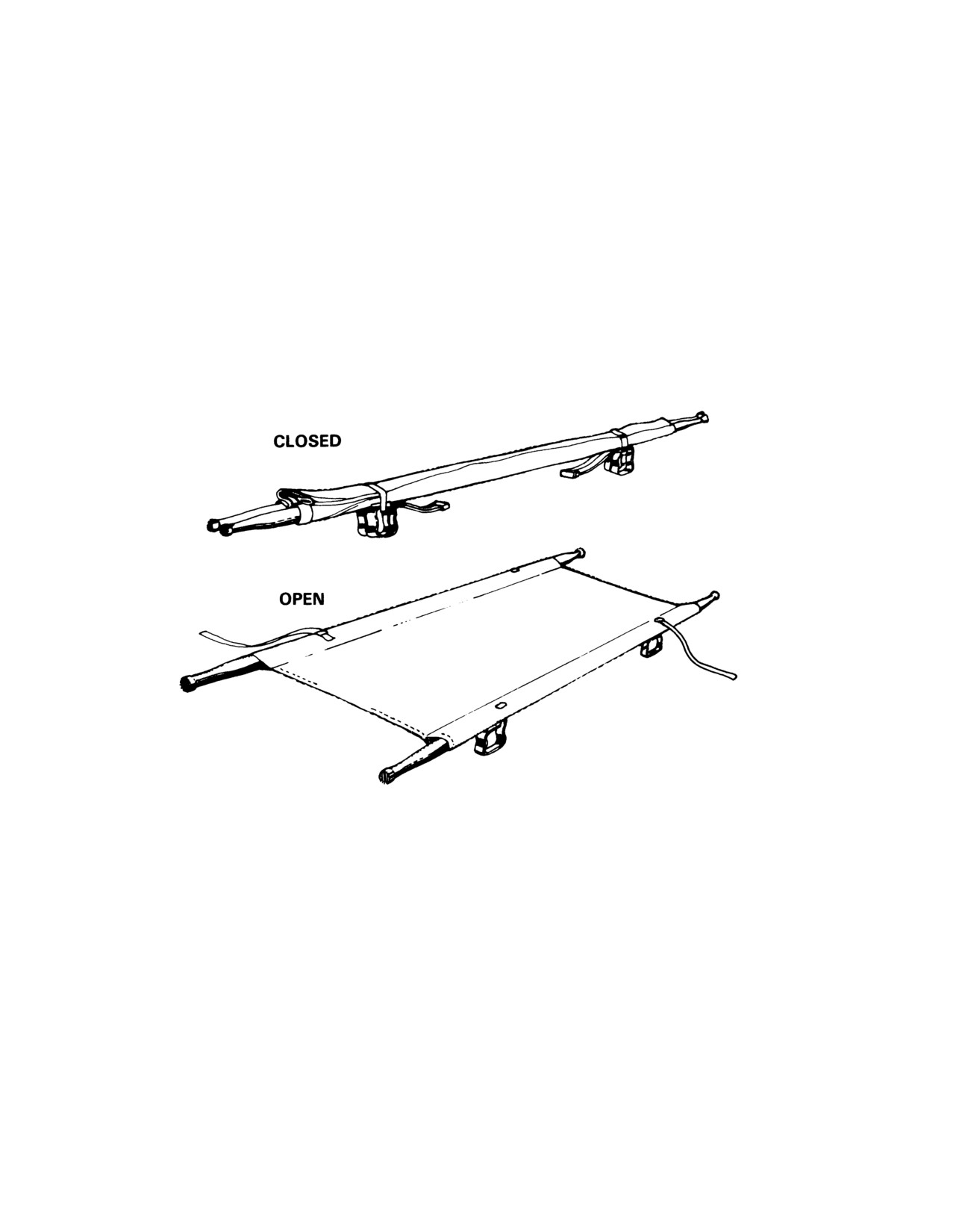
(1) The standard collapsible litter is the most widely used (Figure 9-1). It folds along the
long axis only.
(a) The basic components of the litter are
Two straight, rigid, lightweight aluminum poles.
A cover (bed) of cotton duck.
Four wooden handles attached to the poles.
Four stirrups (one bolted near the end of each pole). The stirrups support the
litter when it is placed on the ground.
Two spreader bars (one near each end of the litter). These bars are extended
crosswise at the stirrups to hold the cover taut when the litter is open.
Two litter securing straps (one attached to each pole at the stirrup bolts).
These straps are used to secure the litter when it is closed.
Accessories such as patient securing straps.
(b) Dimensions of the standard collapsible litters are as follows:
Overall length is 90 inches.
9-1
FM 8-10-6
Overall width is 227/8 inches.
Bed length is 72 inches.
Bed width is 227/8 inches.
Weight is 15 pounds.
Figure 9-1. Standard collapsible litter.
NOTE
The standard collapsible litter is being replaced by the litter, folding,
rigid pole and will be phased in as the standard collapsible litters are
replaced. The new litter is 91.6 inches long with nominal adjustable
handles (from 90 inches to 94.4 inches). It has a spreader bar and
stirrup assemblies with interlocking securing buckles. It has aluminum
poles, nylon handles, and a plastic polypropylene cover. This litter
can be decontaminated and is painted with a chemical agent resistant
material. It is assembled in the folded position and weighs 25 pounds.
9-2
FM 8-10-6
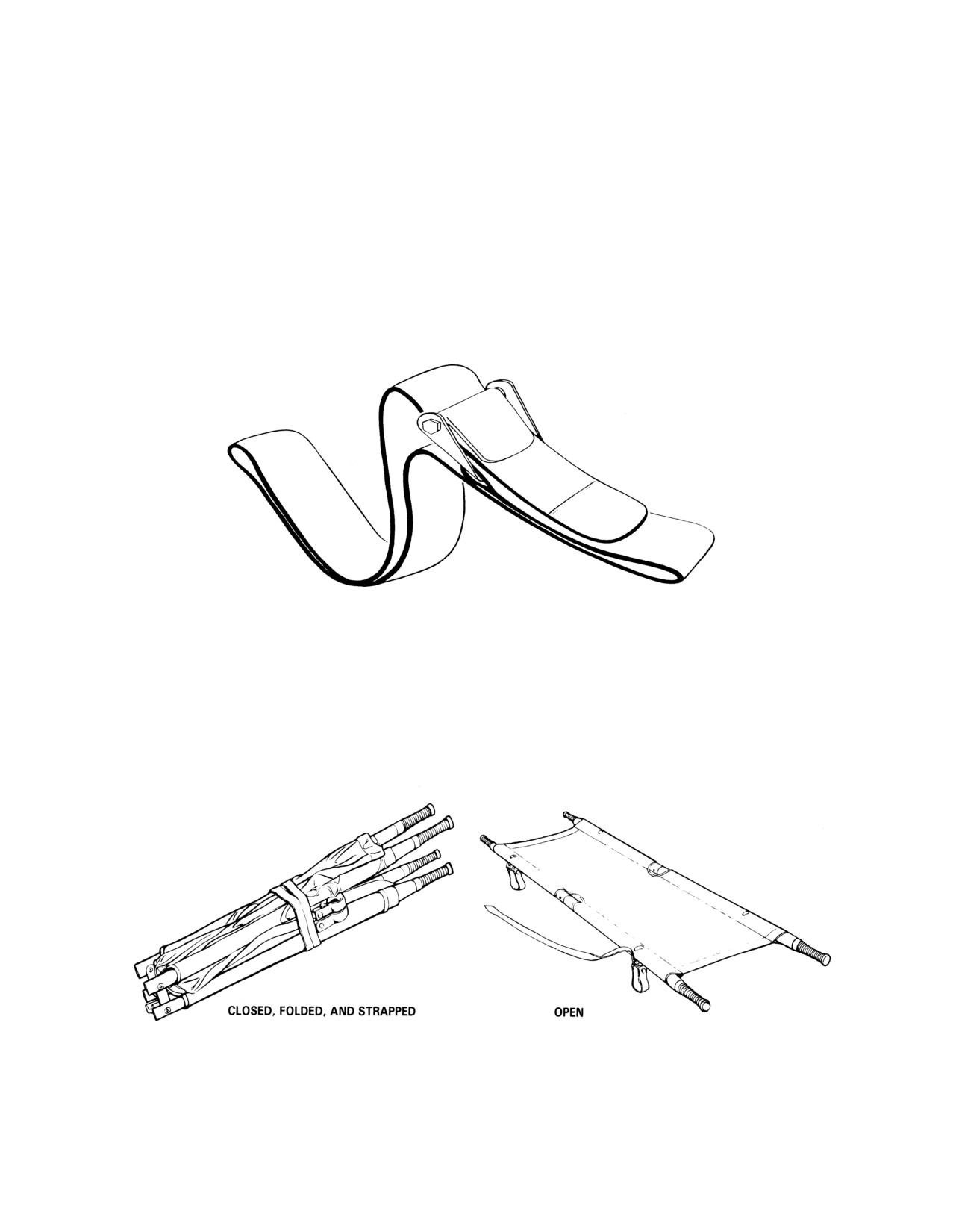
(2) The patient securing strap (Figure 9-2) is used to hold the patient in position on the litter.
It is designed to fit the straight and folding aluminum litters as well as other standard litters. It is available
in quantities of four per litter. This strap can also be used with an improvised litter and as a patient
restraint, if required. It is made from a 6-foot length of 2-inch webbing and a buckle with a locking device
and spring.
Figure 9-2. Patient securing strap.
(3) Another standard litter, with the same general dimensions when open, is the folding
aluminum litter. It has folding lightweight aluminum poles (Figure 9-3). The poles can be folded to one-
half their length when the litter is not in use.
Figure 9-3. Folding aluminum litter.
9-3
FM 8-10-6
(4) The poleless semirigid litter (Figure 9-4) is useful in evacuating patients from ships and
in mountainous areas. It holds the patient securely in position and facilitates the movement of the patient in
a vertical position. The dimensions of this litter are overall length, 833/4 inches; overall width, 223/4 inches;
and it weighs 183/4 pounds. The basic components are
Semirigid cotton duck with wooden supports.
Four webbing handles (two at each end). These straps can be used when the litter is
carried by four bearers.
Four loops. These loops are used to insert the poles for carrying.
Headpiece. This is used to support the patients head.
Seven patient securing straps. These straps are used to secure the patient to the litter.
Figure 9-4. Poleless semirigid litter.
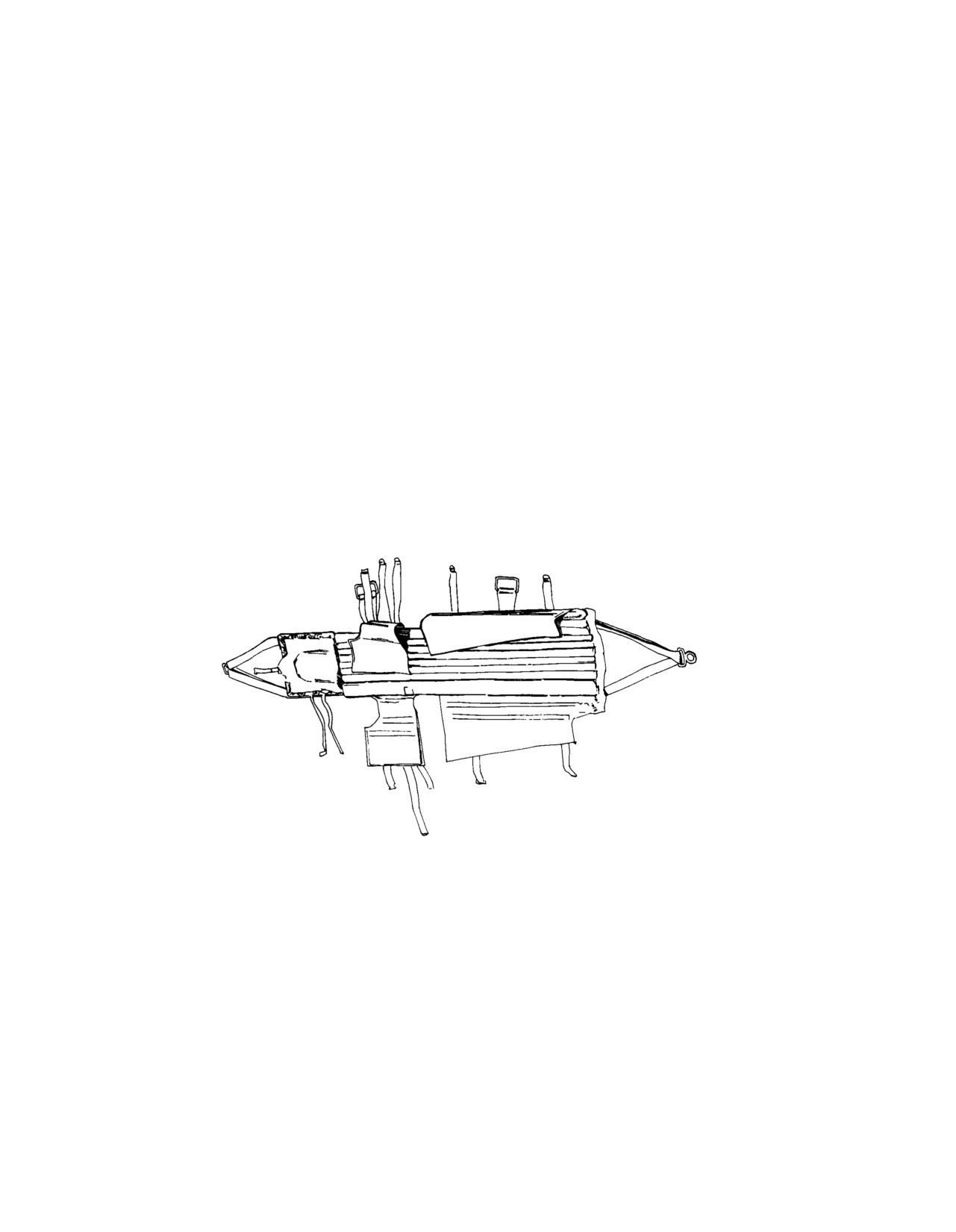
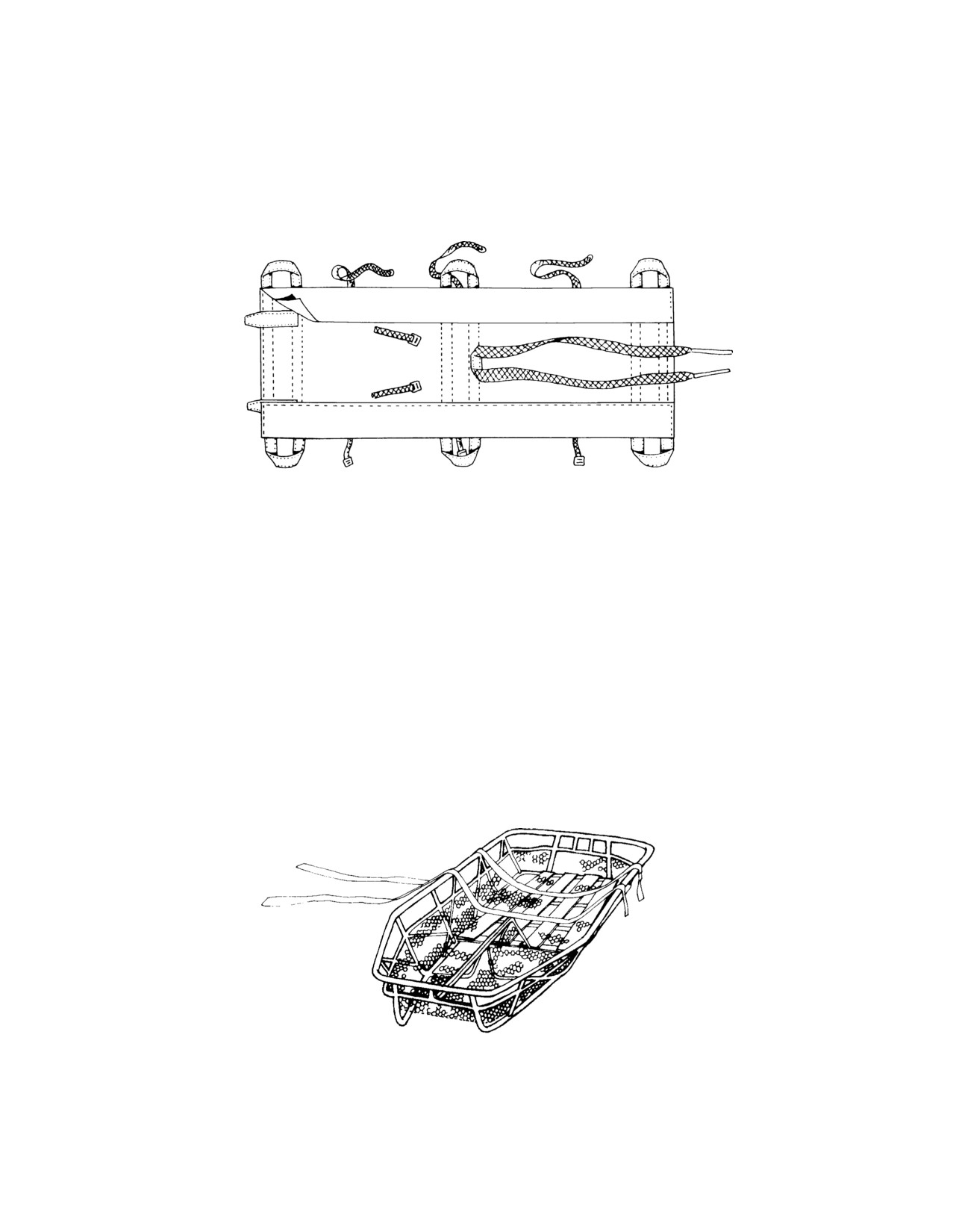
(5) The poleless nonrigid litter (Figure 9-5) can be folded and carried by the combat medic.
It has folds into which improvised poles can be inserted for evacuation over long distances. It also has
slings for hoisting, lowering, and carrying, and patient securing straps to secure the patient to the litter.
(Refer to paragraphs E-34 through E-37 for additional information.)
(6) The Stokes litter (Figure 9-6) affords maximum security for the patient when the litter is
tilted.
(For additional information, refer to paragraphs E-30 through E-33.) The dimensions and basic
components and their functions of the litter are provided below.
9-4
FM 8-10-6
Figure 9-5. Poleless nonrigid litter.
It is composed of a steel or aluminum tubular frame supporting a bed of wire mesh
netting. It also has wooden support slats to support the patients back.
The lower half is divided into two compartments to accommodate the patients
legs.
It has four webbed patient securing straps for use in securing the patient.
It has ropes, cables, or steel rings that can be attached to the litter as required for
vertical recoveries.
Its dimensions are length, 84 inches; width, 23 inches; and weight, 311/2 pounds.
Figure 9-6. Stokes litter.
9-5
FM 8-10-6
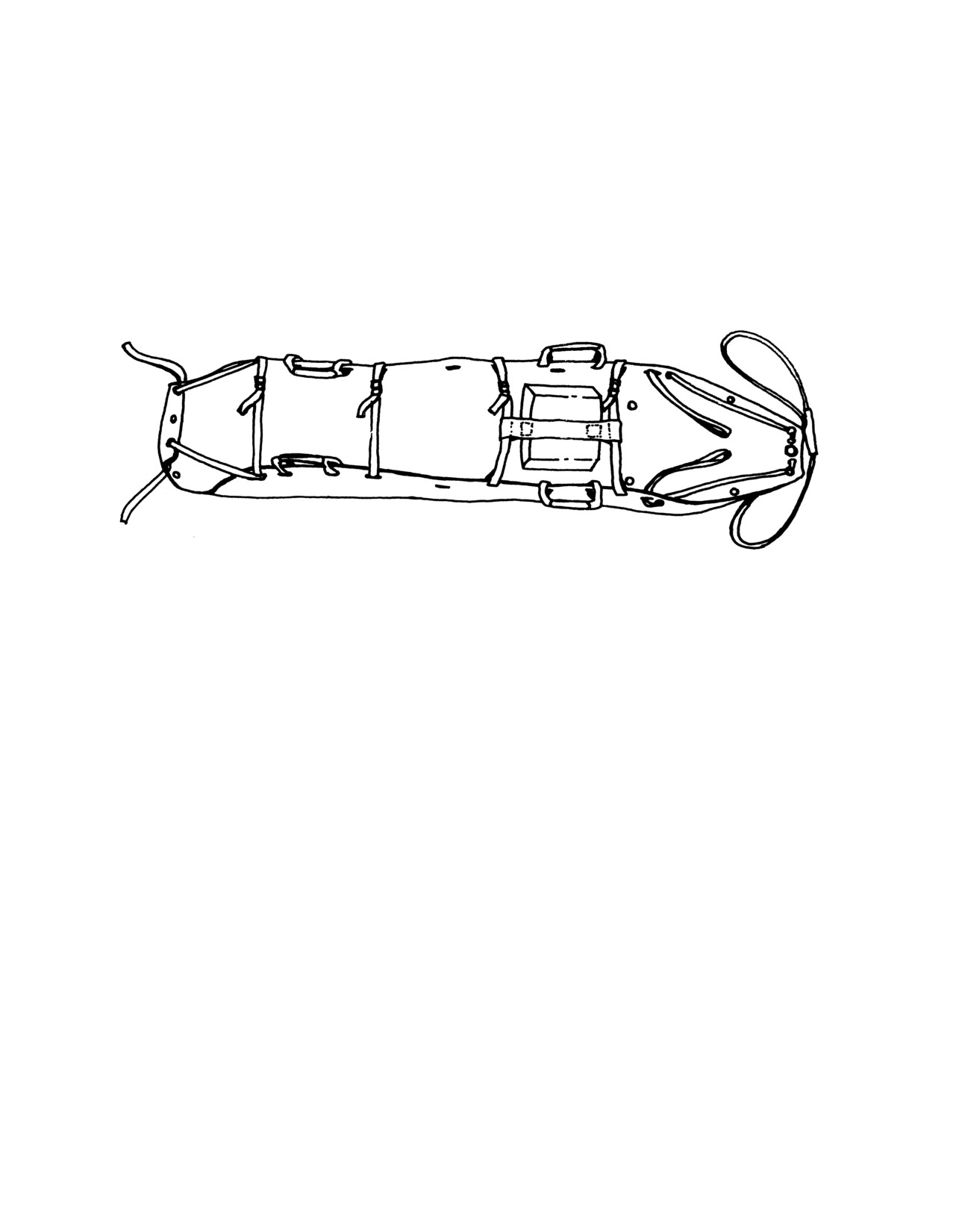
(7) The SKED litter (Figure 9-7) is a compact and lightweight transport system used to
evacuate a patient over land. It may also be used to rescue a patient in the water. Detailed information on
this system is contained in paragraphs E-26 through E-29.
Figure 9-7. SKED litter.
b. Improvised Litters. Improvised litters are those made from various materials normally available
in the forward area.
(1) There are times when a patient may have to be moved and a standard litter is not
available. The distance may be too great for manual carries (Chapter 8) or the patient may have an injury
(such as a fractured neck, back, hip, or thigh) that would be aggravated by manual transportation. In these
situations, litters can be improvised from materials at hand. Improvised litters must be as well constructed
as possible to avoid the risk of dropping or further injuring the patient. Improvised litters are emergency
measures and must be replaced by standard litters at the first opportunity.
(2) Many different types of litters can be improvised, depending upon the materials available.
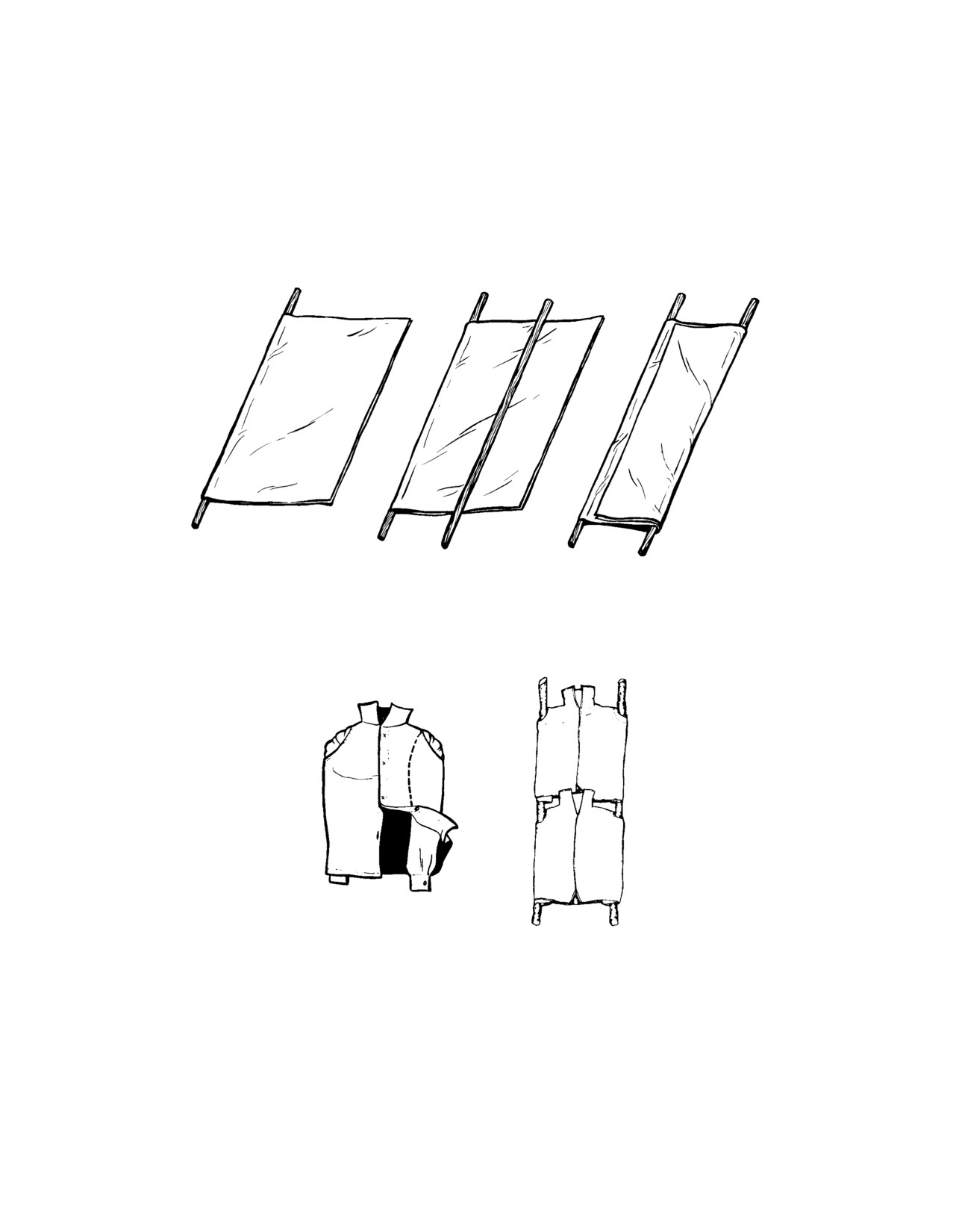
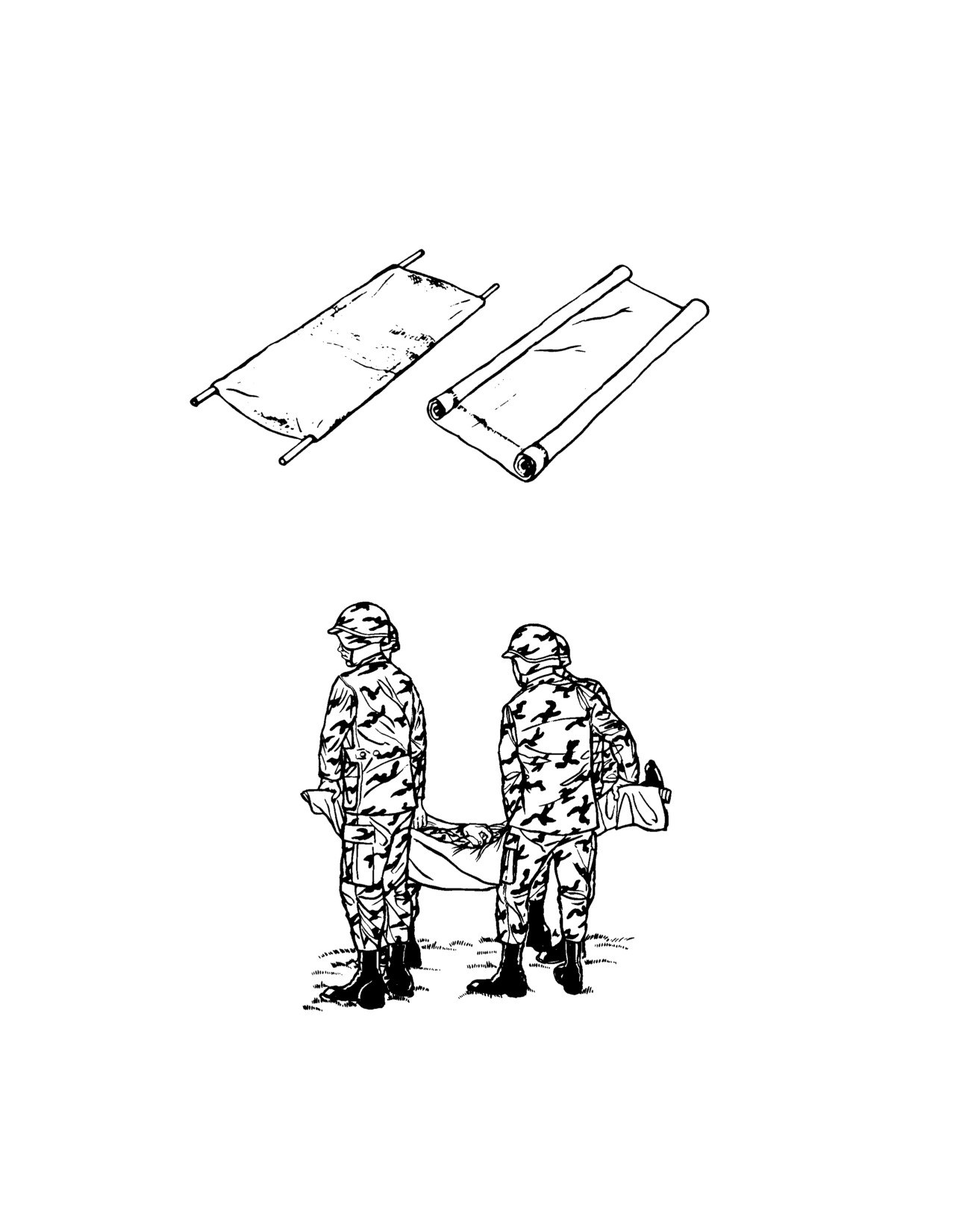
A satisfactory litter can be made by securing poles inside such items as a blanket (Figure 9-8), poncho,
shelter half, tarpaulin, mattress cover, jackets, shirts (Figure 9-9), or bedticks, bags, and sacks (Figure
9-10). Poles can be improvised from strong branches, tent poles, skis, lengths of pipe, and other objects. If
objects for improvising poles are not available, a blanket, poncho, or similar item can be rolled from both
sides toward the center so the rolls can be gripped for carrying a patient (Figure 9-11). Most flat-surface
objects of suitable size can be used as litters. Such objects include doors, boards, window shutters,
benches, ladders, cots, and chairs. If possible, these objects should be padded for patient comfort.
(a) To improvise a litter using a blanket and poles, the following steps should be used:
Open the blanket and lay one pole lengthwise across the center; then fold the
blanket over the pole
Place the second pole across the center of the folded blanket.
9-6
FM 8-10-6
Fold the free edges of the blanket over the second pole and across to the first
pole.
Figure 9-8. Litter made with blanket and poles.
(b) To improvise a litter using shirts or jackets, button the shirt or jacket and turn it
inside out, leaving the sleeves inside, then pass pole through the sleeves.
Figure 9-9. Litter improvised from jackets and poles.
(c) To improvise a litter from bedticks, bags, and sacks and poles, rip open the corners
of bedticks, bags, or sacks; then pass the poles through them.
(d) If no poles are available, roll a blanket, shelter half, tarpaulin, or similar item from
both sides toward the center. Grip the rolls to carry the patient.
9-7
FM 8-10-6
Figure 9-10. Litter improvised from bed sacks and poles.
Figure 9-11. Rolled blanket used as litter.
9-8
FM 8-10-6
9-3.
Dressed Litter
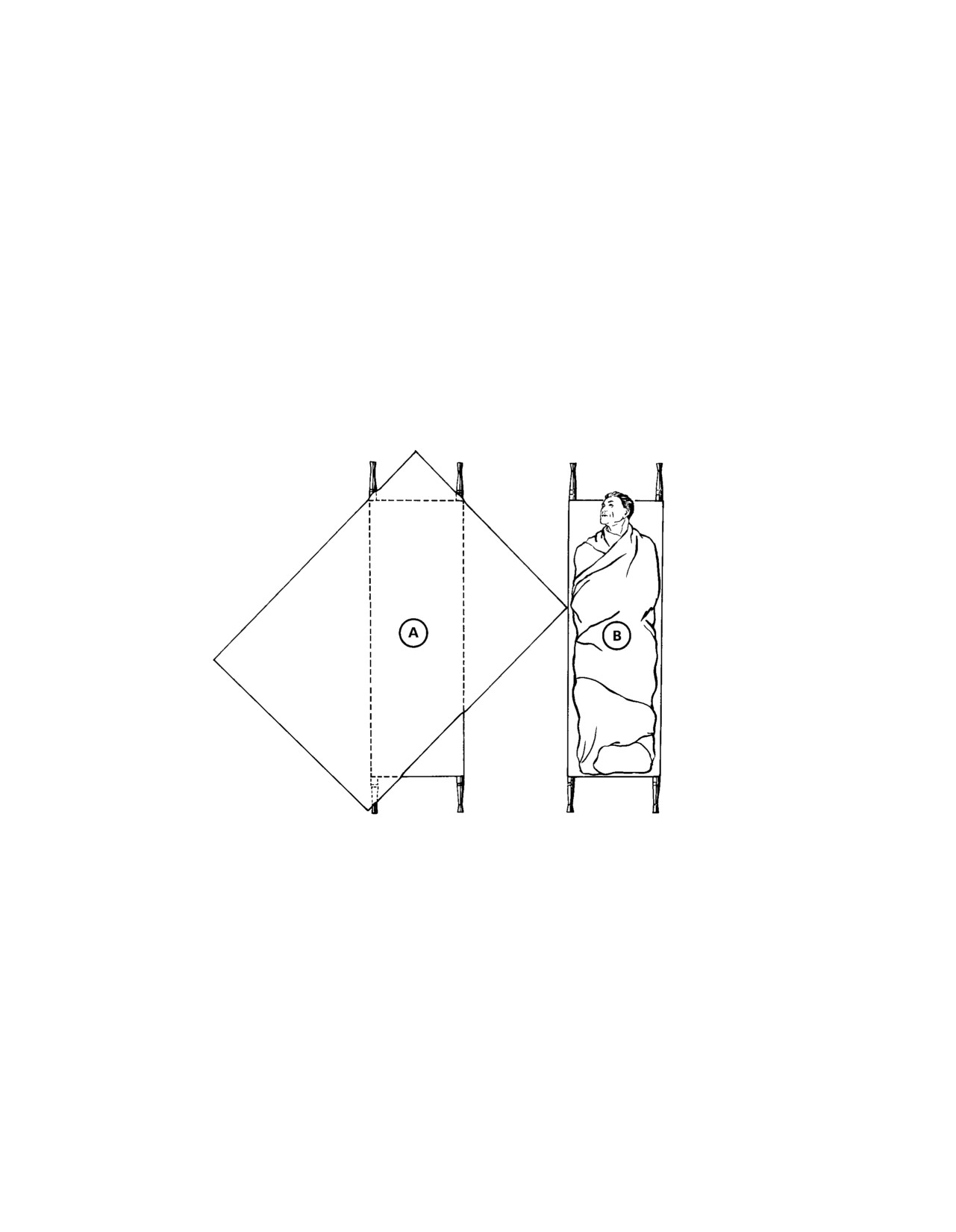
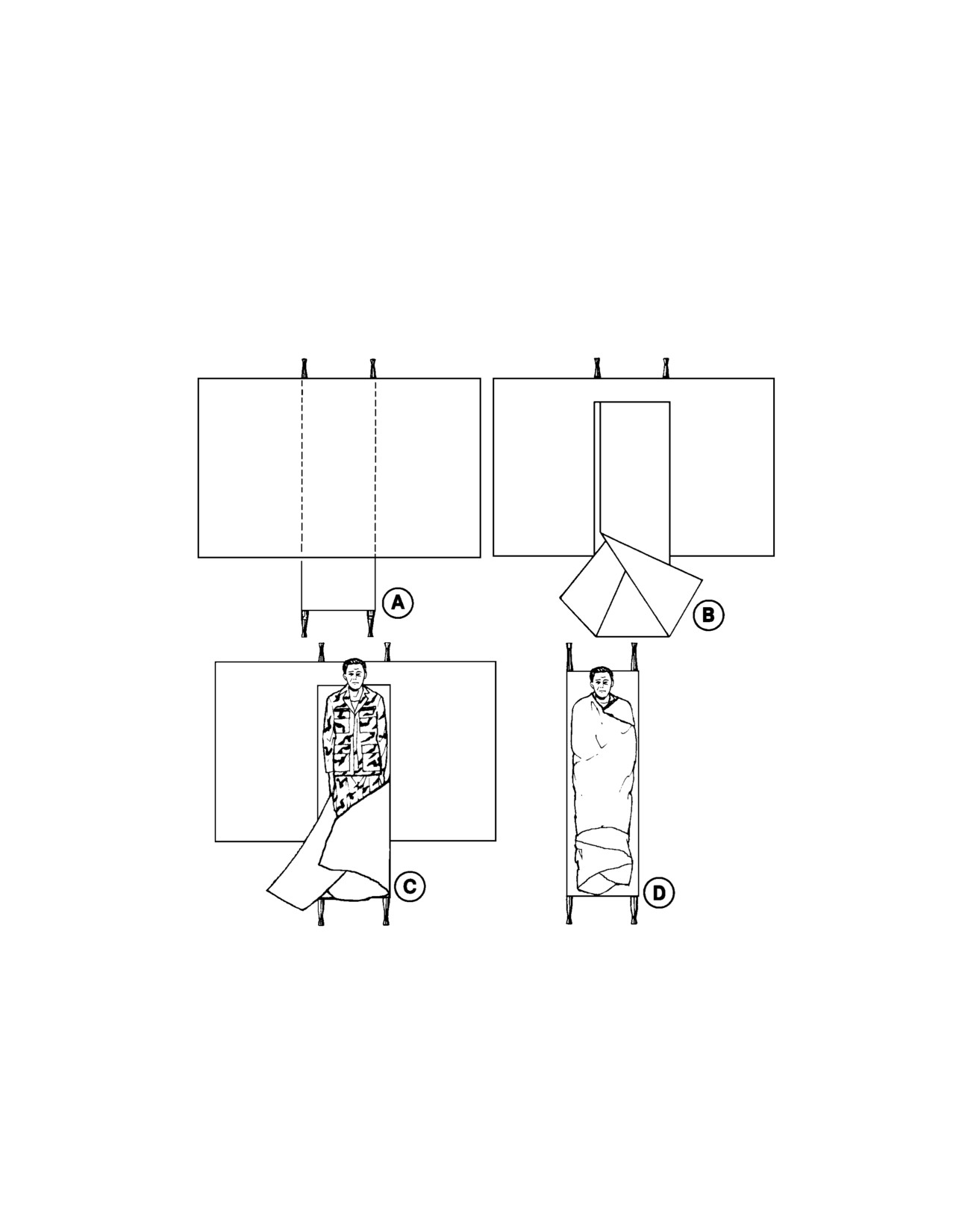
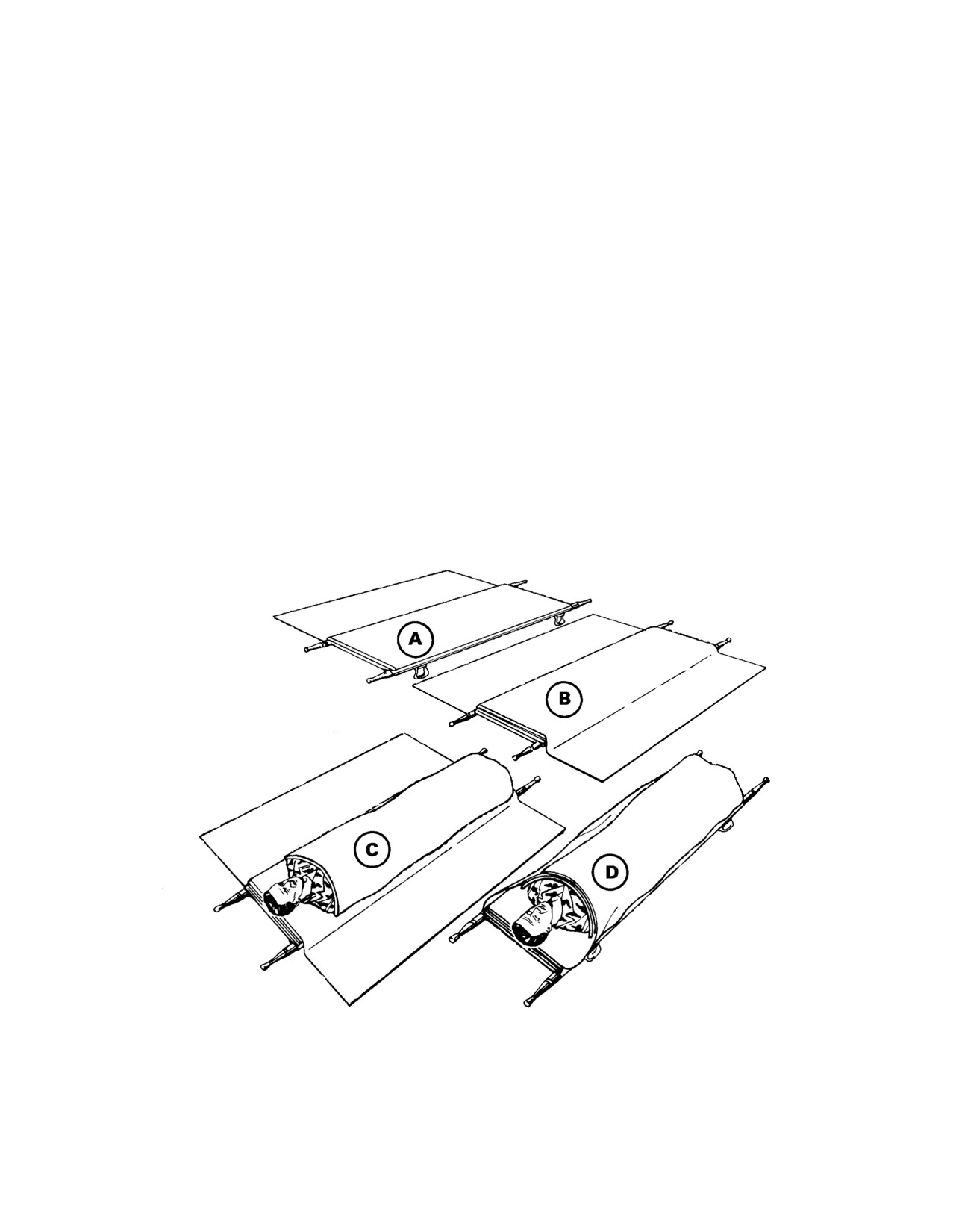
A litter is dressed with one, two, or three blankets (Figures 9-12 through 9-14) to reduce the danger of
shock and to afford warmth and comfort during transport. In an NBC environment, the litter should be
dressed with an impermeable cover (rubber poncho or similar material). This cover is folded over the
patient to prevent additional exposure to contaminants. If an impermeable cover is not available, a blanket
can be used.
a. To dress a litter with one blanket (Figure 9-12), place the blanket diagonally over the litter.
After the patient is placed on the litter, bring the sides of the blanket over the patient and tuck in the edges at
his head and feet.
Figure 9-12. Dressing the litter with one blanket.
b. To dress a litter with two blankets (Figure 9-13), place the first blanket lengthwise across the
litter with the blanket edge just beyond the head end of the litter. The second blanket is folded in thirds,
lengthwise, and placed over the first blanket. Let the upper edge of the second blanket drop about 10 inches
below the upper edge of the first one. Open the folds on the second blanket about 2 feet from the foot end.
After the patient is placed on the litter, bring the bottom of the blanket up and over the patients feet. Leave
a small fold between his feet. Tuck the two folds closely over and around his feet and ankles. Open the
folds on the second blanket about 2 feet from the foot end. After the patient is placed on the litter, bring the
bottom of the blanket up and over the patients feet. Leave a small fold between his feet. Tuck the two
folds closely over and around his feet and ankles. Finally, wrap the patient with one side and then the
opposite side of the first blanket.
9-9
FM 8-10-6
NOTE
If the patient to be placed on the litter is tall, the blanket should be
placed lower on the litter.
Figure 9-13. Dressing the litter with two blankets.
c.
To dress a litter with three blankets (Figure 9-14), place the first blanket on the litter lengthwise
so that one edge is even with the litter pole farthest from you. The upper end of the blanket is even with the
head of the canvas. Fold the blanket back upon itself once, so that the folded edge is along the litter pole
9-10
FM 8-10-6
nearer you and the outer edge of the blanket overhangs the other pole. Place the second blanket lengthwise
over the first one as described above, except start with the opposite litter pole so that the blanket overhang is
on the opposite side of the first blanket. After the patient is placed on the litter, fold the third blanket once
lengthwise and place it over the patient with one end under his chin. Fold the overhanging edges of the first
two blankets over the third blanket and secure them in place with safety pins, if available, or patient
securing straps.
NOTE
This method of dressing the litter gives four thicknesses of blanket
over and under the patient. This provides additional warmth and will
help in preventing shock.
Figure 9-14. Dressing the litter with three blankets
9-11
FM 8-10-6
9-4.
Using Patient Securing Straps
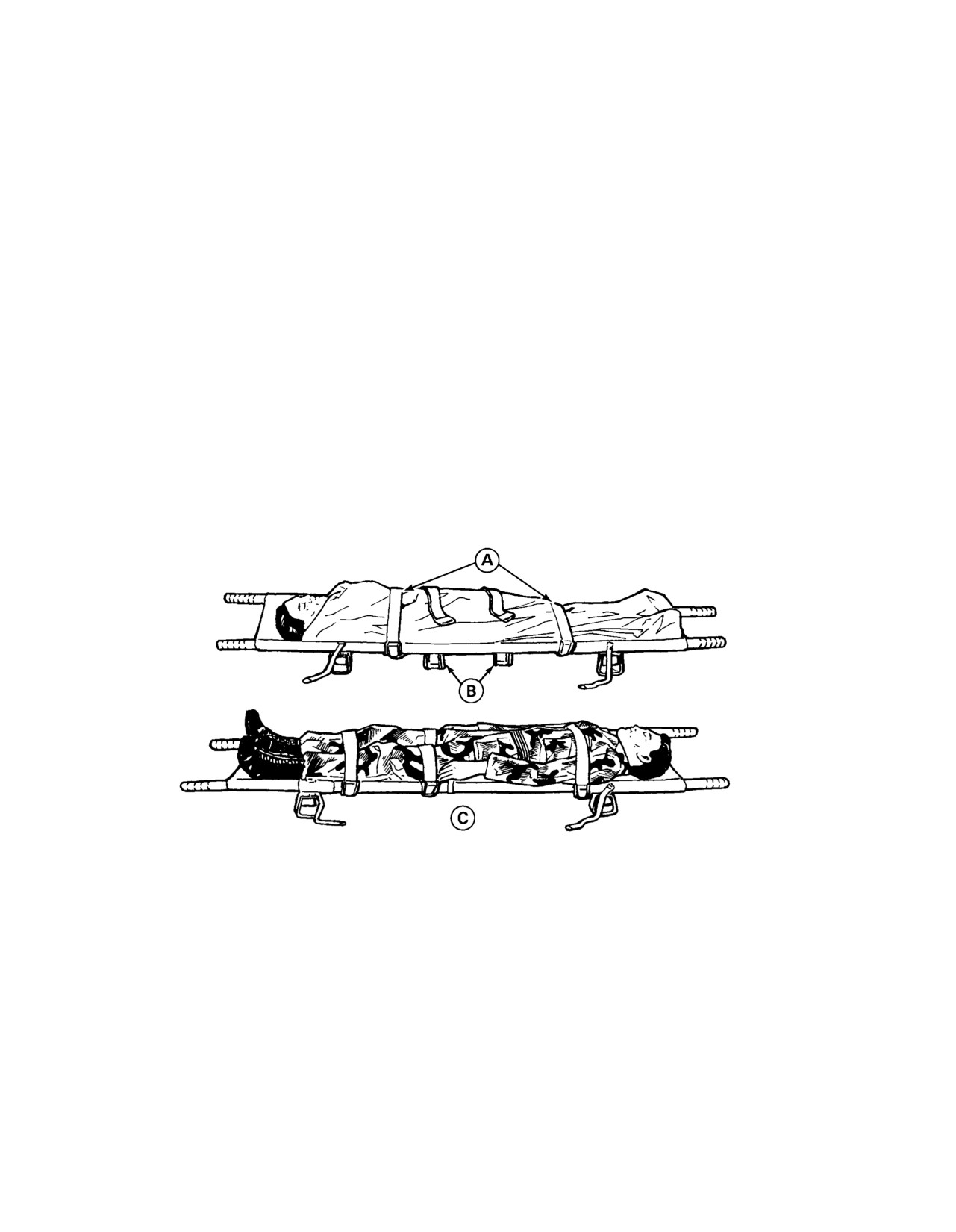
After the patient is placed on the dressed litter and covered, the patient securing straps are used to hold him
in position. The number of straps and the body parts over which they should be placed depend upon the
type of terrain over which the patient is to be carried (Figure 9-15).
If only two straps are necessary, put one strap across the chest and one across the legs, just
below the knees. Extend the straps under the litter and buckle them against the litter pole.
If the terrain is rough, apply two additional straps. One is placed across the waist and the
other across the thighs. Again, extend them under the litter and buckle them against the litter pole.
If the patient is being carried either up or down steep slopes, use the two additional straps to
secure each thigh to the litter separately. Take one strap over one thigh, under the other thigh, then under
the litter, and buckle it against the litter pole. Take the remaining strap and secure the opposite thigh in the
same manner.
Figure 9-15. Using patient securing straps.
9-5.
General Rules for Litter Bearers
a. In addition to the bearer rules addressed in paragraph 8-3, the following rules also apply:
(1) In moving a patient, the litter bearers must make every movement deliberately and as
gently as possible. The command STEADY should be used to prevent undue haste.
(2) The rear bearers should watch the movements of the front bearers and time their
movements accordingly to ensure a smooth and steady action.
9-12
FM 8-10-6
(3) The litter must be kept as level as possible at all times, particularly when crossing
obstacles, such as ditches.
(4) Normally, the patient should be carried on the litter feet first, except when going uphill
or upstairs; his head should then be forward. If the patient has a fracture of a lower extremity, he should be
carried uphill or upstairs feet first and downhill or downstairs head first to prevent the weight of the body
from pressing upon the injured part.
(5) When the patient is loaded on a litter, his individual equipment is carried by two of the
bearers or placed on the litter.
b. Procedures for litter evacuation training and techniques are provided in Appendix J.
9-6.
Use of Spine Boards and the Kendricks Extrication Device
Spine boards and the KED aid in rescuing and immobilizing patients with known or suspected spinal
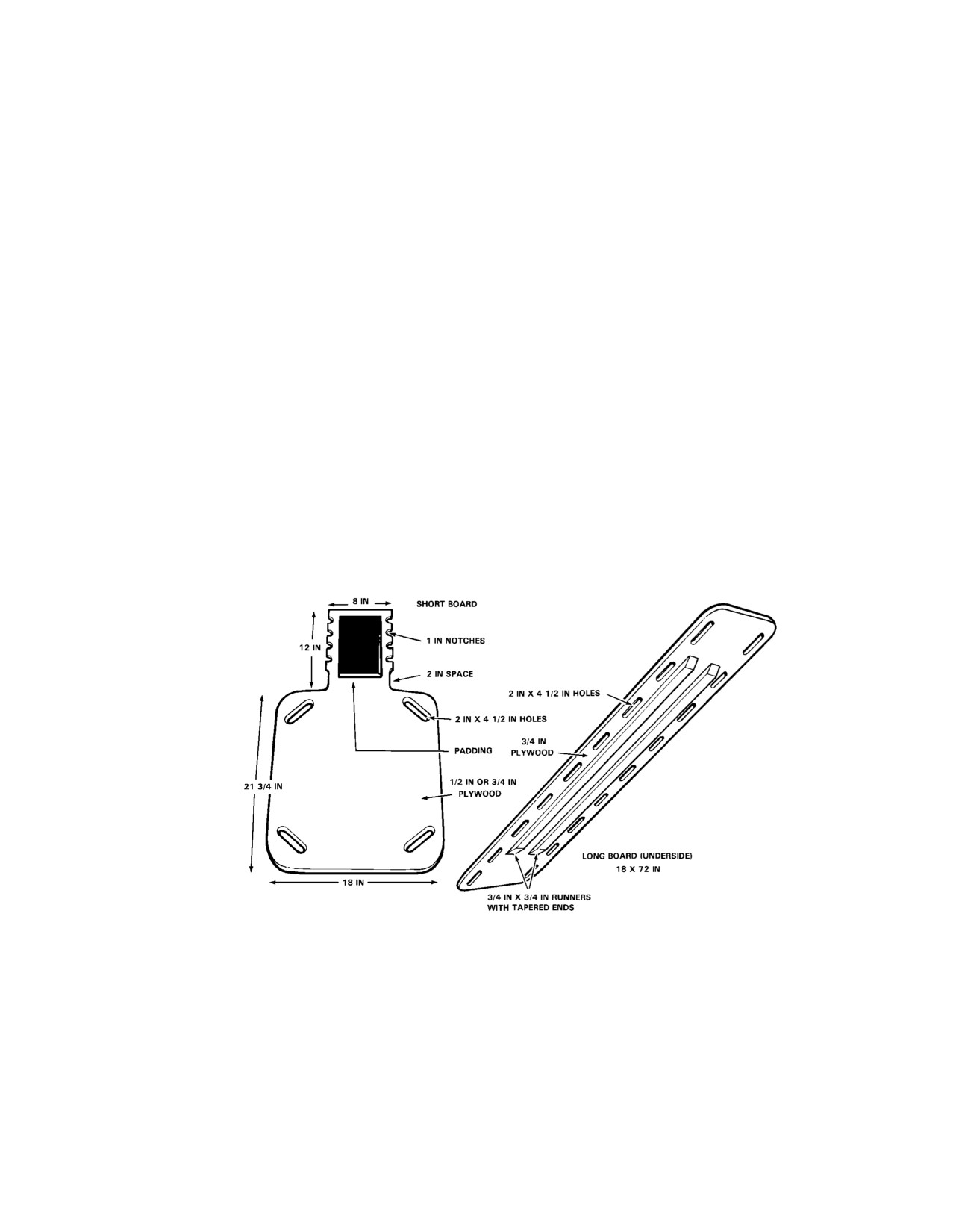
fractures. Spine boards can be prefabricated from plywood or any suitable material (Figure 9-16).
Figure 9-16. Prefabricated spine boards (short and long).
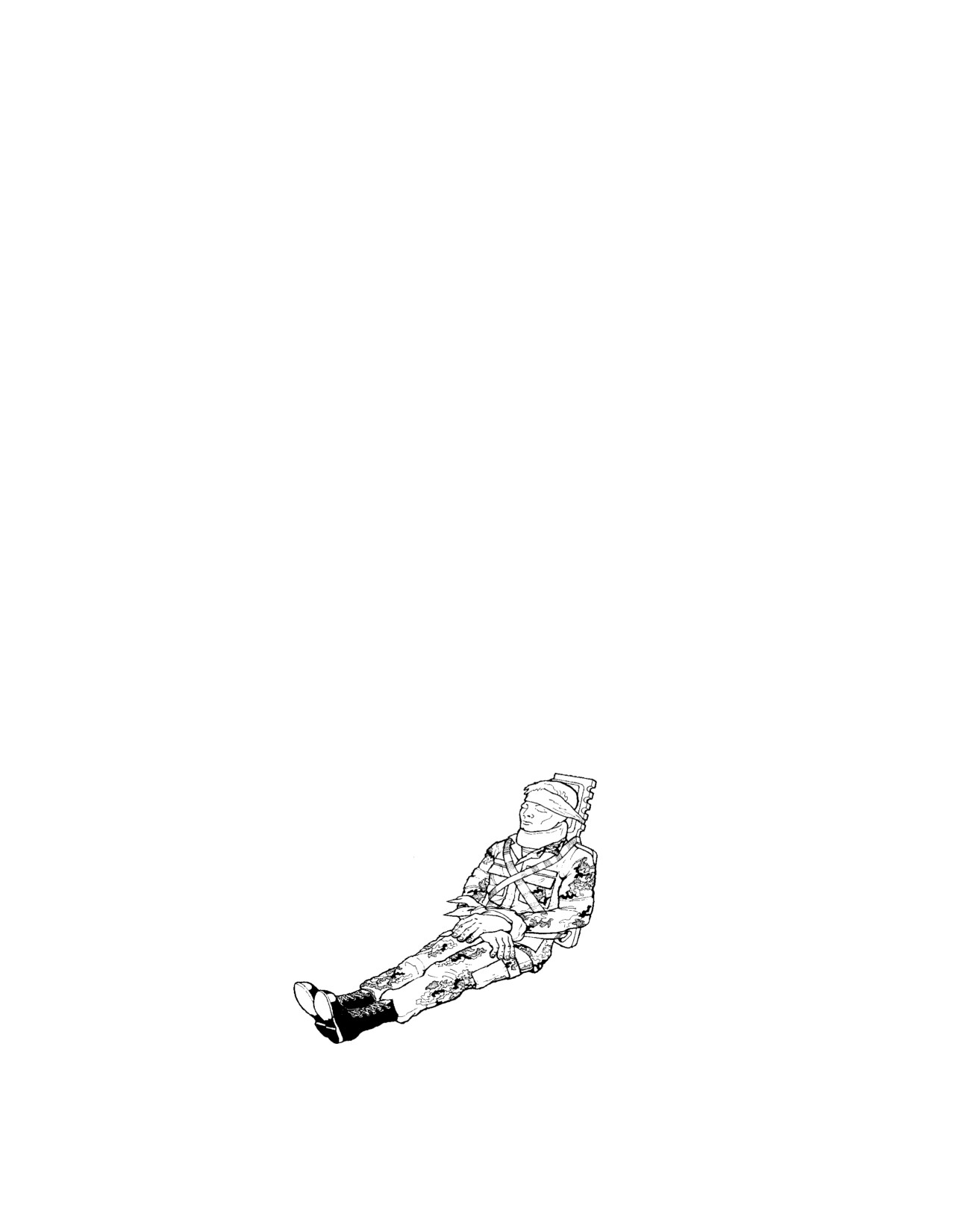
a. Short Spine Board. When a patient has a fracture or suspected fracture of the neck, the short
spine board is applied from the waist up to immobilize the upper spine before moving him (Figure 9-17).
The patient is then lifted onto a long spine board (c below). To apply the short spine board, the bearers
assemble the required items: a short spine board, a cervical collar, two 6-foot patient securing straps, and a
cravat. If an item is not available, the bearers should improvise it from any available material.
9-13
FM 8-10-6
(1) Bearer number 1 places his hands on each side of the patients head and jaws. He then
applies slight upward traction to the neck while bearer number 2 inserts a cervical collar around the
patients neck.
(2) Bearer number 1 maintains a slight upward traction while bearer number 2 inserts the
short spine board behind the patients back. He then applies the cravat and the two patient securing straps
(Figure 9-17) in the following order:
(a) Cravat. The center of the cravat is placed across the patients forehead with the
middle of the cravat covering the hairline. The ends are inserted into the bottom notches of the board and
are tied in the back.
(b) First strap. The buckle of the first patient securing strap is placed in the patients
lap and the other end is passed through the lower hole in the board. It is brought up the back of the board,
through the top hole, under the armpit, over the shoulder, and across the back of the board at the neck. The
end is then attached to the second strap.
(c) Second strap. The second patient securing strap is buckled to the first one, letting
the buckle rest on the side of the board at the neck. The other end of the second strap is passed over the
shoulder, under the armpit, through the top hole in the board, down the back of the board, and through the
lower hole. It is then taken across the patients lap, where it is secured in place by buckling it to the first
strap.
NOTE
If available, bearer number 2 will apply a rigid cervical collar.
Figure 9-17. Application of short spine board.
9-14
FM 8-10-6
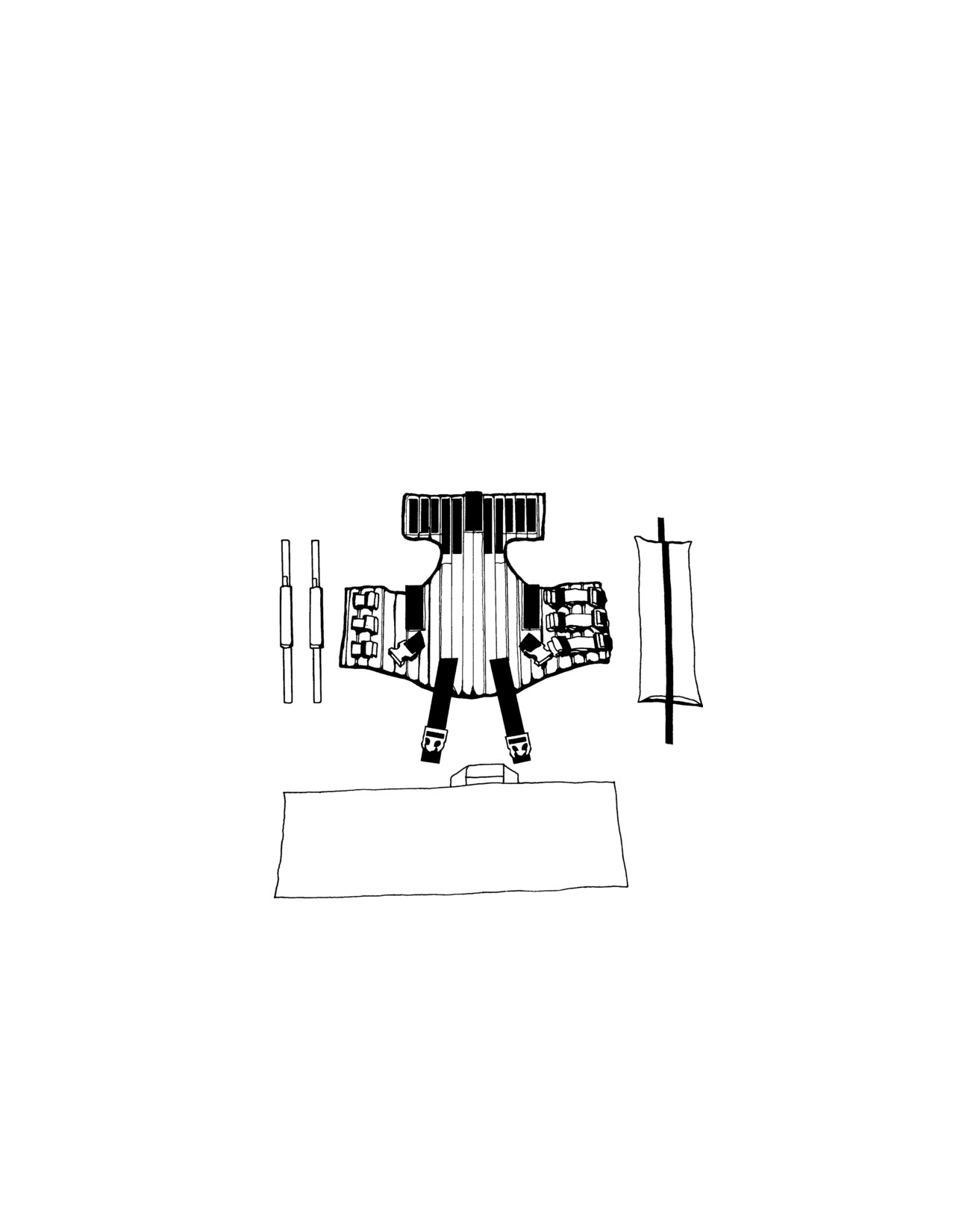
b. Kendricks Extrication Device. The KED (Figure 9-18) is a prefabricated flexible type of short
spine board. It is useful in extricating a patient suspected of having spinal injuries, especially if the patient
is in the sitting position.
(1) Bearer number 1 maintains cervical traction until KED has been completely applied.
(2) Bearer number 2 applies a rigid cervical collar, places the KED behind the patient, puts a
cushion behind the patients head to align the KED, fastens the trunk straps, then the leg/hip straps, and then
the forehead strap and chin strap.
(3) Bearer number 3 ties the hands of the patient together and places the patient on the long
board.
Figure 9-18. Kendricks extraction device.
c.
Long Spine Board. When a patient has a fracture or suspected fracture of the back as well as
the neck (a above), he is placed on a long spine board (Figures 9-19 and 9-21). To apply the long spine
board, the bearers assemble the required items: a long spine board, four 6-foot patient securing straps, a
cravat, and four pieces of padding. If an item is not available, the bearers should improvise it from any
available material.
9-15
FM 8-10-6
(1) The bearers place the spine board beside the patient. They align it with his body. They
then place padding on the board at the points where the patients neck, small of the back, knees, and ankles
will rest.
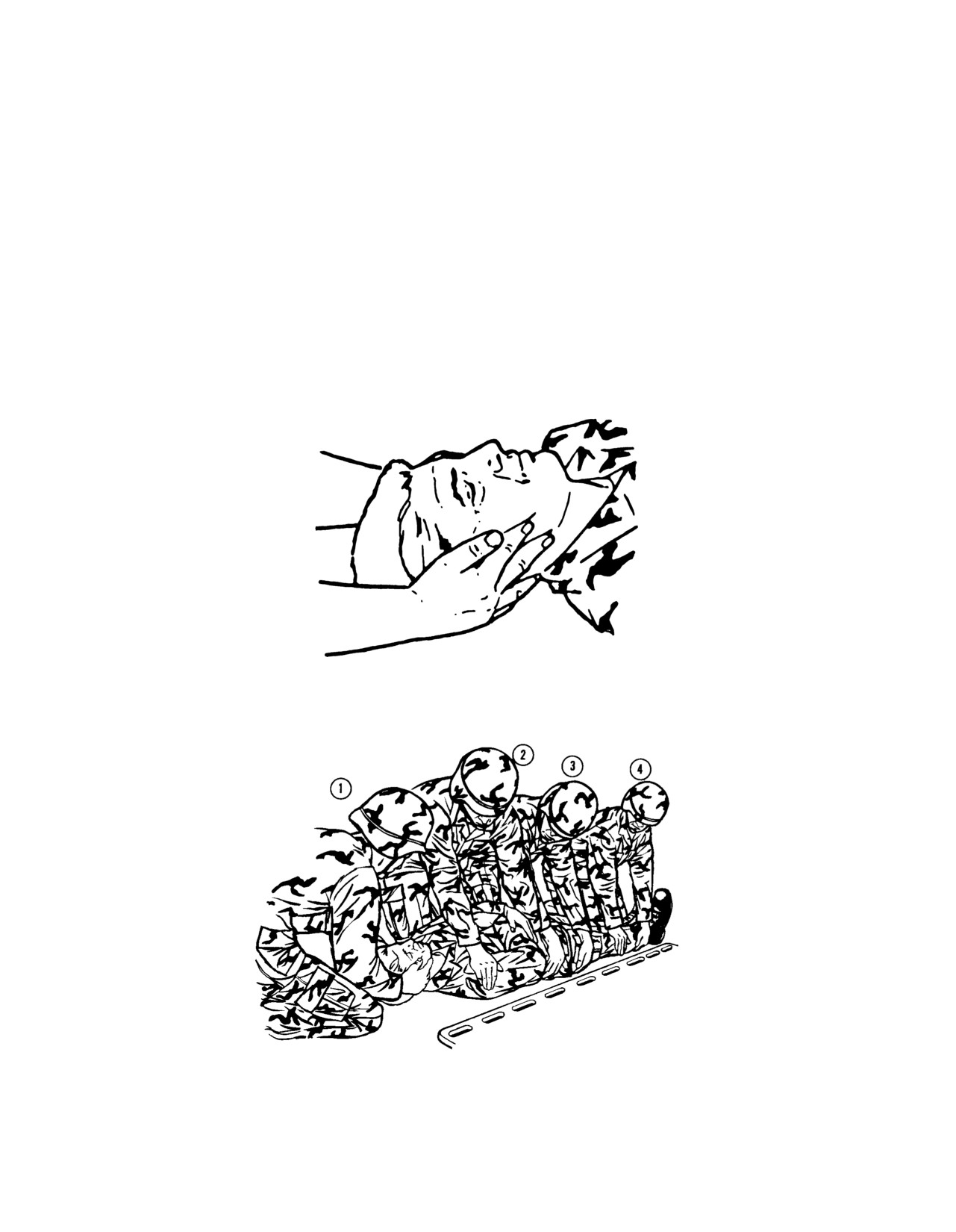
(2) Bearer number 1 kneels at the patients head. He places his hands on each side of the
patients head and jaws, immobilizing the head and neck and applying slight traction (Figure 9-19).
Bearers numbers 2, 3, and 4 kneel on one side of the patient and place their hands on the opposite side at
the patients shoulder and waist, hip and thigh, knee and ankle (Figure 9-20).
Figure 9-19. Positioning of hands.
Figure 9-20. Positioning of litter bearers
9-16
FM 8-10-6
(3) Bearers numbers 2, 3, and 4 roll the patients body slightly toward them as bearer
number 1 turns the patients head, keeping it in a straight line with the spine.
(4) Bearer number 3 reaches across the patients body with one hand, grasps the board at the
nearer edge and slides it against the patient. Bearer number 3, with the same hand, reaches across the
board to the farther edge and holds the board in place. All the bearers then slowly roll the patient backward
onto the board, keeping the head and spine in a straight line.
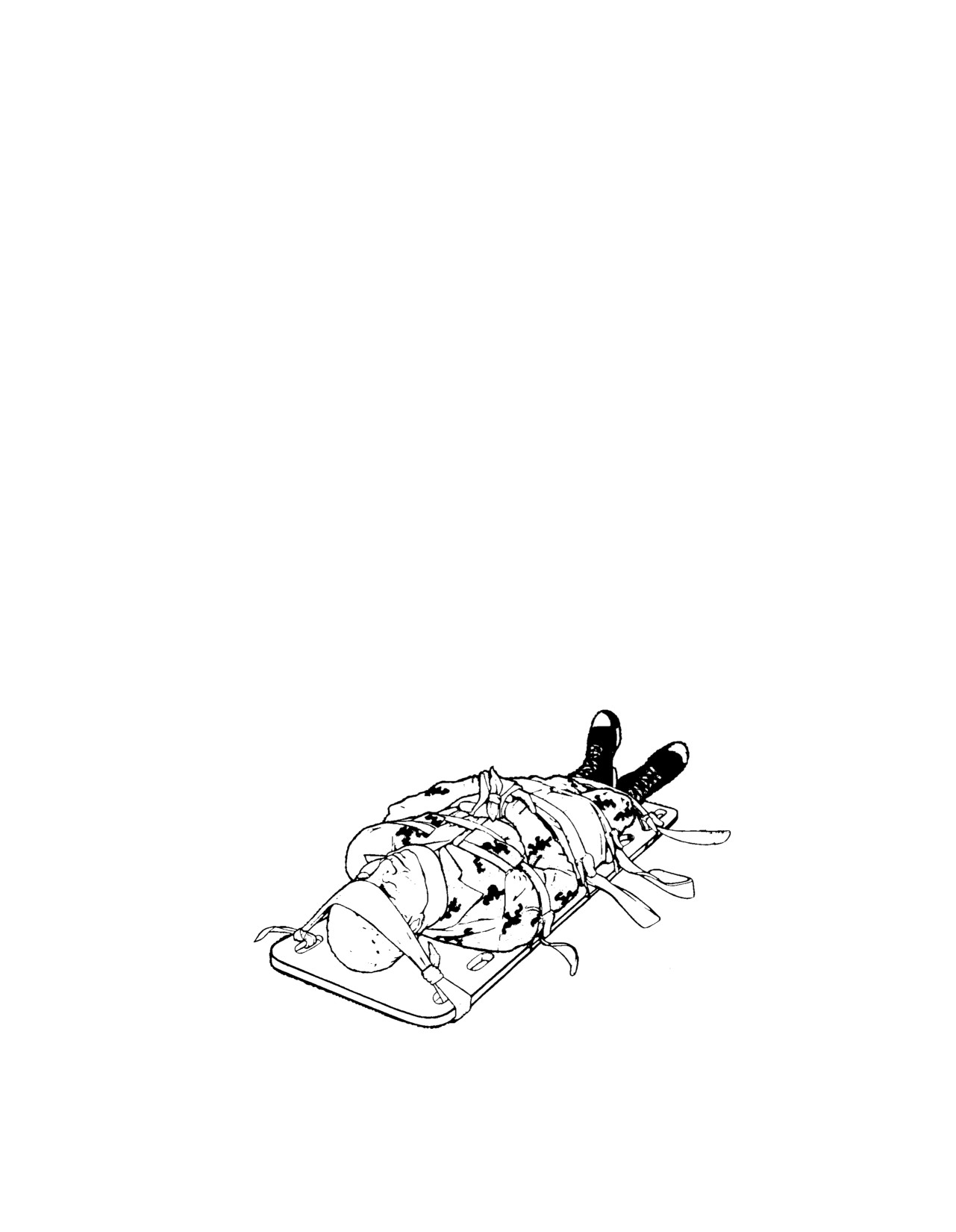
(5) While bearer number 1 continues to apply slight traction to the neck, bearers numbers 2,
3, and 4 immobilize the patient by applying the cravat and four patient securing straps (Figure 9-21) in the
following order:
(a) Cravat. The center of the cravat is placed over the patients forehead with the
middle of the cravat covering the hairline. The ends are then extended straight across and inserted through
the nearest holes on each side of the board.
(b) First strap. One end of the first patient securing strap is inserted through the board
hole near the chest, across the chest, and through the hole on the opposite side. It is then brought back
across the arms and buckled to the other end of the strap. The buckle rests on the top of the board, not
against the patient.
(c) Remaining straps. The three remaining straps are applied: one across the hips,
one above the knees (not over the kneecaps), and one above the ankles. One end of each strap is inserted
through the board hole near the body part and buckled to the other end of the strap. The buckle rests on the
top of the board, not against the patient.
Figure 9-21. Patient secured on a long spine board.
9-17
FM 8-10-6
9-7.
Travois
A travois is a crude sled lashed to a horse or similar animal and dragged along the ground. It can also be
lashed between two animals in single file and carried level. The sled is made from two long poles fastened
together by two crossbars and a litter bed fastened to the poles and crossbars. The patient is secured on the
litter bed. If the sled is pulled by only one animal, the bearers lift the dragging end from the ground when
going uphill, fording streams, or crossing obstacles. To make a travois
a. Cut two poles about 16-feet long (one pole should be 8- to 10-inches longer than the other). En-
sure that the small ends are at least 2 inches in diameter. Then cut two crossbars which are about 3-feet long.
b. Lay the poles parallel to each other. They should be placed about 21/2 feet apart with the
larger ends to the front. If only one animal is used, let the smaller ends spread apart about 3 feet and have
one of the small ends project 8 to 10 inches beyond the other one. This results in a rocking motion, rather
than a jolting motion to the patient.
c.
Notch the poles and the crossbars so that the poles can be connected with one crossbar about 6
feet from the front end and the other crossbar about 6 feet to the rear of the first one. Fit the notches in the
crossbars and poles together and lace them securely in place.
d. Make a litter bed 6-feet long between the crossbars. This is done by fastening a blanket,
canvas, or similar material securely to the poles and crossbars.
NOTE
A rope or strap may be stretched diagonally from pole-to-pole, letting
it cross many times to form a base for an improvised bed. A litter or
cot may also be fastened between the poles for the same purpose.
e.
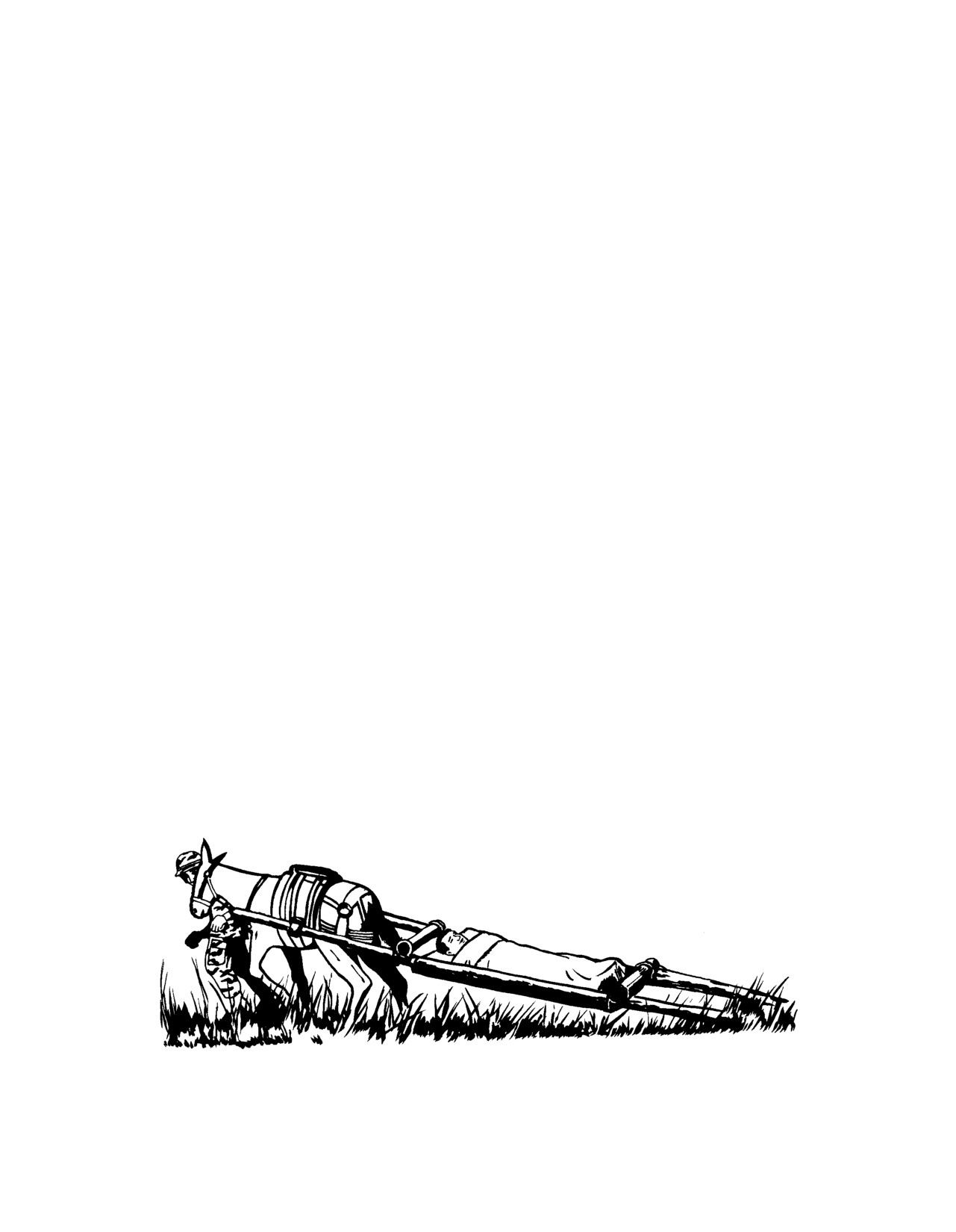
If only one animal is used, securely fasten the front ends of the poles to the saddle of the
animal. Leave the other ends of the poles on the ground (Figure 9-22).
Figure 9-22. Travois used with only one animal.
9-18
FM 8-10-6
f.
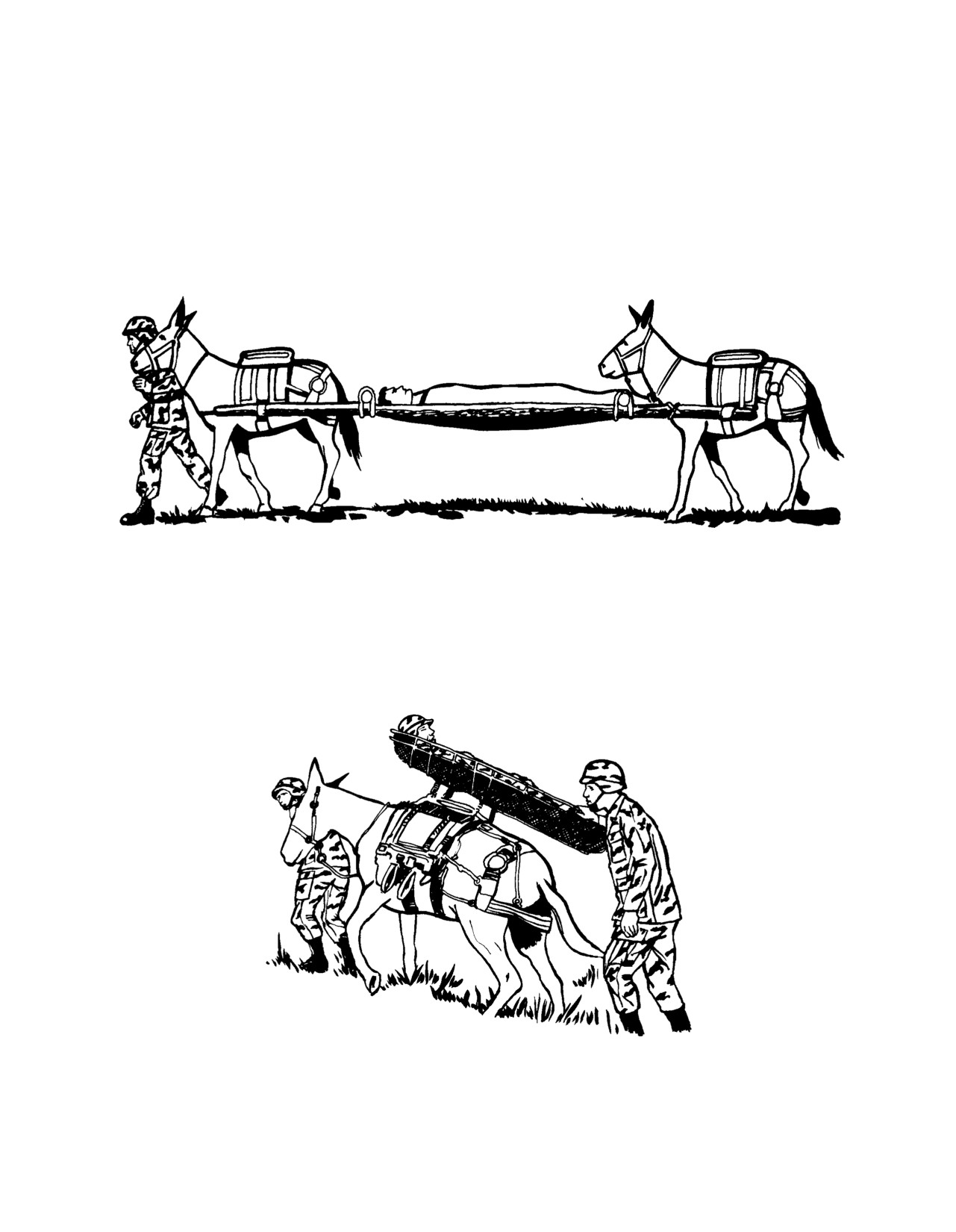
If two animals are used, securely fasten the front ends of the poles to the saddle of the lead
animal and the other end of the poles to the saddle of the animal which follows (Figure 9-23).
Figure 9-23. Travois used with two animals
9-8.
Packsaddle Litter
A packsaddle litter can be improvised by fitting a suitable litter onto the packsaddle of a mule or other
animal (Figure 9-24). This technique is particularly useful in jungle and mountain areas where it may be
necessary to carry a litter patient for a long distance.
Figure 9-24. Packsaddle litter.
9-19
FM 8-10-6
9-9.
Litter Evacuation in Mountain Operations
a. Personnel assigned to litter squads for mountain service must be trained in
Rock climbing.
Use of ropes.
Individual and unit movements at high altitudes.
b. Because of the conditions in mountain operations, a litter squad is normally increased from
four to six men.
c.
For additional information on medical evacuation over mountainous terrain, refer to paragraphs
5-2, 9-12 through 9-13, and E-15.
9-10. Techniques for Litter Evacuation in Mountain Operations
The evacuation techniques used in mountain operations are well proven. They are, however, subject to
improvement and should be modified as better methods of patient handling are developed. When evacuating
a patient from mountainous areas
a. Select the smoothest available route.
b. Keep the patient as warm as possible and avoid unnecessary handling.
c.
Place the patients helmet on his head for protection from falling rocks.
d. If the evacuation route is long and difficult to travel, a series of litter relay points or warming
stations should be established. Warming stations, if established, should be staffed with medical personnel to
permit proper treatment of shock, hemorrhage, or other emergency conditions.
e.
If a patient develops new or increased signs of shock while being evacuated, he should be
treated and retained at one of the warming stations until his condition stabilizes and permits further
evacuation.
9-11. Types of Litters for Mountain Operations
There are four types of litters available for evacuation of casualties over rough mountain terrain. They are
the standard collapsible litter (Figure 9-1); the poleless semirigid litter (Figure 9-4); the Stokes litter (Figure
9-6); and the SKED litter (Figure 9-7). When using the standard collapsible litter and patient securing
straps are not available, it is necessary to secure a patient to the litter with a rope.
9-20
FM 8-10-6
9-12. Methods of Litter Evacuation in Mountain Operations
Several litter evacuation methods that are adaptable to mountain terrain and climatic conditions are discussed.
a. Modified Travois (Descending) (Figure 9-25). This method is used when descending relatively
smooth slopes. Considerable speed can be made on slopes and cliff faces which are 4- to 6-feet high. These
areas can be passed without much difficulty.
(1) Two poles about 18 feet long and about 3 inches in diameter at the large end are cut.
These poles are fastened to the litter stirrups. About 5 to 10 feet of these poles should extend beyond the
litter to serve as runners.
(2) One bearer supports the foot of the litter by a rope sling and guides the litter downhill.
Another bearer uses a rope to lower the patient and the litter. A third bearer assists the soldier holding the
rope and relieves him at frequent intervals.
Figure 9-25. Modified travois (descending).
9-21
FM 8-10-6
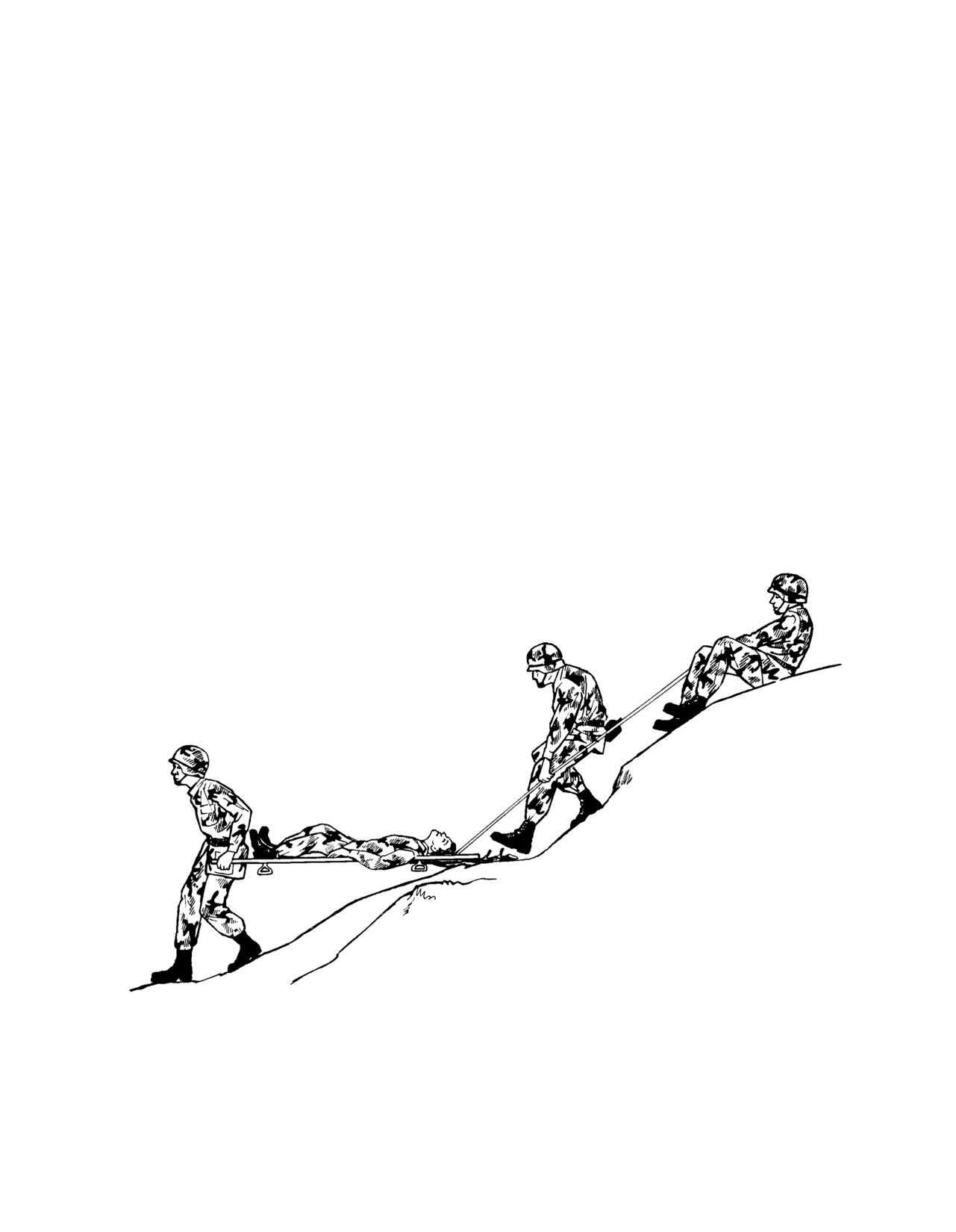
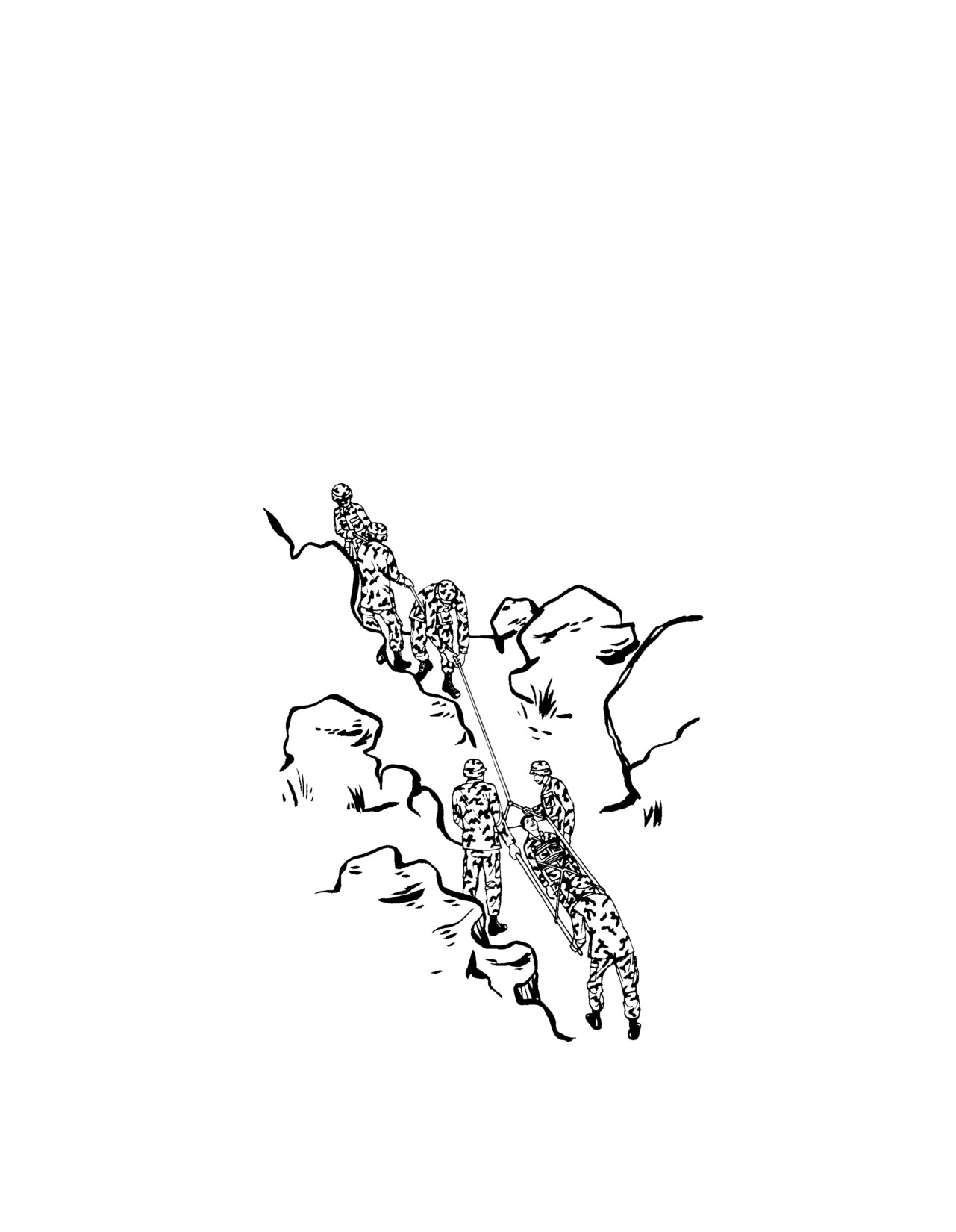
b. Modified Travois (Ascending Steep Slope) (Figure 9-26). The litter is prepared as a modified
travois.
(1) A thin sapling is passed through the litter stirrups at the head of the litter. The poles
should extend about 18 inches on each side of the litter. The use of poles affords a more secure grip for the
bearers at the head of the litter.
(2) Two bearers take their places at the head of the litter. A third bearer, using an improvised
rope sling, takes his place at the foot of the litter.
(3) The fourth and fifth bearers take their positions along the rope extending from the head
of the litter. The sixth bearer handles the end of the rope.
Figure 9-26. Modified travois (ascending steep slope).
9-22
FM 8-10-6
(4) At the command UP ROPE, the fourth, fifth, and sixth bearers pull on the rope while the
first, second, and third bearers lift the litter and climb slowly. The bearers carrying the litter should not try
to do all the work. They should allow themselves to be pulled up the slope as they hold the litter off the
ground and climb. The position of the bearers should be rotated at each halt to lessen fatigue.
c.
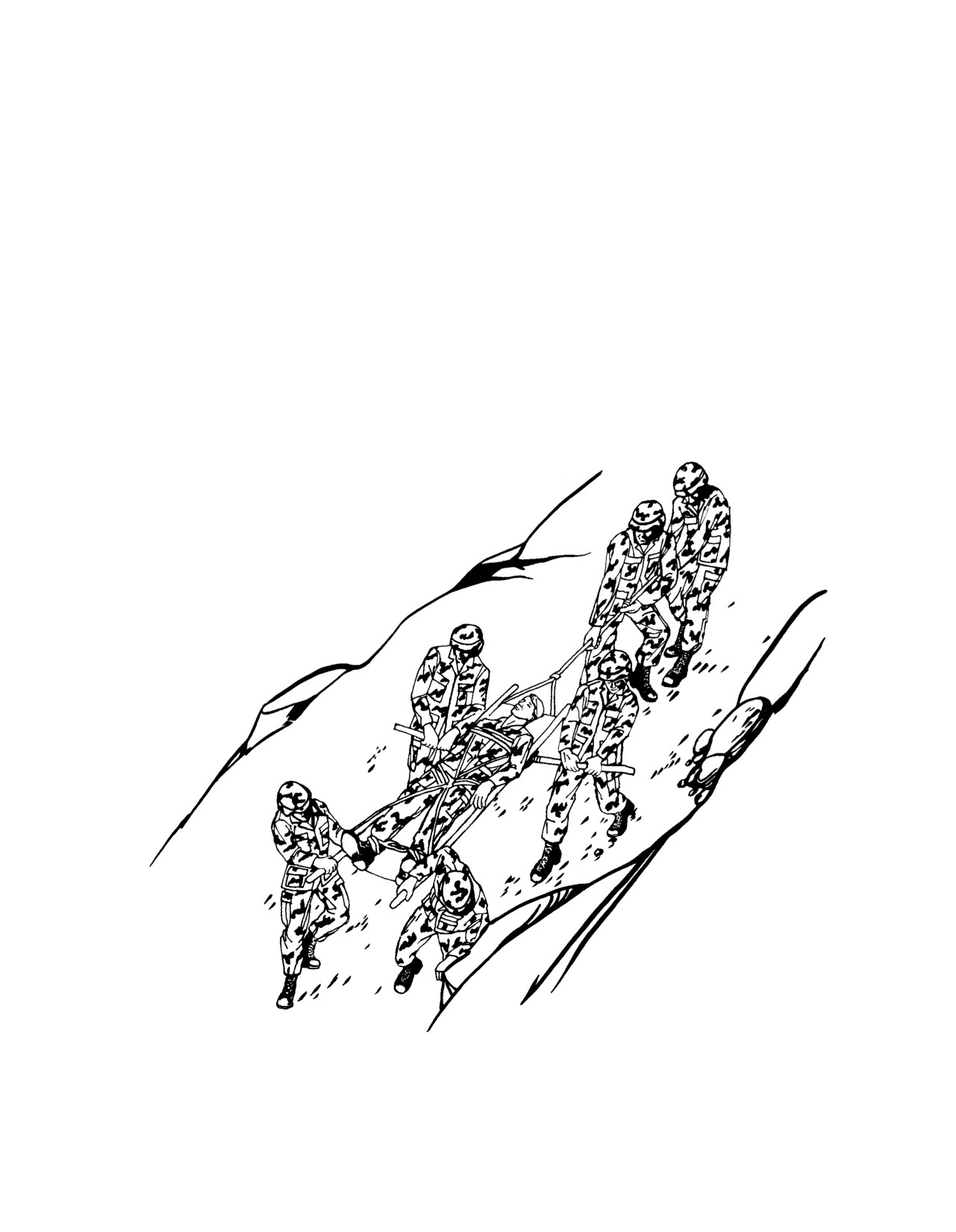
Modified Travois (Descending Steep Slope) (Figure 9-27). In making a descent, the most
direct passage should be taken. The litter is prepared is a modified travois.
(1) Two bearers hold the rope to assist in lowering the litter.
(2) Three bearers take positions at the litter: two at the head and one at the foot.
Figure 9-27. Modified travois (descending steep slope).
9-23
FM 8-10-6
(3) The sixth bearer may assist with the foot of the litter or he may precede the team to
Pick out a trail, thus preventing the squad from having to retrace its steps should
there be a cliff ahead.
Make the passage more negotiable by clearing away shrubs and vines.
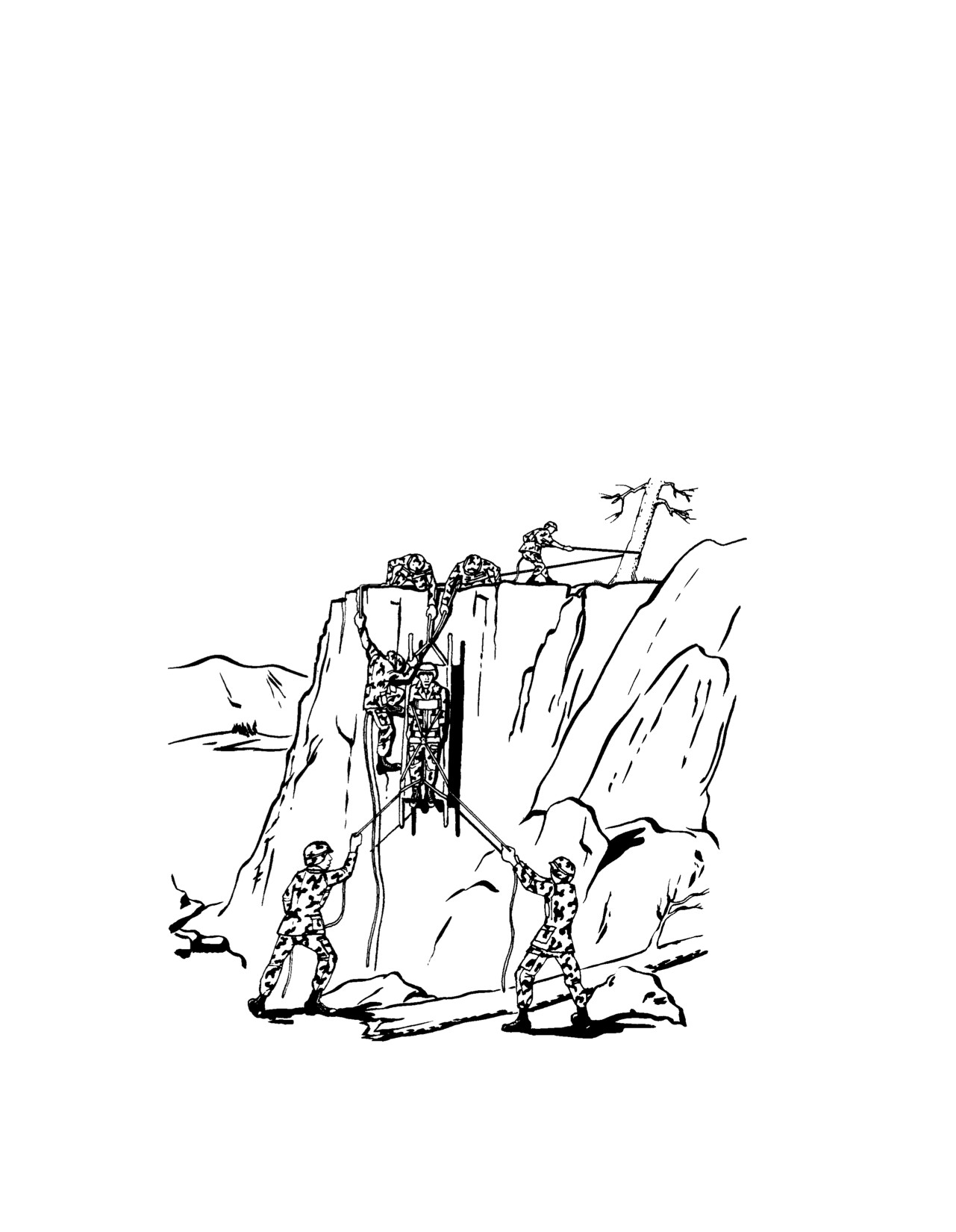
d. Modified Travois (Lowered from Cliff) (Figure 9-28). If a cliff is too extensive to bypass, the
portion with the smoothest face is selected for descending. The litter is prepared as a modified travois.
(If
using a SKED litter, follow manufacturers instructions for lacing the litter.)
(1) Notches are cut in the poles to provide an indentation for tying the ropes, thus preventing
them from becoming frayed by the stone cliff.
Figure 9-28. Modified travois (lowered from cliff).
9-24
FM 8-10-6
(2) Ropes are lashed to the stirrups at the foot of the litter to serve as guys in keeping the
litter from revolving.
(3) After one bearer secures the rope around a tree or large boulder, two bearers lower the
litter over the cliffs edge.
(4) One bearer descends the cliffs face on a rope, moving parallel to the litter and assisting
the litter over any projections.
(5) The two remaining bearers hold the guy ropes and guide the litter from the foot of the
cliff. When the litter has almost reached the base of the cliff, they ease it to the ground.
9-13. Horizontal Hauling Line
The horizontal hauling line (Figure 9-29) is also a method of evacuation. It is addressed in a separate
paragraph because of its complexity. The horizontal hauling line is used in those cases where a steep slope
or cliff must be scaled and where, at the same time, there is an intervening obstacle such as a swiftly
running mountain stream. It can also be used to span a chasm when a bridge has been demolished. This
method should be used only where there will be a considerable number of patients (a warming station or
collecting point) and should not be installed for the evacuation of only one or two patients. It can also be
used to lower or to raise patients over obstacles. The installation and operation of the hauling line is
addressed below.
This apparatus is a continuous rope cableway secured by a system of snaplinks spanning a
maximum of 1,000 feet between terminals. A slope of at least 10 degrees is required for proper operation.
A Stokes litter containing the patient is suspended from the top of the cable at the upper
terminal and an empty litter is suspended from the bottom of the cable at the lower terminal.
The litter patient at the upper terminal is lowered by gravity to the lower terminal. A relay
line attached to the litter prevents it from rapidly and uncontrollably descending. At the same time, the
empty litter at the lower terminal is raised to the upper terminal ready to receive the next patient.
One bearer stands at the upper terminal to control the relay line and another bearer stands at
the lower terminal ready to receive the patient.
a. Installation. The horizontal hauling line is installed in four steps:
(1) By means of a bowline, secure a 10-centimeter manila rope to a tree far enough from the
edge of the cliff (2 to 3 meters) to permit freedom of movement by the medical personnel.
(2) On the opposite side, pass the other end of the rope around another fixed point (tree,
boulder, or vehicle) and make a transport knot to pull the rope as taut as necessary. All traverse ropes
should have a certain amount of slack. When manila or sisal rope is used, a 5-percent sag should be allowed
to avoid undue fatigue in the rope.
9-25