FM 8-10-6 MEDICAL EVACUATION IN A THEATER OF OPERATIONS TACTICS, TECHNIQUES, AND PROCEDURES - page 4
FM 8-10-6
Provide supportive medical care when not augmented by CCAT teams. (When augmented
by CCAT teams, continued stabilization of patients can be accomplished. Aeromedical evacuation crews
and CCAT teams fly airlift missions to provide in-flight patient care.)
Confirm sending facility has prepared patients for evacuation.
In coordination with the OMF, ensure patient evacuation manifests are completed.
(If
the OMF is an Echelon II facility [such as an FSMC augmented with an FST], the forms required to
complete the manifest may not be available and the MASF will be required to complete the appropriate
forms.)
Identify patient baggage tags.
d. Upon deployment, the OMF provides an adequate quantity of medications for patients transit
time to the regulated destinations.
e.
The MASF staff also establishes liaison with the OMF. The AELT is composed of two air
evacuation liaison officers, a flight nurse, and three communications specialists. The team provides the
initial interface between the user service and the TAES. The AELT is located at any level of the combat
forces joint medical regulating chain that is required to ensure a smooth patient flow into the TAES.
6-10. Limitations of the United States Air Force Theater Aeromedical Evacuation System
There are a number of limitations that are inherent in the current system. These include the following:
a. Absence of BW and CW agent decontamination ability.
b. The MASF cannot hold patients in excess of 6 hours.
c.
The MASF does not have the capability to provide patient meals.
d. The AECC ensures the initial 30-days medical resupply package arrives at the MASF. The
MASF/AELT/AEOT rely on the user service for all other logistical support.
e.
It is the Armys responsibility to provide food and other logistical support required including
moving patients back to Army facilities should USAF AE support be delayed.
6-11. Originating Medical Facilitys Responsibilities
Once the authorization to move the patient has been given, the OMF must complete the following
administrative procedures prior to entering the patient into the TAES:
6-10
FM 8-10-6
a. The patients baggage tag, patient evacuation manifest, and patient evacuation tag are the
specified evacuation forms for all Services and are completed as required by triservice regulation. (Refer to
Appendix H for instructions on completing these forms.)
NOTE
If the OMF is an Echelon II facility (such as the FSMC or MSMC),
the forms may not be available; in which case, the forms will need to
be completed by the MASF.
b. All of the patients medical records must be collected together and packaged. The dental
records are forwarded separately in the event they are needed for identification.
c.
At the appropriate time, the OMF provides transportation to the MASF and assists in the off-
load.
d. The OMF must provide the necessary medications, medical supplies, and equipment to support
the patients travel time to the regulated destination.
e.
Any requirements for armed guards must be met by the echelon commander.
NOTE
Medical units do not provide guards for prisoners or EPWs in their
care. When guards are required, they are provided by the echelon
commander. The OMF will coordinate for this support when needed.
f.
A limited amount of personal baggage is authorized if each piece is properly tagged and
delivered to the MASF with the patient. Patients will always be evacuated with NBC-protective equipment,
less the protective overgarment.
g. Each patient must be clearly identified with a wristband or equivalent identification and
properly classified as to his medical condition.
h. The OMF must ensure that each patient is properly briefed and prepared for his evacuation
prior to his arrival at the MASF.
6-12. Medical Regulating for Army Special Operations Forces
a. As in medical evacuation, the medical regulating plan must be integrated with the ARSOF
operational and logistic plan. Maximum use of opportune (operational and logistics) aircraft and command
and logistics communications nets must be coordinated to expedite mission requests and ensure success.
6-11
FM 8-10-6
b. The ARSOF medical planner must constantly coordinate with the battalion or group operations
and logistics sections to obtain up-to-date information of opportune transportation assets to be used for
evacuation. In a deep operation, or when the theater is not sufficiently developed to allow the TAES to be
used effectively, the primary means of air evacuation will be those Special Operations Aviation (SOA) or
USAF SOF airframes conducting the clandestine mission. It is essential that coordination is made through
the theater special operations command (SOC) or the highest C2 element for flight medics or pararescuemen
(PJs) to accompany the flight when backhauling the casualties. Otherwise, a medic from the SOF unit being
supported may have to accompany the patient, leaving the mission without proper medical support, or the
casualty may have to be transported without en route care.
c.
For all other special operations, the supporting medical evacuation unit provides air and
ground ambulances in accordance with standard doctrinal procedures. United States Air Force MASFs or
AELTs may be collocated at SOF support bases, or C2 bases, particularly during contingency operations
where the build-up phase allows for pre-positioning of assets.
d. During sustained special operations missions, the theater SOC cannot afford to lose the
services of ARSOF soldiers who become casualties, but who can be treated and returned to duty at hospitals
within the EAC. As an exception to the theater evacuation policy, the Commander in Chief (CINC) retains
these soldiers in the theater where they can be returned to their units for limited duty. There they can
assume the support duties performed by other ARSOF soldiers, freeing the latter for operational duties.
6-12
FM 8-10-6
CHAPTER 7
EVACUATION REQUEST PROCEDURES
7-1.
General
Procedures for requesting medical evacuation support must be institutionalized down to the unit level.
Procedural guidance and standardization of request procedures are provided in this chapter. The same
format used to request aeromedical evacuation is also used for requesting ground evacuation.
7-2.
Unit Evacuation Plan
Before initiating any operation, a unit must have an evacuation plan in effect. The plan may be a standard
TSOP or it may be designed for a particular operation. It can be published in various ways depending on
the level of headquarters and the amount of detail required. For example, it may be in the form of verbal
instructions at the squad or platoon level, a comment in the signal operation instructions (SOI), or a
paragraph in the unit OPORD. The unit evacuation plan is essential to requesting evacuation because it
identifies
Primary and alternate channels to be used in submitting the medical evacuation request.
Primary and alternate evacuation routes to be used.
Means of evacuation (type of transport such as litter, ground ambulance, or air ambulance) to
be used.
Location of the destination MTF, if predesignated.
This paragraph implements STANAGs 2087 and 3204,
QSTAG 529, and Air STDs 44/36A and 61/71.
7-3.
Determination to Request Medical Evacuation and Assignment of Medical Evacuation Prece-
dence
The determination to request medical evacuation and assignment of a precedence is made by the senior
military person present. This decision is based on the advice of the senior medical person at the scene, the
patients condition, and the tactical situation. Assignment of a medical evacuation precedence is necessary.
The precedence provides the supporting medical unit and controlling headquarters with information that is
used in determining priorities for committing their evacuation assets. For this reason, correct assignment of
a precedence cannot be overemphasized; overclassification remains a continuing problem. Patients will be
picked up as soon as possible, consistent with available resources and pending missions. The following are
categories of precedence and the criteria used in their assignment:
7-1
FM 8-10-6
a. Priority IURGENT is assigned to emergency cases that should be evacuated as soon as
possible and within a maximum of 2 hours in order to save life, limb, or eyesight, to prevent complications
of serious illness, or to avoid permanent disability.
b. Priority IAURGENT-SURG is assigned to patients who must receive far forward surgical
intervention to save life and to stabilize them for further evacuation.
c.
Priority IIPRIORITY is assigned to sick and wounded personnel requiring prompt medical
care. This precedence is used when the individual should be evacuated within 4 hours or his medical
condition could deteriorate to such a degree that he will become an URGENT precedence, or whose
requirements for special treatment are not available locally, or who will suffer unnecessary pain or disability.
d. Priority IIIROUTINE is assigned to sick and wounded personnel requiring evacuation but
whose condition is not expected to deteriorate significantly. The sick and wounded in this category should
be evacuated within 24 hours.
e.
Priority IVCONVENIENCE is assigned to patients for whom evacuation by medical vehicle
is a matter of medical convenience rather than necessity.
NOTE
The NATO STANAG 3204 has deleted the category of Priority IV
CONVENIENCE; however, it will still be included in the US Army
evacuation priorities as there is a requirement for it on the battlefield.
7-4.
Unit Responsibilities in Evacuation
A decision to request medical evacuation places certain responsibilities on the requesting unit in the overall
evacuation effort. To prepare for and assist during evacuation, the unit must
a. Ensure that the tactical situation permits successful evacuation.
b. Have an English-speaking representative at the pickup site when evacuation is requested for
non-US personnel.
c.
Ensure that patients are ready for pickup when the request is submitted and provide patient
information, as required.
d. Receive backhauled medical supplies and report the type, quantity, and where they are
delivered.
e.
Move patients to the safest aircraft approach and departure point or AXP if they are to be
evacuated by air. Ensure that ground personnel are familiar with the principles of helicopter operations.
The ground crew
7-2
FM 8-10-6
Selects and prepares the landing site.
Loads and unloads the helicopter according to the pilots instructions.
Briefs the pilot on the position of enemy troops and directs him to other units in the area,
if asked.
Guides the helicopter using hand signals during landing and takeoff when the tactical
situation permits.
Marks friendly positions when armed helicopter escort is provided.
7-5.
Types of Medical Evacuation Request Formats and Procedures
a. The medical evacuation request is used for requesting evacuation support for both air and
ground ambulances.
b. There are two established medical evacuation formats and proceduresone for wartime use
and one used in peacetime.
c.
Several differences exist between the wartime and the peacetime medical evacuation request
formats and procedures. The wartime request format is shown in Table 7-1. The peacetime request form
differs in two line item areas.
(1) Line 6changed to number and type of wound, injury, or illness (two gunshot wounds
and one compound fracture). If serious bleeding is reported, the patients blood type should be given, if
known.
(2) Line 9changed to description of terrain (flat, open, sloping, wooded). If possible,
include relationship of landing area to prominent terrain features.
d. Security is another basic difference between wartime and peacetime requesting procedures.
Under all nonwar conditions, the safety of US military and civilian personnel outweighs the need for
security, and clear text transmissions of medical evacuation requests are authorized. During wartime, the
rapid evacuation of patients must be weighed against the importance of unit survivability. Accordingly,
wartime medical evacuation requests are transmitted by secure means only.
e.
A medical evacuation request and mission completion record format is provided in Appendix I.
7-6.
Collection of Medical Evacuation Information
The medical evacuation information collected for the wartime medical evacuation request, line numbers
3 through 9, is subject to brevity codes. This information is limited to the specific remarks provided in
7-3
FM 8-10-6
Table 7-1 (Page 7-7). For example: The information to be collected for Line 4 pertains to special
equipment to be placed on board the evacuation vehicle or aircraft. The limiting remarks restrict
identification to none required, hoist, extraction equipment, and ventilator. No other remarks are authorized
for Line 4.
7-7.
Preparation of the Medical Evacuation Request
Table 7-1 provides the procedures for preparation of the medical evacuation request, to include information
requirements and sources.
a. During wartime, brevity codes must be used in preparing all medical evacuation requests. The
authorized codes are provided in Table 7-1; they are also provided in the SOI. Use of locally devised
brevity codes is not authorized. If the unit preparing the request does not have access to secure
communications, the medical evacuation request must be prepared in encrypted form. Encrypting is
required for all information on the request with the exception of
(1) The medical evacuation line number identifier. This information is always transmitted in
clear text.
(2) The call sign and suffix (Line 2) which can be transmitted in clear text.
b. During peacetime, two line number items (Lines 6 and 9) will change. Details for
the collection of information and request preparation are shown in Table 7-1. More detailed procedures
for use of the peacetime request format must be developed by each local command to meet specific
requirements.
7-8.
Transmission of the Request
The medical evacuation request should be made by the most direct communications means to the medical
unit that controls evacuation assets. The communications means and channels used depend on the situation
(organization, communication means available, location on the battlefield, and distance between units). The
primary and alternate channels to be used are specified in the unit evacuation plan.
a. Secure Transmissions. Under all wartime conditions, these requests are transmitted by
SECURE MEANS only. Therefore, the use of nonsecure communications dictates that the request be
transmitted in ENCRYPTED FORM. Regardless of the type (secure or nonsecure) of communications
equipment used in transmission, it is necessary to
Make proper contact with the intended receiver.
Use the effective call sign and frequency assignments from the SOI.
Use the proper radio procedure.
7-4
FM 8-10-6
Ensure that transmission time is kept to a minimum (20 to 25 seconds maximum).
Provide the opening statement:
I HAVE A MEDEVAC REQUEST.
b. Receiver Acknowledgment. After the appropriate opening statement is made, the transmitting
operator breaks for acknowledgment. Authentication by the receiving or transmitting unit should be done in
accordance with the TSOP.
c.
Clear Text and Encrypted Transmissions. If secure communications equipment is used in
transmission, the request will be transmitted in CLEAR TEXT. However, if the communications equipment
used in transmission is not secure, the request must be transmitted in encrypted form with the exception of
the following:
(1) The medical evacuation line number identifier (Line 1, Line 2, Line 3, and so forth).
This information is always transmitted in clear text.
(2) The call sign and suffix (Line 2) which can be transmitted in clear text.
NOTE
When using DRYAD Numeral Cipher, the same SET line is used to
encrypt both the grid zone letters and the coordinates (Line 1 of the
request). To avoid misunderstanding, a statement should be made
that the grid zone letters are included in the message. This must be
accomplished unless the TSOP specifies that the DRYAD Numeral
Cipher is to be used at all times.
(3) The automated net control device (ANCD) (AN/CYZ-10) is associated equipment for
the SINCGARS radios. It is capable of receiving, storing, and transferring data to SINCGARS radios, and
from the ANCD to other compatible communications-electronic equipment. The ANCD (AN/CYZ-10)
is used primarily for handling COMSEC keys, frequency hopping, and SOI information.
(For informa-
tion concerning the operation of the ANCD [AN/CYZ-10], refer to Technical Manual [TM] 11-5820-890-
10-8 .)
d. Letter and Numeral Pronunciation. The letters and numerals that make up the request are
pronounced according to standard radio procedures. In transmission of the request, the medical evacuation
request line number identifier will be given followed by the applicable evacuation information (example:
Line One. TANGO PAPA FOUR SIX FIVE THREE SEVEN NINER).
e.
Medical Evacuation Request Line Numbers 1 through 5. The medical evacuation request line
numbers 1 through 5 must always be transmitted first. The information enables the evacuation unit to begin
the mission and avoids unnecessary delay if the remaining information is not immediately available. The
information for Lines 6 through 9 should be transmitted as soon as it is available.
7-5
FM 8-10-6
f.
Monitoring Requirement. After transmission and acknowledgment are accomplished, the
transmitting operator must monitor the frequency (Line 2 of the request) to wait for additional instructions
or contact from the evacuation vehicle.
7-9.
Relaying Requests
If the unit receiving the request does not control the evacuation means, it must relay the request to the
headquarters or unit that has control, or to another relaying unit. When the relaying unit does not have
access to secure communications equipment, the request must be transmitted in encrypted form. The
method of transmission and specific units involved depends on the situation. Regardless of the method of
transmission, the unit relaying the request must ensure that it relays the exact information originally
received and that it is transmitted by secure means only. The radio call sign and frequency relayed (Line 2
of the request) should be that of the requesting unit and not that of the relaying unit. If possible,
intermediate headquarters or units relaying requests will monitor the frequency specified in Line 2. This is
necessary in the event contact is not established by the medical evacuation unit, vehicle, or aircraft with the
requesting unit.
7-6
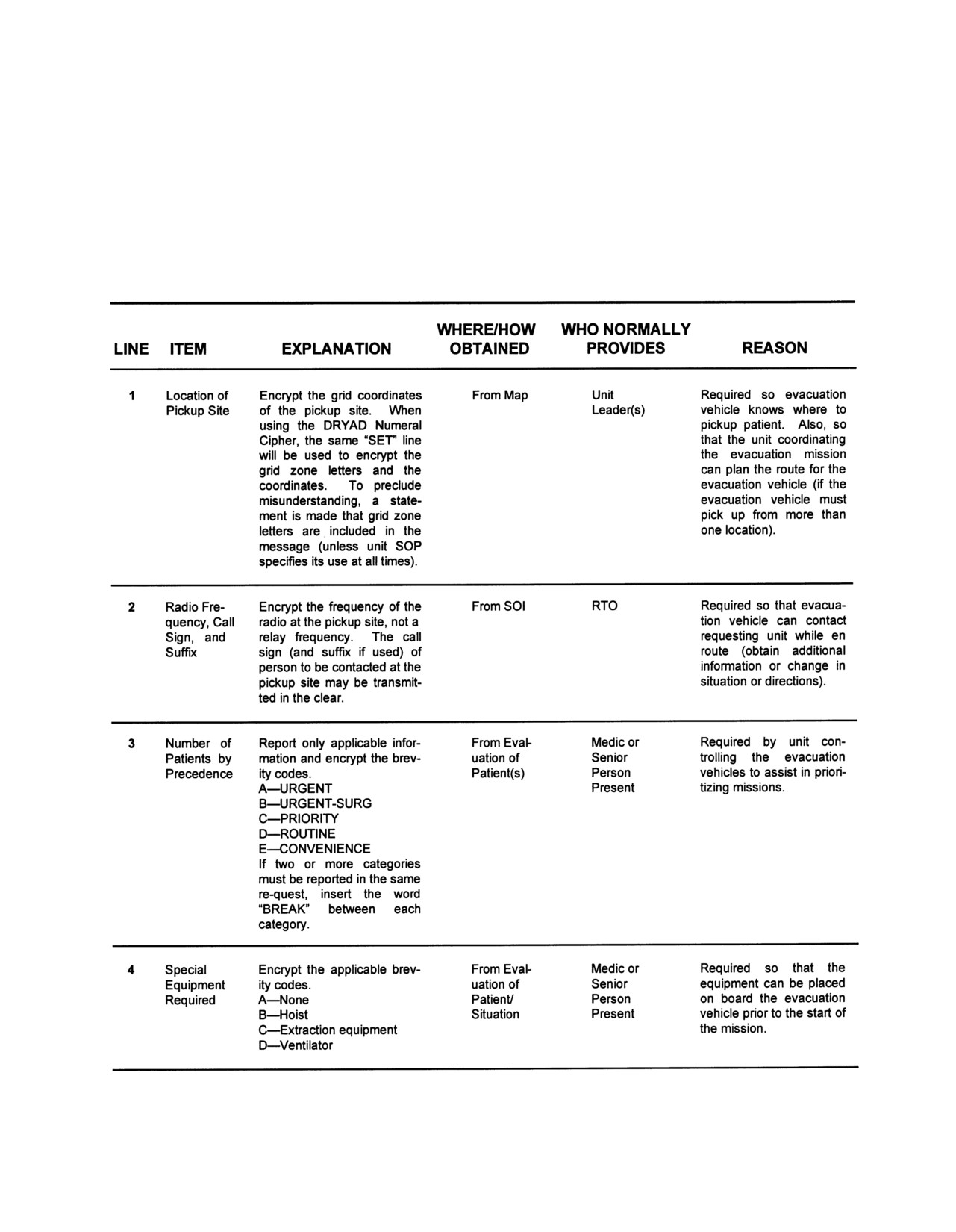
FM 8-10-6
Table 7-1. Procedures for Information Collection and
Medical Evacuation Request Preparation
7-7
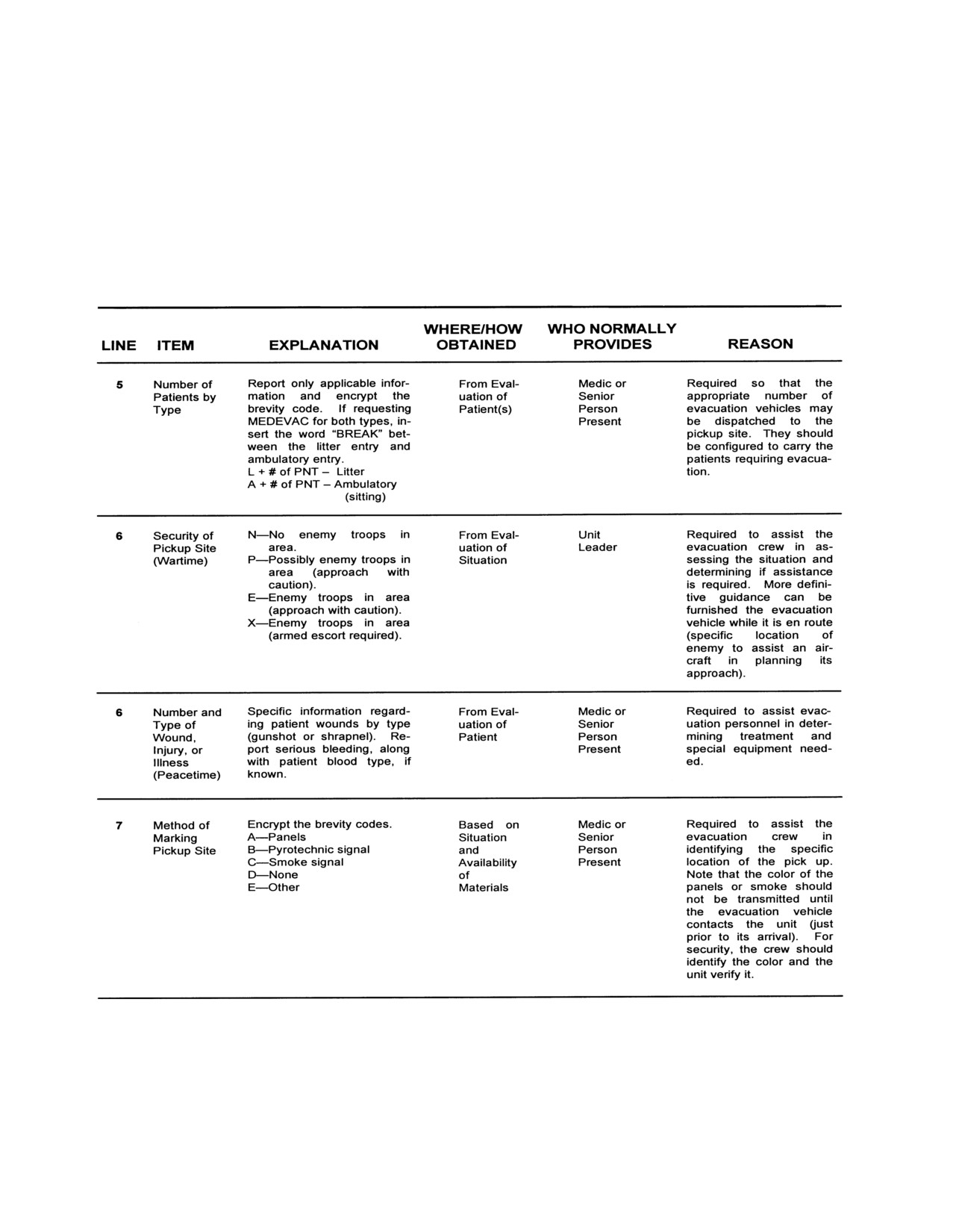
FM 8-10-6
Table 7-1. Procedures for Information Collection and
Medical Evacuation Request Preparation (Continued)
7-8
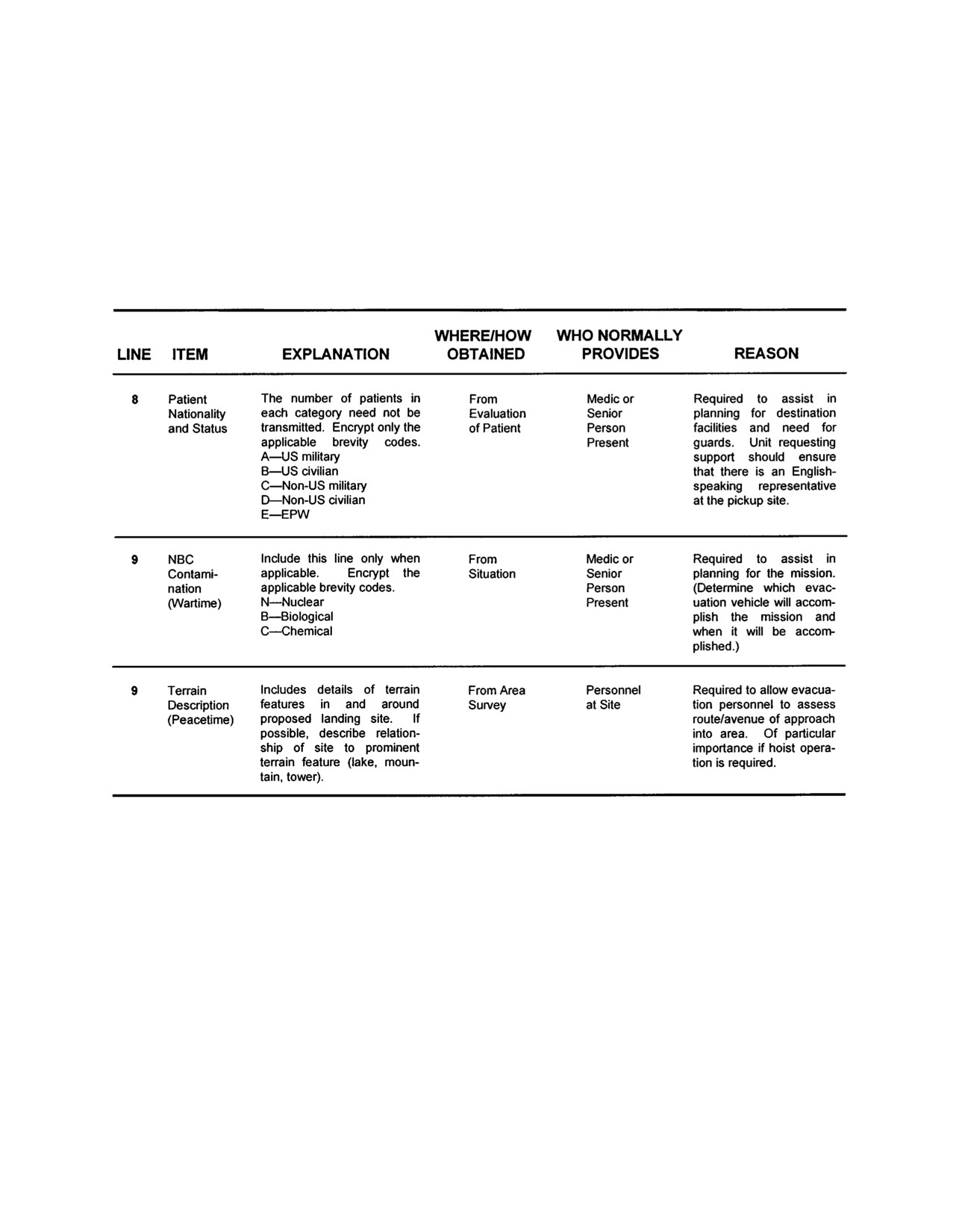
FM 8-10-6
Table 7-1. Procedures for Information Collection and
Medical Evacuation Request Preparation (Continued)
7-9
FM 8-10-6
CHAPTER 8
MANUAL EVACUATION
8-1.
General
Manual evacuation is the process of transporting casualties by manual carries. It is accomplished without
the aid of a litter or other forms of transport. It is intended to end at the point where a more sophisticated
means of evacuation becomes available. For example, manual evacuation ends when a litter, vehicle, or
other form of conveyance is available.
8-2.
Casualty Handling
a. Casualties evacuated by manual means must be carefully handled. Rough or improper handling
may cause further injury to the casualty. The evacuation effort should be organized and performed
methodically. Each movement made in lifting or moving casualties should be performed as deliberately and
as gently as possible. Casualties should not be moved before the type and extent of their injuries are
evaluated and the required first aid (self-aid, buddy aid, or combat lifesaver) or EMT (combat medic or
ambulance crew) is administered.
NOTE
The exception to this occurs when the situation dictates immediate
movement for safety reasons. For example, if a casualty is on the
ground near a burning vehicle, it may be necessary to move him a
safe distance away from the vehicle. This situation dictates that the
urgency of casualty movement outweighs the need to administer first
aid or EMT. Even when immediate movement of casualties is re-
quired, they should be moved only far enough to be out of danger.
b. Many lifesaving and life-preserving measures are carried out before evacuating injured or
wounded soldiers. Except in extreme emergencies, the type and extent of injuries must be evaluated before
any movement of the casualty is attempted. Measures are taken, as needed, to
Open the airway and restore breathing and heartbeat.
Stop bleeding.
Prevent or control shock.
Protect the wound from further contamination.
c.
When a fracture is evident or suspected, the injured part must be immobilized. Every
precaution must be taken to prevent broken ends of bone from cutting through muscle, blood vessels,
nerves, and skin.
8-1
FM 8-10-6
d. When a casualty has a serious wound, the dressing over the wound should be reinforced to
provide additional protection during manual evacuation.
8-3.
General Rules for Bearers
a. In manual evacuation, individuals performing the evacuation are referred to as bearers.
Improper handling of a casualty can result in injury to the bearers as well as to the casualty. To minimize
disabling injuries (muscle strain, sprains, or other injuries) that could hamper the evacuation effort, the
following rules should be followed:
Use the bodys natural system of levers when lifting and moving a casualty.
Know your physical capabilities and limitations.
Maintain solid footing when lifting and transporting a casualty.
Use the leg muscles (not the back muscles) when lifting or lowering a casualty.
Use the shoulder and leg muscles (not the back muscles) when carrying or standing with
a casualty.
Keep the back straight; use arms and shoulders when pulling a casualty.
Work in unison with other bearers, using deliberate, gradual movements.
Slide or roll, rather than lift, heavy objects that must be moved.
Rest frequently, or whenever possible, while transporting a casualty.
b. Normally, a casualtys individual weapon is not moved through the evacuation chain with him.
Weapons are turned in at the first available MTF (BAS or division clearing station) to be returned to the
parent unit through supply channels. Individual equipment, to include protective clothing and mask,
remains with the casualty and is evacuated with him.
8-4.
Manual Carries
Manual carriers are tiring for the bearers and involve the risk of increasing the severity of the casualtys
injuries. In some instances, however, they are essential to save the casualtys life. When a litter is not
available or when the terrain or the tactical situation makes other forms of casualty transport impractical, a
manual carry may be the only means to transport a casualty to where a combat medic can treat him. The
distance a casualty can be transported by a manual carry depends upon many factors, such as
Strength and endurance of the bearers.
8-2
FM 8-10-6
Weight of the casualty.
Nature of the injuries.
Obstacles encountered during transport.
8-5.
Casualty Positioning
The first step in any manual carry is to position the casualty to be lifted. If he is conscious, he should be
told how he is to be positioned and transported. This helps to lessen his fear of movement and to gain his
cooperation. It may be necessary to roll the casualty onto his abdomen, or his back, depending upon the
position in which he is lying and the particular carry to be used.
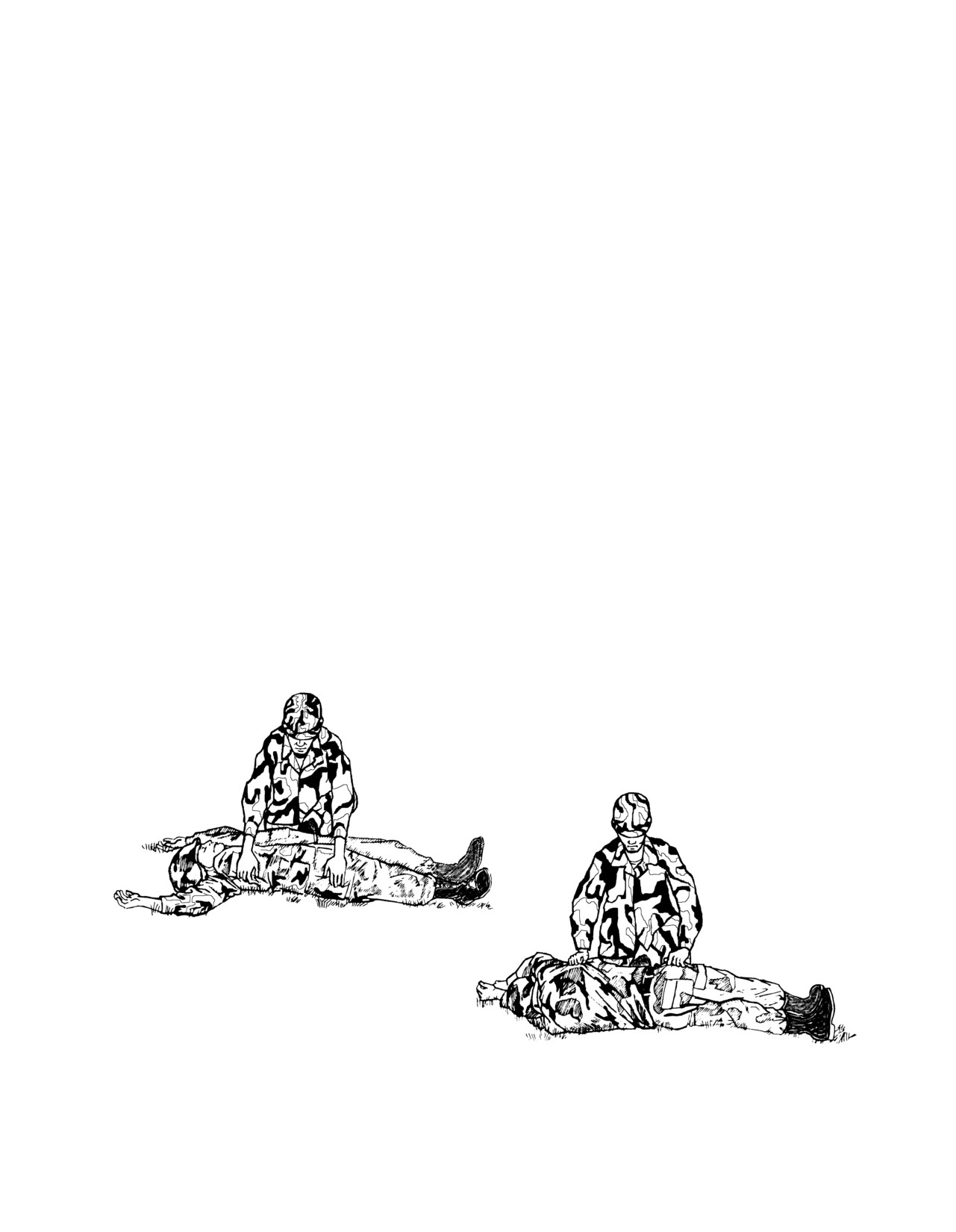
a. To roll a casualty onto his abdomen, kneel at the casualtys uninjured side.
(1) Place his arms above his head; cross his ankle which is farther from you over the one that
is closer to you.
(2) Place one of your hands on the shoulder which is farther from you; place your other hand
in the area of his hip or thigh.
(3) Roll him gently toward you onto his abdomen (Figure 8-1).
Figure 8-1. Positioning the casualty (on his abdomen).
8-3
FM 8-10-6
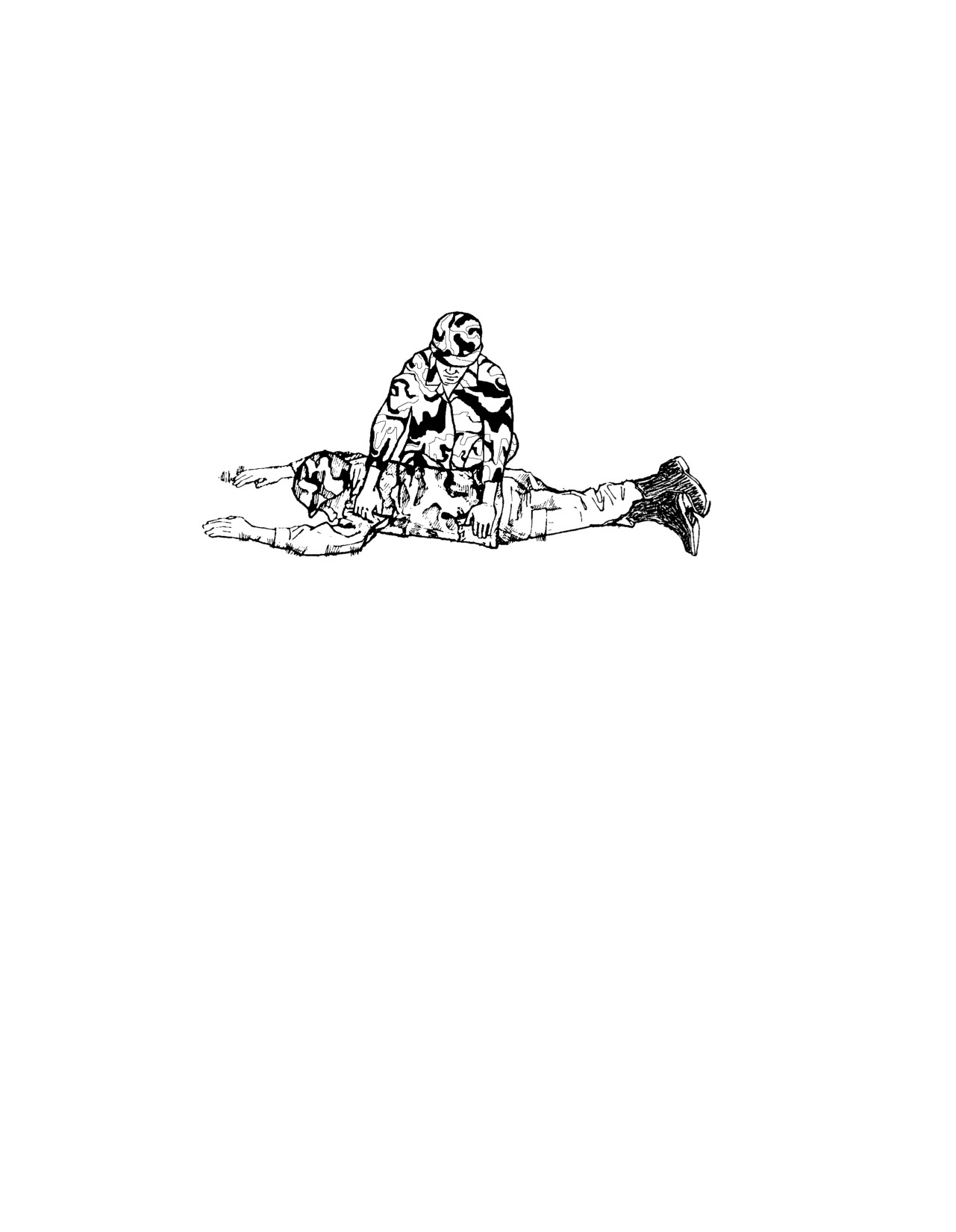
b. To roll a casualty onto his back, follow the same procedure described in a above, except
gently roll the casualty onto his back, rather than onto his abdomen (Figure 8-2).
Figure 8-2. Positioning the casualty on his back.
8-6.
Categories of Manual Carries
a. One-Man Carries. These carries should be used when only one bearer is available to transport
the casualty.
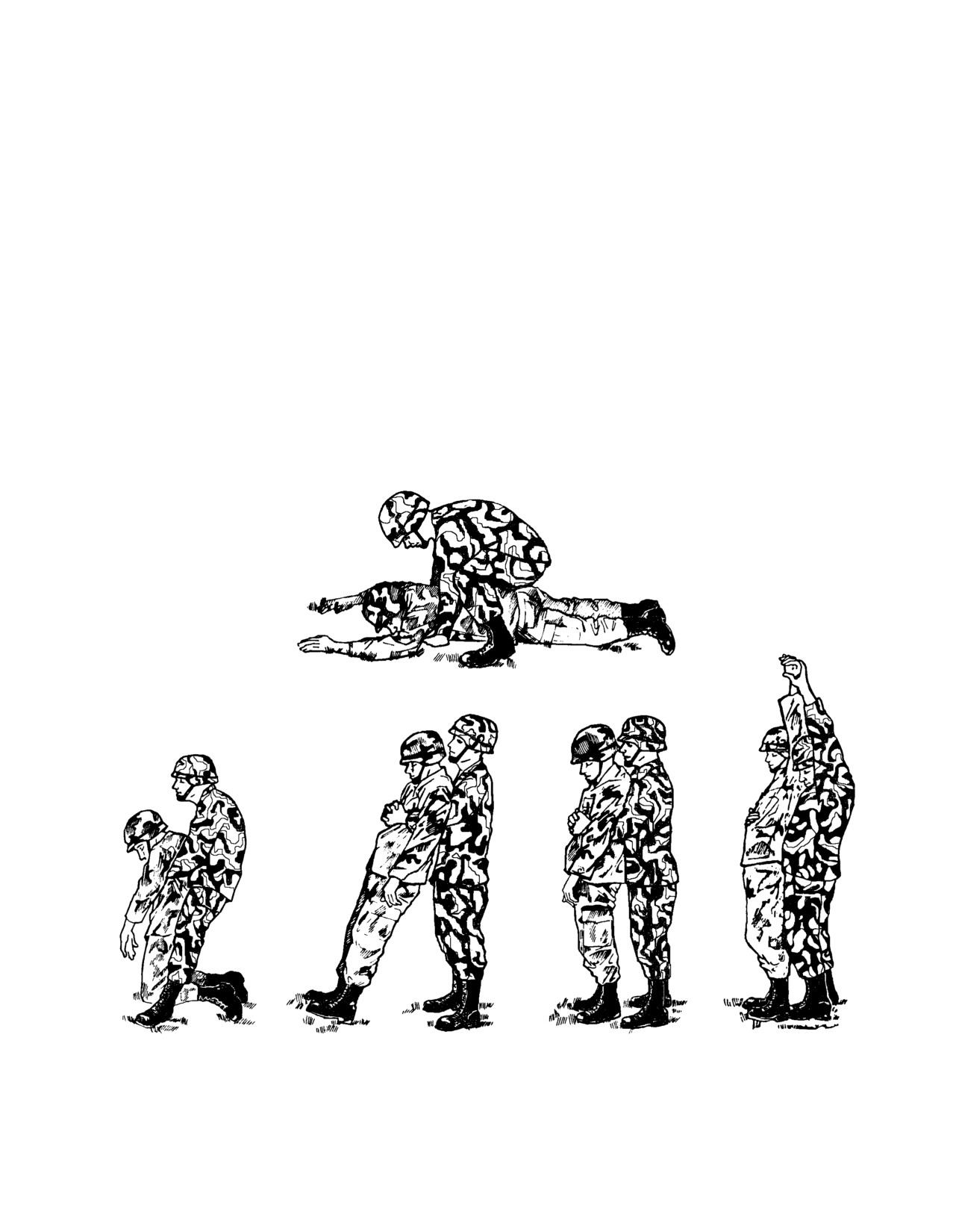
(1) The firemans carry (Figure 8-3) is one of the easiest ways for one individual to carry
another. After an unconscious or disabled casualty has been properly positioned (Figure 8-1), he is raised
from the ground, then supported and placed in the carrying position.
(a) After rolling the casualty onto his abdomen, straddle him. Extend your hands
under his chest and lock them together.
(b) Lift the patient to his knees as you move backward
(c) Continue to move backward, thus straightening the casualtys legs and locking his
knees.
(d) Walk forward, bringing the casualty to a standing position; tilt him slightly backward
to prevent his knees from bucking.
(e) As you maintain constant support of the casualty with one arm, free your other
arm, quickly grasp his wrist, and raise his arm high. Instantly pass your head under his raised arm,
releasing it as you pass under it.
8-4
FM 8-10-6
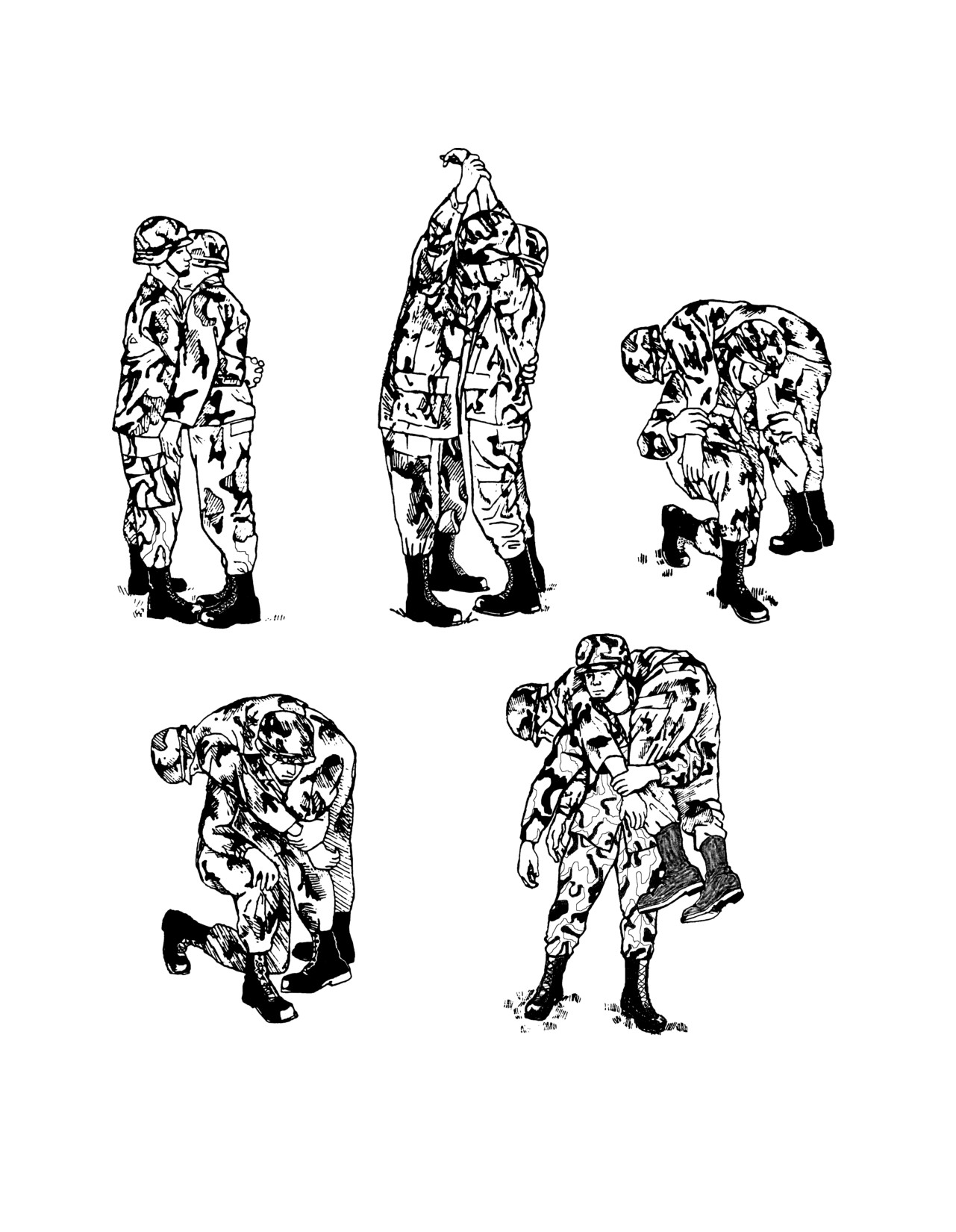
(f)
Move swiftly to face the casualty and secure your arms around his waist. Immedi-
ately place your foot between his feet and spread them apart (approximately 6 to 8 inches).
(g) Grasp the casualtys wrist and raise his arm high over your head.
(h) Bend down and pull the casualtys arm over and down on your shoulder, bringing
his body across your shoulders. At the same time, pass your arm between his legs.
(i)
Grasp the casualtys wrist with one hand, and place your other hand on your knee
for support.
(j)
Rise with the casualty positioned correctly. Your other hand is free for use.
Figure 8-3. Firemans carry.
8-5
FM 8-10-6
Figure 8-3. Firemans carry (continued).
8-6
FM 8-10-6
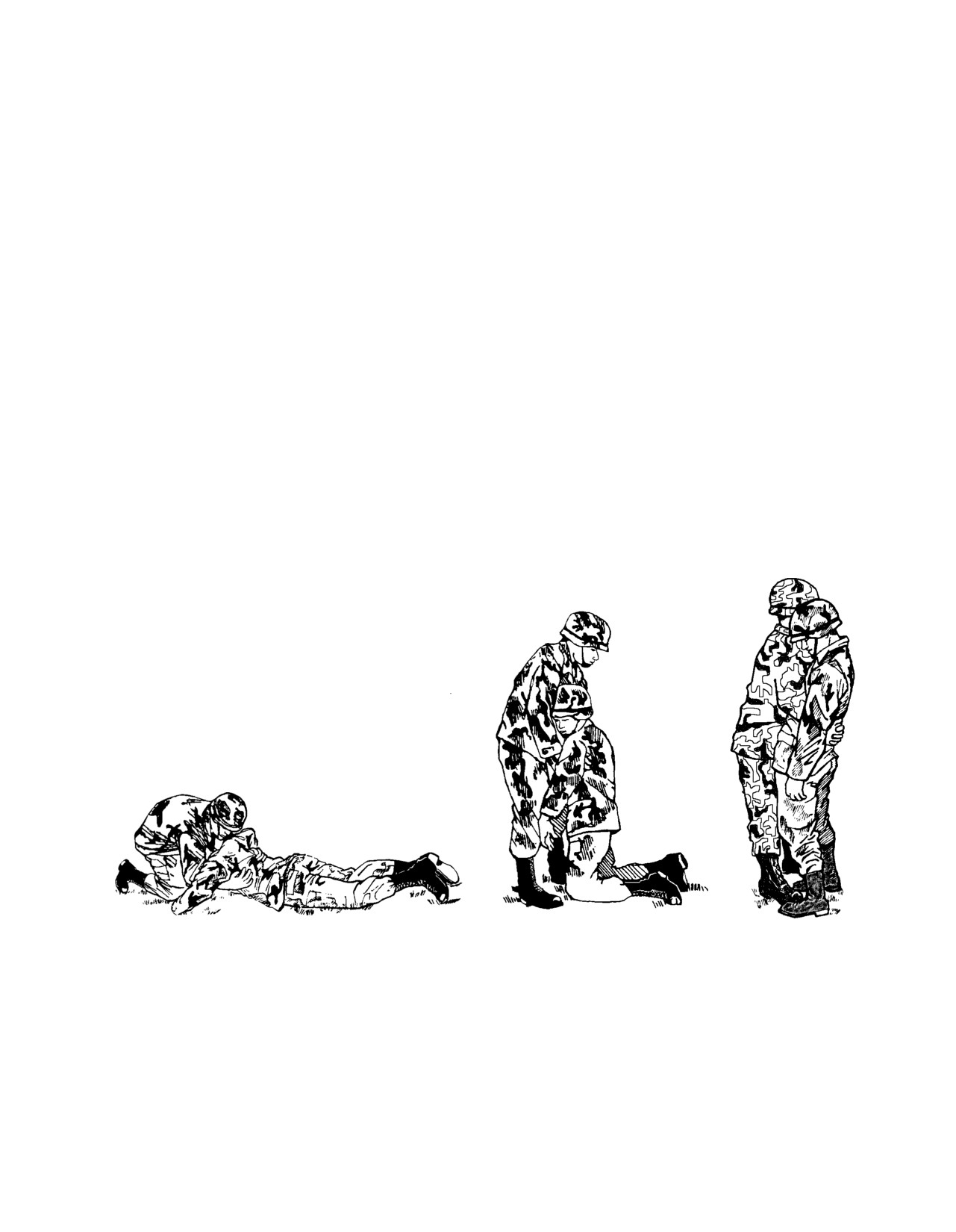
(2) The alternate method of the firemans carry for raising a casualty from the ground is
illustrated in Figure 8-4; however, it should be used only when the bearer believes it to be safer for the
casualty because of the location of his wounds. When the alternate method is used, care must be taken to
prevent the casualtys head from snapping back and causing a neck injury. The steps for raising a casualty
from the ground for the firemans carry are also used in other one-man carries.
(a) Kneel on one knee at the casualtys head and face his feet. Extend your hands
under his armpits, down his sides, and across his back.
(b) As you rise, lift the casualty to his knees. Then secure a lower hold and raise him to
a standing position with his knees locked.
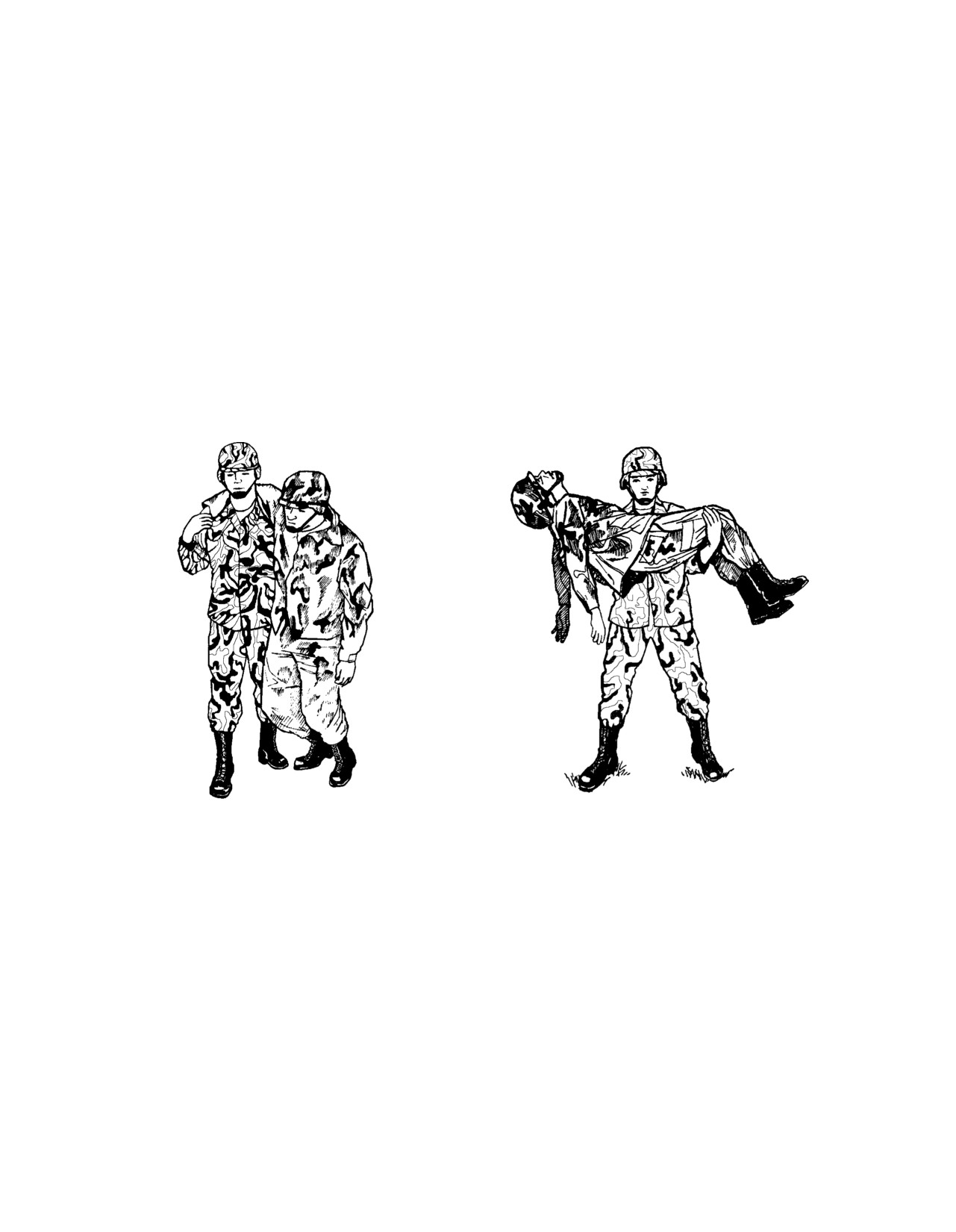
(3) In the supporting carry (Figure 8-5), the casualty must be able to walk, or at least hop,
on one leg, using the bearer as a crutch. This carry can be used to transport a casualty as far as he is able to
walk or hop.
(a) Raise the casualty from the ground to a standing position by using the firemans
carry.
Figure 8-4. Firemans carry (alternate method for lifting the patient to a standing position).
(b) Grasp the casualtys wrist and draw his arm around your neck.
(c) Place your arm around his wrist. The casualty is now able to walk or hop, using
you as a support.
8-7
FM 8-10-6
(4) The arms carry (Figure 8-6) is useful in carrying a casualty for a short distance (up to 50
meters) and for placing a casualty on a litter.
(a) Raise or lift the casualty from the ground to a standing position, as in the firemans
carry.
(b) Place one arm under the casualtys knees and your other arm around his back.
(c) Lift the casualty.
(d) Carry the casualty high to lessen fatigue.
Figure 8-5. Supporting carry.
Figure 8-6. Arms carry.
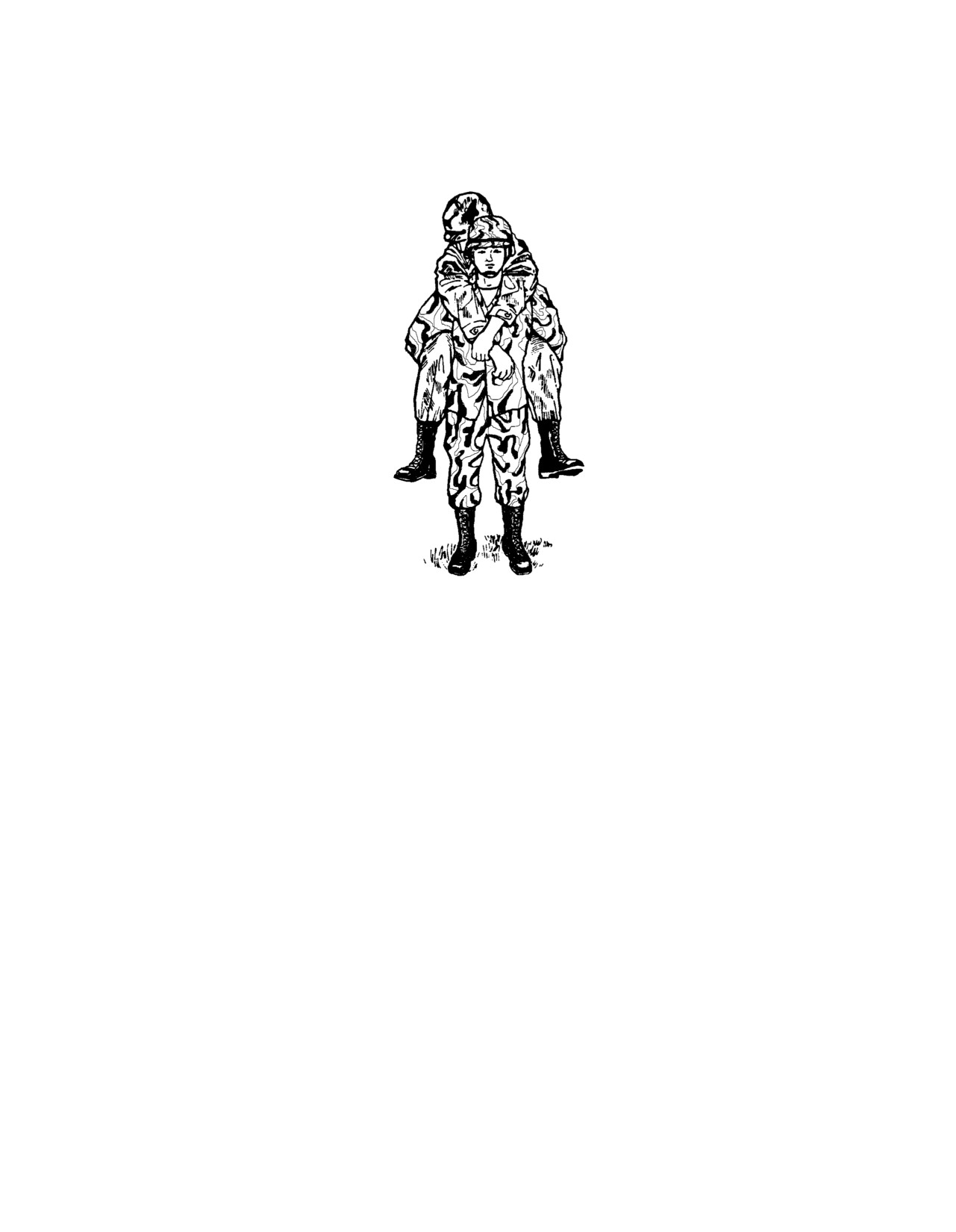
(5) Only a conscious casualty can be transported by the saddleback carry (Figure 8-7)
because he must be able to hold onto the bearers neck. To use this technique
(a) Raise the casualty to an upright position, as in the firemans carry.
(b) Support the casualty by placing an arm around his waist. Move to the casualtys
side. Have the casualty put his arm around your neck and move in front of him with your back to him.
(c) Have the casualty encircle his arms around your neck.
(d) Stoop, raise him on your back, and clasp your hands together beneath his thighs, if
possible.
8-8
FM 8-10-6
Figure 8-7. Saddleback carry.
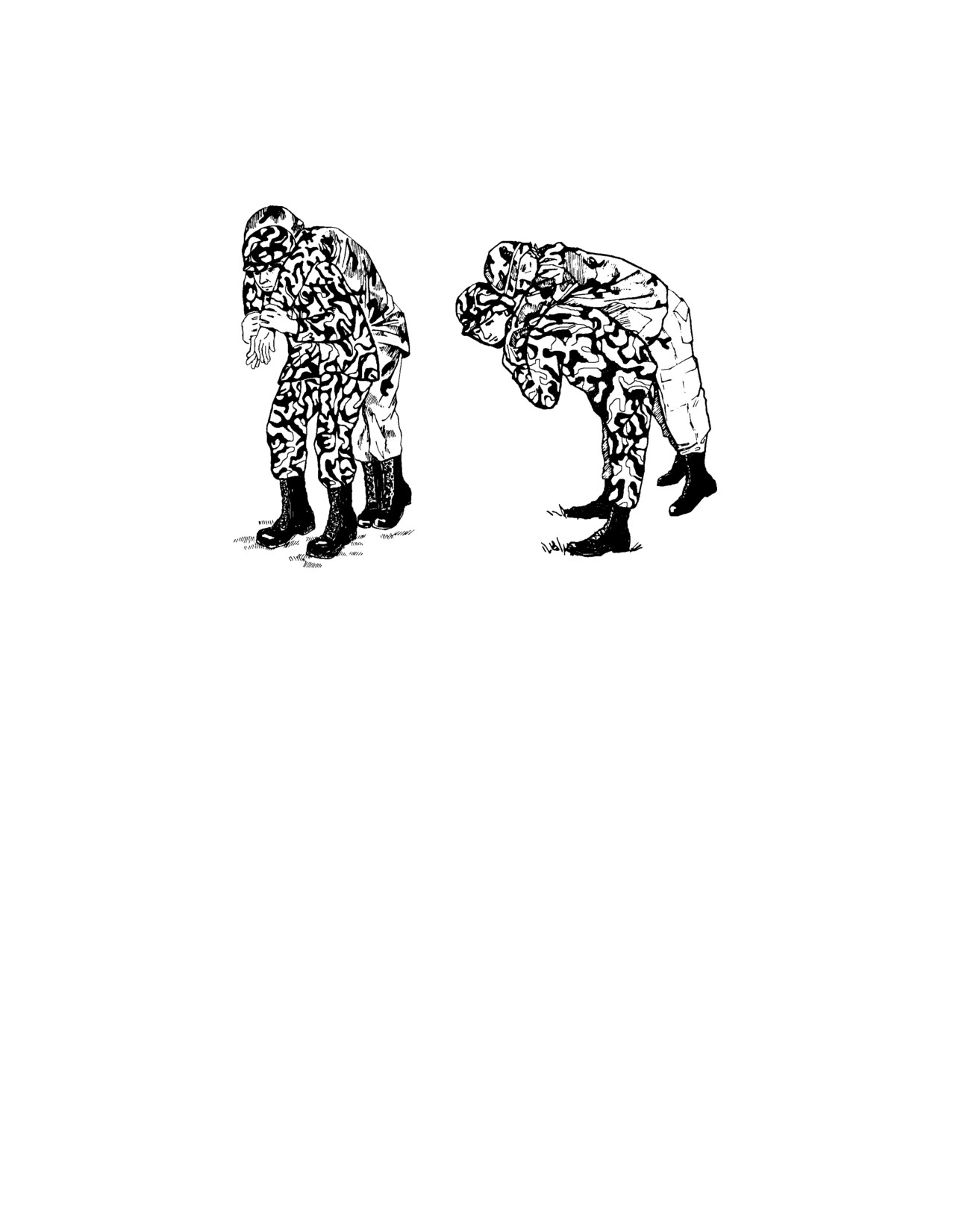
(6) In the pack-strap carry (Figure 8-8), the casualtys weight rests high on your back. This
makes it easier for you to carry the casualty a moderate distance (50 to 300 meters). To eliminate the
possibility of injury to the casualtys arms, you must hold the casualtys arms in a palms-down position.
(a) Lift the casualty from the ground to a standing position, as in the firemans carry.
(b) Support the casualty with your arms around him and grasp his wrist closer to you.
(c) Place his arm over your head and across your shoulders.
(d) Move in front of him while still supporting his weight against your back.
(e) Grasp his other wrist and place this arm over your shoulder.
(f)
Bend forward and raise or hoist the casualty as high on your back as possible so that
his weight is resting on your back.
NOTE
Once the casualty is positioned on the bearers back, the bearer
remains as erect as possible to prevent straining or injuring his back.
8-9
FM 8-10-6
Figure 8-8. Pack-strap carry.
(7) The pistol-belt carry (Figure 8-9) is the best one-man carry for a long distance (over 300
meters). The casualty is securely supported upon your shoulders by a belt. Both your hands and the
casualtys (if conscious) are free for carrying a weapon or equipment, or for climbing obstacles. With your
hands free and the casualty secured in place, you are also able to creep through shrubs and under low-
hanging branches.
(a) Link two pistol belts (or three, if necessary) together to form a sling. Place the
sling under the casualtys thighs and lower back so that a loop extends from each side.
NOTE
If pistol belts are not available for use, other items such as rifle
slings, two cravat bandages, two litter straps, or any other suitable
material which will not cut or bind the casualty may be used.
(b) Lie face up between the casualtys outstretched legs. Thrust your arms through the
loops and grasp his hands and trouser leg on his injured side.
(c) Roll toward the casualtys uninjured side onto your abdomen, bringing him onto
your back. Adjust the sling, if necessary.
(d) Rise to a kneeling position. The belt holds the casualty in place.
8-10
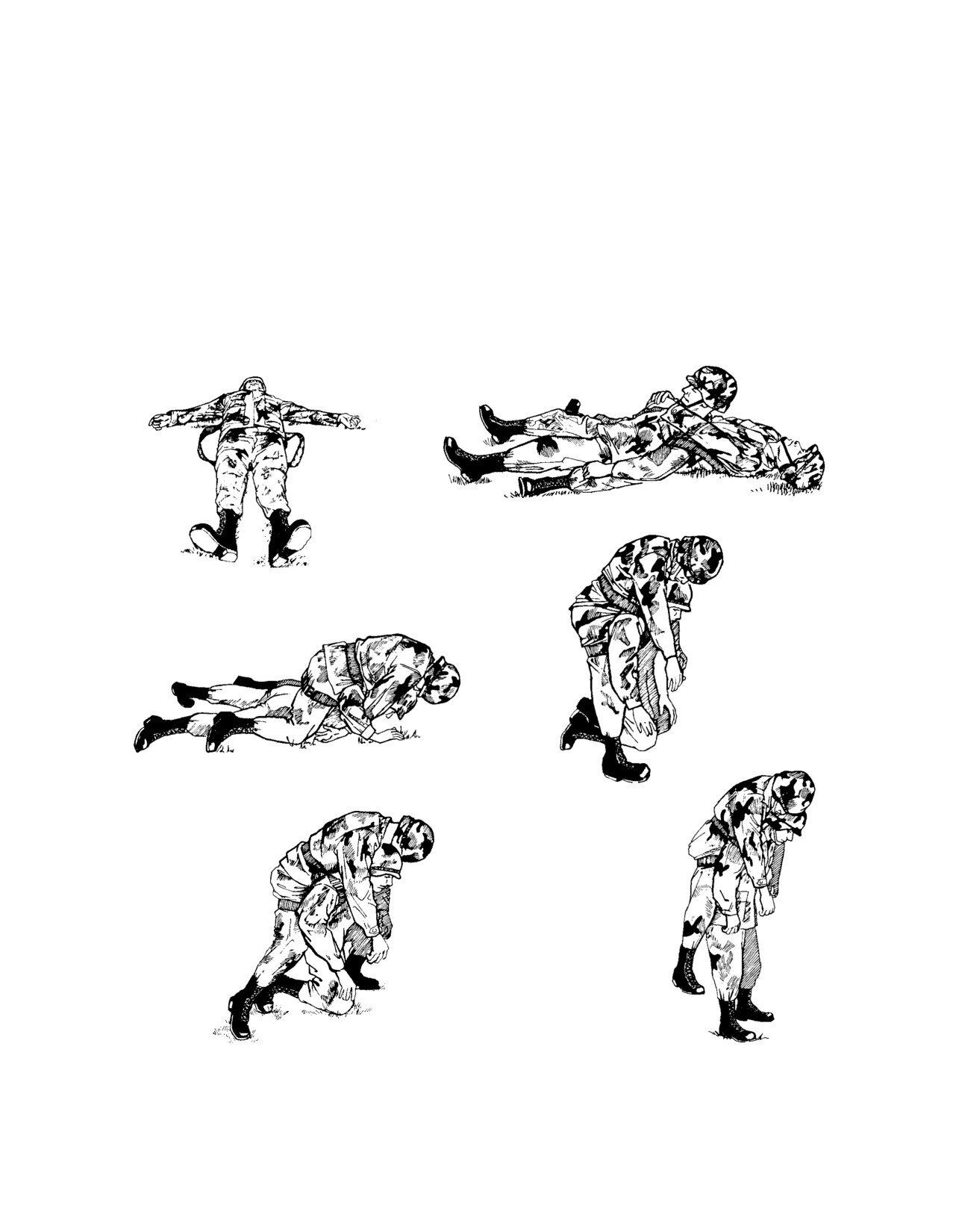
FM 8-10-6
(e) Place one hand on your knee for support and rise to an upright position.
(The
casualty is supported on your shoulders.)
(f)
Carry the casualty with your hands free for use in rifle firing, climbing, or
surmounting obstacles.
Figure 8-9. Pistol-belt carry.
8-11
FM 8-10-6
(8) The pistol-belt drag (Figure 8-10), as well as other drags, is generally used for short
distances (up to 50 meters). This drag is useful in combat, since both the bearer and the casualty can remain
closer to the ground than in other drags.
(a) Extend two pistol belts or similar objects to their full length and join them together
to make a continuous loop.
(b) Roll the casualty onto his back, as in the firemans carry.
(c) Pass the loop over the casualtys head, and position it across his chest and under his
armpits. Then cross the remaining portion of the loop, thus forming a figure eight.
(d) Lie on your side facing the casualty.
(e) Slip the loop over your head and turn onto your abdomen. This enables you to drag
the casualty as you crawl.
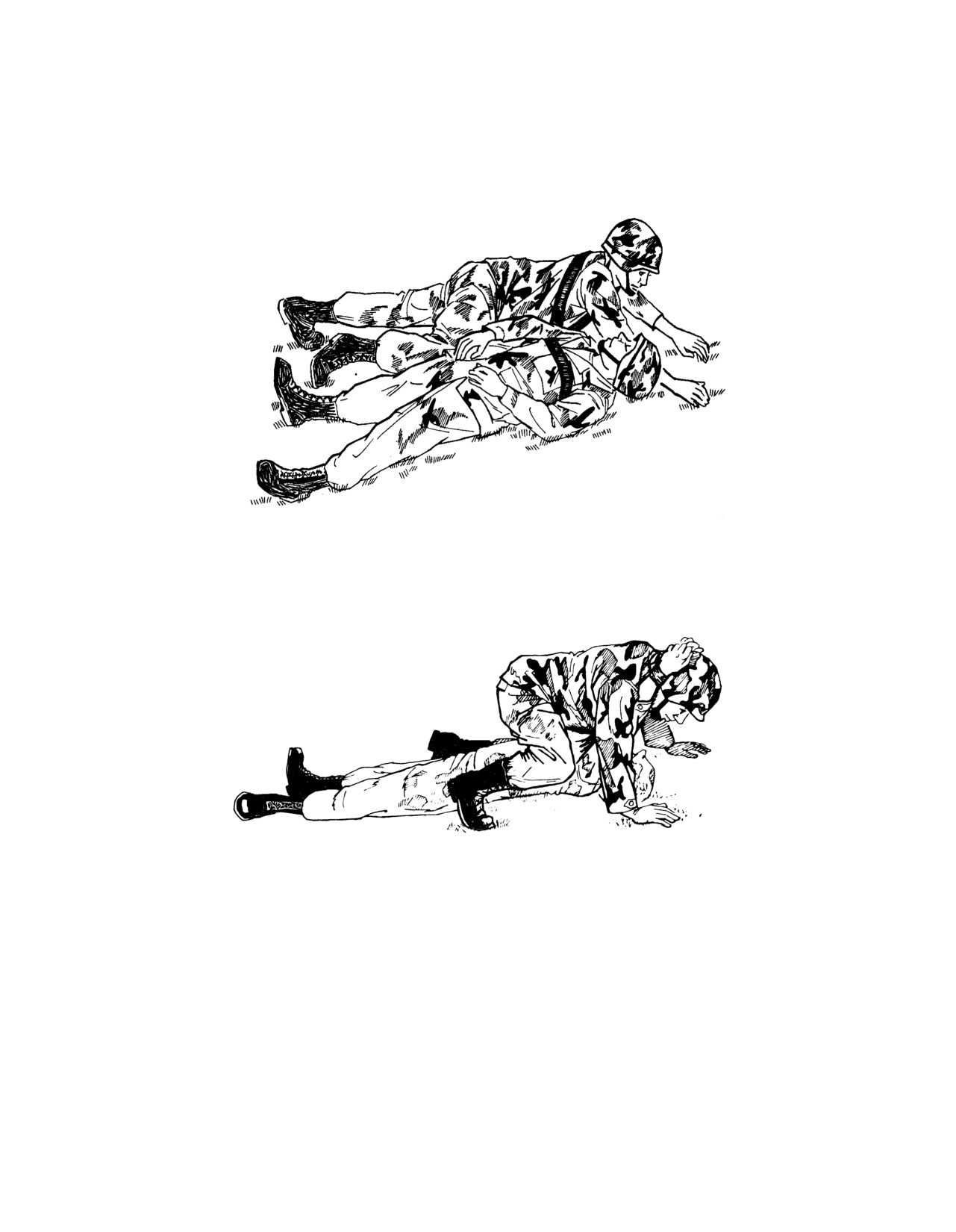
(9) The neck drag (Figure 8-11) is useful in combat because the bearer can transport the
casualty as he creeps behind a low wall or shrubbery, under a vehicle, or through a culvert. If the casualty is
unconscious, his head must be protected from the ground. The neck drag cannot be used if the casualty has
a broken arm.
NOTE
If the casualty is conscious, he may clasp his hands together
around your neck.
(a) Tie the casualtys hands together at the wrists.
(b) Straddle the casualty in a kneeling face-to-face position.
(c) Loop the casualtys tied hands over and around your neck.
(d) Crawl forward dragging the casualty with you.
NOTE
If the casualty is unconscious, protect his head from the
ground.
8-12
FM 8-10-6
Figure 8-10. Pistol-belt drag.
Figure 8-11. Neck drag.
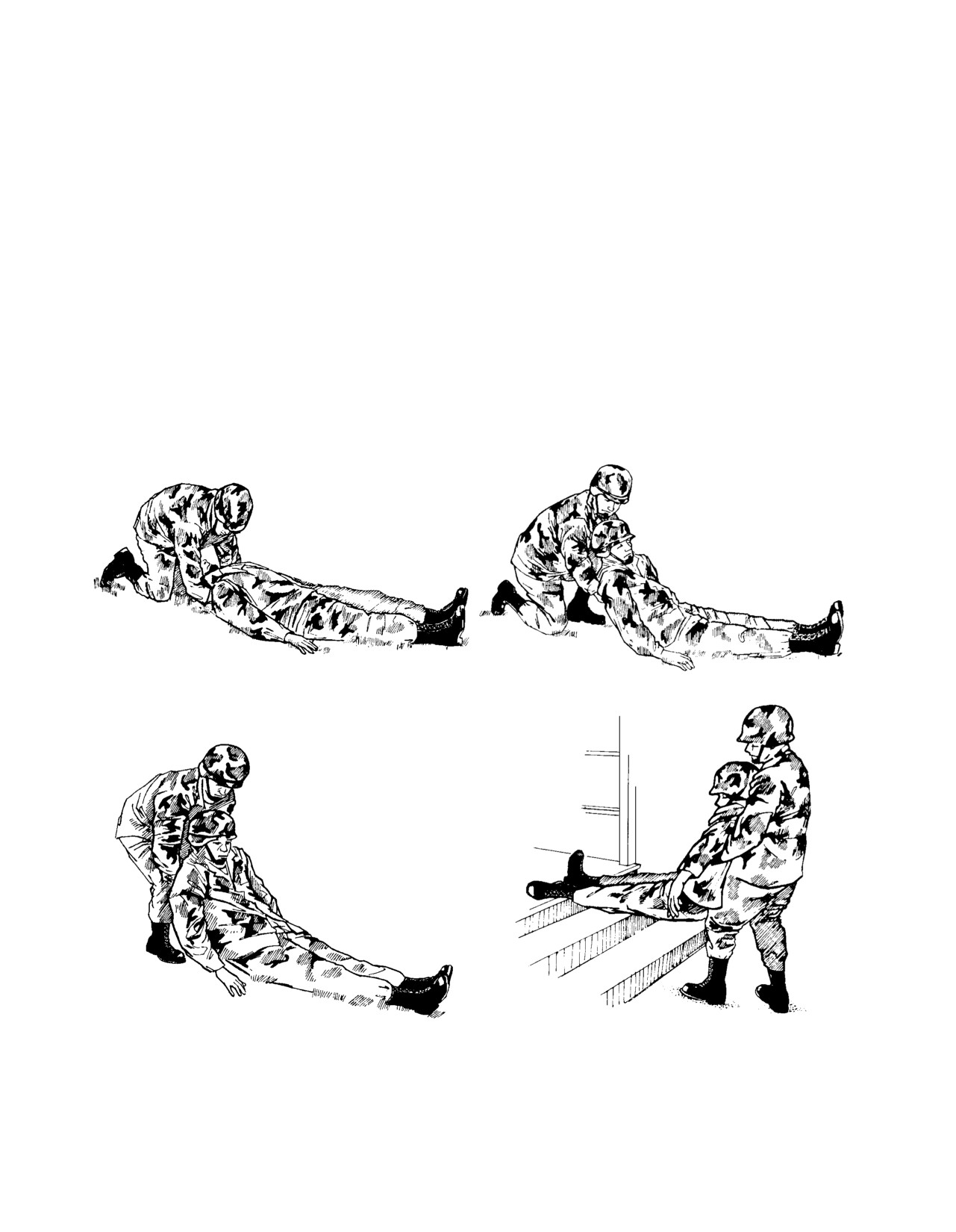
(10) The cradle-drop drag (Figure 8-12) is effective in moving a casualty up or down steps.
(a) Kneel at the casualtys head (with him lying on his back). Slide your hands, with
palms up, under the casualtys shoulders and get a firm hold under his armpits.
(b) Rise (partially), supporting the casualtys head on one of your forearms. (You may
bring your elbows together and let the casualtys head rest on both of your forearms.)
(c) Rise and drag the casualty backward.
(The casualty is in a semisitting position.)
8-13
FM 8-10-6
(d) Back down the steps, supporting the casualtys head and body and letting his hips
and legs drop from step to step.
NOTE
If the casualty needs to be moved up the steps, you should back
up the steps, using the same procedure.
Figure 8-12. Cradle-drop drag.
8-14
FM 8-10-6
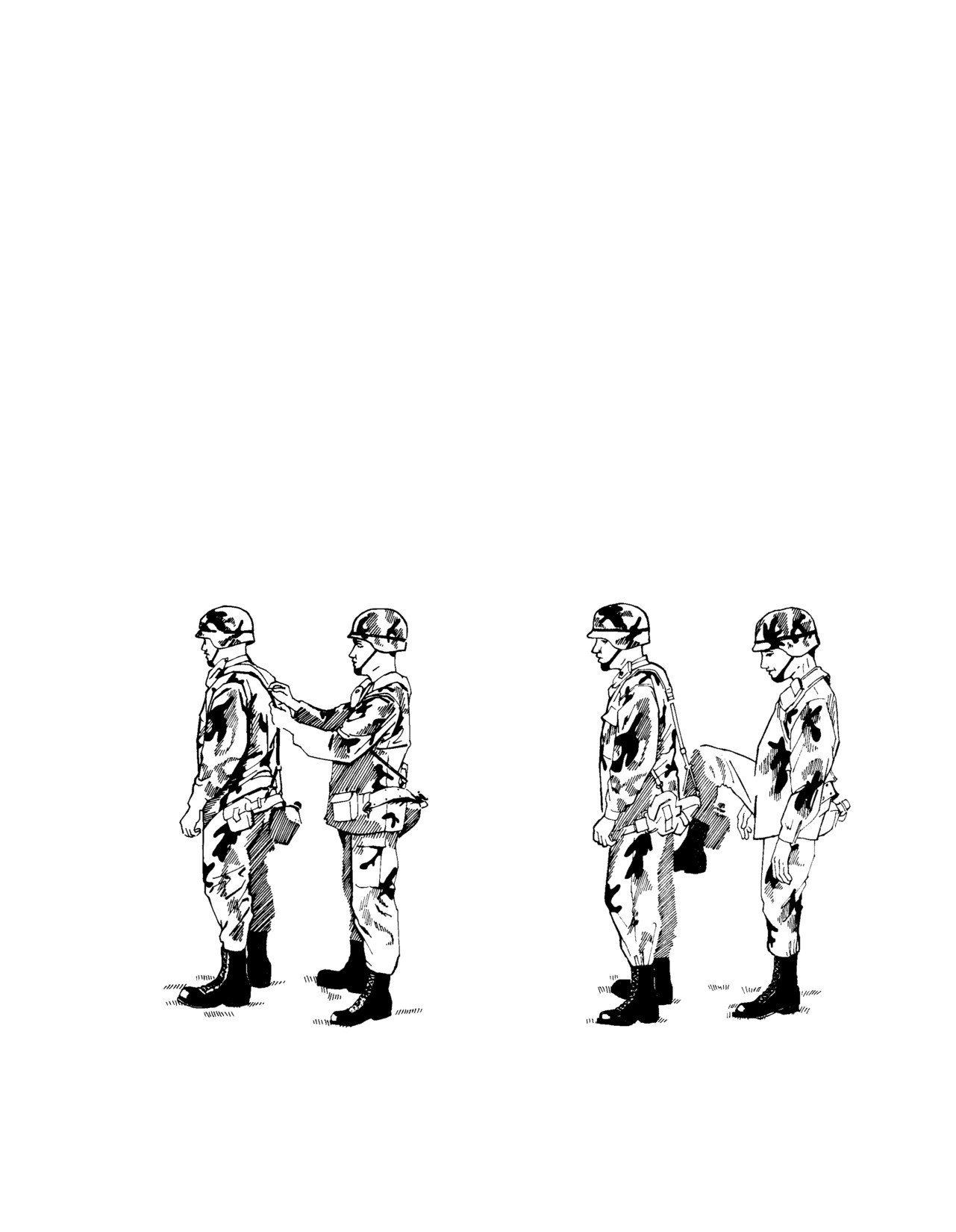
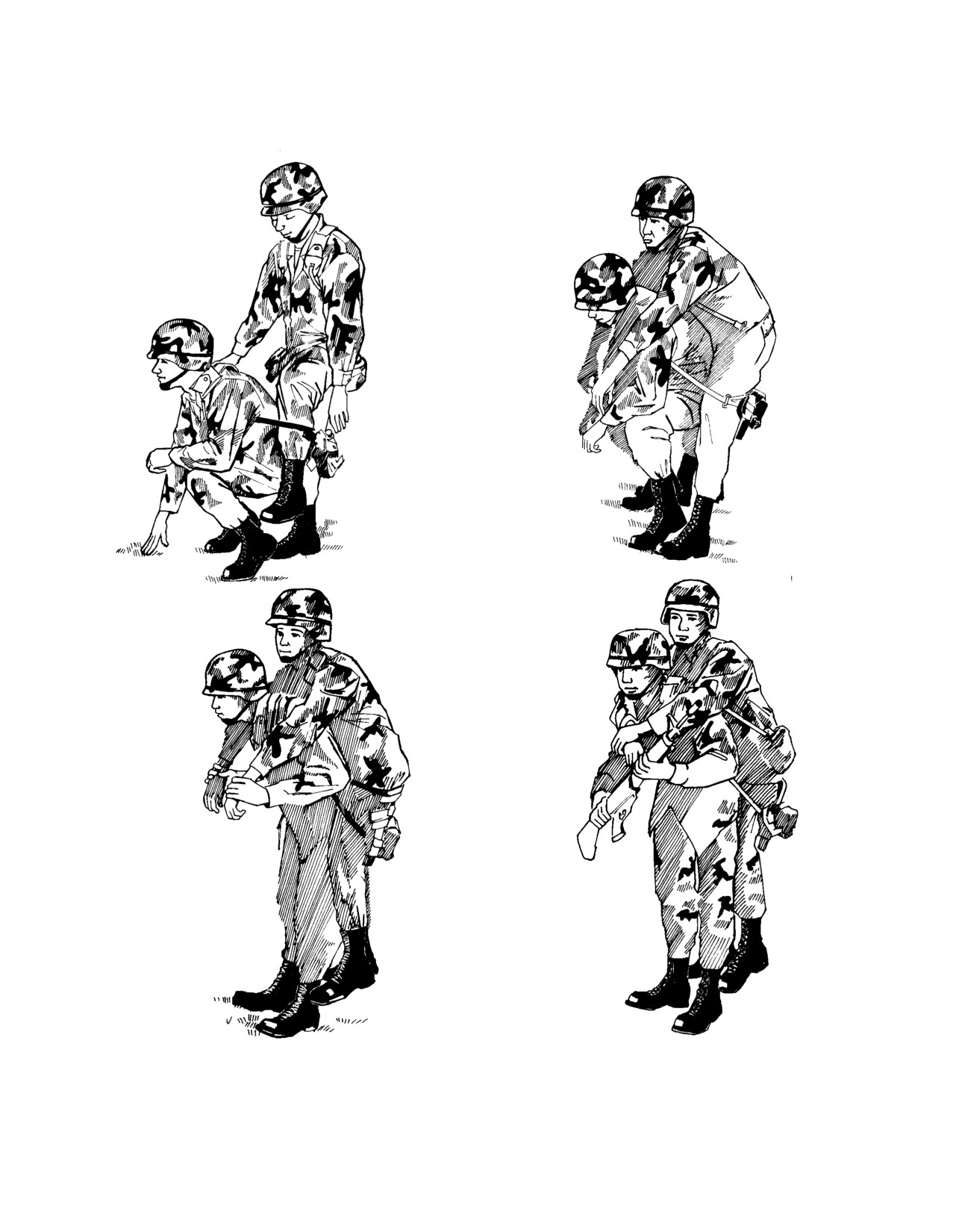
(11) The load-bearing equipment (LBE) carry using the bearers LBE can be used with a
conscious casualty (Figure 8-13).
(a) Loosen all suspenders on your LBE.
(b) Have the casualty place one leg into the loop formed by your suspenders and pistol
belt.
(c) Squat in front of the standing casualty. Have him place his other leg into the loop,
also.
(d) Have the casualty place his arms over your shoulders, lean forward onto your back,
and lock his hands together.
(e) Stand up and lean forward into a comfortable position.
(f)
Continue mission.
Figure 8-13. LBE carry using bearers LBE (conscious casualty).
8-15
FM 8-10-6
Figure 8-13. LBE carry using bearers LBE (conscious casualty) (continued).
8-16
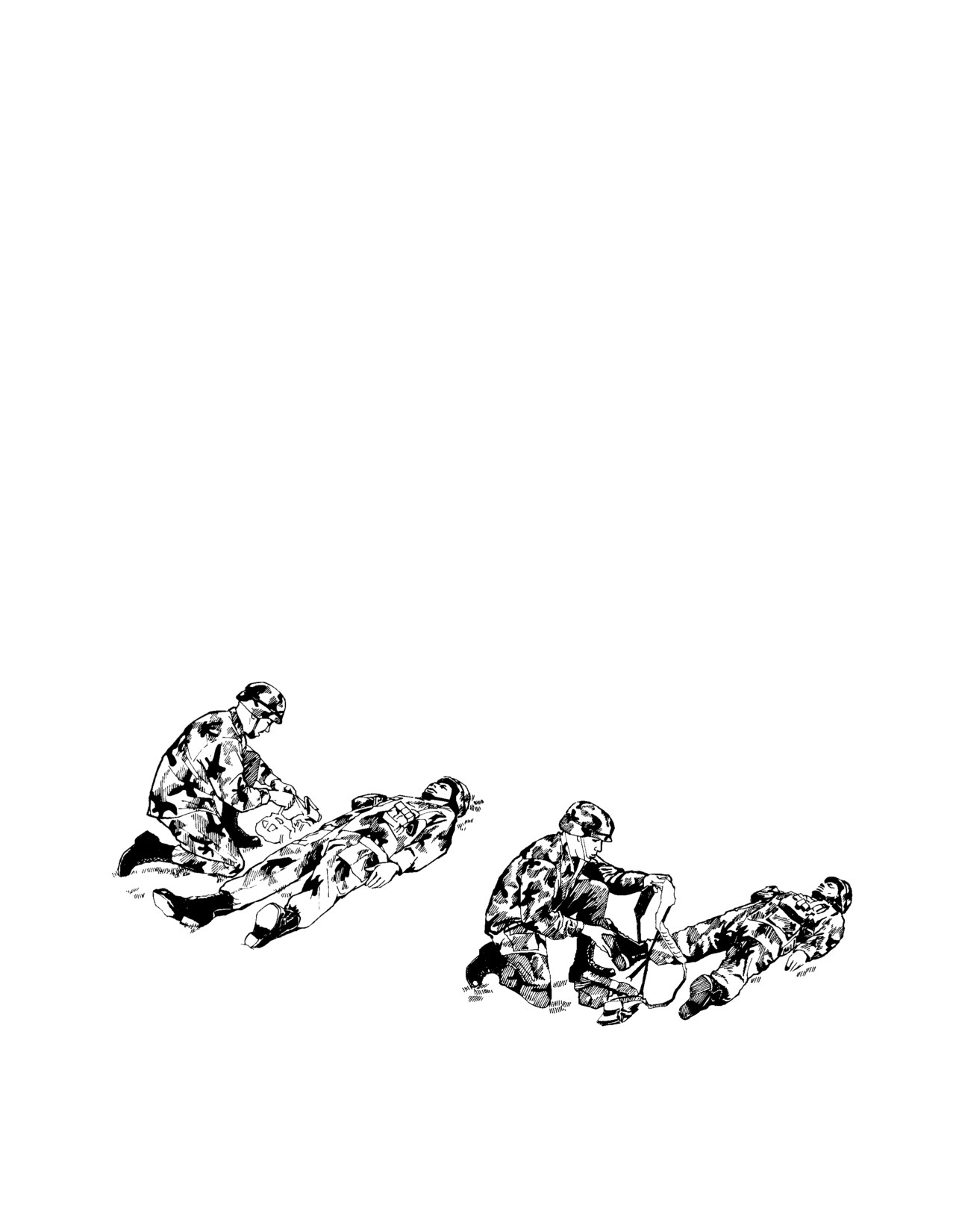
FM 8-10-6
(12) The LBE carry using the bearers LBE can be used with an unconscious casualty or one
who cannot stand (Figure 8-14).
(a) Position the casualty on the flat of his back.
(b) Remove your LBE and loosen all suspender straps.
(c) Lift the casualtys leg and place it through the loop formed by your suspenders and
pistol belt. Then place the other leg. The LBE is moved up until the pistol belt is behind the casualtys
thighs.
(d) Lay between the casualtys legs; work his arms through his LBE suspenders.
(e) Grasp the casualtys hand (on the injured side), and roll the casualty
(on his
uninjured side) onto his back.
(f)
Rise to one knee and then push into a standing position.
(g) Bring the casualtys arms over your shoulders. Grasp his hands and secure them if
the casualty in unconscious. If the casualty is conscious and he is able to assist, have him lock his hands in
front of you.
(h) Lean forward into a comfortable position and continue the mission.
Figure 8-14. LBE carry using bearers LBE
(unconscious casualty or one that cannot stand).
8-17
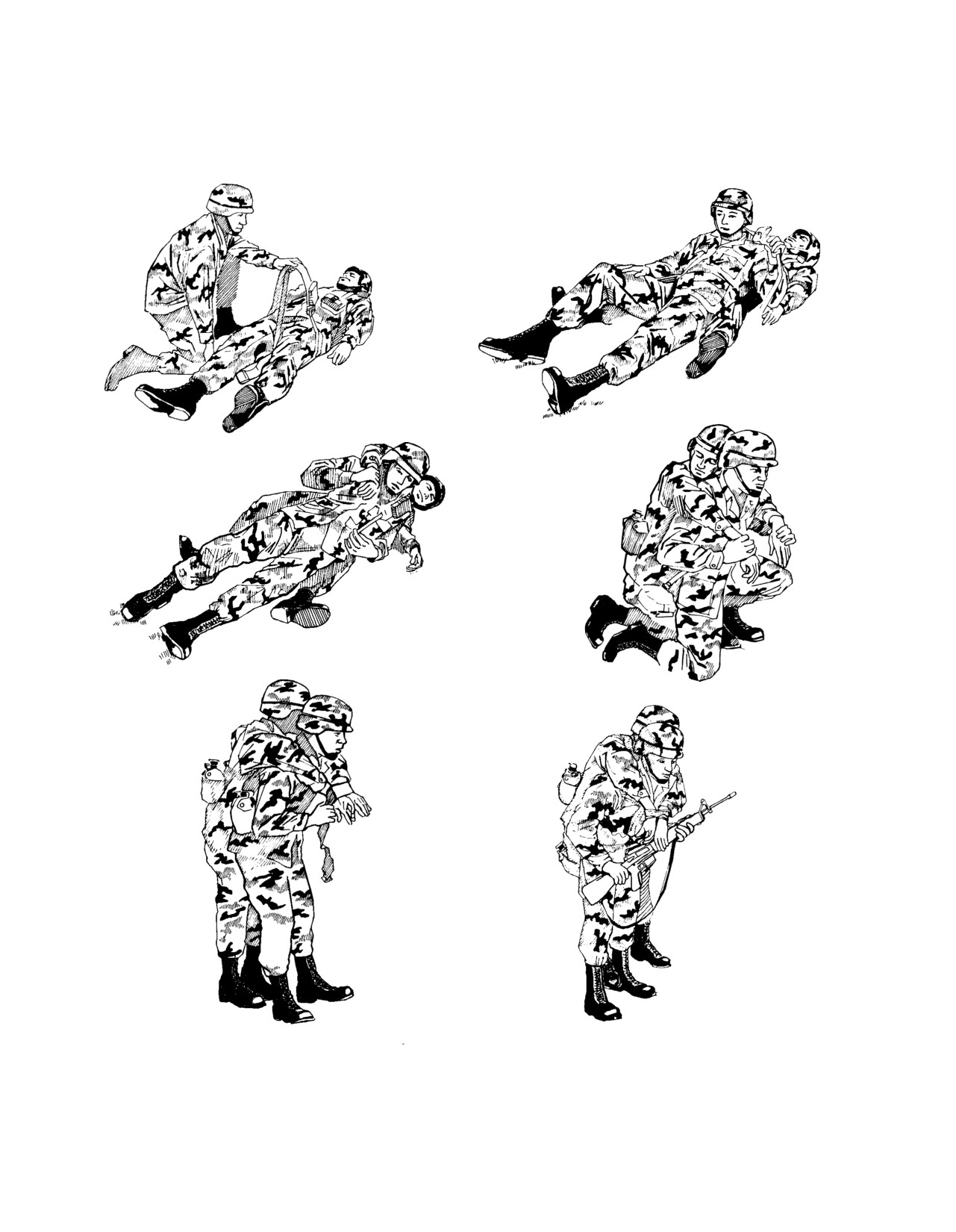
FM 8-10-6
Figure 8-14. LBE carry using bearers LBE (unconscious casualty
or one that cannot stand) (continued).
8-18
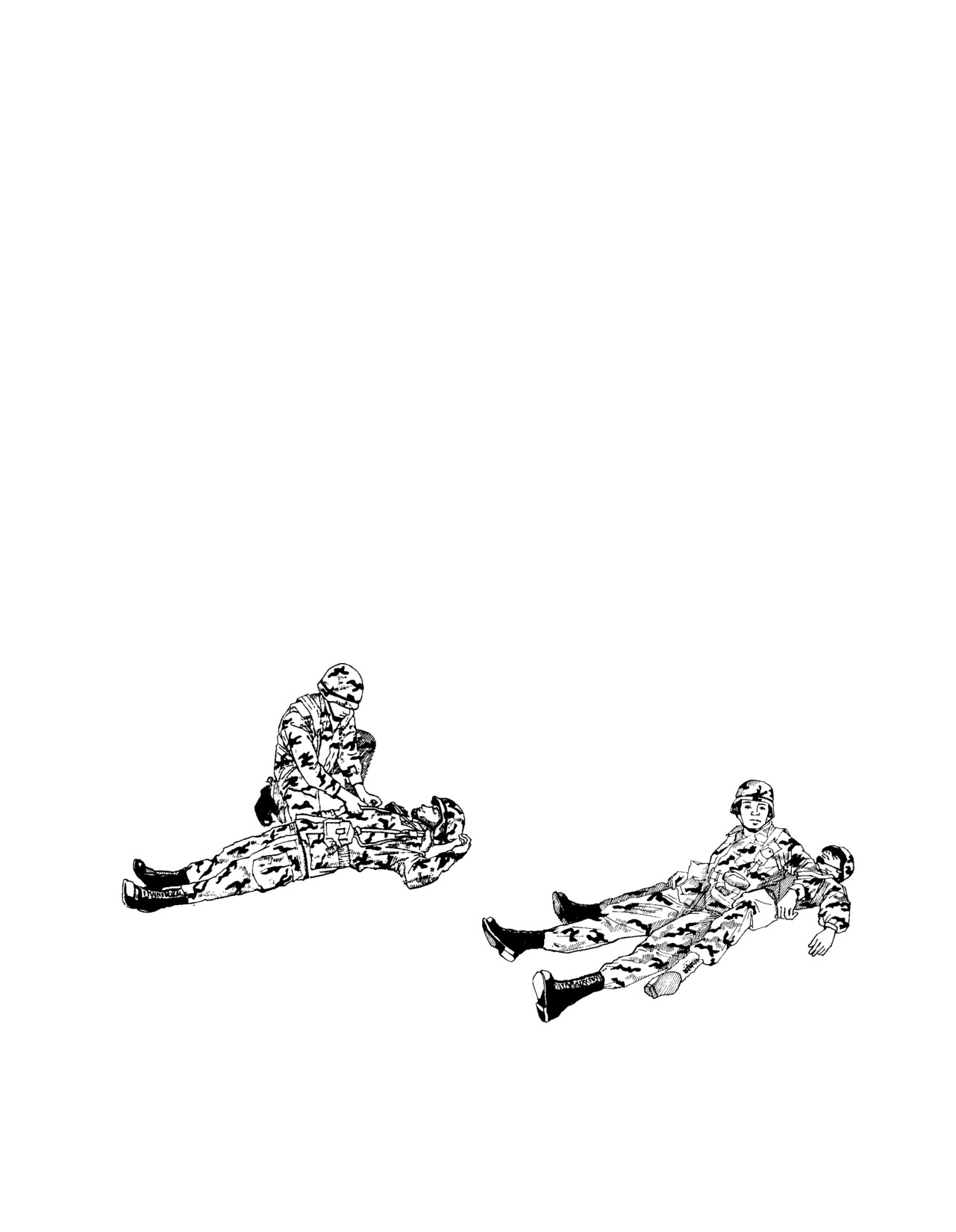
FM 8-10-6
(13) The LBE carry using the casualtys LBE (Figure 8-15) can be used with a conscious or
unconscious casualty.
(a) Position the casualty on his back with his LBE on.
(b) Loosen the casualtys two front suspenders.
(c) Position yourself between the casualtys legs, and slip your arms into the casualtys
two front suspenders (up to his shoulders).
(d) Work his arms out of his LBE suspenders.
(e) Grasp the casualtys hand (on the injured side), and roll him (on his uninjured side)
onto his stomach.
(f)
Rise to one knee, then into a standing position.
(g) Grasp the casualtys hands and secure them, if the casualty is unconscious. If he is
conscious, have the casualty lock his hands in front of you.
(h) Lean forward into a comfortable position and continue the mission.
Figure 8-15. LBE carry using casualtys LBE.
8-19
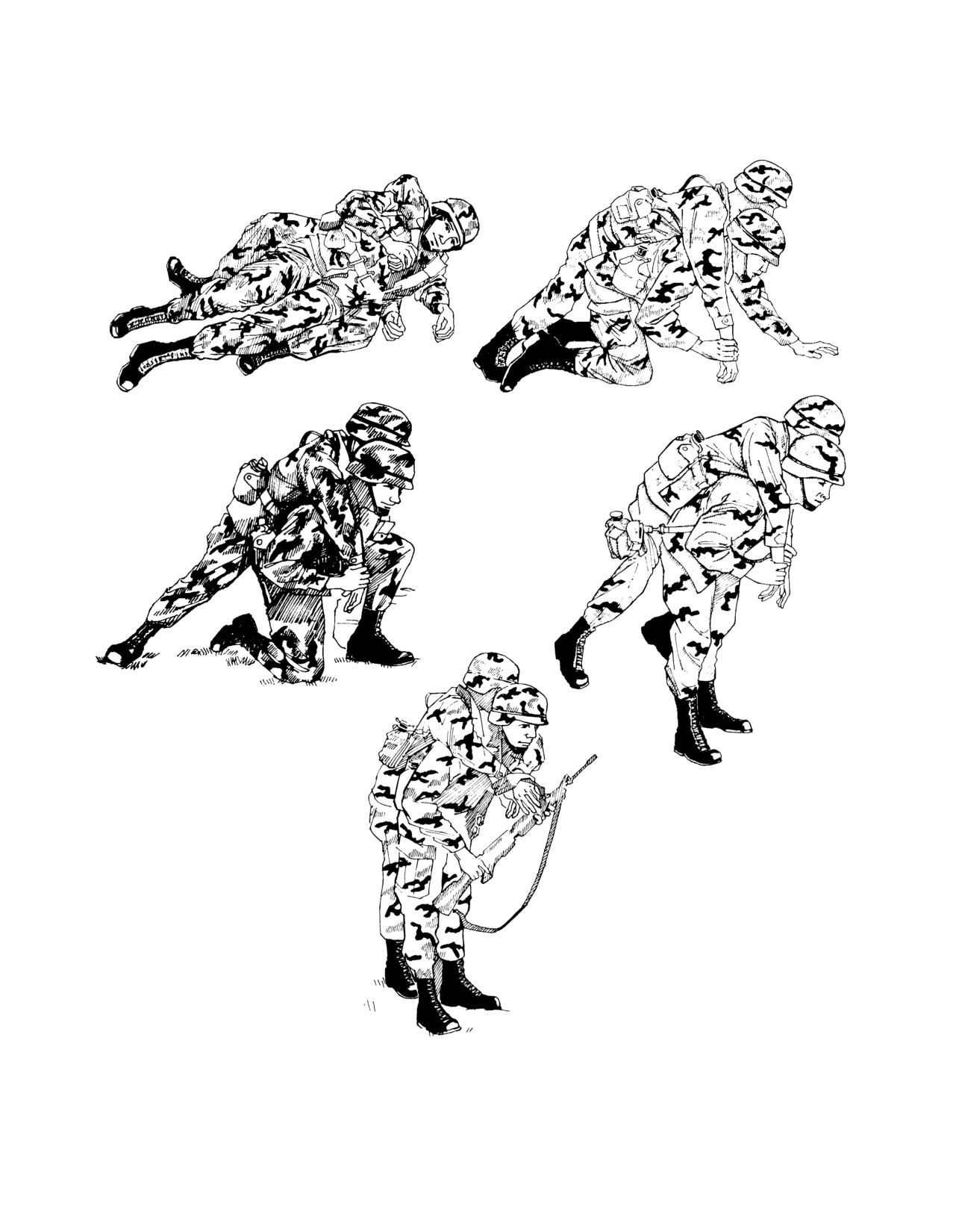
FM 8-10-6
Figure 8-15. LBE carry using casualtys LBE (continued).
8-20
FM 8-10-6
b. Two-Man Carries. These carries should be used whenever possible. They provide more
comfort for the casualty, are less likely to aggravate injuries, and are less tiring for the bearers. Five
different two-man carries can be used.
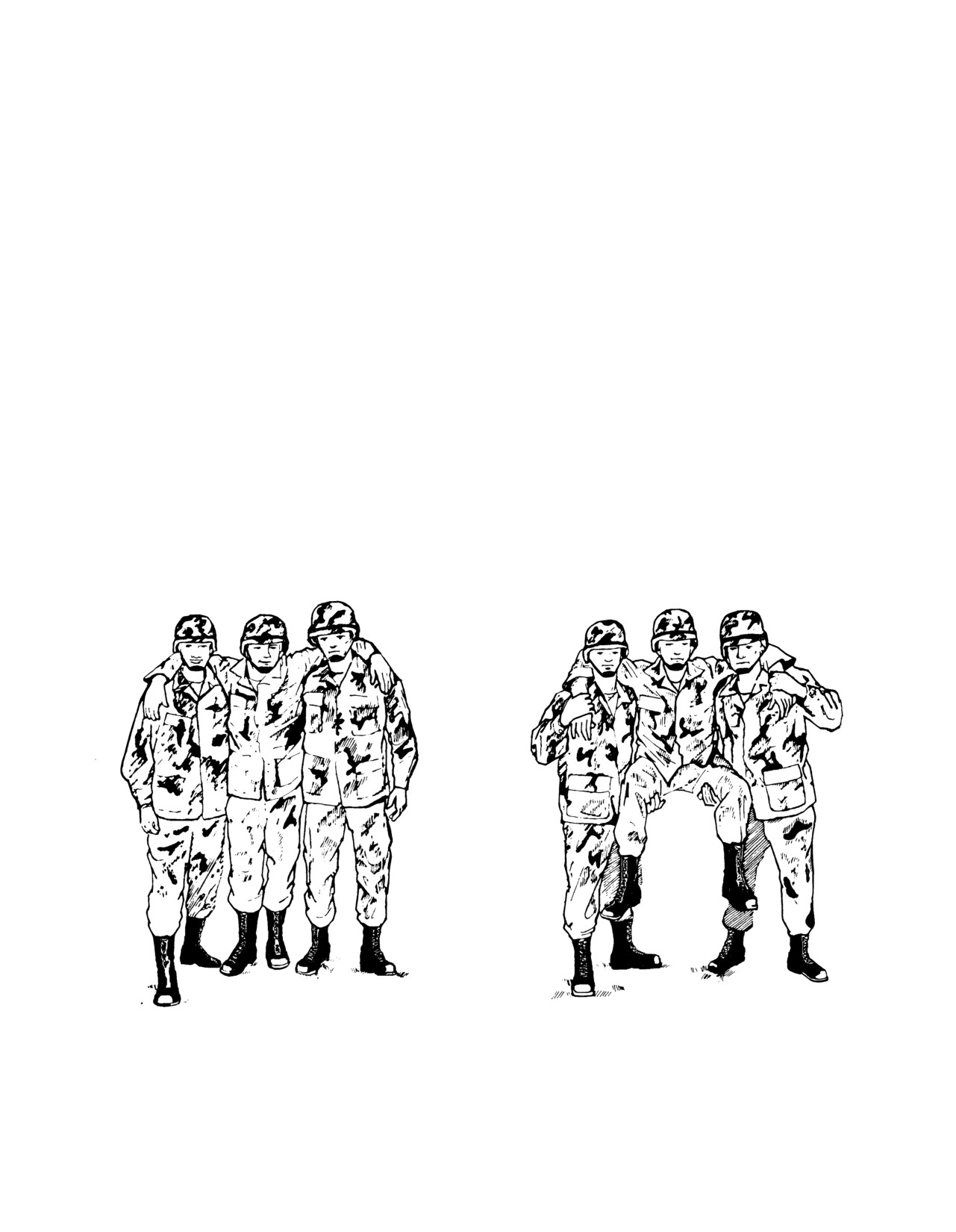
(1) The two-man supporting carry (Figure 8-16) can be used in transporting both conscious
and unconscious casualties. If the casualty is taller than the bearers, it may be necessary for the bearers to
lift the casualtys legs and let them rest on their forearms. The bearers
(a) Help the casualty to his feet and support him with their arms around his waist.
(b) Grasp the casualtys wrists and draw his arms around their necks.
Figure 8-16. Two-man supporting carry.
8-21
FM 8-10-6
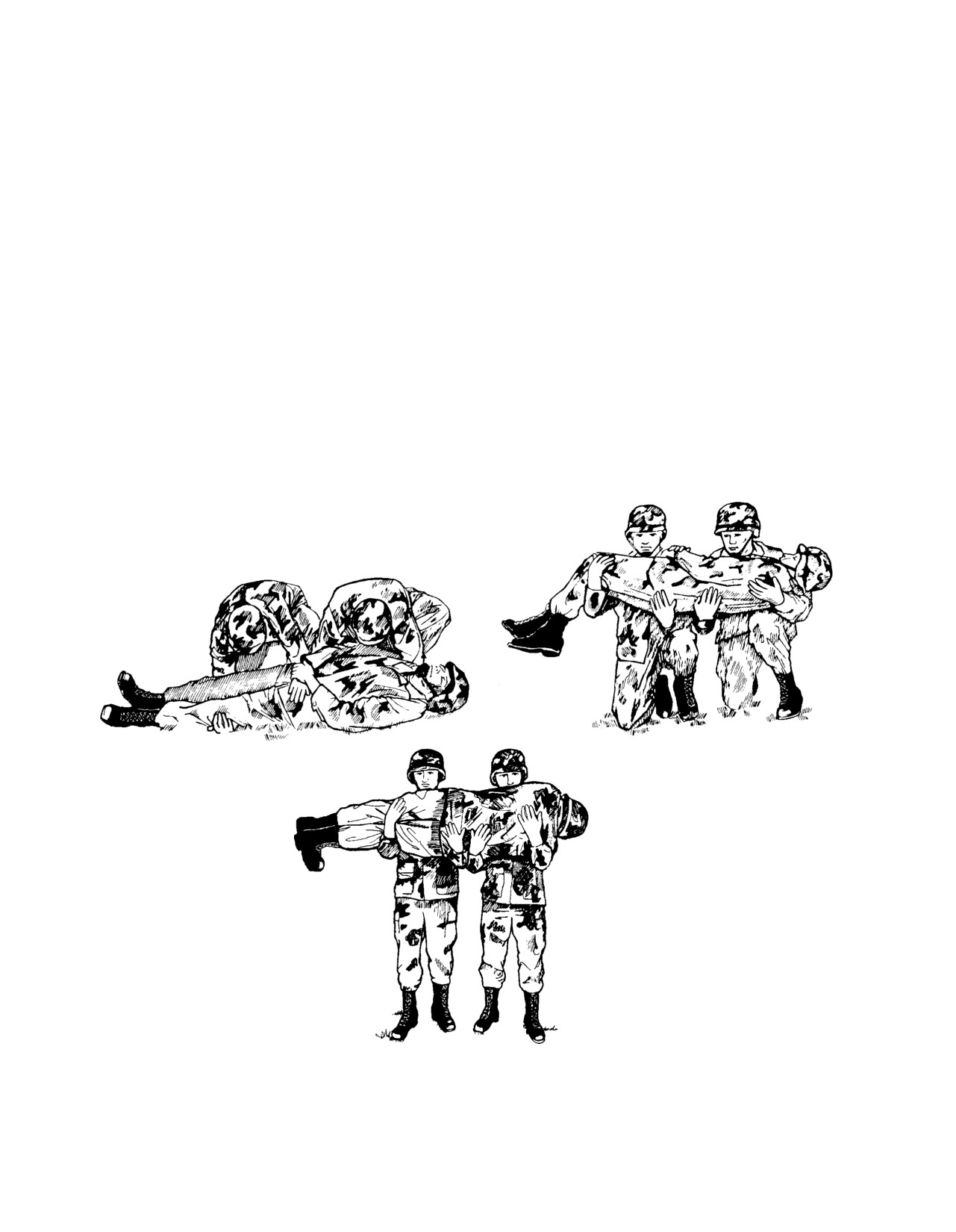
(2) The two-man arms carry (Figure 8-17) is useful in carrying a casualty for a moderate
distance (50 to 300 meters) and placing him on a litter. To lessen fatigue, the bearers should carry the
casualty high and as close to their chests as possible. In extreme emergencies when there is not time to
obtain a spine board, this carry is the safest one for transporting a casualty with a back injury. If possible,
two additional bearers should be used to keep the casualtys head and legs in alignment with his body. The
bearers
(a) Kneel at one side of the casualty and place their arms beneath the casualtys back,
waist, hips, and knees.
(b) Lift the casualty while rising to their knees.
(c) Turn the casualty toward their chests, while rising to a standing position. Carry the
casualty high to lessen fatigue.
Figure 8-17. Two-man arms carry.
8-22
FM 8-10-6
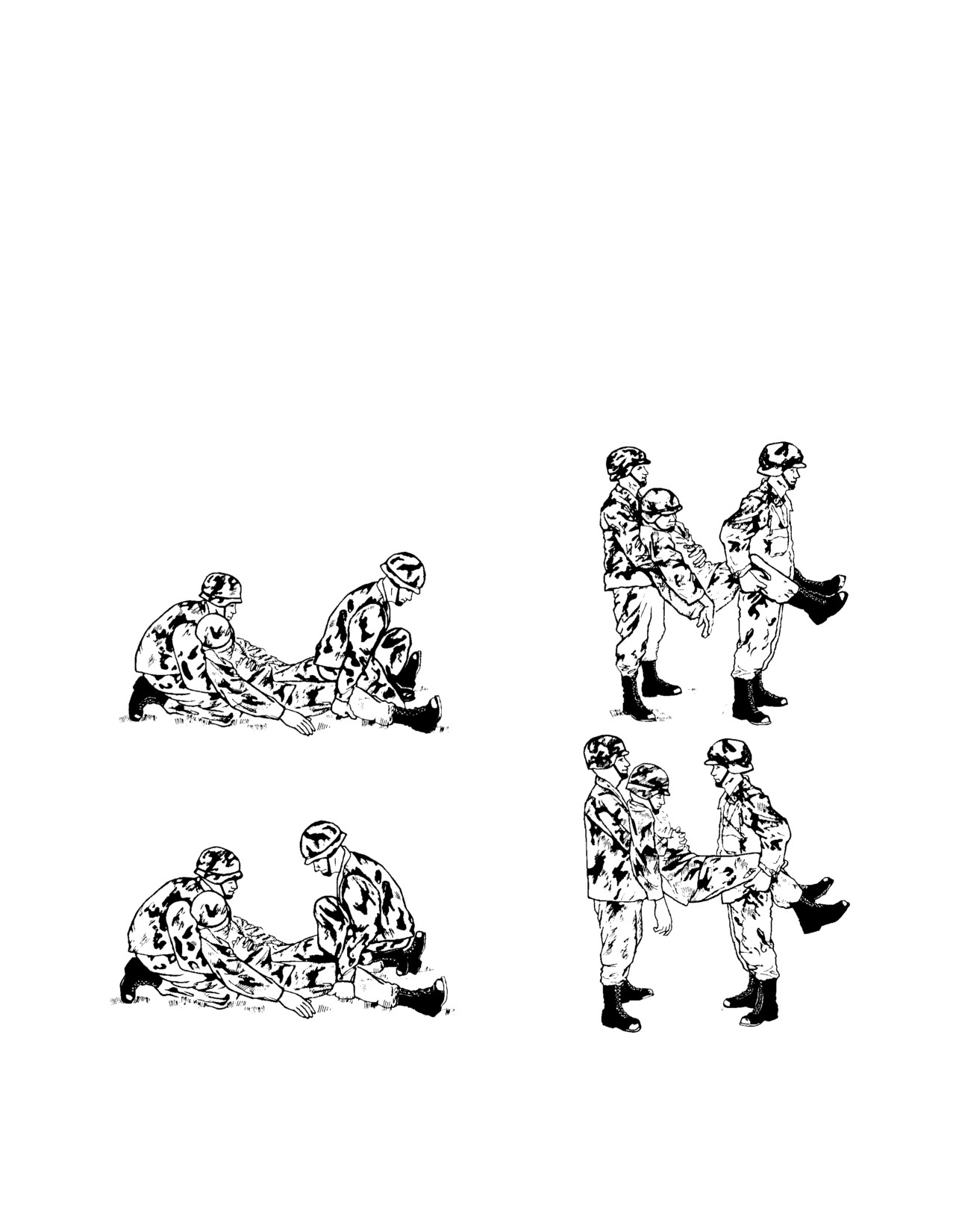
(3) The two-man fore-and-aft carry (Figure 8-18) is a useful two-man carry for transporting
the casualty over a long distance (over 300 meters). The taller of the two bearers should position himself at
the casualtys head. By altering this carry so that both bearers face the casualty, it is useful for placing a
casualty on a litter.
(a) One bearer spreads the casualtys legs and kneels between them with his back to the
casualty. He positions his hands behind the casualtys knees. The other bearer kneels at the casualtys
head, slides his hands under the arms, across the chest, and locks his hands together.
(b) The two bearers rise together, lifting the casualty.
Figure 8-18. Two-man fore-and-aft carry.
8-23
FM 8-10-6
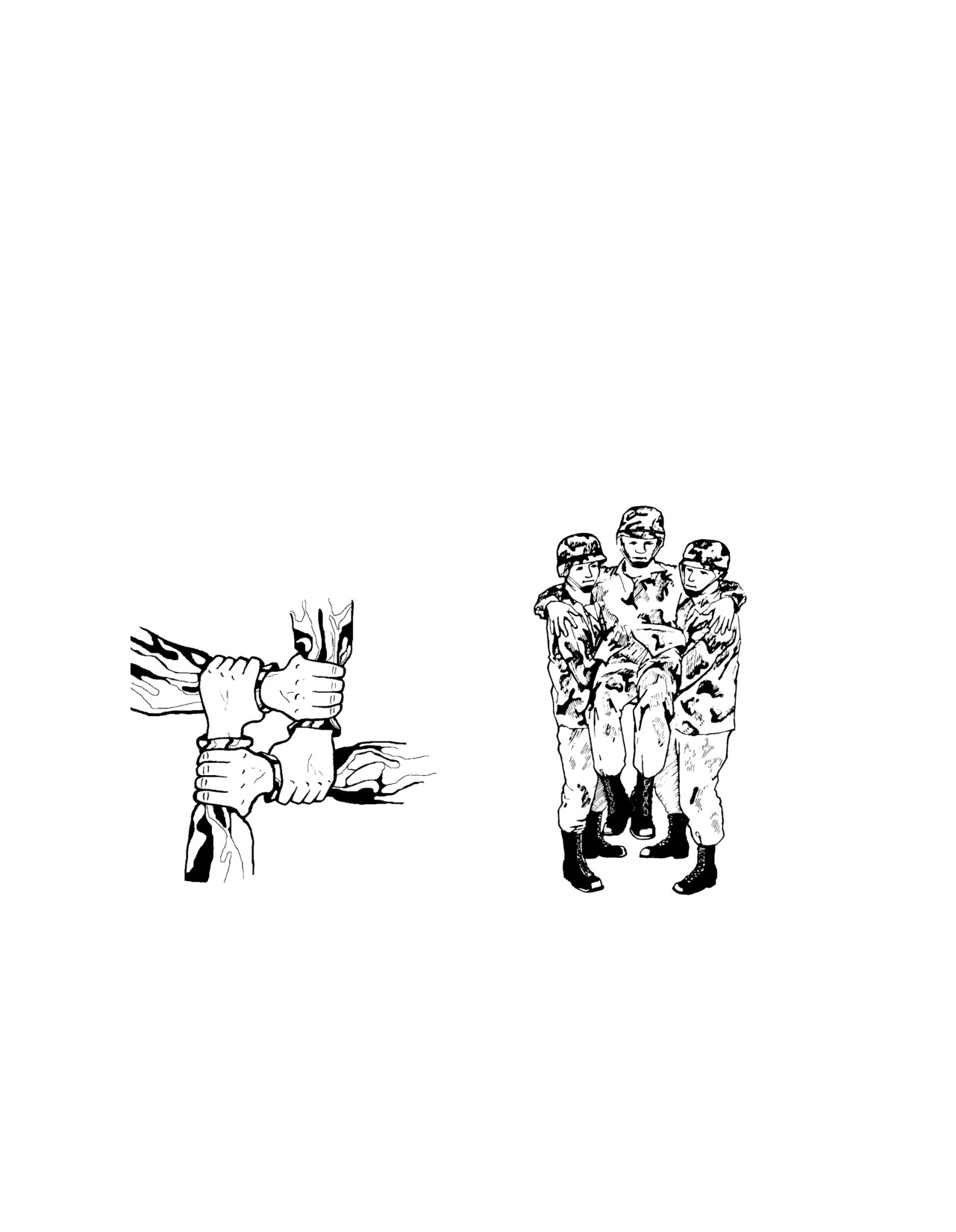
(4) Only a conscious casualty can be transported with the four-hand seat carry (Figure 8-19)
since he must help support himself by placing his arms around the bearers shoulders. This carry is
especially useful in transporting a casualty with a head or foot injury for a moderate distance (50 to 300
meters). It is also useful in placing a casualty on a litter.
(a) Each bearer grasps one of his wrists and one of the other bearers wrists, thus
forming a packsaddle.
(b) The two bearers lower themselves sufficiently for the casualty to sit on the
packsaddle; then, they have the casualty place his arms around their shoulders for support. The bearers
then rise to an upright position.
Figure 8-19. Four-hand seat carry.
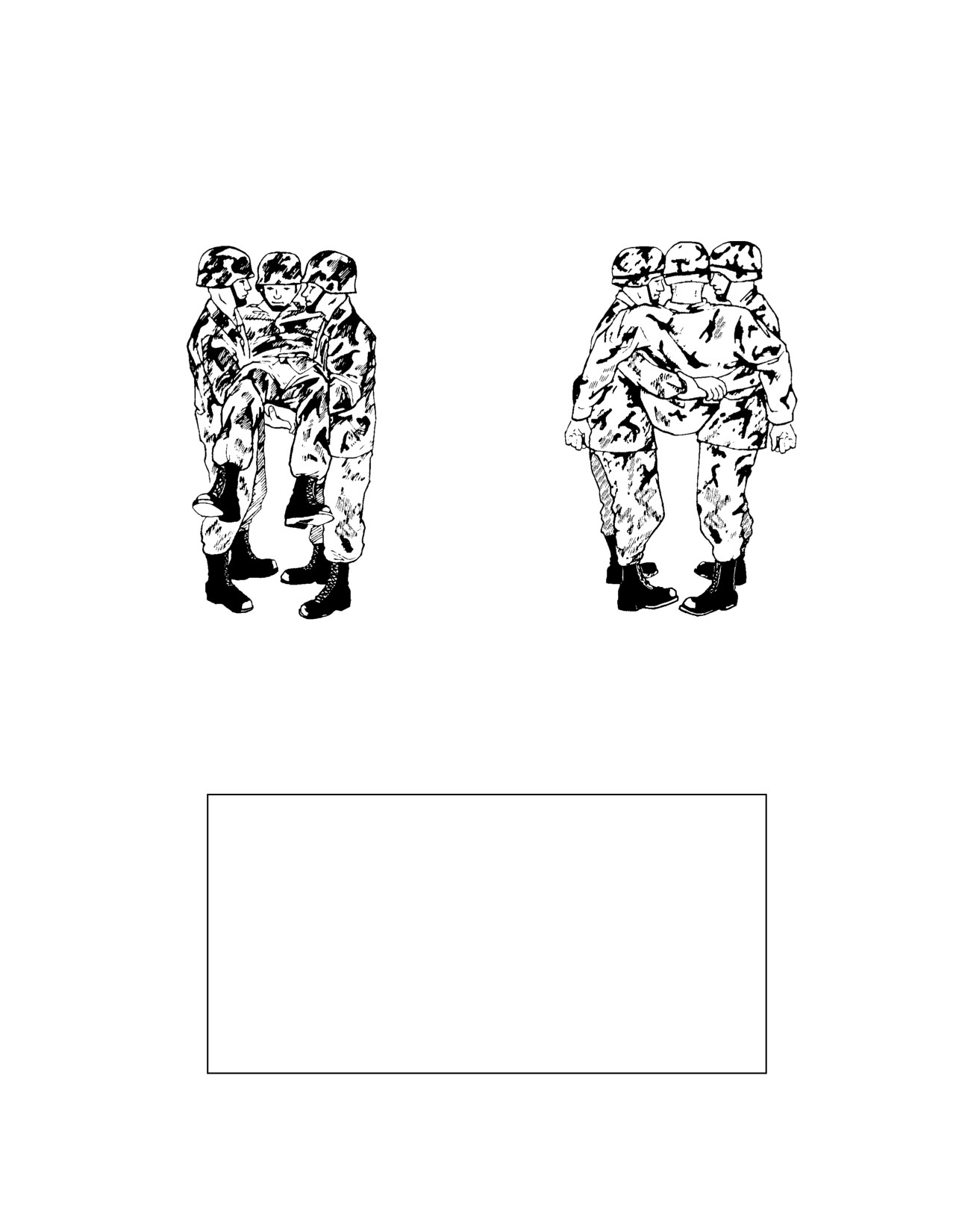
(5) The two-hand seat carry (Figure 8-20) is used when carrying a casualty for a short
distance (up to 50 meters) and in placing a casualty on a litter. With the casualty lying on his back, a bearer
kneels on each side of the casualty at his hips. Each bearer passes his arms under the casualtys thighs and
back, and grasps the other bearers wrists. The bearers rise lifting the casualty.
8-24
FM 8-10-6
Figure 8-20. Two-hand seat carry.
8-7.
Special Manual Evacuation Techniques
The use of special techniques is required to remove injured soldiers from tanks, other armored vehicles,
motor vehicles, or from other limited-access positions. The procedures for extracting a casualty include
CAUTION
Parking next to a battle damaged tank can draw antitank fire
to the ambulance.
If there is the potential for enemy fire approach from the
opposite side of the vehicle, using all available cover and
concealment.
Ambulance teams should park the vehicle behind protective
terrain and dismount with the necessary equipment to provide
emergency medical treatment to include stabilizaton of the
head and spine, when required.
8-25
FM 8-10-6
Observing the vehicle for fire.
WARNING
Exercise extreme caution when approaching a burning vehi-
cle. Use fire suppression equipment and any protective
measures available. In some cases, attempting to save the
crew of a burning vehicle may only result in the injury or
death of the rescuer. This must be a rescuers decision
based on the specific circumstances.
Gaining access to the casualty.
Administering lifesaving measures.
Freeing the casualty from the vehicle or other limited-access positions.
Preparing the casualty for removal.
Transporting the casualty from the site.
NOTE
Removing a wounded soldier from the interior of a tank is difficult
and requires speed (as there is the potential that a damaged tank may
explode or the tank may be more easily acquired/targeted by the
enemy). Whenever possible, crew members should be used to extract
casualties from tanks because of their experience with these vehicles.
a. Removing an Injured Driver from a Tank Through Drivers Hatch.
DANGER
Before traversing the turret, ensure the drivers body
is clear of the turret or you could kill him.
8-26
FM 8-10-6
NOTE
Three soldiers are required to remove the injured driver through the
drivers hatch.
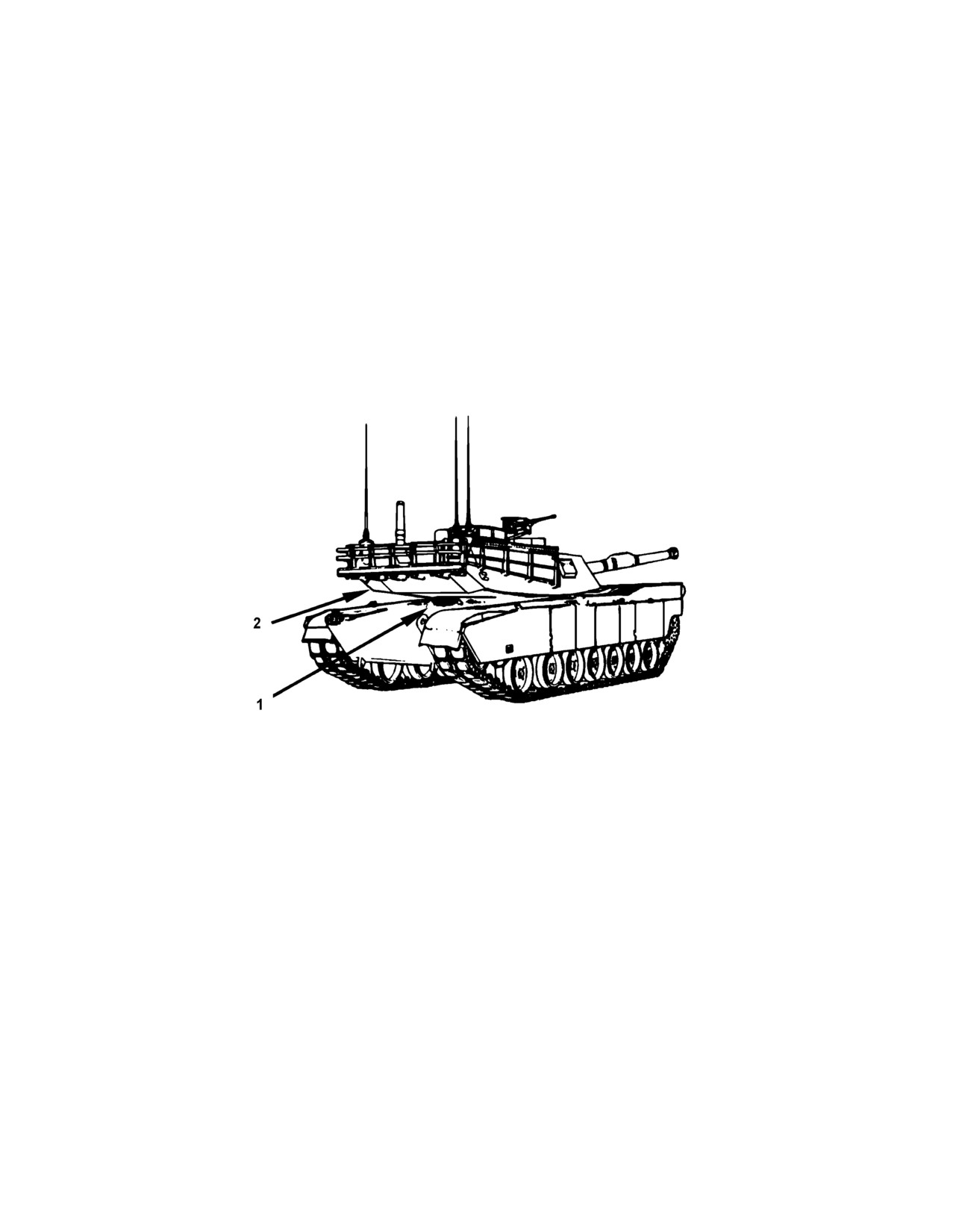
(1) The crew member in the turret traverses the turret so that the drivers hatch (1) is under
the rear of the turret (2) and the main gun is over the rear deck (Figure 8-21).
Figure 8-21. The drivers hatch and rear turret of an M1 tank.
(2) Lock the turret.
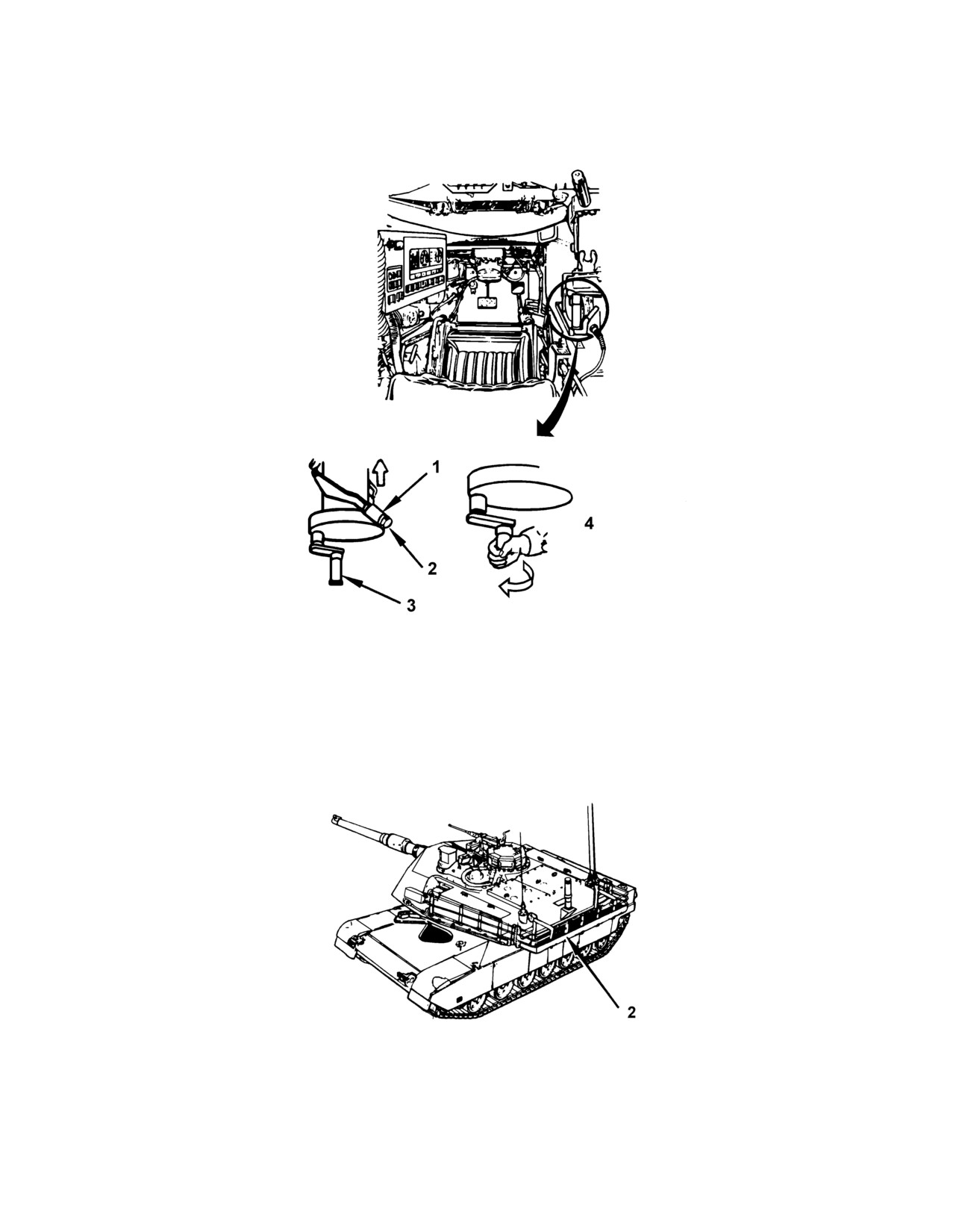
(3) The crew member in the turret opens the drivers hatch (Figure 8-22) as follows:
(a) Swing the loaders safety guard open.
(b) Reach into the drivers compartment and grasp the handle (1).
(c) Press button (2) and push up on handle (1).
(d) Turn crank (3) clockwise (4) to open the drivers hatch.
(e) Swing loaders safety guard closed.
(4) The crew member in the turret unlocks the turret.
8-27
FM 8-10-6
Figure 8-22. The crew member in the turret opening drivers hatch.
(5) The crew member in the turret, traverses the turret so that the rear of the turret (Figure
8-23) is over the right or the left side of the tank.
(6) The crew member in the turret locks the turret.
Figure 8-23. The rear of the turret in position.
8-28