FM 8-10-6 MEDICAL EVACUATION IN A THEATER OF OPERATIONS TACTICS, TECHNIQUES, AND PROCEDURES - page 3
FM 8-10-6
Acclimatization. To be effective, soldiers must be properly acclimatized to the
desert. Two weeks are usually required to satisfactorily acclimatize troops to hot environments, using
progressive degrees of heat exposure and physical exertion. Other potential acclimatization problems that
may be encountered are the effects of dry air and altitude on the respiratory system. Since many desert
areas are located in mountainous terrain, soldiers must be acclimatized for both the altitude and the
temperature. In some areas of the world, such as the Gobi Desert in East Asia, people must be acclimatized
to the cold, in addition to the dryness.
(For additional information, refer to FM 21-10, FM 8-250, and TB
MED 507.)
Discipline. Units deployed in desert areas typically have long LOCs and are widely
dispersed. As unit elements become more dispersed, commanders must rely more heavily on junior officers
to ensure that C2 is maintained and that discipline and PVNTMED programs are enforced. For a unit to be
effective, a high level of discipline must exist at all levels of the organization.
Water. Water is the most basic need in a desert. Without it, soldiers cannot
function effectively for more than a few hours.
Thirst is not an adequate indicator of the need for water. It is necessary for
each commander to establish and enforce a supervised drinking program. Experience has shown many
times that soldiers do not drink enough fluids unless forced to do so. It is important to cool the water, if at
all possible, to make it more appealing. Water supplies should be carefully guarded against accidental loss,
sabotage, or contamination.
Extra water must be carried by CHS vehicles for patients to drink and to cool
heat casualties.
Endemic disease and environmental injuries. Soldiers deployed in the desert are
susceptible to endemic diseases and environmental injuries.
Proper water discipline, vaccines, prophylactic measures, field sanitation
measures, personal hygiene, and other PVNTMED measures can reduce these risks.
Cold weather injuries, heat injuries, and respiratory disease can also be
prevalent. Proper clothing, equipment, and a water discipline program must have command emphasis in
desert operations.
Winds. Winds may very easily damage materiel such as aircraft, antennas, and
tents. Equipment is protected by using covers, tie-downs, and shelters. Terrain helps shield equipment
from the wind if site selection is done carefully. In some cases, special tools, such as extra long metal tent
stakes, are necessary.
Wind and sand. The effects of wind and sand are interrelated. Desert sand starts to
become airborne when the wind reaches about 20 knots. Sandstorms
Restrict visibility.
5-8
FM 8-10-6
Pose a hazard to eyes (especially for soldiers wearing contact lenses).
Can contaminate water supplies (if they are not protected).
Make navigation difficult.
Sun. The sun may cause sunburn of the skin and eyes (if protection is not used).
(3) Eight characteristics of the desert environment that may adversely effect equipment
are
Terrain. Trafficability varies with the type of terrain covered. Open, flat, and
rocky terrain affords higher trafficability than do mountainous areas, lava beds, or salt marshes. Drivers
must be well trained in judging the terrain over which they are driving to select the best alternative
routes.
Tracked vehicles are best suited for desert operations. However, they can
throw tracks when traversing a rocky area. Their use is also limited in rough terrain with steep slopes.
Wheeled vehicles may be used in desert operations; however, they normally
have a lower average speed than tracked vehicles and a higher incidence of damage and malfunction.
Wheeled vehicles often bog down in sandy areas and cannot traverse many of the rougher areas.
In planning for desert operations, vehicles should carry extra repair parts (fan
belts, tires, and other items apt to malfunction).
Heat.
Excessive heat causes vehicles to overheat, leading to greater than normal
wear. The frequency of leaks on vehicles and aircraft is greater than in some other environments. Engine
and transmission seals tend to dry out and crack; fuel lines wear out quickly; and water requirements for
cooling vehicle engines are greater. Loss of water, through evaporation, must be included in logistical
planning. Aircraft temperature limitations may be reached quickly, resulting in limited use during the
hotter parts of the day. Aircraft performance is greatly reduced by the heat when combined with the effects
of ground elevation. This may result in the limited use of some LZs, reduced patient carrying capacity, and
reduced fuel load. There may not be sufficient out-of-ground-effect hover power available for landing in
confined areas or on pinnacles, for using the hoist, or for nap-of-the-earth (NOE) flights. Using vehicle and
aircraft covers reduce the effects of heat while vehicles and aircraft are not in use.
Batteries do not hold their charge efficiently in intense heat. Dry battery
supplies should be increased to compensate for a higher usage rate.
Communications equipment must be protected from the heat in the desert.
Dust covers are used on this type of equipment. If the equipment has ventilating ports, these should be
cleaned regularly to avoid clogging.
5-9
FM 8-10-6
Medical supplies must be protected from the heat to prevent deterioration.
The shelf life of some medical supplies decreases when stored in hot climates.
Medical equipment must be protected from the effects of heat. It may be
protected using the same techniques as those used to protect communications equipment.
Radiant light.
The sun burns unprotected skin and it may damage unprotected eyes. Soldiers
should dress in loosely fitting clothing, use sunburn cream or oils to protect exposed skin, and wear
sunglasses or goggles to protect their eyes. Soldiers should remain fully clothed. Removing clothing
increases direct exposure of the skin to the sun and eliminates the beneficial cooling effects of the moisture
trapped in clothing.
Radiant light or its heat effects may be detrimental to plastics, lubricants,
pressurized gasses, rubber, and other fluids. All vehicles and aircraft should be kept well ventilated, and
windshields should be covered to reduce heat buildup inside. Supplies of all types should be stored in a well
ventilated, shady area. Placing supplies in covered holes in the ground may reduce adverse heat effects.
Dust and sand.
Dust and sand present one of the greatest dangers to the proper functioning of
equipment. Sand mixed with lubricants forms an abrasive paste. Lubrication fittings, bearings, and filters
should be inspected frequently and changed when required.
Aircraft should not be exposed to dust and sand any more than is absolutely
necessary. Ground handling instead of hovering reduces sand ingestion. Dust and sand increase failure of
microphone switches, signal distribution panels, and circuit breakers, and cause electrical motors and
generators to burn out. Wheel and flight control bearings require more frequent cleaning; engines should
be flushed frequently.
Medical and communications equipment may be adversely affected by dust
and sand. Over a period of time, electrical insulation is damaged by windblown sand. When combined
with the effects of lubricants on the insulation, dust and sand can become a major communications problem.
Special care should be taken to brush dust off radio equipment and to keep ventilating ports and channels
clear.
Sand can accumulate in airframes, on the bottom of armored vehicles, and in
bearings on all types of equipment. This accumulation, combined with oil and condensation, adds extra
weight to aircraft and vehicles as well as jamming their control linkages. Sand and grease buildups must be
removed from bearings to ensure safe operation and control of aircraft and vehicles.
Dust trails created by hovering aircraft or ground vehicles can be seen in
excess of 10 miles on a relatively flat desert. This exposes these assets to direct and indirect enemy fires.
Ground vehicles should reduce their speed to the point that they do not create a dust signature.
5-10
FM 8-10-6
Humidity. Humidity is a factor in some desert areas of the world, especially in the
Middle East. Humidity can become a problem for short periods of time in other desert areas. Light coats of
lubrication can help prevent rust; however, these benefits should be weighed against the dust-gathering
qualities of oil. Demisting equipment is used on optics and night vision equipment to combat the effects of
humidity.
Temperature variation. Temperature variation can cause condensation in humid
desert areas affecting optics, fuel lines, air tanks, and weapons. Expansion and contraction of air and fluids
cause tires to overinflate during the day and underinflate at night. Fuel tanks may overflow during the day
causing a fire hazard. Oil fluid levels become overfull and cause leaks during the day, or insufficient
lubrication occurs when the oil cools. Vehicle operators and crew chiefs must ensure that the effects of
temperature variations do not become a significant problem.
Static electricity. Static electricity is prevalent in the desert. This is important to
remember during refueling operations and when oxygen is being used on board vehicles or aircraft. Proper
refueling procedures must be followed. Static electricity also causes severe shock to ground personnel in
sling load and hoist operations.
NOTE
The load must touch the ground before the ground crew can handle it.
b. Preparation for Desert Operations.
(1) To ensure success in desert operations, detailed planning is required. Factors to consider
include
Water. Additional quantities of water are required for CHS operations for the
survival of both medical personnel and their patients. Load plans for all vehicles and aircraft must include
water. Water is as mission essential as any piece of unit equipment. It should be a priority item when
loading plans are developed.
Prescribed load lists. These lists are expanded to carry sufficient quantities of
repair parts easily degraded by the environmental factors. For example, rubber and plastic fittings and
tubes, or spare parts for communications equipment.
Wind, sand, and sun. Plan for the effects of wind, sand, and sun. All plastic and
glass surfaces on vehicles, aircraft, and other equipment should be covered when not in use. Covers should
be ordered or made prior to deployment.
Fuel. Fuel planning is critical due to power limitations, extended range require-
ments, and increased vulnerability of refueling sites in the relatively open desert terrain. Careful planning
of FARPs is essential for mission accomplishment.
5-11
FM 8-10-6
Clothing. Units should plan to pack both hot and cold weather clothing when
deploying.
Petroleum, oils, and lubricants. Petroleum, oils, and lubricants (POL) products
should be of the proper viscosity for desert operations. Maintenance services are also performed more
frequently on ground vehicles and aircraft, thus requiring a larger amount of POL than normal.
Filters. Extra filters of all types are planned for due to a higher consumption rate.
(2) Training for desert operations is not significantly different than training for operations in
other areas except for the following:
Mountain training. Because many desert areas are in mountainous terrain and
because high temperatures increase density altitude, aeromedical evacuation units should conduct mountain
training to prepare for contingencies in desert areas. Further, procedures and techniques for evacuation in
mountainous terrain must be practiced by all CHS personnel. Special equipment requirements (paragraph
5-2h) must also be considered.
Navigation. Navigation in desert terrain varies from simple to extremely difficult.
Factors affecting navigation are the type of desert and the scale and quality of the available navigational
charts. At times, aircraft may have to use dead-reckoning navigational techniques (time, distance, and
heading). Ground vehicles must have compasses available, as they have to rely on compass headings and
odometer readings to navigate. Ground and air ambulance crews should be able to interpret navigational
charts and maps of all types and scales. Use of convoys is a viable technique to improve security and to
ensure that ground vehicles do not get lost. Aircraft may be used to assist in navigation by convoys in those
areas in which there are poor road networks and the terrain offers no distinctive features by which to
navigate.
c.
Medical Evacuation Operations in the Desert. In principle, medical evacuation operations in
the desert do not differ greatly from these operations in other environments. However, techniques exist
which may increase the effective use of medical resources.
(1) Helicopter landing sites should be chosen with care. Common mistakes made by many
units when establishing the LZ are
Locating the pad relative to the patient and tents, vehicles, and other obstacles. A
common tendency is to locate the helipad downwind of MTFs so that approaches may be made into the wind
towards the facility. In high winds, the helicopter must make its take-off over the facility or go around it.
This not only endangers personnel on the ground, but also the crew of the aircraft. It forces the pilot to take
off with a strong crosswind or tailwind if he does not have the power to clear the obstacles in front of him.
At times, crosswind take-offs are not possible because of higher terrain on either side of the landing area.
In mountainous deserts, winds normally channel down the valleys and are more predictable along valley
floors. A better site selection for a LZ is with the MTF along side the approach and take off zone. Thus,
the landing direction is up or down the valley, depending on the airflow, and the MTF is not overflown.
5-12
FM 8-10-6
Situating landing sites in washes, small confined areas between large rocks, or
close to moving tracked vehicles. Map coordinates are rarely accurate unless the site is beside a major
terrain feature. Therefore, LZs should be located next to major terrain features or on higher ground where
they can be seen from the air at a distance of 2 to 3 kilometers, if possible. Lack of distinctive features in
the open desert and on large-scale maps makes pinpoint navigation difficult, especially at night.
Marking of helicopter LZs is done so that the pad can be seen from the air, but the
markings should not be a hazard in themselves. If engineer tape is used, it should be firmly secured to
prevent it from blowing loose. Panel markers are not a good tool to use as they are difficult to see. If panel
markers are used, they need to be secured. If used, flares or marker smoke should not be deployed on or
directly upwind from the pad. Smoke grenades or flares should not be thrown under the aircraft as it lands.
Avoid using white smoke to mark the LZ. Colored smoke is probably the best daylight marking method. It
is difficult to detect a smoke grenade more than 2 to 3 kilometers away, but an aircraft in the general
vicinity can normally see it. Radios are used to guide aircraft to the LZs, but this creates an electronic
signature. Units requesting medical evacuation must be prepared to signal the evacuation aircraft upon its
arrival. Normally, map coordinates will guide the aircraft to within 2 to 3 kilometers of the LZ. Even from
NOE altitudes, the aircrew may be able to see several units in the area. The requesting unit must signal the
aircraft to ensure the designated LZ is used.
(2) Considerations for night flight include the following:
(a) Moonlight aids the medical evacuation pilot by providing him with the light to see
with either unaided vision or night vision goggles (NVG). When adequate ambient light exists, medical
evacuation crews function almost as effectively at night as they do during daylight. The small arms threat is
somewhat reduced at night, although it still exists from radar-guided weapons, infrared-sited weapons, and
passive night vision device-equipped weapons systems. Flying into a bright moon with NVG on can be
compared to flying into the sun during the day. The goggles darken and visibility becomes extremely poor.
Flight routes should not be planned to fly directly into a bright moon if NVG are to be used.
(b) The lack of visual cues over sand is similar to that over water. It is very easy for
pilots to become disoriented and fly into the ground. Reliance on radar altimeters is a must over flat sandy
areas of the desert.
(c) Frequently, desert areas do not have sufficient ambient light to allow adequate night
vision, even with the aid of NVG. A pilot wearing NVG is often unable to see the ground at an altitude of
100 feet using a landing light equipped with a pink light filter. Under these conditions, dead reckoning is
the only effective navigation method unless Doppler equipment or NAVAIDS are available. Unfiltered
light can be used with or without NVG; however, this increases the risk of exposing the aircrafts position to
the enemy.
(3) Desert warfare is usually characterized by extended battle zones which increase
evacuation distance and time. Combat health support units are located further to the rear in the desert.
Establishing an ambulance shuttle system or PCPs is useful. Combat health support units require a greater
number of vehicles for operating in deserts than in other environments. Air evacuation by fixed- and
rotary-wing aircraft is the preferred method due to their speed and range. Further, using aircraft reduces
5-13
FM 8-10-6
the load on ground vehicles. Augmentation from higher echelon CHS may also be required to meet the
extended evacuation needs.
(4) Smoke is used extensively on the modern battlefield by both sides. It can be effectively
used to mask friendly actions to include medical evacuation. (Refer to Appendix F for further information.)
Smoke can be a major hazard, especially to medical evacuation helicopters. Smoke
reduces visibility and forces an aircraft higher where it can be acquired by threat weapons systems. The
phenomenon of inversion occurs often in the desert. When this happens, medical evacuation vehicles and
aircraft may be able to work underneath the smoke using the smoke layer for overhead concealment.
Medical units must coordinate closely with supported organizations on smoke
operations. Smoke can either help or hinder the evacuation mission, depending upon how it is used.
(5) Communications in the desert are affected by a number of factors. Atmospheric
interference and the skip of signals occur frequently. Mineral deposits in the desert may unexpectedly
disrupt communications. Many of these problems can be overcome by using additional radio relays,
preestablished control measures, and visual signals.
(6) Artificial lights may be used at times in the desert. They are very easily detected. Even
with blackout lights, vehicles using lights can be detected for miles with NVG. Serious consideration
should be given to driving without using lights when the tactical situation dictates. Ground guides are used
to help vehicles navigate through areas that are not clearly marked or through area where troops are
present.
(7) Wind is one of the most significant environmental factors affecting medical evacuation in
the desert. Wind can be destructive to both structures and equipment; tents, antennas, and aircraft can be
easily damaged. Wind direction and speed vary greatly within the space of a few miles. Velocity is
substantially increased when wind channels between hills and direction changes due to interference of
terrain features. The wind frequently makes aeromedical evacuation impossible by exceeding the operating
limitations of the aircraft. At other times, it may limit the use of some potential LZs. Blowing sand and
dust can slow down the evacuation system by making navigation by either ground or air ambulance difficult,
if not impossible. High winds are predictable to a certain extent. For example, at certain times of the year
in the Mojave Desert high winds occur every day at dusk and last for 3 to 4 hours. At other times, high
winds, based on frontal weather patterns, can remain for several days at a time. These factors should be
considered by CHS planners, and medical evacuation assets should be massed or relocated accordingly.
(8) The desert provides little or no protection from enemy air defenses except in mountainous
terrain. Aircraft may have to be flown above NOE altitudes to prevent a dust signature. These factors cause
increased exposure and vulnerability of air ambulances to enemy air defenses and may limit their
employment.
d. Further Information. Refer to FM 90-3 for additional information on desert operations. For
aviation-specific information, refer to FMs 1-202 and 1-400.
5-14
FM 8-10-6
5-5.
Extreme Cold Weather Operations
a. Operations in the extreme cold have many of the limiting factors found in desert operations.
The tundra and glacial areas are harsh, arid, and barren. Temperatures may reach lows of -80° F to -100° F
which, combined with gale force winds, make exposure unsurvivable.
b. The greatest environmental detriment to operations is blowing snow. This results in a loss of
depth perception from total white conditions. Blowing snow is caused by the wind or by the rotorwash of
helicopters; its effect reduces visibility to zero.
c.
Other environmental considerations are as extreme but easier to circumvent. Solid footing is
suspect in both the dead of winter and in the summer. Snow and ice cover crevasses, holes, and otherwise
unstable ground. In traversing suspect ground situations, consider linking soldiers by rope. During the
summer, ground transportation is more restricted than in any other environment due to the marsh and
muskeg composition of the arctic tundra. Patients must be sustained for a longer duration due to terrain
delays and the lack of direct lines of evacuation.
d. Greater responsibility has to be placed on each soldier, especially for maintenance of nutrition
and water consumption. It is imperative to stress that leadership and training are important in the prevention
of cold weather injury. Strict adherence to the guidelines found in FMs 21-10 and 31-70 assures an
effective fighting force. Water conservation is essential; however, adequate consumption by the individual
should be enforced.
e.
Factors to consider for conducting evacuation in arctic operations include the following:
Arctic warfare is usually characterized by extended battle zones that increase evacuation
distance and time. Establishing an ambulance shuttle system or PCPs is useful. Augmentation from higher
echelon CHS may also be required to meet the extended evacuation needs.
Additional supplies of water should be carried by ambulances and maintained at PCPs, if
possible.
Due to the decreased temperature and frozen environment, ambulance maintenance
requirements are increased. Lubricants must be of the correct viscosity for the temperature. In extreme
cold, batteries perform less efficiently. Consult the specific aircraft maintenance manual for the recom-
mended battery and procedures for extreme cold weather operations.
NOTE
All ambulances are considered deadlined without a functional heater
for the patient compartment.
The proper storage of medical supplies is essential to prevent loss from freezing.
5-15
FM 8-10-6
There are few terrain features or road networks; therefore, evacuation routes must be
surveyed and marked over open terrain. At extreme latitudes, operations during the winter months are
conducted in extended hours of darkness. The use of NVG may be required. Compass accuracy is
inconsistent due to a geomagnetic phenomenon. Beacons and homing devices are essential for air navigation.
Weather is extremely unpredictable. There are too few observers to allow for accurate
assessment of weather patterns. Unfavorable weather conditions cause unexpected delays; therefore, medical
personnel must be prepared to provide survival measures for their patients and themselves.
Landing zones must be chosen with extreme care in both winter and summer. Blowing
snow mandates instrument-assisted takeoffs and running landings. Landing areas must be correspondingly
larger. The full weight of the aircraft cannot be allowed to settle on the skis until after firm ground
conditions are established. Movement of patients to and from the aircraft is difficult. Where an aircraft
lands is where it stays. A rocking motion, to free the skis prior to lift off, is performed using the cyclic and
antitorque controls.
f.
Thorough planning and strict preparation are the keys to survival. Factors to consider include
the following:
Mud obstacles at noon may become an avenue of approach at midnight.
Snow complicates all work. Snow-covered terrain hampers reinforcements, muffles
noise, makes cross-country driving hazardous, and creates different camouflage requirements.
Because of thermal sights, a complete reappraisal of concealment is required.
Tracks in the snow destroy concealment.
No soldier is assigned to any job alone. The buddy system is used at all times.
Anticipate that all maintenance tasks will take twice as long.
Bare metal can stick to skin or wet garments in subfreezing temperatures.
Fuel spilled on skin or garments increases the freezing factor; it is one of the greatest
causes of injury in winter operations.
When operating in the cold, anticipate increased POL needs. Fuel consumption can rise
as much as 25 percent for vehicles operating in deep snow, slush, or mud.
The recommended fuel for Yukon stoves is diesel.
Make every effort to warm gearboxes and engines before starting.
A higher paraffin content is contained in jet petroleum (JP)-5 fuel. At extremely cold
temperatures, the aircraft fuel controls are likely not to work even with preheating.
5-16
FM 8-10-6
The first consideration in the AO is heat; followed by shelter for sustained work.
Soldiers need to stand clear of taut cables; steel tends to be brittle and breaks in extremely
cold temperature.
Fire extinguishers are winterized by adding 15 percent nitrogen to the carbon dioxide.
Degradation of battery life requires changes as much as six times more frequently than in
a more temperate environment.
Radio sets are warmed up prior to transmission. The sets may be turned on but should
not transmit for at least one-half hour.
NOTE
Single-channel ground and airborne radio system (SINCGARS) radios
do not require a warm up period.
Frost shields (such as using the plastic bag in which the batteries are packed) should be
placed over microphones.
Grounding rods have to be buried horizontally instead of pounded in vertically. Recovery
of stakes and rods placed in the ground is significantly more difficult.
Flooring is needed in heated areas because of the thawing of the tundra.
Soldiers must take breaks for water and warmth.
Static electricity presents a serious safety hazard especially around flammable materials.
g. For additional information, refer to FM 31-70. For aviation-specific information, refer to
FMs 1-202 and 1-400.
5-6.
Medical Evacuation in a Nuclear, Biological, or Chemical Environment
a. Medical evacuation and treatment operations are conducted continuously throughout operations
conducted in an NBC environment. The CHS commander must have a comprehensive plan which is
rehearsed on a periodic basis to ensure the timely evacuation and treatment of casualties in an NBC
environment. Techniques and procedures which are essential for operating in a contaminated environment
should be contained in the unit TSOP. The number of casualties and their medical condition, type of
contaminant, the size of the land area contaminated, the expected duration of operation, risk assessment and
acceptable level of risk, and the number of CHS assets (medical personnel, medical units, and evacuation
5-17
FM 8-10-6
vehicles and aircraft) initially contaminated will determine the quantity and type of uncontaminated CHS
resources, if any, which will be introduced into the contaminated environment to ensure timely medical
treatment and evacuation occur.
b. Evacuation of patients in an NBC environment forces the commander to consider to what
extent he will commit evacuation assets to actually enter the contaminated area. Since the combinations of
evacuation methods are nearly endless, the commander has greater flexibility in tailoring an evacuation
system to meet his particular tactical situation and to deal with the NBC environment.
c.
On the modern battlefield there are three basic modes of evacuating patients (personnel,
ground vehicles, and aircraft).
(1) In using personnel to physically carry the casualties, the commander must realize the
inherent stress involved. Cumbersome mission-oriented protective posture (MOPP) gear needed in a
contaminated environment (added to climate, increased workloads, and the fatigue of battle) greatly reduces
the effectiveness of unit personnel.
(2) If the commander must send evacuation personnel into a radiologically contaminated
area, he must establish operational exposure guidance (OEG) for the medical evacuation operation.
Radiation exposure records are maintained by the unit NBC NCO and are made available to the commander,
staff, and surgeon. Based on OEG, the commander decides which medical evacuation assets to send into the
contaminated environment.
d. Commanders should make every effort to limit the number of evacuation assets which are
contaminated while still maintaining a timely and effective medical treatment and evacuation operation.
(1) It is expected that a certain number of both ground and air ambulances will become
contaminated in the course of battle. The commander can, therefore, segregate the contaminated ones.
This results in the smallest impact on his available assets and the greatest possibility for continuing the
patient evacuation mission. Optimize the use of resources, medical or nonmedical, which are already
contaminated before employing uncontaminated resources.
(2) Once a vehicle or aircraft has entered a contaminated area, it is highly unlikely that it
will be able to be spared long enough to undergo a complete decontamination. This depends upon the
contaminant, the tempo of the battle, and the resources available. Normally, contaminated vehicles (air and
ground) have restricted use and are confined to dirty environments.
(3) Introducing uncontaminated aircraft into a contaminated area should be avoided,
whenever possible. Ground ambulances should be used instead of air ambulances as long as their use does
not adversely affect the patients medical condition. Ground ambulances are more plentiful and are easier
to decontaminate. This does not, however, preclude using aircraft in a contaminated environment or in the
evacuation of contaminated patients.
(4) The relative positions of the contaminated area, FLOT, and threat air defense systems
determine if and where helicopters are to be used. The commander may choose to restrict one or more
5-18
FM 8-10-6
helicopters to the contaminated areas and use ground vehicles to cross the line separating contaminated and
clean areas. The ground ambulance can proceed to the receiving MTF with a patient decontamination
station. The patient can then be transferred to a clean ground or air ambulance if further evacuation is
required. The routes used by ground vehicles to cross between contaminated and clean areas are considered
dirty routes and should not be crossed by clean vehicles. The effects of wind and time upon the contaminants
must also be considered.
(5) The rotorwash of the helicopters must always be kept in mind when evacuating
contaminated casualties. The intense winds disturb the contaminants in the area and further aggravate the
condition by additionally spreading the contaminants. Ideally, the aircraft must be allowed to land and
reduce to a flat pitch prior to bringing any patients near. This will be dictated by the tactical situation, but
allows some reduction in the effects of the downwash. A helicopter must not land too close to a
decontamination station (especially upwind) because any trace of contaminants in the rotorwash will
compromise the decontamination procedure.
e.
Immediate decontamination of aircraft and ground vehicles should be accomplished to minimize
crew exposure. Units should develop their own procedures for thorough decontamination and document
them in their TSOPs. A sample aircraft decontamination station that may be tailored to a particular units
needs is provided in FM 3-5.
f.
Evacuation of patients must continue even in a contaminated environment. The commander
must recognize the constraints placed upon him by resources and plan and train to overcome deficiencies.
g. Refer to FM 8-10-7 for additional information on CHS operations in an NBC environment.
5-7.
Naval Operations
a. It is imperative that Army aeromedical evacuation units be able to interface on the first day of
battle with US Navy (USN) air-capable ships. Lessons learned from past operations, such as Vietnam and
Grenada, have shown that US Army helicopters should be able to operate to and from USN air-capable
ships. An interservice agreement between the Army and the Navy allows for deck-landing qualification of
Army pilots.
(Refer to FM 1-564 for additional information.)
(1) It is important that units having contingency missions requiring Navy support establish
training requirements to obtain naval-operations orientation, water egress training, water survival, and
deck-landing qualification. This enhances the successful accomplishment of the aeromedical evacuation
mission to naval vessels.
(2) In past joint operations, communications have been burdensome for both Army and
Navy elements. Commonality of communication requirements should be established during training
exercises. Communication equipment and frequencies for medical evacuation to Navy vessels must be
established. This will provide smooth integration of Army helicopters into the Navy airspace management
system during actual operations.
5-19
FM 8-10-6
(3) As the Navy vessels may operate relatively long distances from the ground combat
operations, Army aeromedical evacuation units need to be proficient in over-water navigation. The use of
NAVAIDS from the Navy element in support of the operation is the first priority for over-water navigation.
Basic dead-reckoning remains a secondary measure.
b. An important aspect of joint operations is the medical capabilities of Navy vessels servicing
the CZ. Knowledge of ships medical capabilities assists the MRO to direct patients to proper treatment
sites. There are many classes of ships which can meet the medical needs of ground forces. Destroyer
tenders and aircraft carriers have helicopter landing areas, one operating room and, at a minimum, one
medical officer. Amphibious ships have the most extensive medical facilities of any Navy combat ship.
The Navy has fifty-nine amphibious ships in active commission plus two tank landing ships (LST), which
are operated by the Navy Reserve Force. The primary mission of the amphibious ships is to transport and
support the Fleet Marine Force. The ships have the additional duty of casualty receiving and treatment
ships (CRTS). During normal operations, the medical staff is kept to a minimum. The medical staff is
augmented when expanded capabilities are needed. Current information regarding landing requirements
and medical capabilities should be obtained during training periods with the Navy. Casualty care is
secondary to the combat mission of all US combat ships.
(1) Amphibious assault ships WASP class are designated by the Navy as LHD (followed
by a number) and have the largest patient care facilities on any US combat ship. The WASP class ships
have six main operating rooms, four dental operating rooms, bed capacity that can be expanded to 600, and
it carries 1,500 pints of frozen blood. This ship can receive casualties from helicopters or landing craft.
(2) Amphibious assault ships TARAWA class are designated by the Navy as LHA
(followed by a number). The TARAWA class ships have three main operating rooms, two dental operating
rooms, an overflow bed capacity of 300, and carries 1,500 pints of frozen blood. The ship can receive
casualties from helicopters or landing craft.
(3) Amphibious assault ships IWO JIMA class are designated by the Navy as LPH
(followed by a number). These ships were specifically designed to operate helicopters. The IWO JIMA
class ships have two operating rooms and an overflow bed capacity of 200.
(4) The amphibious transport dock is designated LPD (followed by a number) and has less
medical capabilities than the LHD, LHA, or LPH ships. It can be designated as secondary casualty
receiving ship.
(5) The older dock landing ship is designated LSD (followed by a number). It can be used as
a secondary CRTS when augmented. The newer class of LSD currently under construction can be used as a
casualty receiving ship with a capacity for 50 wounded.
(6) The tank landing ship is designated LST (followed by a number). It is another type of
ship used in amphibious operations. It is designed with a helicopter platform and a stern ramp. Patients can
be delivered by air or boat when required by tactical or mass casualty situations. When the LST is
augmented with medical personnel and materiel, it can be used for the emergency treatment and evacuation
of patients.
5-20
FM 8-10-6
(7) The troop transport, designated AP (followed by a number), is not in active service.
When available, the troop transport can be outfitted with special medical facilities and carry sick, injured,
and wounded personnel.
c.
The Military Sealift Command operates two hospital ships. The United States Navy Ship
(USNS) MERCY T-AH 19 and the USNS COMFORT T-AH 20. One ship is based on each coast and, when
needed, will be assigned medical staffs from military hospitals, getting underway within 5 days. The
hospital ships MTFs were designed for a total capacity of 1,000 casualties, including 500 acute care beds
and 500 recuperation beds. The hospital ships have 50 trauma stations in the casualty receiving area;
12 operating rooms; a 20-bed recovery room; 80 intensive care beds; and 16 intermediate, light, limited
care wards. The maximum patient flow rate, for which the helicopter facility and the casualty reception
area were designed, is 300 patients per 24 hours. There is a limited capability to receive casualties from
boats.
d. The US Army has the shore-to-ship medical evacuation mission on an area support basis for
Marine forces deployed on land.
5-8.
Airborne and Air Assault Operations
a. The airborne and air assault operational forces are specialized forces employed to maximize
their design characteristics. Airborne units are a flexible force that can be strategically or tactically
deployed. They can be inserted rapidly anywhere in the world as either a deterrent or strike force. Air
assault units are flexible and lethal fighting organizations. They are ideally suited for rapid employment to
critical areas beyond the reach of ground forces.
b. After airborne forces have landed in the objective area, they reorganize and maneuver to seize
objectives. When it is necessary for assault aircraft to land in the drop zone, they are parked and unloaded
rapidly. Then, they may be used to transport soldiers injured during the parachute assault. It must be
understood that organic medical units may experience an overload of patients during the early phases of an
airborne assault. These units have to hold the patients until either ground link-up is made or evacuation can
be established at airheads. Aeromedical evacuation from the airhead is accomplished using tactical and
strategic USAF aircraft.
c.
The air assault divisions organic aircraft have the ability to attack from any direction, overfly
obstacles, and bypass enemy positions. Evacuation of patients in the assault phase is accomplished by
division air ambulances. Air ambulances may accompany the air assault task force (AATF) or respond
from laager sites once the initial assault has taken place. If air ambulances are providing on-call support, it
will be necessary to fly secure air avenues of approach.
d. When both airborne and air assault divisions have been employed and become a part of other
conventional forces, their operations are similar to that of light infantry forces. During initial deployment,
division medical evacuation assets may be used to evacuate patients to the airhead for air evacuation directly
to corps hospitals.
5-21
FM 8-10-6
5-9.
Army Special Operations Forces
a. The ARSOF often operate far removed from conventional CHS and must be more self-reliant
and sustaining than conventional forces. Accordingly, SOF medical personnel receive enhanced medical
training above that provided for a combat medic. The SOF medic is trained as an independent care
practitioner and is qualified to provide ATM to combat casualties. When deployed on independent
operations, the two SOF medics are the sole source of medical care for their operational detachment and the
indigenous forces (and their families) that the detachment supports. They can train the indigenous populace
in basic medical skills and establish an austere CHS system. Nonmedical ARSOF personnel receive
medical training at the combat lifesaver level.
b. Although the ARSOF health care provider receives enhanced medical training exceeding the
level and scope found in conventional forces, he depends heavily on the conventional CHS system to
conserve the combat strength of the ARSOF (particularly in the area of medical evacuation where the
ARSOF does not have a dedicated system). Ideally, medical evacuation for ARSOF personnel should
follow the doctrinal flow sequence. The ARSOF CHS planner must be innovative and follow the tenets of
immediate far forward stabilization. He directs evacuation to the appropriate MTF when the condition of
the patient warrants it, with whatever means of transportation are available. Medical evacuation of ARSOF
casualties is an operational matter. That is, it must reflect the commanders concept of the operation. It can
only succeed when the CHS planner integrates the medical evacuation plan with the tactical plan and
logistics airflow.
c.
Conventional medical evacuation assets are not normally used when operations are conducted
in hostile and denied areas. The conventional medical evacuation system is used once the casualty is
extracted from the hostile or denied area. For additional information on CHS to ARSOF, refer to FM 8-10-1
and FM 8-42.
5-10. Military Operations on Urbanized Terrain
a. Throughout history, battles have been fought on urbanized terrain. Some recent examples
include Hue, Beirut, and Panama City. Military operations on urbanized terrain (MOUT) are those military
actions planned and conducted on a terrain where man-made structures impact on the tactical options
available to the commander. This terrain is characterized by a three-dimensional battlefield, having
considerable rubble, ready-made fortified fighting positions, and an isolating effect on all combat, CS, and
CSS units. In this environment, the requirement for a sound and understandable evacuation plan cannot be
overstated. Of concern to CHS and tactical planners is the need to plan, train, prepare, and equip for
evacuation from under, above, and at ground level
b. Conducting medical evacuation operations in the MOUT environment challenges the CHS
planner. He must ensure that the CHS plan includes special or unique materiel requirements or improvised
use of standard equipment. The plan must be sufficiently flexible to support unanticipated situations.
(1) Special equipment requirements include, but are not be limited to
Axes, crowbars, and other tools used to break through barriers.
5-22
FM 8-10-6
Special harnesses; portable block and tackle equipment; grappling hooks; collapsible
litters; lightweight collapsible ladders; heavy gloves; and casualty blankets with shielding. This equipment,
using pulleys, is for lowering casualties from buildings or moving them from one building to another at
some distance above the ground.
Equipment for the safe and quick retrieval from craters, basements, sewers, and
subways. Casualties may have to be extracted from beneath rubble and debris.
(2) Air ambulances equipped with a rescue hoist may be able to evacuate casualties from the
roofs of buildings or may be able to insert needed medical personnel and supplies.
(3) Effective communications will be degraded in the MOUT environment. Line of sight
radios will be ineffective and individual soldiers will not have access to radio equipment. The task-
organized medical evacuation teams will have difficulty in locating injured or wounded soldiers due to their
isolation within buildings, or by being hidden by rubble and debris. Alternate forms of communications,
such as markers, panels, or field expedients (fatigue jackets or T-shirts) can be displayed by the wounded or
injured soldiers indicating where they may be found.
c.
Patient collecting points must be preplanned and established at relatively secure areas accessible
to both ground and air ambulances. The location of these points should be indicated on the CHS overlay to
the OPLAN. Patient collecting points should
Offer cover from enemy fires.
Be located as far forward as the tactical situation permits.
Be identified by an unmistakable feature (natural or man-made).
Allow rapid turnaround of ambulances.
d. Route markings to the MTF and display of the Geneva Red Cross at the facility must be
approved by the tactical commander. (Camouflaging or not displaying the Geneva Red Cross can forfeit the
protections, for both medical personnel and their patients, afforded under the Geneva Conventions. Refer
to Appendix A and FM 8-10 for additional information.) The location of the MTF must be as accessible as
possible, but well separated from fuel and ammunition depots, motor pools, reserve forces, or other
lucrative enemy targets, as well as civilian hazards such as gas stations or chemical factories.
e.
Medical evacuation in the MOUT environment is a labor-intensive effort. Due to rubble,
debris, barricades, and destroyed roadways, much of the evacuation effort must be accomplished by manual
litter teams. When this occurs, an ambulance shuttle system or litter shuttle should be established. The
shuttle system reduces the distance that the wounded or injured soldiers have to be carried by the litter
teams. This enhances the litter teams effectiveness by providing brief respites and reducing fatigue.
Further, the litter teams are retained in the forward areas. They are familiar with the geography of the AO
and what areas have or have not been searched for casualties. In moving patients by litter, you should
Use covered evacuation routes such as subways, whenever possible.
5-23
FM 8-10-6
Use easily identifiable points for navigation and PCPs.
Rest frequently by alternating litter teams.
(1) When using ground evacuation assets in support of MOUT, the CHS planner must be
aware that built-up areas may have significant obstacles to vehicular movement. Factors requiring
consideration include the following:
Transportation operations within the urban terrain are complicated and highly
canalized by rubble and other battle damage.
Bypassed pockets of resistance and ambushes pose a constant threat along evacuation
routes.
Land navigation with most tactical maps proves to be difficult. Using commercial
city maps when available can aid in establishing evacuation routes.
Ambulance teams must dismount from the ambulance, search for, and rescue
casualties.
Movement of patients becomes a personnel intensive effort. There are insufficient
medical personnel to search for, collect, and treat the wounded. Assistance in the form of litter bearers and
search teams is required from supported units, as the tactical situation permits.
Refugees may hamper movement into and around urban areas.
Dislocated civilians and EPWs are provided medical treatment in accordance with
the command policy and the Geneva Conventions.
(2) When using aeromedical evacuation assets in support of MOUT, the CHS planner must
consider enemy air defense capabilities and terrain features, both natural and man-made, within and
adjacent to the built-up areas. Aeromedical evacuation (helicopters) is the preferred means of evacuation in
MOUT. Considerations in the use of air ambulances include the following:
Movement is highly restricted and is canalized over secured areas, down wide
roads, and open areas.
Telephone and electrical wire and communications antennas hinder aircraft
movement.
Secure LZs must be available.
Landing zones may include buildings with helipads on their roofs or sturdy
buildings, such as parking garages.
5-24
FM 8-10-6
Snipers with air defense capabilities may occupy upper stories of the urban areas
taller buildings.
f.
Medical personnel require special training in the tactics, techniques, and procedures required
to operate in a MOUT environment. If they are to survive in this environment, they must know how to
Cross open areas safely.
Avoid barricades and mines.
Enter and depart safely from buildings.
Recognize situations where booby traps or ambushes are likely and would be advanta-
geous to the enemy.
Detailed information on the conduct of combat operations in the urban environment is contained in FM 90-
10-1.
NOTE
Combat health support personnel do not engage in offensive-type
actions. They must rely on the supported unit to provide covering
fires and to clear rooms and buildings prior to entry.
(1) Many of the techniques used in a mountainous terrain for the extraction and evacuation
of patients can be modified and applied to medical evacuation in an urbanized terrain (paragraphs 9-11
through 9-13).
(2) Combat health support personnel must practice and become proficient in using a grappling
hook, scaling walls, and rappelling. Rappelling techniques can be used to gain entry into upper levels of
buildings as well as accompanying the patient during vertical extraction and evacuation. By using the
SKED litter, the patient can be secured inside the litter for ease in vertical extractions and evacuations.
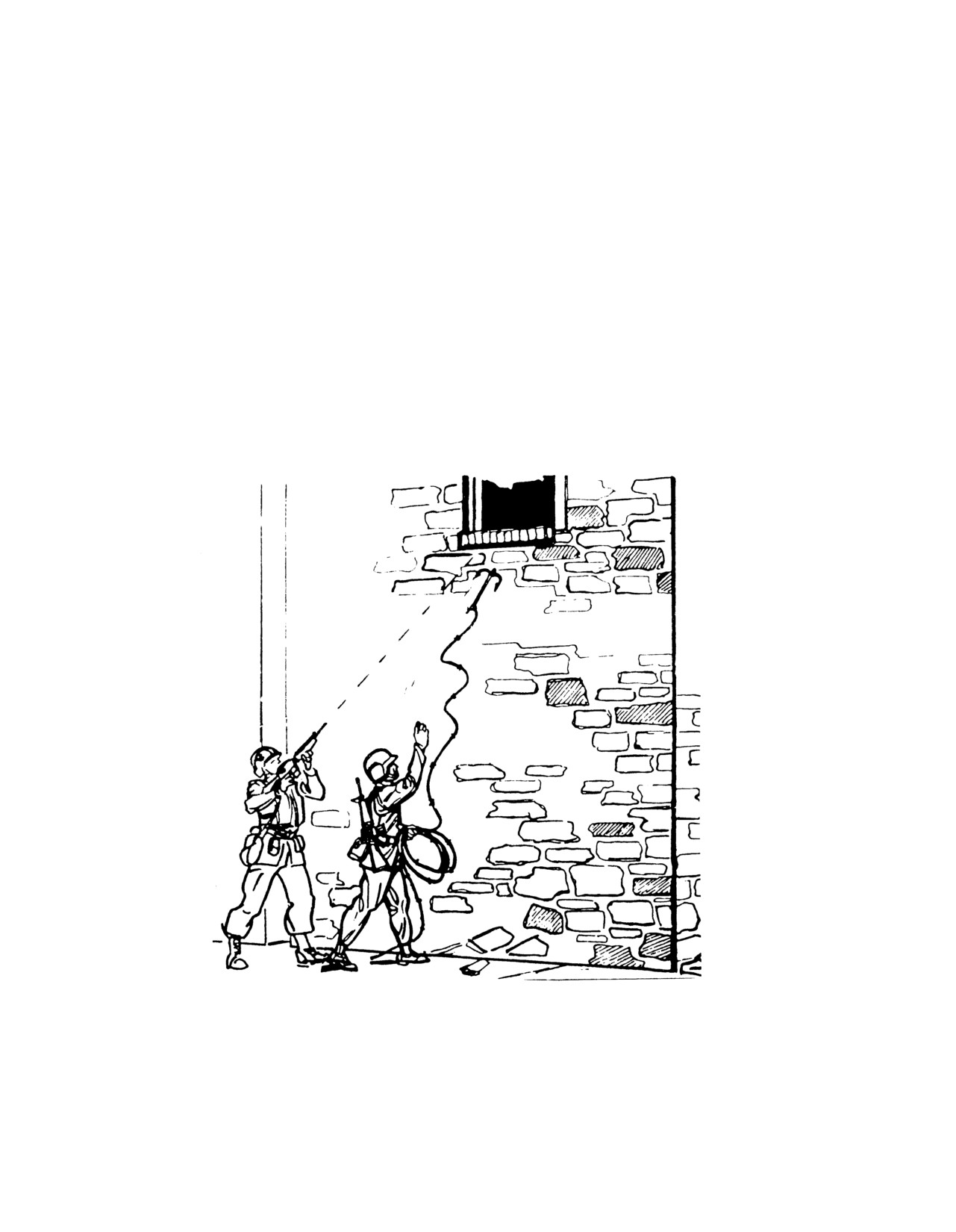
(a) When using a grappling hook, care must be taken to select a suitable grappling
hook and rope. The grappling hook should be sturdy, portable, and easily thrown, and be equipped with
hooks that can hold inside a window. The scaling rope should be 5/8 to 1 inch in diameter and long enough
to reach the objective window. Knots are tied in the rope at 1-foot intervals to make climbing easier.
When throwing the grappling hook, stand as close to the building as possible
(Figure 5-1). The closer you stand, the less the exposure to enemy fires. The closer the range, the less
horizontal distance the hook must be thrown.
Allow the rope to play (pay) out freely. Make sure you have enough rope to
reach the target. Hold the hook and a few coils of rope in your throwing hand. The remainder of the rope,
5-25
FM 8-10-6
in loose coils, should be in your other hand. The throw should be a gentle, even, upward lob of the hook,
with the other hand releasing the rope as it plays (pays) out.
Ensure that the grappling hook has a solid hold before beginning to climb.
Once the grappling hook is inside the window (or on the roof), pull on the rope to obtain a good hold.
When using a window, pull the hook into one corner to ensure the chances of a good bite and to reduce
exposure to lower windows during the climb.
Figure 5-1. Hook thrown at close range.
5-26
FM 8-10-6
(b) When forced to scale a wall during exposure to enemy fire, all available concealment
must be used. The employment of smoke and diversionary measures improve the chances of a successful
exposed movement. When using smoke for concealment, soldiers must plan for wind direction and the
tactical use of smoke (Appendix F).
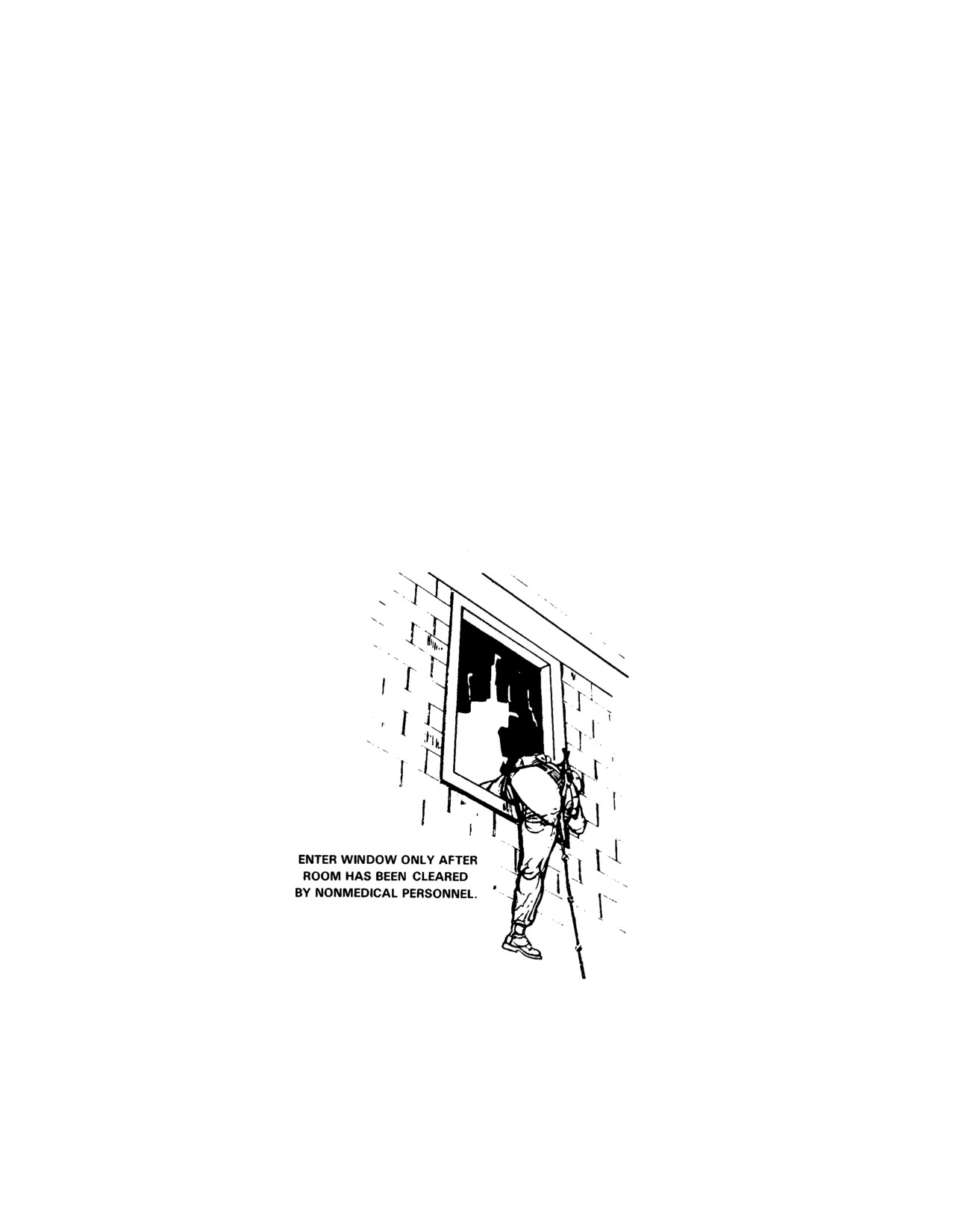
A soldier scaling a wall with a rope should avoid silhouetting himself in
windows of uncleared rooms and avoid exposing himself to enemy fires from lower windows. Combat
medics will require support from the combat elements to provide covering fires and precede the medic to
clear rooms which must be bypassed to reach the casualty.
The soldier enters the objective window with a low silhouette (Figure 5-2).
Entry can be head first; however, the preferred method is to hook a leg over the windowsill and enter
sideways, straddling the ledge.
Figure 5-2. Medic entering the objective window.
5-27
FM 8-10-6
(c) Rappelling is a combat technique soldiers can use to descend from the rooftop of a
tall building into a window. Soldiers conducting operations on urbanized terrain should learn the basic seat-
hip rappel. When using this technique to lower a litter, one or two soldiers rappel down along the sides of
the litter patient. By escorting the litter, the soldiers can ensure that the patient is not further injured by
slamming into the wall as he is lowered. When the patient is safely on the ground, the individual who
lowered the patient, rappels down.
g. The scenario presented in this subparagraph is provided to illustrate a way in which evacuation
operations can be conducted in MOUT.
(1) The following information is provided as a basis for this scenario:
(a) In preparation for the upcoming battle, the tactical planners determine that the
battlefield will include combat within the confines of a city with a population of approximately 750,000.
The CHS planners are involved early-on in the planning process. The medical evacuation mission is
complicated by the terrain features and will require special equipment to satisfactorily accomplish the
mission.
(b) The enemy has already entered the city and is preparing defensive positions.
(c) Preparatory fires and bombing runs made on key industrial targets within the city
have disrupted sanitation efforts by destroying sewer lines, breaking water mains, and canceling garbage
pick up and disposal.
(d) The downtown area of the city has numerous multistoried buildings. Further, a
number of parking garages are within the downtown area. Residential housing consists of apartment
complexes and low-cost housing projects. There are a few small parks; however, the downtown area is
considered to be quite crowded.
(e) Residential and small business suburbs spread out from the downtown area.
North of the city is an industrial park and most of the citys heavy industry is
located in this area. The major heavy industries are fertilizer, ammunition, and plastic manufacturing.
East of the downtown area is comprised of some larger residential estates,
track housing, parks, golf courses, small businesses, and some multifamily dwellings. A river flows along
the eastern border of the city that has commercial interests in transportation of commodities and fishing.
West of the downtown area is the largest residential population with middle
income housing, duplexes, and large apartment complexes. Small businesses which support the population
density are also found here. Numerous schools, parks, and churches are contained in this sector. There is
also some light industry, such as clothing manufacturers, located here. The western limits of the city are
bordered by high mountains. This eliminates access to the northern section of the city from this direction.
South of the downtown area is mainly residential with a gradual shift from
single family homes and apartment complexes to small farms, landfills, and junkyards.
5-28
FM 8-10-6
(f) The friendly forces are approaching the city from the southwest. Intelligence
reports indicate that enemy concentrations are within the downtown area and to the north. Due to the natural
terrain features of the city, friendly forces will be required to fight through residential and the downtown
areas to reach the mission objective of neutralizing the ammunition plants in the northern sector.
(2) Prior to actual deployment of combat forces, the evacuation elements
Train nonmedical personnel on litter-carrying techniques.
Obtain necessary nonmedical equipment for extraction and evacuation.
Provide instructions on alternate forms of communications for indicating where
wounded soldiers are located.
Predesignate PCPs and AXPs and include these positions on the CHS overlay.
Prepare strip maps of evacuation routes, if applicable.
(3) The medical evacuation mission is undertaken by
Establishing the initial BAS in an elementary school playground and gymnasium.
The playground area provides sufficient space to establish an LZ for aeromedical evacuation assets and
turnaround for ground ambulances. Site selection for the BAS is important as it must be easily accessible by
both ground and air and not close to lucrative enemy targets or civilian hazards, such as gas stations.
Echeloning the medical treatment element. This enables the CHS to maintain
contact with and be accessible to the combat forces. A portion of the evacuation resources are deployed
with the medical treatment element to assist in quickly clearing the battlefield of wounded.
(4) Fighting is light through the residential area; however, caution must be used as the
combat elements bypass pockets of resistance and pose a threat to medical treatment elements and evacuation
assets.
(5) Entering the downtown area, the fighting intensifies. As the downtown area has not been
secured, the threat to air ambulances is too great during the initial phase of the battle. When the roads
become impassable due to rubble, debris, barricades, or artillery damage, the ambulance crews dismount
from their vehicles, search for, and administer EMT to the wounded. During the heat of the battle, combat
soldiers will be unable to serve as litter bearers. Ambulance crews, therefore, are responsible for evacuating
litter patients, directing ambulatory patients to PCPs, and administering EMT if the casualty has not already
been treated by the combat medic.
(6) A shuttle system is established to enable litter teams to carry the wounded to the fringes
of the downtown area. Ground ambulances can evacuate the wounded to the BAS site where air ambulances
can evacuate those patients requiring further evacuation to the rear. As the tactical mission evolves and
control of the various sectors is gained by friendly forces, aeromedical evacuation resources can be
5-29
FM 8-10-6
deployed farther forward. However, caution must be exercised because bypassed and isolated pockets of
resistance still remain a threat to evacuation assets.
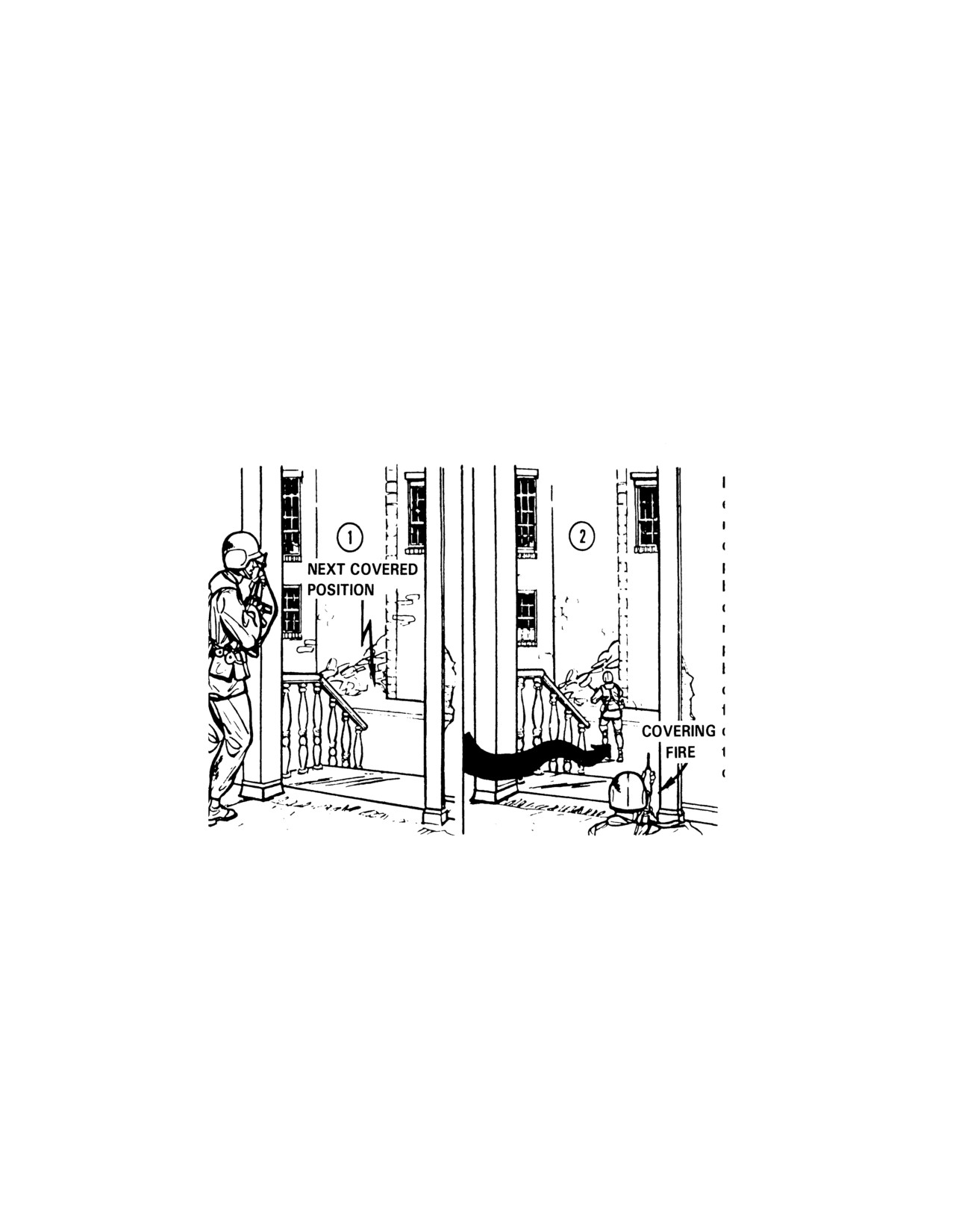
Combat medics maintain contact with the combat elements and employ techniques
necessary to operate in this environment, such as using doorways, moving parallel to buildings, selecting
his next position, and crossing open areas (Figures 5-3 through 5-5).
Doorways should not routinely be used as entrances and exits since they are normally covered by enemy fire. If a medic must use a
doorway as an exit, he should move quickly through it to his next position, staying as low as possible to avoid silhouetting himself.
Before exiting the building, the soldier selects his next covered position. He quickly exits the doorway, keeping as low as possible, and
moves quickly to his next position. Preselection of positions, speed, a low silhouette, and use of covering fires by nonmedical personnel
must be emphasized in exiting doorways. If possible, litters should be vertically lowered from windows, rather than attempting to exit
through a doorway. However, if it becomes necessary to exit through a doorway, the supported unit should provide covering fire for the
litter team.
Figure 5-3. Use of doorways.
5-30
FM 8-10-6
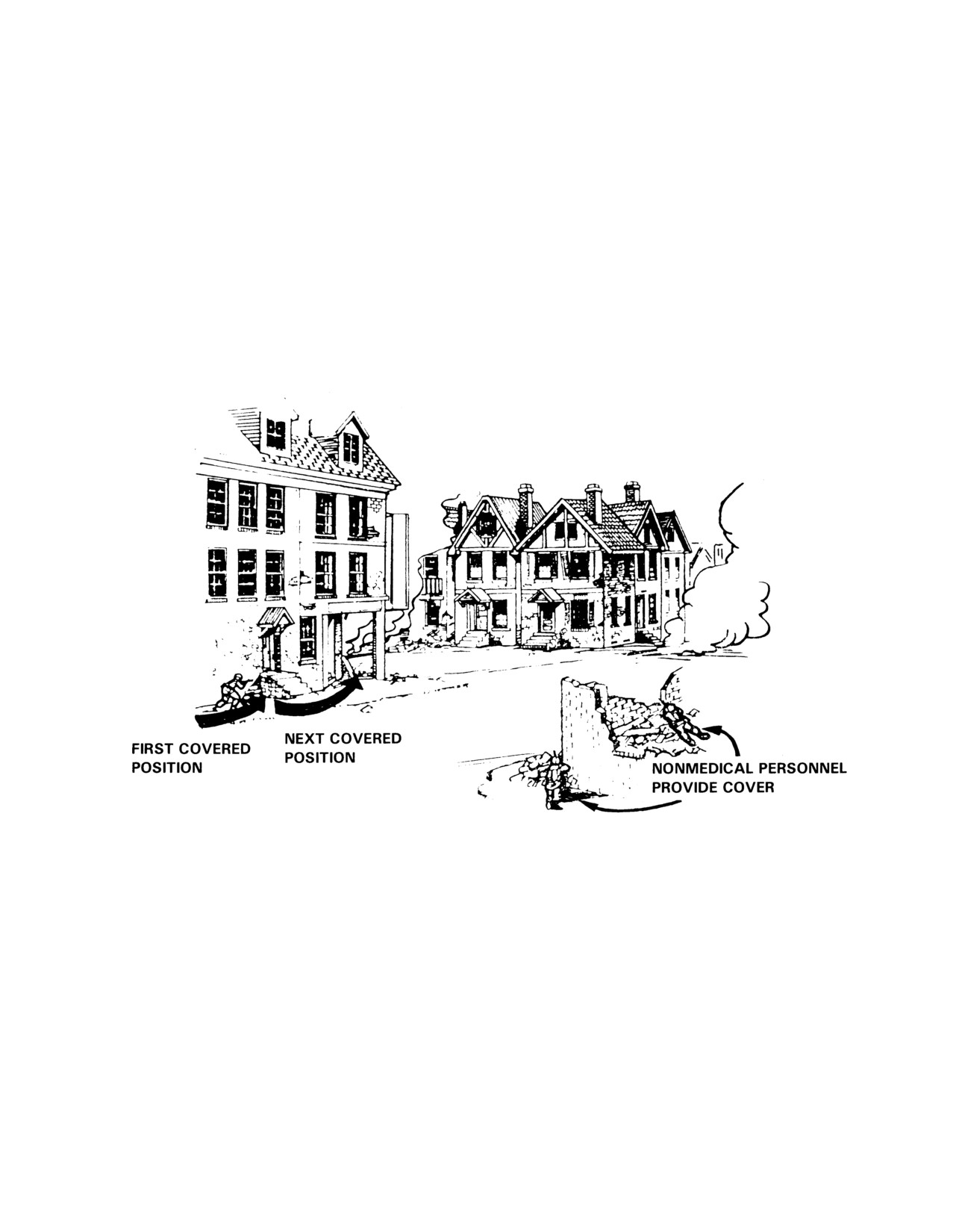
Medics may not always be able to use the inside of buildings for an evacuation route. Therefore, they may have to move on the outside
of the buildings. Smoke and covering fires provided by the supported unit should be used to hide movement. In correctly moving on the
outside of a building, the medic hugs the side of the building, stays in the shade, presents a low silhouette, and moves rapidly to his next
position.
Figure 5-4. Moving outside of building.
5-31
FM 8-10-6
Open areas, such as streets, alleys, and parks, should be avoided whenever possible. They are natural kill zones for enemy crew-served
weapons. This does not mean, however, that they cannot be crossed. They can be crossed safely if certain fundamentals are applied by
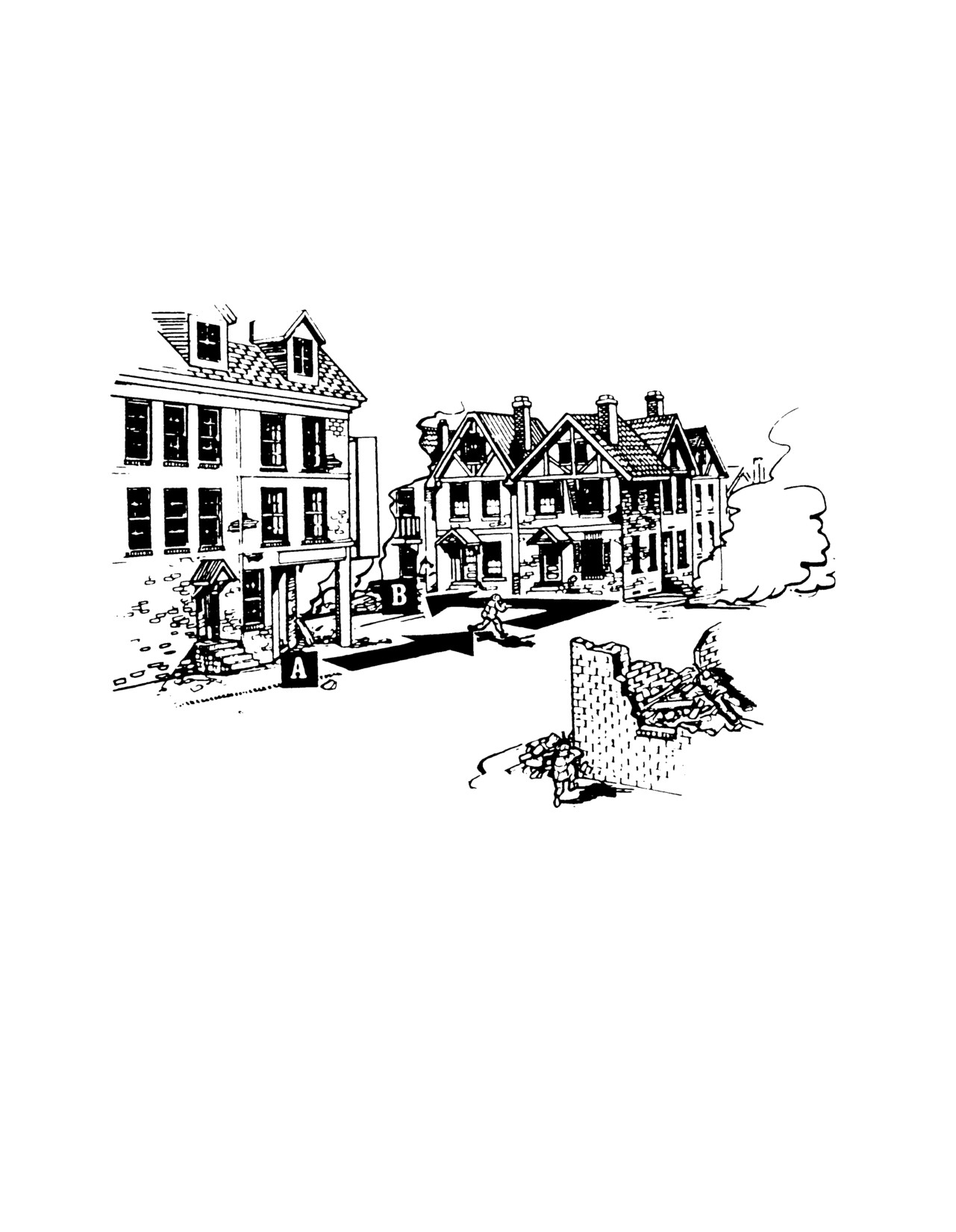
the individual or small-unit leader. The most common mistake in crossing an open area is crossing diagonally from one point to another.
In so doing, the soldier exposes himself to enemy fire for too long. In using the correct procedure for crossing an open area, the soldier
employs smoke between buildings to conceal his movement (or movement of a litter team). Also, he does not cross diagonally from
point A to point B. Instead he runs the shortest distance between the buildings, then moves along the far building to point B. By so
doing, he reduces the time he is exposed to enemy fire.
Figure 5-5. Crossing of open area.
5-32
FM 8-10-6
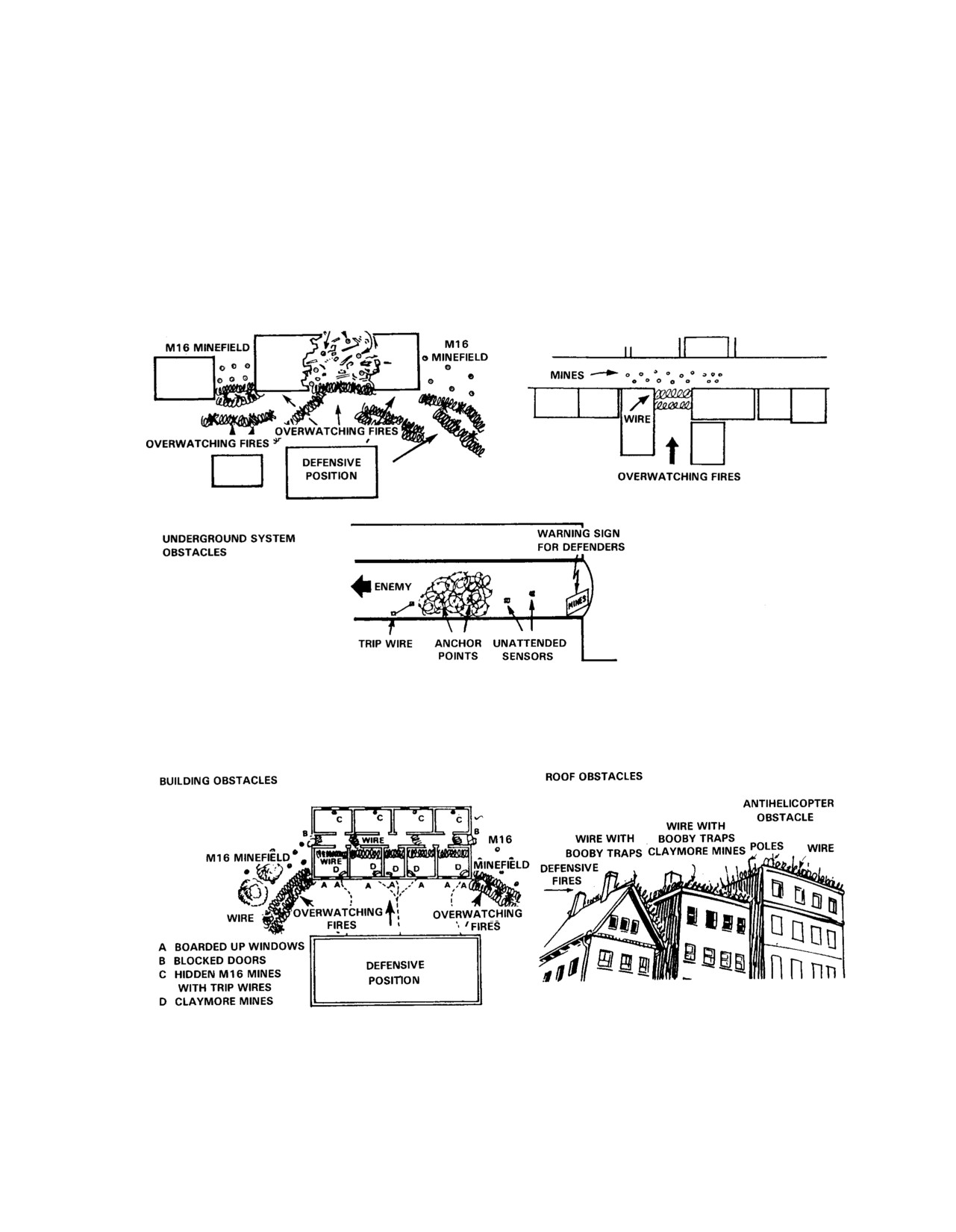
Combat medics and ambulance crews will encounter obstructions, barricades, and
booby traps which will detract from the accomplishment of the evacuation mission. Medics must be familiar
with these antipersonnel obstacles (Figure 5-6) and know how to circumvent or neutralize them.
Figure 5-6. Antipersonnel obstacles.
5-33
FM 8-10-6
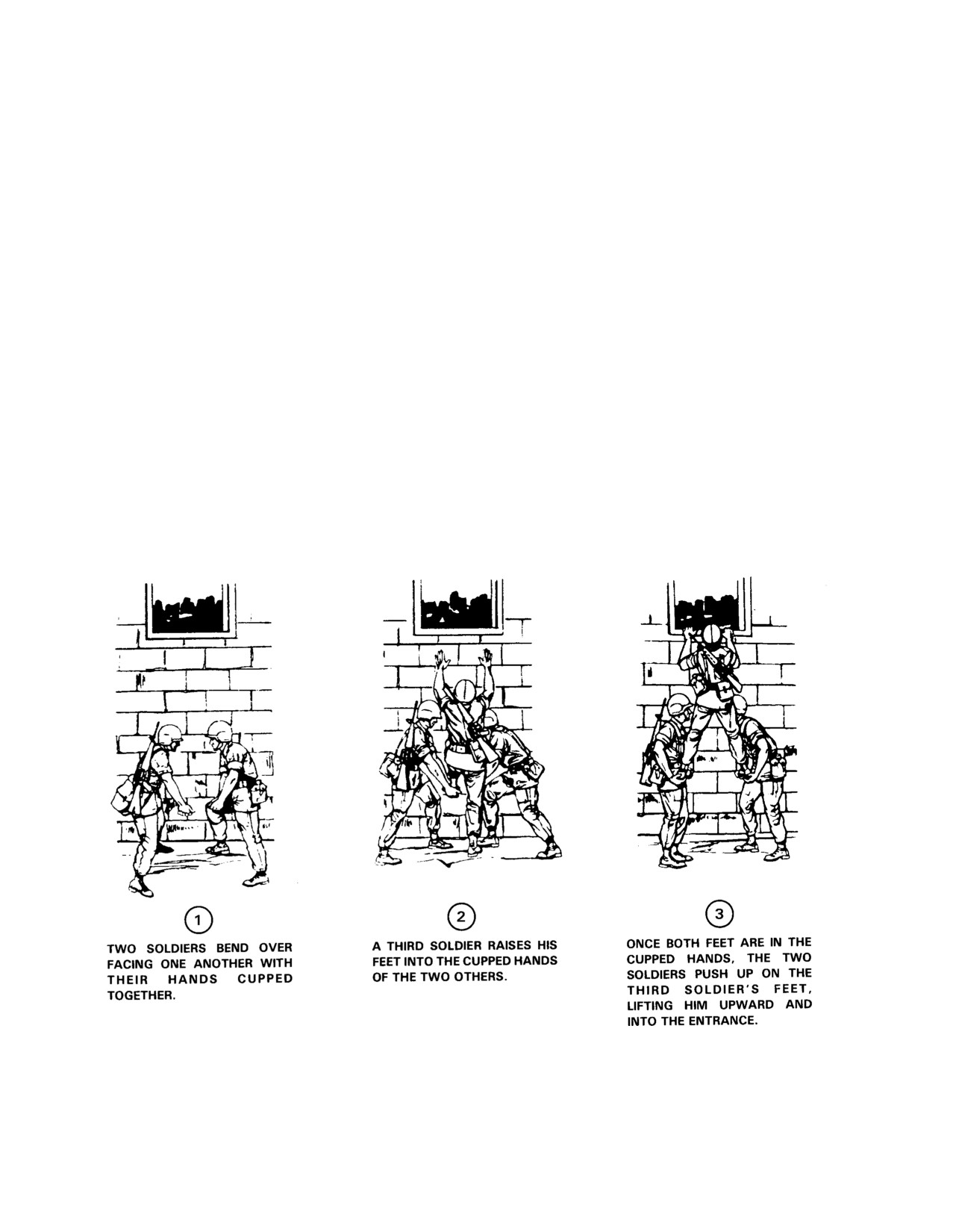
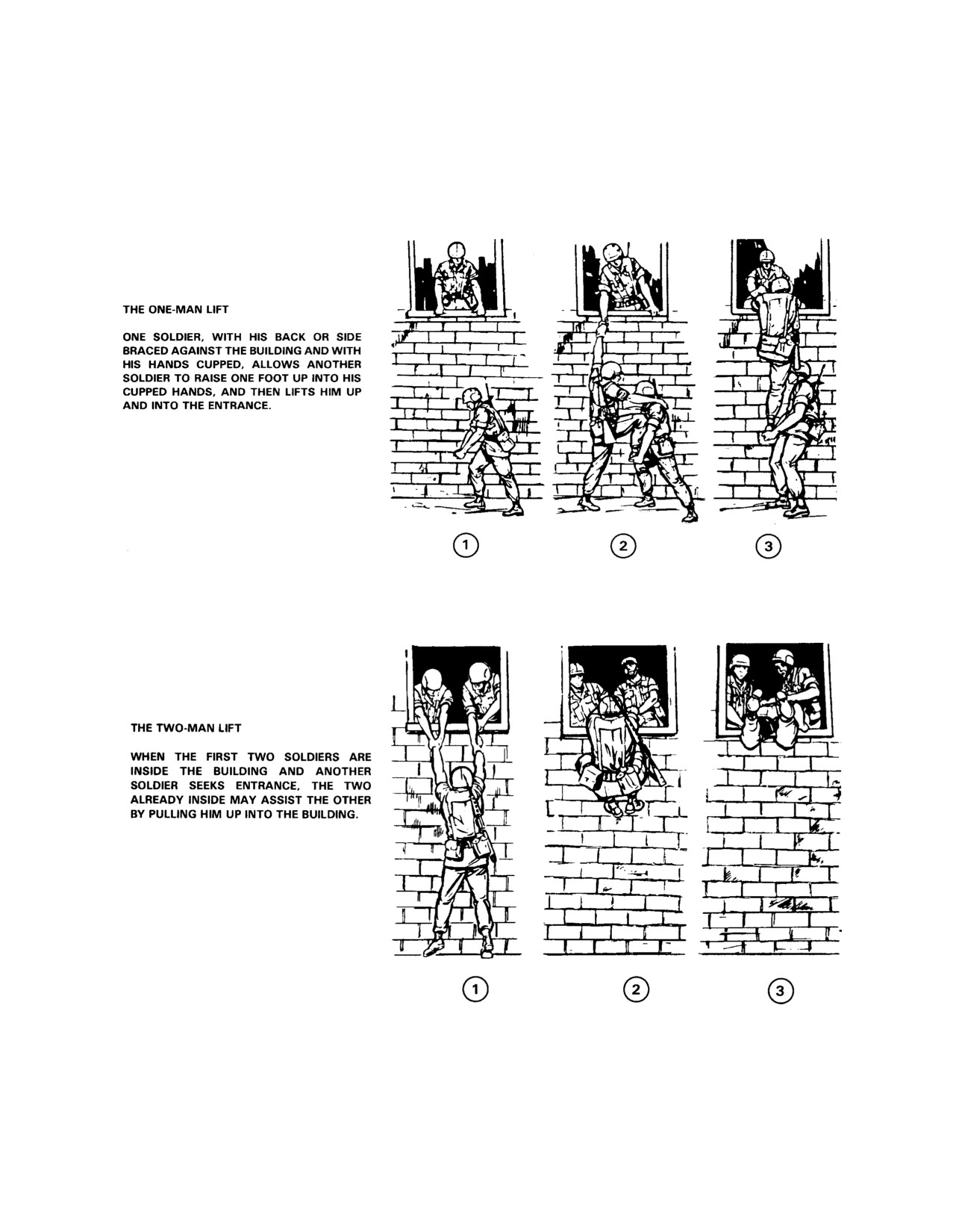
Combat medics and ambulance crews will also need to be familiar with lower-level
entry techniques (Figure 5-7) to gain access to areas where casualties have occurred.
Once the main battle pushes through the downtown area and friendly forces gain
control of this terrain, air ambulances can be employed to hasten the evacuation effort. Air ambulances can
be used to rescue wounded personnel from on top of buildings or downtown parking garages.
As control over the terrain is gained, the BAS can be echeloned further forward,
thereby reducing the distance required for evacuation. If possible, the medical treatment element should be
housed in a structure, as parks within the city area may not be secure from sniper fire.
On those roads that remain passable, a control problem may be encountered as
refugees will be using these roads to escape the battle. Evacuation vehicles and crews should be prepared
for these delays and have sufficient supplies to care for the patient being evacuated.
Figure 5-7. Lower-level entry techniques.
5-34
FM 8-10-6
Figure 5-7. Lower-level entry techniques (continued).
5-35
FM 8-10-6
As troops are relieved of their combat, CS, and CSS duties, they can be used as
litter bearers. The distance that the patients are required to be moved by litter teams will determine the
number of relay points established in the litter shuttle. The relay points should be spaced so that the litter
bearers are not overly fatigued nor taken too far away from the terrain in which they are familiar.
Medical evacuation teams will need to systematically search the battle area for
casualties. Those casualties who can provide a signal for their location (paragraph b(3) above) will hasten
their rescue and evacuation. The special equipment needs for the extraction and evacuation of casualties
become evident during this phase of the evacuation effort. Some casualties will need to be evacuated from
upper floors of buildings where access from ground level is not possible. Entry to some locations will be
from the roof going down to lower floors, or from neighboring buildings across the intervening space.
Techniques and procedures for these extractions must be practiced before the actual operation.
The initiation of intravenous (IV) fluids by combat lifesavers, combat medics, and
evacuation crews will enhance the casualties chances of survival with the delayed evacuation process
existing on urbanized terrain.
As the main battle enters the industrialized sector of the city, the number of
multifloored buildings decreases. However, many of the same obstacles face the medical personnel
responsible for evacuation. Added to the types of injuries incurred during MOUT, the increased chance of
fire, explosion, and toxic fumes or vapors are present in the industrial sector. Combat health support
resources and evacuation assets must be positioned to decrease the vulnerability to these types of hazards.
Combat health support personnel must be familiar with their responsibilities in
regards to the Geneva Conventions and civilian refugees, detained persons, and EPWs (Appendix A).
Procedures should be established in the unit TSOP (Appendix G).
5-11. Cross-Forward Line of Own Troops Operations
Medical evacuation support of cross-FLOT operations is a difficult mission requiring detailed planning.
Although there are a number of different types of cross-FLOT operations, only two will be discussed in this
paragraph. Medical evacuation support for these operations is normally provided by a corps air ambulance
company (GS) working in concert with the corps aviation brigade. A medical evacuation team will be
tasked-organized to provide this support.
a. Deep Attack/Raid. This operation is normally the responsibility of an attack helicopter
battalion in the corps aviation brigade. While it is feasible that air ambulances could accompany the attack
helicopters to the objective, it is more likely that the evacuation team will be field sited in a laager site. The
laager site (hide position) is located in the vicinity of the FLOT. By forward stationing the air ambulances,
the risk and possible compromise of the operation is lessened. The medical evacuation team provides
downed aircrew rescue, EMT, and evacuation support. The air ambulances should be equipped with the
rescue hoist, extraction equipment, personnel locator system (PLS), and enhanced position location and
reporting system (EPLRS). The air ambulances remain in the hide position, with only passive systems
turned on, tracking the process of the raid via limited secure communications. The attack team should
5-36
FM 8-10-6
report, in the blind, only at prearranged communications checkpoints, or upon the downing of an aircraft.
If the wingman is able to retrieve the downed crew, they are taken to a preplanned PCP for transfer to an air
ambulance. If there are injured crew members or the terrain precludes landing, the wingman requests
medical evacuation support. The wingman should provide cover and armed escort for the air ambulances
during the rescue and back across the FLOT. The patients are evacuated to the nearest Echelon II treatment
facility in the brigade sector.
b. Brigade Task Force Cross-Forward Line of Own Troops Operations. This type of operation
employs airborne or air assault insertions into the objective, followed by a penetration and linkup. Medical
evacuation teams are normally attached directly to the TF to provide medical treatment and evacuation
support, both en route and at the objective. Air ambulances accompany the assault aircraft, carrying the
treatment teams and medical supplies and equipment; this enables the assault aircraft to carry more combat
troops. Following the assault aircraft into the LZ, the medical evacuation team provides immediate
evacuation support during the insertion and consolidation. Ground ambulances normally do not accompany
the assault forces, thereby limiting the medical evacuation assets to air ambulances. The tactical commander
may determine that casualties will be held until linkup rather than being evacuated out. The commanders
decision is influenced by the expected duration of the operation, casualty density, METT-TC, and acceptable
risk in evacuating URGENT or URGENT-SURG patients from the objective area. Once linkup is achieved,
ground evacuation assets will become available.
c.
Planning Considerations and Factors. The planning considerations and factors for cross-
FLOT operations include
Expected duration of the operation.
Casualty estimates.
Evacuation distances and time factors.
Location of preplanned PCPs.
Location of AXPs.
Requirements for Class VIII supply/resupply.
Requirements for medical equipment.
Aircraft operational readiness
(maintenance support will not be available; aircraft,
therefore, must have sufficient bank time available to support the entire mission).
Aircraft configuration requirements.
Evacuation routes/air corridors.
Signal operating instructions.
5-37
FM 8-10-6
Equipment (less medical) destruction procedures and policies.
Nuclear, biological, and chemical decontamination procedures.
5-12. Combat Search and Rescue Operations
Air ambulances do not routinely participate in combat search and rescue (CSAR) operations, and are not
protected from attack while engaged in a CSAR mission over contested or denied territory. If the
involvement in these operations consists solely of evacuating wounded crew members from a crash site in
friendly territory, air ambulances retain the protection accorded to them under the provisions of the Geneva
Conventions. (Air ambulances flying in contested or denied areas are not protected from attack and may be
summoned to land. Air ambulances must obey a summons to land. Personnel retain their protections under
the Conventions.) However, if air ambulances participate in the actual search and rescue phases of the
operation, they are not solely engaged in the provision of CHS and are, therefore, not afforded the
protections. Further, because the mission does not fall within the protected activities, the air ambulances
participating in the CSAR operation must remove the Geneva Conventions emblem from the aircraft. Refer
to FM 1-300 and FM 8-10-26 for additional information on CSAR operations.
5-13. Minefield Operations
Medical personnel are often confronted with medical evacuation operations involving casualties extracted
from minefields. Medical evacuation assets operating in areas with known minefields or with a high
potential for discovering minefields, should ensure they have sufficient medical supplies and equipment
aboard the evacuation platform to sustain severe trauma patients during evacuation. Local additions to the
authorized MES may be approved by the command surgeon. Techniques for extracting casualties from
minefields and minefield survival rules are provided in paragraphs 8-9 and 8-10.
5-38
FM 8-10-6
CHAPTER 6
MEDICAL REGULATING
6-1.
General
Medical regulating is the coordination and control of moving patients to MTFs which are best able to
provide the required specialty care. This system is designed to ensure the efficient and safe movement of
patients.
6-2.
Purposes of Medical Regulating
a. Medical regulating entails identifying the patients awaiting evacuation, locating the available
beds, and coordinating the transportation means for movement. Careful control of patient evacuation to
appropriate hospitals is necessary to
Effect an even distribution of cases.
Ensure adequate beds are available for current and anticipated needs.
Route patients requiring specialized treatment to the appropriate MTF.
b. The factors that influence the scheduling of patient movement include the following:
Patients medical condition (stabilized to withstand evacuation).
Tactical situation.
Availability of evacuation means.
Locations of MTFs with special capabilities or resources.
Current bed status of MTFs.
Surgical backlogs.
Number and location of patients by diagnostic category.
Location of airfields, seaports, and other transportation hubs.
Communications capabilities (to include radio silence procedures).
6-3.
Medical Regulating Terminology
As medical regulating may include coordination with other Services, it is necessary to use the correct
terminology. These terms include
6-1
FM 8-10-6
a. Intracorps Medical Regulating. This is the system by which patients are transferred or
evacuated from an FSB or main support battalion (MSB) to a corps hospital (CSH).
b. Intratheater Medical Regulating. This is the system by which patients are transferred or
evacuated from one hospital to another within the TO. This includes evacuations between CZ hospitals,
between EAC hospitals, or from CZ hospitals to EAC hospitals.
c.
Intertheater Medical Regulating. This is the system by which patients are evacuated from
hospitals located in the TO to hospitals located in the support base.
d. Patient Administrator. The patient administrator (PAD) accomplishes the medical regulating
function at the hospital level in addition to his normal duties. His medical regulating functions include
consolidating all evacuation requests within the hospital and forwarding an evacuation request to his next
higher headquarters for action. The PAD is also responsible for keeping his next higher MRO apprised of
the current beds available and the operating room (OR) status.
e.
Medical Regulating Officer. The MRO functions as the responsible individual at C2
headquarters for receiving and consolidating evacuation requests. These requests are initiated by the
DMOCs or subordinate hospitals. The MRO also maintains the current patient status, bed status, and the
surgical backlog at subordinate hospitals. His duties include
Managing what patient classes are regulated into his facility.
Determining what resources are available to move the patients and coordinating for the
use of these assets.
Maintaining accountability of patients within the MTFs.
Preparing reports as required.
f.
Theater Patient Movement Requirements Center. The Theater Patient Movement Requirements
Center (TPMRC) is a joint agency normally located at or near the unified theater headquarters. The theater
surgeon supervises the functions of this office. These functions include
Maintaining direct liaison with the Global Patient Movement Requirements Center
(GPMRC), the MROs of component Services, and the transportation agencies which furnish the means for
evacuation.
Obtaining periodic reports of available beds from the Services MROs providing
hospitalization.
Selecting hospitals based on the reported bed availability to receive patients within EAC.
g. Global Patient Movement Requirements Center. The GPMRC is a joint agency located in
CONUS and established by the US Transportation Command (USTRANSCOM). The GPMRC receives
6-2
FM 8-10-6
requests from the TPMRCs. The primary role of the GPMRC is to apportion intertheater assets to the
TPMRCs, collaborate and integrate proposed TPMRC intertheater plans and schedules, and communicate
lift and bed requirements. The destination hospital is determined based on the patients medical needs, the
available transportation resources, and MTF capabilities.
h. Theater Aeromedical Evacuation System. The Theater Aeromedical Evacuation System
(TAES) is a functional organization which is provided by the USAF and performs the mission of theater
AE. It is composed of the following:
Aeromedical evacuation control center (AECC).
Mobile aeromedical staging facility.
Aeromedical staging facility/aeromedical staging squadron.
Aeromedical evacuation liaison team (AELT).
Aeromedical evacuation operations team (AEOT).
Aeromedical evacuation crews.
Critical care air transport (CCAT) teams.
i.
Aeromedical Evacuation Control Center. The AECC is a USAF element and is responsible
for the USAF AE mission within the TO. The AECC also coordinates for evacuation from EAC to the
support base. The AECC is the core component of the TAES and is normally collocated with the theater air
operations center (AOC) for intratheater and the tanker airlift control center (TACC) for intertheater
coordination of AE operations using USAF aircraft. The CONUS and strategic AOC for the USAF is the
TACC located at Scott Air Force Base (AFB), Illinois. All AE elements (AEOT, AELT, or MASF) within
the TO operationally report to the AECC.
j.
Mobile Aeromedical Staging Facility. The MASF is a USAF staging facility employed at
forward airfields in the CZ to provide a temporary staging capability for preparation of patients being
evacuated from corps to EAC hospitals. The MASF is employed to ensure patients are prepared for aircraft
loading with the main focus of reducing AE aircraft ground time.
k.
Aeromedical Staging Facility or Aeromedical Staging Squadron. The ASF/ASTS is a USAF
staging facility employed at or near airfields in EAC and CZ. It also provides a temporary staging
capability for patients being evacuated from EAC or another theater to CONUS. The ASF/ASTS is
employed to ensure patients are prepared for aircraft loading with the main focus of reducing AE aircraft
ground time.
l.
Military Sealift Command. The Military Sealift Command (MSC) is the USN element
responsible for coordinating movement of supplies, equipment, and personnel into the TO by Navy ships.
Further, it coordinates, through the TPMRC, the medical evacuation of patients by ship from the TO to the
support base, as required.
6-3
FM 8-10-6
m. Corps Movement Control Center. The corps movement control center (CMCC) is the corps
movement control organization. It provides centralized movement control and highway regulation for
movement of personnel and material into, within, and out of the corps area. When USAF capabilities are
exceeded, the CMCC coordinates requests for additional air and ground resources. It also obtains the
necessary clearances to support the medical evacuation mission from the CZ.
n. Theater Army Movement Control Agency. The Theater Army Movement Control Agency
(TAMCA) mission is to provide movement management services and highway traffic regulations and to
coordinate for personnel and material movements into, within, and out of the theater. The TAMCA
coordinates with allied and host-nation (HN) movement control agencies. It also coordinates with the
USTRANSCOM and its subordinate units (such as the Air Mobility Command [AMC] and MSC) and
prepares movement and port clearance plans and programs.
o. Joint Military Transportation Board. The Joint Military Transportation Board (JMTB) is a
joint staff composed of members of the Army, USAF, and USN that coordinates transportation requirements
for patients requiring intertheater evacuation.
p. Defense Medical Regulating Information System. The Defense Medical Regulating Information
System (DMRIS) is an on-line interactive computer system for reporting patients requiring evacuation.
q. Automated Patient Evacuation System. The Automated Patient Evacuation System (APES) is
the system that automates the patient movement portion of medical evacuation.
6-4.
Medical Regulating from the Division
a. Medical regulating in and from the division is the responsibility of the DMOC (the patient
disposition and reports branch). Medical regulating in the division is not as formalized as the rest of the
medical regulating system. It is usually operated procedurally so as not to depend solely on communications
to effect rapid evacuation. The medical regulating function in the DMOC is concerned primarily with
Tracking the movement of patients throughout the division MTFs and into the corps
facilities.
Monitoring the use of ambulance assets.
Coordinating with the corps medical evacuation battalion when additional assets are
needed.
Coordinating with the USAF through the AELT to initiate preplanned high capacity air
ambulance (HCAA) operations, when required. High capacity air ambulance operations are conducted
when the evacuation distance between Echelon II MTFs and corps hospitals exceeds the capability and
range of US Army air ambulances.
b. Corps air and ground ambulances placed in GS of the division are usually field sited in the
division rear and tasked by the DMOC. When these assets go forward to the FSMC or the MSMC to
6-4
FM 8-10-6
evacuate patients to corps MTFs, they have corps MTF destinations predetermined (blocks of beds). The
DMOC, in coordination with the medical group/brigade MRO, establishes the number of patients a
supporting corps hospital can accept during a particular period of time. These blocks of available beds are
then provided to the GS ambulances prior to the call for missions.
NOTE
Under the MRI force structure, the medical group functions were
absorbed by the medical brigade.
(1) Once an evacuation mission is completed, the originating division MTF contacts the
patient disposition section of the DMOC and provides
Patient numbers by category and precedence.
Departure times.
Modes of transportation.
Destination MTFs.
Any other information required by TSOP.
(2) The DMOC, in turn, notifies the medical group/brigade MRO via the patient admin-
istration net, which is monitored by the corps MTFs. Since corps ground ambulances have no on-board
communications ability and air ambulances have no amplitude-modulated-high-frequency (AM-HF)
capability at present, all patient information is passed to the gaining MTFs via the patient administration
nets. To reduce the turnaround time for ground ambulances and to move more serious patients to the CSHs
in the corps rear
Air ambulances are given blocks of beds in the corps hospitals farther to the rear.
Ground ambulances are normally given blocks of beds in the more forward deployed
CSHs.
c.
Medical evacuation can be effected immediately, procedurally, and under conditions of
communications silence without interrupting the continuum of care by
Preparing patient estimates.
Prioritizing and task-organizing ambulance support.
Assigning blocks of hospital bed designations prior to the start of the mission.
6-5
FM 8-10-6
6-5.
Medical Regulating Within the Combat Zone
a. The requirement to transfer patients from one hospital to another within the CZ occurs. This
results from
Surgical backlogs.
Mass casualty situations.
Specialty care requirements.
Planned movement of an MTF.
b. When it is necessary to transfer a patient, the attending physician notifies the hospital PAD.
The PAD consolidates all such requests from the hospital and requests movement authority from the
medical group/brigade MRO.
c.
If the medical group/brigade MRO can transfer the patient or patients to its subordinate
hospitals, he designates the hospitals to receive the patients and notifies both the requesting and receiving
hospitals of the transfer. The medical group/brigade MRO also tasks subordinate medical evacuation units
for the assets to transfer the patients.
NOTE
Under the MRI force structure, the functions of the medical group are
absorbed by the medical brigade. If all C2 headquarters are deployed,
the medical brigade forwards medical evacuation requests to the corps
MEDCOM. If the MEDCOM is not deployed, the medical brigade
forwards the medical evacuation requests to the TPMRC.
d. If the medical group/brigade cannot provide the needed hospitalization within its own
resources, the MRO forwards the request to the medical brigade/MEDCOM MRO for action. The medical
brigade/MEDCOM MRO then designates the receiving hospitals and notifies the subordinate MROs. The
medical group/brigade MROs disseminate the information to the hospital PADs and coordinate the evacuation
resources for the transfer. The MRO also coordinates the regulation of patients to
Other US military service hospitals and naval hospital ships.
Allied nations military hospitals.
Other authorized supporting facilities.
6-6
FM 8-10-6
6-6.
Medical Regulating from the Combat Zone to Echelons Above Corps
a. Hospital attending physicians and oral and maxillofacial surgeons submit daily reports to the
hospital PAD listing the patients requiring evacuation. The PAD assembles this information and transmits
the report to the medical group/brigade headquarters. This report is a request for transportation, as well as a
notification of the number of patients requiring evacuation. The report classifies the patients according to
Diagnostic category.
Desired on-load points.
When the patients will be available for evacuation.
b. The medical group/brigade MRO consolidates these reports from each hospital attached to the
medical group/brigade and forwards his report to the medical brigade/MEDCOM MRO. The medical
brigade MRO consolidates the reports and transmits the data to the MEDCOM MRO.
c.
If a TPMRC has been activated within the theater, the MEDCOM MRO consolidates all
reports from the CZ medical brigades and forwards them to the TPMRC. The TPMRC designates hospitals
in the EAC to receive the patients. The designation is based on the previously received bed status reports
from all Service components and available means of evacuation. The TPMRC then notifies the MEDCOM
MRO of designated hospitals. The MEDCOM MRO accomplishes this task if the TPMRC is not activated.
d. The primary means of moving patients from the CZ to the EAC is USAF aircraft. With the
elements of the TAES deployed, it is possible to find AELTs at each echelon and as far forward as the corps
hospitals. The AELT monitors the MRO patient evacuation requests. At the same time they use their
organic communications capabilities to pass the requirements through the TAES to the airlift control center
(ALCC), seeking an aircraft to perform the evacuation mission. The AELT, through the MRO patient
movement request, requests the TPMRC/AECC to move patients. Included in the request are the originating
medical facility (OMF) and the destination airfields. The airfields selected are those serving the hospitals
designated to receive patients.
e.
The AECC is a component of the TAES and performs the mission of coordinating the
movement of and providing in-flight medical care to patients while under the USAF control. The AECC
receives patient movement requirements from the TPMRC, then works with the AOC to meet the evacuation
requirements.
f.
The AOC coordinates the forward movement of cargo and personnel aboard USAF aircraft
with other USAF units, Army transportation representatives, and USN agencies. Certain of these aircraft
are scheduled to evacuate patients on their return trips. These aircraft seldom go forward solely to evacuate
patients; however, these missions may be used for retrograde movement of patients. Dedicated or designated
(scheduled) aeromedical airlift is the primary means of AE because of the reduced impact assigned AE has
on cargo airlift capability.
g. After the schedules have been arranged, the AECC returns the detailed flight schedule to the
MEDCOM MRO/AELT and the parent AE element.
6-7
FM 8-10-6
h. The MEDCOM MRO, in coordination with the AELT, issues these instructions to the medical
brigade MROs (with the authority to move patients in Army CZ facilities) and the receiving hospitals. The
hospitals must prepare to receive the patients at the destination airfields.
(This may be accomplished by
collocating an ASMC at the airfield to receive the incoming patients.) The patients are sorted by destination
hospital and moved by Army medical evacuation means. The instructions mentioned above include, as a
minimum, the
Number of patients to be moved.
On-load airfield.
Destination airfield.
United States Air Force aircraft mission number.
Estimated time of arrival at the destination airfield.
i.
The medical brigade/MEDCOM MRO issues the flight and movement instructions to its
subordinate medical group/brigade MROs. The medical group/brigade MROs then direct the evacuation
units and hospitals within their AOs to move the patients to the on-load airfield according to the arrival time
of the aircraft. This movement must be closely controlled, as a MASF can accommodate up to 50 patients.
The patients cannot be delivered to the MASF earlier than 6 hours prior to arrival of the aircraft and no later
than 1 hour prior to arrival.
6-7.
Medical Regulating Within Echelons Above Corps
a. Medical regulating within the EAC is similar to the system used within the CZ. Attending
physicians or oral and maxillofacial surgeons within the Echelon III hospitals notify the hospital PAD of
patients requiring evacuation to GHs. The PAD then consolidates the requests from the hospital and
forwards the consolidated request to the medical group/brigade MRO. The MRO, in turn, consolidates the
requests and forwards them to the MEDCOM MRO.
b. The MEDCOM MRO, based on periodic bed status and availability reports from subordinate
hospitals, designates specific hospitals to receive the patients. The hospitals are designated based on bed
availability, to include specialty beds, to support the specific patient. The MEDCOM MRO then notifies
the requesting medical group/brigade MRO of the designated hospitals and, in turn, notifies the designated
hospitals.
6-8.
Intertheater Medical Regulating
a. The patients who are evacuated to EAC are treated there and then further evacuated to the
support base. The attending physicians or oral and maxillofacial surgeons at the hospital notify the PAD.
The PAD then consolidates these requests and forwards them to the MRO at the medical group/brigade.
6-8
FM 8-10-6
This MRO forwards the consolidated request to the MEDCOM MRO who, in turn, consolidates and
forwards a request to the TPMRC (if established).
b. Upon request of the TPMRC for authority to evacuate patients to the support base, the
GPMRC directs the distribution of these patients into hospitals throughout the CONUS; advises the TPMRC
of the destination hospital; and provides the authority for such movement. As a rule, the destination
hospitals are military facilities. Civilian national disaster medical system member hospitals and other
federal hospitals may also receive patients. The VA hospitals, for example, may receive patients who are
expected to be discharged from service. The GPMRC validates the TPMRC patient movement requirements
and, if moving by air, tasks the TACC to plan, schedule, and execute the intertheater evacuation.
c.
When the TPMRC receives the authorization to move patients, it notifies the MEDCOM MRO
of destination hospitals in CONUS. The MEDCOM MRO coordinates with the JMTB to arrange movement
of CONUS-bound patients. The MEDCOM MRO then authorizes the movement to ASFs/ASTSs that are
located on or near air bases or airstrips capable of handling long-range aircraft. Transportation is arranged,
within Army channels, to move patients from the hospitals to the staging facilities. The medical brigade, in
coordination with the AELT, then notifies the subordinate GHs of the flight schedule and the evacuation
arrangements for movement to strategic airheads. At strategic airheads, there is an established ASF/ASTS.
When the patients are delivered to the USAF, the responsibility for those patients is transferred from the
Army hospital to the TAES. Upon arrival in CONUS further movement is the responsibility of the
GPMRC.
d. All patients may not be able to be moved by air from the theater to CONUS. In that event, the
MSC is used to move them by surface means. The movement authority also comes from the GPMRC or
MEDCOM MRO which has arranged with the Navy Service Component Command (NSCC) for the
movement of patients by hospital ships. When the patients are moved by ships, the MEDCOM has to
provide holding facilities at the port (collocating an ASMC can provide this support). Patients are delivered
to these holding facilities and held there until loaded aboard the ships.
6-9.
Mobile Aeromedical Staging Facility
a. The MASF is a 39-person, mobile, tented, temporary staging facility deployed to provide
supportive patient care and administration. Each MASF is capable of routinely holding and processing 50
patients at any given time and is not intended to hold patients overnight or for an extended period.
b. This theater system is used to evacuate patients from
United States Air Force operational locations within the CZ to hospital facilities outside
the CZ.
Airhead or airborne objective areas where airborne operations include USAF forward
logistics support.
c.
Bases used for aeromedical staging are designated by the Director of Aeromedical Evacuation
Forces (DIRAEFOR). The MASFs
6-9