FM 8-10-6 MEDICAL EVACUATION IN A THEATER OF OPERATIONS TACTICS, TECHNIQUES, AND PROCEDURES - page 2
FM 8-10-6
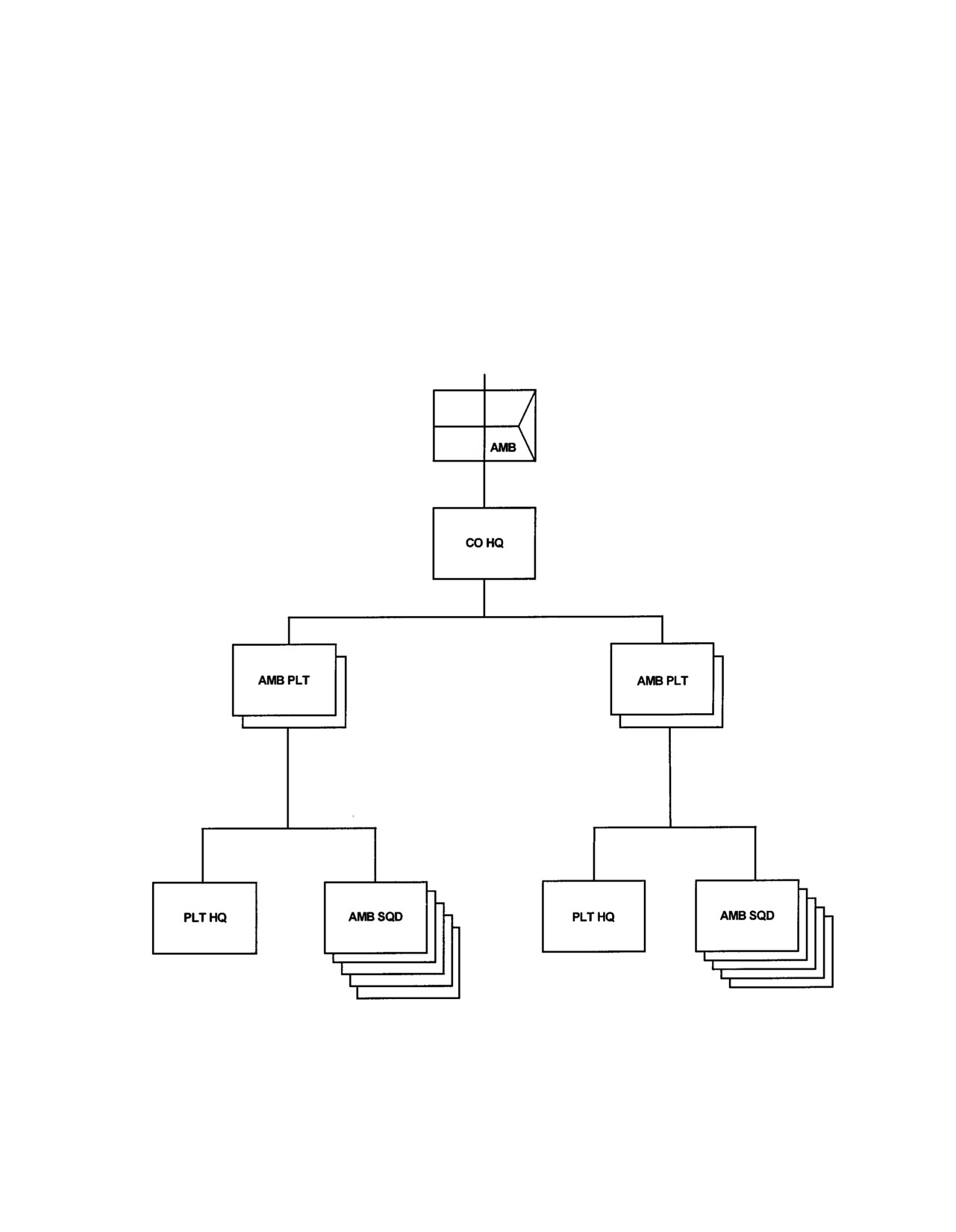
Two ambulance platoons may be employed in the corps to provide medical evacuation
support for interhospital and hospital to MASF (or other embarkation points) transfers.
Figure 3-2. Medical company, ground ambulance.
3-7
FM 8-10-6
Section III. MEDICAL COMPANY, AIR AMBULANCE
3-9.
General
The medical company, air ambulance, provides aeromedical evacuation for all categories of patients
consistent with evacuation precedences and other operational considerations. Medical evacuation is effected
from as far forward as possible in the tactical AO to division- and corps-level MTFs.
3-10. Assignment
a. The medical company, air ambulance, is normally assigned to the MEDCOM or medical
brigade and attached to the medical evacuation battalion for C2.
b. The basis of allocation is one unit in support of each division or equivalent force supported.
Further, one unit is in general support (GS) in the corps per two division or fraction thereof; or .333 units
per separate brigades or armored cavalry regiments (ACRs).
3-11. Mission and Capabilities
a. The mission of the medical company, air ambulance, is to provide
Aeromedical evacuation support within the TO, either DS to the divisions or GS to the
corps.
Emergency movement of medical personnel, equipment, and supplies including whole
blood, blood products, and biologicals.
b. Specific capabilities of this unit are to
Operate on a 24-hour-a-day basis.
Evacuate patients based on operational capability (dependent on type of aircraft).
Operate fifteen air ambulances (UH-60A). These ambulances are each capable of
carrying six litter patients and one ambulatory patient, or seven ambulatory patients, or some combination
thereof. Single patient lift capability is 90 litter patients, or 105 ambulatory patients, or some combination
thereof. In-flight medical treatment and surveillance of patients is provided by a flight medic. OR
Operate fifteen air ambulances (UH-1H/V). These ambulances are capable of
carrying six litter, or nine ambulatory patients, or some combination thereof. Single patient lift capability is
90 litter, 135 ambulatory, or some combination thereof. In-flight medical treatment and patient surveillance
are provided by a flight medic.
3-8
FM 8-10-6
Provide internal/external load capability for the movement of medical personnel and
equipment.
Perform AVUM on all organic aircraft and organizational maintenance on all organic
avionics equipment. It also performs unit-level maintenance on all organic equipment less medical.
Provide air crash rescue support, less fire suppression.
Provide rescue of downed aircrews. (Refer to paragraph 1-13 for additional information.)
Operate as an area support medical evacuation (MEDEVAC) section and three forward
support MEDEVAC teams (FSMTs) to provide flexibility in supporting division, brigade, or brigade TF
equivalent operations.
c.
This unit is dependent upon
(1) Support elements of corps or ASCC for
Finance, legal, and religious support.
Personnel services.
Logistics.
Combat health support, to include medical supply and equipment.
Food service support.
Communications security equipment maintenance.
Mortuary affairs support.
Military police support.
Laundry, shower, and clothing repair.
Engineer support for heliport/landing strip construction and maintenance.
(2) The supporting aviation intermediate maintenance (AVIM) organization for
AVIM
support.
3-12. Organization and Functions
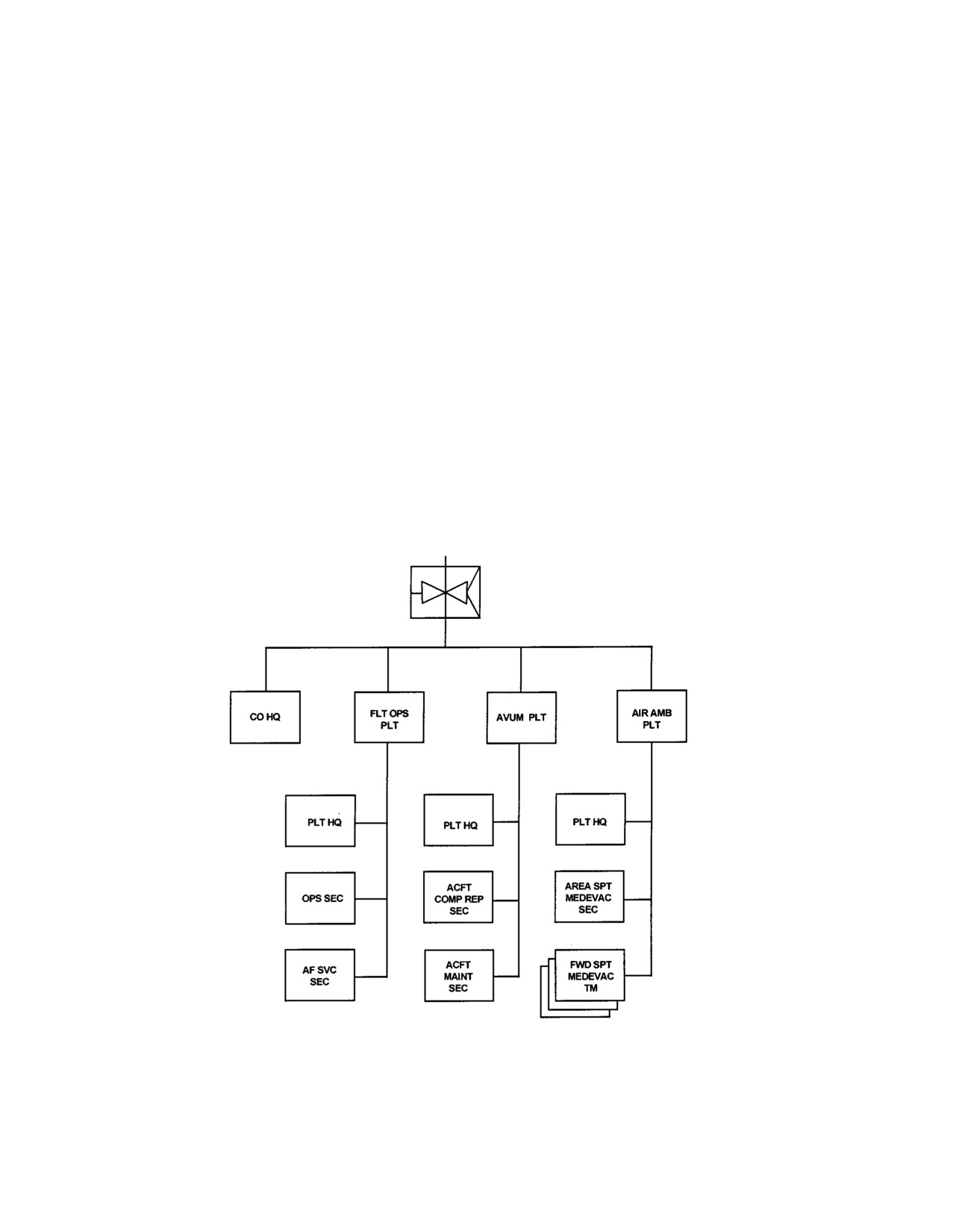
a. The medical company, air ambulance (Figure 3-3), is organized into a/an
3-9
FM 8-10-6
Company headquarters.
Flight operations platoon consisting of a platoon headquarters, a flight operations section,
and an airfield service section.
Aircraft maintenance platoon consisting of a platoon headquarters, a component repair
section, and a maintenance section.
Air ambulance platoon consisting of a platoon headquarters, an area support MEDEVAC
section, and three FSMTs.
b. For additional information on the organization and functions of the medical company, air
ambulance, refer to FM 8-10-26.
Figure 3-3. Medical company, air ambulance.
3-10
FM 8-10-6
CHAPTER 4
THE MEDICAL EVACUATION SYSTEM
4-1.
General
a. The current medical evacuation doctrine and organizations are the result of an evolutionary
process. This process includes both trial and error and the assimilation of lessons learned on the battlefield
and in training environments.
b. Medical evacuation encompasses
Collecting the wounded.
Sorting (triage) and prioritizing.
Providing an evacuation mode (transportation).
Providing medical care en route.
Anticipating complications and being ready to perform emergency medical intervention.
c.
The increase in the speed and lethality of combat formations has served to increase the
importance of medical evacuation as the key link in the continuum of care. The air and ground evacuation
assets currently used to perform battlefield evacuation have both strengths and limitations. To be effective
they must be employed in a synchronized system, each complementing the capabilities of the other.
This paragraph implements STANAG 3204 and AIR STD 44/36A.
d. The initial decision of treatment echelon required is made by the treatment element (squad,
team, or treatment platoon). Soldiers are evacuated by the most expeditious means of evacuation dependent
on their medical condition and assigned evacuation precedence.
(Refer to Chapter 7 for an in-depth discus-
sion of the evacuation precedences.)
Priority I, URGENT.
Priority IA, URGENT-SURG.
Priority I I, PRIORITY.
Priority III, ROUTINE.
Priority IV, CONVENIENCE.
4-1
FM 8-10-6
NOTE
The NATO STANAG 3204 has deleted the category of Priority IV,
CONVENIENCE; however, it will still be included in the US Army
evacuation priorities as there is a requirement for it on the battlefield.
(1) The medical evacuation battalion maximizes the effectiveness of corps ground and air
ambulance resources. This unit exercises C2 over assigned and attached ground or air ambulance
companies. It also provides the required evacuation out of division areas, between hospitals in the corps
and EAC, and from ASMBs in the corps and EAC. The medical evacuation battalion provides the
flexibility and capability for task organizing to support close, deep, and rear operations. It can be modified
to support all aspects of the operational continuum. The ASMB ambulance platoon and the ambulance
squad in the division medical company provide evacuation within their assigned AO. To ensure that
patients are evacuated to the appropriate treatment elements, medical regulating officers (MROs) are
organic to the medical group and medical brigade.
(2) The patients medical condition is the overriding factor in determining the evacuation
platform and destination facility. The air ambulance operates wherever needed on the battlefield, dependent
on risk and METT-TC factors. The crew of the air ambulance, assisted by on-board patient monitoring and
diagnostic equipment, is trained in aeromedical procedures to provide optimum en route patient care. It is
the platform of choice for most categories of patients. However, insufficient numbers of air ambulances are
available to evacuate all patients expected in a corps. To conserve these valuable resources, CHS planners
should plan to use air ambulances to primarily move Priority I, URGENT and Priority IA, URGENT-
SURG patients with other categories on a space available basis.
e.
On the integrated battlefield, commanders must employ their available evacuation resources to
accomplish the mission while maximizing survivability. The enemys ability to fire on exposed elements
may be inhibited by the clever use of cover, concealment, and available defilade. It is essential to minimize
our vulnerabilities while exploiting those of the enemy. It is also important to be as well trained and
knowledgeable of US, allied, coalition, and threat forces capabilities and operational doctrine as possible.
(Refer to paragraph 5-6 for additional information.)
f.
In stability operations and support operations, the force composition and availability of
evacuation resources will be determined by the mission, the anticipated duration of the operation, and the
potential for violence.
(Refer to paragraphs 4-8 and 4-9 for additional information on these types of
operations.)
4-2.
Medical Evacuation
An efficient medical evacuation system
Minimizes mortality by rapidly and efficiently moving the sick, injured, and wounded to an
MTF.
4-2
FM 8-10-6
Clears the battlefield enabling the tactical commander to continue his mission.
Builds the morale of the soldiers by demonstrating that care is quickly available if they are
wounded.
Provides en route medical care that is essential for improving the prognosis and reducing
disability of wounded, injured, or ill soldiers.
a. Evacuation is performed by the higher echelon of medical care going forward and evacuating
from the lower echelon.
b. Evacuation assets must have equal or greater mobility as the troops supported.
c.
The CHS commander responsible for the medical evacuation mission is the primary manager
of the medical evacuation assets. A single, dedicated medical command authority must manage all evacuation
assets. The medical manager ensures that the optimum evacuation mode is used based upon the patients
medical condition and the
Availability of resources.
Destination MTF.
Tactical situation.
d. The evacuation of patients in nonmedical ground and air assets must be considered in mass
casualty situations. Nonmedical assets will be augmented, whenever possible, with medical personnel to
provide en route medical care. With prior coordination, augmentation medical personnel may be obtained
from within the division medical company or the ASMB. When augmentation of medical personnel is not
possible, the transportation of casualties can still be accomplished using nonmedical vehicles and aircraft;
when possible, combat lifesavers should accompany the casualties. The planning for this requirement is the
responsibility of the division medical operations center (DMOC) or battalion S3.
(Refer to paragraph 1-4
for a discussion of CASEVAC.)
e.
Routinely bypassing echelons of care is detrimental to the wounded soldier and the CHS
system. Bypassing echelons of care
Negates the effectiveness of medical resources.
Risks further injury to the patient.
Removes soldiers unnecessarily from forward locations on the battlefield.
Causes overevacuation of less critically injured soldiers; thereby, resulting in a delay of
potential RTD soldiers.
4-3
FM 8-10-6
Unnecessarily removes the evacuation asset from its supporting position for longer
periods of time.
4-3.
Basic Considerations in Medical Evacuation Operations
a. General. As METT-TC factors affect the employment of all units, the medical evacuation
commander must consider the basic tenets that influence the employment of medical evacuation assets.
These factors include the patients medical condition and the
Tactical commanders plan for employment of combat forces.
Enemys most likely course of action.
Anticipated patient load.
Expected areas of patient density.
Availability of medical evacuation resources.
Availability, location, and type of supporting MTFs.
Protection afforded medical personnel, patients, and medical units, vehicles, and aircraft
under the provisions of the Geneva Conventions.
Army airspace command and control (A2C2) plan.
Engineer obstacle plans.
Fire support plan (to ensure medical evacuation assets are not dispatched onto routes and
at the times affected by the fire support mission.)
Road network/dedicated medical evacuation routes (contaminated and clean).
Weather conditions.
b. Patient Acquisition.
(1) Units with organic medical evacuation assets have the primary responsibility for patient
acquisition. Methods of employment and evacuation techniques differ depending upon the nature of the
operation.
(2) Units without organic ambulance assets are provided medical evacuation support on an
area basis. Units must develop techniques which facilitate the effective employment of their combat
medics, enhance the ability to acquire patients in forward areas, and rapidly request medical evacuation
4-4
FM 8-10-6
support. The techniques developed should be included in the unit tactical standing operating procedure
(TSOP). As a minimum, the TSOP should include the
Vehicle assignment for the combat medic.
Vehicles designated to be used for casualty transport and/or patient evacuation.
Procedures for requesting medical evacuation support (during routine operations or
during mass casualty situations).
Role of the first sergeant, platoon sergeants, and combat lifesavers in medical
evacuation.
c.
Medical Platoon, Treatment Squad Forward.
(1) The medical platoon leader (a physician) should be included in all battalion tactical
planning. He must keep himself knowledgeable of the concept of operations, commanders intent, and the
anticipated CHS requirements. He develops his CHS plan (FM 8-55 and FM 8-42) and provides CHS
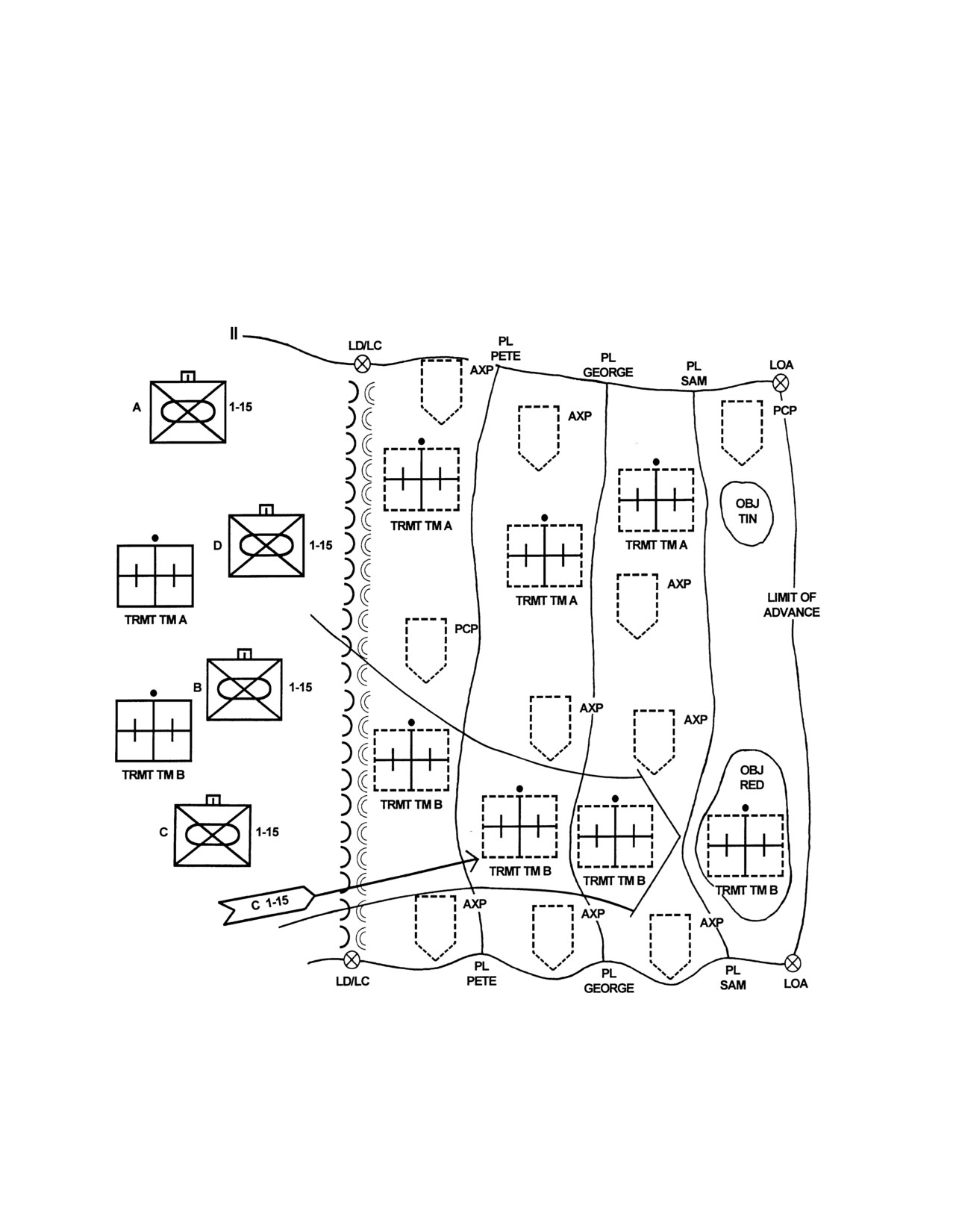
overlays with preplanned evacuation routes, PCPs, and AXPs to the ambulance squads or teams (Figure
4-1) for inclusion in the battalion OPLAN. He ensures that his squad leaders provide strip maps or other
navigational tools to the ambulance drivers, if needed. He requests augmentation support from the
supporting medical company in advance of the operation, if required. When elements of a maneuver
battalion are attached to a TF, the medical platoon leader ensures that adequate medical elements are
included in the support package. He further ensures that orientation and support are provided for his
medical personnel. This precludes taxing the medical elements of the receiving unit. These responsibilities
are normally delegated to the medical operations officer (field medical assistant).
(2) The ambulance section NCO ensures that his squad leaders have a working knowledge of
the terrain features in the AO. Whenever possible, he familiarizes himself with primary and secondary
medical evacuation routes through route reconnaissance conducted by his squad leaders. This NCO
manages the employment of the ambulance teams and monitors the communications net to remain abreast of
the tactical situation.
(3) The following factors should be considered when selecting ambulance routes:
Tactical mission.
Coordinating evacuation plans and operations with the unit movement officer.
Security of routes.
Availability of routes.
Physical characteristics of roads and cross-country routes
(to include natural
obstacles).
4-5
FM 8-10-6
Figure 4-1. Typical evacuation overlay.
4-6
FM 8-10-6
Requirements to traverse roads in built-up areas and potential obstructions from
rubble and debris.
Traffic density.
Time and distance factors.
Proximity of possible routes to areas that may be subject to enemy fire.
Lines of patient drift.
Cover, concealment, and available defilade for moving and stationary vehicles.
Engineer obstacle plans.
Fire support plan (to ensure medical evacuation assets are not dispatched onto
routes and at the times affected by the fire support mission).
(4) Depending upon the combat situation, the modes of evacuation may include walking
soldiers who are wounded, manual and litter carries, nonmedical transportation assets, or dedicated medical
evacuation platforms. Evacuation in the battalion area normally depends on the organic ambulances
assigned. Evacuation by air ambulance is dependent upon the patients medical condition, availability of air
assets, tactical situation, and weather conditions.
(a) The ambulance team or squad routinely deploys with the company trains (combat
trains). It operates, however, as far forward as the tactical situation permits. This team, when operating in
a maneuver company AO, is normally under the tactical control of the maneuver company executive officer
or first sergeant. The team, however, remains under the technical and operational control (OPCON) of the
medical platoon.
(b) The medical operations officer ensures that the ambulances are located close to the
anticipated patient workload. An ambulance team consists of one ambulance and two medical specialists
(on track vehicles, a third medic is required to permit en route medical care). One or two of these teams
serve in DS of a maneuver company. To become familiar with the specific terrain and battlefield situation,
the team maintains contact with the company during most combat operations. The remaining ambulance
assets are positioned strategically throughout the battalion area or are sited at the BAS to
Evacuate patients from the company aid posts, PCPs, or AXPs to the BAS.
Reinforce the forward teams.
Support the combat forces held in reserve and/or scout and mortar platoons.
(c) Another employment option is to forward site the additional ambulance teams at
company aid posts or PCPs, as well as at the BASs.
4-7
FM 8-10-6
(d) Many times the ambulance team finds battlefield casualties who have not been seen
by a combat medic. In these cases, the team members dismount and then find, treat, and evacuate the
patients.
(e) Ambulance teams not specifically dedicated to support combat elements can be
used as messengers in medical channels and to provide transport of emergency medical personnel,
equipment, and supplies.
(5) During static situations where the maneuver company is not in enemy contact or is in
reserve, the ambulance team returns to the BAS to serve as reinforcement to other elements in contact.
However, during movement to contact, the ambulance team immediately deploys with its supported unit.
In moving patients back to the PCPs point, the team may be assisted by nonmedical personnel. Specific
duties of the ambulance team are to
Maintain contact with supported elements.
Find and collect the wounded.
Administer EMT.
Initiate or complete the FMC (Appendix C).
Evacuate patients to the BAS.
Direct or guide ambulatory patients to the BAS.
Resupply combat medics.
Serve as messengers in medical channels.
(6) During the offense, PCPs may be used to avoid hampering the movement of the maneuver
elements. In fast-moving situations, preplanned PCPs are included in the CHS plan and activated based on
the crossing of phase lines, upon the occurrence of predetermined events, or on the execution of other
control measures. It may be necessary to set up multiple PCPs for each phase of an operation. Rotating the
use of these points precludes the enemy from using them to pinpoint maneuver elements or from attracting
enemy fires. When the situation permits, patient evacuation from PCPs or AXPs may be accomplished by
air ambulances.
(7) Ambulance teams move using available terrain features for cover and concealment.
They avoid prominent terrain features and likely targets. When stationary, the ambulance crew should
conceal the vehicle as much as possible.
(8) When a casualty occurs in a tank or a Bradley infantry fighting vehicle (BIFV), the
ambulance team moves as close to the armored vehicle as possible. Assisted by the armored crew, if
possible, the casualty is extracted from the vehicle and then administered EMT. The ambulance team
4-8
FM 8-10-6
moves the patient to the BAS, or to a PCP point to await further evacuation. The combat medic normally
remains with the company combat trains, but may be used anywhere in the company area, even assisting the
ambulance teams in some situations. He may be used to direct ambulance teams to locations where vehicle
crews need assistance, or where injured or wounded crew members have been left. In some situations,
crew members may have to rely on self-aid or buddy aid until the combat lifesaver or the combat medic
arrives.
(9) Medical evacuation on an area basis is required at all echelons in the CHS system.
Divisional units, without organic evacuation resources such as combat engineers, will require evacuation
support on an area basis. To ensure that these elements receive adequate support, the CHS planner must
include their requirements into the OPLAN. Prior coordination is essential to ensure that the locations of
PCPs, AXPs, and BASs are disseminated to these elements and that any unique support requirements are
included.
d. Medical Platoon Treatment Squad or Team to Forward Support Medical Company.
(1) Evacuation from the treatment squad or team is normally provided by the FSMC ambu-
lance platoon and the FSMT of the DS air ambulance company. Further, these ambulance assets provide
evacuation support on an area basis to other units in the brigade rear.
(2) The elements of the ambulance platoon are normally collocated with the FSMC treatment
platoon for mutual support. They establish contact and locate one ambulance team with the medical platoon
of each maneuver battalion. The remaining ambulances are used for brigade TF operations and area
support. The ambulances are pre-positioned at AXPs or PCPs, or are field-sited at the FSMC.
(3) An air ambulance team of the corps air ambulance company can be forward deployed to
the BSA and collocated with the FSMC depending upon METT-TC. The team may be attached in DS or
under the OPCON of the FSMC. (The FSMT may also be attached to the aviation brigade for support less
OPCON.) The OPCON relationship provides authority to the FSMC to direct the integrated air and ground
evacuation system. Administrative and logistics responsibilities, along with discipline, internal organization,
and training, remain the responsibility of the parent unit. The section leader of the FSMT should be
included in the brigade tactical planning process. The air ambulance team evacuates Priority I, URGENT
patients from as far forward as possible to the FSMC. Further, when a FST is collocated with a division
medical company (FSMC or MSMC), air ambulances evacuate Priority IA, URGENT-SURG to this
facility. External lift capabilities of aeromedical evacuation helicopters add an important dimension to its
role on the battlefield. It provides the FSMC commander flexibility and agility in the movement of
treatment teams and equipment to the forward battle area. It also provides the capability to rapidly resupply
Class VIII supplies to combat units.
(a) Corps air evacuation elements may operate from the division rear and BSAs
providing around-the-clock, immediate response, evacuation aircraft. To accomplish this, elements must
maintain a close tie with the division A2C2 system.
(b) The FSB support operations can provide planning and coordination between air
ambulance elements in the BSA and the maneuver brigade S3. Since the support operations section is not
4-9
FM 8-10-6
staffed for this mission, the FSMT should plan to provide the FSB support operations cell with a flight
operation specialist to assist in A2C2 planning and coordination. Forward support MEDEVAC teams,
through the FSB support operations, provide the necessary information to the maneuver brigade S3.
(4) In the FSMC, the executive officer is the principal assistant to the commander for the
tactical employment of the company assets. He should be included in all brigade tactical planning. He
needs to be prepared to reinforce or reconstitute forward CHS elements and to request augmentation
through the DMOC, if required. The FSMT leader keeps the FSMC executive officer appraised of his
operational capability. This enables the executive officer to effect timely reinforcement or augmentation.
The FSMC executive officer must be familiar with the specific terrain and battlefield situation. Further, he
should have a thorough understanding of the division and brigade commanders ground tactical plan.
e.
Forward Support Medical Company to the Medical Company in the Division Rear Area.
(1) In Vietnam, with the virtually unrestricted availability of aeromedical evacuation, it
became a common practice to overfly echelons of CHS. Patients were evacuated directly to a corps-level
hospital. A return to a more systematic approach to patient evacuation is dictated by the
Potentially greater distances involved.
Necessity of integration into the various levels of A2C2.
Requirement to treat as far forward as possible.
Requirement to limit the overevacuation of patients to reduce congestion at corps
MTFs.
Threat.
(2) The FSMC commander is responsible for the brigade medical evacuation plan, to include
the use of both ground and air assets. The commander should include the medical company executive
officer, brigade S1, brigade executive officer, medical platoon leaders, FSMT leader, and the forward
support battalion (FSB) CHS officer in the planning process. Evacuation from the FSMC is normally
provided by ground and air assets from the corps medical evacuation battalion. The ambulance platoon of
the MSMC does not possess sufficient assets to move the anticipated number of patients from the FSMCs.
It usually moves only those patients who will RTD within 72 hours (and are held in the MSMC holding
squad) or clear the FSMC prior to the relocation of the unit.
(3) The MSMC ambulance platoon normally collocates with the treatment platoon for mutual
support and area taskings. It performs ground evacuation and en route patient care for supported units in
the division rear. It may also evacuate patients from the FSMC in the BSA, as necessary. The ambulance
platoon is mobile in operations as its assets may be totally deployed at one time. The platoon normally
forward stations a portion of its teams in support of those units in the division rear. The remaining teams
are used for TF operations, reinforcing support, or ambulance shuttles. Platoons or squads from the corps
ground ambulance company will be in DS, or OPCON to, and collocated with the medical company in the
division rear or BSA. These assets evacuate patients from the forward medical treatment elements.
4-10
FM 8-10-6
(4) A corps air ambulance company designated to support a division may be deployed as
OPCON, attached, or in DS of the division. For aeromedical evacuation when OPCON or attached, the air
ambulance company is normally under the control of the DISCOM. The air ambulance company may
collocate with the MSMC or aviation brigade and forward deploys air ambulance teams or crews to the
FSMCs depending upon METT-TC. Air ambulance teams deployed to the FSMC will have the minimum
number of aircraft required to accomplish the mission. The remaining aircraft are located with the company
headquarters for reinforcement of the FSMC and an area support mission in the division rear.
f.
Evacuation from Main Support Medical Company to Echelons III and IV Hospitals.
(1) The mission of the hospital system is twofold. First, it is designed to maximize the RTD
of patients. Secondly, it provides the necessary treatment to stabilize patients for further evacuation.
Patients are further evacuated when they are not expected to RTD within the limits of the theater evacuation
policy.
(2) Hospitalization in the theater is provided at Echelons III and IV of the CHS system.
(a) The FST collocates with division medical companies to provide resuscitative
surgery.
(In some scenarios the FST may be collocated with an ASMC.) Patients are further stabilized and
evacuated to Echelons III hospitals.
(Field Manual 8-10-25 discusses the operation and employment of
FSTs. Although the FST is not an Echelon III resource, its parent unit is the combat support hospital
[CSH].)
(b) Forward-oriented CSHs (FM 8-10-14) are capable of treating all classes of patients;
however, their primary mission is that of providing
Resuscitative surgery and trauma treatment.
Returning patients to duty within prescribed CZ policies.
(c) Field hospitals (FHs) (FM 8-10-15) are designed to focus on RTD patients and
specialize in reconditioning and rehabilitation. These hospitals are normally located in either EAC, but may
be employed in the corps area, if required.
(d) General hospitals (GHs) (FM 8-10-15) are oriented toward the trauma patient but
have sufficient balance to fulfill their area support role for all classes of patients. They are normally located
in the EAC.
NOTE
Under MRI, there is only one basic type of hospital in the theater.
(3) Elements of the medical evacuation battalion are also tasked with corps interhospital
transfer responsibilities and the movement of patients to USAF MASFs (this may be accomplished by air or
4-11
FM 8-10-6
ground ambulances as determined by the commander). Corps area ground evacuation support is provided
by the ASMB with its organic ambulance assets. This allows the medical evacuation battalion to focus its
entire ground effort forward on the supported divisions and the movement of patients between corps
hospitals.
(4) The organic ground evacuation assets of the MSMC provide evacuation support on an
area basis.
4-4.
Property Exchange and Patient Movement Items
a. United States Army Medical Evacuation Operations. Whenever a patient is evacuated from
one MTF to another or is transferred from one ambulance to another, medical items of equipment (casualty
evacuation bags [cold weather-type bags], blankets, litters, and splints) remain with the patient. To prevent
rapid and unnecessary depletion of supplies and equipment, the receiving Army element exchanges
like property with the transferring element. This reciprocal procedure will be practiced to the fullest extent
possible through all phases of evacuation from the most forward element through the most rearward
hospital.
b. United States Air Force Aeromedical Evacuation Operations. A major factor in the evacuation
of patients is that specific medical equipment and durable supplies designated as patient movement items
(PMI) must be available to support the patient during the evacuation. Examples of PMI include ventilators,
litters, patient monitors, and pulse oximeters. These items will be available for exchange at the supporting
ASFs and MASFs. Refer to Joint Pub 4-02.2 for additional information on PMI.
This subparagraph implements STANAG 2128 and QSTAGs 435 and 436.
c.
Medical Property of Allied Nations (NATO and ABCA armies). Medical property accom-
panying patients of allied nations will be returned to the parent nation at once, if possible. If it is not
possible, like items will be exchanged as in paragraph a above.
d. Medical Property of Coalition Forces or Allied Nations Without Ratified Standardization
Agreements. Absent a formal agreement, such as an Acquisition and Cross-Servicing Agreement, medical
property accompanying patients of coalition and allied forces without ratified STANAGs will be returned to
the parent nation as soon as practicable. Commanders should consult with their Staff Judge Advocate early
in the planning process to ensure appropriate policy and procedures are developed and disseminated.
4-5.
Medical Evacuation Tools
It is essential that the evacuation plan for all combat operations be well conceived, planned, coordinated,
and disseminated. In designing the medical evacuation plan, the CHS planner uses the following tools:
4-12
FM 8-10-6
a. Patient Collecting Points. In fast-moving situations, PCPs normally are predesignated along
the axis of advance or evacuation routes. Forward of the BAS, combat medics, combat lifesavers, and
combat troops take casualties to the PCPs. These points facilitate acquisition by supporting ambulance
teams and reduce evacuation time. When used by the BAS, PCPs help preserve BAS mobility, preclude
carrying casualties forward, and reduce evacuation time to the rear. Patient collecting points designated by
the division level of CHS concentrate patients along evacuation routes, increasing the efficiency of each
ambulance mission to the treatment station. They also provide those units lacking organic medical support
with a forward area for patient disposition. When designating a PCP, the designating authority makes a
decision whether or not to provide medical staff at the location. This decision is based upon the assessment
of risk versus the availability of personnel. Normally, the echelon of CHS designating the point is
responsible for staffing. Combat health support personnel may not be available to staff these points, and
combat lifesavers and ambulatory patients may be required to perform self-aid, buddy aid, or enhanced first
aid. Patient collecting points should be identified on operational overlays (Figure 4-1).
NOTE
A PCP staffed by a trauma treatment team is designated as a BAS
(minus) rather than as a PCP.
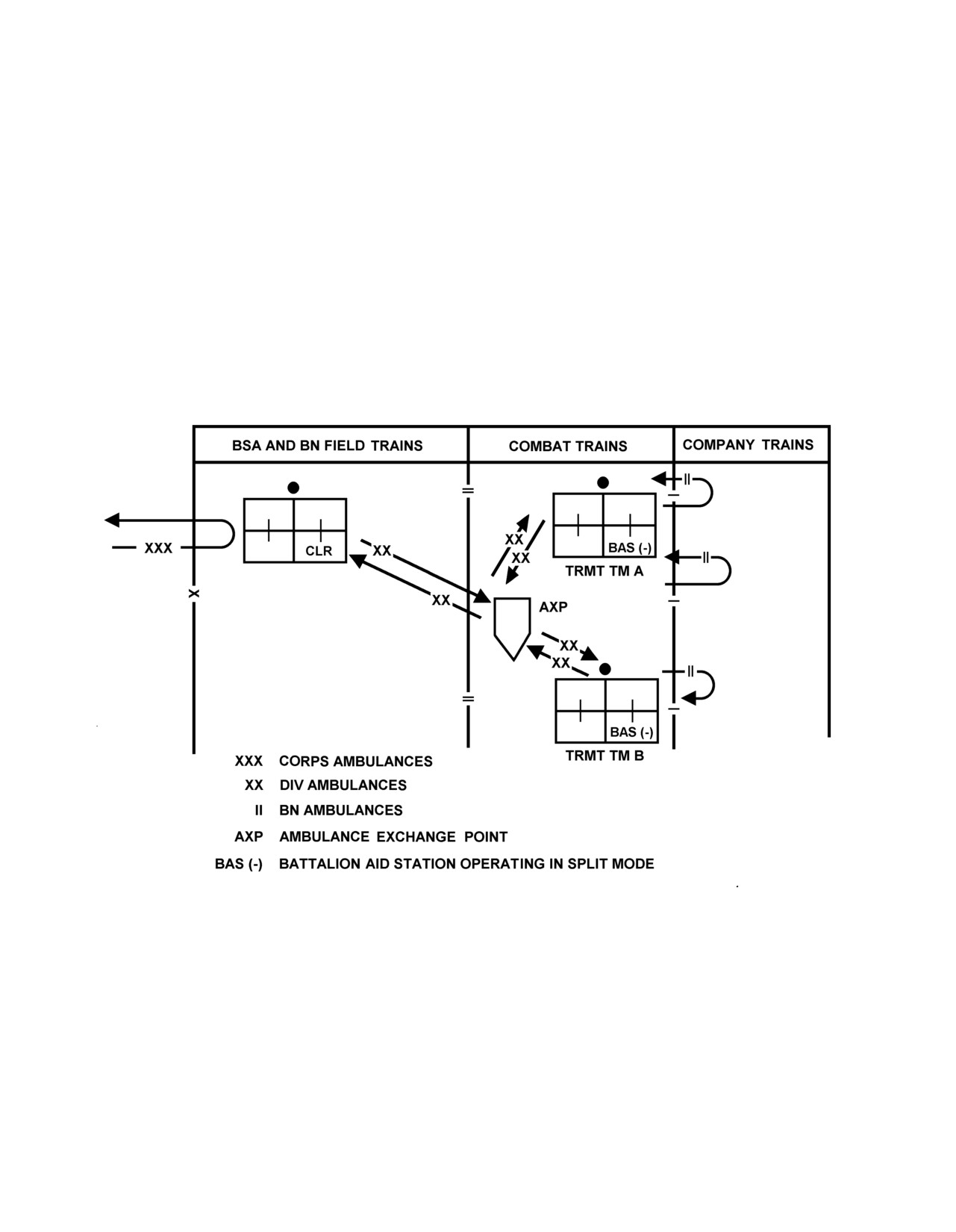
b. Ambulance Exchange Points. A position where patients are exchanged from one evacuation
platform to another is designated as an AXP.
(1) These points are normally preplanned and are a part of the CHS annex to the OPLAN.
In the forward area, the threat of enemy ground activities, large concentrations of lethal weapons systems,
and effective use of antiaircraft weapons may dictate that the AXP be a predetermined rendezvous point for
the rapid transfer of patients from one evacuation platform to another. The location of AXPs should be
frequently changed to preclude attracting enemy fires.
(2) Ambulance exchange points are established for many different reasons. For example,
the ambulance platoon of the heavy FSMCs now possesses a mixture of wheel and track ambulances. The
track vehicles are provided so that they may keep up with maneuver elements. These vehicles carry the
patients from the BAS to an AXP where the divisional wheel ambulances take over for the relatively longer
trip to the rear. Ambulance exchange points are not limited to ground evacuation assets. Another example
is a situation where the threat air defense artillery capability is such that air ambulances cannot fly as far
forward as the BASs. However, an AXP could be established a few kilometers to the rear, still well
forward of the BSA. The divisional track or wheel ambulances could then transfer the patients to the air
assets, thereby facilitating the rapid evacuation of patients and realizing a significant timesavings.
(3) By using AXPs, evacuation assets are returned to their supporting positions faster. This
facilitates evacuation as the returning crews are familiar with the road network and the supported units
tactical situation. In the case of air ambulance assets, it is important because of the requirements for
integration into the A2C2 system at each level and the enhancement to survivability provided by current
threat and friendly air defense information.
4-13
FM 8-10-6
c.
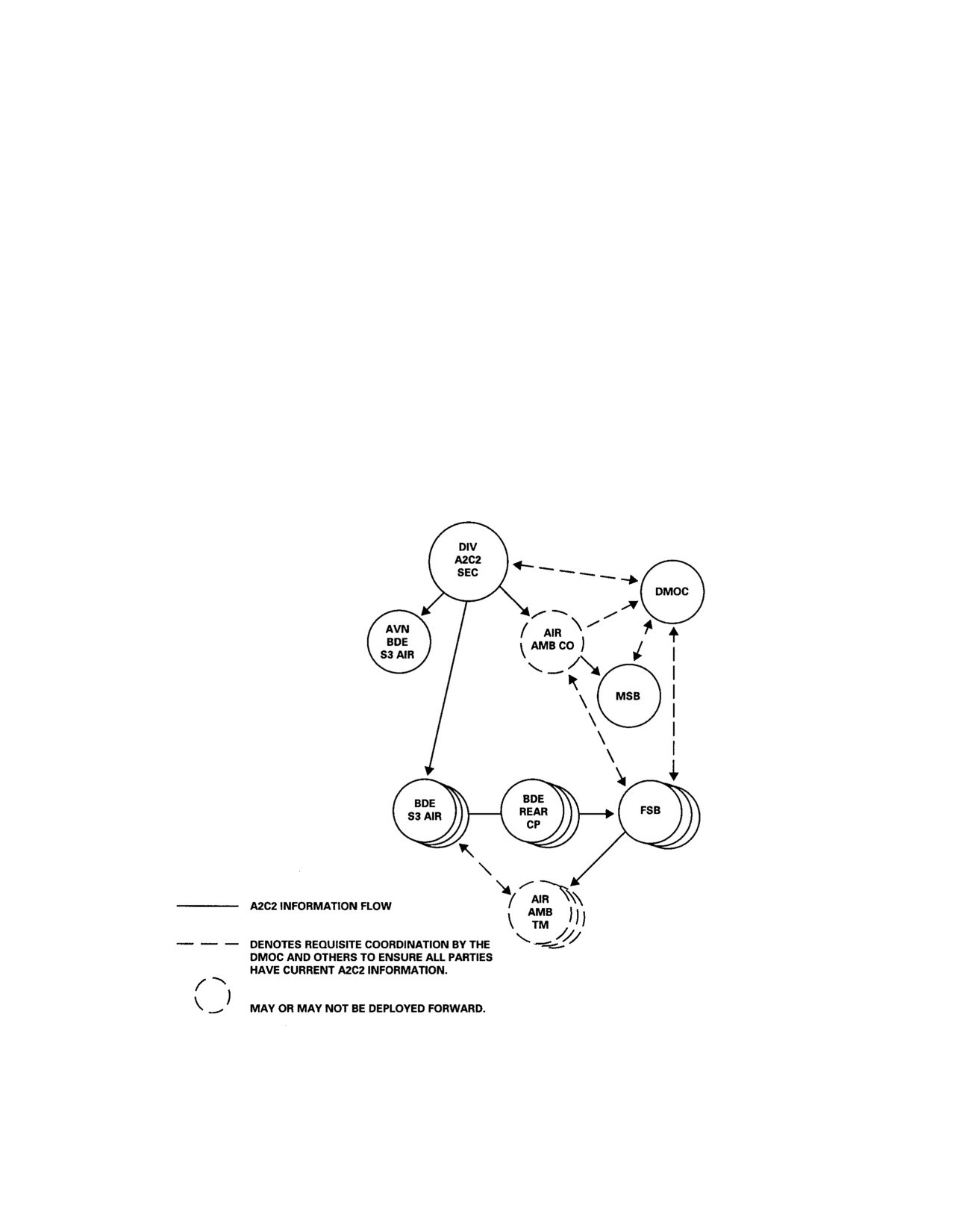
Ambulance Shuttle System. The ambulance shuttle system (Figure 4-2) is an effective and
flexible method of employing ambulances during combat. It consists of one or more ambulance loading
points, relay points, and when necessary, ambulance control points, all echeloned forward from the principal
group of ambulances, the company location, or basic relay points as tactically required.
(1) Ambulance loading point. This is a point in the shuttle system where one or more
ambulances are stationed ready to receive patients for evacuation.
(2) Ambulance relay point. This is a point in the shuttle system where one or more empty
ambulances are stationed. They are ready to advance to a loading point or to the next relay post to replace
an ambulance that has moved from it. As a control measure, relay points are generally numbered from
front to rear.
Figure 4-2. Ambulance shuttle system.
4-14
FM 8-10-6
(3) Ambulance control point. The ambulance control point consists of a soldier (from the
ambulance company or platoon) stationed at a crossroad or road junction where ambulances may take one of
two or more directions to reach loading points. The soldier, knowing from which location each loaded
ambulance has come, directs empty ambulances returning from the rear. The need for control points is
dictated by the situation. Generally, they are more necessary in forward areas.
(4) Establishment of the ambulance shuttle. Once the relay points are designated, the
required number of ambulances are stationed at each point. If the tactical situation permits, the ambulances
may be delivered to the relay points by convoy.
(5) Staffing of relay, loading, and ambulance control points. Important points may be
manned to supervise the blanket, litter, and splint exchange (paragraph 4-4) and to ensure that messages and
medical supplies to be forwarded are expedited.
(6) Advantages of the ambulance shuttle system. This system
Places ambulances at PCPs and BASs as needed.
Permits a steady flow of patients through the system to MTFs.
Avoids unnecessary massing of transport in forward areas.
Minimizes the danger of damage to ambulances by the enemy.
Permits the commander or platoon leader to control his elements and enables him to
extend their activities without advancing the headquarters.
Facilitates administration and maintenance.
Maximizes the use of small C2 elements (sections or platoons) to operate the
ambulance shuttle without employing the entire parent unit.
Provides for flexible use of other ambulance assets for specific situations.
d. Obstacles Marking. Ambulance crews must know and recognize the standard land/gap marking
patterns. Unit TSOPs on the types of materials used should be available to ambulance crews. Refer to FM
90-13-1 for additional information.
4-6.
Medical Evacuation Support for Combat Forces in the Offense and Defense
a. Support to the Offense.
(1) The offense is the decisive form of war, the commanders only means of attaining a
positive goal or of completely destroying an enemy force (FM 100-5). The offense is characterized by rapid
4-15
FM 8-10-6
movement, deep penetrations, aggressive action, and the ability to sustain momentum regardless of
counterfires and countermeasures.
(2) When considering the evacuation plans to support an offensive action, the CHS planner
must consider many factors (FM 8-55). The forms of maneuver, as well as the enemys capabilities,
influence the character of the patient workload and its time and space distribution. The analysis of this
workload determines the allocation of CHS resources and the location or relocation of MTFs.
(3) Evacuation support of offensive operations must be responsive to several essential
characteristics. As operations achieve success, the areas of casualty density move away from the supporting
facilities. This causes the routes of medical evacuation to lengthen. Heaviest patient workloads occur
during disruption of enemy main defenses, at terrain or tactical barriers, during the assault on final
objectives, and during enemy counterattacks. The accurate prediction of these workload points by the CHS
planner is essential if medical evacuation operations are to be successful.
(4) In traditional combat operations, the major casualty area of the division is normally the
zone of the main attack. As the main attack accomplishes the primary task of the division, it receives first
priority in the allocation of combat power. The allocation of combat forces dictates roughly the areas which
are likely to have the greatest casualty density. As a general rule, all division MTFs are located initially as
far forward as combat operations permit. This allows the maximum use of these facilities before lengthening
evacuation lines force their displacement forward.
(5) In operations that feature deep battles with WMD targeted at supporting logistical bases,
mass casualty operations may be conducted in rear areas.
(6) As advancing combat formations extend control of the battle area forward, supporting
medical elements overtake patients. This facilitates the acquisition of the battle wounded and reduces the
vital time elapsed between wounding and treatment. In offensive operations, two basic problems confront
the supporting evacuation units. First, contact with the supported unit must be maintained. Responsibility
for the contact follows the normal CHS patternrear to front. The contact is maintained by forward
deployed air and ground evacuation resources. Secondly, the mobility of the MTFs supporting the combat
formations must be maintained. Periodically, division medical companies, FSTs, and CSHs are cleared so
that they may move forward. This requirement for prompt evacuation of patients from forward MTFs
requires available ambulances to be echeloned well forward from the outset. The requirement for periodic
movement of large numbers of patients from divisional and corps facilities further stresses the evacuation
system.
(7) Types of operations in the offense include
(a) Movement to contact. Medical evacuation support in movement to contact is keyed
to the tactical plan. Prior deployment of evacuation resources with parent and supported units permits
uninterrupted and effective evacuation support.
(Refer also to paragraph 4-3c[5].)
(b) Exploitation and pursuit. Evacuation support of exploitation and pursuit operations
resembles those discussed for the envelopment (paragraph 4-7a[2]). Since exploitation and pursuit operations
4-16
FM 8-10-6
can rarely be planned in detail, evacuation operations must adhere to TSOPs and innovative C2. These
actions are often characterized by
Decentralized operations.
Unsecured ground evacuation routes.
Exceptionally long distances for evacuation.
Increased reliance on convoys and air ambulances.
(c) Attack. Refer to paragraph 4-6a(4) above. A sample overlay of a brigade attack is
depicted in Figure 4-3.
b. Support to the Defense. There are three forms of the defense: area defense, mobile defense,
and retrograde. The area defense concentrates on denying enemy access to designated terrain for a specific
period of time, rather than on the outright destruction of the enemy. The mobile defense focuses on denying
the enemy force by allowing him to advance to a point where he is exposed to a decisive counterattack by
the striking force. The primary defeat mechanism, the counterattack, is supplemented by the fires of the
fixing force. The third form of defense is the retrograde. The retrograde is an organized movement to the
rear and away from the enemy. The enemy may force these operations or a commander may execute them
voluntarily. Within the retrograde operation there are three forms: delay, withdrawal, and retirement.
(1) Support is generally more difficult to provide in the defense. The patient load reflects
lower casualty rates, but forward area patient acquisition is complicated by enemy actions and the maneuver
of combat forces. Medical personnel are permitted much less time to reach the patient, complete vital
EMT, and remove him from the battle site. Increased casualties among exposed medical personnel further
reduce the medical treatment and evacuation capabilities. Heaviest patient workloads, including those
produced by enemy artillery and NBC weapons, may be expected during the preparation or initial phase of
the enemy attack and in the counterattack phase. The enemy attack may disrupt ground and air routes and
delay evacuation of patients to and from treatment elements. The depth and dispersion of the defense create
significant time and distance problems for evacuation assets. Combat elements may be forced to withdraw
while carrying their remaining patients to the rear. The enemy exercises the initiative early in the operation
which may preclude accurate prediction of initial areas of casualty density. This makes the effective
integration of air assets into the evacuation plan essential. The use of air ambulances must not only be
integrated into the CHS annex to the operation order (OPORD), but also into the A2C2 annex. A medical
overlay for a defensive operation is depicted in Figure 4-4.
(2) The support requirements for retrogrades may vary widely depending upon the tactical
plan, the enemy reaction, and the METT-TC factors. Firm rules that apply equally to all types of
retrograde operations are not feasible, but considerations include
Requirement for maximum security and secrecy in movement.
4-17
FM 8-10-6
Figure 4-3. Medical overlay to brigade attack.
4-18
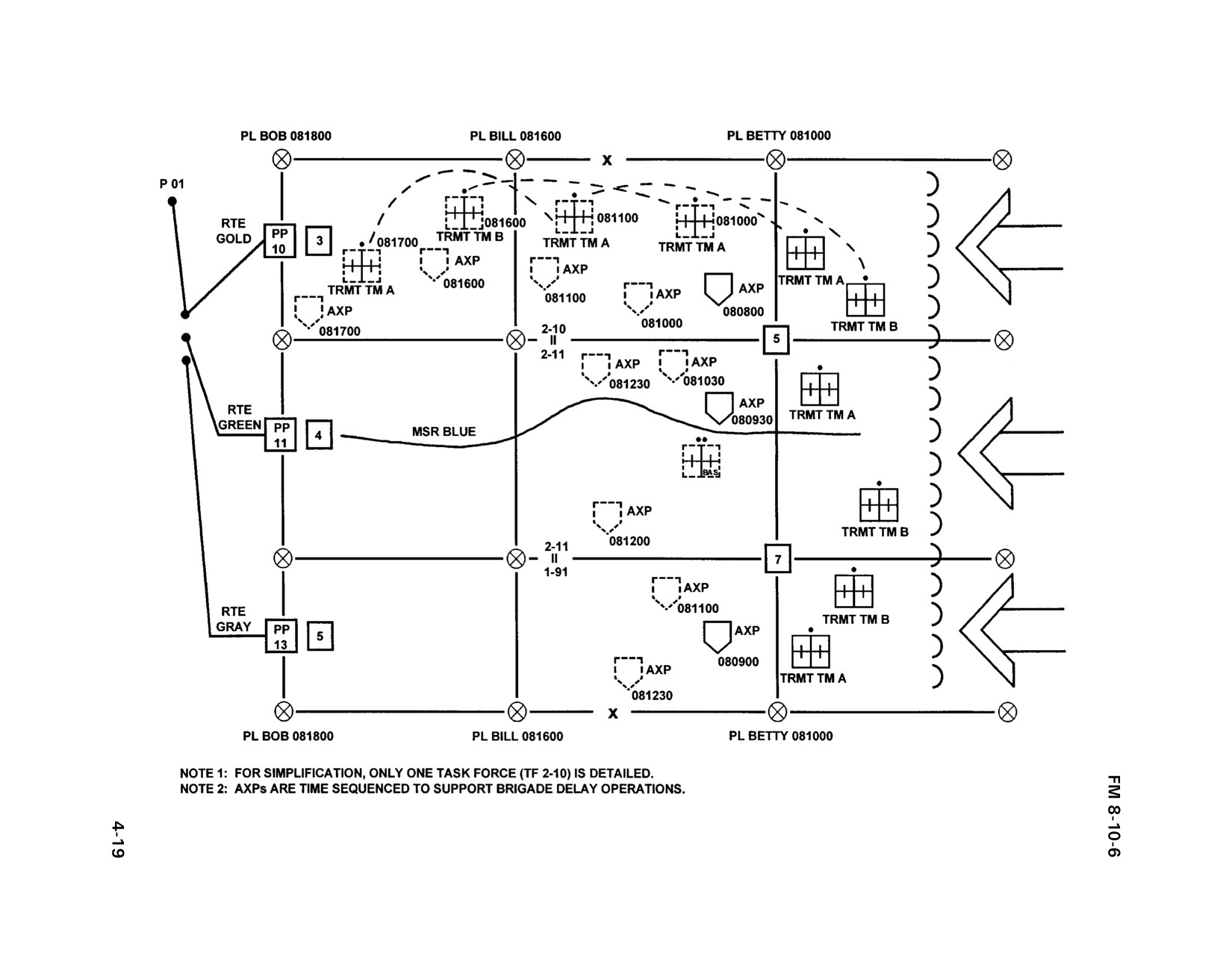
Figure 4-4. Medical overlay to brigade delay.
FM 8-10-6
Influence of refugee movement that may impede medical evacuation missions
conducted in friendly territory.
Integration of evacuation routes and obstacle plans should be accomplished.
Difficulties in controlling and coordinating movements of the force which may
produce lucrative targets for the enemy.
Movements at night or during periods of limited visibility.
Time and means available to remove patients from the battlefield. In stable
situations and in the advance, time is important only as it affects the physical well-being of the wounded. In
retrograde operations, time is more important. As available time decreases, CHS managers at all echelons
closely evaluate the capability to collect, treat, and evacuate all patients.
Medical evacuation routes will also be required for the movement of troops and
materiel. This causes patient evacuation in retrograde movements to be more difficult than in any other type
of operation. Command, control, and communications may be disrupted by the enemy. Successful medical
evacuation requires including ambulances on the priority list for movement; providing for the transportation
of the slightly wounded in cargo vehicles; and providing guidance to subordinate commanders defining their
responsibilities in collecting and evacuating patients. Special emphasis must be placed on the triage of
patients and consideration given to the type of transportation assets available for evacuation.
When the patient load exceeds the means to move them, the tactical commander
must make the decision as to whether patients are to be left behind. The medical staff officer keeps the
tactical commander informed in order that he may make a timely decision. Medical personnel and supplies
must be left with patients who cannot be evacuated.
(Refer to FM 8-10 for additional information.)
4-7.
Medical Evacuation Support for Choices of Maneuver and Enabling Operations
a. Choices of Maneuver.
(1) Penetration. In this tactic, the attack passes through the enemys principal defensive
position, ruptures it, and neutralizes or destroys the enemy forces. Of all forms of offensive maneuver, the
penetration of main enemy defenses normally produces the heaviest medical evacuation workload. Patient
acquisition starts slowly, but becomes more rapid as the attack progresses. The evacuation routes lengthen
as the operation progresses. The penetration maneuver is often preceded by heavy preparatory fires which
may evoke heavy return fire. These enemy fires may modify the decision to place evacuation assets as far
forward as possible. Patient evacuation may be slow and difficult due to damage to roads or the
inaccessibility of patients. Evacuation support problems multiply when some combat units remain near the
point of original penetration. This is done to hold or widen the gap in enemy defenses while the bulk of
division forces exploit or pursue the enemy. Treatment elements are placed near each shoulder of the
penetration; ground evacuation cannot take place across an avenue of heavy combat traffic. Besides the
heavy traffic, the area of the penetration is normally a target for both conventional and NBC weapons.
4-20
FM 8-10-6
(2) Envelopment. In the envelopment, the main or enveloping attack passes around or over
the enemys principal defensive positions. The purpose is to seize objectives which cut his escape routes
and subject him to destruction in place from flank to rear. Since the envelopment maneuver involves no
direct breach of the enemys principal defensive positions, the medical evacuation system is not confronted
with a heavy workload in the opening phase. Ambulances are echeloned well forward in all echelons of
CHS to quickly evacuate the patients generated by suddenly occurring contact. Medical treatment facilities
moving with their respective formations overtake patients during evacuation and reduce delays in treatment.
After triage and treatment, the patients are evacuated to corps-level facilities by accompanying corps assets.
When the isolated nature of the envelopment maneuver precludes prompt evacuation, the patients are
carried forward with the treatment element. Again, nonmedical vehicles may be pressed into emergency
use for this purpose. When patients must be carried forward with the enveloping forces, CHS commanders
use halts at assembly areas and phase lines to arrange combat protection for ground ambulance convoys
through unsecured areas. Further, the commander may take advantage of friendly fires and suppression of
enemy air defenses to call for prearranged air ambulance support missions, or emergency use of medium-
lift helicopter backhaul capabilities.
(3) Infiltration.
(a) Infiltration is a choice of maneuver used during offensive operations. The division
can attack after infiltration or use it as a means of obtaining intelligence and harassing the enemy. Though it
is not restricted to small units or dismounted actions, the division employs these techniques with a portion of
its units, in conjunction with offensive operations conducted by the remainder of its units.
(b) Combat health support of infiltration is restricted by the amount of medical equip-
ment, supplies, and transportation assets that can be introduced into the attack area. No deployment of
division-level medical units without their organic transportation should be attempted. Elements of unit-level
CHS should be accompanied by their organic vehicles, and ambulances should receive priority for deploy-
ment. It may be necessary to man-carry enough BAS equipment into the attack area to provide EMT and
ATM; however, this results in degrading mobility. When the element is committed without its ambulances,
patients are evacuated to the BAS by litter bearer teams. This requires reinforcement of the medical platoon
by division or corps medical personnel or improvisation of litter teams using combat troops (if available and
approved by the tactical commander). Patient evacuation from the BAS and medical resupply of the force
may be provided by litter bearers, depending upon distances and degree of secrecy required.
(c) When airborne and air assault forces are used, infiltrating elements may land at
various points within the enemys rear area and proceed on foot to designated attack positions. As in
surface movement, the amount of medical equipment taken may be limited. In airborne operations, the
evacuation of patients will be by litter bearers or frontline ambulances to PCPs or the BAS and then by
division-level ambulances to the clearing station. In air assault operations, the evacuation is by litter bearers
to PCPs or to the BAS and then by air ambulances to a clearing station. Once the combat element begins the
assault on the objective, secrecy is no longer important and its isolated location requires CHS characteristic
to airborne and air assault operations until ground linkup.
(4) Turning movement. The turning movement is a variant to the envelopment in which the
attacker attempts to avoid the defense entirely; rather, the attacker seeks to secure key terrain deep in the
4-21
FM 8-10-6
enemys rear and along his LOCs. Faced with a major threat to his rear, the enemy is thus turned out of
his defensive positions and forced to attack rearward at a disadvantage.
General MacArthurs invasion at Inchon during the Korean War is an example of a
classic turning movement. Casualties were initially light as the main defenses were avoided; however, as
the invasion developed, resistance stiffened and higher casualty rates were experienced. Further, as
fighting occurred in a populated area (Seoul), significant civilian casualties resulted. The lack of Korean
health care providers caused many of these civilians to seek medical aid from US field medical units.
Medical evacuation support to the turning movement is provided basically in the
same manner as to the envelopment. As the operation is conducted in the enemys rear area, LOCs and
evacuation routes may be unsecured resulting in delays in resupply and evacuation. In the Inchon example,
a hospital ship was located off the coast to accept patients evacuated from the fighting. However, due to the
precarious tides, evacuation and resupply were often delayed for hours and sometimes days since the harbor
could not be navigated by small vessels. It was not until Kimpo Airfield fell that timely evacuation could
occur. The deployed CHS units must be able to quickly clear the battlefield of patients, evacuate them from
the forward areas, and sustain the patients in rear areas until evacuation routes are established.
b. Enabling Operations.
(1) Passage of lines. This situation presents a challenge for the CHS planner. There will be
a number of medical evacuation units using the same air and road networks. Coordination and
synchronization are essential if confusion and overevacuation are to be avoided. The information required
to operate in the division AO includes
Radio frequencies and call signs.
Operations plans and TSOPs.
Location of MTFs.
Location of PCPs and AXPs.
Main supply route, forward arming and refueling points (FARP), and A2C2 data.
(2) Security operations. The covering forces are dependent upon organic resources found in
the maneuver battalion medical platoon for initial support. The level of command for the covering force
(division or corps) determines the responsibility for the subsequent evacuation plan. In a corps covering
force, for example, the corps CHS structure has the responsibility for establishing and operating the medical
evacuation system to support the forward deployed corps forces. This is done to prevent the divisions
following the covering forces from becoming overloaded with patients prior to the hand off and passage of
lines. The use of PCPs, AXPs, and nonmedical transportation assets (CASEVAC) to move the wounded is
essential. The covering force battle may be extremely violent. Patient loads will be high and the distance to
MTFs may be much longer than usual. The effectiveness of the medical evacuation system depends upon
the forward positioning of a number of ground ambulances and the effective integration of corps air
ambulances into the evacuation plan.
4-22
FM 8-10-6
(3) Advance, flank and rear guards. These forces normally receive medical evacuation
support through the attachment of evacuation teams. The teams evacuate patients to predesignated PCPs
along a main axis of advance or to the nearest treatment element providing area support. Employment of air
ambulances provides a measure of agility and flexibility.
(4) River crossing operations. The river barrier itself exerts decisive influence on the use of
divisional medical units. Attack across a river line creates a CHS delivery problem comparable to that of
the amphibious assault. Combat health support elements cross as soon as combat operations permit. Early
crossing of treatment elements reduces turnaround time for all crossing equipment that is used to load
patients on the far shore. Maximum use of air ambulance assets is made to prevent excessive patient
buildup in far shore treatment facilities. Near shore MTFs are placed as far forward as assault operations
and protective considerations permit to reduce ambulance shuttle distances from off-loading points. For
detailed information on river crossing operations, refer to FM 90-13.
(5) Reconnaissance operations. The reconnaissance in force is an attack to discover and test
the enemys position and strength or to develop other intelligence. The division usually probes with
multiple combat units of limited size, retaining sufficient reserves to quickly exploit known enemy
weaknesses. Combat health support techniques follow those discussed for a movement to contact (paragraph
4-6a). Ambulances are positioned well forward at both unit and division levels. Ambulances are moved at
night to enhance secrecy. The echeloning of ambulances is an indication to the enemy that an attack is
imminent due to the forward placement of CHS. Clearing stations are not established until a significant
patient workload develops. Patients received at BASs of reconnoitering units are evacuated to clearing
stations as early as practical, or are carried forward with the force until a suitable opportunity for evacuation
presents itself. Maximum possible use of air ambulance assets is made to cover extended distances and to
overcome potentially unsecured ground evacuation routes.
(6) Unified action. The majority of operations occurring at the present time are joint,
interagency, or multinational operations. The CHS planner must determine in the initial planning stages of
these operations whose responsibility it is to provide medical evacuation support to the force. The CHS
planner must also ensure that duplications in support do not exist, guidelines are established as to eligible
beneficiaries and when individuals are to be returned to their own nations health care delivery system, and
what mechanisms exist for reimbursement of services. For additional information, refer to FM 8-42.
(7) Integrated warfare operations. Medical evacuation in an NBC environment is discussed
in paragraph 5-6.
4-8.
Medical Evacuation Support in Stability Operations
a. Overview of Stability Operations.
(1) Stability operations apply military power to influence the political environment, facilitate
diplomacy, and interrupt specified illegal activities. They include both developmental and coercive actions.
Developmental actions enhance a governments willingness and ability to care for its people. Coercive
actions apply carefully prescribed limited force and the threat of force to achieve objectives. The types of
activities conducted in stability operations include
4-23
FM 8-10-6
Peace operations.
Operations in support of diplomatic efforts.
Combatting terrorism operations.
Counterdrug operations.
Noncombatant evacuation operations (NEO).
Arms control.
Nation assistance and foreign internal defense.
Support to insurgencies.
Support to counterinsurgencies.
Shows of force.
Civil disturbance operations.
(2)
While each operation in this environment is unique, there are seven broad
imperatives which enhance the deployed forces ability to develop concepts and schemes for executing
stability operations. These imperatives are to
Stress force protection.
Emphasize information operations.
Maximize interagency, joint, and multinational cooperation.
Display the capability to apply force without threatening.
Understand the potential for disproportionate consequences to individual and small
unit actions.
Apply force selectively and discriminantly.
Act decisively to prevent escalation.
b. Medical Evacuation Support.
(1) Medical evacuation support to forces deployed in stability operations is dependent upon
the specific type of operation, anticipated duration of the operation, number of forces deployed, theater
4-24
FM 8-10-6
evacuation policy, medical troop ceiling, and anticipated level of violence. In most situations, medical
evacuation support follows the traditional support provided to combat forces. If there is a shortened theater
evacuation policy, a limited medical troop ceiling, and limited hospitalization assets within the AO, organic
and DS ambulance support is provided from the point of injury to the supporting Echelons I or II MTF and,
once the patient is stabilized for further evacuation, from the treatment element to an airfield for evacuation
out of the theater.
(2) During NEO, those persons who are injured, wounded, or ill are treated and stabilized
by the medical element accompanying the NEO force. Once stabilized, they are evacuated by the NEO
force. In NEO conducted in a permissive environment (no apparent physical threat to the evacuees), sick,
injured, or wounded persons should be evacuated on dedicated medical evacuation platforms, if at all
possible. In an uncertain or hostile environment, the transportation assets used to insert and extract the
NEO force are normally used to evacuate the patients. The medical personnel accompanying the force
provide en route medical care until the NEO force reaches an intermediate staging base (ISB) or safe haven.
Those evacuees requiring medical care are then transferred to dedicated medical evacuation platforms for
further evacuation to MTFs capable of providing the required care.
(3) During combatting terrorism operations, planning considerations for medical evacuation
support include
Using medical and nonmedical transportation assets to evacuate casualties in mass
casualty situations. If nonmedical assets are used, planning should include augmenting these assets with
medical personnel to provide en route medical care.
Applying techniques for acquiring and evacuating patients under hostile fire or on
adverse terrain (from rubble or from above or below ground level.
(Refer to paragraph 5-10 for additional
information.)
Ensuring security measures (such as establishing checkpoints, screening personnel
and vehicles, and limiting access to the MTF area) are implemented.
(4) In nation assistance, support to insurgencies, and support to counterinsurgencies, medical
evacuation personnel may be called upon to assist in the development of a medical evacuation system for the
supported nation/group; teach civilian, military, or paramilitary personnel basic evacuation techniques and
the treatment protocols for providing provision of en route medical care; or provide the more traditional
support from the point of injury to the supporting treatment element.
(5) For additional information, refer to FM 8-42.
4-9.
Medical Evacuation Support in Support Operations
a. Support operations provide essential supplies and services to assist designated groups. They
are conducted mainly to relieve suffering and help civil authorities respond to crises. In most cases, Army
forces achieve success by overcoming conditions created by man-made or natural disasters. The ultimate
4-25
FM 8-10-6
goal of support operations is to meet the immediate needs of designated groups and transfer responsibility
quickly and efficiently to appropriate civilian authorities. Support operations, which consist of humanitarian
assistance and environmental assistance accomplish one or more of the following: save lives; reduce
suffering; recover essential infrastructure; improve quality of life; and restore situations to normal. The
seven broad support imperatives are to
Secure the force.
Provide essential support to the largest number of people.
Coordinate actions with other agencies.
Hand over to civilian agencies as soon as feasible.
Establish measures of success.
Conduct robust information operations.
Ensure operations conform to legal requirements.
b. Humanitarian assistance operations can include a number of activities such as disaster relief,
domestic support, refugee assistance, the provision of medical care to isolated populations, and refeeding
programs resulting from famines or natural disasters. Medical evacuation assets may be used to evacuate
the injured from disaster sites, to provide the emergency transport of critically needed medical supplies and
personnel to remote locations, or to perform emergency rescues during times of flooding, wild fires, or
other natural disasters.
c.
Further, medical evacuation assets may perform community assistance missions such as the
Military Assistance to Safety and Traffic (MAST) program, where an air ambulance unit provides evacuation
support to the nearby civilian community. (For additional information, refer to Army Regulation AR 500-4
and FM 8-10-26.)
4-10. Medical Evacuation of Enemy Prisoners of War
Sick, injured, and wounded enemy prisoners of war (EPWs) are treated and evacuated in military police
(MP) channels when possible. They must be physically segregated from US, allied, and coalition patients.
Guards for these prisoners are provided in accordance with the division or corps TSOP and are from other
than medical resources. The echelon commander is normally responsible for this support.
a. United States medical personnel decide if EPWs are healthy enough to be escorted within MP
channels or if they need to be medically evacuated. Generally, ambulatory prisoners remain within the MP
channels and litter patients are evacuated through medical channels.
b. The US provides the same standard of medical care for wounded, sick, and injured EPWs as
that given to US, allied, and coalition soldiers. Wounded, sick, or injured EPWs in the CZ may be treated
4-26
FM 8-10-6
and returned to MP channels for evacuation; or the EPWs may be stabilized and moved through medical
channels to the rear as far and as quickly as possible. Enemy prisoners of war are moved to corps or EAC
hospitals for treatment.
c.
When EPWs are evacuated through medical channels, medical personnel
Report this action through medical channels to the next higher headquarters.
Request disposition instructions from the corps MRO.
d. The corps MRO is responsible for
Coordinating the transportation means.
Identifying the MTF to which the EPWs will be taken.
Coordinating, in conjunction with the hospital commander, with the branch Prisoner of
War Information Center (PWIC) to account for EPWs within medical channels.
4-11. Evacuation and Disposition of Remains
a. The transportation and disposition of remains is a Quartermaster function. Air and ground
ambulance personnel do not clear the battlefield of remains nor do they carry remains in their dedicated
medical vehicles or aircraft. Medical units do not accept remains or provide temporary morgues in which
to hold remains for other units until they can be transferred to MA sites/personnel.
b. The only remains that a medical unit handles are those of its own unit members or of patients
who are dead on arrival (DOA) or who died of wounds (DOW) while in their care. Whenever a medical
unit must establish a temporary morgue, it should be established out of sight of the triage and treatment
areas. This area can be established behind a natural barrier, such as a stand of trees or it can be set off by
using tentage and tarpaulins. This is not an actual morgue, as it has neither the required equipment nor is it
staffed; it is only a temporary holding area.
c.
For additional information, refer to FMs 8-10 and 8-10-1.
4-12. Aeromedical Evacuation Operations
a. The effectiveness and efficiency of the AMEDD is enhanced by the air ambulances capabilities
to
Remove patients from otherwise inaccessible areas.
Circumvent fixed defenses and natural obstacles.
4-27
FM 8-10-6
Deliver medical supplies and blood products.
Provide a rapid evacuation means.
Provide emergency airlift of medical personnel, equipment, and supplies.
b. Individual medical evacuation mission requests are processed through communications channels
designated in the CHS annex of the OPLAN or OPORD. Mission control is retained by the appropriate
CHS headquarters commander.
c.
Medical evacuation missions are based upon requests from units within the CZ requiring CHS.
Requests for augmentation or reinforcement of aeromedical evacuation capabilities are made by the
controlling CHS headquarters. Since the majority of requests for medical evacuation originate in the
division, the basic concept of mission control is oriented on this requirement. Mission requests are processed
through the fastest and most reliable means available. A sole-user channel is desirable for the expedient
transmission of medical evacuation requests. Within their area of responsibility, surgeons at various levels
of command may monitor requests and recommend priorities for patient evacuation.
d. Direct aeromedical evacuation support is normally provided to each division (from the corps)
by one air ambulance company. It is the mission of this company to
Evacuate selected patients within the division.
Transport medical elements to areas where they are critically needed.
Ensure the uninterrupted delivery of blood, blood products, biologicals, and medical
supplies.
Provide for air crash rescue (less fire suppression).
Rescue downed aircrews (refer to paragraph 1-13 for additional information).
e.
In addition to the air ambulance company (DS) operating in the division area, aeromedical
evacuation support is provided by one or more air ambulance companies (GS) in the corps. Their primary
mission is to augment and reinforce forward deployed air ambulances units. To accomplish this mission,
they
Evacuate patients from FSMC, MSMC, and FST to corps hospitals.
Evacuate patients from combat, CS, and combat service support (CSS) units operating
between division rear and corps rear boundaries.
Evacuate patients between corps-level hospitals and intermediate staging points (MASFs,
railheads, and seaports).
4-28
FM 8-10-6
Transport medical teams and squads, as required.
Deliver blood and blood products, medical supplies, and biologicals.
Rescue downed aircrews.
f.
The aeromedical evacuation mission requests are referred to the air ambulance unit or team
supporting the particular echelon of health care. Proper flight clearance is obtained as the mission is
accepted. If the mission cannot be accepted, the commander will coordinate with either lateral or rear
supporting air ambulance units.
g. Aeromedical evacuation support, which exceeds the capabilities of the assets available at
division, becomes the responsibility of the medical evacuation battalion commander. He adjusts evacuation
capabilities between supported divisions through his unit commanders based on the tactical situation and
patient densities. The air evacuation unit commanders coordinate and receive flight missions, as appropriate.
The requesting unit is notified, if possible, as to the estimated time of arrival for the support. If evacuation
requirements overwhelm available medical evacuation battalion assets, the medical evacuation battalion
coordinates for additional corps-level assets. When nonmedical aircraft are used to meet the requirements
for peak periods of patient evacuation, every attempt should be made to furnish medical personnel and
equipment for en route medical care. The use of nonmedical assets requires intensive preplanning to ensure
availability of assets when needed. One source of personnel and equipment may be from the additional
treatment teams of the MSMC. In instances when the evacuation system becomes overwhelmed, every
available space on general purpose aircraft may be used to transport those less severely injured without
provisions for en route medical care. Regardless of the method used, control of nonmedical assets is
maintained through medical channels regarding the designation of the point of origin, the casualties to be
carried, and the destination.
h. Medical regulating remains the responsibility of the corps medical brigade or group. However,
coordination for the medical evacuation of patients to the FST or CSH from the FSMC or MSMC is
accomplished by the DMOC. Medical regulating out of the division is accomplished procedurally and must
be preplanned to ensure proper pre-mission planning by both ground and air units.
i.
For additional information on the medical company, air ambulance, refer to Chapter 3,
Section III of this manual and FM 8-10-26.
4-13. Evacuation of Military Working Dogs
Military working dogs (MWDs) when injured or ill may be evacuated on any transportation means available.
The using unit is responsible for the evacuation of the animal. Use of dedicated medical evacuation assets
(air or ground ambulances) is authorized based on mission priority and availability. When possible, the
handler should accompany the animal during the evacuation. Using units should include the location of
veterinary support units on operational overlays.
4-29
FM 8-10-6
CHAPTER 5
MEDICAL EVACUATION IN SPECIFIC ENVIRONMENTS
5-1.
General
This chapter addresses medical evacuation in specific environments or under special circumstances. The
medical evacuation effort must be well planned and its execution synchronized to be effective. Further,
medical evacuation personnel must be flexible and ready to improvise, if needed, to meet the demands of
unique situations.
5-2.
Mountain Operations
a. In the past, armies have experienced great difficulty in evacuating patients from mountainous
areas. Mountain environments are extremely diverse in nature. Some mountains are dry and barren with
temperatures ranging from extreme heat in the summer to extreme cold in the winter. In tropical regions,
mountains are frequently covered by lush jungles and heavy seasonal rains occur. Many areas display high
rocky crags with glaciated peaks and year-round snow cover. Elevations can also vary from as little as
1,000 feet to over 16,000 feet with drastic and rapidly occurring weather changes.
b. Operations in mountainous terrain require some procedure modifications. This is due to the
environmental impact on personnel and equipment. Important physical characteristics and considerations
that influence medical evacuation are
Rugged peaks, steep ridges, and deep valleys.
Limited number of trafficable roads.
Reduced communications ranges.
Unpredictability of and severe changes in weather.
Decreased partial pressure of oxygen.
Limited availability of landing zones (LZs).
c.
In order to effectively support the tactical plan, the CHS plan must provide maximum
flexibility. The CHS planner should consider using all means of evacuation. Due to the length of
evacuation times and the limited means of ground evacuation, it is important to triage and prioritize patients
prior to movement.
(1) The availability of improved, hard-surfaced roads is extremely limited, if they exist at
all. Usually, improved roads are only found in valley corridors. Such roads are often dependent upon a
system of narrow bridges spanning mountain streams and ravines. They may also twist along ridgelines and
cling to steep shoulders.
5-1
FM 8-10-6
(2) Secondary roads and trails may be primitive and scarce. However, they may provide the
only routes capable of vehicular traffic. Cross-compartment travel between adjacent valleys may be
impossible by ground vehicle. Off-road travel requires detailed planning, even for short distances.
(3) Because of rough terrain, the FSMC may not be able to reach the BAS by ground
vehicle. An ambulance shuttle system is established with an AXP for air and ground evacuation vehicles to
meet litter bearers. Litter bearers and beasts of burden may be the only means of evacuation available. Any
available personnel may be used as litter bearers (nonmedical personnel from supported units may be
required to augment the litter bearer teams). Close coordination between FSMC and BASs in establishing
PCPs or AXPs is necessary to
Reduce distance traveled by litter bearers.
Reduce evacuation time.
Conserve personnel.
Locate the best potential LZs for air ambulances.
(4) In mountainous areas, evacuation of patients by air is the preferred means. Air
ambulances permit the rapid movement of patients over rugged terrain. For example, to travel a distance of
only 6 kilometers on foot could take up to 2 hours, while flying time could be less than 2 minutes.
(5) Frequency-modulated (FM) radios are the principal means of communication in this
environment. The ability to transmit is hampered by the limitations of line of sight transmissions.
(6) The briefing of ambulance drivers needs to be extensive, including detailed strip maps
and overlays. Further, specific instructions on what to do in various situations should be covered (such as if
the vehicle breaks down or the unit moves).
d. The mountain environment, with its severe and rapidly changing weather, impacts on aircraft
performance capabilities; accelerates crew fatigue; and requires special flying techniques. Having to rely on
continuous aviation support for a successful mountain operation is risky.
(1) Flying in mountainous areas requires special training. Both the terrain and the weather
influence basic flying techniques and operational planning. Rugged, mountainous terrain complicates flight
route selection. Direct routes can seldom be flown without exposing the aircraft to detection and destruction
by the enemy.
(2) Important considerations for aeromedical operations in mountainous areas are
(a) Density altitude. Density altitude is the most important factor affecting aircraft
performance. Density altitude combines temperature, humidity, and pressure altitude, and provides the
basis for lift capability. Density altitude can vary significantly between the pickup point and the LZ because
of the time of day and changes in elevation. Frequent performance planning updates are essential.
5-2
FM 8-10-6
(b) Wind. Unpredictable winds can produce significant turbulence, wind sheers,
updrafts, and downdrafts. This further increases the risk of a catastrophe in a seemingly routine mission.
Adverse winds along with high density altitude demand current and accurate performance planning. Pilots
must plan for greater margins of safety.
(c) Icing. Ice can clog intake ports, thus starving the engine of air, or it can collect on
rotor blades resulting in a significant loss of lift. Asymmetrical shedding can cause severe out-of-balance
rotor conditions.
(d) Visibility. Low clouds or fog greatly decrease the ability to navigate or to avoid
obstacles.
(e) Lack of landing zones. The characteristics of mountain terrain do not usually afford
adequate LZs. The terrain may only allow the aircraft to hover while loading patients on board.
(f) Hoist operations. Use of the internal or external rescue hoist (Appendix E) can be
expected in mountainous terrain. Mounting the rescue hoist on the aircraft as standard equipment in
mountain operations may be required. When possible, orientation and training sessions with supported
troops should be conducted to help minimize the difficulty of such missions. Depending on the terrain, the
forest penetrator may also be needed to accomplish the mission.
(g) Enemy air defenses. When enemy air defense capabilities preclude using air
ambulances in forward areas, they should be used to evacuate patients from AXPs or from division clearing
stations.
(h) Ambulatory patients. Some ambulatory patients may be reported as litter patients in
mountainous terrain. These patients may be unable to move unassisted over the rugged terrain. Once
placed on the air ambulance, their status may be upgraded.
(i)
Crew training. Ground and air evacuation crews should receive additional training
and orientation in mountaineering skills, handling patients, and survival skills; for example
Cold weather survival training, including cold injury prevention.
Mountain (rock) climbing.
Use of ropes and vertical rescue techniques (paragraphs 9-12 through 9-13).
Individual and unit movement at high altitudes.
Care and treatment of patients suffering high altitude illnesses and cold weather
injuries.
Techniques of patient evacuation by litter, emphasizing the use of pack animals
(if available from the host country), and the improvised travois (paragraph 9-7) litter.
5-3
FM 8-10-6
(j) Patient loading. Care must be taken when loading patients where there is a great
deal of slope to the LZ. Emphasis on approaching and loading the aircraft from the down-slope side of the
aircraft must be reinforced.
CAUTION
Approaching the aircraft from the up-slope side is hazardous.
e.
Troops operating in mountainous areas are exposed to other injuries and illnesses that
frequently occur in this environment. These conditions include
An increased rate of fracture, sprain, and dislocation injuries.
Incidents of acute mountain sickness, high-altitude pulmonary edema, and cerebral edema
caused by rapid ascent to heights over 7,500 feet.
Cold weather injuries.
Dehydration and heat exhaustion.
Sunburns and snow blindness.
Aggravated sickle cell anemia. Although this condition is not considered a mountain
illness, personnel with the sickle cell trait can be seriously affected by the decrease in barometric pressure
and lower oxygen levels found at higher altitudes.
f.
The proportion of litter cases to ambulatory cases is increased in mountainous terrain, for even
the slightly wounded may be unable to move unassisted over rough terrain. Litter relay stations may be
required along the evacuation route to conserve the energy of litter bearers and to speed evacuation.
g. It is important to be able to predict the number of patients that can be evacuated with available
personnel. When the average terrain grade exceeds 20 degrees, the four-man litter team is no longer
efficient and should be replaced by a six-man team. The average mountain litter team should be capable of
climbing 120 to 150 vertical meters of average mountain terrain and return with a patient in approximately
1 hour.
h. Mountain operations may require medical personnel to carry additional equipment. Items
such as ropes, pulleys, pitons, piton hammers, and snap links are all necessary for evacuating patients and
establishing BASs. All unnecessary items of equipment including those for which substitutes or
improvisations can be made should be left behind. Heavy tentage, bulky chests, extra splint sets, excess
litters, and nice-to-have medical supplies should be stored. Such medical supplies, if stored, should be
5-4
FM 8-10-6
readily available for airdrop or other means of transport. Medical items that are subject to freezing should
be safeguarded; they should not be exposed to the low temperatures experienced in mountainous areas.
i.
Evacuation times may be extended when using litter teams with AXPs. Therefore, shelter for
patients must be improvised if tentage is not available to prevent undue exposure. In the summer or in
warm climates, improvisation may not be necessary; however, since there is a close relationship between
extreme cold and shock, medical personnel must be conscious of the need to provide adequate shelter for
patients. Satisfactory shelter may be found in caves, under overhanging cliffs, behind clumps of thick
bushes, and in ruins. Shelters may be built using a few saplings, evergreen boughs, shelter halves, or
similar items. The time a patient is to be held influences the type of shelter used. When patients are to be
kept overnight, a weatherproofed shelter should be constructed.
j.
For further information on mountain operations, refer to FM 90-6 and Training Circular (TC)
90-6-1. For aviation-specific information, refer to FMs 1-202 and 1-400.
5-3.
Jungle Operations
a. Combat health support elements in a jungle environment retain the same basic capabilities as
in other environments. Jungle operations, however, subject personnel and equipment to effects not found in
other environments. The jungle environment degrades the ability to maneuver. Security problems are also
increased and affect medical evacuation operations as much as they do the combat forces.
b. In jungle operations a combination of air and ground evacuation units are used to maximize the
patient evacuation potential. Using this dual system of evacuation ensures that the inherent limitations of
one system can be compensated for by the other. Jungle variations affect the organizing, positioning, and
securing of CHS. Due to the terrain, aerial resupply is usually a common practice. The responsiveness
provided by aerial resupply requires fewer supplies to be stockpiled in the combat trains.
c.
Jungle combat operations are characterized by ambushes and other guerrilla-type operations.
The security threat caused by infiltrators requires that LOCs be patrolled often and that convoys be
escorted. It is, therefore, essential that CHS be performed as far forward as the tactical situation permits.
Positioning assets forward
Improves response time.
Reduces road movement.
Allows the CHS elements to take advantage of the security offered by combat units.
d. The thick foliage often makes evacuation by ground more difficult than in other types of
terrain. Factors such as the threat, limited road network, and reliance on nonmedical personnel for convoy
security make air evacuation the preferred means. By using the ambulance shuttle system, patients can be
transferred from forward operating ground ambulances to either ground or air ambulances operating further
to the rear. In situations where evacuation assets are delayed by various factors (weather or terrain),
5-5
FM 8-10-6
patients are held for longer periods of time at forward locations. This will dictate the need for additional
medical supplies. Combat health support planners must try to anticipate these delays whenever possible.
The increased disease and infection incidences associated with the jungle environment may worsen the
patients condition; therefore, timely evacuation is essential.
e.
In some remote and densely foliaged jungles, the only means of evacuation may be by litter.
Ambulances may not be practical on trails, unimproved muddy roads, or in swamps. As in mountain
operations, there is a higher proportion of litter cases than usual. In the jungle even a slightly wounded
soldier may find it impossible to walk through dense undergrowth. At best, litter teams can carry patients
only a few hundred meters over rough jungle terrain before needing rest or relief. Litter carries should be
kept as short as possible and medical elements pre-positioned and retained forward.
f.
Other special planning considerations in jungle operations include
(1) Water. Water is vital in the jungle and is plentiful. Water from natural sources,
however, should be considered contaminated. Water purification procedures must be taught to all soldiers.
(Refer to FMs 21-10 and 21-10-1 for additional information.)
(2) Clothing. Due to the tropical climate, units should pack hot weather clothing when
deploying to jungle areas. Jungle fatigues and boots are recommended. Insect (mosquito) nets, insect
repellent, and sunscreen should be issued to all soldiers operating in this environment.
(3) Disease and nonbattle injuries. The jungle environment is ideal for the transmission of a
large number of diseases. The rate of DNBI casualties is potentially the highest in this climate. The heat,
humidity, and terrain places the troops at high risk for dehydration, heat injury, skin diseases, endemic
diseases, and immersion foot. Small wounds can rapidly become infected and lead to loss of effectiveness
and possibly require evacuation. High standards of personal hygiene must be taught, encouraged, and
maintained by the command. Mosquitoes and other arthropods that carry disease flourish under jungle
conditions. Use of all possible personal protective measures must be ensured. Food- and waterborne
diseases leading to diarrhea or other symptoms will abound. Food service sanitation measures must be
strictly followed. The potential for contamination of food and water increases with each time they are
handled, stored, or transported. Soldiers must be encouraged to consume adequate amounts of water that
has been purified and to eat only approved foods. In the jungle it is necessary for the commander to pay
meticulous attention to the details of PVNTMED measures to maintain an effective fighting force. For
additional information on PVNTMED measures, refer to FM 21-10 and FM 21-10-1.
(4) Training. Combat health support personnel should be trained in survival and support
techniques in jungle environments. For example, training should be conducted in
Hot weather acclimatization and survival.
Prevention, early detection, and treatment of arthropod-, food-, and waterborne
diseases.
Land navigation in a jungle environment.
5-6
FM 8-10-6
Field sanitation and other PVNTMED measures.
Care and maintenance of equipment and supplies.
(5) Equipment. Due to the increased heat and humidity, vehicles and equipment require
additional maintenance. Equipment tends to rust quickly and must be cleaned and oiled more frequently.
Canvas items rot and rubber deteriorates much faster than in more temperate climates.
(6) Communications. The range of FM communications in the jungle is significantly reduced
due to the dense undergrowth, heavy rains, and hilly terrain. The range of a radio set operated in the jungle
may be reduced by 10 to 25 percent. The heavy rain and high humidity of the tropics also reduce the range
(about 20 percent) and reliability of wire communications. The transmission range can be extended by
using additional radio relays and field expedient antennas.
(7) Aircraft performance. Utility helicopters are not able to lift the same size loads that can
be lifted in more temperate areas. This results in a reduced patient load in some evacuation aircraft. Again,
frequent and accurate performance planning is essential for mission accomplishment.
(8) Landing zones. There may be few suitable LZs. Many LZs will only be large enough to
support one or two helicopters at a time.
(9) Hoist operations. Hoist operations may be required more frequently in the thick jungle
vegetation where LZs are not available. The forest penetrator should be carried on all operations.
g. For aviation-specific information, refer to FMs 1-202 and 1-400.
5-4.
Desert Operations
a. The Environment.
(1) Deserts are arid, barren regions of the earth incapable of supporting normal life due to a
lack of fresh water. Although deserts are often thought of as hot climates, it is important to note that
temperatures range from over 136 degrees Fahrenheit (F) in some deserts, to bitter cold in others. Day to
night fluctuations in temperature can exceed 70° F. Desert terrain can have mountains, rocky plateaus, or
sandy dunes; some desert areas may contain all of these characteristics. Rain, when it falls, often causes
flooding in low-lying areas. Winds can have a devastating effect upon CHS operations by destroying
equipment and supplies and causing dust storms. Dust storms make navigation and patient treatment
difficult. Since deserts vary considerably in the type of terrain and temperature, and in their cultural
makeup, current medical intelligence should be obtained prior to deployment on operations conducted on
desert terrain.
(2) People have lived and fought in desert areas for thousands of years. However, the
environmental effects on personnel can be extreme, especially for soldiers not prepared for these operations.
5-7