FM 8-10-6 MEDICAL EVACUATION IN A THEATER OF OPERATIONS TACTICS, TECHNIQUES, AND PROCEDURES - page 6
FM 8-10-6
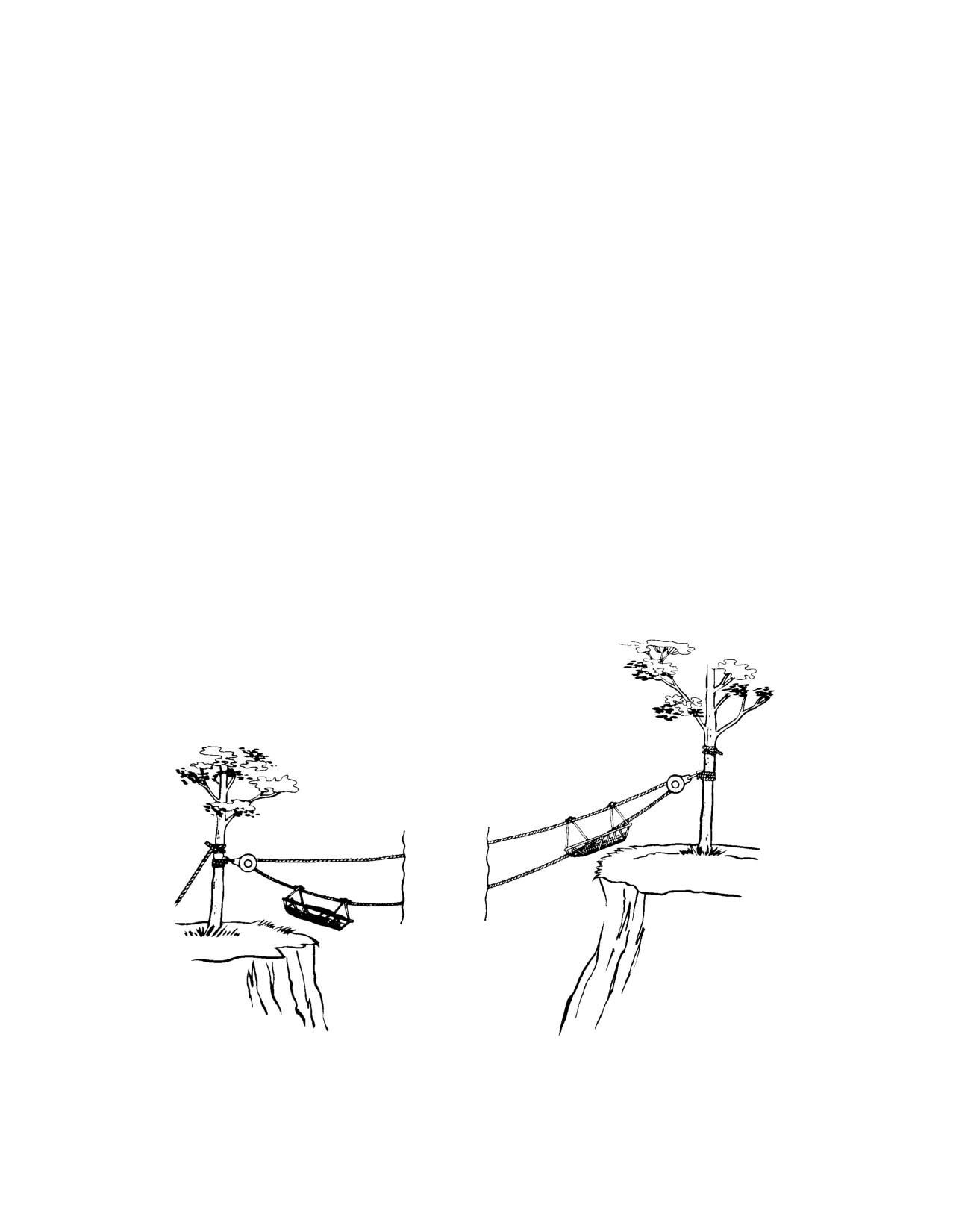
(3) To suspend the litter, place two snaplinks on the traverse rope and attach one long litter
carrying strap to each. Attach an upper and lower retrieving rope to either the litter stirrup or to the
respective snaplinks. In the latter case, the loose ends of each rope are tied together above the center of the
litter so that, when drawn up or down, both snaplinks move simultaneously.
(4) After the patient has been secured to the litter, the litter is raised, and the litter carrying
straps or suspension ropes are passed through the stirrups and fastened together or else secured to the
opposite stirrup.
b. Operation. The horizontal hauling line is operated as follows:
(1) For the ascent, three men can easily raise the litter along the traverse by pulling on the
upper retrieving rope. The pull should be steady and smooth in order to prevent jolting and swaying.
(2) For the descent, a gentle pull on the lower retrieving rope is enough to break the inertia
and let gravity do the rest. During the descent, the men on the upper side should control the speed of the
descent through their retrieving rope. It may be necessary to pull the patient the last few meters when the
litter nears the low point of the slack in the traverse rope.
c.
Refer to TC 90-6-1 for additional information on the construction of a horizontal hauling
system.
Figure 9-29. Evacuation by horizontal hauling line.
9-26
FM 8-10-6
CHAPTER 10
EVACUATION PLATFORMS
Section I. ARMY GROUND AMBULANCES
10-1. General
a. Ground ambulances are vehicles designed for or converted to carrying patients. They are
dedicated assets to be used solely for the medical mission. They are organic to CHS units that evacuate
sick, injured, and wounded soldiers by ground ambulance. These vehicles are equipped with an MES
designed for use in these ambulances.
b. They are staffed with a driver/medical aidman and an additional medical aidman who are both
qualified in basic EMT procedures. Track ambulances are staffed with three medical personnel (ambulance
driver, track commander, and medical aidman).
NOTE
The third medic may not be present on the MTOE. This position may
be staffed by US Army Reserve personnel.
This paragraph implements STANAG 2931.
c.
The Geneva Conventions stipulate that ground ambulances be clearly marked with the
distinctive emblem (red cross on a white background). To camouflage or not display this emblem will result
in the loss of the protections afforded under these conventions. Guidance on the camouflage of medical
units, vehicles, and aircraft on the ground is contained in STANAG 2931.
10-2. Ground Ambulances
Vehicles designed or modified as ambulances include field (wheel) ambulances, the bus ambulance, and the
M113 (track) armored personnel carrier.
a. Military field ambulances, designed for use by field units, operate on paved and secondary
roads, trails, and cross-country terrain. Field ambulances operating in the forward areas of the CZ must
possess mobility and survivability comparable to the units being supported. Current field ambulance
variations include the M1010, HMMWV (M996 and M997), and M113. These ambulances are normally
used to evacuate patients from frontline units to BASs.
b. The bus ambulances are useful in transporting large numbers of patients within EAC.
10-1
FM 8-10-6
c.
The M113, when configured with a litter kit, an NBC kit, and an MES, is classified as a
standard evacuation vehicle and is therefore included in this section on ground ambulances.
10-3. Ambulance Driver
The ambulance driver/medical aidman is responsible for the ambulance at all times. He performs driver
maintenance on the vehicle and is responsible for reporting major deficiencies to his section chief or
supervisor. The ambulance driver/medical aidman is an MOS-qualified medic; if required, he can perform
emergency medical intervention and provide EMT. The drivers responsibilities include
Providing maximum safety and welfare for the patients entrusted to his care. This includes
ensuring that the patient is secured to the litter prior to loading.
Ensuring operational readiness and responsiveness. This is accomplished by maintaining and
being able to use the authorized equipment aboard the ambulance. This equipment includes
Litters.
Blankets.
Splints.
Medical expendables.
Oxygen canisters.
Flashlights.
Auxiliary fuel.
Decontamination equipment.
Special medical materials and equipment.
Ensuring he has the required information, tools, and equipment to navigate to the pick-up
location.
(This includes a map, tactical overlays, map coordinates, compass, and when available, position
locator equipment.)
NOTE
When traversing open terrain (such as in a desert) with few distin-
guishable landmarks, strip maps are ineffective.
10-2
FM 8-10-6
Preparing the ambulance for loading and unloading.
Assisting the litter bearers in the loading and unloading of patients.
Performing property exchange when patients are loaded or unloaded.
Providing emergency transport of medical personnel, medical supplies, and blood and blood
products.
Acting as a messenger in medical channels.
10-4. Medical Aidman
The medical aidman acts as the assistant driver and his duties include
Becoming familiar with the condition of each patient being evacuated and reviewing the
information on the FMC.
Coordinating with the individual in charge for any special instructions in the care and treatment
of the patients en route.
Providing EMT as required.
Making periodic checks of patients while en route.
Supervising and assisting in the proper loading and unloading of the ambulance.
Assisting the driver with land navigation and guiding the driver when backing or moving off
roads, or when under blackout conditions.
10-5. Ambulance Loading and Unloading
In loading and unloading ambulances, litter patients are moved carefully. Details of the loading and
unloading procedures vary slightly depending on the number of bearers, the presence or absence of a
medical aidman, and the type of vehicle used.
a. General Procedures.
Patients are normally loaded head first. The exception is if the nature of the patients
injuries make this inadvisable. They are less likely to experience motion sickness or nausea with the head in
the direction of travel. They also experience less noise from the opening and closing of rear doors.
Further, there is less danger of injury to the patients if a rear-end collision occurs.
10-3
FM 8-10-6
When a patient requires en route care for an injury to one side of his body, it may be
necessary to load him feet first to make the injured side readily accessible from the aisle. Patients with
wounds of the chest or abdomen, or those receiving IV fluids are loaded in lower berths to provide gravity
flow. For ease of loading and patient comfort, those patients wearing bulky splints should be placed on
lower berths, if possible.
b. Instructional Procedures. For loading and unloading the ambulances, the litter bearers are
numbered and formal commands are given so that each individual can learn his particular job and work as a
team.
(1) Loading procedures. The sequence for loading four litter patients in the berths is upper
right, lower right, upper left, and lower left. The most seriously injured are loaded last so they will be the
first to be off-loaded. A three-man squad is required to load and unload the ambulance.
(2) Unloading procedures. The sequence for unloading the ambulance is the reverse of the
loading procedures: lower left, upper left, lower right, and upper right. A three-man squad is needed to
unload the ambulance.
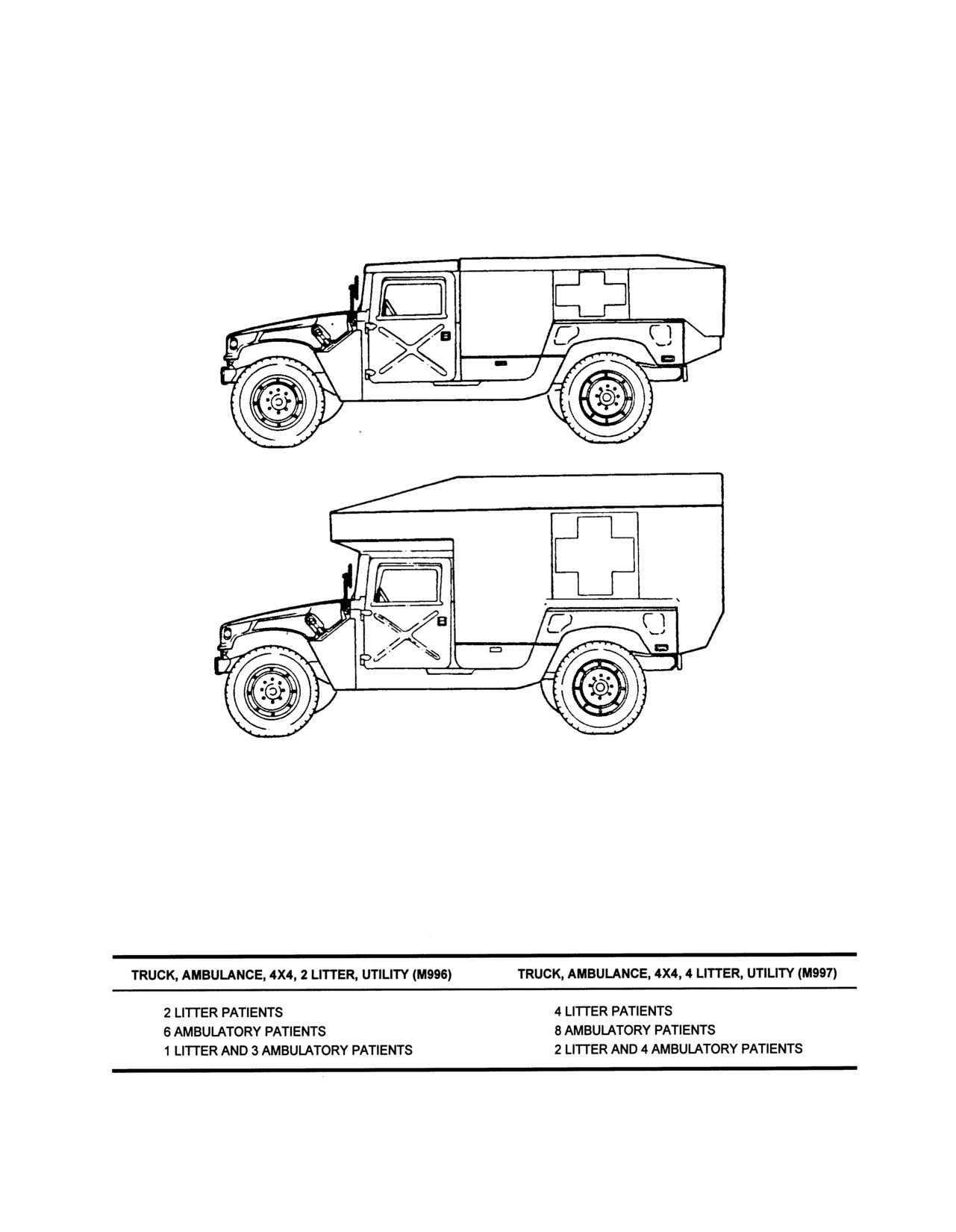
10-6. Truck, Ambulances, 4x4, Utility, M996 and M997
The M996 and M997 ambulances are tactical vehicles designed for use over all types of roads, as well as
cross-country terrain. It can also operate in all weather conditions (Figure 10-1). These ambulances are
diesel-powered and equipped with four-wheel hydraulic service brakes. The ambulances can be heated and
ventilated. Only the M997 can be air-conditioned. Supplemental electrical power to operate the life
support equipment is also available. For operations in an NBC environment, the M996 and M997
ambulances are equipped with a gas-particulate filter unit (GPFU).
a. Patient Carrying Capacities. Refer to Table 10-1 for the various patient carrying capacities.
b. Two-Litter Configuration, M996. The sequence for loading patients in the berths is right first,
then left. The most seriously injured patient is loaded last so that he is the first to be taken out of the
ambulance. The sequence for unloading is the reverse of loading.
NOTE
The numbers used in the explanation of the figures correspond to the
parts/equipment represented in the graphic.
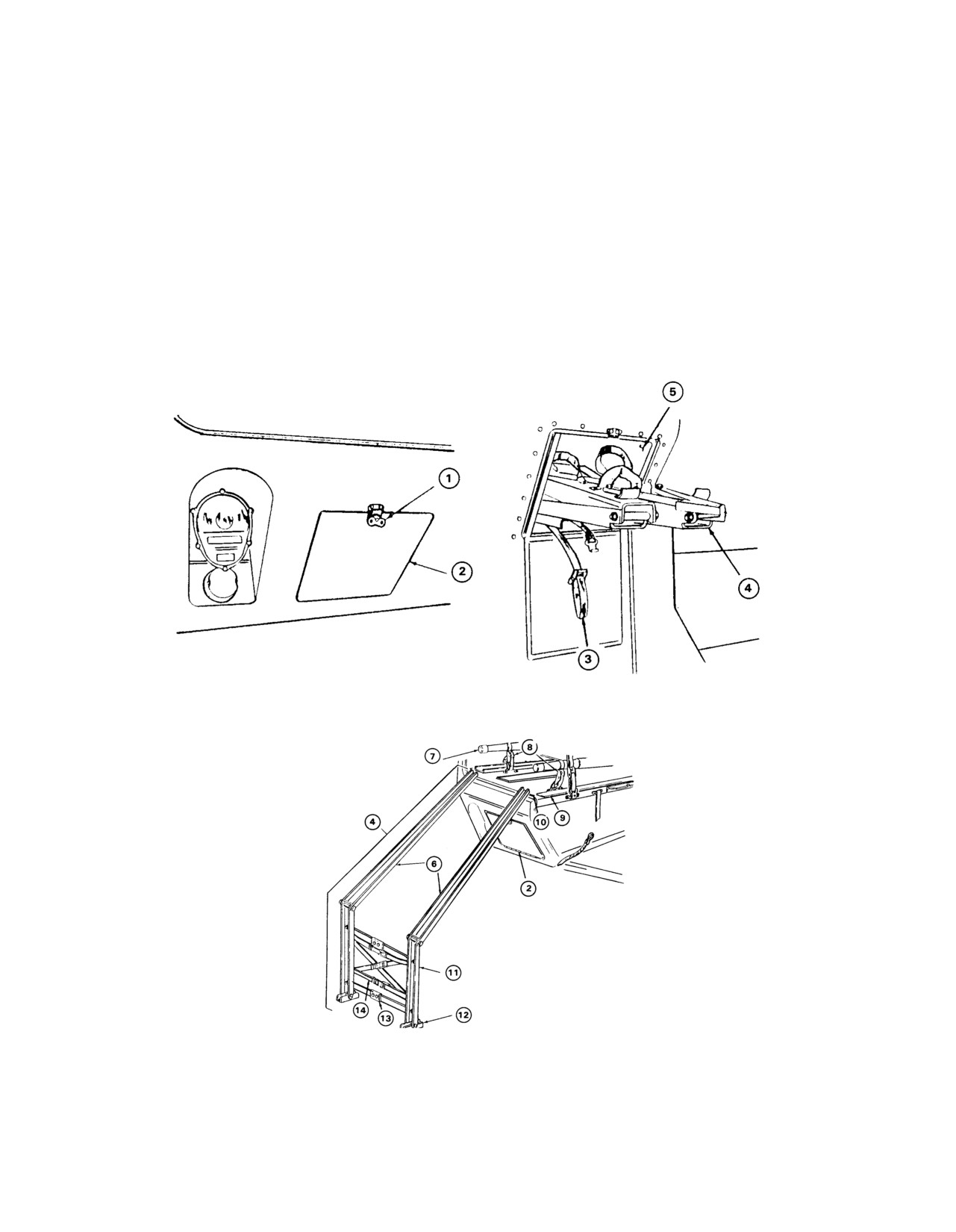
(1) Assembling litter rail extension (Figures 10-2 and 10-3).
(a) Turn latch (1) counterclockwise and open stowage compartment door (2).
10-4
FM 8-10-6
Figure 10-1. Truck, ambulances, 4x4, utility (M996 and M997).
Table 10-1. Patient Carrying Capacities
10-5
FM 8-10-6
(b) Loosen and disconnect securing strap (3) and remove folded litter rail extension
(4) from stowage compartment (5).
(c) Pull left and right rails (6) apart and let legs (11) drop down. Ensure feet (12) are
flat on ground.
(d) Lock support braces (13) and adjust straps (14) as necessary.
Figure 10-2. Litter rail extension stowage compartment, M996.
Figure 10-3. Litter rail extension.
10-6
FM 8-10-6
(2) Loading litters on litter rack (Figure 10-3).
(a) Secure both rails (6) of litter rail extension (4) into slots (10) on litter rack (9).
(b) Place litter (7) on litter rail extension (4).
WARNING
Ensure straps and equipment do not inhibit litter loading
operations. Load litters carefully to prevent patient injury.
(c) Slide litter (7) onto litter rack (9).
(d) Secure litter (7) to litter rack (9) with front and rear litter handle straps (8).
(3) Unloading litters from the litter rack (Figure 10-3).
(a) Release front and rear litter handle straps (8) securing litter (7) to litter rack (9).
(b) Secure both rails (6) of litter rail extension (4) into slots (10) on lower litter rack (9).
(c) Slide litter (7) from lower litter rack (9) onto litter rail extension (4). Lift up and
remove litter (7) from litter rail extension (4).
(4) Fold and stow litter rail extension (Figures 10-2 and 10-3).
(a) Unlock support braces (13).
(b) Fold left and right rails (6) together.
(c) Fold left and right litter rail legs (11) and feet (12) against rails (6).
(d) Place folded litter rail extension (4) into stowage compartment (5) and secure with
strap (3).
(e) Close door (2) and turn latch (1) clockwise to secure door (2).
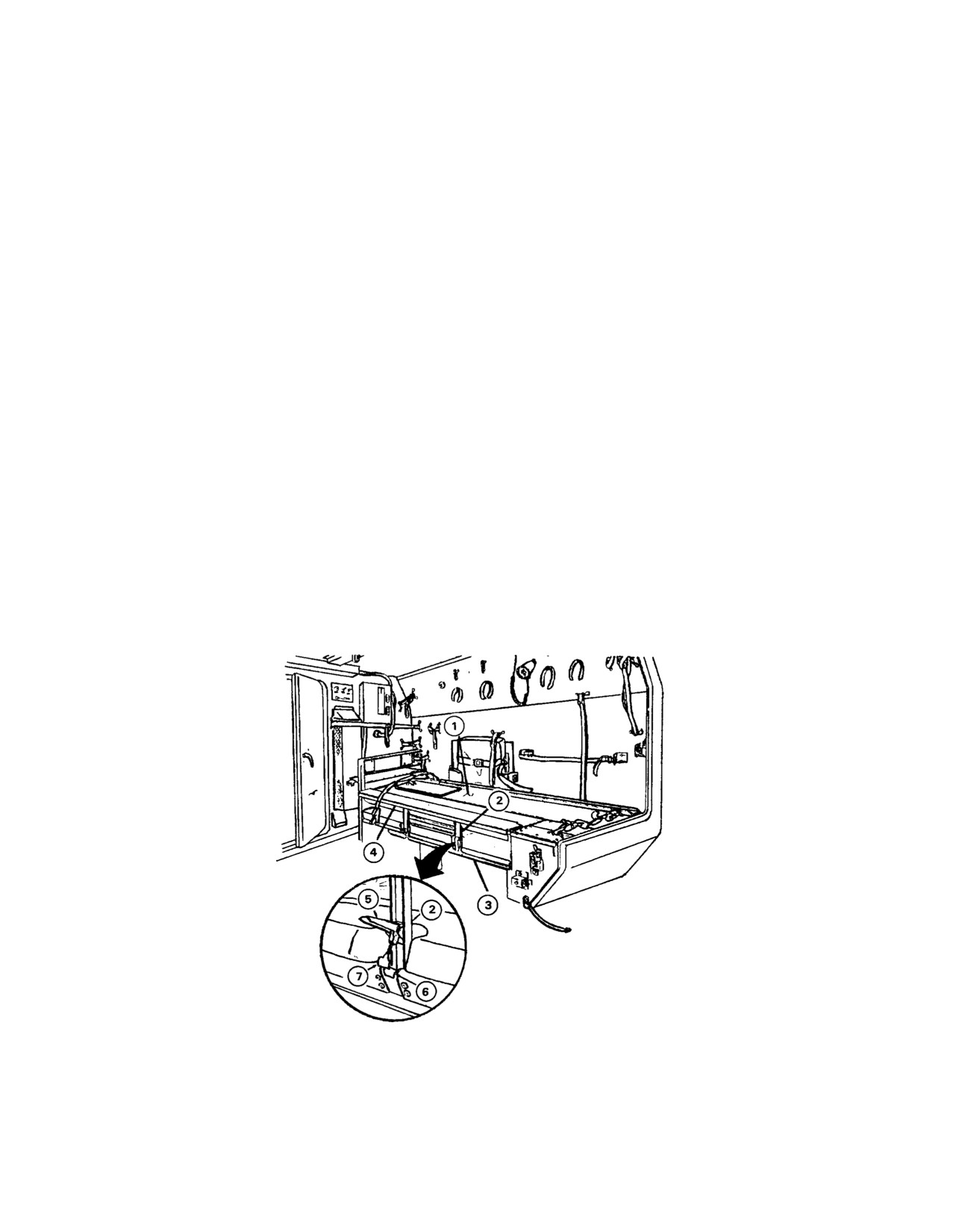
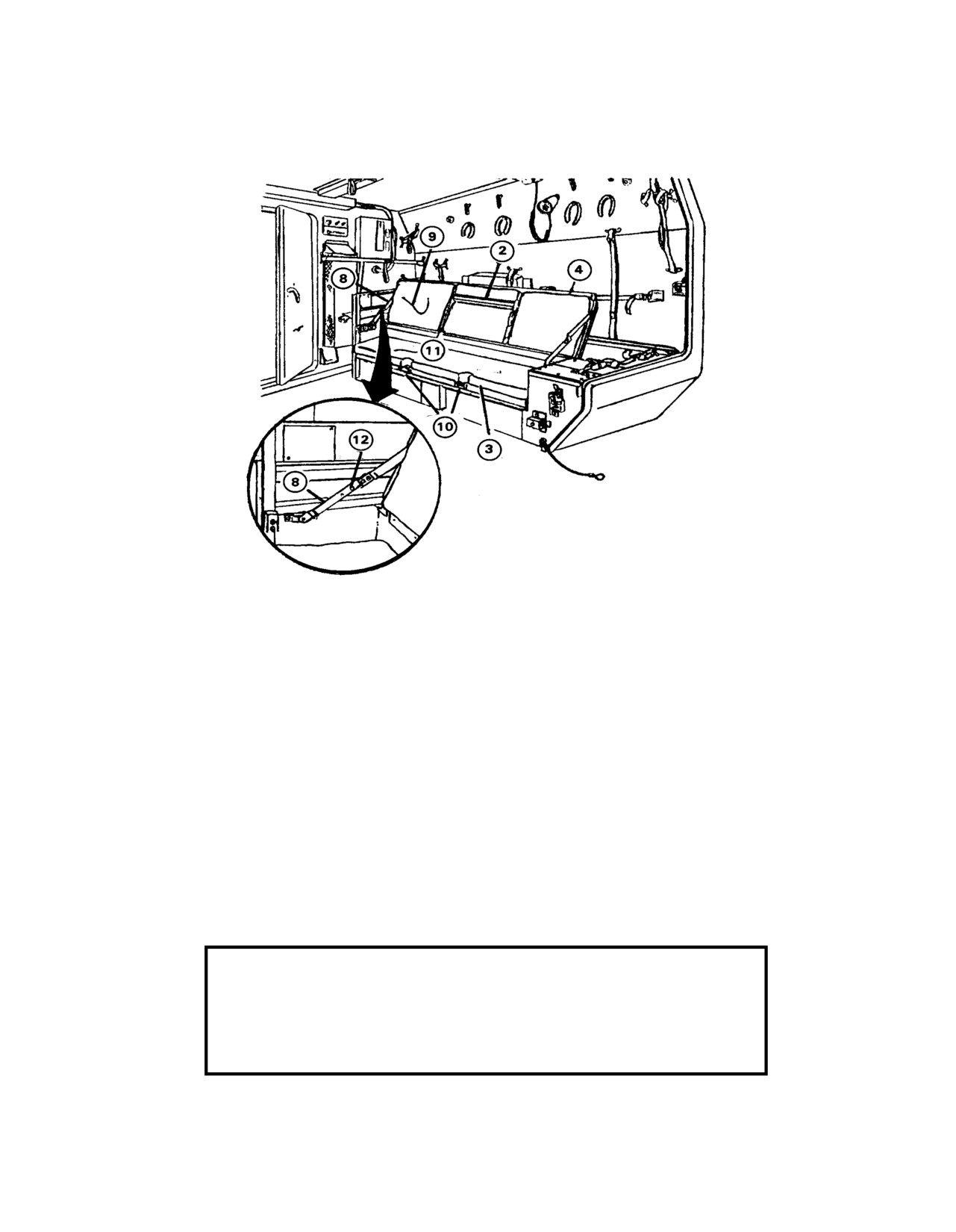
(5) Opening patient seat to accommodate ambulatory patients (Figures 10-4 and 10-5).
(a) Ensure litters are in stowed position.
(b) Pull out and up on seat latch handle (5) and remove latch (7) from catch (6).
10-7
FM 8-10-6
(c) Lift seat back (4) to open position and fold seat back support (2) into recesses
between seat cushions (9).
(d) Ensure that seat braces (8) are fully extended and locked in position.
(6) Closing the patient seat to accommodate litter patients (Figures 10-4 and 10-5).
(a) Press lock buttons (12) on seat braces (8) and fold braces (8) toward seat back (4).
(b) Fold seat back support (2) outward and fold seat back (4) into closed position.
Ensure that guide pins (11) on seat back support engage holes (10) in seat base (3).
(c) Install seat back (4) to seat base (3) with seat latch (7) and secure with latch handle
(5). If necessary to ensure security of seat back (4), adjust seat latch (7) to proper length by turning
clockwise or counterclockwise.
c.
Four-Litter Configuration, M997. The sequence for loading four litter patients in the berths is
upper right, lower right, upper left, and lower left. The most seriously injured patients are loaded last so
they are the first to be taken out of the ambulance.
Figure 10-4. Litter rack (ambulatory patient seat down position).
10-8
FM 8-10-6
Figure 10-5. Litter rack (ambulatory patient seat open position).
The sequence for unloading is the reverse of the loading procedure: lower left, upper left, lower right, and
upper right. When only two litter patients are to be loaded, the upper and lower right side berths are used.
Using the two right side berths leaves the left side unoccupied for use in transporting ambulatory or
additional litter patients.
NOTE
When patients are picked up from several locations, the loading
sequence of least seriously injured patient to most seriously injured
patient cannot always be applied. A previously loaded patient should
not be unloaded in order to maintain the loading sequence. The
receiving MTF must be made aware of the most seriously injured
patients.
WARNING
When loading more than two litter patients, the upper litter
rack patients must be loaded first. Injury may result if litter
patients are loaded in lower rack first.
10-9
FM 8-10-6
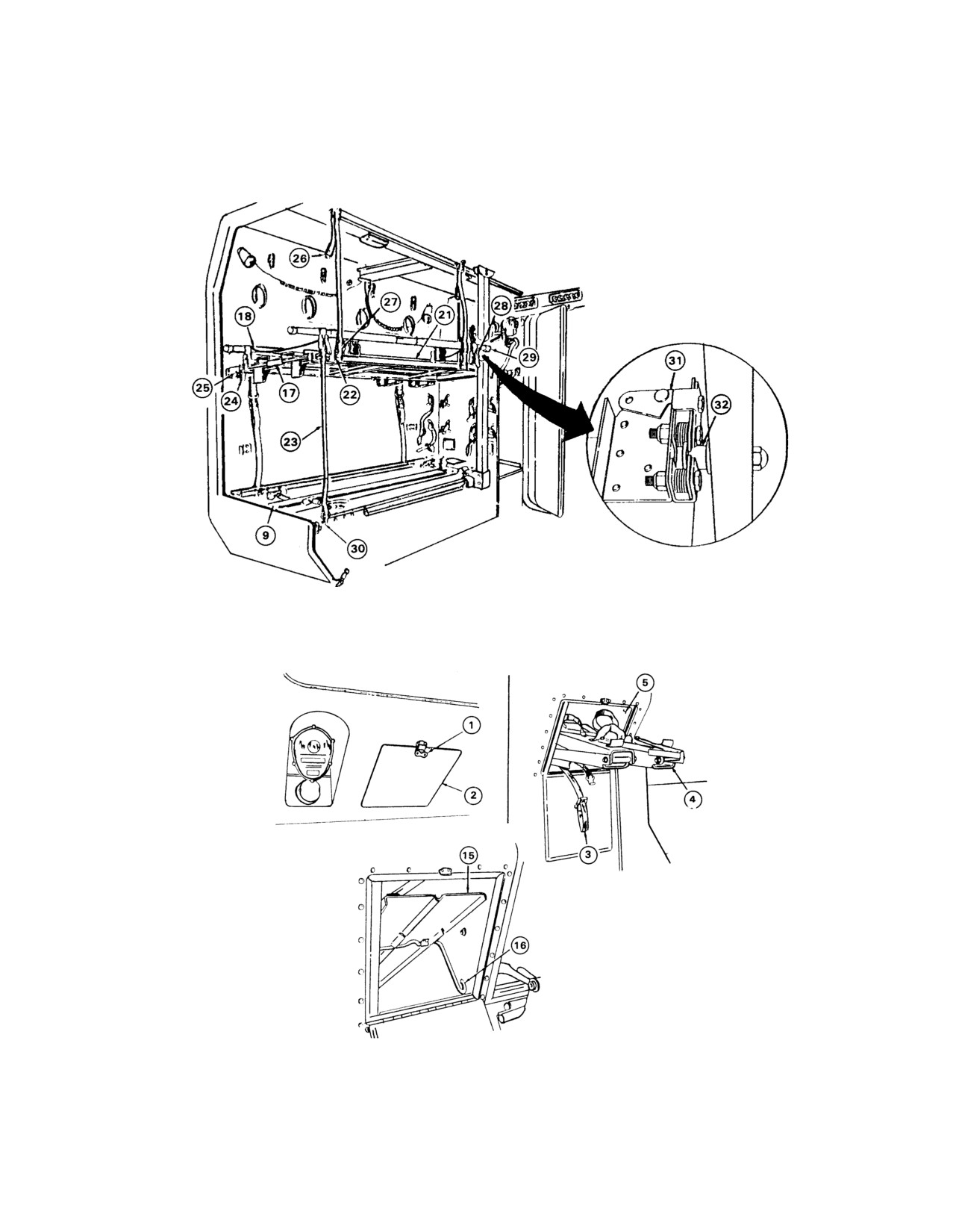
(1) Preparing the upper litter rack (Figure 10-6).
(a) Unhook tension strap (23) from footman loop (30) on lower litter rack (9).
(b) Pull out upper litter rack handle (17) and support weight of upper litter rack (21).
WARNING
The rear end of the upper litter must be supported before
releasing the suspension strap hook. Injury to personnel
may result if rear end of upper litter is not supported.
(c) Unhook rear suspension strap hook (27) from loop (22) on upper litter rack (21).
Clip suspension strap hook (27) to eye (26).
(d) Release litter support latch stop (25), push latch (24) in, and lower upper litter rack
(21) onto lower litter rack (9).
(e) Slide litter rack handle (17) into upper litter rack (21).
(2) Assembling litter rail extension (Figures 10-3 and 10-7).
(a) Turn latch (1) counterclockwise and open stowage compartment door (2).
(b) Loosen and disconnect securing strap (3) and remove folded litter rail extension (4)
from stowage compartment (5).
(c) Lift tray (15) slightly and push in tray supports (16) to lower tray (15) for access to
stowed litters.
(d) Pull left and right rails (6) apart and let legs (11) drop down. Ensure feet (12) are
flat on ground.
(e) Lock support braces (13) and adjust straps (14) as necessary.
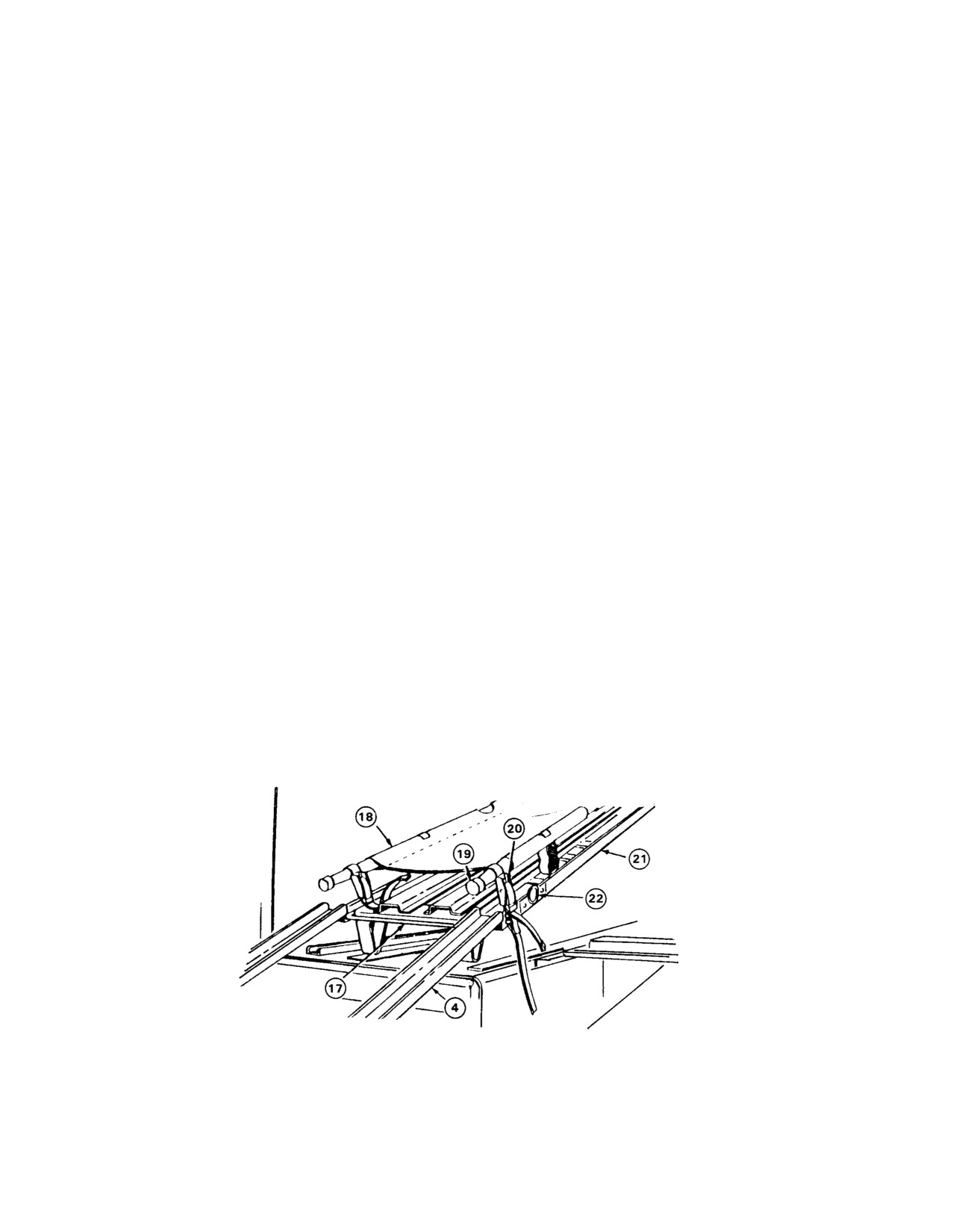
(3) Loading litters on upper litter racks (Figures 10-6 and 10-8).
(a) Secure both rails of litter extension (4) into slots in upper litter rack (21).
(b) Place litter (18) on litter rail extension (4).
(c) Slide litter (18) up rails (4) until litter (18) is clear of litter rail extension (4).
10-10
FM 8-10-6
Figure 10-6. Interior, M997.
Figure 10-7. Litter rail extension stowage compartment, M997.
10-11
FM 8-10-6
(d) Secure rear litter handles (19) to upper litter rack (21) with rear litter handle straps
(20).
(e) Remove litter rail extension (4) from upper litter rack (21).
(f)
Unhook suspension strap hook (27) from eye (26).
(g) Pull out upper litter rack handle (17).
(h) Raise upper litter rack (21), push into litter support latch (24), and secure with latch
stop (25).
(i)
Attach suspension strap hook (27) to loop (22) on upper litter rack (21).
(j)
Secure front litter handles (29) to litter rack (21) with front litter handle straps (28).
(k) Hook tension strap (23) to footman loop (30) on lower litter rack (9) and adjust
strap.
(l)
Slide litter rack handle (17) into upper litter rack (21).
(4)
Loading litters on lower litter rack (Figure 10-3).
(a) Secure both rails (6) of litter rail extension (4) into slots (10) on lower litter rack (9).
(b) Place litter (7) on litter rail extension (4).
(c) Slide litter (7) onto lower litter rack (9).
(d) Secure litter (7) to lower litter rack (9) with front and rear litter handle straps (8).
(5)
Unloading litters from the lower litter rack (Figure 10-3).
WARNING
1. When unloading more than two litter patients, lower litter
rack patients must be unloaded first.
2. Ensure that straps and equipment do not inhibit unload-
ing operations. Unload litters carefully to prevent patient
injury.
10-12
FM 8-10-6
(a) Release front and real litter handle straps (8) securing litter (7) to lower litter rack (9).
(b) Secure both rails (6) of litter rail extension (4) into slots (10) on lower litter rack (9).
(c) Slide litter (7) from lower litter rack (9) onto litter rail extension (4). Lift up and
remove litter (7) from litter rail extension (4).
(6) Unloading litters from upper litter racks (Figure 10-6 and 10-8).
(a) Release front litter handle straps (28) from litter handles (29).
(b) Unhook tension strap (23) from footman loop (30) on lower litter rack (9).
(c) Pull out upper litter rack handle (17) and support weight of upper litter rack (21).
(d) Unhook rear suspension strap hook (27) from loop (22) on upper litter rack (21).
Clip suspension strap hook (27) to eye (26).
(e) Release litter support latch stop (25), push latch (24) in, and lower upper litter rack
(21) onto lower litter rack (9).
(f)
Slide litter rack handle (17) into upper litter rack (21).
(g) Secure rails of litter rail extension (4) into slots in upper litter rack (21).
(h) Release rear litter handle straps (20) from litter handles (19).
(i)
Slide litter (18) down litter rail extension (4) until litter (18) is clear of upper litter
rack (21).
(j)
Lift and remove litter (18) from litter rail extension (4).
(k) Remove litter rail extension (4) from upper litter rack (21).
(7) Fold and stow litter rail extension (Figure 10-3 and 10-7).
(a) Unlock support braces (13).
(b) Fold left and right rails (6) together.
(c) Fold left and right litter rail legs (11) and feet (12) against rail (6).
(d) Lift tray (15) and push tray supports (16) in, and lower tray (15).
(e) Slide litters into stowage compartment (5) on top of lift tray (15). Pull out supports
(16) to place lift tray (15) in raised position.
10-13
FM 8-10-6
(f)
Place folded litter rail extension (4) into stowage compartment (5) and secure with
strap (3).
(g) Close door (2) and turn latch (1) clockwise to secure door (2).
(8) Folding upper litter rack to the backrest position (Figure 10-6).
(a) Unhook litter rack tension strap (23) from lower litter rack footman loop (30).
(b) Unhook two upper litter rack suspension straps hooks (27) from loops (22) on
upper litter rack (21) and reattach strap hooks (27) to eyes (26).
(c) Release upper litter rack latch (31) and disengage rack striker (32) from latch (31).
(d) Lower upper litter rack (21) onto the lower litter rack (9), forming a backrest.
(9) Converting backrest to upper litter rack (Figure 10-6).
(a) Raise upper litter rack (21) and engage rack striker (32) into upper litter rack latch
(31). Ensure striker (32) is locked in latch (31).
(b) Unhook two upper litter rack suspension strap hooks (27) from eyes (26) and hook
to loops (22) on upper litter rack (21).
(c) Hook upper litter rack tension strap (23) to footman loop (30) on lower litter rack (9).
(d) Adjust straps (23 and 27) for proper tension.
Figure 10-8. Upper litter rack.
10-14
FM 8-10-6
10-7. Truck, Ambulance, 11/4 Ton, 4x4, M1010
The M1010 truck, ambulance (Figure 10-9), is a diesel-powered vehicle equipped with power steering and
brakes and automatic transmission. It can accommodate up to four litter or eight ambulatory patients, or a
combination of each. The vehicle has a patient assist boom, and block and tackle for loading. An improved
patient life support capability is provided by four additional focus-type lights, air-conditioning, optional
GPFU for NBC protection, and supplemental electrical power to operate the life support equipment. The
M1010 also has additional storage space between the litter berths and vehicle cab. The loading sequence is
upper right, lower right, upper left, and lower left. In an emergency or mass casualty situation, one
additional litter can be placed in the center aisle.
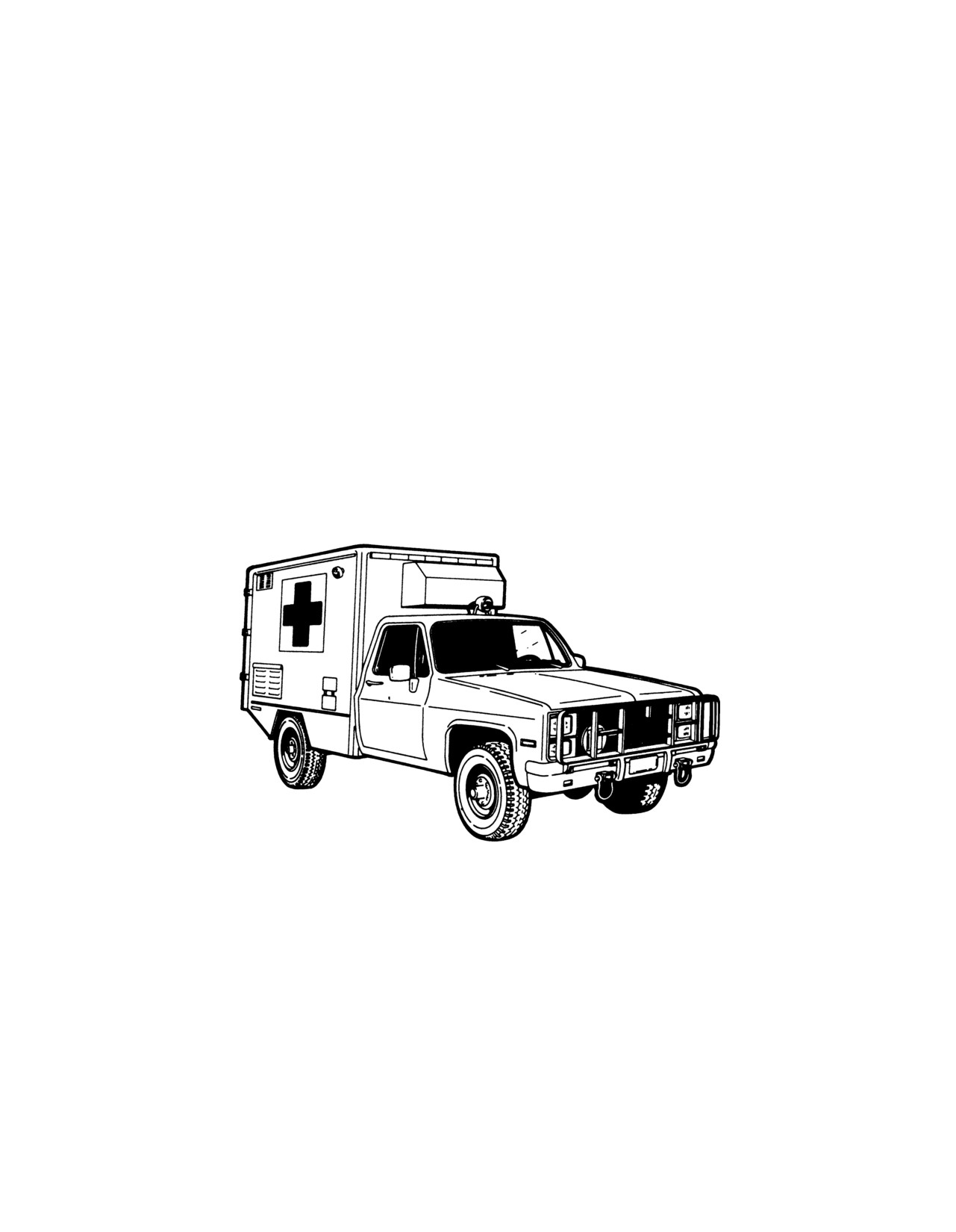
Figure 10-9. Truck, ambulance, 11/4 ton, 4x4, M1010.
10-8. Truck, Ambulance, 11/4 Ton, 6x6, M792
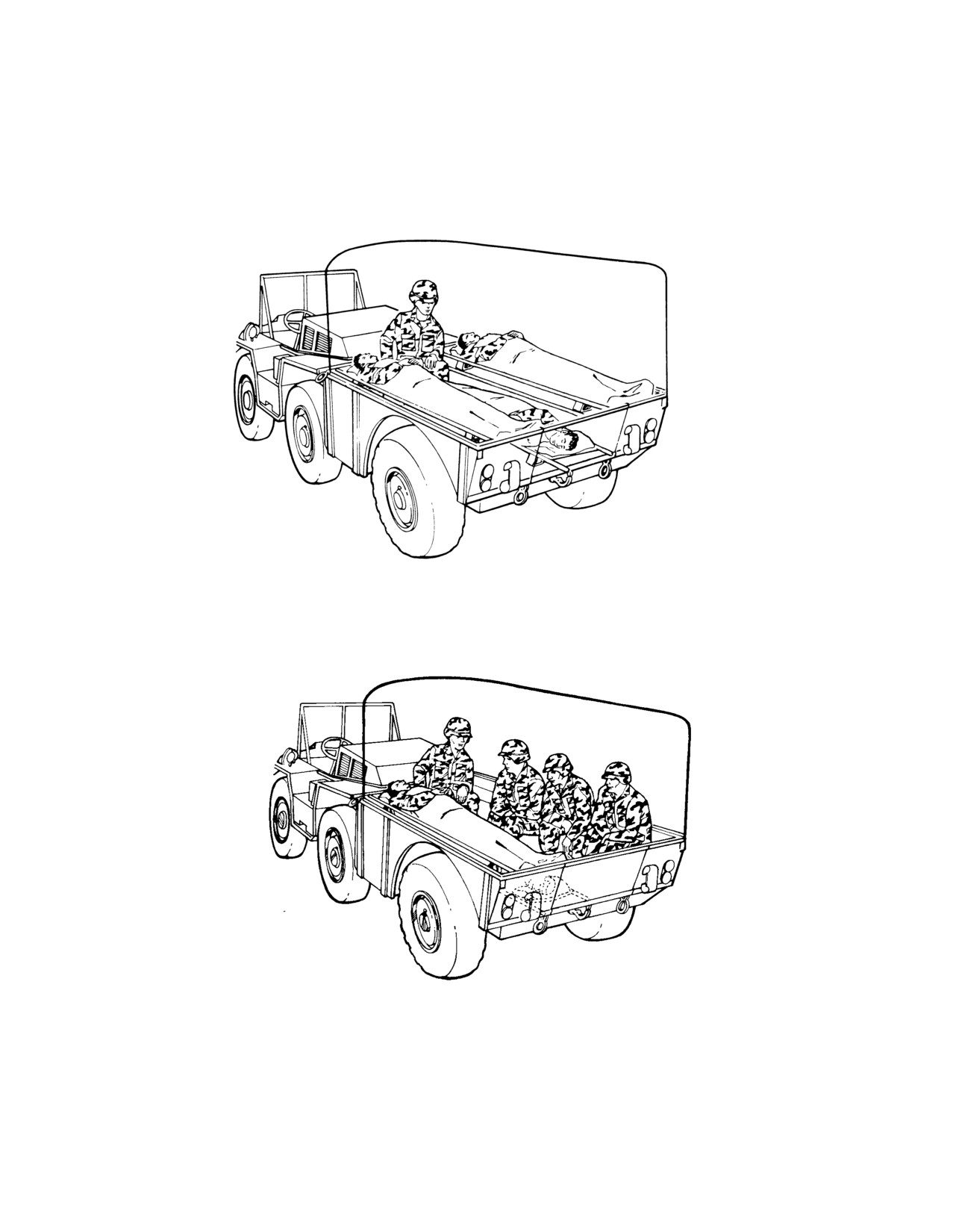
The M792 truck, ambulance, can accommodate three litter patients and a medical attendant (Figure 10-10),
two litter patients, three ambulatory patients, and a medical attendant (Figure 10-11), or six ambulatory
patients. Due to the ride characteristics of the vehicle, all litter patients must be securely strapped in place.
The sequence for loading the berths is upper right, upper left, and lower, with the unloading sequence
accomplished in reverse order. A two-man squad is required for loading and unloading the vehicle.
10-15
FM 8-10-6
Figure 10-10. Truck, ambulance, 11/4 ton, 6x6, M792, with three
litter patients and a medical attendant.
Figure 10-11. Truck, ambulance, 11/4 ton, 6x6, M792, with two litter patients,
three ambulatory patients, and a medical attendant.
10-16
FM 8-10-6
10-9. Buses (Ambulances)
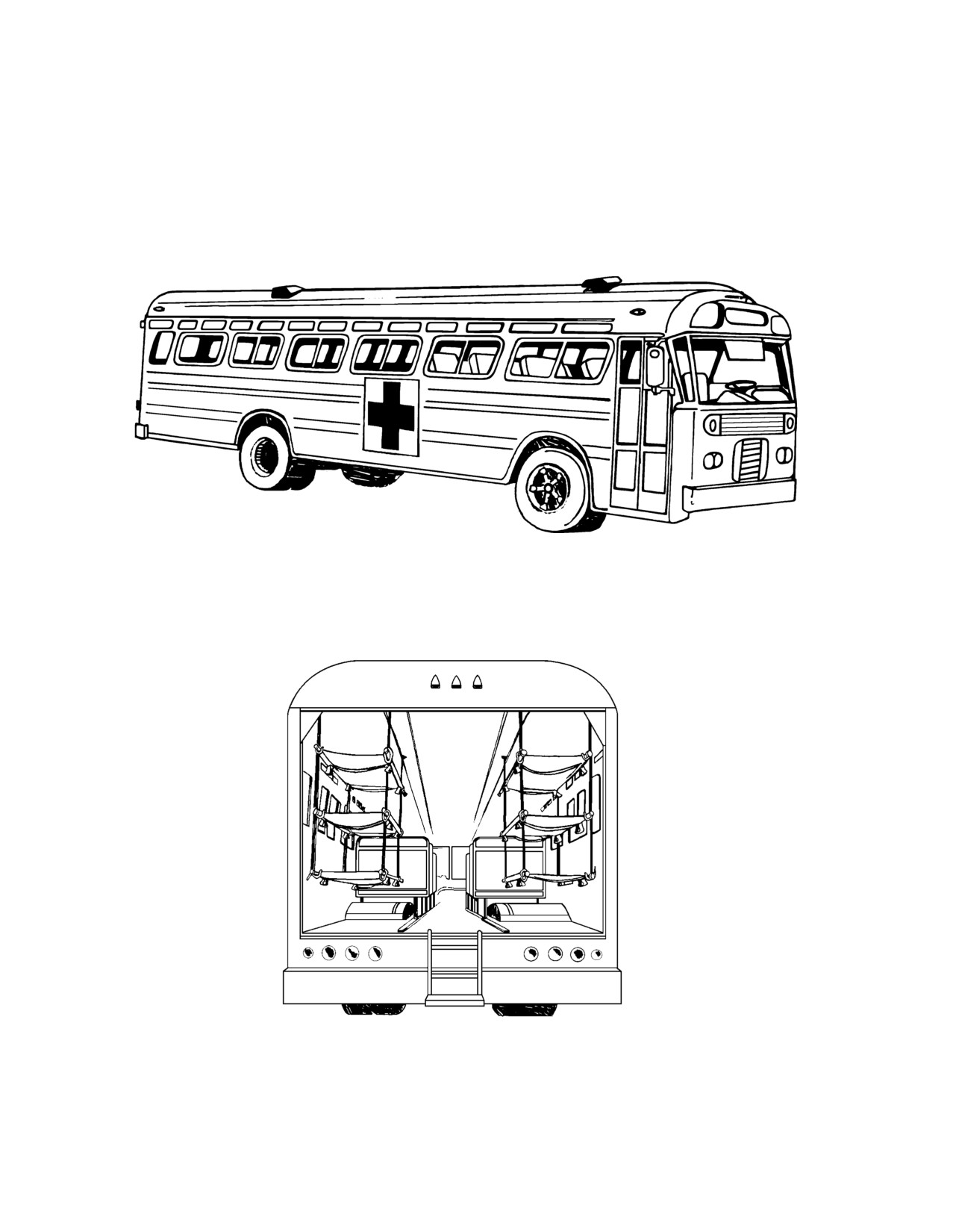
These vehicles can be rapidly converted into ambulances (Figures 10-12 and 10-13). They can be used
in support of the Army in the field as far forward as the road network and tactical situation permit. They
are most useful in situations where a large number of patients are to be transported for relatively short
distances over improved roads, such as transferring patients from hospitals to airheads and ports of
embarkation.
a. Patient Carrying Capacity. Ambulance buses have various patient carrying capacities. Total
capacity for litter and ambulatory patients depends on the size of the available bus. A kit containing
the necessary accessories for conversion is located in the compartment on the right outside of the bus
body.
b. Vehicle Conversion. To convert the bus to an ambulance, it may be necessary to remove all
seats except those immediately behind the driver. The seats behind the driver are used for medical
attendants or ambulatory patients. Litter support hooks are inserted in brackets located at the top and
bottom on the interior of the body side. Litter support hangers are then suspended from the hooks in the
ceiling rails. To return the vehicle to passenger operation, the procedure is reversed. In some buses,
conversion can be done by folding down the seat backs.
c.
Loading Procedures. Normally, two 3-man litter squads are required to load and unload the
bus ambulance. The vehicle is loaded from front to rear and from top to bottom. All patients are loaded
into the bus with their heads toward the front of the vehicle unless the injury dictates using a different
loading technique.
(1) Loading from ramps or platforms. Two litter teams are required to load the bus. One
litter team enters the rear of the bus with a litter patient, loads the patient on the berth, and exits through the
front as the second team enters through the rear with a litter patient. The second team loads its patient and
exits through the front as the first team enters the rear with its second patient. Only one of the teams is in
the bus at a time, thereby avoiding interference.
(2) Loading without ramps or platforms. Two litter teams are used to load the bus from the
ground. One litter team remains in the bus. A second litter team loads patients onto the bus floor at the rear
of the bus where they are picked up by the team in the bus and loaded onto berths.
d. Unloading Procedures. Patients are unloaded (in reverse order of loading procedure) from
rear to front and from bottom to top. Two litter teams are also required to unload the bus.
(1) When the vehicle is to be unloaded from loading ramps or platforms, the two litter teams
alternate in unloading.
(2) When the vehicle is to be unloaded without ramps, one litter team removes the litter
patients from the berths in the bus and places them on the floor at the rear of the bus where they are picked
up and unloaded by the second litter team.
10-17
FM 8-10-6
Figure 10-12. Bus ambulance, exterior view.
Figure 10-13. Bus ambulance, interior view, seats removed and litters installed.
10-18
FM 8-10-6
10-10. Carrier, Personnel, Full Tracked, Armored, M113, T113E2
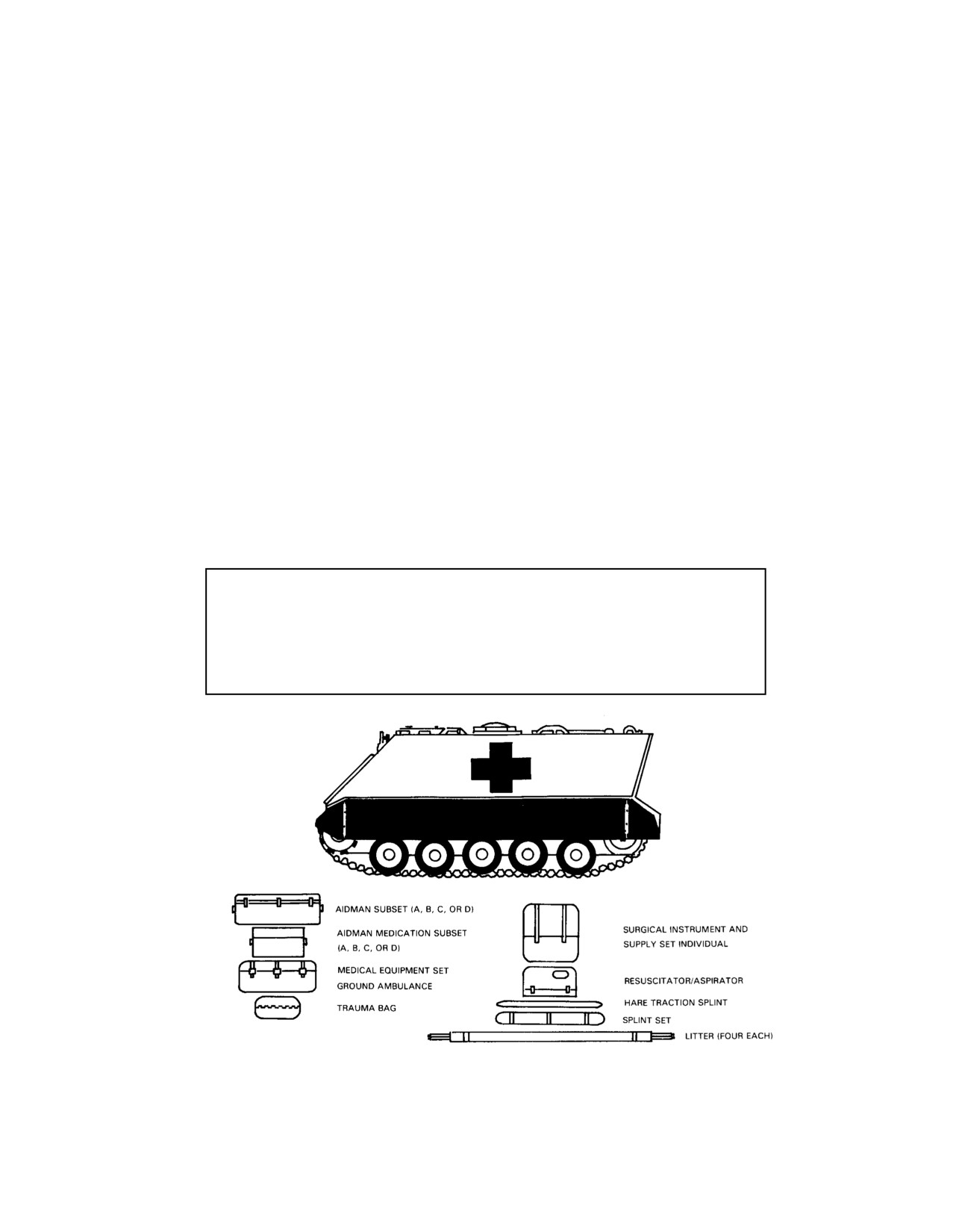
The M113 armored personnel carrier (Figure 10-14) is a standard evacuation vehicle. It is lightly armored
to afford patient protection against small arms. Wearing the helmet inside the vehicle provides added
protection, especially over rough terrain, due to the low silhouette. Movement of the tracks propels and
steers the vehicle. It is highly maneuverable and capable of
Amphibious operations on inland lakes and streams.
Extended cross-country travel over rough terrain.
High-speed operations on improved roads and highways.
a. The vehicle can carry ten ambulatory patients and has a conversion kit which, when installed,
gives a normal capacity of four litter patients.
b. A squad of four men is needed to load and unload the vehicle. The sequence for loading four
litter patients is upper right, lower right, upper left, and lower left.
CAUTION
To install the litter suspension kit in the M113 ambulance, the
spall liner must be removed. Litter patients cannot be safely
moved if the litter suspension kit is not installed.
Figure 10-14. Carrier, personnel, full tracked, armored, M113.
10-19
FM 8-10-6
Section II. NONMEDICAL VEHICLES USED FOR CASUALTY
EVACUATION OR MEDICAL EVACUATION
10-11. General
a. In combat areas, ambulances are often not available, are too few in number, or are incapable
of evacuating patients over certain types of terrain. In these instances, many vehicles available to most units
can be used to transport casualties with little or no change in their configuration.
NOTE
Units should consider emplacing litter racks on nonmedical vehicles
designated to transport casualties. Refer to TM 9-2320-280-24P-1
and -2 for information on the installation of litter racks.
b. Some amphibious cargo and personnel vessels can be used for this purpose; however, their
patient-carrying capacity varies.
c.
When casualties have entered the CHS system, they are classified as patients. Patient
evacuation includes providing en route medical care to the patient being evacuated. However, if a casualty
is moved on a nonmedical vehicle without en route medical care, he is considered to be transported, not
evacuated (refer to paragraph 1-4). Units should consider emplacing litter racks on these designated
vehicles.
10-12. Casualty Transport and Patient Evacuation in a Mass Casualty Situation
To provide timely and responsive evacuation or casualty transport, CHS planners develop proactive OPLANs
to meet the challenges of a mass casualty situation.
Contingency plans should identify
Nonmedical transportation resources.
Nonmedical personnel for litter teams.
Evacuation routes.
Ambulance exchange points.
Medical personnel resources to provide en route medical care on nonmedical vehicles.
10-20
FM 8-10-6
Capabilities and locations of MTFs.
Communications frequencies and call signs for C2.
Procedures for medical equipment exchanges.
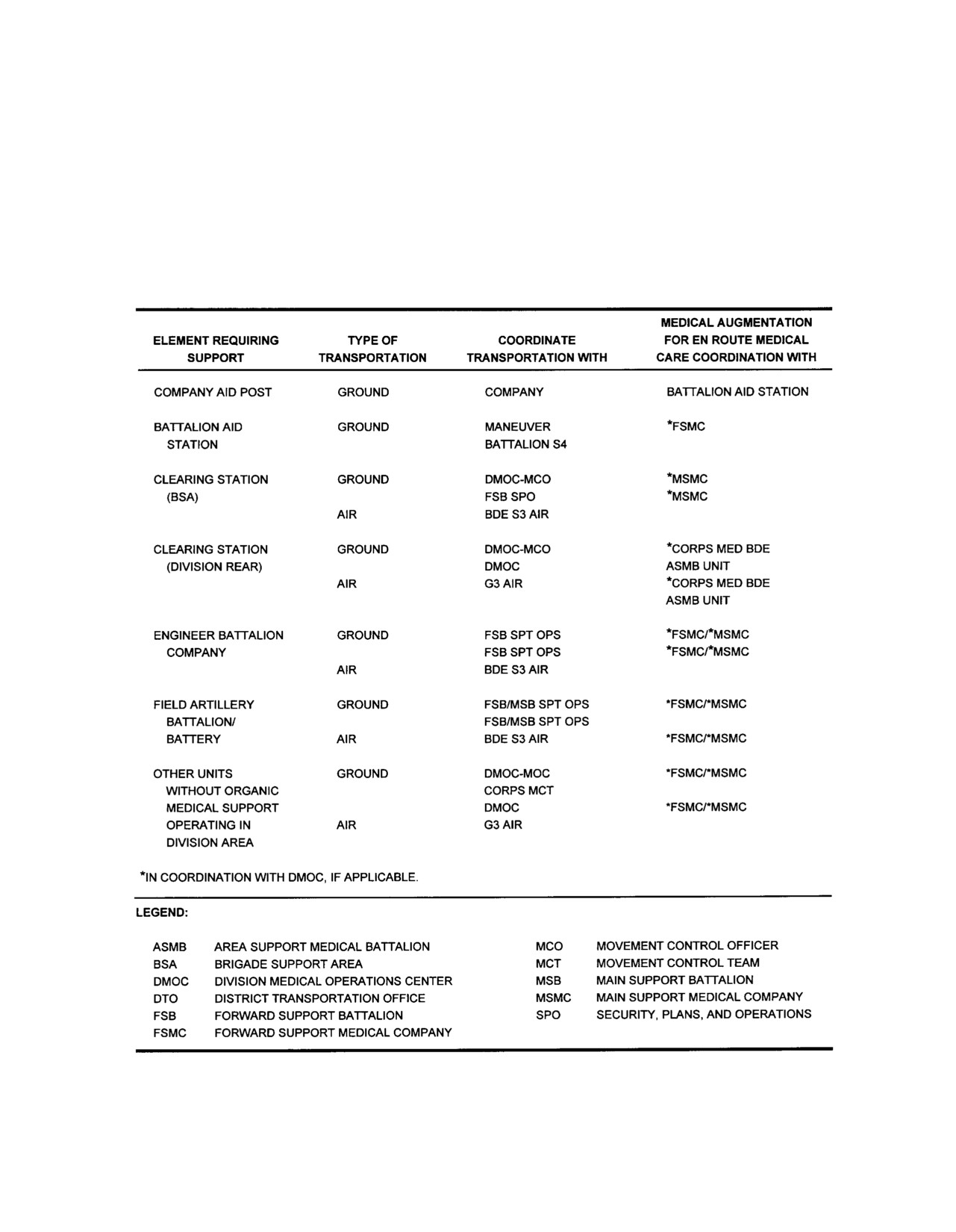
Key players in coordinating the use of nonmedical vehicles for medical evacuation or casualty
transportation are contained in Table 10-2 (Page 10-23).
a. Ground nonmedical assets can be used for casualty transport when the medical evacuation
system is overwhelmed. All available ground vehicles should be considered for augmenting medical
evacuation assets in an emergency. The key to success is identifying the vehicles, drivers, and medical
personnel or combat lifesavers who will accompany the casualties. Coordinating for the release of these
assets upon demand rather than waiting for a mass casualty situation to occur is also crucial to the success of
the operation. Vehicle types will differ depending upon the type of unit supported; however, some of the
more common vehicles which may be used are the
Bradley infantry fighting vehicle, M2/3.
Truck, cargo, medium tactical vehicle (MTV), long wheelbase (LWB), 5 ton, M1085.
Truck, cargo, 21/2 ton, M35.
Truck, cargo, heavy expanded, mobility tactical truck (HEMTT), 8x8, cargo, M977.
Truck, cargo, MTV, light vehicle air drop/air delivery (LVAD/AD), 5 ton, M1093.
Truck cargo, light medium tactical vehicle (LMTV), air drop/air delivery, 21/2 ton,
M1081.
Semitrailer, cargo, 221/2 ton, M871.
Armored personnel carrier, M113.
Tractor, 5 ton, with stake and platform trailer.
High-mobility, multipurpose wheeled vehicle, M998.
b. Depending on the TO, HN support agreements may provide evacuation assets ranging from
austere to extensive support. Coordination with the Assistant Chief of Staff, (Civil-Military Operations)
(G5) can provide information on the availability of assets. This information should be included in the
OPLANs. Some of the types of assets which might be available for support are
Buses.
Ambulance railcars.
10-21
FM 8-10-6
Barges and other watercraft.
Civilian cargo vehicles.
c.
The staffing of nonmedical vehicles with medical personnel to provide en route medical care
requires considerable planning and coordination. Since nonmedical vehicles are normally ones of
opportunity, medical personnel and equipment and transportation platforms must be carefully tracked if
they are to be used. The modular medical system lends itself well to this form of task organizing by
providing four-man trauma treatment teams with equipment organic to the FSMCs and MSMCs. These
same treatment modules are also found in the corps ASMCs. Combat health support managers should plan
to use these assets in this temporary role. Also available within the CS and CSS units of the division are
trained combat lifesavers. These personnel can be used, if available, to provide en route surveillance of less
seriously injured patients.
d. The management of patient evacuation using nonmedical evacuation assets is difficult to
control. Overevacuation occurs routinely unless controls are implemented to manage the evacuees by
patient category. Responsive evacuation in extremely important; however, if en route patient care and
management by patient category are ignored, the end result will be an increase in the mortality rate and an
overevacuation of RTD soldiers. URGENT and URGENT-SURG precedence patients should be evacuated
before PRIORITY or ROUTINE precedence patients. Care must be taken to ensure lower precedence
patients are evacuated before their medical condition begins to deteriorate resulting in upgrading their
precedence to URGENT or URGENT-SURG. The primary means of evacuating URGENT and URGENT-
SURG precedence patients is by air ambulance. If ground ambulance is used for URGENT and URGENT-
SURG patients, the patients must be checked frequently to ensure that their medical condition is not
deteriorating and rendering them nontransportable. Planners should consider and incorporate into the
OPLAN the use of nonmedical air assets and dedicated ground ambulances to move the PRIORITY patient,
and nonmedical ground vehicles to move the ROUTINE precedence patients when dedicated medical
vehicles are not available. Every effort should be made to staff and equip nonmedical vehicles used for
patient evacuation with medical personnel, even if only to move the ROUTINE patient precedence category.
10-22
FM 8-10-6
Table 10-2. Coordination Requirements for Nonmedical Transportation
and Medical Augmentation to Provide En Route Medical Care
10-23
FM 8-10-6
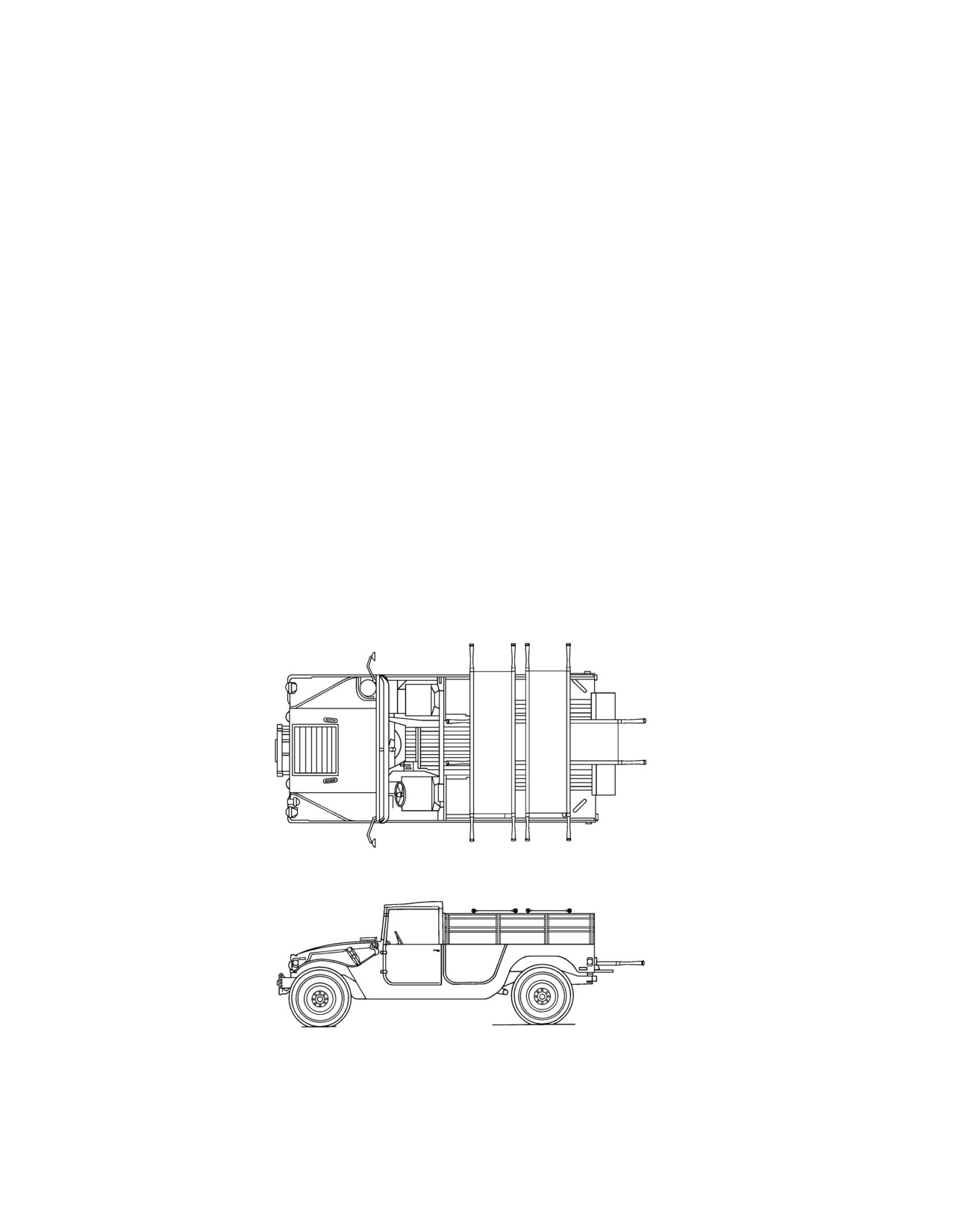
10-13. Truck, Cargo/Troop Carrier, 11/4 Ton, 4x4, M998 (Four-Man Configuration)
The 11/4 -ton cargo truck, four-man configuration (Figure 10-15) can be easily adapted for transporting three
litters. To convert this vehicle for carrying litters, follow the procedures listed below.
a. Remove the cargo cover and metal bows. Secure them in place. Lower the tailgate.
b. Place two litters side-by-side across the back of the truck with the litter handles resting on the
sides of the truck.
NOTE
When the route of evacuation is along narrow roads or trails, care
must be taken to prevent the litter handles from catching on trees or
bushes.
c.
Secure the litters to the vehicle.
d. Place one litter lengthwise, head first, in the bed of the truck. Secure it in place.
e.
Leave tailgate open. It is supported by the two tailgate chain books.
Figure 10-15. Truck, cargo/troop carrier 1 1/4 ton, 4x4,
M998 (four-man configuration), with three litters.
10-24
FM 8-10-6
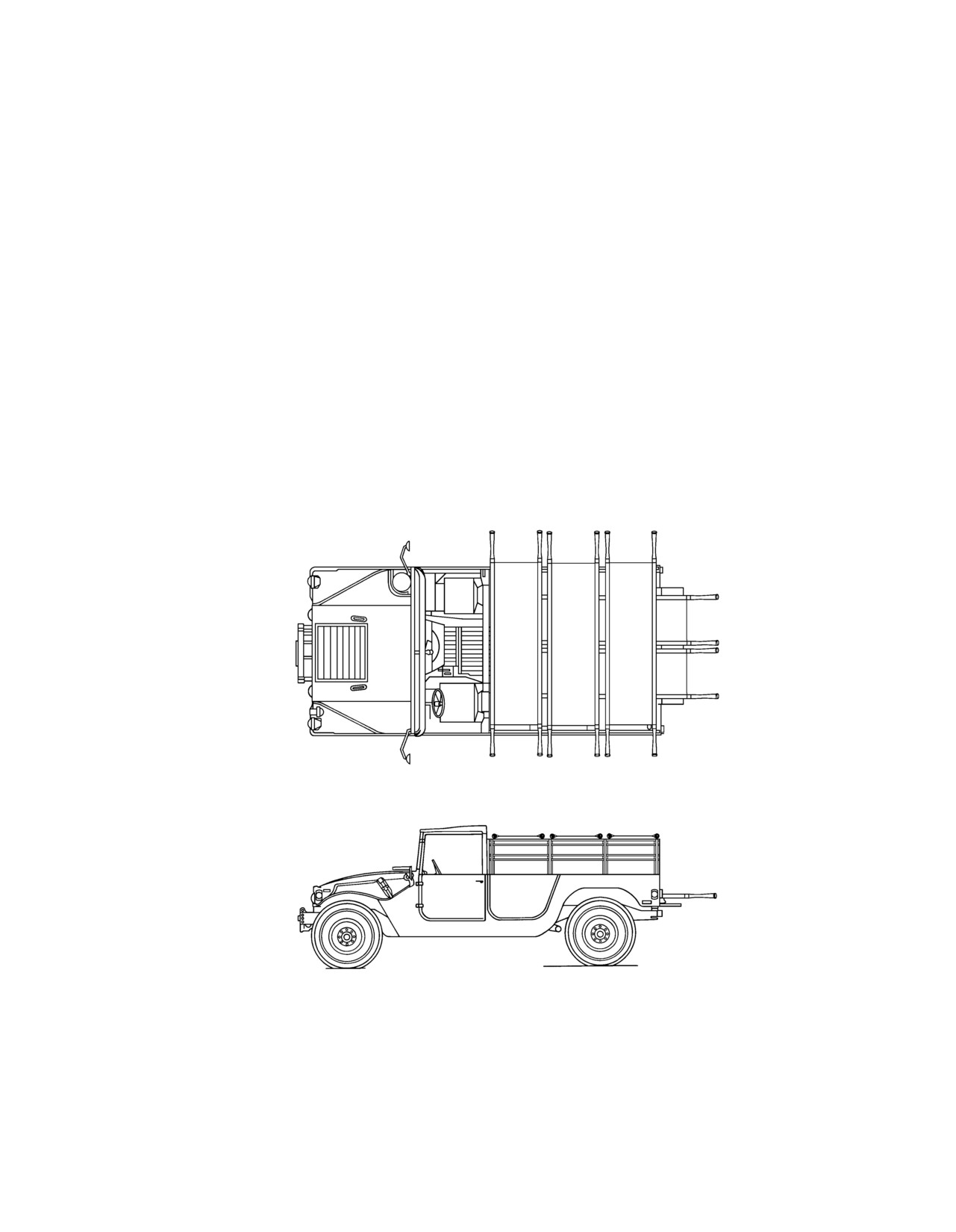
10-14. Truck, Cargo/Troop Carrier, 11/4 Ton, 4x4, M998 (Two-Man Configuration)
The 11/4-ton cargo truck, two-man configuration (Figure 10-16), can be easily adapted for transporting five
litters. To convert this vehicle to carry patients, the procedures listed below should be followed:
a. Fold the fabric cover and metal bows forward and together as an assembly. Secure them in
place. Lower the tailgate.
b. Place three litters side-by-side across the sideboards. Secure them in place.
c.
Place two litters lengthwise, head first, in the bed of the truck. Secure them in place.
d. Leave tailgate open. It is supported by the two tailgate chain hooks.
Figure 10-16. Truck, cargo/troop carrier, 11/4 ton, 4x4, M998
(two-man configuration), with five litters.
10-25
FM 8-10-6
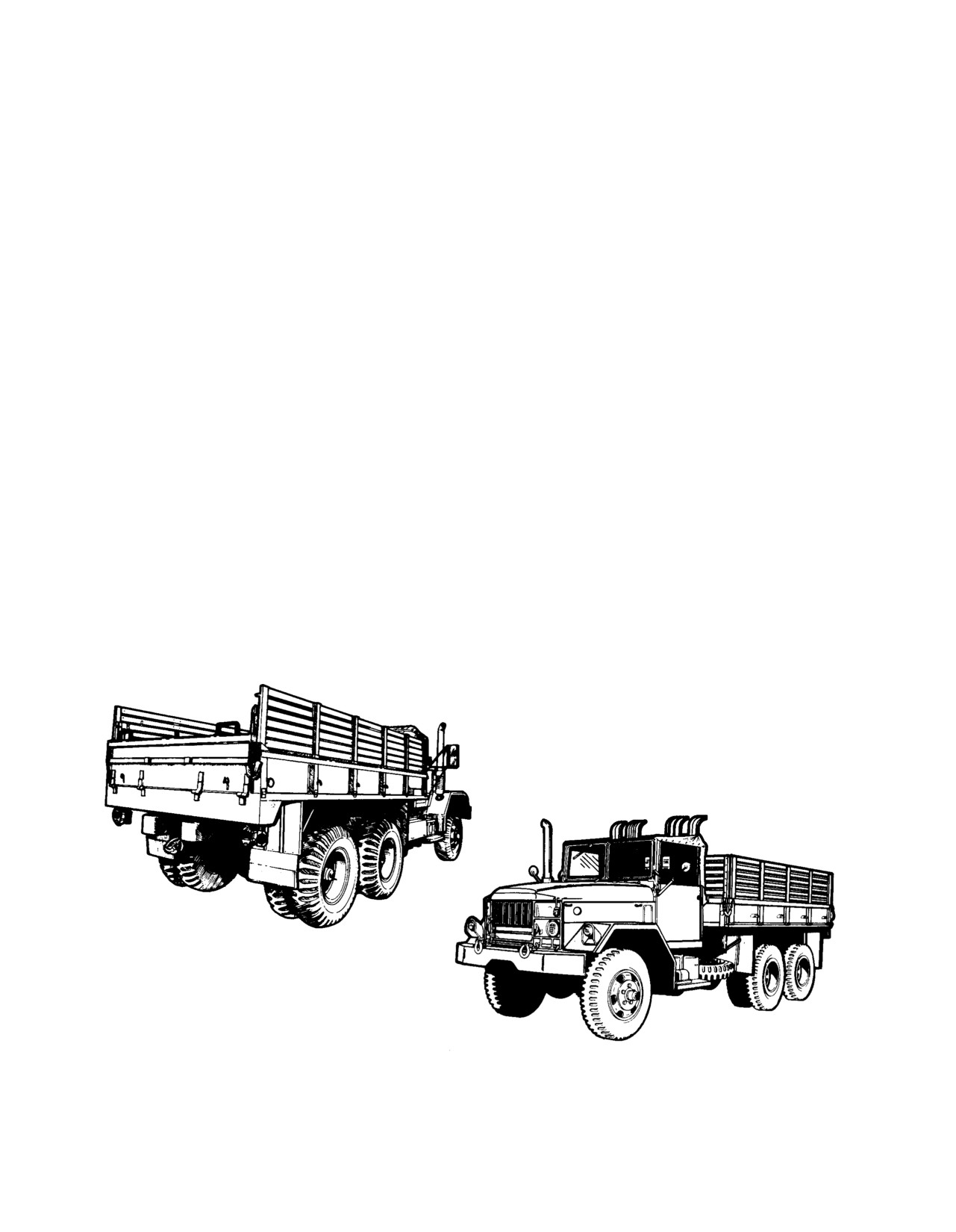
10-15. Truck, Cargo, 5 Ton, 6x6, Wide Bed, and Truck, Cargo, 21/2 Ton, 6x6, Wide Bed
These trucks (Figure 10-17) are normally used to transport general cargo as well as personnel. They have
canvas-covered cabs and removable tarpaulin braces and sideboards. Both vehicles have a maximum
capacity of 12 litters. These vehicles can be used for casualty transportation by
a. Removing the canvas cover.
(The cover can be rolled toward the front of the truck and
secured.)
b. Lowering the seats.
c.
Placing three litters crosswise on the seats as far forward as possible and three litters lengthwise
in the bed of the truck as far forward as possible.
d. Securing the litters individually to the seats.
e.
Placing three additional litters crosswise on the seats and three additional litters lengthwise in
the bed of the truck.
f.
Securing these litters individually to the seats.
g. Raising and securing the tailgate as high as possible to help secure the litters in place.
Figure 10-17. Truck, cargo, 5 ton, 6x6, wide bed, and truck, cargo, 21/2 ton, 6x6, wide bed.
10-26
FM 8-10-6
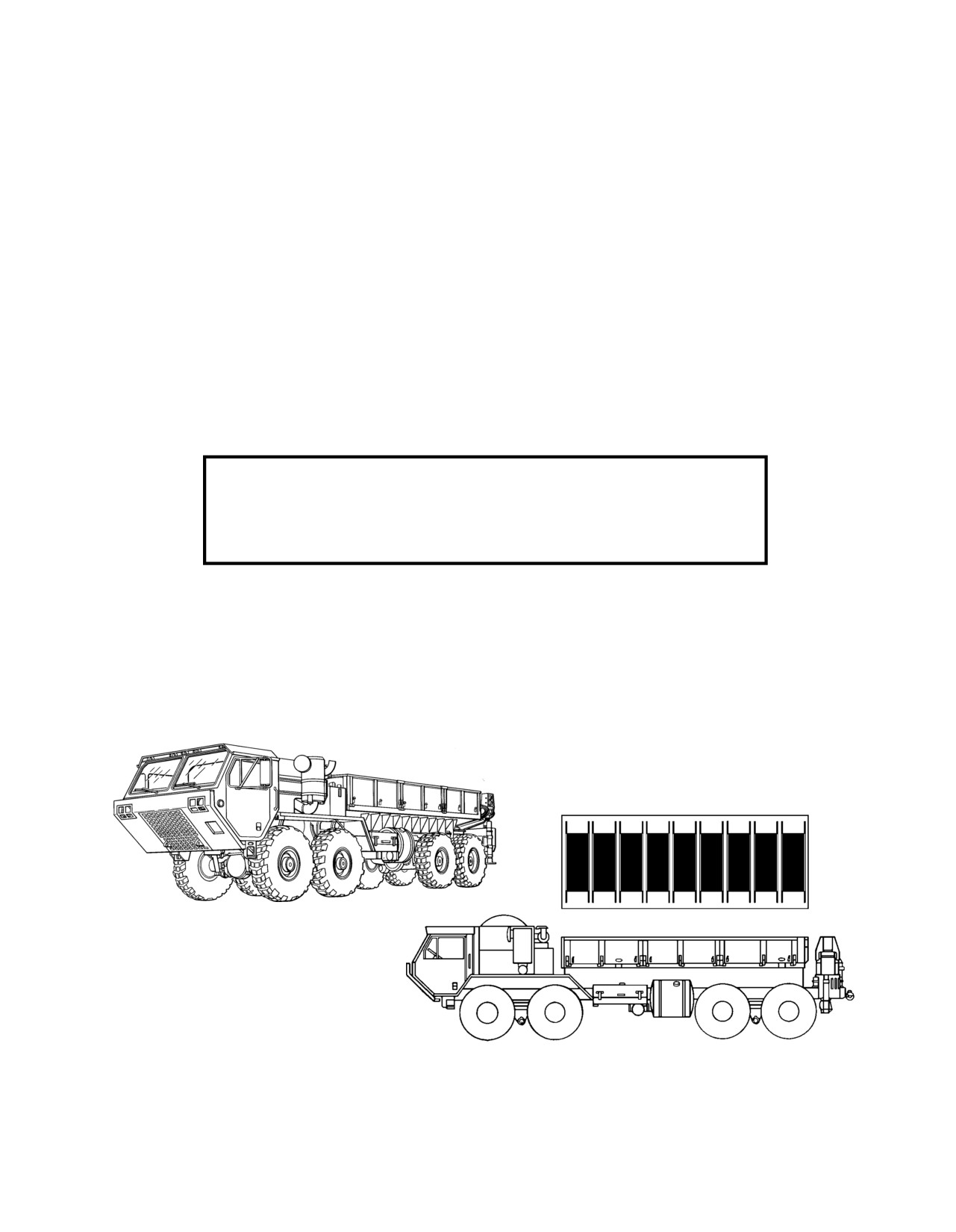
10-16. Heavy Expanded, Mobility Tactical Truck, 8x8, Cargo, M977
The HEMTT is normally used to transport heavy cargo. It may or may not have the cargo cover kit
consisting of the cover, stakes, and bows. The HEMTT has collapsible sides and can be used to transport
the wounded in a mass casualty situation. It can be adapted to carry a maximum of nine litter patients in one
lift. Instructions for the loading of this vehicle are to
a. Start at the rear of the vehicle. Roll the cargo cover (if it is on the vehicle) toward the front of
the vehicle. Remove the corner lockpins and raise the panel latches to lower the rear section of the cargo
body. Remove the first two bows and drop one side of the cargo bed. This will be the side used for
casualty loading.
WARNING
Side panels can slide off of the hinge pins when the vehicle
is parked on a grade. This can cause injury.
b. Place one litter team in the back of the cargo bed to arrange and secure the litters. The second
litter team will carry and place the litters into the cargo bed.
c.
Load the litters from front to back, head to toe, and the less serious to the most serious based
on casualty triage. The litters will be placed horizontally on the cargo bed (Figure 10-18).
d. Raise and secure the side panel to ensure litter stability and casualty safety. Replace the bows
and re-roll the canvas cover, if necessary, to provide protection from the elements.
Figure 10-18. Heavy expanded, mobility tactical truck, 8x8, cargo, M977.
10-27
FM 8-10-6
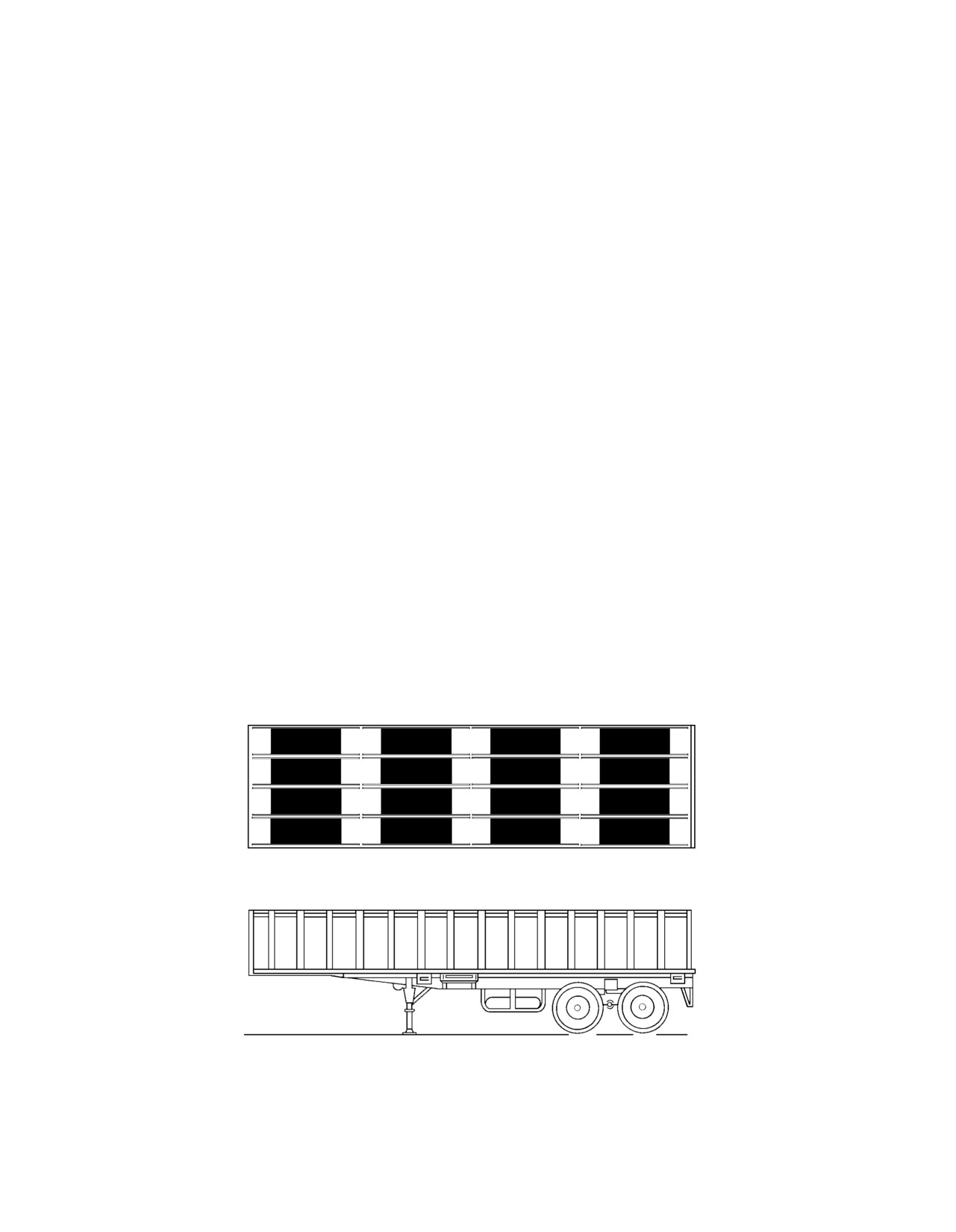
10-17. SemiTrailer, Cargo, 221/2 Ton, M871
The 221/2-ton cargo trailer (M871) (Figure 10-19) is attached to a prime mover such as a M800- or M900-
series tractor for the transport of general cargo.
(There are no major differences between the M871 and the
M871A1 semitrailers.) It has 41/3-foot high wooden sides with a canvas trailer cover. This trailer can be
used to transport wounded in a mass casualty situation. It can be adapted to carry 16 litters in a single lift.
Instructions for the loading of this trailer are to
a. Remove the tie-downs that secure the canvas cover and roll it forward toward the front of the
trailer.
b. Remove the rear panels exposing the trailer bed.
c.
Use one litter team in the cargo bed to arrange and secure the litters in the cargo area, while
another litter team lifts the casualties to the bed of the trailer.
d. Load litters from right to left, front to back, based on casualty triage. The more seriously
injured are loaded last so that they are unloaded first.
e.
Place litters lengthwise, with casualties in a head-to-toe configuration.
f.
Replace the rear doors to ensure the security of the litters.
g. Re-roll the cargo cover 3/4 of the way down, then secure the cover to protect the casualties.
Figure 10-19. Semitrailer, cargo, 221/2 ton, M871, loaded with litter.
10-28
FM 8-10-6
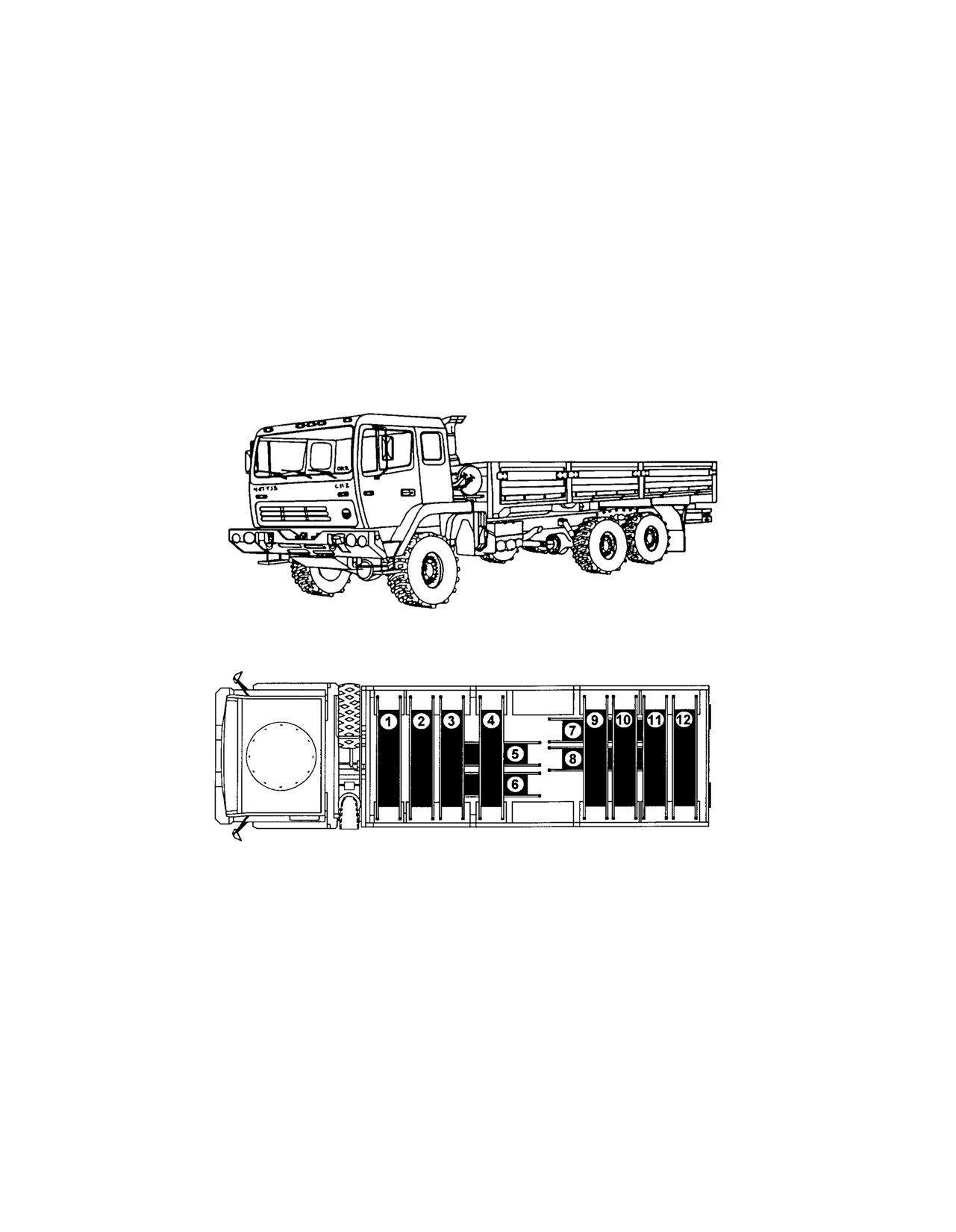
10-18. Truck, Cargo, Medium Tactical Vehicle, Long Wheelbase, 5 Ton, M-1085
The 5-ton truck is normally used to transport general cargo as well as personnel. It has a canvas cover,
removable tarpaulin braces, and hinged sideboards. The canvas cover and braces need not be removed
for patient loading and unloading. This vehicle has a maximum capacity of 12 litter or 22 ambulatory
patients.
a. Use the following steps to load patients (Figure 10-20) into this vehicle.
Figure 10-20. Loading the truck, MTV, LWB, 5 ton, M-1085.
(1) Lower the seats and secure the vertical support brackets in place.
(2) Place four litters (litter numbers 1 through 4) crosswise on the seats, forward, next to the
cab. Secure the litters individually to the seats.
(3) Place two litters (litter numbers 5 and 6) lengthwise on the floor, forward toward the cab,
feet first, ensuring that patients heads are exposed from under the upper litters. Secure the litters together
and to the vertical seat supports.
10-29
FM 8-10-6
(4) Place litter number 7 crosswise on the seats near the rear of the vehicle. Slide the litter
as far forward as possible. Do not secure the litter at this time.
(5) Follow the same procedures in step (4) above for litter numbers 8 and 9.
(6) Place litter number 10 crosswise on the furthest seat rearward. Secure the litter to the
seat.
(7) Slide litters (litter numbers 7, 8, and 9) rearward next to litter number 10. Secure the
litters to the seats individually.
(8) Place two litters lengthwise on the floor, head first, ensuring that the patients head is
exposed to the center opening, between the upper litters. Secure the litters together and to the vertical seat
supports.
(9) Raise and secure the tailgate.
b. The combat medic or combat lifesaver rides in the center of the vehicle to monitor the
patients.
NOTE
If the nonmedical ground vehicle is loaded with the maximum number
of casualties, the combat medic/combat lifesaver will not be able to
attend to the casualties while the vehicle is moving. At best, if the
condition of a casualty deteriorates and emergency measures are re-
quired, the vehicle will have to be stopped to permit care to be given.
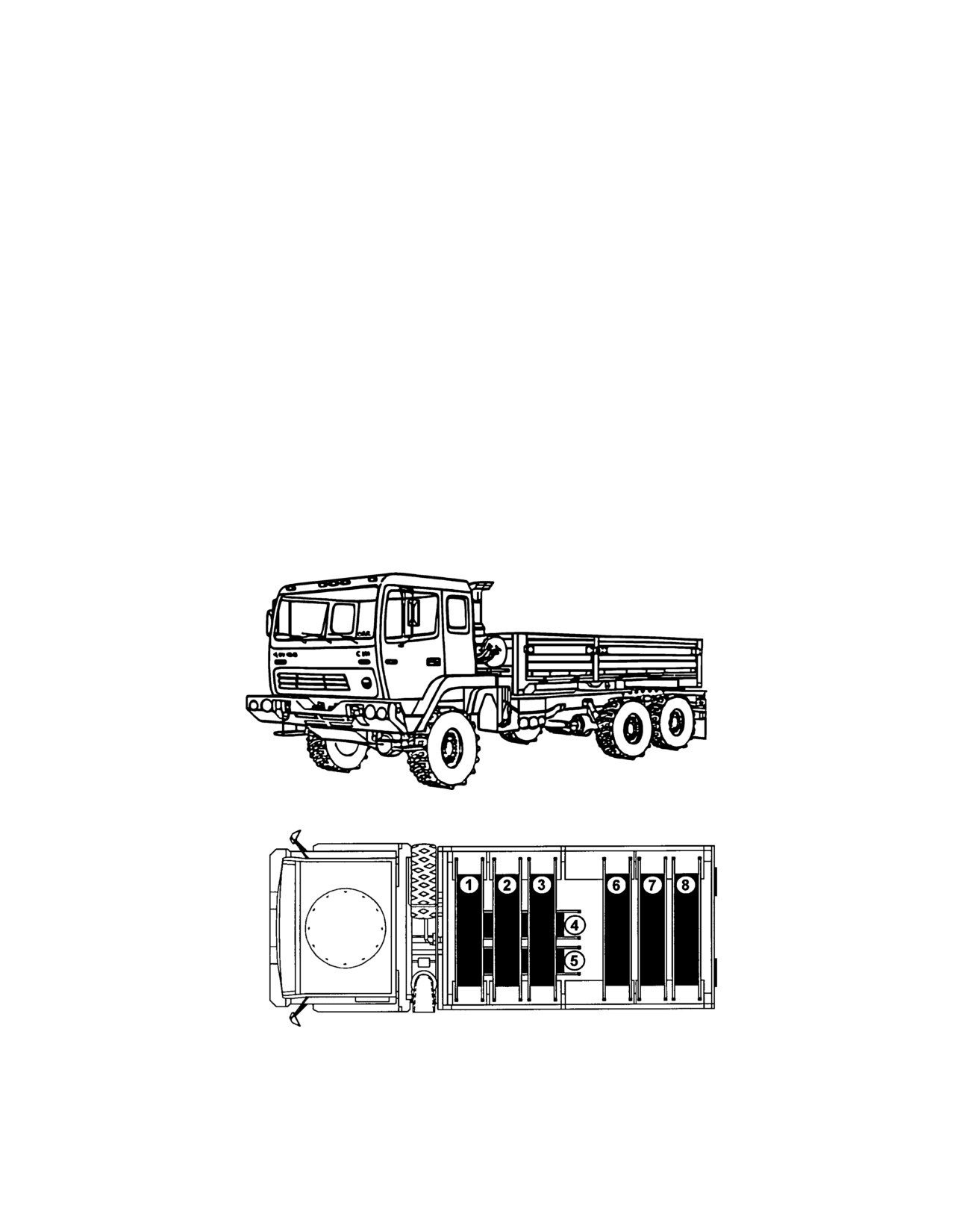
10-19. Truck, Cargo, Medium Tactical Vehicle, Light Vehicle Air Drop/Air Delivery, 5 Ton, M-1093
The 5-ton truck is normally used to transport general cargo as well as personnel. It has a canvas cover,
removable tarpaulin braces, and hinged sideboards. The canvas cover and braces need not be removed for
patient loading and unloading. This vehicle has a maximum capacity of 8 litter and 14 ambulatory patients.
a. Use the following steps to load patients (Figure 10-21a) into this vehicle.
(1) Lower the seats and secure the vertical support bracket into place.
(2) Place three litters (litter numbers 1 through 3) crosswise on the seats, forward, next to
the cab. Secure the litters individually to the seats.
(3) Place two litters (litter numbers 4 and 5) lengthwise on the floor, forward toward the
cab, feet first. Secure the litters together and to the vertical seat support.
10-30
FM 8-10-6
(4) Place litter number 6 crosswise on the seats near the rear of the vehicle. Slide the litter
as far forward as possible. Do not secure the litter at this time.
(5) Place litter number 7 crosswise on the seats near the rear of the vehicle and slide it
forward as in step (4) above. Secure the litter to the seats.
(6) Place litter number 8 crosswise on the seats as far rearward as possible. Secure the litter
to the seats.
(7) Glide litter numbers 6 and 7 rearward next to litter number 8. Secure the litters to the
seats.
(8) Raise and secure the tailgate.
b. The combat medic/combat lifesaver rides in the center of the vehicle to monitor the patients.
Figure 10-21a. Loading the truck, cargo, MTV, LVAD/AD, 5 ton, M-1093.
10-31
FM 8-10-6
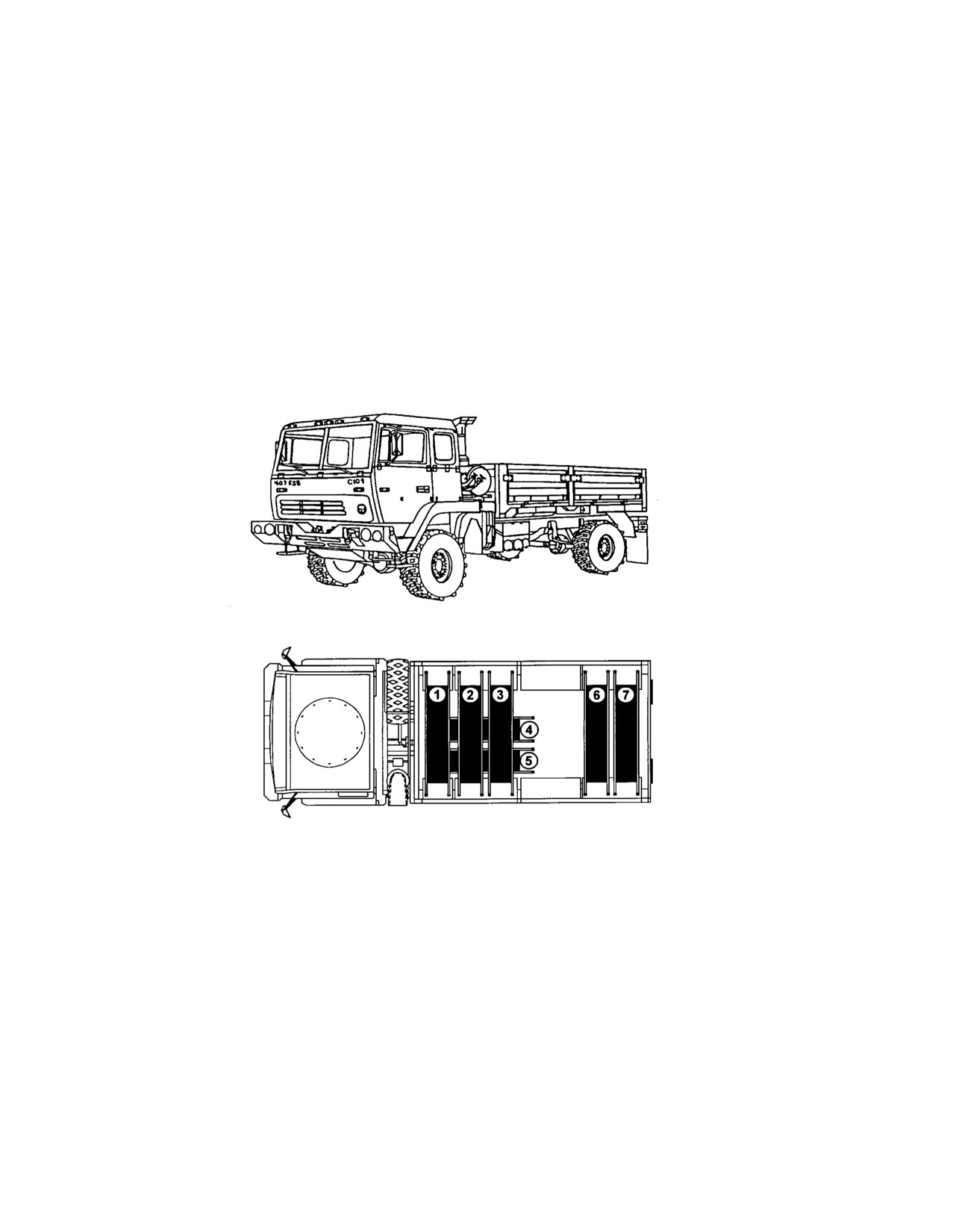
10-20. Truck, Cargo, Light Medium Tactical Vehicle, Light Vehicle Air Drop/Air Delivery, 21/2 Ton,
M-1081
The 21/2-ton truck is normally used to transport general cargo and personnel. It has a canvas cover,
removable tarpaulin braces, and hinged sideboards. The canvas cover and braces need not be removed for
patient loading and unloading. This vehicle has a maximum capacity of 7 litter and 12 ambulatory patients.
a. Use the following steps to load patients (Figure 10-21b) into this vehicle.
Figure 10-21b. Loading the truck, cargo, LMTV, LVAD/AD, 21/2 ton, M-1081.
(1) Lower the seats and secure the vertical support bracket into place.
(2) Place three litters (litter numbers 1 through 3) crosswise on the seats, forward, next to
the cab. Secure the litters individually to the seats.
(3) Place two litters (litter numbers 4 and 5) lengthwise on the floor, forward toward the cab,
feet first. Secure the litters together and to the vertical seat support.
(4) Place litter number 6 crosswise on the seats near the rear of the vehicle. Slide the litter
as far foward as possible. Do not secure the litter at this time.
10-32
FM 8-10-6
(5) Place litter number 7 crosswise on the seats as far rearward as possible. Secure the litter
to the seats.
(6) Slide litter number 6 rearward next to litter number 7. Secure the litter to the seats.
(7) Raise and secure the tailgate.
(8) The aidman rides in the center of the vehicle to monitor the casualties.
b.
The combat medic/combat lifesaver rides in the center of the vehicle to monitor the patients.
Section III. EVACUATION BY MEDICAL AIR AMBULANCES
10-21. General
Aeromedical evacuation is accomplished by both helicopter and fixed-wing aircraft. Dedicated aeromedical
evacuation assets permit en route patient care. This care minimizes further injury to the patient and
decreases mortality.
10-22. Advantages of Aeromedical Evacuation
Evacuation by aircraft is considered advantageous for a variety of reasons.
a. The speed with which the patient can be evacuated by air to an MTF ensures the timeliness of
treatment, thus contributing to
Saving lives.
Reducing permanent disability.
Increasing the number of patients returned to duty.
b. The range and speed of aircraft make it possible to evacuate patients by air over relatively long
distances in short periods of time. This requires the less frequent displacement of MTFs.
c.
Helicopters can move patients quickly over terrain where evacuation by other means would be
difficult and perhaps impossible to accomplish. The minimum landing area required for helicopters permits
patients to be picked up well forward and delivered to the supporting MTFs.
d. Because of the speed, range, flexibility, and versatility of aeromedical evacuation, patients can
be moved directly to the MTF best equipped to deal with their condition.
10-33
FM 8-10-6
e.
The selectivity in the use of MTFs made possible by aeromedical evacuation procedures
permits economy in the use of these facilities. Fewer specialty treatment teams are required because of the
capability to rapidly evacuate patients to hospitals with the required specialties. Hospitals are required to
move less often, thereby reducing periods of noneffectiveness during movement and reestablishment.
10-23. Responsibilities for Loading
The commander who originates the patient evacuation request is responsible for delivering the patient to the
landing site and for loading him aboard the aircraft. The actual loading is supervised by aeromedical
evacuation personnel. In airhead operations, patients are normally transported by vehicle or litter bearers to
designated points within the perimeter of the airhead where evacuation aircraft may be available.
10-24. Army Air Ambulances
Helicopters are rotary-wing aircraft capable of horizontal, vertical, lateral, and hovering flight. Their
ability to circumvent terrain and obstacles, and the minimum requirements for takeoff and landing enable
them to operate from areas inaccessible to fixed-wing aircraft or surface vehicles. The helicopters
capability of flight at relatively slow speeds permits operations during periods of reduced ceiling and
visibility. Helicopters are organic to the air ambulance units and aviation units of the division and corps.
Military helicopters are designated by a combination of letters and numbers which are used to identify the
basic mission and type: observation helicopter (OH), utility helicopter (UH), and cargo/transport helicopter
(CH). The last two classes of helicopters can be used for the air evacuation of litter patients.
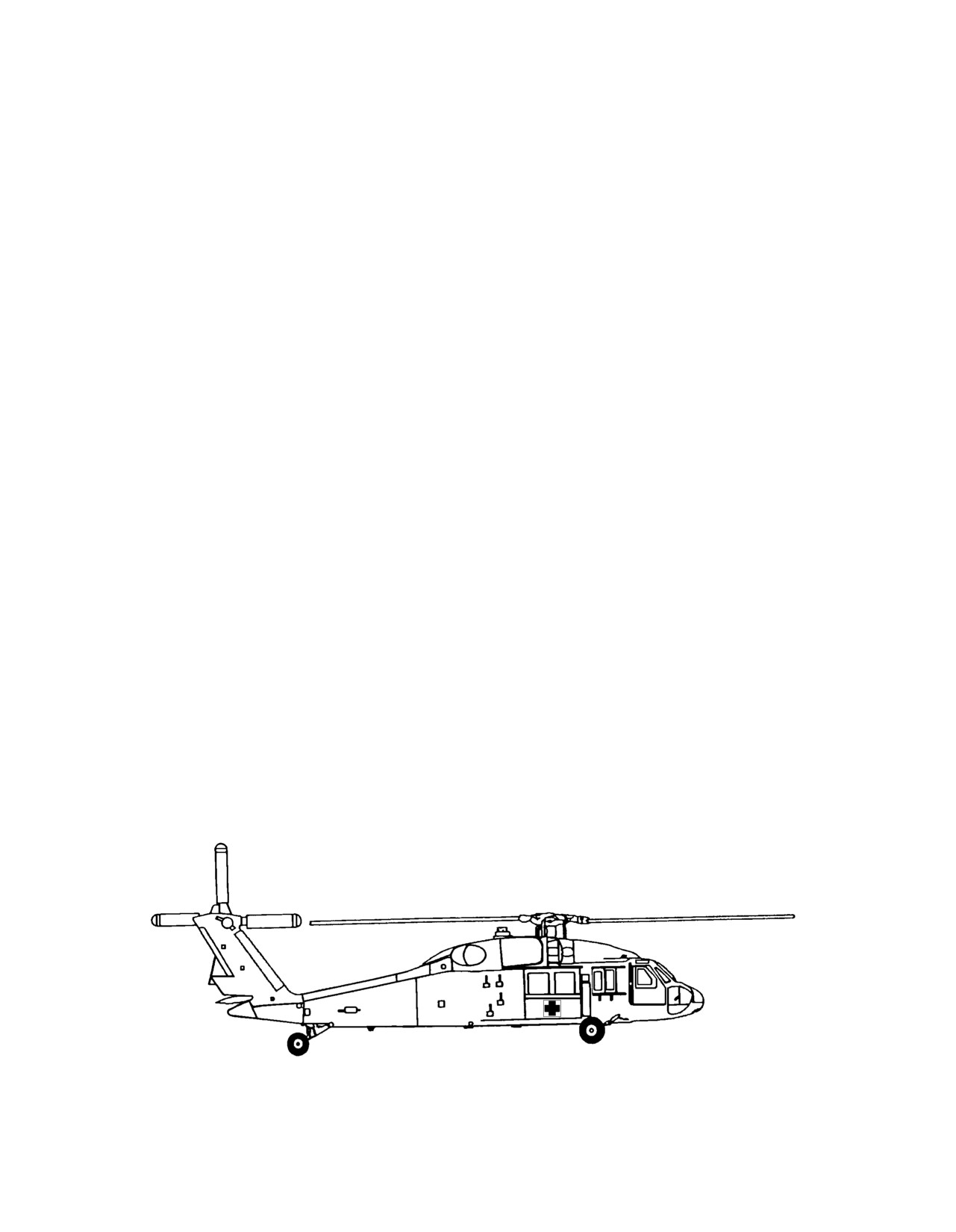
a. The UH-60A Blackhawk (Figure 10-22). This helicopter is used as the primary dedicated air
ambulance. The normal configuration for aeromedical evacuation provides for four litter patients and one
ambulatory patient. The maximum configuration provides for six litter patients and one ambulatory patient,
or seven ambulatory patients.
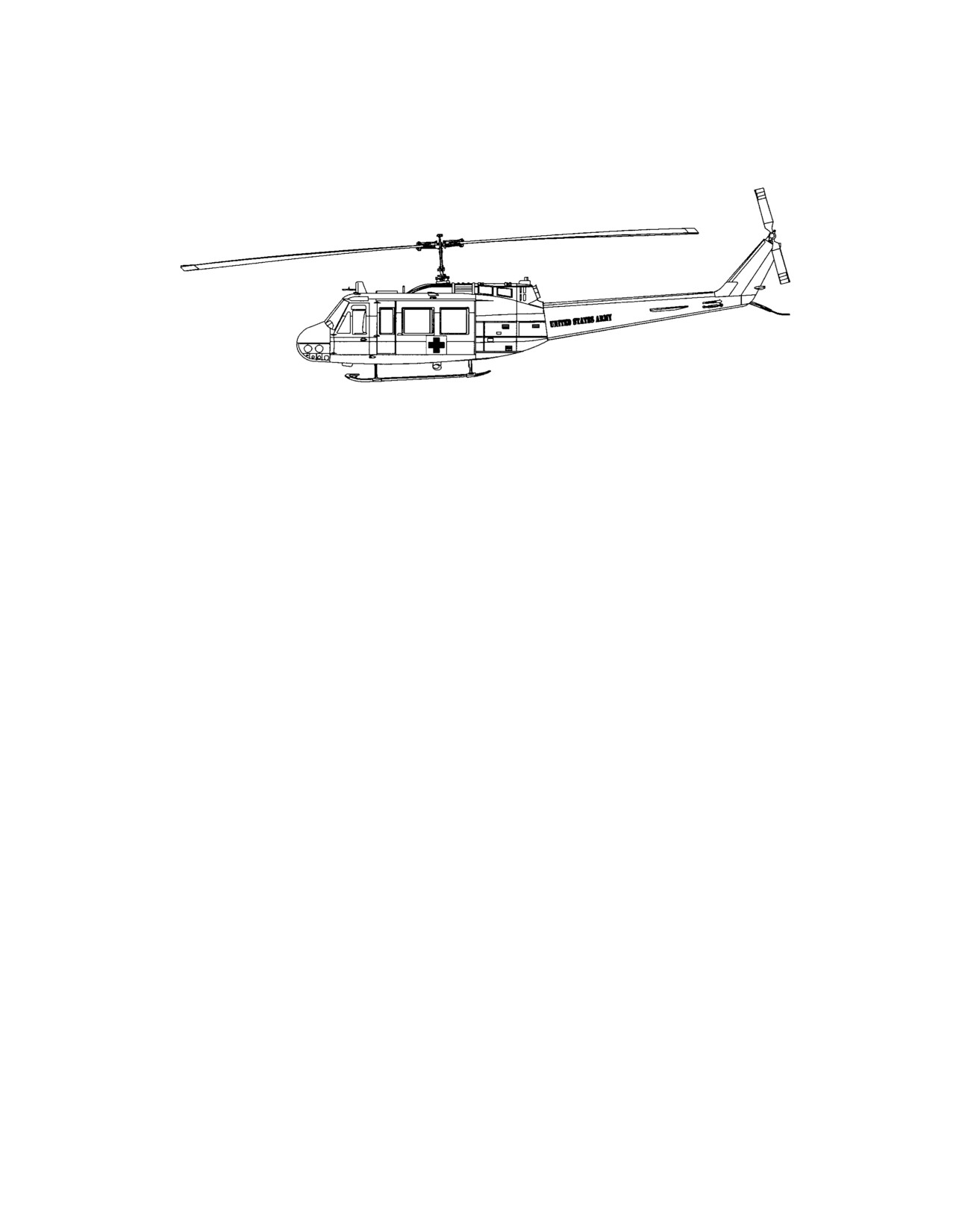
b. The UH-1H/V Iroquois (Figure 10-23). This aircraft also is used as a dedicated air ambulance.
The normal evacuation configuration provides for three litter and four ambulatory patients. The maximum
patient configuration provides for six litter patients or nine ambulatory patients.
Figure 10-22. UH-60A Blackhawk.
10-34
FM 8-10-6
Figure 10-23. UH-1H/V Iroquois.
10-25. Helicopter Landing Sites
a. Responsibility. The unit requesting aeromedical evacuation support is responsible for selecting
and properly marking the helicopter LZ.
b. Criteria for Landing Sites.
The helicopter LZ and the approach zones to the area should be free of obstructions.
Sufficient space must be provided for the hovering and maneuvering of the helicopter during landing and
takeoff. The approach zones should permit the helicopter to land and take off into the prevailing wind
whenever possible. It is desirable that landing sites afford helicopter pilots the opportunity to make shallow
approaches.
Definite measurements for LZs cannot be prescribed since they vary with temperature,
altitude, wind, terrain, loading conditions, and individual helicopter characteristics. The minimum
requirement for light helicopters is a cleared area of 30 meters in diameter with an approach and departure
zone clear of obstructions.
c.
Removing or Marking Obstructions. Any object (paper, cartons, ponchos, blankets, tentage,
or parachutes) likely to be blown about by the wind from the rotor should be removed from the landing
area. Obstacles, such as cables, wires, or antennas at or near LZs, which cannot be removed and may not
be readily seen by a pilot, must be clearly marked. Red lights are normally used at night to mark all
obstacles that cannot be easily eliminated within a LZ. In most combat situations, it is impractical for
security reasons to mark the tops of obstacles at the approach and departure ends of a LZ. If obstacles or
other hazards cannot be marked, pilots should be advised of existing conditions by radio.
NOTE
In a training situation or at a rear area LZ, red lights should be used
whenever possible to mark obstructions.
10-35
FM 8-10-6
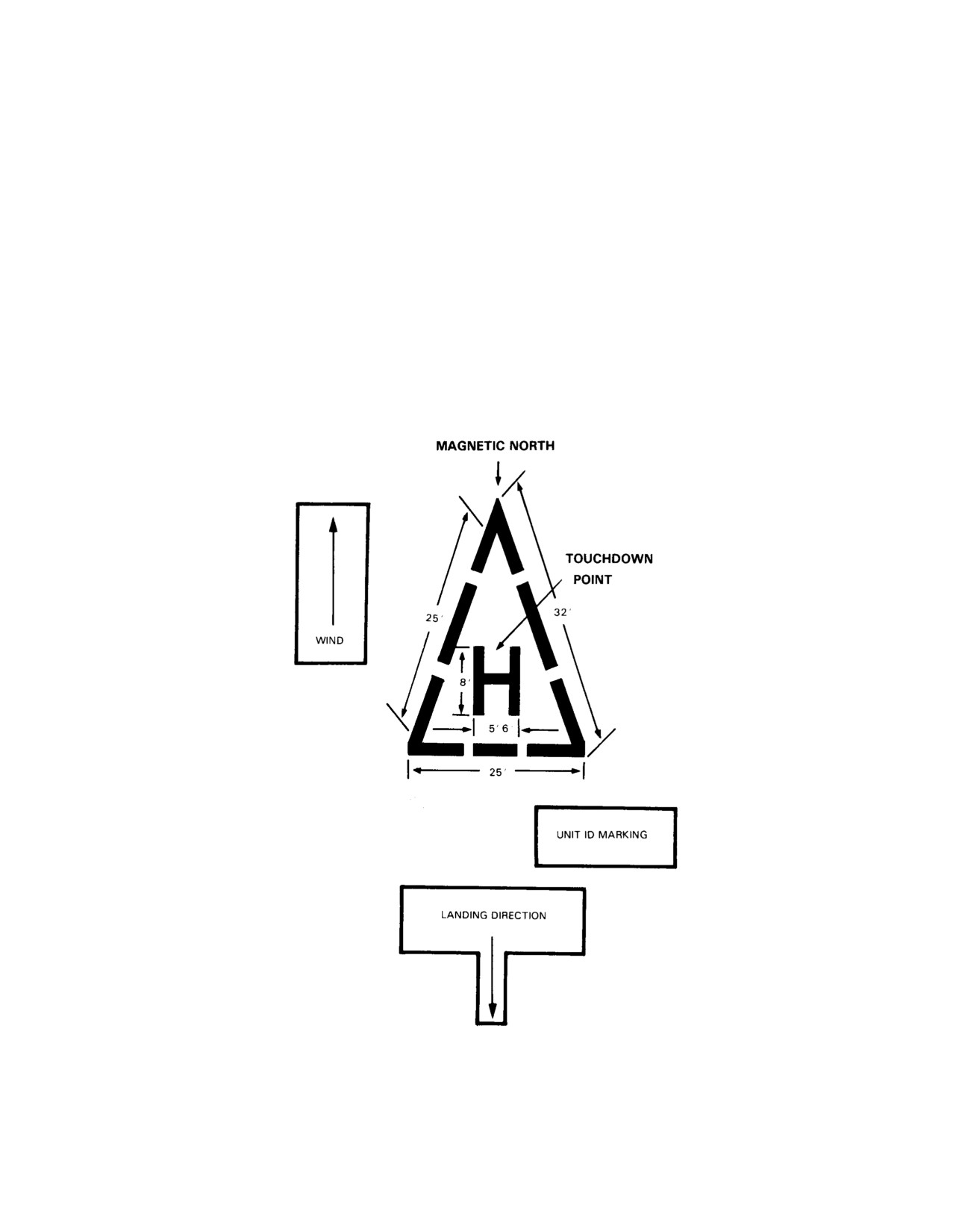
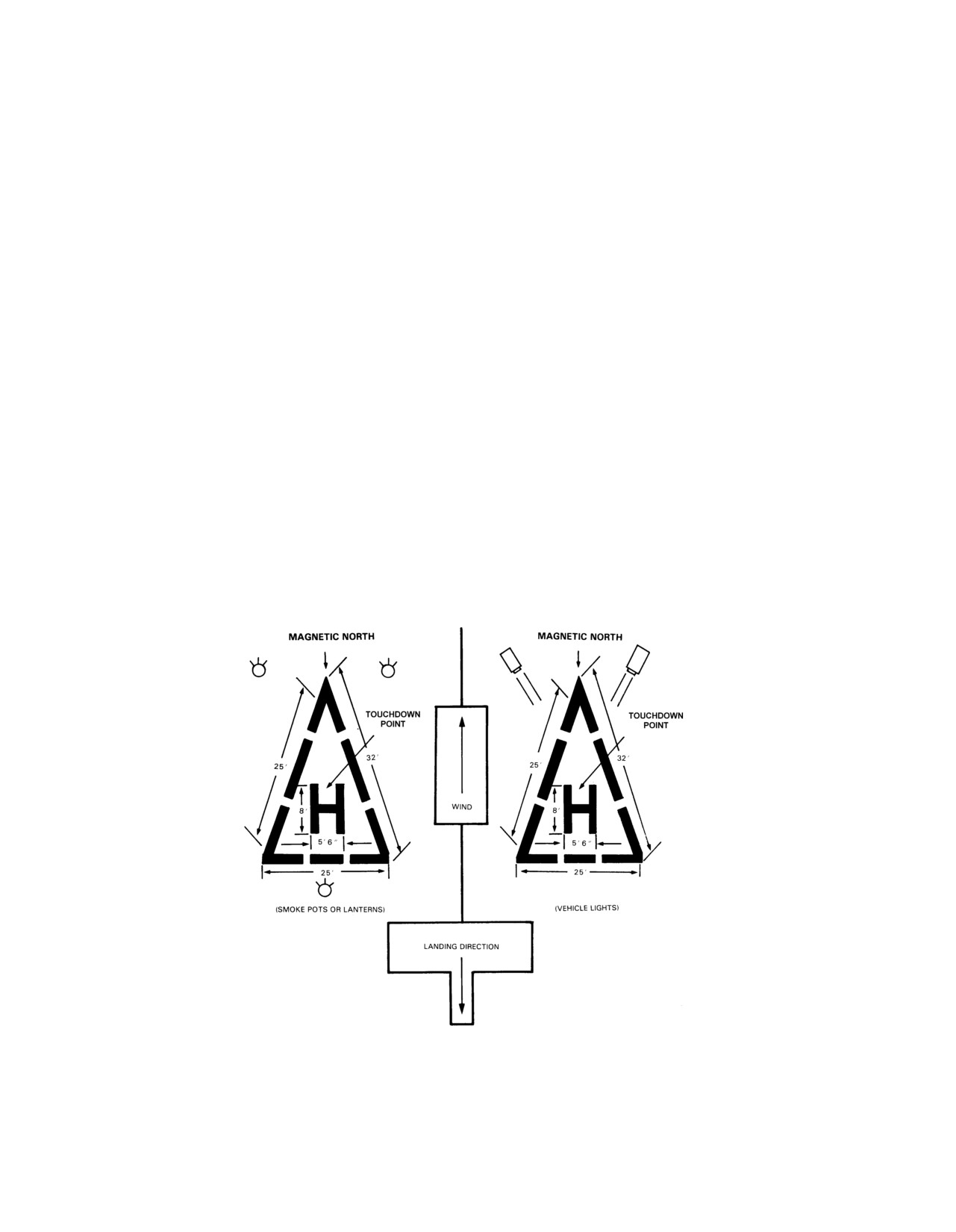
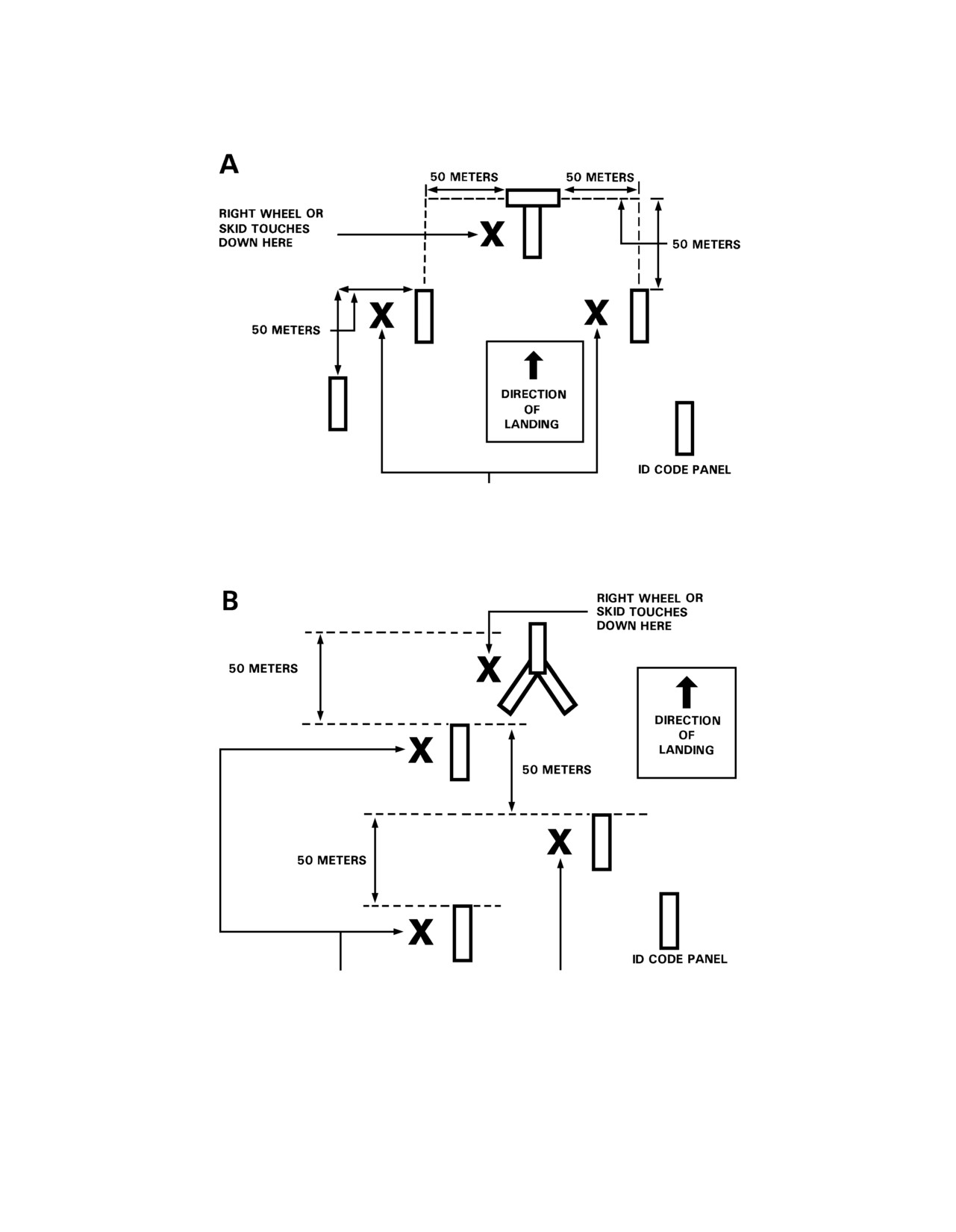
d. Identifying the Landing Site (Figures 10-24 through 10-28).
(1) When the tactical situation permits, a landing site should be marked with the letter H
or an inverted Y, using identification panels or other appropriate marking material. Special care must be
taken to secure panels to the ground to prevent them from being blown about by the rotor wash. Firmly
driven stakes will secure the panels tautly; rocks piled on the corners are not adequate.
(2) If the tactical situation permits, the wind direction may be indicated by a
Small wind sock or rag tied to the end of a stick in the vicinity of the LZ.
Man standing at the upwind edge of the site with his back to the wind and his arm
extended forward.
Smoke grenades that emit colored smoke as soon as the helicopter is sighted.
Smoke color should be identified by the aircrew and confirmed by ground personnel.
(3) In night operations, the following factors should be considered:
(a) One of the preferred methods to mark a landing site for aircrews using NVGs is to
place a light, such as an infrared chemical light, at each of the four corners of the usable LZ. These lights
should be colored to distinguish them from other lights which may appear in the vicinity. A particular color
can also serve as one element in identifying the LZ. Flare pots or other types of open lights should only be
used as a last resort. They usually are blown out by the rotor downwash. Further, they often create a
hazardous glare or reflection on the aircrafts windshield. The site can be further identified using a coded
signal flash to the pilot from a ground operator. This signal can be given with the directed beam of a signal
lamp, flashlight, vehicle lights, or other means. When using open flames, ground personnel should advise
the pilot before he lands. Burning material must be secured in such a way that it will not blow over and start
a fire in the LZ. Precautions should be taken to ensure that open flames are not placed in a position where
the pilot must hover over or be within 3 meters of them. The coded signal is continuously flashed to the
pilot until recognition is assured. After recognition, the signal operator, from his position on the upwind
side of the LZ, directs the beam of light downwind along the ground to bisect the landing area. The pilot
makes his approach for landing in line with the beam of light and toward its source, landing at the center of
the marked area. All lights are displayed for only a minimum time before arrival of the helicopter. The
lights are turned off immediately after the aircraft lands. Blue and green light sources should only be used
as a last resort; the filter on the NVGs may make them difficult to detect.
(b) When standard lighting methods are not possible, pocket-sized white (for day) or
amber (for night) strobe lights are excellent means to aid the pilot in identifying the LZ.
(c) During takeoff, only those lights requested by the pilot are displayed; they are
turned off immediately after the aircrafts departure.
(4) When the helicopter approaches the LZ, the ground contact team can ask the pilot to turn
on his rotating beacon briefly. This enables the ground personnel to identify the aircraft and confirm its
10-36
FM 8-10-6
position in relation to the LZ (north, south, east, or west). The rotating beacon can be turned off as soon as
the ground contact team has located and identified the aircraft. The ground contact team helps the pilot by
informing him of his location in relation to the LZ, observing the aircrafts silhouette, and guiding the
aircraft toward the LZ. While the aircraft is maneuvering toward the LZ, two-way radio contact is maintained
and the type of lighting or signal being displayed is described by the pilot and verified by ground personnel
via radio. The signal should be continued until the aircraft touches down in the LZ.
Figure 10-24. Semifixed base operations (day).
10-37
FM 8-10-6
(5) The use of FM homing procedures can prove to be a valuable asset, especially to troops
in the field under adverse conditions. Through the use of FM homing, the pilot can more accurately locate
the ground personnel. The success of a homing operation depends upon the actions of the ground
personnel. First, ground personnel must be operating an FM radio which is capable of transmitting within
the frequency range of 30.0 to 69.95 megahertz; then they must be able to gain maximum performance
from the radio (refer to appropriate technical manual for procedure). The range of FM radio communica-
tions is limited to line of sight; therefore, personnel should remain as clear as possible of obstructions and
obstacles which could interfere with or totally block the radio signals. Ground personnel must have
knowledge of the FM homing procedures. For example, when the pilot asks the radio operator to key the
microphone, he is simply asking that the transmit button be depressed for a period of 10 to 15 seconds.
This gives the pilot an opportunity to determine the direction to the person using the radio.
NOTE
When using FM homing electronic countermeasures, the possible site
detection of LZs by means of electronic triangulation presents a
serious threat and must be considered.
Figure 10-25. Semifixed base operations (night).
10-38
FM 8-10-6
ADDITIONAL TOUCHDOWN POINTS AS REQUIRED
FOR OTHER HELICOPTERS IN THE FORMATION
ADDITIONAL TOUCHDOWN POINTS AS REQUIRED
FOR OTHER HELICOPTERS IN THE FORMATION
Figure 10-26. Field expedient landing zone (day).
10-39