FM 8-10-6 MEDICAL EVACUATION IN A THEATER OF OPERATIONS TACTICS, TECHNIQUES, AND PROCEDURES - page 11
FM 8-10-6
Moderate Risk. There is the probable occurrence of minor, nonlife-threatening personnel
injuries and equipment damage in medium risk operations. These operations have a remote possibility that
severe injury or death will occur. These operations require complete unit involvement.
High Risk. In high risk, mission capabilities are significantly degraded and there is a
probability that severe personnel injuries, death, and major equipment damage will occur.
Extremely High Risk. In this level, the unit will be unable to accomplish its mission and
there is the probability that mass casualties or deaths will occur, plus the complete destruction of equipment.
L-7. Factors to Consider in Risk Assessment
Some factors which might be considered in the risk assessment process are presented in this paragraph.
This is not a complete listing of all factors which should be considered, but rather some of the more routine
categories. Factors for each mission will be dependent to some respect on the actual mission and where it is
to be executed.
a. Level of Activity. This can include both individual and unit activity. With regard to the
individual, it can include the type of activity (such as heavy, physical labor or sedentary desk work) or the
pace required (such as continuous work with few, if any, breaks). With regard to the level of unit activity,
it can include the operational tempo (OPTEMPO) (such as a mass casualty situation or the slower pace of
performing routine hospital transfers between corps hospitals) or the phase of the operation (such as setting
up or disestablishing the unit area, reinforcing hasty defensive positions, or the unit standing down).
b. Inherent Dangers of Equipment Used. Inherent dangers of the equipment used by the unit can
include the potential for accidents if the equipment is used/stored improperly, or if it is not working
correctly. In medical units if the medical equipment is not correctly calibrated or is otherwise malfunction-
ing, it presents a danger, not only to the operator but also to the patient (such as an improperly stored
oxygen cylinder aboard the ambulance, or, an improperly calibrated x-ray machine at the clearing station).
Further, in the unit there is an abundance of medical and nonmedical equipment which could cause fires or
explosions, resulting in collateral damage to personnel or equipment if the equipment malfunctions.
c.
Hazardous Materials Used or Produced. In medical units, there are numerous hazardous
materials that are used to perform unit functions or produced as a byproduct of the mission (medical waste).
Units must ensure that hazardous materials are properly handled and disposed of to ensure that they do not
create a hazard for medical personnel, patients, and the environment.
d. Environmental Concerns. Environmental concerns encompass a number of areas which must
be considered by a medical unit. Extremes in temperature can cause heat/cold injuries to medical personnel
and increase the patient workload. Commanders must ensure that areas occupied by soldiers/units are free
from industrial contamination, such as that found around chemical plants, petroleum storage areas, or iron
foundries. Terrestrial elevations upon which operations are conducted can lead to mountain illness and
increased numbers of impact injuries. Medical evacuation operations can be further complicated by having
to rely on litter evacuation methods when traversing rugged terrain. Commanders must also consider the
L-6
FM 8-10-6
effect of the mission on the environment. Such effects can cause an imbalance in the ecosystem, which may
lead to unhealthful conditions for soldiers. (Refer to TC 5-400 for information on evaluating environmental
risks.)
e.
Availability of Protective Equipment. This factor includes items common to all military units
(such as fire extinguishers, MOPP gear, or earplugs) as well as items which are primarily found in medical
units (such as patient protective wraps and items used for universal protective measures). Medical units
must consider the equipment available to the unit members as well as that required for the patients in their
care.
f.
Accident Frequency. The commander should focus on what types of accidents occur in the
unit, their frequency, and areas in which they occur. If the frequency of accidents increases or if the
accidents continue to occur in one operational area, it may be necessary to tighten control measures in these
specific areas while instituting more generalized measures throughout the other operational areas. Accidents
can include vehicle/aircraft accidents, accidents involving the loading and unloading of litters from
evacuation platforms, or injuries resulting from litter evacuation operations conducted over rugged or
swampy terrain.
g. Supervision. Supervision can serve as a control measure in areas where the frequency of
accidents and/or other indications of hazards exist. The lack of supervision or inadequate supervision can
result in an increase of hazards and accidents. The commander is challenged by the need to decrease
hazards, but not stifle productivity. Supervision in medical evacuation operations can include ensuring
route reconnaissance is performed, providing strip maps to decrease the likelihood of ambulance crews
becoming lost, and ensuring that medical evacuation operations are synchronized with the fire support plan
to decrease the likelihood of fratricide from friendly fire.
h. Weather. Weather conditions can increase the hazards of accomplishing the CHS mission as
they may make it difficult to accomplish tasks. Adverse weather conditions increase the risk associated with
operating equipment/vehicles/aircraft. For example: Weather which impacts adversely on the use of air
ambulances results in increasing the patient load and the number of missions which are accomplished by
ground ambulances. In mountain operations, where the means of evacuation is by litter carries or pack
animals, severe weather (freezing temperatures and snow) may require a halt in medical evacuation
operations. This delay may require that warming stations be improvised along the evacuation route to
provide relief to patients and litter bearers.
i.
Operational Conditions. These will vary with each mission. Units operating in remote
locations or in underdeveloped areas have a higher potential of exposure to endemic and epidemic diseases
(medical threat). Unimproved roads, rudimentary sanitation, and difficult terrain coupled with extremes in
weather can create hazards not previously experienced in the operation.
j.
Condition of Personnel. Soldiers who are well conditioned physically, acclimated to the
climate in the operational area, well trained, and motivated perform tasks to a higher standard than do
soldiers who are not. Continuous operations which restrict the amount of rest soldiers receive, strenuous
activity in soldiers who are not acclimated to the climate, untrained and unmotivated soldiers, and those
who are not physically well conditioned are some factors which can result in
L-7
FM 8-10-6
More frequently occurring accidents.
Job performance standards not being met.
Preventive maintenance not being accomplished on unit equipment.
k.
Personnel/Organizational Proficiency. Combat health support personnel are normally well
trained within their medical specialties due to the length of training and standards required for award of
their specialties. Many CHS personnel, however, are not as familiar with field duties as they are with those
performed in table of distribution and allowance (TDA) facilities. The commander must assess how
familiar his soldiers are with the field medical equipment contained in their MESs and with the common
soldier tasks they are required to perform in the field.
l.
Adequacy of Site. The CHS commander must carefully evaluate the area assigned for the
establishment of the unit. Sufficient real estate must be allotted for establishing unit operations
(administrative areas), sleep areas, motor pools, field feeding area, helicopter landing areas, ambulance
turnaround, and maintenance operations. The unit area must be sufficiently large enough to permit
dispersion and to use the cover and concealment available at the location. Further, PVNTMED
considerations (health hazards, such as presence of disease vectors, contamination, or other field hygiene
and sanitation issues) need to carefully assessed.
m. Level of Planning. Planning for is the key to mission success and the safe operation of the
unit. Planning includes more than the planning required to support the tactical plan. Every phase of the
operation requires detailed and continuous planning to ensure that deployment, mission execution, and
redeployment are accomplished in the most efficient and safe manner possible. For example, if the unit
field sanitation plan is not developed and executed, combat ineffectiveness can result from the spread of
disease and contamination.
n. Complexity of Movement. When a unit is deploying or redeploying, a number of transportation
means may be used to accomplish the move (such as by rail to a port of embarkation, by ship to the port of
debarkation, or by convoy from the port of debarkation to the operational area). Each of these modes of
transportation have special requirements to ensure that the personnel, vehicles, and equipment are safely
transported from one point to another. The commander must evaluate the plan for the move, assess the
hazards it presents, and institute controls to ensure the move is accomplished in a safe manner. This same
planning and hazard assessment is required for moves of much smaller scope (using one transportation
means, such as ground ambulances). An example is the forward-siting corps of ground ambulances at the
Echelon II facility in the division rear.
o. Adequacy of Directions Given. Leaders must always ensure that the directions they give are
clear and complete and that the soldiers receiving the directions understand what they are expected to do.
Accidents, substandard job performance, and mission failure can result if the personnel performing the tasks
do not understand what they are to do, when they are to do it, and how they are to do it.
L-8
FM 8-10-6
APPENDIX M
MULTINATIONAL OPERATIONS
M-1. General
Multinational operations are those military actions which encompass two or more countries. These
operations serve two purposes. First is the simple combination of numbers. Countries associate themselves
in military operations to bring their separate military forces together into a more powerful combined force.
Increasingly, however, multinational operations serve a political purpose. Their combined efforts lend
legitimacy to the enterprise, demonstrating broad international approval of the operation. For example, in
the Persian Gulf War of 1991 (Operation DESERT STORM), even token military contributions by small
countries added their moral and political backing to the international effort to force Iraq out of Kuwait.
M-2. Alliances and Coalitions
There are two types of multinational forces: alliances and coalitions. These forces must create a structure
that meets the needs, diplomatic realities, constraints, and objectives of the participating nations.
a. Alliances. Alliances are long-standing agreements between or among nations for the attainment
of broad, long-term objectives. An example of an alliance is the NATO.
b. Coalitions. Coalitions, on the other hand, are ad hoc agreements between two or more nations
for a common action (the attainment of a short-term objective).
M-3. Command Structure of Multinational Forces
a. Alliances.
(1) Alliances are characterized by years of cooperation among nations. In alliances
Agreed-upon objectives exist.
Standard operating procedures have been established.
Appropriate plans have been developed and exercised among the participants.
A developed TO exists, some equipment interoperability exists, and command
relationships have been firmly established.
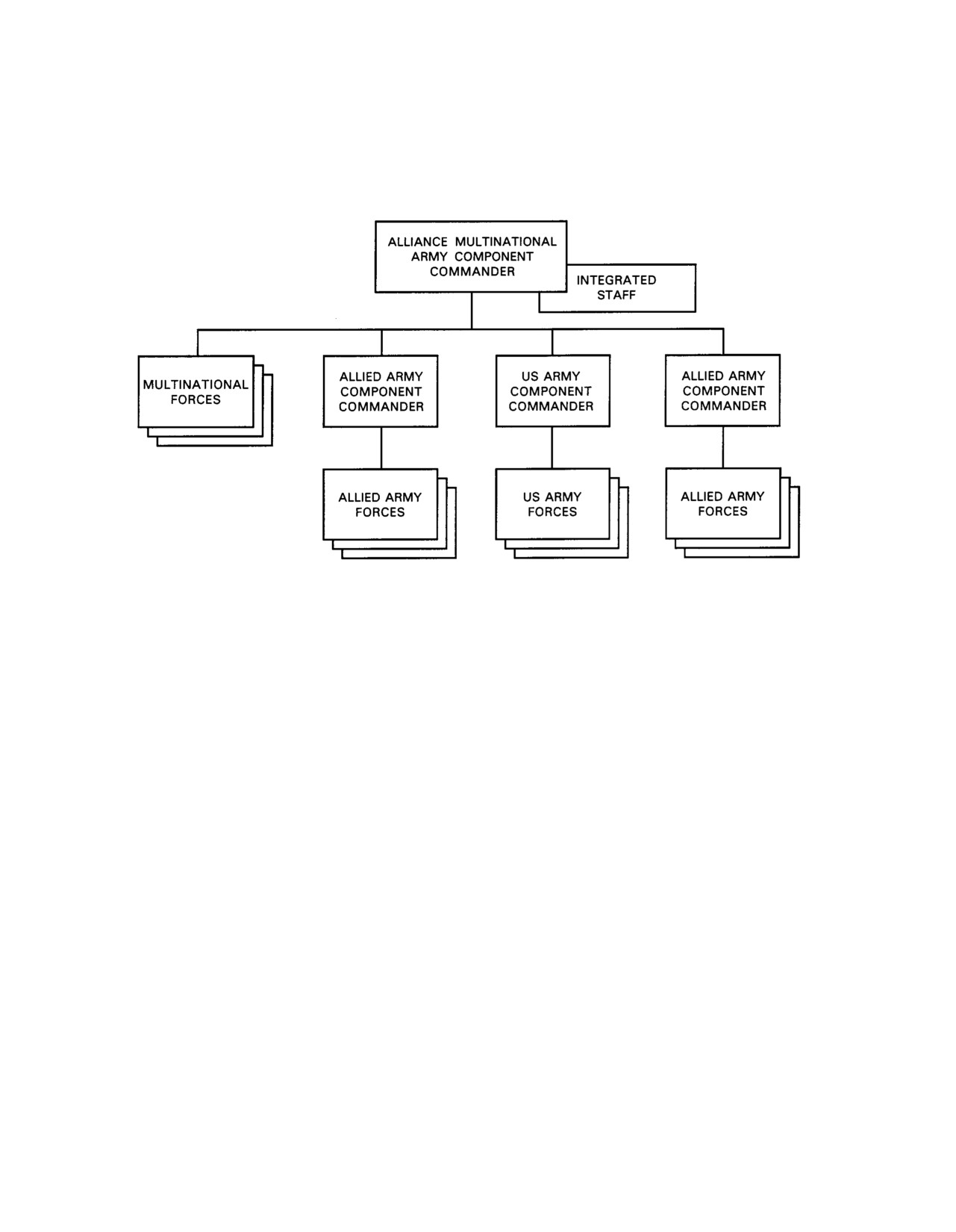
(2) Alliances are normally organized under an integrated command structure that provides
unity of command in a multinational setting. The key ingredients in an integrated alliance command are
that a single commander will be designated, that his staff will be composed of representatives from all
member nations, and that subordinate commands and staffs will be integrated to lowest echelon necessary
to accomplish the mission. Figure M-1 depicts a multinational alliance under an integrated command
structure.
M-1
FM 8-10-6
Figure M-1. Multinational army command structure alliance (national subordinate formations).
(3) Another form of alliance is the lead nation command structure. This structure may exist
in a developing alliance when all member nations place their forces under the control of one nation. This
means that the lead nations procedures and doctrine form the basis for planning and coordinating the
conduct of operations. Although this type of arrangement is unusual in a formal alliance, such a command
structure may have advantages under certain treaty circumstances. A lead nation command in an alliance
may be characterized by a staff that is integrated to the degree necessary to ensure cooperation among
multinational or national subordinate army formations.
b. Coalitions. Coalitions are normally formed as a rapid response to an unforeseen crisis and, as
stated above, are ad hoc arrangements between two or more nations for a common action.
(1) During the early stages of such a contingency, nations rely upon their military command
systems to control the activities of their forces. Therefore, the initial coalition arrangement will most likely
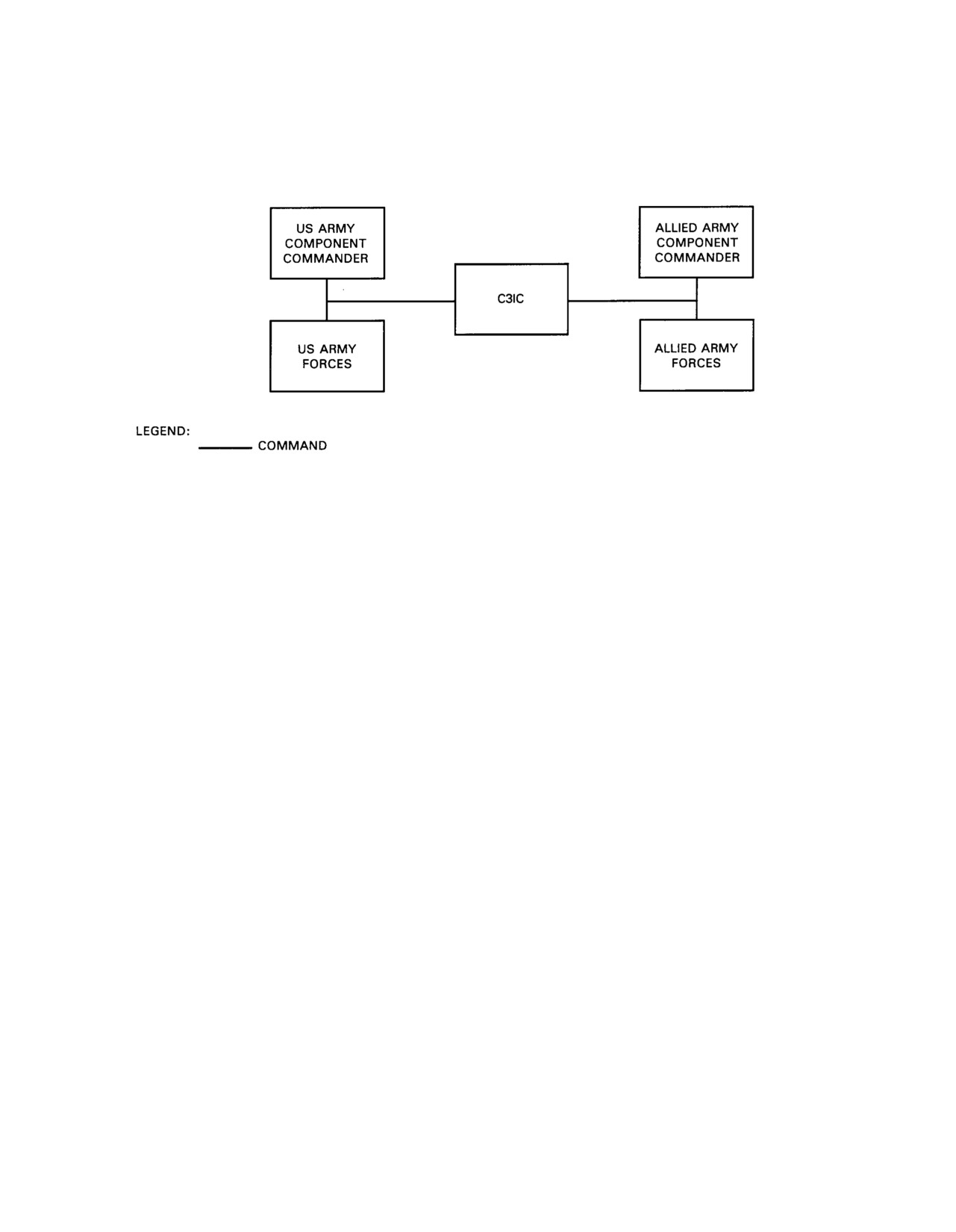
involve a parallel command structure (Figure M-2). Under a parallel command, no single multinational
army commander is designated. Usually member nations retain control of their national forces. Coalition
decisions are made through a coordinated effort among the participants. A coalition coordination,
communications, and integration center (C3IC) can be established to
Facilitate exchange of intelligence and operational information.
Ensure coordination of operations among coalition forces.
Provide a forum for resolving routine issues among staff sections.
M-2
FM 8-10-6
Figure M-2. Coalition parallel command structure (forces under national control).
(2) As a coalition matures, the members may choose to centralize their efforts through
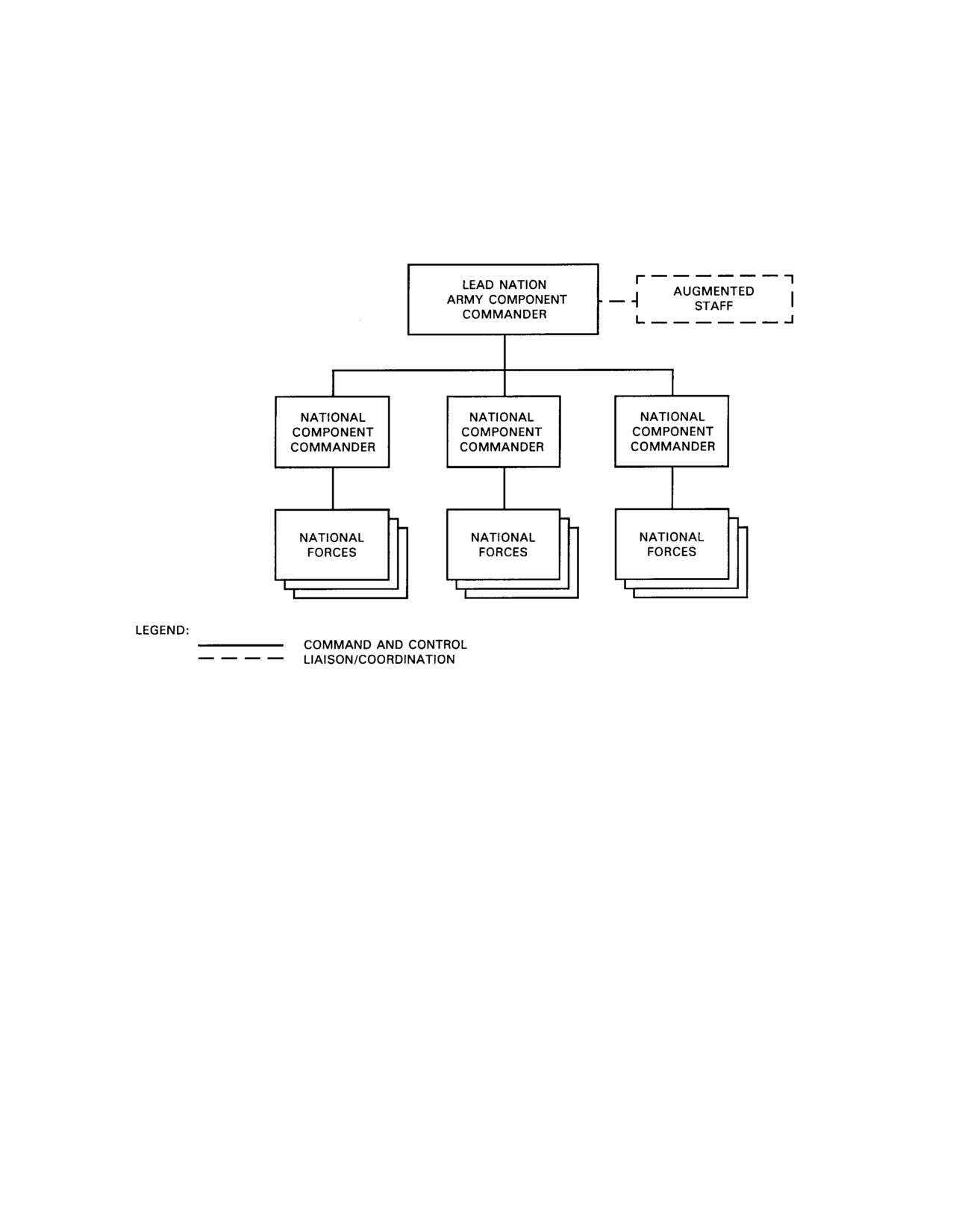
establishing a lead nation command structure (Figure M-3). A lead nation command is one of the less
common command structures in an ad hoc coalition. A coalition of this makeup sees all coalition members
subordinating their forces to a single partner, usually the nation providing the preponderance of forces and
resources. Still, subordinate national commands maintain national integrity. The lead nation command
establishes integrated staff sections, with the composition determined by the coalition leadership.
M-4. Rationalization, Standardization, and Interoperability
One of the most difficult aspects of multinational operations concerns the rationalization, standardization,
and interoperability (RSI) (defined in Glossary) of equipment, supplies, and procedures. This task is
compounded by differences in terminology, language, and doctrine.
a. Communications. To ensure mission success, it is imperative that communications are quickly
established with all participating nations.
(1) Initial communications can be facilitated by exchanging liaison officers or teams who
will provide direct interface with the participating nations. When possible, liaison personnel should be
deployed early in the planning/organization phase of the operation.
(2) Compatible communications equipment may pose a severe problem for the multinational
force. Even within joint operations, the US experiences interoperability problems with communications
equipment; these difficulties are magnified when US forces are engaged in multinational operations.
Depending upon the size of the multinational force, one nation may be required to provide communications
equipment to all elements for C2 purposes. The planning for and effective use of messengers and wire
communications may also assist in alleviating this situation.
M-3
FM 8-10-6
Figure M-3. Lead nation command structure
(augmented staff and multinational subordinate formations).
b. Standardization. Within alliances, standardization can be accomplished in many areas. The
specifications and requirements for equipment, treatment protocols, and procedures can be developed by
working groups and adopted for use by each nation. An example of this is the NATO standard litter which
can be interchangeably used in all ambulances employed by the member nations. In coalitions there is not
sufficient time permitted to reach standardization agreements of this nature. Due to the short duration and
limited purpose of these arrangements, there is usually only sufficient time to standardize principles and
time-sensitive procedures, such as report formats or radio frequencies to be used, rather than materiel
development issues.
c.
Command and Control. As coalitions are ad hoc agreements of countries sharing a common
interest, it may not be possible to establish C2 over all participants. Each nation may have its own specific
requirements which limit the authority it will permit international or national commanders to exercise over
its forces. Thus, command in the formal sense may not exist, and a system of cooperation may be required
in its place. Hasty agreements must be made to formulate workable methods. These are always specific to
the situation and must be decided by commanders and staffs, taking into consideration the mission,
requirements, and capabilities of the participating forces.
M-4
FM 8-10-6
M-5. Combat Health Support Issues
The US military has a sophisticated, state-of-the-art field health care delivery system. When engaged in
multinational operations, the US may be called upon to provide health care to the forces of allied or
coalition partners engaged in the ongoing operation. The US will always provide CHS to its own deployed
conventional forces. Factors that may impact on the delivery of this care include
a. Eligible Beneficiaries. Early in the CHS planning process, a determination must be made as to
who will be eligible beneficiaries for care in US MTFs. This determination should be made at the highest
possible level, with the advice of the staff judge advocate, as it will impact on the medical force structure to
be deployed and the expenditure of funds on Class VIII materiel required to support the eligible population.
b. Funding. The funding and/or reimbursement aspects of the operation should be clearly
delineated at the outset of the operation. Multinational operations are often conducted under the auspices of
nongovernmental agencies, such as the United Nations. The CHS planner must know what the mechanisms
for reimbursement are and what methods of resupply are to be used.
c.
Differences in Languages. Interpreters will be required to assist medical personnel in treating
soldiers from other nations who do not speak English. Department of the Army Pamphlet 40-3 provides
basic medical questions and responses in the languages of the NATO members, but must be supplemented
by locally produced guides for languages not included.
d. Endemic Disease. When treating soldiers from other nations, the health care provider must be
familiar with the endemic diseases in the soldiers native homeland. These diseases may or may not be
endemic in the AO or in CONUS. Treating soldiers with varying endemic diseases may require medications
not normally stocked by the treatment element. As these diseases may not be familiar to the health care
providers, additional consultation with specialists may be required.
e.
Religious and Cultural Differences. Religious and cultural differences will exist between the
different forces. Health care providers must be aware of any cultural norms or religious beliefs which
affect the delivery of health care. These differences may be encountered in areas such as the use of blood
and blood products or dietary restrictions. By the health care provider being aware of and considering these
cultural differences and religious beliefs, cooperation of the patient for the treatment regime may be
facilitated.
f.
Weapons of Mass Destruction Threat. Each nation will have different methods and materials
for safeguarding their troops from the effects of WMD (to include NBC). This may result in different levels
of protection for the various forces participating in the operation. The CHS planner must consider the
various levels of protection to ensure that adequate health care support can be provided in the event that
WMD are employed.
M-6. Combat Health Support Considerations
a. The CHS commander and command surgeon will be required to establish policies and
procedures which will effect the type and quantity of CHS available to the participating forces.
M-5
FM 8-10-6
b. Although this manual is primarily concerned with medical evacuation operations, this
paragraph provides CHS considerations for each of the medical functional areas (except C2). Considerations
in one area may affect the patient evacuation and medical regulating functional area. As a minimum, the
following factors should be considered
(1) Patient evacuation and medical regulating.
The evacuation policy for the theater/operation must be established during the
initial planning phase; much of the CHS force structure to be deployed is dependent upon this policy.
It must be established who will perform medical evacuation missions and what
assets (platforms and personnel) will be used.
(Is one nation the primary evacuator or will each nation
evacuate their own patients?)
It must further be determined where patients from the different member nations will
be evacuated to (such as to the nearest facility regardless of nationality or to a facility established by their
own nation).
The communications interface (type of radio, frequency, and request format) must
be standardized to facilitate the receipt of the request and expedite the dispatch of the evacuation platform.
Additional policies may be required on the exchange of litters, blankets, and other
types of medical equipment accompanying the patient, on the backhaul of Class VIII and blood on
ambulances, and on transferring a patient from one nations evacuation system to another.
Procedures for the marking of LZs and identification of requesting units (such as
the use of colored smoke) must be standardized.
Security requirements (passwords or other identification means) for ambulances
entering another nations base camp to acquire patients may be required.
(2) Hospitalization. The array of hospital assets within a TO or deployed for an operation is
dependent upon the nature and duration of the operation, the anticipated patient workload, and the theater
evacuation policy. In multinational operations, it needs to be determined which nations will provide
hospitalization and, once that is established, what capabilities these assets have. Standards of medical care,
credentialing, scope of practice, and ancillary care available will differ between participating nations. A
clear understanding of the medical capabilities of each nations facilities is an essential requirement for the
CHS planner to ensure that a duplication of services does not occur and that all elements of care are
provided for. Further, the participating nations must establish at what point a patient within the health care
delivery system of one nation will be returned to his own nations system.
(3) Combat health logistics, to include blood management. Different nations have different
standards for collecting and testing blood as well as for the production of pharmaceuticals and medical
equipment. Due to the stringent regulation of blood and blood products and the production of pharmaceu-
ticals in the US, these Class VIII items will normally only be procured through the US forces Class VIII
M-6
FM 8-10-6
system for use with US troops. Funding and reimbursement mechanisms must be identified and formalized
if the US Class VIII system is used to resupply other nations MTFs.
(4) Preventive medicine services. Preventive medicine programs are essential in reducing
morbidity and mortality due to DNBI. In a multinational force, the PVNTMED personnel must be familiar
with the cultural and religious differences of the participating nations. Field sanitation and personal hygiene
practices are not universally the same in all nations; in some nations, these practices do not exist. To ensure
that endemic diseases of a particular nation are not introduced to the other participating forces, disease
surveillance, pest management, and personal protective measure programs must be initiated and enforced.
Inspection of bivouac areas, feeding facilities, potable water supplies, and waste disposal and sanitation
facilities must be an ongoing effort. In addition, ensuring that operations are in compliance with federal,
state, local, and HN environmental laws, regulations, policies, and standards will help to prevent an
imbalance from occurring in the ecosystem.
(5) Dental services. Dental services within the multinational force may be the responsibility
of each participating nation. If care is to be provided by one nation, it would normally only consist of
emergency dental procedures to provide for the immediate relief of pain and discomfort.
(6) Area medical support. A comprehensive plan must be established to ensure that all
participants have access to medical care and services. Whether one nation provides all of the essential
services or each nation is responsible for its own care (or some combination of the two), a comprehensive
plan which delineates the access to and interconnectivity of support must be provided. Units or elements
without organic CHS resources must receive Echelons I and II support on an area support basis and these
support requirements must be incorporated into the supporting units OPLAN.
(7) Veterinary services. The AMEDD is the DOD Executive Agent for Veterinary Services
within the US Army. Its missions of ensuring food wholesomeness and quality and providing medical care
to government-owned animals are an essential service in stability operations and support operations. The
US forces may have the only deployable veterinary resources and may be required to perform their missions
for the entire multinational force.
(8) Combat stress control. Combat stress control activities may be the responsibility of each
nation as the language barrier between nations may adversely impact on consultations and treatment.
(9) Medical laboratory support. Depending on the anticipated duration of the operation,
medical laboratory support above the organic level may not be available within the theater. Procedures for
the collection and transfer of specimens/samples of suspect BW and CW agents must be standardized.
M-7
FM 8-10-6
APPENDIX N
LEADER CHECKLISTS
This appendix provides sample checklists for use by unit leaders.
N-1. Sample Format of a Command Post Operations Checklist
The CP is the CHS commanders principal facility for the C2 of his units operations.
a. General.
____ Command post is established and staffed by the battalions HHD.
____ Executive officer ensures CPs smooth operation and commanders ability to track
required information.
b. Purpose of the Command Post.
____ Receive, analyze, and disseminate information critical to the success of the battalion
mission.
____ Use journal, situation map, and information displays.
c.
Establishment and Security of the Command Post.
____ Establish barriers (concertina wire) and provide security for CP.
____ Control access of personnel into the CP.
____ Establish an entry/exit log.
____ Establish communications with higher, adjacent, and subordinate headquarters.
d. Journal.
____ Official chronological record of events of a unit or staff section during a specific period
of time.
____ Always maintain a journal unless otherwise directed by the commander.
____ Maintain the journal on DA Form 1594.
NOTE
DO NOT write logged as a description of action taken.
e.
Situational Map.
____ Graphic presentation of current situation.
____ Minimum overlays on the map include
____ Operations.
____ Obstacles/barriers.
____ Combat service support.
____ Combat health support (such as location of MTFs, medical units, evacuation assets,
AXPs, Class VIII points, and supported units).
N-1
FM 8-10-6
NOTE
Symbols used on overlays will be those authorized in FM 101-5-1.
____ The S2/S3 or S2/S3 NCOIC ensures all overlays remain up to date.
f.
Informational Display. Informational display is a chart depicting information the commander
considers critical, such as
____ Task organization.
____ Mission (units and units higher headquarters).
____ Intent.
____ Operations sketch.
____ Medical evacuation status.
____ Weather and light data.
____ Personnel status.
____ Equipment status.
____ Class VIII status.
____ Sensitive items.
____ Communications status.
____ Combat health support units and facilities.
____ Other information the commander deems appropriate.
____ Base defense plan.
g.
Importance of Journal, Situation Map, and Information Display.
____ Remember the effect of the information from these three sources on the success of the
operation.
____ Information mindlessly recorded and annotated does not provide assistance.
h.
Staffing.
____ Man the CP 24 hours per day.
____ Ensure minimum of two personnel in CP at all times.
____ Uniform inside the CP is battle dress uniform (BDU) and protective mask; ground all
other equipment.
____ Clear and store weapons in the weapons rack.
____ Place sensitive items on top of the rack.
____ Establish rest plan.
i.
Police.
____ Maintain CP in a high state of police.
____ Ensure table tops are cleared unless being worked on.
____ Clear area immediately when work is completed.
____ Report depleted supplies to the NCOIC.
N-2
FM 8-10-6
j.
Classified Documents.
____ Secure all classified documents in locked container when not in use.
____ Control access to classified documents.
____ Do not leave unattended classified documents lying on desk tops.
N-2.
Site Selection and Establishing Unit Area Checklist
a.
Site Selection Considerations.
____ Coordinate site selection and receive approval from the appropriate headquarters.
____ Anticipated length of occupancy of the location.
____ Accessibility for ground and air evacuation platforms (such as near major road networks
and accessible from different directions).
____ Away from lucrative military targets.
____ Near expected areas of patients density.
____ Is the site large enough to permit dispersal of the unit, ambulance turnaround, establish-
ment of LZ, and augmentation reinforcement, if required?
____ Does the site selected provide good hardstand and drainage?
____ What is the impact of the site on communications equipment and capabilities.
____ How much cover and concealment does the site provide?
____ Is there sufficient space downwind from the unit area to establish an LZ for contaminated
aircraft?
____ Is the site easily defensible?
b.
Establish the Unit Area.
____ Commander finalizes external layout plan.
____ Establishes perimeter defense.
____ Establishes CP.
____ Determines traffic pattern which facilitates the movement of vehicles and equipment
and avoids cross-traffic intersections.
____ Identifies ambulance turnaround points.
____ Identifies and establishes helicopter LZs (conventional and NBC contaminated)
which avoid takeoffs and landings over established unit areas.
____ Determines location of field sanitation facilities.
____ Establishes motor pool area.
____ Establishes field feeding site, if appropriate.
____ Establishes bivouac area.
____ Camouflages area when directed by appropriate authority (STANAG 2931).
____ Commander finalizes internal layout plan.
____ Determines a traffic pattern which facilitates the movement of vehicles, equipment,
and personnel.
____ Adjusts the location of operating sections to improve work flow or security.
____ Establishes communications.
____ Establishes unit and medical support areas.
N-3
FM 8-10-6
N-3.
Precombat Checklists
a.
General Considerations.
____ Leader receives the mission from the next higher headquarters.
____ Clarifies any questions.
____ Coordinates with next higher headquarters as required.
____ Leader conducts mission analysis.
____ Leader produces the
____ Restated mission statement.
____ Tentative time schedule.
____ Leader issues a warning order.
____ Unit members perform readiness, maintenance, and functional checks under the super-
vision of unit leaders.
____ Medical equipment sets.
____ Vehicles/aircraft/generators.
____ Night vision devices.
____ Communications equipment.
____ Weapons and ammunition.
____ Field sanitation equipment and supplies.
____ Any special equipment (such as hoist and forest penetrator).
____ Common table of allowances (CTA) equipment.
____ Leader makes a tentative plan.
____ Uses estimate of the situation to depict plan of support.
____ Develops COAs.
____ War games COAs.
____ Determines best COA.
____ Leader completes his plan.
____ Leader issues OPORD.
____ Leader uses sand table or sketches to depict plan of support.
____ Leader or high designated representative affects coordination for the mission.
____ Support requirements.
____ Current intelligence (to include medical threat) update.
____ Control measures.
____ Communications and signal information.
____ Time schedule.
____ Leader receives attachments/augmentation, if appropriate.
____ Attachments are oriented to unit.
____ Attachments are briefed on the mission.
____ Leader supervises CHS mission preparation.
____ Key leaders brief back unit leader.
____ Key personnel rehearsals are conducted.
____ Unit leaders
____ Supervise.
____ Inspect.
____ Ensure adequate security.
N-4
FM 8-10-6
____ Conduct brief backs.
____ Rehearse.
____ Continue coordination.
____ Unit plans for support of combat operations.
____ Analyze
____ Patient acquisition and medical evacuation requirements.
____ Area support requirements.
____ Requirements for water, Class VIII, and other supply classes.
____ Requirements for NBC defense.
____ Transportation requirements.
____ Unit leaders
____ Execute a work/rest plan based on work priorities and statutory (crew rest) require-
ments.
____ Monitor current situation.
____ Issues appropriate fragmentary orders (FRAGOs) based on intelligence or opera-
tional updates.
____ React to messages or orders from higher headquarters.
____ Execute any actions and coordination resulting from change.
____ Unit headquarters remains current on positions and missions of higher, adjacent, and
subordinate units.
b.
Precombat Checklist for Ground Ambulances.
____ Authorized MES are on hand.
____ Medical equipment is complete and serviceable.
____ Authorized medical gases (oxygen) are on hand and serviceable.
____ Authorized medications are on hand and current.
____ Packing list is available.
____ Strip maps and/or road maps are available (with overlays).
____ On vehicle equipment (OVE) is on hand.
____ Log book is present and current.
____ All drivers are licensed.
____ Situational awareness equipment (position locator) is on hand and serviceable.
____ Communications equipment is on hand and serviceable and set to correct frequency.
____ Medical unit identification markers (in accordance with the Geneva Conventions) are
displayed.
NOTE
Markers are red on a white background only; camouflaged or subdued
markers are not authorized.
c.
Precombat Checklist for Air Ambulances (Medical Aspects Only).
____ Authorized MES is on hand.
N-5
FM 8-10-6
____ Medical equipment is complete and serviceable.
____ Authorized medical gases (oxygen) are on hand and serviceable.
____ Rescue hoist and forest penetrator are installed, if required.
____ Authorized medications are on hand and current.
____ Medical unit identification markers (in accordance with the Geneva
Conventions) are displayed.
d.
Precombat Checklist on Nuclear, Biological, and Chemical Equipment.
____ Individual protective equipment is on hand and serviceable.
(One set is issued; the other
maintained in support.)
____ Protective masks are issued and serviceable.
____ Nerve agent antidote is available and distributed, if required.
____ Convulsant antidote for nerve agent is available and distributed, if required.
____ Decontamination apparatus is completed and serviceable.
____ Basic load of decontamination supplies is on hand.
____ Chemical agent alarms are on hand and serviceable.
____ M256A1 detector kits are issued.
____ Nuclear, biological and chemical contamination marking kits are distributed.
____ Chemical agent monitors are on hand, if authorized.
____ Replacement filters for protective masks are on hand.
____ Biological and chemical warfare agents prophylaxis and/or immunizations have been
accomplished, if appropriate.
____ Nerve agent pretreatment packets are available.
____ Radiac sets are on hand.
e.
Precombat Checklist for Miscellaneous Equipment.
____ Inspect binoculars.
____ Inspect camouflage nets and support systems, if appropriate.
____ Inspect night vision devices.
____ Ensure batteries are on hand and serviceable.
____ Inspect tentage.
____ Inspect global positioning systems, if available.
f.
Precombat Checklist on Personnel.
____ Ensure soldiers are in the correct uniform.
____ Ask questions to ensure that soldiers have been briefed on mission and situation.
____ Implement appropriate MOPP level.
____ Check for drivers licenses.
____ Brief soldiers on operations safety and environmental injuries.
____ Individual equipment is on hand and stowed properly.
____ Soldier has eaten and is briefed on future field feeding.
____ Identification cards and tags are on hand and serviceable.
____ Camouflage self and equipment, if required.
____ Work/rest plan (to include crew rest) is implemented.
____ Water discipline plan is implemented, if appropriate.
N-6
FM 8-10-6
g.
Precombat Checklist on Communications Equipment.
____ Radios are operational (communications check completed).
____ Telemedicine equipment is available and operational, if available.
____ Speech security equipment functions, if available.
____ Frequencies are set.
____ Matching units are operational.
____ Antennas are tied down properly.
____ Connectors are clean and serviceable.
____ TA-312 is on hand and serviceable, if appropriate.
____ Batteries are on hand and charged.
____ Manpack sets are complete.
____ Switchboard is on hand and serviceable.
____ WD-1 is on hand and serviceable.
____ Antennas and remotes are present and serviceable.
____ Signal operating instructions are available and secured.
____ Call signs, frequencies, and challenge passwords have been disseminated.
____ Perform communications check again.
h.
Precombat Checklist for Vehicles.
____ Loads are according to load plan; load plan is posted in the vehicle.
____ Hazardous cargo is properly identified and stored toward the rear of the vehicle for easy
access and inspection.
____ Ammunition is issued and properly stored.
____ Vehicle fuel tank is topped off.
____ Package POL products and small arms lubricant are present.
____ Water cans are full.
____ Meals, read-to-eat are issued and stowed.
____ First-aid kits are present and complete.
____ Operators manuals and lubrication orders are present for the vehicle, radios, and
associated equipment.
____ Critical OVE and basic issue items are present.
____ Vehicle dispatch is complete.
____ DA Form 2404 is complete.
____ No deadline deficiencies exist.
____ Before operation, PMCS has been completed.
i.
Precombat Checklist for Individual Weapons.
____ Clean and functional.
____ Cleaning tools/kits, bolts, and ruptured cartridge extractors are present.
____ Range cards are on hand.
____ Ammunition is issued, accounted for, and secured.
____ Magazines are issued.
____ Blank adapter installed, if appropriate.
____ Function check performed.
N-7
FM 8-10-6
APPENDIX O
COMBATTING TERRORISM AND FORCE PROTECTION
O-1. General
a. Preventive and protective security measures should be taken by military units and individual
soldiers to protect themselves and their ability to accomplish their mission while deployed. These measures
include OPSEC, COMSEC, and antiterrorism considerations. The commander develops an antiterrorism
plan to institute passive defense measures. The commander must constantly evaluate security plans and
measures against the terrorist threat in order to effectively identify security requirements.
b. Terrorism can occur within the US or overseas. Commanders must remain vigilant regardless
of where the unit is physically located. Unit training should include orientation to the terrorist threat and
countermeasures to be taken at both the individual and unit level.
c.
For an in-depth discussion of CHS for combatting terrorism operations, refer to FM 8-42.
O-2. Combatting Terrorism
a. Terrorism is defined as the unlawful use or threatened use of force or violence against people
or property to coerce or intimidate governments or societies, often to achieve political, religious, or
ideological objectives. Combatting terrorism consists of those actions
(including antiterrorism and
counterterrorism) taken to oppose terrorism.
b. Antiterrorism consists of those defensive measures used to reduce the vulnerability of
personnel, family members, facilities, and equipment to terrorist acts. This includes the collection and
analysis of information to accurately assess the magnitude of the threat.
(For the collection of medical
information, refer to FMs 8-10-8 and 8-42.)
c.
Counterterrorism is comprised of those offensive measures taken to prevent, deter, and respond
to terrorism. Combat health support elements are not directly involved in the counterterrorism aspects of an
operation. However, CHS elements provide traditional CHS to US and friendly forces engaged in these
operations.
O-3. Terrorism Considerations
a. As commanders and staffs address terrorism, they must consider several relevant characteristics
of terrorists and their activities. The first consideration is that anyone can be a victim.
(Some terrorists still
operate under cultural restraints, such as a desire to avoid harming women, but the planner cannot count on
that.) Essentially, there are no innocents. Secondly, attacks which may appear to be senseless and random
are not. To the perpetrators, their attacks make perfect sense. Acts, such as bombing public places of
assembly and shooting into crowded restaurants, heighten public anxiety. This is the terrorists immediate
objective. Third, the terrorists need to publicize their attack. If no one knows about it, it will not produce
fear. The need for publicity often drives the target selection; the greater the symbolic value of the target,
the more publicity the attack brings to the terrorists and the more fear it generates. Finally, a leader
O-1
FM 8-10-6
planning for antiterrorism must understand that he cannot protect every possible target all of the time. He
must also understand that terrorists will likely shift from more protected targets to less protected ones. This
is the key to defensive measures.
b. Medical units have specific protections afforded to them under the provisions of the Geneva
Conventions. The CHS commander must understand that these protections probably will not be recognized
nor adhered to by terrorist elements. The CHS commander in developing his force security plan should not
consider the Geneva Conventions as a protection from attack by terrorist elements.
c.
Terrorists rely on surprise and the victims confusion at the time of the incident. Antiterrorism
involves physical security, OPSEC, and the practice of personal protective measures by all personnel.
Commanders and staffs must plan their response to terrorist threats and incidents. Combatting terrorism is
an aspect of force protection and is the responsibility of commanders at all levels at all times. Properly
planned and executed, the Army antiterrorism program will reduce the probability of surprise while
discouraging attack by raising the risk to the attackers.
O-4. Antiterrorism Assessment
The commander and his staff complete a thorough assessment, using METT-TC and political planning
factors in developing a security assessment to determine the units vulnerability to terrorist activities. The
assessment is situationally dependent; the commander should develop his own listing of considerations.
Assessment considerations include, but are not limited to
a. Mission. An assessment of the mission is conducted to identify vulnerabilities.
What type of mission is to be conducted?
(This includes the primary and any secondary
missions the unit is tasked with. Examples of types of missions are conventional support to combat forces;
humanitarian assistance; disaster relief; domestic support; peace support; or nation assistance.)
Where is the mission to be performed?
(The mission may be conducted at the home
station [either CONUS or outside continental United States (OCONUS)]). The actual physical location and
available security should also be considered, such as within a secure compound or area; in the civilian
community [local villages, remote sites; or in the countryside]; or in a field environment.)
Is the entire unit operating together in the same location?
(The dispersion of unit
operations is a significant consideration. The more dispersed the unit is, the more difficult the task of
providing adequate security. Are all of the operations being conducted in the headquarters area? Are
ambulance teams being dispatched to unprotected locations [such as outside of the secured area]? Are
ambulance teams field sited with forward units?)
Is the unit part of a CHS TF which deployed prior to the entry of combat and CS forces?
(Is the area where the unit is deployed considered to be friendly? Are other CSS units operating within the
area? Are there any other US, allied, or coalition forces which can provide security for CHS units?)
O-2
FM 8-10-6
Is the unit tasked to provide medical evacuation support to mass casualty situations?
(Is
the unit included in the rear area protection plan? Will the unit provide medical evacuation support to
civilian mass casualty situations? In mass casualty operations resulting from a terrorist incident, what is the
potential for a follow-on attack [such as another bomb planted to go off during rescue efforts ]?)
Once deployed, does the unit mission change?
(Is there the potential for a peacetime
mission to transition to more conventional CHS to combat forces [a deteriorating political and economic
situation during a nation assistance operation may result in civil unrest with the HN requesting additional
US forces to perform a peacekeeping/peace enforcement type of operation; as additional US forces are
deployed, the in-country CHS elements transition from the nation assistance operation to conventional
support for the deployed US forces]? Are the in-county CHS resources more vulnerable to being targeted by
terrorists during the transitional phase?)
Are air ambulance assets supporting civilian and/or HN populations?
(Are the aircraft
required to land at civilian and/or unprotected airstrips? Do air ambulances need security escorts? Is there
a potential for attack of air assets by terrorist or terrorist groups?)
How are medical evacuation requests authenticated?
(What is the potential for receiving
false evacuation requests to lure air or ground evacuation assets from secured areas?)
b. Enemy (Opposition Groups or Terrorist Factions). In assessing the terrorist threat, the
commander must consider all persons, groups, or organizations that potentially pose a terrorist threat. He
must also consider whether these persons, groups, or organizations are active within the geographical area
the unit is located or the mission is conducted. Considerations include
Who are the potential terrorists?
(This includes a myriad of people, groups, and
organizations; the basis for affiliations can be anything of common interest such as race, ethnicity, labor/
profession, and the hatred of a person, group, or country or the persons/groups/organizations may be
sponsored by a nation state.)
What is known about the terrorists? (This can include what their grievances are, how are
they funded, how sophisticated is their organization, how they evade capture, what weapons do they have
access to, or other similar information.)
How do the terrorist receive information?
(The sources of information the terrorist uses
may give an indication as to the sophistication of their organization and their potential targets. Do they rely
on public information sources [radio, television, and newspapers], or do they have private sources of
information such as infiltrating public service organizations [for example, the police, armed forces, or
public utilities], or do they receive intelligence from state-sponsored sources?)
How might the terrorists attack?
(Think like the terrorists. Will they ambush or conduct
raids? Will they use snipers, mortars, rockets, air and ground attacks, suicide attacks, firebombs, or
bicycle, car, or truck bombs? Will they use WMD to include BW and CW agents?)
What is the perceived terrorist threat for use of violence?
(What is the probability the
terrorists will use violence?)
O-3
FM 8-10-6
Does the unit have routines or published operating hours?
(Do the ambulances have
routine routes that they follow? Do the ambulances provide support on a recurring basis to certain events?
Could a terrorist predict where the unit personnel and equipment/vehicles will be at a certain time on a
certain date?)
Will an attack gain sympathy for the terrorists?
(What is general feeling of the local
population concerning US military personnel, units, and equipment/vehicles/aircraft involvement in the
local area? Are US forces more likely to be targeted than a civilian agency, organization, or facility?)
c.
Terrain. The suitability of the terrain over which the unit is established and will conduct its
mission may a have significant impact on the ability of the unit to protect itself.
What are the strengths/weaknesses of the unit area and local surroundings? (This includes
the traditional concerns of site selection to ensure that the area the unit is established in affords protection
from its natural surroundings [cover, concealment, and defilade]. In an urban setting, considerations such
as how far buildings are located from streets that have public access are of extreme importance. The
bombings of the billets in Dhahran and the Embassies in Kenya and Tanzania attest to the vulnerability of
locations that do not have sufficient space to adequately protect the buildings and personnel from car and/or
truck bombs.)
What are the avenues of approach?
(Again, this pertains to both the field environment
and the urban location. As the unit limits the number of avenues of approach, it can more easily defend its
perimeter. Also, the unit should limit entry and exit points to the units AO, as well as screen personnel
desiring to gain entry. In an urban setting, is it possible to block streets running adjacent to the property
used by US forces?)
Are there tall buildings, water towers, or terrain, either exterior or adjacent to the
perimeter, that could become critical terrain in the event of an attack?
(Can overlooking buildings or towers
be cleared and access to them denied? Are there any likely sniper positions in or overlooking the operational
area? In an urban area, if possible, determine who owns and/or rents adjacent properties and if they have
any affiliation to terrorist or paramilitary groups.)
When teams must be deployed to outlying areas to accomplish their mission, what is the
condition of the roads and terrain that must be traversed (such as paved roads or unimproved dirt tracks)
and what is the potential for attack while in transit?
(Do ambulance teams need security escorts in some
areas? Have potential evacuation routes been reconnoitered? Are ambulance crews familiar with the
proposed routes? Are there alternate routes rather than having to traverse extremely rugged terrain [rugged
terrain requires reduced speeds which in turn makes ambulances more vulnerable to attack]? What is the
potential for encountering mined areas?)
Where are recreational areas located within a secure compound or in the civilian
community? (Do soldiers have to leave secured areas for recreational purposes? Are recreational events/
tournaments [such as baseball and football games] advertised to the public indicating date, time, and
location? Are recreational areas controlled by military or civilian agencies/organizations? Are social
events held in civilian facilities [restaurants/clubs]? How well advertised are the events? Are measures
O-4
FM 8-10-6
taken to ensure that only invited guests are permitted entrance? Do parking areas have security and/or
limited access? Does the composition of the guest list raise the vulnerability for terrorist attack [such as
senior ranking officers, civilian politicians, or other notables assembled in a specific area at a specific
time]?)
d. Troops. The troop factor includes both the military aspects and the personal aspects of the
deployed troops. Unit security is an important factor, however, when considering passive defense measures
to counter the terrorist threat, considerations concerning the individual soldier (and his family) is of equal
importance.
Has the individual soldier been oriented to the terrorist threat?
(The individual soldier
must be aware of personal protective measures that he can take to make himself less vulnerable to terrorist
activities [such as varying his schedule and the routes he uses going to and from work]. Further, he should
receive orientation and/or training in his role in antiterrorism activities, mass casualty situations, terrorist
bomb awareness and protective measures, what to do if the unit is a target of a terrorist attack, dealing with
bystanders to a terrorist incident, and how to talk to terrorists or hostage takers until law enforcement
personnel are available. NOTE: The soldiers family should also receive orientation to the terrorist threat
and actions required to protect themselves. In areas with a high risk of terrorist activities, assessment of the
threat to the family should include, as a minimum, the housing areas, schools, and shopping areas.)
Determine what the friendly situation is?
(What organic resources are available for
force protection? Are there other US forces in the AO who can provide security for CHS units/personnel?
Are there engineers in the AO who can assist in area preparation [erecting barriers, removing mine fields,
preparing bunkers, or establishing other security facilities]? Are MWD teams available to conduct searches
for explosive materials in the unit area? What are the HN responsibilities, capabilities, and attitudes toward
providing assistance? What are the rules of engagement [ROE]?)
e.
Time. Time is important as it dictates the extent of security measures to be taken and the
potential vulnerability of the unit and the individual soldier.
What is the duration of the operation?
(The longer the duration of the operation, the
more permanent the security fortifications [such as bunkers, barriers, fences, and exterior lighting] can be
made. Further, the longer the duration of the operations, the more resources [combat, CS, and CSS
personnel/units and equipment] will be available for support. The negative side of a lengthy operation is
that the more likely routines will be established and the behavior [of individuals and the unit] can be
predicted.)
Are there time constraints?
(Missions that are conducted under significant time
constraints may result in an inadequate preparation of security measures thereby increasing vulnerability.
Further, the type of operation to be conducted may increase the vulnerability of the force [such as a NEO
conducted in a hostile environment] as well as provide a lucrative target for the terrorist.)
f.
Civilian Considerations. Civilian considerations are one of the most significant categories to
consider in combatting terrorism. The civilian community/sector is the potential source of the terrorist as
well as (in many cases) the intended victim of a terrorist incident. Commanders must be alert to even small
changes within the civilian community in the AO.
O-5
FM 8-10-6
Are there refugee or displaced person camps within the region? (Refugee camps normally
require considerable CHS especially in PVNTMED and primary care areas. If present, how stable are the
camps? Can dissidents and/or potential terrorists be hiding in the camps? Will there be a medical
evacuation support mission for these camps?)
How is US involvement viewed by the HN populace? (How are US troops treated by the
HN populace? Are the area residents friendly? hostile? indifferent? How much contact is there between
US forces and the civilian population?)
Do religious, ethnic, or cultural norms affect the interaction of US forces and the civilian
populace?
(Are there specific religious, cultural, or ethnic norms which govern the interaction of US forces
and the HN civilian populace? If there are and the US forces do not observe them, will the civilian
population be offended? Can US forces actions contribute to discontent and increase the likelihood of an
attack?)
g. Political Planning Factors. The political environment in the AO requires careful consideration
when assessing the potential for terrorist activity in a given geographical location.
Are there any ethnic, cultural, or religious influences in the region?
(In nations with
overt struggles concerning ethnic, religious, and cultural values, principles, or beliefs, the potential for
terrorist-type activities is greater. These issues carry very serious emotional involvement for all participants
and can present enormous challenges in working with and defusing issues based on these factors.)
Is the accomplishment of the CHS mission alleviating the reason for the unrest in the
country and/or area (such as better access to health care or reducing morbidity and mortality rates in
children).
(How is the CHS involvement in the area viewed by HN residents? Is the CHS mission alleviating
suffering in the region and is it enhancing stability within the country?)
O-6
FM 8-10-6
APPENDIX P
STRATEGIC DEPLOYABILITY DATA
P-1. General
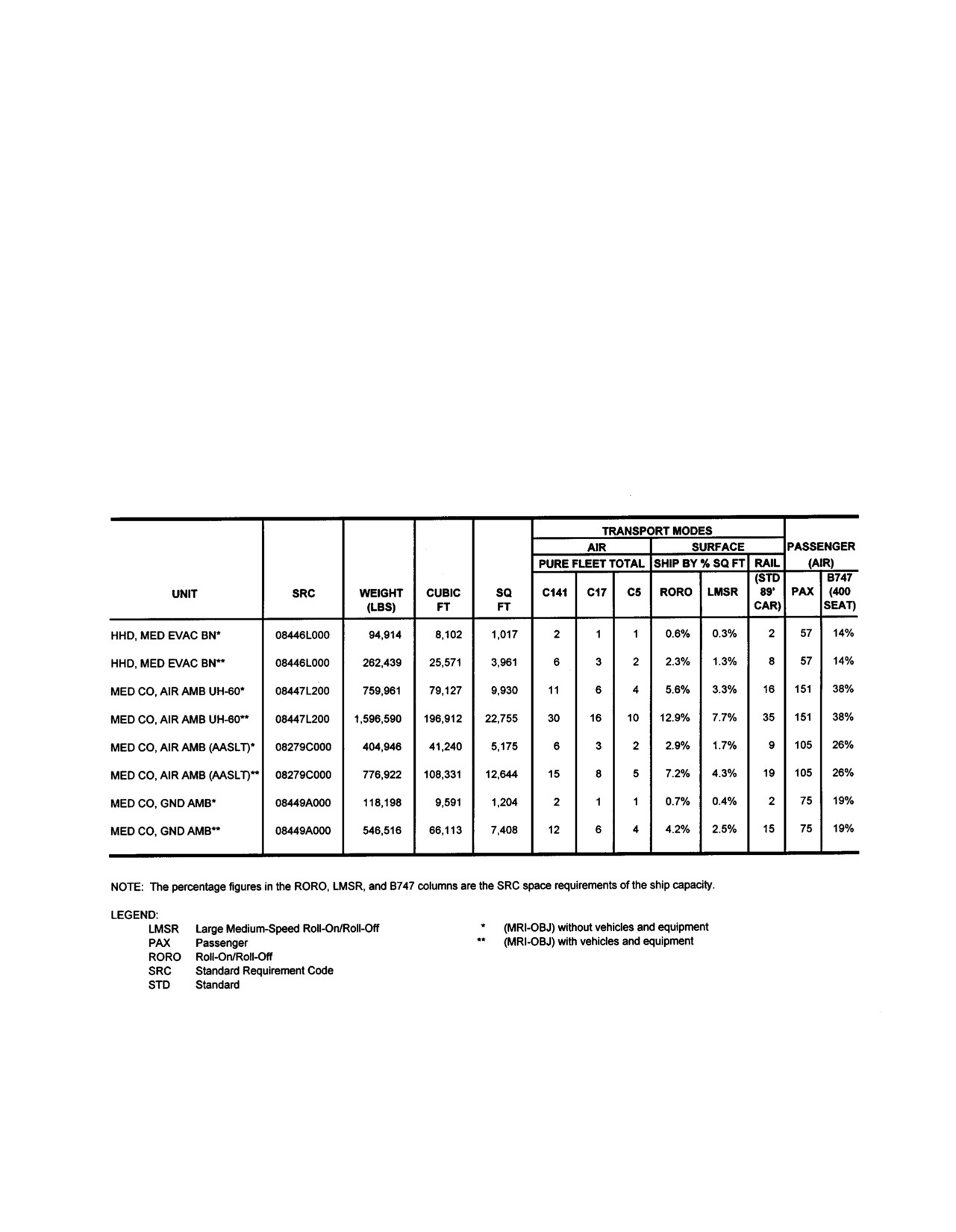
This appendix provides strategic deployability data for medical evacuation headquarters and units. It is only
a general reference and must be tailored to the specific unit and equipment.
P-2. Strategic Deployability Data
Table P-1 provides strategic deployability data for medical evacuation headquarters and units.
Table P-1. Strategic Deployability Data
P-1
FM 8-10-6
APPENDIX Q
EVACUATION CAPABILITIES OF UNITED STATES FORCES
Q-1. General
This appendix provides the evacuation capabilities of US forces vehicles and aircraft.
Q-2. Evacuation Capabilities of United States Air Force Aircraft
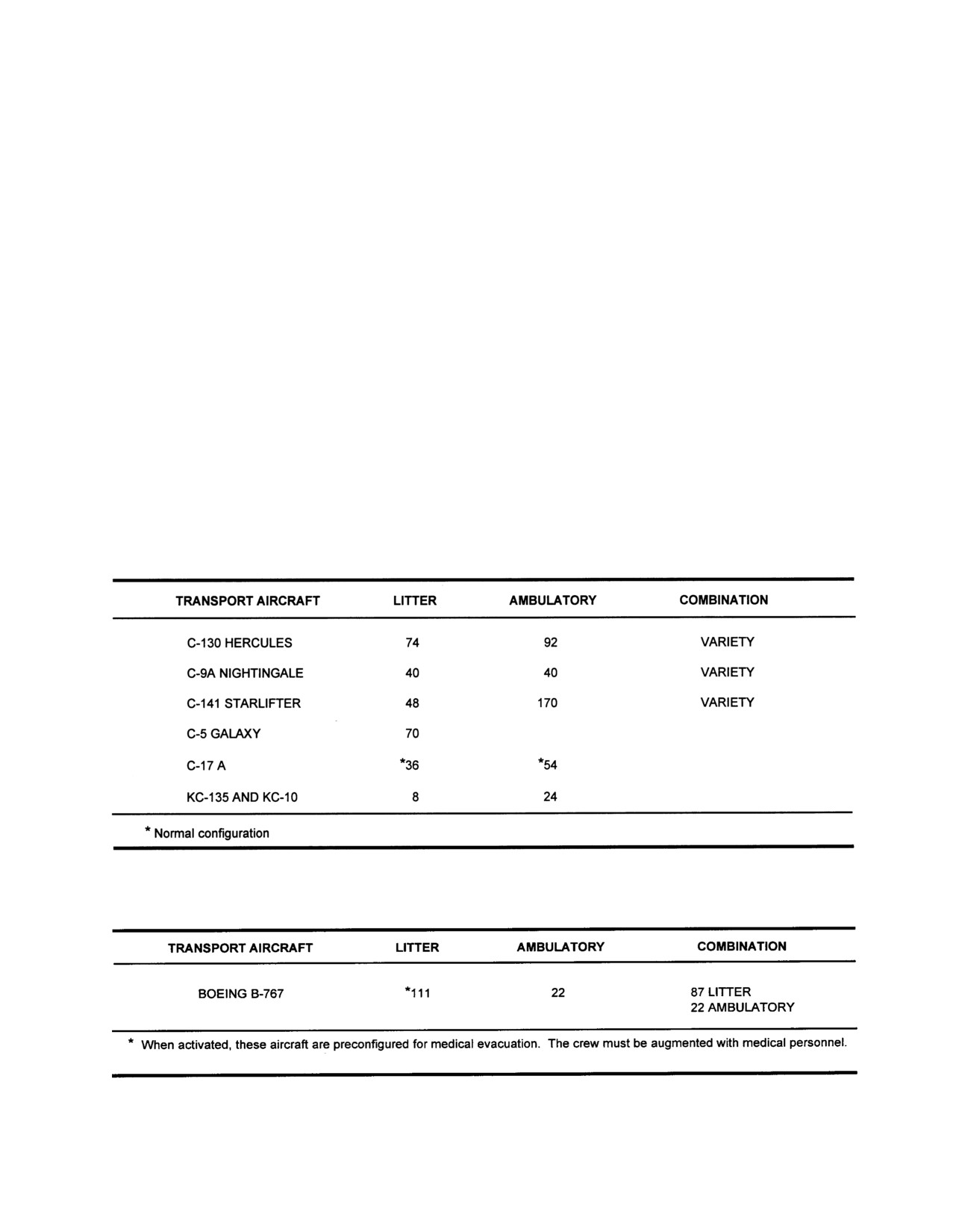
a. Evacuation capabilities of USAF aircraft are provided in Table Q-1. As the majority of USAF
aircraft are not dedicated medical evacuation platforms, when used for medical evacuation the crew must be
augmented with medical personnel to provide in-flight care. For additional information on these aircraft,
refer to paragraph 10-36.
b. The evacuation capability of CRAF aircraft is provided in Table Q-2. For additional
information on CRAF, refer to paragraph 10-37.
Table Q-1. Evacuation Capabilities of United States Air Force Aircraft
Table Q-2. Civil Reserve Air Fleet Capabilities
Q-1
FM 8-10-6
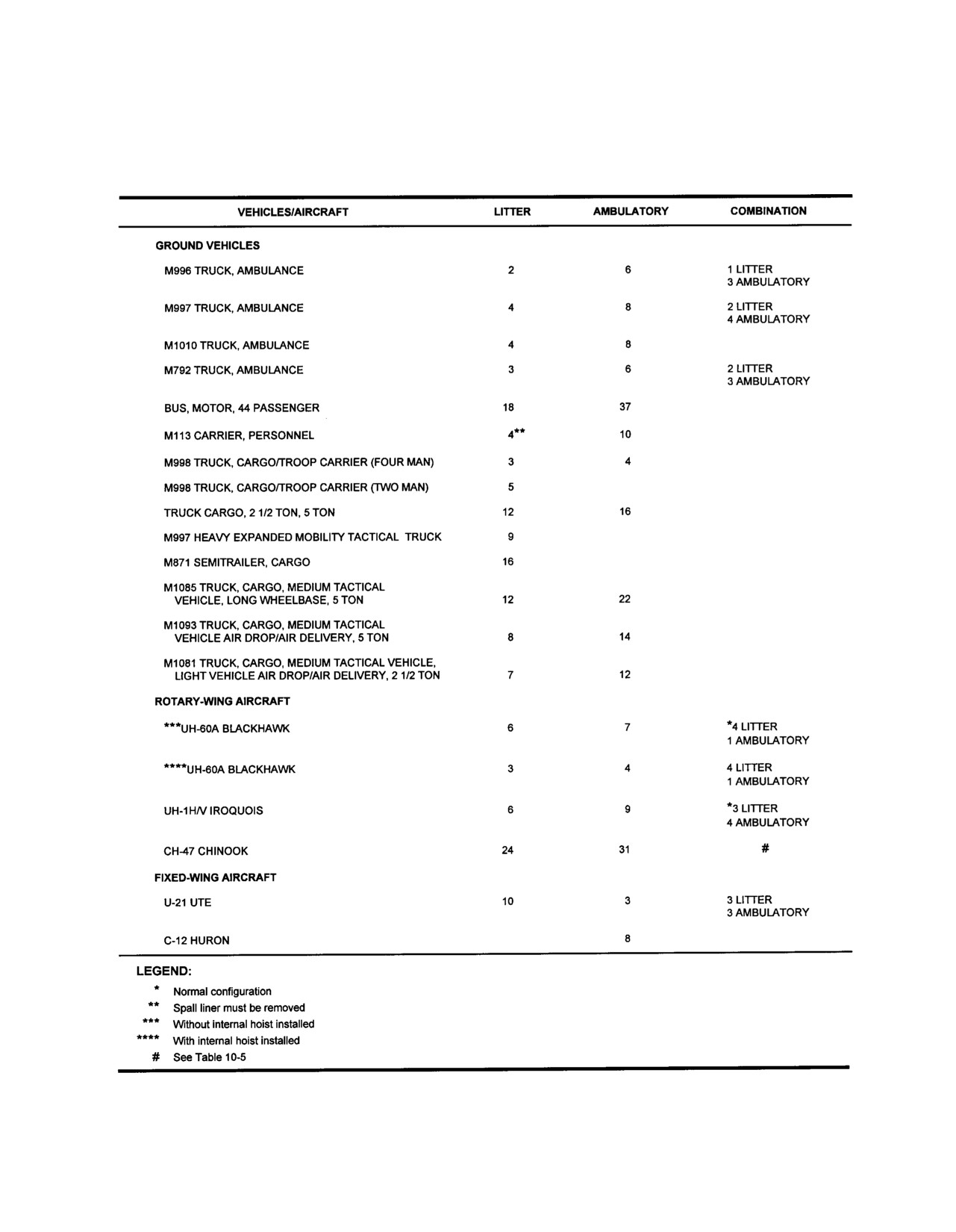
Q-3. Evacuation Capabilities of United States Army Vehicles and Aircraft
The evacuation capabilities of US Army vehicles and aircraft are provided in Table Q-3. Additional
discussion of these vehicles and aircraft is provided in Chapter 10.
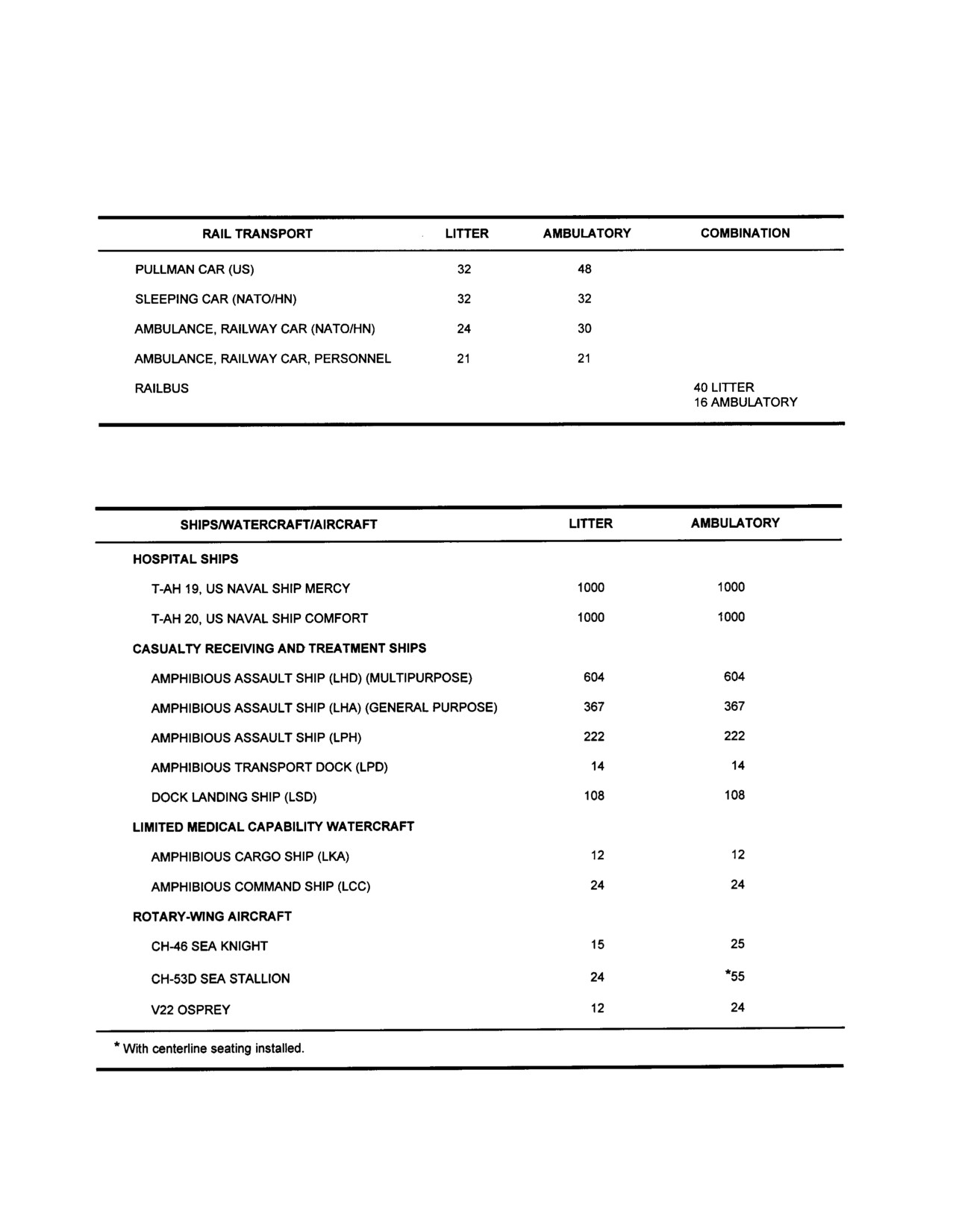
Q-4. Railway Car Capabilities
Although railway cars are not available within the US Army inventory, it is important to know the
approximate capacities of rail transport in the event they become available and/or required in domestic
support operations or through wartime HN support agreements. The approximate capabilities of railway
cars are provided in Table Q-4.
Q-5. Evacuation Capabilities of United States Navy Ships, Watercraft, and Rotary-Wing Aircraft
The evacuation capabilities of US Navy ships, watercraft, and aircraft are provided in Table Q-5. The
entries for ambulatory and litter patients on ships are the same because all patients require a bunk.
Q-2
FM 8-10-6
Table Q-3. Evacuation Capabilities of United States Army Vehicles and Aircraft
Q-3
FM 8-10-6
Table Q-4. Capabilities of Railway Cars
Table Q-5. Evacuation Capabilities of United States Navy Ships, Watercraft, and Aircraft
Q-4
FM 8-10-6
GLOSSARY
ABBREVIATIONS, ACRONYMS, AND DEFINITIONS
A2C2
Army airspace command and control
AASLT air assault
AATF air assault task force
ABCA American, British, Canadian, and Australian
acft aircraft
ACP air control point
ACR armored cavalry regiment
advanced trauma management (ATM) Resuscitative and stabilizing medical or surgical treatment
provided to patients to save life or limb and to prepare them for further evacuation without jeopardizing
their well-being or prolonging the state of their condition.
AE aeromedical evacuation (United States Air Force acronym)
AECC Aeromedical Evacuation Control Center
AELT aeromedical evacuation liaison team
AEOT aeromedical evacuation operations team
AF airfield
AFB Air Force Base
AFMIC Armed Forces Medical Intelligence Center
AIR STD Air Standardization Agreement
ALCC airlift control center
AM amplitude modulated
amb ambulance
ambulance control point The ambulance control point consists of a soldier (from the ambulance company
or platoon) stationed at a crossroad or road junction where ambulances may take one of two or more
directions to reach loading points. The soldier, knowing from which location each loaded ambulance
has come, directs empty ambulances returning from the rear. The need for control points is dictated
by the tactical situation. Generally, they are more necessary in forward areas.
Glossary-1
FM 8-10-6
ambulance exchange point (AXP) A location where a patient is transferred from one ambulance to
another en route to a medical treatment facility. This may be an established point in an ambulance
shuttle or it may be designated independently.
ambulance loading points This is a point in the shuttle system here one or more ambulances are stationed
ready to receive patients for evacuation.
ambulance relay point This is a point in the shuttle system where one or more empty ambulances are
stationed ready to advance to a loading point or to the next relay post to replace an ambulance that has
moved from it. As a control measure, relay points are generally numbered from front to rear.
ambulance shuttle system The shuttle system is an effective and flexible method of employing ambulances
during combat. It consists of one or more ambulance loading points, relay points, and when necessary,
ambulance control points, all echeloned forward from the principal group of ambulances, the company
location, or basic relay points as tactically required.
(When patients are being transported by litter
carries, this system is referred to as a litter shuttle system.)
AMC Air Mobility Command
AMEDD Army Medical Department
AMEDDC&S Army Medical Department Center and School
ANCD automated net control device
AO area of operations
AOC area of concentration (United States Army officer personnel)/air operations center (United States Air
Force term)
AOR area(s) of responsibility
APES Automated Patient Evacuation System
AR Army regulation
ARSOF Army Special Operations Forces
ASCC Army Service Component Command
ASE aircraft survivability equipment
ASF aeromedical staging facility
aslt assault
Glossary-2
FM 8-10-6
ASMB area support medical battalion
ASMC area support medical company
ASMS area support MEDEVAC section
ASTS aeromedical staging squadron(s)
ATC air traffic control
ATM See advanced trauma management.
ATS air traffic services
attn attention
augmentation The addition of specialized personnel and/or equipment to a unit, aircraft, or ship to supple-
ment the medical evacuation mission.
AVIM aviation intermediate maintenance
avn aviation
AVUM aviation unit maintenance
AXP See ambulance exchange point.
BAS battalion aid station
bde brigade
BDU battle dress uniform
BIFV Bradley infantry fighting vehicle
bn battalion
brigade support area (BSA) A designated area in which combat service support elements from division
and corps support commands and provide logistic support to the brigade. The BSA normally is
located 20 to 25 kilometers behind the forward edge of the battle area.
BSA See brigade support area.
BTU British thermal unit
Glossary-3
FM 8-10-6
BW biological warfare
C Celsius
C2
command and control
C3IC coalition coordination, communications, and integration center
C4I command, control, communications, computers, and intelligence
CASEVAC See casualty evacuation.
casualty Any person who is lost to his organization by reason of having been declared dead, wounded,
injured, diseased, interned, captured, retained, missing, missing in action, beleaguered, besieged, or
detained.
casualty evacuation This is the term used by nonmedical units to refer to the movement of casualties
aboard nonmedical vehicles or aircraft. En route medical care is not provided.
CCAT critical care air transport
CCIR commanders critical information requirements
CDR commander
CG center of gravity
CH cargo/transport helicopter
CHL combat health logistics
CHS See combat health support.
CINC Commander in Chief
clr clearing
CMCC corps movement control center
CMO civil-military operations
co company
carbon dioxide
CO2
Glossary-4
FM 8-10-6
COA course of action
collecting point (patient) A specific location where casualties are assembled to be transported to a
medical treatment facility; for example, a company aid post.
combat health support (CHS) This term is used in current doctrine to include all support and services
performed, provided, or arranged by the Army Medical Department to promote, improve, conserve,
or restore the mental or physical well-being of personnel in the Army and, as directed, in other
Services, agencies, and organizations.
combat medic A medical specialist trained in emergency medical treatment procedures and assigned or
attached in support of a combat or combat support unit.
combat search and rescue A specific task performed by rescue forces to effect the recovery of distressed
personnel during wartime or contingency operations.
combat service support (CSS) The assistance provided to sustain combat forces, primarily in the fields of
administration and logistics. It includes administrative services, chaplain services, civil affairs, food
service, finance, legal services, maintenance, combat health support, supply, transportation, and other
logistical services.
combat support (CS) Fire support and operational assistance provided to combat elements. It includes
artillery, air defense artillery, military police, signal, military intelligence, and chemical.
combat zone (CZ) That area required by combat forces for the conduct of operations. It is the territory
forward of the Army rear area boundary.
comp component
COMSEC communications security
concealment The protection from observation or surveillance.
CONUS continental United States
cover Natural or artificial protection from enemy observation and fire.
CP command post
CRAF Civil Reserve Air Fleet
CRO carded for record only
CRTS casualty receiving and treatment ship
CS See combat support.
Glossary-5
FM 8-10-6
CSAR See combat search and rescue.
CSC combat stress control
CSH combat support hospital
CSS See combat service support.
CTA common table of allowances
CW chemical warfare
CZ See combat zone.
DA Department of the Army
DD Department of Defense
DE directed energy
defilade Protection from hostile observation and fire provided by an obstacle such as a hill, ridge,
or bank. To shield from enemy observation by using natural or artificial obstacles.
dest destination
det detachment
DIRAEFOR Director of Aeromedical Evacuation Forces (United States Air Force)
DISCOM division support command
div division
division rear The area located in the division rear positioned near airlanding facilities and along the
main supply route. The division rear contains the division support command command post, head-
quarters elements of the division support command battalions, and those division support command
elements charged with providing backup support to the combat service support elements in the
brigade support area and direct support to units located in the division rear. Selected corps support
command elements in the division may be located in the division rear to provide direct support back-
up and general support as required.
DMOC division medical operations center
DMRIS Defense Medical Regulating Information System
Glossary-6
FM 8-10-6
DNBI disease and nonbattle injury
DOA dead on arrival
DOD Department of Defense
DOW died of wounds
dressed litter A litter provided with one, two, or three blankets to reduce the danger of shock and to
afford warmth and comfort during transport.
DRYAD numeral cipher A random listing of numbers that can be used to encode a plain text message
for radio transmission.
DS direct support
DTG date/time group
EAC echelons above corps
emergency medical treatment (EMT) The immediate application of medical procedures to the wounded,
injured, or sick by specially trained medical personnel.
EMT See emergency medical treatment.
EOD explosive ordnance disposal
EPLRS enhanced position location and reporting system
EPW enemy prisoner of war
ETE estimated time en route
evac evacuation
evacuation policy A command decision indicating the length in days of the maximum period of non-
effectiveness that patients may be held within the command for treatment. Patients who, in the
opinion of a responsible medical officer, cannot be returned to duty status within the period pres-
cribed are evacuated by the first available means, provided the travel involved will not aggravate their
disabilities.
F Fahrenheit
FARP forward arming and refueling points
Glossary-7
FM 8-10-6
FCC flight control center
FH field hospital
first aid (self-aid/buddy aid) Urgent and immediate lifesaving and other measures which can be per-
formed for casualties (or performed by the victim himself) by nonmedical personnel when medical
personnel are not immediately available.
FLOT forward line of own troops
flt flight
FM field manual; frequency modulated
FMC US Field Medical Card (Department of Defense Form 1380)
FOB forward operating base
FOC flight operations center
FRAGO fragmentary orders
FSB forward support battalion
FSMC forward support medical company
FSMT forward support MEDEVAC team
FST forward surgical team
ft feet
fwd forward
G5
Assistant Chief of Staff, G5, Civil-Military Operations
GH general hospital
GND ground
gp group
GPFU gas-particulate filter unit
GPMRC Global Patient Movement Requirements Center
Glossary-8
FM 8-10-6
GPS Global Positioning System
GRREG graves registration
GS general support
GSW gunshot wound
GWS Geneva Convention for the Amelioration of the Condition of the Wounded and Sick in Armed
Forces in the Field
HCAA high capacity air ambulance
HEED helicopter emergency egress device
HEMTT truck, cargo, heavy expanded, mobility tactical, 8x8
HF high frequency
HHC headquarters and headquarters company
HHD headquarters and headquarters detachment
hldg holding
HMMWV high mobility multipurpose wheeled vehicle
HN host nation
HQ headquarters
HREC health record
HSC headquarters and support company
ID identification
initial point of treatment Any point within the combat health support system at which a soldier is seen
and treated by trained medical personnel.
interoperability The ability of systems, units, or forces to provide services to and accept services from
other systems, units, or forces and to use the services so exchanged to enable them to operate effec-
tively together.
Glossary-9
FM 8-10-6
IR infrared
ISB intermediate staging base
ITR inpatient treatment record
ITRCS inpatient treatment record cover sheet
IV intravenous
JMTB Joint Military Transportation Board
JP jet petroleum
JSOTF joint special operations task force
KED Kendricks Extrication Device
KIA killed in action
LBE load-bearing equipment
lbs pounds
LC line of contact
LD line of departure
lines of patient drift Natural routes along which wounded soldiers may be expected to go back
for
medical care from a combat position.
litter patient A patient whose physical condition requires transportation by a litter. Some ambulatory
patients may require to be transported by litter when traveling over rough terrain.
LMTV light medium tactical vehicle
LOA limit of advance
LOC lines of communication
LST landing ship, tank
LTOE living table of organization and equipment
Glossary-10
FM 8-10-6
LVAD/AD light vehicle air drop/air delivery
LWB long wheelbase
LZ landing zone
M meter
MA mortuary affairs
maint maintenance
manual evacuation Process of transporting patients by manual carries without the aid of a litter or other
means of transportation.
MASF mobile aeromedical staging facility
MAST military assistance to safety and traffic
med medical
MEDCOM medical command
MEDEVAC medical evacuation
medical equipment set (MES) A chest containing medical instruments and supplies designed for
specific table of organization and equipment units or specific missions.
medical treatment facility (MTF) Any facility established for the purpose of providing medical treat-
ment. This includes battalion aid stations, division clearing stations, dispensaries, clinics, and
hospitals.
MEDLOG BN medical battalion, logistics (forward/rear) (Medical Force 2000 unit)
MES See medical equipment set.
METT-TC mission, enemy, terrain, troops, time available, and civilian considerations
MF2K Medical Force 2000
mg milligram
MIA missing in action
MIJI meaconing, intrusion, jamming, and interference
Glossary-11
FM 8-10-6
ml milliliter
MOPP mission-oriented protective posture
MOS military occupational specialty (enlisted personnel)
MOUT military operations on urbanized terrain
MP military police
MRE meal(s), ready to eat
MRI Medical Reengineering Initiative
MRO medical regulating office(r)
MSB main support battalion
MSC Military Sealift Command
MSMC main support medical company
MSR main supply route
MTF See medical treatment facility.
MTOE modified table of organization and equipment
MTV medium tactical vehicle
MWD military working dog
NA not applicable
NATO North Atlantic Treaty Organization
NAVAIDS navigational aids
NBC nuclear, biological, and chemical
NBI nonbattle injury
NCA National Command Authorities
NCO noncommissioned officer
Glossary-12