FM 3-24.2 TACTICS IN COUNTERINSURGENCY (APRIL 2009) - page 7
Chapter 8
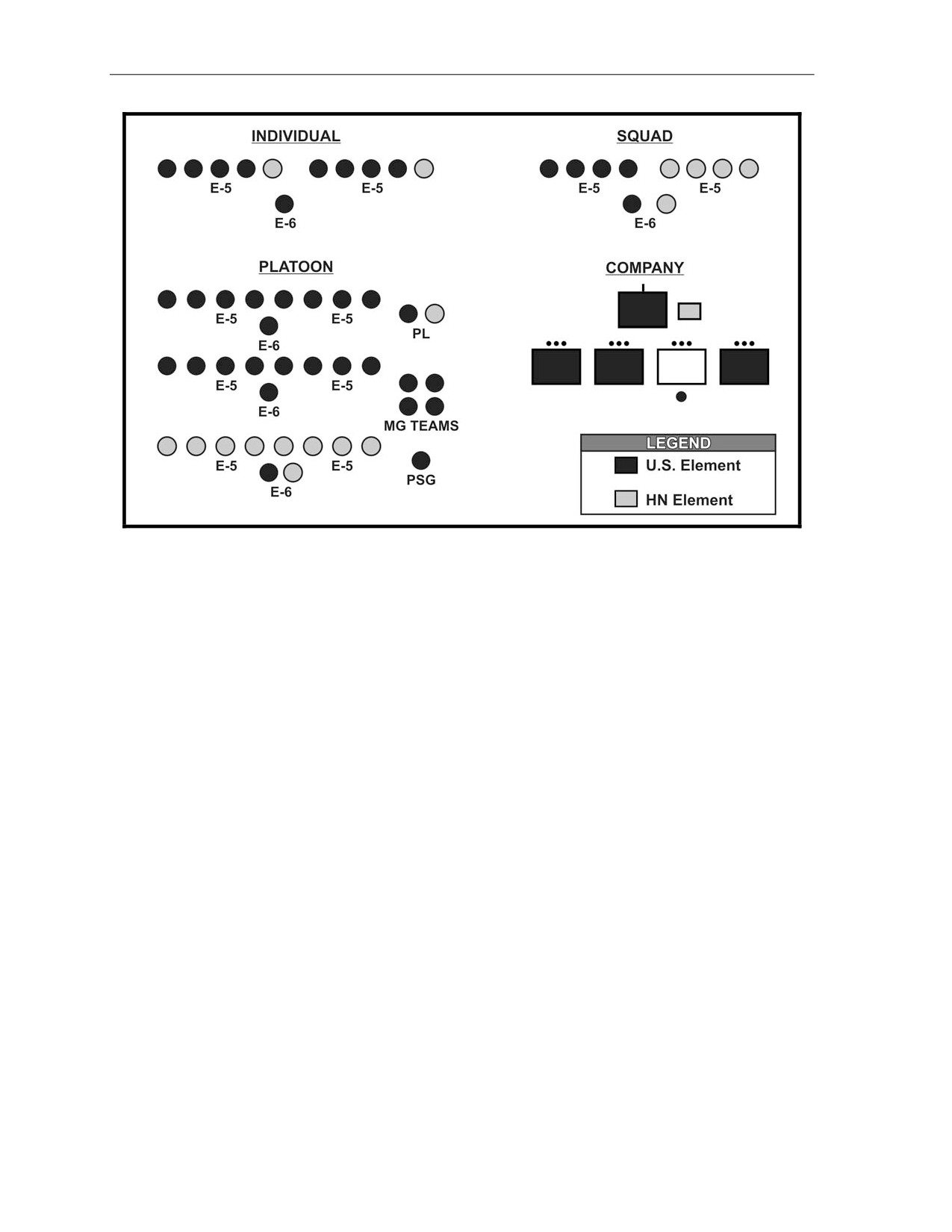
Figure 8-7. Augmentation of an example unit.
EQUIP
8-83.
The requirement to provide equipment may be as simple as assisting with maintenance of existing
formations or as extensive as providing everything from shoes and clothing to vehicles, communications,
and investigation kits. If insurgents use heavy machine guns and rocket-propelled grenades, HN security
forces need comparable or better equipment. This especially applies to police forces, which are often
lightly armed and vulnerable to well-armed insurgents.
8-84.
Primary considerations should include maintainability, ease of operation, and long-term
sustainment costs. Few developing nations can support highly complex equipment. In COIN operations,
having many versatile vehicles that require simple maintenance is often better than having a few highly
capable armored vehicles or combat systems that require extensive maintenance. Developing an effective
HN maintenance system may begins with major maintenance performed by contractors. The program then
progresses to partnership arrangements with US forces as HN personnel are trained to perform the support
mission.
ADVISE
8-85.
Advisors are the most prominent group of US personnel that serve with HN units. Advisors live,
work, and fight with their HN units. Segregation is kept to an absolute minimum. The relationship between
advisors and HN forces is vital. US partner unit commanders must remember that advisors are not liaison
officers, nor do they command HN units. Additionally, partner units regularly advise their HN security
force counterparts.
8-86.
Effective advisors are an enormous force enhancer. The importance of the job means that the most
capable individuals should fill these positions. Advisors should be Soldiers known to take the initiative
and set the standards for others.
8-87.
Professional knowledge and competence win the respect of HN troops. Effective advisors develop
a healthy rapport with HN personnel but avoid the temptation to adopt HN positions contrary to US
or multinational values or policy.
8-18
FM 3-24.2
21 April 2009
Support to Host Nation Security Forces
8-88.
Advisors who understand the HN military culture understand that local politics have national
effects. Effective advisors recognize and use cultural factors that support HN commitment and teamwork.
A good advisor uses the culture’s positive aspects to get the best performance from each security force
member and leader.
Guidelines
8-89.
Important guidelines for advisors include—
•
Remain patient. Be subtle. In guiding Host Nation counterparts, explain the benefits of an
action and convince them to accept the idea as their own. Respect the rank and positions of
Host Nation counterparts.
•
Exercise diplomacy in correcting Host Nation security forces. Praise each success and work
to instill pride in the unit.
•
Work to continually train and improve the unit, even in the combat zone. Help the commander
develop unit SOPs.
•
Know light infantry tactics and unit security procedures.
•
Use “confidence” missions to validate training.
•
Understand that an advisor is not the unit commander but an enabler. The Host Nation
commander makes decisions and commands the unit. Advisors help with this task.
•
Train Host Nation units to standard and fight alongside them. Consider Host Nation limitations
and adjust.
•
Flexibility is key. It is impossible to plan completely for everything in this type of operation.
•
Constantly look forward to the next issue and be ready to develop solutions to problems that
cannot be answered with a doctrinal solution.
•
Remember that most actions have long-term strategic implications.
•
Try to learn enough of the language for simple conversation, at a minimum, greetings.
•
Keep Host Nation counterparts informed; try not to hide agendas.
•
Remain prepared to act as a liaison to multinational assets, especially air support and logistics.
Maintain liaison with civil affairs and humanitarian teams in the area of operations.
•
Remain ready to advise on the maintenance of equipment and supplies.
•
Stay integrated with the unit. Eat their food. Do not become isolated from them.
•
Remain aware of the operations in the immediate area to prevent fratricide.
•
Insist on Host Nation adherence to the recognized human rights standards concerning treatment
of civilians, detainees, and captured insurgents. Report any violation to the chain of command.
•
Remain objective in reports on Host Nation unit and leader proficiency. Report gross
corruption or incompetence.
•
Maintain a proper military bearing and professional manner.
Advisor Teams
8-90.
Advisor teams link Host Nation units and US partner units to fill the gaps of the HN's supply
system. They have the ability to bring attention to shortfalls in equipment both to their higher US chain
of command and, through their chain of command, the Host Nation higher headquarters. The advisor
should ensure that the Host Nation logistical system is being used properly first. In addition, the advisor
team may assist by hand walking his HN counterpart through the HN system.
8-91.
Advisor teams often have authority to provide tactical equipment such as radios through their
appropriated funds. The advisor team must use this money since it is one of the few forms of leverage they
posses.
8-92.
It is important to note that advisors should not use bribery or coercion, since results achieved from
these actions are only temporary. As soon as the “payment” is made, or the “force” is removed, the Host
Nation counterpart has no reason to comply. In practice, these techniques are not efficient and will not
achieve the long-term goal of developing proficiency, competence, and initiative in the counterpart.
21 April 2009
FM 3-24.2
8-19
Chapter 8
Advisor Art and Science
8-93.
The most important mission of an advisor is to enhance the military professionalism of his
counterpart. Rapport, credibility, and legitimacy can only be established through time, proximity,
and interaction. Advisors mentor HN leadership at every opportunity. Partner units are engaged in every
aspect of the HN’s development.
8-94.
Advisors sleep and eat daily with HN security force units. They must “leave the wire.” The closer
they operate with the HN security force, the faster the unit will improve. The social and cultural aspects
of the mission are just as or more important than patrolling with the unit.
8-95.
Just as the credibility of US advisors is critical for influencing the leadership and men of the HN
security force, the actions of these advisor teams are equally vital to winning the population’s confidence.
Advisors build their credibility by contact, visibility, technical and tactical proficiency, the ability
to provide resources, success in battle, and respectful interaction with civilians.
8-96.
Often, to be successful, advisors partner with their HN equivalents. For instance, US leaders
partner with HN leaders, US staffs partner with HN staffs, US soldiers partner with HN soldiers.
8-97.
Combat advisors go on patrol and operations in order to—
• Lead and advise by example.
• Share the risk.
• Improve legitimacy and unity of effort.
• Bond with the counterparts.
• Coordinate assets (CAS, QRF, EOD).
• Prevent fratricide.
• Provide accurate and specific AARs.
• Prevent, report, remedy human rights violations.
• Gather information for intelligence.
• Ensure site exploitation is thorough.
• Ensure evidence is correctly gathered and processed.
• Improve situational awareness.
Challenges
8-98.
US advisors and units share the same challenges and often develop the same practices. Some
of these practices are negative while others are positive. Some challenges are common to all US advisors
and units. They include aspects often referred to as the American military culture.
8-99.
Just as in counterinsurgency operations, advising is an iterative process. The advisor team and the
HN unit will not get it right the first time. However, both the HN unit and the advisor team must “learn
and adapt” faster than insurgents.
8-100. Some typical advisor challenges include—
• Adjusting to native cuisine can pose a problem for the advisor. Refusal to accept food and
beverages when offered might be considered an insult.
• The advisor does not become discouraged. Not all advice will be accepted. Some will be
implemented later.
• The advisor cannot forget that a careless word or action can cost the United States dearly
in good will and cooperation that may have been established with great effort and at
considerable cost.
8-20
FM 3-24.2
21 April 2009

Support to Host Nation Security Forces
• The advisor does not criticize HN policy in front of HN personnel. It is the advisor’s obligation
to support the incumbent government just as he does his own. This obligation is US
national policy.
• The advisor studies his counterpart to determine his personality and background. He makes
every effort to establish and maintain friendly relationships. He learns something about his
counterpart’s personal life and demonstrates an interest in his likes and dislikes.
• The advisor recognizes and observes military courtesy and local customs and courtesies. He
recognizes that in many cultures, observance of formal courtesies must take place before other
business can be conducted. When in doubt, he leans toward the polite.
• The advisor does not get caught up in personality clashes between HN officers/personnel.
• The advisor keeps in mind that HN partners may consider person-to-person relationships more
important than organizational frameworks.
• The advisor may have to deal with the HN norms regarding time and timeliness.
Advising Principles
8-101. Advising principles can best be described as shown in Figure 8-8.
By, With,
Not counting immediate action battle drill responses, the mark of an effective
and Through
advisory effort is the amount of stake the Host Nation security forces take in their
own operations.
Empathy Leads to
Truly understanding other human beings and where they come from allows
Cultural Competence
honest relationships to develop. These relationships are critical factors
of success.
Success is Built
This relationship is likely to be tested on numerous occasions and challenges;
on Personal
only one built on a solid relationship of mutual trust can survive and ensure
Relationships
mission success.
Advisors
Increasing the advisors’ level of frustration is the rapid realization that, when the
are not ‘Them’
dealing with partner units, advisors are not one of “them.” The advisors are often
alone navigating between two military systems and two cultures, never quite
fitting in with either of them.
You Will Never
The advisor attaining a tactical objective does not achieve success; success
Win…Nor Should
is achieved by the Host Nation forces achieving the objective.
You
Advisors are not
Advisors are not intended to lead Host Nation security forces in combat; they are
Commanders
ultimately responsible for command and control only of their own small TEAM
of US combat advisors.
Advisors
Advisors are advocates for the Host Nation security forces with partner units.
are Honest Brokers
Living
Advisors will likely find themselves isolated with great autonomy, often with no
with Shades of Gray
supervision and will encounter moral and ethical dilemmas on a daily basis.
Talent is Everything,
The paradox lies in that in some Host Nation forces, recognized talent can take a
but
back seat to rank. Advisors must understand that rank on the uniform
Understand Rank
is important to many armies, but it is skin deep; the ways around rank are the
relationship and talent.
Make Do
Advisors will never have everything that they feel they need to succeed.
Scrounging, bartering, and horse-trading are daily activities of the combat
advisor. An enormous amount of energy must be devoted to these activities.
These efforts will not only help the advisor achieve mission success but also
endear him to his counterpart.
Figure 8-8. Principles of advising.
21 April 2009
FM 3-24.2
8-21
Chapter 8
Advisor Relationship with Host Nation Peers
8-102. The advisor spends maximum time with the unit so the troops get to know and trust him. The
advisor talks to and gets to know the troops, not just the unit leaders, so he receives excellent feedback
through the common Soldier’s candid comments. Such comments often reflect troop morale
and operational effectiveness. He stays abreast of what is going on in the unit by staying in close contact
with the commander and staff.
• The advisor encourages frequent command inspections by the commander. In some cultures,
this action is a new concept or not a common practice. Many HN commanders are reluctant
to inspect. They rely solely on correspondence and reports to evaluate unit effectiveness.
• The advisor continually stresses the obvious advantages of good military-civilian relations
to avoid the idea of military arrogance, which irritates the civilian populace. The development
of a proper Soldier-civilian relationship is a critical factor in counterinsurgency. Improper
behavior by Soldiers toward civilians must be immediately corrected.
• The advisor keeps training standards high so that the unit is prepared for combat at all times.
• The advisor stresses human rights and the consequences of mistreating suspects and prisoners.
• The advisor constantly promotes unit esprit-de-corps to sustain the unit in the face
of difficulties.
• The advisor persuades the HN personnel to pass information up, down, and laterally.
MENTOR
8-103. Effective mentorship is based on mutual respect, building relationships and trust. Maintaining
patience is the key in developing positive situations for Mentorship. All of which will go into the building
of an effective team. Both advisor teams and partner units have equal ability to mentor, if the conditions
have been set.
Respect
8-104. In order to get respect, mentors need to give it.
Relationship
8-105. Mentors need to have a good working relationship with Host Nation forces.
Trust
8-106. The best way to gain trust is through shared danger and hardship. Nothing builds trust faster than
facing the enemy together.
Team
8-107. The end state should be a unity of effort for the advisor team, the HN unit, and the partner unit. If
a recommendation is made to the Host Nation unit, mentors should move on. If every recommendation
becomes a point of contention, the mutual respect and relationship that has been carefully cultivated will be
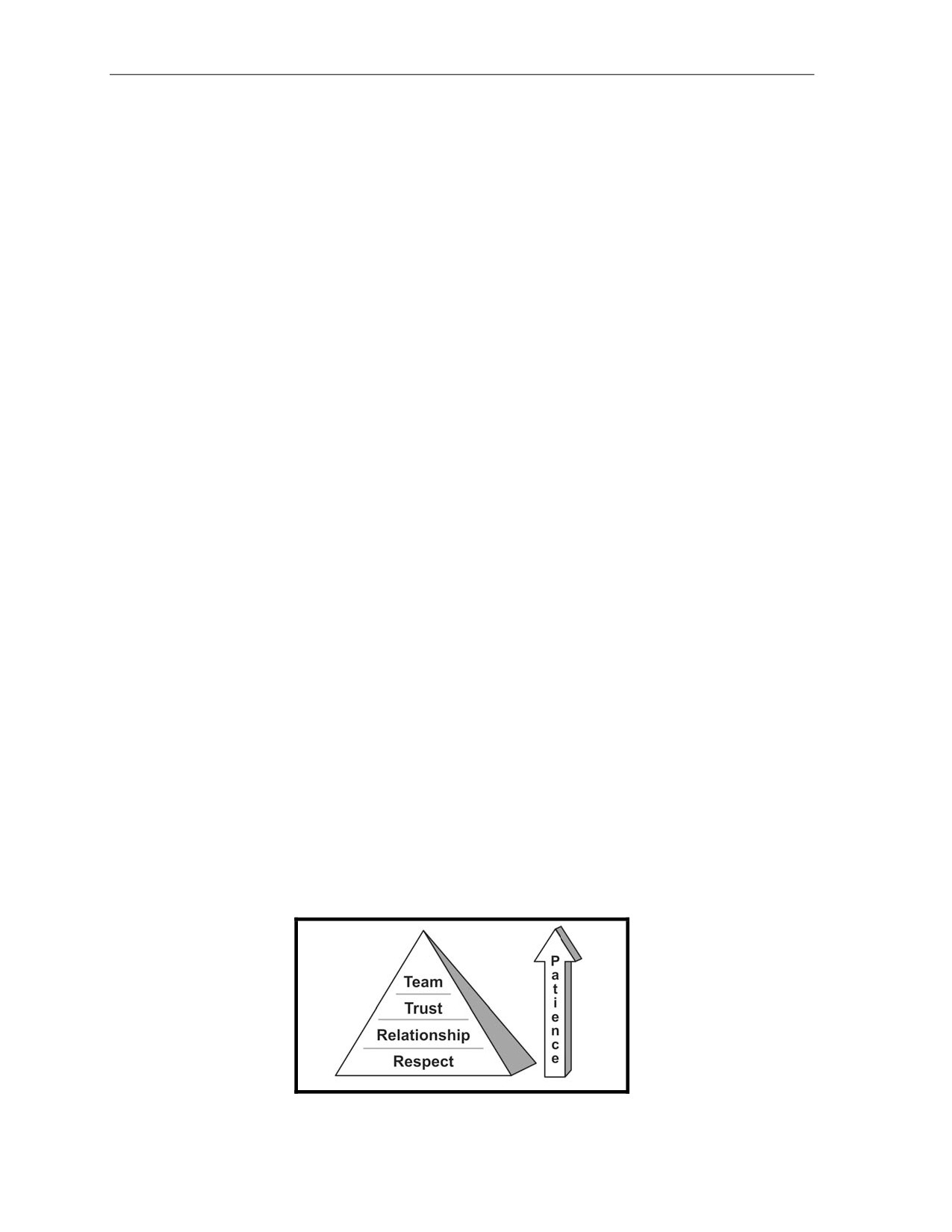
damaged. Figure 8-9 shows the process that is needed to build a relationship that ultimately develops into
an effective team. Giving respect sets the conditions for trust and, finally, a good team, where mentoring
can occur.
Figure 8-9. Team-building process.
8-22
FM 3-24.2
21 April 2009
Support to Host Nation Security Forces
Host Nation AAR
8-108. First, an advisor should never take credit for an idea; instead, they should empower their
counterpart. Discuss the issue and come up with the solution together, even if he has the answer. The point
is that advisors are mentoring them to come up with solutions of their own in the future. Second, by giving
them the credit and making them look good the leader will more readily come to the advisors for advice
and take advice more readily in the future.
8-109. Advisors should cover all activities and salient points (sustainment and improvement) for each
phase of the operation, including information engagements. The AAR should conclude with a plan
to follow-up and make improvements as necessary. Just as with US forces, an AAR with the HN security
forces is not only potentially of great value but it is also potentially full of pitfalls. To evaluate the HN
security forces, the advisors should assess at a minimum—
• Leadership
• Level of training demonstrated on operations
• Use and effectiveness of administrative/logistics (as applicable).
• Professionalism to include human rights and dealing with civilians.
8-110. Advisors need to bring up general positive points with the groups, but they should refrain from
singling out a leader, staff, soldier, or unit to provide criticism in front of others. The US military culture
of group AARs to discuss all mistakes is a technique we find valuable because our culture accepts it
as important for improvement. Most other cultures do not accept pointing out criticisms of one person
or group to another. The advisor should take that member or unit aside and discuss the issue. Let them talk
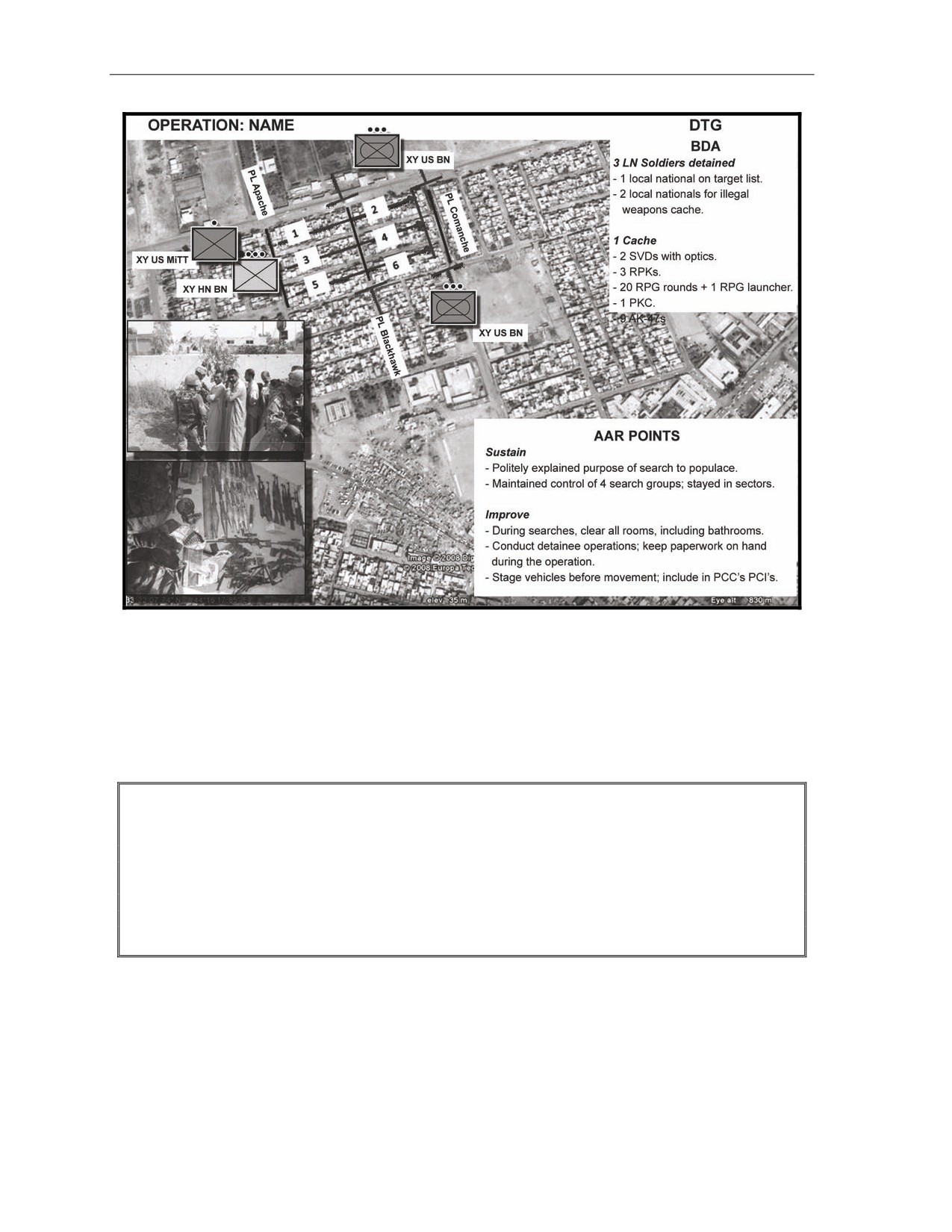
about how to improve this point in a productive way. Figure 8-10 shows an example AAR for a Host
Nation security force after and operation.
Commander's One-on-One
8-111. Remember some AAR points are best kept between the advisor and the Host Nation commander.
Internal Advisor AAR
8-112. In order to effectively advise HN security forces, the US Advisor Team should also conduct an
internal AAR, focusing on what the Team must sustain and improve. An internal AAR is for the advisors
only and should cover three primary topics:
• Conduct of advisors and US partner
• Conduct of the HN security force
• Review ROE/EOF for effectiveness and compliance/training level
EMPLOYMENT OF NEWLY TRAINED FORCES IN COIN
8-113. Building the morale and confidence of HN security forces should be a long term objective.
Committing poorly trained and badly led forces results in high casualties and invites tactical defeats. While
defeat in a small operation may have little effect on the outcome of a conventional war, even a small
tactical defeat of HN security forces can have serious strategic consequences, since COIN is largely about
perceptions. Effective insurgent leaders can quickly turn minor wins into major propaganda victories.
In short, the HN security forces must be prepared for operations so that they have every possible
advantage. The decision to commit units to their first actions and their employment method requires careful
consideration. As much as possible, HN security forces should begin with simpler missions. As their
confidence and competence grows, these forces can assume more complex assignments.
21 April 2009
FM 3-24.2
8-23
Chapter 8
Figure 8-10. Example Host Nation security force AAR—operation summary.
8-114. Newly trained units should enter their first combat operation in support of more experienced HN,
US, or multinational forces. Partner units and advisor teams need to closely monitor the situation
and support each other and the Host Nation. It is paramount that the Host Nation security force not be
defeated in the initial stage of their operations. Host nation units can be broken down into smaller elements
and paired with US forces in order to put a Host National “face” on the operation and provide the Host
Nation with support and training experience.
SUMMARY
A successful COIN effort establishes HN institutions that can sustain government legitimacy. Developing
effective HN security forces—including military, police, and paramilitary forces—is one of the highest
priority COIN tasks. Soldiers and Marines can make vital contributions to this mission by training
and advising the HN security forces. Effective tactical commanders must understand the importance
of this mission and select the right personnel as trainers and advisors. Using the MORTEAM framework
may enable tactical leaders to successfully train, mentor and conduct operations with Host Nation security
force.
8-24
FM 3-24.2
21 April 2009
Appendix A
Intelligence Preparation of the Battlefield
“In no class of warfare is a well organized and well served intelligence department
more essential than in against guerrillas”
COL C. E. Callwell, Small Wars, 1896
The complexity of an insurgency and increased number of variables
(and their
infinite combinations) increases the difficulty of providing timely, relevant,
and effective intelligence support to counterinsurgency
(COIN) operations.
Conducted effectively, however, the intelligence preparation of the battlefield (IPB)
allows commanders to develop the situational understanding necessary to visualize,
describe, and direct subordinates in successfully accomplishing the mission.
OVERVIEW
A-1.
IPB is the systematic process of analyzing the threat and environment in a specific geographic
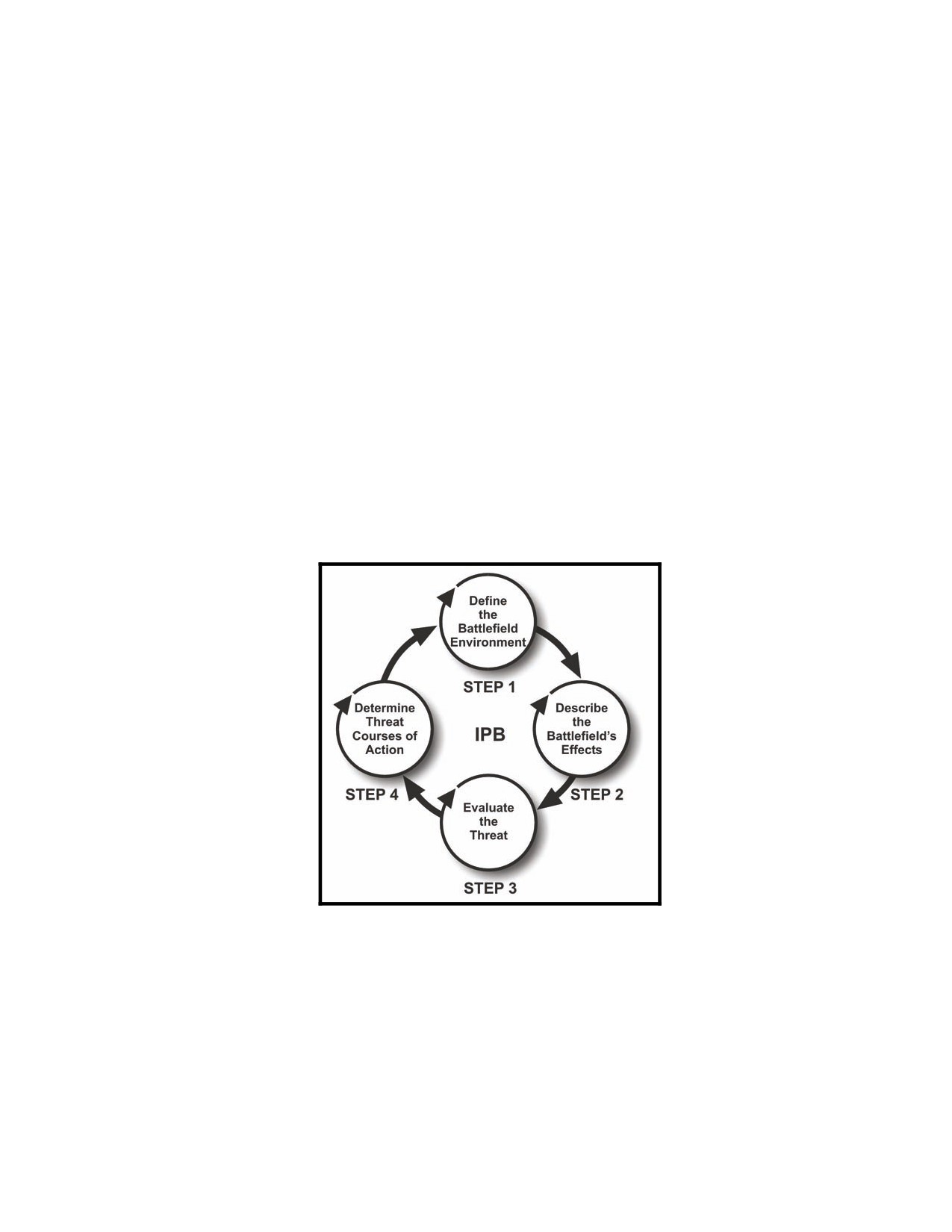
area—the area of operations (AO) and its associated area of interest (Figure A-1). It provides the basis
for intelligence support to current and future operations, drives the military decision-making process,
and supports targeting and battle damage assessment. The procedure (as well as each of its four steps)
is performed continuously throughout the planning, preparation, and execution of a COIN operation.
Figure A-1. The steps of IPB.
INCREASED COMPLEXITY
A-2.
Uncovering intricate relationships takes time, careful analysis, and constant refinement
to determine actual effects on friendly and threat courses of action
(COAs). These relationships
exist among—
• Population groups.
• The infrastructure.
21 April 2009
FM 3-24.2
A-1
Appendix A
• The historical, cultural, political, or economic significance of the area in relation to surrounding
urban and rural areas or the nation as a whole.
• The physical effects of the natural and man-made terrain.
A-3.
A primary goal of any IPB is to accurately predict the threat’s likely COA (step four—which may
include political, social, religious, informational, economic, and military actions). Commanders can then
develop their own COAs that maximize and apply combat power at decisive points. Understanding the
decisive points in counterinsurgency operations allows commanders to select objectives that are clearly
defined, decisive, and attainable.
REDUCED UNCERTAINTY AND ITS EFFECTS
A-4.
Commanders and their staffs may be unfamiliar with the intricacies of a counterinsurgency
and more adept at thinking and planning in other environments. Therefore, without detailed situational
understanding, commanders may assign missions that their subordinate forces may not be able to achieve.
As importantly, commanders and their staffs may miss critical opportunities because they appear
overwhelming or impossible (and concede the initiative to the threat). They also may fail to anticipate
potential threat COAs afforded by the distinctive operational environment. Commanders may fail
to recognize that the least likely threat COA may be the one adopted precisely because it is least likely and,
therefore, may be intended to maximize surprise. Misunderstanding the AO’s effect on potential friendly
and threat COAs may rapidly lead to mission failure and the unnecessary loss of Soldiers’ lives and other
resources. A thorough IPB of the AO can greatly reduce uncertainty and contribute to mission success.
AMPLIFIED IMPORTANCE OF CIVIL CONSIDERATIONS
A-5.
In COIN operations, the terrain and enemy are still essential considerations, but the societal
component of the COIN environment is considered more closely and throughout the operational process.
Moreover, the human or civil considerations gain importance in COIN or stability operations. As discussed
in Chapter One, a key tool for the counterinsurgent unit is analyzing civil considerations using ASCOPE.
Overall, population effects are significant in how they impact the threat, Army forces, and overall
accomplishment of strategic and operational goals.
A-6.
Describing the battlefield’s effects—step two in IPB—ascribes meaning to the characteristics
analyzed. It helps commanders understand how the environment enhances or degrades friendly
and insurgent forces and capabilities. It also helps commanders understand how the environment supports
the population. It also explains how changes in the “normal” environment (intentional or unintentional
and because of insurgent or friendly activities) may affect the population. Included in this assessment are
matters of perception. At each step of the IPB process, commanders must try to determine the HN
population’s perceptions of ongoing activities to ensure Army operations are viewed as intended.
Throughout this process, commanders, staffs, and analysts cannot allow their biases—cultural,
organizational, personal, or cognitive—to markedly influence or alter their assessment (see FM 34-3). This
particularly applies when they analyze the societal aspect of the operational environment. With so many
potential groups and varied interests in such a limited area, misperception is always a risk.
SIGNIFIGANT CHARACTERISTICS IN COIN
A-7.
COIN intelligence analysis must include consideration of the AO’s distinguishing attributes—
terrain, society, infrastructure, and the threat. Because the COIN environment is so complex, it is often
useful to break it into categories. Then commanders can understand the intricacies of the environment that
may affect their operations and assimilate this information into clear mental images. Commanders can then
synthesize these images of the AO with the current status of friendly and threat forces, and develop a
desired end state. Then they can determine the most decisive sequence of activities that will move their
forces from the current state to the end state. Identifying and understanding the environment’s
characteristics (from a counterinsurgent, insurgent, and HN population’s perspective) allows commanders
to establish and maintain situational understanding. Then they can develop appropriate COAs and rules
of engagement that will lead to decisive mission accomplishment.
A-2
FM 3-24.2
21 April 2009
Intelligence Preparation of the Battlefield
A-8.
Figures A-2 and A-3 are not all-encompassing lists of COIN characteristics. Instead, they provide
a starting point or outline useful for conducting a COIN-focused IPB and analysis that can be modified
to fit the specific operational environment and meet the commander’s requirements. Commanders
and staffs can compare the categories presented with those in the civil affairs area study and assessment
format found in FM 3-05.40 and the IPB considerations for stability operations found in ST 2-91.1.
INTERCONNECTED SYSTEMS
A-9.
Since the COIN environment comprises an interconnected “system of systems,” considerations
among the key elements of the environment will overlap during a COIN intelligence analysis. For example,
boundaries, regions, or areas relate to a physical location on the ground. Hence, they have terrain
implications. These boundaries, regions, or areas often stem from some historical, religious, political,
administrative, or social aspect that could also be considered a characteristic of the society. Overlaps can
also occur in a specific category, such as infrastructure. For instance, dams are a consideration for their
potential effects on transportation and distribution (mobility), administration and human services (water
supply), and energy (hydroelectric).
A-10. This overlap recognition is a critical concern for commanders and their staffs. In “taking apart”
the COIN environment and analyzing the pieces, commanders and staffs cannot lose perspective of how
each piece interacts with any other and as part of the whole. Otherwise, their vision will be shortsighted,
and they will fail to recognize the second-and third-order effects of their proposed COAs; the actual end
state differing dramatically from the one envisioned by the commander. The increased density
of combatants and noncombatants, infrastructure, and complex terrain means that a given action will likely
have unintended consequences—positive or negative. Those consequences will be more widely felt
and their impact will spread in less time than in other environments. These unintended results may have
important strategic and operational consequences. The multiple ways these dynamic COIN elements
and characteristics combine make it necessary to approach each COIN environment as a unique challenge
for intelligence analysis.
TERRAIN AND WEATHER
A-11. Earlier admonitions that civil considerations are more closely considered in COIN do not
necessarily mean that considerations for terrain and weather are deemphasized.
Terrain
A-12. In every COIN operation, terrain and its effects on both threat and friendly forces must be
assessed and understood. Then commanders can quickly choose and exploit the terrain (and weather
conditions) that best supports their missions. Effective terrain analysis thoroughly assesses structures
as well as the ground on which they stand (Figure A-2). An analysis of terrain first considers broader
characteristics and effects and then progresses to a more detailed examination.
Natural Terrain
A-13. Natural terrain features significantly influence unit operations. They dictate where buildings can
be constructed, the slopes and patterns of streets, and even the broad patterns that develop over longer
periods, all of which influence a unit’s scheme of maneuver. The military aspects of terrain—observation
and fields of fire, avenues of approach, key terrain, obstacles, and cover and concealment (OAKOC)—
remain critical to the analysis of natural terrain in, under, and around areas where COIN operations will be
conducted. Fortunately, commanders and their staffs are normally accustomed to this type of analysis.
21 April 2009
FM 3-24.2
A-3
Appendix A
Forms and Functions
Construction and Placement
Military Aspects of Terrain: OAKOC
Cores.
Construction.
Observation and fields of fire.
Industrial areas.
• Mass or framed
• Smoke (fire), dust (explosions), and
• Toxic industrial material production
flying debris
• Light or heavy clad
and storage facilities
• Rubble
• Material (dirt, wood, stone, brick,
• Standard signs and markings for
cinder block, concrete, steel, and
• Engagement ranges
toxic chemicals
glass)
(including minimum safe distances
Outlying high-rise areas.
and backblast factors) and
• Density and thickness (roofs,
obliquity/angles (ricochets)
Residential areas and shantytowns.
floors, and interior and exterior
walls)
• Elevation and depression
Commercial ribbon areas.
considerations
• Load-bearing walls and columns
Forts and military bases.
• Lasers and reflective concerns
• Height (floors)
Avenues of approach
Broad Urban Patterns
• Doors, windows, fire escapes,
(mobility corridors).
and other openings
Types.
• Airspace
• Interior floor plan (including crawl
spaces, elevators, and stairs)
• Surface
• Satellite
• Network
• Supersurface
Placement.
• Subsurface
• Linear
• Random
• Segment
Key terrain
• Close, orderly block
Dominant or central hub (if any).
• Dispersed
• Landmarks
• Buildings of significant cultural,
Area covered (square miles).
Ownership.
social, political, historical, or
economic significance
Street Patterns
Obstacles
Basic types.
• Rubble and vehicles
• Radial
• Steep embankments
• Grid
• Medians
• Irregular (planned and unplanned).
• Inadequate bridges and overpasses
(destroyed, weight-restricted, or
Variations.
narrow)
• Rayed
• Tunnels and underpasses (destroyed
• Radial ring
or narrow)
• Contour forming
• Mines and roadside improvised
explosive devices
• Combined
• Masking of fires
Widths.
• Burning buildings or other fire
hazards
• Rivers and lakes
Cover and concealment.
• Building protection
• Weapon penetration (single shot and
multiple rounds) considerations
• Rubble and vehicles
Figure A-2. Significant terrain characteristics common to COIN operations.
Man-Made Terrain
A-14. Building composition, frontages, placement, forms and functions, size, floor plans, and window
and door locations affect maneuver, force positioning, and weapons deployment considerations. Angles,
A-4
FM 3-24.2
21 April 2009
Intelligence Preparation of the Battlefield
displacement, surface reflection, and antenna locations influence command and control. Structures also
influence ISR operations. The increased density and volume created by man-made structures increases how
much information commanders and their staffs collect and assess as well as the number of forces required.
Building materials and construction will also influence force structures to include weapons and equipment
required. Heavily constructed buildings combined with hot and cold extremes may affect target
identification for thermal sights. Thick walls, for example, may make combat vehicle identification
difficult by distorting hotspots. Additionally, the increased use of heaters and warming fires may clutter
thermal sights with numerous hotspots. The ability to maneuver through the urban dimensions—airspace,
supersurface, surface, and subsurface—and shoot through walls, ceilings, and floors also creates increased
psychological stress. The physical characteristics of man-made terrain can also be analyzed using OAKOC.
Weather
A-15. Weather and its effects are often considered when examining the military aspects of terrain.
Military aspects of weather include temperature (heat and cold), light conditions, precipitation (cloud
cover, rain, snow, fog, and smog), and wind. Their military effects during COIN are similar to any
operational environment (see FM 34-81 and FM 34-81-1). Extremes of heat and cold affect weapon
systems and the Soldiers that operate them. Precipitation affects mobility and visibility.
A-16. Commanders also analyze weather for its potential effect on civilians and civilian infrastructure
as well as Soldiers and military equipment. Rain might create sewage overflow problems in areas with
collapsed sewage infrastructure, increasing disease and even creating panic. Rain and flooding may also
make some subsurface areas impassable or extremely hazardous to civilian and military forces alike. Other
weather effects on COIN can include—
• Heavy snowfall may paralyze area transportation and distribution infrastructure, hindering the
government’s ability to provide vital human services
(police, fire fighting, medical,
and rescue). Heavy rains and flooding may have similar effects especially on poorly designed
and constructed roads or roads that have been damaged by tracked vehicles.
• Extreme hot and cold weather climates, which increase the dependence
(and military
significance) of many elements of the infrastructure. For example, the energy infrastructure
may be critical. Without it, civilians may be inadequately cooled or heated, or they may be
unable to cook their food.
• In tropical areas, rain can occur at the same time each day during the wet season. Threat forces
may attack during these periods knowing aircraft will have difficulty responding. Bad weather
also reduces the effectiveness of surveillance, direct and indirect fire, and logistic support.
• Inclement weather may preclude demonstrations or rallies by threats. Good weather may mean
a maximum turnout of civilians for events such as festivals, sporting events, and other social,
cultural, or religious activities.
• Severe weather may affect psychological, civil-military and humanitarian assistance operations.
Heavy rains and severe dust storms may disrupt leaflet drops, construction projects, food
and water distribution, and medical and veterinary assistance programs.
SOCIETY
A-17. This manual shows that societal considerations take on added importance in COIN. Critical
to operational success is knowing and understanding which groups live in an area, what relationships exist
among them, and how each population group will respond to friendly and threat activities. Often
determining any of this is very difficult. Cultural acuity is also essential in helping commanders and their
staffs to view the area as the residents view it. The demographics presented show what conditions exist,
while the other categories help to explain the root causes or why conditions exist (Figure A-3). Other
categories besides basic demographics that are important to gain this understanding include health, history,
leadership, ethnicity and culture, religion, and government and politics.
21 April 2009
FM 3-24.2
A-5
Appendix A
POPULATION
HISTORY
Exchanges of gifts.
DEMOGRAPHICS
General and for a specific
Displays of emotion.
General population size.
group.
Lines of authority.
• Village
• Internal or external
Dating and marriage.
• Town
• Recent conflicts
Greetings, leave-takings, and gestures.
• City
Relationship with U.S.
• Metropolis
Visiting practices.
allies and other
• Megalopolis
Alcohol and drug use.
participating multinational
Group size based on race,
forces.
Important holidays, festivals, sporting, or entertainment events.
age, sex, political affiliation,
Applicable international
Eating and dietary practices.
economics, religion, tribe,
treaties.
clan, gang, criminal activities,
Significance of animals and pets.
or other significant grouping.
Status-of-forces
Urban-rural similarities and differences.
agreements.
• Significant U.S. or
Driving habits.
coalition populations
Antagonists/protagonists
Clothing.
• Distribution, densities,
Heroes.
RELIGION
and physical boundaries
Events, facts, and dates
and overlaps
considered important or
Sects, divisions, and overlaps.
• Majority, minority, and
celebrated.
Religious biases and problems.
dominant groups
Urban area’s historical
Relationship and influence on government, politics, economics, and
Increasing or decreasing
importance.
education.
migration trends.
LEADERSHIP AND
Impact on ethnic and cultural beliefs.
• Dislocated civilians
PROMINENT
Key events or celebrations (daily, weekly, monthly, or annually).
PERSONALITIES
Nongovernmental
Funeral and burial practices.
organizations (NGOs).
Identification, location, and
prioritization of influential
GOVERNMENT AND POLITICS
• Local
• National
leaders (exploitation,
Present and past forms.
• International
evacuation, protection,
Organization and powers (executive, legislative, judicial, and administrative
etc.)
Languages (distribution
divisions).
dialects, relationship to social
Affiliation (ethnic, religion,
Scheduled elections and historical turnouts.
structure).
military, government,
industry, criminal, or
Degree of control over the population
Educational levels and literacy
entertainment).
rates.
• Identification required
Education attained.
• Border-crossing procedures
Crime rates.
Organization and
Relations with U.S. or multinational governments, national government, and
Birth and death rates.
distribution of power.
criminal elements.
Labor statistics and
Associations among
Political factions and boundaries.
considerations.
different leaders and
Political traditions.
• Skilled and unskilled
groups.
Grievances.
• Imported and exported
ETHNICITY AND
Censorship.
• Unemployment
CULTURE
Nepotism and other clan, tribal, or social ties.
• Standard wages and per
Values, moral codes,
capita income
taboos, and insults
Civil defense and disaster preparedness (organization, plans, training,
(verbal and nonverbal).
equipment, and resources).
• Workday and workweek
norms
Attitudes towards age,
Legal system.
sex, and race (including
• System of laws
HEALTH
same-sex interaction).
• Applicable treaties
Diseases.
Role of the clan, tribe, or
• Courts and tribunals
Nutritional deficiencies.
family.
• Procedures
• Records (birth and deeds).
Local standards of care.
Biases between ethnic
groups.
Property control.
Pollution and environmental
hazards (air, water, food, and
Privacy and individuality.
Monetary system (formal and informal).
soil).
Domestic and foreign trade.
Recreation, entertainment,
Health workers (types,
and humor.
• Taxation and tariffs
numbers, and degree of
• Customs requirements
Fatalism or
skill).
• Rationing and price controls
self-determination.
• Economic performance and contribution to gross national product
Economic aid.
Perception of relative deprivation.
Trade unions.
Competition with the black market and organized crime.
Figure A-3. Societal considerations.
A-6
FM 3-24.2
21 April 2009
Appendix B
Readings for COIN Tactical Leaders
in a Time-Constrained Environment
ARTICLES
“Best Practices in Counterinsurgency.” Military Review, May-Jun 2005, Kalev I. Sepp.
“COIN Cliff Notes: Techniques for the Conventional Rifle Platoon in Layman’s Terms.” Infantry
Magazine, July-August 2008, Craig Coppock.
“Counterinsurgency Redux,” Survival, Winter 2006-2007, David Kilcullen.
“The Decisive Weapon: A Brigade Combat Team Commander’s Perspective on Conduct Information
Tasks.” Military Review, May-Jun 2006, Ralph O. Baker.
“Learning Counterinsurgency: Observations from Soldiering in Iraq.” Military Review, Jan-Feb 2006,
David Petraeus.
“‘Twenty-Eight Articles’: Fundamentals of Company-level Counterinsurgency.” Military Review, May-Jun
2006, David Kilcullen.
“The 27 Articles of T.E. Lawrence.," Military Review, May-June 2006, Professional Forum
BOOKS
Galula, David. Counterinsurgency Warfare—Theory and Practice. London: Praeger, 1964.
Hammes, T.X. The Sling and the Stone: On War in the 21st Century. Osceola, WI: Zenith Press, 2004
Kitson, Frank. Low Intensity Operations: Subversion, Insurgency and Peacekeeping. London: Faber
and Faber, 1971.
Trinquier, Roger. Modern Warfare—A French View of Counterinsurgency. New York: Praeger, 1964.
Zedong, Mao. On Guerrilla Warfare. London: Cassell, 1965.
21 April 2009
FM 3-24.2
B-1
Appendix C
Twenty-Eight Articles:
Fundamentals of Company-Level Counterinsurgency
LTC David Kilcullen, PhD, originally submitted his essay, 28 Articles, to Military
Review for the CAC CG's Special Topics Writing Competition: Countering
Insurgency. However, he was asked to publish it immediately to help Soldiers in the
field. Even though doing so cost him the opportunity to compete—and possibly
win—the competition, the Australian Army officer graciously agreed, and pulled the
essay from the contest. The article is reprinted in this appendix, with permission,
from the May-June
2006 issue of Military Review, and formatted to fit this
publication.
INTRODUCTION
C-1.
Your company has just been warned about possible deployment for counterinsurgency operations
in Iraq or Afghanistan. You have read David Galula, T.E. Lawrence, and Robert Thompson. You have
studied FM 3—24, and now understand the history, philosophy, and theory of counterinsurgency. You
have also watched Black Hawk Down and The Battle of Algiers, and you know this will be the most
difficult challenge of your life.
C-2.
But what does all that theory mean at the company level? How do the principles translate into
action at night, with the GPS down, the media criticizing you, the locals complaining in a language you
don’t understand, and an unseen enemy killing your people by ones and twos? How does
counterinsurgency actually happen?
C-3.
There are no universal answers, and insurgents are among the most adaptive opponents you will
ever face. Countering them will demand every ounce of your intellect. But be comforted: You are not the
first to feel this way. There are tactical fundamentals you can apply to link the theory with the techniques
and procedures you already know.
WHAT IS COUNTERINSURGENCY?
C-4.
If you have not studied counterinsurgency theory, here it is in a nutshell: Counterinsurgency is a
competition with the insurgent for the right to win the hearts, minds, and acquiescence of the population.
You are being sent in because the insurgents, at their strongest, can defeat anything with less strength than
you. But you have more combat power than you can or should use in most situations. Injudicious use
of firepower creates blood feuds, homeless people, and societal disruption that fuel and perpetuate the
insurgency. The most beneficial actions are often local politics, civic action, and beat-cop behaviors. For
your side to win, the people don’t have to like you but they must respect you, accept that your actions
benefit them, and trust your integrity and ability to deliver on promises, particularly regarding their
security. In this battlefield, popular perceptions and rumor are more influential than the facts and more
powerful than a hundred tanks.
C-5.
Within this context, what follows are observations from collective experience, the distilled
essence of what those who went before you learned. They are expressed as commandments, for clarity, but
are really more like folklore. Apply them judiciously and skeptically.
21 April 2009
FM 3-24.2
C-1
Appendix C
PREPARATION
C-6.
Time is short during predeployment, but you will never have more time to think than you have
now. This is your chance to prepare yourself and your command.
1.
Know your turf. Know the people, the topography, economy, history, religion, and culture.
Know every village, road, field, population group, tribal leader, and ancient grievance. Your
task is to become the world expert on your district. If you don’t know precisely where you
will be operating, study the general area. Read the map like a book: Study it every night
before sleep and redraw it from memory every morning until you understand its patterns
intuitively. Develop a mental model of your area, a framework in which to fit every new
piece of knowledge you acquire. Study handover notes from predecessors; better still, get
in touch with the unit in theater and pick their leaders’ brains. In an ideal world, intelligence
officers and area experts would brief you; however, this rarely happens, and even if it does,
there is no substitute for personal mastery. Understand the broader area of influence, which
can be a wide area, particularly when insurgents draw on global grievances. Share out aspects
of the operational area among platoon leaders and noncommissioned officers; have each
individual develop a personal specialization and brief the others. Neglect this knowledge,
and it will kill you.
2.
Diagnose the problem. Once you know your area and its people, you can begin to diagnose
the problem. Who are the insurgents? What drives them? What makes local leaders tick?
Counterinsurgency is fundamentally a competition between each side to mobilize the
population in support of its agenda. So you must understand what motivates the people
and how to mobilize them. You need to know why and how the insurgents are getting
followers. This means you need to know your real enemy, not a cardboard cut-out. The
enemy is adaptive, resourceful, and probably grew up in the region where you will be
operating. The locals have known him since he was a boy; how long have they known you?
Your worst opponent is not the psychopathic terrorist of Hollywood; it is the charismatic
follow-me warrior who would make your best platoon leader. His followers are not misled
or naïve; much of his success may be due to bad government policies or security forces that
alienate the population. Work this problem collectively with your platoon and squad leaders.
Discuss ideas, explore the problem, understand what you are facing, and seek a consensus. If
this sounds unmilitary, get over it. Once you are in theater, situations will arise too quickly
for orders or even commander’s intent. Corporals and privates will have to make snap
judgments with strategic impact. The only way to help them is to give them a shared
understanding, then trust them to think for themselves on the day.
3.
Organize for intelligence. In counterinsurgency, killing the enemy is easy. Finding him
is often nearly impossible. Intelligence and operations are complementary. Your operations
will be intelligence-driven, but intelligence will come mostly from your own operations, not
as a product prepared and served up by higher headquarters. So you must organize
for intelligence. You will need a company S2 and an intelligence section (including analysts).
You might need platoon S2s and S3s, and you will need a reconnaissance and surveillance
(R&S) element. You will not have enough linguists—you never do—but carefully consider
where best to use them. Linguists are a battle-winning asset, but like any other scarce
resource, you must have a prioritized “bump plan” in case you lose them. Often during
predeployment the best use of linguists is to train your command in basic language. You will
probably not get augmentation for all this, but you must still do it. Put the smartest soldiers in
the S2 section and the R&S squad. You will have one less rifle squad, but the intelligence
section will pay for itself in lives and effort saved.
4.
Organize for interagency operations. Almost everything in counterinsurgency
is interagency. And everything important, from policing to intelligence to civil-military
operations to trash collection, will involve your company working with civilian actors
and local indigenous partners you cannot control, but whose success is essential for yours.
Train the company in interagency operations: Get a briefing from the US Department
C-2
FM 3-24.2
21 April 2009
Twenty-Eight Articles:
Fundamentals of Company-Level Counterinsurgency
of State, aid agencies, and the local police or fire brigade. Train point-men in each squad
to deal with the interagency people. Realize that civilians find rifles, helmets, and body armor
intimidating. Learn how not to scare them. Ask others who come from that country or culture
about your ideas. See it through the eyes of a civilian who knows nothing about the military.
How would you react if foreigners came to your neighborhood and conducted the operations
you planned? What if somebody came to your mother’s house and did that? Most
importantly, know that your operations will create a temporary breathing space, but long-term
development and stabilization by civilian agencies will ultimately win the war.
5.
Travel light and harden your combat service support (CSS). You will be weighed down
with body armor, rations, extra ammunition, communications gear, and a thousand other
things. The enemy will carry a rifle or rocket-propelled grenade launcher, a shemagh (head
scarf), and a water bottle if he is lucky. Unless you ruthlessly lighten your load and enforce a
culture of speed and mobility, the insurgents will consistently out-run and out-maneuver you.
But in lightening your load, make sure you can always reach back to call for firepower
or heavy support if needed. Also, remember to harden your CSS. The enemy will attack your
weakest points. Most attacks on Coalition forces in Iraq in 2004 and 2005, outside preplanned
combat actions like the two battles of Fallujah or Operation Iron Horse, were against CSS
installations and convoys. You do the math. Ensure your CSS assets are hardened, have
communications, and are trained in combat operations. They may do more fighting than your
rifle squads.
6.
Find a political/cultural adviser. In a force optimized for counterinsurgency, you might
receive a political-cultural adviser at company level, a diplomat or military foreign area
officer able to speak the language and navigate the intricacies of local politics. Back on planet
Earth, the corps and division commander will get a political advisor; you will not, so you
must improvise. Find a POLAD (political-cultural adviser) from among your people—
perhaps an officer, perhaps not (see article 8). Someone with people skills and a feel for the
environment will do better than a political-science graduate. Don’t try to be your own cultural
adviser: You must be fully aware of the political and cultural dimension, but this is a different
task. Also, don’t give one of your intelligence people this role. They can help, but their task
is to understand the environment. The POLAD’s job is to help shape it.
7.
Train the squad leaders—then trust them. Counterinsurgency is a squad and platoon
leader’s war, and often a private soldier’s war. Battles are won or lost in moments: Whoever
can bring combat power to bear in seconds, on a street corner, will win. The commander on
the spot controls the fight. You must train the squad leaders to act intelligently
and independently without orders. If your squad leaders are competent, you can get away
with average company or platoon staffs. The reverse is not the case. Training should focus on
basic skills: marksmanship, patrolling, security on the move and at the halt, and basic drills.
When in doubt, spend less time on company and platoon training, and more time on squads.
Ruthlessly replace leaders who do not make the grade. But once people are trained and you
have a shared operational diagnosis, you must trust them. We talk about this, but few
company or platoon leaders really trust their people. In counterinsurgency, you have no
choice.
8.
Rank is nothing; talent is everything. Not everyone is good at counterinsurgency. Many
people don’t understand the concept, and some can’t execute it. It is difficult, and in a
conventional force only a few people will master it. Anyone can learn the basics, but a few
naturals do exist. Learn how to spot these people, and put them into positions where they can
make a difference. Rank matters far less than talent—a few good men led by a smart junior
noncommissioned officer can succeed in counterinsurgency, where hundreds of well-armed
soldiers under a mediocre senior officer will fail.
9.
Have a game plan. The final preparation task is to develop a game plan, a mental picture
of how you see the operation developing. You will be tempted to try and do this too early.
But wait, as your knowledge improves, you will get a better idea of what needs to be done
21 April 2009
FM 3-24.2
C-3
Appendix C
and a fuller understanding of your own limitations. Like any plan, this plan will change once
you hit the ground, and it may need to be scrapped if there is a major shift in the environment.
But you still need a plan, and the process of planning will give you a simple, robust idea
of what to achieve, even if the methods change. This is sometimes called
“operational
design.” One approach is to identify basic stages in your operation, for example “establish
dominance, build local networks, marginalize the enemy.” Make sure you can easily
transition between phases, forward and backward, in case of setbacks. Just as the insurgent
can adapt his activity to yours, so you must have a simple enough plan to survive setbacks
without collapsing. This plan is the solution that matches the shared diagnosis you developed
earlier. It must be simple, and known to everyone
GOLDEN HOUR
C-7.
You have deployed, completed reception and staging, and (if you are lucky) attended the
in-country counterinsurgency school. Now it is time to enter your sector and start your tour. This is the
golden hour. Mistakes made now will haunt you for the rest of your tour, while early successes will set the
tone for victory. You will look back on your early actions and cringe at your clumsiness. So be it. But you
must act.
10. Be there. The most fundamental rule of counterinsurgency is to be there. You can almost
never outrun the enemy. If you are not present when an incident happens, there is usually
little you can do about it. So your first order of business is to establish presence. If you can’t
do this throughout your sector, then do it wherever you can. This demands a residential
approach: living in your sector, in close proximity to the population rather than raiding into
the area from remote, secure bases. Movement on foot, sleeping in local villages, night
patrolling—all these seem more dangerous than they are. They establish links with the locals,
who see you as real people they can trust and do business with, not as aliens who descend
from an armored box. Driving around in an armored convoy, day-tripping like a tourist
in hell, degrades situational awareness, makes you a target, and is ultimately more dangerous.
11. Avoid knee-jerk responses to first impressions. Don’t act rashly; get the facts first. The
violence you see may be part of the insurgent strategy; it may be various interest groups
fighting it out with each other or settling personal vendettas. Normality in Kandahar is not the
same as in Seattle—you need time to learn what normality looks like. The insurgent
commander wants to goad you into lashing out at the population or making a mistake. Unless
you happen to be on the spot when an incident occurs, you will have only second-hand
reports and may misunderstand the local context or interpretation. This fragmentation
and “disaggregation” of the battlefield, particularly in urban areas, means that first
impressions are often highly misleading. Of course, you can’t avoid making judgments. But
if possible, check them with an older or a trusted local. If you can, keep one or two officers
from your predecessor unit for the first part of the tour. Try to avoid a rush to judgment.
12. Prepare for handover from day one. Believe it or not, you will not resolve the insurgency
on your watch. Your tour will end, and your successors will need your corporate knowledge.
Start handover folders, in every platoon and specialist squad, from day one. Ideally, you
would have inherited these from your predecessors, but if not you must start them. The
folders should include lessons learned, details about the population, village and patrol reports,
updated maps, and photographs—anything that will help newcomers master the environment.
Computerized databases are fine, but keep good back-ups and ensure you have hard copy
of key artifacts and documents. This is and tedious, but essential. Over time, you will create a
corporate memory that keeps your people alive.
13. Build trusted networks. Once you have settled into your sector, your key task is to build
trusted networks. This is the true meaning of the phrase hearts and minds, which comprises
two separate components. Hearts means persuading people their best interests are served by
your success; minds means convincing them that you can protect them, and that resisting you
is pointless. Note that neither concept has anything to do with whether people like you.
C-4
FM 3-24.2
21 April 2009
Twenty-Eight Articles:
Fundamentals of Company-Level Counterinsurgency
Calculated self-interest, not emotion, is what counts. Over time, if you successfully build
networks of trust, these will grow like roots into the population, displacing the enemy’s
networks, bringing him out into the open to fight you, and letting you seize the initiative.
These networks include local allies, community leaders, local security forces,
nongovernmental organizations (NGOs) and other friendly or neutral nonstate actors in your
area, and the media. Conduct village and neighborhood surveys to identify needs in the
community, and then follow through to meet them. Build common interests and mobilize
popular support. This is your true main effort; everything else is secondary. Actions that help
build trusted networks serve your cause. Actions—even killing high-profile targets that
undermine trust or disrupt your networks—help the enemy.
14.
Start easy. If you were trained in maneuver warfare you know about surfaces and gaps. This
applies to counterinsurgency as much as any other form of maneuver. Don’t try to crack the
hardest nut first—don’t go straight for the main insurgent stronghold, try to provoke a
decisive showdown, or focus efforts on villages that support the insurgents. Instead, start
from secure areas and work gradually outwards. Do this by extending your influence through
the locals’ own networks. Go with, not against, the grain of local society. First win the
confidence of a few villages and see who they trade, intermarry, or do business with. Now
win these people over. Soon enough the showdown with the insurgents will come. But now
you have local allies, a mobilized population, and a trusted network at your back. Do it the
other way around and no one will mourn your failure.
15.
Seek early victories. In this early phase, your aim is to stamp your dominance in your sector.
Do this by seeking an early victory. This will probably not translate into a combat victory
over the enemy. Looking for such a victory can be overly aggressive and create collateral
damage—especially since you really do not yet understand your sector. Also, such a combat
victory depends on the enemy being stupid enough to present you with a clear-cut target,
which is a rare windfall in counterinsurgency. Instead, you may achieve a victory by
resolving long-standing issues your predecessors have failed to address, or by co-opting a key
local leader who has resisted cooperation with our forces. Like any other form of armed
propaganda, achieving even a small victory early in the tour sets the tone for what comes later
and helps seize the initiative, which you have probably lost due to the inevitable hiatus
entailed by the handover-takeover with your predecessor.
16.
Practice deterrent patrolling. Establish patrolling methods that deter the enemy from
attacking you. Often our patrolling approach seems designed to provoke, then defeat, enemy
attacks. This is counterproductive; it leads to a raiding, day-tripping mindset or, worse, a
bunker mentality. Instead, practice deterrent patrolling. There are many methods for this,
including multiple patrolling in which you flood an area with numerous small patrols working
together. Each is too small to be a worthwhile target, and the insurgents never know where all
the patrols are—making an attack on any one patrol extremely risky. Other methods include
so-called blue-green patrolling, where you mount daylight, overt humanitarian patrols, which
go covert at night and hunt specific targets. Again, the aim is to keep the enemy off balance,
and the population reassured through constant and unpredictable activity, which, over time,
deters attacks and creates a more permissive environment. A reasonable rule of thumb is that
one—to two-thirds of your force should be on patrol at any time, day or night.
17.
Be prepared for setbacks. Setbacks are normal in counterinsurgency, as in every other form
of war. You will make mistakes, lose people, or occasionally kill or detain the wrong person.
You may fail in building or expanding networks. If this happens, don’t lose heart, simply
drop back to the previous phase of your game plan and recover your balance. It is normal
in company counterinsurgency operations for some platoons to be doing well while others do
badly. This is not necessarily evidence of failure. Give local commanders the freedom
to adjust their posture to local conditions. This creates elasticity that helps you survive
setbacks.
21 April 2009
FM 3-24.2
C-5
Appendix C
18. Remember the global audience. One of the biggest differences between the
counterinsurgencies our fathers fought and those we face today is the omnipresence
of globalized media. Most houses in Iraq have one or more satellite dishes. Web bloggers;
print, radio, and television reporters; and others are monitoring and reporting your every
move. When the insurgents ambush your patrols or set off a car bomb, they do so not
to destroy one more track, but because they want graphic images of a burning vehicle
and dead bodies for the evening news. Beware of the scripted enemy who plays to a global
audience and seeks to defeat you in the court of global public opinion. You counter this by
training people to always bear in mind the global audience, to assume that everything they
say or do will be publicized, and to befriend the media. Get the press on-side—help them get
their story, and trade information with them. Good relationships with nonembedded media,
especially indigenous media, dramatically increase your situational awareness and help get
your message across to the global and local audience.
19. Engage the women, beware of the children. Most insurgent fighters are men. But
in traditional societies, women are hugely influential in forming the social networks that
insurgents use for support. Co-opting neutral or friendly women, through targeted social
and economic programs, builds networks of enlightened self-interest that eventually
undermine the insurgents. You need your own female counterinsurgents, including
interagency people, to do this effectively. Win the women, and you own the family unit. Own
the family, and you take a big step forward in mobilizing the population. Conversely, though,
stop your people from fraternizing with the local children. Your troops are homesick; they
want to drop their guard with the kids, but children are sharp-eyed, lacking in empathy,
and willing to commit atrocities their elders would shrink from. The insurgents are watching:
They will notice a growing friendship between one of your people and a local child,
and either harm the child as punishment, or use them against you. Similarly, stop people from
throwing candies or presents to children. It attracts them to our vehicles, creates crowds the
enemy can exploit, and leads to children being run over. Harden your heart and keep the
children at arm’s length.
20. Take stock regularly. You probably already know that a body count tells you little, because
you usually can’t know how many insurgents there were to start with, how many moved into
the area, how many transferred from supporter to combatant status, or how many new fighters
the conflict has created. But you still need to develop metrics early in the tour and refine them
as the operation progresses. They should cover a range of social, informational, military,
and economic issues. Use metrics intelligently to form an overall impression of progress—not
in a mechanistic traffic-light fashion. Typical metrics include percentage of engagements
initiated by our forces versus those initiated by insurgents; longevity of friendly local leaders
in positions of authority; number and quality of tip-offs on insurgent activity that originate
spontaneously from the population; and economic activity at markets and shops. These mean
virtually nothing as a snapshot; it is trends over time that help you track progress
in your sector.
GROUNDHOG DAY
C-8.
Now you are in “steady state.” You are established in your sector, and people are settling into that
“groundhog day” mentality that hits every unit at some stage during every tour. It will probably take you at
least the first third of your tour to become effective in your new environment, if not longer. Then in the last
period you will struggle against the short-timer mentality. So this middle part of the tour is the most
productive—but keeping the flame alive, and bringing the local population along with you, takes immense
leadership.
21. Exploit a “single narrative.” Since counterinsurgency is a competition to mobilize popular
support, it pays to know how people are mobilized. In most societies there are opinion
makers—local leaders, pillars of the community, religious figures, media personalities,
and others who set trends and influence public perceptions. This influence, including the
pernicious influence of the insurgents, often takes the form of a “single narrative”: a simple,
C-6
FM 3-24.2
21 April 2009
Twenty-Eight Articles:
Fundamentals of Company-Level Counterinsurgency
unifying, easily expressed story or explanation that organizes people’s experience
and provides a framework for understanding events. Nationalist and ethnic historical myths,
or sectarian creeds, provide such a narrative. The Iraqi insurgents have one, as do Al-Qaeda
and the Taliban. To undercut their influence you must exploit an alternative narrative,
or better yet, tap into an existing narrative that excludes the insurgents. This narrative is often
worked out for you by higher headquarters—but only you have the detailed knowledge
to tailor the narrative to local conditions and generate leverage from it. For example, you
might use a nationalist narrative to marginalize foreign fighters in your area or a narrative
of national redemption to undermine former regime elements that have been terrorizing the
population. At the company level, you do this in baby steps by getting to know local
opinion-makers, winning their trust, learning what motivates them, and building on this
to find a single narrative that emphasizes the inevitability and rightness of your ultimate
success. This is art, not science.
22.
Local forces should mirror the enemy, not the Americans. By this stage, you will be
working closely with local forces, training or supporting them and building indigenous
capability. The natural tendency is to build forces in the US image, with the aim of eventually
handing our role over to them. This is a mistake. Instead, local indigenous forces need
to mirror the enemy’s capabilities and seek to supplant the insurgent’s role. This does not
mean they should be irregular in the sense of being brutal or outside proper control. Rather,
they should move, equip, organize like the insurgents, but have access to your support and be
under the firm control of their parent societies. Combined with a mobilized population
and trusted networks, this allows local forces to hard-wire the enemy out of the environment,
under top-cover from you. At the company level, this means that raising, training,
and employing local indigenous auxiliary forces (police and military) are valid tasks. This
requires high-level clearance, of course, but if support is given, you should establish a
company training cell. Platoons should aim to train one local squad, and then use that squad
as a nucleus for a partner platoon. Company headquarters should train an indigenous
leadership team. This mirrors the growth process of other trusted networks and tends
to emerge naturally as you win local allies who want to take up arms in their own defense.
23.
Practice armed civil affairs. Counterinsurgency is armed social work, an attempt to redress
basic social and political problems while being shot at. This makes civil affairs a central
counterinsurgency activity, not an afterthought. It is how you restructure the environment
to displace the enemy from it. In your company sector, civil affairs must focus on meeting
basic needs first, and then progress up Maslow’s hierarchy as each successive need is met.
You need intimate cooperation with interagency partners here—national, international,
and local. You will not be able to control these partners—many NGOs, for example, do not
want to be too closely associated with you because they need to preserve their perceived
neutrality. Instead, you need to work on a shared diagnosis of the problem, building a
consensus that helps you self-synchronize. Your role is to provide protection, identify needs,
facilitate civil affairs, and use improvements in social conditions as leverage to build
networks and mobilize the population. Thus, there is no such thing as impartial humanitarian
assistance or civil affairs in counterinsurgency. Every time you help someone, you hurt
someone else—not least the insurgents—so civil and humanitarian assistance personnel will
be targeted. Protecting them is a matter not only of close-in defense, but also of creating a
permissive operating environment by co-opting the beneficiaries of aid (local communities
and leaders) to help you help them.
24.
Small is beautiful. Another natural tendency is to go for large-scale, mass programs.
In particular, we have a tendency to template ideas that succeed in one area and transplant
them into another, and we tend to take small programs that work and try to replicate them on
a larger scale. Again, this is usually a mistake: Often programs succeed because of specific
local conditions of which we are unaware, or because their very smallness kept them below
the enemy’s radar and helped them flourish unmolested. At the company level, programs that
succeed in one district often also succeed in another (because the overall company sector
21 April 2009
FM 3-24.2
C-7
Appendix C
is small), but small-scale projects rarely proceed smoothly into large programs. Keep
programs small; this makes them cheap, sustainable, low-key, and (importantly) recoverable
if they fail. You can add new programs—also small, cheap and tailored to local conditions—
as the situation allows.
25.
Fight the enemy’s strategy, not his forces. At this stage, if things are proceeding well, the
insurgents will go over to the offensive. Yes, the offensive, because you have created a
situation so dangerous to the insurgents
(by threatening to displace them from the
environment) that they have to attack you and the population to get back into the game. Thus
it is normal, even in the most successful operations, to have spikes of offensive insurgent
activity late in the operation. This does not necessarily mean you have done something wrong
(though it may, it depends on whether you have successfully mobilized the population). At
this point the tendency is to go for the jugular and seek to destroy the enemy’s forces in open
battle. This is rarely the best choice at company level, because provoking major combat
usually plays into the enemy’s hands by undermining the population’s confidence. Instead,
attack the enemy’s strategy. If he is seeking to recapture the allegiance of a segment of the
local population, then co-opt them against him. If he is trying to provoke a sectarian conflict,
go over to peace-enforcement mode. The permutations are endless, but the principle is the
same: Fight the enemy’s strategy, not his forces.
26.
Build your own solution—only attack the enemy when he gets in the way. Try not to be
distracted or forced into a series of reactive moves by a desire to kill or capture the
insurgents. Your aim should be to implement your own solution, the game plan you
developed early in the operation and then refined through interaction with local partners.
Your approach must be environment-centric
(based on dominating the whole district
and implementing a solution to its systemic problems) rather than enemy-centric. This means
that particularly late in the operation you may need to learn to negotiate with the enemy.
Members of the population that supports you also know the enemy’s leaders. They may have
grown up together in the small district that is now your company sector, and valid negotiating
partners sometimes emerge as the operation progresses. Again, you need close interagency
relationships to exploit opportunities to co-opt segments of the enemy. This helps you wind
down the insurgency without alienating potential local allies who have relatives or friends in
the insurgent movement. At this stage, a defection is better than a surrender, a surrender
is better than a capture, and a capture is better than a kill.
GETTING SHORT
C-9.
Time is short, and the tour is drawing to a close. The key problem now is keeping your people
focused, maintaining the rage on all the multifarious programs, projects, and operations that you have
started, and preventing your people from dropping their guard. In this final phase, the previous articles still
stand, but there is an important new one.
27. Keep your extraction plan secret. The temptation to talk about home becomes almost
unbearable toward the end of a tour. The locals know you are leaving, and probably have a
better idea than you of the generic extraction plan. Remember, they have seen units come
and go. But you must protect the specific details of the extraction plan, or the enemy will use
this as an opportunity to score a high-profile hit, recapture the population’s allegiance by
scare tactics that convince them they will not be protected once you leave, or persuade them
that your successor unit will be oppressive or incompetent. Keep the details secret within a
tightly controlled compartment in your headquarters.
FOUR “WHAT IFS”
C-10. The articles above describe what should happen, but we all know that things go wrong. Here are
some what ifs to consider:
• What if you get moved to a different area? You prepared for ar-Ramadi and studied Dulaim
tribal structures and Sunni beliefs. Now you are going to Najaf and will be surrounded by
C-8
FM 3-24.2
21 April 2009
Twenty-Eight Articles:
Fundamentals of Company-Level Counterinsurgency
al-Hassani tribes and Shi’a communities. But that work was not wasted. In mastering your first
area, you learned techniques you can apply: how to “case” an operational area and how
to decide what matters in the local societal structure. Do the same again, and this time the
process is easier and faster, since you have an existing mental structure and can focus on what
is different. The same applies if you get moved frequently within a battalion or brigade area.
•
What if higher headquarters doesn’t “get” counterinsurgency? Higher headquarters is telling
you the mission is to “kill terrorists,” or pushing for high-speed armored patrols and a
base-camp mentality. They just don’t seem to understand counterinsurgency. This is not
uncommon, since company-grade officers today often have more combat experience than
senior officers. In this case, just do what you can. Try not to create expectations that higher
headquarters will not let you meet. Apply the adage “first do no harm.” Over time, you will
find ways to do what you have to do. But never lie to higher headquarters about your locations
or activities—they own the indirect fires.
•
What if you have no resources? You have no linguists, the aid agencies have no money
for projects in your area, and you have a low priority for civil affairs. You can still get things
done, but you need to focus on self-reliance: Keep things small and sustainable and ruthlessly
prioritize effort. The local population are your allies in this: They know what matters to them
more than you do. Be honest with them; discuss possible projects and options with community
leaders; get them to choose what their priorities are. Often they will find the translators,
building supplies, or expertise that you need, and will only expect your support and protection
in making their projects work. And the process of negotiation and consultation will help
mobilize their support and strengthen their social cohesion. If you set your sights on what
is achievable, the situation can still work.
•
What if the theater situation shifts under your feet? It is your worst nightmare—Everything has
gone well in your sector, but the whole theater situation has changed and invalidates your
efforts. Think of the first battle of Fallujah, the Askariya shrine bombing, or the Sadr uprising.
What do you do? Here is where having a flexible, adaptive game plan comes in. Just as the
insurgents drop down to a lower posture when things go wrong, now is the time for you to drop
back a stage, consolidate, regain your balance, and prepare to expand again when the situation
allows. But see article 28: If you cede the initiative, you must regain it as soon as the situation
allows, or you will eventually lose.
C-11.
This, then, is the tribal wisdom, the folklore that those who went before you have learned. Like
any folklore it needs interpretation and contains seemingly contradictory advice. Over time, as you apply
unremitting intellectual effort to study your sector, you will learn to apply these ideas in your own way
and will add to this store of wisdom from your own observations and experience. So only one article
remains, and if you remember nothing else, remember this:
28. Whatever else you do, keep the initiative. In counterinsurgency, the initiative is everything.
If the enemy is reacting to you, you control the environment. Provided you mobilize the
population, you will win. If you are reacting to the enemy, even if you are killing or capturing
him in large numbers, then he is controlling the environment and you will eventually lose.
In counterinsurgency, the enemy initiates most attacks, targets you unexpectedly,
and withdraws too fast for you to react. Do not be drawn into purely reactive operations:
Focus on the population, build your own solution, further your game plan, and fight the
enemy only when he gets in the way. This gains and keeps the initiative.
21 April 2009
FM 3-24.2
C-9
Appendix D
Twenty-Seven Articles of T. E. Lawrence
T. E. Lawrence wrote that he expressed these notes, published in The Arab Bulletin,
20 August 1917, "in commandment form" for clarity and brevity:
They are, however, only my personal conclusions, arrived at gradually while I
worked in the Hejaz and now put on paper as stalking horses for beginners in the
Arab armies. They are meant to apply only to Bedu; townspeople or Syrians require
totally different treatment. They are of course not suitable to any other person's need,
or applicable unchanged in any particular situation. Handling Hejaz Arabs is an art,
not a science, with exceptions and no obvious rules. At the same time we have a great
chance there; the Sharif trusts us, and has given us the position
(towards his
Government) which the Germans wanted to win in Turkey. If we are tactful, we can
at once retain his goodwill and carry out our job, but to succeed we have got to put
into it all the interest and skill we possess.
1.
Go easy for the first few weeks. A bad start is difficult to atone for, and the Arabs form their
judgments on externals that we ignore. When you have reached the inner circle in a tribe, you can
do as you please with yourself and them.
2.
Learn all you can about your Ashraf and Bedu. Get to know their families, clans and tribes,
friends and enemies, wells, hills and roads. Do all this by listening and by indirect inquiry. Do not
ask questions. Get to speak their dialect of Arabic, not yours. Until you can understand their
allusions, avoid getting deep into conversation or you will drop bricks. Be a little stiff at first.
3.
In matters of business deal only with the commander of the army, column, or party in which you
serve. Never give orders to anyone at all, and reserve your directions or advice for the C.O.,
however great the temptation (for efficiency's sake) of dealing with his underlings. Your place
is advisory, and your advice is due to the commander alone. Let him see that this is your
conception of your duty, and that his is to be the sole executive of your joint plans.
4.
Win and keep the confidence of your leader. Strengthen his prestige at your expense before others
when you can. Never refuse or quash schemes he may put forward; but ensure that they are put
forward in the first instance privately to you. Always approve them, and after praise modify them
insensibly, causing the suggestions to come from him, until they are in accord with your own
opinion. When you attain this point, hold him to it, keep a tight grip of his ideas, and push them
forward as firmly as possibly, but secretly, so that no one but himself (and he not too clearly)
is aware of your pressure.
5.
Remain in touch with your leader as constantly and unobtrusively as you can. Live with him, that
at meal times and at audiences you may be naturally with him in his tent. Formal visits to give
advice are not so good as the constant dropping of ideas in casual talk. When stranger sheikhs
come in for the first time to swear allegiance and offer service, clear out of the tent. If their first
impression is of foreigners in the confidence of the Sharif, it will do the Arab cause much harm.
6.
Be shy of too close relations with the subordinates of the expedition. Continual intercourse with
them will make it impossible for you to avoid going behind or beyond the instructions that the
Arab C.O. has given them on your advice, and in so disclosing the weakness of his position you
altogether destroy your own.
21 April 2009
FM 3-24.2
D-1
Appendix D
7. Treat the sub-chiefs of your force quite easily and lightly. In this way you hold yourself above
their level. Treat the leader, if a Sharif, with respect. He will return your manner and you and he
will then be alike, and above the rest. Precedence is a serious matter among the Arabs, and you
must attain it.
8. Your ideal position is when you are present and not noticed. Do not be too intimate, too
prominent, or too earnest. Avoid being identified too long or too often with any tribal sheikh, even
if C.O. of the expedition. To do your work you must be above jealousies, and you lose prestige
if you are associated with a tribe or clan, and its inevitable feuds. Sharifs are above all
blood-feuds and local rivalries, and form the only principle of unity among the Arabs. Let your
name therefore be coupled always with a Sharif's, and share his attitude towards the tribes. When
the moment comes for action put yourself publicly under his orders. The Bedu will then follow
suit.
9. Magnify and develop the growing conception of the Sharifs as the natural aristocracy of the
Arabs. Intertribal jealousies make it impossible for any sheikh to attain a commanding position,
and the only hope of union in nomad Arabs is that the Ashraf be universally acknowledged as the
ruling class. Sharifs are half-townsmen, half-nomad, in manner and life, and have the instinct
of command. Mere merit and money would be insufficient to obtain such recognition; but the
Arab reverence for pedigree and the Prophet gives hope for the ultimate success of the Ashraf.
10. Call your Sharif 'Sidi' in public and in private. Call other people by their ordinary names, without
title. In intimate conversation call a Sheikh 'Abu Annad', 'Akhu Alia' or some similar by-name.
11. The foreigner and Christian is not a popular person in Arabia. However friendly and informal the
treatment of yourself may be, remember always that your foundations are very sandy ones. Wave
a Sharif in front of you like a banner and hide your own mind and person. If you succeed, you will
have hundreds of miles of country and thousands of men under your orders, and for this it is worth
bartering the outward show.
12. Cling tight to your sense of humor. You will need it every day. A dry irony is the most useful
type, and repartee of a personal and not too broad character will double your influence with the
chiefs. Reproof, if wrapped up in some smiling form, will carry further and last longer than the
most violent speech. The power of mimicry or parody is valuable, but use it sparingly, for wit
is more dignified than humor. Do not cause a laugh at a Sharif except among Sharifs.
13. Never lay hands on an Arab; you degrade yourself. You may think the resultant obvious increase
of outward respect a gain to you, but what you have really done is to build a wall between you
and their inner selves. It is difficult to keep quiet when everything is being done wrong, but the
less you lose your temper the greater your advantage. Also then you will not go mad yourself.
14. While very difficult to drive, the Bedu are easy to lead, if— have the patience to bear with them.
The less apparent your interferences the more your influence. They are willing to follow your
advice and do what you wish, but they do not mean you or anyone else to be aware of that. It
is only after the end of all annoyances that you find at bottom their real fund of goodwill.
15. Do not try to do too much with your own hands. Better the Arabs do it tolerably than that you do
it perfectly. It is their war, and you are to help them, not to win it for them. Actually, also, under
the very odd conditions of Arabia, your practical work will not be as good as, perhaps, you think
it is.
16. If you can, without being too lavish, forestall presents to yourself. A well-placed gift is often most
effective in winning over a suspicious sheikh. Never receive a present without giving a liberal
return, but you may delay this return (while letting its ultimate certainty be known) if you require
a particular service from the giver. Do not let them ask you for things, since their greed will then
make them look upon you only as a cow to milk.
17. Wear an Arab head cloth when with a tribe. Bedu have a malignant prejudice against the hat,
and believe that our persistence in wearing it (due probably to British obstinacy of dictation)
D-2
FM 3-24.2
21 April 2009
Twenty-Seven Articles of T. E. Lawrence
is founded on some immoral or irreligious principle. A thick head cloth forms a good protection
against the sun, and if you wear a hat your best Arab friends will be ashamed of you in public.
18.
Disguise is not advisable. Except in special areas, let it be clearly known that you are a British
officer and a Christian. At the same time, if you can wear Arab kit when with the tribes, you will
acquire their trust and intimacy to a degree impossible in uniform. It is, however, dangerous
and difficult. They make no special allowances for you when you dress like them. Breaches
of etiquette not charged against a foreigner are not condoned to you in Arab clothes. You will be
like an actor in a foreign theatre, playing a part day and night for months, without rest, and for an
anxious stake. Complete success, which is when the Arabs forget your strangeness and speak
naturally before you, counting you as one of themselves, is perhaps only attainable in character:
while half-success (all that most of us will strive for; the other costs too much) is easier to win
in British things, and you yourself will last longer, physically and mentally, in the comfort that
they mean. Also then the Turks will not hang you, when you are caught.
19.
If you wear Arab things, wear the best. Clothes are significant among the tribes, and you must
wear the appropriate, and appear at ease in them. Dress like a Sharif, if they agree to it.
20.
If you wear Arab things at all, go the whole way. Leave your English friends and customs on the
coast, and fall back on Arab habits entirely. It is possible, starting thus level with them, for the
European to beat the Arabs at their own game, for we have stronger motives for our action,
and put more heart into it than they. If you can surpass them, you have taken an immense stride
toward complete success, but the strain of living and thinking in a foreign and half-understood
language, the savage food, strange clothes, and stranger ways, with the complete loss of privacy
and quiet, and the impossibility of ever relaxing your watchful imitation of the others for months
on end, provide such an added stress to the ordinary difficulties of dealing with the Bedu, the
climate, and the Turks, that this road should not be chosen without serious thought.
21.
Religious discussions will be frequent. Say what you like about your own side, and avoid criticism
of theirs, unless you know that the point is external, when you may score heavily by proving it so.
With the Bedu, Islam is so all-pervading an element that there is little religiosity, little fervor,
and no regard for externals. Do not think from their conduct that they are careless. Their
conviction of the truth of their faith, and its share in every act and thought and principle of their
daily life is so intimate and intense as to be unconscious, unless roused by opposition. Their
religion is as much a part of nature to them as is sleep or food.
22.
Do not try to trade on what you know of fighting. The Hejaz confounds ordinary tactics. Learn the
Bedu principles of war as thoroughly and as quickly as you can, for till you know them your
advice will be no good to the Sharif. Unnumbered generations of tribal raids have taught them
more about some parts of the business than we will ever know. In familiar conditions they fight
well, but strange events cause panic. Keep your unit small. Their raiding parties are usually from
one hundred to two hundred men, and if you take a crowd they only get confused. Also their
sheikhs, while admirable company commanders, are too 'set' to learn to handle the equivalents
of battalions or regiments. Don't attempt unusual things, unless they appeal to the sporting instinct
Bedu have so strongly, unless success is obvious. If the objective is a good one (booty) they will
attack like fiends, they are splendid scouts, their mobility gives you the advantage that will win
this local war, they make proper use of their knowledge of the country (don't take tribesmen
to places they do not know), and the gazelle-hunters, who form a proportion of the better men, are
great shots at visible targets. A sheikh from one tribe cannot give orders to men from another; a
Sharif is necessary to command a mixed tribal force. If there is plunder in prospect, and the odds
are at all equal, you will win. Do not waste Bedu attacking trenches (they will not stand
casualties) or in trying to defend a position, for they cannot sit still without slacking. The more
unorthodox and Arab your proceedings, the more likely you are to have the Turks cold, for they
lack initiative and expect you to. Don't play for safety.
23.
The open reason that Bedu give you for action or inaction may be true, but always there will be
better reasons left for you to divine. You must find these inner reasons (they will be denied, but
are none the less in operation) before shaping your arguments for one course or other. Allusion
21 April 2009
FM 3-24.2
D-3
Appendix D
is more effective than logical exposition: they dislike concise expression. Their minds work just
as ours do, but on different premises. There is nothing unreasonable, incomprehensible,
or inscrutable in the Arab. Experience of them and knowledge of their prejudices will enable you
to foresee their attitude and possible course of action in nearly every case.
24. Do not mix Bedu and Syrians, or trained men and tribesmen. You will get work out of neither,
for they hate each other. I have never seen a successful combined operation, but many failures.
In particular, ex-officers of the Turkish army, however Arab in feelings and blood and language,
are hopeless with Bedu. They are narrow minded in tactics, unable to adjust themselves
to irregular warfare, clumsy in Arab etiquette, swollen-headed to the extent of being incapable
of politeness to a tribesman for more than a few minutes, impatient, and, usually, helpless without
their troops on the road and in action. Your orders (if you were unwise enough to give any) would
be more readily obeyed by Bedouins than those of any Mohammedan Syrian officer. Arab
townsmen and Arab tribesmen regard each other mutually as poor relations, and poor relations are
much more objectionable than poor strangers.
25. In spite of ordinary Arab example, avoid too free talk about women. It is as difficult a subject
as religion, and their standards are so unlike our own that a remark, harmless in English, may
appear as unrestrained to them, as some of their statements would look to us, if translated literally.
26. Be as careful of your servants as of yourself. If you want a sophisticated one you will probably
have to take an Egyptian, or a Sudani, and unless you are very lucky he will undo on trek much
of the good you so laboriously effect. Arabs will cook rice and make coffee for you, and leave you
if required to do unmanly work like cleaning boots or washing. They are only really possible
if you are in Arab kit. A slave brought up in the Hejaz is the best servant, but there are rules
against British subjects owning them, so they have to be lent to you. In any case, take with you an
Ageyli or two when you go up country. They are the most efficient couriers in Arabia,
and understand camels.
27. The beginning and ending of the secret of handling Arabs is unremitting study of them. Keep
always on your guard; never say an unnecessary thing: watch yourself and your companions all
the time: hear all that passes, search out what is going on beneath the surface, read their
characters, discover their tastes and their weaknesses and keep everything you find out
to yourself. Bury yourself in Arab circles, have no interests and no ideas except the work in hand,
so that your brain is saturated with one thing only, and you realize your part deeply enough
to avoid the little slips that would counteract the painful work of weeks. Your success will be
proportioned to the amount of mental effort you devote to it."
D-4
FM 3-24.2
21 April 2009
Glossary
Section I—ACRONYMS AND ABBREVIATIONS
3C
cross-cultural competency
CORDS
civil operations and revolutionary
(rural) development support
A
CWIED
command-wired improvised
explosive device
AAR
after-action review
AI
area of interest
D
AO
area of operations
D3A
decide, detect, deliver, and assess
ASCOPE
areas, structures, capabilities,
DA
Department of the Army
organizations, people, and events
DC
dislocated civilian
B
DCP
detention control point
BCT
brigade combat team
DHA
detainee holding area
BDA
battle damage assessment
DNA
deoxyribonucleic acid
DOD
Department of Defense
C
DOMEX
document and media exploitation
C2
command and control
DOTMLPF
Doctrine
Organization
CA
civil affairs
Training
CALL
Center for Army Lessons Learned
Materiel
CARE
Cooperative for Assistance and
Leadership and Education
Relief Everywhere
Personnel
CARVER-P
Criticality
Facilities
Accessibility
DTG
date-time group
Recoverability
DVD
digital videodisk
Vulnerability
Effect
E
Recognizability
Psychological impact
EEFI
essential elements of friendly
CAS
close air support
information
CASEVAC
casualty evacuation
EOD
explosive ordnance disposal
CAT
civil affairs team
EOF
escalation of force
CBRN
chemical, biological, radiological,
EPW
enemy prisoner of war
or nuclear
F
CCIR
commander’s critical information
requirement
FARC
Revolutionary Armed Forces of
CI
civilian internee
Colombia (Fuerzas Armadas
Revolucionarias de Colombia)
CID
combat identification
FCM
fire-control measure
COA
course of action
FFIR
friendly force information
COIN
counterinsurgency
requirement
COP
common operational picture
FID
foreign internal defense
21 April 2009
FM 3-24.2
Glossary-1
Glossary
FOB
forward operating base
LOA
limit of advance
FRAGO
fragmentary order
LOC
line of communications
LOE
line of effort
G
M
GIS
geographic information system
m
meter(s)
H
MASINT
measurement and signature
HCT
HUMINT collection team
intelligence
HMMWV
high-mobility, multipurpose
MDMP
military decision-making process
wheeled vehicle
METT-TC
mission, enemy, terrain and
HN
host nation
weather, troops and support
available, time available, and
HOPE-P
higher, operational, planning,
civilian considerations
enemy, and populace
MILVAN
military van (container)
HPT
high-payoff target
MOE
measure of effectiveness
HQ
headquarters
MOP
measure of performance
HUMINT
human intelligence
MORTEAM
Measure (assess)
I
Organize
Rebuild/build facilities
IAW
in accordance with
Train
Equip
ID
identification
Advise
IDAD
internal defense and development
Mentor
IDP
internally displaced person
MWD
military working dog
IE
information engagement
IED
improvised explosive device
N
IGO
intergovernmental organization
NATO
North Atlantic Treaty Organization
IPB
intelligence preparation of the
NCO
noncommissioned officer
battlefield
NCOIC
noncommissioned officer in charge
IPI
indigenous population and
NGA
National Geospatial-Intelli-
institutions
gence Agency
IRA
Irish Republican Army
NGO
nongovernmental organization
ISR
intelligence, surveillance,
reconnaissance
O
J
OAKOC
observation and fields of fire,
avenues of approach, key and
JDAM
joint direct attack munition
decisive terrain, obstacles, cover
JLENS
Joint Land Attack Cruise Missile
and concealment.
Defense Elevated Netted Sensor
obj
objective
System
OE
operational environment
JTACMS
Joint Tactical Attack Cruise
OP
observation post
Missile System
OPORD
operation order
L
OPSEC
operations security
LEP
law enforcement professionals
LN
local nationals
Glossary-2
FM 3-24.2
21 April 2009
Glossary
ORP
objective rally point
S-5
Plans Staff Officer
OXFAM
Oxford Committee for Famine
S-7
Information Engagement
Relief
Staff Officer
S-9
Civil Affairs Operations
P
Staff Officer
PAO
public affairs office
SCT
small capture team
PBIED
person-borne improvised explosive
SE
site exploitation
device
sec
second(s)
PCC
precombat check
SIGINT
signals intelligence
PCI
precombat inspection
SITEMP
situation template
PID
positively identify (a target)
SKT
small kill team
PIR
priority intelligence requirement
SOF
special operations forces
PKC
Russian-made machine gun; also
SOP
standing operating procedures
called PK or PKS
SOT
small observation team
PMESII-PT
Political
SVD
Soviet semiautomatic sniper rifle,
Military
common throughout the former
Economic
Eastern Bloc
Social
Information
SWAT
special weapons and tactics
Infrastructure
SWEAT-MSO
sewers, water, electrical, academic,
physical environment, time
trash, medical facilities, safety, and
PRC
populace and resource control
other considerations
PSYOP
psychological operations
T
Q
TACSAT
tactical satellite
QRF
quick reaction force
tm
team
terp
interpreter
R
THT
tactical human intelligence team
RAM
random antiterrorism measure
TLP
troop-leading procedures
RCIED
radio-controlled improvised
TM
team
explosive device
TOA
transfer of authority
RCT
route clearance team
TPT
tactical psychological
RIP
relief in place
operations team
ROE
rules of engagement
TRP
target reference point
ROI
rules of interaction
TV
television
RPG
rocket-propelled grenade
U
RPK
a light machine gun
RSTA
reconnaissance, surveillance, target
UAS
Unmanned Aircraft System
acquisition
UN
United Nations
UNHCR
United Nations High
S
Commissioner for Refugees
S-1
Personnel Staff Officer
USAF
United States Air Force
S-2
Intelligence Staff Officer
USAID
United States Agency for
S-3
Operations Staff Officer
International Development
21 April 2009
FM 3-24.2
Glossary-3
Glossary
USMC United States Marine Corps
W
UXO unexploded ordnance
WARNORD warning order
WFF warfighting function
V
WIT weapons intelligence team
VBIED vehicle-borne, improvised
explosive device
X
VIP very important person
XO executive officer
Section II—TERMS
advisor
A military member who conducts operations that train Host Nation military individuals
and units in tactical employment, sustainment, and integration of land, air, and maritime
skills; provide advice and assisstance to military leaders, and provide training on tactics,
techniques, and procedures required to protect the HN from subversion, lawlessness,
and insurgency, and develop indigenous individual, leader, organizational skills.
ambush
A form of attack by fire or other destructive means from concealed positions on a moving
or temporarily halted enemy (FM 3-0).
area defense
A type of defensive operation that concentrates on denying enemy forces access to designated
terrain for a specific time rather than destroying the enemy outright (FM 3-0).
area of interest
(Joint) That area of concern to the commander, including the area of influence, areas adjacent
thereto, and extending into enemy territory to the objectives of current or planned operations.
This area also includes areas occupied by enemy forces who could jeopardize the
accomplishment of the mission (JP 1-02).
area of operations
An operational area defined by the joint force commander for land and naval forces. Areas
of operations do not typically encompass the entire operational area of the joint force
commander, but should be large enough for component commanders to accomplish their
missions and protect their forces (JP 1-02).
area security
A form of security operations conducted to protect friendly forces, installation routes,
and actions within a specific area (FM 3-90).
assessment
(Army) The continuous monitoring and evaluation of the current situation and progress of an
operation (FMI 5-0.1).
*asymmetric warfare
Conflict in which a weaker opponent uses unorthodox or surprise tactics to attack weak
points of a stronger opponent, especially if the tactics include terrorism, guerrilla warfare,
criminal activity, subversion, or propaganda.
Glossary-4
FM 3-24.2
21 April 2009
Glossary
auxiliary
In unconventional warfare, that element of the resistance force established to provide the
organized civilian support of the resistance movement. (AR 310-25).
avenue of approach
An air or ground route of an attacking force of a given size leading to its objective or to key
terrain in its path (JP 1-02).
capacity building
The process of creating an environment that fosters Host Nation institutional development,
community participation, human resources development, and strengthening managerial
systems (FM 3-07).
center of gravity
(Joint) The source of power that provides moral or physical strength, freedom of action,
or will to act (JP 3-0).
civil considerations
How the manmade infrastructure, civilian institutions, and attitudes and activities of the
civilian leaders, populations, organizations within an area of operations influence the conduct
of military operations (FM 6-0). See also METT-TC.
civil-military operations
(FM 3-07) The activities of a commander that establish, maintain, influence, or exploit
relations between military forces, governmental and nongovernmental civilian organizations
and authorities, and the civilian populace in a friendly, neutral, or hostile operational area
in order to facilitate military operations, to consolidate and achieve operational US objectives.
Civil-military operations may include performance by military forces of activities
and functions normally the responsibility of the local, regional, or national government. These
activities may occur prior to, during, or subsequent to other military actions. They may also
occur, if directed, in the absence of other military operations. Civil-military operations may
be performed by designated civil affairs, by other military forces, or by a combination of civil
affairs and other forces (JP 3-57).
civil war
A war between opposing groups of citizens of the same country.
clear
(Army) A tactical mission task that requires the commander to remove all enemy forces
and eliminate organized resistance in an assigned area (FM 3-90).
close air support
(CAS) Air action by fixed—and rotary-wing aircraft against hostile targets that are in close
proximity to friendly forces and which require detailed integration of each air mission with
the fire and movement of those forces (DOD).
close combat
Combat carried out with direct-fire weapons, supported by indirect fires, air-delivered fires,
and nonlethal engagement means. Close combat defeats or destroys enemy forces or seizes
and retains ground (FM 3-0).
coalition
(Joint) An ad hoc arrangement between two or more nations for common action. (JP 5-0)
collateral damage
Unintended and undesirable civilian personnel injuries or material damage adjacent to a target
produced by the effects of demolition weapons.
21 April 2009
FM 3-24.2
Glossary-5
Glossary
combat patrol
(NATO): For ground forces, a tactical unit sent out from the main body to engage
in independent fighting; detachment assigned to protect the front, flank, or rear of the main
body by fighting if necessary.
combat power
(Army) The total means of destructive, constructive, and information capabilities that a
military unit/formation can apply at a given time. Army forces generate combat power by
converting potential into effective action (FM 3-0).
combined arms
The synchronized and simultaneous application of the elements of combat power—to achieve
an effect greater than if each element of combat power was used separately or sequentially
(FM 3-0).
command
(Joint) 1. The authority that a commander in the armed forces lawfully exercises over
subordinates by virtue of rank or assignment. Command includes the authority
and responsibility for effectively using available resources and for planning the employment
of, organizing, directing, coordinating, and controlling military forces for the accomplishment
of assigned missions. It also includes responsibility for health, welfare, morale, and discipline
of assigned personnel.
2. An order given by a commander; that is, the will of the commander expressed for the
purpose of bringing about a particular action.
3. A unit or units, an organization, or an area under the command of one individual (JP 1).
command and control
(Joint) The exercise of authority and direction by a properly designated commander over
assigned and attached forces in the accomplishment of a mission. Command and control
functions are performed through an arrangement of personnel, equipment, communications,
facilities, and procedures employed by a commander in planning, directing, coordinating,
and controlling forces and operations in the accomplishment of the mission (JP 1).
(Army) The exercise of authority and direction by a properly designated commander over
assigned and attached forces in the accomplishment of a mission. Commanders perform
command and control functions through a command and control system (FM 6-0).
commander’s critical information requirement
(Joint) An information requirement identified by the commander as being critical
to facilitating timely decisionmaking. The two key elements are friendly force information
requirements and priority intelligence requirements (JP 3-0).
commander’s intent
(Joint) A concise expression of the purpose of the operation and the desired end state. It may
also include the commander’s assessment of the adversary commander’s intent and an
assessment of where and how much risk is acceptable during the operation (JP 3-0).
(Army) A clear, concise statement of what the force must do and the conditions the force
must establish with respect to the enemy, terrain, and civil considerations that represent the
desired end state (FM 3-0).
commander’s visualization
The mental process of developing situational understanding, determining a desired end state,
and envisioning the broad sequence of events by which the force will achieve that end state
(FM 3-0).
Glossary-6
FM 3-24.2
21 April 2009
Glossary
comprehensive approach
An approach that integrates the cooperative efforts of the departments and agencies of the
United States Government, intergovernmental and nongovernmental organizations,
multinational partners, and private sector entities to achieve unity of effort toward a shared
goal (FM 3-07)
concept of operations
(Joint) A verbal or graphic statement that clearly and concisely expresses what the joint force
commander intends to accomplish and how it will be done using available resources. The
concept is designed to give an overall picture of the operation. (JP 5-0, Army) A statement
that directs the manner in which subordinate units cooperate to accomplish the mission
and establishes the sequence of actions the force will use to achieve the end state. It
is normally expressed in terms of decisive, shaping, and sustaining operations (FM 3-0).
condition
(DOD) Those variables of an operational environment or situation in which a unit, system,
or individual is expected to operate and may affect performance.
control
(Joint) 1. Authority that may be less than full command exercised by a commander over part
of the activities of subordinate or other organizations.
2. In mapping, charting, and photogrammetry, a collective term for a system of marks
or objects on the Earth or on a map or a photograph, whose positions or elevations (or both)
have been or will be determined.
3. Physical or psychological pressures exerted with the intent to assure that an agent or group
will respond as directed. 4. An indicator governing the distribution and use of documents,
information, or material. Such indicators are the subject of intelligence community agreement
and are specifically defined in appropriate regulations (JP 1-02).
(Army) 1. In the context of command and control, the regulation of forces and warfighting
functions to accomplish the mission in accordance with the commander’s intent (FM 3-0).
2. A tactical mission task that requires the commander to maintain physical influence over a
specified area to prevent its use by an enemy (FM 3-90).
3. An action taken to eliminate a hazard or reduce its risk (FM 5-19).
4. In the context of stability mechanisms, to impose civil order (FM 3-0).
conventional forces
Those forces capable of conducting operations using nonnuclear weapons (JP 1-02).
counterinsurgency
(Joint) Those military, paramilitary, political, economic, psychological, and civic actions
taken by a government to defeat insurgency (JP 1-02).
counterterrorism
(Joint) operations that include the offensive measures taken to prevent, deter, preempt,
and respond to terrorism (JP 1-02).
course of action
1. Any sequence of activities that an individual or a unit may follow.
2. A possible plan open to an individual or a commander that would accomplish or is related
to the accomplishment of a mission.
3. The scheme adopted to accomplish a job or mission.
4. A line of conduct in an engagement.
5. A product of the Joint Operation Planning and Execution System concept development
phase (JP 1-02).
21 April 2009
FM 3-24.2
Glossary-7
Glossary
deception
Those measures designed to mislead the enemy by manipulation, distortion, or falsification
of evidence to induce him to react in a manner prejudicial to his interests (JP 1-02).
decision point
(Army) An event, area, or point in the battle where and when the friendly commander will
make a critical decision (FM 3-0).
decisive operation
The operation that directly accomplishes the mission. It determines the outcome of a major
operation, battle, or engagement. The decisive operation is the focal point around which
commanders design the entire operation (FM 3-0).
decisive point
(Joint) A geographic place, specific key event, critical factor, or function that, when acted
upon, allows commanders to gain a marked advantage over an adversary or contribute
materially to achieving success. (JP 3-0) [Note: In this context, adversary also refers
to enemies.]
defeat
A tactical mission task that occurs when an enemy force has temporarily or permanently lost
the physical means or the will to fight. The defeated force’s commander is unwilling
or unable to pursue his adopted course of action, thereby yielding to the friendly
commander’s will, and can no longer interfere to a significant degree with the actions
of friendly forces. Defeat can result from the use of force or the threat of its use (FM 3-90).
displaced person
(Army) A civilian who is involuntarily outside the national boundaries of his or her country
or as an internally displaced person is a civilian involuntarily outside his area or region within
his country (FM 2-0).
disrupt
A tactical mission task in which a commander integrates direct and indirect fires, terrain,
and obstacles to upset an enemy’s formation or tempo, interrupt his timetable, or cause his
forces to commit prematurely or attack in piecemeal fashion (FM 3-90).
doctrine
Fundamental principles by which the military forces or elements thereof guide their actions
in support of national objectives. It is authoritative but requires judgment in application
(JP 1-02).
defensive operations
Combat operations conducted to defeat an enemy attack, gain time, economize forces,
and develop conditions favorable for offensive or stability operations (FM 3-0).
demobilization
(Joint) The process of transitioning a conflict or wartime military establishment
and defense-based civilian economy to a peacetime configuration while maintaining national
security and economic vitality (JP 4-05).
destroy
In the context of defeat mechaisms, to apply lethal combat power on an enemy capability so
that it can no longer perform any function and cannot be restored to a usable condition
without being entirely rebuilt (FM 3-0).
2. A tactical mission task that physically renders an enemy force combat-ineffective until it
is reconstituted (FM 3-90).
Glossary-8
FM 3-24.2
21 April 2009
Glossary
effect
(Army) A result, outcome, or consequence of an action (FMI 5-0.1).
engagement
A tactical conflict, usually between opposing lower echelon maneuver forces (JP 1-02).
end state
(Joint) The set of required conditions that defines achievement of the commander’s objectives
(JP 3-0).
enemy
A party identified as hostile against which the use of force is authorized (FM 3-0).
enemy combatant
A person engaged in hostilities against the United States or its coalition partners during an
armed conflict. This term includes both “enemy combatants” and “unlawful enemy
combatants” (DODD 2310.01E. September 5, 2006).
execution
Putting a plan into action by applying combat power to accomplish the mission and using
situational understanding to assess progress and make execution and adjustment decisions
(FM 3-0).
exfiltration
The removal of personnel or units from areas under enemy control by stealth, deception,
surprise, or clandestine means (JP 1-02).
exploitation
1. Taking full advantage of success in military operations, following up initial gains,
and making permanent the temporary effects already achieved.
2. An offensive operation that usually follows a successful attack and is designed
to disorganize the enemy in depth (JP 1-02).
explosive ordnance disposal
The detection, identification, on-site evaluation, rendering safe, recovery, and final disposal
of unexploded ordnance. It may also include explosive ordnance which has become
hazardous by damage or deterioration (JP 1-02).
fires
The effects of lethal or nonlethal weapons (JP 1-02).
fix
(Army) 1. A tactical mission task where a commander prevents the enemy from moving any
part of its force from a specific location for a specific period of time. 2. An engineer obstacle
effect that focuses fire planning and obstacle effort to slow an attacker’s movement within a
specified area, normally an engagement area (FM 3-90).
foreign internal defense
(Joint) Participation by civilian and military agencies of a government in any of the action
programs taken by another government or other designated organization to free and protect its
society from subversion, lawlessness, and insurgency (JP 1-02).
forward operating base
An area used to support tactical operations without establishing full support facilities (FM 0).
21 April 2009
FM 3-24.2
Glossary-9
Glossary
full-spectrum operations
The Army’s operational concept: Army forces combine offensive, defensive, and stability
or civil support operations simultaneously as part of an interdependent joint force to seize,
retain, and exploit the initiative, accepting prudent risk to create opportunities to achieve
decisive results. They employ synchronized action—lethal and nonlethal—proportional to the
mission and informed by a thorough understanding of all variables of the operational
environment. Mission command that conveys intent and an appreciation of all aspects of the
situation guides the adaptive use of Army forces (FM 3-0).
goals (governmental planning)
Goals are more specific statements than objectives, they represent the actions or things to be
accomplished in order to achieve the established objectives. A goal is an observable
and measurable end result.
guerrilla
(DOD definition): A combat participant in guerrilla warfare. Dictionary definition: A member
of an irregular, usually indigenous military or paramilitary unit that operates in small units
and uses guerrilla warfare. Source: The Spanish diminutive form of guerra (war) that means
“small” or “little war." The word developed in reference to the tactics that the Spanish
resistance used against Napoleon's forces in Spain.
guerrilla force
(DOD) A group of irregular, predominantly indigenous personnel organized along military
lines to conduct military and paramilitary operations in enemy-held, hostile, or denied
territory.
guerrilla warfare
(GW, DOD, NATO) Military and paramilitary operations conducted in enemy held or hostile
territory by irregular, predominantly indigenous forces.
host nation
(Joint) A nation which permits, either by written agreement or official invitation, government
representatives and/or agencies of another nation to operate, under specified conditions,
within its borders. (JP 1-02).
host nation support
Civil or military assistance rendered by a nation to foreign forces within its territory during
peacetime, crises or emergencies, or war based on agreements mutually concluded between
nations (JP 1-02).
human intelligence
(Army) The collection of information by a trained human intelligence collector from people
and their associated documents and media sources to identify elements, intentions,
composition, strength, dispositions, tactics, equipment, personnel, and capabilities
(FM 2-22.3). [Note: trained HUMINT collectors are Soldiers holding military occupational
specialties 97E, 351Y {formerly 351C}, 351M {formerly 351E}, 35E, and 35F, and Marines
holding the specialty 0251.]
imagery intelligence
Intelligence derived from the exploitation of collection by visual photography, infrared
sensors, lasers, electro-optics, and radar sensors such as synthetic aperture radar wherein
images of objects are reproduced optically or electronically on film,electronic display
devices, or other media (JP 1-02).
indigenous
Existing, born, or produced in a lor region. Synonym: Native.
Glossary-10
FM 3-24.2
21 April 2009
Glossary
infiltration
(Army) A form of maneuver in which an attacking force conducts undetected movement
through or into an area occupied by enemy forces to occupy a position of advantage in the
enemy rear while exposing only small elements to enemy defensive fires (FM 3-90).
information engagement
The integrated employment of public affairs to inform US and friendly audiences;
psychological operations, combat camera, US Government strategic communication
and defense support to public diplomacy, and other means necessary to influence foreign
audiences; and, leader and Soldier engagements to support both efforts (FM 3-0).
information warfare
Information Operations conducted during time of crisis or conflict to achieve or promote
specific objectives over a specific adversary or adversaries (JP 1-02).
insurgency
(Joint) An organized movement aimed at the overthrow of a constituted government through
the use of subversion and armed conflict (JP 1-02).
insurgent
(DOD) Member of a political party who rebels against established leadership.
intelligence
1. The product resulting from the collection, processing, integration, analysis, evaluation,
and interpretation of available information concerning foreign countries or areas.
2. Information and knowledge about an adversary obtained through observation,
investigation, analysis, or understanding (JP 1-02).
intelligence preparation of the battlefield
The systematic, continuous process of analyzing the threat and environment in a specific
geographic area. Intelligence preparation of the battlefield (IPB) is designed to support the
running estimate and military decision-making processes. Most intelligence requirements are
generated as a result of the IPB process and its interrelation with the decision-making process
(FM 34-130).
intelligence, surveillance, and reconnaissance
(Army) An activity that synchronizes and integrates the planning and operation of sensors,
assets, and processing, exploitation, and dissemination systems in direct support of current
and future operations. This is an integrated intelligence and operations function. For Army
forces, this activity is a combined arms operation that focuses on priority intelligence
requirements while answering the commander’s critical information requirements (FM 3-0).
interagency
(Joint) United States Government agencies and departments, including the Department
of Defense (JP 3-08).
interagency coordination
(Joint) Within the context of Department of Defense involvement, the coordination that
occurs between elements of Department of Defense and engaged US Government agencies
for the purpose of achieving an objective (JP 1-02).
interdict
A tactical mission task where the commander prevents, disrupts, or delays the enemy’s use
of an area or route (FM 3-90).
21 April 2009
FM 3-24.2
Glossary-11
Glossary
intergovernmental organization
(Joint) An organization created by a formal agreement, such as a treaty, between two or more
governments. It may be established on a global, regional, or functional basis for wide-ranging
or narrowly defined purposes. Formed to protect and promote national interests shared by
member states. Examples include the United Nations, North Atlantic Treaty Organization,
and the African Union (JP 3-08).
internal defense and development
(IDAD, DOD) The full range of measures taken by a nation to promote its growth
and to protect itself from subversion, lawlessness, and insurgency. It focuses on building
viable institutions (political, economic, social, and military) that respond to the needs
of society.
irregular forces
(DOD) Armed individuals or groups who are not members of the regular armed forces,
police, or other internal security forces (FM 3-07).
irregular warfare
A broad form of conflicts in which insurgency, counterinsurgency, and unconventional
warfare are the principle activities (FM 3-0).
isolate
In the context of defeat mechanisms, to deny an enemy or adversary access to capabilities that
enable the exercise of coercion, influence, potential advantage, and freedom of action
(FM 3-0).
joint
Connotes activities, operations, organizations, and so on, in which elements of two or more
Military Departments participate (JP 1-02).
joint force
A general term applied to a force composed of significant elements, assigned or attached,
of two or more Military Departments, operating under a single joint force commander
(JP 1-02).
joint operations
A general term to describe military actions conducted by joint forces, or by Service forces
in relationships, such as support or coordinating authority which, of themselves,do not create
joint forces (JP 1-02).
key terrain
Any locality, or area, the seizure or retention of which affords a marked advantage to either
combatant (JP 1-02).
leadership
The process of influencing people by providing purpose, direction, and motivation, while
operating to accomplish the mission and improving the organization (FM 6-22).
line of effort
A line that links multiple tasks and missions using the logic of purpose—cause and effect—to
focus efforts toward establishing operational and strategic conditions (FM 3-0).
line of communications
(Joint) A route, either land, water, or air, that connects an operating military force with a base
of operations and along which supplies and military forces move (JP 1-02).
Glossary-12
FM 3-24.2
21 April 2009
Glossary
major operation
A series of tactical actions (battles, engagements, strikes) conducted by various combat forces
of a single or several Services, coordinated in time and place, to accomplish operational and,
sometimes, strategic objectives in an operational area. These actions are conducted
simultaneously or sequentially in accordance with a common plan and are controlled by a
single commander (JP 1-02).
maneuver
(Joint) Employment of forces in the operational area through movement in combination with
fires to achieve a position of advantage in respect to the enemy in order to accomplish the
mission (JP 3-0).
measure of effectiveness
(Joint) A criterion used to assess changes in system behavior, capability, or operational
environment that is tied to measuring the attainment of an end state, achievement of an
objective, or creation of an effect (JP 3-0).
measure of performance
(Joint) A criterion used to assess friendly actions that is tied to measuring task
accomplishment (JP 3-0).
METT-TC
A memory aid used in two contexts:
1. Information Management— the major subject categories into which relevant information
is grouped for military operations: mission, enemy, terrain and weather, troops and support
available, time available, civil considerations (FM 6-0). 2. In the context of tactics, major
variables considered during mission analysis (mission variables, FM 3-90).
milestone
A significant event in a project.
military decision-making process
A process that integrates the activities of the commander, staff and subordinate commanders
in developing and operation plan or order. It establishes procedures for analyzing a mission;
developing, analyzing, and comparing courses of action; selecting the best course of action;
and producing an operation plan or order (FMI 5-0.1).
mission
(Joint) 1. The task, together with the purpose, that clearly indicates the action to be taken
and the reason therefore. 2. In common usage, especially when applied to lower military
units, a duty assigned to an individual or unit; a task. 3. The dispatching of one or more
aircraft to accomplish one particular task (JP 1-02).
mission command
The conduct of military operations through decentralized execution based upon mission
orders for effective mission accomplishment. Successful mission command results from
subordinate leaders at all echelons exercising disciplined initiative within the commander’s
intent to accomplish missions. It requires an environment of trust and mutual understanding
(FM 6-0).
movement to contact
A form of the offensive designed to develop the situation and to establish or regain contact
(JP 1-02).
multinational operations
(Joint) A collective term to describe military actions conducted by forces of two or more
nations, usually undertaken within the structure of a coalition or alliance (JP 3-16).
21 April 2009
FM 3-24.2
Glossary-13