FM 3-24.2 TACTICS IN COUNTERINSURGENCY (APRIL 2009) - page 5
Chapter 5
what operations were executed correctly and what could have been done better. This information must be
passed on so that others can learn from the operation. Finally, unit members must account for and clean
their equipment in order to be ready for the next operation. The debrief, at a minimum, should include—
• Specifics on the five W’s (who, what, when, where, why) and how.
• Photos or sketches.
• Answers to priority intelligence requirements (PIRs) and other information requirements.
• Actionable intelligence.
• Recap of route.
• Reports of enemy contact.
• Engagements conducted:
Who engaged the guerrilla force?
What concerns have the HN population brought to the patrols attention?
What promises did the US make as a result of these concerns?
• Tips or actionable information for intelligence.
• Noteworthy observations (propaganda, graffiti, and so on).
• Changes in the HN population, which leaders can use to improve understanding of community
dynamics. These changes may be detected in—
People’s attitudes toward coalition forces.
Local infrastructure.
Civil leadership.
Local organization.
Civil institutions.
Section III—OTHER LINES OF EFFORT
Offensive operations enable and complement the other lines of effort—support HN security forces, restore
essential services, provide support to economic and infrastructure development, provide support to governance,
and conduct information tasks. Without the increased security resulting from offensive operations, units may
not be able to accomplish any significant tasks in the other LOE.
SUPPORT HOST NATION SECURITY FORCES
5-220. The preferred method is to conduct all offensive operations combined with HN security forces
to improve their tactical and technical competence and develop their professionalism. This technique also
takes advantage of both forces’ strengths and capabilities, especially the HN security forces’ language
skills and cultural knowledge. An example of this is a combined cordon and search of a suspected
insurgent village where US forces establish the outer cordon and the HN security forces conduct the actual
search of the village.
SUPPORT TO GOVERNANCE
5-221. In COIN, tactical units must consider how offensive operations can be used to assist their efforts
to strengthen the local government. For instance, a unit might conduct a combined cordon and search based
on a tip provided by the local mayor, assist in securing polling sites during local or national elections,
or set the conditions for completion of a government project. Units must remember that all offensive
operations support one or another group’s political agenda. Eliminating one insurgent group may lead
to another group filling the power vacuum.
RESTORE ESSENTIAL SERVICES
5-222. Tactical units must consider how to incorporate essential service projects as a complementary
portion of their offensive operations. For instance, delivering water to a neighborhood without clean
drinking water can be useful in several ways. For example, it may afford the opportunity to gather
intelligence for an upcoming raid, reconnoiter for a cordon and search, serve as a deception for the
5-38
FM 3-24.2
21 April 2009
Offensive Considerations in Counterinsurgency
emplacement of a sniper, or allow the covert positioning of a force for a later attack. Units must be careful
about too closely linking projects and offensive operations to ensure that they do not inadvertently decrease
the population’s support.
SUPPORT TO ECONOMIC AND INFRASTRUCTURE
DEVELOPMENT
5-223. Tactical units conducting COIN must consider how offensive operations can assist in stimulating
the economy of their local area. For instance, a raid on an insurgent group that has been extorting money
from the local factory to finance their operations may dramatically increase the capital available to conduct
repairs to the factory. This in turn creates jobs in the village. As in essential services projects, the economic
project may serve as a means to gather intelligence for an upcoming raid, reconnoiter for a cordon
and search, serve as a deception for a sniper team, or be used to position forces for an attack. Units may
decide not to conduct an offensive operation due to the economic impact of the operation.
CONDUCT INFORMATION ENGAGEMENT
5-224. All tactical unit offensive operations must consider and incorporate information engagements.
Options range from simple explanation of the purpose of a raid to the head of the household, to handing
out leaflets as part of the outer cordon, to using tactical PSYOP teams to keep the population from
interfering with operations, to attending a city council meeting to explain a recent raid. In each endeavor,
the counterinsurgent force must use information tasks to increase the HN government’s legitimacy, isolate
the insurgent, and garner the support of the population.
SUMMARY
Offensive operations are a critical part of counterinsurgency and help Host Nations establish civil security
and civil control. Key operations include search and attacks, cordon and searches, searches, raids,
ambushes, and COIN patrols, especially in the “clear” phase of a clear-hold-build operation. Offensive
operations can support other LOEs such as support Host Nation security forces and restore essential
services. Commanders conduct offensive operations in COIN with constant considerations of the
population in support of the seven COIN LOEs.
21 April 2009
FM 3-24.2
5-39
This page intentionally left blank.
Chapter 6
Defensive Considerations in Counterinsurgency
“A defensive attitude is almost always to be deprecated and only under certain
special circumstances is it to be recommended. The operations of regular troops
in such warfare (small wars) must never be allowed to stagnate; the troops must be
up and doing, striking their adversaries when these attempt resistance, hunting them
down when they shun combat.”
COL C. E. Callwell, Small Wars, 1896
Insurgents will not passively let counterinsurgent forces disrupt their plans
and isolate them from the populace. They will attack counterinsurgent forces when
they feel that they have a good chance of success. Additionally, the insurgents will
choose targets with an eye towards reducing the legitimacy of the established
government. The conduct of defensive operations in COIN is very much like that in a
conventional defense. However, in COIN, the counterinsurgent must be concerned
with securing the HN population, HN government, and infrastructure. This chapter
will examine defensive operations, defensive operations as they apply specifically
to establishing civil security and civil control, defensive operations as they apply to
the other lines of effort, and security operations.
Section I—OVERVIEW
Tactical formations conduct three types of defensive operations in every environment—area defense, mobile
defense, and retrograde. At the tactical level, counterinsurgency units focus mostly on executing an area
defense, although, there may be instances where mobile defense or retrograde are appropriate.
AREA DEFENSE
6-1.
This type of defensive operation concentrates on denying enemy forces access to designated
terrain for a specific time rather than destroying the enemy outright (FM 3-0). In counterinsurgencies, both
the insurgency and the counterinsurgent are vying for the support of the population as if it were terrain.
The focus of the area defense is on retaining terrain where the bulk of the defending force positions itself
in mutually supporting, prepared positions. In counterinsurgencies, commanders choose an area defense
to secure the population by living among the population employing the seven COIN lines of effort.
Examples of an area defense in counterinsurgencies are a combat outpost next to a city market, a
permanent squad position at an electrical plant, and a checkpoint near a police station.
MOBILE DEFENSE
6-2.
This type of defensive operation concentrates on the destruction or defeat of the enemy through a
decisive attack by a striking force (FM 3-0). The mobile defense focuses on defeating or destroying the
enemy by allowing him to advance to a point where he is exposed to a decisive counterattack by the
striking force. Mobile defense operations are less common in counterinsurgencies, because insurgents
rarely mass. However, strike operations can be useful in destroying guerrilla bases. Another example of a
mobile defense at the tactical level is the use of quick reaction forces to exploit tactical intelligence.
21 April 2009
FM 3-24.2
6-1
Chapter 6
RETROGRADE
6-3.
This type of defensive operation involves organized movement away from the enemy (FM 3-0).
The enemy may force these operations, or a commander may execute them voluntarily.
In counterinsurgencies, retrograde operations are generally conducted intentionally after a unit
is transitioning responsibility of an area of operations to a Host Nation security force or a relief in place
with another US unit.
MAJOR COUNTERINSURGENCY OPERATIONS
6-4.
In clear-hold-build operations, defensive operations are foremost in the “hold” phase, although
operations occur during all three phases. These operations help to establish and maintain civil security
and civil control, enabling units to set conditions across the seven COIN LOEs. Defensive operations in the
“hold” phase deal primarily with securing the HN population and isolating insurgents from their support.
6-5.
In strike operations and populace and resource control operations, defensive operations are
conducted in concert with stability and offensive operations. In strike operations, units conduct defensive
operations to establish bases where they can conduct offensive operations. In PRC operations, units
conduct defensive operations to protect the populace and its materiel resources from insurgents, to deny
insurgents access to the populace and materiel resources and to identify and eliminate the insurgents, their
organization, their activities, and influence while doing so.
Section II—CIVIL SECURITY AND CONTROL
Tactical units conduct most defensive operations under either the establish civil security or establish civil
control lines of effort. In COIN operations, especially clear-hold-build operations, the most common method
that tactical units employ to secure the population is the establishment of bases. Units use site selection
techniques to decide where to put bases and focus security. Certain defensive actions like counter—ambush,
counter—IED, and counter—sniper clearly contribute to increased civil security or increased civil control
as they reduce violence against HN and US forces, as well as the HN population. Throughout, units must use
appropriate protection measures.
SITE SELECTION
6-6.
Brigades, battalions, and companies routinely possess enormous AOs during counterinsurgencies,
some as large as US states. Within these large AOs, there can be hundreds or thousands of essential service
structure, governmental infrastructure, economic assets, population centers, and important leaders that may
be targets for the insurgency. There are many techniques to conduct security operations at the tactical level.
Tactical units need a framework to decide how best to secure the HN population, and HN infrastructure.
6-7.
It is not possible to protect every asset and every point. Eventually, the insurgent will attack.
A primary goal is to protect those vital assets and points to such a degree that, if they are attacked, the
damage to them is minimal, while the insurgent's losses are heavy. The CARVER-P Vulnerability
Prioritization Matrix is a method for units to help the HN government in deciding what HN assets
to protect.
CARVER-P RISK/VULNERABILITY PRIORITIZATION MATRIX
6-8.
This matrix considers targets within the HN population, government, and infrastructure. It allows
leaders to identify target vulnerability, determine corresponding risk, and then prioritize security assets.
The matrix is based on seven criteria represented by the acronym CARVER-P (criticality, accessibility,
recuperability, vulnerability, effects, recognizability, and psychological impact). This matrix derives from
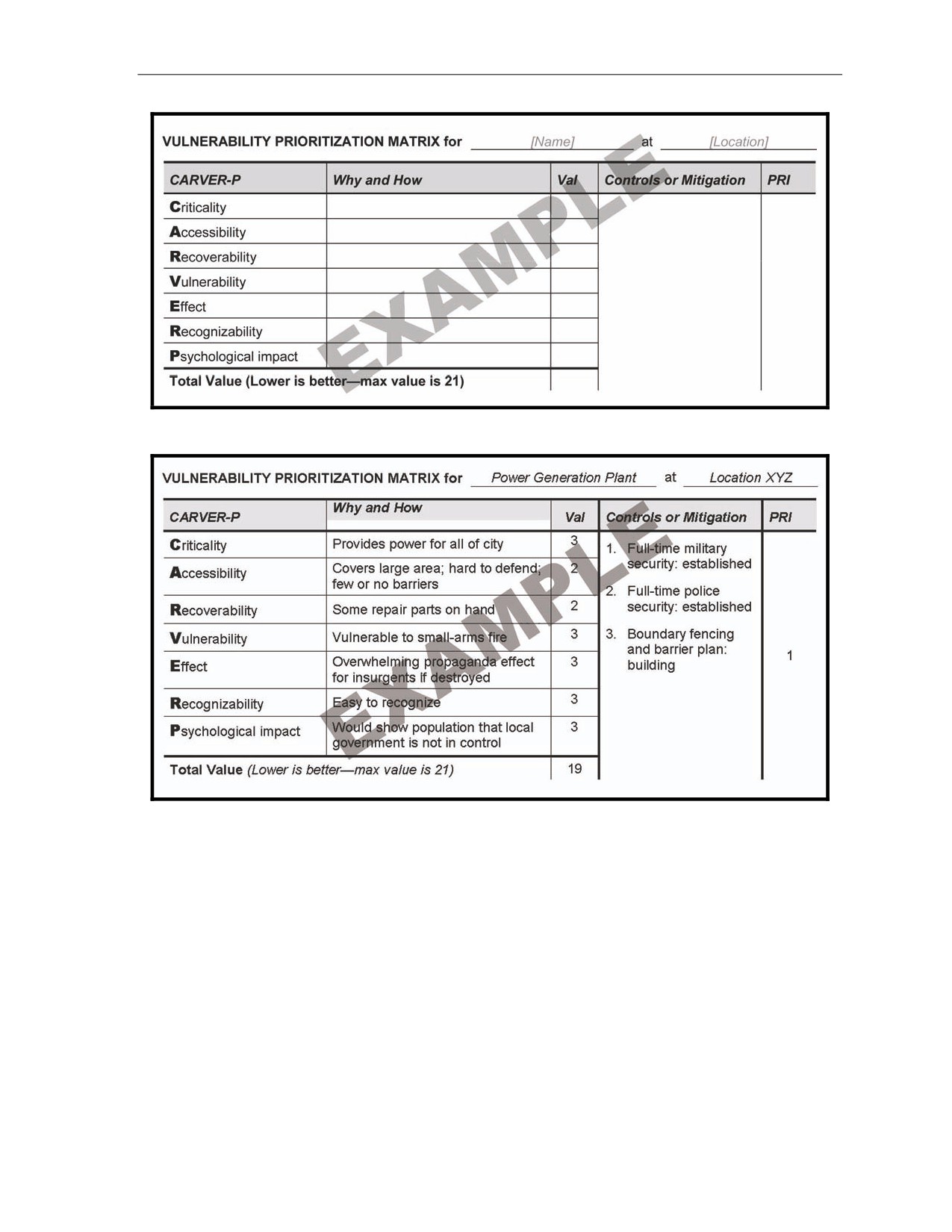
the Army risk-assessment process. Figure 6-1 shows an example format of the Carver-P matrix for the
vulnerability criteria. Figure 6-2 shows an example of the same matrix completed for a power plant.
6-2
FM 3-24.2
21 April 2009
Defensive Considerations in Counterinsurgency
Figure 6-1. Example format for Vulnerability Prioritization Matrix.
Figure 6-2. Example completed CARVER-P Vulnerability Prioritization Matrix.
6-9.
Complete the CARVER-P Vulnerability Prioritization Matrix using these five steps:
Step 1—Identification
6-10.
Identify and continually reevaluate the key structures, capabilities, organizations, and individuals
in the AO that the insurgents may target. Record each target's name and location on a separate Carver-P
Risk/Vulnerability Prioritization Matrix. Figure
6-2 showed an example matrix completed for a
power plant.
Step 2—Evaluation
6-11.
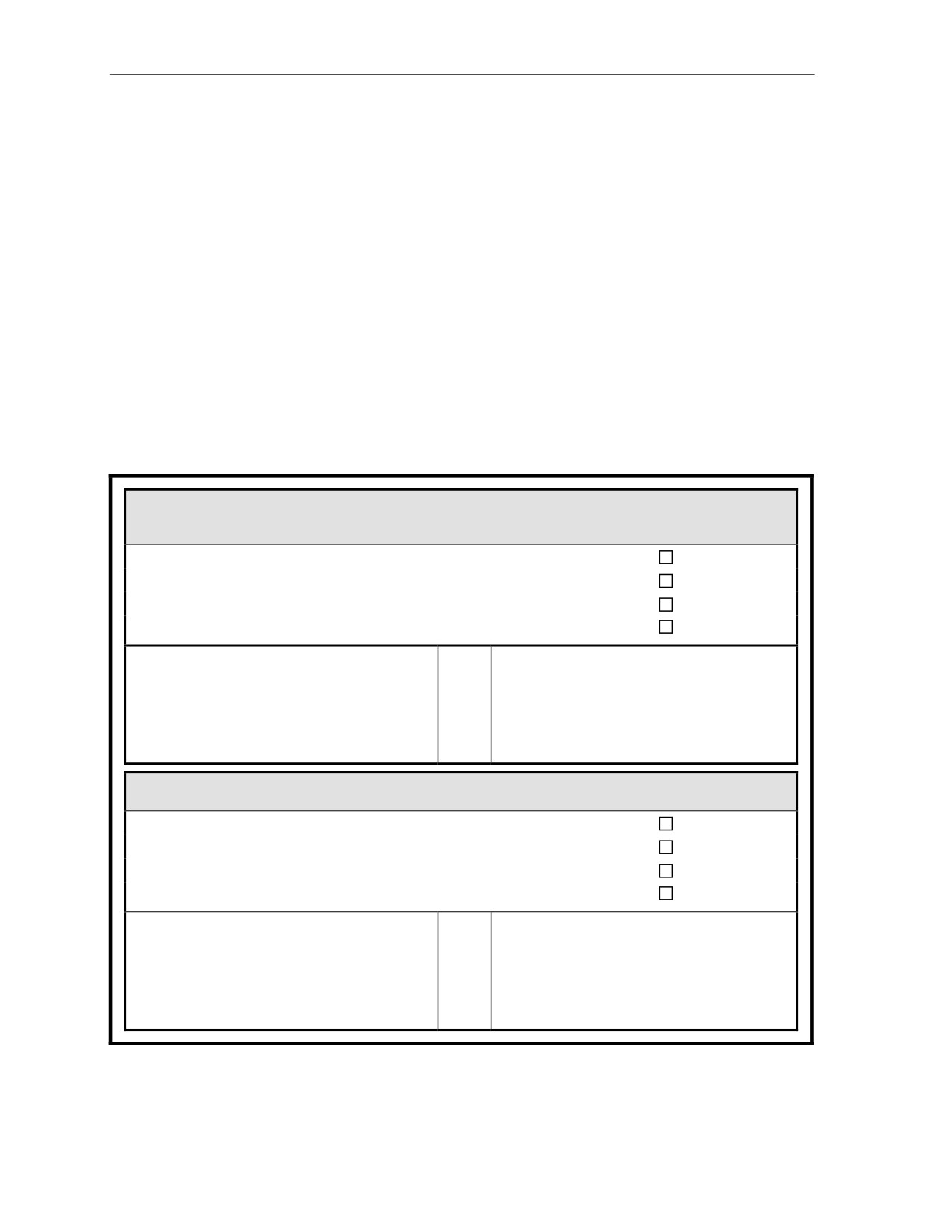
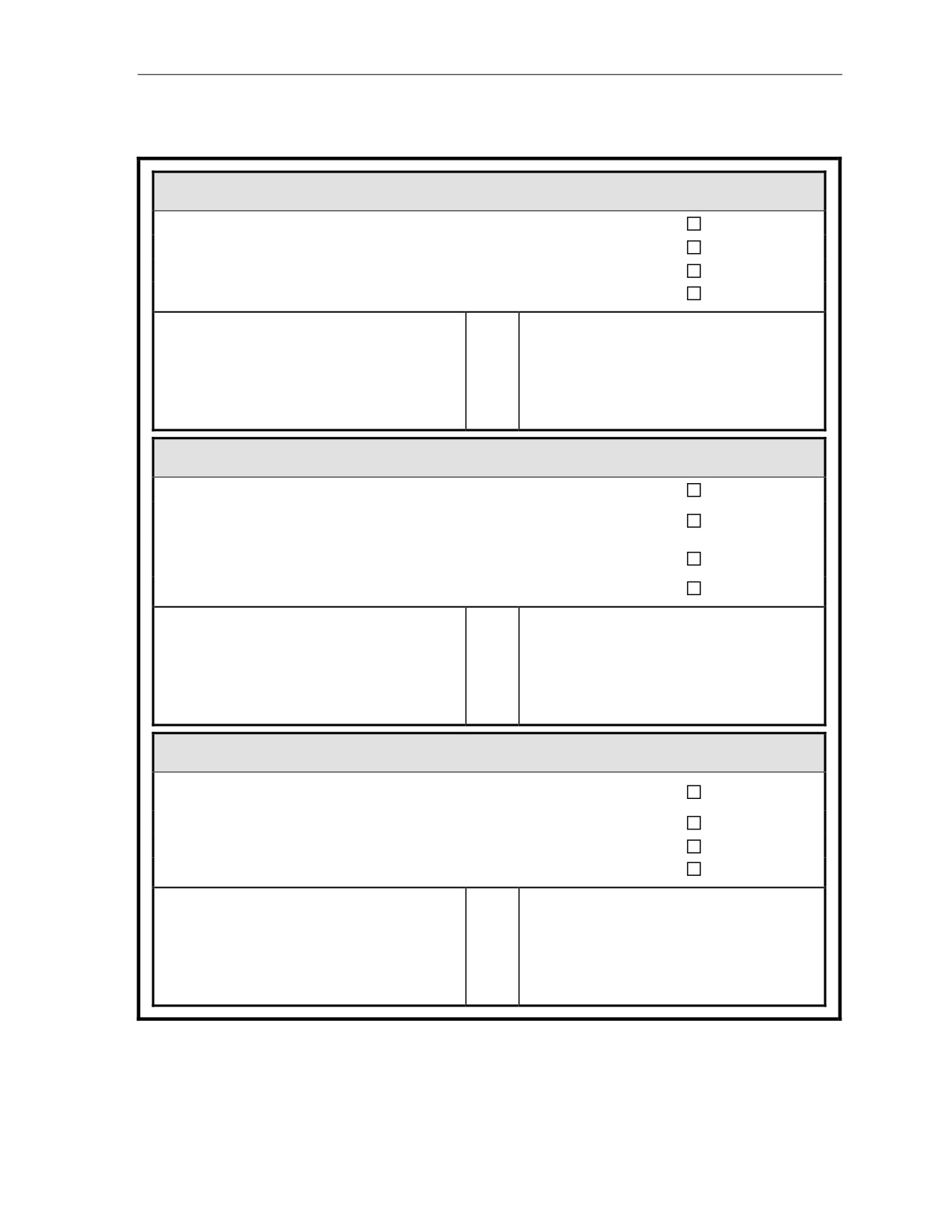
Evaluate this potential target using the Criteria Evaluation Tool shown in Figure 6-3. This tool
provides a simple means to determine risk either using the four generic risk statements of each criteria, or
by developing or modifying similar statements.
21 April 2009
FM 3-24.2
6-3
Chapter 6
Step 3—Analysis
6-12.
In the Criteria Evaluation Tool
(Figure 6-3), for each criteria, choose an appropriate risk
statement, which corresponds to a risk level. Then, explain why and how you assessed the risk level, assign
a numerical value for each of the criteria and, if needed, identify the control and mitigation for each
assessment. Transfer this information to the matrix and sum the values. This sum represents the assessed
desirability of the potential target from the insurgent’s perspective. The higher the number the more likely
the insurgent will attack the target.
Step 4—Facilities Category
6-13.
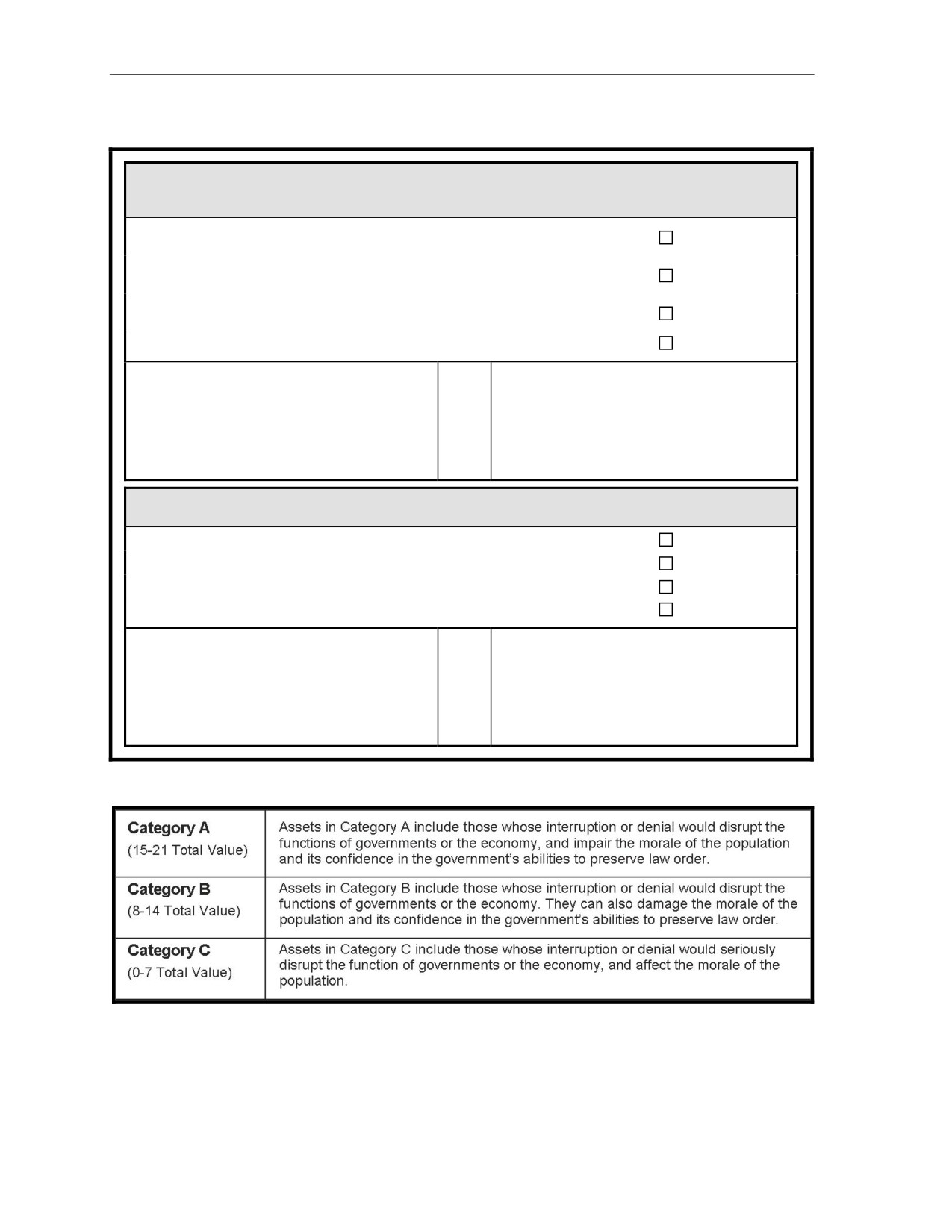
Using this sum, identify the facilities category
(Figure 6-4). Both the identification and the
prioritization of vital assets and key points should be the responsibility of the Host Nation. However, US
commanders should participate in the planning process for assets within their area of operations. To assist
in this process, it is useful to have a simple method of categorizing the facilities to be considered.
Figure 6-4 shows a suggested method for categorizing facilities.
Step 5—Prioritization
6-14.
Compare this target to others to determine priority.
CRITICALITY CRITERIA. Criticality refers to asset value. This is the primary consideration in targeting. A
target is critical when its destruction or damage has a significant impact on military, political, or economic
aspects of a community.
High effect on output, production, service, or mission
High Risk
Moderate effect on output, production, service, or mission
Moderate Risk
Negligible effect on output, production, service, or mission
Low Risk
No significant effect on output, production, service, or mission
No Risk
Why and how
Value
Controls and Mitigation
ACCESSIBILITY CRITERIA. An asset is accessible when an insurgent can reach
the target with sufficient personnel and equipment to accomplish its mission.
Highly accessible: standoff weapons can be employed
High Risk
Moderate accessibility: heavy barriers or protection can be employed
Moderate Risk
Little accessibility: some barriers or protection employed
Low Risk
Inaccessible or accessible only with extreme difficulty
No Risk
Why and how
Value
Controls and Mitigation
Figure 6-3. Criteria evaluation tool.
6-4
FM 3-24.2
21 April 2009
Defensive Considerations in Counterinsurgency
RECUPERABILITY CRITERIA. An asset's recuperability is measured in time. That is,
how long will it take to replace, repair, or bypass the destruction of or damage to the target?
High effect on replacement, repair, or substitution
High Risk
Moderate effect on replacement, repair, or substitution
Moderate Risk
Some effect on replacement, repair, or substitution
Low Risk
No effect on replacement, repair, or substitution
No Risk
Why and how
Value
Controls and Mitigation
VULNERABILITY CRITERIA. An asset is vulnerable if the insurgent has the means
and expertise to attack the target.
Vulnerable to small-arms fire, light antiarmor fire, or charges of 5 to 10 pounds
High Risk
Vulnerable to medium antiarmor fire, bulk charges of 10 to 30 pounds, or very careful
Moderate Risk
placement of smaller charges
Vulnerable to heavy antiarmor fire, bulk charges of 30 to 50 pounds, or requires special
Low Risk
weapons
Invulnerable to all but the most extreme targeting measures
No Risk
Why and how
Value
Controls and Mitigation
EFFECTS CRITERIA. The effect of an asset attack is a measure of possible military,
political, economic, psychological, and sociological impacts at the target and beyond.
Overwhelmingly positive effects for insurgent; no significant
High Risk
negative effects
Moderately positive effects for insurgent; few significant negative effects
Moderate Risk
No significant effects; neutral
Low Risk
Overwhelmingly negative effects for insurgent; no significant positive effects
No Risk
Why and how
Value
Controls and Mitigation
Figure 6-3. Criteria evaluation tool (continued).
21 April 2009
FM 3-24.2
6-5
Chapter 6
RECOGNIZABILITY CRITERIA. An asset's recognizability is the degree to which an insurgent or
intelligence-collection and reconnaissance assets can recognize it under
varying conditions.
The target is clearly recognizable under all conditions and from a distance. Requires little
High Risk
or no training for recognition
The target is easily recognizable at small arms range. Requires a small amount of
Moderate Risk
training for recognition
The target is hard to recognize at night or in bad weather, or might be confused with other
Low Risk
targets or target components. Requires some training for recognition
The target cannot be recognized under any conditions, except by experts
No Risk
Why and how
Value
Controls and Mitigation
PSYCHOLOGICAL IMPACT CRITERIA. An asset's psychological impact is the degree
to which it affects the local population and that population's perception of the government.
Overwhelmingly negative effects on population's perception of government
High Risk
Moderately negative effects on population's perception of government
Moderate Risk
Little negative effects on population's perception of government
Low Risk
Overwhelmingly negative effects on population's perception of government
No Risk
Why and how
Value
Controls and Mitigation
Figure 6-3. Criteria evaluation tool (continued).
Figure 6-4. Facility categories.
6-6
FM 3-24.2
21 April 2009
Defensive Considerations in Counterinsurgency
PROTECTION
6-15.
Protection is the preservation of the effectiveness and survivability of mission-related military
and nonmilitary personnel, equipment, facilities, information, and infrastructure, deployed or located
within or outside the boundaries of a given operational area (JP 3-0). The elements of protection are the
same in concept between conventional operations and COIN. However, one important aspect is that,
counterinsurgents are responsible for protecting local citizens. By ensuring that the local population
is secure, counterinsurgents increase their effectiveness in all other tasks and gain allies who will provide
information and cooperation. This increases the security of tactical units.
TECHNIQUE CONSIDERATIONS DURING COUNTERINSURGENCIES
6-16.
Individual and small groups of Soldiers, leaders, and civilians are targets for the insurgents. This
targeting not only includes lethal operations, such as attacks against an individual, but also nonlethal
operations such as kidnapping, subversion or character attacks. Established individual protection measures
remain the first line of defense. Basic site-protection operations, a building block to secure the population,
include the following:
Static Posts or Bases
6-17.
Each static post has a full-time detachment at the location of the vital asset. The size of the
detachment is determined by the size of the vital asset, the threat, and the distance to the nearest available
reserve. Consideration must be given to conserving manpower by employing surveillance devices
and intruder alarms.
Observation Post
6-18.
Although an OP has too little combat power to secure the vital asset, it can immediately call
for support.
Vehicle Patrols
6-19.
Vehicle patrols may be used to give periodic coverage to many low category vital assets. Timings
for patrols must be varied to prevent the likelihood of ambush and to retain the element of surprise. Patrols
should be strong enough to deal with anticipated threats and they must be supported by a local reserve.
Foot Patrols
6-20.
Foot patrols also give periodic coverage to low category vital assets. Foot patrols will be
particularly valuable at vital assets where movement is congested, observation is difficult, and concealment
is easily afforded to enemy forces, such as those in busy city blocks.
Airmobile Patrols
6-21.
Airmobile patrols may be used as a supplement to vehicle and foot patrols. They will be valuable
for checking vital assets over extended distances or where access is difficult.
RANDOM ANTITERRORISM MEASURES
6-22.
One means to disrupt insurgent attack plans is to implement random antiterrorism measures
(RAMs). These consistently change the look of a security posture to defeat surveillance attempts
and introduce uncertainty to a site's overall security plan, thereby making it difficult for the enemy
to accurately predict friendly actions. Examples of RAMs are—
• Moving Jersey barriers, vehicular barriers, Class IV objects, or objects in other classes to route
traffic around base.
• Starting random security patrols in the surrounding blocks.
• Installing floodlights that operate at random times.
• Changing guard shift at random times.
21 April 2009
FM 3-24.2
6-7
Chapter 6
• Changing access time for entry points.
• Changing access procedures at random.
• Changing the way personnel are searched on a random basis.
• Observing surrounding areas with UAS or JLENS at random times.
Armor Protection
6-23.
Vehicle and personnel armor protection saves lives and makes it more difficult for an insurgent
to conduct a lethal attack. However, the added weight will cause vehicles, especially the engine, to wear
out much faster than normal. Individual body armor also contributes substantial weight to the Soldier
and degrades his maneuverability and endurance.
Hardening
• Hardening vehicles or static sites—Increases protection.
• Makes an insurgent attack more difficult.
• Uses natural or man-made materials to protect personnel, equipment, or facilities.
Concrete or expedient barriers.
Sandbags, walls, shields, berms, or some other type of physical protection.
• Protects resources from blast, direct and indirect fire, heat, radiation, or electronic warfare.
• Concrete and expedient barriers.
• Is intended to defeat or negate the effects of an attack.
Combat Identification
6-24.
CID is the process of attaining an accurate characterization of detected objects in the OE sufficient
to support an engagement decision (JP 3-0). These objects, all of which are potential targets, must be
quickly discriminated as friendly, enemy, or neutral. This is necessary to ensure that enemy forces can be
destroyed, friendly entities can be identified and prevented from becoming fratricide victims, and neutral
entities can be identified to prevent collateral damage. Common combat identification techniques include
the use of—
• Glint tape.
• Infrared lights and strobes.
• Heat sources.
• VS-17 panels.
• Flares.
COUNTERINSURGENCY BASES
6-25.
US counterinsurgency forces operate within a Host Nation and must have a base from which
to operate. Typically, bases try to secure the population and isolate the insurgency from its support. A base
is a locality where operations are projected or supported
(JP 1-02). All bases must be securable
and defendable. Bases vary in accordance with the size of the unit occupying the base and the mission
of the units using the base. All types of bases require clear command relationships. In counterinsurgencies,
forward operating bases (FOBs), combat outposts, and patrol bases are three types of bases.
FORWARD OPERATING BASES
6-26.
Normally, each AO has at least one FOB. The size of the area, its physical characteristics, and the
number and size of the units operating within the area often require additional operating bases. The FOBs
established by a brigade or battalion are often semipermanent and provide deployed units with command,
control, and communications facilities; sustainment; personnel systems support; staging areas;
and intelligence activities. They provide units with relatively secure locations from which to plan
and prepare for operations. During counterinsurgency operations, they also aid in limiting insurgent
mobility nearby, and providing security to the local population.
6-8
FM 3-24.2
21 April 2009
Defensive Considerations in Counterinsurgency
6-27.
Some differences exist between brigade and battalion FOBs. Brigade FOBs are larger than
battalion FOBs, and they provide a rear location for elements of battalions such as forward support
companies. A battalion FOB is normally staffed with the minimum personnel needed to operate
and provide security. It should also maintain two methods for sustainment: road and either air or water.
COMBAT OUTPOSTS
6-28.
This is a reinforced observation post that can conduct limited combat operations (FM 3-90).
In counterinsurgency operations, combat outposts are often company and platoon-sized bases inside
of insurgent-influenced territory. They represent a cornerstone of counterinsurgency operations, in that
they are a means to secure the population. Located in strategically important areas, a combat outpost
provides security in its immediate area and direct contact with the local populace. These benefits are
unavailable from remote bases. Although the strategy carries with it potential downsides in terms
of increased protection concerns and limiting flexibility, the bases provide a huge increase in overall
security in the area.
6-29.
Properly placed combat outposts often increase overall security. Emplacing a company or platoon
combat outpost in sector is a deliberate operation requiring detailed planning and additional logistical
support. The unit must first decide the task and purpose of the outpost by analyzing their sector.
Purpose
6-30.
Outposts may be employed—
• To secure key lines of communication or infrastructure.
• To secure and co-opt the local populace.
• To gather intelligence.
• To assist the government in restoring essential services.
• To force insurgents to operate elsewhere.
Priorities of Work
6-31.
For the initial establishment of combat outposts, priorities of work need to be considered. Some
considerations include—
• Ensuring the position is free of noncombatants. Removing them from the area of operations
before occupying the position.
• Selecting key weapons and crew-served weapon positions to cover likely mounted
and dismounted avenues of approach.
• Clearing fields of fire. Prepare loopholes, aiming stakes, sector stakes, and target reference
point markings. Construct positions with overhead cover and camouflage.
• Identifying and securing supra- and subsurface avenues of approach such as rooftops, sewers,
basements, and stairwells.
• Constructing barriers and emplacing obstacles to deny the enemy any access to streets,
underground passages, and buildings, and to slow his movement in general.
• Integrating barriers or obstacles with key weapons.
• Improving and marking movement routes between positions, as well as to alternate
and supplementary positions.
• Stockpiling ammunition, food, firefighting equipment, and drinking water.
PATROL BASES
6-32.
When a patrol halts for an extended period, it takes active and passive measures to provide
maximum security by occupying a patrol base. A patrol base can be permanent or temporary.
21 April 2009
FM 3-24.2
6-9
Chapter 6
Situations
6-33.
Common situations that require establishing a patrol base include—
• A requirement to cease all movement to avoid detection.
• A requirement to hide the unit during a lengthy, detailed reconnaissance of the objective area.
• A need to prepare food, maintain weapons and equipment, and rest after extended movement.
• A need to formulate a final plan and issue orders for actions at the objective.
• A requirement for reorganization after a patrol has infiltrated the enemy area in small groups.
• A need for a base where several consecutive or concurrent operations, such as ambush, raid,
reconnaissance, or surveillance patrols, can be conducted.
Purposes
6-34.
In counterinsurgency operations, collocating patrol bases in population centers enables
combined forces—
• To deny the insurgent access to the local population.
• To influence and assist the local government.
• To provide security.
• To help Host Nation security forces provide their own unaided security.
Methods of Establishment
6-35.
Patrol bases, in the current fight, can be established using either of two methods. The same
priorities of work described for combat outposts apply also to patrol bases:
• Move in with the indigenous population. The advantages of the first method are that Soldiers
will have more direct contact with the local government, the locals will identify combined
forces with the emerging Host Nation government, and the construction will be less intensive.
The disadvantages are that Soldiers may live in unsanitary conditions, the mass base
or auxiliary may inform insurgents about outgoing patrols with relative ease, attacks on the
base will have collateral damage considerations, and houses are often not suited for defense.
• Build a new patrol base. Although more isolated from the population, new patrol bases are
usually on chosen ground and, therefore, easier to defend. Additionally, they are far more
resource and personnel intensive during construction. It is generally advisable to set aside
detailed planning time before sending a combined force to occupy the terrain.
PLANNING CONSIDERATIONS FOR A BASE DEFENSE
6-36.
Regardless of the ongoing operation, the type of base, or the location of a base, the characteristics
of the defense do not change. The best technique for base defense is the perimeter defense.
TERRAIN
6-37.
Proper evaluation and use of the terrain in the area is essential to hold down the number
of additional forces required for base defense. Key terrain factors to consider include the following:
• Use of the terrain's natural defensive characteristics.
• Use of artificial obstacles to enhance the terrain's natural defensive characteristics.
• Control of all roads and waterways leading into the base.
• Control of military lines of communications and civilian commerce routes.
• Control of land areas surrounding the base to a range beyond that of enemy mortars
and rockets.
HOST NATION SECURITY FORCES
6-38.
The base commander should consider the integration of Host Nation security forces in the overall
base defense effort. Particular emphasis is on integration of host country forces in patrol and populace
control activities. Both host and third country forces provide local security for their own units. However,
6-10
FM 3-24.2
21 April 2009
Defensive Considerations in Counterinsurgency
to ensure maximum benefit, all such local plans should be coordinated and integrated with the base master
defense plan.
COMMUNICATION
6-39.
Control is the key to a successful base defense. To achieve the necessary control, a
communication capability must be established between the base defense operations center and sector
commanders, and between the sector commander and his bunkers, towers, and reserve. Bunkers or Towers
within each section can communicate laterally within the sector, and flank bunkers of one sector can
communicate with flank bunkers of adjacent sectors.
SUSTAINMENT
6-40.
Depending on the mission and status of the battalion, the type of transport available, the weather,
and the terrain, resupply may be by air or ground. The availability of landing zones and drop zones
protected from the enemy's observation and fire is the main consideration if selecting organizing aerial
resupply.
PROTECTION
6-41.
All units in the base area are responsible for preserving its fighting potential. Protective measures
reduce the probability (and the effects) of damage caused by hostile action. Responsibility for the conduct
of protective measures is assigned to fire fighting units, chemical units, medical units, and other units.
In addition, all units assigned to the base are tasked to conduct activities such as dispersion, camouflage,
blackout, field discipline, and use of shelters.
SECURITY
6-42.
Early warning of pending actions ensures the base commander time to react to any insurgent
threat. Outposts, patrols, ground surveillance and countermortar radar, military working dogs teams,
and air reconnaissance and surveillance provide early warning. Information provided by civilians
and actions of indigenous personnel near the base are excellent indicators of pending enemy actions.
All-round security is essential.
DEFENSE IN DEPTH
6-43.
Alternate and supplementary positions, observation posts, and mutually supporting strong points
in front of the base forward defense area extend the depth of the defense. The commander plans fires
throughout the defensive area up to the maximum range of available weapons. Portable obstacles may be
placed around critical targets during reduced visibility to disrupt the enemy’s plan and add depth to the
defense.
PATROLS
6-44.
Base defense operations to counter small groups of enemy forces include aggressive, frequent
patrolling by squad—and platoon-size forces to detect, capture, or destroy small groups of insurgents.
Dogs, if available, may be used to add security and additional detection ability to patrol operations.
Populated areas near the base are searched, and surprise checkpoints are established along known
or suspected routes of insurgent movement.
MAXIMUM USE OF OFFENSIVE ACTION
6-45.
Since the objective of the base defense is to maintain a secure base, the defender maximizes the
use of offensive actions to engage enemy forces outside the base. On initial occupation of the base site,
friendly forces take offensive actions to destroy enemy forces in the immediate area. The area commander
employs patrols, raids, ambushes, air attacks, and supporting fires to harass and destroy any remaining
enemy force. Once the enemy has been cleared from the area, the base can be defended by a smaller force.
The base commander maintains constant liaison with major tactical unit commanders in the area to stay
abreast of efforts to remove the threat.
21 April 2009
FM 3-24.2
6-11
Chapter 6
MUTUAL SUPPORT
6-46.
Defending forces are positioned to ensure mutual employment of defensive resources that include
fires, observation, and maneuver elements. Mutual support between defensive elements requires careful
planning, positioning, and coordination because of the circular aspects of the base area. Surveillance,
obstacles, prearranged fires, and maneuvers are used to control gaps.
ALL-AROUND DEFENSE
6-47.
In defensive planning, the base commander must be prepared to defend against enemy attack from
any direction. Plans are sufficiently flexible, and reserves are positioned to permit reaction to any threat.
Base defense forces are assigned primary and alternate positions and sectors of responsibility. All
personnel are assigned duty stations or shelters.
RESPONSIVENESS
6-48.
Attacks against a base may range from long-range sniper, mortar, or rocket fire to attacks by
suicide bombers or major forces. The insurgent has the advantage of deciding when, where, and with what
force he will attack. The defender positions his forces and plans fires and movement so he can respond to
the widest possible range of enemy actions. The defender prepares plans, to include counterattack plans,
and rehearses, evaluates, and revises them as necessary.
QUICK REACTION FORCE
6-49.
A QRF is a designated organization for any immediate response requirement that occurs in a
designated area of operation
(FM 3-90.6). A QRF increases the overall flexibility of a base defense
and is available for contingencies. Usually a battalion will maintain a platoon sized QRF.
COMBAT OUTPOST CONSTRUCTION CONSIDERATIONS
6-50.
Building a combat outpost is a complex task that must be well thought-out, with a clear vision
from the beginning for expansion and development. It is always best to have trained engineers, either
military or civilian construct the base. Heavy consideration must be given to using local companies
or personnel in constructing the base. This will benefit the local economy; however, it will also increase the
security risk. Figure 6-5 shows a typical combat outpost construction in Iraq. The following considerations
are critical:
PROTECTION
6-51.
Protection involves enemy and security considerations.
Enemy
• Coverage of dead spaces.
• Creation of a safety zone to prevent rocket attacks.
• Emplacement of IEDs along routes.
• Observation.
6-12
FM 3-24.2
21 April 2009
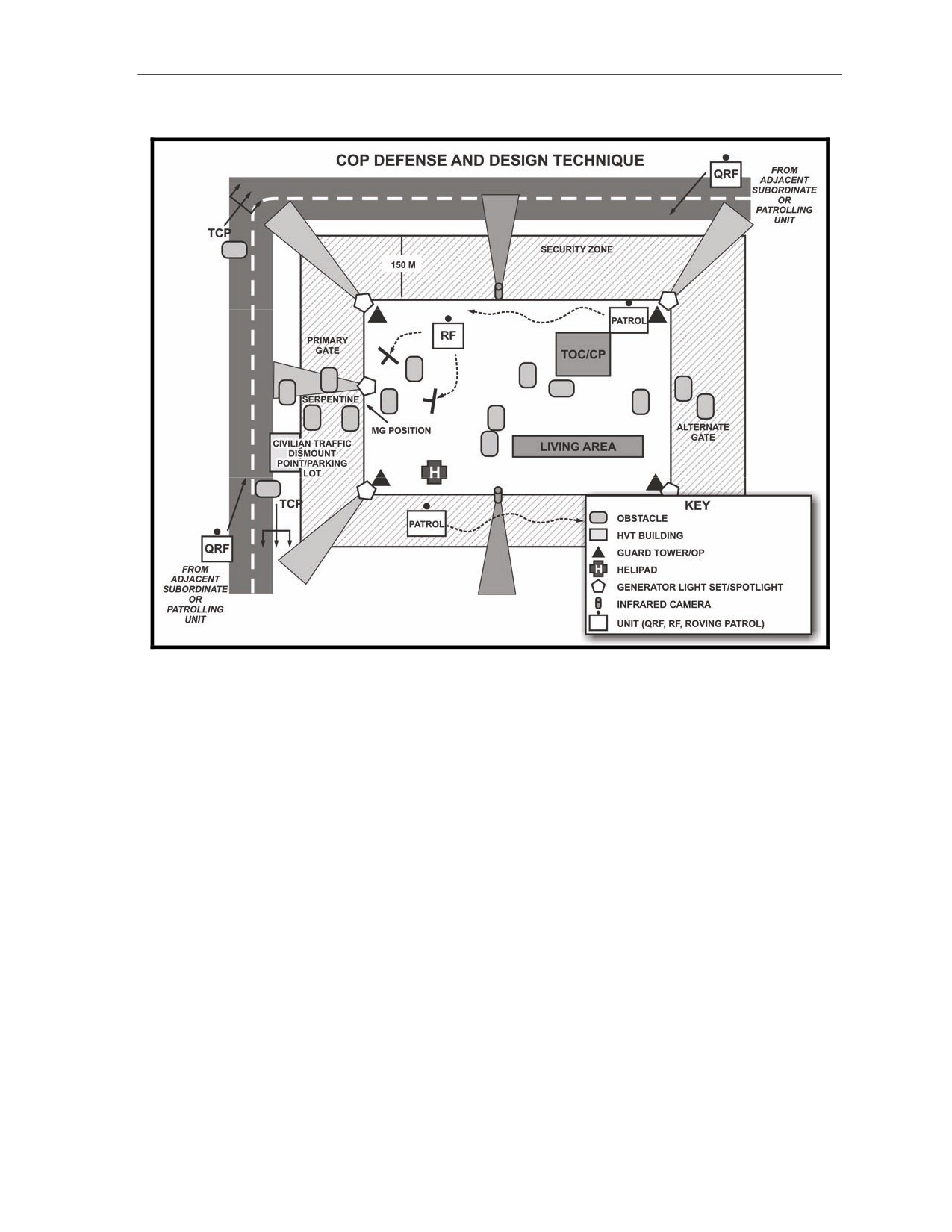
Defensive Considerations in Counterinsurgency
Figure 6-5. Typical US combat outpost design.
Security
• Position concrete block guard towers at each corner and reinforce with sandbags.
• Use chain-link screens to protect positions from rocket-propelled grenades and hand grenades.
WORK AND SLEEP AREAS
• Separate work areas from sleeping and eating areas for sanitation and health concerns.
• Develop a basing strategy that—
Projects where facilities will be located.
Identifies areas for expansion is required.
COMBAT OUTPOST EQUIPMENT
6-52.
Standard equipment for the base includes—
• Kitchen sets.
• Motor pool assets.
• Gym sets.
• Power generators.
• Earth-moving equipment.
21 April 2009
FM 3-24.2
6-13
Chapter 6
STORAGE
• Create storage space by using military van containers (MILVANs).
• Use MILVANs for bunkers, portable housing, and work units.
ELECTRICAL
6-53.
When initially developing combat outposts—
• Envision the proper wiring and layout of zone power grids.
• Consider using generators for backup.
• Consider hiring contract electricians and construction workers, which can assist greatly in the
development of this system.
PLUMBING
• Field sanitation is paramount to the health and safety of personnel on the combat outpost.
• Bulk water from locally drilled wells is typically the main source of water.
FUEL
• Fuel stands are required for storing and distributing bulk fuel assets.
COUNTERINFILTRATION AND EARLY WARNING
6-54.
The key to an effective combat outpost defense lies in identifying the threats. Among the most
dangerous threats are infiltrators. The best defense against these threats is the population that surrounds the
combat outpost. As described in Chapter 1, internally displaced people, merchants, or shopkeepers are
potential sources of intelligence about insurgent attacks on bases. Soldiers from the combat outpost must
talk to their neighbors.
BASE DEFENSE
6-55.
This includes both normal and emergency military measures taken to nullify or reduce the
effectiveness of enemy attacks or sabotage. The base commander is responsible for the local defense of the
base and provision of resources for other activities within the overall area of operations. The base defense
force commander executes base defense operations. Operations are conducted to ensure the continued
effectiveness of base facilities and units to fulfill their missions. The area commander’s responsibilities
include protecting the resources of his area from interruptions caused by enemy activities. Figure 6-6
shows a possible organization of a base command.
6-14
FM 3-24.2
21 April 2009
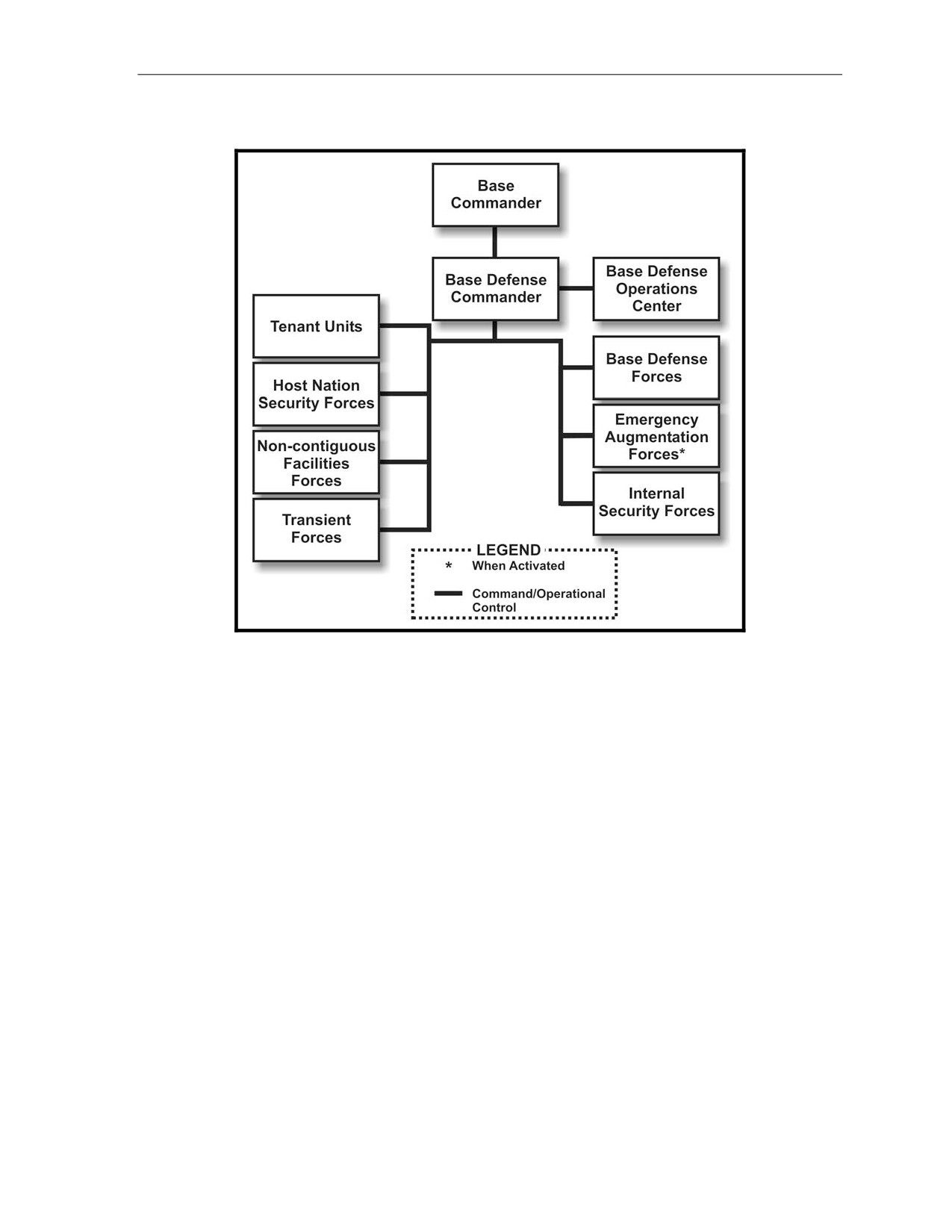
Defensive Considerations in Counterinsurgency
Figure 6-6. Organization of base command.
BASE COMMANDER
6-56.
The mission of the base commander is to exercise command, control, and administration of the
base and to exercise necessary control of resident and transient units not a part of the base command.
A base commander may also be the area commander. The base commander’s responsibilities include
establishing the overall defense organization as well as planning, preparing, and executing all defense
measures.
BASE DEFENSE COMMANDER
6-57.
A base defense commander is appointed to supervise the preparation of detailed defense plans
including establishing defense sectors, conducting required training, providing for or coordinating
logistical support, and controlling base defense operations through an operations center. As the base
commander’s special representative, the base defense commander coordinates the planning efforts
and operations of all elements that are to participate in the base defense.
BASE DEFENSE ELEMENTS (FORCES)
6-58.
Three categories of elements that conduct base defenses are shown in Figure 6-7. The term
elements is used in place of the term units, because base operations are often executed ad hoc:
21 April 2009
FM 3-24.2
6-15
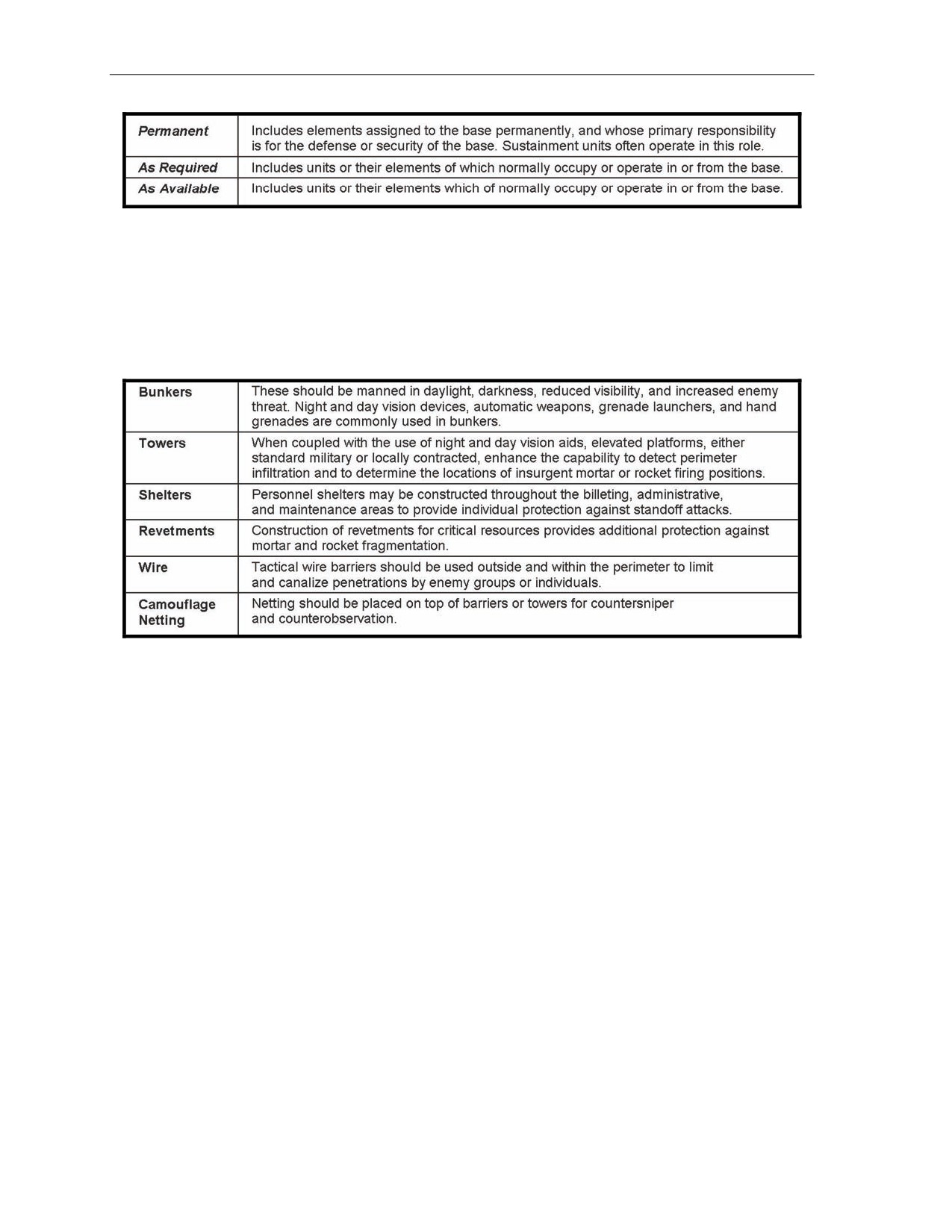
Chapter 6
Figure 6-7. Base defense elements forces.
KEY BASE DEFENSE STRUCTURES
6-59.
The key base defense positions consist primarily of bunkers and towers in the base perimeter area.
The positioning of bunkers and towers affords maximum observation and mutually supporting fires over
the area forward of the perimeter to include the perimeter barrier and sensor system. See FM 3-34.300
for specifics on the construction of defensive positions associated with base defense (Figure 6-8).
Figure 6-8. Key base defense structures.
BASE DEFENSE EXERCISES
6-60.
All base defense plans must be rehearsed, and should include the testing of the base defense alarm
and communication systems. Diverse elements of the defense force must be trained to act in a coordinated
effort. These exercises familiarize all elements of the defense force and base tenant units with their
assignments in base defense. Exercises must be conducted frequently under various weather conditions
during daylight and darkness. Defense exercises include the following:
• Defense of sectors of responsibility, to include—
Rehearsing counterattacks.
Manning defense positions.
• Employment of the reserve for counterattacking and for reinforcing the defense positions.
• Coordination of supporting fires and other means of support.
• Mass casualty exercises.
• Coordination with other forces assigned to base that may be used in a ground defense role.
• Command post exercises.
6-16
FM 3-24.2
21 April 2009
Defensive Considerations in Counterinsurgency
In 1965, the Marine Corps created the Marine Combined Action Program (CAP) in Vietnam. The plan
was to incorporate a Marine Squad with a Vietnamese Popular Defense Force platoon on the Fort Page
firebase.
On June 10, 1965, 12 Marines from C Company, 1st Battalion, 7th Marines were placed with a
Vietnamese Popular Defense Force platoon of about 30 men in a village. Binh Nghia had long been a
"hotbed" of Viet Cong activity. Aggressive patrols and intelligence gained by the Popular Defense Force
soldiers immediately disrupted Viet Cong Operations, and the sector grew quiet. The Viet Cong
requested support from the 409 North Vietnamese Army Battalion. They planned to attack Fort Page and
destroy the CAP. This would free the Viet Cong to resume regular operations.
On September 14, 1965, the CAP was conducting normal night patrols, leaving Fort Page with only 6
Marines and 12 Vietnamese soldiers. Forgetting that the CAP's presence was responsible for the lull in
Viet Cong activity, the squad leader lowered American security from 2 Marines to 1 Marine per guard
shift. This left Vietnamese Soldiers almost completely in charge of Fort Page security. Viet Cong Sappers
infiltrated that night and killed 6 Vietnamese Soldiers and 5 Marines. A reserve squad from a nearby
Marine company firebase arrived on scene after the NVA battalion withdrew. The Viet Cong thought they
had won.
The next morning, the Marine Division Commander asked remaining Marines if they wanted to stay. To a
soldier, they did. At night, the Marines and Vietnamese soldiers doubled their security, and Viet Cong
operations came to a complete stop.
In March 1967, the Viet Cong and the North Vietnamese Army planned another attack on Fort Page. The
CAP had reliable intelligence about the attack, and sent out two patrols to provide early warning. Fearing
a repeat of the 1965 attack, Marine commanders ordered the CAP to retire under threat of court martial.
The Marine squad leader asked his squad what they thought.
One said, “They’re not getting this fort. They’re not getting this ville. I’m not leaving here, no matter what.”
The Marines stayed. When one of the CAP patrols killed the NVA battalion scout, the rest of the battalion
withdrew.
Fort Page was never again threatened. By the time the Marines withdrew from Binh Nghia, the
Vietnamese soldiers were patrolling in buddy teams on their own.
COUNTER AMBUSH
6-61.
Ambushes are a basic tactic commonly used by guerrilla forces. As such, counterinsurgent forces
must continually operate under the understanding that they will encounter an ambush. Counterinsurgent
forces must therefore develop specific local procedures to both react to and to counter ambushes. Typical
complex insurgent ambushes involve IEDs, small arms fire, mortars, and sniper fire.
CONSIDERATIONS DURING COUNTERINSURGENCIES
6-62.
The goal for tactical units is to identify and attack or disrupt the ambush force before it can initiate
the ambush. Additionally, if the insurgents’ kill zone can be identified before the insurgents are in position,
then the ambushers can be attacked as they move into position. Any counterinsurgency unit that
is ambushed must immediately return fire and assault the ambushers. Specific considerations include—
• Avoid massing personnel or vehicles.
• Prepare a reaction plan that includes assaulting the ambushers.
• Ensure only part of the element is in a kill zone at the same time (usually means dispersion).
• Maintain control of your immediate tactical space (within 100 meters).
• Where insurgents are likely to establish ambushes, establish counter ambushes.
• Emplace sniper teams or other forces to overwatch likely insurgent routes to ambush sites.
21 April 2009
FM 3-24.2
6-17
Chapter 6
MOUNTED PROCEDURES
6-63.
The following procedures may be used when reacting to an ambush while mounted:
• Immediately return fire and assume a covered position if possible.
• If you are in the kill zone, leave rapidly.
• If you are not in the kill zone, use fire and maneuver to destroy the enemy if possible.
• Scan your area and prepare for additional attacks, especially—
An IED.
An enemy moving to flank.
An enemy moving to engage you with RPGs or antitank weapons.
• Report contact to higher HQ.
• Follow directions of the vehicle or convoy commander.
COUNTERING IEDS
6-64.
An improvised explosive device (IED) is "a device placed or fabricated in an improvised manner
incorporating destructive, lethal, noxious, pyrotechnic, or incendiary chemicals and designed to destroy,
incapacitate, harass, or distract. It may incorporate military stores, but it is normally made from nonmilitary
components" (JP 3-07.2). IEDs are key components of insurgent ambushes. (See also FM 3-90.119.)
CONSIDERATIONS DURING COUNTERINSURGENCY
6-65.
Between 2001 and 2007, US forces were attacked by over 81,000 IEDs. IEDs are the most
dangerous and effective weapon system faced by Coalition Forces in Iraq. They have inflicted more
casualties than all other weapon systems combined.
TECHNIQUES
6-66.
Wide usage, a destructive nature, and the resulting overall impact on military operations makes
the IED a significant factor for tactical units. For this reason, leaders at all levels must consider IEDs. At a
tactical level, a unit has three major techniques for defeating IEDs. They are—
• Attack the network.
• Defeat the device.
• Train the force.
Attack the Network
6-67.
This method is used to defeat the complex network of IED makers, financiers, emplacers,
suppliers, and others before the IED is emplaced. It includes actions and activities against networks
designed to interrupt the enemy’s chain of IED activities by identifying and exploiting vulnerabilities
and enabling offensive operations. This effort is accomplished through intelligence, surveillance,
reconnaissance, counter bomber targeting, device technical and forensic exploitation, disposal
of unexploded and captured ordnance, persistent surveillance directed toward defeat of the enemy’s
capabilities, and the execution of information tasks which includes command and control warfare, military
deception, and, especially, information engagements. Search operations and operations to kill or capture
network members provide the final, critical step in the process. It is better to find 100 detonators in a cache
than to deal with 100 IEDs on the battlefield.
6-68.
Several analytical tools can be used by tactical units to detect members of an IED network
and synchronize all information gained through various sources. They are part of the targeting process,
which is discussed in Chapter 4. By correctly synchronizing intelligence at all levels, leaders can better
apply combat power to attacking the IED network. The three major tools are imagery and geospatial
intelligence analysis, pattern analysis, and link analysis.
6-18
FM 3-24.2
21 April 2009
Defensive Considerations in Counterinsurgency
Imagery and Geospatial Intelligence Analysis
6-69.
Analysis of an AO where IEDs are employed would be incomplete without the use of imagery
and geospatial intelligence. Imagery products include both aerial photography and satellite imagery.
In many cases, tasked aerial reconnaissance platforms, including UASs, respond directly to the
commander, thus ensuring timely and focused data collection.
Pattern Analysis
6-70.
Units use pattern analysis to determine many of these patterns and predict potential hazards.
Pattern analysis is the ability to observe a selection of events or actions over a period of time in a defined
location or area. It is used to discover likely patterns or similarities that lead to a logical conclusion that the
action or event will occur again in the same location. The two most common forms are coordinates register
and pattern-analysis plot sheet.
Considerations
6-71.
For IED analysis, commanders and staffs use pattern analysis to determine the—
• Types of IEDs.
• Locations where IED incidents have occurred.
Characteristics of the IED sites.
Sizes of the IEDs.
Distance from road, mosque, other natural or man-made objects.
Type of terrain the threat prefers.
Other obstacles used in conjunction with IEDs.
Routes to and from the IED sites (worn paths, other).
• Distance from the IED site to the possible cache.
• Types of munitions and whether one or more types were used.
• Whether the IEDs used explosively formed penetrators (EFPs).
• Whether the IEDs used shape charges.
• Other IED main components such as—
Main charge (explosive)
Casing (materials around the explosives)
Initiators.
• Methods of initiation, such as—
Command wired.
Radio controlled.
Victim operated.
Timed.
Coordinates Register
6-72.
A coordinates register shows cumulative events that have occurred within the AO and focuses on
the “where” of an event. Figure 6-9, which is an example of a coordinates register, is also known as an
incident map.
21 April 2009
FM 3-24.2
6-19
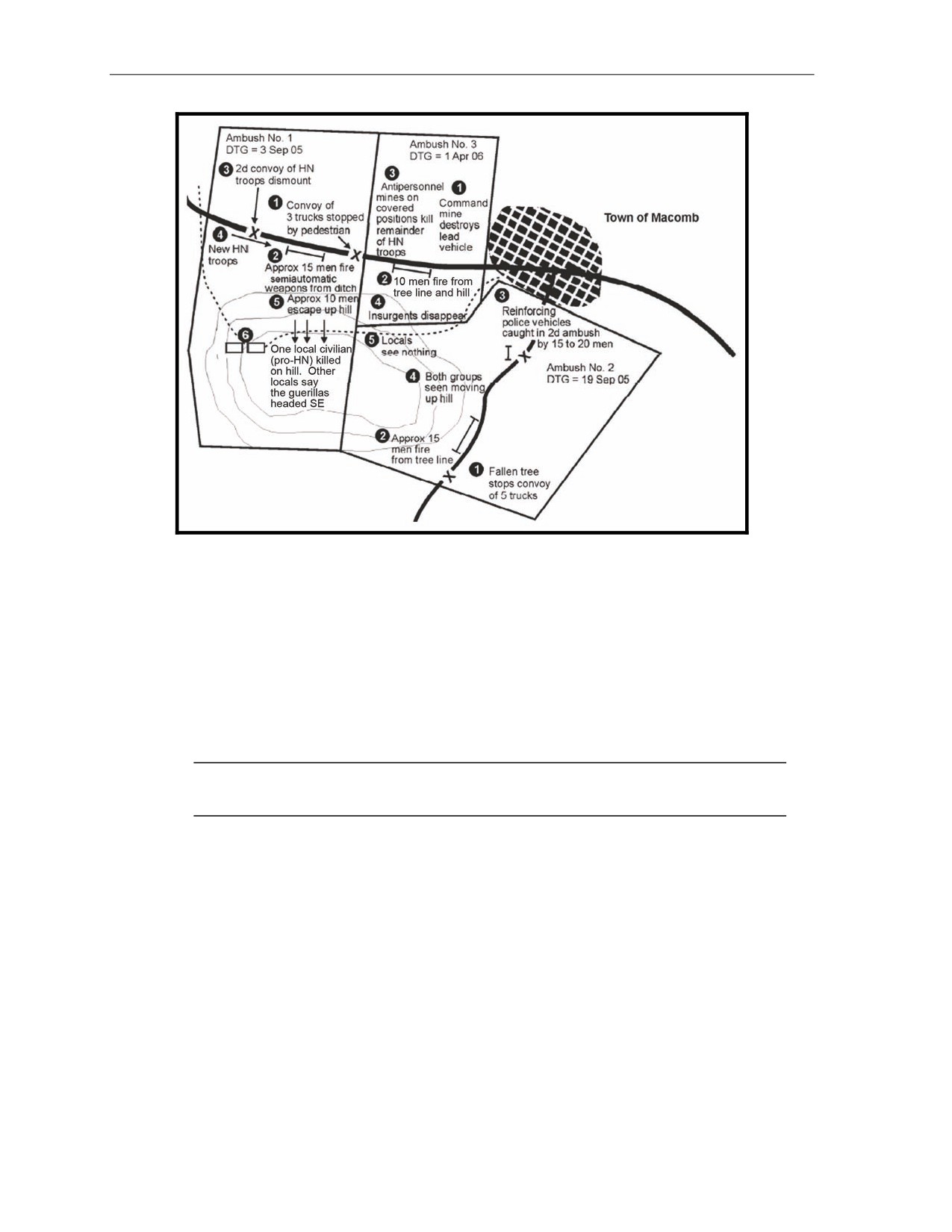
Chapter 6
Figure 6-9. Coordinates register.
Pattern-Analysis Plot Sheet
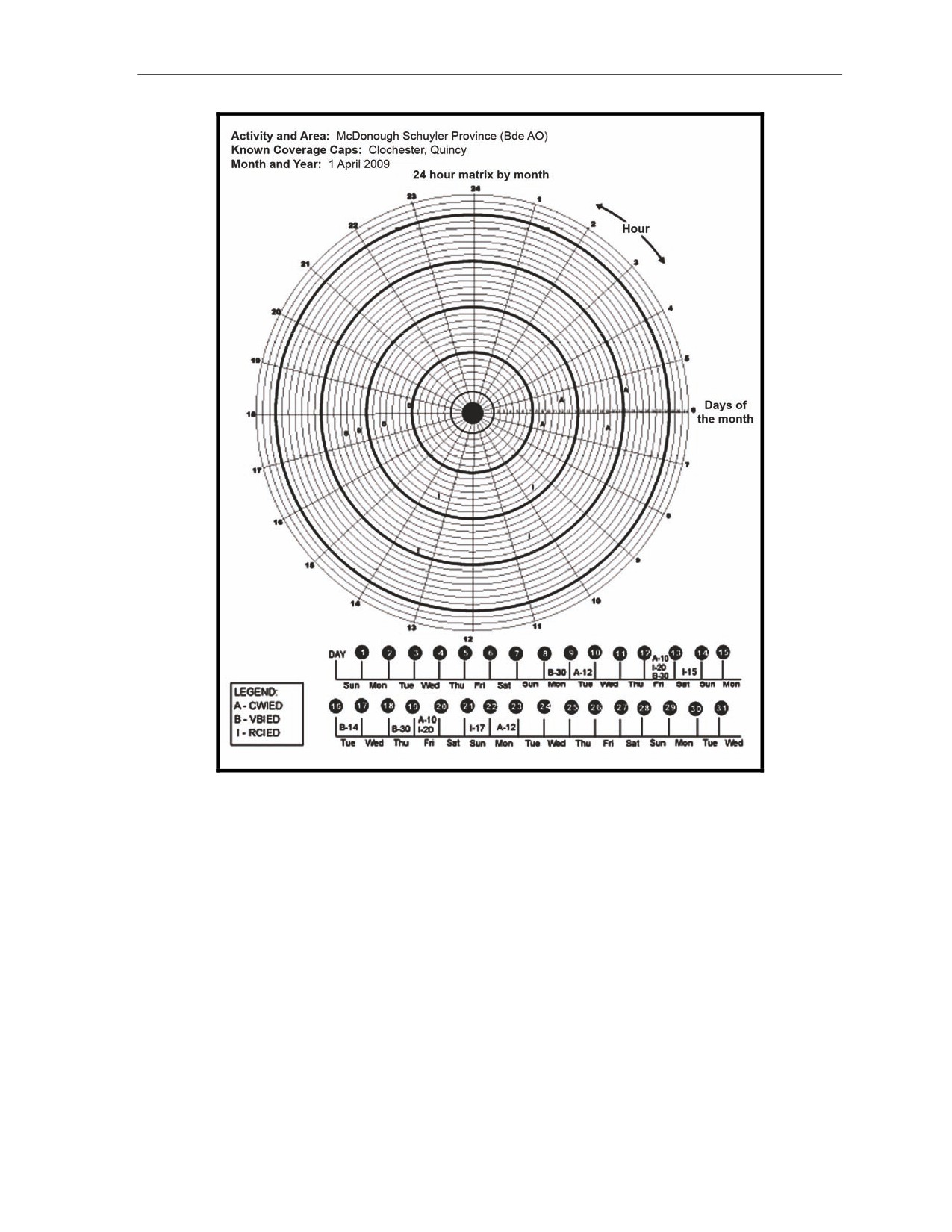
6-73.
A pattern-analysis plot sheet focuses on the time and date of each serious incident that occurs
within the AO. The rings show days of the month; the segments show the hours of the day. As shown in
the plot sheet's legend, the chart shows the actual events; it identifies each by using an alphanumeric
designation that directly corresponds to the legend used on the coordinates register. The legend icons can
be changed to show other types of incidents such as vehicle-borne IEDs (VBIEDs), command-wired IEDs
(CWIEDs), and radio-controlled IEDs (RCIEDs). Figure 6-10 shows an example pattern-analysis plot
sheet.
Note: List daily entry number on calendar. In journal, cross-reference each incident to the
incident overlay.
6-20
FM 3-24.2
21 April 2009
Defensive Considerations in Counterinsurgency
Figure 6-10. Example pattern-analysis plot sheet.
Link Analysis
6-74.
Link analysis is used to show contacts, associations, and relationships between persons, events,
activities, organizations. The two most effective types of link analysis tools are the activities
and association matrixes and the link diagram.
Activities and Association Matrixes
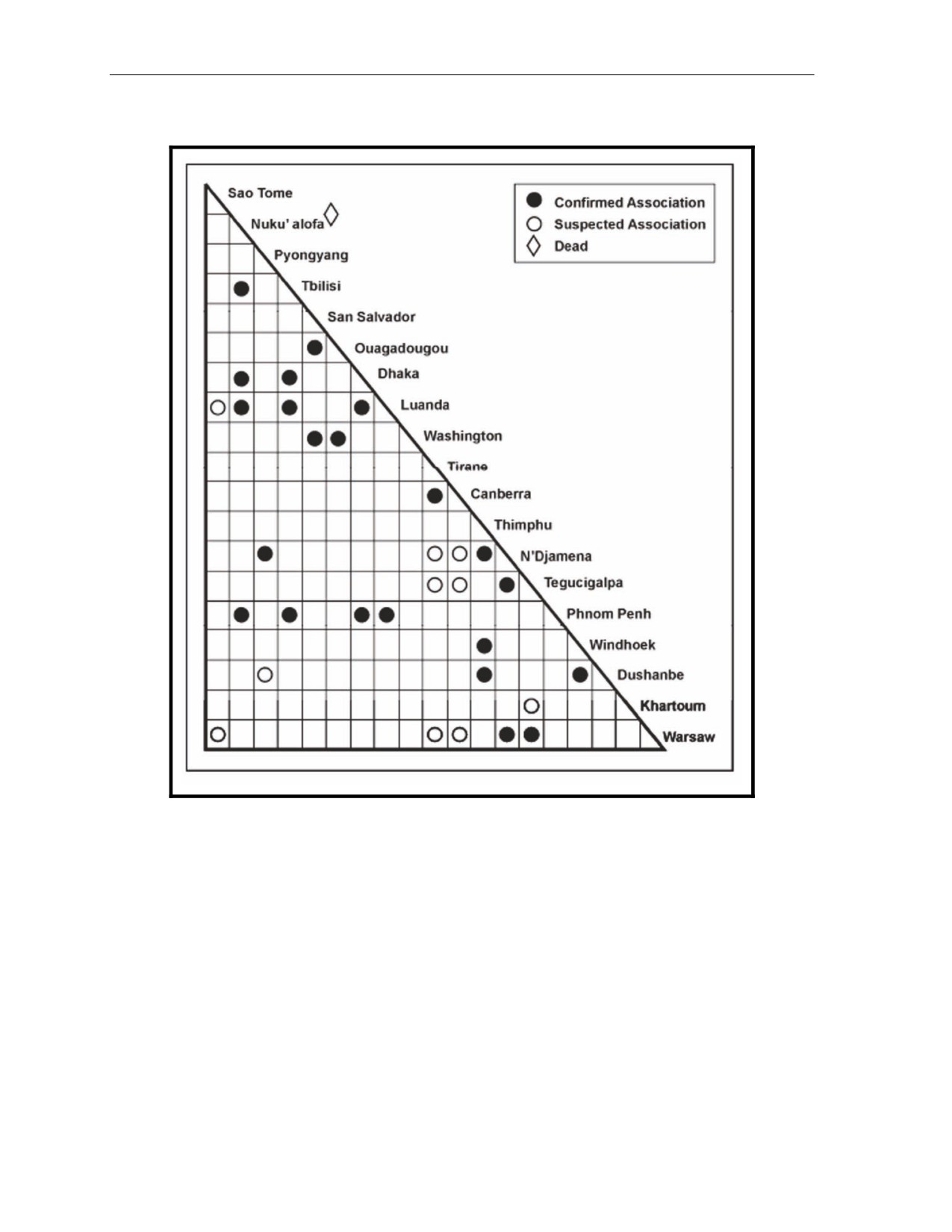
6-75.
Using the activities and association matrixes, the analyst can pinpoint the optimal targets
for further intelligence collection, identify key personalities within an organization, and considerably
increase the analyst's understanding of an organization and its structure. The activities matrix is used
to determine connectivity between individuals and any organization, event, address, activity, or any other
nonpersonal entity. The association matrix is used to determine existence of relationships between
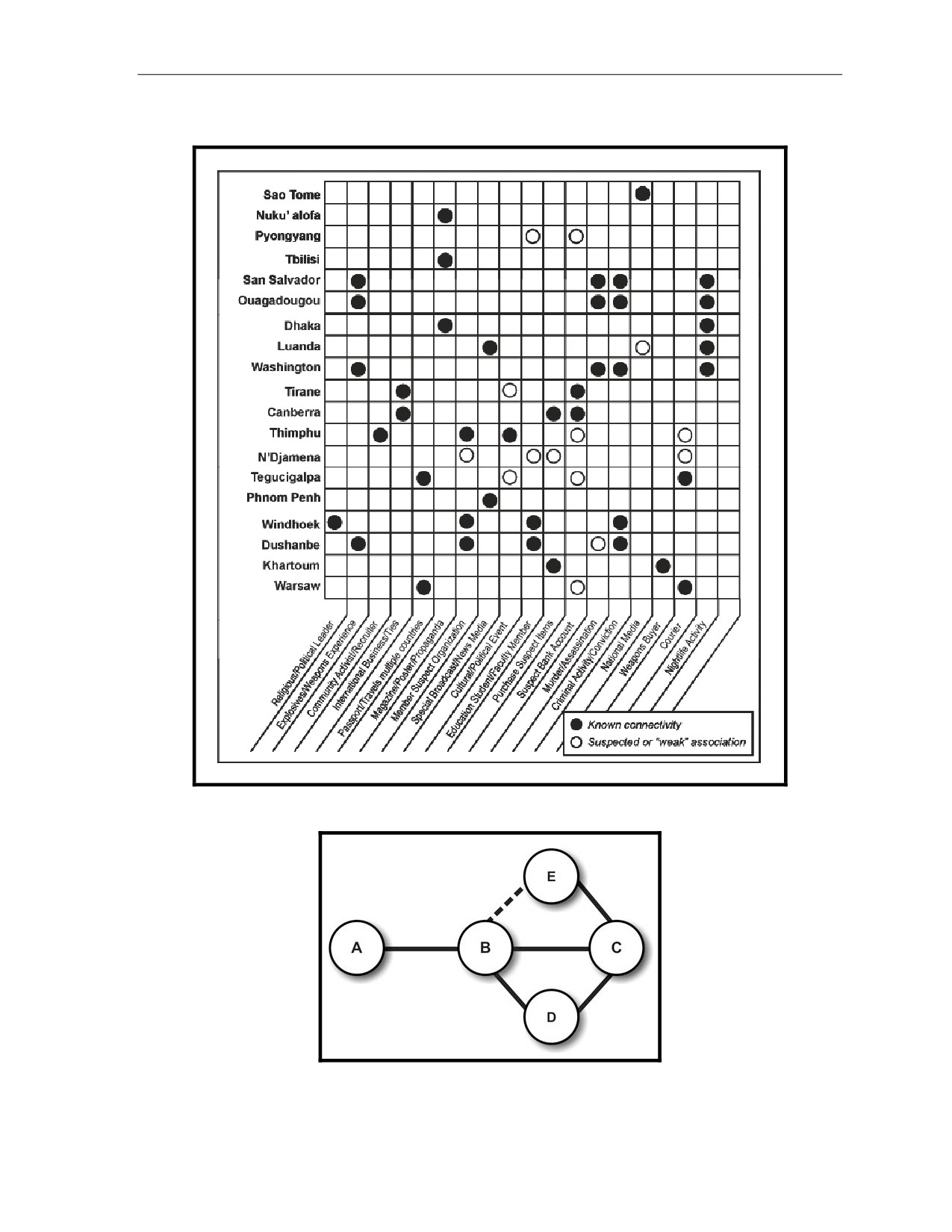
individuals. Figure
6-11 shows an example activities matrix, and Figure 6-12 shows an example
association matrix.
21 April 2009
FM 3-24.2
6-21
Chapter 6
Figure 6-11. Example activities matrix.
Link Diagrams
6-76.
Often, the link analysis is the most effective method to show the connections between people,
groups, or activities. An example of a link diagram is shown in Figure
6-13. The analyst can easily
determine from the diagram that A knows B, and that B knows C and D. B is suspected of knowing E,
and C knows D, B, and E. Although the same information could be shown on a matrix, it may be easier
to understand when shown on a link analysis diagram. As situations or investigations become more
complex, the ease in understanding a link analysis diagram becomes more apparent. In almost all cases, the
available information is first shown and analyzed on both types of matrixes, which are then used
to construct a link analysis diagram for further analysis.
6-22
FM 3-24.2
21 April 2009
Defensive Considerations in Counterinsurgency
Figure 6-12. Example association matrix.
Figure 6-13. Example link diagram.
21 April 2009
FM 3-24.2
6-23
Chapter 6
Defeat the Device
6-77.
In order to enhance commanders’ freedom of maneuver for safe operations, actions taken to
discover IEDs and activities reduce the effects of IED detonation at the point of attack by defeating the
device. They include rapid identification, development, acquisition, and delivery of capabilities for route
clearance, device neutralization, explosive detection, military explosive ordnance disposal, and vehicle
and personnel protection. Additional considerations should address new technologies to include electronic
warfare capabilities. Two techniques for defeating the device are dismounted patrols and route clearance.
Dismounted Patrols
6-78.
Dismounted patrols are especially useful in countering IEDs. Use of dedicated counter IED
patrols, especially along main supply routes, is an important technique to reduce the threat of IEDs along
those routes. A great way to counter IEDs is to eliminate the popular support or acquiescence to the IED
cell through regular engagements. If that is not possible, then identify, and neutralize the kill zones.
Route Clearance
6-79.
Route clearance teams (RCTs) are used to thwart ambushes, clear natural or man-made obstacles,
and detect IEDs. RCTs are comprised of engineers, EOD personnel, mechanical devices, and specialized
robotics to increase standoff from the IED threat. The purpose of route clearance is to eliminate
concealment for IEDs and munitions caches and to conduct the systemic detection and deterrence sweeps
along the cleared routes.
6-80.
Route clearance missions consist of the following two phases: right-of-way clearance and route
maintenance and sweep operations. Right of way clearance is the removal of rubble, debris, berms, holes,
trenches, vegetation, and trash from the medians and shoulders of routes. Right-of-way clearance can be
conducted with special equipment such as an up-armored bulldozer. Cleaning the right of way in this
manner serves multiple purposes: IED-detection devices become more effective; it is more difficult for the
enemy to emplace IEDs; and all counterinsurgent forces can more easily identify IEDs should the enemy
attempt to emplace them again. Another technique is to use by local national labor, which employs the
population. Units should then conduct a deliberate route reconnaissance, identify and record the location
of man-made objects
(buried pipes and cables), and investigate suspicious areas. Route maintenance
and sweep operations are when units conduct systemic, random detection sweeps of the cleared areas
and progress to detection and deterrence sweeps along the cleared route. A visual detection sweep should
focus on changed conditions.
Train the Force
6-81.
Mitigating the effects of enemy IED employment through comprehensive training of our forces
puts troops in the field who are situationally aware and who know their gear. This includes, but is not
limited to, multiechelon and multicomponent training, training on new gear, information management
and dissemination, strategic communications, doctrinal and institutional training changes, and unit mission
rehearsals at Service combat training centers. All soldiers need to be trained in basic techniques, actions
while mounted, and dismounted actions.
Individual Techniques
6-82.
Counter-IED operations at the soldier level revolve around several principles.
(See
GTA 90-10-046 for information on combined arms improvised explosive device defeat operations.) Units
need to know, control, and identify when something is out of place in their area of operations. Insurgents
adapt their techniques based off of counterinsurgent unit actions. These principles are the following:
• Maintain an offensive mindset.
• Develop and maintain situational awareness.
• Stay observant.
• Avoid setting patterns.
• Maintain 360-degree security.
6-24
FM 3-24.2
21 April 2009
Defensive Considerations in Counterinsurgency
• Maintain tactical dispersion.
• Use blast and fragmentation protection.
• Use technology, such as electronic warfare capabilities, thermals, or other devices.
• Look for the triggerman.
Mounted Actions
6-83.
Mounted action includes actions before encountering an IED and actions after encountering
an IED.
Precautionary Actions while Mounted
6-84.
Consider the following while conducting mounted operations:
• Alert all crewmembers of possible IED and its location.
• Never stop a vehicle within 50 meters of a suspected IEDs. The driver should speed up or back
away to quickly move through the danger area. Minimum open area safe distance is 300 meters.
• Watch for approaching vehicle borne IEDs
(VBIEDs). All personnel should be alert
and constantly aware of any vehicle approaching or parked along the route
• Threats should be addressed with a direction, a short description, and an estimated distance.
When time is limited, only the direction need be given: RIGHT FRONT or RIGHT FRONT
MERGING TRUCK 200 METERS.
• Vehicle commands to the driver should be short, giving only a direction and a desired action:
TURN RIGHT, SPEED UP, SLOW DOWN or STOP.
• Gunners should respond by scanning the sector (weapon ready) indicated in the threat alert.
Reaction to IED while Mounted
6-85.
The following procedures may be used when reacting to an IED while mounted:
• Immediately establish security and scan for secondary IEDs.
• Scan your area and be ready for any follow on attacks, especially any additional IED or enemy
moving to engage you with small arms, RPG, or antitank weapons. If necessary, use
obscurants.
• Look for the triggerman or for anyone trying to escape the area.
• Conduct five and twenty-five meter vehicle perimeter checks.
• Report IED to higher HQ. If found before detonation, use the 9-line IED/UXO report.
• Follow directions of the vehicle/convoy commander.
Dismounted Actions
6-86.
Dismounted actions include actions before encountering an IED and actions after encountering
an IED.
Precautionary Actions while Dismounted
6-87.
Consider the following while conducting dismounted operations:
• Alert patrol members of possible IED and its location.
• Never stop within 50 meters of a suspected IED. Move out of the danger area. Minimum open
area safe distance is 300 meters.
• Watch for approaching VBIEDs or PBIEDs. All personnel should be alert and constantly aware
of any vehicle approaching or parked along the route
• Threats should be addressed with a direction, a short description and estimated distance. When
time is limited, only the direction need be given: RIGHT FRONT or RIGHT FRONT
ONCOMING TRUCK 200 METERS.
• All Soldiers should respond by scanning the sector (weapon ready) indicated in the threat alert.
21 April 2009
FM 3-24.2
6-25
Chapter 6
Reaction to IED While Dismounted
6-88.
The following procedures may be used when reacting to an IED while dismounted:
• Establish security and scan for secondary IEDs (5m and 25m sweeps).
• Report IED to higher HQ. If found before detonation, use a 9-line IED/UXO report.
• Maintain security in case of an ambush.
• Follow the directions of the team/squad leader.
React to a Suspected Person-Borne Improvised Explosive Device
6-89.
The following procedures may be used to react to a suspected person-borne IED (PBIED):
• Alert unit members of suspect and evacuate area if possible.
• Issue a verbal command in a loud and firm voice to the suspect to stop. Weapon should be
trained on the suspect.
Note:
After these actions, there is a high probability that the suicide bomber will attempt to detonate
the explosive device. Use deadly force in accordance with the Theater ROE. Physically
restraining the suspect from detonating the device requires coordination with other Soldiers
and is inherently very dangerous.
• Direct the suspect to show hands palms up. The suspect must show palms and fingers spread,
so it can be verified if the suspect is palming a detonator. Be advised that there may be a remote
detonator.
• Tell the suspect to ground all carried items and step two paces away from them.
• Direct the suspect to remove outer clothing and place garments on the ground.
• Direct the suspect to raise or remove any undershirt, and to hold it up while turning a
complete circle.
• Direct the suspect to lie face down, with arms outstretched palms up, and face turned away
from you. DO NOT approach, even if the suspect is injured. Maintain cover and wait for the
arrival of explosive ordnance disposal (EOD) personnel.
• Report suicide bomber to higher HQ using the 10-line explosive hazard spot report.
• If the suspect is noncompliant, deadly force will be used in accordance with the theater ROE.
• Evacuate the area around the suspect (minimum 300 meters or METT-TC) to any hard cover
available.
• Establish security and scan for secondary PBIEDs.
• Maintain security in case of possible ambush.
• Follow the directions of the vehicle/squad leader.
COUNTERSNIPER OR SNIPER DEFEAT
6-90.
The first step in countering snipers is for commanders, leaders, and Soldiers at all levels to be
aware of the sniper threat. Plans to counter the sniper threat and protect friendly forces from insurgent
snipers must be integrated into all counterinsurgent operations during the early stages of planning. Enemy
snipers in a counterinsurgency environment vary from well-trained sniper teams to individuals taking shots
of opportunity. US counterinsurgency forces must be prepared for both.
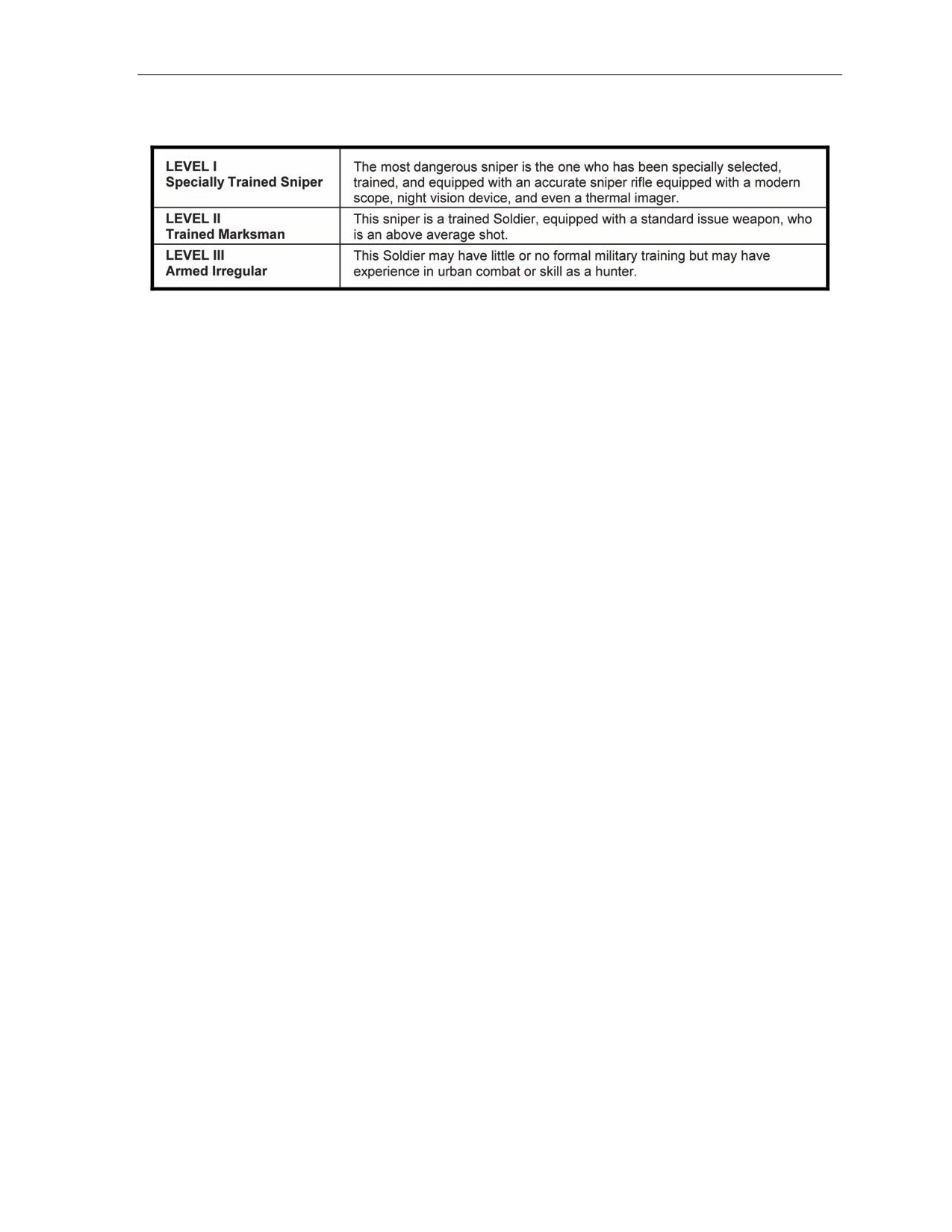
6-91.
Figure 6-14 shows the three types of snipers an insurgent can employ. Identifying the type that
is on the battlefield can aid a commander in deciding what countermeasure to use.
6-26
FM 3-24.2
21 April 2009
Defensive Considerations in Counterinsurgency
Figure 6-14. Types of snipers.
CONSIDERATIONS DURING COUNTERINSURGENCIES
6-92.
Sniper operations have the same effect in insurgencies as they do in conventional warfare, but the
purpose is different. For example, in conventional warfare, a sniper targets leaders in order to cause
confusion on the battlefield and disrupt operations. In an insurgency, a sniper will still target leaders, but
more for use in propaganda that can be used after a successful attack. Additionally, he can create the
attitude that the area of his operations is not secure and the Host Nation government is powerless to stop
him. Since the sniper has the initiative, leaders must enforce compliance with the countermeasures.
Implementing countermeasures halfheartedly invites casualties from snipers who can wait hours for the
moment when a unit’s guard is down. US forces have two categories of sniper countermeasures: active
countermeasures and passive countermeasures. Each has its place, depending on the METT-TC mission
variables.
Active Countermeasures
6-93.
Active countermeasures seek to detect and destroy the sniper before he can fire, or engage
and neutralize him after he fires.
Observation Posts and Observers
6-94.
Observation posts should have access to powerful spotting telescopes, medium power binoculars,
night observation devices (thermal, if possible), and remote control closed circuit cameras. Additionally,
laser countermeasure should be employed, such as laser protective glasses, binoculars with laser filters,
and indirect-view optics to protect observers. Additionally, many electronic detection devices are available
to aid in the detection of snipers such as acoustic devices. Once detected, snipers can then be neutralized
or forced to withdraw. Observers can maintain a constant surveillance over potential sniper positions
and detect snipers as they attempt to move into position for a shot. Constantly scanning an area for the
minute movements made by a well-trained sniper is exhausting. Therefore, personnel on static OP duty
should rotate frequently. Unmanned aerial systems (UAS) and rotary wing aircraft should be integrated
into an OP plan to give it depth.
Patrols
6-95.
Constant reconnaissance and security patrols around a unit’s position hinder a sniper from getting
into a firing position undetected. Small patrols are usually more effective than large ones. A moving sniper
who has been discovered by a patrol is at a great disadvantage since he lacks the firepower to fight a long
engagement. Small night reconnaissance patrols using night vision devices can be very effective
in disrupting and interdicting a sniper. Reconnaissance patrols should move by covered and concealed
routes to good observation points; should stop and observe; and then should move to another position. The
patrol routes and times must vary, and a reaction force or supporting weapons must be ready if the patrol
makes contact. A variation of the ambush patrol is the stay-behind ambush. A small ambush element
moves as part of a larger patrol and occupies its position without being observed. It then observes its kill
zone, which may be very large if the element has a sniper team with it, and engages enemy snipers as they
attempt to move into position. Currently, SKTs, SCTs, or small observation teams
(SOTs) conduct
ambushes of likely sniper positions.
21 April 2009
FM 3-24.2
6-27
Chapter 6
United States Sniper Teams
6-96.
US sniper teams can be a very effective counter to enemy snipers. Not only do they have expert
knowledge of sniping and likely enemy hiding places, they can normally engage enemy snipers
or marksmen at a greater range than the enemy sniper can engage US forces. Their precision fires are also
much less likely to cause civilian casualties than dozens of rounds from other weapons.
Return Fire and Maneuver
6-97.
Before a unit encounters an enemy sniper, the unit must not only understand the rules
of engagement but also war-game the rules of engagement to ensure the authorized level of responses are
sufficient. Although the ROE and the tactical situation determine the response, ideally authorization should
include the ability to respond with fire from all the units light weapons. If a unit can determine the general
location of a sniper, it should return suppressive fire while maneuvering to engage the sniper from close
range. This is not always successful because a well-trained sniper often has a route of withdrawal already
chosen. Fire without maneuver will not be successful in defeating snipers.
Obscurants
6-98.
Projected smoke that builds quickly is a good response to protect a unit from further casualties
if engaged by an enemy sniper. It greatly limits his ability to acquire targets. The closer the smoke is placed
to the sniper’s location, the more effective it is. If the location of the sniper is unknown or cannot be
reached by projected smoke, a smoke cloud established near the unit can be effective in reducing the
sniper’s chances of hitting a target and allowing a unit to conduct first aid and CASEVAC.
Passive Countermeasures
6-99.
Passive countermeasures prevent the sniper from acquiring a clear target and prevent his fires
from causing casualties. Passive countersniper measures are rarely successful by themselves. If passive
measure are the only measures enacted, they may also create a siege mentality and pass the initiative over
to the sniper. They include—
Limiting Sniper Exposure
6-100. If Soldiers limit their sniper exposure, they can marginalize snipers operations. Some examples
include using covered and concealed routes, avoiding lighted areas at night, moving tactically while using
traveling or bounding overwatch, and staying away from doors and windows.
Wearing Protective Equipment
6-101. Other sniper protective measures include wear of the Kevlar helmet, protective eyewear, and body
armor systems. These should be worn any time Soldiers are exposed to potential sniper fire. This decreases
the snipers' casualty-producing target area, which limits his effectiveness.
Using Armored Vehicles
6-102. Whenever possible, move around in the urban area in a protected vehicle with as little exposure
as possible. Avoid open-sided cargo vehicles. Requisition or improvise vehicular armor against small-arms
fire for all unarmored vehicles. This technique limits a unit’s ability to interact with the population,
and should be used as a last resort.
Erecting Screens and Shields
6-103. Use simple canvas or plastic screens to make a dangerous alleyway or street crossing safer
for foot traffic. Adapt screens on windows to allow vision out while hiding personnel inside. Use moveable
concrete barriers to provide protection for personnel at static positions. Use common items, such
as rubble-filled 55-gallon drums and sandbags, to provide cover.
6-28
FM 3-24.2
21 April 2009
Defensive Considerations in Counterinsurgency
Denying Enemy Use of Overwatching Terrain
6-104. Either occupy overwatching terrain with friendly forces, or modify it to make it less useful to an
enemy sniper. Pull down likely hiding places. Clear bushes and rubble. Board or brick up windows. Pile up
earth and rubble in front of buildings to block lines of sight for snipers. Ensure all actions are
in accordance with the laws of war.
TECHNIQUE CONSIDERATIONS
6-105. Countersniper actions have two parts: find and eliminate the sniper.
Find the Sniper
6-106. Once a unit determines it has a sniper or a sniper team in its AO, the unit should implement
countersniper immediate action drills. Allowing the enemy sniper to fight another day is mission failure.
First, the unit must find the sniper or the sniper team. Techniques for detecting a sniper consist
of identifying likely sniper locations, focusing observation on sniper movement, and seeking audible and
visual signs. Backtracking, which involves integrating the following techniques, is used to find the sniper:
Identify Likely Sniper Locations
6-107. A sniper is a line-of-sight asset. The larger the sniper kill zone, the closer or the higher he must
position himself to cover it. Smaller sniper kill zones create for a narrow, if not linear, line of sight. In such
cases, the sniper will always choose a position that offers that offers a line of sight, such as a road or alley,
or maybe inside a building, shooting through a window, doorway, or other opening.
Focus Observation on Sniper Movement
6-108. Snipers always plan infiltration and exfiltration routes. After identifying possible sniper locations,
a unit commander can focus observation on these routes and deny a sniper the ability to reposition. Snipers
operate slowly, with calculated movements, to avoid detection. The movement the sniper makes may not
be easily detected. Units should look for movement that does not "fit" the environment.
Seek Audible/Visible Signs
6-109. Audible/visual indicators help find snipers based on the sniper's firing a shot. Actually, firing a
weapon is a sniper’s greatest moment of risk; it offers the best opportunity to locate him or his team. The
acoustic, light and heat signatures associated with the projection of the bullet from his rifle are his greatest
vulnerabilities. The muzzle flash can be detected with infrared sensors out to a kilometer. Often the muzzle
flash and the blast can throw dust into the air. Acoustic sensors can detect a muzzle blast from several
hundred meters to more than a kilometer. The bullet’s shock wave is a mini-sonic boom. This noise, caused
by the bullet travelling faster than the speed of sound, can sometimes be heard more than a kilometer away.
Backtrack Sounds, Sights, and Angles
6-110. In a city, the backtracking process is complicated by buildings that obstruct the view of the
sniper’s position. Backtracking is challenging, but it is how you relate shot angles, kill zones, movement,
and audible and visible signs to help you find the sniper. Experience and training play a major role
in accurate backtracking.
Eliminate Sniper
6-111. Once spotted, the enemy sniper must be killed or forced to surrender. To be successful in this
goal, the unit must rapidly locate, fix, and finish an active enemy sniper to ultimately kill or capture him.
21 April 2009
FM 3-24.2
6-29
Chapter 6
Avoid the Kill Zone
6-112. Figure out his kill zone and stay out of it. A unit may also want to eliminate or at least reduce his
targets. If a unit removes its targets, the unit curtails mission success; the sniper will need to move, or at
least adjust his position, to remain effective.
Maneuver Rapidly
6-113. When contact is made, the on-scene commander needs to rapidly calculate the disposition of his
forces, the quick reaction force (QRF), and adjacent friendly forces and factor in time/space considerations
to determine how to neutralize the threat. Because of the fleeting nature of the sniper, it is often preferable
for the on-scene commander to begin to maneuver against the hostile sniper with an unengaged portion
of his own force rather than wait for a QRF.
Consider Sniper Hunting with Another Sniper
6-114. Throughout history, many units engaged in urban combat often employed direct and indirect
supporting arms, close air support, or large numbers of ground forces to counter urban snipers. However,
the Russian and German forces of World War II found that the best solution to a sniper threat was the
employment of their own snipers in a countersniper role. Advantages to using a trained sniper to counter
enemy snipers include—
• The relative ease of movement over the urban battlefield of a sniper team versus that of a larger
ground formation.
• Countersnipers who “know the habits and modus operandi” of their enemy counterparts.
• The ability to deliver
“precision fire” and the resulting reduction in collateral damage
or civilian and friendly casualties.
Confirm that Enemy Sniper is Neutralized
6-115. In this context, neutralization means that the sniper is killed or captured. A dead or captured
enemy sniper, besides ending that threat, can be a valuable source of intelligence.
COUNTERING DRIVE-BY SHOOTINGS
6-116. A drive-by shooting is the firing of small arms by an occupant(s) of a vehicle as [the vehicle]
drives past an area, followed by the vehicle's immediate departure of the area. This is an effective
technique for an insurgent, because it allows rapid infiltration and exfiltration, requires little logistical
support, has a chance of success, and has little chance of resulting in a decisive engagement. Any structure
or location near a roadway is a target for a drive-by shooting. Usual targets for drive-by shootings are
vulnerable, easily escapable spots. Attackers avoid well-defended locations.
CONSIDERATIONS
6-117. Establishing static checkpoints or closing roads near a high threat area often prevents further
drive-by attacks along a specific avenue of approach. However, the insurgents are not eliminated and they
will then look for new or different ways to attack. Timely and accurate reporting by subordinate units can
allow higher headquarters to integrate UAS and rotary wing aircraft to track vehicles after a drive-by
attack. This will open insurgents up to targeting counterinsurgent forces.
TECHNIQUES
6-118. One technique is to conduct mobile checkpoints. If effective, they can disrupt the ability
of insurgents to transport weapons in vehicles. Random snap checkpoints may encourage drive-by shooters
to look elsewhere for targets.
6-30
FM 3-24.2
21 April 2009
Defensive Considerations in Counterinsurgency
Section III—OTHER LINES OF EFFORT
In a counterinsurgency, defensive operations are conducted to prevent insurgents from attacking security
forces, attacking the population, or disrupting actions along the seven COIN lines of effort. This section
discusses special defensive operation considerations for the remaining five lines of effort.
SUPPORT HOST NATION SECURITY FORCES
6-119. The success or failure of a counterinsurgency falls heavily on the competence and capability
of Host Nation security forces. When insurgent forces are stronger than the Host Nation security forces,
insurgents focus on the destruction of weak Host Nation units to control terrain and consolidate gains
through deliberate attacks on a Host Nation base, combined combat outpost, combined patrol base,
or combined command post. In this situation, extra defensive efforts need to be applied to give time for the
Host Nation security forces to develop. When Host Nation forces are stronger than insurgent forces,
insurgents attempt to delegitimize Host Nation security force operations through attacks focused on
lessening security. Then, defensive considerations need to be applied to enable Host Nation forces
to increase the efficiency of their operations.
SUPPORT TO GOVERNANCE
6-120. This line of effort relates to the Host Nation governments' ability to gather and distribute resources
while providing direction and control for society. By disrupting the Host Nation government’s ability
to conduct these functions, an insurgency can delegitimize the government. An example is the local
security of a key judge who has been instrumental in issuing verdicts against criminal activities
of insurgents in order to prevent his assassination. Defensive efforts may need to be applied so that a
government can conduct its basic functions which include—
• Controlling military and police activities.
• Establishing and enforcing the rule of law.
• Public administration.
• Justice (a judiciary system, prosecutor/defense representation, and corrections).
• Property records and control.
• Civil information.
• Historical, cultural, and recreational services.
• An electoral process.
• Disaster preparedness and response.
RESTORE ESSENTIAL SERVICES
6-121. A common insurgent technique is to create a dissatisfied population by preventing the Host
Nation from meeting the population’s basic needs. An easy way for an insurgent to do this is to disrupt the
population from receiving sewage, water, electrical power, and medical services. Units should apply
defensive considerations for any attempt by combined or Host Nation security forces to build or restore
those services. For example, a poorly planned generator drop allows an insurgent to attack and destroy the
generator. Now, instead of restoring an essential service and reinforcing the legitimacy of the Host Nation
government as intended, the insurgent has demonstrated the weakness of the Host Nation government.
Instead, US and Host Nation security forces need to secure, protect, and prevent insurgents from
influencing projects that restore essential services.
SUPPORT TO ECONOMIC AND INFRASTRUCTURE
DEVELOPMENT
6-122. A poor and unemployed population is naturally dissatisfied. The major pool of insurgent recruits
are unemployed, young, adult males. The primary motivation for a young male to join an insurgency
is often the wage that it provides. Sometimes insurgencies foster the conditions to keep an economy
21 April 2009
FM 3-24.2
6-31
Chapter 6
stagnant. Naturally, the Host Nation and combined forces will conduct stability operations to create
situations where businesses can thrive. An example is conducting route security, so that insurgents cannot
interfere with the transportation of products to a market. Economic infrastructure that might need defensive
considerations include—
• Natural resources.
• Industries such as manufacturing and transportation.
• Agriculture and livestock—crops, products, and storage facilities.
• Local merchants and markets.
• Credit associations.
CONDUCT INFORMATION ENGAGEMENT
6-123. Information engagement is deliberately integrated into defensive operations to compliment
and reinforce the success of operations. Exploiting insurgent violent tactics, behaving harshly towards the
HN population, and failing to achieve their goals are matters of precise timing and coordination. Some
units have chosen to prepare an information engagement plan to provide an immediate response
to insurgent attacks or propaganda such as sending a field-grade officer to the site of an insurgent attack
to talk with the local media and get the correct story out. These efforts may go far to influence the populace
to provide information, either for reward or anonymously, that may break apart insurgent networks.
Specifically, information supplied by the populace is critical in countering ambushes, IEDs, snipers, and
drive-by shootings. It does this by interrupting the insurgent decision cycle.
SUMMARY
General Clutterbuck in the Malayan emergency said, “(A Village police post)… was the only thing that
could provide security against the threat that really mattered in the villages—the man with the knife, who
lived in the village and prowled the streets at night seeking out those people who had actively supported
the government or betrayed the guerrillas during the day.” This chapter identified defensive operations
as they apply specifically to establishing civil security and civil control, and the other LOEs. Defensive
operations in COIN must secure the population, Host Nation security forces and government, and US
forces from the actions of insurgents.
6-32
FM 3-24.2
21 April 2009
Chapter 7
Stability Operations Considerations in Counterinsurgency
“Internal Warfare within a population, particularly in cities, generally involves an
extensive police operation. There is also an intensive propaganda effort, destined
primarily to make the steps that are taken understood [by the population]. A broad
social program follows, the objective of which is to give the people the material
and moral assistance necessary to permit them to resume their normal activities
quickly after operations are over.”
Trinquier, Roger. Modern Warfare—A French View of Counterinsurgency, 1964.
Stability operations encompass various military missions, tasks, and activities
conducted outside the United States in coordination with other instruments
of national power to maintain or reestablish a safe and secure environment, provide
essential governmental services, emergency infrastructure reconstruction,
and humanitarian relief
(JP
3-0). They leverage the coercive and constructive
capabilities of the military force to establish a safe and secure environment; facilitate
reconciliation among local or regional adversaries; establish political, legal, social,
and economic institutions; and facilitate the transition of responsibility to a legitimate
civilian authority (FM 3-07). In the absence of HN civil government, military forces
will have to fulfill this role until HN, UN, or other US Government agencies assume
these responsibilities. FM 3-07 describes in detail the requirements that may fall upon
the Soldiers and leaders to perform.
Section I—OVERVIEW
During an insurgency, stability operations are executed simultaneously with offensive and defensive operations.
They compliment and reinforce offensive and defensive operations. Because they begin to address the root
causes that lead to the insurgency, stability operations are often the most critical for defeating an insurgency.
There are five primary tasks within stability operations—establish civil security, establish civil control, support
to governance, restore essential services, and support to economic and infrastructure development. Two
additional tasks— support Host Nation security forces and conduct information engagement are added
to produce the seven COIN lines of effort. HN security forces are discussed in Chapter 8, while information
engagements are in Chapter 4. These seven COIN LOEs are a means for tactical units to manage a stability
operation’s numerous tasks, achieve unity of effort, and restore the legitimacy of a Host Nation government.
The stability tasks fall into three categories. This chapter will focus on the first two tasks:
• Military forces retain primary responsibility.
• Civilian agencies/organizations likely retain responsibility, but military forces prepared
to execute.
• Tasks for which civilian agencies or organizations retain primary responsibility.
NATURE OF STABILITY OPERATIONS
7-1.
The stability tasks and their interrelation with the COIN LOEs are not sequential in nature.
They must be continually assessed and re-evaluated. This iterative process occurs because units do not
have the manpower to apply the same effort along each stability task. As in the rheostat, discussed
in Chapter 3, success in the establish civil security LOE may cause units to apply more pressure along the
restore essential services LOE. Figure 7-1 shows an example of a brigade that incorporated the five
primary stability tasks into the seven COIN LOEs. At the commander’s discretion, this brigade has chosen
to combine the establish civil security and establish civil control LOEs.
21 April 2009
FM 3-24.2
7-1
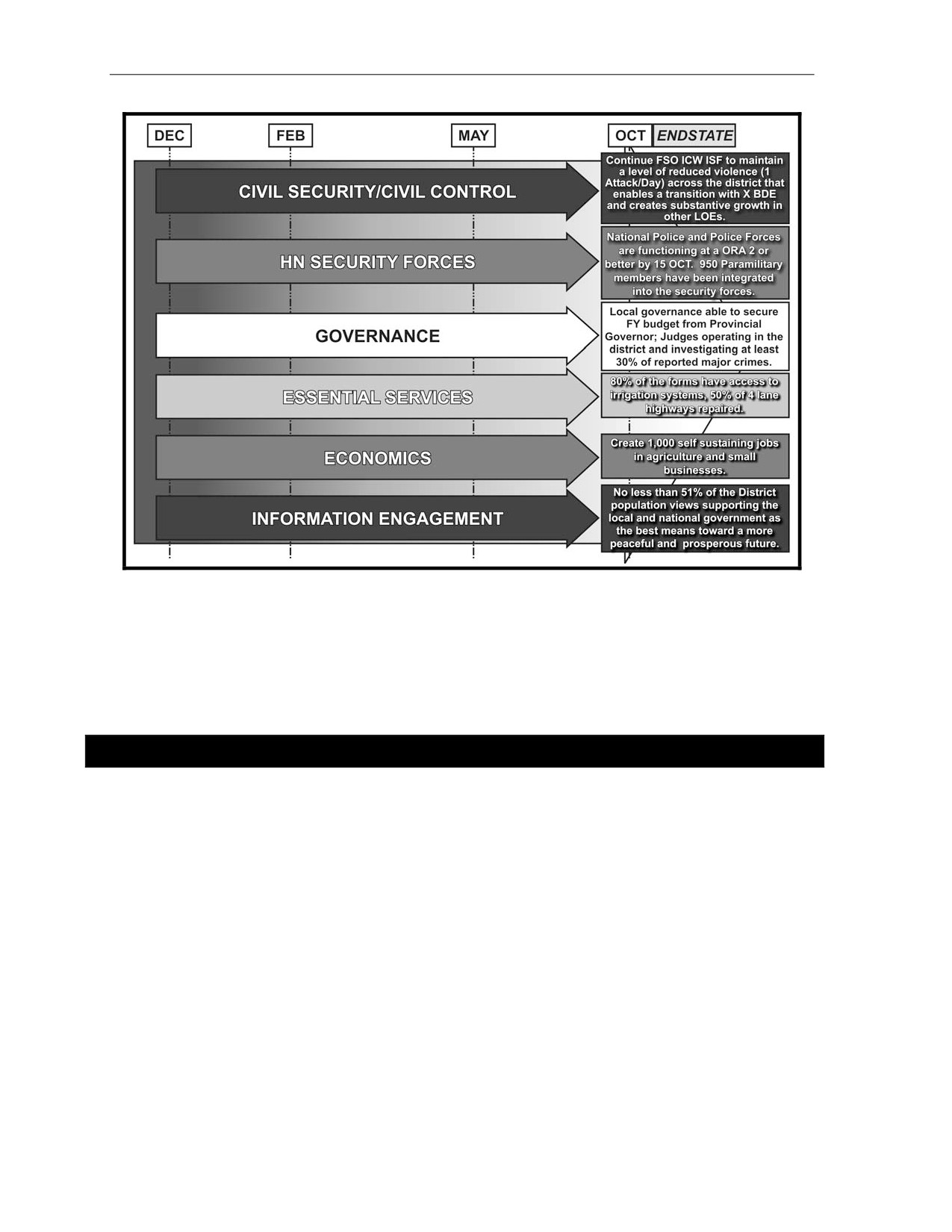
Chapter 7
Figure 7-1. Example BCT using LOEs.
CLEAR-HOLD-BUILD OPERATIONS
7-2.
In a clear-hold-build operation, stability operations are conducted in the “clear” phase, “hold”
phase, and the “build” phase. In the “build” phase, which focuses on building HN capacity and capabilities,
stability operations are primary, although offensive operations and defensive operations occur
simultaneously. Stability operations address multiple COIN LOEs.
Section II—FIVE PRIMARY STABILITY TASKS
All five primary stability tasks are used during counterinsurgency operations, normally as individual lines
of effort. However, since each counterinsurgency, each insurgency, and even individual units and leaders are
different, how these five stability tasks are applied and managed as individual lines of efforts may vary
considerably. The five stability tasks follow:
• Establish civil security.
• Establish civil control.
• Support to governance.
• Restore essential services.
• Support to economic and infrastructure development.
ESTABLISH CIVIL SECURITY
7-3.
Counterinsurgent forces seek to create a safe, secure, and stable environment for the local
populace. Key to this is the development of security institutions, or in their absence performing the duties
normally associated with those institutions until those capabilities are developed or transitioned to HN, UN
or other US agencies. Ultimately, the Host Nation must secure its own people. Civil security involves
protecting areas, resources, and the populace from both external and internal threats. Ideally, Army forces
focus on the external threats while police and security elements address internal security threats by
7-2
FM 3-24.2
21 April 2009
Stability Operations Considerations in Counterinsurgency
criminals and small, hostile groups. However, during an insurgency, the Army must now also address the
internal security threats by criminals and small, hostile groups—notably the armed insurgents.
SUBORDINATE TASKS
7-4.
Typical civil security subordinate tasks a counterinsurgent unit may perform are as follows
(combat-oriented techniques for establish civil security are covered in Chapter 6):
• Enforce cessation of hostilities.
• Enforce peace agreements and other arrangements.
• Conduct disarmament, demobilization, and reintegration
• Conduct border control, boundary security, and freedom of movement.
• Support identification.
• Protect key personnel and facilities.
• Clear explosive and CBRN hazards.
ENFORCE CESSATION OF HOSTILITIES, PEACE AGREEMENTS, AND OTHER ARRANGEMENTS
7-5.
These tasks aid in providing security and stability after an armed conflict, while at the same time
setting the conditions needed to start disarming, demobilization, and reintegration. These tasks are critical
to providing effective security for the local populace by reducing their exposure to the threat of violent
conflict. The tasks help military forces establish a sustained peace by focusing on processes and activities
fundamental to conflict transformation. In COIN, most efforts focus on identifying and neutralizing
potential adversaries. For instance, in Iraq from 2003 to 2005, US forces fought a Sunni insurgency
comprised of many members of the former regime’s security apparatus. The list of essential tasks
may include—
• Enforce cease fires.
• Supervise disengagement of belligerent forces
• Identify and neutralize potential adversaries.
• Provide security for negotiations.
Conduct Disarmament, Demobilization, and Reintegration
7-6.
These tasks are fundamental to establishing stability and lasting peace. It includes physically
disbanding guerrillas and reintegrating them into society. Other elements do not carry weapons; however,
they support the guerrilla forces. Their communities and families perceive them as part of the insurgency.
Together, the tasks of disarmament, demobilization, and reintegration reduce a potential resurgence
of insurgency. These tasks provide a means for these individuals and groups to reenter society
as contributing members. Some of these tasks could also be used for the demobilization of HN paramilitary
forces. For more on HN paramilitary forces, see Chapter 8. Essential tasks may include—
• Negotiate arrangements with insurgents.
• Establish and enforce weapons control programs, including collection and destruction.
• Provide reassurances and incentives for disarmed groups.
• Establish a monitoring program.
• Ensure adequate health, food, and security for former insurgents.
• Disarm former insurgents or HN paramilitary forces.
• Reduce availability of unauthorized weapons.
• Reintegrate former insurgents and HN paramilitary forces and dislocated civilians into society.
• Secure, store, and dispose of weapons.
• Develop HN arms control capacity.
21 April 2009
FM 3-24.2
7-3
Chapter 7
Establish Border Control, Border Security, and Freedom of Movement
7-7.
A central component of civil security is the ability of the HN to monitor and regulate its borders.
Generally, border and coast guard forces secure national boundaries while customs officials regulate the
flow of people, animals, and goods across state borders. These border controls are necessary to regulate
immigration, control the movements of the local populace, collect excise taxes or duties, limit smuggling,
and control the spread of disease vectors through quarantine. In COIN, the ability for the counterinsurgent
to control the borders reduces the effectiveness of the external support for the insurgency. Essential tasks
may include—
• Establish border control and boundary security.
• Establish and disseminate rules relevant to movement.
• Dismantle roadblocks and establish checkpoints.
• Ensure freedom of movement.
Support Identification
7-8.
This task complements efforts to vet Host Nation personnel, encourage participation
in representative government, resolve property disputes, and validate professional credentials. Although
vital to other programs for rebuilding a functioning civil society, identification programs are equally
important to civil security. After the collapse of an authoritarian or hostile regime, these programs ensure
that potential adversaries do not inadvertently reintegrate into society. Thus, they are deprived of the ability
to sow the seeds of a future insurgency. It is a key part of populace and resource control operations.
Tactical units often do this by conducting a census with biometric assets. Essential tasks may include—
• Secure documents relating to personal identification, property ownership, court records, voter
registries, professional certificates, birth records, and driving licenses.
• Establish identification program.
• Ensure individuals have personal forms of identification.
Protect Key Personnel and Facilities
7-9.
In COIN, military forces may extend protection and support to the HN population to ensure their
continued contribution to the overall stability operation. In the interest of transparency, military forces
specifically request and carefully negotiate this protection. Similarly, the long-term success of any
counterinsurgency often relies on the ability of the security force to protect and maintain critical
infrastructure until the HN government can resume that responsibility. Essential tasks may include
identifying, securing, protecting, and coordinating disposition for stockpiles of munitions and CBRN
materiel and precursors; facilities; and adversaries with technical expertise as well as the following:
• Protect—
Government-sponsored civilian reconstruction and stabilization personnel.
Contractor and civilian reconstruction and stabilization personnel and resources.
• Protect and secure—
Places of religious worship and cultural sites.
Critical infrastructure, natural resources, civil registries, and property ownership documents.
Strategically important institutions (such as government buildings; medical and public health
infrastructure; the central bank, national treasury, and integral commercial banks;
museums; and religious sites).
Military depots, equipment, ammunition dumps, and means of communications.
• Build Host Nation capacity to protect—
Civilian reconstruction and stabilization personnel.
Infrastructure and public institutions.
Military infrastructure.
7-4
FM 3-24.2
21 April 2009
Stability Operations Considerations in Counterinsurgency
Clear Explosive and CBRN Hazards
7-10.
To an HN combatting an insurgency, the presence of explosive hazards (including minefields,
IEDs, and unexploded ordnance) and CBRN hazards (resulting from intentional or accidental release)
inflicts stress that the surviving institutions cannot bear. These hazards restrict freedom of movement,
hinder international trade, and detract from the ability of an HN government to secure its population
and borders. Military forces may clear unexploded ordnance and other explosive hazards to facilitate
capacity-building activities. Removing these hazards ensures the safety, security, and well-being of the
local populace. Essential tasks may include—
• Establish an explosive hazards coordination cell.
• Conduct emergency clearing of mines, IEDs, unexploded ordnance, and other explosive
hazards.
• Map, survey, and mark mined areas, unexploded ordnance, and other explosive hazards.
• Remediate hazards remaining from the release of CBRN hazards and radiological fallout,
as well as provide decontamination support.
• Create Host Nation capacity to conduct demining.
• Build Host Nation capability to export demining expertise.
ESTABLISH CIVIL CONTROL
7-11.
This task regulates selected behavior and activities of individuals and groups. This control reduces
risk to individuals or groups and promotes security. Civil control channels the population’s activities
to allow provision of security and essential services while coexisting with a military force conducting
operations
(FM 3-0). A top priority for military forces conducting stability operations during a
counterinsurgency will be the re-establishment of legal and justice systems to help aid with security sector
reform. Units may find themselves involved with corrections activities, establishing public order
and safety, resolving property disputes, and supporting reconciliation efforts. Most military efforts focus on
building temporary or interim capabilities until more permanent capabilities are put in place by either the
Host Nation or US and international agencies.
SUBORDINATE TASKS
7-12.
Typical civil control subordinate tasks a counterinsurgent unit may perform are—
• Establish public order and safety.
• Establish interim criminal justice system.
• Support law enforcement and police reform.
• Support judicial reform.
• Support property dispute resolution processes.
• Support corrections reform.
• Support public outreach and community rebuilding programs.
Establish Public Order and Safety
7-13.
These tasks provide a broad range of activities to protect the civilian populace, provide interim
policing and crowd control, and secure critical infrastructure. These essential tasks represent actions that
must occur during and after an insurgency to ensure the long-term sustainability of any reform efforts. The
speed and effectiveness in performing these tasks directly correlates with the length of time to defeat the
insurgency. Executing these tasks as soon as practical after intervening reduces the time required
for related efforts and allows the mission to be accomplished far sooner. However, the military’s legal
authorities for all activities in the justice sector, particularly involving enforcement and adjudication of the
law, must be clear. Essential tasks may include—
• Secure the population.
• Ensure humanitarian aid and security forces reach endangered populations and refugee camps.
• Perform civilian police functions, including investigating crimes and making arrests.
21 April 2009
FM 3-24.2
7-5